EP3802985B1 - Method of attaching a lining to the interior surface of a room - Google Patents
Method of attaching a lining to the interior surface of a room Download PDFInfo
- Publication number
- EP3802985B1 EP3802985B1 EP18732657.4A EP18732657A EP3802985B1 EP 3802985 B1 EP3802985 B1 EP 3802985B1 EP 18732657 A EP18732657 A EP 18732657A EP 3802985 B1 EP3802985 B1 EP 3802985B1
- Authority
- EP
- European Patent Office
- Prior art keywords
- lining
- sheet
- interior surface
- glue dots
- attaching
- Prior art date
- Legal status (The legal status is an assumption and is not a legal conclusion. Google has not performed a legal analysis and makes no representation as to the accuracy of the status listed.)
- Active
Links
Images

Classifications
-
- E—FIXED CONSTRUCTIONS
- E04—BUILDING
- E04F—FINISHING WORK ON BUILDINGS, e.g. STAIRS, FLOORS
- E04F13/00—Coverings or linings, e.g. for walls or ceilings
- E04F13/002—Coverings or linings, e.g. for walls or ceilings made of webs, e.g. of fabrics, or wallpaper, used as coverings or linings
-
- E—FIXED CONSTRUCTIONS
- E04—BUILDING
- E04B—GENERAL BUILDING CONSTRUCTIONS; WALLS, e.g. PARTITIONS; ROOFS; FLOORS; CEILINGS; INSULATION OR OTHER PROTECTION OF BUILDINGS
- E04B1/00—Constructions in general; Structures which are not restricted either to walls, e.g. partitions, or floors or ceilings or roofs
- E04B1/62—Insulation or other protection; Elements or use of specified material therefor
- E04B1/74—Heat, sound or noise insulation, absorption, or reflection; Other building methods affording favourable thermal or acoustical conditions, e.g. accumulating of heat within walls
- E04B1/82—Heat, sound or noise insulation, absorption, or reflection; Other building methods affording favourable thermal or acoustical conditions, e.g. accumulating of heat within walls specifically with respect to sound only
- E04B1/84—Sound-absorbing elements
- E04B1/8409—Sound-absorbing elements sheet-shaped
-
- E—FIXED CONSTRUCTIONS
- E04—BUILDING
- E04B—GENERAL BUILDING CONSTRUCTIONS; WALLS, e.g. PARTITIONS; ROOFS; FLOORS; CEILINGS; INSULATION OR OTHER PROTECTION OF BUILDINGS
- E04B9/00—Ceilings; Construction of ceilings, e.g. false ceilings; Ceiling construction with regard to insulation
- E04B9/22—Connection of slabs, panels, sheets or the like to the supporting construction
- E04B9/24—Connection of slabs, panels, sheets or the like to the supporting construction with the slabs, panels, sheets or the like positioned on the upperside of, or held against the underside of the horizontal flanges of the supporting construction or accessory means connected thereto
-
- E—FIXED CONSTRUCTIONS
- E04—BUILDING
- E04F—FINISHING WORK ON BUILDINGS, e.g. STAIRS, FLOORS
- E04F13/00—Coverings or linings, e.g. for walls or ceilings
- E04F13/07—Coverings or linings, e.g. for walls or ceilings composed of covering or lining elements; Sub-structures therefor; Fastening means therefor
- E04F13/08—Coverings or linings, e.g. for walls or ceilings composed of covering or lining elements; Sub-structures therefor; Fastening means therefor composed of a plurality of similar covering or lining elements
- E04F13/0867—Coverings or linings, e.g. for walls or ceilings composed of covering or lining elements; Sub-structures therefor; Fastening means therefor composed of a plurality of similar covering or lining elements having acoustic absorption means on the visible surface
-
- E—FIXED CONSTRUCTIONS
- E04—BUILDING
- E04F—FINISHING WORK ON BUILDINGS, e.g. STAIRS, FLOORS
- E04F13/00—Coverings or linings, e.g. for walls or ceilings
- E04F13/07—Coverings or linings, e.g. for walls or ceilings composed of covering or lining elements; Sub-structures therefor; Fastening means therefor
- E04F13/08—Coverings or linings, e.g. for walls or ceilings composed of covering or lining elements; Sub-structures therefor; Fastening means therefor composed of a plurality of similar covering or lining elements
- E04F13/0885—Coverings or linings, e.g. for walls or ceilings composed of covering or lining elements; Sub-structures therefor; Fastening means therefor composed of a plurality of similar covering or lining elements specially adapted for being adhesively fixed to the wall; Fastening means therefor; Fixing by means of plastics materials hardening after application
-
- B—PERFORMING OPERATIONS; TRANSPORTING
- B29—WORKING OF PLASTICS; WORKING OF SUBSTANCES IN A PLASTIC STATE IN GENERAL
- B29C—SHAPING OR JOINING OF PLASTICS; SHAPING OF MATERIAL IN A PLASTIC STATE, NOT OTHERWISE PROVIDED FOR; AFTER-TREATMENT OF THE SHAPED PRODUCTS, e.g. REPAIRING
- B29C65/00—Joining or sealing of preformed parts, e.g. welding of plastics materials; Apparatus therefor
- B29C65/48—Joining or sealing of preformed parts, e.g. welding of plastics materials; Apparatus therefor using adhesives, i.e. using supplementary joining material; solvent bonding
-
- B—PERFORMING OPERATIONS; TRANSPORTING
- B29—WORKING OF PLASTICS; WORKING OF SUBSTANCES IN A PLASTIC STATE IN GENERAL
- B29C—SHAPING OR JOINING OF PLASTICS; SHAPING OF MATERIAL IN A PLASTIC STATE, NOT OTHERWISE PROVIDED FOR; AFTER-TREATMENT OF THE SHAPED PRODUCTS, e.g. REPAIRING
- B29C65/00—Joining or sealing of preformed parts, e.g. welding of plastics materials; Apparatus therefor
- B29C65/48—Joining or sealing of preformed parts, e.g. welding of plastics materials; Apparatus therefor using adhesives, i.e. using supplementary joining material; solvent bonding
- B29C65/52—Joining or sealing of preformed parts, e.g. welding of plastics materials; Apparatus therefor using adhesives, i.e. using supplementary joining material; solvent bonding characterised by the way of applying the adhesive
- B29C65/526—Joining or sealing of preformed parts, e.g. welding of plastics materials; Apparatus therefor using adhesives, i.e. using supplementary joining material; solvent bonding characterised by the way of applying the adhesive by printing or by transfer from the surfaces of elements carrying the adhesive, e.g. using brushes, pads, rollers, stencils or silk screens
-
- B—PERFORMING OPERATIONS; TRANSPORTING
- B29—WORKING OF PLASTICS; WORKING OF SUBSTANCES IN A PLASTIC STATE IN GENERAL
- B29C—SHAPING OR JOINING OF PLASTICS; SHAPING OF MATERIAL IN A PLASTIC STATE, NOT OTHERWISE PROVIDED FOR; AFTER-TREATMENT OF THE SHAPED PRODUCTS, e.g. REPAIRING
- B29C65/00—Joining or sealing of preformed parts, e.g. welding of plastics materials; Apparatus therefor
- B29C65/74—Joining or sealing of preformed parts, e.g. welding of plastics materials; Apparatus therefor by welding and severing, or by joining and severing, the severing being performed in the area to be joined, next to the area to be joined, in the joint area or next to the joint area
-
- B—PERFORMING OPERATIONS; TRANSPORTING
- B32—LAYERED PRODUCTS
- B32B—LAYERED PRODUCTS, i.e. PRODUCTS BUILT-UP OF STRATA OF FLAT OR NON-FLAT, e.g. CELLULAR OR HONEYCOMB, FORM
- B32B43/00—Operations specially adapted for layered products and not otherwise provided for, e.g. repairing; Apparatus therefor
- B32B43/006—Delaminating
-
- E—FIXED CONSTRUCTIONS
- E04—BUILDING
- E04B—GENERAL BUILDING CONSTRUCTIONS; WALLS, e.g. PARTITIONS; ROOFS; FLOORS; CEILINGS; INSULATION OR OTHER PROTECTION OF BUILDINGS
- E04B1/00—Constructions in general; Structures which are not restricted either to walls, e.g. partitions, or floors or ceilings or roofs
- E04B1/62—Insulation or other protection; Elements or use of specified material therefor
- E04B1/74—Heat, sound or noise insulation, absorption, or reflection; Other building methods affording favourable thermal or acoustical conditions, e.g. accumulating of heat within walls
- E04B1/76—Heat, sound or noise insulation, absorption, or reflection; Other building methods affording favourable thermal or acoustical conditions, e.g. accumulating of heat within walls specifically with respect to heat only
- E04B1/7675—Insulating linings for the interior face of exterior walls
-
- E—FIXED CONSTRUCTIONS
- E04—BUILDING
- E04B—GENERAL BUILDING CONSTRUCTIONS; WALLS, e.g. PARTITIONS; ROOFS; FLOORS; CEILINGS; INSULATION OR OTHER PROTECTION OF BUILDINGS
- E04B1/00—Constructions in general; Structures which are not restricted either to walls, e.g. partitions, or floors or ceilings or roofs
- E04B1/62—Insulation or other protection; Elements or use of specified material therefor
- E04B1/74—Heat, sound or noise insulation, absorption, or reflection; Other building methods affording favourable thermal or acoustical conditions, e.g. accumulating of heat within walls
- E04B1/82—Heat, sound or noise insulation, absorption, or reflection; Other building methods affording favourable thermal or acoustical conditions, e.g. accumulating of heat within walls specifically with respect to sound only
- E04B1/84—Sound-absorbing elements
- E04B1/86—Sound-absorbing elements slab-shaped
-
- E—FIXED CONSTRUCTIONS
- E04—BUILDING
- E04B—GENERAL BUILDING CONSTRUCTIONS; WALLS, e.g. PARTITIONS; ROOFS; FLOORS; CEILINGS; INSULATION OR OTHER PROTECTION OF BUILDINGS
- E04B9/00—Ceilings; Construction of ceilings, e.g. false ceilings; Ceiling construction with regard to insulation
- E04B9/001—Ceilings; Construction of ceilings, e.g. false ceilings; Ceiling construction with regard to insulation characterised by provisions for heat or sound insulation
-
- Y—GENERAL TAGGING OF NEW TECHNOLOGICAL DEVELOPMENTS; GENERAL TAGGING OF CROSS-SECTIONAL TECHNOLOGIES SPANNING OVER SEVERAL SECTIONS OF THE IPC; TECHNICAL SUBJECTS COVERED BY FORMER USPC CROSS-REFERENCE ART COLLECTIONS [XRACs] AND DIGESTS
- Y10—TECHNICAL SUBJECTS COVERED BY FORMER USPC
- Y10T—TECHNICAL SUBJECTS COVERED BY FORMER US CLASSIFICATION
- Y10T156/00—Adhesive bonding and miscellaneous chemical manufacture
- Y10T156/11—Methods of delaminating, per se; i.e., separating at bonding face
- Y10T156/1168—Gripping and pulling work apart during delaminating
- Y10T156/1195—Delaminating from release surface
-
- Y—GENERAL TAGGING OF NEW TECHNOLOGICAL DEVELOPMENTS; GENERAL TAGGING OF CROSS-SECTIONAL TECHNOLOGIES SPANNING OVER SEVERAL SECTIONS OF THE IPC; TECHNICAL SUBJECTS COVERED BY FORMER USPC CROSS-REFERENCE ART COLLECTIONS [XRACs] AND DIGESTS
- Y10—TECHNICAL SUBJECTS COVERED BY FORMER USPC
- Y10T—TECHNICAL SUBJECTS COVERED BY FORMER US CLASSIFICATION
- Y10T156/00—Adhesive bonding and miscellaneous chemical manufacture
- Y10T156/19—Delaminating means
- Y10T156/1994—Means for delaminating from release surface
Definitions
- the invention relates to a method of attaching a lining to an interior surface of a room according to the independent claim.
- the invention relates to the technical field of methods for interior constructions and in particular to methods for the attachment of a lining for covering a wall or a ceiling of the room.
- Such a method can be used for example in case of the attachment of a lining to an acoustic ceiling.
- perforated building panels i. e. perforated gypsum plasterboards
- Such an acoustic plasterboard has a plurality of perforations shaped therein extending nearly over the entire surface. The perforations are visually dominant which is disadvantageous for many uses.
- WO 2015 172 799 A1 It is known from WO 2015 172 799 A1 to provide a sound-permeable lining for covering perforations shaped in an acoustic plasterboard.
- the sound-permeable lining is attached so as to cover perforations shaped in the applied acoustic plasterboard.
- the sound-permeable lining comprises a first ply of a fleece material and a second ply which is arranged in between of the first ply and the acoustic plasterboard to which the sound-permeable lining is attached.
- the sound-permeable lining is attached to the mounted acoustic plasterboards in the same manner as wallpaper.
- the wallpaper is attached in strips to the wall or ceiling by cutting the wallpaper to a predetermined length before attachment.
- the object of the invention is therefore to provide a method for attaching a lining an interior surface in a room covering at least in part said interior surface which overcomes or at least reduces the disadvantages known from the prior art.
- it is a method for the attachment of a lining to a wall or ceiling without the need of a liquid glue.
- the invention comprises a method of attaching a lining to an interior surface of a room.
- the method includes the steps of:
- the glue dots are pressure sensitive adhesives (i.e. hot melt pressure sensitive adhesive) and/or temperature activable adhesives.
- the glue dots preferably have a size range from 0.1 to 3.0 mm. They can be arranged in a regular pattern, for example of 3 to 100 dpi dots per inch (equal to about 1-40 dots per cm).
- the glue dots preferably have an adhesive base weight of 10 to 150 g/m 2 .
- the step of applying a plurality of glue dots comprises applying a transfer sheet with the plurality of glue dots onto the interior surface or onto the first sheet of lining and removing a release sheet which is part of the transfer sheet to leave the plurality of glue dots on the interior surface or on the first sheet of lining.
- the transfer sheet allows storing the glue dots on the release sheet as "ready to apply/', so the glue dots can be applied immediately before the attachment of the lining.
- the release sheet is made of silicone paper or silicone foil.
- the release sheet can be made of any material suitable to release the glue dots when applied to an interior surface or a sheet of lining.
- the method further comprises the step of pressing the first sheet of lining to the interior surface.
- the strength of the adhesion between the surface and the lining can be increased by the application of pressure.
- the step of pressing the first sheet of lining to the interior surface is carried out with a roller, a trowel or a brush.
- a trowel is a tool which is normally already present during the attachment of the lining and allows for appling a high pressure.
- a brush allows for applying pressure in a very uniform manner.
- a roller allows for applying pressure with a soft outer surface.
- the step of removing the release sheet from the transfer sheet is carried out in presence of heat.
- the release sheet is peeled off from the surface to which the transfer sheet is applied, while the glue dots stay attached to the surface.
- the heat can be applied by use of a dryer, i. e. a hairdryer or an infrared heater.
- the method further comprises the step of covering the glue dots, which are arranged such that they get in contact with an edge section of the first sheet of the attached lining, with a cover tape.
- the cover tape prevents the glue dots from sticking to the interior surface and the lining at the same time, thus allowing for the lining to be cut to the appropriate size while already partly attached to the surface.
- the remaining cover tape is removed after the cut, and the edges of the second and the first sheet of lining are finally glued to the interior surface.
- the method comprises the step of attaching a second sheet of lining to the interior surface adjacent to the first sheet of lining in the same manner.
- the second sheet of lining is attached to the interior surface adjacent to the first sheet of the lining in such that the sheets partly overlap.
- the overlap is preferably in such a manner that the respective edge portions of the first and the second sheet of lining are arranged in a parallel manner.
- the minimum overlap distance of the respective edge portions is 0.5 cm.
- the method further comprises the step of cutting the second sheet of lining overlapping with the first sheet of lining simultaneously in one single cut.
- a cutter device can be used. The overlapping portions are pressed together and a cut through both sheets at the same time and while they overlap is carried out, i.e. simultaneously in one single cut.
- the step of cutting the second sheet of lining and the first sheet of lining while overlapping comprises the application of a marker tape.
- the marker tape allows marking the line along which the cut is carried out.
- the marker tape can for example have a width in the range of 0.5 cm to 5 cm.
- first and second sheet of lining particularly preferably the step of removing the cover tape and pressing the bordering sections of the second sheet and the first sheet of lining onto the interior surface is carried out. Due to the complementarily cut edges a nearly invisible border section is achieved.
- a further sheet of lining can be correspondingly attached adjacent to an already attached sheet of lining.
- the interior surface is an acoustic ceiling made of perforated building panels.
- the step of cutting the second sheet of lining overlapping with the first sheet of lining simultaneously in one single cut is preferably carried out along the bridge portions of the ceiling panels that border adjacent perforations.
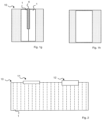
- Fig. 1a to 1h the method of attaching a lining to an interior surface 10 of a room is exemplified by attaching a lining to a section of a ceiling surface 10 of a room.
- a plurality of glue dots 2 is applied to to the interior surface 10.
- the step of applying a plurality of glue dots 2 comprises applying a transfer sheet 21 comprising the plurality of glue dots 2 onto the interior surface 10 and removing a release sheet of the transfer sheet 21 leaving the plurality of glue dots on the interior surface 10.
- the transfer sheet 21 comprises a release sheet 21 made of a silicon paper to which the glue dots 2 adhere.
- the transfer sheet 21 can be applied in strips in a parallel manner, wherein the removal of the transfer sheet 21 is carried out in the presence of heat, e. g. by use of a hairdryer. Alternatively, the transfer sheet can have any other convenient size.
- Figure 1b illustrates the step of covering the glue dots 2 which are arranged such that they get in contact with an edge section of the applied first sheet of lining 1 with a cover tape 4.
- Figure 1c illustrates the step of attaching the first sheet of the lining 1 to the interior surface 10 in such a manner that the first sheet of lining 1 is fixed at least partly to the interior surface 10 via the glue dots 2.
- the edge section of the first sheet of lining 1 overlapping the cover tape 4 is not yet fixed to the interior surface 10.
- Figure 1d illustrates the step of attaching a second sheet of lining 1 to the interior surface 10 adjacent to the first sheet of lining 1.
- the second sheet of lining 1 is at least partly attached to the interior surface 10 adjacent to the first sheet of the lining 1.
- the edges of the first and the second sheet of lining partly overlap.
- Figure 1e illustrates the application of a marker tape 5 on top of the edge portion of the lining 1.
- the marker tape 5 indicates the cutting line along which the cut is directed.
- the actual cut can for example be carried out along one of its edges. If the interior ceiling is made of acoustic panels with perforations, preferably the cut is made along the bridge portions that border adjacent perforations of the perforated acoustic panel.
- the cut can be carried out in the middle of the cover tape 4 or along one of its edges.
- Figure 1f illustrates the step of cutting the second sheet of lining 1 overlapping the first sheet of lining 1 simultaneously in one single cut.
- Figure 1g illustrates the removal of the cover tape 4 after the cut, wherein in the present illustration the cover tape 4 is half pulled out from between of the edges of the linings. After the cover tape 4 has been removed, the edges of the linings can be attached to the formerly covered glue dots.
- Figure 1h illustrates a ceiling 10 of a room with attached adjacent strips of linings after cutting and the removal of cover tape.
- a ceiling 10 of a room is shown having attached thereto a plurality of the linings 1.
- the room has a window 11 and a door 12 to exemplify the arrangement of the linings in such a room.
Landscapes
- Engineering & Computer Science (AREA)
- Architecture (AREA)
- Civil Engineering (AREA)
- Structural Engineering (AREA)
- Physics & Mathematics (AREA)
- Acoustics & Sound (AREA)
- Electromagnetism (AREA)
- Finishing Walls (AREA)
- Vehicle Interior And Exterior Ornaments, Soundproofing, And Insulation (AREA)
Description
- The invention relates to a method of attaching a lining to an interior surface of a room according to the independent claim.
- The invention relates to the technical field of methods for interior constructions and in particular to methods for the attachment of a lining for covering a wall or a ceiling of the room.
- Such a method can be used for example in case of the attachment of a lining to an acoustic ceiling. It is known to apply perforated building panels (i. e. perforated gypsum plasterboards) specifically in the construction of acoustic ceilings or walls. Such an acoustic plasterboard has a plurality of perforations shaped therein extending nearly over the entire surface. The perforations are visually dominant which is disadvantageous for many uses.
- It is known from
WO 2015 172 799 A1 to provide a sound-permeable lining for covering perforations shaped in an acoustic plasterboard. For providing an optically closed surface, the sound-permeable lining is attached so as to cover perforations shaped in the applied acoustic plasterboard. The sound-permeable lining comprises a first ply of a fleece material and a second ply which is arranged in between of the first ply and the acoustic plasterboard to which the sound-permeable lining is attached. - In principle, the sound-permeable lining is attached to the mounted acoustic plasterboards in the same manner as wallpaper. The wallpaper is attached in strips to the wall or ceiling by cutting the wallpaper to a predetermined length before attachment.
- Contrary to conventional methods for attachment of wallpapers such a sound permeable lining cannot be attached by use of liquid glue because liquid glue would close the surface of the sound permeable lining and prevents the penetration of air. Another problem with sound permeable lining attached in this manner is, that the
wet glue 5 causes shadow areas after drying out. Shadow areas have a slightly different color than the neighboring areas so they are easily perceivable with the human eye. - The documents
WO 2018 072 278 A1 ,CA 2 135 016 A1CN 206 267 449 A1 andDE 33 28 165 A1 describe known methods of attaching a lining to an interior surface of a room according to the preamble ofclaim 1. - The object of the invention is therefore to provide a method for attaching a lining an interior surface in a room covering at least in part said interior surface which overcomes or at least reduces the disadvantages known from the prior art. In particular it is a method for the attachment of a lining to a wall or ceiling without the need of a liquid glue.
- The problem is solved by a method for attaching of a lining for covering an interior surface of a room, i.e. wall or ceiling according to the independent claim. Preferred technical aspects form the subject matter of the respective dependent claims.
- The invention comprises a method of attaching a lining to an interior surface of a room.
- The method includes the steps of:
- providing a first sheet of lining to be applied/attached to the interior surface; (and thereafter)
- applying a plurality of glue dots to the interior surface or to the first sheet of lining; and (thereafter)
- attaching the first sheet of lining to the interior surface in such a manner that the first sheet of lining is fixed to the interior surface via the glue dots.
- The application of the plurality of glue dots to the interior surface or to the sheet of lining overcomes the disadvantages related to the use of liquid glue. Preferably, the glue dots are pressure sensitive adhesives (i.e. hot melt pressure sensitive adhesive) and/or temperature activable adhesives. The glue dots preferably have a size range from 0.1 to 3.0 mm. They can be arranged in a regular pattern, for example of 3 to 100 dpi dots per inch (equal to about 1-40 dots per cm). The glue dots preferably have an adhesive base weight of 10 to 150 g/m 2. By attaching the first sheet of lining to the interior surface in such a manner that the first sheet of lining is fixed to the interior surface via the glue dots, no shadow areas occur. The alternative of applying a plurality of glue dots to the interior surface is particularly advantageous in case of perforated building panels because the glue dots are only applied at contact areas between the lining and the perforated building panel and do not cover the entire lining surface.
- According to the invention, the step of applying a plurality of glue dots comprises applying a transfer sheet with the plurality of glue dots onto the interior surface or onto the first sheet of lining and removing a release sheet which is part of the transfer sheet to leave the plurality of glue dots on the interior surface or on the first sheet of lining. The transfer sheet allows storing the glue dots on the release sheet as "ready to apply/', so the glue dots can be applied immediately before the attachment of the lining. Preferably, the release sheet is made of silicone paper or silicone foil.
- However, the release sheet can be made of any material suitable to release the glue dots when applied to an interior surface or a sheet of lining.
- According to a preferred technical aspect, the method further comprises the step of pressing the first sheet of lining to the interior surface. In particular in case of pressure sensitive adhesive glue dots, the strength of the adhesion between the surface and the lining can be increased by the application of pressure.
- It is particularly preferred that the step of pressing the first sheet of lining to the interior surface is carried out with a roller, a trowel or a brush. A trowel is a tool which is normally already present during the attachment of the lining and allows for appling a high pressure. A brush allows for applying pressure in a very uniform manner. A roller allows for applying pressure with a soft outer surface.
- Preferably, the step of removing the release sheet from the transfer sheet is carried out in presence of heat. After the application of the transfer sheet to the interior surface or the sheet of lining, the release sheet is peeled off from the surface to which the transfer sheet is applied, while the glue dots stay attached to the surface. The heat can be applied by use of a dryer, i. e. a hairdryer or an infrared heater.
- It is particularly preferred that the method further comprises the step of covering the glue dots, which are arranged such that they get in contact with an edge section of the first sheet of the attached lining, with a cover tape. The cover tape prevents the glue dots from sticking to the interior surface and the lining at the same time, thus allowing for the lining to be cut to the appropriate size while already partly attached to the surface. The remaining cover tape is removed after the cut, and the edges of the second and the first sheet of lining are finally glued to the interior surface.
- According to another particularly preferred aspect, the method comprises the step of attaching a second sheet of lining to the interior surface adjacent to the first sheet of lining in the same manner.
- Advantageously, the second sheet of lining is attached to the interior surface adjacent to the first sheet of the lining in such that the sheets partly overlap. The overlap is preferably in such a manner that the respective edge portions of the first and the second sheet of lining are arranged in a parallel manner. The minimum overlap distance of the respective edge portions is 0.5 cm.
- It is preferred that the method further comprises the step of cutting the second sheet of lining overlapping with the first sheet of lining simultaneously in one single cut. For example a cutter device can be used. The overlapping portions are pressed together and a cut through both sheets at the same time and while they overlap is carried out, i.e. simultaneously in one single cut.
- In a technically preferred aspect, the step of cutting the second sheet of lining and the first sheet of lining while overlapping comprises the application of a marker tape. The marker tape allows marking the line along which the cut is carried out. The marker tape can for example have a width in the range of 0.5 cm to 5 cm.
- After the "double" cut of first and second sheet of lining particularly preferably the step of removing the cover tape and pressing the bordering sections of the second sheet and the first sheet of lining onto the interior surface is carried out. Due to the complementarily cut edges a nearly invisible border section is achieved.
- According to another advantageous aspect a further sheet of lining can be correspondingly attached adjacent to an already attached sheet of lining.
- It is further preferred that the interior surface is an acoustic ceiling made of perforated building panels. In case of an acoustic ceiling, the step of cutting the second sheet of lining overlapping with the first sheet of lining simultaneously in one single cut is preferably carried out along the bridge portions of the ceiling panels that border adjacent perforations.
- In the following the invention will be explained in more detail with reference to the drawings. Like reference numerals denote similar features throughout the drawings.
- The drawings show:
- Fig. 1a-1h
- a view from below to a section of a ceiling to which a lining is attached according to the method of the invention; and
- Fig. 2
- a ceiling of a room with a plurality of attached sheets of lining.
- In
Fig. 1a to 1h the method of attaching a lining to aninterior surface 10 of a room is exemplified by attaching a lining to a section of aceiling surface 10 of a room. - In
Fig. 1a a plurality ofglue dots 2 is applied to to theinterior surface 10. The step of applying a plurality ofglue dots 2 comprises applying atransfer sheet 21 comprising the plurality ofglue dots 2 onto theinterior surface 10 and removing a release sheet of thetransfer sheet 21 leaving the plurality of glue dots on theinterior surface 10. Alternatively it is also possible to apply theglue dots 2 to the first sheet oflining 1. Thetransfer sheet 21 comprises arelease sheet 21 made of a silicon paper to which theglue dots 2 adhere. Thetransfer sheet 21 can be applied in strips in a parallel manner, wherein the removal of thetransfer sheet 21 is carried out in the presence of heat, e. g. by use of a hairdryer. Alternatively, the transfer sheet can have any other convenient size. -
Figure 1b illustrates the step of covering theglue dots 2 which are arranged such that they get in contact with an edge section of the applied first sheet of lining 1 with acover tape 4. -
Figure 1c illustrates the step of attaching the first sheet of thelining 1 to theinterior surface 10 in such a manner that the first sheet of lining 1 is fixed at least partly to theinterior surface 10 via theglue dots 2. The edge section of the first sheet of lining 1 overlapping thecover tape 4 is not yet fixed to theinterior surface 10. -
Figure 1d illustrates the step of attaching a second sheet of lining 1 to theinterior surface 10 adjacent to the first sheet oflining 1. The second sheet of lining 1 is at least partly attached to theinterior surface 10 adjacent to the first sheet of thelining 1. The edges of the first and the second sheet of lining partly overlap. -
Figure 1e illustrates the application of amarker tape 5 on top of the edge portion of thelining 1. Themarker tape 5 indicates the cutting line along which the cut is directed. The actual cut can for example be carried out along one of its edges. If the interior ceiling is made of acoustic panels with perforations, preferably the cut is made along the bridge portions that border adjacent perforations of the perforated acoustic panel. The cut can be carried out in the middle of thecover tape 4 or along one of its edges. -
Figure 1f illustrates the step of cutting the second sheet of lining 1 overlapping the first sheet of lining 1 simultaneously in one single cut.Figure 1g illustrates the removal of thecover tape 4 after the cut, wherein in the present illustration thecover tape 4 is half pulled out from between of the edges of the linings. After thecover tape 4 has been removed, the edges of the linings can be attached to the formerly covered glue dots. -
Figure 1h illustrates aceiling 10 of a room with attached adjacent strips of linings after cutting and the removal of cover tape. - In
Fig. 2 aceiling 10 of a room is shown having attached thereto a plurality of thelinings 1. The room has awindow 11 and adoor 12 to exemplify the arrangement of the linings in such a room.
Claims (11)
- Method of attaching a lining (1) to an interior surface (10) of a room comprising the steps of:- providing a first sheet of lining (1) to be applied to the interior surface (10);- applying a plurality of glue dots (2) to the interior surface (10) or to the first sheet of lining (1); and- attaching the first sheet of the lining (1) to the interior surface (10) such that the first sheet of lining (1) is fixed to the interior surface (10) via the glue dots (2),characterised in that the step of applying a plurality of glue dots (2) comprises applying a transfer sheet (21) with the plurality of glue dots (2) onto the interior surface (10) or the first sheet of lining (1) and removing a release sheet of the transfer sheet (21) leaving the plurality of glue dots on the interior surface (10) or the first sheet of lining (1).
- Method according to claim 1, further comprising the step of pressing the first sheet of lining (1) to the interior surface (10).
- Method according to claim 2, wherein the step of pressing the first sheet of lining (1) to the interior surface (10) is carried out with a roller, a trowel or a brush.
- Method according to claim 1, wherein the step of removing the release sheet of the transfer sheet (21) is carried out in the presence of heat.
- Method according to any one of the preceding claims, further comprising the step of covering the glue dots (2) that are arranged such that they get in contact with an edge section of the applied first sheet of lining (1) with a cover tape (4).
- Method according to any one of the preceding claims, further comprising the step of attaching a second sheet of lining (1) to the interior surface (10) adjacent to the first sheet of lining (1) in the same manner.
- Method according to claim 6, wherein the second sheet of lining (1) is attached to the interior surface (10) adjacent to the first sheet of the lining (1) such that the sheets partly overlap.
- Method according to claim 7, further comprising the step of cutting the second sheet of lining (1) overlapping with the first sheet of lining (1) simultaneously in one single cut.
- Method according to claim 8, wherein the step of cutting the second sheet of lining (1) and the first sheet of lining (1) while overlapping comprises the application of a marker tape (5).
- Method according to claim 8 or 9, further comprising the step of removing the cover tape (4) and pressing the bordering sections of the second sheet (1) and the first sheet of lining (1) onto the interior surface (10).
- Method according to any one of the preceding claims, wherein the interior surface (10) is an acoustic ceiling made of perforated building panels.
Applications Claiming Priority (2)
| Application Number | Priority Date | Filing Date | Title |
|---|---|---|---|
| EP2018000281 | 2018-05-30 | ||
| PCT/EP2018/000292 WO2019228603A1 (en) | 2018-05-30 | 2018-06-06 | Method of attaching a lining to the interior surface of a room |
Publications (3)
| Publication Number | Publication Date |
|---|---|
| EP3802985A1 EP3802985A1 (en) | 2021-04-14 |
| EP3802985C0 EP3802985C0 (en) | 2023-08-02 |
| EP3802985B1 true EP3802985B1 (en) | 2023-08-02 |
Family
ID=68697856
Family Applications (1)
| Application Number | Title | Priority Date | Filing Date |
|---|---|---|---|
| EP18732657.4A Active EP3802985B1 (en) | 2018-05-30 | 2018-06-06 | Method of attaching a lining to the interior surface of a room |
Country Status (8)
| Country | Link |
|---|---|
| US (1) | US12110691B2 (en) |
| EP (1) | EP3802985B1 (en) |
| JP (1) | JP7358383B2 (en) |
| AR (1) | AR115446A1 (en) |
| CA (1) | CA3095324A1 (en) |
| MX (1) | MX2020010138A (en) |
| PL (1) | PL3802985T3 (en) |
| WO (1) | WO2019228603A1 (en) |
Family Cites Families (22)
| Publication number | Priority date | Publication date | Assignee | Title |
|---|---|---|---|---|
| DE3328165A1 (en) | 1982-09-24 | 1985-02-14 | Teppich-Werk Neumünster GmbH, 2350 Neumünster | COATING FOR A SURFACE TO BE COVERED |
| JPH0430633U (en) * | 1990-07-10 | 1992-03-12 | ||
| KR100219954B1 (en) * | 1991-09-12 | 1999-09-01 | 스프레이그 로버트 월터 | Patterned pressure sensitive adhesive transfer tape |
| CA2135016C (en) | 1994-07-29 | 2007-01-16 | George Rusincovitch, Jr. | Repositionable wall covering |
| JPH11303240A (en) * | 1998-04-17 | 1999-11-02 | Shinkoo Kyusyu Kk | Sound absorption wall surface material, its manufacture and execution of sound absorption wall |
| US6984427B2 (en) * | 2002-01-10 | 2006-01-10 | 3M Innovative Properties Company | Microstructed release liner |
| JP4290047B2 (en) | 2004-03-22 | 2009-07-01 | 積水ハウス株式会社 | Interior finishing material pasting method and adhesive material for interior finishing material pasting |
| US8163365B2 (en) * | 2005-03-24 | 2012-04-24 | Nastar Inc. | Repositionable labels using dot patterned adhesive |
| NL1031112C2 (en) * | 2006-02-09 | 2007-08-10 | Multifoil Bv | Tape and method for manufacturing thereof. |
| JP5154825B2 (en) | 2007-04-25 | 2013-02-27 | 株式会社菊池襖紙工場 | Wallpaper and its construction method |
| US8522509B2 (en) * | 2009-03-09 | 2013-09-03 | Custom Building Products, Inc. | Mortarless tile installation system and method for installing tiles |
| US8490356B2 (en) * | 2009-03-09 | 2013-07-23 | Custom Building Products, Inc. | Mortarless tile installation system and method for installing tiles |
| JP2010248316A (en) * | 2009-04-13 | 2010-11-04 | Kokuyo Co Ltd | Tacky sheet and transferring implement |
| ES2767320T3 (en) | 2014-05-15 | 2020-06-17 | Knauf Gips Kg | Sound-permeable coating for acoustic plasterboard |
| JP2016069854A (en) | 2014-09-29 | 2016-05-09 | アキレス株式会社 | Simply installed wallpaper |
| CN107107546B (en) * | 2014-12-18 | 2019-11-05 | 阿莫绿色技术有限公司 | Moisture-permeability waterproof fabric and its manufacturing method |
| JP6519191B2 (en) | 2015-01-19 | 2019-05-29 | 大日本印刷株式会社 | Decorative sheet for concrete structure |
| US9390700B1 (en) * | 2015-03-10 | 2016-07-12 | Awi Licensing Llc | Laminate acoustic panel |
| WO2017112438A1 (en) * | 2015-12-22 | 2017-06-29 | 3M Innovative Properties Company | Bonding layer having discrete adhesive patches |
| CN106437072A (en) | 2016-10-11 | 2017-02-22 | 广西福美新材料有限公司 | Flexible facing sheet with self-adhesive layer and production method of flexible facing sheet |
| CN206267449U (en) | 2016-12-09 | 2017-06-20 | 苏州衣大丽纺织科技有限公司 | A kind of wall paper |
| MX2020004115A (en) * | 2017-10-27 | 2020-09-25 | Knauf Gips Kg | FRIECE TAPE. |
-
2018
- 2018-06-06 JP JP2020555845A patent/JP7358383B2/en active Active
- 2018-06-06 CA CA3095324A patent/CA3095324A1/en not_active Abandoned
- 2018-06-06 WO PCT/EP2018/000292 patent/WO2019228603A1/en not_active Ceased
- 2018-06-06 US US17/057,557 patent/US12110691B2/en active Active
- 2018-06-06 PL PL18732657.4T patent/PL3802985T3/en unknown
- 2018-06-06 MX MX2020010138A patent/MX2020010138A/en unknown
- 2018-06-06 EP EP18732657.4A patent/EP3802985B1/en active Active
-
2019
- 2019-05-28 AR ARP190101455A patent/AR115446A1/en active IP Right Grant
Also Published As
| Publication number | Publication date |
|---|---|
| US12110691B2 (en) | 2024-10-08 |
| WO2019228603A1 (en) | 2019-12-05 |
| EP3802985A1 (en) | 2021-04-14 |
| EP3802985C0 (en) | 2023-08-02 |
| PL3802985T3 (en) | 2023-09-11 |
| JP2021533284A (en) | 2021-12-02 |
| JP7358383B2 (en) | 2023-10-10 |
| AR115446A1 (en) | 2021-01-20 |
| US20210198897A1 (en) | 2021-07-01 |
| CA3095324A1 (en) | 2019-12-05 |
| MX2020010138A (en) | 2020-10-19 |
Similar Documents
| Publication | Publication Date | Title |
|---|---|---|
| US5839250A (en) | Edge protector | |
| WO1998001634A1 (en) | Drywall tape with uncoverable absorbent layer | |
| JP2009535537A (en) | Drywall repair patch | |
| CA2245618A1 (en) | Method and apparatus for preventing adhesion of multi-part release liners | |
| KR20000052496A (en) | Improved waterproofing membrane having release sheet cutting system | |
| US20170138058A1 (en) | Drywall tape, method of making and method of using the same | |
| US12110691B2 (en) | Method of attaching a lining to the interior surface of a room | |
| CA3073230C (en) | Frieze tape | |
| WO2019082201A2 (en) | Self adhesive wall paper coated with reduced adhesive material and water soluble film | |
| CA2523349A1 (en) | Flexible flashing for multiplanar building surfaces | |
| JP2004506811A (en) | Self adhesive film | |
| EP3927908B1 (en) | Joint tape for attachment to a ceiling or a wall | |
| JP2001302999A (en) | Wall paper | |
| RU2787857C2 (en) | Tape for overlapping joints | |
| JP2005271585A (en) | Humidity adjustable noncombustible decorative laminate | |
| US20260117527A1 (en) | Wall covering, top layer and method | |
| WO2003042313A1 (en) | Adhesive sheet and method for producing the same | |
| JP6551904B2 (en) | Mounting method of backing sheet unit tile and tile surface | |
| JP2002194881A (en) | Decorative panel | |
| KR200256650Y1 (en) | Tile type wall plate | |
| JPH05133070A (en) | Finishing method utilizing facing surface material | |
| JPH04371267A (en) | Method for forming three-dimensional pattern | |
| JP2002213061A (en) | Wall surface construction method using panel with decroative sheet, and panel with decorative sheet used for this method | |
| JP2002276122A (en) | Wall-surface execution method using panel with decorative sheet | |
| JP2000054271A (en) | Linoleum material, its processing method and device |
Legal Events
| Date | Code | Title | Description |
|---|---|---|---|
| STAA | Information on the status of an ep patent application or granted ep patent |
Free format text: STATUS: UNKNOWN |
|
| STAA | Information on the status of an ep patent application or granted ep patent |
Free format text: STATUS: THE INTERNATIONAL PUBLICATION HAS BEEN MADE |
|
| PUAI | Public reference made under article 153(3) epc to a published international application that has entered the european phase |
Free format text: ORIGINAL CODE: 0009012 |
|
| STAA | Information on the status of an ep patent application or granted ep patent |
Free format text: STATUS: REQUEST FOR EXAMINATION WAS MADE |
|
| 17P | Request for examination filed |
Effective date: 20201028 |
|
| AK | Designated contracting states |
Kind code of ref document: A1 Designated state(s): AL AT BE BG CH CY CZ DE DK EE ES FI FR GB GR HR HU IE IS IT LI LT LU LV MC MK MT NL NO PL PT RO RS SE SI SK SM TR |
|
| AX | Request for extension of the european patent |
Extension state: BA ME |
|
| DAV | Request for validation of the european patent (deleted) | ||
| DAX | Request for extension of the european patent (deleted) | ||
| GRAP | Despatch of communication of intention to grant a patent |
Free format text: ORIGINAL CODE: EPIDOSNIGR1 |
|
| RIC1 | Information provided on ipc code assigned before grant |
Ipc: E04B 9/24 20060101ALI20221125BHEP Ipc: E04B 1/76 20060101ALI20221125BHEP Ipc: E04F 13/08 20060101ALI20221125BHEP Ipc: E04B 1/84 20060101ALI20221125BHEP Ipc: E04B 9/00 20060101ALI20221125BHEP Ipc: E04B 1/86 20060101ALI20221125BHEP Ipc: E04F 13/00 20060101AFI20221125BHEP |
|
| STAA | Information on the status of an ep patent application or granted ep patent |
Free format text: STATUS: GRANT OF PATENT IS INTENDED |
|
| INTG | Intention to grant announced |
Effective date: 20230105 |
|
| GRAS | Grant fee paid |
Free format text: ORIGINAL CODE: EPIDOSNIGR3 |
|
| GRAA | (expected) grant |
Free format text: ORIGINAL CODE: 0009210 |
|
| STAA | Information on the status of an ep patent application or granted ep patent |
Free format text: STATUS: THE PATENT HAS BEEN GRANTED |
|
| AK | Designated contracting states |
Kind code of ref document: B1 Designated state(s): AL AT BE BG CH CY CZ DE DK EE ES FI FR GB GR HR HU IE IS IT LI LT LU LV MC MK MT NL NO PL PT RO RS SE SI SK SM TR |
|
| REG | Reference to a national code |
Ref country code: GB Ref legal event code: FG4D |
|
| REG | Reference to a national code |
Ref country code: CH Ref legal event code: EP |
|
| REG | Reference to a national code |
Ref country code: DE Ref legal event code: R096 Ref document number: 602018054501 Country of ref document: DE |
|
| REG | Reference to a national code |
Ref country code: IE Ref legal event code: FG4D |
|
| U01 | Request for unitary effect filed |
Effective date: 20230802 |
|
| U07 | Unitary effect registered |
Designated state(s): AT BE BG DE DK EE FI FR IT LT LU LV MT NL PT SE SI Effective date: 20230807 |
|
| REG | Reference to a national code |
Ref country code: GR Ref legal event code: EP Ref document number: 20230401517 Country of ref document: GR Effective date: 20231113 |
|
| PG25 | Lapsed in a contracting state [announced via postgrant information from national office to epo] |
Ref country code: IS Free format text: LAPSE BECAUSE OF FAILURE TO SUBMIT A TRANSLATION OF THE DESCRIPTION OR TO PAY THE FEE WITHIN THE PRESCRIBED TIME-LIMIT Effective date: 20231202 |
|
| PG25 | Lapsed in a contracting state [announced via postgrant information from national office to epo] |
Ref country code: RS Free format text: LAPSE BECAUSE OF FAILURE TO SUBMIT A TRANSLATION OF THE DESCRIPTION OR TO PAY THE FEE WITHIN THE PRESCRIBED TIME-LIMIT Effective date: 20230802 Ref country code: NO Free format text: LAPSE BECAUSE OF FAILURE TO SUBMIT A TRANSLATION OF THE DESCRIPTION OR TO PAY THE FEE WITHIN THE PRESCRIBED TIME-LIMIT Effective date: 20231102 Ref country code: IS Free format text: LAPSE BECAUSE OF FAILURE TO SUBMIT A TRANSLATION OF THE DESCRIPTION OR TO PAY THE FEE WITHIN THE PRESCRIBED TIME-LIMIT Effective date: 20231202 Ref country code: HR Free format text: LAPSE BECAUSE OF FAILURE TO SUBMIT A TRANSLATION OF THE DESCRIPTION OR TO PAY THE FEE WITHIN THE PRESCRIBED TIME-LIMIT Effective date: 20230802 |
|
| PG25 | Lapsed in a contracting state [announced via postgrant information from national office to epo] |
Ref country code: ES Free format text: LAPSE BECAUSE OF FAILURE TO SUBMIT A TRANSLATION OF THE DESCRIPTION OR TO PAY THE FEE WITHIN THE PRESCRIBED TIME-LIMIT Effective date: 20230802 |
|
| PG25 | Lapsed in a contracting state [announced via postgrant information from national office to epo] |
Ref country code: SM Free format text: LAPSE BECAUSE OF FAILURE TO SUBMIT A TRANSLATION OF THE DESCRIPTION OR TO PAY THE FEE WITHIN THE PRESCRIBED TIME-LIMIT Effective date: 20230802 Ref country code: RO Free format text: LAPSE BECAUSE OF FAILURE TO SUBMIT A TRANSLATION OF THE DESCRIPTION OR TO PAY THE FEE WITHIN THE PRESCRIBED TIME-LIMIT Effective date: 20230802 Ref country code: ES Free format text: LAPSE BECAUSE OF FAILURE TO SUBMIT A TRANSLATION OF THE DESCRIPTION OR TO PAY THE FEE WITHIN THE PRESCRIBED TIME-LIMIT Effective date: 20230802 Ref country code: CZ Free format text: LAPSE BECAUSE OF FAILURE TO SUBMIT A TRANSLATION OF THE DESCRIPTION OR TO PAY THE FEE WITHIN THE PRESCRIBED TIME-LIMIT Effective date: 20230802 Ref country code: SK Free format text: LAPSE BECAUSE OF FAILURE TO SUBMIT A TRANSLATION OF THE DESCRIPTION OR TO PAY THE FEE WITHIN THE PRESCRIBED TIME-LIMIT Effective date: 20230802 |
|
| REG | Reference to a national code |
Ref country code: DE Ref legal event code: R097 Ref document number: 602018054501 Country of ref document: DE |
|
| PLBE | No opposition filed within time limit |
Free format text: ORIGINAL CODE: 0009261 |
|
| STAA | Information on the status of an ep patent application or granted ep patent |
Free format text: STATUS: NO OPPOSITION FILED WITHIN TIME LIMIT |
|
| 26N | No opposition filed |
Effective date: 20240503 |
|
| U20 | Renewal fee for the european patent with unitary effect paid |
Year of fee payment: 7 Effective date: 20240627 |
|
| PG25 | Lapsed in a contracting state [announced via postgrant information from national office to epo] |
Ref country code: MC Free format text: LAPSE BECAUSE OF FAILURE TO SUBMIT A TRANSLATION OF THE DESCRIPTION OR TO PAY THE FEE WITHIN THE PRESCRIBED TIME-LIMIT Effective date: 20230802 |
|
| REG | Reference to a national code |
Ref country code: CH Ref legal event code: PL |
|
| GBPC | Gb: european patent ceased through non-payment of renewal fee |
Effective date: 20240606 |
|
| PG25 | Lapsed in a contracting state [announced via postgrant information from national office to epo] |
Ref country code: IE Free format text: LAPSE BECAUSE OF NON-PAYMENT OF DUE FEES Effective date: 20240606 |
|
| PG25 | Lapsed in a contracting state [announced via postgrant information from national office to epo] |
Ref country code: CH Free format text: LAPSE BECAUSE OF NON-PAYMENT OF DUE FEES Effective date: 20240630 |
|
| PG25 | Lapsed in a contracting state [announced via postgrant information from national office to epo] |
Ref country code: GB Free format text: LAPSE BECAUSE OF NON-PAYMENT OF DUE FEES Effective date: 20240606 |
|
| PGFP | Annual fee paid to national office [announced via postgrant information from national office to epo] |
Ref country code: PL Payment date: 20250521 Year of fee payment: 8 |
|
| U1N | Appointed representative for the unitary patent procedure changed after the registration of the unitary effect |
Representative=s name: GLEIM PETRI PATENT- UNDRECHTSANWALTSPARTNERSCHAFT MBB; DE |
|
| PGFP | Annual fee paid to national office [announced via postgrant information from national office to epo] |
Ref country code: GR Payment date: 20250626 Year of fee payment: 8 |
|
| PGFP | Annual fee paid to national office [announced via postgrant information from national office to epo] |
Ref country code: TR Payment date: 20250526 Year of fee payment: 8 |
|
| U20 | Renewal fee for the european patent with unitary effect paid |
Year of fee payment: 8 Effective date: 20250628 |
|
| PG25 | Lapsed in a contracting state [announced via postgrant information from national office to epo] |
Ref country code: CY Free format text: LAPSE BECAUSE OF FAILURE TO SUBMIT A TRANSLATION OF THE DESCRIPTION OR TO PAY THE FEE WITHIN THE PRESCRIBED TIME-LIMIT; INVALID AB INITIO Effective date: 20180606 |
|
| PG25 | Lapsed in a contracting state [announced via postgrant information from national office to epo] |
Ref country code: HU Free format text: LAPSE BECAUSE OF FAILURE TO SUBMIT A TRANSLATION OF THE DESCRIPTION OR TO PAY THE FEE WITHIN THE PRESCRIBED TIME-LIMIT; INVALID AB INITIO Effective date: 20180606 |