EP3802495B1 - 4-(2-((2-chloroquinolin-4-yl)amino)ethyl)benzenesulfonamide derivatives as stat3 inhibitors for the treatment of cancer - Google Patents
4-(2-((2-chloroquinolin-4-yl)amino)ethyl)benzenesulfonamide derivatives as stat3 inhibitors for the treatment of cancer Download PDFInfo
- Publication number
- EP3802495B1 EP3802495B1 EP19812552.8A EP19812552A EP3802495B1 EP 3802495 B1 EP3802495 B1 EP 3802495B1 EP 19812552 A EP19812552 A EP 19812552A EP 3802495 B1 EP3802495 B1 EP 3802495B1
- Authority
- EP
- European Patent Office
- Prior art keywords
- nitrophenethyl
- chloro
- amine
- quinolin
- amino
- Prior art date
- Legal status (The legal status is an assumption and is not a legal conclusion. Google has not performed a legal analysis and makes no representation as to the accuracy of the status listed.)
- Active
Links
Classifications
-
- C—CHEMISTRY; METALLURGY
- C07—ORGANIC CHEMISTRY
- C07D—HETEROCYCLIC COMPOUNDS
- C07D239/00—Heterocyclic compounds containing 1,3-diazine or hydrogenated 1,3-diazine rings
- C07D239/70—Heterocyclic compounds containing 1,3-diazine or hydrogenated 1,3-diazine rings condensed with carbocyclic rings or ring systems
- C07D239/72—Quinazolines; Hydrogenated quinazolines
-
- A—HUMAN NECESSITIES
- A61—MEDICAL OR VETERINARY SCIENCE; HYGIENE
- A61K—PREPARATIONS FOR MEDICAL, DENTAL OR TOILETRY PURPOSES
- A61K31/00—Medicinal preparations containing organic active ingredients
- A61K31/33—Heterocyclic compounds
- A61K31/395—Heterocyclic compounds having nitrogen as a ring hetero atom, e.g. guanethidine or rifamycins
- A61K31/435—Heterocyclic compounds having nitrogen as a ring hetero atom, e.g. guanethidine or rifamycins having six-membered rings with one nitrogen as the only ring hetero atom
- A61K31/47—Quinolines; Isoquinolines
-
- A—HUMAN NECESSITIES
- A61—MEDICAL OR VETERINARY SCIENCE; HYGIENE
- A61K—PREPARATIONS FOR MEDICAL, DENTAL OR TOILETRY PURPOSES
- A61K31/00—Medicinal preparations containing organic active ingredients
- A61K31/33—Heterocyclic compounds
- A61K31/395—Heterocyclic compounds having nitrogen as a ring hetero atom, e.g. guanethidine or rifamycins
- A61K31/495—Heterocyclic compounds having nitrogen as a ring hetero atom, e.g. guanethidine or rifamycins having six-membered rings with two or more nitrogen atoms as the only ring heteroatoms, e.g. piperazine or tetrazines
- A61K31/50—Pyridazines; Hydrogenated pyridazines
- A61K31/502—Pyridazines; Hydrogenated pyridazines ortho- or peri-condensed with carbocyclic ring systems, e.g. cinnoline, phthalazine
-
- A—HUMAN NECESSITIES
- A61—MEDICAL OR VETERINARY SCIENCE; HYGIENE
- A61K—PREPARATIONS FOR MEDICAL, DENTAL OR TOILETRY PURPOSES
- A61K31/00—Medicinal preparations containing organic active ingredients
- A61K31/33—Heterocyclic compounds
- A61K31/395—Heterocyclic compounds having nitrogen as a ring hetero atom, e.g. guanethidine or rifamycins
- A61K31/495—Heterocyclic compounds having nitrogen as a ring hetero atom, e.g. guanethidine or rifamycins having six-membered rings with two or more nitrogen atoms as the only ring heteroatoms, e.g. piperazine or tetrazines
- A61K31/505—Pyrimidines; Hydrogenated pyrimidines, e.g. trimethoprim
- A61K31/517—Pyrimidines; Hydrogenated pyrimidines, e.g. trimethoprim ortho- or peri-condensed with carbocyclic ring systems, e.g. quinazoline, perimidine
-
- A—HUMAN NECESSITIES
- A61—MEDICAL OR VETERINARY SCIENCE; HYGIENE
- A61K—PREPARATIONS FOR MEDICAL, DENTAL OR TOILETRY PURPOSES
- A61K31/00—Medicinal preparations containing organic active ingredients
- A61K31/33—Heterocyclic compounds
- A61K31/395—Heterocyclic compounds having nitrogen as a ring hetero atom, e.g. guanethidine or rifamycins
- A61K31/53—Heterocyclic compounds having nitrogen as a ring hetero atom, e.g. guanethidine or rifamycins having six-membered rings with three nitrogens as the only ring hetero atoms, e.g. chlorazanil, melamine
-
- A—HUMAN NECESSITIES
- A61—MEDICAL OR VETERINARY SCIENCE; HYGIENE
- A61P—SPECIFIC THERAPEUTIC ACTIVITY OF CHEMICAL COMPOUNDS OR MEDICINAL PREPARATIONS
- A61P31/00—Antiinfectives, i.e. antibiotics, antiseptics, chemotherapeutics
- A61P31/04—Antibacterial agents
- A61P31/06—Antibacterial agents for tuberculosis
-
- A—HUMAN NECESSITIES
- A61—MEDICAL OR VETERINARY SCIENCE; HYGIENE
- A61P—SPECIFIC THERAPEUTIC ACTIVITY OF CHEMICAL COMPOUNDS OR MEDICINAL PREPARATIONS
- A61P35/00—Antineoplastic agents
-
- A—HUMAN NECESSITIES
- A61—MEDICAL OR VETERINARY SCIENCE; HYGIENE
- A61P—SPECIFIC THERAPEUTIC ACTIVITY OF CHEMICAL COMPOUNDS OR MEDICINAL PREPARATIONS
- A61P37/00—Drugs for immunological or allergic disorders
-
- C—CHEMISTRY; METALLURGY
- C07—ORGANIC CHEMISTRY
- C07D—HETEROCYCLIC COMPOUNDS
- C07D215/00—Heterocyclic compounds containing quinoline or hydrogenated quinoline ring systems
- C07D215/02—Heterocyclic compounds containing quinoline or hydrogenated quinoline ring systems having no bond between the ring nitrogen atom and a non-ring member or having only hydrogen atoms or carbon atoms directly attached to the ring nitrogen atom
- C07D215/16—Heterocyclic compounds containing quinoline or hydrogenated quinoline ring systems having no bond between the ring nitrogen atom and a non-ring member or having only hydrogen atoms or carbon atoms directly attached to the ring nitrogen atom with hetero atoms or with carbon atoms having three bonds to hetero atoms with at the most one bond to halogen, e.g. ester or nitrile radicals, directly attached to ring carbon atoms
- C07D215/38—Nitrogen atoms
-
- C—CHEMISTRY; METALLURGY
- C07—ORGANIC CHEMISTRY
- C07D—HETEROCYCLIC COMPOUNDS
- C07D215/00—Heterocyclic compounds containing quinoline or hydrogenated quinoline ring systems
- C07D215/02—Heterocyclic compounds containing quinoline or hydrogenated quinoline ring systems having no bond between the ring nitrogen atom and a non-ring member or having only hydrogen atoms or carbon atoms directly attached to the ring nitrogen atom
- C07D215/16—Heterocyclic compounds containing quinoline or hydrogenated quinoline ring systems having no bond between the ring nitrogen atom and a non-ring member or having only hydrogen atoms or carbon atoms directly attached to the ring nitrogen atom with hetero atoms or with carbon atoms having three bonds to hetero atoms with at the most one bond to halogen, e.g. ester or nitrile radicals, directly attached to ring carbon atoms
- C07D215/48—Carbon atoms having three bonds to hetero atoms with at the most one bond to halogen
-
- C—CHEMISTRY; METALLURGY
- C07—ORGANIC CHEMISTRY
- C07D—HETEROCYCLIC COMPOUNDS
- C07D215/00—Heterocyclic compounds containing quinoline or hydrogenated quinoline ring systems
- C07D215/02—Heterocyclic compounds containing quinoline or hydrogenated quinoline ring systems having no bond between the ring nitrogen atom and a non-ring member or having only hydrogen atoms or carbon atoms directly attached to the ring nitrogen atom
- C07D215/16—Heterocyclic compounds containing quinoline or hydrogenated quinoline ring systems having no bond between the ring nitrogen atom and a non-ring member or having only hydrogen atoms or carbon atoms directly attached to the ring nitrogen atom with hetero atoms or with carbon atoms having three bonds to hetero atoms with at the most one bond to halogen, e.g. ester or nitrile radicals, directly attached to ring carbon atoms
- C07D215/48—Carbon atoms having three bonds to hetero atoms with at the most one bond to halogen
- C07D215/50—Carbon atoms having three bonds to hetero atoms with at the most one bond to halogen attached in position 4
-
- C—CHEMISTRY; METALLURGY
- C07—ORGANIC CHEMISTRY
- C07D—HETEROCYCLIC COMPOUNDS
- C07D239/00—Heterocyclic compounds containing 1,3-diazine or hydrogenated 1,3-diazine rings
- C07D239/70—Heterocyclic compounds containing 1,3-diazine or hydrogenated 1,3-diazine rings condensed with carbocyclic rings or ring systems
- C07D239/72—Quinazolines; Hydrogenated quinazolines
- C07D239/86—Quinazolines; Hydrogenated quinazolines with hetero atoms directly attached in position 4
- C07D239/94—Nitrogen atoms
-
- C—CHEMISTRY; METALLURGY
- C07—ORGANIC CHEMISTRY
- C07D—HETEROCYCLIC COMPOUNDS
- C07D471/00—Heterocyclic compounds containing nitrogen atoms as the only ring hetero atoms in the condensed system, at least one ring being a six-membered ring with one nitrogen atom, not provided for by groups C07D451/00 - C07D463/00
- C07D471/02—Heterocyclic compounds containing nitrogen atoms as the only ring hetero atoms in the condensed system, at least one ring being a six-membered ring with one nitrogen atom, not provided for by groups C07D451/00 - C07D463/00 in which the condensed system contains two hetero rings
- C07D471/04—Ortho-condensed systems
-
- C—CHEMISTRY; METALLURGY
- C07—ORGANIC CHEMISTRY
- C07D—HETEROCYCLIC COMPOUNDS
- C07D473/00—Heterocyclic compounds containing purine ring systems
- C07D473/26—Heterocyclic compounds containing purine ring systems with an oxygen, sulphur, or nitrogen atom directly attached in position 2 or 6, but not in both
- C07D473/32—Nitrogen atom
- C07D473/34—Nitrogen atom attached in position 6, e.g. adenine
-
- C—CHEMISTRY; METALLURGY
- C07—ORGANIC CHEMISTRY
- C07D—HETEROCYCLIC COMPOUNDS
- C07D487/00—Heterocyclic compounds containing nitrogen atoms as the only ring hetero atoms in the condensed system, not provided for by groups C07D451/00 - C07D477/00
- C07D487/02—Heterocyclic compounds containing nitrogen atoms as the only ring hetero atoms in the condensed system, not provided for by groups C07D451/00 - C07D477/00 in which the condensed system contains two hetero rings
- C07D487/04—Ortho-condensed systems
-
- C—CHEMISTRY; METALLURGY
- C07—ORGANIC CHEMISTRY
- C07D—HETEROCYCLIC COMPOUNDS
- C07D491/00—Heterocyclic compounds containing in the condensed ring system both one or more rings having oxygen atoms as the only ring hetero atoms and one or more rings having nitrogen atoms as the only ring hetero atoms, not provided for by groups C07D451/00 - C07D459/00, C07D463/00, C07D477/00 or C07D489/00
- C07D491/02—Heterocyclic compounds containing in the condensed ring system both one or more rings having oxygen atoms as the only ring hetero atoms and one or more rings having nitrogen atoms as the only ring hetero atoms, not provided for by groups C07D451/00 - C07D459/00, C07D463/00, C07D477/00 or C07D489/00 in which the condensed system contains two hetero rings
- C07D491/04—Ortho-condensed systems
- C07D491/044—Ortho-condensed systems with only one oxygen atom as ring hetero atom in the oxygen-containing ring
- C07D491/048—Ortho-condensed systems with only one oxygen atom as ring hetero atom in the oxygen-containing ring the oxygen-containing ring being five-membered
-
- C—CHEMISTRY; METALLURGY
- C07—ORGANIC CHEMISTRY
- C07D—HETEROCYCLIC COMPOUNDS
- C07D495/00—Heterocyclic compounds containing in the condensed system at least one hetero ring having sulfur atoms as the only ring hetero atoms
- C07D495/02—Heterocyclic compounds containing in the condensed system at least one hetero ring having sulfur atoms as the only ring hetero atoms in which the condensed system contains two hetero rings
- C07D495/04—Ortho-condensed systems
-
- C—CHEMISTRY; METALLURGY
- C07—ORGANIC CHEMISTRY
- C07D—HETEROCYCLIC COMPOUNDS
- C07D513/00—Heterocyclic compounds containing in the condensed system at least one hetero ring having nitrogen and sulfur atoms as the only ring hetero atoms, not provided for in groups C07D463/00, C07D477/00 or C07D499/00 - C07D507/00
- C07D513/02—Heterocyclic compounds containing in the condensed system at least one hetero ring having nitrogen and sulfur atoms as the only ring hetero atoms, not provided for in groups C07D463/00, C07D477/00 or C07D499/00 - C07D507/00 in which the condensed system contains two hetero rings
- C07D513/04—Ortho-condensed systems
Definitions
- the present invention relates to novel heterocyclic compounds, pharmaceutical compositions comprising same, and the pharmaceutical compositions comprising the novel heterocyclic compounds for use in the prevention or treatment of diseases associated with the activation of STAT3 protein selected from the group consisting of solid tumor, blood cancer, radiation or drug-resistant cancer, metastatic cancer, inflammatory disease, immune system disease, diabetes, macular degeneration, papillomavirus infection and tuberculosis.
- diseases associated with the activation of STAT3 protein selected from the group consisting of solid tumor, blood cancer, radiation or drug-resistant cancer, metastatic cancer, inflammatory disease, immune system disease, diabetes, macular degeneration, papillomavirus infection and tuberculosis.
- STAT proteins are transcription factors which transduce signals from various extracellular cytokines and growth factors to a nucleus. Seven (7) subtypes of STAT proteins (STAT1, STAT2, STAT3, STAT4, STAT5a, STAT5b, STAT6) are currently known, and generally they consist of about 750 - 850 amino acids. In addition, each subtype of STAT proteins contains several conserved domains which play an important role in exhibiting the function of STAT proteins. Specifically, five (5) domains from N-terminus to C-terminus of STAT proteins have been reported including coiled-coiled domain, DNA binding domain, linker domain, SH2 domain and transactivation domain (TAD).
- TAD transactivation domain
- IL-2, IL-3, IL-5, IL-6, IL-12, G-CSF, GM-CSF, LIF, thrombopoietin, etc. bind to Class I receptors, while INF- ⁇ , INF- ⁇ , IL-10, etc., bind to Class II receptors ( Schindler C et al., Annu. Rev. Biochem., 1995, 64 ; Novick D et al., Cell, 1994, 77 ; Ho AS et al., Proc. Natl. Acad. Sci., 1993, 90 ).
- JAK kinases (JAK1, JAK2, JAK3 and Tyk2) in the cytoplasm are recruited to a cytoplasmic region of gp130 to be phosphorylated and activated.
- latent cytoplasmic STAT proteins are attracted to a receptor, phosphorylated by JAK kinases and activated.
- Tyrosine-705 adjacent to the SH2 domain located in the C-terminus of STAT proteins is phosphorylated, and the activated tyrosine-705 of each STAT protein monomer binds to the SH2 domain of another monomer in a reciprocal manner, thereby forming a homo- or heterodimer.
- the dimer are translocalized into a nucleus and bind to a specific DNA binding promoter to promote the transcription.
- various proteins Myc, Cyclin D1/D2, BCLxL, Mcl, survivin, VEGF, HIF1, Immunosuppressive factor, etc.
- Myc Cyclin D1/D2, BCLxL, Mcl, survivin, VEGF, HIF1, Immunosuppressive factor, etc.
- STAT3 protein is known to play a crucial role in the acute inflammatory response and the signal transduction pathway of IL-6 and EGF ( Akira et al., Cell, 1994, 76 ; Zhong et al., Science, 1994, 264 ).
- STAT3 protein is constantly activated in patients with solid cancers occurring in prostate, stomach, breast, lung, pancreas, kidney, uterine, ovary, head and neck, etc., and also in patients with blood cancer such as acute and chronic leukemia, multiple myeloma, etc.
- N -(4-nitrophenethyl)-2-(trifluoromethyl)quinolin-4-amine (34.0 mg, 0.09 mmol) was dissolved in MeOH (1.5 mL), and Raney Ni (34 mg, 100 w/w%) was added thereto.
- the reaction mixture was charged with H 2 gas and stirred at room temperature for 4 hours.
- the reaction mixture was filtered with celite and distilled under reduced pressure.
- 6-Bromo-4-chloroquinazoline (200.0 mg, 0.82 mmol) and 2-(4-nitrophenethyl)ethan-1-amine hydrochloride (182.0 mg, 0.90 mmol) were dissolved in iPrOH (4.0 mL), and Et 3 N (170.0 ⁇ L, 1.23 mmol) was added thereto at room temperature.
- the reaction mixture was stirred at 20°C for 15 hours and distilled under reduced pressure.
- the residue was extracted with CH 2 Cl 2 .
- the organic layer was washed with brine, dried with Na 2 SO 4 , filtered and distilled under reduced pressure. After addition of CH 2 Cl 2 and water, the residue was stirred.
- N-(4-nitrophenethyl)thieno[3,2-d]pyrimidin-4-amine 100.0 mg, 0.33 mmol
- the same synthesis procedures as Example 52 were carried out to obtain the white solid compound, N-(4-(2-(thieno[3,2-d]pyrimidin-4-ylamino)ethyl)phenyl)methanesulfonamide (70.0 mg, 61%: 2 steps).
- N-(4-nitrophenethyl)thieno[2,3-d]pyrimidin-4-amine 110.0 mg, 0.41 mmol
- the same synthesis procedures as Example 52 were carried out to obtain the white solid compound, N-(4-(2-(thieno[2,3-d]pyrimidin-4-ylamino)ethyl)phenyl)methanesulfonamide (80.0 mg, 53%: 2 steps).
- N-(4-nitrophenethyl)thiazolo[5,4-d]pyrimidin-7-amine (50.0 mg, 0.17 mmol) was dissolved in a mixed solvent of CH 3 OH:H 2 O (1.6 mL, 10/1 v/v), and Zn (108.0 mg, 1.66 mmol) and ammonium chloride (44.4 mg, 0.83 mmol) were added thereto at room temperature.
- the reaction mixture was stirred at room temperature for 2 hours and filtered with celite. After addition of water, the reaction mixture was extracted with EtOAc, washed with brine, dried with Na 2 SO 4 , filtered and distilled under reduced pressure.
- N-(4-aminophenethyl)thiazolo[5,4-d]pyrimidin-7-amine (37.5 mg, 0.10 mmol) was dissolved in pyridine (1.0 mL), and MsCl (11.8 ⁇ L, 0.15 mmol) was slowly added thereto at 0°C.
- the reaction mixture was stirred at room temperature for 2 hours. After addition of water, the reaction mixture was extracted with EtOAc, washed with brine, dried with Na 2 SO 4 , filtered and distilled under reduced pressure.
- N-(4-nitrophenethyl)-7H-pyrrolo[2,3-d]pyrimidin-4-amine (21.3 mg, 0.07 mmol) was dissolved in acetic acid (1.5 mL), and Zn (24.0 mg, 0.37 mmol) was added thereto at room temperature.
- the reaction mixture was stirred at room temperature for 1 hour and filtered with celite. After addition of water, the reaction mixture was extracted with EtOAc, washed with brine, dried with Na 2 SO 4 , filtered and distilled under reduced pressure. The residue was dissolved in pyridine (1.5 mL), and MsCl (7.03 ⁇ L, 0.57 mmol) was slowly added thereto at 0°C.
- reaction mixture was stirred at room temperature for 1 hour and filtered with celite. After addition of water, the reaction mixture was extracted with EtOAc, washed with brine, dried with Na 2 SO 4 , filtered and distilled under reduced pressure. The residue was purified by C18 reversed-phase silica gel column chromatography (CH 3 CN:H 2 O condition) and freeze-dried to obtain the white solid compound, N-(4-(2-((7H-pyrrolo[2,3-d]pyrimidin-4-yl)amino)ethyl)phenyl)methanesulfonamide (5.0 mg, 20%).
- N-(4-nitrophenethyl)pyrido[3,4-b]pyrazin-5-amine 99.0 mg, 0.33 mmol
- a mixed solvent of methanol/water 6.7 mL, 10/1 v/v
- Zn 110.0 mg, 1.67 mmol
- ammonium formate 179.0 mg, 3.35 mmol
- N-(4-aminophenethyl)pyrido[3,4-b]pyrazin-5-amine (5.3 mg, 0.02 mmol) was dissolved in pyridine (0.4 mL), and MsCl (1.55 ⁇ L, 0.02 mmol) was slowly added thereto at 24°C. After the reaction was terminated, the reaction mixture was extracted with CH 2 Cl 2 . The organic layer was washed with brine, dried with Na 2 SO 4 , filtered and distilled under reduced pressure.
- N-(4-aminophenethyl)-3-methylquinolin-4-amine (11.0 mg, 0.04 mmol) was dissolved in pyridine (0.79 mL), and MsCl (3.1 ⁇ L, 0.04 mmol) was slowly added thereto at 24°C. After the reaction was terminated, the reaction mixture was extracted with CH 2 Cl 2 . The organic layer was washed with brine, dried with Na 2 SO 4 , filtered and distilled under reduced pressure.
- N-(4-nitrophenethyl)furo[3,2-c]pyridin-4-amine 140.0 mg, 0.49 mmol was dissolved in acetic acid (4.9 mL), and Zn (323 mg, 4.94 mmol) was added thereto at room temperature.
- the reaction mixture was stirred at room temperature for 1 hour and filtered with celite. After addition of H 2 O, the reaction mixture was extracted with EtOAc, washed with brine, dried with Na 2 SO 4 , filtered and distilled under reduced pressure. The residue was dissolved in pyridine (4.9 mL), and MsCl (46.2 ⁇ L, 0.59 mmol) was slowly added thereto at 0°C.
- reaction mixture was stirred at room temperature for 1 hour and filtered with celite. After addition of water, the reaction mixture was extracted with EtOAc, washed with brine, dried with Na 2 SO 4 , filtered and distilled under reduced pressure. The residue was purified by C18 reversed-phase silica gel column chromatography (CH 3 CN:H 2 O condition) and freeze-dried to obtain the white solid compound, N-(4-(2-(furo[3,2-c]pyridin-4-ylamino)ethyl)phenyl)methanesulfonamide (78.0 mg, 48%).
- 1,4-Dichloroisoquinoline (100.0 mg, 0.51 mmol), 2-(4-nitrophenyl)ethan-1-amine hydrochloride (124.0 mg, 0.51 mmol) and DIPEA (441.0 ⁇ L, 2.52 mmol) were dissolved in sulforane (5.0 mL) and stirred at 160°C for 15 hours. After addition of H 2 O, the reaction mixture was stirred and extracted with EtOAc. The organic layer was washed with brine, dried with Na 2 SO 4 , filtered and concentrated under reduced pressure.
- reaction mixture was stirred at room temperature for 1 hour and filtered with celite. After addition of water, the reaction mixture was extracted with EtOAc, washed with brine, dried with Na 2 SO 4 , filtered and distilled under reduced pressure. The residue was purified by C18 reversed-phase silica gel column chromatography (CH 3 CN:H 2 O condition) and freeze-dried to obtain the white solid compound, N -(4-(2-((4-chloroisoquinolin-1-yl)amino)ethyl)phenyl)methanesulfonamide (24.0 mg, 70%).
- N-(4-nitrophenethyl)isoquinolin-1-amine (31.0 mg, 0.11 mmol) was dissolved in acetic acid (1.0 mL), and Zn (69.1 mg, 1.06 mmol) was added thereto at 25°C.
- the reaction mixture was stirred at 25°C for 2 hours and filtered with celite. After addition of H 2 O, the reaction mixture was extracted with EtOAc, washed with brine, dried with Na 2 SO 4 , filtered and distilled under reduced pressure. The residue was dissolved in pyridine (1.0 mL), and MsCl (9.9 ⁇ L, 0.13 mmol) was slowly added thereto at 25°C. After the reaction was terminated, the reaction mixture was extracted with CH 2 Cl 2 .
- 2,4-Dichloroquinoline (300.0 mg, 1.52 mmol), 2-(4-nitrophenyl)ethan-1-amine hydrochloride (307.0 mg, 1.52 mmol) and DIPEA (1.3 mL, 7.57 mmol) were dissolved in sulforane (7.5 mL) and stirred at 160°C for 2 days. After addition of H 2 O, the reaction mixture was stirred and extracted with EtOAc. The organic layer was washed with brine, dried with Na 2 SO 4 , filtered and distilled under reduced pressure.
- reaction mixture was stirred at room temperature for 1 hour and filtered with celite. After addition of H 2 O, the reaction mixture was extracted with EtOAc, washed with brine, dried with Na 2 SO 4 , filtered and distilled under reduced pressure. The residue was purified by C18 reversed-phase silica gel column chromatography (CH 3 CN:H 2 O condition) and freeze-dried to obtain the white solid compound, N-(4-(2-((2-chloroquinolin-4-yl)amino)ethyl)phenyl)methanesulfonamide (100.0 mg, 67%).
- N-(4-(2-((2-chloroquinolin-4-yl)amino)ethyl)phenyl)methanesulfonamide (20.0 mg, 2.66 mmol) was dissolved in methanol (1.0 mL), and sodium methoxide (144.0 mg, 2.66 mmol) was added thereto. The reaction mixture was stirred at 80°C for 72 hours. After addition of sodium bicarbonate saturated solution, the reaction mixture was extracted with EtOAc, washed with brine, dried with Na 2 SO 4 , filtered and distilled under reduced pressure.
- Cancer cell lines used for evaluating the compounds of the Examples were purchased from ATCC (American Type Culture Collection) or KCLB (Korean Cell Line Bank), and cultured according to the vendor's recommendation.
- the human prostate cancer cell line stably expressing the STAT3 promoter (LNcaP stable cell line [plasmid STAT3-TA-luc])-which was prepared to evaluate the inhibitory effect of the compounds of the Examples against dimerization of STAT3-was cultured in RPMI1640 (Cat no. 11875, Gibco), 10% fetal bovine serum (Cat no. SH30071.03, Hyclone) and 150 ⁇ g/mL G418 solution (Cat no. 04 727 894 001, Roche).
- rhIL-6 (Cat no. 206-IF, R&D system), rhIFN-y (Cat no. 285-IF, R&D system), luciferase assay system (Cat no. E1501, Promega), pSTAT3-TA-luc(Cat no. PT-3535-5w, Takara bio), pGL4-STAT1-luc, pSV- ⁇ -Galactosidase control vector (Cat.# E1081, Promega), ⁇ -galactosidase enzyme assay sytem (Cat no. E2000, Promega), Jet-PEI transfection reagent (Cat no. 101-40, Polyplus) and Celltiter Glo luminescent cell viability assay (Cat no. G7573, Promega).
- the reporter gene assay of LNcap stable cell line was carried out by the use of RPMI 1640 medium containing 3% DCC-FBS (without G-418).
- the cell line was dispensed into two (2) white 96-well plates at 30,000 cells/well/50 ⁇ L.
- the cell line was incubated for 24 hours under the condition of 37 °C and 5% CO 2 , and then the Example compounds of 50 mM DMSO stock were diliuted to various concentrations and treated to two (2) white 96-well plates containing cells.
- IL-6 was treated to a final concentration of 10 ng/mL. After the treatment of Example compounds and IL-6, the cells were cultured for 48 hours under the condition of 37 °C and 5% CO 2 .
- the 96-well plates were observed under a microscope to record the presence or absence of drug precipitation and specificities, and the 96-well plates were kept at room temperature for 30 minutes. Then, in the case of the first 96-well plate, the culture medium on the plate was removed to measure the luciferase activity, and treated with passive lysis buffer at 20 ⁇ L/well and shaken for 30 minutes. The luciferase activity was measured on microLUMA LB96P (BERTHOLD) or Centro XS LB 960 (BERTHOLD) instrument using Luciferase assay system (Cat No. E1501, Promega Corporation).
- Human osteosarcoma U2OS cell line was plated with 2.0 x 10 6 cells/10 mL in a 100 mm 2 dish. After incubation under the condition of 37°C and 5% CO 2 for 24 hours, total 12 ⁇ g of luciferase reporter vector containing STAT1 response elements and ⁇ -galactosidase DNA at a ratio of 7:5 were transfected by the use of a Jet-PEI transfection reagent. After incubation under the condition of 37°C and 5% CO 2 for 4 hours, the transfected cell line was dispensed into a white 96-well plate at 25,000 cells/well/50 ⁇ L.
- Example compounds of 50 mM DMSO stock were diliuted to various concentrations and treated to the white 96-well plate containing cells. Then, IFN- ⁇ was treated to a final concentration of 50 ng/mL. After treatment of the Example compounds and IFN-y, the white 96-well plate was incubated under the condition of 37°C and 5% CO 2 for 24 hours. After 24 hour incubation, the 96-well plate was observed under a microscope to record the presence or absence of drug precipitation and specificities, and the 96-well plate was kept at room temperature for 30 minutes.
- the culture medium of the white 96-well plate was removed, and the plate was treated with MPER lysis buffer at 50 ⁇ L/well and shaken for 30 minutes. Then, 30 ⁇ L/well of the plate was taken and transferred to a new white 96-well plate. With this new white 96-well plate, the luciferase activity was measured on microLUMA LB96P (BERTHOLD) or Centro XS LB 960 (BERTHOLD) instrument using Luciferase assay system (Cat No. E1501, Promega Corporation). The remaining 20 ⁇ L/well plate was measured with a UV detector (TECAN) at 405 nm using the ⁇ -galactosidase enzyme assay system to determine cytotoxicity by the Example compounds.
- TECAN UV detector
- a 96 well-plate in which culture medium was added but cells were not plated was used.
- a positive control a 96 well-plate in which cells were plated and 0.1% DMSO and culture medium containing stimulation were added was used.
- Example IC 50 ( ⁇ M) pSTAT3 IC 50 ( ⁇ M) pSTAT1 Example IC 50 ( ⁇ M) pSTAT3 IC 50 ( ⁇ M) pSTAT1 1 2.6 >50 2 0.85 >50 3 10.5 >50 4 20.9 40.9 5 38.1 46.2 6 0.71 >50 7 0.038 >50 8 7.8 46.4 9 3.0 >50 10 3.9 >50 11 1.6 >50 12 5.8 >50 13 3.1 >50 14 0.59 >50 15 3.1 46.1 16 >50 >50 17 1.6 >50 18 0.21 >50 19 >50 >50 20 0.75 >50 21 2.3 >50 22 0.10 >50 23 0.26 >50 24 4.1 >50 25 1.9 >50 26 0.15 >50 27 0.14 >50 28 32.3 >50 29 0.64 >50 30 2.2 >50 31 0.12 >50 32
- LNCap prostate cancer cell line
- the prostate cancer cell line (LNCap) used was cultured under the condition according to the vendor's recommendation.
- LNCap was dispensed into a 96-well plate at 10,000 cells/well.
- the Example compounds of 50 mM DMSO stock were diliuted to various concentrations and treated to the 96-well plate containing cells.
- LNCap cells were incubated in an incubator (37 °C, 5% CO 2 ) for 120 hours.
- the 96-well plate was observed under a microscope to record the presence or absence of drug precipitation and specificities, and the 96-well plate was kept at room temperature for 30 minutes. Then, after addition of 20 ⁇ L of Celltiter Glo solution, the 96-well plate was well shaken for 30 minutes. The growth inhibitory activity was measured on microLUMA LB96P (BERTHOLD) instrument using Glo-vial protocol. As a negative control, a 96 well-plate in which culture medium was added but cells were not plated was used. As a positive control, a 96 well-plate in which cells were plated and 0.1 % DMSO instead of drugs was added was used.
Landscapes
- Chemical & Material Sciences (AREA)
- Organic Chemistry (AREA)
- Health & Medical Sciences (AREA)
- Pharmacology & Pharmacy (AREA)
- Veterinary Medicine (AREA)
- Public Health (AREA)
- General Health & Medical Sciences (AREA)
- Animal Behavior & Ethology (AREA)
- Medicinal Chemistry (AREA)
- Life Sciences & Earth Sciences (AREA)
- General Chemical & Material Sciences (AREA)
- Nuclear Medicine, Radiotherapy & Molecular Imaging (AREA)
- Chemical Kinetics & Catalysis (AREA)
- Epidemiology (AREA)
- Communicable Diseases (AREA)
- Engineering & Computer Science (AREA)
- Pulmonology (AREA)
- Bioinformatics & Cheminformatics (AREA)
- Oncology (AREA)
- Immunology (AREA)
- Pharmaceuticals Containing Other Organic And Inorganic Compounds (AREA)
- Nitrogen Condensed Heterocyclic Rings (AREA)
- Heterocyclic Carbon Compounds Containing A Hetero Ring Having Oxygen Or Sulfur (AREA)
- Nitrogen And Oxygen Or Sulfur-Condensed Heterocyclic Ring Systems (AREA)
Description
- The present invention relates to novel heterocyclic compounds, pharmaceutical compositions comprising same, and the pharmaceutical compositions comprising the novel heterocyclic compounds for use in the prevention or treatment of diseases associated with the activation of STAT3 protein selected from the group consisting of solid tumor, blood cancer, radiation or drug-resistant cancer, metastatic cancer, inflammatory disease, immune system disease, diabetes, macular degeneration, papillomavirus infection and tuberculosis.
- STAT (signal transducer and activator of transcription) proteins are transcription factors which transduce signals from various extracellular cytokines and growth factors to a nucleus. Seven (7) subtypes of STAT proteins (STAT1, STAT2, STAT3, STAT4, STAT5a, STAT5b, STAT6) are currently known, and generally they consist of about 750 - 850 amino acids. In addition, each subtype of STAT proteins contains several conserved domains which play an important role in exhibiting the function of STAT proteins. Specifically, five (5) domains from N-terminus to C-terminus of STAT proteins have been reported including coiled-coiled domain, DNA binding domain, linker domain, SH2 domain and transactivation domain (TAD). Further, X-ray crystalline structures of STAT1, STAT3, STAT4 and STAT5 have been reported since 1998 (Becker S et al., Nature, 1998, 394; Vinkemeier U et al., Science, 1998, 279; Chen X et al., Cell, 1998, 93; D. Neculai et al., J. Biol. Chem., 2005, 280). In general, receptors to which cytokines and growth factors bind are categorized into Class I and Class II. IL-2, IL-3, IL-5, IL-6, IL-12, G-CSF, GM-CSF, LIF, thrombopoietin, etc., bind to Class I receptors, while INF-α, INF-γ, IL-10, etc., bind to Class II receptors (Schindler C et al., Annu. Rev. Biochem., 1995, 64; Novick D et al., Cell, 1994, 77; Ho AS et al., Proc. Natl. Acad. Sci., 1993, 90). Among them, the cytokine receptors involved in activation of STAT proteins can be classified depending on their structural forms of extracellular domains into a gp-130 family, an IL-2 family, a growth factor family, an interferon family and a receptor tyrosine kinase family. Interleukin-6 family cytokines are representative multifunctional cytokines which mediate various physiological activities. When IL-6 binds to the IL-6 receptor which is present on the cell membrane surface, it attracts gp-130 receptor to form an IL-6-gp-130 receptor complex. At this time, JAK kinases (JAK1, JAK2, JAK3 and Tyk2) in the cytoplasm are recruited to a cytoplasmic region of gp130 to be phosphorylated and activated. Subsequently, latent cytoplasmic STAT proteins are attracted to a receptor, phosphorylated by JAK kinases and activated. Tyrosine-705 adjacent to the SH2 domain located in the C-terminus of STAT proteins is phosphorylated, and the activated tyrosine-705 of each STAT protein monomer binds to the SH2 domain of another monomer in a reciprocal manner, thereby forming a homo- or heterodimer. The dimer are translocalized into a nucleus and bind to a specific DNA binding promoter to promote the transcription. Through its transcription process, various proteins (Myc, Cyclin D1/D2, BCLxL, Mcl, survivin, VEGF, HIF1, Immunosuppressive factor, etc.) through transcription process (Stark et al., Annu. Rev. Biochem., 1997, 67; Levy et al., Nat. Rev. Mol. Cell Biol., 2002, 3).
- In particular, STAT3 protein is known to play a crucial role in the acute inflammatory response and the signal transduction pathway of IL-6 and EGF (Akira et al., Cell, 1994, 76; Zhong et al., Science, 1994, 264). According to the recent clinical report, STAT3 protein is constantly activated in patients with solid cancers occurring in prostate, stomach, breast, lung, pancreas, kidney, uterine, ovary, head and neck, etc., and also in patients with blood cancer such as acute and chronic leukemia, multiple myeloma, etc. Further, it has been reported that the survival rate of a patient group with activated STAT3 is remarkably lower than that of a patient group with inactivated STAT3 (Masuda et al., Cancer Res., 2002, 62; Benekli et al., Blood, 2002, 99; Yuichi et al., Int. J. Oncology, 2007, 30). Meanwhile, STAT3 was identified to be an essential factor for the growth and maintenance of murine embryonic stem cells in a study employing a STAT3 knockout mouse model. Also, a study with a tissue-specific STAT3-deficient mouse model reveals that STAT3 plays an important role in cell growth, apoptosis, and cell motility in a tissue-specific manner (Akira et al., Oncogene 2000, 19). Moreover, since apoptosis induced by anti-sensing STAT3 was observed in various cancer cell lines, STAT3 is considered as a promising new anticancer target. STAT3 is also considered as a potential target in the treatment of patients with diabetes, immune system diseases, hepatitis C, macular degeneration, papilloma virus infection, non-Hodgkin's lymphoma and tuberculosis patients. Contrary to this, STAT1 increases inflammation, innate, acquired immunity with the same cytokines and growth factors, while sharing the intracellular down-pathway of the same cytokines and growth factors, leading to anti-proliferation or pro-apoptotic responses in most cases. As such, it has been known that STAT1 plays an opposite role to STAT3 (Valeria Poli et al., Review, Landes Bioscience, 2009).
- The strategies for developing STAT3 inhibitors can be largely divided into i) inhibition of STAT3 protein phosphorylation by IL-6 / gp-130 / JAK kinase, ii) direct inhibition of dimerization of activated STAT3, and iii) inhibition of binding of STAT3 dimer to DNA in the nucleus of STAT3.
- As small molecule STAT3 inhibitors under development, it has been reported that OPB-31121, OPB-51602 and OPB-111077, which are being developed by Otsuka Pharmaceutical Co., Ltd., are undergoing clinical trials for solid tumor and blood cancer patients, and S3I-201 (Siddiquee et al., Proc. Natl. Acad. Sci., 2007, 104), S3I-M2001 (Siddiquee et al., Chem. Biol., 2007, 2), LLL-12 (Lin et al., Neoplasia, 2010, 12), Stattic (Schust et al., Chem. Biol. 2006, 13), STA-21 (Song et al., Proc. Natl. Acad. Sci., 2005, 102), SF-1-066 (Zhang et al., Biochem. Pharm., 2010, 79) and STX-0119 (Matsuno et al., ACS Med. Chem. Lett., 2010, 1), etc. have been reported to be effective in a cancer cell growth inhibition experiment and in animal model (in vivo Xenograft model). Furthermore, although peptide compounds mimicking the sequence of amino acid of pY-705 (STAT3) adjacent to the binding site to SH2 domain or the amino acid sequence of gp-130 receptor in which JAK kinases bind were studied (Turkson J et al., Mol Cancer Ther. 2004, 261, Coleman et al., J. Med. Chem., 2005, 48), the development of the peptide compounds has not been successful due to the problems such as solubility and membrane permeability.
- Patent documents 1, 2, and 6 to 10 as listed below disclose heterocyclic compounds, wherein patent documents 1, 2, 6 and 7 teach the use of heterocyclic compounds for the treatment of cancer. Patent documents 5 discloses STAT3 inhibitors for the treatment of cancer.
-
- (Patent document 1)
WO 2014/145512 A2 - (Patent document 2)
WO 2009/007422 A1 - (Patent document 3)
WO 2005/061516 A1 - (Patent document 4)
US 2010/234324 A1 - (Patent document 5)
US 2011/172429 A1 - (Patent document 6)
WO 2012/079079 A1 - (Patent document 7)
WO 2010/093419 A1 - (Patent document 8)
WO 2010/036629 A2 - (Patent document 9)
WO 2008/086462 A2 - (Patent document 10)
WO 2019/046778 A1 -
- (Non-patent document 1) Becker S et al., Nature, 1998, 394.
- (Non-patent document 2) Vinkemeier U et al., Science, 1998, 279
- (Non-patent document 3) Chen X et al., Cell, 1998, 93
- (Non-patent document 4) D. Neculai et al., J. Biol. Chem., 2005, 280
- (Non-patent document 5) Schindler C et al., Annu. Rev. Biochem., 1995, 64
- (Non-patent document 6) Novick D et al., Cell, 1994, 77
- (Non-patent document 7) Ho AS et al., Proc. Natl. Acad. Sci., 1993, 90
- (Non-patent document 8) Stark et al., Annu. Rev. Biochem., 1997, 67
- (Non-patent document 9) Levy et al., Nat. Rev. Mol. Cell Biol., 2002, 3
- (Non-patent document 10) Akira et al., Cell, 1994, 76
- (Non-patent document 11) Zhong et al., Science, 1994, 264
- (Non-patent document 12) Masuda et al., Cancer Res., 2002, 62
- (Non-patent document 13) Benekli et al., Blood, 2002, 99
- (Non-patent document 14) Yuichi et al., Int. J. Oncology, 2007, 30
- (Non-patent document 15) Akira et al., Oncogene 2000, 19
- (Non-patent document 16) Valeria Poli et al., Review, Landes Bioscience, 2009
- (Non-patent document 17) Siddiquee et al., Proc. Natl. Acad. Sci., 2007, 104
- (Non-patent document 18) Siddiquee et al., Chem. Biol., 2007, 2
- (Non-patent document 19) Lin et al., Neoplasia, 2010, 12
- (Non-patent document 20) Schust et al., Chem. Biol. 2006, 13
- (Non-patent document 21) Song et al., Proc. Natl. Acad. Sci., 2005, 102
- (Non-patent document 22) Zhang et al., Biochem. Pharm., 2010, 79
- (Non-patent document 23) Matsuno et al., ACS Med. Chem. Lett., 2010, 1
- (Non-patent document 24) Turkson J et al., Mol Cancer Ther. 2004, 261
- (Non-patent document 25) Coleman et al., J. Med. Chem., 2005, 48
- Accordingly, the purpose of the present invention is the provision of novel heterocyclic compounds which inhibit the activation of STAT3 protein.
- Another purpose of the present invention is the provision of a pharmaceutical composition for use in the prevention or treatment of diseases associated with the activation of STAT3 protein selected from the group consisting of solid tumor, blood cancer, radiation or drug-resistant cancer, metastatic cancer, inflammatory disease, immune system disease, diabetes, macular degeneration, papillomavirus infection and tuberculosis.
- According to the present invention, there is provided a heterocyclic compound of the following Formula 1, or a pharmaceutically acceptable salt thereof:

- X1 is N, and each of X2 and X3 is independently C or N;
- R1 is hydrogen, halo, or alkyl;
- R2 is hydrogen, Cl, Br, I, or haloalkoxy;
- R3 is hydrogen;
- R4 is nitro, nitroso, or alkylsulfonyl-amino; provided that when R1 is alkyl, R4 is not alkylsulfonyl-amino;
- A ring is aryl or 3- to 8-membered saturated or unsaturated heterocycle having 1 to 3 heteroatoms selected from N, O and S;
- D is -CH2-;
- E is -CH2- optionally substituted with halo;
- n is an integer of 0 to 2; and
- m is 2;
- N-(4-(2-((2-chloroquinolin-4-yl)amino)ethyl)phenyl)-N-hydroxymethanesulfonamide;
- 4-(2-((2-chloroquinolin-4-yl)amino)ethyl)benzenesulfonamide;
- 4-(2-((2-chloroquinolin-4-yl)(phenethyl)amino)ethyl)benzenesulfonamide;
- N-(4-aminophenethyl)-2-chloroquinolin-4-amine;
- 2-chloro-8-ethyl-N-(4-nitrophenethyl)quinolin-4-amine;
- 2-chloro-6-methoxy-N-(4-nitrophenethyl)quinolin-4-amine;
- 2-chloro-8-methoxy-N-(4-nitrophenethyl)quinolin-4-amine;
- N-(4-(2-((2-chloro-6-methoxyquinolin-4-yl)amino)ethyl)phenyl)methanesulfonamide;
- 2-chloro-6-fluoro-N-(4-nitrophenethyl)quinolin-4-amine;
- 2-chloro-8-methyl-N-(4-nitrophenethyl)quinolin-4-amine;
- ethyl 2-chloro-4-((4-nitrophenethyl)amino)quinolin-6-carboxylate;
- 2-chloro-N-(4-nitrophenethyl)-4-((4-nitrophenethyl)amino)quinolin-6-sulfonamide;
- N-(4-(2-((6-fluoroquinolin-4-yl)amino)ethyl)phenyl)methanesulfonamide;
- N-(4-(2-((2-chloro-6-fluoroquinolin-4-yl)amino)ethyl)phenyl)methanesulfonamide;
- 2-chloro-6-morpholino-N-(4-nitrophenethyl)quinolin-4-amine 2,2,2-trifluoroacetate;
- 2-chloro-5-fluoro-N-(4-nitrophenethyl)quinolin-4-amine;
- 2-chloro-7-fluoro-N-(4-nitrophenethyl)quinolin-4-amine;
- 2-chloro-8-fluoro-N-(4-nitrophenethyl)quinolin-4-amine;
- 2-chloro-N-(4-nitrophenethyl)-6-phenoxyquinolin-4-amine;
- (2-chloro-4-((4-nitrophenethyl)amino)quinolin-6-yl)(phenyl)methanone;
- 2-chloro-4-((4-nitrophenethyl)amino)quinolin-6-ol;
- ethyl 2-((2-chloro-4-((4-nitrophenethyl)amino)quinolin-6-yl)oxy)acetate;
- 2-((2-chloro-4-((4-nitrophenethyl)amino)quinolin-6-yl)oxy)acetamide;
- 2-chloro-4-((4-nitrophenethyl)amino)quinolin-6-carboxylic acid;
- 2-chloro-4-((4-nitrophenethyl)amino)quinolin-6-carboxamide;
- (2-chloro-4-((4-nitrophenethyl)amino)quinolin-6-yl)(morpholino)methanone;
- 2-((2-chloro-4-((4-nitrophenethyl)amino)quinolin-6-yl)oxy)acetic acid;
- 2-chloro-4-((4-nitrophenethyl)amino)quinolin-6-carbohydrazide;
- N-(4-(2-((2-chloro-8-fluoroquinolin-4-yl)amino)ethyl)phenyl)methanesulfonamide;
- N-(4-(2-((8-fluoroquinolin-4-yl)amino)ethyl)phenyl)methanesulfonamide;
- N-(4-nitrophenethyl)-2-(trifluoromethyl)quinazolin-4-amine;
- N-(4-nitrophenethyl)-2-(trifluoromethyl)quinolin-4-amine;
- N2-methyl-N4-(4-nitrophenethyl)quinolin-2,4-diamine 2,2,2-trifluoroacetate;
- N-(4-(2-((2-(trifluoromethyl)quinolin-4-yl)amino)ethyl)phenyl)methanesulfonamide;
- N-(4-(2-((2-(trifluoromethyl)quinazolin-4-yl)amino)ethyl)phenyl)methanesulfonamide;
- 6-(2,4-dichlorophenyl)-N-(4-nitrophenethyl)quinazolin-4-amine;
- 2-chloro-6-(2,4-dichlorophenyl)-N-(4-nitrophenethyl)quinolin-4-amine;
- N-(4-(2-((6-(2,4-dichlorophenyl)quinazolin-4-yl)amino)ethyl)phenyl)methanesulfonamide;
- N-(4-(2-((2-chloro-6-(2,4-dichlorophenyl)quinolin-4-yl)amino)ethyl)phenyl)methanesulfonamide;
- 2-chloro-N-(4-(methylsulfonamido)benzyl)quinolin-4-carboxamide;
- 1,1,1-trifluoro-N-(4-(2-(quinazolin-4-ylamino)ethyl)phenyl)methanesulfonamide;
- 6-fluoro-N-(4-nitrophenethyl)quinazolin-4-amine;
- N-(4-nitrophenethyl)isoquinolin-4-amine;
- N-(4-(2-(isoquinolin-4-ylamino)ethyl)phenyl)methanesulfonamide;
- N-(4-(2-(pyrido[3,4-b]pyrazin-5-ylamino)ethyl)phenyl)methanesulfonamide;
- N-(4-(2-(furo[3,2-c]pyridin-4-ylamino)ethyl)phenyl)methanesulfonamide;
- N-(4-(2-((4-chloroisoquinolin-1-yl)amino)ethyl)phenyl)methanesulfonamide;
- N-(4-(2-(isoquinolin-1-ylamino)ethyl)phenyl)methanesulfonamide; and
- N-(4-(2-((2-methoxyquinolin-4-yl)amino)ethyl)phenyl)methanesulfonamide;
- Unless mentioned otherwise, herein the term "alkyl," either alone or in combination with further terms (for example, alkoxy), means a radical of saturated aliphatic hydrocarbyl group having preferably 1 to 6 carbon atoms, which may be linear or branched.
- Unless mentioned otherwise, herein the term "alkoxy" means alkyloxy, preferably alkyloxy having 1 to 6 carbon atoms.
- Unless mentioned otherwise, herein the term "halo" means a radical of fluorine (F), chlorine (Cl), bromine (Br) or iodine (I).
- Unless mentioned otherwise, herein the term "aryl" means an aromatic radical having preferably 6 to 10 carbon atoms. Concrete examples of aryl include phenyl and naphthyl.
- Unless mentioned otherwise, herein the term "heterocycloalkyl" means 5- to 10-membered saturated monocyclic or bycyclic ring having preferably 1 to 3 heteroatoms selected from N, O and S. Concrete examples of heterocycloalkyl include pyrrolidine, piperidine, tetrahydrofuran, tetrahydropyran, morpholine, thiomorpholine and piperazine.
- Unless mentioned otherwise, herein the term "heterocycle" means 5- to 8-membered saturated or unsaturated monocyclic ring having preferably 1 to 3 heteroatoms selected from N, O and S. Concrete examples of heterocycle include pyridine, imidazole, pyrimidine, thiophene and furan.
- According to one embodiment of the present invention, in Formula 1,
- X1 is N, and each of X2 and X3 is independently C or N;
- R1 is hydrogen, halo, or C1-C6-alkyl;
- R2 is hydrogen, Cl, Br, I, or halo-C1-C6-alkoxy;
- R3 is hydrogen;
- R4 is nitro, nitroso, or C1-C6-alkylsulfonyl-amino; provided that when R1 is C1-C6-alkyl, R4 is not C1-C6-alkylsulfonyl-amino;
- A ring is C6-C10-aryl or 5- or 6-membered saturated or unsaturated heterocycle having 1 to 3 heteroatoms selected from N, O and S;
- D is -CH2-;
- E is -CH2- optionally substituted with halo;
- n is an integer of 0 to 2; and
- m is 2.
- According to the present invention, in Formula 1, X1 is N, and each of X2 and X3 is independently C or N.
- According to another embodiment of the present invention, in Formula 1, R1 is halo, or C1-C6-alkyl.
- According to still another embodiment of the present invention, in Formula 1, R2 is hydrogen, Cl, Br, I, or halo-C1-C4-alkoxy.
- According to the present invention, in Formula 1, R3 is hydrogen.
- According to another embodiment of the present invention, in Formula 1, R4 is nitro, nitroso, or C1-C4-alkylsulfonyl-amino.
- According to still another embodiment of the present invention, in Formula 1, A ring is phenyl or 5- or 6-membered unsaturated heterocycle having 1 to 3 heteroatoms selected from N and S.
- As representative examples of the compound according to the present invention, the following compounds may be mentioned:
- 2-chloro-N-(4-nitrophenethyl)quinolin-4-amine;
- N-(4-(2-((2-chloroquinolin-4-yl)amino)ethyl)phenyl)-N-hydroxymethanesulfonamide;
- N-(4-(2-((2-chloroquinolin-4-yl)amino)ethyl)phenyl)methanesulfonamide;
- 2-chloro-8-ethyl-N-(4-nitrophenethyl)quinolin-4-amine;
- 2-chloro-6-methoxy-N-(4-nitrophenethyl)quinolin-4-amine;
- 2-chloro-8-methoxy-N-(4-nitrophenethyl)quinolin-4-amine;
- N-(4-(2-((2-chloro-6-methoxyquinolin-4-yl)amino)ethyl)phenyl)methanesulfonamide;
- 2-chloro-N-(4-nitrophenethyl)-7-(trifluoromethoxy)quinolin-4-amine;
- 2-chloro-N-(4-nitrophenethyl)-5-(trifluoromethoxy)quinolin-4-amine;
- 2-chloro-8-methyl-N-(4-nitrophenethyl)quinolin-4-amine;
- ethyl 2-chloro-4-((4-nitrophenethyl)amino)quinolin-6-carboxylate;
- N-(4-nitrophenethyl)quinolin-4-amine;
- 2-chloro-N-(4-nitrophenethyl)quinazolin-4-amine;
- 2-chloro-N-(4-nitrophenethyl)-4-((4-nitrophenethyl)amino)quinolin-6-sulfonamide;
- 2-chloro-N-(4-nitrosophenethyl)quinolin-4-amine;
- N-(4-(2-((2-chloroquinazolin-4-yl)amino)ethyl)phenyl)methanesulfonamide;
- N-(4-(2-((2-chloro-7-(trifluoromethoxy)quinolin-4-yl)amino)ethyl)phenyl)methanesulfonamide;
- N-(4-(2-((7-(trifluoromethoxy)quinolin-4-yl)amino)ethyl)phenyl)methanesulfonamide;
- N-(4-(2-((2-chloro-5-(trifluoromethoxy)quinolin-4-yl)amino)ethyl)phenyl)methanesulfonamide;
- N-(4-(2-((5-(trifluoromethoxy)quinolin-4-yl)amino)ethyl)phenyl)methanesulfonamide;
- 2-chloro-6-morpholino-N-(4-nitrophenethyl)quinolin-4-amine 2,2,2-trifluoroacetate;
- 2,6-dichloro-N-(4-nitrophenethyl)quinolin-4-amine;
- 2-chloro-N-(4-nitrophenethyl)-6-phenoxyquinolin-4-amine;
- (2-chloro-4-((4-nitrophenethyl)amino)quinolin-6-yl)(phenyl)methanone:
- 2-chloro-4-((4-nitrophenethyl)amino)quinolin-6-ol;
- N-(4-nitrophenethyl)quinazolin-4-amine;
- ethyl 2-((2-chloro-4-((4-nitrophenethyl)amino)quinolin-6-yl)oxy)acetate;
- N-(4-(2-(quinazolin-4-ylamino)ethyl)phenyl)methanesulfonamide;
- 2-((2-chloro-4-((4-nitrophenethyl)amino)quinolin-6-yl)oxy)acetamide;
- 2-chloro-4-((4-nitrophenethyl)amino)quinolin-6-carboxylic acid;
- 2-chloro-4-((4-nitrophenethyl)amino)quinolin-6-carboxamide;
- (2-chloro-4-((4-nitrophenethyl)amino)quinolin-6-yl)(morpholino)methanone;
- 2-((2-chloro-4-((4-nitrophenethyl)amino)quinolin-6-yl)oxy)acetic acid;
- 2-chloro-4-((4-nitrophenethyl)amino)quinolin-6-carbohydrazide;
- 2-chloro-N-(4-nitrophenethyl)-9H-purin-6-amine;
- N-(4-nitrophenethyl)-2-(trifluoromethyl)quinazolin-4-amine;
- N-(4-nitrophenethyl)-2-(trifluoromethyl)quinolin-4-amine;
- 2-fluoro-N-(4-nitrophenethyl)-9H-purin-6-amine;
- N 2-methyl-N 4-(4-nitrophenethyl)quinolin-2,4-diamine 2,2,2-trifluoroacetate;
- N-(4-(2-((2-(trifluoromethyl)quinolin-4-yl)amino)ethyl)phenyl)methanesulfonamide;
- N-(4-(2-((2-(trifluoromethyl)quinazolin-4-yl)amino)ethyl)phenyl)methanesulfonamide;
- 6-(2,4-dichlorophenyl)-N-(4-nitrophenethyl)quinazolin-4-amine;
- 2-chloro-6-(2,4-dichlorophenyl)-N-(4-nitrophenethyl)quinolin-4-amine;
- N-(4-(2-((6-(2,4-dichlorophenyl)quinazolin-4-yl)amino)ethyl)phenyl)methanesulfonamide;
- N-(4-(2-((2-chloro-6-(2,4-dichlorophenyl)quinolin-4-yl)amino)ethyl)phenyl)methanesulfonamide;
- N-(2,2-difluoro-2-(4-nitrophenyl)ethyl)quinazolin-4-amine;
- 1,1,1-trifluoro-N-(4-(2-(quinazolin-4-ylamino)ethyl)phenyl)methanesulfonamide;
- 6-fluoro-N-(4-nitrophenethyl)quinazolin-4-amine;
- N-(4-nitrophenethyl)isoquinolin-4-amine;
- N-(4-(2-(isoquinolin-4-ylamino)ethyl)phenyl)methanesulfonamide;
- N-(4-(2-((6-fluoroquinazolin-4-yl)amino)ethyl)phenyl)methanesulfonamide;
- 2-(4-nitrophenyl)-N-(quinazolin-4-yl)acetamide;
- N-(4-(2-(thieno[3,2-d]pyrimidin-4-ylamino)ethyl)phenyl)methanesulfonamide;
- 2-chloro-N-(4-nitrophenethyl)pyrido[2,3-d]pyrimidin-4-amine;
- N-(4-(2-(thieno[2,3-d]pyrimidin-4-ylamino)ethyl)phenyl)methanesulfonamide;
- N-(4-(2-(thiazolo[5,4-d]pyrimidin-7-ylamino)ethyl)phenyl)methanesulfonamide;
- N-(4-(2-((7H-pyrrolo[2,3-d]pyrimidin-4-yl)amino)ethyl)phenyl)methanesulfonamide;
- N-(4-(2-(pyrido[3,4-b]pyrazin-5-ylamino)ethyl)phenyl)methanesulfonamide;
- N-(4-(2-((3-methylquinolin-4-yl)amino)ethyl)phenyl)methanesulfonamide;
- N-(4-(2-(furo[3,2-c]pyridin-4-ylamino)ethyl)phenyl)methanesulfonamide;
- N-(4-(2-((4-chloroisoquinolin-1-yl)amino)ethyl)phenyl)methanesulfonamide;
- N-(4-(2-(isoquinolin-1-ylamino)ethyl)phenyl)methanesulfonamide; and
- N-(4-(2-((2-methoxyquinolin-4-yl)amino)ethyl)phenyl)methanesulfonamide.
- The above-listed names of the compounds are described in accordance with the nomenclature method provided by ChemDraw Professional (Version 15.0.0.106) of PerkinElmer.
- The compound of Formula 1 according to the present invention may also form a pharmaceutically acceptable salt. Representative acids useful in preparing such a pharmaceutically acceptable salt include hydrochloric acid, sulfuric acid, nitric acid, phosphoric acid, hydrobromic acid, hydroiodic acid, formic acid, citric acid, acetic acid, trichloroacetic acid or trifluoroacetic acid, benzoic acid, fumaric acid, maleic acid, methane sulfonic acid, benzene sulfonic acid, p-toluene sulfonic acid, 2,2-dichloroacetic acid, acylated amino acids, adipic acid, alginic acid, ascorbic acid, L-aspartic acid, 4-acetamidobenzoic acid, (+)-camphoric acid, camphorsulfonic acid, (+)-(1S)-camphorsulfonic acid, capric acid, caproic acid, caprylic acid, cinnamic acid, cyclamic acid, dodecyl sulfuric acid, ethane-1,2-disulfonic acid, ethanesulfonic acid, 2-hydroxyethanesulfonic acid, galactaric acid, gentisic acid, glucoheptanoic acid, D-gluconic acid, D-glucuronic acid, L-glutamic acid, α-oxo-glutaric acid, glycolic acid, hippuric acid, (+)-L-lactic acid, (±)-DL-lactic acid, lactobionic acid, (-)-L-malic acid, malonic acid, (±)-DL-mandelic acid, methane sulfonic acid, naphthalene-2-sulfonic acid, naphthalene-1,5-disulfonic acid, 1-hydroxy-2-naphthoic acid, nicotinic acid, oleic acid, orotic acid, oxalic acid, palmitic acid, pamoic acid, L-pyroglutamic acid, salicylic acid, 4-amino-salicylic acid, sebacic acid, stearic acid, succinic acid, tannic acid, (+)-L-tartaric acid, thiocyanic acid, undecylenic acid and the like. In addition, other acid salts that are known and used in the art of amine derivatives may be included. They may be prepared by conventionally known processes.
- The compound of Formula 1 as defined above according to the present invention may be prepared by the methods described in the following Examples.
- The compound of Formula 1 according to the present invention has an excellent activity for inhibiting the activation of STAT3 protein. Therefore, the present invention also provides a pharmaceutical composition comprising a therapeutically effective amount of a compound of Formula 1, or a pharmaceutically acceptable salt thereof as an active ingredient, and a pharmaceutically acceptable carrier.
- The compound of Formula 1 according to the present invention-which inhibits the activation of STAT3 protein-is for use for preventing or treating solid tumors, blood cancers, radiation or drug-resistant cancers, metastatic cancers, inflammatory diseases, immune system diseases, diabetes, macular degeneration, papillomavirus infections and tuberculosis.
- The compound of Formula 1 according to the present invention-which inhibits the activation of STAT3 protein-is for use for preventing or treating diseases associated with the activation of STAT3 protein, for example breast cancer, lung cancer, stomach cancer, prostate cancer, uterine cancer, ovarian cancer, renal cancer, pancreatic cancer, liver cancer, colon cancer, skin cancer, head and neck cancer, thyroid cancer, osteosarcoma, acute or chronic leukemia, multiple myeloma, non-Hodgkin's lymphoma, autoimmune diseases including rheumatoid arthritis, psoriasis, hepatitis, inflammatory bowel disease, Crohn's disease, diabetes, macular degeneration, papillomavirus infections and tuberculosis.
- A pharmaceutical composition according to the present invention may be prepared by mixing a therapeutically effective amount of a compound of Formula 1, or a pharmaceutically acceptable salt thereof as an active ingredient, with a pharmaceutically acceptable carrier, binder, stabilizer and/or diluent. In addition, when the pharmaceutical composition according to the present invention is prepared in an injection liquid form, a pharmaceutically acceptable buffer, dissolution adjuvant and/or isotonic agent may be mixed with the compound of Formula 1, or a pharmaceutically acceptable salt thereof.
- The pharmaceutical composition according to the present invention may be prepared in a delivery form of a pharmaceutical composition comprising one or more dosage units of pharmaceutical agent by using a preparation technique known or available to a skilled artisan, and a suitable pharmaceutical excipient. In a method of the present disclosure, the composition may be administered via suitable delivery route, for example, such as oral or parenteral, percutaneous, rectal, topical or ocular administration, or by inhalation. The pharmaceutical formulation may be in a form of tablet, capsule, sachet, sugar-coated pill, powder, granule, lozenge, powder for reconstitution, liquid preparation or suppository. For example, the composition may be formulated in a form for intravenous injection, spray, topical or oral administration.
- In case of preparing a formulation in oral dosage form, any conventional pharmaceutical carriers may be used. For example, water, glycols, oils, alcohols and the like may be used as a carrier in case of oral liquid formulations such as suspensions, syrups, elixirs and solutions; and starches, sugars, kaolin, lubricants, binders, disintegrating agents and the like may be used as a carrier in case of solid formulations such as powders, pills, capsules and tablets. Because of the easiness of administration, tablets and capsules are the most convenient dose forms, and tablets and pills are preferably prepared as enteric coating formulations.
- In case of parenteral formulations, sterilized water is used usually and other ingredient(s) such as a dissolution adjuvant may also be comprised. Injection formulations, for example, sterilized aqueous- or oil-based suspension for injection may be prepared according to known techniques by using appropriate dispersing agent, wetting agent or suspending agent. The solvents useful for this purpose include water, ringer solution and isotonic NaCl solution, and sterilized, immobilized oils are also used as a solvent or a suspending medium conventionally. Any non-irritant immobilized oils including mono- and di-glycerides may be used for this purpose, and fatty acids such as an oleic acid may be used for an injection formulation.
- In case of percutaneous formulations, a penetration-enhancing agent and/or a suitable wetting agent may be used as a carrier, optionally in combination with suitable non-irritant additive(s) to the skin. As such additives, those helpful in enhancing the administration through the skin and/or preparing the desired composition may be selected. The percutaneous formulation may be administered in various ways, for example, such as a transdermal patch, a spot-on treatment or an ointment.
- The administration time and dosage of the pharmaceutical composition according to the present invention may be suitably determined according to the patient's disease, condition, age, body weight and administration form. In case of adults, the pharmaceutical composition may be administered in an amount of 0.1-2,000 mg, preferably 1-200 mg per day, in a single dose or multiple doses.
- The heterocyclic compound of Formula 1, or a pharmaceutically acceptable salt thereof according to the present invention exhibits an excellent inhibitory effect against the activation of STAT3 protein, and thus a pharmaceutical composition comprising the same is provided for use in the prevention or treatment of diseases associated with the activation of STAT3 protein selected from the group consisting of solid tumor, blood cancer, radiation or drug-resistant cancer, metastatic cancer, inflammatory disease, immune system disease, diabetes, macular degeneration, papillomavirus infection and tuberculosis.
- Hereinafter, the present invention is explained in more detail with the following examples. However, the following examples are only intended to facilitate understanding of the present invention. The present invention is defined by the claims. Any subject-matter falling outside the scope of the claims is provided for information purposes only.
- The abbreviations used in the following examples are defined as follows.
Abbreviation Full Name BBr3 Boron tribromide BINAP 2,2'-Bis(diphenylphosphino)-1,1'-binaphthyl Brine Brine is water, saturated or nearly saturated with salt (usually sodium chloride) Celite Trade name of diatomaceous earth CH3CN Acetonitrile CDCl3 Deuterated chloroform CD3OD Fully deuterated methanol CH2Cl2 Dichloromethane DAST Diethylaminosulfur trifluoride DIPEA N,N-Diisopropylethylamine DMA Dimethylacetamide DME Dimethoxyethane DMF N,N-Dimethylformamide DMSO Dimethylsulfoxide DMSO-d 6 Fully deuterated dimethylsulfoxide EDC Ethyl-(N,N-dimethylamino)propylcarbodiimide EtOAc Ethyl acetate EtOH Ethyl alcohol Et3N Triethylamine HCl Hydrochloric acid n-Hex n-Hexane H2O Water HOBT 1-Hydroxybenzotriazole i-PrOH iso-Propyl alcohol K2CO3 Potassium carbonate MeOH Methyl alcohol MsCl Methanesulfonyl chloride Na2CO3 Sodium carbonate Na2SO4 Sodium sulfate NaHCO3 Sodium bicarbonate NaOH Sodium hydroxide NaBH4 Sodium borohydride NH4Cl Ammonium chloride NaBH3CN Sodium cyanoborohydride NMP n-methylpyrrolidone Pd2(dba)3 Tris(dibenzylideneacetone)dipalladium(0) Pd(PPh3)4 Tetrakis(triphenylphosphine)palladium PPh3 Triphenylphosphine Raney Ni Raney nickel Tf2O Trifluoromethanesulfonic anhydride THF Tetrahydrofuran Zn Zinc -

- 2,4-Dichloroquinoline (100.0 mg, 0.50 mmol), 2-(4-nitrophenyl)ethan-1-amine hydrochloride (101.0 mg, 0.50 mmol) and Et3N (350.0 µL, 2.50 mmol) were added to DMF (4.0 mL). The reaction mixture was reacted in a microwaver (100W, 150°C) for 30 minutes and cooled to room temperature. After addition of ice water, the reaction mixture was extracted with CH2Cl2. The organic layer was washed with brine, dried with Na2SO4 and filtered. The residue obtained under reduced pressure was purified by column chromatography (n-Hex:CH2Cl2=1:1) on amine silica. The fractions containing the product were collected and evaporated to obtain the white solid compound, 2-chloro-N-(4-nitrophenethyl)quinolin-4-amine (25.0 mg, 15%).
1H NMR (300 MHz, CDCl3) δ = 8.27 - 8.14 (m, 2H), 7.96 - 7.85 (m, 1H), 7.66 (ddd, J = 1.1, 6.9, 8.4 Hz, 1H), 7.57 - 7.49 (m, 1H), 7.47 - 7.35 (m, 3H), 6.43 (s, 1H), 5.14 - 5.03 (m, 1H), 3.75 - 3.63 (m, 2H), 3.19 (t, J = 6.9 Hz, 2H) LC/MS ESI (+): 328 (M+1) -

- 2-Chloro-N-(4-nitrophenethyl)quinolin-4-amine (100.0 mg, 0.30 mmol) was dissolved in a mixed solvent of CH3CN/CH2Cl2 (4.0 mL, 3/1 v/v), and Zn (100.0 mg, 1.50 mmol) and ammonium formate (192.0 mg, 3.0 mmol) were added thereto at room temperature. The reaction mixture was stirred at 25°C for 2 hours. After addition of water, the reaction mixture was extracted with CH2Cl2, washed with brine, dried with Na2SO4, filtered and evaporated under reduced pressure. The residue was purified by column chromatography (CH2Cl2:MeOH=20:1) on silica. The fractions containing the product were collected and evaporated to obtain the white solid compound, 2-chloro-N-(4-hydroxyamino)phenethyl)quinolin-4-amine (50.0 mg, 53%) .
LC/MS ESI (+): 314 (M+1) - 2-Chloro-N-(4-(hydroxyamino)phenethyl)quinolin-4-amine (50.0 mg, 0.16 mmol) was dissolved in pyridine (1.6 mL), MsCl (25.0 µL, 0.32 mmol) was slowly added thereto at 0°C. After termination of the reaction, the reaction mixture was extracted with CH2Cl2. The organic layer was washed with brine, dried with Na2SO4, filtered and evaporated under reduced pressure. The residue was purified by column chromatography (CH2Cl2:MeOH=20:1) on silica. The fractions containing the product were collected and evaporated to obtain the white solid compound, N-(4-(2-((2-chloroquinolin-4-yl)amino)ethyl)phenyl)-N-hydroxymethanesulfonamide (10.0 mg, 16%).
- 1H NMR (300 MHz, CD3OD) δ = 8.04 - 7.95 (m, 1H), 7.76 - 7.59 (m, 2H), 7.48 - 7.39 (m, 3H), 7.33 - 7.24 (m, 2H), 6.48 (s, 1H), 3.63 (t, J = 7.2 Hz, 2H), 3.04 (t, J = 7.2 Hz, 2H), 2.81 (s, 3H)
- LC/MS ESI (+): 392 (M+1)
-

- 2,4-Dichloroquinoline (100.0 mg, 0.50 mmol), 4-(2-aminoethyl)benzenesulfonamide (100.0 mg, 0.50 mmol) and Et3N (210.0 µL, 1.50 mmol) were added to DMF (2.5 mL). The reaction mixture was reacted in a microwaver (50W, 100°C) for 30 minutes and cooled to room temperature. After addition of ice water, the reaction mixture was extracted with CH2Cl2. The organic layer was washed with brine, dried with Na2SO4 and filtered. The residue obtained under reduced pressure was purified by column chromatography (CH2Cl2:MeOH=20:1) on amine silica. The fractions containing the product were collected and evaporated to obtain the white solid compound, 4-(2-((2-chloroquinolin-4-yl)amino)ethyl)benzenesulfonamide (25.0 mg, 14%).
- 1H NMR (300 MHz, CD3OD) δ = 8.04 - 7.95 (m, 1H), 7.86 - 7.79 (m, 2H), 7.76 - 7.61 (m, 2H), 7.49 - 7.40 (m, 3H), 6.52 (s, 1H), 3.66 (t, J = 7.2 Hz, 2H), 3.12 (t, J = 7.1 Hz, 2H)
- LC/MS ESI (+): 362 (M+1)
-

- 4-(2-Aminoethyl)benzenesulfonamide (500.0 mg, 2.5 mmol) and 2-phenylacetaldehyde (300.0 mg, 2.5 mmol) were dissolved in MeOH (25.0 mL), and NaBH3CN (470.0 mg, 7.5 mmol) was added thereto. The reaction mixture was stirred at 25°C for 20 hours and evaporated under reduced pressure. The residue was extracted with EtOAc. The organic layer was washed with brine, dried with Na2SO4, filtered and evaporated under reduced pressure. The residue was purified by column chromatography (CH2Cl2:MeOH=20:1) on silica The fractions containing the product were collected and evaporated to obtain the white solid compound, 4-(2-(phenethylamino)ethyl)benzenesulfonamide (270.0 mg, 36%).
LC/MS ESI (+): 305 (M+1) - 2,4-dichloroquinoline (54.0 mg, 0.27 mmol), 4-(2-(phenethylamino)ethyl)benzenesulfonamide (83.0 mg, 0.27 mmol) and Et3N (110.0 µL, 0.81 mmol) were added to DMF (1.5 mL). The reaction mixture was reacted in a microwaver (50W, 100°C) for 1 hour and cooled to room temperature. After addition of ice water, the reaction mixture was extracted with CH2Cl2. The organic layer was washed with brine, dried with Na2SO4 and filtered. The residue obtained under reduced pressure was purified by column chromatography (CH2Cl2) on amine silica. The fractions containing the product were collected and evaporated to obtain the ivory solid compound, 4-(2-((2-chloroquinolin-4-yl)(phenethyl)amino)ethyl)benzenesulfonamide (2.5 mg, 2%).
- 1H NMR (300 MHz, CDCl3) δ = 7.98 (dd, J = 1.0, 8.2 Hz, 1H), 7.86 - 7.79 (m, 2H), 7.74 - 7.68 (m, 1H), 7.63 - 7.55 (m, 1H), 7.42 - 7.19 (m, 8H), 6.88 - 6.83 (m, 1H), 4.62 (s, 2H), 3.79 - 3.64 (m, 4H), 3.05 - 2.89 (m, 4H)
- LC/MS ESI (+): 466 (M+1)
-

- 4-Chloro-2-methylquinoline (200.0 mg, 1.13 mmol), 2-(4-nitrophenyl)ethan-1-amine hydrochloride (230.0 mg, 1.13 mmol) and Et3N (470.0 µL, 3.39 mmol) were added to NMP (3.6 mL). The reaction mixture was reacted in a microwaver (50W, 100°C) for 1 hour and cooled to room temperature. After addition of ice water, the reaction mixture was extracted with CH2Cl2. The organic layer was washed with brine, dried with Na2SO4 and filtered. The residue obtained under reduced pressure was purified by column chromatography (n-Hex:EtOAc=2:1) on amine silica. The fractions containing the product were collected and evaporated to obtain yellow liquid compound, 2-methyl-N-(4-nitrophenethyl)quinolin-4-amine (120.0 mg, 35%).
- 1H NMR (300 MHz, CDCl3) δ = 8.26 - 8.17 (m, 2H), 7.97 - 7.89 (m, 1H), 7.61 (ddd, J = 1.5, 6.9, 8.4 Hz, 1H), 7.54 (d, J = 7.6 Hz, 1H), 7.47 - 7.32 (m, 3H), 6.41 (s, 1H), 4.89 (br s, 1H), 3.73 - 3.63 (m, 2H), 3.18 (t, J = 7.1 Hz, 2H), 2.64 (s, 3H)
- LC/MS ESI (+): 308 (M+1)
-

- 2-Chloro-N-(4-nitrophenethyl)quinolin-4-amine (30.0 mg, 0.09 mmol) was dissolved in MeOH (2.0 mL), and 5% palladium on activated carbon (3.0 mg, 10 w/w%) was added thereto. The reaction mixture was charged with H2 gas and stirred at room temperature for 1 hour. The reaction mixture was filtered with celite and evaporated under reduced pressure. The residue was purified by column chromatography (CH2Cl2) on amine silica. The fractions containing the product were collected and evaporated to obtain the white solid compound, N-(4-aminophenethyl)-2-chloroquinolin-4-amine (121.7 mg, 81%).
- 1H NMR (300 MHz, CDCl3) δ = 7.93 - 7.83 (m, 1H), 7.62 (ddd, J = 1.5, 6.9, 8.4 Hz, 1H), 7.54 - 7.46 (m, 1H), 7.44 - 7.34 (m, 1H), 7.09 - 7.00 (m, 2H), 6.72 - 6.66 (m, 2H), 6.50 - 6.41 (m, 1H), 5.12 (br s, 1H), 3.66 (br s, 2H), 3.57 - 3.47 (m, 2H), 3.00 - 2.91 (m, 2H)
- LC/MS ESI (+): 298 (M+1)
-

- N-(4-Aminophenethyl)-2-chloroquinolin-4-amine (8.0 mg, 0.03 mmol) was dissolved in pyridine (0.3 mL), and MsCl (4.0 µL, 0.05 mmol) was slowly added thereto at 0°C. After termination of the reaction, the reaction mixture was extracted with CH2Cl2. The organic layer was washed with brine, dried with Na2SO4, filtered and distilled under reduced pressure. The residue was purified by column chromatography (n-Hex:EtOAc=1:1) on silica. The fractions containing the product were collected and evaporated to obtain the white solid compound, N-(4-(2-((2-chloroquinolin-4-yl)amino)ethyl)phenyl)methanesulfonamide (5.0 mg, 49%).
- 1H NMR (300 MHz, CD3OD) δ = 8.05 - 7.98 (m, 1H), 7.75 - 7.61 (m, 2H), 7.48 - 7.40 (m, 1H), 7.29 - 7.22 (m, 2H), 7.21 - 7.14 (m, 2H), 6.45 (s, 1H), 3.65 - 3.59 (m, 2H), 3.05 - 2.97 (m, 2H), 2.90 (s, 3H)
- LC/MS ESI (+): 376 (M+1)
-

- With 2,4-dichloro-8-ethylquinoline (200.0 mg, 0.88 mmol) as a starting material, the same synthesis procedures as Example 5 were carried out to obtain the white solid compound, 2-chloro-8-ethyl-N-(4-nitrophenethyl)quinolin-4-amine (20.0 mg, 6%).
- 1H NMR (300 MHz, CDCl3) δ = 8.22 (d, J = 8.7 Hz, 2H), 7.53 (t, J = 4.3 Hz, 1H), 7.43 - 7.35 (m, 4H), 6.48 ( s, 1H), 5.02 (br s, 1H), 3.68 - 3.64 (m, 2H), 3.22 - 3.15 (m, 4H), 1.34 (t, J = 7.4 Hz, 3H)
- LC/MS ESI (+): 356 (M+1)
-
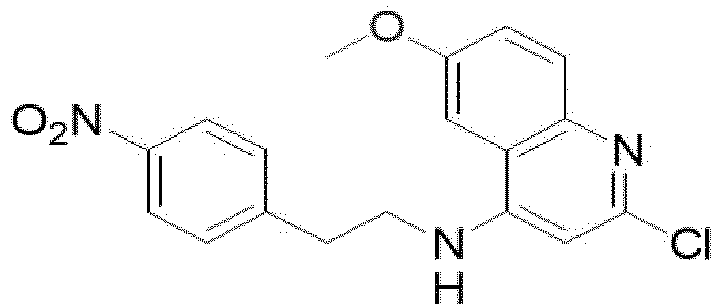
- With 2,4-dichloro-6-methoxyquinoline (200.0 mg, 0.88 mmol) as a starting material, the same synthesis procedures as Example 5 were carried out to obtain the white solid compound, 2-chloro-6-methoxy-N-(4-nitrophenethyl)quinolin-4-amine (20.0 mg, 6%).
- 1H NMR (300 MHz, CDCl3) δ = 8.22 (d, J = 8.7 Hz, 2H), 7.85 (d, J = 8.4 Hz, 1H), 7.43 - 7.30 (m, 3H), 6.76 ( s, 1H), 6.47 (s, 1H), 4.88 - 4.84 (m, 1H), 3.88 ( s, 3H), 3.71 - 3.64 (m, 2H), 3.19 (t, J = 7.4 Hz, 2H)
- LC/MS ESI (+): 358 (M+1)
-

- With 2,4-dichloro-8-methoxyquinoline (200.0 mg, 0.88 mmol) as a starting material, the same synthesis procedures as Example 5 were carried out to obtain the white solid compound, 2-chloro-8-methoxy-N-(4-nitrophenethyl)quinolin-4-amine (15.0 mg, 5%).
- 1H NMR (300 MHz, CDCl3) δ = 8.21 (d, J = 8.7 Hz, 2H), 7.43 - 7.32 (m, 3H), 7.08 - 7.02 (m, 2H), 6.52 (s, 1H), 5.04 (br s, 1H), 4.03 ( s, 3H), 3.70 - 3.63 (m, 2H), 3.18 (t, J = 6.8 Hz, 2H)
- LC/MS ESI (+): 358 (M+1)
-

- 2-Chloro-6-methoxy-N-(4-nitrophenethyl)quinolin-4-amine (40.0 mg, 0.11 mmol) was dissolved in MeOH (2.0 mL), and 5% palladium on activated carbon (4 mg, 10 w/w%) was added thereto. The reaction mixture was charged with H2 gas and stirred at room temperature for 2 hours. The reaction mixture was filtered with celite and distilled under reduced pressure. The residue was purified by column chromatography (CH2Cl2) on amine silica. The fractions containing the product were collected and evaporated to obtain the white compound, N-(4-aminophenethyl)-2-chloro-6-methoxyquinolin-4-amine (12.2 mg, 32%).
LC/MS ESI (+): 328 (M+1) - N-(4-aminophenethyl)-2-chloro-6-methoxyquinolin-4-amine (12.2 mg, 0.04 mmol) was dissolved in pyridine (3.0 mL), and MsCl (6.0 µL, 0.07 mmol) was slowly added thereto at 0°C. After termination of the reaction, the reaction mixture was extracted with CH2Cl2. The organic layer was washed with brine, dried with Na2SO4, filtered and distilled under reduced pressure. The residue was purified by column chromatography (CH2Cl2:MeOH=20:1) on silica. The fractions containing the product were collected and evaporated to obtain the white solid compound, N-(4-(2-((2-chloro-6-methoxyquinolin-4-yl)amino)ethyl)phenyl)methanesulfonamide (9.0 mg, 60%).
- 1H NMR (300 MHz, DMSO-d6 ) δ = 9.61 (s, 1H), 7.63 - 7.56 (m, 2H), 7.43 (br s, 1H), 7.32 - 7.26 (m, 3H), 7.14 (d, J = 8.4 Hz, 2H), 6.42 (s, 1H), 3.87 (s, 3H), 3.54 - 3.47 (m, 2H), 2.96 - 2.90 (m, 5H)
- LC/MS ESI (+): 406 (M+1)
-

- With 2,4-dichloro-7-(trifluoromethoxy)quinoline (200.0 mg, 0.71 mmol) as a starting material, the same synthesis procedures as Example 5 were carried out to obtain the white solid compound, 2-chloro-N-(4-nitrophenethyl)-7-(trifluoromethoxy)quinolin-4-amine (60.0 mg, 21%).
- 1H NMR (300 MHz, DMSO-d6 ) δ = 8.33 (d, J = 9.3 Hz, 1H), 8.17 (d, J = 8.7 Hz, 2H), 7.80 (br s, 1H), 7.61 - 7.57 (m, 3H), 7.51 - 7.47 (m, 1H), 6.58 (s, 1H), 3.66 - 3.60 (m, 2H), 3.12 (t, J = 6.9 Hz, 2H),
- LC/MS ESI (+): 412 (M+1)
-

- With 2,4-dichloro-5-(trifluoromethoxy)quinoline (115.0 mg, 0.41 mmol) as a starting material, the same synthesis procedures as Example 5 were carried out to obtain the white solid compound, 2-chloro-N-(4-nitrophenethyl)-5-(trifluoromethoxy)quinolin-4-amine (49.0 mg, 29%).
- 1H NMR (300 MHz, DMSO-d6 ) δ = 8.18 (d, J = 8.7 Hz, 2H), 7.74 - 7.66 (m, 2H), 7.62 (d, J = 8.8 Hz, 2H), 7.42 - 7.39 (m, 1H), 6.96 (br s, 1H), 6.68 (s, 1H), 3.70 - 3.63 (m, 2H), 3.14 (t, J = 6.9 Hz, 2H),.
- LC/MS ESI (+): 412 (M+1)
-
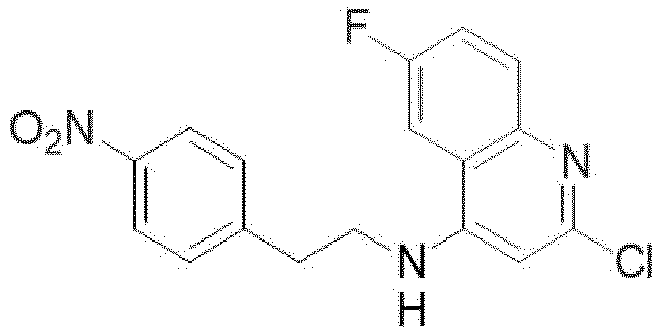
- 2,4-Dichloro-6-fluoroquinoline (200.0 mg, 0.93 mmol), 2-(4-nitrophenyl)ethan-1-amine hydrochloride (188.0 mg, 0.93 mmol) and Et3N (390.0 µL, 2.79 mmol) were added to NMP (3.1 mL). The reaction mixture was reacted in a microwaver (50W, 100°C) for 1 hour and cooled to room temperature. After addition of ice water, the reaction mixture was extracted with CH2Cl2. The organic layer was washed with brine, dried with Na2SO4 and filtered. The residue obtained under reduced pressure was purified by column chromatography (n-Hex:EtOAc=1:1) on silica. The fractions containing the product were collected and evaporated to obtain the white solid compound, 2-chloro-6-fluoro-N-(4-nitrophenethyl)quinolin-4-amine (45.0 mg, 14%).
- 1H NMR (300 MHz, CDCl3) δ = 8.27 - 8.17 (m, 2H), 7.96 - 7.86 (m, 1H), 7.49 - 7.36 (m, 3H), 7.17 (dd, J = 2.7, 9.5 Hz, 1H), 6.49 (s, 1H), 4.91 (t, J = 4.8 Hz, 1H), 3.73 - 3.63 (m, 2H), 3.19 (t, J= 7.1 Hz, 2H)
- LC/MS ESI (+): 346 (M+1)
-

- 2,4-Dichloro-8-methylquinoline (200.0 mg, 0.94 mmol), 2-(4-nitrophenyl)ethan-1-amine hydrochloride (188.0 mg, 0.94 mmol) and Et3N (390.0 µL, 2.82 mmol) were added to NMP (3.1 mL). The reaction mixture was reacted in a microwaver (50W, 100°C) for 1 hour and cooled to room temperature. After addition of ice water, the reaction mixture was extracted with CH2Cl2. The organic layer was washed with brine, dried with Na2SO4 and filtered. The residue obtained under reduced pressure was purified by column chromatography (n-Hex:EtOAc=1:1) on silica. The fractions containing the product were collected and evaporated to obtain the white solid compound, 2-chloro-8-methyl-N-(4-nitrophenethyl)quinolin-4-amine (10.0 mg, 3%).
- 1H NMR (300 MHz, CDCl3) δ = 8.26 - 8.15 (m, 2H), 7.56 - 7.48 (m, 1H), 7.45 - 7.28 (m, 4H), 6.48 (s, 1H), 5.05 (t, J = 5.3 Hz, 1H), 3.72 - 3.60 (m, 2H), 3.18 (t, J = 6.9 Hz, 2H), 2.72 (s, 3H)
- LC/MS ESI (+): 342 (M+1)
-

- Ethyl 2,4-dichloroquinolin-6-carboxylate (200.0 mg, 0.74 mmol), 2-(4-nitrophenyl)ethan-1-amine hydrochloride (150.0 mg, 0.74 mmol) and Et3N (310.0 µL, 2.22 mmol) were added to NMP (2.5 mL). The reaction mixture was reacted in a microwaver (50W, 100°C) for 1 hour and cooled to room temperature. After addition of ice water, the reaction mixture was extracted with CH2Cl2. The organic layer was washed with brine, dried with Na2SO4 and filtered. The residue obtained under reduced pressure was purified by column chromatography (n-Hex:EtOAc=1:1) on silica. The fractions containing the product were collected and evaporated to obtain the white solid compound, ethyl 2-chloro-4-((4-nitrophenethyl)amino)quinolin-6-carboxylate (30.0 mg, 10%).
- 1H NMR (300 MHz, DMSO-d6 ) δ = 8.89 (d, J = 1.5 Hz, 1H), 8.21 - 8.06 (m, 4H), 7.75 (d, J = 8.8 Hz, 1H), 7.64 - 7.56 (m, 2H), 6.60 (s, 1H), 4.38 (q, J = 7.0 Hz, 2H), 3.64 (q, J = 6.6 Hz, 2H), 3.13 (t, J = 7.2 Hz, 2H), 1.36 (t, J = 7.2 Hz, 3H)
- LC/MS ESI (+): 400 (M+1)
-

- 4-Chloroquinoline (300.0 mg, 1.83 mmol), 2-(4-nitrophenyl)ethan-1-amine hydrochloride (371.0 mg, 1.83 mmol) and Et3N (760.0 µL, 5.49 mmol) were added to NMP (6.0 mL). The reaction mixture was reacted in a microwaver (50W, 100°C) for 1 hour and cooled to room temperature. After addition of ice water, the reaction mixture was extracted with CH2Cl2. The organic layer was washed with brine, dried with Na2SO4 and filtered. The residue obtained under reduced pressure was purified by column chromatography (CH2Cl2) on silica. The fractions containing the product were collected and evaporated to obtain the white solid compound, N-(4-nitrophenethyl)quinolin-4-amine (5.0 mg, 1%).
- 1H NMR (300 MHz, DMSO-d6 ) δ = 8.45 - 8.37 (m, 1H), 8.22 - 8.12 (m, 3H), 7.77 (dd, J = 0.8, 8.4 Hz, 1H), 7.65 - 7.56 (m, 3H), 7.41 (ddd, J = 1.1, 7.0, 8.3 Hz, 1H), 7.25 (t, J= 5.5 Hz, 1H), 6.55 (d, J = 5.3 Hz, 1H), 3.58 (q, J = 6.9 Hz, 2H), 3.13 (t, J = 7.2 Hz, 2H)
- LC/MS ESI (+): 294 (M+1)
-

- 2,4-Dichloroquinazoline (100.0 mg, 0.50 mmol) and 2-(4-nitrophenyl)ethan-1-amine hydrochloride (102.0 mg, 0.50 mmol) were dissolved in THF (5.0 mL) and cooled to 0°C, and Et3N (140.0 µL, 1.0 mmol) was added thereto. The reaction mixture was stirred at 25°C for 5 hours and evaporated under reduced pressure. The residue was extracted with CH2Cl2. The organic layer was washed with brine, dried with Na2SO4, filtered and distilled under reduced pressure. The residue was purified by column chromatography (CH2Cl2) on amine silica. The fractions containing the product were collected and evaporated to obtain the white solid compound, 2-chloro-N-(4-nitrophenethyl)quinazolin-4-amine (50.0 mg, 30%).
- 1H NMR (300 MHz, CDCl3) δ = 8.20 (d, J = 8.8 Hz, 2H), 7.84 - 7.71 (m, 2H), 7.60 - 7.54 (m, 1H), 7.51 - 7.40 (m, 3H), 6.05 - 5.93 (m, 1H), 4.00 (q, J = 6.9 Hz, 2H), 3.19 (t, J = 7.1 Hz, 2H)
- LC/MS ESI (+): 329 (M+1)
-

- 2,4-Dichloroquinolin-6-sulfonamide (200.0 mg, 0.72 mmol), 2-(4-nitrophenyl)ethan-1-amine hydrochloride (146.0 mg, 0.72 mmol) and Et3N (302.0 µL, 2.17 mmol) were added to NMP (4.0 mL). The reaction mixture was reacted in a microwaver (50W, 100°C) for 1 hour and cooled to room temperature. After addition of ice water, the reaction mixture was extracted with CH2Cl2. The organic layer was washed with brine, dried with Na2SO4 and filtered. The residue obtained under reduced pressure was purified by column chromatography (n-Hex: CH2Cl2=1:2) on silica. The fractions containing the product were collected and evaporated to obtain the white solid compound, 2-chloro-N-(4-nitrophenethyl)-4-((4-nitrophenethyl)amino)quinolin-6-sulfonamide (4.0 mg, 1%).
- 1H NMR (300 MHz, DMSO-d6) δ = 8.19 - 8.11 (m, 3H), 7.98 (d, J = 8.7 Hz, 2H), 7.81 - 7.72 (m, 3H), 7.61 - 7.56 (m, 3H), 7.37 (d, J = 8.7 Hz, 2H), 7.30 (s, 1H), 3.73 - 3.66 (m, 2H), 3.12 - 3.04 (m, 4H), 2.79 (t, J = 6.7 Hz, 2H),.
- LC/MS ESI (+): 556 (M+1)
-

- 2-Chloro-N-(4-nitrophenethyl)quinolin-4-amine (135.0 mg, 0.41 mmol) was dissolved in MeOH (4.0 mL), and 5% palladium on activated carbon (13 mg, 10 w/w%) was added thereto. The reaction mixture was charged with H2 gas and stirred at room temperature for 3 hours. The reaction mixture was filtered with celite and distilled under reduced pressure. The residue was purified by column chromatography (CH2Cl2) on amine silica. The fractions containing the product were collected and evaporated to obtain the white solid compound, 2-chloro-N-(4-nitrosophenethyl)quinolin-4-amine (2.3 mg, 2%).
- 1H NMR (300 MHz, DMSO-d6 ) δ = 8.20 - 8.14 (m, 1H), 7.93 - 7.86 (m, 2H), 7.73 - 7.58 (m, 5H), 7.42 (d, J = 0.8 Hz, 1H), 6.52 (s, 1H), 3.71 - 3.56 (m, 2H), 3.17 - 3.08 (m, 2H)
- LC/MS ESI (+): 312 (M+1)
-

- 2-Chloro-6-fluoro-N-(4-nitrophenethyl)quinolin-4-amine (50.0 mg, 0.14 mmol) was dissolved in MeOH (2.0 mL), and 5% palladium on activated carbon (5 mg, 10 w/w%) was added thereto. The reaction mixture was charged with H2 gas and stirred at room temperature for 1 hour. The reaction mixture was filtered with celite and distilled under reduced pressure. The residue was purified by column chromatography (CH2Cl2) on amine silica. The fractions containing the product were collected and evaporated to obtain the white solid compound, N-(4-aminophenethyl)-6-fluoroquinolin-4-amine (30.0 mg, 76%).
LC/MS ESI (+): 282 (M+1) - N-(4-aminophenethyl)-6-fluoroquinolin-4-amine (30.0 mg, 0.11 mmol) was dissolved in pyridine (1.1 mL), and MsCl (17.0 µL, 0.21 mmol) was slowly added thereto at 26°C. After termination of the reaction, the reaction mixture was extracted with CH2Cl2. The organic layer was washed with brine, dried with Na2SO4, filtered and evaporated under reduced pressure. The residue was purified by column chromatography (CH2Cl2:MeOH=20:1) on silica. The fractions containing the product were collected and evaporated to obtain the white solid compound, N-(4-(2-((6-fluoroquinolin-4-yl)amino)ethyl)phenyl)methanesulfonamide (12.0 mg, 31%).
- 1H NMR (300 MHz, DMSO-d6 ) δ = 9.82 - 9.70 (m, 1H), 8.54 (d, J = 5.7 Hz, 1H), 8.32 (d, J = 11.1 Hz, 1H), 8.03 (dd, J = 5.7, 9.2 Hz, 2H), 7.82 - 7.69 (m, 1H), 7.45 - 7.35 (m, 2H), 7.26 (d, J = 8.4 Hz, 2H), 6.76 (d, J = 5.7 Hz, 1H), 3.74 - 3.64 (m, 2H), 3.14 - 3.01 (m, 5H)
- LC/MS ESI (+): 360 (M+1)
-

- With 2-chloro-6-fluoro-N-(4-nitrophenethyl)quinolin-4-amine (50.0 mg, 0.14 mmol) as a starting material, the same synthesis procedures as Example 21 were carried out to obtain the white solid compound, N-(4-2-((2-chloro-6-fluoroquinolin-4-yl)amino)ethyl)phenyl)methanesulfonamide (15.0 mg, 27%: 2 steps).
- 1H NMR (300 MHz, DMSO-d6 ) δ = 9.67 - 9.56 (m, 1H), 8.07 (dd, J = 2.5, 10.9 Hz, 1H), 7.76 (dd, J = 5.7, 9.2 Hz, 1H), 7.62 - 7.44 (m, 2H), 7.33 - 7.22 (m, 2H), 7.14 (d, J = 8.0 Hz, 2H), 6.48 (s, 1H), 3.51 (q, J = 6.2 Hz, 2H), 2.99 - 2.88 (m, 5H)
- LC/MS ESI (+): 394 (M+1)
-

- With 2-chloro-N-(4-nitrophenethyl)quinazolin-4-amine (50.0 mg, 0.14 mmol) as a starting material, the same synthesis procedures as Example 21 were carried out to obtain the white solid compound, N-(4-(2-((2-chloroquinazolin-4-yl)amino)ethyl)phenyl)methanesulfonamide (10.0 mg, 17%: 2 steps).
1H NMR (300 MHz, DMSO-d6 ) δ = 9.66 - 9.56 (m, 1H), 8.83 (t, J = 5.5 Hz, 1H), 8.22 (d, J = 8.0 Hz, 1H), 7.85 - 7.75 (m, 1H), 7.64 - 7.58 (m, 1H), 7.53 (dt, J = 1.1, 7.6 Hz, 1H), 7.28 - 7.20 (m, 2H), 7.17 - 7.10 (m, 2H), 3.78 - 3.65 (m, 2H), 2.98 - 2.87 (m, 5H) LC/MS ESI (+): 377 (M+1) -

- 2-Chloro-N-(4-nitrophenethyl)-7-(trifluoromethoxy)quinolin-4-amine (52.0 mg, 0.13 mmol) was dissolved in MeOH (4.0 mL), and 5% palladium on activated carbon (8 mg, 15 w/w%) was added thereto. The reaction mixture was charged with H2 gas and stirred at room temperature for 2 hours. The reaction mixture was filtered with celite and distilled under reduced pressure. The residue was purified by column chromatography (CH2Cl2:MeOH=20:1) on amine silica. The fractions containing the product were collected and evaporated to obtain the white solid compound, N-(4-aminophenethyl)-2-chloro-7-(trifluoromethoxy)quinolin-4-amine (9.0 mg, 18%).
LC/MS ESI (+): 382 (M+1) - N-(4-aminophenethyl)-2-chloro-7-(trifluoromethoxy)quinolin-4-amine (9.0 mg, 0.11 mmol) was dissolved in pyridine (1.5 mL), and MsCl (4.0 µL, 0.05 mmol) was slowly added thereto at 26°C. After termination of the reaction, the reaction mixture was extracted with CH2Cl2. The organic layer was washed with brine, dried with Na2SO4, filtered and evaporated under reduced pressure. The residue was purified by column chromatography (EtOAc) on amine silica. The fractions containing the product were collected and evaporated to obtain the white solid compound, N-(4-(2-((2-chloro-7-(trifluoromethoxy)quinolin-4-yl)amino)ethyl)phenyl)methanesulfonamide (7.9 mg, 73%).
- 1H NMR (300 MHz, DMSO-d6 ) δ = 8.06 (d, J = 9.3 Hz, 1H), 7.64 (s, 1H), 7.27 - 7.18 (m, 6H), 6.81 (br s, 1H), 6.38 (s, 1H), 3.57 - 3.50 (m, 2H), 3.03 (t, J = 7.3 Hz, 2H), 2.93 (s, 3H)
- LC/MS ESI (+): 460 (M+1)
-

- 2-Chloro-N-(4-nitrophenethyl)-7-(trifluoromethoxy)quinolin-4-amine (52.0 mg, 0.13 mmol) was dissolved in MeOH (4.0 mL), and 5% palladium on activated carbon (8 mg, 15 w/w%) was added thereto. The reaction mixture was charged with H2 gas and stirred at room temperature for 2 hours. The reaction mixture was filtered with celite and distilled under reduced pressure. The residue was purified by column chromatography (CH2Cl2:MeOH=20:1) on amine silica. The fractions containing the product were collected and evaporated to obtain the white solid compound, N-(4-aminophenethyl)-7-(trifluoromethoxy)quinolin-4-amine (28.9 mg, 66%).
LC/MS ESI (+): 348 (M+1) - N-(4-aminophenethyl)-7-(trifluoromethoxy)quinolin-4-amine (28.9 mg, 0.08 mmol) was dissolved in pyridine (3.0 mL), and MsCl (13.0 µL, 0.16 mmol) was slowly added thereto at 24°C. After termination of the reaction, the reaction mixture was extracted with CH2Cl2. The organic layer was washed with brine, dried with Na2SO4, filtered and evaporated under reduced pressure. The residue was purified by column chromatography (CH2Cl2:MeOH=20:1) on amine silica. The fractions containing the product were collected and evaporated to obtain the white solid compound, N-(4-(2-((7-(trifluoromethoxy)quinolin-4-yl)amino)ethyl)phenyl)methanesulfonamide (9.3 mg, 26%) .
- 1H NMR (300 MHz, DMSO-d6 ) δ = 9.62 (s, 1H), 8.43 (d, J = 5.4 Hz, 1H), 8.35 (d, J = 9.3 Hz, 1H), 7.64 (s, 1H), 7.50 - 7.40 (m, 2H), 7.27 (d, J = 8.3 Hz, 2H), 7.13 (d, J = 8.3 Hz, 2H), 6.57 (d, J = 5.5 Hz, 1H), 3.66 - 3.46 (m, 2H), 2.95 - 2.90 (m, 5H),
- LC/MS ESI (+): 426 (M+1)
-

- With 2-chloro-N-(4-nitrophenethyl)-5-(trifluoromethoxy)quinolin-4-amine (49.0 mg, 0.12 mmol) as a starting material, the same synthesis procedures as Example 24 were carried out to obtain the white solid compound, N-(4-(2-((2-chloro-5-(trifluoromethoxy)quinolin-4-yl)amino)ethyl)phenyl)methanesulfonamide (17.3 mg, 32%: 2 steps).
- 1H NMR (300 MHz, CDCl3) δ = 7.80 (d, J = 8.4 Hz, 1H), 7.55 (t, J = 8.4 Hz, 1H), 7.29 - 7.19 (m, 5H), 6.58 (br s, 1H), 6.42 (s, 1H), 6.33 (s, 1H), 3.57 - 3.50 (m, 2H), 3.07 - 3.00 (m, 5H)
- LC/MS ESI (+): 460 (M+1)
-

- With 2-chloro-N-(4-nitrophenethyl)-5-(trifluoromethoxy)quinolin-4-amine (49.0 mg, 0.12 mmol) as a starting material, the same synthesis procedures as Example 25 were carried out to obtain the white solid compound, N-(4-(2-((5-(trifluoromethoxy)quinolin-4-yl)amino)ethyl)phenyl)methanesulfonamide (11.7 mg, 23%: 2 steps).
- 1H NMR (300 MHz, DMSO-d6 ) δ = 9.63 (s, 1H), 8.45 (d, J = 5.4 Hz, 1H), 7.80 (d, J = 7.3 Hz, 1H), 7.63 (t, J = 8.4 Hz, 1H), 7.37 - 7.27 (m, 3H), 7.16 (d, J = 8.4 Hz, 2H), 6.66 (d, J = 5.6 Hz, 1H), 6.60 (br s, 1H), 3.55 - 3.48 (m, 2H), 2.97 - 2.93 (m, 5H)
- LC/MS ESI (+): 426 (M+1)
-

- With 4-(2,4-dichloroquinolin-6-yl)morpholine (70.0 mg, 0.25 mmol) as a starting material, the same synthesis procedures as Example 5 were carried out to obtain the white solid compound, 2-chloro-6-morpholino-N-(4-nitrophenethyl)quinolin-4-amine 2,2,2-trifluoroacetate (4.0 mg, 3%).
- 1H NMR (300 MHz, DMSO-d6 ) δ = 11.70 (br s, 1H), 8.17 (d, J = 8.6 Hz, 2H), 7.64 - 7.49 (m, 5H), 7.35 (s, 1H), 6.48 (s, 1H), 3.80 - 3.77 (m, 4H), 3.65 - 3.57 (m, 2H), 3.26 - 3.21 (m, 4H), 3.11 (t, J = 7.5 Hz, 2H)
- LC/MS ESI (+): 413 (M+1)
-

- 2,4-Dichloro-5-fluoroquinoline (160.0 mg, 0.74 mmol), 2-(4-nitrophenyl)ethan-1-amine hydrochloride (151.0 mg, 0.74 mmol) and Et3N (310.0 µL, 2.22 mmol) were added to DMA (2.0 mL). The reaction mixture was reacted in a microwaver (50W, 100°C) for 1 hour and cooled to room temperature. After addition of ice water, the reaction mixture was extracted with CH2Cl2. The organic layer was washed with brine, dried with Na2SO4 and filtered. The residue obtained under reduced pressure was purified by column chromatography (n-Hex:EtOAc=1:1) on silica. The fractions containing the product were collected and evaporated to obtain the white solid compound, 2-chloro-5-fluoro-N-(4-nitrophenethyl)quinolin-4-amine (130.0 mg, 50%).
- 1H NMR (300 MHz, DMSO-d6 ) δ = 8.23 - 8.12 (m, 2H), 7.68 - 7.48 (m, 4H), 7.30 - 7.08 (m, 2H), 6.58 (s, 1H), 3.69 - 3.56 (m, 2H), 3.11 (t, J = 6.9 Hz, 2H)
- LC/MS ESI (+): 346 (M+1)
-

- 2,4-Dichloro-7-fluoroquinoline (300.0 mg, 1.40 mmol), 2-(4-nitrophenyl)ethan-1-amine hydrochloride (283.0 mg, 1.40 mmol) and Et3N (585.0 µL, 4.20 mmol) were added to DMA (3.0 mL). The reaction mixture was reacted in a microwaver (50W, 100°C) for 1 hour and cooled to room temperature. After addition of ice water, the reaction mixture was extracted with CH2Cl2. The organic layer was washed with brine, dried with Na2SO4 and filtered. The residue obtained under reduced pressure was purified by column chromatography (CH2Cl2) on silica. The fractions containing the product were collected and evaporated to obtain the white solid compound, 2-chloro-7-fluoro-N-(4-nitrophenethyl)quinolin-4-amine (160.0 mg, 33%).
- 1H NMR (300 MHz, DMSO-d6 ) δ = 8.32 - 8.22 (m, 1H), 8.21 - 8.12 (m, 2H), 7.71 (t, J = 5.5 Hz, 1H), 7.64 - 7.54 (m, 2H), 7.48 - 7.33 (m, 2H), 6.52 (s, 1H), 3.69 - 3.54 (m, 2H), 3.11 (t, J = 7.1 Hz, 2H)
- LC/MS ESI (+): 346 (M+1)
-

- 2,4-Dichloro-8-fluoroquinoline (130.0 mg, 0.60 mmol), 2-(4-nitrophenyl)ethan-1-amine hydrochloride (123.0 mg, 0.60 mmol) and Et3N (250.0 µL, 1.80 mmol) were added to DMA (1.5 mL). The reaction mixture was reacted in a microwaver (50W, 100°C) for 1 hour and cooled to room temperature. After addition of ice water, the reaction mixture was extracted with CH2Cl2. The organic layer was washed with brine, dried with Na2SO4 and filtered. The residue obtained under reduced pressure was purified by column chromatography (CH2Cl2:MeOH=20:1) on silica. The fractions containing the product were collected and evaporated to obtain the white solid compound, 2-chloro-8-fluoro-N-(4-nitrophenethyl)quinolin-4-amine (70.0 mg, 33%).
- 1H NMR (300 MHz, DMSO-d6 ) δ = 8.21 - 8.13 (m, 2H), 8.03 - 7.95 (m, 1H), 7.73 (t, J = 5.5 Hz, 1H), 7.65 - 7.56 (m, 2H), 7.56 - 7.37 (m, 2H), 6.64 - 6.56 (m, 1H), 3.70 - 3.56 (m, 2H), 3.12 (t, J = 7.1 Hz, 2H)
- LC/MS ESI (+): 346 (M+1)
-
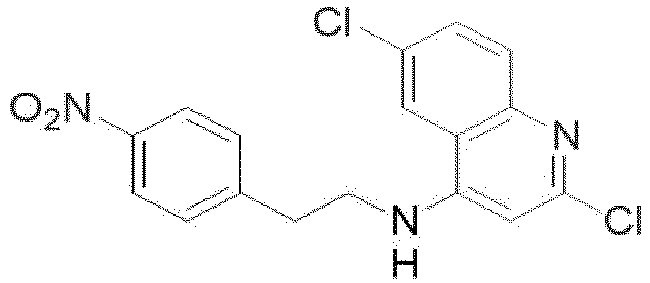
- 2,4,6-Trichloroquinoline (300.0 mg, 1.29 mmol), 2-(4-nitrophenyl)ethan-1-amine hydrochloride (261.0 mg, 1.29 mmol) and Et3N (540.0 µL, 3.87 mmol) were added to DMA (3.0 mL). The reaction mixture was reacted in a microwaver (50W, 100°C) for 1 hour and cooled to room temperature. After addition of ice water, the reaction mixture was extracted with CH2Cl2. The organic layer was washed with brine, dried with Na2SO4 and filtered. The residue obtained under reduced pressure was purified by column chromatography (CH2Cl2) on silica. The fractions containing the product were collected and evaporated to obtain the white solid compound, 2,6-dichloro-N-(4-nitrophenethyl)quinolin-4-amine (180.0 mg, 38%).
- 1H NMR (300 MHz, DMSO-d6 ) δ = 8.35 (d, J = 1.5 Hz, 1H), 8.17 (d, J = 8.8 Hz, 2H), 7.77 - 7.64 (m, 3H), 7.60 (d, J = 8.8 Hz, 2H), 6.60 - 6.49 (m, 1H), 3.61 (q, J = 6.5 Hz, 2H), 3.12 (t, J = 7.1 Hz, 2H)
- LC/MS ESI (+): 362 (M+1)
-

- 2,4-Dichloro-6-phenoxyquinoline (300.0 mg, 1.04 mmol), 2-(4-nitrophenyl)ethan-1-amine hydrochloride (210.0 mg, 1.04 mmol) and Et3N (435.0 µL, 3.12 mmol) were added to DMA (3.0 mL). The reaction mixture was reacted in a microwaver (50W, 100°C) for 1 hour and cooled to room temperature. After addition of ice water, the reaction mixture was extracted with CH2Cl2. The organic layer was washed with brine, dried with Na2SO4 and filtered. The residue obtained under reduced pressure was purified by column chromatography (CH2Cl2:MeOH=20:1) on silica. The fractions containing the product were collected and evaporated to obtain the white solid compound, 2-chloro-N-(4-nitrophenethyl)-6-phenoxyquinolin-4-amine (60.0 mg, 14%).
- 1H NMR (300 MHz, DMSO-d6 ) δ = 8.20 - 8.11 (m, 2H), 7.97 - 7.89 (m, 1H), 7.75 (d, J = 9.2 Hz, 1H), 7.57 (d, J = 8.8 Hz, 2H), 7.47 (t, J = 5.3 Hz, 1H), 7.43 - 7.34 (m, 3H), 7.19 - 7.09 (m, 1H), 7.04 - 6.97 (m, 2H), 6.51 (s, 1H), 3.63 - 3.52 (m, 2H), 3.14 - 3.04 (m, 2H)
- LC/MS ESI (+): 420 (M+1)
-

- (2,4-Dichloroquinolin-6-yl)(phenyl)methanone (210.0 mg, 0.70 mmol), 2-(4-nitrophenyl)ethan-1-amine hydrochloride (141.0 mg, 0.70 mmol) and Et3N (293.0 µL, 2.10 mmol) were added to DMA (2.5 mL). The reaction mixture was reacted in a microwaver (50W, 100°C) for 1 hour and cooled to room temperature. After addition of ice water, the reaction mixture was extracted with CH2Cl2. The organic layer was washed with brine, dried with Na2SO4 and filtered. The residue obtained under reduced pressure was purified by column chromatography (n-Hex:EtOAc=1:1) on silica. The fractions containing the product were collected and evaporated to obtain the yellow solid compound, (2-chloro-4-((4-nitrophenethyl)amino)quinolin-6-yl)(phenyl)methanone (30.0 mg, 10%).
- 1H NMR (300 MHz, DMSO-d6 ) δ = 8.70 - 8.58 (m, 1H), 8.21 - 8.11 (m, 2H), 8.00 (s, 1H), 7.96 - 7.87 (m, 1H), 7.83 - 7.75 (m, 3H), 7.74 - 7.66 (m, 1H), 7.62 - 7.50 (m, 4H), 6.63 (s, 1H), 3.62 (d, J = 5.7 Hz, 2H), 3.09 (t, J = 7.1 Hz, 2H)
- LC/MS ESI (+): 432 (M+1)
-

- 2,4-Dichloro-6-methoxyquinoline (500.0 mg, 2.19 mmol), 2-(4-nitrophenyl)ethan-1-amine hydrochloride (444.0 mg, 2.19 mmol) and Et3N (916.0 µL, 6.57 mmol) were added to DMA (4.0 mL). The reaction mixture was reacted in a microwaver (50W, 100°C) for 1 hour and cooled to room temperature. After addition of ice water, the reaction mixture was extracted with CH2Cl2. The organic layer was washed with brine, dried with Na2SO4 and filtered. The residue obtained under reduced pressure was purified by column chromatography (CH2Cl2) on silica. The fractions containing the product were collected and evaporated to obtain the white solid compound, 2-chloro-6-methoxy-N-(4-nitrophenethyl)quinolin-4-amine (160.0 mg, 20%) .
LC/MS ESI (+): 358 (M+1) - 2-Chloro-6-methoxy-N-(4-nitrophenethyl)quinolin-4-amine (95.0 mg, 0.27 mmol) was dissolved in CH2Cl2 (2.7 mL), and CH2Cl2 in which 1M BBr3 is dissolved (0.8 mL, 0.80 mmol) was slowly added thereto at 23°C. The reaction mixture was stirred at 23°C for 3 hours and extracted with CH2Cl2. The organic layer was washed with brine, dried with Na2SO4, filtered and distilled under reduced pressure. The residue was purified by column chromatography (CH2Cl2:MeOH=20:1) on silica. The fractions containing the product were collected and evaporated to obtain the ivory solid compound, 2-chloro-4-((4-nitrophenethyl)amino)quinolin-6-ol (30.0 mg, 32%).
- 1H NMR (300 MHz, DMSO-d6 ) δ = 9.96 - 9.69 (m, 1H), 8.23 - 8.09 (m, 2H), 7.57 (dd, J = 8.8, 11.4 Hz, 3H), 7.43 - 7.32 (m, 1H), 7.22 (dd, J= 2.7, 9.2 Hz, 2H), 6.37 (s, 1H), 3.64 - 3.50 (m, 2H), 3.11 (t, J= 7.1 Hz, 2H)
- LC/MS ESI (+): 344 (M+1)
-

- 4-Chloroquinazoline (100.0 mg, 0.61 mmol) and 2-(4-nitrophenyl)ethan-1-amine hydrochloride (246.0 mg, 1.22 mmol) were dissolved in EtOH (3.0 mL) and cooled to 0°C, and Et3N (425.0 µL, 3.05 mmol) was added thereto. The reaction mixture was stirred at 80°C for 5 hours and distilled under reduced pressure. The residue was extracted with EtOAc. The organic layer was washed with brine, dried with Na2SO4, filtered and distilled under reduced pressure. The residue was purified by column chromatography (CH2Cl2:MeOH=20:1) on silica. The fractions containing the product were collected and evaporated to obtain the white solid compound, N-(4-nitrophenethyl)quinazolin-4-amine (40.0 mg, 22%).
- 1H NMR (300 MHz, DMSO-d6 ) δ = 8.52 - 8.45 (m, 1H), 8.39 (t, J= 5.3 Hz, 1H), 8.22 - 8.13 (m, 3H), 7.80 - 7.72 (m, 1H), 7.71 - 7.65 (m, 1H), 7.61 - 7.45 (m, 3H), 3.82 (q, J= 6.7 Hz, 2H), 3.13 (t, J= 7.1 Hz, 2H)
- LC/MS ESI (+): 295 (M+1)
-

- 2-Chloro-4-((4-nitrophenethyl)amino)quinolin-6-ol (25.0 mg, 0.07 mmol) and ethyl 2-bromoacetate (24.0 µL, 0.22 mmol) were dissolved in acetone (2.0 mL), and K2CO3 (30.0 mg, 0.22 mmol) was added thereto at 22°C. The reaction mixture was stirred at 75°C for 3 hours and distilled under reduced pressure. The reaction was terminated by the addition of water, and the reaction mixture was extracted with CH2Cl2. The organic layer was washed with brine, dried with Na2SO4, filtered and distilled under reduced pressure. The residue was purified by column chromatography (CH2Cl2:MeOH=20:1) on silica. The fractions containing the product were collected and evaporated to obtain the yellow solid compound, ethyl 2-((2-chloro-4-((4-nitrophenethyl)amino)quinolin-6-yl)oxy)acetate (30.0 mg, 95%).
- 1H NMR (300 MHz, DMSO-d6 ) δ = 8.17 (d, J= 8.8 Hz, 2H), 7.69 - 7.54 (m, 4H), 7.47 - 7.31 (m, 2H), 6.51 - 6.45 (m, 1H), 4.87 (s, 2H), 4.17 (q, J= 7.0 Hz, 2H), 3.61 (q, J= 6.7 Hz, 2H), 3.11 (t, J= 7.1 Hz, 2H), 1.21 (t, J = 7.1 Hz, 3H)
- LC/MS ESI (+): 430 (M+1)
-

- With N-(4-nitrophenethyl)quinazolin-4-amine (40.0 mg, 0.14 mmol) as a starting material, the same synthesis procedures as Example 21 were carried out to obtain the white solid compound, N-(4-(2-(quinazolin-4-ylamino)ethyl)phenyl)methanesulfonamide (30.0 mg, 64%: 2 steps).
- 1H NMR (300 MHz, DMSO-d6 ) δ = 9.74 - 9.47 (m, 1H), 8.51 - 8.44 (m, 1H), 8.37 (t, J = 5.9 Hz, 1H), 8.20 (d, J= 7.6 Hz, 1H), 7.82 - 7.60 (m, 2H), 7.55 - 7.44 (m, 1H), 7.29 - 7.18 (m, 2H), 7.16 - 7.08 (m, 2H), 3.79 - 3.66 (m, 2H), 2.98 - 2.88 (m, 5H)
- LC/MS ESI (+): 343 (M+1)
-

- 2-Chloro-4-((4-nitrophenethyl)amino)quinolin-6-ol (15.0 mg, 0.04 mmol) and 2-bromoacetamide (18.0 mg, 0.22 mmol) were dissolved in acetone (2.0 mL), and K2CO3 (18.0 mg, 0.13 mmol) was added thereto at room temperature. The reaction mixture was stirred at 80°C for 3 hours and distilled under reduced pressure. The residue was extracted with CH2Cl2. The organic layer was washed with brine, dried with Na2SO4, filtered and distilled under reduced pressure. The residue was purified by column chromatography (CH2Cl2:MeOH=20:1) on silica. The fractions containing the product were collected and evaporated to obtain the yellow solid compound, 2-((2-chloro-4-((4-nitrophenethyl)amino)quinolin-6-yl)oxy)acetamide (5.0 mg, 28%).
- 1H NMR (300 MHz, DMSO-d6 ) δ = 8.18 (d, J= 8.4 Hz, 2H), 7.71 - 7.31 (m, 7H), 6.52 - 6.41 (m, 1H), 4.52 (s, 2H), 3.66 - 3.54 (m, 2H), 3.20 - 3.05 (m, 3H)
- LC/MS ESI (+): 401 (M+1)
-

- Ethyl 2-chloro-4-((4-nitrophenethyl)amino)quinolin-6-carboxylate (27.5 mg, 0.07 mmol) was dissolved in EtOH (6.0 mL), and 1N NaOH aqueous solution (83.0 µL) was added thereto. The reaction mixture was stirred at 24°C for 48 hours. The aqueous solution layer was acidified (pH=3) by 1N HCl aqueous solution and extracted with EtOAc. The organic layer was washed with brine, dried with Na2SO4, filtered and distilled under reduced pressure to obtain the white solid compound, 2-chloro-4-((4-nitrophenethyl)amino)quinolin-6-carboxylic acid (25.0 mg, 97%).
- 1H NMR (300 MHz, DMSO-d6 ) δ = 13.13 (s, 1H), 8.90 (s, 1H), 8.19 - 8.09 (m, 4H), 7.73 (d, J = 8.8 Hz, 1H), 7.60 (d, J = 8.7 Hz, 2H), 6.58 (s, 1H), 3.66 - 3.60 (m, 2H), 3.13 (t, J = 6.9 Hz, 2H)
- LC/MS ESI (+): 372 (M+1)
-

- 2-Chloro-4-((4-nitrophenethyl)amino)quinolin-6-carboxylic acid (16.0 mg, 0.04 mmol), NH4Cl (9.2 mg, 0.17 mmol), EDC (33.0 mg, 0.17 mmol) and HOBT (23.0 mg, 0.17 mmol) were dissolved in DMF (1.0 mL), and DIPEA (75.0 µL, 0.43 mmol) was added thereto. The reaction mixture was stirred at room temperature for 15 hours. The reaction was terminated by the addition of water, and the reaction mixture was extracted with EtOAc. The organic layer was washed with brine, dried with Na2SO4, filtered and distilled under reduced pressure. The residue was purified by column chromatography (CH2Cl2:MeOH=10:1) on silica. The fractions containing the product were collected and evaporated to obtain the white solid compound, 2-chloro-4-((4-nitrophenethyl)amino)quinolin-6-carboxamide (3.6 mg, 23%).
- 1H NMR (300 MHz, DMSO-d6 ) δ = 8.75 (s, 1H), 8.17 (d, J = 8.7 Hz, 2H), 8.07 (d, J = 8.7 Hz, 1H), 7.98 (s, 1H), 7.83 (s, 1H), 7.71 (d, J= 8.7 Hz, 1H), 7.62 - 7.56 (m, 3H), 6.56 (s, 1H), 3.67 - 3.60 (m, 2H), 3.14 (t, J= 7.2 Hz, 2H)
- LC/MS ESI (+): 371 (M+1)
-

- 2-Chloro-4-((4-nitrophenethyl)amino)quinolin-6-carboxylic acid (40.0 mg, 0.11 mmol), morpholine (11.0 µL, 0.13 mmol), EDC (31.0 mg, 0.15 mmol) and HOBT (21.0 mg, 0.15 mmol) were dissolved in DMF (2.0 mL), and DIPEA (56.0 µL, 0.32 mmol) was added thereto. The reaction mixture was stirred at room temperature for 15 hours. The reaction was terminated by the addition of water, and the reaction mixture was extracted with EtOAc. The organic layer was washed with brine, dried with Na2SO4, filtered and distilled under reduced pressure. The residue was purified by column chromatography (CH2Cl2:MeOH=20:1) on silica. The fractions containing the product were collected and evaporated to obtain the white solid compound, (2-chloro-4-((4-nitrophenethyl)amino)quinolin-6-yl)(morpholino)methanone (20.0 mg, 42%).
- 1H NMR (300 MHz, DMSO-d6 ) δ = 8.27 (s, 1H), 8.16 (d, J= 8.7 Hz, 2H), 7.70 - 7.57 (m, 5H), 6.57 (s, 1H), 3.75 - 3.52 (m, 10H), 3.12 (t, J= 6.7 Hz, 2H)
- LC/MS ESI (+): 441 (M+1)
-

- Ethyl 2-((2-chloro-4-((4-nitrophenethyl)amino)quinolin-6-yl)oxy)acetate (30.0 mg, 0.07 mmol) was dissolved in EtOH (5.0 mL), and 1N NaOH solution (0.21 ml, 0.21 mmol) was added thereto at 23°C. The reaction mixture was stirred at 23°C for 3 hours and distilled under reduced pressure. The residue was extracted with CH2Cl2. The organic layer was washed with brine, dried with Na2SO4, filtered and distilled under reduced pressure. The residue was purified by column chromatography (CH2Cl2:MeOH=20:1) on silica. The fractions containing the product were collected and evaporated to obtain the white solid compound, 2-((2-chloro-4-((4-nitrophenethyl)amino)quinolin-6-yl)oxy)acetic acid (15.0 mg, 53%).
- 1H NMR (300 MHz, DMSO-d6 ) δ = 13.39 - 13.07 (m, 1H), 8.18 (d, J= 8.8 Hz, 2H), 7.70 - 7.55 (m, 4H), 7.51 - 7.27 (m, 2H), 6.51 - 6.40 (m, 1H), 4.86 - 4.70 (m, 2H), 3.68 - 3.53 (m, 2H), 3.20 - 3.03 (m, 2H)
- LC/MS ESI (+): 402 (M+1)
-

- 2-Chloro-4-((4-nitrophenethyl)amino)quinolin-6-carboxylic acid (40.0 mg, 0.11 mmol), anhydrous hydrazine (4.0 µL, 0.13 mmol), EDC (31.0 mg, 0.15 mmol) and HOBT (21.0 mg, 0.15 mmol) were dissolved in DMF (2.0 mL), and DIPEA (56.0 µL, 0.32 mmol) was added thereto. The reaction mixture was stirred at room temperature for 15 hours. The reaction was terminated by the addition of water, and the reaction mixture was extracted with EtOAc. The organic layer was washed with brine, dried with Na2SO4, filtered and distilled under reduced pressure. The residue was purified by column chromatography (CH2Cl2:MeOH=10:1) on silica. The fractions containing the product were collected and evaporated to obtain the white solid compound, 2-chloro-4-((4-nitrophenethyl)amino)quinolin-6-carbohydrazide (41.0 mg, 98%).
- 1H NMR (300 MHz, DMSO-d6 ) δ = 9.77 (s, 1H), 8.70 (s, 1H), 8.17 (d, J= 8.7 Hz, 2H), 8.01 (d, J= 8.7 Hz, 1H), 7.94 (s, 1H), 7.70 (d, J= 8.7 Hz, 1H), 7.60 (d, J = 8.7 Hz, 2H), 6.56 (s, 1H), 4.57 (br s, 2H), 3.67 - 3.60 (m, 2H), 3.13 (t, J= 7.2 Hz, 2H)
- LC/MS ESI (+): 386 (M+1)
-

- With 2-chloro-8-fluoro-N-(4-nitrophenethyl)quinolin-4-amine (40.0 mg, 0.14 mmol) as a starting material, the same synthesis procedures as Example 21 were carried out to obtain the white solid compound, N-(4-(2-((2-chloro-8-fluoroquinolin-4-yl)amino)ethyl)phenyl)methanesulfonamide (8.0 mg, 18%: 2 steps).
- 1H NMR (300 MHz, DMSO-d6 ) δ = 9.74 - 9.49 (m, 1H), 7.68 (d, J = 8.4 Hz, 1H), 7.57 - 7.49 (m, 1H), 7.43 (ddd, J = 1.5, 7.8, 11.3 Hz, 1H), 7.28 - 7.17 (m, 3H), 7.17 - 7.09 (m, 2H), 7.05 (s, 1H), 3.59 (q, J = 6.6 Hz, 2H), 2.97 - 2.81 (m, 5H)
- LC/MS ESI (+): 394 (M+1)
-

- 2-Chloro-8-fluoro-N-(4-nitrophenethyl)quinolin-4-amine (40.0 mg, 0.12 mmol) was dissolved in MeOH (2.0 mL), and 5% palladium on activated carbon (5 mg, 12 w/w%) were added thereto. The reaction mixture was charged with H2 gas and stirred at room temperature for 1 hour. The reaction mixture was filtered with celite and distilled under reduced pressure. The residue was purified by column chromatography (n-Hex:EtOAc=1:1) on amine silica. The fractions containing the product were collected and evaporated to obtain the white solid compound, N-(4-aminophenethyl)-8-fluoroquinolin-4-amine (20.0 mg, 59%).
LC/MS ESI (+): 282 (M+1) - N-(4-aminophenethyl)-8-fluoroquinolin-4-amine (17.0 mg, 0.06 mmol) was dissolved in pyridine (1.0 mL), and MsCl (10.0 µL, 0.12 mmol) was slowly added thereto at 25°C. After termination of the reaction, the reaction mixture was extracted with CH2Cl2. The organic layer was washed with brine, dried with Na2SO4, filtered and distilled under reduced pressure. The residue was purified by column chromatography (CH2Cl2:MeOH=20:1) on amine silica. The fractions containing the product were collected and evaporated to obtain the white solid compound, N-(4-(2-((8-fluoroquinolin-4-yl)amino)ethyl)phenyl)methanesulfonamide (15.0 mg, 69%).
- 1H NMR (300 MHz, DMSO-d6 ) δ = 9.62 (br s, 1H), 7.89 (d, J = 9.2 Hz, 1H), 7.47 - 7.41 (m, 1H), 7.39 - 7.23 (m, 4H), 7.18 - 7.04 (m, 3H), 6.86 - 6.77 (m, 1H), 3.59 (q, J= 6.7 Hz, 2H), 2.97 - 2.83 (m, 5H)
- LC/MS ESI (+): 360 (M+1)
-

- 2,6-Dichloro-9H-purine (100.0 mg, 0.53 mmol) and 2-(4-nitrophenyl)ethan-1-amine hydrochloride (107.0 mg, 0.53 mmol) were dissolved in THF (3.0 mL) and DMSO (2 ml), and Et3N (148.0 µL, 1.06 mmol) was added thereto at 22°C. The reaction mixture was stirred at 22°C for 3 hours and distilled under reduced pressure. After addition of CH2Cl2 and water, the residue was stirred. The obtained solid was filtered and dried to obtain the white solid compound, 2-chloro-N-(4-nitrophenethyl)-9H-purin-6-amine (42.0 mg, 25%).
- 1H NMR (300 MHz, DMSO-d6 ) δ = 8.45 - 8.28 (m, 1H), 8.20 - 8.09 (m, 4H), 7.55 (d, J = 8.0 Hz, 2H), 3.70 (br s, 2H), 3.07 (t, J = 6.9 Hz, 2H)
- LC/MS ESI (+): 319 (M+1)
-

- 4-chloro-2-(trifluoromethyl)quinazoline (100.0 mg, 0.43 mmol) and 2-(4-nitrophenyl)ethan-1-amine hydrochloride (87.0 mg, 0.43 mmol) were dissolved in iPrOH (4.0 mL) and cooled to 0°C, and Et3N (180.0 µL, 1.29 mmol) was added thereto. The reaction mixture was stirred at 23°C for 5 hours and distilled under reduced pressure. The residue was extracted with CH2Cl2. The organic layer was washed with brine, dried with Na2SO4, filtered and distilled under reduced pressure. The residue was purified by column chromatography (CH2Cl2) on silica. The fractions containing the product were collected and evaporated to obtain the white solid compound, N-(4-nitrophenethyl)-2-(trifluoromethyl)quinazolin-4-amine (50.0 mg, 32%) .
- 1H NMR (300 MHz, DMSO-d6 ) δ = 8.96 (br s, 1H), 8.34 - 8.26 (m, 1H), 8.19 - 8.10 (m, 2H), 7.93 - 7.80 (m, 2H), 7.68 (ddd, J= 1.3, 6.8, 8.3 Hz, 1H), 7.54 (d, J= 8.4 Hz, 2H), 3.85 (t, J = 6.7 Hz, 2H), 3.14 (t, J = 6.9 Hz, 2H)
- LC/MS ESI (+): 363 (M+1)
-

- 4-Chloro-2-(trifluoromethyl)quinoline (100.0 mg, 0.43 mmol), 2-(4-nitrophenyl)ethan-1-amine hydrochloride (87.0 mg, 0.43 mmol) and Et3N (180.0 µL, 1.29 mmol) were added to NMP (1.0 mL). The reaction mixture was reacted in a microwaver (50W, 100°C) for 1 hour and cooled to room temperature. After addition of ice water, the reaction mixture was extracted with CH2Cl2. The organic layer was washed with brine, dried with Na2SO4 and filtered. The residue obtained under reduced pressure was purified by column chromatography (CH2Cl2:MeOH=20:1) on silica. The fractions containing the product were collected and evaporated to obtain the white solid compound, N-(4-nitrophenethyl)-2-(trifluoromethyl)quinolin-4-amine (35.0 mg, 23%).
- 1H NMR (300 MHz, DMSO-d6 ) δ = 8.28 (d, J = 8.4 Hz, 1H), 8.15 (d, J= 8.4 Hz, 2H), 7.89 (d, J= 8.4 Hz, 1H), 7.84 - 7.69 (m, 2H), 7.64 - 7.52 (m, 3H), 6.79 - 6.69 (m, 1H), 3.76 - 3.65 (m, 2H), 3.15 (t, J= 6.9 Hz, 2H)
- LC/MS ESI (+): 362 (M+1)
-

- 6-Chloro-2-fluoro-9H-purine (100.0 mg, 0.58 mmol) and 2-(4-nitrophenyl)ethan-1-amine hydrochloride (117.0 mg, 0.58 mmol) were dissolved in iPrOH (4.0 mL), and Et3N (240.0 µL, 1.74 mmol) was added thereto at room temperature. The reaction mixture was stirred at 60°C for 15 hours and distilled under reduced pressure. The residue was extracted with CH2Cl2. The organic layer was washed with brine, dried with Na2SO4, filtered and distilled under reduced pressure. The residue was purified by column chromatography (CH2Cl2) on silica. The fractions containing the product were collected and evaporated to obtain the white solid compound, 2-fluoro-N-(4-nitrophenethyl)-9H-purin-6-amine (10.0 mg, 6%).
- 1H NMR (300 MHz, DMSO-d6 ) δ = 13.30 - 12.60 (m, 1H), 8.32 (br s, 1H), 8.22 - 8.03 (m, 3H), 7.53 (s, 2H), 3.71 (d, J = 6.5 Hz, 2H), 3.07 (t, J = 7.1 Hz, 2H)
- LC/MS ESI (+): 303 (M+1)
-

- 2-Chloro-N-(4-nitrophenethyl)quinolin-4-amine (11.0 mg, 0.03 mmol) and 2M methylamine (0.3 ml, 0.6 mmol) were added to anhydrous 1,4-dioxane (1.0 mL). The reaction mixture was reacted in a microwaver (100W, 180°C) for 2 hours and cooled to room temperature. After addition of ice water, the reaction mixture was extracted with CH2Cl2. The organic layer was washed with brine, dried with Na2SO4 and filtered. The residue obtained under reduced pressure was purified by column chromatography (CH2Cl2:MeOH=20:1) on silica. The fractions containing the product were collected and evaporated to obtain the white solid compound, N 2-methyl-N 4-(4-nitrophenethyl)quinolin-2,4-diamine 2,2,2-trifluoroacetate (10.8 mg, 74%).
- 1H NMR (300 MHz, DMSO-d6 ) δ = 11.74 (s, 1H), 8.20 - 8.11 (m, 3H), 7.70 - 7.58 (m, 4H), 7.42 - 7.31 (m, 1H), 6.55 (s, 1H), 5.83 (s, 1H), 3.64 - 3.58 (m, 2H), 3.12 (t, J = 6.6 Hz, 2H), 3.00 (s, 3H)
- LC/MS ESI (+): 323 (M+1)
-
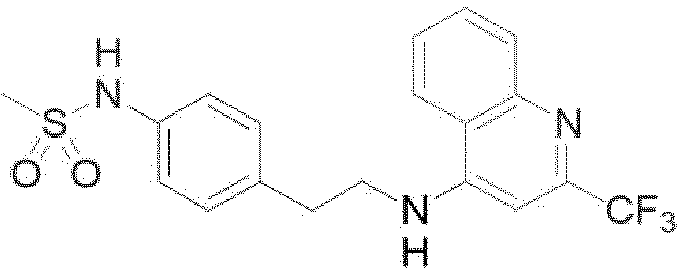
- N-(4-nitrophenethyl)-2-(trifluoromethyl)quinolin-4-amine (34.0 mg, 0.09 mmol) was dissolved in MeOH (1.5 mL), and Raney Ni (34 mg, 100 w/w%) was added thereto. The reaction mixture was charged with H2 gas and stirred at room temperature for 4 hours. The reaction mixture was filtered with celite and distilled under reduced pressure. The residue was purified by column chromatography (MeOH:CH2Cl2=1:30) on amine silica. The fractions containing the product were collected and evaporated to obtain the white solid compound, N-(4-aminophenethyl)-2-(trifluoromethyl)quinolin-4-amine (30.0 mg, 97%).
LC/MS ESI (+): 332 (M+1) - N-(4-aminophenethyl)-2-(trifluoromethyl)quinolin-4-amine (30.0 mg, 0.09 mmol) was dissolved in pyridine (4.0 mL), and MsCl (14.0 µL, 0.18 mmol) was slowly added thereto at 21°C. After 3 hours, the reaction was terminated, and the reaction mixture was extracted with CH2Cl2. The organic layer was washed with brine, dried with Na2SO4, filtered and distilled under reduced pressure. The residue was purified by column chromatography (n-Hex:EtOAc=2:1) on silica. The fractions containing the product were collected and evaporated to obtain the white solid compound, N-(4-(2-((2-(trifluoromethyl)quinolin-4-yl)amino)ethyl)phenyl)methanesulfonamide (30.0 mg, 81%).
- 1H NMR (300 MHz, DMSO-d6 ) δ = 9.63 (s, 1H), 8.25 (d, J = 8.3 Hz, 1H), 7.89 (d, J= 7.8 Hz, 1H), 7.81 - 7.71 (m, 2H), 7.57 (t, J= 7.1 Hz, 1H), 7.27 (d, J= 8.4 Hz, 2H), 7.13 (d, J= 8.4 Hz, 2H), 6.75 (s, 1H), 3.62 - 3.56 (m, 2H), 2.98 - 2.92 (m, 5H)
- LC/MS ESI (+): 410 (M+1)
-

- With N-(4-nitrophenethyl)-2-(trifluoromethyl)quinazolin-4-amine (60.0 mg, 0.16 mmol) as a starting material, the same synthesis procedures as Example 52 were carried out to obtain the white solid compound, N-(4-(2-((2-(trifluoromethyl)quinazolin-4-yl)amino)ethyl)phenyl)methanesulfonamide (50.0 mg, 68%: 2 steps).
- 1H NMR (300 MHz, DMSO-d6 ) δ = 9.62 (s, 1H), 8.94 (s, 1H), 8.32 (d, J= 8.2 Hz, 1H), 7.91 - 7.82 (m, 2H), 7.67 (t, J= 8.1 Hz, 1H), 7.23 (d, J= 8.4 Hz, 2H), 7.12 (d, J= 8.4 Hz, 2H), 3.79 - 3.72 (m, 2H), 2.97 - 2.92 (m, 5H)
- LC/MS ESI (+): 411 (M+1)
-

- 6-Bromo-4-chloroquinazoline (200.0 mg, 0.82 mmol) and 2-(4-nitrophenethyl)ethan-1-amine hydrochloride (182.0 mg, 0.90 mmol) were dissolved in iPrOH (4.0 mL), and Et3N (170.0 µL, 1.23 mmol) was added thereto at room temperature. The reaction mixture was stirred at 20°C for 15 hours and distilled under reduced pressure. The residue was extracted with CH2Cl2. The organic layer was washed with brine, dried with Na2SO4, filtered and distilled under reduced pressure. After addition of CH2Cl2 and water, the residue was stirred. The obtained solid was filtered and dried to obtain the ivory solid compound, 6-bromo-N-(4-nitrophenethyl)quinazolin-4-amine (210.0 mg, 69%).
LC/MS ESI (+): 373 (M+1) - (2,4-Dichlorophenyl)boronic acid (31.0 mg, 0.16 mmol) and 6-bromo-N-(4-nitrophenethyl)quinazolin-4-amine (50.0 mg, 0.13 mmol) were dissolved in a mixed solvent of DME/H2O (0.92 mL, 4/1 v/v), and Pd(PPh3)4 (31.0 mg, 0.03 mmol) and Na2CO3 (43.0 mg, 0.40 mmol) were added thereto. The reaction mixture was stirred at 80°C for 3 hours, cooled to room temperature and extracted with EtOAc. The organic layer was washed with brine, dried with Na2SO4, filtered and distilled under reduced pressure. The residue was purified by column chromatography (n-Hex:EtOAc=1:1) on silica. The fractions containing the product were collected and evaporated to obtain the yellow solid compound, 6-(2,4-dichlorophenyl)-N-(4-nitrophenethyl)quinazolin-4-amine (15.0 mg, 26%).
- 1H NMR (300 MHz, CDCl3) δ = 8.74 (s, 1H), 8.23 - 8.13 (m, 2H), 7.98 - 7.88 (m, 1H), 7.84 - 7.75 (m, 1H), 7.61 (d, J = 1.5 Hz, 1H), 7.54 (d, J= 1.9 Hz, 1H), 7.43 (d, J= 8.4 Hz, 2H), 7.38 - 7.28 (m, 2H), 5.88 - 5.74 (m, 1H), 3.99 (d, J= 6.5 Hz, 2H), 3.19 (t, J= 7.1 Hz, 2H)
- LC/MS ESI (+): 439 (M+1)
-

- 2',4'-Dichloro-[1,1'-biphenyl]-4-amine (1.5 g, 6.3 mmol) and malonic acid (1.0 g, 9.4 mmol) were dissolved in phosphorous oxychloride (15.0 mL). The reaction mixture was stirred at 100°C for 5 hours and cooled to room temperature. After addition of ice water, the reaction mixture was neutralized by saturated NaHCO3 solution. At this time, the white solid was formed and filtered. The residue was purified by column chromatography (n-Hex: CH2Cl2=1:4) on silica. The fractions containing the product were collected and evaporated to obtain the white solid compound, 2,4-dichloro-6-(2,4-dichlorophenyl)quinoline (483.0 mg, 22%).
LC/MS ESI (+): 342 (M+1) - 2,4-Dichloro-6-(2,4-dichlorophenyl)quinoline (300.0 mg, 0.87 mmol), 2-(4-nitrophenyl)ethan-1-amine hydrochloride (177.0 mg, 0.87 mmol) and Et3N (364.0 µL, 2.61 mmol) were added to NMP (3.0 mL). The reaction mixture was reacted in a microwaver (50W, 100°C) for 1 hour and cooled to room temperature. After addition of ice water, the reaction mixture was extracted with CH2Cl2. The organic layer was washed with brine, dried with Na2SO4 and filtered. The residue obtained under reduced pressure was purified by column chromatography (n-Hex:EtOAc=1:1) on silica. The fractions containing the product were collected and evaporated to obtain the white solid compound, 2-chloro-6-(2,4-dichlorophenyl)-N-(4-nitrophenethyl)quinolin-4-amine (1.2 mg, 0.3%).
- 1H NMR (300 MHz, CDCl3) δ = 8.74 (s, 1H), 8.22 - 8.13 (m, 2H), 7.96 - 7.89 (m, 1H), 7.83 - 7.75 (m, 1H), 7.61 (d, J= 1.5 Hz, 1H), 7.54 (d, J= 1.9 Hz, 1H), 7.43 (d, J= 8.4 Hz, 2H), 7.38 - 7.29 (m, 2H), 5.86 - 5.74 (m, 1H), 3.99 (q, J= 6.9 Hz, 2H), 3.19 (t, J = 7.1 Hz, 2H)
- LC/MS ESI (+): 472 (M+1)
-

- With 6-(2,4-dichlorophenyl)-N-(4-nitrophenethyl)quinazolin-4-amine (35.0 mg, 0.08 mmol) as a starting material, the same synthesis procedures as Example 52 were carried out to obtain the white solid compound, N-(4-(2-((6-(2,4-dichlorophenyl)quinazolin-4-yl)amino)ethyl)phenyl)methanesulfonamide (10.0 mg, 23%: 2 steps).
- 1H NMR (300 MHz, CDCl3) δ = 8.72 (s, 1H), 7.95 - 7.87 (m, 1H), 7.82 - 7.75 (m, 1H), .64 - 7.58 (m, 1H), 7.56 - 7.52 (m, 1H), 7.40 - 7.31 (m, 2H), 7.30 - 7.24 (m, 2H), 7.22 - 7.12 (m, 2H), 6.34 - 6.27 (m, 1H), 5.79 - 5.70 (m, 1H), 3.98 - 3.88 (m, 2H), 3.08 - 2.94 (m, 5H)
- LC/MS ESI (+): 487 (M+1)
-

- With 2-chloro-6-(2,4-dichlorophenyl)-N-(4-nitrophenethyl)quinolin-4-amine (200.0 mg, 0.42 mmol) as a starting material, the same synthesis procedures as Example 52 were carried out to obtain the white solid compound, N-(4-(2-((2-chloro-6-(2,4-dichlorophenyl)quinolin-4-yl)amino)ethyl)phenyl)methanesulfonamide (45.0 mg, 20%: 2 steps).
- 1H NMR (300 MHz, CDCl3) δ = 7.99 - 7.88 (m, 1H), 7.68 (dd, J= 1.7, 8.6 Hz, 1H), 7.55 (dd, J = 1.9, 9.5 Hz, 2H), 7.41 - 7.15 (m, 6H), 6.52 - 6.46 (m, 1H), 6.41 (s, 1H), 5.18 - 5.09 (m, 1H), 3.66 - 3.53 (m, 2H), 3.10 - 2.97 (m, 5H)
- LC/MS ESI (+): 520 (M+1)
-

- With 2-chloro-N-(4-nitrobenzyl)quinolin-4-carboxamide (90.0 mg, 0.26 mmol) as a starting material, the same synthesis procedures as Example 52 were carried out to obtain the white solid compound, 2-chloro-N-(4-(methylsulfonamido)benzyl)quinolin-4-carboxamide (10.0 mg, 34%: 2 steps).
- 1H NMR (300 MHz, DMSO-d6 ) δ = 9.72 (s, 1H), 9.40 (s, 1H), 8.12 (d, J= 8.0 Hz, 1H), 8.02 (d, J= 8.4 Hz, 1H), 7.93 - 7.83 (m, 1H), 7.77 - 7.67 (m, 2H), 7.37 (d, J= 8.4 Hz, 2H), 7.21 (d, J = 8.4 Hz, 2H), 4.51 (d, J = 5.7 Hz, 2H), 2.97 (s, 3H)
- LC/MS ESI (+): 390 (M+1)
-

- 2-Azido-1-(4-nitrophenyl)ethan-1-one (2.59 g, 12.6 mmol) was dissolved in CH2Cl2 (50.0 mL), and DAST (3.29 mL, 25.1 mmol) was slowly added thereto at -20°C. The reaction mixture was stirred at -20°C for 5 days. After addition of saturated NaHCO3 aqueous solution to terminate the reaction, the reaction mixture was extracted with CH2Cl2. The organic layer was washed with brine, dried with Na2SO4, filtered and distilled under reduced pressure. The residue was purified by column chromatography (n-Hex: CH2Cl2=2:1) on silica. The fractions containing the product were collected and evaporated to obtain the yellow oil compound 1-(2-azido-1,1-difluoroethyl)-4-nitrobenzene (1.60 g, 56%).
1H NMR (300 MHz, CDCl3) δ = 8.33 (d, J = 8.3 Hz, 2H), 7.72 (d, J = 8.3 Hz, 2H), 3.77 (t, J= 12.8 Hz, 2H) - 1-(2-Azido-1,1-difluoroethyl)-4-nitrobenzene (1.60 g, 7.0 mmol) was dissolved in THF (40.0 mL), and PPh3 (2.58 g, 9.8 mmol) and H2O (20 ml) were slowly added thereto at 25°C. The reaction mixture was stirred at 50°C for 3 days. After addition of 1N HCl aqueous solution to terminate the reaction, the reaction mixture was extracted with EtOAc. The organic layer was washed with brine, dried with Na2SO4, filtered and distilled under reduced pressure. The residue was purified by column chromatography (MeOH:CH2Cl2=1:40) on silica. The fractions containing the product were collected and evaporated to obtain the orange solid compound, 2,2-difluoro-2-(4-nitrophenyl)ethan-1-amine (933.0 mg, 66%).
LC/MS ESI (+): 203 (M+1) - With 2,2-difluoro-2-(4-nitrophenyl)ethan-1-amine (61.0 mg, 0.30 mmol) and 4-chloroquinazoline (50.0 mg, 0.30 mmol) as starting materials, the same synthesis procedures as Example 5 were carried out to obtain the white solid compound, N-(2,2-difluoro-2-(4-nitrophenyl)ethyl)quinazolin-4-amine (3.1 mg, 3%).
- 1H NMR (300 MHz, CDCl3) δ = 8.59 (s, 1H), 8.27 (d, J = 8.8 Hz, 2H), 7.92 - 7.71 (m, 5H), 7.58 - 7.49 (m, 1H), 5.99 (t, J = 5.5 Hz, 1H), 4.60 - 4.43 (m, 2H)
- LC/MS ESI (+): 331 (M+1)
-

- N-(4-nitrophenethyl)quinazolin-4-amine (118.0 mg, 0.40 mmol) was dissolved in MeOH (4.0 mL), and Raney Ni (59 mg, 50 w/w%) was added thereto. The reaction mixture was charged with H2 gas and stirred at room temperature for 3 hours. The reaction mixture was filtered with celite and distilled under reduced pressure. The residue was purified by column chromatography (MeOH:CH2Cl2=1:20) on silica. The fractions containing the product were collected and evaporated to obtain the white solid compound, N-(4-aminophenethyl)quinazolin-4-amine (30.0 mg, 28%).
LC/MS ESI (+): 265 (M+1) - N-(4-aminophenethyl)quinazolin-4-amine (30.0 mg, 0.11 mmol) was dissolved in CH2Cl2 (2.3 mL), and anhydrous trifluoromethanesulfonic acid (27.9 □ L, 0.17 mmol) was slowly added thereto at 0°C. The reaction mixture was stirred at room temperature for 1 hour and extracted with CH2Cl2. The organic layer was washed with brine, dried with Na2SO4, filtered and distilled under reduced pressure. The residue was purified by column chromatography (CH3CN:H2O=30:70) on reverse-phase silica. The fractions containing the product were collected and evaporated to obtain the white solid compound, 1,1,1-trifluoro-N-(4-(2-(quinazolin-4-ylamino)ethyl)phenyl)methanesulfonamide (29.2 mg, 65%).
- 1H NMR (300 MHz, DMSO-d6 ) δ = 10.09 - 9.89 (m, 1H), 8.87 (s, 1H), 8.44 - 8.32 (m, 1H), 8.07 - 7.96 (m, 1H), 7.81 - 7.71 (m, 2H), 7.33 - 7.23 (m, 2H), 7.15 (d, J= 8.4 Hz, 2H), 3.98 - 3.86 (m, 2H), 3.06 - 2.94 (m, 3H)
- LC/MS ESI (+): 397 (M+1)
-

- 4-Chloro-6-fluoroquinazoline (200.0 mg, 1.10 mmol) and 2-(4-nitrophenyl)ethan-1-amine hydrochloride (222.0 mg, 1.10 mmol) were dissolved in iPrOH (5.5 mL) and cooled to 0°C, and Et3N (457.0 µL, 3.30 mmol) was added thereto. The reaction mixture was stirred at 100°C for 15 hours and distilled under reduced pressure. The residue was extracted with EtOAc. The organic layer was washed with brine, dried with Na2SO4, filtered and distilled under reduced pressure. The residue was purified by column chromatography (CH2Cl2:MeOH=30:1) on silica. The fractions containing the product were collected and evaporated to obtain the white solid compound, 6-fluoro-N-(4-nitrophenethyl)quinazolin-4-amine (270.0 mg, 78%).
- 1H NMR (300 MHz, DMSO-d6 ) δ = 8.48 (s, 1H), 8.39 - 8.30 (m, 1H), 8.16 (d, J= 8.4 Hz, 2H), 8.09 - 8.00 (m, 1H), 7.80 - 7.62 (m, 2H), 7.55 (d, J= 8.4 Hz, 2H), 3.82 (q, J= 6.9 Hz, 2H), 3.19 - 3.06 (m, 2H)
- LC/MS ESI (+): 313 (M+1)
-

- 4-(4,4,5,5-Tetramethyl-1,3,2-dioxaborolan-2-yl)isoquinoline (30.0 mg, 0.12 mmol) and 2-(4-nitrophenyl)ethan-1-amine hydrochloride (48.0 mg, 0.24 mmol) were dissolved in MeOH (2.0 mL), and Et3N (33.0 µL, 0.24 mmol) was added thereto at room temperature. The reaction mixture was stirred at 20°C for 30 minutes, and copper(I) oxide (42.0 mg, 0.12 mmol) was added thereto. The reaction mixture was stirred at 20°C for 5 hours and distilled under reduced pressure. The residue was extracted with CH2Cl2. The organic layer was washed with brine, dried with Na2SO4, filtered and distilled under reduced pressure. The residue was purified by column chromatography (n-Hex: EtOAc=1:2) on amine silica. The fractions containing the product were collected and evaporated to obtain the yellow solid compound, N-(4-nitrophenethyl)isoquinolin-4-amine (10.0 mg, 28%).
- 1H NMR (300 MHz, CDCl3) δ = 8.80 - 8.69 (m, 1H), 8.21 (d, J = 8.4 Hz, 2H), 8.04 - 7.90 (m, 2H), 7.73 - 7.57 (m, 3H), 7.44 (d, J= 8.4 Hz, 2H), 4.22 (br s, 1H), 3.70 (q, J= 6.5 Hz, 2H), 3.31 - 3.14 (m, 2H)
- LC/MS ESI (+): 294 (M+1)
-

- With N-(4-nitrophenethyl)isoquinolin-4-amine (20.0 mg, 0.07 mmol) as a starting material, the same synthesis procedures as Example 52 were carried out to obtain the ivory solid compound, N-(4-(2-(isoquinolin-4-ylamino)ethyl)phenyl)methanesulfonamide (5.0 mg, 21%: 2 steps).
- 1H NMR (300 MHz, CDCl3) δ = 8.76 - 8.69 (m, 1H), 7.96 - 7.89 (m, 2H), 7.71 - 7.56 (m, 3H), 7.33 - 7.19 (m, 5H), 4.32 - 4.22 (m, 1H), 3.66 - 3.56 (m, 2H), 3.13 - 3.00 (m, 5H)
- LC/MS ESI (+): 342 (M+1)
-

- With 6-fluoro-N-(4-nitrophenethyl)quinazolin-4-amine (60.0 mg, 0.19 mmol) as a starting material, the same synthesis procedures as Example 52 were carried out to obtain the white solid compound, N-(4-(2-((6-fluoroquinazolin-4-yl)amino)ethyl)phenyl)methanesulfonamide (63.0 mg, 94%: 2 steps).
- 1H NMR (300 MHz, DMSO-d6 ) δ = 9.62 (s, 1H), 8.53 - 8.44 (m, 1H), 8.33 (t, J = 5.3 Hz, 1H), 8.12 - 8.00 (m, 1H), 7.81 - 7.61 (m, 2H), 7.28 - 7.18 (m, 2H), 7.18 - 7.08 (m, 2H), 3.80 - 3.65 (m, 2H), 2.93 (s, 5H)
- LC/MS ESI (+): 361 (M+1)
-

- Quinazolin-4-amine (30.0 mg, 0.21 mmol) and 2-(4-nitrophenyl)acetyl chloride (41.0 mg, 0.21 mmol) were dissolved in toluene (2.1 mL) and stirred under reflux at 100°C for 2 hours. The reaction mixture was cooled to room temperature and distilled under reduced pressure. The residue was extracted with EtOAc. The organic layer was washed with brine, dried with Na2SO4 and distilled under reduced pressure. The residue was purified by column chromatography (n-Hex:EtOAc=1:1) on silica. The fractions containing the product were collected and evaporated to obtain the white solid compound, 2-(4-nitrophenyl)-N-(quinazolin-4-yl)acetamide (3.0 mg, 5%).
- 1H NMR (300 MHz, DMSO-d6) δ = 11.22 - 11.11 (m, 1H), 9.02 (s, 1H), 8.31 - 8.18 (m, 3H), 8.02 - 7.91 (m, 2H), 7.75 - 7.63 (m, 1H), 7.76 - 7.62 (m, 2H), 4.25 (s, 2H)
- LC/MS ESI (+): 309 (M+1)
-

- With N-(4-nitrophenethyl)thieno[3,2-d]pyrimidin-4-amine (100.0 mg, 0.33 mmol) as a starting material, the same synthesis procedures as Example 52 were carried out to obtain the white solid compound, N-(4-(2-(thieno[3,2-d]pyrimidin-4-ylamino)ethyl)phenyl)methanesulfonamide (70.0 mg, 61%: 2 steps).
- 1H NMR (300 MHz, DMSO-d6 ) δ = 9.60 (s, 1H), 8.49 - 8.40 (m, 1H), 8.12 - 8.03 (m, 1H), 7.99 - 7.88 (m, 1H), 7.36 (d, J= 5.3 Hz, 1H), 7.25 - 7.17 (m, 2H), 7.16 - 7.07 (m, 2H), 3.75 - 3.62 (m, 2H), 2.99 - 2.84 (m, 5H)
- LC/MS ESI (+): 349 (M+1)
-

- 2,4-Dichloropyrido[2,3-d]pyrimidine (170.0 mg, 0.85 mmol) and 2-(4-nitrophenyl)ethan-1-amine hydrochloride (172.0 mg, 0.85 mmol) were dissolved in iPrOH (8.5 mL), and Et3N(250.0 µL, 1.80 mmol) was added thereto at room temperature. The reaction mixture was stirred at 21°C for 5 hours and distilled under reduced pressure. After addition of CH2Cl2 and water, the residue was stirred. The obtained solid was filtered and dried to obtain the white solid compound, 2-chloro-N-(4-nitrophenethyl)pyrido[2,3-d]pyrimidin-4-amine (250.0 mg, 89%).
- 1H NMR (300 MHz, DMSO-d6 ) δ = 9.15 (t, J = 5.3 Hz, 1H), 8.97 (d, J = 2.7 Hz, 1H), 8.71 - 8.61 (m, 1H), 8.20 - 8.12 (m, 2H), 7.62 - 7.52 (m, 3H), 3.86 - 3.74 (m, 2H), 3.17 - 3.06 (m, 2H)
- LC/MS ESI (+): 330 (M+1)
-

- With N-(4-nitrophenethyl)thieno[2,3-d]pyrimidin-4-amine (110.0 mg, 0.41 mmol) as a starting material, the same synthesis procedures as Example 52 were carried out to obtain the white solid compound, N-(4-(2-(thieno[2,3-d]pyrimidin-4-ylamino)ethyl)phenyl)methanesulfonamide (80.0 mg, 53%: 2 steps).
- 1H NMR (300 MHz, DMSO-d6 ) δ = 9.76 - 9.47 (m, 1H), 8.36 (s, 1H), 8.14 - 8.00 (m, 1H), 7.63 - 7.50 (m, 2H), 7.26 - 7.17 (m, 2H), 7.16 - 7.06 (m, 2H), 3.75 - 3.61 (m, 2H), 3.01 - 2.81 (m, 5H)
- LC/MS ESI (+): 349 (M+1)
-

- 7-Chlorothiazolo[5,4-d]pyrimidine (100.0 mg, 0.58 mmol), 2-(4-nitrophenyl)ethan-1-amine hydrochloride (118.0 mg, 0.58 mmol) and Et3N (244.0 µL, 1.75 mmol) were added to i-PrOH (5.8 mL). The reaction mixture was stirred at room temperature for 22 hours. After addition of water, the reaction mixture was extracted with EtOAc, washed with brine, dried with Na2SO4, filtered and distilled under reduced pressure. The residue was purified by C18 reversed-phase silica gel column chromatography (CH3CN:H2O condition) and freeze-dried to obtain the yellow solid compound, N-(4-nitrophenethyl)thiazolo[5,4-d]pyrimidin-7-amine (124.0 mg, 71%).
- 1H NMR (400 MHz, DMSO-d6) δ = 9.25 (s, 1H), 8.42 (s, 2H), 8.16 (d, J= 8.7 Hz, 2H), 7.55 (d, J = 8.6 Hz, 2H), 3.81 (q, J = 6.8 Hz, 2H), 3.11 (t, J = 7.1 Hz, 2H)
- LC/MS ESI (+): 302 (M+1)
- N-(4-nitrophenethyl)thiazolo[5,4-d]pyrimidin-7-amine (50.0 mg, 0.17 mmol) was dissolved in a mixed solvent of CH3OH:H2O (1.6 mL, 10/1 v/v), and Zn (108.0 mg, 1.66 mmol) and ammonium chloride (44.4 mg, 0.83 mmol) were added thereto at room temperature. The reaction mixture was stirred at room temperature for 2 hours and filtered with celite. After addition of water, the reaction mixture was extracted with EtOAc, washed with brine, dried with Na2SO4, filtered and distilled under reduced pressure. The residue was purified by C18 reversed-phase silica gel column chromatography (CH3CN:H2O condition) and freeze-dried to obtain the white solid compound, N-(4-aminophenethyl)thiazolo[5,4-d]pyrimidin-7-amine (36.5 mg, 80%).
- 1H NMR (400 MHz, DMSO-d6) δ = 9.17 (s, 1H), 8.35 (s, 1H), 8.23 (br t, J= 5.7 Hz, 1H), 6.86 - 6.80 (m, J = 8.1 Hz, 2H), 6.44 - 6.39 (m, J = 8.2 Hz, 2H), 4.82 (s, 2H), 3.61 - 3.51 (m, 2H), 2.71 - 2.61 (m, 2H)
- LC/MS ESI (+): 272 (M+1)
- N-(4-aminophenethyl)thiazolo[5,4-d]pyrimidin-7-amine (37.5 mg, 0.10 mmol) was dissolved in pyridine (1.0 mL), and MsCl (11.8 µL, 0.15 mmol) was slowly added thereto at 0°C. The reaction mixture was stirred at room temperature for 2 hours. After addition of water, the reaction mixture was extracted with EtOAc, washed with brine, dried with Na2SO4, filtered and distilled under reduced pressure. The residue was purified by C18 reversed-phase silica gel column chromatography (CH3CN:H2O condition) and freeze-dried to obtain the white solid compound, N-(4-(2-(thiazolo[5,4-d]pyrimidin-7-ylamino)ethyl)phenyl)methanesulfonamide (19.4 mg, 55%).
- 1H NMR (400 MHz, DMSO-d6) δ = 9.61 (s, 1H), 9.24 (s, 1H), 8.42 (s, 1H), 8.34 (br s, 1H), 7.24 - 7.19 (m, J = 8.3 Hz, 2H), 7.15 - 7.10 (m, J = 8.3 Hz, 2H), 3.71 (q, J= 6.9 Hz, 2H), 2.93 (s, 3H), 2.90 (br t, J = 7.4 Hz, 2H)
- LC/MS ESI (+): 350 (M+1)
-
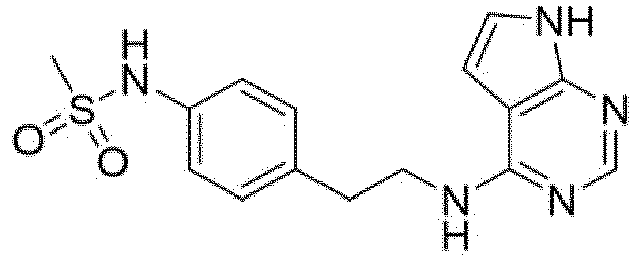
- 4-Chloro-7H-pyrrolo[2,3-d]pyrimidine (100.0 mg, 0.65 mmol), 2-(4-nitrophenyl)ethan-1-amine hydrochloride (132.0 mg, 0.65 mmol) and Et3N (272.0 µL, 1.95 mmol) were added to i-PrOH (6.5 mL). The reaction mixture was stirred at 80°C for 2 days. After addition of water, the reaction mixture was extracted with EtOAc, washed with brine, dried with Na2SO4, filtered and distilled under reduced pressure. The residue was purified by C18 reversed-phase silica gel column chromatography (CH3CN:H2O condition) and freeze-dried to obtain the yellow solid compound, N-(4-nitrophenethyl)-7H-pyrrolo[2,3-d]pyrimidin-4-amine (102.0 mg, 55%).
LC/MS ESI (+): 284 (M+1) - N-(4-nitrophenethyl)-7H-pyrrolo[2,3-d]pyrimidin-4-amine (21.3 mg, 0.07 mmol) was dissolved in acetic acid (1.5 mL), and Zn (24.0 mg, 0.37 mmol) was added thereto at room temperature. The reaction mixture was stirred at room temperature for 1 hour and filtered with celite. After addition of water, the reaction mixture was extracted with EtOAc, washed with brine, dried with Na2SO4, filtered and distilled under reduced pressure. The residue was dissolved in pyridine (1.5 mL), and MsCl (7.03 µL, 0.57 mmol) was slowly added thereto at 0°C. The reaction mixture was stirred at room temperature for 1 hour and filtered with celite. After addition of water, the reaction mixture was extracted with EtOAc, washed with brine, dried with Na2SO4, filtered and distilled under reduced pressure. The residue was purified by C18 reversed-phase silica gel column chromatography (CH3CN:H2O condition) and freeze-dried to obtain the white solid compound, N-(4-(2-((7H-pyrrolo[2,3-d]pyrimidin-4-yl)amino)ethyl)phenyl)methanesulfonamide (5.0 mg, 20%).
- 1H NMR (400 MHz, DMSO-d6) δ = 11.40 (br s, 1H), 9.54 (br s, 1H), 8.04 (s, 1H), 7.41 (br s, 1H), 7.18 - 7.12 (m, J = 8.3 Hz, 2H), 7.10 - 7.04 (m, J = 8.2 Hz, 2H), 6.98 (br s, 1H), 6.45 (br s, 1H), 3.62 - 3.54 (m, 2H), 2.87 (s, 3H), 2.80 (br t, J = 7.5 Hz, 2H)
- LC/MS ESI (+): 332 (M+1)
-

- 5-Chloropyrido[3,4-b]pyrazine (100.0 mg, 0.64 mmol), 2-(4-nitrophenyl)ethan-1-amine hydrochloride (122.0 mg, 0.64 mmol) and DIPEA (527.0 µL, 3.02 mmol) were dissolved in sulforane (3.0 mL), and stirred at 160°C for 18 hours. After addition of H2O, the reaction mixture was stirred and extracted with EtOAc. The organic layer was washed with brine, dried with Na2SO4, filtered and concentrated under reduced pressure. The residue was purified by C18 reversed-phase silica gel column chromatography (CH3CN containing 0.1% formic acid:H2O containing 0.1% formic acid) to obtain the yellow solid, N-(4-nitrophenethyl)pyrido[3,4-b]pyrazin-5-amine (99.0 mg, 56%).
LC/MS ESI (+): 296 (M+1) - 3 N-(4-nitrophenethyl)pyrido[3,4-b]pyrazin-5-amine (99.0 mg, 0.33 mmol) was dissolved in a mixed solvent of methanol/water (6.7 mL, 10/1 v/v), and Zn (110.0 mg, 1.67 mmol) and ammonium formate (179.0 mg, 3.35 mmol) were added thereto at room temperature. The reaction mixture was stirred at 24°C for 2 hours. After addition of H2O the reaction mixture was extracted with CH2Cl2, washed with brine, dried with Na2SO4, filtered and distilled under reduced pressure. The residue was purified by C18 reversed-phase silica gel column chromatography (CH3CN containing 0.1% formic acid:H2O containing 0.1% formic acid) to obtain the yellow solid, N-(4-aminophenethyl)pyrido[3,4-b]pyrazin-5-amine (5.3 mg, 6%).
LC/MS ESI (+): 266 (M+1) - N-(4-aminophenethyl)pyrido[3,4-b]pyrazin-5-amine (5.3 mg, 0.02 mmol) was dissolved in pyridine (0.4 mL), and MsCl (1.55 µL, 0.02 mmol) was slowly added thereto at 24°C. After the reaction was terminated, the reaction mixture was extracted with CH2Cl2. The organic layer was washed with brine, dried with Na2SO4, filtered and distilled under reduced pressure. The residue was purified by C18 reversed-phase silica gel column chromatography (CH3CN containing 0.1% formic acid:H2O containing 0.1% formic acid) to obtain the white solid compound, N-(4-(2-(pyrido[3,4-b]pyrazin-5-ylamino)ethyl)phenyl)methanesulfonamide (5.0 mg, 72.3%).
- 1H NMR (400 MHz, DMSO-d6) δ = 9.60 (br s, 1H), 9.00 (s, 1H), 8.78 (s, 1H), 8.15 (d, J = 5.9 Hz, 1H), 7.92 (t, J = 5.7 Hz, 1H), 7.26 - 7.20 (m, J = 8.3 Hz, 2H), 7.16 - 7.11 (m, J = 8.3 Hz, 2H), 6.97 (d, J = 5.9 Hz, 1H), 3.78 - 3.70 (m, 2H), 2.93 (s, 3H), 2.90 (s, 2H)
- LC/MS ESI (+): 344 (M+1)
-

- 4-Chloro-3-methylquinoline (100.0 mg, 0.56 mmol), 2-(4-nitrophenyl)ethan-1-amine hydrochloride (114.0 mg, 0.56 mmol) and DIPEA (492.0 µL, 2.81 mmol) were dissolved in sulforane (2.8 mL) and stirred at 160°C for 18 hours. After addition of H2O, the reaction mixture was stirred and extracted with EtOAc. The organic layer was washed with brine, dried with Na2SO4, filtered and concentrated under reduced pressure. The residue was purified by C18 reversed-phase silica gel column chromatography (CH3CN containing 0.1% formic acid:H2O containing 0.1% formic acid) to obtain the yellow solid, N-(4-nitrophenethyl)isoquinolin-1-amine (31.0 mg, 18%).
LC/MS ESI (+): 308 (M+1) - 3-Methyl-N-(4-nitrophenethyl)isoquinolin-4-amine (31.0 mg, 0.10 mmol) was dissolved in a mixed solvent of methanol/water (2.0 mL, 10/1 v/v), and Zn (33.0 mg, 0.50 mmol) and ammonium formate (54.0 mg, 1.00 mmol) were added thereto at room temperature. The reaction mixture was stirred at 24°C for 2 hours. After addition of H2O, the reaction mixture was extracted with CH2Cl2, washed with brine, dried with Na2SO4, filtered and distilled under reduced pressure. The residue was purified by C18 reversed-phase silica gel column chromatography (CH3CN containing 0.1% formic acid:H2O containing 0.1% formic acid) to obtain the yellow solid, N-(4-aminophenethyl)-3-methylquinolin-4-amine (11.0 mg, 39%).
LC/MS ESI (+): 278 (M+1) - N-(4-aminophenethyl)-3-methylquinolin-4-amine (11.0 mg, 0.04 mmol) was dissolved in pyridine (0.79 mL), and MsCl (3.1 µL, 0.04 mmol) was slowly added thereto at 24°C. After the reaction was terminated, the reaction mixture was extracted with CH2Cl2. The organic layer was washed with brine, dried with Na2SO4, filtered and distilled under reduced pressure. The residue was purified by C18 reversed-phase silica gel column chromatography (CH3CN containing 0.1% formic acid:H2O containing 0.1% formic acid) to obtain the white solid compound, N-(4-(2-((3-methylquinolin-4-yl)amino)ethyl)phenyl)methanesulfonamide (7.0 mg, 50%).
- 1H NMR (400 MHz, DMSO-d6) δ = 9.60 (br s, 1H), 8.35 (s, 1H), 8.13 (d, J = 8.4 Hz, 1H), 7.79 (d, J = 8.3 Hz, 1H), 7.57 (t, J = 7.6 Hz, 1H), 7.41 (t, J = 7.6 Hz, 1H), 7.19 - 7.12 (m, 2H), 7.12 - 7.08 (m, 2H), 5.89 (br t, J = 6.1 Hz, 1H), 3.68 (q, J = 6.8 Hz, 2H), 2.92 (s, 3H), 2.82 (t, J = 7.4 Hz, 2H), 2.32 (s, 3H)
- LC/MS ESI (+): 356 (M+1)
-

- 4-Chlorofuro[3,2-c]pyridine (150.0 mg, 0.98 mmol), 2-(4-nitrophenyl)ethan-1-amine hydrochloride (297.0 mg, 1.46 mmol), Pd2(dba)3 (44.7 mg, 0.05 mmol), BINAP (60.8 mg, 0.10 mmol) and Cs2CO3 (955.0 mg, 2.93 mmol) were dissolved in toluene/DMF (3.9 mL, 10/1, v/v), and stirred at 160°C for 18 hours. After addition of H2O, the reaction mixture was stirred and extracted with EtOAc. The organic layer was washed with brine, dried with Na2SO4, filtered and concentrated under reduced pressure. The residue was purified by C18 reversed-phase silica gel column chromatography (CH3CN containing 0.1% formic acid: H2O containing 0.1% formic acid) to obtain the yellow solid, N-(4-nitrophenethyl)furo[3,2-c]pyridin-4-amine (140.0 mg, 50.6%).
LC/MS ESI (+): 284 (M+1) - N-(4-nitrophenethyl)furo[3,2-c]pyridin-4-amine (140.0 mg, 0.49 mmol) was dissolved in acetic acid (4.9 mL), and Zn (323 mg, 4.94 mmol) was added thereto at room temperature. The reaction mixture was stirred at room temperature for 1 hour and filtered with celite. After addition of H2O, the reaction mixture was extracted with EtOAc, washed with brine, dried with Na2SO4, filtered and distilled under reduced pressure. The residue was dissolved in pyridine (4.9 mL), and MsCl (46.2 µL, 0.59 mmol) was slowly added thereto at 0°C. The reaction mixture was stirred at room temperature for 1 hour and filtered with celite. After addition of water, the reaction mixture was extracted with EtOAc, washed with brine, dried with Na2SO4, filtered and distilled under reduced pressure. The residue was purified by C18 reversed-phase silica gel column chromatography (CH3CN:H2O condition) and freeze-dried to obtain the white solid compound, N-(4-(2-(furo[3,2-c]pyridin-4-ylamino)ethyl)phenyl)methanesulfonamide (78.0 mg, 48%).
- 1H NMR (400 MHz, DMSO-d6) δ = 9.53 (s, 1H), 7.80 - 7.77 (m, 1H), 7.74 - 7.72 (m, 1H), 7.18 - 7.11 (m, 2H), 7.09 - 7.04 (m, 2H), 7.04 - 7.00 (m, 1H), 7.00 (d, J = 2.0 Hz, 1H), 6.73 (d, J = 5.9 Hz, 1H), 3.61 - 3.49 (m, 2H), 2.87 (s, 3H), 2.80 (t, J = 7.5 Hz, 2H)
- LC/MS ESI (+): 332 (M+1)
-

- 1,4-Dichloroisoquinoline (100.0 mg, 0.51 mmol), 2-(4-nitrophenyl)ethan-1-amine hydrochloride (124.0 mg, 0.51 mmol) and DIPEA (441.0 µL, 2.52 mmol) were dissolved in sulforane (5.0 mL) and stirred at 160°C for 15 hours. After addition of H2O, the reaction mixture was stirred and extracted with EtOAc. The organic layer was washed with brine, dried with Na2SO4, filtered and concentrated under reduced pressure. The residue was purified by C18 reversed-phase silica gel column chromatography (CH3CN containing 0.1% formic acid:H2O containing 0.1% formic acid) to obtain the yellow solid, 4-chloro-N-(4-nitrophenethyl)isoquinolin-1-amine (31.0 mg, 19%). LC/MS ESI (+): 328 (M+1)
- 4-Chloro-N-(4-nitrophenethyl)isoquinolin-1-amine (30.0 mg, 0.09 mmol) was dissolved in acetic acid (0.91 mL), and Zn (59.8 mg, 0.92 mmol) was added thereto at room temperature. The reaction mixture was stirred at room temperature for 1 hour and filtered with celite. After addition of H2O, the reaction mixture was extracted with EtOAc, washed with brine, dried with Na2SO4, filtered and distilled under reduced pressure. The residue was dissolved in pyridine (4.9 mL), and MsCl (7.9 µL, 0.10 mmol) was slowly added thereto at 0°C. The reaction mixture was stirred at room temperature for 1 hour and filtered with celite. After addition of water, the reaction mixture was extracted with EtOAc, washed with brine, dried with Na2SO4, filtered and distilled under reduced pressure. The residue was purified by C18 reversed-phase silica gel column chromatography (CH3CN:H2O condition) and freeze-dried to obtain the white solid compound, N-(4-(2-((4-chloroisoquinolin-1-yl)amino)ethyl)phenyl)methanesulfonamide (24.0 mg, 70%).
- 1H NMR (400 MHz, DMSO-d6) δ = 9.53 (br s, 1H), 8.23 (d, J = 8.4 Hz, 1H), 7.92 (s, 1H), 7.87 (d, J = 8.3 Hz, 1H), 7.77 - 7.73 (m, 1H), 7.73 - 7.67 (m, 1H), 7.55 (t, J = 7.6 Hz, 1H), 7.19 - 7.13 (m, J = 8.4 Hz, 2H), 7.09 - 7.04 (m, J = 8.3 Hz, 2H), 3.65 - 3.56 (m, 2H), 2.87 (s, 3H), 2.86 - 2.83 (m, 2H)
- LC/MS ESI (+): 376 (M+1)
-

- 1-Chloroisoquinoline (100 mg, 0.61 mmol), 2-(4-nitrophenyl)ethan-1-amine hydrochloride (124 mg, 0.61 mmol) and DIPEA (534 µL, 3.06 mmol) were dissolved in sulforane (6.0 mL) and stirred at 160°C for 15 hours. After addition of H2O, the reaction mixture was stirred and extracted with EtOAc. The organic layer was washed with brine, dried with Na2SO4, filtered and concentrated under reduced pressure. The residue was purified by C18 reversed-phase silica gel column chromatography (CH3CN containing 0.1% formic acid:H2O containing 0.1% formic acid) to obtain the yellow solid, N-(4-nitrophenethyl)isoquinolin-1-amine (32.0 mg, 17.8%).
- LC/MS ESI (+): 294 (M+1)
- 1H NMR (400 MHz, CDCl3) δ = 8.18 (d, J= 8.7 Hz, 2H), 8.03 (d, J= 5.9 Hz, 1H), 7.74 - 7.66 (m, 1H), 7.62 (m, 2H), 7.48 - 7.45 (dd, 7.8 Hz, 1.2 Hz, 1H), 7.43 (d, J= 8.6 Hz, 2H), 6.99 (d, J= 5.9 Hz, 1H), 5.26 (br s, 1H), 4.00 - 3.86 (m, 2H), 3.18 (t, J = 6.9 Hz, 2H)
- N-(4-nitrophenethyl)isoquinolin-1-amine (31.0 mg, 0.11 mmol) was dissolved in acetic acid (1.0 mL), and Zn (69.1 mg, 1.06 mmol) was added thereto at 25°C. The reaction mixture was stirred at 25°C for 2 hours and filtered with celite. After addition of H2O, the reaction mixture was extracted with EtOAc, washed with brine, dried with Na2SO4, filtered and distilled under reduced pressure. The residue was dissolved in pyridine (1.0 mL), and MsCl (9.9 µL, 0.13 mmol) was slowly added thereto at 25°C. After the reaction was terminated, the reaction mixture was extracted with CH2Cl2. The organic layer was washed with brine, dried with Na2SO4, filtered and distilled under reduced pressure. The residue was purified by C18 reversed-phase silica gel column chromatography (CH3CN containing 0.1% formic acid:H2O containing 0.1% formic acid) to obtain the white solid compound, N-(4-(2-(isoquinolin-1-ylamino)ethyl)phenyl)methanesulfonamide (17.0 mg, 47.1%).
- LC/MS ESI (+): 342 (M+1)
- 1H NMR (300 MHz, DMSO-d6 ) δ = 9.59 (s, 1H), 8.21 - 8.17 (m, 1H), 7.88 (d, J= 5.7 Hz, 1H), 7.72 - 7.66 (m, 1H), 7.61 (dt, J = 1.0, 7.5 Hz, 1H), 7.50 - 7.48 (m, 1H), 7.48 - 7.44 (m, 1H), 7.27 - 7.21 (m, 2H), 7.17 - 7.09 (m, 2H), 6.88 (d, J= 5.7 Hz, 1H), 3.72 - 3.64 (m, 2H), 2.94 (s, 3H), 2.93 - 2.89 (m, 2H)
-
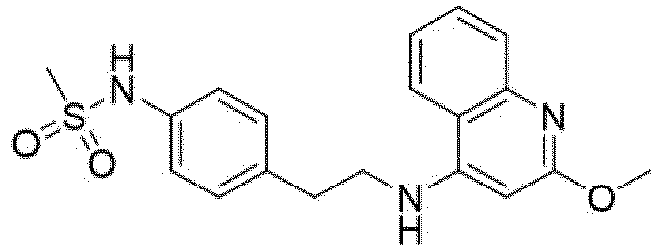
- 2,4-Dichloroquinoline (300.0 mg, 1.52 mmol), 2-(4-nitrophenyl)ethan-1-amine hydrochloride (307.0 mg, 1.52 mmol) and DIPEA (1.3 mL, 7.57 mmol) were dissolved in sulforane (7.5 mL) and stirred at 160°C for 2 days. After addition of H2O, the reaction mixture was stirred and extracted with EtOAc. The organic layer was washed with brine, dried with Na2SO4, filtered and distilled under reduced pressure. The residue was purified by C18 reversed-phase silica gel column chromatography (CH3CN:H2O condition) and freeze-dried to obtain the light brown solid compound, 2-chloro-N-(4-nitrophenethyl)quinolin-4-amine (130.0 mg, 25%).
- 1H NMR (400 MHz, METHANOL-d4) δ = 8.17 (d, J = 8.0 Hz, 2H), 8.00 (dd, J = 0.7, 8.4 Hz, 1H), 7.74 - 7.69 (m, 1H), 7.69 - 7.63 (m, 1H), 7.52 (d, J= 8.7 Hz, 2H), 7.45 (ddd, J = 1.4, 6.8, 8.4 Hz, 1H), 6.51 (s, 1H), 3.70 (t, J = 7.0 Hz, 2H), 3.17 (t, J = 7.0 Hz, 2H)
- LC/MS ESI (+): 328 (M+1)
- 2-Chloro-N-(4-nitrophenethyl)quinolin-4-amine (130.0 mg, 0.40 mmol) was dissolved in acetic acid (4.0 mL), and Zn (259.0 mg, 3.97 mmol) was added thereto at room temperature. The reaction mixture was stirred at room temperature for 1 hour and filtered with celite. After addition of H2O, the reaction mixture was extracted with EtOAc, washed with brine, dried with Na2SO4, filtered and distilled under reduced pressure. The residue was dissolved in pyridine (4.0 mL), and MsCl (34.0 µL, 0.44 mmol) was slowly added thereto at 0°C. The reaction mixture was stirred at room temperature for 1 hour and filtered with celite. After addition of H2O, the reaction mixture was extracted with EtOAc, washed with brine, dried with Na2SO4, filtered and distilled under reduced pressure. The residue was purified by C18 reversed-phase silica gel column chromatography (CH3CN:H2O condition) and freeze-dried to obtain the white solid compound, N-(4-(2-((2-chloroquinolin-4-yl)amino)ethyl)phenyl)methanesulfonamide (100.0 mg, 67%).
- 1H NMR (400 MHz, DMSO-d6) δ = 9.61 (s, 1H), 8.20 (d, J= 8.3 Hz, 1H), 7.73 - 7.57 (m, 3H), 7.46 (t, J= 7.0 Hz, 1H), 7.30 - 7.24 (m, J = 8.4 Hz, 2H), 7.16 - 7.11 (m, J = 8.4 Hz, 2H), 6.45 (s, 1H), 3.57 - 3.45 (m, 2H), 2.99 - 2.88 (m, 5H)
- LC/MS ESI (+): 376 (M+1)
- N-(4-(2-((2-chloroquinolin-4-yl)amino)ethyl)phenyl)methanesulfonamide (20.0 mg, 2.66 mmol) was dissolved in methanol (1.0 mL), and sodium methoxide (144.0 mg, 2.66 mmol) was added thereto. The reaction mixture was stirred at 80°C for 72 hours. After addition of sodium bicarbonate saturated solution, the reaction mixture was extracted with EtOAc, washed with brine, dried with Na2SO4, filtered and distilled under reduced pressure. The residue was purified by C18 reversed-phase silica gel column chromatography (CH3CN:H2O condition) and freeze-dried to obtain the white solid compound, N-(4-(2-((2-methoxyquinolin-4-yl)amino)ethyl)phenyl)methanesulfonamide (14.0 mg, 71%).
- 1H NMR (400 MHz, DMSO-d6) δ = 9.61 (s, 1H), 8.06 (d, J= 8.2 Hz, 1H), 7.60 - 7.57 (m, 1H), 7.55-7.50 (m, 1H), 7.29 - 7.24 (m, 3H), 7.14 (d, J= 8.4 Hz, 2H), 7.09 (t, J= 5.3 Hz, 1H), 5.89 (s, 1H), 3.88 (s, 3H), 3.48 - 3.40 (m, 2H), 2.94 (s, 3H), 2.93 - 2.90 (m, 2H)
- LC/MS ESI (+): 372 (M+1)
- With the compounds prepared in the Examples, the following experiments were carried out.
- Cancer cell lines used for evaluating the compounds of the Examples were purchased from ATCC (American Type Culture Collection) or KCLB (Korean Cell Line Bank), and cultured according to the vendor's recommendation. The human prostate cancer cell line stably expressing the STAT3 promoter (LNcaP stable cell line [plasmid STAT3-TA-luc])-which was prepared to evaluate the inhibitory effect of the compounds of the Examples against dimerization of STAT3-was cultured in RPMI1640 (Cat no. 11875, Gibco), 10% fetal bovine serum (Cat no. SH30071.03, Hyclone) and 150 µg/mL G418 solution (Cat no. 04 727 894 001, Roche).
- In addition, to evaluate the inhibitory effect of the compounds of the Examples against dimerization of STAT1, total 12 µg of luciferase reporter vector containing STAT1 response elements and β-galactosidase DNA at a ratio of 7:5 were transiently transfected into a human osteosarcoma cell line, and the experiment was carried out by the use of this cell line. The human osteosarcoma cell line was incubated in McCoy 5'A (Cat no.16600, Gibco), 15% fetal bovine serum (Cat no. SH30071.03, Hyclone).
- Information about experimental materials is as follows:
rhIL-6 (Cat no. 206-IF, R&D system), rhIFN-y (Cat no. 285-IF, R&D system), luciferase assay system (Cat no. E1501, Promega), pSTAT3-TA-luc(Cat no. PT-3535-5w, Takara bio), pGL4-STAT1-luc, pSV-β-Galactosidase control vector (Cat.# E1081, Promega), β-galactosidase enzyme assay sytem (Cat no. E2000, Promega), Jet-PEI transfection reagent (Cat no. 101-40, Polyplus) and Celltiter Glo luminescent cell viability assay (Cat no. G7573, Promega). - The reporter gene assay of LNcap stable cell line was carried out by the use of RPMI 1640 medium containing 3% DCC-FBS (without G-418). The cell line was dispensed into two (2) white 96-well plates at 30,000 cells/well/50 µL. The cell line was incubated for 24 hours under the condition of 37 °C and 5% CO2, and then the Example compounds of 50 mM DMSO stock were diliuted to various concentrations and treated to two (2) white 96-well plates containing cells. Then, IL-6 was treated to a final concentration of 10 ng/mL. After the treatment of Example compounds and IL-6, the cells were cultured for 48 hours under the condition of 37 °C and 5% CO2. After 48 hours, the 96-well plates were observed under a microscope to record the presence or absence of drug precipitation and specificities, and the 96-well plates were kept at room temperature for 30 minutes. Then, in the case of the first 96-well plate, the culture medium on the plate was removed to measure the luciferase activity, and treated with passive lysis buffer at 20 µL/well and shaken for 30 minutes. The luciferase activity was measured on microLUMA LB96P (BERTHOLD) or Centro XS LB 960 (BERTHOLD) instrument using Luciferase assay system (Cat No. E1501, Promega Corporation). In the case of the second 96-well plate, 20 µL of Glo-mix solution was added to measure cytotoxicity by the compounds of the Examples, and the plate was well shaken for 10 minutes and analyzed on microLUMA LB96P (BERTHOLD) instrument using Glo-vial protocol. As a negative control, a 96 well-plate in which culture medium was added but cells were not plated was used. As a positive control, a 96 well-plate in which cells were plated and 0.1% DMSO and culture medium containing stimulation were added was used.
- Human osteosarcoma U2OS cell line was plated with 2.0 x 10⁶ cells/10 mL in a 100 mm2 dish. After incubation under the condition of 37°C and 5% CO2 for 24 hours, total 12 µg of luciferase reporter vector containing STAT1 response elements and β-galactosidase DNA at a ratio of 7:5 were transfected by the use of a Jet-PEI transfection reagent. After incubation under the condition of 37°C and 5% CO2 for 4 hours, the transfected cell line was dispensed into a white 96-well plate at 25,000 cells/well/50 µL. After incubation under the condition of 37°C and 5% CO2 for 24 hours, the Example compounds of 50 mM DMSO stock were diliuted to various concentrations and treated to the white 96-well plate containing cells. Then, IFN-γ was treated to a final concentration of 50 ng/mL. After treatment of the Example compounds and IFN-y, the white 96-well plate was incubated under the condition of 37°C and 5% CO2 for 24 hours. After 24 hour incubation, the 96-well plate was observed under a microscope to record the presence or absence of drug precipitation and specificities, and the 96-well plate was kept at room temperature for 30 minutes. Then, the culture medium of the white 96-well plate was removed, and the plate was treated with MPER lysis buffer at 50 µL/well and shaken for 30 minutes. Then, 30 µL/well of the plate was taken and transferred to a new white 96-well plate. With this new white 96-well plate, the luciferase activity was measured on microLUMA LB96P (BERTHOLD) or Centro XS LB 960 (BERTHOLD) instrument using Luciferase assay system (Cat No. E1501, Promega Corporation). The remaining 20 µL/well plate was measured with a UV detector (TECAN) at 405 nm using the β-galactosidase enzyme assay system to determine cytotoxicity by the Example compounds. As a negative control, a 96 well-plate in which culture medium was added but cells were not plated was used. As a positive control, a 96 well-plate in which cells were plated and 0.1% DMSO and culture medium containing stimulation were added was used.
- The results of evaluating the inhibitory effects of the compounds of the Examples against dimerization of STAT3 and STAT1 via STAT3 and STAT1 reporter gene assay are represented in Table 1.
[Table 1] Example IC50 (µM) pSTAT3 IC50 (µM) pSTAT1 Example IC50 (µM) pSTAT3 IC50 (µM) pSTAT1 1 2.6 >50 2 0.85 >50 3 10.5 >50 4 20.9 40.9 5 38.1 46.2 6 0.71 >50 7 0.038 >50 8 7.8 46.4 9 3.0 >50 10 3.9 >50 11 1.6 >50 12 5.8 >50 13 3.1 >50 14 0.59 >50 15 3.1 46.1 16 >50 >50 17 1.6 >50 18 0.21 >50 19 >50 >50 20 0.75 >50 21 2.3 >50 22 0.10 >50 23 0.26 >50 24 4.1 >50 25 1.9 >50 26 0.15 >50 27 0.14 >50 28 32.3 >50 29 0.64 >50 30 2.2 >50 31 0.12 >50 32 3.3 45.2 33 6.0 >50 34 6.9 >50 35 2.3 >50 36 0.023 >50 37 20.3 >50 38 0.17 >50 39 >50 >50 40 >50 >50 41 9.8 >50 42 >50 >50 43 >50 >50 44 >50 >50 45 13.1 50 46 33.7 >50 47 >50 >50 48 7.3 >50 49 5.6 >50 50 13.9 >50 51 24.1 >50 52 3.1 47.4 53 3.0 >50 54 11.0 >50 55 >50 >50 56 6.6 28.9 57 17.9 >50 58 >50 >50 59 0.35 >50 60 14.0 33.9 61 0.053 >50 62 12.1 41.8 63 0.75 >50 64 0.063 >50 65 >50 >50 66 0.74 >50 67 4.4 >50 68 0.076 >50 69 0.046 >50 70 3.8 >50 71 9.6 >50 72 0.62 >50 73 35.9 >50 74 3.9 >50 75 4.3 >50 76 1.2 >50 - Cancer cell inhibitory effects by the compounds of the Examples were evaluated as follows. The prostate cancer cell line (LNCap) used was cultured under the condition according to the vendor's recommendation. LNCap was dispensed into a 96-well plate at 10,000 cells/well. After incubation under the condition of 37 °C and 5% CO2 for 24 hours, the Example compounds of 50 mM DMSO stock were diliuted to various concentrations and treated to the 96-well plate containing cells. After treatment of the Example compounds, LNCap cells were incubated in an incubator (37 °C, 5% CO2) for 120 hours. After each incubation time, the 96-well plate was observed under a microscope to record the presence or absence of drug precipitation and specificities, and the 96-well plate was kept at room temperature for 30 minutes. Then, after addition of 20 µL of Celltiter Glo solution, the 96-well plate was well shaken for 30 minutes. The growth inhibitory activity was measured on microLUMA LB96P (BERTHOLD) instrument using Glo-vial protocol. As a negative control, a 96 well-plate in which culture medium was added but cells were not plated was used. As a positive control, a 96 well-plate in which cells were plated and 0.1 % DMSO instead of drugs was added was used. The results of growth inhibitory effects of the Example compounds on prostate cancer cell line are represented in Table 2.
[Table 2] Example IC50 (µM) LNCap Example IC50 (µM) LNCap Example IC50 (µM) LNCap Example IC50 (µM) LNCap 1 3.5 2 0.81 3 5.1 4 >50 5 47.3 6 0.69 7 0.078 8 16.0 9 7.7 10 2.6 11 2.6 12 9.3 13 2.5 14 1.9 15 1.6 16 21.8 17 4.7 18 0.48 19 18.4 20 0.74 21 2.4 22 0.074 23 0.25 24 6.2 25 9.6 26 0.23 27 0.14 28 44.1 29 2.5 30 7.0 31 0.21 32 33.8 33 >50 34 15.7 35 7.3 36 0.093 37 10.6 38 0.18 39 >50 40 >50 41 >50 42 >50 43 >50 44 >50 45 13.1 46 18.9 47 >50 48 14.2 49 14.1 50 23.1 51 27.7 52 6.6 53 15.7 54 14.1 55 >50 56 13.9 57 8.6 58 >50 59 0.16 60 29.5 61 0.19 62 23.5 63 1.9 64 0.23 65 >50 66 0.71 67 3.7 68 0.27 69 0.13 70 10.8 71 20.9 72 1.4 73 33.0 74 13.1 75 6.0 76 3.9
Claims (10)
- A compound of the following Formula 1, or a pharmaceutically acceptable salt thereof:
 X1 is N, and each of X2 and X3 is independently C or N;R1 is hydrogen, halo, or alkyl;R2 is hydrogen, Cl, Br, I, or haloalkoxy;R3 is hydrogen;R4 is nitro, nitroso, or alkylsulfonyl-amino; provided that when R1 is alkyl, R4 is not alkylsulfonyl-amino;A ring is aryl or 3- to 8-membered saturated or unsaturated heterocycle having 1 to 3 heteroatoms selected from N, O and S;D is -CH2-;E is -CH2- optionally substituted with halo;n is an integer of 0 to 2; andm is 2;or a compound which is selected from the group consisting of:N-(4-(2-((2-chloroquinolin-4-yl)amino)ethyl)phenyl)-N-hydroxymethanesulfonamide;4-(2-((2-chloroquinolin-4-yl)amino)ethyl)benzenesulfonamide;4-(2-((2-chloroquinolin-4-yl)(phenethyl)amino)ethyl)benzenesulfonamide;N-(4-aminophenethyl)-2-chloroquinolin-4-amine;2-chloro-8-ethyl-N-(4-nitrophenethyl)quinolin-4-amine;2-chloro-6-methoxy-N-(4-nitrophenethyl)quinolin-4-amine;2-chloro-8-methoxy-N-(4-nitrophenethyl)quinolin-4-amine;N-(4-(2-((2-chloro-6-methoxyquinolin-4-yl)amino)ethyl)phenyl)methanesulfonamide;2-chloro-6-fluoro-N-(4-nitrophenethyl)quinolin-4-amine;2-chloro-8-methyl-N-(4-nitrophenethyl)quinolin-4-amine;ethyl 2-chloro-4-((4-nitrophenethyl)amino)quinolin-6-carboxylate ;2-chloro-N-(4-nitrophenethyl)-4-((4-nitrophenethyl)amino)quinolin-6-sulfonamide;N-(4-(2-((6-fluoroquinolin-4-yl)amino)ethyl)phenyl)methanesulfonamide;N-(4-(2-((2-chloro-6-fluoroquinolin-4-yl)amino)ethyl)phenyl)methanesulfonamide;2-chloro-6-morpholino-N-(4-nitrophenethyl)quinolin-4-amine 2,2,2-trifluoroacetate;2-chloro-5-fluoro-N-(4-nitrophenethyl)quinolin-4-amine;2-chloro-7-fluoro-N-(4-nitrophenethyl)quinolin-4-amine;2-chloro-8-fluoro-N-(4-nitrophenethyl)quinolin-4-amine;2-chloro-N-(4-nitrophenethyl)-6-phenoxyquinolin-4-amine;(2-chloro-4-((4-nitrophenethyl)amino)quinolin-6-yl)(phenyl)methanone;2-chloro-4-((4-nitrophenethyl)amino)quinolin-6-ol;ethyl 2-((2-chloro-4-((4-nitrophenethyl)amino)quinolin-6-yl)oxy)acetate;2-((2-chloro-4-((4-nitrophenethyl)amino)quinolin-6-yl)oxy)acetamide;2-chloro-4-((4-nitrophenethyl)amino)quinolin-6-carboxylic acid;2-chloro-4-((4-nitrophenethyl)amino)quinolin-6-carboxamide;(2-chloro-4-((4-nitrophenethyl)amino)quinolin-6-yl)(morpholino)methanone;2-((2-chloro-4-((4-nitrophenethyl)amino)quinolin-6-yl)oxy)acetic acid;2-chloro-4-((4-nitrophenethyl)amino)quinolin-6-carbohydrazide;N-(4-(2-((2-chloro-8-fluoroquinolin-4-yl)amino)ethyl)phenyl)methanesulfonamide;N-(4-(2-((8-fluoroquinolin-4-yl)amino)ethyl)phenyl)methanesulfonamide;N-(4-nitrophenethyl)-2-(trifluoromethyl)quinazolin-4-amine;N-(4-nitrophenethyl)-2-(trifluoromethyl)quinolin-4-amine;N2-methyl-N4-(4-nitrophenethyl)quinolin-2,4-diamine 2,2,2-trifluoroacetate;N-(4-(2-((2-(trifluoromethyl)quinolin-4-yl)amino)ethyl)phenyl)methanesulfonamide;N-(4-(2-((2-(trifluoromethyl)quinazolin-4-yl)amino)ethyl)phenyl)methanesulfonamide;6-(2,4-dichlorophenyl)-N-(4-nitrophenethyl)quinazolin-4-amine;2-chloro-6-(2,4-dichlorophenyl)-N-(4-nitrophenethyl)quinolin-4-amine;N-(4-(2-((6-(2,4-dichlorophenyl)quinazolin-4-yl)amino)ethyl)phenyl)methanesulfonamide;N-(4-(2-((2-chloro-6-(2,4-dichlorophenyl)quinolin-4-yl)amino)ethyl)phenyl)methanesulfonamide;2-chloro-N-(4-(methylsulfonamido)benzyl)quinolin-4-carboxamide;1,1,1-trifluoro-N-(4-(2-(quinazolin-4-ylamino)ethyl)phenyl)methanesulfonamide;6-fluoro-N-(4-nitrophenethyl)quinazolin-4-amine;N-(4-nitrophenethyl)isoquinolin-4-amine;N-(4-(2-(isoquinolin-4-ylamino)ethyl)phenyl)methanesulfonamide;N-(4-(2-(pyrido[3,4-b]pyrazin-5-ylamino)ethyl)phenyl)methanesulfonamide;N-(4-(2-(furo[3,2-c]pyridin-4-ylamino)ethyl)phenyl)methanesulfonamide;N-(4-(2-((4-chloroisoquinolin-1-yl)amino)ethyl)phenyl)methanesulfonamide;N-(4-(2-(isoquinolin-1-ylamino)ethyl)phenyl)methanesulfonamide; andN-(4-(2-((2-methoxyquinolin-4-yl)amino)ethyl)phenyl)methanesulfonamide;or a pharmaceutically acceptable salt thereof.
 - The compound, or a pharmaceutically acceptable salt thereof according to Claim 1, whereinX1 is N, and each of X2 and X3 is independently C or N;R1 is hydrogen, halo, or C1-C6-alkyl;R2 is hydrogen, Cl, Br, I, or halo-C1-C6-alkoxy;R3 is hydrogen;R4 is nitro, nitroso, or C1-C6-alkylsulfonyl-amino; provided that when R1 is C1-C6-alkyl, R4 is not C1-C6-alkylsulfonyl-amino;A ring is C6-C10-aryl or 5- or 6-membered saturated or unsaturated heterocycle having 1 to 3 heteroatoms selected from N, O and S;D is -CH2-;E is -CH2- optionally substituted with halo;n is an integer of 0 to 2; andm is 2.
- The compound, or a pharmaceutically acceptable salt thereof according to Claim 1, wherein R1 is halo, or C1-C6-alkyl.
- The compound, or a pharmaceutically acceptable salt thereof according to Claim 1, wherein R2 is hydrogen, Cl, Br, I, or halo-C1-C4-alkoxy.
- The compound, or a pharmaceutically acceptable salt thereof according to Claim 1, wherein R4 is nitro, nitroso, or C1-C4-alkylsulfonyl-amino.
- The compound, or a pharmaceutically acceptable salt thereof according to Claim 1, wherein A ring is phenyl or 5- or 6-membered unsaturated heterocycle having 1 to 3 heteroatoms selected from N and S.
- The compound, or a pharmaceutically acceptable salt thereof according to Claim 1, wherein the compound is selected from the group consisting of:2-chloro-N-(4-nitrophenethyl)quinolin-4-amine;N-(4-(2-((2-chloroquinolin-4-yl)amino)ethyl)phenyl)methanesulfonamide;2-chloro-N-(4-nitrophenethyl)-7-(trifluoromethoxy)quinolin-4-amine;2-chloro-N-(4-nitrophenethyl)-5-(trifluoromethoxy)quinolin-4-amine;N-(4-nitrophenethyl)quinolin-4-amine;2-chloro-N-(4-nitrophenethyl)quinazolin-4-amine;2-chloro-N-(4-nitrosophenethyl)quinolin-4-amine;N-(4-(2-((2-chloroquinazolin-4-yl)amino)ethyl)phenyl)methanesulfonamide;N-(4-(2-((2-chloro-7-(trifluoromethoxy)quinolin-4-yl)amino)ethyl)phenyl)methanesulfonamide;N-(4-(2-((7-(trifluoromethoxy)quinolin-4-yl)amino)ethyl)phenyl)methanesulfonamide;N-(4-(2-((2-chloro-5-(trifluoromethoxy)quinolin-4-yl)amino)ethyl)phenyl)methanesulfonamide;N-(4-(2-((5-(trifluoromethoxy)quinolin-4-yl)amino)ethyl)phenyl)methanesulfonamide;2,6-dichloro-N-(4-nitrophenethyl)quinolin-4-amine;N-(4-nitrophenethyl)quinazolin-4-amine;N-(4-(2-(quinazolin-4-ylamino)ethyl)phenyl)methanesulfonamide;2-chloro-N-(4-nitrophenethyl)-9H-purin-6-amine;2-fluoro-N-(4-nitrophenethyl)-9H-purin-6-amine;N-(2,2-difluoro-2-(4-nitrophenyl)ethyl)quinazolin-4-amine;2-(4-nitrophenyl)-N-(quinazolin-4-yl)acetamide;N-(4-(2-(thieno[3,2-d]pyrimidin-4-ylamino)ethyl)phenyl)methanesulfonamide;2-chloro-N-(4-nitrophenethyl)pyrido[2,3-d]pyrimidin-4-amine;N-(4-(2-(thieno[2,3-d]pyrimidin-4-ylamino)ethyl)phenyl)methanesulfonamide;N-(4-(2-(thiazolo[5,4-d]pyrimidin-7-ylamino)ethyl)phenyl)methanesulfonamide;N-(4-(2-((7H-pyrrolo[2,3-d]pyrimidin-4-yl)amino)ethyl)phenyl)methanesulfonamide;and N-(4-(2-((3-methylquinolin-4-yl)amino)ethyl)phenyl)methanesulfonamide.
- A pharmaceutical composition comprising a compound, or a pharmaceutically acceptable salt thereof as defined in any one of Claims 1 to 7 as an active ingredient, and a pharmaceutically acceptable carrier.
- The pharmaceutical composition according to Claim 8 for use in the prevention or treatment of a disease associated with the activation of STAT3 protein selected from the group consisting of solid tumor, blood cancer, radiation or drug-resistant cancer, metastatic cancer, inflammatory disease, immune system disease, diabetes, macular degeneration, papillomavirus infection and tuberculosis.
- The pharmaceutical composition for use according to Claim 9, wherein the disease associated with the activation of STAT3 protein is selected from the group consisting of breast cancer, lung cancer, stomach cancer, prostate cancer, uterine cancer, ovarian cancer, renal cancer, pancreatic cancer, liver cancer, colon cancer, skin cancer, head and neck cancer, thyroid cancer, osteosarcoma, acute or chronic leukemia, multiple myeloma, non-Hodgkin's lymphoma, autoimmune diseases including rheumatoid arthritis, psoriasis, hepatitis, inflammatory bowel disease, Crohn's disease, diabetes, macular degeneration, papillomavirus infection and tuberculosis.
Applications Claiming Priority (2)
| Application Number | Priority Date | Filing Date | Title |
|---|---|---|---|
| KR20180062450 | 2018-05-31 | ||
| PCT/KR2019/006554 WO2019231271A1 (en) | 2018-05-31 | 2019-05-31 | Heterocyclic derivatives and use thereof |
Publications (3)
| Publication Number | Publication Date |
|---|---|
| EP3802495A1 EP3802495A1 (en) | 2021-04-14 |
| EP3802495A4 EP3802495A4 (en) | 2022-04-13 |
| EP3802495B1 true EP3802495B1 (en) | 2025-07-02 |
Family
ID=68698337
Family Applications (1)
| Application Number | Title | Priority Date | Filing Date |
|---|---|---|---|
| EP19812552.8A Active EP3802495B1 (en) | 2018-05-31 | 2019-05-31 | 4-(2-((2-chloroquinolin-4-yl)amino)ethyl)benzenesulfonamide derivatives as stat3 inhibitors for the treatment of cancer |
Country Status (8)
| Country | Link |
|---|---|
| US (1) | US12404249B2 (en) |
| EP (1) | EP3802495B1 (en) |
| JP (1) | JP7558066B2 (en) |
| KR (1) | KR102229471B1 (en) |
| CN (1) | CN112204010B (en) |
| ES (1) | ES3041067T3 (en) |
| TW (1) | TWI853814B (en) |
| WO (1) | WO2019231271A1 (en) |
Families Citing this family (6)
| Publication number | Priority date | Publication date | Assignee | Title |
|---|---|---|---|---|
| CN110105237B (en) * | 2019-06-06 | 2021-12-24 | 东北师范大学 | Beta-gem-difluoro azide compound and preparation and application thereof |
| WO2022187411A1 (en) * | 2021-03-02 | 2022-09-09 | Kumquat Biosciences Inc. | Heterocycles and uses thereof |
| CN113845476B (en) * | 2021-11-08 | 2024-04-30 | 中国药科大学 | A quinolone derivative and its preparation method and use |
| CN114315802B (en) * | 2021-12-14 | 2023-06-16 | 西安医学院 | Quinazoline nitrogen-containing heterocyclic derivative, preparation method and application |
| CA3246750A1 (en) | 2022-04-20 | 2023-10-26 | Kumquat Biosciences Inc. | Macrocyclic heterocycles and uses thereof |
| EP4296674A1 (en) | 2022-06-20 | 2023-12-27 | Université Toulouse III - Paul Sabatier | Innovative molecules decreasing virulence of mycobacterium for the treatment of tuberculosis |
Family Cites Families (19)
| Publication number | Priority date | Publication date | Assignee | Title |
|---|---|---|---|---|
| KR960007566A (en) * | 1994-08-19 | 1996-03-22 | 김정규 | Novel quinolylamine derivatives, methods for their preparation and use as antiarrhythmics |
| AU4878601A (en) | 2000-04-20 | 2001-11-07 | Mitsubishi Corporation | Aromatic amide compounds |
| PE20030008A1 (en) * | 2001-06-19 | 2003-01-22 | Bristol Myers Squibb Co | DUAL INHIBITORS OF PDE 7 AND PDE 4 |
| WO2005061516A1 (en) * | 2003-12-04 | 2005-07-07 | Smithkline Beecham Corporation | Novel chemical compounds |
| GB0420719D0 (en) * | 2004-09-17 | 2004-10-20 | Addex Pharmaceuticals Sa | Novel allosteric modulators |
| US20060074105A1 (en) * | 2004-09-20 | 2006-04-06 | Serenex, Inc. | Substituted quinoline and quinazoline inhibitors of quinone reductase 2 |
| US7932257B2 (en) | 2005-07-22 | 2011-04-26 | Sunesis Pharmaceuticals, Inc. | Substituted pyrazolo[4,3-d]pyrimidines as aurora kinase inhibitors |
| US20090170847A1 (en) * | 2006-01-23 | 2009-07-02 | Seung Chul Lee | Imidazopyridine Derivatives Inhibiting Protein Kinase Activity, Method for the Preparation Thereof and Pharmaceutical Composition Containing Same |
| US20090004185A1 (en) * | 2007-01-11 | 2009-01-01 | Wyeth | Amino-substituted quinazoline derivatives as inhibitors of beta-catenin/tcf-4 pathway and cancer treatment agents |
| EP2014663A1 (en) * | 2007-07-12 | 2009-01-14 | Bayer Schering Pharma AG | Thieno-pyrimidyl amines as modulators of EP2 receptors |
| DE102007032739A1 (en) | 2007-07-13 | 2009-01-15 | Merck Patent Gmbh | Chinazolinamidderivate |
| AU2009219376B2 (en) * | 2008-02-28 | 2014-09-25 | Merck Patent Gmbh | Protein kinase inhibitors and use thereof |
| US8466290B2 (en) | 2008-07-10 | 2013-06-18 | Pharma Ip General Incorporated Association | STAT3 inhibitor containing quinolinecarboxamide derivative as active ingredient |
| JP5507567B2 (en) | 2008-09-26 | 2014-05-28 | ベーリンガー インゲルハイム インターナショナル ゲゼルシャフト ミット ベシュレンクテル ハフツング | Azaindazole compounds as CCR1 receptor antagonists |
| EP2331530B8 (en) * | 2008-09-26 | 2013-12-25 | National Health Research Institutes | Fused multicyclic compounds as protein kinase inhibitors |
| BRPI1008325A2 (en) * | 2009-02-11 | 2020-08-25 | Merck Patent Gmbh | amino azaeterocyclic carboxamides |
| WO2012079079A1 (en) * | 2010-12-10 | 2012-06-14 | President And Fellows Of Harvard College | Production of induced pluripotent stem cells |
| WO2014145512A2 (en) * | 2013-03-15 | 2014-09-18 | President And Fellows Of Harvard College | Potent small molecule inhibitors of autophagy, and methods of use thereof |
| KR20200047627A (en) * | 2017-08-31 | 2020-05-07 | 애브비 인코포레이티드 | Ectonucleotide pyrophosphatase-phosphodiesterase 1 (ENPP-1) inhibitors and uses thereof |
-
2019
- 2019-05-30 TW TW108118755A patent/TWI853814B/en active
- 2019-05-31 WO PCT/KR2019/006554 patent/WO2019231271A1/en not_active Ceased
- 2019-05-31 KR KR1020190064288A patent/KR102229471B1/en active Active
- 2019-05-31 US US17/058,209 patent/US12404249B2/en active Active
- 2019-05-31 ES ES19812552T patent/ES3041067T3/en active Active
- 2019-05-31 EP EP19812552.8A patent/EP3802495B1/en active Active
- 2019-05-31 CN CN201980035635.6A patent/CN112204010B/en active Active
- 2019-05-31 JP JP2020566834A patent/JP7558066B2/en active Active
Also Published As
| Publication number | Publication date |
|---|---|
| JP7558066B2 (en) | 2024-09-30 |
| US20210155594A1 (en) | 2021-05-27 |
| EP3802495A1 (en) | 2021-04-14 |
| WO2019231271A1 (en) | 2019-12-05 |
| KR20190137014A (en) | 2019-12-10 |
| CN112204010A (en) | 2021-01-08 |
| CN112204010B (en) | 2024-03-19 |
| US12404249B2 (en) | 2025-09-02 |
| KR102229471B1 (en) | 2021-03-18 |
| TW202016076A (en) | 2020-05-01 |
| ES3041067T3 (en) | 2025-11-06 |
| EP3802495A4 (en) | 2022-04-13 |
| JP2021525752A (en) | 2021-09-27 |
| TWI853814B (en) | 2024-09-01 |
Similar Documents
| Publication | Publication Date | Title |
|---|---|---|
| US12404249B2 (en) | Heterocyclic derivatives and use thereof | |
| US10912779B2 (en) | Quinazolines and azaquinazolines as dual inhibitors of RAS/RAF/MEK/ERK and PI3K/AKT/PTEN/mTOR pathways | |
| US10590112B2 (en) | Dihydropyrimidinyl benzazepine carboxamide compounds | |
| US11498916B2 (en) | Crystalline FGFR4 inhibitor compound and uses thereof | |
| CA2987466A1 (en) | Use of pteridinone derivative serving as egfr inhibitor | |
| CN105985342B (en) | As the pyrimido-pyrimidine derovatives of EGFR inhibitor and its application | |
| WO2006118231A1 (en) | Cyanopyridine derivative and use thereof as medicine | |
| WO2020077944A1 (en) | Purine derivative, preparation method therefor and use thereof | |
| US20210179610A1 (en) | Parp/pi3k double-target inhibitor containing pyridopyrimidine structure | |
| HK1215810B (en) | Quinazolines and azaquinazolines as dual inhibitors of ras/raf/mek/erk and pi3k/akt/pten/mtor pathways |
Legal Events
| Date | Code | Title | Description |
|---|---|---|---|
| STAA | Information on the status of an ep patent application or granted ep patent |
Free format text: STATUS: THE INTERNATIONAL PUBLICATION HAS BEEN MADE |
|
| PUAI | Public reference made under article 153(3) epc to a published international application that has entered the european phase |
Free format text: ORIGINAL CODE: 0009012 |
|
| STAA | Information on the status of an ep patent application or granted ep patent |
Free format text: STATUS: REQUEST FOR EXAMINATION WAS MADE |
|
| 17P | Request for examination filed |
Effective date: 20210111 |
|
| AK | Designated contracting states |
Kind code of ref document: A1 Designated state(s): AL AT BE BG CH CY CZ DE DK EE ES FI FR GB GR HR HU IE IS IT LI LT LU LV MC MK MT NL NO PL PT RO RS SE SI SK SM TR |
|
| AX | Request for extension of the european patent |
Extension state: BA ME |
|
| DAV | Request for validation of the european patent (deleted) | ||
| DAX | Request for extension of the european patent (deleted) | ||
| A4 | Supplementary search report drawn up and despatched |
Effective date: 20220314 |
|
| RIC1 | Information provided on ipc code assigned before grant |
Ipc: A61P 37/00 20060101ALI20220308BHEP Ipc: A61P 35/00 20060101ALI20220308BHEP Ipc: A61P 31/06 20060101ALI20220308BHEP Ipc: A61K 31/53 20060101ALI20220308BHEP Ipc: A61K 31/517 20060101ALI20220308BHEP Ipc: A61K 31/502 20060101ALI20220308BHEP Ipc: A61K 31/47 20060101ALI20220308BHEP Ipc: C07D 513/04 20060101ALI20220308BHEP Ipc: C07D 495/04 20060101ALI20220308BHEP Ipc: C07D 491/048 20060101ALI20220308BHEP Ipc: C07D 487/04 20060101ALI20220308BHEP Ipc: C07D 471/04 20060101ALI20220308BHEP Ipc: C07D 239/94 20060101ALI20220308BHEP Ipc: C07D 215/50 20060101ALI20220308BHEP Ipc: C07D 215/48 20060101ALI20220308BHEP Ipc: C07D 215/38 20060101AFI20220308BHEP |
|
| STAA | Information on the status of an ep patent application or granted ep patent |
Free format text: STATUS: EXAMINATION IS IN PROGRESS |
|
| 17Q | First examination report despatched |
Effective date: 20230503 |
|
| GRAP | Despatch of communication of intention to grant a patent |
Free format text: ORIGINAL CODE: EPIDOSNIGR1 |
|
| STAA | Information on the status of an ep patent application or granted ep patent |
Free format text: STATUS: GRANT OF PATENT IS INTENDED |
|
| INTG | Intention to grant announced |
Effective date: 20241212 |
|
| GRAS | Grant fee paid |
Free format text: ORIGINAL CODE: EPIDOSNIGR3 |
|
| RAP3 | Party data changed (applicant data changed or rights of an application transferred) |
Owner name: C&C RESEARCH LABORATORIES |
|
| RIN1 | Information on inventor provided before grant (corrected) |
Inventor name: HONG, YEON JU Inventor name: PARK, HEON KYU Inventor name: KIM, JAE ILL Inventor name: MOON, HYUNG JO Inventor name: KIM, BYUNG HO Inventor name: KO, KWANG SEOK Inventor name: LEE, SANG HWI Inventor name: LEE, SOON OK Inventor name: IM, JUN HWAN Inventor name: PARK, CHAN HEE |
|
| P01 | Opt-out of the competence of the unified patent court (upc) registered |
Free format text: CASE NUMBER: APP_18808/2025 Effective date: 20250417 |
|
| GRAA | (expected) grant |
Free format text: ORIGINAL CODE: 0009210 |
|
| STAA | Information on the status of an ep patent application or granted ep patent |
Free format text: STATUS: THE PATENT HAS BEEN GRANTED |
|
| AK | Designated contracting states |
Kind code of ref document: B1 Designated state(s): AL AT BE BG CH CY CZ DE DK EE ES FI FR GB GR HR HU IE IS IT LI LT LU LV MC MK MT NL NO PL PT RO RS SE SI SK SM TR |
|
| REG | Reference to a national code |
Ref country code: GB Ref legal event code: FG4D |
|
| REG | Reference to a national code |
Ref country code: CH Ref legal event code: EP |
|
| REG | Reference to a national code |
Ref country code: DE Ref legal event code: R096 Ref document number: 602019072023 Country of ref document: DE |
|
| REG | Reference to a national code |
Ref country code: IE Ref legal event code: FG4D |
|
| REG | Reference to a national code |
Ref country code: NL Ref legal event code: MP Effective date: 20250702 |
|
| REG | Reference to a national code |
Ref country code: ES Ref legal event code: FG2A Ref document number: 3041067 Country of ref document: ES Kind code of ref document: T3 Effective date: 20251106 |
|
| PG25 | Lapsed in a contracting state [announced via postgrant information from national office to epo] |
Ref country code: PT Free format text: LAPSE BECAUSE OF FAILURE TO SUBMIT A TRANSLATION OF THE DESCRIPTION OR TO PAY THE FEE WITHIN THE PRESCRIBED TIME-LIMIT Effective date: 20251103 |
|
| PG25 | Lapsed in a contracting state [announced via postgrant information from national office to epo] |
Ref country code: NL Free format text: LAPSE BECAUSE OF FAILURE TO SUBMIT A TRANSLATION OF THE DESCRIPTION OR TO PAY THE FEE WITHIN THE PRESCRIBED TIME-LIMIT Effective date: 20250702 |
|
| REG | Reference to a national code |
Ref country code: AT Ref legal event code: MK05 Ref document number: 1809142 Country of ref document: AT Kind code of ref document: T Effective date: 20250702 |
|
| PG25 | Lapsed in a contracting state [announced via postgrant information from national office to epo] |
Ref country code: IS Free format text: LAPSE BECAUSE OF FAILURE TO SUBMIT A TRANSLATION OF THE DESCRIPTION OR TO PAY THE FEE WITHIN THE PRESCRIBED TIME-LIMIT Effective date: 20251102 |
|
| PG25 | Lapsed in a contracting state [announced via postgrant information from national office to epo] |
Ref country code: NO Free format text: LAPSE BECAUSE OF FAILURE TO SUBMIT A TRANSLATION OF THE DESCRIPTION OR TO PAY THE FEE WITHIN THE PRESCRIBED TIME-LIMIT Effective date: 20251002 |
|
| REG | Reference to a national code |
Ref country code: LT Ref legal event code: MG9D |
|
| PG25 | Lapsed in a contracting state [announced via postgrant information from national office to epo] |
Ref country code: AT Free format text: LAPSE BECAUSE OF FAILURE TO SUBMIT A TRANSLATION OF THE DESCRIPTION OR TO PAY THE FEE WITHIN THE PRESCRIBED TIME-LIMIT Effective date: 20250702 |
|
| PG25 | Lapsed in a contracting state [announced via postgrant information from national office to epo] |
Ref country code: FI Free format text: LAPSE BECAUSE OF FAILURE TO SUBMIT A TRANSLATION OF THE DESCRIPTION OR TO PAY THE FEE WITHIN THE PRESCRIBED TIME-LIMIT Effective date: 20250702 |
|
| PG25 | Lapsed in a contracting state [announced via postgrant information from national office to epo] |
Ref country code: HR Free format text: LAPSE BECAUSE OF FAILURE TO SUBMIT A TRANSLATION OF THE DESCRIPTION OR TO PAY THE FEE WITHIN THE PRESCRIBED TIME-LIMIT Effective date: 20250702 |
|
| PG25 | Lapsed in a contracting state [announced via postgrant information from national office to epo] |
Ref country code: GR Free format text: LAPSE BECAUSE OF FAILURE TO SUBMIT A TRANSLATION OF THE DESCRIPTION OR TO PAY THE FEE WITHIN THE PRESCRIBED TIME-LIMIT Effective date: 20251003 |
|
| PG25 | Lapsed in a contracting state [announced via postgrant information from national office to epo] |
Ref country code: SE Free format text: LAPSE BECAUSE OF FAILURE TO SUBMIT A TRANSLATION OF THE DESCRIPTION OR TO PAY THE FEE WITHIN THE PRESCRIBED TIME-LIMIT Effective date: 20250702 Ref country code: CZ Free format text: LAPSE BECAUSE OF FAILURE TO SUBMIT A TRANSLATION OF THE DESCRIPTION OR TO PAY THE FEE WITHIN THE PRESCRIBED TIME-LIMIT Effective date: 20250702 |
|
| PG25 | Lapsed in a contracting state [announced via postgrant information from national office to epo] |
Ref country code: LV Free format text: LAPSE BECAUSE OF FAILURE TO SUBMIT A TRANSLATION OF THE DESCRIPTION OR TO PAY THE FEE WITHIN THE PRESCRIBED TIME-LIMIT Effective date: 20250702 |
|
| PG25 | Lapsed in a contracting state [announced via postgrant information from national office to epo] |
Ref country code: PL Free format text: LAPSE BECAUSE OF FAILURE TO SUBMIT A TRANSLATION OF THE DESCRIPTION OR TO PAY THE FEE WITHIN THE PRESCRIBED TIME-LIMIT Effective date: 20250702 Ref country code: BG Free format text: LAPSE BECAUSE OF FAILURE TO SUBMIT A TRANSLATION OF THE DESCRIPTION OR TO PAY THE FEE WITHIN THE PRESCRIBED TIME-LIMIT Effective date: 20250702 |
|
| PG25 | Lapsed in a contracting state [announced via postgrant information from national office to epo] |
Ref country code: RS Free format text: LAPSE BECAUSE OF FAILURE TO SUBMIT A TRANSLATION OF THE DESCRIPTION OR TO PAY THE FEE WITHIN THE PRESCRIBED TIME-LIMIT Effective date: 20251002 |
|
| PG25 | Lapsed in a contracting state [announced via postgrant information from national office to epo] |
Ref country code: SM Free format text: LAPSE BECAUSE OF FAILURE TO SUBMIT A TRANSLATION OF THE DESCRIPTION OR TO PAY THE FEE WITHIN THE PRESCRIBED TIME-LIMIT Effective date: 20250702 |
|
| PGFP | Annual fee paid to national office [announced via postgrant information from national office to epo] |
Ref country code: GB Payment date: 20260324 Year of fee payment: 8 |
|
| PG25 | Lapsed in a contracting state [announced via postgrant information from national office to epo] |
Ref country code: DK Free format text: LAPSE BECAUSE OF FAILURE TO SUBMIT A TRANSLATION OF THE DESCRIPTION OR TO PAY THE FEE WITHIN THE PRESCRIBED TIME-LIMIT Effective date: 20250702 |
|
| PGFP | Annual fee paid to national office [announced via postgrant information from national office to epo] |
Ref country code: FR Payment date: 20260323 Year of fee payment: 8 |
|
| PG25 | Lapsed in a contracting state [announced via postgrant information from national office to epo] |
Ref country code: EE Free format text: LAPSE BECAUSE OF FAILURE TO SUBMIT A TRANSLATION OF THE DESCRIPTION OR TO PAY THE FEE WITHIN THE PRESCRIBED TIME-LIMIT Effective date: 20250702 Ref country code: SK Free format text: LAPSE BECAUSE OF FAILURE TO SUBMIT A TRANSLATION OF THE DESCRIPTION OR TO PAY THE FEE WITHIN THE PRESCRIBED TIME-LIMIT Effective date: 20250702 |
|
| PLBE | No opposition filed within time limit |
Free format text: ORIGINAL CODE: 0009261 |
|
| STAA | Information on the status of an ep patent application or granted ep patent |
Free format text: STATUS: NO OPPOSITION FILED WITHIN TIME LIMIT |