EP3800720B1 - Method of preparing a laminated cell - Google Patents
Method of preparing a laminated cell Download PDFInfo
- Publication number
- EP3800720B1 EP3800720B1 EP19817567.1A EP19817567A EP3800720B1 EP 3800720 B1 EP3800720 B1 EP 3800720B1 EP 19817567 A EP19817567 A EP 19817567A EP 3800720 B1 EP3800720 B1 EP 3800720B1
- Authority
- EP
- European Patent Office
- Prior art keywords
- electrodes
- lamination
- preparing
- staggered
- folding
- Prior art date
- Legal status (The legal status is an assumption and is not a legal conclusion. Google has not performed a legal analysis and makes no representation as to the accuracy of the status listed.)
- Active
Links
Images


Classifications
-
- H—ELECTRICITY
- H01—ELECTRIC ELEMENTS
- H01M—PROCESSES OR MEANS, e.g. BATTERIES, FOR THE DIRECT CONVERSION OF CHEMICAL ENERGY INTO ELECTRICAL ENERGY
- H01M10/00—Secondary cells; Manufacture thereof
- H01M10/04—Construction or manufacture in general
- H01M10/0413—Large-sized flat cells or batteries for motive or stationary systems with plate-like electrodes
-
- H—ELECTRICITY
- H01—ELECTRIC ELEMENTS
- H01M—PROCESSES OR MEANS, e.g. BATTERIES, FOR THE DIRECT CONVERSION OF CHEMICAL ENERGY INTO ELECTRICAL ENERGY
- H01M10/00—Secondary cells; Manufacture thereof
- H01M10/05—Accumulators with non-aqueous electrolyte
- H01M10/058—Construction or manufacture
- H01M10/0583—Construction or manufacture of accumulators with folded construction elements except wound ones, i.e. folded positive or negative electrodes or separators, e.g. with "Z"-shaped electrodes or separators
-
- H—ELECTRICITY
- H01—ELECTRIC ELEMENTS
- H01M—PROCESSES OR MEANS, e.g. BATTERIES, FOR THE DIRECT CONVERSION OF CHEMICAL ENERGY INTO ELECTRICAL ENERGY
- H01M10/00—Secondary cells; Manufacture thereof
- H01M10/04—Construction or manufacture in general
- H01M10/0404—Machines for assembling batteries
-
- H—ELECTRICITY
- H01—ELECTRIC ELEMENTS
- H01M—PROCESSES OR MEANS, e.g. BATTERIES, FOR THE DIRECT CONVERSION OF CHEMICAL ENERGY INTO ELECTRICAL ENERGY
- H01M10/00—Secondary cells; Manufacture thereof
- H01M10/04—Construction or manufacture in general
- H01M10/0459—Cells or batteries with folded separator between plate-like electrodes
-
- H—ELECTRICITY
- H01—ELECTRIC ELEMENTS
- H01M—PROCESSES OR MEANS, e.g. BATTERIES, FOR THE DIRECT CONVERSION OF CHEMICAL ENERGY INTO ELECTRICAL ENERGY
- H01M10/00—Secondary cells; Manufacture thereof
- H01M10/05—Accumulators with non-aqueous electrolyte
- H01M10/052—Li-accumulators
-
- H—ELECTRICITY
- H01—ELECTRIC ELEMENTS
- H01M—PROCESSES OR MEANS, e.g. BATTERIES, FOR THE DIRECT CONVERSION OF CHEMICAL ENERGY INTO ELECTRICAL ENERGY
- H01M10/00—Secondary cells; Manufacture thereof
- H01M10/04—Construction or manufacture in general
- H01M10/0468—Compression means for stacks of electrodes and separators
-
- Y—GENERAL TAGGING OF NEW TECHNOLOGICAL DEVELOPMENTS; GENERAL TAGGING OF CROSS-SECTIONAL TECHNOLOGIES SPANNING OVER SEVERAL SECTIONS OF THE IPC; TECHNICAL SUBJECTS COVERED BY FORMER USPC CROSS-REFERENCE ART COLLECTIONS [XRACs] AND DIGESTS
- Y02—TECHNOLOGIES OR APPLICATIONS FOR MITIGATION OR ADAPTATION AGAINST CLIMATE CHANGE
- Y02E—REDUCTION OF GREENHOUSE GAS [GHG] EMISSIONS, RELATED TO ENERGY GENERATION, TRANSMISSION OR DISTRIBUTION
- Y02E60/00—Enabling technologies; Technologies with a potential or indirect contribution to GHG emissions mitigation
- Y02E60/10—Energy storage using batteries
-
- Y—GENERAL TAGGING OF NEW TECHNOLOGICAL DEVELOPMENTS; GENERAL TAGGING OF CROSS-SECTIONAL TECHNOLOGIES SPANNING OVER SEVERAL SECTIONS OF THE IPC; TECHNICAL SUBJECTS COVERED BY FORMER USPC CROSS-REFERENCE ART COLLECTIONS [XRACs] AND DIGESTS
- Y02—TECHNOLOGIES OR APPLICATIONS FOR MITIGATION OR ADAPTATION AGAINST CLIMATE CHANGE
- Y02P—CLIMATE CHANGE MITIGATION TECHNOLOGIES IN THE PRODUCTION OR PROCESSING OF GOODS
- Y02P70/00—Climate change mitigation technologies in the production process for final industrial or consumer products
- Y02P70/50—Manufacturing or production processes characterised by the final manufactured product
Definitions
- the present disclosure relates to the technical field of battery cell preparation, and particularly to a method of preparing a laminated cell.
- a laminated cell is formed by firstly cutting a continuous laminate into a plurality of laminate units and then stacking the laminate units.
- KR1020170059739 relates to an electrode assembly, more specifically, to the electrode assembly folding apparatus and an electrode assembly folding method using the same. It can simply the fabrication method of the battery and increase the battery energy density.
- EP3514863A2 relates to a method for producing an electrode stack for an energy store of a motor vehicle; as electrodes, cathodes and anodes being alternately stacked on top of one another with the interposition of a separator strip, the separator strip first having the cathodes and anodes laid thereon, thereby forming an electrode strip, and the electrode strip subsequently being folded numerous times to stack the cathodes and the anodes on top of one another
- An object of the present disclosure comprises providing a method of preparing a laminated cell, which can simplify the preparation process and improve production efficiency, and thus is suitable for mass production.
- An embodiment of the present disclosure can e.g. be implemented in the following manner:
- the step of laying out a plurality of second electrodes successively on both surface sides of the internal layer along the first direction with the second electrodes on one surface side and the second electrodes on the other surface side placed alternately to form a composite lamination comprises the following steps of:
- the step of folding the staggered lamination in a zigzag manner comprises the step of: folding the staggered lamination in a zigzag manner, wherein respective interstices formed between respective first electrodes are used as folding positions.
- the method of preparing a laminated cell further comprises the step of flattening the staggered lamination folded in a zigzag manner to obtain a laminated cell with certain compactness.
- the method of preparing a laminated cell provided in the embodiment of the present disclosure further comprises the step of sealing openings along the edges of the two separators.
- the method of preparing a laminated cell provided in the embodiment of the present disclosure further comprises selecting a cathode as the first electrode, and selecting an anode as the second electrode.
- the first direction is parallel to the extension direction of the separator.
- the plurality of second electrodes are arranged alternately on both surface sides of the internal layer, together forming a composite lamination; when pressing this composite lamination, the separator is creased, hereby forming a staggered lamination; and the staggered lamination is folded in a zigzag manner, forming a laminated cell.
- the whole preparation process is convenient and fast, wherein the operation of stacking after cutting off is replaced by folding, meanwhile, additional operations such as positioning of trimming positions before the cutting operation are omitted, and since the first electrodes are staggered and the separators are creased at the folding positions, the folding process can be completed rapidly.
- the method of preparing a laminated cell provided in the embodiments of the present disclosure has the following beneficial effects: simplifying the preparation process of laminated cells, improving the production efficiency significantly, and being suitable for mass production.
- orientations or position relationships indicated by terms such as “upper”, “lower”, “inner”, “outer”, “left” and “right” are orientations or position relationships shown based on the figures, or orientations or position relationships in which the product of this disclosure is conventionally placed during use, or orientations or position relationships that could be conventionally understood by a person skilled in the art, merely for the purposes of facilitating the description of the present disclosure and simplifying the description, rather than indicating or implying that a specified apparatus or element must have a specific orientation, or be constructed and operated in a certain orientation, and therefore cannot be construed as limiting the present disclosure
- connection may refer to fixed connection, or detachable connection, or integrated connection; it may refer to mechanical connection, or electrical connection; or it may refer to direct connection, or indirect connection via an intermediate, or inner communication between two elements.
- connect may refer to fixed connection, or detachable connection, or integrated connection; it may refer to mechanical connection, or electrical connection; or it may refer to direct connection, or indirect connection via an intermediate, or inner communication between two elements.
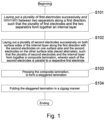
- Fig. 1 is a schematic block diagram showing the flow chart of a method of preparing a laminated cell provided in an embodiment of the present disclosure; and in combination with Figs. 1 and 2 , the method of preparing a laminated cell comprises: Step S101: laying out a plurality of first electrodes 11 successively and intervally between two separators 12 along a first direction, such that the plurality of first electrodes 11 and the two separators 12 form together an internal layer 10.
- the distance between adjacent first electrodes 11 needs to be controlled. Since in subsequent steps, no trimming at this interstice is necessary, in the embodiment of the present disclosure, compared with the conventional preparation method, the interstice between adjacent first electrodes 11 can be smaller, that is to say, more first electrodes 11 can be placed on a separator 12 of the same length, hereby achieving the effect of reducing production costs.
- the internal layer 10 resulting from Step S101 comprises two layers of separators 12, i.e. an upper layer and a lower layer, and the plurality of first electrodes 11 placed intervally between the two layers of separators 12, wherein the distances between respectively adjacent two first electrodes 11 are identical.
- the method of preparing a laminated cell can further comprise: Step S102: laying out a plurality of second electrodes 21 successively on both surface sides of the internal layer 10 along the first direction with the second electrodes on one surface side and the second electrodes on the other surface side placed alternately, such that the plurality of second electrodes 21 and the internal layer 10 form together a composite lamination 20, wherein each of the second electrodes 21 is parallel to a respective first electrode 11. Specifically, the position of one second electrode 21 corresponds to the position of one first electrode 11.
- Step S102 the composite lamination 20 is formed by laying out the plurality of second electrodes 21 successively on both surface sides of the internal layer 10 in a way that the second electrodes on one surface side and the second electrodes on the other surface side are alternately placed.
- Step S102 can further comprise the following substeps:
- the specific laying-out process of the second electrodes 21 can be adjusted according to practical circumstances.
- a method may by adopted, in which a plurality of second electrodes 21 are firstly placed intervally on one surface side of the internal layer 10, and then a plurality of second electrodes 21 are placed intervally on the other surface side of the internal layer 10, as long as it can achieve that on the formed composite lamination 20, any two second electrodes 21 among the plurality of second electrodes 21 distributed on the two surface sides of the internal layer 10 are spaced from each other and staggeredly placed in a vertical direction.
- This vertical direction may be a direction perpendicular to the extension direction of the separator 12.
- the method of preparing a laminated cell can further comprise: Step S103: pressing the composite lamination 20 to form a staggered lamination 30.
- Step S102 the arrangement of the second electrodes 21 is completed, and the implementation of Step S103 begins, after that the second electrodes and the internal layer 10 together form the composite lamination 20.
- Step S103 can further comprise the following substeps: Substep S1031: heating the composite lamination 20, such that a hot-melt adhesive adhered to the separator 12 melts.
- a hot-melt adhesive is adhered to the separator 12, and after Substep S1031, the hot-melt adhesive melts to have stickiness, such that the first electrode 11 and the second electrode 21 can be stuck together.
- Substep S1032 exerting opposite pressures on the respective second electrodes 21 on both sides of the composite lamination 20 in the stacking layer direction of the first electrodes 11 and the corresponding second electrodes 21, such that any two adjacent first electrodes 11 are staggered in the first direction, and such that the separators 12 are each creased at the interstice between any two adjacent first electrodes 11.
- the composite lamination 20 is pressed by way of hot-pressing, as a hot-melt adhesive is adhered to the selected separator 12.
- a hot-melt adhesive is adhered to the selected separator 12.
- the composite lamination 20 can be pressed correspondingly by way of cold-pressing, which means no heating is required.
- the plurality of second electrodes 21 on the two sides of the composite lamination 20 move towards each other, and each push the corresponding first electrode 11 thereof to move, thereby causing the staggering of adjacent first electrodes 11; moreover, the two separators 12 are creased at the interstice between two adjacent first electrodes 11, and the crease can enable subsequent folding process to be completed more quickly.
- Substep S1033 stopping exerting the pressures, when the opposite two sides of the composite lamination 20, where the respective second electrodes 21 are located, are flat.
- the method of preparing a laminated cell can further comprise: Step S104: folding the staggered lamination 30 in a zigzag manner.
- Step S104 After Step S103, after completing the pressing of the composite lamination 20 to form the staggered lamination 30, the implementation of Step S104 begins.
- a laminating device is used to fold the staggered lamination 30 extending in the first direction in a zigzag manner, hereby forming a laminated cell 40.
- the separator 12 When performing the folding in the zigzag manner, since the bending strength of the electrode differs from that of the separator 12, there is an interstice between two adjacent first electrodes 11 on the continuous staggered lamination 30, and the separator 12 would be creased correspondingly at this interstice. Thus, there would be a bending at this interstice, i.e. the crease. As a result, each crease on the separator 12 indicates the position of each folding for the zigzag folding.
- the staggered lamination 30 formed in Step S103 the plurality of first electrodes 11 thereof is staggered in the first direction, and creases are formed on the separator 12 at the staggered parts of the first electrodes 11.
- the separator 12 would not be dragged significantly by turning over the first electrodes 11, so the folding process is easier, and the first electrodes would not be damaged during the folding process due to the interstice between two adjacent first electrodes.
- attaching of the corresponding areas of the separator 12 is tighter.
- the plurality of first electrodes 11 successively arranged in the first direction can be deemed as a continuous whole sheet of first electrodes extending in the first direction, when the interstices between adjacent first electrodes 11 are small enough.
- the plurality of first electrodes 11 in the internal layer 10 can be replaced by a whole continuous first electrode; and because of the flexibility of the continuous first electrode, the alternately arranged second electrodes 21 are staggered under stress and reversely abut against adjacent areas on the continuous first electrode, when the composite lamination 20 is pressed, as a result, this continuous first electrode is bent repeatedly in the first direction, that is to say, being creased like the separator 12.
- the openings along the two edges of the two separators 12 can be sealed, so as to protect the first electrodes 11.
- the separator 12 only has openings at edges where the folding starts and ends, and the sealing operation is convenient and fast.
- the trimming is performed multiple times, resulting in that each layer of the stacked separators 12 has openings at two edges, that is to say, each layer of the separators 12 requires to be sealed, which process is troublesome and slows down the preparation speed.
- a cathode is used as the first electrode 11, and an anode is used as the second electrode 21.
- successive stacking is replaced by zigzag folding, a series of operations such as multiple trimming and positioning before the trimming are omitted, moreover, the stacking process is completed in one time, which greatly improves the preparation speed, saves the preparation costs, and is suitable for mass production.
- the respective electrodes are accurately aligned with each other in the stacking layer direction, and the folding process is easier and faster, and the laminated cell 40 obtained after folding has a compacter structure, that is to say, the battery cell has a better quality.
- the two separators 12 have openings only at the edges where folding starts and ends, achieving a better protection for the first electrodes 11
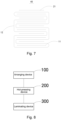
- Fig. 8 shows a schematic block diagram of the structure of a laminating system which, in combination with Figs. 1-8 , can be used in the method of preparing a laminated cell provided in the embodiments of the present disclosure, and can be configured as an automatic production line of laminated cells 40, hereby realizing mass production of laminated cells 40.
- This laminating system comprises an arranging device 100, a hot-pressing device 200, and a laminating device 300;, conveying devices are respectively provided between the arranging device 100, the hot-pressing device 200 and the laminating device 300, where this conveying device may be a conveyor belt.
- the arranging device 100 is configured to lay out a plurality of first electrodes 11 successively and intervally between two separators 12 along a first direction, such that the plurality of first electrodes 11 and the two separators 12 form together an internal layer 10, and is used to lay out a plurality of second electrodes 21 successively on the both surface sides of the internal layer 10 along the first direction with the second electrodes on one surface side and the second electrodes on the other surface side placed alternately, such that the plurality of second electrodes 21 and the internal layer 10 form together a composite lamination 20;
- the hot-pressing device 200 is configured to hot-press the composite lamination 20, hereby forming a staggered lamination 30;
- the laminating device 300 is configured to fold the staggered lamination 30 in a zigzag manner.
- the arranging device 100 outputs the composite lamination 20 to the hot-pressing device 200 through the conveying device; the hot-pressing device 200 then hot-presses the composite lamination 20, hereby forming a staggered lamination 30; and this staggered lamination 30 is then transported to the laminating device 300, and the laminating device 300 folds the staggered lamination 30 in a zigzag manner, so as to form a laminated cell 40.
- Fig. 9 shows a structural schematic diagram of this laminating device 300 for performing Step S104 in the method of preparing a laminated cell provided in the embodiment of the present disclosure. It comprises a guide roller 310, a feeding assembly 330, and a carrying assembly 350, wherein the guide roller 310 is disposed on the feeding assembly 330, or disposed upstream of this feeding assembly 330, and is in rotatable connection with the feeding assembly 330, for the purpose of guiding the continuous staggered lamination 30 outputted by the hot-pressing device 200 and transporting the staggered lamination 30 to the feeding assembly 330.
- the carrying assembly 350 is disposed under the feeding assembly 330, or disposed downstream of this feeding assembly 330, so as to carry the staggered lamination 30.
- the feeding assembly 330 is configured to transport the staggered lamination 30 coming from the guide roller 310 to the carrying assembly 350, and is further configured to reciprocally swing relative to the carrying assembly 350 during the transportation, such that the staggered lamination 30 is folded in a zigzag manner and the folded staggered lamination 30 is placed in the carrying assembly 350.
- the swing angle of the feeding assembly 330 can be adaptively adjusted according to folding requirements.
- the feeding assembly 330 includes a swinging arm 331, a double roller driving assembly 333, and a cutting assembly 335, wherein the guide roller 310 is disposed at one end of the swinging arm 331 and is in rotatable connection with the swinging arm 331.
- the double roller driving assembly 333 is disposed on the swinging arm 331, and is in rotatable connection with the swinging arm 331, so as to transport the staggered lamination 30 to the carrying assembly 350.
- the double roller driving assembly 333 includes one separate guide die roll and two sets of clamping die rolls, wherein each set of clamping die rolls is provided with a driving member for rotation (a rotation driving member), and each set of clamping die rolls includes two small die rolls provided opposite to each other, wherein the driving member for rotation drives the two small die rolls to rotate relative to each other.
- the staggered lamination 30 guided and transported by the guide roller 310 passes by the guide die roll and is transported to the two sets of clamping die rolls, the staggered lamination 30 passes between the two small die rolls of each set of clamping die rolls and is clamped thereby, and under driving by the driving member for rotation, the two small die rolls of each set of clamping die rolls realize the clamping of the staggered lamination 30 and simultaneously transport the same to the carrying assembly 350.
- the staggered lamination 30 is transported to the carrying assembly 350; with the one-way swinging of the swinging arm 331, the staggered lamination 30 is placed on the carrying assembly 350; and after pre-setting the swing angle, the swinging arm 331 performs returning swing, and now, the staggered lamination 30 is bent at the creases of the separator 12 and folded accordingly.
- the swinging arm reciprocally swings, hereby realizing the zigzag folding of the staggered lamination 30.
- the cutting assembly 335 is provided on the swinging arm 331, and the cutting assembly 335 is configured to cut off the continuous staggered lamination 30 after finishing the folding.
- the carrying assembly 350 includes a carrying platform 351 and a folding and flattening mechanism 353, wherein the carrying platform 351 is configured to carry the staggered lamination 30, and the carrying platform 351 is provided with an elevating mechanism, driven by which the carrying platform 351 can move towards or away from the guide roller 310, that is, move towards or away from the folding and flattening mechanism 353, so as to flatten the folded staggered lamination 30.
- the folding and flattening mechanism 353 is provided on the carrying platform 351 in a standing manner and is provided with a protrusion part, wherein this folding and flattening mechanism is able to rotate about a vertical axis, and this protrusion part is able to move towards or away from the carrying platform 351.
- the folding and flattening mechanism 353 begins to rotate, so as to make the protrusion part placed on a top surface of the multi-layered staggered lamination 30; the protrusion part moves then towards a surface of the carrying platform 351, so as to realize the flattening of the multi-layered staggered lamination 30 in the stacking layer direction, wherein the creases are flattened, so as to obtain a laminated cell with a desired compactness.
- the distance between the folding and flattening mechanisms may be an integral multiple of the length of the first electrode or the second electrode in the first direction, so as to assure that the staggered lamination 30 is folded at the gaps between electrodes.
- more folding and flattening mechanisms may be provided, so as to achieve a better flattening effect.
- the laminating system can successively complete the steps of laying-out, pressing and zigzag folding the electrodes, to finally prepare a desired laminated cell.
- the preparation speed of laminated cells can be significantly improved, which indicates suitableness for mass production of laminated cells.
- the method of preparing a laminated cell provided in the embodiments of the present disclosure enables a convenient and fast preparation process, wherein the operation of stacking after cutting off is replaced by folding, meanwhile, additional operations such as positioning of trimming positions required to be performed before the cutting operation are omitted, and since the first electrodes are staggered and the separators are creased at the folding positions, the folding process can be completed rapidly without damaging the first electrodes.
- the preparation process of laminated cells is simplified, and the production efficiency is significantly improved, which indicates the suitableness for mass production.
Landscapes
- Engineering & Computer Science (AREA)
- Manufacturing & Machinery (AREA)
- Chemical & Material Sciences (AREA)
- Chemical Kinetics & Catalysis (AREA)
- Electrochemistry (AREA)
- General Chemical & Material Sciences (AREA)
- Secondary Cells (AREA)
Description
- The present disclosure relates to the technical field of battery cell preparation, and particularly to a method of preparing a laminated cell.
- In the traditional method of preparing a laminated cell, a laminated cell is formed by firstly cutting a continuous laminate into a plurality of laminate units and then stacking the laminate units.
-
KR1020170059739 -
EP3514863A2 relates to a method for producing an electrode stack for an energy store of a motor vehicle; as electrodes, cathodes and anodes being alternately stacked on top of one another with the interposition of a separator strip, the separator strip first having the cathodes and anodes laid thereon, thereby forming an electrode strip, and the electrode strip subsequently being folded numerous times to stack the cathodes and the anodes on top of one another - These traditional preparation methods are complicated in process and have low production efficiency, and are therefore not suitable for mass production.
- An object of the present disclosure comprises providing a method of preparing a laminated cell, which can simplify the preparation process and improve production efficiency, and thus is suitable for mass production.
- An embodiment of the present disclosure can e.g. be implemented in the following manner:
- An embodiment of the present disclosure provides a method of preparing a laminated cell, comprising the following steps of:
- laying out a plurality of first electrodes successively and intervally between two separators along a first direction, such that the plurality of first electrodes and the two separators form together an internal layer;
- laying out a plurality of second electrodes successively on both surface sides of the internal layer along the first direction with the second electrodes on one surface side and the second electrodes on the other surface side placed alternately, such that the plurality of second electrodes and the internal layer form together a composite lamination, wherein each of the second electrodes respectively is parallel to a respective first electrode;
- pressing the composite lamination, to form a staggered lamination; and
- folding the staggered lamination in a zigzag manner
- wherein the step of pressing the composite lamination to form a staggered lamination comprises steps of:
- heating the composite lamination, such that a hot-melt adhesive adhered to the separator melts; and
- exerting opposite pressures on the respective second electrodes on both sides of the composite lamination in a stacking layer direction of the second electrodes, the separators and the first electrodes, such that the separators are each creased at an interstice between any two adjacent first electrodes;
- wherein after the step of exerting opposite pressures on the respective second electrodes on both sides of the composite lamination in a stacking layer direction, the method further comprises a step of:
stopping exerting the pressures, when the opposite two sides of the composite lamination are flat. - Optionally, the step of laying out a plurality of second electrodes successively on both surface sides of the internal layer along the first direction with the second electrodes on one surface side and the second electrodes on the other surface side placed alternately to form a composite lamination comprises the following steps of:
- placing one of two adjacent second electrodes on the separator on one surface side of the internal layer, and making the same correspond to one of two adjacent first electrodes; and
- placing the other one of the two adjacent second electrodes on the separator on the other surface side of the internal layer, and making the same correspond to the other one of the two adjacent first electrodes, wherein each second electrode and the corresponding first electrode thereof are projected onto a direction perpendicular to the separator, with the projections of the each second electrode and the corresponding first electrode thereof at least partially overlapping each other.
- Optionally, the step of folding the staggered lamination in a zigzag manner comprises the step of:
folding the staggered lamination in a zigzag manner, wherein respective interstices formed between respective first electrodes are used as folding positions. - Optionally, the method of preparing a laminated cell provided in the embodiment of the present disclosure further comprises the step of flattening the staggered lamination folded in a zigzag manner to obtain a laminated cell with certain compactness.
- Optionally, the method of preparing a laminated cell provided in the embodiment of the present disclosure further comprises the step of sealing openings along the edges of the two separators.
- Optionally, the method of preparing a laminated cell provided in the embodiment of the present disclosure further comprises selecting a cathode as the first electrode, and selecting an anode as the second electrode.
- Optionally, in the method of preparing a laminated cell provided in the embodiment of the present disclosure, the first direction is parallel to the extension direction of the separator.
- Compared with the prior art, as for the method of preparing a laminated cell provided in the embodiments of the present disclosure, the plurality of second electrodes are arranged alternately on both surface sides of the internal layer, together forming a composite lamination; when pressing this composite lamination, the separator is creased, hereby forming a staggered lamination; and the staggered lamination is folded in a zigzag manner, forming a laminated cell. The whole preparation process is convenient and fast, wherein the operation of stacking after cutting off is replaced by folding, meanwhile, additional operations such as positioning of trimming positions before the cutting operation are omitted, and since the first electrodes are staggered and the separators are creased at the folding positions, the folding process can be completed rapidly. Thus, the method of preparing a laminated cell provided in the embodiments of the present disclosure has the following beneficial effects: simplifying the preparation process of laminated cells, improving the production efficiency significantly, and being suitable for mass production.
- In order to more clearly describe the technical solutions in the embodiments of the present disclosure, the figures to be used in the embodiments will be briefly introduced in the following contents. It shall be understood that the following figures merely show certain embodiments of the present disclosure, and thus should not be deemed as limiting the scope thereof. For a person ordinarily skilled in the art, further relevant figures could be obtained according to these figures without using inventive efforts.
-
Fig. 1 is a schematic block diagram showing the flow chart of a method of preparing a laminated cell provided in an embodiment of the present disclosure; -
Fig. 2 shows a schematic diagram showing the structure of an internal layer; -
Fig. 3 shows a schematic diagram showing the structure of a composite lamination; -
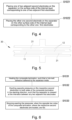
Fig. 4 is a schematic block diagram showing the flow chart of substeps of Step S102 inFig. 1 ; -
Fig. 5 is a structural schematic diagram showing the forming of a staggered lamination by means of pressing; -
Fig. 6 is a schematic block diagram showing the flow chart of substeps of Step S103 inFig. 1 ; -
Fig. 7 is a schematic diagram showing the structure of a laminated cell; -
Fig. 8 is a schematic block diagram showing the structure of a laminating system provided in an embodiment of the present disclosure; and -
Fig. 9 is a schematic diagram showing the structure of the laminating device inFig. 8 . - Reference signs: 10-internal layer; 11-first electrode; 12-seperator; 20-composite lamination; 21-second electrode; 30-staggered lamination; 40-laminated cell; 100-arranging device; 200-hot-pressing device; 300-laminating device; 310-guide roller; 330-feeding assembly; 331-swinging arm; 333-double roller driving assembly; 335-cutting assembly; 350-carrying assembly; 351-carrying platform; and 353- folding and flattening mechanism.
- In order to make the objects, the technical solutions and the advantages of the embodiments of the present disclosure clearer, the technical solutions of the embodiments of the present disclosure will be clearly and comprehensively described below with reference to the attached figures in the embodiments of the present disclosure. Obviously, the described embodiments are merely some of the embodiments of the present disclosure, but not all the embodiments. Generally, the assemblies of the embodiments of the present disclosure that are described and shown here in the figures may be arranged and designed according to various configurations.
- Thus, the following detailed description of the embodiments of the present disclosure that are provided in the figures merely represents selected embodiments of the present disclosure, rather than being intended to limit the scope of the present disclosure for which protection is sought.
- It shall be noted that similar reference signs and letters represent similar items in the following figures, thus, once a certain item is defined in one figure, no further definition and explanation of this item is necessary in the subsequent figures.
- In the description of the present disclosure, it shall be understood that orientations or position relationships indicated by terms such as "upper", "lower", "inner", "outer", "left" and "right" are orientations or position relationships shown based on the figures, or orientations or position relationships in which the product of this disclosure is conventionally placed during use, or orientations or position relationships that could be conventionally understood by a person skilled in the art, merely for the purposes of facilitating the description of the present disclosure and simplifying the description, rather than indicating or implying that a specified apparatus or element must have a specific orientation, or be constructed and operated in a certain orientation, and therefore cannot be construed as limiting the present disclosure
- In addition, terms such as "first" and "second" are used merely for purpose of differentiated description, and cannot be construed as indicating or implying to have importance in relativity.
- In the description of the present disclosure, it shall further be clarified that unless otherwise expressly specified and defined, terms such as "provide" and "connect" shall be construed in a broad sense. For example, the term "connect" may refer to fixed connection, or detachable connection, or integrated connection; it may refer to mechanical connection, or electrical connection; or it may refer to direct connection, or indirect connection via an intermediate, or inner communication between two elements. For a person ordinarily skilled in the art, the specific meanings of the above-mentioned terms in the present disclosure could be construed in accordance with specific circumstances.
- The embodiments of the present disclosure will be described in detail below referring to the figures.
-
Fig. 1 is a schematic block diagram showing the flow chart of a method of preparing a laminated cell provided in an embodiment of the present disclosure; and in combination withFigs. 1 and2 , the method of preparing a laminated cell comprises:
Step S101: laying out a plurality offirst electrodes 11 successively and intervally between twoseparators 12 along a first direction, such that the plurality offirst electrodes 11 and the twoseparators 12 form together aninternal layer 10. - When successively laying out the plurality of
first electrodes 11, the distance between adjacentfirst electrodes 11 needs to be controlled. Since in subsequent steps, no trimming at this interstice is necessary, in the embodiment of the present disclosure, compared with the conventional preparation method, the interstice between adjacentfirst electrodes 11 can be smaller, that is to say, morefirst electrodes 11 can be placed on aseparator 12 of the same length, hereby achieving the effect of reducing production costs. - Referring further to
Fig. 2 , theinternal layer 10 resulting from Step S101 comprises two layers ofseparators 12, i.e. an upper layer and a lower layer, and the plurality offirst electrodes 11 placed intervally between the two layers ofseparators 12, wherein the distances between respectively adjacent twofirst electrodes 11 are identical. - Further, in combination with
Fig. 1 andFig. 3 , the method of preparing a laminated cell can further comprise:
Step S102: laying out a plurality ofsecond electrodes 21 successively on both surface sides of theinternal layer 10 along the first direction with the second electrodes on one surface side and the second electrodes on the other surface side placed alternately, such that the plurality ofsecond electrodes 21 and theinternal layer 10 form together acomposite lamination 20, wherein each of thesecond electrodes 21 is parallel to a respectivefirst electrode 11. Specifically, the position of onesecond electrode 21 corresponds to the position of onefirst electrode 11. - After the completion of Step S101, it begins to implement Step S102. In the embodiment of the present disclosure, the
composite lamination 20 is formed by laying out the plurality ofsecond electrodes 21 successively on both surface sides of theinternal layer 10 in a way that the second electrodes on one surface side and the second electrodes on the other surface side are alternately placed. - Further, referring to
Fig. 4 , Step S102 can further comprise the following substeps: - Substep S1021: placing one of two adjacent
second electrodes 21 on theseparator 12 on one surface side of theinternal layer 10, and making the same correspond to one of two adjacentfirst electrodes 11; and - Substep S1022: placing the other one of the two adjacent
second electrodes 21 on theseparator 12 on the other surface side of theinternal layer 10, and making the same correspond to the other one of the two adjacentfirst electrodes 11, wherein eachsecond electrode 21 and the correspondingfirst electrode 11 thereof re projected onto a direction perpendicular to the separator, with the projections of the each second electrode and the corresponding first electrode thereof at least partially overlapping each other. - In order to avoid influences on subsequent folding step caused by blocking interstices between adjacent
first electrodes 11 during arrangement of thesecond electrodes 21, it is required, when performing Substep S1021 or Substep S1022, to assure that thesecond electrode 21 is arranged within a corresponding region range of thefirst electrode 11 on theseparator 12, that is to say, in the first direction, the margin of thesecond electrode 21 does not exceed the margin of the correspondingfirst electrode 11 thereof, i.e. the interstice between projections of two adjacentsecond electrodes 21 in a direction perpendicular to the internal layer covers the interstice between the corresponding two adjacentfirst electrodes 11, with the two adjacent second electrodes placed on both surface sides of the internal layer. - The specific laying-out process of the
second electrodes 21 can be adjusted according to practical circumstances. For example, in another embodiment, a method may by adopted, in which a plurality ofsecond electrodes 21 are firstly placed intervally on one surface side of theinternal layer 10, and then a plurality ofsecond electrodes 21 are placed intervally on the other surface side of theinternal layer 10, as long as it can achieve that on the formedcomposite lamination 20, any twosecond electrodes 21 among the plurality ofsecond electrodes 21 distributed on the two surface sides of theinternal layer 10 are spaced from each other and staggeredly placed in a vertical direction. This vertical direction may be a direction perpendicular to the extension direction of theseparator 12. - Further, in combination with
Figs. 1 and5 , the method of preparing a laminated cell can further comprise:
Step S103: pressing thecomposite lamination 20 to form astaggered lamination 30. - After Step S102, the arrangement of the
second electrodes 21 is completed, and the implementation of Step S103 begins, after that the second electrodes and theinternal layer 10 together form thecomposite lamination 20. - Referring to
Fig. 6 , Step S103 can further comprise the following substeps:
Substep S1031: heating thecomposite lamination 20, such that a hot-melt adhesive adhered to theseparator 12 melts. - A hot-melt adhesive is adhered to the
separator 12, and after Substep S1031, the hot-melt adhesive melts to have stickiness, such that thefirst electrode 11 and thesecond electrode 21 can be stuck together. - Substep S1032: exerting opposite pressures on the respective
second electrodes 21 on both sides of thecomposite lamination 20 in the stacking layer direction of thefirst electrodes 11 and the correspondingsecond electrodes 21, such that any two adjacentfirst electrodes 11 are staggered in the first direction, and such that theseparators 12 are each creased at the interstice between any two adjacentfirst electrodes 11. - In an embodiment of the present disclosure, the
composite lamination 20 is pressed by way of hot-pressing, as a hot-melt adhesive is adhered to the selectedseparator 12. In another embodiment, if an adhesive adhered to the selectedseparator 12 has an adhesive effect at a room temperature, thecomposite lamination 20 can be pressed correspondingly by way of cold-pressing, which means no heating is required. - When exerting pressures on the
composite lamination 20 during the execution of Substep S1032, due to that the individualsecond electrodes 21 at the two sides of thecomposite lamination 20 protrudes, the pressure acts on one sides of the respectivesecond electrodes 21 away from thefirst electrodes 11, and the pressurizing direction is parallel to the stacking layer direction of thesecond electrodes 21, theseparators 12 and thefirst electrodes 11, that is to say, the pressure direction is perpendicular to the surface of thesecond electrodes 21, and the electrodes at two sides of thecomposite lamination 20 are under pressures of the opposite directions. - After the pressure is applied, the plurality of
second electrodes 21 on the two sides of thecomposite lamination 20 move towards each other, and each push the correspondingfirst electrode 11 thereof to move, thereby causing the staggering of adjacentfirst electrodes 11; moreover, the twoseparators 12 are creased at the interstice between two adjacentfirst electrodes 11, and the crease can enable subsequent folding process to be completed more quickly. - Substep S1033: stopping exerting the pressures, when the opposite two sides of the
composite lamination 20, where the respectivesecond electrodes 21 are located, are flat. - During the continuous application of the pressure, the area corresponding to the
second electrode 21 on theseparator 12 at the same side as the respectivesecond electrode 21 recesses gradually, and adjacent areas with nosecond electrode 21 disposed thereon protrude gradually, that is to say, the opposite two sides of thecomposite lamination 20 become flat gradually. When the opposite two sides of thecomposite lamination 20, where the respectivesecond electrodes 21 are located, are flat, the pressure application stops, and at this time, the respectivesecond electrodes 21 are aligned with the protruding areas of theseparator 12 at the same side as the second electrodes. - Further, in combination with
Figs. 1 and7 , the method of preparing a laminated cell can further comprise:
Step S104: folding the staggeredlamination 30 in a zigzag manner. - After Step S103, after completing the pressing of the
composite lamination 20 to form the staggeredlamination 30, the implementation of Step S104 begins. In an embodiment of the present disclosure, a laminating device is used to fold the staggeredlamination 30 extending in the first direction in a zigzag manner, hereby forming alaminated cell 40. When performing the folding in the zigzag manner, since the bending strength of the electrode differs from that of theseparator 12, there is an interstice between two adjacentfirst electrodes 11 on the continuousstaggered lamination 30, and theseparator 12 would be creased correspondingly at this interstice. Thus, there would be a bending at this interstice, i.e. the crease. As a result, each crease on theseparator 12 indicates the position of each folding for the zigzag folding. - As to the staggered
lamination 30 formed in Step S103, the plurality offirst electrodes 11 thereof is staggered in the first direction, and creases are formed on theseparator 12 at the staggered parts of thefirst electrodes 11. Thus, when folding the staggeredlamination 30 in a zigzag manner, theseparator 12 would not be dragged significantly by turning over thefirst electrodes 11, so the folding process is easier, and the first electrodes would not be damaged during the folding process due to the interstice between two adjacent first electrodes. In addition, after the folding of two adjacentfirst electrodes 11, attaching of the corresponding areas of theseparator 12 is tighter. - Furthermore, it shall be understood that the plurality of
first electrodes 11 successively arranged in the first direction can be deemed as a continuous whole sheet of first electrodes extending in the first direction, when the interstices between adjacentfirst electrodes 11 are small enough. In other words, in another embodiment, the plurality offirst electrodes 11 in theinternal layer 10 can be replaced by a whole continuous first electrode; and because of the flexibility of the continuous first electrode, the alternately arrangedsecond electrodes 21 are staggered under stress and reversely abut against adjacent areas on the continuous first electrode, when thecomposite lamination 20 is pressed, as a result, this continuous first electrode is bent repeatedly in the first direction, that is to say, being creased like theseparator 12. - Moreover, after folding, the openings along the two edges of the two
separators 12 can be sealed, so as to protect thefirst electrodes 11. In the method of preparing a laminated cell provided in the embodiment of the present disclosure, theseparator 12 only has openings at edges where the folding starts and ends, and the sealing operation is convenient and fast. In the conventional preparation method, the trimming is performed multiple times, resulting in that each layer of the stackedseparators 12 has openings at two edges, that is to say, each layer of theseparators 12 requires to be sealed, which process is troublesome and slows down the preparation speed. - In an embodiment of the present disclosure, a cathode is used as the
first electrode 11, and an anode is used as thesecond electrode 21. In the method of preparing a laminated cell provided in the embodiment of the present disclosure, compared with the conventional preparation method, successive stacking is replaced by zigzag folding, a series of operations such as multiple trimming and positioning before the trimming are omitted, moreover, the stacking process is completed in one time, which greatly improves the preparation speed, saves the preparation costs, and is suitable for mass production. - In a
laminated cell 40 prepared through the method of preparing a laminated cell provided in the embodiment of the present disclosure, the respective electrodes are accurately aligned with each other in the stacking layer direction, and the folding process is easier and faster, and thelaminated cell 40 obtained after folding has a compacter structure, that is to say, the battery cell has a better quality. Moreover, the twoseparators 12 have openings only at the edges where folding starts and ends, achieving a better protection for thefirst electrodes 11 -
Fig. 8 shows a schematic block diagram of the structure of a laminating system which, in combination withFigs. 1-8 , can be used in the method of preparing a laminated cell provided in the embodiments of the present disclosure, and can be configured as an automatic production line oflaminated cells 40, hereby realizing mass production oflaminated cells 40. - This laminating system comprises an arranging
device 100, a hot-pressingdevice 200, and alaminating device 300;, conveying devices are respectively provided between the arrangingdevice 100, the hot-pressingdevice 200 and thelaminating device 300, where this conveying device may be a conveyor belt. The arrangingdevice 100 is configured to lay out a plurality offirst electrodes 11 successively and intervally between twoseparators 12 along a first direction, such that the plurality offirst electrodes 11 and the twoseparators 12 form together aninternal layer 10, and is used to lay out a plurality ofsecond electrodes 21 successively on the both surface sides of theinternal layer 10 along the first direction with the second electrodes on one surface side and the second electrodes on the other surface side placed alternately, such that the plurality ofsecond electrodes 21 and theinternal layer 10 form together acomposite lamination 20; the hot-pressingdevice 200 is configured to hot-press thecomposite lamination 20, hereby forming astaggered lamination 30; and thelaminating device 300 is configured to fold the staggeredlamination 30 in a zigzag manner. - The arranging
device 100 outputs thecomposite lamination 20 to the hot-pressingdevice 200 through the conveying device; the hot-pressingdevice 200 then hot-presses thecomposite lamination 20, hereby forming astaggered lamination 30; and this staggeredlamination 30 is then transported to thelaminating device 300, and thelaminating device 300 folds the staggeredlamination 30 in a zigzag manner, so as to form alaminated cell 40. -
Fig. 9 shows a structural schematic diagram of thislaminating device 300 for performing Step S104 in the method of preparing a laminated cell provided in the embodiment of the present disclosure. It comprises aguide roller 310, a feedingassembly 330, and a carryingassembly 350, wherein theguide roller 310 is disposed on the feedingassembly 330, or disposed upstream of this feedingassembly 330, and is in rotatable connection with the feedingassembly 330, for the purpose of guiding the continuousstaggered lamination 30 outputted by the hot-pressingdevice 200 and transporting the staggeredlamination 30 to the feedingassembly 330. The carryingassembly 350 is disposed under the feedingassembly 330, or disposed downstream of this feedingassembly 330, so as to carry thestaggered lamination 30. The feedingassembly 330 is configured to transport the staggeredlamination 30 coming from theguide roller 310 to the carryingassembly 350, and is further configured to reciprocally swing relative to the carryingassembly 350 during the transportation, such that the staggeredlamination 30 is folded in a zigzag manner and the folded staggeredlamination 30 is placed in the carryingassembly 350. During actual applications, the swing angle of the feedingassembly 330 can be adaptively adjusted according to folding requirements. - The feeding
assembly 330 includes a swingingarm 331, a doubleroller driving assembly 333, and a cuttingassembly 335, wherein theguide roller 310 is disposed at one end of the swingingarm 331 and is in rotatable connection with the swingingarm 331. The doubleroller driving assembly 333 is disposed on the swingingarm 331, and is in rotatable connection with the swingingarm 331, so as to transport the staggeredlamination 30 to the carryingassembly 350. The doubleroller driving assembly 333 includes one separate guide die roll and two sets of clamping die rolls, wherein each set of clamping die rolls is provided with a driving member for rotation (a rotation driving member), and each set of clamping die rolls includes two small die rolls provided opposite to each other, wherein the driving member for rotation drives the two small die rolls to rotate relative to each other. The staggeredlamination 30 guided and transported by theguide roller 310 passes by the guide die roll and is transported to the two sets of clamping die rolls, the staggeredlamination 30 passes between the two small die rolls of each set of clamping die rolls and is clamped thereby, and under driving by the driving member for rotation, the two small die rolls of each set of clamping die rolls realize the clamping of the staggeredlamination 30 and simultaneously transport the same to the carryingassembly 350. - During actual applications, the staggered
lamination 30 is transported to the carryingassembly 350; with the one-way swinging of the swingingarm 331, the staggeredlamination 30 is placed on the carryingassembly 350; and after pre-setting the swing angle, the swingingarm 331 performs returning swing, and now, the staggeredlamination 30 is bent at the creases of theseparator 12 and folded accordingly. The swinging arm reciprocally swings, hereby realizing the zigzag folding of the staggeredlamination 30. - The cutting
assembly 335 is provided on the swingingarm 331, and the cuttingassembly 335 is configured to cut off the continuousstaggered lamination 30 after finishing the folding. - The carrying
assembly 350 includes a carryingplatform 351 and a folding andflattening mechanism 353, wherein the carryingplatform 351 is configured to carry thestaggered lamination 30, and the carryingplatform 351 is provided with an elevating mechanism, driven by which thecarrying platform 351 can move towards or away from theguide roller 310, that is, move towards or away from the folding andflattening mechanism 353, so as to flatten the folded staggeredlamination 30. Specifically, the folding andflattening mechanism 353 is provided on the carryingplatform 351 in a standing manner and is provided with a protrusion part, wherein this folding and flattening mechanism is able to rotate about a vertical axis, and this protrusion part is able to move towards or away from the carryingplatform 351. After finishing the folding, the folding andflattening mechanism 353 begins to rotate, so as to make the protrusion part placed on a top surface of the multi-layeredstaggered lamination 30; the protrusion part moves then towards a surface of the carryingplatform 351, so as to realize the flattening of the multi-layeredstaggered lamination 30 in the stacking layer direction, wherein the creases are flattened, so as to obtain a laminated cell with a desired compactness. - Here, two folding and flattening mechanisms are provided, and the distance between the folding and flattening mechanisms may be an integral multiple of the length of the first electrode or the second electrode in the first direction, so as to assure that the staggered
lamination 30 is folded at the gaps between electrodes. In addition, it could be understood that more folding and flattening mechanisms may be provided, so as to achieve a better flattening effect. - Moreover, it could be understood that as to the two configurations, i.e. the providing of an elevating mechanism enabling the movement of the carrying
platform 351 relative to the folding andflattening mechanism 353 and the configuration of the protrusion part to be movable relative to the carryingplatform 351, either one may be selected, or the both may be selected simultaneously, as long as the flattening of the folded staggeredlamination 30 can be realized. - The laminating system can successively complete the steps of laying-out, pressing and zigzag folding the electrodes, to finally prepare a desired laminated cell. The preparation speed of laminated cells can be significantly improved, which indicates suitableness for mass production of laminated cells.
- The above mentioned is merely preferred embodiments of the present disclosure, and is not intended to limit the present disclosure, and for a person skilled in the art, the present disclosure may be modified and changed in various ways.
- The method of preparing a laminated cell provided in the embodiments of the present disclosure enables a convenient and fast preparation process, wherein the operation of stacking after cutting off is replaced by folding, meanwhile, additional operations such as positioning of trimming positions required to be performed before the cutting operation are omitted, and since the first electrodes are staggered and the separators are creased at the folding positions, the folding process can be completed rapidly without damaging the first electrodes. As a result, the preparation process of laminated cells is simplified, and the production efficiency is significantly improved, which indicates the suitableness for mass production.
Claims (7)
- A method of preparing a laminated cell (40), comprising steps of:laying out a plurality of first electrodes (11) successively and intervally between two separators (12) along a first direction, such that the plurality of first electrodes (11) and the two separators (12) form together an internal layer (10);laying out a plurality of second electrodes (21) successively on both surface sides of the internal layer (10) along the first direction with the second electrodes (21) on one surface side and the second electrodes (21) on the other surface side placed alternately, such that the plurality of second electrodes (21) and the internal layer (10) form together a composite lamination (20), wherein each of the second electrodes (21) is parallel to the respective first electrode (11);pressing the composite lamination (20), to form a staggered lamination (30); andfolding the staggered lamination (30) in a zigzag manner,characterized in that the step of pressing the composite lamination (20) to form a staggered lamination (30) comprises steps of:heating the composite lamination (20), such that a hot-melt adhesive adhered to the separator (12) melts; andexerting opposite pressures on the respective second electrodes (21) on both sides of the composite lamination (20) in a stacking layer direction of the second electrodes (21), the separators (12) and the first electrodes (11), such that the separators (12) are each creased at an interstice between any two adjacent first electrodes (11);wherein after the step of exerting opposite pressures on the respective second electrodes (21) on both sides of the composite lamination (20) in a stacking layer direction, the method further comprises a step of:
stopping exerting the pressures, when the opposite two sides of the composite lamination (20) are flat. - The method of preparing a laminated cell (40) according to claim 1, wherein the step of laying out a plurality of second electrodes (21) successively on both surface sides of the internal layer (10) along the first direction with the second electrodes (21) on one surface side and the second electrodes (21) on the other surface side placed alternately to form a composite lamination (20) comprises steps of:placing one of two adjacent second electrodes (21) on the separator (12) on one surface side of the internal layer (10), with the one corresponding to one of two adjacent first electrodes (11); andplacing the other one of the two adjacent second electrodes (21) on the separator (12) on the other surface side of the internal layer (10), with the other one corresponding to the other one of the two adjacent first electrodes (11).
- The method of preparing a laminated cell (40) according to claim 1 or 2, wherein the step of folding the staggered lamination (30) in a zigzag manner comprises a step of:
folding the staggered lamination (30) in a zigzag manner, wherein respective interstices formed between respective first electrodes (11) are used as folding positions. - The method of preparing a laminated cell (40) according to any one of claims 1-3, further comprising a step of flattening the staggered lamination (30) folded in a zigzag manner to obtain a compact laminated battery cell (40).
- The method of preparing a laminated cell (40) according to any one of claims 1-4, further comprising a step of sealing openings along edges of the two separators (12).
- The method of preparing a laminated cell (40) according to any one of claims 1-5, wherein a cathode is used as the first electrode (11), and an anode is used as the second electrode (21).
- The method of preparing a laminated cell (40) according to any one of claims 1-6, wherein the first direction is parallel to an extension direction of the separators (12).
Applications Claiming Priority (2)
| Application Number | Priority Date | Filing Date | Title |
|---|---|---|---|
| CN201910771940.3A CN110459796B (en) | 2019-08-16 | 2019-08-16 | A preparation method of laminated electric core, laminated electric core, lamination device and system |
| PCT/CN2019/107516 WO2021031287A1 (en) | 2019-08-16 | 2019-09-24 | Preparation method for laminated battery cell, laminated battery cell, and lamination device and system |
Publications (4)
| Publication Number | Publication Date |
|---|---|
| EP3800720A1 EP3800720A1 (en) | 2021-04-07 |
| EP3800720A4 EP3800720A4 (en) | 2021-08-18 |
| EP3800720B1 true EP3800720B1 (en) | 2025-07-02 |
| EP3800720C0 EP3800720C0 (en) | 2025-07-02 |
Family
ID=68488016
Family Applications (1)
| Application Number | Title | Priority Date | Filing Date |
|---|---|---|---|
| EP19817567.1A Active EP3800720B1 (en) | 2019-08-16 | 2019-09-24 | Method of preparing a laminated cell |
Country Status (4)
| Country | Link |
|---|---|
| EP (1) | EP3800720B1 (en) |
| CN (2) | CN116613368A (en) |
| HU (1) | HUE073193T2 (en) |
| WO (1) | WO2021031287A1 (en) |
Families Citing this family (35)
| Publication number | Priority date | Publication date | Assignee | Title |
|---|---|---|---|---|
| CN110277590B (en) * | 2019-06-28 | 2022-04-12 | 蜂巢能源科技有限公司 | Lamination method for manufacturing battery cell and battery cell pole group manufacturing equipment |
| CN113131006A (en) * | 2019-12-31 | 2021-07-16 | 广东利元亨智能装备股份有限公司 | Lamination apparatus and method |
| CN111342107B (en) * | 2020-03-13 | 2025-02-28 | 宁德时代新能源科技股份有限公司 | A hot composite high-speed lamination machine |
| CN111653832B (en) * | 2020-06-17 | 2021-12-24 | 深圳吉阳智能科技有限公司 | Laminated cell manufacturing control method, laminated cell and lithium battery |
| CN111786029B (en) * | 2020-07-30 | 2024-08-30 | 深圳吉阳智能科技有限公司 | Pole piece forming device and battery cell production system |
| CN111786031B (en) * | 2020-08-03 | 2024-09-06 | 宁德时代新能源科技股份有限公司 | Opposite side push and swing folding equipment |
| CN111864248B (en) * | 2020-08-20 | 2025-03-04 | 宁德时代新能源科技股份有限公司 | A stacking system and a battery cell stacking method |
| CN112234257A (en) * | 2020-09-24 | 2021-01-15 | 江苏中关村嘉拓新能源设备有限公司 | Method and system for preparing a thermal composite battery |
| CN112186266A (en) * | 2020-10-16 | 2021-01-05 | 深圳市海目星激光智能装备股份有限公司 | Battery cell lamination method and equipment thereof |
| CN112117495B (en) | 2020-10-20 | 2025-02-18 | 深圳吉阳智能科技有限公司 | Lamination equipment, method and lamination structure |
| CN112864441B (en) * | 2021-01-11 | 2023-05-16 | 深圳市格林晟科技股份有限公司 | Discharging mechanism and lamination device |
| CN112615041A (en) * | 2021-01-11 | 2021-04-06 | 深圳市格林晟科技有限公司 | Lamination mechanism and lamination method |
| CN112615060A (en) * | 2021-01-11 | 2021-04-06 | 深圳市格林晟科技有限公司 | Lamination method of laminated battery cell |
| CN112615040B (en) * | 2021-01-11 | 2025-07-08 | 深圳市格林晟科技股份有限公司 | Lamination device and lamination method |
| CN112744635B (en) * | 2021-01-11 | 2025-07-08 | 深圳市格林晟科技股份有限公司 | Lamination mechanism and lamination device |
| CN112820929B (en) * | 2021-02-09 | 2024-06-04 | 无锡先导智能装备股份有限公司 | Lamination machine |
| CN112864473A (en) * | 2021-03-12 | 2021-05-28 | 深圳吉阳智能科技有限公司 | Laminated battery cell and manufacturing method thereof |
| CN113036229A (en) * | 2021-03-12 | 2021-06-25 | 深圳吉阳智能科技有限公司 | Composite lamination process |
| CN113078346B (en) * | 2021-03-29 | 2022-07-19 | 东莞市佳兴自动化设备科技有限公司 | Battery cell folding forming production line and folding forming method |
| CN113611912B (en) * | 2021-06-15 | 2023-07-07 | 万向一二三股份公司 | Lamination structure of electrode assembly, preparation method and electrochemical device |
| CN113346122A (en) * | 2021-06-22 | 2021-09-03 | 苏州巨一智能装备有限公司 | Device for improving alignment stability of Z-shaped lamination |
| CN113571756B (en) * | 2021-07-26 | 2024-09-03 | 珠海冠宇电池股份有限公司 | A method for manufacturing a battery cell and a battery cell |
| CN113594533A (en) * | 2021-08-03 | 2021-11-02 | 蜂巢能源科技有限公司 | Battery cell, preparation method and system thereof and secondary battery |
| CN115732641B (en) * | 2021-08-31 | 2024-08-09 | 宁德时代新能源科技股份有限公司 | Removing device, pole piece processing equipment and removing method |
| CN115732628B (en) * | 2021-08-31 | 2024-08-09 | 宁德时代新能源科技股份有限公司 | Electrode assembly, battery cell, battery and electric equipment |
| CN115832167B (en) * | 2021-10-25 | 2025-02-18 | 宁德时代新能源科技股份有限公司 | Battery pole piece water removal system and battery pole piece water removal method |
| ES3045782T3 (en) * | 2021-10-26 | 2025-11-28 | Lg Energy Solution Ltd | Electrode assembly folding apparatus and electrode assembly folding method |
| US20240258558A1 (en) * | 2021-10-26 | 2024-08-01 | Lg Energy Solution, Ltd. | Electrode Assembly Folding Apparatus and Method Using the Same |
| CN114044347A (en) * | 2021-11-09 | 2022-02-15 | 远景动力技术(江苏)有限公司 | Battery cell stacking system and battery cell stacking deviation rectifying method |
| CN115832168B (en) * | 2021-11-19 | 2024-08-09 | 宁德时代新能源科技股份有限公司 | Negative pressure roller and pole piece processing device |
| CN114300754A (en) * | 2021-11-22 | 2022-04-08 | 江苏中关村嘉拓新能源设备有限公司 | Diaphragm pre-folding and stacking structure of composite lamination machine and stacking process thereof |
| CN114824500A (en) * | 2022-04-13 | 2022-07-29 | 合肥国轩高科动力能源有限公司 | Laminated battery cell, preparation method of laminated battery cell and laminated lithium battery |
| CN115117459A (en) * | 2022-07-01 | 2022-09-27 | 深圳吉阳智能科技有限公司 | A composite lamination method |
| CN116259855A (en) * | 2022-11-30 | 2023-06-13 | 海目星激光科技集团股份有限公司 | A pole piece heating device and pole piece composite equipment |
| CN119426113B (en) * | 2023-08-07 | 2026-03-06 | 宁德时代新能源科技股份有限公司 | Pole piece detection control system |
Family Cites Families (19)
| Publication number | Priority date | Publication date | Assignee | Title |
|---|---|---|---|---|
| DE19929679C5 (en) * | 1999-06-28 | 2005-01-20 | Schreiner Etiketten Und Selbstklebetechnik Gmbh & Co. | Material web with cover label and method and apparatus for processing such a material web |
| CN101630757A (en) * | 2008-07-14 | 2010-01-20 | Tcl集团股份有限公司 | Core structure of lithium ion battery |
| CN103081200B (en) * | 2010-08-11 | 2015-08-19 | 日本自动精机株式会社 | Lamination method and device for positive and negative plates |
| US20120189894A1 (en) * | 2011-01-26 | 2012-07-26 | Samsung Sdi Co., Ltd. | Electrode assembly and secondary battery including the same |
| CN103247825B (en) * | 2013-05-31 | 2016-01-13 | 深圳市格瑞普电池有限公司 | A kind of laminated lithium ion battery preparation method and the battery made |
| CN103682460A (en) * | 2013-12-19 | 2014-03-26 | 深圳市吉阳自动化科技有限公司 | Stacking machine and stacking method thereof |
| JP2015130246A (en) * | 2014-01-06 | 2015-07-16 | 日新電機株式会社 | Power storage device and manufacturing method for power storage device |
| CN105119009B (en) * | 2015-08-18 | 2018-04-10 | 深圳吉阳智云科技有限公司 | The manufacture method of battery bag |
| KR102065556B1 (en) * | 2015-11-23 | 2020-01-13 | 주식회사 엘지화학 | Electrode assembly folding device and electrode assembly folding method using the same |
| IT201600119013A1 (en) * | 2016-11-24 | 2018-05-24 | Manz Italy Srl | Production of Electrical Energy Storage Devices |
| CN207052707U (en) * | 2017-08-24 | 2018-02-27 | 雷天温斯顿电池(长泰)有限公司 | A kind of battery battery core laminating machine |
| IT201700103755A1 (en) * | 2017-09-15 | 2019-03-15 | Manz Italy Srl | METHOD AND APPARATUS FOR ASSEMBLING ELECTRODES |
| DE102018200958A1 (en) * | 2018-01-22 | 2019-07-25 | Volkswagen Aktiengesellschaft | Process for producing an electrode stack for energy storage, stacking plant |
| JP7042090B2 (en) * | 2018-01-23 | 2022-03-25 | 日機装株式会社 | Laminating equipment and laminating method |
| CN108110308A (en) * | 2018-02-01 | 2018-06-01 | 力信(江苏)能源科技有限责任公司 | A kind of cell winding device and electric core winding method |
| CN108832190B (en) * | 2018-05-28 | 2020-12-01 | 深圳吉阳智能科技有限公司 | Lamination device of diaphragm capable of reversing |
| CN109004260B (en) * | 2018-07-02 | 2020-07-24 | 浙江衡远新能源科技有限公司 | Preparation method of cutting lamination winding type flexible package lithium ion battery cell |
| CN109244554B (en) * | 2018-09-21 | 2020-12-29 | 江苏卡耐新能源有限公司 | Z-shaped lamination equipment and process for lithium ion battery |
| CN109599589A (en) * | 2018-12-12 | 2019-04-09 | 河北银隆新能源有限公司 | Battery core method for making and battery |
-
2019
- 2019-08-16 CN CN202310588106.7A patent/CN116613368A/en active Pending
- 2019-08-16 CN CN201910771940.3A patent/CN110459796B/en active Active
- 2019-09-24 HU HUE19817567A patent/HUE073193T2/en unknown
- 2019-09-24 WO PCT/CN2019/107516 patent/WO2021031287A1/en not_active Ceased
- 2019-09-24 EP EP19817567.1A patent/EP3800720B1/en active Active
Also Published As
| Publication number | Publication date |
|---|---|
| HUE073193T2 (en) | 2026-01-28 |
| WO2021031287A1 (en) | 2021-02-25 |
| EP3800720A1 (en) | 2021-04-07 |
| EP3800720C0 (en) | 2025-07-02 |
| CN110459796A (en) | 2019-11-15 |
| EP3800720A4 (en) | 2021-08-18 |
| CN110459796B (en) | 2023-06-13 |
| CN116613368A (en) | 2023-08-18 |
Similar Documents
| Publication | Publication Date | Title |
|---|---|---|
| EP3800720B1 (en) | Method of preparing a laminated cell | |
| KR102692319B1 (en) | Cell stacking apparatus and manufacturing system for secondary battery | |
| CN109004260B (en) | Preparation method of cutting lamination winding type flexible package lithium ion battery cell | |
| CN103579660B (en) | Coiler device | |
| CN106299487B (en) | A lithium ion laminated battery manufacturing device and manufacturing method | |
| US11038188B2 (en) | Manufacturing device and manufacturing method of fuel cell component | |
| US12472735B2 (en) | Laminating machine | |
| CN109244554A (en) | A kind of lithium ion battery zigzag laminating equipment and its technique | |
| US20220336840A1 (en) | Laminating machine | |
| CN106328981A (en) | Laminated cell preparation device | |
| US20220336839A1 (en) | Composite device and laminating machine | |
| KR20150037089A (en) | Lamination device including electrode guide | |
| CN110890582A (en) | Lamination device and lamination method | |
| CN113571762A (en) | Battery cell and manufacturing method thereof | |
| CN217426821U (en) | Battery core lamination processing device and battery core production equipment | |
| CN106654386A (en) | Assembly method and equipment for battery cell modules | |
| KR102892566B1 (en) | Method for manufacturing electrode assembly including line compression and surface compression, electrode assembly manufactured using the same | |
| EP0796732A3 (en) | Method for manufacturing laminates and apparatus performing the method | |
| KR102914055B1 (en) | The Apparatus And The Method For Manufacturing Unit Cell | |
| CN209888346U (en) | Honeycomb sandwich layer production line | |
| CN217691263U (en) | Lamination device and battery production line having the same | |
| CN220526972U (en) | Thermal compounding device and lamination machine | |
| CN117747964A (en) | Preparation method of battery cell | |
| JP2025536784A (en) | Laminating device and method for manufacturing electrode assembly | |
| CN115939487A (en) | Composite lamination method and composite lamination equipment |
Legal Events
| Date | Code | Title | Description |
|---|---|---|---|
| STAA | Information on the status of an ep patent application or granted ep patent |
Free format text: STATUS: UNKNOWN |
|
| STAA | Information on the status of an ep patent application or granted ep patent |
Free format text: STATUS: THE INTERNATIONAL PUBLICATION HAS BEEN MADE |
|
| PUAI | Public reference made under article 153(3) epc to a published international application that has entered the european phase |
Free format text: ORIGINAL CODE: 0009012 |
|
| STAA | Information on the status of an ep patent application or granted ep patent |
Free format text: STATUS: REQUEST FOR EXAMINATION WAS MADE |
|
| 17P | Request for examination filed |
Effective date: 20191219 |
|
| AK | Designated contracting states |
Kind code of ref document: A1 Designated state(s): AL AT BE BG CH CY CZ DE DK EE ES FI FR GB GR HR HU IE IS IT LI LT LU LV MC MK MT NL NO PL PT RO RS SE SI SK SM TR |
|
| AX | Request for extension of the european patent |
Extension state: BA ME |
|
| STAA | Information on the status of an ep patent application or granted ep patent |
Free format text: STATUS: EXAMINATION IS IN PROGRESS |
|
| A4 | Supplementary search report drawn up and despatched |
Effective date: 20210716 |
|
| RIC1 | Information provided on ipc code assigned before grant |
Ipc: H01M 10/0583 20100101AFI20210712BHEP Ipc: H01M 10/04 20060101ALI20210712BHEP |
|
| 17Q | First examination report despatched |
Effective date: 20210728 |
|
| DAV | Request for validation of the european patent (deleted) | ||
| DAX | Request for extension of the european patent (deleted) | ||
| RAP1 | Party data changed (applicant data changed or rights of an application transferred) |
Owner name: CONTEMPORARY AMPEREX TECHNOLOGY(HONG KONG) LIMITED |
|
| GRAP | Despatch of communication of intention to grant a patent |
Free format text: ORIGINAL CODE: EPIDOSNIGR1 |
|
| STAA | Information on the status of an ep patent application or granted ep patent |
Free format text: STATUS: GRANT OF PATENT IS INTENDED |
|
| INTG | Intention to grant announced |
Effective date: 20250214 |
|
| GRAS | Grant fee paid |
Free format text: ORIGINAL CODE: EPIDOSNIGR3 |
|
| GRAA | (expected) grant |
Free format text: ORIGINAL CODE: 0009210 |
|
| STAA | Information on the status of an ep patent application or granted ep patent |
Free format text: STATUS: THE PATENT HAS BEEN GRANTED |
|
| AK | Designated contracting states |
Kind code of ref document: B1 Designated state(s): AL AT BE BG CH CY CZ DE DK EE ES FI FR GB GR HR HU IE IS IT LI LT LU LV MC MK MT NL NO PL PT RO RS SE SI SK SM TR |
|
| REG | Reference to a national code |
Ref country code: GB Ref legal event code: FG4D |
|
| REG | Reference to a national code |
Ref country code: CH Ref legal event code: EP |
|
| REG | Reference to a national code |
Ref country code: DE Ref legal event code: R096 Ref document number: 602019072029 Country of ref document: DE |
|
| REG | Reference to a national code |
Ref country code: IE Ref legal event code: FG4D |
|
| U01 | Request for unitary effect filed |
Effective date: 20250729 |
|
| U07 | Unitary effect registered |
Designated state(s): AT BE BG DE DK EE FI FR IT LT LU LV MT NL PT RO SE SI Effective date: 20250804 |
|
| PGFP | Annual fee paid to national office [announced via postgrant information from national office to epo] |
Ref country code: GB Payment date: 20250916 Year of fee payment: 7 |
|
| U20 | Renewal fee for the european patent with unitary effect paid |
Year of fee payment: 7 Effective date: 20250916 |
|
| PGFP | Annual fee paid to national office [announced via postgrant information from national office to epo] |
Ref country code: HU Payment date: 20250910 Year of fee payment: 7 |
|
| PG25 | Lapsed in a contracting state [announced via postgrant information from national office to epo] |
Ref country code: IS Free format text: LAPSE BECAUSE OF FAILURE TO SUBMIT A TRANSLATION OF THE DESCRIPTION OR TO PAY THE FEE WITHIN THE PRESCRIBED TIME-LIMIT Effective date: 20251102 |
|
| PG25 | Lapsed in a contracting state [announced via postgrant information from national office to epo] |
Ref country code: NO Free format text: LAPSE BECAUSE OF FAILURE TO SUBMIT A TRANSLATION OF THE DESCRIPTION OR TO PAY THE FEE WITHIN THE PRESCRIBED TIME-LIMIT Effective date: 20251002 |
|
| PG25 | Lapsed in a contracting state [announced via postgrant information from national office to epo] |
Ref country code: HR Free format text: LAPSE BECAUSE OF FAILURE TO SUBMIT A TRANSLATION OF THE DESCRIPTION OR TO PAY THE FEE WITHIN THE PRESCRIBED TIME-LIMIT Effective date: 20250702 |
|
| PG25 | Lapsed in a contracting state [announced via postgrant information from national office to epo] |
Ref country code: GR Free format text: LAPSE BECAUSE OF FAILURE TO SUBMIT A TRANSLATION OF THE DESCRIPTION OR TO PAY THE FEE WITHIN THE PRESCRIBED TIME-LIMIT Effective date: 20251003 |
|
| PG25 | Lapsed in a contracting state [announced via postgrant information from national office to epo] |
Ref country code: CZ Free format text: LAPSE BECAUSE OF FAILURE TO SUBMIT A TRANSLATION OF THE DESCRIPTION OR TO PAY THE FEE WITHIN THE PRESCRIBED TIME-LIMIT Effective date: 20250702 |
|
| PG25 | Lapsed in a contracting state [announced via postgrant information from national office to epo] |
Ref country code: PL Free format text: LAPSE BECAUSE OF FAILURE TO SUBMIT A TRANSLATION OF THE DESCRIPTION OR TO PAY THE FEE WITHIN THE PRESCRIBED TIME-LIMIT Effective date: 20250702 |
|
| PG25 | Lapsed in a contracting state [announced via postgrant information from national office to epo] |
Ref country code: RS Free format text: LAPSE BECAUSE OF FAILURE TO SUBMIT A TRANSLATION OF THE DESCRIPTION OR TO PAY THE FEE WITHIN THE PRESCRIBED TIME-LIMIT Effective date: 20251002 |
|
| REG | Reference to a national code |
Ref country code: HU Ref legal event code: AG4A Ref document number: E073193 Country of ref document: HU |
|
| PG25 | Lapsed in a contracting state [announced via postgrant information from national office to epo] |
Ref country code: ES Free format text: LAPSE BECAUSE OF FAILURE TO SUBMIT A TRANSLATION OF THE DESCRIPTION OR TO PAY THE FEE WITHIN THE PRESCRIBED TIME-LIMIT Effective date: 20250702 |
|
| PG25 | Lapsed in a contracting state [announced via postgrant information from national office to epo] |
Ref country code: SM Free format text: LAPSE BECAUSE OF FAILURE TO SUBMIT A TRANSLATION OF THE DESCRIPTION OR TO PAY THE FEE WITHIN THE PRESCRIBED TIME-LIMIT Effective date: 20250702 |
|
| REG | Reference to a national code |
Ref country code: CH Ref legal event code: H13 Free format text: ST27 STATUS EVENT CODE: U-0-0-H10-H13 (AS PROVIDED BY THE NATIONAL OFFICE) Effective date: 20260425 |
|
| PG25 | Lapsed in a contracting state [announced via postgrant information from national office to epo] |
Ref country code: SK Free format text: LAPSE BECAUSE OF FAILURE TO SUBMIT A TRANSLATION OF THE DESCRIPTION OR TO PAY THE FEE WITHIN THE PRESCRIBED TIME-LIMIT Effective date: 20250702 |