EP3800188A1 - Substituted pyrazolopyrimidines as irak4 inhibitors - Google Patents
Substituted pyrazolopyrimidines as irak4 inhibitors Download PDFInfo
- Publication number
- EP3800188A1 EP3800188A1 EP19201191.4A EP19201191A EP3800188A1 EP 3800188 A1 EP3800188 A1 EP 3800188A1 EP 19201191 A EP19201191 A EP 19201191A EP 3800188 A1 EP3800188 A1 EP 3800188A1
- Authority
- EP
- European Patent Office
- Prior art keywords
- phenyl
- pyrazolo
- pyrimidin
- amino
- trifluoromethyl
- Prior art date
- Legal status (The legal status is an assumption and is not a legal conclusion. Google has not performed a legal analysis and makes no representation as to the accuracy of the status listed.)
- Withdrawn
Links
- 229940127590 IRAK4 inhibitor Drugs 0.000 title description 18
- APXRHPDHORGIEB-UHFFFAOYSA-N 1H-pyrazolo[4,3-d]pyrimidine Chemical class N1=CN=C2C=NNC2=C1 APXRHPDHORGIEB-UHFFFAOYSA-N 0.000 title description 6
- 208000037265 diseases, disorders, signs and symptoms Diseases 0.000 claims abstract description 99
- 238000011282 treatment Methods 0.000 claims abstract description 97
- 201000010099 disease Diseases 0.000 claims abstract description 53
- 208000035475 disorder Diseases 0.000 claims abstract description 46
- 208000027866 inflammatory disease Diseases 0.000 claims abstract description 45
- 241001465754 Metazoa Species 0.000 claims abstract description 35
- 208000026935 allergic disease Diseases 0.000 claims abstract description 35
- 239000003814 drug Substances 0.000 claims abstract description 31
- 238000011321 prophylaxis Methods 0.000 claims abstract description 29
- 208000030159 metabolic disease Diseases 0.000 claims abstract description 27
- 230000002503 metabolic effect Effects 0.000 claims abstract description 21
- 206010020751 Hypersensitivity Diseases 0.000 claims abstract description 20
- 230000007815 allergy Effects 0.000 claims abstract description 19
- 208000023275 Autoimmune disease Diseases 0.000 claims abstract description 18
- 201000004624 Dermatitis Diseases 0.000 claims abstract description 18
- 206010012438 Dermatitis atopic Diseases 0.000 claims abstract description 17
- 230000000172 allergic effect Effects 0.000 claims abstract description 17
- 201000008937 atopic dermatitis Diseases 0.000 claims abstract description 17
- 230000002757 inflammatory effect Effects 0.000 claims abstract description 17
- 230000002062 proliferating effect Effects 0.000 claims abstract description 17
- 210000000987 immune system Anatomy 0.000 claims abstract description 16
- 241000282472 Canis lupus familiaris Species 0.000 claims abstract description 15
- 206010028980 Neoplasm Diseases 0.000 claims abstract description 14
- 208000019693 Lung disease Diseases 0.000 claims abstract description 10
- 201000011510 cancer Diseases 0.000 claims abstract description 9
- 208000024172 Cardiovascular disease Diseases 0.000 claims abstract description 8
- 241000282412 Homo Species 0.000 claims abstract description 8
- 208000012902 Nervous system disease Diseases 0.000 claims abstract description 7
- 208000030533 eye disease Diseases 0.000 claims abstract description 7
- 208000017520 skin disease Diseases 0.000 claims abstract description 7
- 208000036339 neurological pain disease Diseases 0.000 claims abstract description 6
- -1 oxo substituent Chemical group 0.000 claims description 303
- 150000001875 compounds Chemical class 0.000 claims description 279
- 239000000203 mixture Substances 0.000 claims description 106
- 125000005842 heteroatom Chemical group 0.000 claims description 104
- 229910052757 nitrogen Inorganic materials 0.000 claims description 88
- 125000001424 substituent group Chemical group 0.000 claims description 84
- 125000000592 heterocycloalkyl group Chemical group 0.000 claims description 78
- 125000001153 fluoro group Chemical group F* 0.000 claims description 72
- 125000001997 phenyl group Chemical group [H]C1=C([H])C([H])=C(*)C([H])=C1[H] 0.000 claims description 70
- 150000003839 salts Chemical class 0.000 claims description 69
- 229910052731 fluorine Inorganic materials 0.000 claims description 64
- 229910052717 sulfur Inorganic materials 0.000 claims description 63
- 125000004433 nitrogen atom Chemical group N* 0.000 claims description 54
- 229910052760 oxygen Inorganic materials 0.000 claims description 53
- 125000002924 primary amino group Chemical group [H]N([H])* 0.000 claims description 52
- 125000004527 pyrimidin-4-yl group Chemical group N1=CN=C(C=C1)* 0.000 claims description 48
- 229910052739 hydrogen Inorganic materials 0.000 claims description 44
- 239000001257 hydrogen Substances 0.000 claims description 44
- 125000004435 hydrogen atom Chemical group [H]* 0.000 claims description 44
- MDFFNEOEWAXZRQ-UHFFFAOYSA-N aminyl Chemical compound [NH2] MDFFNEOEWAXZRQ-UHFFFAOYSA-N 0.000 claims description 40
- 229910003827 NRaRb Inorganic materials 0.000 claims description 39
- 201000006417 multiple sclerosis Diseases 0.000 claims description 37
- 208000002193 Pain Diseases 0.000 claims description 36
- 125000004178 (C1-C4) alkyl group Chemical group 0.000 claims description 34
- 125000003178 carboxy group Chemical group [H]OC(*)=O 0.000 claims description 33
- 201000009273 Endometriosis Diseases 0.000 claims description 32
- 201000010065 polycystic ovary syndrome Diseases 0.000 claims description 31
- 125000004093 cyano group Chemical group *C#N 0.000 claims description 28
- RUYNTLUDGSFPFZ-UHFFFAOYSA-N cyclobutanol Chemical compound OC1[CH]CC1 RUYNTLUDGSFPFZ-UHFFFAOYSA-N 0.000 claims description 26
- 206010061218 Inflammation Diseases 0.000 claims description 25
- 230000004054 inflammatory process Effects 0.000 claims description 25
- 125000002950 monocyclic group Chemical group 0.000 claims description 24
- 239000012453 solvate Substances 0.000 claims description 23
- 125000004169 (C1-C6) alkyl group Chemical group 0.000 claims description 21
- 125000004432 carbon atom Chemical group C* 0.000 claims description 20
- JHHZLHWJQPUNKB-UHFFFAOYSA-N pyrrolidin-3-ol Chemical compound OC1CCNC1 JHHZLHWJQPUNKB-UHFFFAOYSA-N 0.000 claims description 20
- 125000004191 (C1-C6) alkoxy group Chemical group 0.000 claims description 19
- 125000001995 cyclobutyl group Chemical group [H]C1([H])C([H])([H])C([H])(*)C1([H])[H] 0.000 claims description 19
- 150000001204 N-oxides Chemical class 0.000 claims description 16
- 150000004677 hydrates Chemical class 0.000 claims description 16
- 201000005569 Gout Diseases 0.000 claims description 15
- 201000004681 Psoriasis Diseases 0.000 claims description 15
- 208000000094 Chronic Pain Diseases 0.000 claims description 14
- KFZMGEQAYNKOFK-UHFFFAOYSA-N Isopropanol Chemical compound CC(C)O KFZMGEQAYNKOFK-UHFFFAOYSA-N 0.000 claims description 14
- 150000002367 halogens Chemical class 0.000 claims description 14
- 206010039073 rheumatoid arthritis Diseases 0.000 claims description 14
- 201000000596 systemic lupus erythematosus Diseases 0.000 claims description 14
- 125000005913 (C3-C6) cycloalkyl group Chemical group 0.000 claims description 13
- 229910052736 halogen Inorganic materials 0.000 claims description 13
- 206010022489 Insulin Resistance Diseases 0.000 claims description 12
- 208000001145 Metabolic Syndrome Diseases 0.000 claims description 12
- 201000000690 abdominal obesity-metabolic syndrome Diseases 0.000 claims description 12
- 208000001072 type 2 diabetes mellitus Diseases 0.000 claims description 12
- 125000001559 cyclopropyl group Chemical group [H]C1([H])C([H])([H])C1([H])* 0.000 claims description 11
- 125000000229 (C1-C4)alkoxy group Chemical group 0.000 claims description 10
- 229910052799 carbon Inorganic materials 0.000 claims description 10
- JCZPOYAMKJFOLA-ZXZARUISSA-N (3s,4r)-pyrrolidine-3,4-diol Chemical compound O[C@H]1CNC[C@H]1O JCZPOYAMKJFOLA-ZXZARUISSA-N 0.000 claims description 9
- 239000008194 pharmaceutical composition Substances 0.000 claims description 9
- 239000000546 pharmaceutical excipient Substances 0.000 claims description 7
- 238000002360 preparation method Methods 0.000 claims description 7
- 125000005843 halogen group Chemical group 0.000 claims description 6
- 201000005671 spondyloarthropathy Diseases 0.000 claims description 6
- QBUWHPXMVYAIBK-UHFFFAOYSA-N O=S1(CC(CC1)NC1=NC(=C2C(=N1)N(N=C2)C1=CC(=CC=C1)C(F)(F)F)N1CCC(CC1)C(C)(C)O)=O Chemical compound O=S1(CC(CC1)NC1=NC(=C2C(=N1)N(N=C2)C1=CC(=CC=C1)C(F)(F)F)N1CCC(CC1)C(C)(C)O)=O QBUWHPXMVYAIBK-UHFFFAOYSA-N 0.000 claims description 5
- 125000004739 (C1-C6) alkylsulfonyl group Chemical group 0.000 claims description 4
- 208000006545 Chronic Obstructive Pulmonary Disease Diseases 0.000 claims description 4
- 241000282326 Felis catus Species 0.000 claims description 4
- 206010025323 Lymphomas Diseases 0.000 claims description 3
- HSRBNNFHSVVWLH-RZDIXWSQSA-N N1(CCOCC1)C1CN(C1)C1=C2C(=NC(=N1)N[C@@H]1C[C@H](C1)O)N(N=C2)C1=CC(=CC=C1)C(F)(F)F Chemical compound N1(CCOCC1)C1CN(C1)C1=C2C(=NC(=N1)N[C@@H]1C[C@H](C1)O)N(N=C2)C1=CC(=CC=C1)C(F)(F)F HSRBNNFHSVVWLH-RZDIXWSQSA-N 0.000 claims description 3
- XRFIHHFKCZAYHY-CZIWCDLHSA-N O[C@@H]1C[C@H](C1)NC1=NC(=C2C(=N1)N(N=C2)C1=CC(=CC=C1)C(F)(F)F)N1CC(C1)N1C(CCC1)=O Chemical compound O[C@@H]1C[C@H](C1)NC1=NC(=C2C(=N1)N(N=C2)C1=CC(=CC=C1)C(F)(F)F)N1CC(C1)N1C(CCC1)=O XRFIHHFKCZAYHY-CZIWCDLHSA-N 0.000 claims description 3
- OSUMAOVETNUZQW-RUCARUNLSA-N O[C@@H]1C[C@H](C1)NC1=NC(=C2C(=N1)N(N=C2)C1=CC(=CC=C1)C(F)(F)F)N1CC(C1)N1CCC(CC1)(O)C Chemical compound O[C@@H]1C[C@H](C1)NC1=NC(=C2C(=N1)N(N=C2)C1=CC(=CC=C1)C(F)(F)F)N1CC(C1)N1CCC(CC1)(O)C OSUMAOVETNUZQW-RUCARUNLSA-N 0.000 claims description 3
- XRFIHHFKCZAYHY-KDYLLFBJSA-N O[C@H]1C[C@H](C1)NC1=NC(=C2C(=N1)N(N=C2)C1=CC(=CC=C1)C(F)(F)F)N1CC(C1)N1C(CCC1)=O Chemical compound O[C@H]1C[C@H](C1)NC1=NC(=C2C(=N1)N(N=C2)C1=CC(=CC=C1)C(F)(F)F)N1CC(C1)N1C(CCC1)=O XRFIHHFKCZAYHY-KDYLLFBJSA-N 0.000 claims description 3
- ODVDSHGQHUALLJ-KDYLLFBJSA-N O[C@H]1C[C@H](C1)NC1=NC(=C2C(=N1)N(N=C2)C1=CC(=CC=C1)C(F)(F)F)N1CC(C1)N1C(COCC1)=O Chemical compound O[C@H]1C[C@H](C1)NC1=NC(=C2C(=N1)N(N=C2)C1=CC(=CC=C1)C(F)(F)F)N1CC(C1)N1C(COCC1)=O ODVDSHGQHUALLJ-KDYLLFBJSA-N 0.000 claims description 3
- OSUMAOVETNUZQW-UWUNEBHHSA-N O[C@H]1C[C@H](C1)NC1=NC(=C2C(=N1)N(N=C2)C1=CC(=CC=C1)C(F)(F)F)N1CC(C1)N1CCC(CC1)(O)C Chemical compound O[C@H]1C[C@H](C1)NC1=NC(=C2C(=N1)N(N=C2)C1=CC(=CC=C1)C(F)(F)F)N1CC(C1)N1CCC(CC1)(O)C OSUMAOVETNUZQW-UWUNEBHHSA-N 0.000 claims description 3
- VSEAAEQOQBMPQF-UHFFFAOYSA-N morpholin-3-one Chemical compound O=C1COCCN1 VSEAAEQOQBMPQF-UHFFFAOYSA-N 0.000 claims description 3
- AMXKVIWWXBYXRS-UHFFFAOYSA-N 1,1-dioxothiolan-3-ol Chemical compound OC1CCS(=O)(=O)C1 AMXKVIWWXBYXRS-UHFFFAOYSA-N 0.000 claims description 2
- XDPCNPCKDGQBAN-UHFFFAOYSA-N 3-hydroxytetrahydrofuran Chemical compound OC1CCOC1 XDPCNPCKDGQBAN-UHFFFAOYSA-N 0.000 claims description 2
- DNYQKNYROJHUTE-CYBMUJFWSA-N C(C)C1(CN(C1)C1=C2C(=NC(=N1)N[C@@H]1CC(NC1)=O)N(N=C2)C1=CC(=CC=C1)C(F)(F)F)O Chemical compound C(C)C1(CN(C1)C1=C2C(=NC(=N1)N[C@@H]1CC(NC1)=O)N(N=C2)C1=CC(=CC=C1)C(F)(F)F)O DNYQKNYROJHUTE-CYBMUJFWSA-N 0.000 claims description 2
- IUAWUEILMVRFHX-HNNXBMFYSA-N C(C)C1(CN(C1)C1=C2C(=NC(=N1)N[C@@H]1CN(CC1)C)N(N=C2)C1=CC(=CC=C1)C(F)(F)F)O Chemical compound C(C)C1(CN(C1)C1=C2C(=NC(=N1)N[C@@H]1CN(CC1)C)N(N=C2)C1=CC(=CC=C1)C(F)(F)F)O IUAWUEILMVRFHX-HNNXBMFYSA-N 0.000 claims description 2
- VIJSTULLLARLPC-HNNXBMFYSA-N C(C)C1(CN(C1)C1=C2C(=NC(=N1)N[C@@H]1CN(CC1)C)N(N=C2)C1=CC(=CC=C1)S(=O)(=O)C)O Chemical compound C(C)C1(CN(C1)C1=C2C(=NC(=N1)N[C@@H]1CN(CC1)C)N(N=C2)C1=CC(=CC=C1)S(=O)(=O)C)O VIJSTULLLARLPC-HNNXBMFYSA-N 0.000 claims description 2
- JXVDNHYMGDOZFC-KOMQPUFPSA-N C(C)C1(CN(C1)C1=C2C(=NC(=N1)N[C@@H]1C[C@H](C1)S(=O)(=O)C)N(N=C2)C1=CC(=CC=C1)C(F)(F)F)O Chemical compound C(C)C1(CN(C1)C1=C2C(=NC(=N1)N[C@@H]1C[C@H](C1)S(=O)(=O)C)N(N=C2)C1=CC(=CC=C1)C(F)(F)F)O JXVDNHYMGDOZFC-KOMQPUFPSA-N 0.000 claims description 2
- DNYQKNYROJHUTE-ZDUSSCGKSA-N C(C)C1(CN(C1)C1=C2C(=NC(=N1)N[C@H]1CC(NC1)=O)N(N=C2)C1=CC(=CC=C1)C(F)(F)F)O Chemical compound C(C)C1(CN(C1)C1=C2C(=NC(=N1)N[C@H]1CC(NC1)=O)N(N=C2)C1=CC(=CC=C1)C(F)(F)F)O DNYQKNYROJHUTE-ZDUSSCGKSA-N 0.000 claims description 2
- SRMXZNKAAHSGSZ-CQSZACIVSA-N C(C)C1(CN(C1)C1=C2C(=NC(=N1)N[C@H]1COCC1)N(N=C2)C1=CC(=CC=C1)S(=O)(=O)C)O Chemical compound C(C)C1(CN(C1)C1=C2C(=NC(=N1)N[C@H]1COCC1)N(N=C2)C1=CC(=CC=C1)S(=O)(=O)C)O SRMXZNKAAHSGSZ-CQSZACIVSA-N 0.000 claims description 2
- VFBPOQAYOSEFQR-UHFFFAOYSA-N C(C)S(=O)(=O)N1CC(C1)NC1=NC(=C2C(=N1)N(N=C2)C1=CC(=CC=C1)C(F)(F)F)N1CC(C1)N1CCOCC1 Chemical compound C(C)S(=O)(=O)N1CC(C1)NC1=NC(=C2C(=N1)N(N=C2)C1=CC(=CC=C1)C(F)(F)F)N1CC(C1)N1CCOCC1 VFBPOQAYOSEFQR-UHFFFAOYSA-N 0.000 claims description 2
- ZPMRGRVAOKSDBO-IRJFHVNHSA-N C(C)S(=O)(=O)[C@@H]1C[C@H](C1)NC1=NC(=C2C(=N1)N(N=C2)C1=CC(=CC=C1)C(F)(F)F)N1CC(C1)N1CCOCC1 Chemical compound C(C)S(=O)(=O)[C@@H]1C[C@H](C1)NC1=NC(=C2C(=N1)N(N=C2)C1=CC(=CC=C1)C(F)(F)F)N1CC(C1)N1CCOCC1 ZPMRGRVAOKSDBO-IRJFHVNHSA-N 0.000 claims description 2
- IXPYVSODIQCEOJ-UHFFFAOYSA-N C1(CC1)NC1=NC(=C2C(=N1)N(N=C2)C1=CC(=CC=C1)C(F)(F)F)N1CC(C1)N1CCS(CC1)(=O)=O Chemical compound C1(CC1)NC1=NC(=C2C(=N1)N(N=C2)C1=CC(=CC=C1)C(F)(F)F)N1CC(C1)N1CCS(CC1)(=O)=O IXPYVSODIQCEOJ-UHFFFAOYSA-N 0.000 claims description 2
- IWKNJIYZHBBURW-UHFFFAOYSA-N C1(CC1)S(=O)(=O)N1CC(C1)NC1=NC(=C2C(=N1)N(N=C2)C1=CC(=CC=C1)C(F)F)N1CCC(CC1)C(C)(C)O Chemical compound C1(CC1)S(=O)(=O)N1CC(C1)NC1=NC(=C2C(=N1)N(N=C2)C1=CC(=CC=C1)C(F)F)N1CCC(CC1)C(C)(C)O IWKNJIYZHBBURW-UHFFFAOYSA-N 0.000 claims description 2
- OCAAXRHHBQJVSE-IVMQYODDSA-N C12CN(CC(O1)C2)C(CC1CN(C1)C1=C2C(=NC(=N1)N[C@H]1CC(NC1)=O)N(N=C2)C1=CC(=CC=C1)C(F)(F)F)=O Chemical compound C12CN(CC(O1)C2)C(CC1CN(C1)C1=C2C(=NC(=N1)N[C@H]1CC(NC1)=O)N(N=C2)C1=CC(=CC=C1)C(F)(F)F)=O OCAAXRHHBQJVSE-IVMQYODDSA-N 0.000 claims description 2
- DUBTYRCLTAPBPI-IBGZPJMESA-N CC(CC1CCN(CC1)C1=C2C(=NC(=N1)N[C@@H]1CN(CC1)C)N(N=C2)C1=CC(=CC=C1)C(F)(F)F)(C)O Chemical compound CC(CC1CCN(CC1)C1=C2C(=NC(=N1)N[C@@H]1CN(CC1)C)N(N=C2)C1=CC(=CC=C1)C(F)(F)F)(C)O DUBTYRCLTAPBPI-IBGZPJMESA-N 0.000 claims description 2
- DUBTYRCLTAPBPI-LJQANCHMSA-N CC(CC1CCN(CC1)C1=C2C(=NC(=N1)N[C@H]1CN(CC1)C)N(N=C2)C1=CC(=CC=C1)C(F)(F)F)(C)O Chemical compound CC(CC1CCN(CC1)C1=C2C(=NC(=N1)N[C@H]1CN(CC1)C)N(N=C2)C1=CC(=CC=C1)C(F)(F)F)(C)O DUBTYRCLTAPBPI-LJQANCHMSA-N 0.000 claims description 2
- JJPXIWSHXOMBFK-UHFFFAOYSA-N CC(CC1CN(C1)C1=C2C(=NC(=N1)NC1CN(C1)S(=O)(=O)C)N(N=C2)C1=CC(=CC=C1)C(F)(F)F)(C)O Chemical compound CC(CC1CN(C1)C1=C2C(=NC(=N1)NC1CN(C1)S(=O)(=O)C)N(N=C2)C1=CC(=CC=C1)C(F)(F)F)(C)O JJPXIWSHXOMBFK-UHFFFAOYSA-N 0.000 claims description 2
- TUUSTRCERSSTDT-SAABIXHNSA-N CC(CC1CN(C1)C1=C2C(=NC(=N1)N[C@@H]1C[C@H](C1)S(=O)(=O)C)N(N=C2)C1=CC(=CC=C1)C(F)(F)F)(C)O Chemical compound CC(CC1CN(C1)C1=C2C(=NC(=N1)N[C@@H]1C[C@H](C1)S(=O)(=O)C)N(N=C2)C1=CC(=CC=C1)C(F)(F)F)(C)O TUUSTRCERSSTDT-SAABIXHNSA-N 0.000 claims description 2
- ILYDBIOBLFRVJO-IRJFHVNHSA-N CC1(CCN(CC1)C1CN(C1)C1=C2C(=NC(=N1)N[C@@H]1C[C@H](C1)S(=O)(=O)C)N(N=C2)C1=CC(=CC=C1)C(F)(F)F)O Chemical compound CC1(CCN(CC1)C1CN(C1)C1=C2C(=NC(=N1)N[C@@H]1C[C@H](C1)S(=O)(=O)C)N(N=C2)C1=CC(=CC=C1)C(F)(F)F)O ILYDBIOBLFRVJO-IRJFHVNHSA-N 0.000 claims description 2
- FQAVHGUPJYNPPK-AWEZNQCLSA-N CC1(CN(C1)C1=C2C(=NC(=N1)N[C@@H]1CN(CC1)S(=O)(=O)C)N(N=C2)C1=CC(=CC=C1)C(F)(F)F)O Chemical compound CC1(CN(C1)C1=C2C(=NC(=N1)N[C@@H]1CN(CC1)S(=O)(=O)C)N(N=C2)C1=CC(=CC=C1)C(F)(F)F)O FQAVHGUPJYNPPK-AWEZNQCLSA-N 0.000 claims description 2
- KJIYQXHJJIQWNI-UAPYVXQJSA-N CC1(CN(C1)C1=C2C(=NC(=N1)N[C@@H]1C[C@H](C1)S(=O)(=O)C)N(N=C2)C1=CC(=CC=C1)C(F)(F)F)N1CCOCC1 Chemical compound CC1(CN(C1)C1=C2C(=NC(=N1)N[C@@H]1C[C@H](C1)S(=O)(=O)C)N(N=C2)C1=CC(=CC=C1)C(F)(F)F)N1CCOCC1 KJIYQXHJJIQWNI-UAPYVXQJSA-N 0.000 claims description 2
- FQAVHGUPJYNPPK-CQSZACIVSA-N CC1(CN(C1)C1=C2C(=NC(=N1)N[C@H]1CN(CC1)S(=O)(=O)C)N(N=C2)C1=CC(=CC=C1)C(F)(F)F)O Chemical compound CC1(CN(C1)C1=C2C(=NC(=N1)N[C@H]1CN(CC1)S(=O)(=O)C)N(N=C2)C1=CC(=CC=C1)C(F)(F)F)O FQAVHGUPJYNPPK-CQSZACIVSA-N 0.000 claims description 2
- DNNMXJKKYPCDST-UHFFFAOYSA-N CC1(CS(CC1)(=O)=O)NC1=NC(=C2C(=N1)N(N=C2)C1=CC(=CC=C1)C(F)(F)F)N1CC(C1)N1CCOCC1 Chemical compound CC1(CS(CC1)(=O)=O)NC1=NC(=C2C(=N1)N(N=C2)C1=CC(=CC=C1)C(F)(F)F)N1CC(C1)N1CCOCC1 DNNMXJKKYPCDST-UHFFFAOYSA-N 0.000 claims description 2
- LPLYDRMINSMUER-UHFFFAOYSA-N CN(C1(CN(C1)C1=C2C(=NC(=N1)NC1CCS(CC1)(=O)=O)N(N=C2)C1=CC(=CC=C1)C(F)(F)F)C)C Chemical compound CN(C1(CN(C1)C1=C2C(=NC(=N1)NC1CCS(CC1)(=O)=O)N(N=C2)C1=CC(=CC=C1)C(F)(F)F)C)C LPLYDRMINSMUER-UHFFFAOYSA-N 0.000 claims description 2
- UEZYUKKZIGOKTM-AWEZNQCLSA-N CN(C1(CN(C1)C1=C2C(=NC(=N1)N[C@H]1CC(NC1)=O)N(N=C2)C1=CC(=CC=C1)C(F)(F)F)C)C Chemical compound CN(C1(CN(C1)C1=C2C(=NC(=N1)N[C@H]1CC(NC1)=O)N(N=C2)C1=CC(=CC=C1)C(F)(F)F)C)C UEZYUKKZIGOKTM-AWEZNQCLSA-N 0.000 claims description 2
- WMJCCFDPNCOTSE-UHFFFAOYSA-N CN(C1CN(C1)C1=C2C(=NC(=N1)NC1CCS(CC1)(=O)=O)N(N=C2)C1=CC(=CC=C1)C(F)(F)F)C Chemical compound CN(C1CN(C1)C1=C2C(=NC(=N1)NC1CCS(CC1)(=O)=O)N(N=C2)C1=CC(=CC=C1)C(F)(F)F)C WMJCCFDPNCOTSE-UHFFFAOYSA-N 0.000 claims description 2
- QMPUBKWHBULLPD-ZDUSSCGKSA-N CN(C1CN(C1)C1=C2C(=NC(=N1)N[C@H]1CC(NC1)=O)N(N=C2)C1=CC(=CC=C1)C(F)(F)F)C Chemical compound CN(C1CN(C1)C1=C2C(=NC(=N1)N[C@H]1CC(NC1)=O)N(N=C2)C1=CC(=CC=C1)C(F)(F)F)C QMPUBKWHBULLPD-ZDUSSCGKSA-N 0.000 claims description 2
- JOXQCCCLIITOPA-GOSISDBHSA-N CN1C[C@@H](CC1)NC1=NC(=C2C(=N1)N(N=C2)C1=CC(=CC=C1)C(F)(F)F)N1CCC(CC1)C(C)(C)O Chemical compound CN1C[C@@H](CC1)NC1=NC(=C2C(=N1)N(N=C2)C1=CC(=CC=C1)C(F)(F)F)N1CCC(CC1)C(C)(C)O JOXQCCCLIITOPA-GOSISDBHSA-N 0.000 claims description 2
- QTQAIPPGTDSYOM-INIZCTEOSA-N CN1C[C@H](CC1)NC1=NC(=C2C(=N1)N(N=C2)C1=CC(=CC=C1)C(F)(F)F)N1CC(C1)CS(=O)(=O)C Chemical compound CN1C[C@H](CC1)NC1=NC(=C2C(=N1)N(N=C2)C1=CC(=CC=C1)C(F)(F)F)N1CC(C1)CS(=O)(=O)C QTQAIPPGTDSYOM-INIZCTEOSA-N 0.000 claims description 2
- JOXQCCCLIITOPA-SFHVURJKSA-N CN1C[C@H](CC1)NC1=NC(=C2C(=N1)N(N=C2)C1=CC(=CC=C1)C(F)(F)F)N1CCC(CC1)C(C)(C)O Chemical compound CN1C[C@H](CC1)NC1=NC(=C2C(=N1)N(N=C2)C1=CC(=CC=C1)C(F)(F)F)N1CCC(CC1)C(C)(C)O JOXQCCCLIITOPA-SFHVURJKSA-N 0.000 claims description 2
- GABDVOFQUXEAGX-IAOVAPTHSA-N CN1C[C@H](CC1)NC1=NC(=C2C(=N1)N(N=C2)C1=CC(=CC=C1)C(F)(F)F)N1C[C@H]([C@@H](C1)O)O Chemical compound CN1C[C@H](CC1)NC1=NC(=C2C(=N1)N(N=C2)C1=CC(=CC=C1)C(F)(F)F)N1C[C@H]([C@@H](C1)O)O GABDVOFQUXEAGX-IAOVAPTHSA-N 0.000 claims description 2
- ZPAJAZSWPKOTLO-UHFFFAOYSA-N CS(=O)(=O)C1CN(C1)C1=C2C(=NC(=N1)C1(CC(C1)N)N)N(N=C2)C1=CC(=CC=C1)C(F)(F)F Chemical compound CS(=O)(=O)C1CN(C1)C1=C2C(=NC(=N1)C1(CC(C1)N)N)N(N=C2)C1=CC(=CC=C1)C(F)(F)F ZPAJAZSWPKOTLO-UHFFFAOYSA-N 0.000 claims description 2
- YBAQTXFBECHGFY-AWEZNQCLSA-N CS(=O)(=O)CC1CN(C1)C1=C2C(=NC(=N1)N[C@H]1CC(NC1)=O)N(N=C2)C1=CC(=CC=C1)C(F)(F)F Chemical compound CS(=O)(=O)CC1CN(C1)C1=C2C(=NC(=N1)N[C@H]1CC(NC1)=O)N(N=C2)C1=CC(=CC=C1)C(F)(F)F YBAQTXFBECHGFY-AWEZNQCLSA-N 0.000 claims description 2
- PJYWCTGEYGUJKR-UHFFFAOYSA-N CS(=O)(=O)N1CC(C1)NC1=NC(=C2C(=N1)N(N=C2)C1=CC(=CC=C1)C(F)(F)F)N1CCC(CC1)C(C)(C)O Chemical compound CS(=O)(=O)N1CC(C1)NC1=NC(=C2C(=N1)N(N=C2)C1=CC(=CC=C1)C(F)(F)F)N1CCC(CC1)C(C)(C)O PJYWCTGEYGUJKR-UHFFFAOYSA-N 0.000 claims description 2
- KCSFZZYTAHNXIM-JCNLHEQBSA-N CS(=O)(=O)[C@@H]1C[C@H](C1)NC1=NC(=C2C(=N1)N(N=C2)C1=CC(=CC=C1)C(F)(F)F)N1CC(C1)C(C)(C)O Chemical compound CS(=O)(=O)[C@@H]1C[C@H](C1)NC1=NC(=C2C(=N1)N(N=C2)C1=CC(=CC=C1)C(F)(F)F)N1CC(C1)C(C)(C)O KCSFZZYTAHNXIM-JCNLHEQBSA-N 0.000 claims description 2
- DWOHZWBJQLVXOD-RUCARUNLSA-N CS(=O)(=O)[C@@H]1C[C@H](C1)NC1=NC(=C2C(=N1)N(N=C2)C1=CC(=CC=C1)C(F)(F)F)N1CC(C1)N1CCOCC1 Chemical compound CS(=O)(=O)[C@@H]1C[C@H](C1)NC1=NC(=C2C(=N1)N(N=C2)C1=CC(=CC=C1)C(F)(F)F)N1CC(C1)N1CCOCC1 DWOHZWBJQLVXOD-RUCARUNLSA-N 0.000 claims description 2
- AQAKGBKRBQZWLN-CZIWCDLHSA-N CS(=O)(=O)[C@@H]1C[C@H](C1)NC1=NC(=C2C(=N1)N(N=C2)C1=CC(=CC=C1)C(F)(F)F)N1CCC(CC1)O Chemical compound CS(=O)(=O)[C@@H]1C[C@H](C1)NC1=NC(=C2C(=N1)N(N=C2)C1=CC(=CC=C1)C(F)(F)F)N1CCC(CC1)O AQAKGBKRBQZWLN-CZIWCDLHSA-N 0.000 claims description 2
- DWOHZWBJQLVXOD-UWUNEBHHSA-N CS(=O)(=O)[C@H]1C[C@H](C1)NC1=NC(=C2C(=N1)N(N=C2)C1=CC(=CC=C1)C(F)(F)F)N1CC(C1)N1CCOCC1 Chemical compound CS(=O)(=O)[C@H]1C[C@H](C1)NC1=NC(=C2C(=N1)N(N=C2)C1=CC(=CC=C1)C(F)(F)F)N1CC(C1)N1CCOCC1 DWOHZWBJQLVXOD-UWUNEBHHSA-N 0.000 claims description 2
- AVSYQGZLQBCDGK-YJBOKZPZSA-N C[C@H]1C[C@@H](CN1)NC1=NC(=C2C(=N1)N(N=C2)C1=CC(=CC=C1)C(F)(F)F)N1CCC(CC1)C(C)(C)O Chemical compound C[C@H]1C[C@@H](CN1)NC1=NC(=C2C(=N1)N(N=C2)C1=CC(=CC=C1)C(F)(F)F)N1CCC(CC1)C(C)(C)O AVSYQGZLQBCDGK-YJBOKZPZSA-N 0.000 claims description 2
- 241000282465 Canis Species 0.000 claims description 2
- LAOUWHKFIZEGCU-UAPYVXQJSA-N FC(C=1C=C(C=CC=1)N1N=CC=2C1=NC(=NC=2N1CC(C1)(N1CCOCC1)C)N[C@@H]1C[C@H](C1)S(=O)(=O)C)F Chemical compound FC(C=1C=C(C=CC=1)N1N=CC=2C1=NC(=NC=2N1CC(C1)(N1CCOCC1)C)N[C@@H]1C[C@H](C1)S(=O)(=O)C)F LAOUWHKFIZEGCU-UAPYVXQJSA-N 0.000 claims description 2
- UYLAAZXTJCFILC-UHFFFAOYSA-N FC(C=1C=C(C=CC=1)N1N=CC=2C1=NC(=NC=2N1CC(C1)C(C(=O)O)(C)C)NC1CCS(CC1)(=O)=O)F Chemical compound FC(C=1C=C(C=CC=1)N1N=CC=2C1=NC(=NC=2N1CC(C1)C(C(=O)O)(C)C)NC1CCS(CC1)(=O)=O)F UYLAAZXTJCFILC-UHFFFAOYSA-N 0.000 claims description 2
- OOAXVKAAJJFKJK-UHFFFAOYSA-N FC(C=1C=C(C=CC=1)N1N=CC=2C1=NC(=NC=2N1CC(C1)CC(=O)N1CCOCC1)NC1CCS(CC1)(=O)=O)F Chemical compound FC(C=1C=C(C=CC=1)N1N=CC=2C1=NC(=NC=2N1CC(C1)CC(=O)N1CCOCC1)NC1CCS(CC1)(=O)=O)F OOAXVKAAJJFKJK-UHFFFAOYSA-N 0.000 claims description 2
- UKGRBUULHXBWAI-UHFFFAOYSA-N FC(C=1C=C(C=CC=1)N1N=CC=2C1=NC(=NC=2N1CC(C1)CC(=O)O)NC1CCS(CC1)(=O)=O)F Chemical compound FC(C=1C=C(C=CC=1)N1N=CC=2C1=NC(=NC=2N1CC(C1)CC(=O)O)NC1CCS(CC1)(=O)=O)F UKGRBUULHXBWAI-UHFFFAOYSA-N 0.000 claims description 2
- SOHRSJIZRCVULL-UHFFFAOYSA-N FC(C=1C=C(C=CC=1)N1N=CC=2C1=NC(=NC=2N1CC(C1)CC(C)(O)C)NC1CCS(CC1)(=O)=O)F Chemical compound FC(C=1C=C(C=CC=1)N1N=CC=2C1=NC(=NC=2N1CC(C1)CC(C)(O)C)NC1CCS(CC1)(=O)=O)F SOHRSJIZRCVULL-UHFFFAOYSA-N 0.000 claims description 2
- MMILPOYJMHZCSV-UHFFFAOYSA-N FC(C=1C=C(C=CC=1)N1N=CC=2C1=NC(=NC=2N1CC(C1)CC(C)(O)C)NC1CN(C1)S(=O)(=O)C)F Chemical compound FC(C=1C=C(C=CC=1)N1N=CC=2C1=NC(=NC=2N1CC(C1)CC(C)(O)C)NC1CN(C1)S(=O)(=O)C)F MMILPOYJMHZCSV-UHFFFAOYSA-N 0.000 claims description 2
- QUFXCJBXZINVGO-UHFFFAOYSA-N FC(C=1C=C(C=CC=1)N1N=CC=2C1=NC(=NC=2N1CC(C1)CC(C)(O)C)NC1CN(C1)S(=O)(=O)CC)F Chemical compound FC(C=1C=C(C=CC=1)N1N=CC=2C1=NC(=NC=2N1CC(C1)CC(C)(O)C)NC1CN(C1)S(=O)(=O)CC)F QUFXCJBXZINVGO-UHFFFAOYSA-N 0.000 claims description 2
- FBAMCEZRASYFSL-SAABIXHNSA-N FC(C=1C=C(C=CC=1)N1N=CC=2C1=NC(=NC=2N1CC(C1)CC(C)(O)C)N[C@@H]1C[C@H](C1)S(=O)(=O)C)F Chemical compound FC(C=1C=C(C=CC=1)N1N=CC=2C1=NC(=NC=2N1CC(C1)CC(C)(O)C)N[C@@H]1C[C@H](C1)S(=O)(=O)C)F FBAMCEZRASYFSL-SAABIXHNSA-N 0.000 claims description 2
- TYBTZIJKIMCGQM-CZIWCDLHSA-N FC(C=1C=C(C=CC=1)N1N=CC=2C1=NC(=NC=2N1CC(C1)N1CC(NCC1)=O)N[C@@H]1C[C@H](C1)O)F Chemical compound FC(C=1C=C(C=CC=1)N1N=CC=2C1=NC(=NC=2N1CC(C1)N1CC(NCC1)=O)N[C@@H]1C[C@H](C1)O)F TYBTZIJKIMCGQM-CZIWCDLHSA-N 0.000 claims description 2
- QQEZXSMKGUTTRA-UHFFFAOYSA-N FC(C=1C=C(C=CC=1)N1N=CC=2C1=NC(=NC=2N1CC(C1)N1CCOCC1)NC1CCS(CC1)(=O)=O)F Chemical compound FC(C=1C=C(C=CC=1)N1N=CC=2C1=NC(=NC=2N1CC(C1)N1CCOCC1)NC1CCS(CC1)(=O)=O)F QQEZXSMKGUTTRA-UHFFFAOYSA-N 0.000 claims description 2
- DXJPRPKTPWARLR-UHFFFAOYSA-N FC(C=1C=C(C=CC=1)N1N=CC=2C1=NC(=NC=2N1CC(C1)N1CCOCC1)NC1CN(C1)S(=O)(=O)C)F Chemical compound FC(C=1C=C(C=CC=1)N1N=CC=2C1=NC(=NC=2N1CC(C1)N1CCOCC1)NC1CN(C1)S(=O)(=O)C)F DXJPRPKTPWARLR-UHFFFAOYSA-N 0.000 claims description 2
- NQSIHRUCKSLQPW-UHFFFAOYSA-N FC(C=1C=C(C=CC=1)N1N=CC=2C1=NC(=NC=2N1CC(C1)N1CCOCC1)NC1CN(C1)S(=O)(=O)CC)F Chemical compound FC(C=1C=C(C=CC=1)N1N=CC=2C1=NC(=NC=2N1CC(C1)N1CCOCC1)NC1CN(C1)S(=O)(=O)CC)F NQSIHRUCKSLQPW-UHFFFAOYSA-N 0.000 claims description 2
- DZQVRXCTPPOFBU-INIZCTEOSA-N FC(C=1C=C(C=CC=1)N1N=CC=2C1=NC(=NC=2N1CC(C1)N1CCOCC1)N[C@@H]1CS(CC1)(=O)=O)F Chemical compound FC(C=1C=C(C=CC=1)N1N=CC=2C1=NC(=NC=2N1CC(C1)N1CCOCC1)N[C@@H]1CS(CC1)(=O)=O)F DZQVRXCTPPOFBU-INIZCTEOSA-N 0.000 claims description 2
- ULTBXIZWIJGWSO-RZDIXWSQSA-N FC(C=1C=C(C=CC=1)N1N=CC=2C1=NC(=NC=2N1CC(C1)N1CCOCC1)N[C@@H]1C[C@H](C1)O)F Chemical compound FC(C=1C=C(C=CC=1)N1N=CC=2C1=NC(=NC=2N1CC(C1)N1CCOCC1)N[C@@H]1C[C@H](C1)O)F ULTBXIZWIJGWSO-RZDIXWSQSA-N 0.000 claims description 2
- WTFWTAJIGVIZRG-RUCARUNLSA-N FC(C=1C=C(C=CC=1)N1N=CC=2C1=NC(=NC=2N1CC(C1)N1CCOCC1)N[C@@H]1C[C@H](C1)S(=O)(=O)C)F Chemical compound FC(C=1C=C(C=CC=1)N1N=CC=2C1=NC(=NC=2N1CC(C1)N1CCOCC1)N[C@@H]1C[C@H](C1)S(=O)(=O)C)F WTFWTAJIGVIZRG-RUCARUNLSA-N 0.000 claims description 2
- DZZNVLHFUJMGPB-HNNXBMFYSA-N FC(C=1C=C(C=CC=1)N1N=CC=2C1=NC(=NC=2N1CC(C1)N1CCOCC1)N[C@H]1CC(NC1)=O)F Chemical compound FC(C=1C=C(C=CC=1)N1N=CC=2C1=NC(=NC=2N1CC(C1)N1CCOCC1)N[C@H]1CC(NC1)=O)F DZZNVLHFUJMGPB-HNNXBMFYSA-N 0.000 claims description 2
- XKTAPTINQOSPPY-UHFFFAOYSA-N FC(C=1C=C(C=CC=1)N1N=CC=2C1=NC(=NC=2N1CC(CC1)(O)C(F)(F)F)NC1CCS(CC1)(=O)=O)F Chemical compound FC(C=1C=C(C=CC=1)N1N=CC=2C1=NC(=NC=2N1CC(CC1)(O)C(F)(F)F)NC1CCS(CC1)(=O)=O)F XKTAPTINQOSPPY-UHFFFAOYSA-N 0.000 claims description 2
- BSQGPDUFNCXPGV-UHFFFAOYSA-N FC(C=1C=C(C=CC=1)N1N=CC=2C1=NC(=NC=2N1CCC(CC1)C(C)(C)O)NC1CCS(CC1)(=O)=O)F Chemical compound FC(C=1C=C(C=CC=1)N1N=CC=2C1=NC(=NC=2N1CCC(CC1)C(C)(C)O)NC1CCS(CC1)(=O)=O)F BSQGPDUFNCXPGV-UHFFFAOYSA-N 0.000 claims description 2
- NAGNYPBKGLNVRY-UHFFFAOYSA-N FC(C=1C=C(C=CC=1)N1N=CC=2C1=NC(=NC=2N1CCC(CC1)C(C)(C)O)NC1CN(C1)S(=O)(=O)C)F Chemical compound FC(C=1C=C(C=CC=1)N1N=CC=2C1=NC(=NC=2N1CCC(CC1)C(C)(C)O)NC1CN(C1)S(=O)(=O)C)F NAGNYPBKGLNVRY-UHFFFAOYSA-N 0.000 claims description 2
- BKFOYABWDBGVFO-UHFFFAOYSA-N FC(C=1C=C(C=CC=1)N1N=CC=2C1=NC(=NC=2N1CCC(CC1)C(C)(C)O)NC1CN(C1)S(=O)(=O)CC)F Chemical compound FC(C=1C=C(C=CC=1)N1N=CC=2C1=NC(=NC=2N1CCC(CC1)C(C)(C)O)NC1CN(C1)S(=O)(=O)CC)F BKFOYABWDBGVFO-UHFFFAOYSA-N 0.000 claims description 2
- UTUXNXMOGUPOFH-SFHVURJKSA-N FC(C=1C=C(C=CC=1)N1N=CC=2C1=NC(=NC=2N1CCC(CC1)C(C)(C)O)N[C@@H]1CN(CC1)C)F Chemical compound FC(C=1C=C(C=CC=1)N1N=CC=2C1=NC(=NC=2N1CCC(CC1)C(C)(C)O)N[C@@H]1CN(CC1)C)F UTUXNXMOGUPOFH-SFHVURJKSA-N 0.000 claims description 2
- DYVUOLSMBZQTFE-KRWDZBQOSA-N FC(C=1C=C(C=CC=1)N1N=CC=2C1=NC(=NC=2N1CCC(CC1)C(C)(C)O)N[C@@H]1CS(CC1)(=O)=O)F Chemical compound FC(C=1C=C(C=CC=1)N1N=CC=2C1=NC(=NC=2N1CCC(CC1)C(C)(C)O)N[C@@H]1CS(CC1)(=O)=O)F DYVUOLSMBZQTFE-KRWDZBQOSA-N 0.000 claims description 2
- GDYSMYKCFZUEBY-UAPYVXQJSA-N FC(C=1C=C(C=CC=1)N1N=CC=2C1=NC(=NC=2N1CCC(CC1)C(C)(C)O)N[C@@H]1C[C@H](C1)S(=O)(=O)C)F Chemical compound FC(C=1C=C(C=CC=1)N1N=CC=2C1=NC(=NC=2N1CCC(CC1)C(C)(C)O)N[C@@H]1C[C@H](C1)S(=O)(=O)C)F GDYSMYKCFZUEBY-UAPYVXQJSA-N 0.000 claims description 2
- XUVIISZKTICNJF-HOTGVXAUSA-N FC(C=1C=C(C=CC=1)N1N=CC=2C1=NC(=NC=2N1C[C@@H]([C@H](C1)F)O)NC1CN(C1)S(=O)(=O)C)F Chemical compound FC(C=1C=C(C=CC=1)N1N=CC=2C1=NC(=NC=2N1C[C@@H]([C@H](C1)F)O)NC1CN(C1)S(=O)(=O)C)F XUVIISZKTICNJF-HOTGVXAUSA-N 0.000 claims description 2
- HHSBEAKLRXMSPE-CSFVBSKPSA-N FC(C=1C=C(C=CC=1)N1N=CC=2C1=NC(=NC=2N1C[C@@H]([C@H](C1)F)O)N[C@@H]1C[C@H](C1)S(=O)(=O)C)F Chemical compound FC(C=1C=C(C=CC=1)N1N=CC=2C1=NC(=NC=2N1C[C@@H]([C@H](C1)F)O)N[C@@H]1C[C@H](C1)S(=O)(=O)C)F HHSBEAKLRXMSPE-CSFVBSKPSA-N 0.000 claims description 2
- RAIYJAIIVLXRCQ-OAQYLSRUSA-N FC(C=1C=C(C=CC=1)N1N=CC=2C1=NC(=NC=2N1C[C@@](CC1)(O)C)NC1CN(C1)S(=O)(=O)C)F Chemical compound FC(C=1C=C(C=CC=1)N1N=CC=2C1=NC(=NC=2N1C[C@@](CC1)(O)C)NC1CN(C1)S(=O)(=O)C)F RAIYJAIIVLXRCQ-OAQYLSRUSA-N 0.000 claims description 2
- XUVIISZKTICNJF-HZPDHXFCSA-N FC(C=1C=C(C=CC=1)N1N=CC=2C1=NC(=NC=2N1C[C@H]([C@@H](C1)F)O)NC1CN(C1)S(=O)(=O)C)F Chemical compound FC(C=1C=C(C=CC=1)N1N=CC=2C1=NC(=NC=2N1C[C@H]([C@@H](C1)F)O)NC1CN(C1)S(=O)(=O)C)F XUVIISZKTICNJF-HZPDHXFCSA-N 0.000 claims description 2
- HHSBEAKLRXMSPE-ODVANORSSA-N FC(C=1C=C(C=CC=1)N1N=CC=2C1=NC(=NC=2N1C[C@H]([C@@H](C1)F)O)N[C@@H]1C[C@H](C1)S(=O)(=O)C)F Chemical compound FC(C=1C=C(C=CC=1)N1N=CC=2C1=NC(=NC=2N1C[C@H]([C@@H](C1)F)O)N[C@@H]1C[C@H](C1)S(=O)(=O)C)F HHSBEAKLRXMSPE-ODVANORSSA-N 0.000 claims description 2
- OCGULWKDBQMTTN-RZDIXWSQSA-N FC(OC=1C=C(C=CC=1)N1N=CC=2C1=NC(=NC=2N1CC(C1)CC(C)(O)C)N[C@@H]1C[C@H](C1)S(=O)(=O)C)F Chemical compound FC(OC=1C=C(C=CC=1)N1N=CC=2C1=NC(=NC=2N1CC(C1)CC(C)(O)C)N[C@@H]1C[C@H](C1)S(=O)(=O)C)F OCGULWKDBQMTTN-RZDIXWSQSA-N 0.000 claims description 2
- QBIWVGTWJUWTPY-RUCARUNLSA-N FC(OC=1C=C(C=CC=1)N1N=CC=2C1=NC(=NC=2N1CCC(CC1)C(C)(C)O)N[C@@H]1C[C@H](C1)S(=O)(=O)C)F Chemical compound FC(OC=1C=C(C=CC=1)N1N=CC=2C1=NC(=NC=2N1CCC(CC1)C(C)(C)O)N[C@@H]1C[C@H](C1)S(=O)(=O)C)F QBIWVGTWJUWTPY-RUCARUNLSA-N 0.000 claims description 2
- QWXWXCPGKXKELM-HNNXBMFYSA-N FC(OC=1C=C(C=CC=1)N1N=CC=2C1=NC(=NC=2N1CCC(CC1)C(C)(C)O)N[C@H]1CC(NC1)=O)F Chemical compound FC(OC=1C=C(C=CC=1)N1N=CC=2C1=NC(=NC=2N1CCC(CC1)C(C)(C)O)N[C@H]1CC(NC1)=O)F QWXWXCPGKXKELM-HNNXBMFYSA-N 0.000 claims description 2
- XGIJRLZDMNEHSK-IRXDYDNUSA-N FC(OC=1C=C(C=CC=1)N1N=CC=2C1=NC(=NC=2N1C[C@@H]([C@H](C1)F)O)NC1CCS(CC1)(=O)=O)F Chemical compound FC(OC=1C=C(C=CC=1)N1N=CC=2C1=NC(=NC=2N1C[C@@H]([C@H](C1)F)O)NC1CCS(CC1)(=O)=O)F XGIJRLZDMNEHSK-IRXDYDNUSA-N 0.000 claims description 2
- SEAGCUUCBDYYMF-HOTGVXAUSA-N FC(OC=1C=C(C=CC=1)N1N=CC=2C1=NC(=NC=2N1C[C@@H]([C@H](C1)F)O)NC1CN(C1)S(=O)(=O)C)F Chemical compound FC(OC=1C=C(C=CC=1)N1N=CC=2C1=NC(=NC=2N1C[C@@H]([C@H](C1)F)O)NC1CN(C1)S(=O)(=O)C)F SEAGCUUCBDYYMF-HOTGVXAUSA-N 0.000 claims description 2
- LFUNXXYKOSBTPD-GQGQLFGLSA-N FC(OC=1C=C(C=CC=1)N1N=CC=2C1=NC(=NC=2N1C[C@@H]([C@H](C1)F)O)N[C@@H]1C[C@H](C1)S(=O)(=O)C)F Chemical compound FC(OC=1C=C(C=CC=1)N1N=CC=2C1=NC(=NC=2N1C[C@@H]([C@H](C1)F)O)N[C@@H]1C[C@H](C1)S(=O)(=O)C)F LFUNXXYKOSBTPD-GQGQLFGLSA-N 0.000 claims description 2
- HLSYUMFRYIAFMS-UHFFFAOYSA-N FC1(CC(C1)NC1=NC(=C2C(=N1)N(N=C2)C1=CC(=CC=C1)C(F)(F)F)N1CC(C1)N(C)C)F Chemical compound FC1(CC(C1)NC1=NC(=C2C(=N1)N(N=C2)C1=CC(=CC=C1)C(F)(F)F)N1CC(C1)N(C)C)F HLSYUMFRYIAFMS-UHFFFAOYSA-N 0.000 claims description 2
- QDHUSUNVSQLIFU-CTYIDZIISA-N FC1CN(C1)C1=C2C(=NC(=N1)N[C@@H]1C[C@H](C1)S(=O)(=O)C)N(N=C2)C1=CC(=CC=C1)C(F)(F)F Chemical compound FC1CN(C1)C1=C2C(=NC(=N1)N[C@@H]1C[C@H](C1)S(=O)(=O)C)N(N=C2)C1=CC(=CC=C1)C(F)(F)F QDHUSUNVSQLIFU-CTYIDZIISA-N 0.000 claims description 2
- VGKWKQDFUFUZSS-CZIWCDLHSA-N FC1CN(C1)C1CN(C1)C1=C2C(=NC(=N1)N[C@@H]1C[C@H](C1)O)N(N=C2)C1=CC(=CC=C1)C(F)(F)F Chemical compound FC1CN(C1)C1CN(C1)C1=C2C(=NC(=N1)N[C@@H]1C[C@H](C1)O)N(N=C2)C1=CC(=CC=C1)C(F)(F)F VGKWKQDFUFUZSS-CZIWCDLHSA-N 0.000 claims description 2
- PWBXTYQMSFAVQY-RTBURBONSA-N F[C@H]1[C@@H](CNC1)NC1=NC(=C2C(=N1)N(N=C2)C1=CC(=CC=C1)C(F)(F)F)N1CCC(CC1)C(C)(C)O Chemical compound F[C@H]1[C@@H](CNC1)NC1=NC(=C2C(=N1)N(N=C2)C1=CC(=CC=C1)C(F)(F)F)N1CCC(CC1)C(C)(C)O PWBXTYQMSFAVQY-RTBURBONSA-N 0.000 claims description 2
- CJXIFMUFMLPOJV-KRWDZBQOSA-N N1(CCOCC1)C(CC1CN(C1)C1=C2C(=NC(=N1)N[C@H]1CC(NC1)=O)N(N=C2)C1=CC(=CC=C1)C(F)(F)F)=O Chemical compound N1(CCOCC1)C(CC1CN(C1)C1=C2C(=NC(=N1)N[C@H]1CC(NC1)=O)N(N=C2)C1=CC(=CC=C1)C(F)(F)F)=O CJXIFMUFMLPOJV-KRWDZBQOSA-N 0.000 claims description 2
- ZKHGJDUZJILNRN-UHFFFAOYSA-N N1(CCOCC1)C1=C2C(=NC(=N1)C1(CC(C1)N)N)N(N=C2)C1=CC(=CC=C1)C(F)(F)F Chemical compound N1(CCOCC1)C1=C2C(=NC(=N1)C1(CC(C1)N)N)N(N=C2)C1=CC(=CC=C1)C(F)(F)F ZKHGJDUZJILNRN-UHFFFAOYSA-N 0.000 claims description 2
- CLICMKHIXISBCY-ZDUSSCGKSA-N N1(CCOCC1)C1=C2C(=NC(=N1)N[C@H]1CC(NC1)=O)N(N=C2)C1=CC(=CC=C1)C(F)(F)F Chemical compound N1(CCOCC1)C1=C2C(=NC(=N1)N[C@H]1CC(NC1)=O)N(N=C2)C1=CC(=CC=C1)C(F)(F)F CLICMKHIXISBCY-ZDUSSCGKSA-N 0.000 claims description 2
- OPFYZMKHVBVCIK-KRWDZBQOSA-N N1(CCOCC1)C1CCN(CC1)C1=C2C(=NC(=N1)N[C@H]1CC(NC1)=O)N(N=C2)C1=CC(=CC=C1)C(F)(F)F Chemical compound N1(CCOCC1)C1CCN(CC1)C1=C2C(=NC(=N1)N[C@H]1CC(NC1)=O)N(N=C2)C1=CC(=CC=C1)C(F)(F)F OPFYZMKHVBVCIK-KRWDZBQOSA-N 0.000 claims description 2
- AVBLOCHYSXLYDV-OAHLLOKOSA-N N1(CCOCC1)C1CN(C1)C1=C2C(=NC(=N1)N[C@@H]1CC(NC1)=O)N(N=C2)C1=CC(=CC=C1)C(F)(F)F Chemical compound N1(CCOCC1)C1CN(C1)C1=C2C(=NC(=N1)N[C@@H]1CC(NC1)=O)N(N=C2)C1=CC(=CC=C1)C(F)(F)F AVBLOCHYSXLYDV-OAHLLOKOSA-N 0.000 claims description 2
- FMZHWBLODGXINN-OALUTQOASA-N N1(CCOCC1)C1CN(C1)C1=C2C(=NC(=N1)N[C@@H]1[C@H](COC1)O)N(N=C2)C1=CC(=CC=C1)C(F)(F)F Chemical compound N1(CCOCC1)C1CN(C1)C1=C2C(=NC(=N1)N[C@@H]1[C@H](COC1)O)N(N=C2)C1=CC(=CC=C1)C(F)(F)F FMZHWBLODGXINN-OALUTQOASA-N 0.000 claims description 2
- AVBLOCHYSXLYDV-HNNXBMFYSA-N N1(CCOCC1)C1CN(C1)C1=C2C(=NC(=N1)N[C@H]1CC(NC1)=O)N(N=C2)C1=CC(=CC=C1)C(F)(F)F Chemical compound N1(CCOCC1)C1CN(C1)C1=C2C(=NC(=N1)N[C@H]1CC(NC1)=O)N(N=C2)C1=CC(=CC=C1)C(F)(F)F AVBLOCHYSXLYDV-HNNXBMFYSA-N 0.000 claims description 2
- RXPXGRVQUDAFKR-FUHWJXTLSA-N N1(CCOCC1)[C@H]1CN(CC1)C1=C2C(=NC(=N1)N[C@H]1CC(NC1)=O)N(N=C2)C1=CC(=CC=C1)C(F)(F)F Chemical compound N1(CCOCC1)[C@H]1CN(CC1)C1=C2C(=NC(=N1)N[C@H]1CC(NC1)=O)N(N=C2)C1=CC(=CC=C1)C(F)(F)F RXPXGRVQUDAFKR-FUHWJXTLSA-N 0.000 claims description 2
- OOMZNZDUEFHPIZ-QFIPXVFZSA-N N12C[C@@H](C(CC1)CC2)NC1=NC(=C2C(=N1)N(N=C2)C1=CC(=CC=C1)C(F)(F)F)N1CCC(CC1)C(C)(C)O Chemical compound N12C[C@@H](C(CC1)CC2)NC1=NC(=C2C(=N1)N(N=C2)C1=CC(=CC=C1)C(F)(F)F)N1CCC(CC1)C(C)(C)O OOMZNZDUEFHPIZ-QFIPXVFZSA-N 0.000 claims description 2
- OOMZNZDUEFHPIZ-JOCHJYFZSA-N N12C[C@H](C(CC1)CC2)NC1=NC(=C2C(=N1)N(N=C2)C1=CC(=CC=C1)C(F)(F)F)N1CCC(CC1)C(C)(C)O Chemical compound N12C[C@H](C(CC1)CC2)NC1=NC(=C2C(=N1)N(N=C2)C1=CC(=CC=C1)C(F)(F)F)N1CCC(CC1)C(C)(C)O OOMZNZDUEFHPIZ-JOCHJYFZSA-N 0.000 claims description 2
- HSCUYOPOUTZHLP-UHFFFAOYSA-N NC(C)(C)C1CCN(CC1)C1=C2C(=NC(=N1)NC1CCS(CC1)(=O)=O)N(N=C2)C1=CC(=CC=C1)C(F)(F)F Chemical compound NC(C)(C)C1CCN(CC1)C1=C2C(=NC(=N1)NC1CCS(CC1)(=O)=O)N(N=C2)C1=CC(=CC=C1)C(F)(F)F HSCUYOPOUTZHLP-UHFFFAOYSA-N 0.000 claims description 2
- MEPHPIHBCDZXFS-INIZCTEOSA-N NC(C)(C)C1CCN(CC1)C1=C2C(=NC(=N1)N[C@H]1CC(NC1)=O)N(N=C2)C1=CC(=CC=C1)C(F)(F)F Chemical compound NC(C)(C)C1CCN(CC1)C1=C2C(=NC(=N1)N[C@H]1CC(NC1)=O)N(N=C2)C1=CC(=CC=C1)C(F)(F)F MEPHPIHBCDZXFS-INIZCTEOSA-N 0.000 claims description 2
- LQIKTTJZQVZCAA-UHFFFAOYSA-N NC(C)(C)C1CN(C1)C1=C2C(=NC(=N1)NC1CCS(CC1)(=O)=O)N(N=C2)C1=CC(=CC=C1)C(F)(F)F Chemical compound NC(C)(C)C1CN(C1)C1=C2C(=NC(=N1)NC1CCS(CC1)(=O)=O)N(N=C2)C1=CC(=CC=C1)C(F)(F)F LQIKTTJZQVZCAA-UHFFFAOYSA-N 0.000 claims description 2
- LEOLCURLKGQQBO-UHFFFAOYSA-N NC1(CC1)C1CCN(CC1)C1=C2C(=NC(=N1)NC1CCS(CC1)(=O)=O)N(N=C2)C1=CC(=CC=C1)C(F)(F)F Chemical compound NC1(CC1)C1CCN(CC1)C1=C2C(=NC(=N1)NC1CCS(CC1)(=O)=O)N(N=C2)C1=CC(=CC=C1)C(F)(F)F LEOLCURLKGQQBO-UHFFFAOYSA-N 0.000 claims description 2
- DBDOEDWMRAOISQ-UHFFFAOYSA-N NC1(CC1)C1CCN(CC1)C1=C2C(=NC(=N1)NC1CN(C1)S(=O)(=O)C)N(N=C2)C1=CC(=CC=C1)C(F)F Chemical compound NC1(CC1)C1CCN(CC1)C1=C2C(=NC(=N1)NC1CN(C1)S(=O)(=O)C)N(N=C2)C1=CC(=CC=C1)C(F)F DBDOEDWMRAOISQ-UHFFFAOYSA-N 0.000 claims description 2
- QWDZWXADAHUVQO-UHFFFAOYSA-N NC1(CC1)C1CCN(CC1)C1=C2C(=NC(=N1)NC1CN(C1)S(=O)(=O)C)N(N=C2)C1=CC(=CC=C1)OC(F)F Chemical compound NC1(CC1)C1CCN(CC1)C1=C2C(=NC(=N1)NC1CN(C1)S(=O)(=O)C)N(N=C2)C1=CC(=CC=C1)OC(F)F QWDZWXADAHUVQO-UHFFFAOYSA-N 0.000 claims description 2
- KPTHLYFKHHBUFD-INIZCTEOSA-N NC1(CC1)C1CCN(CC1)C1=C2C(=NC(=N1)N[C@H]1CC(NC1)=O)N(N=C2)C1=CC(=CC=C1)C(F)(F)F Chemical compound NC1(CC1)C1CCN(CC1)C1=C2C(=NC(=N1)N[C@H]1CC(NC1)=O)N(N=C2)C1=CC(=CC=C1)C(F)(F)F KPTHLYFKHHBUFD-INIZCTEOSA-N 0.000 claims description 2
- RCRVUGDGTSCGSQ-UHFFFAOYSA-N NC1C(CN(CC1)C1=C2C(=NC(=N1)NC1CCS(CC1)(=O)=O)N(N=C2)C1=CC(=CC=C1)C(F)(F)F)(F)F Chemical compound NC1C(CN(CC1)C1=C2C(=NC(=N1)NC1CCS(CC1)(=O)=O)N(N=C2)C1=CC(=CC=C1)C(F)(F)F)(F)F RCRVUGDGTSCGSQ-UHFFFAOYSA-N 0.000 claims description 2
- OFWXZJYOASZWMV-OFCDMGMCSA-N NC1C(CN(CC1)C1=C2C(=NC(=N1)N[C@@H]1C[C@H](C1)O)N(N=C2)C1=CC(=CC=C1)C(F)(F)F)(F)F Chemical compound NC1C(CN(CC1)C1=C2C(=NC(=N1)N[C@@H]1C[C@H](C1)O)N(N=C2)C1=CC(=CC=C1)C(F)(F)F)(F)F OFWXZJYOASZWMV-OFCDMGMCSA-N 0.000 claims description 2
- PEBYGSKSAQJAKM-QGZVFWFLSA-N O1C[C@@H](CC1)NC1=NC(=C2C(=N1)N(N=C2)C1=CC(=CC=C1)C(F)(F)F)N1CCC(CC1)C(C)(C)O Chemical compound O1C[C@@H](CC1)NC1=NC(=C2C(=N1)N(N=C2)C1=CC(=CC=C1)C(F)(F)F)N1CCC(CC1)C(C)(C)O PEBYGSKSAQJAKM-QGZVFWFLSA-N 0.000 claims description 2
- PEBYGSKSAQJAKM-KRWDZBQOSA-N O1C[C@H](CC1)NC1=NC(=C2C(=N1)N(N=C2)C1=CC(=CC=C1)C(F)(F)F)N1CCC(CC1)C(C)(C)O Chemical compound O1C[C@H](CC1)NC1=NC(=C2C(=N1)N(N=C2)C1=CC(=CC=C1)C(F)(F)F)N1CCC(CC1)C(C)(C)O PEBYGSKSAQJAKM-KRWDZBQOSA-N 0.000 claims description 2
- NNIAAKDKWJBJCU-ZDUSSCGKSA-N O=C1C[C@@H](CN1)NC1=NC(=C2C(=N1)N(N=C2)C1=CC(=CC=C1)C(F)(F)F)N1CC(C1)CC(=O)O Chemical compound O=C1C[C@@H](CN1)NC1=NC(=C2C(=N1)N(N=C2)C1=CC(=CC=C1)C(F)(F)F)N1CC(C1)CC(=O)O NNIAAKDKWJBJCU-ZDUSSCGKSA-N 0.000 claims description 2
- VKZNIRVWFVXERA-UHFFFAOYSA-N O=S1(CC(CCC1)NC1=NC(=C2C(=N1)N(N=C2)C1=CC(=CC=C1)C(F)(F)F)N1CCC(CC1)C(C)(C)O)=O Chemical compound O=S1(CC(CCC1)NC1=NC(=C2C(=N1)N(N=C2)C1=CC(=CC=C1)C(F)(F)F)N1CCC(CC1)C(C)(C)O)=O VKZNIRVWFVXERA-UHFFFAOYSA-N 0.000 claims description 2
- UEHFLSDIOKVPRE-UHFFFAOYSA-N O=S1(CCC(CC1)NC1=NC(=C2C(=N1)N(N=C2)C1=CC(=CC=C1)C(F)(F)F)N1CC(C1)(N1CCOCC1)C)=O Chemical compound O=S1(CCC(CC1)NC1=NC(=C2C(=N1)N(N=C2)C1=CC(=CC=C1)C(F)(F)F)N1CC(C1)(N1CCOCC1)C)=O UEHFLSDIOKVPRE-UHFFFAOYSA-N 0.000 claims description 2
- XOHUHFRYFFEVNH-UHFFFAOYSA-N O=S1(CCC(CC1)NC1=NC(=C2C(=N1)N(N=C2)C1=CC(=CC=C1)C(F)(F)F)N1CC(C1)(O)CC)=O Chemical compound O=S1(CCC(CC1)NC1=NC(=C2C(=N1)N(N=C2)C1=CC(=CC=C1)C(F)(F)F)N1CC(C1)(O)CC)=O XOHUHFRYFFEVNH-UHFFFAOYSA-N 0.000 claims description 2
- JOAVMQMMLJYOQH-UHFFFAOYSA-N O=S1(CCC(CC1)NC1=NC(=C2C(=N1)N(N=C2)C1=CC(=CC=C1)C(F)(F)F)N1CC(C1)CN1CCOCC1)=O Chemical compound O=S1(CCC(CC1)NC1=NC(=C2C(=N1)N(N=C2)C1=CC(=CC=C1)C(F)(F)F)N1CC(C1)CN1CCOCC1)=O JOAVMQMMLJYOQH-UHFFFAOYSA-N 0.000 claims description 2
- OVQLSPSYHRKGNT-UHFFFAOYSA-N O=S1(CCC(CC1)NC1=NC(=C2C(=N1)N(N=C2)C1=CC(=CC=C1)C(F)(F)F)N1CC(C1)N1CCC(CC1)(O)C)=O Chemical compound O=S1(CCC(CC1)NC1=NC(=C2C(=N1)N(N=C2)C1=CC(=CC=C1)C(F)(F)F)N1CC(C1)N1CCC(CC1)(O)C)=O OVQLSPSYHRKGNT-UHFFFAOYSA-N 0.000 claims description 2
- YDGMHLHNWDWYTM-UHFFFAOYSA-N O=S1(CCC(CC1)NC1=NC(=C2C(=N1)N(N=C2)C1=CC(=CC=C1)C(F)(F)F)N1CC(C1)N1CCOCC1)=O Chemical compound O=S1(CCC(CC1)NC1=NC(=C2C(=N1)N(N=C2)C1=CC(=CC=C1)C(F)(F)F)N1CC(C1)N1CCOCC1)=O YDGMHLHNWDWYTM-UHFFFAOYSA-N 0.000 claims description 2
- NLEDTXFJNZBQOL-UHFFFAOYSA-N O=S1(CCC(CC1)NC1=NC(=C2C(=N1)N(N=C2)C1=CC(=CC=C1)C(F)(F)F)N1CCC(CC1)C(C)(C)O)=O Chemical compound O=S1(CCC(CC1)NC1=NC(=C2C(=N1)N(N=C2)C1=CC(=CC=C1)C(F)(F)F)N1CCC(CC1)C(C)(C)O)=O NLEDTXFJNZBQOL-UHFFFAOYSA-N 0.000 claims description 2
- ZQOVGRDVIOCSHS-INIZCTEOSA-N O=S1(CCN(CC1)C1CN(C1)C1=C2C(=NC(=N1)N[C@@H]1COCC1)N(N=C2)C1=CC(=CC=C1)C(F)(F)F)=O Chemical compound O=S1(CCN(CC1)C1CN(C1)C1=C2C(=NC(=N1)N[C@@H]1COCC1)N(N=C2)C1=CC(=CC=C1)C(F)(F)F)=O ZQOVGRDVIOCSHS-INIZCTEOSA-N 0.000 claims description 2
- ZQOVGRDVIOCSHS-MRXNPFEDSA-N O=S1(CCN(CC1)C1CN(C1)C1=C2C(=NC(=N1)N[C@H]1COCC1)N(N=C2)C1=CC(=CC=C1)C(F)(F)F)=O Chemical compound O=S1(CCN(CC1)C1CN(C1)C1=C2C(=NC(=N1)N[C@H]1COCC1)N(N=C2)C1=CC(=CC=C1)C(F)(F)F)=O ZQOVGRDVIOCSHS-MRXNPFEDSA-N 0.000 claims description 2
- ASISHXCREAJQKO-MRXNPFEDSA-N O=S1(C[C@@H](CC1)NC1=NC(=C2C(=N1)N(N=C2)C1=CC(=CC=C1)C(F)(F)F)N1CC(C1)N1CCOCC1)=O Chemical compound O=S1(C[C@@H](CC1)NC1=NC(=C2C(=N1)N(N=C2)C1=CC(=CC=C1)C(F)(F)F)N1CC(C1)N1CCOCC1)=O ASISHXCREAJQKO-MRXNPFEDSA-N 0.000 claims description 2
- ASISHXCREAJQKO-INIZCTEOSA-N O=S1(C[C@H](CC1)NC1=NC(=C2C(=N1)N(N=C2)C1=CC(=CC=C1)C(F)(F)F)N1CC(C1)N1CCOCC1)=O Chemical compound O=S1(C[C@H](CC1)NC1=NC(=C2C(=N1)N(N=C2)C1=CC(=CC=C1)C(F)(F)F)N1CC(C1)N1CCOCC1)=O ASISHXCREAJQKO-INIZCTEOSA-N 0.000 claims description 2
- OPVRKAWFGMXRRO-SFHVURJKSA-N O=S1(C[C@H](CC1)NC1=NC(=C2C(=N1)N(N=C2)C1=CC(=CC=C1)C(F)(F)F)N1CCC(CC1)N1CCOCC1)=O Chemical compound O=S1(C[C@H](CC1)NC1=NC(=C2C(=N1)N(N=C2)C1=CC(=CC=C1)C(F)(F)F)N1CCC(CC1)N1CCOCC1)=O OPVRKAWFGMXRRO-SFHVURJKSA-N 0.000 claims description 2
- PLLDRMNPDLYKND-UHFFFAOYSA-N OC(C)(C)C1CCN(CC1)C1=C2C(=NC(=N1)NC1CC(N(C1)C)=O)N(N=C2)C1=CC(=CC=C1)C(F)(F)F Chemical compound OC(C)(C)C1CCN(CC1)C1=C2C(=NC(=N1)NC1CC(N(C1)C)=O)N(N=C2)C1=CC(=CC=C1)C(F)(F)F PLLDRMNPDLYKND-UHFFFAOYSA-N 0.000 claims description 2
- FFXCQWRNZWRZBV-UHFFFAOYSA-N OC(C)(C)C1CCN(CC1)C1=C2C(=NC(=N1)NC1CC(NC1(C)C)=O)N(N=C2)C1=CC(=CC=C1)C(F)(F)F Chemical compound OC(C)(C)C1CCN(CC1)C1=C2C(=NC(=N1)NC1CC(NC1(C)C)=O)N(N=C2)C1=CC(=CC=C1)C(F)(F)F FFXCQWRNZWRZBV-UHFFFAOYSA-N 0.000 claims description 2
- QPEXUDUAPHOYEY-UHFFFAOYSA-N OC(C)(C)C1CCN(CC1)C1=C2C(=NC(=N1)NC1CC(NC1)=O)N(N=C2)C1=CC(=CC=C1)C(F)(F)F Chemical compound OC(C)(C)C1CCN(CC1)C1=C2C(=NC(=N1)NC1CC(NC1)=O)N(N=C2)C1=CC(=CC=C1)C(F)(F)F QPEXUDUAPHOYEY-UHFFFAOYSA-N 0.000 claims description 2
- JQWZQMWFVPLVOP-SFHVURJKSA-N OC(C)(C)C1CCN(CC1)C1=C2C(=NC(=N1)N[C@@H]1C(NCC1)=O)N(N=C2)C1=CC(=CC=C1)C(F)(F)F Chemical compound OC(C)(C)C1CCN(CC1)C1=C2C(=NC(=N1)N[C@@H]1C(NCC1)=O)N(N=C2)C1=CC(=CC=C1)C(F)(F)F JQWZQMWFVPLVOP-SFHVURJKSA-N 0.000 claims description 2
- IPFKOOWWGQTIDC-IBGZPJMESA-N OC(C)(C)C1CCN(CC1)C1=C2C(=NC(=N1)N[C@@H]1C(NCCC1)=O)N(N=C2)C1=CC(=CC=C1)C(F)(F)F Chemical compound OC(C)(C)C1CCN(CC1)C1=C2C(=NC(=N1)N[C@@H]1C(NCCC1)=O)N(N=C2)C1=CC(=CC=C1)C(F)(F)F IPFKOOWWGQTIDC-IBGZPJMESA-N 0.000 claims description 2
- QPEXUDUAPHOYEY-MRXNPFEDSA-N OC(C)(C)C1CCN(CC1)C1=C2C(=NC(=N1)N[C@@H]1CC(NC1)=O)N(N=C2)C1=CC(=CC=C1)C(F)(F)F Chemical compound OC(C)(C)C1CCN(CC1)C1=C2C(=NC(=N1)N[C@@H]1CC(NC1)=O)N(N=C2)C1=CC(=CC=C1)C(F)(F)F QPEXUDUAPHOYEY-MRXNPFEDSA-N 0.000 claims description 2
- COGORMYWLUYZOI-QGZVFWFLSA-N OC(C)(C)C1CCN(CC1)C1=C2C(=NC(=N1)N[C@@H]1CCC(NC1)=O)N(N=C2)C1=CC(=CC=C1)C(F)(F)F Chemical compound OC(C)(C)C1CCN(CC1)C1=C2C(=NC(=N1)N[C@@H]1CCC(NC1)=O)N(N=C2)C1=CC(=CC=C1)C(F)(F)F COGORMYWLUYZOI-QGZVFWFLSA-N 0.000 claims description 2
- XTFMAFXSAABPEG-LJQANCHMSA-N OC(C)(C)C1CCN(CC1)C1=C2C(=NC(=N1)N[C@H]1C(C(NC1)=O)(C)C)N(N=C2)C1=CC(=CC=C1)C(F)(F)F Chemical compound OC(C)(C)C1CCN(CC1)C1=C2C(=NC(=N1)N[C@H]1C(C(NC1)=O)(C)C)N(N=C2)C1=CC(=CC=C1)C(F)(F)F XTFMAFXSAABPEG-LJQANCHMSA-N 0.000 claims description 2
- MNJNKUHRBZMTCQ-LJQANCHMSA-N OC(C)(C)C1CCN(CC1)C1=C2C(=NC(=N1)N[C@H]1C(N(CC1)C)=O)N(N=C2)C1=CC(=CC=C1)C(F)(F)F Chemical compound OC(C)(C)C1CCN(CC1)C1=C2C(=NC(=N1)N[C@H]1C(N(CC1)C)=O)N(N=C2)C1=CC(=CC=C1)C(F)(F)F MNJNKUHRBZMTCQ-LJQANCHMSA-N 0.000 claims description 2
- JQWZQMWFVPLVOP-GOSISDBHSA-N OC(C)(C)C1CCN(CC1)C1=C2C(=NC(=N1)N[C@H]1C(NCC1)=O)N(N=C2)C1=CC(=CC=C1)C(F)(F)F Chemical compound OC(C)(C)C1CCN(CC1)C1=C2C(=NC(=N1)N[C@H]1C(NCC1)=O)N(N=C2)C1=CC(=CC=C1)C(F)(F)F JQWZQMWFVPLVOP-GOSISDBHSA-N 0.000 claims description 2
- IPFKOOWWGQTIDC-LJQANCHMSA-N OC(C)(C)C1CCN(CC1)C1=C2C(=NC(=N1)N[C@H]1C(NCCC1)=O)N(N=C2)C1=CC(=CC=C1)C(F)(F)F Chemical compound OC(C)(C)C1CCN(CC1)C1=C2C(=NC(=N1)N[C@H]1C(NCCC1)=O)N(N=C2)C1=CC(=CC=C1)C(F)(F)F IPFKOOWWGQTIDC-LJQANCHMSA-N 0.000 claims description 2
- QPEXUDUAPHOYEY-INIZCTEOSA-N OC(C)(C)C1CCN(CC1)C1=C2C(=NC(=N1)N[C@H]1CC(NC1)=O)N(N=C2)C1=CC(=CC=C1)C(F)(F)F Chemical compound OC(C)(C)C1CCN(CC1)C1=C2C(=NC(=N1)N[C@H]1CC(NC1)=O)N(N=C2)C1=CC(=CC=C1)C(F)(F)F QPEXUDUAPHOYEY-INIZCTEOSA-N 0.000 claims description 2
- MSUKINFJGOASIE-HNNXBMFYSA-N OC(C)(C)C1CCN(CC1)C1=C2C(=NC(=N1)N[C@H]1CC(NC1)=O)N(N=C2)C1=CC(=CC=C1)OC(F)(F)F Chemical compound OC(C)(C)C1CCN(CC1)C1=C2C(=NC(=N1)N[C@H]1CC(NC1)=O)N(N=C2)C1=CC(=CC=C1)OC(F)(F)F MSUKINFJGOASIE-HNNXBMFYSA-N 0.000 claims description 2
- COGORMYWLUYZOI-KRWDZBQOSA-N OC(C)(C)C1CCN(CC1)C1=C2C(=NC(=N1)N[C@H]1CCC(NC1)=O)N(N=C2)C1=CC(=CC=C1)C(F)(F)F Chemical compound OC(C)(C)C1CCN(CC1)C1=C2C(=NC(=N1)N[C@H]1CCC(NC1)=O)N(N=C2)C1=CC(=CC=C1)C(F)(F)F COGORMYWLUYZOI-KRWDZBQOSA-N 0.000 claims description 2
- QNPGBVXFCPFERB-FQEVSTJZSA-N OC(C)(C)C=1C=C(C=CC=1)N1N=CC=2C1=NC(=NC=2N1CCC(CC1)C(C)(C)O)N[C@@H]1CN(CC1)C Chemical compound OC(C)(C)C=1C=C(C=CC=1)N1N=CC=2C1=NC(=NC=2N1CCC(CC1)C(C)(C)O)N[C@@H]1CN(CC1)C QNPGBVXFCPFERB-FQEVSTJZSA-N 0.000 claims description 2
- WGLLAQFQCBPITB-KRWDZBQOSA-N OC(CC1CCN(CC1)C1=C2C(=NC(=N1)N[C@H]1CC(NC1)=O)N(N=C2)C1=CC(=CC=C1)C(F)(F)F)(C)C Chemical compound OC(CC1CCN(CC1)C1=C2C(=NC(=N1)N[C@H]1CC(NC1)=O)N(N=C2)C1=CC(=CC=C1)C(F)(F)F)(C)C WGLLAQFQCBPITB-KRWDZBQOSA-N 0.000 claims description 2
- VMNZBMRIFAOCCX-HNNXBMFYSA-N OC(CC1CN(C1)C1=C2C(=NC(=N1)N[C@H]1CC(NC1)=O)N(N=C2)C1=CC(=CC=C1)C(F)(F)F)(C)C Chemical compound OC(CC1CN(C1)C1=C2C(=NC(=N1)N[C@H]1CC(NC1)=O)N(N=C2)C1=CC(=CC=C1)C(F)(F)F)(C)C VMNZBMRIFAOCCX-HNNXBMFYSA-N 0.000 claims description 2
- KIKVDRBFBRYROY-INIZCTEOSA-N OC1(CCN(CC1)C1CN(C1)C1=C2C(=NC(=N1)N[C@H]1CC(NC1)=O)N(N=C2)C1=CC(=CC=C1)C(F)(F)F)C Chemical compound OC1(CCN(CC1)C1CN(C1)C1=C2C(=NC(=N1)N[C@H]1CC(NC1)=O)N(N=C2)C1=CC(=CC=C1)C(F)(F)F)C KIKVDRBFBRYROY-INIZCTEOSA-N 0.000 claims description 2
- DUKCBOJEQFUZNM-NSHDSACASA-N OC1CN(C1)C1=C2C(=NC(=N1)N[C@H]1CC(NC1)=O)N(N=C2)C1=CC(=CC=C1)C(F)(F)F Chemical compound OC1CN(C1)C1=C2C(=NC(=N1)N[C@H]1CC(NC1)=O)N(N=C2)C1=CC(=CC=C1)C(F)(F)F DUKCBOJEQFUZNM-NSHDSACASA-N 0.000 claims description 2
- YOSZUVSJSMQXAF-SAZUREKKSA-N O[C@@H]1C[C@H](C1)NC1=NC(=C2C(=N1)N(N=C2)C1=CC(=CC=C1)C(F)(F)F)N1CCC(CC1)O Chemical compound O[C@@H]1C[C@H](C1)NC1=NC(=C2C(=N1)N(N=C2)C1=CC(=CC=C1)C(F)(F)F)N1CCC(CC1)O YOSZUVSJSMQXAF-SAZUREKKSA-N 0.000 claims description 2
- ASJIMZOYPIEJJO-UGFHNGPFSA-N O[C@H]1CN(C[C@@H]1O)C1=C2C(=NC(=N1)N[C@@H]1CC(NC1)=O)N(N=C2)C1=CC(=CC=C1)C(F)(F)F Chemical compound O[C@H]1CN(C[C@@H]1O)C1=C2C(=NC(=N1)N[C@@H]1CC(NC1)=O)N(N=C2)C1=CC(=CC=C1)C(F)(F)F ASJIMZOYPIEJJO-UGFHNGPFSA-N 0.000 claims description 2
- ASJIMZOYPIEJJO-CQDKDKBSSA-N O[C@H]1CN(C[C@@H]1O)C1=C2C(=NC(=N1)N[C@H]1CC(NC1)=O)N(N=C2)C1=CC(=CC=C1)C(F)(F)F Chemical compound O[C@H]1CN(C[C@@H]1O)C1=C2C(=NC(=N1)N[C@H]1CC(NC1)=O)N(N=C2)C1=CC(=CC=C1)C(F)(F)F ASJIMZOYPIEJJO-CQDKDKBSSA-N 0.000 claims description 2
- OCBJVXRLXWBVFZ-KDYLLFBJSA-N O[C@H]1C[C@H](C1)NC1=NC(=C2C(=N1)N(N=C2)C1=CC(=CC=C1)C(F)(F)F)N1CC(C1)N1CC(NCC1)=O Chemical compound O[C@H]1C[C@H](C1)NC1=NC(=C2C(=N1)N(N=C2)C1=CC(=CC=C1)C(F)(F)F)N1CC(C1)N1CC(NCC1)=O OCBJVXRLXWBVFZ-KDYLLFBJSA-N 0.000 claims description 2
- YIIKMHUBUNOHCW-PUZFROQSSA-N O[C@H]1C[C@H](C1)NC1=NC(=C2C(=N1)N(N=C2)C1=CC(=CC=C1)C(F)(F)F)N1CCC(CC1)(O)CN1CCCC1 Chemical compound O[C@H]1C[C@H](C1)NC1=NC(=C2C(=N1)N(N=C2)C1=CC(=CC=C1)C(F)(F)F)N1CCC(CC1)(O)CN1CCCC1 YIIKMHUBUNOHCW-PUZFROQSSA-N 0.000 claims description 2
- XCIXKGXIYUWCLL-UHFFFAOYSA-N cyclopentanol Chemical compound OC1CCCC1 XCIXKGXIYUWCLL-UHFFFAOYSA-N 0.000 claims description 2
- 230000001185 psoriatic effect Effects 0.000 claims description 2
- 125000002887 hydroxy group Chemical group [H]O* 0.000 claims 17
- IDRGIVAPFKQJHN-IAGOWNOFSA-N C(C)S(=O)(=O)N1CC(C1)NC1=NC(=C2C(=N1)N(N=C2)C1=CC(=CC=C1)C(F)(F)F)N1C[C@H]([C@@H](C1)O)O Chemical compound C(C)S(=O)(=O)N1CC(C1)NC1=NC(=C2C(=N1)N(N=C2)C1=CC(=CC=C1)C(F)(F)F)N1C[C@H]([C@@H](C1)O)O IDRGIVAPFKQJHN-IAGOWNOFSA-N 0.000 claims 1
- OGEBRHQLRGFBNV-RZDIXWSQSA-N chembl2036808 Chemical class C12=NC(NCCCC)=NC=C2C(C=2C=CC(F)=CC=2)=NN1C[C@H]1CC[C@H](N)CC1 OGEBRHQLRGFBNV-RZDIXWSQSA-N 0.000 abstract description 7
- 208000025966 Neurological disease Diseases 0.000 abstract description 6
- 238000004519 manufacturing process Methods 0.000 abstract description 5
- XEKOWRVHYACXOJ-UHFFFAOYSA-N Ethyl acetate Chemical compound CCOC(C)=O XEKOWRVHYACXOJ-UHFFFAOYSA-N 0.000 description 183
- 238000000034 method Methods 0.000 description 76
- WEVYAHXRMPXWCK-UHFFFAOYSA-N Acetonitrile Chemical compound CC#N WEVYAHXRMPXWCK-UHFFFAOYSA-N 0.000 description 69
- 125000004356 hydroxy functional group Chemical group O* 0.000 description 67
- 239000000243 solution Substances 0.000 description 63
- XLYOFNOQVPJJNP-UHFFFAOYSA-N water Substances O XLYOFNOQVPJJNP-UHFFFAOYSA-N 0.000 description 59
- JGFZNNIVVJXRND-UHFFFAOYSA-N N,N-Diisopropylethylamine (DIPEA) Chemical compound CCN(C(C)C)C(C)C JGFZNNIVVJXRND-UHFFFAOYSA-N 0.000 description 51
- 108010072621 Interleukin-1 Receptor-Associated Kinases Proteins 0.000 description 48
- 102000006940 Interleukin-1 Receptor-Associated Kinases Human genes 0.000 description 48
- 239000003480 eluent Substances 0.000 description 46
- 239000000543 intermediate Substances 0.000 description 45
- DTQVDTLACAAQTR-UHFFFAOYSA-N Trifluoroacetic acid Chemical compound OC(=O)C(F)(F)F DTQVDTLACAAQTR-UHFFFAOYSA-N 0.000 description 43
- RTZKZFJDLAIYFH-UHFFFAOYSA-N Diethyl ether Chemical compound CCOCC RTZKZFJDLAIYFH-UHFFFAOYSA-N 0.000 description 40
- LFQSCWFLJHTTHZ-UHFFFAOYSA-N Ethanol Chemical compound CCO LFQSCWFLJHTTHZ-UHFFFAOYSA-N 0.000 description 40
- IAZDPXIOMUYVGZ-WFGJKAKNSA-N Dimethyl sulfoxide Chemical compound [2H]C([2H])([2H])S(=O)C([2H])([2H])[2H] IAZDPXIOMUYVGZ-WFGJKAKNSA-N 0.000 description 38
- ZMANZCXQSJIPKH-UHFFFAOYSA-N Triethylamine Chemical compound CCN(CC)CC ZMANZCXQSJIPKH-UHFFFAOYSA-N 0.000 description 38
- VEXZGXHMUGYJMC-UHFFFAOYSA-N Hydrochloric acid Chemical compound Cl VEXZGXHMUGYJMC-UHFFFAOYSA-N 0.000 description 33
- RWRDLPDLKQPQOW-UHFFFAOYSA-N Pyrrolidine Chemical compound C1CCNC1 RWRDLPDLKQPQOW-UHFFFAOYSA-N 0.000 description 30
- 239000004480 active ingredient Substances 0.000 description 30
- 238000005160 1H NMR spectroscopy Methods 0.000 description 29
- VLKZOEOYAKHREP-UHFFFAOYSA-N n-Hexane Chemical compound CCCCCC VLKZOEOYAKHREP-UHFFFAOYSA-N 0.000 description 29
- 239000011541 reaction mixture Substances 0.000 description 28
- 229910052805 deuterium Inorganic materials 0.000 description 27
- 239000003112 inhibitor Substances 0.000 description 27
- YMWUJEATGCHHMB-UHFFFAOYSA-N Dichloromethane Chemical compound ClCCl YMWUJEATGCHHMB-UHFFFAOYSA-N 0.000 description 26
- SECXISVLQFMRJM-UHFFFAOYSA-N N-Methylpyrrolidone Chemical compound CN1CCCC1=O SECXISVLQFMRJM-UHFFFAOYSA-N 0.000 description 26
- 230000015572 biosynthetic process Effects 0.000 description 26
- 125000004573 morpholin-4-yl group Chemical group N1(CCOCC1)* 0.000 description 26
- 238000000746 purification Methods 0.000 description 26
- 239000007787 solid Substances 0.000 description 26
- YZCKVEUIGOORGS-OUBTZVSYSA-N Deuterium Chemical compound [2H] YZCKVEUIGOORGS-OUBTZVSYSA-N 0.000 description 23
- BUYDQCZNZZXYBA-UHFFFAOYSA-N ClC1=C2C(=NC(=N1)Cl)N(N=C2)C1=CC(=CC=C1)C(F)(F)F Chemical compound ClC1=C2C(=NC(=N1)Cl)N(N=C2)C1=CC(=CC=C1)C(F)(F)F BUYDQCZNZZXYBA-UHFFFAOYSA-N 0.000 description 22
- 208000022993 cryopyrin-associated periodic syndrome Diseases 0.000 description 22
- 238000004895 liquid chromatography mass spectrometry Methods 0.000 description 22
- 125000002496 methyl group Chemical group [H]C([H])([H])* 0.000 description 20
- 230000009467 reduction Effects 0.000 description 20
- 238000006722 reduction reaction Methods 0.000 description 20
- 238000003786 synthesis reaction Methods 0.000 description 20
- 239000003208 petroleum Substances 0.000 description 19
- 230000001225 therapeutic effect Effects 0.000 description 19
- 206010036049 Polycystic ovaries Diseases 0.000 description 18
- 230000002265 prevention Effects 0.000 description 18
- 229940079593 drug Drugs 0.000 description 17
- 125000001495 ethyl group Chemical group [H]C([H])([H])C([H])([H])* 0.000 description 17
- 239000012044 organic layer Substances 0.000 description 17
- 108010077432 Myeloid Differentiation Factor 88 Proteins 0.000 description 16
- 102000010168 Myeloid Differentiation Factor 88 Human genes 0.000 description 16
- WYURNTSHIVDZCO-UHFFFAOYSA-N Tetrahydrofuran Chemical compound C1CCOC1 WYURNTSHIVDZCO-UHFFFAOYSA-N 0.000 description 16
- 102000002689 Toll-like receptor Human genes 0.000 description 16
- 108020000411 Toll-like receptor Proteins 0.000 description 16
- 238000006243 chemical reaction Methods 0.000 description 16
- 230000000694 effects Effects 0.000 description 16
- 230000001363 autoimmune Effects 0.000 description 15
- 230000001684 chronic effect Effects 0.000 description 15
- 238000010898 silica gel chromatography Methods 0.000 description 15
- 239000000126 substance Substances 0.000 description 15
- 238000002560 therapeutic procedure Methods 0.000 description 15
- JWUJQDFVADABEY-UHFFFAOYSA-N 2-methyltetrahydrofuran Chemical compound CC1CCCO1 JWUJQDFVADABEY-UHFFFAOYSA-N 0.000 description 14
- UIIMBOGNXHQVGW-UHFFFAOYSA-M Sodium bicarbonate Chemical compound [Na+].OC([O-])=O UIIMBOGNXHQVGW-UHFFFAOYSA-M 0.000 description 14
- 238000011160 research Methods 0.000 description 14
- 230000009885 systemic effect Effects 0.000 description 14
- 239000002253 acid Substances 0.000 description 13
- 239000012267 brine Substances 0.000 description 13
- 230000001404 mediated effect Effects 0.000 description 13
- 239000012074 organic phase Substances 0.000 description 13
- HPALAKNZSZLMCH-UHFFFAOYSA-M sodium;chloride;hydrate Chemical compound O.[Na+].[Cl-] HPALAKNZSZLMCH-UHFFFAOYSA-M 0.000 description 13
- 239000002904 solvent Substances 0.000 description 13
- 208000024891 symptom Diseases 0.000 description 13
- HEMHJVSKTPXQMS-UHFFFAOYSA-M Sodium hydroxide Chemical compound [OH-].[Na+] HEMHJVSKTPXQMS-UHFFFAOYSA-M 0.000 description 12
- BDAGIHXWWSANSR-UHFFFAOYSA-N methanoic acid Natural products OC=O BDAGIHXWWSANSR-UHFFFAOYSA-N 0.000 description 12
- 230000019491 signal transduction Effects 0.000 description 12
- 206010013935 Dysmenorrhoea Diseases 0.000 description 11
- 208000004483 Dyspareunia Diseases 0.000 description 11
- 201000001263 Psoriatic Arthritis Diseases 0.000 description 11
- 208000036824 Psoriatic arthropathy Diseases 0.000 description 11
- 239000002585 base Substances 0.000 description 11
- 230000035772 mutation Effects 0.000 description 11
- 125000002023 trifluoromethyl group Chemical group FC(F)(F)* 0.000 description 11
- 238000010626 work up procedure Methods 0.000 description 11
- VHUUQVKOLVNVRT-UHFFFAOYSA-N Ammonium hydroxide Chemical compound [NH4+].[OH-] VHUUQVKOLVNVRT-UHFFFAOYSA-N 0.000 description 10
- 206010010774 Constipation Diseases 0.000 description 10
- IAZDPXIOMUYVGZ-UHFFFAOYSA-N Dimethylsulphoxide Chemical compound CS(C)=O IAZDPXIOMUYVGZ-UHFFFAOYSA-N 0.000 description 10
- 206010051244 Dyschezia Diseases 0.000 description 10
- BZLVMXJERCGZMT-UHFFFAOYSA-N Methyl tert-butyl ether Chemical compound COC(C)(C)C BZLVMXJERCGZMT-UHFFFAOYSA-N 0.000 description 10
- ZMXDDKWLCZADIW-UHFFFAOYSA-N N,N-Dimethylformamide Chemical compound CN(C)C=O ZMXDDKWLCZADIW-UHFFFAOYSA-N 0.000 description 10
- PMZURENOXWZQFD-UHFFFAOYSA-L Sodium Sulfate Chemical compound [Na+].[Na+].[O-]S([O-])(=O)=O PMZURENOXWZQFD-UHFFFAOYSA-L 0.000 description 10
- 206010042971 T-cell lymphoma Diseases 0.000 description 10
- 208000027585 T-cell non-Hodgkin lymphoma Diseases 0.000 description 10
- 230000003213 activating effect Effects 0.000 description 10
- 125000004566 azetidin-1-yl group Chemical group N1(CCC1)* 0.000 description 10
- 210000004027 cell Anatomy 0.000 description 10
- 206010013990 dysuria Diseases 0.000 description 10
- 238000004128 high performance liquid chromatography Methods 0.000 description 10
- 230000005764 inhibitory process Effects 0.000 description 10
- 230000000155 isotopic effect Effects 0.000 description 10
- 125000000587 piperidin-1-yl group Chemical group [H]C1([H])N(*)C([H])([H])C([H])([H])C([H])([H])C1([H])[H] 0.000 description 10
- 230000008569 process Effects 0.000 description 10
- OKKJLVBELUTLKV-UHFFFAOYSA-N Methanol Chemical compound OC OKKJLVBELUTLKV-UHFFFAOYSA-N 0.000 description 9
- 239000003153 chemical reaction reagent Substances 0.000 description 9
- 125000004786 difluoromethoxy group Chemical group [H]C(F)(F)O* 0.000 description 9
- 125000001028 difluoromethyl group Chemical group [H]C(F)(F)* 0.000 description 9
- 239000012065 filter cake Substances 0.000 description 9
- 239000002207 metabolite Substances 0.000 description 9
- 125000002347 octyl group Chemical group [H]C([*])([H])C([H])([H])C([H])([H])C([H])([H])C([H])([H])C([H])([H])C([H])([H])C([H])([H])[H] 0.000 description 9
- 125000003003 spiro group Chemical group 0.000 description 9
- 239000003643 water by type Substances 0.000 description 9
- PEDCQBHIVMGVHV-UHFFFAOYSA-N Glycerine Chemical compound OCC(O)CO PEDCQBHIVMGVHV-UHFFFAOYSA-N 0.000 description 8
- 150000001412 amines Chemical class 0.000 description 8
- 208000004296 neuralgia Diseases 0.000 description 8
- BWHMMNNQKKPAPP-UHFFFAOYSA-L potassium carbonate Chemical compound [K+].[K+].[O-]C([O-])=O BWHMMNNQKKPAPP-UHFFFAOYSA-L 0.000 description 8
- 102000005962 receptors Human genes 0.000 description 8
- 108020003175 receptors Proteins 0.000 description 8
- 230000002829 reductive effect Effects 0.000 description 8
- 239000005871 repellent Substances 0.000 description 8
- LPXPTNMVRIOKMN-UHFFFAOYSA-M sodium nitrite Chemical compound [Na+].[O-]N=O LPXPTNMVRIOKMN-UHFFFAOYSA-M 0.000 description 8
- KVJIRFGNHAAUNQ-UHFFFAOYSA-N 2,4,6-trichloropyrimidine-5-carbaldehyde Chemical compound ClC1=NC(Cl)=C(C=O)C(Cl)=N1 KVJIRFGNHAAUNQ-UHFFFAOYSA-N 0.000 description 7
- FBOZXECLQNJBKD-ZDUSSCGKSA-N L-methotrexate Chemical compound C=1N=C2N=C(N)N=C(N)C2=NC=1CN(C)C1=CC=C(C(=O)N[C@@H](CCC(O)=O)C(O)=O)C=C1 FBOZXECLQNJBKD-ZDUSSCGKSA-N 0.000 description 7
- 208000010668 atopic eczema Diseases 0.000 description 7
- 230000009286 beneficial effect Effects 0.000 description 7
- 125000002619 bicyclic group Chemical group 0.000 description 7
- 238000004440 column chromatography Methods 0.000 description 7
- 239000012043 crude product Substances 0.000 description 7
- 125000001400 nonyl group Chemical group [H]C([*])([H])C([H])([H])C([H])([H])C([H])([H])C([H])([H])C([H])([H])C([H])([H])C([H])([H])C([H])([H])[H] 0.000 description 7
- KDLHZDBZIXYQEI-UHFFFAOYSA-N palladium Substances [Pd] KDLHZDBZIXYQEI-UHFFFAOYSA-N 0.000 description 7
- 230000008506 pathogenesis Effects 0.000 description 7
- 238000003756 stirring Methods 0.000 description 7
- 238000004704 ultra performance liquid chromatography Methods 0.000 description 7
- OSWFIVFLDKOXQC-UHFFFAOYSA-N 4-(3-methoxyphenyl)aniline Chemical compound COC1=CC=CC(C=2C=CC(N)=CC=2)=C1 OSWFIVFLDKOXQC-UHFFFAOYSA-N 0.000 description 6
- QGZKDVFQNNGYKY-UHFFFAOYSA-N Ammonia Chemical compound N QGZKDVFQNNGYKY-UHFFFAOYSA-N 0.000 description 6
- OKTJSMMVPCPJKN-UHFFFAOYSA-N Carbon Chemical compound [C] OKTJSMMVPCPJKN-UHFFFAOYSA-N 0.000 description 6
- CMSMOCZEIVJLDB-UHFFFAOYSA-N Cyclophosphamide Chemical compound ClCCN(CCCl)P1(=O)NCCCO1 CMSMOCZEIVJLDB-UHFFFAOYSA-N 0.000 description 6
- 102000004127 Cytokines Human genes 0.000 description 6
- 108090000695 Cytokines Proteins 0.000 description 6
- 206010016207 Familial Mediterranean fever Diseases 0.000 description 6
- 206010072010 Hyper IgD syndrome Diseases 0.000 description 6
- 208000018208 Hyperimmunoglobulinemia D with periodic fever Diseases 0.000 description 6
- 206010059176 Juvenile idiopathic arthritis Diseases 0.000 description 6
- YNAVUWVOSKDBBP-UHFFFAOYSA-N Morpholine Chemical compound C1COCCN1 YNAVUWVOSKDBBP-UHFFFAOYSA-N 0.000 description 6
- 201000002795 Muckle-Wells syndrome Diseases 0.000 description 6
- 238000005481 NMR spectroscopy Methods 0.000 description 6
- DNIAPMSPPWPWGF-UHFFFAOYSA-N Propylene glycol Chemical compound CC(O)CO DNIAPMSPPWPWGF-UHFFFAOYSA-N 0.000 description 6
- FAPWRFPIFSIZLT-UHFFFAOYSA-M Sodium chloride Chemical compound [Na+].[Cl-] FAPWRFPIFSIZLT-UHFFFAOYSA-M 0.000 description 6
- HEDRZPFGACZZDS-MICDWDOJSA-N Trichloro(2H)methane Chemical compound [2H]C(Cl)(Cl)Cl HEDRZPFGACZZDS-MICDWDOJSA-N 0.000 description 6
- 150000007513 acids Chemical class 0.000 description 6
- 230000001154 acute effect Effects 0.000 description 6
- 239000000908 ammonium hydroxide Substances 0.000 description 6
- 206010003246 arthritis Diseases 0.000 description 6
- 229960002170 azathioprine Drugs 0.000 description 6
- LMEKQMALGUDUQG-UHFFFAOYSA-N azathioprine Chemical compound CN1C=NC([N+]([O-])=O)=C1SC1=NC=NC2=C1NC=N2 LMEKQMALGUDUQG-UHFFFAOYSA-N 0.000 description 6
- 230000037396 body weight Effects 0.000 description 6
- 230000000875 corresponding effect Effects 0.000 description 6
- 229960004397 cyclophosphamide Drugs 0.000 description 6
- 206010052015 cytokine release syndrome Diseases 0.000 description 6
- 125000002147 dimethylamino group Chemical group [H]C([H])([H])N(*)C([H])([H])[H] 0.000 description 6
- 235000019253 formic acid Nutrition 0.000 description 6
- 125000000524 functional group Chemical group 0.000 description 6
- 125000003187 heptyl group Chemical group [H]C([*])([H])C([H])([H])C([H])([H])C([H])([H])C([H])([H])C([H])([H])C([H])([H])[H] 0.000 description 6
- 206010025135 lupus erythematosus Diseases 0.000 description 6
- 238000012423 maintenance Methods 0.000 description 6
- 229960000485 methotrexate Drugs 0.000 description 6
- 206010072221 mevalonate kinase deficiency Diseases 0.000 description 6
- 239000003921 oil Substances 0.000 description 6
- 229920001223 polyethylene glycol Polymers 0.000 description 6
- 150000003335 secondary amines Chemical class 0.000 description 6
- 208000011580 syndromic disease Diseases 0.000 description 6
- 125000005931 tert-butyloxycarbonyl group Chemical group [H]C([H])([H])C(OC(*)=O)(C([H])([H])[H])C([H])([H])[H] 0.000 description 6
- YLQBMQCUIZJEEH-UHFFFAOYSA-N tetrahydrofuran Natural products C=1C=COC=1 YLQBMQCUIZJEEH-UHFFFAOYSA-N 0.000 description 6
- NLXLAEXVIDQMFP-UHFFFAOYSA-N Ammonia chloride Chemical compound [NH4+].[Cl-] NLXLAEXVIDQMFP-UHFFFAOYSA-N 0.000 description 5
- 206010009900 Colitis ulcerative Diseases 0.000 description 5
- 208000011231 Crohn disease Diseases 0.000 description 5
- 206010012442 Dermatitis contact Diseases 0.000 description 5
- 208000022559 Inflammatory bowel disease Diseases 0.000 description 5
- 102000019223 Interleukin-1 receptor Human genes 0.000 description 5
- 108050006617 Interleukin-1 receptor Proteins 0.000 description 5
- 208000008930 Low Back Pain Diseases 0.000 description 5
- 208000036110 Neuroinflammatory disease Diseases 0.000 description 5
- VYPSYNLAJGMNEJ-UHFFFAOYSA-N Silicium dioxide Chemical compound O=[Si]=O VYPSYNLAJGMNEJ-UHFFFAOYSA-N 0.000 description 5
- 208000034327 Tumor necrosis factor receptor 1 associated periodic syndrome Diseases 0.000 description 5
- 201000006704 Ulcerative Colitis Diseases 0.000 description 5
- QGILWUJAWZMBPJ-UHFFFAOYSA-N [3-[(2-methylpropan-2-yl)oxycarbonylamino]cyclobutyl] methanesulfonate Chemical compound CC(C)(C)OC(=O)NC1CC(OS(C)(=O)=O)C1 QGILWUJAWZMBPJ-UHFFFAOYSA-N 0.000 description 5
- 208000006673 asthma Diseases 0.000 description 5
- 201000003308 autosomal dominant familial periodic fever Diseases 0.000 description 5
- 239000002775 capsule Substances 0.000 description 5
- 239000003795 chemical substances by application Substances 0.000 description 5
- 125000002704 decyl group Chemical group [H]C([H])([H])C([H])([H])C([H])([H])C([H])([H])C([H])([H])C([H])([H])C([H])([H])C([H])([H])C([H])([H])C([H])([H])* 0.000 description 5
- 235000014113 dietary fatty acids Nutrition 0.000 description 5
- 239000000194 fatty acid Substances 0.000 description 5
- 229930195729 fatty acid Natural products 0.000 description 5
- 239000000706 filtrate Substances 0.000 description 5
- 230000036039 immunity Effects 0.000 description 5
- 239000012535 impurity Substances 0.000 description 5
- 108040006732 interleukin-1 receptor activity proteins Proteins 0.000 description 5
- 102000014909 interleukin-1 receptor activity proteins Human genes 0.000 description 5
- 210000002540 macrophage Anatomy 0.000 description 5
- 208000021722 neuropathic pain Diseases 0.000 description 5
- IJGRMHOSHXDMSA-UHFFFAOYSA-N nitrogen Substances N#N IJGRMHOSHXDMSA-UHFFFAOYSA-N 0.000 description 5
- 239000000843 powder Substances 0.000 description 5
- 229910052705 radium Inorganic materials 0.000 description 5
- 230000000241 respiratory effect Effects 0.000 description 5
- 229960004641 rituximab Drugs 0.000 description 5
- 229910052701 rubidium Inorganic materials 0.000 description 5
- 229920006395 saturated elastomer Polymers 0.000 description 5
- 229910000030 sodium bicarbonate Inorganic materials 0.000 description 5
- 239000007858 starting material Substances 0.000 description 5
- 230000009466 transformation Effects 0.000 description 5
- 238000000844 transformation Methods 0.000 description 5
- 125000004214 1-pyrrolidinyl group Chemical group [H]C1([H])N(*)C([H])([H])C([H])([H])C1([H])[H] 0.000 description 4
- 125000004195 4-methylpiperazin-1-yl group Chemical group [H]C([H])([H])N1C([H])([H])C([H])([H])N(*)C([H])([H])C1([H])[H] 0.000 description 4
- 208000026326 Adult-onset Still disease Diseases 0.000 description 4
- PAYRUJLWNCNPSJ-UHFFFAOYSA-N Aniline Chemical compound NC1=CC=CC=C1 PAYRUJLWNCNPSJ-UHFFFAOYSA-N 0.000 description 4
- 201000003274 CINCA syndrome Diseases 0.000 description 4
- PMATZTZNYRCHOR-CGLBZJNRSA-N Cyclosporin A Chemical compound CC[C@@H]1NC(=O)[C@H]([C@H](O)[C@H](C)C\C=C\C)N(C)C(=O)[C@H](C(C)C)N(C)C(=O)[C@H](CC(C)C)N(C)C(=O)[C@H](CC(C)C)N(C)C(=O)[C@@H](C)NC(=O)[C@H](C)NC(=O)[C@H](CC(C)C)N(C)C(=O)[C@H](C(C)C)NC(=O)[C@H](CC(C)C)N(C)C(=O)CN(C)C1=O PMATZTZNYRCHOR-CGLBZJNRSA-N 0.000 description 4
- AOJJSUZBOXZQNB-TZSSRYMLSA-N Doxorubicin Chemical compound O([C@H]1C[C@@](O)(CC=2C(O)=C3C(=O)C=4C=CC=C(C=4C(=O)C3=C(O)C=21)OC)C(=O)CO)[C@H]1C[C@H](N)[C@H](O)[C@H](C)O1 AOJJSUZBOXZQNB-TZSSRYMLSA-N 0.000 description 4
- UFHFLCQGNIYNRP-UHFFFAOYSA-N Hydrogen Chemical compound [H][H] UFHFLCQGNIYNRP-UHFFFAOYSA-N 0.000 description 4
- 108010050904 Interferons Proteins 0.000 description 4
- 102000014150 Interferons Human genes 0.000 description 4
- XEEYBQQBJWHFJM-UHFFFAOYSA-N Iron Chemical compound [Fe] XEEYBQQBJWHFJM-UHFFFAOYSA-N 0.000 description 4
- 208000003456 Juvenile Arthritis Diseases 0.000 description 4
- 208000003251 Pruritus Diseases 0.000 description 4
- 241000219061 Rheum Species 0.000 description 4
- 206010040047 Sepsis Diseases 0.000 description 4
- 208000021386 Sjogren Syndrome Diseases 0.000 description 4
- 206010047642 Vitiligo Diseases 0.000 description 4
- 230000004913 activation Effects 0.000 description 4
- 208000004631 alopecia areata Diseases 0.000 description 4
- 239000005557 antagonist Substances 0.000 description 4
- 238000013459 approach Methods 0.000 description 4
- 125000004429 atom Chemical group 0.000 description 4
- 229960000074 biopharmaceutical Drugs 0.000 description 4
- 150000001721 carbon Chemical group 0.000 description 4
- 229960001265 ciclosporin Drugs 0.000 description 4
- 230000004087 circulation Effects 0.000 description 4
- 208000010247 contact dermatitis Diseases 0.000 description 4
- 150000001975 deuterium Chemical group 0.000 description 4
- 206010012601 diabetes mellitus Diseases 0.000 description 4
- ADEBPBSSDYVVLD-UHFFFAOYSA-N donepezil Chemical compound O=C1C=2C=C(OC)C(OC)=CC=2CC1CC(CC1)CCN1CC1=CC=CC=C1 ADEBPBSSDYVVLD-UHFFFAOYSA-N 0.000 description 4
- 150000002148 esters Chemical class 0.000 description 4
- 238000000105 evaporative light scattering detection Methods 0.000 description 4
- 238000002474 experimental method Methods 0.000 description 4
- 201000003377 familial cold autoinflammatory syndrome 1 Diseases 0.000 description 4
- 238000003818 flash chromatography Methods 0.000 description 4
- 125000000623 heterocyclic group Chemical class 0.000 description 4
- 201000007162 hidradenitis suppurativa Diseases 0.000 description 4
- 150000002429 hydrazines Chemical class 0.000 description 4
- 150000002430 hydrocarbons Chemical group 0.000 description 4
- JYGXADMDTFJGBT-VWUMJDOOSA-N hydrocortisone Chemical compound O=C1CC[C@]2(C)[C@H]3[C@@H](O)C[C@](C)([C@@](CC4)(O)C(=O)CO)[C@@H]4[C@@H]3CCC2=C1 JYGXADMDTFJGBT-VWUMJDOOSA-N 0.000 description 4
- IXCSERBJSXMMFS-UHFFFAOYSA-N hydrogen chloride Substances Cl.Cl IXCSERBJSXMMFS-UHFFFAOYSA-N 0.000 description 4
- 229910000041 hydrogen chloride Inorganic materials 0.000 description 4
- 230000002401 inhibitory effect Effects 0.000 description 4
- 201000002215 juvenile rheumatoid arthritis Diseases 0.000 description 4
- 230000004060 metabolic process Effects 0.000 description 4
- 208000008338 non-alcoholic fatty liver disease Diseases 0.000 description 4
- 201000008482 osteoarthritis Diseases 0.000 description 4
- 230000000144 pharmacologic effect Effects 0.000 description 4
- 125000004194 piperazin-1-yl group Chemical group [H]N1C([H])([H])C([H])([H])N(*)C([H])([H])C1([H])[H] 0.000 description 4
- 229920000036 polyvinylpyrrolidone Polymers 0.000 description 4
- 235000013855 polyvinylpyrrolidone Nutrition 0.000 description 4
- 229910000027 potassium carbonate Inorganic materials 0.000 description 4
- 229940093956 potassium carbonate Drugs 0.000 description 4
- 230000000069 prophylactic effect Effects 0.000 description 4
- 125000006239 protecting group Chemical group 0.000 description 4
- 208000009954 pyoderma gangrenosum Diseases 0.000 description 4
- ZAHRKKWIAAJSAO-UHFFFAOYSA-N rapamycin Natural products COCC(O)C(=C/C(C)C(=O)CC(OC(=O)C1CCCCN1C(=O)C(=O)C2(O)OC(CC(OC)C(=CC=CC=CC(C)CC(C)C(=O)C)C)CCC2C)C(C)CC3CCC(O)C(C3)OC)C ZAHRKKWIAAJSAO-UHFFFAOYSA-N 0.000 description 4
- 238000012552 review Methods 0.000 description 4
- 125000006413 ring segment Chemical group 0.000 description 4
- 238000000926 separation method Methods 0.000 description 4
- 229960002930 sirolimus Drugs 0.000 description 4
- QFJCIRLUMZQUOT-HPLJOQBZSA-N sirolimus Chemical compound C1C[C@@H](O)[C@H](OC)C[C@@H]1C[C@@H](C)[C@H]1OC(=O)[C@@H]2CCCCN2C(=O)C(=O)[C@](O)(O2)[C@H](C)CC[C@H]2C[C@H](OC)/C(C)=C/C=C/C=C/[C@@H](C)C[C@@H](C)C(=O)[C@H](OC)[C@H](O)/C(C)=C/[C@@H](C)C(=O)C1 QFJCIRLUMZQUOT-HPLJOQBZSA-N 0.000 description 4
- 235000017557 sodium bicarbonate Nutrition 0.000 description 4
- 235000010288 sodium nitrite Nutrition 0.000 description 4
- 231100000331 toxic Toxicity 0.000 description 4
- 230000002588 toxic effect Effects 0.000 description 4
- 230000000007 visual effect Effects 0.000 description 4
- HLYCKHOZSJZTKH-UHFFFAOYSA-N (1-benzhydryl-3-methylazetidin-3-yl) methanesulfonate Chemical compound C1C(C)(OS(C)(=O)=O)CN1C(C=1C=CC=CC=1)C1=CC=CC=C1 HLYCKHOZSJZTKH-UHFFFAOYSA-N 0.000 description 3
- 125000006273 (C1-C3) alkyl group Chemical group 0.000 description 3
- QOGPXSPKXMNSLH-UHFFFAOYSA-N 1-(difluoromethyl)-3-nitrobenzene Chemical compound [O-][N+](=O)C1=CC=CC(C(F)F)=C1 QOGPXSPKXMNSLH-UHFFFAOYSA-N 0.000 description 3
- BCVZHHLJPZIBCC-UHFFFAOYSA-N 1-benzhydryl-3-methylazetidin-3-ol Chemical compound C1C(C)(O)CN1C(C=1C=CC=CC=1)C1=CC=CC=C1 BCVZHHLJPZIBCC-UHFFFAOYSA-N 0.000 description 3
- IDFPXKDJNDYDKA-UHFFFAOYSA-N 3-(difluoromethyl)aniline Chemical compound NC1=CC=CC(C(F)F)=C1 IDFPXKDJNDYDKA-UHFFFAOYSA-N 0.000 description 3
- NHQDETIJWKXCTC-UHFFFAOYSA-N 3-chloroperbenzoic acid Chemical compound OOC(=O)C1=CC=CC(Cl)=C1 NHQDETIJWKXCTC-UHFFFAOYSA-N 0.000 description 3
- FGZJADAEEWGMEC-UHFFFAOYSA-N 3-methylsulfonylcyclobutan-1-amine;hydrochloride Chemical compound Cl.CS(=O)(=O)C1CC(N)C1 FGZJADAEEWGMEC-UHFFFAOYSA-N 0.000 description 3
- UCGIAPLDPPIBMS-UHFFFAOYSA-N 4-(1-benzhydryl-3-methylazetidin-3-yl)morpholine Chemical compound C1C(C)(N2CCOCC2)CN1C(C=1C=CC=CC=1)C1=CC=CC=C1 UCGIAPLDPPIBMS-UHFFFAOYSA-N 0.000 description 3
- QTBSBXVTEAMEQO-UHFFFAOYSA-N Acetic acid Chemical compound CC(O)=O QTBSBXVTEAMEQO-UHFFFAOYSA-N 0.000 description 3
- 208000035285 Allergic Seasonal Rhinitis Diseases 0.000 description 3
- CIWBSHSKHKDKBQ-JLAZNSOCSA-N Ascorbic acid Chemical compound OC[C@H](O)[C@H]1OC(=O)C(O)=C1O CIWBSHSKHKDKBQ-JLAZNSOCSA-N 0.000 description 3
- 201000001320 Atherosclerosis Diseases 0.000 description 3
- 208000027496 Behcet disease Diseases 0.000 description 3
- 241000283690 Bos taurus Species 0.000 description 3
- XZRIQSHIVQVEFB-KYZUINATSA-N C(C)S(=O)(=O)[C@@H]1C[C@H](C1)NC(OC(C)(C)C)=O Chemical compound C(C)S(=O)(=O)[C@@H]1C[C@H](C1)NC(OC(C)(C)C)=O XZRIQSHIVQVEFB-KYZUINATSA-N 0.000 description 3
- ZYJDBRHXXHODHX-KYZUINATSA-N C(C)S[C@@H]1C[C@H](C1)NC(OC(C)(C)C)=O Chemical compound C(C)S[C@@H]1C[C@H](C1)NC(OC(C)(C)C)=O ZYJDBRHXXHODHX-KYZUINATSA-N 0.000 description 3
- ZZKUQLFEADJCDZ-ZKCHVHJHSA-N CS(=O)(=O)[C@@H]1C[C@H](C1)NC(OC(C)(C)C)=O Chemical compound CS(=O)(=O)[C@@H]1C[C@H](C1)NC(OC(C)(C)C)=O ZZKUQLFEADJCDZ-ZKCHVHJHSA-N 0.000 description 3
- ACHWPODPQDAXBR-ZKCHVHJHSA-N CS[C@@H]1C[C@H](C1)NC(OC(C)(C)C)=O Chemical compound CS[C@@H]1C[C@H](C1)NC(OC(C)(C)C)=O ACHWPODPQDAXBR-ZKCHVHJHSA-N 0.000 description 3
- ONBNMHSFXQAYFM-UHFFFAOYSA-N Cl.CC1(CNC1)N1CCOCC1 Chemical compound Cl.CC1(CNC1)N1CCOCC1 ONBNMHSFXQAYFM-UHFFFAOYSA-N 0.000 description 3
- 108010036949 Cyclosporine Proteins 0.000 description 3
- 208000016192 Demyelinating disease Diseases 0.000 description 3
- 208000002249 Diabetes Complications Diseases 0.000 description 3
- 241000283086 Equidae Species 0.000 description 3
- 239000001828 Gelatine Substances 0.000 description 3
- 206010018634 Gouty Arthritis Diseases 0.000 description 3
- 208000007514 Herpes zoster Diseases 0.000 description 3
- 101000831496 Homo sapiens Toll-like receptor 3 Proteins 0.000 description 3
- 241000725303 Human immunodeficiency virus Species 0.000 description 3
- 108090000467 Interferon-beta Proteins 0.000 description 3
- 239000004166 Lanolin Substances 0.000 description 3
- WMFOQBRAJBCJND-UHFFFAOYSA-M Lithium hydroxide Chemical compound [Li+].[OH-] WMFOQBRAJBCJND-UHFFFAOYSA-M 0.000 description 3
- 208000005777 Lupus Nephritis Diseases 0.000 description 3
- 241000124008 Mammalia Species 0.000 description 3
- 201000002481 Myositis Diseases 0.000 description 3
- HSHXDCVZWHOWCS-UHFFFAOYSA-N N'-hexadecylthiophene-2-carbohydrazide Chemical compound CCCCCCCCCCCCCCCCNNC(=O)c1cccs1 HSHXDCVZWHOWCS-UHFFFAOYSA-N 0.000 description 3
- HOKKHZGPKSLGJE-GSVOUGTGSA-N N-Methyl-D-aspartic acid Chemical compound CN[C@@H](C(O)=O)CC(O)=O HOKKHZGPKSLGJE-GSVOUGTGSA-N 0.000 description 3
- SJRJJKPEHAURKC-UHFFFAOYSA-N N-Methylmorpholine Chemical compound CN1CCOCC1 SJRJJKPEHAURKC-UHFFFAOYSA-N 0.000 description 3
- PVNIIMVLHYAWGP-UHFFFAOYSA-N Niacin Chemical class OC(=O)C1=CC=CN=C1 PVNIIMVLHYAWGP-UHFFFAOYSA-N 0.000 description 3
- 208000008589 Obesity Diseases 0.000 description 3
- 229920003171 Poly (ethylene oxide) Polymers 0.000 description 3
- 102100038280 Prostaglandin G/H synthase 2 Human genes 0.000 description 3
- 206010037575 Pustular psoriasis Diseases 0.000 description 3
- 206010037660 Pyrexia Diseases 0.000 description 3
- 201000010848 Schnitzler Syndrome Diseases 0.000 description 3
- 206010048908 Seasonal allergy Diseases 0.000 description 3
- 229920002125 Sokalan® Polymers 0.000 description 3
- 210000001744 T-lymphocyte Anatomy 0.000 description 3
- 102100024324 Toll-like receptor 3 Human genes 0.000 description 3
- 206010046851 Uveitis Diseases 0.000 description 3
- 206010047115 Vasculitis Diseases 0.000 description 3
- MSEQTPQCVUHAHA-UHFFFAOYSA-N [3-(difluoromethoxy)phenyl]hydrazine Chemical compound NNC1=CC=CC(OC(F)F)=C1 MSEQTPQCVUHAHA-UHFFFAOYSA-N 0.000 description 3
- CCVANCDUTZXYGF-UHFFFAOYSA-N [3-(difluoromethyl)phenyl]hydrazine Chemical compound NNC1=CC=CC(C(F)F)=C1 CCVANCDUTZXYGF-UHFFFAOYSA-N 0.000 description 3
- DPXJVFZANSGRMM-UHFFFAOYSA-N acetic acid;2,3,4,5,6-pentahydroxyhexanal;sodium Chemical compound [Na].CC(O)=O.OCC(O)C(O)C(O)C(O)C=O DPXJVFZANSGRMM-UHFFFAOYSA-N 0.000 description 3
- 230000002378 acidificating effect Effects 0.000 description 3
- 229910052784 alkaline earth metal Inorganic materials 0.000 description 3
- 125000003277 amino group Chemical group 0.000 description 3
- 238000010171 animal model Methods 0.000 description 3
- 239000002260 anti-inflammatory agent Substances 0.000 description 3
- 230000000840 anti-viral effect Effects 0.000 description 3
- 210000003719 b-lymphocyte Anatomy 0.000 description 3
- 230000004071 biological effect Effects 0.000 description 3
- GDTBXPJZTBHREO-UHFFFAOYSA-N bromine Chemical compound BrBr GDTBXPJZTBHREO-UHFFFAOYSA-N 0.000 description 3
- 238000002512 chemotherapy Methods 0.000 description 3
- 229910052801 chlorine Inorganic materials 0.000 description 3
- 238000004587 chromatography analysis Methods 0.000 description 3
- 208000020832 chronic kidney disease Diseases 0.000 description 3
- KRKNYBCHXYNGOX-UHFFFAOYSA-N citric acid Chemical compound OC(=O)CC(O)(C(O)=O)CC(O)=O KRKNYBCHXYNGOX-UHFFFAOYSA-N 0.000 description 3
- 238000003776 cleavage reaction Methods 0.000 description 3
- ACSIXWWBWUQEHA-UHFFFAOYSA-N clodronic acid Chemical compound OP(O)(=O)C(Cl)(Cl)P(O)(O)=O ACSIXWWBWUQEHA-UHFFFAOYSA-N 0.000 description 3
- 229960002286 clodronic acid Drugs 0.000 description 3
- 238000001514 detection method Methods 0.000 description 3
- 239000002552 dosage form Substances 0.000 description 3
- 239000000839 emulsion Substances 0.000 description 3
- 238000001914 filtration Methods 0.000 description 3
- 239000011737 fluorine Substances 0.000 description 3
- 239000012458 free base Substances 0.000 description 3
- 229920000159 gelatin Polymers 0.000 description 3
- 235000019322 gelatine Nutrition 0.000 description 3
- 208000002557 hidradenitis Diseases 0.000 description 3
- 229920003088 hydroxypropyl methyl cellulose Polymers 0.000 description 3
- 239000001866 hydroxypropyl methyl cellulose Substances 0.000 description 3
- 235000010979 hydroxypropyl methyl cellulose Nutrition 0.000 description 3
- 238000010348 incorporation Methods 0.000 description 3
- 208000015181 infectious disease Diseases 0.000 description 3
- 238000002347 injection Methods 0.000 description 3
- 239000007924 injection Substances 0.000 description 3
- 239000003446 ligand Substances 0.000 description 3
- NXPHGHWWQRMDIA-UHFFFAOYSA-M magnesium;carbanide;bromide Chemical compound [CH3-].[Mg+2].[Br-] NXPHGHWWQRMDIA-UHFFFAOYSA-M 0.000 description 3
- 239000000463 material Substances 0.000 description 3
- GLVAUDGFNGKCSF-UHFFFAOYSA-N mercaptopurine Chemical compound S=C1NC=NC2=C1NC=N2 GLVAUDGFNGKCSF-UHFFFAOYSA-N 0.000 description 3
- 150000007522 mineralic acids Chemical class 0.000 description 3
- 208000010125 myocardial infarction Diseases 0.000 description 3
- 230000000926 neurological effect Effects 0.000 description 3
- 229940021182 non-steroidal anti-inflammatory drug Drugs 0.000 description 3
- 210000000056 organ Anatomy 0.000 description 3
- 150000007524 organic acids Chemical class 0.000 description 3
- 125000004430 oxygen atom Chemical group O* 0.000 description 3
- 229910052763 palladium Inorganic materials 0.000 description 3
- 230000007170 pathology Effects 0.000 description 3
- 239000012071 phase Substances 0.000 description 3
- 208000005987 polymyositis Diseases 0.000 description 3
- 229940002612 prodrug Drugs 0.000 description 3
- 239000000651 prodrug Substances 0.000 description 3
- 230000001850 reproductive effect Effects 0.000 description 3
- 208000023504 respiratory system disease Diseases 0.000 description 3
- 201000000306 sarcoidosis Diseases 0.000 description 3
- 230000007017 scission Effects 0.000 description 3
- 239000011780 sodium chloride Substances 0.000 description 3
- 238000001228 spectrum Methods 0.000 description 3
- 239000000725 suspension Substances 0.000 description 3
- 238000002636 symptomatic treatment Methods 0.000 description 3
- 239000003826 tablet Substances 0.000 description 3
- GZNAASVAJNXPPW-UHFFFAOYSA-M tin(4+) chloride dihydrate Chemical compound O.O.[Cl-].[Sn+4] GZNAASVAJNXPPW-UHFFFAOYSA-M 0.000 description 3
- FWPIDFUJEMBDLS-UHFFFAOYSA-L tin(II) chloride dihydrate Substances O.O.Cl[Sn]Cl FWPIDFUJEMBDLS-UHFFFAOYSA-L 0.000 description 3
- LNNDRFNNTDYHIO-OMYILHBOSA-N (2S)-1-[(2S)-2-[[(2S)-2-[2-[(3R,6S)-6-[[(2S)-2-[[(2R)-2-[[(2R)-2-[[(2R)-2-acetamido-3-naphthalen-2-ylpropanoyl]amino]-3-(4-chlorophenyl)propanoyl]amino]-3-pyridin-3-ylpropanoyl]amino]-3-hydroxypropanoyl]-methylamino]-1-amino-7-(4-hydroxyphenyl)-1,4,5-trioxoheptan-3-yl]hydrazinyl]-4-methylpentanoyl]amino]-6-(propan-2-ylamino)hexanoyl]-N-[(2R)-1-amino-1-oxopropan-2-yl]pyrrolidine-2-carboxamide Chemical compound CC(C)C[C@H](NN[C@H](CC(N)=O)C(=O)C(=O)[C@H](Cc1ccc(O)cc1)N(C)C(=O)[C@H](CO)NC(=O)[C@@H](Cc1cccnc1)NC(=O)[C@@H](Cc1ccc(Cl)cc1)NC(=O)[C@@H](Cc1ccc2ccccc2c1)NC(C)=O)C(=O)N[C@@H](CCCCNC(C)C)C(=O)N1CCC[C@H]1C(=O)N[C@H](C)C(N)=O LNNDRFNNTDYHIO-OMYILHBOSA-N 0.000 description 2
- SZPJJHUFWHTSON-UHFFFAOYSA-N (3-methylsulfonylphenyl)hydrazine Chemical compound CS(=O)(=O)C1=CC=CC(NN)=C1 SZPJJHUFWHTSON-UHFFFAOYSA-N 0.000 description 2
- ZGGHKIMDNBDHJB-NRFPMOEYSA-M (3R,5S)-fluvastatin sodium Chemical compound [Na+].C12=CC=CC=C2N(C(C)C)C(\C=C\[C@@H](O)C[C@@H](O)CC([O-])=O)=C1C1=CC=C(F)C=C1 ZGGHKIMDNBDHJB-NRFPMOEYSA-M 0.000 description 2
- MIOPJNTWMNEORI-GMSGAONNSA-N (S)-camphorsulfonic acid Chemical compound C1C[C@@]2(CS(O)(=O)=O)C(=O)C[C@@H]1C2(C)C MIOPJNTWMNEORI-GMSGAONNSA-N 0.000 description 2
- IAKHMKGGTNLKSZ-INIZCTEOSA-N (S)-colchicine Chemical compound C1([C@@H](NC(C)=O)CC2)=CC(=O)C(OC)=CC=C1C1=C2C=C(OC)C(OC)=C1OC IAKHMKGGTNLKSZ-INIZCTEOSA-N 0.000 description 2
- RYHBNJHYFVUHQT-UHFFFAOYSA-N 1,4-Dioxane Chemical compound C1COCCO1 RYHBNJHYFVUHQT-UHFFFAOYSA-N 0.000 description 2
- PAMIQIKDUOTOBW-UHFFFAOYSA-N 1-methylpiperidine Chemical compound CN1CCCCC1 PAMIQIKDUOTOBW-UHFFFAOYSA-N 0.000 description 2
- KJJPLEZQSCZCKE-UHFFFAOYSA-N 2-aminopropane-1,3-diol Chemical compound OCC(N)CO KJJPLEZQSCZCKE-UHFFFAOYSA-N 0.000 description 2
- CBIBQVHLHINUAI-UHFFFAOYSA-N 5h-pyrazolo[4,3-d]pyrimidine-4,6-diamine Chemical group NN1CN(N)C2=CN=NC2=C1 CBIBQVHLHINUAI-UHFFFAOYSA-N 0.000 description 2
- 208000002874 Acne Vulgaris Diseases 0.000 description 2
- 206010001052 Acute respiratory distress syndrome Diseases 0.000 description 2
- 102000001714 Agammaglobulinaemia Tyrosine Kinase Human genes 0.000 description 2
- 108010029445 Agammaglobulinaemia Tyrosine Kinase Proteins 0.000 description 2
- 208000007082 Alcoholic Fatty Liver Diseases 0.000 description 2
- 102000004602 Aldo-Keto Reductase Family 1 Member C3 Human genes 0.000 description 2
- 208000024827 Alzheimer disease Diseases 0.000 description 2
- 208000002267 Anti-neutrophil cytoplasmic antibody-associated vasculitis Diseases 0.000 description 2
- 206010003267 Arthritis reactive Diseases 0.000 description 2
- 102000017916 BDKRB1 Human genes 0.000 description 2
- 208000009137 Behcet syndrome Diseases 0.000 description 2
- 208000009766 Blau syndrome Diseases 0.000 description 2
- COVZYZSDYWQREU-UHFFFAOYSA-N Busulfan Chemical compound CS(=O)(=O)OCCCCOS(C)(=O)=O COVZYZSDYWQREU-UHFFFAOYSA-N 0.000 description 2
- DWEQRTRMWUMRBN-UHFFFAOYSA-N COC(CC1CN(C1)C(=O)OCC1=CC=CC=C1)=O Chemical compound COC(CC1CN(C1)C(=O)OCC1=CC=CC=C1)=O DWEQRTRMWUMRBN-UHFFFAOYSA-N 0.000 description 2
- 102000006378 Catechol O-methyltransferase Human genes 0.000 description 2
- 108020002739 Catechol O-methyltransferase Proteins 0.000 description 2
- WDGPXEFTDWWJJR-KYOXOEKESA-N Cl.C(C)S(=O)(=O)[C@@H]1C[C@H](C1)N Chemical compound Cl.C(C)S(=O)(=O)[C@@H]1C[C@H](C1)N WDGPXEFTDWWJJR-KYOXOEKESA-N 0.000 description 2
- LTTJLGIKKKXWQB-UHFFFAOYSA-N ClC1=C2C(=NC(=N1)Cl)N(N=C2)C1=CC(=CC=C1)C(F)F Chemical compound ClC1=C2C(=NC(=N1)Cl)N(N=C2)C1=CC(=CC=C1)C(F)F LTTJLGIKKKXWQB-UHFFFAOYSA-N 0.000 description 2
- CFGRGJJDAOSHNO-UHFFFAOYSA-N ClC1=C2C(=NC(=N1)Cl)N(N=C2)C1=CC(=CC=C1)OC(F)(F)F Chemical compound ClC1=C2C(=NC(=N1)Cl)N(N=C2)C1=CC(=CC=C1)OC(F)(F)F CFGRGJJDAOSHNO-UHFFFAOYSA-N 0.000 description 2
- DWQBUIUSCCYEMP-UHFFFAOYSA-N ClC1=C2C(=NC(=N1)Cl)N(N=C2)C1=CC(=CC=C1)OC(F)F Chemical compound ClC1=C2C(=NC(=N1)Cl)N(N=C2)C1=CC(=CC=C1)OC(F)F DWQBUIUSCCYEMP-UHFFFAOYSA-N 0.000 description 2
- VSFLRFURRLGSKP-UHFFFAOYSA-N ClC1=C2C(=NC(=N1)Cl)N(N=C2)C1=CC(=CC=C1)S(=O)(=O)C Chemical compound ClC1=C2C(=NC(=N1)Cl)N(N=C2)C1=CC(=CC=C1)S(=O)(=O)C VSFLRFURRLGSKP-UHFFFAOYSA-N 0.000 description 2
- HXEMTCSYCMBJQF-UHFFFAOYSA-N ClC1=NC(=C2C(=N1)N(N=C2)C1=CC(=CC=C1)C(F)(F)F)N1CC(C1)(N1CCOCC1)C Chemical compound ClC1=NC(=C2C(=N1)N(N=C2)C1=CC(=CC=C1)C(F)(F)F)N1CC(C1)(N1CCOCC1)C HXEMTCSYCMBJQF-UHFFFAOYSA-N 0.000 description 2
- VLAJCMOUXKWJLG-UHFFFAOYSA-N ClC1=NC(=C2C(=N1)N(N=C2)C1=CC(=CC=C1)C(F)(F)F)N1CC(C1)N(C)C Chemical compound ClC1=NC(=C2C(=N1)N(N=C2)C1=CC(=CC=C1)C(F)(F)F)N1CC(C1)N(C)C VLAJCMOUXKWJLG-UHFFFAOYSA-N 0.000 description 2
- 208000023890 Complex Regional Pain Syndromes Diseases 0.000 description 2
- 208000007342 Diabetic Nephropathies Diseases 0.000 description 2
- 108010067722 Dipeptidyl Peptidase 4 Proteins 0.000 description 2
- 102100025012 Dipeptidyl peptidase 4 Human genes 0.000 description 2
- 208000003556 Dry Eye Syndromes Diseases 0.000 description 2
- 206010013774 Dry eye Diseases 0.000 description 2
- 102000004190 Enzymes Human genes 0.000 description 2
- 108090000790 Enzymes Proteins 0.000 description 2
- DNXHEGUUPJUMQT-CBZIJGRNSA-N Estrone Chemical compound OC1=CC=C2[C@H]3CC[C@](C)(C(CC4)=O)[C@@H]4[C@@H]3CCC2=C1 DNXHEGUUPJUMQT-CBZIJGRNSA-N 0.000 description 2
- QUSNBJAOOMFDIB-UHFFFAOYSA-N Ethylamine Chemical compound CCN QUSNBJAOOMFDIB-UHFFFAOYSA-N 0.000 description 2
- 229920003134 Eudragit® polymer Polymers 0.000 description 2
- HKVAMNSJSFKALM-GKUWKFKPSA-N Everolimus Chemical compound C1C[C@@H](OCCO)[C@H](OC)C[C@@H]1C[C@@H](C)[C@H]1OC(=O)[C@@H]2CCCCN2C(=O)C(=O)[C@](O)(O2)[C@H](C)CC[C@H]2C[C@H](OC)/C(C)=C/C=C/C=C/[C@@H](C)C[C@@H](C)C(=O)[C@H](OC)[C@H](O)/C(C)=C/[C@@H](C)C(=O)C1 HKVAMNSJSFKALM-GKUWKFKPSA-N 0.000 description 2
- 208000035690 Familial cold urticaria Diseases 0.000 description 2
- PXGOKWXKJXAPGV-UHFFFAOYSA-N Fluorine Chemical compound FF PXGOKWXKJXAPGV-UHFFFAOYSA-N 0.000 description 2
- UGJMXCAKCUNAIE-UHFFFAOYSA-N Gabapentin Chemical compound OC(=O)CC1(CN)CCCCC1 UGJMXCAKCUNAIE-UHFFFAOYSA-N 0.000 description 2
- 108010004460 Gastric Inhibitory Polypeptide Proteins 0.000 description 2
- 208000007465 Giant cell arteritis Diseases 0.000 description 2
- 108010072051 Glatiramer Acetate Proteins 0.000 description 2
- 108010044091 Globulins Proteins 0.000 description 2
- 102000006395 Globulins Human genes 0.000 description 2
- 102100039619 Granulocyte colony-stimulating factor Human genes 0.000 description 2
- 239000007821 HATU Substances 0.000 description 2
- 229940121710 HMGCoA reductase inhibitor Drugs 0.000 description 2
- 229920002153 Hydroxypropyl cellulose Polymers 0.000 description 2
- 208000004454 Hyperalgesia Diseases 0.000 description 2
- 206010020772 Hypertension Diseases 0.000 description 2
- 108010034143 Inflammasomes Proteins 0.000 description 2
- 206010065390 Inflammatory pain Diseases 0.000 description 2
- 108010047761 Interferon-alpha Proteins 0.000 description 2
- 102000006992 Interferon-alpha Human genes 0.000 description 2
- 102000003996 Interferon-beta Human genes 0.000 description 2
- 102000000589 Interleukin-1 Human genes 0.000 description 2
- 108010002352 Interleukin-1 Proteins 0.000 description 2
- 102000004889 Interleukin-6 Human genes 0.000 description 2
- 108090001005 Interleukin-6 Proteins 0.000 description 2
- 102000015696 Interleukins Human genes 0.000 description 2
- 108010063738 Interleukins Proteins 0.000 description 2
- 208000029523 Interstitial Lung disease Diseases 0.000 description 2
- UETNIIAIRMUTSM-UHFFFAOYSA-N Jacareubin Natural products CC1(C)OC2=CC3Oc4c(O)c(O)ccc4C(=O)C3C(=C2C=C1)O UETNIIAIRMUTSM-UHFFFAOYSA-N 0.000 description 2
- 208000009319 Keratoconjunctivitis Sicca Diseases 0.000 description 2
- WTDRDQBEARUVNC-LURJTMIESA-N L-DOPA Chemical compound OC(=O)[C@@H](N)CC1=CC=C(O)C(O)=C1 WTDRDQBEARUVNC-LURJTMIESA-N 0.000 description 2
- WTDRDQBEARUVNC-UHFFFAOYSA-N L-Dopa Natural products OC(=O)C(N)CC1=CC=C(O)C(O)=C1 WTDRDQBEARUVNC-UHFFFAOYSA-N 0.000 description 2
- 239000002147 L01XE04 - Sunitinib Substances 0.000 description 2
- 239000002177 L01XE27 - Ibrutinib Substances 0.000 description 2
- 102000043136 MAP kinase family Human genes 0.000 description 2
- 108091054455 MAP kinase family Proteins 0.000 description 2
- 239000012359 Methanesulfonyl chloride Substances 0.000 description 2
- 102000004232 Mitogen-Activated Protein Kinase Kinases Human genes 0.000 description 2
- 108090000744 Mitogen-Activated Protein Kinase Kinases Proteins 0.000 description 2
- 241000699670 Mus sp. Species 0.000 description 2
- 208000009525 Myocarditis Diseases 0.000 description 2
- AHVYPIQETPWLSZ-UHFFFAOYSA-N N-methyl-pyrrolidine Natural products CN1CC=CC1 AHVYPIQETPWLSZ-UHFFFAOYSA-N 0.000 description 2
- 102100040460 P2X purinoceptor 3 Human genes 0.000 description 2
- 101710189970 P2X purinoceptor 3 Proteins 0.000 description 2
- 102100037601 P2X purinoceptor 4 Human genes 0.000 description 2
- 101710189967 P2X purinoceptor 4 Proteins 0.000 description 2
- 229910019142 PO4 Inorganic materials 0.000 description 2
- KFSLWBXXFJQRDL-UHFFFAOYSA-N Peracetic acid Chemical compound CC(=O)OO KFSLWBXXFJQRDL-UHFFFAOYSA-N 0.000 description 2
- 206010035226 Plasma cell myeloma Diseases 0.000 description 2
- ZTHYODDOHIVTJV-UHFFFAOYSA-N Propyl gallate Chemical compound CCCOC(=O)C1=CC(O)=C(O)C(O)=C1 ZTHYODDOHIVTJV-UHFFFAOYSA-N 0.000 description 2
- 102100033076 Prostaglandin E synthase Human genes 0.000 description 2
- 108050003267 Prostaglandin G/H synthase 2 Proteins 0.000 description 2
- 108010065942 Prostaglandin-F synthase Proteins 0.000 description 2
- RYMZZMVNJRMUDD-UHFFFAOYSA-N SJ000286063 Natural products C12C(OC(=O)C(C)(C)CC)CC(C)C=C2C=CC(C)C1CCC1CC(O)CC(=O)O1 RYMZZMVNJRMUDD-UHFFFAOYSA-N 0.000 description 2
- 101710103228 Sodium/glucose cotransporter 2 Proteins 0.000 description 2
- 102100020888 Sodium/glucose cotransporter 2 Human genes 0.000 description 2
- 208000007156 Spondylarthritis Diseases 0.000 description 2
- 201000002661 Spondylitis Diseases 0.000 description 2
- 229920002472 Starch Polymers 0.000 description 2
- 208000006011 Stroke Diseases 0.000 description 2
- 102000000551 Syk Kinase Human genes 0.000 description 2
- 108010016672 Syk Kinase Proteins 0.000 description 2
- QJJXYPPXXYFBGM-LFZNUXCKSA-N Tacrolimus Chemical compound C1C[C@@H](O)[C@H](OC)C[C@@H]1\C=C(/C)[C@@H]1[C@H](C)[C@@H](O)CC(=O)[C@H](CC=C)/C=C(C)/C[C@H](C)C[C@H](OC)[C@H]([C@H](C[C@H]2C)OC)O[C@@]2(O)C(=O)C(=O)N2CCCC[C@H]2C(=O)O1 QJJXYPPXXYFBGM-LFZNUXCKSA-N 0.000 description 2
- NKANXQFJJICGDU-QPLCGJKRSA-N Tamoxifen Chemical compound C=1C=CC=CC=1C(/CC)=C(C=1C=CC(OCCN(C)C)=CC=1)/C1=CC=CC=C1 NKANXQFJJICGDU-QPLCGJKRSA-N 0.000 description 2
- MUMGGOZAMZWBJJ-DYKIIFRCSA-N Testostosterone Chemical compound O=C1CC[C@]2(C)[C@H]3CC[C@](C)([C@H](CC4)O)[C@@H]4[C@@H]3CCC2=C1 MUMGGOZAMZWBJJ-DYKIIFRCSA-N 0.000 description 2
- 210000000068 Th17 cell Anatomy 0.000 description 2
- GWEVSGVZZGPLCZ-UHFFFAOYSA-N Titan oxide Chemical compound O=[Ti]=O GWEVSGVZZGPLCZ-UHFFFAOYSA-N 0.000 description 2
- 239000004012 Tofacitinib Substances 0.000 description 2
- GSEJCLTVZPLZKY-UHFFFAOYSA-N Triethanolamine Chemical compound OCCN(CCO)CCO GSEJCLTVZPLZKY-UHFFFAOYSA-N 0.000 description 2
- DTQVDTLACAAQTR-UHFFFAOYSA-M Trifluoroacetate Chemical compound [O-]C(=O)C(F)(F)F DTQVDTLACAAQTR-UHFFFAOYSA-M 0.000 description 2
- XSQUKJJJFZCRTK-UHFFFAOYSA-N Urea Chemical compound NC(N)=O XSQUKJJJFZCRTK-UHFFFAOYSA-N 0.000 description 2
- 241000700605 Viruses Species 0.000 description 2
- 229960002184 abarelix Drugs 0.000 description 2
- 108010023617 abarelix Proteins 0.000 description 2
- 238000010521 absorption reaction Methods 0.000 description 2
- FHEAIOHRHQGZPC-KIWGSFCNSA-N acetic acid;(2s)-2-amino-3-(4-hydroxyphenyl)propanoic acid;(2s)-2-aminopentanedioic acid;(2s)-2-aminopropanoic acid;(2s)-2,6-diaminohexanoic acid Chemical compound CC(O)=O.C[C@H](N)C(O)=O.NCCCC[C@H](N)C(O)=O.OC(=O)[C@@H](N)CCC(O)=O.OC(=O)[C@@H](N)CC1=CC=C(O)C=C1 FHEAIOHRHQGZPC-KIWGSFCNSA-N 0.000 description 2
- 206010000496 acne Diseases 0.000 description 2
- RJURFGZVJUQBHK-UHFFFAOYSA-N actinomycin D Natural products CC1OC(=O)C(C(C)C)N(C)C(=O)CN(C)C(=O)C2CCCN2C(=O)C(C(C)C)NC(=O)C1NC(=O)C1=C(N)C(=O)C(C)=C2OC(C(C)=CC=C3C(=O)NC4C(=O)NC(C(N5CCCC5C(=O)N(C)CC(=O)N(C)C(C(C)C)C(=O)OC4C)=O)C(C)C)=C3N=C21 RJURFGZVJUQBHK-UHFFFAOYSA-N 0.000 description 2
- 230000009471 action Effects 0.000 description 2
- 206010069351 acute lung injury Diseases 0.000 description 2
- OIRDTQYFTABQOQ-KQYNXXCUSA-N adenosine Chemical compound C1=NC=2C(N)=NC=NC=2N1[C@@H]1O[C@H](CO)[C@@H](O)[C@H]1O OIRDTQYFTABQOQ-KQYNXXCUSA-N 0.000 description 2
- 239000000556 agonist Substances 0.000 description 2
- 208000026594 alcoholic fatty liver disease Diseases 0.000 description 2
- 125000000217 alkyl group Chemical group 0.000 description 2
- 235000019270 ammonium chloride Nutrition 0.000 description 2
- 150000003863 ammonium salts Chemical class 0.000 description 2
- 206010002026 amyotrophic lateral sclerosis Diseases 0.000 description 2
- 230000001028 anti-proliverative effect Effects 0.000 description 2
- 229940065524 anticholinergics inhalants for obstructive airway diseases Drugs 0.000 description 2
- 239000003472 antidiabetic agent Substances 0.000 description 2
- 125000003118 aryl group Chemical group 0.000 description 2
- 201000004982 autoimmune uveitis Diseases 0.000 description 2
- 125000002393 azetidinyl group Chemical group 0.000 description 2
- XUZMWHLSFXCVMG-UHFFFAOYSA-N baricitinib Chemical compound C1N(S(=O)(=O)CC)CC1(CC#N)N1N=CC(C=2C=3C=CNC=3N=CN=2)=C1 XUZMWHLSFXCVMG-UHFFFAOYSA-N 0.000 description 2
- 229950000971 baricitinib Drugs 0.000 description 2
- 229960004669 basiliximab Drugs 0.000 description 2
- 229960003270 belimumab Drugs 0.000 description 2
- 230000008901 benefit Effects 0.000 description 2
- 229960000397 bevacizumab Drugs 0.000 description 2
- 238000004166 bioassay Methods 0.000 description 2
- 210000004556 brain Anatomy 0.000 description 2
- 229910052794 bromium Inorganic materials 0.000 description 2
- FJDQFPXHSGXQBY-UHFFFAOYSA-L caesium carbonate Chemical compound [Cs+].[Cs+].[O-]C([O-])=O FJDQFPXHSGXQBY-UHFFFAOYSA-L 0.000 description 2
- 229910000024 caesium carbonate Inorganic materials 0.000 description 2
- 150000001735 carboxylic acids Chemical class 0.000 description 2
- 229920003123 carboxymethyl cellulose sodium Polymers 0.000 description 2
- 229940063834 carboxymethylcellulose sodium Drugs 0.000 description 2
- 239000003054 catalyst Substances 0.000 description 2
- 239000000460 chlorine Substances 0.000 description 2
- 239000000812 cholinergic antagonist Substances 0.000 description 2
- 239000000544 cholinesterase inhibitor Substances 0.000 description 2
- MYSWGUAQZAJSOK-UHFFFAOYSA-N ciprofloxacin Chemical compound C12=CC(N3CCNCC3)=C(F)C=C2C(=O)C(C(=O)O)=CN1C1CC1 MYSWGUAQZAJSOK-UHFFFAOYSA-N 0.000 description 2
- 238000000576 coating method Methods 0.000 description 2
- 229930182912 cyclosporin Natural products 0.000 description 2
- UWFYSQMTEOIJJG-FDTZYFLXSA-N cyproterone acetate Chemical compound C1=C(Cl)C2=CC(=O)[C@@H]3C[C@@H]3[C@]2(C)[C@@H]2[C@@H]1[C@@H]1CC[C@@](C(C)=O)(OC(=O)C)[C@@]1(C)CC2 UWFYSQMTEOIJJG-FDTZYFLXSA-N 0.000 description 2
- 238000001212 derivatisation Methods 0.000 description 2
- 201000001981 dermatomyositis Diseases 0.000 description 2
- 208000033679 diabetic kidney disease Diseases 0.000 description 2
- DOIRQSBPFJWKBE-UHFFFAOYSA-N dibutyl phthalate Chemical compound CCCCOC(=O)C1=CC=CC=C1C(=O)OCCCC DOIRQSBPFJWKBE-UHFFFAOYSA-N 0.000 description 2
- CSJLBAMHHLJAAS-UHFFFAOYSA-N diethylaminosulfur trifluoride Chemical compound CCN(CC)S(F)(F)F CSJLBAMHHLJAAS-UHFFFAOYSA-N 0.000 description 2
- 230000004069 differentiation Effects 0.000 description 2
- 229960003530 donepezil Drugs 0.000 description 2
- 229960004679 doxorubicin Drugs 0.000 description 2
- 238000000132 electrospray ionisation Methods 0.000 description 2
- 238000003821 enantio-separation Methods 0.000 description 2
- 229940088598 enzyme Drugs 0.000 description 2
- 108010002601 epoetin beta Proteins 0.000 description 2
- 229960004579 epoetin beta Drugs 0.000 description 2
- 229960005167 everolimus Drugs 0.000 description 2
- 230000001747 exhibiting effect Effects 0.000 description 2
- 206010064570 familial cold autoinflammatory syndrome Diseases 0.000 description 2
- 229960003765 fluvastatin Drugs 0.000 description 2
- 238000009472 formulation Methods 0.000 description 2
- 230000006870 function Effects 0.000 description 2
- ASUTZQLVASHGKV-JDFRZJQESA-N galanthamine Chemical compound O1C(=C23)C(OC)=CC=C2CN(C)CC[C@]23[C@@H]1C[C@@H](O)C=C2 ASUTZQLVASHGKV-JDFRZJQESA-N 0.000 description 2
- CHPZKNULDCNCBW-UHFFFAOYSA-N gallium nitrate Chemical compound [Ga+3].[O-][N+]([O-])=O.[O-][N+]([O-])=O.[O-][N+]([O-])=O CHPZKNULDCNCBW-UHFFFAOYSA-N 0.000 description 2
- 239000007789 gas Substances 0.000 description 2
- 229960003776 glatiramer acetate Drugs 0.000 description 2
- 208000006454 hepatitis Diseases 0.000 description 2
- 231100000283 hepatitis Toxicity 0.000 description 2
- 125000001072 heteroaryl group Chemical group 0.000 description 2
- 125000004051 hexyl group Chemical group [H]C([H])([H])C([H])([H])C([H])([H])C([H])([H])C([H])([H])C([H])([H])* 0.000 description 2
- 229960000890 hydrocortisone Drugs 0.000 description 2
- XVVBLYYGZHLQDX-UHFFFAOYSA-N hydron;[3-(trifluoromethyl)phenyl]hydrazine;chloride Chemical compound Cl.NNC1=CC=CC(C(F)(F)F)=C1 XVVBLYYGZHLQDX-UHFFFAOYSA-N 0.000 description 2
- 239000002471 hydroxymethylglutaryl coenzyme A reductase inhibitor Substances 0.000 description 2
- 239000001863 hydroxypropyl cellulose Substances 0.000 description 2
- 235000010977 hydroxypropyl cellulose Nutrition 0.000 description 2
- 229940071676 hydroxypropylcellulose Drugs 0.000 description 2
- 201000010066 hyperandrogenism Diseases 0.000 description 2
- 229960001507 ibrutinib Drugs 0.000 description 2
- XYFPWWZEPKGCCK-GOSISDBHSA-N ibrutinib Chemical compound C1=2C(N)=NC=NC=2N([C@H]2CN(CCC2)C(=O)C=C)N=C1C(C=C1)=CC=C1OC1=CC=CC=C1 XYFPWWZEPKGCCK-GOSISDBHSA-N 0.000 description 2
- 230000002519 immonomodulatory effect Effects 0.000 description 2
- 229960003444 immunosuppressant agent Drugs 0.000 description 2
- 239000003018 immunosuppressive agent Substances 0.000 description 2
- 239000007943 implant Substances 0.000 description 2
- 150000002473 indoazoles Chemical class 0.000 description 2
- 238000001802 infusion Methods 0.000 description 2
- NOESYZHRGYRDHS-UHFFFAOYSA-N insulin Chemical compound N1C(=O)C(NC(=O)C(CCC(N)=O)NC(=O)C(CCC(O)=O)NC(=O)C(C(C)C)NC(=O)C(NC(=O)CN)C(C)CC)CSSCC(C(NC(CO)C(=O)NC(CC(C)C)C(=O)NC(CC=2C=CC(O)=CC=2)C(=O)NC(CCC(N)=O)C(=O)NC(CC(C)C)C(=O)NC(CCC(O)=O)C(=O)NC(CC(N)=O)C(=O)NC(CC=2C=CC(O)=CC=2)C(=O)NC(CSSCC(NC(=O)C(C(C)C)NC(=O)C(CC(C)C)NC(=O)C(CC=2C=CC(O)=CC=2)NC(=O)C(CC(C)C)NC(=O)C(C)NC(=O)C(CCC(O)=O)NC(=O)C(C(C)C)NC(=O)C(CC(C)C)NC(=O)C(CC=2NC=NC=2)NC(=O)C(CO)NC(=O)CNC2=O)C(=O)NCC(=O)NC(CCC(O)=O)C(=O)NC(CCCNC(N)=N)C(=O)NCC(=O)NC(CC=3C=CC=CC=3)C(=O)NC(CC=3C=CC=CC=3)C(=O)NC(CC=3C=CC(O)=CC=3)C(=O)NC(C(C)O)C(=O)N3C(CCC3)C(=O)NC(CCCCN)C(=O)NC(C)C(O)=O)C(=O)NC(CC(N)=O)C(O)=O)=O)NC(=O)C(C(C)CC)NC(=O)C(CO)NC(=O)C(C(C)O)NC(=O)C1CSSCC2NC(=O)C(CC(C)C)NC(=O)C(NC(=O)C(CCC(N)=O)NC(=O)C(CC(N)=O)NC(=O)C(NC(=O)C(N)CC=1C=CC=CC=1)C(C)C)CC1=CN=CN1 NOESYZHRGYRDHS-UHFFFAOYSA-N 0.000 description 2
- 229940047124 interferons Drugs 0.000 description 2
- 108040007659 interleukin-33 receptor activity proteins Proteins 0.000 description 2
- 229940100601 interleukin-6 Drugs 0.000 description 2
- 238000007918 intramuscular administration Methods 0.000 description 2
- 238000001990 intravenous administration Methods 0.000 description 2
- 238000011835 investigation Methods 0.000 description 2
- 229910052742 iron Inorganic materials 0.000 description 2
- 238000002955 isolation Methods 0.000 description 2
- 235000019388 lanolin Nutrition 0.000 description 2
- 230000000670 limiting effect Effects 0.000 description 2
- 230000004199 lung function Effects 0.000 description 2
- HQKMJHAJHXVSDF-UHFFFAOYSA-L magnesium stearate Chemical compound [Mg+2].CCCCCCCCCCCCCCCCCC([O-])=O.CCCCCCCCCCCCCCCCCC([O-])=O HQKMJHAJHXVSDF-UHFFFAOYSA-L 0.000 description 2
- 239000003628 mammalian target of rapamycin inhibitor Substances 0.000 description 2
- 238000004949 mass spectrometry Methods 0.000 description 2
- 229960001428 mercaptopurine Drugs 0.000 description 2
- QARBMVPHQWIHKH-UHFFFAOYSA-N methanesulfonyl chloride Chemical compound CS(Cl)(=O)=O QARBMVPHQWIHKH-UHFFFAOYSA-N 0.000 description 2
- IIHOAEAWZALALH-UHFFFAOYSA-N methyl 2-(azetidin-3-yl)acetate;2,2,2-trifluoroacetic acid Chemical compound OC(=O)C(F)(F)F.COC(=O)CC1CNC1 IIHOAEAWZALALH-UHFFFAOYSA-N 0.000 description 2
- 229960001156 mitoxantrone Drugs 0.000 description 2
- KKZJGLLVHKMTCM-UHFFFAOYSA-N mitoxantrone Chemical compound O=C1C2=C(O)C=CC(O)=C2C(=O)C2=C1C(NCCNCCO)=CC=C2NCCNCCO KKZJGLLVHKMTCM-UHFFFAOYSA-N 0.000 description 2
- 239000012452 mother liquor Substances 0.000 description 2
- RTGDFNSFWBGLEC-SYZQJQIISA-N mycophenolate mofetil Chemical compound COC1=C(C)C=2COC(=O)C=2C(O)=C1C\C=C(/C)CCC(=O)OCCN1CCOCC1 RTGDFNSFWBGLEC-SYZQJQIISA-N 0.000 description 2
- 229960004866 mycophenolate mofetil Drugs 0.000 description 2
- RDSACQWTXKSHJT-NSHDSACASA-N n-[3,4-difluoro-2-(2-fluoro-4-iodoanilino)-6-methoxyphenyl]-1-[(2s)-2,3-dihydroxypropyl]cyclopropane-1-sulfonamide Chemical compound C1CC1(C[C@H](O)CO)S(=O)(=O)NC=1C(OC)=CC(F)=C(F)C=1NC1=CC=C(I)C=C1F RDSACQWTXKSHJT-NSHDSACASA-N 0.000 description 2
- 230000003959 neuroinflammation Effects 0.000 description 2
- NQDJXKOVJZTUJA-UHFFFAOYSA-N nevirapine Chemical compound C12=NC=CC=C2C(=O)NC=2C(C)=CC=NC=2N1C1CC1 NQDJXKOVJZTUJA-UHFFFAOYSA-N 0.000 description 2
- 125000000449 nitro group Chemical group [O-][N+](*)=O 0.000 description 2
- 239000012299 nitrogen atmosphere Substances 0.000 description 2
- 206010053219 non-alcoholic steatohepatitis Diseases 0.000 description 2
- 239000000041 non-steroidal anti-inflammatory agent Substances 0.000 description 2
- 235000020824 obesity Nutrition 0.000 description 2
- QIQXTHQIDYTFRH-UHFFFAOYSA-N octadecanoic acid Chemical compound CCCCCCCCCCCCCCCCCC(O)=O QIQXTHQIDYTFRH-UHFFFAOYSA-N 0.000 description 2
- 229960002450 ofatumumab Drugs 0.000 description 2
- 230000003287 optical effect Effects 0.000 description 2
- 230000003647 oxidation Effects 0.000 description 2
- 238000007254 oxidation reaction Methods 0.000 description 2
- 238000007911 parenteral administration Methods 0.000 description 2
- 230000003285 pharmacodynamic effect Effects 0.000 description 2
- 235000021317 phosphate Nutrition 0.000 description 2
- 238000001126 phototherapy Methods 0.000 description 2
- HYAFETHFCAUJAY-UHFFFAOYSA-N pioglitazone Chemical compound N1=CC(CC)=CC=C1CCOC(C=C1)=CC=C1CC1C(=O)NC(=O)S1 HYAFETHFCAUJAY-UHFFFAOYSA-N 0.000 description 2
- 125000004193 piperazinyl group Chemical group 0.000 description 2
- 125000003386 piperidinyl group Chemical group 0.000 description 2
- 239000002798 polar solvent Substances 0.000 description 2
- 229920001983 poloxamer Polymers 0.000 description 2
- 229920000191 poly(N-vinyl pyrrolidone) Polymers 0.000 description 2
- 229920000058 polyacrylate Polymers 0.000 description 2
- 229920000193 polymethacrylate Polymers 0.000 description 2
- 208000015768 polyposis Diseases 0.000 description 2
- 229920002451 polyvinyl alcohol Polymers 0.000 description 2
- 235000019422 polyvinyl alcohol Nutrition 0.000 description 2
- 239000001267 polyvinylpyrrolidone Substances 0.000 description 2
- 229960004618 prednisone Drugs 0.000 description 2
- XOFYZVNMUHMLCC-ZPOLXVRWSA-N prednisone Chemical compound O=C1C=C[C@]2(C)[C@H]3C(=O)C[C@](C)([C@@](CC4)(O)C(=O)CO)[C@@H]4[C@@H]3CCC2=C1 XOFYZVNMUHMLCC-ZPOLXVRWSA-N 0.000 description 2
- 238000002953 preparative HPLC Methods 0.000 description 2
- 208000022256 primary systemic amyloidosis Diseases 0.000 description 2
- 108090000765 processed proteins & peptides Proteins 0.000 description 2
- 239000000047 product Substances 0.000 description 2
- 230000004224 protection Effects 0.000 description 2
- 208000005069 pulmonary fibrosis Diseases 0.000 description 2
- 125000000719 pyrrolidinyl group Chemical group 0.000 description 2
- 230000002285 radioactive effect Effects 0.000 description 2
- 238000001959 radiotherapy Methods 0.000 description 2
- 102000016914 ras Proteins Human genes 0.000 description 2
- 108010014186 ras Proteins Proteins 0.000 description 2
- 208000002574 reactive arthritis Diseases 0.000 description 2
- YGSDEFSMJLZEOE-UHFFFAOYSA-N salicylic acid Chemical compound OC(=O)C1=CC=CC=C1O YGSDEFSMJLZEOE-UHFFFAOYSA-N 0.000 description 2
- FSYKKLYZXJSNPZ-UHFFFAOYSA-N sarcosine Chemical compound C[NH2+]CC([O-])=O FSYKKLYZXJSNPZ-UHFFFAOYSA-N 0.000 description 2
- MEZLKOACVSPNER-GFCCVEGCSA-N selegiline Chemical compound C#CCN(C)[C@H](C)CC1=CC=CC=C1 MEZLKOACVSPNER-GFCCVEGCSA-N 0.000 description 2
- 229960003946 selegiline Drugs 0.000 description 2
- RYMZZMVNJRMUDD-HGQWONQESA-N simvastatin Chemical compound C([C@H]1[C@@H](C)C=CC2=C[C@H](C)C[C@@H]([C@H]12)OC(=O)C(C)(C)CC)C[C@@H]1C[C@@H](O)CC(=O)O1 RYMZZMVNJRMUDD-HGQWONQESA-N 0.000 description 2
- 229960002855 simvastatin Drugs 0.000 description 2
- RMBAVIFYHOYIFM-UHFFFAOYSA-M sodium methanethiolate Chemical compound [Na+].[S-]C RMBAVIFYHOYIFM-UHFFFAOYSA-M 0.000 description 2
- 239000008107 starch Substances 0.000 description 2
- 229940032147 starch Drugs 0.000 description 2
- 235000019698 starch Nutrition 0.000 description 2
- 230000003637 steroidlike Effects 0.000 description 2
- 150000003431 steroids Chemical class 0.000 description 2
- 238000007920 subcutaneous administration Methods 0.000 description 2
- 238000006467 substitution reaction Methods 0.000 description 2
- 229960001940 sulfasalazine Drugs 0.000 description 2
- NCEXYHBECQHGNR-QZQOTICOSA-N sulfasalazine Chemical compound C1=C(O)C(C(=O)O)=CC(\N=N\C=2C=CC(=CC=2)S(=O)(=O)NC=2N=CC=CC=2)=C1 NCEXYHBECQHGNR-QZQOTICOSA-N 0.000 description 2
- NCEXYHBECQHGNR-UHFFFAOYSA-N sulfasalazine Natural products C1=C(O)C(C(=O)O)=CC(N=NC=2C=CC(=CC=2)S(=O)(=O)NC=2N=CC=CC=2)=C1 NCEXYHBECQHGNR-UHFFFAOYSA-N 0.000 description 2
- 239000000829 suppository Substances 0.000 description 2
- 230000004083 survival effect Effects 0.000 description 2
- 208000020408 systemic-onset juvenile idiopathic arthritis Diseases 0.000 description 2
- 229960001967 tacrolimus Drugs 0.000 description 2
- QJJXYPPXXYFBGM-SHYZHZOCSA-N tacrolimus Natural products CO[C@H]1C[C@H](CC[C@@H]1O)C=C(C)[C@H]2OC(=O)[C@H]3CCCCN3C(=O)C(=O)[C@@]4(O)O[C@@H]([C@H](C[C@H]4C)OC)[C@@H](C[C@H](C)CC(=C[C@@H](CC=C)C(=O)C[C@H](O)[C@H]2C)C)OC QJJXYPPXXYFBGM-SHYZHZOCSA-N 0.000 description 2
- AYUNIORJHRXIBJ-TXHRRWQRSA-N tanespimycin Chemical compound N1C(=O)\C(C)=C\C=C/[C@H](OC)[C@@H](OC(N)=O)\C(C)=C\[C@H](C)[C@@H](O)[C@@H](OC)C[C@H](C)CC2=C(NCC=C)C(=O)C=C1C2=O AYUNIORJHRXIBJ-TXHRRWQRSA-N 0.000 description 2
- 229960001674 tegafur Drugs 0.000 description 2
- WFWLQNSHRPWKFK-ZCFIWIBFSA-N tegafur Chemical compound O=C1NC(=O)C(F)=CN1[C@@H]1OCCC1 WFWLQNSHRPWKFK-ZCFIWIBFSA-N 0.000 description 2
- 206010043207 temporal arteritis Diseases 0.000 description 2
- SYCMFTHLNCVHEM-UHFFFAOYSA-N tert-butyl N-(1-piperidin-4-ylcyclopropyl)carbamate Chemical compound C1CNCCC1C1(NC(=O)OC(C)(C)C)CC1 SYCMFTHLNCVHEM-UHFFFAOYSA-N 0.000 description 2
- 238000012360 testing method Methods 0.000 description 2
- ZFXYFBGIUFBOJW-UHFFFAOYSA-N theophylline Chemical compound O=C1N(C)C(=O)N(C)C2=C1NC=N2 ZFXYFBGIUFBOJW-UHFFFAOYSA-N 0.000 description 2
- ZMZDMBWJUHKJPS-UHFFFAOYSA-N thiocyanic acid Chemical compound SC#N ZMZDMBWJUHKJPS-UHFFFAOYSA-N 0.000 description 2
- 229960001350 tofacitinib Drugs 0.000 description 2
- UJLAWZDWDVHWOW-YPMHNXCESA-N tofacitinib Chemical compound C[C@@H]1CCN(C(=O)CC#N)C[C@@H]1N(C)C1=NC=NC2=C1C=CN2 UJLAWZDWDVHWOW-YPMHNXCESA-N 0.000 description 2
- 238000002054 transplantation Methods 0.000 description 2
- 150000003626 triacylglycerols Chemical class 0.000 description 2
- GETQZCLCWQTVFV-UHFFFAOYSA-N trimethylamine Chemical compound CN(C)C GETQZCLCWQTVFV-UHFFFAOYSA-N 0.000 description 2
- LENZDBCJOHFCAS-UHFFFAOYSA-N tris Chemical compound OCC(N)(CO)CO LENZDBCJOHFCAS-UHFFFAOYSA-N 0.000 description 2
- 210000004881 tumor cell Anatomy 0.000 description 2
- 125000002948 undecyl group Chemical group [H]C([*])([H])C([H])([H])C([H])([H])C([H])([H])C([H])([H])C([H])([H])C([H])([H])C([H])([H])C([H])([H])C([H])([H])C([H])([H])[H] 0.000 description 2
- MYPYJXKWCTUITO-UHFFFAOYSA-N vancomycin Natural products O1C(C(=C2)Cl)=CC=C2C(O)C(C(NC(C2=CC(O)=CC(O)=C2C=2C(O)=CC=C3C=2)C(O)=O)=O)NC(=O)C3NC(=O)C2NC(=O)C(CC(N)=O)NC(=O)C(NC(=O)C(CC(C)C)NC)C(O)C(C=C3Cl)=CC=C3OC3=CC2=CC1=C3OC1OC(CO)C(O)C(O)C1OC1CC(C)(N)C(O)C(C)O1 MYPYJXKWCTUITO-UHFFFAOYSA-N 0.000 description 2
- 229960004528 vincristine Drugs 0.000 description 2
- OGWKCGZFUXNPDA-XQKSVPLYSA-N vincristine Chemical compound C([N@]1C[C@@H](C[C@]2(C(=O)OC)C=3C(=CC4=C([C@]56[C@H]([C@@]([C@H](OC(C)=O)[C@]7(CC)C=CCN([C@H]67)CC5)(O)C(=O)OC)N4C=O)C=3)OC)C[C@@](C1)(O)CC)CC1=C2NC2=CC=CC=C12 OGWKCGZFUXNPDA-XQKSVPLYSA-N 0.000 description 2
- OGWKCGZFUXNPDA-UHFFFAOYSA-N vincristine Natural products C1C(CC)(O)CC(CC2(C(=O)OC)C=3C(=CC4=C(C56C(C(C(OC(C)=O)C7(CC)C=CCN(C67)CC5)(O)C(=O)OC)N4C=O)C=3)OC)CN1CCC1=C2NC2=CC=CC=C12 OGWKCGZFUXNPDA-UHFFFAOYSA-N 0.000 description 2
- 235000012431 wafers Nutrition 0.000 description 2
- DNXHEGUUPJUMQT-UHFFFAOYSA-N (+)-estrone Natural products OC1=CC=C2C3CCC(C)(C(CC4)=O)C4C3CCC2=C1 DNXHEGUUPJUMQT-UHFFFAOYSA-N 0.000 description 1
- HFVMEOPYDLEHBR-UHFFFAOYSA-N (2-fluorophenyl)-phenylmethanol Chemical compound C=1C=CC=C(F)C=1C(O)C1=CC=CC=C1 HFVMEOPYDLEHBR-UHFFFAOYSA-N 0.000 description 1
- RWRDJVNMSZYMDV-SIUYXFDKSA-L (223)RaCl2 Chemical compound Cl[223Ra]Cl RWRDJVNMSZYMDV-SIUYXFDKSA-L 0.000 description 1
- XUFXOAAUWZOOIT-SXARVLRPSA-N (2R,3R,4R,5S,6R)-5-[[(2R,3R,4R,5S,6R)-5-[[(2R,3R,4S,5S,6R)-3,4-dihydroxy-6-methyl-5-[[(1S,4R,5S,6S)-4,5,6-trihydroxy-3-(hydroxymethyl)-1-cyclohex-2-enyl]amino]-2-oxanyl]oxy]-3,4-dihydroxy-6-(hydroxymethyl)-2-oxanyl]oxy]-6-(hydroxymethyl)oxane-2,3,4-triol Chemical compound O([C@H]1O[C@H](CO)[C@H]([C@@H]([C@H]1O)O)O[C@H]1O[C@@H]([C@H]([C@H](O)[C@H]1O)N[C@@H]1[C@@H]([C@@H](O)[C@H](O)C(CO)=C1)O)C)[C@@H]1[C@@H](CO)O[C@@H](O)[C@H](O)[C@H]1O XUFXOAAUWZOOIT-SXARVLRPSA-N 0.000 description 1
- STUWGJZDJHPWGZ-LBPRGKRZSA-N (2S)-N1-[4-methyl-5-[2-(1,1,1-trifluoro-2-methylpropan-2-yl)-4-pyridinyl]-2-thiazolyl]pyrrolidine-1,2-dicarboxamide Chemical compound S1C(C=2C=C(N=CC=2)C(C)(C)C(F)(F)F)=C(C)N=C1NC(=O)N1CCC[C@H]1C(N)=O STUWGJZDJHPWGZ-LBPRGKRZSA-N 0.000 description 1
- ASUGUQWIHMTFJL-QGZVFWFLSA-N (2r)-2-methyl-2-[[2-(1h-pyrrolo[2,3-b]pyridin-3-yl)pyrimidin-4-yl]amino]-n-(2,2,2-trifluoroethyl)butanamide Chemical compound FC(F)(F)CNC(=O)[C@@](C)(CC)NC1=CC=NC(C=2C3=CC=CN=C3NC=2)=N1 ASUGUQWIHMTFJL-QGZVFWFLSA-N 0.000 description 1
- UELYDGOOJPRWGF-SRQXXRKNSA-N (2r,3r)-3-[2-[4-(cyclopropylsulfonimidoyl)anilino]-5-(trifluoromethyl)pyrimidin-4-yl]oxybutan-2-ol Chemical compound C1=C(C(F)(F)F)C(O[C@H](C)[C@H](O)C)=NC(NC=2C=CC(=CC=2)[S@](=N)(=O)C2CC2)=N1 UELYDGOOJPRWGF-SRQXXRKNSA-N 0.000 description 1
- CUGDYSSBTWBKII-LXGUWJNJSA-N (2r,3r,4r,5s)-6-(dimethylamino)hexane-1,2,3,4,5-pentol Chemical compound CN(C)C[C@H](O)[C@@H](O)[C@H](O)[C@H](O)CO CUGDYSSBTWBKII-LXGUWJNJSA-N 0.000 description 1
- IKXCHOUDIPZROZ-LXGUWJNJSA-N (2r,3r,4r,5s)-6-(ethylamino)hexane-1,2,3,4,5-pentol Chemical compound CCNC[C@H](O)[C@@H](O)[C@H](O)[C@H](O)CO IKXCHOUDIPZROZ-LXGUWJNJSA-N 0.000 description 1
- SVNJBEMPMKWDCO-KCHLEUMXSA-N (2s)-2-[[(2s)-3-carboxy-2-[[2-[[(2s)-5-(diaminomethylideneamino)-2-[[4-oxo-4-[[4-(4-oxo-8-phenylchromen-2-yl)morpholin-4-ium-4-yl]methoxy]butanoyl]amino]pentanoyl]amino]acetyl]amino]propanoyl]amino]-3-hydroxypropanoate Chemical compound C=1C(=O)C2=CC=CC(C=3C=CC=CC=3)=C2OC=1[N+]1(COC(=O)CCC(=O)N[C@@H](CCCNC(=N)N)C(=O)NCC(=O)N[C@@H](CC(O)=O)C(=O)N[C@@H](CO)C([O-])=O)CCOCC1 SVNJBEMPMKWDCO-KCHLEUMXSA-N 0.000 description 1
- FWIVDMJALNEADT-SFTDATJTSA-N (2s)-n-(1-cyanocyclopropyl)-4-fluoro-4-methyl-2-[[(1s)-2,2,2-trifluoro-1-[4-(4-methylsulfonylphenyl)phenyl]ethyl]amino]pentanamide Chemical compound C1=CC([C@H](N[C@@H](CC(C)(F)C)C(=O)NC2(CC2)C#N)C(F)(F)F)=CC=C1C1=CC=C(S(C)(=O)=O)C=C1 FWIVDMJALNEADT-SFTDATJTSA-N 0.000 description 1
- GTXSRFUZSLTDFX-HRCADAONSA-N (2s)-n-[(2s)-3,3-dimethyl-1-(methylamino)-1-oxobutan-2-yl]-4-methyl-2-[[(2s)-2-sulfanyl-4-(3,4,4-trimethyl-2,5-dioxoimidazolidin-1-yl)butanoyl]amino]pentanamide Chemical compound CNC(=O)[C@H](C(C)(C)C)NC(=O)[C@H](CC(C)C)NC(=O)[C@@H](S)CCN1C(=O)N(C)C(C)(C)C1=O GTXSRFUZSLTDFX-HRCADAONSA-N 0.000 description 1
- KWMLJOLKUYYJFJ-GASJEMHNSA-N (2xi)-D-gluco-heptonic acid Chemical compound OC[C@@H](O)[C@@H](O)[C@H](O)[C@@H](O)C(O)C(O)=O KWMLJOLKUYYJFJ-GASJEMHNSA-N 0.000 description 1
- GDFGTRDCCWFXTG-SCTDSRPQSA-N (3r,4ar,10as)-3-(diethylsulfamoylamino)-6-hydroxy-1-propyl-3,4,4a,5,10,10a-hexahydro-2h-benzo[g]quinoline Chemical compound C1=CC=C2C[C@@H]3N(CCC)C[C@H](NS(=O)(=O)N(CC)CC)C[C@H]3CC2=C1O GDFGTRDCCWFXTG-SCTDSRPQSA-N 0.000 description 1
- JCZPOYAMKJFOLA-QWWZWVQMSA-N (3r,4r)-pyrrolidine-3,4-diol Chemical compound O[C@@H]1CNC[C@H]1O JCZPOYAMKJFOLA-QWWZWVQMSA-N 0.000 description 1
- JCZPOYAMKJFOLA-IMJSIDKUSA-N (3s,4s)-pyrrolidine-3,4-diol Chemical compound O[C@H]1CNC[C@@H]1O JCZPOYAMKJFOLA-IMJSIDKUSA-N 0.000 description 1
- SWXOGPJRIDTIRL-DOUNNPEJSA-N (4r,7s,10s,13r,16s,19r)-10-(4-aminobutyl)-n-[(2s)-1-amino-3-(1h-indol-3-yl)-1-oxopropan-2-yl]-19-[[(2r)-2-amino-3-phenylpropanoyl]amino]-16-[(4-hydroxyphenyl)methyl]-13-(1h-indol-3-ylmethyl)-6,9,12,15,18-pentaoxo-7-propan-2-yl-1,2-dithia-5,8,11,14,17-pent Chemical compound C([C@H]1C(=O)N[C@H](CC=2C3=CC=CC=C3NC=2)C(=O)N[C@@H](CCCCN)C(=O)N[C@H](C(N[C@@H](CSSC[C@@H](C(=O)N1)NC(=O)[C@H](N)CC=1C=CC=CC=1)C(=O)N[C@@H](CC=1C2=CC=CC=C2NC=1)C(N)=O)=O)C(C)C)C1=CC=C(O)C=C1 SWXOGPJRIDTIRL-DOUNNPEJSA-N 0.000 description 1
- PUDHBTGHUJUUFI-SCTWWAJVSA-N (4r,7s,10s,13r,16s,19r)-10-(4-aminobutyl)-n-[(2s,3r)-1-amino-3-hydroxy-1-oxobutan-2-yl]-19-[[(2r)-2-amino-3-naphthalen-2-ylpropanoyl]amino]-16-[(4-hydroxyphenyl)methyl]-13-(1h-indol-3-ylmethyl)-6,9,12,15,18-pentaoxo-7-propan-2-yl-1,2-dithia-5,8,11,14,17-p Chemical compound C([C@H]1C(=O)N[C@H](CC=2C3=CC=CC=C3NC=2)C(=O)N[C@@H](CCCCN)C(=O)N[C@H](C(N[C@@H](CSSC[C@@H](C(=O)N1)NC(=O)[C@H](N)CC=1C=C2C=CC=CC2=CC=1)C(=O)N[C@@H]([C@@H](C)O)C(N)=O)=O)C(C)C)C1=CC=C(O)C=C1 PUDHBTGHUJUUFI-SCTWWAJVSA-N 0.000 description 1
- SGKRLCUYIXIAHR-AKNGSSGZSA-N (4s,4ar,5s,5ar,6r,12ar)-4-(dimethylamino)-1,5,10,11,12a-pentahydroxy-6-methyl-3,12-dioxo-4a,5,5a,6-tetrahydro-4h-tetracene-2-carboxamide Chemical compound C1=CC=C2[C@H](C)[C@@H]([C@H](O)[C@@H]3[C@](C(O)=C(C(N)=O)C(=O)[C@H]3N(C)C)(O)C3=O)C3=C(O)C2=C1O SGKRLCUYIXIAHR-AKNGSSGZSA-N 0.000 description 1
- OMJKFYKNWZZKTK-POHAHGRESA-N (5z)-5-(dimethylaminohydrazinylidene)imidazole-4-carboxamide Chemical compound CN(C)N\N=C1/N=CN=C1C(N)=O OMJKFYKNWZZKTK-POHAHGRESA-N 0.000 description 1
- SWDZPNJZKUGIIH-QQTULTPQSA-N (5z)-n-ethyl-5-(4-hydroxy-6-oxo-3-propan-2-ylcyclohexa-2,4-dien-1-ylidene)-4-[4-(morpholin-4-ylmethyl)phenyl]-2h-1,2-oxazole-3-carboxamide Chemical compound O1NC(C(=O)NCC)=C(C=2C=CC(CN3CCOCC3)=CC=2)\C1=C1/C=C(C(C)C)C(O)=CC1=O SWDZPNJZKUGIIH-QQTULTPQSA-N 0.000 description 1
- HMLGSIZOMSVISS-ONJSNURVSA-N (7r)-7-[[(2z)-2-(2-amino-1,3-thiazol-4-yl)-2-(2,2-dimethylpropanoyloxymethoxyimino)acetyl]amino]-3-ethenyl-8-oxo-5-thia-1-azabicyclo[4.2.0]oct-2-ene-2-carboxylic acid Chemical compound N([C@@H]1C(N2C(=C(C=C)CSC21)C(O)=O)=O)C(=O)\C(=N/OCOC(=O)C(C)(C)C)C1=CSC(N)=N1 HMLGSIZOMSVISS-ONJSNURVSA-N 0.000 description 1
- FPVKHBSQESCIEP-UHFFFAOYSA-N (8S)-3-(2-deoxy-beta-D-erythro-pentofuranosyl)-3,6,7,8-tetrahydroimidazo[4,5-d][1,3]diazepin-8-ol Natural products C1C(O)C(CO)OC1N1C(NC=NCC2O)=C2N=C1 FPVKHBSQESCIEP-UHFFFAOYSA-N 0.000 description 1
- LKJPYSCBVHEWIU-KRWDZBQOSA-N (R)-bicalutamide Chemical compound C([C@@](O)(C)C(=O)NC=1C=C(C(C#N)=CC=1)C(F)(F)F)S(=O)(=O)C1=CC=C(F)C=C1 LKJPYSCBVHEWIU-KRWDZBQOSA-N 0.000 description 1
- WHTVZRBIWZFKQO-AWEZNQCLSA-N (S)-chloroquine Chemical compound ClC1=CC=C2C(N[C@@H](C)CCCN(CC)CC)=CC=NC2=C1 WHTVZRBIWZFKQO-AWEZNQCLSA-N 0.000 description 1
- BJEPYKJPYRNKOW-REOHCLBHSA-N (S)-malic acid Chemical compound OC(=O)[C@@H](O)CC(O)=O BJEPYKJPYRNKOW-REOHCLBHSA-N 0.000 description 1
- 125000005918 1,2-dimethylbutyl group Chemical group 0.000 description 1
- IGERFAHWSHDDHX-UHFFFAOYSA-N 1,3-dioxanyl Chemical group [CH]1OCCCO1 IGERFAHWSHDDHX-UHFFFAOYSA-N 0.000 description 1
- JPRPJUMQRZTTED-UHFFFAOYSA-N 1,3-dioxolanyl Chemical group [CH]1OCCO1 JPRPJUMQRZTTED-UHFFFAOYSA-N 0.000 description 1
- 125000005960 1,4-diazepanyl group Chemical group 0.000 description 1
- 125000005940 1,4-dioxanyl group Chemical group 0.000 description 1
- 125000005962 1,4-oxazepanyl group Chemical group 0.000 description 1
- HJTAZXHBEBIQQX-UHFFFAOYSA-N 1,5-bis(chloromethyl)naphthalene Chemical compound C1=CC=C2C(CCl)=CC=CC2=C1CCl HJTAZXHBEBIQQX-UHFFFAOYSA-N 0.000 description 1
- QTTWHUCVZYEODC-UHFFFAOYSA-N 1-(azetidin-3-yl)-4-methylpiperidin-4-ol;dihydrochloride Chemical compound Cl.Cl.C1CC(C)(O)CCN1C1CNC1 QTTWHUCVZYEODC-UHFFFAOYSA-N 0.000 description 1
- SOJJMSYMCLIQCZ-CYBMUJFWSA-N 1-[(2r)-4-[2-(2-aminopyrimidin-5-yl)-6-morpholin-4-yl-9-(2,2,2-trifluoroethyl)purin-8-yl]-2-methylpiperazin-1-yl]ethanone Chemical compound C1CN(C(C)=O)[C@H](C)CN1C1=NC2=C(N3CCOCC3)N=C(C=3C=NC(N)=NC=3)N=C2N1CC(F)(F)F SOJJMSYMCLIQCZ-CYBMUJFWSA-N 0.000 description 1
- AVUDXLOVIBJFQA-UHFFFAOYSA-N 1-benzhydrylazetidin-3-one Chemical compound C1C(=O)CN1C(C=1C=CC=CC=1)C1=CC=CC=C1 AVUDXLOVIBJFQA-UHFFFAOYSA-N 0.000 description 1
- 125000006218 1-ethylbutyl group Chemical group [H]C([H])([H])C([H])([H])C([H])([H])C([H])(*)C([H])([H])C([H])([H])[H] 0.000 description 1
- IIZPXYDJLKNOIY-JXPKJXOSSA-N 1-palmitoyl-2-arachidonoyl-sn-glycero-3-phosphocholine Chemical compound CCCCCCCCCCCCCCCC(=O)OC[C@H](COP([O-])(=O)OCC[N+](C)(C)C)OC(=O)CCC\C=C/C\C=C/C\C=C/C\C=C/CCCCC IIZPXYDJLKNOIY-JXPKJXOSSA-N 0.000 description 1
- FUFLCEKSBBHCMO-UHFFFAOYSA-N 11-dehydrocorticosterone Natural products O=C1CCC2(C)C3C(=O)CC(C)(C(CC4)C(=O)CO)C4C3CCC2=C1 FUFLCEKSBBHCMO-UHFFFAOYSA-N 0.000 description 1
- KUFRQPKVAWMTJO-QSTRRNJOSA-N 17-dmag Chemical compound N1C(=O)\C(C)=C/C=C\[C@@H](OC)[C@H](OC(N)=O)\C(C)=C/[C@@H](C)[C@@H](O)[C@H](OC)C[C@@H](C)CC2=C(NCCN(C)C)C(=O)C=C1C2=O KUFRQPKVAWMTJO-QSTRRNJOSA-N 0.000 description 1
- GCKMFJBGXUYNAG-UHFFFAOYSA-N 17alpha-methyltestosterone Natural products C1CC2=CC(=O)CCC2(C)C2C1C1CCC(C)(O)C1(C)CC2 GCKMFJBGXUYNAG-UHFFFAOYSA-N 0.000 description 1
- VOXZDWNPVJITMN-ZBRFXRBCSA-N 17β-estradiol Chemical compound OC1=CC=C2[C@H]3CC[C@](C)([C@H](CC4)O)[C@@H]4[C@@H]3CCC2=C1 VOXZDWNPVJITMN-ZBRFXRBCSA-N 0.000 description 1
- BOMZMNZEXMAQQW-UHFFFAOYSA-N 2,5,11-trimethyl-6h-pyrido[4,3-b]carbazol-2-ium-9-ol;acetate Chemical compound CC([O-])=O.C[N+]1=CC=C2C(C)=C(NC=3C4=CC(O)=CC=3)C4=C(C)C2=C1 BOMZMNZEXMAQQW-UHFFFAOYSA-N 0.000 description 1
- UEJJHQNACJXSKW-UHFFFAOYSA-N 2-(2,6-dioxopiperidin-3-yl)-1H-isoindole-1,3(2H)-dione Chemical compound O=C1C2=CC=CC=C2C(=O)N1C1CCC(=O)NC1=O UEJJHQNACJXSKW-UHFFFAOYSA-N 0.000 description 1
- VTAKZNRDSPNOAU-UHFFFAOYSA-M 2-(chloromethyl)oxirane;hydron;prop-2-en-1-amine;n-prop-2-enyldecan-1-amine;trimethyl-[6-(prop-2-enylamino)hexyl]azanium;dichloride Chemical compound Cl.[Cl-].NCC=C.ClCC1CO1.CCCCCCCCCCNCC=C.C[N+](C)(C)CCCCCCNCC=C VTAKZNRDSPNOAU-UHFFFAOYSA-M 0.000 description 1
- HZAXFHJVJLSVMW-UHFFFAOYSA-N 2-Aminoethan-1-ol Chemical compound NCCO HZAXFHJVJLSVMW-UHFFFAOYSA-N 0.000 description 1
- MFYSUUPKMDJYPF-UHFFFAOYSA-N 2-[(4-methyl-2-nitrophenyl)diazenyl]-3-oxo-n-phenylbutanamide Chemical compound C=1C=CC=CC=1NC(=O)C(C(=O)C)N=NC1=CC=C(C)C=C1[N+]([O-])=O MFYSUUPKMDJYPF-UHFFFAOYSA-N 0.000 description 1
- QXLQZLBNPTZMRK-UHFFFAOYSA-N 2-[(dimethylamino)methyl]-1-(2,4-dimethylphenyl)prop-2-en-1-one Chemical compound CN(C)CC(=C)C(=O)C1=CC=C(C)C=C1C QXLQZLBNPTZMRK-UHFFFAOYSA-N 0.000 description 1
- VFUXSYAXEKYYMB-UHFFFAOYSA-N 2-[2-ethyl-3,5-dihydroxy-6-[3-methoxy-4-(2-morpholin-4-ylethoxy)benzoyl]phenyl]-n,n-bis(2-methoxyethyl)acetamide Chemical compound CCC1=C(O)C=C(O)C(C(=O)C=2C=C(OC)C(OCCN3CCOCC3)=CC=2)=C1CC(=O)N(CCOC)CCOC VFUXSYAXEKYYMB-UHFFFAOYSA-N 0.000 description 1
- TXGKRVFSSHPBAJ-JKSUJKDBSA-N 2-[[(1r,2s)-2-aminocyclohexyl]amino]-4-[3-(triazol-2-yl)anilino]pyrimidine-5-carboxamide Chemical compound N[C@H]1CCCC[C@H]1NC1=NC=C(C(N)=O)C(NC=2C=C(C=CC=2)N2N=CC=N2)=N1 TXGKRVFSSHPBAJ-JKSUJKDBSA-N 0.000 description 1
- RTQWWZBSTRGEAV-PKHIMPSTSA-N 2-[[(2s)-2-[bis(carboxymethyl)amino]-3-[4-(methylcarbamoylamino)phenyl]propyl]-[2-[bis(carboxymethyl)amino]propyl]amino]acetic acid Chemical compound CNC(=O)NC1=CC=C(C[C@@H](CN(CC(C)N(CC(O)=O)CC(O)=O)CC(O)=O)N(CC(O)=O)CC(O)=O)C=C1 RTQWWZBSTRGEAV-PKHIMPSTSA-N 0.000 description 1
- MSWZFWKMSRAUBD-IVMDWMLBSA-N 2-amino-2-deoxy-D-glucopyranose Chemical compound N[C@H]1C(O)O[C@H](CO)[C@@H](O)[C@@H]1O MSWZFWKMSRAUBD-IVMDWMLBSA-N 0.000 description 1
- RGHYDLZMTYDBDT-UHFFFAOYSA-N 2-amino-8-ethyl-4-methyl-6-(1H-pyrazol-5-yl)-7-pyrido[2,3-d]pyrimidinone Chemical compound O=C1N(CC)C2=NC(N)=NC(C)=C2C=C1C=1C=CNN=1 RGHYDLZMTYDBDT-UHFFFAOYSA-N 0.000 description 1
- MWYDSXOGIBMAET-UHFFFAOYSA-N 2-amino-N-[7-methoxy-8-(3-morpholin-4-ylpropoxy)-2,3-dihydro-1H-imidazo[1,2-c]quinazolin-5-ylidene]pyrimidine-5-carboxamide Chemical compound NC1=NC=C(C=N1)C(=O)N=C1N=C2C(=C(C=CC2=C2N1CCN2)OCCCN1CCOCC1)OC MWYDSXOGIBMAET-UHFFFAOYSA-N 0.000 description 1
- QINPEPAQOBZPOF-UHFFFAOYSA-N 2-amino-n-[3-[[3-(2-chloro-5-methoxyanilino)quinoxalin-2-yl]sulfamoyl]phenyl]-2-methylpropanamide Chemical compound COC1=CC=C(Cl)C(NC=2C(=NC3=CC=CC=C3N=2)NS(=O)(=O)C=2C=C(NC(=O)C(C)(C)N)C=CC=2)=C1 QINPEPAQOBZPOF-UHFFFAOYSA-N 0.000 description 1
- BFSVOASYOCHEOV-UHFFFAOYSA-N 2-diethylaminoethanol Chemical compound CCN(CC)CCO BFSVOASYOCHEOV-UHFFFAOYSA-N 0.000 description 1
- 125000006176 2-ethylbutyl group Chemical group [H]C([H])([H])C([H])([H])C([H])(C([H])([H])*)C([H])([H])C([H])([H])[H] 0.000 description 1
- DLNDOZRKEZIWBB-UHFFFAOYSA-N 2-methyl-1-piperidin-4-ylpropan-2-ol hydrochloride Chemical compound Cl.CC(C)(O)CC1CCNCC1 DLNDOZRKEZIWBB-UHFFFAOYSA-N 0.000 description 1
- 125000004493 2-methylbut-1-yl group Chemical group CC(C*)CC 0.000 description 1
- 125000005916 2-methylpentyl group Chemical group 0.000 description 1
- IIXYTWTZMGUQPT-UHFFFAOYSA-N 2-piperidin-4-ylpropan-2-ol Chemical compound CC(C)(O)C1CCNCC1 IIXYTWTZMGUQPT-UHFFFAOYSA-N 0.000 description 1
- NDMPLJNOPCLANR-UHFFFAOYSA-N 3,4-dihydroxy-15-(4-hydroxy-18-methoxycarbonyl-5,18-seco-ibogamin-18-yl)-16-methoxy-1-methyl-6,7-didehydro-aspidospermidine-3-carboxylic acid methyl ester Natural products C1C(CC)(O)CC(CC2(C(=O)OC)C=3C(=CC4=C(C56C(C(C(O)C7(CC)C=CCN(C67)CC5)(O)C(=O)OC)N4C)C=3)OC)CN1CCC1=C2NC2=CC=CC=C12 NDMPLJNOPCLANR-UHFFFAOYSA-N 0.000 description 1
- RSOFZRXRIPVBBM-UHFFFAOYSA-N 3-(difluoromethoxy)aniline Chemical compound NC1=CC=CC(OC(F)F)=C1 RSOFZRXRIPVBBM-UHFFFAOYSA-N 0.000 description 1
- UZFPOOOQHWICKY-UHFFFAOYSA-N 3-[13-[1-[1-[8,12-bis(2-carboxyethyl)-17-(1-hydroxyethyl)-3,7,13,18-tetramethyl-21,24-dihydroporphyrin-2-yl]ethoxy]ethyl]-18-(2-carboxyethyl)-8-(1-hydroxyethyl)-3,7,12,17-tetramethyl-22,23-dihydroporphyrin-2-yl]propanoic acid Chemical compound N1C(C=C2C(=C(CCC(O)=O)C(C=C3C(=C(C)C(C=C4N5)=N3)CCC(O)=O)=N2)C)=C(C)C(C(C)O)=C1C=C5C(C)=C4C(C)OC(C)C1=C(N2)C=C(N3)C(C)=C(C(O)C)C3=CC(C(C)=C3CCC(O)=O)=NC3=CC(C(CCC(O)=O)=C3C)=NC3=CC2=C1C UZFPOOOQHWICKY-UHFFFAOYSA-N 0.000 description 1
- KQIGMPWTAHJUMN-UHFFFAOYSA-N 3-aminopropane-1,2-diol Chemical compound NCC(O)CO KQIGMPWTAHJUMN-UHFFFAOYSA-N 0.000 description 1
- CURYRIVJTBNEGU-UHFFFAOYSA-L 3-bromo-1-[12-(3-bromopropanoyl)-3,12-diaza-6,9-diazoniadispiro[5.2.5^{9}.2^{6}]hexadecan-3-yl]propan-1-one;dichloride Chemical compound [Cl-].[Cl-].C1CN(C(=O)CCBr)CC[N+]21CC[N+]1(CCN(CC1)C(=O)CCBr)CC2 CURYRIVJTBNEGU-UHFFFAOYSA-L 0.000 description 1
- PIMOMOKLCCGODE-UHFFFAOYSA-N 3-ethylazetidin-3-ol;hydrochloride Chemical compound Cl.CCC1(O)CNC1 PIMOMOKLCCGODE-UHFFFAOYSA-N 0.000 description 1
- LDLAEUFQUOXALI-UHFFFAOYSA-N 3-methylazetidin-3-ol Chemical compound CC1(O)CNC1 LDLAEUFQUOXALI-UHFFFAOYSA-N 0.000 description 1
- 125000003542 3-methylbutan-2-yl group Chemical group [H]C([H])([H])C([H])(*)C([H])(C([H])([H])[H])C([H])([H])[H] 0.000 description 1
- 125000005917 3-methylpentyl group Chemical group 0.000 description 1
- MBNPJRQKQLLRIS-UHFFFAOYSA-N 3-methylsulfonylaniline Chemical compound CS(=O)(=O)C1=CC=CC(N)=C1 MBNPJRQKQLLRIS-UHFFFAOYSA-N 0.000 description 1
- ZETIVVHRRQLWFW-UHFFFAOYSA-N 3-nitrobenzaldehyde Chemical compound [O-][N+](=O)C1=CC=CC(C=O)=C1 ZETIVVHRRQLWFW-UHFFFAOYSA-N 0.000 description 1
- XNUWJIVEALIHMO-UHFFFAOYSA-N 3lambda6-thia-8-azabicyclo[3.2.1]octane 3,3-dioxide Chemical compound C1S(=O)(=O)CC2CCC1N2 XNUWJIVEALIHMO-UHFFFAOYSA-N 0.000 description 1
- AOJJSUZBOXZQNB-VTZDEGQISA-N 4'-epidoxorubicin Chemical compound O([C@H]1C[C@@](O)(CC=2C(O)=C3C(=O)C=4C=CC=C(C=4C(=O)C3=C(O)C=21)OC)C(=O)CO)[C@H]1C[C@H](N)[C@@H](O)[C@H](C)O1 AOJJSUZBOXZQNB-VTZDEGQISA-N 0.000 description 1
- CLPFFLWZZBQMAO-UHFFFAOYSA-N 4-(5,6,7,8-tetrahydroimidazo[1,5-a]pyridin-5-yl)benzonitrile Chemical compound C1=CC(C#N)=CC=C1C1N2C=NC=C2CCC1 CLPFFLWZZBQMAO-UHFFFAOYSA-N 0.000 description 1
- AXHOLMAQHXNIGR-UHFFFAOYSA-N 4-(azetidin-3-yl)-1,4-thiazinane 1,1-dioxide;dihydrochloride Chemical compound Cl.Cl.C1CS(=O)(=O)CCN1C1CNC1 AXHOLMAQHXNIGR-UHFFFAOYSA-N 0.000 description 1
- GLHXYSFEVOAOSL-UHFFFAOYSA-N 4-(azetidin-3-yl)morpholine Chemical compound C1NCC1N1CCOCC1 GLHXYSFEVOAOSL-UHFFFAOYSA-N 0.000 description 1
- KTTHNJILQSHJHQ-UHFFFAOYSA-N 4-(azetidin-3-yl)morpholine;dihydrochloride Chemical compound Cl.Cl.C1NCC1N1CCOCC1 KTTHNJILQSHJHQ-UHFFFAOYSA-N 0.000 description 1
- RMOHYPVCYZBSGP-UHFFFAOYSA-N 4-(azetidin-3-ylmethyl)morpholine 2,2,2-trifluoroacetic acid Chemical compound OC(=O)C(F)(F)F.C(C1CNC1)N1CCOCC1 RMOHYPVCYZBSGP-UHFFFAOYSA-N 0.000 description 1
- NYWPZMNBIBFPQE-DDWIOCJRSA-N 4-[(3R)-pyrrolidin-3-yl]morpholine hydrochloride Chemical compound Cl.N1C[C@@H](CC1)N1CCOCC1 NYWPZMNBIBFPQE-DDWIOCJRSA-N 0.000 description 1
- BMZGPNGECPQAGB-UHFFFAOYSA-N 4-[2-amino-4-chloro-7-[(4-methoxy-3,5-dimethylpyridin-2-yl)methyl]pyrrolo[2,3-d]pyrimidin-5-yl]but-3-ynyl dihydrogen phosphate Chemical compound COC1=C(C)C=NC(CN2C3=NC(N)=NC(Cl)=C3C(C#CCCOP(O)(O)=O)=C2)=C1C BMZGPNGECPQAGB-UHFFFAOYSA-N 0.000 description 1
- WIFPJDJJFUSIFP-UHFFFAOYSA-N 4-aminobutane-1,2,3-triol Chemical compound NCC(O)C(O)CO WIFPJDJJFUSIFP-UHFFFAOYSA-N 0.000 description 1
- QISOBCMNUJQOJU-UHFFFAOYSA-N 4-bromo-1h-pyrazole-5-carboxylic acid Chemical compound OC(=O)C=1NN=CC=1Br QISOBCMNUJQOJU-UHFFFAOYSA-N 0.000 description 1
- JKGAGURSLNIISK-UHFFFAOYSA-N 4-methylbenzenesulfonic acid 3-(methylsulfonylmethyl)azetidine Chemical compound CS(=O)(=O)CC1CNC1.Cc1ccc(cc1)S(O)(=O)=O JKGAGURSLNIISK-UHFFFAOYSA-N 0.000 description 1
- XKWZLZLVNFUCBL-UHFFFAOYSA-N 4-methylsulfonylpiperidine Chemical class CS(=O)(=O)C1CCNCC1 XKWZLZLVNFUCBL-UHFFFAOYSA-N 0.000 description 1
- YYBXNWIRMJXEQJ-UHFFFAOYSA-N 4-piperidin-4-ylmorpholine Chemical compound C1CNCCC1N1CCOCC1 YYBXNWIRMJXEQJ-UHFFFAOYSA-N 0.000 description 1
- PXRKCOCTEMYUEG-UHFFFAOYSA-N 5-aminoisoindole-1,3-dione Chemical compound NC1=CC=C2C(=O)NC(=O)C2=C1 PXRKCOCTEMYUEG-UHFFFAOYSA-N 0.000 description 1
- XAUDJQYHKZQPEU-KVQBGUIXSA-N 5-aza-2'-deoxycytidine Chemical compound O=C1N=C(N)N=CN1[C@@H]1O[C@H](CO)[C@@H](O)C1 XAUDJQYHKZQPEU-KVQBGUIXSA-N 0.000 description 1
- NMUSYJAQQFHJEW-KVTDHHQDSA-N 5-azacytidine Chemical compound O=C1N=C(N)N=CN1[C@H]1[C@H](O)[C@H](O)[C@@H](CO)O1 NMUSYJAQQFHJEW-KVTDHHQDSA-N 0.000 description 1
- RYYCJUAHISIHTL-UHFFFAOYSA-N 5-azaorotic acid Chemical compound OC(=O)C1=NC(=O)NC(=O)N1 RYYCJUAHISIHTL-UHFFFAOYSA-N 0.000 description 1
- PDOQBOJDRPLBQU-QMMMGPOBSA-N 5-chloro-2-n-[(1s)-1-(5-fluoropyrimidin-2-yl)ethyl]-4-n-(5-methyl-1h-pyrazol-3-yl)pyrimidine-2,4-diamine Chemical compound N([C@@H](C)C=1N=CC(F)=CN=1)C(N=1)=NC=C(Cl)C=1NC=1C=C(C)NN=1 PDOQBOJDRPLBQU-QMMMGPOBSA-N 0.000 description 1
- YCPXWRQRBFJBPZ-UHFFFAOYSA-N 5-sulfosalicylic acid Chemical compound OC(=O)C1=CC(S(O)(=O)=O)=CC=C1O YCPXWRQRBFJBPZ-UHFFFAOYSA-N 0.000 description 1
- WYWHKKSPHMUBEB-UHFFFAOYSA-N 6-Mercaptoguanine Natural products N1C(N)=NC(=S)C2=C1N=CN2 WYWHKKSPHMUBEB-UHFFFAOYSA-N 0.000 description 1
- JDSIKUYJPSNJFG-UHFFFAOYSA-N 7$l^{6}-thia-2-azaspiro[3.5]nonane 7,7-dioxide Chemical compound C1CS(=O)(=O)CCC11CNC1 JDSIKUYJPSNJFG-UHFFFAOYSA-N 0.000 description 1
- STQGQHZAVUOBTE-UHFFFAOYSA-N 7-Cyan-hept-2t-en-4,6-diinsaeure Natural products C1=2C(O)=C3C(=O)C=4C(OC)=CC=CC=4C(=O)C3=C(O)C=2CC(O)(C(C)=O)CC1OC1CC(N)C(O)C(C)O1 STQGQHZAVUOBTE-UHFFFAOYSA-N 0.000 description 1
- ZCYVEMRRCGMTRW-UHFFFAOYSA-N 7553-56-2 Chemical group [I] ZCYVEMRRCGMTRW-UHFFFAOYSA-N 0.000 description 1
- HBAQYPYDRFILMT-UHFFFAOYSA-N 8-[3-(1-cyclopropylpyrazol-4-yl)-1H-pyrazolo[4,3-d]pyrimidin-5-yl]-3-methyl-3,8-diazabicyclo[3.2.1]octan-2-one Chemical class C1(CC1)N1N=CC(=C1)C1=NNC2=C1N=C(N=C2)N1C2C(N(CC1CC2)C)=O HBAQYPYDRFILMT-UHFFFAOYSA-N 0.000 description 1
- RTAPDZBZLSXHQQ-UHFFFAOYSA-N 8-methyl-3,7-dihydropurine-2,6-dione Chemical class N1C(=O)NC(=O)C2=C1N=C(C)N2 RTAPDZBZLSXHQQ-UHFFFAOYSA-N 0.000 description 1
- HUDKCYMCCYWQJW-UHFFFAOYSA-N 8lambda6-thia-3-azabicyclo[3.2.1]octane 8,8-dioxide Chemical compound C1NCC2CCC1S2(=O)=O HUDKCYMCCYWQJW-UHFFFAOYSA-N 0.000 description 1
- SHGAZHPCJJPHSC-ZVCIMWCZSA-N 9-cis-retinoic acid Chemical compound OC(=O)/C=C(\C)/C=C/C=C(/C)\C=C\C1=C(C)CCCC1(C)C SHGAZHPCJJPHSC-ZVCIMWCZSA-N 0.000 description 1
- 239000005541 ACE inhibitor Substances 0.000 description 1
- RZVAJINKPMORJF-UHFFFAOYSA-N Acetaminophen Chemical compound CC(=O)NC1=CC=C(O)C=C1 RZVAJINKPMORJF-UHFFFAOYSA-N 0.000 description 1
- 208000009304 Acute Kidney Injury Diseases 0.000 description 1
- 208000005641 Adenomyosis Diseases 0.000 description 1
- 229910002012 Aerosil® Inorganic materials 0.000 description 1
- OGSPWJRAVKPPFI-UHFFFAOYSA-N Alendronic Acid Chemical compound NCCCC(O)(P(O)(O)=O)P(O)(O)=O OGSPWJRAVKPPFI-UHFFFAOYSA-N 0.000 description 1
- KHOITXIGCFIULA-UHFFFAOYSA-N Alophen Chemical compound C1=CC(OC(=O)C)=CC=C1C(C=1N=CC=CC=1)C1=CC=C(OC(C)=O)C=C1 KHOITXIGCFIULA-UHFFFAOYSA-N 0.000 description 1
- 229940077274 Alpha glucosidase inhibitor Drugs 0.000 description 1
- GUBGYTABKSRVRQ-XLOQQCSPSA-N Alpha-Lactose Chemical compound O[C@@H]1[C@@H](O)[C@@H](O)[C@@H](CO)O[C@H]1O[C@@H]1[C@@H](CO)O[C@H](O)[C@H](O)[C@H]1O GUBGYTABKSRVRQ-XLOQQCSPSA-N 0.000 description 1
- QGZKDVFQNNGYKY-UHFFFAOYSA-O Ammonium Chemical compound [NH4+] QGZKDVFQNNGYKY-UHFFFAOYSA-O 0.000 description 1
- ATRRKUHOCOJYRX-UHFFFAOYSA-N Ammonium bicarbonate Chemical compound [NH4+].OC([O-])=O ATRRKUHOCOJYRX-UHFFFAOYSA-N 0.000 description 1
- 241001156002 Anthonomus pomorum Species 0.000 description 1
- 239000004475 Arginine Substances 0.000 description 1
- BFYIZQONLCFLEV-DAELLWKTSA-N Aromasine Chemical compound O=C1C=C[C@]2(C)[C@H]3CC[C@](C)(C(CC4)=O)[C@@H]4[C@@H]3CC(=C)C2=C1 BFYIZQONLCFLEV-DAELLWKTSA-N 0.000 description 1
- 206010053555 Arthritis bacterial Diseases 0.000 description 1
- 108010024976 Asparaginase Proteins 0.000 description 1
- 102000015790 Asparaginase Human genes 0.000 description 1
- CKLJMWTZIZZHCS-UHFFFAOYSA-N Aspartic acid Chemical compound OC(=O)C(N)CC(O)=O CKLJMWTZIZZHCS-UHFFFAOYSA-N 0.000 description 1
- BSYNRYMUTXBXSQ-UHFFFAOYSA-N Aspirin Chemical compound CC(=O)OC1=CC=CC=C1C(O)=O BSYNRYMUTXBXSQ-UHFFFAOYSA-N 0.000 description 1
- 208000003950 B-cell lymphoma Diseases 0.000 description 1
- MLDQJTXFUGDVEO-UHFFFAOYSA-N BAY-43-9006 Chemical compound C1=NC(C(=O)NC)=CC(OC=2C=CC(NC(=O)NC=3C=C(C(Cl)=CC=3)C(F)(F)F)=CC=2)=C1 MLDQJTXFUGDVEO-UHFFFAOYSA-N 0.000 description 1
- 108060003359 BDKRB1 Proteins 0.000 description 1
- CWHUFRVAEUJCEF-UHFFFAOYSA-N BKM120 Chemical compound C1=NC(N)=CC(C(F)(F)F)=C1C1=CC(N2CCOCC2)=NC(N2CCOCC2)=N1 CWHUFRVAEUJCEF-UHFFFAOYSA-N 0.000 description 1
- 108091005625 BRD4 Proteins 0.000 description 1
- 229940124291 BTK inhibitor Drugs 0.000 description 1
- 241000894006 Bacteria Species 0.000 description 1
- XPCFTKFZXHTYIP-PMACEKPBSA-N Benazepril Chemical compound C([C@@H](C(=O)OCC)N[C@@H]1C(N(CC(O)=O)C2=CC=CC=C2CC1)=O)CC1=CC=CC=C1 XPCFTKFZXHTYIP-PMACEKPBSA-N 0.000 description 1
- VGGGPCQERPFHOB-MCIONIFRSA-N Bestatin Chemical compound CC(C)C[C@H](C(O)=O)NC(=O)[C@@H](O)[C@H](N)CC1=CC=CC=C1 VGGGPCQERPFHOB-MCIONIFRSA-N 0.000 description 1
- 241001608472 Bifidobacterium longum Species 0.000 description 1
- 241000186015 Bifidobacterium longum subsp. infantis Species 0.000 description 1
- 208000008439 Biliary Liver Cirrhosis Diseases 0.000 description 1
- 208000033222 Biliary cirrhosis primary Diseases 0.000 description 1
- 229940122361 Bisphosphonate Drugs 0.000 description 1
- 108010006654 Bleomycin Proteins 0.000 description 1
- 201000004569 Blindness Diseases 0.000 description 1
- 108050008513 Bradykinin receptor B1 Proteins 0.000 description 1
- 206010006187 Breast cancer Diseases 0.000 description 1
- 208000026310 Breast neoplasm Diseases 0.000 description 1
- CPELXLSAUQHCOX-UHFFFAOYSA-M Bromide Chemical compound [Br-] CPELXLSAUQHCOX-UHFFFAOYSA-M 0.000 description 1
- WKBOTKDWSSQWDR-UHFFFAOYSA-N Bromine atom Chemical compound [Br] WKBOTKDWSSQWDR-UHFFFAOYSA-N 0.000 description 1
- 102100029895 Bromodomain-containing protein 4 Human genes 0.000 description 1
- 108010037003 Buserelin Proteins 0.000 description 1
- NLZUEZXRPGMBCV-UHFFFAOYSA-N Butylhydroxytoluene Chemical compound CC1=CC(C(C)(C)C)=C(O)C(C(C)(C)C)=C1 NLZUEZXRPGMBCV-UHFFFAOYSA-N 0.000 description 1
- 239000002126 C01EB10 - Adenosine Substances 0.000 description 1
- 239000002083 C09CA01 - Losartan Substances 0.000 description 1
- 239000004072 C09CA03 - Valsartan Substances 0.000 description 1
- CBJVSQDCLXUXLM-UHFFFAOYSA-N C12S(CC(NC1)CC2)(=O)=O Chemical compound C12S(CC(NC1)CC2)(=O)=O CBJVSQDCLXUXLM-UHFFFAOYSA-N 0.000 description 1
- VSEIDZLLWQQJGK-CHOZPQDDSA-N CCC1=C(C)C2=N\C\1=C/C1=C(C)C(C(O)=O)=C(N1)\C(CC(=O)N[C@@H](CC(O)=O)C(O)=O)=C1/N=C(/C=C3\N/C(=C\2)C(C=C)=C3C)[C@@H](C)[C@@H]1CCC(O)=O Chemical compound CCC1=C(C)C2=N\C\1=C/C1=C(C)C(C(O)=O)=C(N1)\C(CC(=O)N[C@@H](CC(O)=O)C(O)=O)=C1/N=C(/C=C3\N/C(=C\2)C(C=C)=C3C)[C@@H](C)[C@@H]1CCC(O)=O VSEIDZLLWQQJGK-CHOZPQDDSA-N 0.000 description 1
- 101100016516 Caenorhabditis elegans hbl-1 gene Proteins 0.000 description 1
- 101100296719 Caenorhabditis elegans pde-4 gene Proteins 0.000 description 1
- OYPRJOBELJOOCE-UHFFFAOYSA-N Calcium Chemical compound [Ca] OYPRJOBELJOOCE-UHFFFAOYSA-N 0.000 description 1
- 229940127291 Calcium channel antagonist Drugs 0.000 description 1
- 206010058019 Cancer Pain Diseases 0.000 description 1
- 241000282461 Canis lupus Species 0.000 description 1
- GAGWJHPBXLXJQN-UORFTKCHSA-N Capecitabine Chemical compound C1=C(F)C(NC(=O)OCCCCC)=NC(=O)N1[C@H]1[C@H](O)[C@H](O)[C@@H](C)O1 GAGWJHPBXLXJQN-UORFTKCHSA-N 0.000 description 1
- 241000233001 Carios Species 0.000 description 1
- AOCCBINRVIKJHY-UHFFFAOYSA-N Carmofur Chemical compound CCCCCCNC(=O)N1C=C(F)C(=O)NC1=O AOCCBINRVIKJHY-UHFFFAOYSA-N 0.000 description 1
- DLGOEMSEDOSKAD-UHFFFAOYSA-N Carmustine Chemical compound ClCCNC(=O)N(N=O)CCCl DLGOEMSEDOSKAD-UHFFFAOYSA-N 0.000 description 1
- 229920000623 Cellulose acetate phthalate Polymers 0.000 description 1
- PTHCMJGKKRQCBF-UHFFFAOYSA-N Cellulose, microcrystalline Chemical compound OC1C(O)C(OC)OC(CO)C1OC1C(O)C(O)C(OC)C(CO)O1 PTHCMJGKKRQCBF-UHFFFAOYSA-N 0.000 description 1
- 108010012236 Chemokines Proteins 0.000 description 1
- 102000019034 Chemokines Human genes 0.000 description 1
- 229920001661 Chitosan Polymers 0.000 description 1
- JWBOIMRXGHLCPP-UHFFFAOYSA-N Chloditan Chemical compound C=1C=CC=C(Cl)C=1C(C(Cl)Cl)C1=CC=C(Cl)C=C1 JWBOIMRXGHLCPP-UHFFFAOYSA-N 0.000 description 1
- VEXZGXHMUGYJMC-UHFFFAOYSA-M Chloride anion Chemical compound [Cl-] VEXZGXHMUGYJMC-UHFFFAOYSA-M 0.000 description 1
- KZBUYRJDOAKODT-UHFFFAOYSA-N Chlorine Chemical compound ClCl KZBUYRJDOAKODT-UHFFFAOYSA-N 0.000 description 1
- ZAMOUSCENKQFHK-UHFFFAOYSA-N Chlorine atom Chemical compound [Cl] ZAMOUSCENKQFHK-UHFFFAOYSA-N 0.000 description 1
- JZUFKLXOESDKRF-UHFFFAOYSA-N Chlorothiazide Chemical compound C1=C(Cl)C(S(=O)(=O)N)=CC2=C1NCNS2(=O)=O JZUFKLXOESDKRF-UHFFFAOYSA-N 0.000 description 1
- 229920001268 Cholestyramine Polymers 0.000 description 1
- 241000505721 Christia Species 0.000 description 1
- QJDYNJDQSUPAFZ-UHFFFAOYSA-N ClC1=C2C(=NC(=N1)Cl)N(N=C2)C=1C=C(C(=O)OCC)C=CC=1 Chemical compound ClC1=C2C(=NC(=N1)Cl)N(N=C2)C=1C=C(C(=O)OCC)C=CC=1 QJDYNJDQSUPAFZ-UHFFFAOYSA-N 0.000 description 1
- YNHRTCRHLYJZBD-UHFFFAOYSA-N ClC1=NC(=C2C(=N1)N(N=C2)C1=CC(=CC=C1)C(F)(F)F)N1CC(C1)(N(C)C)C Chemical compound ClC1=NC(=C2C(=N1)N(N=C2)C1=CC(=CC=C1)C(F)(F)F)N1CC(C1)(N(C)C)C YNHRTCRHLYJZBD-UHFFFAOYSA-N 0.000 description 1
- SGSJRXBMFFMSRV-UHFFFAOYSA-N ClC1=NC(=C2C(=N1)N(N=C2)C1=CC(=CC=C1)C(F)(F)F)N1CC(C1)(O)C Chemical compound ClC1=NC(=C2C(=N1)N(N=C2)C1=CC(=CC=C1)C(F)(F)F)N1CC(C1)(O)C SGSJRXBMFFMSRV-UHFFFAOYSA-N 0.000 description 1
- ATUWWXVSHTTYLI-UHFFFAOYSA-N ClC1=NC(=C2C(=N1)N(N=C2)C1=CC(=CC=C1)C(F)(F)F)N1CC(C1)(O)CC Chemical compound ClC1=NC(=C2C(=N1)N(N=C2)C1=CC(=CC=C1)C(F)(F)F)N1CC(C1)(O)CC ATUWWXVSHTTYLI-UHFFFAOYSA-N 0.000 description 1
- ZZGGHLNNVHRYHS-UHFFFAOYSA-N ClC1=NC(=C2C(=N1)N(N=C2)C1=CC(=CC=C1)C(F)(F)F)N1CC(C1)C(C)(C)NC(OC(C)(C)C)=O Chemical compound ClC1=NC(=C2C(=N1)N(N=C2)C1=CC(=CC=C1)C(F)(F)F)N1CC(C1)C(C)(C)NC(OC(C)(C)C)=O ZZGGHLNNVHRYHS-UHFFFAOYSA-N 0.000 description 1
- YWXADDSIJQNFIL-UHFFFAOYSA-N ClC1=NC(=C2C(=N1)N(N=C2)C1=CC(=CC=C1)C(F)(F)F)N1CC(C1)CC(=O)OC Chemical compound ClC1=NC(=C2C(=N1)N(N=C2)C1=CC(=CC=C1)C(F)(F)F)N1CC(C1)CC(=O)OC YWXADDSIJQNFIL-UHFFFAOYSA-N 0.000 description 1
- RGYFYCKTHIYCJK-UHFFFAOYSA-N ClC1=NC(=C2C(=N1)N(N=C2)C1=CC(=CC=C1)C(F)(F)F)N1CC(C1)CC(C)(O)C Chemical compound ClC1=NC(=C2C(=N1)N(N=C2)C1=CC(=CC=C1)C(F)(F)F)N1CC(C1)CC(C)(O)C RGYFYCKTHIYCJK-UHFFFAOYSA-N 0.000 description 1
- ZNVOJTWXGWNILQ-UHFFFAOYSA-N ClC1=NC(=C2C(=N1)N(N=C2)C1=CC(=CC=C1)C(F)(F)F)N1CC(C1)CN1CCOCC1 Chemical compound ClC1=NC(=C2C(=N1)N(N=C2)C1=CC(=CC=C1)C(F)(F)F)N1CC(C1)CN1CCOCC1 ZNVOJTWXGWNILQ-UHFFFAOYSA-N 0.000 description 1
- FBZXUCHUOSLCDZ-UHFFFAOYSA-N ClC1=NC(=C2C(=N1)N(N=C2)C1=CC(=CC=C1)C(F)(F)F)N1CC(C1)CS(=O)(=O)C Chemical compound ClC1=NC(=C2C(=N1)N(N=C2)C1=CC(=CC=C1)C(F)(F)F)N1CC(C1)CS(=O)(=O)C FBZXUCHUOSLCDZ-UHFFFAOYSA-N 0.000 description 1
- USHVBTUTHFDLQA-UHFFFAOYSA-N ClC1=NC(=C2C(=N1)N(N=C2)C1=CC(=CC=C1)C(F)(F)F)N1CC(C1)N1CCC(CC1)(O)C Chemical compound ClC1=NC(=C2C(=N1)N(N=C2)C1=CC(=CC=C1)C(F)(F)F)N1CC(C1)N1CCC(CC1)(O)C USHVBTUTHFDLQA-UHFFFAOYSA-N 0.000 description 1
- CBRFTPLTLPTSRV-UHFFFAOYSA-N ClC1=NC(=C2C(=N1)N(N=C2)C1=CC(=CC=C1)C(F)(F)F)N1CC(C1)N1CCOCC1 Chemical compound ClC1=NC(=C2C(=N1)N(N=C2)C1=CC(=CC=C1)C(F)(F)F)N1CC(C1)N1CCOCC1 CBRFTPLTLPTSRV-UHFFFAOYSA-N 0.000 description 1
- HXZXAEORZQOKNO-UHFFFAOYSA-N ClC1=NC(=C2C(=N1)N(N=C2)C1=CC(=CC=C1)C(F)(F)F)N1CC(C1)N1CCS(CC1)(=O)=O Chemical compound ClC1=NC(=C2C(=N1)N(N=C2)C1=CC(=CC=C1)C(F)(F)F)N1CC(C1)N1CCS(CC1)(=O)=O HXZXAEORZQOKNO-UHFFFAOYSA-N 0.000 description 1
- ZLCGPEQSUPMMSD-UHFFFAOYSA-N ClC1=NC(=C2C(=N1)N(N=C2)C1=CC(=CC=C1)C(F)(F)F)N1CC(C1)O Chemical compound ClC1=NC(=C2C(=N1)N(N=C2)C1=CC(=CC=C1)C(F)(F)F)N1CC(C1)O ZLCGPEQSUPMMSD-UHFFFAOYSA-N 0.000 description 1
- JCTMUTAVPXOQCL-UHFFFAOYSA-N ClC1=NC(=C2C(=N1)N(N=C2)C1=CC(=CC=C1)C(F)(F)F)N1CCC(CC1)C1(CC1)NC(OC(C)(C)C)=O Chemical compound ClC1=NC(=C2C(=N1)N(N=C2)C1=CC(=CC=C1)C(F)(F)F)N1CCC(CC1)C1(CC1)NC(OC(C)(C)C)=O JCTMUTAVPXOQCL-UHFFFAOYSA-N 0.000 description 1
- NGLYGAYJUBSGAS-UHFFFAOYSA-N ClC1=NC(=C2C(=N1)N(N=C2)C1=CC(=CC=C1)C(F)(F)F)N1CCC(CC1)CC(C)(O)C Chemical compound ClC1=NC(=C2C(=N1)N(N=C2)C1=CC(=CC=C1)C(F)(F)F)N1CCC(CC1)CC(C)(O)C NGLYGAYJUBSGAS-UHFFFAOYSA-N 0.000 description 1
- URSWLYYNHVWKNR-UHFFFAOYSA-N ClC1=NC(=C2C(=N1)N(N=C2)C1=CC(=CC=C1)C(F)(F)F)N1CCC(CC1)N1CCOCC1 Chemical compound ClC1=NC(=C2C(=N1)N(N=C2)C1=CC(=CC=C1)C(F)(F)F)N1CCC(CC1)N1CCOCC1 URSWLYYNHVWKNR-UHFFFAOYSA-N 0.000 description 1
- VCSHSEKTJXJRPJ-UHFFFAOYSA-N ClC1=NC(=C2C(=N1)N(N=C2)C1=CC(=CC=C1)C(F)(F)F)N1CCOCC1 Chemical compound ClC1=NC(=C2C(=N1)N(N=C2)C1=CC(=CC=C1)C(F)(F)F)N1CCOCC1 VCSHSEKTJXJRPJ-UHFFFAOYSA-N 0.000 description 1
- YWUNNOZULMYMCS-OAHLLOKOSA-N ClC1=NC(=C2C(=N1)N(N=C2)C1=CC(=CC=C1)C(F)(F)F)N1C[C@@H](CC1)N1CCOCC1 Chemical compound ClC1=NC(=C2C(=N1)N(N=C2)C1=CC(=CC=C1)C(F)(F)F)N1C[C@@H](CC1)N1CCOCC1 YWUNNOZULMYMCS-OAHLLOKOSA-N 0.000 description 1
- LSUJAZNGWPNCPQ-RYUDHWBXSA-N ClC1=NC(=C2C(=N1)N(N=C2)C1=CC(=CC=C1)C(F)(F)F)N1C[C@@H]([C@H](C1)O)O Chemical compound ClC1=NC(=C2C(=N1)N(N=C2)C1=CC(=CC=C1)C(F)(F)F)N1C[C@@H]([C@H](C1)O)O LSUJAZNGWPNCPQ-RYUDHWBXSA-N 0.000 description 1
- LSUJAZNGWPNCPQ-VXGBXAGGSA-N ClC1=NC(=C2C(=N1)N(N=C2)C1=CC(=CC=C1)C(F)(F)F)N1C[C@H]([C@@H](C1)O)O Chemical compound ClC1=NC(=C2C(=N1)N(N=C2)C1=CC(=CC=C1)C(F)(F)F)N1C[C@H]([C@@H](C1)O)O LSUJAZNGWPNCPQ-VXGBXAGGSA-N 0.000 description 1
- PTOAARAWEBMLNO-KVQBGUIXSA-N Cladribine Chemical compound C1=NC=2C(N)=NC(Cl)=NC=2N1[C@H]1C[C@H](O)[C@@H](CO)O1 PTOAARAWEBMLNO-KVQBGUIXSA-N 0.000 description 1
- UNPLRYRWJLTVAE-UHFFFAOYSA-N Cloperastine hydrochloride Chemical compound Cl.C1=CC(Cl)=CC=C1C(C=1C=CC=CC=1)OCCN1CCCCC1 UNPLRYRWJLTVAE-UHFFFAOYSA-N 0.000 description 1
- 229920002905 Colesevelam Polymers 0.000 description 1
- 229920002911 Colestipol Polymers 0.000 description 1
- 102100031162 Collagen alpha-1(XVIII) chain Human genes 0.000 description 1
- 206010009944 Colon cancer Diseases 0.000 description 1
- 208000001333 Colorectal Neoplasms Diseases 0.000 description 1
- 206010010356 Congenital anomaly Diseases 0.000 description 1
- 206010010741 Conjunctivitis Diseases 0.000 description 1
- 206010010744 Conjunctivitis allergic Diseases 0.000 description 1
- MFYSYFVPBJMHGN-ZPOLXVRWSA-N Cortisone Chemical compound O=C1CC[C@]2(C)[C@H]3C(=O)C[C@](C)([C@@](CC4)(O)C(=O)CO)[C@@H]4[C@@H]3CCC2=C1 MFYSYFVPBJMHGN-ZPOLXVRWSA-N 0.000 description 1
- MFYSYFVPBJMHGN-UHFFFAOYSA-N Cortisone Natural products O=C1CCC2(C)C3C(=O)CC(C)(C(CC4)(O)C(=O)CO)C4C3CCC2=C1 MFYSYFVPBJMHGN-UHFFFAOYSA-N 0.000 description 1
- 229920002785 Croscarmellose sodium Polymers 0.000 description 1
- 108010037462 Cyclooxygenase 2 Proteins 0.000 description 1
- QASFUMOKHFSJGL-LAFRSMQTSA-N Cyclopamine Chemical compound C1C=C2C[C@@H](O)CC[C@]2(C)[C@@H](CC2=C3C)[C@@H]1[C@@H]2CC[C@@]13O[C@@H]2C[C@H](C)CN[C@H]2[C@H]1C QASFUMOKHFSJGL-LAFRSMQTSA-N 0.000 description 1
- 229930105110 Cyclosporin A Natural products 0.000 description 1
- 201000003883 Cystic fibrosis Diseases 0.000 description 1
- UHDGCWIWMRVCDJ-CCXZUQQUSA-N Cytarabine Chemical compound O=C1N=C(N)C=CN1[C@H]1[C@@H](O)[C@H](O)[C@@H](CO)O1 UHDGCWIWMRVCDJ-CCXZUQQUSA-N 0.000 description 1
- 108010015742 Cytochrome P-450 Enzyme System Proteins 0.000 description 1
- 102000003849 Cytochrome P450 Human genes 0.000 description 1
- FBPFZTCFMRRESA-KVTDHHQDSA-N D-Mannitol Chemical compound OC[C@@H](O)[C@@H](O)[C@H](O)[C@H](O)CO FBPFZTCFMRRESA-KVTDHHQDSA-N 0.000 description 1
- RGHNJXZEOKUKBD-SQOUGZDYSA-N D-gluconic acid Chemical compound OC[C@@H](O)[C@@H](O)[C@H](O)[C@@H](O)C(O)=O RGHNJXZEOKUKBD-SQOUGZDYSA-N 0.000 description 1
- GSNUFIFRDBKVIE-UHFFFAOYSA-N DMF Natural products CC1=CC=C(C)O1 GSNUFIFRDBKVIE-UHFFFAOYSA-N 0.000 description 1
- 229940123780 DNA topoisomerase I inhibitor Drugs 0.000 description 1
- 229940124087 DNA topoisomerase II inhibitor Drugs 0.000 description 1
- 108010092160 Dactinomycin Proteins 0.000 description 1
- JVHXJTBJCFBINQ-ADAARDCZSA-N Dapagliflozin Chemical compound C1=CC(OCC)=CC=C1CC1=CC([C@H]2[C@@H]([C@@H](O)[C@H](O)[C@@H](CO)O2)O)=CC=C1Cl JVHXJTBJCFBINQ-ADAARDCZSA-N 0.000 description 1
- 108010019673 Darbepoetin alfa Proteins 0.000 description 1
- ZBNZXTGUTAYRHI-UHFFFAOYSA-N Dasatinib Chemical compound C=1C(N2CCN(CCO)CC2)=NC(C)=NC=1NC(S1)=NC=C1C(=O)NC1=C(C)C=CC=C1Cl ZBNZXTGUTAYRHI-UHFFFAOYSA-N 0.000 description 1
- GJKXGJCSJWBJEZ-XRSSZCMZSA-N Deslorelin Chemical compound CCNC(=O)[C@@H]1CCCN1C(=O)[C@H](CCCN=C(N)N)NC(=O)[C@H](CC(C)C)NC(=O)[C@H](NC(=O)[C@H](CC=1C=CC(O)=CC=1)NC(=O)[C@H](CO)NC(=O)[C@H](CC=1C2=CC=CC=C2NC=1)NC(=O)[C@H](CC=1NC=NC=1)NC(=O)[C@H]1NC(=O)CC1)CC1=CNC2=CC=CC=C12 GJKXGJCSJWBJEZ-XRSSZCMZSA-N 0.000 description 1
- BWLUMTFWVZZZND-UHFFFAOYSA-N Dibenzylamine Chemical compound C=1C=CC=CC=1CNCC1=CC=CC=C1 BWLUMTFWVZZZND-UHFFFAOYSA-N 0.000 description 1
- XBPCUCUWBYBCDP-UHFFFAOYSA-N Dicyclohexylamine Chemical compound C1CCCCC1NC1CCCCC1 XBPCUCUWBYBCDP-UHFFFAOYSA-N 0.000 description 1
- 206010061818 Disease progression Diseases 0.000 description 1
- 208000032928 Dyslipidaemia Diseases 0.000 description 1
- XXPXYPLPSDPERN-UHFFFAOYSA-N Ecteinascidin 743 Natural products COc1cc2C(NCCc2cc1O)C(=O)OCC3N4C(O)C5Cc6cc(C)c(OC)c(O)c6C(C4C(S)c7c(OC(=O)C)c(C)c8OCOc8c37)N5C XXPXYPLPSDPERN-UHFFFAOYSA-N 0.000 description 1
- XPOQHMRABVBWPR-UHFFFAOYSA-N Efavirenz Natural products O1C(=O)NC2=CC=C(Cl)C=C2C1(C(F)(F)F)C#CC1CC1 XPOQHMRABVBWPR-UHFFFAOYSA-N 0.000 description 1
- 241000876833 Emberizinae Species 0.000 description 1
- 208000004145 Endometritis Diseases 0.000 description 1
- 108010079505 Endostatins Proteins 0.000 description 1
- SAMRUMKYXPVKPA-VFKOLLTISA-N Enocitabine Chemical compound O=C1N=C(NC(=O)CCCCCCCCCCCCCCCCCCCCC)C=CN1[C@H]1[C@@H](O)[C@H](O)[C@@H](CO)O1 SAMRUMKYXPVKPA-VFKOLLTISA-N 0.000 description 1
- 241000194033 Enterococcus Species 0.000 description 1
- HTIJFSOGRVMCQR-UHFFFAOYSA-N Epirubicin Natural products COc1cccc2C(=O)c3c(O)c4CC(O)(CC(OC5CC(N)C(=O)C(C)O5)c4c(O)c3C(=O)c12)C(=O)CO HTIJFSOGRVMCQR-UHFFFAOYSA-N 0.000 description 1
- OBMLHUPNRURLOK-XGRAFVIBSA-N Epitiostanol Chemical compound C1[C@@H]2S[C@@H]2C[C@]2(C)[C@H]3CC[C@](C)([C@H](CC4)O)[C@@H]4[C@@H]3CC[C@H]21 OBMLHUPNRURLOK-XGRAFVIBSA-N 0.000 description 1
- 108010074604 Epoetin Alfa Proteins 0.000 description 1
- 241001302654 Escherichia coli Nissle 1917 Species 0.000 description 1
- 108010008165 Etanercept Proteins 0.000 description 1
- 239000001856 Ethyl cellulose Substances 0.000 description 1
- ZZSNKZQZMQGXPY-UHFFFAOYSA-N Ethyl cellulose Chemical compound CCOCC1OC(OC)C(OCC)C(OCC)C1OC1C(O)C(O)C(OC)C(CO)O1 ZZSNKZQZMQGXPY-UHFFFAOYSA-N 0.000 description 1
- PIICEJLVQHRZGT-UHFFFAOYSA-N Ethylenediamine Chemical compound NCCN PIICEJLVQHRZGT-UHFFFAOYSA-N 0.000 description 1
- DBVJJBKOTRCVKF-UHFFFAOYSA-N Etidronic acid Chemical compound OP(=O)(O)C(O)(C)P(O)(O)=O DBVJJBKOTRCVKF-UHFFFAOYSA-N 0.000 description 1
- HTQBXNHDCUEHJF-XWLPCZSASA-N Exenatide Chemical compound C([C@@H](C(=O)N[C@@H]([C@@H](C)CC)C(=O)N[C@@H](CCC(O)=O)C(=O)N[C@@H](CC=1C2=CC=CC=C2NC=1)C(=O)N[C@@H](CC(C)C)C(=O)N[C@@H](CCCCN)C(=O)N[C@@H](CC(N)=O)C(=O)NCC(=O)NCC(=O)N1[C@@H](CCC1)C(=O)N[C@@H](CO)C(=O)N[C@@H](CO)C(=O)NCC(=O)N[C@@H](C)C(=O)N1[C@@H](CCC1)C(=O)N1[C@@H](CCC1)C(=O)N1[C@@H](CCC1)C(=O)N[C@@H](CO)C(N)=O)NC(=O)[C@H](CC(C)C)NC(=O)[C@H](CCCNC(N)=N)NC(=O)[C@@H](NC(=O)[C@H](C)NC(=O)[C@H](CCC(O)=O)NC(=O)[C@H](CCC(O)=O)NC(=O)[C@H](CCC(O)=O)NC(=O)[C@H](CCSC)NC(=O)[C@H](CCC(N)=O)NC(=O)[C@H](CCCCN)NC(=O)[C@H](CO)NC(=O)[C@H](CC(C)C)NC(=O)[C@H](CC(O)=O)NC(=O)[C@H](CO)NC(=O)[C@@H](NC(=O)[C@H](CC=1C=CC=CC=1)NC(=O)[C@@H](NC(=O)CNC(=O)[C@H](CCC(O)=O)NC(=O)CNC(=O)[C@@H](N)CC=1NC=NC=1)[C@@H](C)O)[C@@H](C)O)C(C)C)C1=CC=CC=C1 HTQBXNHDCUEHJF-XWLPCZSASA-N 0.000 description 1
- 108010011459 Exenatide Proteins 0.000 description 1
- CGRACNLUDAENGI-UHFFFAOYSA-N FC(C(=O)O)(F)F.C(C)S(=O)(=O)N1CC(C1)N Chemical compound FC(C(=O)O)(F)F.C(C)S(=O)(=O)N1CC(C1)N CGRACNLUDAENGI-UHFFFAOYSA-N 0.000 description 1
- DHTXTYYQFONILN-UHFFFAOYSA-N FC(C(=O)O)(F)F.C1(CC1)S(=O)(=O)N1CC(C1)N Chemical compound FC(C(=O)O)(F)F.C1(CC1)S(=O)(=O)N1CC(C1)N DHTXTYYQFONILN-UHFFFAOYSA-N 0.000 description 1
- 208000004930 Fatty Liver Diseases 0.000 description 1
- 241000282324 Felis Species 0.000 description 1
- 102000003972 Fibroblast growth factor 7 Human genes 0.000 description 1
- 108090000385 Fibroblast growth factor 7 Proteins 0.000 description 1
- 108010029961 Filgrastim Proteins 0.000 description 1
- 206010016717 Fistula Diseases 0.000 description 1
- KRHYYFGTRYWZRS-UHFFFAOYSA-M Fluoride anion Chemical compound [F-] KRHYYFGTRYWZRS-UHFFFAOYSA-M 0.000 description 1
- YCKRFDGAMUMZLT-UHFFFAOYSA-N Fluorine atom Chemical compound [F] YCKRFDGAMUMZLT-UHFFFAOYSA-N 0.000 description 1
- GHASVSINZRGABV-UHFFFAOYSA-N Fluorouracil Chemical compound FC1=CNC(=O)NC1=O GHASVSINZRGABV-UHFFFAOYSA-N 0.000 description 1
- 241000537377 Fraxinus berlandieriana Species 0.000 description 1
- 244000182067 Fraxinus ornus Species 0.000 description 1
- VWUXBMIQPBEWFH-WCCTWKNTSA-N Fulvestrant Chemical compound OC1=CC=C2[C@H]3CC[C@](C)([C@H](CC4)O)[C@@H]4[C@@H]3[C@H](CCCCCCCCCS(=O)CCCC(F)(F)C(F)(F)F)CC2=C1 VWUXBMIQPBEWFH-WCCTWKNTSA-N 0.000 description 1
- 102000011392 Galanin receptor Human genes 0.000 description 1
- 108050001605 Galanin receptor Proteins 0.000 description 1
- RVAQIUULWULRNW-UHFFFAOYSA-N Ganetespib Chemical compound C1=C(O)C(C(C)C)=CC(C=2N(C(O)=NN=2)C=2C=C3C=CN(C)C3=CC=2)=C1O RVAQIUULWULRNW-UHFFFAOYSA-N 0.000 description 1
- HEMJJKBWTPKOJG-UHFFFAOYSA-N Gemfibrozil Chemical compound CC1=CC=C(C)C(OCCCC(C)(C)C(O)=O)=C1 HEMJJKBWTPKOJG-UHFFFAOYSA-N 0.000 description 1
- ZPLQIPFOCGIIHV-UHFFFAOYSA-N Gimeracil Chemical compound OC1=CC(=O)C(Cl)=CN1 ZPLQIPFOCGIIHV-UHFFFAOYSA-N 0.000 description 1
- 208000022461 Glomerular disease Diseases 0.000 description 1
- WQZGKKKJIJFFOK-GASJEMHNSA-N Glucose Natural products OC[C@H]1OC(O)[C@H](O)[C@@H](O)[C@@H]1O WQZGKKKJIJFFOK-GASJEMHNSA-N 0.000 description 1
- 244000060234 Gmelina philippensis Species 0.000 description 1
- 102000009165 Gonadoliberin Human genes 0.000 description 1
- 108050000048 Gonadoliberin Proteins 0.000 description 1
- BLCLNMBMMGCOAS-URPVMXJPSA-N Goserelin Chemical compound C([C@@H](C(=O)N[C@H](COC(C)(C)C)C(=O)N[C@@H](CC(C)C)C(=O)N[C@@H](CCCN=C(N)N)C(=O)N1[C@@H](CCC1)C(=O)NNC(N)=O)NC(=O)[C@H](CO)NC(=O)[C@H](CC=1C2=CC=CC=C2NC=1)NC(=O)[C@H](CC=1NC=NC=1)NC(=O)[C@H]1NC(=O)CC1)C1=CC=C(O)C=C1 BLCLNMBMMGCOAS-URPVMXJPSA-N 0.000 description 1
- 108010069236 Goserelin Proteins 0.000 description 1
- 102100039620 Granulocyte-macrophage colony-stimulating factor Human genes 0.000 description 1
- 206010072579 Granulomatosis with polyangiitis Diseases 0.000 description 1
- 206010019196 Head injury Diseases 0.000 description 1
- 102100024025 Heparanase Human genes 0.000 description 1
- 206010019668 Hepatic fibrosis Diseases 0.000 description 1
- 206010019708 Hepatic steatosis Diseases 0.000 description 1
- 241000238631 Hexapoda Species 0.000 description 1
- 101000852483 Homo sapiens Interleukin-1 receptor-associated kinase 1 Proteins 0.000 description 1
- 101000977771 Homo sapiens Interleukin-1 receptor-associated kinase 4 Proteins 0.000 description 1
- 101000852255 Homo sapiens Interleukin-1 receptor-associated kinase-like 2 Proteins 0.000 description 1
- 101000852965 Homo sapiens Interleukin-1 receptor-like 2 Proteins 0.000 description 1
- 101000981728 Homo sapiens Myeloid differentiation primary response protein MyD88 Proteins 0.000 description 1
- 101001135391 Homo sapiens Prostaglandin E synthase Proteins 0.000 description 1
- 101000997832 Homo sapiens Tyrosine-protein kinase JAK2 Proteins 0.000 description 1
- VSNHCAURESNICA-UHFFFAOYSA-N Hydroxyurea Chemical compound NC(=O)NO VSNHCAURESNICA-UHFFFAOYSA-N 0.000 description 1
- 208000035154 Hyperesthesia Diseases 0.000 description 1
- 206010060378 Hyperinsulinaemia Diseases 0.000 description 1
- 208000013016 Hypoglycemia Diseases 0.000 description 1
- 229940099539 IL-36 receptor antagonist Drugs 0.000 description 1
- MPBVHIBUJCELCL-UHFFFAOYSA-N Ibandronate Chemical compound CCCCCN(C)CCC(O)(P(O)(O)=O)P(O)(O)=O MPBVHIBUJCELCL-UHFFFAOYSA-N 0.000 description 1
- HEFNNWSXXWATRW-UHFFFAOYSA-N Ibuprofen Chemical compound CC(C)CC1=CC=C(C(C)C(O)=O)C=C1 HEFNNWSXXWATRW-UHFFFAOYSA-N 0.000 description 1
- XDXDZDZNSLXDNA-TZNDIEGXSA-N Idarubicin Chemical compound C1[C@H](N)[C@H](O)[C@H](C)O[C@H]1O[C@@H]1C2=C(O)C(C(=O)C3=CC=CC=C3C3=O)=C3C(O)=C2C[C@@](O)(C(C)=O)C1 XDXDZDZNSLXDNA-TZNDIEGXSA-N 0.000 description 1
- XDXDZDZNSLXDNA-UHFFFAOYSA-N Idarubicin Natural products C1C(N)C(O)C(C)OC1OC1C2=C(O)C(C(=O)C3=CC=CC=C3C3=O)=C3C(O)=C2CC(O)(C(C)=O)C1 XDXDZDZNSLXDNA-UHFFFAOYSA-N 0.000 description 1
- 201000003838 Idiopathic interstitial pneumonia Diseases 0.000 description 1
- DGAQECJNVWCQMB-PUAWFVPOSA-M Ilexoside XXIX Chemical compound C[C@@H]1CC[C@@]2(CC[C@@]3(C(=CC[C@H]4[C@]3(CC[C@@H]5[C@@]4(CC[C@@H](C5(C)C)OS(=O)(=O)[O-])C)C)[C@@H]2[C@]1(C)O)C)C(=O)O[C@H]6[C@@H]([C@H]([C@@H]([C@H](O6)CO)O)O)O.[Na+] DGAQECJNVWCQMB-PUAWFVPOSA-M 0.000 description 1
- 108060003951 Immunoglobulin Proteins 0.000 description 1
- 102000004877 Insulin Human genes 0.000 description 1
- 108090001061 Insulin Proteins 0.000 description 1
- 108010065920 Insulin Lispro Proteins 0.000 description 1
- 208000031773 Insulin resistance syndrome Diseases 0.000 description 1
- 229940122355 Insulin sensitizer Drugs 0.000 description 1
- 102100026720 Interferon beta Human genes 0.000 description 1
- 108010005716 Interferon beta-1a Proteins 0.000 description 1
- 108010005714 Interferon beta-1b Proteins 0.000 description 1
- 108010074328 Interferon-gamma Proteins 0.000 description 1
- 102000008070 Interferon-gamma Human genes 0.000 description 1
- 102000051628 Interleukin-1 receptor antagonist Human genes 0.000 description 1
- 108700021006 Interleukin-1 receptor antagonist Proteins 0.000 description 1
- 102100036342 Interleukin-1 receptor-associated kinase 1 Human genes 0.000 description 1
- 102100036433 Interleukin-1 receptor-associated kinase-like 2 Human genes 0.000 description 1
- 102100036697 Interleukin-1 receptor-like 2 Human genes 0.000 description 1
- 102100030694 Interleukin-11 Human genes 0.000 description 1
- 102000013691 Interleukin-17 Human genes 0.000 description 1
- 108090001007 Interleukin-8 Proteins 0.000 description 1
- 208000005615 Interstitial Cystitis Diseases 0.000 description 1
- 206010022998 Irritability Diseases 0.000 description 1
- 102000005237 Isophane Insulin Human genes 0.000 description 1
- 108010081368 Isophane Insulin Proteins 0.000 description 1
- 102000042838 JAK family Human genes 0.000 description 1
- 108091082332 JAK family Proteins 0.000 description 1
- 108010024121 Janus Kinases Proteins 0.000 description 1
- 102000015617 Janus Kinases Human genes 0.000 description 1
- 208000034607 Kindler epidermolysis bullosa Diseases 0.000 description 1
- 201000004290 Kindler syndrome Diseases 0.000 description 1
- 102000010638 Kinesin Human genes 0.000 description 1
- 108010063296 Kinesin Proteins 0.000 description 1
- ODKSFYDXXFIFQN-BYPYZUCNSA-P L-argininium(2+) Chemical compound NC(=[NH2+])NCCC[C@H]([NH3+])C(O)=O ODKSFYDXXFIFQN-BYPYZUCNSA-P 0.000 description 1
- QAQJMLQRFWZOBN-LAUBAEHRSA-N L-ascorbyl-6-palmitate Chemical compound CCCCCCCCCCCCCCCC(=O)OC[C@H](O)[C@H]1OC(=O)C(O)=C1O QAQJMLQRFWZOBN-LAUBAEHRSA-N 0.000 description 1
- 239000011786 L-ascorbyl-6-palmitate Substances 0.000 description 1
- KDXKERNSBIXSRK-YFKPBYRVSA-N L-lysine Chemical compound NCCCC[C@H](N)C(O)=O KDXKERNSBIXSRK-YFKPBYRVSA-N 0.000 description 1
- QIVBCDIJIAJPQS-VIFPVBQESA-N L-tryptophane Chemical compound C1=CC=C2C(C[C@H](N)C(O)=O)=CNC2=C1 QIVBCDIJIAJPQS-VIFPVBQESA-N 0.000 description 1
- 239000005517 L01XE01 - Imatinib Substances 0.000 description 1
- 239000005411 L01XE02 - Gefitinib Substances 0.000 description 1
- 239000005551 L01XE03 - Erlotinib Substances 0.000 description 1
- 239000005511 L01XE05 - Sorafenib Substances 0.000 description 1
- 239000002067 L01XE06 - Dasatinib Substances 0.000 description 1
- 239000002136 L01XE07 - Lapatinib Substances 0.000 description 1
- 239000005536 L01XE08 - Nilotinib Substances 0.000 description 1
- 239000003798 L01XE11 - Pazopanib Substances 0.000 description 1
- 239000002118 L01XE12 - Vandetanib Substances 0.000 description 1
- 239000002144 L01XE18 - Ruxolitinib Substances 0.000 description 1
- 239000002138 L01XE21 - Regorafenib Substances 0.000 description 1
- 241000186660 Lactobacillus Species 0.000 description 1
- 240000001046 Lactobacillus acidophilus Species 0.000 description 1
- 244000199866 Lactobacillus casei Species 0.000 description 1
- 240000006024 Lactobacillus plantarum Species 0.000 description 1
- 235000013965 Lactobacillus plantarum Nutrition 0.000 description 1
- GUBGYTABKSRVRQ-QKKXKWKRSA-N Lactose Natural products OC[C@H]1O[C@@H](O[C@H]2[C@H](O)[C@@H](O)C(O)O[C@@H]2CO)[C@H](O)[C@@H](O)[C@H]1O GUBGYTABKSRVRQ-QKKXKWKRSA-N 0.000 description 1
- XNRVGTHNYCNCFF-UHFFFAOYSA-N Lapatinib ditosylate monohydrate Chemical compound O.CC1=CC=C(S(O)(=O)=O)C=C1.CC1=CC=C(S(O)(=O)=O)C=C1.O1C(CNCCS(=O)(=O)C)=CC=C1C1=CC=C(N=CN=C2NC=3C=C(Cl)C(OCC=4C=C(F)C=CC=4)=CC=3)C2=C1 XNRVGTHNYCNCFF-UHFFFAOYSA-N 0.000 description 1
- 108010062867 Lenograstim Proteins 0.000 description 1
- 229920001491 Lentinan Polymers 0.000 description 1
- 108010000817 Leuprolide Proteins 0.000 description 1
- HLFSDGLLUJUHTE-SNVBAGLBSA-N Levamisole Chemical compound C1([C@H]2CN3CCSC3=N2)=CC=CC=C1 HLFSDGLLUJUHTE-SNVBAGLBSA-N 0.000 description 1
- LTXREWYXXSTFRX-QGZVFWFLSA-N Linagliptin Chemical compound N=1C=2N(C)C(=O)N(CC=3N=C4C=CC=CC4=C(C)N=3)C(=O)C=2N(CC#CC)C=1N1CCC[C@@H](N)C1 LTXREWYXXSTFRX-QGZVFWFLSA-N 0.000 description 1
- YSDQQAXHVYUZIW-QCIJIYAXSA-N Liraglutide Chemical compound C([C@@H](C(=O)N[C@@H](CC(C)C)C(=O)N[C@@H](CCC(O)=O)C(=O)NCC(=O)N[C@@H](CCC(N)=O)C(=O)N[C@@H](C)C(=O)N[C@@H](C)C(=O)N[C@@H](CCCCNC(=O)CC[C@H](NC(=O)CCCCCCCCCCCCCCC)C(O)=O)C(=O)N[C@@H](CCC(O)=O)C(=O)N[C@@H](CC=1C=CC=CC=1)C(=O)N[C@@H]([C@@H](C)CC)C(=O)N[C@@H](C)C(=O)N[C@@H](CC=1C2=CC=CC=C2NC=1)C(=O)N[C@@H](CC(C)C)C(=O)N[C@@H](C(C)C)C(=O)N[C@@H](CCCNC(N)=N)C(=O)NCC(=O)N[C@@H](CCCNC(N)=N)C(=O)NCC(O)=O)NC(=O)[C@H](CO)NC(=O)[C@H](CO)NC(=O)[C@@H](NC(=O)[C@H](CC(O)=O)NC(=O)[C@H](CO)NC(=O)[C@@H](NC(=O)[C@H](CC=1C=CC=CC=1)NC(=O)[C@@H](NC(=O)CNC(=O)[C@H](CCC(O)=O)NC(=O)[C@H](C)NC(=O)[C@@H](N)CC=1NC=NC=1)[C@@H](C)O)[C@@H](C)O)C(C)C)C1=CC=C(O)C=C1 YSDQQAXHVYUZIW-QCIJIYAXSA-N 0.000 description 1
- 108010019598 Liraglutide Proteins 0.000 description 1
- XVVOERDUTLJJHN-UHFFFAOYSA-N Lixisenatide Chemical compound C=1NC2=CC=CC=C2C=1CC(C(=O)NC(CC(C)C)C(=O)NC(CCCCN)C(=O)NC(CC(N)=O)C(=O)NCC(=O)NCC(=O)N1C(CCC1)C(=O)NC(CO)C(=O)NC(CO)C(=O)NCC(=O)NC(C)C(=O)N1C(CCC1)C(=O)N1C(CCC1)C(=O)NC(CO)C(=O)NC(CCCCN)C(=O)NC(CCCCN)C(=O)NC(CCCCN)C(=O)NC(CCCCN)C(=O)NC(CCCCN)C(=O)NC(CCCCN)C(N)=O)NC(=O)C(CCC(O)=O)NC(=O)C(C(C)CC)NC(=O)C(NC(=O)C(CC(C)C)NC(=O)C(CCCNC(N)=N)NC(=O)C(NC(=O)C(C)NC(=O)C(CCC(O)=O)NC(=O)C(CCC(O)=O)NC(=O)C(CCC(O)=O)NC(=O)C(CCSC)NC(=O)C(CCC(N)=O)NC(=O)C(CCCCN)NC(=O)C(CO)NC(=O)C(CC(C)C)NC(=O)C(CC(O)=O)NC(=O)C(CO)NC(=O)C(NC(=O)C(CC=1C=CC=CC=1)NC(=O)C(NC(=O)CNC(=O)C(CCC(O)=O)NC(=O)CNC(=O)C(N)CC=1NC=NC=1)C(C)O)C(C)O)C(C)C)CC1=CC=CC=C1 XVVOERDUTLJJHN-UHFFFAOYSA-N 0.000 description 1
- GQYIWUVLTXOXAJ-UHFFFAOYSA-N Lomustine Chemical compound ClCCN(N=O)C(=O)NC1CCCCC1 GQYIWUVLTXOXAJ-UHFFFAOYSA-N 0.000 description 1
- 206010058467 Lung neoplasm malignant Diseases 0.000 description 1
- 239000004472 Lysine Substances 0.000 description 1
- KDXKERNSBIXSRK-UHFFFAOYSA-N Lysine Natural products NCCCCC(N)C(O)=O KDXKERNSBIXSRK-UHFFFAOYSA-N 0.000 description 1
- 229940124761 MMP inhibitor Drugs 0.000 description 1
- FYYHWMGAXLPEAU-UHFFFAOYSA-N Magnesium Chemical compound [Mg] FYYHWMGAXLPEAU-UHFFFAOYSA-N 0.000 description 1
- OFOBLEOULBTSOW-UHFFFAOYSA-N Malonic acid Chemical compound OC(=O)CC(O)=O OFOBLEOULBTSOW-UHFFFAOYSA-N 0.000 description 1
- 229930195725 Mannitol Natural products 0.000 description 1
- 208000025205 Mantle-Cell Lymphoma Diseases 0.000 description 1
- IVDYZAAPOLNZKG-KWHRADDSSA-N Mepitiostane Chemical compound O([C@@H]1[C@]2(CC[C@@H]3[C@@]4(C)C[C@H]5S[C@H]5C[C@@H]4CC[C@H]3[C@@H]2CC1)C)C1(OC)CCCC1 IVDYZAAPOLNZKG-KWHRADDSSA-N 0.000 description 1
- 101710181812 Methionine aminopeptidase Proteins 0.000 description 1
- QXKHYNVANLEOEG-UHFFFAOYSA-N Methoxsalen Chemical compound C1=CC(=O)OC2=C1C=C1C=COC1=C2OC QXKHYNVANLEOEG-UHFFFAOYSA-N 0.000 description 1
- FQISKWAFAHGMGT-SGJOWKDISA-M Methylprednisolone sodium succinate Chemical compound [Na+].C([C@@]12C)=CC(=O)C=C1[C@@H](C)C[C@@H]1[C@@H]2[C@@H](O)C[C@]2(C)[C@@](O)(C(=O)COC(=O)CCC([O-])=O)CC[C@H]21 FQISKWAFAHGMGT-SGJOWKDISA-M 0.000 description 1
- GCKMFJBGXUYNAG-HLXURNFRSA-N Methyltestosterone Chemical compound C1CC2=CC(=O)CC[C@]2(C)[C@@H]2[C@@H]1[C@@H]1CC[C@](C)(O)[C@@]1(C)CC2 GCKMFJBGXUYNAG-HLXURNFRSA-N 0.000 description 1
- 229920000168 Microcrystalline cellulose Polymers 0.000 description 1
- IBAQFPQHRJAVAV-ULAWRXDQSA-N Miglitol Chemical compound OCCN1C[C@H](O)[C@@H](O)[C@H](O)[C@H]1CO IBAQFPQHRJAVAV-ULAWRXDQSA-N 0.000 description 1
- VFKZTMPDYBFSTM-KVTDHHQDSA-N Mitobronitol Chemical compound BrC[C@@H](O)[C@@H](O)[C@H](O)[C@H](O)CBr VFKZTMPDYBFSTM-KVTDHHQDSA-N 0.000 description 1
- 229930192392 Mitomycin Natural products 0.000 description 1
- 239000004368 Modified starch Substances 0.000 description 1
- 229920000881 Modified starch Polymers 0.000 description 1
- 102000010909 Monoamine Oxidase Human genes 0.000 description 1
- 108010062431 Monoamine oxidase Proteins 0.000 description 1
- UCHDWCPVSPXUMX-TZIWLTJVSA-N Montelukast Chemical compound CC(C)(O)C1=CC=CC=C1CC[C@H](C=1C=C(\C=C\C=2N=C3C=C(Cl)C=CC3=CC=2)C=CC=1)SCC1(CC(O)=O)CC1 UCHDWCPVSPXUMX-TZIWLTJVSA-N 0.000 description 1
- 102100024134 Myeloid differentiation primary response protein MyD88 Human genes 0.000 description 1
- NWIBSHFKIJFRCO-WUDYKRTCSA-N Mytomycin Chemical compound C1N2C(C(C(C)=C(N)C3=O)=O)=C3[C@@H](COC(N)=O)[C@@]2(OC)[C@@H]2[C@H]1N2 NWIBSHFKIJFRCO-WUDYKRTCSA-N 0.000 description 1
- ZKGNPQKYVKXMGJ-UHFFFAOYSA-N N,N-dimethylacetamide Chemical compound CN(C)C(C)=O.CN(C)C(C)=O ZKGNPQKYVKXMGJ-UHFFFAOYSA-N 0.000 description 1
- QJZRFPJCWMNVAV-HHHXNRCGSA-N N-(3-aminopropyl)-N-[(1R)-1-[7-chloro-4-oxo-3-(phenylmethyl)-2-quinazolinyl]-2-methylpropyl]-4-methylbenzamide Chemical compound NCCCN([C@H](C(C)C)C=1N(C(=O)C2=CC=C(Cl)C=C2N=1)CC=1C=CC=CC=1)C(=O)C1=CC=C(C)C=C1 QJZRFPJCWMNVAV-HHHXNRCGSA-N 0.000 description 1
- QJTLLKKDFGPDPF-QGZVFWFLSA-N N-[8-[(2R)-2-hydroxy-3-morpholin-4-ylpropoxy]-7-methoxy-2,3-dihydro-1H-imidazo[1,2-c]quinazolin-5-ylidene]-2-methylpyridine-3-carboxamide Chemical compound CC1=C(C=CC=N1)C(=O)N=C2N=C3C(=C4N2CCN4)C=CC(=C3OC)OC[C@@H](CN5CCOCC5)O QJTLLKKDFGPDPF-QGZVFWFLSA-N 0.000 description 1
- ZDZOTLJHXYCWBA-VCVYQWHSSA-N N-debenzoyl-N-(tert-butoxycarbonyl)-10-deacetyltaxol Chemical compound O([C@H]1[C@H]2[C@@](C([C@H](O)C3=C(C)[C@@H](OC(=O)[C@H](O)[C@@H](NC(=O)OC(C)(C)C)C=4C=CC=CC=4)C[C@]1(O)C3(C)C)=O)(C)[C@@H](O)C[C@H]1OC[C@]12OC(=O)C)C(=O)C1=CC=CC=C1 ZDZOTLJHXYCWBA-VCVYQWHSSA-N 0.000 description 1
- UEEJHVSXFDXPFK-UHFFFAOYSA-N N-dimethylaminoethanol Chemical compound CN(C)CCO UEEJHVSXFDXPFK-UHFFFAOYSA-N 0.000 description 1
- MBBZMMPHUWSWHV-BDVNFPICSA-N N-methylglucamine Chemical compound CNC[C@H](O)[C@@H](O)[C@H](O)[C@H](O)CO MBBZMMPHUWSWHV-BDVNFPICSA-N 0.000 description 1
- JOOXLOJCABQBSG-UHFFFAOYSA-N N-tert-butyl-3-[[5-methyl-2-[4-[2-(1-pyrrolidinyl)ethoxy]anilino]-4-pyrimidinyl]amino]benzenesulfonamide Chemical compound N1=C(NC=2C=C(C=CC=2)S(=O)(=O)NC(C)(C)C)C(C)=CN=C1NC(C=C1)=CC=C1OCCN1CCCC1 JOOXLOJCABQBSG-UHFFFAOYSA-N 0.000 description 1
- XFAZZQREFHAALG-UHFFFAOYSA-N N-{1-amino-6-[(5-nitro-2-furoyl)amino]-1-oxohexan-2-yl}-23-(indol-3-yl)-20-oxo-4,7,10,13,16-pentaoxa-19-azatricosan-1-amide Chemical compound C=1NC2=CC=CC=C2C=1CCCC(=O)NCCOCCOCCOCCOCCOCCC(=O)NC(C(=O)N)CCCCNC(=O)C1=CC=C([N+]([O-])=O)O1 XFAZZQREFHAALG-UHFFFAOYSA-N 0.000 description 1
- LYPFDBRUNKHDGX-SOGSVHMOSA-N N1C2=CC=C1\C(=C1\C=CC(=N1)\C(=C1\C=C/C(/N1)=C(/C1=N/C(/CC1)=C2/C1=CC(O)=CC=C1)C1=CC(O)=CC=C1)\C1=CC(O)=CC=C1)C1=CC(O)=CC=C1 Chemical compound N1C2=CC=C1\C(=C1\C=CC(=N1)\C(=C1\C=C/C(/N1)=C(/C1=N/C(/CC1)=C2/C1=CC(O)=CC=C1)C1=CC(O)=CC=C1)\C1=CC(O)=CC=C1)C1=CC(O)=CC=C1 LYPFDBRUNKHDGX-SOGSVHMOSA-N 0.000 description 1
- 108010057466 NF-kappa B Proteins 0.000 description 1
- 102000003945 NF-kappa B Human genes 0.000 description 1
- 229910003204 NH2 Inorganic materials 0.000 description 1
- GPVKLYONJSSZFL-UHFFFAOYSA-N NSC 750259 Natural products CCC(C)C=CC(O)C(O)C(O)C(OC)C(=O)NC1CCCCNC1=O GPVKLYONJSSZFL-UHFFFAOYSA-N 0.000 description 1
- CMWTZPSULFXXJA-UHFFFAOYSA-N Naproxen Natural products C1=C(C(C)C(O)=O)C=CC2=CC(OC)=CC=C21 CMWTZPSULFXXJA-UHFFFAOYSA-N 0.000 description 1
- GRYLNZFGIOXLOG-UHFFFAOYSA-N Nitric acid Chemical compound O[N+]([O-])=O GRYLNZFGIOXLOG-UHFFFAOYSA-N 0.000 description 1
- MSHZHSPISPJWHW-UHFFFAOYSA-N O-(chloroacetylcarbamoyl)fumagillol Chemical compound O1C(CC=C(C)C)C1(C)C1C(OC)C(OC(=O)NC(=O)CCl)CCC21CO2 MSHZHSPISPJWHW-UHFFFAOYSA-N 0.000 description 1
- OEZGRCWZDZMFFV-UHFFFAOYSA-N OC(CC1CN(C1)C(=O)OCC1=CC=CC=C1)(C)C Chemical compound OC(CC1CN(C1)C(=O)OCC1=CC=CC=C1)(C)C OEZGRCWZDZMFFV-UHFFFAOYSA-N 0.000 description 1
- 108010064641 ONX 0912 Proteins 0.000 description 1
- 208000011623 Obstructive Lung disease Diseases 0.000 description 1
- 206010033128 Ovarian cancer Diseases 0.000 description 1
- MUBZPKHOEPUJKR-UHFFFAOYSA-N Oxalic acid Chemical compound OC(=O)C(O)=O MUBZPKHOEPUJKR-UHFFFAOYSA-N 0.000 description 1
- 201000008470 PAPA syndrome Diseases 0.000 description 1
- 239000012828 PI3K inhibitor Substances 0.000 description 1
- 229930012538 Paclitaxel Natural products 0.000 description 1
- 206010033645 Pancreatitis Diseases 0.000 description 1
- 208000027089 Parkinsonian disease Diseases 0.000 description 1
- 206010034010 Parkinsonism Diseases 0.000 description 1
- 206010034277 Pemphigoid Diseases 0.000 description 1
- 229930182555 Penicillin Natural products 0.000 description 1
- 108010057150 Peplomycin Proteins 0.000 description 1
- 108090001050 Phosphoric Diester Hydrolases Proteins 0.000 description 1
- 102000004861 Phosphoric Diester Hydrolases Human genes 0.000 description 1
- NBIIXXVUZAFLBC-UHFFFAOYSA-N Phosphoric acid Chemical compound OP(O)(O)=O NBIIXXVUZAFLBC-UHFFFAOYSA-N 0.000 description 1
- OAICVXFJPJFONN-UHFFFAOYSA-N Phosphorus Chemical compound [P] OAICVXFJPJFONN-UHFFFAOYSA-N 0.000 description 1
- 108091000080 Phosphotransferase Proteins 0.000 description 1
- KMSKQZKKOZQFFG-HSUXVGOQSA-N Pirarubicin Chemical compound O([C@H]1[C@@H](N)C[C@@H](O[C@H]1C)O[C@H]1C[C@@](O)(CC=2C(O)=C3C(=O)C=4C=CC=C(C=4C(=O)C3=C(O)C=21)OC)C(=O)CO)[C@H]1CCCCO1 KMSKQZKKOZQFFG-HSUXVGOQSA-N 0.000 description 1
- 229920000954 Polyglycolide Polymers 0.000 description 1
- 229920001214 Polysorbate 60 Polymers 0.000 description 1
- 239000004372 Polyvinyl alcohol Substances 0.000 description 1
- 208000004550 Postoperative Pain Diseases 0.000 description 1
- HFVNWDWLWUCIHC-GUPDPFMOSA-N Prednimustine Chemical compound O=C([C@@]1(O)CC[C@H]2[C@H]3[C@@H]([C@]4(C=CC(=O)C=C4CC3)C)[C@@H](O)C[C@@]21C)COC(=O)CCCC1=CC=C(N(CCCl)CCCl)C=C1 HFVNWDWLWUCIHC-GUPDPFMOSA-N 0.000 description 1
- 206010065347 Premenstrual pain Diseases 0.000 description 1
- 208000012654 Primary biliary cholangitis Diseases 0.000 description 1
- 108090000748 Prostaglandin-E Synthases Proteins 0.000 description 1
- 206010060862 Prostate cancer Diseases 0.000 description 1
- 208000000236 Prostatic Neoplasms Diseases 0.000 description 1
- 229940079156 Proteasome inhibitor Drugs 0.000 description 1
- 101150109738 Ptger4 gene Proteins 0.000 description 1
- 206010072222 Pyogenic sterile arthritis pyoderma gangrenosum and acne syndrome Diseases 0.000 description 1
- CZPWVGJYEJSRLH-UHFFFAOYSA-N Pyrimidine Chemical compound C1=CN=CN=C1 CZPWVGJYEJSRLH-UHFFFAOYSA-N 0.000 description 1
- AHHFEZNOXOZZQA-ZEBDFXRSSA-N Ranimustine Chemical compound CO[C@H]1O[C@H](CNC(=O)N(CCCl)N=O)[C@@H](O)[C@H](O)[C@H]1O AHHFEZNOXOZZQA-ZEBDFXRSSA-N 0.000 description 1
- 206010037888 Rash pustular Diseases 0.000 description 1
- 208000033626 Renal failure acute Diseases 0.000 description 1
- 206010062237 Renal impairment Diseases 0.000 description 1
- 206010063837 Reperfusion injury Diseases 0.000 description 1
- BKRGVLQUQGGVSM-KBXCAEBGSA-N Revanil Chemical compound C1=CC(C=2[C@H](N(C)C[C@H](C=2)NC(=O)N(CC)CC)C2)=C3C2=CNC3=C1 BKRGVLQUQGGVSM-KBXCAEBGSA-N 0.000 description 1
- 206010039085 Rhinitis allergic Diseases 0.000 description 1
- IIDJRNMFWXDHID-UHFFFAOYSA-N Risedronic acid Chemical compound OP(=O)(O)C(P(O)(O)=O)(O)CC1=CC=CN=C1 IIDJRNMFWXDHID-UHFFFAOYSA-N 0.000 description 1
- XSVMFMHYUFZWBK-NSHDSACASA-N Rivastigmine Chemical compound CCN(C)C(=O)OC1=CC=CC([C@H](C)N(C)C)=C1 XSVMFMHYUFZWBK-NSHDSACASA-N 0.000 description 1
- 241001620634 Roger Species 0.000 description 1
- 108010040181 SF 1126 Proteins 0.000 description 1
- 108010077895 Sarcosine Proteins 0.000 description 1
- 229920001800 Shellac Polymers 0.000 description 1
- 206010067868 Skin mass Diseases 0.000 description 1
- KEAYESYHFKHZAL-UHFFFAOYSA-N Sodium Chemical compound [Na] KEAYESYHFKHZAL-UHFFFAOYSA-N 0.000 description 1
- DBMJMQXJHONAFJ-UHFFFAOYSA-M Sodium laurylsulphate Chemical compound [Na+].CCCCCCCCCCCCOS([O-])(=O)=O DBMJMQXJHONAFJ-UHFFFAOYSA-M 0.000 description 1
- 235000021355 Stearic acid Nutrition 0.000 description 1
- ZSJLQEPLLKMAKR-UHFFFAOYSA-N Streptozotocin Natural products O=NN(C)C(=O)NC1C(O)OC(CO)C(O)C1O ZSJLQEPLLKMAKR-UHFFFAOYSA-N 0.000 description 1
- NINIDFKCEFEMDL-UHFFFAOYSA-N Sulfur Chemical compound [S] NINIDFKCEFEMDL-UHFFFAOYSA-N 0.000 description 1
- UCKMPCXJQFINFW-UHFFFAOYSA-N Sulphide Chemical compound [S-2] UCKMPCXJQFINFW-UHFFFAOYSA-N 0.000 description 1
- 241000282898 Sus scrofa Species 0.000 description 1
- 239000000150 Sympathomimetic Substances 0.000 description 1
- JXAGDPXECXQWBC-LJQANCHMSA-N Tanomastat Chemical compound C([C@H](C(=O)O)CC(=O)C=1C=CC(=CC=1)C=1C=CC(Cl)=CC=1)SC1=CC=CC=C1 JXAGDPXECXQWBC-LJQANCHMSA-N 0.000 description 1
- NAVMQTYZDKMPEU-UHFFFAOYSA-N Targretin Chemical compound CC1=CC(C(CCC2(C)C)(C)C)=C2C=C1C(=C)C1=CC=C(C(O)=O)C=C1 NAVMQTYZDKMPEU-UHFFFAOYSA-N 0.000 description 1
- FEWJPZIEWOKRBE-UHFFFAOYSA-N Tartaric Acid Chemical compound [H+].[H+].[O-]C(=O)C(O)C(O)C([O-])=O FEWJPZIEWOKRBE-UHFFFAOYSA-N 0.000 description 1
- BPEGJWRSRHCHSN-UHFFFAOYSA-N Temozolomide Chemical compound O=C1N(C)N=NC2=C(C(N)=O)N=CN21 BPEGJWRSRHCHSN-UHFFFAOYSA-N 0.000 description 1
- CBPNZQVSJQDFBE-FUXHJELOSA-N Temsirolimus Chemical compound C1C[C@@H](OC(=O)C(C)(CO)CO)[C@H](OC)C[C@@H]1C[C@@H](C)[C@H]1OC(=O)[C@@H]2CCCCN2C(=O)C(=O)[C@](O)(O2)[C@H](C)CC[C@H]2C[C@H](OC)/C(C)=C/C=C/C=C/[C@@H](C)C[C@@H](C)C(=O)[C@H](OC)[C@H](O)/C(C)=C/[C@@H](C)C(=O)C1 CBPNZQVSJQDFBE-FUXHJELOSA-N 0.000 description 1
- 239000004098 Tetracycline Substances 0.000 description 1
- 244000299461 Theobroma cacao Species 0.000 description 1
- 235000005764 Theobroma cacao ssp. cacao Nutrition 0.000 description 1
- 235000005767 Theobroma cacao ssp. sphaerocarpum Nutrition 0.000 description 1
- FOCVUCIESVLUNU-UHFFFAOYSA-N Thiotepa Chemical compound C1CN1P(N1CC1)(=S)N1CC1 FOCVUCIESVLUNU-UHFFFAOYSA-N 0.000 description 1
- 108010078233 Thymalfasin Proteins 0.000 description 1
- DKJJVAGXPKPDRL-UHFFFAOYSA-N Tiludronic acid Chemical compound OP(O)(=O)C(P(O)(O)=O)SC1=CC=C(Cl)C=C1 DKJJVAGXPKPDRL-UHFFFAOYSA-N 0.000 description 1
- 229910021626 Tin(II) chloride Inorganic materials 0.000 description 1
- JLRGJRBPOGGCBT-UHFFFAOYSA-N Tolbutamide Chemical compound CCCCNC(=O)NS(=O)(=O)C1=CC=C(C)C=C1 JLRGJRBPOGGCBT-UHFFFAOYSA-N 0.000 description 1
- IVTVGDXNLFLDRM-HNNXBMFYSA-N Tomudex Chemical compound C=1C=C2NC(C)=NC(=O)C2=CC=1CN(C)C1=CC=C(C(=O)N[C@@H](CCC(O)=O)C(O)=O)S1 IVTVGDXNLFLDRM-HNNXBMFYSA-N 0.000 description 1
- 239000000365 Topoisomerase I Inhibitor Substances 0.000 description 1
- 239000000317 Topoisomerase II Inhibitor Substances 0.000 description 1
- 206010052779 Transplant rejections Diseases 0.000 description 1
- YCPOZVAOBBQLRI-WDSKDSINSA-N Treosulfan Chemical compound CS(=O)(=O)OC[C@H](O)[C@@H](O)COS(C)(=O)=O YCPOZVAOBBQLRI-WDSKDSINSA-N 0.000 description 1
- HWHLPVGTWGOCJO-UHFFFAOYSA-N Trihexyphenidyl Chemical group C1CCCCC1C(C=1C=CC=CC=1)(O)CCN1CCCCC1 HWHLPVGTWGOCJO-UHFFFAOYSA-N 0.000 description 1
- 108010050144 Triptorelin Pamoate Proteins 0.000 description 1
- YZCKVEUIGOORGS-NJFSPNSNSA-N Tritium Chemical compound [3H] YZCKVEUIGOORGS-NJFSPNSNSA-N 0.000 description 1
- QIVBCDIJIAJPQS-UHFFFAOYSA-N Tryptophan Natural products C1=CC=C2C(CC(N)C(O)=O)=CNC2=C1 QIVBCDIJIAJPQS-UHFFFAOYSA-N 0.000 description 1
- 102100040247 Tumor necrosis factor Human genes 0.000 description 1
- 102000018594 Tumour necrosis factor Human genes 0.000 description 1
- 108050007852 Tumour necrosis factor Proteins 0.000 description 1
- 206010067584 Type 1 diabetes mellitus Diseases 0.000 description 1
- 208000001445 Uveomeningoencephalitic Syndrome Diseases 0.000 description 1
- 108010059993 Vancomycin Proteins 0.000 description 1
- JXLYSJRDGCGARV-WWYNWVTFSA-N Vinblastine Natural products O=C(O[C@H]1[C@](O)(C(=O)OC)[C@@H]2N(C)c3c(cc(c(OC)c3)[C@]3(C(=O)OC)c4[nH]c5c(c4CCN4C[C@](O)(CC)C[C@H](C3)C4)cccc5)[C@@]32[C@H]2[C@@]1(CC)C=CCN2CC3)C JXLYSJRDGCGARV-WWYNWVTFSA-N 0.000 description 1
- 208000034705 Vogt-Koyanagi-Harada syndrome Diseases 0.000 description 1
- PCWZKQSKUXXDDJ-UHFFFAOYSA-N Xanthotoxin Natural products COCc1c2OC(=O)C=Cc2cc3ccoc13 PCWZKQSKUXXDDJ-UHFFFAOYSA-N 0.000 description 1
- VWQVUPCCIRVNHF-OUBTZVSYSA-N Yttrium-90 Chemical compound [90Y] VWQVUPCCIRVNHF-OUBTZVSYSA-N 0.000 description 1
- QBDVVYNLLXGUGN-XGTBZJOHSA-N [(3r,4s,5s,6r)-5-methoxy-4-[(2r,3r)-2-methyl-3-(3-methylbut-2-enyl)oxiran-2-yl]-1-oxaspiro[2.5]octan-6-yl] n-[(2r)-1-amino-3-methyl-1-oxobutan-2-yl]carbamate Chemical compound C([C@H]([C@H]([C@@H]1[C@]2(C)[C@H](O2)CC=C(C)C)OC)OC(=O)N[C@H](C(C)C)C(N)=O)C[C@@]21CO2 QBDVVYNLLXGUGN-XGTBZJOHSA-N 0.000 description 1
- PURWEMRGCTWJGM-JCGAPIOVSA-N [(3r,5s,6r,7s,8e,10s,11s,12z,14e)-6,20,22-trihydroxy-5,11-dimethoxy-3,7,9,15-tetramethyl-16-oxo-21-(prop-2-enylamino)-17-azabicyclo[16.3.1]docosa-1(21),8,12,14,18-pentaen-10-yl] carbamate;hydrochloride Chemical compound Cl.N1C(=O)\C(C)=C\C=C/[C@H](OC)[C@@H](OC(N)=O)\C(C)=C\[C@H](C)[C@@H](O)[C@@H](OC)C[C@H](C)CC2=C(NCC=C)C(O)C=C1C2O PURWEMRGCTWJGM-JCGAPIOVSA-N 0.000 description 1
- ANGKOCUUWGHLCE-HKUYNNGSSA-N [(3s)-1,1-dimethylpyrrolidin-1-ium-3-yl] (2r)-2-cyclopentyl-2-hydroxy-2-phenylacetate Chemical compound C1[N+](C)(C)CC[C@@H]1OC(=O)[C@](O)(C=1C=CC=CC=1)C1CCCC1 ANGKOCUUWGHLCE-HKUYNNGSSA-N 0.000 description 1
- XJXKGUZINMNEDK-GPJOBVNKSA-L [(4r,5r)-5-(aminomethyl)-2-propan-2-yl-1,3-dioxolan-4-yl]methanamine;platinum(2+);propanedioate Chemical compound [Pt+2].[O-]C(=O)CC([O-])=O.CC(C)C1O[C@H](CN)[C@@H](CN)O1 XJXKGUZINMNEDK-GPJOBVNKSA-L 0.000 description 1
- XSMVECZRZBFTIZ-UHFFFAOYSA-M [2-(aminomethyl)cyclobutyl]methanamine;2-oxidopropanoate;platinum(4+) Chemical compound [Pt+4].CC([O-])C([O-])=O.NCC1CCC1CN XSMVECZRZBFTIZ-UHFFFAOYSA-M 0.000 description 1
- PGUYGXWLFYYEFI-UHFFFAOYSA-N [3-(trifluoromethoxy)phenyl]hydrazine Chemical compound NNC1=CC=CC(OC(F)(F)F)=C1 PGUYGXWLFYYEFI-UHFFFAOYSA-N 0.000 description 1
- KNDHRUPPBXRELB-UHFFFAOYSA-M [4-[3-(4-ethylphenyl)butyl]phenyl]-trimethylazanium;chloride Chemical compound [Cl-].C1=CC(CC)=CC=C1C(C)CCC1=CC=C([N+](C)(C)C)C=C1 KNDHRUPPBXRELB-UHFFFAOYSA-M 0.000 description 1
- AUYLVPGDOVEOML-UHFFFAOYSA-N [6-hydroxy-2-(4-hydroxyphenyl)-1-benzothiophen-3-yl]-[4-(piperidin-1-ylmethoxy)phenyl]methanone Chemical compound C1=CC(O)=CC=C1C1=C(C(=O)C=2C=CC(OCN3CCCCC3)=CC=2)C2=CC=C(O)C=C2S1 AUYLVPGDOVEOML-UHFFFAOYSA-N 0.000 description 1
- 229960003697 abatacept Drugs 0.000 description 1
- GZOSMCIZMLWJML-VJLLXTKPSA-N abiraterone Chemical compound C([C@H]1[C@H]2[C@@H]([C@]3(CC[C@H](O)CC3=CC2)C)CC[C@@]11C)C=C1C1=CC=CN=C1 GZOSMCIZMLWJML-VJLLXTKPSA-N 0.000 description 1
- 229960000853 abiraterone Drugs 0.000 description 1
- 229950009821 acalabrutinib Drugs 0.000 description 1
- WDENQIQQYWYTPO-IBGZPJMESA-N acalabrutinib Chemical compound CC#CC(=O)N1CCC[C@H]1C1=NC(C=2C=CC(=CC=2)C(=O)NC=2N=CC=CC=2)=C2N1C=CN=C2N WDENQIQQYWYTPO-IBGZPJMESA-N 0.000 description 1
- 229960002632 acarbose Drugs 0.000 description 1
- XUFXOAAUWZOOIT-UHFFFAOYSA-N acarviostatin I01 Natural products OC1C(O)C(NC2C(C(O)C(O)C(CO)=C2)O)C(C)OC1OC(C(C1O)O)C(CO)OC1OC1C(CO)OC(O)C(O)C1O XUFXOAAUWZOOIT-UHFFFAOYSA-N 0.000 description 1
- 108010052004 acetyl-2-naphthylalanyl-3-chlorophenylalanyl-1-oxohexadecyl-seryl-4-aminophenylalanyl(hydroorotyl)-4-aminophenylalanyl(carbamoyl)-leucyl-ILys-prolyl-alaninamide Proteins 0.000 description 1
- 229940081735 acetylcellulose Drugs 0.000 description 1
- 229960001138 acetylsalicylic acid Drugs 0.000 description 1
- 229960004150 aciclovir Drugs 0.000 description 1
- MKUXAQIIEYXACX-UHFFFAOYSA-N aciclovir Chemical compound N1C(N)=NC(=O)C2=C1N(COCCO)C=N2 MKUXAQIIEYXACX-UHFFFAOYSA-N 0.000 description 1
- USZYSDMBJDPRIF-SVEJIMAYSA-N aclacinomycin A Chemical compound O([C@H]1[C@@H](O)C[C@@H](O[C@H]1C)O[C@H]1[C@H](C[C@@H](O[C@H]1C)O[C@H]1C[C@]([C@@H](C2=CC=3C(=O)C4=CC=CC(O)=C4C(=O)C=3C(O)=C21)C(=O)OC)(O)CC)N(C)C)[C@H]1CCC(=O)[C@H](C)O1 USZYSDMBJDPRIF-SVEJIMAYSA-N 0.000 description 1
- 229960004176 aclarubicin Drugs 0.000 description 1
- RJURFGZVJUQBHK-IIXSONLDSA-N actinomycin D Chemical compound C[C@H]1OC(=O)[C@H](C(C)C)N(C)C(=O)CN(C)C(=O)[C@@H]2CCCN2C(=O)[C@@H](C(C)C)NC(=O)[C@H]1NC(=O)C1=C(N)C(=O)C(C)=C2OC(C(C)=CC=C3C(=O)N[C@@H]4C(=O)N[C@@H](C(N5CCC[C@H]5C(=O)N(C)CC(=O)N(C)[C@@H](C(C)C)C(=O)O[C@@H]4C)=O)C(C)C)=C3N=C21 RJURFGZVJUQBHK-IIXSONLDSA-N 0.000 description 1
- 239000013543 active substance Substances 0.000 description 1
- 201000011040 acute kidney failure Diseases 0.000 description 1
- 208000005298 acute pain Diseases 0.000 description 1
- 230000004721 adaptive immunity Effects 0.000 description 1
- 239000000654 additive Substances 0.000 description 1
- 229960005305 adenosine Drugs 0.000 description 1
- WNLRTRBMVRJNCN-UHFFFAOYSA-N adipic acid Chemical compound OC(=O)CCCCC(O)=O WNLRTRBMVRJNCN-UHFFFAOYSA-N 0.000 description 1
- 239000003463 adsorbent Substances 0.000 description 1
- 230000002411 adverse Effects 0.000 description 1
- 239000000443 aerosol Substances 0.000 description 1
- NDAUXUAQIAJITI-UHFFFAOYSA-N albuterol Chemical compound CC(C)(C)NCC(O)C1=CC=C(O)C(CO)=C1 NDAUXUAQIAJITI-UHFFFAOYSA-N 0.000 description 1
- 150000001298 alcohols Chemical class 0.000 description 1
- 108700025316 aldesleukin Proteins 0.000 description 1
- 229960005310 aldesleukin Drugs 0.000 description 1
- 229960000548 alemtuzumab Drugs 0.000 description 1
- 229960004343 alendronic acid Drugs 0.000 description 1
- 229920000615 alginic acid Polymers 0.000 description 1
- 235000010443 alginic acid Nutrition 0.000 description 1
- 150000004781 alginic acids Chemical class 0.000 description 1
- 229960001445 alitretinoin Drugs 0.000 description 1
- 239000003513 alkali Substances 0.000 description 1
- 229910052783 alkali metal Inorganic materials 0.000 description 1
- 230000002152 alkylating effect Effects 0.000 description 1
- SHGAZHPCJJPHSC-YCNIQYBTSA-N all-trans-retinoic acid Chemical compound OC(=O)\C=C(/C)\C=C\C=C(/C)\C=C\C1=C(C)CCCC1(C)C SHGAZHPCJJPHSC-YCNIQYBTSA-N 0.000 description 1
- 208000002205 allergic conjunctivitis Diseases 0.000 description 1
- 208000002029 allergic contact dermatitis Diseases 0.000 description 1
- 201000010105 allergic rhinitis Diseases 0.000 description 1
- 206010053552 allodynia Diseases 0.000 description 1
- 229950010482 alpelisib Drugs 0.000 description 1
- 239000003888 alpha glucosidase inhibitor Substances 0.000 description 1
- 239000004411 aluminium Substances 0.000 description 1
- 229910052782 aluminium Inorganic materials 0.000 description 1
- XAGFODPZIPBFFR-UHFFFAOYSA-N aluminium Chemical compound [Al] XAGFODPZIPBFFR-UHFFFAOYSA-N 0.000 description 1
- 229910000147 aluminium phosphate Inorganic materials 0.000 description 1
- DKNWSYNQZKUICI-UHFFFAOYSA-N amantadine Chemical compound C1C(C2)CC3CC2CC1(N)C3 DKNWSYNQZKUICI-UHFFFAOYSA-N 0.000 description 1
- 229960003805 amantadine Drugs 0.000 description 1
- 238000010640 amide synthesis reaction Methods 0.000 description 1
- ROBVIMPUHSLWNV-UHFFFAOYSA-N aminoglutethimide Chemical compound C=1C=C(N)C=CC=1C1(CC)CCC(=O)NC1=O ROBVIMPUHSLWNV-UHFFFAOYSA-N 0.000 description 1
- 229960003437 aminoglutethimide Drugs 0.000 description 1
- 229910021529 ammonia Inorganic materials 0.000 description 1
- 239000001099 ammonium carbonate Substances 0.000 description 1
- 235000012501 ammonium carbonate Nutrition 0.000 description 1
- 229960002550 amrubicin Drugs 0.000 description 1
- VJZITPJGSQKZMX-XDPRQOKASA-N amrubicin Chemical compound O([C@H]1C[C@](CC2=C(O)C=3C(=O)C4=CC=CC=C4C(=O)C=3C(O)=C21)(N)C(=O)C)[C@H]1C[C@H](O)[C@H](O)CO1 VJZITPJGSQKZMX-XDPRQOKASA-N 0.000 description 1
- 229960001220 amsacrine Drugs 0.000 description 1
- XCPGHVQEEXUHNC-UHFFFAOYSA-N amsacrine Chemical compound COC1=CC(NS(C)(=O)=O)=CC=C1NC1=C(C=CC=C2)C2=NC2=CC=CC=C12 XCPGHVQEEXUHNC-UHFFFAOYSA-N 0.000 description 1
- 229960004238 anakinra Drugs 0.000 description 1
- 238000004458 analytical method Methods 0.000 description 1
- 229960002932 anastrozole Drugs 0.000 description 1
- YBBLVLTVTVSKRW-UHFFFAOYSA-N anastrozole Chemical compound N#CC(C)(C)C1=CC(C(C)(C#N)C)=CC(CN2N=CN=C2)=C1 YBBLVLTVTVSKRW-UHFFFAOYSA-N 0.000 description 1
- 239000002333 angiotensin II receptor antagonist Substances 0.000 description 1
- 229940125364 angiotensin receptor blocker Drugs 0.000 description 1
- 229940044094 angiotensin-converting-enzyme inhibitor Drugs 0.000 description 1
- 125000002490 anilino group Chemical group [H]N(*)C1=C([H])C([H])=C([H])C([H])=C1[H] 0.000 description 1
- 150000001450 anions Chemical class 0.000 description 1
- 239000003242 anti bacterial agent Substances 0.000 description 1
- 230000002280 anti-androgenic effect Effects 0.000 description 1
- 230000001772 anti-angiogenic effect Effects 0.000 description 1
- 230000000844 anti-bacterial effect Effects 0.000 description 1
- 230000002082 anti-convulsion Effects 0.000 description 1
- 229940127003 anti-diabetic drug Drugs 0.000 description 1
- 230000003178 anti-diabetic effect Effects 0.000 description 1
- 230000001142 anti-diarrhea Effects 0.000 description 1
- 230000000781 anti-lymphocytic effect Effects 0.000 description 1
- 230000000340 anti-metabolite Effects 0.000 description 1
- 230000001857 anti-mycotic effect Effects 0.000 description 1
- 230000002785 anti-thrombosis Effects 0.000 description 1
- 230000000259 anti-tumor effect Effects 0.000 description 1
- 229940088710 antibiotic agent Drugs 0.000 description 1
- 229940100197 antimetabolite Drugs 0.000 description 1
- 239000002256 antimetabolite Substances 0.000 description 1
- 239000002543 antimycotic Substances 0.000 description 1
- 229940045985 antineoplastic platinum compound Drugs 0.000 description 1
- 239000003963 antioxidant agent Substances 0.000 description 1
- 235000006708 antioxidants Nutrition 0.000 description 1
- 229960001164 apremilast Drugs 0.000 description 1
- IMOZEMNVLZVGJZ-QGZVFWFLSA-N apremilast Chemical compound C1=C(OC)C(OCC)=CC([C@@H](CS(C)(=O)=O)N2C(C3=C(NC(C)=O)C=CC=C3C2=O)=O)=C1 IMOZEMNVLZVGJZ-QGZVFWFLSA-N 0.000 description 1
- 239000007900 aqueous suspension Substances 0.000 description 1
- ODKSFYDXXFIFQN-UHFFFAOYSA-N arginine Natural products OC(=O)C(N)CCCNC(N)=N ODKSFYDXXFIFQN-UHFFFAOYSA-N 0.000 description 1
- UVJYAKBJSGRTHA-ZCRGAIPPSA-N arglabin Chemical compound C1C[C@H]2C(=C)C(=O)O[C@@H]2[C@@H]2C(C)=CC[C@]32O[C@]31C UVJYAKBJSGRTHA-ZCRGAIPPSA-N 0.000 description 1
- UVJYAKBJSGRTHA-UHFFFAOYSA-N arglabin Natural products C1CC2C(=C)C(=O)OC2C2C(C)=CCC32OC31C UVJYAKBJSGRTHA-UHFFFAOYSA-N 0.000 description 1
- 239000003886 aromatase inhibitor Substances 0.000 description 1
- 229940046844 aromatase inhibitors Drugs 0.000 description 1
- GOLCXWYRSKYTSP-UHFFFAOYSA-N arsenic trioxide Inorganic materials O1[As]2O[As]1O2 GOLCXWYRSKYTSP-UHFFFAOYSA-N 0.000 description 1
- 229960002594 arsenic trioxide Drugs 0.000 description 1
- 235000010323 ascorbic acid Nutrition 0.000 description 1
- 239000011668 ascorbic acid Substances 0.000 description 1
- 229960005070 ascorbic acid Drugs 0.000 description 1
- 235000010385 ascorbyl palmitate Nutrition 0.000 description 1
- 229960003272 asparaginase Drugs 0.000 description 1
- DCXYFEDJOCDNAF-UHFFFAOYSA-M asparaginate Chemical compound [O-]C(=O)C(N)CC(N)=O DCXYFEDJOCDNAF-UHFFFAOYSA-M 0.000 description 1
- 238000003556 assay Methods 0.000 description 1
- 239000012298 atmosphere Substances 0.000 description 1
- QVGXLLKOCUKJST-UHFFFAOYSA-N atomic oxygen Chemical compound [O] QVGXLLKOCUKJST-UHFFFAOYSA-N 0.000 description 1
- 208000024998 atopic conjunctivitis Diseases 0.000 description 1
- 230000005784 autoimmunity Effects 0.000 description 1
- 229940003504 avonex Drugs 0.000 description 1
- 229960002756 azacitidine Drugs 0.000 description 1
- KLNFSAOEKUDMFA-UHFFFAOYSA-N azanide;2-hydroxyacetic acid;platinum(2+) Chemical compound [NH2-].[NH2-].[Pt+2].OCC(O)=O KLNFSAOEKUDMFA-UHFFFAOYSA-N 0.000 description 1
- 125000003725 azepanyl group Chemical group 0.000 description 1
- UQUPQEUNHVVNKW-UHFFFAOYSA-N azetidin-1-ium-3-ol;chloride Chemical compound Cl.OC1CNC1 UQUPQEUNHVVNKW-UHFFFAOYSA-N 0.000 description 1
- 125000004567 azetidin-3-yl group Chemical group N1CC(C1)* 0.000 description 1
- 150000001539 azetidines Chemical class 0.000 description 1
- 208000025255 bacterial arthritis Diseases 0.000 description 1
- LNHWXBUNXOXMRL-VWLOTQADSA-N belotecan Chemical compound C1=CC=C2C(CCNC(C)C)=C(CN3C4=CC5=C(C3=O)COC(=O)[C@]5(O)CC)C4=NC2=C1 LNHWXBUNXOXMRL-VWLOTQADSA-N 0.000 description 1
- 229950011276 belotecan Drugs 0.000 description 1
- 229960004530 benazepril Drugs 0.000 description 1
- 229960002707 bendamustine Drugs 0.000 description 1
- YTKUWDBFDASYHO-UHFFFAOYSA-N bendamustine Chemical compound ClCCN(CCCl)C1=CC=C2N(C)C(CCCC(O)=O)=NC2=C1 YTKUWDBFDASYHO-UHFFFAOYSA-N 0.000 description 1
- 229930195545 bengamide Natural products 0.000 description 1
- 229960001716 benzalkonium Drugs 0.000 description 1
- 229960000686 benzalkonium chloride Drugs 0.000 description 1
- CYDRXTMLKJDRQH-UHFFFAOYSA-N benzododecinium Chemical compound CCCCCCCCCCCC[N+](C)(C)CC1=CC=CC=C1 CYDRXTMLKJDRQH-UHFFFAOYSA-N 0.000 description 1
- WPYMKLBDIGXBTP-UHFFFAOYSA-N benzoic acid group Chemical group C(C1=CC=CC=C1)(=O)O WPYMKLBDIGXBTP-UHFFFAOYSA-N 0.000 description 1
- HSDAJNMJOMSNEV-UHFFFAOYSA-N benzyl chloroformate Chemical compound ClC(=O)OCC1=CC=CC=C1 HSDAJNMJOMSNEV-UHFFFAOYSA-N 0.000 description 1
- CADWTSSKOVRVJC-UHFFFAOYSA-N benzyl(dimethyl)azanium;chloride Chemical compound [Cl-].C[NH+](C)CC1=CC=CC=C1 CADWTSSKOVRVJC-UHFFFAOYSA-N 0.000 description 1
- YOUGRGFIHBUKRS-UHFFFAOYSA-N benzyl(trimethyl)azanium Chemical compound C[N+](C)(C)CC1=CC=CC=C1 YOUGRGFIHBUKRS-UHFFFAOYSA-N 0.000 description 1
- 239000002876 beta blocker Substances 0.000 description 1
- 229940097320 beta blocking agent Drugs 0.000 description 1
- MSWZFWKMSRAUBD-UHFFFAOYSA-N beta-D-galactosamine Natural products NC1C(O)OC(CO)C(O)C1O MSWZFWKMSRAUBD-UHFFFAOYSA-N 0.000 description 1
- WQZGKKKJIJFFOK-VFUOTHLCSA-N beta-D-glucose Chemical compound OC[C@H]1O[C@@H](O)[C@H](O)[C@@H](O)[C@@H]1O WQZGKKKJIJFFOK-VFUOTHLCSA-N 0.000 description 1
- 229960002537 betamethasone Drugs 0.000 description 1
- UREBDLICKHMUKA-DVTGEIKXSA-N betamethasone Chemical compound C1CC2=CC(=O)C=C[C@]2(C)[C@]2(F)[C@@H]1[C@@H]1C[C@H](C)[C@@](C(=O)CO)(O)[C@@]1(C)C[C@@H]2O UREBDLICKHMUKA-DVTGEIKXSA-N 0.000 description 1
- 229960002938 bexarotene Drugs 0.000 description 1
- 229960000516 bezafibrate Drugs 0.000 description 1
- IIBYAHWJQTYFKB-UHFFFAOYSA-N bezafibrate Chemical compound C1=CC(OC(C)(C)C(O)=O)=CC=C1CCNC(=O)C1=CC=C(Cl)C=C1 IIBYAHWJQTYFKB-UHFFFAOYSA-N 0.000 description 1
- 229960000997 bicalutamide Drugs 0.000 description 1
- 229940004120 bifidobacterium infantis Drugs 0.000 description 1
- 229940009291 bifidobacterium longum Drugs 0.000 description 1
- 239000011230 binding agent Substances 0.000 description 1
- 229960000503 bisacodyl Drugs 0.000 description 1
- 229950008548 bisantrene Drugs 0.000 description 1
- 150000004663 bisphosphonates Chemical class 0.000 description 1
- 229960001561 bleomycin Drugs 0.000 description 1
- OYVAGSVQBOHSSS-UAPAGMARSA-O bleomycin A2 Chemical compound N([C@H](C(=O)N[C@H](C)[C@@H](O)[C@H](C)C(=O)N[C@@H]([C@H](O)C)C(=O)NCCC=1SC=C(N=1)C=1SC=C(N=1)C(=O)NCCC[S+](C)C)[C@@H](O[C@H]1[C@H]([C@@H](O)[C@H](O)[C@H](CO)O1)O[C@@H]1[C@H]([C@@H](OC(N)=O)[C@H](O)[C@@H](CO)O1)O)C=1N=CNC=1)C(=O)C1=NC([C@H](CC(N)=O)NC[C@H](N)C(N)=O)=NC(N)=C1C OYVAGSVQBOHSSS-UAPAGMARSA-O 0.000 description 1
- 229920001400 block copolymer Polymers 0.000 description 1
- 230000000903 blocking effect Effects 0.000 description 1
- GXJABQQUPOEUTA-RDJZCZTQSA-N bortezomib Chemical compound C([C@@H](C(=O)N[C@@H](CC(C)C)B(O)O)NC(=O)C=1N=CC=NC=1)C1=CC=CC=C1 GXJABQQUPOEUTA-RDJZCZTQSA-N 0.000 description 1
- 229960001467 bortezomib Drugs 0.000 description 1
- OZVBMTJYIDMWIL-AYFBDAFISA-N bromocriptine Chemical compound C1=CC(C=2[C@H](N(C)C[C@@H](C=2)C(=O)N[C@]2(C(=O)N3[C@H](C(N4CCC[C@H]4[C@]3(O)O2)=O)CC(C)C)C(C)C)C2)=C3C2=C(Br)NC3=C1 OZVBMTJYIDMWIL-AYFBDAFISA-N 0.000 description 1
- 229960002802 bromocriptine Drugs 0.000 description 1
- 239000000872 buffer Substances 0.000 description 1
- 208000000594 bullous pemphigoid Diseases 0.000 description 1
- 229950003628 buparlisib Drugs 0.000 description 1
- CUWODFFVMXJOKD-UVLQAERKSA-N buserelin Chemical compound CCNC(=O)[C@@H]1CCCN1C(=O)[C@H](CCCN=C(N)N)NC(=O)[C@H](CC(C)C)NC(=O)[C@@H](COC(C)(C)C)NC(=O)[C@@H](NC(=O)[C@H](CO)NC(=O)[C@H](CC=1C2=CC=CC=C2NC=1)NC(=O)[C@H](CC=1NC=NC=1)NC(=O)[C@H]1NC(=O)CC1)CC1=CC=C(O)C=C1 CUWODFFVMXJOKD-UVLQAERKSA-N 0.000 description 1
- 229960002719 buserelin Drugs 0.000 description 1
- 229960002092 busulfan Drugs 0.000 description 1
- 235000014121 butter Nutrition 0.000 description 1
- 125000000484 butyl group Chemical group [H]C([*])([H])C([H])([H])C([H])([H])C([H])([H])[H] 0.000 description 1
- CZBZUDVBLSSABA-UHFFFAOYSA-N butylated hydroxyanisole Chemical compound COC1=CC=C(O)C(C(C)(C)C)=C1.COC1=CC=C(O)C=C1C(C)(C)C CZBZUDVBLSSABA-UHFFFAOYSA-N 0.000 description 1
- 239000006227 byproduct Substances 0.000 description 1
- 229960001573 cabazitaxel Drugs 0.000 description 1
- BMQGVNUXMIRLCK-OAGWZNDDSA-N cabazitaxel Chemical compound O([C@H]1[C@@H]2[C@]3(OC(C)=O)CO[C@@H]3C[C@@H]([C@]2(C(=O)[C@H](OC)C2=C(C)[C@@H](OC(=O)[C@H](O)[C@@H](NC(=O)OC(C)(C)C)C=3C=CC=CC=3)C[C@]1(O)C2(C)C)C)OC)C(=O)C1=CC=CC=C1 BMQGVNUXMIRLCK-OAGWZNDDSA-N 0.000 description 1
- 235000001046 cacaotero Nutrition 0.000 description 1
- 229940046731 calcineurin inhibitors Drugs 0.000 description 1
- LWQQLNNNIPYSNX-UROSTWAQSA-N calcipotriol Chemical compound C1([C@H](O)/C=C/[C@@H](C)[C@@H]2[C@]3(CCCC(/[C@@H]3CC2)=C\C=C\2C([C@@H](O)C[C@H](O)C/2)=C)C)CC1 LWQQLNNNIPYSNX-UROSTWAQSA-N 0.000 description 1
- 229960002882 calcipotriol Drugs 0.000 description 1
- GMRQFYUYWCNGIN-NKMMMXOESA-N calcitriol Chemical compound C1(/[C@@H]2CC[C@@H]([C@]2(CCC1)C)[C@@H](CCCC(C)(C)O)C)=C\C=C1\C[C@@H](O)C[C@H](O)C1=C GMRQFYUYWCNGIN-NKMMMXOESA-N 0.000 description 1
- 229960005084 calcitriol Drugs 0.000 description 1
- 235000020964 calcitriol Nutrition 0.000 description 1
- 239000011612 calcitriol Substances 0.000 description 1
- 229960005069 calcium Drugs 0.000 description 1
- 239000011575 calcium Substances 0.000 description 1
- 229910052791 calcium Inorganic materials 0.000 description 1
- 239000000480 calcium channel blocker Substances 0.000 description 1
- KVUAALJSMIVURS-ZEDZUCNESA-L calcium folinate Chemical compound [Ca+2].C1NC=2NC(N)=NC(=O)C=2N(C=O)C1CNC1=CC=C(C(=O)N[C@@H](CCC([O-])=O)C([O-])=O)C=C1 KVUAALJSMIVURS-ZEDZUCNESA-L 0.000 description 1
- 239000011687 calcium folinate Substances 0.000 description 1
- 235000008207 calcium folinate Nutrition 0.000 description 1
- 229960001921 calcium levofolinate Drugs 0.000 description 1
- 239000001506 calcium phosphate Substances 0.000 description 1
- 229910000389 calcium phosphate Inorganic materials 0.000 description 1
- 235000011010 calcium phosphates Nutrition 0.000 description 1
- KVUAALJSMIVURS-QNTKWALQSA-L calcium;(2s)-2-[[4-[[(6s)-2-amino-5-formyl-4-oxo-1,6,7,8-tetrahydropteridin-6-yl]methylamino]benzoyl]amino]pentanedioate Chemical compound [Ca+2].C([C@@H]1N(C=O)C=2C(=O)N=C(NC=2NC1)N)NC1=CC=C(C(=O)N[C@@H](CCC([O-])=O)C([O-])=O)C=C1 KVUAALJSMIVURS-QNTKWALQSA-L 0.000 description 1
- 229960001838 canakinumab Drugs 0.000 description 1
- LEMUFSYUPGXXCM-JNEQYSBXSA-N caninsulin Chemical compound [Zn].C([C@@H](C(=O)N[C@@H](CC(C)C)C(=O)N[C@H]1CSSC[C@H]2C(=O)N[C@H](C(=O)N[C@@H](CO)C(=O)N[C@H](C(=O)N[C@H](C(N[C@@H](CO)C(=O)N[C@@H](CC(C)C)C(=O)N[C@@H](CC=3C=CC(O)=CC=3)C(=O)N[C@@H](CCC(N)=O)C(=O)N[C@@H](CC(C)C)C(=O)N[C@@H](CCC(O)=O)C(=O)N[C@@H](CC(N)=O)C(=O)N[C@@H](CC=3C=CC(O)=CC=3)C(=O)N[C@@H](CSSC[C@H](NC(=O)[C@H](C(C)C)NC(=O)[C@H](CC(C)C)NC(=O)[C@H](CC=3C=CC(O)=CC=3)NC(=O)[C@H](CC(C)C)NC(=O)[C@H](C)NC(=O)[C@H](CCC(O)=O)NC(=O)[C@H](C(C)C)NC(=O)[C@H](CC(C)C)NC(=O)[C@H](CC3N=CN=C3)NC(=O)[C@H](CO)NC(=O)CNC1=O)C(=O)NCC(=O)N[C@@H](CCC(O)=O)C(=O)N[C@@H](CCCNC(N)=N)C(=O)NCC(=O)N[C@@H](CC=1C=CC=CC=1)C(=O)N[C@@H](CC=1C=CC=CC=1)C(=O)N[C@@H](CC=1C=CC(O)=CC=1)C(=O)N[C@@H]([C@@H](C)O)C(=O)N1[C@@H](CCC1)C(=O)N[C@@H](CCCCN)C(=O)N[C@@H](C(C)O)C(O)=O)C(=O)N[C@@H](CC(N)=O)C(O)=O)=O)CSSC[C@@H](C(N2)=O)NC(=O)[C@H](CCC(N)=O)NC(=O)[C@H](CCC(O)=O)NC(=O)[C@H](C(C)C)NC(=O)[C@@H](NC(=O)CN)[C@@H](C)CC)[C@@H](C)CC)[C@@H](C)O)NC(=O)[C@H](CCC(N)=O)NC(=O)[C@H](CC(N)=O)NC(=O)[C@@H](NC(=O)[C@@H](N)CC=1C=CC=CC=1)C(C)C)C1C=NC=N1 LEMUFSYUPGXXCM-JNEQYSBXSA-N 0.000 description 1
- 239000004202 carbamide Substances 0.000 description 1
- QTAOMKOIBXZKND-PPHPATTJSA-N carbidopa Chemical compound O.NN[C@@](C(O)=O)(C)CC1=CC=C(O)C(O)=C1 QTAOMKOIBXZKND-PPHPATTJSA-N 0.000 description 1
- 229960004205 carbidopa Drugs 0.000 description 1
- 150000004649 carbonic acid derivatives Chemical class 0.000 description 1
- YAYRGNWWLMLWJE-UHFFFAOYSA-L carboplatin Chemical compound O=C1O[Pt](N)(N)OC(=O)C11CCC1 YAYRGNWWLMLWJE-UHFFFAOYSA-L 0.000 description 1
- 229960004562 carboplatin Drugs 0.000 description 1
- 150000003857 carboxamides Chemical class 0.000 description 1
- 150000001732 carboxylic acid derivatives Chemical group 0.000 description 1
- 125000003262 carboxylic acid ester group Chemical group [H]C([H])([*:2])OC(=O)C([H])([H])[*:1] 0.000 description 1
- 229940082638 cardiac stimulant phosphodiesterase inhibitors Drugs 0.000 description 1
- 108010021331 carfilzomib Proteins 0.000 description 1
- BLMPQMFVWMYDKT-NZTKNTHTSA-N carfilzomib Chemical compound C([C@@H](C(=O)N[C@@H](CC(C)C)C(=O)N[C@@H](CC=1C=CC=CC=1)C(=O)N[C@@H](CC(C)C)C(=O)[C@]1(C)OC1)NC(=O)CN1CCOCC1)CC1=CC=CC=C1 BLMPQMFVWMYDKT-NZTKNTHTSA-N 0.000 description 1
- 229960002438 carfilzomib Drugs 0.000 description 1
- 229960003261 carmofur Drugs 0.000 description 1
- 229960005243 carmustine Drugs 0.000 description 1
- 239000000969 carrier Substances 0.000 description 1
- 230000003197 catalytic effect Effects 0.000 description 1
- 229960000419 catumaxomab Drugs 0.000 description 1
- 229960000590 celecoxib Drugs 0.000 description 1
- RZEKVGVHFLEQIL-UHFFFAOYSA-N celecoxib Chemical compound C1=CC(C)=CC=C1C1=CC(C(F)(F)F)=NN1C1=CC=C(S(N)(=O)=O)C=C1 RZEKVGVHFLEQIL-UHFFFAOYSA-N 0.000 description 1
- 230000032823 cell division Effects 0.000 description 1
- 238000002659 cell therapy Methods 0.000 description 1
- 229920002301 cellulose acetate Polymers 0.000 description 1
- 229940081734 cellulose acetate phthalate Drugs 0.000 description 1
- 229950001357 celmoleukin Drugs 0.000 description 1
- 208000026106 cerebrovascular disease Diseases 0.000 description 1
- 229960005395 cetuximab Drugs 0.000 description 1
- XDLYKKIQACFMJG-WKILWMFISA-N chembl1234354 Chemical compound C1=NC(OC)=CC=C1C(C1=O)=CC2=C(C)N=C(N)N=C2N1[C@@H]1CC[C@@H](OCCO)CC1 XDLYKKIQACFMJG-WKILWMFISA-N 0.000 description 1
- NNXDIGHYPZHXTR-ONEGZZNKSA-N chembl2035185 Chemical compound C=1C=C(C=2)NC(N=3)=NC=CC=3C(O3)=CC=C3COC\C=C\COCC=2C=1OCCN1CCCC1 NNXDIGHYPZHXTR-ONEGZZNKSA-N 0.000 description 1
- 238000000451 chemical ionisation Methods 0.000 description 1
- FLASNYPZGWUPSU-SICDJOISSA-N chitosan Chemical compound O([C@@H]1[C@@H](CO)O[C@H]([C@@H]([C@H]1O)N)O[C@@H]1[C@@H](CO)O[C@H]([C@@H]([C@H]1O)N)O[C@@H]1[C@@H](CO)O[C@H]([C@@H]([C@H]1O)N)O[C@@H]1[C@@H](CO)O[C@H]([C@@H]([C@H]1O)N)O[C@@H]1[C@@H](CO)O[C@H]([C@@H]([C@H]1O)N)O[C@H]1[C@H](O)[C@H]([C@@H](O[C@@H]1CO)O[C@@H]1[C@H](O[C@@H](O[C@@H]2[C@H](O[C@@H](O)[C@H](N)[C@H]2O)CO)[C@H](N)[C@H]1O)CO)NC(=O)OC)[C@@H]1O[C@H](CO)[C@@H](O)[C@H](O)[C@H]1N FLASNYPZGWUPSU-SICDJOISSA-N 0.000 description 1
- 229960004630 chlorambucil Drugs 0.000 description 1
- JCKYGMPEJWAADB-UHFFFAOYSA-N chlorambucil Chemical compound OC(=O)CCCC1=CC=C(N(CCCl)CCCl)C=C1 JCKYGMPEJWAADB-UHFFFAOYSA-N 0.000 description 1
- 229960002152 chlorhexidine acetate Drugs 0.000 description 1
- 229960003996 chlormadinone Drugs 0.000 description 1
- VUHJZBBCZGVNDZ-TTYLFXKOSA-N chlormadinone Chemical compound C1=C(Cl)C2=CC(=O)CC[C@]2(C)[C@@H]2[C@@H]1[C@@H]1CC[C@@](C(=O)C)(O)[C@@]1(C)CC2 VUHJZBBCZGVNDZ-TTYLFXKOSA-N 0.000 description 1
- 125000001309 chloro group Chemical group Cl* 0.000 description 1
- 229960003677 chloroquine Drugs 0.000 description 1
- WHTVZRBIWZFKQO-UHFFFAOYSA-N chloroquine Natural products ClC1=CC=C2C(NC(C)CCCN(CC)CC)=CC=NC2=C1 WHTVZRBIWZFKQO-UHFFFAOYSA-N 0.000 description 1
- ZPEIMTDSQAKGNT-UHFFFAOYSA-N chlorpromazine Chemical compound C1=C(Cl)C=C2N(CCCN(C)C)C3=CC=CC=C3SC2=C1 ZPEIMTDSQAKGNT-UHFFFAOYSA-N 0.000 description 1
- 229960001076 chlorpromazine Drugs 0.000 description 1
- OEYIOHPDSNJKLS-UHFFFAOYSA-N choline Chemical compound C[N+](C)(C)CCO OEYIOHPDSNJKLS-UHFFFAOYSA-N 0.000 description 1
- 229960001231 choline Drugs 0.000 description 1
- 208000037516 chromosome inversion disease Diseases 0.000 description 1
- 208000032852 chronic lymphocytic leukemia Diseases 0.000 description 1
- 208000022831 chronic renal failure syndrome Diseases 0.000 description 1
- 229960003405 ciprofloxacin Drugs 0.000 description 1
- 229940087211 ciprofloxacin and metronidazole Drugs 0.000 description 1
- 229960004316 cisplatin Drugs 0.000 description 1
- DQLATGHUWYMOKM-UHFFFAOYSA-L cisplatin Chemical compound N[Pt](N)(Cl)Cl DQLATGHUWYMOKM-UHFFFAOYSA-L 0.000 description 1
- 229960002436 cladribine Drugs 0.000 description 1
- WDDPHFBMKLOVOX-AYQXTPAHSA-N clofarabine Chemical compound C1=NC=2C(N)=NC(Cl)=NC=2N1[C@@H]1O[C@H](CO)[C@@H](O)[C@@H]1F WDDPHFBMKLOVOX-AYQXTPAHSA-N 0.000 description 1
- 229960000928 clofarabine Drugs 0.000 description 1
- 239000011248 coating agent Substances 0.000 description 1
- 229960001338 colchicine Drugs 0.000 description 1
- 229960001152 colesevelam Drugs 0.000 description 1
- GMRWGQCZJGVHKL-UHFFFAOYSA-N colestipol Chemical compound ClCC1CO1.NCCNCCNCCNCCN GMRWGQCZJGVHKL-UHFFFAOYSA-N 0.000 description 1
- 229960002604 colestipol Drugs 0.000 description 1
- 229960001678 colestyramine Drugs 0.000 description 1
- 201000010989 colorectal carcinoma Diseases 0.000 description 1
- 238000004891 communication Methods 0.000 description 1
- 235000009508 confectionery Nutrition 0.000 description 1
- 238000013270 controlled release Methods 0.000 description 1
- 229920001577 copolymer Polymers 0.000 description 1
- 210000004087 cornea Anatomy 0.000 description 1
- 230000002596 correlated effect Effects 0.000 description 1
- 239000003246 corticosteroid Substances 0.000 description 1
- 229960001334 corticosteroids Drugs 0.000 description 1
- 229960004544 cortisone Drugs 0.000 description 1
- 239000006071 cream Substances 0.000 description 1
- 229950006799 crisantaspase Drugs 0.000 description 1
- 229960001681 croscarmellose sodium Drugs 0.000 description 1
- 235000010947 crosslinked sodium carboxy methyl cellulose Nutrition 0.000 description 1
- 239000013078 crystal Substances 0.000 description 1
- 238000002425 crystallisation Methods 0.000 description 1
- 230000008025 crystallization Effects 0.000 description 1
- WZHCOOQXZCIUNC-UHFFFAOYSA-N cyclandelate Chemical compound C1C(C)(C)CC(C)CC1OC(=O)C(O)C1=CC=CC=C1 WZHCOOQXZCIUNC-UHFFFAOYSA-N 0.000 description 1
- 125000000753 cycloalkyl group Chemical group 0.000 description 1
- LRCTTYSATZVTRI-UHFFFAOYSA-L cyclohexane-1,2-diamine;platinum(4+);tetradecanoate Chemical compound [Pt+4].NC1CCCCC1N.CCCCCCCCCCCCCC([O-])=O.CCCCCCCCCCCCCC([O-])=O LRCTTYSATZVTRI-UHFFFAOYSA-L 0.000 description 1
- 125000000113 cyclohexyl group Chemical group [H]C1([H])C([H])([H])C([H])([H])C([H])(*)C([H])([H])C1([H])[H] 0.000 description 1
- QASFUMOKHFSJGL-UHFFFAOYSA-N cyclopamine Natural products C1C=C2CC(O)CCC2(C)C(CC2=C3C)C1C2CCC13OC2CC(C)CNC2C1C QASFUMOKHFSJGL-UHFFFAOYSA-N 0.000 description 1
- 125000001511 cyclopentyl group Chemical group [H]C1([H])C([H])([H])C([H])([H])C([H])(*)C1([H])[H] 0.000 description 1
- PFWWSGFPICCWGU-UHFFFAOYSA-N cyclopropanesulfonyl chloride Chemical compound ClS(=O)(=O)C1CC1 PFWWSGFPICCWGU-UHFFFAOYSA-N 0.000 description 1
- 229960003843 cyproterone Drugs 0.000 description 1
- 229960000978 cyproterone acetate Drugs 0.000 description 1
- 229960000684 cytarabine Drugs 0.000 description 1
- BFSMGDJOXZAERB-UHFFFAOYSA-N dabrafenib Chemical compound S1C(C(C)(C)C)=NC(C=2C(=C(NS(=O)(=O)C=3C(=CC=CC=3F)F)C=CC=2)F)=C1C1=CC=NC(N)=N1 BFSMGDJOXZAERB-UHFFFAOYSA-N 0.000 description 1
- 229960002465 dabrafenib Drugs 0.000 description 1
- 229960003901 dacarbazine Drugs 0.000 description 1
- 229960002806 daclizumab Drugs 0.000 description 1
- 229960000640 dactinomycin Drugs 0.000 description 1
- 229960003834 dapagliflozin Drugs 0.000 description 1
- 229960005029 darbepoetin alfa Drugs 0.000 description 1
- 229960002448 dasatinib Drugs 0.000 description 1
- 229960000975 daunorubicin Drugs 0.000 description 1
- STQGQHZAVUOBTE-VGBVRHCVSA-N daunorubicin Chemical compound O([C@H]1C[C@@](O)(CC=2C(O)=C3C(=O)C=4C=CC=C(C=4C(=O)C3=C(O)C=21)OC)C(C)=O)[C@H]1C[C@H](N)[C@H](O)[C@H](C)O1 STQGQHZAVUOBTE-VGBVRHCVSA-N 0.000 description 1
- DEZRYPDIMOWBDS-UHFFFAOYSA-N dcm dichloromethane Chemical compound ClCCl.ClCCl DEZRYPDIMOWBDS-UHFFFAOYSA-N 0.000 description 1
- 229960002887 deanol Drugs 0.000 description 1
- 229960003603 decitabine Drugs 0.000 description 1
- 230000003247 decreasing effect Effects 0.000 description 1
- 229960002272 degarelix Drugs 0.000 description 1
- MEUCPCLKGZSHTA-XYAYPHGZSA-N degarelix Chemical compound C([C@H](C(=O)N[C@@H](CC(C)C)C(=O)N[C@@H](CCCCNC(C)C)C(=O)N1[C@@H](CCC1)C(=O)N[C@H](C)C(N)=O)NC(=O)[C@H](CC=1C=CC(NC(=O)[C@H]2NC(=O)NC(=O)C2)=CC=1)NC(=O)[C@H](CO)NC(=O)[C@@H](CC=1C=NC=CC=1)NC(=O)[C@@H](CC=1C=CC(Cl)=CC=1)NC(=O)[C@@H](CC=1C=C2C=CC=CC2=CC=1)NC(C)=O)C1=CC=C(NC(N)=O)C=C1 MEUCPCLKGZSHTA-XYAYPHGZSA-N 0.000 description 1
- 238000012217 deletion Methods 0.000 description 1
- 230000037430 deletion Effects 0.000 description 1
- 210000004443 dendritic cell Anatomy 0.000 description 1
- 229960002923 denileukin diftitox Drugs 0.000 description 1
- 108010017271 denileukin diftitox Proteins 0.000 description 1
- 229960001251 denosumab Drugs 0.000 description 1
- 230000001419 dependent effect Effects 0.000 description 1
- 238000010511 deprotection reaction Methods 0.000 description 1
- 229960005408 deslorelin Drugs 0.000 description 1
- 108700025485 deslorelin Proteins 0.000 description 1
- 238000011161 development Methods 0.000 description 1
- 230000018109 developmental process Effects 0.000 description 1
- 229960003957 dexamethasone Drugs 0.000 description 1
- UREBDLICKHMUKA-CXSFZGCWSA-N dexamethasone Chemical compound C1CC2=CC(=O)C=C[C@]2(C)[C@]2(F)[C@@H]1[C@@H]1C[C@@H](C)[C@@](C(=O)CO)(O)[C@@]1(C)C[C@@H]2O UREBDLICKHMUKA-CXSFZGCWSA-N 0.000 description 1
- 238000000502 dialysis Methods 0.000 description 1
- 229950007457 dibrospidium chloride Drugs 0.000 description 1
- ZBCBWPMODOFKDW-UHFFFAOYSA-N diethanolamine Chemical compound OCCNCCO ZBCBWPMODOFKDW-UHFFFAOYSA-N 0.000 description 1
- HPNMFZURTQLUMO-UHFFFAOYSA-N diethylamine Chemical compound CCNCC HPNMFZURTQLUMO-UHFFFAOYSA-N 0.000 description 1
- 238000009792 diffusion process Methods 0.000 description 1
- 229960004419 dimethyl fumarate Drugs 0.000 description 1
- LDCRTTXIJACKKU-ONEGZZNKSA-N dimethyl fumarate Chemical compound COC(=O)\C=C\C(=O)OC LDCRTTXIJACKKU-ONEGZZNKSA-N 0.000 description 1
- UXGNZZKBCMGWAZ-UHFFFAOYSA-N dimethylformamide dmf Chemical compound CN(C)C=O.CN(C)C=O UXGNZZKBCMGWAZ-UHFFFAOYSA-N 0.000 description 1
- 230000005750 disease progression Effects 0.000 description 1
- 239000007884 disintegrant Substances 0.000 description 1
- DRFILBXQKYDTFW-JIWRMXRASA-L disodium;2-[[(2r)-2-[[(4s)-4-amino-4-carboxybutanoyl]amino]-3-[[(2r)-2-[[(4s)-4-amino-4-carboxybutanoyl]amino]-3-(carboxylatomethylamino)-3-oxopropyl]disulfanyl]propanoyl]amino]acetate Chemical compound [Na+].[Na+].OC(=O)[C@@H](N)CCC(=O)N[C@H](C(=O)NCC([O-])=O)CSSC[C@@H](C(=O)NCC([O-])=O)NC(=O)CC[C@H](N)C(O)=O DRFILBXQKYDTFW-JIWRMXRASA-L 0.000 description 1
- 239000002270 dispersing agent Substances 0.000 description 1
- 238000009826 distribution Methods 0.000 description 1
- 125000005883 dithianyl group Chemical group 0.000 description 1
- 239000002934 diuretic Substances 0.000 description 1
- 229940030606 diuretics Drugs 0.000 description 1
- CETRZFQIITUQQL-UHFFFAOYSA-N dmso dimethylsulfoxide Chemical compound CS(C)=O.CS(C)=O CETRZFQIITUQQL-UHFFFAOYSA-N 0.000 description 1
- 229960003668 docetaxel Drugs 0.000 description 1
- 229940052760 dopamine agonists Drugs 0.000 description 1
- 239000003136 dopamine receptor stimulating agent Substances 0.000 description 1
- ZWAOHEXOSAUJHY-ZIYNGMLESA-N doxifluridine Chemical compound O[C@@H]1[C@H](O)[C@@H](C)O[C@H]1N1C(=O)NC(=O)C(F)=C1 ZWAOHEXOSAUJHY-ZIYNGMLESA-N 0.000 description 1
- 229950005454 doxifluridine Drugs 0.000 description 1
- 229960003722 doxycycline Drugs 0.000 description 1
- 239000008298 dragée Substances 0.000 description 1
- 239000000890 drug combination Substances 0.000 description 1
- 238000002651 drug therapy Methods 0.000 description 1
- 238000010410 dusting Methods 0.000 description 1
- 230000004064 dysfunction Effects 0.000 description 1
- 239000003221 ear drop Substances 0.000 description 1
- 229940047652 ear drops Drugs 0.000 description 1
- 229960002224 eculizumab Drugs 0.000 description 1
- 229960001776 edrecolomab Drugs 0.000 description 1
- 229960000284 efalizumab Drugs 0.000 description 1
- XPOQHMRABVBWPR-ZDUSSCGKSA-N efavirenz Chemical compound C([C@]1(C2=CC(Cl)=CC=C2NC(=O)O1)C(F)(F)F)#CC1CC1 XPOQHMRABVBWPR-ZDUSSCGKSA-N 0.000 description 1
- 229960003804 efavirenz Drugs 0.000 description 1
- 230000002526 effect on cardiovascular system Effects 0.000 description 1
- 230000002500 effect on skin Effects 0.000 description 1
- 229950000549 elliptinium acetate Drugs 0.000 description 1
- XDXWLKQMMKQXPV-QYQHSDTDSA-N eltrombopag Chemical compound CC1=NN(C=2C=C(C)C(C)=CC=2)C(=O)\C1=N/NC(C=1O)=CC=CC=1C1=CC=CC(C(O)=O)=C1 XDXWLKQMMKQXPV-QYQHSDTDSA-N 0.000 description 1
- 229960001069 eltrombopag Drugs 0.000 description 1
- 229960003345 empagliflozin Drugs 0.000 description 1
- OBWASQILIWPZMG-QZMOQZSNSA-N empagliflozin Chemical compound O[C@@H]1[C@@H](O)[C@H](O)[C@@H](CO)O[C@H]1C1=CC=C(Cl)C(CC=2C=CC(O[C@@H]3COCC3)=CC=2)=C1 OBWASQILIWPZMG-QZMOQZSNSA-N 0.000 description 1
- 239000003995 emulsifying agent Substances 0.000 description 1
- 201000009274 endometriosis of uterus Diseases 0.000 description 1
- 239000003623 enhancer Substances 0.000 description 1
- 229950011487 enocitabine Drugs 0.000 description 1
- JRURYQJSLYLRLN-BJMVGYQFSA-N entacapone Chemical compound CCN(CC)C(=O)C(\C#N)=C\C1=CC(O)=C(O)C([N+]([O-])=O)=C1 JRURYQJSLYLRLN-BJMVGYQFSA-N 0.000 description 1
- 229960003337 entacapone Drugs 0.000 description 1
- 229960004671 enzalutamide Drugs 0.000 description 1
- WXCXUHSOUPDCQV-UHFFFAOYSA-N enzalutamide Chemical compound C1=C(F)C(C(=O)NC)=CC=C1N1C(C)(C)C(=O)N(C=2C=C(C(C#N)=CC=2)C(F)(F)F)C1=S WXCXUHSOUPDCQV-UHFFFAOYSA-N 0.000 description 1
- 230000002255 enzymatic effect Effects 0.000 description 1
- 230000001973 epigenetic effect Effects 0.000 description 1
- 229960001904 epirubicin Drugs 0.000 description 1
- 229950002973 epitiostanol Drugs 0.000 description 1
- 229960003388 epoetin alfa Drugs 0.000 description 1
- 229950006835 eptaplatin Drugs 0.000 description 1
- 229960003649 eribulin Drugs 0.000 description 1
- UFNVPOGXISZXJD-XJPMSQCNSA-N eribulin Chemical compound C([C@H]1CC[C@@H]2O[C@@H]3[C@H]4O[C@H]5C[C@](O[C@H]4[C@H]2O1)(O[C@@H]53)CC[C@@H]1O[C@H](C(C1)=C)CC1)C(=O)C[C@@H]2[C@@H](OC)[C@@H](C[C@H](O)CN)O[C@H]2C[C@@H]2C(=C)[C@H](C)C[C@H]1O2 UFNVPOGXISZXJD-XJPMSQCNSA-N 0.000 description 1
- AAKJLRGGTJKAMG-UHFFFAOYSA-N erlotinib Chemical compound C=12C=C(OCCOC)C(OCCOC)=CC2=NC=NC=1NC1=CC=CC(C#C)=C1 AAKJLRGGTJKAMG-UHFFFAOYSA-N 0.000 description 1
- 229960001433 erlotinib Drugs 0.000 description 1
- HCZKYJDFEPMADG-UHFFFAOYSA-N erythro-nordihydroguaiaretic acid Natural products C=1C=C(O)C(O)=CC=1CC(C)C(C)CC1=CC=C(O)C(O)=C1 HCZKYJDFEPMADG-UHFFFAOYSA-N 0.000 description 1
- 229930182833 estradiol Natural products 0.000 description 1
- 229960001842 estramustine Drugs 0.000 description 1
- FRPJXPJMRWBBIH-RBRWEJTLSA-N estramustine Chemical compound ClCCN(CCCl)C(=O)OC1=CC=C2[C@H]3CC[C@](C)([C@H](CC4)O)[C@@H]4[C@@H]3CCC2=C1 FRPJXPJMRWBBIH-RBRWEJTLSA-N 0.000 description 1
- 239000000262 estrogen Substances 0.000 description 1
- 229960003399 estrone Drugs 0.000 description 1
- 229960000403 etanercept Drugs 0.000 description 1
- FRYHCSODNHYDPU-UHFFFAOYSA-N ethanesulfonyl chloride Chemical compound CCS(Cl)(=O)=O FRYHCSODNHYDPU-UHFFFAOYSA-N 0.000 description 1
- BEFDCLMNVWHSGT-UHFFFAOYSA-N ethenylcyclopentane Chemical compound C=CC1CCCC1 BEFDCLMNVWHSGT-UHFFFAOYSA-N 0.000 description 1
- YMKGDNLSBACMSE-UHFFFAOYSA-N ethyl 3-hydrazinylbenzoate;hydrochloride Chemical compound Cl.CCOC(=O)C1=CC=CC(NN)=C1 YMKGDNLSBACMSE-UHFFFAOYSA-N 0.000 description 1
- 235000019325 ethyl cellulose Nutrition 0.000 description 1
- 229920001249 ethyl cellulose Polymers 0.000 description 1
- 229960004667 ethyl cellulose Drugs 0.000 description 1
- 229940009626 etidronate Drugs 0.000 description 1
- 229960005293 etodolac Drugs 0.000 description 1
- XFBVBWWRPKNWHW-UHFFFAOYSA-N etodolac Chemical compound C1COC(CC)(CC(O)=O)C2=N[C]3C(CC)=CC=CC3=C21 XFBVBWWRPKNWHW-UHFFFAOYSA-N 0.000 description 1
- 229960003501 etofibrate Drugs 0.000 description 1
- XXRVYAFBUDSLJX-UHFFFAOYSA-N etofibrate Chemical compound C=1C=CN=CC=1C(=O)OCCOC(=O)C(C)(C)OC1=CC=C(Cl)C=C1 XXRVYAFBUDSLJX-UHFFFAOYSA-N 0.000 description 1
- VJJPUSNTGOMMGY-MRVIYFEKSA-N etoposide Chemical compound COC1=C(O)C(OC)=CC([C@@H]2C3=CC=4OCOC=4C=C3[C@@H](O[C@H]3[C@@H]([C@@H](O)[C@@H]4O[C@H](C)OC[C@H]4O3)O)[C@@H]3[C@@H]2C(OC3)=O)=C1 VJJPUSNTGOMMGY-MRVIYFEKSA-N 0.000 description 1
- 229960005420 etoposide Drugs 0.000 description 1
- 238000001704 evaporation Methods 0.000 description 1
- 230000008020 evaporation Effects 0.000 description 1
- QUIWHXQETADMGN-UHFFFAOYSA-N evobrutinib Chemical compound C=1C=C(OC=2C=CC=CC=2)C=CC=1C=1C(N)=NC=NC=1NCC1CCN(C(=O)C=C)CC1 QUIWHXQETADMGN-UHFFFAOYSA-N 0.000 description 1
- 229950003411 evobrutinib Drugs 0.000 description 1
- 230000005713 exacerbation Effects 0.000 description 1
- 230000029142 excretion Effects 0.000 description 1
- 229960000255 exemestane Drugs 0.000 description 1
- 229960001519 exenatide Drugs 0.000 description 1
- 238000000605 extraction Methods 0.000 description 1
- 239000003889 eye drop Substances 0.000 description 1
- 229940012356 eye drops Drugs 0.000 description 1
- 239000003885 eye ointment Substances 0.000 description 1
- OLNTVTPDXPETLC-XPWALMASSA-N ezetimibe Chemical compound N1([C@@H]([C@H](C1=O)CC[C@H](O)C=1C=CC(F)=CC=1)C=1C=CC(O)=CC=1)C1=CC=C(F)C=C1 OLNTVTPDXPETLC-XPWALMASSA-N 0.000 description 1
- 229960000815 ezetimibe Drugs 0.000 description 1
- LVZYXEALRXBLJZ-ISQYCPACSA-N f60ne4xb53 Chemical compound N1([C@@H]2O[C@@H]([C@H](C2)NP(O)(=S)OC[C@@H]2[C@H](C[C@@H](O2)N2C3=NC=NC(N)=C3N=C2)NP(S)(=O)OC[C@@H]2[C@H](C[C@@H](O2)N2C3=NC=NC(N)=C3N=C2)N)COP(O)(=S)N[C@H]2C[C@@H](O[C@@H]2COP(O)(=S)N[C@H]2C[C@@H](O[C@@H]2COP(O)(=S)N[C@H]2C[C@@H](O[C@@H]2COP(O)(=S)N[C@H]2C[C@@H](O[C@@H]2COP(O)(=S)N[C@H]2C[C@@H](O[C@@H]2COP(O)(=S)N[C@H]2C[C@@H](O[C@@H]2COP(O)(=S)N[C@H]2C[C@@H](O[C@@H]2COP(O)(=S)N[C@H]2C[C@@H](O[C@@H]2COP(O)(=S)N[C@H]2C[C@@H](O[C@@H]2COP(O)(=S)N[C@H]2C[C@@H](O[C@@H]2COP(O)(=S)OCC(O)CNC(=O)CCCCCCCCCCCCCCC)N2C(NC(=O)C(C)=C2)=O)N2C3=NC=NC(N)=C3N=C2)N2C3=C(C(NC(N)=N3)=O)N=C2)N2C3=C(C(NC(N)=N3)=O)N=C2)N2C3=C(C(NC(N)=N3)=O)N=C2)N2C(NC(=O)C(C)=C2)=O)N2C(NC(=O)C(C)=C2)=O)N2C3=NC=NC(N)=C3N=C2)N2C3=C(C(NC(N)=N3)=O)N=C2)N2C3=NC=NC(N)=C3N=C2)C=CC(N)=NC1=O LVZYXEALRXBLJZ-ISQYCPACSA-N 0.000 description 1
- 229950011548 fadrozole Drugs 0.000 description 1
- 150000002191 fatty alcohols Chemical class 0.000 description 1
- 208000010706 fatty liver disease Diseases 0.000 description 1
- 239000010685 fatty oil Substances 0.000 description 1
- 229960002297 fenofibrate Drugs 0.000 description 1
- YMTINGFKWWXKFG-UHFFFAOYSA-N fenofibrate Chemical compound C1=CC(OC(C)(C)C(=O)OC(C)C)=CC=C1C(=O)C1=CC=C(Cl)C=C1 YMTINGFKWWXKFG-UHFFFAOYSA-N 0.000 description 1
- 229940125753 fibrate Drugs 0.000 description 1
- 230000003176 fibrotic effect Effects 0.000 description 1
- 229960004177 filgrastim Drugs 0.000 description 1
- 239000000945 filler Substances 0.000 description 1
- 229960000556 fingolimod Drugs 0.000 description 1
- KKGQTZUTZRNORY-UHFFFAOYSA-N fingolimod Chemical compound CCCCCCCCC1=CC=C(CCC(N)(CO)CO)C=C1 KKGQTZUTZRNORY-UHFFFAOYSA-N 0.000 description 1
- 230000003890 fistula Effects 0.000 description 1
- 239000000796 flavoring agent Substances 0.000 description 1
- 229960000390 fludarabine Drugs 0.000 description 1
- GIUYCYHIANZCFB-FJFJXFQQSA-N fludarabine phosphate Chemical compound C1=NC=2C(N)=NC(F)=NC=2N1[C@@H]1O[C@H](COP(O)(O)=O)[C@@H](O)[C@@H]1O GIUYCYHIANZCFB-FJFJXFQQSA-N 0.000 description 1
- 229960002949 fluorouracil Drugs 0.000 description 1
- 229960002074 flutamide Drugs 0.000 description 1
- MKXKFYHWDHIYRV-UHFFFAOYSA-N flutamide Chemical compound CC(C)C(=O)NC1=CC=C([N+]([O-])=O)C(C(F)(F)F)=C1 MKXKFYHWDHIYRV-UHFFFAOYSA-N 0.000 description 1
- 239000006260 foam Substances 0.000 description 1
- 235000003599 food sweetener Nutrition 0.000 description 1
- 229960004421 formestane Drugs 0.000 description 1
- OSVMTWJCGUFAOD-KZQROQTASA-N formestane Chemical compound O=C1CC[C@]2(C)[C@H]3CC[C@](C)(C(CC4)=O)[C@@H]4[C@@H]3CCC2=C1O OSVMTWJCGUFAOD-KZQROQTASA-N 0.000 description 1
- 150000004675 formic acid derivatives Chemical class 0.000 description 1
- GKDRMWXFWHEQQT-UHFFFAOYSA-N fostamatinib Chemical compound COC1=C(OC)C(OC)=CC(NC=2N=C(NC=3N=C4N(COP(O)(O)=O)C(=O)C(C)(C)OC4=CC=3)C(F)=CN=2)=C1 GKDRMWXFWHEQQT-UHFFFAOYSA-N 0.000 description 1
- 229950005309 fostamatinib Drugs 0.000 description 1
- 238000001640 fractional crystallisation Methods 0.000 description 1
- 229960002258 fulvestrant Drugs 0.000 description 1
- 229960002870 gabapentin Drugs 0.000 description 1
- 229960003980 galantamine Drugs 0.000 description 1
- ASUTZQLVASHGKV-UHFFFAOYSA-N galanthamine hydrochloride Natural products O1C(=C23)C(OC)=CC=C2CN(C)CCC23C1CC(O)C=C2 ASUTZQLVASHGKV-UHFFFAOYSA-N 0.000 description 1
- 229940044658 gallium nitrate Drugs 0.000 description 1
- 108010074605 gamma-Globulins Proteins 0.000 description 1
- GJNXBNATEDXMAK-PFLSVRRQSA-N ganirelix Chemical compound C([C@@H](C(=O)N[C@H](CCCCN=C(NCC)NCC)C(=O)N[C@@H](CC(C)C)C(=O)N[C@@H](CCCCN=C(NCC)NCC)C(=O)N1[C@@H](CCC1)C(=O)N[C@H](C)C(N)=O)NC(=O)[C@H](CO)NC(=O)[C@@H](CC=1C=NC=CC=1)NC(=O)[C@@H](CC=1C=CC(Cl)=CC=1)NC(=O)[C@@H](CC=1C=C2C=CC=CC2=CC=1)NC(C)=O)C1=CC=C(O)C=C1 GJNXBNATEDXMAK-PFLSVRRQSA-N 0.000 description 1
- 108700032141 ganirelix Proteins 0.000 description 1
- 229960003794 ganirelix Drugs 0.000 description 1
- XGALLCVXEZPNRQ-UHFFFAOYSA-N gefitinib Chemical compound C=12C=C(OCCCN3CCOCC3)C(OC)=CC2=NC=NC=1NC1=CC=C(F)C(Cl)=C1 XGALLCVXEZPNRQ-UHFFFAOYSA-N 0.000 description 1
- 229960002584 gefitinib Drugs 0.000 description 1
- 239000000499 gel Substances 0.000 description 1
- 229960005277 gemcitabine Drugs 0.000 description 1
- SDUQYLNIPVEERB-QPPQHZFASA-N gemcitabine Chemical compound O=C1N=C(N)C=CN1[C@H]1C(F)(F)[C@H](O)[C@@H](CO)O1 SDUQYLNIPVEERB-QPPQHZFASA-N 0.000 description 1
- 229960003627 gemfibrozil Drugs 0.000 description 1
- 229960000578 gemtuzumab Drugs 0.000 description 1
- 238000001415 gene therapy Methods 0.000 description 1
- 229950009822 gimeracil Drugs 0.000 description 1
- 239000011521 glass Substances 0.000 description 1
- 229960004580 glibenclamide Drugs 0.000 description 1
- 231100000852 glomerular disease Toxicity 0.000 description 1
- 239000003862 glucocorticoid Substances 0.000 description 1
- 229960002442 glucosamine Drugs 0.000 description 1
- 239000008103 glucose Substances 0.000 description 1
- 108010068227 glutoxim Proteins 0.000 description 1
- ZNNLBTZKUZBEKO-UHFFFAOYSA-N glyburide Chemical compound COC1=CC=C(Cl)C=C1C(=O)NCCC1=CC=C(S(=O)(=O)NC(=O)NC2CCCCC2)C=C1 ZNNLBTZKUZBEKO-UHFFFAOYSA-N 0.000 description 1
- 229960002462 glycopyrronium bromide Drugs 0.000 description 1
- 229960002913 goserelin Drugs 0.000 description 1
- 208000024908 graft versus host disease Diseases 0.000 description 1
- 239000008187 granular material Substances 0.000 description 1
- 150000004795 grignard reagents Chemical class 0.000 description 1
- 239000003102 growth factor Substances 0.000 description 1
- 210000004209 hair Anatomy 0.000 description 1
- 150000004820 halides Chemical class 0.000 description 1
- 230000026030 halogenation Effects 0.000 description 1
- 238000005658 halogenation reaction Methods 0.000 description 1
- 229940116364 hard fat Drugs 0.000 description 1
- 201000003911 head and neck carcinoma Diseases 0.000 description 1
- 230000036541 health Effects 0.000 description 1
- 239000003481 heat shock protein 90 inhibitor Substances 0.000 description 1
- XLYOFNOQVPJJNP-ZSJDYOACSA-N heavy water Substances [2H]O[2H] XLYOFNOQVPJJNP-ZSJDYOACSA-N 0.000 description 1
- 108010037536 heparanase Proteins 0.000 description 1
- 206010073071 hepatocellular carcinoma Diseases 0.000 description 1
- MNWFXJYAOYHMED-UHFFFAOYSA-N heptanoic acid group Chemical group C(CCCCCC)(=O)O MNWFXJYAOYHMED-UHFFFAOYSA-N 0.000 description 1
- NAQMVNRVTILPCV-UHFFFAOYSA-N hexane-1,6-diamine Chemical compound NCCCCCCN NAQMVNRVTILPCV-UHFFFAOYSA-N 0.000 description 1
- FUZZWVXGSFPDMH-UHFFFAOYSA-N hexanoic acid group Chemical group C(CCCCC)(=O)O FUZZWVXGSFPDMH-UHFFFAOYSA-N 0.000 description 1
- 229960004931 histamine dihydrochloride Drugs 0.000 description 1
- PPZMYIBUHIPZOS-UHFFFAOYSA-N histamine dihydrochloride Chemical compound Cl.Cl.NCCC1=CN=CN1 PPZMYIBUHIPZOS-UHFFFAOYSA-N 0.000 description 1
- 239000003276 histone deacetylase inhibitor Substances 0.000 description 1
- 229940121372 histone deacetylase inhibitor Drugs 0.000 description 1
- 108700020746 histrelin Proteins 0.000 description 1
- HHXHVIJIIXKSOE-QILQGKCVSA-N histrelin Chemical compound CCNC(=O)[C@@H]1CCCN1C(=O)[C@H](CCCNC(N)=N)NC(=O)[C@H](CC(C)C)NC(=O)[C@H](NC(=O)[C@H](CC=1C=CC(O)=CC=1)NC(=O)[C@H](CO)NC(=O)[C@H](CC=1C2=CC=CC=C2NC=1)NC(=O)[C@H](CC=1N=CNC=1)NC(=O)[C@H]1NC(=O)CC1)CC(N=C1)=CN1CC1=CC=CC=C1 HHXHVIJIIXKSOE-QILQGKCVSA-N 0.000 description 1
- 229960002193 histrelin Drugs 0.000 description 1
- 229940088597 hormone Drugs 0.000 description 1
- 239000005556 hormone Substances 0.000 description 1
- WNRQPCUGRUFHED-DETKDSODSA-N humalog Chemical compound C([C@H](NC(=O)[C@H](CC(C)C)NC(=O)[C@H](CO)NC(=O)[C@H](CS)NC(=O)[C@H]([C@@H](C)CC)NC(=O)[C@H](CO)NC(=O)[C@H]([C@@H](C)O)NC(=O)[C@H](CS)NC(=O)[C@H](CS)NC(=O)[C@H](CCC(N)=O)NC(=O)[C@H](CCC(O)=O)NC(=O)[C@H](C(C)C)NC(=O)[C@@H](NC(=O)CN)[C@@H](C)CC)C(=O)N[C@@H](CCC(N)=O)C(=O)N[C@@H](CC(C)C)C(=O)N[C@@H](CCC(O)=O)C(=O)N[C@@H](CC(N)=O)C(=O)N[C@@H](CC=1C=CC(O)=CC=1)C(=O)N[C@@H](CS)C(=O)N[C@@H](CC(N)=O)C(O)=O)C1=CC=C(O)C=C1.C([C@@H](C(=O)N[C@@H](CC(C)C)C(=O)N[C@H](C(=O)N[C@@H](CCC(O)=O)C(=O)N[C@@H](C)C(=O)N[C@@H](CC(C)C)C(=O)N[C@@H](CC=1C=CC(O)=CC=1)C(=O)N[C@@H](CC(C)C)C(=O)N[C@@H](C(C)C)C(=O)N[C@@H](CS)C(=O)NCC(=O)N[C@@H](CCC(O)=O)C(=O)N[C@@H](CCCNC(N)=N)C(=O)NCC(=O)N[C@@H](CC=1C=CC=CC=1)C(=O)N[C@@H](CC=1C=CC=CC=1)C(=O)N[C@@H](CC=1C=CC(O)=CC=1)C(=O)N[C@@H]([C@@H](C)O)C(=O)N[C@@H](CCCCN)C(=O)N1[C@@H](CCC1)C(=O)N[C@@H]([C@@H](C)O)C(O)=O)C(C)C)NC(=O)[C@H](CO)NC(=O)CNC(=O)[C@H](CS)NC(=O)[C@H](CC(C)C)NC(=O)[C@H](CC=1NC=NC=1)NC(=O)[C@H](CCC(N)=O)NC(=O)[C@H](CC(N)=O)NC(=O)[C@@H](NC(=O)[C@@H](N)CC=1C=CC=CC=1)C(C)C)C1=CN=CN1 WNRQPCUGRUFHED-DETKDSODSA-N 0.000 description 1
- 102000046806 human IRAK4 Human genes 0.000 description 1
- 210000005260 human cell Anatomy 0.000 description 1
- 229940048921 humira Drugs 0.000 description 1
- 229930195733 hydrocarbon Natural products 0.000 description 1
- 229960002003 hydrochlorothiazide Drugs 0.000 description 1
- XMBWDFGMSWQBCA-UHFFFAOYSA-N hydrogen iodide Chemical compound I XMBWDFGMSWQBCA-UHFFFAOYSA-N 0.000 description 1
- 230000007062 hydrolysis Effects 0.000 description 1
- 238000006460 hydrolysis reaction Methods 0.000 description 1
- 239000008311 hydrophilic ointment Substances 0.000 description 1
- 229960001330 hydroxycarbamide Drugs 0.000 description 1
- 229920003132 hydroxypropyl methylcellulose phthalate Polymers 0.000 description 1
- 229940031704 hydroxypropyl methylcellulose phthalate Drugs 0.000 description 1
- 230000003451 hyperinsulinaemic effect Effects 0.000 description 1
- 201000008980 hyperinsulinism Diseases 0.000 description 1
- 230000009610 hypersensitivity Effects 0.000 description 1
- 229940015872 ibandronate Drugs 0.000 description 1
- 229960001001 ibritumomab tiuxetan Drugs 0.000 description 1
- 229960001680 ibuprofen Drugs 0.000 description 1
- 239000005457 ice water Substances 0.000 description 1
- 229960000908 idarubicin Drugs 0.000 description 1
- 229960003445 idelalisib Drugs 0.000 description 1
- IFSDAJWBUCMOAH-HNNXBMFYSA-N idelalisib Chemical compound C1([C@@H](NC=2C=3N=CNC=3N=CN=2)CC)=NC2=CC=CC(F)=C2C(=O)N1C1=CC=CC=C1 IFSDAJWBUCMOAH-HNNXBMFYSA-N 0.000 description 1
- 229960001101 ifosfamide Drugs 0.000 description 1
- HOMGKSMUEGBAAB-UHFFFAOYSA-N ifosfamide Chemical compound ClCCNP1(=O)OCCCN1CCCl HOMGKSMUEGBAAB-UHFFFAOYSA-N 0.000 description 1
- KTUFNOKKBVMGRW-UHFFFAOYSA-N imatinib Chemical compound C1CN(C)CCN1CC1=CC=C(C(=O)NC=2C=C(NC=3N=C(C=CN=3)C=3C=NC=CC=3)C(C)=CC=2)C=C1 KTUFNOKKBVMGRW-UHFFFAOYSA-N 0.000 description 1
- 229960002411 imatinib Drugs 0.000 description 1
- 229950004291 imetelstat Drugs 0.000 description 1
- 125000002632 imidazolidinyl group Chemical group 0.000 description 1
- 229960002751 imiquimod Drugs 0.000 description 1
- DOUYETYNHWVLEO-UHFFFAOYSA-N imiquimod Chemical compound C1=CC=CC2=C3N(CC(C)C)C=NC3=C(N)N=C21 DOUYETYNHWVLEO-UHFFFAOYSA-N 0.000 description 1
- 230000001900 immune effect Effects 0.000 description 1
- 102000018358 immunoglobulin Human genes 0.000 description 1
- 229940072221 immunoglobulins Drugs 0.000 description 1
- 230000001506 immunosuppresive effect Effects 0.000 description 1
- 238000009169 immunotherapy Methods 0.000 description 1
- DBIGHPPNXATHOF-UHFFFAOYSA-N improsulfan Chemical compound CS(=O)(=O)OCCCNCCCOS(C)(=O)=O DBIGHPPNXATHOF-UHFFFAOYSA-N 0.000 description 1
- 229950008097 improsulfan Drugs 0.000 description 1
- 238000000338 in vitro Methods 0.000 description 1
- 238000011503 in vivo imaging Methods 0.000 description 1
- MGXWVYUBJRZYPE-YUGYIWNOSA-N incretin Chemical class C([C@@H](C(=O)N[C@@H](CO)C(=O)N[C@@H]([C@@H](C)CC)C(=O)N[C@@H](C)C(=O)N[C@@H](CCSC)C(=O)N[C@@H](CC(O)=O)C(=O)N[C@@H](CCCCN)C(=O)N[C@@H]([C@@H](C)CC)C(=O)N[C@@H](CC=1NC=NC=1)C(=O)N[C@@H](CCC(N)=O)C(=O)N[C@@H](CCC(N)=O)C(=O)N[C@@H](CC(O)=O)C(=O)N[C@@H](CC=1C=CC=CC=1)C(=O)N[C@@H](C(C)C)C(=O)N[C@@H](CC(N)=O)C(=O)N[C@@H](CC=1C2=CC=CC=C2NC=1)C(=O)N[C@@H](CC(C)C)C(=O)N[C@@H](CC(C)C)C(=O)N[C@@H](C)C(=O)N[C@@H](CCC(N)=O)C(=O)N[C@@H](CCCCN)C(=O)NCC(=O)N[C@@H](CCCCN)C(=O)N[C@@H](CCCCN)C(=O)N[C@@H](CC(N)=O)C(=O)N[C@@H](CC(O)=O)C(=O)N[C@@H](CC=1C2=CC=CC=C2NC=1)C(=O)N[C@@H](CCCCN)C(=O)N[C@@H](CC=1NC=NC=1)C(=O)N[C@@H](CC(N)=O)C(=O)N[C@@H]([C@@H](C)CC)C(=O)N[C@@H]([C@@H](C)O)C(=O)N[C@@H](CCC(N)=O)C(O)=O)NC(=O)[C@H](CC(O)=O)NC(=O)[C@H](CO)NC(=O)[C@@H](NC(=O)[C@H](CC=1C=CC=CC=1)NC(=O)[C@@H](NC(=O)CNC(=O)[C@H](CCC(O)=O)NC(=O)[C@H](C)NC(=O)[C@@H](N)CC=1C=CC(O)=CC=1)[C@@H](C)O)[C@@H](C)CC)C1=CC=C(O)C=C1 MGXWVYUBJRZYPE-YUGYIWNOSA-N 0.000 description 1
- 239000000859 incretin Substances 0.000 description 1
- 230000006698 induction Effects 0.000 description 1
- 230000002458 infectious effect Effects 0.000 description 1
- 229960000598 infliximab Drugs 0.000 description 1
- 229910052500 inorganic mineral Inorganic materials 0.000 description 1
- 239000001023 inorganic pigment Substances 0.000 description 1
- 229940125396 insulin Drugs 0.000 description 1
- 229960002068 insulin lispro Drugs 0.000 description 1
- 229960003130 interferon gamma Drugs 0.000 description 1
- 229960001388 interferon-beta Drugs 0.000 description 1
- 108040002014 interleukin-18 receptor activity proteins Proteins 0.000 description 1
- 102000008625 interleukin-18 receptor activity proteins Human genes 0.000 description 1
- 238000001361 intraarterial administration Methods 0.000 description 1
- 238000007912 intraperitoneal administration Methods 0.000 description 1
- PNDPGZBMCMUPRI-UHFFFAOYSA-N iodine Chemical compound II PNDPGZBMCMUPRI-UHFFFAOYSA-N 0.000 description 1
- 229910052740 iodine Inorganic materials 0.000 description 1
- 229960005386 ipilimumab Drugs 0.000 description 1
- UWKQSNNFCGGAFS-XIFFEERXSA-N irinotecan Chemical compound C1=C2C(CC)=C3CN(C(C4=C([C@@](C(=O)OC4)(O)CC)C=4)=O)C=4C3=NC2=CC=C1OC(=O)N(CC1)CCC1N1CCCCC1 UWKQSNNFCGGAFS-XIFFEERXSA-N 0.000 description 1
- 229960004768 irinotecan Drugs 0.000 description 1
- UQSXHKLRYXJYBZ-UHFFFAOYSA-N iron oxide Inorganic materials [Fe]=O UQSXHKLRYXJYBZ-UHFFFAOYSA-N 0.000 description 1
- 235000013980 iron oxide Nutrition 0.000 description 1
- VBMVTYDPPZVILR-UHFFFAOYSA-N iron(2+);oxygen(2-) Chemical class [O-2].[Fe+2] VBMVTYDPPZVILR-UHFFFAOYSA-N 0.000 description 1
- 125000000959 isobutyl group Chemical group [H]C([H])([H])C([H])(C([H])([H])[H])C([H])([H])* 0.000 description 1
- 125000004491 isohexyl group Chemical group C(CCC(C)C)* 0.000 description 1
- 125000001972 isopentyl group Chemical group [H]C([H])([H])C([H])(C([H])([H])[H])C([H])([H])C([H])([H])* 0.000 description 1
- 125000001449 isopropyl group Chemical group [H]C([H])([H])C([H])(*)C([H])([H])[H] 0.000 description 1
- YWXYYJSYQOXTPL-SLPGGIOYSA-N isosorbide mononitrate Chemical compound [O-][N+](=O)O[C@@H]1CO[C@@H]2[C@@H](O)CO[C@@H]21 YWXYYJSYQOXTPL-SLPGGIOYSA-N 0.000 description 1
- 229960002014 ixabepilone Drugs 0.000 description 1
- FABUFPQFXZVHFB-CFWQTKTJSA-N ixabepilone Chemical compound C/C([C@@H]1C[C@@H]2O[C@]2(C)CCC[C@@H]([C@@H]([C@H](C)C(=O)C(C)(C)[C@H](O)CC(=O)N1)O)C)=C\C1=CSC(C)=N1 FABUFPQFXZVHFB-CFWQTKTJSA-N 0.000 description 1
- 210000001503 joint Anatomy 0.000 description 1
- 208000018937 joint inflammation Diseases 0.000 description 1
- 206010023332 keratitis Diseases 0.000 description 1
- 210000003734 kidney Anatomy 0.000 description 1
- 208000017169 kidney disease Diseases 0.000 description 1
- 230000005977 kidney dysfunction Effects 0.000 description 1
- 201000006370 kidney failure Diseases 0.000 description 1
- 230000003907 kidney function Effects 0.000 description 1
- 229940043355 kinase inhibitor Drugs 0.000 description 1
- 238000011813 knockout mouse model Methods 0.000 description 1
- 238000011005 laboratory method Methods 0.000 description 1
- JVTAAEKCZFNVCJ-UHFFFAOYSA-N lactic acid Chemical compound CC(O)C(O)=O JVTAAEKCZFNVCJ-UHFFFAOYSA-N 0.000 description 1
- 229940039696 lactobacillus Drugs 0.000 description 1
- 229940072205 lactobacillus plantarum Drugs 0.000 description 1
- 239000008101 lactose Substances 0.000 description 1
- 229940039717 lanolin Drugs 0.000 description 1
- 229960002437 lanreotide Drugs 0.000 description 1
- 108010021336 lanreotide Proteins 0.000 description 1
- 229960004891 lapatinib Drugs 0.000 description 1
- 201000003445 large cell neuroendocrine carcinoma Diseases 0.000 description 1
- NXFFJDQHYLNEJK-CYBMUJFWSA-N laropiprant Chemical compound C=1([C@@H](CC(O)=O)CCC=1C=1C=C(F)C=C(C2=1)S(=O)(=O)C)N2CC1=CC=C(Cl)C=C1 NXFFJDQHYLNEJK-CYBMUJFWSA-N 0.000 description 1
- 229950008292 laropiprant Drugs 0.000 description 1
- 239000008141 laxative Substances 0.000 description 1
- 229940125722 laxative agent Drugs 0.000 description 1
- 239000000787 lecithin Substances 0.000 description 1
- 235000010445 lecithin Nutrition 0.000 description 1
- 229940067606 lecithin Drugs 0.000 description 1
- 229960004942 lenalidomide Drugs 0.000 description 1
- GOTYRUGSSMKFNF-UHFFFAOYSA-N lenalidomide Chemical compound C1C=2C(N)=CC=CC=2C(=O)N1C1CCC(=O)NC1=O GOTYRUGSSMKFNF-UHFFFAOYSA-N 0.000 description 1
- 229960002618 lenograstim Drugs 0.000 description 1
- 229940115286 lentinan Drugs 0.000 description 1
- 230000003902 lesion Effects 0.000 description 1
- 231100000518 lethal Toxicity 0.000 description 1
- 230000001665 lethal effect Effects 0.000 description 1
- 229960003881 letrozole Drugs 0.000 description 1
- HPJKCIUCZWXJDR-UHFFFAOYSA-N letrozole Chemical compound C1=CC(C#N)=CC=C1C(N1N=CN=C1)C1=CC=C(C#N)C=C1 HPJKCIUCZWXJDR-UHFFFAOYSA-N 0.000 description 1
- 229940065725 leukotriene receptor antagonists for obstructive airway diseases Drugs 0.000 description 1
- 239000003199 leukotriene receptor blocking agent Substances 0.000 description 1
- GFIJNRVAKGFPGQ-LIJARHBVSA-N leuprolide Chemical compound CCNC(=O)[C@@H]1CCCN1C(=O)[C@H](CCCNC(N)=N)NC(=O)[C@H](CC(C)C)NC(=O)[C@@H](CC(C)C)NC(=O)[C@@H](NC(=O)[C@H](CO)NC(=O)[C@H](CC=1C2=CC=CC=C2NC=1)NC(=O)[C@H](CC=1N=CNC=1)NC(=O)[C@H]1NC(=O)CC1)CC1=CC=C(O)C=C1 GFIJNRVAKGFPGQ-LIJARHBVSA-N 0.000 description 1
- 229960004338 leuprorelin Drugs 0.000 description 1
- 229960001614 levamisole Drugs 0.000 description 1
- 229960002397 linagliptin Drugs 0.000 description 1
- 239000007788 liquid Substances 0.000 description 1
- 229960002701 liraglutide Drugs 0.000 description 1
- 229960003587 lisuride Drugs 0.000 description 1
- 210000004185 liver Anatomy 0.000 description 1
- 208000019423 liver disease Diseases 0.000 description 1
- 229960001093 lixisenatide Drugs 0.000 description 1
- 108010004367 lixisenatide Proteins 0.000 description 1
- 229950008991 lobaplatin Drugs 0.000 description 1
- 229960002247 lomustine Drugs 0.000 description 1
- DHMTURDWPRKSOA-RUZDIDTESA-N lonafarnib Chemical compound C1CN(C(=O)N)CCC1CC(=O)N1CCC([C@@H]2C3=C(Br)C=C(Cl)C=C3CCC3=CC(Br)=CN=C32)CC1 DHMTURDWPRKSOA-RUZDIDTESA-N 0.000 description 1
- 229950001750 lonafarnib Drugs 0.000 description 1
- 229960003538 lonidamine Drugs 0.000 description 1
- WDRYRZXSPDWGEB-UHFFFAOYSA-N lonidamine Chemical compound C12=CC=CC=C2C(C(=O)O)=NN1CC1=CC=C(Cl)C=C1Cl WDRYRZXSPDWGEB-UHFFFAOYSA-N 0.000 description 1
- RDOIQAHITMMDAJ-UHFFFAOYSA-N loperamide Chemical compound C=1C=CC=CC=1C(C=1C=CC=CC=1)(C(=O)N(C)C)CCN(CC1)CCC1(O)C1=CC=C(Cl)C=C1 RDOIQAHITMMDAJ-UHFFFAOYSA-N 0.000 description 1
- 229960001571 loperamide Drugs 0.000 description 1
- 229960004773 losartan Drugs 0.000 description 1
- KJJZZJSZUJXYEA-UHFFFAOYSA-N losartan Chemical compound CCCCC1=NC(Cl)=C(CO)N1CC1=CC=C(C=2C(=CC=CC=2)C=2[N]N=NN=2)C=C1 KJJZZJSZUJXYEA-UHFFFAOYSA-N 0.000 description 1
- 239000006210 lotion Substances 0.000 description 1
- 239000000314 lubricant Substances 0.000 description 1
- 229950005069 luminespib Drugs 0.000 description 1
- 201000005202 lung cancer Diseases 0.000 description 1
- 208000020816 lung neoplasm Diseases 0.000 description 1
- 229920001427 mPEG Polymers 0.000 description 1
- 229940124302 mTOR inhibitor Drugs 0.000 description 1
- 208000002780 macular degeneration Diseases 0.000 description 1
- 239000011777 magnesium Substances 0.000 description 1
- 229910052749 magnesium Inorganic materials 0.000 description 1
- 235000019359 magnesium stearate Nutrition 0.000 description 1
- 230000014759 maintenance of location Effects 0.000 description 1
- VZCYOOQTPOCHFL-UPHRSURJSA-N maleic acid Chemical compound OC(=O)\C=C/C(O)=O VZCYOOQTPOCHFL-UPHRSURJSA-N 0.000 description 1
- 239000000594 mannitol Substances 0.000 description 1
- 235000010355 mannitol Nutrition 0.000 description 1
- 229950008959 marimastat Drugs 0.000 description 1
- OCSMOTCMPXTDND-OUAUKWLOSA-N marimastat Chemical compound CNC(=O)[C@H](C(C)(C)C)NC(=O)[C@H](CC(C)C)[C@H](O)C(=O)NO OCSMOTCMPXTDND-OUAUKWLOSA-N 0.000 description 1
- 229960003951 masoprocol Drugs 0.000 description 1
- HCZKYJDFEPMADG-TXEJJXNPSA-N masoprocol Chemical compound C([C@H](C)[C@H](C)CC=1C=C(O)C(O)=CC=1)C1=CC=C(O)C(O)=C1 HCZKYJDFEPMADG-TXEJJXNPSA-N 0.000 description 1
- 208000004396 mastitis Diseases 0.000 description 1
- 230000007246 mechanism Effects 0.000 description 1
- 229960004961 mechlorethamine Drugs 0.000 description 1
- HAWPXGHAZFHHAD-UHFFFAOYSA-N mechlorethamine Chemical compound ClCCN(C)CCCl HAWPXGHAZFHHAD-UHFFFAOYSA-N 0.000 description 1
- BCVXHSPFUWZLGQ-UHFFFAOYSA-N mecn acetonitrile Chemical compound CC#N.CC#N BCVXHSPFUWZLGQ-UHFFFAOYSA-N 0.000 description 1
- 239000002609 medium Substances 0.000 description 1
- 229960004616 medroxyprogesterone Drugs 0.000 description 1
- FRQMUZJSZHZSGN-HBNHAYAOSA-N medroxyprogesterone Chemical compound C([C@@]12C)CC(=O)C=C1[C@@H](C)C[C@@H]1[C@@H]2CC[C@]2(C)[C@@](O)(C(C)=O)CC[C@H]21 FRQMUZJSZHZSGN-HBNHAYAOSA-N 0.000 description 1
- 229960001786 megestrol Drugs 0.000 description 1
- RQZAXGRLVPAYTJ-GQFGMJRRSA-N megestrol acetate Chemical compound C1=C(C)C2=CC(=O)CC[C@]2(C)[C@@H]2[C@@H]1[C@@H]1CC[C@@](C(C)=O)(OC(=O)C)[C@@]1(C)CC2 RQZAXGRLVPAYTJ-GQFGMJRRSA-N 0.000 description 1
- 201000001441 melanoma Diseases 0.000 description 1
- 229960001924 melphalan Drugs 0.000 description 1
- SGDBTWWWUNNDEQ-LBPRGKRZSA-N melphalan Chemical compound OC(=O)[C@@H](N)CC1=CC=C(N(CCCl)CCCl)C=C1 SGDBTWWWUNNDEQ-LBPRGKRZSA-N 0.000 description 1
- BUGYDGFZZOZRHP-UHFFFAOYSA-N memantine Chemical compound C1C(C2)CC3(C)CC1(C)CC2(N)C3 BUGYDGFZZOZRHP-UHFFFAOYSA-N 0.000 description 1
- 229960004640 memantine Drugs 0.000 description 1
- 239000012528 membrane Substances 0.000 description 1
- COTNUBDHGSIOTA-UHFFFAOYSA-N meoh methanol Chemical compound OC.OC COTNUBDHGSIOTA-UHFFFAOYSA-N 0.000 description 1
- 229950009246 mepitiostane Drugs 0.000 description 1
- KBOPZPXVLCULAV-UHFFFAOYSA-N mesalamine Chemical compound NC1=CC=C(O)C(C(O)=O)=C1 KBOPZPXVLCULAV-UHFFFAOYSA-N 0.000 description 1
- 229960004963 mesalazine Drugs 0.000 description 1
- 108020004999 messenger RNA Proteins 0.000 description 1
- 229910052751 metal Inorganic materials 0.000 description 1
- 239000002184 metal Substances 0.000 description 1
- 238000006263 metalation reaction Methods 0.000 description 1
- XZWYZXLIPXDOLR-UHFFFAOYSA-N metformin Chemical compound CN(C)C(=N)NC(N)=N XZWYZXLIPXDOLR-UHFFFAOYSA-N 0.000 description 1
- 229960003105 metformin Drugs 0.000 description 1
- 229960004469 methoxsalen Drugs 0.000 description 1
- 125000000956 methoxy group Chemical group [H]C([H])([H])O* 0.000 description 1
- YUUAYBAIHCDHHD-UHFFFAOYSA-N methyl 5-aminolevulinate Chemical compound COC(=O)CCC(=O)CN YUUAYBAIHCDHHD-UHFFFAOYSA-N 0.000 description 1
- 229960005033 methyl aminolevulinate Drugs 0.000 description 1
- 229920000609 methyl cellulose Polymers 0.000 description 1
- MMNNTJYFHUDSKL-UHFFFAOYSA-N methyl n-[6-[2-(5-chloro-2-methylphenyl)-1-hydroxy-3-oxoisoindol-1-yl]-1h-benzimidazol-2-yl]carbamate Chemical compound C=1C=C2NC(NC(=O)OC)=NC2=CC=1C(C1=CC=CC=C1C1=O)(O)N1C1=CC(Cl)=CC=C1C MMNNTJYFHUDSKL-UHFFFAOYSA-N 0.000 description 1
- 239000001923 methylcellulose Substances 0.000 description 1
- 235000010981 methylcellulose Nutrition 0.000 description 1
- 229960004584 methylprednisolone Drugs 0.000 description 1
- 229960001566 methyltestosterone Drugs 0.000 description 1
- IUBSYMUCCVWXPE-UHFFFAOYSA-N metoprolol Chemical compound COCCC1=CC=C(OCC(O)CNC(C)C)C=C1 IUBSYMUCCVWXPE-UHFFFAOYSA-N 0.000 description 1
- 229960002237 metoprolol Drugs 0.000 description 1
- HPNSFSBZBAHARI-UHFFFAOYSA-N micophenolic acid Natural products OC1=C(CC=C(C)CCC(O)=O)C(OC)=C(C)C2=C1C(=O)OC2 HPNSFSBZBAHARI-UHFFFAOYSA-N 0.000 description 1
- 235000019813 microcrystalline cellulose Nutrition 0.000 description 1
- 239000008108 microcrystalline cellulose Substances 0.000 description 1
- 229940016286 microcrystalline cellulose Drugs 0.000 description 1
- 239000004005 microsphere Substances 0.000 description 1
- 229960005225 mifamurtide Drugs 0.000 description 1
- 108700007621 mifamurtide Proteins 0.000 description 1
- 229960001110 miglitol Drugs 0.000 description 1
- 235000013336 milk Nutrition 0.000 description 1
- 239000008267 milk Substances 0.000 description 1
- 210000004080 milk Anatomy 0.000 description 1
- 229960003775 miltefosine Drugs 0.000 description 1
- PQLXHQMOHUQAKB-UHFFFAOYSA-N miltefosine Chemical compound CCCCCCCCCCCCCCCCOP([O-])(=O)OCC[N+](C)(C)C PQLXHQMOHUQAKB-UHFFFAOYSA-N 0.000 description 1
- 235000010755 mineral Nutrition 0.000 description 1
- 239000011707 mineral Substances 0.000 description 1
- 229950004962 miriplatin Drugs 0.000 description 1
- CFCUWKMKBJTWLW-BKHRDMLASA-N mithramycin Chemical compound O([C@@H]1C[C@@H](O[C@H](C)[C@H]1O)OC=1C=C2C=C3C[C@H]([C@@H](C(=O)C3=C(O)C2=C(O)C=1C)O[C@@H]1O[C@H](C)[C@@H](O)[C@H](O[C@@H]2O[C@H](C)[C@H](O)[C@H](O[C@@H]3O[C@H](C)[C@@H](O)[C@@](C)(O)C3)C2)C1)[C@H](OC)C(=O)[C@@H](O)[C@@H](C)O)[C@H]1C[C@@H](O)[C@H](O)[C@@H](C)O1 CFCUWKMKBJTWLW-BKHRDMLASA-N 0.000 description 1
- 229960005485 mitobronitol Drugs 0.000 description 1
- 229960003539 mitoguazone Drugs 0.000 description 1
- MXWHMTNPTTVWDM-NXOFHUPFSA-N mitoguazone Chemical compound NC(N)=N\N=C(/C)\C=N\N=C(N)N MXWHMTNPTTVWDM-NXOFHUPFSA-N 0.000 description 1
- VFKZTMPDYBFSTM-GUCUJZIJSA-N mitolactol Chemical compound BrC[C@H](O)[C@@H](O)[C@@H](O)[C@H](O)CBr VFKZTMPDYBFSTM-GUCUJZIJSA-N 0.000 description 1
- 229950010913 mitolactol Drugs 0.000 description 1
- 229960004857 mitomycin Drugs 0.000 description 1
- 229960000350 mitotane Drugs 0.000 description 1
- 239000012046 mixed solvent Substances 0.000 description 1
- 238000002156 mixing Methods 0.000 description 1
- 230000004048 modification Effects 0.000 description 1
- 238000012986 modification Methods 0.000 description 1
- 235000019426 modified starch Nutrition 0.000 description 1
- 239000003607 modifier Substances 0.000 description 1
- 229950008814 momelotinib Drugs 0.000 description 1
- ZVHNDZWQTBEVRY-UHFFFAOYSA-N momelotinib Chemical compound C1=CC(C(NCC#N)=O)=CC=C1C1=CC=NC(NC=2C=CC(=CC=2)N2CCOCC2)=N1 ZVHNDZWQTBEVRY-UHFFFAOYSA-N 0.000 description 1
- 210000001616 monocyte Anatomy 0.000 description 1
- 229960005127 montelukast Drugs 0.000 description 1
- 125000002757 morpholinyl group Chemical group 0.000 description 1
- 206010028417 myasthenia gravis Diseases 0.000 description 1
- 229960000951 mycophenolic acid Drugs 0.000 description 1
- HPNSFSBZBAHARI-RUDMXATFSA-N mycophenolic acid Chemical compound OC1=C(C\C=C(/C)CCC(O)=O)C(OC)=C(C)C2=C1C(=O)OC2 HPNSFSBZBAHARI-RUDMXATFSA-N 0.000 description 1
- 230000002107 myocardial effect Effects 0.000 description 1
- MKRHDBKTGMBWHU-UHFFFAOYSA-N n,n,3-trimethylazetidin-3-amine;hydrochloride Chemical compound Cl.CN(C)C1(C)CNC1 MKRHDBKTGMBWHU-UHFFFAOYSA-N 0.000 description 1
- BMUIAEREBKVJQG-UHFFFAOYSA-N n,n-dimethylazetidin-3-amine;hydrochloride Chemical compound Cl.CN(C)C1CNC1 BMUIAEREBKVJQG-UHFFFAOYSA-N 0.000 description 1
- ONDPWWDPQDCQNJ-UHFFFAOYSA-N n-(3,3-dimethyl-1,2-dihydroindol-6-yl)-2-(pyridin-4-ylmethylamino)pyridine-3-carboxamide;phosphoric acid Chemical compound OP(O)(O)=O.OP(O)(O)=O.C=1C=C2C(C)(C)CNC2=CC=1NC(=O)C1=CC=CN=C1NCC1=CC=NC=C1 ONDPWWDPQDCQNJ-UHFFFAOYSA-N 0.000 description 1
- MLMZVWABFOLFGV-LNLSOMNWSA-N n-(3-aminopropyl)-n-[(1r)-1-(3-benzyl-7-chloro-4-oxochromen-2-yl)-2-methylpropyl]-4-methylbenzamide;hydrochloride Chemical compound Cl.NCCCN([C@H](C(C)C)C1=C(C(=O)C2=CC=C(Cl)C=C2O1)CC=1C=CC=CC=1)C(=O)C1=CC=C(C)C=C1 MLMZVWABFOLFGV-LNLSOMNWSA-N 0.000 description 1
- SWZXEVABPLUDIO-WSZYKNRRSA-N n-[(2s)-3-methoxy-1-[[(2s)-3-methoxy-1-[[(2s)-1-[(2r)-2-methyloxiran-2-yl]-1-oxo-3-phenylpropan-2-yl]amino]-1-oxopropan-2-yl]amino]-1-oxopropan-2-yl]-2-methyl-1,3-thiazole-5-carboxamide Chemical compound N([C@@H](COC)C(=O)N[C@@H](COC)C(=O)N[C@@H](CC=1C=CC=CC=1)C(=O)[C@]1(C)OC1)C(=O)C1=CN=C(C)S1 SWZXEVABPLUDIO-WSZYKNRRSA-N 0.000 description 1
- NJSMWLQOCQIOPE-OCHFTUDZSA-N n-[(e)-[10-[(e)-(4,5-dihydro-1h-imidazol-2-ylhydrazinylidene)methyl]anthracen-9-yl]methylideneamino]-4,5-dihydro-1h-imidazol-2-amine Chemical compound N1CCN=C1N\N=C\C(C1=CC=CC=C11)=C(C=CC=C2)C2=C1\C=N\NC1=NCCN1 NJSMWLQOCQIOPE-OCHFTUDZSA-N 0.000 description 1
- LBWFXVZLPYTWQI-IPOVEDGCSA-N n-[2-(diethylamino)ethyl]-5-[(z)-(5-fluoro-2-oxo-1h-indol-3-ylidene)methyl]-2,4-dimethyl-1h-pyrrole-3-carboxamide;(2s)-2-hydroxybutanedioic acid Chemical compound OC(=O)[C@@H](O)CC(O)=O.CCN(CC)CCNC(=O)C1=C(C)NC(\C=C/2C3=CC(F)=CC=C3NC\2=O)=C1C LBWFXVZLPYTWQI-IPOVEDGCSA-N 0.000 description 1
- SYSQUGFVNFXIIT-UHFFFAOYSA-N n-[4-(1,3-benzoxazol-2-yl)phenyl]-4-nitrobenzenesulfonamide Chemical class C1=CC([N+](=O)[O-])=CC=C1S(=O)(=O)NC1=CC=C(C=2OC3=CC=CC=C3N=2)C=C1 SYSQUGFVNFXIIT-UHFFFAOYSA-N 0.000 description 1
- RIJLVEAXPNLDTC-UHFFFAOYSA-N n-[5-[4-[(1,1-dioxo-1,4-thiazinan-4-yl)methyl]phenyl]-[1,2,4]triazolo[1,5-a]pyridin-2-yl]cyclopropanecarboxamide Chemical compound C1CC1C(=O)NC(=NN12)N=C1C=CC=C2C(C=C1)=CC=C1CN1CCS(=O)(=O)CC1 RIJLVEAXPNLDTC-UHFFFAOYSA-N 0.000 description 1
- WOOWBQQQJXZGIE-UHFFFAOYSA-N n-ethyl-n-propan-2-ylpropan-2-amine Chemical compound CCN(C(C)C)C(C)C.CCN(C(C)C)C(C)C WOOWBQQQJXZGIE-UHFFFAOYSA-N 0.000 description 1
- 125000001298 n-hexoxy group Chemical group [H]C([H])([H])C([H])([H])C([H])([H])C([H])([H])C([H])([H])C([H])([H])O* 0.000 description 1
- OZGNYLLQHRPOBR-DHZHZOJOSA-N naftifine Chemical compound C=1C=CC2=CC=CC=C2C=1CN(C)C\C=C\C1=CC=CC=C1 OZGNYLLQHRPOBR-DHZHZOJOSA-N 0.000 description 1
- 229960004313 naftifine Drugs 0.000 description 1
- 229960002009 naproxen Drugs 0.000 description 1
- CMWTZPSULFXXJA-VIFPVBQESA-N naproxen Chemical compound C1=C([C@H](C)C(O)=O)C=CC2=CC(OC)=CC=C21 CMWTZPSULFXXJA-VIFPVBQESA-N 0.000 description 1
- 239000007923 nasal drop Substances 0.000 description 1
- 229940100662 nasal drops Drugs 0.000 description 1
- 239000007922 nasal spray Substances 0.000 description 1
- 229960005027 natalizumab Drugs 0.000 description 1
- OELFLUMRDSZNSF-BRWVUGGUSA-N nateglinide Chemical compound C1C[C@@H](C(C)C)CC[C@@H]1C(=O)N[C@@H](C(O)=O)CC1=CC=CC=C1 OELFLUMRDSZNSF-BRWVUGGUSA-N 0.000 description 1
- 229960000698 nateglinide Drugs 0.000 description 1
- 229950007221 nedaplatin Drugs 0.000 description 1
- IXOXBSCIXZEQEQ-UHTZMRCNSA-N nelarabine Chemical compound C1=NC=2C(OC)=NC(N)=NC=2N1[C@@H]1O[C@H](CO)[C@@H](O)[C@@H]1O IXOXBSCIXZEQEQ-UHTZMRCNSA-N 0.000 description 1
- 229960000801 nelarabine Drugs 0.000 description 1
- QZGIWPZCWHMVQL-UIYAJPBUSA-N neocarzinostatin chromophore Chemical compound O1[C@H](C)[C@H](O)[C@H](O)[C@@H](NC)[C@H]1O[C@@H]1C/2=C/C#C[C@H]3O[C@@]3([C@@H]3OC(=O)OC3)C#CC\2=C[C@H]1OC(=O)C1=C(O)C=CC2=C(C)C=C(OC)C=C12 QZGIWPZCWHMVQL-UIYAJPBUSA-N 0.000 description 1
- 125000001971 neopentyl group Chemical group [H]C([*])([H])C(C([H])([H])[H])(C([H])([H])[H])C([H])([H])[H] 0.000 description 1
- 201000008383 nephritis Diseases 0.000 description 1
- 230000001703 neuroimmune Effects 0.000 description 1
- 230000007171 neuropathology Effects 0.000 description 1
- 201000001119 neuropathy Diseases 0.000 description 1
- 230000007823 neuropathy Effects 0.000 description 1
- 230000000508 neurotrophic effect Effects 0.000 description 1
- 230000003472 neutralizing effect Effects 0.000 description 1
- 229960000689 nevirapine Drugs 0.000 description 1
- 229960003512 nicotinic acid Drugs 0.000 description 1
- 235000001968 nicotinic acid Nutrition 0.000 description 1
- 239000011664 nicotinic acid Substances 0.000 description 1
- HYIMSNHJOBLJNT-UHFFFAOYSA-N nifedipine Chemical compound COC(=O)C1=C(C)NC(C)=C(C(=O)OC)C1C1=CC=CC=C1[N+]([O-])=O HYIMSNHJOBLJNT-UHFFFAOYSA-N 0.000 description 1
- 229960001597 nifedipine Drugs 0.000 description 1
- HHZIURLSWUIHRB-UHFFFAOYSA-N nilotinib Chemical compound C1=NC(C)=CN1C1=CC(NC(=O)C=2C=C(NC=3N=C(C=CN=3)C=3C=NC=CC=3)C(C)=CC=2)=CC(C(F)(F)F)=C1 HHZIURLSWUIHRB-UHFFFAOYSA-N 0.000 description 1
- 229960001346 nilotinib Drugs 0.000 description 1
- 229960002653 nilutamide Drugs 0.000 description 1
- XWXYUMMDTVBTOU-UHFFFAOYSA-N nilutamide Chemical compound O=C1C(C)(C)NC(=O)N1C1=CC=C([N+]([O-])=O)C(C(F)(F)F)=C1 XWXYUMMDTVBTOU-UHFFFAOYSA-N 0.000 description 1
- 229950010203 nimotuzumab Drugs 0.000 description 1
- 229960001420 nimustine Drugs 0.000 description 1
- VFEDRRNHLBGPNN-UHFFFAOYSA-N nimustine Chemical compound CC1=NC=C(CNC(=O)N(CCCl)N=O)C(N)=N1 VFEDRRNHLBGPNN-UHFFFAOYSA-N 0.000 description 1
- 229910017604 nitric acid Inorganic materials 0.000 description 1
- QJGQUHMNIGDVPM-UHFFFAOYSA-N nitrogen group Chemical group [N] QJGQUHMNIGDVPM-UHFFFAOYSA-N 0.000 description 1
- 125000006574 non-aromatic ring group Chemical group 0.000 description 1
- 238000013546 non-drug therapy Methods 0.000 description 1
- 238000000655 nuclear magnetic resonance spectrum Methods 0.000 description 1
- 238000010534 nucleophilic substitution reaction Methods 0.000 description 1
- 235000014571 nuts Nutrition 0.000 description 1
- 229960000988 nystatin Drugs 0.000 description 1
- VQOXZBDYSJBXMA-NQTDYLQESA-N nystatin A1 Chemical compound O[C@H]1[C@@H](N)[C@H](O)[C@@H](C)O[C@H]1O[C@H]1/C=C/C=C/C=C/C=C/CC/C=C/C=C/[C@H](C)[C@@H](O)[C@@H](C)[C@H](C)OC(=O)C[C@H](O)C[C@H](O)C[C@H](O)CC[C@@H](O)[C@H](O)C[C@](O)(C[C@H](O)[C@H]2C(O)=O)O[C@H]2C1 VQOXZBDYSJBXMA-NQTDYLQESA-N 0.000 description 1
- 229960003347 obinutuzumab Drugs 0.000 description 1
- OQCDKBAXFALNLD-UHFFFAOYSA-N octadecanoic acid Natural products CCCCCCCC(C)CCCCCCCCC(O)=O OQCDKBAXFALNLD-UHFFFAOYSA-N 0.000 description 1
- 229950009755 odanacatib Drugs 0.000 description 1
- 239000002674 ointment Substances 0.000 description 1
- 239000003883 ointment base Substances 0.000 description 1
- 229960000381 omeprazole Drugs 0.000 description 1
- SBQLYHNEIUGQKH-UHFFFAOYSA-N omeprazole Chemical compound N1=C2[CH]C(OC)=CC=C2N=C1S(=O)CC1=NC=C(C)C(OC)=C1C SBQLYHNEIUGQKH-UHFFFAOYSA-N 0.000 description 1
- CGBJSGAELGCMKE-UHFFFAOYSA-N omipalisib Chemical compound COC1=NC=C(C=2C=C3C(C=4C=NN=CC=4)=CC=NC3=CC=2)C=C1NS(=O)(=O)C1=CC=C(F)C=C1F CGBJSGAELGCMKE-UHFFFAOYSA-N 0.000 description 1
- 230000000771 oncological effect Effects 0.000 description 1
- 108010046821 oprelvekin Proteins 0.000 description 1
- 229960001840 oprelvekin Drugs 0.000 description 1
- 229950005750 oprozomib Drugs 0.000 description 1
- 239000006191 orally-disintegrating tablet Substances 0.000 description 1
- 150000002894 organic compounds Chemical class 0.000 description 1
- VSZGPKBBMSAYNT-RRFJBIMHSA-N oseltamivir Chemical compound CCOC(=O)C1=C[C@@H](OC(CC)CC)[C@H](NC(C)=O)[C@@H](N)C1 VSZGPKBBMSAYNT-RRFJBIMHSA-N 0.000 description 1
- 229960003752 oseltamivir Drugs 0.000 description 1
- 229950000193 oteracil Drugs 0.000 description 1
- 230000000624 ovulatory effect Effects 0.000 description 1
- DWAFYCQODLXJNR-BNTLRKBRSA-L oxaliplatin Chemical compound O1C(=O)C(=O)O[Pt]11N[C@@H]2CCCC[C@H]2N1 DWAFYCQODLXJNR-BNTLRKBRSA-L 0.000 description 1
- 229960001756 oxaliplatin Drugs 0.000 description 1
- 125000003566 oxetanyl group Chemical group 0.000 description 1
- 239000001301 oxygen Substances 0.000 description 1
- 108700025694 p53 Genes Proteins 0.000 description 1
- 229960001592 paclitaxel Drugs 0.000 description 1
- 229950011410 pacritinib Drugs 0.000 description 1
- HWXVIOGONBBTBY-ONEGZZNKSA-N pacritinib Chemical compound C=1C=C(C=2)NC(N=3)=NC=CC=3C(C=3)=CC=CC=3COC\C=C\COCC=2C=1OCCN1CCCC1 HWXVIOGONBBTBY-ONEGZZNKSA-N 0.000 description 1
- 229960002404 palifermin Drugs 0.000 description 1
- NXJCBFBQEVOTOW-UHFFFAOYSA-L palladium(2+);dihydroxide Chemical compound O[Pd]O NXJCBFBQEVOTOW-UHFFFAOYSA-L 0.000 description 1
- KDLHZDBZIXYQEI-OIOBTWANSA-N palladium-103 Chemical compound [103Pd] KDLHZDBZIXYQEI-OIOBTWANSA-N 0.000 description 1
- WRUUGTRCQOWXEG-UHFFFAOYSA-N pamidronate Chemical compound NCCC(O)(P(O)(O)=O)P(O)(O)=O WRUUGTRCQOWXEG-UHFFFAOYSA-N 0.000 description 1
- 229940046231 pamidronate Drugs 0.000 description 1
- 229960001972 panitumumab Drugs 0.000 description 1
- 229960005184 panobinostat Drugs 0.000 description 1
- FPOHNWQLNRZRFC-ZHACJKMWSA-N panobinostat Chemical compound CC=1NC2=CC=CC=C2C=1CCNCC1=CC=C(\C=C\C(=O)NO)C=C1 FPOHNWQLNRZRFC-ZHACJKMWSA-N 0.000 description 1
- FJKROLUGYXJWQN-UHFFFAOYSA-N papa-hydroxy-benzoic acid Natural products OC(=O)C1=CC=C(O)C=C1 FJKROLUGYXJWQN-UHFFFAOYSA-N 0.000 description 1
- 229960005489 paracetamol Drugs 0.000 description 1
- 239000006072 paste Substances 0.000 description 1
- 229960000639 pazopanib Drugs 0.000 description 1
- CUIHSIWYWATEQL-UHFFFAOYSA-N pazopanib Chemical compound C1=CC2=C(C)N(C)N=C2C=C1N(C)C(N=1)=CC=NC=1NC1=CC=C(C)C(S(N)(=O)=O)=C1 CUIHSIWYWATEQL-UHFFFAOYSA-N 0.000 description 1
- HQQSBEDKMRHYME-UHFFFAOYSA-N pefloxacin mesylate Chemical compound [H+].CS([O-])(=O)=O.C1=C2N(CC)C=C(C(O)=O)C(=O)C2=CC(F)=C1N1CCN(C)CC1 HQQSBEDKMRHYME-UHFFFAOYSA-N 0.000 description 1
- 229960001744 pegaspargase Drugs 0.000 description 1
- 108010001564 pegaspargase Proteins 0.000 description 1
- 229960001373 pegfilgrastim Drugs 0.000 description 1
- 108010044644 pegfilgrastim Proteins 0.000 description 1
- 108010092851 peginterferon alfa-2b Proteins 0.000 description 1
- 229960003931 peginterferon alfa-2b Drugs 0.000 description 1
- 239000008188 pellet Substances 0.000 description 1
- 229960005079 pemetrexed Drugs 0.000 description 1
- WBXPDJSOTKVWSJ-ZDUSSCGKSA-N pemetrexed Chemical compound C=1NC=2NC(N)=NC(=O)C=2C=1CCC1=CC=C(C(=O)N[C@@H](CCC(O)=O)C(O)=O)C=C1 WBXPDJSOTKVWSJ-ZDUSSCGKSA-N 0.000 description 1
- 230000035515 penetration Effects 0.000 description 1
- 150000002960 penicillins Chemical class 0.000 description 1
- XDRYMKDFEDOLFX-UHFFFAOYSA-N pentamidine Chemical compound C1=CC(C(=N)N)=CC=C1OCCCCCOC1=CC=C(C(N)=N)C=C1 XDRYMKDFEDOLFX-UHFFFAOYSA-N 0.000 description 1
- 229960004448 pentamidine Drugs 0.000 description 1
- 125000003538 pentan-3-yl group Chemical group [H]C([H])([H])C([H])([H])C([H])(*)C([H])([H])C([H])([H])[H] 0.000 description 1
- VOKSWYLNZZRQPF-GDIGMMSISA-N pentazocine Chemical compound C1C2=CC=C(O)C=C2[C@@]2(C)[C@@H](C)[C@@H]1N(CC=C(C)C)CC2 VOKSWYLNZZRQPF-GDIGMMSISA-N 0.000 description 1
- 229960005301 pentazocine Drugs 0.000 description 1
- 229960002340 pentostatin Drugs 0.000 description 1
- FPVKHBSQESCIEP-JQCXWYLXSA-N pentostatin Chemical compound C1[C@H](O)[C@@H](CO)O[C@H]1N1C(N=CNC[C@H]2O)=C2N=C1 FPVKHBSQESCIEP-JQCXWYLXSA-N 0.000 description 1
- 125000001147 pentyl group Chemical group C(CCCC)* 0.000 description 1
- QIMGFXOHTOXMQP-GFAGFCTOSA-N peplomycin Chemical compound N([C@H](C(=O)N[C@H](C)[C@@H](O)[C@H](C)C(=O)N[C@@H]([C@H](O)C)C(=O)NCCC=1SC=C(N=1)C=1SC=C(N=1)C(=O)NCCCN[C@@H](C)C=1C=CC=CC=1)[C@@H](O[C@H]1[C@H]([C@@H](O)[C@H](O)[C@H](CO)O1)O[C@@H]1[C@H]([C@@H](OC(N)=O)[C@H](O)[C@@H](CO)O1)O)C=1NC=NC=1)C(=O)C1=NC([C@H](CC(N)=O)NC[C@H](N)C(N)=O)=NC(N)=C1C QIMGFXOHTOXMQP-GFAGFCTOSA-N 0.000 description 1
- 229950003180 peplomycin Drugs 0.000 description 1
- VPAWVRUHMJVRHU-VGDKGRGNSA-N perfosfamide Chemical compound OO[C@@H]1CCO[P@@](=O)(N(CCCl)CCCl)N1 VPAWVRUHMJVRHU-VGDKGRGNSA-N 0.000 description 1
- 229950009351 perfosfamide Drugs 0.000 description 1
- 208000008494 pericarditis Diseases 0.000 description 1
- 230000000737 periodic effect Effects 0.000 description 1
- 208000033808 peripheral neuropathy Diseases 0.000 description 1
- 235000019271 petrolatum Nutrition 0.000 description 1
- 239000008177 pharmaceutical agent Substances 0.000 description 1
- NBIIXXVUZAFLBC-UHFFFAOYSA-K phosphate Chemical compound [O-]P([O-])([O-])=O NBIIXXVUZAFLBC-UHFFFAOYSA-K 0.000 description 1
- 239000010452 phosphate Substances 0.000 description 1
- 239000002935 phosphatidylinositol 3 kinase inhibitor Substances 0.000 description 1
- 239000002571 phosphodiesterase inhibitor Substances 0.000 description 1
- 229940043441 phosphoinositide 3-kinase inhibitor Drugs 0.000 description 1
- 150000003904 phospholipids Chemical class 0.000 description 1
- 150000003013 phosphoric acid derivatives Chemical class 0.000 description 1
- 229910052698 phosphorus Inorganic materials 0.000 description 1
- 239000011574 phosphorus Substances 0.000 description 1
- 102000020233 phosphotransferase Human genes 0.000 description 1
- 239000003757 phosphotransferase inhibitor Substances 0.000 description 1
- 230000035479 physiological effects, processes and functions Effects 0.000 description 1
- 229960005095 pioglitazone Drugs 0.000 description 1
- 125000004482 piperidin-4-yl group Chemical group N1CCC(CC1)* 0.000 description 1
- 229960001221 pirarubicin Drugs 0.000 description 1
- 210000005134 plasmacytoid dendritic cell Anatomy 0.000 description 1
- 239000004014 plasticizer Substances 0.000 description 1
- 229910052697 platinum Inorganic materials 0.000 description 1
- BASFCYQUMIYNBI-UHFFFAOYSA-N platinum Substances [Pt] BASFCYQUMIYNBI-UHFFFAOYSA-N 0.000 description 1
- 150000003058 platinum compounds Chemical class 0.000 description 1
- YIQPUIGJQJDJOS-UHFFFAOYSA-N plerixafor Chemical compound C=1C=C(CN2CCNCCCNCCNCCC2)C=CC=1CN1CCCNCCNCCCNCC1 YIQPUIGJQJDJOS-UHFFFAOYSA-N 0.000 description 1
- 229960002169 plerixafor Drugs 0.000 description 1
- 229960003171 plicamycin Drugs 0.000 description 1
- 229950008282 poliglusam Drugs 0.000 description 1
- 229920000747 poly(lactic acid) Polymers 0.000 description 1
- 239000008389 polyethoxylated castor oil Substances 0.000 description 1
- 108010001062 polysaccharide-K Proteins 0.000 description 1
- 229940034049 polysaccharide-k Drugs 0.000 description 1
- 229920000136 polysorbate Polymers 0.000 description 1
- 229920002689 polyvinyl acetate Polymers 0.000 description 1
- 229960004293 porfimer sodium Drugs 0.000 description 1
- XAEFZNCEHLXOMS-UHFFFAOYSA-M potassium benzoate Chemical compound [K+].[O-]C(=O)C1=CC=CC=C1 XAEFZNCEHLXOMS-UHFFFAOYSA-M 0.000 description 1
- OGSBUKJUDHAQEA-WMCAAGNKSA-N pralatrexate Chemical compound C1=NC2=NC(N)=NC(N)=C2N=C1CC(CC#C)C1=CC=C(C(=O)N[C@@H](CCC(O)=O)C(O)=O)C=C1 OGSBUKJUDHAQEA-WMCAAGNKSA-N 0.000 description 1
- 229960000214 pralatrexate Drugs 0.000 description 1
- FASDKYOPVNHBLU-ZETCQYMHSA-N pramipexole Chemical compound C1[C@@H](NCCC)CCC2=C1SC(N)=N2 FASDKYOPVNHBLU-ZETCQYMHSA-N 0.000 description 1
- 229960003089 pramipexole Drugs 0.000 description 1
- 239000002244 precipitate Substances 0.000 description 1
- 229960004694 prednimustine Drugs 0.000 description 1
- 229960005205 prednisolone Drugs 0.000 description 1
- OIGNJSKKLXVSLS-VWUMJDOOSA-N prednisolone Chemical compound O=C1C=C[C@]2(C)[C@H]3[C@@H](O)C[C@](C)([C@@](CC4)(O)C(=O)CO)[C@@H]4[C@@H]3CCC2=C1 OIGNJSKKLXVSLS-VWUMJDOOSA-N 0.000 description 1
- 239000003755 preservative agent Substances 0.000 description 1
- 230000003449 preventive effect Effects 0.000 description 1
- 150000003141 primary amines Chemical class 0.000 description 1
- 230000009862 primary prevention Effects 0.000 description 1
- 229950003608 prinomastat Drugs 0.000 description 1
- YKPYIPVDTNNYCN-INIZCTEOSA-N prinomastat Chemical compound ONC(=O)[C@H]1C(C)(C)SCCN1S(=O)(=O)C(C=C1)=CC=C1OC1=CC=NC=C1 YKPYIPVDTNNYCN-INIZCTEOSA-N 0.000 description 1
- 239000006041 probiotic Substances 0.000 description 1
- 230000000529 probiotic effect Effects 0.000 description 1
- 235000018291 probiotics Nutrition 0.000 description 1
- MFDFERRIHVXMIY-UHFFFAOYSA-N procaine Chemical compound CCN(CC)CCOC(=O)C1=CC=C(N)C=C1 MFDFERRIHVXMIY-UHFFFAOYSA-N 0.000 description 1
- 229960004919 procaine Drugs 0.000 description 1
- CPTBDICYNRMXFX-UHFFFAOYSA-N procarbazine Chemical compound CNNCC1=CC=C(C(=O)NC(C)C)C=C1 CPTBDICYNRMXFX-UHFFFAOYSA-N 0.000 description 1
- 229960000624 procarbazine Drugs 0.000 description 1
- 239000000583 progesterone congener Substances 0.000 description 1
- 230000000750 progressive effect Effects 0.000 description 1
- 230000000770 proinflammatory effect Effects 0.000 description 1
- 230000035755 proliferation Effects 0.000 description 1
- 235000010388 propyl gallate Nutrition 0.000 description 1
- 239000000473 propyl gallate Substances 0.000 description 1
- 229940075579 propyl gallate Drugs 0.000 description 1
- 125000001436 propyl group Chemical group [H]C([*])([H])C([H])([H])C([H])([H])[H] 0.000 description 1
- MCSINKKTEDDPNK-UHFFFAOYSA-N propyl propionate Chemical compound CCCOC(=O)CC MCSINKKTEDDPNK-UHFFFAOYSA-N 0.000 description 1
- 210000002307 prostate Anatomy 0.000 description 1
- 201000007094 prostatitis Diseases 0.000 description 1
- 239000003207 proteasome inhibitor Substances 0.000 description 1
- 239000003528 protein farnesyltransferase inhibitor Substances 0.000 description 1
- 229940121649 protein inhibitor Drugs 0.000 description 1
- 239000012268 protein inhibitor Substances 0.000 description 1
- 108090000623 proteins and genes Proteins 0.000 description 1
- 230000002685 pulmonary effect Effects 0.000 description 1
- 208000002815 pulmonary hypertension Diseases 0.000 description 1
- 208000029561 pustule Diseases 0.000 description 1
- 208000022638 pyogenic arthritis-pyoderma gangrenosum-acne syndrome Diseases 0.000 description 1
- 125000003072 pyrazolidinyl group Chemical group 0.000 description 1
- 150000005229 pyrazolopyridines Chemical class 0.000 description 1
- 150000004944 pyrrolopyrimidines Chemical class 0.000 description 1
- 229960000924 quinagolide Drugs 0.000 description 1
- 229960004432 raltitrexed Drugs 0.000 description 1
- 229960002185 ranimustine Drugs 0.000 description 1
- BMKDZUISNHGIBY-UHFFFAOYSA-N razoxane Chemical compound C1C(=O)NC(=O)CN1C(C)CN1CC(=O)NC(=O)C1 BMKDZUISNHGIBY-UHFFFAOYSA-N 0.000 description 1
- 229960000460 razoxane Drugs 0.000 description 1
- 229940044551 receptor antagonist Drugs 0.000 description 1
- 239000002464 receptor antagonist Substances 0.000 description 1
- 230000007115 recruitment Effects 0.000 description 1
- 238000001953 recrystallisation Methods 0.000 description 1
- 230000000306 recurrent effect Effects 0.000 description 1
- 238000006268 reductive amination reaction Methods 0.000 description 1
- 229950008933 refametinib Drugs 0.000 description 1
- FNHKPVJBJVTLMP-UHFFFAOYSA-N regorafenib Chemical compound C1=NC(C(=O)NC)=CC(OC=2C=C(F)C(NC(=O)NC=3C=C(C(Cl)=CC=3)C(F)(F)F)=CC=2)=C1 FNHKPVJBJVTLMP-UHFFFAOYSA-N 0.000 description 1
- 229960004836 regorafenib Drugs 0.000 description 1
- OIRUWDYJGMHDHJ-AFXVCOSJSA-N retaspimycin hydrochloride Chemical compound Cl.N1C(=O)\C(C)=C\C=C/[C@H](OC)[C@@H](OC(N)=O)\C(C)=C\[C@H](C)[C@@H](O)[C@@H](OC)C[C@H](C)CC2=C(O)C1=CC(O)=C2NCC=C OIRUWDYJGMHDHJ-AFXVCOSJSA-N 0.000 description 1
- 208000032253 retinal ischemia Diseases 0.000 description 1
- 230000002441 reversible effect Effects 0.000 description 1
- 201000003068 rheumatic fever Diseases 0.000 description 1
- 206010039083 rhinitis Diseases 0.000 description 1
- 229910052703 rhodium Inorganic materials 0.000 description 1
- 239000010948 rhodium Substances 0.000 description 1
- 108010046141 rilonacept Proteins 0.000 description 1
- 229960001886 rilonacept Drugs 0.000 description 1
- 229940089617 risedronate Drugs 0.000 description 1
- 229960004136 rivastigmine Drugs 0.000 description 1
- RZJQGNCSTQAWON-UHFFFAOYSA-N rofecoxib Chemical compound C1=CC(S(=O)(=O)C)=CC=C1C1=C(C=2C=CC=CC=2)C(=O)OC1 RZJQGNCSTQAWON-UHFFFAOYSA-N 0.000 description 1
- 229960000371 rofecoxib Drugs 0.000 description 1
- MNDBXUUTURYVHR-UHFFFAOYSA-N roflumilast Chemical compound FC(F)OC1=CC=C(C(=O)NC=2C(=CN=CC=2Cl)Cl)C=C1OCC1CC1 MNDBXUUTURYVHR-UHFFFAOYSA-N 0.000 description 1
- 229960002586 roflumilast Drugs 0.000 description 1
- OHRURASPPZQGQM-GCCNXGTGSA-N romidepsin Chemical compound O1C(=O)[C@H](C(C)C)NC(=O)C(=C/C)/NC(=O)[C@H]2CSSCC\C=C\[C@@H]1CC(=O)N[C@H](C(C)C)C(=O)N2 OHRURASPPZQGQM-GCCNXGTGSA-N 0.000 description 1
- 229960003452 romidepsin Drugs 0.000 description 1
- OHRURASPPZQGQM-UHFFFAOYSA-N romidepsin Natural products O1C(=O)C(C(C)C)NC(=O)C(=CC)NC(=O)C2CSSCCC=CC1CC(=O)NC(C(C)C)C(=O)N2 OHRURASPPZQGQM-UHFFFAOYSA-N 0.000 description 1
- 108010091666 romidepsin Proteins 0.000 description 1
- 108010017584 romiplostim Proteins 0.000 description 1
- 229960004262 romiplostim Drugs 0.000 description 1
- 229950002433 roniciclib Drugs 0.000 description 1
- UHSKFQJFRQCDBE-UHFFFAOYSA-N ropinirole Chemical compound CCCN(CCC)CCC1=CC=CC2=C1CC(=O)N2 UHSKFQJFRQCDBE-UHFFFAOYSA-N 0.000 description 1
- 229960001879 ropinirole Drugs 0.000 description 1
- 229960000215 ruxolitinib Drugs 0.000 description 1
- HFNKQEVNSGCOJV-OAHLLOKOSA-N ruxolitinib Chemical compound C1([C@@H](CC#N)N2N=CC(=C2)C=2C=3C=CNC=3N=CN=2)CCCC1 HFNKQEVNSGCOJV-OAHLLOKOSA-N 0.000 description 1
- 229960002052 salbutamol Drugs 0.000 description 1
- 229960004889 salicylic acid Drugs 0.000 description 1
- 238000007127 saponification reaction Methods 0.000 description 1
- 229940043230 sarcosine Drugs 0.000 description 1
- 108010038379 sargramostim Proteins 0.000 description 1
- 229960002530 sargramostim Drugs 0.000 description 1
- QGJUIPDUBHWZPV-SGTAVMJGSA-N saxagliptin Chemical compound C1C(C2)CC(C3)CC2(O)CC13[C@H](N)C(=O)N1[C@H](C#N)C[C@@H]2C[C@@H]21 QGJUIPDUBHWZPV-SGTAVMJGSA-N 0.000 description 1
- 229960004937 saxagliptin Drugs 0.000 description 1
- 108010033693 saxagliptin Proteins 0.000 description 1
- 238000012216 screening Methods 0.000 description 1
- 125000002914 sec-butyl group Chemical group [H]C([H])([H])C([H])([H])C([H])(*)C([H])([H])[H] 0.000 description 1
- 125000003548 sec-pentyl group Chemical group [H]C([H])([H])C([H])([H])C([H])([H])C([H])(*)C([H])([H])[H] 0.000 description 1
- 230000009863 secondary prevention Effects 0.000 description 1
- CYOHGALHFOKKQC-UHFFFAOYSA-N selumetinib Chemical compound OCCONC(=O)C=1C=C2N(C)C=NC2=C(F)C=1NC1=CC=C(Br)C=C1Cl CYOHGALHFOKKQC-UHFFFAOYSA-N 0.000 description 1
- WUWDLXZGHZSWQZ-WQLSENKSSA-N semaxanib Chemical compound N1C(C)=CC(C)=C1\C=C/1C2=CC=CC=C2NC\1=O WUWDLXZGHZSWQZ-WQLSENKSSA-N 0.000 description 1
- 239000004208 shellac Substances 0.000 description 1
- 229940113147 shellac Drugs 0.000 description 1
- ZLGIYFNHBLSMPS-ATJNOEHPSA-N shellac Chemical compound OCCCCCC(O)C(O)CCCCCCCC(O)=O.C1C23[C@H](C(O)=O)CCC2[C@](C)(CO)[C@@H]1C(C(O)=O)=C[C@@H]3O ZLGIYFNHBLSMPS-ATJNOEHPSA-N 0.000 description 1
- 235000013874 shellac Nutrition 0.000 description 1
- 230000011664 signaling Effects 0.000 description 1
- 239000000741 silica gel Substances 0.000 description 1
- 229910002027 silica gel Inorganic materials 0.000 description 1
- 238000004088 simulation Methods 0.000 description 1
- 238000009097 single-agent therapy Methods 0.000 description 1
- 229960000714 sipuleucel-t Drugs 0.000 description 1
- MFFMDFFZMYYVKS-SECBINFHSA-N sitagliptin Chemical compound C([C@H](CC(=O)N1CC=2N(C(=NN=2)C(F)(F)F)CC1)N)C1=CC(F)=C(F)C=C1F MFFMDFFZMYYVKS-SECBINFHSA-N 0.000 description 1
- 229960004034 sitagliptin Drugs 0.000 description 1
- 206010040882 skin lesion Diseases 0.000 description 1
- 231100000444 skin lesion Toxicity 0.000 description 1
- AWUCVROLDVIAJX-GSVOUGTGSA-N sn-glycerol 3-phosphate Chemical compound OC[C@@H](O)COP(O)(O)=O AWUCVROLDVIAJX-GSVOUGTGSA-N 0.000 description 1
- 239000011734 sodium Substances 0.000 description 1
- 229940083542 sodium Drugs 0.000 description 1
- 229910052708 sodium Inorganic materials 0.000 description 1
- 235000010378 sodium ascorbate Nutrition 0.000 description 1
- PPASLZSBLFJQEF-RKJRWTFHSA-M sodium ascorbate Substances [Na+].OC[C@@H](O)[C@H]1OC(=O)C(O)=C1[O-] PPASLZSBLFJQEF-RKJRWTFHSA-M 0.000 description 1
- 229960005055 sodium ascorbate Drugs 0.000 description 1
- WXMKPNITSTVMEF-UHFFFAOYSA-M sodium benzoate Chemical compound [Na+].[O-]C(=O)C1=CC=CC=C1 WXMKPNITSTVMEF-UHFFFAOYSA-M 0.000 description 1
- 235000010234 sodium benzoate Nutrition 0.000 description 1
- 239000004299 sodium benzoate Substances 0.000 description 1
- 229960003885 sodium benzoate Drugs 0.000 description 1
- 239000012312 sodium hydride Substances 0.000 description 1
- 229910000104 sodium hydride Inorganic materials 0.000 description 1
- 159000000000 sodium salts Chemical class 0.000 description 1
- 229920003109 sodium starch glycolate Polymers 0.000 description 1
- 239000008109 sodium starch glycolate Substances 0.000 description 1
- 229940079832 sodium starch glycolate Drugs 0.000 description 1
- PPASLZSBLFJQEF-RXSVEWSESA-M sodium-L-ascorbate Chemical compound [Na+].OC[C@H](O)[C@H]1OC(=O)C(O)=C1[O-] PPASLZSBLFJQEF-RXSVEWSESA-M 0.000 description 1
- SARBMGXGWXCXFW-GJHVZSAVSA-M sodium;2-[[(2s)-2-[[(4r)-4-[[(2s)-2-[[(2r)-2-[(3r,4r,5s,6r)-3-acetamido-2,5-dihydroxy-6-(hydroxymethyl)oxan-4-yl]oxypropanoyl]amino]propanoyl]amino]-5-amino-5-oxopentanoyl]amino]propanoyl]amino]ethyl [(2r)-2,3-di(hexadecanoyloxy)propyl] phosphate;hydrate Chemical compound O.[Na+].CCCCCCCCCCCCCCCC(=O)OC[C@@H](OC(=O)CCCCCCCCCCCCCCC)COP([O-])(=O)OCCNC(=O)[C@H](C)NC(=O)CC[C@H](C(N)=O)NC(=O)[C@H](C)NC(=O)[C@@H](C)O[C@H]1[C@H](O)[C@@H](CO)OC(O)[C@@H]1NC(C)=O SARBMGXGWXCXFW-GJHVZSAVSA-M 0.000 description 1
- FWYUJENICVGSJH-UHFFFAOYSA-M sodium;2-[bis[2-[2-(2-methyl-5-nitroimidazol-1-yl)ethoxy]-2-oxoethyl]amino]acetate Chemical compound [Na+].CC1=NC=C([N+]([O-])=O)N1CCOC(=O)CN(CC([O-])=O)CC(=O)OCCN1C([N+]([O-])=O)=CN=C1C FWYUJENICVGSJH-UHFFFAOYSA-M 0.000 description 1
- QJDUDPQVDAASMV-UHFFFAOYSA-M sodium;ethanethiolate Chemical compound [Na+].CC[S-] QJDUDPQVDAASMV-UHFFFAOYSA-M 0.000 description 1
- 229960003787 sorafenib Drugs 0.000 description 1
- 235000010199 sorbic acid Nutrition 0.000 description 1
- 239000004334 sorbic acid Substances 0.000 description 1
- 229940075582 sorbic acid Drugs 0.000 description 1
- 241000894007 species Species 0.000 description 1
- 208000020431 spinal cord injury Diseases 0.000 description 1
- 238000009987 spinning Methods 0.000 description 1
- 239000007921 spray Substances 0.000 description 1
- 239000003381 stabilizer Substances 0.000 description 1
- 238000010561 standard procedure Methods 0.000 description 1
- 235000011150 stannous chloride Nutrition 0.000 description 1
- 239000008117 stearic acid Substances 0.000 description 1
- 231100000240 steatosis hepatitis Toxicity 0.000 description 1
- 230000000638 stimulation Effects 0.000 description 1
- 229960001052 streptozocin Drugs 0.000 description 1
- ZSJLQEPLLKMAKR-GKHCUFPYSA-N streptozocin Chemical compound O=NN(C)C(=O)N[C@H]1[C@@H](O)O[C@H](CO)[C@@H](O)[C@@H]1O ZSJLQEPLLKMAKR-GKHCUFPYSA-N 0.000 description 1
- 159000000008 strontium salts Chemical class 0.000 description 1
- 125000000547 substituted alkyl group Chemical group 0.000 description 1
- 239000000758 substrate Substances 0.000 description 1
- 239000007940 sugar coated tablet Substances 0.000 description 1
- 150000003457 sulfones Chemical class 0.000 description 1
- 239000011593 sulfur Substances 0.000 description 1
- RAHZWNYVWXNFOC-UHFFFAOYSA-N sulfur dioxide Inorganic materials O=S=O RAHZWNYVWXNFOC-UHFFFAOYSA-N 0.000 description 1
- WINHZLLDWRZWRT-ATVHPVEESA-N sunitinib Chemical compound CCN(CC)CCNC(=O)C1=C(C)NC(\C=C/2C3=CC(F)=CC=C3NC\2=O)=C1C WINHZLLDWRZWRT-ATVHPVEESA-N 0.000 description 1
- 229960001796 sunitinib Drugs 0.000 description 1
- 239000013589 supplement Substances 0.000 description 1
- 239000004094 surface-active agent Substances 0.000 description 1
- 229940034785 sutent Drugs 0.000 description 1
- 239000003765 sweetening agent Substances 0.000 description 1
- 229940064707 sympathomimetics Drugs 0.000 description 1
- 230000002195 synergetic effect Effects 0.000 description 1
- 230000002194 synthesizing effect Effects 0.000 description 1
- 229920001059 synthetic polymer Polymers 0.000 description 1
- 229940037128 systemic glucocorticoids Drugs 0.000 description 1
- 229960004907 tacalcitol Drugs 0.000 description 1
- BJYLYJCXYAMOFT-RSFVBTMBSA-N tacalcitol Chemical compound C1(/[C@@H]2CC[C@@H]([C@]2(CCC1)C)[C@H](C)CC[C@@H](O)C(C)C)=C\C=C1\C[C@@H](O)C[C@H](O)C1=C BJYLYJCXYAMOFT-RSFVBTMBSA-N 0.000 description 1
- 229960001685 tacrine Drugs 0.000 description 1
- YLJREFDVOIBQDA-UHFFFAOYSA-N tacrine Chemical compound C1=CC=C2C(N)=C(CCCC3)C3=NC2=C1 YLJREFDVOIBQDA-UHFFFAOYSA-N 0.000 description 1
- 229950010924 talaporfin Drugs 0.000 description 1
- 239000000454 talc Substances 0.000 description 1
- 229910052623 talc Inorganic materials 0.000 description 1
- 235000012222 talc Nutrition 0.000 description 1
- MUTNCGKQJGXKEM-UHFFFAOYSA-N tamibarotene Chemical compound C=1C=C2C(C)(C)CCC(C)(C)C2=CC=1NC(=O)C1=CC=C(C(O)=O)C=C1 MUTNCGKQJGXKEM-UHFFFAOYSA-N 0.000 description 1
- 229950010130 tamibarotene Drugs 0.000 description 1
- 229960001603 tamoxifen Drugs 0.000 description 1
- 229950007866 tanespimycin Drugs 0.000 description 1
- 229960003102 tasonermin Drugs 0.000 description 1
- RCINICONZNJXQF-MZXODVADSA-N taxol Chemical compound O([C@@H]1[C@@]2(C[C@@H](C(C)=C(C2(C)C)[C@H](C([C@]2(C)[C@@H](O)C[C@H]3OC[C@]3([C@H]21)OC(C)=O)=O)OC(=O)C)OC(=O)[C@H](O)[C@@H](NC(=O)C=1C=CC=CC=1)C=1C=CC=CC=1)O)C(=O)C1=CC=CC=C1 RCINICONZNJXQF-MZXODVADSA-N 0.000 description 1
- 229950001699 teceleukin Drugs 0.000 description 1
- 108010017101 telaprevir Proteins 0.000 description 1
- BBAWEDCPNXPBQM-GDEBMMAJSA-N telaprevir Chemical compound N([C@H](C(=O)N[C@H](C(=O)N1C[C@@H]2CCC[C@@H]2[C@H]1C(=O)N[C@@H](CCC)C(=O)C(=O)NC1CC1)C(C)(C)C)C1CCCCC1)C(=O)C1=CN=CC=N1 BBAWEDCPNXPBQM-GDEBMMAJSA-N 0.000 description 1
- 229960002935 telaprevir Drugs 0.000 description 1
- 239000003277 telomerase inhibitor Substances 0.000 description 1
- 229960002197 temoporfin Drugs 0.000 description 1
- 229960004964 temozolomide Drugs 0.000 description 1
- 229960000235 temsirolimus Drugs 0.000 description 1
- QFJCIRLUMZQUOT-UHFFFAOYSA-N temsirolimus Natural products C1CC(O)C(OC)CC1CC(C)C1OC(=O)C2CCCCN2C(=O)C(=O)C(O)(O2)C(C)CCC2CC(OC)C(C)=CC=CC=CC(C)CC(C)C(=O)C(OC)C(O)C(C)=CC(C)C(=O)C1 QFJCIRLUMZQUOT-UHFFFAOYSA-N 0.000 description 1
- NRUKOCRGYNPUPR-QBPJDGROSA-N teniposide Chemical compound COC1=C(O)C(OC)=CC([C@@H]2C3=CC=4OCOC=4C=C3[C@@H](O[C@H]3[C@@H]([C@@H](O)[C@@H]4O[C@@H](OC[C@H]4O3)C=3SC=CC=3)O)[C@@H]3[C@@H]2C(OC3)=O)=C1 NRUKOCRGYNPUPR-QBPJDGROSA-N 0.000 description 1
- 229960001278 teniposide Drugs 0.000 description 1
- QQLOZRROQTZROD-UHFFFAOYSA-N tert-butyl 3-morpholin-4-ylazetidine-1-carboxylate Chemical compound C1N(C(=O)OC(C)(C)C)CC1N1CCOCC1 QQLOZRROQTZROD-UHFFFAOYSA-N 0.000 description 1
- VMKIXWAFFVLJCK-UHFFFAOYSA-N tert-butyl 3-oxoazetidine-1-carboxylate Chemical compound CC(C)(C)OC(=O)N1CC(=O)C1 VMKIXWAFFVLJCK-UHFFFAOYSA-N 0.000 description 1
- CZSKSQNWJVWVMQ-UHFFFAOYSA-N tert-butyl N-[2-(azetidin-3-yl)propan-2-yl]carbamate hydrochloride Chemical compound Cl.CC(C)(C)OC(=O)NC(C)(C)C1CNC1 CZSKSQNWJVWVMQ-UHFFFAOYSA-N 0.000 description 1
- 125000000999 tert-butyl group Chemical group [H]C([H])([H])C(*)(C([H])([H])[H])C([H])([H])[H] 0.000 description 1
- WSUMHFNEPOYLJM-UHFFFAOYSA-N tert-butyl n-(3-hydroxycyclobutyl)carbamate Chemical compound CC(C)(C)OC(=O)NC1CC(O)C1 WSUMHFNEPOYLJM-UHFFFAOYSA-N 0.000 description 1
- NEMXVXVJGXZDRR-UHFFFAOYSA-N tert-butyl n-(azetidin-3-yl)carbamate Chemical compound CC(C)(C)OC(=O)NC1CNC1 NEMXVXVJGXZDRR-UHFFFAOYSA-N 0.000 description 1
- 125000001973 tert-pentyl group Chemical group [H]C([H])([H])C([H])([H])C(*)(C([H])([H])[H])C([H])([H])[H] 0.000 description 1
- 150000003512 tertiary amines Chemical class 0.000 description 1
- 229960003604 testosterone Drugs 0.000 description 1
- DZLFLBLQUQXARW-UHFFFAOYSA-N tetrabutylammonium Chemical compound CCCC[N+](CCCC)(CCCC)CCCC DZLFLBLQUQXARW-UHFFFAOYSA-N 0.000 description 1
- 235000019364 tetracycline Nutrition 0.000 description 1
- 150000003522 tetracyclines Chemical class 0.000 description 1
- 229940040944 tetracyclines Drugs 0.000 description 1
- CBXCPBUEXACCNR-UHFFFAOYSA-N tetraethylammonium Chemical compound CC[N+](CC)(CC)CC CBXCPBUEXACCNR-UHFFFAOYSA-N 0.000 description 1
- WHRNULOCNSKMGB-UHFFFAOYSA-N tetrahydrofuran thf Chemical compound C1CCOC1.C1CCOC1 WHRNULOCNSKMGB-UHFFFAOYSA-N 0.000 description 1
- 125000003718 tetrahydrofuranyl group Chemical group 0.000 description 1
- 125000001412 tetrahydropyranyl group Chemical group 0.000 description 1
- 125000004632 tetrahydrothiopyranyl group Chemical group S1C(CCCC1)* 0.000 description 1
- QEMXHQIAXOOASZ-UHFFFAOYSA-N tetramethylammonium Chemical compound C[N+](C)(C)C QEMXHQIAXOOASZ-UHFFFAOYSA-N 0.000 description 1
- OSBSFAARYOCBHB-UHFFFAOYSA-N tetrapropylammonium Chemical compound CCC[N+](CCC)(CCC)CCC OSBSFAARYOCBHB-UHFFFAOYSA-N 0.000 description 1
- QCWJONLQSHEGEJ-UHFFFAOYSA-N tetrofosmin Chemical compound CCOCCP(CCOCC)CCP(CCOCC)CCOCC QCWJONLQSHEGEJ-UHFFFAOYSA-N 0.000 description 1
- 229960004113 tetrofosmin Drugs 0.000 description 1
- WROMPOXWARCANT-UHFFFAOYSA-N tfa trifluoroacetic acid Chemical compound OC(=O)C(F)(F)F.OC(=O)C(F)(F)F WROMPOXWARCANT-UHFFFAOYSA-N 0.000 description 1
- 229960003433 thalidomide Drugs 0.000 description 1
- 229960000278 theophylline Drugs 0.000 description 1
- 229940124597 therapeutic agent Drugs 0.000 description 1
- 239000002562 thickening agent Substances 0.000 description 1
- 125000002053 thietanyl group Chemical group 0.000 description 1
- RTKIYNMVFMVABJ-UHFFFAOYSA-L thimerosal Chemical compound [Na+].CC[Hg]SC1=CC=CC=C1C([O-])=O RTKIYNMVFMVABJ-UHFFFAOYSA-L 0.000 description 1
- 125000001166 thiolanyl group Chemical group 0.000 description 1
- 229960004906 thiomersal Drugs 0.000 description 1
- 125000004568 thiomorpholinyl group Chemical group 0.000 description 1
- 229960001196 thiotepa Drugs 0.000 description 1
- NZVYCXVTEHPMHE-ZSUJOUNUSA-N thymalfasin Chemical compound CC(=O)N[C@@H](CO)C(=O)N[C@@H](CC(O)=O)C(=O)N[C@@H](C)C(=O)N[C@@H](C)C(=O)N[C@@H](C(C)C)C(=O)N[C@@H](CC(O)=O)C(=O)N[C@@H]([C@@H](C)O)C(=O)N[C@@H](CO)C(=O)N[C@@H](CO)C(=O)N[C@@H](CCC(O)=O)C(=O)N[C@@H]([C@@H](C)CC)C(=O)N[C@@H]([C@@H](C)O)C(=O)N[C@@H]([C@@H](C)O)C(=O)N[C@@H](CCCCN)C(=O)N[C@@H](CC(O)=O)C(=O)N[C@@H](CC(C)C)C(=O)N[C@@H](CCCCN)C(=O)N[C@@H](CCC(O)=O)C(=O)N[C@@H](CCCCN)C(=O)N[C@@H](CCCCN)C(=O)N[C@@H](CCC(O)=O)C(=O)N[C@@H](C(C)C)C(=O)N[C@@H](C(C)C)C(=O)N[C@@H](CCC(O)=O)C(=O)N[C@@H](CCC(O)=O)C(=O)N[C@@H](C)C(=O)N[C@@H](CCC(O)=O)C(=O)N[C@@H](CC(N)=O)C(O)=O NZVYCXVTEHPMHE-ZSUJOUNUSA-N 0.000 description 1
- 229960004231 thymalfasin Drugs 0.000 description 1
- 229940019375 tiludronate Drugs 0.000 description 1
- AXZWODMDQAVCJE-UHFFFAOYSA-L tin(II) chloride (anhydrous) Chemical compound [Cl-].[Cl-].[Sn+2] AXZWODMDQAVCJE-UHFFFAOYSA-L 0.000 description 1
- 229960003087 tioguanine Drugs 0.000 description 1
- MNRILEROXIRVNJ-UHFFFAOYSA-N tioguanine Chemical compound N1C(N)=NC(=S)C2=NC=N[C]21 MNRILEROXIRVNJ-UHFFFAOYSA-N 0.000 description 1
- PLHJCIYEEKOWNM-HHHXNRCGSA-N tipifarnib Chemical compound CN1C=NC=C1[C@](N)(C=1C=C2C(C=3C=C(Cl)C=CC=3)=CC(=O)N(C)C2=CC=1)C1=CC=C(Cl)C=C1 PLHJCIYEEKOWNM-HHHXNRCGSA-N 0.000 description 1
- 229950009158 tipifarnib Drugs 0.000 description 1
- 210000001519 tissue Anatomy 0.000 description 1
- 230000017423 tissue regeneration Effects 0.000 description 1
- 239000004408 titanium dioxide Substances 0.000 description 1
- 229960003989 tocilizumab Drugs 0.000 description 1
- 229960005371 tolbutamide Drugs 0.000 description 1
- 230000000699 topical effect Effects 0.000 description 1
- UCFGDBYHRUNTLO-QHCPKHFHSA-N topotecan Chemical compound C1=C(O)C(CN(C)C)=C2C=C(CN3C4=CC5=C(C3=O)COC(=O)[C@]5(O)CC)C4=NC2=C1 UCFGDBYHRUNTLO-QHCPKHFHSA-N 0.000 description 1
- 229960000303 topotecan Drugs 0.000 description 1
- 229960005267 tositumomab Drugs 0.000 description 1
- 231100000820 toxicity test Toxicity 0.000 description 1
- PKVRCIRHQMSYJX-AIFWHQITSA-N trabectedin Chemical compound C([C@@]1(C(OC2)=O)NCCC3=C1C=C(C(=C3)O)OC)S[C@@H]1C3=C(OC(C)=O)C(C)=C4OCOC4=C3[C@H]2N2[C@@H](O)[C@H](CC=3C4=C(O)C(OC)=C(C)C=3)N(C)[C@H]4[C@@H]21 PKVRCIRHQMSYJX-AIFWHQITSA-N 0.000 description 1
- 229960000977 trabectedin Drugs 0.000 description 1
- 229960004066 trametinib Drugs 0.000 description 1
- LIRYPHYGHXZJBZ-UHFFFAOYSA-N trametinib Chemical compound CC(=O)NC1=CC=CC(N2C(N(C3CC3)C(=O)C3=C(NC=4C(=CC(I)=CC=4)F)N(C)C(=O)C(C)=C32)=O)=C1 LIRYPHYGHXZJBZ-UHFFFAOYSA-N 0.000 description 1
- 229960000575 trastuzumab Drugs 0.000 description 1
- 229960003181 treosulfan Drugs 0.000 description 1
- 229960001727 tretinoin Drugs 0.000 description 1
- URAYPUMNDPQOKB-UHFFFAOYSA-N triacetin Chemical compound CC(=O)OCC(OC(C)=O)COC(C)=O URAYPUMNDPQOKB-UHFFFAOYSA-N 0.000 description 1
- 229960002622 triacetin Drugs 0.000 description 1
- QCRXMFTZTSTGJM-UHFFFAOYSA-N triacetyl 2-hydroxypropane-1,2,3-tricarboxylate Chemical compound CC(=O)OC(=O)CC(O)(C(=O)OC(C)=O)CC(=O)OC(C)=O QCRXMFTZTSTGJM-UHFFFAOYSA-N 0.000 description 1
- QORWJWZARLRLPR-UHFFFAOYSA-H tricalcium bis(phosphate) Chemical compound [Ca+2].[Ca+2].[Ca+2].[O-]P([O-])([O-])=O.[O-]P([O-])([O-])=O QORWJWZARLRLPR-UHFFFAOYSA-H 0.000 description 1
- 206010044652 trigeminal neuralgia Diseases 0.000 description 1
- 229960001032 trihexyphenidyl Drugs 0.000 description 1
- 229960001670 trilostane Drugs 0.000 description 1
- KVJXBPDAXMEYOA-CXANFOAXSA-N trilostane Chemical compound OC1=C(C#N)C[C@]2(C)[C@H]3CC[C@](C)([C@H](CC4)O)[C@@H]4[C@@H]3CC[C@@]32O[C@@H]31 KVJXBPDAXMEYOA-CXANFOAXSA-N 0.000 description 1
- VXKHXGOKWPXYNA-PGBVPBMZSA-N triptorelin Chemical compound C([C@@H](C(=O)N[C@H](CC=1C2=CC=CC=C2NC=1)C(=O)N[C@@H](CC(C)C)C(=O)N[C@@H](CCCNC(N)=N)C(=O)N1[C@@H](CCC1)C(=O)NCC(N)=O)NC(=O)[C@H](CO)NC(=O)[C@H](CC=1C2=CC=CC=C2NC=1)NC(=O)[C@H](CC=1N=CNC=1)NC(=O)[C@H]1NC(=O)CC1)C1=CC=C(O)C=C1 VXKHXGOKWPXYNA-PGBVPBMZSA-N 0.000 description 1
- 229960004824 triptorelin Drugs 0.000 description 1
- 229910052722 tritium Inorganic materials 0.000 description 1
- UMKFEPPTGMDVMI-UHFFFAOYSA-N trofosfamide Chemical compound ClCCN(CCCl)P1(=O)OCCCN1CCCl UMKFEPPTGMDVMI-UHFFFAOYSA-N 0.000 description 1
- 229960000875 trofosfamide Drugs 0.000 description 1
- 229960000281 trometamol Drugs 0.000 description 1
- 229960004799 tryptophan Drugs 0.000 description 1
- 229950009811 ubenimex Drugs 0.000 description 1
- 238000001946 ultra-performance liquid chromatography-mass spectrometry Methods 0.000 description 1
- 230000003827 upregulation Effects 0.000 description 1
- 229940045136 urea Drugs 0.000 description 1
- 229960000653 valrubicin Drugs 0.000 description 1
- ZOCKGBMQLCSHFP-KQRAQHLDSA-N valrubicin Chemical compound O([C@H]1C[C@](CC2=C(O)C=3C(=O)C4=CC=CC(OC)=C4C(=O)C=3C(O)=C21)(O)C(=O)COC(=O)CCCC)[C@H]1C[C@H](NC(=O)C(F)(F)F)[C@H](O)[C@H](C)O1 ZOCKGBMQLCSHFP-KQRAQHLDSA-N 0.000 description 1
- SJSNUMAYCRRIOM-QFIPXVFZSA-N valsartan Chemical compound C1=CC(CN(C(=O)CCCC)[C@@H](C(C)C)C(O)=O)=CC=C1C1=CC=CC=C1C1=NN=N[N]1 SJSNUMAYCRRIOM-QFIPXVFZSA-N 0.000 description 1
- 229960004699 valsartan Drugs 0.000 description 1
- MYPYJXKWCTUITO-LYRMYLQWSA-N vancomycin Chemical compound O([C@@H]1[C@@H](O)[C@H](O)[C@@H](CO)O[C@H]1OC1=C2C=C3C=C1OC1=CC=C(C=C1Cl)[C@@H](O)[C@H](C(N[C@@H](CC(N)=O)C(=O)N[C@H]3C(=O)N[C@H]1C(=O)N[C@H](C(N[C@@H](C3=CC(O)=CC(O)=C3C=3C(O)=CC=C1C=3)C(O)=O)=O)[C@H](O)C1=CC=C(C(=C1)Cl)O2)=O)NC(=O)[C@@H](CC(C)C)NC)[C@H]1C[C@](C)(N)[C@H](O)[C@H](C)O1 MYPYJXKWCTUITO-LYRMYLQWSA-N 0.000 description 1
- 229960003165 vancomycin Drugs 0.000 description 1
- UHTHHESEBZOYNR-UHFFFAOYSA-N vandetanib Chemical compound COC1=CC(C(/N=CN2)=N/C=3C(=CC(Br)=CC=3)F)=C2C=C1OCC1CCN(C)CC1 UHTHHESEBZOYNR-UHFFFAOYSA-N 0.000 description 1
- 229960000241 vandetanib Drugs 0.000 description 1
- 229960002730 vapreotide Drugs 0.000 description 1
- 108700029852 vapreotide Proteins 0.000 description 1
- GPXBXXGIAQBQNI-UHFFFAOYSA-N vemurafenib Chemical compound CCCS(=O)(=O)NC1=CC=C(F)C(C(=O)C=2C3=CC(=CN=C3NC=2)C=2C=CC(Cl)=CC=2)=C1F GPXBXXGIAQBQNI-UHFFFAOYSA-N 0.000 description 1
- 229960003862 vemurafenib Drugs 0.000 description 1
- SYOKIDBDQMKNDQ-XWTIBIIYSA-N vildagliptin Chemical compound C1C(O)(C2)CC(C3)CC1CC32NCC(=O)N1CCC[C@H]1C#N SYOKIDBDQMKNDQ-XWTIBIIYSA-N 0.000 description 1
- 229960001254 vildagliptin Drugs 0.000 description 1
- 229960003048 vinblastine Drugs 0.000 description 1
- JXLYSJRDGCGARV-XQKSVPLYSA-N vincaleukoblastine Chemical compound C([C@@H](C[C@]1(C(=O)OC)C=2C(=CC3=C([C@]45[C@H]([C@@]([C@H](OC(C)=O)[C@]6(CC)C=CCN([C@H]56)CC4)(O)C(=O)OC)N3C)C=2)OC)C[C@@](C2)(O)CC)N2CCC2=C1NC1=CC=CC=C21 JXLYSJRDGCGARV-XQKSVPLYSA-N 0.000 description 1
- 229960004355 vindesine Drugs 0.000 description 1
- UGGWPQSBPIFKDZ-KOTLKJBCSA-N vindesine Chemical compound C([C@@H](C[C@]1(C(=O)OC)C=2C(=CC3=C([C@]45[C@H]([C@@]([C@H](O)[C@]6(CC)C=CCN([C@H]56)CC4)(O)C(N)=O)N3C)C=2)OC)C[C@@](C2)(O)CC)N2CCC2=C1N=C1[C]2C=CC=C1 UGGWPQSBPIFKDZ-KOTLKJBCSA-N 0.000 description 1
- 229960002066 vinorelbine Drugs 0.000 description 1
- GBABOYUKABKIAF-GHYRFKGUSA-N vinorelbine Chemical compound C1N(CC=2C3=CC=CC=C3NC=22)CC(CC)=C[C@H]1C[C@]2(C(=O)OC)C1=CC([C@]23[C@H]([C@]([C@H](OC(C)=O)[C@]4(CC)C=CCN([C@H]34)CC2)(O)C(=O)OC)N2C)=C2C=C1OC GBABOYUKABKIAF-GHYRFKGUSA-N 0.000 description 1
- 230000003612 virological effect Effects 0.000 description 1
- 229960004449 vismodegib Drugs 0.000 description 1
- BPQMGSKTAYIVFO-UHFFFAOYSA-N vismodegib Chemical compound ClC1=CC(S(=O)(=O)C)=CC=C1C(=O)NC1=CC=C(Cl)C(C=2N=CC=CC=2)=C1 BPQMGSKTAYIVFO-UHFFFAOYSA-N 0.000 description 1
- 230000004393 visual impairment Effects 0.000 description 1
- QYSXJUFSXHHAJI-YRZJJWOYSA-N vitamin D3 Chemical class C1(/[C@@H]2CC[C@@H]([C@]2(CCC1)C)[C@H](C)CCCC(C)C)=C\C=C1\C[C@@H](O)CCC1=C QYSXJUFSXHHAJI-YRZJJWOYSA-N 0.000 description 1
- WAEXFXRVDQXREF-UHFFFAOYSA-N vorinostat Chemical compound ONC(=O)CCCCCCC(=O)NC1=CC=CC=C1 WAEXFXRVDQXREF-UHFFFAOYSA-N 0.000 description 1
- 229960000237 vorinostat Drugs 0.000 description 1
- 229960001771 vorozole Drugs 0.000 description 1
- XLMPPFTZALNBFS-INIZCTEOSA-N vorozole Chemical compound C1([C@@H](C2=CC=C3N=NN(C3=C2)C)N2N=CN=C2)=CC=C(Cl)C=C1 XLMPPFTZALNBFS-INIZCTEOSA-N 0.000 description 1
- 238000005406 washing Methods 0.000 description 1
- 239000001993 wax Substances 0.000 description 1
- 239000013585 weight reducing agent Substances 0.000 description 1
- 150000003751 zinc Chemical class 0.000 description 1
- 229950009268 zinostatin Drugs 0.000 description 1
- FYQZGCBXYVWXSP-STTFAQHVSA-N zinostatin stimalamer Chemical compound O1[C@H](C)[C@H](O)[C@H](O)[C@@H](NC)[C@H]1OC1C/2=C/C#C[C@H]3O[C@@]3([C@H]3OC(=O)OC3)C#CC\2=C[C@H]1OC(=O)C1=C(C)C=CC2=C(C)C=C(OC)C=C12 FYQZGCBXYVWXSP-STTFAQHVSA-N 0.000 description 1
- 229950009233 zinostatin stimalamer Drugs 0.000 description 1
- XRASPMIURGNCCH-UHFFFAOYSA-N zoledronic acid Chemical compound OP(=O)(O)C(P(O)(O)=O)(O)CN1C=CN=C1 XRASPMIURGNCCH-UHFFFAOYSA-N 0.000 description 1
- 229960004276 zoledronic acid Drugs 0.000 description 1
- FBTUMDXHSRTGRV-ALTNURHMSA-N zorubicin Chemical compound O([C@H]1C[C@@](O)(CC=2C(O)=C3C(=O)C=4C=CC=C(C=4C(=O)C3=C(O)C=21)OC)C(\C)=N\NC(=O)C=1C=CC=CC=1)[C@H]1C[C@H](N)[C@H](O)[C@H](C)O1 FBTUMDXHSRTGRV-ALTNURHMSA-N 0.000 description 1
- 229960000641 zorubicin Drugs 0.000 description 1
- CGTADGCBEXYWNE-JUKNQOCSSA-N zotarolimus Chemical compound N1([C@H]2CC[C@@H](C[C@@H](C)[C@H]3OC(=O)[C@@H]4CCCCN4C(=O)C(=O)[C@@]4(O)[C@H](C)CC[C@H](O4)C[C@@H](/C(C)=C/C=C/C=C/[C@@H](C)C[C@@H](C)C(=O)[C@H](OC)[C@H](O)/C(C)=C/[C@@H](C)C(=O)C3)OC)C[C@H]2OC)C=NN=N1 CGTADGCBEXYWNE-JUKNQOCSSA-N 0.000 description 1
- 229950009819 zotarolimus Drugs 0.000 description 1
Classifications
-
- C—CHEMISTRY; METALLURGY
- C07—ORGANIC CHEMISTRY
- C07D—HETEROCYCLIC COMPOUNDS
- C07D487/00—Heterocyclic compounds containing nitrogen atoms as the only ring hetero atoms in the condensed system, not provided for by groups C07D451/00 - C07D477/00
- C07D487/02—Heterocyclic compounds containing nitrogen atoms as the only ring hetero atoms in the condensed system, not provided for by groups C07D451/00 - C07D477/00 in which the condensed system contains two hetero rings
- C07D487/04—Ortho-condensed systems
-
- A—HUMAN NECESSITIES
- A61—MEDICAL OR VETERINARY SCIENCE; HYGIENE
- A61P—SPECIFIC THERAPEUTIC ACTIVITY OF CHEMICAL COMPOUNDS OR MEDICINAL PREPARATIONS
- A61P25/00—Drugs for disorders of the nervous system
-
- A—HUMAN NECESSITIES
- A61—MEDICAL OR VETERINARY SCIENCE; HYGIENE
- A61P—SPECIFIC THERAPEUTIC ACTIVITY OF CHEMICAL COMPOUNDS OR MEDICINAL PREPARATIONS
- A61P29/00—Non-central analgesic, antipyretic or antiinflammatory agents, e.g. antirheumatic agents; Non-steroidal antiinflammatory drugs [NSAID]
-
- A—HUMAN NECESSITIES
- A61—MEDICAL OR VETERINARY SCIENCE; HYGIENE
- A61P—SPECIFIC THERAPEUTIC ACTIVITY OF CHEMICAL COMPOUNDS OR MEDICINAL PREPARATIONS
- A61P35/00—Antineoplastic agents
-
- A—HUMAN NECESSITIES
- A61—MEDICAL OR VETERINARY SCIENCE; HYGIENE
- A61P—SPECIFIC THERAPEUTIC ACTIVITY OF CHEMICAL COMPOUNDS OR MEDICINAL PREPARATIONS
- A61P37/00—Drugs for immunological or allergic disorders
Definitions
- the present application relates to novel pyrazolopyrimidine derivatives for treatment and/or prophylaxis of diseases and to the use thereof for production of medicaments for treatment and/or prophylaxis of diseases in humans and in animals, especially of proliferative disorders, autoimmune disorders, metabolic and inflammatory disorders characterized by an overreacting immune system, in particular rheumatological disorders, inflammatory skin disorders, cardiovascular disorders, lung disorders, eye disorders, neurological disorders, pain disorders and cancer, in human as well as of allergic and/or inflammatory diseases in animals, especially of atopic dermatitis and/or Flea Allergy Dermatitis, and especially in domestic animals, particularly in dogs.
- the present invention relates to novel pyrazolopyrimidine derivatives of the general formula (I) which inhibit interleukin-1 receptor-associated kinase 4 (IRAK4).
- IRAK4 interleukin-1 receptor-associated kinase 4
- Human IRAK4 plays a key role in the activation of the immune system. Therefore, this kinase is an important therapeutic target molecule for the development of inflammation-inhibiting substances.
- IRAK4 is expressed by a multitude of cells and mediates the signal transduction of Toll-like receptors (TLR), except for TLR3, and receptors of the interleukin (IL)-1 ⁇ family consisting of the IL-1R (receptor), IL-18R, IL-33R and IL-36R ( Janeway, Medzhitov, Annu. Rev. Immunol., 2002 20:197-216 ; Dinarello, Annu. Rev. Immunol., 2009, 27(1): 519-550 ; Flannery and Bowie, Biochemical Pharmacology, 2010, 80(12): 1981-1991 ).
- TLR Toll-like receptors
- IL-1 ⁇ family consisting of the IL-1R (receptor), IL-18R, IL-33R and IL-36R ( Janeway, Medzhitov, Annu. Rev. Immunol., 2002 20:197-216 ; Dinarello, Annu. Rev. Immunol., 2009, 27(1): 519-550
- IRAK4 knockout mice nor human cells from patients lacking IRAK4 react to stimulation by TLRs (except for TLR3) and the IL-1 ⁇ family ( Suzuki, Suzuki, et al., Nature, 2002, 416(6882): 750-756 ; Davidson, Currie, et al., The Journal of Immunology, 2006, 177(11): 8202-8211 ; Ku, von Bernuth, et al., JEM, 2007, 204(10): 2407-2422 ; Kim, Staschke, et al., JEM, 2007, 204(5): 1025-1036 ).
- MyD88 interacts with IRAK4, resulting in the formation of an active complex which interacts with and activates the kinases IRAK1 or IRAK2 ( Kollewe, Mackensen, et al., Journal of Biological Chemistry, 2004, 279(7): 5227-5236 ; Precious et al., J. Biol. Chem., 2009, 284(37): 25404-25411 ).
- NF nuclear factor
- MAPK mitogen-activated protein kinase
- inflammatory signal molecules and enzymes such as cytokines, chemokines and COX-2 (cyclooxygenase-2), for example, and increased mRNA stability of inflammation-associated genes, for example COX-2, IL-6 (interleukin-6), IL-8 ( Holtmann, Enninga, et al., Journal of Biological Chemistry, 2001, 276(5): 3508-3516 ; Datta, Novotny, et al., The Journal of Immunology, 2004, 173(4): 2755-2761 ).
- these processes may be associated with the proliferation and differentiation of particular cell types, for example monocytes, macrophages, dendritic cells, T cells and B cells ( Wan, Chi, et al., Nat Immunol, 2006, 7(8): 851-858 ; McGettrick and J. O'Neill, British Journal of Haematology, 2007, 139(2): 185-193 ).
- IRAK4 KDKI The central role of IRAK4 in the pathology of various inflammatory disorders had already been shown by direct comparison of wild-type (WT) mice with genetically modified animals having a kinase-inactivated form of IRAK4 (IRAK4 KDKI).
- IRAK4 KDKI animals have an improved clinical picture in the animal model of multiple sclerosis, atherosclerosis, myocardial infarction and Alzheimer's disease ( Rekhter, Staschke, et al., Biochemical and Biophysical Research Communication, 2008, 367(3): 642-648 ; Maekawa, Mizue, et al., Circulation, 2009, 120(14): 1401-1414 ; Staschke, Dong, et al., The Journal of Immunology, 2009, 183(1): 568-577 ; Kim, Febbraio, et al., The Journal of Immunology, 2011, 186(5): 2871-2880 ; Cameron, Tse, et al., The Journal of Neuroscience, 2012, 32(43): 15112-15123 ).
- IRAK4 in the animal model protects against virus-induced myocarditis by virtue of an improved anti-viral reaction with simultaneously reduced systemic inflammation ( Valaperti, Nishii, et al., Circulation, 2013, 128(14): 1542-1554 ). It has also been shown that the expression of IRAK4 correlates with the degree of Vogt-Koyanagi-Harada syndrome ( Sun, Yang, et al., PLoS ONE, 2014, 9(4): e93214. doi:10.1371 ).
- IRAK4 immune complex-mediated IFN ⁇ (interferon-alpha) production by plasmacytoid dendritic cells, a key process in the pathogenesis of systemic lupus erythematosus (SLE), has been shown ( Chiang et al., The Journal of Immunology, 2010, 186(2):1279-88 ). Furthermore, the signaling pathway is associated with obesity ( Ahmad, R., P. Shihab, et al., Diabetology & Metabolic Syndrome, 2015, 7: 71 ). As well as the essential role of IRAK4 in congenital immunity, there are also hints that IRAK4 influences the differentiation of what are called the Th17 T cells, components of adaptive immunity.
- IRAK4 kinase activity In the absence of IRAK4 kinase activity, fewer IL-17-producing T cells (Th17 T cells) are generated compared to WT mice.
- the inhibition of IRAK4 enables the prophylaxis and/or treatment of atherosclerosis, type 1 diabetes mellitus, rheumatoid arthritis, spondyloarthritis (especially psoriatic spondyloarthritis and Bechterev's disease), lupus erythematosus, psoriasis, vitiligo, giant cell arteritis, chronic inflammatory bowel disorder and viral disorders, for example HIV (human immunodeficiency virus), hepatitis virus ( Staschke, et al., The Journal of Immunology, 2009, 183(1): 568-577 ; Marquez, Hernández-Rodr ⁇ guez et al., Ann Rheum Dis, 2014, 73:17
- the inhibition of IRAK4 can be utilized for the prophylaxis and/or treatment of disorders mediated by the receptors mentioned.
- TLRs as well as components of the IL-1 receptor family are involved in the pathogenesis of rheumatic arthritis, psoriatic arthritis, myasthenia gravis, vasculitis, for example Behçet's disease, granulomatosis with polyangiitis and giant cell arteritis, pancreatitis, systemic lupus erythematosus, dermamyositis and polymyositis, metabolic syndrome including, for example, insulin resistance, hypertension, dyslipoproteinaemia and adipositas, polycystic ovarian syndrome (PCOS), diabetes mellitus (type 1 and type 2), diabetic nephropathy, osteoarthritis, Sjögren syndrome and sepsis ( Yang, Tuzun, et al., J Immunol, 2005, 175(3):2018-25 ; Candia, Marquez et al., The Journal of Rheumatology, 2007, 34(2):374-9 ; Scanzello
- PCOS Polycystic Ovary Syndrome
- ovulatory dysfunction characterized by hyperandrogenism, ovulatory dysfunction and polycystic ovaries.
- Obesity, metabolic issues, insulin resistance, adiopose inflammation are common features of PCOS, and the resultant hyperinsulinemia promotes hyperandrogenism in the disorder.
- Chronic low-grade inflammation has emerged as a contributor to the pathogenesis of PCOS.
- the TLR receptor signaling pathway has been shown to mediate the proinflammatory cytokine upregulation in the macrophage from PCOS patients, thereby contributing to maintain and exacerbate inflammation and insulin resistance in PCOS macrophages.
- Pulmonary disorders such as pulmonary fibrosis, obstructive pulmonary disease (COPD), acute respiratory distress syndrome (ARDS), acute lung injury (ALI), interstitial lung disease (ILD), sarcoidosis and pulmonary hypertension also show an association with various TLR-mediated signal pathways.
- COPD obstructive pulmonary disease
- ARDS acute respiratory distress syndrome
- ALI acute lung injury
- ILD interstitial lung disease
- sarcoidosis pulmonary hypertension
- the pathogenesis of the pulmonary disorders may be either infectiously mediated or non-infectiously mediated processes ( Ramirez Cruz, Maldonado Bernal, et al., Rev Alerg Mex, 2004, 51(6): 210-217 ; Jeyaseelan, Chu, et al., Infection and Immunity, 2005, 73(3): 1754-1763 ; Seki, Tasaka, et al., Inflammation Research, 2010, 59(10): 837-845 ; Xiang, Fan, et al., Mediators of Inflammation, 2010 ; Margaritopoulos, Antoniou, et al., Fibrogenesis & Tissue Repair, 2010, 3(1): 20 ; Hilberath, Carlo, et al., The FASEB Journal, 2011, 25(6): 1827-1835 ; Nadigel, Prefontaine, et al., Respiratory Research, 2011, 12(1): 149 ; Kovach and Standiford, International Immunopharmacology, 2011, 11
- TLRs and also IL-1R family members are also involved in the pathogenesis of other inflammatory disorders such as allergy, Behçet's disease, gout, lupus erythematosus, adult-onset Still's disease, pericarditis and chronic inflammatory bowel disorders such as ulcerative colitis and Crohn's disease, transplant rejection and graft-versus-host reaction, and so inhibition of IRAK4 here is a suitable prophylactic and/or therapeutic approach ( Liu-Bryan, Scott, et al., Arthritis & Rheumatism, 2005, 52(9): 2936-2946 ; Piggott, Eisenbarth, et al., J Clin Inves, 2005, 115(2):459-67 ; Christensen, Shupe, et al., Immunity, 2006, 25(3): 417-428 ; Cario, Inflammatory Bowel Diseases, 2010, 16(9): 1583-1597 ; Nickerson, Christensen, et al.
- Gynaecological disorders mediated by TLR and the IL-1R family such as adenomyosis, dysmenorrhoea, dyspareunia and endometriosis, especially endometriosis-associated pain and other endometriosis-associated symptoms such as dysmenorrhoea, dyspareunia, dysuria and dyschezia, can be positively influenced by the prophylactic and/or therapeutic use of IRAK4 inhibitors ( Akoum, Lawson, et al., Human Reproduction, 2007, 22(5): 1464-1473 ; Allhorn, Boing, et al., Reproductive Biology and Endocrinology, 2008, 6(1): 40 ; Lawson, Bourcier, et al., Journal of Reproductive Immunology, 2008, 77(1): 75-84 ; Sikora, Mielczarek-Palacz, et al., American Journal of Reproductive Immunology, 2012, 68(2): 138-145 ;
- IRAK4 inhibitors can also have a positive influence on atherosclerosis ( Seneviratne, Sivagurunathan, et al., Clinica Chimica Acta, 2012, 413(1-2): 3-14 ; Falck-Hansen, Kassiteridi, et al., International Journal of Molecular Sciences, 2013, 14(7): 14008-14023 ; Sedimbi, Hagglof, et al., Cell Mol Life Sci, 2013, 70(24): 4795-4808 ).
- IRAK4-mediated TLR processes have been described in the pathogenesis of eye disorders such as retinal ischemia, keratitis, allergic conjunctivitis, keratoconjunctivitis sicca, macular degeneration and uveitis ( Kaarniranta and Salminen, J Mol Med (Berl), 2009, 87(2): 117-123 ; Sun and Pearlman, Investigative Ophthalmology & Visual Science, 2009, 50(3): 1247-1254 ; Redfern and McDermott, Experimental Eye Research, 2010, 90(6): 679-687 ; Kezic, Taylor, et al., J Leukoc Biol, 2011, 90(2): 305-311 ; Chang, McCluskey, et al., Clinical & Experimental Ophthalmology, 2012, 40(8): 821-828 ; Guo, Gao, et al., Immunol Cell Biol, 2012, 90(3): 352-357 ; Lee, Hattori, et al.
- IRAK4 is also a suitable therapeutic approach for fibrotic disorders, for example hepatic fibrosis, myocarditis, primary biliary cirrhosis, cystic fibrosis ( Zhao, Zhao, et al., Scand J Gastroenterol, 2011, 46(5):627-33 ; Benias, Gopal, et al., Clin Res Hepatol Gastroenterol, 2012, 36(5):448-54 ; Yang, L. and E. Seki, Front Physiol, 2012, 22;3:138 ; Liu, Hu, et al., Biochim Biophys Acta., 2015, 1852(11):2456-66 ).
- IRAK4 has in disorders mediated by TLR- and the IL-1R family
- chronic liver disorders for example fatty liver hepatitis and especially non-alcoholic fatty liver disease (NAFLD) and/or non-alcoholic steatohepatitis (NASH), alcoholic steatohepatitis (ASH) in a preventative and/or therapeutic manner with IRAK4 inhibitors
- NAFLD non-alcoholic fatty liver disease
- NASH non-alcoholic steatohepatitis
- ASH alcoholic steatohepatitis
- IRAK4 inhibition is also a possible therapeutic approach for treatment of kidney dysfunction and kidney disorders as for examples chronic kidney disease (CKD), chronic kidney failure, glomerular diseases, diabetic nephropathy, lupus nephritis, IgA-Nephritis (Morbus Berger), nephrosklersois.
- CKD chronic kidney disease
- glomerular diseases diabetic nephropathy, lupus nephritis, IgA-Nephritis (Morbus Berger), nephrosklersois.
- IRAK4 Because of the central role of IRAK4 in TLR-mediated processes, the inhibition of IRAK4 also enables the treatment and/or prevention of cardiovascular and neurological disorders, for example myocardial reperfusion damage, myocardial infarction, hypertension ( Oyama, Blais, et al., Circulation, 2004, 109(6): 784-789 ; Timmers, Sluijter, et al., Circulation Research, 2008, 102(2): 257-264 ; Fang and Hu, Med Sci Monit, 2011, 17(4): RA100-109 ; Bijani, International Reviews of Immunology, 2012, 31(5): 379-395 ; Bomfim, Dos Santos, et al., Clin Sci (Lond), 2012, 122(11): 535-543 ; Christia and Frangogiannis, European Journal of Clinical Investigation, 2013, 43(9): 986-995 ; Thompson and Webb, Clin Sci (Lond), 2013, 125(1): 19-25 ; Hernanz
- pain examples include hyperalgesia, allodynia, premenstrual pain, endometriosis-associated pain, post-operative pain, interstitial cystitis, CRPS (complex regional pain syndrome), trigeminal neuralgia, prostatitis, pain caused by spinal cord injury, inflammation-induced pain, lower back pain, cancer pain, chemotherapy-associated pain, HIV treatment-induced neuropathy, burn-induced pain and chronic pain
- CRPS complex regional pain syndrome
- trigeminal neuralgia prostatitis, pain caused by spinal cord injury, inflammation-induced pain, lower back pain, cancer pain, chemotherapy-associated pain, HIV treatment-induced neuropathy, burn-induced pain and chronic pain
- Wolf Livshits, et al., Brain, Behavior, and Immunity, 2008, 22(7): 1072-1077 ; Kim, Lee, et al., Toll-like Receptors: Roles in Infection and Neuropathology, 2009, 336: 169-186 ; del Rey, Apkarian, et al
- lymphomas for example ABC-DLBCL (activated B-cell diffuse large-cell B-cell lymphoma), mantle cell lymphoma and Waldenström's disease, and also chronic lymphatic leukaemia, melanoma, pancreatic tumour and liver cell carcinoma, are characterized by mutations in MyD88 or changes in MyD88 activity which can be treated by an IRAK4 inhibitor ( Ngo, Young, et al., Nature, 2011, 470(7332):115-9 ; Puente, Pinyol, et al., Nature, 2011, 475(7354): 101-105 ; Ochi, Nguyen, et al., J Exp Med, 2012, 209(9):1671-87 ; Srivastava, Geng, et al., Cancer Research, 2012, 72(23): 6209-6216 ; Treon, Xu, et al., New England Journal of Medicine, 2012, 367(9): 826-833 ; Choi, Kim,
- IRAK4 inhibitors are also suitable for treatment thereof ( Kfoury, A., K. L. Corf, et al., Journal of the National Cancer Institute, 2013, 105(13): 937-946 ).
- WO2016/174183 describes combinations of IRAK4 inhibiting substituted indazoles with specific BTK inhibitors such as ibrutinib showing synergistic anti-proliferative effects in tumour cell lines like THP-1, TMD-8, HBL-1. A distinct rise in the antitumour effect of the combinations in vitro and in animal models has been observed compared to respective monotherapies.
- CAPS cryopyrin-associated periodic syndromes
- FCAS familial cold autoinflammatory syndrome
- MWS Muckle-Wells syndrome
- NOMID neonatal-onset multisystem inflammatory disease
- CONCA chronic infantile, neurological, cutaneous, and articular
- FMF familial mediterranean fever
- HIDS hyper-IgD syndrome
- TRAPS tumor necrosis factor receptor 1-associated periodic syndrome
- juvenile idiopathic arthritis adult-onset Still's disease
- Adamantiades-Behçet's disease rheumatoid arthritis
- osteoarthritis keratoconjunctivitis sicca
- PAPA syndrome pyogenic arthritis, Pyoderma gangraenosum and acne
- Schnitzler's syndrome and Sjögren syndrome are treated by blocking the IL-1 signal pathway; therefore here, too, an IRAK4 inhibitor is suitable for treatment of the diseases mentioned ( Narayanan, Corrales
- the ligand of IL-33R, IL-33 is involved particularly in the pathogenesis of acute kidney failure, and so the inhibition of IRAK4 for prophylaxis and/or treatment is a suitable therapeutic approach ( Akcay, Nguyen, et al., Journal of the American Society of Nephrology, 2011, 22(11):2057-67 ).
- Components of the IL-1 receptor family are associated with myocardial infarction, different pulmonary disorders such as asthma, COPD, idiopathic interstitial pneumonia, allergic rhinitis, pulmonary fibrosis and acute respiratory distress syndrome (ARDS), and so prophylactic and/or therapeutic action is to be expected in the indications mentioned through the inhibition of IRAK4 ( Kang, Homer, et al., The Journal of Immunology, 2007, 178(3): 1948-1959 ; Imaoka, Hoshino, et al., European Respiratory Journal, 2008, 31(2): 287-297 ; Couillin, Vasseur, et al., The Journal of Immunology, 2009, 183(12): 8195-8202 ; Abbate, Kontos, et al., The American Journal of Cardiology, 2010, 105(10): 1371-1377 .e1371; Lloyd, Current Opinion in Immunology, 2010, 22(6): 800-806 ; Pauwels, Bracke, et al
- WO2017207481 discloses IRAK4 inhibiting substituted indazoles which are especially suitable for treatment and for prevention of inflammatory disorders in animals characterized by an overreacting immune system, in particular for Canine Atopic Dermatitis, Flea Allergy Dermatitis in dogs and cats, inflammatory bowel disease in dogs and cats, osteoarthritis and inflammatory pain in dogs, cats, horses and cattle, non-infectious recurrent airway disease in horses (also known as chronic obstructive pulmonary disease, heaves), insect hypersensitivity in horses (also known as sweet itch, summer eczema), feline asthma, bovine respiratory disease, mastitis and endometritis in cattle, and swine respiratory disease.
- the prior art discloses a multitude of IRAK4 inhibitors (see, for example, W. M. Seganish, Expert Opinion on Therapeutic Patents, 2016, Vol. 26, No. 8, 917-932 ).
- Compound L-1 (racemic mixture) has been described to interact with adenosine A receptors ( Bioorg. Med. Chem. Lett. 11 (2001) 191 - 193 ).
- the compound displays an unsubstituted phenyl ring but does not show a meta-substituted phenyl ring and shows a 2-aminopropane amide moiety at the 6-position but not a cyclic substituent.
- the compound displays an amino (-NH2) group at the position 4 but no cyclic substituent.
- WO2018098561 describes bicyclic inhibitors inhibiting the activity of BRD4 and/or JAK2 tyrosine kinase.
- the general structure L-7 of the compounds is characterized by a phenyl substituent linked to position Z 2 of the bicyclic core and said phenyl moiety displays a functional group based on a nitrogen atom in meta-position.
- Pyrazolopyrimidines of the general formula L-10 acting as mTOR kinase and PI3 kinase inhibitors have been described in WO2009052145 .
- the substituent "het" in the formula L-10 has the meaning 5-10 membered bridged bicyclic group containing at least on O atom, at least one N atom, and optionally additional heteroatoms.
- the compounds disclosed in WO2009052145 are not described to be active as IRAK4 inhibitors. Only one compound based on a 4,6-diamino pyrazolopyrimidine structure is described in WO 2009052145 . However, this compound L-11 displays a piperidine moiety and not a phenyl moiety at the N-1 of the pyrazolopyrimidine core.
- pyrazolopyrimidines A variety of bicyclic alkylene diamine-substituted heterocycles including pyrazolopyrimidines has been described to act as NPY 1 receptor modifiers in WO200123389 . 6-methyl substituted pyrazolopyrimidines are disclosed. There is no report about compounds based on a 4,6-diaminopyrazolopyrimidine core. The compounds disclosed in WO200123389 are not described to be active as IRAK4 inhibitors.
- the commercially available compound CAS No. 1313851-93-2 displays a para-methylphenyl substituent but not a meta -substituted phenyl substituent. There is no information available about biological activity and synthesis of the compound.
- Bicyclic IRAK4 inhibitors of general formula L-12 have been reported in WO2017205762 .
- Cy 1 has the meaning heteroaryl but not heterocycloalkyl
- Cy 2 has the meaning of C 3 -C 12 -cycloalkyl or 5- to 7-membered heteroaryl
- R 2 is selected from H, or substituted or unsubstituted C 1 -C 3 -alkyl.
- Heterocycloalkyl substituents directly attached to the 4-position via a nitrogen atom have not been described.
- the compounds of the present invention have surprisingly been found to effectively inhibit IRAK4 for which data are given in biological experimental section and may therefore be used for the treatment or prophylaxis of proliferative disorders, autoimmune disorders, metabolic and inflammatory disorders, in particular of inflammatory rheumatological disorders, inflammatory skin disorders, cardiovascular disorders, lung disorders, eye disorders, neurological disorders, pain disorders and cancer in human and in animals.
- the present invention covers compounds of general formula (I): wherein
- substituted means that one or more hydrogen atoms on the designated atom or group are replaced with a selection from the indicated group, provided that the designated atom's normal valency under the existing circumstances is not exceeded. Combinations of substituents and/or variables are permissible.
- optionally substituted means that the number of substituents can be equal to or different from zero. Unless otherwise indicated, it is possible that optionally substituted groups are substituted with as many optional substituents as can be accommodated by replacing a hydrogen atom with a non-hydrogen substituent on any available carbon or nitrogen atom. Commonly, it is possible for the number of optional substituents, when present, to be 1, 2, 3, 4, 5 or 6, in particular 1, 2 or 3.
- the term "one or more”, e.g. in the definition of the substituents of the compounds of general formula (I) of the present invention, means 1, 2, 3, 4, 5 or 6, particularly 1, 2, 3 or 4, more particularly 1, 2 or 3, even more particularly 1 or 2.
- an oxo substituent represents an oxygen atom, which is bound to a carbon atom via a double bond.
- ring substituent means a substituent attached to an aromatic or nonaromatic ring, which replaces an available hydrogen atom on the ring. If within the present text any item is referred to as “as mentioned herein", it means that it may be mentioned anywhere in the present text.
- the term “comprising" when used in the specification includes “consisting of”.
- halogen atom or halogen means a fluorine, chlorine, bromine or iodine atom, particularly a fluorine, or chlorine atom.
- C 1 -C 6 -alkyl means a linear or branched, saturated, monovalent hydrocarbon group having 1, 2, 3, 4, 5 or 6 or 1, 2, 3 or 4 carbon atoms, e.g .
- C 1 -C 4 -alkyl means a linear or branched, saturated, monovalent group of formula (C 1 -C 6 -alkyl)-O-, in which the term "C 1 -C 6 -alkyl” is as defined supra, e.g. a methoxy, ethoxy, n -propoxy, isopropoxy, n -butoxy, sec-butoxy, isobutoxy, tert -butoxy, pentyloxy, isopentyloxy or n-hexyloxy group, or an isomer thereof.
- C 1 -C 4 -alkoxy means a linear or branched, saturated, monovalent group of formula (C 1 -C 6 -alkyl)-O-, in which the term “C 1 -C 6 -alkyl” is as defined supra, e.g. a methoxy, ethoxy, n -propoxy, isopropoxy, n -butoxy, sec-
- C 3 -C 6 -cycloalkyl means a saturated, monovalent, monocyclic hydrocarbon ring which contains 3, 4, 5 or 6 carbon atoms.
- Said C 3 -C 6 -cycloalkyl group is is for example, a monocyclic hydrocarbon ring, e.g . a a cyclopropyl, cyclobutyl, cyclopentyl or cyclohexyl group.
- Said heterocycloalkyl group can be a 4-membered ring, such as azetidinyl, oxetanyl or thietanyl, for example; or a 5-membered ring, such as tetrahydrofuranyl, 1,3-dioxolanyl, thiolanyl, pyrrolidinyl, imidazolidinyl, pyrazolidinyl, 1,1-dioxidothiolanyl, 1,2-oxazolidinyl, 1,3-oxazolidinyl or 1,3-thiazolidinyl, for example; or a 6-membered ring, such as tetrahydropyranyl, tetrahydrothiopyranyl, piperidinyl, morpholinyl, dithianyl, thiomorpholinyl, piperazinyl, 1,3-dioxanyl, 1,4-dioxanyl or 1,2-
- Said heterospirocycloalkyl group is, for example, azaspiro[2.3]hexyl, azaspiro[3.3]heptyl, azaspiro[4.3]octyl, oxaazaspiro[3.3]heptyl, thiaazaspiro[3.3]heptyl, oxaspiro[3.3]heptyl, oxazaspiro[5.3]nonyl, oxazaspiro[4.3]octyl, azaspiro[4,5]decyl, oxazaspiro [5.5]undecyl, diazaspiro[3.3]heptyl, thiazaspiro[3.3]heptyl, thiazaspiro[4.3]octyl, azaspiro[5.5]undecyl, or one of the further homologous scaffolds such as spiro[3.4]-, spiro[4.4]-, spiro[
- Said heterospirocycloalkyl group containing a SO 2 group is, for example 7-thia-2-azaspiro[3.5]nonane 7,7-dioxide.
- the term "bridged heterocycloalkyl” means a bicyclic, saturated heterocycle with 6, 7, 8, 9, 10, 11 or 12 ring atoms in total, in which the two rings share two common ring atoms which are not adjacent, and in which the "bridged heterocycloalkyl” contains one or two identical or different ring heteroatoms or heteroatom-containing group selected from the series N, O, S, SO 2 ; it being possible for said bridged heterocycloalkyl group to be attached to the rest of the molecule via any one of the carbon atoms or, if present, a nitrogen atom.
- Said bridged heterocycloalkyl group is, for example, azabicyclo[2.2.1]heptyl, oxazabicyclo[2.2.1]heptyl, thiazabicyclo[2.2.1]heptyl, diazabicyclo[2.2.1]heptyl, azabicyclo-[2.2.2]octyl, diazabicyclo[2.2.2]octyl, oxazabicyclo[2.2.2]octyl, thiazabicyclo[2.2.2]octyl, azabicyclo[3.2.1]octyl, diazabicyclo[3.2.1]octyl, oxazabicyclo[3.2.1]octyl, thiazabicyclo[3.2.1]octyl, azabicyclo[3.3.1]nonyl, diazabicyclo[3.3.1]nonyl, oxazabicyclo[3.3.1]nonyl, thiazabicyclo-[
- Said bridged heterocycloalkyl group containing a SO 2 group is, for example 8-thia-3-azabicyclo[3.2.1]octane 8,8-dioxide, 2-thia-5-azabicyclo[2.2.2]octane 2,2-dioxide, 3-thia-8-azabicyclo[3.2.1]octane 3,3-dioxide.
- the term "C 1 -C 6 ", as used in the present text, e.g . in the context of the definition of "C 1 -C 6 -alkyl" or "C 1 -C 6 -alkoxy” means an alkyl group having a finite number of carbon atoms of 1 to 6, i.e.
- C 3 -C 6 as used in the present text, e.g . in the context of the definition of "C 3 -C 6 -cycloalkyl", means a cycloalkyl group having a finite number of carbon atoms of 3 to 6, i.e. 3, 4, 5 or 6 carbon atoms. When a range of values is given, said range encompasses each value and sub-range within said range. For example:
- the invention therefore includes one or more isotopic variant(s) of the compounds of general formula (I), particularly deuterium-containing compounds of general formula (I).
- the term "Isotopic variant” of a compound or a reagent is defined as a compound exhibiting an unnatural proportion of one or more of the isotopes that constitute such a compound.
- the term "Isotopic variant of the compound of general formula (I)” is defined as a compound of general formula (I) exhibiting an unnatural proportion of one or more of the isotopes that constitute such a compound.
- the expression "unnatural proportion” means a proportion of such isotope which is higher than its natural abundance.
- isotopes to be applied in this context are described in " Isotopic Compositions of the Elements 1997", Pure Appl. Chem., 70(1), 217-235, 1998 .
- isotopes include stable and radioactive isotopes of hydrogen, carbon, nitrogen, oxygen, phosphorus, sulfur, fluorine, chlorine, bromine and iodine, such as 2H (deuterium), 3H (tritium), 11C, 13C, 14C, 15N, 17O, 18O, 32P, 33P, 33S, 34S, 35S, 36S, 18F, 36Cl, 82Br, 123I, 124I, 125I, 129I and 131I, respectively.
- the isotopic variant(s) of the compounds of general formula (I) preferably contain deuterium ("deuterium-containing compounds of general formula (I)").
- Isotopic variants of the compounds of general formula (I) in which one or more radioactive isotopes, such as 3H or 14C, are incorporated are useful e.g. in drug and/or substrate tissue distribution studies. These isotopes are particularly preferred for the ease of their incorporation and detectability.
- Positron emitting isotopes such as 18F or 11C may be incorporated into a compound of general formula (I). These isotopic variants of the compounds of general formula (I) are useful for in vivo imaging applications.
- Deuterium-containing and 13C-containing compounds of general formula (I) can be used in mass spectrometry analyses in the context of preclinical or clinical studies.
- Isotopic variants of the compounds of general formula (I) can generally be prepared by methods known to a person skilled in the art, such as those described in the schemes and/or examples herein, by substituting a reagent for an isotopic variant of said reagent, preferably for a deuterium-containing reagent.
- a reagent for an isotopic variant of said reagent preferably for a deuterium-containing reagent.
- deuterium from D2O can be incorporated either directly into the compounds or into reagents that are useful for synthesizing such compounds.
- Deuterium gas is also a useful reagent for incorporating deuterium into molecules.
- Catalytic deuteration of olefinic bonds and acetylenic bonds is a rapid route for incorporation of deuterium.
- Metal catalysts i.e. Pd, Pt, and Rh
- Pd, Pt, and Rh metal catalysts in the presence of deuterium gas can be used to directly exchange deuterium for hydrogen in functional groups containing hydrocarbons.
- a variety of deuterated reagents and synthetic building blocks are commercially available from companies such as for example C/D/N Isotopes, Quebec, Canada; Cambridge Isotope Laboratories Inc., Andover, MA, USA; and CombiPhos Catalysts, Inc., Princeton, NJ, USA.
- deuterium-containing compound of general formula (I) is defined as a compound of general formula (I), in which one or more hydrogen atom(s) is/are replaced by one or more deuterium atom(s) and in which the abundance of deuterium at each deuterated position of the compound of general formula (I) is higher than the natural abundance of deuterium, which is about 0.015%.
- the abundance of deuterium at each deuterated position of the compound of general formula (I) is higher than 10%, 20%, 30%, 40%, 50%, 60%, 70% or 80%, preferably higher than 90%, 95%, 96% or 97%, even more preferably higher than 98% or 99% at said position(s).
- the abundance of deuterium at each deuterated position is independent of the abundance of deuterium at other deuterated position(s).
- the selective incorporation of one or more deuterium atom(s) into a compound of general formula (I) may alter the physicochemical properties (such as for example acidity [ C. L. Perrin, et al., J. Am. Chem. Soc., 2007, 129, 4490 ], basicity [ C. L. Perrin et al., J. Am. Chem. Soc., 2005, 127, 9641 ], lipophilicity [ B. Testa et al., Int. J.
- deuterium substitution reduces or eliminates the formation of an undesired or toxic metabolite and enhances the formation of a desired metabolite (e.g. Nevirapine: A. M. Sharma et al., Chem. Res. Toxicol., 2013, 26, 410 ; Efavirenz: A. E. Mutlib et al., Toxicol. Appl. Pharmacol., 2000, 169, 102 ).
- the major effect of deuteration is to reduce the rate of systemic clearance. As a result, the biological half-life of the compound is increased.
- the potential clinical benefits would include the ability to maintain similar systemic exposure with decreased peak levels and increased trough levels.
- Deuterated drugs showing this effect may have reduced dosing requirements (e.g. lower number of doses or lower dosage to achieve the desired effect) and/or may produce lower metabolite loads.
- a compound of general formula (I) may have multiple potential sites of attack for metabolism. To optimize the above-described effects on physicochemical properties and metabolic profile, deuterium-containing compounds of general formula (I) having a certain pattern of one or more deuterium-hydrogen exchange(s) can be selected.
- the deuterium atom(s) of deuterium-containing compound(s) of general formula (I) is/are attached to a carbon atom and/or is/are located at those positions of the compound of general formula (I), which are sites of attack for metabolizing enzymes such as e.g. cytochrome P450.
- stable compound' or “stable structure” is meant a compound that is sufficiently robust to survive isolation to a useful degree of purity from a reaction mixture, and formulation into an efficacious therapeutic agent.
- the compounds of the present invention optionally contain one or more asymmetric centres, depending upon the location and nature of the various substituents desired.
- one or more asymmetric carbon atoms are present in the (R) or (S) configuration, which can result in racemic mixtures in the case of a single asymmetric centre, and in diastereomeric mixtures in the case of multiple asymmetric centres.
- asymmetry also be present due to restricted rotation about a given bond, for example, the central bond adjoining two substituted aromatic rings of the specified compounds.
- Preferred compounds are those, which produce the more desirable biological activity.
- the optical isomers can be obtained by resolution of the racemic mixtures according to conventional processes, for example, by the formation of diastereoisomeric salts using an optically active acid or base or formation of covalent diastereomers.
- appropriate acids are tartaric, diacetyltartaric, ditoluoyltartaric and camphorsulfonic acid.
- Mixtures of diastereoisomers can be separated into their individual diastereomers on the basis of their physical and/or chemical differences by methods known in the art, for example, by chromatography or fractional crystallisation.
- the optically active bases or acids are then liberated from the separated diastereomeric salts.
- a different process for separation of optical isomers involves the use of chiral chromatography (e.g ., HPLC columns using a chiral phase), with or without conventional derivatisation, optimally chosen to maximise the separation of the enantiomers.
- Suitable HPLC columns using a chiral phase are commercially available, such as those manufactured by Daicel, e.g., Chiracel OD and Chiracel OJ, for example, among many others, which are all routinely selectable.
- Enzymatic separations, with or without derivatisation are also useful.
- the optically active compounds of the present invention can likewise be obtained by chiral syntheses utilizing optically active starting materials.
- the present invention includes all possible stereoisomers of the compounds of the present invention as single stereoisomers, or as any mixture of said stereoisomers, e.g. (R)- or (S)-isomers, in any ratio.
- Isolation of a single stereoisomer, e.g . a single enantiomer or a single diastereomer, of a compound of the present invention is achieved by any suitable state of the art method, such as chromatography, especially chiral chromatography, for example.
- the compounds of the present invention can exist as N-oxides, which are defined in that at least one nitrogen of the compounds of the present invention is oxidised.
- the present invention includes all such possible N-oxides.
- the present invention also covers useful forms of the compounds of the present invention, such as metabolites, hydrates, solvates, prodrugs, salts, in particular pharmaceutically acceptable salts, and/or co-precipitates.
- the compounds of the present invention can exist as a hydrate, or as a solvate, wherein the compounds of the present invention contain polar solvents, in particular water, methanol or ethanol for example, as structural element of the crystal lattice of the compounds. It is possible for the amount of polar solvents, in particular water, to exist in a stoichiometric or non-stoichiometric ratio. In the case of stoichiometric solvates, e.g .
- a hydrate, hemi-, (semi-), mono-, sesqui-, di-, tri-, tetra-, penta- etc. solvates or hydrates, respectively, are possible.
- the present invention includes all such hydrates or solvates.
- the compounds of the present invention to exist in free form, e.g . as a free base, or as a free acid, or as a zwitterion, or to exist in the form of a salt.
- Said salt may be any salt, either an organic or inorganic addition salt, particularly any pharmaceutically acceptable organic or inorganic addition salt, which is customarily used in pharmacy, or which is used, for example, for isolating or purifying the compounds of the present invention.
- pharmaceutically acceptable salt refers to an inorganic or organic acid addition salt of a compound of the present invention.
- pharmaceutically acceptable salt refers to an inorganic or organic acid addition salt of a compound of the present invention.
- S. M. Berge, et al. “Pharmaceutical Salts,” J. Pharm. Sci. 1977, 66, 1-19 .
- a suitable pharmaceutically acceptable salt of the compounds of the present invention may be, for example, an acid-addition salt of a compound of the present invention bearing a nitrogen atom, in a chain or in a ring, for example, which is sufficiently basic, such as an acid-addition salt with an inorganic acid, or "mineral acid", such as hydrochloric, hydrobromic, hydroiodic, sulfuric, sulfamic, bisulfuric, phosphoric, or nitric acid, for example, or with an organic acid, such as formic, acetic, acetoacetic, pyruvic, trifluoroacetic, propionic, butyric, hexanoic, heptanoic, undecanoic, lauric, benzoic, salicylic, 2-(4-hydroxybenzoyl)-benzoic, camphoric, cinnamic, cyclopentanepropionic, digluconic, 3-hydroxy-2-naphthoic, nico
- an alkali metal salt for example a sodium or potassium salt
- an alkaline earth metal salt for example a calcium, magnesium or strontium salt, or an aluminium or a zinc salt
- acid addition salts of the claimed compounds to be prepared by reaction of the compounds with the appropriate inorganic or organic acid via any of a number of known methods.
- alkali and alkaline earth metal salts of acidic compounds of the present invention are prepared by reacting the compounds of the present invention with the appropriate base via a variety of known methods.
- the present invention includes all possible salts of the compounds of the present invention as single salts, or as any mixture of said salts, in any ratio.
- the present invention includes all possible crystalline forms, or polymorphs, of the compounds of the present invention, either as single polymorph, or as a mixture of more than one polymorph, in any ratio.
- the present invention also includes prodrugs of the compounds according to the invention.
- prodrugs here designates compounds which themselves can be biologically active or inactive but are converted (for example metabolically or hydrolytically) into compounds according to the invention during their residence time in the body.
- the present invention covers compounds of general formula (I): wherein
- the present invention covers compounds of general formula (I), wherein
- the present invention covers compounds of general formula (I), wherein
- the present invention covers compounds of general formula (I), wherein
- the present invention covers compounds of general formula (I), wherein
- the present invention covers compounds of general formula (I), wherein
- the present invention covers compounds of general formula (I), wherein
- the present invention covers compounds of general formula (I), wherein
- the present invention covers compounds of general formula (I), wherein
- the present invention covers compounds of general formula (I), supra, in which
- the present invention covers compounds of general formula (I), supra, in which
- the present invention covers compounds of general formula (I), supra, in which
- the present invention covers compounds of general formula (I), supra, in which R 2 represents R 7 , wherein R 7 has the same meaning as defined in general formula (I).
- the present invention covers compounds of general formula (I), supra, in which
- the present invention covers compounds of general formula (I), supra, in which
- the present invention covers compounds of general formula (I), supra, in which
- the present invention covers compounds of general formula (I), supra, in which
- the present invention covers compounds of general formula (I), supra, in which
- the present invention covers compounds of general formula (I), supra, in which
- the present invention covers compounds of general formula (I), supra, in which
- the present invention covers compounds of general formula (I), supra, in which
- the present invention covers compounds of general formula (I), supra, in which
- the present invention covers compounds of general formula (I), supra, in which
- the present invention covers compounds of general formula (I), supra, in which R 2 represents wherein
- the present invention covers compounds of general formula (I), supra, in which R 2 represents wherein
- the present invention covers compounds of general formula (I), supra, in which R 2 represents wherein
- the present invention covers compounds of general formula (I), supra, in which R 2 represents wherein
- the present invention covers compounds of general formula (I), supra, in which R 2 represents wherein
- the present invention covers compounds of general formula (I), supra, in which
- the present invention covers compounds of general formula (I), supra, in which
- the present invention covers compounds of general formula (I), supra, in which
- the present invention covers compounds of general formula (I), supra, in which
- the present invention covers compounds of general formula (I), supra, in which
- the present invention covers compounds of general formula (I), supra, in which
- the present invention covers compounds of general formula (I), supra, in which
- the present invention covers compounds of general formula (I), supra, in which
- the present invention covers compounds of general formula (I), supra, in which
- the present invention covers compounds of general formula (I), supra, in which
- the present invention covers compounds of general formula (I), supra, in which
- the present invention covers compounds of general formula (I), supra, in which
- the present invention covers compounds of general formula (I), supra, in which
- the present invention covers compounds of general formula (I), supra, in which
- the present invention covers compounds of general formula (I), supra, in which
- the present invention covers compounds of general formula (I), supra, in which
- the present invention covers compounds of general formula (I), supra, in which
- the present invention covers compounds of general formula (I), supra, in which
- the present invention covers compounds of general formula (I), supra, in which
- the present invention covers compounds of general formula (I), supra, in which
- the present invention covers compounds of general formula (I), supra, in which R 3 represents wherein R 16 has the meaning of hydrogen or methyl.
- the present invention covers compounds of general formula (I), supra, in which wherein
- the present invention covers compounds of general formula (I), supra, in which R 3 has the meaning of
- the present invention covers compounds of general formula (I), supra, in which R 3 has the meaning of
- the present invention covers compounds of general formula (I), supra, in which R 3 has the meaning of wherein
- the present invention covers compounds of general formula (I), supra, in which
- the present invention covers compounds of general formula (I), supra, in which R 3 has the meaning of wherein
- the present invention covers compounds of general formula (I), supra, in which
- the present invention covers compounds of general formula (I), supra, in which
- the present invention covers compounds of general formula (I), supra, in which
- the present invention covers compounds of general formula (I), supra, in which R 3 is
- the present invention covers compounds of general formula (I), supra, in which R 3 is
- the present invention covers compounds of general formula (I), supra, in which R 3 is
- the present invention covers compounds of general formula (I), supra, in which R 3 is
- the present invention covers compounds of general formula (I), supra, in which
- the present invention covers compounds of general formula (I), supra, in which
- the present invention covers compounds of general formula (I), supra, in which
- the present invention covers compounds of general formula (I), supra, in which
- the present invention covers compounds of general formula (I), supra, in which
- the present invention covers compounds of general formula (I), supra, in which
- the present invention covers compounds of general formula (I), supra, in which R 3 is
- the present invention covers compounds of general formula (I), supra, in which
- the present invention covers compounds of general formula (I), supra, in which
- the present invention covers compounds of general formula (I), supra, in which
- the present invention covers compounds of general formula (I), supra, in which R 1 represents trifluoromethyl, difluoromethyl or difluoromethoxy, R 2 represents wherein
- the present invention covers compounds of general formula (I), supra, in which
- the present invention covers compounds of general formula (I), supra, in which
- the present invention covers compounds of general formula (I), supra, in which
- the present invention covers compounds of general formula (I), supra, in which
- the present invention covers combinations of two or more of the above-mentioned embodiments under the heading "further embodiments of the first aspect of the present invention”.
- the present invention covers any sub-combination within any embodiment or aspect of the present invention of compounds of general formula (I), supra.
- the present invention covers the compounds of general formula (I) which are disclosed in the Example Section of this text, infra.
- the compounds according to the invention of general formula (I) can be prepared according to the following scheme 1.
- the scheme and procedures described below illustrate synthetic routes to the compounds of general formula (I) of the invention and are not intended to be limiting. It is clear to the person skilled in the art that the order of transformations as exemplified in scheme 1 can be modified in various ways. The order of transformations exemplified in these schemes is therefore not intended to be limiting.
- R 1 , R 2 , R 3 , R 4 , R 5 , R 6 , R 7 , R 8 , R 9 , R 10 , R 11 , R 12 , R 13 , R 14 , R 15 , R 16 , R 17 , R 18 or R 19 as well as R a , R b or R c can be achieved before and/or after the exemplified transformations.
- These modifications can be such as the introduction of protecting groups, cleavage of protecting groups, reduction or oxidation of functional groups, halogenation, metalation, substitution or other reactions known to the person skilled in the art.
- These transformations include those which introduce a functionality which allows for further interconversion of substituents.
- hydrazines can be obtained from starting materials displaying a nitro group by reducing the nitro group with iron in the presence of ammonium chloride and reaction of the resulting aniline with sodium nitrite and tin(II)chloride dihydrate.
- Intermediate 1 is then transformed to intermediate 2 by the reaction with a secondary amine in a suitable solvent in the presence of a base.
- Solvents such as NMP, DMSO, acetonitrile, ethanol, 2-methyltetrahydrofuran or DMF can be applied (see J. Med. Chem. 2009, 52, 24, 8010 - 8024 ).
- the solvents NMP and 2-methyltetrahydrofuran are preferred.
- Suitable bases are DIPEA, triethylamine, cesium carbonate or potassium carbonate. DIPEA and potassium carbonate are preferred.
- the secondary amine may contain a functional group which is protected, and the corresponding protection group has to be cleaved by an additional synthetic step known to a person skilled in the art.
- the functional group can be based on an amino group protected by a tert -butyloxycarbonyl group (BOC-group).
- BOC-group tert -butyloxycarbonyl group
- the BOC-group can be cleaved with acids such as TFA to form the corresponding amino group.
- the secondary amine may contain a carboxylic acid ester group which can be cleaved by hydrolysis (using e.g. aq.
- the secondary amines or their respective salts used for the synthesis of intermediate 2 are commercially available or can be synthesized by a person skilled to the art using known procedures or in analogy to know procedures.
- Selected secondary amines used for the synthesis of intermediates 2 display an azetidine structure.
- tert-butyl 3-oxoazetidine-1-carboxylate can be used as starting material for the synthesis.
- a reductive amination reaction can be applied with an amine such as morpholine (compare e.g.
- WO201353051 for the synthesis of tert-butyl 3-(morpholin-4-yl)azetidine-1-carboxylate). Afterwards, deprotection using e.g. hydrogenchloride in 1,4-dioxane or TFA then leads to the desired amines (see e.g. WO201353051 , WO2017132474 for the synthesis of salt forms of 4-(azetidin-3-yl)morpholine).
- Other azetidines displaying a 3-methylgroup can for example be synthesized in analogy to J. Frigola et. al, J. Med. Chem. 1993, 36, 801-810 .
- Intermediate 2 can then be transformed with amine H 2 NR 3 to the compounds of general formula (I) in a suitable solvent in the presence of a base (see also Bioorganic and Medicinal Chemistry Letters, 2008, vol. 18, # 8, p. 2652 - 2657 and Bioorganic and Medicinal Chemistry Letters, 2001, vol. 11, # 2, p. 191 - 193 ).
- Solvents such as NMP, isopropyl alcohol, DMSO or DMF can be applied. The solvent NMP is preferred.
- Bases such as DIPEA, triethylamine, cesium carbonate, sodium hydride or potassium carbonate can be applied. DIPEA is preferred.
- the amine H 2 NR 3 may contain a functional group which is protected and the corresponding protection group has to be cleaved by an additional synthetic step.
- R 3 can contain an amino group protected by a BOC group and the BOC group can be cleaved with acids such as trifluoroacetic acid (TFA).
- TFA trifluoroacetic acid
- the amine H 2 NR 3 or its respective salt can be commercially available or can be synthesized according to known procedures. Selected amines H 2 NR 3 based on a cyclobutyl motive are commercially available or can be synthesized starting from intermediates known in literature.
- the compounds cis-3-[(tert-butoxycarbonyl)amino]cyclobutyl methanesulfonate or trans-3-[(tert-butoxycarbonyl)-amino]cyclobutyl methanesulfonate can be used as starting materials using reactions known to a person skilled in the art (transformations comprise e.g. nucleophilic substitution reactions using thiolate salts such as sodium methanethiolate and subsequent oxidation of the sulfide to the sulfone e.g.
- compounds displaying a carboxylic acid moiety can be synthesized by saponification of the corresponding esters; carboxamides can be prepared by amide formation using amines starting from the corresponding carboxylic acids and esters of carboxylic acids can be transformed to alcohols by addition of an excess of Grignard reagents such as methylmagnesium bromide.
- the compounds of general formula (I) of the present invention can be converted to any salt, preferably pharmaceutically acceptable salts, as described herein, by any method which is known to the person skilled in the art.
- any salt of a compound of general formula (I) of the present invention can be converted into the free compound, by any method which is known to the person skilled in the art.
- Compounds of general formula (I) of the present invention demonstrate a valuable pharmacological spectrum of action and pharmacokinetic profile, both of which could not have been predicted.
- Compounds of the present invention have surprisingly been found to effectively inhibit IRAK4 and it is possible therefore that said compounds be used for the treatment or prophylaxis of diseases, preferably for proliferative disorders, for autoimmune (allergic) disorders, for metabolic and inflammatory disorders in humans and animals.
- Compounds of the present invention can be utilized to inhibit, block, reduce, decrease, etc., IRAK4.
- This method comprises administering to a mammal in need thereof, including a human as well as domestic animals, an amount of a compound of this invention, or a pharmaceutically acceptable salt, isomer, polymorph, metabolite, hydrate, solvate or ester thereof; which is effective to treat the disorder.
- the present invention also provides methods of treating proliferative, metabolic and inflammatory disorders characterized by an overreacting immune system. Particular mention should be made here of inflammatory skin disorders, cardiovascular disorders, lung disorders, eye disorders, neurological disorders, pain disorders and cancer.
- novel IRAK4 inhibitors are suitable for treatment and prevention in human
- novel IRAK4 inhibitors are suitable for treatment and prevention in animals
- the term "therapy” as used in the present text is used conventionally, e.g. includes the prevention as well as the treatment or cure of disease.
- the term "treating”, or “treatment” as used in the present text is used conventionally, e.g. the management or care of a subject for the purpose of combating, alleviating, reducing, relieving, improving the condition of a disease or disorder, such as a proliferative, metabolic or inflammatory disorder characterized by an overreacting immune system.
- the term “preventing”, or “prevention” as used in the present text is used conventionally, e.g. interventions for primary and secondary (early detection) prevention, aiming to minimize the burden of diseases and associated risk factors.
- Primary prevention refers to actions aimed at avoiding the manifestation of a disease.
- Secondary prevention deals with early detection when this improves the chances for positive health outcomes. This comprises activities such as evidence-based screening programs for early detection of diseases and preventive drug therapies of proven effectiveness when administered at an early stage of the disease.
- the treatment of autoimmune and inflammatory disorders means a disease-modifiying treatment with inducation and maintenance of remission.
- the treatment of multiple sclerosis means a disease-modifying treatment with prevention of relapses and slowing of disease progression based on Expanded Disability Status Scale (EDSS).
- the treatment of systemic lupus erythematosus and lupus nephritis means inducation and maintenance of remission.
- the treatment of gout means prevention of flares and gouty arthritis.
- gouty arthritis symptomatic treatment of acute flare is meant.
- the treatment of reactive arthritis means prevention of flares and symptomatic treatment of acute flare.
- the treatment of Behcet's disease means a beneficial effect for example on skin nodules, uveitis and joints.
- the treatment of macrophage activiation syndrome means for example the amelioration of MAS, reduction of systemic inflammatory signs and prevention of lethal outcome.
- the treatment of familial Mediterranean fever (FMF) means a beneficial effect on systemic inflammatory signs and symptoms such as fever, reduction of fever flares.
- the treatment of all forms of myositis including polymyositis and dermatomyositis means a disease modifying treatment and beneficial effect for example on myositis and skin changes.
- the treatment of systemic sarcoidosis including Sjögren's syndrome means a therapeutic effect on lung function.
- the treatment of localized or systemic amyloidosis means a therapeutic effect on organ function.
- the treatment of vasculitis including ANCA associated vasculitis and Kawasaki-Syndrome means a remedial effect for example on renal function, skin vascultitis and vision.
- the treatment of autoinflammatory disorders with an activation of the inflammasome such as Schnitzler's syndrome, Cryopyrin-associated-periodic syndrome (CAPS) including Familial Cold-induced autoinflammatory Syndrome (FACS), Muckle-Wells-Syndrome (MWS) means inducation and maintenance of remission.
- the treatment of neonatal onset inflammatory disease means inducation and maintenance of remission and systemic inflammation signs.
- NOMID neonatal onset inflammatory disease
- CINCA chronic infantile neurological cutaneous and articular disorder
- TRAPS TNF-receptor 1-associated periodic syndrome
- HIDS Heyper-IgD syndrome
- Blau-syndrome means inducation and maintenance of remission and systemic inflammation signs.
- the treatment of inflammatory skin diseases and auto-immune or allergic diseases such as atopic dermatitis means for example a reduction of IGA score, EASI50/75/90, and reduction of pruritus.
- exogenous asthma means for example reduction of exacerbations, steroid use and lung function parameters such FEV1.
- the treatment of pollinosis means for example reduction of symptoms including rhinitis and conjunctivitis.
- the treatment of cutaneous lupus, e.g. subacute and chronic means for example reduction of skin lesions, area and intensity.
- the treatment of plaque psoriasis means reduction of Psoriasis Area Severity Index (PASI).
- the treatment of pustular psoriasis means reduction of extent and severity of pustules.
- the treatment of hidradenitis suppurativa means reduction of Sartorius Score.
- the treatment of alopecia areata (localized, total and universalis) means growing back of hair.
- the treatment of vitiligo means repigmentation.
- the treatment of pyoderma gangrenosum means for example reduction of severity and extent of lesions, remission and prevention of new flares.
- the treatment of acute or chronic contact dermatitis means symptomatic treatment of skin eczema and pruritus.
- the treatment of all forms of inflammatory bowel diseases such as ulcerative colitis (UC) and Crohn's disease (CD) means induction of remission and maintenance of remission and treatment of fistulas.
- the treatment of ophthalmological disorders such as inflammatory/autoimmune uveitis means a beneficial effect for example on uveitis signs and vision as well as prevention of vision loss.
- the treatment of neuroinflammatory disorders such as multiple sclerosis (relapsing, relapsing remitting or progressive forms) and other demyelinating disorders means for example reduction of flares, prevention of disability according to EDSS, either with standalone therapy or in combination with other immunomodulatory agents such as Beta-interferone, Glatiramer acetate or Dimethylfumarate.
- the treatment of metabolic disorders with primary or secondaryinsulin resistance including polycystic ovary syndrome (PCOS) means for example weight reduction, reduction of required anti-diabetic treatment or enhanced conception rate.
- PCOS polycystic ovary syndrome
- the treatment of of inflammation-induced or chronic pain such as lower back pain, neuropathic pain means for example reduction of Visual Analog Scale for Pain (pain VAS) or Numeric Rating Scale (NRS).
- the treatment of post-zoster neuralgia means for example reduction of frequency of flares and pain according to VAS or NRS.
- the treatment of cytokine release syndrome (CRS) and sepsis means reduction of systemic inflammation signs, clinical as well as lab, inflammatory parameters with better outcome with regard to organ function and letality.
- the treatment of antibody formation in therapy with biologics means for example reduction of lymphoma cell count, progression free survival and overall survival.
- the compounds of the present invention can be used in particular in therapy and prevention, i.e. prophylaxis of proliferative, autoimmune disorders, metabolic, and inflammatory disorders characterized by an overreacting immune system.
- prophylaxis of proliferative, autoimmune disorders, metabolic, and inflammatory disorders characterized by an overreacting immune system.
- rheumatological disorders inflammatory skin disorders, cardiovascular disorders, lung disorders, eye disorders, neurological disorders, pain disorders and cancer.
- the novel IRAK4 inhibitors are suitable in therapy and prevention, i.e. prophylaxis in human
- novel IRAK4 inhibitors are suitable in therapy and prevention, i.e. prophylaxis in animals
- the present invention covers a compound of general formula (I), as described supra, or stereoisomers, tautomers, N-oxides, hydrates, solvates, and salts thereof, particularly pharmaceutically acceptable salts thereof, or mixtures of same, for use in the treatment or prophylaxis of diseases, in particular proliferative, metabolic and inflammatory disorders characterized by an overreacting immune system.
- the present invention covers the use of a compound of general formula (I), as described supra, or stereoisomers, tautomers, N-oxides, hydrates, solvates, and salts thereof, particularly pharmaceutically acceptable salts thereof, or mixtures of same, for the treatment or prophylaxis of diseases in human, in particular proliferative, metabolic and inflammatory disorders characterized by an overreacting immune system, particularly
- the present invention covers the use of a compound of general formula (I), as described supra, or stereoisomers, tautomers, N-oxides, hydrates, solvates, and salts thereof, particularly pharmaceutically acceptable salts thereof, or mixtures of same, for the treatment or prophylaxis of diseases in animals, particularly
- the present invention covers the use of a compound of formula (I), described supra, or a stereoisomer, a tautomer, an N-oxide, a hydrate, a solvate, or a salt thereof, particularly a pharmaceutically acceptable salt thereof, or a mixture of same, for the prophylaxis or treatment of diseases in human, in particular proliferative, metabolic and inflammatory disorders characterized by an overreacting immune system, particularly
- the present invention covers the use of a compound of formula (I), described supra, or a stereoisomer, a tautomer, an N-oxide, a hydrate, a solvate, or a salt thereof, particularly a pharmaceutically acceptable salt thereof, or a mixture of same, for the prophylaxis or treatment of diseases in animals, particularly
- the present invention covers the use of a compound of general formula (I), as described supra, or stereoisomers, tautomers, N-oxides, hydrates, solvates, and salts thereof, particularly pharmaceutically acceptable salts thereof, or mixtures of same, in a method of treatment or prophylaxis of diseases in human, in particular proliferative, metabolic and inflammatory disorders characterized by an overreacting immune system, particularly
- the present invention covers the use of a compound of formula (I), as described supra, or stereoisomers, tautomers, N-oxides, hydrates, solvates, and salts thereof, particularly pharmaceutically acceptable salts thereof, or mixtures of same, in a method of treatment or prophylaxis of diseases in animals, particularly
- the present invention covers use of a compound of general formula (I), as described supra, or stereoisomers, tautomers, N-oxides, hydrates, solvates, and salts thereof, particularly pharmaceutically acceptable salts thereof, or mixtures of same, for the preparation of a pharmaceutical composition, preferably a medicament, for the prophylaxis or treatment of diseases in human, in particular proliferative, metabolic and inflammatory disorders characterized by an overreacting immune system, particularly
- the present invention covers the use of a compound of formula (I), as described supra, or stereoisomers, tautomers, N-oxides, hydrates, solvates, and salts thereof, particularly pharmaceutically acceptable salts thereof, or mixtures of same, for the preparation of a pharmaceutical composition, preferably a medicament, for the prophylaxis or treatment of diseases in animals, particularly
- the present invention covers a method of treatment or prophylaxis of diseases in human, in particular proliferative, metabolic and inflammatory disorders characterized by an overreacting immune system, particularly
- the present invention covers a method of treatment or prophylaxis of diseases in animals, particularly
- the present invention covers pharmaceutical combinations, in particular medicaments, comprising at least one compound of general formula (I) of the present invention and at least one or more further active ingredients, in particular for the treatment and/or prophylaxis of diseases in human, in particular proliferative, metabolic and inflammatory disorders characterized by an overreacting immune system, particularly
- the present invention covers pharmaceutical combinations, in particular medicaments, comprising at least one compound of general formula (I) of the present invention and at least one or more further active ingredients, in particular for the treatment and/or prophylaxis of diseases in animals, particularly
- the present invention covers a pharmaceutical combination, which comprises:
- a pharmaceutical combination which comprises:
- a “fixed combination” in the present invention is used as known to persons skilled in the art, it being possible for said combination to be a fixed combination, a non-fixed combination or a kit-of-parts.
- a "fixed combination” in the present invention is used as known to persons skilled in the art and is defined as a combination wherein, for example, a first active ingredient, such as one or more compounds of general formula (I) of the present invention, and a further active ingredient are present together in one unit dosage or in one single entity.
- a “fixed combination” is a pharmaceutical composition wherein a first active ingredient and a further active ingredient are present in admixture for simultaneous administration, such as in a formulation.
- a “fixed combination” is a pharmaceutical combination wherein a first active ingredient and a further active ingredient are present in one unit without being in admixture.
- a non-fixed combination or "kit-of-parts" in the present invention is used as known to persons skilled in the art and is defined as a combination wherein a first active ingredient and a further active ingredient are present in more than one unit.
- One example of a non-fixed combination or kit-of-parts is a combination wherein the first active ingredient and the further active ingredient are present separately. It is possible for the components of the non-fixed combination or kit-of-parts to be administered separately, sequentially, simultaneously, concurrently or chronologically staggered.
- the compounds of the present invention can be administered as the sole pharmaceutical agent or in combination with one or more other pharmaceutically active ingredients where the combination causes no unacceptable adverse effects.
- the present invention also covers such pharmaceutical combinations.
- the compounds of the present invention can be combined with known active ingredients.
- active ingredients include, but are not limited to: General mention may be made of active ingredients such as antibacterial (e.g. penicillins, vancomycin, ciprofloxacin), antiviral (e.g. aciclovir, oseltamivir) and antimycotic (e.g.
- naftifin, nystatin substances and gamma globulins
- immunomodulatory and immunosuppressive compounds such as cyclosporin, Methotrexat®, TNF antagonists (e.g. Humira®,, Etanercept, Infliximab), IL-1 inhibitors (e.g. Anakinra, Canakinumab, Rilonacept), phosphodiesterase inhibitors (e.g. Apremilast), Jak/STAT inhibitors (e.g.
- prednisone prednisolone, methylprednisolone, hydrocortisone, betamethasone
- cyclophosphamide azathioprine and sulfasalazine
- paracetamol non-steroidal anti-inflammatory substances (NSAIDS) (aspirin, ibuprofen, naproxen, etodolac, celecoxib, colchicine).
- NSAIDS non-steroidal anti-inflammatory substances
- tumour therapy e.g. aldesleukin, alemtuzumab, basiliximab, catumaxomab, celmoleukin, denileukin diftitox, eculizumab, edrecolomab, gemtuzumab, ibritumomab tiuxetan, imiquimod, interferon-alpha, interferon beta, interferon-gamma, ipilimumab, lenalidomide, lenograstim, mifamurtide, ofatumumab, oprelvekin, picibanil, plerixafor, polysaccharide-K, sargramostim, sipuleucel-T, tasonermin, teceleukin, tocilizumab), antiproliferative substances, for example but not exclusively amsacrine, arglabin, arsenic trioxide, as
- exemestane fadrozole, formestane, letrozole, anastrozole, vorozole
- antioestrogens e.g. chlormadinone, fulvestrant, mepitiostane, tamoxifen, toremifen
- oestrogens e.g. oestradiol, polyoestradiol phosphate, raloxifen
- gestagens e.g. medroxyprogesterone, megestrol
- topoisomerase I inhibitors e.g. irinotecan, topotecan
- topoisomerase II inhibitors e.g.
- amrubicin daunorubicin, elliptiniumacetate, etoposide, idarubicin, mitoxantrone, teniposide
- microtubuli-active substances e.g. cabazitaxel, eribulin, paclitaxel, vinblastine, vincristine, vindesine, vinorelbine
- telomerase inhibitors e.g. imetelstat
- alkylating substances and histone deacetylase inhibitors e.g.
- sirolimus, everolimus, temsirolimus, zotarolimus antimetabolites (e.g. clofarabine, doxifluridine, methotrexate, 5-fluorouracil, cladribine, cytarabine, fludarabine, mercaptopurine, methotrexate, pemetrexed, raltitrexed, tegafur, tioguanine), platinum compounds (e.g. carboplatin, cisplatin, cisplatinum, eptaplatin, lobaplatin, miriplatin, nedaplatin, oxaliplatin); antiangiogenic compounds (e.g.
- bevacizumab antiandrogenic compounds
- antiandrogenic compounds e.g. bevacizumab, enzalutamide, flutamide, nilutamide, bicalutamide, cyproterone, cyproterone acetate
- proteasome inhibitors e.g. bortezomib, carfilzomib, oprozomib, ONYX0914
- gonadoliberin agonists and antagonists e.g. abarelix, buserelin, deslorelin, ganirelix, goserelin, histrelin, triptorelin, degarelix, leuprorelin
- methionine aminopeptidase inhibitors e.g.
- bengamide derivatives TNP-470, PPI-2458), heparanase inhibitors (e.g. SST0001, PI-88); inhibitors against genetically modified Ras protein (e.g. farnesyl transferase inhibitors such as lonafarnib, tipifarnib), HSP90 inhibitors (e.g. geldamycin derivatives such as 17-allylaminogeldanamycin, 17-demethoxygeldanamycin (17AAG), 17-DMAG, retaspimycin hydrochloride, IPI-493, AUY922, BIIB028, STA-9090, KW-2478), kinesin spindle protein inhibitors (e.g.
- MEK mitogen-activated protein kinase kinase
- MEK mitogen-activated protein kinase kinase inhibitors
- kinase inhibitors e.g.: sorafenib, regorafenib, lapatinib, Sutent®, dasatinib, cetuximab, BMS-908662, GSK2118436, AMG 706, erlotinib, gefitinib, imatinib, nilotinib, pazopanib, roniciclib, sunitinib, vandetanib, vemurafenib), hedgehog signalling inhibitors (e.g.
- BTK Brunauer's tyrosine kinase inhibitor
- ibrutinib acalabrutinib, evobrutinib
- JAK/pan-JAK janus kinase inhibitor
- SB-1578 baricitinib, tofacitinib, pacritinib, momelotinib, ruxolitinib, VX-509, AZD-1480, TG-101348
- PI3K inhibitor e.g.
- bisphosphonates e.g. etidronate, clodronate, tiludronate, pamidronate, alendronic acid, ibandronate, risedronate, zoledronate.
- the following active ingredients should also be mentioned by way of example but not exclusively: rituximab, cyclophosphamide, doxorubicin, doxorubicin in combination with oestrone, vincristine, chlorambucil, fludarabin, dexamethasone, cladribin, prednisone, 131I-chTNT, abiraterone, aclarubicin, alitretinoin, bisantrene, calcium folinate, calcium levofolinate, capecitabin, carmofur, clodronic acid, romiplostim, crisantaspase, darbepoetin alfa, decitabine, denosumab, dibrospidium chloride, eltrombopag, endostatin, epitiostanol, epoetin alfa, filgrastim, fotemustin, gallium nitrate, gemcitabine, glut
- tumour therapy is a combination of a non-drug therapy such as chemotherapy (e.g. azacitidine, belotecan, enocitabine, melphalan, valrubicin, vinflunin, zorubicin), radiotherapy (e.g. I-125 seeds, palladium-103 seed, radium-223 chloride) or phototherapy (e.g. temoporfin, talaporfin) which is accompanied by a drug treatment with the inventive IRAK4 inhibitors or which, after the non-drug tumour therapy such as chemotherapy, radiotherapy or phototherapy has ended, are supplemented by a drug treatment with the inventive IRAK4 inhibitors.
- a non-drug therapy such as chemotherapy (e.g. azacitidine, belotecan, enocitabine, melphalan, valrubicin, vinflunin, zorubicin)
- radiotherapy e.g. I-125 seeds, palladium-103 seed, radium-22
- inventive IRAK4 inhibitors can also be combined with the following active ingredients: active ingredients for Alzheimer's therapy, for example acetylcholinesterase inhibitors (e.g. donepezil, rivastigmine, galantamine, tacrine), NMDA (N-methyl-D-aspartate) receptor antagonists (e.g. memantine); L-DOPA/carbidopa (L-3,4-dihydroxyphenylalanine), COMT (catechol-O-methyltransferase) inhibitors (e.g. entacapone), dopamine agonists (e.g.
- active ingredients for Alzheimer's therapy for example acetylcholinesterase inhibitors (e.g. donepezil, rivastigmine, galantamine, tacrine), NMDA (N-methyl-D-aspartate) receptor antagonists (e.g. memantine); L-DOPA/carbidopa (L-3,4-dihydroxyphenylalanine), COMT (
- ropinirole, pramipexole, bromocriptine MAO-B (monoaminooxidase-B) inhibitors (e.g. selegiline), anticholinergics (e.g. trihexyphenidyl) and NMDA antagonists (e.g. amantadine) for treatment of Parkinson's; beta-interferon (IFN-beta) (e.g.
- IFN beta-1b IFN beta-1a Avonex® and Betaferon®
- glatiramer acetate immunoglobulins
- natalizumab fetal ab
- fingolimod immunosuppressants
- immunosuppressants such as mitoxantrone, azathioprine and cyclophosphamide for treatment of multiple sclerosis
- substances for treatment of pulmonary disorders for example beta-2-sympathomimetics (e.g. salbutamol), anticholinergics (e.g. glycopyrronium), methylxanthines (e.g. theophylline), leukotriene receptor antagonists (e.g. montelukast), PDE-4 (phosphodiesterase type 4) inhibitors (e.g.
- methotrexate e.g. roflumilast
- IgE antibodies e.g. IgE antibodies
- azathioprine and cyclophosphamide e.g. cortisol-containing preparations
- substances for treatment of osteoarthritis such as non-steroidal anti-inflammatory substances (NSAIDs).
- NSAIDs non-steroidal anti-inflammatory substances
- methotrexate and biologics for B-cell and T-cell therapy e.g. rituximab, abatacept
- should be mentioned for rheumatoid disorders for example rheumatoid arthritis, spondyloarthritis and juvenile idiopathic arthritis.
- Neurotrophic substances such as acetylcholinesterase inhibitors (e.g.
- MAO monoaminooxidase
- selegiline interferons und anticonvulsives
- gabapentin active ingredients for treatment of cardiovascular disorders
- beta-blockers e.g. metoprolol
- ACE inhibitors e.g. benazepril
- angiotensin receptor blockers e.g. losartan, valsartan
- diuretics e.g. hydrochlorothiazide
- calcium channel blockers e.g. nifedipine
- statins e.g. simvastatin, fluvastatin
- anti-diabetic drugs for example metformin, glinides (e.g.
- DPP-4 dipeptidyl peptidase-4 inhibitors
- linagliptin saxagliptin, sitagliptin, vildagliptin
- SGLT2 sodium/glucose cotransporter 2
- gliflozin e.g. dapagliflozin, empagliflozin
- incretin mimetics hormonee glucose-dependent insulinotropic peptide (GIP) and glucagon-like peptid 1 (GLP-1) analogues/agonists
- GIP glucose-dependent insulinotropic peptide
- GLP-1 glucagon-like peptid 1
- exenatide liraglutide, lixisenatide
- ⁇ -glucosidase inhibitors e.g. acarbose, miglitol, voglibiose
- sulphonylureas e.g. glibenclamide, tolbutamide
- insulin sensitizers e.g. pioglitazone
- insulin therapy e.g. NPH insulin, insulin lispro
- Lipid-lowering drugs for example fibrates (e.g. bezafibrate, etofibrate, fenofibrate, gemfibrozil), nicotinic acid derivatives (e.g.
- nicotinic acid/laropiprant ezetimib
- statins e.g. simvastatin, fluvastatin
- anion exchangers e.g. colestyramine, colestipol, colesevelam
- Active ingredients such as mesalazine, sulfasalazine, azathioprine, 6-mercaptopurine or methotrexate, probiotic bacteria (Mutaflor, VSL#3®, Lactobacillus GG, Lactobacillus plantarum, L. acidophilus, L.
- Bifidobacterium infantis 35624 Enterococcus fecium SF68, Bifidobacterium longum, Escherichia coli Nissle 1917), antibiotics, for example ciprofloxacin and metronidazole, anti-diarrhoea drugs, for example loperamide, or laxatives (bisacodyl) for treatment of chronic inflammatory bowel diseases.
- antibiotics for example ciprofloxacin and metronidazole
- anti-diarrhoea drugs for example loperamide
- laxatives bisacodyl
- Immunosuppressants such as glucocorticoids and non-steroidale anti-inflammatory substances (NSAIDs), cortisone, chloroquine, cyclosporine, azathioprine, belimumab, rituximab, cyclophosphamide for treatment of lupus erythematosus.
- NSAIDs non-steroidale anti-inflammatory substances
- cortisone e.g. tacrolimus and ciclosporin
- cell division inhibitors e.g.
- Vitamin D3 analogues for example calcipotriol, tacalcitol or calcitriol, salicylic acid, urea, ciclosporine, methotrexate, efalizumab for dermatological disorders.
- medicaments comprising at least one of the compounds of formula (I) and one or more further active ingredients, especially EP4 inhibitors (prostaglandin E2 receptor 4 inhibitors), P2X3 inhibitors (P2X purinoceptor 3), P2X4 inhibitors (P2X purinoceptor 4), PTGES inhibitors (prostaglandin E synthase inhibitors), AKR1C3 inhibitors (aldo-keto reductase family 1 member C3 inhibitors), or Bradykinin receptor B1 (B1; BDKRB1) antagonists for treatment and/or prevention of the aforementioned disorders.
- EP4 inhibitors prostaglandin E2 receptor 4 inhibitors
- P2X3 inhibitors P2X purinoceptor 3
- P2X4 inhibitors P2X purinoceptor 4
- PTGES inhibitors prostaglandin E synthase inhibitors
- AKR1C3 inhibitors aldo-keto reductase family 1 member C3 inhibitors
- the effective dosage of the compounds of the present invention can readily be determined for treatment of each desired indication.
- the amount of the active ingredient to be administered in the treatment of one of these conditions can vary widely according to such considerations as the particular compound and dosage unit employed, the mode of administration, the period of treatment, the age and sex of the patient treated, and the nature and extent of the condition treated.
- the total amount of the active ingredient to be administered will generally range from about 0.001 mg/kg to about 200 mg/kg body weight per day, and preferably from about 0.01 mg/kg to about 20 mg/kg body weight per day.
- Clinically useful dosing schedules will range from one to three times a day dosing to once every four weeks dosing.
- drug holidays in which a patient is not dosed with a drug for a certain period of time, to be beneficial to the overall balance between pharmacological effect and tolerability. It is possible for a unit dosage to contain from about 0.5 mg to about 1500 mg of active ingredient and can be administered one or more times per day or less than once a day.
- the average daily dosage for administration by injection will preferably be from 0.01 to 200 mg/kg of total body weight.
- the average daily rectal dosage regimen will preferably be from 0.01 to 200 mg/kg of total body weight.
- the average daily vaginal dosage regimen will preferably be from 0.01 to 200 mg/kg of total body weight.
- the average daily topical dosage regimen will preferably be from 0.1 to 200 mg administered between one to four times daily.
- the transdermal concentration will preferably be that required to maintain a daily dose of from 0.01 to 200 mg/kg.
- the average daily inhalation dosage regimen will preferably be from 0.01 to 100 mg/kg of total body weight.
- the specific initial and continuing dosage regimen for each patient will vary according to the nature and severity of the condition as determined by the attending diagnostician, the activity of the specific compound employed, the age and general condition of the patient, time of administration, route of administration, rate of excretion of the drug, drug combinations, and the like.
- the desired mode of treatment and number of doses of a compound of the present invention or a pharmaceutically acceptable salt or ester or composition thereof can be ascertained by those skilled in the art using conventional treatment tests.
- NMR peak forms are stated as they appear in the spectra, possible higher order effects have not been considered.
- the 1 H-NMR data of selected compounds are listed in the form of 1 H-NMR peaklists. Therein, for each signal peak the ⁇ value in ppm is given, followed by the signal intensity, reported in round brackets. The ⁇ value-signal intensity pairs from different peaks are separated by commas. Therefore, a peaklist is described by the general form: ⁇ 1 (intensity 1 ), ⁇ 2 (intensity 2 ), ... , ⁇ i (intensity i ), ... , ⁇ n (intensity n ).
- a 1 H-NMR peaklist is similar to a classical 1 H-NMR readout, and thus usually contains all the peaks listed in a classical NMR interpretation. Moreover, similar to classical 1 H-NMR printouts, peaklists can show solvent signals, signals derived from stereoisomers of the particular target compound, peaks of impurities, 13 C satellite peaks, and/or spinning sidebands.
- the peaks of stereoisomers, and/or peaks of impurities are typically displayed with a lower intensity compared to the peaks of the target compound (e.g., with a purity of >90%).
- Such stereoisomers and/or impurities may be typical for the particular manufacturing process, and therefore their peaks may help to identify a reproduction of the manufacturing process on the basis of "by-product fingerprints".
- An expert who calculates the peaks of the target compound by known methods can isolate the peaks of the target compound as required, optionally using additional intensity filters. Such an operation would be similar to peak-picking in classical 1 H-NMR interpretation.
- Chemical names were generated using the ACD/Name software from ACD/Labs. In some cases generally accepted names of commercially available reagents were used in place of ACD/Name generated names.
- Table 1 lists the abbreviations used in this paragraph and in the Intermediates and Examples sections as far as they are not explained within the text body. Other abbreviations have their meanings customary per se to the skilled person. Table 1 Abbreviation Meaning aq. aqueous BOC t-butoxycarbonyl br broad CI chemical ionisation d doublet DAD diode array detector DCM dichloromethane dd double-doublet DIPEA diisopropylethylamine DMA Dimethylacetamide DMF N,N -dimethylformamide DMSO dimethyl sulfoxide dt double-triplet ELSD Evaporative Light Scattering Detector eq.
- the compounds and intermediates produced according to the methods of the invention may require purification. Purification of organic compounds is well known to the person skilled in the art and there may be several ways of purifying the same compound. In some cases, no purification may be necessary. In some cases, the compounds may be purified by crystallization. In some cases, impurities may be stirred out using a suitable solvent. In some cases, the compounds may be purified by chromatography, particularly flash column chromatography, using for example prepacked silica gel cartridges, e.g.
- the compounds may be purified by preparative HPLC using for example a Waters autopurifier equipped with a diode array detector and/or on-line electrospray ionization mass spectrometer in combination with a suitable prepacked reverse phase column and eluents such as gradients of water and acetonitrile which may contain additives such as trifluoroacetic acid, formic acid or aqueous ammonia.
- purification methods as described above can provide those compounds of the present invention which possess a sufficiently basic or acidic functionality in the form of a salt, such as, in the case of a compound of the present invention which is sufficiently basic, a trifluoroacetate or formate salt for example, or, in the case of a compound of the present invention which is sufficiently acidic, an ammonium salt for example.
- a salt of this type can either be transformed into its free base or free acid form, respectively, by various methods known to the person skilled in the art or be used as salts in subsequent biological assays. It is to be understood that the specific form (e.g. salt, free base etc.) of a compound of the present invention as isolated and as described herein is not necessarily the only form in which said compound can be applied to a biological assay in order to quantify the specific biological activity.
- Instrument SHIMADZU LCMS-2020 SingleQuad; Column: Chromolith@Flash RP-18E 25-2 MM; eluent A: water + 0.0375 vol % trifluoroacetic acid, eluent B: acetonitrile + 0.01875 vol % trifluoroacetic acid; gradient: 0-0.8 min, 5-95% B, 0.8-1.2 min 95% B; flow 1.5 ml/min; temperature: 50 °C; PDA: 220 nm & 254 nm.
- Instrument Agilent 1200 ⁇ G6110A SingleQuad; Column: XBridge C18 2.1*50 mm, 5 ⁇ m; eluent A: water + 0.025 vol % ammonium hydroxide, eluent B: acetonitrile; gradient: 0-1.2 min 10-80% B, 1.2-1.6 min 80% B; flow 1.2 ml/min; temperature: 40 °C; DAD: 220 nm & 254 nm.
- Instrument Agilent 1200 ⁇ G6110A SingleQuad; Column: XBridge C18 2.1*50 mm, 5 ⁇ m; eluent A: water + 0.025 vol % ammonium hydroxide, eluent B: acetonitrile; gradient: 0-1.2 min 0-60% B, 1.2-1.6 min 60% B; flow 1.0 ml/min; temperature: 40 °C; DAD: 220 nm & 254 nm.
- Instrument SHIMADZU LCMS-2020 SingleQuad; Column: Kinetex EVO C18 2.1*30 mm, 5 ⁇ m; eluent A: water + 0.025 vol % ammonium hydroxide, eluent B: acetonitrile; gradient: 0-0.8 min, 5-95% B, 0.8-1.2 min 95% B; flow 1.5 ml/min; temperature: 40 °C; PDA: 220 nm & 254 nm.
- Instrument SHIMADZU LCMS-2020 SingleQuad; Column: Kinetex EVO C18 2.1*30 mm, 5 ⁇ m; eluent A: water + 0.025 vol % ammonium hydroxide, eluent B: acetonitrile; gradient: 0-1.2 min, 0-60% B, 1.2-1.6 min, 60% B; flow 1.0 ml/min; temperature: 40 °C; PDA: 220 nm & 254 nm.
- Instrument SHIMADZU LCMS-2020 SingleQuad; Column: Kinetex EVO C18 2.1*30 mm, 5um; eluent A: water + 0.025 vol % ammonium hydroxide, eluent B: acetonitrile; gradient: 0-0.8 min, 5-95% B, 0.8-1.2 min, 95% B; flow 1.5 ml/min; temperature: 40 °C; PDA: 220 nm & 254 nm.
- Instrument SHIMADZU LCMS-2020 SingleQuad; Column: Kinetex EVO C18 2.1*30 mm, 5 ⁇ m; eluent A: water + 0.025 vol % ammonium hydroxide, eluent B: acetonitrile; gradient: 0-0.8 min, 0-60% B, 0.8-1.2 min, 60% B; flow 1.5 ml/min; temperature: 40 °C; PDA: 220 nm & 254 nm.
- Standard workup procedure as used and described in relation to the present invention and the synthesis of compounds of formula (I) means the addition of water to the reaction; subsequent followed by extraction of the mixture with ethyl acetate, mainly for three times, and concentration of the combined organic layers, for example with a rotary evaporator. In some cases, the residue was then dried in vacuum.
- Ethanesulfonyl chloride 250 ⁇ l was added to tert-butyl azetidin-3-ylcarbamate (300 mg) in DCM (4.0 ml). Then DIPEA (0.91 ml) was added and the mixture was stirred at RT for 65 h. The mixture was diluted with water and extracted with ethyl acetate three times. The combined organic layers were washed with aqueous hydrochloric acid (1M), saturated sodium hydrogen carbonate solution, filtered and evaporated. DCM (4.0 ml) and TFA (1.0 ml) were added and the mixture was stirred at RT for 21 h. Evaporation afforded the title compound as a crude product, which was used without further purification.
- the reaction mixture was combined with the mixture of a parallel reaction using the same amounts of starting materials and conditions as described before. After filtration and washing the filter cake with hydrochloric acid (1M), the filter cake was dissolved in water. Sodium hydroxide solution (4M) was added to adjust pH ⁇ 10. The mixture was extracted with ethyl acetate. The organic phase was washed with brine, dried over anhydrous sodium sulfate, filtered and concentrated to give a residue.
- DIPEA (0.78 ml) was added to 4,6-dichloro-1-[3-(trifluoromethyl)phenyl]-1H-pyrazolo[3,4-d]pyrimidine (500 mg, 1.50 mmol) and 1-(azetidin-3-yl)-2-methylpropan-2-ol (233 mg) in 2-methyltetrahydrofuran and the mixture was stirred at rt for 20 h.
- the title compound was prepared in a similar fashion to the preparation of example I-2-1 by the reaction of 2-(1- ⁇ 6-chloro-1-[3-(trifluoromethyl)phenyl]-1H-pyrazolo[3,4-d]pyrimidin-4-yl ⁇ piperidin-4-yl)propan-2-ol (60.0 mg, 0.14 mmol) with 4-aminopyrrolidin-2-one hydrochloride (27.9 mg) at 80°C for 16 h and 100°C for 10 h. Puri fication by HPLC (method HT_PREP _acid) afforded 16 mg of the title compound.
- DIPEA (0.19 ml) was added to 6-chloro-4-[3-(morpholin-4-yl)azetidin-1-yl]-1-[3-(trifluoromethyl)phenyl]-1H-pyrazolo[3,4-d]pyrimidine (1 equivalent, 80.0 mg, 0.18 mmol) and tetrahydro-2H-thiopyran-4-amine 1,1-dioxide (54.4 mg) in NMP (2.0 ml). The mixture was stirred at 100°C for 16 h, then again tetrahydro-2H-thiopyran-4-amine 1,1-dioxide (1 equivalent) and DIPEA (3 equivalents) were added and stirring was continued for 72 h at 130°C.
Landscapes
- Health & Medical Sciences (AREA)
- Chemical & Material Sciences (AREA)
- Organic Chemistry (AREA)
- General Health & Medical Sciences (AREA)
- Pharmacology & Pharmacy (AREA)
- Veterinary Medicine (AREA)
- Public Health (AREA)
- Chemical Kinetics & Catalysis (AREA)
- General Chemical & Material Sciences (AREA)
- Medicinal Chemistry (AREA)
- Nuclear Medicine, Radiotherapy & Molecular Imaging (AREA)
- Animal Behavior & Ethology (AREA)
- Life Sciences & Earth Sciences (AREA)
- Bioinformatics & Cheminformatics (AREA)
- Engineering & Computer Science (AREA)
- Neurology (AREA)
- Biomedical Technology (AREA)
- Neurosurgery (AREA)
- Immunology (AREA)
- Pain & Pain Management (AREA)
- Rheumatology (AREA)
- Pharmaceuticals Containing Other Organic And Inorganic Compounds (AREA)
- Nitrogen Condensed Heterocyclic Rings (AREA)
Abstract
The present application relates to novel pyrazolopyrimidine derivatives for treatment and/or prophylaxis of diseases and to the use thereof for production of medicaments for treatment and/or prophylaxis of diseases in humans and in animals, especially of proliferative disorders, autoimmune disorders, metabolic and inflammatory disorders characterized by an overreacting immune system, in particular rheumatological disorders, inflammatory skin disorders, cardiovascular disorders, lung disorders, eye disorders, neurological disorders, pain disorders and cancer, in human as well as of allergic and/or inflammatory diseases in animals, especially of atopic dermatitis and/or Flea Allergy Dermatitis, and especially in domestic animals, particularly in dogs.
Description
- The present application relates to novel pyrazolopyrimidine derivatives for treatment and/or prophylaxis of diseases and to the use thereof for production of medicaments for treatment and/or prophylaxis of diseases in humans and in animals, especially of proliferative disorders, autoimmune disorders, metabolic and inflammatory disorders characterized by an overreacting immune system, in particular rheumatological disorders, inflammatory skin disorders, cardiovascular disorders, lung disorders, eye disorders, neurological disorders, pain disorders and cancer, in human as well as of allergic and/or inflammatory diseases in animals, especially of atopic dermatitis and/or Flea Allergy Dermatitis, and especially in domestic animals, particularly in dogs.
- The present invention relates to novel pyrazolopyrimidine derivatives of the general formula (I) which inhibit interleukin-1 receptor-associated kinase 4 (IRAK4).
Human IRAK4 (interleukin-1 receptor-associated kinase 4) plays a key role in the activation of the immune system. Therefore, this kinase is an important therapeutic target molecule for the development of inflammation-inhibiting substances. IRAK4 is expressed by a multitude of cells and mediates the signal transduction of Toll-like receptors (TLR), except for TLR3, and receptors of the interleukin (IL)-1β family consisting of the IL-1R (receptor), IL-18R, IL-33R and IL-36R (Janeway, Medzhitov, Annu. Rev. Immunol., 2002 20:197-216; Dinarello, Annu. Rev. Immunol., 2009, 27(1): 519-550; Flannery and Bowie, Biochemical Pharmacology, 2010, 80(12): 1981-1991).
Neither IRAK4 knockout mice nor human cells from patients lacking IRAK4 react to stimulation by TLRs (except for TLR3) and the IL-1β family (Suzuki, Suzuki, et al., Nature, 2002, 416(6882): 750-756; Davidson, Currie, et al., The Journal of Immunology, 2006, 177(11): 8202-8211; Ku, von Bernuth, et al., JEM, 2007, 204(10): 2407-2422; Kim, Staschke, et al., JEM, 2007, 204(5): 1025-1036).
The binding of the TLR ligands or the ligands of the IL-1β family to the respective receptor leads to recruitment and binding of MyD88 [Myeloid differentiation primary response gene (88)] to the receptor. As a result, MyD88 interacts with IRAK4,
resulting in the formation of an active complex which interacts with and activates the kinases IRAK1 or IRAK2 (Kollewe, Mackensen, et al., Journal of Biological Chemistry, 2004, 279(7): 5227-5236; Precious et al., J. Biol. Chem., 2009, 284(37): 25404-25411). As a result of this, the NF (nuclear factor)-κB signaling pathway and the MAPK (mitogen-activated protein kinase) signal pathway is activated (Wang, Deng, et al., Nature, 2001, 412(6844): 346-351). The activation of both the NF-κB signal pathway and of the MAPK signal pathway leads to processes associated with different immune processes. For example, there is increased expression of various inflammatory signal molecules and enzymes such as cytokines, chemokines and COX-2 (cyclooxygenase-2), for example, and increased mRNA stability of inflammation-associated genes, for example COX-2, IL-6 (interleukin-6), IL-8 (Holtmann, Enninga, et al., Journal of Biological Chemistry, 2001, 276(5): 3508-3516; Datta, Novotny, et al., The Journal of Immunology, 2004, 173(4): 2755-2761). Furthermore, these processes may be associated with the proliferation and differentiation of particular cell types, for example monocytes, macrophages, dendritic cells, T cells and B cells (Wan, Chi, et al., Nat Immunol, 2006, 7(8): 851-858; McGettrick and J. O'Neill, British Journal of Haematology, 2007, 139(2): 185-193). - The central role of IRAK4 in the pathology of various inflammatory disorders had already been shown by direct comparison of wild-type (WT) mice with genetically modified animals having a kinase-inactivated form of IRAK4 (IRAK4 KDKI). IRAK4 KDKI animals have an improved clinical picture in the animal model of multiple sclerosis, atherosclerosis, myocardial infarction and Alzheimer's disease (Rekhter, Staschke, et al., Biochemical and Biophysical Research Communication, 2008, 367(3): 642-648; Maekawa, Mizue, et al., Circulation, 2009, 120(14): 1401-1414; Staschke, Dong, et al., The Journal of Immunology, 2009, 183(1): 568-577; Kim, Febbraio, et al., The Journal of Immunology, 2011, 186(5): 2871-2880; Cameron, Tse, et al., The Journal of Neuroscience, 2012, 32(43): 15112-15123). Furthermore, it was found that deletion of IRAK4 in the animal model protects against virus-induced myocarditis by virtue of an improved anti-viral reaction with simultaneously reduced systemic inflammation (Valaperti, Nishii, et al., Circulation, 2013, 128(14): 1542-1554). It has also been shown that the expression of IRAK4 correlates with the degree of Vogt-Koyanagi-Harada syndrome (Sun, Yang, et al., PLoS ONE, 2014, 9(4): e93214. doi:10.1371). In addition, the high relevance of IRAK4 for immune complex-mediated IFNα (interferon-alpha) production by plasmacytoid dendritic cells, a key process in the pathogenesis of systemic lupus erythematosus (SLE), has been shown (Chiang et al., The Journal of Immunology, 2010, 186(2):1279-88). Furthermore, the signaling pathway is associated with obesity (Ahmad, R., P. Shihab, et al., Diabetology & Metabolic Syndrome, 2015, 7: 71).
As well as the essential role of IRAK4 in congenital immunity, there are also hints that IRAK4 influences the differentiation of what are called the Th17 T cells, components of adaptive immunity. In the absence of IRAK4 kinase activity, fewer IL-17-producing T cells (Th17 T cells) are generated compared to WT mice. The inhibition of IRAK4 enables the prophylaxis and/or treatment of atherosclerosis, type 1 diabetes mellitus, rheumatoid arthritis, spondyloarthritis (especially psoriatic spondyloarthritis and Bechterev's disease), lupus erythematosus, psoriasis, vitiligo, giant cell arteritis, chronic inflammatory bowel disorder and viral disorders, for example HIV (human immunodeficiency virus), hepatitis virus (Staschke, et al., The Journal of Immunology, 2009, 183(1): 568-577; Marquez, Hernández-Rodríguez et al., Ann Rheum Dis, 2014, 73:1742-1745; Zambrano-Zaragoza, et al., International Journal of Inflammation, 2014, 651503; Wang, et al., Experimental and Therapeutic Medicine, 2015, (1):250-256; Ciccia, et al., Rheumatology, 2015, 54(12): 2264-72). - Owing to the central role of IRAK4 in the MyD88-mediated signal cascade of TLRs (except for TLR3) and the IL-1 receptor family, the inhibition of IRAK4 can be utilized for the prophylaxis and/or treatment of disorders mediated by the receptors mentioned. TLRs as well as components of the IL-1 receptor family are involved in the pathogenesis of rheumatic arthritis, psoriatic arthritis, myasthenia gravis, vasculitis, for example Behçet's disease, granulomatosis with polyangiitis and giant cell arteritis, pancreatitis, systemic lupus erythematosus, dermamyositis and polymyositis, metabolic syndrome including, for example, insulin resistance, hypertension, dyslipoproteinaemia and adipositas, polycystic ovarian syndrome (PCOS), diabetes mellitus (type 1 and type 2), diabetic nephropathy, osteoarthritis, Sjögren syndrome and sepsis (Yang, Tuzun, et al., J Immunol, 2005, 175(3):2018-25; Candia, Marquez et al., The Journal of Rheumatology, 2007, 34(2):374-9; Scanzello, Plaas, et al. Curr Opin Rheumatol, 2008, Scanzello; Deng, Ma-Krupa, et al., Circ Res, 2009, 104(4):488-95; Roger, Froidevaux, et al, PNAS, 2009, 106(7): 2348-2352; Devaraj, Tobias, et al., Arterioscler Thromb Vasc Biol, 2011, 31(8):1796-804; Kim, Cho, et al., Clin Rheumatol, 2010, 29(3):273-9; Carrasco et al., Clinical and Experimental Rheumatology, 2011, 29(6):958-62; Gambuzza, Licata, et al., Journal of Neuroimmunology, 2011, 239(1-2):1-12; Fresno, Archives Of Physiology And Biochemistry, 2011, 117(3):151-64; Volin and Koch, J Interferon Cytokine Res, 2011, (10):745-51; Akash, Shen, et al., Journal of Pharmaceutical Sciences, 2012, 101(5):1647-58; Goh and Midwood, Rheumatology, 2012, 51(1):7-23; Dasu, Ramirez, et al., Clinical Science, 2012, 122(5): 203-214; Ouziel, Gustot, et al., Am J Patho, 2012, 180(6):2330-9; Ramirez and Dasu, Curr Diabetes Rev, 2012, 8(6):480-8, Okiyama et al., Arthritis Rheum, 2012, 64(11):3741-9; Chen et al., Arthritis Research & Therapy, 2013, 4;15(2):R39; Holle, Windmoller, et al., Rheumatology (Oxford), 2013, 52(7):1183-9; Li, Wang, et al., Pharmacology & Therapeutics, 2013, 138(3): 441-451; Sedimbi, Hagglof, et al., Cell Mol Life Sci, 2013, 70(24): 4795-4808; Caso, Costa, et al., Mediators of Inflammation, 2014, 107421; Cordiglieri, Marolda, et al., J Autoimmun, 2014, 52:74-89; Jialal, Major, et al., J Diabetes Complications, 2014, 28(6):755-61; Kaplan, Yazgan, et al., Scand J Gastroenterol, 2014, 49(9):1124-30; Talabot-Aye, et al., Cytokine, 2014, 69(1):68-74; Zong, Dorph, et al., Ann Rheum Di, 2014, 73(5):913-20; Ballak, Stienstra, et al., Cytokine, 2015, 75(2):280-90; Timper, Seelig, et al., J Diabetes Complications, 2015, 29(7):955-60).
Polycystic Ovary Syndrome (PCOS) is characterized by hyperandrogenism, ovulatory dysfunction and polycystic ovaries. Obesity, metabolic issues, insulin resistance, adiopose inflammation are common features of PCOS, and the resultant hyperinsulinemia promotes hyperandrogenism in the disorder. Chronic low-grade inflammation has emerged as a contributor to the pathogenesis of PCOS. The TLR receptor signaling pathway has been shown to mediate the proinflammatory cytokine upregulation in the macrophage from PCOS patients, thereby contributing to maintain and exacerbate inflammation and insulin resistance in PCOS macrophages. (Escobar-Morreale HF, Nature, 2018, 14(5):270-284, Li et al., Clin Lab, 2017, 63(2):301-311, Gonzalez, K, Steroids 2012, 10;77(4):300-5, Gonzalez, K. et al., Metabolism, 1999, 48(4):437-41). - Skin diseases such as psoriasis, atopic dermatitis, Kindler's syndrome, bullous pemphigoid, allergic contact dermatitis, alopecia areata, acne inversa and acne vulgaris are associated with the IRAK4-mediated TLR signaling pathway or the IL-1R family (Schmidt, Mittnacht, et al., J Dermatol Sci, 1996; Hoffmann, J Investig Dermatol Symp Proc, 1999, 4(3):235-8; Gilliet, Conrad, et al., Archives of Dermatology, 2004, 140(12): 1490-1495; Niebuhr, Langnickel, et al., Allergy, 2008, 63(6): 728-734; Miller, Adv Dermatol, 2008, 24: 71-87; Terhorst, Kalali, et al., Am J Clin Dermatol, 2010, 11(1): 1-10; Viguier, Guigue, et al., Annals of Internal Medicine, 2010, 153(1): 66-67; Cevikbas, Steinhoff, J Invest Dermatol, 2012, 132(5): 1326-1329; Minkis, Aksentijevich, et al., Archives of Dermatology, 2012, 148(6): 747-752; Dispenza, Wolpert, et al., J Invest Dermatol, 2012, 132(9): 2198-2205; Minkis, Aksentijevich, et al., Archives of Dermatology, 2012, 148(6): 747-752; Gresnigt and van de Veerdonk, Seminars in Immunology, 2013, 25(6):458-65; Selway, Kurczab, et al., BMC Dermatology, 2013, 13(1): 10; Sedimbi, Hagglof, et al., Cell Mol Life Sci, 2013, 70(24): 4795-4808; Wollina, Koch, et al. Indian Dermatol Online, 2013, 4(1): 2-11; Foster, Baliwag, et al., The Journal of Immunology, 2014, 192(12):6053-61).
Pulmonary disorders such as pulmonary fibrosis, obstructive pulmonary disease (COPD), acute respiratory distress syndrome (ARDS), acute lung injury (ALI), interstitial lung disease (ILD), sarcoidosis and pulmonary hypertension also show an association with various TLR-mediated signal pathways. The pathogenesis of the pulmonary disorders may be either infectiously mediated or non-infectiously mediated processes (Ramirez Cruz, Maldonado Bernal, et al., Rev Alerg Mex, 2004, 51(6): 210-217; Jeyaseelan, Chu, et al., Infection and Immunity, 2005, 73(3): 1754-1763; Seki, Tasaka, et al., Inflammation Research, 2010, 59(10): 837-845; Xiang, Fan, et al., Mediators of Inflammation, 2010; Margaritopoulos, Antoniou, et al., Fibrogenesis & Tissue Repair, 2010, 3(1): 20; Hilberath, Carlo, et al., The FASEB Journal, 2011, 25(6): 1827-1835; Nadigel, Prefontaine, et al., Respiratory Research, 2011, 12(1): 149; Kovach and Standiford, International Immunopharmacology, 2011, 11(10): 1399-1406; Bauer, Shapiro, et al., Mol Med, 2012, 18: 1509-1518; Deng, Yang, et al., PLoS One, 2013, 8(5): e64375; Freeman, Martinez, et al., Respiratory Research, 2013, 14(1): 13; Dubaniewicz, A., Human Immunology, 2013, 74(12):1550-8). TLRs and also IL-1R family members are also involved in the pathogenesis of other inflammatory disorders such as allergy, Behçet's disease, gout, lupus erythematosus, adult-onset Still's disease, pericarditis and chronic inflammatory bowel disorders such as ulcerative colitis and Crohn's disease, transplant rejection and graft-versus-host reaction, and so inhibition of IRAK4 here is a suitable prophylactic and/or therapeutic approach (Liu-Bryan, Scott, et al., Arthritis & Rheumatism, 2005, 52(9): 2936-2946; Piggott, Eisenbarth, et al., J Clin Inves, 2005, 115(2):459-67; Christensen, Shupe, et al., Immunity, 2006, 25(3): 417-428; Cario, Inflammatory Bowel Diseases, 2010, 16(9): 1583-1597; Nickerson, Christensen, et al., The Journal of Immunology, 2010, 184(4): 1840-1848; Rakoff-Nahoum, Hao, et al., Immunity, 2006, 25(2): 319-329; Heimesaat, Fischer, et al., PLoS ONE, 2007, 2(7): e662; Heimesaat, Nogai, et al., Gut, 2010, 59(8):1079-87; Kobori, Yagi, et al., J Gastroenterol, 2010, 45(10): 999-1007; Schmidt, Raghavan, et al., Nat Immunol, 2010, 11(9):814-9; Shi, Mucsi, et al., Immunological Reviews, 2010, 233(1): 203-217; Leventhal and Schroppel, Kidney Int, 2012, 81(9):826-32; Chen, Lin, et al., Arthritis Res Ther, 2013, 15(2):R39; Hao, Liu, et al., Curr Opin Gastroenterol, 2013, 29(4):363-9; Kreisel and Goldstein, Transplant International, 2013, 26(1):2-10; Li, Wang, et al., Pharmacology & Therapeutics, 2013; Walsh, Carthy, et al., Cytokine & Growth Factor Reviews, 2013, 24(2): 91-104; Zhu, Jiang, et al., Autoimmunity, 2013, 46(7): 419-428; Yap and Lai, Nephrology, 2013, 18(4): 243-255; Vennegaard, Dyring-Andersen, et al., Contact Dermatitis, 2014, 71(4):224-32; D'Elia, Brucato, et al., Clin Exp Rheumatol, 2015, 33(2):294-5; Jain, Thongprayoon, et al., Am J Cardiol., 2015, 116(8):1277-9; Li, Zhang, et al., Oncol Rep., 2015).
Gynaecological disorders mediated by TLR and the IL-1R family, such as adenomyosis, dysmenorrhoea, dyspareunia and endometriosis, especially endometriosis-associated pain and other endometriosis-associated symptoms such as dysmenorrhoea, dyspareunia, dysuria and dyschezia, can be positively influenced by the prophylactic and/or therapeutic use of IRAK4 inhibitors (Akoum, Lawson, et al., Human Reproduction, 2007, 22(5): 1464-1473; Allhorn, Boing, et al., Reproductive Biology and Endocrinology, 2008, 6(1): 40; Lawson, Bourcier, et al., Journal of Reproductive Immunology, 2008, 77(1): 75-84; Sikora, Mielczarek-Palacz, et al., American Journal of Reproductive Immunology, 2012, 68(2): 138-145; Khan, Kitajima, et al., Journal of Obstetrics and Gynaecology Research, 2013, 39(8): 1281-1292; Santulli, Borghese, et al., Human Reproduction, 2013, 27(7): 2001-2009). The prophylactic and/or therapeutic use of IRAK4 inhibitors can also have a positive influence on atherosclerosis (Seneviratne, Sivagurunathan, et al., Clinica Chimica Acta, 2012, 413(1-2): 3-14; Falck-Hansen, Kassiteridi, et al., International Journal of Molecular Sciences, 2013, 14(7): 14008-14023; Sedimbi, Hagglof, et al., Cell Mol Life Sci, 2013, 70(24): 4795-4808).
In addition to the disorders already mentioned, IRAK4-mediated TLR processes have been described in the pathogenesis of eye disorders such as retinal ischemia, keratitis, allergic conjunctivitis, keratoconjunctivitis sicca, macular degeneration and uveitis (Kaarniranta and Salminen, J Mol Med (Berl), 2009, 87(2): 117-123; Sun and Pearlman, Investigative Ophthalmology & Visual Science, 2009, 50(3): 1247-1254; Redfern and McDermott, Experimental Eye Research, 2010, 90(6): 679-687; Kezic, Taylor, et al., J Leukoc Biol, 2011, 90(2): 305-311; Chang, McCluskey, et al., Clinical & Experimental Ophthalmology, 2012, 40(8): 821-828; Guo, Gao, et al., Immunol Cell Biol, 2012, 90(3): 352-357; Lee, Hattori, et al., Investigative Ophthalmology & Visual Science, 2012, 53(9): 5632-5640; Qi, Zhao, et al., Investigative Ophthalmology & Visual Science, 2014, 55(9):5466-75).
The inhibition of IRAK4 is also a suitable therapeutic approach for fibrotic disorders, for example hepatic fibrosis, myocarditis, primary biliary cirrhosis, cystic fibrosis (Zhao, Zhao, et al., Scand J Gastroenterol, 2011, 46(5):627-33; Benias, Gopal, et al., Clin Res Hepatol Gastroenterol, 2012, 36(5):448-54; Yang, L. and E. Seki, Front Physiol, 2012, 22;3:138; Liu, Hu, et al., Biochim Biophys Acta., 2015, 1852(11):2456-66).
By virtue of the key position that IRAK4 has in disorders mediated by TLR- and the IL-1R family, it is possible to treat chronic liver disorders, for example fatty liver hepatitis and especially non-alcoholic fatty liver disease (NAFLD) and/or non-alcoholic steatohepatitis (NASH), alcoholic steatohepatitis (ASH) in a preventative and/or therapeutic manner with IRAK4 inhibitors (Nozaki, Saibara, et al., Alcohol Clin Exp Res, 2004, 28(8 Suppl Proceedings): 106S-110S; Csak, T., A. Velayudham, et al., Am J Physiol Gastrointest Liver Physiol, 2011, 300(3):G433-41; Miura, Kodama, et al., Gastroenterology, 2010, 139(1):323-34; Kamari, Shaish, et al., J Hepatol, 2011, 55(5):1086-94; Ye, Li, et al., Gut, 2012, 61(7):1058-67; Roh, Seki, J Gastroenterol Hepatol, 2013, 28 Suppl 1:38-42; Ceccarelli, S., V. Nobili, et al., World J Gastroenterol, 2014, 20(44):16443-51; Miura, Ohnishi, World J Gastroenterol, 2014, 20(23):7381-91; Stojsavljevic, Palcic, et al., World J Gastroenterol, 2014, 20(48):18070-91).
In addition, IRAK4 inhibition is also a possible therapeutic approach for treatment of kidney dysfunction and kidney disorders as for examples chronic kidney disease (CKD), chronic kidney failure, glomerular diseases, diabetic nephropathy, lupus nephritis, IgA-Nephritis (Morbus Berger), nephrosklersois. These mentioned diseases are associated with the TLR signal transduction pathway as well as with components of the IL-1 receptor familiy (Suzuki, et al., Journal of the American Society of Nephrology, 2008, 19(12):2384-95; Hahn, Cho, et al., Pediatric Nephrology, 2009, 24(7):1329-36; Conti, Spinelli, et al., Clinical Reviews in Allergy & Immunology, 2011;40(3):192-198; Conti, et al., Mediators Inflamm. 2016, 7697592 ; Bao, Na, et al., Journal of Clinical Immunology, 2011, 32(3):587-94; Devaraj, Tobias, et al., Arterioscler Thromb Vasc Biol, 2011, 31(8):1796-804; Rosa Ramirez, and Ravi Krishna Dasu, Curr Diabetes Rev, 2012, 8(6):480-8; Urbonaviciute, Starke, et al. Arthritis & Rheumatism, 2013, 65(6):1612-23; Batal, et al., Transplantation, 2014, 27;97(10):1034-42; Jialal, Major, et al., J Diabetes Complications, 2014, 28(6):755-61; Lin, and Tang, Nephrology Dialysis Transplantation, 2014, 29(4):746-54; Zawada, Rogacev, et al., Epigenetic, 2014, 9(1):161-72; Elsherbiny and Al-Gayyar, Cytokine, 2016, 81:15-22; Yang, et al., Mol Med Rep, 2016, 13(1):3-8). - Because of the central role of IRAK4 in TLR-mediated processes, the inhibition of IRAK4 also enables the treatment and/or prevention of cardiovascular and neurological disorders, for example myocardial reperfusion damage, myocardial infarction, hypertension (Oyama, Blais, et al., Circulation, 2004, 109(6): 784-789; Timmers, Sluijter, et al., Circulation Research, 2008, 102(2): 257-264; Fang and Hu, Med Sci Monit, 2011, 17(4): RA100-109; Bijani, International Reviews of Immunology, 2012, 31(5): 379-395; Bomfim, Dos Santos, et al., Clin Sci (Lond), 2012, 122(11): 535-543; Christia and Frangogiannis, European Journal of Clinical Investigation, 2013, 43(9): 986-995; Thompson and Webb, Clin Sci (Lond), 2013, 125(1): 19-25; Hernanz, Martinez-Revelles, et al., British Journal of Pharmacology, 2015, 172(12):3159-76; Frangogiannis, Curr Opin Cardiol, 2015; Bomfim, Echem, et al., Life Sciences, 2015, 43(9): 986-995, and also Alzheimer's disease, stroke, craniocerebral trauma, amyotrophic lateral sclerosis (ALS) and Parkinson's (Brough, Tyrrell, et al., Trends in Pharmacological Sciences, 2011, 32(10): 617-622; Carty and Bowie, Biochemical Pharmacology, 2011, 81(7): 825-837; Denes, A., E. Pinteaux, et al. (2011). Cerebrovascular Diseases 32(6): 517-527; Kitazawa, Cheng, et al., The Journal of Immunology, 2011, 187(12): 6539-6549; Lim, Kou, et al., The American Journal of Pathology, 2011, 179(3): 1095-1103; Béraud and Maguire-Zeiss, Parkinsonism & Related Disorders, 2012, 18, Supplement 1(0): S17-S20; Denes, Wilkinson, et al., Disease Models & Mechanisms, 2013, 6(4): 1043-1048; Noelker, Morel, et al., Sci. Rep., 2013, 3: 1393; Wang, Wang, et al., Stroke, 2013, 44(9): 2545-2552; Xiang Chao, et al., Rev Neurosci, 2015, 26(4):407-14; Lee, Lee, et al., J Neuroinflammation, 2015, 13;12:90).
Because of the involvement of TLR-mediated signals and IL-1 receptor family-mediated signals via IRAK4 in the case of pruritus and pain, including acute, chronic, inflammatory and neuropathic pain, there may be assumed to be a therapeutic effect in the indications mentioned through the inhibition of IRAK4. Examples of pain include hyperalgesia, allodynia, premenstrual pain, endometriosis-associated pain, post-operative pain, interstitial cystitis, CRPS (complex regional pain syndrome), trigeminal neuralgia, prostatitis, pain caused by spinal cord injury, inflammation-induced pain, lower back pain, cancer pain, chemotherapy-associated pain, HIV treatment-induced neuropathy, burn-induced pain and chronic pain (Wolf, Livshits, et al., Brain, Behavior, and Immunity, 2008, 22(7): 1072-1077; Kim, Lee, et al., Toll-like Receptors: Roles in Infection and Neuropathology, 2009, 336: 169-186; del Rey, Apkarian, et al., Annals of the New York Academy of Sciences, 2012, 1262(1): 101-107; Guerrero, Cunha, et al., European Journal of Pharmacology, 2012, 674(1): 51-57; Kwok, Hutchinson, et al., PLoS ONE, 2012, 7(8): e44232; Nicotra, Loram, et al., Experimental Neurology, 2012, 234(2): 316-329; Chopra and Cooper, J Neuroimmune Pharmacol, 2013, 8(3): 470-476; David, Ratnayake, et al., Neurobiology of Disease, 2013, 54(0): 194-205; Han, Zhao, et al., Neuroscience, 2013, 241(0): 59-66; Liu and Ji, Pflugers Arch., 2013, 465(12): 1671-1685; Stokes, Cheung, et al., Journal of Neuroinflammation, 2013, 9;10:148; Zhao, Zhang, et al., Neuroscience, 2013, 3;253:172-82; Liu, Zhang, et al., Cell Research, 2014; Park, Stokes, et al., Cancer Chemother Pharmacol, 2014, 73(1):25-34; Van der Watt, Wilkinson, et al., BMC Infect Dis, 2014, 10;14:71; Won, K. A., M. J. Kim, et al., J Pain, 2014, 15(3):250-61; Min, Ahmad, et al., Photochem Photobiol., 2015, 91(6):1435-43; Schrepf, Bradley, et al., Brain Behav Immun, 2015, 49:66-74; Wong, L., J. D. Done, et al., Prostate, 2015, 75(1):50-9).
This also applies to some oncological disorders. Particular lymphomas, for example ABC-DLBCL (activated B-cell diffuse large-cell B-cell lymphoma), mantle cell lymphoma and Waldenström's disease, and also chronic lymphatic leukaemia, melanoma, pancreatic tumour and liver cell carcinoma, are characterized by mutations in MyD88 or changes in MyD88 activity which can be treated by an IRAK4 inhibitor (Ngo, Young, et al., Nature, 2011, 470(7332):115-9; Puente, Pinyol, et al., Nature, 2011, 475(7354): 101-105; Ochi, Nguyen, et al., J Exp Med, 2012, 209(9):1671-87; Srivastava, Geng, et al., Cancer Research, 2012, 72(23): 6209-6216; Treon, Xu, et al., New England Journal of Medicine, 2012, 367(9): 826-833; Choi, Kim, et al., Human Pathology, 2013, 44(7): 1375-1381; Liang, Chen, et al., Clinical Cancer Research, 2013, 19(11): 2905-2916). In addition, MyD88 plays an important role in ras-dependent tumours, and so IRAK4 inhibitors are also suitable for treatment thereof (Kfoury, A., K. L. Corf, et al., Journal of the National Cancer Institute, 2013, 105(13): 937-946). There can also be assumed to be a therapeutic effect in breast cancer, ovarian carcinoma, colorectal carcinoma, head and neck carcinoma, lung cancer, prostate cancer through the inhibition of IRAK4, since the indications mentioned are associated with the signaling pathway (Szczepanski, Czystowska, et al., Cancer Res, 2009, 69(7):3105-13; Zhang, He, et al., Mol Biol Rep, 2009, 36(6):1475-81; Wang, Qian, et al., Br J Cancer, 2010, 102(5):908-15; Kim, Jo, et al., World J Surg Oncol, 2012, Sep 17;10:193; Zhao, Zhang, et al.; Front Immunol, 2014, Jul 23;5:352; Chen, Zhao, et al., Int J Clin Exp Pathol, 2015, 8(6):7034-9).
WO2016/174183 describes combinations of IRAK4 inhibiting substituted indazoles with specific BTK inhibitors such as ibrutinib showing synergistic anti-proliferative effects in tumour cell lines like THP-1, TMD-8, HBL-1. A distinct rise in the antitumour effect of the combinations in vitro and in animal models has been observed compared to respective monotherapies. - Inflammatory disorders such as CAPS (cryopyrin-associated periodic syndromes) including FCAS (familial cold autoinflammatory syndrome), MWS (Muckle-Wells syndrome), NOMID (neonatal-onset multisystem inflammatory disease) and CONCA (chronic infantile, neurological, cutaneous, and articular) syndrome; FMF (familial mediterranean fever), HIDS (hyper-IgD syndrome), TRAPS (tumour necrosis factor receptor 1-associated periodic syndrome), juvenile idiopathic arthritis, adult-onset Still's disease, Adamantiades-Behçet's disease, rheumatoid arthritis, osteoarthritis, keratoconjunctivitis sicca, PAPA syndrome (pyogenic arthritis, Pyoderma gangraenosum and acne), Schnitzler's syndrome and Sjögren syndrome are treated by blocking the IL-1 signal pathway; therefore here, too, an IRAK4 inhibitor is suitable for treatment of the diseases mentioned (Narayanan, Corrales, et al., Cornea, 2008, 27(7): 811-817; Brenner, Ruzicka, et al., British Journal of Dermatology, 2009, Nov;161(5):1199-201; Henderson and Goldbach-Mansky, Clinical Immunology, 2010, 135(2): 210-222; Dinarello, European Journal of Immunology, 2011, 41(5): 1203-1217; Gul, Tugal-Tutkun, et al., Ann Rheum Dis, 2012, 71(4): 563-566; Pettersson, Annals of MedicinePetterson, 2012, 44(2): 109-118; Ruperto, Brunner, et al., New England Journal of Medicine, 2012, 367(25): 2396-2406; Nordström, Knight, et al., The Journal of Rheumatology, 2012, 39(10): 2008-2011; Vijmasi, Chen, et al., Mol Vis, 2013, 19: 1957-1965; Yamada, Arakaki, et al., Opinion on Therapeutic Targets, 2013, 17(4): 393-401; de Koning, Clin Transl Allergy, 2014, Dec 5;4:41). The ligand of IL-33R, IL-33, is involved particularly in the pathogenesis of acute kidney failure, and so the inhibition of IRAK4 for prophylaxis and/or treatment is a suitable therapeutic approach (Akcay, Nguyen, et al., Journal of the American Society of Nephrology, 2011, 22(11):2057-67). Components of the IL-1 receptor family are associated with myocardial infarction, different pulmonary disorders such as asthma, COPD, idiopathic interstitial pneumonia, allergic rhinitis, pulmonary fibrosis and acute respiratory distress syndrome (ARDS), and so prophylactic and/or therapeutic action is to be expected in the indications mentioned through the inhibition of IRAK4 (Kang, Homer, et al., The Journal of Immunology, 2007, 178(3): 1948-1959; Imaoka, Hoshino, et al., European Respiratory Journal, 2008, 31(2): 287-297; Couillin, Vasseur, et al., The Journal of Immunology, 2009, 183(12): 8195-8202; Abbate, Kontos, et al., The American Journal of Cardiology, 2010, 105(10): 1371-1377.e1371; Lloyd, Current Opinion in Immunology, 2010, 22(6): 800-806; Pauwels, Bracke, et al., European Respiratory Journal, 2011, 38(5): 1019-1028; Haenuki, Matsushita, et al., Journal of Allergy and Clinical Immunology, 2012, 130(1):184-94.e11; Yin, Li, et al., Clinical & Experimental Immunology, 2012, 170(1): 1-9; Abbate, Van Tassell, et al., The American Journal of Cardiology, 2013, 111(10): 1394-1400; Byers, Alexander-Brett, et al., The Journal of Clinical Investigation, 2013, 123(9): 3967-3982; Bunting, Shadie, et al., BioMed Research International, 2013, 2013:250938; Kawayama, Okamoto, et al., J Interferon Cytokine Res, 2013, 32(10): 443-449; Martinez-Gonzalez, Roca, et al., American Journal of Respiratory Cell and Molecular Biology, 2013, 49(4): 552-562; Nakanishi, Yamaguchi, et al., PLoS ONE, 2013, 8(10):e78099; Qiu, Li, et al., Immunology, 2013, 138(1): 76-8; Li, Guabiraba, et al., Journal of Allergy and Clinical Immunology, 2014, 134(6):1422-1432.e11; Saluja, Ketelaar, et al., Molecular Immunology, 2014, 63(1):80-5; Lugrin, Parapanov, et al., The Journal of Immunology, 2015, 194(2):499-503).
-
WO2017207481 discloses IRAK4 inhibiting substituted indazoles which are especially suitable for treatment and for prevention of inflammatory disorders in animals characterized by an overreacting immune system, in particular for Canine Atopic Dermatitis, Flea Allergy Dermatitis in dogs and cats, inflammatory bowel disease in dogs and cats, osteoarthritis and inflammatory pain in dogs, cats, horses and cattle, non-infectious recurrent airway disease in horses (also known as chronic obstructive pulmonary disease, heaves), insect hypersensitivity in horses (also known as sweet itch, summer eczema), feline asthma, bovine respiratory disease, mastitis and endometritis in cattle, and swine respiratory disease. - The prior art discloses a multitude of IRAK4 inhibitors (see, for example, W. M. Seganish, Expert Opinion on Therapeutic Patents, 2016, Vol. 26, No. 8, 917-932).
- The state of the art discloses a multitude of substituted pyrazolopyrimidines as well.
- Compound L-1 (racemic mixture) has been described to interact with adenosine A receptors (Bioorg. Med. Chem. Lett. 11 (2001) 191 - 193). The compound displays an unsubstituted phenyl ring but does not show a meta-substituted phenyl ring and shows a 2-aminopropane amide moiety at the 6-position but not a cyclic substituent. In addition, the compound displays an amino (-NH2) group at the position 4 but no cyclic substituent.

- Selective p38alpha inhibitors such as compound L-2, L-3 and L-4 have been described (Bioorg. Med. Chem. Lett. 18 (2008) 2652-2657). All compounds reported display an aniline based substituent linked via the nitrogen atom to the position 4 of the pyrazolopyrimidine core. There is no report about compounds showing a heterocycloalkyl moiety directly linked to the position 4. Moreover, a compound with a meta-substituted phenyl moiety linked to the 1-position has not been described in the paper.

- Compound L-5 and others of the general formula L-6 have been described in
DE2430454A1 as compounds having antithrombotic properties. Substituent R1 of formula L-6 has the meaning hydrogen, alkyl, or phenyl optionally substituted by halogen atom or methoxy, but compounds displaying a meta-substituted phenyl moiety have not been reported.
have not been described inDE2430454A1 .
Heterocycloalkyl is listed as part of the definition of R6 in formula L-6 but said heterocycloalkyl ring is directly linked to the rest of the molecule (compare piperazine moiety of compound L-5). -
WO2018098561 describes bicyclic inhibitors inhibiting the activity of BRD4 and/or JAK2 tyrosine kinase. The general structure L-7 of the compounds is characterized by a phenyl substituent linked to position Z2 of the bicyclic core and said phenyl moiety displays a functional group based on a nitrogen atom in meta-position.
- In
WO2012/009258 , table 6, compounds such as compound L-8 (333-2316) have been reported to be modulators of galanin receptors. Neither compounds with a meta-substituted phenyl moiety attached to the nitrogen N-1 nor compounds with a heterocycloalkyl moiety linked to the 6-position of the pyrazolopyrimidine core are disclosed.
- Pyrazolopyrimidine based compounds with antiviral properties can be found in
WO2010118367 (see library G, page 115). However, the compounds displaying an aniline moiety at position 4 are directly connected at position 6 to the heterocycloalkyl moiety (compare e.g. the pyrrolidine moiety of compound series L-9 (library G3 inWO2010118367 , page 122).
- Pyrazolopyrimidines of the general formula L-10 acting as mTOR kinase and PI3 kinase inhibitors have been described in
WO2009052145 . The substituent "het" in the formula L-10 has the meaning 5-10 membered bridged bicyclic group containing at least on O atom, at least one N atom, and optionally additional heteroatoms. The compounds disclosed inWO2009052145 are not described to be active as IRAK4 inhibitors.
Only one compound based on a 4,6-diamino pyrazolopyrimidine structure is described inWO 2009052145 . However, this compound L-11 displays a piperidine moiety and not a phenyl moiety at the N-1 of the pyrazolopyrimidine core.

- A variety of bicyclic alkylene diamine-substituted heterocycles including pyrazolopyrimidines has been described to act as NPY1 receptor modifiers in
WO200123389 WO200123389 - The commercially available compound CAS No. 1313851-93-2 displays a para-methylphenyl substituent but not a meta-substituted phenyl substituent. There is no information available about biological activity and synthesis of the compound.

- Bicyclic IRAK4 inhibitors of general formula L-12 have been reported in
WO2017205762 . Cy1 has the meaning heteroaryl but not heterocycloalkyl, Cy2 has the meaning of C3-C12-cycloalkyl or 5- to 7-membered heteroaryl, and R2 is selected from H, or substituted or unsubstituted C1-C3-alkyl. Heterocycloalkyl substituents directly attached to the 4-position via a nitrogen atom have not been described.
- Pyrimidine based bicyclic cores such as pyrrolo pyrimidines, but no pyrazolo pyridines have been described in J. Med. Chem. 2017, 60, 10071-10091.
- To summarize, pyrazolo pyrimidines of formula (I) are not described in the prior art.
- It has now been found, and this constitutes the basis of the present invention, that the compounds of formula (I) of the present invention have surprising and advantageous properties.
- In particular, the compounds of the present invention have surprisingly been found to effectively inhibit IRAK4 for which data are given in biological experimental section and may therefore be used for the treatment or prophylaxis of proliferative disorders, autoimmune disorders, metabolic and inflammatory disorders, in particular of inflammatory rheumatological disorders, inflammatory skin disorders, cardiovascular disorders, lung disorders, eye disorders, neurological disorders, pain disorders and cancer in human and in animals.
- In accordance with a first aspect, the present invention covers compounds of general formula (I):

- R1
- represents C1-C4-alkyl, C1-C4-alkoxy, C1-C6-alkylsulfonyl, or cyano,
- • wherein said C1-C4-alkyl is optionally substituted with one or more substituents which are the same or different and independently selected from the group consisting of fluorine atom and hydroxy, and
- • wherein said C1-C4-alkoxy is substituted with 1 to 6 fluorine atoms;
- R2
- represents 4- to 7-membered monocyclic saturated heterocycloalkyl containing one ring nitrogen atom and optionally one additional heteroatom or heteroatom-containing group independently selected from the group consisting of N, O, S, S(=O), S(=O)2 and S(=O)(=NH),
- wherein said 4- to 7-membered monocyclic saturated heterocycloalkyl is bound to the rest of the molecule via any nitrogen atom, and
- wherein said 4- to 7-membered monocyclic saturated heterocycloalkyl is optionally substituted with one or more substituents which are the same or different and independently selected from the group consisting of an oxo substituent, halogen, hydroxy, cyano, C1-C6-alkoxy, CO2H, NH2, NRaRb, -S(=O)2Rb, -S(=O)2R4 -(C=O)Rb, -(C=O)NH2, -(C=O)NRaRb, -(C=O)R4, R5, R6, R7, R8, and R9;
- R3
- represents 4- to 7-membered monocyclic saturated heterocycloalkyl containing one to two heteroatom or heteroatom-containing groups selected from N, O, S, S(=O), S(=O)2 and S(=O)(=NH), C3-C6-cycloalkyl, 6- to 11-membered heterospirocycloalkyl containing one heteroatom or heteroatom-containing group independently selected from N, O and S(=O)2, or 6- to 12-membered bridged heterocycloalkyl group containing one heteroatom or heteroatom-containing group independently selected from N, O, and S(=O)2,
- wherein said 4- to 7-membered monocyclic saturated heterocycloalkyl, said 6- to 11-membered heterospirocycloalkyl and said 6- to 12-membered bridged heterocycloalkyl group are bound to the rest of the molecule via any of the carbon atoms, and
- wherein said 4- to 7-membered monocyclic saturated heterocycloalkyl is optionally substituted with one or more substituents which are the same or different and independently selected from the group consisting of oxo substituent, halogen, hydroxy, cyano, CO2H, C1-C6-alkoxy, NH2, NRaRb, -S(=O)2Rb, -S(=O)2Rc, -S(=O)2NRaRb, cyclopropyl, cyclobutyl, -CH2-CH2-forming a cyclopropyl group together with any carbon atom of the 4- to 7-membered saturated heterocycloalkyl, and C1-C6-alkyl optionally substituted with one to five halogens atoms or with one hydroxy,
- wherein said C3-C6-cycloalkyl is optionally substituted with one or more substituents which are the same or different and independently selected from the group consisting of oxo substituent, halogen, hydroxy, cyano, CO2H, C1-C6-alkoxy, NH2, NRaRb, -S(=O)2Rb, -S(=O)2NH2, -S(=O)2NRaRb, C(=O)Rb, -C(=O)NH2, -C(=O)NRaRb, and C1-C6-alkyl, wherein said C1-C6-alkyl is optionally substituted with one to five halogen atoms or with one hydroxy,
- wherein said 6- to 11-membered heterospirocycloalkyl is optionally substituted with one or more substituents which are the same or different and independently selected from the group consisting of C1-C4-alkyl, fluorine atom, hydroxy, cyano, CO2H, NH2, and -S(=O)2Rb, and
- wherein said 6- to 12-membered bridged heterocycloalkyl group is optionally substituted with one or more substituent which are the same or different and independently selected from the group consisting of C1-C6-alkyl, fluorine atom, and hydroxy;
- R4
- represents 4- to 7-membered monocyclic saturated heterocycloalkyl group containing one nitrogen atom and optionally one additional heteroatom or heteroatom-containing group independently selected from N, O, and S(=O)2, or 6- to 12-membered bridged heterocycloalkyl containing one nitrogen atom and optionally one additional heteroatom or heteroatom-containing group independently selected from the group consisting of N, O, and S(=O)2,
- wherein said 4- to 7-membered monocyclic saturated heterocycloalkyl and said 6- to 12-membered bridged heterocycloalkyl are bound to the rest of the molecule via any nitrogen atom,
- wherein said 4- to 7-membered monocyclic saturated heterocycloalkyl and said 6- to 12-membered bridged heterocycloalkyl are optionally substituted with one or more substituents which are the same or different and independently selected from the group consisting of C1-C6-alkyl, fluorine atom, and hydroxy;
- R5
- represents C1-C6-alkyl group optionally substituted with one or more substituents which are the same or different and independently selected from the group consisting of halogen, hydroxy, CO2H, cyclopropyl, cyano, C1-C6-alkoxy, NH2, NRaRb, -S(=O)2Rb, -S(=O)2R4 -(C=O)Rb, -(C=O)NH2, -(C=O)RaRb, -(C=O)R4, 4- to 7-membered monocyclic saturated heterocycloalkyl containing one or two identical or different heteroatoms or heteroatom-containing groups independently selected from the group consisting of N, O, S, S(=O), and S(=O)2, 6- to 12-membered bridged heterocycloalkyl group containing one nitrogen atom and optionally one additional heteroatom or heteroatom-containing group independently selected from the group consisting of N, O, and S(=O)2, and 6- to 11-membered heterospirocycloalkyl containing one nitrogen atom and optionally one additional heteroatom or heteroatom-containing group independently selected from the group consisting of N, O, and S(=O)2,
- wherein said 6- to 12-membered bridged heterocycloalkyl group and said 6- to 11-membered heterospirocycloalkyl are connected to the rest of the molecule via any nitrogen atom, and
- wherein said 4- to 7-membered monocyclic saturated heterocycloalkyl and said 6- to 12-membered bridged heterocycloalkyl group are optionally substituted with one or more substituents which are the same or different and independently selected from the group consisting of C1-C6-alkyl, fluorine atom, oxo substituent, and hydroxy, and
- wherein said 6- to 11-membered heterospirocycloalkyl is optionally substituted with one or more substituents which are the same or different and independently selected from the group consisting of C1-C4-alkyl, fluorine atom, hydroxy, cyano, CO2H, NH2, and -S(=O)2Rb;
- R6
- represents -C3-C6-cycloalkyl optionally substituted with one or more substituents which are the same or different and independently selected from the group consisting of halogen, C1-C6-alkyl, hydroxy, NH2, and NRaRb;
- R7
- represents 4- to 7-membered monocyclic saturated heterocycloalkyl containing one or two identical or different heteroatoms or heteroatom-containing groups independently selected from the group consisting of N, O, S, S(=O), S(=O)2 and S(=O)(=NH),
- wherein said 4- to 7-membered monocyclic saturated heterocycloalkyl is optionally substituted with one or more substituents which are the same or different and independently selected from the group consisting of an oxo substituent, halogen, hydroxy, NH2, NRaRb, cyano, C1-C6-alkoxy, CO2H,-S(=O)2Rb, and C1-C6-alkyl,
- wherein said C1-C6-alkyl is optionally substituted with one or more substituents which are the same or different and independently selected from the group consisting of fluorine atom, hydroxy, NH2, and NRaRb;
- wherein said 4- to 7-membered monocyclic saturated heterocycloalkyl is optionally substituted with one or more substituents which are the same or different and independently selected from the group consisting of an oxo substituent, halogen, hydroxy, NH2, NRaRb, cyano, C1-C6-alkoxy, CO2H,-S(=O)2Rb, and C1-C6-alkyl,
- R8
- represents 6- to 12-membered bridged heterocycloalkyl containing one nitrogen atom and optionally one additional heteroatom or heteroatom-containing group independently selected from the group consisting of N, O, and S(=O)2,
- wherein said 6- to 12-membered bridged heterocycloalkyl is connected to the rest of the molecule via any nitrogen atom, and
- wherein said 6- to 12-membered bridged heterocycloalkyl is optionally substituted with one or more substituents which are the same or different and independently selected from the group consisting of C1-C6-alkyl, fluorine atom, and hydroxy;
- R9
- represents 6- to 11-membered heterospirocycloalkyl containing one nitrogen atom and optionally one additional heteroatom or heteroatom-containing group independently selected from the group consisting of N, O and S(=O)2,
- wherein said 6- to 11-membered heterospirocycloalkyl is connected to the rest of the molecule via any nitrogen atom, and
- wherein said 6- to 11-membered heterospirocycloalkyl is optionally substituted with one or more substituents which are the same or different and independently selected from the group consisting of C1-C4-alkyl, fluorine atom, hydroxy, cyano, CO2H, NH2, and -S(=O)2C1-C6-alkyl;
- Ra
- represents hydrogen or C1-C6-alkyl,
- Rb
- represents C1-C6-alkyl, and
- Rc
- represents C3-C6-cycloalkyl;
- The term "substituted" means that one or more hydrogen atoms on the designated atom or group are replaced with a selection from the indicated group, provided that the designated atom's normal valency under the existing circumstances is not exceeded. Combinations of substituents and/or variables are permissible.
The term "optionally substituted" means that the number of substituents can be equal to or different from zero. Unless otherwise indicated, it is possible that optionally substituted groups are substituted with as many optional substituents as can be accommodated by replacing a hydrogen atom with a non-hydrogen substituent on any available carbon or nitrogen atom. Commonly, it is possible for the number of optional substituents, when present, to be 1, 2, 3, 4, 5 or 6, in particular 1, 2 or 3.
As used herein, the term "one or more", e.g. in the definition of the substituents of the compounds of general formula (I) of the present invention, means 1, 2, 3, 4, 5 or 6, particularly 1, 2, 3 or 4, more particularly 1, 2 or 3, even more particularly 1 or 2.
As used herein, an oxo substituent represents an oxygen atom, which is bound to a carbon atom via a double bond.
The term "ring substituent" means a substituent attached to an aromatic or nonaromatic ring, which replaces an available hydrogen atom on the ring.
If within the present text any item is referred to as "as mentioned herein", it means that it may be mentioned anywhere in the present text.
The term "comprising" when used in the specification includes "consisting of".
The terms as mentioned in the present text have the following meanings:
The term "halogen atom" or "halogen" means a fluorine, chlorine, bromine or iodine atom, particularly a fluorine, or chlorine atom.
The term "C1-C6-alkyl" means a linear or branched, saturated, monovalent hydrocarbon group having 1, 2, 3, 4, 5 or 6 or 1, 2, 3 or 4 carbon atoms, e.g. a methyl, ethyl, propyl, isopropyl, butyl, sec-butyl, isobutyl, tert-butyl, pentyl, isopentyl, 2-methylbutyl, 1-methylbutyl, 1-ethylpropyl, 1,2-dimethylpropyl, neo-pentyl, 1,1-dimethylpropyl, hexyl, 1-methylpentyl, 2-methylpentyl, 3-methylpentyl, 4-methylpentyl, 1-ethylbutyl, 2-ethylbutyl, 1,1-dimethylbutyl, 2,2-dimethylbutyl, 3,3-dimethylbutyl, 2,3-dimethylbutyl, 1,2-dimethylbutyl or 1,3-dimethylbutyl group, or an isomer thereof.
The same applies to the term "C1-C4-alkyl".
The term "C1-C6-alkoxy" means a linear or branched, saturated, monovalent group of formula (C1-C6-alkyl)-O-, in which the term "C1-C6-alkyl" is as defined supra, e.g. a methoxy, ethoxy, n-propoxy, isopropoxy, n-butoxy, sec-butoxy, isobutoxy, tert-butoxy, pentyloxy, isopentyloxy or n-hexyloxy group, or an isomer thereof.
The same applies to the term "C1-C4-alkoxy".
The term "C3-C6-cycloalkyl" means a saturated, monovalent, monocyclic hydrocarbon ring which contains 3, 4, 5 or 6 carbon atoms. Said C3-C6-cycloalkyl group is is for example, a monocyclic hydrocarbon ring, e.g. a a cyclopropyl, cyclobutyl, cyclopentyl or cyclohexyl group.
The terms "4- to 7-membered monocyclic saturated heterocycloalkyl" and "4- to 6-membered heterocycloalkyl" mean a monocyclic, saturated heterocycle with 4, 5, 6 or 7 or, respectively, 4, 5 or 6 ring atoms in total, which contains one or two identical or different ring heteroatoms from the series N, O, S, S(=O), S(=O)2 and S(=O)(=NH), it being possible for said heterocycloalkyl group to be attached to the rest of the molecule via any one of the carbon atoms or, if present, a nitrogen atom.
Said heterocycloalkyl group, without being limited thereto, can be a 4-membered ring, such as azetidinyl, oxetanyl or thietanyl, for example; or a 5-membered ring, such as tetrahydrofuranyl, 1,3-dioxolanyl, thiolanyl, pyrrolidinyl, imidazolidinyl, pyrazolidinyl, 1,1-dioxidothiolanyl, 1,2-oxazolidinyl, 1,3-oxazolidinyl or 1,3-thiazolidinyl, for example; or a 6-membered ring, such as tetrahydropyranyl, tetrahydrothiopyranyl, piperidinyl, morpholinyl, dithianyl, thiomorpholinyl, piperazinyl, 1,3-dioxanyl, 1,4-dioxanyl or 1,2-oxazinanyl, for example, or a 7-membered ring, such as azepanyl, 1,4-diazepanyl or 1,4-oxazepanyl, for example.
The term "heterospirocycloalkyl" means a bicyclic, saturated heterocycle with 6, 7, 8, 9, 10 or 11 ring atoms in total, in which the two rings share one common ring carbon atom, which "heterospirocycloalkyl" contains one or two identical or different ring heteroatoms or heteroatom-containing group selectedfrom the series N, O, S, S(=O)2; it being possible for said heterospirocycloalkyl group to be attached to the rest of the molecule via any one of the carbon atoms, except the spiro carbon atom, or, if present, a nitrogen atom.
Said heterospirocycloalkyl group is, for example, azaspiro[2.3]hexyl, azaspiro[3.3]heptyl, azaspiro[4.3]octyl, oxaazaspiro[3.3]heptyl, thiaazaspiro[3.3]heptyl, oxaspiro[3.3]heptyl, oxazaspiro[5.3]nonyl, oxazaspiro[4.3]octyl, azaspiro[4,5]decyl, oxazaspiro [5.5]undecyl, diazaspiro[3.3]heptyl, thiazaspiro[3.3]heptyl, thiazaspiro[4.3]octyl, azaspiro[5.5]undecyl, or one of the further homologous scaffolds such as spiro[3.4]-, spiro[4.4]-, spiro[2.4]-, spiro[2.5]-, spiro[2.6]-, spiro[3.5]-, spiro[3.6]-, spiro[4.5]- and spiro[4.6]-. Said heterospirocycloalkyl group containing a SO2 group is, for example 7-thia-2-azaspiro[3.5]nonane 7,7-dioxide.
The term "bridged heterocycloalkyl" means a bicyclic, saturated heterocycle with 6, 7, 8, 9, 10, 11 or 12 ring atoms in total, in which the two rings share two common ring atoms which are not adjacent, and in which the "bridged heterocycloalkyl" contains one or two identical or different ring heteroatoms or heteroatom-containing group selected from the series N, O, S, SO2; it being possible for said bridged heterocycloalkyl group to be attached to the rest of the molecule via any one of the carbon atoms or, if present, a nitrogen atom.
Said bridged heterocycloalkyl group is, for example, azabicyclo[2.2.1]heptyl, oxazabicyclo[2.2.1]heptyl, thiazabicyclo[2.2.1]heptyl, diazabicyclo[2.2.1]heptyl, azabicyclo-[2.2.2]octyl, diazabicyclo[2.2.2]octyl, oxazabicyclo[2.2.2]octyl, thiazabicyclo[2.2.2]octyl, azabicyclo[3.2.1]octyl, diazabicyclo[3.2.1]octyl, oxazabicyclo[3.2.1]octyl, thiazabicyclo[3.2.1]octyl, azabicyclo[3.3.1]nonyl, diazabicyclo[3.3.1]nonyl, oxazabicyclo[3.3.1]nonyl, thiazabicyclo-[3.3.1]nonyl, azabicyclo[4.2.1]nonyl, diazabicyclo[4.2.1]nonyl, oxazabicyclo[4.2.1]nonyl, thiazabicyclo[4.2.1]nonyl, azabicyclo[3.3.2]decyl, diazabicyclo[3.3.2]decyl, oxazabicyclo-[3.3.2]decyl, thiazabicyclo[3.3.2]decyl or azabicyclo[4.2.2]decyl. Said bridged heterocycloalkyl group containing a SO2 group is, for example 8-thia-3-azabicyclo[3.2.1]octane 8,8-dioxide, 2-thia-5-azabicyclo[2.2.2]octane 2,2-dioxide, 3-thia-8-azabicyclo[3.2.1]octane 3,3-dioxide.
The term "C1-C6", as used in the present text, e.g. in the context of the definition of "C1-C6-alkyl" or "C1-C6-alkoxy" means an alkyl group having a finite number of carbon atoms of 1 to 6, i.e. 1, 2, 3, 4, 5 or 6 carbon atoms.
Further, as used herein, the term "C3-C6", as used in the present text, e.g. in the context of the definition of "C3-C6-cycloalkyl", means a cycloalkyl group having a finite number of carbon atoms of 3 to 6, i.e. 3, 4, 5 or 6 carbon atoms.
When a range of values is given, said range encompasses each value and sub-range within said range.
For example: - "C1-C6" encompasses C1, C2, C3, C4, C5, C6, C1-C6, C1-C5, C1-C4, C1-C3, C1-C2, C2-C6, C2-C5, C2-C4, C2-C3, C3-C6, C3-C5, C3-C4, C4-C6, C4-C5, and C5-C6;
- "C1-C3" encompasses C1, C2, C3, C1-C3, C1-C2, and C2-C3,;
- "C3-C6" encompasses C3, C4, C5, C6, C3-C6, C3-C5, C3-C4, C4-C6, C4-C5, and C5-C6.
- It is possible for the compounds of general formula (I) to exist as isotopic variants. The invention therefore includes one or more isotopic variant(s) of the compounds of general formula (I), particularly deuterium-containing compounds of general formula (I).
The term "Isotopic variant" of a compound or a reagent is defined as a compound exhibiting an unnatural proportion of one or more of the isotopes that constitute such a compound.
The term "Isotopic variant of the compound of general formula (I)" is defined as a compound of general formula (I) exhibiting an unnatural proportion of one or more of the isotopes that constitute such a compound.
The expression "unnatural proportion" means a proportion of such isotope which is higher than its natural abundance. The natural abundances of isotopes to be applied in this context are described in "Isotopic Compositions of the Elements 1997", Pure Appl. Chem., 70(1), 217-235, 1998.
Examples of such isotopes include stable and radioactive isotopes of hydrogen, carbon, nitrogen, oxygen, phosphorus, sulfur, fluorine, chlorine, bromine and iodine, such as 2H (deuterium), 3H (tritium), 11C, 13C, 14C, 15N, 17O, 18O, 32P, 33P, 33S, 34S, 35S, 36S, 18F, 36Cl, 82Br, 123I, 124I, 125I, 129I and 131I, respectively.
With respect to the treatment and/or prophylaxis of the disorders specified herein the isotopic variant(s) of the compounds of general formula (I) preferably contain deuterium ("deuterium-containing compounds of general formula (I)"). Isotopic variants of the compounds of general formula (I) in which one or more radioactive isotopes, such as 3H or 14C, are incorporated are useful e.g. in drug and/or substrate tissue distribution studies. These isotopes are particularly preferred for the ease of their incorporation and detectability. Positron emitting isotopes such as 18F or 11C may be incorporated into a compound of general formula (I). These isotopic variants of the compounds of general formula (I) are useful for in vivo imaging applications. Deuterium-containing and 13C-containing compounds of general formula (I) can be used in mass spectrometry analyses in the context of preclinical or clinical studies.
Isotopic variants of the compounds of general formula (I) can generally be prepared by methods known to a person skilled in the art, such as those described in the schemes and/or examples herein, by substituting a reagent for an isotopic variant of said reagent, preferably for a deuterium-containing reagent. Depending on the desired sites of deuteration, in some cases deuterium from D2O can be incorporated either directly into the compounds or into reagents that are useful for synthesizing such compounds. Deuterium gas is also a useful reagent for incorporating deuterium into molecules. Catalytic deuteration of olefinic bonds and acetylenic bonds is a rapid route for incorporation of deuterium. Metal catalysts (i.e. Pd, Pt, and Rh) in the presence of deuterium gas can be used to directly exchange deuterium for hydrogen in functional groups containing hydrocarbons. A variety of deuterated reagents and synthetic building blocks are commercially available from companies such as for example C/D/N Isotopes, Quebec, Canada; Cambridge Isotope Laboratories Inc., Andover, MA, USA; and CombiPhos Catalysts, Inc., Princeton, NJ, USA.
The term "deuterium-containing compound of general formula (I)" is defined as a compound of general formula (I), in which one or more hydrogen atom(s) is/are replaced by one or more deuterium atom(s) and in which the abundance of deuterium at each deuterated position of the compound of general formula (I) is higher than the natural abundance of deuterium, which is about 0.015%. Particularly, in a deuterium-containing compound of general formula (I) the abundance of deuterium at each deuterated position of the compound of general formula (I) is higher than 10%, 20%, 30%, 40%, 50%, 60%, 70% or 80%, preferably higher than 90%, 95%, 96% or 97%, even more preferably higher than 98% or 99% at said position(s). It is understood that the abundance of deuterium at each deuterated position is independent of the abundance of deuterium at other deuterated position(s).
The selective incorporation of one or more deuterium atom(s) into a compound of general formula (I) may alter the physicochemical properties (such as for example acidity [C. L. Perrin, et al., J. Am. Chem. Soc., 2007, 129, 4490], basicity [C. L. Perrin et al., J. Am. Chem. Soc., 2005, 127, 9641], lipophilicity [B. Testa et al., Int. J. Pharm., 1984, 19(3), 271]) and/or the metabolic profile of the molecule and may result in changes in the ratio of parent compound to metabolites or in the amounts of metabolites formed. Such changes may result in certain therapeutic advantages and hence may be preferred in some circumstances. Reduced rates of metabolism and metabolic switching, where the ratio of metabolites is changed, have been reported (A. E. Mutlib et al., Toxicol. Appl. Pharmacol., 2000, 169, 102). These changes in the exposure to parent drug and metabolites can have important consequences with respect to the pharmacodynamics, tolerability and efficacy of a deuterium-containing compound of general formula (I). In some cases, deuterium substitution reduces or eliminates the formation of an undesired or toxic metabolite and enhances the formation of a desired metabolite (e.g. Nevirapine: A. M. Sharma et al., Chem. Res. Toxicol., 2013, 26, 410; Efavirenz: A. E. Mutlib et al., Toxicol. Appl. Pharmacol., 2000, 169, 102). In other cases, the major effect of deuteration is to reduce the rate of systemic clearance. As a result, the biological half-life of the compound is increased. The potential clinical benefits would include the ability to maintain similar systemic exposure with decreased peak levels and increased trough levels. This could result in lower side effects and enhanced efficacy, depending on the particular compound's pharmacokinetic/ pharmacodynamic relationship. ML-337 (C. J. Wenthur et al., J. Med. Chem., 2013, 56, 5208) and Odanacatib (K. Kassahun et al., WO2012/112363 ) are examples for this deuterium effect. Still other cases have been reported in which reduced rates of metabolism result in an increase in exposure of the drug without changing the rate of systemic clearance (e.g. Rofecoxib: F. Schneider et al., Arzneim. Forsch./ Drug. Res., 2006, 56, 295; Telaprevir: F. Maltais et al., J. Med. Chem., 2009, 52, 7993). Deuterated drugs showing this effect may have reduced dosing requirements (e.g. lower number of doses or lower dosage to achieve the desired effect) and/or may produce lower metabolite loads.
A compound of general formula (I) may have multiple potential sites of attack for metabolism. To optimize the above-described effects on physicochemical properties and metabolic profile, deuterium-containing compounds of general formula (I) having a certain pattern of one or more deuterium-hydrogen exchange(s) can be selected. Particularly, the deuterium atom(s) of deuterium-containing compound(s) of general formula (I) is/are attached to a carbon atom and/or is/are located at those positions of the compound of general formula (I), which are sites of attack for metabolizing enzymes such as e.g. cytochrome P450. - Where the plural form of the word compounds, salts, polymorphs, hydrates, solvates and the like, is used herein, this is taken to mean also a single compound, salt, polymorph, isomer, hydrate, solvate or the like.
By "stable compound' or "stable structure" is meant a compound that is sufficiently robust to survive isolation to a useful degree of purity from a reaction mixture, and formulation into an efficacious therapeutic agent.
The compounds of the present invention optionally contain one or more asymmetric centres, depending upon the location and nature of the various substituents desired. It is possible that one or more asymmetric carbon atoms are present in the (R) or (S) configuration, which can result in racemic mixtures in the case of a single asymmetric centre, and in diastereomeric mixtures in the case of multiple asymmetric centres. In certain instances, it is possible that asymmetry also be present due to restricted rotation about a given bond, for example, the central bond adjoining two substituted aromatic rings of the specified compounds.
Preferred compounds are those, which produce the more desirable biological activity. Separated, pure or partially purified isomers and stereoisomers or racemic or diastereomeric mixtures of the compounds of the present invention are also included within the scope of the present invention. The purification and the separation of such materials can be accomplished by standard techniques known in the art.
The optical isomers can be obtained by resolution of the racemic mixtures according to conventional processes, for example, by the formation of diastereoisomeric salts using an optically active acid or base or formation of covalent diastereomers. Examples of appropriate acids are tartaric, diacetyltartaric, ditoluoyltartaric and camphorsulfonic acid. Mixtures of diastereoisomers can be separated into their individual diastereomers on the basis of their physical and/or chemical differences by methods known in the art, for example, by chromatography or fractional crystallisation. The optically active bases or acids are then liberated from the separated diastereomeric salts. A different process for separation of optical isomers involves the use of chiral chromatography (e.g., HPLC columns using a chiral phase), with or without conventional derivatisation, optimally chosen to maximise the separation of the enantiomers. Suitable HPLC columns using a chiral phase are commercially available, such as those manufactured by Daicel, e.g., Chiracel OD and Chiracel OJ, for example, among many others, which are all routinely selectable. Enzymatic separations, with or without derivatisation, are also useful. The optically active compounds of the present invention can likewise be obtained by chiral syntheses utilizing optically active starting materials.
In order to distinguish different types of isomers from each other reference is made to IUPAC Rules Section E (Pure Appl Chem 45, 11-30, 1976).
The present invention includes all possible stereoisomers of the compounds of the present invention as single stereoisomers, or as any mixture of said stereoisomers, e.g. (R)- or (S)-isomers, in any ratio. Isolation of a single stereoisomer, e.g. a single enantiomer or a single diastereomer, of a compound of the present invention is achieved by any suitable state of the art method, such as chromatography, especially chiral chromatography, for example. - Further, the compounds of the present invention can exist as N-oxides, which are defined in that at least one nitrogen of the compounds of the present invention is oxidised. The present invention includes all such possible N-oxides.
- The present invention also covers useful forms of the compounds of the present invention, such as metabolites, hydrates, solvates, prodrugs, salts, in particular pharmaceutically acceptable salts, and/or co-precipitates.
The compounds of the present invention can exist as a hydrate, or as a solvate, wherein the compounds of the present invention contain polar solvents, in particular water, methanol or ethanol for example, as structural element of the crystal lattice of the compounds. It is possible for the amount of polar solvents, in particular water, to exist in a stoichiometric or non-stoichiometric ratio. In the case of stoichiometric solvates, e.g. a hydrate, hemi-, (semi-), mono-, sesqui-, di-, tri-, tetra-, penta- etc. solvates or hydrates, respectively, are possible. The present invention includes all such hydrates or solvates.
Further, it is possible for the compounds of the present invention to exist in free form, e.g. as a free base, or as a free acid, or as a zwitterion, or to exist in the form of a salt. Said salt may be any salt, either an organic or inorganic addition salt, particularly any pharmaceutically acceptable organic or inorganic addition salt, which is customarily used in pharmacy, or which is used, for example, for isolating or purifying the compounds of the present invention.
The term "pharmaceutically acceptable salt" refers to an inorganic or organic acid addition salt of a compound of the present invention. For example, see S. M. Berge, et al. "Pharmaceutical Salts," J. Pharm. Sci. 1977, 66, 1-19.
A suitable pharmaceutically acceptable salt of the compounds of the present invention may be, for example, an acid-addition salt of a compound of the present invention bearing a nitrogen atom, in a chain or in a ring, for example, which is sufficiently basic, such as an acid-addition salt with an inorganic acid, or "mineral acid", such as hydrochloric, hydrobromic, hydroiodic, sulfuric, sulfamic, bisulfuric, phosphoric, or nitric acid, for example, or with an organic acid, such as formic, acetic, acetoacetic, pyruvic, trifluoroacetic, propionic, butyric, hexanoic, heptanoic, undecanoic, lauric, benzoic, salicylic, 2-(4-hydroxybenzoyl)-benzoic, camphoric, cinnamic, cyclopentanepropionic, digluconic, 3-hydroxy-2-naphthoic, nicotinic, pamoic, pectinic, 3-phenylpropionic, pivalic, 2-hydroxyethanesulfonic, itaconic, trifluoromethanesulfonic, dodecylsulfuric, ethanesulfonic, benzenesulfonic, paratoluenesulfonic, methanesulfonic, 2-naphthalenesulfonic, naphthaline-disulfonic, camphorsulfonic acid, citric, tartaric, stearic, lactic, oxalic, malonic, succinic, malic, adipic, alginic, maleic, fumaric, D-gluconic, mandelic, ascorbic, glucoheptanoic, glycerophosphoric, aspartic, sulfosalicylic, or thiocyanic acid, for example.
Further, another suitably pharmaceutically acceptable salt of a compound of the present invention which is sufficiently acidic, is an alkali metal salt, for example a sodium or potassium salt, an alkaline earth metal salt, for example a calcium, magnesium or strontium salt, or an aluminium or a zinc salt, or an ammonium salt derived from ammonia or from an organic primary, secondary or tertiary amine having 1 to 20 carbon atoms, such as ethylamine, diethylamine, triethylamine, ethyldiisopropylamine, monoethanolamine, diethanolamine, triethanolamine, dicyclohexylamine, dimethylaminoethanol, diethylaminoethanol, tris(hydroxymethyl)aminomethane, procaine, dibenzylamine, N-methylmorpholine, arginine, lysine, 1,2-ethylenediamine, N-methylpiperidine, N-methylglucamine, N,N-dimethyl-glucamine, N-ethyl-glucamine, 1,6-hexanediamine, glucosamine, sarcosine, serinol, 2-amino-1,3-propanediol, 3-amino-1,2-propanediol, 4-amino-1,2,3-butanetriol, or a salt with a quarternary ammonium ion having 1 to 20 carbon atoms, such as tetramethylammonium, tetraethylammonium, tetra(n-propyl)ammonium, tetra(n-butyl)ammonium, N-benzyl-N,N,N-trimethylammonium, choline or benzalkonium.
Those skilled in the art will further recognise that it is possible for acid addition salts of the claimed compounds to be prepared by reaction of the compounds with the appropriate inorganic or organic acid via any of a number of known methods. Alternatively, alkali and alkaline earth metal salts of acidic compounds of the present invention are prepared by reacting the compounds of the present invention with the appropriate base via a variety of known methods.
The present invention includes all possible salts of the compounds of the present invention as single salts, or as any mixture of said salts, in any ratio.
In the present text, in particular in the Experimental Section, for the synthesis of intermediates and of examples of the present invention, when a compound is mentioned as a salt form with the corresponding base or acid, the exact stoichiometric composition of said salt form, as obtained by the respective preparation and/or purification process, is, in most cases, unknown.
Unless specified otherwise, suffixes to chemical names or structural formulae relating to salts, such as "hydrochloride", "trifluoroacetate", "sodium salt", or "x HCl", "x CF3COOH", "x Na+", for example, mean a salt form, the stoichiometry of which salt form not being specified.
This applies analogously to cases in which synthesis intermediates or example compounds or salts thereof have been obtained, by the preparation and/or purification processes described, as solvates, such as hydrates, with (if defined) unknown stoichiometric composition.
Furthermore, the present invention includes all possible crystalline forms, or polymorphs, of the compounds of the present invention, either as single polymorph, or as a mixture of more than one polymorph, in any ratio.
Moreover, the present invention also includes prodrugs of the compounds according to the invention. The term "prodrugs" here designates compounds which themselves can be biologically active or inactive but are converted (for example metabolically or hydrolytically) into compounds according to the invention during their residence time in the body. - In accordance with a second embodiment of the first aspect, the present invention covers compounds of general formula (I):

- R1
- represents C1-C4-alkyl, C1-C4-alkoxy, C1-C6-alkylsulfonyl, or cyano,
- wherein said C1-C4-alkyl is optionally substituted with one or more substituents which are the same or different and independently selected from the group consisting of fluorine atom and hydroxy, and
- wherein said C1-C4-alkoxy is substituted with 1 to 6 fluorine atoms.
- In accordance with a third embodiment of the first aspect, the present invention covers compounds of general formula (I), wherein
- R2
- represents 4- to 7-membered monocyclic saturated heterocycloalkyl containing one ring nitrogen atom and optionally one additional heteroatom or heteroatom-containing group independently selected from the group consisting of N, O, and S(=O)2,
- wherein said 4- to 7-membered monocyclic saturated heterocycloalkyl is bound to the rest of the molecule via any nitrogen atom, and
- wherein said 4- to 7-membered monocyclic saturated heterocycloalkyl is optionally substituted with one or more substituents which are the same or different and independently selected from the group consisting of an oxo substituent, fluorine atom, hydroxy, cyano, C1-C6-alkoxy, CO2H, NH2, NRaRb, -S(=O)2Rb, -S(=O)2R4 -(C=O)Rb, -(C=O)NH2, -(C=O)NRaRb, -(C=O)R4, R5, R6, R7, R8, and R9, and
- In accordance with a fourth embodiment of the first aspect, the present invention covers compounds of general formula (I), wherein
- R3
- represents 4- to 6-membered monocyclic saturated heterocycloalkyl containing one to two heteroatom or heteroatom-containing groups selected from N, O, and S(=O)2, C3-C6-cycloalkyl, 6- to 11-membered heterospirocycloalkyl containing one heteroatom or heteroatom-containing group independently selected from N, O and S(=O)2, or 6- to 12-membered bridged heterocycloalkyl group containing one heteroatom or heteroatom-containing group independently selected from N, O, and S(=O)2,
- wherein said 4- to 6-membered monocyclic saturated heterocycloalkyl, said 6-to 11-membered heterospirocycloalkyl and said 6- to 12-membered bridged heterocycloalkyl group are bound to the rest of the molecule via any of the carbon atoms, and
- wherein said 4- to 6-membered monocyclic saturated heterocycloalkyl is optionally substituted with one or more substituents which are the same or different and independently selected from the group consisting of oxo substituent, fluorine atom, hydroxy, cyano, CO2H, C1-C6-alkoxy, NH2, NRaRb, - S(=O)2Rb, -S(=O)2Rc, cyclopropyl, cyclobutyl, and C1-C6-alkyl optionally substituted with one to five fluorine atoms or with one hydroxy,
- wherein said C3-C6-cycloalkyl is optionally substituted with one or more substituents which are the same or different and independently selected from the group consisting of oxo substituent, fluorine atom, hydroxy, cyano, CO2H, C1-C6-alkoxy, NH2, NRaRb, -S(=O)2Rb, -S(=O)2NH2, -S(=O)2NRaRb, -C(=O)NH2, -C(=O)NRaRb, and C1-C6-alkyl, wherein said C1-C6-alkyl is optionally substituted with one to five halogen atoms or with one hydroxy,
- wherein said 6- to 11-membered heterospirocycloalkyl is optionally substituted with one or more substituents which are the same or different and independently selected from the group consisting of C1-C4-alkyl, fluorine atom, hydroxy, cyano, CO2H, NH2, and -S(=O)2Rb, and
- wherein said 6- to 12-membered bridged heterocycloalkyl group is optionally substituted with one or more substituent which are the same or different and independently selected from the group consisting of C1-C6-alkyl, fluorine atom, and hydroxy, and
- In accordance with a fifth embodiment of the first aspect, the present invention covers compounds of general formula (I), wherein
- R4
- represents 4- to 6-membered monocyclic saturated heterocycloalkyl group containing one nitrogen atom and optionally one additional heteroatom or heteroatom-containing group independently selected from N, O, and S(=O)2, or 6- to 12-membered bridged heterocycloalkyl containing one nitrogen atom and optionally one additional heteroatom or heteroatom-containing group independently selected from the group consisting of N, O, and S(=O)2,
- wherein said 4- to 6-membered monocyclic saturated heterocycloalkyl and said 6- to 12-membered bridged heterocycloalkyl are bound to the rest of the molecule via any nitrogen atom,
- wherein said 4- to 6-membered monocyclic saturated heterocycloalkyl and said 6- to 12-membered bridged heterocycloalkyl are optionally substituted with one or more substituents which are the same or different and independently selected from the group consisting of C1-C6-alkyl, fluorine atom, and hydroxy.
- In accordance with a sixth embodiment of the first aspect, the present invention covers compounds of general formula (I), wherein
- R5
- represents C1-C6-alkyl group optionally substituted with one or more substituents which are the same or different and independently selected from the group consisting of fluorine atom, hydroxy, CO2H, cyclopropyl, cyano, C1-C6-alkoxy, NH2, NRaRb, -S(=O)2Rb, -S(=O)2R4 -(C=O)Rb, -(C=O)NH2, -(C=O)RaRb, -(C=O)R4, 4- to 6-membered monocyclic saturated heterocycloalkyl containing one or two identical or different heteroatoms or heteroatom-containing groups independently selected from the group consisting of N, O, and S(=O)2, 6- to 12-membered bridged heterocycloalkyl group containing one nitrogen atom and optionally one additional heteroatom or heteroatom-containing group independently selected from the group consisting of N, O, and S(=O)2, and 6- to 11-membered heterospirocycloalkyl containing one nitrogen atom and optionally one additional heteroatom or heteroatom-containing group independently selected from the group consisting of N, O, and S(=O)2,
- wherein said 6- to 12-membered bridged heterocycloalkyl group and said 6- to 11-membered heterospirocycloalkyl are connected to the rest of the molecule via any nitrogen atom, and
- wherein said 4- to 6-membered monocyclic saturated heterocycloalkyl and said 6- to 12-membered bridged heterocycloalkyl group are optionally substituted with one or more substituents which are the same or different and independently selected from the group consisting of C1-C6-alkyl, fluorine atom, oxo substituent, and hydroxy, and
- wherein said 6- to 11-membered heterospirocycloalkyl is optionally substituted with one or more substituents which are the same or different and independently selected from the group consisting of C1-C4-alkyl, fluorine atom, and hydroxy, and
- In accordance with a seventh embodiment of the first aspect, the present invention covers compounds of general formula (I), wherein
- R6
- represents -C3-C6-cycloalkyl optionally substituted with one or more substituents which are the same or different and independently selected from the group consisting of fluorine atom, C1-C6-alkyl, and hydroxy.
- In accordance with an eighth embodiment of the first aspect, the present invention covers compounds of general formula (I), wherein
- R7
- represents 4- to 6-membered monocyclic saturated heterocycloalkyl containing one or two identical or different heteroatoms or heteroatom-containing groups independently selected from the group consisting of N, O, and S(=O)2,
- wherein said 4- to 6-membered monocyclic saturated heterocycloalkyl is optionally substituted with one or more substituents which are the same or different and independently selected from the group consisting of an oxo substituent, fluorine atom, hydroxy, NH2, NRaRb, cyano, C1-C6-alkoxy, CO2H, - S(=O)2Rb, and C1-C6-alkyl,
- wherein said C1-C6-alkyl is optionally substituted with one or more substituents which are the same or different and independently selected from the group consisting of fluorine atom, hydroxy, NH2, and NRaRb, and
- wherein said 4- to 6-membered monocyclic saturated heterocycloalkyl is optionally substituted with one or more substituents which are the same or different and independently selected from the group consisting of an oxo substituent, fluorine atom, hydroxy, NH2, NRaRb, cyano, C1-C6-alkoxy, CO2H, - S(=O)2Rb, and C1-C6-alkyl,
- In accordance with a ninth embodiment of the first aspect, the present invention covers compounds of general formula (I), wherein
- R8
- represents 6- to 12-membered bridged heterocycloalkyl containing one nitrogen atom and optionally one additional heteroatom or heteroatom-containing group independently selected from the group consisting of N, O, and S(=O)2,
- wherein said 6- to 12-membered bridged heterocycloalkyl is connected to the rest of the molecule via any nitrogen atom, and
- wherein said 6- to 12-membered bridged heterocycloalkyl is optionally substituted with one or more substituents which are the same or different and independently selected from the group consisting of C1-C6-alkyl, fluorine atom, and hydroxy.
- In accordance with a tenth embodiment of the first aspect, the present invention covers compounds of general formula (I), wherein
- R9
- represents 6- to 11-membered heterospirocycloalkyl containing one nitrogen atom and optionally one additional heteroatom or heteroatom-containing group independently selected from the group consisting of N, O and S(=O)2,
- wherein said 6- to 11-membered heterospirocycloalkyl is connected to the rest of the molecule via any nitrogen atom, and
- wherein said 6- to 11-membered heterospirocycloalkyl is optionally substituted with one or more substituents which are the same or different and independently selected from the group consisting of C1-C4-alkyl, fluorine atom, hydroxy, cyano, CO2H, NH2, and -S(=O)2C1-C6-alkyl.
- In accordance with a further embodiment of the first aspect, the present invention covers compounds of general formula (I), supra, in which
- R1
- represents trifluoromethyl, difluoromethyl, trifluoromethoxy, difluoromethoxy, methylsulfonyl, cyano or 2-hydroxypropan-2-yl.
- In accordance with a further embodiment of the first aspect, the present invention covers compounds of general formula (I), supra, in which
- R1
- represents trifluoromethyl, difluromethyl or difluoromethoxy.
- In accordance with a further embodiment of the first aspect, the present invention covers compounds of general formula (I), supra, in which
- R1
- represents trifluoromethyl.
- In accordance with a further embodiment of the first aspect, the present invention covers compounds of general formula (I), supra, in which
R2 represents R7, wherein R7 has the same meaning as defined in general formula (I). - In accordance with a further embodiment of the first aspect, the present invention covers compounds of general formula (I), supra, in which
- R2
- represents

R10 represents hydrogen, NH2, NRaRb, fluorine atom, hydroxy or C1-C6-alkyl,
R11 represents C1-C6-alkyl optionally substituted with one or more substituents which are the same or different and independently selected from the group consisting of fluorine atom, hydroxy, NH2, N(CH3)2, CO2H, -S(=O)2CH3, -C(=O)(morpholin-4-yl),-C(=O)(pyrrolidin-1-yl), -C(=O)(piperazin-1-yl), -C(=O)(4-methylpiperazin-1-yl),-C(=O)(4-hydroxy-4-methylpiperidin-1-yl), -C(=O)(2-(6-oxa-3-azabicyclo[3.1.1]heptan-3-yl) and 4- to 6-membered monocyclic saturated heterocycloalkyl group containing one or two identical or different heteroatoms or heteroatom-containing groups independently selected from the group consisting of N, O, and S(=O)2,- wherein said 4- to 6-membered monocyclic saturated heterocycloalkyl group is bound to the rest of the molecule via any nitrogen atom, and
- wherein said 4- to 6-membered monocyclic saturated heterocycloalkyl group is optionally substituted with one or more substituents independently selected from the group consisting of fluorine atom, hydroxy, oxo substituent and C1-C6-alkyl group;
Rb represents C1-C6-alkyl. - In accordance with a further embodiment of the first aspect, the present invention covers compounds of general formula (I), supra, in which
- R2
- represents

R10 represents hydrogen, NRaRb, or hydroxy,
R11 represents C1-C4-alkyl optionally substituted with one or more substituents which are the same or different and independently selected from the group consisting of fluorine atom, hydroxy, NH2, N(CH3)2, CO2H, -S(=O)2CH3, -C(=O)(morpholin-4-yl), -C(=O)(4-hydroxy-4-methylpiperidin-1-yl), -C(=O)(2-(6-oxa-3-azabicyclo-[3.1.1]-heptan-3-yl) and 6-membered monocyclic saturated heterocycloalkyl group containing one or two identical or different heteroatoms or heteroatom-containing groups independently selected from the group consisting of N, O, and S(=O)2,- wherein said 6-membered monocyclic saturated heterocycloalkyl group is bound to the rest of the molecule via any nitrogen atom, and
- wherein said 6-membered monocyclic saturated heterocycloalkyl is optionally substituted with one or more substituents independently selected from the group consisting of fluorine atom, hydroxy, and C1-C6-alkyl group;
Rb represents C1-C6-alkyl. - In accordance with a further embodiment of the first aspect, the present invention covers compounds of general formula (I), supra, in which
- R2
- represents

R10 represents hydrogen, NRaRb, hydroxy, and
R11 represents C1-C4-alkyl optionally substituted with one or more substituents which are the same or different and independently selected from the group consisting of hydroxy, NH2, N(CH3)2, CO2H, -S(=O)2CH3, -C(=O)(morpholin-4-yl), -C(=O)(2-(6-oxa-3-azabicyclo-[3.1.1]-heptan-3-yl) and 6-membered monocyclic saturated heterocycloalkyl group containing one or two identical or different heteroatoms or heteroatom-containing groups independently selected from the group consisting of N, O, and S(=O)2,- wherein said 6-membered monocyclic saturated heterocycloalkyl group is bound to the rest of the molecule via any nitrogen atom, and
- wherein said 6-membered monocyclic saturated heterocycloalkyl is optionally substituted with one or more substituents independently selected from the group consisting of fluorine atom, hydroxy, methyl and ethyl group;
Rb represents C1-C3-alkyl. - In accordance with a further embodiment of the first aspect, the present invention covers compounds of general formula (I), supra, in which
- R2
- represents

R10 represents hydrogen, NRaRb, hydroxy, and
R11 represents C1-C4-alkyl optionally substituted with one or more substituents which are the same or different and independently selected from the group consisting of hydroxy, NH2, N(CH3)2, CO2H, -S(=O)2CH3, -C(=O)(morpholin-4-yl), and -C(=O)(2-(6-oxa-3-azabicyclo-[3.1.1]-heptan-3-yl), azetidin-1-yl, 3-hydroxyazetidin-1-yl, 3-fluoro-azetidin-1-yl, 3-hydroxy-3-methylazetidin-1-yl, pyrrolidine, 3-hydroxypyrrolidin-1-yl, 3-hydroxy-3-methylpyrrolidin-1-yl, 3-fluoropyrrolidin-1-yl, 3,3-difluoropyrrolidin-1-yl, morpholin-4-yl, 3-methylmorpholin-4-yl, 1,1-dioxidothiomorpholin-4-yl, piperidin-1-yl, 4-fluoropiperidin-1-yl, 4,4-difluoropiperidin-1-yl, 4-hydroxypiperidin-1-yl, and 4-hydroxy-4-methylpiperidin-1-yl;
Ra represents methyl;
Rb represents methyl. - In accordance with a further embodiment of the first aspect, the present invention covers compounds of general formula (I), supra, in which
- R2
- represents

R10 represents hydrogen, and
R11 represents C1-C4-alkyl optionally substituted with one or more substituents which are the same or different and independently selected from the group consisting of hydroxy, NH2, N(CH3)2, CO2H, -S(=O)2CH3, -C(=O)(morpholin-4-yl), and -C(=O)(2-(6-oxa-3-azabicyclo-[3.1.1]-heptan-3-yl), azetidin-1-yl, 3-hydroxyazetidin-1-yl, 3-fluoroazetidin-1-yl, 3-hydroxy-3-methylazetidin-1-yl, pyrrolidine, 3-hydroxypyrrolidin-1-yl, 3-hydroxy-3-methylpyrrolidin-1-yl, 3-fluoropyrrolidin-1-yl, 3,3-difluoropyrrolidin-1-yl, morpholin-4-yl, 3-methylmorpholin-4-yl, 1,1-dioxidothiomorpholin-4-yl, piperidin-1-yl, 4-fluoropiperidin-1-yl, 4,4-difluoropiperidin-1-yl, 4-hydroxypiperidin-1-yl, and 4-hydroxy-4-methylpiperidin-1-yl. - In accordance with a further embodiment of the first aspect, the present invention covers compounds of general formula (I), supra, in which
- R2
- represents
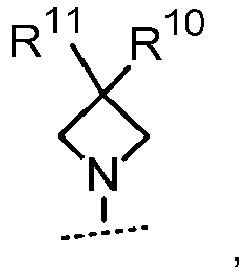
R10 represents hydrogen, and
R11 represents C1-C4-alkyl substituted with one hydroxy. - In accordance with a further embodiment of the first aspect, the present invention covers compounds of general formula (I), supra, in which
- R2
- represents

R10 represents hydrogen, and
R11 represents C1-C4-alkyl substituted with one substituent selected from the group consisting of azetidin-1-yl, 3-hydroxyazetidin-1-yl, 3-fluoroazetidin-1-yl, 3-hydroxy-3-methylazetidin-1-yl, pyrrolidine, 3-hydroxypyrrolidin-1-yl, 3-hydroxy-3-methylpyrrolidin-1-yl, 3-fluoropyrrolidin-1-yl, 3,3-difluoropyrrolidin-1-yl, morpholin-4-yl, 3-methylmorpholin-4-yl, 1,1-dioxidothiomorpholin-4-yl, piperidin-1-yl, 4-fluoropiperidin-1-yl, 4,4-difluoropiperidin-1-yl, 4-hydroxypiperidin-1-yl, and 4-hydroxy-4-methylpiperidin-1-yl. - In accordance with a further embodiment of the first aspect, the present invention covers compounds of general formula (I), supra, in which
- R2
- represents

R10 represents hydrogen, and
R11 represents morpholin-4-ylmethyl, (3-methylmorpholin-4-yl)methyl or (4-hydroxy-4-methylpiperidin-1-yl)methyl. - In accordance with a further embodiment of the first aspect, the present invention covers compounds of general formula (I), supra, in which
- R2
- represents

R10 represents hydrogen or C1-C6-alkyl, and
R11 represents 4- to 6-membered monocyclic saturated heterocycloalkyl group containing one or two identical or different heteroatoms or heteroatom-containing groups independently selected from the group consisting of N, O, and S(=O)2, wherein said heterocycloalkyl group is bound to the rest of the molecule via any nitrogen atom, and wherein said 4- to 6-membered monocyclic saturated heterocycloalkyl is optionally substituted with one or more substituents which are the same or different and independently selected from the group consisting of oxo substituent, fluorine atom, hydroxy, and C1-C6-alkyl,- wherein said C1-C6-alkyl is optionally substituted with one to five fluorine atoms.
- In accordance with a further embodiment of the first aspect, the present invention covers compounds of general formula (I), supra, in which
- R2
- represents

R10 represents hydrogen, methyl or ethyl, and
R11 represents azetidin-1-yl, 3-hydroxyazetidin-1-yl, 3-fluoroazetidin-1-yl, 3-hydroxy-3-methylazetidin-1-yl, pyrrolidine, 3-hydroxypyrrolidin-1-yl, 3-hydroxy-3-methylpyrrolidin-1-yl, 3-fluoropyrrolidin-1-yl, 3,3-difluoropyrrolidin-1-yl, morpholin-4-yl, 3-methylmorpholin-4-yl, 1,1-dioxidothiomorpholin-4-yl, piperidin-1-yl, 4-fluoropiperidin-1-yl, 4,4-difluoropiperidin-1-yl, 4-hydroxypiperidin-1-yl, or 4-hydroxy-4-methylpiperidin-1-yl - In accordance with a further embodiment of the first aspect, the present invention covers compounds of general formula (I), supra, in which R2 represents

- R10
- represents hydrogen or methyl, and
- R11
- represents morpholin-4-yl, 4-hydroxy-4-methylpiperidin-1-yl or 3,3-difluoropyrrolidin-1-yl
- In accordance with a further embodiment of the first aspect, the present invention covers compounds of general formula (I), supra, in which R2 represents

- R10
- represents hydrogen, and
- R11
- represents morpholin-4-yl or 4-hydroxy-4-methylpiperidin-1-yl.
- In accordance with a further embodiment of the first aspect, the present invention covers compounds of general formula (I), supra, in which R2 represents

- R10
- represents hydrogen, methyl or ethyl, and
- R11
- represents 2-oxopyrrolidin-1-yl, 2-oxopiperidin-1-yl, 3-oxomorpholin-4-yl, 2-oxomorpholin-4-yl, 2-oxopiperazin-1-yl, 3-oxopiperazin-1-yl, 4-methyl-3-oxopiperazin-1-yl or 4-methyl-2-oxopiperazin-1-yl.
- In accordance with a further embodiment of the first aspect, the present invention covers compounds of general formula (I), supra, in which R2 represents

- R10
- represents hydrogen, and
- R11
- represents 2-oxopyrrolidin-1-yl, 2-oxopiperidin-1-yl, 3-oxomorpholin-4-yl, 2-oxomorpholin-4-yl, 2-oxopiperazin-1-yl, 3-oxopiperazin-1-yl, 4-methyl-3-oxopiperazin-1-yl or 4-methyl-2-oxopiperazin-1-yl.
- In accordance with a further embodiment of the first aspect, the present invention covers compounds of general formula (I), supra, in which R2 represents

- R10
- represents hydrogen, and
- R11
- represents 2-oxopyrrolidin-1-yl, 2-oxopiperidin-1-yl or 3-oxomorpholin-4-yl.
- In accordance with a further embodiment of the first aspect, the present invention covers compounds of general formula (I), supra, in which
- R2
- represents
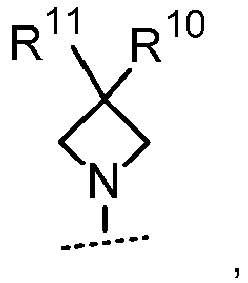
R10 represents hydrogen;
R11 represents fluorine atom, hydroxy, cyano, C1-C6-alkoxy, CO2H, NH2, -N(CH3)2, N(CH2CH3)(CH3), -S(=O)2CH3, -(C=O)NH2, -(C=O)NRaRb or -(C=O)R4;
R4 represents 4- to 6-membered monocyclic saturated heterocycloalkyl group containing one nitrogen atom and optionally one additional heteroatom or heteroatom-containing group independently selected from N, O, and S(=O)2, wherein said 4- to 6-membered monocyclic saturated heterocycloalkyl and said 6- to 12-membered bridged heterocycloalkyl are bound to the rest of the molecule via any nitrogen atom,- wherein said 4- to 6-membered monocyclic saturated heterocycloalkyl is optionally substituted with one or more substituents which are the same or different and independently selected from the group consisting of C1-C6-alkyl, fluorine atom, and hydroxy;
Rb represents C1-C6-alkyl. - In accordance with a further embodiment of the first aspect, the present invention covers compounds of general formula (I), supra, in which
- R2
- represents

R10 represents hydrogen;
R11 represents fluorine atom, hydroxy, -N(CH3)2, N(CH2CH3)(CH3) or -(C=O)R4. - In accordance with a further embodiment of the first aspect, the present invention covers compounds of general formula (I), supra, in which
- R2
- represents

R12 represents 4- to 6-membered monocyclic saturated heterocycloalkyl group containing one or two identical or different heteroatoms or heteroatom-containing groups independently selected from the group consisting of N, O, and S(=O)2, wherein said heterocycloalkyl group is bound to the rest of the molecule via any nitrogen atom, and wherein said 4- to 6-membered monocyclic saturated heterocycloalkyl is optionally substituted with one or more substituents which are the same or different and independently selected from the group consisting of oxo substituent, fluorine atom, hydroxy, and C1-C6-alkyl,- wherein said C1-C6-alkyl is optionally substituted with one to five fluorine atoms; and
- In accordance with a further embodiment of the first aspect, the present invention covers compounds of general formula (I), supra, in which
- R2
- represents

R12 represents azetidin-1-yl, 3-hydroxyazetidin-1-yl, 3-fluoroazetidin-1-yl, 3-hydroxy-3-methylazetidin-1-yl, pyrrolidine, 3-hydroxypyrrolidin-1-yl, 3-hydroxy-3-methylpyrrolidin-1-yl, 3-fluoropyrrolidin-1-yl, 3,3-difluoropyrrolidin-1-yl, morpholin-4-yl, 3-methylmorpholin-4-yl, 1,1-dioxidothiomorpholin-4-yl, piperidin-1-yl, 4-fluoropiperidin-1-yl, 4,4-difluoropiperidin-1-yl, 4-hydroxypiperidin-1-yl, or 4-hydroxy-4-methylpiperidin-1-yl, and
R13 represents hydrogen. - In accordance with a further embodiment of the first aspect, the present invention covers compounds of general formula (I), supra, in which
- R2
- represents

R12 represents morpholin-4-yl, 4-hydroxy-4-methylpiperidin-1-yl or 3,3-difluoropyrrolidin-1-yl; and
R13 represents hydrogen. - In accordance with a further embodiment of the first aspect, the present invention covers compounds of general formula (I), supra, in which
- R2
- represents

R12 represents morpholin-4-yl; and
R13 represents hydrogen. - In accordance with a further embodiment of the first aspect, the present invention covers compounds of general formula (I), supra, in which
- R2
- represents

R12 represents 2-oxopyrrolidin-1-yl, 2-oxopiperidin-1-yl, 3-oxomorpholin-4-yl, 2-oxomorpholin-4-yl, 2-oxopiperazin-1-yl, 3-oxopiperazin-1-yl, 4-methyl-3-oxopiperazin-1-yl or 4-methyl-2-oxopiperazin-1-yl; and
R13 represents hydrogen. - In accordance with a further embodiment of the first aspect, the present invention covers compounds of general formula (I), supra, in which
- R2
- represents

R12 represents 2-oxopyrrolidin-1-yl, 2-oxopiperidin-1-yl or 3-oxomorpholin-4-yl; and
R13 represents hydrogen. - In accordance with a further embodiment of the first aspect, the present invention covers compounds of general formula (I), supra, in which
- R2
- represents

R12 and R13 both are hydroxy. - In accordance with a further embodiment of the first aspect, the present invention covers compounds of general formula (I), supra, in which
- R2
- represents

R12 represents methyl or fluorine atom, and
R13 represents hydroxy, or
R12 represents hydroxy, and
R13 represents hydrogen. - In accordance with a further embodiment of the first aspect, the present invention covers compounds of general formula (I), supra, in which
- R2
- represents

R14 represents fluorine atom, hydroxy, cyano, 1-aminocyclopropyl, -N(CH3)2, N(CH2CH3)(CH3), -C(=O)(morpholin-4-yl), -C(=O)(pyrrolidin-1-yl), -C(=O)(piperazin-1-yl), -C(=O)(4-methylpiperazin-1-yl), -C(=O)(4-hydroxy-4-methylpiperidin-1-yl) or -C(=O)(2-(6-oxa-3-azabicyclo[3.1.1]heptan-3-yl), or
R14 represents C1-C4-alkyl optionally substituted with one or more substituents which are the same or different and independently selected from the group consisting of fluorine atom, hydroxy, NH2, CO2H, and -S(=O)2CH3, or
R14 represents 4- to 6-membered monocyclic saturated heterocycloalkyl group containing one or two identical or different heteroatoms or heteroatom-containing groups independently selected from the group consisting of N, O, and S(=O)2,- wherein said 4- to 6-membered monocyclic saturated heterocycloalkyl I group is bound to the rest of the molecule via any nitrogen atom, and
- wherein said 4- to 6-membered monocyclic saturated heterocycloalkyl group is optionally substituted with one or more substituents which are the same or different and independently selected from the group consisting of fluorine atom, oxo substituent, hydroxy, methyl and ethyl.
- In accordance with a further embodiment of the first aspect, the present invention covers compounds of general formula (I), supra, in which
- R2
- represents:

R14 represents fluorine atom, hydroxy, cyano, 1-aminocyclopropyl, -N(CH3)2, N(CH2CH3)(CH3), -C(=O)(morpholin-4-yl), -C(=O)(pyrrolidin-1-yl), -C(=O)(piperazin-1-yl), -C(=O)(4-methylpiperazin-1-yl), -C(=O)(4-hydroxy-4-methylpiperidin-1-yl) or -C(=O)(2-(6-oxa-3-azabicyclo[3.1.1]heptan-3-yl). - In accordance with a further embodiment of the first aspect, the present invention covers compounds of general formula (I), supra, in which
- R2
- represents:
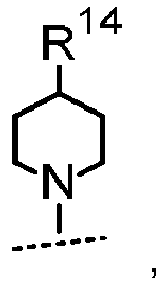
R14 represents C1-C4-alkyl optionally substituted with one or more substituents which are the same or different and independently selected from the group consisting of fluorine atom, hydroxy, NH2, CO2H, and -S(=O)2CH3. - In accordance with a further embodiment of the first aspect, the present invention covers compounds of general formula (I), supra, in which
- R2
- represents

R14 represents C1-C4-alkyl optionally substituted with one hydroxy. - In accordance with a further embodiment of the first aspect, the present invention covers compounds of general formula (I), supra, in which
- R2
- represents:

- In accordance with a further embodiment of the first aspect, the present invention covers compounds of general formula (I), supra, in which
- R2
- represents

R14 represents 4- to 6-membered monocyclic saturated heterocycloalkyl group containing one or two identical or different heteroatoms or heteroatom-containing groups independently selected from the group consisting of N, O, and S(=O)2,- wherein said 4- to 6-membered monocyclic saturated heterocycloalkyl I group is bound to the rest of the molecule via any nitrogen atom, and
- wherein said 4- to 6-membered monocyclic saturated heterocycloalkyl group is optionally substituted with one or more substituents which are the same or different and independently selected from the group consisting of fluorine atom, oxo substituent, hydroxy, methyl and ethyl.
- In accordance with a further embodiment of the first aspect, the present invention covers compounds of general formula (I), supra, in which
- R2
- represents

R14 represents azetidin-1-yl, 3-hydroxyazetidin-1-yl, 3-fluoroazetidin-1-yl, 3-hydroxy-3-methylazetidin-1-yl, pyrrolidine, 3-hydroxypyrrolidin-1-yl, 3-hydroxy-3-methyl-pyrrolidin-1-yl, 3-fluoropyrrolidin-1-yl, 3,3-difluoropyrrolidin-1-yl, morpholin-4-yl, 3-methylmorpholin-4-yl, 1,1-dioxidothiomorpholin-4-yl, piperidin-1-yl, 4-fluoropiperidin-1-yl, 4,4-difluoropiperidin-1-yl, 4-hydroxypiperidin-1-yl, or 4-hydroxy-4-methylpiperidin-1-yl. - In accordance with a further embodiment of the first aspect, the present invention covers compounds of general formula (I), supra, in which
- R2
- represents

R14 represents 2-oxopyrrolidin-1-yl, 2-oxopiperidin-1-yl, 3-oxomorpholin-4-yl, 2-oxomorpholin-4-yl, 2-oxopiperazin-1-yl, 3-oxopiperazin-1-yl, 4-methyl-3-oxo-piperazin-1-yl or 4-methyl-2-oxopiperazin-1-yl. - In accordance with a further embodiment of the first aspect, the present invention covers compounds of general formula (I), supra, in which
- R2
- represents

A represents oxygen atom, -S(=O)2- or -NR15, and
R15 has the meaning of hydrogen, -C(=O)C1-C6-alkyl, -C(=O)C3-C5-cycloalkyl, -C(=O)(morpholin-4-yl), -C(=O)(pyrrolidin-1-yl), -C(=O)(piperazin-1-yl), -C(=O)(4-methylpiperazin-1-yl), -C(=O)(4-hydroxy-4-methylpiperidin-1-yl), or -C(=O)(2-(6-oxa-3-azabicyclo[3.1.1]heptan-3-yl), or
R15 has the meaning of C1-C6-alkyl optionally substituted with one or more substituents which are the same or different and independently selected from the group consisting of fluorine atom, hydroxy, and C1-C6-alkoxy, or
R15 has the meaning of 4- to 6-membered monocyclic saturated heterocycloalkyl group containing one or two identical or different heteroatoms or heteroatom-containing groups independently selected from the group consisting of N, O, and S(=O)2,- wherein said 4- to 6-membered monocyclic saturated heterocycloalkyl group is bound to the rest of the molecule via any one of the carbon atoms, and
- wherein said 4- to 6-membered monocyclic saturated heterocycloalkyl group is optionally substituted with one or more substituents which are the same or different and independently selected from the group consisting of fluorine atom, hydroxy, methyl and ethyl group.
- In accordance with a further embodiment of the first aspect, the present invention covers compounds of general formula (I), supra, in which
- R3
- has the meaning of a 4- to 6-membered monocyclic saturated heterocycloalkyl group containing one to two heteroatoms or heteroatom-containing groups selected from N, O or S(=O)2,
- which is bound to the rest of the molecule via any of the carbon atoms, and
- which is optionally substituted with one or more substituents which are the same or different and independently selected from the group consisting of oxo substituent, fluorine atom, hydroxy, NH2, NRaRb, -S(=O)2C1-C6-alkyl,-S(=O)2cyclopropyl, and C1-C4 alkyl group,
- wherein said C1-C4 alkyl group is optionally substituted with one to three fluorine atoms.
- In accordance with a further embodiment of the first aspect, the present invention covers compounds of general formula (I), supra, in which
R3 represents
- In accordance with a further embodiment of the first aspect, the present invention covers compounds of general formula (I), supra, in which

- R17
- represents methyl, and
- X
- represents -NH-,
- R17
- represents hydrogen, and
- X
- represents -NH- or -NCH3-,
- R17
- represents hydrogen, and
- X
- represents -O-.
- In accordance with a further embodiment of the first aspect, the present invention covers compounds of general formula (I), supra, in which
R3 has the meaning of
- In accordance with a further embodiment of the first aspect, the present invention covers compounds of general formula (I), supra, in which
R3 has the meaning of
- In accordance with a further embodiment of the first aspect, the present invention covers compounds of general formula (I), supra, in which
R3 has the meaning of
- R18
- represents C1-C6-alkyl or cyclopropyl.
- In accordance with a further embodiment of the first aspect, the present invention covers compounds of general formula (I), supra, in which
- R3
- represents a C3-C6-cycloalkyl optionally substituted with one or more substituents which are the same or different and independently selected from the group consisting of fluorine atom, hydroxy, C1-C4-alkoxy, NH2, NRaRb, -(C=O)NH2, -(C=O)NHC1-C6-alkyl, -S(=O)2C1-C6-alkyl, and C1-C6 alkyl,
- wherein said C1-C6 alkyl group is optionally substituted with one to three fluorine atoms, and
- In accordance with a further embodiment of the first aspect, the present invention covers compounds of general formula (I), supra, in which
R3 has the meaning of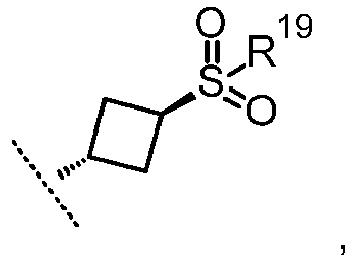
- R19
- represents C1-C6-alkyl.
- In accordance with a further embodiment of the first aspect, the present invention covers compounds of general formula (I), supra, in which
- R3
- has the meaning of

R19 represents methyl or ethyl. - In accordance with a further embodiment of the first aspect, the present invention covers compounds of general formula (I), supra, in which
- R3
- represents

R19 represents methyl or ethyl. - In accordance with a further embodiment of the first aspect, the present invention covers compounds of general formula (I), supra, in which
- R3
- represents

- In accordance with a further embodiment of the first aspect, the present invention covers compounds of general formula (I), supra, in which
R3 is
- In accordance with a further embodiment of the first aspect, the present invention covers compounds of general formula (I), supra, in which
R3 is
- In accordance with a further embodiment of the first aspect, the present invention covers compounds of general formula (I), supra, in which
R3 is
- In accordance with a further embodiment of the first aspect, the present invention covers compounds of general formula (I), supra, in which
R3 is
- In accordance with a further embodiment of the first aspect, the present invention covers compounds of general formula (I), supra, in which
- R3
- represents 6- to 11-membered heterospirocycloalkyl containing one heteroatom or heteroatom-containing group independently selected from N, O and S(=O)2,
- which is bound to the rest of the molecule via any of the carbon atoms, and
- which is optionally substituted with one or more substituents which are the same or different and independently selected from the group consisting of C1-C4-alkyl, and fluorine atom.
- In accordance with a further embodiment of the first aspect, the present invention covers compounds of general formula (I), supra, in which
- R3
- represents 2-oxaspiro[3.3]heptan-6-yl, 2-azaspiro[3.3]heptan-6-yl, 1-azaspiro[3.3]-heptan-6-yl, 5-azaspiro[3.4]octan-2-yl or 6-azaspiro[3.4]octan-2-yl, each of which is optionally substituted with one or more substituents which are the same or different and independently selected from the group consisting of C1-C4 alkyl and fluorine atom.
- In accordance with a further embodiment of the first aspect, the present invention covers compounds of general formula (I), supra, in which
- R3
- represents unsubstituted 2-oxaspiro[3.3]heptan-6-yl, 2-azaspiro[3.3]heptan-6-yl, 1-azaspiro[3.3]heptan-6-yl, 5-azaspiro[3.4]octan-2-yl or 6-azaspiro[3.4]octan-2-yl.
- In accordance with a further embodiment of the first aspect, the present invention covers compounds of general formula (I), supra, in which
- R3
- is 1-azaspiro[3.3]heptan-6-yl.
- In accordance with a further embodiment of the first aspect, the present invention covers compounds of general formula (I), supra, in which
- R3
- represents 6- to 12-membered bridged heterocycloalkyl group containing one heteroatom or heteroatom-containing group independently selected from N, O, and S(=O)2,
- which is bound to the rest of the molecule via any of the carbon atoms, and
- which is optionally substituted with one or more substituents which are the same or different and independently selected from the group consisting of C1-C4-alkyl, and fluorine atom.
- In accordance with a further embodiment of the first aspect, the present invention covers compounds of general formula (I), supra, in which
- R3
- represents unsubstituted 6- to 8-membered bridged heterocycloalkyl group containing one heteroatom or heteroatom-containing group independently selected from N, O, and S(=O)2,
- In accordance with a further embodiment of the first aspect, the present invention covers compounds of general formula (I), supra, in which
R3 is
- In accordance with a further embodiment of the first aspect, the present invention covers compounds of general formula (I), supra, in which
- R1
- represents trifluoromethyl, difluoromethyl or difluoromethoxy,
- R2
- represents

R10 represents hydrogen, methyl or ethyl,
R11 represents hydroxy, -N(CH3)2, azetidin-1-yl, 3-hydroxyazetidin-1-yl, 3-fluoroazetidin-1-yl, 3-hydroxy-3-methylazetidin-1-yl, pyrrolidine, 3-hydroxypyrrolidin-1-yl, 3-hydroxy-3-methylpyrrolidin-1-yl, 3-fluoropyrrolidin-1-yl, 3,3-difluoropyrrolidin-1-yl, morpholin-4-yl, 3-methylmorpholin-4-yl, 1,1-dioxidothiomorpholin-4-yl, piperidin-1-yl, 4-fluoropiperidin-1-yl, 4,4-difluoropiperidin-1-yl, 4-hydroxypiperidin-1-yl, 4-hydroxy-4-methylpiperidin-1-yl, or C1-C4-alkyl,- wherein said C1-C4-alkyl is optionally substituted with one or more substituents which are the same or different and independently selected from the group consisting of fluorine atom, hydroxy, NH2, CO2H, morpholin-4-yl,-S(=O)2CH3, -C(=O)(morpholin-4-yl), -C(=O)(4-hydroxy-4-methylpiperidin-1-yl), -C(=O)(2-(6-oxa-3-azabicyclo[3.1.1]heptan-3-yl), and

R19 represents methyl or ethyl. - In accordance with a further embodiment of the first aspect, the present invention covers compounds of general formula (I), supra, in which
- R1
- represents trifluoromethyl, difluoromethyl or difluoromethoxy,
- R2
- represents

R10 represents hydrogen,
R11 represents azetidin-1-yl, 3-hydroxyazetidin-1-yl, 3-fluoroazetidin-1-yl, 3-hydroxy-3-methyl azetidin-1-yl, pyrrolidine, 3-hydroxypyrrolidin-1-yl, 3-hydroxy-3-methyl-pyrrolidin-1-yl, 3-fluoropyrrolidin-1-yl, 3,3-difluoropyrrolidin-1-yl, morpholin-4-yl, 3-methylmorpholin-4-yl, 1,1-dioxidothiomorpholin-4-yl, piperidin-1-yl, 4-fluoropiperidin-1-yl, 4,4-difluoropiperidin-1-yl, 4-hydroxypiperidin-1-yl or 4-hydroxy-4-methylpiperidin-1-yl, and
R3 represents
- In accordance with a further embodiment of the first aspect, the present invention covers compounds of general formula (I), supra, in which
- R1
- represents trifluoromethyl, difluoromethyl or difluoromethoxy,
- R2
- represents
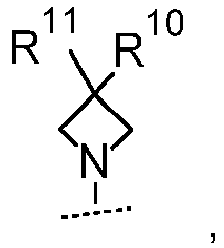
R10 represents hydrogen,
R11 represents azetidin-1-yl, 3-hydroxyazetidin-1-yl, 3-fluoroazetidin-1-yl, 3-hydroxy-3-methylazetidin-1-yl, pyrrolidine, 3-hydroxypyrrolidin-1-yl, 3-hydroxy-3-methylpyrrolidin-1-yl, 3-fluoropyrrolidin-1-yl, 3,3-difluoropyrrolidin-1-yl, morpholin-4-yl, 3-methylmorpholin-4-yl, 1,1-dioxidothiomorpholin-4-yl, piperidin-1-yl, 4-fluoropiperidin-1-yl, 4,4-difluoro-piperidin-1-yl, 4-hydroxypiperidin-1-yl or 4-hydroxy-4-methylpiperidin-1-yl, and
R3 represents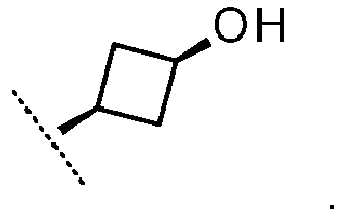
- In accordance with a further embodiment of the first aspect, the present invention covers compounds of general formula (I), supra, in which
R1 represents trifluoromethyl, difluoromethyl or difluoromethoxy,
R2 represents
- R10
- represents hydrogen,
- R11
- represents hydroxy, -N(CH3)2, azetidin-1-yl, 3-hydroxyazetidin-1-yl, 3-fluoroazetidin-1-yl, 3-hydroxy-3-methylazetidin-1-yl, pyrrolidine, 3-hydroxypyrrolidin-1-yl, 3-hydroxy-3-methylpyrrolidin-1-yl, 3-fluoropyrrolidin-1-yl, 3,3-difluoropyrrolidin-1-yl, morpholin-4-yl, 3-methylmorpholin-4-yl, 1,1-dioxidothiomorpholin-4-yl, piperidin-1-yl, 4-fluoropiperidin-1-yl, 4,4-difluoropiperidin-1-yl, 4-hydroxypiperidin-1-yl, 4-hydroxy-4-methylpiperidin-1-yl, or C1-C4-alkyl,
- wherein said C1-C4-alkyl is optionally substituted with one or more substituents which are the same or different and independently selected from the group consisting of fluorine atom, hydroxy, NH2, N(CH3)2, CO2H, morpholin-4-yl,-S(=O)2CH3 , -C(=O)(morpholin-4-yl), -C(=O)(4-hydroxy-4-methylpiperidin-1-yl) and -C(=O)(2-(6-oxa-3-azabicyclo[3.1.1]heptan-3-yl), and
- R3
- represents

- In accordance with a further embodiment of the first aspect, the present invention covers compounds of general formula (I), supra, in which
- R1
- represents trifluoromethyl, difluoromethyl or difluoromethoxy,
- R2
- represents

R10 represents hydrogen,
R11 represents 2-oxopyrrolidin-1-yl, 2-oxopiperidin-1-yl, or 3-oxomorpholin-4-yl, and
R3 represents C3-C6-cycloalkyl optionally substituted with one or more substituents which are the same or different and independently selected from the group consisting of fluorine atoms, hydroxy, C1-C4-alkoxy, NH2, NRaRb, -S(=O)2C1-C6-alkyl and C1-C6 alkyl- wherein said C1-C6 alkyl is optionally substituted with one to three fluorine atoms, and
- In accordance with a further embodiment of the first aspect, the present invention covers compounds of general formula (I), supra, in which
- R1
- represents trifluoromethyl, difluoromethyl or difluoromethoxy,
- R2
- represents

R10 represents hydrogen,
R11 represents 2-oxopyrrolidin-1-yl, 2-oxopiperidin-1-yl, 3-oxomorpholin-4-yl, and
R3 represents
- In accordance with a further embodiment of the first aspect, the present invention covers compounds of general formula (I), supra, in which
- R1
- represents trifluoromethyl, difluoromethyl or difluoromethoxy
- R2
- represents
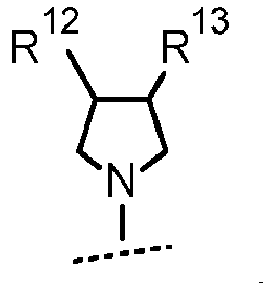
R12 and R13 both have the meaning of hydroxy, and
R3 represents
R19 represents methyl or ethyl. - In accordance with a further embodiment of the first aspect, the present invention covers compounds of general formula (I), supra, in which
- R1
- represents trifluoromethyl, difluoromethyl or difluoromethoxy
- R2
- represents:

R12 represents hydrogen, methyl or fluorine atom, and
R13 represents hydroxy, and
R3 represents
R19 represents methyl or ethyl. - The following compounds are disclosed, namely:
Example Name I-1-1 (4S)-4-({4-[3-(morpholin-4-yl)azetidin-1-yl]-1-[3-(trifluoromethyl)phenyl]-1H-pyrazolo[3,4-d]pyrimidin-6-yl}amino)pyrrolidin-2-one I-1-2 (4R)-4-({4-[3-(morpholin-4-yl)azetidin-1-yl]-1-[3-(trifluoromethyl)phenyl]-1H-pyrazolo[3,4-d]pyrimidin-6-yl}amino)pyrrolidin-2-one I-2-1 (4S)-4-({4-[4-(2-hydroxypropan-2-yl)piperidin-1-yl]-1-[3-(trifluoromethyl)phenyl]-1H-pyrazolo[3,4-d]pyrimidin-6-yl}amino)pyrrolidin-2-one I-2-2 ((4R)-4-({4-[4-(2-hydroxypropan-2-yl)piperidin-1-yl]-1-[3-(trifluoromethyl)phenyl]-1H-pyrazolo[3,4-d]pyrimidin-6-yl}amino)pyrrolidin-2-one I-2-3 4-({4-[4-(2-hydroxypropan-2-yl)piperidin-1-yl]-1-[3-(trifluoromethyl)phenyl]-1H-pyrazolo[3,4-d]pyrimidin-6-yl}amino)pyrrolidin-2-one I-3-1 (4S)-4-({4-(3-ethyl-3-hydroxyazetidin-1-yl)-1-[3-(trifluoromethyl)phenyl]-1H-pyrazolo[3,4-d]pyrimidin-6-yl}amino)pyrrolidin-2-one I-3-2 (4R)-4-({4-(3-ethyl-3-hydroxyazetidin-1-yl)-1-[3-(trifluoromethyl)phenyl]-1H-pyrazolo[3,4-d]pyrimidin-6-yl}amino)pyrrolidin-2-one I-4-1 2-(1-{6-[(1,1-dioxidotetrahydrothiophen-3-yl)amino]-1-[3-(trifluoromethyl)phenyl]-1H-pyrazolo[3,4-d]pyrimidin-4-yl}piperidin-4-yl)propan-2-ol I-4-2 (+)-2-(1-[6-[(1,1-dioxidotetrahydrothiophen-3-yl)amino]-1-[3-(trifluoromethyl)phenyl]-1H-pyrazolo[3,4-d]pyrimidin-4-yl}piperidin-4-yl)propan-2-ol I-4-3 (-)-2-(1-{6-[(1,1-dioxidotetrahydrothiophen-3-yl)amino]-1-[3-(trifluoromethyl)phenyl]-1H-pyrazolo[3,4-d]pyrimidin-4-yl}piperidin-4-yl)propan-2-ol I-5 2-(1-{6-[(1,1-dioxidotetrahydro-2H-thiopyran-4-yl)amino]-1-[3-(trifluoromethyl)phenyl]-1H-pyrazolo[3,4-d]pyrimidin-4-yl}piperidin-4-yl)propan-2-ol I-6 4-({4-[4-(2-hydroxypropan-2-yl)piperidin-1-yl]-1-[3-(trifluoromethyl)phenyl]-1H-pyrazolo[3,4-d]pyrimidin-6-yl}amino)-5,5-dimethylpyrrolidin-2-one I-7-1 (5R)-5-({4-[4-(2-hydroxypropan-2-yl)piperidin-1-yl]-1-[3-(trifluoromethyl)phenyl]-1H-pyrazolo[3,4-d]pyrimidin-6-yl}amino)piperidin-2-one I-7-2 (5S)-5-({4-[4-(2-hydroxypropan-2-yl)piperidin-1-yl]-1-[3-(trifluoromethyl)phenyl]-1H-pyrazolo[3,4-d]pyrimidin-6-yl}amino)piperidin-2-one I-8 4-({4-[4-(2-hydroxypropan-2-yl)piperidin-1-yl]-1-[3-(trifluoromethyl)phenyl]-1H-pyrazolo[3,4-d]pyrimidin-6-yl}amino)-1-methylpyrrolidin-2-one I-9 (3R)-3-({4-[4-(2-hydroxypropan-2-yl)piperidin-1-yl]-1-[3-(trifluoromethyl)phenyl]-1H-pyrazolo[3,4-d]pyrimidin-6-yl}amino)-1-methylpyrrolidin-2-one I-10 2-(1-{6-[(1,1-dioxidotetrahydro-2H-thiopyran-3-yl)amino]-1-[3-(trifluoromethyl)phenyl]-1H-pyrazolo[3,4-d]pyrimidin-4-yl}piperidin-4-yl)propan-2-ol I-11-1 (3S)-3-({4-[4-(2-hydroxypropan-2-yl)piperidin-1-yl]-1-[3-(trifluoromethyl)phenyl]-1H-pyrazolo[3,4-d]pyrimidin-6-yl}amino)piperidin-2-one I-11-2 (3R)-3-({4-[4-(2-hydroxypropan-2-yl)piperidin-1-yl]-1-[3-(trifluoromethyl)phenyl]-1H-pyrazolo[3,4-d]pyrimidin-6-yl}amino)piperidin-2-one I-12 (3S)-3-({4-[4-(2-hydroxypropan-2-yl)piperidin-1-yl]-1-[3-(trifluoromethyl)phenyl]-1H-pyrazolo[3,4-d]pyrimidin-6-yl}amino)pyrrolidin-2-one I-13-1 2-[1-(6-{[(3S)-1-methylpyrrolidin-3-yl]amino}-1-[3-(trifluoromethyl)phenyl]-1H-pyrazolo[3,4-d]pyrimidin-4-yl)piperidin-4-yl]propan-2-ol I-13-2 2-[1-(6-{[(3R)-1-methylpyrrolidin-3-yl]amino}-1-[3-(trifluoromethyl)phenyl]-1H-pyrazolo[3,4-d]pyrimidin-4-yl)piperidin-4-yl]propan-2-ol I-14 2-[1-(6-{[1-(methylsulfonyl)azetidin-3-yl]amino}-1-[3-(trifluoromethyl)phenyl]-1H-pyrazolo[3,4-d]pyrimidin-4-yl)piperidin-4-yl]propan-2-ol I-15 (3R)-3-({4-[4-(2-hydroxypropan-2-yl)piperidin-1-yl]-1-[3-(trifluoromethyl)phenyl]-1H-pyrazolo[3,4-d]pyrimidin-6-yl}amino)pyrrolidin-2-one I-16-1 2-(1-{6-[(3S)-tetrahydrofuran-3-ylamino]-1-[3-(trifluoromethyl)phenyl]-1H-pyrazolo[3,4-d]pyrimidin-4-yl}piperidin-4-yl)propan-2-ol I-16-2 2-(1-{6-[(3R)-tetrahydrofuran-3-ylamino]-1-[3-(trifluoromethyl)phenyl]-1H-pyrazolo[3,4-d]pyrimidin-4-yl}piperidin-4-yl)propan-2-ol I-17 (4S)-4-({4-[4-(2-hydroxypropan-2-yl)piperidin-1-yl]-1-[3-(trifluoromethyl)phenyl]-1H-pyrazolo[3,4-d]pyrimidin-6-yl}amino)-3,3-dimethylpyrrolidin-2-one I-18 3-ethyl-1-(6-{[(3S)-1-methylpyrrolidin-3-yl]amino}-1-[3-(trifluoromethyl)phenyl]-1H-pyrazolo[3,4-d]pyrimidin-4-yl)azetidin-3-ol I-19 1-{6-[(1,1-dioxidotetrahydro-2H-thiopyran-4-yl)amino]-1-[3-(trifluoromethyl)phenyl]-1H-pyrazolo[3,4-d]pyrimidin-4-yl}-3-ethylazetidin-3-ol I-20-1 (4R)-4-({4-[(3S,4S)-3,4-dihydroxypyrrolidin-1-yl]-1-[3-(trifluoromethyl)phenyl]-1H-pyrazolo[3,4-d]pyrimidin-6-yl}amino)pyrrolidin-2-one I-20-2 (4S)-4-({4-[(3S,4S)-3,4-dihydroxypyrrolidin-1-yl]-1-[3-(trifluoromethyl)phenyl]-1H-pyrazolo[3,4-d]pyrimidin-6-yl}amino)pyrrolidin-2-one I-21 (4S)-4-({4-[(3R)-3-(morpholin-4-yl)pyrrolidin-1-yl]-1-[3-(trifluoromethyl)phenyl]-1H-pyrazolo[3,4-d]pyrimidin-6-yl}amino)pyrrolidin-2-one I-22 N-[(3R)-1,1-dioxidotetrahydrothiophen-3-yl]-4-[3-(morpholin-4-yl)azetidin-1-yl]-1-[3-(trifluoromethyl)phenyl]-1H-pyrazolo[3,4-d]pyrimidin-6-amine I-23 N-(1,1-dioxidotetrahydro-2H-thiopyran-4-yl)-4-[3-(morpholin-4-yl)azetidin-1-yl]-1-[3-(trifluoromethyl)phenyl]-1H-pyrazolo[3,4-d]pyrimidin-6-amine I-24 (4S)-4-({4-[4-(2-hydroxy-2-methylpropyl)piperidin-1-yl]-1-[3-(trifluoromethyl)phenyl]-1H-pyrazolo[3,4-d]pyrimidin-6-yl}amino)pyrrolidin-2-one I-25-1 2-methyl-1-[1-(6-{[(3R)-1-methylpyrrolidin-3-yl]amino}-1-[3-(trifluoromethyl)phenyl]-1H-pyrazolo[3,4-d]pyrimidin-4-yl)piperidin-4-yl]propan-2-ol I-25-2 2-methyl-1-[1-(6-{[(3S)-1-methylpyrrolidin-3-yl]amino}-1-[3-(trifluoromethyl)phenyl]-1H-pyrazolo[3,4-d]pyrimidin-4-yl)piperidin-4-yl]propan-2-ol I-26-1 4-[3-(1,1-dioxidothiomorpholin-4-yl)azetidin-1-yl]-N-[(3R)-tetrahydrofuran-3-yl]-1-[3-(trifluoromethyl)phenyl]-1 H-pyrazolo[3,4-d]pyrimidin-6-amine I-26-2 4-[3-(1,1-dioxidothiomorpholin-4-yl)azetidin-1-yl]-N-[(3S)-tetrahydrofuran-3-yl]-1-[3-(trifluoromethyl)phenyl]-1H-pyrazolo[3,4-d]pyrimidin-6-amine I-27 (4S)-4-({4-[4-(morpholin-4-yl)piperidin-1-yl]-1-[3-(trifluoromethyl)phenyl]-1H-pyrazolo[3,4-d]pyrimidin-6-yl}amino)pyrrolidin-2-one I-28 (4S)-4-({4-(morpholin-4-yl)-1-[3-(trifluoromethyl)phenyl]-1H-pyrazolo[3,4-d]pyrimidin-6-yl}amino)pyrrolidin-2-one I-29 (1 R,3S)-3-({4-[4-(2-hydroxypropan-2-yl)piperidin-1-yl]-1-[3-(trifluoromethyl)phenyl]-1H-pyrazolo[3,4-d]pyrimidin-6-yl}amino)cyclopentanol I-30 (4S)-4-({4-[3-(4-hydroxy-4-methylpiperidin-1-yl)azetidin-1-yl]-1-[3-(trifluoromethyl)phenyl]-1H-pyrazolo[3,4-d]pyrimidin-6-yl}amino)pyrrolidin-2-one I-31 (3R,4R)-1-(6-{[(3S)-1-methylpyrrolidin-3-yl]amino}-1-[3-(trifluoromethyl)phenyl]-1H-pyrazolo[3,4-d]pyrimidin-4-yl)pyrrolidine-3,4-diol I-32 (4S)-4-({4-(3-hydroxyazetidin-1-yl)-1-[3-(trifluoromethyl)phenyl]-1H-pyrazolo[3,4-d]pyrimidin-6-yl}amino)pyrrolidin-2-one I-33 N-[(3S)-1,1-dioxidotetrahydrothiophen-3-yl]-4-[4-(morpholin-4-yl)piperidin-1-yl]-1-[3-(trifluoromethyl)phenyl]-1H-pyrazolo[3,4-d]pyrimidin-6-amine I-34 N-[(3S)-1,1-dioxidotetrahydrothiophen-3-yl]-4-[3-(morpholin-4-yl)azetidin-1-yl]-1-[3-(trifluoromethyl)phenyl]-1H-pyrazolo[3,4-d]pyrimidin-6-amine I-35 (4S)-4-[(4-{3-[(methylsulfonyl)methyl]azetidin-1-yl}-1-[3-(trifluoromethyl)phenyl]-1H-pyrazolo[3,4-d]pyrimidin-6-yl)amino]pyrrolidin-2-one I-36 N-[(3S)-1-methylpyrrolidin-3-yl]-4-{3-[(methylsulfonyl)methyl]azetidin-1-yl}-1-[3-(trifluoromethyl)phenyl]-1H-pyrazolo[3,4-d]pyrimidin-6-amine I-37 rel-(3R,4R)-4-({4-[3-(morpholin-4-yl)azetidin-1-yl]-1-[3-(trifluoromethyl)phenyl]-1H-pyrazolo[3,4-d]pyrimidin-6-yl}amino)tetrahydrothiophene-3-ol 1,1-dioxide I-38 (4S)-4-({4-[3-(dimethylamino)-3-methylazetidin-1-yl]-1-[3-(trifluoromethyl)phenyl]-1H-pyrazolo[3,4-d]pyrimidin-6-yl}amino)pyrrolidin-2-one I-39 4-[3-(dimethylamino)-3-methylazetidin-1-yl]-N-(1,1-dioxidotetrahydro-2H-thiopyran-4-yl)-1-[3-(trifluoromethyl)phenyl]-1H-pyrazolo[3,4-d]pyrimidin-6-amine I-40 2-[1-(6-{[(3S,5S)-5-methylpyrrolidin-3-yl]amino}-1-[3-(trifluoromethyl)phenyl]-1H-pyrazolo[3,4-d]pyrimidin-4-yl)piperidin-4-yl]propan-2-ol I-41-1 3-methyl-1-(6-{[(3R)-1-(methylsulfonyl)pyrrolidin-3-yl]amino}-1-[3-(trifluoromethyl)phenyl]-1H-pyrazolo[3,4-d]pyrimidin-4-yl)azetidin-3-ol I-41-2 3-methyl-1-(6-{[(3S)-1-(methylsulfonyl)pyrrolidin-3-yl]amino}-1-[3-(trifluoromethyl)phenyl]-1H-pyrazolo[3,4-d]pyrimidin-4-yl)azetidin-3-ol I-42 4-[3-(dimethylamino)azetidin-1-yl]-N-(1,1-dioxidotetrahydro-2H-thiopyran-4-yl)-1-[3-(trifluoromethyl)phenyl]-1H-pyrazolo[3,4-d]pyrimidin-6-amine I-43 N-(3-methyl-1,1-dioxidotetrahydrothiophen-3-yl)-4-[3-(morpholin-4-yl)azetidin-1-yl]-1-[3-(trifluoromethyl)phenyl]-1H-pyrazolo[3,4-d]pyrimidin-6-amine I-44 (4S)-4-({4-[3-(dimethylamino)azetidin-1-yl]-1-[3-(trifluoromethyl)phenyl]-1H-pyrazolo[3,4-d]pyrimidin-6-yl}amino)pyrrolidin-2-one I-45 4-[3-(2-aminopropan-2-yl)azetidin-1-yl]-N-(1,1-dioxidotetrahydro-2H-thiopyran-4-yl)-1-[3-(trifluoromethyl)phenyl]-1H-pyrazolo[3,4-d]pyrimidin-6-amine I-46 4-[4-(2-aminopropan-2-yl)piperidin-1-yl]-N-(1,1-dioxidotetrahydro-2H-thiopyran-4-yl)-1-[3-(trifluoromethyl)phenyl]-1H-pyrazolo[3,4-d]pyrimidin-6-amine I-47 (4S)-4-({4-[4-(2-aminopropan-2-yl)piperidin-1-yl]-1-[3-(trifluoromethyl)phenyl]-1H-pyrazolo[3,4-d]pyrimidin-6-yl}amino)pyrrolidin-2-one I-48 (4S)-4-({4-[4-(1-aminocyclopropyl)piperidin-1-yl]-1-[3-(trifluoromethyl)phenyl]-1H-pyrazolo[3,4-d]pyrimidin-6-yl}amino)pyrrolidin-2-one I-49 (4S)-4-({4-[3-(2-hydroxy-2-methylpropyl)azetidin-1-yl]-1-[3-(trifluoromethyl)phenyl]-1H-pyrazolo[3,4-d]pyrimidin-6-yl}amino)pyrrolidin-2-one I-50 [1-(6-{[(3S)-5-oxopyrrolidin-3-yl]amino}-1-[3-(trifluoromethyl)phenyl]-1H-pyrazolo[3,4-d]pyrimidin-4-yl)azetidin-3-yl]acetic acid I-51 (4S)-4-[(4-{3-[2-(morpholin-4-yl)-2-oxoethyl]azetidin-1-yl}-1-[3-(trifluoromethyl)phenyl]-1H-pyrazolo[3,4-d]pyrimidin-6-yl)amino]pyrrolidin-2-one I-52 (4S)-4-[(4-{3-[2-(6-oxa-3-azabicyclo[3.1.1]heptan-3-yl)-2-oxoethyl]azetidin-1-yl}-1-[3-(trifluoromethyl)phenyl]-1H-pyrazolo[3,4-d]pyrimidin-6-yl)amino]pyrrolidin-2-one I-53 N-cyclopropyl-4-[3-(1,1-dioxidothiomorpholin-4-yl)azetidin-1-yl]-1-[3-(trifluoromethyl)phenyl]-1H-pyrazolo[3,4-d]pyrimidin-6-amine I-54 N-(3,3-difluorocyclobutyl)-4-[3-(dimethylamino)azetidin-1-yl]-1-[3-(trifluoromethyl)phenyl]-1H-pyrazolo[3,4-d]pyrimidin-6-amine I-55 N-[cis-3-(methylsulfonyl)cyclobutyl]-4-[3-(morpholin-4-yl)azetidin-1-yl]-1-[3-(trifluoromethyl)phenyl]-1H-pyrazolo[3,4-d]pyrimidin-6-amine I-56 N-[trans-3-(methylsulfonyl)cyclobutyl]-4-[3-(morpholin-4-yl)azetidin-1-yl]-1-[3-(trifluoromethyl)phenyl]-1H-pyrazolo[3,4-d]pyrimidin-6-amine I-57 2-(1-{6-[(trans-3-amino-3-methylcyclobutyl)amino]-1-[3-(trifluoromethyl)phenyl]-1H-pyrazolo[3,4-d]pyrimidin-4-yl}piperidin-4-yl)propan-2-ol I-58 cis-1-methyl-N3-{4-(morpholin-4-yl)-1-[3-(trifluoromethyl)phenyl]-1H-pyrazolo[3,4-d]pyrimidin-6-yl}cyclobutane-1,3-diamine I-59 4-[3-methyl-3-(morpholin-4-yl)azetidin-1-yl]-N-[trans-3-(methylsulfonyl)cyclobutyl]-1-[3-(trifluoromethyl)phenyl]-1H-pyrazolo[3,4-d]pyrimidin-6-amine I-60 N-(1,1-dioxidotetrahydro-2H-thiopyran-4-yl)-4-[3-(morpholin-4-ylmethyl)azetidin-1-yl]-1-[3-(trifluoromethyl)phenyl]-1H-pyrazolo[3,4-d]pyrimidin-6-amine I-61 4-methyl-1-[1-(6-{[trans-3-(methylsulfonyl)cyclobutyl]amino}-1-[3-(trifluoromethyl)phenyl]-1H-pyrazolo[3,4-d]pyrimidin-4-yl)azetidin-3-yl]piperidin-4-ol I-62 4-[4-(1-aminocyclopropyl)piperidin-1-yl]-N-(1,1-dioxidotetrahydro-2H-thiopyran-4-yl)-1-[3-(trifluoromethyl)phenyl]-1H-pyrazolo[3,4-d]pyrimidin-6-amine I-63 trans-3-({4-[4-(2-hydroxypropan-2-yl)piperidin-1-yl]-1-[3-(trifluoromethyl)phenyl]-1H-pyrazolo[3,4-d]pyrimidin-6-yl}amino)-1-(trifluoromethyl)cyclobutanol I-64-1 2-(1-{6-[(3R)-1-azabicyclo[2.2.2]octan-3-ylamino]-1-[3-(trifluoromethyl)phenyl]-1H-pyrazolo[3,4-d]pyrimidin-4-yl}piperidin-4-yl)propan-2-ol I-64-2 2-(1-{6-[(3S)-1-azabicyclo[2.2.2]octan-3-ylamino]-1-[3-(trifluoromethyl)phenyl]-1H-pyrazolo[3,4-d]pyrimidin-4-yl}piperidin-4-yl)propan-2-ol I-65 2-[1-(6-{[rel-(3R,4R)-4-fluoropyrrolidin-3-yl]amino}-1-[3-(trifluoromethyl)phenyl]-1H-pyrazolo[3,4-d]pyrimidin-4-yl)piperidin-4-yl]propan-2-ol I-66 cis-3-({4-[4-(2-hydroxypropan-2-yl)piperidin-1-yl]-1-[3-(trifluoromethyl)phenyl]-1H-pyrazolo[3,4-d]pyrimidin-6-yl}amino)-1-methylcyclobutanecarboxylic acid I-67 2-methyl-1-[1-(6-{[trans-3-(methylsulfonyl)cyclobutyl]amino}-1-[3-(trifluoromethyl)phenyl]-1H-pyrazolo[3,4-d]pyrimidin-4-yl)azetidin-3-yl]propan-2-ol I-68 2-methyl-1-[1-(6-{[1-(methylsulfonyl)azetidin-3-yl]amino}-1-[3-(trifluoromethyl)phenyl]-1H-pyrazolo[3,4-d]pyrimidin-4-yl)azetidin-3-yl]propan-2-ol I-69 (3R,4S)-4-({4-[3-(morpholin-4-yl)azetidin-1-yl]-1-[3-(trifluoromethyl)phenyl]-1H-pyrazolo[3,4-d]pyrimidin-6-yl}amino)tetrahydrofuran-3-ol I-70 rel-(3R,4R)-4-({4-[3-(morpholin-4-yl)azetidin-1-yl]-1-[3-(trifluoromethyl)phenyl]-1H-pyrazolo[3,4-d]pyrimidin-6-yl}amino)tetrahydrofuran-3-ol I-71 trans-1 -methyl-N3-{4-[3-(methylsulfonyl)azetidin-1-yl]-1-[3-(trifluoromethyl)phenyl]-1H-pyrazolo[3,4-d]pyrimidin-6-yl}cyclobutane-1,3-diamine I-72 cis-3-({4-[3-(morpholin-4-yl)azetidin-1-yl]-1-[3-(trifluoromethyl)phenyl]-1H-pyrazolo[3,4-d]pyrimidin-6-yl}amino)cyclobutanol I-73 rel-(1 R,2S)-2-({4-[3-(morpholin-4-yl)azetidin-1-yl]-1-[3-(trifluoromethyl)phenyl]-1H-pyrazolo[3,4-d]pyrimidin-6-yl}amino)cyclobutanol I-74 trans-3-({4-[3-(morpholin-4-yl)azetidin-1-yl]-1-[3-(trifluoromethyl)phenyl]-1H-pyrazolo[3,4-d]pyrimidin-6-yl}amino)cyclobutanol I-75 rel-(1R,2R)-2-({4-[3-(morpholin-4-yl)azetidin-1-yl]-1-[3-(trifluoromethyl)phenyl]-1H-pyrazolo[3,4-d]pyrimidin-6-yl}amino)cyclobutanol I-76 cis-3-({4-[3-methyl-3-(morpholin-4-yl)azetidin-1-yl]-1-[3-(trifluoromethyl)phenyl]-1H-pyrazolo[3,4-d]pyrimidin-6-yl}amino)cyclobutanol I-77 trans-1-methyl-3-({4-[3-(morpholin-4-yl)azetidin-1-yl]-1-[3-(trifluoromethyl)phenyl]-1H-pyrazolo[3,4-d]pyrimidin-6-yl}amino)cyclobutanol I-78 cis-1-methyl-3-({4-[3-(morpholin-4-yl)azetidin-1-yl]-1-[3-(trifluoromethyl)phenyl]-1H-pyrazolo[3,4-d]pyrimidin-6-yl}amino)cyclobutanol I-79 1-(1-{6-[(trans-3-hydroxycyclobutyl)amino]-1-[3-(trifluoromethyl)phenyl]-1H-pyrazolo[3,4-d]pyrimidin-4-yl}azetidin-3-yl)-4-methylpiperidin-4-ol I-80 1-(1-{6-[(1,1-dioxidotetrahydro-2H-thiopyran-4-yl)amino]-1-[3-(trifluoromethyl)phenyl]-1H-pyrazolo[3,4-d]pyrimidin-4-yl}azetidin-3-yl)-4-methylpiperidin-4-ol I-81 N-[1-(ethylsulfonyl)azetidin-3-yl]-4-[3-(morpholin-4-yl)azetidin-1-yl]-1-[3-(trifluoromethyl)phenyl]-1H-pyrazolo[3,4-d]pyrimidin-6-amine I-82 N-[trans-3-(ethylsulfonyl)cyclobutyl]-4-[3-(morpholin-4-yl)azetidin-1-yl]-1-[3-(trifluoromethyl)phenyl]-1H-pyrazolo[3,4-d]pyrimidin-6-amine I-83 2-[1-(6-{[trans-3-(methylsulfonyl)cyclobutyl]amino}-1-[3-(trifluoromethyl)phenyl]-1H-pyrazolo[3,4-d]pyrimidin-4-yl)azetidin-3-yl]propan-2-ol I-84 (3R,4R)-1-(6-{[1-(ethylsulfonyl)azetidin-3-yl]amino}-1-[3-(trifluoromethyl)phenyl]-1H-pyrazolo[3,4-d]pyrim idin-4-yl)pyrrolidine-3,4-diol I-85 (3R,4R)-1-(6-1[(1s,3S)-3-hydroxycyclobutyl]amino}-1-[3-(trifluoromethyl)phenyl]-1H-pyrazolo[3,4-d]pyrimidin-4-yl)pyrrolidine-3,4-diol I-86 (3R,4R)-4-fluoro-1-(6-{[(1r,3R)-3-(methylsulfonyl)cyclobutyl]amino}-1-[3-(trifluoromethyl)phenyl]-1H-pyrazolo[3,4-d]pyrimidin-4-yl)pyrrolidin-3-ol I-87 (3R,4R)-1-(6-{[(1r,3R)-3-(ethylsulfonyl)cyclobutyl]amino}-1-[3-(trifluoromethyl)phenyl]-1H-pyrazolo[3,4-d]pyrimidin-4-yl)-4-fluoropyrrolidin-3-ol I-88 (3R,4R)-4-fluoro-1-(6-{[(1r,3R)-3-hydroxycyclobutyl]amino}-1-[3-(trifluoromethyl)phenyl]-1H-pyrazolo[3,4-d]pyrimidin-4-yl)pyrrolidin-3-ol I-89 (3R,4R)-4-fluoro-1-(6-{[(1s,3S)-3-hydroxycyclobutyl]amino}-1-[3-(trifluoromethyl)phenyl]-1H-pyrazolo[3,4-d]pyrimidin-4-yl)pyrrolidin-3-ol I-90 cis-3-({4-[4-(2-hydroxypropan-2-yl)piperidin-1-yl]-1-[3-(trifluoromethyl)phenyl]-1H-pyrazolo[3,4-d]pyrimidin-6-yl}amino)-1-methylcyclobutanol I-91 trans-3-({4-[4-(2-hydroxypropan-2-yl)piperidin-1-yl]-1-[3-(trifluoromethyl)phenyl]-1H-pyrazolo[3,4-d]pyrimidin-6-yl}amino)-1-methylcyclobutanol I-92 3-ethyl-1-(6-{[trans-3-(methylsulfonyl)cyclobutyl]amino}-1-[3-(trifluoromethyl)phenyl]-1H-pyrazolo[3,4-d]pyrimidin-4-yl)azetidin-3-ol I-93 1-(6-{[trans-3-(methylsulfonyl)cyclobutyl]amino}-1-[3-(trifluoromethyl)phenyl]-1 H-pyrazolo[3,4-d]pyrimidin-4-yl)piperidin-4-ol I-94 (3S,4S)-4-fluoro-1-(6-{[(1r,3S)-3-(methylsulfonyl)cyclobutyl]amino}-1-[3-(trifluoromethyl)phenyl]-1H-pyrazolo[3,4-d]pyrimidin-4-yl)pyrrolidin-3-ol I-95 (3S,4S)-1-(6-{[(1r,3S)-3-(ethylsulfonyl)cyclobutyl]amino}-1-[3-(trifluoromethyl)phenyl]-1H-pyrazolo[3,4-d]pyrimidin-4-yl)-4-fluoropyrrolidin-3-ol I-96 (3S,4S)-4-fluoro-1-(6-{[(1r,3S)-3-hydroxycyclobutyl]amino}-1-[3-(trifluoromethyl)phenyl]-1H-pyrazolo[3,4-d]pyrimidin-4-yl)pyrrolidin-3-ol I-97 (3S,4S)-4-fluoro-1-(6-{[(1s,3R)-3-hydroxycyclobutyl]amino}-1-[3-(trifluoromethyl)phenyl]-1H-pyrazolo[3,4-d]pyrimidin-4-yl)pyrrolidin-3-ol I-98 (3S,4S)-1-{6-[(4S,6s)-1-azaspiro[3.3]heptan-6-ylamino]-1-[3-(trifluoromethyl)phenyl]-1H-pyrazolo[3,4-d]pyrimidin-4-yl}-4-fluoropyrrolidin-3-ol I-99 4-(3-fluoroazetidin-1-yl)-N-[trans-3-(methylsulfonyl)cyclobutyl]-1-[3-(trifluoromethyl)phenyl]-1H-pyrazolo[3,4-d]pyrimidin-6-amine I-100 1-{6-[(trans-3-hydroxycyclobutyl)amino]-1-[3-(trifluoromethyl)phenyl]-1H-pyrazolo[3,4-d]pyrimidin-4-yl}piperidin-4-ol I-101 (3R,4R)-1-(6-{[(1r,3R)-3-hydroxycyclobutyl]amino}-1-[3-(trifluoromethyl)phenyl]-1H-pyrazolo[3,4-d]pyrim idin-4-yl)pyrrolidine-3,4-diol I-102 (3R)-1-(6-{[(1r,3R)-3-hydroxycyclobutyl]amino}-1-[3-(trifluoromethyl)phenyl]-1H-pyrazolo[3,4-d]pyrimidin-4-yl)-3-methylpyrrolidin-3-ol I-103 (3R)-3-methyl-1-(6-{[(1r,3R)-3-(methylsulfonyl)cyclobutyl]amino}-1-[3-(trifluoromethyl)phenyl]-1H-pyrazolo[3,4-d]pyrimidin-4-yl)pyrrolidin-3-ol I-104 trans-3-({4-[(4RS)-4-amino-3,3-difluoropiperidin-1-yl]-1-[3-(trifluoromethyl)phenyl]-1H-pyrazolo[3,4-d]pyrimidin-6-yl}amino)cyclobutanol I-105 4-[(4RS)-4-amino-3,3-difluoropiperidin-1-yl]-N-(1,1-dioxidotetrahydro-2H-thiopyran-4-yl)-1-[3-(trifluoromethyl)phenyl]-1H-pyrazolo[3,4-d]pyrimidin-6-amine I-106 N-(1,1-dioxidotetrahydro-2H-thiopyran-4-yl)-4-[3-methyl-3-(morpholin-4-yl)azetidin-1-yl]-1-[3-(trifluoromethyl)phenyl]-1H-pyrazolo[3,4-d]pyrimidin-6-amine I-107 (3R,4R)-1-(6-{[(1s,3S)-3-hydroxy-3-methylcyclobutyl]amino}-1-[3-(trifluoromethyl)phenyl]-1H-pyrazolo[3,4-d]pyrimidin-4-yl)pyrrolidine-3,4-diol I-108 (3R,4R)-1-(6-{[(1r,3R)-3-hydroxy-3-methylcyclobutyl]amino}-1-[3-(trifluoromethyl)phenyl]-1H-pyrazolo[3,4-d]pyrimidin-4-yl)pyrrolidine-3,4-diol I-109 1-(1-{6-[(cis-3-hydroxycyclobutyl)amino]-1-[3-(trifluoromethyl)phenyl]-1H-pyrazolo[3,4-d]pyrimidin-4-yl}azetidin-3-yl)-4-methylpiperidin-4-ol I-110 1-(1-{6-[(trans-3-hydroxy-3-methylcyclobutyl)amino]-1-[3-(trifluoromethyl)phenyl]-1H-pyrazolo[3,4-d]pyrimidin-4-yl}azetidin-3-yl)-4-methylpiperidin-4-ol I-111 1-(1-{6-[(cis-3-hydroxy-3-methylcyclobutyl)amino]-1-[3-(trifluoromethyl)phenyl]-1H-pyrazolo[3,4-d]pyrimidin-4-yl}azetidin-3-yl)-4-methylpiperidin-4-ol I-112 1-(1-{6-[(cis-3-hydroxycyclobutyl)amino]-1-[3-(trifluoromethyl)phenyl]-1H-pyrazolo[3,4-d]pyrimidin-4-yl}azetidin-3-yl)pyrrolidin-2-one I-113 1-(1-{6-[(trans-3-hydroxycyclobutyl)amino]-1-[3-(trifluoromethyl)phenyl]-1H-pyrazolo[3,4-d]pyrimidin-4-yl}azetidin-3-yl)pyrrolidin-2-one I-114 1-{6-[(cis-3-hydroxycyclobutyl)amino]-1-[3-(trifluoromethyl)phenyl]-1H-pyrazolo[3,4-d]pyrimidin-4-yl}-4-(pyrrolidin-1-ylmethyl)piperidin-4-ol I-115 4-(1-{6-[(cis-3-hydroxycyclobutyl)amino]-1-[3-(trifluoromethyl)phenyl]-1H-pyrazolo[3,4-d]pyrimidin-4-yl}azetidin-3-yl)piperazin-2-one I-116 cis-3-({4-[3-(2-hydroxypropan-2-yl)azetidin-1-yl]-1-[3-(trifluoromethyl)phenyl]-1H-pyrazolo[3,4-d]pyrimidin-6-yl}amino)cyclobutanol I-117 (3R)-1-(6-{[(1s,3S)-3-hydroxycyclobutyl]amino}-1-[3-(trifluoromethyl)phenyl]-1H-pyrazolo[3,4-d]pyrimidin-4-yl)pyrrolidin-3-ol I-118 cis-3-({4-[3-(3,3-difluoropyrrolidin-1-yl)azetidin-1-yl]-1-[3-(trifluoromethyl)phenyl]-1H-pyrazolo[3,4-d]pyrimidin-6-yl}amino)cyclobutanol I-119 trans-3-({4-(3-fluoro[1,3'-biazetidin]-1'-yl)-1-[3-(trifluoromethyl)phenyl]-1H-pyrazolo[3,4-d]pyrimidin-6-yl}amino)cyclobutanol I-120 trans-3-({4-(3-fluoro[1,3'-biazetidin]-1'-yl)-1-[3-(trifluoromethyl)phenyl]-1H-pyrazolo[3,4-d]pyrimidin-6-yl}amino)-1-methylcyclobutanol I-121 4-(1-{6-[(cis-3-hydroxycyclobutyl)amino]-1-[3-(trifluoromethyl)phenyl]-1H-pyrazolo[3,4-d]pyrimidin-4-yl}azetidin-3-yl)morpholin-3-one I-122 4-(1-{6-[(trans-3-hydroxy-3-methylcyclobutyl)amino]-1-[3-(trifluoromethyl)phenyl]-1H-pyrazolo[3,4-d]pyrimidin-4-yl}azetidin-3-yl)morpholin-3-one I-123 trans-1-methyl-3-({4-[3-methyl-3-(morpholin-4-yl)azetidin-1-yl]-1-[3-(trifluoromethyl)phenyl]-1H-pyrazolo[3,4-d]pyrimidin-6-yl}amino)cyclobutanol I-124 (3S)-1-(6-{[(1s,3R)-3-hydroxycyclobutyl]amino}-1-[3-(trifluoromethyl)phenyl]-1H-pyrazolo[3,4-d]pyrimidin-4-yl)-3-methylpyrrolidin-3-ol II-1 (4S)-4-({1-[3-(difluoromethyl)phenyl]-4-[3-(morpholin-4-yl)azetidin-1-yl]-1H-pyrazolo[3,4-d]pyrimidin-6-yl}amino)pyrrolidin-2-one II-2 1-[3-(difluoromethyl)phenyl]-N-(1,1-dioxidotetrahydro-2H-thiopyran-4-yl)-4-[3-(morpholin-4-yl)azetidin-1-yl]-1H-pyrazolo[3,4-d]pyrimidin-6-amine II-3 1-[3-(difluoromethyl)phenyl]-N-[(3S)-1,1-dioxidotetrahydrothiophen-3-yl]-4-[3-(morpholin-4-yl)azetidin-1-yl]-1H-pyrazolo[3,4-d]pyrimidin-6-amine II-4 2-[1-(1-[3-(difluoromethyl)phenyl]-6-{[(3S)-1-methylpyrrolidin-3-yl]amino}-1H-pyrazolo[3,4-d]pyrimidin-4-yl)piperidin-4-yl]propan-2-ol II-5 2-(1-{1-[3-(difluoromethyl)phenyl]-6-[(1,1-dioxidotetrahydro-2H-thiopyran-4-yl)amino]-1H-pyrazolo[3,4-d]pyrimidin-4-yl}piperidin-4-yl)propan-2-ol II-6 2-[1-(1-[3-(difluoromethyl)phenyl]-6-{[(3S)-1,1-dioxidotetrahydrothiophen-3-yl]amino}-1H-pyrazolo[3,4-d]pyrimidin-4-yl)piperidin-4-yl]propan-2-ol II-7 1-(1-{1-[3-(difluoromethyl)phenyl]-6-[(1,1-dioxidotetrahydro-2H-thiopyran-4-yl)amino]-1H-pyrazolo[3,4-d]pyrimidin-4-yl}azetidin-3-yl)-2-methylpropan-2-ol II-8 1-[3-(difluoromethyl)phenyl]-N-[trans-3-(methylsulfonyl)cyclobutyl]-4-[3-(morpholin-4-yl)azetidin-1-yl]-1H-pyrazolo[3,4-d]pyrimidin-6-amine II-9 (1-{1-[3-(difluoromethyl)phenyl]-6-[(1,1-dioxidotetrahydro-2H-thiopyran-4-yl)amino]-1H-pyrazolo[3,4-d]pyrimidin-4-yl}azetidin-3-yl)acetic acid II-10 2-(1-{1-[3-(difluoromethyl)phenyl]-6-[(1,1-dioxidotetrahydro-2H-thiopyran-4-yl)amino]-1H-pyrazolo[3,4-d]pyrimidin-4-yl}azetidin-3-yl)-1-(morpholin-4-yl)ethanone II-11 2-[1-(1-[3-(difluoromethyl)phenyl]-6-{[trans-3-(methylsulfonyl)cyclobutyl]amino}-1H-pyrazolo[3,4-d]pyrimidin-4-yl)piperidin-4-yl]propan-2-ol II-12 2-[1-(1-[3-(difluoromethyl)phenyl]-6-{[1-(methylsulfonyl)azetidin-3-yl]amino}-1H-pyrazolo[3,4-d]pyrimidin-4-yl)piperidin-4-yl]propan-2-ol II-13 1-[3-(difluoromethyl)phenyl]-N-[1-(methylsulfonyl)azetidin-3-yl]-4-[3-(morpholin-4-yl)azetidin-1-yl]-1H-pyrazolo[3,4-d]pyrimidin-6-amine II-14 1-[1-(1-[3-(difluoromethyl)phenyl]-6-{[1-(methylsulfonyl)azetidin-3-yl]amino}-1H-pyrazolo[3,4-d]pyrimidin-4-yl)azetidin-3-yl]-2-methylpropan-2-ol II-15 1-{1-[3-(difluoromethyl)phenyl]-6-[(1,1-dioxidotetrahydro-2H-thiopyran-4-yl)amino]-1H-pyrazolo[3,4-d]pyrimidin-4-yl}-3-(trifluoromethyl)pyrrolidin-3-ol II-16-1 rel-(3R,4R)-1-(1-[3-(difluoromethyl)phenyl]-6-{[trans-3-(methylsulfonyl)cyclobutyl]amino}-1H-pyrazolo[3,4-d]pyrimidin-4-yl)-4-fluoropyrrolidin-3-ol II-16-2 (3S,4S)-1-(1-[3-(difluoromethyl)phenyl]-6-{[trans-3-(methanesulfonyl)cyclobutyl]amino}-1H-pyrazolo[3,4-d]pyrimidin-4-yl)-4-fluoropyrrolidin-3-ol II-16-3 (3R,4R)-1-(1-[3-(difluoromethyl)phenyl]-6-{[trans-3-(methanesulfonyl)cyclobutyl]amino}-1H-pyrazolo[3,4-d]pyrimidin-4-yl)-4-fluoropyrrolidin-3-ol II-17-1 rel-(3R,4S)-1-(1-[3-(difluoromethyl)phenyl]-6-{[trans-3-(methylsulfonyl)cyclobutyl]amino}-1H-pyrazolo[3,4-d]pyrimidin-4-yl)-4-methylpyrrolidin-3-ol II-17-2 (3R*,4S*)-1-(1-[3-(difluoromethyl)phenyl]-6-{[trans-3-(methylsulfonyl)cyclobutyl]amino}-1H-pyrazolo[3,4-d]pyrimidin-4-yl)-4-methylpyrrolidin-3-ol (single enantiomer 1) II-17-3 (3R*,4S*)-1-(1-[3-(difluoromethyl)phenyl]-6-{[trans-3-(methylsulfonyl)cyclobutyl]amino}-1H-pyrazolo[3,4-d]pyrimidin-4-yl)-4-methylpyrrolidin-3-ol (single enantiomer 2) II-18 2-(1-16-(trans-1-azaspiro[3.3]heptan-6-ylamino)-1-[3-(difluoromethyl)phenyl]-1H-pyrazolo[3,4-d]pyrimidin-4-yl}piperidin-4-yl)propan-2-ol II-19 1-[1-(1-[3-(difluoromethyl)phenyl]-6-{[trans-3-(methylsulfonyl)cyclobutyl]amino}-1 H-pyrazolo[3,4-d]pyrimidin-4-yl)azetidin-3-yl]-2-methylpropan-2-ol II-20 4-[4-(1-aminocyclopropyl)piperidin-1-yl]-1-[3-(difluoromethyl)phenyl]-N-[1-(methylsulfonyl)azetidin-3-yl]-1H-pyrazolo[3,4-d]pyrimidin-6-amine II-21 1-[3-(difluoromethyl)phenyl]-4-[3-methyl-3-(morpholin-4-yl)azetidin-1-yl]-N-[trans-3-(methylsulfonyl)cyclobutyl]-1 H-pyrazolo[3,4-d]pyrimidin-6-amine II-22 (3S,4S)-1-(1-[3-(difluoromethyl)phenyl]-6-{[1-(methylsulfonyl)azetidin-3-yl]amino}-1H-pyrazolo[3,4-d]pyrimidin-4-yl)-4-fluoropyrrolidin-3-ol II-23 (3R,4R)-1-(1-[3-(difluoromethyl)phenyl]-6-{[1-(methylsulfonyl)azetidin-3-yl]amino}-1H-pyrazolo[3,4-d]pyrimidin-4-yl)-4-fluoropyrrolidin-3-ol II-24 cis-3-({1-[3-(difluoromethyl)phenyl]-4-[3-(morpholin-4-yl)azetidin-1-yl]-1H-pyrazolo[3,4-d]pyrimidin-6-yl}amino)cyclobutanol II-25 trans-3-({1-[3-(difluoromethyl)phenyl]-4-[3-(morpholin-4-yl)azetidin-1-yl]-1H-pyrazolo[3,4-d]pyrimidin-6-yl}amino)cyclobutanol II-26 2-(1-{1-[3-(difluoromethyl)phenyl]-6-[(1,1-dioxidotetrahydro-2H-thiopyran-4-yl)amino]-1H-pyrazolo[3,4-d]pyrimidin-4-yl}azetidin-3-yl)-2-methylpropanoic acid II-27 4-(1-{1-[3-(difluoromethyl)phenyl]-6-[(trans-3-hydroxycyclobutyl)amino]-1H-pyrazolo[3,4-d]pyrimidin-4-yl}azetidin-3-yl)piperazin-2-one II-28 1-[1-(1-[3-(difluoromethyl)phenyl]-6-{[1-(ethylsulfonyl)azetidin-3-yl]amino}-1H-pyrazolo[3,4-d]pyrimidin-4-yl)azetidin-3-yl]-2-methylpropan-2-ol II-29 (3R)-1-(1-[3-(difluoromethyl)phenyl]-6-{[1-(methylsulfonyl)azetidin-3-yl]amino}-1H-pyrazolo[3,4-d]pyrimidin-4-yl)-3-methylpyrrolidin-3-ol II-30 2-[1-(6-{[1-(cyclopropylsulfonyl)azetidin-3-yl]amino}-1-[3-(difluoromethyl)phenyl]-1H-pyrazolo[3,4-d]pyrimidin-4-yl)piperidin-4-yl]propan-2-ol II-31 2-[1-(1-[3-(difluoromethyl)phenyl]-6-{[1-(ethylsulfonyl)azetidin-3-yl]amino}-1H-pyrazolo[3,4-d]pyrimidin-4-yl)piperidin-4-yl]propan-2-ol II-32 1-[3-(difluoromethyl)phenyl]-N-[1-(ethylsulfonyl)azetidin-3-yl]-4-[3-(morpholin-4-yl)azetidin-1-yl]-1H-pyrazolo[3,4-d]pyrimidin-6-amine II-33 (3R)-1-(1-[3-(difluoromethyl)phenyl]-6-{[(1r,3R)-3-hydroxycyclobutyl]amino}-1H-pyrazolo[3,4-d]pyrimidin-4-yl)pyrrolidin-3-ol II-34 (3R)-1-(1-[3-(difluoromethyl)phenyl]-6-{[(1r,3R)-3-(methylsulfonyl)cyclobutyl]amino}-1H-pyrazolo[3,4-d]pyrimidin-4-yl)pyrrolidin-3-ol II-35 (3R)-1-(1-[3-(difluoromethyl)phenyl]-6-{[(1r,3R)-3-(methylsulfonyl)cyclobutyl]amino}-1H-pyrazolo[3,4-d]pyrimidin-4-yl)-3-methylpyrrolidin-3-ol II-36 1-(1-{6-[(4r,6s)-1-azaspiro[3.3]heptan-6-ylamino]-1-[3-(difluoromethyl)phenyl]-1H-pyrazolo[3,4-d]pyrimidin-4-yl}azetidin-3-yl)-2-methylpropan-2-ol III-1 (4S)-4-({4-[4-(2-hydroxypropan-2-yl)piperidin-1-yl]-1-[3-(trifluoromethoxy)phenyl]-1H-pyrazolo[3,4-d]pyrimidin-6-yl}amino)pyrrolidin-2-one IV-1 (4S)-4-({1-[3-(difluoromethoxy)phenyl]-4-[4-(2-hydroxypropan-2-yl)piperidin-1-yl]-1H-pyrazolo[3,4-d]pyrimidin-6-yl}amino)pyrrolidin-2-one IV-2 2-[1-(1-[3-(difluoromethoxy)phenyl]-6-{[trans-3-(methylsulfonyl)cyclobutyl]amino}-1H-pyrazolo[3,4-d]pyrimidin-4-yl)piperidin-4-yl]propan-2-ol IV-3 4-[4-(1-aminocyclopropyl)piperidin-1-yl]-1-[3-(difluoromethoxy)phenyl]-N-[1-(methylsulfonyl)azetidin-3-yl]-1H-pyrazolo[3,4-d]pyrimidin-6-amine IV-4 1-[1-(1-[3-(difluoromethoxy)phenyl]-6-{[trans-3-(methylsulfonyl)cyclobutyl]amino}-1H-pyrazolo[3,4-d]pyrimidin-4-yl)azetidin-3-yl]-2-methylpropan-2-ol IV-5 (3S,4S)-1-(1-[3-(difluoromethoxy)phenyl]-6-{[trans-3-(methylsulfonyl)cyclobutyl]amino}-1H-pyrazolo[3,4-d]pyrimidin-4-yl)-4-fluoropyrrolidin-3-ol IV-6 (3S,4S)-1-(1-[3-(difluoromethoxy)phenyl]-6-{[1-(methylsulfonyl)azetidin-3-yl]amino}-1H-pyrazolo[3,4-d]pyrimidin-4-yl)-4-fluoropyrrolidin-3-ol IV-7 (3S,4S)-1-{1-[3-(difluoromethoxy)phenyl]-6-[(1,1-dioxidotetrahydro-2H-thiopyran-4-yl)amino]-1H-pyrazolo[3,4-d]pyrimidin-4-yl}-4-fluoropyrrolidin-3-ol V-1 3-ethyl-1-(6-{[(3S)-1-methylpyrrolidin-3-yl]amino}-1-[3-(methylsulfonyl)phenyl]-1H-pyrazolo[3,4-d]pyrimidin-4-yl)azetidin-3-ol V-2 3-ethyl-1-{1-[3-(methylsulfonyl)phenyl]-6-[(3R)-tetrahydrofuran-3-ylamino]-1H-pyrazolo[3,4-d]pyrimidin-4-yl}azetidin-3-ol VI-1 2-[1-(1-[3-(2-hydroxypropan-2-yl)phenyl]-6-{[(3S)-1-methylpyrrolidin-3-yl]amino}-1H-pyrazolo[3,4-d]pyrimidin-4-yl)piperidin-4-yl]propan-2-ol - The following compounds are preferred, namely:
I-72 cis-3-({4-[3-(morpholin-4-yl)azetidin-1-yl]-1-[3-(trifluoromethyl)phenyl]-1H-pyrazolo[3,4-d]pyrimidin-6-yl}amino)cyclobutanol I-74 trans-3-({4-[3-(morpholin-4-yl)azetidin-1-yl]-1-[3-(trifluoromethyl)phenyl]-1H-pyrazolo[3,4-d]pyrimidin-6-yl}amino)cyclobutanol I-76 cis-3-({4-[3-methyl-3-(morpholin-4-yl)azetidin-1-yl]-1-[3-(trifluoromethyl)phenyl]-1H-pyrazolo[3,4-d]pyrimidin-6-yl}amino)cyclobutanol I-77 trans-1-methyl-3-({4-[3-(morpholin-4-yl)azetidin-1-yl]-1-[3-(trifluoromethyl)phenyl]-1H-pyrazolo[3,4-d]pyrimidin-6-yl}amino)cyclobutanol I-78 cis-1-methyl-3-({4-[3-(morpholin-4-yl)azetidin-1-yl]-1-[3-(trifluoromethyl)phenyl]-1H-pyrazolo[3,4-d]pyrimidin-6-yl}amino)cyclobutanol I-79 1-(1-{6-[(trans-3-hydroxycyclobutyl)amino]-1-[3-(trifluoromethyl)phenyl]-1H-pyrazolo[3,4-d]pyrimidin-4-yl}azetidin-3-yl)-4-methylpiperidin-4-ol I-109 1-(1-{6-[(cis-3-hydroxycyclobutyl)amino]-1-[3-(trifluoromethyl)phenyl]-1H-pyrazolo[3,4-d]pyrimidin-4-yl}azetidin-3-yl)-4-methylpiperidin-4-ol I-110 1-(1-{6-[(trans-3-hydroxy-3-methylcyclobutyl)amino]-1-[3-(trifluoromethyl)phenyl]-1H-pyrazolo[3,4-d]pyrimidin-4-yl}azetidin-3-yl)-4-methylpiperidin-4-ol I-111 1-(1-{6-[(cis-3-hydroxy-3-methylcyclobutyl)amino]-1-[3-(trifluoromethyl)phenyl]-1H-pyrazolo[3,4-d]pyrimidin-4-yl}azetidin-3-yl)-4-methylpiperidin-4-ol I-112 1-(1-{6-[(cis-3-hydroxycyclobutyl)amino]-1-[3-(trifluoromethyl)phenyl]-1H-pyrazolo[3,4-d]pyrimidin-4-yl}azetidin-3-yl)pyrrolidin-2-one I-113 1-(1-{6-[(trans-3-hydroxycyclobutyl)amino]-1-[3-(trifluoromethyl)phenyl]-1H-pyrazolo[3,4-d]pyrimidin-4-yl}azetidin-3-yl)pyrrolidin-2-one I-118 cis-3-({4-[3-(3,3-difluoropyrrolidin-1-yl)azetidin-1-yl]-1-[3-(trifluoromethyl)phenyl]-1H-pyrazolo[3,4-d]pyrimidin-6-yl}amino)cyclobutanol I-121 4-(1-{6-[(cis-3-hydroxycyclobutyl)amino]-1-[3-(trifluoromethyl)phenyl]-1H-pyrazolo[3,4-d]pyrimidin-4-yl}azetidin-3-yl)morpholin-3-one I-122 4-(1-{6-[(trans-3-hydroxy-3-methylcyclobutyl)amino]-1-[3-(trifluoromethyl)phenyl]-1H-pyrazolo[3,4-d]pyrimidin-4-yl}azetidin-3-yl)morpholin-3-one I-123 trans-1-methyl-3-({4-[3-methyl-3-(morpholin-4-yl)azetidin-1-yl]-1-[3-(trifluoromethyl)phenyl]-1H-pyrazolo[3,4-d]pyrimidin-6-yl}amino)cyclobutanol - In a further embodiment of the first aspect, the present invention covers combinations of two or more of the above-mentioned embodiments under the heading "further embodiments of the first aspect of the present invention".
- The present invention covers any sub-combination within any embodiment or aspect of the present invention of compounds of general formula (I), supra.
- The present invention covers the compounds of general formula (I) which are disclosed in the Example Section of this text, infra.
- The compounds according to the invention of general formula (I) can be prepared according to the following scheme 1. The scheme and procedures described below illustrate synthetic routes to the compounds of general formula (I) of the invention and are not intended to be limiting. It is clear to the person skilled in the art that the order of transformations as exemplified in scheme 1 can be modified in various ways. The order of transformations exemplified in these schemes is therefore not intended to be limiting. In addition, interconversion of any of the substituents, R1, R2, R3, R4, R5, R6, R7, R8, R9, R10, R11, R12, R13, R14, R15, R16, R17, R18 or R19 as well as Ra, Rb or Rc can be achieved before and/or after the exemplified transformations. These modifications can be such as the introduction of protecting groups, cleavage of protecting groups, reduction or oxidation of functional groups, halogenation, metalation, substitution or other reactions known to the person skilled in the art. These transformations include those which introduce a functionality which allows for further interconversion of substituents. Appropriate protecting groups and their introduction and cleavage are well-known to the person skilled in the art (see for example T.W. Greene and P.G.M. Wuts in Protective Groups in Organic Synthesis, 3rd edition, Wiley 1999). Specific examples are described in the subsequent paragraphs.
- The synthesis of compounds of formula (I) can be accomplished as depicted in scheme 1:

- Reaction of 2,4,6-trichloropyrimidine-5-carbaldehyde with hydrazines (or salt forms (e.g. hydrochloride salts) of hydrazines) in a suitable solvent, preferably ethanol in the presence of a suitable base, preferably trimethylamine affords intermediate 1 (compare J. Med. Chem. 2009, 52, 24, 8010 - 8024). The hydrazines or their respective salts are commercially available or can be synthesized according to known procedures (see e.g. Org. Lett, 2009, Vol. 11, Issue 22, 5142-5145, Scheme 3; Angewandte Chemie - International Edition, 2013, vol. 52, # 12, p. 3434 - 3437). For example hydrazines can be obtained from starting materials displaying a nitro group by reducing the nitro group with iron in the presence of ammonium chloride and reaction of the resulting aniline with sodium nitrite and tin(II)chloride dihydrate. Intermediate 1 is then transformed to intermediate 2 by the reaction with a secondary amine in a suitable solvent in the presence of a base. Solvents such as NMP, DMSO, acetonitrile, ethanol, 2-methyltetrahydrofuran or DMF can be applied (see J. Med. Chem. 2009, 52, 24, 8010 - 8024). The solvents NMP and 2-methyltetrahydrofuran are preferred. Suitable bases are DIPEA, triethylamine, cesium carbonate or potassium carbonate. DIPEA and potassium carbonate are preferred. In some cases, the secondary amine may contain a functional group which is protected, and the corresponding protection group has to be cleaved by an additional synthetic step known to a person skilled in the art. For example, the functional group can be based on an amino group protected by a tert-butyloxycarbonyl group (BOC-group). The BOC-group can be cleaved with acids such as TFA to form the corresponding amino group. In some cases, the secondary amine may contain a carboxylic acid ester group which can be cleaved by hydrolysis (using e.g. aq. sodium hydroxide or lithium hydroxide solution) by procedures known to a person skilled in the art.
The secondary amines or their respective salts used for the synthesis of intermediate 2 are commercially available or can be synthesized by a person skilled to the art using known procedures or in analogy to know procedures.
Selected secondary amines used for the synthesis of intermediates 2 display an azetidine structure. In some cases, tert-butyl 3-oxoazetidine-1-carboxylate can be used as starting material for the synthesis. For example a reductive amination reaction can be applied with an amine such as morpholine (compare e.g.WO201353051 WO201353051 WO2017132474 for the synthesis of salt forms of 4-(azetidin-3-yl)morpholine).
Other azetidines displaying a 3-methylgroup can for example be synthesized in analogy to J. Frigola et. al, J. Med. Chem. 1993, 36, 801-810. - Intermediate 2 can then be transformed with amine H2NR3 to the compounds of general formula (I) in a suitable solvent in the presence of a base (see also Bioorganic and Medicinal Chemistry Letters, 2008, vol. 18, # 8, p. 2652 - 2657 and Bioorganic and Medicinal Chemistry Letters, 2001, vol. 11, # 2, p. 191 - 193). Solvents such as NMP, isopropyl alcohol, DMSO or DMF can be applied. The solvent NMP is preferred. Bases such as DIPEA, triethylamine, cesium carbonate, sodium hydride or potassium carbonate can be applied. DIPEA is preferred. In some cases, the amine H2NR3 may contain a functional group which is protected and the corresponding protection group has to be cleaved by an additional synthetic step. For example, R3 can contain an amino group protected by a BOC group and the BOC group can be cleaved with acids such as trifluoroacetic acid (TFA). The amine H2NR3 or its respective salt can be commercially available or can be synthesized according to known procedures.
Selected amines H2NR3 based on a cyclobutyl motive are commercially available or can be synthesized starting from intermediates known in literature. For example the compounds cis-3-[(tert-butoxycarbonyl)amino]cyclobutyl methanesulfonate or trans-3-[(tert-butoxycarbonyl)-amino]cyclobutyl methanesulfonate (see D. S. Radchenko et al., J. Org. Chem. 2010, 75, 5941 - 5952) can be used as starting materials using reactions known to a person skilled in the art (transformations comprise e.g. nucleophilic substitution reactions using thiolate salts such as sodium methanethiolate and subsequent oxidation of the sulfide to the sulfone e.g. with 3-chlorobenzenecarboperoxoic acid or peracetic acid and cleavage of the BOC-group by using e.g. hydrogenchloride in 1,4-dioxane or TFA) (in analogy to the synthesis of deuterated 4-(methylsulfonyl)piperidine described in J. Label Compd. Radiopharm 2016, 59, 300 - 304). In some cases, additional synthetic steps known to persons skilled in the art can be applied to generate subsets of compounds of the general formula (I). For example, compounds displaying a carboxylic acid moiety can be synthesized by saponification of the corresponding esters; carboxamides can be prepared by amide formation using amines starting from the corresponding carboxylic acids and esters of carboxylic acids can be transformed to alcohols by addition of an excess of Grignard reagents such as methylmagnesium bromide. - The compounds of general formula (I) of the present invention can be converted to any salt, preferably pharmaceutically acceptable salts, as described herein, by any method which is known to the person skilled in the art. Similarly, any salt of a compound of general formula (I) of the present invention can be converted into the free compound, by any method which is known to the person skilled in the art.
- Compounds of general formula (I) of the present invention demonstrate a valuable pharmacological spectrum of action and pharmacokinetic profile, both of which could not have been predicted. Compounds of the present invention have surprisingly been found to effectively inhibit IRAK4 and it is possible therefore that said compounds be used for the treatment or prophylaxis of diseases, preferably for proliferative disorders, for autoimmune (allergic) disorders, for metabolic and inflammatory disorders in humans and animals.
- Compounds of the present invention can be utilized to inhibit, block, reduce, decrease, etc., IRAK4. This method comprises administering to a mammal in need thereof, including a human as well as domestic animals, an amount of a compound of this invention, or a pharmaceutically acceptable salt, isomer, polymorph, metabolite, hydrate, solvate or ester thereof; which is effective to treat the disorder.
- The present invention also provides methods of treating proliferative, metabolic and inflammatory disorders characterized by an overreacting immune system. Particular mention should be made here of inflammatory skin disorders, cardiovascular disorders, lung disorders, eye disorders, neurological disorders, pain disorders and cancer.
In particular, the novel IRAK4 inhibitors are suitable for treatment and prevention in human - of autoimmune and inflammatory disorders, especially rheumatoid arthritis, spondylarthritis especially psoriatic arthritis and ankylosing spondyilits/ Bechterev's disease, multiple sclerosis, systemic lupus erythematosus, lupus nephritis, gout, gouty arthritis, reactive arthritis, Behcet's disease, systemic/polyarthritic idiopathic juvenile arthritis (sJIA/pJIA), Still's disease in pediatric patients, adult onset Still's disease, macrophage activiation syndrome (MAS), familial Mediterranean fever (FMF), all forms of myositis including polymyositis and dermatomyositis, systemic sarcoidosis including Sjögren's syndrome, localized or systemic amyloidosis, vasculitis including ANCA associated vasculitis and Kawasaki-Syndrome, autoinflammatory disorders with an activation of the inflammasome such as Schnitzler's syndrome, Cryopyrin-associated-periodic syndrome (CAPS) including Familial Cold-induced autoinflammatory Syndrome (FACS), Muckle-Wells-Syndrome (MWS), neonatal onset inflammatory disease (NOMID), chronic infantile neurological cutaneous and articular disorder (CINCA), TNF-receptor 1-associated periodic syndrome (TRAPS), HIDS (Hyper-IgD syndrome), Blau-syndrome,
- of inflammatory skin diseases and auto-immune or allergic diseases such as atopic dermatitis, exogenous asthma, pollinosis, nasal polyposis, cutaneous lupus (subacute and chronic), plaque psoriasis, pustular psoriasis, hidradenitis suppurativa, alopecia areata (localized, total and universalis), vitiligo, pyoderma gangrenosum, acute or chronic contact dermatitis (toxic or allergic),
- of all forms of inflammatory bowel diseases such as ulcerative colitis (UC) and Crohn's disease (CD),
- of ophthalmological disorders such as inflammatory/autoimmune uveitis,
- of neuroinflammatory disorders such as multiple sclerosis and other demyelinating disorders,
- of metabolic disorders like primary or secondary insulin resistance or polycystic ovary syndrome (PCOS),
- of gynaecological disorders, especially of endometriosis and of endometriosis-associated pain and other endometriosis-associated symptoms such as dysmenorrhoea, dyspareunia, dysuria and dyschezia,
- of inflammation-induced or chronic pain such as lower back pain, neuropathic pain, post-zoster neuralgia, cytokine release syndrome (CRS), sepsis, antibody formation in therapy with biologics, and
- of B-and T-cell lymphoma, especially forms with an IRAK4/MyD88 activating mutation.
- These disorders have been well characterized in humans, but also exist with a similar etiology in other mammals and can be treated by administering pharmaceutical compositions of the present invention.
- Furthermore, the novel IRAK4 inhibitors are suitable for treatment and prevention in animals
- of allergic and/or inflammatory diseases, especially of atopic dermatitis and/or Flea Allergy Dermatitis, and especially in domestic animals, particularly in dogs.
- The term "therapy" as used in the present text is used conventionally, e.g. includes the prevention as well as the treatment or cure of disease.
The term "treating", or "treatment" as used in the present text is used conventionally, e.g. the management or care of a subject for the purpose of combating, alleviating, reducing, relieving, improving the condition of a disease or disorder, such as a proliferative, metabolic or inflammatory disorder characterized by an overreacting immune system.
The term "preventing", or "prevention" as used in the present text is used conventionally, e.g. interventions for primary and secondary (early detection) prevention, aiming to minimize the burden of diseases and associated risk factors.
"Primary prevention" refers to actions aimed at avoiding the manifestation of a disease.
"Secondary prevention" deals with early detection when this improves the chances for positive health outcomes. This comprises activities such as evidence-based screening programs for early detection of diseases and preventive drug therapies of proven effectiveness when administered at an early stage of the disease. - In the context of the present invention, the treatment of autoimmune and inflammatory disorders, especially rheumatoid arthritis, spondylarthritis especially psoriatic arthritis and ankylosing spondyilits/Bechterev's disease means a disease-modifiying treatment with inducation and maintenance of remission.
In the context of the present invention, the treatment of multiple sclerosis means a disease-modifying treatment with prevention of relapses and slowing of disease progression based on Expanded Disability Status Scale (EDSS).
In the context of the present invention, the treatment of systemic lupus erythematosus and lupus nephritis means inducation and maintenance of remission.
In the context of the present invention, the treatment of gout means prevention of flares and gouty arthritis. For gouty arthritis symptomatic treatment of acute flare is meant.
In the context of the present invention, the treatment of reactive arthritis means prevention of flares and symptomatic treatment of acute flare.
In the context of the present invention, the treatment of Behcet's disease means a beneficial effect for example on skin nodules, uveitis and joints.
In the context of the present invention, the treatment of systemic/polyarthritic idiopathic juvenile arthritis (sJIA/pJIA), Still's disease in pediatric patients and adult onset Still's disease menas a beneficial effect for example on systemic inflammatory signs and symptoms such as fever, reduction of flares and beneficial effect on joint inflammation. - In the context of the present invention, the treatment of macrophage activiation syndrome (MAS) means for example the amelioration of MAS, reduction of systemic inflammatory signs and prevention of lethal outcome.
In the context of the present invention, the treatment of familial Mediterranean fever (FMF) means a beneficial effect on systemic inflammatory signs and symptoms such as fever, reduction of fever flares.
In the context of the present invention, the treatment of all forms of myositis including polymyositis and dermatomyositis means a disease modifying treatment and beneficial effect for example on myositis and skin changes.
In the context of the present invention, the treatment of systemic sarcoidosis including Sjögren's syndrome means a therapeutic effect on lung function.
In the context of the present invention, the treatment of localized or systemic amyloidosis means a therapeutic effect on organ function.
In the context of the present invention, the treatment of vasculitis including ANCA associated vasculitis and Kawasaki-Syndrome means a benefical effect for example on renal function, skin vascultitis and vision.
In the context of the present invention, the treatment of autoinflammatory disorders with an activation of the inflammasome such as Schnitzler's syndrome, Cryopyrin-associated-periodic syndrome (CAPS) including Familial Cold-induced autoinflammatory Syndrome (FACS), Muckle-Wells-Syndrome (MWS) means inducation and maintenance of remission.
In the context of the present invention, the treatment of neonatal onset inflammatory disease (NOMID), chronic infantile neurological cutaneous and articular disorder (CINCA), TNF-receptor 1-associated periodic syndrome (TRAPS), HIDS (Hyper-IgD syndrome), Blau-syndrome means inducation and maintenance of remission and systemic inflammation signs. In the context of the present invention, the treatment of inflammatory skin diseases and auto-immune or allergic diseases such as atopic dermatitis means for example a reduction of IGA score, EASI50/75/90, and reduction of pruritus.
In the context of the present invention, the treatment of exogenous asthma means for example reduction of exacerbations, steroid use and lung function parameters such FEV1.
In the context of the present invention, the treatment of pollinosis means for example reduction of symptoms including rhinitis and conjunctivitis.
In the context of the present invention, the treatment of cutaneous lupus, e.g. subacute and chronic means for example reduction of skin lesions, area and intensity.
In the context of the present invention, the treatment of plaque psoriasis means reduction of Psoriasis Area Severity Index (PASI).
In the context of the present invention, the treatment of pustular psoriasis means reduction of extent and severity of pustules. - In the context of the present invention, the treatment of hidradenitis suppurativa means reduction of Sartorius Score.
In the context of the present invention, the treatment of alopecia areata (localized, total and universalis) means growing back of hair.
In the context of the present invention, the treatment of vitiligo means repigmentation.
In the context of the present invention, the treatment of pyoderma gangrenosum means for example reduction of severity and extent of lesions, remission and prevention of new flares.
In the context of the present invention, the treatment of acute or chronic contact dermatitis (toxic or allergic) means symptomatic treatment of skin eczema and pruritus.
In the context of the present invention, the treatment of all forms of inflammatory bowel diseases such as ulcerative colitis (UC) and Crohn's disease (CD) means induction of remission and maintenance of remission and treatment of fistulas.
In the context of the present invention, the treatment of ophthalmological disorders such as inflammatory/autoimmune uveitis means a beneficial effect for example on uveitis signs and vision as well as prevention of vision loss.
In the context of the present invention, the treatment of neuroinflammatory disorders such as multiple sclerosis (relapsing, relapsing remitting or progressive forms) and other demyelinating disorders means for example reduction of flares, prevention of disability according to EDSS, either with standalone therapy or in combination with other immunomodulatory agents such as Beta-interferone, Glatiramer acetate or Dimethylfumarate. In the context of the present invention, the treatment of metabolic disorders with primary or secondaryinsulin resistance including polycystic ovary syndrome (PCOS) means for example weight reduction, reduction of required anti-diabetic treatment or enhanced conception rate.
In the context of the present invention, the treatment of of inflammation-induced or chronic pain such as lower back pain, neuropathic pain means for example reduction of Visual Analog Scale for Pain (pain VAS) or Numeric Rating Scale (NRS).
In the context of the present invention, the treatment of post-zoster neuralgia means for example reduction of frequency of flares and pain according to VAS or NRS.
In the context of the present invention, the treatment of cytokine release syndrome (CRS) and sepsis means reduction of systemic inflammation signs, clinical as well as lab, inflammatory parameters with better outcome with regard to organ function and letality.
In the context of the present invention, the treatment of antibody formation in therapy with biologics (reduction of anti-drug-antibodies [neutralizing or not] and maintenance of therapeutic effect, e.g. with anti-TNF-antibodies).
In the context of the present invention, the treatment of B-and T-cell lymphoma, especially forms with an IRAK4/MyD88 activating mutation means for example reduction of lymphoma cell count, progression free survival and overall survival. - The compounds of the present invention can be used in particular in therapy and prevention, i.e. prophylaxis of proliferative, autoimmune disorders, metabolic, and inflammatory disorders characterized by an overreacting immune system. Particular mention should be made here of rheumatological disorders, inflammatory skin disorders, cardiovascular disorders, lung disorders, eye disorders, neurological disorders, pain disorders and cancer.
In particular, the novel IRAK4 inhibitors are suitable in therapy and prevention, i.e. prophylaxis in human - of autoimmune and inflammatory disorders, especially rheumatoid arthritis, spondyloarthritis (especially psoriatic arthritis and Bechterev's disease), multiple sclerosis, systemic lupus erythematosus, psoriasis, and gout,
- of metabolic disorders, especially metabolic syndrome, primary or secondary insulin resistance, polycystic ovary syndrome (PCOS),
- of gynaecological disorders, especially of endometriosis and of endometriosis-associated pain and other endometriosis-associated symptoms such as dysmenorrhoea, dyspareunia, dysuria and dyschezia,
- of inflammation-induced or chronic pain such as lower back pain, neuropathic pain,
- of inflammatory skin diseases and auto-immune or allergic diseases such as atopic dermatitis, exogenous asthma, pollinosis, nasal polyposis, cutaneous lupus (subacute and chronic), plaque psoriasis, pustular psoriasis, hidradenitis suppurativa, alopecia areata (localized, total and universalis), vitiligo, pyoderma gangrenosum, acute or chronic contact dermatitis (toxic or allergic),
- of neuroinflammatory disorders such as multiple sclerosis and other demyelinating disorders,
- of inflammation-induced or chronic pain such as lower back pain, neuropathic pain, post-zoster neuralgia, cytokine release syndrome (CRS), sepsis, antibody formation in therapy with biologics, and
- of B-and T-cell lymphoma, especially forms with an IRAK4/MyD88 activating mutation.
- Furthermore, the novel IRAK4 inhibitors are suitable in therapy and prevention, i.e. prophylaxis in animals
- of allergic and/or inflammatory diseases, especially of atopic dermatitis and/or Flea Allergy Dermatitis, and especially in domestic animals, particularly in dogs.
- In accordance with a further aspect, the present invention covers a compound of general formula (I), as described supra, or stereoisomers, tautomers, N-oxides, hydrates, solvates, and salts thereof, particularly pharmaceutically acceptable salts thereof, or mixtures of same, for use in the treatment or prophylaxis of diseases, in particular proliferative, metabolic and inflammatory disorders characterized by an overreacting immune system.
- In accordance with a further aspect, the present invention covers the use of a compound of general formula (I), as described supra, or stereoisomers, tautomers, N-oxides, hydrates, solvates, and salts thereof, particularly pharmaceutically acceptable salts thereof, or mixtures of same, for the treatment or prophylaxis of diseases in human, in particular proliferative, metabolic and inflammatory disorders characterized by an overreacting immune system, particularly
- of autoimmune and inflammatory disorders, especially rheumatoid arthritis, psoriatic arthritis, Bechterev's disease, multiple sclerosis, systemic lupus erythematosus, psoriasis, and gout,
- of metabolic disorders, especially metabolic syndrome, insulin resistance, polycystic ovary syndrome (PCOS),
- of gynaecological disorders, especially of endometriosis and of endometriosis-associated pain and other endometriosis-associated symptoms such as dysmenorrhoea, dyspareunia, dysuria and dyschezia,
- inflammation-induced or chronic pain, and of B-and T-cell lymphoma, especially forms with an IRAK4/MyD88 activating mutation.
- Furthermore, the present invention covers the use of a compound of general formula (I), as described supra, or stereoisomers, tautomers, N-oxides, hydrates, solvates, and salts thereof, particularly pharmaceutically acceptable salts thereof, or mixtures of same, for the treatment or prophylaxis of diseases in animals, particularly
- of allergic and/or inflammatory diseases, especially of atopic dermatitis and/or Flea Allergy Dermatitis, and especially in domestic animals, particularly in dogs.
- In accordance with a further aspect, the present invention covers the use of a compound of formula (I), described supra, or a stereoisomer, a tautomer, an N-oxide, a hydrate, a solvate, or a salt thereof, particularly a pharmaceutically acceptable salt thereof, or a mixture of same, for the prophylaxis or treatment of diseases in human, in particular proliferative, metabolic and inflammatory disorders characterized by an overreacting immune system, particularly
- of autoimmune and inflammatory disorders, especially rheumatoid arthritis, psoriatic arthritis, Bechterev's disease, multiple sclerosis, systemic lupus erythematosus, psoriasis, and gout,
- of metabolic disorders, especially metabolic syndrome, insulin resistance, polycystic ovary syndrome (PCOS),
- of gynaecological disorders, especially of endometriosis and of endometriosis-associated pain and other endometriosis-associated symptoms such as dysmenorrhoea, dyspareunia, dysuria and dyschezia,
- inflammation-induced or chronic pain,
- and of B-and T-cell lymphoma, especially forms with an IRAK4/MyD88 activating mutation.
- Furthermore, the present invention covers the use of a compound of formula (I), described supra, or a stereoisomer, a tautomer, an N-oxide, a hydrate, a solvate, or a salt thereof, particularly a pharmaceutically acceptable salt thereof, or a mixture of same, for the prophylaxis or treatment of diseases in animals, particularly
- of allergic and/or inflammatory diseases, especially of atopic dermatitis and/or Flea Allergy Dermatitis, and especially in domestic animals, particularly in dogs.
- In accordance with a further aspect, the present invention covers the use of a compound of general formula (I), as described supra, or stereoisomers, tautomers, N-oxides, hydrates, solvates, and salts thereof, particularly pharmaceutically acceptable salts thereof, or mixtures of same, in a method of treatment or prophylaxis of diseases in human, in particular proliferative, metabolic and inflammatory disorders characterized by an overreacting immune system, particularly
- of autoimmune and inflammatory disorders, especially rheumatoid arthritis, psoriatic arthritis, Bechterev's disease, multiple sclerosis, systemic lupus erythematosus, psoriasis, and gout,
- of metabolic disorders, especially metabolic syndrome, insulin resistance, polycystic ovary syndrome (PCOS),
- of gynaecological disorders, especially of endometriosis and of endometriosis-associated pain and other endometriosis-associated symptoms such as dysmenorrhoea, dyspareunia, dysuria and dyschezia,
- inflammation-induced or chronic pain,
- and of B-and T-cell lymphoma, especially forms with an IRAK4/MyD88 activating mutation.
- Furthermore, the present invention covers the use of a compound of formula (I), as described supra, or stereoisomers, tautomers, N-oxides, hydrates, solvates, and salts thereof, particularly pharmaceutically acceptable salts thereof, or mixtures of same, in a method of treatment or prophylaxis of diseases in animals, particularly
- of allergic and/or inflammatory diseases, especially of atopic dermatitis and/or Flea Allergy Dermatitis, and especially in domestic animals, particularly in dogs.
- In accordance with a further aspect, the present invention covers use of a compound of general formula (I), as described supra, or stereoisomers, tautomers, N-oxides, hydrates, solvates, and salts thereof, particularly pharmaceutically acceptable salts thereof, or mixtures of same, for the preparation of a pharmaceutical composition, preferably a medicament, for the prophylaxis or treatment of diseases in human, in particular proliferative, metabolic and inflammatory disorders characterized by an overreacting immune system, particularly
- of autoimmune and inflammatory disorders, especially rheumatoid arthritis, psoriatic arthritis, Bechterev's disease, multiple sclerosis, systemic lupus erythematosus, psoriasis, and gout,
- of metabolic disorders, especially metabolic syndrome, insulin resistance, polycystic ovary syndrome (PCOS),
- of gynaecological disorders, especially of endometriosis and of endometriosis-associated pain and other endometriosis-associated symptoms such as dysmenorrhoea, dyspareunia, dysuria and dyschezia,
- inflammation-induced or chronic pain,
- and of B-and T-cell lymphoma, especially forms with an IRAK4/MyD88 activating mutation.
- Furthermore, the present invention covers the use of a compound of formula (I), as described supra, or stereoisomers, tautomers, N-oxides, hydrates, solvates, and salts thereof, particularly pharmaceutically acceptable salts thereof, or mixtures of same, for the preparation of a pharmaceutical composition, preferably a medicament, for the prophylaxis or treatment of diseases in animals, particularly
- of allergic and/or inflammatory diseases, especially of atopic dermatitis and/or Flea Allergy Dermatitis, and especially in domestic animals, particularly in dogs.
- In accordance with a further aspect, the present invention covers a method of treatment or prophylaxis of diseases in human, in particular proliferative, metabolic and inflammatory disorders characterized by an overreacting immune system, particularly
- of autoimmune and inflammatory disorders, especially rheumatoid arthritis, psoriatic arthritis, Bechterev's disease, multiple sclerosis, systemic lupus erythematosus, psoriasis, and gout,
- of metabolic disorders, especially metabolic syndrome, insulin resistance, polycystic ovary syndrome (PCOS),
- of gynaecological disorders, especially of endometriosis and of endometriosis-associated pain and other endometriosis-associated symptoms such as dysmenorrhoea, dyspareunia, dysuria and dyschezia,
- inflammation-induced or chronic pain,
- and of B-and T-cell lymphoma, especially forms with an IRAK4/MyD88 activating mutation,
- Furthermore, the present invention covers a method of treatment or prophylaxis of diseases in animals, particularly
- of allergic and/or inflammatory diseases, especially of atopic dermatitis and/or Flea Allergy Dermatitis, and especially in domestic animals, particularly in dogs,
- fillers and carriers (for example cellulose, microcrystalline cellulose (such as, for example, Avicel®), lactose, mannitol, starch, calcium phosphate (such as, for example, Di-Cafos®)),
- ointment bases (for example petroleum jelly, paraffins, triglycerides, waxes, wool wax, wool wax alcohols, lanolin, hydrophilic ointment, polyethylene glycols),
- bases for suppositories (for example polyethylene glycols, cacao butter, hard fat),
- solvents (for example water, ethanol, isopropanol, glycerol, propylene glycol, medium chain-length triglycerides fatty oils, liquid polyethylene glycols, paraffins),
- surfactants, emulsifiers, dispersants or wetters (for example sodium dodecyl sulfate), lecithin, phospholipids, fatty alcohols (such as, for example, Lanette®), sorbitan fatty acid esters (such as, for example, Span®), polyoxyethylene sorbitan fatty acid esters (such as, for example, Tween®), polyoxyethylene fatty acid glycerides (such as, for example, Cremophor®), polyoxethylene fatty acid esters, polyoxyethylene fatty alcohol ethers, glycerol fatty acid esters, poloxamers (such as, for example, Pluronic®),
- buffers, acids and bases (for example phosphates, carbonates, citric acid, acetic acid, hydrochloric acid, sodium hydroxide solution, ammonium carbonate, trometamol, triethanolamine),
- isotonicity agents (for example glucose, sodium chloride),
- adsorbents (for example highly-disperse silicas),
- viscosity-increasing agents, gel formers, thickeners and/or binders (for example polyvinylpyrrolidone, methylcellulose, hydroxypropylmethylcellulose, hydroxypropylcellulose, carboxymethylcellulose-sodium, starch, carbomers, polyacrylic acids (such as, for example, Carbopol®); alginates, gelatine),
- disintegrants (for example modified starch, carboxymethylcellulose-sodium, sodium starch glycolate (such as, for example, Explotab®), cross- linked polyvinylpyrrolidone, croscarmellose-sodium (such as, for example, AcDiSol®)),
- flow regulators, lubricants, glidants and mould release agents (for example magnesium stearate, stearic acid, talc, highly-disperse silicas (such as, for example, Aerosil®)),
- coating materials (for example sugar, shellac) and film formers for films or diffusion membranes which dissolve rapidly or in a modified manner (for example polyvinylpyrrolidones (such as, for example, Kollidon®), polyvinyl alcohol, hydroxypropylmethylcellulose, hydroxypropylcellulose, ethylcellulose, hydroxypropylmethylcellulose phthalate, cellulose acetate, cellulose acetate phthalate, polyacrylates, polymethacrylates such as, for example, Eudragit®)),
- capsule materials (for example gelatine, hydroxypropylmethylcellulose),
- synthetic polymers (for example polylactides, polyglycolides, polyacrylates, polymethacrylates (such as, for example, Eudragit®), polyvinylpyrrolidones (such as, for example, Kollidon®), polyvinyl alcohols, polyvinyl acetates, polyethylene oxides, polyethylene glycols and their copolymers and blockcopolymers),
- plasticizers (for example polyethylene glycols, propylene glycol, glycerol, triacetine, triacetyl citrate, dibutyl phthalate),
- penetration enhancers,
- stabilisers (for example antioxidants such as, for example, ascorbic acid, ascorbyl palmitate, sodium ascorbate, butylhydroxyanisole, butylhydroxytoluene, propyl gallate),
- preservatives (for example parabens, sorbic acid, thiomersal, benzalkonium chloride, chlorhexidine acetate, sodium benzoate),
- colourants (for example inorganic pigments such as, for example, iron oxides, titanium dioxide),
- flavourings, sweeteners, flavour- and/or odour-masking agents.
- In accordance with another aspect, the present invention covers pharmaceutical combinations, in particular medicaments, comprising at least one compound of general formula (I) of the present invention and at least one or more further active ingredients, in particular for the treatment and/or prophylaxis of diseases in human, in particular proliferative, metabolic and inflammatory disorders characterized by an overreacting immune system, particularly
- of autoimmune and inflammatory disorders, especially rheumatoid arthritis, psoriatic arthritis, Bechterev's disease, multiple sclerosis, systemic lupus erythematosus, psoriasis, and gout,
- of metabolic disorders, especially metabolic syndrome, insulin resistance, polycystic ovary syndrome (PCOS),
- of gynaecological disorders, especially of endometriosis and of endometriosis-associated pain and other endometriosis-associated symptoms such as dysmenorrhoea, dyspareunia, dysuria and dyschezia,
- inflammation-induced or chronic pain,
- and of B-and T-cell lymphoma, especially forms with an IRAK4/MyD88 activating mutation.
- Furthermore, the present invention covers pharmaceutical combinations, in particular medicaments, comprising at least one compound of general formula (I) of the present invention and at least one or more further active ingredients, in particular for the treatment and/or prophylaxis of diseases in animals, particularly
- of allergic and/or inflammatory diseases, especially of atopic dermatitis and/or Flea Allergy Dermatitis, and especially in domestic animals, particularly in dogs.
- Particularly, the present invention covers a pharmaceutical combination, which comprises:
- one or more first active ingredients, in particular compounds of general formula (I) as defined supra, and
- one or more further active ingredients for the treatment in human, in particular of proliferative, metabolic and inflammatory disorders characterized by an overreacting immune system, particularly
- of autoimmune and inflammatory disorders, especially rheumatoid arthritis, psoriatic arthritis, Bechterev's disease, multiple sclerosis, systemic lupus erythematosus, psoriasis, and gout,
- of metabolic disorders, especially metabolic syndrome, insulin resistance, polycystic ovary syndrome (PCOS),
- of gynaecological disorders, especially of endometriosis and of endometriosis-associated pain and other endometriosis-associated symptoms such as dysmenorrhoea, dyspareunia, dysuria and dyschezia,
- inflammation-induced or chronic pain,
- and of B-and T-cell lymphoma, especially forms with an IRAK4/MyD88 activating mutation.
- Furthermore, the present invention covers a pharmaceutical combination, which comprises:
- one or more first active ingredients, in particular compounds of general formula (I) as defined supra, and
- one or more further active ingredients for the treatment in animals, particularly
- of allergic and/or inflammatory diseases, especially of atopic dermatitis and/or Flea Allergy Dermatitis, and especially in domestic animals, particularly in dogs.
- The term "combination" in the present invention is used as known to persons skilled in the art, it being possible for said combination to be a fixed combination, a non-fixed combination or a kit-of-parts.
A "fixed combination" in the present invention is used as known to persons skilled in the art and is defined as a combination wherein, for example, a first active ingredient, such as one or more compounds of general formula (I) of the present invention, and a further active ingredient are present together in one unit dosage or in one single entity. One example of a "fixed combination" is a pharmaceutical composition wherein a first active ingredient and a further active ingredient are present in admixture for simultaneous administration, such as in a formulation. Another example of a "fixed combination" is a pharmaceutical combination wherein a first active ingredient and a further active ingredient are present in one unit without being in admixture.
A non-fixed combination or "kit-of-parts" in the present invention is used as known to persons skilled in the art and is defined as a combination wherein a first active ingredient and a further active ingredient are present in more than one unit. One example of a non-fixed combination or kit-of-parts is a combination wherein the first active ingredient and the further active ingredient are present separately. It is possible for the components of the non-fixed combination or kit-of-parts to be administered separately, sequentially, simultaneously, concurrently or chronologically staggered.
The compounds of the present invention can be administered as the sole pharmaceutical agent or in combination with one or more other pharmaceutically active ingredients where the combination causes no unacceptable adverse effects. The present invention also covers such pharmaceutical combinations. For example, the compounds of the present invention can be combined with known active ingredients.
Examples of active ingredients include, but are not limited to:
General mention may be made of active ingredients such as antibacterial (e.g. penicillins, vancomycin, ciprofloxacin), antiviral (e.g. aciclovir, oseltamivir) and antimycotic (e.g. naftifin, nystatin) substances and gamma globulins, immunomodulatory and immunosuppressive compounds such as cyclosporin, Methotrexat®, TNF antagonists (e.g. Humira®,, Etanercept, Infliximab), IL-1 inhibitors (e.g. Anakinra, Canakinumab, Rilonacept), phosphodiesterase inhibitors (e.g. Apremilast), Jak/STAT inhibitors (e.g. Tofacitinib, Baricitinib, GLPG0634), leflunomid, cyclophosphamide, rituximab, belimumab, tacrolimus, rapamycin, mycophenolate mofetil, interferons, corticosteroids (e.g. prednisone, prednisolone, methylprednisolone, hydrocortisone, betamethasone), cyclophosphamide, azathioprine and sulfasalazine; paracetamol, non-steroidal anti-inflammatory substances (NSAIDS) (aspirin, ibuprofen, naproxen, etodolac, celecoxib, colchicine). - The following should be mentioned for tumour therapy: immunotherapy (e.g. aldesleukin, alemtuzumab, basiliximab, catumaxomab, celmoleukin, denileukin diftitox, eculizumab, edrecolomab, gemtuzumab, ibritumomab tiuxetan, imiquimod, interferon-alpha, interferon beta, interferon-gamma, ipilimumab, lenalidomide, lenograstim, mifamurtide, ofatumumab, oprelvekin, picibanil, plerixafor, polysaccharide-K, sargramostim, sipuleucel-T, tasonermin, teceleukin, tocilizumab), antiproliferative substances, for example but not exclusively amsacrine, arglabin, arsenic trioxide, asparaginase, bleomycin, busulfan, dactinomycin, docetaxel, epirubicin, peplomycin, trastuzumab, rituximab, obinutuzumab, ofatumumab, tositumomab, aromatase inhibitors (e.g. exemestane, fadrozole, formestane, letrozole, anastrozole, vorozole), antioestrogens (e.g. chlormadinone, fulvestrant, mepitiostane, tamoxifen, toremifen), oestrogens (e.g. oestradiol, polyoestradiol phosphate, raloxifen), gestagens (e.g. medroxyprogesterone, megestrol), topoisomerase I inhibitors (e.g. irinotecan, topotecan), topoisomerase II inhibitors (e.g. amrubicin, daunorubicin, elliptiniumacetate, etoposide, idarubicin, mitoxantrone, teniposide), microtubuli-active substances (e.g. cabazitaxel, eribulin, paclitaxel, vinblastine, vincristine, vindesine, vinorelbine), telomerase inhibitors (e.g. imetelstat), alkylating substances and histone deacetylase inhibitors (e.g. bendamustine, carmustine, chlormethine, dacarbazine, estramustine, ifosfamide, lomustine, mitobronitol, mitolactol, nimustine prednimustine, procarbazine, ranimustine, streptozotocin, temozolomide, thiotepa, treosulfan, trofosfamide, vorinostat, romidepsin, panobinostat); substances which affect cell differentation processes, such as abarelix, aminoglutethimide, bexarotene, MMP inhibitors (peptide mimetics, non-peptide mimetics and tetracyclines, for example marimastat, BAY 12-9566, BMS-275291, clodronate, prinomastat, doxycycline), mTOR inhibitors (e.g. sirolimus, everolimus, temsirolimus, zotarolimus), antimetabolites (e.g. clofarabine, doxifluridine, methotrexate, 5-fluorouracil, cladribine, cytarabine, fludarabine, mercaptopurine, methotrexate, pemetrexed, raltitrexed, tegafur, tioguanine), platinum compounds (e.g. carboplatin, cisplatin, cisplatinum, eptaplatin, lobaplatin, miriplatin, nedaplatin, oxaliplatin); antiangiogenic compounds (e.g. bevacizumab), antiandrogenic compounds (e.g. bevacizumab, enzalutamide, flutamide, nilutamide, bicalutamide, cyproterone, cyproterone acetate), proteasome inhibitors (e.g. bortezomib, carfilzomib, oprozomib, ONYX0914), gonadoliberin agonists and antagonists (e.g. abarelix, buserelin, deslorelin, ganirelix, goserelin, histrelin, triptorelin, degarelix, leuprorelin), methionine aminopeptidase inhibitors (e.g. bengamide derivatives, TNP-470, PPI-2458), heparanase inhibitors (e.g. SST0001, PI-88); inhibitors against genetically modified Ras protein (e.g. farnesyl transferase inhibitors such as lonafarnib, tipifarnib), HSP90 inhibitors (e.g. geldamycin derivatives such as 17-allylaminogeldanamycin, 17-demethoxygeldanamycin (17AAG), 17-DMAG, retaspimycin hydrochloride, IPI-493, AUY922, BIIB028, STA-9090, KW-2478), kinesin spindle protein inhibitors (e.g. SB715992, SB743921, pentamidine/chlorpromazine), MEK (mitogen-activated protein kinase kinase) inhibitors (e.g. trametinib, BAY 86-9766 (refametinib), AZD6244), kinase inhibitors (e.g.: sorafenib, regorafenib, lapatinib, Sutent®, dasatinib, cetuximab, BMS-908662, GSK2118436, AMG 706, erlotinib, gefitinib, imatinib, nilotinib, pazopanib, roniciclib, sunitinib, vandetanib, vemurafenib), hedgehog signalling inhibitors (e.g. cyclopamine, vismodegib), BTK (Bruton's tyrosine kinase) inhibitor (e.g. ibrutinib, acalabrutinib, evobrutinib), JAK/pan-JAK (janus kinase) inhibitor (e.g. SB-1578, baricitinib, tofacitinib, pacritinib, momelotinib, ruxolitinib, VX-509, AZD-1480, TG-101348), PI3K inhibitor (e.g. BAY 1082439, BAY 80-6946 (copanlisib), ATU-027, SF-1126, DS-7423, GSK-2126458, buparlisib, PF-4691502, BYL-719, XL-147, XL-765, idelalisib), SYK (spleen tyrosine kinase) inhibitors (e.g. fostamatinib, Excellair, PRT-062607), p53 gene therapy, bisphosphonates (e.g. etidronate, clodronate, tiludronate, pamidronate, alendronic acid, ibandronate, risedronate, zoledronate). For combination, the following active ingredients should also be mentioned by way of example but not exclusively: rituximab, cyclophosphamide, doxorubicin, doxorubicin in combination with oestrone, vincristine, chlorambucil, fludarabin, dexamethasone, cladribin, prednisone, 131I-chTNT, abiraterone, aclarubicin, alitretinoin, bisantrene, calcium folinate, calcium levofolinate, capecitabin, carmofur, clodronic acid, romiplostim, crisantaspase, darbepoetin alfa, decitabine, denosumab, dibrospidium chloride, eltrombopag, endostatin, epitiostanol, epoetin alfa, filgrastim, fotemustin, gallium nitrate, gemcitabine, glutoxim, histamine dihydrochloride, hydroxycarbamide, improsulfan, ixabepilone, lanreotide, lentinan, levamisole, lisuride, lonidamine, masoprocol, methyltestosterone, methoxsalen, methyl aminolevulinate, miltefosine, mitoguazone, mitomycin, mitotane, nelarabine, nimotuzumab, nitracrin, omeprazole, palifermin, panitumumab, pegaspargase, PEG epoetin beta (methoxy-PEG epoetin beta), pegfilgrastim, peg interferon alfa-2b, pentazocine, pentostatin, perfosfamide, pirarubicin, plicamycin, poliglusam, porfimer sodium, pralatrexate, quinagolide, razoxane, sizofirane, sobuzoxan, sodium glycididazole, tamibarotene, the combination of tegafur and gimeracil and oteracil, testosterone, tetrofosmin, thalidomide, thymalfasin, trabectedin, tretinoin, trilostane, tryptophan, ubenimex, vapreotide, yttrium-90 glass microspheres, zinostatin, zinostatin stimalamer.
- Also suitable for tumour therapy is a combination of a non-drug therapy such as chemotherapy (e.g. azacitidine, belotecan, enocitabine, melphalan, valrubicin, vinflunin, zorubicin), radiotherapy (e.g. I-125 seeds, palladium-103 seed, radium-223 chloride) or phototherapy (e.g. temoporfin, talaporfin) which is accompanied by a drug treatment with the inventive IRAK4 inhibitors or which, after the non-drug tumour therapy such as chemotherapy, radiotherapy or phototherapy has ended, are supplemented by a drug treatment with the inventive IRAK4 inhibitors.
In addition to those mentioned above, the inventive IRAK4 inhibitors can also be combined with the following active ingredients:
active ingredients for Alzheimer's therapy, for example acetylcholinesterase inhibitors (e.g. donepezil, rivastigmine, galantamine, tacrine), NMDA (N-methyl-D-aspartate) receptor antagonists (e.g. memantine); L-DOPA/carbidopa (L-3,4-dihydroxyphenylalanine), COMT (catechol-O-methyltransferase) inhibitors (e.g. entacapone), dopamine agonists (e.g. ropinirole, pramipexole, bromocriptine), MAO-B (monoaminooxidase-B) inhibitors (e.g. selegiline), anticholinergics (e.g. trihexyphenidyl) and NMDA antagonists (e.g. amantadine) for treatment of Parkinson's; beta-interferon (IFN-beta) (e.g. IFN beta-1b, IFN beta-1a Avonex® and Betaferon®), glatiramer acetate, immunoglobulins, natalizumab, fingolimod and immunosuppressants such as mitoxantrone, azathioprine and cyclophosphamide for treatment of multiple sclerosis; substances for treatment of pulmonary disorders, for example beta-2-sympathomimetics (e.g. salbutamol), anticholinergics (e.g. glycopyrronium), methylxanthines (e.g. theophylline), leukotriene receptor antagonists (e.g. montelukast), PDE-4 (phosphodiesterase type 4) inhibitors (e.g. roflumilast), methotrexate, IgE antibodies, azathioprine and cyclophosphamide, cortisol-containing preparations; substances for treatment of osteoarthritis such as non-steroidal anti-inflammatory substances (NSAIDs). In addition to the two therapies mentioned, methotrexate and biologics for B-cell and T-cell therapy (e.g. rituximab, abatacept) should be mentioned for rheumatoid disorders, for example rheumatoid arthritis, spondyloarthritis and juvenile idiopathic arthritis. Neurotrophic substances such as acetylcholinesterase inhibitors (e.g. donepezil), MAO (monoaminooxidase) inhibitors (e.g. selegiline), interferons und anticonvulsives (e.g. gabapentin); active ingredients for treatment of cardiovascular disorders such as beta-blockers (e.g. metoprolol), ACE inhibitors (e.g. benazepril), angiotensin receptor blockers (e.g. losartan, valsartan), diuretics (e.g. hydrochlorothiazide), calcium channel blockers (e.g. nifedipine), statins (e.g. simvastatin, fluvastatin); anti-diabetic drugs, for example metformin, glinides (e.g. nateglinide), DPP-4 (dipeptidyl peptidase-4) inhibitors (e.g. linagliptin, saxagliptin, sitagliptin, vildagliptin), SGLT2 (sodium/glucose cotransporter 2) inhibitors/ gliflozin (e.g. dapagliflozin, empagliflozin), incretin mimetics (hormone glucose-dependent insulinotropic peptide (GIP) and glucagon-like peptid 1 (GLP-1) analogues/agonists) (e.g. exenatide, liraglutide, lixisenatide), α-glucosidase inhibitors (e.g. acarbose, miglitol, voglibiose) and sulphonylureas (e.g. glibenclamide, tolbutamide), insulin sensitizers (e.g. pioglitazone) and insulin therapy (e.g. NPH insulin, insulin lispro), substances for treatment of hypoglycaemia, for treatment of diabetes and metabolic syndrome. Lipid-lowering drugs, for example fibrates (e.g. bezafibrate, etofibrate, fenofibrate, gemfibrozil), nicotinic acid derivatives (e.g. nicotinic acid/laropiprant), ezetimib, statins (e.g. simvastatin, fluvastatin), anion exchangers (e.g. colestyramine, colestipol, colesevelam). Active ingredients such as mesalazine, sulfasalazine, azathioprine, 6-mercaptopurine or methotrexate, probiotic bacteria (Mutaflor, VSL#3®, Lactobacillus GG, Lactobacillus plantarum, L. acidophilus, L. casei, Bifidobacterium infantis 35624, Enterococcus fecium SF68, Bifidobacterium longum, Escherichia coli Nissle 1917), antibiotics, for example ciprofloxacin and metronidazole, anti-diarrhoea drugs, for example loperamide, or laxatives (bisacodyl) for treatment of chronic inflammatory bowel diseases. Immunosuppressants such as glucocorticoids and non-steroidale anti-inflammatory substances (NSAIDs), cortisone, chloroquine, cyclosporine, azathioprine, belimumab, rituximab, cyclophosphamide for treatment of lupus erythematosus. By way of example but not exclusively, calcineurin inhibitors (e.g. tacrolimus and ciclosporin), cell division inhibitors (e.g. azathioprine, mycophenolate mofetil, mycophenolic acid, everolimus or sirolimus), rapamycin, basiliximab, daclizumab, anti-CD3 antibodies, anti-T-lymphocyte globulin/anti-lymphocyte globulin for organ transplants. Vitamin D3 analogues, for example calcipotriol, tacalcitol or calcitriol, salicylic acid, urea, ciclosporine, methotrexate, efalizumab for dermatological disorders. - Mention should also be made of medicaments comprising at least one of the compounds of formula (I) and one or more further active ingredients, especially EP4 inhibitors (prostaglandin E2 receptor 4 inhibitors), P2X3 inhibitors (P2X purinoceptor 3), P2X4 inhibitors (P2X purinoceptor 4), PTGES inhibitors (prostaglandin E synthase inhibitors), AKR1C3 inhibitors (aldo-keto reductase family 1 member C3 inhibitors), or Bradykinin receptor B1 (B1; BDKRB1) antagonists for treatment and/or prevention of the aforementioned disorders.
- Based upon standard laboratory techniques known to evaluate compounds useful for the treatment of diseases in humans and in animals, especially of proliferative disorders, of autoimmune (allergic) disorders, of metabolic and inflammatory disorders, by standard toxicity tests and by standard pharmacological assays for the determination of treatment of the conditions identified above in mammals, and by comparison of these results with the results of known active ingredients or medicaments that are used to treat these conditions, the effective dosage of the compounds of the present invention can readily be determined for treatment of each desired indication. The amount of the active ingredient to be administered in the treatment of one of these conditions can vary widely according to such considerations as the particular compound and dosage unit employed, the mode of administration, the period of treatment, the age and sex of the patient treated, and the nature and extent of the condition treated.
- The total amount of the active ingredient to be administered will generally range from about 0.001 mg/kg to about 200 mg/kg body weight per day, and preferably from about 0.01 mg/kg to about 20 mg/kg body weight per day. Clinically useful dosing schedules will range from one to three times a day dosing to once every four weeks dosing. In addition, it is possible for "drug holidays", in which a patient is not dosed with a drug for a certain period of time, to be beneficial to the overall balance between pharmacological effect and tolerability. It is possible for a unit dosage to contain from about 0.5 mg to about 1500 mg of active ingredient and can be administered one or more times per day or less than once a day. The average daily dosage for administration by injection, including intravenous, intramuscular, subcutaneous and parenteral injections, and use of infusion techniques will preferably be from 0.01 to 200 mg/kg of total body weight. The average daily rectal dosage regimen will preferably be from 0.01 to 200 mg/kg of total body weight. The average daily vaginal dosage regimen will preferably be from 0.01 to 200 mg/kg of total body weight. The average daily topical dosage regimen will preferably be from 0.1 to 200 mg administered between one to four times daily. The transdermal concentration will preferably be that required to maintain a daily dose of from 0.01 to 200 mg/kg. The average daily inhalation dosage regimen will preferably be from 0.01 to 100 mg/kg of total body weight.
Of course the specific initial and continuing dosage regimen for each patient will vary according to the nature and severity of the condition as determined by the attending diagnostician, the activity of the specific compound employed, the age and general condition of the patient, time of administration, route of administration, rate of excretion of the drug, drug combinations, and the like. The desired mode of treatment and number of doses of a compound of the present invention or a pharmaceutically acceptable salt or ester or composition thereof can be ascertained by those skilled in the art using conventional treatment tests. - NMR peak forms are stated as they appear in the spectra, possible higher order effects have not been considered.
- The 1H-NMR data of selected compounds are listed in the form of 1H-NMR peaklists. Therein, for each signal peak the δ value in ppm is given, followed by the signal intensity, reported in round brackets. The δ value-signal intensity pairs from different peaks are separated by commas. Therefore, a peaklist is described by the general form: δ1 (intensity1), δ2 (intensity2), ... , δi (intensityi), ... , δn (intensityn).
- The intensity of a sharp signal correlates with the height (in cm) of the signal in a printed NMR spectrum. When compared with other signals, this data can be correlated to the real ratios of the signal intensities. In the case of broad signals, more than one peak, or the center of the signal along with their relative intensity, compared to the most intense signal displayed in the spectrum, are shown. A 1H-NMR peaklist is similar to a classical 1H-NMR readout, and thus usually contains all the peaks listed in a classical NMR interpretation. Moreover, similar to classical 1H-NMR printouts, peaklists can show solvent signals, signals derived from stereoisomers of the particular target compound, peaks of impurities, 13C satellite peaks, and/or spinning sidebands. The peaks of stereoisomers, and/or peaks of impurities are typically displayed with a lower intensity compared to the peaks of the target compound (e.g., with a purity of >90%). Such stereoisomers and/or impurities may be typical for the particular manufacturing process, and therefore their peaks may help to identify a reproduction of the manufacturing process on the basis of "by-product fingerprints". An expert who calculates the peaks of the target compound by known methods (MestReC, ACD simulation, or by use of empirically evaluated expectation values), can isolate the peaks of the target compound as required, optionally using additional intensity filters. Such an operation would be similar to peak-picking in classical 1H-NMR interpretation. A detailed description of the reporting of NMR data in the form of peaklists can be found in the publication "Citation of NMR Peaklist Data within Patent Applications" (cf. http://www.researchdisclosure.com/searching-disclosures, Research Disclosure Database Number 605005, 2014, 01 Aug 2014). In the peak picking routine, as described in the Research Disclosure Database Number 605005, the parameter "MinimumHeight" can be adjusted between 1% and 4%. However, depending on the chemical structure and/or depending on the concentration of the measured compound it may be reasonable to set the parameter "MinimumHeight" <1%.
- Chemical names were generated using the ACD/Name software from ACD/Labs. In some cases generally accepted names of commercially available reagents were used in place of ACD/Name generated names.
- The following table 1 lists the abbreviations used in this paragraph and in the Intermediates and Examples sections as far as they are not explained within the text body. Other abbreviations have their meanings customary per se to the skilled person.
Table 1 Abbreviation Meaning aq. aqueous BOC t-butoxycarbonyl br broad CI chemical ionisation d doublet DAD diode array detector DCM dichloromethane dd double-doublet DIPEA diisopropylethylamine DMA Dimethylacetamide DMF N,N-dimethylformamide DMSO dimethyl sulfoxide dt double-triplet ELSD Evaporative Light Scattering Detector eq. equivalent ESI electrospray (ES) ionisation h hour HATU 1-[bis(dimethylamino)methylene]-1 H-1,2,3-triazolo[4,5-b]pyridinium 3-oxid hexafluorophosphate HCl hydrochloric acid HPLC high performance liquid chromatography LC-MS liquid chromatography mass spectrometry m multiplet min minute MeCN acetonitrile MeOH methanol MS mass spectrometry MTBE methyl-tert-butyl ether NaCl sodium chloride NaHCO3 sodium hydrogen carbonate or sodium bicarbonate NMR nuclear magnetic resonance spectroscopy: chemical shifts (δ) are given in ppm. The chemical shifts were corrected by setting the DMSO signal to 2.50 ppm unless otherwise stated. PDA Photo Diode Array Pd/C palladium on activated charcoal q quartet r.t. or rt or RT room temperature Rt retention time (as measured either with HPLC or UPLC) in minutes s singlet sat. saturated SQD Single-Quadrupole-Detector t triplet td triple-doublet TEA triethylamine TFA trifluoroacetic acid THF tetrahydrofuran UPLC ultra performance liquid chromatography - The various aspects of the invention described in this application are illustrated by the following examples, which are not meant to limit the invention in any way.
- The example testing experiments described herein serve to illustrate the present invention and the invention is not limited to the examples given.
- All reagents, for which the synthesis is not described in the experimental part, are either commercially available, or are known compounds or may be formed from known compounds by known methods by a person skilled in the art.
- The compounds and intermediates produced according to the methods of the invention may require purification. Purification of organic compounds is well known to the person skilled in the art and there may be several ways of purifying the same compound. In some cases, no purification may be necessary. In some cases, the compounds may be purified by crystallization. In some cases, impurities may be stirred out using a suitable solvent. In some cases, the compounds may be purified by chromatography, particularly flash column chromatography, using for example prepacked silica gel cartridges, e.g. Biotage SNAP cartridges KP-Sil® or KP-NH® in combination with a Biotage autopurifier system (SP4® or Isolera Four®) and eluents such as gradients of hexane/ethyl acetate or DCM/methanol. In some cases, the compounds may be purified by preparative HPLC using for example a Waters autopurifier equipped with a diode array detector and/or on-line electrospray ionization mass spectrometer in combination with a suitable prepacked reverse phase column and eluents such as gradients of water and acetonitrile which may contain additives such as trifluoroacetic acid, formic acid or aqueous ammonia.
- In some cases, purification methods as described above can provide those compounds of the present invention which possess a sufficiently basic or acidic functionality in the form of a salt, such as, in the case of a compound of the present invention which is sufficiently basic, a trifluoroacetate or formate salt for example, or, in the case of a compound of the present invention which is sufficiently acidic, an ammonium salt for example. A salt of this type can either be transformed into its free base or free acid form, respectively, by various methods known to the person skilled in the art or be used as salts in subsequent biological assays. It is to be understood that the specific form (e.g. salt, free base etc.) of a compound of the present invention as isolated and as described herein is not necessarily the only form in which said compound can be applied to a biological assay in order to quantify the specific biological activity.
- In the following section, a selection of methods for the analysis and purification of compounds and compound mixtures can be found:
Examples for analytical LC-MS and UPLC-MS methods can be found below. The masses (m/z) are reported from the positive mode electrospray ionisation unless the negative mode is indicated (ESI-). - Instrument: SHIMADZU LCMS-2020 SingleQuad; Column: Chromolith@Flash RP-18E 25-2 MM; eluent A: water + 0.0375 vol % trifluoroacetic acid, eluent B: acetonitrile + 0.01875 vol % trifluoroacetic acid; gradient: 0-0.8 min 0-60% B, 0.8-1.2 min 60% B; flow 1.5 ml/min; temperature: 50 °C; PDA: 220 nm & 254 nm.
- Instrument: Agilent 1100\G1956A SingleQuad; Column: Kinetex@ 5um EVO C18 30*2.1 mm; eluent A: water + 0.0375 vol % trifluoroacetic acid, eluent B: acetonitrile + 0.01875 vol % trifluoroacetic acid; gradient: 0-0.8 min 0-60% B, 0.8-1.2 min 60% B; flow 1.5 ml/min; temperature: 50 °C; PDA: 220 nm & 254 nm.
- Instrument: SHIMADZU LCMS-2020 SingleQuad; Column: Chromolith@Flash RP-18E 25-2 MM; eluent A: water + 0.0375 vol % trifluoroacetic acid, eluent B: acetonitrile + 0.01875 vol % trifluoroacetic acid; gradient: 0-0.8 min, 5-95% B, 0.8-1.2 min 95% B; flow 1.5 ml/min; temperature: 50 °C; PDA: 220 nm & 254 nm.
- Instrument: Agilent 1100\G1956A SingleQuad; Column: Kinetex@ 5 µm EVO C18 30*2.1 mm; eluent A: water + 0.0375 vol % trifluoroacetic acid, eluent B: acetonitrile + 0.01875 vol % trifluoroacetic acid; gradient: 0-0.8 min 5-95% B, 0.8-1.2 min 95% B; flow 1.5 ml/min; temperature: 50 °C; PDA: 220 nm & 254 nm.
- Instrument: Agilent 1200\G6110A SingleQuad; Column: XBridge C18 2.1*50 mm, 5 µm; eluent A: water + 0.025 vol % ammonium hydroxide, eluent B: acetonitrile; gradient: 0-1.2 min 10-80% B, 1.2-1.6 min 80% B; flow 1.2 ml/min; temperature: 40 °C; DAD: 220 nm & 254 nm.
- Instrument: Agilent 1200\G6110A SingleQuad; Column: XBridge C18 2.1*50 mm, 5 µm; eluent A: water + 0.025 vol % ammonium hydroxide, eluent B: acetonitrile; gradient: 0-1.2 min 0-60% B, 1.2-1.6 min 60% B; flow 1.0 ml/min; temperature: 40 °C; DAD: 220 nm & 254 nm.
- Instrument: SHIMADZU LCMS-2020 SingleQuad; Column: Kinetex EVO C18 2.1*30 mm, 5 µm; eluent A: water + 0.025 vol % ammonium hydroxide, eluent B: acetonitrile; gradient: 0-0.8 min, 5-95% B, 0.8-1.2 min 95% B; flow 1.5 ml/min; temperature: 40 °C; PDA: 220 nm & 254 nm.
- Instrument: SHIMADZU LCMS-2020 SingleQuad; Column: Kinetex EVO C18 2.1*30 mm, 5 µm; eluent A: water + 0.025 vol % ammonium hydroxide, eluent B: acetonitrile; gradient: 0-1.2 min, 0-60% B, 1.2-1.6 min, 60% B; flow 1.0 ml/min; temperature: 40 °C; PDA: 220 nm & 254 nm.
- Instrument: SHIMADZU LCMS-2020 SingleQuad; Column: Kinetex EVO C18 2.1*30 mm, 5um; eluent A: water + 0.025 vol % ammonium hydroxide, eluent B: acetonitrile; gradient: 0-0.8 min, 5-95% B, 0.8-1.2 min, 95% B; flow 1.5 ml/min; temperature: 40 °C; PDA: 220 nm & 254 nm.
- Instrument: SHIMADZU LCMS-2020 SingleQuad; Column: Kinetex EVO C18 2.1*30 mm, 5 µm; eluent A: water + 0.025 vol % ammonium hydroxide, eluent B: acetonitrile; gradient: 0-0.8 min, 0-60% B, 0.8-1.2 min, 60% B; flow 1.5 ml/min; temperature: 40 °C; PDA: 220 nm & 254 nm.
- Instrument: Waters Acquity UPLCMS SingleQuad; Column: Acquity UPLC BEH C18 1.7 µm, 50x2.1 mm; eluent A: water + 0.1 vol % formic acid (99%), eluent B: acetonitrile; gradient: 0-1.6 min 1-99% B, 1.6-2.0 min 99% B; flow 0.8 ml/min; temperature: 60 °C; DAD scan: 210-400 nm.
- Instrument: Waters Acquity UPLCMS SingleQuad; Column: Acquity UPLC BEH C18 1.7 µm, 50x2.1 mm; eluent A: water + 0.2 vol % aqueous ammonia (32%), eluent B: acetonitrile; gradient: 0-1.6 min 1-99% B, 1.6-2.0 min 99% B; flow 0.8 ml/min; temperature: 60 °C; DAD scan: 210-400 nm.
- Instrument: Waters Acquity UPLCMS SingleQuad; Column: Acquity UPLC BEH C18 1.7 50x2.1 mm; eluent A: water + 0.1 vol % formic acid (99%), eluent B: acetonitrile; gradient: 0-1.6 min 1-99% B, 1.6-2.0 min 99% B; flow 0.8 ml/min; temperature: 60 °C; DAD scan: 210-400 nm
- Instrument: Waters Acquity UPLCMS SingleQuad; Colum: Acquity UPLC BEH C18 1.7 50x2.1 mm; eluent A: water + 0.2 vol % aqueous ammonia (32%), eluent B: acetonitrile; gradient: 0-1.6 min 1-99% B, 1.6-2.0 min 99% B; flow 0.8 ml/min; temperature: 60 °C; DAD scan: 210-400 nm
- The purification of selected compounds and compound mixtures was performed by the following methods:
- Instrument: Waters Autopurificationsystem; Column: Waters XBrigde C18 5µ 100x30mm; Eluent A: water + 0.1 Vol-% formic acid (99%), Eluent B: acetonitrile, DAD scan: 210-400 nm
- Instrument: Waters Autopurificationsystem; Column: Waters XBrigde C18 5µ 100x30mm; Eluent A: water + 0.2 Vol-% aqueous ammonia (32%), Eluent B: acetonitrile, DAD scan: 210-400 nm
- For some of the reactions a standard workup procedure was applied which can be adapted by a person skilled in the art.
- Standard workup procedure as used and described in relation to the present invention and the synthesis of compounds of formula (I) means the addition of water to the reaction; subsequent followed by extraction of the mixture with ethyl acetate, mainly for three times, and concentration of the combined organic layers, for example with a rotary evaporator. In some cases, the residue was then dried in vacuum.
- That procedure will be named in the following description of working protocols and experiments as standard workup procedure.
- Synthesis of selected amines R3-NH2 (see general synthesis scheme 1):
-

-

- To a solution of tert-butyl (cis-3-hydroxycyclobutyl)carbamate (2.00 g, 10.7 mmol) in DCM (20 ml) were added triethylamine (2.2 ml, 16 mmol) and methanesulfonyl chloride (1.35 g, 11.7 mmol) at 0 °C. The mixture was stirred at rt for 2 h. The reaction mixture was diluted with DCM, washed with water and brine. The organic phase was dried over anhydrous sodium sulfate, filtered and the filtrate was concentrated to give cis-3-[(tert-butoxycarbonyl)amino]cyclobutyl methanesulfonate (2.60 g, 92% yield) as a yellow solid.
1H NMR (400 MHz, CDCl3) δ [ppm] = 4.76-4.60 (m, 2H), 3.92-3.77 (m, 1H), 2.99 (s, 3H), 2.96-2.83 (m, 2H), 2.26-2.13 (m, 2H), 1.44 (s, 9H). -
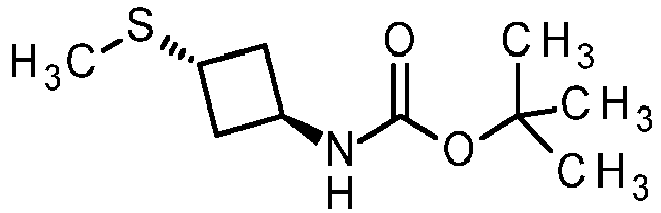
- A mixture of cis-3-[(tert-butoxycarbonyl)amino]cyclobutyl methanesulfonate (2.80 g, 10.6 mmol) and sodium thiomethoxide (888 mg, 12.7 mmol) in N,N-dimethylformamide (30 ml) was stirred at room temperature for 12 hours. The mixture was diluted with ethyl acetate and washed with brine. The organic phase was concentrated and purified by silica gel chromatography (1000 mesh, petroleum ether: ethyl acetate = 1: 0, then 50: 1, then 20: 1) to give tert-butyl [trans-3-(methylsulfanyl)cyclobutyl]carbamate (1.15 g, 50% yield) as a yellow solid.
1H NMR (400 MHz, CDCl3) δ [ppm] = 4.87-4.61 (m, 1H), 4.43-4.25 (m, 1H), 3.39-3.27 (m, 1H), 2.44-2.18 (m, 4H), 2.05 (s, 3H), 1.44 (s, 9H). -
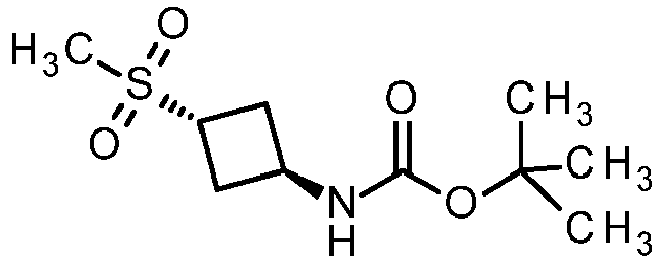
- To a solution of tert-butyl [trans-3-(methylsulfanyl)cyclobutyl]carbamate
(850 mg, 3.91 mmol) in DCM (15 ml) was added meta-chloroperoxybenzoic acid (2.53 g, 80% purity, 11.7 mmol) at rt. The mixture was stirred at rt for 3 hours. Saturated sodium bicarbonate solution was added to the mixture and the mixture was stirred for 15 minutes. The mixture was diluted with DCM and washed with brine. The organic phase was concentrated and purified by silica gel chromatography (1000 mesh, petroleum ether: ethyl acetate = 5: 1, then 0: 1) to give tert-butyl [trans-3-(methylsulfonyl)cyclobutyl]carbamate (800 mg, 82% yield) as a yellow solid.
1H NMR (400 MHz, DMSO-d6 ) δ [ppm] = 7.29 (d, J = 7.6 Hz, 1H), 4.25-4.03 (m, 1H), 3.80-3.64 (m, 1H), 2.90 (s, 3H), 2.60-2.51 (m, 2H), 2.37-2.22 (m, 2H), 1.37 (s, 9H). - A solution of tert-butyl [trans-3-(methylsulfonyl)cyclobutyl]carbamate (1.02 g, 4.09 mmol) in hydrochloric acid (15 ml, 4 M in ethyl acetate) was stirred at rt for 1 hour. The mixture was filtered and the filter cake was concentrated to give trans-3-(methylsulfonyl)cyclobutanamine hydrochloride (554 mg, 99% purity) as a white solid.
- LC-MS (SIL_85_85AB_7MIN, Instrument: Agilent 1100 LC & Agilent G1956A; Software: Agilent Chemstation Rev. B. 04.03[54]; Column: Agilent ZORBAX RX-SIL, 4.6*150mm,5µm; eluent A: water + 0.0375 vol % trifluoroacetic acid, eluent B: acetonitrile + 0.01875 vol % trifluoroacetic acid; gradient: 0-7 min 85-85% B, flow 1 ml/min; temperature: 40 °C; DAD&ELSD): Rt = 2.661 min; MS (ESIpos): m/z = 150.1
1H NMR (400 MHz, DMSO-d6 ) δ [ppm] = 8.59 (s, 3H), 4.04-3.93 (m, 1H), 3.80-3.67 (m, 1H), 2.96 (s, 3H), 2.61 (t, J = 7.6 Hz, 4H). -

-

- A mixture of cis-3-[(tert-butoxycarbonyl)amino]cyclobutyl methanesulfonate (2.74 g, 10.3 mmol) and sodium ethanethiolate (1.04 g, 12.4 mmol) in N,N-dimethylformamide (40 ml) was stirred at rt for 12 hours. The mixture was diluted with ethyl acetate and washed with brine. The organic phase was concentrated and purified by silica gel chromatography (1000 mesh, petroleum ether: ethyl acetate = 1: 0, then 100: 1, then 20: 1) to give tert-butyl [trans-3-(ethylsulfanyl)cyclobutyl]carbamate (1.70 g, 71% yield) as a yellow solid.
1H NMR (400 MHz, DMSO-d6 ) δ [ppm] = 7.23 (d, J = 7.6 Hz, 1H), 4.26-4.03 (m, 1H), 3.40-3.32 (m, 1H), 2.45 (q, J = 7.2 Hz, 2H), 2.33-2.21 (m, 2H), 2.12-2.00 (m, 2H), 1.37 (s, 9H), 1.15 (t, J = 7.6 Hz, 3H). -

- To a solution of tert-butyl [trans-3-(ethylsulfanyl)cyclobutyl]carbamate (1.70 g, 7.35 mmol) in DCM (30 ml) was added meta-chloroperoxybenzoic acid (4.75 g, 80% purity, 22.0 mmol) at rt. The mixture was stirred at rt for 3 hours. Saturated sodium bicarbonate solution was added to the mixture and the mixture was stirred for 15 minutes. The mixture was diluted with DCM and washed with brine. The organic phase was concentrated and purified by silica gel chromatography (1000 mesh, petroleum ether: ethyl acetate = 5: 1, then 0: 1) to give tert-butyl [trans-3-(ethylsulfonyl)cyclobutyl]carbamate (1.34 g, 69% yield) as a yellow solid.
1H NMR (400 MHz, DMSO-d6 ) δ [ppm] = 7.31 (d, J = 8 Hz, 1H), 4.20-4.05 (m, 1H), 3.81-3.69 (m, 1H), 3.03 (q, J = 7.6 Hz, 2H), 2.61-2.51 (m, 2H), 2.38-2.24 (m, 2H), 1.37 (s, 9H), 1.18 (t, J = 7.6 Hz, 3H). - A solution of tert-butyl [trans-3-(ethylsulfonyl)cyclobutyl]carbamate (1.34 g, 5.09 mmol) in hydrochloric acid (20 ml, 4 M in ethyl acetate) was stirred at rt for 1 hour. The mixture was filtered and the filter cake was concentrated to give trans-3-(ethylsulfonyl)cyclobutanamine hydrochloride (719 mg, 99% purity, 70% yield) as a white solid.
- LC-MS (SIL_85_85AB_7MIN, Instrument: Agilent 1100 LC & Agilent G1956A; Software: Agilent Chemstation Rev. B. 04.03[54]; Column: Agilent ZORBAX RX-SIL, 4.6*150mm,5µm; eluent A: water + 0.0375 vol % trifluoroacetic acid, eluent B: acetonitrile + 0.01875 vol % trifluoroacetic acid; gradient: 0-7 min 85-85% B, flow 1 ml/min; temperature: 40 °C; DAD&ELSD): Rt = 2.553 min; MS (ESIpos): m/z = 164.1
1H NMR (400 MHz, DMSO-d6 ) δ [ppm] = 8.61 (s, 3H), 4.12-3.98 (m, 1H), 3.83-3.65 (m, 1H), 3.08 (q, J = 7.2 Hz, 2H), 2.65-2.55 (m, 4H), 1.18 (t, J = 7.2 Hz, 3H). -

- Ethanesulfonyl chloride (250 µl) was added to tert-butyl azetidin-3-ylcarbamate (300 mg) in DCM (4.0 ml). Then DIPEA (0.91 ml) was added and the mixture was stirred at RT for 65 h. The mixture was diluted with water and extracted with ethyl acetate three times. The combined organic layers were washed with aqueous hydrochloric acid (1M), saturated sodium hydrogen carbonate solution, filtered and evaporated. DCM (4.0 ml) and TFA (1.0 ml) were added and the mixture was stirred at RT for 21 h. Evaporation afforded the title compound as a crude product, which was used without further purification.
-

- The synthesis was preformed in a similar fashion using cyclopropanesulfonyl chloride
-

- To a solution of 2,4,6-trichloropyrimidine-5-carbaldehyde (29.8 g, 141 mmol) in ethanol (500 ml) was added (3-(trifluoromethyl)phenyl)hydrazine hydrochloride (30.0 g, 141 mmol, CAS number 3107-33-3) at -78 °C, followed by the addition of triethylamine (42.8 g, 423 mmol) at -78 °C. The resulting mixture was stirred at this temperature for 30 min and warmed up to 0 °C. The mixture was stirred at 0 °C for 2 h. Upon completion of the reaction, the solvent was removed under vacuum. The residue was purified by silica gel column chromatography (ethyl acetate / petroleum ether) and re-purified by recrystallization from n-hexane/ethyl acetate to give 8.13 g of the product as a yellow solid.
1H-NMR (400 MHz, DMSO-d6 ): δ [ppm] = 7.85-7.88 (m, 2H), 8.31-8.40 (m, 2H), 8.87 (s, 1H). -
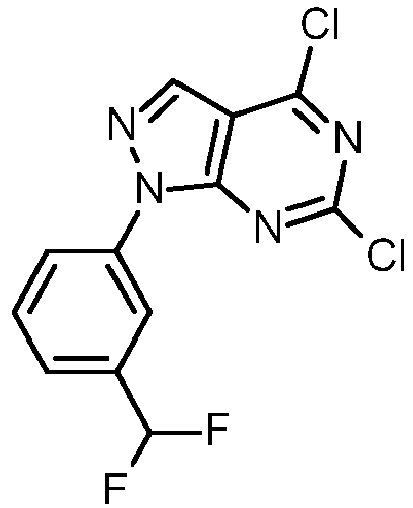
-

- To a solution of 3-nitrobenzaldehyde (50.0 g, 331 mmol) in DCM (800 ml) was added diethylaminosulfur trifluoride (130 ml, 990 mmol) at -78 °C. After stirring at rt for 2 h, the reaction mixture was poured into ice-water and extracted with DCM. The organic phase was concentrated and purified by silica gel chromatography (1000 mesh, petroleum ether: ethyl acetate = 1: 0, then 100: 1) to give 1-(difluoromethyl)-3-nitrobenzene (55.0 g) as yellow oil.
1H NMR (400 MHz, DMSO-d6 ): δ [ppm] = 8.42-8.38 (m, 2H), 8.06 (d, J = 8.0 Hz, 1H), 7.86-7.82 (m, 1H), 7.22 (t, J = 55.2 Hz, 1H). -

- To a solution of 1-(difluoromethyl)-3-nitrobenzene (55.0 g, 318 mmol) in a mixed solvent of methanol (500 ml) and water (200 ml) were added iron (53.2 g, 953 mmol) and ammonium chloride (85.0 g, 1.59 mol). The reaction mixture was stirred at 70 °C for 12 h. The reaction mixture was cooled to rt and filtered. The filtrate was diluted with water and extracted with ethyl acetate. The organic phase was washed with brine, dried over anhydrous sodium sulfate and filtered. The filtrate was concentrated under reduced pressure to give 3-(difluoromethyl)aniline (42.0 g) as yellow oil.
1H NMR (400 MHz, DMSO-d6 ): δ [ppm] = 7.11 (t, J = 8.0 Hz, 1H), 6.82 (t, J = 56.4 Hz, 1H), 6.72-6.62 (m, 3H), 5.35 (s, 2H). -

- To a solution of 3-(difluoromethyl)aniline (8.50 g, 59.4 mmol) in hydrochloric acid (40 ml, 12 M, 0.5 mol) was added a solution of sodium nitrite (4.10 g, 59.4 mmol) in water (20 ml) dropwise at -5 - 0 °C. The reaction mixture was stirred at -5 - 0 °C for 1 h. To the reaction mixture was added a solution of tin(II) chloride dihydrate (40.2 g, 178 mmol) in hydrochloric acid (100 ml, 12 M, 1.2 mol) dropwise at -5 - 0 °C. After stirring at the same temperature for 4 h, the reaction mixture was combined with the mixture of a parallel reaction using the same amounts of starting materials and conditions as described before. After filtration and washing the filter cake with hydrochloric acid (1M), the filter cake was dissolved in water. Sodium hydroxide solution (4M) was added to adjust pH∼10. The mixture was extracted with ethyl acetate. The organic phase was washed with brine, dried over anhydrous sodium sulfate, filtered and concentrated to give a residue. The residue was purified by silica gel chromatography (1000 mesh, petroleum ether: ethyl acetate = 10: 1, 5: 1, then 2: 1) to give [3-(difluoromethyl)phenyl]hydrazine (6.0 g) as a yellow solid.
1H NMR (400 MHz, DMSO-d6 ): δ [ppm] = 7.20 (t, J = 8.0 Hz, 1H), 6.98 (d, J = 8.0 Hz, 2H), 6.92-6.87 (m, 1H), 6.87 (t, J = 56.0 Hz, 1H), 6.72 (s, 1H), 4.11 (br.s, 2H). - To a solution of 2,4,6-trichloropyrimidine-5-carbaldehyde (6.02 g, 28.5 mmol) in ethanol (50 ml) was added a solution of [3-(difluoromethyl)phenyl]hydrazine (4.50 g, 28.5 mmol) in ethanol (40 ml) dropwise, followed by triethylamine (12 ml, 85 mmol) at -78 °C. After stirring at -78 °C for 0.5 h and 0 °C for 2 h, the mixture w as concentrated at rt to give a residue. The residue was diluted with ethyl acetate, washed with water and brine. The organic phase was concentrated and purified by silica gel chromatography (1000 mesh, petroleum ether: ethyl acetate = 10:1, then 5:1) to give 4,6-dichloro-1-[3-(difluoromethyl)phenyl]-1H-pyrazolo[3,4-d]pyrimidine (2.95 g) as yellow oil.
LC-MS (Method C): Rt = 1.009 min; MS (ESIpos): m/z = 315.0 [M+H]+.
1H NMR (400 MHz, DMSO-d6 ): δ [ppm] = 0.84 (s, 1H), 8.30-8.24 (m, 2H), 7.82-7.77 (m, 1H), 7.66 (d, J = 7.6 Hz, 1H), 7.20 (t, J = 55.6 Hz, 1H). -

- To a solution of 2,4,6-trichloropyrimidine-5-carbaldehyde (7.15 g, 33.8 mmol) in ethanol (70 ml) was added a solution of [3-(trifluoromethoxy)phenyl]hydrazine (6.50 g, 33.8 mmol) in ethanol (70 ml) dropwise, followed by triethylamine (14 ml, 100 mmol) at -78 °C. After stirring at -78 °C for 0.5 h and 0 °C for 0.5 h, the mixture was concentrated at rt to give a residue. The residue was diluted with ethyl acetate, washed with water and brine. The organic phase was concentrated and purified by silica gel chromatography (1000 mesh, petroleum ether: ethyl acetate = 1: 0, then 100: 1) to give 4,6-dichloro-1-[3-(trifluoromethoxy)phenyl]-1H-pyrazolo[3,4-d]pyrimidine (630 mg) as a yellow solid.
LC-MS (Method C): Rt = 1.059 min; MS (ESIpos): m/z = 349.0
1H NMR (400 MHz, DMSO-d6 ) δ [ppm] = 8.87 (s, 1H), 8.18-8.15 (m, 1H), 8.10-8.06 (m, 1H), 7.79 (t, J = 8.0 Hz, 1H), 7.51-7.46 (m, 1H). -

-

- To a solution of 3-(difluoromethoxy)aniline (5.00 g, 31.4 mmol) in hydrochloric acid (20 ml, 12 M, 240 mmol) was added a solution of sodium nitrite (2.17 g, 31.4 mmol) in water (10 ml) dropwise at 0 °C. After stirring at 0 °C for 1 h, a solution of tin(II) chloride in hydrochloric acid (50 ml, 12 M, 600 mmol) was added dropwise. The reaction mixture was stirred at 0 °C for 4 h. The reaction mixture was filtered and the filter cake was washed with hydrochloric acid (1M). The filter cake was dissolved in water. Sodium hydroxide (4 M) was added to adjust pH∼10. The mixture was extracted with ethyl acetate. The organic phase was washed with brine, dried over anhydrous sodium sulfate, filtered and concentrated to give a residue. The residue was purified by silica gel chromatography (1000 mesh, petroleum ether: ethyl acetate = 10: 1, then 5: 1) to give [3-(difluoromethoxy)phenyl]hydrazine (3.40 g) as a light yellow solid.
1H NMR (400 MHz, CDCl3): δ [ppm] = 7.19 (t, J = 8.0 Hz, 1H), 6.65-6.62 (m, 2H), 6.55-6.53 (m, 1H), 6.51 (t, J = 76.0 Hz, 1H), 5.31 (s, 1H), 3.59 (s, 2H). - To a solution of 2,4,6-trichloropyrimidine-5-carbaldehyde (2.91 g, 13.8 mmol) in ethanol (20 ml) was added a solution of [3-(difluoromethoxy)phenyl]hydrazine (2.40 g, 13.8 mmol) in ethanol (30 ml) dropwise, followed by triethylamine (5.8 ml, 41 mmol) at -78 °C. The mixture was stirred at -78 °C for 0.5 h and 0 °C for 2 h. The mixture was concentrated below 30 °C to give a residue. The residue was diluted with ethyl acetate, washed with water and brine. The organic phase was concentrated and purified by silica gel chromatography (1000 mesh, petroleum ether: ethyl acetate = 10: 1, then 5: 1) to give 4,6-dichloro-1-[3-(difluoromethoxy)phenyl]-1H-pyrazolo[3,4-d]pyrimidine (1.6 g) as a yellow solid.
LC-MS (Method C): Rt = 1.111 min; MS (ESIpos): m/z = 331.3 [M+H]+.
1H NMR (400 MHz, DMSO-d6 ): δ [ppm] = 8.87 (s, 1H), 8.02 (dd, J = 8.4, 1.2 Hz, 1H), 7.90 (t, J = 2.0 Hz, 1H), 7.71 (t, J = 8.0 Hz, 1H), 7.37 (t, J = 73.6 Hz, 1H), 7.30 (dd, J = 8.0, 2.0 Hz, 1H). -

-

- To a solution of 3-(methylsulfonyl)aniline (12.0 g, 70.1 mmol) in hydrochloric acid (300 mL) was added a solution of sodium nitrite (5.8 g, 84.1 mmol) in water (100 mL) dropwise with stirring at -20 °C ∼ -10 °C for 1 h. To the reaction mixture was added a solution of tin(II) chloride dihydrate (47.4 g, 210 mmol) in hydrochloric acid (200 mL) slowly. The mixture was stirred at -20 °C ∼ -10 °C for 2 h. Upon completion of the reaction, the mixture was basified to pH = 7 with sodium hydrogen carbonate and extracted with ethyl acetate. The organic layers were dried over anhydrous sodium sulfate and concentrated in vacuo to give 6.0 g of the crude product. The residue was used for the next step without further purification.
- To a solution of 2,4,6-trichloropyrimidine-5-carbaldehyde (3.4 g, 16.1 mmol) in tetrahydrofuran (60 mL) was added a solution of (3-(methylsulfonyl)phenyl)hydrazine (3.0 g, 16.1 mmol) in tetrahydrofuran/water (40 mL, v: v = 9: 1) at -78 °C . Triethylamine (6.7 mL, 48.3 mmol) was added dropwise and the mixture was stirred at -78 °C for 30 min. Then the mixture was warmed to -10 °C and stirred for further 1 h. Upon completion of the reaction, the solvent was removed in vacuo. The residue was purified with silica gel column chromatography (petroleum ether: ethyl acetate = 3: 1) to give 518 mg (82% purity) 4,6-dichloro-1-(3-(methylsulfonyl)phenyl)-1H-pyrazolo[3,4-d]pyrimidine as a light yellow solid.
1H-NMR (300 MHz, DMSO-d6 ): δ [ppm] = 3.34 (s, 3H), 7.93-8.05 (m, 3H), 8.50-8.51 (m, 1H), 8.93 (s, 1H). -

- To a solution of 2,4,6-trichloropyrimidine-5-carbaldehyde (3.9 g, 18.5 mmol) in tetrahydrofuran (100 mL) was added dropwise a solution of ethyl 3-hydrazinobenzoate hydrochloride (4.0 g, 18.5 mmol) in tetrahydrofuran/water (50 mL, v: v = 9: 1) at -78 °C under nitrogen atmosphere. Then triethylamine (7.7 mL, 55.4 mmol) was added dropwise and the mixture was stirred at -78 °C for 30 minutes under nitrogen atmosphere. Then the mixture was warmed to -10 °C and stirred for further 2 h. Upon completion of the reaction, the solvent was removed in vacuo. The residue was purified with silica gel column chromatography (ethyl acetate: petroleum ether = 1: 10) to give 1.01 g of the product (batch contained impurities) as a light yellow solid.
MS (ESIpos): m/z = 337 (M+H)+ -

- A solution of 4,6-dichloro-1-[3-(trifluoromethyl)phenyl]-1H-pyrazolo[3,4-d]pyrimidine (1.20 g, 3.60 mmol) and 4-(azetidin-3-yl)morpholine dihydrochloride (852 mg, 3.96 mmol) in NMP (30 ml) was treated with DIPEA (1.9 ml, 11 mmol) and the mixture was stirred at rt for 16 h. Water was added to the reaction mixture and the precipitated solid was filtered off with vacuum and dried to afford 1.51 g (95%) of the title compound as a white solid.
1H-NMR (400 MHz, DMSO-d6) δ [ppm]: 2.420 (3.94), 2.429 (4.08), 2.518 (3.15), 2.523 (2.12), 3.391 (0.42), 3.403 (0.95), 3.408 (1.04), 3.420 (1.81), 3.432 (1.07), 3.437 (1.09), 3.449 (0.50), 3.618 (4.95), 3.629 (8.35), 3.641 (4.92), 4.113 (1.03), 4.126 (1.04), 4.140 (1.37), 4.151 (1.31), 4.283 (1.36), 4.301 (1.46), 4.308 (1.22), 4.327 (0.98), 4.404 (0.97), 4.416 (1.03), 4.428 (1.40), 4.440 (1.31), 4.534 (1.31), 4.553 (1.54), 4.575 (0.90), 7.737 (1.90), 7.756 (3.01), 7.811 (1.92), 7.813 (1.92), 7.833 (2.79), 7.853 (1.26), 7.855 (1.25), 8.400 (16.00), 8.443 (2.68), 8.454 (4.63), 8.458 (5.27). -

- A solution of 4,6-dichloro-1-[3-(trifluoromethyl)phenyl]-1H-pyrazolo[3,4-d]pyrimidine (2.00 g, 6.00 mmol) and 2-(piperidin-4-yl)propan-2-ol (946 mg, 6.60 mmol) in NMP (30 ml) was treated with DIPEA (3.1 ml, 18 mmol) and the mixture was stirred at rt for 16h. Water was added to the reaction mixture and the mixture was extracted with ethyl acetate three times, the organic layers were filtered using a water-repellent filter and concentrated. Purification by column chromatography (Biotage ULTRA 50g column, eluent: hexane / ethyl acetate) afforded 2.65 g of the title compound.
LC-MS (method a01): Rt = 1.49 min; MS (ESIpos): m/z = 440 [M+H]+ -

- A solution of 4,6-dichloro-1-[3-(trifluoromethyl)phenyl]-1H-pyrazolo[3,4-d]pyrimidine (500 mg, 1.50 mmol) and 3-ethylazetidin-3-ol hydrochloride (227 mg, 1.65 mmol) in NMP (10 ml) was treated with potassium carbonate (622 mg, 4.50 mmol) and the mixture was stirred at rt for 16h. Water was added to the reaction mixture and the mixture was extracted with ethyl acetate three times, the organic layers were filtered using a water-repellent filter and concentrated. Purification by column chromatography (Biotage ULTRA 10g column, eluent: hexane / ethyl acetate) and subsequent purification by HPLC afforded 330 mg of the title compound.
LC-MS (method a01): Rt = 1.38 min; MS (ESIpos): m/z = 398 [M+H]+ -
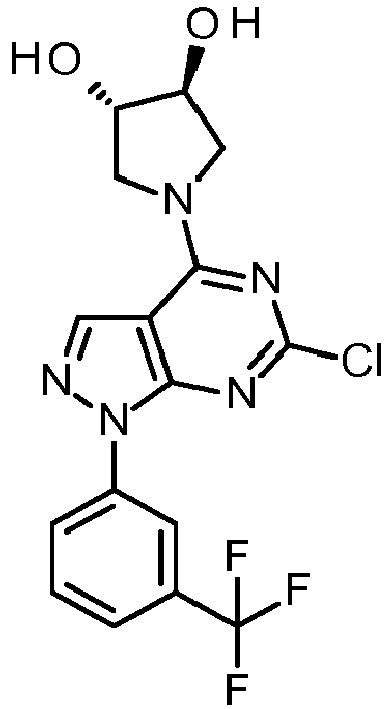
- A solution of 4,6-dichloro-1-[3-(trifluoromethyl)phenyl]-1H-pyrazolo[3,4-d]pyrimidine (370 mg, 1.11 mmol) and (3S,4S)-pyrrolidine-3,4-diol (126 mg, 1.22 mmol) in NMP (7.4 ml) was treated with DIPEA (0.58 ml, 3.3 mmol) and the mixture was stirred at rt. Water was added to the reaction mixture and the mixture was extracted with ethyl acetate three times, the organic layers were filtered using a water-repellent filter and concentrated. Purification by column chromatography (Biotage ULTRA 10g column, eluent: hexane / ethyl acetate) afforded 350 mg of the title compound.
LC-MS (method a01): Rt = 1.16 min; MS (ESIpos): m/z = 400 [M+H]+ -

- A solution of 4,6-dichloro-1-[3-(trifluoromethyl)phenyl]-1H-pyrazolo[3,4-d]pyrimidine (300 mg, 901 µmol) and 4-[(3R)-pyrrolidin-3-yl]morpholine hydrochloride (191 mg, 991 µmol) in NMP (4.5 ml) was treated with DIPEA (470 µl, 2.7 mmol) and the mixture was stirred at rt for 16h. Water was added to the reaction mixture and the mixture was extracted with ethyl acetate three times, the organic layers were filtered using a water-repellent filter and concentrated. The crude product was purified by column chromatography (Biotage ULTRA 25g column, eluent: hexane / ethyl acetate) to afford 450 mg of the title compound (crude batch).
LC-MS (method b02): Rt = 1.41 min; MS (ESIpos): m/z = 453 [M+H]+ -

- To a mixture of 4,6-dichloro-1-[3-(trifluoromethyl)phenyl]-1H-pyrazolo[3,4-d]pyrimidine (500 mg, 1.50 mmol) and methyl azetidin-3-ylacetate trifluoroacetate (365 mg, 1.50 mmol) in NMP (4.0 ml) was added DIPEA (0.78 ml, 4.5 mmol) and the mixture was stirred for 19 h at rt. Water was added and the mixture was extracted with ethyl acetate three times and the combined organic layers were concentrated. The residue was treated with DMSO, the resulting solid was filtered, washed with water and 2-methoxy-2-methylpropane and dried. A solid precipitated from the mother liquor, which was filtered, washed with water and 2-methoxy-2-methylpropane and dried. Both solids were combined to afford 148 mg of title compound. Another batch of the title compound (248 mg) was obtained by purification of the remaining mother liquor by HPLC.
LC-MS (method a01): Rt = 1.43 min; MS (ESIpos): m/z = 426 [M+H]+
1H-NMR (400 MHz, DMSO-d6) δ [ppm]: 2.074 (0.42), 2.522 (1.31), 2.838 (3.10), 2.857 (3.50), 3.164 (0.49), 3.184 (0.67), 3.204 (0.48), 3.628 (16.00), 3.958 (0.64), 3.973 (0.66), 3.983 (0.75), 3.997 (0.69), 4.217 (0.63), 4.231 (0.70), 4.240 (0.76), 4.255 (0.66), 4.354 (0.72), 4.377 (1.10), 4.400 (0.61), 4.650 (0.67), 4.672 (1.23), 4.694 (0.59), 7.735 (0.98), 7.754 (1.54), 7.811 (0.94), 7.832 (1.42), 7.853 (0.64), 8.393 (6.42), 8.454 (2.44), 8.458 (2.60). -

- DIPEA (1.3 ml, 7.5 mmol) was added to 4,6-dichloro-1-[3-(trifluoromethyl)phenyl]-1H-pyrazolo[3,4-d]pyrimidine (500 mg, 1.50 mmol) and 2-methyl-1-(piperidin-4-yl)propan-2-ol hydrochloride (291 mg, 1.50 mmol)] in NMP (4.0 ml, 42 mmol) and the mixture was stirred for 15 h at rt. Water was added and the mixture was extracted three times with ethyl acetate. The combined organic layers were concentrated and the residue was purified by HPLC affording 540 mg of the title compound.
LC-MS (method a01): Rt = 1.55 min; MS (ESIpos): m/z = 454 [M+H]+ -

- A solution of 4,6-dichloro-1-[3-(trifluoromethyl)phenyl]-1H-pyrazolo[3,4-d]pyrimidine (299 mg, 898 µmol) and 4-(azetidin-3-yl)thiomorpholine 1,1-dioxide dihydrochloride (260 mg, 988 µmol) in NMP (5.0 ml) was treated with DIPEA (470 µl, 2.7 mmol) and the mixture was stirred at rt for 16 h. Water was added to the reaction mixture and the mixture was extracted with ethyl acetate three times, the organic layers were filtered using a water-repellent filter and concentrated. 2-methoxy-2-methylpropane was added, the precipitated solid was separated by filtration, washed with 2-methoxy-2-methylpropane and dried affording 210 mg of the title compound.
LC-MS (method a01): Rt = 1.29 min; MS (ESIpos): m/z = 487 [M+H]+ -

- A solution of 4,6-dichloro-1-[3-(trifluoromethyl)phenyl]-1H-pyrazolo[3,4-d]pyrimidine (300 mg, 901 µmol) in 2-methyltetrahydrofuran (5.0 ml) was treated with DIPEA (470 µl, 2.7 mmol). The solution was cooled down with a cold water bath, 4-(piperidin-4-yl)morpholine (169 mg, 991 µmol) was added in portions and the mixture was stirred at rt for 16h. Water was added and the mixture was extracted with ethyl acetate three times, the organic layers were filtered using a water-repellent filter and concentrated. 400 mg of the crude title compound was obtained which was used without further purification.
-

- A solution of 4,6-dichloro-1-[3-(trifluoromethyl)phenyl]-1H-pyrazolo[3,4-d]pyrimidine (300 mg, 901 µmol) in 2-methyltetrahydrofuran (5.0 ml) was treated with DIPEA (470 µl, 2.7 mmol). The solution was cooled down with a cold water bath, morpholine (87 µl, 990 µmol) was added in portions and the mixture was stirred at rt for 16h. Water was added to the reaction mixture and the mixture was extracted with ethyl acetate three times, the organic layers were filtered using a water-repellent filter and concentrated.
- 2-methoxy-2-methylpropane was added, the precipitated solid was separated by filtration, washed with 2-methoxy-2-methylpropane and dried affording 260 mg of the title compound which was used without purification.
-

- A solution of [4,6-dichloro-1-[3-(trifluoromethyl)phenyl]-1H-pyrazolo[3,4-d]pyrimidine (200 mg, 600 µmol) and 1-(azetidin-3-yl)-4-methylpiperidin-4-ol dihydrochloride (161 mg, 660 µmol) in NMP was treated with DIPEA and the mixture was stirred at rt for 72 h. Water was added to the reaction mixture and the mixture was extracted with ethyl acetate three times, the organic layers were filtered using a water-repellent filter and concentrated. Purification by column chromatography (Biotage ULTRA 10 g column, eluent: hexane / ethyl acetate) afforded the title compound (225 mg).
LC-MS (method b02): Rt = 1.31 min; MS (ESIpos): m/z = 467 [M+H]+ -
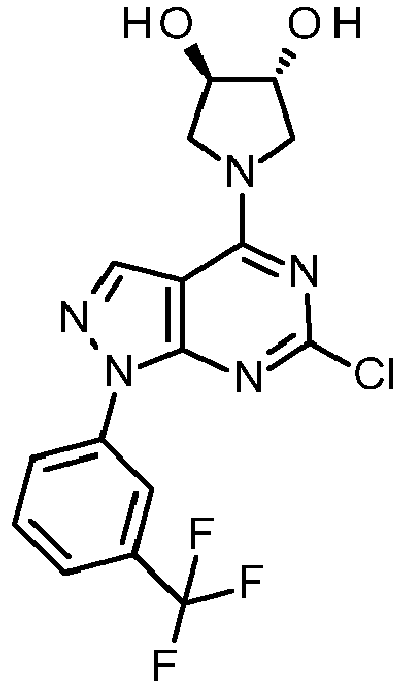
- A solution of 4,6-dichloro-1-[3-(trifluoromethyl)phenyl]-1H-pyrazolo[3,4-d]pyrimidine (800 mg, 2.40 mmol) and (3R,4R)-pyrrolidine-3,4-diol (272 mg, 2.64 mmol) in 2-methyltetrahydrofuran (8.0 ml) was treated with DIPEA (1.3 ml, 7.2 mmol) and the mixture was stirred at rt for 16 h. Standard workup and purification by column chromatography (Biotage ULTRA 25g column; eluent: ethyl acetate / ethanol) afforded 455 mg of the title compound.
-

- DIPEA (470 µl, 2.7 mmol) was added to 4,6-dichloro-1-[3-(trifluoromethyl)phenyl]-1H-pyrazolo[3,4-d]pyrimidine (300 mg, 901 µmol) and azetidin-3-ol hydrochloride (98.7 mg, 901 µmol) in 2-methyltetrahydrofuran (3.0 ml) and the mixture was stirred at rt for 15.5 h. Standard workup and purification of the crude product by HPLC (water + 0.1% formic acid/ acetonitrile) afforded 283 mg of the title compound
-

- To solution of 4,6-dichloro-1-[3-(trifluoromethyl)phenyl]-1H-pyrazolo[3,4-d]pyrimidine (800 mg) in 2-methyltetrahydrofuran (15 ml) were added DIPEA (1.0 ml) and 3-methylazetidin-3-ol (174 mg) at 0° C. The mixture was stirred at rt for 12 h. Water was added to the reaction mixture and the mixture was extracted with ethyl acetate, the organic layers were dried over anhydrous sodium sulfate and concentrated to give a residue. The residue was purified by flash column chromatography (petroleum ether / ethyl acetate) to give 312 mg of the title compound as a yellow solid.
-

- A solution of 4,6-dichloro-1-[3-(trifluoromethyl)phenyl]-1H-pyrazolo[3,4-d]pyrimidine (500 mg, 1.50 mmol) and tert-butyl [2-(azetidin-3-yl)propan-2-yl]carbamate hydrochloride (414 mg, 1.65 mmol) in 2-methyltetrahydrofuran (7.0 ml) was treated with DIPEA (0.78 ml) and the mixture was stirred at rt for 16 h. Standard workup and purification (Biotage ULTRA 25 g column, hexane / ethyl acetate) afforded the title compound (750 mg).
-

- To solution of 4,6-dichloro-1-[3-(trifluoromethyl)phenyl]-1H-pyrazolo[3,4-d]pyrimidine (800 mg) in 2-methyltetrahydrofuran (15 ml) were added DIPEA (1.54 ml, 8.84 mmol) and N,N-dimethylazetidin-3-amine hydrochloride (302 mg, 2.21 mmol) at 0 °C. The mixture was stirred at rt for 12 h. Water was added to the reaction mixture and the mixture was combined with a mixture of an experiment performed in a similar fashion (726 mg 4,6-dichloro-1-[3-(trifluoromethyl)phenyl]-1H-pyrazolo[3,4-d]pyrimidine was used for the 2nd experiment). The combined reaction mixtures were extracted with ethyl acetate. The organic layers were dried over anhydrous sodium sulfate and concentrated to give a residue. The residue was purified by flash chromatography (petroleum ether: ethyl acetate = 8: 1 to 2: 1, then 2: 1, 2: 1 to 0: 1, then 0: 1) to give 1-{6-chloro-1-[3-(trifluoromethyl)phenyl]-1 H-pyrazolo[3,4-d]pyrimidin-4-yl}-N,N-dimethylazetidin-3-amine (760 mg) as a yellow solid.
LC-MS (method C): Rt = 0.822 min; MS (ESIpos): m/z = 397.3 [M+H]+.
1H NMR (400 MHz, DMSO-d 6): δ [ppm] = 8.45-8.39 (m, 2H), 8.32 (s, 1H), 7.79 (t, J = 8.4 Hz, 1H), 7.70 (d, J = 7.6 Hz, 1H), 4.47 (t, J = 7.6 Hz, 1H), 4.36-4.28 (m, 1H), 4.27-4.20 (m, 1H), 4.06-3.99 (m, 1H), 3.37-3.28 (m, 1H), 2.16 (s, 6H). -

- DIPEA (1.3 ml) was added to 4,6-dichloro-1-[3-(trifluoromethyl)phenyl]-1H-pyrazolo[3,4-d]pyrimidine (500 mg, 1.50 mmol) and tert-butyl [1-(piperidin-4-yl)cyclopropyl]carbamate (379 mg, 1.58 mmol, CAS 1330766-47-6) in 2-methyltetrahydrofuran (5.0 ml) and the mixture was stirred at rt for 67 h. Standard workup and purification (Biotage Isolera, hexane / ethyl acetate) afforded 843 mg of the title compound.
LC-MS (method a01): Rt = 1.63 min; MS (ESIpos): m/z = 537 [M+H]+ -

- A solution of 4,6-dichloro-1-[3-(trifluoromethyl)phenyl]-1H-pyrazolo[3,4-d]pyrimidine (1.00 g, 3.00 mmol) and N,N,3-trimethylazetidin-3-amine hydrochloride (498 mg, 3.30 mmol) in 2-methyltetrahydrofuran (10 ml) was treated with DIPEA (1.6 ml, 9.0 mmol) and the mixture was stirred at rt for 16 h. Standard workup and purification (Biotage ULTRA 50 g column, hexane / ethyl acetate) afforded 900 mg of the title compound.
-

- DIPEA (0.44 ml, 2.5 mmol) was added to 4,6-dichloro-1-[3-(trifluoromethyl)phenyl]-1H-pyrazolo[3,4-d]pyrimidine (281 mg, 0.84 mmol) and 3-[(methylsulfonyl)methyl]azetidine 4-methylbenzenesulfonate (271 mg, 0.84 mmol) in 2-methyltetrahydrofuran (5.0 ml) and the mixture was stirred 19 h at rt. Standard workup and purification by HPLC (acetonitrile / water + 0.1% formic acid) afforded 299 mg of the title compound.
LC-MS (method a01): Rt = 1.26 min; MS (ESIpos): m/z = 446 [M+H]+ -

-

- To a solution of 1-(diphenylmethyl)azetidin-3-one (10.0 g, 42.1 mmol)] in tetrahydrofuran (100 ml) was added methylmagnesium bromide solution (3M in tetrahydrofuran, 17 ml, 51 mmol) at 0 ∼ 10°C. The mixture was stirred at 0°C for 20 min utes. Then the mixture was stirred at rt for 2 h. The mixture was added to saturated ammonium chloride solution and extracted with ethyl acetate. The organic layers were dried over anhydrous sodium sulfate and concentrated to give a residue. The residue was purified by column chromatography (1000 mesh, petroleum ether: ethyl acetate = 10: 1, then 5: 1) to give 1-(diphenylmethyl)-3-methylazetidin-3-ol (9.00 g, 84% yield) as light-yellow oil.
1H NMR (400 MHz, DMSO-d6 ): δ [ppm] = 7.41 (d, J = 7.2 Hz, 4H), 7.26 (t, J = 7.6 Hz, 4H), 7.19-7.12 (m, 2H), 5.12 (s, 1H), 4.38 (s, 1H), 3.04 (d, J = 7.6 Hz, 2H), 2.81 (d, J = 7.6 Hz, 2H), 1.40 (s, 3H). -
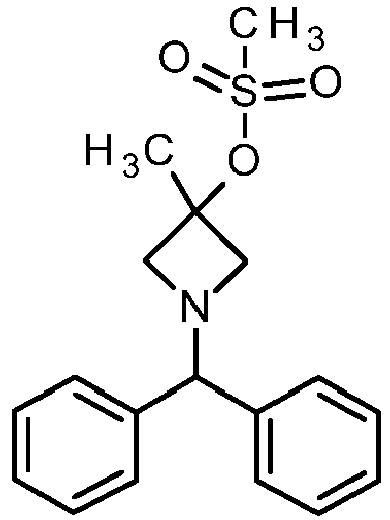
- To a solution of 1-(diphenylmethyl)-3-methylazetidin-3-ol (6.00 g, 23.7 mmol) in DCM (60 ml) were added triethylamine (5.0 ml, 36 mmol) and methanesulfonyl chloride (2.2 ml, 28 mmol) at 0 °C . The reaction was stirred at 0 °C for 30 mi nutes, warmed to rt and stirred for 2 h. The reaction mixture was quenched with saturated aq. sodium bicarbonate solution and extracted with ethyl acetate. The organic phase was washed with brine, dried over anhydrous sodium sulfate, filtered and concentrated to give crude product 1-(diphenylmethyl)-3-methylazetidin-3-yl methanesulfonate (6.50 g). The crude product was directly used for next step.
-

- To a solution of 1-(diphenylmethyl)-3-methylazetidin-3-yl methanesulfonate (5.20 g, 15.7 mmol) in 2-propanol (50 ml) was added morpholine (2.7 ml, 31 mmol) at rt. The reaction mixture was stirred at 70°C for 12 h. The mixture was concentrated, and ethyl acetate was added. The solution was washed with water, brine and concentrated to give a residue. The residue was purified by silica gel chromatography (1000 mesh, petroleum ether: ethyl acetate = 10: 1, then 3: 1) to give 4-[1-(diphenylmethyl)-3-methylazetidin-3-yl]morpholine (3.50 g, 69% yield) as light yellow oil.
1H NMR (400 MHz, DMSO-d6 ): δ [ppm] = 7.44 (d, J = 7.2 Hz, 4H), 7.27 (t, J = 7.2 Hz, 4H), 7.20-7.13 (m, 2H), 4.45 (s, 1H), 3.59-3.48 (m, 4H), 2.93 (d, J = 7.2 Hz, 2H), 2.75 (d, J = 6.8 Hz, 2H), 2.28-2.21 (m, 4H), 1.28 (s, 3H). -

- To a solution of 4-[1-(diphenylmethyl)-3-methylazetidin-3-yl]morpholine (5.20 g, 16.1 mmol) in ethanol (30 ml) were added palladium (10% on carbon, 1 g) and palladium hydroxide (15% on carbon,1 g). The reaction mixture was stirred at rt for 6 h under hydrogen atmosphere (15 psi). The reaction mixture was filtered, and the filter cake was washed with DCM. The filtrate was concentrated under reduced pressure to give a residue. Hydrochloric acid (4M in ethyl acetate, 10 ml) was added to the residue dropwise and the mixture was stirred for 0.5 h. The reaction mixture was filtered and the filter cake was washed with ethyl acetate. The filter cake was dried under reduced pressure to give 4-(3-methylazetidin-3-yl)morpholine hydrochloride (1.19 g, 38% yield) as white solid.
- LC-MS (Instrument: Agilent 1100\G1956A SingleQuad; Column: Agilent ZORBAX RX-SIL, 4.6*150mm, 5µm; eluent A: water + 0.0375 vol % trifluoroacetic acid, eluent B: acetonitrile + 0.01875 vol % trifluoroacetic acid; gradient: 0-7 min 5-90% B; flow 1 ml/min; temperature: 40 °C; PDA: 220 nm & 254 nm): Rt = 3.051 min; MS (ESIpos): m/z = 157.1 [M+H]+.
1H NMR (400 MHz, DMSO-d6 ): δ [ppm] = 10.64 (s, 1H), 9.24 (s, 1H), 4.74-4.58 (m, 2H), 4.07-3.94 (m, 4H), 3.79-3.68 (m, 2H), 3.32-3.02 (m, 4H), 1.72 (s, 3H). - To solution of 4-(3-methylazetidin-3-yl)morpholine hydrochloride (752 mg, 3.90 mmol) in 2-methyltetrahydrofuran (30 ml) were added DIPEA (2.1 ml, 12 mmol) and 4,6-dichloro-1-[3-(trifluoromethyl)phenyl]-1H-pyrazolo[3,4-d]pyrimidine (1000 mg, 3.00 mmol) at 0 °C . After stirring at rt for 12 h, the reaction mixture was concentrated under reduced pressure and the residue was purified by silica gel chromatography (1000 mesh, petroleum ether: ethyl acetate = 10: 1, then 5: 1, 2: 1) to give 6-chloro-4-[3-methyl-3-(morpholin-4-yl)azetidin-1-yl]-1-[3-(trifluoromethyl) phenyl]-1H-pyrazolo[3,4-d] pyrimidine (720 mg, 95% purity, 39% yield) as a white solid.
LC-MS (method C): Rt = 0.856 min; MS (ESIpos): m/z = 453.3 [M+H]+.
1H NMR (400 MHz, DMSO-d6 ): δ [ppm] = 8.46-8.44 (m, 2H), 8.38 (s, 1H), 7.83 (t, J = 8.4 Hz, 1H), 7.75 (d, J = 8.0 Hz, 1H), 4.39 (d, J = 9.2 Hz, 1H), 4.19 (d, J = 9.2 Hz, 1H), 4.11 (d, J = 10.0 Hz, 1H), 3.93 (d, J = 10.0 Hz, 1H), 3.62 (t, J = 4.0 Hz, 4H), 2.48-2.41 (m, 4H), 1.34 (s, 3H). -

- DIPEA (0.52 ml) was added to 4,6-dichloro-1-[3-(trifluoromethyl)phenyl]-1H-pyrazolo[3,4-d]pyrimidine (200 mg, 0.60 mmol) and 4-(azetidin-3-ylmethyl)morpholine trifluoroacetate (178 mg, 0.66 mmol) in 2-methyltetrahydrofuran (2.0 ml) and the mixture was stirred at rt for 23 h. Standard workup afforded a crude product which was treated with DMSO. The remaining solid was filtered, washed three times with 2-methoxy-2-methylpropane and dried affording 102 mg of the title compound. An additional batch (46 mg) was obtained by purification of the filtrate by preparative HPLC.
LC-MS (method b02): Rt = 1.39 min; MS (ESIpos): m/z = 453 [M+H]+ -

-

- To a solution of methyl azetidin-3-ylacetate trifluoroacetate (10.5 g, 43.2 mmol) in THF were added saturated sodium hydrogen carbonate and benzyl carbonochloridate (14.7 g, 86.4 mmol) at 0 °C. The mixture was stirred at rt for 12 h. The mixture diluted with ethyl acetate and washed with water. The organic layer was dired over anhydrous sodium sulfate and concentrated to give a residue. The residue was purified by flash chromatography (petroleum ether: ethyl acetate) to afford 10.2 g of the title compound as a yellow oil.
-

- To a solution of benzyl 3-(2-methoxy-2-oxoethyl)azetidine-1-carboxylate (12.5 g, 47.5 mmol) in THF (150 ml) was added methylmagnesium bromide (47 ml, 3 M, in diethyl ether) at 0 °C. Then the mixture was stirred at rt for 12 h. The mixture was added to saturated ammonium chloride solution and extracted with ethyl acetate. The organic layers were dried over anhydrous sodium sulfate and concentrated to give a residue. The residue was purified by silica gel chromatography (petroleum ether: ethyl acetate) to give 4.6 g benzyl 3-(2-hydroxy-2-methylpropyl)azetidine-1-carboxylate as a yellow oil.
-

- To a solution of benzyl 3-(2-hydroxy-2-methylpropyl)azetidine-1-carboxylate (4.60 g, 17.5 mmol) in ethanol (60 ml) were added palladium on carbon (10%) (400 mg) and palladium(II) hydroxide palladium on carbon (15%) (400 mg). The mixture was stirred at rt under hydrogen atmosphere (15 Psi) for 12 h. The mixture was filtered, and the filtrate was concentrated to give 1.75 g 1-(azetidin-3-yl)-2-methylpropan-2-ol as yellow oil.
- DIPEA (0.78 ml) was added to 4,6-dichloro-1-[3-(trifluoromethyl)phenyl]-1H-pyrazolo[3,4-d]pyrimidine (500 mg, 1.50 mmol) and 1-(azetidin-3-yl)-2-methylpropan-2-ol (233 mg) in 2-methyltetrahydrofuran and the mixture was stirred at rt for 20 h. Standard workup and purification by HPLC afforded 295 mg 1-(1-{6-chloro-1-[3-(trifluoromethyl)phenyl]-1H-pyrazolo[3,4-d]pyrimidin-4-yl}azetidin-3-yl)-2-methylpropan-2-ol.
LC-MS (method a01): Rt = 1.40 min; MS (ESIpos): m/z = 426 [M+H]+ -

- DIPEA (0.31 ml) was added to 4,6-dichloro-1-[3-(trifluoromethyl)phenyl]-1H-pyrazolo[3,4-d]-pyrimidine (200 mg, 0.60 mmol) and 3-(methylsulfonyl)azetidine hydrochloride (124 mg) in 2-methyltetrahydrofuran (3.0 ml) and the mixture was stirred at rt for 16 h. Standard workup afforded 258 mg of the title compound.
LC-MS (method a01): Rt = 1.26 min; MS (ESIpos): m/z = 432 [M+H]+ -

- DIPEA (1.26 ml) was added to 4,6-dichloro-1-[3-(trifluoromethyl)phenyl]-1H-pyrazolo[3,4-d]pyrimidine (400 mg, 1.20 mmol) and 2-(azetidin-3-yl)propan-2-ol hydrochloride (200 mg, 1.32 mmol) in 2-methyltetrahydrofuran (10 ml) and the mixture was stirred at rt for 16 h. Standard workup and purification by column chromatography (Biotage ULTRA 25 g column, ethyl acetate / hexane) afforded 400 mg of the title compound.
LC-MS (method a01): Rt = 1.37 min; MS (ESIpos): m/z = 412 [M+H]+ -

- DIPEA (1.10 ml) was added to 4,6-dichloro-1-[3-(trifluoromethyl)phenyl]-1H-pyrazolo[3,4-d]pyrimidine (350 mg, 1.05 mmol) and (3R,4R)-4-fluoropyrrolidin-3-ol hydrochloride (164 mg, 1.16 mmol) in 2-methyltetrahydrofuran (6.0 ml) and the mixture was stirred at rt for 16 h. Standard workup and purification by column chromatography (Biotage ULTRA 25 g column, ethyl acetate / hexane) afforded 310 mg of the title compound.
LC-MS (method a01): Rt = 1.32 min; MS (ESIpos): m/z = 402 [M+H]+ -

- DIPEA (0.63 ml) was added to 4,6-dichloro-1-[3-(trifluoromethyl)phenyl]-1H-pyrazolo[3,4-d]pyrimidine (200 mg, 0.60 mmol) and piperidin-4-ol (121 mg, 1.20 mmol) in 2-methyltetrahydrofuran (2.0 ml) and the mixture was stirred at rt for 19 h. Standard workup and purification by HPLC afforded 203 mg of the title compound.
LC-MS (method a01): Rt = 1.34 min; MS (ESIpos): m/z = 398 [M+H]+ -

- DIPEA (1.10 ml) was added to 4,6-dichloro-1-[3-(trifluoromethyl)phenyl]-1H-pyrazolo[3,4-d]pyrimidine (350 mg, 1.05 mmol) and (3S,4S)-4-fluoropyrrolidin-3-ol hydrochloride (164 mg, 1.16 mmol) in 2-methyltetrahydrofuran (3.5 ml) and the mixture was stirred at rt for 22 h. Standard workup and purification by column chromatography (hexane/ethyl acetate) afforded 384 mg of the title compound.
LC-MS (method a01): Rt = 1.33 min; MS (ESIpos): m/z = 402 [M+H]+ -

- DIPEA (0.31 ml) was added to 4,6-dichloro-1-[3-(trifluoromethyl)phenyl]-1H-pyrazolo[3,4-d]pyrimidine (100 mg, 0.30 mmol) and 3-fluoroazetidine hydrochloride (50 mg, 0.45 mmol) in 2-methyltetrahydrofuran (2.0 ml) and the mixture was stirred at rt for 21 h. Standard workup and purification by HPLC afforded 80 mg of the title compound.
LC-MS (method a01): Rt = 1.40 min; MS (ESIpos): m/z = 372 [M+H]+ -

- DIPEA (0.41 ml) was added to 4,6-dichloro-1-[3-(trifluoromethyl)phenyl]-1H-pyrazolo[3,4-d]pyrimidine (130 mg, 0.39 mmol) and (3R)-3-methylpyrrolidin-3-ol (79 mg, 0.78 mmol) in 2-methyltetrahydrofuran (2.5 ml) and the mixture was stirred at rt for 16 h. Standard workup and purification by HPLC afforded 135 mg of the title compound.
LC-MS (method a01): Rt = 1.34 min; MS (ESIpos): m/z = 398 [M+H]+ -

- DIPEA (0.94 ml) was added to 4,6-dichloro-1-[3-(trifluoromethyl)phenyl]-1H-pyrazolo[3,4-d]-pyrimidine (300 mg, 0.90 mmol) and tert-butyl (3,3-difluoropiperidin-4-yl)carbamate (319 mg, 1.35 mmol) in 2-methyltetrahydrofuran (4.0 ml) and the mixture was stirred at rt for 16 h. Standard workup and purification by HPLC afforded 397 mg of the title compound.
LC-MS (method a01): Rt = 1.55 min; MS (ESIpos): m/z = 533 [M+H]+ -

-

- To a solution of benzyl 3-aminoazetidine-1-carboxylate (500 mg, 2.42 mmol) in DCM (10 ml) were added triethylamine (510 µl, 3.6 mmol) and 4-chlorobutanoyl chloride (410 mg, 2.91 mmol) at 0 °C . The reaction mixture was stirred at 25 °C for 2 h. The mixture was poured into water and extracted with ethyl acetate. The organic phase was washed with brine, dried over anhydrous sodium sulfate, filtered and concentrated to give benzyl 3-(4-chlorobutanamido)azetidine-1-carboxylate (500 mg, 66% yield) as a yellow solid.
1H NMR (400 MHz, DMSO-d6 ): δ [ppm] = 8.54 (d, J = 7.2 Hz, 1H), 7.40-7.29 (m, 5H), 5.04 (s, 2H), 4.50-4.40 (m, 1 H), 4.15 (s, 2H), 3.76 (s, 2H), 3.63 (t, J = 6.8 Hz, 2H), 2.24 (t, J = 7.2 Hz, 2H), 1.99-1.87 (m, 2H). -

- To a solution of benzyl 3-(4-chlorobutanamido)azetidine-1-carboxylate (400 mg, 1.29 mmol) in tetrahydrofuran (5.0 ml) was added sodium hydroxide (103 mg, 2.57 mmol) at rt. The reaction mixture was stirred at 25 °C for 12 h. The mixture was poured into water and extracted with ethyl acetate. The organic phase was washed with brine, dried over anhydrous sodium sulfate, filtered and concentrated to give benzyl 3-(2-oxopyrrolidin-1-yl)azetidine-1-carboxylate (300 mg, 85% yield) as a white solid.
1H NMR (400 MHz, CDCl3): δ [ppm] = 7.40-7.31 (m, 5H), 5.11 (s, 2H), 5.07-5.00 (m, 1H), 4.24 (t, J = 8.8 Hz, 2H), 4.07 (dd, J = 9.6, 5.6 Hz, 2H), 3.56 (t, J = 6.8 Hz, 2H), 2.42 (t, J = 8.0 Hz, 2H), 2.14-2.05 (m, 2H). -

- To a solution of benzyl 3-(2-oxopyrrolidin-1-yl)azetidine-1-carboxylate (370 mg, 1.35 mmol) in methanol (10 ml) was added palladium on carbon (200 mg, 10% purity) at rt. The reaction mixture was stirred at rt for 12 h under hydrogen atmosphere (15 psi). The reaction mixture was filtered and the filtrate was concentrated to give 1-(azetidin-3-yl)pyrrolidin-2-one (160 mg, 85% yield) as yellow oil.
1H NMR (400 MHz, CDCl3): δ [ppm] = 5.10-4.98 (m, 1H), 3.79-3.75 (m, 2H), 3.64-3.53 (m, 2H), 3.50-3.45 (m, 2H), 2.43-2.37 (m, 2H), 2.12-2.00 (m, 2H). -

- To a solution of 4,6-dichloro-1-[3-(trifluoromethyl)phenyl]-1H-pyrazolo[3,4-d]pyrimidine (380 mg, 1.14 mmol) in 2-methyltetrahydrofuran (5 ml) were added DIPEA (800 µl, 4.6 mmol) and 1-(azetidin-3-yl)pyrrolidin-2-one (160 mg, 1.14 mmol) at 0 °C. The mixture was stirred at rt for 12 h. The reaction mixture was poured into water and extracted with ethyl acetate. The organic layers were dried over anhydrous sodium sulfate and concentrated to give 1-(1-{6-chloro-1-[3-(trifluoromethyl)phenyl]-1H-pyrazolo[3,4-d]pyrimidin-4-yl}azetidin-3-yl)pyrrolidin-2-one (160 mg, 97% purity, 31% yield) as a white solid.
LC-MS (method C): Rt = 0.987 min; MS (ESIpos): m/z = 437.1 [M+H]+.
1H NMR (400 MHz, CDCl3): δ [ppm] = 8.5 (d, J = 8.0 Hz, 1H), 8.44 (s, 1H), 7.96 (s, 1H), 7.67-7.56 (m, 2H), 5.35-5.25 (m, 1H), 4.80-4.32 (m, 4H), 3.63 (t, J = 7.2 Hz, 2H), 2.48 (t, J = 8.0 Hz, 2H), 2.22-2.11 (m, 2H). -

- A solution of 4,6-dichloro-1-[3-(trifluoromethyl)phenyl]-1H-pyrazolo[3,4-d]pyrimidine (120 mg and 4-[(pyrrolidin-1-yl)methyl]piperidin-4-ol in 2-methyltetrahydrofuran was treated with DIPEA (0.25 ml) and the mixture was stirred at rt for 16 h. Standard workup and purification by HPLC (method HT_PREP_bas) afforded 90 mg of the title compound.
LC-MS (method HTpost_bas): Rt = 1.71 min; MS (ESIpos): m/z = 481 [M+H]+ -

- A solution of 4,6-dichloro-1-[3-(trifluoromethyl)phenyl]-1 H-pyrazolo[3,4-d]pyrimidine (100 mg) and 4-(azetidin-3-yl)piperazin-2-one dihydrochloride (75 mg) in 2-methyltetrahydrofuran was treated with DIPEA (0.21 ml) and the mixture was stirred at rt for 16 h. Water was added to the reaction mixture and the mixture was extracted with ethyl acetate three times and the organic layers were concentrated. The crude product was used without further purification.
-

- A solution of 4,6-dichloro-1-[3-(trifluoromethyl)phenyl]-1H-pyrazolo[3,4-d]pyrimidine (100 mg) and (3R)-pyrrolidin-3-ol-hydrogen chloride in 2-methyltetrahydrofuran (2.0 ml) was treated with DIPEA (0.21 ml) and the mixture was stirred at rt for 16h. Standard workup and purification by HPLC (method HT_PREP_bas) afforded 80 mg of the title compound.
LC-MS (method HTpost_bas): Rt = 1.40 min; MS (ESIpos): m/z = 384 [M+H]+ -

- A solution of 4,6-dichloro-1-[3-(trifluoromethyl)phenyl]-1H-pyrazolo[3,4-d]pyrimidine (200 mg) and 1-(azetidin-3-yl)-3,3-difluoropyrrolidine dihydrochloride (155 mg) (CAS 1403766-97-1) in 2-methyltetrahydrofuran (4.0 ml) was treated with DIPEA (0.42 ml) and the mixture was stirred at RT for 16 h. Standard workup and purification by column chromatography (Biotage ULTRA 25g column, hexane / ethyl acetate) afforded 230 mg of the title compound.
LC-MS (method a01): Rt = 1.46 min; MS (ESIpos): m/z = 459 [M+H]+ -

- A solution of 4,6-dichloro-1-[3-(trifluoromethyl)phenyl]-1H-pyrazolo[3,4-d]pyrimidine (344 mg) and 3-fluoro-1,3'-biazetidine oxalic acid (250 mg) (CAS 1523571-87-0) in 2-methyltetrahydrofuran (6.9 ml) was treated with DIPEA (0.72 ml) and the mixture was stirred at RT for 72 h. Standard workup and purification by column chromatography (Biotage ULTRA 25 g column, hexane / ethyl acetate) afforded 160 mg of the title compound.
MS (ESIpos): m/z = 427 [M+H]+ -
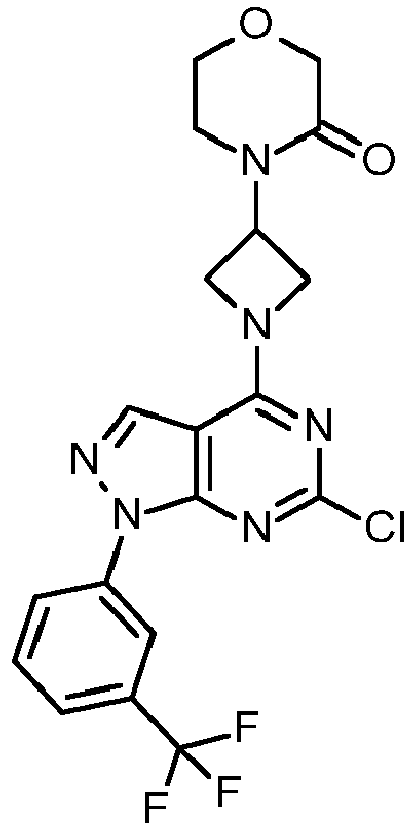
-

- To a mixture of benzyl 3-oxoazetidine-1-carboxylate (10.0 g, 48.7 mmol) and 2-aminoethan-1-ol (4.46 g, 73.1 mmol) in methanol (100 ml) was added acetic acid (280 µl, 4.9 mmol). The mixture was stirred at 60 °C for 1 hour. Then sodium cyanoborohydride (6.12 g, 97.5 mmol) was added at rt. The mixture was stirred at rt for 12 h. The mixture was concentrated and purified by silica gel chromatography (1000 mesh, petroleum ether: ethyl acetate = 1: 1, then 0: 1, then ethyl acetate: methanol = 10: 1) to give benzyl 3-[(2-hydroxyethyl)amino]azetidine-1-carboxylate (4.30 g) as a yellow oil.
LC-MS (method C): Rt = 0.185 min; MS (ESIpos): m/z = 251.6 -

- To a solution of benzyl 3-[(2-hydroxyethyl)amino]azetidine-1-carboxylate (4.30 g) in DCM (80 ml) were added DIPEA (3.8 ml, 22 mmol) and chloroacetyl chloride (1.22 g, 10.8 mmol) at 0 °C . The mixture was stirred at rt for 1 hour. The mixture was diluted with DCM and washed with saturated ammonium chloride solution and brine. The organic phase was dried over anhydrous sodium sulfate, filtered and concentrated to give a residue. The residue was purified by silica gel chromatography (1000 mesh, petroleum ether: ethyl acetate = 5: 1, then 1: 1) to give benzyl 3-[(chloroacetyl)(2-hydroxyethyl)amino]azetidine-1-carboxylate (2.40 g) as a yellow oil.
LC-MS (method C): Rt = 0.680 min; MS (ESIpos): m/z = 327.1 -

- To a solution of benzyl 3-[(chloroacetyl)(2-hydroxyethyl)amino]azetidine-1-carboxylate (1.80 g) in THF (40 ml) was added sodium hydroxide (330 mg, 8.26 mmol) at 0 °C. After stirring at rt for 12 h, the mixture was diluted with ethyl acetate and washed with water. The organic phase was concentrated and purified by silica gel chromatography (1000 mesh, petroleum ether: ethyl acetate = 5: 1, then 1: 1) to give benzyl 3-(3-oxomorpholin-4-yl)azetidine-1-carboxylate (1.30 g) as a yellow oil.
1H NMR (400 MHz, DMSO-d6 ) δ [ppm] = 7.40-7.28 (m, 5H), 5.20-5.09 (m, 1H), 5.04 (s, 1H), 4.19-4.09 (m, 4H), 4.04 (s, 2H), 3.85 (t, J = 4.8 Hz, 2H), 3.49 (t, J = 5.2 Hz, 2H). -

- To a solution of benzyl 3-(3-oxomorpholin-4-yl)azetidine-1-carboxylate (700 mg, 2.41 mmol) in ethanol (15 ml) was added palladium on carbon (100 mg, 10% Pd). The mixture was stirred at rt under hydrogen atmosphere (15 psi) for 12 h. The mixture was filtered and the filtrate was concentrated to give 4-(azetidin-3-yl)morpholin-3-one (350 mg) as a yellow oil
1H NMR (400 MHz, DMSO-d6 ) δ [ppm] = 5.13-5.00 (m, 1H), 4.01 (s, 2H), 3.85 (t, J = 5.2 Hz, 2H), 3.64-3.55 (m, 2H), 3.51-3.43 (m, 4H). - To a solution of 4,6-dichloro-1-[3-(trifluoromethyl)phenyl]-1H-pyrazolo[3,4-d]pyrimidine (746 mg) in 2-methyltetrahydrofuran (20 ml) were added DIPEA (1.2 ml, 6.7 mmol) and 4-(azetidin-3-yl)morpholin-3-one (350 mg) at 0 °C. The mixture was stirred at rt for 12 h. The mixture was diluted with ethyl acetate and washed with brine. The organic phase was concentrated and purified by column chromatography (1000 mesh, petroleum ether: ethyl acetate = 2: 1, then 1: 1, then 1: 2) to give 4-(1-{6-chloro-1-[3-(trifluoromethyl)phenyl]-1 H-pyrazolo[3,4-d]pyrimidin-4-yl}azetidin-3-yl)morpholin-3-one (688 mg) as a yellow solid.
LC-MS (method C): Rt = 0.959 min; MS (ESIpos): m/z = 453.3
1H NMR (400 MHz, DMSO-d6 ) δ [ppm] = 8.48-8.42 (m, 2H), 8.39 (s, 1H), 7.83 (t, J = 8.4 Hz, 1H), 7.75 (d, J = 7.6 Hz, 1H), 5.50-5.36 (m, 1H), 4.80-4.66 (m, 2H), 4.55-4.44 (m, 2H), 4.11 (s, 2H), 3.95-3.84 (m, 2H), 3.61 (t, J = 4.8 Hz, 2H). -

- A solution of 4,6-dichloro-1-[3-(trifluoromethyl)phenyl]-1H-pyrazolo[3,4-d]pyrimidine (150 mg) and (3S)-3-methylpyrrolidin-3-ol (50 mg) in 2-methyltetrahydrofuran (3.0 ml) was treated with DIPEA (0.31 ml) and the mixture was stirred at RT for 16 h. Standard workup and purification by HPLC (method HT_PREP_bas) afforded 130 mg of the title compound.
LC-MS (method HTpost_bas): Rt = 1.44 min; MS (ESIpos): m/z = 398 [M+H]+ -

- To solution of 4,6-dichloro-1-[3-(difluoromethyl)phenyl]-1H-pyrazolo[3,4-d]pyrimidine (1.00 g, 75% purity, 2.38 mmol) in 2-methyltetrahydrofuran (10 ml) were added DIPEA (1.2 ml, 7.1 mmol) and 2-(piperidin-4-yl)propan-2-ol (341 mg, 2.38 mmol) at 0°C. After stirring at rt for 12 h, the reaction mixture was filtered, and the filter cake was washed with 2-methyltetrahydrofuran. The filter cake was purified by silica gel chromatography (1000 mesh, petroleum ether: ethyl acetate = 10: 1, then 5: 1, 2: 1) to give 2-(1-{6-chloro-1-[3-(difluoromethyl)phenyl]-1H-pyrazolo[3,4-d]pyrimidin-4-yl}piperidin-4-yl)propan-2-ol (410 mg) as a yellow solid.
LC-MS (method C): Rt = 1.033 min; MS (ESIpos): m/z = 422.3 [M+H]+.
1H NMR (400 MHz, DMSO-d6 ): δ [ppm] = 0.86 (s, 1H), 8.31-8.26 (m, 2H), 7.73 (t, J = 8.0 Hz, 1H), 7.58 (d, J = 7.6 Hz 1H), 7.17 (t, J = 55.6 Hz, 1H), 5.05-4.40 (m, 2H), 4.20 (s, 1H), 3.29-2.77 (m, 2H), 1.91 (s, 2H), 1.64-1.58 (m, 1H), 1.42-1.22 (m, 2H), 1.06 (s, 6H). -

- DIPEA (1.2 ml) was added to a solution of 4,6-dichloro-1-[3-(difluoromethyl)phenyl]-1H-pyrazolo[3,4-d]pyrimidine (750 mg, 2.38 mmol) and 1-(azetidin-3-yl)-2-methylpropan-2-ol (338 mg, 2.62 mmol) in 2-methyltetrahydrofuran (5.6 ml) and the mixture was stirred at rt for 16 h. Standard workup afforded the title compound as crude product which was used without further purification.
-

- A solution of 4,6-dichloro-1-[3-(difluoromethyl)phenyl]-1H-pyrazolo[3,4-d]pyrimidine (1.00 g, 3.17 mmol) and 4-(azetidin-3-yl)morpholine dihydrochloride (751 mg, 3.49 mmol) in 2-methyltetrahydrofuran (15 ml) was treated with DIPEA (1.7 ml, 9.5 mmol) and the mixture was stirred at rt for 72 h. Standard workup and purification (Biotage ULTRA 50 g column, ethyl acetate / ethanol) afforded 860 mg of the title compound.
-

- DIPEA (1.7 ml) was added to 4,6-dichloro-1-[3-(difluoromethyl)phenyl]-1H-pyrazolo[3,4-d]pyrimidine (1.00 g, 3.17 mmol) and methyl azetidin-3-ylacetate trifluoroacetate in 2-methyltetrahydrofuran (15 ml) and the mixture was stirred at rt for 68 h. Standard workup and purification by column chromatography (hexane / ethyl acetate) afforded 965 mg of the title compound.
LC-MS (method a01): Rt = 1.30 min; MS (ESIpos): m/z = 408 [M+H]+ -

- A solution of 4,6-dichloro-1-[3-(difluoromethyl)phenyl]-1 H-pyrazolo[3,4-d]pyrimidine (295 mg) and 1-(azetidin-3-yl)-4-methylpiperidin-4-ol dihydrochloride (250 mg) in 2-methyltetrahydrofuran (4.2 ml) was treated with DIPEA (0.49 ml) and the mixture was stirred at rt for 16 h. Standard workup and purification by column chromatography (Biotage ULTRA 10 g column, hexane / ethyl acetate / ethanol) afforded 310 mg of the title compound.
-

- A solution of 4,6-dichloro-1-[3-(difluoromethyl)phenyl]-1 H-pyrazolo[3,4-d]pyrimidine (150 mg) and rel-(3R,4R)-4-fluoropyrrolidin-3-ol hydrochloride (74 mg) in 2-methyltetrahydrofuran (2 ml) was treated with DIPEA (0.25 ml) and the mixture was stirred at rt for 16 h. Standard workup and purification by HPLC afforded 160 mg of the title compound.
-

- The synthesis was performed analogously to intermediate 2-II-6-1 using (3S,4S)-4-fluoropyrrolidin-3-ol hydrochloride.
LC-MS (method a01): Rt = 1.20 min; MS (ESIpos): m/z = 384 [M+H]+ -

- The synthesis was performed analogously to intermediate 2-II-6-1 using (3R,4R)-4-fluoropyrrolidin-3-ol hydrochloride (1:1)
LC-MS (method a01): Rt = 1.20 min; MS (ESIpos): m/z = 384 [M+H]+ -

- A solution of 4,6-dichloro-1-[3-(difluoromethyl)phenyl]-1H-pyrazolo[3,4-d]pyrimidine (150 mg) and rel-(3S,4R)-4-methylpyrrolidin-3-ol hydrochloride (72 mg) in 2-methyltetrahydrofuran (2 ml) was treated with DIPEA (0.25 ml) and the mixture was stirred at rt for 16 h. Standard workup and purification by HPLC afforded 140 mg of the title compound.
-

- A solution of 4,6-dichloro-1-[3-(difluoromethyl)phenyl]-1 H-pyrazolo[3,4-d]pyrimidine (150 mg) and 3-(trifluoromethyl)pyrrolidin-3-ol hydrochloride (100 mg) in 2-methyltetrahydrofuran (2 ml) was treated with DIPEA (0.25 ml) and the mixture was stirred at rt for 16 h. Standard workup and purification by HPLC afforded 60 mg of the title compound.
-

- A solution of 4,6-dichloro-1-[3-(difluoromethyl)phenyl]-1 H-pyrazolo[3,4-d]pyrimidine (200 mg) and tert-butyl [1-(piperidin-4-yl)cyclopropyl]carbamate in 2-methyltetrahydrofuran (3.0 ml) was treated with DIPEA (0.55 ml) and the mixture was stirred at RT for 16 h. Standard workup and column chromatography (Biotage ULTRA 10 g column eluent: hexane / ethyl acetate) afforded 300 mg of the crude title compound.
LC-MS (OA01b02): Rt = 1.52 min; MS (ESIpos): m/z = 519 [M+H]+ -

- A solution of 4,6-dichloro-1-[3-(difluoromethyl)phenyl]-1H-pyrazolo[3,4-d]pyrimidine (200 mg) and 4-(3-methylazetidin-3-yl)morpholine hydrochloride (135 mg) in 2-methyltetrahydrofuran (3.0 ml) was treated with DIPEA (0.33 ml) and the mixture was stirred at rt for 16 h. Standard workup and purification by HPLC (method HT_PREP_acid) afforded 90 mg of the title compound.
LC-MS (method HTpost_acid): Rt = 1.04 min; MS (ESIpos): m/z = 435 [M+H]+ - Additional intermediates of type 2-II were prepared in a similar fashion as described before using 4,6-dichloro-1-[3-(difluoromethyl)phenyl]-1H-pyrazolo[3,4-d]pyrimidine and the corresponding amine:
-

-

-

-

-

- To solution of 4,6-dichloro-1-[3-(trifluoromethoxy)phenyl]-1H-pyrazolo[3,4-d]pyrimidine (680 mg, crude batch) in 2-methyltetrahydrofuran (10 ml) were added DIPEA (0.68 ml, 3.9 mmol) and 2-(piperidin-4-yl)propan-2-ol (187 mg, 1.31 mmol) at 0° C. After stirring at rt for 12 h, water was added to the reaction mixture. The mixture was extracted with ethyl acetate. The organic layers were dried over anhydrous sodium sulfate and concentrated to give a residue. The residue was purified by silica gel chromatography (1000 mesh, petroleum ether: ethyl acetate = 8: 1, then 5: 1, then 2: 1) to give 2-(1-{6-chloro-1-[3-(trifluoromethoxy)phenyl]-1H-pyrazolo[3,4-d]pyrimidin-4-yl}piperidin-4-yl)propan-2-ol (323 mg) as a yellow solid.
LC-MS (method C): Rt = 1.178 min; MS (ESIpos): m/z = 456.3
1H NMR (400 MHz, CDCl3) δ [ppm] = 8.25-8.20 (m, 1H), 8.15-8.07 (m, 2H), 7.54 (t, J = 8.4 Hz, 1H), 7.21-7.16 (m, 1H), 5.25-4.40 (m, 2H), 3.45-2.85 (m, 2H), 2.10-1.95 (m, 2H), 1.77-1.65 (m, 1H), 1.55-1.37 (m, 2H), 1.29-1.22 (m, 7H). -

- To solution of [4,6-dichloro-1-[3-(difluoromethoxy)phenyl]-1H-pyrazolo[3,4-d]pyrimidine (700 mg, 2.11 mmol) in 2-methyltetrahydrofuran (15 ml) were added DIPEA (1.1 ml, 6.3 mmol) and 2-(piperidin-4-yl)propan-2-ol (303 mg, 2.11 mmol) at 0° C. After stirring at rt for 12 h, the reaction mixture was filtered, and the filter cake was washed with 2-methyltetrahydrofuran. The filter cake was purified by silica gel chromatography (1000 mesh, petroleum ether: ethyl acetate = 10: 1, then 5: 1, 2: 1) to give 2-(1-{6-chloro-1-[3-(difluoromethoxy)phenyl]-1H-pyrazolo[3,4-d]pyrimidin-4-yl}piperidin-4-yl)propan-2-ol (320 mg) as a yellow solid.
LC-MS (method C): Rt = 1.045 min; MS (ESIpos): m/z = 438.3 [M+H]+.
1H NMR (400 MHz, DMSO-d6 ): δ [ppm] = 8.64 (s, 1H), 8.01 (dd, J = 8.0, 1.2 Hz, 1H), 7.91 (t, J = 2.0 Hz, 1H), 7.63 (t, J = 8.0 Hz, 1H), 7.34 (t, J = 73.6 Hz, 1H), 7.20 (dd, J = 8.0, 2.0 Hz, 1H), 5.05-4.37 (m, 2H), 4.22 (s, 1H), 3.31-2.97 (m, 2H), 1.91 (br.s, 2H), 1.64-1.58 (m, 1H), 1.43-1.16 (m, 2H), 1.06 (s, 6H). -

- A solution of [4,6-dichloro-1-[3-(difluoromethoxy)phenyl]-1H-pyrazolo[3,4-d]pyrimidine (200 mg) and tert-butyl [1-(piperidin-4-yl)cyclopropyl]carbamate] (160 mg) in 2-methyltetrahydrofuran (3.0 ml) was treated with DIPEA (0.53 ml) and the mixture was stirred at rt for 16 h. Standard workup afforded a crude product which was treated with 2-methoxy-2-methylpropane. The resulting solid was filtered, washed with 2-methoxy-2-methylpropane and dried to afford 250 mg of the title compound.
LC-MS (method b02): Rt = 1.53 min; MS (ESIpos): m/z = 535 [M+H]+ -

- A solution of [4,6-dichloro-1-[3-(difluoromethoxy)phenyl]-1H-pyrazolo[3,4-d]pyrimidine (120 mg) and 1-(azetidin-3-yl)-2-methylpropan-2-ol (52 mg) in 2-methyltetrahydrofuran (2.0 ml) was treated with DIPEA (0.32 ml) and the mixture was stirred at rt for 16 h. Then 1-(azetidin-3-yl)-2-methylpropan-2-ol (20 mg) and NMP (1 ml) was added and the mixture was stirred at rt for 16 h. Standard workup and HPLC purification afforded 75 mg of the title compound.
LC-MS (method a01): Rt = 1.28 min; MS (ESIpos): m/z = 424 [M+H]+ -

- A solution of [4,6-dichloro-1-[3-(difluoromethoxy)phenyl]-1H-pyrazolo[3,4-d]pyrimidine (250 mg) and (3S,4S)-4-fluoropyrrolidin-3-ol hydrochloride (118 mg) in 2-methyltetrahydrofuran (3.5 ml) was treated with DIPEA (0.66 ml) and the mixture was stirred at rt for 16 h. Standard workup and HPLC purification (water + 0.1% formic acid / acetonitrile) afforded 245 mg of the title compound.
LC-MS (method a01): Rt = 1.21 min; MS (ESIpos): m/z = 400 [M+H]+ -

- DIPEA (630 µl, 3.6 mmol) was added to 4,6-dichloro-1-[3-(methylsulfonyl)phenyl]-1H-pyrazolo[3,4-d]pyrimidine (250 mg, 728 µmol) and 3-ethylazetidin-3-ol hydrochloride (150 mg, 1.09 mmol) in 2-methyltetrahydrofuran and the mixture was stirred for 19.5 h at rt. Standard workup and purification by HPLC (acetonitrile / water buffered with ammonia) afforded the title compound (129 mg, 0.32 mmol).
LC-MS (method b02): Rt = 1.02 min; MS (ESIpos): m/z = 408 [M+H]+ -

- Reaction of ethyl 3-(4,6-dichloro-1H-pyrazolo[3,4-d]pyrimidin-1-yl)benzoate (500 mg, 1.48 mmol) and 2-(piperidin-4-yl)propan-2-ol (234 mg, 1.63 mmol) similar to the preparation of intermediate 2-II-9 afforded 490 mg of the title compound
LC-MS (method a01): Rt = 1.41 min; MS (ESIpos): m/z = 444 [M+H]+. -

- A solution of 6-chloro-4-[3-(morpholin-4-yl)azetidin-1-yl]-1-[3-(trifluoromethyl)phenyl]-1H-pyrazolo[3,4-d]pyrimidine (80.0 mg, 0.18 mmol, 1.0 eq.) and (4S)-4-aminopyrrolidin-2-one hydrochloride (1.5 eq., 37.3 mg, 0.27 mmol) in NMP (2.0 ml) was treated with DIPEA (0.16 ml) and the mixture was stirred at 110°C for 16 h. Then 1 eq. (4S)-4-aminopyrrolidin-2-one hydrochloride and 3 eq. DIPEA were added and the mixture was stirred at 110°C for 24 h. Standard workup and purification by HPLC (method HT_PREP_acid) afforded 34 mg of the title compound.
LC-MS (method HTpost_acid): Rt = 0.83 min; MS (ESIpos): m/z = 503 [M+H]+
1H-NMR (400 MHz, DMSO-d6) δ [ppm]: 2.278 (0.87), 2.293 (0.94), 2.323 (2.11), 2.327 (2.34), 2.332 (2.13), 2.402 (6.55), 2.518 (5.36), 2.523 (3.53), 2.532 (1.36), 2.540 (1.55), 2.553 (1.47), 2.665 (0.91), 2.669 (1.28), 2.674 (0.94), 3.215 (1.19), 3.362 (3.70), 3.375 (2.26), 3.380 (2.15), 3.392 (0.98), 3.624 (11.45), 3.634 (7.13), 3.989 (0.77), 4.187 (0.91), 4.268 (1.04), 4.430 (0.91), 4.542 (1.26), 4.556 (1.23), 7.518 (0.83), 7.605 (2.62), 7.629 (6.55), 7.731 (1.28), 7.749 (1.94), 7.769 (0.98), 8.092 (16.00), 8.500 (0.74), 8.570 (0.40), 8.840 (0.83). -

- Reaction of 6-chloro-4-[3-(morpholin-4-yl)azetidin-1-yl]-1-[3-(trifluoromethyl)phenyl]-1H-pyrazolo[3,4-d]pyrimidine (80.0 mg, 0.18 mmol) and (4R)-4-aminopyrrolidin-2-one hydrochloride (37.3 mg, 0.27 mmol) using similar conditions to the preparation of example I-1-1 afforded 37 mg of the title compound.
LC-MS (method HTpost_acid): Rt = 0.83 min; MS (ESIpos): m/z = 503 [M+H]+
1H-NMR (400 MHz, DMSO-d6) δ [ppm]: 2.277 (1.05), 2.292 (1.15), 2.322 (2.67), 2.326 (2.93), 2.331 (2.73), 2.402 (8.00), 2.518 (9.35), 2.522 (5.83), 2.531 (2.34), 2.539 (2.96), 2.553 (1.71), 2.664 (1.28), 2.669 (1.71), 2.673 (1.32), 3.202 (1.42), 3.374 (2.77), 3.391 (1.25), 3.623 (13.73), 3.983 (0.95), 4.186 (1.15), 4.264 (1.25), 4.426 (1.15), 4.542 (1.55), 4.557 (1.51), 7.520 (1.02), 7.605 (3.06), 7.628 (7.84), 7.731 (1.48), 7.750 (2.30), 7.769 (1.15), 8.092 (16.00), 8.454 (0.46), 8.500 (0.92), 8.839 (1.02). -

- A solution of 2-(1-{6-chloro-1-[3-(trifluoromethyl)phenyl]-1H-pyrazolo[3,4-d]pyrimidin-4-yl}piperidin-4-yl)propan-2-ol (80.0 mg, 0.18 mmol) and (4S)-4-aminopyrrolidin-2-one hydrochloride (1.5 eq., 37.3 mg, 0.27 mmol) in NMP (2.0 ml) was treated with DIPEA (0.16 ml) and the mixture was stirred at 110°C for 16 h. Then 1 eq. (4S)-4-aminopyrrolidin-2-one hydrochloride and 3 eq. DIPEA were added and the mixture was stirred at 110°C for 24h.Standard workup and purification by HPLC (method HT_PREP_acid) afforded 54 mg of the title compound.
LC-MS (method HTpost_acid): Rt = 1.11 min; MS (ESIpos): m/z = 504 [M+H]+
1H-NMR (400 MHz, DMSO-d6) δ [ppm]: 1.051 (16.00), 1.229 (0.53), 1.256 (0.55), 1.561 (0.45), 1.834 (0.75), 1.865 (0.69), 2.074 (1.60), 2.269 (0.59), 2.285 (0.62), 2.311 (0.84), 2.327 (1.24), 2.518 (2.14), 2.523 (1.53), 2.540 (0.44), 2.669 (0.42), 3.615 (0.56), 4.186 (2.46), 7.610 (0.75), 7.636 (1.47), 7.749 (0.57), 8.345 (4.20). -

- A mixture of 2-(1-{6-chloro-1-[3-(trifluoromethyl)phenyl]-1H-pyrazolo[3,4-d]pyrimidin-4-yl}piperidin-4-yl)propan-2-ol (80.0 mg, 0.18 mmol), (4R)-4-aminopyrrolidin-2-one hydrochloride (37.3 mg, 0.27 mmol) and DIPEA (0.16 ml) in 1-methyl-2-pyrrolidinone (2.0 ml, 20 mmol) was heated at 110°C in for 16 h. Then 1 eq. (4R)-4-aminopyrrolidin-2-one hydrochloride and 3 eq. DIPEA were added and the mixture was stirred at 110°C. Standard workup and purification by HPLC (method HT_PREP_acid) afforded 56 mg of the title compound.
LC-MS (method HTpost_acid): Rt = 1.11 min; MS (ESIpos): m/z = 504 [M+H]+
1H-NMR (400 MHz, DMSO-d6) δ [ppm]: 1.050 (16.00), 1.229 (0.54), 1.254 (0.57), 1.560 (0.46), 1.834 (0.78), 1.863 (0.71), 2.074 (1.09), 2.270 (0.61), 2.285 (0.63), 2.311 (0.85), 2.326 (1.12), 2.518 (1.65), 2.522 (1.20), 2.539 (0.41), 3.615 (0.57), 4.185 (3.81), 7.608 (0.77), 7.629 (1.33), 7.637 (1.42), 7.747 (0.59), 8.343 (4.12). -

- The title compound was prepared in a similar fashion to the preparation of example I-2-1 by the reaction of 2-(1-{6-chloro-1-[3-(trifluoromethyl)phenyl]-1H-pyrazolo[3,4-d]pyrimidin-4-yl}piperidin-4-yl)propan-2-ol (60.0 mg, 0.14 mmol) with 4-aminopyrrolidin-2-one hydrochloride (27.9 mg) at 80°C for 16 h and 100°C for 10 h. Puri fication by HPLC (method HT_PREP _acid) afforded 16 mg of the title compound.
LC-MS (method HTpost_acid): Rt = 1.15 min; MS (ESIpos): m/z = 504 [M+H]+
1H-NMR (400 MHz, DMSO-d6) δ [ppm]: 1.050 (16.00), 1.229 (0.53), 1.255 (0.55), 1.561 (0.45), 1.834 (0.72), 1.863 (0.66), 2.269 (0.62), 2.284 (0.62), 2.311 (0.85), 2.326 (1.27), 2.518 (2.10), 2.522 (1.55), 2.539 (0.72), 2.668 (0.47), 3.615 (0.55), 4.188 (4.04), 7.610 (0.74), 7.636 (1.44), 7.748 (0.57), 8.345 (4.21). -

- A solution of 1-{6-chloro-1-[3-(trifluoromethyl)phenyl]-1H-pyrazolo[3,4-d]pyrimidin-4-yl}-3-ethylazetidin-3-ol (50.0 mg, 0.13 mmol, 1.0 equivalent) and (4S)-4-aminopyrrolidin-2-one hydrochloride (25.8 mg, 0.19 mmol) in NMP (2.0 ml, 20 mmol) was treated with DIPEA (0.11 ml) and the mixture was stirred at 110°C for 16 h. Then 1 eq. (4S)-4-aminopyrrolidin-2-one hydrochloride (25.8 mg, 189 µmol) and 3 eq. DIPEA were added and the mixture was stirred at 110°C for 24 h. Standard workup and purification by HPLC (method HT_PREP_acid) afforded 32.0 mg of the title compound.
LC-MS (method HTpost_acid): Rt = 1.02 min; MS (ESIpos): m/z = 462 [M+H]+
1H-NMR (400 MHz, DMSO-d6) δ [ppm]: 0.916 (6.46), 0.934 (15.30), 0.953 (6.96), 1.714 (1.80), 1.732 (5.13), 1.750 (4.91), 1.768 (1.53), 2.280 (1.15), 2.294 (1.18), 2.323 (2.65), 2.327 (2.65), 2.332 (2.33), 2.523 (5.11), 2.540 (2.88), 2.552 (1.58), 2.665 (1.10), 2.669 (1.45), 3.213 (1.80), 3.601 (1.58), 3.621 (2.23), 3.644 (1.43), 3.950 (1.48), 4.032 (1.35), 4.164 (1.53), 4.317 (1.53), 4.539 (1.70), 4.554 (1.65), 5.763 (1.35), 7.518 (1.05), 7.604 (2.95), 7.629 (7.36), 7.731 (1.43), 7.751 (2.25), 7.770 (1.15), 8.114 (16.00), 8.228 (1.60), 8.492 (0.95), 8.850 (1.08). -

- Reaction of 1-{6-chloro-1-[3-(trifluoromethyl)phenyl]-1H-pyrazolo[3,4-d]pyrimidin-4-yl}-3-ethylazetidin-3-ol (50.0 mg, 0.13 mmol) with (4R)-4-aminopyrrolidin-2-one hydrochloride (25.8 mg, 0.19 mmol) using conditions similar to the preparation of example I-3-1 afforded 35.0 mg of the title compound.
LC-MS (method HTpost_acid): Rt = 1.02 min; MS (ESIpos): m/z = 462 [M+H]+
1H-NMR (400 MHz, DMSO-d6) δ [ppm]: 0.916 (6.11), 0.934 (14.91), 0.952 (6.68), 1.713 (1.60), 1.731 (4.79), 1.750 (4.58), 1.767 (1.42), 2.279 (1.04), 2.295 (1.07), 2.322 (2.14), 2.326 (2.00), 2.331 (1.77), 2.336 (1.77), 2.518 (5.14), 2.522 (3.24), 2.532 (1.62), 2.539 (5.13), 2.553 (1.30), 2.664 (0.72), 2.668 (0.97), 2.673 (0.73), 3.209 (1.40), 3.602 (1.40), 3.620 (1.99), 3.643 (1.27), 3.949 (1.34), 4.030 (1.25), 4.164 (1.37), 4.317 (1.40), 4.522 (0.90), 4.540 (1.54), 4.555 (1.52), 5.763 (1.75), 7.515 (0.97), 7.603 (2.74), 7.629 (6.13), 7.731 (1.34), 7.750 (2.09), 7.770 (1.05), 8.112 (16.00), 8.259 (0.63), 8.498 (0.87), 8.848 (0.99). -

- A solution of 2-(1-{6-chloro-1-[3-(trifluoromethyl)phenyl]-1H-pyrazolo[3,4-d]pyrimidin-4-yl}piperidin-4-yl)propan-2-ol (60.0 mg, 0.14 mmol) and tetrahydrothiophen-3-amine 1,1-dioxide (27.7 mg, 0.21 mmol) in NMP (1.0 ml, 10 mmol) was treated with DIPEA (0.12 ml) and the mixture was stirred at 100°C for 16 h. Standard workup and purification by HPLC (method HT_PREP_acid) afforded 10 mg of the title compound.
LC-MS (method HTpost_acid): Rt = 1.26 min; MS (ESIpos): m/z = 539 [M+H]+
1H-NMR (400 MHz, DMSO-d6) δ [ppm]: 1.054 (16.00), 1.237 (0.56), 1.267 (0.57), 1.569 (0.50), 1.842 (0.79), 1.872 (0.72), 2.214 (0.43), 2.235 (0.47), 2.247 (0.57), 2.269 (0.57), 2.322 (0.41), 2.327 (0.56), 2.331 (0.41), 2.518 (2.44), 2.523 (1.54), 2.664 (0.43), 2.669 (0.57), 2.673 (0.41), 3.139 (0.47), 3.370 (0.52), 3.386 (0.56), 3.493 (0.66), 3.513 (0.72), 3.527 (0.61), 3.546 (0.57), 4.192 (4.39), 4.639 (0.41), 4.655 (0.41), 7.624 (0.75), 7.644 (1.02), 7.729 (0.65), 7.749 (1.02), 7.769 (0.47), 8.369 (4.68). - 200 mg 2-(1-{6-[(1,1-dioxidotetrahydrothiophen-3-yl)amino]-1-[3-(trifluoromethyl)phenyl]-1H-pyrazolo[3,4-d]pyrimidin-4-yl}piperidin-4-yl)propan-2-ol (see example I-3-1, batch prepared by an independent experiment) were subjected to chiral HPLC.
-
- Instrument: Agilent: 1260, Aurora SFC-module; column: Chiralpak IG 5µm 100x4.6mm;
- Eluent A: CO2, Eluent B: methanol + 0.2 Vol-% Ammonia (32%); Isocratic: 40%B; flow 4.0 ml/min; temperature: 37.5°C;
- Preparation: Instrument: Sepiatec: Prep SFC100; column: Chiralpak IG 5µm 250x20mm; eluent A CO2, eluent B: methanol + 0.2 Vol-% ammonia (32%); Isocratic: 40%B; flow 80.0 ml/min: 89 mg of enantiomer 1 (retention time 10.5 - 17.0 min, (+)-2-(1-{6-[(1,1-dioxidotetrahydrothiophen-3-yl)amino]-1-[3-(trifluoromethyl)phenyl]-1H-pyrazolo[3,4-d]-pyrimidin-4-yl}piperidin-4-yl)propan-2-ol (Example I-4-2)) and 102 mg of enantiomer 2 (retention time 19.5 - 30.5 min, (-)-2-(1-{6-[(1,1-dioxidotetrahydrothiophen-3-yl)amino]-1-[3-(trifluoromethyl)phenyl]-1H-pyrazolo[3,4-d]pyrimidin-4-yl}piperidin-4-yl)propan-2-ol (Example I-4-3)) were obtained after evaporation, addition of 2-methylpropan-2-ol and freeze drying. Optical rotation (wave length 589 nm, temperature 20.0°C, concentration 1.0000 g / 100 ml): enantiomer 1: 29.8° +/- 0.61°; enantiomer 2: -26.1° +/- 0.49°.
-

- Reaction using 2-(1-{6-chloro-1-[3-(trifluoromethyl)phenyl]-1H-pyrazolo[3,4-d]pyrimidin-4-yl}piperidin-4-yl)propan-2-ol (80.0 mg, 0.18 mmol), tetrahydro-2H-thiopyran-4-amine 1,1-dioxide, DIPEA and NMP using conditions similar to the preparation of example I-3-1 afforded 41 mg of the title compound after purification by HPLC (method HT_PREP_acid).
LC-MS (method HTpost_acid): Rt = 1.22 min; MS (ESIpos): m/z = 553 [M+H]+
1H-NMR (400 MHz, DMSO-d6) δ [ppm]: 1.054 (16.00), 1.223 (0.54), 1.232 (0.58), 1.254 (0.61), 1.262 (0.58), 1.558 (0.48), 1.838 (0.76), 1.867 (0.70), 2.076 (0.49), 2.098 (0.59), 2.229 (0.56), 2.518 (2.08), 2.522 (1.33), 2.539 (1.29), 3.198 (1.15), 4.187 (4.90), 7.618 (0.65), 7.637 (0.83), 7.765 (0.43), 8.336 (4.19). -

- DIPEA (0.19 ml) was added to 2-(1-{6-chloro-1-[3-(trifluoromethyl)phenyl]-1H-pyrazolo[3,4-d]pyrimidin-4-yl}piperidin-4-yl)propan-2-ol (80.0 mg, 0.18 mmol) and 4-amino-5,5-dimethylpyrrolidin-2-one (46.6 mg, 0.36 mmol) in NMP and the mixture was stirred at 130°C for 72 h. Standard workup and purification by HPLC (method HT_PREP_bas) afforded 46.0 mg of the title compound.
LC-MS (method HTpost_bas): Rt = 1.21 min; MS (ESIpos): m/z = 532 [M+H]+
1H-NMR (400 MHz, DMSO-d6) δ [ppm]: 1.052 (16.00), 1.076 (9.74), 1.231 (0.83), 1.261 (0.90), 1.287 (10.86), 1.525 (0.41), 1.555 (0.66), 1.834 (1.09), 1.865 (0.98), 2.447 (2.85), 2.470 (3.12), 2.518 (1.13), 2.523 (0.82), 2.539 (0.58), 3.005 (0.48), 4.188 (6.56), 4.576 (0.45), 4.598 (0.55), 7.213 (0.54), 7.235 (0.44), 7.605 (1.24), 7.625 (1.68), 7.735 (2.36), 7.763 (0.48), 8.324 (6.84), 8.510 (0.46), 8.532 (0.47), 8.770 (0.69). -

- Reaction of 2-(1-{6-chloro-1-[3-(trifluoromethyl)phenyl]-1H-pyrazolo[3,4-d]pyrimidin-4-yl}-piperidin-4-yl)propan-2-ol (80.0 mg, 0.18 mmol), (5R)-5-aminopiperidin-2-one hydrochloride (54.8 mg, 0.36 mmol), DIPEA (0.19 ml) and NMP (2.0 ml) at 110°C for 72 h and standard workup afforded 15.0 mg of the title compound after purification by HPLC (acetonitrile / water + 0.1% formic acid).
MS (ESIpos): m/z = 518 [M+H]+
1H-NMR (400 MHz, DMSO-d6) δ [ppm]: 1.054 (16.00), 1.107 (3.01), 1.227 (0.72), 1.254 (0.58), 1.558 (0.44), 1.837 (0.73), 1.868 (0.65), 2.071 (0.63), 2.082 (0.54), 2.098 (0.55), 2.111 (1.24), 2.133 (0.53), 2.160 (0.50), 2.518 (1.42), 2.523 (0.98), 2.877 (0.48), 4.187 (3.55), 7.057 (0.41), 7.606 (0.70), 7.626 (0.91), 7.717 (0.58), 7.752 (0.50), 8.328 (4.25). -

- Reaction using 2-(1-{6-chloro-1-[3-(trifluoromethyl)phenyl]-1H-pyrazolo[3,4-d]pyrimidin-4-yl}piperidin-4-yl)propan-2-ol (80.0 mg, 0.18 mmol), (5S)-5-aminopiperidin-2-one hydrochloride (54.8 mg, 0.36 mmol), DIPEA (0.19 ml) and NMP (2.0 ml) at 110°C for 72 h and standard workup afforded 3.7 mg of the title compound after HPLC (column XBrigde C18 5 µ 50 x 50mm; acetonitrile / water + 0.1% formic acid).
MS (ESIpos): m/z = 518 [M+H]+
1H-NMR (400 MHz, DMSO-d6) δ [ppm]: 1.054 (16.00), 1.227 (0.73), 1.254 (0.58), 1.558 (0.45), 1.837 (0.76), 1.867 (0.67), 2.071 (0.63), 2.082 (0.55), 2.098 (0.55), 2.114 (1.25), 2.133 (0.53), 2.160 (0.50), 2.518 (1.33), 2.523 (0.92), 4.187 (2.52), 7.057 (0.42), 7.606 (0.70), 7.625 (0.94), 7.717 (0.58), 7.752 (0.51), 8.328 (4.16). -

- Reaction using 2-(1-{6-chloro-1-[3-(trifluoromethyl)phenyl]-1H-pyrazolo[3,4-d]pyrimidin-4-yl}piperidin-4-yl)propan-2-ol (80.0 mg, 0.18 mmol), 4-amino-1-methylpyrrolidin-2-one hydrochloride (54.8 mg, 0.36 mmol), DIPEA (0.19 ml) and NMP (2.0 ml) at 120°C for 16 h and standard workup afforded 35.0 mg of the title compound after purification by HPLC (method HT_PREP_acid).
LC-MS (method HTpost_acid): Rt = 1.18 min; MS (ESIpos): m/z = 518 [M+H]+
1H-NMR (400 MHz, DMSO-d6) δ [ppm]: 1.051 (16.00), 1.229 (0.52), 1.255 (0.56), 1.559 (0.48), 1.834 (0.78), 1.864 (0.71), 2.414 (0.42), 2.427 (0.40), 2.518 (1.19), 2.522 (0.72), 2.609 (0.55), 2.630 (0.61), 2.651 (0.44), 2.664 (0.40), 2.669 (0.57), 2.673 (0.60), 2.729 (10.28), 3.719 (0.52), 4.189 (2.79), 7.613 (0.71), 7.632 (0.92), 7.751 (0.55), 8.347 (4.55). -

- Reaction using 2-(1-{6-chloro-1-[3-(trifluoromethyl)phenyl]-1H-pyrazolo[3,4-d]pyrimidin-4-yl}piperidin-4-yl)propan-2-ol (80.0 mg, 0.18 mmol), (3R)-3-amino-1-methylpyrrolidin-2-one (41.5 mg, 0.36 mmol), DIPEA (0.19 ml) and NMP (2.0 ml) at 120°C for 16 h and standard workup afforded 38.0 mg of the title compound after purification by HPLC (Method HT_PREP _acid).
LC-MS (method HTpost_acid): Rt = 1.19 min; MS (ESIpos): m/z = 518 [M+H]+
1H-NMR (400 MHz, DMSO-d6) δ [ppm]: 1.051 (16.00), 1.219 (0.54), 1.250 (0.60), 1.559 (0.48), 1.831 (0.74), 1.862 (0.67), 2.322 (0.48), 2.327 (0.61), 2.331 (0.49), 2.518 (2.05), 2.523 (1.29), 2.539 (0.46), 2.669 (0.50), 2.767 (9.14), 4.190 (1.12), 7.603 (0.75), 7.623 (0.99), 7.747 (0.61), 8.339 (2.96), 8.666 (1.20). -

- Reaction using 2-(1-{6-chloro-1-[3-(trifluoromethyl)phenyl]-1H-pyrazolo[3,4-d]pyrimidin-4-yl}piperidin-4-yl)propan-2-ol (80.0 mg, 0.18 mmol), tetrahydro-2H-thiopyran-3-amine 1,1-dioxide hydrochloride (67.5 mg, 0.36 mmol), DIPEA (0.19 ml) and NMP (2.0 ml) at 120°C for 16 h and standard workup afforded 35.0 mg of the title compound after purification by HPLC (method HT_PREP_acid).
LC-MS (method HTpost_acid): Rt = 1.24 min; MS (ESIpos): m/z = 553 [M+H]+
1H-NMR (400 MHz, DMSO-d6) δ [ppm]: 1.052 (16.00), 1.231 (0.49), 1.261 (0.51), 1.564 (0.56), 1.835 (1.00), 1.864 (0.92), 2.067 (0.66), 2.331 (0.46), 2.518 (2.73), 2.522 (1.66), 2.673 (0.46), 3.087 (1.07), 3.102 (1.00), 3.427 (0.54), 3.458 (0.46), 4.190 (4.01), 7.614 (0.72), 7.633 (1.05), 7.697 (0.51), 7.716 (0.79), 8.354 (3.40), 8.627 (0.46). -

- Reaction using 2-(1-{6-chloro-1-[3-(trifluoromethyl)phenyl]-1H-pyrazolo[3,4-d]pyrimidin-4-yl}piperidin-4-yl)propan-2-ol (80.0 mg, 0.18 mmol), (3S)-3-aminopiperidin-2-one hydrochloride (54.8 mg, 0.36 mmol), DIPEA (0.19 ml) and NMP (2.0 ml) at 120°C for 16 h and standard workup afforded 56.0 mg of the title compound after purification by HPLC (method HT_PREP _acid).
LC-MS (method HTpost_acid): Rt = 1.23 min; MS (ESIpos): m/z = 518 [M+H]+
1H-NMR (400 MHz, DMSO-d6) δ [ppm]: 1.052 (16.00), 1.224 (0.56), 1.232 (0.59), 1.254 (0.63), 1.263 (0.61), 1.562 (0.52), 1.838 (1.23), 1.863 (1.10), 2.518 (2.25), 2.522 (1.35), 3.186 (1.02), 4.184 (3.16), 7.612 (0.72), 7.631 (0.95), 7.731 (0.51), 7.752 (0.82), 8.335 (3.60). -

- Reaction using 2-(1-{6-chloro-1-[3-(trifluoromethyl)phenyl]-1H-pyrazolo[3,4-d]pyrimidin-4-yl}piperidin-4-yl)propan-2-ol (80.0 mg, 0.18 mmol), (3R)-3-aminopiperidin-2-one (41.5 mg, 0.36 mmol), DIPEA (0.19 ml) and NMP (2.0 ml) at 120°C for 16 h and standard workup afforded 56.1 mg of the title compound after purification by HPLC (method HT_PREP_acid). LC-MS (method HTpost_acid): Rt = 1.23 min; MS (ESIpos): m/z = 518 [M+H]+
1H-NMR (400 MHz, DMSO-d6) δ [ppm]: 1.052 (16.00), 1.224 (0.56), 1.232 (0.59), 1.255 (0.64), 1.263 (0.60), 1.561 (0.52), 1.838 (1.21), 1.862 (1.10), 2.518 (1.87), 2.523 (1.21), 3.181 (1.01), 3.186 (1.01), 4.184 (2.83), 7.612 (0.72), 7.631 (0.94), 7.731 (0.51), 7.752 (0.82), 8.335 (3.67). -

- DIPEA (0.19 ml) was added to 2-(1-{6-chloro-1-[3-(trifluoromethyl)phenyl]-1H-pyrazolo[3,4-d]pyrimidin-4-yl}piperidin-4-yl)propan-2-ol (80.0 mg, 0.18 mmol), (3S)-3-aminopyrrolidin-2-one (36.4 mg, 0.36 mmol) in NMP (2.0 ml) and the mixture was stirred at 120°C for 16 h. Standard workup and purification by HPLC (method HT_PREP_acid) afforded 32.0 mg of the title compound.
LC-MS (method HTpost_acid): Rt = 1.13 min; MS (ESIpos): m/z = 504 [M+H]+
1H-NMR (400 MHz, DMSO-d6) δ [ppm]: 1.051 (16.00), 1.222 (0.57), 1.230 (0.60), 1.253 (0.65), 1.262 (0.62), 1.562 (0.53), 1.836 (0.82), 1.867 (0.74), 2.326 (0.47), 2.518 (1.41), 2.522 (0.87), 2.539 (0.84), 3.209 (0.54), 3.231 (0.92), 3.249 (0.82), 4.189 (2.72), 4.405 (0.56), 4.431 (0.54), 7.608 (0.70), 7.627 (0.90), 7.758 (0.52), 8.339 (3.70), 8.590 (0.42), 8.607 (0.42), 8.673 (1.65) . -

- Reaction using 2-(1-{6-chloro-1-[3-(trifluoromethyl)phenyl]-1H-pyrazolo[3,4-d]pyrimidin-4-yl}piperidin-4-yl)propan-2-ol (90.0 mg), (3S)-1-methylpyrrolidin-3-amine dihydrochloride (70.8 mg), DIPEA (0.21 ml) and NMP (2.0 ml) at 120°C for 16 h and standard workup afforded 10.0 mg of the title compound after purification by HPLC (method HT_PREP_bas).
LC-MS (method HTpost_bas): Rt = 1.38 min; MS (ESIpos): m/z = 504 [M+H]+
1H-NMR (400 MHz, DMSO-d6) δ [ppm]: 1.050 (16.00), 1.224 (0.53), 1.249 (0.56), 1.552 (0.46), 1.828 (0.77), 1.858 (0.71), 2.235 (11.01), 2.398 (0.47), 2.413 (0.48), 2.518 (2.29), 2.522 (1.51), 2.551 (0.40), 2.768 (0.61), 2.786 (0.76), 2.791 (0.69), 2.809 (0.55), 4.182 (3.16), 7.080 (0.44), 7.597 (0.71), 7.616 (0.93), 7.743 (0.59), 8.315 (4.04). -

- Reaction of 2-(1-{6-chloro-1-[3-(trifluoromethyl)phenyl]-1H-pyrazolo[3,4-d]pyrimidin-4-yl}piperidin-4-yl)propan-2-ol (80.0 mg, 0.18 mmol) and (3R)-1-methylpyrrolidin-3-amine (36.4 mg, 0.36 mmol) and DIPEA (0.19 ml) in 1-methyl-2-pyrrolidinone (2.0 ml) at 130°C for 16 h and standard workup afforded 23 mg of the title compound after purification by HPLC (method HT_PREP_bas).
LC-MS (method HTpost_bas): Rt = 1.39 min; MS (ESIpos): m/z = 504 [M+H]+
1H-NMR (400 MHz, DMSO-d6) δ [ppm]: 1.050 (16.00), 1.225 (0.52), 1.247 (0.53), 1.552 (0.43), 1.829 (0.73), 1.860 (0.67), 2.084 (1.02), 2.235 (10.89), 2.300 (0.74), 2.518 (2.68), 2.523 (1.80), 2.769 (0.57), 2.786 (0.69), 2.791 (0.63), 2.809 (0.51), 4.181 (4.59), 7.597 (0.66), 7.617 (0.84), 7.722 (0.40), 7.742 (0.61), 8.316 (3.93), 8.332 (0.51), 8.421 (0.45). -

- Reaction using 2-(1-{6-chloro-1-[3-(trifluoromethyl)phenyl]-1H-pyrazolo[3,4-d]pyrimidin-4-yl}piperidin-4-yl)propan-2-ol (90.0 mg), 1-(methanesulfonyl)azetidin-3-amine (61.5 mg), DIPEA (0.21 ml) and NMP (2.0 ml) at 120°C for 16 h and standard workup afforded 53.0 mg of the title compound after purification by HPLC (method HT_PREP_acid).
LC-MS (method HTpost_acid): Rt = 1.24 min; MS (ESIpos): m/z = 554 [M+H]+
1H-NMR (400 MHz, DMSO-d6) δ [ppm]: 1.054 (16.00), 1.234 (0.61), 1.256 (0.66), 1.264 (0.63), 1.567 (0.53), 1.845 (0.79), 1.875 (0.72), 2.074 (7.87), 2.518 (1.47), 2.522 (0.91), 3.032 (14.37), 3.886 (0.76), 3.904 (1.28), 3.922 (0.91), 4.098 (1.15), 4.117 (2.12), 4.137 (1.04), 4.191 (3.98), 4.628 (0.49), 4.644 (0.48), 7.629 (0.89), 7.648 (1.20), 7.774 (0.48), 8.365 (4.20). -

- Reaction using 2-(1-{6-chloro-1-[3-(trifluoromethyl)phenyl]-1H-pyrazolo[3,4-d]pyrimidin-4-yl}piperidin-4-yl)propan-2-ol (80.0 mg, 0.18 mmol), (3R)-3-aminopyrrolidin-2-one (36.4 mg, 0.36 mmol), DIPEA (0.19 ml) and NMP (2.0 ml) at 120°C for 16 h and standard workup afforded 16.0 mg of the title compound after purification by HPLC (method HT_PREP_acid). LC-MS (method HTpost_acid): Rt = 1.13 min; MS (ESIpos): m/z = 504 [M+H]+
1H-NMR (400 MHz, DMSO-d6) δ [ppm]: 1.051 (16.00), 1.222 (0.57), 1.231 (0.60), 1.253 (0.65), 1.562 (0.53), 1.836 (0.82), 1.865 (0.75), 2.327 (0.46), 2.518 (1.43), 2.523 (0.93), 2.539 (1.31), 3.209 (0.53), 3.232 (0.92), 3.249 (0.81), 4.190 (3.05), 4.405 (0.55), 4.431 (0.53), 7.607 (0.70), 7.627 (0.89), 7.757 (0.51), 8.339 (3.78), 8.591 (0.42), 8.608 (0.43), 8.672 (1.61). -

- A solution of 2-(1-{6-chloro-1-[3-(trifluoromethyl)phenyl]-1H-pyrazolo[3,4-d]pyrimidin-4-yl}piperidin-4-yl)propan-2-ol (80.0 mg, 0.18 mmol) and (3S)-tetrahydrofuran-3-amine 4-methylbenzenesulfonate (70.7 mg, 0.27 mmol) in NMP (2.0 ml) was treated with DIPEA (0.19 ml) and the mixture was stirred at 120°C for 16 h.Standard workup and purification by HPLC (method HT_PREP_acid) afforded 49.0 mg of the title compound.
LC-MS (method HTpost_acid): Rt = 1.32 min; MS (ESIpos): m/z = 491 [M+H]+
1H-NMR (400 MHz, DMSO-d6) δ [ppm]: 1.051 (16.00), 1.229 (0.54), 1.253 (0.57), 1.558 (0.46), 1.832 (0.76), 1.863 (0.69), 1.961 (0.44), 2.142 (0.42), 2.161 (0.47), 2.518 (2.25), 2.522 (1.41), 2.539 (0.73), 3.692 (0.44), 3.706 (0.48), 3.712 (0.94), 3.727 (0.93), 3.732 (0.65), 3.747 (0.56), 3.808 (0.52), 3.826 (1.09), 3.846 (0.86), 3.910 (0.91), 3.925 (1.12), 3.932 (0.98), 3.947 (0.86), 4.182 (4.55), 7.222 (0.43), 7.604 (0.73), 7.623 (0.97), 7.726 (0.43), 7.746 (0.67), 8.334 (4.02). -

- Synthesis as described for the previous example using 2-(1-{6-chloro-1-[3-(trifluoromethyl)phenyl]-1H-pyrazolo[3,4-d]pyrimidin-4-yl}piperidin-4-yl)propan-2-ol (80.0 mg, 0.18 mmol) and (3R)-tetrahydrofuran-3-amine 4-methylbenzenesulfonate (70.7 mg, 0.27 mmol) afforded 10.0 mg of the title compound.
LC-MS (method HTpost_acid): Rt = 1.32 min; MS (ESIpos): m/z = 491 [M+H]+
1H-NMR (400 MHz, DMSO-d6) δ [ppm]: 1.051 (16.00), 1.230 (0.53), 1.252 (0.56), 1.558 (0.46), 1.833 (0.76), 1.862 (0.70), 1.961 (0.43), 2.142 (0.42), 2.161 (0.46), 2.518 (2.37), 2.522 (1.42), 2.539 (0.98), 3.692 (0.44), 3.706 (0.48), 3.712 (0.94), 3.726 (0.94), 3.732 (0.66), 3.747 (0.56), 3.808 (0.52), 3.826 (1.09), 3.846 (0.86), 3.910 (0.91), 3.925 (1.13), 3.932 (0.98), 3.947 (0.86), 4.182 (4.44), 7.222 (0.42), 7.604 (0.72), 7.623 (0.97), 7.726 (0.42), 7.746 (0.67), 8.334 (4.18). -

- A solution of 2-(1-{6-chloro-1-[3-(trifluoromethyl)phenyl]-1H-pyrazolo[3,4-d]pyrimidin-4-yl}piperidin-4-yl)propan-2-ol (80.0 mg, 0.18 mmol) and (4S)-4-amino-3,3-dimethylpyrrolidin-2-one (46.6 mg, 0.36 mmol) in NMP (2.0 ml) was treated with DIPEA (0.19 ml) and the mixture was stirred at 130°C for 72 h. Standard workup and purification by HPLC (method HT_PREP _bas) afforded 64.0 mg of the title compound.
LC-MS (method HTpost_bas): Rt = 1.22 min; MS (ESIpos): m/z = 532 [M+H]+
1H-NMR (400 MHz, DMSO-d6) δ [ppm]: 0.931 (9.83), 1.053 (16.00), 1.104 (12.76), 1.231 (0.77), 1.242 (0.72), 1.262 (0.87), 1.528 (0.42), 1.558 (0.67), 1.836 (1.02), 1.867 (0.92), 2.518 (2.45), 2.523 (1.70), 2.540 (1.80), 3.007 (0.47), 3.127 (0.42), 3.149 (0.77), 3.171 (0.50), 3.392 (0.75), 3.413 (1.32), 3.435 (0.60), 4.190 (5.17), 4.640 (0.52), 7.131 (0.47), 7.610 (2.85), 7.624 (1.72), 7.723 (0.72), 7.743 (1.17), 7.763 (0.55), 8.332 (6.02), 8.800 (0.52). -

- DIPEA (0.21 ml) was added to 1-{6-chloro-1-[3-(trifluoromethyl)phenyl]-1H-pyrazolo[3,4-d]pyrimidin-4-yl}-3-ethylazetidin-3-ol (80.0 mg, 0.20 mmol) and (3S)-1-methylpyrrolidin-3-amine dihydrochloride (69.6 mg, 0.40 mmol) in NMP (2.2 ml) and the mixture was stirred at 130°C for 16 h. Standard workup and purification by HPLC (method HT_PREP_bas) afforded 17.0 mg of the title compound.
1H-NMR (400 MHz, DMSO-d6) δ [ppm]: 0.914 (2.52), 0.932 (6.18), 0.950 (2.80), 1.709 (0.66), 1.727 (1.94), 1.745 (2.04), 1.764 (0.99), 2.149 (0.40), 2.166 (0.51), 2.185 (0.49), 2.200 (0.40), 2.229 (16.00), 2.407 (0.94), 2.424 (1.08), 2.518 (4.34), 2.522 (2.91), 2.548 (0.46), 2.794 (0.69), 2.812 (0.94), 2.834 (0.64), 3.939 (0.51), 4.018 (0.51), 4.150 (0.55), 4.306 (0.88), 5.751 (2.93), 7.226 (0.51), 7.592 (1.08), 7.612 (1.40), 7.723 (0.59), 7.744 (0.92), 7.763 (0.47), 8.085 (7.61), 8.475 (0.44), 8.959 (0.64). -

- Reaction using 1-{6-chloro-1-[3-(trifluoromethyl)phenyl]-1H-pyrazolo[3,4-d]pyrimidin-4-yl}-3-ethylazetidin-3-ol (50.0 mg, 126 µmol), tetrahydro-2H-thiopyran-4-amine 1,1-dioxide, DIPEA and NMP using conditions similar to the preparation of example I-3-1 afforded 29.0 mg of the title compound after purification by HPLC (method HT_PREP_acid).
LC-MS (method HTpost_acid): Rt = 1.13 min; MS (ESIpos): m/z = 511 [M+H]+
1H-NMR (400 MHz, DMSO-d6) δ [ppm]: 0.918 (4.60), 0.937 (11.17), 0.947 (2.37), 0.954 (5.29), 1.715 (1.24), 1.733 (3.68), 1.752 (3.54), 1.769 (1.17), 2.074 (1.49), 2.094 (1.81), 2.109 (1.38), 2.221 (1.84), 2.518 (6.55), 2.522 (4.07), 2.539 (16.00), 2.692 (1.12), 3.194 (4.69), 3.282 (0.67), 3.959 (1.04), 4.040 (1.15), 4.141 (1.40), 4.312 (1.12), 5.757 (3.73), 7.365 (0.62), 7.614 (1.86), 7.633 (2.35), 7.749 (0.88), 7.769 (1.38), 7.790 (0.83), 8.106 (13.17), 8.419 (1.04), 8.432 (0.94), 8.573 (0.96), 8.683 (0.41), 8.757 (0.69). -

- Reaction using (3S,4S)-1-{6-chloro-1-[3-(trifluoromethyl)phenyl]-1H-pyrazolo[3,4-d]pyrimidin-4-yl}pyrrolidine-3,4-diol (60.0 mg, 150 µmol), (4R)-4-aminopyrrolidin-2-one hydrochloride, DIPEA and NMP using conditions similar to the preparation of example I-3-1 afforded 34.0 mg of the title compound after purification by HPLC (method HT_PREP_acid).
LC-MS (method HTpost_acid): Rt = 0.85 min; MS (ESIpos): m/z = 464 [M+H]+
1H-NMR (400 MHz, DMSO-d6) δ [ppm]: 2.297 (2.29), 2.313 (2.40), 2.322 (1.32), 2.326 (1.73), 2.331 (1.51), 2.338 (3.45), 2.354 (3.32), 2.518 (8.72), 2.522 (6.26), 2.539 (3.64), 2.562 (1.89), 2.664 (1.16), 2.668 (1.54), 2.673 (1.16), 3.229 (1.43), 3.601 (3.24), 3.616 (2.59), 3.630 (4.48), 3.640 (3.10), 3.659 (2.78), 3.679 (3.70), 3.954 (1.78), 3.963 (2.19), 3.981 (1.81), 3.990 (1.73), 4.035 (3.35), 4.164 (3.13), 4.568 (1.24), 5.239 (2.59), 5.345 (2.70), 7.369 (1.13), 7.603 (2.62), 7.622 (3.64), 7.640 (6.15), 7.730 (1.21), 7.749 (1.86), 8.243 (16.00), 8.520 (0.62), 8.620 (0.46), 8.887 (0.59). -

- Reaction using (3S,4S)-1-{6-chloro-1-[3-(trifluoromethyl)phenyl]-1H-pyrazolo[3,4-d]pyrimidin-4-yl}pyrrolidine-3,4-diol (65.0 mg, 0.16 mmol), (4S)-4-aminopyrrolidin-2-one hydrochloride, DIPEA and NMP using conditions similar to the preparation of example I-3-1 afforded 18.0 mg of the title compound after purification by HPLC (method HT_PREP_acid).
LC-MS (method HTpost_acid): Rt = 0.85 min; MS (ESIpos): m/z = 464 [M+H]+
1H-NMR (400 MHz, DMSO-d6) δ [ppm]: 2.296 (1.21), 2.313 (1.33), 2.323 (1.40), 2.327 (1.85), 2.332 (1.78), 2.337 (2.07), 2.354 (1.78), 2.518 (6.42), 2.523 (4.99), 2.527 (4.14), 2.540 (1.50), 2.548 (2.23), 2.569 (1.88), 2.665 (1.05), 2.669 (1.36), 2.673 (1.00), 3.202 (1.59), 3.215 (1.88), 3.226 (2.00), 3.240 (1.93), 3.605 (3.57), 3.611 (3.19), 3.632 (6.61), 3.655 (3.02), 3.687 (2.97), 3.951 (1.93), 3.961 (2.38), 3.978 (1.95), 3.988 (1.83), 4.036 (3.49), 4.163 (3.16), 4.568 (1.33), 5.235 (2.07), 5.346 (2.16), 7.368 (1.14), 7.603 (2.73), 7.623 (4.18), 7.634 (6.32), 7.729 (1.28), 7.748 (1.93), 8.243 (16.00), 8.530 (0.64), 8.622 (0.50), 8.885 (0.67). -

- A solution of 6-chloro-4-[(3R)-3-(morpholin-4-yl)pyrrolidin-1-yl]-1-[3-(trifluoromethyl)phenyl]-1H-pyrazolo[3,4-d]pyrimidine (120 mg) and (4S)-4-aminopyrrolidin-2-one hydrochloride (72.4 mg) in NMP (2.0 ml) was treated with DIPEA (0.28 ml) and the mixture was stirred at 130°C for 16 h. Standard workup and purification by HPLC (method HT_PREP_bas) afforded 31 mg of the title compound.
LC-MS (method HTpost_bas): Rt = 1.06 min; MS (ESIpos): m/z = 517 [M+H]+
1H-NMR (400 MHz, DMSO-d6) δ [ppm]: 0.931 (0.89), 0.947 (0.85), 1.228 (0.61), 1.751 (0.73), 1.775 (0.97), 1.801 (0.77), 1.922 (0.77), 1.952 (1.06), 1.974 (0.85), 2.162 (1.10), 2.290 (3.33), 2.305 (3.29), 2.332 (5.32), 2.347 (3.86), 2.413 (1.58), 2.522 (13.52), 2.539 (10.23), 2.556 (4.30), 2.665 (1.75), 2.669 (2.27), 2.673 (1.66), 2.692 (0.45), 2.884 (1.14), 3.010 (1.10), 3.205 (2.31), 3.216 (2.36), 3.498 (1.83), 3.521 (2.11), 3.544 (1.26), 3.609 (13.85), 3.619 (16.00), 3.740 (1.22), 3.758 (1.26), 3.904 (1.58), 3.924 (1.87), 3.967 (1.99), 3.985 (2.68), 4.010 (1.87), 4.562 (1.83), 7.362 (1.79), 7.601 (4.35), 7.622 (7.80), 7.725 (1.95), 7.745 (2.92), 8.188 (4.59), 8.309 (5.04), 8.496 (1.10), 8.611 (0.77), 8.874 (0.97). -

- Reaction using 6-chloro-4-[3-(morpholin-4-yl)azetidin-1-yl]-1-[3-(trifluoromethyl)phenyl]-1H-pyrazolo[3,4-d]pyrimidine (100 mg, 0.23 mmol), (3R)tetrahydrothiophen-3-amine 1,1-dioxide hydrochloride (78.2 mg, 0.46 mmol), DIPEA (0.24 ml) and NMP (2.0 ml) at 130°C for 72 h and standard workup afforded 40.0 mg of the title compound after purification by HPLC (acetonitrile / water + 0.1% formic acid).
1H-NMR (400 MHz, DMSO-d6) δ [ppm]: 2.188 (0.66), 2.208 (1.77), 2.230 (2.08), 2.242 (2.50), 2.263 (2.36), 2.283 (0.97), 2.326 (2.26), 2.668 (2.12), 2.728 (0.42), 2.888 (0.42), 3.103 (2.19), 3.124 (3.16), 3.138 (3.19), 3.157 (3.02), 3.178 (1.42), 3.373 (5.41), 3.386 (4.82), 3.403 (2.64), 3.419 (1.32), 3.495 (1.80), 3.514 (2.05), 3.528 (1.84), 3.547 (1.67), 3.626 (14.02), 4.000 (1.25), 4.203 (1.53), 4.286 (1.70), 4.441 (1.60), 4.617 (1.39), 4.634 (2.46), 4.651 (2.36), 4.668 (1.28), 7.589 (1.01), 7.620 (3.61), 7.638 (4.55), 7.728 (2.57), 7.749 (4.16), 7.769 (2.01), 8.115 (16.00), 8.529 (1.21), 8.713 (0.97). -

- DIPEA (0.19 ml) was added to 6-chloro-4-[3-(morpholin-4-yl)azetidin-1-yl]-1-[3-(trifluoromethyl)phenyl]-1H-pyrazolo[3,4-d]pyrimidine (1 equivalent, 80.0 mg, 0.18 mmol) and tetrahydro-2H-thiopyran-4-amine 1,1-dioxide (54.4 mg) in NMP (2.0 ml). The mixture was stirred at 100°C for 16 h, then again tetrahydro-2H-thiopyran-4-amine 1,1-dioxide (1 equivalent) and DIPEA (3 equivalents) were added and stirring was continued for 72 h at 130°C. Standard workup and purification by HPLC (method HT_PREP_acid) afforded 28.0 mg of the title compound.
LC-MS (method HTpost_acid): Rt = 0.92 min; MS (ESIpos): m/z = 552 [M+H]+
1H-NMR (400 MHz, DMSO-d6) δ [ppm]: 2.073 (1.97), 2.094 (2.36), 2.112 (1.85), 2.222 (2.56), 2.404 (7.35), 2.518 (7.67), 2.523 (5.19), 2.540 (1.93), 3.193 (7.12), 3.366 (3.89), 3.378 (2.36), 3.626 (10.46), 3.996 (0.94), 4.113 (1.26), 4.195 (1.14), 4.273 (1.18), 4.425 (1.02), 7.367 (0.79), 7.616 (2.48), 7.635 (3.14), 7.750 (1.22), 7.770 (1.85), 8.087 (16.00), 8.421 (0.39), 8.573 (1.18), 8.745 (0.86). -

- DIPEA (0.23 ml) was added to 1-(1-{6-chloro-1-[3-(trifluoromethyl)phenyl]-1H-pyrazolo[3,4-d]pyrimidin-4-yl}piperidin-4-yl)-2-methylpropan-2-ol (100 mg, 0.22 mmol) and (4S)-4-aminopyrrolidin-2-one hydrochloride (60.2 mg, 0.44 mmol) in NMP (1.5 ml) and the mixture was stirred for 16 h at 130°C. Standard workup and purification by HPLC (method HT_PREP _acid) afforded 63 mg of the title compound.
LC-MS (method a01): Rt = 1.21 min; MS (ESIpos): m/z = 518 [M+H]+
1H-NMR (400 MHz, DMSO-d6) δ [ppm]: 1.129 (16.00), 1.158 (0.47), 1.188 (0.46), 1.317 (1.62), 1.330 (1.61), 1.887 (0.57), 1.921 (0.48), 2.074 (0.79), 2.265 (0.47), 2.280 (0.48), 2.307 (0.65), 2.322 (0.96), 2.326 (0.57), 2.518 (1.90), 2.523 (1.24), 2.669 (0.44), 3.319 (0.60), 4.132 (3.78), 7.608 (0.58), 7.631 (1.20), 7.747 (0.44), 8.332 (3.24). -

- Reaction of 1-(1-{6-chloro-1-[3-(trifluoromethyl)phenyl]-1H-pyrazolo[3,4-d]pyrimidin-4-yl}piperidin-4-yl)-2-methylpropan-2-ol (100 mg, 0.22 mmol), (3R)-1-methylpyrrolidin-3-amine (44.1 mg, 0.44 mmol) and DIPEA (0.23 ml) in NMP (1.5 ml) at 130°C for 16 h and standard workup afforded 28.3 mg of the title compound after purification by HPLC (method HT_PREP _bas) .
LC-MS (method HTpost_bas): Rt = 1.48 min; MS (ESIneg): m/z = 516 [M-H]-
1H-NMR (400 MHz, DMSO-d6) δ [ppm]: 1.128 (16.00), 1.187 (0.47), 1.316 (1.74), 1.330 (1.76), 1.882 (0.58), 1.915 (0.52), 2.234 (8.19), 2.299 (0.58), 2.518 (1.94), 2.523 (1.30), 2.782 (0.46), 4.129 (3.56), 7.596 (0.52), 7.615 (0.68), 7.741 (0.51), 8.301 (3.04), 8.318 (0.49). -

- Reaction of 1-(1-{6-chloro-1-[3-(trifluoromethyl)phenyl]-1H-pyrazolo[3,4-d]pyrimidin-4-yl}piperidin-4-yl)-2-methylpropan-2-ol (100 mg, 0.22 mmol), (3S)-1-methylpyrrolidin-3-amine dihydrochloride (76.3 mg, 0.44 mmol) and DIPEA (0.23 ml) in NMP (1.5 ml) at 130°C for 16 h and standard workup afforded 28.2 mg of the title compound after purification by HPLC (method HT_PREP_bas).
LC-MS (method HTpost_bas): Rt = 1.48 min; MS (ESIneg): m/z = 516 [M-H]-
1H-NMR (400 MHz, DMSO-d6) δ [ppm]: 1.128 (16.00), 1.182 (0.52), 1.316 (1.74), 1.329 (1.79), 1.880 (0.62), 1.914 (0.55), 2.233 (8.76), 2.518 (2.03), 2.522 (1.37), 2.782 (0.52), 4.129 (2.31), 7.595 (0.57), 7.615 (0.72), 7.741 (0.47), 8.301 (3.23). -

- DIPEA (0.15 ml) was added to a solution of 6-chloro-4-[3-(1,1-dioxidothiomorpholin-4-yl)azetidin-1-yl]-1-[3-(trifluoromethyl)phenyl]-1H-pyrazolo[3,4-d]pyrimidine (70.0 mg, 0.14 mmol) and (3R)-tetrahydrofuran-3-amine 4-methylbenzenesulfonate (74.6 mg, 0.29 mmol) in NMP (2.0 ml) and the mixture was stirred at 130°C for 16 h. Standard workup and purification by HPLC (method HT_PREP_acid) afforded 32.0 mg of the title compound.
LC-MS (method HTpost_acid): Rt = 1.22 min; MS (ESIpos): m/z = 538 [M+H]+
1H-NMR (400 MHz, DMSO-d6) δ [ppm]: 1.953 (1.06), 1.966 (1.18), 2.112 (0.70), 2.131 (1.86), 2.149 (1.98), 2.162 (1.55), 2.168 (1.04), 2.181 (1.40), 2.200 (0.53), 2.336 (0.46), 2.518 (5.12), 2.522 (3.26), 2.539 (0.44), 2.885 (7.15), 3.131 (0.87), 3.169 (8.12), 3.628 (1.43), 3.645 (2.25), 3.658 (2.95), 3.670 (1.84), 3.685 (2.25), 3.699 (1.96), 3.705 (3.63), 3.720 (3.65), 3.725 (2.56), 3.739 (2.20), 3.796 (1.74), 3.814 (3.72), 3.834 (2.97), 3.852 (1.21), 3.919 (2.30), 3.934 (2.97), 3.941 (2.73), 3.957 (2.61), 4.255 (1.35), 4.393 (1.45), 4.459 (1.06), 7.399 (0.97), 7.601 (2.66), 7.621 (3.46), 7.727 (1.50), 7.747 (2.37), 7.766 (1.16), 7.927 (0.41), 8.078 (16.00), 8.478 (0.80), 8.907 (0.89). -

- Reaction of 6-chloro-4-[3-(1,1-dioxidothiomorpholin-4-yl)azetidin-1-yl]-1-[3-(trifluoromethyl)-phenyl]-1H-pyrazolo[3,4-d]pyrimidine (70.0 mg, 0.14 mmol) and (3S)-tetrahydrofuran-3-amine 4-methylbenzenesulfonate (74.6 mg, 0.29 mmol) as described for the previous example and purification by HPLC (method HT_PREP_acid) afforded 32 mg of the title compound.
LC-MS (method HTpost_acid): Rt = 1.22 min; MS (ESIpos): m/z = 538 [M+H]+
1H-NMR (400 MHz, DMSO-d6) δ [ppm]: 1.953 (1.07), 1.967 (1.21), 2.112 (0.76), 2.132 (1.88), 2.149 (1.99), 2.162 (1.54), 2.168 (1.07), 2.181 (1.40), 2.200 (0.53), 2.518 (6.40), 2.522 (3.99), 2.539 (0.79), 2.884 (7.27), 3.131 (1.15), 3.169 (8.28), 3.628 (1.52), 3.646 (2.33), 3.658 (2.98), 3.670 (1.91), 3.685 (2.25), 3.699 (2.02), 3.705 (3.65), 3.720 (3.71), 3.725 (2.58), 3.739 (2.19), 3.796 (1.71), 3.814 (3.71), 3.834 (3.00), 3.852 (1.21), 3.918 (2.30), 3.934 (3.00), 3.941 (2.75), 3.957 (2.64), 4.252 (1.40), 4.393 (1.49), 4.459 (1.04), 7.400 (0.98), 7.602 (2.64), 7.621 (3.51), 7.728 (1.52), 7.747 (2.41), 7.766 (1.15), 8.071 (1.18), 8.078 (16.00), 8.474 (0.81), 8.906 (0.93). -

- A solution of 6-chloro-4-[4-(morpholin-4-yl)piperidin-1-yl]-1-[3-(trifluoromethyl)phenyl]-1H-pyrazolo[3,4-d]pyrimidine (80.0 mg, 0.17 mmmol) and (4S)-4-aminopyrrolidin-2-one hydrochloride (46.8 mg, 0.34 mmol) in NMP was treated with DIPEA (0.18 ml) and the mixture was stirred at 130°C for 72 h. Standard workup and purification by HPLC (method HT_PREP_bas) afforded 50.0 mg of the title compound.
LC-MS (method HTpost_bas): Rt = 1.10 min; MS (ESIpos): m/z = 531 [M+H]+
1H-NMR (400 MHz, DMSO-d6) δ [ppm]: 1.405 (1.73), 1.431 (1.83), 1.898 (2.65), 1.926 (2.31), 2.073 (0.72), 2.083 (2.02), 2.266 (2.12), 2.281 (2.27), 2.307 (2.99), 2.323 (3.71), 2.332 (0.96), 2.464 (6.84), 2.476 (9.93), 2.518 (6.36), 2.522 (5.35), 2.539 (10.99), 2.563 (1.06), 2.664 (0.77), 2.669 (1.06), 2.673 (0.77), 3.147 (1.40), 3.206 (1.40), 3.292 (0.43), 3.551 (7.61), 3.563 (10.12), 3.573 (7.52), 3.595 (1.40), 3.614 (1.78), 3.637 (1.16), 4.544 (1.16), 4.629 (1.16), 7.396 (1.25), 7.610 (2.60), 7.632 (4.48), 7.639 (4.29), 7.728 (1.25), 7.748 (1.93), 7.767 (0.96), 8.342 (16.00), 8.506 (0.67), 8.848 (0.67). -

- A solution of 6-chloro-4-(morpholin-4-yl)-1-[3-(trifluoromethyl)phenyl]-1H-pyrazolo[3,4-d]-pyrimidine (80.0 mg, 0.21 mmol) and (4S)-4-aminopyrrolidin-2-one hydrochloride (56.9 mg, 0.42 mol) in NMP (2.0 ml) was treated with DIPEA (0.22 ml) and the mixture was stirred at 130°C for 72 h. Standard workup and purification by HPLC (method HT_PREP_acid) afforded 73.0 mg of the title compound.
LC-MS (method HTpost_acid): Rt = 1.06 min; MS (ESIpos): m/z = 448 [M+H]+
1H-NMR (400 MHz, DMSO-d6) δ [ppm]: 2.074 (5.91), 2.083 (1.02), 2.260 (1.35), 2.274 (1.46), 2.302 (1.85), 2.317 (2.10), 2.327 (0.76), 2.332 (0.50), 2.518 (2.91), 2.523 (2.27), 2.539 (0.86), 2.550 (0.84), 2.569 (0.65), 2.664 (0.41), 2.669 (0.59), 2.673 (0.43), 3.212 (0.95), 3.599 (0.99), 3.618 (1.46), 3.640 (0.90), 3.737 (8.81), 3.748 (7.05), 3.850 (7.50), 3.862 (8.93), 3.873 (5.25), 4.546 (0.79), 7.452 (1.20), 7.615 (2.48), 7.635 (3.99), 7.646 (3.27), 7.730 (1.13), 7.750 (1.74), 7.768 (0.88), 8.352 (16.00), 8.499 (0.67), 8.841 (0.63). -
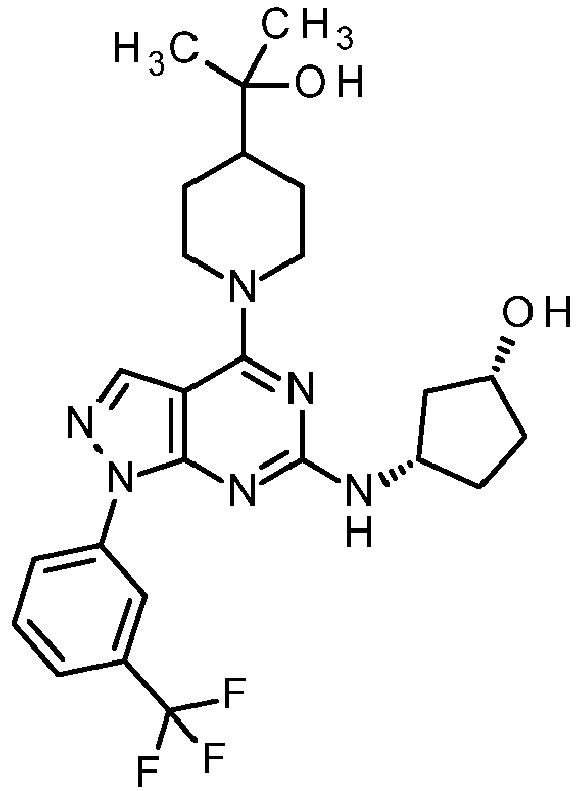
- DIPEA (0.19 ml) was added to 2-(1-{6-chloro-1-[3-(trifluoromethyl)phenyl]-1H-pyrazolo[3,4-d]pyrimidin-4-yl}piperidin-4-yl)propan-2-ol (80.0 mg, 0.18 mmol) and (1R,3S)-3-aminocyclopentanol hydrochloride (50.1 mg, 0.36 mmol) in NMP (2.0 ml) and the mixture was stirred at 130°C for 72 h. Standard workup and purification by HPLC (method HT_PREP _bas) afforded 66.0 mg of the title compound.
1H-NMR (400 MHz, DMSO-d6) δ [ppm]: 1.049 (16.00), 1.222 (0.50), 1.246 (0.55), 1.505 (0.49), 1.520 (0.64), 1.536 (0.43), 1.550 (0.46), 1.596 (0.45), 1.606 (0.42), 1.694 (0.43), 1.712 (0.74), 1.720 (0.70), 1.826 (0.74), 1.855 (0.67), 2.518 (1.23), 2.523 (0.78), 2.540 (0.55), 3.325 (0.99), 4.120 (0.56), 4.133 (0.57), 4.181 (5.13), 4.636 (1.99), 4.646 (1.93), 7.589 (0.77), 7.609 (0.99), 7.715 (0.49), 7.735 (0.81), 8.306 (4.36). -
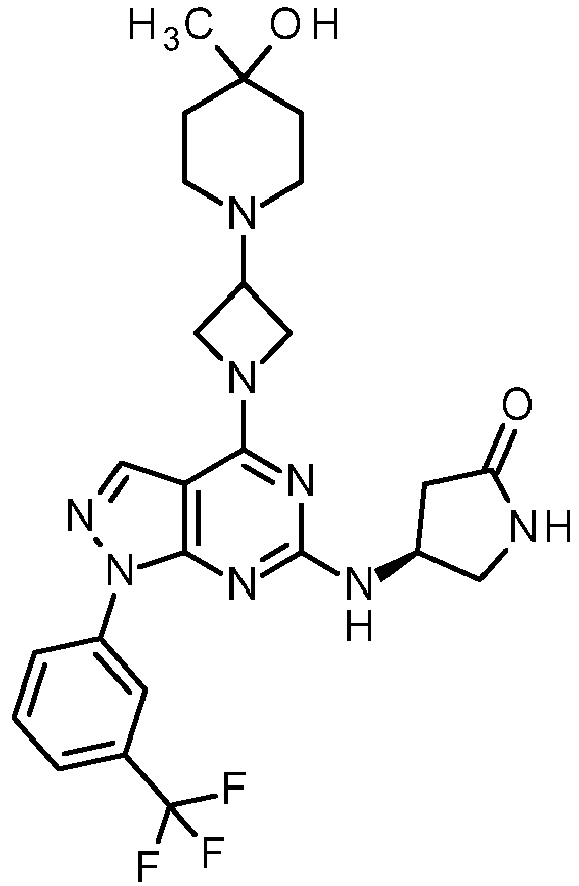
- DIPEA (0.18 ml) was added to 1-(1-{6-chloro-1-[3-(trifluoromethyl)phenyl]-1H-pyrazolo[3,4-d]pyrimidin-4-yl}azetidin-3-yl)-4-methylpiperidin-4-ol (80.0 mg, 0.17 mmol) and (4S)-4-aminopyrrolidin-2-one hydrochloride (46.8 mg, 0.34 mmol) in NMP (2.0 ml) and the mixture was stirred at 130°C for 72h. Standard workup and purification by HPLC afforded 37.6 mg of the title compound.
LC-MS (method HTpost_acid): Rt = 0.74 min; MS (ESIpos): m/z = 531 [M+H]+
1H-NMR (400 MHz, DMSO-d6) δ [ppm]: 1.112 (16.00), 1.446 (0.46), 1.469 (1.88), 1.493 (4.70), 1.526 (0.57), 2.279 (1.37), 2.296 (1.79), 2.318 (2.11), 2.323 (2.47), 2.327 (2.64), 2.331 (2.21), 2.429 (1.31), 2.518 (5.14), 2.523 (3.67), 2.551 (0.78), 2.660 (0.46), 2.665 (0.95), 2.669 (1.29), 2.673 (0.93), 2.678 (0.42), 3.217 (1.29), 3.599 (0.95), 3.619 (1.24), 3.641 (0.84), 3.932 (0.59), 4.186 (1.35), 4.428 (0.72), 4.522 (0.53), 4.540 (0.84), 4.554 (0.82), 7.510 (0.53), 7.603 (1.56), 7.626 (4.15), 7.728 (0.74), 7.748 (1.12), 7.768 (0.57), 8.098 (8.69), 8.172 (5.23), 8.500 (0.46), 8.841 (0.51). -

- DIPEA (0.23 ml) was added to (3R,4R)-1-{6-chloro-1-[3-(trifluoromethyl)phenyl]-1H-pyrazolo[3,4-d]pyrimidin-4-yl}pyrrolidine-3,4-diol (90.5 mg) und (3S)-1-methylpyrrolidin-3-amine dihydrochloride (76.8 mg, 0.44 mmol) in NMP (1.5 ml) and the mixture was stirred for 19 h at 130°C. The mixture was filtered and diluted with 750 µl DMSO. Purification by HPLC (method HT_PREP_bas) afforded 17.4 mg of the title compound.
LC-MS (method HTpost_bas): Rt = 1.10 min; MS (ESIpos): m/z = 464 [M+H]+
1H-NMR (400 MHz, DMSO-d6) δ [ppm]: 0.923 (1.22), 0.937 (10.03), 0.941 (3.58), 0.954 (10.03), 0.958 (1.87), 1.774 (0.52), 1.789 (0.55), 2.180 (0.49), 2.202 (0.51), 2.216 (0.42), 2.242 (16.00), 2.419 (1.16), 2.437 (1.20), 2.455 (0.74), 2.518 (4.05), 2.523 (2.73), 2.536 (0.90), 2.551 (0.69), 2.799 (1.04), 2.817 (1.25), 2.822 (1.14), 2.840 (0.95), 2.970 (0.48), 3.005 (0.68), 3.592 (1.21), 3.620 (1.42), 3.679 (1.34), 3.944 (0.69), 3.954 (0.88), 3.971 (0.72), 3.981 (0.69), 4.030 (1.17), 4.160 (1.14), 5.222 (0.87), 5.331 (0.94), 7.057 (0.65), 7.591 (0.95), 7.610 (1.24), 7.724 (0.51), 7.743 (0.77), 7.762 (0.43), 8.215 (7.02), 8.392 (0.42). -

- DIPEA (0.20 ml) was added to 1-{6-chloro-1-[3-(trifluoromethyl)phenyl]-1H-pyrazolo[3,4-d]pyrimidin-4-yl}azetidin-3-ol (70.0 mg, 0.19 mmol) and (4S)-4-aminopyrrolidin-2-one hydrochloride (51.7 mg, 0.38 mmol) in NMP (1.5 ml) and the mixture was stirred 19 h at 130°C. Water and ethyl acetate were added and the precipitated solid was washed with water and 2-methoxy-2-methylpropane and dried in vacuum affording 42.6 mg of the title compound.
1H-NMR (400 MHz, DMSO-d6) δ [ppm]: 1.153 (0.63), 1.171 (1.21), 1.189 (0.57), 1.986 (2.34), 2.277 (0.95), 2.292 (1.00), 2.318 (1.72), 2.322 (1.74), 2.326 (1.82), 2.331 (1.95), 2.518 (4.63), 2.522 (3.15), 2.530 (1.32), 2.551 (1.06), 2.664 (0.83), 2.668 (1.15), 2.673 (0.82), 3.205 (0.96), 3.599 (1.09), 3.620 (1.56), 3.642 (1.00), 3.907 (0.50), 4.016 (0.70), 4.034 (0.70), 4.118 (0.52), 4.377 (0.50), 4.500 (0.41), 4.516 (0.91), 4.535 (1.46), 4.550 (1.46), 4.566 (1.00), 4.583 (0.63), 4.660 (1.09), 4.670 (1.69), 4.681 (1.28), 4.686 (1.43), 4.697 (0.80), 5.890 (5.77), 5.906 (5.69), 7.534 (0.76), 7.603 (2.28), 7.627 (5.60), 7.731 (1.09), 7.750 (1.72), 7.769 (0.85), 8.102 (16.00), 8.498 (0.70), 8.845 (0.78). -

- DIPEA (0.22 ml) was added to 6-chloro-4-[4-(morpholin-4-yl)piperidin-1-yl]-1-[3-(trifluoromethyl)phenyl]-1H-pyrazolo[3,4-d]pyrimidine (100 mg, 0.21 mmol) and (3S)tetrahydrothiophen-3-amine 1,1-dioxide hydrochloride (73.5 mg, 0.43 mmol) in NMP (1.5 ml) and the mixture was stirred for 42 h at 130°C. Standard workup and purification by HPLC (method HT_PREP_bas) afforded 23.4 mg of the title compound.
LC-MS (method HTpost_bas): Rt = 1.20 min; MS (ESIpos): m/z = 566 [M+H]+
1H-NMR (400 MHz, DMSO-d6) δ [ppm]: 1.416 (1.73), 1.444 (1.83), 1.907 (2.74), 1.935 (2.40), 2.192 (0.58), 2.212 (1.43), 2.225 (0.88), 2.233 (1.61), 2.246 (1.95), 2.254 (0.85), 2.266 (1.95), 2.287 (0.85), 2.337 (0.64), 2.470 (8.21), 2.518 (8.27), 2.523 (6.17), 2.533 (2.31), 2.540 (15.03), 2.560 (0.91), 2.678 (0.61), 3.143 (2.74), 3.352 (1.31), 3.371 (1.52), 3.386 (1.70), 3.400 (1.28), 3.419 (0.70), 3.494 (2.37), 3.513 (2.62), 3.528 (2.37), 3.555 (7.97), 3.566 (10.49), 3.577 (7.67), 4.639 (2.01), 7.448 (1.06), 7.627 (2.49), 7.646 (3.44), 7.731 (2.16), 7.751 (3.44), 7.771 (1.61), 8.369 (16.00), 8.529 (0.76), 8.701 (0.52). -

- DIPEA (0,24 ml) was added to 6-chloro-4-[3-(morpholin-4-yl)azetidin-1-yl]-1-[3-(trifluoromethyl)phenyl]-1H-pyrazolo[3,4-d]pyrimidine (100 mg, 0.23 mmol) and (3S)tetra-hydrothiophen-3-amine 1,1-dioxide hydrochloride (78.2 mg, 0.46 mmol) in NMP (1.5 ml) and the mixture was stirred for 42 h at 130°C. Standard workup and purification by HPLC (method HT_PREP_acid) afforded 23.4 mg of the title compound.
LC-MS (method HTpost_acid): Rt = 0.94 min; MS (ESIpos): m/z = 538 [M+H]+
1H-NMR (400 MHz, DMSO-d6) δ [ppm]: 2.189 (0.50), 2.209 (1.30), 2.222 (0.78), 2.230 (1.43), 2.242 (1.72), 2.250 (0.76), 2.263 (1.76), 2.284 (0.78), 2.407 (5.80), 2.449 (0.80), 2.465 (1.24), 2.518 (4.56), 2.523 (3.13), 2.540 (1.56), 3.104 (1.32), 3.124 (1.91), 3.138 (1.91), 3.157 (1.89), 3.178 (0.87), 3.355 (2.15), 3.361 (1.72), 3.373 (3.24), 3.387 (2.76), 3.403 (1.50), 3.420 (0.72), 3.496 (1.09), 3.515 (1.22), 3.529 (1.09), 3.548 (1.02), 3.616 (5.73), 3.627 (8.57), 3.636 (5.67), 4.007 (0.70), 4.200 (0.85), 4.287 (0.98), 4.438 (0.91), 4.617 (0.91), 4.634 (1.56), 4.651 (1.50), 4.668 (0.80), 7.586 (0.54), 7.619 (2.34), 7.639 (2.97), 7.728 (1.78), 7.749 (2.86), 7.768 (1.33), 8.113 (16.00), 8.529 (0.67), 8.711 (0.56). -

- DIPEA (0.17 ml) was added to 6-chloro-4-{3-[(methanesulfonyl)methyl]azetidin-1-yl}-1-[3-(trifluoromethyl)phenyl]-1H-pyrazolo[3,4-d]pyrimidine (75.0 mg) and (4S)-4-aminopyrrolidin-2-one hydrochloride (45.0 mg) in NMP (1.5 ml) and the mixture was stirred at 130°C for 17 h. Standard workup and purification by HPLC (method HT_PREP_acid) afforded 49.9 mg of the title compound.
LC-MS (method HTpost_acid): Rt = 1.01 min; MS (ESIpos): m/z = 510 [M+H]+
1H-NMR (400 MHz, DMSO-d6) δ [ppm]: 2.274 (0.46), 2.289 (0.50), 2.317 (0.79), 2.322 (0.84), 2.326 (1.02), 2.331 (1.01), 2.518 (2.43), 2.522 (1.54), 2.536 (0.63), 2.539 (0.66), 2.556 (0.45), 2.668 (0.51), 3.016 (16.00), 3.208 (0.53), 3.365 (0.75), 3.384 (0.57), 3.602 (0.71), 3.625 (2.99), 3.643 (2.38), 4.053 (0.44), 4.255 (0.50), 4.323 (0.40), 4.540 (0.72), 4.555 (0.72), 4.624 (0.44), 7.545 (0.45), 7.606 (1.29), 7.627 (2.04), 7.636 (2.73), 7.731 (0.60), 7.751 (0.93), 7.771 (0.46), 8.075 (10.83), 8.500 (0.40), 8.843 (0.47). -

- DIPEA (0.17 ml) was added to 6-chloro-4-{3-[(methanesulfonyl)methyl]azetidin-1-yl}-1-[3-(trifluoromethyl)phenyl]-1H-pyrazolo[3,4-d]pyrimidine (75 mg) and (3S)-1-methylpyrrolidin-3-amine dihydrochloride (57 mg) in NMP (1.5 ml) and the mixture was stirred at 130°C for 17 h. Standard workup and purification by HPLC (method HT_PREP_bas) afforded 12 mg of the title compound.
LC-MS (method HTpost_bas): Rt = 1.23 min; MS (ESIneg): m/z = 508 [M-H]-
1H-NMR (400 MHz, DMSO-d6) δ [ppm]: 1.780 (0.40), 2.166 (0.44), 2.230 (16.00), 2.423 (0.92), 2.518 (4.67), 2.522 (3.05), 2.529 (1.21), 2.791 (0.55), 2.810 (0.77), 2.831 (0.48), 2.839 (0.44), 3.013 (11.95), 3.371 (0.60), 3.621 (1.76), 3.638 (1.57), 4.318 (0.68), 7.258 (0.47), 7.596 (0.98), 7.615 (1.28), 7.724 (0.53), 7.745 (0.81), 7.765 (0.40), 8.049 (7.99), 8.458 (0.40), 8.957 (0.61). -

- DIPEA (0.19 ml) was added to 6-chloro-4-[3-(morpholin-4-yl)azetidin-1-yl]-1-[3-(trifluoromethyl)phenyl]-1H-pyrazolo[3,4-d]pyrimidine (80.0 mg, 0.18 mmol) and rel-(3R,4R)-4-aminotetrahydrothiophene-3-ol 1,1-dioxide (55.1 mg) in NMP (1.5 ml) and the mixture was stirred at 130°C for 19.5 h. Standard workup and purification by HPLC (method HT_PREP _acid) afforded 29.6 mg of the title compound.
LC-MS (method a01): Rt = 0.93 min; MS (ESIpos): m/z = 554 [M+H]+
1H-NMR (400 MHz, DMSO-d6) δ [ppm]: 2.407 (7.12), 2.518 (5.25), 2.523 (3.66), 2.539 (6.03), 2.692 (0.48), 3.364 (3.22), 3.377 (3.17), 3.389 (2.08), 3.406 (1.09), 3.446 (2.30), 3.464 (2.42), 3.477 (1.72), 3.495 (1.52), 3.616 (7.02), 3.627 (10.55), 3.636 (6.97), 4.016 (0.90), 4.205 (1.04), 4.295 (1.26), 4.444 (1.21), 4.670 (2.30), 5.855 (2.37), 7.068 (0.77), 7.621 (2.40), 7.640 (3.24), 7.726 (2.47), 7.746 (3.99), 7.766 (1.84), 8.123 (16.00), 8.510 (0.73), 8.708 (0.99). -

- A solution of 1-{6-chloro-1-[3-(trifluoromethyl)phenyl]-1H-pyrazolo[3,4-d]pyrimidin-4-yl}-N,N,3-trimethylazetidin-3-amine (80.0 mg) and (4S)-4-aminopyrrolidin-2-one hydrochloride (53.2 mg) in NMP (1.5 ml) was treated with DIPEA (0.20 ml) and the mixture was stirred at 130°C for 16h. Standard workup and purification by HPLC (method HT_PREP_bas) afforded 55.7 mg of the title compound.
LC-MS (method HTpost_bas): Rt = 1.12 min; MS (ESIpos): m/z = 475 [M+H]+
1H-NMR (400 MHz, DMSO-d6) δ [ppm]: 1.294 (7.32), 2.146 (16.00), 2.322 (0.58), 2.327 (0.63), 2.332 (0.55), 2.336 (0.44), 2.518 (1.61), 2.523 (1.12), 2.669 (0.40), 3.620 (0.49), 7.604 (0.68), 7.628 (1.69), 7.750 (0.51), 8.098 (4.67). -

- A solution of 1-{6-chloro-1-[3-(trifluoromethyl)phenyl]-1H-pyrazolo[3,4-d]pyrimidin-4-yl}-N,N,3-trimethylazetidin-3-amine (80.0 mg) and tetrahydro-2H-thiopyran-4-amine 1,1-dioxide (58.1 mg) in NMP (1.5 ml) was treated with DIPEA (0.20 ml) and the mixture was stirred at 130°C for 16h. Standard workup and purification by HPLC (method HT_PREP_bas) afforded 67.2 mg of the title compound.
LC-MS (method HTpost_bas): Rt = 1.22 min; MS (ESIpos): m/z = 524 [M+H]+
1H-NMR (400 MHz, DMSO-d6) δ [ppm]: 1.295 (7.38), 2.075 (0.49), 2.096 (0.60), 2.115 (0.49), 2.148 (16.00), 2.165 (0.89), 2.223 (0.61), 2.518 (1.01), 2.523 (0.72), 2.539 (0.45), 3.195 (1.68), 7.614 (0.62), 7.633 (0.81), 7.768 (0.47), 8.091 (4.95). -

-

- DIPEA (0.19 ml) was added to 2-(1-{6-chloro-1-[3-(trifluoromethyl)phenyl]-1H-pyrazolo[3,4-d]pyrimidin-4-yl}piperidin-4-yl)propan-2-ol (80.5 mg, 0.18 mmol) and tert-butyl (2S,4S)-4-amino-2-methylpyrrolidine-1-carboxylate (55.0 mg) in NMP (1.5 ml) and the mixture was stirred for 67.5 h at rt, 23 h at 100°C and 23 h at 130°C. Standard workup and purification by HPLC (acetonitrile / water + 0.1% formic acid) afforded tert-butyl (2S,4S)-4-({4-[4-(2-hydroxypropan-2-yl)piperidin-1-yl]-1-[3-(trifluoromethyl)phenyl]-1H-pyrazolo[3,4-d]pyrimidin-6-yl}amino)-2-methylpyrrolidine-1-carboxylate (76 mg).
LC-MS (method a01): Rt = 1.61 min; MS (ESIpos): m/z = 604 [M+H]+ - tert-butyl (2S,4S)-4-({4-[4-(2-hydroxypropan-2-yl)piperidin-1-yl]-1-[3-(trifluoromethyl)phenyl]-1H-pyrazolo[3,4-d]pyrimidin-6-yl}amino)-2-methylpyrrolidine-1-carboxylate (76.0 mg, 0.13 mmol) in dichlormethane (2 ml) was treated with trifluoroacetic acid (29 µl) and the mixture was stirred at rt for 68 h and 4.5 h at 40°C. Water was added and the mixture was extracted three times with ethyl acetate. The organic layers were concentrated and the residue was purified by HPLC (method HT_PREP_bas) to afford 29.1 mg 2-[1-(6-{[(3S,5S)-5-methylpyrrolidin-3-yl]amino}-1-[3-(trifluoromethyl)phenyl]-1H-pyrazolo[3,4-d]pyrimidin-4-yl)piperidin-4-yl]propan-2-ol.
LC-MS (method HTpost_bas): Rt = 1.36 min; MS (ESIpos): m/z = 504 [M+H]+
1H-NMR (400 MHz, DMSO-d6) δ [ppm]: 1.051 (16.00), 1.071 (4.61), 1.180 (0.43), 1.196 (0.51), 1.223 (0.52), 1.248 (0.51), 1.551 (0.59), 1.828 (0.72), 1.858 (0.92), 2.327 (0.49), 2.518 (1.97), 2.523 (1.31), 2.665 (0.47), 2.669 (0.63), 2.674 (0.51), 3.193 (0.47), 3.212 (0.47), 3.234 (0.76), 3.251 (0.82), 3.262 (0.79), 3.279 (0.82), 4.183 (1.55), 7.598 (0.61), 7.617 (0.83), 7.738 (0.62), 8.313 (3.24), 8.510 (0.43). -

- DIPEA (0.22 ml) was added to 1-{6-chloro-1-[3-(trifluoromethyl)phenyl]-1H-pyrazolo[3,4-d]pyrimidin-4-yl}-3-methylazetidin-3-ol (80.0 mg, 0.21 mmol) and (3R)-1-(methylsulfonyl)-pyrrolidin-3-amine hydrochloride (83.7 mg, 0.42 mmol) in NMP (1.5 ml) and the mixture was stirred 6 h at 130°C, 66 h at rt and 20.5 h at 130°C. Standard workup and purification by HPLC (method HT_PREP_acid) afforded 75.6 mg of the title compound.
LC-MS (method HTpost_acid): Rt = 1.11 min; MS (ESIpos): m/z = 512 [M+H]+
1H-NMR (400 MHz, DMSO-d6) δ [ppm]: 1.479 (9.28), 2.003 (0.55), 2.019 (0.63), 2.035 (0.49), 2.074 (1.38), 2.197 (0.48), 2.214 (0.59), 2.229 (0.52), 2.518 (1.81), 2.522 (1.20), 2.888 (16.00), 2.935 (0.46), 3.274 (1.04), 3.289 (1.35), 3.294 (1.60), 3.298 (1.75), 3.308 (2.07), 3.314 (2.86), 3.319 (3.62), 3.334 (12.54), 3.428 (0.72), 3.446 (1.16), 3.452 (0.69), 3.464 (0.73), 3.470 (0.89), 3.488 (0.47), 3.550 (0.60), 3.566 (0.72), 3.575 (0.64), 3.592 (0.54), 4.030 (0.68), 4.230 (0.48), 4.307 (0.47), 4.400 (0.51), 4.414 (0.90), 4.428 (0.89), 4.443 (0.48), 5.846 (0.76), 7.610 (1.07), 7.629 (1.41), 7.726 (0.81), 7.747 (1.34), 7.766 (0.65), 8.103 (9.56), 8.160 (1.13). -

- DIPEA (0.22 ml) was added to 1-{6-chloro-1-[3-(trifluoromethyl)phenyl]-1H-pyrazolo[3,4-d]pyrimidin-4-yl}-3-methylazetidin-3-ol (80.0 mg, 0.21 mmol) and (3S)-1-(methylsulfonyl)-pyrrolidin-3-amine hydrochloride (83.7 mg, 0.42 mmol) in NMP (1.5 ml) and the mixture was stirred 6 h at 130°C, 66 h at rt and 20.5 h at 130°C. Standard workup and purification by HPLC (method HT_PREP_acid) afforded 78.0 mg of the title compound.
LC-MS (method HTpost_acid): Rt = 1.10 min; MS (ESIpos): m/z = 512 [M+H]+
1H-NMR (400 MHz, DMSO-d6) δ [ppm]: 1.479 (9.53), 2.004 (0.58), 2.019 (0.67), 2.036 (0.52), 2.074 (0.99), 2.197 (0.50), 2.214 (0.62), 2.230 (0.55), 2.246 (0.41), 2.518 (1.72), 2.522 (1.13), 2.539 (0.66), 2.889 (16.00), 2.936 (0.74), 3.274 (0.99), 3.290 (1.25), 3.294 (1.48), 3.299 (1.58), 3.309 (1.67), 3.314 (2.16), 3.319 (2.42), 3.333 (3.45), 3.378 (0.42), 3.428 (0.69), 3.447 (1.16), 3.453 (0.69), 3.464 (0.74), 3.471 (0.91), 3.488 (0.47), 3.551 (0.62), 3.566 (0.75), 3.576 (0.67), 3.592 (0.56), 4.032 (0.73), 4.230 (0.51), 4.307 (0.49), 4.400 (0.53), 4.414 (0.94), 4.428 (0.93), 4.443 (0.51), 5.758 (0.80), 5.845 (0.49), 7.608 (1.10), 7.628 (1.47), 7.725 (0.84), 7.746 (1.40), 7.766 (0.69), 8.102 (8.45), 8.146 (2.11). -

- DIPEA (0.21 ml) was added to 1-{6-chloro-1-[3-(trifluoromethyl)phenyl]-1H-pyrazolo[3,4-d]pyrimidin-4-yl}-N,N-dimethylazetidin-3-amine (80.0 mg, 0.20 mol) and tetrahydro-2H-thiopyran-4-amine 1,1-dioxide hydrochloride (74.9 mg, 0.40 mmol) in NMP (1.5 ml) and the mixture was stirred for 17 h at 130°C. Standard workup and purification by HPLC (method HT_PREP_bas) afforded 19.1 mg of the title compound.
LC-MS (method HTpost_bas): Rt = 1.17 min; MS (ESIpos): m/z = 510 [M+H]+
1H-NMR (400 MHz, DMSO-d6) δ [ppm]: 2.075 (0.48), 2.095 (0.61), 2.112 (0.48), 2.160 (16.00), 2.178 (0.88), 2.221 (0.64), 2.518 (2.48), 2.523 (1.70), 3.193 (1.67), 3.281 (0.41), 3.287 (0.44), 3.299 (0.75), 3.316 (0.63), 4.201 (0.41), 7.615 (0.63), 7.635 (0.81), 7.769 (0.47), 8.102 (4.73). -

- DIPEA (0.11 ml) was added to 6-chloro-4-[3-(morpholin-4-yl)azetidin-1-yl]-1-[3-(trifluoromethyl)phenyl]-1H-pyrazolo[3,4-d]pyrimidine (45.0 mg, 0.10 mmol, 1.0 eq.) and 3-methyltetrahydrothiophen-3-amine 1,1-dioxide hydrochloride (38.1 mg) in NMP (1.5 ml) and the mixture was stirred at 130°C for 26 h and at rt for 66 h. Then the mixture was heated for 1 h at 160°C in a microwave reactor. Potassium carbon ate (3 eq.) was added and the mixture was stirred for 50 h at 130°C. Standard workup and purification by HPLC (method HT_PREP _bas) afforded 2.5 mg of the title compound.
LC-MS (method b02): Rt = 1.23 min; MS (ESIpos): m/z = 552 [M+H]+
1H-NMR (400 MHz, CHLOROFORM-d) δ [ppm]: 1.572 (4.84), 1.774 (16.00), 2.159 (0.46), 2.224 (0.61), 2.244 (0.89), 2.258 (0.75), 2.266 (0.74), 2.281 (0.97), 2.300 (0.72), 2.491 (4.36), 2.998 (0.61), 3.012 (0.74), 3.031 (0.58), 3.038 (0.55), 3.046 (0.45), 3.145 (2.72), 3.180 (2.87), 3.201 (0.66), 3.214 (0.68), 3.219 (0.75), 3.233 (1.35), 3.247 (0.94), 3.252 (0.95), 3.266 (0.72), 3.399 (0.71), 3.410 (0.46), 3.422 (1.80), 3.440 (2.10), 3.453 (1.69), 3.474 (0.57), 3.773 (4.35), 3.784 (6.56), 3.795 (4.47), 4.137 (1.38), 4.171 (1.34), 4.285 (0.83), 4.451 (0.46), 5.161 (3.38), 7.006 (0.86), 7.516 (1.50), 7.528 (1.38), 7.535 (2.23), 7.605 (1.50), 7.625 (2.38), 7.645 (1.06), 7.813 (13.16), 8.357 (1.40), 8.377 (1.32), 8.605 (2.00). -
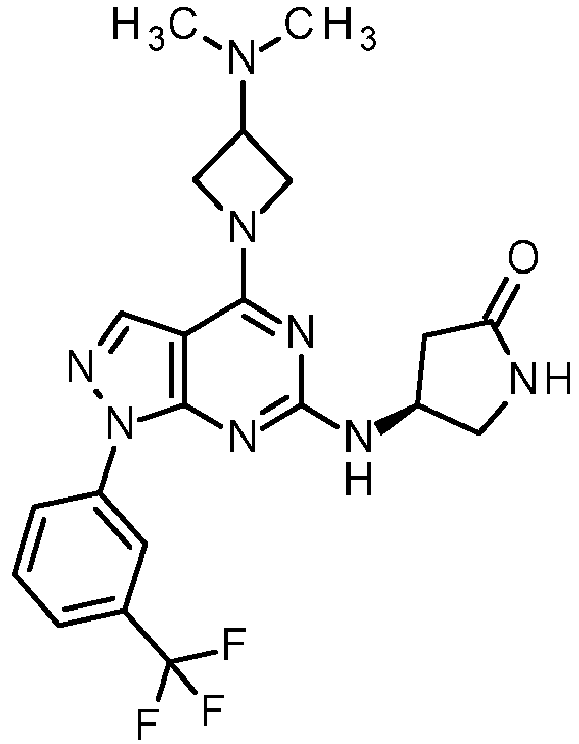
- DIPEA (0.21 ml) was added to 1-{6-chloro-1-[3-(trifluoromethyl)phenyl]-1H-pyrazolo[3,4-d]-pyrimidin-4-yl}-N,N-dimethylazetidin-3-amine (80.0 mg, 0.20 mmol) and (4S)-4-aminopyrrolidin-2-one hydrochloride (55.1 mg, 0.40 mmol) in NMP (1.5 ml) and the mixture was stirred for 17 h at 130°C. Standard workup and purification by HPLC (method HT_PREP _bas) afforded 40.1 mg of the title compound.
LC-MS (method HTpost_bas): Rt = 1.06 min; MS (ESIpos): m/z = 461 [M+H]+
1H-NMR (400 MHz, DMSO-d6) δ [ppm]: 2.157 (16.00), 2.322 (0.79), 2.326 (0.85), 2.331 (0.71), 2.518 (2.30), 2.522 (1.59), 2.530 (0.45), 2.664 (0.44), 2.668 (0.60), 2.673 (0.42), 3.283 (0.42), 3.296 (0.72), 3.314 (0.58), 3.619 (0.53), 7.605 (0.71), 7.628 (1.72), 7.750 (0.51), 8.108 (4.24). -

-

- A solution of tert-butyl [2-(1-{6-chloro-1-[3-(trifluoromethyl)phenyl]-1H-pyrazolo[3,4-d]pyrimidin-4-yl}azetidin-3-yl)propan-2-yl]carbamate (200 mg, 0.39 mmol) and tetrahydro-2H-thiopyran-4-amine 1,1-dioxide (117 mg, 0.78 mmol) in NMP (4.3 ml) was stirred at 130°C for 40 h. Standard workup afforded tert-butyl [2-(1-{6-[(1,1-dioxidotetrahydro-2H-thiopyran-4-yl)amino]-1-[3-(trifluoromethyl)phenyl]-1H-pyrazolo[3,4-d]pyrimidin-4-yl}azetidin-3-yl)propan-2-yl]carbamate as a crude product which was used in the next step without further purification.
- A solution of tert-butyl [2-(1-{6-[(1,1-dioxidotetrahydro-2H-thiopyran-4-yl)amino]-1-[3-(trifluoromethyl)phenyl]-1H-pyrazolo[3,4-d]pyrimidin-4-yl}azetidin-3-yl)propan-2-yl]carbamate (245 mg, 393 µmol) in dichlormethane (3.7 ml) was treated with trifluoroacetic acid (1.9 ml) and the mixture was stirred at rt for 16 h. The mixture was concentrated and the residue was purified by HPLC (method HT_PREP_bas) to afford 76 mg 4-[3-(2-aminopropan-2-yl)azetidin-1-yl]-N-(1,1-dioxidotetrahydro-2H-thiopyran-4-yl)-1-[3-(trifluoromethyl)phenyl]-1H-pyrazolo[3,4-d]pyrimidin-6-amine
LC-MS (method HTpost_bas): Rt = 1.15 min; MS (ESIpos): m/z = 524 [M+H]+
1H-NMR (400 MHz, DMSO-d6) δ [ppm]: 1.007 (16.00), 1.552 (1.38), 2.076 (1.42), 2.096 (1.66), 2.114 (1.35), 2.221 (1.83), 2.518 (4.74), 2.522 (3.01), 2.539 (0.46), 2.736 (0.98), 2.753 (1.46), 2.772 (1.03), 3.193 (5.17), 3.378 (0.41), 4.029 (1.90), 4.287 (2.07), 7.292 (0.59), 7.609 (1.83), 7.629 (2.36), 7.745 (0.89), 7.766 (1.40), 7.785 (0.74), 8.071 (12.75), 8.529 (0.55), 8.576 (0.76), 8.751 (0.59). -

- A solution of 4,6-dichloro-1-[3-(trifluoromethyl)phenyl]-1H-pyrazolo[3,4-d]pyrimidine (120 mg, 0.36 mmol) and 2-(piperidin-4-yl)propan-2-amine dihydrochloride (85.3 mg, 0.40 mmol) in NMP (2.0 ml) was treated with DIPEA (0.38 ml) and the mixture was stirred at RT for 16h. tetrahydro-2H-thiopyran-4-amine 1,1-dioxide (108 mg, 721 µmol) was added, the mixture was stirred at 130°C for 16h. Water was added to the reaction mixture and the mixture was extracted with ethyl acetate three times, the organic layers were filtered using a water-repellent filter and concentrated. Purification by HPLC (method HT_PREP_bas) afforded 56.0 mg of the title compound.
LC-MS (method HTpost_bas): Rt = 1.25 min; MS (ESIpos): m/z = 552 [M+H]+
1H-NMR (400 MHz, DMSO-d6) δ [ppm]: 0.972 (16.00), 1.224 (0.67), 1.247 (0.72), 1.255 (0.68), 1.414 (0.62), 1.444 (0.63), 1.841 (0.88), 1.871 (0.80), 2.075 (0.56), 2.097 (0.67), 2.226 (0.65), 2.518 (2.17), 2.523 (1.39), 2.539 (0.59), 2.673 (0.43), 3.007 (0.41), 3.199 (1.37), 7.618 (0.74), 7.637 (0.93), 7.766 (0.49), 8.333 (4.47). -
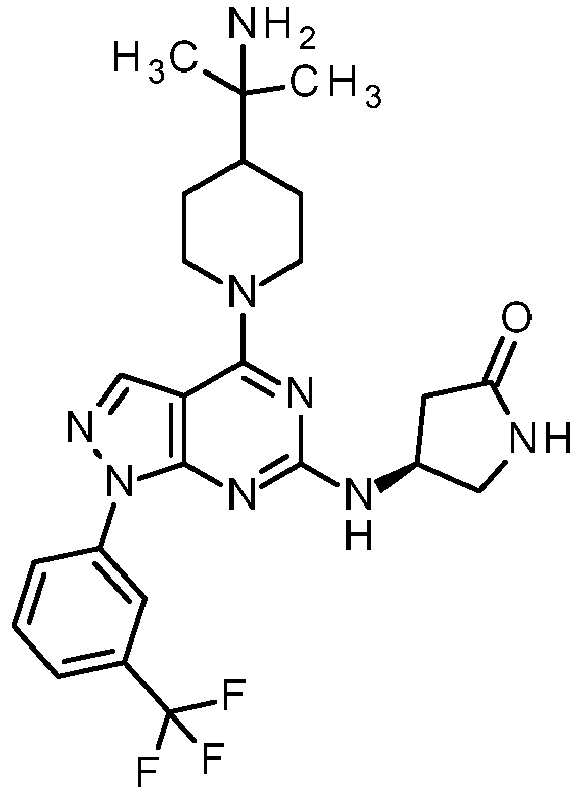
- Reaction of 4,6-dichloro-1-[3-(trifluoromethyl)phenyl]-1H-pyrazolo[3,4-d]pyrimidine (120 mg, 360 nmol), 2-(piperidin-4-yl)propan-2-amine dihydrochloride (85.3 mg, 0.40 mmol), (4S)-4-aminopyrrolidin-2-one hydrochloride (98.4 mg, 0.72 mmol) and DIPEA (0.38 ml) in NMP (2.0 ml) using conditions similar to the preparation of the example before afforded 70.0 mg of the title compound.
LC-MS (method HTpost_bas): Rt = 1.15 min; MS (ESIpos): m/z = 503 [M+H]+
1H-NMR (400 MHz, DMSO-d6) δ [ppm]: 0.968 (16.00), 1.224 (0.61), 1.247 (0.65), 1.417 (0.63), 1.447 (0.62), 1.838 (0.84), 1.869 (0.78), 2.269 (0.67), 2.284 (0.69), 2.311 (0.94), 2.326 (1.47), 2.518 (2.93), 2.522 (1.99), 2.539 (1.12), 2.664 (0.43), 2.669 (0.58), 2.673 (0.42), 3.223 (0.42), 3.596 (0.44), 3.615 (0.62), 7.371 (0.41), 7.610 (0.85), 7.636 (1.58), 7.729 (0.41), 7.749 (0.64), 8.342 (4.44). -

-

- DIPEA (0.19 ml) was added to tert-butyl [1-(1-{6-chloro-1-[3-(trifluoromethyl)phenyl]-1H-pyrazolo[3,4-d]pyrimidin-4-yl}piperidin-4-yl)cyclopropyl]carbamate (100 mg, 0.19 mmol) and (4S)-4-aminopyrrolidin-2-one hydrochloride (38.2 mg, 0.28 mmol) in NMP (1.5 ml) and the mixture was stirred for 18 h at 130°C. Standard workup and purification by HPLC (acetonitrile / water + 0.1% formic acid) afforded 70.0 mg tert-butyl {1-[1-(6-{[(3S)-5-oxopyrrolidin-3-yl]amino}-1-[3-(trifluoromethyl)phenyl]-1H-pyrazolo[3,4-d]pyrimidin-4-yl)piperidin-4-yl]cyclopropyl}carbamate.
LC-MS (method a01): Rt = 1.36 min; MS (ESIpos): m/z = 601 [M+H]+ - TFA (500 µl, 6.5 mmol) was added to tert-butyl {1-[1-(6-{[(3S)-5-oxopyrrolidin-3-yl]amino}-1-[3-(trifluoromethyl)phenyl]-1H-pyrazolo[3,4-d]pyrimidin-4-yl)piperidin-4-yl]cyclopropyl}carbamate (70.0 mg) in DCM and the mixture was stirred at rt for 17 h and concentrated. Purification by HPLC (method HT_PREP_bas) afforded 43.7 mg (4S)-4-({4-[4-(1-aminocyclopropyl)piperidin-1-yl]-1-[3-(trifluoromethyl)phenyl]-1H-pyrazolo[3,4-d]pyrimidin-6-yl}amino)pyrrolidin-2-one.
LC-MS (method HTpost_bas): Rt = 1.14 min; MS (ESIpos): m/z = 501 [M+H]+
1H-NMR (400 MHz, DMSO-d6) δ [ppm]: 0.322 (3.94), 0.339 (13.68), 0.381 (14.28), 0.398 (3.66), 1.069 (2.42), 1.483 (4.01), 1.508 (4.24), 1.539 (2.29), 1.609 (6.60), 1.672 (5.73), 1.701 (4.26), 2.273 (3.64), 2.288 (3.89), 2.314 (5.48), 2.330 (6.58), 2.564 (4.21), 2.670 (1.60), 2.999 (2.32), 3.230 (3.19), 3.598 (2.57), 3.618 (3.56), 3.641 (2.39), 4.547 (2.27), 4.755 (1.69), 7.383 (2.24), 7.611 (4.76), 7.640 (8.47), 7.730 (2.42), 7.751 (3.59), 8.350 (16.00), 8.500 (1.42), 8.855 (1.32). -

-

- A mixture of methyl (1-{6-chloro-1-[3-(trifluoromethyl)phenyl]-1H-pyrazolo[3,4-d]pyrimidin-4-yl}azetidin-3-yl)acetate (429 mg, 1.01 mmol) and (4S)-4-aminopyrrolidin-2-one hydrochloride (275 mg, 2.02 mmol, CAS 672883-63-5) in NMP (3.0 ml) was treated with DIPEA (1.1 ml) and the mixture was stirred at 130°C for 17 h. Water was added and the mixture was extracted with ethyl acetate three times. The combined organic layers were washed with brine and filtered through a water-repellent filter and evaporated. The residue was treated with DMSO and water, the resulting solid was filtered, washed with water and 2-methoxy-2-methylpropane and dried in vacuum affording 341 mg methyl [1-(6-{[(3S)-5-oxopyrrolidin-3-yl]amino}-1-[3-(trifluoromethyl)phenyl]-1H-pyrazolo[3,4-d]pyrimidin-4-yl)azetidin-3-yl]acetate.
LC-MS (method a01): Rt = 1.12 min; MS (ESIpos): m/z = 490 [M+H]+ - A solution of methyl [1-(6-{[(3S)-5-oxopyrrolidin-3-yl]amino}-1-[3-(trifluoromethyl)phenyl]-1H-pyrazolo[3,4-d]pyrimidin-4-yl)azetidin-3-yl]acetate (130 mg, 0.24 mmol) in 2-methyltetrahydrofuran (3.0 ml) was cooled with an ice bath. Then methylmagnesium bromide solution (3.4M in 2-methyltetrahydrofuran, 700 µl, 2.4 mmol) was added dropwise. The mixture was stirred for 30 min with cooling by the ice bath and then at rt for 19 h. Sat. aq. ammonium chloride solution was added, the mixture was extracted with ethyl acetate three times and the combined organic layers were concentrated. Purification by HPLC afforded 30.4 mg (4S)-4-({4-[3-(2-hydroxy-2-methylpropyl)azetidin-1-yl]-1-[3-(trifluoromethyl)phenyl]-1H-pyrazolo[3,4-d]pyrimidin-6-yl}amino)pyrrolidin-2-one.
LC-MS (method HTpost_acid): Rt = 1.03 min; MS (ESIpos): m/z = 490 [M+H]+
1H-NMR (400 MHz, DMSO-d6) δ [ppm]: 1.102 (16.00), 1.762 (2.01), 1.779 (2.05), 2.116 (0.79), 2.318 (0.67), 2.322 (0.88), 2.327 (1.16), 2.331 (1.00), 2.522 (2.58), 2.548 (0.46), 2.664 (0.54), 2.669 (0.74), 2.673 (0.55), 3.045 (0.51), 3.063 (0.41), 3.202 (0.42), 3.596 (0.43), 3.615 (0.64), 4.259 (4.07), 4.535 (0.84), 4.549 (0.85), 7.601 (0.92), 7.623 (2.48), 7.726 (0.46), 7.747 (0.73), 8.050 (5.39). -
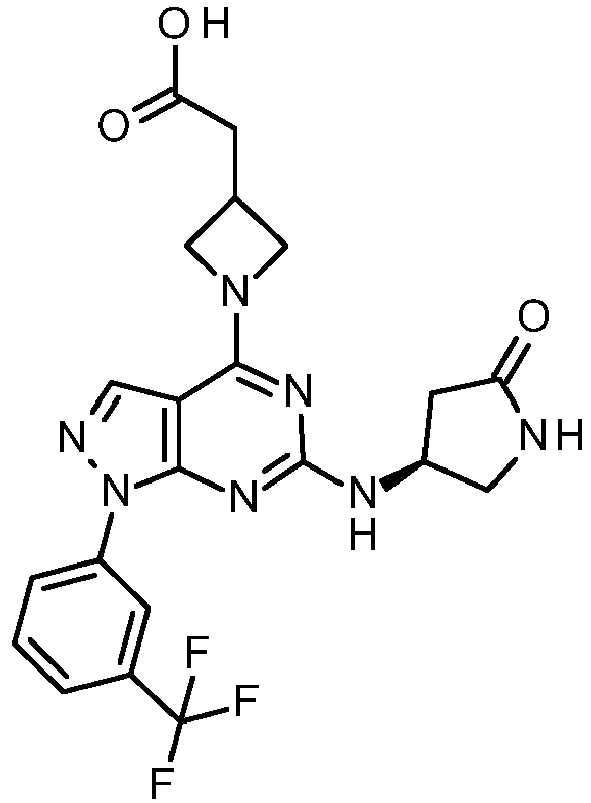
- Aq. sodium hydroxide solution (1.4 ml, 2.0 M) was added to methyl [1-(6-{[(3S)-5-oxopyrrolidin-3-yl]amino}-1-[3-(trifluoromethyl)phenyl]-1H-pyrazolo[3,4-d]pyrimidin-4-yl)azetidin-3-yl]acetate (210 mg) in 2-methyltetrahydrofuran (2.0 ml) and the mixture was stirred 2.5 h at rt. The mixture was acidified by aqueous citric acid solution to pH 4 and the resulting solid was filtered, washed with water and three times with 2-methoxy-2-methylpropane and dried affording 179 mg of the title compound (crude product). 40 mg of the resulting batch was purified by HPLC (method HT_PREP_acid) affording 27 mg of the title compound.
LC-MS (method a01): Rt = 0.97 min; MS (ESIpos): m/z = 476 [M+H]+
1H-NMR (400 MHz, DMSO-d6) δ [ppm]: 2.275 (0.79), 2.291 (0.84), 2.318 (1.44), 2.322 (1.47), 2.326 (1.71), 2.331 (1.82), 2.518 (4.52), 2.522 (3.10), 2.539 (10.69), 2.549 (0.89), 2.664 (0.85), 2.669 (1.15), 2.673 (0.99), 2.691 (4.74), 2.711 (5.09), 3.062 (0.55), 3.077 (0.99), 3.097 (1.32), 3.116 (1.04), 3.131 (0.69), 3.210 (1.44), 3.597 (1.14), 3.616 (1.56), 3.639 (1.00), 3.849 (0.77), 4.090 (0.84), 4.259 (0.70), 4.519 (1.31), 4.535 (1.99), 4.551 (1.76), 7.488 (0.69), 7.599 (2.04), 7.626 (4.20), 7.726 (0.97), 7.745 (1.54), 7.764 (0.79), 8.063 (16.00), 8.500 (0.62), 8.844 (0.69). -

- DIPEA (0.11 ml) was added to [1-(6-{[(3S)-5-oxopyrrolidin-3-yl]amino}-1-[3-(trifluoromethyl)phenyl]-1H-pyrazolo[3,4-d]pyrimidin-4-yl)azetidin-3-yl]acetic acid (70.0 mg, crude product), morpholine (17 µl, 0.19 mmol) and HATU (CAS 148893-10-1, 73.9 mg, 0.19 mmol) in NMP (1.0 ml) and the mixture was stirred 19 h at rt. The reaction mixture was filtered and the filtrate was diluted with DMSO and purified by HPLC (method HT_PREP _bas) affording 42 mg of the title compound
LC-MS (method HTpost_bas): Rt = 1.03 min; MS (ESIpos): m/z = 545 [M+H]+
1H-NMR (400 MHz, DMSO-d6) δ [ppm]: 0.936 (2.64), 0.953 (2.52), 2.276 (0.88), 2.292 (0.97), 2.318 (1.78), 2.322 (2.01), 2.327 (2.24), 2.331 (2.29), 2.518 (8.09), 2.522 (5.27), 2.539 (2.06), 2.548 (1.09), 2.664 (1.11), 2.669 (1.48), 2.673 (1.13), 2.692 (0.60), 2.814 (3.65), 2.834 (4.00), 3.089 (0.97), 3.106 (1.25), 3.124 (0.97), 3.202 (1.09), 3.428 (5.43), 3.438 (9.41), 3.450 (8.00), 3.533 (3.93), 3.545 (4.76), 3.557 (3.40), 3.566 (4.32), 3.578 (4.79), 3.589 (3.21), 3.617 (1.64), 3.638 (0.97), 3.821 (0.99), 4.039 (1.09), 4.268 (0.95), 4.534 (2.29), 4.550 (2.47), 4.567 (1.43), 7.483 (0.79), 7.600 (2.29), 7.627 (4.88), 7.726 (1.09), 7.746 (1.66), 7.764 (0.83), 8.062 (16.00), 8.493 (0.69), 8.847 (0.76). -

- DIPEA (0.11 ml) was added to [1-(6-{[(3S)-5-oxopyrrolidin-3-yl]amino}-1-[3-(trifluoromethyl)-phenyl]-1H-pyrazolo[3,4-d]pyrimidin-4-yl)azetidin-3-yl]acetic acid (70.0 mg, batch contained impurities), 6-oxa-3-azabicyclo[3.1.1]heptane 4-methylbenzenesulfonate (52.7 mg, 0.19 mmol)] and HATU (CAS 148893-10-1 , 73.9 mg, 0.19 mmol) in NMP (1.0 ml) and the mixture was stirred at rt for 16 h. The mixture was filtered and DMSO (1 ml) was added. Purification by HPLC (method HT_PREP_bas) afforded 46 mg of the title compound.
LC-MS (method HTpost_bas): Rt = 1.00 min; MS (ESIpos): m/z = 557 [M+H]+
1H-NMR (400 MHz, DMSO-d6) δ [ppm]: 0.936 (1.54), 0.953 (1.50), 1.746 (3.79), 1.768 (3.82), 2.279 (0.99), 2.294 (1.02), 2.322 (2.87), 2.326 (2.90), 2.332 (2.46), 2.336 (2.12), 2.518 (8.60), 2.523 (5.66), 2.539 (2.80), 2.551 (0.99), 2.660 (0.68), 2.664 (1.50), 2.669 (2.12), 2.673 (1.54), 2.678 (0.68), 2.692 (0.61), 2.831 (1.23), 2.848 (1.19), 2.886 (1.23), 3.038 (0.89), 3.055 (2.08), 3.076 (2.05), 3.093 (0.92), 3.142 (1.09), 3.162 (1.54), 3.181 (1.60), 3.197 (1.54), 3.405 (2.15), 3.438 (3.00), 3.608 (4.54), 3.641 (4.09), 3.694 (1.98), 3.734 (2.18), 3.764 (0.96), 3.859 (1.13), 4.085 (1.19), 4.297 (1.06), 4.521 (1.06), 4.539 (1.94), 4.554 (2.39), 4.573 (2.35), 4.589 (6.41), 4.605 (5.77), 7.494 (0.78), 7.601 (2.56), 7.628 (5.70), 7.728 (1.19), 7.747 (1.88), 7.767 (0.92), 8.073 (16.00), 8.501 (0.75), 8.851 (0.82). -

- A solution of 6-chloro-4-[3-(1,1-dioxidothiomorpholin-4-yl)azetidin-1-yl]-1-[3-(trifluoromethyl)-phenyl]-1H-pyrazolo[3,4-d]pyrimidine (70.0 mg, 0.14 mmol) and cyclopropanamine (50 µl, 720 µmol) in NMP (1.6 ml) was treated with DIPEA (0.10 ml) and the mixture was stirred in a microwave at 130°C for 5 h. Standard workup and purification by HPLC (method HT_PREP _bas) afforded 50.0 mg of the title compound.
LC-MS (method HTpost_bas): Rt = 1.26 min; MS (ESIpos): m/z = 508 [M+H]+
1H-NMR (400 MHz, DMSO-d6) δ [ppm]: 0.495 (1.39), 0.507 (4.59), 0.516 (5.23), 0.522 (5.40), 0.532 (1.81), 0.681 (3.69), 0.694 (3.84), 0.972 (0.42), 2.331 (1.05), 2.518 (7.57), 2.522 (4.67), 2.539 (2.86), 2.673 (1.22), 2.722 (1.15), 2.881 (6.89), 3.166 (7.67), 3.621 (0.44), 3.639 (1.27), 3.651 (2.00), 3.664 (1.34), 3.681 (0.56), 3.962 (0.76), 4.256 (1.10), 4.453 (0.85), 7.391 (0.98), 7.589 (2.61), 7.608 (3.42), 7.717 (2.08), 7.737 (3.47), 7.757 (1.69), 8.077 (16.00), 8.536 (1.47), 8.554 (1.42), 9.133 (0.51). -

- DIPEA (0.21 ml) was added to 1-{6-chloro-1-[3-(trifluoromethyl)phenyl]-1H-pyrazolo[3,4-d]-pyrimidin-4-yl}-N,N-dimethylazetidin-3-amine (80.0 mg, 0.20 mmol) and 3,3-difluorocyclo-butanamine hydrochloride (57.9 mg, 0.40 mmol) in NMP (1.5 ml) and the mixture was stirred at 130°C for 24 h. DMSO was added and the mixture was purified by HPLC (acetonitrile/ water + ammonia) affording 21.7 mg of the title compound.
1H-NMR (400 MHz, DMSO-d6) δ [ppm]: 2.159 (16.00), 2.327 (0.44), 2.523 (1.49), 2.540 (0.86), 2.646 (0.42), 2.665 (0.81), 2.669 (0.84), 2.673 (0.74), 2.691 (0.53), 2.709 (0.42), 2.938 (0.59), 2.958 (0.60), 2.972 (0.56), 3.285 (0.47), 3.297 (0.77), 3.315 (0.74), 4.193 (0.76), 5.759 (1.31), 7.609 (0.84), 7.629 (1.09), 7.732 (0.65), 7.752 (0.92), 7.773 (0.44), 8.114 (3.95). -
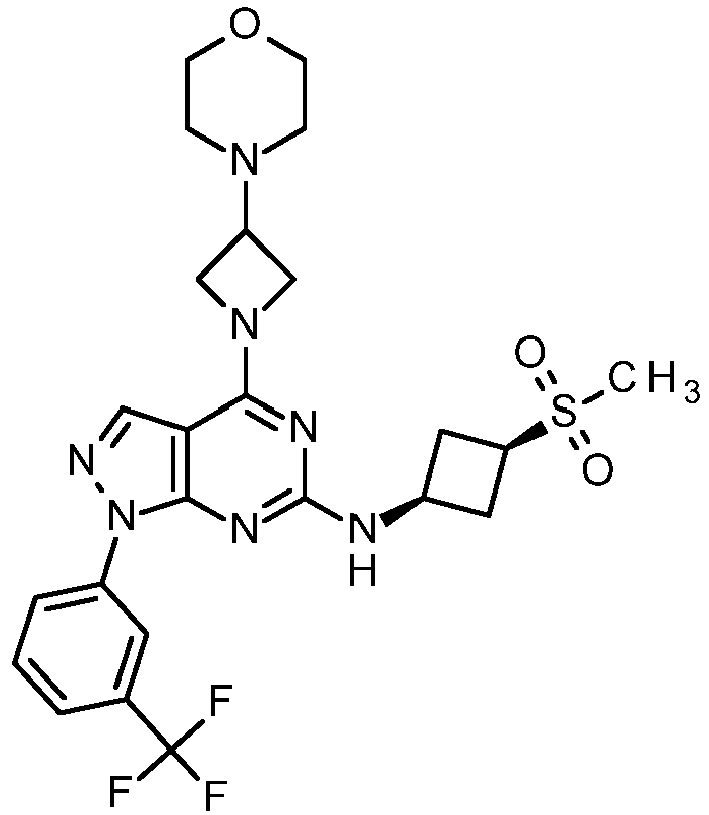
- DIPEA (0.19 ml) was added to 6-chloro-4-[3-(morpholin-4-yl)azetidin-1-yl]-1-[3-(trifluoromethyl)phenyl]-1H-pyrazolo[3,4-d]pyrimidine (80.0 mg, 0.18 mmol) and cis-3-(methylsulfonyl)cyclobutanamine hydrochloride (67.7 mg, 365 µmol, CAS 1408074-56-5) in NMP (1.5 ml) and the mixture was stirred for 19.5 h at 130°C. Standard workup and purification by HPLC (method HT_PREP_acid) afforded 27.9 mg of the title compound.
LC-MS (method a01): Rt = 0.99 min; MS (ESIpos): m/z = 552 [M+H]+
1H-NMR (400 MHz, DMSO-d6) δ [ppm]: 2.292 (0.49), 2.315 (1.19), 2.322 (1.39), 2.327 (1.02), 2.332 (0.83), 2.338 (1.16), 2.345 (1.36), 2.368 (0.83), 2.404 (2.30), 2.518 (2.11), 2.523 (1.50), 2.540 (2.21), 2.610 (0.73), 2.665 (0.54), 2.669 (0.67), 2.673 (0.48), 2.889 (16.00), 3.362 (0.83), 3.374 (0.52), 3.379 (0.51), 3.615 (2.29), 3.625 (3.44), 3.635 (2.28), 3.714 (0.57), 3.734 (0.87), 3.754 (0.52), 4.279 (0.55), 7.610 (0.83), 7.629 (1.09), 7.732 (0.43), 7.752 (0.61), 8.084 (5.78). -

- DIPEA (0.19 ml) was added to 6-chloro-4-[3-(morpholin-4-yl)azetidin-1-yl]-1-[3-(trifluoromethyl)phenyl]-1H-pyrazolo[3,4-d]pyrimidine (80.0 mg, 0.18 mmol) and trans-3-(methylsulfonyl)cyclobutanamine hydrochloride (67.7 mg, 365 µmol, CAS 1408075-97-7) in NMP (1.5 ml) and the mixture was stirred for 19.5 h at 130°C Standard workup and purification by HPLC afforded 26.1 mg of the title compound.
LC-MS (method a01): Rt = 0.97 min; MS (ESIpos): m/z = 552 [M+H]+
1H-NMR (400 MHz, DMSO-d6) δ [ppm]: 2.327 (0.41), 2.408 (1.43), 2.518 (1.70), 2.523 (1.22), 2.539 (16.00), 2.669 (0.51), 2.673 (0.44), 2.692 (1.02), 2.710 (0.49), 2.926 (5.02), 3.367 (0.54), 3.615 (1.42), 3.626 (2.17), 3.636 (1.43), 7.607 (0.68), 7.626 (0.96), 7.709 (0.64), 7.729 (1.00), 7.749 (0.46), 8.085 (3.82). -

- DIPEA (0.19 ml) was added to 2-(1-{6-chloro-1-[3-(trifluoromethyl)phenyl]-1H-pyrazolo[3,4-d]pyrimidin-4-yl}piperidin-4-yl)propan-2-ol (80.0 mg, 0.18 mmol) and tert-butyl (trans-3-amino-1-methylcyclobutyl)carbamate (72.9 mg, 0.36 mmol) in NMP (1.7 ml) and the mixture was stirred at 130°C for 16 h. After standard workup an d evaporation of solvents the residue was dissolved in DCM (1.8 ml) and trifluoroacetic acid (0.91 ml) was added and the mixture was stirred at rt for 16 h. Evaporation of solvents and purification by HPLC (method HT_PREP _bas) afforded 23.0 mg of the title compound.
LC-MS (method HTpost_bas): Rt = 1.28 min; MS (ESIpos): m/z = 504 [M+H]+
1H-NMR (400 MHz, DMSO-d6) δ [ppm]: 1.051 (16.00), 1.218 (10.78), 1.247 (0.57), 1.553 (0.42), 1.826 (1.07), 1.857 (0.83), 1.923 (0.53), 1.947 (0.77), 1.970 (0.61), 2.198 (0.57), 2.518 (1.80), 2.523 (1.24), 2.540 (1.19), 4.181 (4.38), 7.597 (0.70), 7.616 (0.93), 7.714 (0.48), 7.734 (0.78), 8.303 (4.40). -

- DIPEA (0.22 ml) was added to 6-chloro-4-(morpholin-4-yl)-1-[3-(trifluoromethyl)phenyl]-1H-pyrazolo[3,4-d]pyrimidine (80.0 mg, 0.21 mmol) and tert-butyl (cis-3-amino-1-methylcyclobutyl)carbamate (83.5 mg, 0.42 mmol) in NMP (2.0 ml) and the mixture was stirred at 130°C for 16 h. After standard workup and evaporation of solvents, DCM (2.0 ml) and trifluoroacetic acid (1.0 ml) were added and the mixture was stirred at rt for 16 h. Evaporation of solvents and purification by HPLC (method HT_PREP_bas) afforded 76.7 mg of the title compound.
LC-MS (method HTpost_bas): Rt = 1.24 min; MS (ESIpos): m/z = 448 [M+H]+
1H-NMR (400 MHz, DMSO-d6) δ [ppm]: 1.205 (15.10), 1.824 (3.03), 1.845 (4.42), 1.851 (4.41), 1.873 (2.68), 2.074 (1.19), 2.323 (2.34), 2.327 (2.78), 2.331 (2.51), 2.336 (2.22), 2.347 (2.39), 2.518 (3.73), 2.523 (2.56), 2.540 (0.75), 2.665 (0.75), 2.669 (1.00), 2.673 (0.71), 3.728 (8.54), 3.739 (7.24), 3.832 (7.44), 3.844 (9.03), 3.996 (0.69), 4.015 (1.27), 4.034 (1.25), 4.053 (0.71), 7.204 (1.31), 7.604 (2.61), 7.624 (3.51), 7.716 (2.14), 7.736 (3.44), 7.756 (1.58), 8.318 (16.00), 8.356 (1.08), 8.373 (1.05), 8.538 (0.53), 9.173 (1.73). -

- DIPEA (0.18 ml) was added to 6-chloro-4-[3-methyl-3-(morpholin-4-yl)azetidin-1-yl]-1-[3-(trifluoromethyl)phenyl]-1H-pyrazolo[3,4-d]pyrimidine (80.0 mg, 0.18 m mol) and trans-3-(methylsulfonyl)cyclobutanamine hydrochloride in NMP (1.5 ml) and the mixture was stirred 19 h at 120°C. Standard workup and purification by HPLC (method HT_PREP_acid) afforded 64.0 mg of the title compound.
LC-MS (method HTpost_acid): Rt = 0.92 min; MS (ESIpos): m/z = 566 [M+H]+
1H-NMR (400 MHz, DMSO-d6) δ [ppm]: 1.332 (16.00), 2.322 (0.82), 2.326 (1.12), 2.332 (0.81), 2.455 (6.34), 2.464 (5.60), 2.518 (3.99), 2.522 (2.59), 2.539 (1.00), 2.664 (1.02), 2.668 (1.37), 2.673 (1.19), 2.678 (0.93), 2.715 (1.23), 2.927 (13.79), 3.616 (5.60), 3.808 (0.74), 3.844 (0.70), 3.855 (0.91), 3.867 (1.07), 3.879 (0.82), 3.891 (0.56), 3.957 (0.89), 3.977 (0.75), 4.050 (0.84), 4.069 (0.95), 4.233 (0.95), 4.253 (0.77), 4.491 (0.63), 7.607 (2.03), 7.627 (2.59), 7.710 (1.82), 7.730 (2.85), 7.749 (1.33), 8.073 (12.17), 8.526 (0.54), 8.749 (0.60). -

- DIPEA (0.17 ml) was added to 6-chloro-4-{3-[(morpholin-4-yl)methyl]azetidin-1-yl}-1-[3-(trifluoromethyl)phenyl]-1H-pyrazolo[3,4-d]pyrimidine and tetrahydro-2H-thiopyran-4-amine 1,1-dioxide in NMP (2.0 ml) and the mixture was stirred for 42 h at 120°C. Standard workup and purification by HPLC (method HT_PREP_bas) afforded 49.0 mg of the title compound.
LC-MS (method HTpost_bas): Rt = 1.17 min; MS (ESIpos): m/z = 566 [M+H]+
1H-NMR (400 MHz, DMSO-d6) δ [ppm]: 2.074 (1.72), 2.091 (1.99), 2.109 (1.53), 2.218 (2.07), 2.322 (1.04), 2.326 (1.39), 2.332 (1.04), 2.336 (0.66), 2.390 (6.04), 2.518 (3.46), 2.522 (2.48), 2.539 (2.52), 2.621 (1.88), 2.660 (0.93), 2.664 (1.32), 2.668 (1.57), 2.673 (1.14), 3.037 (1.01), 3.056 (1.28), 3.074 (0.97), 3.193 (5.32), 3.566 (7.41), 3.578 (11.90), 3.589 (7.31), 3.805 (0.91), 4.057 (1.18), 4.229 (0.91), 4.490 (0.99), 7.329 (0.66), 7.610 (2.19), 7.629 (2.77), 7.744 (1.03), 7.765 (1.57), 7.785 (0.85), 8.088 (16.00), 8.406 (0.62), 8.416 (0.50), 8.578 (0.97), 8.746 (0.72). -

- A solution of 1-(1-{6-chloro-1-[3-(trifluoromethyl)phenyl]-1H-pyrazolo[3,4-d]pyrimidin-4-yl}azetidin-3-yl)-4-methylpiperidin-4-ol (80.0 mg, 0.17 mol) and trans-3-(methylsulfonyl)-cyclobutanamine hydrochloride (41.4 mg, 0.22 mmol) in NMP (1.6 ml) was treated with DIPEA (0.18 ml) and the mixture was stirred at 130°C for 16 h. Standard workup and purification by HPLC (method HT_PREP_bas) afforded 67.0 mg of the title compound.
LC-MS (method HTpost_bas): Rt = 1.08 min; MS (ESIpos): m/z = 580 [M+H]+
1H-NMR (400 MHz, DMSO-d6) δ [ppm]: 1.113 (16.00), 1.448 (0.48), 1.470 (1.94), 1.495 (5.02), 1.527 (0.63), 2.304 (1.47), 2.323 (1.59), 2.327 (1.73), 2.332 (1.41), 2.518 (3.89), 2.523 (2.60), 2.665 (0.87), 2.669 (1.17), 2.674 (1.11), 2.679 (0.99), 2.713 (1.38), 2.926 (11.54), 3.844 (0.60), 3.855 (0.90), 3.867 (1.11), 3.879 (0.93), 3.891 (0.78), 3.902 (0.66), 4.167 (5.32), 4.423 (0.78), 4.471 (0.75), 7.603 (2.09), 7.623 (2.63), 7.706 (1.73), 7.727 (2.72), 7.746 (1.26), 8.089 (8.46), 8.523 (0.57), 8.750 (0.63). -

-

- A solution of tert-butyl [1-(1-{6-chloro-1-[3-(trifluoromethyl)phenyl]-1H-pyrazolo[3,4-d]pyrimidin-4-yl}piperidin-4-yl)cyclopropyl]carbamate (100 mg, 0.19 mmol) and tetrahydro-2H-thiopyran-4-amine 1,1-dioxide (55.6 mg, 0.37 mmol) in NMP (2.0 ml) was treated with DIPEA (0.19 ml) and the mixture was stirred at 130°C for 16 h. Standard workup afforded a crude product, which was used without further purification.
- A solution of tert-butyl [1-(1-{6-[(1,1-dioxidotetrahydro-2H-thiopyran-4-yl)amino]-1-[3-(trifluoromethyl)phenyl]-1H-pyrazolo[3,4-d]pyrimidin-4-yl}piperidin-4-yl)cyclopropyl]carbamate (120 mg) in dichlormethane (2.0 ml) was treated with TFA (1.0 ml) and the mixture was stirred at rt for 72 h and concentrated. The crude product was purified by HPLC (method HT_PREP _bas) affording 55.0 mg 4-[4-(1-aminocyclopropyl)piperidin-1-yl]-N-(1,1-dioxidotetrahydro-2H-thiopyran-4-yl)-1-[3-(trifluoromethyl)phenyl]-1H-pyrazolo[3,4-d]pyrimidin-6-amine.
LC-MS (method HTpost_bas): Rt = 1.23 min; MS (ESIpos): m/z = 550 [M+H]+
1H-NMR (400 MHz, DMSO-d6) δ [ppm]: 0.325 (2.46), 0.342 (9.44), 0.349 (6.96), 0.378 (6.78), 0.384 (9.96), 0.402 (2.36), 1.038 (0.75), 1.068 (1.57), 1.097 (0.94), 1.443 (0.80), 1.453 (0.94), 1.475 (2.31), 1.484 (2.41), 1.506 (2.56), 1.516 (2.43), 1.538 (1.17), 1.548 (1.02), 1.642 (2.31), 1.673 (3.98), 1.703 (2.71), 2.078 (2.01), 2.100 (2.39), 2.114 (1.79), 2.136 (0.99), 2.231 (2.34), 2.318 (0.57), 2.322 (1.14), 2.326 (1.49), 2.331 (1.09), 2.336 (0.52), 2.518 (5.66), 2.522 (3.65), 2.539 (0.89), 2.659 (0.50), 2.664 (1.07), 2.669 (1.44), 2.673 (1.07), 2.678 (0.47), 2.994 (1.24), 3.140 (0.80), 3.202 (4.77), 4.104 (0.99), 4.766 (0.77), 7.221 (0.92), 7.620 (2.51), 7.639 (3.18), 7.749 (1.14), 7.768 (1.69), 8.342 (16.00), 8.573 (0.99), 8.756 (0.65). -
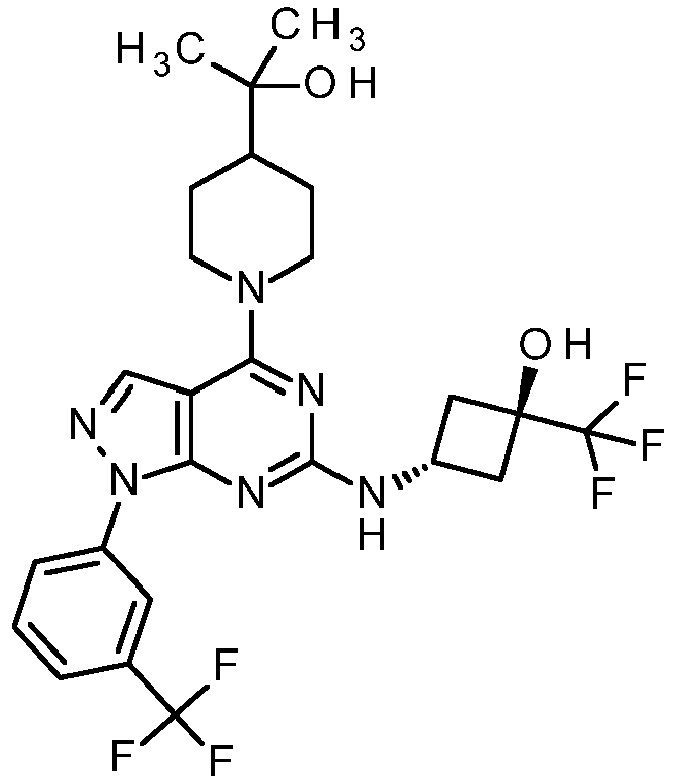
- A solution of 2-(1-{6-chloro-1-[3-(trifluoromethyl)phenyl]-1H-pyrazolo[3,4-d]pyrimidin-4-yl}-piperidin-4-yl)propan-2-ol (80.0 mg, 0.18 mmol) and trans-3-amino-1-(trifluoromethyl)cyclobutanol hydrochloride (CAS 1408075-16-0) in NMP (2.0 ml) was treated with DIPEA (0.19 ml) and the mixture was stirred at 130°C for 16h. Standard workup and purification by HPLC afforded 68 mg of the title compound.
1H-NMR (400 MHz, DMSO-d6) δ [ppm]: 1.052 (16.00), 1.229 (0.54), 1.256 (0.57), 1.563 (0.45), 1.836 (0.79), 1.865 (0.72), 2.323 (0.76), 2.327 (0.86), 2.332 (0.72), 2.349 (1.15), 2.370 (1.30), 2.518 (2.71), 2.523 (1.82), 2.665 (0.42), 2.669 (0.61), 2.673 (0.44), 4.187 (4.56), 6.412 (0.81), 7.432 (0.40), 7.615 (0.71), 7.634 (0.89), 7.725 (0.45), 7.744 (0.71), 8.332 (4.68). -

- DIPEA (0.19 ml) was added to 2-(1-{6-chloro-1-[3-(trifluoromethyl)phenyl]-1H-pyrazolo[3,4-d]pyrimidin-4-yl}piperidin-4-yl)propan-2-ol (80 mg) and (3R)-quinuclidin-3-amine dihydrochloride (54.3 mg, CAS 123536-14-1) in NMP (1.5 ml) and the mixture was stirred at rt for 20 h. Standard workup and purification by HPLC (Instrument: Waters Autopurificationsystem; Column: XBrigde C18 5µ, 100x30mm; eluent A: water + 0.2 vol % aq. ammonia (32%); eluent B: acetonitril; gradient: 0.0-0.5 min 50% B (35-70 ml/min), 0.5-5.5 min 50-85% B; flow: 70 ml/min; temperature: 25°C; DAD scan: 210-400 nm) afforded a crude product which was then purified again by HPLC (Instrument: Sepiatec: Prep SFC100; Column: Chiralpak IC 5µ 250x30mm; eluent A: CO2; eluent B: methanol + 0.2 vol % aq. ammonia (32%); isocratic: 25%B; flow: 100 ml/min; temperature: 40°C; BPR: 150 bar; UV: 254) to afford 15.2 mg of the title compound.
LC-MS (OA01b02): Rt = 1.52 min; MS (ESIpos): m/z = 530 [M+H]+
1H-NMR (500 MHz, DMSO-d6) δ [ppm]: 0.000 (2.04), 0.994 (0.47), 1.079 (16.00), 1.245 (0.83), 1.280 (0.52), 1.295 (0.57), 1.305 (0.99), 1.314 (0.84), 1.319 (0.79), 1.330 (1.05), 1.339 (0.97), 1.363 (0.71), 1.585 (0.55), 1.878 (0.96), 1.904 (0.92), 1.936 (0.65), 1.956 (0.47), 2.348 (0.41), 2.504 (0.86), 2.508 (0.71), 2.699 (0.60), 2.814 (0.47), 2.819 (0.49), 2.987 (0.69), 3.007 (0.64), 3.054 (0.96), 3.080 (1.26), 3.104 (0.74), 3.186 (6.27), 3.896 (0.72), 4.652 (0.64), 4.677 (0.60), 7.571 (0.65), 7.587 (0.76), 7.721 (0.54), 7.737 (0.91), 7.753 (0.45), 8.248 (2.84), 8.477 (0.60), 8.493 (0.58), 8.771 (1.08). -

- Synthesis as described for the previous example but using (3S)-quinuclidin-3-amine dihydrochloride (54.3 mg, CAS 119904-90-4) afforded 14 mg of the title compound.
LC-MS (OA01b02): Rt = 1.52 min; MS (ESIpos): m/z = 530 [M+H]+
1H-NMR (400 MHz, DMSO-d6) δ [ppm]: 0.762 (0.44), 0.786 (0.62), 0.804 (0.75), 0.825 (0.58), 0.840 (0.66), 0.847 (0.62), 0.854 (0.62), 0.874 (0.53), 0.892 (0.80), 0.909 (0.75), 0.958 (0.49), 0.974 (0.66), 0.977 (0.75), 0.996 (0.62), 1.052 (16.00), 1.106 (0.40), 1.115 (0.49), 1.121 (0.71), 1.130 (0.44), 1.175 (0.80), 1.234 (1.33), 1.244 (1.37), 1.267 (1.42), 1.276 (1.42), 1.308 (0.98), 1.337 (0.58), 1.349 (0.49), 1.362 (0.49), 1.413 (0.53), 1.432 (0.49), 1.532 (0.53), 1.562 (0.75), 1.815 (0.44), 1.850 (1.42), 1.884 (1.82), 1.935 (0.62), 2.095 (0.53), 2.233 (0.53), 2.322 (0.75), 2.326 (1.02), 2.331 (0.75), 2.522 (3.59), 2.601 (0.53), 2.631 (0.80), 2.659 (0.75), 2.664 (0.93), 2.669 (1.11), 2.673 (0.80), 2.796 (0.62), 2.824 (0.44), 2.874 (0.49), 2.896 (0.93), 2.922 (0.71), 3.037 (0.49), 4.200 (2.44), 4.848 (0.49), 4.878 (0.49), 4.980 (0.44), 5.004 (0.40), 7.610 (0.89), 7.629 (1.15), 7.743 (0.71), 7.763 (1.15), 7.783 (0.62), 8.339 (3.28), 8.478 (0.80), 8.498 (0.75), 8.797 (1.02). -

-

- A solution of 2-(1-{6-chloro-1-[3-(trifluoromethyl)phenyl]-1H-pyrazolo[3,4-d]pyrimidin-4-yl}-piperidin-4-yl)propan-2-ol (100 mg, 0.23 mmol) and tert-butyl rel-(3R,4R)-3-amino-4-fluoro-pyrrolidine-1-carboxylate (92.9 mg, 0.46 mmol, CAS 1363382-79-9) in NMP (2.5 ml) was treated with DIPEA (0.24 ml) and the mixture was stirred at 130°C for 16 h. Standard workup afforded tert-butyl rel-(3R,4R)-3-fluoro-4-({4-[4-(2-hydroxypropan-2-yl)piperidin-1-yl]-1-[3-(trifluoromethyl)phenyl]-1H-pyrazolo[3,4-d]pyrimidin-6-yl}amino)pyrrolidine-1-carboxylate (90 mg) which was directly used in the next step.
LC-MS (method HTpost_bas): Rt = 1.52 min; MS (ESIpos): m/z = 608 [M+H]+ - A solution of tert-butyl rel-(3R,4R)-3-fluoro-4-({4-[4-(2-hydroxypropan-2-yl)piperidin-1-yl]-1-[3-(trifluoromethyl)phenyl]-1H-pyrazolo[3,4-d]pyrimidin-6-yl}amino)pyrrolidine-1-carboxylate (90 mg, 0.15 mmol) in dichlormethane (1.7 ml) was treated with TFA (0.34 ml) and the mixture was stirred at rt for 16 h. The mixture was concentrated and purified by HPLC (method HT_PREP_bas) to afford 41 mg 2-[1-(6-{[rel-(3R,4R)-4-fluoropyrrolidin-3-yl]amino}-1-[3-(trifluoromethyl)phenyl]-1H-pyrazolo[3,4-d]pyrimidin-4-yl)piperidin-4-yl]propan-2-ol.
LC-MS (method HTpost_bas): Rt = 1.22 min; MS (ESIpos): m/z = 508 [M+H]+
1H-NMR (400 MHz, DMSO-d6) δ [ppm]: 1.051 (16.00), 1.232 (0.46), 1.258 (0.50), 1.832 (0.73), 1.862 (0.66), 2.326 (0.43), 2.518 (1.42), 2.522 (1.01), 2.668 (0.44), 2.883 (0.56), 2.915 (0.44), 2.948 (0.60), 2.994 (0.52), 3.017 (0.47), 3.171 (0.55), 3.188 (0.62), 3.201 (0.55), 3.217 (0.49), 4.185 (3.39), 4.968 (0.41), 5.110 (0.40), 7.602 (0.74), 7.621 (1.04), 7.699 (0.74), 7.719 (1.16), 7.739 (0.54), 8.353 (3.84). -

-
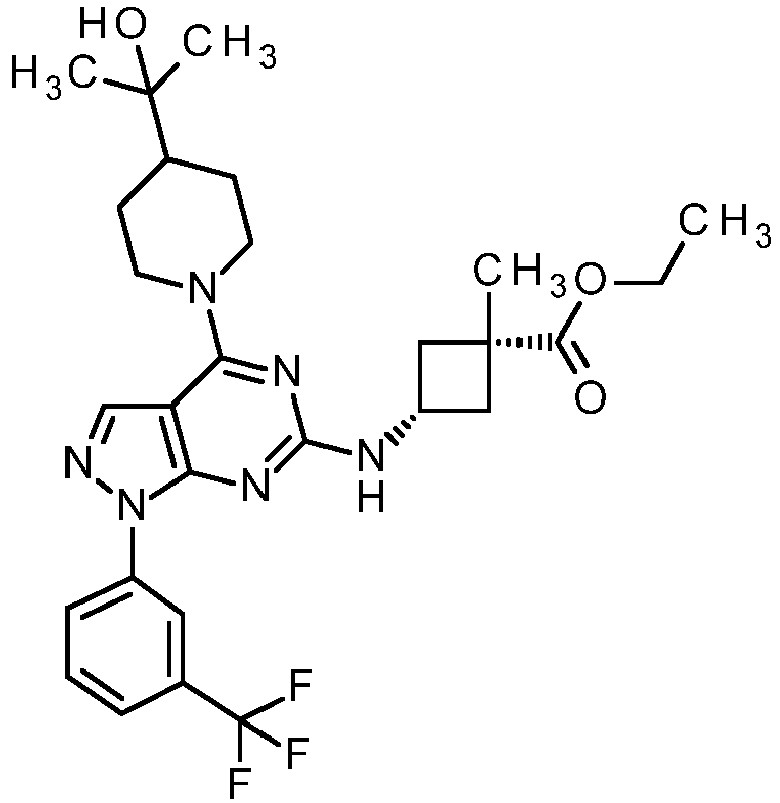
- A solution of 2-(1-{6-chloro-1-[3-(trifluoromethyl)phenyl]-1H-pyrazolo[3,4-d]pyrimidin-4-yl}-piperidin-4-yl)propan-2-ol (80.0 mg, 182 µmol) and ethyl cis-3-amino-1-methylcyclobutanecarboxylate (57.2 mg, 364 µmol, CAS 1408075-83-1) in NMP (2.0 ml) was treated with DIPEA (0.19 ml) and the mixture was stirred at 130°C for 16 h. Standard workup and purification by HPLC (method HT_PREP _bas) afforded 60 mg ethyl cis-3-({4-[4-(2-hydroxypropan-2-yl)piperidin-1-yl]-1-[3-(trifluoromethyl)phenyl]-1H-pyrazolo[3,4-d]pyrimidin-6-yl}amino)-1-methylcyclobutanecarboxylate
LC-MS (method HTpost_bas): Rt = 1.55 min; MS (ESIpos): m/z = 561 [M+H]+ - A solution of ethyl cis-3-({4-[4-(2-hydroxypropan-2-yl)piperidin-1-yl]-1-[3-(trifluoromethyl)-phenyl]-1H-pyrazolo[3,4-d]pyrimidin-6-yl}amino)-1-methylcyclobutanecarboxylate (60 mg, 0.11 mmol)in 2-methyltetrahydrofuran (2.0 ml) was treated with 2M aq. sodium hydroxide solution (1.0 ml) and the mixture was stirred at RT for 16 h. 10% aq. citric acid solution and ethyl acetate were added and stirring was continued for 5 min. The organic layer was separated and the mixture was extracted with ethyl acetate, the combined organic layers were concentrated and the residue was purified by HPLC (method HT_PREP_acid) to afford 20 mg cis-3-({4-[4-(2-hydroxypropan-2-yl)piperidin-1-yl]-1-[3-(trifluoromethyl)phenyl]-1H-pyrazolo[3,4-d]pyrimidin-6-yl}amino)-1-methylcyclobutanecarboxylic acid.
LC-MS (method HTpost_acid): Rt = 1.28 min; MS (ESIpos): m/z = 533 [M+H]+
1H-NMR (400 MHz, DMSO-d6) δ [ppm]: 0.000 (3.85), 1.053 (16.00), 1.224 (0.71), 1.250 (0.76), 1.392 (7.53), 1.555 (0.59), 1.831 (0.91), 1.861 (0.85), 2.079 (2.15), 2.216 (0.97), 2.353 (0.75), 2.376 (1.14), 2.401 (0.62), 2.994 (0.47), 4.184 (2.37), 4.399 (0.66), 4.418 (0.65), 7.356 (0.46), 7.609 (0.82), 7.628 (1.05), 7.726 (0.55), 7.745 (0.87), 7.765 (0.42), 8.320 (4.07), 9.160 (0.54). -

- DIPEA (0.23 ml) was added to 1-(1-{6-chloro-1-[3-(trifluoromethyl)phenyl]-1H-pyrazolo[3,4-d]pyrimidin-4-yl}azetidin-3-yl)-2-methylpropan-2-ol (98.0 mg) and trans-3-(methylsulfonyl)-cyclobutanamine hydrochloride (82.9 mg, 446 µmol) in NMP (1.5 ml) and the mixture was stirred 16.5 h at 120°C. Standard workup and purification by HPLC (method HT_PREP_acid) afforded two batches oft he product (23.4 mg and 28.4 mg).
LC-MS (method HTpost_acid): Rt = 1.10 min; MS (ESIpos): m/z = 539 [M+H]+
1H-NMR (400 MHz, DMSO-d6) δ [ppm]: 1.104 (16.00), 1.764 (1.79), 1.782 (1.81), 2.327 (0.48), 2.518 (2.07), 2.522 (1.29), 2.665 (0.50), 2.669 (0.69), 2.673 (0.64), 2.678 (0.54), 2.711 (0.64), 2.924 (8.20), 3.046 (0.48), 3.853 (0.63), 3.863 (0.64), 4.261 (3.25), 7.602 (0.97), 7.621 (1.14), 7.705 (0.85), 7.725 (1.34), 7.745 (0.63), 8.040 (5.20). -

- DIPEA (0.23 ml) was added to 1-(1-{6-chloro-1-[3-(trifluoromethyl)phenyl]-1H-pyrazolo[3,4-d]pyrimidin-4-yl}azetidin-3-yl)-2-methylpropan-2-ol (98.0 mg) and 1-(methylsulfonyl)azetidin-3-amine (67.1 mg, 0.45 mmol) in NMP (1.5 ml) and the mixture was stirred for 16.5 h at 120°C Standard workup and purification by HPLC (method HT_PREP_acid) afforded 55 mg of the title compound.
LC-MS (method HTpost_acid): Rt = 1.17 min; MS (ESIpos): m/z = 540 [M+H]+
1H-NMR (400 MHz, DMSO-d6) δ [ppm]: 1.104 (16.00), 1.765 (2.16), 1.783 (2.21), 2.074 (1.22), 2.327 (0.40), 2.518 (1.90), 2.522 (1.17), 2.669 (0.42), 3.025 (15.31), 3.051 (0.57), 3.069 (0.41), 3.879 (0.83), 3.897 (1.19), 3.914 (0.81), 4.092 (0.89), 4.110 (1.10), 4.264 (3.86), 4.551 (0.42), 4.619 (0.54), 4.635 (0.52), 7.619 (0.84), 7.639 (1.09), 7.755 (0.44), 7.774 (0.68), 8.067 (5.51). -

- DIPEA (0.19 ml) was added to 6-chloro-4-[3-(morpholin-4-yl)azetidin-1-yl]-1-[3-(trifluoromethyl)phenyl]-1H-pyrazolo[3,4-d]pyrimidine (80.0 mg) and (3R,4S)-4-aminotetra-hydrofuran-3-ol (37.6 mg) in NMP (1.5 ml) and the mixture was stirred for 20 h at 130°C. Addition of water led to the precipitation of a solid, which was filtered, washed with water and 2-methoxy-2-methylpropane. After drying, 60 mg of the title compound was obtained.
LC-MS (OA01b02): Rt = 1.10 min; MS (ESIpos): m/z = 506 [M+H]+
1H-NMR (400 MHz, DMSO-d6) δ [ppm]: -0.008 (1.92), 0.008 (2.04), 1.157 (0.42), 1.175 (0.77), 1.193 (0.38), 1.991 (1.50), 2.335 (1.23), 2.339 (0.65), 2.407 (6.19), 2.521 (5.92), 2.526 (3.85), 2.677 (1.15), 2.681 (0.50), 3.368 (2.19), 3.379 (1.38), 3.385 (1.27), 3.397 (0.58), 3.515 (3.04), 3.520 (3.04), 3.538 (3.27), 3.544 (3.38), 3.618 (6.35), 3.628 (9.58), 3.639 (6.62), 3.893 (3.00), 3.905 (3.46), 3.916 (3.00), 3.928 (2.92), 4.002 (0.77), 4.020 (0.85), 4.038 (0.73), 4.054 (1.92), 4.068 (2.92), 4.075 (1.96), 4.089 (2.46), 4.144 (1.46), 4.289 (2.73), 4.433 (0.85), 5.151 (6.31), 5.161 (6.27), 7.328 (0.81), 7.605 (2.35), 7.624 (3.12), 7.723 (1.50), 7.743 (2.42), 7.762 (1.15), 8.091 (16.00), 8.578 (0.92), 8.788 (0.77). -

- 6-chloro-4-[3-(morpholin-4-yl)azetidin-1-yl]-1-[3-(trifluoromethyl)phenyl]-1H-pyrazolo[3,4-d]pyrimidine (80.0 mg) and rel-(3R,4R)-4-aminotetrahydrofuran-3-ol (37.6 mg, 365 µmol, CAS 535936-61-9) were transformed as described in the previous example to 57 mg of the title compound
LC-MS (method b02): Rt = 1.13 min; MS (ESIpos): m/z = 506 [M+H]+
1H-NMR (400 MHz, DMSO-d6) δ [ppm]: -0.008 (2.11), 0.008 (2.29), 0.934 (1.84), 0.951 (1.87), 1.106 (0.63), 2.178 (0.48), 2.407 (6.01), 2.521 (6.58), 2.525 (4.44), 2.695 (2.51), 3.285 (0.69), 3.303 (0.94), 3.349 (1.57), 3.366 (2.14), 3.378 (1.33), 3.618 (8.66), 3.624 (11.38), 3.636 (6.58), 3.641 (6.10), 3.647 (3.98), 3.921 (1.81), 3.933 (2.20), 3.945 (1.78), 3.956 (1.84), 4.014 (2.90), 4.033 (4.56), 4.052 (2.54), 4.192 (0.94), 4.272 (1.96), 4.353 (1.24), 4.434 (0.91), 5.320 (3.20), 5.332 (3.35), 6.474 (0.85), 7.608 (2.42), 7.627 (3.08), 7.734 (1.84), 7.754 (2.99), 7.775 (1.39), 8.103 (16.00), 8.406 (0.45), 8.424 (0.72), 8.450 (0.69), 8.911 (0.78). -

- The synthesis was performed using 6-chloro-4-[3-(methylsulfonyl)azetidin-1-yl]-1-[3-(trifluoromethyl)phenyl]-1H-pyrazolo[3,4-d]pyrimidine (86 mg) and tert-butyl (trans-3-amino-1-methylcyclobutyl)carbamate (76 mg) analogously the preparation of example I-57 to afford 59 mg of the title compound.
LC-MS (method HTpost_bas): Rt = 1.14 min; MS (ESIpos): m/z = 496 [M+H]+
1H-NMR (400 MHz, DMSO-d6) δ [ppm]: -0.008 (0.49), 0.008 (0.49), 1.219 (16.00), 1.944 (0.89), 1.966 (1.13), 2.210 (0.84), 2.521 (2.22), 2.526 (1.43), 2.543 (0.53), 3.120 (15.62), 4.362 (0.46), 4.526 (0.87), 7.492 (0.43), 7.610 (0.96), 7.629 (1.27), 7.728 (0.62), 7.748 (1.00), 7.768 (0.47), 8.130 (7.92), 8.530 (0.41), 8.547 (0.49), 8.914 (0.59). -

- DIPEA (0.19 ml) was added to 6-chloro-4-[3-(morpholin-4-yl)azetidin-1-yl]-1-[3-(trifluoromethyl)phenyl]-1H-pyrazolo[3,4-d]pyrimidine (80.0 mg, 182 µmol) and cis-3-amino-cyclobutanol hydrochloride (45.1 mg, 365 µmol) in NMP (1.5 ml) and the mixture was stirred for 19 h at 130°C. Standard workup and purification by HPLC (method HT_PREP _bas) afforded 67 mg of the title compound.
LC-MS (method HTpost_bas): Rt = 1.17 min; MS (ESIpos): m/z = 490 [M+H]+
1H-NMR (400 MHz, DMSO-d6) δ [ppm]: 1.795 (1.51), 1.802 (1.21), 1.817 (3.44), 1.823 (3.33), 1.838 (3.35), 1.845 (3.64), 1.860 (1.27), 1.867 (1.64), 2.078 (2.18), 2.403 (7.43), 2.522 (4.99), 2.526 (3.29), 2.543 (0.65), 2.610 (2.51), 3.356 (2.69), 3.368 (1.67), 3.386 (0.74), 3.616 (7.44), 3.627 (11.44), 3.637 (7.55), 3.796 (1.27), 3.814 (1.75), 3.832 (2.28), 3.848 (2.10), 3.866 (1.17), 3.976 (0.86), 4.176 (1.03), 4.248 (1.10), 4.411 (0.94), 5.056 (1.96), 7.434 (1.16), 7.595 (2.96), 7.614 (3.86), 7.724 (1.67), 7.744 (2.68), 7.764 (1.30), 8.061 (16.00), 8.078 (0.41), 8.460 (1.04), 9.042 (1.50). -

- The synthesis was performed analogously to example I-72 using 45 mg rel-(1R,2S)-2-aminocyclobutanol hydrochloride affording 15.5 mg of the title compound (HPLC method: method HT_PREP_bas).
LC-MS (method HTpost_bas): Rt = 1.25 min; MS (ESIpos): m/z = 490 [M+H]+
1H-NMR (400 MHz, DMSO-d6) δ [ppm]: 1.810 (0.88), 1.978 (0.55), 1.990 (0.81), 2.003 (1.37), 2.037 (0.90), 2.061 (1.60), 2.078 (2.51), 2.088 (1.97), 2.405 (5.37), 2.522 (2.81), 2.526 (1.83), 2.543 (0.49), 3.144 (1.05), 3.360 (1.92), 3.372 (1.23), 3.389 (0.52), 3.616 (5.39), 3.627 (8.35), 3.637 (5.55), 3.999 (0.67), 4.182 (0.89), 4.260 (0.88), 4.318 (0.92), 4.389 (1.44), 5.144 (1.55), 5.156 (1.39), 6.595 (2.73), 6.610 (2.77), 7.596 (2.31), 7.616 (3.02), 7.724 (2.10), 7.744 (3.46), 7.764 (1.71), 8.078 (16.00), 8.465 (0.62), 8.990 (0.76). -

- The synthesis was performed analogously to example I-72 using 45 mg trans-3-aminocyclo-butanol hydrochloride affording 68 mg of the title compound (HPLC method: method HT_PREP _bas).
LC-MS (method HTpost_bas): Rt = 1.15 min; MS (ESIpos): m/z = 490 [M+H]+
1H-NMR (400 MHz, DMSO-d6) δ [ppm]: 2.077 (0.78), 2.165 (2.52), 2.180 (2.49), 2.282 (2.24), 2.320 (1.22), 2.325 (1.70), 2.330 (2.04), 2.335 (1.50), 2.339 (0.81), 2.405 (6.80), 2.521 (6.78), 2.526 (4.33), 2.663 (0.55), 2.667 (1.25), 2.672 (1.68), 2.677 (1.24), 2.681 (0.55), 3.310 (0.43), 3.360 (2.42), 3.373 (1.48), 3.377 (1.49), 3.390 (0.67), 3.617 (6.70), 3.628 (10.26), 3.638 (6.79), 3.980 (0.75), 4.241 (1.72), 4.284 (1.76), 4.300 (2.33), 4.315 (2.09), 4.330 (1.21), 4.415 (0.87), 4.968 (2.66), 4.982 (2.37), 7.442 (1.12), 7.594 (2.83), 7.614 (3.73), 7.717 (2.10), 7.738 (3.51), 7.757 (1.66), 8.066 (16.00), 8.479 (0.94), 8.959 (1.25). -

- The synthesis was performed analogously to example I-72 using 45 mg rel-(1R,2R)-2-amino-cyclobutanol hydrochloride affording 54 mg of the title compound (method: method HT_PREP _bas) .
LC-MS (method HTpost_bas): Rt = 1.18 min; MS (ESIpos): m/z = 490 [M+H]+
1H-NMR (400 MHz, DMSO-d6) δ [ppm]: 1.239 (0.80), 1.262 (0.70), 1.385 (0.79), 1.408 (1.02), 1.432 (0.69), 1.953 (1.27), 1.974 (1.35), 1.997 (1.05), 2.339 (0.48), 2.406 (5.54), 2.521 (4.36), 2.526 (2.82), 2.543 (1.50), 3.350 (1.48), 3.362 (1.98), 3.374 (1.26), 3.379 (1.22), 3.391 (0.54), 3.617 (5.59), 3.628 (8.63), 3.638 (5.73), 4.026 (1.12), 4.044 (1.27), 4.160 (1.09), 4.250 (0.93), 4.417 (0.71), 5.179 (2.01), 5.195 (1.80), 7.436 (0.82), 7.600 (1.98), 7.619 (2.58), 7.728 (1.07), 7.748 (1.55), 7.767 (0.76), 8.065 (16.00), 8.521 (0.80), 8.536 (0.96), 8.954 (1.21). -

- A solution of 6-chloro-4-[3-methyl-3-(morpholin-4-yl)azetidin-1-yl]-1-[3-(trifluoromethyl)-phenyl]-1H-pyrazolo[3,4-d]pyrimidine (70 mg) and cis-3-aminocyclobutanol hydrochloride (38 mg) in NMP (1.6 ml) was treated with DIPEA (0.16 ml) and the mixture was stirred at 130°C for 16 h. Standard workup and purification by HPLC (method HT_PREP _acid) afforded 56 mg of the title compound.
LC-MS (method HTpost_acid): Rt = 1.00 min; MS (ESIpos): m/z = 504 [M+H]+
1H-NMR (400 MHz, DMSO-d6) δ [ppm]: 1.329 (15.35), 1.355 (0.42), 1.798 (0.79), 1.804 (0.59), 1.819 (1.77), 1.825 (1.70), 1.841 (1.70), 1.847 (1.86), 1.862 (0.61), 1.869 (0.83), 2.332 (0.47), 2.450 (5.09), 2.523 (1.46), 2.528 (1.01), 2.544 (0.61), 2.615 (1.32), 2.669 (0.48), 2.674 (0.54), 3.337 (16.00), 3.797 (1.31), 3.832 (1.16), 3.849 (0.99), 3.949 (0.70), 4.040 (0.80), 4.061 (0.88), 4.217 (0.83), 4.236 (0.69), 5.060 (0.88), 7.421 (0.61), 7.596 (1.57), 7.615 (2.04), 7.725 (0.89), 7.745 (1.39), 7.764 (0.68), 8.049 (8.54), 8.463 (0.54), 9.044 (0.77). -

- A solution of 6-chloro-4-[3-(morpholin-4-yl)azetidin-1-yl]-1-[3-(trifluoromethyl)phenyl]-1H-pyrazolo[3,4-d]pyrimidine (80.0 mg) and trans-3-amino-1-methylcyclobutanol hydrochloride (CAS number 1523571-03-0) (50 mg) in NMP (2.0 ml) was treated with DIPEA (0.19 ml) and the mixture was stirred at 130°C for 16 h. Standard workup and purification by HPLC (method HT_PREP_bas) afforded 64 mg of the title compound.
LC-MS (method HTpost_bas): Rt = 1.23 min; MS (ESIpos): m/z = 504 [M+H]+
1H-NMR (500 MHz, DMSO-d6) δ [ppm]: -0.004 (8.08), 1.269 (16.00), 2.011 (1.15), 2.358 (1.35), 2.361 (1.43), 2.398 (3.02), 2.514 (2.06), 2.518 (1.60), 2.522 (1.21), 2.635 (0.47), 3.353 (1.53), 3.362 (0.83), 3.367 (0.84), 3.377 (0.40), 3.614 (3.24), 3.623 (5.11), 3.631 (3.41), 4.177 (0.42), 4.245 (0.49), 4.409 (0.43), 4.746 (3.20), 7.383 (0.51), 7.593 (1.27), 7.608 (1.58), 7.714 (0.84), 7.730 (1.40), 7.746 (0.68), 8.055 (6.48), 8.529 (0.47), 8.870 (0.61). -

- A solution of 6-chloro-4-[3-(morpholin-4-yl)azetidin-1-yl]-1-[3-(trifluoromethyl)phenyl]-1H-pyrazolo[3,4-d]pyrimidine (80.0 mg) and cis-3-amino-1-methylcyclobutanol hydrochloride (CAS number 1523606-23-6) (50.2 mg) in NMP (2.0 ml) was treated with DIPEA (0.19 ml) and the mixture was stirred at 130°C for 16 h. Standard workup and purification by HPLC (method HT_PREP_bas) afforded 66 mg of the title compound.
LC-MS (method HTpost_bas): Rt = 1.25 min; MS (ESIpos): m/z = 504 [M+H]+
1H-NMR (500 MHz, DMSO-d6) δ [ppm]: 1.275 (16.00), 1.997 (2.12), 2.019 (3.98), 2.037 (2.49), 2.361 (4.01), 2.365 (3.72), 2.369 (3.01), 2.403 (6.28), 2.518 (3.07), 2.522 (2.92), 2.526 (2.32), 2.544 (0.85), 2.635 (0.74), 2.639 (1.02), 2.642 (0.76), 3.356 (3.27), 3.366 (1.92), 3.370 (1.80), 3.380 (0.85), 3.618 (6.85), 3.627 (10.77), 3.635 (7.11), 3.863 (1.20), 3.876 (1.22), 3.969 (0.77), 4.172 (0.86), 4.252 (0.96), 4.411 (0.87), 4.923 (4.96), 7.423 (1.64), 7.435 (1.58), 7.596 (2.78), 7.612 (3.44), 7.717 (2.10), 7.733 (3.58), 7.748 (1.74), 8.061 (13.46), 8.349 (1.44), 8.365 (1.40), 9.164 (2.43). -

- A solution of 1-(1-{6-chloro-1-[3-(trifluoromethyl)phenyl]-1H-pyrazolo[3,4-d]pyrimidin-4-yl}-azetidin-3-yl)-4-methylpiperidin-4-ol (80 mg) and trans-3-aminocyclobutanol hydrochloride (42 mg) in NMP (2.0 ml) was treated with DIPEA (0.18 ml) and the mixture was stirred at 130°C for 24 h. Standard workup and purification by HPLC (method HT_PREP_bas) afforded 62 mg of the title compound.
LC-MS (method HTpost_bas): Rt = 1.07 min; MS (ESIpos): m/z = 518 [M+H]+
1H-NMR (400 MHz, DMSO-d6) δ [ppm]: 1.115 (16.00), 1.449 (0.49), 1.472 (2.01), 1.496 (5.11), 1.529 (0.65), 2.166 (1.67), 2.179 (1.64), 2.297 (2.53), 2.326 (1.78), 2.331 (1.80), 2.426 (1.48), 2.526 (2.94), 2.543 (0.61), 2.668 (0.59), 2.673 (0.78), 2.677 (0.57), 3.922 (0.60), 4.166 (5.59), 4.269 (0.52), 4.285 (0.85), 4.300 (1.31), 4.315 (1.22), 4.330 (0.71), 4.415 (0.70), 4.969 (1.66), 4.982 (1.47), 7.434 (0.73), 7.592 (1.73), 7.611 (2.27), 7.715 (1.27), 7.736 (2.08), 7.755 (1.00), 8.070 (8.42), 8.478 (0.65), 8.959 (0.83). -

- A solution of 1-(1-{6-chloro-1-[3-(trifluoromethyl)phenyl]-1H-pyrazolo[3,4-d]pyrimidin-4-yl}-azetidin-3-yl)-4-methylpiperidin-4-ol (65 mg) and tetrahydro-2H-thiopyran-4-amine 1,1-dioxide (41.5 mg) in NMP (2.0 ml) was treated with DIPEA (0.15 ml) and the mixture was stirred at 130°C for 40 h. Standard workup and purification by HPLC (method HT_PREP_bas) afforded 48 mg of the title compound.
LC-MS (method HTpost_bas): Rt = 1.11 min; MS (ESIpos): m/z = 580 [M+H]+
1H-NMR (400 MHz, DMSO-d6) δ [ppm]: -0.004 (8.52), 1.113 (16.00), 1.446 (0.50), 1.469 (2.00), 1.494 (4.98), 1.527 (0.61), 2.074 (1.71), 2.093 (1.44), 2.110 (1.13), 2.222 (1.60), 2.301 (1.56), 2.322 (1.61), 2.326 (1.70), 2.331 (1.36), 2.427 (1.49), 2.518 (2.87), 2.522 (1.80), 2.664 (0.56), 2.669 (0.75), 2.673 (0.55), 3.191 (4.04), 3.937 (0.62), 4.104 (0.74), 4.167 (4.94), 4.191 (1.39), 4.425 (0.76), 7.360 (0.48), 7.612 (1.54), 7.631 (1.91), 7.747 (0.73), 7.766 (1.10), 8.090 (8.97), 8.564 (0.68), 8.746 (0.53). -

- A mixture of 6-chloro-4-[3-(morpholin-4-yl)azetidin-1-yl]-1-[3-(trifluoromethyl)phenyl]-1H-pyrazolo[3,4-d]pyrimidine (84 mg) und 1-(ethylsulfonyl)azetidin-3-amine trifluoroacetate (80 mg) in NMP (2.0 ml) was treated with DIPEA (0.27 ml) and the mixture was stirred at 130°C for 43 h. Standard workup and purification by HPLC (method HT_PREP _acid) afforded 14 mg of the title compound.
LC-MS (HTpost1_acid): Rt = 1.00 min; MS (ESIpos): m/z = 567 [M+H]+
1H-NMR (400 MHz, DMSO-d6) δ [ppm]: 1.194 (0.41), 1.223 (7.10), 1.242 (16.00), 1.260 (7.39), 2.410 (4.06), 2.521 (3.77), 2.526 (2.40), 2.543 (0.54), 3.120 (2.36), 3.138 (7.62), 3.156 (7.40), 3.175 (2.18), 3.372 (2.75), 3.620 (4.13), 3.630 (6.24), 3.640 (4.20), 3.905 (2.11), 3.924 (3.51), 3.942 (2.73), 4.004 (0.62), 4.097 (1.86), 4.199 (0.72), 4.283 (0.70), 4.439 (0.67), 4.598 (0.73), 4.611 (0.73), 7.624 (1.49), 7.644 (1.98), 7.755 (0.76), 7.774 (1.12), 7.791 (0.66), 7.876 (0.41), 8.111 (9.22), 8.267 (0.62), 8.510 (0.48), 8.531 (0.45), 8.752 (0.45). -

- A solution of 6-chloro-4-[3-(morpholin-4-yl)azetidin-1-yl]-1-[3-(trifluoromethyl)phenyl]-1H-pyrazolo[3,4-d]pyrimidine (80.0 mg) and trans-3-(ethylsulfonyl)cyclobutanamine hydrochloride (73 mg) in NMP (2.0 ml) was treated with DIPEA (0.19 ml) and the mixture was stirred at 130°C for 16 h. Standard workup and purification by HPLC (method HT_PREP _acid) afforded 24 mg of the title compound.
LC-MS (method HTpost_acid): Rt = 0.93 min; MS (ESIpos): m/z = 566 [M+H]+
1H-NMR (400 MHz, DMSO-d6) δ [ppm]: 1.190 (7.52), 1.208 (16.00), 1.227 (7.80), 2.331 (0.92), 2.410 (6.80), 2.673 (1.14), 2.724 (2.16), 3.018 (1.53), 3.035 (4.12), 3.054 (4.09), 3.072 (1.51), 3.369 (2.85), 3.629 (9.28), 3.915 (1.53), 3.927 (1.27), 3.985 (0.91), 4.194 (0.98), 4.272 (1.09), 4.450 (1.40), 7.610 (2.64), 7.629 (3.93), 7.711 (2.25), 7.731 (3.55), 7.752 (1.63), 8.087 (9.39), 8.517 (0.90), 8.766 (1.04). -

- A solution of 2-(1-{6-chloro-1-[3-(trifluoromethyl)phenyl]-1H-pyrazolo[3,4-d]pyrimidin-4-yl}-azetidin-3-yl)propan-2-ol (75.0 mg) and trans-3-(methylsulfonyl)cyclobutanamine hydrochloride in NMP (2.0 ml) was treated with DIPEA (0.19 ml) and the mixture was stirred at 130°C for 40 h. Standard workup and purification by HPLC (method HT_PREP _acid) afforded 22 mg of the title compound.
LC-MS (method HTpost_acid): Rt = 1.07 min; MS (ESIpos): m/z = 525 [M+H]+
1H-NMR (400 MHz, DMSO-d6) δ [ppm]: 1.107 (15.69), 2.321 (0.43), 2.326 (0.93), 2.330 (1.26), 2.335 (0.95), 2.340 (0.44), 2.521 (5.88), 2.526 (3.61), 2.543 (0.95), 2.668 (1.23), 2.673 (1.72), 2.677 (1.62), 2.682 (1.43), 2.716 (2.00), 2.774 (0.50), 2.793 (1.21), 2.811 (1.74), 2.830 (1.24), 2.847 (0.48), 2.930 (16.00), 3.858 (1.20), 3.869 (1.34), 3.881 (1.04), 4.066 (2.36), 4.263 (0.79), 4.283 (1.74), 4.299 (1.57), 4.313 (1.35), 4.333 (1.60), 4.355 (0.62), 4.491 (0.73), 4.627 (7.33), 7.579 (0.73), 7.605 (2.54), 7.624 (3.23), 7.709 (2.50), 7.729 (3.94), 7.749 (1.83), 8.099 (15.51), 8.530 (0.77), 8.761 (0.86). -

- A solution of (3R,4R)-1-{6-chloro-1-[3-(trifluoromethyl)phenyl]-1H-pyrazolo[3,4-d]pyrimidin-4-yl}pyrrolidine-3,4-diol (80.0 mg) and 1-(ethylsulfonyl)azetidin-3-amine trifluoroacetate (111 mg) in NMP (2.0 ml) was treated with DIPEA (0.21 ml) and the mixture was stirred at 130°C for 40 h. Standard workup and purification by HPLC (method HT_PREP _acid) afforded 35 mg of the title compound.
LC-MS (method HTpost_acid): Rt = 1.03 min; MS (ESIpos): m/z = 528 [M+H]+
1H-NMR (400 MHz, DMSO-d6) δ [ppm]: 1.229 (6.87), 1.248 (16.00), 1.266 (7.32), 2.522 (2.69), 2.526 (1.76), 2.543 (1.97), 3.130 (2.23), 3.149 (7.43), 3.167 (7.28), 3.185 (2.06), 3.610 (1.58), 3.638 (1.80), 3.693 (3.08), 3.923 (1.79), 3.942 (3.03), 3.959 (3.03), 3.969 (1.29), 3.988 (0.94), 3.997 (0.89), 4.049 (1.87), 4.089 (1.76), 4.109 (3.31), 4.128 (1.56), 4.172 (1.64), 4.629 (0.67), 4.643 (0.65), 5.250 (1.45), 5.351 (1.43), 7.623 (1.44), 7.642 (1.89), 7.752 (0.75), 7.772 (0.96), 8.265 (8.90). -

- A solution of (3R,4R)-1-{6-chloro-1-[3-(trifluoromethyl)phenyl]-1H-pyrazolo[3,4-d]pyrimidin-4-yl}pyrrolidine-3,4-diol (80 mg) and cis-3-aminocyclobutanol hydrochloride (49.5 mg) in NMP (2.0 ml) was treated with DIPEA (0.21 ml) and the mixture was stirred at 130°C for 40 h. Standard workup and purification by HPLC (method HT_PREP _acid) afforded 30 mg of the title compound.
LC-MS (method HTpost_acid): Rt = 0.88 min; MS (ESIpos): m/z = 451 [M+H]+
1H-NMR (400 MHz, DMSO-d6) δ [ppm]: 1.810 (1.28), 1.833 (2.89), 1.838 (2.64), 1.859 (2.99), 1.881 (1.46), 2.321 (0.53), 2.325 (1.22), 2.330 (1.71), 2.335 (1.21), 2.339 (0.55), 2.521 (7.14), 2.526 (4.45), 2.543 (6.57), 2.631 (2.22), 2.663 (1.22), 2.667 (1.66), 2.672 (1.97), 2.677 (1.39), 2.681 (0.67), 3.590 (2.84), 3.617 (3.32), 3.678 (2.98), 3.834 (1.82), 3.852 (2.12), 3.871 (1.43), 3.941 (1.64), 3.951 (2.03), 3.969 (1.66), 3.978 (1.58), 4.032 (3.07), 4.156 (2.75), 5.060 (0.90), 5.220 (1.09), 5.328 (1.14), 7.265 (0.84), 7.593 (2.49), 7.612 (3.23), 7.724 (1.28), 7.744 (2.06), 7.764 (1.02), 8.207 (16.00), 8.479 (0.68), 9.095 (0.82). -
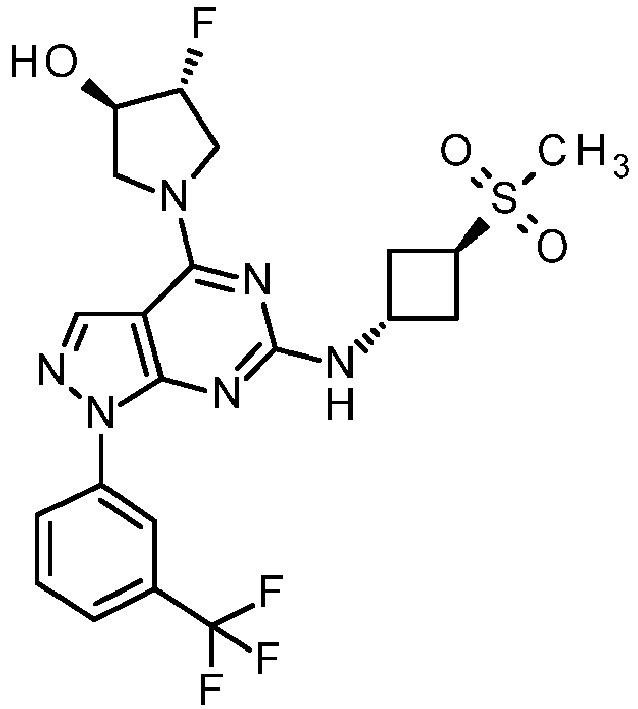
- A solution of (3R,4R)-1-{6-chloro-1-[3-(trifluoromethyl)phenyl]-1H-pyrazolo[3,4-d]pyrimidin-4-yl}-4-fluoropyrrolidin-3-ol (80 mg) and trans-3-(methylsulfonyl)cyclobutanamine hydrochloride (73.9 mg) in NMP (2.0 ml) was treated with DIPEA (0.21 ml) and the mixture was stirred at 130°C for 16 h. Standard workup and purification by HPLC (method HT_PREP _acid) afforded 68 mg of the title compound.
LC-MS (method HTpost_acid): Rt = 1.08 min; MS (ESIpos): m/z = 515 [M+H]+
1H-NMR (400 MHz, DMSO-d6) δ [ppm]: 2.078 (1.50), 2.522 (6.09), 2.526 (4.50), 2.543 (2.28), 2.733 (2.89), 2.942 (15.69), 3.701 (0.64), 3.766 (1.40), 3.795 (1.77), 3.849 (1.81), 3.862 (1.66), 3.883 (2.68), 3.895 (1.87), 3.968 (0.88), 4.002 (1.49), 4.037 (1.40), 4.069 (1.31), 4.170 (0.53), 4.367 (0.83), 4.490 (1.38), 5.054 (0.75), 5.137 (0.87), 5.183 (0.76), 5.262 (0.86), 5.669 (0.67), 5.776 (0.76), 7.550 (0.86), 7.618 (3.13), 7.638 (4.26), 7.721 (3.50), 7.741 (5.58), 7.761 (2.52), 8.265 (16.00), 8.293 (0.77), 8.557 (0.82), 8.621 (0.77), 8.774 (0.82). -

- A solution of (3R,4R)-1-{6-chloro-1-[3-(trifluoromethyl)phenyl]-1H-pyrazolo[3,4-d]pyrimidin-4-yl}-4-fluoropyrrolidin-3-ol (80 mg) and trans-3-(ethylsulfonyl)cyclobutanamine hydrochloride (79.5 mg) in NMP (2.0 ml) was treated with DIPEA (0.21 ml) and the mixture was stirred at 130°C for 16 h. Standard workup and purification by HPLC (method HT_PREP _acid) afforded 75 mg of the title compound.
LC-MS (method HTpost_acid): Rt = 1.12 min; MS (ESIpos): m/z = 529 [M+H]+
1H-NMR (400 MHz, DMSO-d6) δ [ppm]: 1.197 (6.88), 1.216 (16.00), 1.234 (7.34), 2.523 (2.76), 2.527 (1.99), 2.544 (0.70), 2.678 (0.41), 2.739 (1.26), 3.049 (1.64), 3.067 (1.65), 3.767 (0.63), 3.795 (0.80), 3.848 (0.61), 3.881 (0.55), 3.929 (1.08), 3.964 (0.54), 4.002 (0.66), 4.036 (0.62), 4.068 (0.59), 4.477 (0.75), 5.666 (0.51), 5.776 (0.61), 7.556 (0.40), 7.618 (1.40), 7.638 (1.93), 7.720 (1.52), 7.741 (2.43), 7.761 (1.12), 8.265 (6.74). -

- A solution of (3R,4R)-1-{6-chloro-1-[3-(trifluoromethyl)phenyl]-1H-pyrazolo[3,4-d]pyrimidin-4-yl}-4-fluoropyrrolidin-3-ol (80 mg) and trans-3-aminocyclobutanol hydrochloride (49 mg) in NMP (2.0 ml) was treated with DIPEA (0.21 ml) and the mixture was stirred at 130°C for 16 h. Standard workup and purification by HPLC (method HT_PREP_acid) afforded 66 mg of the title compound.
LC-MS (method HTpost_acid): Rt = 1.05 min; MS (ESIpos): m/z = 453 [M+H]+
1H-NMR (500 MHz, DMSO-d6) δ [ppm]: 2.161 (2.08), 2.187 (4.78), 2.196 (4.56), 2.298 (3.70), 2.518 (7.76), 2.522 (7.51), 2.525 (6.17), 2.543 (2.65), 3.679 (0.96), 3.758 (2.03), 3.780 (2.41), 3.853 (2.01), 3.877 (1.72), 3.941 (0.83), 3.966 (1.39), 3.992 (2.09), 4.015 (2.09), 4.070 (0.84), 4.151 (0.79), 4.175 (0.57), 4.261 (1.23), 4.324 (2.78), 4.467 (1.70), 4.989 (2.13), 5.053 (1.35), 5.148 (1.62), 5.243 (1.19), 5.644 (0.79), 5.763 (0.85), 7.363 (1.83), 7.604 (5.22), 7.620 (6.51), 7.729 (3.01), 7.745 (5.01), 7.761 (2.50), 8.229 (3.83), 8.239 (16.00), 8.496 (1.36), 8.988 (1.69). -

- A solution of (3R,4R)-1-{6-chloro-1-[3-(trifluoromethyl)phenyl]-1H-pyrazolo[3,4-d]pyrimidin-4-yl}-4-fluoropyrrolidin-3-ol (80 mg) and cis-3-aminocyclobutanol hydrochloride (49 mg) in NMP (2.0 ml) was treated with DIPEA (0.21 ml) and the mixture was stirred at 130°C for 16 h. Standard workup and purification by HPLC (method HT_PREP_acid) afforded 57 mg of the title compound.
LC-MS (method HTpost_acid): Rt = 1.06 min; MS (ESIpos): m/z = 453 [M+H]+
1H-NMR (500 MHz, DMSO-d6) δ [ppm]: 1.822 (2.25), 1.841 (5.52), 1.862 (5.65), 1.879 (2.48), 2.358 (1.07), 2.361 (2.24), 2.365 (3.26), 2.368 (2.33), 2.372 (1.02), 2.518 (8.67), 2.522 (8.49), 2.525 (6.81), 2.543 (2.31), 2.631 (5.52), 2.635 (6.88), 2.639 (7.68), 2.642 (6.39), 3.664 (0.85), 3.755 (2.29), 3.778 (3.04), 3.850 (4.84), 3.860 (4.68), 3.964 (1.40), 3.990 (2.10), 4.007 (2.20), 4.069 (0.92), 4.150 (0.82), 4.169 (0.59), 4.352 (1.39), 4.464 (1.53), 5.050 (2.55), 5.068 (2.25), 5.145 (2.08), 5.240 (1.26), 5.762 (1.63), 7.355 (1.74), 7.605 (5.12), 7.620 (6.26), 7.736 (2.22), 7.751 (3.27), 8.235 (16.00), 8.316 (0.88), 8.478 (1.47), 8.618 (0.57), 9.077 (1.95). -

- A solution of 2-(1-{6-chloro-1-[3-(trifluoromethyl)phenyl]-1H-pyrazolo[3,4-d]pyrimidin-4-yl}piperidin-4-yl)propan-2-ol (80 mg) and cis-3-amino-1-methylcyclobutanol hydrochloride (CAS number 1523606-23-6) (50 mg) in NMP (2.0 ml) was treated with DIPEA (0.19 ml) and the mixture was stirred at 130°C for 16 h. Standard workup and purification by HPLC (method HT_PREP_acid) afforded 72 mg of the title compound.
LC-MS (method HTpost_acid): Rt = 1.25 min; MS (ESIpos): m/z = 505 [M+H]+
1H-NMR (500 MHz, DMSO-d6) δ [ppm]: 1.053 (16.00), 1.225 (0.48), 1.243 (0.52), 1.279 (5.04), 1.554 (0.42), 1.833 (0.65), 1.855 (0.60), 2.003 (0.48), 2.023 (0.88), 2.040 (0.53), 2.366 (0.92), 2.369 (0.88), 2.518 (0.85), 2.522 (0.80), 2.526 (0.65), 3.871 (0.45), 3.885 (0.44), 4.183 (4.00), 4.931 (1.07), 7.603 (0.68), 7.618 (0.85), 7.719 (0.49), 7.736 (0.84), 8.312 (4.31), 9.181 (0.44). -
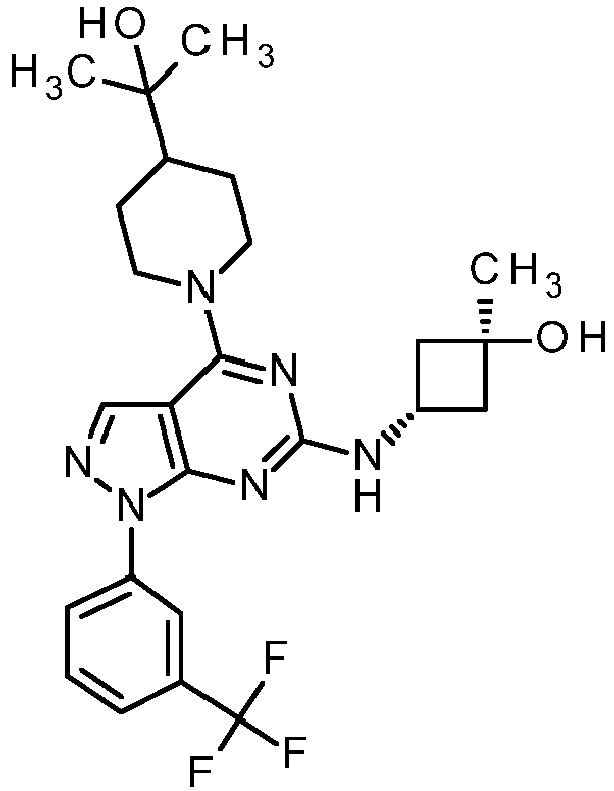
- A solution of 2-(1-{6-chloro-1-[3-(trifluoromethyl)phenyl]-1H-pyrazolo[3,4-d]pyrimidin-4-yl}piperidin-4-yl)propan-2-ol (80 mg) and trans-3-amino-1-methylcyclobutanol hydrochloride (50 mg) in NMP (2.0 ml) was treated with DIPEA (0.19 ml) and the mixture was stirred at 130°C for 16 h. Standard workup and purification by HPLC (method HT_PREP _acid) afforded 40 mg of the title compound.
LC-MS (method HTpost_acid): Rt = 1.22 min; MS (ESIpos): m/z = 505 [M+H]+
1H-NMR (500 MHz, DMSO-d6) δ [ppm]: -0.004 (7.64), 1.051 (16.00), 1.225 (0.47), 1.251 (0.54), 1.275 (4.49), 1.831 (0.63), 1.855 (0.60), 2.005 (0.62), 2.027 (0.55), 2.358 (0.72), 2.361 (0.87), 2.365 (0.71), 2.514 (1.36), 2.518 (1.28), 2.522 (1.04), 2.539 (0.56), 2.635 (0.50), 4.181 (4.70), 4.759 (1.07), 7.598 (0.70), 7.614 (0.87), 7.715 (0.46), 7.731 (0.76), 8.305 (4.39). -

- DIPEA (0.10 ml) was added to 1-{6-chloro-1-[3-(trifluoromethyl)phenyl]-1H-pyrazolo[3,4-d]-pyrimidin-4-yl}-3-ethylazetidin-3-ol (39 mg) and trans-3-(methylsulfonyl)cyclobutanamine hydrochloride (36 mg) in NMP (1.0 ml) and the mixture was stirred for 16 h at 130°C. Standard workup and purification by HPLC (method HT_PREP _acid) afforded 36 mg of the title compound.
LC-MS (method HTpost_acid): Rt = 1.09 min; MS (ESIpos): m/z = 511 [M+H]+
1H-NMR (400 MHz, DMSO-d6) δ [ppm]: 0.923 (5.24), 0.942 (12.81), 0.959 (5.89), 1.721 (1.30), 1.739 (3.96), 1.757 (3.76), 1.775 (1.16), 2.325 (0.69), 2.331 (1.00), 2.335 (0.71), 2.521 (4.31), 2.526 (3.03), 2.543 (2.14), 2.668 (1.00), 2.672 (1.43), 2.677 (1.32), 2.718 (1.78), 2.930 (14.27), 3.859 (1.05), 3.871 (1.25), 3.882 (1.01), 3.954 (1.12), 4.033 (1.21), 4.163 (1.10), 4.318 (1.19), 4.493 (0.79), 5.762 (5.69), 7.609 (2.73), 7.628 (3.82), 7.712 (2.47), 7.732 (3.93), 7.752 (1.81), 8.109 (16.00), 8.524 (0.80), 8.760 (0.91). -

- DIPEA (0.21 ml) was added to 1-{6-chloro-1-[3-(trifluoromethyl)phenyl]-1H-pyrazolo[3,4-d]-pyrimidin-4-yl}piperidin-4-ol (80 mg) and trans-3-(methylsulfonyl)cyclobutanamine hydrochloride (56 mg) in NMP (1.5 ml) and the mixture was stirred for 17 h at 130°C. Standard workup and purification by HPLC (method HT_PREP _acid) afforded 70 mg of the title compound.
LC-MS (method HTpost_acid): Rt = 1.07 min; MS (ESIpos): m/z = 511 [M+H]+
1H-NMR (400 MHz, DMSO-d6) δ [ppm]: 1.399 (0.71), 1.421 (1.72), 1.432 (1.37), 1.444 (1.80), 1.465 (0.80), 1.853 (1.64), 1.876 (1.43), 2.332 (0.56), 2.438 (1.14), 2.455 (1.32), 2.462 (1.98), 2.468 (1.61), 2.473 (2.15), 2.479 (1.93), 2.523 (2.22), 2.528 (1.41), 2.669 (0.63), 2.674 (0.88), 2.678 (0.83), 2.720 (1.49), 2.937 (16.00), 3.484 (1.41), 3.509 (2.33), 3.534 (1.45), 3.800 (0.58), 3.811 (0.95), 3.820 (1.30), 3.830 (1.31), 3.840 (1.13), 3.851 (0.92), 3.869 (0.91), 3.881 (1.05), 3.892 (0.83), 4.238 (1.36), 4.495 (0.61), 4.819 (4.93), 4.829 (4.76), 7.458 (0.76), 7.618 (1.93), 7.637 (2.72), 7.716 (2.06), 7.736 (3.27), 7.756 (1.48), 8.344 (11.15), 8.545 (0.58), 8.747 (0.52). -

- DIPEA (0.16 ml) was added to (3S,4S)-1-{6-chloro-1-[3-(trifluoromethyl)phenyl]-1H-pyrazolo-[3,4-d]pyrimidin-4-yl}-4-fluoropyrrolidin-3-ol (76 mg, crude batch) and trans-3-(methylsulfonyl)cyclobutanamine hydrochloride (42 mg) in NMP (1.5 ml) and the mixture was stirred 15.5 h at 130°C. Standard workup and purification by HPLC (method HT_PREP _acid) afforded 56 mg of the title compound.
LC-MS (method HTpost_acid): Rt = 1.08 min; MS (ESIpos): m/z = 515 [M+H]+
1H-NMR (400 MHz, DMSO-d6) δ [ppm]: 2.543 (2.72), 2.733 (3.16), 2.942 (16.00), 3.705 (0.67), 3.766 (1.47), 3.794 (1.84), 3.849 (1.90), 3.860 (1.83), 3.883 (2.90), 3.895 (2.07), 3.969 (0.91), 4.002 (1.59), 4.035 (1.53), 4.069 (1.40), 4.172 (0.55), 4.370 (0.90), 4.488 (1.51), 5.056 (0.81), 5.137 (0.92), 5.183 (0.81), 5.264 (0.91), 5.667 (0.95), 5.773 (1.16), 7.553 (0.93), 7.618 (3.14), 7.638 (4.39), 7.721 (3.37), 7.741 (5.42), 7.762 (2.50), 8.265 (14.86), 8.557 (0.91), 8.620 (0.85), 8.775 (0.91). -

- DIPEA (0.16 ml) was added to (3S,4S)-1-{6-chloro-1-[3-(trifluoromethyl)phenyl]-1H-pyrazolo-[3,4-d]pyrimidin-4-yl}-4-fluoropyrrolidin-3-ol (76 mg, crude batch) and trans-3-(ethylsulfonyl)-cyclobutanamine hydrochloride (44.8 mg) in NMP (1.5 ml) and the mixture was stirred 15.5 h at 130°C. Standard workup and purification by HPLC (method HT_PREP _acid) afforded 62 mg of the title compound.
LC-MS (method HTpost_acid): Rt = 1.12 min; MS (ESIpos): m/z = 529 [M+H]+
1H-NMR (400 MHz, DMSO-d6) δ [ppm]: 1.197 (7.27), 1.215 (16.00), 1.234 (7.52), 2.522 (3.18), 2.526 (2.16), 2.543 (1.14), 2.739 (1.47), 3.049 (1.92), 3.066 (1.89), 3.767 (0.74), 3.794 (0.92), 3.847 (0.71), 3.880 (0.64), 3.928 (1.26), 3.965 (0.63), 4.004 (0.77), 4.035 (0.72), 4.068 (0.68), 4.377 (0.45), 4.482 (0.87), 5.136 (0.46), 5.263 (0.44), 5.665 (0.55), 5.773 (0.67), 7.555 (0.49), 7.618 (1.62), 7.638 (2.20), 7.720 (1.73), 7.741 (2.71), 7.760 (1.24), 8.265 (7.38), 8.543 (0.45), 8.784 (0.45). -

- DIPEA (0.16 ml) was added to (3S,4S)-1-{6-chloro-1-[3-(trifluoromethyl)phenyl]-1H-pyrazolo[3,4-d]pyrimidin-4-yl}-4-fluoropyrrolidin-3-ol (76 mg, crude batch) and trans-3-amino-cyclobutanol hydrochloride (28 mg) in NMP (1.5 ml) and the mixture was stirred 15.5 h at 130°C. Standard workup and purification by HPLC (method HT_PREP _acid) afforded 61 mg of the title compound.
LC-MS (method HTpost_acid): Rt = 1.05 min; MS (ESIpos): m/z = 453 [M+H]+
1H-NMR (400 MHz, DMSO-d6) δ [ppm]: 2.154 (1.84), 2.185 (4.62), 2.199 (4.45), 2.296 (3.71), 2.322 (2.77), 2.327 (3.06), 2.331 (3.18), 2.336 (2.41), 2.522 (6.92), 2.527 (4.34), 2.543 (2.64), 2.669 (1.22), 2.673 (1.64), 2.678 (1.19), 3.687 (0.91), 3.756 (1.85), 3.783 (2.31), 3.852 (1.96), 3.883 (1.66), 3.930 (0.90), 3.994 (2.07), 4.026 (1.93), 4.054 (1.79), 4.091 (0.48), 4.160 (0.72), 4.188 (0.52), 4.261 (1.19), 4.333 (2.89), 4.469 (1.56), 4.983 (2.91), 5.042 (1.29), 5.129 (1.12), 5.168 (1.21), 5.257 (1.07), 5.644 (1.19), 5.757 (1.32), 7.361 (1.87), 7.602 (4.60), 7.622 (6.01), 7.725 (3.11), 7.745 (5.12), 7.765 (2.43), 8.205 (1.18), 8.240 (16.00), 8.499 (1.32), 8.989 (1.57). -

- DIPEA (0.16 ml) was added to (3S,4S)-1-{6-chloro-1-[3-(trifluoromethyl)phenyl]-1H-pyrazolo-[3,4-d]pyrimidin-4-yl}-4-fluoropyrrolidin-3-ol (76 mg, crude batch) and cis-3-aminocyclobutanol hydrochloride (28 mg) in NMP (1.5 ml) and the mixture was stirred 15.5 h at 130°C. Standard workup and purification by HPLC (method HT_PREP _acid) afforded 60 mg of the title compound.
LC-MS (method HTpost_acid): Rt = 1.06 min; MS (ESIpos): m/z = 453 [M+H]+
1H-NMR (400 MHz, DMSO-d6) δ [ppm]: 1.816 (2.06), 1.838 (5.06), 1.864 (5.29), 1.887 (2.26), 2.327 (1.42), 2.331 (1.92), 2.336 (1.41), 2.457 (1.01), 2.526 (6.18), 2.543 (2.36), 2.626 (4.23), 2.664 (2.52), 2.668 (2.87), 2.673 (2.85), 2.678 (1.97), 3.680 (0.86), 3.753 (2.06), 3.782 (2.99), 3.847 (4.97), 3.863 (4.38), 3.954 (1.21), 3.988 (2.14), 4.022 (2.10), 4.052 (1.97), 4.084 (0.51), 4.156 (0.71), 4.185 (0.47), 4.355 (1.28), 4.466 (1.39), 5.039 (2.21), 5.066 (2.42), 5.126 (1.29), 5.163 (1.38), 5.252 (1.15), 5.639 (1.44), 5.759 (1.56), 7.354 (1.73), 7.603 (4.57), 7.622 (5.88), 7.731 (2.33), 7.751 (3.63), 7.771 (1.79), 8.218 (1.38), 8.235 (16.00), 8.475 (1.44), 8.618 (0.59), 9.077 (1.79). -

- DIPEA (0.16 ml) was added to (3S,4S)-1-{6-chloro-1-[3-(trifluoromethyl)phenyl]-1H-pyrazolo-[3,4-d]pyrimidin-4-yl}-4-fluoropyrrolidin-3-ol (76 mg) and tert-butyl (4r,6s)-6-amino-1-azaspiro[3.3]heptane-1-carboxylate (48 mg) in NMP (1.5 ml) and the mixture was stirred for 15 h at 130°C. Standard workup and evaporation affo rded afforded a residue (86 mg) which was dissolved in DCM (1.5 ml). TFA (0.12 ml) was added and the mixture was stirred at RT for 16.5h. Again, TFA (0.5 ml) was added and stirring was continued for 22 h at 40°C. Purification by HPLC (method HT_PREP _bas) afforded 49 mg of the title compound.
LC-MS (method HTpost_bas): Rt = 1.46 min; MS (ESIpos): m/z = 478 [M+H]+
1H-NMR (400 MHz, DMSO-d6) δ [ppm]: 2.230 (8.80), 2.247 (7.65), 2.473 (4.94), 2.522 (12.84), 2.526 (8.74), 2.543 (6.61), 2.990 (0.52), 3.265 (9.01), 3.283 (15.94), 3.301 (11.99), 3.666 (1.93), 3.753 (2.16), 3.781 (2.64), 3.849 (1.75), 3.878 (1.59), 3.953 (1.30), 3.986 (2.28), 4.021 (2.24), 4.051 (2.12), 4.089 (0.69), 4.157 (1.90), 4.347 (1.46), 4.466 (1.50), 5.037 (1.27), 5.127 (1.21), 5.163 (1.32), 5.254 (1.19), 5.648 (0.82), 5.767 (0.80), 7.315 (1.56), 7.603 (4.14), 7.622 (5.29), 7.731 (2.29), 7.750 (3.40), 7.768 (1.73), 8.237 (16.00), 8.477 (0.81), 8.531 (1.92), 8.599 (1.08), 8.952 (1.35). -

- DIPEA (0.21 ml) was added to 6-chloro-4-(3-fluoroazetidin-1-yl)-1-[3-(trifluoromethyl)phenyl]-1H-pyrazolo[3,4-d]pyrimidine (80 mg) and trans-3-(methylsulfonyl)cyclobutanamine hydrochloride (56 mg) and the mixture was stirred for 20 h at 130°C. Standard workup and purification by HPLC (method HT_PREP _acid) afforded 67 mg of the title compound.
LC-MS (method HTpost_acid): Rt = 1.17 min; MS (ESIpos): m/z = 485 [M+H]+
1H-NMR (400 MHz, DMSO-d6) δ [ppm]: 2.079 (0.51), 2.332 (0.46), 2.545 (3.40), 2.674 (0.74), 2.679 (0.71), 2.727 (2.05), 2.932 (16.00), 3.855 (0.83), 3.867 (1.20), 3.878 (1.44), 3.890 (1.13), 3.902 (0.77), 4.489 (1.28), 4.620 (0.83), 5.521 (0.71), 5.528 (0.98), 5.535 (1.16), 5.542 (0.93), 5.671 (0.96), 5.678 (1.15), 5.685 (0.96), 5.693 (0.67), 7.617 (2.40), 7.637 (3.34), 7.719 (3.22), 7.738 (4.48), 7.758 (1.92), 8.116 (13.77), 8.519 (0.92), 8.754 (1.12). -

- DIPEA (0.32 ml) was added to 1-{6-chloro-1-[3-(trifluoromethyl)phenyl]-1H-pyrazolo[3,4-d]-pyrimidin-4-yl}piperidin-4-ol (123 mg) and trans-3-aminocyclobutanol hydrochloride (57 mg) in NMP (1.5 ml) and the mixture was stirred for 20 h at 130°C. Standard workup and purification by HPLC (method HT_PREP _acid) afforded 80 mg of the title compound.
LC-MS (method HTpost_acid): Rt = 1.06 min; MS (ESIpos): m/z = 449 [M+H]+
1H-NMR (400 MHz, DMSO-d6) δ [ppm]: 1.413 (3.92), 1.425 (3.27), 1.436 (4.11), 1.458 (1.89), 1.844 (4.00), 1.868 (3.51), 2.079 (3.23), 2.176 (4.04), 2.278 (3.96), 2.331 (1.72), 2.544 (2.20), 2.673 (1.32), 3.464 (3.06), 3.490 (5.01), 3.515 (3.15), 3.801 (2.13), 3.811 (2.79), 3.821 (2.76), 3.831 (2.08), 4.242 (4.52), 4.311 (2.86), 4.810 (8.73), 4.821 (8.60), 4.982 (5.30), 4.995 (4.76), 7.278 (2.36), 7.601 (4.20), 7.620 (5.57), 7.719 (3.04), 7.739 (4.96), 7.758 (2.35), 8.319 (16.00), 8.482 (1.36), 8.968 (1.51). -

- A solution of (3R,4R)-1-{6-chloro-1-[3-(trifluoromethyl)phenyl]-1H-pyrazolo[3,4-d]pyrimidin-4-yl}pyrrolidine-3,4-diol (80 mg) and trans-3-aminocyclobutanol hydrochloride (49.5 mg) in NMP (2.0 ml) was treated with DIPEA (0.21 ml) and the mixture was stirred at 130°C for 40 h. Standard workup and purification by HPLC (method HT_PREP _acid) afforded 34 mg of the title compound.
LC-MS (method HTpost_acid): Rt = 0.86 min; MS (ESIpos): m/z = 451 [M+H]+
1H-NMR (400 MHz, DMSO-d6) δ [ppm]: 2.149 (0.68), 2.180 (1.72), 2.193 (1.60), 2.294 (1.34), 2.322 (0.91), 2.326 (1.07), 2.331 (1.12), 2.336 (0.78), 2.522 (2.42), 2.526 (1.56), 2.668 (0.50), 2.673 (0.69), 2.678 (0.52), 3.593 (1.96), 3.621 (2.17), 3.688 (2.54), 3.719 (0.63), 3.945 (1.06), 3.954 (1.29), 3.971 (1.07), 3.982 (1.01), 4.034 (1.98), 4.159 (1.89), 4.308 (0.94), 4.323 (1.12), 7.274 (0.61), 7.592 (1.71), 7.612 (2.26), 7.718 (1.18), 7.738 (1.98), 7.758 (0.94), 8.147 (16.00), 8.212 (10.71), 8.505 (0.44), 9.001 (0.48). -
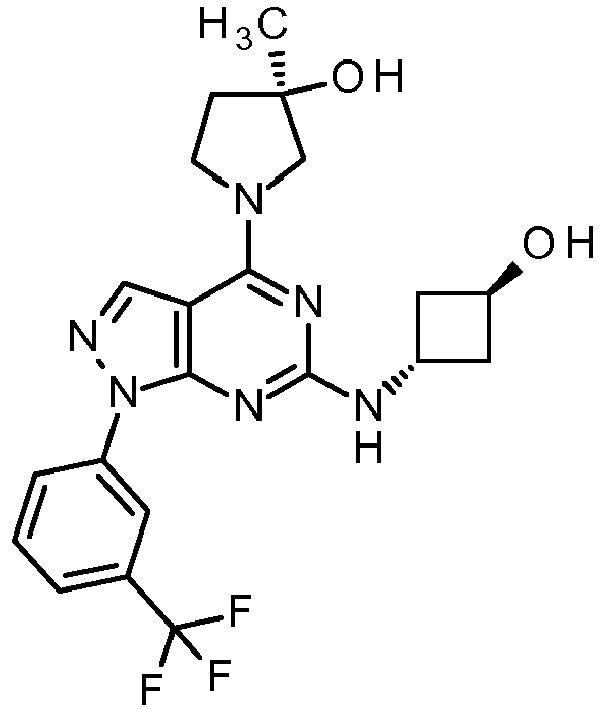
- DIPEA (0.18 ml) was added to (3R)-1-{6-chloro-1-[3-(trifluoromethyl)phenyl]-1H-pyrazolo[3,4-d]pyrimidin-4-yl}-3-methylpyrrolidin-3-ol (67.5 mg) and trans-3-aminocyclobutanol hydrochloride (31.5 mg) in NMP (1.5 ml) and the mixture was stirred for 16 h at 130°C Standard workup and purification by HPLC (method HT_PREP _acid) afforded 45 mg of the title compound.
LC-MS (method HTpost_acid): Rt = 1.07 min; MS (ESIpos): m/z = 449 [M+H]+
1H-NMR (400 MHz, DMSO-d6) δ [ppm]: 1.371 (14.18), 1.418 (16.00), 1.856 (0.99), 1.881 (1.67), 1.902 (1.94), 1.997 (1.42), 2.019 (3.80), 2.037 (2.80), 2.143 (1.94), 2.176 (4.85), 2.188 (4.61), 2.284 (3.92), 2.321 (2.21), 2.326 (2.65), 2.330 (2.89), 2.335 (2.03), 2.521 (6.68), 2.526 (4.45), 2.543 (2.52), 2.663 (0.69), 2.668 (1.59), 2.673 (2.09), 2.677 (1.53), 2.681 (0.69), 3.369 (2.01), 3.399 (1.92), 3.658 (8.92), 3.712 (2.31), 3.742 (1.85), 3.793 (1.12), 3.849 (2.93), 3.868 (3.49), 3.888 (1.59), 4.309 (2.91), 4.323 (2.68), 4.897 (6.78), 4.964 (7.81), 4.981 (4.33), 7.224 (1.64), 7.589 (5.09), 7.608 (6.73), 7.714 (3.63), 7.734 (6.04), 7.754 (2.89), 8.148 (7.17), 8.161 (1.49), 8.189 (10.03), 8.501 (1.22), 8.998 (1.33). -

- DIPEA (0.18 ml) was added to (3R)-1-{6-chloro-1-[3-(trifluoromethyl)phenyl]-1H-pyrazolo[3,4-d]pyrimidin-4-yl}-3-methylpyrrolidin-3-ol (67.5 mg) and trans-3-(methylsulfonyl)cyclobutan-amine hydrochloride (47.3 mg) in NMP (1.5 ml) and the mixture was stirred for 16 h at 130°C Standard workup and purification by HPLC (method HT_PREP _acid) afforded 43 mg of the title compound.
LC-MS (method HTpost_acid): Rt = 1.13 min; MS (ESIpos): m/z = 511 [M+H]+
1H-NMR (400 MHz, DMSO-d6) δ [ppm]: 1.377 (6.54), 1.422 (8.66), 1.868 (0.45), 1.894 (0.77), 1.910 (0.96), 2.003 (0.71), 2.025 (1.86), 2.044 (1.39), 2.325 (0.79), 2.330 (1.06), 2.335 (0.76), 2.521 (5.22), 2.526 (3.53), 2.543 (0.94), 2.667 (0.92), 2.672 (1.27), 2.677 (1.11), 2.681 (0.94), 2.721 (1.87), 2.937 (16.00), 3.376 (0.86), 3.406 (0.92), 3.667 (4.43), 3.708 (1.19), 3.738 (0.82), 3.795 (0.56), 3.860 (2.12), 3.875 (2.73), 3.897 (1.38), 4.518 (0.64), 4.915 (2.72), 4.971 (2.86), 7.416 (0.53), 7.605 (2.23), 7.624 (3.08), 7.711 (2.42), 7.731 (3.85), 7.751 (1.77), 8.175 (4.30), 8.213 (5.23), 8.563 (0.57), 8.775 (0.50). -

- DIPEA (0.15 ml) was added to tert-butyl (1-{6-chloro-1-[3-(trifluoromethyl)phenyl]-1H-pyrazolo[3,4-d]pyrimidin-4-yl}-3,3-difluoropiperidin-4-yl)carbamate (79 mg) and trans-3-aminocyclobutanol hydrochloride (26 mg) in NMP (1.5 m) and the mixture was stirred for 19.5 at 130°C. Standard workup afforded a residue, which was dissolved in DCM (2.0 ml). TFA (0.5 ml) was added and the mixture was stirred at RT for 16.5 h. Evaporation and purification by HPLC (method HT_PREP _bas) afforded 39 mg of the title compound..
LC-MS (method HTpost_bas): Rt = 1.20 min; MS (ESIpos): m/z = 484 [M+H]+
1H-NMR (400 MHz, DMSO-d6) δ [ppm]: 1.579 (1.22), 1.607 (1.28), 1.882 (2.41), 1.923 (1.94), 1.947 (1.45), 2.087 (0.41), 2.185 (2.85), 2.199 (2.83), 2.285 (2.63), 2.321 (1.57), 2.325 (1.98), 2.331 (2.16), 2.335 (1.51), 2.339 (0.70), 2.521 (5.61), 2.526 (3.83), 2.543 (2.07), 2.663 (0.54), 2.668 (1.19), 2.672 (1.70), 2.677 (1.21), 2.681 (0.52), 3.143 (0.42), 3.173 (0.53), 3.186 (0.91), 3.198 (0.98), 3.210 (0.98), 3.230 (1.04), 3.244 (0.99), 3.255 (0.89), 3.572 (1.02), 3.598 (1.70), 3.622 (1.08), 3.796 (0.91), 3.825 (1.01), 3.850 (1.00), 3.885 (1.02), 4.256 (1.72), 4.303 (1.86), 4.317 (1.85), 4.655 (1.00), 4.673 (0.96), 4.999 (5.95), 5.012 (5.29), 7.443 (1.43), 7.616 (3.40), 7.635 (4.60), 7.728 (2.35), 7.748 (3.88), 7.768 (1.84), 8.399 (16.00), 8.480 (1.08), 8.946 (1.49). -

- DIPEA (0.15 ml) was added to tert-butyl (1-{6-chloro-1-[3-(trifluoromethyl)phenyl]-1H-pyrazolo[3,4-d]pyrimidin-4-yl}-3,3-difluoropiperidin-4-yl)carbamate (79 mg) and tetrahydro-2H-thiopyran-4-amine 1,1-dioxide (31 mg) in NMP (1.5 m) and the mixture was stirred for 19.5 at 130°C. Standard workup afforded a residue, which was dissolved in DCM (2.0 ml). TFA (0.5 ml) was added and the mixture was stirred at RT for 16.5 h. Evaporation and purification by HPLC (method HT_PREP _bas) afforded 47 mg of the title compound.
LC-MS (method HTpost_bas): Rt = 1.23 min; MS (ESIpos): m/z = 546 [M+H]+
1H-NMR (400 MHz, DMSO-d6) δ [ppm]: 1.580 (1.25), 1.608 (1.38), 1.834 (3.97), 1.928 (1.57), 1.951 (1.34), 1.962 (1.36), 2.087 (2.43), 2.098 (2.40), 2.242 (2.21), 2.334 (1.41), 2.339 (0.68), 2.521 (6.51), 2.526 (4.14), 2.542 (1.46), 3.203 (5.44), 3.587 (1.05), 3.614 (1.76), 3.639 (1.14), 3.812 (1.03), 3.841 (1.13), 3.868 (1.10), 3.902 (1.12), 4.107 (0.92), 4.271 (1.06), 4.672 (0.96), 7.376 (1.05), 7.638 (2.71), 7.658 (3.45), 7.782 (1.65), 8.426 (16.00), 8.563 (1.32), 8.737 (1.06). -

- A mixture of 6-chloro-4-[3-methyl-3-(morpholin-4-yl)azetidin-1-yl]-1-[3-(trifluoromethyl)phenyl]-1 H-pyrazolo[3,4-d]pyrimidine (80 mg) and tetrahydro-2H-thiopyran-4-amine 1,1-dioxide (39.5 mg) in NMP (1.5 ml) was treated with DIPEA (0.18 ml) and the mixture was stirred for 42 h at 120°C. Standard workup and purification by HPLC (method HT_PREP _bas) afforded 67 mg of the title compound.
LC-MS (method HTpost_bas): Rt = 1.20 min; MS (ESIpos): m/z = 566 [M+H]+
1H-NMR (400 MHz, DMSO-d6) δ [ppm]: 1.331 (16.00), 1.352 (0.66), 2.074 (1.34), 2.094 (1.34), 2.113 (1.07), 2.131 (0.53), 2.223 (1.40), 2.451 (5.57), 2.518 (4.04), 2.522 (2.79), 2.539 (1.63), 3.194 (4.23), 3.617 (5.60), 3.794 (0.73), 3.815 (0.85), 3.965 (0.83), 3.985 (0.72), 4.052 (0.99), 4.072 (1.30), 4.233 (1.01), 4.254 (0.85), 7.354 (0.46), 7.616 (1.45), 7.636 (1.86), 7.750 (0.68), 7.770 (1.07), 7.789 (0.57), 8.075 (11.76), 8.578 (0.64), 8.745 (0.50). -

- A solution of (3R,4R)-1-{6-chloro-1-[3-(trifluoromethyl)phenyl]-1H-pyrazolo[3,4-d]pyrimidin-4-yl}pyrrolidine-3,4-diol (55 mg) and cis-3-amino-1-methylcyclobutanol hydrochloride (CAS number 1523606-23-6) (38 mg) in NMP (2.0 ml) was treated with DIPEA (0.14 ml) and the mixture was stirred at 130°C for 16 h. Standard wor kup and purification by HPLC (method HT_PREP _acid) afforded 29 mg of the title compound.
LC-MS (method HTpost_acid): Rt = 0.97 min; MS (ESIpos): m/z = 465 [M+H]+
1H-NMR (400 MHz, DMSO-d6) δ [ppm]: 1.283 (16.00), 2.008 (1.67), 2.035 (2.88), 2.058 (1.96), 2.322 (0.44), 2.326 (0.94), 2.331 (1.36), 2.335 (1.16), 2.340 (0.95), 2.351 (1.56), 2.369 (2.28), 2.395 (1.27), 2.522 (4.12), 2.526 (2.87), 2.668 (0.86), 2.672 (1.22), 2.677 (0.84), 3.592 (2.35), 3.619 (2.82), 3.675 (2.40), 3.887 (0.82), 3.906 (0.87), 3.943 (1.52), 3.952 (1.74), 3.969 (1.37), 3.980 (1.26), 4.032 (2.22), 4.156 (2.28), 4.922 (0.62), 5.224 (0.45), 5.329 (0.48), 7.253 (0.96), 7.594 (1.90), 7.614 (2.52), 7.716 (1.49), 7.736 (2.45), 7.756 (1.16), 8.172 (3.35), 8.210 (12.02), 8.372 (0.79), 8.390 (0.78), 9.212 (1.24). -

- A solution of (3R,4R)-1-{6-chloro-1-[3-(trifluoromethyl)phenyl]-1H-pyrazolo[3,4-d]pyrimidin-4-yl}pyrrolidine-3,4-diol (55 mg) and trans-3-amino-1-methylcyclobutanol hydrochloride (CAS number 1523571-03-0) (38 mg), in NMP (2.0 ml) was treated with DIPEA (0.14 ml) and the mixture was stirred at 130°C for 16 h. Standard wor kup and purification by HPLC (method HT_PREP _acid) afforded 31 mg of the title compound.
LC-MS (method HTpost_acid): Rt = 0.93 min; MS (ESIpos): m/z = 465 [M+H]+
1H-NMR (400 MHz, DMSO-d6) δ [ppm]: 1.281 (16.00), 2.007 (1.04), 2.022 (1.40), 2.326 (1.21), 2.331 (1.59), 2.335 (1.46), 2.340 (1.19), 2.358 (1.09), 2.521 (3.09), 2.526 (2.13), 2.543 (0.48), 2.668 (0.61), 2.672 (0.85), 2.677 (0.61), 3.591 (1.69), 3.618 (1.96), 3.688 (1.40), 3.942 (0.97), 3.952 (1.21), 3.969 (0.99), 3.980 (0.93), 4.034 (1.64), 4.161 (1.61), 4.753 (1.40), 5.223 (0.77), 5.331 (0.84), 7.218 (0.49), 7.593 (1.46), 7.613 (1.96), 7.715 (1.05), 7.735 (1.75), 7.755 (0.85), 8.207 (9.50), 8.271 (0.78), 8.569 (0.44), 8.913 (0.43). -

- DIPEA (0.22 ml) was added to 1-(1-{6-chloro-1-[3-(trifluoromethyl)phenyl]-1H-pyrazolo[3,4-d]-pyrimidin-4-yl}azetidin-3-yl)-4-methylpiperidin-4-ol (100 mg) and cis-3-aminocyclobutanol hydrochloride (53 mg) in NMP (2.0 ml) and the mixture was stirred at 130°C for 16 h. Standard workup and purification by HPLC (method HT_PREP _bas) afforded 70 mg oft he title compound.
LC-MS (method HTpost_bas): Rt = 1.10 min; MS (ESIpos): m/z = 518 [M+H]+
1H-NMR (400 MHz, DMSO-d6) δ [ppm]: 1.115 (16.00), 1.449 (0.45), 1.471 (1.85), 1.495 (4.66), 1.528 (0.54), 1.794 (0.82), 1.801 (0.63), 1.816 (1.83), 1.822 (1.77), 1.837 (1.77), 1.843 (1.91), 1.858 (0.66), 1.865 (0.87), 2.301 (1.31), 2.322 (1.21), 2.326 (1.49), 2.331 (1.62), 2.336 (1.15), 2.424 (1.28), 2.522 (2.98), 2.527 (2.09), 2.544 (0.72), 2.611 (1.35), 2.664 (0.45), 2.668 (0.79), 2.673 (1.05), 2.678 (0.75), 3.794 (0.67), 3.811 (0.93), 3.830 (1.27), 3.847 (1.19), 3.864 (0.72), 3.883 (0.43), 3.914 (0.54), 4.170 (5.58), 4.415 (0.59), 5.058 (1.04), 7.420 (0.62), 7.592 (1.56), 7.612 (1.99), 7.722 (0.86), 7.743 (1.40), 7.763 (0.66), 8.066 (7.42), 8.458 (0.55), 9.041 (0.79). -

- DIPEA (0.17 ml) was added to 1-(1-{6-chloro-1-[3-(trifluoromethyl)phenyl]-1H-pyrazolo[3,4-d]-pyrimidin-4-yl}azetidin-3-yl)-4-methylpiperidin-4-ol (80 mg) and trans-3-amino-1-methylcyclobutanol hydrochloride (CAS number 1523571-03-0) (34 mg) in NMP (1.5 ml) and the mixture was stirred at 130°C for 15 h. Standard workup and purification by HPLC (method HT_PREP _acid) afforded 53 mg of the title compound.
LC-MS (method HTpost_acid): Rt = 0.81 min; MS (ESIpos): m/z = 532 [M+H]+
1H-NMR (400 MHz, DMSO-d6) δ [ppm]: 1.115 (12.94), 1.272 (16.00), 1.472 (1.50), 1.496 (3.91), 1.528 (0.47), 2.013 (1.16), 2.029 (1.15), 2.042 (1.04), 2.307 (1.42), 2.327 (1.72), 2.331 (1.87), 2.336 (1.64), 2.426 (1.09), 2.522 (2.30), 2.527 (1.35), 2.673 (0.47), 3.345 (4.10), 3.922 (0.43), 4.170 (1.40), 4.308 (0.43), 4.413 (0.52), 4.747 (0.71), 7.373 (0.50), 7.593 (1.24), 7.612 (1.63), 7.712 (0.94), 7.732 (1.53), 7.752 (0.72), 8.065 (6.46), 8.159 (1.98), 8.538 (0.49), 8.871 (0.59). -

- DIPEA (0.17 ml) was added to 1-(1-{6-chloro-1-[3-(trifluoromethyl)phenyl]-1H-pyrazolo[3,4-d]-pyrimidin-4-yl}azetidin-3-yl)-4-methylpiperidin-4-ol (80 mg) and cis-3-amino-1-methylcyclo-butanol (34 mg) in NMP (1.5 ml) and the mixture was stirred at 130°C for 15 h. Standard workup and purification by HPLC (method HT_PREP _acid) afforded 62 mg of the title compound.
LC-MS (method HTpost_acid): Rt = 0.84 min; MS (ESIpos): m/z = 532 [M+H]+
1H-NMR (400 MHz, DMSO-d6) δ [ppm]: 1.115 (16.00), 1.274 (10.31), 1.450 (0.45), 1.471 (1.84), 1.496 (4.76), 1.529 (0.57), 1.992 (1.21), 2.014 (2.18), 2.019 (2.27), 2.041 (1.41), 2.303 (1.42), 2.327 (1.88), 2.331 (2.31), 2.336 (2.19), 2.355 (1.96), 2.374 (1.17), 2.425 (1.30), 2.522 (2.21), 2.527 (1.52), 2.669 (0.42), 2.673 (0.58), 2.678 (0.42), 3.332 (5.12), 3.861 (0.75), 3.878 (0.89), 3.895 (0.84), 4.169 (1.65), 4.413 (0.58), 4.918 (0.73), 7.411 (0.92), 7.424 (0.89), 7.591 (1.54), 7.610 (2.05), 7.710 (1.31), 7.730 (2.15), 7.750 (1.01), 8.065 (8.06), 8.154 (3.30), 8.346 (0.82), 8.367 (0.80), 9.164 (1.37). -

- DIPEA (0.19 ml) was added to 1-(1-{6-chloro-1-[3-(trifluoromethyl)phenyl]-1H-pyrazolo[3,4-d]-pyrimidin-4-yl}azetidin-3-yl)pyrrolidin-2-one (80 mg) und cis-3-aminocyclobutanol hydrochloride (45 mg) in NMP (1.5 ml) and the mixture was stirred at 130°C for 16 h. Standard workup and purification by HPLC (method HT_PREP _acid) afforded 35 mg of the title compound.
LC-MS (method HTpost_acid): Rt = 1.05 min; MS (ESIpos): m/z = 488 [M+H]+
1H-NMR (400 MHz, DMSO-d6) δ [ppm]: 1.797 (1.12), 1.803 (1.02), 1.818 (2.81), 1.824 (2.73), 1.840 (2.73), 1.845 (2.94), 1.860 (1.10), 1.867 (1.23), 1.946 (0.86), 1.966 (2.90), 1.984 (4.62), 2.004 (3.33), 2.021 (1.20), 2.078 (2.13), 2.269 (5.12), 2.289 (8.04), 2.309 (3.87), 2.321 (0.57), 2.326 (0.94), 2.331 (1.27), 2.335 (0.92), 2.521 (4.92), 2.526 (3.13), 2.615 (2.26), 2.663 (0.69), 2.668 (1.09), 2.672 (1.33), 2.677 (0.93), 3.575 (3.57), 3.592 (6.16), 3.609 (3.52), 3.799 (1.12), 3.816 (1.49), 3.834 (1.92), 3.850 (1.76), 3.867 (0.97), 4.363 (0.79), 4.519 (0.85), 5.059 (2.28), 5.073 (3.05), 5.088 (2.24), 5.103 (1.20), 5.122 (0.45), 7.498 (1.16), 7.600 (2.66), 7.619 (3.43), 7.729 (1.57), 7.749 (2.49), 7.769 (1.19), 8.054 (16.00), 8.443 (1.05), 8.461 (1.05), 9.041 (1.56). -

- DIPEA (0.19 ml) was added to 1-(1-{6-chloro-1-[3-(trifluoromethyl)phenyl]-1H-pyrazolo[3,4-d]-pyrimidin-4-yl}azetidin-3-yl)pyrrolidin-2-one (80 mg) und trans-3-aminocyclobutanol hydrochloride (45 mg) in NMP (1.5 ml) and the mixture was stirred for 16.5 h at 130°C. Standard workup and purification by HPLC (method HT_PREP _acid) afforded 36 mg of the title compound.
LC-MS (method HTpost_acid): Rt = 1.04 min; MS (ESIpos): m/z = 488 [M+H]+
1H-NMR (400 MHz, DMSO-d6) δ [ppm]: 1.948 (0.84), 1.967 (2.83), 1.986 (4.48), 2.005 (3.25), 2.022 (1.18), 2.170 (2.47), 2.184 (2.46), 2.270 (6.94), 2.291 (9.94), 2.311 (5.02), 2.326 (1.16), 2.331 (1.11), 2.336 (0.77), 2.522 (3.45), 2.527 (2.15), 2.669 (0.51), 2.673 (0.72), 2.678 (0.52), 3.578 (3.49), 3.596 (6.02), 3.613 (3.43), 4.241 (1.16), 4.274 (1.10), 4.289 (1.72), 4.304 (2.45), 4.319 (2.34), 4.334 (1.59), 4.517 (0.87), 4.977 (2.35), 4.989 (2.10), 5.058 (0.58), 5.077 (1.32), 5.092 (2.01), 5.107 (1.14), 5.112 (1.14), 5.126 (0.45), 7.509 (1.22), 7.598 (2.72), 7.618 (3.59), 7.722 (2.06), 7.742 (3.40), 7.762 (1.62), 8.057 (16.00), 8.481 (1.04), 8.963 (1.49). -

- A solution of 1-{6-chloro-1-[3-(trifluoromethyl)phenyl]-1H-pyrazolo[3,4-d]pyrimidin-4-yl}-4-(pyrrolidin-1-ylmethyl)piperidin-4-ol (90 mg) and cis-3-aminocyclobutanol hydrochloride (46 mg) in NMP (2.0 ml) was treated with DIPEA (0.20 ml) and the mixture was stirred at 130°C for 16 h. Standard workup and purification by HPLC (method HT_PREP _bas) afforded 68 mg of the title compound
LC-MS (method HTpost_bas): Rt = 1.36 min; MS (ESIpos): m/z = 532 [M+H]+
1H-NMR (400 MHz, DMSO-d6) δ [ppm]: 1.591 (7.57), 1.640 (14.61), 1.795 (1.58), 1.802 (1.40), 1.817 (3.64), 1.824 (3.51), 1.838 (3.55), 1.845 (3.78), 1.860 (1.43), 1.866 (1.64), 2.326 (1.47), 2.330 (2.02), 2.335 (1.45), 2.444 (15.49), 2.521 (7.28), 2.526 (4.93), 2.561 (13.19), 2.614 (2.71), 2.668 (1.87), 2.672 (2.24), 2.677 (1.64), 3.130 (0.60), 3.495 (1.49), 3.789 (1.32), 3.805 (1.69), 3.823 (2.07), 3.841 (2.67), 3.858 (2.49), 3.875 (1.30), 3.894 (0.42), 4.330 (4.15), 5.063 (1.69), 7.250 (1.25), 7.598 (3.23), 7.617 (4.26), 7.723 (1.74), 7.743 (2.85), 7.762 (1.43), 8.308 (0.53), 8.323 (16.00), 8.457 (0.93), 9.062 (1.13). -

- A solution of 4-(1-{6-chloro-1-[3-(trifluoromethyl)phenyl]-1H-pyrazolo[3,4-d]pyrimidin-4-yl}-azetidin-3-yl)piperazin-2-one (80 mg) and cis-3-aminocyclobutanol hydrochloride (44 mg) in NMP (2.0 ml) was treated with DIPEA (0.19 ml) and the mixture was stirred at 130°C for 16 h. Standard workup and purification by HPLC (method HT_PREP _acid) afforded 26 mg of the title compound.
LC-MS (method HTpost_acid): Rt = 0.96 min; MS (ESIpos): m/z = 503 [M+H]+
1H-NMR (400 MHz, DMSO-d6) δ [ppm]: 1.797 (1.65), 1.804 (1.35), 1.819 (3.87), 1.825 (3.73), 1.840 (3.73), 1.847 (4.05), 1.861 (1.47), 1.868 (1.81), 2.326 (1.04), 2.331 (1.46), 2.336 (1.06), 2.522 (5.15), 2.526 (3.22), 2.543 (0.86), 2.611 (5.97), 2.664 (1.07), 2.668 (1.45), 2.672 (1.75), 2.678 (1.27), 3.010 (9.18), 3.205 (5.60), 3.451 (0.68), 3.469 (1.69), 3.481 (2.68), 3.493 (1.72), 3.511 (0.74), 3.813 (1.86), 3.832 (2.36), 3.847 (2.10), 3.864 (1.25), 3.988 (1.02), 4.203 (1.25), 4.303 (1.39), 4.435 (1.28), 5.057 (2.04), 7.448 (1.34), 7.595 (3.40), 7.614 (4.27), 7.724 (1.92), 7.745 (3.01), 7.764 (1.41), 7.829 (5.56), 8.056 (16.00), 8.209 (0.42), 8.462 (1.22), 9.041 (1.71). -

- A solution of 2-(1-{6-chloro-1-[3-(trifluoromethyl)phenyl]-1H-pyrazolo[3,4-d]pyrimidin-4-yl}-azetidin-3-yl)propan-2-ol (80 mg) and cis-3-aminocyclobutanol hydrochloride (48 mg) in NMP (1.5 ml) was treated with DIPEA (0.20 ml) and the mixture was stirred at 130°C for 16 h. Standard workup and purification by HPLC (method HT_PREP _acid) afforded 17 mg of the title compound.
1H-NMR (400 MHz, DMSO-d6) δ [ppm]: -0.008 (1.56), 0.008 (1.56), 1.100 (16.00), 1.795 (0.95), 1.817 (2.49), 1.843 (2.67), 1.865 (1.07), 2.326 (0.83), 2.331 (1.15), 2.335 (0.83), 2.521 (3.93), 2.526 (2.59), 2.543 (3.00), 2.608 (2.15), 2.663 (0.57), 2.668 (0.97), 2.673 (1.26), 2.677 (0.91), 2.681 (0.43), 2.763 (0.51), 2.782 (1.32), 2.799 (2.01), 2.818 (1.38), 2.836 (0.53), 3.804 (1.13), 3.821 (1.80), 3.840 (2.19), 3.858 (1.46), 3.876 (0.55), 4.051 (2.35), 4.268 (1.76), 4.284 (1.58), 4.298 (1.44), 4.319 (1.70), 4.339 (0.65), 4.613 (1.05), 5.057 (0.61), 7.377 (0.97), 7.589 (2.53), 7.608 (3.26), 7.721 (1.40), 7.741 (2.27), 7.761 (1.09), 8.070 (14.18), 8.152 (11.69), 8.461 (0.85), 9.050 (1.17). -

- A solution of (3R)-1-{6-chloro-1-[3-(trifluoromethyl)phenyl]-1H-pyrazolo[3,4-d]pyrimidin-4-yl}-pyrrolidin-3-ol (80.0 mg) and cis-3-aminocyclobutanol hydrochloride (51.5 mg) in NMP (2.0 ml) was treated with DIPEA (0.22 ml) and the mixture was stirred at 130°C for 16 h. Standard workup and purification by HPLC (method HT_PREP _acid) afforded 59 mg of the title compound.
LC-MS (method HTpost_acid): Rt = 0.98 min; MS (ESIpos): m/z = 435 [M+H]+
1H-NMR (400 MHz, DMSO-d6) δ [ppm]: -0.149 (0.43), 1.809 (5.01), 1.832 (12.35), 1.857 (13.27), 1.880 (6.71), 1.974 (2.77), 1.999 (3.81), 2.030 (3.76), 2.078 (9.48), 2.119 (2.90), 2.141 (2.43), 2.331 (3.11), 2.544 (3.69), 2.620 (10.08), 2.668 (4.30), 2.673 (4.23), 3.585 (5.91), 3.610 (7.61), 3.654 (5.62), 3.825 (15.14), 3.842 (16.00), 3.859 (12.82), 3.875 (8.77), 4.375 (5.11), 4.501 (4.04), 5.032 (9.21), 5.053 (7.03), 5.139 (5.42), 7.250 (3.43), 7.591 (10.37), 7.610 (13.55), 7.722 (5.66), 7.742 (9.04), 7.761 (4.62), 8.154 (10.55), 8.196 (13.56), 8.478 (3.05), 8.633 (1.36), 9.095 (3.57). -

- A solution of 6-chloro-4-[3-(3,3-difluoropyrrolidin-1-yl)azetidin-1-yl]-1-[3-(trifluoromethyl)-phenyl]-1H-pyrazolo[3,4-d]pyrimidine (80 mg) and cis-3-aminocyclobutanol hydrochloride (43 mg) in NMP (3.0 ml) was treated with DIPEA (0.18 ml) and the mixture was stirred at 130°C for 16 h. Standard workup and purification by HPLC (method HT_PREP _acid) afforded 11 mg of the title compound.
1H-NMR (400 MHz, DMSO-d6) δ [ppm]: 1.792 (1.61), 1.799 (1.35), 1.814 (3.87), 1.820 (3.80), 1.836 (3.80), 1.842 (4.13), 1.857 (1.46), 1.864 (1.75), 2.240 (1.06), 2.257 (2.19), 2.277 (2.70), 2.295 (4.31), 2.312 (2.89), 2.322 (2.52), 2.327 (3.07), 2.331 (3.32), 2.350 (1.06), 2.518 (8.07), 2.522 (5.19), 2.539 (0.80), 2.608 (3.07), 2.659 (1.10), 2.664 (1.79), 2.669 (2.26), 2.673 (1.68), 2.776 (4.68), 2.793 (8.66), 2.811 (4.02), 2.981 (1.72), 3.012 (3.11), 3.041 (1.72), 3.572 (0.62), 3.633 (2.52), 3.792 (1.42), 3.809 (2.01), 3.827 (2.70), 3.844 (2.48), 3.861 (1.39), 4.006 (0.95), 4.207 (1.17), 4.311 (1.28), 4.417 (1.13), 5.053 (2.41), 5.066 (2.16), 7.432 (1.42), 7.592 (3.47), 7.612 (4.46), 7.722 (1.94), 7.742 (3.03), 7.761 (1.46), 8.040 (16.00), 8.455 (1.28), 9.036 (1.79). -

- A solution of 6-chloro-4-(3-fluoro[1,3'-biazetidin]-1'-yl)-1-[3-(trifluoromethyl)phenyl]-1H-pyrazolo[3,4-d]pyrimidine (50 mg) and trans-3-aminocyclobutanol hydrochloride (29 mg) in NMP (2.0 ml) was treated with DIPEA (0.12 ml) and the mixture was stirred at 130°C for 16 h. Standard workup and purification by HPLC (water + 0.1% formic acid / acetonitrile) afforded 11 mg of the title compound.
1H-NMR (400 MHz, DMSO-d6) δ [ppm]: 0.000 (2.93), 1.232 (1.34), 1.713 (0.48), 2.164 (3.51), 2.180 (3.25), 2.283 (3.03), 2.326 (1.98), 2.331 (2.36), 2.335 (1.69), 2.521 (8.13), 2.526 (5.23), 2.668 (1.43), 2.672 (1.94), 2.677 (1.37), 2.716 (1.02), 3.250 (2.77), 3.590 (2.10), 3.604 (2.84), 3.629 (3.03), 3.646 (2.80), 3.669 (2.01), 3.696 (0.83), 3.707 (1.66), 3.724 (3.03), 3.735 (2.14), 3.752 (1.05), 3.869 (1.02), 4.188 (1.98), 4.307 (2.58), 4.389 (1.12), 4.978 (1.53), 5.141 (1.24), 5.152 (1.88), 5.164 (1.18), 5.285 (1.18), 5.297 (1.78), 5.311 (1.18), 7.429 (1.43), 7.593 (3.44), 7.613 (4.69), 7.717 (2.55), 7.736 (4.24), 7.757 (2.04), 7.894 (0.41), 8.061 (16.00), 8.407 (0.67), 8.422 (0.80), 8.479 (1.27), 8.956 (1.66). -

- A solution of 6-chloro-4-(3-fluoro[1,3'-biazetidin]-1'-yl)-1-[3-(trifluoromethyl)phenyl]-1H-pyrazolo[3,4-d]pyrimidine (50 mg) and trans-3-amino-1-methylcyclobutanol hydrochloride (CAS number 1523571-03-0) (32 mg) in NMP (2.0 ml) was treated with DIPEA (0.12 ml) and the mixture was stirred at 130°C for 16 h. Standard workup and purification by HPLC (water + 0.1% formic acid / acetonitrile) afforded 14 mg of the title compound.
1H-NMR (400 MHz, DMSO-d6) δ [ppm]: 1.229 (0.52), 1.237 (0.40), 1.268 (16.00), 2.007 (1.23), 2.022 (1.23), 2.037 (1.08), 2.323 (1.32), 2.327 (1.69), 2.332 (1.45), 2.337 (1.08), 2.350 (0.94), 2.518 (3.59), 2.523 (2.39), 2.665 (0.69), 2.669 (0.93), 2.674 (0.65), 2.713 (0.46), 3.243 (1.04), 3.586 (0.76), 3.601 (1.07), 3.626 (1.14), 3.642 (1.05), 3.665 (0.72), 3.703 (0.65), 3.709 (0.75), 3.720 (1.20), 3.730 (0.82), 3.737 (0.75), 4.175 (0.69), 4.307 (0.53), 4.378 (0.43), 4.747 (1.45), 5.136 (0.47), 5.149 (0.73), 5.160 (0.44), 5.281 (0.47), 5.293 (0.72), 5.307 (0.44), 7.371 (0.52), 7.591 (1.31), 7.611 (1.71), 7.710 (0.99), 7.730 (1.57), 7.750 (0.72), 8.053 (6.52), 8.405 (0.43), 8.420 (0.47), 8.531 (0.52), 8.865 (0.61). -

- A solution of 4-(1-{6-chloro-1-[3-(trifluoromethyl)phenyl]-1H-pyrazolo[3,4-d]pyrimidin-4-yl}-azetidin-3-yl)morpholin-3-one (80 mg) and cis-3-aminocyclobutanol hydrochloride (44 mg) in NMP (3.0 ml) was treated with DIPEA (0.18 ml) and the mixture was stirred at 130°C for 16 h. Standard workup and purification by HPLC (method HT_PREP _acid) afforded 38 mg of the title compound.
1H-NMR (400 MHz, DMSO-d6) δ [ppm]: 1.798 (0.87), 1.804 (0.79), 1.819 (2.13), 1.825 (2.07), 1.841 (2.09), 1.846 (2.23), 1.862 (0.85), 1.868 (0.91), 2.326 (0.63), 2.331 (0.89), 2.336 (0.65), 2.522 (3.69), 2.526 (2.33), 2.544 (0.41), 2.616 (1.76), 2.664 (0.59), 2.668 (0.83), 2.673 (1.01), 2.678 (0.73), 3.580 (2.94), 3.593 (5.19), 3.605 (3.45), 3.800 (0.87), 3.817 (1.16), 3.835 (1.54), 3.852 (1.48), 3.870 (1.07), 3.885 (2.98), 3.897 (4.04), 3.909 (2.51), 4.097 (16.00), 4.350 (0.73), 4.569 (0.77), 5.064 (1.52), 5.076 (1.36), 5.417 (1.01), 7.503 (0.93), 7.600 (2.05), 7.619 (2.62), 7.729 (1.16), 7.750 (1.89), 7.769 (0.89), 8.053 (11.27), 8.445 (0.83), 8.461 (0.81), 9.041 (1.24). -

- A solution of 4-(1-{6-chloro-1-[3-(trifluoromethyl)phenyl]-1H-pyrazolo[3,4-d]pyrimidin-4-yl}-azetidin-3-yl)morpholin-3-one (80 mg) and trans-3-amino-1-methylcyclobutanol hydrochloride (CAS number 1523571-03-0) (36.5 mg) in NMP (3.0 ml) was treated with DIPEA (0.19 ml) and the mixture was stirred at 130°C for 16 h. Stan dard workup and purification by HPLC (method HT_PREP _acid) afforded 31 mg of the title compound.
1H-NMR (400 MHz, DMSO-d6) δ [ppm]: 1.271 (16.00), 1.304 (0.48), 2.000 (1.04), 2.014 (1.28), 2.030 (1.28), 2.045 (1.20), 2.323 (0.93), 2.327 (1.24), 2.331 (1.19), 2.336 (1.01), 2.359 (1.01), 2.518 (2.28), 2.523 (1.49), 2.664 (0.47), 2.669 (0.64), 2.673 (0.47), 3.580 (1.93), 3.592 (3.37), 3.605 (2.25), 3.881 (1.79), 3.894 (2.56), 3.906 (1.59), 4.093 (10.69), 4.304 (0.71), 4.561 (0.51), 4.754 (4.05), 5.418 (0.59), 7.460 (0.57), 7.597 (1.33), 7.616 (1.70), 7.716 (0.99), 7.736 (1.60), 7.756 (0.77), 8.049 (8.48), 8.512 (0.53), 8.529 (0.56), 8.874 (0.76). -
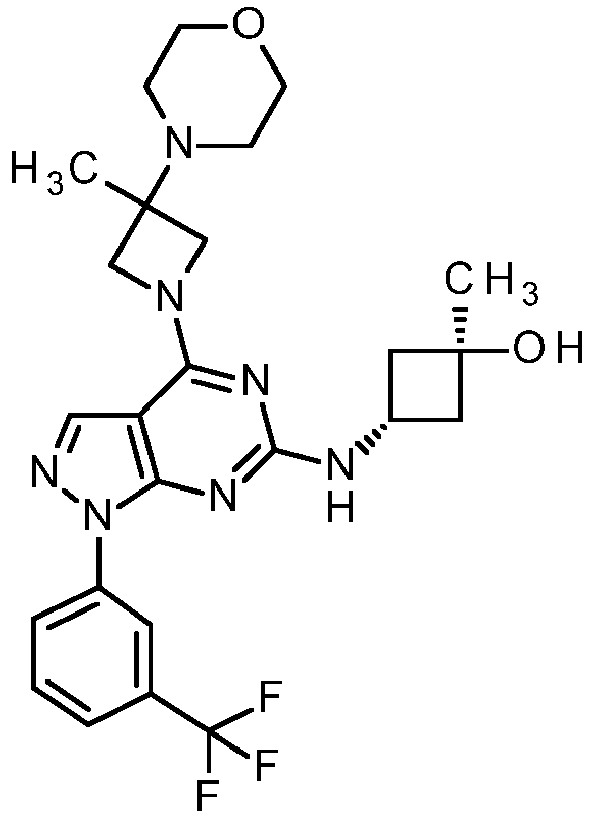
- A solution of 6-chloro-4-[3-methyl-3-(morpholin-4-yl)azetidin-1-yl]-1-[3-(trifluoromethyl)-phenyl]-1H-pyrazolo[3,4-d]pyrimidine (75 mg) and trans-3-amino-1-methylcyclobutanol hydrochloride (CAS number 1523571-03-0) (CAS number 1523571-03-0) (34 mg) in NMP (2.8 ml) was treated with DIPEA (0.17 ml) and the mixture was stirred at 130°C for 16 h. Standard workup and purification by HPLC (method HT_PREP _acid) afforded 18 mg of the title compound.
1H-NMR (400 MHz, DMSO-d6) δ [ppm]: 1.269 (16.00), 1.327 (12.84), 2.011 (1.24), 2.037 (1.09), 2.322 (1.17), 2.327 (1.48), 2.331 (1.36), 2.354 (0.96), 2.447 (4.52), 2.518 (2.97), 2.522 (1.94), 2.539 (1.68), 2.664 (0.57), 2.669 (0.77), 2.673 (0.57), 3.613 (4.77), 3.796 (0.60), 3.948 (0.61), 4.039 (0.69), 4.057 (0.75), 4.213 (0.73), 4.232 (0.62), 4.745 (2.46), 7.376 (0.54), 7.593 (1.32), 7.612 (1.74), 7.711 (0.99), 7.731 (1.62), 7.752 (0.75), 8.045 (7.43), 8.534 (0.53), 8.871 (0.65). -

- A solution of (3S)-1-{6-chloro-1-[3-(trifluoromethyl)phenyl]-1H-pyrazolo[3,4-d]pyrimidin-4-yl}-3-methylpyrrolidin-3-ol (65 mg) and cis-3-aminocyclobutanol hydrochloride (40 mg) in NMP (2.0 ml) was treated with DIPEA (0.17 ml) and the mixture was stirred at 130°C for 16 h. Standard workup and purification by HPLC (method HT_PREP _acid) afforded 51 mg of the title compound.
LC-MS (method HTpost_acid): Rt = 1.02 min; MS (ESIpos): m/z = 449 [M+H]+
1H-NMR (400 MHz, DMSO-d6) δ [ppm]: 1.370 (15.28), 1.417 (16.00), 1.809 (1.94), 1.830 (5.26), 1.852 (6.21), 1.876 (3.58), 1.895 (2.06), 1.995 (1.52), 2.017 (3.95), 2.035 (2.89), 2.326 (1.21), 2.331 (1.60), 2.336 (1.18), 2.522 (5.99), 2.526 (3.82), 2.544 (1.93), 2.616 (4.27), 2.664 (1.52), 2.668 (1.86), 2.673 (2.02), 2.678 (1.42), 3.657 (9.08), 3.701 (1.92), 3.733 (1.48), 3.844 (6.65), 3.864 (6.12), 4.895 (4.30), 4.963 (3.66), 5.058 (2.52), 7.208 (1.32), 7.589 (4.86), 7.609 (6.30), 7.720 (2.56), 7.739 (4.13), 7.759 (2.02), 8.144 (6.65), 8.184 (9.14), 8.223 (0.44), 8.473 (1.29), 8.633 (0.57), 9.089 (1.52). -

- DIPEA (0.20 ml) was added to 6-chloro-1-[3-(difluoromethyl)phenyl]-4-[3-(morpholin-4-yl)-azetidin-1-yl]-1H-pyrazolo[3,4-d]pyrimidine (80 mg, 0.19 mmol) and (4S)-4-aminopyrrolidin-2-one hydrochloride (51.9 mg, 0.38 mmol) in NMP (2.1 ml) and the mixture was stirred at 130°C for 20 h. The mixture was treated with water and ethyl acetate, the precipitated solid was separated by filtration, washed with water and 2-methoxy-2-methylpropane and dried to afford 28.0 mg of the title compound.
1H-NMR (400 MHz, DMSO-d6) δ [ppm]: 2.288 (1.33), 2.327 (3.69), 2.553 (2.16), 2.669 (2.10), 3.199 (1.63), 3.361 (4.32), 3.625 (15.73), 3.990 (1.16), 4.186 (1.43), 4.263 (1.60), 4.429 (1.40), 4.522 (0.50), 4.536 (1.36), 4.554 (2.30), 4.571 (2.23), 4.587 (1.26), 6.991 (2.23), 7.131 (4.56), 7.270 (2.10), 7.438 (4.59), 7.457 (5.79), 7.616 (7.92), 7.648 (3.36), 7.667 (1.73), 8.069 (16.00), 8.415 (1.33), 8.538 (0.77), 8.605 (1.13). -

- DIPEA (0.20 ml) was added to 6-chloro-1-[3-(difluoromethyl)phenyl]-4-[3-(morpholin-4-yl)-azetidin-1-yl]-1H-pyrazolo[3,4-d]pyrimidine (80 mg, 0.19 mmol) and tetrahydro-2H-thiopyran-4-amine 1,1-dioxide (56.7 mg, 0.38 mmol) in NMP (2.1 ml) and the mixture was stirred at 130°C for 20 h. Standard workup and purification by HPLC (method HT_PREP _acid) afforded 38 mg of the title compound.
LC-MS (method HTpost_acid): Rt = 0.81 min; MS (ESIpos): m/z = 534 [M+H]+
1H-NMR (400 MHz, DMSO-d6) δ [ppm]: 0.934 (0.56), 0.951 (0.56), 2.024 (0.61), 2.050 (1.89), 2.073 (3.00), 2.100 (1.00), 2.232 (1.89), 2.318 (0.78), 2.322 (1.50), 2.326 (2.00), 2.331 (1.44), 2.336 (0.78), 2.402 (5.94), 2.518 (7.22), 2.522 (4.72), 2.664 (1.50), 2.668 (1.83), 2.673 (1.33), 2.678 (0.67), 2.838 (0.44), 2.849 (0.44), 3.150 (1.11), 3.191 (4.67), 3.226 (2.56), 3.254 (0.94), 3.262 (0.89), 3.376 (2.22), 3.625 (8.50), 3.992 (0.72), 4.124 (1.06), 4.191 (0.89), 4.265 (0.94), 4.422 (0.78), 7.020 (0.89), 7.160 (1.72), 7.299 (1.39), 7.445 (2.56), 7.465 (2.94), 7.645 (1.17), 7.665 (1.89), 7.684 (0.94), 8.039 (0.61), 8.063 (16.00), 8.422 (0.83), 8.620 (0.67). -

- DIPEA (0.20 ml) was added to 6-chloro-1-[3-(difluoromethyl)phenyl]-4-[3-(morpholin-4-yl)-azetidin-1-yl]-1H-pyrazolo[3,4-d]pyrimidine (80 mg, 0.18 mmol, 1 eq.) and (3S)tetrahydrothiophen-3-amine 1,1-dioxide hydrochloride (65.3 mg, 0.38 mmol) in NMP (2.1 ml) and the mixture was stirred at 130°C for 20 h. Then 1 eq. of (3S)tetrahydrothiophen-3-amine 1,1-dioxide hydrochloride and 3 eq. DIPEA were added and the mixture was stirred at 130°C for 20 h. Standard workup and purification by HPLC (method HT_PREP _acid) afforded 18 mg of the title compound.
LC-MS (method HTpost_acid): Rt = 1.12 min; MS (ESIneg): m/z = 518 [M-H]-
1H-NMR (400 MHz, DMSO-d6) δ [ppm]: 2.185 (0.40), 2.206 (1.13), 2.219 (0.71), 2.227 (1.30), 2.239 (1.55), 2.260 (1.53), 2.281 (0.63), 2.336 (0.55), 2.406 (5.80), 2.459 (1.15), 2.518 (5.23), 2.522 (3.51), 2.539 (0.67), 2.837 (0.44), 2.849 (0.42), 3.033 (1.66), 3.106 (0.97), 3.127 (1.66), 3.148 (1.68), 3.160 (1.53), 3.168 (1.20), 3.181 (2.20), 3.202 (1.36), 3.380 (5.54), 3.414 (1.53), 3.523 (1.76), 3.542 (1.93), 3.556 (1.68), 3.575 (1.66), 3.625 (8.48), 4.002 (0.71), 4.198 (0.86), 4.283 (0.92), 4.438 (0.86), 4.618 (0.97), 4.634 (1.66), 4.653 (1.60), 4.669 (0.88), 6.990 (2.39), 7.129 (5.06), 7.268 (2.14), 7.455 (2.56), 7.474 (3.04), 7.545 (0.52), 7.629 (1.85), 7.648 (3.04), 7.668 (1.51), 8.038 (0.52), 8.091 (16.00), 8.278 (0.82), 8.399 (0.67), 8.549 (0.50). -

- DIPEA (0.16 ml) was added to 2-(1-{6-chloro-1-[3-(difluoromethyl)phenyl]-1H-pyrazolo[3,4-d]-pyrimidin-4-yl}piperidin-4-yl)propan-2-ol (65.0 mg, 0.15 mmol) and (3S)-1-methylpyrrolidin-3-amine dihydrochloride (53.3 mg, 0.31 mmol) in NMP (1.9 ml) and the mixture was stirred at 130°C for 16 h. Standard workup and purification by HPLC (method HT_PREP_bas) afforded 17.0 mg of the title compound.
LC-MS (method HTpost_bas): Rt = 1.28 min; MS (ESIneg): m/z = 484 [M-H]-
1H-NMR (400 MHz, DMSO-d6) δ [ppm]: 1.051 (16.00), 1.226 (0.50), 1.257 (0.51), 1.551 (0.42), 1.829 (0.72), 1.859 (0.65), 2.235 (11.59), 2.302 (0.55), 2.422 (0.55), 2.518 (1.80), 2.523 (1.44), 2.798 (0.52), 4.181 (3.46), 6.982 (0.81), 7.121 (1.34), 7.261 (0.57), 7.432 (0.79), 7.451 (0.93), 7.640 (0.68), 8.286 (3.87). -

- A solution of 2-(1-{6-chloro-1-[3-(difluoromethyl)phenyl]-1H-pyrazolo[3,4-d]pyrimidin-4-yl}-piperidin-4-yl)propan-2-ol (65.0 mg, 0.15 mol) and tetrahydro-2H-thiopyran-4-amine 1,1-dioxide (46.0 mg, 0.31 mmol) in NMP (2.0 ml) was treated with DIPEA (0.16 ml) and the mixture was stirred at 130°C for 16 h. 1 eq. tetrah ydro-2H-thiopyran-4-amine 1,1-dioxide and 3 eq. DIPEA were added and the mixture was stirred at 130°C for 20 h. Standard workup and purification by HPLC (method HT_PREP_bas) afforded 43.0 mg of the title compound.
LC-MS (method HTpost_bas): Rt = 1.15 min; MS (ESIpos): m/z = 535 [M+H]+
1H-NMR (400 MHz, DMSO-d6) δ [ppm]: 1.054 (16.00), 1.231 (0.65), 1.254 (0.63), 1.262 (0.60), 1.555 (0.47), 1.836 (0.77), 1.866 (0.70), 2.054 (0.59), 2.074 (0.95), 2.078 (0.70), 2.243 (0.51), 2.518 (1.68), 2.523 (1.06), 3.190 (1.00), 4.188 (5.26), 7.158 (0.73), 7.451 (0.82), 7.470 (0.99), 7.662 (0.55), 8.308 (4.45). -

- A solution of 2-(1-{6-chloro-1-[3-(difluoromethyl)phenyl]-1H-pyrazolo[3,4-d]pyrimidin-4-yl}-piperidin-4-yl)propan-2-ol (65.0 mg, 0.15 mmol, 1.0 eq.) and (3S)tetrahydrothiophen-3-amine 1,1-dioxide hydrochloride (52.9 mg, 308 µmol) in NMP (2.0 ml) was treated with DIPEA (0.16 ml) and the mixture was stirred at 130°C for 16 h. Then 1 eq. (3S)tetrahydrothiophen-3-amine 1,1-dioxide hydrochloride and 3 eq. DIPEA were added and the mixture was stirred at 130°C for 20 h. Standard workup and purification by HPLC (method HT_PREP_bas) afforded 40.0 mg of the title compound.
LC-MS (method HTpost_bas): Rt = 1.14 min; MS (ESIpos): m/z = 521 [M+H]+
1H-NMR (400 MHz, DMSO-d6) δ [ppm]: 1.054 (16.00), 1.238 (0.56), 1.265 (0.58), 1.567 (0.48), 1.841 (0.83), 1.870 (0.73), 2.232 (0.45), 2.245 (0.53), 2.266 (0.53), 2.518 (1.90), 2.523 (1.28), 3.134 (0.72), 3.198 (0.50), 3.362 (0.72), 3.366 (0.67), 3.381 (0.61), 3.519 (0.47), 3.537 (0.53), 3.552 (0.45), 3.571 (0.42), 4.192 (4.58), 4.639 (0.44), 4.657 (0.45), 6.992 (0.83), 7.132 (1.75), 7.271 (0.73), 7.462 (0.84), 7.481 (1.03), 7.630 (0.64), 7.650 (1.11), 7.669 (0.55), 8.342 (4.54). -

- DIPEA (0.22 ml) was added to 1-(1-{6-chloro-1-[3-(difluoromethyl)phenyl]-1H-pyrazolo[3,4-d]-pyrimidin-4-yl}azetidin-3-yl)-2-methylpropan-2-ol (85.0 mg, 0.21 mmol) and tetrahydro-2H-thiopyran-4-amine 1,1-dioxide (62.2 mg, 0.42 mmol) in NMP (1.5 ml) and the mixture was stirred 17 h at 120°C. Standard workup and purification by HPLC (method HT_PREP_acid) afforded 39.7 mg of the title compound.
LC-MS (method HTpost_acid): Rt = 1.00 min; MS (ESIpos): m/z = 521 [M+H]+
1H-NMR (400 MHz, DMSO-d6) δ [ppm]: 1.102 (16.00), 1.760 (2.18), 1.778 (2.21), 2.047 (0.74), 2.073 (0.87), 2.230 (0.75), 2.518 (1.65), 2.522 (1.10), 2.539 (0.45), 3.041 (0.53), 3.058 (0.41), 3.150 (0.43), 3.191 (1.91), 3.224 (1.02), 4.102 (0.43), 4.258 (1.28), 7.160 (0.75), 7.298 (0.45), 7.441 (0.97), 7.460 (1.14), 7.641 (0.47), 7.661 (0.80), 7.681 (0.40), 8.016 (5.53), 8.163 (0.65). -

- DIPEA (0.20 ml) was added to 6-chloro-1-[3-(difluoromethyl)phenyl]-4-[3-(morpholin-4-yl)-azetidin-1-yl]-1H-pyrazolo[3,4-d]pyrimidine (80 mg, 190 µmol) and trans-3-(methylsulfonyl)cyclobutanamine hydrochloride (52.9 mg, 285 µmol) in NMP (1.5 ml) and the mixture was stirred 16 h at 130°C. After removal of solids by filtration, DMSO (1 ml) was added and the solution was purified by HPLC (method HT_PREP_bas) to afford 62.1 mg of the title compound.
LC-MS (method HTpost_bas): Rt = 1.01 min; MS (ESIpos): m/z = 534 [M+H]+
1H-NMR (400 MHz, DMSO-d6) δ [ppm]: 0.931 (2.86), 0.948 (2.84), 0.952 (0.54), 2.075 (0.67), 2.327 (0.53), 2.332 (0.40), 2.405 (2.95), 2.518 (2.37), 2.523 (1.54), 2.539 (0.49), 2.665 (0.50), 2.669 (0.68), 2.673 (0.62), 2.716 (0.89), 2.947 (16.00), 3.346 (0.72), 3.364 (0.98), 3.376 (0.62), 3.625 (4.12), 3.829 (0.48), 3.841 (0.67), 3.853 (0.86), 3.864 (0.65), 3.875 (0.45), 4.265 (0.42), 4.541 (0.48), 4.558 (0.46), 6.968 (0.81), 7.107 (1.65), 7.247 (0.74), 7.450 (1.16), 7.469 (1.39), 7.615 (1.27), 7.634 (1.92), 7.655 (0.98), 8.061 (6.90). -

-

- DIPEA (0.48 ml) was added to methyl (1-{6-chloro-1-[3-(difluoromethyl)phenyl]-1H-pyrazolo-[3,4-d]pyrimidin-4-yl}azetidin-3-yl)acetate (200 mg) and tetrahydro-2H-thiopyran-4-amine 1,1-dioxide (103 mg, 0.69 mmol) in NMP (2.0 ml) and the mixture was stirred 21 h at 130°C. A spatula of tetrahydro-2H-thiopyran-4-amine 1,1-dioxide was added and the mixture was stirred 22 h at 130°C. Standard workup afforded a c rude product, which was used in step b).
- Aq. sodium hydroxide solution (1.7 ml, 2.0 M) was added to methyl (1-{1-[3-(difluoromethyl)-phenyl]-6-[(1,1-dioxidotetrahydro-2H-thiopyran-4-yl)amino]-1H-pyrazolo[3,4-d]pyrimidin-4-yl}-azetidin-3-yl)acetate (240 mg, batch contained residual NMP) in 2-methyltetrahydrofuran (1.5 ml) and the mixture was stirred at rt for 19 h. The mixture was acidified to pH 4 using aq. citric acid (10% solution), then the mixture was diluted with water and a small amount of ethyl acetate and the resulting solid was filtered, washed with water and 2-methoxy-2-methylpropane twice. The solid was then treated with DMSO, the solid was filtered, stirred in 2-methoxy-2-methylpropane, filtered, washed with 2-methoxy-2-methylpropane and dried to afford 81.7mg (1-{1-[3-(difluoromethyl)phenyl]-6-[(1,1-dioxidotetrahydro-2H-thiopyran-4-yl)-amino]-1H-pyrazolo[3,4-d]pyrimidin-4-yl}azetidin-3-yl)acetic acid.
LC-MS (method a01): Rt = 0.97 min; MS (ESIpos): m/z = 507 [M+H]+
1H-NMR (400 MHz, DMSO-d6) δ [ppm]: 1.104 (1.17), 2.023 (0.42), 2.049 (1.41), 2.074 (1.65), 2.100 (0.72), 2.231 (1.30), 2.337 (0.50), 2.518 (5.73), 2.523 (4.01), 2.540 (16.00), 2.674 (1.33), 2.679 (0.93), 2.689 (4.01), 2.708 (4.30), 3.074 (1.09), 3.093 (0.98), 3.112 (0.77), 3.147 (0.93), 3.181 (2.49), 3.193 (2.81), 3.228 (1.96), 3.256 (0.90), 3.859 (0.58), 4.105 (1.09), 4.270 (0.53), 4.535 (0.58), 7.019 (0.58), 7.159 (1.22), 7.298 (0.90), 7.441 (1.86), 7.461 (2.23), 7.641 (0.80), 7.661 (1.35), 7.682 (0.72), 8.032 (13.74), 8.418 (0.56), 8.627 (0.48). -

- DIPEA (120 µl, 680 µmol) was added to (1-{1-[3-(difluoromethyl)phenyl]-6-[(1,1-dioxidotetrahydro-2H-thiopyran-4-yl)amino]-1H-pyrazolo[3,4-d]pyrimidin-4-yl}azetidin-3-yl)acetic acid (75.4 mg), morpholine (24 µl, 270 µmol) and HATU (77.3 mg, 203 µmol) in NMP (1.5 ml) and the mixture was stirred at rt for 19 h. Standard workup and purification by HPLC (method HT_PREP_bas) afforded 59.1 mg of the title compound.
1H-NMR (400 MHz, DMSO-d6) δ [ppm]: 1.229 (0.53), 2.048 (1.63), 2.074 (4.43), 2.099 (0.85), 2.230 (1.54), 2.331 (0.75), 2.518 (3.68), 2.522 (2.52), 2.673 (0.79), 2.812 (3.42), 2.831 (3.79), 3.083 (0.85), 3.102 (1.13), 3.121 (0.90), 3.146 (1.09), 3.181 (2.89), 3.194 (3.12), 3.230 (2.16), 3.257 (0.77), 3.428 (4.73), 3.438 (8.11), 3.450 (6.89), 3.532 (3.44), 3.545 (4.13), 3.556 (2.85), 3.566 (3.64), 3.579 (3.91), 3.589 (2.29), 3.828 (0.85), 4.031 (0.92), 4.108 (0.85), 4.271 (0.77), 4.543 (0.94), 7.019 (0.66), 7.158 (1.43), 7.296 (0.94), 7.440 (2.22), 7.459 (2.59), 7.641 (0.96), 7.660 (1.58), 7.679 (0.81), 8.028 (16.00), 8.413 (0.66), 8.635 (0.58). -

- A solution of 2-(1-{6-chloro-1-[3-(difluoromethyl)phenyl]-1H-pyrazolo[3,4-d]pyrimidin-4-yl}piperidin-4-yl)propan-2-ol (100 mg, 0.24 mmol) and trans-3-(methylsulfonyl)cyclobutanamine hydrochloride (0.47 mmol) in NMP (2.6 ml) was treated with DIPEA (250 µl, 1.4 mmol) and the mixture was stirred at 130°C for 16 h. Standard workup and purification by HPLC (method method HT_PREP_bas; the resulting product was then subjected to additional purification by using method method HT_PREP_acid) afforded 70.0 mg of the title compound.
LC-MS (method HTpost_acid): Rt = 1.08 min; MS (ESIpos): m/z = 535 [M+H]+
1H-NMR (400 MHz, DMSO-d6) δ [ppm]: 1.052 (16.00), 1.230 (0.61), 1.253 (0.65), 1.559 (0.51), 1.834 (0.82), 1.866 (0.74), 2.073 (0.56), 2.435 (0.48), 2.459 (0.98), 2.470 (1.19), 2.522 (0.81), 2.669 (0.41), 2.715 (0.67), 2.950 (11.98), 3.007 (0.41), 3.844 (0.46), 3.856 (0.60), 3.868 (0.44), 4.187 (0.93), 4.544 (0.54), 4.562 (0.53), 6.972 (0.59), 7.112 (1.21), 7.251 (0.55), 7.456 (0.88), 7.475 (1.04), 7.616 (0.84), 7.636 (1.38), 7.656 (0.69), 8.308 (3.95). -

- DIPEA (250 µl, 1.4 mmol) was added to (2-(1-{6-chloro-1-[3-(difluoromethyl)phenyl]-1H-pyrazolo[3,4-d]pyrimidin-4-yl}piperidin-4-yl)propan-2-ol (100 mg, 0.24 mmol) and 1-(methylsulfonyl)azetidin-3-amine (71.2 mg, 0.47 mmol) in NMP (1.5 ml) and the mixture was stirred 15.5 h at 120°C. Standard workup and purification by HPLC (method HT_PREP_acid) afforded 55.3 mg of the title compound.
1H-NMR (400 MHz, DMSO-d6) δ [ppm]: 1.054 (16.00), 1.234 (0.76), 1.256 (0.70), 1.266 (0.65), 1.565 (0.51), 1.844 (0.76), 1.873 (0.69), 2.518 (1.29), 2.522 (0.88), 2.539 (0.67), 3.033 (15.64), 3.877 (0.74), 3.896 (1.21), 3.914 (0.85), 4.108 (0.69), 4.127 (1.21), 4.146 (0.61), 4.189 (4.73), 4.638 (0.61), 4.654 (0.59), 7.158 (0.53), 7.461 (0.86), 7.481 (1.02), 7.672 (0.57), 8.337 (4.46). -

- DIPEA (250 µl, 1.4 mmol) was added to 6-chloro-1-[3-(difluoromethyl)phenyl]-4-[3-(morpholin-4-yl)azetidin-1-yl]-1H-pyrazolo[3,4-d]pyrimidine (100 mg, 0.24 mmol) and 1-(methylsulfonyl)-azetidin-3-amine (71.4 mg) in NMP (1.5 ml) and the mixture was stirred for 15.5 h at 120°C. Standard workup and purification by HPLC (method HT_PREP_acid) afforded two batches (19.3 mg and 32.1 mg) of the title compound.
1H-NMR (400 MHz, DMSO-d6) δ [ppm]: 2.407 (2.22), 2.518 (1.55), 2.522 (1.08), 2.539 (0.78), 3.027 (16.00), 3.351 (0.62), 3.368 (0.79), 3.381 (0.50), 3.616 (2.26), 3.627 (3.33), 3.877 (0.71), 3.894 (1.16), 3.911 (0.79), 4.129 (0.94), 4.633 (0.72), 4.649 (0.68), 7.160 (0.58), 7.455 (1.01), 7.474 (1.18), 7.655 (0.42), 7.672 (0.63), 8.086 (6.09). -

- DIPEA (0.26 ml) was added to 1-(1-{6-chloro-1-[3-(difluoromethyl)phenyl]-1H-pyrazolo[3,4-d]-pyrimidin-4-yl}azetidin-3-yl)-2-methylpropan-2-ol (100 mg) and 1-(methylsulfonyl)azetidin-3-amine (73.7 mg, 0.49 mmol) in NMP (1.5 ml) and the mixture was stirred for 15.5 h at 120°C. Standard workup and purification by HPLC (Method HT_PREP_acid) afforded two fractions (21.7 mg and 21.3 mg) of the title compound.
1H-NMR (400 MHz, DMSO-d6) δ [ppm]: 1.105 (16.00), 1.765 (2.12), 1.784 (2.15), 2.326 (0.55), 2.518 (2.53), 2.522 (1.62), 2.539 (0.45), 2.664 (0.40), 2.668 (0.54), 2.673 (0.41), 3.026 (14.79), 3.051 (0.56), 3.871 (0.87), 3.888 (1.18), 3.906 (0.79), 4.071 (0.49), 4.126 (0.78), 4.263 (1.94), 4.632 (0.64), 4.648 (0.61), 7.158 (0.61), 7.450 (0.93), 7.469 (1.11), 7.652 (0.41), 7.671 (0.65), 8.043 (6.23). -

- A solution of 1-{6-chloro-1-[3-(difluoromethyl)phenyl]-1H-pyrazolo[3,4-d]pyrimidin-4-yl}-3-(trifluoromethyl)pyrrolidin-3-ol (60.0 mg, 0.14 mmol) and tetrahydro-2H-thiopyran-4-amine 1,1-dioxide (41.3 mg, 0.28 mmol) in NMP (1.5 ml) was treated with DIPEA (0.14 ml) and the mixture was stirred at 130°C for 16 h. Standard workup and purification by HPLC (method HT_PREP_bas) afforded 45.0 mg of the title compound.
LC-MS (method HTpost_bas): Rt = 1.13 min; MS (ESIpos): m/z = 547 [M+H]+
1H-NMR (400 MHz, DMSO-d6) δ [ppm]: 2.060 (8.96), 2.073 (9.49), 2.086 (10.88), 2.243 (13.33), 2.326 (4.80), 2.399 (4.27), 2.430 (4.59), 2.668 (3.95), 3.191 (15.57), 3.245 (9.81), 3.761 (3.84), 3.792 (4.05), 3.929 (8.96), 3.958 (8.64), 4.071 (7.47), 4.094 (4.91), 4.143 (4.59), 6.633 (13.23), 6.707 (0.75), 7.025 (2.88), 7.166 (6.29), 7.269 (4.05), 7.300 (3.95), 7.455 (11.52), 7.474 (13.55), 7.566 (1.07), 7.670 (7.36), 8.234 (16.00), 8.436 (4.80), 8.451 (4.48), 8.501 (2.45), 8.574 (3.41), 8.647 (3.09). -

- A solution of rel-(3R,4R)-1-{6-chloro-1-[3-(difluoromethyl)phenyl]-1H-pyrazolo[3,4-d]pyrimidin-4-yl}-4-fluoropyrrolidin-3-ol (160 mg, 417 µmol) and trans-3-(methylsulfonyl)cyclobutanamine hydrochloride (155 mg, 834 µmol) in NMP (3.0 ml) was treated with DIPEA (0.44 ml) and the mixture was stirred at 130°C for 16 h. Standard workup and purification by HPLC (method HT_PREP_bas) afforded 103 mg of the title compound.
LC-MS (method HTpost_bas): Rt = 1.00 min; MS (ESIpos): m/z = 497 [M+H]+
1H-NMR (400 MHz, DMSO-d6) δ [ppm]: 2.073 (0.67), 2.539 (0.74), 2.728 (1.05), 2.955 (16.00), 3.762 (0.52), 3.791 (0.65), 3.839 (0.85), 3.852 (0.85), 3.864 (1.08), 3.874 (0.88), 3.887 (0.58), 3.998 (0.51), 4.014 (0.50), 4.031 (0.50), 4.063 (0.47), 4.570 (0.59), 4.587 (0.56), 5.660 (0.50), 5.762 (0.64), 5.770 (0.61), 6.977 (0.77), 7.116 (1.59), 7.255 (0.72), 7.459 (1.29), 7.478 (1.56), 7.622 (1.11), 7.642 (1.83), 7.662 (0.91), 8.236 (3.96), 8.451 (0.47). -

- A solution of (3S,4S)-1-{6-chloro-1-[3-(difluoromethyl)phenyl]-1H-pyrazolo[3,4-d]pyrimidin-4-yl}-4-fluoropyrrolidin-3-ol (71 mg) and trans-3-(methylsulfonyl)cyclobutanamine hydrochloride (48 mg) in NMP (1.5 ml) was treated with DIPEA (0.18 ml) and the mixture was stirred at 120°C for 16.5 h and at 130°C for 23 h. Standard wo rkup and purification by HPLC (method HT_PREP_acid) afforded 64 mg of the title compound.
LC-MS (method HTpost_acid): Rt = 0.96 min; MS (ESIpos): m/z = 497 [M+H]+
1H-NMR (400 MHz, DMSO-d6) δ [ppm]: -0.008 (0.49), 0.008 (0.46), 2.466 (0.41), 2.521 (2.22), 2.526 (1.53), 2.543 (0.97), 2.731 (0.73), 2.958 (16.00), 3.795 (0.47), 3.843 (0.61), 3.856 (0.60), 3.867 (0.79), 3.878 (0.64), 3.891 (0.41), 4.572 (0.43), 4.591 (0.41), 6.981 (0.66), 7.120 (1.35), 7.260 (0.60), 7.462 (0.96), 7.481 (1.18), 7.626 (0.93), 7.647 (1.53), 7.666 (0.78), 8.183 (0.71), 8.240 (3.59). -

- A solution of (3R,4R)-1-{6-chloro-1-[3-(difluoromethyl)phenyl]-1H-pyrazolo[3,4-d]pyrimidin-4-yl}-4-fluoropyrrolidin-3-ol (70 mg) and trans-3-(methylsulfonyl)cyclobutanamine hydrochloride (45 mg) in NMP (1.5 ml) was treated with DIPEA (0.17 ml) and the mixture was stirred at 120°C for 23 h Standard workup and purification by HPLC (method HT_PREP_acid) afforded 55.5 mg of the title compound.
LC-MS (method HTpost_acid): Rt = 0.96 min; MS (ESIpos): m/z = 497 [M+H]+
1H-NMR (400 MHz, DMSO-d6) δ [ppm]: 2.522 (1.75), 2.526 (1.28), 2.543 (1.25), 2.732 (0.75), 2.960 (16.00), 3.795 (0.48), 3.844 (0.62), 3.856 (0.62), 3.868 (0.79), 3.878 (0.65), 3.892 (0.42), 4.574 (0.43), 4.592 (0.41), 6.981 (0.67), 7.121 (1.38), 7.260 (0.61), 7.462 (0.98), 7.482 (1.21), 7.627 (0.94), 7.647 (1.55), 7.667 (0.78), 8.166 (1.00), 8.240 (3.64). -

- A solution of rel-(3R,4S)-1-{6-chloro-1-[3-(difluoromethyl)phenyl]-1H-pyrazolo[3,4-d]pyrimidin-4-yl}-4-methylpyrrolidin-3-ol (140 mg) and trans-3-(methylsulfonyl)cyclobutanamine hydrochloride (137 mg) in NMP (2.0 ml) was treated with DIPEA (0.39 ml) and the mixture was stirred at 130°C for 16 h. Standard workup and purification by HPLC (method HT_PREP _acid) afforded 122 mg of the title compound (pure diastereomer).
LC-MS (method HTpost_acid): Rt = 0.94 min; MS (ESIpos): m/z = 493 [M+H]+
1H-NMR (400 MHz, DMSO-d6) δ [ppm]: 0.995 (1.62), 1.013 (1.77), 1.035 (2.70), 1.053 (2.57), 2.280 (0.44), 2.326 (0.56), 2.539 (0.56), 2.669 (0.69), 2.718 (1.16), 2.952 (16.00), 3.409 (0.48), 3.420 (0.51), 3.433 (0.57), 3.446 (0.64), 3.526 (0.48), 3.544 (0.47), 3.842 (1.10), 3.853 (1.11), 3.917 (0.58), 3.977 (0.46), 4.011 (0.88), 4.028 (1.28), 4.552 (0.42), 4.570 (0.75), 4.589 (0.70), 5.188 (0.57), 5.283 (0.69), 6.973 (0.89), 7.113 (1.84), 7.252 (0.85), 7.448 (1.40), 7.467 (1.60), 7.614 (1.22), 7.634 (2.06), 7.654 (1.02), 8.158 (1.84), 8.182 (2.19), 8.434 (0.41). -

- A sample of example II-17-1 was purified by chiral HPLC:
Preparative method: Instrument: PrepCon Labomatic HPLC; Column: Chiralpak IE 5µ, 250x30; eluent A: hexane + 0.1 vol % diethylamine; eluent B: ethanol + 0.1 vol % diethylamine; isocratic: 60%A+40%B; flow: 40 ml/min; temperature: 25°C; UV: 254 nm Analytical method: Instrument: Waters Alliance 2695; Column: Chiralpak IE 3µ, 100x4.6; eluent A: hexane + 0.1 vol % diethylamine; eluent B: ethanol; isocratic: 60%A+40%B; flow: 1.4 ml/min; temperature: 25°C; UV: 254 nm.
51 mg of isomer 1 with Rt = 6.14 min have been obtained after chiral HPLC.
LC-MS (method a01): Rt = 0.99 min; MS (ESIpos): m/z = 493 [M+H]+
1H-NMR (400 MHz, DMSO-d6) δ [ppm]: 0.700 (0.68), 0.747 (0.60), 0.824 (0.55), 0.999 (2.03), 1.015 (2.20), 1.039 (3.19), 1.056 (3.10), 1.154 (1.72), 1.234 (1.96), 1.262 (0.73), 1.295 (0.51), 2.280 (0.46), 2.330 (0.88), 2.672 (1.08), 2.719 (1.40), 2.954 (16.00), 3.412 (0.72), 3.426 (0.73), 3.437 (0.77), 3.448 (0.82), 3.529 (0.59), 3.548 (0.59), 3.854 (1.31), 3.921 (0.68), 3.981 (0.50), 4.032 (1.46), 4.572 (0.84), 4.591 (0.84), 5.190 (0.72), 5.294 (0.84), 6.976 (0.96), 7.115 (1.92), 7.255 (0.89), 7.404 (0.44), 7.451 (1.54), 7.470 (1.80), 7.617 (1.27), 7.637 (2.16), 7.657 (1.10), 8.160 (1.87), 8.185 (2.22), 8.441 (0.50). -

- 56 mg of isomer 2 with Rt = 4.93 min have been obtained after chrial HPLC (see example before).
LC-MS (method a01): Rt = 1.00 min; MS (ESIpos): m/z = 493 [M+H]+
1H-NMR (400 MHz, DMSO-d6) δ [ppm]: 0.749 (0.49), 0.768 (0.50), 0.999 (1.59), 1.016 (1.73), 1.039 (2.69), 1.056 (2.60), 1.141 (1.32), 1.158 (1.50), 1.232 (0.94), 1.262 (0.41), 2.331 (0.50), 2.526 (2.07), 2.668 (0.48), 2.672 (0.66), 2.678 (0.57), 2.719 (1.05), 2.954 (16.00), 3.412 (0.45), 3.424 (0.47), 3.437 (0.52), 3.449 (0.59), 3.530 (0.43), 3.547 (0.45), 3.846 (1.00), 3.857 (1.01), 3.921 (0.52), 3.982 (0.41), 4.014 (0.78), 4.032 (1.17), 4.574 (0.67), 4.592 (0.65), 5.189 (0.56), 5.286 (0.68), 5.296 (0.66), 6.976 (0.86), 7.116 (1.77), 7.255 (0.80), 7.451 (1.26), 7.470 (1.47), 7.617 (1.16), 7.638 (1.95), 7.657 (0.98), 8.161 (1.75), 8.185 (2.08). -

- A solution of 2-(1-{6-chloro-1-[3-(difluoromethyl)phenyl]-1H-pyrazolo[3,4-d]pyrimidin-4-yl}-piperidin-4-yl)propan-2-ol (120 mg, 284 µmol) and tert-butyl (trans-4,6)-6-amino-1-azaspiro-[3.3]heptane-1-carboxylate (CAS 1638769-04-6) in NMP (3.1 ml) was treated with DIPEA (0.30 ml) and the mixture was stirred at 130°C for 16h. Standard workup led to a residue, which was dissolved in DCM (3.2 ml). TFA (0.66 ml) was added and the mixture was stirred for 16 h at rt and concentrated. Purification by HPLC (method HT_PREP_bas) afforded 53 mg of the title compound.
LC-MS (method HTpost_bas): Rt = 1.20 min; MS (ESIpos): m/z = 498 [M+H]+
1H-NMR (400 MHz, DMSO-d6) δ [ppm]: 1.035 (0.70), 1.052 (12.38), 1.222 (0.48), 1.246 (0.49), 1.827 (0.67), 1.858 (0.61), 2.236 (0.73), 2.253 (0.88), 2.260 (1.30), 2.269 (1.07), 2.278 (1.94), 2.297 (0.89), 2.518 (1.74), 2.523 (1.21), 2.539 (16.00), 2.577 (0.56), 2.596 (0.67), 2.609 (0.57), 2.629 (0.48), 2.692 (0.43), 4.186 (1.46), 7.131 (0.63), 7.441 (0.63), 7.460 (0.72), 7.642 (0.53), 8.286 (2.95). -

- DIPEA (0.31 ml) was added to 1-(1-{6-chloro-1-[3-(difluoromethyl)phenyl]-1H-pyrazolo[3,4-d]-pyrimidin-4-yl}azetidin-3-yl)-2-methylpropan-2-ol (120 mg) and trans-3-(methylsulfonyl)cyclobutanamine hydrochloride (109 mg) in NMP (2.0 ml) and the mixture was stirred at 120°C for 17 h. Standard workup and purification by HPLC (method HT_PREP_acid) afforded 90 mg of the title compound.
LC-MS (method HTpost_acid): Rt = 0.98 min; MS (ESIpos): m/z = 521 [M+H]+
1H-NMR (400 MHz, DMSO-d6) δ [ppm]: 1.103 (16.00), 1.762 (1.76), 1.781 (1.79), 2.451 (0.73), 2.463 (0.78), 2.518 (1.04), 2.522 (0.70), 2.539 (1.10), 2.669 (0.49), 2.673 (0.48), 2.678 (0.43), 2.711 (0.60), 2.944 (11.40), 3.043 (0.48), 3.823 (0.54), 3.835 (0.71), 3.846 (0.80), 3.858 (0.61), 4.262 (0.94), 4.523 (0.53), 4.541 (0.80), 4.560 (0.69), 6.965 (0.60), 7.104 (1.27), 7.243 (0.56), 7.445 (0.84), 7.464 (1.02), 7.610 (0.86), 7.630 (1.41), 7.650 (0.71), 8.014 (5.70), 8.178 (0.53). -

-

- A solution of tert-butyl [1-(1-{6-chloro-1-[3-(difluoromethyl)phenyl]-1H-pyrazolo[3,4-d]-pyrimidin-4-yl}piperidin-4-yl)cyclopropyl]carbamate (80 mg) and 1-(methylsulfonyl)azetidin-3-amine (46 mg) in NMP (2.0 ml) was treated with DIPEA (0.16 ml) and the mixture was stirred at 130°C for 72 h. Standard workup and purification by HPLC afforded 70 mg tert-butyl {1-[1-(1-[3-(difluoromethyl)phenyl]-6-{[1-(methylsulfonyl)azetidin-3-yl]amino}-1H-pyrazolo[3,4-d]pyrimidin-4-yl)piperidin-4-yl]cyclopropyl}carbamate
LC-MS (method HTpost_bas): Rt = 1.33 min; MS (ESIpos): m/z = 633 [M+H]+ - A solution of tert-butyl {1-[1-(1-[3-(difluoromethyl)phenyl]-6-{[1-(methylsulfonyl)azetidin-3-yl]amino}-1H-pyrazolo[3,4-d]pyrimidin-4-yl)piperidin-4-yl]cyclopropyl}carbamate (70 mg) in dichlormethane (1,3 ml) was treated with TFA (0.26 ml) and the mixture was stirred at RT for 16 h. The mixture was concentrated and the residue was purified by HPLC (method HT_PREP_bas) affording 16 mg 4-[4-(1-aminocyclopropyl)piperidin-1-yl]-1-[3-(difluoromethyl)phenyl]-N-[1-(methylsulfonyl)azetidin-3-yl]-1H-pyrazolo[3,4-d]pyrimidin-6-amine.
LC-MS (method HTpost_bas): Rt = 1.13 min; MS (ESIpos): m/z = 533 [M+H]+
1H-NMR (400 MHz, DMSO-d6) δ [ppm]: 0.326 (0.69), 0.343 (2.81), 0.350 (2.06), 0.379 (2.00), 0.386 (2.95), 0.403 (0.70), 1.074 (0.49), 1.478 (0.69), 1.488 (0.72), 1.510 (0.76), 1.519 (0.72), 1.680 (1.15), 1.710 (0.80), 2.518 (1.86), 2.523 (1.25), 2.540 (2.49), 2.953 (0.68), 3.034 (16.00), 3.880 (0.88), 3.899 (1.41), 3.917 (1.07), 4.111 (0.72), 4.130 (1.30), 4.149 (0.66), 4.641 (0.59), 4.657 (0.59), 7.159 (0.57), 7.463 (0.93), 7.483 (1.09), 7.655 (0.51), 7.674 (0.66), 8.343 (4.56). -

- A solution of 6-chloro-1-[3-(difluoromethyl)phenyl]-4-[3-methyl-3-(morpholin-4-yl)azetidin-1-yl]-1H-pyrazolo[3,4-d]pyrimidine (90 mg) and trans-3-(methylsulfonyl)cyclobutanamine hydrochloride (77 mg) in NMP (1.9 ml) was treated with DIPEA (0.22 ml) and the mixture was stirred at 130°C for 16 h. Standard workup and purification by HPLC (method HT_PREP _bas) afforded 86 mg of the title compound.
LC-MS (method HTpost_bas): Rt = 1.06 min; MS (ESIpos): m/z = 548 [M+H]+
1H-NMR (400 MHz, DMSO-d6) δ [ppm]: 0.000 (9.32), 1.334 (9.71), 2.077 (0.66), 2.331 (0.44), 2.458 (3.55), 2.521 (2.10), 2.526 (1.30), 2.667 (0.47), 2.672 (0.65), 2.677 (0.58), 2.682 (0.48), 2.718 (0.76), 2.951 (16.00), 3.619 (3.44), 3.818 (0.52), 3.831 (0.59), 3.842 (0.70), 3.854 (0.84), 3.866 (0.60), 3.878 (0.43), 3.957 (0.51), 3.978 (0.45), 4.051 (0.51), 4.071 (0.56), 4.234 (0.55), 4.253 (0.46), 4.547 (0.42), 4.566 (0.40), 6.972 (0.77), 7.111 (1.59), 7.251 (0.70), 7.454 (1.07), 7.473 (1.29), 7.618 (1.14), 7.638 (1.82), 7.658 (0.90), 8.053 (8.04). -

- DIPEA (0.18 ml) was added to (3S,4S)-1-{6-chloro-1-[3-(difluoromethyl)phenyl]-1H-pyrazolo-[3,4-d]pyrimidin-4-yl}-4-fluoropyrrolidin-3-ol (71 mg) and 1-(methylsulfonyl)azetidin-3-amine (52 mg) in NMP (1.5 ml) and the mixture was stirred at 120°C for 16.5 h and 23h at 130°C for 23 h. Standard workup and purification by HPLC (method HT_PREP_acid) afforded 43 mg of the title compound.
LC-MS (method HTpost_acid): Rt = 1.00 min; MS (ESIpos): m/z = 498 [M+H]+
1H-NMR (400 MHz, DMSO-d6) δ [ppm]: 2.521 (1.36), 2.526 (0.88), 2.543 (0.44), 3.039 (16.00), 3.802 (0.48), 3.846 (0.41), 3.898 (0.72), 3.916 (1.19), 3.934 (0.84), 4.013 (0.46), 4.127 (0.81), 4.146 (1.47), 4.167 (0.78), 4.668 (0.45), 4.683 (0.44), 7.164 (0.47), 7.467 (0.92), 7.486 (1.11), 7.681 (0.65), 8.266 (3.20). -

- DIPEA (0.17 ml) was added to (3R,4R)-1-{6-chloro-1-[3-(difluoromethyl)phenyl]-1H-pyrazolo-[3,4-d]pyrimidin-4-yl}-4-fluoropyrrolidin-3-ol (70 mg) and 1-(methylsulfonyl)azetidin-3-amine (49 mg) in NMP (1.5 ml) and the mixture was stirred at 120°C for 16 h and 23 h at 130°C for 23 h. Standard workup and purification by HPLC (method HT_PREP_acid) afforded 42 mg of the title compound.
LC-MS (method HTpost_acid): Rt = 1.00 min; MS (ESIpos): m/z = 498 [M+H]+
1H-NMR (400 MHz, DMSO-d6) δ [ppm]: -0.008 (0.48), 0.008 (0.49), 2.521 (1.61), 2.525 (1.05), 2.542 (0.51), 3.038 (16.00), 3.775 (0.41), 3.803 (0.50), 3.846 (0.42), 3.878 (0.41), 3.899 (0.73), 3.916 (1.22), 3.933 (0.86), 4.011 (0.47), 4.126 (0.83), 4.146 (1.50), 4.166 (0.79), 4.666 (0.46), 4.682 (0.46), 5.657 (0.44), 5.665 (0.45), 5.766 (0.52), 5.776 (0.50), 7.163 (0.48), 7.467 (0.94), 7.486 (1.13), 7.681 (0.67), 8.266 (3.22). -

- A solution of 6-chloro-1-[3-(difluoromethyl)phenyl]-4-[3-(morpholin-4-yl)azetidin-1-yl]-1H-pyrazolo[3,4-d]pyrimidine (100 mg) and cis-3-aminocyclobutanol hydrochloride (59 mg) in NMP (2.0 ml) was treated with DIPEA (0.25 ml) and the mixture was stirred at 130°C for 40 h. Standard workup and purification by HPLC (method HT_PREP_bas) afforded 80 mg of the title compound.
LC-MS (method HTpost_bas): Rt = 1.00 min; MS (ESIpos): m/z = 472 [M+H]+
1H-NMR (400 MHz, DMSO-d6) δ [ppm]: 1.791 (1.40), 1.798 (1.05), 1.813 (3.01), 1.819 (2.95), 1.834 (2.94), 1.840 (3.17), 1.855 (1.10), 1.862 (1.48), 2.078 (1.29), 2.326 (0.60), 2.331 (0.81), 2.336 (0.66), 2.402 (6.28), 2.522 (2.89), 2.526 (1.70), 2.619 (2.01), 2.668 (0.84), 2.673 (0.92), 2.678 (0.69), 3.326 (1.80), 3.363 (1.51), 3.381 (0.70), 3.616 (6.32), 3.626 (9.75), 3.636 (6.69), 3.842 (1.70), 3.973 (0.68), 4.178 (0.87), 4.241 (0.93), 4.405 (0.80), 5.027 (2.37), 5.041 (2.25), 6.996 (1.25), 7.136 (2.56), 7.179 (0.47), 7.276 (1.24), 7.354 (0.86), 7.427 (2.73), 7.446 (3.24), 7.622 (1.54), 7.643 (2.62), 7.662 (1.30), 8.034 (16.00), 8.381 (1.94), 8.403 (2.08), 8.753 (1.02). -

- DIPEA (0.25 ml) was added to 6-chloro-1-[3-(difluoromethyl)phenyl]-4-[3-(morpholin-4-yl)-azetidin-1-yl]-1H-pyrazolo[3,4-d]pyrimidine (100 mg) and trans-3-aminocyclobutanol hydrochloride (59 mg) in NMP (2.0 ml) and the mixture was stirred at 130°C for 40 h. Water and ethyl acetate was added to the reaction mixture. The precipitated solid was collected by filtration and washed with water and 2-methoxy-2-methylpropane. The solid was dried in a vacuum oven (15 mbar, 30°C) to afford 75 mg of the title compound.
LC-MS (method b02): Rt = 1.03 min; MS (ESIpos): m/z = 472 [M+H]+
1H-NMR (400 MHz, DMSO-d6) δ [ppm]: 1.106 (0.60), 1.157 (0.82), 1.175 (1.57), 1.193 (0.77), 1.991 (3.18), 2.176 (2.08), 2.268 (1.98), 2.325 (0.98), 2.330 (1.23), 2.335 (0.98), 2.405 (6.30), 2.521 (3.76), 2.526 (2.44), 2.667 (0.74), 2.672 (1.02), 2.677 (0.74), 3.132 (0.48), 3.357 (2.49), 3.369 (1.44), 3.374 (1.41), 3.386 (0.56), 3.616 (6.25), 3.627 (9.51), 3.637 (6.36), 3.980 (0.67), 4.002 (0.71), 4.020 (1.02), 4.038 (0.90), 4.267 (1.58), 4.284 (1.90), 4.298 (2.27), 4.313 (1.96), 4.411 (0.81), 4.962 (2.37), 4.976 (2.03), 6.982 (2.82), 7.122 (5.99), 7.262 (2.64), 7.382 (0.85), 7.429 (2.88), 7.448 (3.34), 7.617 (1.98), 7.638 (3.43), 7.657 (1.76), 8.040 (16.00), 8.052 (0.45), 8.442 (0.90), 8.663 (0.88). -
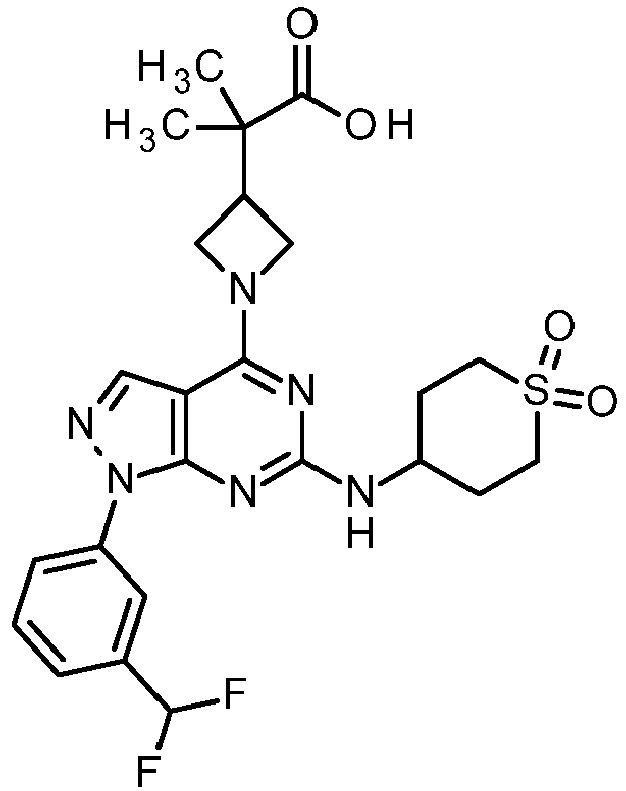
- DIPEA (0.29 ml) was added to methyl 2-(1-{6-chloro-1-[3-(difluoromethyl)phenyl]-1H-pyrazolo[3,4-d]pyrimidin-4-yl}azetidin-3-yl)-2-methylpropanoate (120 mg) and tetrahydro-2H-thiopyran-4-amine 1,1-dioxide hydrochloride (102 mg) in NMP (2.0 ml) and the mixture was stirred for 120 h at 130°C. Aqueous sodium hydroxide solution (2M, 1 ml) was added and the mixture was stirred at 80°C for 16 h. The mixture was treated with aqueous citric acid solution (10%) and ethyl acetate and stirred for 5 min. The mixture was extracted with ethyl acetate three times, the organic layers were concentrated. Purification by HPLC (method HT_PREP _acid) afforded 5 mg of the title compound.
LC-MS (method HTpost_acid): Rt = 1.03 min; MS (ESIpos): m/z = 535 [M+H]+
1H-NMR (400 MHz, DMSO-d6) δ [ppm]: 1.160 (16.00), 1.211 (0.41), 2.053 (0.74), 2.078 (0.86), 2.239 (0.75), 2.324 (0.70), 2.329 (0.98), 2.334 (0.69), 2.520 (2.84), 2.525 (2.12), 2.542 (0.59), 2.667 (0.71), 2.671 (0.98), 2.676 (0.69), 3.060 (0.42), 3.074 (0.60), 3.090 (0.43), 3.150 (0.58), 3.184 (1.46), 3.198 (1.42), 3.233 (1.10), 3.271 (0.60), 3.988 (0.43), 4.132 (0.65), 4.256 (0.50), 4.412 (0.52), 7.161 (0.71), 7.445 (1.09), 7.464 (1.24), 7.644 (0.48), 7.663 (0.75), 8.075 (7.03). -
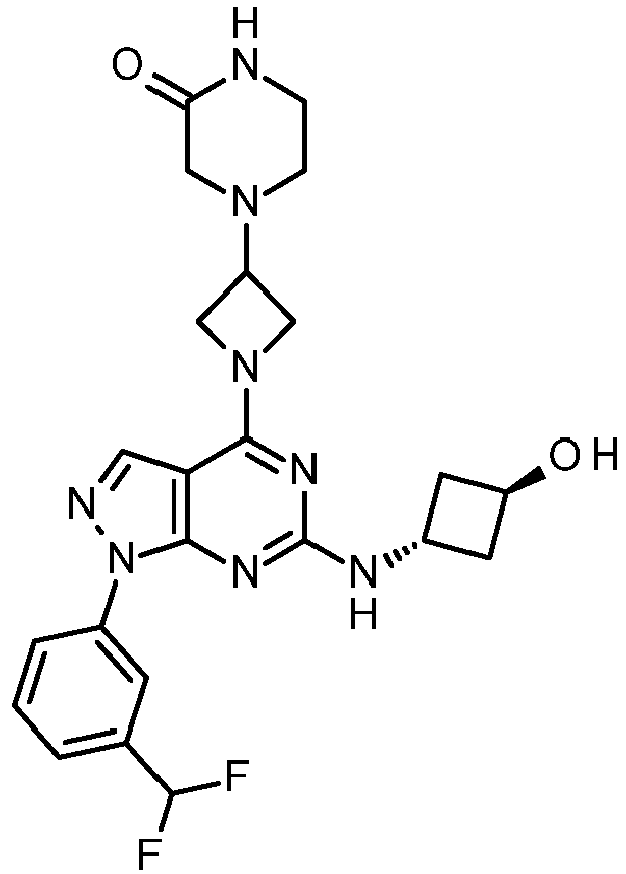
- A solution of 4-(1-{6-chloro-1-[3-(difluoromethyl)phenyl]-1H-pyrazolo[3,4-d]pyrimidin-4-yl}-azetidin-3-yl)piperazin-2-one (80 mg) and trans-3-aminocyclobutanol hydrochloride (46 mg in NMP (2.0 ml) was treated with DIPEA (0.19 ml) and the mixture was stirred at 130°C for 72 h. Standard workup and purification by HPLC (method HT_PREP_bas) afforded 43 mg of the title compound.)
LC-MS (method HTpost_bas): Rt = 0.86 min; MS (ESIpos): m/z = 485 [M+H]+
1H-NMR (400 MHz, DMSO-d6) δ [ppm]: 2.176 (2.08), 2.269 (1.98), 2.334 (1.07), 2.339 (0.53), 2.521 (4.32), 2.526 (2.83), 2.542 (1.54), 2.606 (2.24), 2.676 (1.09), 2.681 (0.53), 3.011 (5.33), 3.205 (3.95), 3.452 (0.48), 3.470 (1.20), 3.482 (1.91), 3.494 (1.23), 3.499 (1.20), 3.511 (0.53), 3.994 (0.74), 4.284 (2.22), 4.299 (2.83), 4.313 (2.48), 4.434 (0.95), 4.963 (2.29), 4.976 (2.01), 6.983 (2.79), 7.122 (5.96), 7.262 (2.56), 7.398 (0.83), 7.430 (2.88), 7.449 (3.23), 7.618 (1.92), 7.637 (3.26), 7.658 (1.61), 7.829 (4.05), 8.036 (16.00), 8.376 (0.53), 8.407 (0.82), 8.430 (0.88), 8.663 (0.91). -

- A solution of 1-(1-{6-chloro-1-[3-(difluoromethyl)phenyl]-1H-pyrazolo[3,4-d]pyrimidin-4-yl}-azetidin-3-yl)-2-methylpropan-2-ol (80 mg) and 1-(ethylsulfonyl)azetidin-3-amine trifluoroacetate in NMP (2.2 ml) was treated with DIPEA (0.20 ml) and the mixture was stirred at 130°C for 16 h. Standard workup and purification by HPLC (method HT_PREP_acid) afforded 27 mg of the title compound.
LC-MS (method HTpost_acid): Rt = 1.10 min; MS (ESIpos): m/z = 536 [M+H]+
1H-NMR (400 MHz, DMSO-d6) δ [ppm]: 1.108 (16.00), 1.224 (3.51), 1.243 (7.96), 1.261 (3.68), 1.769 (2.06), 1.786 (2.10), 2.521 (1.32), 2.526 (0.88), 2.543 (0.84), 3.053 (0.50), 3.123 (1.16), 3.141 (3.46), 3.160 (3.40), 3.178 (0.98), 3.893 (0.93), 3.912 (1.53), 3.930 (1.09), 4.090 (0.74), 4.263 (3.41), 4.604 (0.47), 4.621 (0.44), 7.154 (0.70), 7.450 (0.89), 7.469 (1.07), 7.648 (0.42), 7.667 (0.68), 8.042 (6.22). -
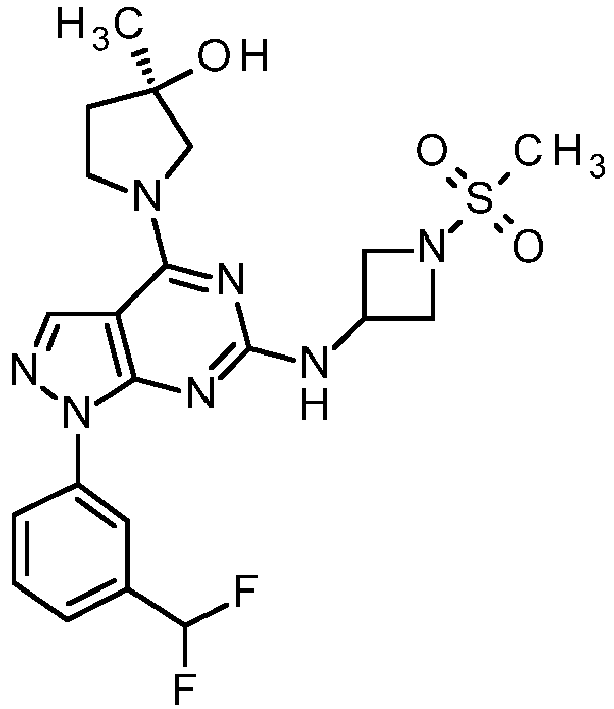
- A solution of (3R)-1-{6-chloro-1-[3-(difluoromethyl)phenyl]-1H-pyrazolo[3,4-d]pyrimidin-4-yl}-3-methylpyrrolidin-3-ol (100 mg) and 1-(methanesulfonyl)azetidin-3-amine (79 mg) in NMP (2.0 ml) was treated with DIPEA (0.28 ml) and the mixture was stirred at 130°C for 16 h. Standard workup and purification by HPLC (method HT_PREP_bas) afforded 44 mg of the title compound.
LC-MS (method HTpost_bas): Rt = 1.05 min; MS (ESIpos): m/z = 494 [M+H]+
1H-NMR (400 MHz, DMSO-d6) δ [ppm]: 1.379 (2.68), 1.424 (3.42), 2.027 (0.72), 2.046 (0.54), 2.521 (1.29), 2.526 (0.89), 3.036 (16.00), 3.415 (0.48), 3.677 (1.68), 3.713 (0.49), 3.888 (1.13), 3.905 (1.14), 4.115 (0.67), 4.134 (1.15), 4.153 (0.60), 4.655 (0.47), 4.671 (0.46), 4.907 (1.55), 4.971 (1.59), 7.160 (0.56), 7.455 (0.97), 7.474 (1.14), 7.652 (0.40), 7.671 (0.58), 8.177 (1.72), 8.215 (2.21). -
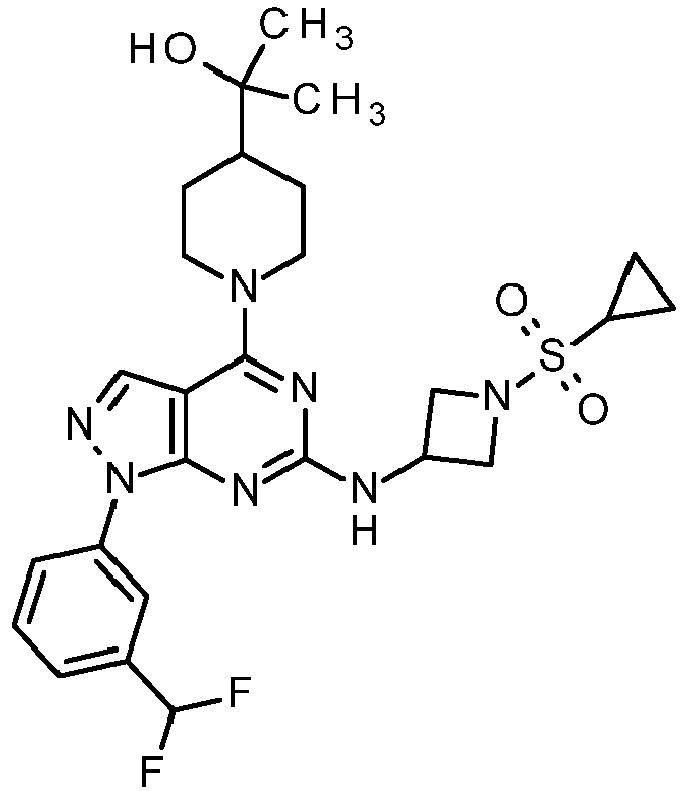
- DIPEA (0.24 ml) was added to 2-(1-{6-chloro-1-[3-(difluoromethyl)phenyl]-1H-pyrazolo[3,4-d]-pyrimidin-4-yl}piperidin-4-yl)propan-2-ol (80 mg) and 1-(cyclopropylsulfonyl)azetidin-3-amine trifluoroacetate in NMP (1.5 ml) and the mixture was stirred for 42 h at 130°C. Standard workup and purification by HPLC (method HT_PREP_acid) afforded 25 mg of the title compound.
LC-MS (method HTpost_acid): Rt = 1.19 min; MS (ESIpos): m/z = 562 [M+H]+
1H-NMR (400 MHz, DMSO-d6) δ [ppm]: 0.930 (1.33), 0.935 (1.34), 0.942 (1.26), 0.947 (1.56), 0.957 (0.54), 1.027 (0.56), 1.038 (1.51), 1.047 (1.88), 1.057 (16.00), 1.073 (1.05), 1.238 (0.57), 1.261 (0.60), 1.269 (0.58), 1.569 (0.47), 1.845 (0.72), 1.876 (0.66), 2.521 (2.01), 2.526 (1.24), 2.745 (0.48), 2.752 (0.53), 2.764 (0.96), 2.776 (0.49), 2.784 (0.46), 3.949 (0.96), 3.968 (1.58), 3.985 (1.17), 4.142 (0.80), 4.193 (3.02), 7.154 (0.59), 7.463 (0.81), 7.482 (0.95), 7.652 (0.66), 7.670 (0.82), 8.339 (3.93). -

- Reaction of 2-(1-{6-chloro-1-[3-(difluoromethyl)phenyl]-1H-pyrazolo[3,4-d]pyrimidin-4-yl}-piperidin-4-yl)propan-2-ol (80 mg) and 1-(ethylsulfonyl)azetidin-3-amine trifluoroacetate (70 mg) using conditions as described for the example II-30 afforded 25 mg of the title compound. LC-MS (method HTpost_acid): Rt = 1.18 min; MS (ESIpos): m/z = 550 [M+H]+
1H-NMR (400 MHz, DMSO-d6) δ [ppm]: 1.057 (16.00), 1.227 (3.90), 1.245 (8.03), 1.264 (4.07), 1.567 (0.51), 1.846 (0.79), 1.876 (0.71), 2.521 (1.27), 2.526 (0.75), 3.129 (1.15), 3.147 (3.62), 3.166 (3.55), 3.184 (1.04), 3.901 (1.09), 3.920 (1.70), 3.937 (1.33), 4.091 (0.62), 4.108 (1.08), 4.127 (0.56), 4.192 (4.47), 4.618 (0.45), 4.633 (0.44), 7.154 (0.66), 7.462 (0.84), 7.481 (1.02), 7.650 (0.70), 7.671 (0.77), 8.337 (4.16). -

- Reaction of 6-chloro-1-[3-(difluoromethyl)phenyl]-4-[3-(morpholin-4-yl)azetidin-1-yl]-1H-pyrazolo[3,4-d]pyrimidine (80 mg) and 1-(ethylsulfonyl)azetidin-3-amine trifluoroacetate (79 mg) using conditions as described for example II-30 afforded 11 mg of the title compound. LC-MS (method HTpost_acid): Rt = 0.87 min; MS (ESIpos): m/z = 549 [M+H]+
1H-NMR (400 MHz, DMSO-d6) δ [ppm]: 1.224 (7.16), 1.242 (16.00), 1.260 (7.48), 1.306 (0.75), 2.410 (4.59), 2.521 (5.95), 2.525 (3.68), 3.122 (2.23), 3.140 (7.05), 3.159 (6.85), 3.177 (2.09), 3.370 (2.65), 3.586 (0.51), 3.629 (7.07), 3.898 (2.15), 3.917 (3.67), 3.934 (2.73), 4.007 (0.71), 4.108 (1.70), 4.197 (0.84), 4.284 (0.79), 4.439 (0.73), 4.589 (0.64), 4.605 (1.15), 4.621 (1.09), 4.637 (0.59), 7.014 (0.72), 7.154 (1.46), 7.294 (0.69), 7.455 (1.96), 7.474 (2.41), 7.651 (0.92), 7.671 (1.48), 7.690 (0.85), 7.815 (0.47), 8.087 (10.74), 8.097 (0.52), 8.374 (0.76), 8.514 (0.80), 8.562 (0.51). -

- Reaction of (3R)-1-{6-chloro-1-[3-(difluoromethyl)phenyl]-1H-pyrazolo[3,4-d]pyrimidin-4-yl}pyrrolidin-3-ol (80 mg) and trans-3-aminocyclobutanol hydrochloride (54 mg) using conditions as described for example II-30 afforded 56 mg of the title compound.
LC-MS (method HTpost_bas): Rt = 0.96 min; MS (ESIpos): m/z = 417 [M+H]+
1H-NMR (400 MHz, DMSO-d6) δ [ppm]: 1.906 (1.05), 2.000 (1.48), 2.034 (1.50), 2.078 (16.00), 2.120 (1.25), 2.183 (3.93), 2.270 (3.64), 2.321 (1.25), 2.326 (1.60), 2.331 (1.87), 2.335 (1.29), 2.522 (5.43), 2.526 (3.57), 2.668 (1.04), 2.672 (1.48), 2.678 (1.02), 3.588 (2.08), 3.612 (3.14), 3.661 (2.62), 3.692 (1.18), 3.785 (1.20), 3.815 (2.85), 3.828 (2.97), 3.837 (2.92), 3.849 (2.20), 3.865 (1.36), 3.877 (1.37), 3.893 (1.07), 4.309 (3.33), 4.323 (3.03), 4.377 (2.33), 4.502 (1.68), 4.961 (5.42), 4.974 (4.90), 5.025 (2.97), 5.032 (2.96), 5.134 (2.39), 5.142 (2.22), 6.983 (5.56), 7.123 (12.05), 7.181 (1.58), 7.263 (4.99), 7.428 (5.19), 7.448 (6.16), 7.617 (3.68), 7.636 (6.32), 7.656 (3.14), 8.130 (4.53), 8.173 (6.03), 8.463 (1.23), 8.542 (0.92), 8.701 (0.94). -

- Reaction of (3R)-1-{6-chloro-1-[3-(difluoromethyl)phenyl]-1H-pyrazolo[3,4-d]pyrimidin-4-yl}pyrrolidin-3-ol (80 mg) and trans-3-(methylsulfonyl)cyclobutanamine (65 mg) using conditions as described for example II-30 afforded 40 mg of the title compound after HPLC (method HT_PREP_bas).
LC-MS (method HTpost_bas): Rt = 0.98 min; MS (ESIpos): m/z = 479 [M+H]+
1H-NMR (400 MHz, DMSO-d6) δ [ppm]: 2.521 (1.56), 2.526 (1.12), 2.535 (0.60), 2.672 (0.40), 2.722 (0.78), 2.955 (16.00), 3.597 (0.49), 3.622 (0.71), 3.659 (0.54), 3.825 (0.75), 3.835 (0.93), 3.846 (1.14), 3.858 (1.15), 3.868 (0.73), 3.881 (0.58), 4.389 (0.41), 4.574 (0.61), 4.593 (0.61), 5.046 (0.53), 5.143 (0.63), 5.151 (0.61), 6.977 (0.80), 7.116 (1.64), 7.256 (0.74), 7.451 (1.05), 7.470 (1.23), 7.618 (1.05), 7.638 (1.75), 7.658 (0.87), 8.158 (1.25), 8.199 (1.66). -

- Reaction of (3R)-1-{6-chloro-1-[3-(difluoromethyl)phenyl]-1H-pyrazolo[3,4-d]pyrimidin-4-yl}-3-methylpyrrolidin-3-ol (100 mg) and trans-3-(methylsulfonyl)cyclobutanamine hydrochloride (98 mg) using conditions as described for example II-30 afforded 73 mg of the title compound after HPLC (method HT_PREP_bas).
LC-MS (method HTpost_bas): Rt = 1.01 min; MS (ESIpos): m/z = 493 [M+H]+
1H-NMR (400 MHz, DMSO-d6) δ [ppm]: 1.376 (2.61), 1.421 (3.42), 2.022 (0.74), 2.041 (0.54), 2.521 (1.88), 2.526 (1.30), 2.542 (0.40), 2.672 (0.55), 2.676 (0.49), 2.681 (0.42), 2.720 (0.82), 2.955 (16.00), 2.987 (0.53), 3.669 (1.83), 3.702 (0.46), 3.834 (0.54), 3.846 (0.88), 3.857 (1.23), 3.869 (0.96), 3.878 (0.87), 4.570 (0.58), 4.589 (0.55), 4.912 (1.25), 4.967 (1.39), 6.976 (0.71), 7.116 (1.48), 7.255 (0.67), 7.450 (1.02), 7.469 (1.19), 7.616 (1.00), 7.636 (1.66), 7.656 (0.84), 8.149 (1.75), 8.187 (2.17). -
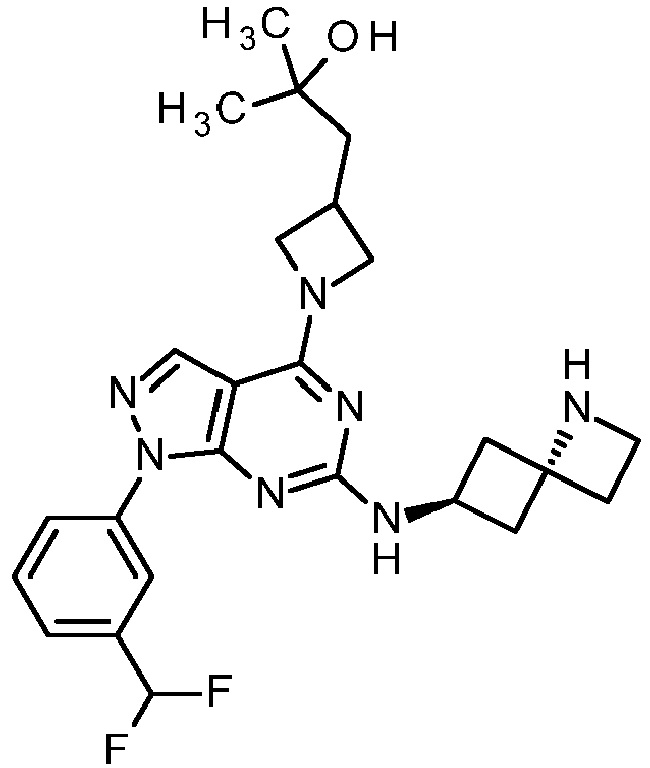
-
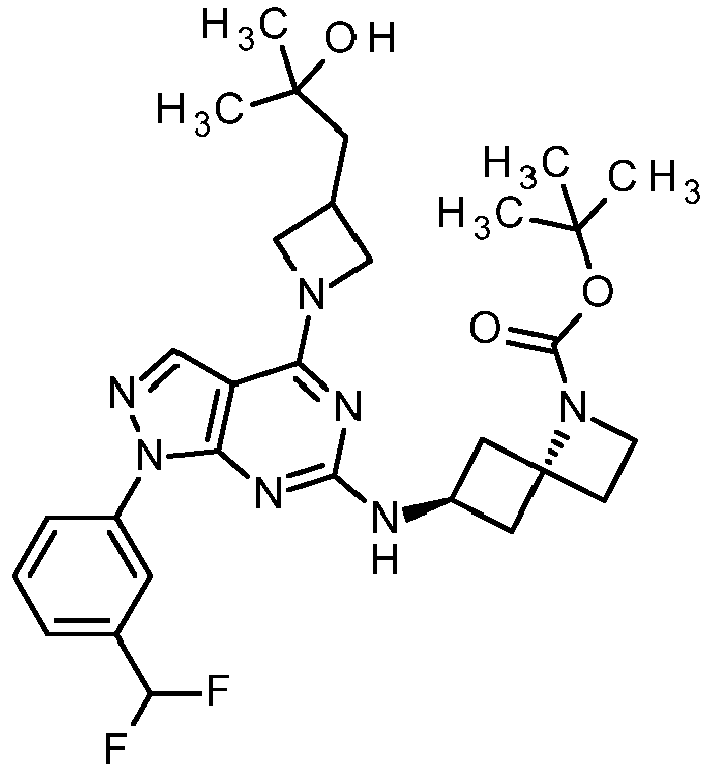
- A solution of 1-(1-{6-chloro-1-[3-(difluoromethyl)phenyl]-1H-pyrazolo[3,4-d]pyrimidin-4-yl}-azetidin-3-yl)-2-methylpropan-2-ol (80 mg) and tert-butyl (4r,6s)-6-amino-1-azaspiro[3.3]heptane-1-carboxylate (71 mg) (CAS number 1638769-04-6) in NMP (2.2 ml) was treated with DIPEA (0.20 ml) and the mixture was stirred at 130°C for 16 h.Standard workup and purification by HPLC (method HT_PREP_bas) afforded 50 mg of tert-butyl (4r,6s)-6-({1-[3-(difluoromethyl)phenyl]-4-[3-(2-hydroxy-2-methylpropyl)azetidin-1-yl]-1H-pyrazolo[3,4-d]pyrimidin-6-yl}amino)-1-azaspiro[3.3]heptane-1-carboxylate.
LC-MS (method HTpost_bas): Rt = 1.38 min; MS (ESIpos): m/z = 584 [M+H]+ - A solution of tert-butyl (4r,6s)-6-({1-[3-(difluoromethyl)phenyl]-4-[3-(2-hydroxy-2-methylpropyl)azetidin-1-yl]-1H-pyrazolo[3,4-d]pyrimidin-6-yl}amino)-1-azaspiro[3.3]heptane-1-carboxylate in dichlormethane (0.24 ml) was treated with TFA (0.12 ml) and the mixture was stirred at rt for 78 h. The mixture was concentrated and purified by HPLC (method HT_PREP _bas) to afford 20 mg 1-[1-(6-{[(4r,6s)-1-azaspiro[3.3]heptan-6-yl]amino}-1-[3-(difluoromethyl)phenyl]-1H-pyrazolo[3,4-d]pyrimidin-4-yl)azetidin-3-yl]-2-methylpropan-2-ol
LC-MS (method HTpost_bas): Rt = 1.14 min; MS (ESIpos): m/z = 484 [M+H]+
1H-NMR (400 MHz, DMSO-d6) δ [ppm]: 1.103 (16.00), 1.759 (1.94), 1.777 (1.97), 2.194 (1.22), 2.211 (2.24), 2.229 (1.63), 2.453 (0.64), 2.521 (1.09), 2.526 (0.72), 2.543 (1.07), 3.035 (0.47), 3.254 (1.17), 3.272 (2.07), 3.290 (1.30), 4.258 (1.11), 6.990 (0.42), 7.130 (0.90), 7.269 (0.49), 7.424 (0.84), 7.443 (0.99), 7.619 (0.44), 7.639 (0.76), 7.990 (5.48). -

- DIPEA (0.23 ml) was added to 2-(1-{6-chloro-1-[3-(trifluoromethoxy)phenyl]-1H-pyrazolo[3,4-d]pyrimidin-4-yl}piperidin-4-yl)propan-2-ol (100 mg, 0.22 mmol) and (4S)-4-aminopyrrolidin-2-one hydrochloride (59.9 mg, 0.44 mmol) in NMP (1.5 ml) and the mixture was stirred for 20 h at 130°C. Standard workup and purification by HPLC (method HT_PREP_acid) afforded 75.3 mg of the title compound.
LC-MS (method HTpost_acid): Rt = 1.14 min; MS (ESIpos): m/z = 520 [M+H]+
1H-NMR (400 MHz, DMSO-d6) δ [ppm]: 1.050 (16.00), 1.227 (0.50), 1.251 (0.54), 1.560 (0.43), 1.832 (0.72), 1.862 (0.65), 2.258 (0.74), 2.274 (0.74), 2.300 (1.01), 2.316 (1.04), 2.323 (0.44), 2.327 (0.55), 2.518 (2.17), 2.523 (1.52), 2.527 (0.83), 2.549 (0.54), 2.669 (0.52), 3.192 (0.41), 3.204 (0.43), 3.582 (0.61), 3.600 (0.76), 3.605 (0.68), 3.624 (0.56), 4.183 (5.43), 4.556 (0.48), 4.572 (0.48), 7.247 (0.63), 7.268 (0.70), 7.353 (0.54), 7.368 (0.51), 7.614 (0.40), 7.634 (1.87), 8.328 (4.44). -

- DIPEA (0.24 ml) was added to 2-(1-{6-chloro-1-[3-(difluoromethoxy)phenyl]-1H-pyrazolo[3,4-d]pyrimidin-4-yl}piperidin-4-yl)propan-2-ol (100 mg, 0.23 mmol) and (4S)-4-aminopyrrolidin-2-one hydrochloride (62.4 mg, 0.46 mmol) in NMP (1.5 ml) and the mixture was stirred for 20 h at 130°C. Standard workup and purification by HPLC (method HT_PREP_acid) afforded 68.9 mg of the title compound.
LC-MS (method HTpost_acid): Rt = 1.02 min; MS (ESIpos): m/z = 502 [M+H]+
1H-NMR (400 MHz, DMSO-d6) δ [ppm]: 1.049 (16.00), 1.227 (0.49), 1.251 (0.53), 1.558 (0.42), 1.830 (0.71), 1.861 (0.66), 2.074 (2.02), 2.253 (0.69), 2.269 (0.71), 2.295 (0.96), 2.311 (0.99), 2.518 (1.22), 2.522 (0.85), 2.529 (0.47), 2.539 (2.58), 3.186 (0.41), 3.198 (0.43), 3.608 (0.54), 4.181 (1.28), 4.568 (0.48), 4.584 (0.47), 7.054 (0.68), 7.060 (0.69), 7.074 (0.75), 7.080 (0.76), 7.131 (0.57), 7.316 (1.85), 7.333 (0.80), 7.501 (0.56), 7.542 (0.63), 7.621 (1.61), 8.165 (0.41), 8.305 (4.09). -

- DIPEA (0.14 ml) was added to 2-[1-(1-[3-(difluoromethoxy)phenyl]-6-{[trans-3-(methylsulfonyl)cyclobutyl]amino}-1H-pyrazolo[3,4-d]pyrimidin-4-yl)piperidin-4-yl]propan-2-ol (57.0 mg) and trans-3-(methylsulfonyl)cyclobutanamine hydrochloride (31 mg) in NMP (1.5 ml) and the mixture was stirred at 130°C for 19 h. Standard workup and purification by HPLC (method HT_PREP_acid) afforded 42 mg of the title compound.
LC-MS (method HTpost_acid): Rt = 1.12 min; MS (ESIpos): m/z = 551 [M+H]+
1H-NMR (400 MHz, DMSO-d6) δ [ppm]: 1.051 (16.00), 1.228 (0.53), 1.251 (0.57), 1.559 (0.45), 1.834 (0.70), 1.865 (0.64), 2.326 (0.43), 2.518 (1.90), 2.522 (1.24), 2.664 (0.47), 2.668 (0.68), 2.673 (0.66), 2.678 (0.53), 2.703 (0.62), 2.942 (12.54), 3.862 (0.46), 4.181 (5.04), 4.518 (0.47), 4.537 (0.45), 7.061 (0.67), 7.066 (0.68), 7.081 (0.74), 7.086 (0.76), 7.394 (0.43), 7.508 (1.35), 7.528 (2.40), 7.549 (1.22), 8.121 (0.67), 8.163 (0.89), 8.165 (0.99), 8.168 (0.80), 8.186 (0.82), 8.189 (0.80), 8.297 (4.29). -

-

- A solution of tert-butyl [1-(1-{6-chloro-1-[3-(difluoromethoxy)phenyl]-1H-pyrazolo[3,4-d]pyrimidin-4-yl}piperidin-4-yl)cyclopropyl]carbamate (80 mg) and 1-(methylsulfonyl)azetidin-3-amine (45 mg) in NMP (1.9 ml) was treated with DIPEA (0.16 ml) and the mixture was stirred at 130°C for 72 h. Standard workup and purification by HPLC afforded 70 mg tert-butyl {1-[1-(1-[3-(difluoromethoxy)phenyl]-6-{[1-(methylsulfonyl)azetidin-3-yl]amino}-1H-pyrazolo[3,4-d]pyrimidin-4-yl)piperidin-4-yl]cyclopropyl}carbamate
LC-MS (method HTpost_bas): Rt = 1.34 min; MS (ESIpos): m/z = 649 [M+H]+ - A solution of tert-butyl {1-[1-(1-[3-(difluoromethoxy)phenyl]-6-{[1-(methylsulfonyl)azetidin-3-yl]amino}-1H-pyrazolo[3,4-d]pyrimidin-4-yl)piperidin-4-yl]cyclopropyl}carbamate (70 mg) in dichlormethane (1.2 ml) was treated with TFA (0.25 ml) and the mixture was stirred at RT for 16 h. The mixture was concentrated and the residue was purified by HPLC to afford 18 mg 4-[4-(1-aminocyclopropyl)piperidin-1-yl]-1-[3-(difluoromethoxy)phenyl]-N-[1-(methylsulfonyl)azetidin-3-yl]-1H-pyrazolo[3,4-d]pyrimidin-6-amine.
LC-MS (method HTpost_bas): Rt = 1.15 min; MS (ESIpos): m/z = 549 [M+H]+
1H-NMR (400 MHz, DMSO-d6) δ [ppm]: 0.325 (0.80), 0.342 (3.16), 0.348 (2.29), 0.378 (2.26), 0.384 (3.32), 0.401 (0.80), 1.073 (0.56), 1.473 (0.80), 1.482 (0.82), 1.504 (0.89), 1.515 (0.83), 1.536 (0.41), 1.630 (0.71), 1.677 (1.27), 1.708 (0.91), 2.518 (2.46), 2.523 (1.61), 2.540 (1.00), 2.950 (0.76), 3.034 (16.00), 3.876 (1.09), 3.895 (1.74), 3.913 (1.30), 4.095 (1.35), 4.114 (2.50), 4.135 (1.22), 4.648 (0.48), 4.665 (0.83), 4.682 (0.84), 4.700 (0.54), 7.076 (0.87), 7.081 (0.88), 7.102 (0.91), 7.157 (1.24), 7.341 (2.51), 7.526 (1.26), 7.549 (0.46), 7.569 (0.64), 7.622 (0.52), 8.142 (0.92), 8.162 (0.93), 8.332 (4.77). -

- A solution of 1-(1-{6-chloro-1-[3-(difluoromethoxy)phenyl]-1H-pyrazolo[3,4-d]pyrimidin-4-yl}azetidin-3-yl)-2-methylpropan-2-ol (75.0 mg, 0.18 mmol) and trans-3-(methylsulfonyl)-cyclobutanamine hydrochloride 65.7 mg, 0.35 mmol) in NMP (2.0 ml) was treated with DIPEA (0.18 ml) and the mixture was stirred at 130°C for 16 h. Standard workup and HPLC purifaction (method HT_PREP_bas) afforded 47.0 mg of the title compound.
LC-MS (method HTpost_acid): Rt = 1.00 min; MS (ESIpos): m/z = 537 [M+H]+
1H-NMR (400 MHz, DMSO-d6) δ [ppm]: 0.000 (8.79), 1.106 (16.00), 1.765 (1.68), 1.783 (1.72), 2.463 (0.71), 2.474 (0.85), 2.521 (1.29), 2.526 (0.79), 2.667 (0.54), 2.672 (0.71), 2.677 (0.67), 2.681 (0.59), 2.702 (0.64), 2.937 (14.49), 3.045 (0.47), 3.844 (0.64), 3.855 (0.68), 4.261 (3.12), 4.498 (0.40), 4.516 (0.75), 4.535 (0.79), 4.553 (0.44), 7.053 (0.72), 7.058 (0.73), 7.073 (0.79), 7.079 (0.81), 7.505 (1.42), 7.526 (2.58), 7.546 (1.38), 8.006 (5.40), 8.134 (0.83), 8.165 (0.83), 8.187 (0.73). -

- A solution of (3S,4S)-1-{6-chloro-1-[3-(difluoromethoxy)phenyl]-1H-pyrazolo[3,4-d]pyrimidin-4-yl}-4-fluoropyrrolidin-3-ol (80 mg, 0.20 mmol) and trans-3-(methylsulfonyl)cyclobutanamine hydrochloride (74.3 mg, 400 µmol) in NMP (2.1 ml) was treated with DIPEA (0.21 ml) and the mixture was stirred at 130°C for 16 h. Standard workup and purification by HPLC (method HT_PREP_acid) afforded 63 mg of the title compound.
LC-MS (method HTpost_acid): Rt = 0.98 min; MS (ESIpos): m/z = 513 [M+H]+
1H-NMR (400 MHz, DMSO-d6) δ [ppm]: -0.009 (0.54), 0.007 (0.54), 2.472 (0.74), 2.521 (3.07), 2.525 (2.69), 2.542 (2.18), 2.549 (0.86), 2.709 (0.95), 2.722 (1.18), 2.949 (16.00), 3.756 (0.53), 3.783 (0.63), 3.849 (0.69), 3.861 (0.83), 3.873 (1.07), 3.884 (0.74), 3.896 (0.53), 3.990 (0.59), 4.025 (0.56), 4.057 (0.49), 4.541 (0.60), 4.561 (0.61), 7.065 (1.05), 7.070 (1.08), 7.085 (1.15), 7.090 (1.19), 7.488 (0.57), 7.517 (2.41), 7.538 (3.94), 7.558 (2.02), 8.146 (1.27), 8.176 (1.88), 8.195 (1.31), 8.227 (5.92). -

- A solution of (3S,4S)-1-{6-chloro-1-[3-(difluoromethoxy)phenyl]-1H-pyrazolo[3,4-d]pyrimidin-4-yl}-4-fluoropyrrolidin-3-ol (80 mg, 0.20 mmol) and 1-(methylsulfonyl)azetidin-3-amine (74.3 mg, 0.40 mmol) in NMP (2.1 ml) was treated with DIPEA (0.21 ml) and the mixture was stirred at 130°C for 16 h. Standard workup and purification by HPLC (method HT_PREP _acid) afforded 51 mg of the title compound.
LC-MS (method HTpost_acid): Rt = 1.03 min; MS (ESIpos): m/z = 514 [M+H]+
1H-NMR (400 MHz, DMSO-d6) δ [ppm]: 0.000 (7.51), 2.521 (1.05), 2.526 (0.67), 3.039 (16.00), 3.793 (0.44), 3.893 (0.70), 3.911 (1.16), 3.928 (0.81), 4.002 (0.44), 4.113 (1.03), 4.133 (1.90), 4.153 (0.93), 4.692 (0.55), 4.709 (0.52), 7.079 (0.69), 7.084 (0.70), 7.099 (0.73), 7.104 (0.75), 7.165 (0.90), 7.349 (1.86), 7.534 (0.95), 8.173 (0.68), 8.192 (0.64), 8.254 (3.39). -

- A solution of (3S,4S)-1-{6-chloro-1-[3-(difluoromethoxy)phenyl]-1H-pyrazolo[3,4-d]pyrimidin-4-yl}-4-fluoropyrrolidin-3-ol (80 mg, 0.20 mmol) and tetrahydro-2H-thiopyran-4-amine 1,1-dioxide hydrochloride (74 mg, 0.40 mmol) in NMP (2.1 ml) was treated with DIPEA (0.21 ml) and the mixture was stirred at 130°C for 40 h. Standard workup and purification by HPLC (method HT_PREP_acid) afforded 54 mg of the title compound.
LC-MS (method HTpost_acid): Rt = 1.02 min; MS (ESIpos): m/z = 513 [M+H]+
1H-NMR (400 MHz, DMSO-d6) δ [ppm]: 2.077 (2.62), 2.102 (3.05), 2.237 (3.29), 2.521 (6.32), 2.526 (4.12), 2.543 (1.78), 3.203 (5.27), 3.756 (1.75), 3.784 (2.10), 3.870 (1.42), 3.900 (1.18), 3.959 (1.00), 3.992 (1.79), 4.026 (1.91), 4.057 (1.92), 4.162 (1.82), 4.186 (1.68), 4.356 (1.04), 4.472 (1.12), 5.039 (1.16), 5.132 (0.98), 5.165 (1.19), 5.257 (0.97), 5.653 (1.30), 5.762 (1.67), 7.071 (3.27), 7.090 (3.53), 7.154 (7.52), 7.255 (1.23), 7.339 (15.90), 7.524 (7.55), 7.567 (1.96), 8.211 (4.34), 8.226 (16.00). -

- DIPEA (0.17 ml) was added to (1-{6-chloro-1-[3-(methanesulfonyl)phenyl]-1H-pyrazolo[3,4-d]pyrimidin-4-yl}-3-ethylazetidin-3-ol (65.0 mg, 0.16 mmol) and (3S)-1-methylpyrrolidin-3-amine dihydrochloride (55.2 mg, 0.32 mmol) in NMP (1.0 ml) and the mixture was stirred for 17 h at 130°C. The mixture was filtered, DMSO (1 ml) was added and the solution was purified by HPLC (column XBrigde C18 5µ 50 x 50 mm; water + 0.2 Vol% aq. ammonia (32%), acetonitrile) affording 3.5 mg of the title compound.
MS (ESIpos): m/z = 472 [M+H]+ -

- DIPEA (0.17 ml) was added to 1-{6-chloro-1-[3-(methanesulfonyl)phenyl]-1H-pyrazolo[3,4-d]pyrimidin-4-yl}-3-ethylazetidin-3-ol (65.0 mg, 0.16 mmol) and (3R)-tetrahydrofuran-3-amine 4-methylbenzenesulfonate (82.7 mg, 0.32 mmol) in NMP (1.0 ml) and the mixture was stirred for 17 h at 130°C. The mixture was filtered, DMSO (1 ml) was added and the solution was purified by HPLC (method HT_PREP_acid) affording the title compound (34.8 mg).
LC-MS (method HTpost_acid): Rt = 0.87 min; MS (ESIpos): m/z = 459 [M+H]+
1H-NMR (400 MHz, DMSO-d6) δ [ppm]: 0.917 (5.72), 0.936 (13.47), 0.954 (6.28), 1.715 (1.59), 1.732 (4.58), 1.751 (4.37), 1.769 (1.44), 1.924 (1.38), 1.939 (1.47), 1.952 (1.09), 2.186 (1.14), 2.327 (0.87), 2.522 (3.04), 2.668 (0.88), 3.267 (15.52), 3.619 (1.17), 3.688 (1.33), 3.703 (1.66), 3.708 (3.10), 3.723 (3.13), 3.728 (2.25), 3.743 (1.77), 3.796 (1.60), 3.815 (3.55), 3.834 (2.89), 3.853 (1.11), 3.965 (1.89), 3.984 (2.01), 4.030 (1.36), 4.164 (1.36), 4.316 (1.35), 4.449 (1.57), 5.755 (4.87), 7.373 (1.11), 7.763 (0.57), 7.786 (5.11), 7.791 (5.29), 7.797 (7.25), 8.113 (16.00), 8.528 (0.97), 9.100 (1.14). -

-

- A solution of ethyl 3-{6-chloro-4-[4-(2-hydroxypropan-2-yl)piperidin-1-yl]-1H-pyrazolo[3,4-d]pyrimidin-1-yl}benzoate (150 mg, 0.34 mmol) and (3S)-1-methylpyrrolidin-3-amine dihydrochloride (117 mg, 0.68 mmol) in NMP (3.0 ml) was treated with DIPEA (0.35 ml) and the mixture was stirred at 130°C for 16 h. Standard workup and purification by HPLC (method HT_PREP_bas) afforded 32 mg ethyl 3-(4-[4-(2-hydroxypropan-2-yl)piperidin-1-yl]-6-{[(3S)-1-methylpyrrolidin-3-yl]amino}-1H-pyrazolo[3,4-d]pyrimidin-1-yl)benzoate.
LC-MS (HTpost1_bas): Rt = 1.30 min; MS (ESIpos): m/z = 508 [M+H]+
1H-NMR (400 MHz, DMSO-d6) δ [ppm]: 1.051 (16.00), 1.226 (0.72), 1.248 (0.73), 1.333 (3.26), 1.351 (6.80), 1.368 (3.26), 1.552 (0.54), 1.744 (0.42), 1.758 (0.45), 1.828 (0.97), 1.859 (0.89), 2.238 (9.14), 2.308 (0.51), 2.322 (0.51), 2.326 (0.65), 2.404 (0.70), 2.425 (0.89), 2.442 (0.95), 2.668 (0.63), 2.843 (0.45), 2.991 (0.51), 4.181 (3.66), 4.339 (1.01), 4.357 (2.92), 4.375 (3.03), 4.392 (1.27), 4.731 (0.42), 7.625 (0.45), 7.645 (0.87), 7.664 (0.52), 7.825 (1.24), 7.844 (1.00), 8.291 (3.24). - A solution of ethyl 3-(4-[4-(2-hydroxypropan-2-yl)piperidin-1-yl]-6-{[(3S)-1-methylpyrrolidin-3-yl]amino}-1H-pyrazolo[3,4-d]pyrimidin-1-yl)benzoate (25.0 mg, 49.2 µmol) in 2-methyltetrahydrofuran (1.2 ml) under nitrogen was cooled with an ice-cold water bath. Then methylmagnesium bromide (160 µl, 3.0 M) was carefully added. The mixture was stirred for 30 min with cooling, then the mixture stirred at rt for 72 h. Saturated aq. ammonium chloride solution and ethyl acetate was added and the mixture was stirred for 30 min. The mixture was extracted with ethyl acetate three times, the organic layers were filtered using a water-repellent filter and concentrated. Purification by HPLC (method HT_PREP_bas) afforded 5 mg of the title compound.
1H-NMR (400 MHz, DMSO-d6) δ [ppm]: 1.051 (15.77), 1.222 (0.55), 1.245 (0.58), 1.474 (16.00), 1.548 (0.50), 1.722 (0.45), 1.736 (0.47), 1.824 (0.79), 1.854 (0.72), 2.230 (10.71), 2.297 (0.73), 2.331 (0.42), 2.376 (0.42), 2.390 (0.53), 2.411 (0.50), 2.428 (0.55), 2.518 (2.12), 2.522 (1.61), 2.539 (1.27), 2.809 (0.48), 2.982 (0.42), 4.179 (3.40), 4.356 (0.41), 5.100 (2.21), 7.348 (0.42), 7.367 (0.94), 7.384 (0.62), 7.403 (0.70), 8.217 (3.70). - Examples were tested in selected biological assays one or more times. When tested more than once, data are reported as either average values or as median values, wherein
- the average value, also referred to as the arithmetic mean value, represents the sum of the values obtained divided by the number of times tested, and
- the median value represents the middle number of the group of values when ranked in ascending or descending order. If the number of values in the data set is odd, the median is the middle value. If the number of values in the data set is even, the median is the arithmetic mean of the two middle values.
- Examples were synthesized one or more times. When synthesized more than once, data from biological assays represent average values or median values calculated utilizing data sets obtained from testing of one or more synthetic batch.
The in vitro activity of the compounds of the present invention can be demonstrated in the following assays: - The IRAK4-inhibitory activity of the inventive substances was measured in the IRAK4 TR-FRET assay (TR-FRET = Time Resolved Fluorescence Resonance Energy Transfer) described hereinafter.
- Recombinant fusion protein from N-terminal GST (glutathione S-transferase) and human IRAK4, expressed in baculovirus-infected insect cells (Hi5, BTI-TN-5B1-4, cell line purchased from Invitrogen, catalogue No. B855-02) and purified via affinity chromatography, was used as enzyme. The substrate used for the kinase reaction was the biotinylated peptide biotin-Ahx-KKARFSRFAGSSPSQASFAEPG (C-terminus in amide form) which can be purchased, for example, from Biosyntan GmbH (Berlin-Buch).
For the assay, 11 different concentrations in the range from 20 µM to 0.073 nM were prepared from a 2 mM DMSO solution of the test substance. 50 nl of the respective 100fold concentrated test compound solutions in DMSO were pipetted into a black low-volume 384-well microtitre plate or a black 1536-well microtiter plate (both Greiner Bio-One, Frickenhausen, Germany), 2 µl of a solution of IRAK4 in assay buffer [50 mM HEPES pH 7.5, 5mM MgCl2, 1.0 mM dithiothreitol, 30 µM activated sodium orthovanadate, 0.1% (w/v) of bovine gamma-globulin (BGG) 0.04% (v/v) nonidet-P40 (Sigma)] were added and the mixture was incubated for 15 min to allow prebinding of the substances to the enzyme prior to the kinase reaction. The kinase reaction was then started by addition of 3 µl of a solution of adenosine triphosphate (ATP, 1.67 mM = final concentration in 5 µl of assay volume: 1 mM) and peptide substrate (0.83 µM = final concentration in 5 µl assay volume: 0.5 µM) in assay buffer, and the resulting mixture was incubated at 22°C for the reaction time of 45 min. The concentration of the IRAK4 was adjusted to the respective activity of the enzyme and set such that the assay was carried out in the linear range. Typical concentrations were in the order of about 0.2 nM. The reaction was stopped by addition of 5 µl of a solution of TR-FRET detection reagents [0.1 µM streptavidin-XL665 (Cisbio Bioassays; France, catalogue No. 610SAXLG)] and 1.5 nM anti-phosphoserine antibody [Merck Millipore, "STK Antibody", catalogue No. 35-002] and 0.6 nM LANCE EU-W1024-labelled anti-mouse-IgG antibody (Perkin-Elmer, product No. AD0077; alternatively, it is possible to use a terbium cryptate-labelled anti-mouse-IgG antibody from Cisbio Bioassays) in aqueous EDTA solution (100 mM EDTA, 0.4 % [w/v] bovine serum albumin [BSA] in 25 mM HEPES pH 7.5).
The resulting mixture was incubated at 22°C for 1 h to allow formation of a complex of the biotinylated phosphorylated substrate and the detection reagents. The amount of the phosphorylated substrate was then evaluated by measuring the resonance energy transfer from europium chelate-labelled anti-mouse-IgG antibody to streptavidin-XL665. To this end, the fluorescence emissions at 620 nm and 665 nm were measured after excitation at 350 nm in a TR-FRET measuring instrument, for example a Rubystar (BMG Labtechnologies, Offenburg, Germany) or a Viewlux (Perkin-Elmer). The ratio of the emissions at 665 nm and 622 nm was taken as a measure of the amount of phosphorylated substrate. The data were normalized (enzyme reaction without test substance = 0% inhibition; all other assay components but no enzyme = 100% inhibition). Typically, the test substances were tested on the same microtitre plates at 11 different concentrations in the range from 20 µM to 0.073 nM (20 µM, 5.7 µM, 1.6 µM, 0.47 µM, 0.13 µM, 38 nM, 11 nM, 3.1 nM, 0.89 nM, 0.25 nM and 0.073 nM, the dilution series prepared separately before the assay on the level of the 100fold concentrated solutions in DMSO by serial dilutions, exact concentrations may vary depending pipettors used) in duplicate values for each concentration and IC50-values were calculated using Genedata Screener™ software. - The data in table 2 demonstrate that the compounds of the general formula (I) display strong inhibition of human IRAK4 (IC50 < 500 nm). Most of the compounds show even double or single digit nanomolar potency values (IC50 < 100 nM) demonstrating that the compounds are useful for the treatment of diseases which are related to IRAK4.
- The applied DNA expression constructs which encode the following protein sequence were optimized for expression in insect cells and synthesized by the GeneArt Technology at Life Technologies:
- IRAK4 dog_1: amino acid 2-459 (UNIPROT: E2RDL0) with a TEV (Tobacco Etch Virus) protease cleavage site at the N-terminus.
- This expression construct additionally encoded att-site sequences at the 5' and 3' end for subcloning into destination vectors using the Gateway Technology. The applied Destination vector was pD-INS6, a Baculovirus transfer vector (based on vector pVL1393, Pharmingen). Destination vector pD-INX1 provides an N-terminal fusion of a GST-tag to the integrated gene construct and pD-INS6 a N-terminal fusion of a His6-tag, respectively. IRAK4 dog_1 was cloned into pD-INS6, the resulting vector was termed pD-Ins6_IRAK4 dog_1.
- A recombinant baculovirus stock for expression of pD-INS6_IRAK4 canine_1 was generated by co transfection of Sf9 insect cells with the separate transfer vector and commercial Baculovirus DNA (FlashBac Gold, Oxford Expression Technologies) according the instruction manual of the manufacturer. After 5 days the supernatant of the transfected cells containing the recombinant Baculovirus encoding the IRAK4 canine_1 protein was used for further infection of Sf9 cells for virus amplification whereby the virus titer was monitored using qPCR. Hi5 cells were grown (Insect-xpress medium, Lonza, 27 °C, 100 rpm) in a shaked 24-well plate with 2 mL culture volume and infected at a cell density of 106 cells/mL with recombinant baculovirus stocks at a multiplicity of infection of 3 and incubated for 48 h. Subsequently the cells were harvested by centrifugation (800 xg) and cell pellet frozen at -80 °C.
- Purification of the His-IRAK4 canine_1 fusion protein was achieved by affinity chromatography using Ni Sepharose High Performance matrix (GE Healthcare Life Sciences) at 4 °C.
- The pelleted cells (from 0.8 mL culture) were resuspended in Lysis-Buffer (A: 50 mM Tris pH 8,0, 150 mM NaCl, 10 % Glycerol, 2 mM DTT, Complete Inhibitor without EDTA (Roche Diagnostics), 0.1 % NP40, 40 mM Imidazole) in a 24 well plate and incubated on ice for for 1 h. The lysate was then transferred to a 96-microtiter plate and centrifuge for 30 min (3200 xg). The supernatant was further transferred to a TurboFilter (Qiagen) 96 -plates to remove DNA and insoluble material by centrifugation (500 xg). The filtrate was incubated with the Ni Sepharose (50 µl bed volume, equilibrated with wash buffer 50 mM Tris pH 8,0, 150 mM NaCl, 10 % Glycerol, 2 mM DTT, 40 mM Imidazole) in 96-formate at 150 min., centrifuged and washed twice with wash buffer (each 500 µl, 500 xg). Washed beads were incubated with 0.1 mL elution buffer (50 mM Tris pH 8,0, 150 mM NaCl, 10 % Glycerol, 2 mM DTT, 500 mM Imidazole) for 90 min. and subsequently eluted by centrifugation, followed by a second incubation and elution with 0.1 mL elution buffer. The buffer of the eluate was adjusted to storage buffer 50 mM Tris pH 8,0, 150 mM NaCl, 10 % Glycerol, 2 mM DTT using Zeba Spin Desalting Plate (Pierce) and the sample stored after freezing in liquid nitrogen at -80 °C.
-

- Inhibitory activity of compounds of the present invention against canine Irak4 was quantified employing the TR-FRET based Irak4 kinase activity assay as described in the following paragraphs (TR-FRET = Time Resolved Fluorescence Resonance Energy Transfer).
N-terminally His6-tagged recombinant canine Irak4, expressed in baculovirus-infected insect cells and purified via affinity chromatography using Ni-Sepharose as described above was used as kinase. As substrate for the kinase reaction the biotinylated peptide biotin-Ahx-KKARFSRFAGSSPSQASFAEPG (C-terminus in amide form) was used which can be purchased e.g. from the company Biosynthan GmbH (Berlin-Buch, Germany).
For the assay 50 nl of a 100fold concentrated solution of the test compound in DMSO was pipetted into either a black low volume 384well microtiter plate or a black 1536well microtiter plate (both Greiner Bio-One, Frickenhausen, Germany), 2 µl of a solution of Irak4 in aqueous assay buffer [50 mM Hepes pH 7.5, 5 mM MgCl2, 1mM dithiothreitol, 0.5 mM EGTA, 30 µM activated sodium ortho-vanadate, 0.1 % (w/v) bovine gamma globulin, 0.04% (v/v) Nonidet-P40 (Sigma)] were added and the mixture was incubated for 15 min at 22°C to allow pre-binding of the test compounds to the enzyme before the start of the kinase reaction. Then the kinase reaction was started by the addition of 3 µL of a solution of adenosine-tri-phosphate (ATP, 1.67 mM= final concentration in the 5 µL assay volume is 1 mM) and substrate (0.83 µM = final conccentration in the 5 µL assay volume is 0.5 µM) in assay buffer and the resulting mixture was incubated for a reaction time of 45 min at 22°C. The concentration of canine Irak4 was adjusted depending on the activity of the enzyme lot and was chosen appropriate to have the assay in the linear range, a typical concentration was 0.1 nM. The reaction was stopped by the addition of 3 µl of a solution of TR-FRET detection reagents (100 nM streptavidine-XL665 [Cisbio Bioassays, Codolet, France] and 1.5 nM anti-phosho-Serine antibody [Merck Millipore, cat. # 35-002] and 0.6 nM LANCE EU-W1024 labeled anti-mouse IgG antibody [Perkin-Elmer, product no. AD0077, as an alternative a Terbium-cryptate-labeled anti-mouse IgG antibody from Cisbio Bioassays can be used]) in an aqueous EDTA-solution (100 mM EDTA, 0.4 % (w/v) bovine serum albumin in 25 mM HEPES pH 7.5).
The resulting mixture was incubated 1 h at 22°C to allow the binding of the biotinylated phosphorylated peptide to the streptavidine-XL665 and the PT66-Tb-Cryptate. Subsequently the amount of phosphorylated substrate was evaluated by measurement of the resonance energy transfer from the Eu-chelate to the streptavidine-XL665. Therefore, the fluorescence emissions at 622 nm and 665 nm after excitation at 337 nm were measured in a TR-FRET reader, e.g. a Pherastar or Pherastar FS (both from BMG Labtechnologies, Offenburg, Germany) or a Viewlux (Perkin-Elmer). The ratio of the emissions at 665 nm and at 622 nm was taken as the measure for the amount of phosphorylated substrate. The data were normalised (enzyme reaction without inhibitor = 0 % inhibition, all other assay components but no enzyme = 100 % inhibition). Usually the test compounds were tested on the same microtiterplate in 11 different concentrations in the range of 20 µM to 0.07 nM (20 µM, 5.7 µM, 1.6 µM, 0.47 µM, 0.13 µM, 38 nM, 11 nM, 3.1 nM, 0.9 nM, 0.25 nM and 0.07 nM, the dilution series prepared separately before the assay on the level of the 100fold concentrated solutions in DMSO by serial dilutions, exact concentrations may vary depending pipettors used) in duplicate values for each concentration and IC50-values were calculated using Genedata Screener™ software. - The data in table 2 demonstrate that the compounds of the general formula (I) display surprisingly strong inhibition of canine IRAK4 (IC50 < 50 nm) indicating that the compounds are useful for the treatment of diseases in animals which are associated with IRAK4.
Table 2: IC50-values of example compounds in the IRAK4 human kinase assay and IC50 -values from canine kinase assay Example Compound Human IRAK4 IC50 [mol/l] Canine IRAK4 IC50 [mol/l] I-1-1 3.04 E-9 3.19 E-9 I-1-2 8.45 E-8 I-2-1 7.19 E-9 8.70 E-9 I-2-2 3.14 E-8 I-2-3 9.69 E-9 I-3-1 9.76 E-9 I-3-2 1.67 E-7 I-4-1 1.22 E-8 I-4-2 8.27 E-9 8.54 E-9 I-4-3 6.85 E-8 I-5 1.05 E-8 9.27 E-9 I-6 7.68 E-8 I-7-1 1.14 E-8 I-7-2 3.38 E-8 I-8 4.14 E-8 I-9 5.95 E-8 I-10 1.31 E-7 I-11-1 1.39 E-7 I-11-2 1.51 E-7 I-12 5.12 E-8 I-13-1 1.31 E-8 2.64 E-8 I-13-2 3.27 E-8 I-14 1.20 E-8 1.27 E-8 I-15 6.20 E-8 I-16-1 1.94 E-8 I-16-2 1.61 E-8 I-17 4.42 E-7 I-18 1.84 E-8 I-19 2.70 E-8 I-20-1 2.78 E-7 I-20-2 1.49 E-8 I-21 7.80 E-8 I-22 9.93 E-8 I-23 8.82 E-9 5.41 E-9 I-24 7.08 E-9 I-25-1 4.03 E-8 I-25-2 1.20 E-8 I-26-1 3.73 E-8 I-26-2 5.78 E-8 I-27 7.01 E-9 I-28 2.39 E-8 I-29 1.08 E-8 I-30 6.15 E-9 I-31 1.26 E-8 I-32 2.87 E-8 I-33 8.42 E-8 I-34 8.51 E-8 I-35 1.65 E-8 I-36 4.50 E-8 I-37 1.15 E-8 I-38 1.62 E-8 I-39 2.45 E-8 I-40 3.68 E-9 I-41-1 2.50 E-7 I-41-2 4.00 E-7 I-42 3.20 E-8 I-43 2.80 E-7 I-44 1.57 E-8 I-45 5.10 E-9 I-46 1.40 E-9 I-47 8.61 E-10 I-48 1.12 E-9 I-49 3.85 E-9 I-50 4.84 E-8 I-51 2.50 E-9 I-52 7.99 E-9 I-53 9.98 E-8 I-54 2.97 E-7 I-55 1.56 E-8 I-56 3.46 E-9 I-57 1.82 E-9 1.98 E-9 I-58 2.30 E-8 I-59 3.63 E-9 I-60 3.42 E-8 I-61 3.28 E-9 I-62 2.57 E-9 I-63 3.06 E-8 I-64-1 8.58 E-9 I-64-2 5.89 E-8 I-65 1.56 E-8 I-66 1.38 E-7 I-67 5.33 E-9 I-68 2.30 E-8 I-69 2.62 E-8 I-70 2.50 E-8 I-71 1.53 E-8 I-72 7.31 E-9 I-73 2.80 E-8 I-74 4.83 E-9 I-75 1.40 E-8 I-76 9.61 E-9 I-77 4.80 E-9 I-78 5.62 E-9 I-79 7.75 E-9 I-80 1.14 E-8 I-81 8.32 E-8 I-82 1.15 E-8 I-83 5.53 E-9 I-84 4.83 E-8 I-85 2.41 E-9 I-86 3.66 E-9 I-87 7.87 E-9 I-88 3.94 E-9 I-89 4.72 E-9 I-90 2.47 E-8 I-91 6.53 E-9 I-92 5.61 E-9 I-93 1.12 E-8 I-94 4.28 E-9 I-95 2.50 E-8 I-96 8.10 E-9 I-97 8.16 E-9 I-98 9.99 E-9 I-99 1.62 E-8 I-100 4.99 E-8 I-101 2.81 E-9 I-102 4.99 E-8 I-103 1.14 E-8 I-104 1.78 E-7 I-105 2.80 E-7 I-106 9.09 E-9 I-107 8.11 E-9 I-108 3.72 E-9 I-109 1.06 E-8 I-110 1.18 E-8 I-111 1.11 E-8 I-112 3.24 E-9 I-113 3.60 E-9 I-114 8.49 E-9 I-115 7.51 E-9 I-116 1.68 E-8 I-117 2.34 E-8 I-118 5.13 E-9 I-119 1.65 E-8 I-120 1.66 E-8 I-121 3.65 E-9 I-122 2.75 E-9 I-123 7.98 E-9 I-124 2.25 E-8 II-1 3.46 E-9 II-2 6.68 E-9 II-3 2.48 E-8 II-4 3.33 E-9 II-5 3.45 E-9 II-6 5.49 E-9 II-7 5.37 E-9 II-8 2.01 E-9 II-9 8.49 E-8 II-10 4.31 E-9 II-11 2.67 E-9 II-12 2.98 E-9 II-13 1.33 E-8 II-14 7.01 E-9 II-15 4.52 E-8 II-16-1 1.36 E-9 II-16-2 2.82 E-9 II-16-3 1.62 E-9 II-17-1 2.64 E-9 II-17-2 2.10 E-9 II-17-3 4.17 E-9 II-18 1.40 E-9 II-19 1.63 E-9 II-20 1.39 E-9 II-21 1.80 E-9 II-22 4.53 E-8 II-23 1.62 E-8 II-24 5.65 E-9 II-25 6.15 E-9 II-26 7.36 E-8 II-27 4.75 E-9 II-28 4.00 E-8 II-29 6.71 E-8 II-30 1.62 E-8 II-31 9.22 E-9 II-32 5.67 E-8 II-33 1.65 E-8 II-34 3.49 E-9 II-35 6.80 E-9 II-36 2.76 E-9 III-1 1.91 E-8 IV-1 8.06 E-9 6.52 E-9 IV-2 3.42 E-9 IV-3 6.61 E-9 IV-4 4.78 E-9 IV-5 1.12 E-8 IV-6 1.93 E-7 IV-7 4.64 E-8 V-1 1.70 E-7 V-2 1.79 E-7 VI-1 7.73 E-8 - The in vitro metabolic stability of test compounds was determined by incubating them at 1 µM in a suspension liver microsomes in 100 mM phosphate buffer, pH7.4 (NaH2PO4 x H2O + Na2HPO4 x 2H2O) and at a protein concentration of 0.5 mg/mL at 37° C. The microsomes were activated by adding a co-factor mix containing 8 mM Glukose-6-Phosphat, 4 mM MgCl2, 0.5 mM NADP and 1 IU/mL G-6-P-Dehydrogenase in phosphate buffer, pH 7.4. The metabolic assay was started shortly afterwards by adding the test compound to the incubation at a final volume of 1 mL. Organic solvent in the incubations was limited to ≤0.01 % dimethylsulfoxide (DMSO) and ≤1% acetonitril. During incubation, the microsomal suspensions were continuously shaken at 580 rpm, and aliquots were taken at 2, 8, 16, 30, 45 and 60 min, to which equal volumes of cold methanol were immediately added. Samples were frozen at -20° C over night, subsequently centrifuged for 15 min at 3000 rpm and the supernatant was analyzed with an Agilent 1200 HPLC-system with LCMS/MS detection.
- The half-life of a test compound was determined from the concentration-time plot. From the half-life the intrinsic clearances were calculated. Together with the additional parameters liver blood flow, specific liver weight and microsomal protein content the hepatic in vivo blood clearance (CL) and the maximal oral bioavailability (Fmax) were calculated using the "well stirred" liver model. The following parameter values were used: Liver blood flow - 1.32 L/h/kg (human), 2.1 L/h/kg (dog); specific liver weight - 21 g/kg (human), 39 g/kg (dog); microsomal protein content - 40 mg/g.
- For classification of the results the following criteria were used:
- Fmax > 70 % (= CL < 0.4 L/h/kg human; < 0.6 Uh/kg dog) was classified as high metabolic stability (high),
- Fmax between 30 and 70 % (CL between 0.4 and 0.9 L/h/kg human; between 0.6 and 1.5 L/h/kg dog) as moderate metabolic stability (moderate) and
- Fmax < 30 % (= CL > 0.9 L/h/kg human; > 1.5 Uh/kg dog) as low metabolic stability (low).
- The data shown in table 3 demonstrate that the compounds of the general formula (I) show medium to high metabolic stability. The majority of compounds show high metabolic stability (Fmax > 70%). The compounds tested in dog liver microsomes also show a high stability.
Table 3: Results from metabolic stability assay in dog and human liver microsomes Example Compound Fmax, human microsomes [%] CLblood, human microsomes [L/h/kg] Fmax, dog microsomes [%] CLblood, dog microsomes [L/h/kg] I-2-1 76 0.32 I-3-1 65 0.46 I-4-2 89 0.14 I-5 93 0.09 I-13-1 62 0.50 I-14 95 0.07 I-16-2 30 0.92 I-22 74 0.34 I-23 87 0.17 I-27 87 0.17 I-29 68 0.43 I-30 100 (stable) < 0.01 (stable) I-31 100 (stable) < 0.01 (stable) I-37 97 0.05 I-40 95 0.07 I-45 96 0.05 I-46 81 0.25 I-47 87 0.17 I-48 100 (stable) < 0.01 (stable) I-49 90 0.13 I-51 81 0.25 I-52 100 (stable) < 0.01 (stable) I-56 95 0.06 97 0.06 I-57 97 0.04 I-58 100 (stable) < 0.01 (stable) I-59 74 0.34 I-60 72 0.37 I-61 77 0.31 I-62 100 (stable) < 0.01 (stable) I-64-1 76 0.32 I-67 82 0.24 I-68 99 0.02 I-72 79 0.28 95 0.10 I-74 91 0.11 I-76 77 0.30 I-77 72 0.36 I-78 76 0.32 I-79 69 0.41 I-83 83 0.23 I-85 100 (stable) < 0.01 (stable) I-86 81 0.25 I-88 57 0.57 I-89 72 0.37 I-91 97 0.04 I-92 73 0.36 I-94 88 0.16 I-98 100 (stable) < 0.01 (stable) I-101 73 0.35 I-106 48 0.68 I-107 96 0.05 I-108 88 0.16 I-109 75 0.33 I-111 90 0.13 I-112 71 0.39 I-113 98 0.03 I-114 84 0.21 I-115 100 (stable) < 0.01 (stable) II-1 100 (stable) < 0.01 (stable) II-2 88 0.15 97 0.07 II-4 100 (stable) < 0.01 (stable) 100 (stable) < 0.01 (stable) II-5 93 0.10 89 0.24 II-6 86 0.19 78 0.46 II-7 100 (stable) < 0.01 (stable) II-8 100 (stable) < 0.01 (stable) II-10 68 0.42 II-11 81 0.25 II-12 81 0.25 80 0.42 II-14 100 (stable) < 0.01 (stable) II-16-2 100 (stable) < 0.01 (stable) II-16-3 94 0.08 II-17-1 93 0.10 II-17-2 79 0.28 II-18 93 0.10 II-19 82 0.23 II-20 97 0.04 II-21 95 0.07 II-24 100 (stable) < 0.01 (stable) II-27 100 (stable) < 0.01 (stable) II-31 78 0.29 II-34 95 0.07 II-35 93 0.10 IV-1 86 0.18 IV-2 76 0.32 100 (stable) < 0.01 (stable) IV-3 89 0.14 IV-4 58 0.55 - The effect of the compounds of the general formula (I) on induced cytokine production in human PBMCs was examined.
- Cytokine production was induced here by LPS, a TLR4 ligand, which leads to activation of the IRAK4-mediated signal path.
- The human PBMCs were obtained from anti-coagulated human whole blood. To this end, 15 mL of Ficoll-Paque (Biochrom, Cat. No. L6115) were initially charged in Leucosep tubes and 20 mL of human blood were added. After centrifugation of the blood at 800 g for 15 min at room temperature, the plasma including the platelets was removed and discarded. The PBMCs were transferred into centrifugation tubes and made up with PBS (phosphate-buffered saline) (Gibco, Cat. No. 14190). The cell suspension was centrifuged at room temperature at 250 g for 10 min and the supernatant was discarded. The PBMCs were resuspended in complete medium (RPMI 1640, without L-glutamine (PAA, Cat. No. E15-039), 10% FCS; 50 U/mL penicillin, 50 µg/mL streptomycin (PAA, Cat. No. P11-010) and 1% L-glutamine (Sigma, Cat. No. G7513)).
The assay was also carried out in complete medium. The PBMCs were sown in 96-well plates at a cell density of 2.5x10⁵ cells/well. The compounds according to the invention were subjected to serial dilution in a constant volume of 100% DMSO and used in the assay at 8 different concentrations in the range from 10 µM to 3 nM such that the final DMSO concentration was 0.4% DMSO. Prior to the actual stimulation, the cells were then preincubated therewith for 30 min. To induce cytokine secretion, the cells were stimulated with 0.1 µg/mL LPS (Sigma, Escherichia coli 0128:B12, Cat. No. L2887) for 24 hours. Cell viability was determined using the CellTiter-Glo luminescent assay (Promega, Cat. No. G7571 (G755/G756A)) in accordance with the manufacturer's instructions. The amount of secreted TNF-α in the cell culture supernatant was determined using the Human ProInflammatory 9-Plex Tissue Culture Kit (MSD, Cat. No. K15007B) in accordance with the instructions of the manufacturer.
By way of example, Example Compounds II-2, I-40, I-56, I-61 have activity ≤ 500 nM. - The compounds of the general formula (I) are tested in an in vivo TLR-mediated inflammation model for their in vivo efficacy.
- This mechanistic model shows potential efficacy of the compounds in TLR4-mediated diseases, as a LPS-mediated inflammation model is applied. LPS is administered i.p. to female Balb/c mice (about 8 weeks old, Charles River Laboratories, Germany) and the effect of the compounds on LPS mediated cytokine secretion is examined. There are 10 animals in each group. The control group is treated with the vehicles used for dissolving the substance and the LPS.
0,2 mg LPS/kg body weight (Sigma, Kat-Nr. L4391 Lipopolysaccharides from E. coli 0111:B4) dissolved in PBS are administered i.p. to each of the groups treated with substance and the positive control group to induce inflammation. The substance (via oral dosing) or its vehicle in the positive control group is administered before the administration of LPS. 1.5 hours after administration of the LPS, TNF-α is determined in the plasma after the final removal of blood using the Mouse ProInflammatory 7-Plex Tissue Culture Kit (MSD, Cat. No. K15012B) in accordance with the manufacturer's instructions. Aim of the experiment is to demonstrate efficacy of the compounds on the inhibition of LPS induced TNF-α release in the plasma. - The compounds of the general formula (I) are tested for their effects in an Imiquimod (IMQ)-induced psoriasis model in mice.
- Topical application of IMQ, a TLR7/8 ligand and potent immune activator, induces and exacerbates psoriasis in mice. For this purpose, female Balb/c mice (approx. 9 weeks of age; Charles River, Germany; n= 10 mice/group) receive daily a topical application for 6 days of 62.5mg of commercially available IMQ cream (5% Aldara©) on the beforehand (day -1) shaved (∼2cm x 3cm), depilated (Pilka© cream) back skin, and in addition 7mg on the outer right ear skin for 6 consecutive days, translating in a daily dose of approximately 3.5mg IMQ, which was published by van der Fits, Mourits, Voerman, Kant, Boon, Laman, Cornelissen, Mus, Florencia, Prens, Lubberts, J Immunol, 2009; 182: 5836-5845 to induce most optimal and reproducible a psoriasis-like phenotype in mice. Healthy control mice are included in the study and receive a vehicle cream (Vaseline) instead of IMQ.
- Before starting treatment on the day of disease induction, animals are randomized based on body weight to the respective treatment group. The oral treatment with different dosages of the test substance is starting with the disease induction on day 0. Next to healthy controls, a disease control group is included. Both control groups are treated p.o. with vehicle of the test substance only.
- On a daily base the psoriasis severity on the back skin of each mouse is evaluated by using a modified scoring system developed by van der Fits et al. (van der Fits, Mourits, Voerman, Kant, Boon, Laman, Cornelissen, Mus, Florencia, Prens, Lubberts, J Immunol, 2009; 182: 5836-5845), which is based on the clinical PASI (psoriasis area and severity index) and takes erythema, scaling and skin thickening into account. Each parameter is thereby scored independently on a scale from 0 to 3 (0 = none; 1 = slight; 2 = moderate; 3 = marked). The cumulative score (erythema plus scaling plus skin thickening), named PASI score (scale 0 to 9), serves then as a marker for the severity of back skin inflammation. In addition, ear thickness of the right ear is determined daily by the use of an automatized caliper (Bayer AG, Germany). At day 6, animals are sacrificed, and the right ear of each mouse is collected for ex vivo analysis of inflammation markers (e.g. cytokines, elastase activity). Each ear is frozen in liquid nitrogen and stored at -80°C until processing for inflammation marker analysis.
- Skin samples from the back are collected in addition for histopathology evaluation (after hematoxylin and eosin (HE) staining).
- The aim of the experiment is to demonstrate efficacy of the compounds by inhibition of inflammatory skin diseases, such as psoriasis.
- The compounds of the general formula (I) are tested for their effects in a Polycystic Ovary Syndrome (PCOS) model in rats.
- Han Wistar rats are randomly divided into 3 groups with n=8 animals per group. Rats in the control group receive vehicle (for example a solutol, ethanol, or water-based vehicle) only once daily per os (po), whereas rats of the other two groups are administered letrozole at a concentration of 1 mg/kg body weight dissolved in 0.5 % carboxymethylcellulose (CMC) once daily for consecutive 28 days. Animals of the third group receiving letrozole additionally receive the test compound once daily using for example a solutol, ethanol, water-based vehicle orally dispensed for consecutive 28 days. Vaginal smears are performed, and the rat weights are recorded daily. At day 27 animals are fasted. An oral glucose tolerance test is performed, and weight of the animals is determined. Rats are euthanized, ovaries are removed and weighed. One ovary of each rat is fixed in formaldehyde for histological examination, whereas the other ovary is stored at -80°C for mRNA and protein analyses. Fat tissue and liver are also removed and from each tissue one aliquot is fixed in formaldehyde and the other aliquot is shock frozen for further mRNA analyses.
- Vaginal Smears: the stage of the estrous cycle is determined by microscopic analysis of the predominant cell type in the daily vaginal smears.
- Ovarian morphology: sections from the ovarian tissue are taken from the part of the ovary with largest diameter, stained with hematoxylin and eosin. Aim of the experiment is demonstrate efficacy of the test compound on the inhibition of letrozol induced PCOS phenotype compared to the control group
- To determine the anti-inflammatory activity of the compounds of the general formula (I), they are examined for their in vivo efficacy in a rat arthritis model. The rat AIA model is characterized by a rapid onset and progression to severe polyarticular inflammation leading to permanent joint malformation.
- For this purpose, adjuvant-induced arthritis is initiated on day 0 in male Lewis rats (approximately 100-125g, Charles River Laboratories, Germany) by a subcutaneous injection of 100 µl complete Freund's adjuvant (CFA) (containing 100mg M. tuberculosis H37Ra [Difo Lab, Cat. No. -231141] dissolved in 6ml incomplete Freund's adjuvant [Difco Lab, Cat. No. - 263910]) at the base of the tail. Beforehand, animals are randomized based on their body weight with n = 8 rats per respective treatment or control group. Both a healthy control and a disease control group are included in the study. Each control group is given p.o. treatment only with the vehicle of the test substance. The oral treatment with different dosages of the test substance starts on day 0. Assessment of the arthritis severity is performed once pre-treatment (starting condition of the animals on day 0), and from day 8 onwards on a daily base until study end (day 20) by macroscopic observation of the disease activity score (rating of the severity of arthritis based on a points system). In this scoring system, according to the extent of joint inflammation, points were awarded from 0 to 4 for the presence of an erythema including joint swelling (0 = none; 1 = slight; 2 = moderate; 3 = distinct; 4 = severe) for both hind paws and added up. Next to this, the extent of joint swelling is detected by the hind paw volume (via the use of a plethysmometer [IITC Life Science Inc, USA]) and by an automatized caliper measuring the ankle sagittal x transversal (once pre-treatment and from day 8 onwards 3 times weekly). Statistical analysis is effected using single-factor variance analysis (ANOVA) and comparison with the control group by means of multiple comparative analysis (Dunnett's test).
- Using the compounds of the general formula (I), the inhibition of disease severity in rat adjuvant-induced arthritis can be observed.
- The anti-inflammatory effect of the inventive compounds of the general formula (I) was examined in a further murine arthritis model.
- In mice, a primary i.v. injection of a collagen antibody-cocktail followed by a boost immunization with LPS induces an erosive polyarthritis (Holmdahl et al., APMIS 1989 97(7):575-84; McCann et al., Arthritis Res Ther, 2010 12(3): R107), and represents thereby an animal model for indications like rheumatoid arthritis, psoriatric arthritis, reactive arthritis and ankylosing spondylitis.
- In this murine arthritis model, the anti-inflammatory activity of the compounds of the general formula (I) are evaluated. At day 0, female Balb/c mice (approximately 7 weeks old, Charles River Laboratories, Germany; n= 8 mice/group) are administered i.v. with 400µl/mouse of a collagen-antibody cocktail (10mg/ml dissolved in PBS; ArthritoMab, MD Bioproducts, USA). Healthy controls, which are included in the study, receive PBS only. Before starting treatment on the day of disease induction, animals are randomized based on body weight to the respective treatment group. The treatment with different dosages of the test substance is conducted in a preventative manner, i.e. starting from day 0, by oral administration. Next to healthy controls, a disease control group is included. Both control groups are treated p.o. with vehicle of the test substance only. The boost immunization with endotoxin is performed on day 3 by an intraperitoneal injection of 100µl LPS (0.5mg/ml; ArthritoMab Kit, MD Bioproducts, USA) per animal.
- The assessment of the arthritis severity is visually evaluated once before onset of disease (day 0) and in a daily fashion after disease development (> day 8) by the disease activity score based on redness and swelling of arthritic joints using the scoring system described by Nandakumar & Holmendahl (Nandakumar KS, Holmdahl R. Collagen antibody induced arthritis. Methods Mol Med. 2007; 136:215-23). In this scoring system each inflamed toe or knuckle gives one point, whereas an inflamed wrist or ankle gives five points, resulting in a score of between 0 and 15 (5 toes + 5 knuckles + 5 wrist/ankle) for each paw and between 0 and max. 60 points for each mouse. Next to this, pain-related functional disability is determined by the grip strength of each mouse via a grip strength meter (IITC Life Science Inc., USA). Furthermore, joint swelling either is determined by measuring of joint thickness (sagittal x transversal in mm) with an automatized caliper (Bayer AG, Germany) or by analysis of hind paw volume via a plethysmomether (IITC Life Science Inc., USA). At day 14 the experiment is terminated and biopsies of joints from hind paws are taken for histopathological analysis and for ex vivo analysis of pro-inflammatory markers in the arthritic joint tissue. The histopathological evaluation is performed in a blinded fashion using a scoring system which rates the pathological joint inflammation and damage by points (0 = none; 1 = slight; 2 = moderate; 3 = severe), analyzing parameters like inflammation/immune cell infiltration, synovial hyperplasia, pannus formation, cartilage degradation, bone damage, periosteal changes and vasculitis.
- Statistical analysis is affected using single-factor variance analysis (ANOVA) and comparison with the control group by means of multiple comparative analysis (Dunnett's test).
- Using the compounds of the general formula (I), the inhibition of disease severity in mouse collagen antibody-induced arthritis can be observed.
- To determine the anti-inflammatory activity of the compounds of the general formula (I), these are examined in an experimental animal model of multiple sclerosis (MS) for their in vivo efficacy. The chronic MOG33-35 (myelin oligodendrocyte glycoprotein)-induced EAE (experimental autoimmune encephalomyelitis) model is the standard animal model for testing pharmacological substances for potential use in MS patients.
- The compounds of the general formula (I) are evaluated regarding their effects in multiple sclerosis (MS) using an experimental autoimmune encephalomyelitis (EAE) model in mice.
- Fur this purpose, female C57BL/6 mice (19-20g; Jackson Laboratories, Bar Harbour, USA; n= 10-15 mice/group) are randomized based on the body weight. EAE is induced on day 0 by a single subcutaneous injection of 0.1ml on the back of each mouse containing 200µg of MOG 33-35 peptide emulsified in 100µl CFA (complete Freund'sch adjuvant), 2mg/ml supplemented with Mycobacterium tuberculosis 8mg/ml; strain H37RA). In addition, each mouse receives a total of two i.p. injections of 200ng of pertussis toxin (PTx) dissolved in 0.1ml PBS (2µg/ml], with one injection on day 0 and another on day 2. A naïve, healthy control group as well as an EAE disease control is included in the study, and both are treated with vehicle of test substance only. Daily treatment with different oral doses of test substance starts with the disease induction on day 0. All mice are weighed daily. Symptoms of EAE are assessed also on a daily base, starting on day 4 and continuing until end of the study (day 30), according to the following scoring scale:
Score Description 0 Normal 1 Limp tail 2 Limp tail and weakness of hind legs 3 Limp tail and complete paralysis of hind legs (most common) -OR- Limp tail with paralysis of one front and one hind leg -OR- ALL of: Severe head tilting 4 Limp tail, complete hind leg and partial front leg paralysis 5 Complete hind and complete front leg paralysis, no movement around the cage -OR- Mouse is spontaneously rolling in the cage -OR- Mouse is found dead due to paralysis. - Mice are euthanized when they have reached an EAE score of 5 (tetraplegia), or have reached a score of 4 on two consecutive days, or have lost 30% of their initial body weight. All surving mice are sacrificed at the completion of the study (day 30). Blood is collected for evaluation of inflammatory markers (e.g. cytokines). Animals are then perfused with formalin and the spinal cord is collected and stored in 10% formalin for subsequent histopathological evaluation analyzing for instance inflammation and demyelination.
- Statistical analysis is affected using single-factor variance analysis (ANOVA) and comparison with the control group by means of multiple comparative analysis (Dunnett's test).
- The aim of the experiment is to demonstrate inhibitory effects of the compounds of the general formula (I) in vivo in inflammatory CNS indications, like for instance MS.
- The compounds of the general formula (I) are evaluated regarding their therapeutic effects in MS using an adoptive transfer EAE model in mice.
- In the adoptive transfer EAE model, donor mice are immunized to generate encephalitogenic T cells, which are then activated in cell culture and transferred into recipient mice to induce EAE. Because fully encephalitogenic T cells are transferred into the recipient mice, this is considered a model of therapeutic treatment.
- Female donor SJL mice (Jackson Laboratories, Bar Harbour, USA) are immunized with PLP139-151/CFA (Hooke Laboratories, USA) on day -13. Ten days later (day -3) spleen and lymphnodes (LNs) are harvested from all euthanized donor mice. The spleens and LNs are pooled and a cell suspension is prepared, which is cultured with 3.5 million cells/ml in T150 flasks in the presence of PLP139-151 peptide (20µg/ml) for 3 consecutive days to generate encephalitogenic T cells. On day 0, EAE is induced in recipient mice. Therefore, the in vitro cultured cells are collected, spun down and resuspended in RPMI1640 media (without FCS) before they are injected (6 million cells/mouse) intraperitoneally into the randomized (based on body weight), recipient SJL mice (6 weeks of age). A healthy, naïve control group is included in the study, which is left uninjected. Next to the healthy control, an EAE disease control group is included in the study, and both are treated with vehicle of test substance only. Daily treatment of recipient mice with different oral doses of test substance starts with the adoptive EAE transfer of encephalitogenic cells on day 0. All mice are weighed 3 times per week starting day -1. Symptoms of EAE are assessed also on a daily base, starting on day 5 and continuing until termination of the study (day 20), according to the following scoring scale:
Score Clinical observations 0 Normal 1 Limp tail 2 Limp tail and weakness of hind legs 3 Limp tail and complete paralysis of hind legs (most common) -OR- Limp tail with paralysis of one front and one hind leg -OR- ALL of: Severe head tilting, walking only along the edges of the cage, pushing against the cage wall, spinning when pickedup by the tail 4 Limp tail, complete hind leg and partial front leg paralysis 5 Complete hind and complete front leg paralysis, no movement around the cage -OR- Mouse is spontaneously rolling in the cage -OR- Mouse is found dead due to paralysis. - Mice are euthanized when they have reached an EAE score of 5 (tetraplegia) or have reached a score of 4 on two consecutive days, or have lost 30% of their initial body weight. All surving mice are sacrificed at the completion of the study (day 20). Blood is collected for evaluation of inflammatory markers (e.g. cytokines). Animals are then perfused with formalin and the spinal cord is collected and stored in 10% formalin for subsequent histopathological evaluation analyzing for instance inflammation and demyelination.
- Statistical analysis is affected using single-factor variance analysis (ANOVA) and comparison with the control group by means of multiple comparative analysis (Dunnett's test).
- The aim of the experiment is to demonstrate inhibitory effects of the compounds in vivo in inflammatory CNS indications, like for instance MS.
- The compounds of the general formula (I) are evaluated regarding their therapeutic effects on systemic lupus erythematosus (SLE) in MRL/MpJ-Faslpr/J mice, which is one of the most commonly used spontaneous models of SLE.
MRL/MpJ-Faslpr/J mice are homozygous for spontaneous mutation in the Fas gene. As a result of the mutation, aberrant T cells (CD4-CD8-, TCR-low) in these mice proliferate much more than in normal mice, leading to development of enlarged lymph nodes and spleen. Autoimmune responses occur spontaneously in these mice, resulting in arthritis and glomerulonephritis, with production of anti-nuclear antibodies detectable as early as 8 weeks of age. Extensive kidney pathology is found at 4 to 7 months of age. The pathology resembles SLE in people.
The study starts when female MRL/MpJ-Faslpr/J mice (Jackson Laboratories, Bar Harbour, USA; n= 15 mice/group) are 11 weeks old, all having detectable concentrations of protein in urine. At 12 weeks of age, the mice are assigned to the treatment groups in a balanced manner, to achieve similar average body weight and similar proteinuria across the groups. A SLE disease control group, treated with vehicle of test substance only, was included in the study. Daily treatment of different oral doses of test substance started with the group assignment and continued until the end of the study (20 weeks of age). During the duration of the study mice are weighed weekly starting at week 11. Next to this, once weekly the protein concentration in the collected 24h urine is dertermined by urine dip sticks (Roche Diagnostics Chemstrip 2GP, Germany). Proteinuria is expressed as a score from 0 to 4: - 0 - no protein
- 1 - traces of protein (< 30 mg/dL)
- 2 - 30-100 mg/dL
- 3 - 100-500 mg/dL
- 4 - > 500 mg/dL
- The compounds of general formula (I) have surprisingly been found to effectively inhibit IRAK4 for which data are given in biological experimental section, see example Bio 1 as shown above.
In addition, the compounds of formula (I) show high stability in the presence of human liver microsomes indicating a favorable pharmacokinetic profile (see example Bio 2). Selected compounds show also high potency in a cellular assay based on PBMCs (see example Bio 3). Overall, the data of the present invention indicate that compounds of formula (I) can be used for a variety of indications such as for treatment or prophylaxis of proliferative disorders, of autoimmune disorders, of metabolic and inflammatory disorders, for example rheumatoid arthritis, spondyloarthritis (especially psoriatic spondyloarthritis and Bechterev's disease), chronic obstructive pulmonary disease (abbreviation: COPD), multiple sclerosis, systemic lupus erythematosus, psoriasis, gout, metabolic syndrome, fatty liver hepatitis, insulin resistance, polycystic ovary syndrome (PCOS), endometriosis and inflammation-induced or chronic pain, and of lymphoma in human as well as of allergic and/or inflammatory diseases in animals, especially of atopic dermatitis and/or Flea Allergy Dermatitis, and especially in domestic animals, particularly in dogs..
The compounds of formula (I) also surprisingly inhibit the IRAK4 enzyme in a biochemical assay based on canine enzyme. The compounds show high stability in the presence of dog liver microsomes indicating a favorable pharmacokinetic profile.

In accordance with a further aspect, the present invention covers pharmaceutical compositions, in particular a medicament, comprising a compound of general formula (I), as described supra, or a stereoisomer, a tautomer, an N-oxide, a hydrate, a solvate, a salt thereof, particularly a pharmaceutically acceptable salt, or a mixture of same, and one or more excipients), in particular one or more pharmaceutically acceptable excipient(s). Conventional procedures for preparing such pharmaceutical compositions in appropriate dosage forms can be utilized.
The present invention furthermore covers pharmaceutical compositions, in particular medicaments, which comprise at least one compound according to the invention, conventionally together with one or more pharmaceutically suitable excipients, and to their use for the above-mentioned purposes.
It is possible for the compounds according to the invention to have systemic and/or local activity. For this purpose, they can be administered in a suitable manner, such as, for example, via the oral, parenteral, pulmonary, nasal, sublingual, lingual, buccal, rectal, vaginal, dermal, transdermal, conjunctival, otic route or as an implant or stent.
For these administration routes, it is possible for the compounds according to the invention to be administered in suitable administration forms.
For oral administration, it is possible to formulate the compounds according to the invention to dosage forms known in the art that deliver the compounds of the invention rapidly and/or in a modified manner, such as, for example, tablets (uncoated or coated tablets, for example with enteric or controlled release coatings that dissolve with a delay or are insoluble), orally-disintegrating tablets, films/wafers, films/lyophylisates, capsules (for example hard or soft gelatine capsules), sugar-coated tablets, granules, pellets, powders, emulsions, suspensions, aerosols or solutions. It is possible to incorporate the compounds according to the invention in crystalline and/or amorphised and/or dissolved form into said dosage forms.
Parenteral administration can be effected with avoidance of an absorption step (for example intravenous, intraarterial, intracardial, intraspinal or intralumbal) or with inclusion of absorption (for example intramuscular, subcutaneous, intracutaneous, percutaneous or intraperitoneal). Administration forms which are suitable for parenteral administration are, inter alia, preparations for injection and infusion in the form of solutions, suspensions, emulsions, lyophylisates or sterile powders.
Examples which are suitable for other administration routes are pharmaceutical forms for inhalation [inter alia powder inhalers, nebulizers], nasal drops, nasal solutions, nasal sprays; tablets/films/wafers/capsules for lingual, sublingual or buccal administration; suppositories; eye drops, eye ointments, eye baths, ocular inserts, ear drops, ear sprays, ear powders, ear-rinses, ear tampons; vaginal capsules, aqueous suspensions (lotions, mixturae agitandae), lipophilic suspensions, emulsions, ointments, creams, transdermal therapeutic systems (such as, for example, patches), milk, pastes, foams, dusting powders, implants or stents.
The compounds according to the invention can be incorporated into the stated administration forms. This can be effected in a manner known per se by mixing with pharmaceutically suitable excipients. Pharmaceutically suitable excipients include, inter alia,
The aim of the experiment is to demonstrate inhibitory effects of the compounds in a murine SLE model.
Claims (10)
- Compounds of general formula (I):
 R1 represents C1-C4-alkyl, C1-C4-alkoxy, C1-C6-alkylsulfonyl, or cyano,• wherein said C1-C4-alkyl is optionally substituted with one or more substituents which are the same or different and independently selected from the group consisting of fluorine atom and hydroxy, and• wherein said C1-C4-alkoxy is substituted with 1 to 6 fluorine atoms;R2 represents 4- to 7-membered monocyclic saturated heterocycloalkyl containing one ring nitrogen atom and optionally one additional heteroatom or heteroatom-containing group independently selected from the group consisting of N, O, S, S(=O), S(=O)2 and S(=O)(=NH),• wherein said 4- to 7-membered monocyclic saturated heterocycloalkyl is bound to the rest of the molecule via any nitrogen atom, and• wherein said 4- to 7-membered monocyclic saturated heterocycloalkyl is optionally substituted with one or more substituents which are the same or different and independently selected from the group consisting of an oxo substituent, halogen, hydroxy, cyano, C1-C6-alkoxy, CO2H, NH2, NRaRb, -S(=O)2Rb, -S(=O)2R4 -(C=O)Rb, -(C=O)NH2, -(C=O)NRaRb, -(C=O)R4, R5, R6, R7, R8, and R9;R3 represents 4- to 7-membered monocyclic saturated heterocycloalkyl containing one to two heteroatom or heteroatom-containing groups selected from N, O, S, S(=O), S(=O)2 and S(=O)(=NH), C3-C6-cycloalkyl, 6- to 11-membered heterospirocycloalkyl containing one heteroatom or heteroatom-containing group independently selected from N, O and S(=O)2, or 6- to 12-membered bridged heterocycloalkyl group containing one heteroatom or heteroatom-containing group independently selected from N, O, and S(=O)2,• wherein said 4- to 7-membered monocyclic saturated heterocycloalkyl, said 6- to 11-membered heterospirocycloalkyl and said 6- to 12-membered bridged heterocycloalkyl group are bound to the rest of the molecule via any of the carbon atoms, and• wherein said 4- to 7-membered monocyclic saturated heterocycloalkyl is optionally substituted with one or more substituents which are the same or different and independently selected from the group consisting of oxo substituent, halogen, hydroxy, cyano, CO2H, C1-C6-alkoxy, NH2, NRaRb, -S(=O)2Rb, -S(=O)2Rb, -S(=O)2NRaRb, cyclopropyl, cyclobutyl, -CH2-CH2-forming a cyclopropyl group together with any carbon atom of the 4- to 7-membered saturated heterocycloalkyl, and C1-C6-alkyl optionally substituted with one to five halogens atoms or with one hydroxy,• wherein said C3-C6-cycloalkyl is optionally substituted with one or more substituents which are the same or different and independently selected from the group consisting of oxo substituent, halogen, hydroxy, cyano, CO2H, C1-C6-alkoxy, NH2, NRaRb, -S(=O)2Rb, -S(=O)2NH2, -S(=O)2NRaRb, C(=O)Rb, -C(=O)NH2, -C(=O)NRaRb, and C1-C6-alkyl, wherein said C1-C6-alkyl is optionally substituted with one to five halogen atoms or with one hydroxy,• wherein said 6- to 11-membered heterospirocycloalkyl is optionally substituted with one or more substituents which are the same or different and independently selected from the group consisting of C1-C4-alkyl, fluorine atom, hydroxy, cyano, CO2H, NH2, and -S(=O)2Rb, and• wherein said 6- to 12-membered bridged heterocycloalkyl group is optionally substituted with one or more substituent which are the same or different and independently selected from the group consisting of C1-C6-alkyl, fluorine atom, and hydroxy;R4 represents 4- to 7-membered monocyclic saturated heterocycloalkyl group containing one nitrogen atom and optionally one additional heteroatom or heteroatom-containing group independently selected from N, O, and S(=O)2, or 6- to 12-membered bridged heterocycloalkyl containing one nitrogen atom and optionally one additional heteroatom or heteroatom-containing group independently selected from the group consisting of N, O, and S(=O)2,• wherein said 4- to 7-membered monocyclic saturated heterocycloalkyl and said 6- to 12-membered bridged heterocycloalkyl are bound to the rest of the molecule via any nitrogen atom,• wherein said 4- to 7-membered monocyclic saturated heterocycloalkyl and said 6- to 12-membered bridged heterocycloalkyl are optionally substituted with one or more substituents which are the same or different and independently selected from the group consisting of C1-C6-alkyl, fluorine atom, and hydroxy;R5 represents C1-C6-alkyl group optionally substituted with one or more substituents which are the same or different and independently selected from the group consisting of halogen, hydroxy, CO2H, cyclopropyl, cyano, C1-C6-alkoxy, NH2, NRaRb, -S(=O)2Rb, -S(=O)2R4 -(C=O)Rb, -(C=O)NH2,-(C=O)RaRb, -(C=O)R4, 4- to 7-membered monocyclic saturated heterocycloalkyl containing one or two identical or different heteroatoms or heteroatom-containing groups independently selected from the group consisting of N, O, S, S(=O), and S(=O)2, 6- to 12-membered bridged heterocycloalkyl group containing one nitrogen atom and optionally one additional heteroatom or heteroatom-containing group independently selected from the group consisting of N, O, and S(=O)2, and 6- to 11-membered heterospirocycloalkyl containing one nitrogen atom and optionally one additional heteroatom or heteroatom-containing group independently selected from the group consisting of N, O, and S(=O)2,• wherein said 6- to 12-membered bridged heterocycloalkyl group and said 6- to 11-membered heterospirocycloalkyl are connected to the rest of the molecule via any nitrogen atom, and• wherein said 4- to 7-membered monocyclic saturated heterocycloalkyl and said 6- to 12-membered bridged heterocycloalkyl group are optionally substituted with one or more substituents which are the same or different and independently selected from the group consisting of C1-C6-alkyl, fluorine atom, oxo substituent, and hydroxy, and• wherein said 6- to 11-membered heterospirocycloalkyl is optionally substituted with one or more substituents which are the same or different and independently selected from the group consisting of C1-C4-alkyl, fluorine atom, hydroxy, cyano, CO2H, NH2, and -S(=O)2Rb;R6 represents -C3-C6-cycloalkyl optionally substituted with one or more substituents which are the same or different and independently selected from the group consisting of halogen, C1-C6-alkyl, hydroxy, NH2, and NRaRb;R7 represents 4- to 7-membered monocyclic saturated heterocycloalkyl containing one or two identical or different heteroatoms or heteroatom-containing groups independently selected from the group consisting of N, O, S, S(=O), S(=O)2 and S(=O)(=NH),• wherein said 4- to 7-membered monocyclic saturated heterocycloalkyl is optionally substituted with one or more substituents which are the same or different and independently selected from the group consisting of an oxo substituent, halogen, hydroxy, NH2, NRaRb, cyano, C1-C6-alkoxy, CO2H, -S(=O)2Rb, and C1-C6-alkyl,- wherein said C1-C6-alkyl is optionally substituted with one or more substituents which are the same or different and independently selected from the group consisting of fluorine atom, hydroxy, NH2, and NRaRb;R8 represents 6- to 12-membered bridged heterocycloalkyl containing one nitrogen atom and optionally one additional heteroatom or heteroatom-containing group independently selected from the group consisting of N, O, and S(=O)2,• wherein said 6- to 12-membered bridged heterocycloalkyl is connected to the rest of the molecule via any nitrogen atom, and• wherein said 6- to 12-membered bridged heterocycloalkyl is optionally substituted with one or more substituents which are the same or different and independently selected from the group consisting of C1-C6-alkyl, fluorine atom, and hydroxy;R9 represents 6- to 11-membered heterospirocycloalkyl containing one nitrogen atom and optionally one additional heteroatom or heteroatom-containing group independently selected from the group consisting of N, O and S(=O)2,• wherein said 6- to 11-membered heterospirocycloalkyl is connected to the rest of the molecule via any nitrogen atom, and• wherein said 6- to 11-membered heterospirocycloalkyl is optionally substituted with one or more substituents which are the same or different and independently selected from the group consisting of C1-C4-alkyl, fluorine atom, hydroxy, cyano, CO2H, NH2, and -S(=O)2C1-C6-alkyl;Ra represents hydrogen or C1-C6-alkyl,Rb represents C1-C6-alkyl, andRc represents C3-C6-cycloalkyl;and stereoisomers, tautomers, N-oxides, hydrates, solvates, and salts thereof, and mixtures of same.
 - A compound according to claim 1, namely
Example Name I-1-1 (4S)-4-({4-[3-(morpholin-4-yl)azetidin-1-yl]-1-[3-(trifluoromethyl)phenyl]-1H-pyrazolo[3,4-d]pyrimidin-6-yl}amino)pyrrolidin-2-one I-1-2 (4R)-4-({4-[3-(morpholin-4-yl)azetidin-1-yl]-1-[3-(trifluoromethyl)phenyl]-1H-pyrazolo[3,4-d]pyrimidin-6-yl}amino)pyrrolidin-2-one I-2-1 (4S)-4-({4-[4-(2-hydroxypropan-2-yl)piperidin-1-yl]-1-[3-(trifluoromethyl)phenyl]-1H-pyrazolo[3,4-d]pyrimidin-6-yl}amino)pyrrolidin-2-one I-2-2 ((4R)-4-({4-[4-(2-hydroxypropan-2-yl)piperidin-1-yl]-1-[3-(trifluoromethyl)phenyl]-1H-pyrazolo[3,4-d]pyrimidin-6-yl}amino)pyrrolidin-2-one I-2-3 4-({4-[4-(2-hydroxypropan-2-yl)piperidin-1-yl]-1-[3-(trifluoromethyl)phenyl]-1H-pyrazolo[3,4-d]pyrimidin-6-yl}amino)pyrrolidin-2-one I-3-1 (4S)-4-({4-(3-ethyl-3-hydroxyazetidin-1-yl)-1-[3-(trifluoromethyl)phenyl]-1H-pyrazolo[3,4-d]pyrimidin-6-yl}amino)pyrrolidin-2-one I-3-2 (4R)-4-({4-(3-ethyl-3-hydroxyazetidin-1-yl)-1-[3-(trifluoromethyl)phenyl]-1H-pyrazolo[3,4-d]pyrimidin-6-yl}amino)pyrrolidin-2-one I-4-1 2-(1-{6-[(1,1-dioxidotetrahydrothiophen-3-yl)amino]-1-[3-(trifluoromethyl)phenyl]-1H-pyrazolo[3,4-d]pyrimidin-4-yl}piperidin-4-yl)propan-2-ol I-4-2 (+)-2-(1-{6-[(1,1-dioxidotetrahydrothiophen-3-yl)amino]-1-[3-(trifluoromethyl)phenyl]-1H-pyrazolo[3,4-d]pyrimidin-4-yl}piperidin-4-yl)propan-2-ol I-4-3 (-)-2-(1-{6-[(1,1-dioxidotetrahydrothiophen-3-yl)amino]-1-[3-(trifluoromethyl)phenyl]-1H-pyrazolo[3,4-d]pyrimidin-4-yl}piperidin-4-yl)propan-2-ol I-5 2-(1-{6-[(1,1-dioxidotetrahydro-2H-thiopyran-4-yl)amino]-1-[3-(trifluoromethyl)phenyl]-1H-pyrazolo[3,4-d]pyrimidin-4-yl}piperidin-4-yl)propan-2-ol I-6 4-({4-[4-(2-hydroxypropan-2-yl)piperidin-1-yl]-1-[3-(trifluoromethyl)phenyl]-1H-pyrazolo[3,4-d]pyrimidin-6-yl}amino)-5,5-dimethylpyrrolidin-2-one I-7-1 (5R)-5-({4-[4-(2-hydroxypropan-2-yl)piperidin-1-yl]-1-[3-(trifluoromethyl)phenyl]-1H-pyrazolo[3,4-d]pyrimidin-6-yl}amino)piperidin-2-one I-7-2 (5S)-5-({4-[4-(2-hydroxypropan-2-yl)piperidin-1-yl]-1-[3-(trifluoromethyl)phenyl]-1H-pyrazolo[3,4-d]pyrimidin-6-yl}amino)piperidin-2-one I-8 4-({4-[4-(2-hydroxypropan-2-yl)piperidin-1-yl]-1-[3-(trifluoromethyl)phenyl]-1H-pyrazolo[3,4-d]pyrimidin-6-yl}amino)-1-methylpyrrolidin-2-one I-9 (3R)-3-({4-[4-(2-hydroxypropan-2-yl)piperidin-1-yl]-1-[3-(trifluoromethyl)phenyl]-1H-pyrazolo[3,4-d]pyrimidin-6-yl}amino)-1-methylpyrrolidin-2-one I-10 2-(1-{6-[(1,1-dioxidotetrahydro-2H-thiopyran-3-yl)amino]-1-[3-(trifluoromethyl)phenyl]-1H-pyrazolo[3,4-d]pyrimidin-4-yl}piperidin-4-yl)propan-2-ol I-11-1 (3S)-3-({4-[4-(2-hydroxypropan-2-yl)piperidin-1-yl]-1-[3-(trifluoromethyl)phenyl]-1H-pyrazolo[3,4-d]pyrimidin-6-yl}amino)piperidin-2-one I-11-2 (3R)-3-({4-[4-(2-hydroxypropan-2-yl)piperidin-1-yl]-1-[3-(trifluoromethyl)phenyl]-1H-pyrazolo[3,4-d]pyrimidin-6-yl}amino)piperidin-2-one I-12 (3S)-3-({4-[4-(2-hydroxypropan-2-yl)piperidin-1-yl]-1-[3-(trifluoromethyl)phenyl]-1H-pyrazolo[3,4-d]pyrimidin-6-yl}amino)pyrrolidin-2-one I-13-1 2-[1-(6-{[(3S)-1-methylpyrrolidin-3-yl]amino}-1-[3-(trifluoromethyl)phenyl]-1H-pyrazolo[3,4-d]pyrimidin-4-yl)piperidin-4-yl]propan-2-ol I-13-2 2-[1-(6-{[(3R)-1-methylpyrrolidin-3-yl]amino}-1-[3-(trifluoromethyl)phenyl]-1H-pyrazolo[3,4-d]pyrimidin-4-yl)piperidin-4-yl]propan-2-ol I-14 2-[1-(6-{[1-(methylsulfonyl)azetidin-3-yl]amino}-1-[3-(trifluoromethyl)phenyl]-1H-pyrazolo[3,4-d]pyrimidin-4-yl)piperidin-4-yl]propan-2-ol I-15 (3R)-3-({4-[4-(2-hydroxypropan-2-yl)piperidin-1-yl]-1-[3-(trifluoromethyl)phenyl]-1H-pyrazolo[3,4-d]pyrimidin-6-yl}amino)pyrrolidin-2-one I-16-1 2-(1-{6-[(3S)-tetrahydrofuran-3-ylamino]-1-[3-(trifluoromethyl)phenyl]-1H-pyrazolo[3,4-d]pyrimidin-4-yl}piperidin-4-yl)propan-2-ol I-16-2 2-(1-{6-[(3R)-tetrahydrofuran-3-ylamino]-1-[3-(trifluoromethyl)phenyl]-1H-pyrazolo[3,4-d]pyrimidin-4-yl}piperidin-4-yl)propan-2-ol I-17 (4S)-4-({4-[4-(2-hydroxypropan-2-yl)piperidin-1-yl]-1-[3-(trifluoromethyl)phenyl]-1H-pyrazolo[3,4-d]pyrimidin-6-yl}amino)-3,3-dimethylpyrrolidin-2-one I-18 3-ethyl-1-(6-{[(3S)-1-methylpyrrolidin-3-yl]amino}-1-[3-(trifluoromethyl)phenyl]-1H-pyrazolo[3,4-d]pyrimidin-4-yl)azetidin-3-ol I-19 1-{6-[(1,1-dioxidotetrahydro-2H-thiopyran-4-yl)amino]-1-[3-(trifluoromethyl)phenyl]-1H-pyrazolo[3,4-d]pyrimidin-4-yl}-3-ethylazetidin-3-ol I-20-1 (4R)-4-({4-[(3S,4S)-3,4-dihydroxypyrrolidin-1-yl]-1-[3-(trifluoromethyl)phenyl]-1H-pyrazolo[3,4-d]pyrimidin-6-yl}amino)pyrrolidin-2-one I-20-2 (4S)-4-({4-[(3S,4S)-3,4-dihydroxypyrrolidin-1-yl]-1-[3-(trifluoromethyl)phenyl]-1H-pyrazolo[3,4-d]pyrimidin-6-yl}amino)pyrrolidin-2-one I-21 (4S)-4-({4-[(3R)-3-(morpholin-4-yl)pyrrolidin-1-yl]-1-[3-(trifluoromethyl)phenyl]-1H-pyrazolo[3,4-d]pyrimidin-6-yl}amino)pyrrolidin-2-one I-22 N-[(3R)-1,1-dioxidotetrahydrothiophen-3-yl]-4-[3-(morpholin-4-yl)azetidin-1-yl]-1-[3-(trifluoromethyl)phenyl]-1H-pyrazolo[3,4-d]pyrimidin-6-amine I-23 N-(1,1-dioxidotetrahydro-2H-thiopyran-4-yl)-4-[3-(morpholin-4-yl)azetidin-1-yl]-1-[3-(trifluoromethyl)phenyl]-1H-pyrazolo[3,4-d]pyrimidin-6-amine I-24 (4S)-4-({4-[4-(2-hydroxy-2-methylpropyl)piperidin-1-yl]-1-[3-(trifluoromethyl)phenyl]-1H-pyrazolo[3,4-d]pyrimidin-6-yl}amino)pyrrolidin-2-one I-25-1 2-methyl-1-[1-(6-{[(3R)-1-methylpyrrolidin-3-yl]amino}-1-[3-(trifluoromethyl)phenyl]-1H-pyrazolo[3,4-d]pyrimidin-4-yl)piperidin-4-yl]propan-2-ol I-25-2 2-methyl-1-[1-(6-{[(3S)-1-methylpyrrolidin-3-yl]amino}-1-[3-(trifluoromethyl)phenyl]-1H-pyrazolo[3,4-d]pyrimidin-4-yl)piperidin-4-yl]propan-2-ol I-26-1 4-[3-(1,1-dioxidothiomorpholin-4-yl)azetidin-1-yl]-N-[(3R)-tetrahydrofuran-3-yl]-1-[3-(trifluoromethyl)phenyl]-1H-pyrazolo[3,4-d]pyrimidin-6-amine I-26-2 4-[3-(1,1-dioxidothiomorpholin-4-yl)azetidin-1-yl]-N-[(3S)-tetrahydrofuran-3-yl]-1-[3-(trifluoromethyl)phenyl]-1H-pyrazolo[3,4-d]pyrimidin-6-amine I-27 (4S)-4-({4-[4-(morpholin-4-yl)piperidin-1-yl]-1-[3-(trifluoromethyl)phenyl]-1H-pyrazolo[3,4-d]pyrimidin-6-yl}amino)pyrrolidin-2-one I-28 (4S)-4-({4-(morpholin-4-yl)-1-[3-(trifluoromethyl)phenyl]-1H-pyrazolo[3,4-d]pyrimidin-6-yl}amino)pyrrolidin-2-one I-29 (1 R,3S)-3-({4-[4-(2-hydroxypropan-2-yl)piperidin-1-yl]-1-[3-(trifluoromethyl)phenyl]-1H-pyrazolo[3,4-d]pyrimidin-6-yl}amino)cyclopentanol I-30 (4S)-4-({4-[3-(4-hydroxy-4-methylpiperidin-1-yl)azetidin-1-yl]-1-[3-(trifluoromethyl)phenyl]-1H-pyrazolo[3,4-d]pyrimidin-6-yl}amino)pyrrolidin-2-one I-31 (3R,4R)-1-(6-{[(3S)-1-methylpyrrolidin-3-yl]amino}-1-[3-(trifluoromethyl)phenyl]-1H-pyrazolo[3,4-d]pyrimidin-4-yl)pyrrolidine-3,4-diol I-32 (4S)-4-({4-(3-hydroxyazetidin-1-yl)-1-[3-(trifluoromethyl)phenyl]-1 H-pyrazolo[3,4-d]pyrimidin-6-yl}amino)pyrrolidin-2-one I-33 N-[(3S)-1,1-dioxidotetrahydrothiophen-3-yl]-4-[4-(morpholin-4-yl)piperidin-1-yl]-1-[3-(trifluoromethyl)phenyl]-1H-pyrazolo[3,4-d]pyrimidin-6-amine I-34 N-[(3S)-1,1-dioxidotetrahydrothiophen-3-yl]-4-[3-(morpholin-4-yl)azetidin-1-yl]-1-[3-(trifluoromethyl)phenyl]-1H-pyrazolo[3,4-d]pyrimidin-6-amine I-35 (4S)-4-[(4-{3-[(methylsulfonyl)methyl]azetidin-1-yl}-1-[3-(trifluoromethyl)phenyl]-1H-pyrazolo[3,4-d]pyrimidin-6-yl)amino]pyrrolidin-2-one I-36 N-[(3S)-1-methylpyrrolidin-3-yl]-4-{3-[(methylsulfonyl)methyl]azetidin-1-yl}-1-[3-(trifluoromethyl)phenyl]-1 H-pyrazolo[3,4-d]pyrimidin-6-amine I-37 rel-(3R,4R)-4-({4-[3-(morpholin-4-yl)azetidin-1-yl]-1-[3-(trifluoromethyl)phenyl]-1H-pyrazolo[3,4-d]pyrimidin-6-yl}amino)tetrahydrothiophene-3-ol 1,1-dioxide I-38 (4S)-4-({4-[3-(dimethylamino)-3-methylazetidin-1-yl]-1-[3-(trifluoromethyl)phenyl]-1H-pyrazolo[3,4-d]pyrimidin-6-yl}amino)pyrrolidin-2-one I-39 4-[3-(dimethylamino)-3-methylazetidin-1-yl]-N-(1,1-dioxidotetrahydro-2H-thiopyran-4-yl)-1-[3-(trifluoromethyl)phenyl]-1H-pyrazolo[3,4-d]pyrimidin-6-amine I-40 2-[1-(6-{[(3S,5S)-5-methylpyrrolidin-3-yl]amino}-1-[3-(trifluoromethyl)phenyl]-1H-pyrazolo[3,4-d]pyrimidin-4-yl)piperidin-4-yl]propan-2-ol I-41-1 3-methyl-1-(6-{[(3R)-1-(methylsulfonyl)pyrrolidin-3-yl]amino}-1-[3-(trifluoromethyl)phenyl]-1H-pyrazolo[3,4-d]pyrimidin-4-yl)azetidin-3-ol I-41-2 3-methyl-1-(6-{[(3S)-1-(methylsulfonyl)pyrrolidin-3-yl]amino}-1-[3-(trifluoromethyl)phenyl]-1H-pyrazolo[3,4-d]pyrimidin-4-yl)azetidin-3-ol I-42 4-[3-(dimethylamino)azetidin-1-yl]-N-(1,1-dioxidotetrahydro-2H-thiopyran-4-yl)-1-[3-(trifluoromethyl)phenyl]-1H-pyrazolo[3,4-d]pyrimidin-6-amine I-43 N-(3-methyl-1,1-dioxidotetrahydrothiophen-3-yl)-4-[3-(morpholin-4-yl)azetidin-1-yl]-1-[3-(trifluoromethyl)phenyl]-1H-pyrazolo[3,4-d]pyrimidin-6-amine I-44 (4S)-4-({4-[3-(dimethylamino)azetidin-1-yl]-1-[3-(trifluoromethyl)phenyl]-1H-pyrazolo[3,4-d]pyrimidin-6-yl}amino)pyrrolidin-2-one I-45 4-[3-(2-aminopropan-2-yl)azetidin-1-yl]-N-(1,1-dioxidotetrahydro-2H-thiopyran-4-yl)-1-[3-(trifluoromethyl)phenyl]-1H-pyrazolo[3,4-d]pyrimidin-6-amine I-46 4-[4-(2-aminopropan-2-yl)piperidin-1-yl]-N-(1,1-dioxidotetrahydro-2H-thiopyran-4-yl)-1-[3-(trifluoromethyl)phenyl]-1H-pyrazolo[3,4-d]pyrimidin-6-amine I-47 (4S)-4-({4-[4-(2-aminopropan-2-yl)piperidin-1-yl]-1-[3-(trifluoromethyl)phenyl]-1H-pyrazolo[3,4-d]pyrimidin-6-yl}amino)pyrrolidin-2-one I-48 (4S)-4-({4-[4-(1-aminocyclopropyl)piperidin-1-yl]-1-[3-(trifluoromethyl)phenyl]-1H-pyrazolo[3,4-d]pyrimidin-6-yl}amino)pyrrolidin-2-one I-49 (4S)-4-({4-[3-(2-hydroxy-2-methylpropyl)azetidin-1-yl]-1-[3-(trifluoromethyl)phenyl]-1H-pyrazolo[3,4-d]pyrimidin-6-yl}amino)pyrrolidin-2-one I-50 [1-(6-{[(3S)-5-oxopyrrolidin-3-yl]amino}-1-[3-(trifluoromethyl)phenyl]-1 H-pyrazolo[3,4-d]pyrimidin-4-yl)azetidin-3-yl]acetic acid I-51 (4S)-4-[(4-{3-[2-(morpholin-4-yl)-2-oxoethyl]azetidin-1-yl}-1-[3-(trifluoromethyl)phenyl]-1H-pyrazolo[3,4-d]pyrimidin-6-yl)amino]pyrrolidin-2-one I-52 (4S)-4-[(4-{3-[2-(6-oxa-3-azabicyclo[3.1.1]heptan-3-yl)-2-oxoethyl]azetidin-1-yl}-1-[3-(trifluoromethyl)phenyl]-1H-pyrazolo[3,4-d]pyrimidin-6-yl)amino]pyrrolidin-2-one I-53 N-cyclopropyl-4-[3-(1,1-dioxidothiomorpholin-4-yl)azetidin-1-yl]-1-[3-(trifluoromethyl)phenyl]-1H-pyrazolo[3,4-d]pyrimidin-6-amine I-54 N-(3,3-difluorocyclobutyl)-4-[3-(dimethylamino)azetidin-1-yl]-1-[3-(trifluoromethyl)phenyl]-1H-pyrazolo[3,4-d]pyrimidin-6-amine I-55 N-[cis-3-(methylsulfonyl)cyclobutyl]-4-[3-(morpholin-4-yl)azetidin-1-yl]-1-[3-(trifluoromethyl)phenyl]-1H-pyrazolo[3,4-d]pyrimidin-6-amine I-56 N-[trans-3-(methylsulfonyl)cyclobutyl]-4-[3-(morpholin-4-yl)azetidin-1-yl]-1-[3-(trifluoromethyl)phenyl]-1H-pyrazolo[3,4-d]pyrimidin-6-amine I-57 2-(1-{6-[(trans-3-amino-3-methylcyclobutyl)amino]-1-[3-(trifluoromethyl)phenyl]-1H-pyrazolo[3,4-d]pyrimidin-4-yl}piperidin-4-yl)propan-2-ol I-58 cis-1-methyl-N3-{4-(morpholin-4-yl)-1-[3-(trifluoromethyl)phenyl]-1H-pyrazolo[3,4-d]pyrimidin-6-yl}cyclobutane-1,3-diamine I-59 4-[3-methyl-3-(morpholin-4-yl)azetidin-1-yl]-N-[trans-3-(methylsulfonyl)cyclobutyl]-1-[3-(trifluoromethyl)phenyl]-1H-pyrazolo[3,4-d]pyrimidin-6-amine I-60 N-(1,1-dioxidotetrahydro-2H-thiopyran-4-yl)-4-[3-(morpholin-4-ylmethyl)azetidin-1-yl]-1-[3-(trifluoromethyl)phenyl]-1H-pyrazolo[3,4-d]pyrimidin-6-amine I-61 4-methyl-1-[1-(6-{[trans-3-(methylsulfonyl)cyclobutyl]amino}-1-[3-(trifluoromethyl)phenyl]-1H-pyrazolo[3,4-d]pyrimidin-4-yl)azetidin-3-yl]piperidin-4-ol I-62 4-[4-(1-aminocyclopropyl)piperidin-1-yl]-N-(1,1-dioxidotetrahydro-2H-thiopyran-4-yl)-1-[3-(trifluoromethyl)phenyl]-1H-pyrazolo[3,4-d]pyrimidin-6-amine I-63 trans-3-({4-[4-(2-hydroxypropan-2-yl)piperidin-1-yl]-1-[3-(trifluoromethyl)phenyl]-1H-pyrazolo[3,4-d]pyrimidin-6-yl}amino)-1-(trifluoromethyl)cyclobutanol I-64-1 2-(1-{6-[(3R)-1-azabicyclo[2.2.2]octan-3-ylamino]-1-[3-(trifluoromethyl)phenyl]-1H-pyrazolo[3,4-d]pyrimidin-4-yl}piperidin-4-yl)propan-2-ol I-64-2 2-(1-{6-[(3S)-1-azabicyclo[2.2.2]octan-3-ylamino]-1-[3-(trifluoromethyl)phenyl]-1H-pyrazolo[3,4-d]pyrimidin-4-yl}piperidin-4-yl)propan-2-ol I-65 2-[1-(6-{[rel-(3R,4R)-4-fluoropyrrolidin-3-yl]amino}-1-[3-(trifluoromethyl)phenyl]-1H-pyrazolo[3,4-d]pyrimidin-4-yl)piperidin-4-yl]propan-2-ol I-66 cis-3-({4-[4-(2-hydroxypropan-2-yl)piperidin-1-yl]-1-[3-(trifluoromethyl)phenyl]-1H-pyrazolo[3,4-d]pyrimidin-6-yl}amino)-1-methylcyclobutanecarboxylic acid I-67 2-methyl-1-[1-(6-{[trans-3-(methylsulfonyl)cyclobutyl]amino}-1-[3-(trifluoromethyl)phenyl]-1H-pyrazolo[3,4-d]pyrimidin-4-yl)azetidin-3-yl]propan-2-ol I-68 2-methyl-1-[1-(6-{[1-(methylsulfonyl)azetidin-3-yl]amino}-1-[3-(trifluoromethyl)phenyl]-1H-pyrazolo[3,4-d]pyrimidin-4-yl)azetidin-3-yl]propan-2-ol I-69 (3R,4S)-4-({4-[3-(morpholin-4-yl)azetidin-1-yl]-1-[3-(trifluoromethyl)phenyl]-1H-pyrazolo[3,4-d]pyrimidin-6-yl}amino)tetrahydrofuran-3-ol I-70 rel-(3R,4R)-4-({4-[3-(morpholin-4-yl)azetidin-1-yl]-1-[3-(trifluoromethyl)phenyl]-1H-pyrazolo[3,4-d]pyrimidin-6-yl}amino)tetrahydrofuran-3-ol I-71 trans-1-methyl-N3-{4-[3-(methylsulfonyl)azetidin-1-yl]-1-[3-(trifluoromethyl)phenyl]-1H-pyrazolo[3,4-d]pyrimidin-6-yl}cyclobutane-1,3-diamine I-72 cis-3-({4-[3-(morpholin-4-yl)azetidin-1-yl]-1-[3-(trifluoromethyl)phenyl]-1 H-pyrazolo[3,4-d]pyrimidin-6-yl}amino)cyclobutanol I-73 rel-(1 R,2S)-2-({4-[3-(morpholin-4-yl)azetidin-1-yl]-1-[3-(trifluoromethyl)phenyl]-1H-pyrazolo[3,4-d]pyrimidin-6-yl}amino)cyclobutanol I-74 trans-3-({4-[3-(morpholin-4-yl)azetidin-1-yl]-1-[3-(trifluoromethyl)phenyl]-1H-pyrazolo[3,4-d]pyrimidin-6-yl}amino)cyclobutanol I-75 rel-(1 R,2R)-2-({4-[3-(morpholin-4-yl)azetidin-1-yl]-1-[3-(trifluoromethyl)phenyl]-1H-pyrazolo[3,4-d]pyrimidin-6-yl}amino)cyclobutanol I-76 cis-3-({4-[3-methyl-3-(morpholin-4-yl)azetidin-1-yl]-1-[3-(trifluoromethyl)phenyl]-1H-pyrazolo[3,4-d]pyrimidin-6-yl}amino)cyclobutanol I-77 trans-1-methyl-3-({4-[3-(morpholin-4-yl)azetidin-1-yl]-1-[3-(trifluoromethyl)phenyl]-1H-pyrazolo[3,4-d]pyrimidin-6-yl}amino)cyclobutanol I-78 cis-1-methyl-3-({4-[3-(morpholin-4-yl)azetidin-1-yl]-1-[3-(trifluoromethyl)phenyl]-1H-pyrazolo[3,4-d]pyrimidin-6-yl}amino)cyclobutanol I-79 1-(1-{6-[(trans-3-hydroxycyclobutyl)amino]-1-[3-(trifluoromethyl)phenyl]-1H-pyrazolo[3,4-d]pyrimidin-4-yl}azetidin-3-yl)-4-methylpiperidin-4-ol I-80 1-(1-{6-[(1,1-dioxidotetrahydro-2H-thiopyran-4-yl)amino]-1-[3-(trifluoromethyl)phenyl]-1H-pyrazolo[3,4-d]pyrimidin-4-yl}azetidin-3-yl)-4-methylpiperidin-4-ol I-81 N-[1-(ethylsulfonyl)azetidin-3-yl]-4-[3-(morpholin-4-yl)azetidin-1-yl]-1-[3-(trifluoromethyl)phenyl]-1H-pyrazolo[3,4-d]pyrimidin-6-amine I-82 N-[trans-3-(ethylsulfonyl)cyclobutyl]-4-[3-(morpholin-4-yl)azetidin-1-yl]-1-[3-(trifluoromethyl)phenyl]-1H-pyrazolo[3,4-d]pyrimidin-6-amine I-83 2-[1-(6-{[trans-3-(methylsulfonyl)cyclobutyl]amino}-1-[3-(trifluoromethyl)phenyl]-1H-pyrazolo[3,4-d]pyrimidin-4-yl)azetidin-3-yl]propan-2-ol I-84 (3R,4R)-1-(6-{[1-(ethylsulfonyl)azetidin-3-yl]amino}-1-[3-(trifluoromethyl)phenyl]-1H-pyrazolo[3,4-d]pyrimidin-4-yl)pyrrolidine-3,4-diol I-85 (3R,4R)-1-(6-{[(1s,3S)-3-hydroxycyclobutyl]amino}-1-[3-(trifluoromethyl)phenyl]-1H-pyrazolo[3,4-d]pyrimidin-4-yl)pyrrolidine-3,4-diol I-86 (3R,4R)-4-fluoro-1-(6-{[(1r,3R)-3-(methylsulfonyl)cyclobutyl]amino}-1-[3-(trifluoromethyl)phenyl]-1H-pyrazolo[3,4-d]pyrimidin-4-yl)pyrrolidin-3-ol I-87 (3R,4R)-1-(6-{[(1r,3R)-3-(ethylsulfonyl)cyclobutyl]amino}-1-[3-(trifluoromethyl)phenyl]-1H-pyrazolo[3,4-d]pyrimidin-4-yl)-4-fluoropyrrolidin-3-ol I-88 (3R,4R)-4-fluoro-1-(6-{[(1r,3R)-3-hydroxycyclobutyl]amino}-1-[3-(trifluoromethyl)phenyl]-1H-pyrazolo[3,4-d]pyrimidin-4-yl)pyrrolidin-3-ol I-89 (3R,4R)-4-fluoro-1-(6-{[(1s,3S)-3-hydroxycyclobutyl]amino}-1-[3-(trifluoromethyl)phenyl]-1H-pyrazolo[3,4-d]pyrimidin-4-yl)pyrrolidin-3-ol I-90 cis-3-({4-[4-(2-hydroxypropan-2-yl)piperidin-1-yl]-1-[3-(trifluoromethyl)phenyl]-1H-pyrazolo[3,4-d]pyrimidin-6-yl}amino)-1-methylcyclobutanol I-91 trans-3-({4-[4-(2-hydroxypropan-2-yl)piperidin-1-yl]-1-[3-(trifluoromethyl)phenyl]-1H-pyrazolo[3,4-d]pyrimidin-6-yl}amino)-1-methylcyclobutanol I-92 3-ethyl-1-(6-{[trans-3-(methylsulfonyl)cyclobutyl]amino}-1-[3-(trifluoromethyl)phenyl]-1H-pyrazolo[3,4-d]pyrimidin-4-yl)azetidin-3-ol I-93 1-(6-{[trans-3-(methylsulfonyl)cyclobutyl]amino}-1-[3-(trifluoromethyl)phenyl]-1H-pyrazolo[3,4-d]pyrimidin-4-yl)piperidin-4-ol I-94 (3S,4S)-4-fluoro-1-(6-{[(1r,3S)-3-(methylsulfonyl)cyclobutyl]amino}-1-[3-(trifluoromethyl)phenyl]-1H-pyrazolo[3,4-d]pyrimidin-4-yl)pyrrolidin-3-ol I-95 (3S,4S)-1-(6-{[(1r,3S)-3-(ethylsulfonyl)cyclobutyl]amino}-1-[3-(trifluoromethyl)phenyl]-1H-pyrazolo[3,4-d]pyrimidin-4-yl)-4-fluoropyrrolidin-3-ol I-96 (3S,4S)-4-fluoro-1-(6-{[(1r,3S)-3-hydroxycyclobutyl]amino}-1-[3-(trifluoromethyl)phenyl]-1H-pyrazolo[3,4-d]pyrimidin-4-yl)pyrrolidin-3-ol I-97 (3S,4S)-4-fluoro-1-(6-{[(1s,3R)-3-hydroxycyclobutyl]amino}-1-[3-(trifluoromethyl)phenyl]-1H-pyrazolo[3,4-d]pyrimidin-4-yl)pyrrolidin-3-ol I-98 (3S,4S)-1-{6-[(4S,6s)-1-azaspiro[3.3]heptan-6-ylamino]-1-[3-(trifluoromethyl)phenyl]-1H-pyrazolo[3,4-d]pyrimidin-4-yl}-4-fluoropyrrolidin-3-ol I-99 4-(3-fluoroazetidin-1-yl)-N-[trans-3-(methylsulfonyl)cyclobutyl]-1-[3-(trifluoromethyl)phenyl]-1H-pyrazolo[3,4-d]pyrimidin-6-amine I-100 1-{6-[(trans-3-hydroxycyclobutyl)amino]-1-[3-(trifluoromethyl)phenyl]-1H-pyrazolo[3,4-d]pyrimidin-4-yl}piperidin-4-ol I-101 (3R,4R)-1-(6-{[(1r,3R)-3-hydroxycyclobutyl]amino}-1-[3-(trifluoromethyl)phenyl]-1H-pyrazolo[3,4-d]pyrimidin-4-yl)pyrrolidine-3,4-diol I-102 (3R)-1-(6-{[(1r,3R)-3-hydroxycyclobutyl]amino}-1-[3-(trifluoromethyl)phenyl]-1H-pyrazolo[3,4-d]pyrimidin-4-yl)-3-methylpyrrolidin-3-ol I-103 (3R)-3-methyl-1-(6-{[(1r,3R)-3-(methylsulfonyl)cyclobutyl]amino}-1-[3-(trifluoromethyl)phenyl]-1H-pyrazolo[3,4-d]pyrimidin-4-yl)pyrrolidin-3-ol I-104 trans-3-({4-[(4RS)-4-amino-3,3-difluoropiperidin-1-yl]-1-[3-(trifluoromethyl)phenyl]-1H-pyrazolo[3,4-d]pyrimidin-6-yl}amino)cyclobutanol I-105 4-[(4RS)-4-amino-3,3-difluoropiperidin-1-yl]-N-(1,1-dioxidotetrahydro-2H-thiopyran-4-yl)-1-[3-(trifluoromethyl)phenyl]-1H-pyrazolo[3,4-d]pyrimidin-6-amine I-106 N-(1,1-dioxidotetrahydro-2H-thiopyran-4-yl)-4-[3-methyl-3-(morpholin-4-yl)azetidin-1-yl]-1-[3-(trifluoromethyl)phenyl]-1H-pyrazolo[3,4-d]pyrimidin-6-amine I-107 (3R,4R)-1-(6-{[(1s,3S)-3-hydroxy-3-methylcyclobutyl]amino}-1-[3-(trifluoromethyl)phenyl]-1H-pyrazolo[3,4-d]pyrimidin-4-yl)pyrrolidine-3,4-diol I-108 (3R,4R)-1-(6-{[(1r,3R)-3-hydroxy-3-methylcyclobutyl]amino}-1-[3-(trifluoromethyl)phenyl]-1H-pyrazolo[3,4-d]pyrimidin-4-yl)pyrrolidine-3,4-diol I-109 1-(1-{6-[(cis-3-hydroxycyclobutyl)amino]-1-[3-(trifluoromethyl)phenyl]-1H-pyrazolo[3,4-d]pyrimidin-4-yl}azetidin-3-yl)-4-methylpiperidin-4-ol I-110 1-(1-{6-[(trans-3-hydroxy-3-methylcyclobutyl)amino]-1-[3-(trifluoromethyl)phenyl]-1H-pyrazolo[3,4-d]pyrimidin-4-yl}azetidin-3-yl)-4-methylpiperidin-4-ol I-111 1-(1-{6-[(cis-3-hydroxy-3-methylcyclobutyl)amino]-1-[3-(trifluoromethyl)phenyl]-1H-pyrazolo[3,4-d]pyrimidin-4-yl}azetidin-3-yl)-4-methylpiperidin-4-ol I-112 1-(1-{6-[(cis-3-hydroxycyclobutyl)amino]-1-[3-(trifluoromethyl)phenyl]-1H-pyrazolo[3,4-d]pyrimidin-4-yl}azetidin-3-yl)pyrrolidin-2-one I-113 1-(1-{6-[(trans-3-hydroxycyclobutyl)amino]-1-[3-(trifluoromethyl)phenyl]-1H-pyrazolo[3,4-d]pyrimidin-4-yl}azetidin-3-yl)pyrrolidin-2-one I-114 1-{6-[(cis-3-hydroxycyclobutyl)amino]-1-[3-(trifluoromethyl)phenyl]-1H-pyrazolo[3,4-d]pyrimidin-4-yl}-4-(pyrrolidin-1-ylmethyl)piperidin-4-ol I-115 4-(1-{6-[(cis-3-hydroxycyclobutyl)amino]-1-[3-(trifluoromethyl)phenyl]-1H-pyrazolo[3,4-d]pyrimidin-4-yl}azetidin-3-yl)piperazin-2-one I-116 cis-3-({4-[3-(2-hydroxypropan-2-yl)azetidin-1-yl]-1-[3-(trifluoromethyl)phenyl]-1H-pyrazolo[3,4-d]pyrimidin-6-yl}amino)cyclobutanol I-117 (3R)-1-(6-{[(1s,3S)-3-hydroxycyclobutyl]amino}-1-[3-(trifluoromethyl)phenyl]-1H-pyrazolo[3,4-d]pyrimidin-4-yl)pyrrolidin-3-ol I-118 cis-3-({4-[3-(3,3-difluoropyrrolidin-1-yl)azetidin-1-yl]-1-[3-(trifluoromethyl)phenyl]-1H-pyrazolo[3,4-d]pyrimidin-6-yl}amino)cyclobutanol I-119 trans-3-({4-(3-fluoro[1,3'-biazetidin]-1'-yl)-1-[3-(trifluoromethyl)phenyl]-1H-pyrazolo[3,4-d]pyrimidin-6-yl}amino)cyclobutanol I-120 trans-3-({4-(3-fluoro[1,3'-biazetidin]-1'-yl)-1-[3-(trifluoromethyl)phenyl]-1H-pyrazolo[3,4-d]pyrimidin-6-yl}amino)-1-methylcyclobutanol I-121 4-(1-{6-[(cis-3-hydroxycyclobutyl)amino]-1-[3-(trifluoromethyl)phenyl]-1H-pyrazolo[3,4-d]pyrimidin-4-yl}azetidin-3-yl)morpholin-3-one I-122 4-(1-{6-[(trans-3-hydroxy-3-methylcyclobutyl)amino]-1-[3-(trifluoromethyl)phenyl]-1H-pyrazolo[3,4-d]pyrimidin-4-yl}azetidin-3-yl)morpholin-3-one I-123 trans-1-methyl-3-({4-[3-methyl-3-(morpholin-4-yl)azetidin-1-yl]-1-[3-(trifluoromethyl)phenyl]-1H-pyrazolo[3,4-d]pyrimidin-6-yl}amino)cyclobutanol I-124 (3S)-1-(6-{[(1s,3R)-3-hydroxycyclobutyl]amino}-1-[3-(trifluoromethyl)phenyl]-1H-pyrazolo[3,4-d]pyrimidin-4-yl)-3-methylpyrrolidin-3-ol II-1 (4S)-4-({1-[3-(difluoromethyl)phenyl]-4-[3-(morpholin-4-yl)azetidin-1-yl]-1H-pyrazolo[3,4-d]pyrimidin-6-yl}amino)pyrrolidin-2-one II-2 1-[3-(difluoromethyl)phenyl]-N-(1,1-dioxidotetrahydro-2H-thiopyran-4-yl)-4-[3-(morpholin-4-yl)azetidin-1-yl]-1H-pyrazolo[3,4-d]pyrimidin-6-amine II-3 1-[3-(difluoromethyl)phenyl]-N-[(3S)-1,1-dioxidotetrahydrothiophen-3-yl]-4-[3-(morpholin-4-yl)azetidin-1-yl]-1H-pyrazolo[3,4-d]pyrimidin-6-amine II-4 2-[1-(1-[3-(difluoromethyl)phenyl]-6-{[(3S)-1-methylpyrrolidin-3-yl]amino}-1H-pyrazolo[3,4-d]pyrimidin-4-yl)piperidin-4-yl]propan-2-ol II-5 2-(1-{1-[3-(difluoromethyl)phenyl]-6-[(1,1-dioxidotetrahydro-2H-thiopyran-4-yl)amino]-1H-pyrazolo[3,4-d]pyrimidin-4-yl}piperidin-4-yl)propan-2-ol II-6 2-[1-(1-[3-(difluoromethyl)phenyl]-6-{[(3S)-1,1-dioxidotetrahydrothiophen-3-yl]amino}-1H-pyrazolo[3,4-d]pyrimidin-4-yl)piperidin-4-yl]propan-2-ol II-7 1-(1-{1-[3-(difluoromethyl)phenyl]-6-[(1,1-dioxidotetrahydro-2H-thiopyran-4-yl)amino]-1H-pyrazolo[3,4-d]pyrimidin-4-yl}azetidin-3-yl)-2-methylpropan-2-ol II-8 1-[3-(difluoromethyl)phenyl]-N-[trans-3-(methylsulfonyl)cyclobutyl]-4-[3-(morpholin-4-yl)azetidin-1-yl]-1H-pyrazolo[3,4-d]pyrimidin-6-amine II-9 (1-{1-[3-(difluoromethyl)phenyl]-6-[(1,1-dioxidotetrahydro-2H-thiopyran-4-yl)amino]-1 H-pyrazolo[3,4-d]pyrimidin-4-yl}azetidin-3-yl)acetic acid II-10 2-(1-{1-[3-(difluoromethyl)phenyl]-6-[(1,1-dioxidotetrahydro-2H-thiopyran-4-yl)amino]-1H-pyrazolo[3,4-d]pyrimidin-4-yl}azetidin-3-yl)-1-(morpholin-4-yl)ethanone II-11 2-[1-(1-[3-(difluoromethyl)phenyl]-6-{[trans-3-(methylsulfonyl)cyclobutyl]amino}-1H-pyrazolo[3,4-d]pyrimidin-4-yl)piperidin-4-yl]propan-2-ol II-12 2-[1-(1-[3-(difluoromethyl)phenyl]-6-{[1-(methylsulfonyl)azetidin-3-yl]amino}-1H-pyrazolo[3,4-d]pyrimidin-4-yl)piperidin-4-yl]propan-2-ol II-13 1-[3-(difluoromethyl)phenyl]-N-[1-(methylsulfonyl)azetidin-3-yl]-4-[3-(morpholin-4-yl)azetidin-1-yl]-1H-pyrazolo[3,4-d]pyrimidin-6-amine II-14 1-[1-(1-[3-(difluoromethyl)phenyl]-6-{[1-(methylsulfonyl)azetidin-3-yl]amino}-1H-pyrazolo[3,4-d]pyrimidin-4-yl)azetidin-3-yl]-2-methylpropan-2-ol II-15 1-{1-[3-(difluoromethyl)phenyl]-6-[(1,1-dioxidotetrahydro-2H-thiopyran-4-yl)amino]-1H-pyrazolo[3,4-d]pyrimidin-4-yl}-3-(trifluoromethyl)pyrrolidin-3-ol II-16-1 rel-(3R,4R)-1-(1-[3-(difluoromethyl)phenyl]-6-{[trans-3-(methylsulfonyl)cyclobutyl]amino}-1H-pyrazolo[3,4-d]pyrimidin-4-yl)-4-fluoropyrrolidin-3-ol II-16-2 (3S,4S)-1-(1-[3-(difluoromethyl)phenyl]-6-{[trans-3-(methanesulfonyl)cyclobutyl]amino}-1H-pyrazolo[3,4-d]pyrimidin-4-yl)-4-fluoropyrrolidin-3-ol II-16-3 (3R,4R)-1-(1-[3-(difluoromethyl)phenyl]-6-{[trans-3-(methanesulfonyl)cyclobutyl]amino}-1H-pyrazolo[3,4-d]pyrimidin-4-yl)-4-fluoropyrrolidin-3-ol II-17-1 rel-(3R,4S)-1-(1-[3-(difluoromethyl)phenyl]-6-{[trans-3-(methylsulfonyl)cyclobutyl]amino}-1H-pyrazolo[3,4-d]pyrimidin-4-yl)-4-methylpyrrolidin-3-ol II-17-2 (3R*,4S*)-1-(1-[3-(difluoromethyl)phenyl]-6-{[trans-3-(methylsulfonyl)cyclobutyl]amino}-1H-pyrazolo[3,4-d]pyrimidin-4-yl)-4-methylpyrrolidin-3-ol (single enantiomer 1) II-17-3 (3R*,4S*)-1-(1-[3-(difluoromethyl)phenyl]-6-{[trans-3-(methylsulfonyl)cyclobutyl]amino}-1H-pyrazolo[3,4-d]pyrimidin-4-yl)-4-methylpyrrolidin-3-ol (single enantiomer 2) II-18 2-(1-{6-(trans-1-azaspiro[3.3]heptan-6-ylamino)-1-[3-(difluoromethyl)phenyl]-1H-pyrazolo[3,4-d]pyrimidin-4-yl}piperidin-4-yl)propan-2-ol II-19 1-[1-(1-[3-(difluoromethyl)phenyl]-6-{[trans-3-(methylsulfonyl)cyclobutyl]amino}-1H-pyrazolo[3,4-d]pyrimidin-4-yl)azetidin-3-yl]-2-methylpropan-2-ol II-20 4-[4-(1-aminocyclopropyl)piperidin-1-yl]-1-[3-(difluoromethyl)phenyl]-N-[1-(methylsulfonyl)azetidin-3-yl]-1H-pyrazolo[3,4-d]pyrimidin-6-amine II-21 1-[3-(difluoromethyl)phenyl]-4-[3-methyl-3-(morpholin-4-yl)azetidin-1-yl]-N-[trans-3-(methylsulfonyl)cyclobutyl]-1H-pyrazolo[3,4-d]pyrimidin-6-amine II-22 (3S,4S)-1-(1-[3-(difluoromethyl)phenyl]-6-{[1-(methylsulfonyl)azetidin-3-yl]amino}-1H-pyrazolo[3,4-d]pyrimidin-4-yl)-4-fluoropyrrolidin-3-ol II-23 (3R,4R)-1-(1-[3-(difluoromethyl)phenyl]-6-{[1-(methylsulfonyl)azetidin-3-yl]amino}-1H-pyrazolo[3,4-d]pyrimidin-4-yl)-4-fluoropyrrolidin-3-ol II-24 cis-3-({1-[3-(difluoromethyl)phenyl]-4-[3-(morpholin-4-yl)azetidin-1-yl]-1H-pyrazolo[3,4-d]pyrimidin-6-yl}amino)cyclobutanol II-25 trans-3-({1-[3-(difluoromethyl)phenyl]-4-[3-(morpholin-4-yl)azetidin-1-yl]-1H-pyrazolo[3,4-d]pyrimidin-6-yl}amino)cyclobutanol II-26 2-(1-{1-[3-(difluoromethyl)phenyl]-6-[(1,1-dioxidotetrahydro-2H-thiopyran-4-yl)amino]-1H-pyrazolo[3,4-d]pyrimidin-4-yl}azetidin-3-yl)-2-methylpropanoic acid II-27 4-(1-{1-[3-(difluoromethyl)phenyl]-6-[(trans-3-hydroxycyclobutyl)amino]-1H-pyrazolo[3,4-d]pyrimidin-4-yl}azetidin-3-yl)piperazin-2-one II-28 1-[1-(1-[3-(difluoromethyl)phenyl]-6-{[1-(ethylsulfonyl)azetidin-3-yl]amino}-1H-pyrazolo[3,4-d]pyrimidin-4-yl)azetidin-3-yl]-2-methylpropan-2-ol II-29 (3R)-1-(1-[3-(difluoromethyl)phenyl]-6-{[1-(methylsulfonyl)azetidin-3-yl]amino}-1H-pyrazolo[3,4-d]pyrimidin-4-yl)-3-methylpyrrolidin-3-ol II-30 2-[1-(6-{[1-(cyclopropylsulfonyl)azetidin-3-yl]amino}-1-[3-(difluoromethyl)phenyl]-1H-pyrazolo[3,4-d]pyrimidin-4-yl)piperidin-4-yl]propan-2-ol II-31 2-[1-(1-[3-(difluoromethyl)phenyl]-6-{[1-(ethylsulfonyl)azetidin-3-yl]amino}-1H-pyrazolo[3,4-d]pyrimidin-4-yl)piperidin-4-yl]propan-2-ol II-32 1-[3-(difluoromethyl)phenyl]-N-[1-(ethylsulfonyl)azetidin-3-yl]-4-[3-(morpholin-4-yl)azetidin-1-yl]-1H-pyrazolo[3,4-d]pyrimidin-6-amine II-33 (3R)-1-(1-[3-(difluoromethyl)phenyl]-6-{[(1r,3R)-3-hydroxycyclobutyl]amino}-1H-pyrazolo[3,4-d]pyrimidin-4-yl)pyrrolidin-3-ol II-34 (3R)-1-(1-[3-(difluoromethyl)phenyl]-6-{[(1r,3R)-3-(methylsulfonyl)cyclobutyl]amino}-1H-pyrazolo[3,4-d]pyrimidin-4-yl)pyrrolidin-3-ol II-35 (3R)-1-(1-[3-(difluoromethyl)phenyl]-6-{[(1r,3R)-3-(methylsulfonyl)cyclobutyl]amino}-1H-pyrazolo[3,4-d]pyrimidin-4-yl)-3-methylpyrrolidin-3-ol II-36 1-(1-{6-[(4r,6s)-1-azaspiro[3.3]heptan-6-ylamino]-1-[3-(difluoromethyl)phenyl]-1H-pyrazolo[3,4-d]pyrimidin-4-yl}azetidin-3-yl)-2-methylpropan-2-ol III-1 (4S)-4-({4-[4-(2-hydroxypropan-2-yl)piperidin-1-yl]-1-[3-(trifluoromethoxy)phenyl]-1H-pyrazolo[3,4-d]pyrimidin-6-yl}amino)pyrrolidin-2-one IV-1 (4S)-4-({1-[3-(difluoromethoxy)phenyl]-4-[4-(2-hydroxypropan-2-yl)piperidin-1-yl]-1H-pyrazolo[3,4-d]pyrimidin-6-yl}amino)pyrrolidin-2-one IV-2 2-[1-(1-[3-(difluoromethoxy)phenyl]-6-{[trans-3-(methylsulfonyl)cyclobutyl]amino}-1H-pyrazolo[3,4-d]pyrimidin-4-yl)piperidin-4-yl]propan-2-ol IV-3 4-[4-(1-aminocyclopropyl)piperidin-1-yl]-1-[3-(difluoromethoxy)phenyl]-N-[1-(methylsulfonyl)azetidin-3-yl]-1H-pyrazolo[3,4-d]pyrimidin-6-amine IV-4 1-[1-(1-[3-(difluoromethoxy)phenyl]-6-{[trans-3-(methylsulfonyl)cyclobutyl]amino}-1H-pyrazolo[3,4-d]pyrimidin-4-yl)azetidin-3-yl]-2-methylpropan-2-ol IV-5 (3S,4S)-1-(1-[3-(difluoromethoxy)phenyl]-6-{[trans-3-(methylsulfonyl)cyclobutyl]amino}-1H-pyrazolo[3,4-d]pyrimidin-4-yl)-4-fluoropyrrolidin-3-ol IV-6 (3S,4S)-1-(1-[3-(difluoromethoxy)phenyl]-6-{[1-(methylsulfonyl)azetidin-3-yl]amino}-1H-pyrazolo[3,4-d]pyrimidin-4-yl)-4-fluoropyrrolidin-3-ol IV-7 (3S,4S)-1-{1-[3-(difluoromethoxy)phenyl]-6-[(1,1-dioxidotetrahydro-2H-thiopyran-4-yl)amino]-1H-pyrazolo[3,4-d]pyrimidin-4-yl}-4-fluoropyrrolidin-3-ol V-1 3-ethyl-1-(6-{[(3S)-1-methylpyrrolidin-3-yl]amino}-1-[3-(methylsulfonyl)phenyl]-1H-pyrazolo[3,4-d]pyrimidin-4-yl)azetidin-3-ol V-2 3-ethyl-1-{1-[3-(methylsulfonyl)phenyl]-6-[(3R)-tetrahydrofuran-3-ylamino]-1H-pyrazolo[3,4-d]pyrimidin-4-yl}azetidin-3-ol VI-1 2-[1-(1-[3-(2-hydroxypropan-2-yl)phenyl]-6-{[(3S)-1-methylpyrrolidin-3-yl]amino}-1H-pyrazolo[3,4-d]pyrimidin-4-yl)piperidin-4-yl]propan-2-ol - A compound of general formula (I) according to any one of claims 1 to 2 for use in the treatment and/ or prophylaxis of a disease in humans and animals.
- A pharmaceutical composition comprising a compound of general formula (I) according to any one of claims 1 to 2 and one or more pharmaceutically acceptable excipients.
- Use of a compound of general formula (I) according to any one of claims 1 to 2 for the treatment or prophylaxis of a disease in humans and animals.
- Use of a compound of general formula (I) according to any one of claims 1 to 2 for the preparation of a medicament for the treatment or prophylaxis of a disease in humans and animals.
- Use according to claim 5 or 6, wherein the disease is a human disease.
- Use according to claim 7, wherein the disease is a proliferative disorder, autoimmune disorder, metabolic or inflammatory disorder characterized by an overreacting immune system, in particular rheumatological disorder, inflammatory skin disorder, cardiovascular disorder, lung disorder, eye disorder, neurological disorder, pain disorder and cancer.
- Use according to claim 8, wherein the disease is rheumatoid arthritis, spondyloarthritis (especially psoriatic spondyloarthritis and Bechterev's disease), chronic obstructive pulmonary disease (COPD), multiple sclerosis, systemic lupus erythematosus, psoriasis, gout, metabolic syndrome, insulin resistance, polycystic ovary syndrome (PCOS), endometriosis or inflammation-induced or chronic pain, or lymphoma.
- Use according to claim 5 or 6, wherein the disease is an allergic and/or inflammatory disease in domestic animals, in particular canine atopic dermatitis or flea allergy dermatitis in dogs or cats.
Priority Applications (4)
| Application Number | Priority Date | Filing Date | Title |
|---|---|---|---|
| EP19201191.4A EP3800188A1 (en) | 2019-10-02 | 2019-10-02 | Substituted pyrazolopyrimidines as irak4 inhibitors |
| TW109134282A TW202126657A (en) | 2019-10-02 | 2020-09-30 | Substituted pyrazolopyrimidines as irak4 inhibitors |
| PCT/EP2020/077466 WO2021064077A1 (en) | 2019-10-02 | 2020-10-01 | Substituted pyrazolopyrimidines as irak4 inhibitors |
| ARP200102748A AR120152A1 (en) | 2019-10-02 | 2020-10-02 | SUBSTITUTED PYRAZOLOPYRIMIDINES AS IRAK4 INHIBITORS |
Applications Claiming Priority (1)
| Application Number | Priority Date | Filing Date | Title |
|---|---|---|---|
| EP19201191.4A EP3800188A1 (en) | 2019-10-02 | 2019-10-02 | Substituted pyrazolopyrimidines as irak4 inhibitors |
Publications (1)
| Publication Number | Publication Date |
|---|---|
| EP3800188A1 true EP3800188A1 (en) | 2021-04-07 |
Family
ID=68136313
Family Applications (1)
| Application Number | Title | Priority Date | Filing Date |
|---|---|---|---|
| EP19201191.4A Withdrawn EP3800188A1 (en) | 2019-10-02 | 2019-10-02 | Substituted pyrazolopyrimidines as irak4 inhibitors |
Country Status (4)
| Country | Link |
|---|---|
| EP (1) | EP3800188A1 (en) |
| AR (1) | AR120152A1 (en) |
| TW (1) | TW202126657A (en) |
| WO (1) | WO2021064077A1 (en) |
Cited By (1)
| Publication number | Priority date | Publication date | Assignee | Title |
|---|---|---|---|---|
| WO2025215582A1 (en) * | 2024-04-11 | 2025-10-16 | Gt Gain Therapeutics Sa | Substituted pyrazolopyridine and pyrazolopyrimidine compounds and their use |
Families Citing this family (2)
| Publication number | Priority date | Publication date | Assignee | Title |
|---|---|---|---|---|
| IL300310A (en) * | 2020-08-03 | 2023-04-01 | Curis Inc | Compositions and methods for treating diseases and disorders |
| CN114469979B (en) * | 2021-12-15 | 2024-04-09 | 安徽贝克生物制药有限公司 | A ribonucleoside analogue pharmaceutical composition, inhalant and application thereof |
Citations (13)
| Publication number | Priority date | Publication date | Assignee | Title |
|---|---|---|---|---|
| DE2430454A1 (en) | 1974-06-25 | 1976-01-15 | Thomae Gmbh Dr K | 4,6-Bis (cyclic amino)-pyrazolo/3,4-d/pyrimidine derivs - prepd by e.g. reacting 4,6 -dihalo cpds with cyclic amines |
| WO2001023389A2 (en) | 1999-09-30 | 2001-04-05 | Neurogen Corporation | Certain alkylene diamine-substituted heterocycles |
| US20080234262A1 (en) * | 2007-03-21 | 2008-09-25 | Wyeth | Pyrazolopyrimidine analogs and their use as mtor kinase and pi3 kinase inhibitors |
| WO2009052145A1 (en) | 2007-10-16 | 2009-04-23 | Wyeth | Thienopyrimidine and pyrazolopyrimidine compounds and their use as mtor kinase and pi3 kinase inhibitors |
| WO2010118367A2 (en) | 2009-04-10 | 2010-10-14 | Progenics Pharmaceuticals, Inc. | Antiviral pyrimidines |
| WO2012009258A2 (en) | 2010-07-13 | 2012-01-19 | Edward Roberts | Peptidomimetic galanin receptor modulators |
| WO2012112363A1 (en) | 2011-02-14 | 2012-08-23 | Merck Sharp & Dohme Corp. | Cathepsin cysteine protease inhibitors |
| WO2013053051A1 (en) | 2011-10-12 | 2013-04-18 | University Health Network | Indazole compounds as kinase inhibitors and method of treating cancer with same |
| WO2016174183A1 (en) | 2015-04-30 | 2016-11-03 | Bayer Pharma Aktiengesellschaft | Combinations of inhibitors of irak4 with inhibitors of btk |
| WO2017132474A1 (en) | 2016-01-30 | 2017-08-03 | Newave Pharmaceutical Inc. | Bcl-2 inhibitors |
| WO2017205762A1 (en) | 2016-05-27 | 2017-11-30 | Pharmacyclics Llc | Inhibitors of interleukin-1 receptor-associated kinase |
| WO2017207481A1 (en) | 2016-06-01 | 2017-12-07 | Bayer Animal Health Gmbh | Substituted indazoles ueful for treatment and prevention of allergic and/or inflammatory diseases in animals |
| WO2018098561A1 (en) | 2016-12-01 | 2018-06-07 | Aptose Biosciences Inc. | Fused pyrimidine compounds as brd4 and jak2 dual inhibitors and methods for use thereof |
-
2019
- 2019-10-02 EP EP19201191.4A patent/EP3800188A1/en not_active Withdrawn
-
2020
- 2020-09-30 TW TW109134282A patent/TW202126657A/en unknown
- 2020-10-01 WO PCT/EP2020/077466 patent/WO2021064077A1/en not_active Ceased
- 2020-10-02 AR ARP200102748A patent/AR120152A1/en unknown
Patent Citations (13)
| Publication number | Priority date | Publication date | Assignee | Title |
|---|---|---|---|---|
| DE2430454A1 (en) | 1974-06-25 | 1976-01-15 | Thomae Gmbh Dr K | 4,6-Bis (cyclic amino)-pyrazolo/3,4-d/pyrimidine derivs - prepd by e.g. reacting 4,6 -dihalo cpds with cyclic amines |
| WO2001023389A2 (en) | 1999-09-30 | 2001-04-05 | Neurogen Corporation | Certain alkylene diamine-substituted heterocycles |
| US20080234262A1 (en) * | 2007-03-21 | 2008-09-25 | Wyeth | Pyrazolopyrimidine analogs and their use as mtor kinase and pi3 kinase inhibitors |
| WO2009052145A1 (en) | 2007-10-16 | 2009-04-23 | Wyeth | Thienopyrimidine and pyrazolopyrimidine compounds and their use as mtor kinase and pi3 kinase inhibitors |
| WO2010118367A2 (en) | 2009-04-10 | 2010-10-14 | Progenics Pharmaceuticals, Inc. | Antiviral pyrimidines |
| WO2012009258A2 (en) | 2010-07-13 | 2012-01-19 | Edward Roberts | Peptidomimetic galanin receptor modulators |
| WO2012112363A1 (en) | 2011-02-14 | 2012-08-23 | Merck Sharp & Dohme Corp. | Cathepsin cysteine protease inhibitors |
| WO2013053051A1 (en) | 2011-10-12 | 2013-04-18 | University Health Network | Indazole compounds as kinase inhibitors and method of treating cancer with same |
| WO2016174183A1 (en) | 2015-04-30 | 2016-11-03 | Bayer Pharma Aktiengesellschaft | Combinations of inhibitors of irak4 with inhibitors of btk |
| WO2017132474A1 (en) | 2016-01-30 | 2017-08-03 | Newave Pharmaceutical Inc. | Bcl-2 inhibitors |
| WO2017205762A1 (en) | 2016-05-27 | 2017-11-30 | Pharmacyclics Llc | Inhibitors of interleukin-1 receptor-associated kinase |
| WO2017207481A1 (en) | 2016-06-01 | 2017-12-07 | Bayer Animal Health Gmbh | Substituted indazoles ueful for treatment and prevention of allergic and/or inflammatory diseases in animals |
| WO2018098561A1 (en) | 2016-12-01 | 2018-06-07 | Aptose Biosciences Inc. | Fused pyrimidine compounds as brd4 and jak2 dual inhibitors and methods for use thereof |
Non-Patent Citations (247)
| Title |
|---|
| "Isotopic Compositions of the Elements 1997", PURE APPL. CHEM., vol. 70, no. 1, 1998, pages 217 - 235 |
| A. E. MUTLIB ET AL., TOXICOL. APPL. PHARMACOL., vol. 169, 2000, pages 102 |
| A. M. SHARMA ET AL., CHEM. RES. TOXICOL., vol. 26, 2013, pages 410 |
| ABBATEKONTOS ET AL., THE AMERICAN JOURNAL OF CARDIOLOGY, vol. 105, no. 10, 2010, pages 1371 - 1377 |
| ABBATEVAN TASSELL ET AL., THE AMERICAN JOURNAL OF CARDIOLOGY, vol. 111, no. 10, 2013, pages 1394 - 1400 |
| AHMAD, R.P. SHIHAB ET AL., DIABETOLOGY & METABOLIC SYNDROME, vol. 7, 2015, pages 71 |
| AKASHSHEN ET AL., JOURNAL OF PHARMACEUTICAL SCIENCES, vol. 101, no. 5, 2012, pages 1647 - 58 |
| AKCAYNGUYEN ET AL., JOURNAL OF THE AMERICAN SOCIETY OF NEPHROLOGY, vol. 22, no. 11, 2011, pages 2057 - 67 |
| AKOUMLAWSON ET AL., HUMAN REPRODUCTION, vol. 22, no. 5, 2007, pages 1464 - 1473 |
| ALLHORNBOING ET AL., REPRODUCTIVE BIOLOGY AND ENDOCRINOLOGY, vol. 6, no. 1, 2008, pages 40 |
| ANGEWANDTE CHEMIE - INTERNATIONAL EDITION, vol. 52, no. 12, 2013, pages 3434 - 3437 |
| B. TESTA ET AL., INT. J. PHARM., vol. 19, no. 3, 1984, pages 271 |
| BALLAKSTIENSTRA ET AL., CYTOKINE, vol. 75, no. 2, 2015, pages 280 - 90 |
| BAONA ET AL., JOURNAL OF CLINICAL IMMUNOLOGY, vol. 32, no. 3, 2011, pages 587 - 94 |
| BATAL ET AL., TRANSPLANTATION, vol. 97, no. 10, 2014, pages 1034 - 42 |
| BAUERSHAPIRO ET AL., MOL MED, vol. 18, 2012, pages 1509 - 1518 |
| BENIASGOPAL ET AL., CLIN RES HEPATOL GASTROENTEROL, vol. 36, no. 5, 2012, pages 448 - 54 |
| BERAUDMAGUIRE-ZEISS, PARKINSONISM & RELATED DISORDERS, vol. 18, no. 0, 2012, pages S17 - S20 |
| BIJANI, INTERNATIONAL REVIEWS OF IMMUNOLOGY, vol. 31, no. 5, 2012, pages 379 - 395 |
| BIOORG. MED. CHEM. LETT., vol. 11, 2001, pages 191 - 193 |
| BIOORG. MED. CHEM. LETT., vol. 18, 2008, pages 2652 - 2657 |
| BIOORGANIC AND MEDICINAL CHEMISTRY LETTERS, vol. 11, no. 2, 2001, pages 191 - 193 |
| BIOORGANIC AND MEDICINAL CHEMISTRY LETTERS, vol. 18, no. 8, 2008, pages 2652 - 2657 |
| BOMFIMDOS SANTOS ET AL., CLIN SCI (LOND, vol. 122, no. 11, 2012, pages 535 - 543 |
| BOMFIMECHEM ET AL., LIFE SCIENCES, vol. 43, no. 9, 2015, pages 986 - 995 |
| BRENNERRUZICKA ET AL., BRITISH JOURNAL OF DERMATOLOGY, vol. 161, no. 5, November 2009 (2009-11-01), pages 1199 - 201 |
| BROUGHTYRRELL ET AL., TRENDS IN PHARMACOLOGICAL SCIENCES, vol. 32, no. 10, 2011, pages 617 - 622 |
| BUNTINGSHADIE ET AL., BIOMED RESEARCH INTERNATIONAL, vol. 2013, 2013, pages 250938 |
| BYERSALEXANDER-BRETT ET AL., THE JOURNAL OF CLINICAL INVESTIGATION, vol. 123, no. 9, 2013, pages 3967 - 3982 |
| C. J. WENTHUR ET AL., J. MED. CHEM., vol. 56, 2013, pages 5208 |
| C. L. PERRIN ET AL., J. AM. CHEM. SOC., vol. 127, 2005, pages 9641 |
| C. L. PERRIN ET AL., J. AM. CHEM. SOC., vol. 129, 2007, pages 4490 |
| CAMERONTSE ET AL., THE JOURNAL OF NEUROSCIENCE, vol. 32, no. 43, 2012, pages 15112 - 15123 |
| CANDIAMARQUEZ ET AL., THE JOURNAL OF RHEUMATOLOGY, vol. 34, no. 2, 2007, pages 374 - 9 |
| CARIO, INFLAMMATORY BOWEL DISEASES, vol. 16, no. 9, 2010, pages 1583 - 1597 |
| CARRASCO ET AL., CLINICAL AND EXPERIMENTAL RHEUMATOLOGY, vol. 29, no. 6, 2011, pages 958 - 62 |
| CARTYBOWIE, BIOCHEMICAL PHARMACOLOGY, vol. 81, no. 7, 2011, pages 825 - 837 |
| CASOCOSTA ET AL., MEDIATORS OF INFLAMMATION, 2014, pages 107421 |
| CECCARELLI, S.V. NOBILI ET AL., WORLD J GASTROENTEROL, vol. 20, no. 48, 2014, pages 18070 - 91 |
| CHANGMCCLUSKEY ET AL., CLINICAL & EXPERIMENTAL OPHTHALMOLOGY, vol. 40, no. 8, 2012, pages 821 - 828 |
| CHEMICAL ABSTRACTS, Columbus, Ohio, US; abstract no. 1638769-04-6 |
| CHEN ET AL., ARTHRITIS RESEARCH & THERAPY, vol. 15, no. 2, 2013, pages R39 |
| CHENLIN ET AL., ARTHRITIS RES THER, vol. 15, no. 2, 2013, pages R39 |
| CHENZHAO ET AL., INT J CLIN EXP PATHOL, vol. 8, no. 6, 2015, pages 7034 - 9 |
| CHOIKIM ET AL., HUMAN PATHOLOGY, vol. 44, no. 7, 2013, pages 1375 - 1381 |
| CHOPRACOOPER, J NEUROIMMUNE PHARMACOL, vol. 8, no. 3, 2013, pages 470 - 476 |
| CHRISTIAFRANGOGIANNIS, EUROPEAN JOURNAL OF CLINICAL INVESTIGATION, vol. 43, no. 9, 2013, pages 986 - 995 |
| CICCIA ET AL., RHEUMATOLOGY, vol. 54, no. 12, 2015, pages 2264 - 72 |
| CONTI ET AL., MEDIATORS INFLAMM., 2016, pages 7697592 |
| CONTISPINELLI ET AL., CLINICAL REVIEWS IN ALLERGY & IMMUNOLOGY, vol. 40, no. 3, 2011, pages 192 - 198 |
| CORDIGLIERIMAROLDA ET AL., J AUTOIMMUN, vol. 52, 2014, pages 74 - 89 |
| COUILLINVASSEUR ET AL., THE JOURNAL OF IMMUNOLOGY, vol. 183, no. 12, 2009, pages 8195 - 8202 |
| CSAK, T.A. VELAYUDHAM ET AL., AM J PHYSIOL GASTROINTEST LIVER PHYSIOL, vol. 300, no. 3, 2011, pages G433 - 41 |
| D. S. RADCHENKO ET AL., J. ORG. CHEM., vol. 75, 2010, pages 5941 - 5952 |
| DASURAMIREZ ET AL., CLINICAL SCIENCE, vol. 122, no. 5, 2012, pages 203 - 214 |
| DATTANOVOTNY ET AL., THE JOURNAL OF IMMUNOLOGY, vol. 173, no. 4, 2004, pages 2755 - 2761 |
| DAVIDRATNAYAKE ET AL., NEUROBIOLOGY OF DISEASE, vol. 54, no. 0, 2013, pages 194 - 205 |
| DAVIDSONCURRIE ET AL., THE JOURNAL OF IMMUNOLOGY, vol. 177, no. 11, 2006, pages 8202 - 8211 |
| DE KONING, CLIN TRANSL ALLERGY, vol. 4, 5 December 2014 (2014-12-05), pages 41 |
| DEL REYAPKARIAN ET AL., ANNALS OF THE NEW YORK ACADEMY OF SCIENCES, vol. 1262, no. 1, 2012, pages 101 - 107 |
| D'ELIABRUCATO ET AL., CLIN EXP RHEUMATOL, vol. 33, no. 2, 2015, pages 294 - 5 |
| DENES, A.E. PINTEAUX ET AL., CEREBROVASCULAR DISEASES, vol. 32, no. 6, 2011, pages 517 - 527 |
| DENESWILKINSON ET AL., DISEASE MODELS & MECHANISMS, vol. 6, no. 4, 2013, pages 1043 - 1048 |
| DENGMA-KRUPA ET AL., CIRC RES, vol. 104, no. 4, 2009, pages 488 - 95 |
| DENGYANG ET AL., PLOS ONE, vol. 8, no. 5, 2013, pages e64375 |
| DEVARAJTOBIAS ET AL., ARTERIOSCLER THROMB VASC BIOL, vol. 31, no. 8, 2011, pages 1796 - 804 |
| DINARELLO, ANNU. REV. IMMUNOL., vol. 27, no. 1, 2009, pages 519 - 550 |
| DINARELLO, EUROPEAN JOURNAL OF IMMUNOLOGY, vol. 41, no. 5, 2011, pages 1203 - 1217 |
| DISPENZAWOLPERT ET AL., J INVEST DERMATOL, vol. 132, no. 9, 2012, pages 2198 - 2205 |
| DUBANIEWICZ, A., HUMAN IMMUNOLOGY, vol. 74, no. 12, 2013, pages 1550 - 8 |
| ELSHERBINYAI-GAYYAR, CYTOKINE, vol. 81, 2016, pages 15 - 22 |
| ESCOBAR-MORREALE HF, NATURE, vol. 14, no. 5, 2018, pages 270 - 284 |
| EYASEELAN, CHU ET AL., INFECTION AND IMMUNITY, vol. 73, no. 3, 2005, pages 1754 - 1763 |
| F. MALTAIS ET AL., J. MED. CHEM., vol. 52, no. 24, 2009, pages 8010 - 8024 |
| F. SCHNEIDER ET AL., ARZNEIM. FORSCH./ DRUG. RES., vol. 56, 2006, pages 295 |
| FALCK-HANSENKASSITERIDI ET AL., INTERNATIONAL JOURNAL OF MOLECULAR SCIENCES, vol. 14, no. 7, 2013, pages 14008 - 14023 |
| FANGHU, MED SCI MONIT, vol. 17, no. 4, 2011, pages RA100 - 109 |
| FLANNERYBOWIE, BIOCHEMICAL PHARMACOLOGY, vol. 80, no. 12, 2010, pages 1981 - 1991 |
| FOSTERBALIWAG ET AL., THE JOURNAL OF IMMUNOLOGY, vol. 192, no. 12, 2014, pages 6053 - 61 |
| FRANGOGIANNIS, CURR OPIN CARDIOL, 2015 |
| FREEMANMARTINEZ ET AL., RESPIRATORY RESEARCH, vol. 14, no. 1, 2013, pages 13 |
| FRESNO, ARCHIVES OF PHYSIOLOGY AND BIOCHEMISTRY, vol. 117, no. 3, 2011, pages 151 - 64 |
| GAMBUZZALICATA ET AL., JOURNAL OF NEUROIMMUNOLOGY, vol. 239, no. 1-2, 2011, pages 1 - 12 |
| GILLIETCONRAD ET AL., ARCHIVES OF DERMATOLOGY, vol. 140, no. 12, 2004, pages 1490 - 1495 |
| GOHMIDWOOD, RHEUMATOLOGY, vol. 51, no. 1, 2012, pages 7 - 23 |
| GONZALEZ, K, STEROIDS, vol. 77, no. 4, 2012, pages 300 - 5 |
| GONZALEZ, K. ET AL., METABOLISM, vol. 48, no. 4, 1999, pages 437 - 41 |
| GRESNIGTVAN DE VEERDONK, SEMINARS IN IMMUNOLOGY, vol. 25, no. 6, 2013, pages 458 - 65 |
| GUERREROCUNHA ET AL., EUROPEAN JOURNAL OF PHARMACOLOGY, vol. 674, no. 1, 2012, pages 51 - 57 |
| GULTUGAL-TUTKUN ET AL., ANN RHEUM DIS, vol. 71, no. 4, 2012, pages 563 - 566 |
| GUOGAO ET AL., IMMUNOL CELL BIOL, vol. 90, no. 3, 2012, pages 352 - 357 |
| HAENUKIMATSUSHITA ET AL., JOURNAL OF ALLERGY AND CLINICAL IMMUNOLOGY, vol. 130, no. 1, 2012, pages 184 - 94 |
| HAHNCHO ET AL., PEDIATRIC NEPHROLOGY, vol. 24, no. 7, 2009, pages 1329 - 36 |
| HAOLIU ET AL., CURR OPIN GASTROENTEROL, vol. 29, no. 4, 2013, pages 363 - 9 |
| HEIMESAATFISCHER ET AL., PLOS ONE, vol. 2, no. 7, 2007, pages e662 |
| HEIMESAATNOGAI ET AL., GUT, vol. 59, no. 8, 2010, pages 1079 - 87 |
| HENDERSONGOLDBACH-MANSKY, CLINICAL IMMUNOLOGY, vol. 135, no. 2, 2010, pages 210 - 222 |
| HERNANZMARTINEZ-REVELLES ET AL., BRITISH JOURNAL OF PHARMACOLOGY, vol. 172, no. 12, 2015, pages 3159 - 76 |
| HILBERATHCARLO ET AL., THE FASEB JOURNAL, vol. 25, no. 6, 2011, pages 1827 - 1835 |
| HOFFMANN, J INVESTIG DERMATOL SYMP PROC, vol. 4, no. 3, 1999, pages 235 - 8 |
| HOLLEWINDMOLLER ET AL., RHEUMATOLOGY (OXFORD, vol. 52, no. 7, 2013, pages 1183 - 9 |
| HOLTMANNENNINGA ET AL., JOURNAL OF BIOLOGICAL CHEMISTRY, vol. 276, no. 5, 2001, pages 3508 - 3516 |
| IMAOKAHOSHINO ET AL., EUROPEAN RESPIRATORY JOURNAL, vol. 31, no. 2, 2008, pages 287 - 297 |
| J. FRIGOLA, J. MED. CHEM., vol. 36, 1993, pages 801 - 810 |
| J. LABEL COMPD. RADIOPHARM, vol. 59, 2016, pages 300 - 304 |
| J. MED. CHEM., vol. 60, 2017, pages 10071 - 10091 |
| JAINTHONGPRAYOON ET AL., AM J CARDIOL., vol. 116, no. 8, 2015, pages 1277 - 9 |
| JANEWAYMEDZHITOV, ANNU. REV. IMMUNOL., vol. 20, 2002, pages 197 - 216 |
| JIALALMAJOR ET AL., J DIABETES COMPLICATIONS, vol. 28, no. 6, 2014, pages 755 - 61 |
| KAARNIRANTASALMINEN, J MOL MED (BERL, vol. 87, no. 2, 2009, pages 117 - 123 |
| KAMARISHAISH ET AL., J HEPATOL, vol. 55, no. 5, 2011, pages 1086 - 94 |
| KANGHOMER ET AL., THE JOURNAL OF IMMUNOLOGY, vol. 178, no. 3, 2007, pages 1948 - 1959 |
| KAPLANYAZGAN ET AL., SCAND J GASTROENTEROL, vol. 49, no. 9, 2014, pages 1124 - 30 |
| KAWAYAMAOKAMOTO ET AL., J INTERFERON CYTOKINE RES, vol. 32, no. 10, 2013, pages 443 - 449 |
| KEZICTAYLOR ET AL., J LEUKOC BIOL, vol. 90, no. 2, 2011, pages 305 - 311 |
| KFOURY, A.K. L. CORF ET AL., JOURNAL OF THE NATIONAL CANCER INSTITUTE, vol. 105, no. 13, 2013, pages 937 - 946 |
| KHANKITAJIMA ET AL., JOURNAL OF OBSTETRICS AND GYNAECOLOGY RESEARCH, vol. 39, no. 8, 2013, pages 1281 - 1292 |
| KIM, JO ET AL., WORLD J SURG ONCOL, no. 10, 17 September 2012 (2012-09-17), pages 193 |
| KIM, LEE ET AL., TOLL-LIKE RECEPTORS: ROLES IN INFECTION AND NEUROPATHOLOGY, vol. 336, 2009, pages 169 - 186 |
| KIMCHO ET AL., CLIN RHEUMATOL, vol. 29, no. 3, 2010, pages 273 - 9 |
| KITAZAWACHENG ET AL., THE JOURNAL OF IMMUNOLOGY, vol. 187, no. 12, 2011, pages 6539 - 6549 |
| KOBORIYAGI ET AL., J GASTROENTERO, vol. 45, no. 10, 2010, pages 999 - 1007 |
| KOLLEWEMACKENSEN ET AL., JOURNAL OF BIOLOGICAL CHEMISTRY, vol. 279, no. 7, 2004, pages 5227 - 5236 |
| KOVACHSTANDIFORD, INTERNATIONAL IMMUNOPHARMACOLOGY, vol. 11, no. 10, 2011, pages 1399 - 1406 |
| KREISELGOLDSTEIN, TRANSPLANT INTERNATIONAL, vol. 26, no. 1, 2013, pages 2 - 10 |
| KUVON BERNUTH ET AL., JEM, vol. 204, no. 10, 2007, pages 1025 - 1036 |
| KWOKHUTCHINSON ET AL., PLOS ONE, vol. 7, no. 8, 2012, pages e44232 |
| LAWSONBOURCIER ET AL., JOURNAL OF REPRODUCTIVE IMMUNOLOGY, vol. 77, no. 1, 2008, pages 75 - 84 |
| LEEHATTORI ET AL., INVESTIGATIVE OPHTHALMOLOGY & VISUAL SCIENCE, vol. 53, no. 9, 2012, pages 5632 - 5640 |
| LEELEE ET AL., J NEUROINFLAMMATION, vol. 13, no. 12, 2015, pages 90 |
| LEVENTHALSCHROPPEL, KIDNEY INT, vol. 81, no. 9, 2012, pages 826 - 32 |
| LI ET AL., CLIN LAB, vol. 63, no. 2, 2017, pages 301 - 311 |
| LI, WANG ET AL., PHARMACOLOGY & THERAPEUTICS, vol. 138, no. 3, 2013, pages 441 - 451 |
| LIANGCHEN ET AL., CANCER RESEARCH, vol. 19, no. 11, 2013, pages 2905 - 2916 |
| LIGUABIRABA ET AL., JOURNAL OF ALLERGY AND CLINICAL IMMUNOLOGY, vol. 134, no. 6, 2014, pages 1422 - 1432 |
| LIMKOU ET AL., THE AMERICAN JOURNAL OF PATHOLOGY, vol. 179, no. 3, 2011, pages 1095 - 1103 |
| LINTANG, NEPHROLOGY DIALYSIS TRANSPLANTATION, vol. 29, no. 4, 2014, pages 746 - 54 |
| LIU-BRYANSCOTT ET AL., ARTHRITIS & RHEUMATISM, vol. 52, no. 9, 2005, pages 2936 - 2946 |
| LIUHU ET AL., BIOCHIM BIOPHYS ACTA, vol. 1852, no. 11, 2015, pages 2456 - 66 |
| LIUJI, PFLUGERS ARCH., vol. 465, no. 12, 2013, pages 1671 - 1685 |
| LIUZHANG ET AL., CELL RESEARCH, 2014 |
| LIZHANG ET AL., ONCOL REP., 2015 |
| LLOYD, CURRENT OPINION IN IMMUNOLOGY, vol. 22, no. 6, 2010, pages 800 - 806 |
| LUGRINPARAPANOV ET AL., THE JOURNAL OF IMMUNOLOGY, vol. 194, no. 2, 2015, pages 499 - 503 |
| MAEKAWAMIZUE ET AL., CIRCULATION, vol. 120, no. 14, 2009, pages 1401 - 1414 |
| MARGARITOPOULOSANTONIOU ET AL., FIBROGENESIS & TISSUE REPAIR, vol. 3, no. 1, 2010, pages 20 |
| MARQUEZHERNANDEZ-RODRIGUEZ ET AL., ANN RHEUM DIS, vol. 73, 2014, pages 1742 - 1745 |
| MARTINEZ-GONZALEZROCA ET AL., AMERICAN JOURNAL OF RESPIRATORY CELL AND MOLECULAR BIOLOGY, vol. 49, no. 4, 2013, pages 552 - 562 |
| MCGETTRICKJ. O'NEILL, BRITISH JOURNAL OF HAEMATOLOGY, vol. 139, no. 2, 2007, pages 185 - 193 |
| MILLER, ADV DERMATOL, vol. 24, 2008, pages 71 - 87 |
| MINAHMAD ET AL., PHOTOCHEM PHOTOBIOL., vol. 91, no. 6, 2015, pages 1435 - 43 |
| MINKISAKSENTIJEVICH ET AL., ARCHIVES OF DERMATOLOGY, vol. 148, no. 6, 2012, pages 747 - 752 |
| MIURAKODAMA ET AL., GASTROENTEROLOGY, vol. 139, no. 1, 2010, pages 323 - 34 |
| NADIGELPREFONTAINE ET AL., RESPIRATORY RESEARCH, vol. 12, no. 1, 2011, pages 149 |
| NAKANISHIYAMAGUCHI ET AL., PLOS ONE, vol. 8, no. 10, 2013, pages e78099 |
| NARAYANANCORRALES ET AL., CORNEA, vol. 27, no. 7, 2008, pages 811 - 817 |
| NICKERSONCHRISTENSEN ET AL., THE JOURNAL OF IMMUNOLOGY, vol. 184, no. 4, 2010, pages 1840 - 1848 |
| NICOTRALORAM ET AL., EXPERIMENTAL NEUROLOGY, vol. 234, no. 2, 2012, pages 316 - 329 |
| NIEBUHRLANGNICKEL ET AL., ALLERGY, vol. 63, no. 6, 2008, pages 728 - 734 |
| NOELKERMOREL ET AL., SCI. REP., vol. 3, 2013, pages 1393 |
| NORDSTROMKNIGHT ET AL., THE JOURNAL OF RHEUMATOLOGY, vol. 39, no. 10, 2012, pages 2008 - 2011 |
| NOZAKISAIBARA ET AL., ALCOHOL CLIN EXP RES, vol. 28, no. 8, 2004, pages 106S - 110S |
| OCHINGUYEN ET AL., J EXP MED, vol. 209, no. 9, 2012, pages 1671 - 87 |
| OKIYAMA ET AL., ARTHRITIS RHEUM, vol. 64, no. 11, 2012, pages 3741 - 9 |
| ORG. LETT, vol. 11, no. 22, 2009, pages 5142 - 5145 |
| OUZIELGUSTOT ET AL., AM J PATHO, vol. 180, no. 6, 2012, pages 2330 - 9 |
| OYAMABLAIS ET AL., CIRCULATION, vol. 109, no. 6, 2004, pages 784 - 789 |
| PARKSTOKES ET AL., CANCER CHEMOTHER PHARMACOL, vol. 73, no. 1, 2014, pages 25 - 34 |
| PAUWELSBRACKE ET AL., EUROPEAN RESPIRATORY JOURNAL, vol. 38, no. 5, 2011, pages 1019 - 1028 |
| PETTERSSON, ANNALS OF MEDICINEPETTERSON, vol. 44, no. 2, 2012, pages 109 - 118 |
| PIGGOTTEISENBARTH ET AL., J CLIN INVES, vol. 115, no. 2, 2005, pages 459 - 67 |
| PRECIOUS ET AL., J. BIOL. CHEM., vol. 284, no. 37, 2009, pages 25404 - 25411 |
| PUENTEPINYOL ET AL., NATURE, vol. 475, no. 7354, 2011, pages 101 - 105 |
| PURE APPL CHEM, vol. 45, 1976, pages 11 - 30 |
| QIULI ET AL., IMMUNOLOGY, vol. 138, no. 1, 2013, pages 76 - 8 |
| QIZHAO ET AL., INVESTIGATIVE OPHTHALMOLOGY & VISUAL SCIENCE, vol. 55, no. 9, 2014, pages 5466 - 75 |
| QUINTELA J M ET AL: "6-Dimethylamino 1H-Pyrazolo[3,4-d]pyrimidine derivatives as new inhibitors of inflammatory mediators in intact cells", BIOORGANIC & MEDICINAL CHEMISTRY, vol. 11, 1 January 2003 (2003-01-01), pages 863 - 868, XP002376658, ISSN: 0968-0896, DOI: 10.1016/S0968-0896(02)00562-X * |
| QUINTELA J M ET AL: "Pyrazolopyrimidines: synthesis, effect on histamine release from rat peritoneal mast cells and cytotoxic activity", EUROPEAN JOURNAL OF MEDICINAL CHEMISTRY, ELSEVIER, AMSTERDAM, NL, vol. 36, no. 4, 1 May 2001 (2001-05-01), pages 321 - 332, XP004255694, ISSN: 0223-5234, DOI: 10.1016/S0223-5234(01)01225-9 * |
| RAKOFF-NAHOUMHAO ET AL., IMMUNITY, vol. 25, no. 2, 2006, pages 319 - 329 |
| RAMIREZ CRUZMALDONADO BERNAL ET AL., REV ALERG MEX, vol. 51, no. 6, 2004, pages 210 - 217 |
| REDFERNMCDERMOTT, EXPERIMENTAL EYE RESEARCH, vol. 90, no. 6, 2010, pages 679 - 687 |
| REKHTERSTASCHKE ET AL., BIOCHEMICAL AND BIOPHYSICAL RESEARCH COMMUNICATION, vol. 367, no. 3, 2008, pages 642 - 648 |
| ROGER, FROIDEVAUX ET AL., PNAS, vol. 106, no. 7, 2009, pages 2348 - 2352 |
| ROHSEKI, J GASTROENTEROL HEPATOL, vol. 28, no. 1, 2013, pages 38 - 42 |
| ROSA RAMIREZRAVI KRISHNA DASU, CURR DIABETES REV, vol. 8, no. 6, 2012, pages 480 - 8 |
| RUPERTOBRUNNER ET AL., NEW ENGLAND JOURNAL OF MEDICINE, vol. 367, no. 25, 2012, pages 2396 - 2406 |
| S. M. BERGE ET AL.: "Pharmaceutical Salts", J. PHARM. SCI., vol. 66, 1977, pages 1 - 19, XP002675560, doi:10.1002/jps.2600660104 |
| SALUJAKETELAAR ET AL., MOLECULAR IMMUNOLOGY, vol. 63, no. 1, 2014, pages 80 - 5 |
| SANTULLIBORGHESE ET AL., HUMAN REPRODUCTION, vol. 27, no. 7, 2013, pages 2001 - 2009 |
| SCANZELLOPLAAS ET AL., CURR OPIN RHEUMATOL, 2008 |
| SCHMIDTMITTNACHT ET AL., J DERMATOL SCI, 1996 |
| SCHMIDTRAGHAVAN ET AL., NAT IMMUNOL, vol. 11, no. 9, 2010, pages 814 - 9 |
| SCHREPFBRADLEY ET AL., BRAIN BEHAV IMMUN, vol. 49, 2015, pages 66 - 74 |
| SEDIMBIHAGGLOF ET AL., CELL MOL LIFE SCI, vol. 70, no. 24, 2013, pages 4795 - 4808 |
| SEKITASAKA ET AL., INFLAMMATION RESEARCH, vol. 59, no. 10, 2010, pages 837 - 845 |
| SELWAYKURCZAB ET AL., BMC DERMATOLOGY, vol. 13, no. 1, 2013, pages 10 |
| SENEVIRATNESIVAGURUNATHAN ET AL., CLINICA CHIMICA ACTA, vol. 413, no. 1-2, 2012, pages 3 - 14 |
| SHIMUCSI ET AL., IMMUNOLOGICAL REVIEWS, vol. 233, no. 1, 2010, pages 203 - 217 |
| SIKORAMIELCZAREK-PALACZ ET AL., AMERICAN JOURNAL OF REPRODUCTIVE IMMUNOLOGY, vol. 68, no. 2, 2012, pages 138 - 145 |
| SRIVASTAVAGENG ET AL., CANCER RESEARCH, vol. 72, no. 23, 2012, pages 6209 - 6216 |
| STOKESCHEUNG ET AL., JOURNAL OF NEUROINFLAMMATION, vol. 9, no. 10, 2013, pages 148 |
| SUN, YANG ET AL., PLOS ONE, vol. 9, no. 4, 2014, pages e93214 |
| SUNPEARLMAN, INVESTIGATIVE OPHTHALMOLOGY & VISUAL SCIENCE, vol. 50, no. 3, 2009, pages 1247 - 1254 |
| SUZUKI ET AL., JOURNAL OF THE AMERICAN SOCIETY OF NEPHROLOGY, vol. 19, no. 12, 2008, pages 2384 - 95 |
| SUZUKISUZUKI ET AL., NATURE, vol. 416, no. 6882, 2002, pages 750 - 756 |
| SZCZEPANSKICZYSTOWSKA ET AL., CANCER RES, vol. 69, no. 7, 2009, pages 3105 - 13 |
| T.W. GREENEP.G.M. WUTS: "Protective Groups in Organic Synthesis", 1999, WILEY |
| TALABOT-AYE ET AL., CYTOKINE, vol. 69, no. 1, 2014, pages 68 - 74 |
| TERHORSTKALALI ET AL., AM J CLIN DERMATOL, vol. 11, no. 1, 2010, pages 1 - 10 |
| THOMPSONWEBB, CLIN SCI (LOND, vol. 125, no. 1, 2013, pages 19 - 25 |
| TIMMERSSLUIJTER ET AL., CIRCULATION RESEARCH, vol. 102, no. 2, 2008, pages 257 - 264 |
| TIMPERSEELIG ET AL., J DIABETES COMPLICATIONS, vol. 29, no. 7, 2015, pages 955 - 60 |
| URBONAVICIUTESTARKE ET AL., ARTHRITIS & RHEUMATISM, vol. 65, no. 6, 2013, pages 1612 - 23 |
| VALAPERTINISHII ET AL., CIRCULATION, vol. 128, no. 14, 2013, pages 1542 - 1554 |
| VAN DER WATTWILKINSON ET AL., BMC INFECT DIS, vol. 10, no. 14, 2014, pages 71 |
| VENNEGAARDDYRING-ANDERSEN ET AL., CONTACT DERMATITIS, vol. 71, no. 4, 2014, pages 224 - 32 |
| VIGUIERGUIGUE ET AL., ANNALS OF INTERNAL MEDICINE, vol. 153, no. 1, 2010, pages 66 - 67 |
| VIJMASICHEN ET AL., MOL VIS, vol. 19, 2013, pages 1957 - 1965 |
| VOLINKOCH, J INTERFERON CYTOKINE RES, vol. 10, 2011, pages 745 - 51 |
| W. M. SEGANISH, EXPERT OPINION ON THERAPEUTIC PATENTS, vol. 26, no. 8, 2016, pages 917 - 932 |
| WALSHCARTHY ET AL., CYTOKINE & GROWTH FACTOR REVIEWS, vol. 24, no. 2, 2013, pages 91 - 104 |
| WANCHI ET AL., NAT IMMUNOL, vol. 7, no. 8, 2006, pages 851 - 858 |
| WANG ET AL., EXPERIMENTAL AND THERAPEUTIC MEDICINE, vol. 1, 2015, pages 250 - 256 |
| WANG, WANG ET AL., STROKE, vol. 44, no. 9, 2013, pages 2545 - 2552 |
| WANGDENG ET AL., NATURE, vol. 412, no. 6844, 2001, pages 346 - 351 |
| WANGQIAN ET AL., BR J CANCER, vol. 102, no. 5, 2010, pages 908 - 15 |
| WOLFLIVSHITS ET AL., BRAIN, BEHAVIOR, AND IMMUNITY, vol. 22, no. 7, 2008, pages 1072 - 1077 |
| WOLLINAKOCH ET AL., INDIAN DERMATOL ONLINE, vol. 4, no. 1, 2013, pages 2 - 11 |
| WON, K. A.M. J. KIM ET AL., J PAIN, vol. 15, no. 3, 2014, pages 250 - 61 |
| WONG, L.J. D. DONE ET AL., PROSTATE, vol. 75, no. 1, 2015, pages 50 - 9 |
| XIANG CHAO ET AL., REV NEUROSCI, vol. 26, no. 4, 2015, pages 407 - 14 |
| XIANGFAN ET AL., MEDIATORS OF INFLAMMATION, 2010 |
| YAMADAARAKAKI ET AL., OPINION ON THERAPEUTIC TARGETS, vol. 17, no. 4, 2013, pages 393 - 401 |
| YANG ET AL., MOL MED REP, vol. 13, no. 1, 2016, pages 3 - 8 |
| YANG, L.E. SEKI, FRONT PHYSIOL, vol. 22, no. 3, 2012, pages 138 |
| YANGTUZUN ET AL., J IMMUNOL, vol. 175, no. 3, 2005, pages 2018 - 25 |
| YAPLAI, NEPHROLOGY, vol. 18, no. 4, 2013, pages 243 - 255 |
| YELI ET AL., GUT, vol. 61, no. 7, 2012, pages 1058 - 67 |
| YINLI ET AL., CLINICAL & EXPERIMENTAL IMMUNOLOGY, vol. 170, no. 1, 2012, pages 1 - 9 |
| ZAMBRANO-ZARAGOZA ET AL., INTERNATIONAL JOURNAL OF INFLAMMATION, vol. 651503, 2014 |
| ZAWADAROGACEV ET AL., EPIGENETIC, vol. 9, no. 1, 2014, pages 161 - 72 |
| ZHANGHE ET AL., MOL BIOL REP, vol. 36, no. 6, 2009, pages 1475 - 81 |
| ZHAOZHANG ET AL., FRONT IMMUNOL, vol. 5, 23 July 2014 (2014-07-23), pages 352 |
| ZHAOZHANG ET AL., NEUROSCIENCE, vol. 241, no. 253, 2013, pages 172 - 82 |
| ZHAOZHAO ET AL., SCAND J GASTROENTEROL, vol. 46, no. 5, 2011, pages 627 - 33 |
| ZHUJIANG ET AL., AUTOIMMUNITY, vol. 46, no. 7, 2013, pages 419 - 428 |
| ZONGDORPH ET AL., ANN RHEUM DI, vol. 73, no. 5, 2014, pages 913 - 20 |
Cited By (1)
| Publication number | Priority date | Publication date | Assignee | Title |
|---|---|---|---|---|
| WO2025215582A1 (en) * | 2024-04-11 | 2025-10-16 | Gt Gain Therapeutics Sa | Substituted pyrazolopyridine and pyrazolopyrimidine compounds and their use |
Also Published As
| Publication number | Publication date |
|---|---|
| AR120152A1 (en) | 2022-02-02 |
| WO2021064077A1 (en) | 2021-04-08 |
| TW202126657A (en) | 2021-07-16 |
Similar Documents
| Publication | Publication Date | Title |
|---|---|---|
| US12006303B2 (en) | Substituted indazoles, methods for the production thereof, pharmaceutical preparations that contain said substituted indazoles, and use of said substituted indazoles to produce drugs | |
| US10435396B2 (en) | 2-substituted indazoles, methods for producing same, pharmaceutical preparations that contain same, and use of same to produce drugs | |
| EP3448848B1 (en) | Polymorphic form of n-{6-(2-hydroxypropan-2-yl)-2-[2-(methylsulphonyl)ethyl]-2h-indazol-5-yl}-6-(trifluoromethyl)pyridine-2-carboxamide | |
| TW201725202A (en) | Novel substituted indazoles, processes for preparation thereof, pharmaceutical preparations comprising them and use thereof for production of medicaments | |
| AU2017257208B2 (en) | Crystalline forms of N-(2-(3-Hydroxy-3-methylbutyl)-6-(2-hydroxypropan-2-yl)-2H-indazol-5-yl)-6-(trifluoromethyl)pyridine-2-carboxamide | |
| WO2025026903A1 (en) | Imidazo pyrimidine compounds for the treatment of cancer | |
| EP3638670B1 (en) | Substituted pyrrolopyridine-derivatives as map4k1 modulators for the treatment of cancer diseases | |
| US20230113037A1 (en) | [1,2,4]triazolo[1,5-c]quinazolin-5-amines | |
| CA3074381A1 (en) | Substituted pyrrolopyridine-derivatives | |
| TW201831479A (en) | Substituted dihydroimidazopyridinediones | |
| WO2018060174A1 (en) | Substituted benzimidazoles, pharmaceutical preparations containing same, and use of same to produce drugs | |
| EP3800188A1 (en) | Substituted pyrazolopyrimidines as irak4 inhibitors | |
| WO2018060072A1 (en) | New substituted benzimidazoles, methods for the production of same, pharmaceutical preparations containing same, and use of same to produce drugs | |
| WO2022175514A1 (en) | N-(pyridin-2-yl)-acetamides as p2x3 inhibitors | |
| CA3016364C (en) | New 2-substituted indazoles, methods for producing same, pharmaceutical preparations that contain same, and use of same to produce drugs | |
| CA3022332C (en) | Polymorphic form of n-{6-(2-hydroxypropan-2-yl)-2-[2-(methylsulphonyl)ethyl]-2h-indazol-5-yl}-6-(trifluoromethyl)pyridine-2-carboxamide | |
| WO2025021997A1 (en) | New map4k1 inhibitors | |
| HK40045075A (en) | Crystalline forms of a compound | |
| NZ746526B2 (en) | Polymorphic form of n-{6-(2-hydroxypropan-2-yl)-2-[2-(methylsulphonyl)ethyl]-2h-indazol-5-yl}-6-(trifluoromethyl)pyridine-2-carboxamide | |
| BR112018072242B1 (en) | POLYMORPHIC FORM OF N-{6-(2-HYDROXYPROPAN-2-YL)-2-[2-(METHYLSULFONYL)ETHYL]-2H-INDAZOLE-5-YL}-6-(TRIFLUOROMETHYL)PYRIDINE2-CARBOXAMIDE, ITS USES, AND PHARMACEUTICAL COMPOSITION | |
| BR122024003780A2 (en) | POLYMORPHIC FORM OF N-{6-(2-HYDROXYPROPAN-2-YL)-2-[2-(METHYLSULFONYL)ETHYL]-2H-INDAZOL-5-YL}-6-(TRIFLUOROME-THYL)PYRIDINE-2-CARBOXAMIDE | |
| HK1261874B (en) | New 2-substituted indazoles, methods for producing same, pharmaceutical preparations that contain same, and use of same to produce drugs | |
| HK1242324B (en) | New substituted indazoles, methods for the production thereof, pharmaceutical preparations that contain said new substituted indazoles, and use of said new substituted indazoles to produce drugs |
Legal Events
| Date | Code | Title | Description |
|---|---|---|---|
| PUAI | Public reference made under article 153(3) epc to a published international application that has entered the european phase |
Free format text: ORIGINAL CODE: 0009012 |
|
| STAA | Information on the status of an ep patent application or granted ep patent |
Free format text: STATUS: THE APPLICATION HAS BEEN PUBLISHED |
|
| AK | Designated contracting states |
Kind code of ref document: A1 Designated state(s): AL AT BE BG CH CY CZ DE DK EE ES FI FR GB GR HR HU IE IS IT LI LT LU LV MC MK MT NL NO PL PT RO RS SE SI SK SM TR |
|
| AX | Request for extension of the european patent |
Extension state: BA ME |
|
| STAA | Information on the status of an ep patent application or granted ep patent |
Free format text: STATUS: THE APPLICATION IS DEEMED TO BE WITHDRAWN |
|
| 18D | Application deemed to be withdrawn |
Effective date: 20211008 |