EP3799287B1 - Phase calibration circuit and method for receiving end, and receiving end - Google Patents
Phase calibration circuit and method for receiving end, and receiving end Download PDFInfo
- Publication number
- EP3799287B1 EP3799287B1 EP19897695.3A EP19897695A EP3799287B1 EP 3799287 B1 EP3799287 B1 EP 3799287B1 EP 19897695 A EP19897695 A EP 19897695A EP 3799287 B1 EP3799287 B1 EP 3799287B1
- Authority
- EP
- European Patent Office
- Prior art keywords
- phase
- rectifier
- input current
- detector
- zero
- Prior art date
- Legal status (The legal status is an assumption and is not a legal conclusion. Google has not performed a legal analysis and makes no representation as to the accuracy of the status listed.)
- Active
Links
Images




Classifications
-
- B—PERFORMING OPERATIONS; TRANSPORTING
- B60—VEHICLES IN GENERAL
- B60L—PROPULSION OF ELECTRICALLY-PROPELLED VEHICLES; SUPPLYING ELECTRIC POWER FOR AUXILIARY EQUIPMENT OF ELECTRICALLY-PROPELLED VEHICLES; ELECTRODYNAMIC BRAKE SYSTEMS FOR VEHICLES IN GENERAL; MAGNETIC SUSPENSION OR LEVITATION FOR VEHICLES; MONITORING OPERATING VARIABLES OF ELECTRICALLY-PROPELLED VEHICLES; ELECTRIC SAFETY DEVICES FOR ELECTRICALLY-PROPELLED VEHICLES
- B60L53/00—Methods of charging batteries, specially adapted for electric vehicles; Charging stations or on-board charging equipment therefor; Exchange of energy storage elements in electric vehicles
- B60L53/10—Methods of charging batteries, specially adapted for electric vehicles; Charging stations or on-board charging equipment therefor; Exchange of energy storage elements in electric vehicles characterised by the energy transfer between the charging station and the vehicle
- B60L53/12—Inductive energy transfer
- B60L53/122—Circuits or methods for driving the primary coil, e.g. supplying electric power to the coil
-
- H—ELECTRICITY
- H02—GENERATION; CONVERSION OR DISTRIBUTION OF ELECTRIC POWER
- H02M—APPARATUS FOR CONVERSION BETWEEN AC AND AC, BETWEEN AC AND DC, OR BETWEEN DC AND DC, AND FOR USE WITH MAINS OR SIMILAR POWER SUPPLY SYSTEMS; CONVERSION OF DC OR AC INPUT POWER INTO SURGE OUTPUT POWER; CONTROL OR REGULATION THEREOF
- H02M3/00—Conversion of DC power input into DC power output
- H02M3/22—Conversion of DC power input into DC power output with intermediate conversion into AC
- H02M3/24—Conversion of DC power input into DC power output with intermediate conversion into AC by static converters
- H02M3/28—Conversion of DC power input into DC power output with intermediate conversion into AC by static converters using discharge tubes with control electrode or semiconductor devices with control electrode to produce the intermediate AC
- H02M3/325—Conversion of DC power input into DC power output with intermediate conversion into AC by static converters using discharge tubes with control electrode or semiconductor devices with control electrode to produce the intermediate AC using devices of a triode or a transistor type requiring continuous application of a control signal
- H02M3/335—Conversion of DC power input into DC power output with intermediate conversion into AC by static converters using discharge tubes with control electrode or semiconductor devices with control electrode to produce the intermediate AC using devices of a triode or a transistor type requiring continuous application of a control signal using semiconductor devices only
- H02M3/33569—Conversion of DC power input into DC power output with intermediate conversion into AC by static converters using discharge tubes with control electrode or semiconductor devices with control electrode to produce the intermediate AC using devices of a triode or a transistor type requiring continuous application of a control signal using semiconductor devices only having several active switching elements
- H02M3/33576—Conversion of DC power input into DC power output with intermediate conversion into AC by static converters using discharge tubes with control electrode or semiconductor devices with control electrode to produce the intermediate AC using devices of a triode or a transistor type requiring continuous application of a control signal using semiconductor devices only having several active switching elements having at least one active switching element at the secondary side of an isolation transformer
- H02M3/33592—Conversion of DC power input into DC power output with intermediate conversion into AC by static converters using discharge tubes with control electrode or semiconductor devices with control electrode to produce the intermediate AC using devices of a triode or a transistor type requiring continuous application of a control signal using semiconductor devices only having several active switching elements having at least one active switching element at the secondary side of an isolation transformer having a synchronous rectifier circuit or a synchronous freewheeling circuit at the secondary side of an isolation transformer
-
- H—ELECTRICITY
- H02—GENERATION; CONVERSION OR DISTRIBUTION OF ELECTRIC POWER
- H02J—ELECTRIC POWER NETWORKS; CIRCUIT ARRANGEMENTS OR SYSTEMS FOR SUPPLYING OR DISTRIBUTING ELECTRIC POWER; SYSTEMS FOR STORING ELECTRIC ENERGY
- H02J50/00—Circuit arrangements or systems for wireless supply or distribution of electric power
- H02J50/10—Circuit arrangements or systems for wireless supply or distribution of electric power using inductive coupling
-
- H—ELECTRICITY
- H02—GENERATION; CONVERSION OR DISTRIBUTION OF ELECTRIC POWER
- H02J—ELECTRIC POWER NETWORKS; CIRCUIT ARRANGEMENTS OR SYSTEMS FOR SUPPLYING OR DISTRIBUTING ELECTRIC POWER; SYSTEMS FOR STORING ELECTRIC ENERGY
- H02J50/00—Circuit arrangements or systems for wireless supply or distribution of electric power
- H02J50/10—Circuit arrangements or systems for wireless supply or distribution of electric power using inductive coupling
- H02J50/12—Circuit arrangements or systems for wireless supply or distribution of electric power using inductive coupling of the resonant type
-
- H—ELECTRICITY
- H02—GENERATION; CONVERSION OR DISTRIBUTION OF ELECTRIC POWER
- H02M—APPARATUS FOR CONVERSION BETWEEN AC AND AC, BETWEEN AC AND DC, OR BETWEEN DC AND DC, AND FOR USE WITH MAINS OR SIMILAR POWER SUPPLY SYSTEMS; CONVERSION OF DC OR AC INPUT POWER INTO SURGE OUTPUT POWER; CONTROL OR REGULATION THEREOF
- H02M1/00—Details of apparatus for conversion
- H02M1/0083—Converters characterised by their input or output configuration
- H02M1/0085—Partially controlled bridges
-
- H—ELECTRICITY
- H02—GENERATION; CONVERSION OR DISTRIBUTION OF ELECTRIC POWER
- H02M—APPARATUS FOR CONVERSION BETWEEN AC AND AC, BETWEEN AC AND DC, OR BETWEEN DC AND DC, AND FOR USE WITH MAINS OR SIMILAR POWER SUPPLY SYSTEMS; CONVERSION OF DC OR AC INPUT POWER INTO SURGE OUTPUT POWER; CONTROL OR REGULATION THEREOF
- H02M1/00—Details of apparatus for conversion
- H02M1/08—Circuits specially adapted for the generation of control voltages for semiconductor devices incorporated in static converters
- H02M1/083—Circuits specially adapted for the generation of control voltages for semiconductor devices incorporated in static converters for the ignition at the zero crossing of the voltage or the current
-
- H—ELECTRICITY
- H02—GENERATION; CONVERSION OR DISTRIBUTION OF ELECTRIC POWER
- H02M—APPARATUS FOR CONVERSION BETWEEN AC AND AC, BETWEEN AC AND DC, OR BETWEEN DC AND DC, AND FOR USE WITH MAINS OR SIMILAR POWER SUPPLY SYSTEMS; CONVERSION OF DC OR AC INPUT POWER INTO SURGE OUTPUT POWER; CONTROL OR REGULATION THEREOF
- H02M3/00—Conversion of DC power input into DC power output
- H02M3/22—Conversion of DC power input into DC power output with intermediate conversion into AC
- H02M3/24—Conversion of DC power input into DC power output with intermediate conversion into AC by static converters
- H02M3/28—Conversion of DC power input into DC power output with intermediate conversion into AC by static converters using discharge tubes with control electrode or semiconductor devices with control electrode to produce the intermediate AC
- H02M3/325—Conversion of DC power input into DC power output with intermediate conversion into AC by static converters using discharge tubes with control electrode or semiconductor devices with control electrode to produce the intermediate AC using devices of a triode or a transistor type requiring continuous application of a control signal
- H02M3/335—Conversion of DC power input into DC power output with intermediate conversion into AC by static converters using discharge tubes with control electrode or semiconductor devices with control electrode to produce the intermediate AC using devices of a triode or a transistor type requiring continuous application of a control signal using semiconductor devices only
- H02M3/33569—Conversion of DC power input into DC power output with intermediate conversion into AC by static converters using discharge tubes with control electrode or semiconductor devices with control electrode to produce the intermediate AC using devices of a triode or a transistor type requiring continuous application of a control signal using semiconductor devices only having several active switching elements
- H02M3/33573—Full-bridge at primary side of an isolation transformer
-
- H—ELECTRICITY
- H02—GENERATION; CONVERSION OR DISTRIBUTION OF ELECTRIC POWER
- H02M—APPARATUS FOR CONVERSION BETWEEN AC AND AC, BETWEEN AC AND DC, OR BETWEEN DC AND DC, AND FOR USE WITH MAINS OR SIMILAR POWER SUPPLY SYSTEMS; CONVERSION OF DC OR AC INPUT POWER INTO SURGE OUTPUT POWER; CONTROL OR REGULATION THEREOF
- H02M7/00—Conversion of AC power input into DC power output; Conversion of DC power input into AC power output
- H02M7/02—Conversion of AC power input into DC power output without possibility of reversal
- H02M7/04—Conversion of AC power input into DC power output without possibility of reversal by static converters
- H02M7/12—Conversion of AC power input into DC power output without possibility of reversal by static converters using discharge tubes with control electrode or semiconductor devices with control electrode
- H02M7/21—Conversion of AC power input into DC power output without possibility of reversal by static converters using discharge tubes with control electrode or semiconductor devices with control electrode using devices of a triode or transistor type requiring continuous application of a control signal
- H02M7/217—Conversion of AC power input into DC power output without possibility of reversal by static converters using discharge tubes with control electrode or semiconductor devices with control electrode using devices of a triode or transistor type requiring continuous application of a control signal using semiconductor devices only
- H02M7/219—Conversion of AC power input into DC power output without possibility of reversal by static converters using discharge tubes with control electrode or semiconductor devices with control electrode using devices of a triode or transistor type requiring continuous application of a control signal using semiconductor devices only in a bridge configuration
-
- H—ELECTRICITY
- H02—GENERATION; CONVERSION OR DISTRIBUTION OF ELECTRIC POWER
- H02M—APPARATUS FOR CONVERSION BETWEEN AC AND AC, BETWEEN AC AND DC, OR BETWEEN DC AND DC, AND FOR USE WITH MAINS OR SIMILAR POWER SUPPLY SYSTEMS; CONVERSION OF DC OR AC INPUT POWER INTO SURGE OUTPUT POWER; CONTROL OR REGULATION THEREOF
- H02M7/00—Conversion of AC power input into DC power output; Conversion of DC power input into AC power output
- H02M7/02—Conversion of AC power input into DC power output without possibility of reversal
- H02M7/04—Conversion of AC power input into DC power output without possibility of reversal by static converters
- H02M7/12—Conversion of AC power input into DC power output without possibility of reversal by static converters using discharge tubes with control electrode or semiconductor devices with control electrode
- H02M7/21—Conversion of AC power input into DC power output without possibility of reversal by static converters using discharge tubes with control electrode or semiconductor devices with control electrode using devices of a triode or transistor type requiring continuous application of a control signal
- H02M7/217—Conversion of AC power input into DC power output without possibility of reversal by static converters using discharge tubes with control electrode or semiconductor devices with control electrode using devices of a triode or transistor type requiring continuous application of a control signal using semiconductor devices only
- H02M7/219—Conversion of AC power input into DC power output without possibility of reversal by static converters using discharge tubes with control electrode or semiconductor devices with control electrode using devices of a triode or transistor type requiring continuous application of a control signal using semiconductor devices only in a bridge configuration
- H02M7/2195—Conversion of AC power input into DC power output without possibility of reversal by static converters using discharge tubes with control electrode or semiconductor devices with control electrode using devices of a triode or transistor type requiring continuous application of a control signal using semiconductor devices only in a bridge configuration the switches being synchronously commutated at the same frequency of the AC input voltage
-
- H—ELECTRICITY
- H02—GENERATION; CONVERSION OR DISTRIBUTION OF ELECTRIC POWER
- H02J—ELECTRIC POWER NETWORKS; CIRCUIT ARRANGEMENTS OR SYSTEMS FOR SUPPLYING OR DISTRIBUTING ELECTRIC POWER; SYSTEMS FOR STORING ELECTRIC ENERGY
- H02J2105/00—Networks for supplying or distributing electric power characterised by their spatial reach or by the load
- H02J2105/30—Networks for supplying or distributing electric power characterised by their spatial reach or by the load the load networks being external to vehicles, i.e. exchanging power with vehicles
- H02J2105/33—Networks for supplying or distributing electric power characterised by their spatial reach or by the load the load networks being external to vehicles, i.e. exchanging power with vehicles exchanging power with road vehicles
- H02J2105/37—Networks for supplying or distributing electric power characterised by their spatial reach or by the load the load networks being external to vehicles, i.e. exchanging power with vehicles exchanging power with road vehicles exchanging power with electric vehicles [EV] or with hybrid electric vehicles [HEV]
-
- H—ELECTRICITY
- H02—GENERATION; CONVERSION OR DISTRIBUTION OF ELECTRIC POWER
- H02M—APPARATUS FOR CONVERSION BETWEEN AC AND AC, BETWEEN AC AND DC, OR BETWEEN DC AND DC, AND FOR USE WITH MAINS OR SIMILAR POWER SUPPLY SYSTEMS; CONVERSION OF DC OR AC INPUT POWER INTO SURGE OUTPUT POWER; CONTROL OR REGULATION THEREOF
- H02M1/00—Details of apparatus for conversion
- H02M1/0003—Details of control, feedback or regulation circuits
- H02M1/0009—Devices or circuits for detecting current in a converter
-
- H—ELECTRICITY
- H02—GENERATION; CONVERSION OR DISTRIBUTION OF ELECTRIC POWER
- H02M—APPARATUS FOR CONVERSION BETWEEN AC AND AC, BETWEEN AC AND DC, OR BETWEEN DC AND DC, AND FOR USE WITH MAINS OR SIMILAR POWER SUPPLY SYSTEMS; CONVERSION OF DC OR AC INPUT POWER INTO SURGE OUTPUT POWER; CONTROL OR REGULATION THEREOF
- H02M1/00—Details of apparatus for conversion
- H02M1/0048—Circuits or arrangements for reducing losses
- H02M1/0054—Transistor switching losses
- H02M1/0058—Transistor switching losses by employing soft switching techniques, i.e. commutation of transistors when applied voltage is zero or when current flow is zero
-
- H—ELECTRICITY
- H02—GENERATION; CONVERSION OR DISTRIBUTION OF ELECTRIC POWER
- H02M—APPARATUS FOR CONVERSION BETWEEN AC AND AC, BETWEEN AC AND DC, OR BETWEEN DC AND DC, AND FOR USE WITH MAINS OR SIMILAR POWER SUPPLY SYSTEMS; CONVERSION OF DC OR AC INPUT POWER INTO SURGE OUTPUT POWER; CONTROL OR REGULATION THEREOF
- H02M1/00—Details of apparatus for conversion
- H02M1/12—Arrangements for reducing harmonics from AC input or output
-
- H—ELECTRICITY
- H02—GENERATION; CONVERSION OR DISTRIBUTION OF ELECTRIC POWER
- H02M—APPARATUS FOR CONVERSION BETWEEN AC AND AC, BETWEEN AC AND DC, OR BETWEEN DC AND DC, AND FOR USE WITH MAINS OR SIMILAR POWER SUPPLY SYSTEMS; CONVERSION OF DC OR AC INPUT POWER INTO SURGE OUTPUT POWER; CONTROL OR REGULATION THEREOF
- H02M3/00—Conversion of DC power input into DC power output
- H02M3/22—Conversion of DC power input into DC power output with intermediate conversion into AC
- H02M3/24—Conversion of DC power input into DC power output with intermediate conversion into AC by static converters
- H02M3/28—Conversion of DC power input into DC power output with intermediate conversion into AC by static converters using discharge tubes with control electrode or semiconductor devices with control electrode to produce the intermediate AC
- H02M3/325—Conversion of DC power input into DC power output with intermediate conversion into AC by static converters using discharge tubes with control electrode or semiconductor devices with control electrode to produce the intermediate AC using devices of a triode or a transistor type requiring continuous application of a control signal
- H02M3/335—Conversion of DC power input into DC power output with intermediate conversion into AC by static converters using discharge tubes with control electrode or semiconductor devices with control electrode to produce the intermediate AC using devices of a triode or a transistor type requiring continuous application of a control signal using semiconductor devices only
- H02M3/33507—Conversion of DC power input into DC power output with intermediate conversion into AC by static converters using discharge tubes with control electrode or semiconductor devices with control electrode to produce the intermediate AC using devices of a triode or a transistor type requiring continuous application of a control signal using semiconductor devices only with automatic control of the output voltage or current, e.g. flyback converters
- H02M3/33515—Conversion of DC power input into DC power output with intermediate conversion into AC by static converters using discharge tubes with control electrode or semiconductor devices with control electrode to produce the intermediate AC using devices of a triode or a transistor type requiring continuous application of a control signal using semiconductor devices only with automatic control of the output voltage or current, e.g. flyback converters with digital control
-
- H—ELECTRICITY
- H02—GENERATION; CONVERSION OR DISTRIBUTION OF ELECTRIC POWER
- H02M—APPARATUS FOR CONVERSION BETWEEN AC AND AC, BETWEEN AC AND DC, OR BETWEEN DC AND DC, AND FOR USE WITH MAINS OR SIMILAR POWER SUPPLY SYSTEMS; CONVERSION OF DC OR AC INPUT POWER INTO SURGE OUTPUT POWER; CONTROL OR REGULATION THEREOF
- H02M3/00—Conversion of DC power input into DC power output
- H02M3/22—Conversion of DC power input into DC power output with intermediate conversion into AC
- H02M3/24—Conversion of DC power input into DC power output with intermediate conversion into AC by static converters
- H02M3/28—Conversion of DC power input into DC power output with intermediate conversion into AC by static converters using discharge tubes with control electrode or semiconductor devices with control electrode to produce the intermediate AC
- H02M3/325—Conversion of DC power input into DC power output with intermediate conversion into AC by static converters using discharge tubes with control electrode or semiconductor devices with control electrode to produce the intermediate AC using devices of a triode or a transistor type requiring continuous application of a control signal
- H02M3/335—Conversion of DC power input into DC power output with intermediate conversion into AC by static converters using discharge tubes with control electrode or semiconductor devices with control electrode to produce the intermediate AC using devices of a triode or a transistor type requiring continuous application of a control signal using semiconductor devices only
- H02M3/33569—Conversion of DC power input into DC power output with intermediate conversion into AC by static converters using discharge tubes with control electrode or semiconductor devices with control electrode to produce the intermediate AC using devices of a triode or a transistor type requiring continuous application of a control signal using semiconductor devices only having several active switching elements
- H02M3/33576—Conversion of DC power input into DC power output with intermediate conversion into AC by static converters using discharge tubes with control electrode or semiconductor devices with control electrode to produce the intermediate AC using devices of a triode or a transistor type requiring continuous application of a control signal using semiconductor devices only having several active switching elements having at least one active switching element at the secondary side of an isolation transformer
- H02M3/33584—Bidirectional converters
-
- Y—GENERAL TAGGING OF NEW TECHNOLOGICAL DEVELOPMENTS; GENERAL TAGGING OF CROSS-SECTIONAL TECHNOLOGIES SPANNING OVER SEVERAL SECTIONS OF THE IPC; TECHNICAL SUBJECTS COVERED BY FORMER USPC CROSS-REFERENCE ART COLLECTIONS [XRACs] AND DIGESTS
- Y02—TECHNOLOGIES OR APPLICATIONS FOR MITIGATION OR ADAPTATION AGAINST CLIMATE CHANGE
- Y02T—CLIMATE CHANGE MITIGATION TECHNOLOGIES RELATED TO TRANSPORTATION
- Y02T10/00—Road transport of goods or passengers
- Y02T10/60—Other road transportation technologies with climate change mitigation effect
- Y02T10/70—Energy storage systems for electromobility, e.g. batteries
-
- Y—GENERAL TAGGING OF NEW TECHNOLOGICAL DEVELOPMENTS; GENERAL TAGGING OF CROSS-SECTIONAL TECHNOLOGIES SPANNING OVER SEVERAL SECTIONS OF THE IPC; TECHNICAL SUBJECTS COVERED BY FORMER USPC CROSS-REFERENCE ART COLLECTIONS [XRACs] AND DIGESTS
- Y02—TECHNOLOGIES OR APPLICATIONS FOR MITIGATION OR ADAPTATION AGAINST CLIMATE CHANGE
- Y02T—CLIMATE CHANGE MITIGATION TECHNOLOGIES RELATED TO TRANSPORTATION
- Y02T10/00—Road transport of goods or passengers
- Y02T10/60—Other road transportation technologies with climate change mitigation effect
- Y02T10/7072—Electromobility specific charging systems or methods for batteries, ultracapacitors, supercapacitors or double-layer capacitors
-
- Y—GENERAL TAGGING OF NEW TECHNOLOGICAL DEVELOPMENTS; GENERAL TAGGING OF CROSS-SECTIONAL TECHNOLOGIES SPANNING OVER SEVERAL SECTIONS OF THE IPC; TECHNICAL SUBJECTS COVERED BY FORMER USPC CROSS-REFERENCE ART COLLECTIONS [XRACs] AND DIGESTS
- Y02—TECHNOLOGIES OR APPLICATIONS FOR MITIGATION OR ADAPTATION AGAINST CLIMATE CHANGE
- Y02T—CLIMATE CHANGE MITIGATION TECHNOLOGIES RELATED TO TRANSPORTATION
- Y02T90/00—Enabling technologies or technologies with a potential or indirect contribution to GHG emissions mitigation
- Y02T90/10—Technologies relating to charging of electric vehicles
- Y02T90/14—Plug-in electric vehicles
Definitions
- the present invention relates to the field of power electronic technologies, and in particular, to a phase alignment circuit and method of a receive end, and a receive end.
- Battery charging methods for electric vehicles usually include: contact charging and wireless charging.
- contact charging electricity is conducted through metal contact between a plug and a socket.
- wireless charging a coupled electromagnetic field is used as a medium to transfer electrical energy.
- a wireless charging system has undergone a development process of a non-tuning method for adjusting output power by using a direct current conversion circuit, passive tuning for adjusting output power by using passive components such as an inductor and a capacitor, and performing an impedance adjustment by using a controllable switching transistor.
- the impedance adjustment is to control synchronization between a bridge arm voltage of a rectifier of a receive end and an input current of the rectifier. Therefore, a phase of the input current of the rectifier needs to be detected. However, because the input current of the rectifier generally has a harmonic signal or an interference signal, the detected input current needs to be filtered. Regardless of whether the filtering is hardware filtering or software filtering, a phase existing after the filtering lags behind the phase existing before the filtering.
- an active single-phase rectifier (ASPR) with an auxiliary measurement coil (AMC) and its corresponding control method are proposed in this paper.
- Both the equivalent load impedance and the output voltage can be regulated by the ASPR and the inverter, separately.
- the fundamental harmonic analysis model is established to analyze the influence of the load and the detuning on the system efficiency.
- the soft-switching conditions and the equivalent input impedance of ASPR with different phase shifts and pulse widths are investigated in detail.
- the analysis of the AMC and the maximum efficiency control strategy are provided in detail.
- an 800-W prototype is set up to validate the performance of the proposed method.
- US6091205A discloses a phase controlled dimming system having an active filter for receiving the AC line voltage waveform, and for recovering the AC fundamental waveform therefrom.
- the recovered AC fundamental waveform is supplied to a zero crossing detector that provides zero crossing indications of the AC fundamental waveform.
- the recovered AC fundamental is substantially free of noise or distortion, and of frequency components greater than at least second order harmonics, that may be present on the AC line voltage waveform, and that might otherwise result in faulty or incorrect zero crossing detection.
- An output of the zero crossing detector is supplied to a microprocessor that controls the gating of a controllably conductive device interposed between the controlled load and the AC source based on the zero crossing information.
- the filter may take an analog or digital (software) form.
- an embodiment of this application provides a phase alignment circuit of a receive end in accordance with claim 1, including: a phase measurement circuit and a controller. A first input end of the phase measurement circuit is connected to an output end of a current detection circuit, and a second input end of the phase measurement circuit is connected to an output end of a filter. The current detection circuit detects an input current of a rectifier.
- the filter filters the input current to obtain an input current fundamental component.
- the phase measurement circuit obtains a difference between a phase of the input current and a phase of the input current fundamental component.
- the controller uses, as an actual phase shift angle, a result obtained by subtracting the phase difference from a preset phase shift angle, and controls a phase of a bridge arm voltage of the rectifier to lag behind the phase of the input current fundamental component by the actual phase shift angle.
- the phase alignment circuit can compensate for a phase lag caused due to filtering, to keep accurate synchronization between the bridge arm voltage of the rectifier and the input current of the rectifier.
- a phase difference caused due to a filtering delay needs to be subtracted from the preset phase shift angle between the bridge arm voltage that needs to be theoretically controlled and the input current, to compensate for the phase difference caused due to filtering.
- the controller outputs a drive signal for a controllable switching transistor of the rectifier by using the actual phase shift angle. Because a lagging phase caused due to filtering is compensated for, precision of synchronization between the bridge arm voltage and the input current can be increased.
- the phase measurement circuit may be digital or analog.
- the phase alignment circuit further includes: a first zero-crossing detector and a second zero-crossing detector.
- An input end of the first zero-crossing detector is connected to the output end of the filter, and an input end of the second zero-crossing detector is connected to the output end of the current detection circuit.
- An output end of the first zero-crossing detector is connected to a first input end of the digital phase detector, and an output end of the second zero-crossing detector is connected to a second input end of the digital phase detector.
- the first zero-crossing detector is configured to perform zero-crossing detection on the input current fundamental component, to obtain a first square wave.
- the second zero-crossing detector is configured to perform zero-crossing detection on the input current, to obtain a second square wave.
- the digital phase detector is configured to obtain the difference between the phase of the input current and the phase of the input current fundamental component based on the first square wave and the second square wave.
- the digital phase detector may directly obtain a difference between phases of the two square wave signals, that is, obtain a phase difference in a form of a digital signal, and directly send the phase difference to the controller.
- the controller may directly process the digital signal, thereby saving resources of the controller.
- the phase alignment circuit further includes: an analog to digital converter.
- a first input end of the analog phase detector is connected to the output end of the current detection circuit, and a second input end of the analog phase detector is connected to the output end of the filter.
- the analog to digital converter is configured to perform analog to digital conversion on a phase difference that is output by the analog phase detector, to obtain a phase difference in a form of a digital signal. Because the analog phase detector can receive an analog signal, the analog phase detector can directly process a sine signal. Therefore, no zero-crossing detector needs to perform zero-crossing detection to obtain a square wave signal.
- the analog to digital converter and the controller are integrated together.
- the controller may have its own analog to digital converter.
- the rectifier is a full-bridge rectifier, and the full-bridge rectifier includes four controllable switching transistors.
- the bridge arm voltage is a voltage between a middle point of a leading bridge arm of the full-bridge rectifier and a middle point of a lagging bridge arm of the full-bridge rectifier.
- the rectifier is a half-bridge rectifier, and the half-bridge rectifier includes two controllable switching transistors.
- the bridge arm voltage is a voltage between a middle point of a bridge arm of the half-bridge rectifier and the ground.
- an embodiment of this application provides a phase alignment method of a receive end in accordance with claim 8, where the method is applied to the foregoing phase alignment circuit, and includes: detecting an input current of a rectifier; filtering the input current of the rectifier to obtain an input current fundamental component; obtaining a difference between a phase of the input current and a phase of the input current fundamental component; and using, as an actual phase shift angle, a result obtained by subtracting the phase difference from a preset phase shift angle, and controlling a phase of a bridge arm voltage of the rectifier to lag behind the phase of the input current fundamental component by the actual phase shift angle.
- a phase lag caused due to filtering can be compensated for, to keep accurate synchronization between the bridge arm voltage of the rectifier and the input current of the rectifier.
- the phase of the bridge arm voltage is controlled by using the phase of the input current as a reference, a phase difference caused due to a filtering delay needs to be subtracted from the preset phase shift angle between the bridge arm voltage that needs to be theoretically controlled and the input current, to compensate for the phase difference caused due to filtering.
- a drive signal for a controllable switching transistor of the rectifier is output by using the actual phase shift angle. Because a lagging phase caused due to filtering is compensated for, precision of synchronization between the bridge arm voltage and the input current can be increased.
- an embodiment of this application further provides a receive end in accordance with claim 9, including: a receiving coil, a rectifier, and the foregoing phase alignment circuit.
- the receiving coil receives electromagnetic energy transmitted by a transmitting coil and outputs an alternating current.
- the rectifier rectifies the alternating current into a direct current.
- the phase alignment circuit aligns a phase of a bridge arm voltage of the rectifier based on a difference between a phase of an input current existing before filtering and a phase of an input current existing after the filtering of the rectifier.
- the receive end may be applied to a wireless charging system, and the wireless charging system may charge an electric vehicle.
- the receive end may be located on the electric vehicle, and charge a power battery pack on the electric vehicle.
- the rectifier is a full-bridge rectifier or a half-bridge rectifier. When the rectifier is the full-bridge rectifier, four controllable switching transistors may be included, or only two controllable switching transistors may be included. When the rectifier is the half-bridge rectifier, two included switching transistors are both controllable switching transistors.
- the present invention has at least the following advantages:
- the phase lag caused due to filtering can be compensated for, to keep accurate synchronization between the bridge arm voltage of the rectifier and the input current of the rectifier.
- a phase existing after filtering lags behind an actual phase of the input current, and the phase of the bridge arm voltage is also usually enabled to lag behind the phase of the input current; or certainly, the phase of the bridge arm voltage may be the same as the phase of the input current.
- the phase of the bridge arm voltage is controlled by using the phase of the input current as a reference
- the phase difference caused due to the filtering delay needs to be subtracted from the preset phase shift angle between the bridge arm voltage that needs to be theoretically controlled and the input current, to compensate for the phase difference caused due to filtering.
- the controller outputs the drive signal for the controllable switching transistor of the rectifier by using the actual phase shift angle. Because the lagging phase caused due to filtering is compensated for, precision of synchronization between the bridge arm voltage and the input current can be increased.
- FIG. 1 is an equivalent circuit diagram of a wireless charging system.
- the wireless charging system includes a transmit end and a receive end.
- the transmit end includes an inverter, a compensation circuit 100, and a transmitting coil Ct.
- the inverter includes four switching transistors Q1 to Q4.
- the receive end includes a receiving coil Cr, a compensation circuit 200, and a rectifier.
- the rectifier includes four switching transistors S1 to S4.
- Electromagnetic energy is usually wirelessly transferred between the transmit end and the receive end.
- the transmit end transmits electromagnetic energy
- the receive end receives, through wireless communication, the electromagnetic energy transmitted by the transmit end.
- the rectifier of the receive end needs to be controlled, to control synchronization between a bridge arm voltage of the rectifier and an input current i of the rectifier.
- the rectifier may be a full-bridge rectifier or a half-bridge rectifier.
- FIG. 1 shows the full-bridge rectifier.
- the full-bridge rectifier includes four switching transistors.
- the bridge arm voltage of the rectifier is a voltage between middle points of two bridge arms of the rectifier, that is, U2 in the figure.
- the bridge arm voltage is a voltage between a middle point of a bridge arm of the rectifier and the ground.
- a fixed phase difference may be kept between the two.
- the fixed phase difference may be 0, or may be a preset fixed value greater than 0.
- the filtering is hardware filtering or software filtering, a phase existing after the filtering lags behind the phase existing before the filtering.
- a phase lag caused due to filtering can be compensated for, to keep accurate synchronization between the bridge arm voltage of the rectifier and the input current of the rectifier.
- the phase existing after the filtering lags behind an actual phase of the input current
- a phase of the bridge arm voltage is also usually enabled to lag behind the phase of the input current; or certainly, a phase of the bridge arm voltage may be the same as the phase of the input current.
- phase of the bridge arm voltage is controlled by using the phase of the input current as a reference, a phase difference caused due to a filtering delay needs to be subtracted from a preset phase shift angle between the bridge arm voltage that needs to be theoretically controlled and the input current, to compensate for the phase difference caused due to filtering.
- FIG. 2 is a schematic diagram of a phase alignment circuit according to an embodiment of this application.
- a rectifier is a full-bridge rectifier
- the rectifier includes controllable switching transistors S 1 to S4.
- a bridge arm voltage of the rectifier is U2.
- the phase alignment circuit for an impedance adjustment provided in this embodiment includes a phase measurement circuit 300 and a controller 400.
- a first input end of the phase measurement circuit 300 is connected to an output end of a current detection circuit 500, and a second input end of the phase measurement circuit 300 is connected to an output end of a filter 600.
- the current detection circuit 500 detects an input current of the rectifier.
- a specific implementation of the current detection circuit 500 is not limited in this embodiment of this application, and for example, the current detection circuit 500 may be a Hall effect sensor or a current transformer (CT).
- CT current transformer
- the filter 600 filters the input current to obtain an input current fundamental component.
- a main role of the filter 600 is to filter out a high-order harmonic in the input current and retain the input current fundamental component.
- the filter 600 may use a relatively mature filter circuit.
- the phase measurement circuit 300 obtains a difference between a phase of the input current and a phase of the input current fundamental component.
- the phase measurement circuit 300 may be implemented by using a phase detector, or may be implemented by using a circuit built by a basic circuit device, and is mainly configured to obtain a difference between phases of two input signals.
- the controller 400 uses, as an actual phase shift angle, a result obtained by subtracting the phase difference from a preset phase shift angle, and controls a phase of the bridge arm voltage of the rectifier to lag behind the phase of the input current fundamental component by the actual phase shift angle.
- the preset phase shift angle is represented by ⁇ and the phase difference is represented by ⁇ in the following.
- the filter causes a delay to the phase of the input current. Therefore, when generating a drive signal for a controllable switching transistor of the rectifier, the controller needs to compensate for a phase difference caused due to the delay. Keeping synchronization between the bridge arm voltage of the rectifier and the input current of the rectifier means keeping synchronization with the input current existing before the filtering.
- the input current of the rectifier is a sine signal including a harmonic. After filtering, the input current becomes a sine signal. However, a phase of the sine signal existing after filtering lags behind, by the phase difference ⁇ , a phase of the sine signal existing before filtering.
- a phase shift angle of the bridge arm voltage to the input current fundamental component needs to be actually controlled to be ⁇ - ⁇ .
- the preset phase shift angle ⁇ is a preset value, and may be 0 or may be a fixed preset value.
- an input current existing before filtering and an input current existing after the filtering the rectifier are obtained, to obtain a difference between a phase of the input current existing before the filtering and a phase of the input current existing after the filtering. Because the phase difference is caused due to filtering, the phase difference needs to be subsequently controlled to be compensated for.
- the controller uses, as the actual phase shift angle, the result obtained by subtracting the phase difference from the preset phase shift angle, and controls the phase of the bridge arm voltage of the rectifier to lag behind the phase of the input current fundamental component by the actual phase shift angle.
- the controller outputs the drive signal for the controllable switching transistor of the rectifier by using the actual phase shift angle. Because a lagging phase caused due to filtering is compensated for, precision of synchronization between the bridge arm voltage and the input current can be increased.
- FIG. 3 is a schematic diagram of another phase alignment circuit according to an embodiment of this application.
- the phase measurement circuit may be a digital phase detector 301.
- the phase alignment circuit further includes: a first zero-crossing detector 700 and a second zero-crossing detector 800.
- An input end of the first zero-crossing detector 700 is connected to the output end of the filter 600, and an input end of the second zero-crossing detector 800 is connected to the output end of the current detection circuit 500.
- An output end of the first zero-crossing detector 700 is connected to a first input end of the digital phase detector 301, and an output end of the second zero-crossing detector 800 is connected to a second input end of the digital phase detector 301.
- the first zero-crossing detector 700 is configured to perform zero-crossing detection on the input current fundamental component, to obtain a first square wave.
- the second zero-crossing detector 800 is configured to perform zero-crossing detection on the input current, to obtain a second square wave.
- the current detection circuit 500 outputs a sine signal having a harmonic
- the filter 600 outputs a sine signal. Because only a digital signal can be processed when the phase measurement circuit uses the digital phase detector 301, an analog signal corresponding to a sine signal needs to be converted into a digital signal. Therefore, in this embodiment of this application, a sine signal is converted into a square wave signal with a same phase and cycle by using a zero-crossing detector. Because the square wave signal belongs to a digital signal, the square wave signal can be directly processed by the digital phase detector 301.
- the digital phase detector 301 is configured to obtain a difference between a phase of the input current and a phase of the input current fundamental component based on the first square wave and the second square wave.
- the digital phase detector 301 may obtain a difference between phases of the two square wave signals, and the phase difference is a difference between phases of input currents that is caused by the filter.
- a difference between a phase of an input current existing before filtering and a phase of an input current existing after the filtering is obtained by using the digital phase detector 301. Because a signal received by the digital phase detector 301 needs to be a digital signal and an analog signal cannot be processed, the first zero-crossing detector 700 and the second zero-crossing detector 800 need to separately perform zero-crossing detection to convert a sine signal into a square wave signal.
- the digital phase detector 301 may directly obtain the difference between the phases of the two square wave signals, that is, obtain a phase difference in a form of a digital signal, and directly send the phase difference to the controller 400.
- the controller 400 may directly process the digital signal, thereby saving resources of the controller 400.
- Remaining content of this embodiment is the same as that in Embodiment 1 of the phase alignment circuit. Details are not described herein.
- Embodiment 2 of the alignment circuit is described by using an example in which the phase measurement circuit is the digital phase detector, and an implementation in which the phase measurement circuit is an analog phase detector is described below.
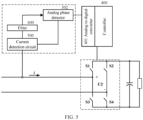
- FIG. 4 is a schematic diagram of still another phase alignment circuit according to an embodiment of this application.
- the phase measurement circuit is an analog phase detector 302.
- the phase alignment circuit further includes an analog to digital converter 401.
- a first input end of the analog phase detector 302 is connected to the output end of the current detection circuit 500, and a second input end of the analog phase detector 302 is connected to the output end of the filter 600.
- the analog to digital converter 401 is configured to: perform analog to digital conversion on a phase difference that is output by the analog phase detector 302, convert the phase difference into a phase difference in a form of a digital signal, and send the phase difference in the form of the digital signal to the controller 400.
- the controller 400 processes the phase difference in the form of the digital signal.
- a difference between a phase of an input current existing before filtering and a phase of an input current existing after the filtering is obtained by using the analog phase detector 302. Because the analog phase detector 302 can receive an analog signal, the analog phase detector 302 can directly process a sine signal. Therefore, no zero-crossing detector needs to perform zero-crossing detection to obtain a square wave signal. Because the analog phase detector 302 outputs a phase difference in a form of an analog signal, the analog to digital converter needs to convert the phase difference into a phase difference in a form of a digital signal, and then the controller 400 can directly process the phase difference.
- analog to digital converter 401 and the controller 400 may be integrated together, that is, the analog to digital converter 401 is integrated in the controller 400.
- the analog to digital converter 401 is integrated in the controller 400.
- FIG. 6 is a phase alignment waveform graph according to an embodiment of this application.
- a waveform of an input current i of a rectifier corresponds to a waveform existing before filtering and a waveform existing after filtering that are both sine waves.
- a solid line indicates an input current existing before filtering, and a dashed line indicates an input current existing after the filtering.
- a square wave that is output by a first zero-crossing detector corresponds to a square wave signal obtained by performing zero-crossing detection on a sine signal existing before i is filtered
- a square wave that is output by a second zero-crossing detector corresponds to a square wave signal obtained by performing zero-crossing detection on a sine signal after i is filtered.
- a phase existing after i is filtered lags, by a phase difference ⁇ , behind a phase existing before i is filtered, in other words, a difference between a phase of a signal that is output by the first zero-crossing detector and a phase of a signal that is output by the second zero-crossing detector is ⁇ .
- an expected phase shift angle between a bridge arm voltage and the input current is a preset phase shift angle ⁇
- a phase of the bridge arm voltage is controlled to lag, by ⁇ , behind the phase of the input current fundamental component existing after filtering, a phase difference by which the phase of the bridge arm voltage lags behind a phase of an actual input current fundamental component is ⁇ + ⁇ . Therefore, the phase shift angle ⁇ between the phase of the bridge arm voltage and the phase of the input current fundamental component needs to be obtained by using the phase of the input current existing before the filtering as a reference.
- phase of the input current fundamental component existing after filtering needs to be compensated for, and a result obtained by subtracting the phase difference ⁇ caused due to filtering from the preset phase shift angle ⁇ needs to be used as a phase shift angle that is used to actually control a drive signal. In this way, a phase of an actually obtained bridge arm voltage lags behind the phase of the actual input current fundamental component by ⁇ .
- the rectifier is the full-bridge rectifier
- the four switching transistors of the full-bridge rectifier are all controllable switching transistors.
- Other implementations of the rectifier are described below with reference to the accompanying drawings.
- the rectifier is the full-bridge rectifier
- two controllable switching transistors and two diodes may be included.
- Detailed descriptions are provided below with reference to the accompanying drawings.
- FIG. 7 is a schematic diagram of a rectifier including two controllable switching transistors according to an embodiment of this application.
- either of two bridge arms of the rectifier includes one controllable switching transistor and one diode.
- a leading bridge arm includes a first diode D 1 and a first controllable switching transistor S3
- a lagging bridge arm includes a second diode D2 and a second controllable switching transistor S4.
- FIG. 8 is another schematic diagram of a rectifier including two controllable switching transistors according to an embodiment of this application.
- the rectifier shown in FIG. 8 also includes two diodes and two controllable switching transistors.
- One bridge arm includes two diodes D 1 and D3, and another bridge arm includes two controllable switching transistors S2 and S4.
- a bridge arm voltage of the full-bridge rectifier is a voltage between middle points of two bridge arms.
- a bridge arm voltage of the half-bridge rectifier is a voltage between a middle point of a bridge arm and the ground.
- FIG. 9 is a schematic diagram of a rectifier that is a half-bridge rectifier according to an embodiment of this application.
- Two switching transistors of the half-bridge rectifier are both controllable switching transistors: S1 and S3 shown in FIG. 9 .
- a specific implementation of the rectifier is not limited in this embodiment of this application. A person skilled in the art may perform selection depending on an actual product requirement.
- this embodiment of this application further provides a phase alignment method. Detailed descriptions are provided below with reference to the accompanying drawing.
- FIG. 10 is a flowchart of a phase alignment method of a receive end according to an embodiment of this application.
- the phase alignment method provided in this embodiment is applied to the phase alignment circuit provided in any one of the foregoing embodiments, and includes the following steps.
- detection may be performed by using a current sensor.
- a type of the current sensor is not specifically limited in this embodiment of this application, and for example, the current sensor may be a Hall effect sensor or may be a current transformer.
- S102 Filter the input current of the rectifier to obtain an input current fundamental component.
- the harmonic component needs to be filtered out to obtain the input current fundamental component, and a subsequently to-be-processed object is the input current fundamental component.
- S104 Use, as an actual phase shift angle, a result obtained by subtracting the phase difference from a preset phase shift angle, and control a phase of a bridge arm voltage of the rectifier to lag behind the phase of the input current fundamental component by the actual phase shift angle.
- the controller uses, as the actual phase shift angle, the result obtained by subtracting the phase difference from the preset phase shift angle, and controls the phase of the bridge arm voltage of the rectifier to lag behind the phase of the input current fundamental component by the actual phase shift angle.
- the controller outputs a drive signal for a controllable switching transistor of the rectifier by using the actual phase shift angle. Because a lagging phase caused due to filtering is compensated for, precision of synchronization between the bridge arm voltage and the input current can be increased.
- this embodiment of this application further provides a receive end of a wireless charging system. Detailed descriptions are provided below with reference to the accompanying drawing.
- FIG. 11 is a schematic diagram of a wireless charging system according to an embodiment of this application.
- the wireless charging system may be applied to various fields in which wireless charging is required, for example, the electric vehicle field.
- a receive end may be located on an electric vehicle and be used as a vehicle-mounted terminal.
- a transmit end of the wireless charging system may be located on the ground, and the transmit end wirelessly charges the electrical vehicle.
- a transmitting coil of the transmit end transmits an alternating magnetic field
- a receiving coil of the receive end receives the alternating magnetic field, so as to exchange electromagnetic energy.
- the wireless charging system provided in this embodiment includes the receive end and the transmit end, and the receive end includes an inverter, a first compensation circuit 100, and a transmitting coil Ct.
- the inverter includes four controllable switching transistors Q1 to Q4.
- the receive end includes: a receiving coil Cr, a second compensation circuit 200, a rectifier, and the phase alignment circuit 1000 described in any one of the foregoing embodiments.
- the rectifier is described by using an example of a full-bridge rectifier including four controllable switching transistors S1 to S4.
- the receiving coil Cr receives electromagnetic energy transmitted by the transmitting coil Ct and outputs an alternating current.
- the rectifier rectifies the alternating current into a direct current to supply power to a powered device.
- load of the rectifier may be a power battery on an electric vehicle.
- the phase alignment circuit 1000 may align a phase of a bridge arm voltage of the rectifier based on a difference between a phase of an input current existing before filtering and a phase of an input current existing after the filtering of the rectifier.
- the rectifier may alternatively be a half-bridge rectifier.
- the receive end provided in this embodiment obtains the input current existing before the filtering and the input current existing after the filtering of the rectifier, to obtain the difference between the phase of the input current existing before the filtering and the phase of the input current existing after the filtering. Because the phase difference is caused due to filtering, the phase difference needs to be subsequently controlled to be compensated for.
- a result obtained by subtracting the phase difference from a preset phase shift angle is used as an actual phase shift angle, and the phase of the bridge arm voltage of the rectifier is controlled to lag behind a phase of an input current fundamental component by the actual phase shift angle.
- the controller outputs a drive signal for a controllable switching transistor of the rectifier by using the actual phase shift angle. Because a lagging phase caused due to filtering is compensated for, precision of synchronization between the bridge arm voltage of the rectifier and the input current can be increased.
- An embodiment of this application further provides a wireless charging system including the receive end described in the foregoing embodiment.
- the wireless charging system may be applied to the electric vehicle field.
- At least one (item) means one or more, and "a plurality of” means two or more than two.
- “And/or” is used to describe an association relationship between associated objects and represents that three relationships may exist. For example, “A and/or B” may represent: Only A exists, only B exists, and both A and B exist. Either of A and B may be singular or plural.
- the character “/” generally indicates an “or” relationship between the associated objects.
- At least one (item) of the following” or a similar expression thereof refers to any combination of the items, including any combination of one or more (items).
- At least one (item) of a, b, or c may indicate: a, b, c, "a and b", “a and c", “b and c", or "a, b, and c".
- Each of a, b, and c may be singular or plural.
Landscapes
- Engineering & Computer Science (AREA)
- Power Engineering (AREA)
- Computer Networks & Wireless Communication (AREA)
- Transportation (AREA)
- Mechanical Engineering (AREA)
- Rectifiers (AREA)
Description
- The present invention relates to the field of power electronic technologies, and in particular, to a phase alignment circuit and method of a receive end, and a receive end.
- With intensification of energy shortages and environmental pollution in the modern society, electric vehicles have attracted wide attention from all walks of life as new energy vehicles. However, most of existing electric vehicles are limited by battery capacities and have a relatively short driving distance. In addition, the electric vehicle has a long battery charging time and corresponding charging station resources are scarce. This has become a biggest bottleneck restricting application and popularization of the electric vehicles.
- Battery charging methods for electric vehicles usually include: contact charging and wireless charging. During contact charging, electricity is conducted through metal contact between a plug and a socket. During wireless charging, a coupled electromagnetic field is used as a medium to transfer electrical energy. Compared with contact charging, wireless charging has many advantages and becomes a mainstream manner for charging electric vehicles in the future. A wireless charging system has undergone a development process of a non-tuning method for adjusting output power by using a direct current conversion circuit, passive tuning for adjusting output power by using passive components such as an inductor and a capacitor, and performing an impedance adjustment by using a controllable switching transistor.
- The impedance adjustment is to control synchronization between a bridge arm voltage of a rectifier of a receive end and an input current of the rectifier. Therefore, a phase of the input current of the rectifier needs to be detected. However, because the input current of the rectifier generally has a harmonic signal or an interference signal, the detected input current needs to be filtered. Regardless of whether the filtering is hardware filtering or software filtering, a phase existing after the filtering lags behind the phase existing before the filtering.
- R. Mai, Y. Liu, Y. Li, P. Yue, G. Cao and Z. He, "An Active-Rectifier-Based Maximum Efficiency Tracking Method Using an Additional Measurement Coil for Wireless Power Transfer," in IEEE Transactions on Power Electronics, vol. 33, no. 1, pp. 716-728, Jan. 2018, doi: 10.1109/TPEL.2017.2665040 discloses that the efficiency of wireless power transfer (WPT) systems is highly dependent on the load, which may change in a wide range in field applications. Besides, the detuning of WPT systems caused by the component tolerance and aging of inductors and capacitors can also decrease the system efficiency. In order to track the maximum system efficiency under varied loads and detuning conditions in real time, an active single-phase rectifier (ASPR) with an auxiliary measurement coil (AMC) and its corresponding control method are proposed in this paper. Both the equivalent load impedance and the output voltage can be regulated by the ASPR and the inverter, separately. First, the fundamental harmonic analysis model is established to analyze the influence of the load and the detuning on the system efficiency. Second, the soft-switching conditions and the equivalent input impedance of ASPR with different phase shifts and pulse widths are investigated in detail. Then, the analysis of the AMC and the maximum efficiency control strategy are provided in detail. Finally, an 800-W prototype is set up to validate the performance of the proposed method. The experimental results show that with 10% tolerance of the resonant capacitor in the receiver side, the system efficiency with the proposed approach reaches 91.7% at rated 800-W load and 91.1% at 300-W light load, which has an improvement by 2% and 10% separately compared with the traditional diode rectifier.
-
US6091205A discloses a phase controlled dimming system having an active filter for receiving the AC line voltage waveform, and for recovering the AC fundamental waveform therefrom. The recovered AC fundamental waveform is supplied to a zero crossing detector that provides zero crossing indications of the AC fundamental waveform. The recovered AC fundamental is substantially free of noise or distortion, and of frequency components greater than at least second order harmonics, that may be present on the AC line voltage waveform, and that might otherwise result in faulty or incorrect zero crossing detection. An output of the zero crossing detector is supplied to a microprocessor that controls the gating of a controllably conductive device interposed between the controlled load and the AC source based on the zero crossing information. The filter may take an analog or digital (software) form. - To resolve the foregoing technical problem existing in the prior art, the present invention provides a phase alignment circuit and method of a receive end, and a receive end, so that a phase lag caused due to filtering can be compensated for, to keep accurate synchronization between a bridge arm voltage of a rectifier and an input current of the rectifier. According to a first aspect, an embodiment of this application provides a phase alignment circuit of a receive end in accordance with
claim 1, including: a phase measurement circuit and a controller. A first input end of the phase measurement circuit is connected to an output end of a current detection circuit, and a second input end of the phase measurement circuit is connected to an output end of a filter. The current detection circuit detects an input current of a rectifier. The filter filters the input current to obtain an input current fundamental component. The phase measurement circuit obtains a difference between a phase of the input current and a phase of the input current fundamental component. The controller uses, as an actual phase shift angle, a result obtained by subtracting the phase difference from a preset phase shift angle, and controls a phase of a bridge arm voltage of the rectifier to lag behind the phase of the input current fundamental component by the actual phase shift angle. - The phase alignment circuit can compensate for a phase lag caused due to filtering, to keep accurate synchronization between the bridge arm voltage of the rectifier and the input current of the rectifier. When the phase of the bridge arm voltage is controlled by using the phase of the input current as a reference, a phase difference caused due to a filtering delay needs to be subtracted from the preset phase shift angle between the bridge arm voltage that needs to be theoretically controlled and the input current, to compensate for the phase difference caused due to filtering. The controller outputs a drive signal for a controllable switching transistor of the rectifier by using the actual phase shift angle. Because a lagging phase caused due to filtering is compensated for, precision of synchronization between the bridge arm voltage and the input current can be increased.
- The phase measurement circuit may be digital or analog. For example, when the phase measurement circuit is a digital phase detector, the phase alignment circuit further includes: a first zero-crossing detector and a second zero-crossing detector. An input end of the first zero-crossing detector is connected to the output end of the filter, and an input end of the second zero-crossing detector is connected to the output end of the current detection circuit. An output end of the first zero-crossing detector is connected to a first input end of the digital phase detector, and an output end of the second zero-crossing detector is connected to a second input end of the digital phase detector. The first zero-crossing detector is configured to perform zero-crossing detection on the input current fundamental component, to obtain a first square wave. The second zero-crossing detector is configured to perform zero-crossing detection on the input current, to obtain a second square wave. The digital phase detector is configured to obtain the difference between the phase of the input current and the phase of the input current fundamental component based on the first square wave and the second square wave. The digital phase detector may directly obtain a difference between phases of the two square wave signals, that is, obtain a phase difference in a form of a digital signal, and directly send the phase difference to the controller. The controller may directly process the digital signal, thereby saving resources of the controller. When the phase measurement circuit is an analog phase detector, the phase alignment circuit further includes: an analog to digital converter. A first input end of the analog phase detector is connected to the output end of the current detection circuit, and a second input end of the analog phase detector is connected to the output end of the filter. The analog to digital converter is configured to perform analog to digital conversion on a phase difference that is output by the analog phase detector, to obtain a phase difference in a form of a digital signal. Because the analog phase detector can receive an analog signal, the analog phase detector can directly process a sine signal. Therefore, no zero-crossing detector needs to perform zero-crossing detection to obtain a square wave signal.
- Preferably, the analog to digital converter and the controller are integrated together. In other words, the controller may have its own analog to digital converter.
- Preferably, the rectifier is a full-bridge rectifier, and the full-bridge rectifier includes four controllable switching transistors. The bridge arm voltage is a voltage between a middle point of a leading bridge arm of the full-bridge rectifier and a middle point of a lagging bridge arm of the full-bridge rectifier. The rectifier is a half-bridge rectifier, and the half-bridge rectifier includes two controllable switching transistors. The bridge arm voltage is a voltage between a middle point of a bridge arm of the half-bridge rectifier and the ground.
- Preferably, the preset phase shift angle is 0, or the preset phase shift angle is a fixed preset value greater than 0. According to a second aspect, an embodiment of this application provides a phase alignment method of a receive end in accordance with claim 8, where the method is applied to the foregoing phase alignment circuit, and includes: detecting an input current of a rectifier; filtering the input current of the rectifier to obtain an input current fundamental component; obtaining a difference between a phase of the input current and a phase of the input current fundamental component; and using, as an actual phase shift angle, a result obtained by subtracting the phase difference from a preset phase shift angle, and controlling a phase of a bridge arm voltage of the rectifier to lag behind the phase of the input current fundamental component by the actual phase shift angle.
- Based on the method, a phase lag caused due to filtering can be compensated for, to keep accurate synchronization between the bridge arm voltage of the rectifier and the input current of the rectifier. When the phase of the bridge arm voltage is controlled by using the phase of the input current as a reference, a phase difference caused due to a filtering delay needs to be subtracted from the preset phase shift angle between the bridge arm voltage that needs to be theoretically controlled and the input current, to compensate for the phase difference caused due to filtering. A drive signal for a controllable switching transistor of the rectifier is output by using the actual phase shift angle. Because a lagging phase caused due to filtering is compensated for, precision of synchronization between the bridge arm voltage and the input current can be increased.
- According to a third aspect, an embodiment of this application further provides a receive end in accordance with claim 9, including: a receiving coil, a rectifier, and the foregoing phase alignment circuit. The receiving coil receives electromagnetic energy transmitted by a transmitting coil and outputs an alternating current. The rectifier rectifies the alternating current into a direct current. The phase alignment circuit aligns a phase of a bridge arm voltage of the rectifier based on a difference between a phase of an input current existing before filtering and a phase of an input current existing after the filtering of the rectifier.
- The receive end may be applied to a wireless charging system, and the wireless charging system may charge an electric vehicle. The receive end may be located on the electric vehicle, and charge a power battery pack on the electric vehicle. The rectifier is a full-bridge rectifier or a half-bridge rectifier. When the rectifier is the full-bridge rectifier, four controllable switching transistors may be included, or only two controllable switching transistors may be included. When the rectifier is the half-bridge rectifier, two included switching transistors are both controllable switching transistors.
- Compared with the prior art, the present invention has at least the following advantages:
The phase lag caused due to filtering can be compensated for, to keep accurate synchronization between the bridge arm voltage of the rectifier and the input current of the rectifier. Specifically, a phase existing after filtering lags behind an actual phase of the input current, and the phase of the bridge arm voltage is also usually enabled to lag behind the phase of the input current; or certainly, the phase of the bridge arm voltage may be the same as the phase of the input current. Therefore, when the phase of the bridge arm voltage is controlled by using the phase of the input current as a reference, the phase difference caused due to the filtering delay needs to be subtracted from the preset phase shift angle between the bridge arm voltage that needs to be theoretically controlled and the input current, to compensate for the phase difference caused due to filtering. The controller outputs the drive signal for the controllable switching transistor of the rectifier by using the actual phase shift angle. Because the lagging phase caused due to filtering is compensated for, precision of synchronization between the bridge arm voltage and the input current can be increased. - To describe the technical solutions in the embodiments of this application more clearly, the following briefly describes the accompanying drawings required for describing the embodiments or the prior art. Apparently, the accompanying drawings in the following description show some embodiments of this application, and a person of ordinary skill in the art may still derive other drawings from these accompanying drawings without creative efforts.
-
FIG. 1 is an equivalent circuit diagram of a wireless charging system; -
FIG. 2 is a schematic diagram of a phase alignment circuit according to an embodiment of this application; -
FIG. 3 is a schematic diagram of another phase alignment circuit according to an embodiment of this application; -
FIG. 4 is a schematic diagram of still another phase alignment circuit according to an embodiment of this application; -
FIG. 5 is a schematic diagram of yet another phase alignment circuit according to an embodiment of this application; -
FIG. 6 is a phase alignment waveform graph according to an embodiment of this application; -
FIG. 7 is a schematic diagram of a rectifier that is a full-bridge rectifier according to an embodiment of this application; -
FIG. 8 is another schematic diagram of a rectifier that is a full-bridge rectifier according to an embodiment of this application; -
FIG. 9 is a schematic diagram of a rectifier that is a half-bridge rectifier according to an embodiment of this application; -
FIG. 10 is a flowchart of a phase alignment method according to an embodiment of this application; and -
FIG. 11 is a schematic diagram of a wireless charging system according to an embodiment of this application. - To enable a person skilled in the art to better understand technical solutions provided in the embodiments of this application, an application scenario of the embodiments of this application is first described below.
-
FIG. 1 is an equivalent circuit diagram of a wireless charging system. - The wireless charging system includes a transmit end and a receive end. The transmit end includes an inverter, a
compensation circuit 100, and a transmitting coil Ct. The inverter includes four switching transistors Q1 to Q4. - The receive end includes a receiving coil Cr, a
compensation circuit 200, and a rectifier. The rectifier includes four switching transistors S1 to S4. - Electromagnetic energy is usually wirelessly transferred between the transmit end and the receive end. In other words, the transmit end transmits electromagnetic energy, and the receive end receives, through wireless communication, the electromagnetic energy transmitted by the transmit end.
- During an impedance adjustment, the rectifier of the receive end needs to be controlled, to control synchronization between a bridge arm voltage of the rectifier and an input current i of the rectifier. The rectifier may be a full-bridge rectifier or a half-bridge rectifier.
FIG. 1 shows the full-bridge rectifier. The full-bridge rectifier includes four switching transistors. In this case, the bridge arm voltage of the rectifier is a voltage between middle points of two bridge arms of the rectifier, that is, U2 in the figure. When the rectifier is the half-bridge rectifier, the bridge arm voltage is a voltage between a middle point of a bridge arm of the rectifier and the ground. - Keeping synchronization between the bridge arm voltage of the rectifier and the input current of the rectifier means that cycles or frequencies of the two are the same. In a process of keeping synchronization between the cycle of the bridge arm voltage and the cycle of the input current, a fixed phase difference may be kept between the two. The fixed phase difference may be 0, or may be a preset fixed value greater than 0.
- If the cycles or frequencies of the two are the same, a phase of the input current of the rectifier needs to be obtained, to obtain the cycle of the input current, so that the bridge arm voltage follows the cycle of the input current.
- However, when the phase of the input current of the rectifier is detected, because the input current of the rectifier generally has a harmonic signal or an interference signal, the detected input current needs to be filtered. Regardless of whether the filtering is hardware filtering or software filtering, a phase existing after the filtering lags behind the phase existing before the filtering.
- Therefore, based on a phase alignment circuit and method and a system that are provided in the embodiments of this application, a phase lag caused due to filtering can be compensated for, to keep accurate synchronization between the bridge arm voltage of the rectifier and the input current of the rectifier. Specifically, the phase existing after the filtering lags behind an actual phase of the input current, and in a controller, a phase of the bridge arm voltage is also usually enabled to lag behind the phase of the input current; or certainly, a phase of the bridge arm voltage may be the same as the phase of the input current. Therefore, when the phase of the bridge arm voltage is controlled by using the phase of the input current as a reference, a phase difference caused due to a filtering delay needs to be subtracted from a preset phase shift angle between the bridge arm voltage that needs to be theoretically controlled and the input current, to compensate for the phase difference caused due to filtering.
- To make a person skilled in the art understand the technical solutions in the present invention better, the following clearly describes the technical solutions in the embodiments of the present invention with reference to the accompanying drawings in the embodiments of the present invention. Apparently, the described embodiments are merely some rather than all of the embodiments of the present invention.
-
FIG. 2 is a schematic diagram of a phase alignment circuit according to an embodiment of this application. - An example in which a rectifier is a full-bridge rectifier is used in this embodiment for description. As shown in
FIG. 2 , the rectifier includes controllableswitching transistors S 1 to S4. A bridge arm voltage of the rectifier is U2. - The phase alignment circuit for an impedance adjustment provided in this embodiment includes a
phase measurement circuit 300 and acontroller 400. - A first input end of the
phase measurement circuit 300 is connected to an output end of acurrent detection circuit 500, and a second input end of thephase measurement circuit 300 is connected to an output end of afilter 600. - The
current detection circuit 500 detects an input current of the rectifier. - A specific implementation of the
current detection circuit 500 is not limited in this embodiment of this application, and for example, thecurrent detection circuit 500 may be a Hall effect sensor or a current transformer (CT). - The
filter 600 filters the input current to obtain an input current fundamental component. - A main role of the
filter 600 is to filter out a high-order harmonic in the input current and retain the input current fundamental component. - The
filter 600 may use a relatively mature filter circuit. - The
phase measurement circuit 300 obtains a difference between a phase of the input current and a phase of the input current fundamental component. - The
phase measurement circuit 300 may be implemented by using a phase detector, or may be implemented by using a circuit built by a basic circuit device, and is mainly configured to obtain a difference between phases of two input signals. - The
controller 400 uses, as an actual phase shift angle, a result obtained by subtracting the phase difference from a preset phase shift angle, and controls a phase of the bridge arm voltage of the rectifier to lag behind the phase of the input current fundamental component by the actual phase shift angle. - For ease of description, the preset phase shift angle is represented by δ and the phase difference is represented by β in the following.
- The filter causes a delay to the phase of the input current. Therefore, when generating a drive signal for a controllable switching transistor of the rectifier, the controller needs to compensate for a phase difference caused due to the delay. Keeping synchronization between the bridge arm voltage of the rectifier and the input current of the rectifier means keeping synchronization with the input current existing before the filtering.
- Before filtering, the input current of the rectifier is a sine signal including a harmonic. After filtering, the input current becomes a sine signal. However, a phase of the sine signal existing after filtering lags behind, by the phase difference β, a phase of the sine signal existing before filtering.
- If the preset phase shift angle between the bridge arm voltage of the rectifier and the input current of the rectifier is δ, a phase shift angle of the bridge arm voltage to the input current fundamental component needs to be actually controlled to be δ-β.
- The preset phase shift angle δ is a preset value, and may be 0 or may be a fixed preset value.
- Based on the alignment circuit provided in this embodiment, an input current existing before filtering and an input current existing after the filtering the rectifier are obtained, to obtain a difference between a phase of the input current existing before the filtering and a phase of the input current existing after the filtering. Because the phase difference is caused due to filtering, the phase difference needs to be subsequently controlled to be compensated for. In this embodiment, the controller uses, as the actual phase shift angle, the result obtained by subtracting the phase difference from the preset phase shift angle, and controls the phase of the bridge arm voltage of the rectifier to lag behind the phase of the input current fundamental component by the actual phase shift angle. The controller outputs the drive signal for the controllable switching transistor of the rectifier by using the actual phase shift angle. Because a lagging phase caused due to filtering is compensated for, precision of synchronization between the bridge arm voltage and the input current can be increased.
-
FIG. 3 is a schematic diagram of another phase alignment circuit according to an embodiment of this application. - In the phase alignment circuit provided in this embodiment, the phase measurement circuit may be a
digital phase detector 301. - The phase alignment circuit further includes: a first zero-crossing
detector 700 and a second zero-crossingdetector 800. - An input end of the first zero-crossing
detector 700 is connected to the output end of thefilter 600, and an input end of the second zero-crossingdetector 800 is connected to the output end of thecurrent detection circuit 500. An output end of the first zero-crossingdetector 700 is connected to a first input end of thedigital phase detector 301, and an output end of the second zero-crossingdetector 800 is connected to a second input end of thedigital phase detector 301. - The first zero-crossing
detector 700 is configured to perform zero-crossing detection on the input current fundamental component, to obtain a first square wave. - The second zero-crossing
detector 800 is configured to perform zero-crossing detection on the input current, to obtain a second square wave. - The
current detection circuit 500 outputs a sine signal having a harmonic, and thefilter 600 outputs a sine signal. Because only a digital signal can be processed when the phase measurement circuit uses thedigital phase detector 301, an analog signal corresponding to a sine signal needs to be converted into a digital signal. Therefore, in this embodiment of this application, a sine signal is converted into a square wave signal with a same phase and cycle by using a zero-crossing detector. Because the square wave signal belongs to a digital signal, the square wave signal can be directly processed by thedigital phase detector 301. - The
digital phase detector 301 is configured to obtain a difference between a phase of the input current and a phase of the input current fundamental component based on the first square wave and the second square wave. - The
digital phase detector 301 may obtain a difference between phases of the two square wave signals, and the phase difference is a difference between phases of input currents that is caused by the filter. - In this embodiment, a difference between a phase of an input current existing before filtering and a phase of an input current existing after the filtering is obtained by using the
digital phase detector 301. Because a signal received by thedigital phase detector 301 needs to be a digital signal and an analog signal cannot be processed, the first zero-crossingdetector 700 and the second zero-crossingdetector 800 need to separately perform zero-crossing detection to convert a sine signal into a square wave signal. Thedigital phase detector 301 may directly obtain the difference between the phases of the two square wave signals, that is, obtain a phase difference in a form of a digital signal, and directly send the phase difference to thecontroller 400. Thecontroller 400 may directly process the digital signal, thereby saving resources of thecontroller 400. - Remaining content of this embodiment is the same as that in
Embodiment 1 of the phase alignment circuit. Details are not described herein. -
Embodiment 2 of the alignment circuit is described by using an example in which the phase measurement circuit is the digital phase detector, and an implementation in which the phase measurement circuit is an analog phase detector is described below. -
FIG. 4 is a schematic diagram of still another phase alignment circuit according to an embodiment of this application. In the phase alignment circuit provided in this embodiment, the phase measurement circuit is ananalog phase detector 302. - The phase alignment circuit further includes an analog to
digital converter 401. - A first input end of the
analog phase detector 302 is connected to the output end of thecurrent detection circuit 500, and a second input end of theanalog phase detector 302 is connected to the output end of thefilter 600. - The analog to
digital converter 401 is configured to: perform analog to digital conversion on a phase difference that is output by theanalog phase detector 302, convert the phase difference into a phase difference in a form of a digital signal, and send the phase difference in the form of the digital signal to thecontroller 400. - The
controller 400 processes the phase difference in the form of the digital signal. - According to the phase alignment circuit provided in this embodiment, a difference between a phase of an input current existing before filtering and a phase of an input current existing after the filtering is obtained by using the
analog phase detector 302. Because theanalog phase detector 302 can receive an analog signal, theanalog phase detector 302 can directly process a sine signal. Therefore, no zero-crossing detector needs to perform zero-crossing detection to obtain a square wave signal. Because theanalog phase detector 302 outputs a phase difference in a form of an analog signal, the analog to digital converter needs to convert the phase difference into a phase difference in a form of a digital signal, and then thecontroller 400 can directly process the phase difference. - It may be understood that the analog to
digital converter 401 and thecontroller 400 may be integrated together, that is, the analog todigital converter 401 is integrated in thecontroller 400. For details, refer to the circuit diagram shown inFIG. 5 . - To enable a person skilled in the art to more intuitively understand the technical solutions provided in the embodiments of this application, detailed descriptions are provided below with reference to a waveform graph corresponding to
FIG. 3 . -
FIG. 6 is a phase alignment waveform graph according to an embodiment of this application. - It can be seen from
FIG. 6 that a waveform of an input current i of a rectifier corresponds to a waveform existing before filtering and a waveform existing after filtering that are both sine waves. A solid line indicates an input current existing before filtering, and a dashed line indicates an input current existing after the filtering. - A square wave that is output by a first zero-crossing detector corresponds to a square wave signal obtained by performing zero-crossing detection on a sine signal existing before i is filtered, and a square wave that is output by a second zero-crossing detector corresponds to a square wave signal obtained by performing zero-crossing detection on a sine signal after i is filtered.
- It can be seen from the figure that a phase existing after i is filtered lags, by a phase difference β, behind a phase existing before i is filtered, in other words, a difference between a phase of a signal that is output by the first zero-crossing detector and a phase of a signal that is output by the second zero-crossing detector is β.
- If an expected phase shift angle between a bridge arm voltage and the input current is a preset phase shift angle δ, if by using a phase of an input current fundamental component existing after filtering as a reference, a phase of the bridge arm voltage is controlled to lag, by δ, behind the phase of the input current fundamental component existing after filtering, a phase difference by which the phase of the bridge arm voltage lags behind a phase of an actual input current fundamental component is δ+β. Therefore, the phase shift angle δ between the phase of the bridge arm voltage and the phase of the input current fundamental component needs to be obtained by using the phase of the input current existing before the filtering as a reference. Therefore, the phase of the input current fundamental component existing after filtering needs to be compensated for, and a result obtained by subtracting the phase difference β caused due to filtering from the preset phase shift angle δ needs to be used as a phase shift angle that is used to actually control a drive signal. In this way, a phase of an actually obtained bridge arm voltage lags behind the phase of the actual input current fundamental component by δ.
- The foregoing embodiments are all described by using an example in which the rectifier is the full-bridge rectifier, and the four switching transistors of the full-bridge rectifier are all controllable switching transistors. Other implementations of the rectifier are described below with reference to the accompanying drawings. For example, when the rectifier is the full-bridge rectifier, two controllable switching transistors and two diodes may be included. Detailed descriptions are provided below with reference to the accompanying drawings.
-
FIG. 7 is a schematic diagram of a rectifier including two controllable switching transistors according to an embodiment of this application. - As shown in
FIG. 7 , either of two bridge arms of the rectifier includes one controllable switching transistor and one diode. For example, a leading bridge arm includes afirst diode D 1 and a first controllable switching transistor S3, and a lagging bridge arm includes a second diode D2 and a second controllable switching transistor S4. - Locations of the two diodes and locations of the two controllable switching transistors in
FIG. 7 are interchangeable.FIG. 8 is another schematic diagram of a rectifier including two controllable switching transistors according to an embodiment of this application. - The rectifier shown in
FIG. 8 also includes two diodes and two controllable switching transistors. - One bridge arm includes two
diodes D 1 and D3, and another bridge arm includes two controllable switching transistors S2 and S4. - It may be understood that locations of switching transistors on the two bridge arms are interchangeable.
- The full-bridge rectifier is described above, and a half-bridge rectifier is described below. A bridge arm voltage of the full-bridge rectifier is a voltage between middle points of two bridge arms. A bridge arm voltage of the half-bridge rectifier is a voltage between a middle point of a bridge arm and the ground.
-
FIG. 9 is a schematic diagram of a rectifier that is a half-bridge rectifier according to an embodiment of this application. Two switching transistors of the half-bridge rectifier are both controllable switching transistors: S1 and S3 shown inFIG. 9 . - A specific implementation of the rectifier is not limited in this embodiment of this application. A person skilled in the art may perform selection depending on an actual product requirement.
- Based on the phase alignment circuit provided in the foregoing embodiment, this embodiment of this application further provides a phase alignment method. Detailed descriptions are provided below with reference to the accompanying drawing.
-
FIG. 10 is a flowchart of a phase alignment method of a receive end according to an embodiment of this application. The phase alignment method provided in this embodiment is applied to the phase alignment circuit provided in any one of the foregoing embodiments, and includes the following steps. - S 101: Detect an input current of a rectifier.
- Specifically, detection may be performed by using a current sensor. A type of the current sensor is not specifically limited in this embodiment of this application, and for example, the current sensor may be a Hall effect sensor or may be a current transformer.
- S102: Filter the input current of the rectifier to obtain an input current fundamental component.
- Because the directly detected input current has a harmonic component, the harmonic component needs to be filtered out to obtain the input current fundamental component, and a subsequently to-be-processed object is the input current fundamental component.
- S103: Obtain a difference between a phase of the input current and a phase of the input current fundamental component. A phase delay is caused due to filtering. Therefore, to compensate, in a subsequent step, for the phase difference caused by the delay, the phase difference needs to be obtained.
- S104: Use, as an actual phase shift angle, a result obtained by subtracting the phase difference from a preset phase shift angle, and control a phase of a bridge arm voltage of the rectifier to lag behind the phase of the input current fundamental component by the actual phase shift angle.
- An input current existing before filtering and an input current existing after the filtering of the rectifier are obtained, to obtain a difference between a phase of the input current existing before the filtering and a phase of the input current existing after the filtering. Because the phase difference is caused due to filtering, the phase difference needs to be subsequently controlled to be compensated for. In this embodiment, the controller uses, as the actual phase shift angle, the result obtained by subtracting the phase difference from the preset phase shift angle, and controls the phase of the bridge arm voltage of the rectifier to lag behind the phase of the input current fundamental component by the actual phase shift angle. The controller outputs a drive signal for a controllable switching transistor of the rectifier by using the actual phase shift angle. Because a lagging phase caused due to filtering is compensated for, precision of synchronization between the bridge arm voltage and the input current can be increased.
- Based on the phase alignment circuit and method provided in the foregoing embodiments, this embodiment of this application further provides a receive end of a wireless charging system. Detailed descriptions are provided below with reference to the accompanying drawing.
-
FIG. 11 is a schematic diagram of a wireless charging system according to an embodiment of this application. - It may be understood that the wireless charging system may be applied to various fields in which wireless charging is required, for example, the electric vehicle field. A receive end may be located on an electric vehicle and be used as a vehicle-mounted terminal. However, a transmit end of the wireless charging system may be located on the ground, and the transmit end wirelessly charges the electrical vehicle. Specifically, a transmitting coil of the transmit end transmits an alternating magnetic field, and a receiving coil of the receive end receives the alternating magnetic field, so as to exchange electromagnetic energy.
- As shown in
FIG. 11 , the wireless charging system provided in this embodiment includes the receive end and the transmit end, and the receive end includes an inverter, afirst compensation circuit 100, and a transmitting coil Ct. The inverter includes four controllable switching transistors Q1 to Q4. - The receive end includes: a receiving coil Cr, a
second compensation circuit 200, a rectifier, and thephase alignment circuit 1000 described in any one of the foregoing embodiments. The rectifier is described by using an example of a full-bridge rectifier including four controllable switching transistors S1 to S4. - The receiving coil Cr receives electromagnetic energy transmitted by the transmitting coil Ct and outputs an alternating current.
- The rectifier rectifies the alternating current into a direct current to supply power to a powered device. For example, in the electric vehicle field, load of the rectifier may be a power battery on an electric vehicle.
- In this embodiment, the
phase alignment circuit 1000 may align a phase of a bridge arm voltage of the rectifier based on a difference between a phase of an input current existing before filtering and a phase of an input current existing after the filtering of the rectifier. - In addition to the full-bridge rectifier shown in
FIG. 11 , the rectifier may alternatively be a half-bridge rectifier. The receive end provided in this embodiment obtains the input current existing before the filtering and the input current existing after the filtering of the rectifier, to obtain the difference between the phase of the input current existing before the filtering and the phase of the input current existing after the filtering. Because the phase difference is caused due to filtering, the phase difference needs to be subsequently controlled to be compensated for. In this embodiment, a result obtained by subtracting the phase difference from a preset phase shift angle is used as an actual phase shift angle, and the phase of the bridge arm voltage of the rectifier is controlled to lag behind a phase of an input current fundamental component by the actual phase shift angle. The controller outputs a drive signal for a controllable switching transistor of the rectifier by using the actual phase shift angle. Because a lagging phase caused due to filtering is compensated for, precision of synchronization between the bridge arm voltage of the rectifier and the input current can be increased. - An embodiment of this application further provides a wireless charging system including the receive end described in the foregoing embodiment. The wireless charging system may be applied to the electric vehicle field.
- It should be understood that, in this application, "at least one (item)" means one or more, and "a plurality of" means two or more than two. "And/or" is used to describe an association relationship between associated objects and represents that three relationships may exist. For example, "A and/or B" may represent: Only A exists, only B exists, and both A and B exist. Either of A and B may be singular or plural. The character "/" generally indicates an "or" relationship between the associated objects. "At least one (item) of the following" or a similar expression thereof refers to any combination of the items, including any combination of one or more (items). For example, at least one (item) of a, b, or c may indicate: a, b, c, "a and b", "a and c", "b and c", or "a, b, and c". Each of a, b, and c may be singular or plural.
- The foregoing are merely embodiments of the present invention, and are not intended to limit the present invention in any form. Although the present invention has been disclosed as above with preferred embodiments, it is not intended to limit the present invention. By using the method and the technical content disclosed above, any person of ordinary skill in the art can make a plurality of possible changes and modifications to the technical solutions of the present invention, or amend the technical solutions thereof to be embodiments with equal effects through equivalent variations without departing from the protection scope of the claims.
Claims (10)
- A phase alignment circuit of a receive end for receiving electromagnetic energy through wireless communication, comprising: a current detection circuit (500), a filter (600), a phase measurement circuit (300) and a controller (400), whereina first input end of the phase measurement circuit is connected to an output end of the current detection circuit, anda second input end of the phase measurement circuit is connected to an output end of the filter;the current detection circuit is configured to detect an input current of a rectifier;the filter is configured to filter the input current to obtain an input current fundamental component;the phase measurement circuit is configured to obtain a difference between a phase of the input current and a phase of the input current fundamental component; andthe controller is configured to: use, as an actual phase shift angle, a result obtained by subtracting the phase difference from a preset phase shift angle, and control a phase of a bridge arm voltage of the rectifier to lag behind the phase of the input current fundamental component by the actual phase shift angle.
- The phase alignment circuit according to claim 1, wherein the phase measurement circuit is a digital phase detector (301);the phase alignment circuit further comprises: a first zero-crossing detector (700) and a second zero-crossing detector (800);an input end of the first zero-crossing detector is connected to the output end of the filter, and an input end of the second zero-crossing detector is connected to the output end of the current detection circuit; and an output end of the first zero-crossing detector is connected to a first input end of the digital phase detector, and an output end of the second zero-crossing detector is connected to a second input end of the digital phase detector;the first zero-crossing detector is configured to perform zero-crossing detection on the input current fundamental component, to obtain a first square wave;the second zero-crossing detector is configured to perform zero-crossing detection on the input current, to obtain a second square wave; andthe digital phase detector is configured to obtain the difference between the phase of the input current and the phase of the input current fundamental component based on the first square wave and the second square wave.
- The phase alignment circuit according to claim 1, wherein the phase measurement circuit is an analog phase detector (302);the phase alignment circuit further comprises an analog to digital converter (401);a first input end of the analog phase detector is connected to the output end of the current detection circuit, and a second input end of the analog phase detector is connected to the output end of the filter; andthe analog to digital converter is configured to perform analog to digital conversion on a phase difference that is output by the analog phase detector, to obtain a phase difference in a form of a digital signal.
- The phase alignment circuit according to claim 3, wherein the analog to digital converter and the controller are integrated together.
- The phase alignment circuit according to any one of claims 1 to 4, wherein the rectifier is a full-bridge rectifier, and the full-bridge rectifier comprises four controllable switching transistors; and the bridge arm voltage is a voltage between a middle point of a leading bridge arm of the full-bridge rectifier and a middle point of a lagging bridge arm of the full-bridge rectifier.
- The phase alignment circuit according to any one of claims 1 to 4, with the rectifier being a half-bridge rectifier, and the half-bridge rectifier comprising two controllable switching transistors; and the bridge arm voltage being a voltage between a middle point of a bridge arm of the half-bridge rectifier and the ground.
- The phase alignment circuit according to claim 1, wherein the preset phase shift angle is 0, or the preset phase shift angle is a fixed preset value greater than 0.
- A phase alignment method of a receive end for receiving electromagnetic energy through wireless communication, wherein the method is applied to the phase alignment circuit according to any one of claims 1 to 7, and comprises:detecting an input current of a rectifier;filtering the input current of the rectifier to obtain an input current fundamental component;obtaining a difference between a phase of the input current and a phase of the input current fundamental component; andusing, as an actual phase shift angle, a result obtained by subtracting the phase difference from a preset phase shift angle, and controlling a phase of a bridge arm voltage of the rectifier to lag behind the phase of the input current fundamental component by the actual phase shift angle.
- A receive end, comprising: a receiving coil, a rectifier, and the phase alignment circuit (1000) according to any one of claims 1 to 7, whereinthe receiving coil is configured to: receive electromagnetic energy transmitted by a transmitting coil and output an alternating current;the rectifier is configured to rectify the alternating current into a direct current; andthe phase alignment circuit is configured to align a phase of a bridge arm voltage of the rectifier based on a difference between a phase of an input current existing before filtering and a phase of an input current existing after the filtering of the rectifier.
- The receive end according to claim 9, wherein the rectifier is a full-bridge rectifier or a half-bridge rectifier.
Applications Claiming Priority (2)
| Application Number | Priority Date | Filing Date | Title |
|---|---|---|---|
| CN201811543560.6A CN109672343B (en) | 2018-12-17 | 2018-12-17 | A phase calibration circuit and method of a receiving end, and a receiving end |
| PCT/CN2019/107419 WO2020125112A1 (en) | 2018-12-17 | 2019-09-24 | Phase calibration circuit and method for receiving end, and receiving end |
Publications (3)
| Publication Number | Publication Date |
|---|---|
| EP3799287A1 EP3799287A1 (en) | 2021-03-31 |
| EP3799287A4 EP3799287A4 (en) | 2021-09-08 |
| EP3799287B1 true EP3799287B1 (en) | 2023-04-26 |
Family
ID=66144817
Family Applications (1)
| Application Number | Title | Priority Date | Filing Date |
|---|---|---|---|
| EP19897695.3A Active EP3799287B1 (en) | 2018-12-17 | 2019-09-24 | Phase calibration circuit and method for receiving end, and receiving end |
Country Status (4)
| Country | Link |
|---|---|
| US (2) | US11038433B2 (en) |
| EP (1) | EP3799287B1 (en) |
| CN (1) | CN109672343B (en) |
| WO (1) | WO2020125112A1 (en) |
Families Citing this family (8)
| Publication number | Priority date | Publication date | Assignee | Title |
|---|---|---|---|---|
| CN109672343B (en) | 2018-12-17 | 2020-12-18 | 华为技术有限公司 | A phase calibration circuit and method of a receiving end, and a receiving end |
| CN109742863B (en) | 2018-12-27 | 2023-06-20 | 华为技术有限公司 | Receiver, transmitter and wireless charging system of a wireless charging system |
| CN110954749B (en) * | 2019-11-06 | 2021-07-30 | 许继电源有限公司 | A phase detection circuit for wireless charging of electric vehicles for frequency tracking |
| CN112217294B (en) * | 2020-08-19 | 2022-05-13 | 浙江大学 | Non-communication constant current control method applied to bidirectional wireless power transmission circuit |
| DE102021116287A1 (en) * | 2021-06-23 | 2022-12-29 | Compleo Charging Solutions Ag | DC-to-DC converter and method of operation for a utility station |
| US11784578B2 (en) | 2022-01-28 | 2023-10-10 | Nxp B.V. | Electronic circuit with electromagnetic interference detection and suppression and method therefor |
| CN117977966A (en) * | 2024-01-05 | 2024-05-03 | 华为数字能源技术有限公司 | Power conversion device and control method thereof |
| CN119582466B (en) * | 2025-02-07 | 2025-04-18 | 国网江苏省电力有限公司电力科学研究院 | Wireless power transfer system based on semi-active rectifier |
Citations (1)
| Publication number | Priority date | Publication date | Assignee | Title |
|---|---|---|---|---|
| US20150316906A1 (en) * | 2012-12-20 | 2015-11-05 | Tianjin University | An active front-end rectifier filter delay compensation method based on model predictive control |
Family Cites Families (34)
| Publication number | Priority date | Publication date | Assignee | Title |
|---|---|---|---|---|
| JPS55100037A (en) * | 1979-01-24 | 1980-07-30 | Hitachi Ltd | Electric power converter |
| US5151638A (en) * | 1991-08-12 | 1992-09-29 | Atlas Roll-Lite Door Corporation | Motor overload indicating arrangement |
| US6091205A (en) * | 1997-10-02 | 2000-07-18 | Lutron Electronics Co., Inc. | Phase controlled dimming system with active filter for preventing flickering and undesired intensity changes |
| DE10064476A1 (en) * | 2000-12-22 | 2002-07-11 | Atmel Germany Gmbh | Process for tuning a PLL circuit |
| JP2006136122A (en) * | 2004-11-05 | 2006-05-25 | Kokusan Denki Co Ltd | Output control device for power generator |
| CN101557227A (en) * | 2009-04-28 | 2009-10-14 | 大连理工大学 | Self-adapting resonance control method for transmitting non-contact electric energy |
| CN102005924A (en) * | 2009-09-03 | 2011-04-06 | 天津工程师范学院 | Control method for non-contact electric energy transmission |
| JP5530212B2 (en) * | 2010-02-10 | 2014-06-25 | 株式会社日立製作所 | Power supply device, hard disk device, and switching method of power supply device |
| US8901901B2 (en) * | 2011-02-10 | 2014-12-02 | Pai Capital Llc | Digital phase adjustment for multi-phase power converters |
| CN102185812A (en) * | 2011-05-13 | 2011-09-14 | 吉林大学 | DC (direct-current) offset filtering circuit |
| US8862648B2 (en) * | 2011-05-24 | 2014-10-14 | Taiwan Semiconductor Manufacturing Company, Ltd. | Fast filter calibration apparatus |
| WO2013083679A1 (en) * | 2011-12-07 | 2013-06-13 | Noliac A/S | Piezoelectric power converter with bi-directional power transfer |
| CN102638169B (en) * | 2012-05-08 | 2014-11-05 | 矽力杰半导体技术(杭州)有限公司 | Control circuit and control method of flyback convertor and alternating current-direct current power converting circuit applying control circuit of flyback convertor |
| US9859755B2 (en) * | 2012-07-16 | 2018-01-02 | Qualcomm Incorporated | Device alignment and identification in inductive power transfer systems |
| US9331614B2 (en) * | 2013-02-08 | 2016-05-03 | Regal Beloit America, Inc. | Systems and methods for controlling electric machines |
| CN203219200U (en) * | 2013-04-25 | 2013-09-25 | 湘煤立达矿山装备股份有限公司 | Three-phase high power factor grid-connected inverter |
| JP6217340B2 (en) * | 2013-11-20 | 2017-10-25 | 富士通株式会社 | Power supply |
| US9511674B2 (en) * | 2014-04-18 | 2016-12-06 | Qualcomm Incorporated | Base distribution network for dynamic wireless charging |
| WO2015173847A1 (en) * | 2014-05-14 | 2015-11-19 | ネオテス株式会社 | Contactless power transfer device |
| CN105682309B (en) * | 2014-11-18 | 2018-04-17 | 台达电子工业股份有限公司 | LED driving circuit and driving method thereof |
| JP2017009774A (en) * | 2015-06-22 | 2017-01-12 | 富士ゼロックス株式会社 | Image forming apparatus |
| CN105391663B (en) * | 2015-10-09 | 2018-08-07 | 浙江大华技术股份有限公司 | A kind of method for transmitting signals and system |
| EP3362804B1 (en) * | 2015-10-14 | 2024-01-17 | WiTricity Corporation | Phase and amplitude detection in wireless energy transfer systems |
| US20170187292A1 (en) * | 2015-12-28 | 2017-06-29 | Infineon Technologies Austria Ag | System and Method for a Switching Circuit |
| CN109075613B (en) | 2016-02-02 | 2022-05-31 | 韦特里西提公司 | Controlling a wireless power transfer system |
| US9899879B2 (en) * | 2016-02-15 | 2018-02-20 | Motorola Solutions, Inc. | Systems and methods for controlling wireless power transfer |
| US9960608B2 (en) * | 2016-03-04 | 2018-05-01 | Qualcomm Incorporated | High frequency multi-level rectification |
| CN106451819B (en) * | 2016-11-18 | 2019-01-18 | 西南交通大学 | A kind of control method of radio energy transmission system and its equivalent impedance |
| US10291109B2 (en) * | 2017-01-18 | 2019-05-14 | Virginia Tech Intellectual Properties, Inc. | Critical-mode-based soft-switching techniques for three-phase bi-directional AC/DC converters |
| US10320224B2 (en) * | 2017-05-25 | 2019-06-11 | Nxp B.V. | Wireless charging transmitter and method for operating the wireless charging transmitter |
| CN109412276B (en) * | 2017-08-15 | 2022-08-12 | 泰达电子股份有限公司 | Control circuit and control method suitable for wireless power transmission device |
| EP3553918B1 (en) * | 2018-04-09 | 2020-11-25 | NXP USA, Inc. | A power transmitter unit |
| CN109672343B (en) * | 2018-12-17 | 2020-12-18 | 华为技术有限公司 | A phase calibration circuit and method of a receiving end, and a receiving end |
| CN110103742B (en) * | 2019-05-29 | 2020-10-27 | 西安交通大学 | Current phase locking and pulse generating method for wireless charging of electric automobile |
-
2018
- 2018-12-17 CN CN201811543560.6A patent/CN109672343B/en active Active
-
2019
- 2019-09-24 EP EP19897695.3A patent/EP3799287B1/en active Active
- 2019-09-24 WO PCT/CN2019/107419 patent/WO2020125112A1/en not_active Ceased
-
2020
- 2020-12-30 US US17/137,786 patent/US11038433B2/en active Active
-
2021
- 2021-06-11 US US17/345,189 patent/US11482941B2/en active Active
Patent Citations (1)
| Publication number | Priority date | Publication date | Assignee | Title |
|---|---|---|---|---|
| US20150316906A1 (en) * | 2012-12-20 | 2015-11-05 | Tianjin University | An active front-end rectifier filter delay compensation method based on model predictive control |
Also Published As
| Publication number | Publication date |
|---|---|
| BR112021002260A2 (en) | 2021-05-04 |
| US20210126544A1 (en) | 2021-04-29 |
| US11482941B2 (en) | 2022-10-25 |
| WO2020125112A1 (en) | 2020-06-25 |
| US11038433B2 (en) | 2021-06-15 |
| EP3799287A4 (en) | 2021-09-08 |
| CN109672343B (en) | 2020-12-18 |
| CN109672343A (en) | 2019-04-23 |
| US20210305904A1 (en) | 2021-09-30 |
| EP3799287A1 (en) | 2021-03-31 |
Similar Documents
| Publication | Publication Date | Title |
|---|---|---|
| EP3799287B1 (en) | Phase calibration circuit and method for receiving end, and receiving end | |
| US11901760B2 (en) | Receive end and transmit end of wireless charging system, method, electrical terminal, and system | |
| CN104734300B (en) | A kind of electric motor car wireless charging circuit and its control method | |
| EP3691104B1 (en) | Inverter current equalizing method and apparatus, inverter system, and wireless charging system | |
| CN111386646B (en) | A wireless charging receiving device, method, terminal and system | |
| Zhu et al. | A parameter recognition-based impedance tuning method for SS-compensated wireless power transfer systems | |
| US11190042B2 (en) | Wireless charging transmitting apparatus, transmitting method, and wireless charging system | |
| CN109895640A (en) | A kind of electric car wireless charging two stage control system and control method | |
| CN112366777B (en) | Constant-current constant-voltage induction type wireless charging system based on secondary variable structure | |
| US11557921B2 (en) | Wireless power system | |
| CN114189059A (en) | Wireless power transmission device and control method | |
| Zeng et al. | An ultrafast estimation method for coupling coefficient and receiver resonant frequency in universal wireless power transfer systems | |
| EP4009487A1 (en) | Wireless charging transmitting device and method and wireless charging system | |
| CN110994811A (en) | Wireless charging system, control method and automobile wireless charging device | |
| Zhang et al. | A hybrid compensation topology with single switch for battery charging of inductive power transfer systems | |
| Wang et al. | Research on 11kW wireless charging system for electric vehicle based on LCC-SP topology and current doubler | |
| Jenson et al. | A novel LCC-LCL compensation WPT system for better performance | |
| CN112260416B (en) | Constant-current constant-voltage induction type wireless charging system based on variable primary parameters | |
| Rastegar et al. | Self-tuning in dynamic wireless power transfer (dwpt) systems: Maximum efficiency under misalignment and load variation | |
| Vishnu et al. | A phase shift control strategy for bidirectional power flow in capacitive wireless power transfer system using LCLC compensation | |
| Prasad et al. | A novel dual-lcc hybrid compensation network for high-efficiency cc-cv wireless charging of an ev battery considering weak communication | |
| Motoyama et al. | Simple Control Method of Wireless Power Ttansfer System Using Matrix Converter | |
| Zheng et al. | Research on Control of Wireless Power Transfer System Based on Switched Inductor | |
| Prigol et al. | Inductive Power Transfer Using Integrated AC–DC Converter With Transmitter-Side-Based Control and Simplified Output Synchronous Rectifier | |
| Wang et al. | Compensation circuit and buck converter based wireless power transmission |
Legal Events
| Date | Code | Title | Description |
|---|---|---|---|
| STAA | Information on the status of an ep patent application or granted ep patent |
Free format text: STATUS: THE INTERNATIONAL PUBLICATION HAS BEEN MADE |
|
| PUAI | Public reference made under article 153(3) epc to a published international application that has entered the european phase |
Free format text: ORIGINAL CODE: 0009012 |
|
| STAA | Information on the status of an ep patent application or granted ep patent |
Free format text: STATUS: REQUEST FOR EXAMINATION WAS MADE |
|
| 17P | Request for examination filed |
Effective date: 20201222 |
|
| AK | Designated contracting states |
Kind code of ref document: A1 Designated state(s): AL AT BE BG CH CY CZ DE DK EE ES FI FR GB GR HR HU IE IS IT LI LT LU LV MC MK MT NL NO PL PT RO RS SE SI SK SM TR |
|
| AX | Request for extension of the european patent |
Extension state: BA ME |
|
| REG | Reference to a national code |
Ref country code: DE Ref legal event code: R079 Ref document number: 602019028191 Country of ref document: DE Free format text: PREVIOUS MAIN CLASS: H02M0003335000 Ipc: H02M0007219000 |
|
| A4 | Supplementary search report drawn up and despatched |
Effective date: 20210809 |
|
| RIC1 | Information provided on ipc code assigned before grant |
Ipc: B60L 53/122 20190101ALI20210803BHEP Ipc: B60L 53/12 20190101ALI20210803BHEP Ipc: H02M 3/335 20060101ALI20210803BHEP Ipc: H02M 1/00 20060101ALI20210803BHEP Ipc: H02J 50/10 20160101ALI20210803BHEP Ipc: H02M 7/219 20060101AFI20210803BHEP |
|
| DAV | Request for validation of the european patent (deleted) | ||
| DAX | Request for extension of the european patent (deleted) | ||
| STAA | Information on the status of an ep patent application or granted ep patent |
Free format text: STATUS: EXAMINATION IS IN PROGRESS |
|
| 17Q | First examination report despatched |
Effective date: 20220428 |
|
| GRAP | Despatch of communication of intention to grant a patent |
Free format text: ORIGINAL CODE: EPIDOSNIGR1 |
|
| STAA | Information on the status of an ep patent application or granted ep patent |
Free format text: STATUS: GRANT OF PATENT IS INTENDED |
|
| INTG | Intention to grant announced |
Effective date: 20221202 |
|
| GRAS | Grant fee paid |
Free format text: ORIGINAL CODE: EPIDOSNIGR3 |
|
| GRAA | (expected) grant |
Free format text: ORIGINAL CODE: 0009210 |
|
| STAA | Information on the status of an ep patent application or granted ep patent |
Free format text: STATUS: THE PATENT HAS BEEN GRANTED |
|
| AK | Designated contracting states |
Kind code of ref document: B1 Designated state(s): AL AT BE BG CH CY CZ DE DK EE ES FI FR GB GR HR HU IE IS IT LI LT LU LV MC MK MT NL NO PL PT RO RS SE SI SK SM TR |
|
| REG | Reference to a national code |
Ref country code: GB Ref legal event code: FG4D |
|
| REG | Reference to a national code |
Ref country code: CH Ref legal event code: EP |
|
| REG | Reference to a national code |
Ref country code: DE Ref legal event code: R096 Ref document number: 602019028191 Country of ref document: DE |
|
| REG | Reference to a national code |
Ref country code: AT Ref legal event code: REF Ref document number: 1563554 Country of ref document: AT Kind code of ref document: T Effective date: 20230515 |
|
| REG | Reference to a national code |
Ref country code: IE Ref legal event code: FG4D |
|
| REG | Reference to a national code |
Ref country code: SE Ref legal event code: TRGR |
|
| REG | Reference to a national code |
Ref country code: LT Ref legal event code: MG9D |
|
| REG | Reference to a national code |
Ref country code: NL Ref legal event code: MP Effective date: 20230426 |
|
| REG | Reference to a national code |
Ref country code: AT Ref legal event code: MK05 Ref document number: 1563554 Country of ref document: AT Kind code of ref document: T Effective date: 20230426 |
|
| PG25 | Lapsed in a contracting state [announced via postgrant information from national office to epo] |
Ref country code: NL Free format text: LAPSE BECAUSE OF FAILURE TO SUBMIT A TRANSLATION OF THE DESCRIPTION OR TO PAY THE FEE WITHIN THE PRESCRIBED TIME-LIMIT Effective date: 20230426 |
|
| PG25 | Lapsed in a contracting state [announced via postgrant information from national office to epo] |
Ref country code: PT Free format text: LAPSE BECAUSE OF FAILURE TO SUBMIT A TRANSLATION OF THE DESCRIPTION OR TO PAY THE FEE WITHIN THE PRESCRIBED TIME-LIMIT Effective date: 20230828 Ref country code: NO Free format text: LAPSE BECAUSE OF FAILURE TO SUBMIT A TRANSLATION OF THE DESCRIPTION OR TO PAY THE FEE WITHIN THE PRESCRIBED TIME-LIMIT Effective date: 20230726 Ref country code: ES Free format text: LAPSE BECAUSE OF FAILURE TO SUBMIT A TRANSLATION OF THE DESCRIPTION OR TO PAY THE FEE WITHIN THE PRESCRIBED TIME-LIMIT Effective date: 20230426 Ref country code: AT Free format text: LAPSE BECAUSE OF FAILURE TO SUBMIT A TRANSLATION OF THE DESCRIPTION OR TO PAY THE FEE WITHIN THE PRESCRIBED TIME-LIMIT Effective date: 20230426 |
|
| PG25 | Lapsed in a contracting state [announced via postgrant information from national office to epo] |
Ref country code: RS Free format text: LAPSE BECAUSE OF FAILURE TO SUBMIT A TRANSLATION OF THE DESCRIPTION OR TO PAY THE FEE WITHIN THE PRESCRIBED TIME-LIMIT Effective date: 20230426 Ref country code: PL Free format text: LAPSE BECAUSE OF FAILURE TO SUBMIT A TRANSLATION OF THE DESCRIPTION OR TO PAY THE FEE WITHIN THE PRESCRIBED TIME-LIMIT Effective date: 20230426 Ref country code: LV Free format text: LAPSE BECAUSE OF FAILURE TO SUBMIT A TRANSLATION OF THE DESCRIPTION OR TO PAY THE FEE WITHIN THE PRESCRIBED TIME-LIMIT Effective date: 20230426 Ref country code: LT Free format text: LAPSE BECAUSE OF FAILURE TO SUBMIT A TRANSLATION OF THE DESCRIPTION OR TO PAY THE FEE WITHIN THE PRESCRIBED TIME-LIMIT Effective date: 20230426 Ref country code: IS Free format text: LAPSE BECAUSE OF FAILURE TO SUBMIT A TRANSLATION OF THE DESCRIPTION OR TO PAY THE FEE WITHIN THE PRESCRIBED TIME-LIMIT Effective date: 20230826 Ref country code: HR Free format text: LAPSE BECAUSE OF FAILURE TO SUBMIT A TRANSLATION OF THE DESCRIPTION OR TO PAY THE FEE WITHIN THE PRESCRIBED TIME-LIMIT Effective date: 20230426 Ref country code: GR Free format text: LAPSE BECAUSE OF FAILURE TO SUBMIT A TRANSLATION OF THE DESCRIPTION OR TO PAY THE FEE WITHIN THE PRESCRIBED TIME-LIMIT Effective date: 20230727 |
|
| PG25 | Lapsed in a contracting state [announced via postgrant information from national office to epo] |
Ref country code: FI Free format text: LAPSE BECAUSE OF FAILURE TO SUBMIT A TRANSLATION OF THE DESCRIPTION OR TO PAY THE FEE WITHIN THE PRESCRIBED TIME-LIMIT Effective date: 20230426 |
|
| PG25 | Lapsed in a contracting state [announced via postgrant information from national office to epo] |
Ref country code: SK Free format text: LAPSE BECAUSE OF FAILURE TO SUBMIT A TRANSLATION OF THE DESCRIPTION OR TO PAY THE FEE WITHIN THE PRESCRIBED TIME-LIMIT Effective date: 20230426 |
|
| REG | Reference to a national code |
Ref country code: DE Ref legal event code: R097 Ref document number: 602019028191 Country of ref document: DE |
|
| PG25 | Lapsed in a contracting state [announced via postgrant information from national office to epo] |
Ref country code: SM Free format text: LAPSE BECAUSE OF FAILURE TO SUBMIT A TRANSLATION OF THE DESCRIPTION OR TO PAY THE FEE WITHIN THE PRESCRIBED TIME-LIMIT Effective date: 20230426 Ref country code: SK Free format text: LAPSE BECAUSE OF FAILURE TO SUBMIT A TRANSLATION OF THE DESCRIPTION OR TO PAY THE FEE WITHIN THE PRESCRIBED TIME-LIMIT Effective date: 20230426 Ref country code: RO Free format text: LAPSE BECAUSE OF FAILURE TO SUBMIT A TRANSLATION OF THE DESCRIPTION OR TO PAY THE FEE WITHIN THE PRESCRIBED TIME-LIMIT Effective date: 20230426 Ref country code: EE Free format text: LAPSE BECAUSE OF FAILURE TO SUBMIT A TRANSLATION OF THE DESCRIPTION OR TO PAY THE FEE WITHIN THE PRESCRIBED TIME-LIMIT Effective date: 20230426 Ref country code: DK Free format text: LAPSE BECAUSE OF FAILURE TO SUBMIT A TRANSLATION OF THE DESCRIPTION OR TO PAY THE FEE WITHIN THE PRESCRIBED TIME-LIMIT Effective date: 20230426 Ref country code: CZ Free format text: LAPSE BECAUSE OF FAILURE TO SUBMIT A TRANSLATION OF THE DESCRIPTION OR TO PAY THE FEE WITHIN THE PRESCRIBED TIME-LIMIT Effective date: 20230426 |
|
| PLBE | No opposition filed within time limit |
Free format text: ORIGINAL CODE: 0009261 |
|
| STAA | Information on the status of an ep patent application or granted ep patent |
Free format text: STATUS: NO OPPOSITION FILED WITHIN TIME LIMIT |
|
| 26N | No opposition filed |
Effective date: 20240129 |
|
| REG | Reference to a national code |
Ref country code: CH Ref legal event code: PL |
|
| PG25 | Lapsed in a contracting state [announced via postgrant information from national office to epo] |
Ref country code: SI Free format text: LAPSE BECAUSE OF FAILURE TO SUBMIT A TRANSLATION OF THE DESCRIPTION OR TO PAY THE FEE WITHIN THE PRESCRIBED TIME-LIMIT Effective date: 20230426 |
|
| PG25 | Lapsed in a contracting state [announced via postgrant information from national office to epo] |
Ref country code: LU Free format text: LAPSE BECAUSE OF NON-PAYMENT OF DUE FEES Effective date: 20230924 |
|
| REG | Reference to a national code |
Ref country code: BE Ref legal event code: MM Effective date: 20230930 |
|
| GBPC | Gb: european patent ceased through non-payment of renewal fee |
Effective date: 20230924 |
|
| PG25 | Lapsed in a contracting state [announced via postgrant information from national office to epo] |
Ref country code: SI Free format text: LAPSE BECAUSE OF FAILURE TO SUBMIT A TRANSLATION OF THE DESCRIPTION OR TO PAY THE FEE WITHIN THE PRESCRIBED TIME-LIMIT Effective date: 20230426 Ref country code: LU Free format text: LAPSE BECAUSE OF NON-PAYMENT OF DUE FEES Effective date: 20230924 Ref country code: IT Free format text: LAPSE BECAUSE OF FAILURE TO SUBMIT A TRANSLATION OF THE DESCRIPTION OR TO PAY THE FEE WITHIN THE PRESCRIBED TIME-LIMIT Effective date: 20230426 Ref country code: MC Free format text: LAPSE BECAUSE OF FAILURE TO SUBMIT A TRANSLATION OF THE DESCRIPTION OR TO PAY THE FEE WITHIN THE PRESCRIBED TIME-LIMIT Effective date: 20230426 |
|
| REG | Reference to a national code |
Ref country code: IE Ref legal event code: MM4A |
|
| PG25 | Lapsed in a contracting state [announced via postgrant information from national office to epo] |
Ref country code: IE Free format text: LAPSE BECAUSE OF NON-PAYMENT OF DUE FEES Effective date: 20230924 |
|
| PG25 | Lapsed in a contracting state [announced via postgrant information from national office to epo] |
Ref country code: GB Free format text: LAPSE BECAUSE OF NON-PAYMENT OF DUE FEES Effective date: 20230924 |
|
| PG25 | Lapsed in a contracting state [announced via postgrant information from national office to epo] |
Ref country code: CH Free format text: LAPSE BECAUSE OF NON-PAYMENT OF DUE FEES Effective date: 20230930 |
|
| PG25 | Lapsed in a contracting state [announced via postgrant information from national office to epo] |
Ref country code: IE Free format text: LAPSE BECAUSE OF NON-PAYMENT OF DUE FEES Effective date: 20230924 Ref country code: GB Free format text: LAPSE BECAUSE OF NON-PAYMENT OF DUE FEES Effective date: 20230924 Ref country code: FR Free format text: LAPSE BECAUSE OF NON-PAYMENT OF DUE FEES Effective date: 20230930 Ref country code: CH Free format text: LAPSE BECAUSE OF NON-PAYMENT OF DUE FEES Effective date: 20230930 |
|
| PG25 | Lapsed in a contracting state [announced via postgrant information from national office to epo] |
Ref country code: BE Free format text: LAPSE BECAUSE OF NON-PAYMENT OF DUE FEES Effective date: 20230930 |
|
| PG25 | Lapsed in a contracting state [announced via postgrant information from national office to epo] |
Ref country code: BG Free format text: LAPSE BECAUSE OF FAILURE TO SUBMIT A TRANSLATION OF THE DESCRIPTION OR TO PAY THE FEE WITHIN THE PRESCRIBED TIME-LIMIT Effective date: 20230426 |
|
| PG25 | Lapsed in a contracting state [announced via postgrant information from national office to epo] |
Ref country code: BG Free format text: LAPSE BECAUSE OF FAILURE TO SUBMIT A TRANSLATION OF THE DESCRIPTION OR TO PAY THE FEE WITHIN THE PRESCRIBED TIME-LIMIT Effective date: 20230426 |
|
| PG25 | Lapsed in a contracting state [announced via postgrant information from national office to epo] |
Ref country code: CY Free format text: LAPSE BECAUSE OF FAILURE TO SUBMIT A TRANSLATION OF THE DESCRIPTION OR TO PAY THE FEE WITHIN THE PRESCRIBED TIME-LIMIT; INVALID AB INITIO Effective date: 20190924 |
|
| PG25 | Lapsed in a contracting state [announced via postgrant information from national office to epo] |
Ref country code: HU Free format text: LAPSE BECAUSE OF FAILURE TO SUBMIT A TRANSLATION OF THE DESCRIPTION OR TO PAY THE FEE WITHIN THE PRESCRIBED TIME-LIMIT; INVALID AB INITIO Effective date: 20190924 |
|
| PGFP | Annual fee paid to national office [announced via postgrant information from national office to epo] |
Ref country code: DE Payment date: 20250730 Year of fee payment: 7 |
|
| PGFP | Annual fee paid to national office [announced via postgrant information from national office to epo] |
Ref country code: SE Payment date: 20250812 Year of fee payment: 7 |
|
| PG25 | Lapsed in a contracting state [announced via postgrant information from national office to epo] |
Ref country code: TR Free format text: LAPSE BECAUSE OF FAILURE TO SUBMIT A TRANSLATION OF THE DESCRIPTION OR TO PAY THE FEE WITHIN THE PRESCRIBED TIME-LIMIT Effective date: 20230426 |