EP3799182B1 - Secondary battery, battery pack and electric device - Google Patents
Secondary battery, battery pack and electric device Download PDFInfo
- Publication number
- EP3799182B1 EP3799182B1 EP20809286.6A EP20809286A EP3799182B1 EP 3799182 B1 EP3799182 B1 EP 3799182B1 EP 20809286 A EP20809286 A EP 20809286A EP 3799182 B1 EP3799182 B1 EP 3799182B1
- Authority
- EP
- European Patent Office
- Prior art keywords
- flow guiding
- guiding component
- secondary battery
- component
- plates
- Prior art date
- Legal status (The legal status is an assumption and is not a legal conclusion. Google has not performed a legal analysis and makes no representation as to the accuracy of the status listed.)
- Active
Links
Images




Classifications
-
- H—ELECTRICITY
- H01—ELECTRIC ELEMENTS
- H01M—PROCESSES OR MEANS, e.g. BATTERIES, FOR THE DIRECT CONVERSION OF CHEMICAL ENERGY INTO ELECTRICAL ENERGY
- H01M10/00—Secondary cells; Manufacture thereof
- H01M10/04—Construction or manufacture in general
- H01M10/0431—Cells with wound or folded electrodes
-
- H—ELECTRICITY
- H01—ELECTRIC ELEMENTS
- H01M—PROCESSES OR MEANS, e.g. BATTERIES, FOR THE DIRECT CONVERSION OF CHEMICAL ENERGY INTO ELECTRICAL ENERGY
- H01M10/00—Secondary cells; Manufacture thereof
- H01M10/05—Accumulators with non-aqueous electrolyte
- H01M10/052—Li-accumulators
-
- H—ELECTRICITY
- H01—ELECTRIC ELEMENTS
- H01M—PROCESSES OR MEANS, e.g. BATTERIES, FOR THE DIRECT CONVERSION OF CHEMICAL ENERGY INTO ELECTRICAL ENERGY
- H01M10/00—Secondary cells; Manufacture thereof
- H01M10/05—Accumulators with non-aqueous electrolyte
- H01M10/058—Construction or manufacture
- H01M10/0585—Construction or manufacture of accumulators having only flat construction elements, i.e. flat positive electrodes, flat negative electrodes and flat separators
-
- H—ELECTRICITY
- H01—ELECTRIC ELEMENTS
- H01M—PROCESSES OR MEANS, e.g. BATTERIES, FOR THE DIRECT CONVERSION OF CHEMICAL ENERGY INTO ELECTRICAL ENERGY
- H01M50/00—Constructional details or processes of manufacture of the non-active parts of electrochemical cells other than fuel cells, e.g. hybrid cells
- H01M50/10—Primary casings; Jackets or wrappings
- H01M50/102—Primary casings; Jackets or wrappings characterised by their shape or physical structure
- H01M50/103—Primary casings; Jackets or wrappings characterised by their shape or physical structure prismatic or rectangular
-
- H—ELECTRICITY
- H01—ELECTRIC ELEMENTS
- H01M—PROCESSES OR MEANS, e.g. BATTERIES, FOR THE DIRECT CONVERSION OF CHEMICAL ENERGY INTO ELECTRICAL ENERGY
- H01M50/00—Constructional details or processes of manufacture of the non-active parts of electrochemical cells other than fuel cells, e.g. hybrid cells
- H01M50/10—Primary casings; Jackets or wrappings
- H01M50/147—Lids or covers
-
- H—ELECTRICITY
- H01—ELECTRIC ELEMENTS
- H01M—PROCESSES OR MEANS, e.g. BATTERIES, FOR THE DIRECT CONVERSION OF CHEMICAL ENERGY INTO ELECTRICAL ENERGY
- H01M50/00—Constructional details or processes of manufacture of the non-active parts of electrochemical cells other than fuel cells, e.g. hybrid cells
- H01M50/50—Current conducting connections for cells or batteries
- H01M50/531—Electrode connections inside a battery casing
- H01M50/533—Electrode connections inside a battery casing characterised by the shape of the leads or tabs
-
- H—ELECTRICITY
- H01—ELECTRIC ELEMENTS
- H01M—PROCESSES OR MEANS, e.g. BATTERIES, FOR THE DIRECT CONVERSION OF CHEMICAL ENERGY INTO ELECTRICAL ENERGY
- H01M50/00—Constructional details or processes of manufacture of the non-active parts of electrochemical cells other than fuel cells, e.g. hybrid cells
- H01M50/70—Arrangements for stirring or circulating the electrolyte
-
- H—ELECTRICITY
- H01—ELECTRIC ELEMENTS
- H01M—PROCESSES OR MEANS, e.g. BATTERIES, FOR THE DIRECT CONVERSION OF CHEMICAL ENERGY INTO ELECTRICAL ENERGY
- H01M10/00—Secondary cells; Manufacture thereof
- H01M10/05—Accumulators with non-aqueous electrolyte
- H01M10/058—Construction or manufacture
- H01M10/0587—Construction or manufacture of accumulators having only wound construction elements, i.e. wound positive electrodes, wound negative electrodes and wound separators
-
- Y—GENERAL TAGGING OF NEW TECHNOLOGICAL DEVELOPMENTS; GENERAL TAGGING OF CROSS-SECTIONAL TECHNOLOGIES SPANNING OVER SEVERAL SECTIONS OF THE IPC; TECHNICAL SUBJECTS COVERED BY FORMER USPC CROSS-REFERENCE ART COLLECTIONS [XRACs] AND DIGESTS
- Y02—TECHNOLOGIES OR APPLICATIONS FOR MITIGATION OR ADAPTATION AGAINST CLIMATE CHANGE
- Y02E—REDUCTION OF GREENHOUSE GAS [GHG] EMISSIONS, RELATED TO ENERGY GENERATION, TRANSMISSION OR DISTRIBUTION
- Y02E60/00—Enabling technologies; Technologies with a potential or indirect contribution to GHG emissions mitigation
- Y02E60/10—Energy storage using batteries
-
- Y—GENERAL TAGGING OF NEW TECHNOLOGICAL DEVELOPMENTS; GENERAL TAGGING OF CROSS-SECTIONAL TECHNOLOGIES SPANNING OVER SEVERAL SECTIONS OF THE IPC; TECHNICAL SUBJECTS COVERED BY FORMER USPC CROSS-REFERENCE ART COLLECTIONS [XRACs] AND DIGESTS
- Y02—TECHNOLOGIES OR APPLICATIONS FOR MITIGATION OR ADAPTATION AGAINST CLIMATE CHANGE
- Y02P—CLIMATE CHANGE MITIGATION TECHNOLOGIES IN THE PRODUCTION OR PROCESSING OF GOODS
- Y02P70/00—Climate change mitigation technologies in the production process for final industrial or consumer products
- Y02P70/50—Manufacturing or production processes characterised by the final manufactured product
Definitions
- the present application relates to the technical field of energy storage devices, and in particular, to a secondary battery, a battery pack and an electric device.
- a secondary battery includes a case and an electrode assembly, and an electrolyte is accommodated in the case, and the electrolyte can infiltrate the electrode assembly, thereby prolonging a service life of the secondary battery.
- the electrode assembly includes a body and a tab. For a structure where the tab extends from a side portion of the body, it is difficult for the electrolyte to infiltrate the electrode assembly from bottom. After the secondary battery works for a long time, an interior of the electrode assembly lacks the electrolyte, and electrolyte wettability of the secondary battery is poor, and a lithium precipitation phenomenon is prone to occur, which affects the service life of the secondary battery.
- embodiments of the present application provide a secondary battery, a battery pack, and an electric device.
- the secondary battery is used to solve a problem in the prior art that poor electrolyte wettability of the secondary battery leads to a low service life of the secondary battery.
- the embodiments of the present application provide a secondary battery, and the secondary battery includes:
- each of the tabs includes a body portion and an extension portion, the body portion extends from the corresponding side portion, and the extension portion is bent relative to the body portion.
- At least part of the body portion is located in the avoiding portion.
- the flow guiding component is a plate-shaped structure.
- one end of the flow guiding component is fixedly connected to the connecting component, and the other end is attached to the side portion.
- a width of the flow guiding component is smaller than a width of the connecting components.
- a height of the flow guiding component is greater than or equal to a height of the electrode assembly.
- Each of the connecting components includes a first connecting portion and a second connecting portion, the first connecting portion is configured to connect to the cap assembly, and the second connecting portion is configured to connect to a tab, and the first connecting portion is bent relative to the second connecting portion.
- one end of the flow guiding component extends to a position where the first connecting portion and the second connecting portion are bent relative to each other, and the other end of the flow guiding component abuts against a bottom of the case; or the secondary battery further includes an insulating membrane located between the case and the electrode assembly, and along the height direction, one end of the flow guiding component extends to the position where the first connecting portion and the second connecting portion are bent relative to each other, and the other end of the flow guiding component abuts against a bottom of the insulating membrane.
- the electrode assembly includes a plurality of anodic plates, a plurality of cathodic plates and a plurality of separators, and the separators are located between the anodic plates and the cathodic plates that are adjacent.
- each of the separators includes first end portions that extend beyond the anodic plates and the cathodic plates.
- a thickness of the flow guiding component is greater than or equal to a distance between the first end portion and the connecting component.
- the flow guiding component includes an anode flow guiding component and a cathode flow guiding component, where the anode flow guiding component and the cathode flow guiding component are respectively located on two sides of the electrode assembly along the width direction.
- each of the cathodic plates includes a third end portion that extends beyond the anodic plates, and along the width direction, the third end portion is located between a first end portion and the anodic plates.
- a first thickness D 1 of the cathode flow guiding component satisfies D 1 ⁇ d 1 + d 2 ; where d 1 is a distance between the first end portion and the connecting component, and d 2 is a distance between the first end portion and the third end portion.
- the flow guiding component includes an anode flow guiding component and a cathode flow guiding component, where the anode flow guiding component and the cathode flow guiding component are respectively located on two sides of the electrode assembly along the width direction.
- each of the anode plates includes a second end portion that extends beyond the cathodic plates, and along the width direction, the second end portion is located between the cathodic plates and the first end portion.
- a second thickness D 2 of the anode flow guiding component satisfies D 2 ⁇ d 1 + d 3 , where d 1 is a distance between the first end portion and the connecting component, and d 3 is a distance between the first end portion and the second end portion.
- L 1 is a total length of the anodic plates or a total length of the cathodic plates
- W 1 is a width of an active material layer of the anodic plates or a width of an active material layer of the cathodic plates
- the avoiding portion is a recess.
- the recess includes a first side wall and a second side wall disposed oppositely, and the first side wall and the second side wall abut against the body portion, respectively.
- the recess includes a third side wall, and the third side wall abuts against the body portion.
- Embodiments of the present application also provide a battery pack including a secondary battery as described above.
- Embodiments of the present application also provide an electric device, including a secondary battery as described above.
- part of the electrolyte injected into the accommodating cavity of the case could be absorbed by the flow guiding component, and the electrolyte could diffuse in the flow guiding component. Since the flow guiding component is in contact with the electrode unit of the electrode assembly, the electrolyte in the flow guiding component which is in contact with the electrode unit enters the electrode unit as the electrolyte inside the electrode unit is consumed, and thus the electrolyte in the accommodating cavity is continuously passed into the electrode unit, the electrolyte wettability in the electrode assembly is improved, the risk of lithium precipitation for the electrode assembly is reduced, and the service life of the secondary battery is improved.
- the electrode assembly and the case could compress the flow guiding component, so that the flow guiding component could release the electrolyte stored therein, the liquid retention capacity of the secondary battery is improved and the service life of the secondary battery is further improved.
- the tab could be avoided, that is, the tab could extend through the avoiding portion, so as to realize fixed connection between the tab and the connecting component.
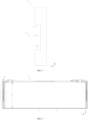
- FIG. 1 is a top view of a secondary battery provided by the present application in a specific embodiment
- FIG. 2 is an exploded diagram of FIG. 1
- FIG. 3 is a schematic structural diagram of an electrode assembly in FIG. 2
- FIG. 4 is a schematic structural diagram showing a connection between a connecting component and a flow guiding component in FIG. 2
- FIG. 5 is a schematic structural diagram of the flow guiding component in FIG. 4
- FIG. 6 is a sectional view taken along a line A-A of FIG. 1
- FIG. 7 is a partial enlarged diagram of part I in FIG. 6
- FIG. 8 is a schematic diagram of a cathodic plate, an anodic plate and a separator in FIG. 3
- FIG. 9 is a sectional view taken along a line B-B of FIG. 8 .
- the secondary battery includes an electrode assembly 1, a cap assembly 4, and a case 6.
- the case 6 may be a hexahedral shape or other shapes, and the case 6 forms an accommodating cavity configured to accommodate the electrode assembly 1 and an electrolyte.
- One end of the case 6 is provided with an opening so that the electrode assembly 1 could be placed into the accommodating cavity of the case 6 through the opening.
- the case 6 may include a metal material, such as aluminum or aluminum alloy, and may also include an insulating material, such as plastic.
- the electrode assembly 1 includes an electrode unit 11 and tabs 12.
- the electrode unit 11 includes two side portions 114 disposed oppositely along a length direction X.
- the two tabs 12 extend from the two side portions 114 of the electrode unit 11, respectively.
- the electrode unit 11 includes an anodic plate 111, a cathodic plate 112, and a separator 113, where the separator 113 is located between the adjacent anodic plate 111 and the cathodic plate 112 to space the anodic plate 111 from the cathodic plate 112.
- the anodic plate 111, the separator 113, and the cathodic plate 112 are sequentially stacked and wound to form the electrode unit 11 of the electrode assembly 1. That is, the electrode unit 11 has a winding structure.
- the anodic plate 111, the separator 113, and the cathodic plate 112 are sequentially stacked to form the electrode unit 11 of the electrode assembly 1, and the electrode unit 11 has a laminated structure. At the same time, there are gaps after the electrode unit 11 is formed, and the electrolyte could enter the electrode unit 11 through the gaps to infiltrate the anodic plate 111 and the cathodic plate 112.
- the anodic plate 111 includes an anode current collector (e.g., copper foil) and an anode active material layer (e.g., graphite, carbon or silicon) coated on a surface of the anode current collector.
- the cathodic plate 112 includes a cathode current collector (e.g., aluminum foil) and a cathode active material layer (e.g., a ternary material, lithium iron phosphate, or lithium cobaltate) coated on a surface of the cathode current collector.
- the tab 12 is connected to the anodic plate 111 and extends from the electrode unit 11, and the tab 12 may be directly formed from the anode current collector by cutting.
- the tab 12 is connected to the cathodic plate 112 and extends from the electrode unit 11, and the tab 12 may be directly formed from the cathode current collector by cutting.
- the cap assembly 4 includes a cap plate 41 and electrode terminals 42, the cap plate 41 is fixed to the opening of the case 6, thereby sealing the electrode assembly 1 and the electrolyte in the accommodating cavity of the case 6.
- the electrode terminals are arranged on the cap plate 41 and include an anode electrode terminal and a cathode electrode terminal.
- the anode electrode terminal and the cathode electrode terminal are respectively electrically connected to a corresponding tab 12 through a connecting component 3, and the cap plate 41 is provided with an explosion-proof opening 411.
- the secondary battery further includes a flow guiding component 2 located in the accommodating cavity of the case 6.
- the flow guiding component 2 can absorb the electrolyte and includes an anode flow guiding component 21 and a cathode flow guiding component 22. At least part of the flow guiding component 2 is in contact with a corresponding side portion 114, and the two flow guiding components 2 are in contact with the electrolyte.
- the two flow guiding components 2 of the secondary battery have a split structure, and there is no connecting part between the two.
- the flow guiding component 2 is provided with an avoiding portion 23, and the avoiding portion 23 is configured to avoid the tab 12.
- part of the electrolyte injected into the accommodating cavity of the case 6 could be absorbed by the flow guiding component 2, and the electrolyte could diffuse in the flow guiding component 2. Since the flow guiding component 2 is in contact with the electrode unit 11 of the electrode assembly 1, the electrolyte in the flow guiding component 2 which is in contact with the electrode unit 11 enters the electrode unit 11 as the electrolyte in the electrode unit 11 is consumed, and thus the electrolyte in the accommodating cavity is continuously passed into the electrode unit 11, the electrolyte wettability in the electrode assembly 1 is improved, the risk of lithium precipitation for the electrode assembly 1 is reduced, and the service life of the secondary battery is increased.
- the electrode assembly 1 and the case 6 could compress the flow guiding component 2, so that the flow guiding component 2 could release the electrolyte stored therein, the liquid retention capacity of the secondary battery is improved, and the service life of secondary battery is further improved.
- the tab 12 could be avoided, that is, the tab 12 could extend through the avoiding portion 23, so as to realize fixed connection between the tab 12 and the connecting component 3.
- the connection between the tab 12 and the connecting component 3 is a welded connection
- the arrangement of the avoiding portion 23 could also reduce a risk of damaging the flow guiding component 2 by heat during a welding process, and improve the service life of the flow guiding component 2 and the secondary battery.
- the connecting component 3 includes a first connecting portion 31 and a second connecting portion 32, where the first connecting portion 31 extends to a top of the electrode assembly 1 for connecting to the cap assembly 4.
- the second connecting portion 32 extends to a side portion of the electrode assembly 1 for connecting to the tab 12.
- the tab 12 includes a body portion 121 and an extension portion 122, where the body portion 121 extends from the side portion 114 of the electrode unit 11, and the extension portion 122 extends from the electrode unit 11 and then bends, that is, the extension portion 122 is bent relative to the body portion 121, where the body portion 121 and the cap assembly 4 are connected by the connecting component 3. At the same time, at least part of the body portion 121 is located in the avoiding portion 23.
- the body portion 121 is attached to the side portion 114, and there is a gap between the extension portion 122 and the body portion 121 along the length direction X. Therefore, when the flow guiding component 2 abuts against the side portion 114, there is a risk of interference between the flow guiding component 2 and the body portion 121 of the tab 12.
- the body portion 121 could be avoided, so that the flow guiding component 2 could be attached to the side portion 114 without being affected by the body portion 121, and thus the wettability of the flow guiding component 2 is improved by the electrode assembly 1, and at the same time, the flow guiding component 2 does not interfere with the body portion 121, a size of the secondary battery in a length direction could be reduced, and energy density of the secondary battery could be increased.
- the secondary battery is formed, at least part of the body portion 121 is located in the avoiding portion 23.
- the avoiding portion 23 includes a recess provided on the flow guiding component 2.
- the recess includes a first side wall 231 and a second side wall 232 disposed oppositely, and at least part of the body portion 121 is located in the recess. And along the height direction Z, the first side wall 231 and the second side wall 232 abut against the body portion 121, respectively.
- the position of the flow guiding component 2 could be restricted along the height direction Z by the body portion 121 of the tab 12, thereby preventing the flow guiding component 2 from moving along the height direction Z relative to the tab 12, and improving stability of the flow guiding component 2 in the secondary battery.
- the recess includes a third side wall 233 along a width direction Y, and the third side wall 233 abuts against the body portion 121.
- the position of the flow guiding component 2 could be restricted along the width direction Y by the body portion 121 of the tab 12, thereby preventing the flow guiding component 2 from moving along the width direction Y relative to the tab 12, and further improving the stability of flow guiding component 2 in the secondary battery.
- the body portion 121 may extend beyond the recess along a side far away from the third side wall 233, or the body portion may also be all located in the recess. Therefore, at least part of the body portion 121 is located in the recess.
- the flow guiding component 2 has a plate-shaped structure, and along the width direction Y, one end surface of the flow guiding component 2 is attached to the side portion 114 of the electrode unit 11, and the other end surface is fixedly connected to the connecting component 3.
- contact area between the flow guiding component 2 of the plate-shaped structure and the side portion 114 is relatively large, so that a capability of the flow guiding component 2 to transport the electrolyte into the electrode assembly 1 could be improved, thereby further improving the service life of the secondary battery.
- the flow guiding component 2 could be fixed in the case 6, where the flow guiding component 2 and the connecting component 3 may be connected by gluing.
- a width of the flow guiding component 2 is smaller than a width of the connecting component 3, and at the same time, the width of the flow guiding component 2 is also smaller than a width of the corresponding side portion 114.
- the width of the flow guiding component 2 could not exceed the width of the connecting component 3. In this embodiment, the width of the flow guiding component 2 needs be as large as possible to increase the contact area between the flow guiding component 2 and the side portion 114 but avoid occupying too much space.
- a height of the flow guiding component 2 is greater than or equal to a height of the electrode assembly 1, so as to ensure that the electrolyte at the bottom of the case 6 could be transported to the electrode assembly 1 through the flow guiding component 2, and when the height of the flow guiding component 2 is equal to the height of the electrode assembly 1, the volume of the flow guiding component 2 could be reduced and the energy density of the secondary battery could be increased while the flow guiding component 2 is ensured to have a high capability to transport the electrolyte.
- the first connecting portion 31 and the second connecting portion 32 of the connecting component 3 are bent relative to each other.
- the first connecting portion 31 is configured to connect to the cap assembly 4, and the second connecting portion 32 is configured to connect to the tab 12 Therefore, the first connecting portion 31 and the second connecting portion 32 are bent at the top of the electrode assembly 1. Therefore, along the height direction Z, one end (upper end) of the flow guiding component 2 extends to a position where the first connecting portion 31 and the second connecting portion 32 are bent relative to each other, and the other end (lower end) abuts against the bottom of the case 6.
- the insulating membrane 5 is located in the inner cavity of the case 6; and, along the height direction Z, the upper end of the flow guiding component 2 extends to the position where the first connecting portion 31 and the second connecting portion 32 are bent relative to each other, and the lower end abuts against the bottom of the insulating membrane 5.
- the electrode unit 11 includes a plurality of anodic plates 111, a plurality of cathodic plates 112, and a plurality of separators 113.
- the separator 113 is located between adjacent anodic plate 111 and cathodic plate 112.
- the separator 113 is used to isolate the anodic plate 111 from the cathodic plate 112.
- a size of the separator 113 is larger than a size of the anodic plate 111 and a size of the cathodic plate 112. As shown in FIG.
- the separator 113 has first end portions 113a extending beyond the anodic plate 111 and the cathodic plate 112, and a thickness of the flow guiding component 2 is greater than or equal to a distance between the first end portion 113a and the connecting component 3.
- the first end portions 113a of the separator 113 extend beyond the anodic plate 111 and the cathodic plate 112, for the electrode unit 11, the first end portions 113a of the separator 113 are the most outer end along the width direction Y, and therefore, when the flow guiding component 2 is connected to the connecting component 3 and abuts against the electrode assembly 1, the flow guiding component 2 first contacts the first end portion 113a.
- the thickness of the flow guiding component 2 is too small (less than the distance between the connecting component 3 and the first end portion 113a), the flow guiding component 2 cannot abut against the electrode assembly 1, or cannot be fixedly connected to the connecting component portion 3. Therefore, in order to achieve fixing the flow guiding component 2 in the secondary battery and transporting the electrolyte to the electrode unit 11, the thickness of the flow guiding component 2 is greater than or equal to the distance between the first end portion 113 a and the connecting component 3.
- the electrode unit 11 includes a cathode and an anode
- the flow guiding component 2 includes an anode flow guiding component 21 and a cathode flow guiding component 22, and the anode flow guiding component 21 is located on the anode side of the electrode unit 11, while the cathode flow guiding component 22 is located on the cathode side of the electrode unit 11.
- the cathodic plate 112 On the cathode side of the electrode unit 11, the cathodic plate 112 includes a third end portion 112a extending beyond the anodic plate 111, and along the width direction Y, the third end portion 112a portion is located between the first end portion 113a and the anodic plate 111, that is, the third end portion 112a extends beyond the anodic plate 111, but does not extend beyond the first end portion 113a of the separator 113.
- a first thickness D 1 of the cathode flow guiding component 22 satisfies D 1 ⁇ d 1 + d 2 , where d 1 is the distance between the first end portion 113a and the connecting component 3, and d 2 is a distance between the first end portion 113a and the third end portion 112a. That is, the first thickness of the cathode flow guiding component 22 satisfies: d 1 ⁇ D 1 ⁇ d 1 + d 2 .
- the cathode flow guiding component 22 when the first thickness D 1 of the cathode flow guiding component 22 is smaller than d 1 , the cathode flow guiding component 22 cannot contact with the electrode unit 11, and when the first thickness D 1 of the cathode flow guiding component 22 is greater than d 1 , the cathode flow guiding component 22 contacts with the electrode unit 11 and then squeezes the separator 113, and when the first thickness D 1 of the cathode flow guiding component is too large ( D 1 > d 1 + d 2 ), the cathode flow guiding component 22 not only squeezes the separator 113, but also squeezes the third end portion 112a of the cathodic plate 112, causing that the cathodic plate 112 is bent inward (toward a center of the electrode assembly 1 ), which leads to that the cathodic plate 112 contacts with the anodic plate 111, thereby causing the cathode and anode of the electrode unit 11 to be short-circuited.
- the anode plate 111 includes a second end portion 111a extending beyond the cathodic plate 112, and along the width direction Y, the second end portion 111a is located between the cathodic plate 112 and the first end portion 113a, that is, the first end 113a extends beyond the cathodic plate 112, but does not extend beyond the first end portion 113a of the separator 113.
- a second thickness D 2 of the anode flow guiding component 21 satisfies D 2 ⁇ d 1 + d 3 , where d 1 is the distance between the first end portion 113a and the connecting component 3, and d 3 is a distance between the first end portion 113a and the second end portion 111a.
- the cathode flow guiding component 21 Similar to the cathode flow guiding component 22, when the second thickness of the anode flow guiding component 21 satisfies d 1 ⁇ D 2 ⁇ d 1 + d 2 , the anodic plate 111 on the anode side and the cathodic plate 112 could be prevented from being short-circuited, and it could be ensured that the anode flow guiding component 21 abuts against the anode side of the electrode unit 11.
- the second thickness D 2 of the anode flow guiding component 21 and the first thickness D 1 of the cathode flow guiding component 22 may be the same or different, and specific values of D 1 and D 2 can be determined according to parameters of the anode side and the cathode side of the electrode unit.
- L 1 is a total length of the anodic plates 111, or a total length of the cathodic plates 112
- the total length of the anodic plates 111 refers to the total length of the anodic plates 111 after the electrode assembly 1 is spread, that is, a sum of the lengths of the anodic plates 111
- W 1 is a width of an active material layer on the anodic plates 111 or a width of an active material layer on the cathodic plates 112, as shown in FIG.
- G is a distance between adjacent anodic plates 111, or a distance between adjacent cathodic plates 112;
- L 2 is a total length of the separators 113, which represent, the total length of the separators 113 after the electrode assembly 1 is spread, that is a sum of the lengths of the separators 113;
- W 2 is a width of the separators 113, as shown in FIG. 8 ;
- H 3 is a height of the electrode assembly 1, as shown in FIG. 6 ;
- W 3 is a width of the connecting component 3, as shown in FIG. 4 ;
- ⁇ 1 is a liquid retention coefficient of the separators 113;
- ⁇ 2 is a liquid retention coefficient of the flow guiding component 2.
- each parameter in formula (1) is a measurable parameter or a known parameter, and the thickness d of the flow guiding component 2 can be calculated by this formula.
- Embodiments of the present application also provide a battery pack, including a secondary battery described in a foregoing embodiment.
- Embodiments of the present application also provide an electric device, including a secondary battery described in a foregoing embodiment, where the secondary battery is used to provide electrical energy, and the device may be a vehicle or an energy storage device.
Landscapes
- Chemical & Material Sciences (AREA)
- Chemical Kinetics & Catalysis (AREA)
- Electrochemistry (AREA)
- General Chemical & Material Sciences (AREA)
- Engineering & Computer Science (AREA)
- Manufacturing & Machinery (AREA)
- Secondary Cells (AREA)
- Connection Of Batteries Or Terminals (AREA)
Description
- The present application claims priority to
Chinese Patent Application No. 201920735006.1, filed on May 21, 2019 - The present application relates to the technical field of energy storage devices, and in particular, to a secondary battery, a battery pack and an electric device.
- A secondary battery includes a case and an electrode assembly, and an electrolyte is accommodated in the case, and the electrolyte can infiltrate the electrode assembly, thereby prolonging a service life of the secondary battery. The electrode assembly includes a body and a tab. For a structure where the tab extends from a side portion of the body, it is difficult for the electrolyte to infiltrate the electrode assembly from bottom. After the secondary battery works for a long time, an interior of the electrode assembly lacks the electrolyte, and electrolyte wettability of the secondary battery is poor, and a lithium precipitation phenomenon is prone to occur, which affects the service life of the secondary battery.
- In view of the above, embodiments of the present application provide a secondary battery, a battery pack, and an electric device. The secondary battery is used to solve a problem in the prior art that poor electrolyte wettability of the secondary battery leads to a low service life of the secondary battery.
- The embodiments of the present application provide a secondary battery, and the secondary battery includes:
- a case, including an opening and an inner cavity, an electrolyte being included in the inner cavity;
- a cap assembly, covering the opening;
- an electrode assembly, located in the inner cavity and including an electrode unit and tabs; along a length direction, the electrode unit including two side portions disposed oppositely, and the tabs extending from the side portions;
- connecting components, configured to connect the tabs and the cap assembly; and
- a flow guiding component, located between a corresponding connecting component and a corresponding side portion and connected to the connecting component, at least part of the flow guiding component being in contact with the corresponding side portion, and the flow guiding component being in contact with the electrolyte;
- where the flow guiding component is provided with an avoiding portion configured to avoid the tabs.
- Optionally, each of the tabs includes a body portion and an extension portion, the body portion extends from the corresponding side portion, and the extension portion is bent relative to the body portion.
- At least part of the body portion is located in the avoiding portion.
- Optionally, the flow guiding component is a plate-shaped structure.
- Along a width direction, one end of the flow guiding component is fixedly connected to the connecting component, and the other end is attached to the side portion.
- Optionally, along the width direction, a width of the flow guiding component is smaller than a width of the connecting components.
- Optionally, along a height direction, a height of the flow guiding component is greater than or equal to a height of the electrode assembly.
- Each of the connecting components includes a first connecting portion and a second connecting portion, the first connecting portion is configured to connect to the cap assembly, and the second connecting portion is configured to connect to a tab, and the first connecting portion is bent relative to the second connecting portion.
- Along the height direction, one end of the flow guiding component extends to a position where the first connecting portion and the second connecting portion are bent relative to each other, and the other end of the flow guiding component abuts against a bottom of the case; or the secondary battery further includes an insulating membrane located between the case and the electrode assembly, and along the height direction, one end of the flow guiding component extends to the position where the first connecting portion and the second connecting portion are bent relative to each other, and the other end of the flow guiding component abuts against a bottom of the insulating membrane.
- Optionally, the electrode assembly includes a plurality of anodic plates, a plurality of cathodic plates and a plurality of separators, and the separators are located between the anodic plates and the cathodic plates that are adjacent.
- Along the width direction, each of the separators includes first end portions that extend beyond the anodic plates and the cathodic plates.
- A thickness of the flow guiding component is greater than or equal to a distance between the first end portion and the connecting component.
- Optionally, the flow guiding component includes an anode flow guiding component and a cathode flow guiding component, where the anode flow guiding component and the cathode flow guiding component are respectively located on two sides of the electrode assembly along the width direction.
- At a cathode of the electrode assembly, each of the cathodic plates includes a third end portion that extends beyond the anodic plates, and along the width direction, the third end portion is located between a first end portion and the anodic plates.
- A first thickness D 1 of the cathode flow guiding component satisfies D 1 ≤ d 1 + d 2; where d 1 is a distance between the first end portion and the connecting component, and d 2 is a distance between the first end portion and the third end portion.
- Optionally, the flow guiding component includes an anode flow guiding component and a cathode flow guiding component, where the anode flow guiding component and the cathode flow guiding component are respectively located on two sides of the electrode assembly along the width direction.
- At an anode of the electrode assembly, each of the anode plates includes a second end portion that extends beyond the cathodic plates, and along the width direction, the second end portion is located between the cathodic plates and the first end portion.
- A second thickness D 2 of the anode flow guiding component satisfies D 2 ≤ d 1 + d 3,
where d 1 is a distance between the first end portion and the connecting component, and d 3 is a distance between the first end portion and the second end portion. - Optionally, a thickness d of the flow guiding component satisfies a following formula:

- G is a distance between the anodic plates that are adjacent, or a distance between the cathodic plates that are adjacent;
- L 2 is a total length of the separators; W 2 is a width of the separators;
- H 3 is a height of the electrode assembly; W 3 is a width of the connecting components;
- ρ 1 is a liquid retention coefficient of the separators; ρ 2 is a liquid retention coefficient of the flow guiding component.
- Optionally, the avoiding portion is a recess.
- Along the height direction, the recess includes a first side wall and a second side wall disposed oppositely, and the first side wall and the second side wall abut against the body portion, respectively.
- Along the width direction, the recess includes a third side wall, and the third side wall abuts against the body portion.
- Embodiments of the present application also provide a battery pack including a secondary battery as described above.
- Embodiments of the present application also provide an electric device, including a secondary battery as described above.
- In the present application, after the flow guiding component is provided, part of the electrolyte injected into the accommodating cavity of the case could be absorbed by the flow guiding component, and the electrolyte could diffuse in the flow guiding component. Since the flow guiding component is in contact with the electrode unit of the electrode assembly, the electrolyte in the flow guiding component which is in contact with the electrode unit enters the electrode unit as the electrolyte inside the electrode unit is consumed, and thus the electrolyte in the accommodating cavity is continuously passed into the electrode unit, the electrolyte wettability in the electrode assembly is improved, the risk of lithium precipitation for the electrode assembly is reduced, and the service life of the secondary battery is improved. Meanwhile, when the secondary battery swells during operation, the electrode assembly and the case could compress the flow guiding component, so that the flow guiding component could release the electrolyte stored therein, the liquid retention capacity of the secondary battery is improved and the service life of the secondary battery is further improved.
- At the same time, after the flow guiding component is provided with the avoiding portion, the tab could be avoided, that is, the tab could extend through the avoiding portion, so as to realize fixed connection between the tab and the connecting component.
-
-
FIG. 1 is a top view of a secondary battery provided by the present application in a specific embodiment; -
FIG. 2 is an exploded diagram ofFIG. 1 ; -
FIG. 3 is a schematic structural diagram of an electrode assembly inFIG. 2 ; -
FIG. 4 is a schematic structural diagram showing a connection between a connecting component and a flow guiding component inFIG. 2 ; -
FIG. 5 is a schematic structural diagram of the flow guiding component inFIG. 4 ; -
FIG. 6 is a sectional view taken along a line A-A ofFIG. 1 ; -
FIG. 7 is a partial enlarged diagram of part I inFIG. 6 ; -
FIG. 8 is a schematic diagram of a cathodic plate, an anodic plate and a separator inFIG. 3 ; -
FIG. 9 is a sectional view taken along a line B-B ofFIG. 8 . -
- 1
- Electrode assembly
- 11
- Electrode unit
- 111
- Anodic plate
- 111a
- Second end portion
- 112
- Cathodic plate
- 112a
- Third end portion
- 113
- Separator
- 113a
- First end portion
- 114
- Side portion
- 12
- Tab
- 121
- Body portion
- 122
- Extension portion
- 2
- Flow guiding component
- 21
- Anode flow guiding component
- 22
- Cathode flow guiding component
- 23
- Avoiding portion
- 231
- First side wall
- 232
- Second side wall
- 233
- Third side wall
- 3
- Connecting component
- 31
- First connecting portion
- 32
- Second connecting portion
- 4
- Cap assembly
- 41
- Cap plate
- 411
- Explosion-proof port
- 42
- Electrode terminal
- 5
- Separator
- 6
- Case
- For a better understanding on the technical solutions of the present application, embodiments of the present application are described in detail below with reference to the accompanying drawings.
- It should be clear that the described embodiments are only part of the embodiments of the present application, rather than all the embodiments. Based on the embodiments in the present application, all other embodiments obtained by a person of ordinary skill in the art without creative effort shall fall within the protection scope of the present application.
- The terms used in the embodiments of the present application are only for the purpose of describing specific embodiments, but are not intended to limit the present application. The singular forms of "a", "description" and "the" used in the embodiments of the present application and the appended claims are also intended to include plural forms, unless the context clearly indicates other meanings.
- It should be understood that the term "and/or" used herein is only an association relationship describing associated objects, which means that there may be three types of relationships; for example, A and/or B can mean that there are three cases: A exists alone, both A and B exist, and B exists alone. In addition, the character "/" in this text generally indicates that the associated objects before and after are in an "or" relationship.
- It should be noted that the "upper", "lower", "left", "right" and other directional words described in the embodiments of the present application are described from an angle shown in the drawings, and should not be construed as any limitation to the embodiments of the present application. In addition, in the context, it also needs to be understood that when it is mentioned that an element is connected "above" or "under" another element, it can not only be directly connected "above" or "under" the other element, but also be indirectly connected "above" or "under" another element through an intermediate element.
- Please refer to
FIG. 1 to FIG. 7 , whereFIG. 1 is a top view of a secondary battery provided by the present application in a specific embodiment;FIG. 2 is an exploded diagram ofFIG. 1 ;FIG. 3 is a schematic structural diagram of an electrode assembly inFIG. 2 ;FIG. 4 is a schematic structural diagram showing a connection between a connecting component and a flow guiding component inFIG. 2 ;FIG. 5 is a schematic structural diagram of the flow guiding component inFIG. 4 ;FIG. 6 is a sectional view taken along a line A-A ofFIG. 1 ;FIG. 7 is a partial enlarged diagram of part I inFIG. 6 ;FIG. 8 is a schematic diagram of a cathodic plate, an anodic plate and a separator inFIG. 3 ;FIG. 9 is a sectional view taken along a line B-B ofFIG. 8 . - An embodiment of the present application provides a secondary battery. As shown in
FIG. 1 and FIG. 2 , the secondary battery includes anelectrode assembly 1, acap assembly 4, and a case 6. The case 6 may be a hexahedral shape or other shapes, and the case 6 forms an accommodating cavity configured to accommodate theelectrode assembly 1 and an electrolyte. One end of the case 6 is provided with an opening so that theelectrode assembly 1 could be placed into the accommodating cavity of the case 6 through the opening. The case 6 may include a metal material, such as aluminum or aluminum alloy, and may also include an insulating material, such as plastic. - As shown in
FIG. 3 , theelectrode assembly 1 includes anelectrode unit 11 andtabs 12. Theelectrode unit 11 includes twoside portions 114 disposed oppositely along a length direction X. In the secondary battery, the twotabs 12 extend from the twoside portions 114 of theelectrode unit 11, respectively. As shown inFIG. 8 , theelectrode unit 11 includes ananodic plate 111, acathodic plate 112, and aseparator 113, where theseparator 113 is located between the adjacentanodic plate 111 and thecathodic plate 112 to space theanodic plate 111 from thecathodic plate 112. - In a specific embodiment, the
anodic plate 111, theseparator 113, and thecathodic plate 112 are sequentially stacked and wound to form theelectrode unit 11 of theelectrode assembly 1. That is, theelectrode unit 11 has a winding structure. In a second specific embodiment, theanodic plate 111, theseparator 113, and thecathodic plate 112 are sequentially stacked to form theelectrode unit 11 of theelectrode assembly 1, and theelectrode unit 11 has a laminated structure. At the same time, there are gaps after theelectrode unit 11 is formed, and the electrolyte could enter theelectrode unit 11 through the gaps to infiltrate theanodic plate 111 and thecathodic plate 112. - The
anodic plate 111 includes an anode current collector (e.g., copper foil) and an anode active material layer (e.g., graphite, carbon or silicon) coated on a surface of the anode current collector. Thecathodic plate 112 includes a cathode current collector (e.g., aluminum foil) and a cathode active material layer (e.g., a ternary material, lithium iron phosphate, or lithium cobaltate) coated on a surface of the cathode current collector. At an anode of theelectrode assembly 1, thetab 12 is connected to theanodic plate 111 and extends from theelectrode unit 11, and thetab 12 may be directly formed from the anode current collector by cutting. At a cathode of theelectrode assembly 1, thetab 12 is connected to thecathodic plate 112 and extends from theelectrode unit 11, and thetab 12 may be directly formed from the cathode current collector by cutting. - As shown in
FIG. 1 and FIG. 2 , thecap assembly 4 includes acap plate 41 andelectrode terminals 42, thecap plate 41 is fixed to the opening of the case 6, thereby sealing theelectrode assembly 1 and the electrolyte in the accommodating cavity of the case 6. The electrode terminals are arranged on thecap plate 41 and include an anode electrode terminal and a cathode electrode terminal. The anode electrode terminal and the cathode electrode terminal are respectively electrically connected to a correspondingtab 12 through a connectingcomponent 3, and thecap plate 41 is provided with an explosion-proof opening 411. - Further, as shown in
FIG. 2 andFIG. 4 , the secondary battery further includes aflow guiding component 2 located in the accommodating cavity of the case 6. Theflow guiding component 2 can absorb the electrolyte and includes an anodeflow guiding component 21 and a cathodeflow guiding component 22. At least part of theflow guiding component 2 is in contact with acorresponding side portion 114, and the twoflow guiding components 2 are in contact with the electrolyte. In the embodiment, as shown inFIG. 2 , the twoflow guiding components 2 of the secondary battery have a split structure, and there is no connecting part between the two. - As shown in
FIG. 5 , theflow guiding component 2 is provided with an avoidingportion 23, and the avoidingportion 23 is configured to avoid thetab 12. - In the present application, after the
flow guiding component 2 is provided, part of the electrolyte injected into the accommodating cavity of the case 6 could be absorbed by theflow guiding component 2, and the electrolyte could diffuse in theflow guiding component 2. Since theflow guiding component 2 is in contact with theelectrode unit 11 of theelectrode assembly 1, the electrolyte in theflow guiding component 2 which is in contact with theelectrode unit 11 enters theelectrode unit 11 as the electrolyte in theelectrode unit 11 is consumed, and thus the electrolyte in the accommodating cavity is continuously passed into theelectrode unit 11, the electrolyte wettability in theelectrode assembly 1 is improved, the risk of lithium precipitation for theelectrode assembly 1 is reduced, and the service life of the secondary battery is increased. Meanwhile, when the secondary battery swells during operation, theelectrode assembly 1 and the case 6 could compress theflow guiding component 2, so that theflow guiding component 2 could release the electrolyte stored therein, the liquid retention capacity of the secondary battery is improved, and the service life of secondary battery is further improved. - At the same time, after the
flow guiding component 2 is provided with the avoidingportion 23, thetab 12 could be avoided, that is, thetab 12 could extend through the avoidingportion 23, so as to realize fixed connection between thetab 12 and the connectingcomponent 3. In addition, when the connection between thetab 12 and the connectingcomponent 3 is a welded connection, the arrangement of the avoidingportion 23 could also reduce a risk of damaging theflow guiding component 2 by heat during a welding process, and improve the service life of theflow guiding component 2 and the secondary battery. - As shown in
FIG. 4 , the connectingcomponent 3 includes a first connectingportion 31 and a second connectingportion 32, where the first connectingportion 31 extends to a top of theelectrode assembly 1 for connecting to thecap assembly 4. The second connectingportion 32 extends to a side portion of theelectrode assembly 1 for connecting to thetab 12. - Further, as shown in
FIG. 3 , thetab 12 includes abody portion 121 and anextension portion 122, where thebody portion 121 extends from theside portion 114 of theelectrode unit 11, and theextension portion 122 extends from theelectrode unit 11 and then bends, that is, theextension portion 122 is bent relative to thebody portion 121, where thebody portion 121 and thecap assembly 4 are connected by the connectingcomponent 3. At the same time, at least part of thebody portion 121 is located in the avoidingportion 23. - In this embodiment, as shown in
FIG. 3 , in thetab 12, thebody portion 121 is attached to theside portion 114, and there is a gap between theextension portion 122 and thebody portion 121 along the length direction X. Therefore, when theflow guiding component 2 abuts against theside portion 114, there is a risk of interference between theflow guiding component 2 and thebody portion 121 of thetab 12. In this embodiment, by providing theflow guiding component 2 with an avoidingportion 23, thebody portion 121 could be avoided, so that theflow guiding component 2 could be attached to theside portion 114 without being affected by thebody portion 121, and thus the wettability of theflow guiding component 2 is improved by theelectrode assembly 1, and at the same time, theflow guiding component 2 does not interfere with thebody portion 121, a size of the secondary battery in a length direction could be reduced, and energy density of the secondary battery could be increased. After the secondary battery is formed, at least part of thebody portion 121 is located in the avoidingportion 23. - Specifically, as shown in
FIG. 4 andFIG. 5 , the avoidingportion 23 includes a recess provided on theflow guiding component 2. Along a height direction Z, the recess includes afirst side wall 231 and asecond side wall 232 disposed oppositely, and at least part of thebody portion 121 is located in the recess. And along the height direction Z, thefirst side wall 231 and thesecond side wall 232 abut against thebody portion 121, respectively. - Therefore, in this embodiment, the position of the
flow guiding component 2 could be restricted along the height direction Z by thebody portion 121 of thetab 12, thereby preventing theflow guiding component 2 from moving along the height direction Z relative to thetab 12, and improving stability of theflow guiding component 2 in the secondary battery. - At the same time, as shown in
FIG. 4 andFIG. 5 , the recess includes athird side wall 233 along a width direction Y, and thethird side wall 233 abuts against thebody portion 121. - Therefore, in this embodiment, the position of the
flow guiding component 2 could be restricted along the width direction Y by thebody portion 121 of thetab 12, thereby preventing theflow guiding component 2 from moving along the width direction Y relative to thetab 12, and further improving the stability offlow guiding component 2 in the secondary battery. - In addition, when the avoiding
portion 23 is a recess, thebody portion 121 may extend beyond the recess along a side far away from thethird side wall 233, or the body portion may also be all located in the recess. Therefore, at least part of thebody portion 121 is located in the recess. - In above embodiments, as shown in
FIG. 4 andFIG. 5 , theflow guiding component 2 has a plate-shaped structure, and along the width direction Y, one end surface of theflow guiding component 2 is attached to theside portion 114 of theelectrode unit 11, and the other end surface is fixedly connected to the connectingcomponent 3. - In this embodiment, contact area between the
flow guiding component 2 of the plate-shaped structure and theside portion 114 is relatively large, so that a capability of theflow guiding component 2 to transport the electrolyte into theelectrode assembly 1 could be improved, thereby further improving the service life of the secondary battery. At the same time, by fixedly connecting theflow guiding component 2 and the connectingcomponent 3, theflow guiding component 2 could be fixed in the case 6, where theflow guiding component 2 and the connectingcomponent 3 may be connected by gluing. - As shown in
FIG. 2 , along the width direction Y, a width of theflow guiding component 2 is smaller than a width of the connectingcomponent 3, and at the same time, the width of theflow guiding component 2 is also smaller than a width of thecorresponding side portion 114. - It can be understood that the larger the area of the
flow guiding component 2, the greater the amount of the electrolyte it can absorb, and the larger the contact area between theflow guiding component 2 and theside portion 114, and the more the electrolyte it can transport into theelectrode unit 11. Therefore, increasing the contact area between theflow guiding component 2 and theelectrode unit 11 helps to improve the wettability of theelectrode assembly 1. However, in order to ensure that thetab 12 and the connectingcomponent 3 could be connected, the width of theflow guiding component 2 could not exceed the width of the connectingcomponent 3. In this embodiment, the width of theflow guiding component 2 needs be as large as possible to increase the contact area between theflow guiding component 2 and theside portion 114 but avoid occupying too much space. - On the other hand, as shown in
FIG. 7 , along the height direction Z, a height of theflow guiding component 2 is greater than or equal to a height of theelectrode assembly 1, so as to ensure that the electrolyte at the bottom of the case 6 could be transported to theelectrode assembly 1 through theflow guiding component 2, and when the height of theflow guiding component 2 is equal to the height of theelectrode assembly 1, the volume of theflow guiding component 2 could be reduced and the energy density of the secondary battery could be increased while theflow guiding component 2 is ensured to have a high capability to transport the electrolyte. - In the secondary battery, the first connecting
portion 31 and the second connectingportion 32 of the connectingcomponent 3 are bent relative to each other. The first connectingportion 31 is configured to connect to thecap assembly 4, and the second connectingportion 32 is configured to connect to thetab 12 Therefore, the first connectingportion 31 and the second connectingportion 32 are bent at the top of theelectrode assembly 1. Therefore, along the height direction Z, one end (upper end) of theflow guiding component 2 extends to a position where the first connectingportion 31 and the second connectingportion 32 are bent relative to each other, and the other end (lower end) abuts against the bottom of the case 6. - Or, when the secondary battery includes an insulating membrane 5, the insulating membrane 5 is located in the inner cavity of the case 6; and, along the height direction Z, the upper end of the
flow guiding component 2 extends to the position where the first connectingportion 31 and the second connectingportion 32 are bent relative to each other, and the lower end abuts against the bottom of the insulating membrane 5. - Specifically, as shown in
FIG. 8 , theelectrode unit 11 includes a plurality ofanodic plates 111, a plurality ofcathodic plates 112, and a plurality ofseparators 113. Theseparator 113 is located between adjacentanodic plate 111 andcathodic plate 112. Theseparator 113 is used to isolate theanodic plate 111 from thecathodic plate 112. In order to ensure complete isolation between the two plates, a size of theseparator 113 is larger than a size of theanodic plate 111 and a size of thecathodic plate 112. As shown inFIG. 8 , along the length direction X, theseparator 113 has first end portions 113a extending beyond theanodic plate 111 and thecathodic plate 112, and a thickness of theflow guiding component 2 is greater than or equal to a distance between the first end portion 113a and the connectingcomponent 3. - Since the first end portions 113a of the
separator 113 extend beyond theanodic plate 111 and thecathodic plate 112, for theelectrode unit 11, the first end portions 113a of theseparator 113 are the most outer end along the width direction Y, and therefore, when theflow guiding component 2 is connected to the connectingcomponent 3 and abuts against theelectrode assembly 1, theflow guiding component 2 first contacts the first end portion 113a. When the thickness of theflow guiding component 2 is too small (less than the distance between the connectingcomponent 3 and the first end portion 113a), theflow guiding component 2 cannot abut against theelectrode assembly 1, or cannot be fixedly connected to the connectingcomponent portion 3. Therefore, in order to achieve fixing theflow guiding component 2 in the secondary battery and transporting the electrolyte to theelectrode unit 11, the thickness of theflow guiding component 2 is greater than or equal to the distance between the first end portion 113 a and the connectingcomponent 3. - Further, as shown in
FIG. 8 , theelectrode unit 11 includes a cathode and an anode, theflow guiding component 2 includes an anodeflow guiding component 21 and a cathodeflow guiding component 22, and the anodeflow guiding component 21 is located on the anode side of theelectrode unit 11, while the cathodeflow guiding component 22 is located on the cathode side of theelectrode unit 11. On the cathode side of theelectrode unit 11, thecathodic plate 112 includes a third end portion 112a extending beyond theanodic plate 111, and along the width direction Y, the third end portion 112a portion is located between the first end portion 113a and theanodic plate 111, that is, the third end portion 112a extends beyond theanodic plate 111, but does not extend beyond the first end portion 113a of theseparator 113. - A first thickness D 1 of the cathode
flow guiding component 22 satisfies D 1 ≤ d 1 + d 2 , where d 1 is the distance between the first end portion 113a and the connectingcomponent 3, and d 2 is a distance between the first end portion 113a and the third end portion 112a. That is, the first thickness of the cathodeflow guiding component 22 satisfies: d 1 ≤ D 1 ≤ d 1 + d2. - As described above, when the first thickness D 1 of the cathode
flow guiding component 22 is smaller than d 1, the cathodeflow guiding component 22 cannot contact with theelectrode unit 11, and when the first thickness D 1 of the cathodeflow guiding component 22 is greater than d 1, the cathodeflow guiding component 22 contacts with theelectrode unit 11 and then squeezes theseparator 113, and when the first thickness D 1 of the cathode flow guiding component is too large (D 1 > d 1 + d 2), the cathodeflow guiding component 22 not only squeezes theseparator 113, but also squeezes the third end portion 112a of thecathodic plate 112, causing that thecathodic plate 112 is bent inward (toward a center of the electrode assembly 1 ), which leads to that thecathodic plate 112 contacts with theanodic plate 111, thereby causing the cathode and anode of theelectrode unit 11 to be short-circuited. - Therefore, in this embodiment, when the first thickness D 1 of the cathode
flow guiding component 22 satisfies d 1 ≤ D 1 ≤ d 1 + d 2 , it could be ensured that the cathodeflow guiding component 22 contacts with the cathode side of theelectrode unit 11, while thecathodic plate 112 and theanodic plate 111 are prevented from being short-circuited. - At the same time, at the anode of the
electrode unit 11, theanode plate 111 includes a second end portion 111a extending beyond thecathodic plate 112, and along the width direction Y, the second end portion 111a is located between thecathodic plate 112 and the first end portion 113a, that is, the first end 113a extends beyond thecathodic plate 112, but does not extend beyond the first end portion 113a of theseparator 113. - A second thickness D 2 of the anode
flow guiding component 21 satisfies D 2 ≤ d 1 + d 3, where d 1 is the distance between the first end portion 113a and the connectingcomponent 3, and d 3 is a distance between the first end portion 113a and the second end portion 111a. - Similar to the cathode
flow guiding component 22, when the second thickness of the anodeflow guiding component 21 satisfies d 1 ≤ D 2 ≤ d 1 + d 2, theanodic plate 111 on the anode side and thecathodic plate 112 could be prevented from being short-circuited, and it could be ensured that the anodeflow guiding component 21 abuts against the anode side of theelectrode unit 11. - It should be noted that the second thickness D 2 of the anode
flow guiding component 21 and the first thickness D 1 of the cathodeflow guiding component 22 may be the same or different, and specific values of D 1 and D 2 can be determined according to parameters of the anode side and the cathode side of the electrode unit. - In addition, a thickness d of the flow guiding component 2 satisfies the following formula:

FIG. 8 ; as shown inFIG. 9 , G is a distance between adjacent anodic plates 111, or a distance between adjacent cathodic plates 112; L 2 is a total length of the separators 113, which represent, the total length of the separators 113 after the electrode assembly 1 is spread, that is a sum of the lengths of the separators 113; W 2 is a width of the separators 113, as shown inFIG. 8 ; H 3 is a height of the electrode assembly 1, as shown inFIG. 6 ; W 3 is a width of the connecting component 3, as shown inFIG. 4 ; ρ 1 is a liquid retention coefficient of the separators 113; ρ 2 is a liquid retention coefficient of the flow guiding component 2. - As described above, each parameter in formula (1) is a measurable parameter or a known parameter, and the thickness d of the
flow guiding component 2 can be calculated by this formula. - Embodiments of the present application also provide a battery pack, including a secondary battery described in a foregoing embodiment.
- Embodiments of the present application also provide an electric device, including a secondary battery described in a foregoing embodiment, where the secondary battery is used to provide electrical energy, and the device may be a vehicle or an energy storage device.
Claims (12)
- A secondary battery, wherein the secondary battery comprises:a case (6), comprising an opening and an inner cavity, an electrolyte being comprised in the inner cavity;a cap assembly (4), covering the opening;an electrode assembly (1), located in the inner cavity and comprising an electrode unit (11) and tabs (12); along a length direction, the electrode unit (11) comprising two side portions (114) disposed oppositely, and the tabs (12) extending from the side portions (114), the length direction being perpendicular to a covering direction in which the cap assembly (4) covers the opening of the case (6);connecting components (3), configured to connect the tabs (12) and the cap assembly (4); anda flow guiding component, located between a corresponding connecting component and a corresponding side portion and connected to the connecting component (3), at least part of the flow guiding component (2) being in contact with the corresponding side portion (114), and the flow guiding component (2) being in contact with the electrolyte, and the flow guiding component (2) absorbing the electrolyte;wherein, the flow guiding component (2) is provided with an avoiding portion (23) configured to avoid the tabs (12).
- The secondary battery according to claim 1, wherein:each of the tabs (12) comprises a body portion (121) and an extension portion (122), the body portion (121) extending from the corresponding side portion (114), and the extension portion (122) being bent relative to the body portion (121); andat least part of the body portion (121) being located in the avoiding portion (23).
- The secondary battery according to claim 1 or 2, wherein:the flow guiding component (2) is a plate-shaped structure; andalong a width direction, one end of the flow guiding component (2) is fixedly connected to the connecting component (3), and the other end is attached to the side portion (114), the width direction being perpendicular to the length direction and a height direction, and the height direction being opposite to the covering direction.
- The secondary battery according to any one of claims 1 to 3, wherein:
along a width direction, a width of the flow guiding component (2) is smaller than a width of the connecting components (3). - The secondary battery according to any one of claims 1 to 4, wherein:along a height direction, a height of the flow guiding component (2) is greater than or equal to a height of the electrode assembly (1);each of the connecting components (3) comprises a first connecting portion (31) and a second connecting portion (32), the first connecting portion (31) being configured to connect to the cap assembly (4), the second connecting portion (32) being configured to connect to a tab (12), and the first connecting portion (31) being bent relative to the second connecting portion (32);along a height direction, one end of the flow guiding component (2) extends to a position where the first connecting portion (31) and the second connecting portion (32) are bent relative to each other, and the other end of the flow guiding component (2) abuts against a bottom of the case; or,the secondary battery further comprises an insulating membrane located between the case and the electrode assembly (1), and along a height direction, one end of the flow guiding component (2) extends to a position where the first connecting portion and the second connecting portion (32) are bent relative to each other, and the other end of the flow guiding component (2) abuts against a bottom of the insulating membrane.
- The secondary battery according to any one of claims 1 to 5, wherein:the electrode assembly (1) comprises a plurality of anodic plates (111), a plurality of cathodic plates (112), and a plurality of separators (113), and the separators (113) are located between the anodic plates (111) and the cathodic plates (112) that are adjacent;along a width direction, each of the separators (113) comprises first end portions (113a) that extend beyond the anodic plates (111) and the cathodic plates (112); anda thickness of the flow guiding component (2) is greater than or equal to a distance between the first end portion (113) and the connecting component (3).
- The secondary battery according to claim 6, wherein:the flow guiding component (2) comprises an anode flow guiding component (21) and a cathode flow guiding component (22), wherein the anode flow guiding component (21) and the cathode flow guiding component (22) are respectively located on two sides of the electrode assembly (1) along the width direction;at a cathode of the electrode assembly (1), each of the cathodic plates (112) comprises a third end portion (112a) that extends beyond the anodic plates (111), and along the width direction, the third end portion (112a) is located between a first end portion (113) and the anodic plates (111);a first thickness D 1 of the cathode flow guiding component (22) satisfies D 1 ≤ d 1 + d 2;wherein d 1 is a distance between the first end portion (113) and the connecting component (3), and d 2 is a distance between the first end portion (113) and the third end portion (112a).
- The secondary battery according to claim 6 or 7, wherein:the flow guiding component (2) comprises an anode flow guiding component (21) and a cathode flow guiding component (22), wherein the anode flow guiding component (21) and the cathode flow guiding component (22) are respectively located on two sides of the electrode assembly (1) along the width direction;at an anode of the electrode assembly (1), each of the anodic plates (111) comprises a second end portion (111a) that extends beyond the cathodic plates (112), and along the width direction, the second end portion (111a) is located between the cathodic plates (112) and the first end portion (113);a second thickness D 2 of the anode flow guiding component (21) satisfies D 2 ≤ d 1 + d 3;wherein d 1 is a distance between the first end portion (113) and the connecting component (3), and d 3 is a distance between the first end portion (113) and the second end portion (111a).
- The secondary battery according to any one of claims 6 to 8, wherein:a thickness d of the flow guiding component (2) satisfies a following formula:
 wherein L 1 is a total length of the anodic plates (111) or a total length of the cathodic plates (112); W 1 is a width of an active material layer of the anodic plates (111) or a width of an active material layer of the cathodic plates (112);G is a distance between the anodic plates (111) that are adjacent, or a distance between the cathodic plates (112) that are adjacent;L 2 is a total length of the separators (113); W 2 is a width of the separators (113);H 3 is a height of the electrode assembly (1); W 3 is a width of the connecting components (3);ρ 1 is a liquid retention coefficient of the separators (113); ρ 2 is a liquid retention coefficient of the flow guiding component (2).
 - The secondary battery according to any one of claims 2 to 9, wherein:the avoiding portion (23) is a recess;along a height direction, the recess comprises a first side wall (231) and a second side wall (232) disposed oppositely, and the first side wall and the second side wall abut against the body portion (121), respectively; andalong a width direction, the recess comprises a third side wall (233), and the third side wall (233) abuts against the body portion (121).
- A battery pack, comprising: a secondary battery according to any one of claims 1 to 10.
- An electric device, comprising: a secondary battery according to any one of claims 1 to 10, the secondary battery being used to provide electrical energy.
Applications Claiming Priority (2)
| Application Number | Priority Date | Filing Date | Title |
|---|---|---|---|
| CN201920735006.1U CN209675429U (en) | 2019-05-21 | 2019-05-21 | a secondary battery |
| PCT/CN2020/085486 WO2020233302A1 (en) | 2019-05-21 | 2020-04-19 | Secondary battery, battery pack and electric device |
Publications (4)
| Publication Number | Publication Date |
|---|---|
| EP3799182A1 EP3799182A1 (en) | 2021-03-31 |
| EP3799182A4 EP3799182A4 (en) | 2021-09-08 |
| EP3799182C0 EP3799182C0 (en) | 2025-01-22 |
| EP3799182B1 true EP3799182B1 (en) | 2025-01-22 |
Family
ID=68575310
Family Applications (1)
| Application Number | Title | Priority Date | Filing Date |
|---|---|---|---|
| EP20809286.6A Active EP3799182B1 (en) | 2019-05-21 | 2020-04-19 | Secondary battery, battery pack and electric device |
Country Status (6)
| Country | Link |
|---|---|
| US (1) | US12155094B2 (en) |
| EP (1) | EP3799182B1 (en) |
| CN (1) | CN209675429U (en) |
| ES (1) | ES3024483T3 (en) |
| HU (1) | HUE070999T2 (en) |
| WO (1) | WO2020233302A1 (en) |
Families Citing this family (6)
| Publication number | Priority date | Publication date | Assignee | Title |
|---|---|---|---|---|
| CN209675429U (en) * | 2019-05-21 | 2019-11-22 | 宁德时代新能源科技股份有限公司 | a secondary battery |
| CN212277344U (en) * | 2020-06-28 | 2021-01-01 | 比亚迪股份有限公司 | Cell lead-out sheet, battery and electric vehicle |
| HUE067564T2 (en) | 2021-02-09 | 2024-10-28 | Contemporary Amperex Technology Hong Kong Ltd | Electrode assembly and related battery, apparatus, manufacturing method, and manufacturing apparatus |
| CN114142181A (en) * | 2021-11-30 | 2022-03-04 | 蜂巢能源科技有限公司 | Cell, cell assembling method and battery |
| CN117941143A (en) * | 2022-03-18 | 2024-04-26 | 宁德时代新能源科技股份有限公司 | Battery cell and manufacturing method and system thereof, battery and electric device |
| CN117096514B (en) * | 2023-10-20 | 2024-03-29 | 江苏时代新能源科技有限公司 | Top cap subassembly, battery and consumer |
Family Cites Families (11)
| Publication number | Priority date | Publication date | Assignee | Title |
|---|---|---|---|---|
| CN102084518B (en) * | 2008-07-02 | 2014-09-17 | 株式会社杰士汤浅国际 | Battery |
| KR101147171B1 (en) * | 2009-04-21 | 2012-05-25 | 에스비리모티브 주식회사 | Rechargeable battery |
| EP2528143B1 (en) * | 2010-08-19 | 2020-11-04 | GS Yuasa International Ltd. | Power storage element provided with a current collector, and method of manufacturing current collector |
| CN102683735B (en) * | 2011-03-16 | 2017-03-01 | 株式会社杰士汤浅国际 | Charge storage element |
| US8748034B2 (en) * | 2011-04-14 | 2014-06-10 | Gs Yuasa International Ltd. | Battery including baffling member including one of projecting portion and recessed portion extending from lid plate |
| US9005793B2 (en) * | 2012-05-23 | 2015-04-14 | General Electric Company | Energy storage article and method |
| JP2017059509A (en) * | 2015-09-18 | 2017-03-23 | リチウム エナジー アンド パワー ゲゼルシャフト ミット ベシュレンクテル ハフッング ウント コンパニー コマンディトゲゼルシャフトLithium Energy and Power GmbH & Co. KG | Electricity storage element |
| JP2018092814A (en) * | 2016-12-05 | 2018-06-14 | 株式会社Gsユアサ | Power storage element |
| CN206574809U (en) * | 2017-02-07 | 2017-10-20 | 山东衡远新能源科技有限公司 | A kind of aluminum hull core strueture |
| CN208819970U (en) * | 2018-10-26 | 2019-05-03 | 宁德时代新能源科技股份有限公司 | Secondary battery |
| CN209675429U (en) * | 2019-05-21 | 2019-11-22 | 宁德时代新能源科技股份有限公司 | a secondary battery |
-
2019
- 2019-05-21 CN CN201920735006.1U patent/CN209675429U/en active Active
-
2020
- 2020-04-19 WO PCT/CN2020/085486 patent/WO2020233302A1/en not_active Ceased
- 2020-04-19 EP EP20809286.6A patent/EP3799182B1/en active Active
- 2020-04-19 HU HUE20809286A patent/HUE070999T2/en unknown
- 2020-04-19 ES ES20809286T patent/ES3024483T3/en active Active
-
2021
- 2021-01-11 US US17/145,613 patent/US12155094B2/en active Active
Also Published As
| Publication number | Publication date |
|---|---|
| ES3024483T3 (en) | 2025-06-04 |
| WO2020233302A1 (en) | 2020-11-26 |
| HUE070999T2 (en) | 2025-07-28 |
| CN209675429U (en) | 2019-11-22 |
| EP3799182A1 (en) | 2021-03-31 |
| US12155094B2 (en) | 2024-11-26 |
| US20210135325A1 (en) | 2021-05-06 |
| EP3799182C0 (en) | 2025-01-22 |
| EP3799182A4 (en) | 2021-09-08 |
Similar Documents
| Publication | Publication Date | Title |
|---|---|---|
| US12155094B2 (en) | Secondary battery, battery pack and electric device | |
| EP2002495B1 (en) | Lithium secondary battery improved safety and capacity | |
| KR101233573B1 (en) | Secondary battery | |
| EP1901365B1 (en) | Battery cell with small groove at surface and battery pack including the same | |
| EP2388847B1 (en) | Secondary battery comprising first and second collector plates that are enmeshed together | |
| EP2515362B1 (en) | Secondary battery | |
| KR101147207B1 (en) | Electrode assembly, and rechargeable battery using thereof | |
| CN216120651U (en) | Battery core and battery of battery | |
| KR101222369B1 (en) | Battery and battery pack comprising the same | |
| EP3890085A1 (en) | Battery cell assembly, battery module and battery pack | |
| KR20130132231A (en) | A stepwise electrode assembly, and a battery cell, battery pack and device comprising the same | |
| US12224405B2 (en) | Electrode assembly, secondary battery, and battery-powered apparatus | |
| EP3852166A1 (en) | Current collecting member, secondary battery and fabrication method | |
| US8785037B2 (en) | Secondary battery with stepped cap plate | |
| US20220200110A1 (en) | Secondary battery | |
| KR101233514B1 (en) | Secondary battery | |
| US11387495B2 (en) | Non-aqueous electrolyte secondary battery | |
| CN209401731U (en) | Secondary battery | |
| EP2482366B1 (en) | Secondary Battery | |
| EP2477257B1 (en) | Secondary battery | |
| US20240380074A1 (en) | Battery and electronic device including the same | |
| KR101118700B1 (en) | Secondary battery | |
| US12469904B2 (en) | Flat secondary battery | |
| KR20180130800A (en) | Secondary Battery | |
| EP4723264A1 (en) | Power storage device |
Legal Events
| Date | Code | Title | Description |
|---|---|---|---|
| STAA | Information on the status of an ep patent application or granted ep patent |
Free format text: STATUS: THE INTERNATIONAL PUBLICATION HAS BEEN MADE |
|
| PUAI | Public reference made under article 153(3) epc to a published international application that has entered the european phase |
Free format text: ORIGINAL CODE: 0009012 |
|
| STAA | Information on the status of an ep patent application or granted ep patent |
Free format text: STATUS: REQUEST FOR EXAMINATION WAS MADE |
|
| 17P | Request for examination filed |
Effective date: 20201222 |
|
| AK | Designated contracting states |
Kind code of ref document: A1 Designated state(s): AL AT BE BG CH CY CZ DE DK EE ES FI FR GB GR HR HU IE IS IT LI LT LU LV MC MK MT NL NO PL PT RO RS SE SI SK SM TR |
|
| AX | Request for extension of the european patent |
Extension state: BA ME |
|
| A4 | Supplementary search report drawn up and despatched |
Effective date: 20210805 |
|
| RIC1 | Information provided on ipc code assigned before grant |
Ipc: H01M 50/531 20210101ALI20210730BHEP Ipc: H01M 10/058 20100101ALI20210730BHEP Ipc: H01M 10/052 20100101AFI20210730BHEP |
|
| DAV | Request for validation of the european patent (deleted) | ||
| DAX | Request for extension of the european patent (deleted) | ||
| REG | Reference to a national code |
Ref country code: DE Ref legal event code: R079 Free format text: PREVIOUS MAIN CLASS: H01M0010052000 Ipc: H01M0010040000 Ref country code: DE Ref legal event code: R079 Ref document number: 602020045237 Country of ref document: DE Free format text: PREVIOUS MAIN CLASS: H01M0010052000 Ipc: H01M0010040000 |
|
| RIC1 | Information provided on ipc code assigned before grant |
Ipc: H01M 10/052 20100101ALI20240726BHEP Ipc: H01M 50/70 20210101ALI20240726BHEP Ipc: H01M 50/533 20210101ALI20240726BHEP Ipc: H01M 50/103 20210101ALI20240726BHEP Ipc: H01M 10/0587 20100101ALI20240726BHEP Ipc: H01M 10/04 20060101AFI20240726BHEP |
|
| GRAP | Despatch of communication of intention to grant a patent |
Free format text: ORIGINAL CODE: EPIDOSNIGR1 |
|
| STAA | Information on the status of an ep patent application or granted ep patent |
Free format text: STATUS: GRANT OF PATENT IS INTENDED |
|
| RAP1 | Party data changed (applicant data changed or rights of an application transferred) |
Owner name: CONTEMPORARY AMPEREX TECHNOLOGY(HONG KONG) LIMITED |
|
| INTG | Intention to grant announced |
Effective date: 20240923 |
|
| GRAS | Grant fee paid |
Free format text: ORIGINAL CODE: EPIDOSNIGR3 |
|
| GRAA | (expected) grant |
Free format text: ORIGINAL CODE: 0009210 |
|
| STAA | Information on the status of an ep patent application or granted ep patent |
Free format text: STATUS: THE PATENT HAS BEEN GRANTED |
|
| AK | Designated contracting states |
Kind code of ref document: B1 Designated state(s): AL AT BE BG CH CY CZ DE DK EE ES FI FR GB GR HR HU IE IS IT LI LT LU LV MC MK MT NL NO PL PT RO RS SE SI SK SM TR |
|
| REG | Reference to a national code |
Ref country code: GB Ref legal event code: FG4D |
|
| REG | Reference to a national code |
Ref country code: CH Ref legal event code: EP |
|
| REG | Reference to a national code |
Ref country code: IE Ref legal event code: FG4D |
|
| REG | Reference to a national code |
Ref country code: DE Ref legal event code: R096 Ref document number: 602020045237 Country of ref document: DE |
|
| U01 | Request for unitary effect filed |
Effective date: 20250212 |
|
| U07 | Unitary effect registered |
Designated state(s): AT BE BG DE DK EE FI FR IT LT LU LV MT NL PT RO SE SI Effective date: 20250219 |
|
| U20 | Renewal fee for the european patent with unitary effect paid |
Year of fee payment: 6 Effective date: 20250422 |
|
| REG | Reference to a national code |
Ref country code: ES Ref legal event code: FG2A Ref document number: 3024483 Country of ref document: ES Kind code of ref document: T3 Effective date: 20250604 |
|
| PG25 | Lapsed in a contracting state [announced via postgrant information from national office to epo] |
Ref country code: RS Free format text: LAPSE BECAUSE OF FAILURE TO SUBMIT A TRANSLATION OF THE DESCRIPTION OR TO PAY THE FEE WITHIN THE PRESCRIBED TIME-LIMIT Effective date: 20250422 |
|
| PG25 | Lapsed in a contracting state [announced via postgrant information from national office to epo] |
Ref country code: PL Free format text: LAPSE BECAUSE OF FAILURE TO SUBMIT A TRANSLATION OF THE DESCRIPTION OR TO PAY THE FEE WITHIN THE PRESCRIBED TIME-LIMIT Effective date: 20250122 |
|
| PGFP | Annual fee paid to national office [announced via postgrant information from national office to epo] |
Ref country code: ES Payment date: 20250506 Year of fee payment: 6 |
|
| PG25 | Lapsed in a contracting state [announced via postgrant information from national office to epo] |
Ref country code: NO Free format text: LAPSE BECAUSE OF FAILURE TO SUBMIT A TRANSLATION OF THE DESCRIPTION OR TO PAY THE FEE WITHIN THE PRESCRIBED TIME-LIMIT Effective date: 20250422 Ref country code: IS Free format text: LAPSE BECAUSE OF FAILURE TO SUBMIT A TRANSLATION OF THE DESCRIPTION OR TO PAY THE FEE WITHIN THE PRESCRIBED TIME-LIMIT Effective date: 20250522 |
|
| PGFP | Annual fee paid to national office [announced via postgrant information from national office to epo] |
Ref country code: HU Payment date: 20250320 Year of fee payment: 6 |
|
| PG25 | Lapsed in a contracting state [announced via postgrant information from national office to epo] |
Ref country code: HR Free format text: LAPSE BECAUSE OF FAILURE TO SUBMIT A TRANSLATION OF THE DESCRIPTION OR TO PAY THE FEE WITHIN THE PRESCRIBED TIME-LIMIT Effective date: 20250122 |
|
| PG25 | Lapsed in a contracting state [announced via postgrant information from national office to epo] |
Ref country code: GR Free format text: LAPSE BECAUSE OF FAILURE TO SUBMIT A TRANSLATION OF THE DESCRIPTION OR TO PAY THE FEE WITHIN THE PRESCRIBED TIME-LIMIT Effective date: 20250423 |
|
| REG | Reference to a national code |
Ref country code: HU Ref legal event code: AG4A Ref document number: E070999 Country of ref document: HU |
|
| PG25 | Lapsed in a contracting state [announced via postgrant information from national office to epo] |
Ref country code: SM Free format text: LAPSE BECAUSE OF FAILURE TO SUBMIT A TRANSLATION OF THE DESCRIPTION OR TO PAY THE FEE WITHIN THE PRESCRIBED TIME-LIMIT Effective date: 20250122 |
|
| PG25 | Lapsed in a contracting state [announced via postgrant information from national office to epo] |
Ref country code: CZ Free format text: LAPSE BECAUSE OF FAILURE TO SUBMIT A TRANSLATION OF THE DESCRIPTION OR TO PAY THE FEE WITHIN THE PRESCRIBED TIME-LIMIT Effective date: 20250122 |
|
| PG25 | Lapsed in a contracting state [announced via postgrant information from national office to epo] |
Ref country code: SK Free format text: LAPSE BECAUSE OF FAILURE TO SUBMIT A TRANSLATION OF THE DESCRIPTION OR TO PAY THE FEE WITHIN THE PRESCRIBED TIME-LIMIT Effective date: 20250122 |
|
| REG | Reference to a national code |
Ref country code: CH Ref legal event code: H13 Free format text: ST27 STATUS EVENT CODE: U-0-0-H10-H13 (AS PROVIDED BY THE NATIONAL OFFICE) Effective date: 20251125 |
|
| PLBE | No opposition filed within time limit |
Free format text: ORIGINAL CODE: 0009261 |
|
| STAA | Information on the status of an ep patent application or granted ep patent |
Free format text: STATUS: NO OPPOSITION FILED WITHIN TIME LIMIT |
|
| PG25 | Lapsed in a contracting state [announced via postgrant information from national office to epo] |
Ref country code: MC Free format text: LAPSE BECAUSE OF FAILURE TO SUBMIT A TRANSLATION OF THE DESCRIPTION OR TO PAY THE FEE WITHIN THE PRESCRIBED TIME-LIMIT Effective date: 20250122 |
|
| 26N | No opposition filed |
Effective date: 20251023 |
|
| PG25 | Lapsed in a contracting state [announced via postgrant information from national office to epo] |
Ref country code: CH Free format text: LAPSE BECAUSE OF NON-PAYMENT OF DUE FEES Effective date: 20250430 |
|
| PGFP | Annual fee paid to national office [announced via postgrant information from national office to epo] |
Ref country code: GB Payment date: 20260327 Year of fee payment: 7 |
|
| PG25 | Lapsed in a contracting state [announced via postgrant information from national office to epo] |
Ref country code: IE Free format text: LAPSE BECAUSE OF NON-PAYMENT OF DUE FEES Effective date: 20250419 |