EP3799163B1 - Negative electrode active material, preparation method therefor, secondary battery and battery module, battery pack and device associated therewith - Google Patents
Negative electrode active material, preparation method therefor, secondary battery and battery module, battery pack and device associated therewith Download PDFInfo
- Publication number
- EP3799163B1 EP3799163B1 EP20806919.5A EP20806919A EP3799163B1 EP 3799163 B1 EP3799163 B1 EP 3799163B1 EP 20806919 A EP20806919 A EP 20806919A EP 3799163 B1 EP3799163 B1 EP 3799163B1
- Authority
- EP
- European Patent Office
- Prior art keywords
- active material
- negative active
- optionally
- polymer
- battery
- Prior art date
- Legal status (The legal status is an assumption and is not a legal conclusion. Google has not performed a legal analysis and makes no representation as to the accuracy of the status listed.)
- Active
Links
Images


Classifications
-
- H—ELECTRICITY
- H01—ELECTRIC ELEMENTS
- H01M—PROCESSES OR MEANS, e.g. BATTERIES, FOR THE DIRECT CONVERSION OF CHEMICAL ENERGY INTO ELECTRICAL ENERGY
- H01M4/00—Electrodes
- H01M4/02—Electrodes composed of, or comprising, active material
- H01M4/36—Selection of substances as active materials, active masses, active liquids
- H01M4/362—Composites
- H01M4/366—Composites as layered products
-
- H—ELECTRICITY
- H01—ELECTRIC ELEMENTS
- H01M—PROCESSES OR MEANS, e.g. BATTERIES, FOR THE DIRECT CONVERSION OF CHEMICAL ENERGY INTO ELECTRICAL ENERGY
- H01M10/00—Secondary cells; Manufacture thereof
- H01M10/05—Accumulators with non-aqueous electrolyte
- H01M10/052—Li-accumulators
- H01M10/0525—Rocking-chair batteries, i.e. batteries with lithium insertion or intercalation in both electrodes; Lithium-ion batteries
-
- H—ELECTRICITY
- H01—ELECTRIC ELEMENTS
- H01M—PROCESSES OR MEANS, e.g. BATTERIES, FOR THE DIRECT CONVERSION OF CHEMICAL ENERGY INTO ELECTRICAL ENERGY
- H01M10/00—Secondary cells; Manufacture thereof
- H01M10/05—Accumulators with non-aqueous electrolyte
- H01M10/058—Construction or manufacture
-
- H—ELECTRICITY
- H01—ELECTRIC ELEMENTS
- H01M—PROCESSES OR MEANS, e.g. BATTERIES, FOR THE DIRECT CONVERSION OF CHEMICAL ENERGY INTO ELECTRICAL ENERGY
- H01M4/00—Electrodes
- H01M4/02—Electrodes composed of, or comprising, active material
- H01M4/04—Processes of manufacture in general
- H01M4/0402—Methods of deposition of the material
- H01M4/0404—Methods of deposition of the material by coating on electrode collectors
-
- H—ELECTRICITY
- H01—ELECTRIC ELEMENTS
- H01M—PROCESSES OR MEANS, e.g. BATTERIES, FOR THE DIRECT CONVERSION OF CHEMICAL ENERGY INTO ELECTRICAL ENERGY
- H01M4/00—Electrodes
- H01M4/02—Electrodes composed of, or comprising, active material
- H01M4/04—Processes of manufacture in general
- H01M4/043—Processes of manufacture in general involving compressing or compaction
-
- H—ELECTRICITY
- H01—ELECTRIC ELEMENTS
- H01M—PROCESSES OR MEANS, e.g. BATTERIES, FOR THE DIRECT CONVERSION OF CHEMICAL ENERGY INTO ELECTRICAL ENERGY
- H01M4/00—Electrodes
- H01M4/02—Electrodes composed of, or comprising, active material
- H01M4/04—Processes of manufacture in general
- H01M4/0471—Processes of manufacture in general involving thermal treatment, e.g. firing, sintering, backing particulate active material, thermal decomposition, pyrolysis
-
- H—ELECTRICITY
- H01—ELECTRIC ELEMENTS
- H01M—PROCESSES OR MEANS, e.g. BATTERIES, FOR THE DIRECT CONVERSION OF CHEMICAL ENERGY INTO ELECTRICAL ENERGY
- H01M4/00—Electrodes
- H01M4/02—Electrodes composed of, or comprising, active material
- H01M4/13—Electrodes for accumulators with non-aqueous electrolyte, e.g. for lithium-accumulators; Processes of manufacture thereof
- H01M4/134—Electrodes based on metals, Si or alloys
-
- H—ELECTRICITY
- H01—ELECTRIC ELEMENTS
- H01M—PROCESSES OR MEANS, e.g. BATTERIES, FOR THE DIRECT CONVERSION OF CHEMICAL ENERGY INTO ELECTRICAL ENERGY
- H01M4/00—Electrodes
- H01M4/02—Electrodes composed of, or comprising, active material
- H01M4/13—Electrodes for accumulators with non-aqueous electrolyte, e.g. for lithium-accumulators; Processes of manufacture thereof
- H01M4/139—Processes of manufacture
- H01M4/1395—Processes of manufacture of electrodes based on metals, Si or alloys
-
- H—ELECTRICITY
- H01—ELECTRIC ELEMENTS
- H01M—PROCESSES OR MEANS, e.g. BATTERIES, FOR THE DIRECT CONVERSION OF CHEMICAL ENERGY INTO ELECTRICAL ENERGY
- H01M4/00—Electrodes
- H01M4/02—Electrodes composed of, or comprising, active material
- H01M4/36—Selection of substances as active materials, active masses, active liquids
- H01M4/38—Selection of substances as active materials, active masses, active liquids of elements or alloys
- H01M4/386—Silicon or alloys based on silicon
-
- H—ELECTRICITY
- H01—ELECTRIC ELEMENTS
- H01M—PROCESSES OR MEANS, e.g. BATTERIES, FOR THE DIRECT CONVERSION OF CHEMICAL ENERGY INTO ELECTRICAL ENERGY
- H01M4/00—Electrodes
- H01M4/02—Electrodes composed of, or comprising, active material
- H01M4/36—Selection of substances as active materials, active masses, active liquids
- H01M4/38—Selection of substances as active materials, active masses, active liquids of elements or alloys
- H01M4/387—Tin or alloys based on tin
-
- H—ELECTRICITY
- H01—ELECTRIC ELEMENTS
- H01M—PROCESSES OR MEANS, e.g. BATTERIES, FOR THE DIRECT CONVERSION OF CHEMICAL ENERGY INTO ELECTRICAL ENERGY
- H01M4/00—Electrodes
- H01M4/02—Electrodes composed of, or comprising, active material
- H01M4/36—Selection of substances as active materials, active masses, active liquids
- H01M4/58—Selection of substances as active materials, active masses, active liquids of inorganic compounds other than oxides or hydroxides, e.g. sulfides, selenides, tellurides, halogenides or LiCoFy; of polyanionic structures, e.g. phosphates, silicates or borates
- H01M4/583—Carbonaceous material, e.g. graphite-intercalation compounds or CFx
- H01M4/587—Carbonaceous material, e.g. graphite-intercalation compounds or CFx for inserting or intercalating light metals
-
- H—ELECTRICITY
- H01—ELECTRIC ELEMENTS
- H01M—PROCESSES OR MEANS, e.g. BATTERIES, FOR THE DIRECT CONVERSION OF CHEMICAL ENERGY INTO ELECTRICAL ENERGY
- H01M4/00—Electrodes
- H01M4/02—Electrodes composed of, or comprising, active material
- H01M4/62—Selection of inactive substances as ingredients for active masses, e.g. binders, fillers
- H01M4/621—Binders
- H01M4/622—Binders being polymers
-
- H—ELECTRICITY
- H01—ELECTRIC ELEMENTS
- H01M—PROCESSES OR MEANS, e.g. BATTERIES, FOR THE DIRECT CONVERSION OF CHEMICAL ENERGY INTO ELECTRICAL ENERGY
- H01M4/00—Electrodes
- H01M4/02—Electrodes composed of, or comprising, active material
- H01M4/62—Selection of inactive substances as ingredients for active masses, e.g. binders, fillers
- H01M4/624—Electric conductive fillers
-
- H—ELECTRICITY
- H01—ELECTRIC ELEMENTS
- H01M—PROCESSES OR MEANS, e.g. BATTERIES, FOR THE DIRECT CONVERSION OF CHEMICAL ENERGY INTO ELECTRICAL ENERGY
- H01M4/00—Electrodes
- H01M4/02—Electrodes composed of, or comprising, active material
- H01M4/62—Selection of inactive substances as ingredients for active masses, e.g. binders, fillers
- H01M4/624—Electric conductive fillers
- H01M4/625—Carbon or graphite
-
- H—ELECTRICITY
- H01—ELECTRIC ELEMENTS
- H01M—PROCESSES OR MEANS, e.g. BATTERIES, FOR THE DIRECT CONVERSION OF CHEMICAL ENERGY INTO ELECTRICAL ENERGY
- H01M4/00—Electrodes
- H01M4/02—Electrodes composed of, or comprising, active material
- H01M2004/021—Physical characteristics, e.g. porosity, surface area
-
- H—ELECTRICITY
- H01—ELECTRIC ELEMENTS
- H01M—PROCESSES OR MEANS, e.g. BATTERIES, FOR THE DIRECT CONVERSION OF CHEMICAL ENERGY INTO ELECTRICAL ENERGY
- H01M4/00—Electrodes
- H01M4/02—Electrodes composed of, or comprising, active material
- H01M2004/026—Electrodes composed of, or comprising, active material characterised by the polarity
- H01M2004/027—Negative electrodes
-
- H—ELECTRICITY
- H01—ELECTRIC ELEMENTS
- H01M—PROCESSES OR MEANS, e.g. BATTERIES, FOR THE DIRECT CONVERSION OF CHEMICAL ENERGY INTO ELECTRICAL ENERGY
- H01M2220/00—Batteries for particular applications
- H01M2220/20—Batteries in motive systems, e.g. vehicle, ship, plane
-
- Y—GENERAL TAGGING OF NEW TECHNOLOGICAL DEVELOPMENTS; GENERAL TAGGING OF CROSS-SECTIONAL TECHNOLOGIES SPANNING OVER SEVERAL SECTIONS OF THE IPC; TECHNICAL SUBJECTS COVERED BY FORMER USPC CROSS-REFERENCE ART COLLECTIONS [XRACs] AND DIGESTS
- Y02—TECHNOLOGIES OR APPLICATIONS FOR MITIGATION OR ADAPTATION AGAINST CLIMATE CHANGE
- Y02E—REDUCTION OF GREENHOUSE GAS [GHG] EMISSIONS, RELATED TO ENERGY GENERATION, TRANSMISSION OR DISTRIBUTION
- Y02E60/00—Enabling technologies; Technologies with a potential or indirect contribution to GHG emissions mitigation
- Y02E60/10—Energy storage using batteries
-
- Y—GENERAL TAGGING OF NEW TECHNOLOGICAL DEVELOPMENTS; GENERAL TAGGING OF CROSS-SECTIONAL TECHNOLOGIES SPANNING OVER SEVERAL SECTIONS OF THE IPC; TECHNICAL SUBJECTS COVERED BY FORMER USPC CROSS-REFERENCE ART COLLECTIONS [XRACs] AND DIGESTS
- Y02—TECHNOLOGIES OR APPLICATIONS FOR MITIGATION OR ADAPTATION AGAINST CLIMATE CHANGE
- Y02P—CLIMATE CHANGE MITIGATION TECHNOLOGIES IN THE PRODUCTION OR PROCESSING OF GOODS
- Y02P70/00—Climate change mitigation technologies in the production process for final industrial or consumer products
- Y02P70/50—Manufacturing or production processes characterised by the final manufactured product
Definitions
- This application belongs to the technical field of energy storage devices, and specifically relates to a negative active material, preparation method thereof, a secondary battery and related battery module, battery pack and device.
- silicon-based materials and tin-based materials have a very high theoretical gram capacity, which is several times that of graphite materials, so they have received much attention.
- silicon-based materials and tin-based materials have serious volume effect, which leads to huge volume expansion during charge procedure, resulting in rapid capacity degradation and poor cycle performance of batteries.
- ranges from any lower limit may be combined with any upper limit to recite a range not explicitly recited
- ranges from any lower limit may be combined with any other lower limit to recite a range not explicitly recited
- ranges from any upper limit may be combined with any other upper limit to recite a range not explicitly recited.
- within a range includes every point or individual value between its end points even though not explicitly recited. Thus, every point or individual value may serve as its own lower or upper limit combined with any other point or individual value or any other lower or upper limit, to recite a range not explicitly recited.
- the negative active material of the present application at least a part of the outer surface of the silicon-based material is coated with a modified polymer coating layer, which coating layer has good toughness and which can prevent the coating layer from cracking due to the expansion and contraction of the silicon-based material.
- the intact coating layer can effectively protect the silicon-based materials for a long time, inhibit the side reaction of electrolytic solution on the surface of the material, and also is conducive to the formation of stable SEI (solid electrolyte interphase) on the surface of the negative active material, so as to avoid the continuous consumption of electrolytic solution and active ions (such as lithium ion in lithium-ion secondary battery) due to the continuous breakage and repair of SEI film, thereby reducing the irreversible capacity of batteries and improving the cycle performance of secondary batteries.
- SEI solid electrolyte interphase
- the coating layer having high conductivity improves the electronic conductivity of the negative active material, which can improve the capacity and the capacity retention rate during the cycle of the negative active material and can also inhibit the impedance increase of secondary batteries during charge discharge cycle and reduce polarization of batteries. Therefore, the cycle performance of secondary batteries is further improved.
- the secondary battery with the negative active material according to the present application has long cycle performance and high energy density both.
- the mass percentage of the nitrogen element in the negative active material may be ⁇ 0.66%, ⁇ 0.62%, ⁇ 0.6%, ⁇ 0.56%, ⁇ 0.54%, ⁇ 0.5%, ⁇ 0.48%, ⁇ 0.45%, ⁇ 0.4%, or ⁇ 0.35%.
- the mass percentage of the nitrogen element in the negative active material may be ⁇ 0.1%, ⁇ 0.15%, ⁇ 0.18%, ⁇ 0.2%, ⁇ 0.22%, ⁇ 0.25%, ⁇ 0.27%, or ⁇ 0.3%.
- the mass percentage of the nitrogen element in the negative active material is 0.2% ⁇ 0.56%.
- the negative active material having the mass percentage of the nitrogen element within above range may exert the above effect well and further improve the cycle performance of batteries.
- the mass percentage of the carbon element in the negative active material is 0.71% ⁇ 3.40%, or 1.15% ⁇ 2.57%.
- the mass percentage of the carbon element in the negative active material is within above range, which is beneficial to make the coating layer have higher conductive performance and to enable the coating layer to have better elasticity and toughness and protect silicon oxide compounds well. Moreover, the mass percentage of the carbon element in the negative active material within above range is also conducive to making the negative active material have high gram capacity. Therefore, the mass percentage of the carbon element in the negative active material within the above range enables the secondary battery to have high cycle performance and energy density.
- the negative active material has scattering peaks at the Raman shifts of 1320cm -1 ⁇ 1410cm -1 and 1550cm-1 ⁇ 1650cm-1 ( Fig. 1 ) in which the scattering peak (abbreviated as peak D) at the Raman shifts of 1320cm -1 ⁇ 1410cm -1 has a peak intensity recorded as I D , and the scattering peak (abbreviated as peak G) at the Raman shifts of 1550cm -1 ⁇ 1650cm -1 has a peak intensity recorded as I G , and the I D and I G may satisfy 1.50 ⁇ I D /I G ⁇ 2.50. Optionally, 1.80 ⁇ I D /I G ⁇ 2.40.
- the ratio of peak intensity I D of peak D to peak intensity I G of peak G within the above range can reduce the irreversible capacity of the material during charge and discharge cycles, and ensure that the coating layer has excellent conductivity, which is conducive to the capacity of the material and improve the cycle capacity retention rate, thereby improving the first coulomb efficiency, cycle performance and energy density of secondary batteries with the negative active materials.
- the negative active material has an infrared spectrum comprising an infrared absorption peak at the wavenumber of 1350cm -1 to 1450cm -1 , and the infrared absorption peak has a transmittance of 90% - 98%.
- the infrared absorption peak has a transmittance of 92% - 96%.
- the negative active material may further improve the first coulomb efficiency and cycle performance.
- the modified polymer coating layer is a product obtained by partial carbonization of polymers.
- the product obtained by partial carbonization of polymers maintains the good toughness of the polymers and is not easy to break with the expansion and contraction of the core material.
- the polymer comprises one or more of polyaniline (abbreviated as PANI), polyimide (abbreviated as PI), polyacrylonitrile (abbreviated as PAN), and polyacrylamide (abbreviated as PAM).
- PANI polyaniline
- PI polyimide
- PAN polyacrylonitrile
- PAM polyacrylamide
- the coating layer obtained by partial carbonization of these polymers can have both better toughness and conductivity, thereby further improving battery performance.
- the partially carbonized polymer is obtained by heat treatment of the polymer at a specific temperature.
- the polymer-modified coating layer obtained by partial carbonization of polymers via heat treatment has higher overall performance, and the coating layer has both better toughness and conductivity, thereby further improving the performance of batteries.
- the partially carbonized polymer is obtained by heat treatment of the polymer at 250°C to 450°C. Further optionally, the partially carbonized polymer is obtained by heat-treating the polymer at 300°C to 450°C. Also optionally, the partially carbonized polymer is obtained by heat-treating the polymer at 350°C to 450°C.
- the nitrogen content may satisfy the aforementioned requirements.
- the nitrogen element and carbon element in the coating layer form a carbon-nitrogen double bond, which further improves the conductivity of the coating layer.
- the coating layer also maintains good toughness and is not prone to cracking. Therefore, the conductivity and mechanical toughness of the negative active material are improved, thereby improving the cycle performance of batteries.
- the coating layer is coated on 80% or more of the surface of the core material. If the coating layer is coated on the entire surface of the core material, the core material can be more fully protected.
- the core material comprises silicon-based materials.
- the silicon-based material is selected from one or more of elemental silicon, silicon-oxygen compounds, silicon-carbon composites, silicon-nitrogen compounds, and silicon alloys. Further optionally, the silicon-based material is selected from silicon-oxygen compounds.
- the negative active material has a diffraction peak at a diffraction angle 2 ⁇ of 19° ⁇ 27°, as shown in Fig. 3 .
- the diffraction peak may has a full width at half maxima of 4° ⁇ 12°.
- the full width at half maxima of the diffraction peak is 5°-10°.
- Full width at half maxima also known as FWHM, refers to the width of the peak at half the peak height.
- the negative active material with a diffraction peak at 2 ⁇ of 19° ⁇ 27° in which the diffraction peak has a full width at half maxima within the above range has a higher gram capacity and a lower cycle expansion effect, which is not prone to cracking and pulverization during charge and discharge cycles of secondary batteries, so the cycle life of batteries can be further improved.
- the negative active material of the present application has a number particle size distribution Dn10 that may satisfy 1 ⁇ m ⁇ Dn10 ⁇ 5 ⁇ m.
- a number particle size distribution Dn10 may satisfy 1 ⁇ m ⁇ Dn10 ⁇ 5 ⁇ m.
- the negative active material comprises a certain proportion of small particle materials, which can reduce the rebound phenomenon of electrode plates, alleviate the expansion and deformation of electrode plates, and further improve the cycle performance of batteries.
- the number particle size distribution Dn10 of the negative active material is within the above range, which is also beneficial to increase the compaction density of the negative electrode film, and can reduce the side reaction of the negative electrode film, reduce the consumption of electrolytic solution, and improve the cycle performance and energy density of batteries.
- the negative active material of the present application has a volume particle size distribution Dv50 that may satisfy 2.5 ⁇ m ⁇ Dv50 ⁇ 12 ⁇ m.
- the volume particle size distribution Dv50 of the negative active material is within the above range, which can reduce the film-forming consumption of active ions on the negative electrode, and reduce the side reaction of electrolytic solution on the negative electrode, thereby reducing the irreversible capacity of secondary batteries; at the same time, which is also beneficial to obtain a higher active ions and electrons conductivity, and prevent particles from cracking or pulverizing during charge and discharge cycles, thereby further improving the cycle performance of secondary batteries.
- the Dv50 of the negative active material within the above range is also beneficial to reduce the amount of the binder added in the negative electrode, thereby increasing the energy density of batteries.
- the negative active material of the present application has a specific surface area that may be 0.5 m 2 /g ⁇ 4.5 m 2 /g.
- the specific surface area of the negative active material of the present application is 0.7 m 2 /g -3 m 2 /g.
- the specific surface area of the negative active material of the present application is 0.9 m 2 /g to 2.2 m 2 /g.
- the specific surface area of the negative active material is within the above range, which can ensure that the surface of the material has more active sites, can improve the electrochemical performance of the material, and meet the requirements of secondary batteries to dynamic performance.
- the specific surface area of the negative active material within the above range is also beneficial to reduce side reactions of electrolytic solution on the negative electrode, and can reduce the film-forming consumption of active ions on the negative electrode, thereby improving the cycle performance of batteries.
- the negative active material of the present application has a compaction density of 1.1 g/cm 3 to 1.7 g/cm 3 under a pressure of 49KN.
- the negative active material of the present application has a compaction density of 1.3 g/cm 3 ⁇ 1.5 g/cm 3 under a pressure of 49KN.
- the compaction density of the negative active material is within the given range, which is beneficial to increase the energy density of secondary batteries.
- the negative active material can be analyzed by infrared spectroscopy using instruments and methods known in the art, such as an infrared spectrometer, such as the IS 10 Fourier Transform Infrared Spectrometer from Nicolet, USA.
- the infrared spectrum of the negative active material of the present application can be tested in accordance with GB/T6040-2002 General rules for infrared spectrum analysis.
- the Raman spectrum of the negative active material can be measured by instruments and methods known in the art.
- a Raman spectrometer is used.
- LabRAM HR Evolution laser microscopic Raman spectrometer is used to perform Raman scattering analysis on the negative active material in which a solid-state laser with a wavenumber of 523nm is used as the light source, the beam diameter is 1.2 ⁇ m, and the power is 1mW; macro Raman test mode is used and CCD detector is used.
- the negative active material powder is pressed into a tablet, on which 3 points are randomly chosen for testing, and average three sets of measured values obtained.
- the X-ray diffraction spectrum of the negative active material can be measured by instruments and methods well known in the art.
- an X-ray diffractometer is used to measure the X-ray diffraction spectrum in accordance with JIS K0131-1996 (General rules for X-ray diffractometric analysis).
- JIS K0131-1996 General rules for X-ray diffractometric analysis.
- the content of nitrogen element in the negative active material can be determined by instruments and methods known in the art.
- an oxygen, nitrogen and hydrogen analyzer is used.
- Vario ELIII element analyzer manufactured by Elementar, Germany is used.
- CHN mode is used in which furnace 1 is operated at a temperature of 950°C, furnace 2 is operated at a temperature of 500°C and furnace 3 is operated at a temperature of 0°C, and the helium and oxygen pressure reducing valve is adjusted to He: 0.2MPa, O2: 0.25MPa.
- a certain weight of powder is weight and loaded into a tin boat, and the air in the tin boat is removed. After that, the tin boat is purged with helium gas, and then is placed on the sample stage for testing.
- the content of carbon element in the negative active material can be determined by using instruments and methods known in the art.
- HCS-140 type infrared carbon and sulfur analyzer from Shanghai Dekai Instrument Co., Ltd. is used for testing in accordance with the measurement method of GB/T 20123-2006/ISO 15350:2000, and the detection precision meets the standard of Metrological Verification Regulation JJG 395-1997.
- the particle size distributions, Dn10 and Dv50, of the negative active material have the meanings well known in the art, and can be measured with instruments and methods known in the art, for example, with a laser particle size analyzer, such as Mastersizer 3000 laser particle size analyzer from Malvern Instruments Co., Ltd., UK.
- a laser particle size analyzer such as Mastersizer 3000 laser particle size analyzer from Malvern Instruments Co., Ltd., UK.
- the specific surface area of the negative active material has the meaning known in the art, and can be measured with instruments and methods known in the art.
- the specific surface area may be measured with nitrogen adsorption specific surface area analysis with reference to GB/T 19587-2004 (Determination of the specific surface area of solids by gas adsorption using the BET method), and calculated by the BET (Brunauer Emmett Teller) method, in which the nitrogen adsorption specific surface area analysis can be carried out by a specific surface and pore size distribution analyzer of Type: Tri Star II 3020 from Micromeritics, USA.
- the compaction density of the negative active material can be measured with instruments and methods known in the art.
- it can be measured by an electronic pressure tester, such as UTM7305 electronic pressure tester.
- UTM7305 electronic pressure tester Accurately weigh about 1g of the sample, add it to a mold with a bottom area of 1.327cm 2 , apply a pressure of 5 tonnes (corresponding to 49KN) to the sample with a pressurizing device and keep it under this pressure for 30 seconds before releasing the pressure, and then measure the height of the sample.
- the preparation method of the negative active material comprises the following steps:
- S10 is not an essential step, and the core material with the required particle size can also be commercially available.
- the core material in step S10 may be one or more of the aforementioned silicon-based materials and tin-based materials.
- the polymer in step S20 can be the aforementioned polymer, such as one or more of polyaniline (PANI), polyimide (PI), polyacrylonitrile (PAN) and polyacrylamide (PAM).
- PANI polyaniline
- PI polyimide
- PAN polyacrylonitrile
- PAM polyacrylamide
- the solvent in step S20 can be selected from one or more of water, acetone, N-methyl pyrrolidone (abbreviated as NMP), N,N-Dimethylformamide (abbreviated as DMF), and ethanol.
- NMP N-methyl pyrrolidone
- DMF N,N-Dimethylformamide
- the mass of the polymer is 1% to 5% of the mass of the core material.
- a certain amount of conductive material can be added to the slurry 1. Adding a conductive material to the coating layer of the negative active material can further improve the conductivity of the negative active material.
- the conductive material can be selected from one or more of conductive carbon black, carbon nanotubes and graphene.
- the added amount of the conductive material accounts for 10%-30% of the polymer mass.
- the specific heat treatment temperature in step S50 is preferably 250° C to 450° C, and controlling the temperature within this range can avoid complete carbonization of the polymer and control the nitrogen content within the given range.
- the heat treatment time is 2h-8h, more preferably 3h-5h.
- the negative active material prepared by the above preparation method can satisfy the particle size distribution described above.
- an inert atmosphere can be used for protection if necessary.
- the inert atmosphere can be selected from one or more of nitrogen, argon, and helium.
- the second aspect of the present application provides a secondary battery comprising the negative active material according to the first aspect of the present application.
- the secondary battery comprises a positive electrode plate, a negative electrode plate, a separator, and an electrolyte.
- the negative electrode comprises a negative current collector and a negative electrode film disposed on at least one surface of the negative current collector, wherein the negative electrode film comprises the negative active material according to the first aspect of the present application.
- the negative electrode current collector can be made of a material with good conductivity and mechanical strength, preferably copper foil.
- the negative electrode film may optionally comprise other negative active materials useful for the secondary batteries.
- Other negative active materials are preferably one or more of graphite, mesophase carbon microspheres (MCMB), hard carbon, and soft carbon, more preferably graphite.
- the graphite can be selected from one or more of artificial graphite and natural graphite.
- the negative electrode film may optionally comprise a conductive agent, a binder, and a thickener, and there is no specific limitation on their types, and those skilled in the art can make selections according to actual needs.
- the conductive agent used for the negative electrode film can be one or more of graphite, superconducting carbon, acetylene black, carbon black, Ketjen black, carbon dots, carbon nanotubes, graphene, and carbon nanofibers.
- the binder can be one or more of polyacrylic acid (PAA), sodium polyacrylate (PAAS), polyvinyl alcohol (PVA), styrene butadiene rubber (SBR), carboxymethyl cellulose (CMC), sodium alginate (SA), polymethacrylic acid (PMAA) and carboxymethyl chitosan (CMCS).
- the thickener can be sodium carboxymethyl cellulose (CMC-Na).
- the negative electrode plate can be prepared according to conventional methods in the art.
- the negative active material and optional conductive agent, binder and thickener are dispersed in a solvent which can be deionized water to form a uniform negative electrode slurry.
- the negative electrode slurry is coated on the negative electrode current collector. After being dried, cold pressed and other processes, a negative electrode plate is obtained.
- the positive electrode plate comprises a positive electrode current collector and a positive electrode film disposed on at least one surface of the positive electrode current collector and comprising a positive active material.
- the positive electrode current collector can be made of materials with good electrical conductivity and mechanical strength, preferably aluminum foil.
- the type of the positive active material is not specifically limited, and materials useful for the secondary battery and known in the art can be used, and those skilled in the art can make selections according to actual needs.
- the secondary battery of the present application may be a lithium ion battery, a sodium ion battery or any other battery using the negative active material described according to the first aspect of the present application.
- the positive active material may be selected from lithium transition metal oxides and modified materials thereof, and the modified material may be lithium transition metal oxide subjected to doping modification and/or coating modification.
- the lithium transition metal oxide can be selected from one or more of lithium cobalt oxide, lithium nickel oxide, lithium manganese oxide, lithium nickel manganese oxide, lithium nickel cobalt manganese oxide, lithium nickel cobalt aluminum oxide and lithium containing phosphate with olivine structure.
- the positive active material of the lithium ion battery can be selected from one or more of LiCoO 2 , LiNiO 2 , LiMnO 2 , LiMn 2 O 4 , LiNi 1/3 Co 1/3 Mn 1/3 O 2 (NCM333), LiNi 0.5 Co 0.2 Mn 0.3 O 2 (NCM523), LiNi 0.6 Co 0.2 Mn 0.2 O 2 (NCM622), LiNi 0.8 Co 0.1 Mn 0.1 O 2 (NCM811), LiNi 0.85 Co 0.15 Al 0.05 O 2 , LiFePO 4 (LFP) and LiMnPO 4 .
- LiCoO 2 LiNiO 2 , LiMnO 2 , LiMn 2 O 4
- NCM333 LiNi 1/3 Co 1/3 Mn 1/3 O 2
- NCM523 LiNi 0.5 Co 0.2 Mn 0.3 O 2
- NCM622 LiNi 0.6 Co 0.2 Mn 0.2 O 2
- NCM811 LiNi 0.8 Co 0.1 Mn
- the positive active material can be selected from transition metal oxide Na x MO 2 (M is a transition metal, preferably from one or more of Mn, Fe, Ni, Co, V, Cu, and Cr, 0 ⁇ x ⁇ 1), polyanionic materials (such as phosphate, fluorophosphate, pyrophosphate, sulfate), Prussian blue materials, and the like.
- M is a transition metal, preferably from one or more of Mn, Fe, Ni, Co, V, Cu, and Cr, 0 ⁇ x ⁇ 1
- polyanionic materials such as phosphate, fluorophosphate, pyrophosphate, sulfate
- Prussian blue materials and the like.
- the present application is not limited to these materials, other materials that can be used as a positive active material for sodium ion batteries can also be used.
- These positive electrode active materials may be used alone or in combination of two or more.
- the positive active material of the sodium ion battery can be selected from one or more of NaFeO 2 , NaCoO 2 , NaCrO 2 , NaMnO 2 , NaNiO 2 , NaNi 1/2 Ti 1/2 O 2 , NaNi 1/2 Mn 1/2 O 2 , Na 2/3 Fe 1/3 Mn 2/3 O 2 , NaNi 1/3 Co 1/3 Mn 1/3 O 2 , NaFePO 4 , NaMnPO 4 , NaCoPO 4 , Prussian blue materials, and materials with the general formula A a M b (PO 4 ) c O x Y 3-x where A is selected from one or more of H + , Li + , Na + , K + and NH 4 + , and M is a transition metal cation, preferably one or more of V, Ti, Mn, Fe, Co, Ni, Cu and Zn, Y is a halogen anion, preferably one or more of F, Cl and Br, 0 ⁇ a ⁇ 4, 0 ⁇ b ⁇
- the positive electrode film may also comprise a binder and/or a conductive agent.
- the types of the binder and the conductive agent are not specifically limited, and those skilled in the art can make selections according to actual needs.
- the binder used for the positive electrode film may comprise one or more of polyvinylidene fluoride (PVDF) and polytetrafluoroethylene (PTFE);
- the conductive agent may comprise one or more of graphite, superconducting carbon, acetylene black, carbon black, Ketjen black, carbon dots, carbon nanotubes, graphene, and carbon nanofibers.
- the above-mentioned positive electrode plate can be prepared according to conventional methods in the art.
- the positive active material and optionally conductive agent and binder are dispersed in a solvent (such as N-methylpyrrolidone, or NMP for short), to form a uniform positive electrode slurry, and the positive electrode slurry is coated on the positive electrode current collector. After being dried, cold pressed and other processes, the positive electrode plate is obtained.
- a solvent such as N-methylpyrrolidone, or NMP for short
- the electrolyte may be selected from at least one of solid electrolyte and liquid electrolyte (i.e. an electrolytic solution).
- the electrolytic solution comprises an electrolyte salt and a solvent.
- the specific types of electrolyte salt and solvent which can be selected according to actual needs.
- the electrolyte salt may be selected from one or more of LiPF6 (lithium hexafluorophosphate), LiBF4 (lithium tetrafluoroborate), LiClO 4 (lithium perchlorate), LiAsF6 (lithium hexafluoroarsenate), LiFSI (lithium bisfluorosulfonimide), LiTFSI (lithium bistrifluoromethanesulfonimide), LiTFS (lithium trifluoromethanesulfonate), LiDFOB (lithium difluorooxalate borate), LiBOB (lithium dioxalate borate), LiPO 2 F 2 (lithium difluorophosphate), LiDFOP (lithium difluorooxalatophosphate) and LiTFOP (lithium tetrafluorooxalate phosphate).
- LiPF6 lithium hexafluorophosphate
- LiBF4 lithium tetrafluoroborate
- LiClO 4
- the electrolyte salt may be selected from one or more of NaPF 6 , NaClO 4 , NaBCl 4 , NaSO 3 CF 3 and Na(CH 3 )C 6 H 4 SO 3 .
- the solvent may be one or more of ethylene carbonate (EC), propylene carbonate (PC), ethyl methyl carbonate (EMC), diethyl carbonate (DEC), dimethyl carbonate (DMC), dipropyl carbonate (DPC), methyl propyl carbonate (MPC), ethyl propyl carbonate (EPC), butylene carbonate (BC), fluoroethylene carbonate (FEC), methyl formate (MF), methyl acetate (MA), ethyl acetate (EA), propyl acetate (PA), methyl propionate (MP), ethyl propionate (EP), propyl propionate (PP), methyl butyrate (MB), ethyl butyrate (EB), 1,4-butyrolactone (GBL), sulfolane (SF), dimethylsulfone (MSM), methylethylsulfone (EMS), and diethylsulfone
- EC ethylene carbonate
- PC
- the electrolytic solution may optionally comprise an additive.
- the additive is not particularly limited and can be selected according to requirements.
- the additives may comprise one or more of negative electrode film-forming additives, positive electrode film-forming additives, and additives that can improve certain performance of the battery, such as additives that improve overcharge performance of the battery, additives that improve high-temperature performance of the battery, and those that improve low-temperature performance of the battery.
- the separator is disposed between the positive electrode plate and the negative electrode plate to isolate them.
- the separator is not particularly limited, and any well-known porous structure separator having chemical stability and mechanical stability can be selected, such as one or more of glass fiber, non-woven fabric, polyethylene, polypropylene and polyvinylidene fluoride.
- the separator can be a single-layer film or a multilayer composite film. When the separator is a multilayer composite film, the materials of each layer may be the same or different.
- the secondary battery can be prepared by a method commonly known in the art.
- a positive electrode plate, a separator, and a negative electrode plate are wound (or stacked) in order, so that the separator is located between the positive electrode plate and the negative electrode plate to act as isolation, thereby obtaining an electrode component.
- the electrode component is placed in a packaging case, and then an electrolytic solution is injected therein and sealed to obtain a secondary battery.
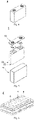
- Fig. 4 shows a secondary battery 5 with a square structure as an example.
- the secondary battery may comprise an outer package.
- the outer packaging is used to package the positive electrode plate, the negative electrode plate and the electrolyte.
- the outer package may comprise a housing 51 and a cover 53, wherein the housing 51 may comprise a bottom plate and a side plate connected to the bottom plate, and the bottom plate and the side plate enclose a receiving cavity.
- the housing 51 has an opening communicating with the receiving cavity, and the cover plate 53 can cover the opening to close the receiving cavity.
- a positive electrode plate, a negative electrode plate and a separator may be formed into an electrode assembly 52 through a winding process or a lamination process.
- the electrode assembly 52 is packaged in the receiving cavity.
- the electrolyte which can be an electrolytic solution is infiltrated in the electrode assembly 52.
- the number of electrode assemblies 52 contained in the secondary battery 5 can be one or more, which can be adjusted according to requirements.
- the outer packaging of the secondary battery may be a hard case, such as a hard plastic case, an aluminum case, a steel case.
- the outer packaging of the secondary battery may also be a soft bag, such as a pouch type soft bag.
- the material of the soft bag can be plastic, for example, it can comprise one or more of polypropylene (PP), polybutylene terephthalate (PBT), polybutylene succinate (PBS).
- the secondary battery can be assembled to form a battery module.
- the number of secondary batteries contained in the battery module can be multiple, and the specific number can be adjusted according to the application and capacity of the battery module.
- Fig. 6 is a battery module 4 as an example.
- a plurality of secondary batteries 5 may be arranged in sequence along the length direction of the battery module 4. Of course, it can also be arranged in any other manner. Further, the plurality of secondary batteries 5 can be fixed by fasteners.
- the battery module 4 may further comprise a housing with a receiving space, and a plurality of secondary batteries 5 are accommodated in the receiving space.
- the above-mentioned battery module can further be assembled into a battery pack.
- the number of battery modules contained in the battery pack can be adjusted according to the application and capacity of the battery pack.
- Figs. 7 and 8 are the battery pack 1 as an example.
- the battery pack 1 may comprise a battery case and a plurality of battery modules 4 provided in the battery case.
- the battery case includes an upper case 2 and a lower case 3.
- the upper case 2 can be covered on the lower case 3 and forms a closed space for accommodating the battery module 4.
- Multiple battery modules 4 can be arranged in the battery box in any manner.
- the present application further provides a device comprising at least one of the secondary battery, battery module, or battery pack of the present application.
- the secondary battery, battery module or battery pack can be used as a power source of the device, and can also be used as an energy storage unit of the device.
- the device can be, but is not limited to, mobile devices (such as mobile phones, notebook computers), electric vehicles (such as pure electric vehicles, hybrid electric vehicles, plug-in hybrid electric vehicles, electric bicycles, electric scooters, electric golf carts, electric trucks.), electric trains, ships and satellites, energy storage systems, etc.
- the device can be selected as a secondary battery, a battery module, or a battery pack according to its usage requirements.
- Fig. 9 is a device as an example.
- the device is a pure electric vehicle, a hybrid electric vehicle, or a plug-in hybrid electric vehicle.
- a battery pack or a battery module can be used.
- the device may be a mobile phone, a tablet computer, a notebook computer, etc.
- the device is generally required to be thin and light, and a secondary battery can be used as a power source.
- Silicon monoxide (SiO) powder was crushed to obtain SiO with a certain particle size distribution.
- 3 g of polyacrylonitrile (PAN) was dispersed into a solvent of 1000 mL of dimethylformamide (DMF) to prepare a polymer slurry 1.
- the slurry 2 was dried in an argon atmosphere at 190° C for 2 hours until the solvent was completely removed, thereby obtaining SiO coated with PAN.
- the PAN coated SiO was heat-treated in an argon atmosphere at 450° C for 3 h, and then sieved to obtain a negative active material.
- the resulting silicon-oxygen compound, a conductive agent Super-P (conductive carbon black), a conductive agent CNT (carbon nanotube) and a binder PAA (polyacrylic acid) were mixed at a mass ratio of 85:4.5:0.5:10 in an appropriate amount of deionized water to obtain a homogeneous negative electrode slurry; the negative electrode slurry was coated on the surface of the negative electrode current collector copper foil, following by drying, cold pressing and cutting, thereby obtaining a negative electrode plate, which can be used as a negative electrode plate of a secondary battery.
- a lithium metal plate was used as an electrode, Celgard 2400 separator was used, and electrolytic solution was injected to assemble a button battery.
- electrolytic solution ethylene carbonate (EC), ethyl methyl carbonate (EMC), and diethyl carbonate (DEC) were mixed uniformly in a volume ratio of 1:1:1 to obtain an organic solvent, and then LiPF6 was dissolved in the above organic solvent. Then the additive fluoroethylene carbonate (FEC) was add, where the concentration of LiPF6 was 1mol/L, and the mass ratio of FEC in the electrolyte was 10%.
- Examples 2 to 28 and Comparative Examples 1 to 3 were the same as Example 1 with the exception that the relevant parameters in the preparation steps of the negative active material were adjusted to obtain different negative active materials.
- the preparation parameters that were different from those in Example 1 were shown in Table 1.
- a button battery Under a normal pressure environment at 25°C, a button battery was discharged at a constant current rate of 0.1C to 0.005V, and then discharged at a constant current of 0.04C to 0.005V. The resulting discharge capacity was recorded as the lithiation capacity after the first cycle. After that, the battery was charged to 1.5V at a constant current rate of 0.1C. The resulting charge capacity was recorded as the delithiation capacity after the first cycle.
- the button battery was subjected to 50 charge and discharge cycles following the procedure described above, and the delithiation capacity for each cycle was recorded.
- Cycle capacity retention rate % delithiation capacity after the 50 th cycle / the lithiation capacity after the 1 st cycle ⁇ 100 %
- Table 1 Relevant preparation parameters for the negative active material No. Polymer Heat-treatment Type Mass ( g ) Temperature(°C) Time (h) Ex 1 Polyacrylonitrile 3 450 3 Ex 2 Polyacrylonitrile 3 420 3 Ex 3 Polyacrylonitrile 3 400 3 Ex 4 Polyacrylonitrile 3 380 3 Ex 5 Polyacrylonitrile 3 350 3 Ex 6 Polyacrylonitrile 3 300 3 Ex 7 Polyacrylonitrile 3 250 3 Ex 8 Polyacrylonitrile 1 400 3 Ex 9 Polyacrylonitrile 2 400 3 Ex 10 Polyacrylonitrile 4 400 3 Ex 11 Polyacrylonitrile 5 400 3 Ex 12 Poly aniline 3 400 3 Ex 13 Polyamide 3 400 3 Ex 14 Polyimide 3 400 3 Ex 15 Polyacrylonitrile 3 400 3 Ex 16 Polyacrylonitrile 3 400 3 Ex 17 Polyacrylonitrile 3 400 3 Ex 18 Polyacrylonitrile 3 400 3 Ex 19 Polyacryl
- N content refers to the mass percentage of nitrogen element in the negative active material
- C content refers to the mass percentage of carbon element in the negative active material
- “/" means that the material does not contain the scattering peak.
- the secondary battery Using the negative active material of the present application enabled the secondary battery to have both higher energy density and cycle performance.
Landscapes
- Chemical & Material Sciences (AREA)
- Chemical Kinetics & Catalysis (AREA)
- Electrochemistry (AREA)
- General Chemical & Material Sciences (AREA)
- Engineering & Computer Science (AREA)
- Manufacturing & Machinery (AREA)
- Composite Materials (AREA)
- Materials Engineering (AREA)
- Inorganic Chemistry (AREA)
- Battery Electrode And Active Subsutance (AREA)
Description
- This application belongs to the technical field of energy storage devices, and specifically relates to a negative active material, preparation method thereof, a secondary battery and related battery module, battery pack and device.
- In recent years, due to the higher energy density requirements of the electric vehicle industry, a lot of research has been carried out on high-capacity negative active materials. Among them, silicon-based materials and tin-based materials have a very high theoretical gram capacity, which is several times that of graphite materials, so they have received much attention. However, silicon-based materials and tin-based materials have serious volume effect, which leads to huge volume expansion during charge procedure, resulting in rapid capacity degradation and poor cycle performance of batteries.
- The invention is set out in the appended set of claims.
-
-
Fig. 1 is a Raman spectrum of a negative active material according to the present application. -
Fig. 2 is a infrared spectrum of a negative active material according to the present application. -
Fig. 3 is an X-ray diffraction (XRD) diagram of a negative active material according to the present application. -
Fig. 4 is a perspective view of a secondary battery according to an embodiment of the present application. -
Fig. 5 is an exploded view ofFig. 4 . -
Fig. 6 is a perspective view of a battery module according to an embodiment of the present application. -
Fig. 7 is a perspective view of a battery pack according to an embodiment of the present application. -
Fig. 8 is an exploded view ofFig. 7 . -
Fig. 9 is a schematic view showing a device with a secondary battery as a power source according to an embodiment of the present application. - In order to make the object, technical solution, and technical effects of the present application apparent, the following further describes the present application in detail with reference to the embodiments. It should be understood that the embodiments described in the present description are only for explaining the present application, and are not intended to limit the application.
- For the sake of brevity, only certain ranges are explicitly disclosed herein. However, ranges from any lower limit may be combined with any upper limit to recite a range not explicitly recited, ranges from any lower limit may be combined with any other lower limit to recite a range not explicitly recited, and in the same way, ranges from any upper limit may be combined with any other upper limit to recite a range not explicitly recited. Additionally, within a range includes every point or individual value between its end points even though not explicitly recited. Thus, every point or individual value may serve as its own lower or upper limit combined with any other point or individual value or any other lower or upper limit, to recite a range not explicitly recited.
- In the description herein, it should be noted that, unless otherwise stated, the recitation of numerical ranges by "above" and "below" include all numbers within that range including the endpoints. As used herein, "a", "an", "the", "at least one", and "one or more" are used interchangeably, unless indicated otherwise and the recitation of "more" in the phrase "one or more" includes two or more.
- The above summary of the present application is not intended to describe each disclosed embodiment or every implementation in this application. The following description illustrates exemplary embodiments more specifically. In many places throughout the application, guidance is provided through a series of examples, which can be used in various combinations. In each instance, the enumeration is only a representative group and should not be interpreted as exhaustive.
- In a first aspect of the present application, a negative active material is provided, comprising a core material and a modified polymer coating layer coated on at least a part of the outer surface of the core material, the core material comprises silicon-based materials, the coating layer comprises carbon element and nitrogen element, wherein the nitrogen element is present in the negative active material in a mass percentage of 0.21%~ 0.56%, and the coating layer comprises a -C=N-linkage.
- In the negative active material of the present application, at least a part of the outer surface of the silicon-based material is coated with a modified polymer coating layer, which coating layer has good toughness and which can prevent the coating layer from cracking due to the expansion and contraction of the silicon-based material. The intact coating layer can effectively protect the silicon-based materials for a long time, inhibit the side reaction of electrolytic solution on the surface of the material, and also is conducive to the formation of stable SEI (solid electrolyte interphase) on the surface of the negative active material, so as to avoid the continuous consumption of electrolytic solution and active ions (such as lithium ion in lithium-ion secondary battery) due to the continuous breakage and repair of SEI film, thereby reducing the irreversible capacity of batteries and improving the cycle performance of secondary batteries.
- Moreover, the coating layer comprises nitrogen element, in which the nitrogen element is present in the negative active material in a mass percentage of 0.2%~ 0.56% and the coating layer comprises -C=N-linkage. The coating layer comprises a certain amount of nitrogen and comprises -C=N-linkage, which makes the coating layer have high conductivity. The coating layer having high conductivity improves the electronic conductivity of the negative active material, which can improve the capacity and the capacity retention rate during the cycle of the negative active material and can also inhibit the impedance increase of secondary batteries during charge discharge cycle and reduce polarization of batteries. Therefore, the cycle performance of secondary batteries is further improved.
- Therefore, the secondary battery with the negative active material according to the present application has long cycle performance and high energy density both.
- In the negative active material of the present application, the mass percentage of the nitrogen element in the negative active material may be ≤0.66%, ≤0.62%, ≤0.6%, ≤0.56%, ≤ 0.54%, ≤0.5%, ≤0.48%, ≤0.45%, ≤0.4%, or ≤0.35%. The mass percentage of the nitrogen element in the negative active material may be ≥0.1%, ≥0.15%, ≥0.18%, ≥0.2%, ≥0.22%, ≥0.25%, ≥0.27%, or ≥0.3%.
- The mass percentage of the nitrogen element in the negative active material is 0.2% ~ 0.56%. The negative active material having the mass percentage of the nitrogen element within above range may exert the above effect well and further improve the cycle performance of batteries.
- In the negative active material of the present application, optionally, the mass percentage of the carbon element in the negative active material is 0.71%~ 3.40%, or 1.15%~2.57%.
- The mass percentage of the carbon element in the negative active material is within above range, which is beneficial to make the coating layer have higher conductive performance and to enable the coating layer to have better elasticity and toughness and protect silicon oxide compounds well. Moreover, the mass percentage of the carbon element in the negative active material within above range is also conducive to making the negative active material have high gram capacity. Therefore, the mass percentage of the carbon element in the negative active material within the above range enables the secondary battery to have high cycle performance and energy density.
- In some embodiments, in Raman scattering analysis, the negative active material has scattering peaks at the Raman shifts of 1320cm-1 ~ 1410cm-1 and 1550cm-1 ~ 1650cm-1 (
Fig. 1 ) in which the scattering peak (abbreviated as peak D) at the Raman shifts of 1320cm-1 ~ 1410cm-1 has a peak intensity recorded as ID, and the scattering peak (abbreviated as peak G) at the Raman shifts of 1550cm-1 ~ 1650cm-1 has a peak intensity recorded as IG, and the ID and IG may satisfy 1.50 ≤ ID/IG ≤ 2.50. Optionally, 1.80 ≤ ID/IG ≤ 2.40. - The ratio of peak intensity ID of peak D to peak intensity IG of peak G within the above range can reduce the irreversible capacity of the material during charge and discharge cycles, and ensure that the coating layer has excellent conductivity, which is conducive to the capacity of the material and improve the cycle capacity retention rate, thereby improving the first coulomb efficiency, cycle performance and energy density of secondary batteries with the negative active materials.
- In some embodiments, as shown in
Fig. 2 , the negative active material has an infrared spectrum comprising an infrared absorption peak at the wavenumber of 1350cm-1 to 1450cm-1, and the infrared absorption peak has a transmittance of 90% - 98%. Optionally, the infrared absorption peak has a transmittance of 92% - 96%. When the negative active material has an infrared absorption peak at the wavenumber of 1350cm-1 to 1450cm-1, and the infrared absorption peak has a transmittance within a given range, the negative active material may further improve the first coulomb efficiency and cycle performance. - In the negative active material of the present application, optionally, the modified polymer coating layer is a product obtained by partial carbonization of polymers. The product obtained by partial carbonization of polymers maintains the good toughness of the polymers and is not easy to break with the expansion and contraction of the core material.
- Optionally, the polymer comprises one or more of polyaniline (abbreviated as PANI), polyimide (abbreviated as PI), polyacrylonitrile (abbreviated as PAN), and polyacrylamide (abbreviated as PAM). The coating layer obtained by partial carbonization of these polymers can have both better toughness and conductivity, thereby further improving battery performance.
- Optionally, the partially carbonized polymer is obtained by heat treatment of the polymer at a specific temperature. The polymer-modified coating layer obtained by partial carbonization of polymers via heat treatment has higher overall performance, and the coating layer has both better toughness and conductivity, thereby further improving the performance of batteries.
- Optionally, the partially carbonized polymer is obtained by heat treatment of the polymer at 250°C to 450°C. Further optionally, the partially carbonized polymer is obtained by heat-treating the polymer at 300°C to 450°C. Also optionally, the partially carbonized polymer is obtained by heat-treating the polymer at 350°C to 450°C.
- In the coating layer obtained by heat treatment of the polymer at 250°C ~ 450°C, the nitrogen content may satisfy the aforementioned requirements. In addition, the nitrogen element and carbon element in the coating layer form a carbon-nitrogen double bond, which further improves the conductivity of the coating layer. Moreover, the coating layer also maintains good toughness and is not prone to cracking. Therefore, the conductivity and mechanical toughness of the negative active material are improved, thereby improving the cycle performance of batteries.
- In the negative active material of the present application, optionally, the coating layer is coated on 80% or more of the surface of the core material. If the coating layer is coated on the entire surface of the core material, the core material can be more fully protected.
- In the negative active material of the present application, the core material comprises silicon-based materials. Optionally, the silicon-based material is selected from one or more of elemental silicon, silicon-oxygen compounds, silicon-carbon composites, silicon-nitrogen compounds, and silicon alloys. Further optionally, the silicon-based material is selected from silicon-oxygen compounds.
- In some embodiments, optionally, in the X-ray diffraction analysis, the negative active material has a diffraction peak at a diffraction angle 2θ of 19° ~ 27°, as shown in
Fig. 3 . The diffraction peak may has a full width at half maxima of 4° ~ 12°. Optionally, the full width at half maxima of the diffraction peak is 5°-10°. Full width at half maxima, also known as FWHM, refers to the width of the peak at half the peak height. - The negative active material with a diffraction peak at 2θ of 19° ~ 27° in which the diffraction peak has a full width at half maxima within the above range has a higher gram capacity and a lower cycle expansion effect, which is not prone to cracking and pulverization during charge and discharge cycles of secondary batteries, so the cycle life of batteries can be further improved.
- In some embodiments, the negative active material of the present application has a number particle size distribution Dn10 that may satisfy 1 µ m ≦ Dn10 ≦ 5 µ m. Optionally, 1.5 µm≤ Dn10≤4.5 µm. Further optionally, 2 µ m ≤Dn10≤4 µm. The negative active material comprises a certain proportion of small particle materials, which can reduce the rebound phenomenon of electrode plates, alleviate the expansion and deformation of electrode plates, and further improve the cycle performance of batteries. In addition, the number particle size distribution Dn10 of the negative active material is within the above range, which is also beneficial to increase the compaction density of the negative electrode film, and can reduce the side reaction of the negative electrode film, reduce the consumption of electrolytic solution, and improve the cycle performance and energy density of batteries.
- In some embodiments, the negative active material of the present application has a volume particle size distribution Dv50 that may satisfy 2.5 µ m ≦ Dv50 ≦ 12 µ m. Optionally, 3 µ m ≤Dv50≤10 µ m. Further optionally, 4 µ m≤Dv50≤8 µ m.
- The volume particle size distribution Dv50 of the negative active material is within the above range, which can reduce the film-forming consumption of active ions on the negative electrode, and reduce the side reaction of electrolytic solution on the negative electrode, thereby reducing the irreversible capacity of secondary batteries; at the same time, which is also beneficial to obtain a higher active ions and electrons conductivity, and prevent particles from cracking or pulverizing during charge and discharge cycles, thereby further improving the cycle performance of secondary batteries. In addition, the Dv50 of the negative active material within the above range is also beneficial to reduce the amount of the binder added in the negative electrode, thereby increasing the energy density of batteries.
- In some embodiments, the negative active material of the present application has a specific surface area that may be 0.5 m2/g ~ 4.5 m2/g. Optionally, the specific surface area of the negative active material of the present application is 0.7 m2/g -3 m2/g. Further optionally, the specific surface area of the negative active material of the present application is 0.9 m2/g to 2.2 m2/g.
- The specific surface area of the negative active material is within the above range, which can ensure that the surface of the material has more active sites, can improve the electrochemical performance of the material, and meet the requirements of secondary batteries to dynamic performance. In addition, the specific surface area of the negative active material within the above range is also beneficial to reduce side reactions of electrolytic solution on the negative electrode, and can reduce the film-forming consumption of active ions on the negative electrode, thereby improving the cycle performance of batteries.
- In some embodiments, optionally, the negative active material of the present application has a compaction density of 1.1 g/cm3 to 1.7 g/cm3 under a pressure of 49KN. Optionally, the negative active material of the present application has a compaction density of 1.3 g/cm3 ~ 1.5 g/cm3 under a pressure of 49KN. The compaction density of the negative active material is within the given range, which is beneficial to increase the energy density of secondary batteries.
- In the present application, the negative active material can be analyzed by infrared spectroscopy using instruments and methods known in the art, such as an infrared spectrometer, such as the
IS 10 Fourier Transform Infrared Spectrometer from Nicolet, USA. The infrared spectrum of the negative active material of the present application can be tested in accordance with GB/T6040-2002 General rules for infrared spectrum analysis. - In present application, the Raman spectrum of the negative active material can be measured by instruments and methods known in the art. For example, a Raman spectrometer is used. As a specific example, LabRAM HR Evolution laser microscopic Raman spectrometer is used to perform Raman scattering analysis on the negative active material in which a solid-state laser with a wavenumber of 523nm is used as the light source, the beam diameter is 1.2µm, and the power is 1mW; macro Raman test mode is used and CCD detector is used. The negative active material powder is pressed into a tablet, on which 3 points are randomly chosen for testing, and average three sets of measured values obtained.
- In the present application, the X-ray diffraction spectrum of the negative active material can be measured by instruments and methods well known in the art. For example, an X-ray diffractometer is used to measure the X-ray diffraction spectrum in accordance with JIS K0131-1996 (General rules for X-ray diffractometric analysis). When Type Bruker D8 Discover X-ray diffractometer is used, CuKα rays is used as the radiation source, the ray wavenumber is λ=1.5406Å, the scanning angle range for 2θ is 15° ~ 80°, and the scanning rate is 4°/min.
- In the present application, the content of nitrogen element in the negative active material can be determined by instruments and methods known in the art. For example, an oxygen, nitrogen and hydrogen analyzer is used. As a specific example, for example, Vario ELIII element analyzer manufactured by Elementar, Germany is used. CHN mode is used in which
furnace 1 is operated at a temperature of 950°C,furnace 2 is operated at a temperature of 500°C andfurnace 3 is operated at a temperature of 0°C, and the helium and oxygen pressure reducing valve is adjusted to He: 0.2MPa, O2: 0.25MPa. A certain weight of powder is weight and loaded into a tin boat, and the air in the tin boat is removed. After that, the tin boat is purged with helium gas, and then is placed on the sample stage for testing. - In the present application, the content of carbon element in the negative active material can be determined by using instruments and methods known in the art. For example, HCS-140 type infrared carbon and sulfur analyzer from Shanghai Dekai Instrument Co., Ltd. is used for testing in accordance with the measurement method of GB/T 20123-2006/ISO 15350:2000, and the detection precision meets the standard of Metrological Verification Regulation JJG 395-1997.
- In the present application, the particle size distributions, Dn10 and Dv50, of the negative active material have the meanings well known in the art, and can be measured with instruments and methods known in the art, for example, with a laser particle size analyzer, such as
Mastersizer 3000 laser particle size analyzer from Malvern Instruments Co., Ltd., UK. - In the present application, the specific surface area of the negative active material has the meaning known in the art, and can be measured with instruments and methods known in the art. For example, the specific surface area may be measured with nitrogen adsorption specific surface area analysis with reference to GB/T 19587-2004 (Determination of the specific surface area of solids by gas adsorption using the BET method), and calculated by the BET (Brunauer Emmett Teller) method, in which the nitrogen adsorption specific surface area analysis can be carried out by a specific surface and pore size distribution analyzer of Type: Tri Star II 3020 from Micromeritics, USA.
- In the present application, the compaction density of the negative active material can be measured with instruments and methods known in the art. For example, with reference to GB/T24533-2009 standard, it can be measured by an electronic pressure tester, such as UTM7305 electronic pressure tester. Accurately weigh about 1g of the sample, add it to a mold with a bottom area of 1.327cm2, apply a pressure of 5 tonnes (corresponding to 49KN) to the sample with a pressurizing device and keep it under this pressure for 30 seconds before releasing the pressure, and then measure the height of the sample. The compaction density of the material can be obtained by the following formula: ρ=m/(1.327∗h), where ρ represents the compaction density of the material, m represents the mass of the sample, and h represents the height of the sample after being applied with a pressure of 5 tons and held at this pressure for 30 seconds before releasing the pressure.
- Next, a process for preparing a negative active material is provided, by which the negative active material of the present application can be prepared.
- As a specific example, the preparation method of the negative active material comprises the following steps:
- S10: crushing a core material and obtaining the core material with a certain particle size distribution;
- S20: dispersing a polymer in a solvent to figure out a polymer slurry 1 (i.e., a first slurry);
- S30: adding the core material to the
slurry 1 and mixing them homogeneously to obtain a slurry 2 (i.e., a second slurry); - S40: drying the
slurry 2 at a temperature of 50°C to 200°C until the solvent is completely removed, thereby obtaining a polymer coated core material on the surface; and - S50: heat-treating the polymer coated core material at a specific temperature to partially carbonize the polymer, and then sieving it to obtain the negative active material.
- It should be noted that S10 is not an essential step, and the core material with the required particle size can also be commercially available.
- In the above preparation method, the core material in step S10 may be one or more of the aforementioned silicon-based materials and tin-based materials.
- In the above preparation method, the polymer in step S20 can be the aforementioned polymer, such as one or more of polyaniline (PANI), polyimide (PI), polyacrylonitrile (PAN) and polyacrylamide (PAM).
- The solvent in step S20 can be selected from one or more of water, acetone, N-methyl pyrrolidone (abbreviated as NMP), N,N-Dimethylformamide (abbreviated as DMF), and ethanol.
- In
slurry 1, optionally, the mass of the polymer is 1% to 5% of the mass of the core material. - Optionally, a certain amount of conductive material can be added to the
slurry 1. Adding a conductive material to the coating layer of the negative active material can further improve the conductivity of the negative active material. - The conductive material can be selected from one or more of conductive carbon black, carbon nanotubes and graphene. Optionally, the added amount of the conductive material accounts for 10%-30% of the polymer mass.
- In the above preparation method, the specific heat treatment temperature in step S50 is preferably 250° C to 450° C, and controlling the temperature within this range can avoid complete carbonization of the polymer and control the nitrogen content within the given range.
- Optionally, the heat treatment time is 2h-8h, more preferably 3h-5h.
- In the above preparation method, the following process conditions have an effect on the particle size distribution Dn10 and Dv50 of the negative active material:
- (1) The particle size distribution of the core material after the pulverization process in step S10.
- (2) The amount of polymer added in
slurry 1. Optionally, the amount of polymer added is less than or equal to 10% of the mass of the solvent. Optionally, the amount of polymer added is 0.05% ~ 10%, 0.1 ~ 10%, 0.1% ~ 5%, 0.1% ~ 3%, 0.1% ~ 1%, 0.1% ~ 0.6%, 0.2% -1%, 0.3% ~ 0.55%, or 0.1% ~ 0.5% of the solvent mass. - (3) The solid content of
slurry 2. Optionally, the solid content ofslurry 2 is 20% or less. Optionally, the solid content ofslurry 2 is 5% ~ 20%, 5% ~ 15%, 8% ~ 15%, 9% ~ 13%, or 10% ~ 15%. - By adjusting one or more of the above process conditions, the negative active material prepared by the above preparation method can satisfy the particle size distribution described above.
- In the above preparation method, an inert atmosphere can be used for protection if necessary. For example, the inert atmosphere can be selected from one or more of nitrogen, argon, and helium.
- The second aspect of the present application provides a secondary battery comprising the negative active material according to the first aspect of the present application.
- Specifically, the secondary battery comprises a positive electrode plate, a negative electrode plate, a separator, and an electrolyte. The negative electrode comprises a negative current collector and a negative electrode film disposed on at least one surface of the negative current collector, wherein the negative electrode film comprises the negative active material according to the first aspect of the present application.
- In the secondary battery of the present application, the negative electrode current collector can be made of a material with good conductivity and mechanical strength, preferably copper foil.
- In the secondary battery of the present application, furthermore, the negative electrode film may optionally comprise other negative active materials useful for the secondary batteries. Other negative active materials are preferably one or more of graphite, mesophase carbon microspheres (MCMB), hard carbon, and soft carbon, more preferably graphite. The graphite can be selected from one or more of artificial graphite and natural graphite.
- In the secondary battery of the present application, furthermore, the negative electrode film may optionally comprise a conductive agent, a binder, and a thickener, and there is no specific limitation on their types, and those skilled in the art can make selections according to actual needs.
- Optionally, the conductive agent used for the negative electrode film can be one or more of graphite, superconducting carbon, acetylene black, carbon black, Ketjen black, carbon dots, carbon nanotubes, graphene, and carbon nanofibers. The binder can be one or more of polyacrylic acid (PAA), sodium polyacrylate (PAAS), polyvinyl alcohol (PVA), styrene butadiene rubber (SBR), carboxymethyl cellulose (CMC), sodium alginate (SA), polymethacrylic acid (PMAA) and carboxymethyl chitosan (CMCS). The thickener can be sodium carboxymethyl cellulose (CMC-Na).
- The negative electrode plate can be prepared according to conventional methods in the art. For example, the negative active material and optional conductive agent, binder and thickener are dispersed in a solvent which can be deionized water to form a uniform negative electrode slurry.
- The negative electrode slurry is coated on the negative electrode current collector. After being dried, cold pressed and other processes, a negative electrode plate is obtained.
- In the secondary battery of the present application, the positive electrode plate comprises a positive electrode current collector and a positive electrode film disposed on at least one surface of the positive electrode current collector and comprising a positive active material.
- In the secondary battery of the present application, the positive electrode current collector can be made of materials with good electrical conductivity and mechanical strength, preferably aluminum foil.
- In the secondary battery of the present application, the type of the positive active material is not specifically limited, and materials useful for the secondary battery and known in the art can be used, and those skilled in the art can make selections according to actual needs.
- It should be noted that the secondary battery of the present application may be a lithium ion battery, a sodium ion battery or any other battery using the negative active material described according to the first aspect of the present application.
- When the secondary battery of the present application is a lithium ion battery, optionally, the positive active material may be selected from lithium transition metal oxides and modified materials thereof, and the modified material may be lithium transition metal oxide subjected to doping modification and/or coating modification. Optionally, the lithium transition metal oxide can be selected from one or more of lithium cobalt oxide, lithium nickel oxide, lithium manganese oxide, lithium nickel manganese oxide, lithium nickel cobalt manganese oxide, lithium nickel cobalt aluminum oxide and lithium containing phosphate with olivine structure.
- For example, the positive active material of the lithium ion battery can be selected from one or more of LiCoO2, LiNiO2, LiMnO2, LiMn2O4, LiNi1/3Co1/3Mn1/3O2(NCM333), LiNi0.5Co0.2Mn0.3O2 (NCM523), LiNi0.6Co0.2Mn0.2O2 (NCM622), LiNi0.8Co0.1Mn0.1O2 (NCM811), LiNi0.85Co0.15Al0.05O2, LiFePO4(LFP) and LiMnPO4.
- When the secondary battery of the present application is a sodium ion battery, optionally, the positive active material can be selected from transition metal oxide NaxMO2 (M is a transition metal, preferably from one or more of Mn, Fe, Ni, Co, V, Cu, and Cr, 0<x≤1), polyanionic materials (such as phosphate, fluorophosphate, pyrophosphate, sulfate), Prussian blue materials, and the like. However, the present application is not limited to these materials, other materials that can be used as a positive active material for sodium ion batteries can also be used. These positive electrode active materials may be used alone or in combination of two or more.
- Optionally, the positive active material of the sodium ion battery can be selected from one or more of NaFeO2, NaCoO2, NaCrO2, NaMnO2, NaNiO2, NaNi1/2Ti1/2O2, NaNi1/2Mn1/2O2, Na2/3Fe1/3Mn2/3O2, NaNi1/3Co1/3Mn1/3O2, NaFePO4, NaMnPO4, NaCoPO4, Prussian blue materials, and materials with the general formula AaMb(PO4)cOxY3-x where A is selected from one or more of H+, Li+, Na+, K+ and NH4 +, and M is a transition metal cation, preferably one or more of V, Ti, Mn, Fe, Co, Ni, Cu and Zn, Y is a halogen anion, preferably one or more of F, Cl and Br, 0< a≤4, 0<b≤2, 1≤c≤3, 0≤x≤2.
- In the secondary battery of the present application, furthermore, the positive electrode film may also comprise a binder and/or a conductive agent. The types of the binder and the conductive agent are not specifically limited, and those skilled in the art can make selections according to actual needs. Optionally, the binder used for the positive electrode film may comprise one or more of polyvinylidene fluoride (PVDF) and polytetrafluoroethylene (PTFE); the conductive agent may comprise one or more of graphite, superconducting carbon, acetylene black, carbon black, Ketjen black, carbon dots, carbon nanotubes, graphene, and carbon nanofibers.
- The above-mentioned positive electrode plate can be prepared according to conventional methods in the art. For example, the positive active material and optionally conductive agent and binder are dispersed in a solvent (such as N-methylpyrrolidone, or NMP for short), to form a uniform positive electrode slurry, and the positive electrode slurry is coated on the positive electrode current collector. After being dried, cold pressed and other processes, the positive electrode plate is obtained.
- In the secondary battery of the present application, there is no specific limitation on the type of electrolyte, and it can be selected according to requirements. The electrolyte may be selected from at least one of solid electrolyte and liquid electrolyte (i.e. an electrolytic solution). When the electrolyte is an electrolytic solution, the electrolytic solution comprises an electrolyte salt and a solvent. Among them, there is no particular limitation to the specific types of electrolyte salt and solvent, which can be selected according to actual needs.
- When the secondary battery of the present application is a lithium ion battery, optionally, the electrolyte salt may be selected from one or more of LiPF6 (lithium hexafluorophosphate), LiBF4 (lithium tetrafluoroborate), LiClO4 (lithium perchlorate), LiAsF6 (lithium hexafluoroarsenate), LiFSI (lithium bisfluorosulfonimide), LiTFSI (lithium bistrifluoromethanesulfonimide), LiTFS (lithium trifluoromethanesulfonate), LiDFOB (lithium difluorooxalate borate), LiBOB (lithium dioxalate borate), LiPO2F2 (lithium difluorophosphate), LiDFOP (lithium difluorooxalatophosphate) and LiTFOP (lithium tetrafluorooxalate phosphate).
- When the secondary battery of the present application is a sodium ion battery, optionally, the electrolyte salt may be selected from one or more of NaPF6, NaClO4, NaBCl4, NaSO3CF3 and Na(CH3)C6H4SO3.
- In the secondary battery of the present application, optionally, the solvent may be one or more of ethylene carbonate (EC), propylene carbonate (PC), ethyl methyl carbonate (EMC), diethyl carbonate (DEC), dimethyl carbonate (DMC), dipropyl carbonate (DPC), methyl propyl carbonate (MPC), ethyl propyl carbonate (EPC), butylene carbonate (BC), fluoroethylene carbonate (FEC), methyl formate (MF), methyl acetate (MA), ethyl acetate (EA), propyl acetate (PA), methyl propionate (MP), ethyl propionate (EP), propyl propionate (PP), methyl butyrate (MB), ethyl butyrate (EB), 1,4-butyrolactone (GBL), sulfolane (SF), dimethylsulfone (MSM), methylethylsulfone (EMS), and diethylsulfone (ESE).
- The electrolytic solution may optionally comprise an additive. The additive is not particularly limited and can be selected according to requirements. For example, the additives may comprise one or more of negative electrode film-forming additives, positive electrode film-forming additives, and additives that can improve certain performance of the battery, such as additives that improve overcharge performance of the battery, additives that improve high-temperature performance of the battery, and those that improve low-temperature performance of the battery.
- In the secondary battery of the present application, the separator is disposed between the positive electrode plate and the negative electrode plate to isolate them. The separator is not particularly limited, and any well-known porous structure separator having chemical stability and mechanical stability can be selected, such as one or more of glass fiber, non-woven fabric, polyethylene, polypropylene and polyvinylidene fluoride. The separator can be a single-layer film or a multilayer composite film. When the separator is a multilayer composite film, the materials of each layer may be the same or different.
- The secondary battery can be prepared by a method commonly known in the art. As an example, a positive electrode plate, a separator, and a negative electrode plate are wound (or stacked) in order, so that the separator is located between the positive electrode plate and the negative electrode plate to act as isolation, thereby obtaining an electrode component. The electrode component is placed in a packaging case, and then an electrolytic solution is injected therein and sealed to obtain a secondary battery.
- The present application has no particular limitation on the shape of the secondary battery, which may be cylindrical, square or any other shapes.
Fig. 4 shows asecondary battery 5 with a square structure as an example. - In some embodiments, the secondary battery may comprise an outer package. The outer packaging is used to package the positive electrode plate, the negative electrode plate and the electrolyte.
- In some embodiments, referring to
Fig. 5 , the outer package may comprise a housing 51 and acover 53, wherein the housing 51 may comprise a bottom plate and a side plate connected to the bottom plate, and the bottom plate and the side plate enclose a receiving cavity. The housing 51 has an opening communicating with the receiving cavity, and thecover plate 53 can cover the opening to close the receiving cavity. - A positive electrode plate, a negative electrode plate and a separator may be formed into an
electrode assembly 52 through a winding process or a lamination process. Theelectrode assembly 52 is packaged in the receiving cavity. The electrolyte which can be an electrolytic solution is infiltrated in theelectrode assembly 52. The number ofelectrode assemblies 52 contained in thesecondary battery 5 can be one or more, which can be adjusted according to requirements. - In some embodiments, the outer packaging of the secondary battery may be a hard case, such as a hard plastic case, an aluminum case, a steel case. The outer packaging of the secondary battery may also be a soft bag, such as a pouch type soft bag. The material of the soft bag can be plastic, for example, it can comprise one or more of polypropylene (PP), polybutylene terephthalate (PBT), polybutylene succinate (PBS).
- In some embodiments, the secondary battery can be assembled to form a battery module. The number of secondary batteries contained in the battery module can be multiple, and the specific number can be adjusted according to the application and capacity of the battery module.
-
Fig. 6 is a battery module 4 as an example. Referring toFig. 6 , in the battery module 4, a plurality ofsecondary batteries 5 may be arranged in sequence along the length direction of the battery module 4. Of course, it can also be arranged in any other manner. Further, the plurality ofsecondary batteries 5 can be fixed by fasteners. - Optionally, the battery module 4 may further comprise a housing with a receiving space, and a plurality of
secondary batteries 5 are accommodated in the receiving space. - In some embodiments, the above-mentioned battery module can further be assembled into a battery pack. The number of battery modules contained in the battery pack can be adjusted according to the application and capacity of the battery pack.
-
Figs. 7 and 8 are thebattery pack 1 as an example. Referring toFigs. 7 and 8 , thebattery pack 1 may comprise a battery case and a plurality of battery modules 4 provided in the battery case. The battery case includes anupper case 2 and alower case 3. Theupper case 2 can be covered on thelower case 3 and forms a closed space for accommodating the battery module 4. Multiple battery modules 4 can be arranged in the battery box in any manner. - The present application further provides a device comprising at least one of the secondary battery, battery module, or battery pack of the present application. The secondary battery, battery module or battery pack can be used as a power source of the device, and can also be used as an energy storage unit of the device. The device can be, but is not limited to, mobile devices (such as mobile phones, notebook computers), electric vehicles (such as pure electric vehicles, hybrid electric vehicles, plug-in hybrid electric vehicles, electric bicycles, electric scooters, electric golf carts, electric trucks.), electric trains, ships and satellites, energy storage systems, etc.
- The device can be selected as a secondary battery, a battery module, or a battery pack according to its usage requirements.
-
Fig. 9 is a device as an example. The device is a pure electric vehicle, a hybrid electric vehicle, or a plug-in hybrid electric vehicle. In order to meet the requirements of the device for high power and high energy density of the secondary battery, a battery pack or a battery module can be used. - As another example, the device may be a mobile phone, a tablet computer, a notebook computer, etc. The device is generally required to be thin and light, and a secondary battery can be used as a power source.
- The following examples are intended to describe the disclosure of the present application in more detail for only illustrative purpose, and various modifications and changes in the scope of the present disclosure will be apparent to those skilled in the art. All parts, percentages, and ratios reported in the following examples are by weight unless otherwise stated, and all reagents used in the examples are commercially available or synthetically obtained by conventional methods and are directly used without further processing, and the instruments used in the examples are commercially available.
- Silicon monoxide (SiO) powder was crushed to obtain SiO with a certain particle size distribution.
3 g of polyacrylonitrile (PAN) was dispersed into a solvent of 1000 mL of dimethylformamide (DMF) to prepare apolymer slurry 1. - 100 g of pulverized SiO was added to
slurry 1 and mixed homogeneously to obtain aslurry 2. - The
slurry 2 was dried in an argon atmosphere at 190° C for 2 hours until the solvent was completely removed, thereby obtaining SiO coated with PAN. - The PAN coated SiO was heat-treated in an argon atmosphere at 450° C for 3 h, and then sieved to obtain a negative active material.
- The resulting silicon-oxygen compound, a conductive agent Super-P (conductive carbon black), a conductive agent CNT (carbon nanotube) and a binder PAA (polyacrylic acid) were mixed at a mass ratio of 85:4.5:0.5:10 in an appropriate amount of deionized water to obtain a homogeneous negative electrode slurry; the negative electrode slurry was coated on the surface of the negative electrode current collector copper foil, following by drying, cold pressing and cutting, thereby obtaining a negative electrode plate, which can be used as a negative electrode plate of a secondary battery.
- A lithium metal plate was used as an electrode, Celgard 2400 separator was used, and electrolytic solution was injected to assemble a button battery. In the electrolytic solution, ethylene carbonate (EC), ethyl methyl carbonate (EMC), and diethyl carbonate (DEC) were mixed uniformly in a volume ratio of 1:1:1 to obtain an organic solvent, and then LiPF6 was dissolved in the above organic solvent. Then the additive fluoroethylene carbonate (FEC) was add, where the concentration of LiPF6 was 1mol/L, and the mass ratio of FEC in the electrolyte was 10%.
- Examples 2 to 28 and Comparative Examples 1 to 3 were the same as Example 1 with the exception that the relevant parameters in the preparation steps of the negative active material were adjusted to obtain different negative active materials. The preparation parameters that were different from those in Example 1 were shown in Table 1.
-
- 1. The negative active material was tested using the test method described above.
- 2. Test for cycle performance of button battery
- Under a normal pressure environment at 25°C, a button battery was discharged at a constant current rate of 0.1C to 0.005V, and then discharged at a constant current of 0.04C to 0.005V. The resulting discharge capacity was recorded as the lithiation capacity after the first cycle. After that, the battery was charged to 1.5V at a constant current rate of 0.1C. The resulting charge capacity was recorded as the delithiation capacity after the first cycle. The button battery was subjected to 50 charge and discharge cycles following the procedure described above, and the delithiation capacity for each cycle was recorded.

Table 1: Relevant preparation parameters for the negative active material No. Polymer Heat-treatment Type Mass ( g ) Temperature(°C) Time (h) Ex 1Polyacrylonitrile 3 450 3 Ex 2Polyacrylonitrile 3 420 3 Ex 3Polyacrylonitrile 3 400 3 Ex 4 Polyacrylonitrile 3 380 3 Ex 5Polyacrylonitrile 3 350 3 Ex 6 Polyacrylonitrile 3 300 3 Ex 7 Polyacrylonitrile 3 250 3 Ex 8 Polyacrylonitrile 1 400 3 Ex 9 Polyacrylonitrile 2 400 3 Ex 10Polyacrylonitrile 4 400 3 Ex 11 Polyacrylonitrile 5 400 3 Ex 12 Poly aniline 3 400 3 Ex 13 Polyamide 3 400 3 Ex 14 Polyimide 3 400 3 Ex 15Polyacrylonitrile 3 400 3 Ex 16 Polyacrylonitrile 3 400 3 Ex 17 Polyacrylonitrile 3 400 3 Ex 18 Polyacrylonitrile 3 400 3 Ex 19 Polyacrylonitrile 3 400 3 Ex 20Polyacrylonitrile 3 400 3 Ex 21 Polyacrylonitrile 3 400 3 Ex 22 Polyacrylonitrile 3 400 3 Ex 23 Polyacrylonitrile 3 400 3 Ex 24 Polyacrylonitrile 3 400 3 Ex 25Polyacrylonitrile 3 400 3 Ex 26 Polyacrylonitrile 3 400 3 Ex 27 Polyacrylonitrile 3 400 3 Ex 28 Polyacrylonitrile 3 400 3 CEx 1Polyacrylonitrile 3 1200 3 CEx 2Polyacrylonitrile 3 200 3 CEx 3Polyacrylonitrile 3 / / Table 2: Measurement results in which Examples 1-2, 6-8, 11 are not in accordance with the present invention. No. Does it contain -C=N-linkage N content ( % ) C content ( % ) ID/IG Dn10 (µm) Dv50 (µm) Specific surface area (m2/g) Cycle capacity retention rate after 50 cycles ( % ) Ex 1 Yes 0.10 1.71 1.52 3.2 5.5 1.3 86.1 Ex 2 Yes 0.15 1.72 1.67 3.2 5.5 1.3 89.3 Ex 3 Yes 0.20 1.73 1.86 3.2 5.5 1.3 96.3 Ex 4 Yes 0.32 1.75 2.05 3.2 5.5 1.3 96.7 Ex 5 Yes 0.56 1.76 2.33 3.2 5.5 1.3 96.4 Ex 6 Yes 0.62 1.77 2.44 3.2 5.5 1.3 91.2 Ex 7 Yes 0.66 1.78 2.48 3.2 5.5 1.3 85.8 Ex 8 Yes 0.13 0.71 1.82 3.2 5.5 1.3 90.5 Ex 9 Yes 0.21 1.15 2.01 3.2 5.5 1.3 95.1 Ex 10 Yes 0.47 2.57 2.03 3.2 5.5 1.3 95.4 Ex 11 Yes 0.62 3.39 2.02 3.2 5.5 1.3 90.6 Ex 12 Yes 0.27 1.7 1.95 3.2 5.5 1.3 91.3 Ex 13 Yes 0.30 1.67 2.18 3.2 5.5 1.3 91.2 Ex 14 Yes 0.16 1.69 2.16 3.2 5.5 1.3 89.7 Ex 15 Yes 0.35 1.92 2.03 1.0 5.5 2.2 88.0 Ex 16 Yes 0.34 1.86 2.05 1.5 5.5 1.8 93.1 Ex 17 Yes 0.33 1.81 2.02 2.0 5.5 1.6 95.2 Ex 18 Yes 0.32 1.75 2.08 2.7 5.5 1.4 95.9 Ex 19 Yes 0.31 1.7 2.04 4.0 5.5 1.2 95.3 Ex 20 Yes 0.30 1.64 2.07 4.5 6 1.1 93.1 Ex 21 Yes 0.28 1.53 2.06 5.0 8 0.8 89.0 Ex 22 Yes 0.35 1.92 2.09 1.5 2.5 4.5 88.1 Ex 23 Yes 0.34 1.86 2.01 1.5 3 3 92.1 Ex 24 Yes 0.33 1.81 2.04 2.3 4 2.2 95.6 Ex 25 Yes 0.31 1.7 2.05 3.3 7 1.1 94.9 Ex 26 Yes 0.30 1.64 2.09 3.5 8 0.9 94.9 Ex 27 Yes 0.28 1.53 2.06 4.0 10 0.7 92.0 Ex 28 Yes 0.26 1.42 2.08 5.0 12 0.5 88.0 CEx 1 No 0 1.69 1.34 3.2 5.5 1.3 73.4 CEx 2 Yes 0.68 1.79 / 3.2 5.5 1.3 77.2 CEx 3 No 0.7 1.8 / 3.2 5.5 1.3 65.5 - In Table 2, N content refers to the mass percentage of nitrogen element in the negative active material; C content refers to the mass percentage of carbon element in the negative active material; and "/" means that the material does not contain the scattering peak.
- It was shown from the data in Table 2 that the negative active material of the present application comprised a silicon-based core material and a modified polymer coating layer covering at least a part of the outer surface of the core material, and the coating layer contained a prescribed amount of nitrogen element and contained the -C=N- linkage, which significantly improved the cycle life of the negative active material, and thus the cycle performance of the secondary battery could be greatly improved.
- In Comparative Examples 1 to 3, too high or too low nitrogen content in the coating layer will affect the cycle life of the negative active material, resulting in poor cycle performance of the secondary battery.
- Using the negative active material of the present application enabled the secondary battery to have both higher energy density and cycle performance.
- The above mentioned descriptions only show particular implementations of the present application and but are not intended to limit the protection scope of the present application.
- Therefore, the protection scope of the present application shall be determined by the protection scope of the claims.
Claims (14)
- A negative active material comprising a core material and a modified polymer coating layer coated on at least a part of the outer surface of the core material, the core material comprises silicon-based materials, the coating layer comprises carbon element and nitrogen element, wherein the nitrogen element is present in a mass percentage of 0.2%- 0.56% based on the total mass of the negative active material, and the coating layer comprises a -C=N-linkage.
- The negative active material according to claim 1, wherein the carbon element is present in a mass percentage of 0.71%- 3.40%, optionally in a mass percentage of 1.15%-2.57% based on the total mass of the negative active material.
- The negative active material according to any one of claims 1-2, wherein the negative active material has a Raman spectrum comprising scattering peaks at the Raman shifts of 1320cm-1 -1410cm-1 and 1550cm-1 -1650cm-1 in which the scattering peak at the Raman shifts of 1320cm-1 - 1410cm-1 has a peak intensity recorded as ID, and the scattering peak at the Raman shifts of 1550cm-1 -1650cm-1 has a peak intensity recorded as IG, and the peak intensity ID and the peak intensity IG satisfy 1.50 ≤ ID/IG ≤ 2.50; optionally, 1.80 ≤ ID/IG ≤ 2.40, as measured according to the description; and/orthe negative active material has an infrared spectrum comprising an infrared absorption peak at the wavenumber of 1350cm-1 to 1450cm-1, and the infrared absorption peak has a transmittance of 90% - 98%, and optionally 92% - 96%, as measured according to the description; and/orthe negative active material has a number particle size distribution Dn10 that satisfies 1.5 µm ≤ Dn10 ≤ 4.5 µm; optionally, 2 µm ≤ Dn10 ≤ 4 µm, as measured according to the description and/orthe negative active material has a specific surface area of 0.7m2/g -3m2/g, and optionally 0.9m2/g-2.2m2/g; and/orthe negative active material has a volume particle size distribution Dv50 that satisfies 3 µm ≤ Dv50 ≤ 10 µm; optionally, 4 µm ≤ Dv50 ≤ 8 µM, as measured according to the description; and/orthe negative active material has an X-ray diffraction pattern comprising a diffraction peak at the diffraction angle 2 θ of 19° to 27° and the diffraction peak has a full width at half maxima of 4° to 12°, and optionally 5° to 10°, as measured according to the description.
- The negative active material according to any one of claims 1-3, wherein the negative active material has a compaction density of 1.1g/cm3-1.7g/cm3 and optionally 1.3g/cm3-1.5g/cm3 under the test condition of 5 tonnes (equivalent to 49KN), as measured according to the description.
- A preparation process of a negative active material, comprising:a) providing a core material comprising silicon-based materials;b) dispersing a polymer into a solvent to obtain a first slurry;c) adding the core material into the first slurry, and mixing it homogeneously to obtain a second slurry;d) drying the second slurry at 50 °C - 200 °C to remove the solvent to obtain a polymer coated core material;e) subjecting to the polymer coated core material with a heat treatment to carbonize the polymer, thereby obtaining the negative active material;
wherein the negative active material comprises the core material and a modified polymer coating layer coated on at least a part of the outer surface of the core material, the coating layer comprises carbon element and nitrogen element, wherein the nitrogen element is present in the negative active material in a mass percentage of 0.2%- 0.56%, and the coating layer comprises a -C=N-linkage. - The preparation process according to claim 5, wherein in step b), the polymer is selected from one or more of polyaniline, polyimide, polyacrylonitrile and polyacrylamide; and/or the polymer is added in an amount of less than or equal to 10% based on the mass of the solvent.
- The preparation process according to claim 5 or 6, wherein in the step c), the polymer is contained in the first slurry in a mass percentage of 1% - 5% based on the mass of the core material.
- The preparation process according to any one of claims 5-7, wherein in the step c), the second slurry has a solid content of 20% or less.
- The preparation process according to any one of claims 5-8, wherein in the step e), the heat treatment is carried out at a temperature of 250 °C -450 °C, optionally 300 °C - 450 °C, further optionally 350 °C - 450 °C; and/or the heat treatment is carried out for 2h - 8h, and optionally 3h - 5h.
- The preparation process according to any one of claims 5-9, wherein in the step b), the first slurry also comprises a conductive material;optionally, the conductive material is added to the first slurry in an amount of 10% - 30% based on the mass of the polymer;optionally, the conductive material is selected from one or more of conductive carbon black, carbon nanotubes and graphene.
- A secondary battery comprising the negative active material according to any one of claims 1-5 or the negative active material obtained by the preparation process according to any one of claims 5-10.
- A battery module, comprising the secondary battery according to claim 11.
- A battery pack comprising the battery module according to claim 12.
- A device comprising at least one of the secondary battery according to claim 11, the battery module according to claim 12, or the battery pack according to claim 13.
Applications Claiming Priority (2)
| Application Number | Priority Date | Filing Date | Title |
|---|---|---|---|
| CN201910688061.4A CN112310356B (en) | 2019-07-29 | 2019-07-29 | Negative electrode active material and secondary battery |
| PCT/CN2020/101845 WO2021017814A1 (en) | 2019-07-29 | 2020-07-14 | Negative electrode active material, preparation method therefor, secondary battery and battery module, battery pack and device associated therewith |
Publications (3)
| Publication Number | Publication Date |
|---|---|
| EP3799163A1 EP3799163A1 (en) | 2021-03-31 |
| EP3799163A4 EP3799163A4 (en) | 2021-08-25 |
| EP3799163B1 true EP3799163B1 (en) | 2023-01-04 |
Family
ID=74228344
Family Applications (1)
| Application Number | Title | Priority Date | Filing Date |
|---|---|---|---|
| EP20806919.5A Active EP3799163B1 (en) | 2019-07-29 | 2020-07-14 | Negative electrode active material, preparation method therefor, secondary battery and battery module, battery pack and device associated therewith |
Country Status (6)
| Country | Link |
|---|---|
| US (1) | US11973215B2 (en) |
| EP (1) | EP3799163B1 (en) |
| JP (1) | JP7313539B2 (en) |
| KR (1) | KR102673319B1 (en) |
| CN (1) | CN112310356B (en) |
| WO (1) | WO2021017814A1 (en) |
Families Citing this family (9)
| Publication number | Priority date | Publication date | Assignee | Title |
|---|---|---|---|---|
| CN113066970B (en) * | 2021-03-29 | 2025-12-30 | 宁德新能源科技有限公司 | Silicon-carbon anode materials, electrochemical devices and electronic devices |
| CN115706211A (en) * | 2021-08-12 | 2023-02-17 | 贝特瑞新材料集团股份有限公司 | Negative electrode material, preparation method thereof and lithium ion battery |
| CN115832298B (en) * | 2021-09-17 | 2025-08-19 | 华为技术有限公司 | Composite electrode material, preparation method thereof, lithium battery and electronic equipment |
| WO2023059015A1 (en) * | 2021-10-05 | 2023-04-13 | 주식회사 엘지에너지솔루션 | Negative electrode composition, negative electrode for lithium secondary battery comprising same, lithium secondary battery comprising negative electrode, and method for preparing negative electrode composition |
| CN115332483A (en) * | 2022-10-11 | 2022-11-11 | 宁德新能源科技有限公司 | Negative pole piece, electrochemical device comprising same and electronic device |
| WO2024182919A1 (en) * | 2023-03-03 | 2024-09-12 | 宁德时代新能源科技股份有限公司 | Silicon-based negative electrode active material, secondary battery, and electric device |
| CN119092700B (en) * | 2023-10-31 | 2025-10-17 | 贝特瑞新材料集团股份有限公司 | Negative electrode material, preparation method thereof, negative electrode plate and lithium ion battery |
| DE102023131164A1 (en) | 2023-11-09 | 2025-05-15 | Fraunhofer-Gesellschaft zur Förderung der angewandten Forschung eingetragener Verein | Process for producing a silicon-carbon composite material, silicon-carbon composite material, use of a silicon-carbon composite material and battery cell |
| CN118943327B (en) * | 2024-07-23 | 2025-07-08 | 宁德新能源科技有限公司 | Negative electrode active material, secondary battery, and electronic device |
Family Cites Families (15)
| Publication number | Priority date | Publication date | Assignee | Title |
|---|---|---|---|---|
| FR2936102B1 (en) * | 2008-09-12 | 2010-10-29 | Commissariat Energie Atomique | PROCESS FOR THE PREPARATION OF A COMPOSITE MATERIAL SILICON / CARBON, MATERIAL THUS PREPARED AND ELECTRODE IN PARTICULAR NEGATIVE ELECTRODE, COMPRISING THIS MATERIAL. |
| KR101155919B1 (en) * | 2010-08-06 | 2012-06-20 | 삼성에스디아이 주식회사 | Negative active material for rechargeable lithium battery and rechargeable lithium battery including same |
| US20140127576A1 (en) | 2011-07-29 | 2014-05-08 | Sanyo Electric Co., Ltd. | Active material for nonaqueous electrolyte secondary batteries, method for producing the same, and negative electrode including the same |
| US9670304B2 (en) | 2012-11-05 | 2017-06-06 | Liang Wang | Composite for preventing ice adhesion |
| JP5827261B2 (en) | 2013-03-28 | 2015-12-02 | 信越化学工業株式会社 | Silicon-containing particles, negative electrode material for nonaqueous electrolyte secondary battery, and nonaqueous electrolyte secondary battery |
| CN104022257B (en) * | 2014-06-16 | 2019-02-12 | 深圳市贝特瑞新能源材料股份有限公司 | A kind of lithium ion battery silicon monoxide composite cathode material, preparation method and its usage |
| EP3254320A4 (en) * | 2015-02-06 | 2018-08-08 | Zhongwei Chen | Method for the preparation of anodes for lithium batteries |
| CN119419246A (en) | 2015-08-28 | 2025-02-11 | 14集团技术公司 | New materials with extremely durable lithium intercalation and methods for making them |
| CN107204438B (en) * | 2016-03-17 | 2021-05-04 | 国家纳米科学中心 | A kind of carbon-silicon composite material and its preparation method and use |
| JP2020507547A (en) * | 2017-02-10 | 2020-03-12 | ワッカー ケミー アクチエンゲゼルシャフトWacker Chemie AG | Core-shell composite particles for anode material of lithium ion battery |
| CN110556519A (en) * | 2018-06-04 | 2019-12-10 | 广州汽车集团股份有限公司 | Silicon cathode material, silicon cathode and preparation method of silicon cathode |
| TWI686001B (en) * | 2018-07-31 | 2020-02-21 | 長興材料工業股份有限公司 | Polymer-modified silicon-carbon composite and use thereof |
| CN109216669A (en) * | 2018-08-03 | 2019-01-15 | 深圳市山木新能源科技股份有限公司 | A kind of preparation method of lithium cell cathode material |
| TWI693193B (en) * | 2018-09-06 | 2020-05-11 | 長興材料工業股份有限公司 | Silicon-carbon composite and method of manufacturing the same |
| CN109786711B (en) * | 2019-01-23 | 2022-02-08 | 电子科技大学 | Preparation method of porous carbon skeleton-coated tin composite electrode material |
-
2019
- 2019-07-29 CN CN201910688061.4A patent/CN112310356B/en active Active
-
2020
- 2020-07-14 EP EP20806919.5A patent/EP3799163B1/en active Active
- 2020-07-14 WO PCT/CN2020/101845 patent/WO2021017814A1/en not_active Ceased
- 2020-07-14 JP JP2022505419A patent/JP7313539B2/en active Active
- 2020-07-14 US US17/059,405 patent/US11973215B2/en active Active
- 2020-07-14 KR KR1020227003590A patent/KR102673319B1/en active Active
Also Published As
| Publication number | Publication date |
|---|---|
| CN112310356B (en) | 2022-06-07 |
| US20220140319A1 (en) | 2022-05-05 |
| WO2021017814A1 (en) | 2021-02-04 |
| EP3799163A4 (en) | 2021-08-25 |
| JP7313539B2 (en) | 2023-07-24 |
| JP2022542278A (en) | 2022-09-30 |
| EP3799163A1 (en) | 2021-03-31 |
| US11973215B2 (en) | 2024-04-30 |
| KR20220031656A (en) | 2022-03-11 |
| KR102673319B1 (en) | 2024-06-12 |
| CN112310356A (en) | 2021-02-02 |
Similar Documents
| Publication | Publication Date | Title |
|---|---|---|
| EP3799163B1 (en) | Negative electrode active material, preparation method therefor, secondary battery and battery module, battery pack and device associated therewith | |
| EP3799164B1 (en) | Negative active material, preparation method thereof, secondary battery and related battery module, battery pack and device | |
| EP3944371B1 (en) | Negative active material, method for preparing the same, and related secondary battery, battery module, battery pack and apparatus | |
| US12021235B2 (en) | Artificial graphite, secondary battery, method for the preparation thereof, and apparatus | |
| US11735775B2 (en) | Secondary battery, electrolyte, and apparatus comprising the secondary battery | |
| EP3879601B1 (en) | Secondary battery, device, artificial graphite, and preparation method therefor | |
| EP4496028A2 (en) | Secondary battery, device, artificial graphite, and preparation method | |
| EP3940824B1 (en) | Negative electrode active material, preparation method therefor and secondary battery, battery module, battery pack and device related thereto | |
| US12365594B2 (en) | Silicon-oxygen compound, method for preparation thereof, and related secondary battery, battery module, battery pack and apparatus | |
| US12224434B2 (en) | Silicon-oxygen compound, preparation method thereof, and related battery module, battery pack and device | |
| EP3798188B1 (en) | Silicon-oxygen compound, secondary battery using it, and related battery module, battery pack and device | |
| US20260128374A1 (en) | Electrochemical device and an electronic device | |
| EP4738503A1 (en) | Electrochemical device and electronic device |
Legal Events
| Date | Code | Title | Description |
|---|---|---|---|
| STAA | Information on the status of an ep patent application or granted ep patent |
Free format text: STATUS: UNKNOWN |
|
| STAA | Information on the status of an ep patent application or granted ep patent |
Free format text: STATUS: THE INTERNATIONAL PUBLICATION HAS BEEN MADE |
|
| PUAI | Public reference made under article 153(3) epc to a published international application that has entered the european phase |
Free format text: ORIGINAL CODE: 0009012 |
|
| STAA | Information on the status of an ep patent application or granted ep patent |
Free format text: STATUS: REQUEST FOR EXAMINATION WAS MADE |
|
| 17P | Request for examination filed |
Effective date: 20201123 |
|
| AK | Designated contracting states |
Kind code of ref document: A1 Designated state(s): AL AT BE BG CH CY CZ DE DK EE ES FI FR GB GR HR HU IE IS IT LI LT LU LV MC MK MT NL NO PL PT RO RS SE SI SK SM TR |
|
| AX | Request for extension of the european patent |
Extension state: BA ME |
|
| A4 | Supplementary search report drawn up and despatched |
Effective date: 20210728 |
|
| RIC1 | Information provided on ipc code assigned before grant |
Ipc: H01M 4/36 20060101AFI20210722BHEP Ipc: H01M 4/48 20100101ALI20210722BHEP Ipc: H01M 4/04 20060101ALI20210722BHEP Ipc: H01M 4/134 20100101ALI20210722BHEP Ipc: H01M 4/1395 20100101ALI20210722BHEP Ipc: H01M 4/38 20060101ALI20210722BHEP Ipc: H01M 4/587 20100101ALI20210722BHEP Ipc: H01M 4/62 20060101ALI20210722BHEP Ipc: H01M 10/0525 20100101ALI20210722BHEP Ipc: H01M 4/02 20060101ALN20210722BHEP |
|
| STAA | Information on the status of an ep patent application or granted ep patent |
Free format text: STATUS: EXAMINATION IS IN PROGRESS |
|
| 17Q | First examination report despatched |
Effective date: 20220309 |
|
| GRAP | Despatch of communication of intention to grant a patent |
Free format text: ORIGINAL CODE: EPIDOSNIGR1 |
|
| STAA | Information on the status of an ep patent application or granted ep patent |
Free format text: STATUS: GRANT OF PATENT IS INTENDED |
|
| RIC1 | Information provided on ipc code assigned before grant |
Ipc: H01M 4/02 20060101ALN20220919BHEP Ipc: H01M 10/0525 20100101ALI20220919BHEP Ipc: H01M 4/62 20060101ALI20220919BHEP Ipc: H01M 4/587 20100101ALI20220919BHEP Ipc: H01M 4/38 20060101ALI20220919BHEP Ipc: H01M 4/1395 20100101ALI20220919BHEP Ipc: H01M 4/134 20100101ALI20220919BHEP Ipc: H01M 4/04 20060101ALI20220919BHEP Ipc: H01M 4/48 20100101ALI20220919BHEP Ipc: H01M 4/36 20060101AFI20220919BHEP |
|
| DAV | Request for validation of the european patent (deleted) | ||
| DAX | Request for extension of the european patent (deleted) | ||
| INTG | Intention to grant announced |
Effective date: 20221025 |
|
| GRAS | Grant fee paid |
Free format text: ORIGINAL CODE: EPIDOSNIGR3 |
|
| GRAA | (expected) grant |
Free format text: ORIGINAL CODE: 0009210 |
|
| STAA | Information on the status of an ep patent application or granted ep patent |
Free format text: STATUS: THE PATENT HAS BEEN GRANTED |
|
| AK | Designated contracting states |
Kind code of ref document: B1 Designated state(s): AL AT BE BG CH CY CZ DE DK EE ES FI FR GB GR HR HU IE IS IT LI LT LU LV MC MK MT NL NO PL PT RO RS SE SI SK SM TR |
|
| REG | Reference to a national code |
Ref country code: GB Ref legal event code: FG4D |
|
| RIN1 | Information on inventor provided before grant (corrected) |
Inventor name: HUANG, QISEN Inventor name: WEN, YAN Inventor name: ZHAO, YUZHEN Inventor name: GUAN, YINGJIE Inventor name: LIANG, CHENGDU |
|
| REG | Reference to a national code |
Ref country code: DE Ref legal event code: R096 Ref document number: 602020007407 Country of ref document: DE |
|
| REG | Reference to a national code |
Ref country code: CH Ref legal event code: EP |
|
| REG | Reference to a national code |
Ref country code: AT Ref legal event code: REF Ref document number: 1542583 Country of ref document: AT Kind code of ref document: T Effective date: 20230115 |
|
| REG | Reference to a national code |
Ref country code: IE Ref legal event code: FG4D |
|
| REG | Reference to a national code |
Ref country code: LT Ref legal event code: MG9D |
|
| REG | Reference to a national code |
Ref country code: NL Ref legal event code: MP Effective date: 20230104 |
|
| REG | Reference to a national code |
Ref country code: AT Ref legal event code: MK05 Ref document number: 1542583 Country of ref document: AT Kind code of ref document: T Effective date: 20230104 |
|
| P01 | Opt-out of the competence of the unified patent court (upc) registered |
Effective date: 20230516 |
|
| PG25 | Lapsed in a contracting state [announced via postgrant information from national office to epo] |
Ref country code: NL Free format text: LAPSE BECAUSE OF FAILURE TO SUBMIT A TRANSLATION OF THE DESCRIPTION OR TO PAY THE FEE WITHIN THE PRESCRIBED TIME-LIMIT Effective date: 20230104 |
|
| PG25 | Lapsed in a contracting state [announced via postgrant information from national office to epo] |
Ref country code: RS Free format text: LAPSE BECAUSE OF FAILURE TO SUBMIT A TRANSLATION OF THE DESCRIPTION OR TO PAY THE FEE WITHIN THE PRESCRIBED TIME-LIMIT Effective date: 20230104 Ref country code: PT Free format text: LAPSE BECAUSE OF FAILURE TO SUBMIT A TRANSLATION OF THE DESCRIPTION OR TO PAY THE FEE WITHIN THE PRESCRIBED TIME-LIMIT Effective date: 20230504 Ref country code: NO Free format text: LAPSE BECAUSE OF FAILURE TO SUBMIT A TRANSLATION OF THE DESCRIPTION OR TO PAY THE FEE WITHIN THE PRESCRIBED TIME-LIMIT Effective date: 20230404 Ref country code: LV Free format text: LAPSE BECAUSE OF FAILURE TO SUBMIT A TRANSLATION OF THE DESCRIPTION OR TO PAY THE FEE WITHIN THE PRESCRIBED TIME-LIMIT Effective date: 20230104 Ref country code: LT Free format text: LAPSE BECAUSE OF FAILURE TO SUBMIT A TRANSLATION OF THE DESCRIPTION OR TO PAY THE FEE WITHIN THE PRESCRIBED TIME-LIMIT Effective date: 20230104 Ref country code: HR Free format text: LAPSE BECAUSE OF FAILURE TO SUBMIT A TRANSLATION OF THE DESCRIPTION OR TO PAY THE FEE WITHIN THE PRESCRIBED TIME-LIMIT Effective date: 20230104 Ref country code: ES Free format text: LAPSE BECAUSE OF FAILURE TO SUBMIT A TRANSLATION OF THE DESCRIPTION OR TO PAY THE FEE WITHIN THE PRESCRIBED TIME-LIMIT Effective date: 20230104 Ref country code: AT Free format text: LAPSE BECAUSE OF FAILURE TO SUBMIT A TRANSLATION OF THE DESCRIPTION OR TO PAY THE FEE WITHIN THE PRESCRIBED TIME-LIMIT Effective date: 20230104 |
|
| PG25 | Lapsed in a contracting state [announced via postgrant information from national office to epo] |
Ref country code: SE Free format text: LAPSE BECAUSE OF FAILURE TO SUBMIT A TRANSLATION OF THE DESCRIPTION OR TO PAY THE FEE WITHIN THE PRESCRIBED TIME-LIMIT Effective date: 20230104 Ref country code: PL Free format text: LAPSE BECAUSE OF FAILURE TO SUBMIT A TRANSLATION OF THE DESCRIPTION OR TO PAY THE FEE WITHIN THE PRESCRIBED TIME-LIMIT Effective date: 20230104 Ref country code: IS Free format text: LAPSE BECAUSE OF FAILURE TO SUBMIT A TRANSLATION OF THE DESCRIPTION OR TO PAY THE FEE WITHIN THE PRESCRIBED TIME-LIMIT Effective date: 20230504 Ref country code: GR Free format text: LAPSE BECAUSE OF FAILURE TO SUBMIT A TRANSLATION OF THE DESCRIPTION OR TO PAY THE FEE WITHIN THE PRESCRIBED TIME-LIMIT Effective date: 20230405 Ref country code: FI Free format text: LAPSE BECAUSE OF FAILURE TO SUBMIT A TRANSLATION OF THE DESCRIPTION OR TO PAY THE FEE WITHIN THE PRESCRIBED TIME-LIMIT Effective date: 20230104 |
|
| REG | Reference to a national code |
Ref country code: DE Ref legal event code: R097 Ref document number: 602020007407 Country of ref document: DE |
|
| PG25 | Lapsed in a contracting state [announced via postgrant information from national office to epo] |
Ref country code: SM Free format text: LAPSE BECAUSE OF FAILURE TO SUBMIT A TRANSLATION OF THE DESCRIPTION OR TO PAY THE FEE WITHIN THE PRESCRIBED TIME-LIMIT Effective date: 20230104 Ref country code: RO Free format text: LAPSE BECAUSE OF FAILURE TO SUBMIT A TRANSLATION OF THE DESCRIPTION OR TO PAY THE FEE WITHIN THE PRESCRIBED TIME-LIMIT Effective date: 20230104 Ref country code: EE Free format text: LAPSE BECAUSE OF FAILURE TO SUBMIT A TRANSLATION OF THE DESCRIPTION OR TO PAY THE FEE WITHIN THE PRESCRIBED TIME-LIMIT Effective date: 20230104 Ref country code: DK Free format text: LAPSE BECAUSE OF FAILURE TO SUBMIT A TRANSLATION OF THE DESCRIPTION OR TO PAY THE FEE WITHIN THE PRESCRIBED TIME-LIMIT Effective date: 20230104 Ref country code: CZ Free format text: LAPSE BECAUSE OF FAILURE TO SUBMIT A TRANSLATION OF THE DESCRIPTION OR TO PAY THE FEE WITHIN THE PRESCRIBED TIME-LIMIT Effective date: 20230104 |
|
| PLBE | No opposition filed within time limit |
Free format text: ORIGINAL CODE: 0009261 |
|
| STAA | Information on the status of an ep patent application or granted ep patent |
Free format text: STATUS: NO OPPOSITION FILED WITHIN TIME LIMIT |
|
| PG25 | Lapsed in a contracting state [announced via postgrant information from national office to epo] |
Ref country code: SK Free format text: LAPSE BECAUSE OF FAILURE TO SUBMIT A TRANSLATION OF THE DESCRIPTION OR TO PAY THE FEE WITHIN THE PRESCRIBED TIME-LIMIT Effective date: 20230104 |
|
| 26N | No opposition filed |
Effective date: 20231005 |
|
| PG25 | Lapsed in a contracting state [announced via postgrant information from national office to epo] |
Ref country code: SI Free format text: LAPSE BECAUSE OF FAILURE TO SUBMIT A TRANSLATION OF THE DESCRIPTION OR TO PAY THE FEE WITHIN THE PRESCRIBED TIME-LIMIT Effective date: 20230104 |
|
| PG25 | Lapsed in a contracting state [announced via postgrant information from national office to epo] |
Ref country code: MC Free format text: LAPSE BECAUSE OF FAILURE TO SUBMIT A TRANSLATION OF THE DESCRIPTION OR TO PAY THE FEE WITHIN THE PRESCRIBED TIME-LIMIT Effective date: 20230104 |
|
| PG25 | Lapsed in a contracting state [announced via postgrant information from national office to epo] |
Ref country code: MC Free format text: LAPSE BECAUSE OF FAILURE TO SUBMIT A TRANSLATION OF THE DESCRIPTION OR TO PAY THE FEE WITHIN THE PRESCRIBED TIME-LIMIT Effective date: 20230104 |
|
| REG | Reference to a national code |
Ref country code: CH Ref legal event code: PL |
|
| REG | Reference to a national code |
Ref country code: BE Ref legal event code: MM Effective date: 20230731 |
|
| PG25 | Lapsed in a contracting state [announced via postgrant information from national office to epo] |
Ref country code: LU Free format text: LAPSE BECAUSE OF NON-PAYMENT OF DUE FEES Effective date: 20230714 |
|
| PG25 | Lapsed in a contracting state [announced via postgrant information from national office to epo] |
Ref country code: LU Free format text: LAPSE BECAUSE OF NON-PAYMENT OF DUE FEES Effective date: 20230714 |
|
| REG | Reference to a national code |
Ref country code: IE Ref legal event code: MM4A |
|
| PG25 | Lapsed in a contracting state [announced via postgrant information from national office to epo] |
Ref country code: CH Free format text: LAPSE BECAUSE OF NON-PAYMENT OF DUE FEES Effective date: 20230731 |
|
| PG25 | Lapsed in a contracting state [announced via postgrant information from national office to epo] |
Ref country code: IT Free format text: LAPSE BECAUSE OF FAILURE TO SUBMIT A TRANSLATION OF THE DESCRIPTION OR TO PAY THE FEE WITHIN THE PRESCRIBED TIME-LIMIT Effective date: 20230104 Ref country code: BE Free format text: LAPSE BECAUSE OF NON-PAYMENT OF DUE FEES Effective date: 20230731 |
|
| PG25 | Lapsed in a contracting state [announced via postgrant information from national office to epo] |
Ref country code: IE Free format text: LAPSE BECAUSE OF NON-PAYMENT OF DUE FEES Effective date: 20230714 |
|
| PG25 | Lapsed in a contracting state [announced via postgrant information from national office to epo] |
Ref country code: IE Free format text: LAPSE BECAUSE OF NON-PAYMENT OF DUE FEES Effective date: 20230714 |
|
| REG | Reference to a national code |
Ref country code: DE Ref legal event code: R081 Ref document number: 602020007407 Country of ref document: DE Owner name: CONTEMPORARY AMPEREX TECHNOLOGY (HONG KONG) LI, HK Free format text: FORMER OWNER: CONTEMPORARY AMPEREX TECHNOLOGY CO., LIMITED, NINGDE CITY, FUJIAN, CN |
|
| REG | Reference to a national code |
Ref country code: GB Ref legal event code: 732E Free format text: REGISTERED BETWEEN 20240822 AND 20240828 |
|
| PG25 | Lapsed in a contracting state [announced via postgrant information from national office to epo] |
Ref country code: BG Free format text: LAPSE BECAUSE OF FAILURE TO SUBMIT A TRANSLATION OF THE DESCRIPTION OR TO PAY THE FEE WITHIN THE PRESCRIBED TIME-LIMIT Effective date: 20230104 |
|
| PG25 | Lapsed in a contracting state [announced via postgrant information from national office to epo] |
Ref country code: BG Free format text: LAPSE BECAUSE OF FAILURE TO SUBMIT A TRANSLATION OF THE DESCRIPTION OR TO PAY THE FEE WITHIN THE PRESCRIBED TIME-LIMIT Effective date: 20230104 |
|
| PGFP | Annual fee paid to national office [announced via postgrant information from national office to epo] |
Ref country code: GB Payment date: 20250522 Year of fee payment: 6 |
|
| PGFP | Annual fee paid to national office [announced via postgrant information from national office to epo] |
Ref country code: FR Payment date: 20250508 Year of fee payment: 6 |
|
| PG25 | Lapsed in a contracting state [announced via postgrant information from national office to epo] |
Ref country code: CY Free format text: LAPSE BECAUSE OF FAILURE TO SUBMIT A TRANSLATION OF THE DESCRIPTION OR TO PAY THE FEE WITHIN THE PRESCRIBED TIME-LIMIT; INVALID AB INITIO Effective date: 20200714 |
|
| PG25 | Lapsed in a contracting state [announced via postgrant information from national office to epo] |
Ref country code: HU Free format text: LAPSE BECAUSE OF FAILURE TO SUBMIT A TRANSLATION OF THE DESCRIPTION OR TO PAY THE FEE WITHIN THE PRESCRIBED TIME-LIMIT; INVALID AB INITIO Effective date: 20200714 |
|
| PGFP | Annual fee paid to national office [announced via postgrant information from national office to epo] |
Ref country code: DE Payment date: 20250521 Year of fee payment: 6 |
|
| PG25 | Lapsed in a contracting state [announced via postgrant information from national office to epo] |
Ref country code: TR Free format text: LAPSE BECAUSE OF FAILURE TO SUBMIT A TRANSLATION OF THE DESCRIPTION OR TO PAY THE FEE WITHIN THE PRESCRIBED TIME-LIMIT Effective date: 20230104 |