EP3798941A1 - Vacant house determination device, vacant house determination method, and recording medium - Google Patents
Vacant house determination device, vacant house determination method, and recording medium Download PDFInfo
- Publication number
- EP3798941A1 EP3798941A1 EP19806663.1A EP19806663A EP3798941A1 EP 3798941 A1 EP3798941 A1 EP 3798941A1 EP 19806663 A EP19806663 A EP 19806663A EP 3798941 A1 EP3798941 A1 EP 3798941A1
- Authority
- EP
- European Patent Office
- Prior art keywords
- house
- vacant house
- vacant
- probability
- houses
- Prior art date
- Legal status (The legal status is an assumption and is not a legal conclusion. Google has not performed a legal analysis and makes no representation as to the accuracy of the status listed.)
- Granted
Links
Images



Classifications
-
- G—PHYSICS
- G06—COMPUTING OR CALCULATING; COUNTING
- G06Q—INFORMATION AND COMMUNICATION TECHNOLOGY [ICT] SPECIALLY ADAPTED FOR ADMINISTRATIVE, COMMERCIAL, FINANCIAL, MANAGERIAL OR SUPERVISORY PURPOSES; SYSTEMS OR METHODS SPECIALLY ADAPTED FOR ADMINISTRATIVE, COMMERCIAL, FINANCIAL, MANAGERIAL OR SUPERVISORY PURPOSES, NOT OTHERWISE PROVIDED FOR
- G06Q10/00—Administration; Management
- G06Q10/06—Resources, workflows, human or project management; Enterprise or organisation planning; Enterprise or organisation modelling
- G06Q10/063—Operations research, analysis or management
- G06Q10/0631—Resource planning, allocation, distributing or scheduling for enterprises or organisations
-
- G—PHYSICS
- G06—COMPUTING OR CALCULATING; COUNTING
- G06Q—INFORMATION AND COMMUNICATION TECHNOLOGY [ICT] SPECIALLY ADAPTED FOR ADMINISTRATIVE, COMMERCIAL, FINANCIAL, MANAGERIAL OR SUPERVISORY PURPOSES; SYSTEMS OR METHODS SPECIALLY ADAPTED FOR ADMINISTRATIVE, COMMERCIAL, FINANCIAL, MANAGERIAL OR SUPERVISORY PURPOSES, NOT OTHERWISE PROVIDED FOR
- G06Q50/00—Information and communication technology [ICT] specially adapted for implementation of business processes of specific business sectors, e.g. utilities or tourism
- G06Q50/10—Services
- G06Q50/16—Real estate
Definitions
- the present invention relates to a vacant house determination device, a vacant house determination method, and a program.
- PTL 1 discloses a technology by which, upon input of a survey condition relating to survey information and of a result of the survey, a vacant house information DB is referenced to search for the survey condition relating to house information and the survey result, at least contents of vacant house information and a house map are displayed, and the house map and the vacant house information relating to the search result are stored.
- NPL 1 discloses a technology for generating a model capable of estimating a vacant house ratio.
- an object of the present disclosure is to provide a vacant house determination device, a vacant house determination method, and a program that solve the problems described above.
- a vacant house determination device includes: a formula deriving unit for deriving a vacant house probability calculation formula with respect to a predetermined district, based on map data that at least includes coordinates of a vacant house surveyed among houses included in a map, attribute information regarding a structural object, and topographic information; a vacant house probability calculating unit for calculating the vacant house probability with respect to each of the houses included in the map data, by using the vacant house probability calculation formula; and a vacant house determining unit for determining whether a house having the vacant house probability equal to or more than a predetermined value is a vacant house, based on machine learning data for presuming that a house in a captured image is a vacant house and image information regarding a site of a house having the vacant house probability equal to or more than a predetermined value, the machine learning data being generated based on, among pieces of pixel information representing sites of the houses in the captured image including the predetermined district, the pixel information representing a site of a house corresponding to
- a vacant house determination method includes: deriving a vacant house probability calculation formula with respect to a predetermined district, based on map data that at least includes coordinates of a vacant house surveyed among houses included in a map, attribute information regarding a structural object, and topographic information; calculating the vacant house probability with respect to each of the houses included in the map data, by using the vacant house probability calculation formula; and determining whether a house having the vacant house probability equal to or more than a predetermined value is a vacant house, based on machine learning data for presuming that a house in a captured image is a vacant house and image information regarding a site of a house having the vacant house probability equal to or more than a predetermined value, the machine learning data being generated based on, among pieces of pixel information representing sites of the houses in the captured image including the predetermined district, the pixel information representing a site of a house corresponding to the coordinates of the vacant house.
- a program causes a computer for a vacant house determination device to function as: formula deriving means for deriving a vacant house probability calculation formula with respect to a predetermined district, based on map data that at least includes coordinates of a vacant house surveyed among houses included in a map, attribute information regarding a structural object, and topographic information; vacant house probability calculating means for calculating the vacant house probability with respect to each of the houses included in the map data, by using the vacant house probability calculation formula; and vacant house determining means for determining whether a house having the vacant house probability equal to or more than a predetermined value is a vacant house, based on machine learning data for presuming that a house in a captured image is a vacant house and image information regarding a site of a house having the vacant house probability equal to or more than a predetermined value, the machine learning data being generated based on, among pieces of pixel information representing sites of the houses in the captured image including the predetermined district, the pixel information representing a site of a
- a vacant house determination device according to an example embodiment of the present invention will now be described with reference to the drawings.
- Fig. 1 is a functional block diagram of a vacant house determination device according to the example embodiment.
- a computer for a vacant house determination device 1 executes a vacant house determination program that is stored in advance.
- the vacant house determination device 1 includes individual functions, namely a control unit 10, a formula deriving unit 11, a vacant house probability calculating unit 12, a learning unit 13, a vacant house determining unit 14, and a map generating unit 15. As shown in Fig. 1 , the vacant house determination device 1 is communicatively connected to a database 2.
- the database 2 records, for example, map data and a captured image.
- the map data and the captured image are map data and a captured image that are associated with each other and include a predetermined district.
- a predetermined district may be a city, ward, town, village, land use zone, or the like.
- the map data includes, for example, the coordinates (latitude and longitude) of each surveyed vacant house among the houses present on a map including a predetermined district, the attribute information regarding a structural object, and the topographic information.
- Information regarding a structural object may be, for example, the coordinates of a road, the width information regarding a road, the identification information (structural object ID) regarding a major public facility (station, school, or the like).
- the topographic information includes information such as an altitude.
- the captured image may be an aerial photograph image, a satellite image, or the like.
- the captured image is preferably a high-definition image.
- the database 2 records machine learning data generated by the vacant house determination device.
- the vacant house determination device 1 generates machine learning data for each district.
- the machine learning data is the data for presuming that a house in a captured image is a vacant house, on the basis of the pixel information regarding a site of a house corresponding to the coordinates of a vacant house, among pieces of pixel information regarding sites of houses in a captured image including a predetermined district.
- Fig. 2 is a diagram illustrating a hardware configuration of the vacant house determination device.
- a computer for the vacant house determination device 1 includes hardware such as a central processing unit (CPU) 101, a read only memory (ROM) 102, a random access memory (RAM) 103, a hard disk drive (HDD) 104, an interface 105, and a communication module 106.
- CPU central processing unit
- ROM read only memory
- RAM random access memory
- HDD hard disk drive
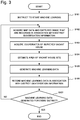
- Fig. 3 is a first diagram illustrating a process flow for the vacant house determination device.
- the vacant house determination device 1 generates, in advance and using map data and captured image data, machine learning data to be used for presuming that a house is a vacant house. More specifically, the machine learning data is the data used for presuming that a house in a captured image is a vacant house, on the basis of the pixel information regarding a site of a house corresponding to the coordinates of a vacant house, among pieces of pixel information regarding sites of houses in a captured image including a predetermined district.
- the vacant house determination device 1 receives an input of an instruction to start machine learning from a user interface (step S101). Then, the learning unit 13 acquires the map data and the captured image that are recorded in association with the identification information (district ID) regarding a first district from the database 2 (step S102). The learning unit 13 acquires the coordinates of a surveyed vacant house from the map data (step S103). On the basis of the coordinates in the captured image corresponding to the coordinates of the vacant house, the learning unit 13 estimates the area of the site of the house at the coordinates (step S104). The learning unit 13 may estimate the area of the site, on the basis of the coordinates of the vacant house and of the range of colors representing trees surrounding the vacant house.
- the learning unit 13 may estimate the site of the vacant house on the basis of an image showing a road around the house. Any other method may be used to estimate the site of the vacant house.
- the learning unit 13 generates machine learning data for determining that an image of a certain area included in a certain captured image shows a vacant house, by using an image of a site of a vacant house, an image of a site of a non-vacant house, and a machine learning technique such as neural network learning (step S105).
- the learning unit 13 records the machine learning data in the database 2 in association with the identification information regarding the district (step S106).
- the learning unit 13 determines whether machine learning data has been generated for a pair of map data and a captured image for every district included in the database 2 (step S107).
- the learning unit 13 repeats generation of machine learning data for any pair of map data and a captured image for which machine learning data has not been generated yet.
- the learning unit 13 may sequentially acquire a plurality of captured images of a district corresponding to times, and may learn, on the basis of the transition of the captured images of the district, information about an element for determining that a house is a vacant house using the coordinates of a vacant house and an image of an area of a site of the vacant house.
- Examples of the element for determining that a house is a vacant house include an altitude X1, a nearest road width X2, a distance from the nearest station X3, a land use zone X4, and other elements such as how old the house is, how often cars enter/leave the site, how many plants are growing in the site, and how often houses in the district are rebuilt.
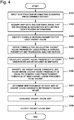
- Fig. 4 is a second diagram illustrating a process flow for the vacant house determination device.
- the vacant house determination device 1 receives an input of identification information regarding a predetermined district (step S201). For example, the vacant house determination device 1 obtains identification information regarding a predetermined district from a user interface device on the basis of a user operation. In addition, the vacant house determination device 1 receives an instruction to start the processing. Accordingly, the control unit 10 in the vacant house determination device 1 acquires the map data, the captured image, and the machine learning data that are recorded in association with the identification information regarding the predetermined district from the database 2 (step S202).
- the formula deriving unit 11 acquires the map data.
- the formula deriving unit 11 acquires the coordinates (latitude and longitude) of a surveyed vacant house, the attribute information regarding a structural object, and the topographic information that are included in the map data. From among the acquired pieces of information, the formula deriving unit 11 identifies a predetermined formula deriving parameter for each vacant house (step S203). Examples of the formula deriving parameter may be information pieces including the altitude of the vacant house, the width of a road nearest to the coordinates of the vacant house, the coordinates of a station nearest to the vacant house, the identifier of a land use zone in the district including the vacant house.
- the formula deriving unit 11 identifies the altitude of the vacant house on the basis of the altitude recorded in the map data in association with the coordinates of the vacant house. In addition, the formula deriving unit 11 identifies the width (nearest road width) of a road recorded in the map data, the road being located at the coordinates closest to the coordinates of the vacant house. The formula deriving unit 11 also identifies the coordinates of a station nearest to the coordinates of the vacant house. Furthermore, the formula deriving unit 11 identifies the identification information regarding a land use zone that includes the coordinates of the vacant house, on the basis of a relationship between the coordinates of the vacant house and the coordinates of each land use zone recorded in the map data.
- the present example embodiment is described with an example in which the coordinates (latitude and longitude) of a surveyed vacant house, the attribute information regarding a structural object, and the topographic information are included in the map data; however, these pieces of information may be stored in the database 2 as separate data from the map data, and the vacant house determination device 1 may use the data to identify a formula deriving parameter for each vacant house as in the example.
- the formula deriving unit 11 derives a vacant house probability calculation formula with regard to a district indicated in the map data, using both an identified formula deriving parameter corresponding to each vacant house and a regression analysis method (step S204).
- An equation (1) represents an example of the vacant house probability calculation formula.
- the formula deriving unit 11 derives a vacant house probability calculation formula by calculating the correlation coefficients A1, A2, A3, A4, and so on for the vacant house probability Y.
- A represents a constant.
- Examples of the regression analysis method include a logistic regression analysis and a multiple regression analysis.
- Vacant house probability Y A + A 1 altitude X 1 + A 2 nearest road width X 2 + A 3 distance from nearest station X 3 + A 4 land use zone X 4
- the vacant house probability calculating unit 12 uses the formula to calculate the vacant house probability Y of every unsurveyed house included in the map data (step S205). Specifically, the vacant house probability calculating unit 12 acquires the coordinates of an unsurveyed vacant house from the map data and, on the basis of the coordinates, identifies the altitude X1, the nearest road width X2, the distance X3 from the nearest station, and the value X4 of the land use zone identifier. The vacant house probability calculating unit 12 inputs these values to the vacant house probability calculation formula (1) to calculate the vacant house probability Y.
- the vacant house probability of a surveyed house may be 100%.
- the vacant house probability calculating unit 12 records the vacant house probability data indicating the vacant house probabilities of individual houses included in the map data in the database 2 in such a way that the vacant house probability data is associated with the map data.
- the formula deriving unit 11 may reconstruct the formula for calculating the vacant house probability Y further including the term of the element.
- the vacant house determining unit 14 identifies, as a vacant house candidate, any house that is included in the map data and has a vacant house probability equal to or more than a predetermined threshold of a vacant house probability at which it can be presumed that a house is a vacant house (step S206).
- the vacant house determining unit 14 constructs a neural network based on the machine learning data acquired in step S202 and, by using the neural network, determines whether the image of the house site of each vacant house candidate represents a vacant house (step S207). Note that the house site of each vacant house candidate in the map data can be estimated in a way similar to the way in step S104.
- the map generating unit 15 generates a vacant house map indicating a vacant house at the coordinates of the position of the house that has been determined to be a vacant house (step S208). For example, the map generating unit 15 plots a point of the position at which a vacant house has been determined to be present with a predetermined icon image (an image like a red dot) to generate the vacant house map.
- An output unit 16 outputs the vacant house map to a predetermined device (step S209).
- the output unit 16 may record the vacant house map in the database 2.
- the vacant house determination device 1 may be allowed to repeat the processing from step S203 by using the map data of the vacant house map generated in step S208 as the map data to be acquired in step S202. Repeating the processing in steps S203 to S208 makes it possible to generate more accurate vacant house map data.
- the vacant house determination device 1 can determine that, on the basis of machine learning data, a house having a vacant house probability value equal to or more than a predetermined threshold is a vacant house.
- the vacant house determination device 1 can generate a vacant house map indicating the position of a house determined to be a vacant house in the district specified the user and can output the map to a desired device.
- Fig. 5 is a diagram illustrating a minimum configuration of the vacant house determination device.
- the vacant house determination device 1 includes functions of at least the formula deriving unit 11, the vacant house probability calculating unit 12, and the vacant house determining unit 14.
- the formula deriving unit 11 derives a vacant house probability calculation formula with respect to a predetermined district, on the basis of map data that at least includes the coordinates of a vacant house surveyed among houses included in the map, the attribute information regarding a structural object, and the topographic information.
- the vacant house probability calculating unit 12 calculates the vacant house probability with respect to each of the houses included in the map data, using the vacant house probability calculation formula.
- the vacant house determining unit 14 determines whether a house having a vacant house probability equal or more than a predetermined value is a vacant house, on the basis of the machine learning data for presuming that a house in a captured image is a vacant house and the image information regarding a site of the house having a vacant house probability equal to or more than a predetermined value, the machine learning data being generated on the basis of the pixel information representing a site of a house corresponding to the coordinates of a vacant house, among pieces of pixel information representing sites of houses in the captured image including a predetermined district.
- the above-described vacant house determination device 1 contains a computer system.
- the process of the processing steps described above is stored in the form of a program in a computer-readable recording medium, and the processing steps are performed by the computer through reading and executing the program.
- Examples of the computer-readable recording medium herein include a magnetic disk, a magneto-optical disk, a CD-ROM, a DVD-ROM, a semiconductor memory, and the like.
- the computer program may be delivered to a computer via a communication line, and the computer that has received the delivered program may execute the program.
- the aforementioned program may be a program for achieving some of the functions described above.
- the program may be a so-called difference file (difference program) capable of achieving the above-described functions in combination with a program that is already recorded in the computer system.
Landscapes
- Business, Economics & Management (AREA)
- Human Resources & Organizations (AREA)
- Engineering & Computer Science (AREA)
- Tourism & Hospitality (AREA)
- Economics (AREA)
- Strategic Management (AREA)
- Theoretical Computer Science (AREA)
- Entrepreneurship & Innovation (AREA)
- General Physics & Mathematics (AREA)
- Marketing (AREA)
- General Business, Economics & Management (AREA)
- Physics & Mathematics (AREA)
- Educational Administration (AREA)
- Quality & Reliability (AREA)
- Operations Research (AREA)
- Game Theory and Decision Science (AREA)
- Development Economics (AREA)
- Health & Medical Sciences (AREA)
- General Health & Medical Sciences (AREA)
- Primary Health Care (AREA)
- Image Analysis (AREA)
- Management, Administration, Business Operations System, And Electronic Commerce (AREA)
Abstract
Description
- The present invention relates to a vacant house determination device, a vacant house determination method, and a program.
- In recent years, an increasing number of vacant houses has been attracting attention as a nationwide social problem. The increase in the number of vacant houses is known to have an adverse effect on the local environment, disaster prevention, and crime prevention, and various countermeasures have been developed by national and local governments to deal with the problem of the growing number of vacant houses. To develop these countermeasures, it is highly important to know the number of vacant houses in a district.
-
PTL 1 discloses a technology by which, upon input of a survey condition relating to survey information and of a result of the survey, a vacant house information DB is referenced to search for the survey condition relating to house information and the survey result, at least contents of vacant house information and a house map are displayed, and the house map and the vacant house information relating to the search result are stored. - NPL 1 discloses a technology for generating a model capable of estimating a vacant house ratio.
- [PTL 1]
JP 2017-97533 A - [NPL 1] "2016 CSIS Joint Research Report No. 691, Construction of an estimation model of the rate of vacant houses in relation to residential and building characteristics using GIS", [online], [Searched on May 21, 2009], Internet, <URL: https://joras.csis.u-tokyo.ac.jp/annual_report/downloadFile/id/365>
- In the technologies as described above, a technology for grasping the state of vacant houses in a desired district with as little effort as possible is needed.
- Accordingly, an object of the present disclosure is to provide a vacant house determination device, a vacant house determination method, and a program that solve the problems described above.
- According to a first aspect of the present invention, a vacant house determination device includes: a formula deriving unit for deriving a vacant house probability calculation formula with respect to a predetermined district, based on map data that at least includes coordinates of a vacant house surveyed among houses included in a map, attribute information regarding a structural object, and topographic information; a vacant house probability calculating unit for calculating the vacant house probability with respect to each of the houses included in the map data, by using the vacant house probability calculation formula; and a vacant house determining unit for determining whether a house having the vacant house probability equal to or more than a predetermined value is a vacant house, based on machine learning data for presuming that a house in a captured image is a vacant house and image information regarding a site of a house having the vacant house probability equal to or more than a predetermined value, the machine learning data being generated based on, among pieces of pixel information representing sites of the houses in the captured image including the predetermined district, the pixel information representing a site of a house corresponding to the coordinates of the vacant house.
- According to a second aspect of the present invention, a vacant house determination method includes: deriving a vacant house probability calculation formula with respect to a predetermined district, based on map data that at least includes coordinates of a vacant house surveyed among houses included in a map, attribute information regarding a structural object, and topographic information; calculating the vacant house probability with respect to each of the houses included in the map data, by using the vacant house probability calculation formula; and determining whether a house having the vacant house probability equal to or more than a predetermined value is a vacant house, based on machine learning data for presuming that a house in a captured image is a vacant house and image information regarding a site of a house having the vacant house probability equal to or more than a predetermined value, the machine learning data being generated based on, among pieces of pixel information representing sites of the houses in the captured image including the predetermined district, the pixel information representing a site of a house corresponding to the coordinates of the vacant house.
- According to a second aspect of the present invention, a program causes a computer for a vacant house determination device to function as: formula deriving means for deriving a vacant house probability calculation formula with respect to a predetermined district, based on map data that at least includes coordinates of a vacant house surveyed among houses included in a map, attribute information regarding a structural object, and topographic information; vacant house probability calculating means for calculating the vacant house probability with respect to each of the houses included in the map data, by using the vacant house probability calculation formula; and vacant house determining means for determining whether a house having the vacant house probability equal to or more than a predetermined value is a vacant house, based on machine learning data for presuming that a house in a captured image is a vacant house and image information regarding a site of a house having the vacant house probability equal to or more than a predetermined value, the machine learning data being generated based on, among pieces of pixel information representing sites of the houses in the captured image including the predetermined district, the pixel information representing a site of a house corresponding to the coordinates of the vacant house. The program may be stored in a non-transitory recording medium.
- According to the present disclosure, it is made possible to grasp the state of vacant houses in a desired district with as little effort as possible.
-
-
Fig. 1 is a functional block diagram of a vacant house determination device according to an example embodiment of the present invention. -
Fig. 2 is a diagram illustrating a hardware configuration of the vacant house determination device according to an example embodiment of the present invention. -
Fig. 3 is a first diagram illustrating a process flow for the vacant house determination device according to an example embodiment of the present invention. -
Fig. 4 is a first diagram illustrating a process flow for the vacant house determination device according to an example embodiment of the present invention. -
Fig. 5 is a functional block diagram of a vacant house determination device in a minimum configuration according to an example embodiment of the present invention. - A vacant house determination device according to an example embodiment of the present invention will now be described with reference to the drawings.
-
Fig. 1 is a functional block diagram of a vacant house determination device according to the example embodiment. - A computer for a vacant
house determination device 1 executes a vacant house determination program that is stored in advance. The vacanthouse determination device 1 includes individual functions, namely acontrol unit 10, aformula deriving unit 11, a vacant houseprobability calculating unit 12, alearning unit 13, a vacanthouse determining unit 14, and amap generating unit 15. As shown inFig. 1 , the vacanthouse determination device 1 is communicatively connected to adatabase 2. - The
database 2 records, for example, map data and a captured image. The map data and the captured image are map data and a captured image that are associated with each other and include a predetermined district. A predetermined district may be a city, ward, town, village, land use zone, or the like. The map data includes, for example, the coordinates (latitude and longitude) of each surveyed vacant house among the houses present on a map including a predetermined district, the attribute information regarding a structural object, and the topographic information. Information regarding a structural object may be, for example, the coordinates of a road, the width information regarding a road, the identification information (structural object ID) regarding a major public facility (station, school, or the like). The topographic information includes information such as an altitude. The captured image may be an aerial photograph image, a satellite image, or the like. The captured image is preferably a high-definition image. - The
database 2 records machine learning data generated by the vacant house determination device. The vacanthouse determination device 1 generates machine learning data for each district. The machine learning data is the data for presuming that a house in a captured image is a vacant house, on the basis of the pixel information regarding a site of a house corresponding to the coordinates of a vacant house, among pieces of pixel information regarding sites of houses in a captured image including a predetermined district. -
Fig. 2 is a diagram illustrating a hardware configuration of the vacant house determination device. - As illustrated in
Fig. 2 , a computer for the vacanthouse determination device 1 includes hardware such as a central processing unit (CPU) 101, a read only memory (ROM) 102, a random access memory (RAM) 103, a hard disk drive (HDD) 104, aninterface 105, and acommunication module 106. -
Fig. 3 is a first diagram illustrating a process flow for the vacant house determination device. - The vacant
house determination device 1 generates, in advance and using map data and captured image data, machine learning data to be used for presuming that a house is a vacant house. More specifically, the machine learning data is the data used for presuming that a house in a captured image is a vacant house, on the basis of the pixel information regarding a site of a house corresponding to the coordinates of a vacant house, among pieces of pixel information regarding sites of houses in a captured image including a predetermined district. - For example, the vacant
house determination device 1 receives an input of an instruction to start machine learning from a user interface (step S101). Then, thelearning unit 13 acquires the map data and the captured image that are recorded in association with the identification information (district ID) regarding a first district from the database 2 (step S102). Thelearning unit 13 acquires the coordinates of a surveyed vacant house from the map data (step S103). On the basis of the coordinates in the captured image corresponding to the coordinates of the vacant house, thelearning unit 13 estimates the area of the site of the house at the coordinates (step S104). Thelearning unit 13 may estimate the area of the site, on the basis of the coordinates of the vacant house and of the range of colors representing trees surrounding the vacant house. In addition, thelearning unit 13 may estimate the site of the vacant house on the basis of an image showing a road around the house. Any other method may be used to estimate the site of the vacant house. Thelearning unit 13 generates machine learning data for determining that an image of a certain area included in a certain captured image shows a vacant house, by using an image of a site of a vacant house, an image of a site of a non-vacant house, and a machine learning technique such as neural network learning (step S105). Thelearning unit 13 records the machine learning data in thedatabase 2 in association with the identification information regarding the district (step S106). In addition, thelearning unit 13 determines whether machine learning data has been generated for a pair of map data and a captured image for every district included in the database 2 (step S107). If the machine learning data has not been generated for every pair of map data and a captured image, thelearning unit 13 repeats generation of machine learning data for any pair of map data and a captured image for which machine learning data has not been generated yet. Note that thelearning unit 13 may sequentially acquire a plurality of captured images of a district corresponding to times, and may learn, on the basis of the transition of the captured images of the district, information about an element for determining that a house is a vacant house using the coordinates of a vacant house and an image of an area of a site of the vacant house. Examples of the element for determining that a house is a vacant house include an altitude X1, a nearest road width X2, a distance from the nearest station X3, a land use zone X4, and other elements such as how old the house is, how often cars enter/leave the site, how many plants are growing in the site, and how often houses in the district are rebuilt. -
Fig. 4 is a second diagram illustrating a process flow for the vacant house determination device. - After generating the machine learning data in advance, the vacant
house determination device 1 receives an input of identification information regarding a predetermined district (step S201). For example, the vacanthouse determination device 1 obtains identification information regarding a predetermined district from a user interface device on the basis of a user operation. In addition, the vacanthouse determination device 1 receives an instruction to start the processing. Accordingly, thecontrol unit 10 in the vacanthouse determination device 1 acquires the map data, the captured image, and the machine learning data that are recorded in association with the identification information regarding the predetermined district from the database 2 (step S202). - The
formula deriving unit 11 acquires the map data. Theformula deriving unit 11 acquires the coordinates (latitude and longitude) of a surveyed vacant house, the attribute information regarding a structural object, and the topographic information that are included in the map data. From among the acquired pieces of information, theformula deriving unit 11 identifies a predetermined formula deriving parameter for each vacant house (step S203). Examples of the formula deriving parameter may be information pieces including the altitude of the vacant house, the width of a road nearest to the coordinates of the vacant house, the coordinates of a station nearest to the vacant house, the identifier of a land use zone in the district including the vacant house. More specifically, theformula deriving unit 11 identifies the altitude of the vacant house on the basis of the altitude recorded in the map data in association with the coordinates of the vacant house. In addition, theformula deriving unit 11 identifies the width (nearest road width) of a road recorded in the map data, the road being located at the coordinates closest to the coordinates of the vacant house. Theformula deriving unit 11 also identifies the coordinates of a station nearest to the coordinates of the vacant house. Furthermore, theformula deriving unit 11 identifies the identification information regarding a land use zone that includes the coordinates of the vacant house, on the basis of a relationship between the coordinates of the vacant house and the coordinates of each land use zone recorded in the map data. The present example embodiment is described with an example in which the coordinates (latitude and longitude) of a surveyed vacant house, the attribute information regarding a structural object, and the topographic information are included in the map data; however, these pieces of information may be stored in thedatabase 2 as separate data from the map data, and the vacanthouse determination device 1 may use the data to identify a formula deriving parameter for each vacant house as in the example. - The
formula deriving unit 11 derives a vacant house probability calculation formula with regard to a district indicated in the map data, using both an identified formula deriving parameter corresponding to each vacant house and a regression analysis method (step S204). An equation (1) represents an example of the vacant house probability calculation formula. Theformula deriving unit 11 derives a vacant house probability calculation formula by calculating the correlation coefficients A1, A2, A3, A4, and so on for the vacant house probability Y. In the equation (1), A represents a constant. Examples of the regression analysis method include a logistic regression analysis and a multiple regression analysis.
- When the vacant house probability calculation formula has been derived by the
formula deriving unit 11, the vacant houseprobability calculating unit 12 uses the formula to calculate the vacant house probability Y of every unsurveyed house included in the map data (step S205). Specifically, the vacant houseprobability calculating unit 12 acquires the coordinates of an unsurveyed vacant house from the map data and, on the basis of the coordinates, identifies the altitude X1, the nearest road width X2, the distance X3 from the nearest station, and the value X4 of the land use zone identifier. The vacant houseprobability calculating unit 12 inputs these values to the vacant house probability calculation formula (1) to calculate the vacant house probability Y. The vacant house probability of a surveyed house may be 100%. The vacant houseprobability calculating unit 12 records the vacant house probability data indicating the vacant house probabilities of individual houses included in the map data in thedatabase 2 in such a way that the vacant house probability data is associated with the map data. In the case where thelearning unit 13 has identified an element for determining that a house is a vacant house, theformula deriving unit 11 may reconstruct the formula for calculating the vacant house probability Y further including the term of the element. - When the vacant house
probability calculating unit 12 has calculated the vacant house probability of every house included in the map data, the vacanthouse determining unit 14 identifies, as a vacant house candidate, any house that is included in the map data and has a vacant house probability equal to or more than a predetermined threshold of a vacant house probability at which it can be presumed that a house is a vacant house (step S206). The vacanthouse determining unit 14 constructs a neural network based on the machine learning data acquired in step S202 and, by using the neural network, determines whether the image of the house site of each vacant house candidate represents a vacant house (step S207). Note that the house site of each vacant house candidate in the map data can be estimated in a way similar to the way in step S104. Themap generating unit 15 generates a vacant house map indicating a vacant house at the coordinates of the position of the house that has been determined to be a vacant house (step S208). For example, themap generating unit 15 plots a point of the position at which a vacant house has been determined to be present with a predetermined icon image (an image like a red dot) to generate the vacant house map. Anoutput unit 16 outputs the vacant house map to a predetermined device (step S209). Theoutput unit 16 may record the vacant house map in thedatabase 2. - Note that the vacant
house determination device 1 may be allowed to repeat the processing from step S203 by using the map data of the vacant house map generated in step S208 as the map data to be acquired in step S202. Repeating the processing in steps S203 to S208 makes it possible to generate more accurate vacant house map data. - Through the above-described processing, the vacant
house determination device 1 can determine that, on the basis of machine learning data, a house having a vacant house probability value equal to or more than a predetermined threshold is a vacant house. In addition, the vacanthouse determination device 1 can generate a vacant house map indicating the position of a house determined to be a vacant house in the district specified the user and can output the map to a desired device. -
Fig. 5 is a diagram illustrating a minimum configuration of the vacant house determination device. - As shown in
Fig. 5 , the vacanthouse determination device 1 includes functions of at least theformula deriving unit 11, the vacant houseprobability calculating unit 12, and the vacanthouse determining unit 14. - The
formula deriving unit 11 derives a vacant house probability calculation formula with respect to a predetermined district, on the basis of map data that at least includes the coordinates of a vacant house surveyed among houses included in the map, the attribute information regarding a structural object, and the topographic information. - The vacant house
probability calculating unit 12 calculates the vacant house probability with respect to each of the houses included in the map data, using the vacant house probability calculation formula. - The vacant
house determining unit 14 determines whether a house having a vacant house probability equal or more than a predetermined value is a vacant house, on the basis of the machine learning data for presuming that a house in a captured image is a vacant house and the image information regarding a site of the house having a vacant house probability equal to or more than a predetermined value, the machine learning data being generated on the basis of the pixel information representing a site of a house corresponding to the coordinates of a vacant house, among pieces of pixel information representing sites of houses in the captured image including a predetermined district. - Note that the above-described vacant
house determination device 1 contains a computer system. The process of the processing steps described above is stored in the form of a program in a computer-readable recording medium, and the processing steps are performed by the computer through reading and executing the program. Examples of the computer-readable recording medium herein include a magnetic disk, a magneto-optical disk, a CD-ROM, a DVD-ROM, a semiconductor memory, and the like. Alternatively, the computer program may be delivered to a computer via a communication line, and the computer that has received the delivered program may execute the program. - Furthermore, the aforementioned program may be a program for achieving some of the functions described above. Moreover, the program may be a so-called difference file (difference program) capable of achieving the above-described functions in combination with a program that is already recorded in the computer system.
- While the invention has been particularly shown and described with reference to exemplary embodiments thereof, the invention is not limited to these embodiments. It will be understood by those of ordinary skill in the art that various changes in form and details may be made therein without departing from the spirit and scope of the present invention as defined by the claims. In addition, the configurations according to the individual example embodiments may be combined with each other without departing from the scope of the present invention.
- This application is based upon and claims the benefit of priority from Japanese patent application No.
2018-098922, filed on May 23, 2018 -
- 1
- Vacant house determination device
- 2
- Database
- 10
- Control unit
- 11
- Formula deriving unit
- 12
- Vacant house probability calculating unit
- 13
- Learning unit
- 14
- Vacant house determining unit
- 15
- Map generating unit
- 16
- Output unit
Claims (6)
- A vacant house determination device comprising:formula deriving means for deriving a vacant house probability calculation formula with respect to a predetermined district, based on map data that at least includes coordinates of a vacant house surveyed among houses included in a map, attribute information regarding a structural object, and topographic information;vacant house probability calculating means for calculating the vacant house probability with respect to each of the houses included in the map data, by using the vacant house probability calculation formula; andvacant house determining means for determining whether a house having the vacant house probability equal to or more than a predetermined value is a vacant house, based onmachine learning data for presuming that a house in a captured image is a vacant house, the machine learning data being generated based on, among pieces of pixel information representing sites of the houses in the captured image including the predetermined district, the pixel information representing a site of a house corresponding to the coordinates of the vacant house, andimage information regarding a site of a house having the vacant house probability equal to or more than a predetermined value.
- The vacant house determination device according to claim 1, comprising:
map generating means for generating vacant house map information indicating a position of the house that has been determined to be a vacant house. - The vacant house determination device according to claim 1 or 2, comprising:
learning means for generating machine learning data for presuming that a house in the captured image is the vacant house, the machine learning data being generated based on, among pieces of pixel information representing sites of the houses in the captured image including the predetermined district, the pixel information representing a site of a house corresponding to the coordinates of the vacant house. - The vacant house determination device according to claim 3, wherein
the learning means learns an element for determining, based on the pixel information representing a site of a house corresponding to the coordinates of the vacant house, that a house is a vacant house, and
the formula deriving means derives the vacant house probability calculation formula that includes a term of the element. - A vacant house determination method comprising:deriving a vacant house probability calculation formula with respect to a predetermined district, based on map data that at least includes coordinates of a vacant house surveyed among houses included in a map, attribute information regarding a structural object, and topographic information;calculating the vacant house probability with respect to each of the houses included in the map data, by using the vacant house probability calculation formula; anddetermining whether a house having the vacant house probability equal to or more than a predetermined value is a vacant house, based on machine learning data for presuming that a house in a captured image is a vacant house and image information regarding a site of a house having the vacant house probability equal to or more than a predetermined value, the machine learning data being generated based on, among pieces of pixel information representing sites of the houses in the captured image including the predetermined district, the pixel information representing a site of a house corresponding to the coordinates of the vacant house.
- A recording medium storing a program that causes a computer for a vacant house determination device to function as:formula deriving means for deriving a vacant house probability calculation formula with respect to a predetermined district, based on map data that at least includes coordinates of a vacant house surveyed among houses included in a map, attribute information regarding a structural object, and topographic information;vacant house probability calculating means for calculating the vacant house probability with respect to each of the houses included in the map data, by using the vacant house probability calculation formula; andvacant house determining means for determining whether a house having the vacant house probability equal to or more than a predetermined value is a vacant house, based onmachine learning data for presuming that a house in a captured image is a vacant house, the machine learning data being generated based on, among pieces of pixel information representing sites of the houses in the captured image including the predetermined district, the pixel information representing a site of a house corresponding to the coordinates of the vacant house, andimage information regarding a site of a house having the vacant house probability equal to or more than a predetermined value.
Applications Claiming Priority (2)
| Application Number | Priority Date | Filing Date | Title |
|---|---|---|---|
| JP2018098922 | 2018-05-23 | ||
| PCT/JP2019/020093 WO2019225597A1 (en) | 2018-05-23 | 2019-05-21 | Vacant house determination device, vacant house determination method, and recording medium |
Publications (3)
| Publication Number | Publication Date |
|---|---|
| EP3798941A1 true EP3798941A1 (en) | 2021-03-31 |
| EP3798941A4 EP3798941A4 (en) | 2022-01-05 |
| EP3798941B1 EP3798941B1 (en) | 2025-07-02 |
Family
ID=68616156
Family Applications (1)
| Application Number | Title | Priority Date | Filing Date |
|---|---|---|---|
| EP19806663.1A Active EP3798941B1 (en) | 2018-05-23 | 2019-05-21 | Vacant house determination device, vacant house determination method, and recording medium |
Country Status (3)
| Country | Link |
|---|---|
| EP (1) | EP3798941B1 (en) |
| JP (1) | JP7218754B2 (en) |
| WO (1) | WO2019225597A1 (en) |
Cited By (1)
| Publication number | Priority date | Publication date | Assignee | Title |
|---|---|---|---|---|
| CN115471367A (en) * | 2022-09-28 | 2022-12-13 | 浙江臻善科技股份有限公司 | House classification system and method for idle agricultural house inventory |
Families Citing this family (7)
| Publication number | Priority date | Publication date | Assignee | Title |
|---|---|---|---|---|
| CN111861257B (en) * | 2020-07-30 | 2024-09-13 | 北京恒华龙信数据科技有限公司 | Hollow village identification method and device based on power data thermodynamic diagram |
| CN112911243B (en) * | 2021-02-01 | 2022-06-03 | 江苏开拓信息与系统有限公司 | Method for analyzing vacancy rate of house by aid of high-altitude parabolic monitoring |
| JP7257007B1 (en) | 2022-05-19 | 2023-04-13 | 東京瓦斯株式会社 | Information processing device and program |
| JP7137267B1 (en) | 2022-07-29 | 2022-09-14 | マイクロベース株式会社 | Information processing device, information processing method and information processing program |
| US20260030696A1 (en) | 2022-10-18 | 2026-01-29 | Penetrator Inc. | System, program and method |
| JP7439333B1 (en) | 2023-09-19 | 2024-02-27 | アビームコンサルティング株式会社 | Property utilization support equipment and programs |
| JP7603356B1 (en) | 2024-09-25 | 2024-12-20 | 株式会社Penetrator | System, program and method |
Family Cites Families (8)
| Publication number | Priority date | Publication date | Assignee | Title |
|---|---|---|---|---|
| JP4437556B2 (en) * | 2007-03-30 | 2010-03-24 | アイシン・エィ・ダブリュ株式会社 | Feature information collecting apparatus and feature information collecting method |
| JP4516090B2 (en) * | 2007-04-05 | 2010-08-04 | 株式会社 セイワメタル | Energy-saving ventilation and odor removal equipment for vacant houses and vacant spaces in apartment buildings |
| JP2011253216A (en) * | 2010-05-31 | 2011-12-15 | Toyota Home Kk | Notification system of apartment house |
| JP6703390B2 (en) * | 2015-10-30 | 2020-06-03 | 株式会社ゼンリン | Unoccupied house information generation program |
| JP2017097533A (en) | 2015-11-20 | 2017-06-01 | Somex測量株式会社 | Vacant dwelling map device, vacant dwelling map program, vacant dwelling map server, and vacant dwelling map system |
| EP3252658B1 (en) * | 2016-05-30 | 2021-08-11 | Kabushiki Kaisha Toshiba | Information processing apparatus and information processing method |
| JP6702168B2 (en) | 2016-12-14 | 2020-05-27 | オムロン株式会社 | Solar power generation system inspection device and inspection method |
| KR101859341B1 (en) * | 2017-12-11 | 2018-05-17 | 진승용 | Uninhabited building management system |
-
2019
- 2019-05-21 EP EP19806663.1A patent/EP3798941B1/en active Active
- 2019-05-21 WO PCT/JP2019/020093 patent/WO2019225597A1/en not_active Ceased
- 2019-05-21 JP JP2020521249A patent/JP7218754B2/en active Active
Cited By (1)
| Publication number | Priority date | Publication date | Assignee | Title |
|---|---|---|---|---|
| CN115471367A (en) * | 2022-09-28 | 2022-12-13 | 浙江臻善科技股份有限公司 | House classification system and method for idle agricultural house inventory |
Also Published As
| Publication number | Publication date |
|---|---|
| JP7218754B2 (en) | 2023-02-07 |
| WO2019225597A1 (en) | 2019-11-28 |
| EP3798941A4 (en) | 2022-01-05 |
| JPWO2019225597A1 (en) | 2021-05-13 |
| EP3798941B1 (en) | 2025-07-02 |
Similar Documents
| Publication | Publication Date | Title |
|---|---|---|
| EP3798941B1 (en) | Vacant house determination device, vacant house determination method, and recording medium | |
| US20190130427A1 (en) | Candidate site evaluation system and candidate site evaluation method | |
| US10026221B2 (en) | Wetland modeling and prediction | |
| US11031757B2 (en) | Submarine cable route planning tool | |
| GB2554978A (en) | Deep machine learning to predict and prevent adverse conditions at structural assets | |
| KR102556631B1 (en) | System and method for providing integrated maritime navigation information | |
| US11967108B2 (en) | Computer-readable recording medium storing position identification program, position identification method, and information processing apparatus | |
| JPWO2018116958A1 (en) | Field information assimilation device, method and program for real-time flood hazard mapping | |
| JP2015161557A5 (en) | ||
| US20230359949A1 (en) | Recovery support apparatus, recovery support method, and program | |
| JP7505597B2 (en) | Information processing device, information processing method, and program | |
| Wu et al. | Is only one GPS position sufficient to locate you to the road network accurately? | |
| JP2021140644A (en) | Disaster situation determination device, disaster situation determination method, and program | |
| JP2021039426A (en) | Estimator, estimation method and program | |
| KR102781191B1 (en) | Apparatus and method for processing multi-modal maritime data | |
| HK40044339A (en) | Vacant house determination device, vacant house determination method, and recording medium | |
| HK40044339B (en) | Vacant house determination device, vacant house determination method, and recording medium | |
| JP2006039629A (en) | Disaster prevention business plan support method and system | |
| Azad et al. | Application Water Level Prediction Through Seasonal Autoregressive Integrated Moving Average: Red Hills Reservoir Case Study | |
| JP7036154B2 (en) | Walking state learning method, walking state estimation method, road surface condition understanding method, device, and program | |
| US12530804B2 (en) | Measurement device, measurement system, measurement method, and computer program product | |
| JP2022138368A (en) | Facility value estimation device, public facility impact assessment system, and public facility impact assessment method | |
| JP2018147024A (en) | Prediction device, prediction method, and prediction program | |
| KR101930174B1 (en) | Seismic damage estimation method and system for electric power system | |
| JP2018025903A (en) | Congestion information estimation device and congestion information estimation method |
Legal Events
| Date | Code | Title | Description |
|---|---|---|---|
| STAA | Information on the status of an ep patent application or granted ep patent |
Free format text: STATUS: THE INTERNATIONAL PUBLICATION HAS BEEN MADE |
|
| PUAI | Public reference made under article 153(3) epc to a published international application that has entered the european phase |
Free format text: ORIGINAL CODE: 0009012 |
|
| STAA | Information on the status of an ep patent application or granted ep patent |
Free format text: STATUS: REQUEST FOR EXAMINATION WAS MADE |
|
| 17P | Request for examination filed |
Effective date: 20201123 |
|
| AK | Designated contracting states |
Kind code of ref document: A1 Designated state(s): AL AT BE BG CH CY CZ DE DK EE ES FI FR GB GR HR HU IE IS IT LI LT LU LV MC MK MT NL NO PL PT RO RS SE SI SK SM TR |
|
| AX | Request for extension of the european patent |
Extension state: BA ME |
|
| DAV | Request for validation of the european patent (deleted) | ||
| DAX | Request for extension of the european patent (deleted) | ||
| REG | Reference to a national code |
Ref country code: HK Ref legal event code: DE Ref document number: 40044339 Country of ref document: HK |
|
| A4 | Supplementary search report drawn up and despatched |
Effective date: 20211206 |
|
| RIC1 | Information provided on ipc code assigned before grant |
Ipc: G06Q 10/04 20120101AFI20211130BHEP |
|
| GRAP | Despatch of communication of intention to grant a patent |
Free format text: ORIGINAL CODE: EPIDOSNIGR1 |
|
| STAA | Information on the status of an ep patent application or granted ep patent |
Free format text: STATUS: GRANT OF PATENT IS INTENDED |
|
| INTG | Intention to grant announced |
Effective date: 20250116 |
|
| GRAJ | Information related to disapproval of communication of intention to grant by the applicant or resumption of examination proceedings by the epo deleted |
Free format text: ORIGINAL CODE: EPIDOSDIGR1 |
|
| STAA | Information on the status of an ep patent application or granted ep patent |
Free format text: STATUS: REQUEST FOR EXAMINATION WAS MADE |
|
| GRAS | Grant fee paid |
Free format text: ORIGINAL CODE: EPIDOSNIGR3 |
|
| STAA | Information on the status of an ep patent application or granted ep patent |
Free format text: STATUS: GRANT OF PATENT IS INTENDED |
|
| GRAP | Despatch of communication of intention to grant a patent |
Free format text: ORIGINAL CODE: EPIDOSNIGR1 |
|
| GRAJ | Information related to disapproval of communication of intention to grant by the applicant or resumption of examination proceedings by the epo deleted |
Free format text: ORIGINAL CODE: EPIDOSDIGR1 |
|
| STAA | Information on the status of an ep patent application or granted ep patent |
Free format text: STATUS: REQUEST FOR EXAMINATION WAS MADE |
|
| INTC | Intention to grant announced (deleted) | ||
| GRAS | Grant fee paid |
Free format text: ORIGINAL CODE: EPIDOSNIGR3 |
|
| STAA | Information on the status of an ep patent application or granted ep patent |
Free format text: STATUS: GRANT OF PATENT IS INTENDED |
|
| GRAP | Despatch of communication of intention to grant a patent |
Free format text: ORIGINAL CODE: EPIDOSNIGR1 |
|
| GRAA | (expected) grant |
Free format text: ORIGINAL CODE: 0009210 |
|
| STAA | Information on the status of an ep patent application or granted ep patent |
Free format text: STATUS: THE PATENT HAS BEEN GRANTED |
|
| INTG | Intention to grant announced |
Effective date: 20250502 |
|
| AK | Designated contracting states |
Kind code of ref document: B1 Designated state(s): AL AT BE BG CH CY CZ DE DK EE ES FI FR GB GR HR HU IE IS IT LI LT LU LV MC MK MT NL NO PL PT RO RS SE SI SK SM TR |
|
| REG | Reference to a national code |
Ref country code: GB Ref legal event code: FG4D |
|
| REG | Reference to a national code |
Ref country code: CH Ref legal event code: EP |
|
| REG | Reference to a national code |
Ref country code: DE Ref legal event code: R096 Ref document number: 602019072010 Country of ref document: DE |
|
| REG | Reference to a national code |
Ref country code: IE Ref legal event code: FG4D |
|
| REG | Reference to a national code |
Ref country code: NL Ref legal event code: MP Effective date: 20250702 |
|
| PG25 | Lapsed in a contracting state [announced via postgrant information from national office to epo] |
Ref country code: PT Free format text: LAPSE BECAUSE OF FAILURE TO SUBMIT A TRANSLATION OF THE DESCRIPTION OR TO PAY THE FEE WITHIN THE PRESCRIBED TIME-LIMIT Effective date: 20251103 |
|
| PG25 | Lapsed in a contracting state [announced via postgrant information from national office to epo] |
Ref country code: NL Free format text: LAPSE BECAUSE OF FAILURE TO SUBMIT A TRANSLATION OF THE DESCRIPTION OR TO PAY THE FEE WITHIN THE PRESCRIBED TIME-LIMIT Effective date: 20250702 |
|
| REG | Reference to a national code |
Ref country code: AT Ref legal event code: MK05 Ref document number: 1810095 Country of ref document: AT Kind code of ref document: T Effective date: 20250702 |
|
| PG25 | Lapsed in a contracting state [announced via postgrant information from national office to epo] |
Ref country code: IS Free format text: LAPSE BECAUSE OF FAILURE TO SUBMIT A TRANSLATION OF THE DESCRIPTION OR TO PAY THE FEE WITHIN THE PRESCRIBED TIME-LIMIT Effective date: 20251102 |
|
| PG25 | Lapsed in a contracting state [announced via postgrant information from national office to epo] |
Ref country code: NO Free format text: LAPSE BECAUSE OF FAILURE TO SUBMIT A TRANSLATION OF THE DESCRIPTION OR TO PAY THE FEE WITHIN THE PRESCRIBED TIME-LIMIT Effective date: 20251002 |
|
| REG | Reference to a national code |
Ref country code: LT Ref legal event code: MG9D |
|
| PG25 | Lapsed in a contracting state [announced via postgrant information from national office to epo] |
Ref country code: AT Free format text: LAPSE BECAUSE OF FAILURE TO SUBMIT A TRANSLATION OF THE DESCRIPTION OR TO PAY THE FEE WITHIN THE PRESCRIBED TIME-LIMIT Effective date: 20250702 |
|
| PG25 | Lapsed in a contracting state [announced via postgrant information from national office to epo] |
Ref country code: FI Free format text: LAPSE BECAUSE OF FAILURE TO SUBMIT A TRANSLATION OF THE DESCRIPTION OR TO PAY THE FEE WITHIN THE PRESCRIBED TIME-LIMIT Effective date: 20250702 |
|
| PG25 | Lapsed in a contracting state [announced via postgrant information from national office to epo] |
Ref country code: HR Free format text: LAPSE BECAUSE OF FAILURE TO SUBMIT A TRANSLATION OF THE DESCRIPTION OR TO PAY THE FEE WITHIN THE PRESCRIBED TIME-LIMIT Effective date: 20250702 |
|
| PG25 | Lapsed in a contracting state [announced via postgrant information from national office to epo] |
Ref country code: GR Free format text: LAPSE BECAUSE OF FAILURE TO SUBMIT A TRANSLATION OF THE DESCRIPTION OR TO PAY THE FEE WITHIN THE PRESCRIBED TIME-LIMIT Effective date: 20251003 |
|
| PG25 | Lapsed in a contracting state [announced via postgrant information from national office to epo] |
Ref country code: SE Free format text: LAPSE BECAUSE OF FAILURE TO SUBMIT A TRANSLATION OF THE DESCRIPTION OR TO PAY THE FEE WITHIN THE PRESCRIBED TIME-LIMIT Effective date: 20250702 Ref country code: CZ Free format text: LAPSE BECAUSE OF FAILURE TO SUBMIT A TRANSLATION OF THE DESCRIPTION OR TO PAY THE FEE WITHIN THE PRESCRIBED TIME-LIMIT Effective date: 20250702 |
|
| PG25 | Lapsed in a contracting state [announced via postgrant information from national office to epo] |
Ref country code: LV Free format text: LAPSE BECAUSE OF FAILURE TO SUBMIT A TRANSLATION OF THE DESCRIPTION OR TO PAY THE FEE WITHIN THE PRESCRIBED TIME-LIMIT Effective date: 20250702 |
|
| PG25 | Lapsed in a contracting state [announced via postgrant information from national office to epo] |
Ref country code: PL Free format text: LAPSE BECAUSE OF FAILURE TO SUBMIT A TRANSLATION OF THE DESCRIPTION OR TO PAY THE FEE WITHIN THE PRESCRIBED TIME-LIMIT Effective date: 20250702 Ref country code: BG Free format text: LAPSE BECAUSE OF FAILURE TO SUBMIT A TRANSLATION OF THE DESCRIPTION OR TO PAY THE FEE WITHIN THE PRESCRIBED TIME-LIMIT Effective date: 20250702 |
|
| PG25 | Lapsed in a contracting state [announced via postgrant information from national office to epo] |
Ref country code: RS Free format text: LAPSE BECAUSE OF FAILURE TO SUBMIT A TRANSLATION OF THE DESCRIPTION OR TO PAY THE FEE WITHIN THE PRESCRIBED TIME-LIMIT Effective date: 20251002 |
|
| PG25 | Lapsed in a contracting state [announced via postgrant information from national office to epo] |
Ref country code: ES Free format text: LAPSE BECAUSE OF FAILURE TO SUBMIT A TRANSLATION OF THE DESCRIPTION OR TO PAY THE FEE WITHIN THE PRESCRIBED TIME-LIMIT Effective date: 20250702 |
|
| PG25 | Lapsed in a contracting state [announced via postgrant information from national office to epo] |
Ref country code: SM Free format text: LAPSE BECAUSE OF FAILURE TO SUBMIT A TRANSLATION OF THE DESCRIPTION OR TO PAY THE FEE WITHIN THE PRESCRIBED TIME-LIMIT Effective date: 20250702 |
|
| PG25 | Lapsed in a contracting state [announced via postgrant information from national office to epo] |
Ref country code: DK Free format text: LAPSE BECAUSE OF FAILURE TO SUBMIT A TRANSLATION OF THE DESCRIPTION OR TO PAY THE FEE WITHIN THE PRESCRIBED TIME-LIMIT Effective date: 20250702 |
|
| PG25 | Lapsed in a contracting state [announced via postgrant information from national office to epo] |
Ref country code: IT Free format text: LAPSE BECAUSE OF FAILURE TO SUBMIT A TRANSLATION OF THE DESCRIPTION OR TO PAY THE FEE WITHIN THE PRESCRIBED TIME-LIMIT Effective date: 20250702 |
|
| PG25 | Lapsed in a contracting state [announced via postgrant information from national office to epo] |
Ref country code: EE Free format text: LAPSE BECAUSE OF FAILURE TO SUBMIT A TRANSLATION OF THE DESCRIPTION OR TO PAY THE FEE WITHIN THE PRESCRIBED TIME-LIMIT Effective date: 20250702 Ref country code: SK Free format text: LAPSE BECAUSE OF FAILURE TO SUBMIT A TRANSLATION OF THE DESCRIPTION OR TO PAY THE FEE WITHIN THE PRESCRIBED TIME-LIMIT Effective date: 20250702 |