EP3798220B1 - P-phenylenediamine derivative as potassium channel regulator and preparation method and medical application thereof - Google Patents
P-phenylenediamine derivative as potassium channel regulator and preparation method and medical application thereof Download PDFInfo
- Publication number
- EP3798220B1 EP3798220B1 EP19808475.8A EP19808475A EP3798220B1 EP 3798220 B1 EP3798220 B1 EP 3798220B1 EP 19808475 A EP19808475 A EP 19808475A EP 3798220 B1 EP3798220 B1 EP 3798220B1
- Authority
- EP
- European Patent Office
- Prior art keywords
- compound
- mmol
- solution
- added
- ring
- Prior art date
- Legal status (The legal status is an assumption and is not a legal conclusion. Google has not performed a legal analysis and makes no representation as to the accuracy of the status listed.)
- Active
Links
Classifications
-
- A—HUMAN NECESSITIES
- A61—MEDICAL OR VETERINARY SCIENCE; HYGIENE
- A61P—SPECIFIC THERAPEUTIC ACTIVITY OF CHEMICAL COMPOUNDS OR MEDICINAL PREPARATIONS
- A61P3/00—Drugs for disorders of the metabolism
- A61P3/12—Drugs for disorders of the metabolism for electrolyte homeostasis
-
- C—CHEMISTRY; METALLURGY
- C07—ORGANIC CHEMISTRY
- C07D—HETEROCYCLIC COMPOUNDS
- C07D267/00—Heterocyclic compounds containing rings of more than six members having one nitrogen atom and one oxygen atom as the only ring hetero atoms
- C07D267/02—Seven-membered rings
- C07D267/08—Seven-membered rings having the hetero atoms in positions 1 and 4
- C07D267/12—Seven-membered rings having the hetero atoms in positions 1 and 4 condensed with carbocyclic rings or ring systems
- C07D267/14—Seven-membered rings having the hetero atoms in positions 1 and 4 condensed with carbocyclic rings or ring systems condensed with one six-membered ring
-
- C—CHEMISTRY; METALLURGY
- C07—ORGANIC CHEMISTRY
- C07D—HETEROCYCLIC COMPOUNDS
- C07D495/00—Heterocyclic compounds containing in the condensed system at least one hetero ring having sulfur atoms as the only ring hetero atoms
- C07D495/02—Heterocyclic compounds containing in the condensed system at least one hetero ring having sulfur atoms as the only ring hetero atoms in which the condensed system contains two hetero rings
- C07D495/04—Ortho-condensed systems
-
- C—CHEMISTRY; METALLURGY
- C07—ORGANIC CHEMISTRY
- C07D—HETEROCYCLIC COMPOUNDS
- C07D451/00—Heterocyclic compounds containing 8-azabicyclo [3.2.1] octane, 9-azabicyclo [3.3.1] nonane, or 3-oxa-9-azatricyclo [3.3.1.0<2,4>] nonane ring systems, e.g. tropane or granatane alkaloids, scopolamine; Cyclic acetals thereof
-
- A—HUMAN NECESSITIES
- A61—MEDICAL OR VETERINARY SCIENCE; HYGIENE
- A61K—PREPARATIONS FOR MEDICAL, DENTAL OR TOILETRY PURPOSES
- A61K31/00—Medicinal preparations containing organic active ingredients
- A61K31/33—Heterocyclic compounds
- A61K31/395—Heterocyclic compounds having nitrogen as a ring hetero atom, e.g. guanethidine or rifamycins
- A61K31/535—Heterocyclic compounds having nitrogen as a ring hetero atom, e.g. guanethidine or rifamycins having six-membered rings with at least one nitrogen and one oxygen as the ring hetero atoms, e.g. 1,2-oxazines
- A61K31/536—Heterocyclic compounds having nitrogen as a ring hetero atom, e.g. guanethidine or rifamycins having six-membered rings with at least one nitrogen and one oxygen as the ring hetero atoms, e.g. 1,2-oxazines ortho- or peri-condensed with carbocyclic ring systems
-
- A—HUMAN NECESSITIES
- A61—MEDICAL OR VETERINARY SCIENCE; HYGIENE
- A61K—PREPARATIONS FOR MEDICAL, DENTAL OR TOILETRY PURPOSES
- A61K31/00—Medicinal preparations containing organic active ingredients
- A61K31/33—Heterocyclic compounds
- A61K31/395—Heterocyclic compounds having nitrogen as a ring hetero atom, e.g. guanethidine or rifamycins
- A61K31/55—Heterocyclic compounds having nitrogen as a ring hetero atom, e.g. guanethidine or rifamycins having seven-membered rings, e.g. azelastine, pentylenetetrazole
- A61K31/554—Heterocyclic compounds having nitrogen as a ring hetero atom, e.g. guanethidine or rifamycins having seven-membered rings, e.g. azelastine, pentylenetetrazole having at least one nitrogen and one sulfur as ring hetero atoms, e.g. clothiapine, diltiazem
-
- A—HUMAN NECESSITIES
- A61—MEDICAL OR VETERINARY SCIENCE; HYGIENE
- A61P—SPECIFIC THERAPEUTIC ACTIVITY OF CHEMICAL COMPOUNDS OR MEDICINAL PREPARATIONS
- A61P25/00—Drugs for disorders of the nervous system
-
- A—HUMAN NECESSITIES
- A61—MEDICAL OR VETERINARY SCIENCE; HYGIENE
- A61P—SPECIFIC THERAPEUTIC ACTIVITY OF CHEMICAL COMPOUNDS OR MEDICINAL PREPARATIONS
- A61P25/00—Drugs for disorders of the nervous system
- A61P25/02—Drugs for disorders of the nervous system for peripheral neuropathies
-
- A—HUMAN NECESSITIES
- A61—MEDICAL OR VETERINARY SCIENCE; HYGIENE
- A61P—SPECIFIC THERAPEUTIC ACTIVITY OF CHEMICAL COMPOUNDS OR MEDICINAL PREPARATIONS
- A61P25/00—Drugs for disorders of the nervous system
- A61P25/04—Centrally acting analgesics, e.g. opioids
-
- A—HUMAN NECESSITIES
- A61—MEDICAL OR VETERINARY SCIENCE; HYGIENE
- A61P—SPECIFIC THERAPEUTIC ACTIVITY OF CHEMICAL COMPOUNDS OR MEDICINAL PREPARATIONS
- A61P25/00—Drugs for disorders of the nervous system
- A61P25/06—Antimigraine agents
-
- A—HUMAN NECESSITIES
- A61—MEDICAL OR VETERINARY SCIENCE; HYGIENE
- A61P—SPECIFIC THERAPEUTIC ACTIVITY OF CHEMICAL COMPOUNDS OR MEDICINAL PREPARATIONS
- A61P25/00—Drugs for disorders of the nervous system
- A61P25/08—Antiepileptics; Anticonvulsants
-
- A—HUMAN NECESSITIES
- A61—MEDICAL OR VETERINARY SCIENCE; HYGIENE
- A61P—SPECIFIC THERAPEUTIC ACTIVITY OF CHEMICAL COMPOUNDS OR MEDICINAL PREPARATIONS
- A61P25/00—Drugs for disorders of the nervous system
- A61P25/14—Drugs for disorders of the nervous system for treating abnormal movements, e.g. chorea, dyskinesia
-
- A—HUMAN NECESSITIES
- A61—MEDICAL OR VETERINARY SCIENCE; HYGIENE
- A61P—SPECIFIC THERAPEUTIC ACTIVITY OF CHEMICAL COMPOUNDS OR MEDICINAL PREPARATIONS
- A61P25/00—Drugs for disorders of the nervous system
- A61P25/14—Drugs for disorders of the nervous system for treating abnormal movements, e.g. chorea, dyskinesia
- A61P25/16—Anti-Parkinson drugs
-
- A—HUMAN NECESSITIES
- A61—MEDICAL OR VETERINARY SCIENCE; HYGIENE
- A61P—SPECIFIC THERAPEUTIC ACTIVITY OF CHEMICAL COMPOUNDS OR MEDICINAL PREPARATIONS
- A61P25/00—Drugs for disorders of the nervous system
- A61P25/28—Drugs for disorders of the nervous system for treating neurodegenerative disorders of the central nervous system, e.g. nootropic agents, cognition enhancers, drugs for treating Alzheimer's disease or other forms of dementia
-
- A—HUMAN NECESSITIES
- A61—MEDICAL OR VETERINARY SCIENCE; HYGIENE
- A61P—SPECIFIC THERAPEUTIC ACTIVITY OF CHEMICAL COMPOUNDS OR MEDICINAL PREPARATIONS
- A61P29/00—Non-central analgesic, antipyretic or antiinflammatory agents, e.g. antirheumatic agents; Non-steroidal antiinflammatory drugs [NSAID]
-
- A—HUMAN NECESSITIES
- A61—MEDICAL OR VETERINARY SCIENCE; HYGIENE
- A61P—SPECIFIC THERAPEUTIC ACTIVITY OF CHEMICAL COMPOUNDS OR MEDICINAL PREPARATIONS
- A61P9/00—Drugs for disorders of the cardiovascular system
- A61P9/10—Drugs for disorders of the cardiovascular system for treating ischaemic or atherosclerotic diseases, e.g. antianginal drugs, coronary vasodilators, drugs for myocardial infarction, retinopathy, cerebrovascula insufficiency, renal arteriosclerosis
-
- C—CHEMISTRY; METALLURGY
- C07—ORGANIC CHEMISTRY
- C07D—HETEROCYCLIC COMPOUNDS
- C07D209/00—Heterocyclic compounds containing five-membered rings, condensed with other rings, with one nitrogen atom as the only ring hetero atom
- C07D209/56—Ring systems containing three or more rings
- C07D209/80—[b, c]- or [b, d]-condensed
-
- C—CHEMISTRY; METALLURGY
- C07—ORGANIC CHEMISTRY
- C07D—HETEROCYCLIC COMPOUNDS
- C07D221/00—Heterocyclic compounds containing six-membered rings having one nitrogen atom as the only ring hetero atom, not provided for by groups C07D211/00 - C07D219/00
- C07D221/02—Heterocyclic compounds containing six-membered rings having one nitrogen atom as the only ring hetero atom, not provided for by groups C07D211/00 - C07D219/00 condensed with carbocyclic rings or ring systems
- C07D221/22—Bridged ring systems
-
- C—CHEMISTRY; METALLURGY
- C07—ORGANIC CHEMISTRY
- C07D—HETEROCYCLIC COMPOUNDS
- C07D225/00—Heterocyclic compounds containing rings of more than seven members having one nitrogen atom as the only ring hetero atom
- C07D225/04—Heterocyclic compounds containing rings of more than seven members having one nitrogen atom as the only ring hetero atom condensed with carbocyclic rings or ring systems
- C07D225/06—Heterocyclic compounds containing rings of more than seven members having one nitrogen atom as the only ring hetero atom condensed with carbocyclic rings or ring systems condensed with one six-membered ring
-
- C—CHEMISTRY; METALLURGY
- C07—ORGANIC CHEMISTRY
- C07D—HETEROCYCLIC COMPOUNDS
- C07D265/00—Heterocyclic compounds containing six-membered rings having one nitrogen atom and one oxygen atom as the only ring hetero atoms
- C07D265/28—1,4-Oxazines; Hydrogenated 1,4-oxazines
- C07D265/34—1,4-Oxazines; Hydrogenated 1,4-oxazines condensed with carbocyclic rings
- C07D265/36—1,4-Oxazines; Hydrogenated 1,4-oxazines condensed with carbocyclic rings condensed with one six-membered ring
-
- C—CHEMISTRY; METALLURGY
- C07—ORGANIC CHEMISTRY
- C07D—HETEROCYCLIC COMPOUNDS
- C07D471/00—Heterocyclic compounds containing nitrogen atoms as the only ring hetero atoms in the condensed system, at least one ring being a six-membered ring with one nitrogen atom, not provided for by groups C07D451/00 - C07D463/00
- C07D471/02—Heterocyclic compounds containing nitrogen atoms as the only ring hetero atoms in the condensed system, at least one ring being a six-membered ring with one nitrogen atom, not provided for by groups C07D451/00 - C07D463/00 in which the condensed system contains two hetero rings
- C07D471/04—Ortho-condensed systems
-
- C—CHEMISTRY; METALLURGY
- C07—ORGANIC CHEMISTRY
- C07D—HETEROCYCLIC COMPOUNDS
- C07D487/00—Heterocyclic compounds containing nitrogen atoms as the only ring hetero atoms in the condensed system, not provided for by groups C07D451/00 - C07D477/00
- C07D487/02—Heterocyclic compounds containing nitrogen atoms as the only ring hetero atoms in the condensed system, not provided for by groups C07D451/00 - C07D477/00 in which the condensed system contains two hetero rings
- C07D487/04—Ortho-condensed systems
-
- C—CHEMISTRY; METALLURGY
- C07—ORGANIC CHEMISTRY
- C07D—HETEROCYCLIC COMPOUNDS
- C07D491/00—Heterocyclic compounds containing in the condensed ring system both one or more rings having oxygen atoms as the only ring hetero atoms and one or more rings having nitrogen atoms as the only ring hetero atoms, not provided for by groups C07D451/00 - C07D459/00, C07D463/00, C07D477/00 or C07D489/00
- C07D491/02—Heterocyclic compounds containing in the condensed ring system both one or more rings having oxygen atoms as the only ring hetero atoms and one or more rings having nitrogen atoms as the only ring hetero atoms, not provided for by groups C07D451/00 - C07D459/00, C07D463/00, C07D477/00 or C07D489/00 in which the condensed system contains two hetero rings
- C07D491/04—Ortho-condensed systems
- C07D491/044—Ortho-condensed systems with only one oxygen atom as ring hetero atom in the oxygen-containing ring
- C07D491/048—Ortho-condensed systems with only one oxygen atom as ring hetero atom in the oxygen-containing ring the oxygen-containing ring being five-membered
-
- C—CHEMISTRY; METALLURGY
- C07—ORGANIC CHEMISTRY
- C07D—HETEROCYCLIC COMPOUNDS
- C07D495/00—Heterocyclic compounds containing in the condensed system at least one hetero ring having sulfur atoms as the only ring hetero atoms
- C07D495/02—Heterocyclic compounds containing in the condensed system at least one hetero ring having sulfur atoms as the only ring hetero atoms in which the condensed system contains two hetero rings
- C07D495/08—Bridged systems
-
- C—CHEMISTRY; METALLURGY
- C07—ORGANIC CHEMISTRY
- C07D—HETEROCYCLIC COMPOUNDS
- C07D513/00—Heterocyclic compounds containing in the condensed system at least one hetero ring having nitrogen and sulfur atoms as the only ring hetero atoms, not provided for in groups C07D463/00, C07D477/00 or C07D499/00 - C07D507/00
- C07D513/02—Heterocyclic compounds containing in the condensed system at least one hetero ring having nitrogen and sulfur atoms as the only ring hetero atoms, not provided for in groups C07D463/00, C07D477/00 or C07D499/00 - C07D507/00 in which the condensed system contains two hetero rings
- C07D513/04—Ortho-condensed systems
Definitions
- the present invention belongs to the field of biomedicine. Specifically, the present invention relates to p -diaminobenzene derivatives and their applications in medicine. Such compounds regulate potassium ion channels and are useful for the treatment and prevention of diseases and conditions affected by the activity of potassium ion channels.
- KCNQs later renamed as Kv 7 channels, are members of the voltage-dependent, non-inactivating potassium channel family. There are 5 genes in the known KCNQ family. They are named as KCNQ 1-5 according to the order of discovery, all of them are coded for potassium channel subunits. KCNQs (KCNQ 1-5) gene-encoded prosthetic groups regulate the expression, biophysical and pharmacological properties of KCNQ channels. KCNQ 1-4 gene mutations can reduce potassium ion current. KCNQs not only participate in regulation of many important physiological functions of the body, but also play an important role in the occurrence of certain diseases. Among them, 4 gene mutations are associated with different genetic diseases.
- KCNQ 1 is expressed in the heart and inner ear, and its gene mutations cause L-QT syndrome and congenital deafness (Jervell and Lange-Nielsen syndrome). In addition, diabetes may also be related to this gene.
- KCNQ 2-5 Four of five members of KCNQs family (KCNQ 2-5) are expressed in the nervous system. Among them, KCNQ 2 and KCNQ 3 are widely expressed in the neocortex and hippocampus. Their genetic mutations can cause benign familial neonatal convulsions (BFNC).
- KCNQ 2 gene mutations are related to peripheral nerve hyperexcitability.
- the heteromultimeric ion channel composed of KCNQ 2 and KCNQ 3 is a molecular basis of M type potassium current in the nervous system.
- KCNQ 5 is widely expressed in the central and peripheral nervous system, and is also involved in the formation of M-type channels. Research indicates that KCNQ 4 is limited to inner ear hair cells and auditory nerves, and its genetic mutations can cause neurological deafness. KCNQs not only are important determinants of the excitability of the myocardium and nerve cell membranes, but also are widely expressed in other smooth muscles. KCNQ 4 and KCNQ 5 are expressed throughout the gastrointestinal tract and are the main regulator of smooth muscle activity in the digestive tract. KCNQs are also selectively distributed on arteriovenous vascular muscle cells (" Chin J Nerv Ment Dis, 2011, 37, 124-126 ).
- Retigabine is a drug for the treatment of epilepsy. It has been approved for marketing in the United Kingdom, Germany and Denmark. Researches have confirmed that the effect of retigabine is related to voltage-gated potassium ion channels (KCNQs), wherein its main mechanism are acting on the KCNQ2/3 channel and modulating the M type potassium current.
- KCNQs voltage-gated potassium ion channels
- KCNQ2 and KCNQ3 are up-regulated in neuropathic pain models ( Wickenden etc, Sccoety for Neuroscience Abstracts, 2002, 454, 7 ), and it has been hypothesized that potassium ion channel modulators are effective in both neuropathic pain and epilepsy ( Schroder etc, Neuropharmacology, 2001, 40, 888-898 ).
- YANG SHAONING et al., Bioorganic & Medicinal Chemistry Letters, (20180516), vol. 28, no. 17, pp 3004-3008, ISSN 0960-894X, XP085447049 relates to design, synthesis and evaluation of novel N-phenylbutanamide derivatives as KCNQopeners for the treatment of epilepsy.
- WO 2008/024398 describes derivatives of 4-(N-azacycloalkyl) anilides as potassium channel modulators.
- the purpose of the present invention is to provide a new type of p-diaminobenzene derivatives that can be used as potassium ion channel openers.
- the purpose of the present invention is also to provide the application of the above compounds for regulating ion current in the potassium channel in mammal.
- the compound according to the present invention or a pharmaceutically acceptable salt thereof is a compound selected from the group consisting of:
- a pharmaceutical composition comprising one or more pharmaceutically acceptable carriers or diluents and the compound according to the present invention or a pharmaceutically acceptable salt thereof.
- the compounds of the present invention have excellent KCNQ2/3 opening activity and can be used for the treatment of pain, epilepsy, stroke and other diseases. Based on above discovery, the present invention has been completed.
- each chiral carbon atom may optionally be in the R configuration or the S configuration, or a mixture of R configuration and S configuration.
- alkyl refers to a straight chain containing only carbon atoms (i.e., unbranched) or a branched saturated hydrocarbon group, or groups combined by straight chain with branches.
- the alkyl group has a limited number of carbon atoms in front of it (such as C 1-6 alkyl) it means that the alkyl group contains 1-6 carbon atoms, including for example methyl, ethyl, propyl, isopropyl, butyl, isobutyl, sec-butyl, tert-butyl, or similar groups.
- C 1-6 alkoxy refers to C 1-6 alkyl-O-, including for example methoxy, ethoxy, propoxy, isopropoxy, butoxy, isobutoxy, sec-butoxy, tert-butoxy, or similar groups.
- C 3-6 cycloalkyl refers to a cyclic alkyl group having 3-6 carbon atoms, including for example cyclopropyl, cyclobutyl, cyclopentyl, cyclohexyl, or similar groups.
- C 3-6 cycloalkenyl refers to a cyclic alkenyl group having 3-6 carbon atoms, which may have one or two alkenyl groups, including for example cyclobutenyl, cyclopentenyl, cyclohexenyl, or similar groups.
- C 2-6 alkenyl refers to a straight or branched chain alkenyl group having 3-6 carbon atoms, which may have one or more alkenyl groups, including for example vinyl, propenyl, butenyl, or similar groups.
- C 2-6 alkynyl refers to a branched or unbranched alkynyl group having 2-6 carbon atoms, which may have one or more alkynyl group, including for example ethynyl, propynyl, butynyl, or similar groups.
- halogen is fluorine, chlorine, bromine or iodine.
- halogenated means fluoro, chloro, bromo or iodo.
- the compound of the present invention refers to the compound represented by the general formula A or its stereoisomer or optical isomer, or its pharmaceutically acceptable salt.
- the “pharmaceutically acceptable salt” refers to the salt formed by the compound of the present invention and pharmaceutically acceptable inorganic acid and organic acid, wherein the preferred inorganic acid includes (but not limited to): hydrochloric acid, hydrobromic acid, phosphoric acid, nitric acid, sulfuric acid, trifluoroacetic acid (TFA); preferred organic acids include (but not limited to): formic acid, acetic acid, propionic acid, succinic acid, naphthalene sulfonic acid (1,5), asiatic acid, oxalic acid, tartaric acid, lactic acid, salicylic acid, benzoic acid, valeric acid, diethyl acetic acid, malonic acid, succinic acid, fumaric acid, pimelic acid, adipic acid, maleic acid, malic acid, sulfamic acid, phenylpropionic acid, gluconic acid, ascorbic acid, niacin, isonicotinic acid, me
- stereoisomer or “optical isomer” means that the chiral carbon atom involved in the compound of the present invention can be in the R configuration or S configuration, or a combination thereof.
- the compound of the present invention has excellent KCNQ2/3 opening activity
- the compound of the present invention and the pharmaceutical composition containing the compound of the present invention as the main active ingredient can be used to treat, prevent and alleviate diseases related to potassium ion channels.
- the compounds of the present invention can be used to treat the following diseases (but not limited to): epilepsy, inflammatory pain, neuropathic pain, migraine, insomnia, neurodegenerative diseases, anxiety disorders, stroke, cocaine abuse, nicotine withdrawal, alcohol withdrawal or tinnitus, etc.
- the pharmaceutical composition of the present invention contains a safe and effective amount of the compound of the present invention and a pharmacologically acceptable excipient or carrier.
- the pharmaceutical composition contains 1-2000 mg of the compound of the present invention/agent, and more preferably, 5-200 mg of the compound of the present invention/agent.
- the "one dosage” is a capsule or a tablet.
- the “pharmaceutically acceptable carrier” refers to: one or more compatible solid or liquid fillers or gel substances, which are suitable for human use, and must have sufficient purity and low enough toxicity.
- the “compatible” herein means that the components in the composition can be blended with the compound of the present invention and between them without significantly reducing the efficacy of the compound.
- Pharmaceutically acceptable carriers include cellulose and its derivatives (such as sodium carboxymethyl cellulose, sodium ethyl cellulose, cellulose acetate, etc.), gelatin, talc, solid lubricants (such as stearic acid, magnesium stearate), calcium sulfate, vegetable oil (such as soybean oil, sesame oil, peanut oil, olive oil, etc.), polyol (such as propylene glycol, glycerin, mannitol, sorbitol, etc.), emulsifiers (such as Tween ® ), wetting agents (such as sodium lauryl sulfate), coloring agents, flavoring agents, stabilizers, antioxidants, preservatives, pyrogen-free water, etc.
- cellulose and its derivatives such as sodium carboxymethyl cellulose, sodium ethyl cellulose, cellulose acetate, etc.
- gelatin such as talc
- solid lubricants such as stearic acid, magnesium stearate
- the administration method of the compound or the pharmaceutical composition of the present invention is not particularly limited.
- Representative administration methods include (but not limited to): oral, rectal, parenteral (intravenous, intramuscular or subcutaneous) and topical administration.
- Solid dosage forms for oral administration include capsules, tablets, pills, powders and granules.
- the active compound is mixed with at least one conventional inert excipient (or carrier), such as sodium citrate or dicalcium phosphate, or mixed with the following ingredients: (a) filler or compatibilizers, such as starch, lactose, sucrose, glucose, mannitol and silicic acid; (b) binders, such as hydroxymethylcellulose, alginate, gelatin, polyvinylpyrrolidone, sucrose and arabic gum; (c) humectant, for example, glycerin; (d) disintegrant, for example, agar, calcium carbonate, potato starch or tapioca starch, alginic acid, certain complex silicates, and sodium carbonate; (e) relieving solvent, such as paraffin; (f) absorption accelerator, such as quaternary amine compound; (g) wetting agent, such as cetyl alcohol and glyceryl
- Solid dosage forms such as tablets, dragees, capsules, pills and granules can be prepared with coatings and shells such as enteric coatings and other materials known in the art. They may contain opacifying agents and the release of the active compound or compound in such compositions may be released in a portion of the digestive tract in a delayed manner. Examples of embedding components that can be employed are polymeric materials and waxy materials. If necessary, the active compound may also be in microencapsulated form with one or more of the above-mentioned excipients.
- Liquid dosage forms for oral administration include pharmaceutically acceptable emulsions, solutions, suspensions, syrups or tinctures.
- the liquid dosage form may contain inert diluents conventionally used in the art, such as water or other solvents, solubilizers and emulsifiers, for example, ethanol, isopropanol, ethyl carbonate, ethyl acetate, propylene glycol, 1,3-butanediol, dimethylformamide and oils, especially cottonseed oil, peanut oil, corn germ oil, olive oil, castor oil and sesame oil or mixtures of these substances.
- inert diluents conventionally used in the art, such as water or other solvents, solubilizers and emulsifiers, for example, ethanol, isopropanol, ethyl carbonate, ethyl acetate, propylene glycol, 1,3-butanediol, dimethylformamide and oils, especially
- compositions may contain adjuvants such as wetting agents, emulsifying and suspending agents, sweetening agents, flavoring agents and spices.
- the suspension may contain suspending agent, for example, ethoxylated isooctadecanol, polyoxyethylene sorbitol and dehydrated sorbitan ester, microcrystalline cellulose, aluminum methoxide and agar, or the mixture thereof etc..
- suspending agent for example, ethoxylated isooctadecanol, polyoxyethylene sorbitol and dehydrated sorbitan ester, microcrystalline cellulose, aluminum methoxide and agar, or the mixture thereof etc.
- compositions for parenteral injection may comprise physiologically acceptable sterile aqueous or anhydrous solutions, dispersions, suspensions or emulsions, and sterile powders which can be re-dissolved into sterile injectable solutions or dispersions.
- Suitable aqueous and non-aqueous carriers, diluents, solvents or excipients include water, ethanol, polyols and any suitable mixtures thereof.
- Dosage forms for the compounds of the invention for topical administration include ointments, powders, patches, propellants and inhalants.
- the active ingredient is mixed under sterile conditions with a physiologically acceptable carrier and any preservatives, buffers, or propellants which may be required if necessary.
- the compounds of the invention may be administered alone or in combination with other pharmaceutically acceptable compounds.
- a safe and effective amount of the compound of the present invention is applied to a mammal in need of treatment (such as a human), wherein the dosage at the time of administration is the pharmaceutically effective dosage, for people having a body weight of 60 kg, the daily dose is usually 1-2000 mg, preferably 5-500 mg.
- specific doses should also consider factors such as the administration route, the health of the patient, etc., which are within the skill of the skilled physician.
- the present invention provides a kind of potassium ion channel opener compound with novel structure.
- the compounds of the invention have excellent potassium ion channel opening activity and also have good safety.
- the compounds of the present invention are expected to be used in the treatment and prevention of diseases and disorders affected by the activity of potassium ion channels.
- the compounds of the invention have better potassium ion channel opening activity, better pharmacokinetic properties, better cerebral blood ratio and better safety.
- Trifluoroacetic acid (4.6 g, 40 mmol) was slowly dropped into a solution of 3-(3-((tert-butoxycarbonyl)amino)-propyl)-2-thiophene methyl formate (1.8 g, 6.1 mmol) in dichloromethane (40mL). The reaction was stirred at room temperature for 3 hours and then directly concentrated to obtain a yellow oily crude compound 4 (1.2 g, yield: 96.5%).
- lithium tetrahydroaluminum (410 mg, 10.8 mmol) was slowly added into a solution of 4,5,6,7-tetrahydro-8H-thieno[2,3-c]azepin-8-one (600 mg, 3.6 mmol) in tetrahydrofuran (10 mL). Reaction mixture was heated to reflux for 3 hours. The mixture was quenched with water and methanol, filtered, concentrated, and the residue was purified with a silica gel column to obtain a yellow oily compound 6 (450 mg, yield: 81.7 %).
- Step six N-(2,6-dimethyl-4-(4,5,6,8-tetrahydro-7H-thieno[2,3-c]azepin-7-yl)phenyl)-3,3-dimethylbutanami de (compound 03026)
- Step two 4-(3-((tert-butoxycarbonyl) amino)-1-propynyl)-3-thiophene methyl formate (compound 3)
- Step three 4-(3-((tert-butoxycarbonyl) amino)-propyl)-3-thiophene methyl formate (Compound 4)
- Step four 4-(3-aminopropyl)-3-thiophene methyl formate (compound 5)
- Trifluoroacetic acid (4.6 g, 40 mmol) was slowly dropped into a solution of 4-(3-((tert-butoxycarbonyl)amino)-propyl)-3-thiophene methyl formate (0.76 g, 2.54 mmol) in dichloromethane (40mL). The reaction was stirred at room temperature for 3 hours and then directly concentrated to obtain a yellow oily crude compound 5 (0.6 g, yield: 100%).
- lithium tetrahydroaluminum (284 mg, 7.5 mmol) was batch added into a solution of 5,6,7,8-tetrahydro-8H-thieno[3,4-c]azepin-4-one (250 mg, 1.5 mmol) in tetrahydrofuran (20 mL)
- the reaction mixture was heated to reflux for 3 hours.
- the mixture was quenched with 15% NaOH (1 mL) and filtered with magnesium sulfate.
- the filtrate was concentrated and purified with a silica gel column to obtain a yellow oily compound 7 (190 mg, yield: 82.8 %).
- Step seven N-(2,6-dimethyl-4-(4,6,7,8-tetrahydro-5H-thieno[3,4-c]azepin-5-yl) phenyl)-3,3-dimethylbutanamide (compound 03027)
- Trifluoroacetic acid (9.1 g, 80 mmol) was slowly dropped into a solution of 2-(3-((tert-butoxycarbonyl)amino)-propyl)-3-thiophene methyl formate (3.4 g, 11.4 mmol) in dichloromethane (40mL). The reaction was stirred at room temperature for 3 hours and then directly concentrated to obtain a yellow oily crude compound 5 (2.2 g, yield: 96.5%).
- lithium tetrahydroaluminum 956 mg, 25.2 mmol was batch added into a solution of 5,6,7,8-tetrahydro-4H-thieno[3,2-c]azepin-4-one (1.4 g, 8.4 mmol) in tetrahydrofuran (50 mL).
- the reaction mixture was heated to reflux for 3 hours.
- the mixture was quenched with 15% NaOH (1 mL) and filtered with magnesium sulfate.
- the filtrate was concentrated and purified with a silica gel column to obtain a yellow oily compound 6 (800 mg, yield: 62.5 %).
- Step seven N-(2,6-dimethyl-4-(4,6,7,8-tetrahydro-5H-thieno[3,2-c]azepin-5-yl) phenyl)-3,3-dimethylbutanamide (compound 03028)
- Trifluoroacetic acid (4.5 g, 40 mmol) was slowly dropped into a solution of 3-(3-((tert-butoxycarbonyl)amino)-propyl)-2-pyridine methyl formate (1.4 g, 4.7 mmol) in dichloromethane (20mL). The reaction was stirred at room temperature for 3 hours and then directly concentrated to obtain a yellow oily crude compound 4 (1.0 g), which was used in the next step without further purification.
- Step six N-(2,6-dimethyl-4-(5,6,7,9-tetrahydro-8H-pyrido[2,3-c]azepin-8-yl)phenyl)-3,3-dimethylbutanami de (compound 03029)
- Step one 5,6,7,8-tetrahydro-4 H -cycloheptatrieno[ b ]thiophen-4-one (compound 2) Phosphorus pentoxide(1.5 g, 10.9 mmol) and molecular sieves (2 g) were added into a solution of 5-(thiophen-2-yl)pentanoic acid (1.00 g, 5.40 mmol) in toluene (20 mL). The reaction mixture was heated to 130°C and reacted for 2 hours under the protection of nitrogen.
- Lithium aluminum hydride (420 mg, 11.05 mmol) was added into a solution of compound 3 (400 mg, 2.21 mmol) in tetrahydrofuran (40 mL). The mixture was heated to 80°C and stirred for 2 hours. Cooled to room temperature, water (2 mL) and 10% sodium hydroxide (1 mL) were added to quench the reaction, filtered, concentrated the filtrate, and purified the residue by column chromatography to obtain a yellow oily compound 4 (150mg, yield: 40.90%).
- Step four N -(2,6-dimethyl-4-(6,7,8,9-tetrahydrothieno[3,2- c ]azocin-5(4 H )-yl)phenyl)-3,3-dimethylbutanami de (compound 03033)
- Step one ( N -(2,6-dimethyl-6-(1-tert-butylacetyl)aniline))-(5,6,7,8-tetrahydro-4 H )-thieno [3,2] azaanthracene (CB03034)
- Trifluoroacetic acid (2 mL) was added into a solution of compound 6 (112 mg, 0.419 mmol) in DCM (5 mL). The mixture was stirred at room temperature for 3 hours. The solvent was removed, the pH was adjusted to be neutral, extracted with ethyl acetate, concentrated, and the residue was separated and purified by silica gel column to obtain a white solid compound 7 (40 mg, yield: 57.1%).
- Step seven N -(2,6-dimethyl-4-(2-methyl-5,6,7,8-tetrahydro-4 H -thieno[3,2- b ]azepin-4-yl)phenyl)-3,3-dimethy lbutyramide (Compound 03039)
- N -(4-bromo-2,6-dimethylphenyl)-3,3-dimethylbutanamide 250 mg, 0.84 mmol
- potassium tert-butoxide 130 mg, 0.84 mmol
- tris(dibenzylideneacetone) dipalladium 39 mg, 0.042 mmol
- tri-tert-butylphosphorus 0.3 mL, 0.084 mmol
- the reaction mixture was heated to 150 °C and reacted in microwave for 2 hours.
- the reaction mixture was cooled to room temperature, filtered, and concentrated.
- the residue was separated and purified by a silica gel column to obtain a white solid compound 03039 (10 mg, yield: 6.2 %).
- compound 2 (13 g, 78 mmol) was slowly added into a suspension of lithium aluminum hydride (8.9 g, 230 mmol) in tetrahydrofuran (200 mL), and the mixture was heated to 70°C and stirred for 1 hour, Then water (9 ml), sodium hydroxide aqueous solution (15%, 9 mL) and water (27 mL) were slowly added, then enough anhydrous magnesium sulfate was added, filtered, concentrated, and the residue was subjected to column chromatography to obtain compound 3 (9.0 g, yield: 75%).
- Step seven A-(4-(2-fluoro-4,6,7,8-tetrahydro-5H-thieno[3,2-c]azepin-5-yl)-2, 6-dimethylphenyl)-3,3-dimethylbutanamide (03041)
- reaction mixture was heated to 95°C under nitrogen and stirred overnight, filtered, concentrated to remove the solvent, the residue was subjected to column chromatography to obtain crude compound 03041, which was further purified by preparative chromatography to obtain compound 03041 (57 mg, yield: 2.5%).
- Step four N -(4-(2-fluoro-4,5,6,8-tetrahydro-7 H -thieno[2,3- c ]azepin-7-yl) -2,6-dimethylphenyl)-3,3-dimethylbutanamide (Compound 03042)
- N -(4-bromo-2,6-dimethylphenyl)-3,3-dimethyl butanamide (712 mg, 2.40 mmol), sodium tert-butoxide (921 mg, 9.59 mmol), methanesulfonic acid (2-dicyclohexylphosphino-2',6'-diisopropoxy-1,1'-linked biphenyl)(2-amino-1,1'-biphenyl-2-yl)palladium(II) (201 mg, 0.24 mmol) were added into a solution of compound 4 (410 mg, 2.40 mmol) in tert-butanol (20 mL) under nitrogen atmosphere. The mixture was reacted at 90°C for sixteen hours.
- N-chlorosuccinimide (32 g, 0.24 mol) was added into a solution of 6,7-dihydrobenzo[ b ]thiophene-4(5 H )-one (25 g, 0.16 mol) in acetic acid (50 mL), the reaction mixture was heated to 50 ° C and reacted overnight. The mixture was cooled to room temperature, concentrated, water and ethyl acetate were added for extraction, and the extract was dried over anhydrous sodium sulfate, filtered, and concentrated. The residue was subjected to column chromatography to obtain compound 2 (19 g, yield: 62%).
- Step four N -(4-(2-chloro-4,6,7,8-tetrahydro-5 H -thieno[3,2-c]azepin-5-yl) -2,6-dimethylphenyl)-3,3-dimethylbutanamide (Compound 03043)
- reaction mixture was heated to 85°C under nitrogen protection and reacted overnight, filtered and concentrated to remove the solvent.
- the residue was subjected to column chromatography to obtain crude compound 03043, which was further purified by preparative chromatography to obtain compound 03043 (600 mg, yield: 16.7%).
- N -tert-butoxycarbonylaminopropyne (8.4 g, 54 mmol), cuprous iodide (0.86 g, 4.5 mmol), Pd(dppf)Cl 2 (1.7 g, 2.3 mmol) and DIEA (8.8 g, 68 mmol) were respectively added into a solution of 3-bromothiophene-2-carboxylic acid methyl ester (10.0 g, 45 mmol) in acetonitrile (100 mL). The reaction mixture was heated to 80 ° C under the protection of nitrogen and reacted for 16 hours. Cooled to room temperature, concentrated in vacuo to remove the solvent, and purified by column chromatography to obtain compound 3 (6.0 g, yield: 45.2%) as a yellow oil.
- Lithium aluminum hydride (1.9 g, 0.05 mol) was add to a solution of compound 5 (2.8 g, 17 mmol) in tetrahydrofuran (50 mL) under ice bath. The mixture was continuously stirred for 0.5 hour, and then heated to 80°C and reacted for 2 hours. The mixture was cooled to room temperature, quenched, the solvent was concentrated in vacuo, and purified by column chromatography to obtain an off-white solid compound 6 (2.18 g, yield: 83.8%).
- Step seven N -(4-(2-chloro-4,5,6,8-tetrahydro-7 H -thieno[2,3- c ]azepin-7-yl) -2,6-dimethylphenyl)-3,3-dimethylbutanamide (Compound 03044)
- Ruphos-Pd-G3 (940 mg, 11 mmol), sodium tert-butoxide (4.3 g, 45 mmol) and compound 8 (4.67g, 15 mmol) were added into a solution of compound 7 (2.1 g, 11 mmol) in tert-butanol (40 mL), the mixture was heated to 90°C under nitrogen and stirred overnight. The mixture was cooled to room temperature, filtered, washed with ethyl acetate, and concentrated. The residue was purified by Flash to give pale yellow compound 03044 (540 mg, yield: 12.2%).
- Potassium carbonate (2.5 g, 18 mmol) was added to a solution of compound 5 (2 g, 6 mmol) in 1,4-dioxane (100 mL), replaced nitrogen for three times, and then 2,4,6-tri methyl-1,3,5,2,4,6-trioxatriborinane (3 g, 24 mmol) and tetrakis(triphenylphosphine) palladium (2 g, 1.8 mmol) were added. The reaction mixture was reacted overnight at 120°C, filtered, concentrated to remove the solvent, and the residue was subjected to column chromatography to obtain crude compound 6 (400 mg).
- Step seven N -(2,6-dimethyl-4-(2-methyl-4,6,7,8-tetrahydro-5 H -thieno[3,2- c ]azepin-5-yl)phenyl)-3,3-dimethy lbutanamide (Compound 03045)
- Potassium carbonate (2.5 g, 0.018 mol) was added to a solution of compound 1 (1.5 g, 0.006 mol) in 1,4-dioxane (50 mL), replaced nitrogen for three times, and then tetrakis(triphenylphosphine) Palladium (1.42 g, 0.0012 mol) and 2,4,6-trimethyl-1,3,5,2,4,6-trioxatriborinane (775 mg, 0.006 mol) were added, the reaction mixture was reacted overnight at 100°C, then filtered, extracted, and concentrated. The residue was subjected to column chromatography to obtain crude compound 2 (1.5 g).
- compound 2 (1.5 g, 0.008 mol) was slowly added into a suspension of lithium aluminum hydride (0.9 g, 0.024 mol) in tetrahydrofuran (50 mL). The mixture was stirred at 70°C for 1 hour, and then water (1 mL), sodium hydroxide aqueous solution (15%, 1 mL) and water (3 mL) were slowly added in sequence, and then sufficient anhydrous magnesium sulfate was added, filtrated, concentrated, and the residue was subjected to column chromatography to obtain compound 8 (500 mg, yield: 36.5%).
- Step three N -(2,6-dimethyl-4-(2-methyl-4,5,6,8-tetrahydro-7 H -thieno[2,3- c ]azepin-7-yl)phenyl)-3,3-dimethy lbutanamide (Compound 03046)
- reaction mixture was reacted overnight at 95°C under nitrogen protection, filtered and concentrated to remove the solvent.
- the residue was subjected to column chromatography to obtain crude compound 03046, which was further purified by preparative chromatography to obtain compound 03046 (46 mg, yield: 4.3%).
- N-chlorosuccinimide (3.2 g, 23.96 mmol) was added to a solution of 6,7-dihydrobenzo[ b ]thiophene-4(5 H )-one (3.0 g, 19.74 mmol) in acetic acid (30 mL) in batch, the reaction mixture was heated to 50 °C and reacted for 16 hours. The mixture was cooled to room temperature, evaporated to remove most of the solvent, extracted with ethyl acetate, dried with anhydrous sodium sulfate, filtered, concentrated and subjected to column chromatography to obtain compound 2 (3.6 g crude product, yield: 100%).
- Step four N -(4-(2-chloro-5,6,7,8-tetrahydro-4 H -thieno[3,2-b]azepin-4-yl) -2,6-dimethylphenyl)-3,3-dimethylbutanamide (Compound 03049)
- N -(4-bromo-2,6-dimethylphenyl)-3,3-dimethyl butanamide (1.19 g, 4.00 mmol), sodium tert-butoxide (1.03 g, 10.70 mmol), methanesulfonic acid (2-dicyclohexylphosphino-2',6'-diisopropoxy-1,1'-biphenyl)(2-amino-1,1'-biphenyl-2-yl)palladiu m(II) (224 mg, 0.27 mmol) were added into a solution of compound 5 (500 mg, 2.67 mmol) in tert-butanol (20 mL) under nitrogen atmosphere.
- Step four N -(4-(8-fluoro-2,3-dihydrobenzo[ f ][1,4]oxazepin-4(5 H )-yl)-2,6-dimethylphenyl)-3,3-dimethylbut anamide (Compound 03058)
- N -(4-bromo-2,6-dimethylphenyl)-3,3-dimethyl butanamide (1.04 g, 3.49 mmol), sodium tert-butoxide (1.34 g, 13.97 mmol), methanesulfonic acid (2-dicyclohexylphosphino-2',6'-diisopropoxy-1,1'-biphenyl)(2-amino-1,1'-biphenyl-2-yl)palladiu m(II) (292 mg, 0.35 mmol) were added into a solution of compound 4 (583 mg, 3.49 mmol) in tert-butanol (20 mL) under nitrogen atmosphere.
- diisobutylaluminum hydride solution (1 N, 30.37 mL) was slowly added to a solution of compound 2 (1.1 g, 6.07 mmol) in dichloromethane (30 mL), and the mixture was stirred at room temperature under nitrogen protection for 5 hours, then water (1.2 mL), 10% sodium hydroxide (1.2 mL) and water (3.6 mL) were added in sequence, stirred at room temperature for 30 minutes, filtered.
- Step three N -(4-(8-fluoro-3,4-dihydrobenzo[ b ] [1,4]oxazepine-5(2 H )-yl)-2, 6-dimethylphenyl)-3,3-dimethylbutanamide (Compound 03059)
- 1,3-dibromopropane (3.1g, 15.695mmol) and K 2 CO 3 (4.96g, 35.874mmol) were added into a solution of tert-butyl (2-hydroxy-4-methylphenyl) carbamate 2 (1g, 4.484mmol) in acetone (30mL).
- the mixture was stirred at 75°C for 0.5 hour. After cooling to room temperature, the mixture was diluted with ethyl acetate and filtered.
- N-(4 -iodine-2,6-dimethylphenyl)-3,3-dimethylbutanamide 7 (1.12g, 3.25mmol), Pd 2 (dba) 3 (229mg, 0.25mmol), Xantphos (289mg, 0.50mmol) ) And t -BuOK (842mg, 7.50mmol) was added to a solution of 8-methyl-2,3,4,5-tetrahydrobenzo[b][1,4]oxazepin 6 (408mg, 2.50mmol) in toluene (25mL). The mixture was stirred at 100°C for 16 hours under a nitrogen atmosphere.
- Step one 2-chloro-N-(2-(hydroxymethyl)-4-methylphenyl)acetamide (Compound 3) 2-amino-5-methylbenzyl alcohol 1 (3.0g, 21.9mmol), 2-chloroacetyl chloride (2.7g, 24mmol) and DIEA (5.66g, 43.8mmol) were dissolved in 50mL of dichloromethane and stirred at room temperature for 2 hours.
- Step three 7-methyl-1,2,3,5-tetrahydrobenzo[E][1,4]oxazepine (compound 5)
- LiAlH 4 (350mg, 9.15mmol) was slowly added into a solution of 7-methyl-1,5-dihydrobenzo[e] [1,4]oxazepine-2(3H)-one 4 (810mg, 4.57mmol) in tetrahydrofuran at 0°C, the reaction was refluxed for 1 hour. The solution was cooled to 0°C, and tetrahydrofuran and Na 2 SO 4 solution were slowly added. The mixture was stirred for 10 minutes and then Na 2 SO 4 solution was added.
- Step three N -(2,6-dimethyl-6-(1-tert-butylacetyl)aniline)) 4-(7-fluoro-2,3-dihydro-4 H -benzo[1,4] oxazine (Compound 03060)
- Hydroxylamine hydrochloride (1.13 g, 16.29 mmol) and sodium acetate (1.34 g, 16.29 mmol) were added to a mixed solution of 7,8-dihydroquinoline-5(6 H )-one (1.0 g, 6.79 mmol) in methanol/water (40 mL / 6 mL), and the mixture was heated to reflux for two hours. The mixture was cooled to room temperature, concentrated to remove the solvent, water was added, filtered, and the filter cake was dried to obtain compound 2 (1.1 g crude product, yield: 100%).
- Step two ( E )-7,8-dihydroquinoline-5(6 H )-one-p-toluenesulfonyl oxime (compound 3)
- N -(4-bromo-2,6-dimethylphenyl)-3,3-dimethylbutanamide 160 mg, 0.54 mmol
- Pd 2 (dba) 3 25 mg, 0.034 mmol
- tri-tert-butylphosphorus n-hexane solution 0.1 mL
- potassium tert-butoxide 61 mg, 0.54 mmol
- CHO-KCNQ2 cells were cultured in a 175 cm 2 culture flask, and when the cells was grown to a density of 60-80%, the culture medium was removed, washed with 7 mL PBS (Phosphate Buffered Saline) once, then 3 mL 0.25% Trypsin was added to digest. After the digestion was completed, 7 mL culture medium (90% DMEM/F12 + 10% FBS + 500 ⁇ g/mL G418) was added to neutralize, centrifugated for 3 minutes at 800 rpm. The supernatant was aspirated, then 5 mL culture medium was added to resuspend, and then the cells were counted.
- PBS Phosphate Buffered Saline
- Cell plating The density to 3 ⁇ 10 4 /well was adjusted according to the results of cell counting. After standing at room temperature for 30 minutes, the cells were placed in a 37°C CO 2 incubator and incubated overnight for 16-18 hours. The cell density reached about 80%.
- Fluorescent dye incubation The cell culture medium was discarded, 80 ⁇ L/well loading buffer was added, and the cells were incubated in dark at room temperature for 60 minutes.
- Fluorescence data collection FDSS/ ⁇ CELL instrument for real-time fluorescence is used for signal recording, wherein excitation wavelength was 480 nm, emission wavelength was 540 nm, and signals were recorded 1 times per second, after baseline was recorded for 10 seconds, the addition of 20 ⁇ L/well stimulation buffer was started, and then the signal was continuously record until the end of 180 seconds.
- loading buffer 10mL/plate
- the preparation method was as follows: component volume PowerLoad TM Concentrate, 100X (ingredient C) 100 ⁇ L FluxOR TM reagent, rebuild in DMSO (step 1.2) 10 ⁇ L Deionized water 8.8 mL FluxOR TM Test Buffer, 10X (ingredient B) 1 mL Probenecid, reconstituted in deionized water (step 1.1) 100 ⁇ L Total volume 10mL
- Test buffer sample 100mL/plate
- the preparation method was as follows: component volume Deionized water 8.9 mL FluxOR TM Test Buffer, 10X (ingredient B) 1 mL Probenecid, reconstituted in deionized water (step 1.1) 100 ⁇ L Total volume 10 mL
- Stimulation buffer 5mL/plate
- the preparation method was as follows: component volume + K + -K + Deionized water 2.5 mL 3.5 mL FluxOR TM Chlorine-free buffer, 5X (ingredient E) 1 mL 1 mL K 2 SO 4 concentrate (125mM K 2 SO 4 concentrated solution, ingredient F) 1 mL / Tl 2 SO 4 concentrate (50mM Tl 2 SO 4 concentrated solution, ingredient G) 0.5 mL 0.5 mL Total volume 5 mL 5 mL
- the above buffer was from a commercially available kit, the kit name was FluxOR potassium ion channel assay, the manufacturer's brand was Invitrogen, the article number was F10017, the lot number was 913728.
- test concentration 100 ⁇ M, followed by 100, 33.33, 11.11, 3.70, 1.23, 0.41, 0.137, 0.045 ⁇ M, total 8 concentrations. Each concentration 3 replicate holes.
- the content of DMSO in the final test concentration did not exceed 0.5%. This concentration of DMSO had no effect on the KCNQ2 potassium channel.
- Percentage of excitement Fluorescence signal ratio with compound ⁇ Fluorescence signal ratio without compound Fluorescence signal ratio without compound x 100 %
Landscapes
- Chemical & Material Sciences (AREA)
- Health & Medical Sciences (AREA)
- Organic Chemistry (AREA)
- Engineering & Computer Science (AREA)
- Bioinformatics & Cheminformatics (AREA)
- Pharmacology & Pharmacy (AREA)
- Veterinary Medicine (AREA)
- Public Health (AREA)
- General Health & Medical Sciences (AREA)
- Animal Behavior & Ethology (AREA)
- Medicinal Chemistry (AREA)
- Life Sciences & Earth Sciences (AREA)
- General Chemical & Material Sciences (AREA)
- Nuclear Medicine, Radiotherapy & Molecular Imaging (AREA)
- Chemical Kinetics & Catalysis (AREA)
- Biomedical Technology (AREA)
- Neurology (AREA)
- Neurosurgery (AREA)
- Pain & Pain Management (AREA)
- Psychology (AREA)
- Vascular Medicine (AREA)
- Heart & Thoracic Surgery (AREA)
- Hematology (AREA)
- Diabetes (AREA)
- Urology & Nephrology (AREA)
- Obesity (AREA)
- Cardiology (AREA)
- Psychiatry (AREA)
- Hospice & Palliative Care (AREA)
- Rheumatology (AREA)
- Epidemiology (AREA)
- Pharmaceuticals Containing Other Organic And Inorganic Compounds (AREA)
- Heterocyclic Carbon Compounds Containing A Hetero Ring Having Oxygen Or Sulfur (AREA)
- Nitrogen Condensed Heterocyclic Rings (AREA)
- Acyclic And Carbocyclic Compounds In Medicinal Compositions (AREA)
- Organic Low-Molecular-Weight Compounds And Preparation Thereof (AREA)
Description
- The present invention belongs to the field of biomedicine. Specifically, the present invention relates to p-diaminobenzene derivatives and their applications in medicine. Such compounds regulate potassium ion channels and are useful for the treatment and prevention of diseases and conditions affected by the activity of potassium ion channels.
- KCNQs, later renamed as Kv 7 channels, are members of the voltage-dependent, non-inactivating potassium channel family. There are 5 genes in the known KCNQ family. They are named as KCNQ 1-5 according to the order of discovery, all of them are coded for potassium channel subunits. KCNQs (KCNQ 1-5) gene-encoded prosthetic groups regulate the expression, biophysical and pharmacological properties of KCNQ channels. KCNQ 1-4 gene mutations can reduce potassium ion current. KCNQs not only participate in regulation of many important physiological functions of the body, but also play an important role in the occurrence of certain diseases. Among them, 4 gene mutations are associated with different genetic diseases. KCNQ 1 is expressed in the heart and inner ear, and its gene mutations cause L-QT syndrome and congenital deafness (Jervell and Lange-Nielsen syndrome). In addition, diabetes may also be related to this gene. Four of five members of KCNQs family (KCNQ 2-5) are expressed in the nervous system. Among them, KCNQ 2 and KCNQ 3 are widely expressed in the neocortex and hippocampus. Their genetic mutations can cause benign familial neonatal convulsions (BFNC). KCNQ 2 gene mutations are related to peripheral nerve hyperexcitability. The heteromultimeric ion channel composed of KCNQ 2 and KCNQ 3 is a molecular basis of M type potassium current in the nervous system. Further, M type potassium current is closely related to maintain the stability of membrane potential and the excitability of cell. KCNQ 5 is widely expressed in the central and peripheral nervous system, and is also involved in the formation of M-type channels. Research indicates that KCNQ 4 is limited to inner ear hair cells and auditory nerves, and its genetic mutations can cause neurological deafness. KCNQs not only are important determinants of the excitability of the myocardium and nerve cell membranes, but also are widely expressed in other smooth muscles. KCNQ 4 and KCNQ 5 are expressed throughout the gastrointestinal tract and are the main regulator of smooth muscle activity in the digestive tract. KCNQs are also selectively distributed on arteriovenous vascular muscle cells ("Chin J Nerv Ment Dis, 2011, 37, 124-126).
- Retigabine is a drug for the treatment of epilepsy. It has been approved for marketing in the United Kingdom, Germany and Denmark. Researches have confirmed that the effect of retigabine is related to voltage-gated potassium ion channels (KCNQs), wherein its main mechanism are acting on the KCNQ2/3 channel and modulating the M type potassium current.
- It has been reported that KCNQ2 and KCNQ3 are up-regulated in neuropathic pain models (Wickenden etc, Sccoety for Neuroscience Abstracts, 2002, 454, 7), and it has been hypothesized that potassium ion channel modulators are effective in both neuropathic pain and epilepsy (Schroder etc, Neuropharmacology, 2001, 40, 888-898).
- Researches have shown that retigabine is beneficial in animal models of neuropathic pain (Blackbum-Munro, European Journal of Pharmacology, 2003, 460, 109-116), which indicates that potassium ion channel openers may be used to treat painful conditions including neuropathic pain.
- Therefore, it is very necessary to develop new and effective potassium ion channel openers.
- YANG, SHAONING et al., Bioorganic & Medicinal Chemistry Letters, (20180516), vol. 28, no. 17, pp 3004-3008, ISSN 0960-894X, XP085447049 relates to design, synthesis and evaluation of novel N-phenylbutanamide derivatives as KCNQopeners for the treatment of epilepsy.
-
WO 2008/024398 describes derivatives of 4-(N-azacycloalkyl) anilides as potassium channel modulators. - The following example 4 is not according to the invention and is presented for illustrative purpose only.
- The purpose of the present invention is to provide a new type of p-diaminobenzene derivatives that can be used as potassium ion channel openers.
- The purpose of the present invention is also to provide the application of the above compounds for regulating ion current in the potassium channel in mammal.
- According to the present invention there is provided a compound represented by formula A or a pharmaceutically acceptable salt thereof:

- ring B is
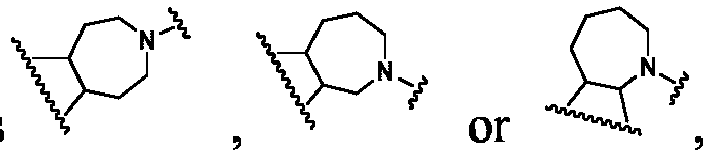
- ring B is

- R1 is a substituent on ring A;
- R2 is a substituent on ring B;
- R3 and R4 are substituents on six-membered ring;
- R1 and R2 are each independently hydrogen, halogen, nitro, cyano, C1-6 alkyl, C1-6 alkoxy, halogenated C1-6 alkyl, halogenated C1-6 alkoxy, C3-6 cycloalkyl, C1-6 alkaneamino;
- R3 and R4 are each independently C1-6 alkyl;
- Y is CH;
- Z is (CH2) n, n is 1;
- R5 is C1-6 alkyl.
- In a preferred embodiment,
- ring B is

- R1 is a substituent on ring A;
- R2 is a substituent on ring B;
- R3 and R4 are substituents on six-membered ring;
- R1 and R2 are each independently hydrogen, halogen, nitro, cyano, C1-6 alkyl, C1-6 alkoxy, halogenated C1-6 alkyl, halogenated C1-6 alkoxy, C3-6 cycloalkyl, C1-6 alkaneamino;
- R3 and R4 are each independently C1-6 alkyl;
- Y is CH;
- Z is (CH2) n, n is 1;
- R5 is C1-6 alkyl.
- In a preferred embodiment,
- ring B is

- R1 is a substituent on ring A;
- R2 is a substituent on ring B;
- R3 and R4 are substituents on six-membered ring;
- R1 and R2 are each independently hydrogen, halogen, nitro, cyano, C1-6 alkyl, C1-6 alkoxy, halogenated C1-6 alkyl, halogenated C1-6 alkoxy, C3-6 cycloalkyl, C1-6 alkaneamino;
- R3 and R4 are each independently C1-6 alkyl;
- Y is CH;
- Z is (CH2) n, n is 1;
- R5 is C1-6 alkyl.
- In a preferred embodiment
- ring B is

- R1 is a substituent on ring A;
- R2 is a substituent on ring B;
- R3 and R4 are substituents on six-membered ring;
- R1 and R2 are each independently hydrogen, halogen, nitro, cyano, C1-6 alkyl, C1-6 alkoxy, halogenated C1-6 alkyl, halogenated C1-6 alkoxy, C3-6 cycloalkyl, C1-6 alkaneamino;
- R3 and R4 are each independently C1-6 alkyl;
- Y is CH;
- Z is CH2;
- R5 is C1-6 alkyl.
- In a preferred embodiment, the compound according to the present invention or a pharmaceutically acceptable salt thereof is a compound selected from the group consisting of:


- In a preferred embodiement, there is provided a pharmaceutical composition comprising one or more pharmaceutically acceptable carriers or diluents and the compound according to the present invention or a pharmaceutically acceptable salt thereof.
- In a preferred embodiment, there is provided the use of the compound according to the present invention or a pharmaceutically acceptable salt thereof or the pharmaceutical composition according to the present invention for the preparation of a medicament regulating ion current in the potassium channel in mammal.
- Through extensive and intensive research, the inventors have unexpectedly discovered for the first time a class of p-diaminobenzene compounds with novel structures as potassium ion channel openers. The compounds of the present invention have excellent KCNQ2/3 opening activity and can be used for the treatment of pain, epilepsy, stroke and other diseases. Based on above discovery, the present invention has been completed.
- Unless otherwise specified, in all compounds of the present invention, each chiral carbon atom (chiral center) may optionally be in the R configuration or the S configuration, or a mixture of R configuration and S configuration.
- As used herein, when alone or as part of other substituents, the term "alkyl" refers to a straight chain containing only carbon atoms (i.e., unbranched) or a branched saturated hydrocarbon group, or groups combined by straight chain with branches. When the alkyl group has a limited number of carbon atoms in front of it (such as C1-6 alkyl), it means that the alkyl group contains 1-6 carbon atoms, including for example methyl, ethyl, propyl, isopropyl, butyl, isobutyl, sec-butyl, tert-butyl, or similar groups.
- As used herein, when alone or as part of other substituents, the term "C1-6 alkoxy" refers to C1-6 alkyl-O-, including for example methoxy, ethoxy, propoxy, isopropoxy, butoxy, isobutoxy, sec-butoxy, tert-butoxy, or similar groups.
- As used herein, when alone or as part of other substituents, the term "C3-6 cycloalkyl" refers to a cyclic alkyl group having 3-6 carbon atoms, including for example cyclopropyl, cyclobutyl, cyclopentyl, cyclohexyl, or similar groups.
- As used herein, when alone or as part of other substituents, the term "C3-6 cycloalkenyl" refers to a cyclic alkenyl group having 3-6 carbon atoms, which may have one or two alkenyl groups, including for example cyclobutenyl, cyclopentenyl, cyclohexenyl, or similar groups.
- As used herein, when alone or as part of other substituents, the term "C2-6 alkenyl" refers to a straight or branched chain alkenyl group having 3-6 carbon atoms, which may have one or more alkenyl groups, including for example vinyl, propenyl, butenyl, or similar groups.
- As used herein, when alone or as part of other substituents, the term "C2-6 alkynyl" refers to a branched or unbranched alkynyl group having 2-6 carbon atoms, which may have one or more alkynyl group, including for example ethynyl, propynyl, butynyl, or similar groups.
- As used herein, "halogen" is fluorine, chlorine, bromine or iodine.
- As used herein, "halogenated" means fluoro, chloro, bromo or iodo.
- The compound of the present invention refers to the compound represented by the general formula A or its stereoisomer or optical isomer, or its pharmaceutically acceptable salt.
- The "pharmaceutically acceptable salt" refers to the salt formed by the compound of the present invention and pharmaceutically acceptable inorganic acid and organic acid, wherein the preferred inorganic acid includes (but not limited to): hydrochloric acid, hydrobromic acid, phosphoric acid, nitric acid, sulfuric acid, trifluoroacetic acid (TFA); preferred organic acids include (but not limited to): formic acid, acetic acid, propionic acid, succinic acid, naphthalene sulfonic acid (1,5), asiatic acid, oxalic acid, tartaric acid, lactic acid, salicylic acid, benzoic acid, valeric acid, diethyl acetic acid, malonic acid, succinic acid, fumaric acid, pimelic acid, adipic acid, maleic acid, malic acid, sulfamic acid, phenylpropionic acid, gluconic acid, ascorbic acid, niacin, isonicotinic acid, methanesulfonic acid, p-toluenesulfonic acid, citric acid, and amino acids.
- The "stereoisomer" or "optical isomer" means that the chiral carbon atom involved in the compound of the present invention can be in the R configuration or S configuration, or a combination thereof.
- Because the compound of the present invention has excellent KCNQ2/3 opening activity, the compound of the present invention and the pharmaceutical composition containing the compound of the present invention as the main active ingredient can be used to treat, prevent and alleviate diseases related to potassium ion channels. According to the prior art, the compounds of the present invention can be used to treat the following diseases (but not limited to): epilepsy, inflammatory pain, neuropathic pain, migraine, insomnia, neurodegenerative diseases, anxiety disorders, stroke, cocaine abuse, nicotine withdrawal, alcohol withdrawal or tinnitus, etc.
- The pharmaceutical composition of the present invention contains a safe and effective amount of the compound of the present invention and a pharmacologically acceptable excipient or carrier.
- The "safe and effective amount" refers to that the amount of the compound is sufficient to significantly improve the condition without causing serious side effects. Usually, the pharmaceutical composition contains 1-2000 mg of the compound of the present invention/agent, and more preferably, 5-200 mg of the compound of the present invention/agent. Preferably, the "one dosage" is a capsule or a tablet.
- The "pharmaceutically acceptable carrier" refers to: one or more compatible solid or liquid fillers or gel substances, which are suitable for human use, and must have sufficient purity and low enough toxicity. The "compatible" herein means that the components in the composition can be blended with the compound of the present invention and between them without significantly reducing the efficacy of the compound. Pharmaceutically acceptable carriers include cellulose and its derivatives (such as sodium carboxymethyl cellulose, sodium ethyl cellulose, cellulose acetate, etc.), gelatin, talc, solid lubricants (such as stearic acid, magnesium stearate), calcium sulfate, vegetable oil (such as soybean oil, sesame oil, peanut oil, olive oil, etc.), polyol (such as propylene glycol, glycerin, mannitol, sorbitol, etc.), emulsifiers (such as Tween®), wetting agents (such as sodium lauryl sulfate), coloring agents, flavoring agents, stabilizers, antioxidants, preservatives, pyrogen-free water, etc.
- The administration method of the compound or the pharmaceutical composition of the present invention is not particularly limited. Representative administration methods include (but not limited to): oral, rectal, parenteral (intravenous, intramuscular or subcutaneous) and topical administration.
- Solid dosage forms for oral administration include capsules, tablets, pills, powders and granules. In these solid dosage forms, the active compound is mixed with at least one conventional inert excipient (or carrier), such as sodium citrate or dicalcium phosphate, or mixed with the following ingredients: (a) filler or compatibilizers, such as starch, lactose, sucrose, glucose, mannitol and silicic acid; (b) binders, such as hydroxymethylcellulose, alginate, gelatin, polyvinylpyrrolidone, sucrose and arabic gum; (c) humectant, for example, glycerin; (d) disintegrant, for example, agar, calcium carbonate, potato starch or tapioca starch, alginic acid, certain complex silicates, and sodium carbonate; (e) relieving solvent, such as paraffin; (f) absorption accelerator, such as quaternary amine compound; (g) wetting agent, such as cetyl alcohol and glyceryl monostearate; (h) adsorbent, for example, kaolin; and (i) lubricant, for example, talc, calcium stearate, magnesium stearate, solid polyethylene glycol, sodium lauryl sulfate, or mixtures thereof. In capsules, tablets and pills, the dosage forms may also contain buffering agents.
- Solid dosage forms such as tablets, dragees, capsules, pills and granules can be prepared with coatings and shells such as enteric coatings and other materials known in the art. They may contain opacifying agents and the release of the active compound or compound in such compositions may be released in a portion of the digestive tract in a delayed manner. Examples of embedding components that can be employed are polymeric materials and waxy materials. If necessary, the active compound may also be in microencapsulated form with one or more of the above-mentioned excipients.
- Liquid dosage forms for oral administration include pharmaceutically acceptable emulsions, solutions, suspensions, syrups or tinctures. In addition to the active compound, the liquid dosage form may contain inert diluents conventionally used in the art, such as water or other solvents, solubilizers and emulsifiers, for example, ethanol, isopropanol, ethyl carbonate, ethyl acetate, propylene glycol, 1,3-butanediol, dimethylformamide and oils, especially cottonseed oil, peanut oil, corn germ oil, olive oil, castor oil and sesame oil or mixtures of these substances.
- In addition to these inert diluents, the compositions may contain adjuvants such as wetting agents, emulsifying and suspending agents, sweetening agents, flavoring agents and spices.
- In addition to the active compound, the suspension may contain suspending agent, for example, ethoxylated isooctadecanol, polyoxyethylene sorbitol and dehydrated sorbitan ester, microcrystalline cellulose, aluminum methoxide and agar, or the mixture thereof etc..
- The compositions for parenteral injection may comprise physiologically acceptable sterile aqueous or anhydrous solutions, dispersions, suspensions or emulsions, and sterile powders which can be re-dissolved into sterile injectable solutions or dispersions. Suitable aqueous and non-aqueous carriers, diluents, solvents or excipients include water, ethanol, polyols and any suitable mixtures thereof. Dosage forms for the compounds of the invention for topical administration include ointments, powders, patches, propellants and inhalants. The active ingredient is mixed under sterile conditions with a physiologically acceptable carrier and any preservatives, buffers, or propellants which may be required if necessary.
- The compounds of the invention may be administered alone or in combination with other pharmaceutically acceptable compounds.
- When the pharmaceutical composition is used, a safe and effective amount of the compound of the present invention is applied to a mammal in need of treatment (such as a human), wherein the dosage at the time of administration is the pharmaceutically effective dosage, for people having a body weight of 60 kg, the daily dose is usually 1-2000 mg, preferably 5-500 mg. Of course, specific doses should also consider factors such as the administration route, the health of the patient, etc., which are within the skill of the skilled physician.
- The present invention provides a kind of potassium ion channel opener compound with novel structure. The compounds of the invention have excellent potassium ion channel opening activity and also have good safety.
- The compounds of the present invention are expected to be used in the treatment and prevention of diseases and disorders affected by the activity of potassium ion channels.
- The compounds of the invention have better potassium ion channel opening activity, better pharmacokinetic properties, better cerebral blood ratio and better safety.
- The present invention will be further illustrated below with reference to the specific examples. It should be understood that these examples are only to illustrate the invention but not to limit the scope of the invention. The experimental methods with no specific conditions described in the following examples are generally performed under the conventional conditions, or according to the manufacture's instructions. Unless otherwise stated, percentages and parts are percentages by weight and parts by weight.
- The experimental materials and reagents used in the following examples can be obtained from commercial sources unless otherwise specified.
-

- (1,1'-bis (diphenylphosphino) ferrocene) palladium dichloride (0.42 g, 0.57 mmol) and cuprous iodide (0.217 g, 1.14 mmol) were added into a solution of 3-bromo-2-thiophene methyl formate (2.5 g, 11.3 mmol), N-tert-butoxycarbonylaminopropyne (2.1 g, 13.6 mmol) and diisopropylethylamine (3 mL) in acetonitrile (30 mL), and the resulting mixture was heated to reflux and stirred overnight under the protection of nitrogen. The reaction solution was cooled to room temperature, filtered with celite, the filtrate was concentrated to remove the solvent, and the residue was purified with a silica gel column to obtain a yellow oily compound 2 (2.0 g, yield: 59.5%).
- MS (ESI): Calcd. for C14H17NO4S 295; Found 318 [M+Na]+.
- 10% palladium carbon (0.2 g) was added into a solution of 3-(3-((tert-butoxycarbonyl)amino)-1-propynyl)-2-methyl thiophenecarboxylate (2.0 g, 6.8 mmol) in tetrahydrofuran (30 mL), and the reaction mixture was stirred overnight under 4 atm hydrogen, filtered and concentrated to obtain a light yellow oily compound 3 (1.8 g, yield: 90.3 %).
- MS (ESI): Calcd. for C14H21NO4S 299; Found 322 [M+Na]+.
- Trifluoroacetic acid (4.6 g, 40 mmol) was slowly dropped into a solution of 3-(3-((tert-butoxycarbonyl)amino)-propyl)-2-thiophene methyl formate (1.8 g, 6.1 mmol) in dichloromethane (40mL). The reaction was stirred at room temperature for 3 hours and then directly concentrated to obtain a yellow oily crude compound 4 (1.2 g, yield: 96.5%).
- MS (ESI): Calcd. for C9H13NO2S 199; Found 200[M+H]+.
- At room temperature, sodium methoxide (1.1 g) was added into a solution of (3-(3-aminopropyl)-2-methyl thiophenecarboxylate (1.2 g, 6.0 mmol) in methanol (40 mL). The reaction mixture was heated to reflux for 3 hours. The reaction solution was directly concentrated, and the residue was purified with a silica gel column to obtain a yellow oily compound 5 (800 mg, yield: 79.8%).
- MS (ESI): Calcd. for C8H9NOS 167; Found 168 [M+H]+.
- At room temperature, lithium tetrahydroaluminum (410 mg, 10.8 mmol) was slowly added into a solution of 4,5,6,7-tetrahydro-8H-thieno[2,3-c]azepin-8-one (600 mg, 3.6 mmol) in tetrahydrofuran (10 mL). Reaction mixture was heated to reflux for 3 hours. The mixture was quenched with water and methanol, filtered, concentrated, and the residue was purified with a silica gel column to obtain a yellow oily compound 6 (450 mg, yield: 81.7 %).
- MS (ESI): Calcd. for C8H11NS 153; Found 154 [M+H]+.
- The mixed reaction solution of tri(dibenzylideneacetone)dipalladium (20 mg), tricyclohexylphosphorus (0.3 mL 10% solution), 5,6,7,8-tetrahydro-4H-thieno[2,3-c]azepine (100 mg, 0.65 mmol), N-(4-bromo-2,6-dimethylphenyl)-3,3-dimethyl butanamide (386 mg, 1.3 mmol), potassium tert-butoxide (218 mg, 1.95 mmol) and dimethyl sulfoxide (20 mL) was reacted in a microwave reactor at 150°C for 2 hours. The resulting mixture was diluted with water (25 mL) and extracted with ethyl acetate (30 mL × 3). The combined organic phase was dried over anhydrous sodium sulfate, filtered and concentrated. The residue was purified by TLC plate to obtain a white solid compound 03026 (6.35 mg, yield: 2.6%).
- HNMR (400 MHz, CD3OD): δ 7.01 (d, J = 4.4 Hz, 1H), 6.74 (d, J = 4.4 Hz, 1H), 6.63 (s, 2H), 4.65 (s, 2H), 3.94-3.85 (m, 2H), 2.94-2.85 (m, 2H), 2.27 (s, 2H), 2.14 (s, 6H), 1.87-1.78 (m, 2H), 1.13 (s, 9H). MS (ESI): Calcd. for C22H30N2OS 370; Found 371 [M+H]+. HPLC: 93.3% (214 nm) / 94.2% (254 nm).
-

- Under ice-cooling, thionyl chloride (2mL) was slowly added into a solution of 4-bromo-3-thiophene formic acid (2.0 g, 9.7 mmol) in methanol (50 mL), and the reaction mixture was heated to 60 degrees and reacted for 3 hours. The mixture was concentrated in vacuo to give a yellow oily compound 2 (2.2 g, yield: 100 %).
- MS (ESI): Calcd. for C6H5BrO2S 220; Found 221 [M+H]+.
- (1,1'-bis (diphenylphosphino) ferrocene) palladium dichloride (0.36 g, 0.5 mmol) and cuprous iodide (0.19 g, 1.0 mmol) were added into a solution of 4-bromo-3-thiophene methyl formate (2.2 g, 10 mmol), N-tert-butoxycarbonylaminopropyne (1.55 g, 10 mmol) and diisopropylethylamine (1.93 g, 15 mmol) in acetonitrile (50 mL), the resulting mixture was heated to reflux and stirred overnight under the protection of nitrogen. The reaction solution was cooled to room temperature, filtered with celite, the filtrate was concentrated to remove the solvent, and the residue was purified with a silica gel column to obtain a yellow oily compound 3 (0.88 g, yield: 29.8%).
- MS (ESI): Calcd. for C14H17NO4S 295; Found 318 [M+Na]+.
- 10% palladium carbon (0.34 g) was added into a solution of 4-(3-((tert-butoxycarbonyl)amino)-1-propynyl)-3-methyl thiophenecarboxylate (0.88 g, 2.95 mmol) in methanol (10 mL), and the reaction mixture was stirred overnight under 4 atm hydrogen, filtered and concentrated to obtain a light yellow oily compound 4 (0.76 g, yield: 86.1 %).
- MS (ESI): Calcd. for C14H21NO4S 299; Found 322 [M+Na]+.
- Trifluoroacetic acid (4.6 g, 40 mmol) was slowly dropped into a solution of 4-(3-((tert-butoxycarbonyl)amino)-propyl)-3-thiophene methyl formate (0.76 g, 2.54 mmol) in dichloromethane (40mL). The reaction was stirred at room temperature for 3 hours and then directly concentrated to obtain a yellow oily crude compound 5 (0.6 g, yield: 100%).
- MS (ESI): Calcd. for C9H13NO2S 199; Found 200 [M+H]+.
- At room temperature, sodium methoxide (488 mg) was added into a solution of (4-(3-aminopropyl)-3-methyl thiophenecarboxylate (0.6 g, 3.0 mmol) in methanol (30 mL). The reaction mixture was heated to reflux for 2 hours. The reaction solution was directly concentrated, and the residue was purified with a silica gel column to obtain a yellow oily compound 6 (0.25 g, yield: 49.9%).
- MS (ESI): Calcd. for C8H9NOS 167; Found 168 [M+H]+.
- At room temperature, lithium tetrahydroaluminum (284 mg, 7.5 mmol) was batch added into a solution of 5,6,7,8-tetrahydro-8H-thieno[3,4-c]azepin-4-one (250 mg, 1.5 mmol) in tetrahydrofuran (20 mL) The reaction mixture was heated to reflux for 3 hours. The mixture was quenched with 15% NaOH (1 mL) and filtered with magnesium sulfate. The filtrate was concentrated and purified with a silica gel column to obtain a yellow oily compound 7 (190 mg, yield: 82.8 %).
- MS (ESI): Calcd. for C8H11NS 153; Found 154 [M+H]+
- The mixed reaction solution of tri(dibenzylideneacetone)dipalladium (5 mg1, 5µmol), tricyclohexylphosphorus (0.1 mL 10% solution), 5,6,7,8-tetrahydro-4H-thieno[3,4-c]azepine (20 mg, 0.13 mmol), N-(4-bromo-2,6-dimethylphenyl)-3,3-dimethyl butanamide (78 mg, 0.26 mmol), potassium tert-butoxide (44 mg, 0.39 mmol) and dimethyl sulfoxide (2 mL) was reacted in a microwave reactor at 150 °C for 1 hours. The resulting mixture was diluted with water (25 mL) and extracted with ethyl acetate (30 mL × 3). The combined organic phase was dried over anhydrous sodium sulfate, filtered and concentrated. The residue was purified with a chromatography plate to obtain a white solid 03027 trifluoroacetate (7.7 mg, yield: 16%).
- HNMR (400 MHz, CD30D): δ 7.23 (d, J = 2.8 Hz, 1H), 6.88 (d, J = 2.8 Hz, 1H), 6.58 (s, 2H), 4.55 (s, 2H), 3.84 (t, J = 4.4 Hz, 2H), 2.94-2.88 (m, 2H), 2.27 (s, 2H), 2.14 (s, 6H), 1.82-1.75 (m, 2H), 1.12 (s, 9H). MS (ESI): Calcd. for C22H30N2OS 370; Found 371 [M+H]+. HPLC: 98.9% (214 nm) / 99.6% (254 nm).
-

- Under ice-cooling, oxalyl chloride (2.5mL, 29.5 mmol)was slowly added into a solution of 2-bromo-3-thiophene formic acid (5.0 g, 24.1 mmol) in dichloromethane (50 mL), and the reaction mixture was stirred overnight at room temperature. Concentrated to remove the solvent, and the residue was dissolved in methanol (50 mL) and heated to reflux for 4 hours. The mixture was concentrated in vacuo to give a yellow oily compound 2 (5.2 g, yield: 93.6 %).
- MS (ESI): Calcd. for C6H5BrO2S 220; Found 221 [M+H]+.
- (1,1'-bis (diphenylphosphino) ferrocene) palladium dichloride (0.50 g, 0.67 mmol) and cuprous iodide (0.13 g, 0.67 mmol) were added into a solution of 2-bromo-3-thiophene methyl formate (3.0 g, 13.5 mmol), N-tert-butoxycarbonylaminopropyne (2.5 g, 16.3 mmol) and diisopropylethylamine (5 mL) in acetonitrile (30 mL), the resulting mixture was heated to reflux and stirred overnight under the protection of nitrogen. The reaction solution was cooled to room temperature, filtered with celite, the filtrate was concentrated to remove the solvent, and the residue was purified with a silica gel column to obtain a yellow oily compound 3 (3.4 g, yield: 84.9%).
- MS (ESI): Calcd. for C14H17NO4S 295; Found 296 [M+H]+.
- 10% palladium carbon (0.34 g) was added into a solution of 2-(3-((tert-butoxycarbonyl)amino)-1-propynyl-3-methyl thiophenecarboxylate (3.4 g, 11.5 mmol) in tetrahydrofuran (30 mL), and the reaction mixture was stirred overnight under 4 atm hydrogen, filtered and concentrated to obtain a light yellow oily compound 4 (3.4 g, yield: 98.6 %).
- MS (ESI): Calcd. for C14H21NO4S 299; Found 200 [M-99]+.
- Trifluoroacetic acid (9.1 g, 80 mmol) was slowly dropped into a solution of 2-(3-((tert-butoxycarbonyl)amino)-propyl)-3-thiophene methyl formate (3.4 g, 11.4 mmol) in dichloromethane (40mL). The reaction was stirred at room temperature for 3 hours and then directly concentrated to obtain a yellow oily crude compound 5 (2.2 g, yield: 96.5%).
- MS (ESI): Calcd. For C9H13NO2S 199; Found 200 [M+H]+.
- At room temperature, sodium methoxide (2.0 g) was added into a solution of (2-(3-aminopropyl)-3-methyl thiophenecarboxylate (2.2 g, 11.0 mmol) in methanol (40 mL). The reaction mixture was heated to reflux for 3 hours. The reaction solution was directly concentrated, and the residue was purified with a silica gel column to obtain a yellow oily compound 6 (1.4 g, yield: 75.8%).
- MS (ESI): Calcd. for C8H9NOS 167; Found 168 [M+H]+.
- At room temperature, lithium tetrahydroaluminum (956 mg, 25.2 mmol) was batch added into a solution of 5,6,7,8-tetrahydro-4H-thieno[3,2-c]azepin-4-one (1.4 g, 8.4 mmol) in tetrahydrofuran (50 mL). The reaction mixture was heated to reflux for 3 hours. The mixture was quenched with 15% NaOH (1 mL) and filtered with magnesium sulfate. The filtrate was concentrated and purified with a silica gel column to obtain a yellow oily compound 6 (800 mg, yield: 62.5 %).
- MS (ESI): Calcd. for C8H11NS 153; Found 154 [M+H]+.
- The mixed reaction solution of tri(dibenzylideneacetone)dipalladium (31 mg, 0.034mmol), tricyclohexylphosphorus (0.1 mL 10% solution), compound 7 (52 mg, 0.34mmol), N-(4-bromo-2,6-dimethylphenyl)-3,3-dimethyl butanamide (200 mg, 0.68 mmol), potassium tert-butoxide (76 mg, 0.68 mmol) and dimethyl sulfoxide (5 mL) was reacted in a microwave reactor at 150 °C for 2 hours. The resulting mixture was diluted with water (25 mL) and extracted with ethyl acetate (30 mL × 3). The combined organic phase was dried over anhydrous sodium sulfate, filtered and concentrated. The residue was purified by chromatography to obtain a white solid compound 03028 trifluoroacetate (12.7 mg, yield: 7.7%).
- HNMR (400 MHz, CD3OD): δ 7.18 (s, 2H), 7.12 (d, J = 5.2 Hz, 1H), 7.00 (d, J = 5.2 Hz, 1H), 4.80 (s, 2H), 4.00-3.93 (m, 2H), 3.15-3.11 (m, 2H), 2.31 (s, 2H), 2.25 (s, 6H), 2.16-2.08 (m, 2H), 1.12 (s, 9H). MS (ESI): Calcd. for C22H30N2OS 370; Found 371 [M+H]+. HPLC: 98.9% (214 nm) / 99.3% (254 nm).
-

- (1,1'-bis (diphenylphosphino) ferrocene) palladium dichloride (0.90 g, 1.0 mmol) and cuprous iodide (0.2 g, 1.5 mmol) were added into a solution of 3-bromo-2-pyridine methyl formate (2.5 g, 11.6 mmol), N-tert-butoxycarbonylaminopropyne (2.0 g, 12.9 mmol) and diisopropylethylamine (5 mL) in acetonitrile (30 mL), the resulting mixture was heated to reflux for 6 hours under the protection of nitrogen. The reaction solution was cooled to room temperature, filtered with celite, the filtrate was concentrated to remove the solvent, and the residue was purified with a silica gel column to obtain a yellow solid compound 2 (1.4 g, yield: 41.7%).
- HNMR (400 MHz, CDCl3): δ 8.64 (d, J = 3.6 Hz, 1H), 7.88 (d, J = 8.0 Hz, 1H), 7.47-7.38 (m, 1H), 4.86 (s, 1H), 4.23 (d, J = 2.8 Hz, 2H), 4.01 (s, 3H), 1.48 (s, 9H).
- 10% palladium carbon (0.14 g) was added into a solution of 3-(3-((tert-butoxycarbonyl)amino)-1-propynyl)-2-pyridine methyl formate (1.4 g, 4.8 mmol) in tetrahydrofuran (30 mL), and the mixture was stirred overnight under 4 atm hydrogen, filtered and concentrated to obtain a light yellow oily compound 3 (1.4 g, yield: 98.6 %).
- MS (ESI): Calcd. for C15H22N2O4 294; Found 295 [M+H]+, 317 [M + Na]+.
- Trifluoroacetic acid (4.5 g, 40 mmol) was slowly dropped into a solution of 3-(3-((tert-butoxycarbonyl)amino)-propyl)-2-pyridine methyl formate (1.4 g, 4.7 mmol) in dichloromethane (20mL). The reaction was stirred at room temperature for 3 hours and then directly concentrated to obtain a yellow oily crude compound 4 (1.0 g), which was used in the next step without further purification.
- MS (ESI): Calcd. for C10H14N2O2 194; Found 195 [M+H]+.
- At room temperature, sodium methoxide (1.0 g) was added into a solution of (3-(3-aminopropyl)-2-pyrido methyl formate (1.0 g) in methanol (20 mL). The reaction mixture was heated to reflux for 3 hours. The reaction solution was directly concentrated, and the residue was purified with a silica gel column to obtain a yellow oily compound 5 (500 mg, yield: 59.8 %).
- MS (ESI): Calcd. for C9H10N2O 162; Found 163 [M+H]+.
- At room temperature, borane tetrahydrofuran solution (1.0 M, 20 mL) was slowly added into a solution of 5,6,7,8-tetrahydro-9H-pyrido[2,3-c]azepin-9-one (500 mg, 3.1 mmol) in tetrahydrofuran (5 mL) The reaction mixture was heated to reflux for 3 hours. The mixture was diluted with methanol (10 mL) and concentrated. The residue was purified with a silica gel column to obtain a yellow oily compound 6 (100 mg, yield: 21.9 %).
- MS (ESI): Calcd. for C9H12N2 148; Found 149 [M+H]+.
- The mixed reaction solution of tri(dibenzylideneacetone)dipalladium (31 mg, 0.034 mmol), tricyclohexylphosphorus (0.1 mL 10% solution), 6,7,8,9-tetrahydro-5H-pyrido[2,3-c]azepine (52 mg, 0.34 mmol), N-(4-bromo-2,6-dimethylphenyl)-3,3-dimethyl butanamide (200 mg, 0.68 mmol), potassium tert-butoxide (76 mg, 0.67 mmol) and dimethyl sulfoxide (5 mL) was reacted in a microwave reactor at 150 °C for 2 hours. The resulting mixture was diluted with water (25 mL) and extracted with ethyl acetate (30 mL × 3). The combined organic phase was dried over anhydrous sodium sulfate, filtered and concentrated. The residue was purified by TLC plate to obtain a white solid compound 03029 (6.8 mg, yield: 5.3%).
- HNMR (400 MHz, CD3OD): δ 8.27 (d, J = 5.2 Hz, 1H), 7.61 (d, J = 7.2 Hz, 1H), 7.45-7.20 (dd, J = 5.2 Hz, J = 7.2 Hz, 1H) ), 6.63 (s, 2H), 4.78 (s, 2H), 3.90 (t, J = 4.8 Hz, 2H), 3.07-3.01 (m, 2H), 2.26 (s, 2H), 2.12 (s, 6H), 1.94-1.87 (m, 2H), 1.11 (s, 9H). MS (ESI): Calcd. for C23H31N3O 365; Found 366 [M+H]+. HPLC: 97.2% (214 nm) / 99.4% (254 nm).
-

- Step one: 5,6,7,8-tetrahydro-4H-cycloheptatrieno[b]thiophen-4-one (compound 2) Phosphorus pentoxide(1.5 g, 10.9 mmol) and molecular sieves (2 g) were added into a solution of 5-(thiophen-2-yl)pentanoic acid (1.00 g, 5.40 mmol) in toluene (20 mL). The reaction mixture was heated to 130°C and reacted for 2 hours under the protection of nitrogen. Cooled to room temperature, filtered, washed with saturated sodium bicarbonate (30 mL), dried, concentrated in vacuo to remove the solvent, and purified by column chromatography to obtain compound 2 (0.42 g, yield: 46.6%) as a yellow oil.
- MS (ESI): Calcd.for C9H10OS 166; Found 167 [M+H]+.
- Sodium azide (501 mg) was added into a solution of compound 2 (0.64 g, 3.86 mmol) in concentrated hydrochloric acid (20 mL). The mixture was stirred at room temperature for 16 hours, poured into ice water, adjusted to pH=7 with potassium carbonate, extracted with ethyl acetate, dried over anhydrous sodium sulfate, the solvent was concentrated in vacuo, and purified by column chromatography to obtain an off-white solid compound 3 (400.0 mg, yield : 57.25%).
- MS (ESI): Calcd. for C9H11NOS 181; Found 182 [M+H]+.
- Lithium aluminum hydride (420 mg, 11.05 mmol) was added into a solution of compound 3 (400 mg, 2.21 mmol) in tetrahydrofuran (40 mL). The mixture was heated to 80°C and stirred for 2 hours. Cooled to room temperature, water (2 mL) and 10% sodium hydroxide (1 mL) were added to quench the reaction, filtered, concentrated the filtrate, and purified the residue by column chromatography to obtain a yellow oily compound 4 (150mg, yield: 40.90%).
- MS (ESI): Calcd. for C9H13NS 167; Found 168 [M+H]+.
- Compound 5 (178 mg, 0.60 mmol), Pd2(dba)3 (10 mg, 0.034 mmol), tri-tert-butylphosphon-hexane solution (1 mol/L, 0.2 mL) and potassium tert-butoxide (100 mg, 0.9 mmol) were added into a solution of compound 4 (50 mg, 0.30 mmol) in DMSO (2 mL). The mixture was microwave reacted at 150°C for 1 hour. The mixture was cooled to room temperature, quenched with water, extracted with ethyl acetate, dried over anhydrous sodium sulfate, concentrated in vacuo, and the residue was purified by column chromatography to obtain an off-white solid compound 03030 (14.78 mg, yield: 12.8%).
- MS (ESI): Calcd. for C23H32N2OS 384; Found 385 [M+H]+.
- HNMR (400 MHz, CD3OD): δ 7.10 (d, J= 5.2 Hz, 1H), 6.90(d, J= 5.2 Hz, 1H), 6.44 (s, 2H), 4.55 (s, 2H), 3.56-3.48 (m, 2H), 2.82 - 2.74 (m, 2H), 2.29 (s, 2H), 2.15 (s, 6H), 1.80 - 1.70 (m, 4H), 1.14 (s, 9H) .
-

- Compound 2 (484 mg, 1.63 mmol), Pd2(dba)3 (149 mg, 0.16 mmol), tri-tert-butylphosphon-hexane solution (66mg, 0.33 mmol) and potassium tert-butoxide (365 mg, 3.26 mmol) were added into a solution of compound 1 (250 mg, 1.63 mmol) in DMSO (5 mL). The mixture was microwave reacted at 150°C for 0.5 hour. Then the mixture was cooled to room temperature, quenched with water, extracted with ethyl acetate, dried over anhydrous sodium sulfate, concentrated in vacuo, and purified by column chromatography to obtain a white solid compound 03034 (49.12 mg, yield: 8.12%).
- MS (ESI): Calcd. for C22H30N2OS 370; Found 371 [M+H]+.
- HNMR (400 MHz, CDCl3): δ 6.98 (d, J= 4.0 Hz, 1H), 6.84 (d, J= 8.0 Hz, 1H), 6.47-6.49 (m, 3H), 3.68 (t, J= 4.0 Hz, 2H), 3.77 (t, J= 6.0 Hz, 2H), 2.29 (s, 2H), 2.16 (s, 6H), 1.89-1.91 (m, 2H), 1.74 -1.68 (m, 2H), 1.16 (s, 9H).
-

- Under ice-cooling, NBS (266 mg, 1.5 mmol) was added into a solution of 6,7-dihydrobenzo[b]thiophene-4(5H)-one (152 mg, 1 mmol) in DMF (5 mL) in batches , the reaction mixture was reacted at room temperature for 12 hours. The mixture was quenched by adding water (10 mL) at 0°C, extracted with ethyl acetate, dried over anhydrous sodium sulfate, filtered, and concentrated to obtain a colorless oily compound 2 (200 mg, yield: 86.0%).
- MS (ESI): Calcd.for C8H7BrOS 230; Found 231 [M+H]+.
- Sodium acetate (5.10 g, 63 mmol) and hydroxylamine hydrochloride (4.30 g, 63 mmol) were added into a solution of 2-bromo-6,7-dihydrobenzo[b]thiophene-4(5H)-one (4.72 g, 21 mmol) in mixed ethanol (100 mL) and water (20 mL) in batch, and the reaction mixture was reacted at 80°C for 3 hours, and cooled to room temperature, filtered and concentrated to obtain brown solid compound 3 (3.80 g, yield: 75.0%).
- MS (ESI): Calcd.for C8H8BrNOS 245; Found 246 [M+H]+.
- In an ice water bath, DIBAL-H (62 mg, 0.46 mmol) was added into 2-bromo-6,7-dihydrobenzo[b]thiophen-4(5H)-ketoxime (300 mg, 1.22 mmol) in dichloromethane (10 mL). The reaction mixture was stirred at room temperature for 4 hours, quenched with water, extracted with ethyl acetate, dried over anhydrous sodium sulfate, filtered, concentrated, and separated and purified by silica gel column to obtain a colorless oily compound 4 (100 mg, yield: 35.0%).
- MS (ESI): Calcd. for C8H10BrNS 231; Found 232 [M+H]+.
- DMAP (223 mg, 1.7 mmol) and BOC-anhydride (3.77 g, 17 mmol) were added into a solution of compound 4 (2 g, 8.7 mmol) in THF (15 mL). The reaction mixture was heated to reflux for 6 hours. The solvent was spin-dried, diluted with water (10 mL) and ethyl acetate, the organic phase was dried over anhydrous sodium sulfate, filtered, and concentrated to obtain a white solid compound 5 (14 g, yield: 48.9%).
- MS (ESI): Calcd. for C13H18BrNO2S 331 Found 276 [M-56+H]+.
- Trimethoxyboron (69 mg, 0.542 mmol), potassium carbonate (125 mg, 0.90 mmol) and tetrakistriphenylphosphine palladium (52 mg, 0.045 mmol) were added into a solution of compound 5 (150 mg, 0.452 mmol) in DMF (5 mL). The reaction mixture was heated to 120°C and stirred for 3 hours. The reaction mixture was cooled to room temperature, filtered, and concentrated. The residue was separated and purified by a silica gel column to obtain a white solid compound 6 (112 mg, yield: 93.2%).
- MS (ESI): Calcd. for C14H21NO2S 267; Found 212[M-56 + H]+.
- Trifluoroacetic acid (2 mL) was added into a solution of compound 6 (112 mg, 0.419 mmol) in DCM (5 mL). The mixture was stirred at room temperature for 3 hours. The solvent was removed, the pH was adjusted to be neutral, extracted with ethyl acetate, concentrated, and the residue was separated and purified by silica gel column to obtain a white solid compound 7 (40 mg, yield: 57.1%).
- N-(4-bromo-2,6-dimethylphenyl)-3,3-dimethylbutanamide (250 mg, 0.84 mmol), potassium tert-butoxide (130 mg, 0.84 mmol), tris(dibenzylideneacetone) dipalladium (39 mg, 0.042 mmol), and tri-tert-butylphosphorus (0.3 mL, 0.084 mmol) were added into a solution of compound 7 (70 mg, 0.42 mmol) in DMSO (2 mL). The reaction mixture was heated to 150 °C and reacted in microwave for 2 hours. The reaction mixture was cooled to room temperature, filtered, and concentrated. The residue was separated and purified by a silica gel column to obtain a white solid compound 03039 (10 mg, yield: 6.2 %).
- MS (ESI): Calcd. for C23H32N2OS 384; Found 385 [M + H]+.
- 1H NMR (400 MHz, CD3CN) δ 7.44 (s, 1H), 6.53 (s, 1H), 6.47 (s, 2H), 3.70 - 3.64 (m, 2H), 2.69 - 2.66 (m, 2H), 2.39 ( s, 3H), 2.23 (s, 2H), 2.10 (s, 6H), 1.87 - 1.81 (m, 2H), 1.68 - 1.62 (m, 2H), 1.12 (s, 9H).
-

- Under ice-cooling, sodium azide (15 g, 250 mmol) was added into a solution of 6,7-dihydrobenzo[b]thiophene-4(5H)-one (15 g, 98 mmol) in hydrochloric acid (100 mL) in batches, the reaction mixture was reacted overnight at room temperature. Ice cubes were added, and the pH was adjusted to be greater than 7 with saturated potassium carbonate aqueous solution, the mixture was extracted with dichloromethane, dried with anhydrous sodium sulfate, filtered, concentrated to obtain a crude white solid compound 2 (13 g) by column chromatography.
- MS (ESI): Calcd.for C8H9NOS 167; Found 168 [M+H]+.
- Under ice cooling, compound 2 (13 g, 78 mmol) was slowly added into a suspension of lithium aluminum hydride (8.9 g, 230 mmol) in tetrahydrofuran (200 mL), and the mixture was heated to 70°C and stirred for 1 hour, Then water (9 ml), sodium hydroxide aqueous solution (15%, 9 mL) and water (27 mL) were slowly added, then enough anhydrous magnesium sulfate was added, filtered, concentrated, and the residue was subjected to column chromatography to obtain compound 3 (9.0 g, yield: 75%).
- MS (ESI): Calcd.for C8H11NS 153; Found 154 [M+H]+.
- Hydrochloric acid (2.3 g, 62 mmol) was added into a solution of 5,6,7,8-tetrahydro-4H-thieno[3,2-c]azepine (8.0 g, 50 mmol) in tetrahydrofuran (100 mL), the mixture was stirred at room temperature for 30 minutes. After concentration to remove excess hydrochloric acid, acetic acid (10 mL) and N-bromosuccinimide (12.0 g, 68 mmol) were added sequentially. The reaction mixture was stirred at room temperature for 3 hours, a saturated sodium bicarbonate aqueous solution was added to adjust the pH to be greater than 7, and the next step reaction was carried out without purification.
- MS (ESI): Calcd.for C8H10BrNS 231; Found 232 [M+H]+.
- BOC-anhydride (19 g, 87 mmol) was added into a solution of compound 4 (8 g, 35 mmol) in tetrahydrofuran (200 mL), the mixture was reacted at room temperature for 2 hours, concentrated, and subjected to silica gel column chromatography to obtain a crude white solid compound 5 (15g).
- MS (ESI): Calcd.for C13H18BrNO2S 331; Found 276 [M-56+1]+.
- Under dry ice cooling, n-butyllithium (2.6 mL, 6.24 mmol) was slowly added into a solution of compound 5 (1.0 g, 3.02 mmol) in tetrahydrofuran (20 mL), and the mixture was stirred at -78°C for 1 hour. Then N-fluorobisbenzenesulfonamide (1.91 g, 6.05 mmol) was slowly added. The reaction mixture was slowly returned to room temperature and stirred overnight. After ice water was added, the mixture was extracted, dried, and concentrated. The residue was subjected to column chromatography to obtain compound 6 crude product (800 mg).
- MS (ESI): Calcd.for C13H18FNO2S 271; Found 216 [M-56+1]+.
- Hydrochloric acid (1.87 mL, 7.49 mmol) was added into a solution of compound 6 (800 mg, 2.95 mmol) in 1,4-dioxane (20 mL), the mixture was stirred at room temperature for 1 hour, concentrated to remove excess hydrochloric acid, and saturated sodium bicarbonate aqueous solution was added to adjust the pH to be greater than 7, the mixture was extracted, dried, and concentrated, the residue was subjected to column chromatography to obtain crude compound 7 (1.0 g).
- MS (ESI): Calcd. for C8H10FNS 171; Found 172 [M+H]+.
- Intermediate N-(4-bromo-2,6-dimethylphenyl)-3,3-dimethyl butanamide (1.9 g, 6.4 mmol) and sodium tert-butoxide (2.25 g, 20 mmol) were added into a solution of compound 7 (1.0 g, 5.8 mmol) in tert-butanol (100 mL). After nitrogen exchange for three times, methanesulfonic acid (2-dicyclohexylphosphino-2' ,6' -diisopropoxy -1,1'-biphenyl)(2-amino-1,1'-biphenyl-2-yl)palladium(II) (830 mg, 990 mmol) was added. The reaction mixture was heated to 95°C under nitrogen and stirred overnight, filtered, concentrated to remove the solvent, the residue was subjected to column chromatography to obtain crude compound 03041, which was further purified by preparative chromatography to obtain compound 03041 (57 mg, yield: 2.5%).
- MS (ESI): Calcd. for C22H29FN2OS 388; Found 389 [M+H]+.
- 1H NMR (400 MHz, CDCl3): δ 6.54 (s, 2H), 6.35 (s, 1H), 4.36 (s, 2H), 3.79-3.74 (m, 2H), 2.84-2.78 (m, 2H), 2.29 (s, 2H), 2.19 (s, 6H), 2.01-1.96 (m, 2H), 1.15 (s, 9H).
-

- At room temperature, di-tert-butyl dicarbonate (569 mg, 2.61 mmol) was added into a solution of 2-bromo-5,6,7,8-tetrahydro-4H-thieno[2,3-c]azepine (300 mg, 1.30 mmol) in tetrahydrofuran (10 mL). The reaction mixture was heated to reflux for 16 hours. The reaction mixture was concentrated to remove the solvent, and the residue was purified by column chromatography to obtain compound 2 (230 mg, yield: 53.5%).
- MS (ESI): Calcd. for C13H18BrNO2S 331; Found 276 [M-56]+.
- Compound 2 (1.2 g, 3.63 mmol) was dissolved in anhydrous tetrahydrofuran (20 mL), the temperature was lowered to -78°C under a nitrogen atmosphere, and n-butyllithium (2.4 M, 3.0 mL) was added dropwise. The reaction was kept at -78°C for half an hour, and then a solution of N-fluorobisbenzenesulfonamide (2.29 g, 7.26 mmol) in tetrahydrofuran was added dropwise into the reaction system. After the addition, the mixture was slowly raised to room temperature and reacted at room temperature for 16 hours. The reaction was quenched with saturated ammonium chloride, extracted with ethyl acetate, dried over anhydrous sodium sulfate, filtered, concentrated to remove the solvent, and the residue was purified by column chromatography to obtain compound 3 (400 mg, yield: 40.7%).
- MS (ESI): Calcd. for C13H18FNO2S 271; Found 216 [M-56+H]+.
- Hydrochloric acid methanol solution (4M, 40 mL) was added to compound 3. The mixture was stirred at room temperature for sixteen hours. After concentration to remove the solvent, sodium bicarbonate was added to adjust the pH to be equal to 8, and the residue was purified by column chromatography to obtain compound 4 (410 mg, yield: 64.9%).
- MS (ESI): Calcd. for C8H10FNS 171; Found 172 [M+H]+.
- N-(4-bromo-2,6-dimethylphenyl)-3,3-dimethyl butanamide (712 mg, 2.40 mmol), sodium tert-butoxide (921 mg, 9.59 mmol), methanesulfonic acid (2-dicyclohexylphosphino-2',6'-diisopropoxy-1,1'-linked biphenyl)(2-amino-1,1'-biphenyl-2-yl)palladium(II) (201 mg, 0.24 mmol) were added into a solution of compound 4 (410 mg, 2.40 mmol) in tert-butanol (20 mL) under nitrogen atmosphere. The mixture was reacted at 90°C for sixteen hours. After the mixture was cooled to room temperature, filtered, the filtrate was concentrated in vacuo to remove the solvent, and the residue was purified by column chromatography to obtain the crude product, which was then separated by preparative chromatography to obtain compound 03042 (32.7 mg, yield: 3.5%).
- MS (ESI): Calcd. for C22H29FN2OS 388; Found 389 [M+H]+.
- HNMR (400 MHz, CD3OD): δ 6.75 (s, 2H), 6.31 (s, 1H), 4.59 (s, 2H), 3.89-3.86 (m, 2H), 2.82-2.79 (m, 2H), 2.29 (s, 2H), 2.19 (s, 6H), 1.91-1.86 (m, 2H), 1.13 (s, 9H).
-

- N-chlorosuccinimide (32 g, 0.24 mol) was added into a solution of 6,7-dihydrobenzo[b]thiophene-4(5H)-one (25 g, 0.16 mol) in acetic acid (50 mL), the reaction mixture was heated to 50 ° C and reacted overnight. The mixture was cooled to room temperature, concentrated, water and ethyl acetate were added for extraction, and the extract was dried over anhydrous sodium sulfate, filtered, and concentrated. The residue was subjected to column chromatography to obtain compound 2 (19 g, yield: 62%).
- MS (ESI): Calcd.for C8H7ClOS 186; Found 187 [M+H]+.
- Under ice-cooling, sodium azide (10 g, 0.15 mol) was slowly added to a solution of compound 2 (14 g, 0.07 mol) in hydrochloric acid (100 mL), and the reaction mixture was allowed to react overnight at room temperature. An appropriate amount of ice and a saturated potassium carbonate aqueous solution were added to adjust the pH to be greater than 7, the mixture was extracted, dried, filtered, and concentrated. The residue was subjected to column chromatography to obtain compound 3 (6 g, yield: 40%).
- MS (ESI): Calcd. for C8H8ClNOS 201; Found 202 [M+H]+.
- Under ice cooling, compound 3 (6 g, 29.8 mmol) was slowly added into a suspension of lithium aluminum hydride (5.6 g, 147 mmol) in tetrahydrofuran (50 mL), and the mixture was stirred at 70°C for 1 hour, then water (5.6 mL), sodium hydroxide aqueous solution (15%, 5.6 mL) and water (16.8 mL) were slowly added in sequence, then enough anhydrous magnesium sulfate was added, the mixture was filtered, concentrated, and the residue was subjected to column chromatography to obtain Compound 4 (3 g, yield: 53.7%).
- MS (ESI): Calcd.for C8H10ClNS 187; Found 188 [M+H]+.
- The intermediate N-(4-bromo-2,6-dimethylphenyl)-3,3-dimethyl butanamide (3.6 g, 12 mmol) and sodium tert-butoxide (3.5 g, 36 mmol) were added into a solution of compound 4 (1.7 g, 9 mmol) in tert-butanol (50 mL). After replacing nitrogen for three times, methanesulfonic acid (2-dicyclohexylphosphino-2' ,6' -diisopropoxy -1,1'-biphenyl)(2-amino-1,1'-biphenyl-2-yl)palladium(II) (1.29 g, 1.53 mmol) was added. The reaction mixture was heated to 85°C under nitrogen protection and reacted overnight, filtered and concentrated to remove the solvent. The residue was subjected to column chromatography to obtain crude compound 03043, which was further purified by preparative chromatography to obtain compound 03043 (600 mg, yield: 16.7%).
- MS (ESI): Calcd. for C22H29ClN2OS 404; Found 405 [M+H]+.
- 1H NMR (400 MHz, CD3OD): δ 6.92 (s, 1H), 6.55 (s, 2H), 4.46 (s, 2H), 3.88-3.80 (m, 2H), 2.92-2.84 (m, 2H), 2.28 (s, 2H), 2.15 (s, 6H), 1.88 (s, 2H), 1.13 (s, 9H).
-
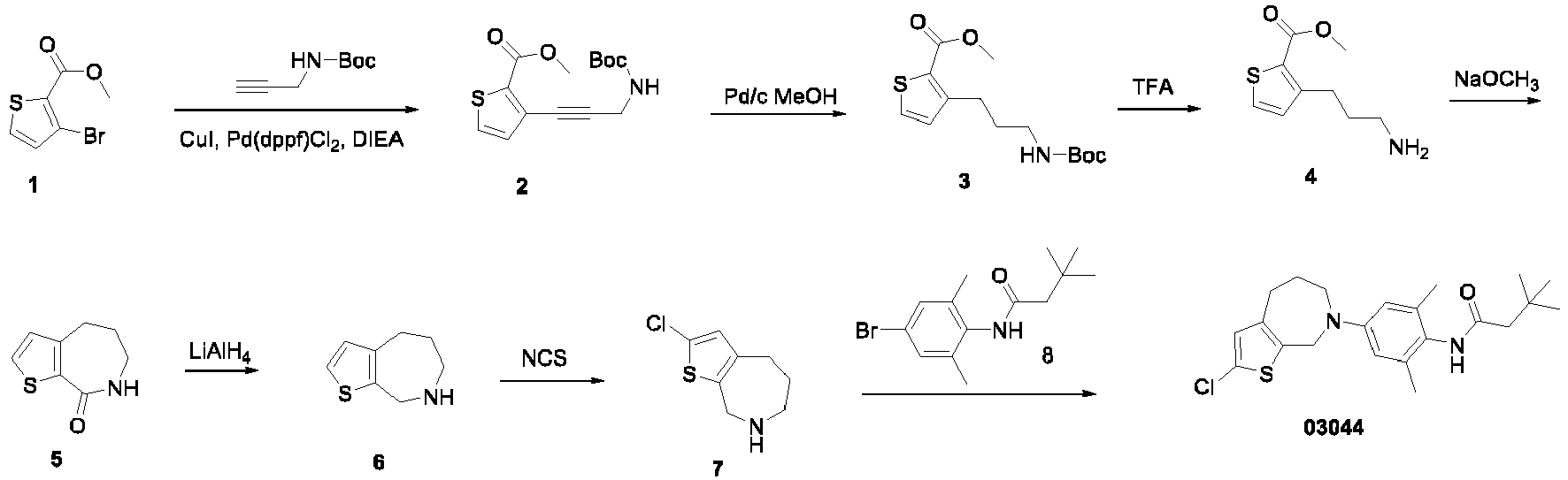
- N-tert-butoxycarbonylaminopropyne (8.4 g, 54 mmol), cuprous iodide (0.86 g, 4.5 mmol), Pd(dppf)Cl2 (1.7 g, 2.3 mmol) and DIEA (8.8 g, 68 mmol) were respectively added into a solution of 3-bromothiophene-2-carboxylic acid methyl ester (10.0 g, 45 mmol) in acetonitrile (100 mL). The reaction mixture was heated to 80 ° C under the protection of nitrogen and reacted for 16 hours. Cooled to room temperature, concentrated in vacuo to remove the solvent, and purified by column chromatography to obtain compound 3 (6.0 g, yield: 45.2%) as a yellow oil.
- MS (ESI): Calcd.for C14H17NO4S 295; Found 318 [M+Na]+.
- Palladium carbon (600 mg) was added into a solution of compound 2 (6.0 g, 0.02 mol) in methanol (40 mL). The mixture was stirred at room temperature under 0.4 MPa hydrogen atmosphere for 16 hours, filtered with suction, the filtrate was concentrated, and purified by column chromatography to obtain yellow oily compound 3 (6.0 g, yield: 100%).
- MS (ESI): Calcd. for C14H21NO4S 299; Found 322 [M+Na]+.
- 2M solution of trifluoroacetic acid in dichloromethane (50 mL) was add to compound 3 (6.0 g, 0.02 mol). The mixture was stirred at room temperature for 2 hours. The filtrate was concentrated to obtain yellow oily compound 4 (4.0 g, yield: 100%).
- MS (ESI): Calcd. for C9H13NO2S 199; Found 200 [M+H]+.
- Sodium methoxide (3.2 g, 0.06 mol) was added to a solution of compound 4 (4.0 g, 0.02 mol) in methanol (50 mL). The mixture was heated to 70°C and stirred for 5 hours. The mixture was cooled to room temperature, filtered, the filtrate was concentrated and purified by column chromatography to obtain compound 5 as a yellow oil (2.8 g, yield: 83.8%).
- MS (ESI): Calcd. for C8H9NOS 167; Found 168 [M+H]+.
- Lithium aluminum hydride (1.9 g, 0.05 mol) was add to a solution of compound 5 (2.8 g, 17 mmol) in tetrahydrofuran (50 mL) under ice bath. The mixture was continuously stirred for 0.5 hour, and then heated to 80°C and reacted for 2 hours. The mixture was cooled to room temperature, quenched, the solvent was concentrated in vacuo, and purified by column chromatography to obtain an off-white solid compound 6 (2.18 g, yield: 83.8%).
- MS (ESI): Calcd. for C8H11NS 153; Found 154 [M+H]+.
- Concentrated hydrochloric acid (1 mL) was added to a solution of compound 6 (2.0 g, 0.013 mol) in tetrahydrofuran (10 mL). The mixture was stirred at room temperature for 10 minutes and concentrated to remove the solvent. The residue was dissolved in tetrahydrofuran (50 mL) and acetic acid (15 mL), and NCS (1.58 g, 0.012 mol) was added in batches. The mixture was reacted at room temperature for 2 hours. The solvent was concentrated in vacuo and purified by column chromatography to obtain an off-white solid compound 7 (2.1 g, yield: 86.4%).
- MS (ESI): Calcd. for C8H10ClNS 187; Found 188 [M+H]+.
- Ruphos-Pd-G3 (940 mg, 11 mmol), sodium tert-butoxide (4.3 g, 45 mmol) and compound 8 (4.67g, 15 mmol) were added into a solution of compound 7 (2.1 g, 11 mmol) in tert-butanol (40 mL), the mixture was heated to 90°C under nitrogen and stirred overnight. The mixture was cooled to room temperature, filtered, washed with ethyl acetate, and concentrated. The residue was purified by Flash to give pale yellow compound 03044 (540 mg, yield: 12.2%).
- MS (ESI): Calcd. for C22H29ClN2OS 404; Found 405 [M+H]+.
- HNMR (400 MHz, CD3OD): δ 8.75 (s, 1H), 6.81(s, 1H), 6.53(s, 2H), 4.57 (s, 2H), 3.84 - 3.75 (m, 2H), 2.82 - 2.73 (m, 2H), 2.16 (s, 2H), 2.04 (s, 6H), 1.75 - 1.65 (m, 2H), 1.04 (s, 9H).
-

- Under ice-cooling, sodium azide (15 g, 250 mmol) was added into a solution of 6,7-dihydrobenzo[b]thiophene-4(5H)-one (15 g, 98 mmol) in hydrochloric acid (100 mL) in batches, the reaction mixture was reacted overnight at room temperature. Ice cubes were added, and the pH was adjusted to be greater than 7 with saturated potassium carbonate aqueous solution, extracted with dichloromethane, dried with anhydrous sodium sulfate, filtered, concentrated, and subjected to silica gel column chromatography to obtain a crude white solid compound 2 (13 g).
- MS (ESI): Calcd.for C8H9NOS 167; Found 168 [M+H]+.
- Under ice cooling, compound 2 (13 g, 78 mmol) was slowly added into a solution of lithium aluminum hydride (8.9 g, 230 mmol) in tetrahydrofuran (200 mL), and the mixture was heated to 70°C and stirred for 1 hour, then water (9 mL), sodium hydroxide aqueous solution (15%, 9 mL) and water (27 mL) were slowly added in sequence, then enough anhydrous magnesium sulfate was added, filtered, concentrated, and the residue was subjected to column chromatography to obtain Compound 3 (9 g, yield: 75%).
- MS (ESI): Calcd.for C8H11NS 153; Found 154 [M+H]+.
- Hydrochloric acid (2.3 g, 62 mmol) was added into a solution of 5,6,7,8-tetrahydro-4H-thieno[3,2-c]azepine (8 g, 50 mmol) in tetrahydrofuran (100 mL), the mixture was stirred at room temperature for 30 minutes. After concentrating to remove excess hydrochloric acid, acetic acid (10 mL) and N-bromosuccinimide (12 g, 68 mmol) were added sequentially. The reaction mixture was stirred at room temperature for 3 hours, a saturated sodium bicarbonate aqueous solution was added to adjust the pH to be greater than 7, and the next step reaction was carried out without purification.
- MS (ESI): Calcd.for C8H10BrNS 230.9; Found 231.9 [M+H]+.
- BOC-anhydride (19 g, 87 mmol) was added into a solution of compound 4 (8 g, 35 mmol) in tetrahydrofuran (200 mL), the mixture was reacted at room temperature for 2 hours, concentrated, and subjected to column chromatography to obtain a crude white solid compound 5 (15 g).
- MS (ESI): Calcd.for C13H18BrNO2S 331; Found 276 [M-56+1]+.
- Potassium carbonate (2.5 g, 18 mmol) was added to a solution of compound 5 (2 g, 6 mmol) in 1,4-dioxane (100 mL), replaced nitrogen for three times, and then 2,4,6-tri methyl-1,3,5,2,4,6-trioxatriborinane (3 g, 24 mmol) and tetrakis(triphenylphosphine) palladium (2 g, 1.8 mmol) were added. The reaction mixture was reacted overnight at 120°C, filtered, concentrated to remove the solvent, and the residue was subjected to column chromatography to obtain crude compound 6 (400 mg).
- MS (ESI): Calcd.for C14H21NO2S 267; Found 212 [M-56+1]+.
- Hydrochloric acid (1.87 mL, 7.49 mmol) was added into a solution of compound 6 (400 mg, 1.49 mmol) in methanol (20 mL), the mixture was stirred at room temperature for 1 hour, concentrated to remove excess hydrochloric acid, and saturated sodium bicarbonate aqueous solution was added to adjust the pH to be greater than 7, the mixture was extracted, dried, and concentrated, and the residue was subjected to column chromatography to obtain crude compound 7 (270 mg).
- MS (ESI): Calcd. for C9H13NS 167; Found 168 [M+H]+.
- The intermediate N-(4-bromo-2,6-dimethylphenyl)-3,3-dimethyl butanamide (528 mg, 1.78 mmol) and sodium tert-butoxide (620 mg, 6.5 mmol) were added into a solution of compound 7 (270 mg, 1.62 mmol) in tert-butanol (30 mL), replaced nitrogen for three times, then methanesulfonic acid (2-dicyclohexylphosphino-2',6'-diisopropoxy -1,1'-biphenyl)(2-amino-1,1'-biphenyl-2-yl)palladium(II) (229 mg, 0.27 mmol) was added, the reaction mixture was heated to 95°C under nitrogen protection and reacted overnight, filtered and concentrated to remove the solvent. The residue was subjected to column chromatography to obtain crude compound 03045, which was further purified by preparative chromatography to obtain compound 03045 (15 mg, yield: 2.4%).
- MS (ESI): Calcd. for C23H32N2OS 384; Found 385 [M+H]+.
- 1H NMR (400 MHz, MeOD): δ 7.04 (s, 2H), 6.69 (s, 1H), 4.65 (s, 2H), 3.96 - 3.92 (m, 2H), 3.04 - 3.00 (m, 2H), 2.39 (s, 3H), 2.33 (s, 2H), 2.25 (s, 6H), 2.07 (s, 2H), 1.15 (s, 9H).
-

- Potassium carbonate (2.5 g, 0.018 mol) was added to a solution of compound 1 (1.5 g, 0.006 mol) in 1,4-dioxane (50 mL), replaced nitrogen for three times, and then tetrakis(triphenylphosphine) Palladium (1.42 g, 0.0012 mol) and 2,4,6-trimethyl-1,3,5,2,4,6-trioxatriborinane (775 mg, 0.006 mol) were added, the reaction mixture was reacted overnight at 100°C, then filtered, extracted, and concentrated. The residue was subjected to column chromatography to obtain crude compound 2 (1.5 g).
- MS (ESI): Calcd.for C9H11NOS 181; Found 182 [M+H]+.
- Under ice cooling, compound 2 (1.5 g, 0.008 mol) was slowly added into a suspension of lithium aluminum hydride (0.9 g, 0.024 mol) in tetrahydrofuran (50 mL). The mixture was stirred at 70°C for 1 hour, and then water (1 mL), sodium hydroxide aqueous solution (15%, 1 mL) and water (3 mL) were slowly added in sequence, and then sufficient anhydrous magnesium sulfate was added, filtrated, concentrated, and the residue was subjected to column chromatography to obtain compound 8 (500 mg, yield: 36.5%).
- MS (ESI): Calcd.for C9H13NS 167; Found 168 [M+H]+.
- The intermediate N-(4-bromo-2,6-dimethylphenyl)-3,3-dimethyl butanamide (897 mg, 3 mmol) and sodium tert-butoxide (1.05 g, 10.9 mmol) were added into a solution of compound 3 (500 mg, 2.7 mmol) in tert-butanol (50 mL). After replacing nitrogen for three times, methanesulfonic acid (2-dicyclohexylphosphino-2',6'-diisopropoxy -1,1'-biphenyl)(2-amino-1,1'-biphenyl-2-yl)palladium(II) (390 mg, 0.46 mmol) was added. The reaction mixture was reacted overnight at 95°C under nitrogen protection, filtered and concentrated to remove the solvent. The residue was subjected to column chromatography to obtain crude compound 03046, which was further purified by preparative chromatography to obtain compound 03046 (46 mg, yield: 4.3%).
- MS (ESI): Calcd. for C23H32N2OS 384; Found 385 [M+H]+.
- 1H NMR (400 MHz, CD3OD): δ 6.79-6.74 (m, 2H), 4.68 (s, 2H), 3.93-3.88 (m, 2H), 2.84-2.79 (m, 2H), 2.29 (s, 2H), 2.17 (s, 6H), 2.11 (s, 3H), 1.95-1.87 (m, 2H), 1.13 (s, 9H).
-

- N-chlorosuccinimide (3.2 g, 23.96 mmol) was added to a solution of 6,7-dihydrobenzo[b]thiophene-4(5H)-one (3.0 g, 19.74 mmol) in acetic acid (30 mL) in batch, the reaction mixture was heated to 50 °C and reacted for 16 hours. The mixture was cooled to room temperature, evaporated to remove most of the solvent, extracted with ethyl acetate, dried with anhydrous sodium sulfate, filtered, concentrated and subjected to column chromatography to obtain compound 2 (3.6 g crude product, yield: 100%).
- MS (ESI): Calcd.for C8H7ClOS 186; Found 187 [M+H]+.
- Hydroxylamine hydrochloride (3.9 g, 56.52 mmol) and sodium acetate (4.6 g, 56.52 mmol) were added into a mixed solution of compound 2 (3.6 g, 19.30 mmol) in ethanol (50 mL) and water (10 mL), and the mixture was heated to reflux for 1 hour. The mixture was cooled to room temperature, concentrated to remove the solvent, and the residue was subjected to column chromatography to obtain compound 3 (3.9 g crude product, yield: 100%).
- MS (ESI): Calcd.for C8H8ClNOS 201; Found 202 [M+H]+..
- In an ice-water bath, a solution of diisobutylaluminum hydride in n-hexane (1 mol/L, 10 mL) was added dropwise into a solution of compound 3 (1.0 g, 4.90 mmol) in dichloromethane (30 mL). The mixture was slowly raised to room temperature under the protection of nitrogen, and stirred at room temperature for 3 hours. When the temperature was lowered to 0°C, water (0.4 mL), sodium hydroxide aqueous solution (15%, 0.4 mL) and water (1.0 mL) were slowly added in sequence, then enough anhydrous magnesium sulfate was added, filtered, concentrated, the residue was subjected to column chromatography to obtain compound 4 (340 mg, yield: 36.6%).
- MS (ESI): Calcd. for C8H10ClNS 187; Found 188 [M+H]+.
- N-(4-bromo-2,6-dimethylphenyl)-3,3-dimethyl butanamide (1.19 g, 4.00 mmol), sodium tert-butoxide (1.03 g, 10.70 mmol), methanesulfonic acid (2-dicyclohexylphosphino-2',6'-diisopropoxy-1,1'-biphenyl)(2-amino-1,1'-biphenyl-2-yl)palladiu m(II) (224 mg, 0.27 mmol) were added into a solution of compound 5 (500 mg, 2.67 mmol) in tert-butanol (20 mL) under nitrogen atmosphere. The mixture was reacted at 90°C for sixteen hours. After the mixture was cooled to room temperature, filtered, the filtrate was concentrated in vacuo to remove the solvent, and the residue was purified by column chromatography to obtain the crude product, which was then separated by preparative chromatography to obtain compound 03049 (27.02 mg, yield: 2.5%).
- MS (ESI): Calcd. for C22H29ClN2OS 404; Found 405 [M+H]+.
- HNMR (400 MHz, CD3OD): δ 6.67 (s, 1H), 6.50 (s, 2H), 3.71-3.68 (m, 2H), 2.71-2.68 (m, 2H), 2.30 (s, 2H), 2.15 (s, 6H), 1.90-1.86 (m, 2H), 1.72-1.71 (m, 2H), 1.15 (s, 9H).
-

- Hydroxylamine hydrochloride (1.5 g, 21.59 mmol) and sodium acetate (2.34 g, 28.54 mmol) were added into a solution of 4-fluoro-2-hydroxybenzaldehyde (1.0 g, 7.14 mmol) in ethanol (50 mL), and the mixture was heated to reflux for two hours. The mixture was cooled to room temperature, concentrated to remove the solvent, extracted with ethyl acetate, dried over anhydrous sodium sulfate, filtered, concentrated to remove the solvent to obtain a crude product. The crude product was dissolved in ethanol (50 mL), and concentrated hydrochloric acid (3.5 mL) and 10% palladium on carbon (300 mg) were added. The mixture was stirred at room temperature under 0.4 MPa hydrogen atmosphere for 16 hours, filtered with suction, and the filtrate was adjusted to pH8 with sodium bicarbonate. After concentration, the residue was purified by column chromatography to obtain compound 2 (1.0 g, yield: 100%).
- MS (ESI): Calcd.for C7H8FNO 141; Found 125 [M-NH2]+.
- Chloroacetyl chloride (88 mg, 0.78 mmol), potassium carbonate (294 mg, 2.13 mmol) and tetrabutyl ammonium bromide (23 mg, 0.071 mmol) were added into a solution of compound 2 (100 mg, 0.71 mmol) in acetonitrile (10 mL) consequently. The reaction mixture was heated to 80 ° C under the protection of nitrogen and reacted for 16 hours. The mixture was cooled to room temperature, suction filtered, the filtrate was concentrated in vacuo, and purified by column chromatography to obtain compound 3 (80 mg, yield: 62.5%).
- MS (ESI): Calcd. for C9H8FNO2 181; Found 182 [M+H]+.
- Compound 3 (800 mg, 2.99 mmol) was added to a suspension of lithium tetrahydroaluminum (420 mg, 11.05 mmol) in tetrahydrofuran (20 mL). The mixture was stirred at room temperature for 16 hours under a nitrogen atmosphere. The reaction system was quenched with water (0.42 mL), 15% sodium hydroxide in water (0.42 mL) and water (1.26 mL), dried over anhydrous magnesium sulfate, filtered with suction. The filter cake was washed with dichloromethane, the filtrate was concentrated, and purified by column chromatography to obtain compound 4 (583 mg, yield: 79.0%).
- MS (ESI): Calcd. for C9H10FNO 167; Found 168 [M+H]+.
- N-(4-bromo-2,6-dimethylphenyl)-3,3-dimethyl butanamide (1.04 g, 3.49 mmol), sodium tert-butoxide (1.34 g, 13.97 mmol), methanesulfonic acid (2-dicyclohexylphosphino-2',6'-diisopropoxy-1,1'-biphenyl)(2-amino-1,1'-biphenyl-2-yl)palladiu m(II) (292 mg, 0.35 mmol) were added into a solution of compound 4 (583 mg, 3.49 mmol) in tert-butanol (20 mL) under nitrogen atmosphere. The mixture was reacted at 90°C for sixteen hours. After the mixture was cooled to room temperature, filtered, the filtrate was concentrated in vacuo to remove the solvent, and the residue was purified by column chromatography to obtain the crude product, which was then separated by preparative chromatography to obtain compound 03058 (78.91 mg, yield: 5.9%).
- MS (ESI): Calcd. for C23H29FN2O2 384; Found 385 [M+H]+.
- HNMR (400 MHz, CD3OD): δ 7.41-7.31 (m, 1H), 6.75-6.61 (m, 4H), 4.61 (s, 2H), 4.16-4.15 (m, 2H), 3.90-3.88 (m, 2H), 2.27 (s, 2H), 2.14 (s, 6H), 1.14 (s, 9H).
-

- At room temperature, sodium acetate (1.6 g, 19.7 mmol), hydroxylamine hydrochloride (1.3 g, 19.7 mmol) and water (2 mL) were added into a solution of 7-fluorochroman-4-one (1.0 g, 6.5 mmol) in ethanol (10 mL) consequently, the reaction mixture was heated to 90°C and reacted for 2 hours. The mixture was cooled to room temperature, diluted with water, extracted with ethyl acetate, dried over anhydrous sodium sulfate, filtered, concentrated, and purified by Flash to obtain solid compound 2 (1.10 g, yield: 93.4%).
- MS (ESI): Calcd.for C9H8FN02 181; Found 182 [M+H]+.
- In an ice bath, diisobutylaluminum hydride solution (1 N, 30.37 mL) was slowly added to a solution of compound 2 (1.1 g, 6.07 mmol) in dichloromethane (30 mL), and the mixture was stirred at room temperature under nitrogen protection for 5 hours, then water (1.2 mL), 10% sodium hydroxide (1.2 mL) and water (3.6 mL) were added in sequence, stirred at room temperature for 30 minutes, filtered. The filter cake was washed with ethyl acetate, and the filtrate was extracted with ethyl acetate, washed with saturated brine, dried with anhydrous sodium sulfate, concentrated, and purified by Flash to obtain compound 3 (0.9 g, yield: 88.3%).
- MS (ESI): Calcd.for C9H10FN0 167; Found 168 [M+H]+.
- Ruphos-Pd-G3 (150.5 mg, 0.18 mmol), sodium tert-butoxide (695 mg, 7.16 mmol) and compound 4 (586 mg, 1.79 mmol) were added into a solution of compound 3 (300 mg, 1.79 mmol) in tert-butanol (10 mL). The mixture was stirred overnight at 80°C under nitrogen. The mixture was cooled to room temperature, filtered, washed with ethyl acetate, and concentrated residue was purified by Flash (ethyl acetate/petroleum ether = 1 / 5) to obtain light yellow compound 03059 (470.08 mg, yield: 78.5%).
- MS (ESI): Calcd. for C23H29FN2O2 384; Found 385 [M+H]+.
- 1H NMR (400 MHz, CDCl3) δ 7.10-7.02 (m, 1H), 6.75-6.66 (m, 1H), 6.68-6.60 (m, 1H), 6.57 (s, 2H), 6.50 (s, 1H) ), 4.12 (t, J= 6.0 Hz, 2H), 3.87 (t, J= 6.0 Hz, 2H), 2.29 (s, 2H), 2.17 (s, 6H), 2.17-2.07 (m, 2H), 1.16 (s, 9H).
-

- BOC2O (10.63 g, 48.717 mmol) and triethylamine (14.79 g, 146.151 mmol) were added into a solution of 2-amino-5-methylphenol 1 (6 g, 48.717 mmol) in dichloromethane (60 mL). The mixture was stirred overnight at room temperature. The mixture was washed with water and saturated NaCl solution, dried with Na2SO4, concentrated and purified by column chromatography (n-hexane/ethyl acetate=10:1) to obtain (2-hydroxy-4-methylphenyl) carbamate tert-butyl ester 2 (4.2g, 38%).
- LCMS: [M+Na] + = 246.2
- 1,3-dibromopropane (3.1g, 15.695mmol) and K2CO3 (4.96g, 35.874mmol) were added into a solution of tert-butyl (2-hydroxy-4-methylphenyl) carbamate 2 (1g, 4.484mmol) in acetone (30mL). The mixture was stirred at 75°C for 0.5 hour. After cooling to room temperature, the mixture was diluted with ethyl acetate and filtered. The filtrate was concentrated and purified by column chromatography (n-hexane/ethyl acetate=15:1) to obtain tert-butyl (2-(3-bromopropoxy)-4-methylphenyl)carbamate 4 (660mg, 43%), as a colorless oil.
- LCMS: [M+Na] + = 366.1.
- NaH (60%, 307mg, 7.674mmol) was added to a solution of tert-butyl (2-(3-bromopropoxy)-4-methylphenyl)carbamate 4 (660mg, 1.918mmol) in THF (20mL), the mixture was stirred at room temperature for 0.5 hours. The mixture was poured into ice water, extracted with ethyl acetate (2x20 mL), washed with water and saturated sodium chloride solution, dried over anhydrous sodium sulfate, concentrated, and purified by column chromatography (n-hexane/ethyl acetate=15: 1) to obtain 8-methyl-3,4-dihydrobenzo[b] [1,4]oxazepine-5(2H)-carboxylic acid tert-butyl ester 5 (385mg, 76%) as a white solid.
- LCMS: [M+Na] + = 286.2
- 4 ml of trifluoroacetic acid was added to a solution of 8-methyl-3,4-dihydrobenzo[b][1,4]oxazepine-5(2H)-carboxylic acid tert-butyl ester 5 (385mg, 1.464mmol) in dichloromethane (4mL), and the mixture was stirred at room temperature for 1 hour. The mixture was concentrated and 30 ml of dichloromethane was added to dissolve the residue. The solution was washed with saturated NaHCO3 solution and saturated sodium chloride solution, dried over anhydrous sodium sulfate, concentrated and purified by column chromatography (n-hexane/ethyl acetate=7:3) to obtain 8-methyl-2,3,4 ,5-tetrahydrobenzo[b] [1,4]oxazepine 6 (175 mg, 73%) as a brown oil.
- LCMS: [M+H] + = 164.2.
- N-(4 -iodine-2,6-dimethylphenyl)-3,3-dimethylbutanamide 7 (1.12g, 3.25mmol), Pd2(dba)3 (229mg, 0.25mmol), Xantphos (289mg, 0.50mmol) ) And t-BuOK (842mg, 7.50mmol) was added to a solution of 8-methyl-2,3,4,5-tetrahydrobenzo[b][1,4]oxazepin 6 (408mg, 2.50mmol) in toluene (25mL). The mixture was stirred at 100°C for 16 hours under a nitrogen atmosphere. The mixture was filtered, and the filtrate was concentrated, and purified by column chromatography (dichloromethane/methanol=30:1) to obtain a yellow oil. Purified by preparative HPLC (column: Kromasil-C18 100x21.2mm, 5um mobile phase: ACN-H2O (0.05%NH3) gradient: 35-45) to obtain the target compound 03063 (30.4mg, 0.08mmol, 3%) as an off-white solid.
- LCMS: [M+H] + = 381.3.
- 1H NMR (400 MHz, DMSO) δ 8.83 (s, 1H), 7.03-6.74 (m, 3H), 6.48 (s, 2H), 3.98 (s, 2H), 3.78 (s, 2H), 2.31- 1.97 (m, 13H), 1.05 (s, 9H).
-

- Step one: 2-chloro-N-(2-(hydroxymethyl)-4-methylphenyl)acetamide (Compound 3) 2-amino-5-methylbenzyl alcohol 1 (3.0g, 21.9mmol), 2-chloroacetyl chloride (2.7g, 24mmol) and DIEA (5.66g, 43.8mmol) were dissolved in 50mL of dichloromethane and stirred at room temperature for 2 hours. The reaction solution was quenched with saturated sodium bicarbonate solution, the organic layer was separated and washed with water (2x50mL) and saturated sodium bicarbonate solution (2x50mL), dried over anhydrous sodium sulfate, concentrated and purified by column chromatography (n-hexane/ethyl acetate = 5/1) to obtain 2-chloro-N-(2-(hydroxymethyl)-4-methylphenyl)acetamide 3 (3.6g, 77%) as a yellow solid.
- LCMS: [M+H] + = 196.1
- At 0°C, NaH (600mg, 25mmol) was added to a solution of 2-chloro-N-(2-(hydroxymethyl)-4-methylphenyl)acetamide 3 (2.6g, 12.5mmol) in tetrahydrofuran (60mL), the mixture was stirred at 0°C for 1 hour, then slowly quenched by adding water, and then ethyl acetate (2x50mL) was added. The organic layer was washed with water (2x50mL) and saturated sodium bicarbonate solution (2x50mL), dried over anhydrous sodium sulfate, concentrated and purified by column chromatography (n-hexane/ethyl acetate=3/1) to obtain 7-methyl-1,5-dihydrobenzo[e][1,4]oxazepine-2(3H)-one 4 (2.1g, 94%) as a yellow solid.
- LCMS: [M+H] + = 178.1
- LiAlH4 (350mg, 9.15mmol) was slowly added into a solution of 7-methyl-1,5-dihydrobenzo[e] [1,4]oxazepine-2(3H)-one 4 (810mg, 4.57mmol) in tetrahydrofuran at 0°C, the reaction was refluxed for 1 hour. The solution was cooled to 0°C, and tetrahydrofuran and Na2SO4 solution were slowly added. The mixture was stirred for 10 minutes and then Na2SO4 solution was added. The mixture was filtered, the organic layer was concentrated, and purified by column chromatography (n-hexane/ethyl acetate=5/1) to obtain 7-methyl-1,2,3,5-tetrahydrobenzo[e] [1,4] oxazepine 5 (600mg, 80%) as a yellow solid.
- LCMS: [M+H] + = 164.1
- A solution of compound 5 (300mg, 1.84mmol), compound 6 (762mg, 2.2mmol), Pd2 (dba) 3 (165mg, 0.18mmol), X-Phos (213mg, 0.37mmol) and Cs2CO3 (1.2g, 3.68mmol) in toluene (15 mL) was stirred at 110°C for 16 hours. After the reaction solution was cooled to room temperature, 10 mL of ethyl acetate was added to the mixture, and the resultant mixture was washed with saturated sodium chloride solution (2x20 mL), and dried with anhydrous sodium sulfate. The solution was concentrated and purified by preparative HPLC (0.1% FA) to obtain compound 03066 (55 mg, 8%) as a white solid.
- LCMS: [M+H] + = 381.2
- 1H NMR (400 MHz, DMSO) δ 8.82 (br s, 1H), 7.20 (s, 1H), 7.11 (dd, J= 8.4, 2.0 Hz, 1H), 7.01 (d, J= 8.0 Hz, 1H), 6.40 (s, 2H), 4.42 (s, 2H), 3.74-3.70 (m, 4H), 2.30 (s, 3H), 2.16 (s, 2H), 2.01 (s, 6H), 1.04 (s, 9H).
-

- Chloroacetyl chloride (490 mg, 4.33 mmol), potassium carbonate (1.63 g, 11.82 mmol) and tetrabutyl ammonium bromide (126 mg, 0.39 mmol) were added to a solution of 2-amino-5-fluorophenol (500 mg, 3.94 mmol) in acetonitrile (5 mL) consequently. The reaction mixture was heated to 65 ° C under the protection of nitrogen and reacted for 15 hours. The mixture was cooled to room temperature, filtered with suction, the filtrate was concentrated in vacuo, and purified by column chromatography to obtain a yellow oily compound (500 mg, yield: 76.05%).
- MS (ESI): Calcd.for C8H6FNO2 167; Found 168 [M+H]+.
- Compound 2 (500 mg, 2.99 mmol) was added to a suspension of lithium tetrahydroaluminum (284 mg, 7.48 mmol) in tetrahydrofuran (5 mL). The mixture was stirred at room temperature for 16 hours under a nitrogen atmosphere. The reaction system was quenched with water and 15% sodium hydroxide aqueous solution, filtered with suction, and the filtrate was extracted with ethyl acetate, concentrated, and purified by column chromatography to obtain compound 3 as a yellow oil (252 mg, yield: 55.01%).
- MS (ESI): Calcd. for C8H8FNO 153; Found 154 [M+H]+.
- Compound 4 (532 mg, 1.79 mmol), Pd2(dba)3 (126.6 mg, 0.16 mmol), and sodium tert-butoxide (632.4 mg, 6.52 mmol) were added to a solution of compound 3 (250 mg, 1.63 mmol) in tert-butanol (5 mL). The mixture was reacted at 85°C for 15 hours. The reaction mixture was cooled to room temperature, filtered, and the filtrate was concentrated in vacuo. The residue was purified by preparative high performance liquid chromatography to obtain a white solid compound 03060 (46.40 mg, yield: 7.67%).
- MS (ESI): Calcd. for C22H27FN2O2 370; Found 371 [M+H]+.
- HNMR (400 MHz, CD3Cl3): δ 6.87-6.90 (m, 3H), 6.66-6.48 (m 3H), 4.25 (t, J= 4.0 Hz, 2H), 3.67 (s, 2H), 2.33 (s, 2H), 2.23 (s, 6H), 1.18 (s, 9H).
-

- Hydroxylamine hydrochloride (1.13 g, 16.29 mmol) and sodium acetate (1.34 g, 16.29 mmol) were added to a mixed solution of 7,8-dihydroquinoline-5(6H)-one (1.0 g, 6.79 mmol) in methanol/water (40 mL / 6 mL), and the mixture was heated to reflux for two hours. The mixture was cooled to room temperature, concentrated to remove the solvent, water was added, filtered, and the filter cake was dried to obtain compound 2 (1.1 g crude product, yield: 100%).
- MS (ESI): Calcd.for C9H10N2O 162; Found 163 [M+H]+.
- Potassium hydroxide (381 mg, 6.79 mmol) and water (10 mL) were added to a solution of compound 2 (1.10 g, 6.79 mmol) in acetone (25 mL), and then p-toluenesulfonyl chloride (1.94 g, 10.18 mmol) was added. The mixture was heated to reflux for 1 hour. The mixture was cooled to room temperature, concentrated to remove the solvent, water was added, filtered, and the filter cake was dried to obtain compound 3 (2.1 g crude product, yield: 100%).
- MS (ESI): Calcd. for C16H16N2O3S 316; Found 317 [M+H]+.
- Potassium acetate (1.5 g, 15.28 mmol) was added to a mixed solution of compound 3 (2.1 g, 6.65 mmol) in ethanol/water (20 mL / 40 mL). The mixture was heated to reflux for sixteen hours. The mixture was cooled to room temperature, concentrated to remove the solvent, water was added, and PH was adjusted to be 10 with 5N sodium hydroxide. The reaction mixture was extracted with dichloromethane, dried with anhydrous sodium sulfate, filtered, concentrated to remove the solvent, and the crude product was column chromatography to obtain compound 4 (750 mg, yield: 75.0%).
- MS (ESI): Calcd. for C9H10N2O 162; Found 163 [M+H]+.
- A solution of borane in tetrahydrofuran (1 mol/L, 14 mL) was added dropwise to a solution of compound 4 (750 mg, 4.63 mmol) in tetrahydrofuran (30 mL). The mixture was continuously stirred for 0.5 hour, and then heated to 60°C and reacted for 2 hours. The mixture was cooled to room temperature, quenched with methanol, concentrated in vacuo to remove the solvent, and the residue was purified by column chromatography to obtain compound 5 (400 mg, yield: 58.0%).
- MS (ESI): Calcd. for C9H12N2 148; Found 149 [M+H]+.
- Under nitrogen atmosphere, N-(4-bromo-2,6-dimethylphenyl)-3,3-dimethylbutanamide (160 mg, 0.54 mmol), Pd2(dba)3 (25 mg, 0.034 mmol), tri-tert-butylphosphorus n-hexane solution (0.1 mL) and potassium tert-butoxide (61 mg, 0.54 mmol) were added to a solution of compound 5 (40 mg, 0.27 mmol) in DMSO (2 mL). The mixture was reacted in microwave at 150°C for one hour. After the mixture was cooled to room temperature, the reaction mixture was quenched with water, extracted with ethyl acetate, dried over anhydrous sodium sulfate, concentrated in vacuo to remove the solvent, and the residue was purified by column chromatography to obtain the crude product, which was further purified by preparative chromatography to obtain compound 03030 (13.59 mg, yield: 11.0%).
- MS (ESI): Calcd. for C23H31N3O 365; Found 366 [M+H]+.
- HNMR (400 MHz, CD3OD): δ 8.29 (s, 1H), 7.97-7.93 (m, 1H), 7.66-7.64 (m, 1H), 6.85 (s, 2H), 3.90-3.88 (m, 2H)), 3.33-3.25 (m, 2H), 2.34 (s, 2H), 2.21 (s, 6H), 1.99-195 (m, 4H), 1.16 (s, 9H).
- Cell preparation: CHO-KCNQ2 cells were cultured in a 175 cm2 culture flask, and when the cells was grown to a density of 60-80%, the culture medium was removed, washed with 7 mL PBS (Phosphate Buffered Saline) once, then 3 mL 0.25% Trypsin was added to digest. After the digestion was completed, 7 mL culture medium (90% DMEM/F12 + 10% FBS + 500 µg/mL G418) was added to neutralize, centrifugated for 3 minutes at 800 rpm. The supernatant was aspirated, then 5 mL culture medium was added to resuspend, and then the cells were counted.
- Cell plating: The density to 3×10⁴/well was adjusted according to the results of cell counting. After standing at room temperature for 30 minutes, the cells were placed in a 37°C CO2 incubator and incubated overnight for 16-18 hours. The cell density reached about 80%.
- Fluorescent dye incubation: The cell culture medium was discarded, 80 µL/well loading buffer was added, and the cells were incubated in dark at room temperature for 60 minutes.
- Compound incubation: the loading buffer was discarded, 80 µL/well prepared compound solution was added, incubated at room temperature and in dark for 20 minutes.
- Fluorescence data collection: FDSS/µCELL instrument for real-time fluorescence is used for signal recording, wherein excitation wavelength was 480 nm, emission wavelength was 540 nm, and signals were recorded 1 times per second, after baseline was recorded for 10 seconds, the addition of 20 µL/well stimulation buffer was started, and then the signal was continuously record until the end of 180 seconds.
- loading buffer: 10mL/plate, the preparation method was as follows:
component volume PowerLoad ™ Concentrate, 100X (ingredient C) 100 µL FluxOR ™ reagent, rebuild in DMSO (step 1.2) 10 µL Deionized water 8.8 mL FluxOR ™ Test Buffer, 10X (ingredient B) 1 mL Probenecid, reconstituted in deionized water (step 1.1) 100 µL Total volume 10mL - Test buffer sample:100mL/plate, the preparation method was as follows:
component volume Deionized water 8.9 mL FluxOR ™ Test Buffer, 10X (ingredient B) 1 mL Probenecid, reconstituted in deionized water (step 1.1) 100 µL Total volume 10 mL - Stimulation buffer:5mL/plate, the preparation method was as follows:
component volume + K+ -K+ Deionized water 2.5 mL 3.5 mL FluxOR ™ Chlorine-free buffer, 5X (ingredient E) 1 mL 1 mL K2SO4 concentrate (125mM K2SO4 concentrated solution, ingredient F) 1 mL / Tl2SO4 concentrate (50mM Tl2SO4 concentrated solution, ingredient G) 0.5 mL 0.5 mL Total volume 5 mL 5 mL - The above buffer was from a commercially available kit, the kit name was FluxOR potassium ion channel assay, the manufacturer's brand was Invitrogen, the article number was F10017, the lot number was 913728.
- 20 mM DMSO compound mother liquor was prepared, 10 µL of 20 mM compound mother liquor was took and added into 20 µL DMSO solution, serially diluted 3 times to 8 intermediate concentrations; then the middle concentration of the compound was took to the test buffer, 200 times dilution to get the final concentration to be tested. 80 µL was took and added to the test plate.
- The highest test concentration was 100 µM, followed by 100, 33.33, 11.11, 3.70, 1.23, 0.41, 0.137, 0.045 µM, total 8 concentrations. Each concentration 3 replicate holes.
- The content of DMSO in the final test concentration did not exceed 0.5%. This concentration of DMSO had no effect on the KCNQ2 potassium channel.
- Experimental data was analyzed by Excel 2007 and GraphPad Prism 5.0 software, and the ratio of 180 seconds was calculated to calculate the excitement effect. The excitement effect of the compound is calculated by the following formula:

-
- Environment: Temperature about25°C
- Reagent: FluxORTM Detection Kit (Invitrogen, Cat #F0017)
- The experimental data in the report might meet the following criteria: Z' Factor> 0.5
-
Table 1. Test results of some compounds of the present invention Compound number Compound structure EC50 (uM) ZTZ240 (positive control) 
8.23 Compound 03026 
0.088 Compound 03027 
0.147 Compound 03028 
0.272 Compound 03029 
14.72 Compound 03034 
0.071 Compound 03039 
0.409 Compound 03043 
0.023 Compound 03044 
0.057 Compound 03049 
0.260 Compound 03058 
0.008 Compound 03059 
0.86 Compound 03066 
0.049 Compound 03060 
> 100 Compound 03037 
6.48 Compound A ( WO2014/048165 A1 )
0.065 Compound B ( WO2008/024398 A2 )
0.098 - References for the above test methods:
- (1) Zhaobing Gao et al. Journal of Biological Chemistry. 2010, 285(36): 28322-28332.
- (2) Jinfeng Yue et al. Acta Pharmacologica Sinica. 2016, 37:105-110.
- It can be known from above Table 1:
- 1) Comparing compound A (structural formula:


- 2) Comparing compound B (structural formula:


- 3) Comparing compound 03060 (structural formula:


-
- 1) Research purpose: To obtain the pharmacokinetic characteristics of compound 03058 in male ICR mice
- 2) Experimental content
6 healthy male ICR mice (body weight range of 18-22 grams) were taken, divide them into 2 groups (3 mice/group, and 3 mice/time point), fasted for more than 12 hours (only oral administration group), and administered intravenously(0.05mg/kg), orally (1mg/kg), at time points of 0.083 (intravenous administration only), 0.25, 0.5, 1, 2, 4, 6 (only oral administration). After 8 and 24h, blood were collected by cardiac puncture. At least 0.3 mL of whole blood was transferred to the EDTA-K2 anticoagulation tube, and within half an hour, the plasma was collected by centrifugation (6000 rpm, 8 minutes, 4°C), and frozen at -20°C for use. (Compound configuration: 5% DMAC+10% Solutol HS 15+85% Saline was used to prepare a solution having a concentration of iv 0.01 mg/mL and po 0.1 mg/mL). - Experimental results: According to the blood drug concentration data obtained, the non-compartmental model of WinNonlin® 7.0 software (Pharsight, USA) was used to calculate the pharmacokinetic parameters after administration.
Table 2 Pharmacokinetic parameters of a single dose of 03058 in male ICR mice parameter unit Intravenous 0.05mg/kg Gavage 1mg/kg plasma plasma T1/2 (h) 0.73 1.05 T max (h) / 0.5 C max ng/mL 15.1 17.0 AUC last hr*ng/mL 7.2 43.6 AUC Inf hr*ng/mL 7.2 43.6 F % / 30.47 - It can be seen from the results in Table 2 that compound 03058 has good pharmacokinetic properties.
-
- 1) Research purpose: To obtain the pharmacokinetic characteristics of compounds 03043 and 03044 in male SD rats and their blood-brain barrier (BBB) penetration
- 2) Experimental content
15 healthy male SD rats (weight range of 200-250 g) were taken and divided into 3 groups. 3 rats were used for intravenous administration in group 1, 3 rats were used for oral administration in group 2, and 9 rats were used for the determination of cerebral blood ratio after oral administration in group 3 (3 rats/time point). Group 2 and group 3 were fasted for more than 12 hours. Intravenous: 1mg/kg, oral 5mg/kg, at time point 0.083 (only group 1), 0.25 (only groups 1 and 2), 0.5 (only groups 1 and 2), 1, 2 (only groups 1 and 2). After 4, 8 and 24h (only group 1 and group 2), blood was collected by jugular vein or cardiac puncture, and at least 0.3 mL of whole blood was collected into an EDTA-K2 anticoagulant tube. Within half an hour, the plasma was collected by centrifugation (6000 revolutions, 8 minutes, 4°C), frozen at -20°C for later use. At the same time, brain tissues were collected from group 3 (time points were 1, 4, and 8h respectively), washed with normal saline, blotted dry with absorbent paper, weighed, and frozen at -20°C for use. (Compound preparation: 5%DMAC+10%Solutol HS 15+85%Saline was used to prepare a solution having a concentration of iv 0.2 mg/mL and po 0.3 mg/mL). - Experimental results: According to the blood drug concentration data obtained, the non-compartmental model of WinNonlin® 7.0 software (Pharsight, USA) was used to calculate the pharmacokinetic parameters after administration.
Table 3 Pharmacokinetic parameters of a single dose of male SD rats parameter unit Compound 03043 Compound 03044 Intravenous 1mg/kg Gavage 5mg/kg Intravenous 1mg/kg Gavage 5mg/kg plasma plasma plasma plasma T1/2 (h) 1.42 12.35 1.8 7.08 T max (h) / 0.25 / 0.67 C max ng/mL 2044.6 128.7 1736.2 117.6 AUC last hr*ng/mL 957.4 612.1 1039.3 722.9 AUC Inf hr*ng/mL 963.7 1110.6 1058.3 889.0 F % / 12.79 / 13.9 Table 4 Plasma (ng/mL) and brain concentration (ng/g) in male SD rats after a single oral administration of compounds Compound Time point (h) Plasma (ng/mL) Brain (ng/g) Cerebral blood ratio 03043 1 32.2 67.1 2.4 4 47.9 65.7 1.5 8 20.8 20.0 1.0 03044 1 112.1 250.8 2.2 4 50.2 102.5 2.1 8 41.3 67.6 1.7 - It can be seen from the results in Table 3 that compounds 03043 and 03044 have good pharmacokinetic properties.
- It can be seen from the results in Table 4 that after oral administration of compounds 03043 and 03044 to male SD rats, they have a good cerebral blood ratio (1.0-2.4) at each time point. In previous studies, we found that the cerebral blood ratio of compound A (
WO2014/048165 A1 ) was about 0.5 (the cerebral blood ratio at 2h was 0.56; the cerebral blood ratio at 4h was 0.46). The above results suggest that, compared with the six-membered ring compound A, the seven-membered ring compounds 03043 and 03044 have a more excellent cerebral blood ratio.
Claims (7)
- The compound represented by formula A or a pharmaceutically acceptable salt thereof:
 ring B is
 ring B is
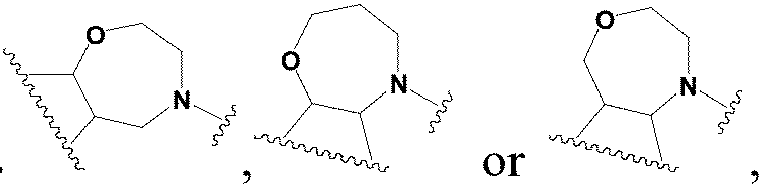 R1 is a substituent on ring A;R2 is a substituent on ring B;R3 and R4 are substituents on six-membered ring;R1 and R2 are each independently hydrogen, halogen, nitro, cyano, C1-6 alkyl, C1-6 alkoxy, halogenated C1-6 alkyl, halogenated C1-6 alkoxy, C3-6 cycloalkyl, C1-6 alkaneamino;R3 and R4 are each independently C1-6 alkyl;Y is CH;Z is (CH2) n, n is 1;R5 is C1-6 alkyl.
 - The compound of claim 1 or a pharmaceutically acceptable salt thereof, wherein:ring B is
 R1 is a substituent on ring A;R2 is a substituent on ring B;R3 and R4 are substituents on six-membered ring;R1 and R2 are each independently hydrogen, halogen, nitro, cyano, C1-6 alkyl, C1-6 alkoxy, halogenated C1-6 alkyl, halogenated C1-6 alkoxy, C3-6 cycloalkyl, C1-6 alkaneamino;R3 and R4 are each independently C1-6 alkyl;Y is CH;Z is (CH2) n, n is 1;R5 is C1-6 alkyl.
 - The compound of claim 1 or a pharmaceutically acceptable salt thereof, wherein:ring B is
 R1 is a substituent on ring A;R2 is a substituent on ring B;R3 and R4 are substituents on six-membered ring;R1 and R2 are each independently hydrogen, halogen, nitro, cyano, C1-6 alkyl, C1-6 alkoxy, halogenated C1-6 alkyl, halogenated C1-6 alkoxy, C3-6 cycloalkyl, C1-6 alkaneamino;R3 and R4 are each independently C1-6 alkyl;Y is CH;Z is (CH2) n, n is 1;R5 is C1-6 alkyl.
 - The compound of claim 1 or a pharmaceutically acceptable salt thereof, wherein:ring B is
 R1 is a substituent on ring A;R2 is a substituent on ring B;R3 and R4 are substituents on six-membered ring;R1 and R2 are each independently hydrogen, halogen, nitro, cyano, C1-6 alkyl, C1-6 alkoxy, halogenated C1-6 alkyl, halogenated C1-6 alkoxy, C3-6 cycloalkyl, C1-6 alkaneamino;R3 and R4 are each independently C1-6 alkyl;Y is CH;Z is CH2;R5 is C1-6 alkyl.
 - The compound of claim 1 or a pharmaceutically acceptable salt thereof, wherein the compound is selected from the group consisting of:


- A pharmaceutical composition comprising one or more pharmaceutically acceptable carriers or diluents and a compound of claim 1 or a pharmaceutically acceptable salt thereof.
- Use of a compound of claim 1 or a pharmaceutically acceptable salt thereof or a pharmaceutical composition of claim 6 for the preparation of a medicament regulating ion current in the potassium channel in mammal.
Priority Applications (2)
| Application Number | Priority Date | Filing Date | Title |
|---|---|---|---|
| HRP20231475TT HRP20231475T1 (en) | 2018-05-22 | 2019-05-22 | P-phenylenediamine derivative as potassium channel regulator and preparation method and medical application thereof |
| RS20230957A RS64710B1 (en) | 2018-05-22 | 2019-05-22 | P-phenylenediamine derivative as potassium channel regulator and preparation method and medical application thereof |
Applications Claiming Priority (2)
| Application Number | Priority Date | Filing Date | Title |
|---|---|---|---|
| CN201810493023 | 2018-05-22 | ||
| PCT/CN2019/088012 WO2019223732A1 (en) | 2018-05-22 | 2019-05-22 | P-phenylenediamine derivative as potassium channel regulator and preparation method and medical application thereof |
Publications (4)
| Publication Number | Publication Date |
|---|---|
| EP3798220A1 EP3798220A1 (en) | 2021-03-31 |
| EP3798220A4 EP3798220A4 (en) | 2022-02-23 |
| EP3798220B1 true EP3798220B1 (en) | 2023-08-23 |
| EP3798220C0 EP3798220C0 (en) | 2023-08-23 |
Family
ID=68617196
Family Applications (1)
| Application Number | Title | Priority Date | Filing Date |
|---|---|---|---|
| EP19808475.8A Active EP3798220B1 (en) | 2018-05-22 | 2019-05-22 | P-phenylenediamine derivative as potassium channel regulator and preparation method and medical application thereof |
Country Status (14)
| Country | Link |
|---|---|
| US (2) | US11365181B2 (en) |
| EP (1) | EP3798220B1 (en) |
| JP (1) | JP7294681B2 (en) |
| KR (1) | KR102599761B1 (en) |
| CN (2) | CN110511220B (en) |
| AU (1) | AU2019272383B2 (en) |
| BR (1) | BR112020023861A2 (en) |
| CA (1) | CA3101226C (en) |
| ES (1) | ES2963614T3 (en) |
| HR (1) | HRP20231475T1 (en) |
| PL (1) | PL3798220T3 (en) |
| RS (1) | RS64710B1 (en) |
| RU (1) | RU2762562C9 (en) |
| WO (1) | WO2019223732A1 (en) |
Families Citing this family (7)
| Publication number | Priority date | Publication date | Assignee | Title |
|---|---|---|---|---|
| CN110511220B (en) | 2018-05-22 | 2022-04-01 | 上海挚盟医药科技有限公司 | P-diaminobenzene derivatives as potassium channel modulators, process for their preparation and their use in medicine |
| CN114057641B (en) * | 2020-08-07 | 2025-02-18 | 上海挚盟医药科技有限公司 | Tetrahydroisoquinoline compounds as potassium channel regulators and their preparation and use |
| EP4393907A4 (en) * | 2021-08-26 | 2024-11-20 | Neushen Therapeutics (Shanghai) Co., Ltd | POTASSIUM CHANNEL MODULATOR, COMPOSITION AND APPLICATION |
| CN113698345B (en) * | 2021-10-27 | 2022-02-01 | 上海挚盟医药科技有限公司 | Compounds as potassium channel modulators, their preparation and use |
| KR102694996B1 (en) * | 2021-10-27 | 2024-08-13 | 상하이 지멍 바이오파마 아이엔씨 | Compounds used as potassium channel modulators and their preparation and applications |
| CN116535353A (en) * | 2022-01-25 | 2023-08-04 | 上海挚盟医药科技有限公司 | Amide compounds as potassium channel regulators and their preparation and application |
| CN119948023A (en) * | 2022-09-30 | 2025-05-06 | 上海翰森生物医药科技有限公司 | Regulator containing piperidine polycyclic derivatives, preparation method and application thereof |
Citations (1)
| Publication number | Priority date | Publication date | Assignee | Title |
|---|---|---|---|---|
| WO2008024398A2 (en) * | 2006-08-23 | 2008-02-28 | Valeant Pharmaceuticals International | Derivatives of 4-(n-azacycloalkyl) anilides as potassium channel modulators |
Family Cites Families (12)
| Publication number | Priority date | Publication date | Assignee | Title |
|---|---|---|---|---|
| NZ223847A (en) * | 1987-04-01 | 1989-12-21 | Janssen Pharmaceutica Nv | Substituted piperazine derivatives and pharmaceutical compositions |
| WO2004058739A1 (en) * | 2002-12-27 | 2004-07-15 | H. Lundbeck A/S | 1,2,4-triaminobenzene derivatives useful for treating disorders of the central nervous system |
| UA89503C2 (en) * | 2004-09-13 | 2010-02-10 | Х. Луннбек А/С | Substituted aniline derivatives |
| US8993593B2 (en) | 2006-08-23 | 2015-03-31 | Valeant Pharmaceuticals International | N-(4-(6-fluoro-3,4-dihydroisoquinolin-2(1H)-yl)-2,6-dimethylphenyl)-3,3-dimethylbutanamide as potassium channel modulators |
| US8030518B2 (en) | 2006-11-28 | 2011-10-04 | Valeant Pharmaceuticals International | 1,4 diamino bicyclic retigabine analogues as potassium channel modulators |
| US8367684B2 (en) | 2007-06-13 | 2013-02-05 | Valeant Pharmaceuticals International | Derivatives of 4-(N-azacycloalkyl) anilides as potassium channel modulators |
| US8563566B2 (en) * | 2007-08-01 | 2013-10-22 | Valeant Pharmaceuticals International | Naphthyridine derivatives as potassium channel modulators |
| EP2185149A1 (en) * | 2007-08-01 | 2010-05-19 | H. Lundbeck A/S | Use of kncq potassium channel openers for reducing symptoms of or treating disorders or conditions wherein the dopaminergic system is disrupted |
| WO2010094645A1 (en) * | 2009-02-17 | 2010-08-26 | Neurosearch A/S | Substituted pyridine derivatives and their medical use |
| CN108250128A (en) * | 2012-09-27 | 2018-07-06 | 江苏先声药业有限公司 | Compound as potassium channel modulating agents |
| CN110511220B (en) | 2018-05-22 | 2022-04-01 | 上海挚盟医药科技有限公司 | P-diaminobenzene derivatives as potassium channel modulators, process for their preparation and their use in medicine |
| MX2022006877A (en) | 2019-12-06 | 2022-07-11 | Xenon Pharmaceuticals Inc | Use of a kv7 potassium channel opener for treating pain. |
-
2019
- 2019-05-21 CN CN201910425178.3A patent/CN110511220B/en active Active
- 2019-05-22 CN CN201980032993.1A patent/CN112119079A/en active Pending
- 2019-05-22 PL PL19808475.8T patent/PL3798220T3/en unknown
- 2019-05-22 ES ES19808475T patent/ES2963614T3/en active Active
- 2019-05-22 CA CA3101226A patent/CA3101226C/en active Active
- 2019-05-22 AU AU2019272383A patent/AU2019272383B2/en active Active
- 2019-05-22 HR HRP20231475TT patent/HRP20231475T1/en unknown
- 2019-05-22 KR KR1020207036438A patent/KR102599761B1/en active Active
- 2019-05-22 EP EP19808475.8A patent/EP3798220B1/en active Active
- 2019-05-22 US US17/057,457 patent/US11365181B2/en active Active
- 2019-05-22 RS RS20230957A patent/RS64710B1/en unknown
- 2019-05-22 WO PCT/CN2019/088012 patent/WO2019223732A1/en not_active Ceased
- 2019-05-22 JP JP2020565315A patent/JP7294681B2/en active Active
- 2019-05-22 RU RU2020141928A patent/RU2762562C9/en active
- 2019-05-22 BR BR112020023861-9A patent/BR112020023861A2/en unknown
-
2022
- 2022-04-07 US US17/715,935 patent/US12157726B2/en active Active
Patent Citations (1)
| Publication number | Priority date | Publication date | Assignee | Title |
|---|---|---|---|---|
| WO2008024398A2 (en) * | 2006-08-23 | 2008-02-28 | Valeant Pharmaceuticals International | Derivatives of 4-(n-azacycloalkyl) anilides as potassium channel modulators |
Also Published As
| Publication number | Publication date |
|---|---|
| BR112020023861A2 (en) | 2021-04-13 |
| CN110511220A (en) | 2019-11-29 |
| US20210163429A1 (en) | 2021-06-03 |
| US12157726B2 (en) | 2024-12-03 |
| US11365181B2 (en) | 2022-06-21 |
| CA3101226A1 (en) | 2019-11-28 |
| CN110511220B (en) | 2022-04-01 |
| US20220227721A1 (en) | 2022-07-21 |
| RU2762562C1 (en) | 2021-12-21 |
| JP2021525241A (en) | 2021-09-24 |
| EP3798220A1 (en) | 2021-03-31 |
| ES2963614T3 (en) | 2024-04-01 |
| PL3798220T3 (en) | 2024-02-26 |
| RS64710B1 (en) | 2023-11-30 |
| AU2019272383A1 (en) | 2021-01-14 |
| KR20210011968A (en) | 2021-02-02 |
| WO2019223732A1 (en) | 2019-11-28 |
| RU2762562C9 (en) | 2022-04-20 |
| EP3798220C0 (en) | 2023-08-23 |
| KR102599761B1 (en) | 2023-11-08 |
| EP3798220A4 (en) | 2022-02-23 |
| HRP20231475T1 (en) | 2024-03-01 |
| CN112119079A (en) | 2020-12-22 |
| CA3101226C (en) | 2023-03-07 |
| JP7294681B2 (en) | 2023-06-20 |
| AU2019272383B2 (en) | 2021-09-23 |
Similar Documents
| Publication | Publication Date | Title |
|---|---|---|
| US12157726B2 (en) | P-phenylenediamine derivative as potassium channel regulator and preparation method and medical application thereof | |
| US20240025858A1 (en) | Cannabinoid derivatives as pharmaceutically active compounds and method of preparation thereof | |
| KR20240040742A (en) | Compounds as KIF18A inhibitors | |
| US8921363B2 (en) | Derivatives of 1 H-isoindol-3-amine, 1 H-iso-aza-indol-3amine, 3,4-dihydroisoquinolin-1-amine, and 1,4-dihydroisoquinolin-3-amine as beta-secretase inhibitors | |
| KR101216296B1 (en) | Thienopyridinone Compounds and Methods of Treatment | |
| EP4071138A1 (en) | Tetrahydroisoquinoline compound as potassium channel modulator and preparation and application thereof | |
| CN114456163A (en) | Tetrahydropyridopyrimidine diketone derivative, preparation method and medical application thereof | |
| EP0828743A1 (en) | Water soluble camptothecin analogs | |
| EP4273150A1 (en) | Tricyclic compound, and preparation method therefor and medical use thereof | |
| EP3978478B1 (en) | Tetrahydro-1h-benzazepine compound as potassium channel modulator, preparation method and use thereof | |
| EP2546255A1 (en) | Benzazepine compound | |
| CN113149894A (en) | (E) Pharmaceutical use of (E) -3-arylheterocyclylprop-2-enoic acid derivatives | |
| RU2800873C1 (en) | Tetrahydroisoquinoline compound as a potassium channels modulator, its preparation and application | |
| KR20220122978A (en) | Tricyclic compounds and methods for their preparation and medical uses thereof | |
| HK40034196A (en) | P-phenylenediamine derivative as potassium channel regulator and preparation method and medical application thereof | |
| CN116554249B (en) | Antiviral compounds and uses thereof | |
| WO2011097337A1 (en) | Novel sulfamides exhibiting neuroprotective action and methods for use thereof | |
| IE920518A1 (en) | Oxazinobenzazole compounds | |
| CN116120327A (en) | Beta-elemene 13, 14-position symmetrical disubstituted derivative and preparation method and application thereof | |
| MXPA05006433A (en) | Substituted benzodioxepins. | |
| CN120647663A (en) | Adamantane modification camptothecin derivatives of (a) | |
| KR20070107039A (en) | Cyclohepta [b] pyridine-3-carbonylguanidine derivatives and pharmaceutical products containing the same | |
| NZ718056A (en) | Glucosylceramide synthase inhibitors for the treatment of diseases | |
| NZ718056B2 (en) | Glucosylceramide synthase inhibitors for the treatment of diseases | |
| JPWO1996025416A1 (en) | Thiophene compounds and their medical uses |
Legal Events
| Date | Code | Title | Description |
|---|---|---|---|
| REG | Reference to a national code |
Ref country code: HR Ref legal event code: TUEP Ref document number: P20231475T Country of ref document: HR |
|
| STAA | Information on the status of an ep patent application or granted ep patent |
Free format text: STATUS: THE INTERNATIONAL PUBLICATION HAS BEEN MADE |
|
| PUAI | Public reference made under article 153(3) epc to a published international application that has entered the european phase |
Free format text: ORIGINAL CODE: 0009012 |
|
| STAA | Information on the status of an ep patent application or granted ep patent |
Free format text: STATUS: REQUEST FOR EXAMINATION WAS MADE |
|
| 17P | Request for examination filed |
Effective date: 20201211 |
|
| AK | Designated contracting states |
Kind code of ref document: A1 Designated state(s): AL AT BE BG CH CY CZ DE DK EE ES FI FR GB GR HR HU IE IS IT LI LT LU LV MC MK MT NL NO PL PT RO RS SE SI SK SM TR |
|
| AX | Request for extension of the european patent |
Extension state: BA ME |
|
| DAV | Request for validation of the european patent (deleted) | ||
| DAX | Request for extension of the european patent (deleted) | ||
| REG | Reference to a national code |
Ref country code: DE Ref legal event code: R079 Free format text: PREVIOUS MAIN CLASS: C07D0471040000 Ipc: C07D0225060000 Ref country code: DE Ref legal event code: R079 Ref document number: 602019035754 Country of ref document: DE Free format text: PREVIOUS MAIN CLASS: C07D0471040000 Ipc: C07D0225060000 |
|
| A4 | Supplementary search report drawn up and despatched |
Effective date: 20220126 |
|
| RIC1 | Information provided on ipc code assigned before grant |
Ipc: A61P 29/00 20060101ALI20220120BHEP Ipc: A61P 25/00 20060101ALI20220120BHEP Ipc: A61P 9/10 20060101ALI20220120BHEP Ipc: A61P 3/12 20060101ALI20220120BHEP Ipc: A61P 25/08 20060101ALI20220120BHEP Ipc: A61K 31/165 20060101ALI20220120BHEP Ipc: C07D 513/04 20060101ALI20220120BHEP Ipc: C07D 495/08 20060101ALI20220120BHEP Ipc: C07D 495/04 20060101ALI20220120BHEP Ipc: C07D 491/048 20060101ALI20220120BHEP Ipc: C07D 487/04 20060101ALI20220120BHEP Ipc: C07D 471/04 20060101ALI20220120BHEP Ipc: C07D 451/00 20060101ALI20220120BHEP Ipc: C07D 265/36 20060101ALI20220120BHEP Ipc: C07D 265/30 20060101ALI20220120BHEP Ipc: C07D 225/06 20060101AFI20220120BHEP |
|
| STAA | Information on the status of an ep patent application or granted ep patent |
Free format text: STATUS: EXAMINATION IS IN PROGRESS |
|
| 17Q | First examination report despatched |
Effective date: 20221116 |
|
| GRAP | Despatch of communication of intention to grant a patent |
Free format text: ORIGINAL CODE: EPIDOSNIGR1 |
|
| STAA | Information on the status of an ep patent application or granted ep patent |
Free format text: STATUS: GRANT OF PATENT IS INTENDED |
|
| INTG | Intention to grant announced |
Effective date: 20230512 |
|
| GRAS | Grant fee paid |
Free format text: ORIGINAL CODE: EPIDOSNIGR3 |
|
| GRAA | (expected) grant |
Free format text: ORIGINAL CODE: 0009210 |
|
| STAA | Information on the status of an ep patent application or granted ep patent |
Free format text: STATUS: THE PATENT HAS BEEN GRANTED |
|
| AK | Designated contracting states |
Kind code of ref document: B1 Designated state(s): AL AT BE BG CH CY CZ DE DK EE ES FI FR GB GR HR HU IE IS IT LI LT LU LV MC MK MT NL NO PL PT RO RS SE SI SK SM TR |
|
| REG | Reference to a national code |
Ref country code: GB Ref legal event code: FG4D |
|
| REG | Reference to a national code |
Ref country code: CH Ref legal event code: EP |
|
| REG | Reference to a national code |
Ref country code: IE Ref legal event code: FG4D |
|
| REG | Reference to a national code |
Ref country code: DE Ref legal event code: R096 Ref document number: 602019035754 Country of ref document: DE |
|
| U01 | Request for unitary effect filed |
Effective date: 20230922 |
|
| U07 | Unitary effect registered |
Designated state(s): AT BE BG DE DK EE FI FR IT LT LU LV MT NL PT SE SI Effective date: 20230927 |
|
| REG | Reference to a national code |
Ref country code: NO Ref legal event code: T2 Effective date: 20230823 |
|
| REG | Reference to a national code |
Ref country code: GR Ref legal event code: EP Ref document number: 20230401787 Country of ref document: GR Effective date: 20231113 |
|
| REG | Reference to a national code |
Ref country code: SK Ref legal event code: T3 Ref document number: E 42573 Country of ref document: SK |
|
| REG | Reference to a national code |
Ref country code: HR Ref legal event code: T1PR Ref document number: P20231475 Country of ref document: HR |
|
| REG | Reference to a national code |
Ref country code: ES Ref legal event code: FG2A Ref document number: 2963614 Country of ref document: ES Kind code of ref document: T3 Effective date: 20240401 |
|
| PG25 | Lapsed in a contracting state [announced via postgrant information from national office to epo] |
Ref country code: SM Free format text: LAPSE BECAUSE OF FAILURE TO SUBMIT A TRANSLATION OF THE DESCRIPTION OR TO PAY THE FEE WITHIN THE PRESCRIBED TIME-LIMIT Effective date: 20230823 |
|
| REG | Reference to a national code |
Ref country code: DE Ref legal event code: R097 Ref document number: 602019035754 Country of ref document: DE Ref country code: HR Ref legal event code: ODRP Ref document number: P20231475 Country of ref document: HR Payment date: 20240510 Year of fee payment: 6 |
|
| PLBE | No opposition filed within time limit |
Free format text: ORIGINAL CODE: 0009261 |
|
| STAA | Information on the status of an ep patent application or granted ep patent |
Free format text: STATUS: NO OPPOSITION FILED WITHIN TIME LIMIT |
|
| U20 | Renewal fee for the european patent with unitary effect paid |
Year of fee payment: 6 Effective date: 20240527 |
|
| 26N | No opposition filed |
Effective date: 20240524 |
|
| REG | Reference to a national code |
Ref country code: HR Ref legal event code: ODRP Ref document number: P20231475 Country of ref document: HR Payment date: 20250515 Year of fee payment: 7 |
|
| U20 | Renewal fee for the european patent with unitary effect paid |
Year of fee payment: 7 Effective date: 20250528 |
|
| PGFP | Annual fee paid to national office [announced via postgrant information from national office to epo] |
Ref country code: MC Payment date: 20250527 Year of fee payment: 7 |
|
| PGFP | Annual fee paid to national office [announced via postgrant information from national office to epo] |
Ref country code: PL Payment date: 20250516 Year of fee payment: 7 |
|
| PGFP | Annual fee paid to national office [announced via postgrant information from national office to epo] |
Ref country code: GB Payment date: 20250527 Year of fee payment: 7 |
|
| PGFP | Annual fee paid to national office [announced via postgrant information from national office to epo] |
Ref country code: RS Payment date: 20250516 Year of fee payment: 7 Ref country code: IS Payment date: 20250512 Year of fee payment: 7 Ref country code: NO Payment date: 20250523 Year of fee payment: 7 |
|
| PGFP | Annual fee paid to national office [announced via postgrant information from national office to epo] |
Ref country code: HR Payment date: 20250515 Year of fee payment: 7 |
|
| PGFP | Annual fee paid to national office [announced via postgrant information from national office to epo] |
Ref country code: GR Payment date: 20250523 Year of fee payment: 7 |
|
| PGFP | Annual fee paid to national office [announced via postgrant information from national office to epo] |
Ref country code: CH Payment date: 20250601 Year of fee payment: 7 |
|
| PGFP | Annual fee paid to national office [announced via postgrant information from national office to epo] |
Ref country code: RO Payment date: 20250521 Year of fee payment: 7 |
|
| PGFP | Annual fee paid to national office [announced via postgrant information from national office to epo] |
Ref country code: SK Payment date: 20250519 Year of fee payment: 7 Ref country code: TR Payment date: 20250520 Year of fee payment: 7 |
|
| PGFP | Annual fee paid to national office [announced via postgrant information from national office to epo] |
Ref country code: CZ Payment date: 20250515 Year of fee payment: 7 |
|
| PGFP | Annual fee paid to national office [announced via postgrant information from national office to epo] |
Ref country code: IE Payment date: 20250521 Year of fee payment: 7 |
|
| PG25 | Lapsed in a contracting state [announced via postgrant information from national office to epo] |
Ref country code: HU Free format text: LAPSE BECAUSE OF FAILURE TO SUBMIT A TRANSLATION OF THE DESCRIPTION OR TO PAY THE FEE WITHIN THE PRESCRIBED TIME-LIMIT; INVALID AB INITIO Effective date: 20190522 |
|
| PGFP | Annual fee paid to national office [announced via postgrant information from national office to epo] |
Ref country code: ES Payment date: 20250630 Year of fee payment: 7 |
|
| PGFP | Annual fee paid to national office [announced via postgrant information from national office to epo] |
Ref country code: CY Payment date: 20250513 Year of fee payment: 7 |