EP3797948A1 - Handle for razor made of bioplastic polymers and vegetable fillers - Google Patents
Handle for razor made of bioplastic polymers and vegetable fillers Download PDFInfo
- Publication number
- EP3797948A1 EP3797948A1 EP19306224.7A EP19306224A EP3797948A1 EP 3797948 A1 EP3797948 A1 EP 3797948A1 EP 19306224 A EP19306224 A EP 19306224A EP 3797948 A1 EP3797948 A1 EP 3797948A1
- Authority
- EP
- European Patent Office
- Prior art keywords
- handle
- razor
- weight
- bio
- pla
- Prior art date
- Legal status (The legal status is an assumption and is not a legal conclusion. Google has not performed a legal analysis and makes no representation as to the accuracy of the status listed.)
- Granted
Links
Images

Classifications
-
- B—PERFORMING OPERATIONS; TRANSPORTING
- B26—HAND CUTTING TOOLS; CUTTING; SEVERING
- B26B—HAND-HELD CUTTING TOOLS NOT OTHERWISE PROVIDED FOR
- B26B21/00—Razors of the open or knife type; Safety razors or other shaving implements of the planing type; Hair-trimming devices involving a razor-blade; Equipment therefor
- B26B21/40—Details or accessories
- B26B21/52—Handles, e.g. tiltable, flexible
- B26B21/522—Ergonomic details, e.g. shape, ribs or rubber parts
-
- B—PERFORMING OPERATIONS; TRANSPORTING
- B26—HAND CUTTING TOOLS; CUTTING; SEVERING
- B26B—HAND-HELD CUTTING TOOLS NOT OTHERWISE PROVIDED FOR
- B26B21/00—Razors of the open or knife type; Safety razors or other shaving implements of the planing type; Hair-trimming devices involving a razor-blade; Equipment therefor
- B26B21/40—Details or accessories
- B26B21/52—Handles, e.g. tiltable, flexible
-
- B—PERFORMING OPERATIONS; TRANSPORTING
- B26—HAND CUTTING TOOLS; CUTTING; SEVERING
- B26B—HAND-HELD CUTTING TOOLS NOT OTHERWISE PROVIDED FOR
- B26B21/00—Razors of the open or knife type; Safety razors or other shaving implements of the planing type; Hair-trimming devices involving a razor-blade; Equipment therefor
- B26B21/40—Details or accessories
- B26B21/52—Handles, e.g. tiltable, flexible
- B26B21/528—Manufacture of razor handles
-
- C—CHEMISTRY; METALLURGY
- C08—ORGANIC MACROMOLECULAR COMPOUNDS; THEIR PREPARATION OR CHEMICAL WORKING-UP; COMPOSITIONS BASED THEREON
- C08K—Use of inorganic or non-macromolecular organic substances as compounding ingredients
- C08K11/00—Use of ingredients of unknown constitution, e.g. undefined reaction products
-
- C—CHEMISTRY; METALLURGY
- C08—ORGANIC MACROMOLECULAR COMPOUNDS; THEIR PREPARATION OR CHEMICAL WORKING-UP; COMPOSITIONS BASED THEREON
- C08K—Use of inorganic or non-macromolecular organic substances as compounding ingredients
- C08K3/00—Use of inorganic substances as compounding ingredients
- C08K3/01—Use of inorganic substances as compounding ingredients characterized by their specific function
- C08K3/013—Fillers, pigments or reinforcing additives
-
- C—CHEMISTRY; METALLURGY
- C08—ORGANIC MACROMOLECULAR COMPOUNDS; THEIR PREPARATION OR CHEMICAL WORKING-UP; COMPOSITIONS BASED THEREON
- C08L—COMPOSITIONS OF MACROMOLECULAR COMPOUNDS
- C08L23/00—Compositions of homopolymers or copolymers of unsaturated aliphatic hydrocarbons having only one carbon-to-carbon double bond; Compositions of derivatives of such polymers
- C08L23/02—Compositions of homopolymers or copolymers of unsaturated aliphatic hydrocarbons having only one carbon-to-carbon double bond; Compositions of derivatives of such polymers not modified by chemical after-treatment
- C08L23/04—Homopolymers or copolymers of ethene
- C08L23/06—Polyethylene
-
- C—CHEMISTRY; METALLURGY
- C08—ORGANIC MACROMOLECULAR COMPOUNDS; THEIR PREPARATION OR CHEMICAL WORKING-UP; COMPOSITIONS BASED THEREON
- C08L—COMPOSITIONS OF MACROMOLECULAR COMPOUNDS
- C08L67/00—Compositions of polyesters obtained by reactions forming a carboxylic ester link in the main chain; Compositions of derivatives of such polymers
- C08L67/02—Polyesters derived from dicarboxylic acids and dihydroxy compounds
- C08L67/03—Polyesters derived from dicarboxylic acids and dihydroxy compounds the dicarboxylic acids and dihydroxy compounds having the carboxyl- and the hydroxy groups directly linked to aromatic rings
-
- C—CHEMISTRY; METALLURGY
- C08—ORGANIC MACROMOLECULAR COMPOUNDS; THEIR PREPARATION OR CHEMICAL WORKING-UP; COMPOSITIONS BASED THEREON
- C08L—COMPOSITIONS OF MACROMOLECULAR COMPOUNDS
- C08L67/00—Compositions of polyesters obtained by reactions forming a carboxylic ester link in the main chain; Compositions of derivatives of such polymers
- C08L67/04—Polyesters derived from hydroxycarboxylic acids, e.g. lactones
Definitions
- the present disclosure relates to the field of skincare, and in particular to shaving. More specifically, the present disclosure relates to a handle for razor, a method for manufacturing such handle, a razor including such handle, and a skincare kit including such handle.
- Disposable skincare devices such as razors, include generally a handle which represents a major part of the disposable device.
- Disposable razor handle represents a major part of a disposable razor and is generally bulky and long enough so as to allow a good handle grip during shaving.
- Handles are currently produced by fossil based thermoplastic materials, due to the fact that the materials that belong to this group generally reassure that the final handle will have good mechanical properties, decent surface finish and aesthetics, may be durable enough even when immersed in hot water, while in the meantime may be produced economically and in high volumes.
- a solution might be to reduce the amount of plastic material that is used to produce a razor, and more precisely the handle that is the largest razor component. The material reduction will lead to a lower plastic consumption, thus providing a more sustainable solution.
- bio-based raw materials such as polylactic acid (PLA), known for having properties close to thermoplastic materials usually used for the manufacture of razors, instead of virgin raw materials, thus eliminating the need of consuming fossil based raw materials.
- PLA polylactic acid
- PLA is known to have poor resistance to hot water, as expressed by its glass transition temperature (Tg) of 60-70°C, and therefore tends to absorb water and become soft, thus having a risk of being deformed when immersed in hot water.
- Tg glass transition temperature
- High heat PLA grades overcome these inherent problems since the high crystallinity of these materials allows them to be highly inert and resistant when immersed in hot water.
- high heat PLA requires high cycle times to be processed as the crystallinity is promoted by processing the PLA in warm injection molds for a prolonged curing time so as to allow crystal formation. This is particularly true for the thick parts of the razor, such as the razor handle.
- the higher density of PLA may lead to economically non-viable articles because the amount of material mass used is substantially higher than in fossil based plastic articles.
- the present disclosure provides a handle for razor.
- the handle is made of PLA with another bioplastic polymer such as polybutylene succinate (PBAT), bio-polyethylene (bio-PE), and polybutylene succinate (PBS), in specific proportions, combined with an appropriate content of specific vegetable fillers.
- PBAT polybutylene succinate
- bio-PE bio-polyethylene
- PBS polybutylene succinate
- PLA in combination with another bioplastic polymer allows the handle for razor to be manufactured by using non-fossil based plastics while assuring the adequate mechanical properties for this application.
- This combination also improves processing by lowering the density of the final material and accelerating cooling time required to prepare the handle.
- the presence of vegetable fillers reduces the amount of material required to manufacture the handle for razor, and increases the Heat Deflection Temperature (HDT) of the material, allowing it to be inert and to resist to deformations when immersed in hot water.
- the use of vegetable fillers also allows the material to be stiff enough in order to be ejected from the injection machine in shorter cycle times than when using PLA.
- Fig. 1 shows a representation of an exemplary handle 14 for a razor.
- the handle 14 may include a body 16 and a connector portion 18.
- the handle 14 is made of PLA with another bioplastic polymer such as polybutylene succinate (PBAT), bio-polyethylene (bio-PE), and polybutylene succinate (PBS), in specific proportions, combined with an appropriate content of specific vegetable fillers chosen in the group consisting of wood, wheat, flax, and seagrass.
- PBAT polybutylene succinate
- bio-PE bio-polyethylene
- PBS polybutylene succinate
- the content of PLA and bioplastic polymer such as polybutylene succinate (PBAT), bio-polyethylene (bio-PE), and polybutylene succinate (PBS), ranges from 60 to 95% by weight, relative to the total weight of the handle for razor, and the weight ratio PLA/bioplastic polymer ranges from 60/40 to 90/10.
- the content of vegetable fillers ranges from 5 to 40% by weight relative to the total weight of the handle for razor.
- Fig. 2 shows a razor 10.
- the razor 10 may include an exemplary handle 14 and a shaving head 12.
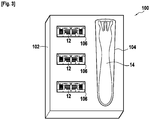
- Fig. 3 shows a skincare kit 100.
- the skincare kit 100 may be housed within a packaging including a support 102 with a base 104 for supporting/storing a handle 14 substantially as described herein and a plurality of cavities 106 for receiving shaving heads 12.
- the kit may include other type of heads such as exfoliation head, massage head, cooling head and/or any other known skin treatment head configured to be attached with a handle as disclosed herein.
- different shaving cartridges may be provided in the kit, e.g., a three-blade shaving cartridge, a two-blade shaving cartridge and a four-blade shaving cartridge. Other combinations may also be foreseen as well as other number of cartridges.
- the skincare kit 100 may include three cavities 106 and three shaving heads 12. It is to be understood that the number of cavities 106 and shaving heads is a non-limiting example.
- the present disclosure thus provides a handle for razor that is made of a composition comprising:
- the handle may be made of a composition comprising:
- the handle for razor may thus comprise PLA, for example commercially available from NaturePlast, in combination with polybutylene adipate terephtalate (PBAT) for example commercially available from NaturePlast, or bio-polyethylene (bio-PE) for example commercially available from Braskem, or polybutylene succinate (PBS) for example commercially available from NaturePlast, in a weight ratio of PLA/bioplastic polymer ranging from 60/40 to 90/10, specifically from 65/45 to 80/20, more specifically from 70/30 to 80/20, and even more specifically in a weight ratio of 70/30.
- PBAT polybutylene adipate terephtalate
- bio-PE bio-polyethylene
- PBS polybutylene succinate
- the handle for razor may comprise PLA in combination with bio-polyethylene (bio-PE), in a weight ratio of PLA/bio-PE ranging from 60/40 to 90/10, specifically from 65/45 to 80/20, more specifically from 70/30 to 80/20, and even more specifically in a weight ratio of 70/30.
- bio-PE bio-polyethylene
- the bio-polyethylene may be partially or completely bio-based polyethylene.
- bio-based as used in the description indicates the inclusion of some component that derives from a material derived from renewable biological resources.
- the minimum bio-based content of the bio-polyethylene (bio-PE) may be greater than or equal to 50% by weight, specifically 60% by weight, more specifically 70% by weight, and even more specifically 80% by weight.
- Bio-polyethylene (bio-PE) also known as renewable polyethylene, is made out of ethanol, which becomes ethylene after a dehydration process. It can be made from various feedstocks including sugar cane, sugar beet and wheat grain.
- the bio-polyethylene may be a low-density polyethylene, a linear low-density polyethylene, a high-density polyethylene, an ultra-high-molecular-weight polyethylene, a cross-linked polyethylene, a high density crosslinked polyethylene, a medium density polyethylene, a very low density polyethylene, as well as their copolymers and mixtures thereof.
- the bio-polyethylene (bio-PE) may be more specifically a linear low density polyethylene, for example the green linear low density polyethylene commercialized by Braskem under the reference SLH218.
- the bio-polyethylene (bio-PE) may have a density ranging from 0.9 to 1.0.
- the mixture of biodegradable thermoplastic polymers serves as a matrix for the handle for razor and makes it possible to manufacture the handle by injection and to provide good mechanical properties such as resilience and impact resistance.
- the content of the mixture of PLA and bioplastic polymer in the handle may range from 50 to 95%, specifically from 60 to 92%, more specifically from 70 to 90%, and even more specifically from 80 to 90%, by weight relative to the total weight of the handle for razor.
- the handle further comprises vegetable fillers chosen in the group consisting of wood, wheat, flax, and seagrass.
- the vegetable fillers may be wood fibers, specifically in the form of powder, in particular commercially available from JRS Rettenmaier or CFF GmbH & Co.KG or Jelu-Werk or Rossow.
- the vegetable fillers may be combined with mineral fillers such as calcium carbonate and/or shells of shellfish. These mineral fillers may not contain SiO 2 ; in particular, they are shells of shellfish, specifically oyster shells or scallop shells, and more specifically crushed oyster shells, for example commercially available from NaturePlast.
- the content of vegetable fillers in the handle may range from 5 to 40%, specifically from 7 to 30%, more specifically from 10 to 20%, and in particular 15%, by weight relative to the total weight of the handle for razor.
- the handle may further comprise an additive c) chosen in the group consisting of mineral fillers, blowing agents, adhesion promoters, dyes, pigments, lubricants, slip agents such as stearates (calcium stearate for example) and/or stearamide, compatibilizers, performance modifiers of PLA (melt enhancers which improve the strength/consistency of the extrusion melt), in particular acrylics, nucleating agents, glass microspheres, and their mixtures.
- an additive c) chosen in the group consisting of mineral fillers, blowing agents, adhesion promoters, dyes, pigments, lubricants, slip agents such as stearates (calcium stearate for example) and/or stearamide, compatibilizers, performance modifiers of PLA (melt enhancers which improve the strength/consistency of the extrusion melt), in particular acrylics, nucleating agents, glass microspheres, and their mixtures.
- the additive(s) may represent from 0.1 to 10%, and specifically from 3 to 8%, by weight relative to the total weight of the handle for razor.
- the handle for razor may be made of a composition wherein the sum of the weight % of a) (blend of PLA/bioplastic polymer), b) (vegetable fillers), and optional c) (optional additive) represents 100%.
- the handle for razor may comprise a blowing agent.
- a blowing agent reduces the amount of material required, thus making the composition an economically viable solution when compared to fossil based plastic compositions.
- the use of a blowing agent also reduces the amount of material that need to be processed and cooled, thus accelerating the cooling time required to ejected the handle from the injection machine.
- the blowing agent may consist, for example, of expandable and impervious particles, the wall of which is made of an extensible polymer material. Under the effect of temperature, a chemical or physical reaction occurs within said particles, causing an increase in the internal volume of said particles and their expansion.
- the blowing agent may be chosen from microspheres having a shell and enclosing a gas or a gas mixture.
- An increase in temperature causes an increase in the internal pressure of the microspheres that swell to a size that can be multiplied by five or more.
- the expansion is completed or not.
- the blowing agent may represent from 0.1 and 5%, and more specifically from 0.5 and 3%, by weight relative to the total weight of the handle for razor.
- the blowing agent may be chosen in the group consisting of citric acid, sodium bicarbonate, and mixture thereof, for example commercially available from ADEKA.
- the handle for razor may also comprise an adhesion promoter.
- the adhesion promoter may represent from 0.1 to 10%, specifically from 1 to 6%, more specifically from 2 to 5%, and even more specifically from 1 to 3%, by weight relative to the total weight of the handle for razor.
- the adhesion promoter makes it possible to improve the adhesion between the biodegradable thermoplastic polymer (mixture of PLA and bioplastic polymer) and the vegetable fillers.
- the adhesion promoter may be a PLA grafted with maleic anhydride (PLA-g-MAH), for example commercialized by NaturePlast or NatureWorks.
- PLA-g-MAH PLA grafted with maleic anhydride
- the handle may further comprise dyes and/or pigments such as red iron oxide.
- the content of dyes and/or pigments may range from 0.1 to 10% by weight, and specifically from 2.5 to 5% by weight, relative to the total weight of the handle for razor.
- the present disclosure also provides a method of manufacturing an above-defined handle for razor.
- the method includes the step of injecting in a dedicated mold (injection molding) the above-defined composition comprising:
- the method for manufacturing the handle for razor may comprise the step of adding and mixing, in a molding injector, the PLA, the bioplastic polymer chosen in the group consisting of polybutylene adipate terephtalate (PBAT), bio-polyethylene (bio-PE), and polybutylene succinate (PBS), the vegetable fillers chosen in the group consisting of wood, wheat, flax, and seagrass, and the optional additive c), in the above-defined proportions.
- the components may be mixed and melted at a temperature ranging from 155 to 215°C, specifically from 170 to 200°C, and more specifically from 175 to 195°C.
- the components may be mixed and melted under a pressure ranging from 600 to 1000 bar, specifically from 700 to 900 bar, and more specifically about 800 bar.
- the obtained mixture may then be injected into a mold for razor handle.
- the obtained composition may be cooled until a temperature of 25-35°C, specifically 30°C, during 17-22 seconds, specifically 18 seconds.
- the present disclosure also provides a razor comprising an above-defined handle for razor and at least one razor blade.
- the razor may have a length ranging from 80 to 150 mm, specifically from 100 to 130 mm, and more specifically around 115 mm.
- the razor may have a width at the connector portion 18 ranging from 15 to 25 mm, and specifically around 20 mm.
- the razor may have a width at the body 16 ranging from 8 to 15 mm, and specifically from 10 to 12 mm.
- the present disclosure also provides a skincare kit comprising an above-defined handle and a razor cartridge, wherein the cartridge may be fixedly or removably attached to the handle.
- the consumption of fossil based raw materials in the above-defined handle for razor is reduced and the cooling time accelerated.
- the Heat Deflection Temperature (HDT) is also increased allowing the above-defined handle for razor to resist deformations when immersed in hot water.
- the handles for razor of compositions A to K were prepared by injection molding in an Engel ES 330H/80V/200 HL - 2F machine.
- the various ingredients of the compositions were mixed and melted at a temperature varying from 150 to 200°C and a pressure of 770 bar, and then injected into a mold for razor handle. At the end of the injection, the composition was cooled during 18 seconds until a temperature of 30°C.
- the dimensions of the mold of the razor handles were as follows:
- the obtained handles for razors correspond to those of the commercial razors BIC 3.
- the performances of the materials of compositions A to K were tested on test bars according to the following tests:
- the flexural modulus of the materials was evaluated according to standard ISO 178:2019. This test assessed the strength and the crack resistance of the materials.
- the Charpy unnotched impact strength of the materials was evaluated according to standard ISO 179-1:2010. This test assessed the resistance to impact (resilience) of the materials.
- MFI Melt Flow Index
- the density was measured according to standard ISO 1183:2012, method A (immersion method).
- the Heat Deflection Temperature (HDT) was measured according to standard ISO 75-2:2013-08.
- the crystallisation temperature was determined by Differential Scanning Calorimetry (DSC) according to standard ISO 11357-3:2018-07.
- Protocol Two heating cycles with controlled cooling cycle (10 K.min -1 ), recording of peak, and determination of onset temperature of crystallisation.
- Table 1 Compositions A B C D E F G H I J K Flexural modulus (MPa) 3468 3126 2551 3151 2938 3553 - 2869 2557 1800-2200 2500 Resistance to impact (resilience) (kJ.m -2 ) 23.7 19.6 16.9 17.7 11.7 21.8 - 32.7 63.8 8 6 MFI (g/10min) 17.76 23.64 21.11 5.02 7.67 - - 12.26 18.29 5-8 5-8 Density (g.cm -3 ) 1.20 1.18 1.17 1.20 1.07 1.20 - 1.25 1.26 1.05 1.05 HDT measurement (°C) - - - - 54 - 51 - - - - Crystallisation temperature (°C) - - - - 111 - 108 -
- Table 1 show the best compromise in terms of crack resistance and resistance to impacts for the materials of razor handles made with the claimed compositions with respect to those made of the comparative compositions.
- the materials of razor handles made with the claimed compositions show better impact resistance.
- the addition of vegetable fillers also lead to higher flexural modulus with respect to the comparative compositions, provided materials of razor handles with increased resilience to deformation due to flexural stresses.
- the material of razor handle made of the composition E also shows a better resilience to water, and thus an improved resistance to deformation in hot water (HDT measurement and crystallisation temperature) compared to the comparative material of razor handle made of composition G.
Landscapes
- Chemical & Material Sciences (AREA)
- Health & Medical Sciences (AREA)
- Chemical Kinetics & Catalysis (AREA)
- Medicinal Chemistry (AREA)
- Polymers & Plastics (AREA)
- Organic Chemistry (AREA)
- Engineering & Computer Science (AREA)
- Life Sciences & Earth Sciences (AREA)
- Forests & Forestry (AREA)
- Mechanical Engineering (AREA)
- Manufacturing & Machinery (AREA)
- Compositions Of Macromolecular Compounds (AREA)
Abstract
Description
- The present disclosure relates to the field of skincare, and in particular to shaving. More specifically, the present disclosure relates to a handle for razor, a method for manufacturing such handle, a razor including such handle, and a skincare kit including such handle.
- Disposable skincare devices, such as razors, include generally a handle which represents a major part of the disposable device.
- Disposable razor handle represents a major part of a disposable razor and is generally bulky and long enough so as to allow a good handle grip during shaving.
- Handles are currently produced by fossil based thermoplastic materials, due to the fact that the materials that belong to this group generally reassure that the final handle will have good mechanical properties, decent surface finish and aesthetics, may be durable enough even when immersed in hot water, while in the meantime may be produced economically and in high volumes.
- However, in parallel, such products have a limited lifetime and are fully discarded after their use. As a result, there is a growing concern that disposable razor products might not be sustainable as they are produced using fossil based plastics and have a limited lifetime usage.
- A solution might be to reduce the amount of plastic material that is used to produce a razor, and more precisely the handle that is the largest razor component. The material reduction will lead to a lower plastic consumption, thus providing a more sustainable solution.
- In addition, it would be beneficial to use bio-based raw materials such as polylactic acid (PLA), known for having properties close to thermoplastic materials usually used for the manufacture of razors, instead of virgin raw materials, thus eliminating the need of consuming fossil based raw materials.
- However, these approaches may result in a disposable razor handle with poor ergonomics due to the reduced handle weight. In addition, PLA is known to have poor resistance to hot water, as expressed by its glass transition temperature (Tg) of 60-70°C, and therefore tends to absorb water and become soft, thus having a risk of being deformed when immersed in hot water.
- High heat PLA grades overcome these inherent problems since the high crystallinity of these materials allows them to be highly inert and resistant when immersed in hot water. However, high heat PLA requires high cycle times to be processed as the crystallinity is promoted by processing the PLA in warm injection molds for a prolonged curing time so as to allow crystal formation. This is particularly true for the thick parts of the razor, such as the razor handle. Further to the high processing time, the higher density of PLA may lead to economically non-viable articles because the amount of material mass used is substantially higher than in fossil based plastic articles.
- In view of the above, there is a growing need for environmentally sustainable razors comprising a handle with good mechanical properties and durability when immersed in hot water.
- The present disclosure provides a handle for razor. The handle is made of PLA with another bioplastic polymer such as polybutylene succinate (PBAT), bio-polyethylene (bio-PE), and polybutylene succinate (PBS), in specific proportions, combined with an appropriate content of specific vegetable fillers.
- The use of PLA in combination with another bioplastic polymer allows the handle for razor to be manufactured by using non-fossil based plastics while assuring the adequate mechanical properties for this application. This combination also improves processing by lowering the density of the final material and accelerating cooling time required to prepare the handle.
- The presence of vegetable fillers reduces the amount of material required to manufacture the handle for razor, and increases the Heat Deflection Temperature (HDT) of the material, allowing it to be inert and to resist to deformations when immersed in hot water. The use of vegetable fillers also allows the material to be stiff enough in order to be ejected from the injection machine in shorter cycle times than when using PLA.
- The disclosure may be more completely understood in consideration of the following detailed description of aspects of the disclosure in connection with the accompanying drawings, in which:
-
Fig. 1 shows a representation of an exemplary handle according to embodiments of the present disclosure; -
Fig. 2 shows a representation of an exemplary razor including an exemplary handle; and -
Fig. 3 shows a representation of an exemplary skincare kit comprising an exemplary handle. - While aspects of the disclosure are amenable to various modifications and alternative forms, specifics thereof have been shown by way of example in the drawings and will be described in detail. It should be understood, however, that the intention is not to limit aspects of the disclosure to the particular embodiment(s) described. On the contrary, the intention of this disclosure is to cover all modifications, equivalents, and alternatives falling within the scope of the disclosure.
- Reference will now be made in detail to exemplary embodiments of the disclosure, examples of which are illustrated in the accompanying drawings. Wherever possible, the same reference numbers will be used throughout the drawings to refer to the same or like parts.
- As used in this disclosure and the appended claims, the singular forms "a", "an", and "the" include plural referents unless the content clearly dictates otherwise. As used in this disclosure and the appended claims, the term "or" is generally employed in its sense including "and/or" unless the content clearly dictates otherwise.
- The following detailed description should be read with reference to the drawings. The detailed description and the drawings, which are not necessarily to scale, depict illustrative aspects and are not intended to limit the scope of the disclosure. The illustrative aspects depicted are intended only as exemplary.
-
Fig. 1 shows a representation of anexemplary handle 14 for a razor. - The
handle 14 may include abody 16 and aconnector portion 18. Thehandle 14 is made of PLA with another bioplastic polymer such as polybutylene succinate (PBAT), bio-polyethylene (bio-PE), and polybutylene succinate (PBS), in specific proportions, combined with an appropriate content of specific vegetable fillers chosen in the group consisting of wood, wheat, flax, and seagrass. - In the
exemplary handle 14 ofFig. 1 , the content of PLA and bioplastic polymer such as polybutylene succinate (PBAT), bio-polyethylene (bio-PE), and polybutylene succinate (PBS), ranges from 60 to 95% by weight, relative to the total weight of the handle for razor, and the weight ratio PLA/bioplastic polymer ranges from 60/40 to 90/10. The content of vegetable fillers ranges from 5 to 40% by weight relative to the total weight of the handle for razor. -
Fig. 2 shows arazor 10. Therazor 10 may include anexemplary handle 14 and a shavinghead 12. -
Fig. 3 shows askincare kit 100. Theskincare kit 100 may be housed within a packaging including asupport 102 with abase 104 for supporting/storing ahandle 14 substantially as described herein and a plurality ofcavities 106 for receivingshaving heads 12. In alternatives, the kit may include other type of heads such as exfoliation head, massage head, cooling head and/or any other known skin treatment head configured to be attached with a handle as disclosed herein. In alternatives, different shaving cartridges may be provided in the kit, e.g., a three-blade shaving cartridge, a two-blade shaving cartridge and a four-blade shaving cartridge. Other combinations may also be foreseen as well as other number of cartridges. As represented atFig. 3 , theskincare kit 100 may include threecavities 106 and threeshaving heads 12. It is to be understood that the number ofcavities 106 and shaving heads is a non-limiting example. - Where any standards of national, international, or other standards body are referenced (e.g., ISO, etc.), such references are intended to refer to the standard as defined by the national or international standards body as of the priority date of the present specification. Any subsequent substantive changes to such standards are not intended to modify the scope and/or definitions of the present disclosure and/or claims.
- Although the described embodiments were provided as different exemplary embodiments, it is envisioned that these embodiments are combinable or, when not conflicting, the features recited in the described embodiments may be interchangeable. Moreover, the features recited in the described embodiments are not inextricably linked to one another, unless such a linkage is clearly indicated between two given features.
- Throughout the description, including the claims, the term "comprising a" should be understood as being synonymous with "comprising at least one" unless otherwise stated. In addition, any range set forth in the description, including the claims should be understood as including its end value(s) unless otherwise stated. Specific values for described elements should be understood to be within accepted manufacturing or industry tolerances known to one of skill in the art, and any use of the terms "substantially" and/or "approximately" and/or "generally" should be understood to mean falling within such accepted tolerances.
- The present disclosure thus provides a handle for razor that is made of a composition comprising:
- a) from 60 to 95% by weight of a mixture of PLA and a bioplastic polymer chosen in the group consisting of polybutylene adipate terephtalate (PBAT), bio-polyethylene (bio-PE), and polybutylene succinate (PBS), wherein the weight ratio PLA/bioplastic polymer ranges from 60/40 to 90/10, and
- b) from 5 to 40% by weight of vegetable fillers chosen in the group consisting of wood, wheat, flax, and seagrass,
- The handle may be made of a composition comprising:
- a) from 80 to 90% by weight of a mixture of PLA and a bioplastic polymer chosen in the group consisting of polybutylene adipate terephtalate (PBAT), bio-polyethylene (bio-PE), and polybutylene succinate (PBS), wherein the weight ratio PLA/bioplastic polymer ranges from 65/35 to 85/15, and
- b) from 10 to 20% by weight of vegetable fillers chosen in the group consisting of wood, wheat, flax, and seagrass,
- The handle for razor may thus comprise PLA, for example commercially available from NaturePlast, in combination with polybutylene adipate terephtalate (PBAT) for example commercially available from NaturePlast, or bio-polyethylene (bio-PE) for example commercially available from Braskem, or polybutylene succinate (PBS) for example commercially available from NaturePlast, in a weight ratio of PLA/bioplastic polymer ranging from 60/40 to 90/10, specifically from 65/45 to 80/20, more specifically from 70/30 to 80/20, and even more specifically in a weight ratio of 70/30. Specifically, the handle for razor may comprise PLA in combination with bio-polyethylene (bio-PE), in a weight ratio of PLA/bio-PE ranging from 60/40 to 90/10, specifically from 65/45 to 80/20, more specifically from 70/30 to 80/20, and even more specifically in a weight ratio of 70/30.
- The bio-polyethylene (bio-PE) may be partially or completely bio-based polyethylene. The term "bio-based" as used in the description indicates the inclusion of some component that derives from a material derived from renewable biological resources. The minimum bio-based content of the bio-polyethylene (bio-PE) may be greater than or equal to 50% by weight, specifically 60% by weight, more specifically 70% by weight, and even more specifically 80% by weight. Bio-polyethylene (bio-PE), also known as renewable polyethylene, is made out of ethanol, which becomes ethylene after a dehydration process. It can be made from various feedstocks including sugar cane, sugar beet and wheat grain. The bio-polyethylene (bio-PE) may be a low-density polyethylene, a linear low-density polyethylene, a high-density polyethylene, an ultra-high-molecular-weight polyethylene, a cross-linked polyethylene, a high density crosslinked polyethylene, a medium density polyethylene, a very low density polyethylene, as well as their copolymers and mixtures thereof. The bio-polyethylene (bio-PE) may be more specifically a linear low density polyethylene, for example the green linear low density polyethylene commercialized by Braskem under the reference SLH218. The bio-polyethylene (bio-PE) may have a density ranging from 0.9 to 1.0.
- The mixture of biodegradable thermoplastic polymers serves as a matrix for the handle for razor and makes it possible to manufacture the handle by injection and to provide good mechanical properties such as resilience and impact resistance. The content of the mixture of PLA and bioplastic polymer in the handle may range from 50 to 95%, specifically from 60 to 92%, more specifically from 70 to 90%, and even more specifically from 80 to 90%, by weight relative to the total weight of the handle for razor.
- The handle further comprises vegetable fillers chosen in the group consisting of wood, wheat, flax, and seagrass. The vegetable fillers may be wood fibers, specifically in the form of powder, in particular commercially available from JRS Rettenmaier or CFF GmbH & Co.KG or Jelu-Werk or Rossow. The vegetable fillers may be combined with mineral fillers such as calcium carbonate and/or shells of shellfish. These mineral fillers may not contain SiO2; in particular, they are shells of shellfish, specifically oyster shells or scallop shells, and more specifically crushed oyster shells, for example commercially available from NaturePlast.
- The content of vegetable fillers in the handle may range from 5 to 40%, specifically from 7 to 30%, more specifically from 10 to 20%, and in particular 15%, by weight relative to the total weight of the handle for razor.
- The handle may further comprise an additive c) chosen in the group consisting of mineral fillers, blowing agents, adhesion promoters, dyes, pigments, lubricants, slip agents such as stearates (calcium stearate for example) and/or stearamide, compatibilizers, performance modifiers of PLA (melt enhancers which improve the strength/consistency of the extrusion melt), in particular acrylics, nucleating agents, glass microspheres, and their mixtures.
- The additive(s) may represent from 0.1 to 10%, and specifically from 3 to 8%, by weight relative to the total weight of the handle for razor.
- The handle for razor may be made of a composition wherein the sum of the weight % of a) (blend of PLA/bioplastic polymer), b) (vegetable fillers), and optional c) (optional additive) represents 100%.
- The handle for razor may comprise a blowing agent. The presence of a blowing agent reduces the amount of material required, thus making the composition an economically viable solution when compared to fossil based plastic compositions. The use of a blowing agent also reduces the amount of material that need to be processed and cooled, thus accelerating the cooling time required to ejected the handle from the injection machine. The blowing agent may consist, for example, of expandable and impervious particles, the wall of which is made of an extensible polymer material. Under the effect of temperature, a chemical or physical reaction occurs within said particles, causing an increase in the internal volume of said particles and their expansion. Thus, the blowing agent may be chosen from microspheres having a shell and enclosing a gas or a gas mixture. An increase in temperature causes an increase in the internal pressure of the microspheres that swell to a size that can be multiplied by five or more. Depending on the desired result of flexibility, weight, and any other property of the material in which the blowing agent is incorporated, the expansion is completed or not.
- The blowing agent may represent from 0.1 and 5%, and more specifically from 0.5 and 3%, by weight relative to the total weight of the handle for razor. The blowing agent may be chosen in the group consisting of citric acid, sodium bicarbonate, and mixture thereof, for example commercially available from ADEKA.
- The handle for razor may also comprise an adhesion promoter.
- The adhesion promoter may represent from 0.1 to 10%, specifically from 1 to 6%, more specifically from 2 to 5%, and even more specifically from 1 to 3%, by weight relative to the total weight of the handle for razor. The adhesion promoter makes it possible to improve the adhesion between the biodegradable thermoplastic polymer (mixture of PLA and bioplastic polymer) and the vegetable fillers.
- The adhesion promoter may be a PLA grafted with maleic anhydride (PLA-g-MAH), for example commercialized by NaturePlast or NatureWorks.
- The handle may further comprise dyes and/or pigments such as red iron oxide. The content of dyes and/or pigments may range from 0.1 to 10% by weight, and specifically from 2.5 to 5% by weight, relative to the total weight of the handle for razor.
- The present disclosure also provides a method of manufacturing an above-defined handle for razor. The method includes the step of injecting in a dedicated mold (injection molding) the above-defined composition comprising:
- a) from 60 to 95% by weight of a mixture of PLA and a bioplastic polymer chosen in the group consisting of polybutylene adipate terephtalate (PBAT), bio-polyethylene (bio-PE), and polybutylene succinate (PBS), wherein the weight ratio PLA/bioplastic polymer ranges from 60/40 to 90/10, and
- b) from 5 to 40% by weight of vegetable fillers chosen in the group consisting of wood, wheat, flax, and seagrass,
- The method for manufacturing the handle for razor may comprise the step of adding and mixing, in a molding injector, the PLA, the bioplastic polymer chosen in the group consisting of polybutylene adipate terephtalate (PBAT), bio-polyethylene (bio-PE), and polybutylene succinate (PBS), the vegetable fillers chosen in the group consisting of wood, wheat, flax, and seagrass, and the optional additive c), in the above-defined proportions. The components may be mixed and melted at a temperature ranging from 155 to 215°C, specifically from 170 to 200°C, and more specifically from 175 to 195°C. The components may be mixed and melted under a pressure ranging from 600 to 1000 bar, specifically from 700 to 900 bar, and more specifically about 800 bar. The obtained mixture may then be injected into a mold for razor handle. At the end of the injection, the obtained composition may be cooled until a temperature of 25-35°C, specifically 30°C, during 17-22 seconds, specifically 18 seconds.
- The present disclosure also provides a razor comprising an above-defined handle for razor and at least one razor blade.
- The razor may have a length ranging from 80 to 150 mm, specifically from 100 to 130 mm, and more specifically around 115 mm. The razor may have a width at the
connector portion 18 ranging from 15 to 25 mm, and specifically around 20 mm. The razor may have a width at thebody 16 ranging from 8 to 15 mm, and specifically from 10 to 12 mm. - The present disclosure also provides a skincare kit comprising an above-defined handle and a razor cartridge, wherein the cartridge may be fixedly or removably attached to the handle.
- Thanks to the combination of PLA/bioplastic polymer and vegetable fillers, the consumption of fossil based raw materials in the above-defined handle for razor is reduced and the cooling time accelerated. The Heat Deflection Temperature (HDT) is also increased allowing the above-defined handle for razor to resist deformations when immersed in hot water.
- It is intended that combinations of the above-described elements and those within the specification may be made, except where otherwise contradictory.
- It is to be understood that both the foregoing general description and the following detailed description are exemplary and explanatory only and are not restrictive of the disclosure, as claimed.
-
- Six handles for razor of compositions A, B, C, D, E and F, according to the disclosure, were prepared and compared to six comparative handles for razor of compositions G, H, I, J and K.
- Composition A was a mixture of PLA (PBE 005-1 from NaturePlast)/PBS (PBE 003 from NaturePlast) in a weight ratio of 70/30, added with 10% by weight of wood fibers (LIGNOCEL® JRS).
- Composition B was a mixture of PLA (PBE 005-1 from NaturePlast)/PBS (PBE 003 from NaturePlast) in a weight ratio of 70/30, added with 10% by weight of flax fibers.
- Composition C was a mixture of PLA (PBE 005-1 from NaturePlast)/PBS (PBE 003 from NaturePlast) in a weight ratio of 70/30, added with 10% by weight of wheat fibers.
- Composition D was a mixture of PLA (PBE 005-1 from NaturePlast)/PBAT (PBE 006 from NaturePlast) in a weight ratio of 80/20, added with 15% by weight of wood fibers (LIGNOCEL® JRS).
- Composition E was a mixture of PLA (PBE 005-1 from NaturePlast)/bio-PE (SLH218 from Braskem) in a weight ratio of 80/20, added with 15% by weight of wood fibers (LIGNOCEL® JRS).
- Composition F was a mixture of PLA (PBE 005-1 from NaturePlast)/PBS (PBE 003 from NaturePlast) in a weight ratio of 70/30, added with 10% by weight of wood fibers (LIGNOCEL® JRS) and with 10% by weight of adhesion promoter (PLA-g-MAH).
- Composition G (comparative) consisted of a composition of pure PLA (PBE 005-1 from NaturePlast).
- Composition H (comparative) was a mixture of PLA (PBE 005-1 from NaturePlast)/PBS (PBE 003 from NaturePlast) in a weight ratio of 80/20.
- Composition I (comparative) was a mixture of PLA (PBE 005-1 from NaturePlast)/PBS (PBE 003 from NaturePlast) in a weight ratio of 70/30.
- Composition J (comparative) consisted of a composition of recycled polystyrene (r-PS) (rPS65W from Galloo Plastics).
- Composition K (comparative) consisted of a composition of improved recycled polystyrene (r-PS) (fish box Acteco Q07).
- The handles for razor of compositions A to K were prepared by injection molding in an Engel ES 330H/80V/200 HL - 2F machine. The various ingredients of the compositions were mixed and melted at a temperature varying from 150 to 200°C and a pressure of 770 bar, and then injected into a mold for razor handle. At the end of the injection, the composition was cooled during 18 seconds until a temperature of 30°C.
- The dimensions of the mold of the razor handles were as follows:
- Length: 114.09 mm
- Width at head connection point: 19.87 mm
- Width at grip area (barrel): 10.78 mm
- The obtained handles for razors correspond to those of the commercial razors BIC 3.
- The performances of the materials of compositions A to K were tested on test bars according to the following tests:
The flexural modulus of the materials was evaluated according to standard ISO 178:2019. This test assessed the strength and the crack resistance of the materials. - The characteristics of the test were as follows:
- Equipment: Dynamometer LLOYD-AMETEK Instrument type, U-bracket span of 6 cm, Sensor ADAMEL DY20 Chatillon Instrument type TCD110 50 daN
- Descent speed of sensor: 50 mm.min-1
- Operating method:
- 1. Turn on the dynamometer.
- 2. Locate the sensor in the up position.
- 3. Fix the pencil on the U-bracket.
- 4. Go down the needle.
- 5. Record the results expressed in MPa.
- The Charpy unnotched impact strength of the materials was evaluated according to standard ISO 179-1:2010. This test assessed the resistance to impact (resilience) of the materials.
- The characteristics of the test were as follows:
- Equipment: Impact II pendulum (CEAST)
- Hammer: 15J
- Distance between supports: 62 mm
- Sampling: specimen type 1A (molded specimen)
- Position: upright
- Packaging: minimum 24h at 23°C ± 2°C and 50% RH ± 10% RH
- Test temperature: 23.7°C
- Test hygrometry: 27%
- The results were expressed in kJ.m-2.
- The viscosity or Melt Flow Index (MFI) was measured according to standard ISO 1133:2011, method B.
- The characteristics of the test were as follows:
- Steaming: 18h at 90°C
- Equipment: Modular Melt Flow Tester (CEAST)
- Diameter of the capillary nozzle: 2.095 mm
- Length of the capillary nozzle: 8 mm
- Test temperature: 200°C
- Load applied: 5.0 kg
- Time interval: 30 seconds
- The results were expressed in g/10 min.
- The density was measured according to standard ISO 1183:2012, method A (immersion method).
- The characteristics of the test were as follows:
- Equipment: Analytical balance ALS/PLS-A01 (KERN) - Density measurement set
- Liquid: Distilled water
- Test temperature: 23°C
- Sampling: Injected piece
- The results were expressed in g.cm-3.
- The Heat Deflection Temperature (HDT) was measured according to standard ISO 75-2:2013-08.
- The characteristics of the test were as follows:
- Load applied: 1.80 MPa
- Size of the specimen: specimen type 1A according to DIN EN ISO 527-2
- The results were expressed in °C.
- The crystallisation temperature was determined by Differential Scanning Calorimetry (DSC) according to standard ISO 11357-3:2018-07.
- The characteristics of the test were as follows:
Protocol: Two heating cycles with controlled cooling cycle (10 K.min-1), recording of peak, and determination of onset temperature of crystallisation. - The results were expressed in °C.
- The performances of the materials of compositions A, B, C, D, E and F, according to the disclosure, and the performances of the comparative materials of compositions G, H, I, J and K are summarized in the following Table 1:
Table 1: Compositions A B C D E F G H I J K Flexural modulus (MPa) 3468 3126 2551 3151 2938 3553 - 2869 2557 1800-2200 2500 Resistance to impact (resilience) (kJ.m-2) 23.7 19.6 16.9 17.7 11.7 21.8 - 32.7 63.8 8 6 MFI (g/10min) 17.76 23.64 21.11 5.02 7.67 - - 12.26 18.29 5-8 5-8 Density (g.cm-3) 1.20 1.18 1.17 1.20 1.07 1.20 - 1.25 1.26 1.05 1.05 HDT measurement (°C) - - - - 54 - 51 - - - - Crystallisation temperature (°C) - - - - 111 - 108 - - - - - The results presented in Table 1 show the best compromise in terms of crack resistance and resistance to impacts for the materials of razor handles made with the claimed compositions with respect to those made of the comparative compositions. In particular, compared to r-PS - which is another material with sustainability benefits - the materials of razor handles made with the claimed compositions show better impact resistance. The addition of vegetable fillers also lead to higher flexural modulus with respect to the comparative compositions, provided materials of razor handles with increased resilience to deformation due to flexural stresses.
- The material of razor handle made of the composition E also shows a better resilience to water, and thus an improved resistance to deformation in hot water (HDT measurement and crystallisation temperature) compared to the comparative material of razor handle made of composition G.
Claims (15)
- A handle for razor that is made of a composition comprising:a) from 60 to 95% by weight of a mixture of polylactic acid (PLA) and a bioplastic polymer chosen in the group consisting of polybutylene adipate terephtalate (PBAT), bio-polyethylene (bio-PE), and polybutylene succinate (PBS), wherein the weight ratio polylactic acid/bioplastic polymer ranges from 60/40 to 90/10, andb) from 5 to 40% by weight of vegetable fillers chosen in the group consisting of wood, wheat, flax, and seagrass,the weight % being relative to the total weight of the handle for razor.
- The handle for razor according to claim 1 that is made of a composition comprising:a) from 80 to 90% by weight of a mixture of polylactic acid (PLA) and a bioplastic polymer chosen in the group consisting of polybutylene adipate terephtalate (PBAT), bio-polyethylene (bio-PE), and polybutylene succinate (PBS), wherein the weight ratio polylactic acid/bioplastic polymer ranges from 65/35 to 85/15, andb) from 10 to 20% by weight of vegetable fillers chosen in the group consisting of wood, wheat, flax, and seagrass,the weight % being relative to the total weight of the handle for razor.
- The handle for razor according to claim 1 or claim 2, the composition comprising an additive chosen in the group consisting of mineral fillers, blowing agents, adhesion promoters, dyes, pigments, lubricants, slip agents, compatibilizers, performance modifiers of polylactic acid (PLA), nucleating agents, glass microspheres, and their mixtures.
- The handle for razor according to claim 3, the additive comprising a blowing agent.
- The handle for razor according to claim 3 or claim 4, the additive comprising an adhesion promoter.
- The handle for razor according to any of claims 3 to 5, wherein the additives represent from 0.1 to 10% by weight relative to the total weight of the handle for razor.
- A method for manufacturing a handle for razor according to any of claims 1 to 6, wherein the method comprises the step of injection of a composition in a dedicated mold, said composition comprising:a) from 60 to 95% by weight of a mixture of polylactic acid (PLA) and a bioplastic polymer chosen in the group consisting of polybutylene adipate terephtalate (PBAT), bio-polyethylene (bio-PE), and polybutylene succinate (PBS), wherein the weight ratio polylactic acid/bioplastic polymer ranges from 60/40 to 90/10, andb) from 5 to 40% by weight of vegetable fillers chosen in the group consisting of wood, wheat, flax, and seagrass,the weight % being relative to the total weight of the handle for razor.
- The method according to claim 7, wherein the composition comprises:a) from 80 to 90% by weight of a mixture of polylactic acid (PLA) and a bioplastic polymer chosen in the group consisting of polybutylene adipate terephtalate (PBAT), bio-polyethylene (bio-PE), and polybutylene succinate (PBS), wherein the weight ratio polylactic acid/bioplastic polymer ranges from 65/35 to 85/15, andb) from 10 to 20% by weight of vegetable fillers chosen in the group consisting of wood, wheat, flax, and seagrass, the weight % being relative to the total weight of the handle for razor.
- The method according to claim 7 or claim 8, wherein the composition comprises an additive chosen in the group consisting of mineral fillers, blowing agents, adhesion promoters, dyes, pigments, lubricants, slip agents, compatibilizers, performance modifiers of polylactic acid (PLA), nucleating agents, glass microspheres, and their mixtures.
- The method according to claim 9, wherein the additives represent from 0.1 to 10% by weight relative to the total weight of the handle for razor.
- The method according to any of claims 7 to 10, wherein the additive comprises a blowing agent.
- The method according to any of claims 7 to 11, wherein the additive comprises an adhesion promoter.
- The method according to any of claims 7 to 12, wherein the components of the composition are mixed and melted at a temperature ranging from 155 to 215°C and under a pressure ranging from 600 to 1000 bar, before the step of injection.
- A razor comprising a handle for razor according to any of claims 1 to 6 and at least one razor blade.
- A skincare kit comprising a handle for razor according to any of claims 1 to 6 and a razor cartridge, wherein the cartridge is fixedly or removably attached to the handle.
Priority Applications (2)
| Application Number | Priority Date | Filing Date | Title |
|---|---|---|---|
| EP19306224.7A EP3797948B1 (en) | 2019-09-30 | 2019-09-30 | Handle for razor made of bioplastic polymers and vegetable fillers |
| US17/034,735 US12017373B2 (en) | 2019-09-30 | 2020-09-28 | Handle for razor made of bioplastic polymers and vegetable fillers |
Applications Claiming Priority (1)
| Application Number | Priority Date | Filing Date | Title |
|---|---|---|---|
| EP19306224.7A EP3797948B1 (en) | 2019-09-30 | 2019-09-30 | Handle for razor made of bioplastic polymers and vegetable fillers |
Publications (2)
| Publication Number | Publication Date |
|---|---|
| EP3797948A1 true EP3797948A1 (en) | 2021-03-31 |
| EP3797948B1 EP3797948B1 (en) | 2024-03-06 |
Family
ID=68290193
Family Applications (1)
| Application Number | Title | Priority Date | Filing Date |
|---|---|---|---|
| EP19306224.7A Active EP3797948B1 (en) | 2019-09-30 | 2019-09-30 | Handle for razor made of bioplastic polymers and vegetable fillers |
Country Status (2)
| Country | Link |
|---|---|
| US (1) | US12017373B2 (en) |
| EP (1) | EP3797948B1 (en) |
Families Citing this family (6)
| Publication number | Priority date | Publication date | Assignee | Title |
|---|---|---|---|---|
| USD986505S1 (en) * | 2021-03-29 | 2023-05-16 | Beauty Perspectives, LLC | Razor handle |
| USD1046291S1 (en) | 2021-05-25 | 2024-10-08 | The Gillette Company Llc | Razor handle |
| USD1042958S1 (en) * | 2021-05-25 | 2024-09-17 | The Gillette Company Llc | Razor handle |
| USD1014847S1 (en) * | 2021-05-25 | 2024-02-13 | The Gillette Company Llc | Razor |
| USD1046290S1 (en) | 2021-05-25 | 2024-10-08 | The Gillette Company Llc | Razor handle |
| EP4238450A1 (en) * | 2022-03-01 | 2023-09-06 | Trisa Holding AG | Body care product |
Citations (5)
| Publication number | Priority date | Publication date | Assignee | Title |
|---|---|---|---|---|
| US20050154114A1 (en) * | 2003-12-22 | 2005-07-14 | Hale Wesley R. | Compatibilized blends of biodegradable polymers with improved rheology |
| WO2011111881A1 (en) * | 2010-03-09 | 2011-09-15 | 주식회사 도루코 | Biodegradable razor handle, method for manufacturing same, and razor including a biodegradable razor handle manufactured by same |
| CN107057389A (en) * | 2017-03-13 | 2017-08-18 | 阜阳市金木工艺品有限公司 | A kind of biodegradable PLA PBS Wood Fiber Composite foamed materials and preparation method thereof |
| CN108677270A (en) * | 2018-06-04 | 2018-10-19 | 贵州省材料产业技术研究院 | A kind of high-performance PBAT plant fiber composite wires and preparation method thereof for 3D printing |
| KR20190062906A (en) * | 2017-11-29 | 2019-06-07 | 롯데케미칼 주식회사 | 3d printing polylactic acid filament composition for improving surface property |
Family Cites Families (5)
| Publication number | Priority date | Publication date | Assignee | Title |
|---|---|---|---|---|
| US5440808A (en) | 1992-01-30 | 1995-08-15 | Warner-Lambert Company | Disposable shaped article |
| US5714573A (en) | 1995-01-19 | 1998-02-03 | Cargill, Incorporated | Impact modified melt-stable lactide polymer compositions and processes for manufacture thereof |
| JP3742842B2 (en) | 2002-06-17 | 2006-02-08 | 独立行政法人産業技術総合研究所 | Biodegradable polylactic acid resin composition |
| WO2015057694A2 (en) | 2013-10-16 | 2015-04-23 | Metabolix, Inc. | Optically clear biodegradable oplyester blends |
| WO2019113520A1 (en) | 2017-12-07 | 2019-06-13 | Joshua Munoz | Edc-free biopolymer based compositions and uses thereof |
-
2019
- 2019-09-30 EP EP19306224.7A patent/EP3797948B1/en active Active
-
2020
- 2020-09-28 US US17/034,735 patent/US12017373B2/en active Active
Patent Citations (5)
| Publication number | Priority date | Publication date | Assignee | Title |
|---|---|---|---|---|
| US20050154114A1 (en) * | 2003-12-22 | 2005-07-14 | Hale Wesley R. | Compatibilized blends of biodegradable polymers with improved rheology |
| WO2011111881A1 (en) * | 2010-03-09 | 2011-09-15 | 주식회사 도루코 | Biodegradable razor handle, method for manufacturing same, and razor including a biodegradable razor handle manufactured by same |
| CN107057389A (en) * | 2017-03-13 | 2017-08-18 | 阜阳市金木工艺品有限公司 | A kind of biodegradable PLA PBS Wood Fiber Composite foamed materials and preparation method thereof |
| KR20190062906A (en) * | 2017-11-29 | 2019-06-07 | 롯데케미칼 주식회사 | 3d printing polylactic acid filament composition for improving surface property |
| CN108677270A (en) * | 2018-06-04 | 2018-10-19 | 贵州省材料产业技术研究院 | A kind of high-performance PBAT plant fiber composite wires and preparation method thereof for 3D printing |
Also Published As
| Publication number | Publication date |
|---|---|
| US20210095116A1 (en) | 2021-04-01 |
| US12017373B2 (en) | 2024-06-25 |
| EP3797948B1 (en) | 2024-03-06 |
Similar Documents
| Publication | Publication Date | Title |
|---|---|---|
| EP3797948B1 (en) | Handle for razor made of bioplastic polymers and vegetable fillers | |
| US12004590B2 (en) | Foam compositions and uses thereof | |
| EP3612049B1 (en) | Foam ionomer compositions and uses thereof | |
| US5810678A (en) | Multilayer golf ball | |
| KR101127287B1 (en) | Articles of manufacture comprising stiff and resilient ethylene copolymer compositions | |
| EP3797946B1 (en) | Handle for razor made of bioplastic polymers and mineral fillers | |
| JP4276489B2 (en) | Method for producing polypropylene resin expanded particles and polypropylene resin expanded particles | |
| KR102699873B1 (en) | Toy building bricks made from biopolymer materials | |
| JP2003128901A (en) | Biodegradable polyester resin composition, method for producing the same, and foam and molded article obtained therefrom | |
| KR20120058503A (en) | Expanded polypropylene resin beads and expanded bead molding | |
| CA2018958A1 (en) | Innersole for footwear | |
| Verma et al. | Development of material extrusion 3D printing compatible tailorable thermoplastic elastomeric materials from acrylonitrile butadiene styrene and styrene‐(ethylene‐butylene)‐styrene block copolymer blends | |
| US8338523B2 (en) | Thermoplastic molding material and molded body made of the material | |
| EP3668926B1 (en) | Injection materials containing surface modified silicates | |
| KR20190062906A (en) | 3d printing polylactic acid filament composition for improving surface property | |
| CN110862642A (en) | High-rigidity super-toughness laser-weldable polypropylene modified material and preparation method thereof | |
| PL169079B1 (en) | Polyester moulding composition | |
| US8883279B2 (en) | Fluid-assisted injection molded articles and process | |
| JP2009155378A (en) | Biodegradable polyester resin composition, and cellular material and molding obtained therefrom | |
| US2752315A (en) | Polymerized styrene molding compositions | |
| JP7656553B2 (en) | New particle foam | |
| CN110283376A (en) | A kind of combined plastic alloy and the preparation method and application thereof | |
| Clarizio et al. | Tensile strength, elongation, hardness, and tensile and flexural moduli of injection-molded TPS filled with glycerol-plasticized DDGS | |
| JP2001268686A (en) | Diaphragm for electroacoustic transducer and method of manufacturing the same | |
| JP2004035656A (en) | Foam injection molded article and foam injection molding method |
Legal Events
| Date | Code | Title | Description |
|---|---|---|---|
| PUAI | Public reference made under article 153(3) epc to a published international application that has entered the european phase |
Free format text: ORIGINAL CODE: 0009012 |
|
| STAA | Information on the status of an ep patent application or granted ep patent |
Free format text: STATUS: THE APPLICATION HAS BEEN PUBLISHED |
|
| AK | Designated contracting states |
Kind code of ref document: A1 Designated state(s): AL AT BE BG CH CY CZ DE DK EE ES FI FR GB GR HR HU IE IS IT LI LT LU LV MC MK MT NL NO PL PT RO RS SE SI SK SM TR |
|
| AX | Request for extension of the european patent |
Extension state: BA ME |
|
| STAA | Information on the status of an ep patent application or granted ep patent |
Free format text: STATUS: REQUEST FOR EXAMINATION WAS MADE |
|
| 17P | Request for examination filed |
Effective date: 20210917 |
|
| RBV | Designated contracting states (corrected) |
Designated state(s): AL AT BE BG CH CY CZ DE DK EE ES FI FR GB GR HR HU IE IS IT LI LT LU LV MC MK MT NL NO PL PT RO RS SE SI SK SM TR |
|
| RAP3 | Party data changed (applicant data changed or rights of an application transferred) |
Owner name: SOCIETE BIC Owner name: BIC VIOLEX SINGLE MEMBER S.A. |
|
| RAP3 | Party data changed (applicant data changed or rights of an application transferred) |
Owner name: SOCIETE BIC Owner name: BIC VIOLEX SINGLE MEMBER S.A. |
|
| STAA | Information on the status of an ep patent application or granted ep patent |
Free format text: STATUS: EXAMINATION IS IN PROGRESS |
|
| 17Q | First examination report despatched |
Effective date: 20230208 |
|
| GRAP | Despatch of communication of intention to grant a patent |
Free format text: ORIGINAL CODE: EPIDOSNIGR1 |
|
| STAA | Information on the status of an ep patent application or granted ep patent |
Free format text: STATUS: GRANT OF PATENT IS INTENDED |
|
| INTG | Intention to grant announced |
Effective date: 20231123 |
|
| GRAS | Grant fee paid |
Free format text: ORIGINAL CODE: EPIDOSNIGR3 |
|
| GRAA | (expected) grant |
Free format text: ORIGINAL CODE: 0009210 |
|
| STAA | Information on the status of an ep patent application or granted ep patent |
Free format text: STATUS: THE PATENT HAS BEEN GRANTED |
|
| AK | Designated contracting states |
Kind code of ref document: B1 Designated state(s): AL AT BE BG CH CY CZ DE DK EE ES FI FR GB GR HR HU IE IS IT LI LT LU LV MC MK MT NL NO PL PT RO RS SE SI SK SM TR |
|
| REG | Reference to a national code |
Ref country code: CH Ref legal event code: EP |
|
| REG | Reference to a national code |
Ref country code: IE Ref legal event code: FG4D |
|
| REG | Reference to a national code |
Ref country code: DE Ref legal event code: R096 Ref document number: 602019047682 Country of ref document: DE |
|
| REG | Reference to a national code |
Ref country code: LT Ref legal event code: MG9D |
|
| PG25 | Lapsed in a contracting state [announced via postgrant information from national office to epo] |
Ref country code: LT Free format text: LAPSE BECAUSE OF FAILURE TO SUBMIT A TRANSLATION OF THE DESCRIPTION OR TO PAY THE FEE WITHIN THE PRESCRIBED TIME-LIMIT Effective date: 20240306 |
|
| REG | Reference to a national code |
Ref country code: NL Ref legal event code: MP Effective date: 20240306 |
|
| PG25 | Lapsed in a contracting state [announced via postgrant information from national office to epo] |
Ref country code: GR Free format text: LAPSE BECAUSE OF FAILURE TO SUBMIT A TRANSLATION OF THE DESCRIPTION OR TO PAY THE FEE WITHIN THE PRESCRIBED TIME-LIMIT Effective date: 20240607 |
|
| PG25 | Lapsed in a contracting state [announced via postgrant information from national office to epo] |
Ref country code: HR Free format text: LAPSE BECAUSE OF FAILURE TO SUBMIT A TRANSLATION OF THE DESCRIPTION OR TO PAY THE FEE WITHIN THE PRESCRIBED TIME-LIMIT Effective date: 20240306 Ref country code: RS Free format text: LAPSE BECAUSE OF FAILURE TO SUBMIT A TRANSLATION OF THE DESCRIPTION OR TO PAY THE FEE WITHIN THE PRESCRIBED TIME-LIMIT Effective date: 20240606 |
|
| PG25 | Lapsed in a contracting state [announced via postgrant information from national office to epo] |
Ref country code: ES Free format text: LAPSE BECAUSE OF FAILURE TO SUBMIT A TRANSLATION OF THE DESCRIPTION OR TO PAY THE FEE WITHIN THE PRESCRIBED TIME-LIMIT Effective date: 20240306 |
|
| PG25 | Lapsed in a contracting state [announced via postgrant information from national office to epo] |
Ref country code: RS Free format text: LAPSE BECAUSE OF FAILURE TO SUBMIT A TRANSLATION OF THE DESCRIPTION OR TO PAY THE FEE WITHIN THE PRESCRIBED TIME-LIMIT Effective date: 20240606 Ref country code: NO Free format text: LAPSE BECAUSE OF FAILURE TO SUBMIT A TRANSLATION OF THE DESCRIPTION OR TO PAY THE FEE WITHIN THE PRESCRIBED TIME-LIMIT Effective date: 20240606 Ref country code: LT Free format text: LAPSE BECAUSE OF FAILURE TO SUBMIT A TRANSLATION OF THE DESCRIPTION OR TO PAY THE FEE WITHIN THE PRESCRIBED TIME-LIMIT Effective date: 20240306 Ref country code: HR Free format text: LAPSE BECAUSE OF FAILURE TO SUBMIT A TRANSLATION OF THE DESCRIPTION OR TO PAY THE FEE WITHIN THE PRESCRIBED TIME-LIMIT Effective date: 20240306 Ref country code: GR Free format text: LAPSE BECAUSE OF FAILURE TO SUBMIT A TRANSLATION OF THE DESCRIPTION OR TO PAY THE FEE WITHIN THE PRESCRIBED TIME-LIMIT Effective date: 20240607 Ref country code: FI Free format text: LAPSE BECAUSE OF FAILURE TO SUBMIT A TRANSLATION OF THE DESCRIPTION OR TO PAY THE FEE WITHIN THE PRESCRIBED TIME-LIMIT Effective date: 20240306 Ref country code: ES Free format text: LAPSE BECAUSE OF FAILURE TO SUBMIT A TRANSLATION OF THE DESCRIPTION OR TO PAY THE FEE WITHIN THE PRESCRIBED TIME-LIMIT Effective date: 20240306 Ref country code: BG Free format text: LAPSE BECAUSE OF FAILURE TO SUBMIT A TRANSLATION OF THE DESCRIPTION OR TO PAY THE FEE WITHIN THE PRESCRIBED TIME-LIMIT Effective date: 20240306 |
|
| REG | Reference to a national code |
Ref country code: AT Ref legal event code: MK05 Ref document number: 1663052 Country of ref document: AT Kind code of ref document: T Effective date: 20240306 |
|
| PG25 | Lapsed in a contracting state [announced via postgrant information from national office to epo] |
Ref country code: SE Free format text: LAPSE BECAUSE OF FAILURE TO SUBMIT A TRANSLATION OF THE DESCRIPTION OR TO PAY THE FEE WITHIN THE PRESCRIBED TIME-LIMIT Effective date: 20240306 Ref country code: LV Free format text: LAPSE BECAUSE OF FAILURE TO SUBMIT A TRANSLATION OF THE DESCRIPTION OR TO PAY THE FEE WITHIN THE PRESCRIBED TIME-LIMIT Effective date: 20240306 |
|
| PG25 | Lapsed in a contracting state [announced via postgrant information from national office to epo] |
Ref country code: NL Free format text: LAPSE BECAUSE OF FAILURE TO SUBMIT A TRANSLATION OF THE DESCRIPTION OR TO PAY THE FEE WITHIN THE PRESCRIBED TIME-LIMIT Effective date: 20240306 |
|
| PG25 | Lapsed in a contracting state [announced via postgrant information from national office to epo] |
Ref country code: NL Free format text: LAPSE BECAUSE OF FAILURE TO SUBMIT A TRANSLATION OF THE DESCRIPTION OR TO PAY THE FEE WITHIN THE PRESCRIBED TIME-LIMIT Effective date: 20240306 |
|
| PG25 | Lapsed in a contracting state [announced via postgrant information from national office to epo] |
Ref country code: IS Free format text: LAPSE BECAUSE OF FAILURE TO SUBMIT A TRANSLATION OF THE DESCRIPTION OR TO PAY THE FEE WITHIN THE PRESCRIBED TIME-LIMIT Effective date: 20240706 |
|
| PG25 | Lapsed in a contracting state [announced via postgrant information from national office to epo] |
Ref country code: SM Free format text: LAPSE BECAUSE OF FAILURE TO SUBMIT A TRANSLATION OF THE DESCRIPTION OR TO PAY THE FEE WITHIN THE PRESCRIBED TIME-LIMIT Effective date: 20240306 Ref country code: PT Free format text: LAPSE BECAUSE OF FAILURE TO SUBMIT A TRANSLATION OF THE DESCRIPTION OR TO PAY THE FEE WITHIN THE PRESCRIBED TIME-LIMIT Effective date: 20240708 |
|
| PG25 | Lapsed in a contracting state [announced via postgrant information from national office to epo] |
Ref country code: EE Free format text: LAPSE BECAUSE OF FAILURE TO SUBMIT A TRANSLATION OF THE DESCRIPTION OR TO PAY THE FEE WITHIN THE PRESCRIBED TIME-LIMIT Effective date: 20240306 Ref country code: CZ Free format text: LAPSE BECAUSE OF FAILURE TO SUBMIT A TRANSLATION OF THE DESCRIPTION OR TO PAY THE FEE WITHIN THE PRESCRIBED TIME-LIMIT Effective date: 20240306 |
|
| PG25 | Lapsed in a contracting state [announced via postgrant information from national office to epo] |
Ref country code: AT Free format text: LAPSE BECAUSE OF FAILURE TO SUBMIT A TRANSLATION OF THE DESCRIPTION OR TO PAY THE FEE WITHIN THE PRESCRIBED TIME-LIMIT Effective date: 20240306 |
|
| PG25 | Lapsed in a contracting state [announced via postgrant information from national office to epo] |
Ref country code: PL Free format text: LAPSE BECAUSE OF FAILURE TO SUBMIT A TRANSLATION OF THE DESCRIPTION OR TO PAY THE FEE WITHIN THE PRESCRIBED TIME-LIMIT Effective date: 20240306 |
|
| PG25 | Lapsed in a contracting state [announced via postgrant information from national office to epo] |
Ref country code: SK Free format text: LAPSE BECAUSE OF FAILURE TO SUBMIT A TRANSLATION OF THE DESCRIPTION OR TO PAY THE FEE WITHIN THE PRESCRIBED TIME-LIMIT Effective date: 20240306 |
|
| PG25 | Lapsed in a contracting state [announced via postgrant information from national office to epo] |
Ref country code: SM Free format text: LAPSE BECAUSE OF FAILURE TO SUBMIT A TRANSLATION OF THE DESCRIPTION OR TO PAY THE FEE WITHIN THE PRESCRIBED TIME-LIMIT Effective date: 20240306 Ref country code: SK Free format text: LAPSE BECAUSE OF FAILURE TO SUBMIT A TRANSLATION OF THE DESCRIPTION OR TO PAY THE FEE WITHIN THE PRESCRIBED TIME-LIMIT Effective date: 20240306 Ref country code: RO Free format text: LAPSE BECAUSE OF FAILURE TO SUBMIT A TRANSLATION OF THE DESCRIPTION OR TO PAY THE FEE WITHIN THE PRESCRIBED TIME-LIMIT Effective date: 20240306 Ref country code: PT Free format text: LAPSE BECAUSE OF FAILURE TO SUBMIT A TRANSLATION OF THE DESCRIPTION OR TO PAY THE FEE WITHIN THE PRESCRIBED TIME-LIMIT Effective date: 20240708 Ref country code: PL Free format text: LAPSE BECAUSE OF FAILURE TO SUBMIT A TRANSLATION OF THE DESCRIPTION OR TO PAY THE FEE WITHIN THE PRESCRIBED TIME-LIMIT Effective date: 20240306 Ref country code: IS Free format text: LAPSE BECAUSE OF FAILURE TO SUBMIT A TRANSLATION OF THE DESCRIPTION OR TO PAY THE FEE WITHIN THE PRESCRIBED TIME-LIMIT Effective date: 20240706 Ref country code: EE Free format text: LAPSE BECAUSE OF FAILURE TO SUBMIT A TRANSLATION OF THE DESCRIPTION OR TO PAY THE FEE WITHIN THE PRESCRIBED TIME-LIMIT Effective date: 20240306 Ref country code: CZ Free format text: LAPSE BECAUSE OF FAILURE TO SUBMIT A TRANSLATION OF THE DESCRIPTION OR TO PAY THE FEE WITHIN THE PRESCRIBED TIME-LIMIT Effective date: 20240306 Ref country code: AT Free format text: LAPSE BECAUSE OF FAILURE TO SUBMIT A TRANSLATION OF THE DESCRIPTION OR TO PAY THE FEE WITHIN THE PRESCRIBED TIME-LIMIT Effective date: 20240306 |
|
| PG25 | Lapsed in a contracting state [announced via postgrant information from national office to epo] |
Ref country code: IT Free format text: LAPSE BECAUSE OF FAILURE TO SUBMIT A TRANSLATION OF THE DESCRIPTION OR TO PAY THE FEE WITHIN THE PRESCRIBED TIME-LIMIT Effective date: 20240306 |
|
| REG | Reference to a national code |
Ref country code: DE Ref legal event code: R097 Ref document number: 602019047682 Country of ref document: DE |
|
| PG25 | Lapsed in a contracting state [announced via postgrant information from national office to epo] |
Ref country code: IT Free format text: LAPSE BECAUSE OF FAILURE TO SUBMIT A TRANSLATION OF THE DESCRIPTION OR TO PAY THE FEE WITHIN THE PRESCRIBED TIME-LIMIT Effective date: 20240306 |
|
| PLBE | No opposition filed within time limit |
Free format text: ORIGINAL CODE: 0009261 |
|
| STAA | Information on the status of an ep patent application or granted ep patent |
Free format text: STATUS: NO OPPOSITION FILED WITHIN TIME LIMIT |
|
| PG25 | Lapsed in a contracting state [announced via postgrant information from national office to epo] |
Ref country code: DK Free format text: LAPSE BECAUSE OF FAILURE TO SUBMIT A TRANSLATION OF THE DESCRIPTION OR TO PAY THE FEE WITHIN THE PRESCRIBED TIME-LIMIT Effective date: 20240306 |
|
| PG25 | Lapsed in a contracting state [announced via postgrant information from national office to epo] |
Ref country code: DK Free format text: LAPSE BECAUSE OF FAILURE TO SUBMIT A TRANSLATION OF THE DESCRIPTION OR TO PAY THE FEE WITHIN THE PRESCRIBED TIME-LIMIT Effective date: 20240306 |
|
| 26N | No opposition filed |
Effective date: 20241209 |
|
| PG25 | Lapsed in a contracting state [announced via postgrant information from national office to epo] |
Ref country code: SI Free format text: LAPSE BECAUSE OF FAILURE TO SUBMIT A TRANSLATION OF THE DESCRIPTION OR TO PAY THE FEE WITHIN THE PRESCRIBED TIME-LIMIT Effective date: 20240306 Ref country code: MC Free format text: LAPSE BECAUSE OF FAILURE TO SUBMIT A TRANSLATION OF THE DESCRIPTION OR TO PAY THE FEE WITHIN THE PRESCRIBED TIME-LIMIT Effective date: 20240306 |
|
| REG | Reference to a national code |
Ref country code: CH Ref legal event code: PL |
|
| PG25 | Lapsed in a contracting state [announced via postgrant information from national office to epo] |
Ref country code: LU Free format text: LAPSE BECAUSE OF NON-PAYMENT OF DUE FEES Effective date: 20240930 |
|
| REG | Reference to a national code |
Ref country code: BE Ref legal event code: MM Effective date: 20240930 |
|
| PG25 | Lapsed in a contracting state [announced via postgrant information from national office to epo] |
Ref country code: BE Free format text: LAPSE BECAUSE OF NON-PAYMENT OF DUE FEES Effective date: 20240930 |
|
| PG25 | Lapsed in a contracting state [announced via postgrant information from national office to epo] |
Ref country code: CH Free format text: LAPSE BECAUSE OF NON-PAYMENT OF DUE FEES Effective date: 20240930 |
|
| PG25 | Lapsed in a contracting state [announced via postgrant information from national office to epo] |
Ref country code: IE Free format text: LAPSE BECAUSE OF NON-PAYMENT OF DUE FEES Effective date: 20240930 |
|
| PGFP | Annual fee paid to national office [announced via postgrant information from national office to epo] |
Ref country code: DE Payment date: 20250919 Year of fee payment: 7 |
|
| PGFP | Annual fee paid to national office [announced via postgrant information from national office to epo] |
Ref country code: GB Payment date: 20250923 Year of fee payment: 7 |
|
| PGFP | Annual fee paid to national office [announced via postgrant information from national office to epo] |
Ref country code: FR Payment date: 20250922 Year of fee payment: 7 |
|
| PG25 | Lapsed in a contracting state [announced via postgrant information from national office to epo] |
Ref country code: CY Free format text: LAPSE BECAUSE OF FAILURE TO SUBMIT A TRANSLATION OF THE DESCRIPTION OR TO PAY THE FEE WITHIN THE PRESCRIBED TIME-LIMIT; INVALID AB INITIO Effective date: 20190930 |
|
| PG25 | Lapsed in a contracting state [announced via postgrant information from national office to epo] |
Ref country code: HU Free format text: LAPSE BECAUSE OF FAILURE TO SUBMIT A TRANSLATION OF THE DESCRIPTION OR TO PAY THE FEE WITHIN THE PRESCRIBED TIME-LIMIT; INVALID AB INITIO Effective date: 20190930 |
|
| PG25 | Lapsed in a contracting state [announced via postgrant information from national office to epo] |
Ref country code: TR Free format text: LAPSE BECAUSE OF FAILURE TO SUBMIT A TRANSLATION OF THE DESCRIPTION OR TO PAY THE FEE WITHIN THE PRESCRIBED TIME-LIMIT Effective date: 20240306 |