EP3797920B1 - Welding process - Google Patents
Welding process Download PDFInfo
- Publication number
- EP3797920B1 EP3797920B1 EP20198447.3A EP20198447A EP3797920B1 EP 3797920 B1 EP3797920 B1 EP 3797920B1 EP 20198447 A EP20198447 A EP 20198447A EP 3797920 B1 EP3797920 B1 EP 3797920B1
- Authority
- EP
- European Patent Office
- Prior art keywords
- conductor
- region
- workpiece
- welding
- bead
- Prior art date
- Legal status (The legal status is an assumption and is not a legal conclusion. Google has not performed a legal analysis and makes no representation as to the accuracy of the status listed.)
- Active
Links
Images
Classifications
-
- B—PERFORMING OPERATIONS; TRANSPORTING
- B23—MACHINE TOOLS; METAL-WORKING NOT OTHERWISE PROVIDED FOR
- B23K—SOLDERING OR UNSOLDERING; WELDING; CLADDING OR PLATING BY SOLDERING OR WELDING; CUTTING BY APPLYING HEAT LOCALLY, e.g. FLAME CUTTING; WORKING BY LASER BEAM
- B23K26/00—Working by laser beam, e.g. welding, cutting or boring
- B23K26/20—Bonding
- B23K26/21—Bonding by welding
- B23K26/22—Spot welding
-
- B—PERFORMING OPERATIONS; TRANSPORTING
- B23—MACHINE TOOLS; METAL-WORKING NOT OTHERWISE PROVIDED FOR
- B23K—SOLDERING OR UNSOLDERING; WELDING; CLADDING OR PLATING BY SOLDERING OR WELDING; CUTTING BY APPLYING HEAT LOCALLY, e.g. FLAME CUTTING; WORKING BY LASER BEAM
- B23K26/00—Working by laser beam, e.g. welding, cutting or boring
- B23K26/20—Bonding
- B23K26/21—Bonding by welding
-
- B—PERFORMING OPERATIONS; TRANSPORTING
- B23—MACHINE TOOLS; METAL-WORKING NOT OTHERWISE PROVIDED FOR
- B23K—SOLDERING OR UNSOLDERING; WELDING; CLADDING OR PLATING BY SOLDERING OR WELDING; CUTTING BY APPLYING HEAT LOCALLY, e.g. FLAME CUTTING; WORKING BY LASER BEAM
- B23K26/00—Working by laser beam, e.g. welding, cutting or boring
- B23K26/20—Bonding
- B23K26/32—Bonding taking account of the properties of the material involved
-
- B—PERFORMING OPERATIONS; TRANSPORTING
- B23—MACHINE TOOLS; METAL-WORKING NOT OTHERWISE PROVIDED FOR
- B23K—SOLDERING OR UNSOLDERING; WELDING; CLADDING OR PLATING BY SOLDERING OR WELDING; CUTTING BY APPLYING HEAT LOCALLY, e.g. FLAME CUTTING; WORKING BY LASER BEAM
- B23K26/00—Working by laser beam, e.g. welding, cutting or boring
- B23K26/60—Preliminary treatment
-
- H—ELECTRICITY
- H01—ELECTRIC ELEMENTS
- H01B—CABLES; CONDUCTORS; INSULATORS; SELECTION OF MATERIALS FOR THEIR CONDUCTIVE, INSULATING OR DIELECTRIC PROPERTIES
- H01B7/00—Insulated conductors or cables characterised by their form
- H01B7/0009—Details relating to the conductive cores
-
- H—ELECTRICITY
- H01—ELECTRIC ELEMENTS
- H01B—CABLES; CONDUCTORS; INSULATORS; SELECTION OF MATERIALS FOR THEIR CONDUCTIVE, INSULATING OR DIELECTRIC PROPERTIES
- H01B7/00—Insulated conductors or cables characterised by their form
- H01B7/40—Insulated conductors or cables characterised by their form with arrangements for facilitating mounting or securing
-
- H—ELECTRICITY
- H01—ELECTRIC ELEMENTS
- H01R—ELECTRICALLY-CONDUCTIVE CONNECTIONS; STRUCTURAL ASSOCIATIONS OF A PLURALITY OF MUTUALLY-INSULATED ELECTRICAL CONNECTING ELEMENTS; COUPLING DEVICES; CURRENT COLLECTORS
- H01R43/00—Apparatus or processes specially adapted for manufacturing, assembling, maintaining, or repairing of line connectors or current collectors or for joining electric conductors
- H01R43/02—Apparatus or processes specially adapted for manufacturing, assembling, maintaining, or repairing of line connectors or current collectors or for joining electric conductors for soldered or welded connections
- H01R43/0221—Laser welding
-
- B—PERFORMING OPERATIONS; TRANSPORTING
- B23—MACHINE TOOLS; METAL-WORKING NOT OTHERWISE PROVIDED FOR
- B23K—SOLDERING OR UNSOLDERING; WELDING; CLADDING OR PLATING BY SOLDERING OR WELDING; CUTTING BY APPLYING HEAT LOCALLY, e.g. FLAME CUTTING; WORKING BY LASER BEAM
- B23K2101/00—Articles made by soldering, welding or cutting
- B23K2101/32—Wires
-
- B—PERFORMING OPERATIONS; TRANSPORTING
- B23—MACHINE TOOLS; METAL-WORKING NOT OTHERWISE PROVIDED FOR
- B23K—SOLDERING OR UNSOLDERING; WELDING; CLADDING OR PLATING BY SOLDERING OR WELDING; CUTTING BY APPLYING HEAT LOCALLY, e.g. FLAME CUTTING; WORKING BY LASER BEAM
- B23K2101/00—Articles made by soldering, welding or cutting
- B23K2101/36—Electric or electronic devices
-
- B—PERFORMING OPERATIONS; TRANSPORTING
- B23—MACHINE TOOLS; METAL-WORKING NOT OTHERWISE PROVIDED FOR
- B23K—SOLDERING OR UNSOLDERING; WELDING; CLADDING OR PLATING BY SOLDERING OR WELDING; CUTTING BY APPLYING HEAT LOCALLY, e.g. FLAME CUTTING; WORKING BY LASER BEAM
- B23K2101/00—Articles made by soldering, welding or cutting
- B23K2101/36—Electric or electronic devices
- B23K2101/38—Conductors
-
- H—ELECTRICITY
- H01—ELECTRIC ELEMENTS
- H01M—PROCESSES OR MEANS, e.g. BATTERIES, FOR THE DIRECT CONVERSION OF CHEMICAL ENERGY INTO ELECTRICAL ENERGY
- H01M50/00—Constructional details or processes of manufacture of the non-active parts of electrochemical cells other than fuel cells, e.g. hybrid cells
- H01M50/50—Current conducting connections for cells or batteries
- H01M50/531—Electrode connections inside a battery casing
-
- Y—GENERAL TAGGING OF NEW TECHNOLOGICAL DEVELOPMENTS; GENERAL TAGGING OF CROSS-SECTIONAL TECHNOLOGIES SPANNING OVER SEVERAL SECTIONS OF THE IPC; TECHNICAL SUBJECTS COVERED BY FORMER USPC CROSS-REFERENCE ART COLLECTIONS [XRACs] AND DIGESTS
- Y02—TECHNOLOGIES OR APPLICATIONS FOR MITIGATION OR ADAPTATION AGAINST CLIMATE CHANGE
- Y02E—REDUCTION OF GREENHOUSE GAS [GHG] EMISSIONS, RELATED TO ENERGY GENERATION, TRANSMISSION OR DISTRIBUTION
- Y02E60/00—Enabling technologies; Technologies with a potential or indirect contribution to GHG emissions mitigation
- Y02E60/10—Energy storage using batteries
Definitions
- the invention relates to a welding process of a conductor on a workpiece.
- the conductor has one or more cores, the one or more cores being enclosed by an insulating material.
- the conductor is stripped of its insulation in one region, that is to say the insulating material is removed.
- the stripped region of the conductor is subsequently pressed onto the workpiece, for example by means of holding-down devices.
- a number of conducting regions that are insulated from one another are arranged in the workpiece.
- the holding down of the conductor must take place in such a way that the core or the cores of the conductor is/are pressed against the workpiece with a certain expenditure of force.
- the holding-down devices must be equipped for this and, for this reason, can also only be used in the stripped region of the conductor.
- One problem addressed by the invention is that of providing an improved welding process.
- the conductor comprises a first metal and the workpiece comprises a second metal.
- the following steps are carried out. First, an insulation of the conductor is removed over a predetermined length. Subsequently, a bead is created in a stripped region of the conductor.
- the stripped region of the conductor may in this case be the region of the conductor in which the insulation has been removed.
- the bead may be arranged in a manner that the conductor is displaced in the direction of the workpiece. This means that the conductor is not straight in the area of the bead, but bended in a way that the conductor in the area of the removed insulation is closer to the workpiece than in other areas of the conductor.
- the conductor is held down on the workpiece, the holding down having the effect of producing a mechanical contact in a welding region between the conductor and the workpiece.
- the welding region is in this case arranged in the region of the bead.
- a laser welding of the conductor onto the workpiece takes place in the welding region.
- the invention is therefore based on the central idea of reducing a distance between the conductor and the workpiece by means of a bead produced in the conductor, which is arranged in the stripped region of the conductor, by the necessary deforming of the conductor already taking place during the forming of the bead and not only when the holding down takes place.
- the bead may in this case be configured in such a way that a convexity of the conductor in the direction of the workpiece is produced on account of the bead and, as a result, the distance between the conductor and the workpiece is reduced. It may be provided that a further deformation of the conductor, occurring in addition to the bead, takes place during the holding down of the conductor.
- the welding process can be improved if a zero gap is produced, that is to say the conductor lies in direct contact with the workpiece.
- the conductor is welded to the workpiece in a further welding region by means of laser welding.
- the conductoris therefore respectively welded to the workpiece in a welding region and a further welding region, in order to provide a more secure welded connection.
- the forming of the bead takes place in such a way that, during the holding down, the conductor initially lies in contact with the welding region and does not lie in contact with the further welding region.
- the thermal expansion of the conductor during the laser welding in the welding region has the effect that the conductor is deformed in such a way that the conductor subsequently lies in contact with the further welding region and can likewise be welded there to the workpiece.
- This may take place for example by the bead being configured in such a way that the conductor is arranged closer to the workpiece in the welding region than in the further welding region on account of the bead; the conductor is in contact with the workpiece in particular in the welding region and not in the further welding region.
- the thermal expansion of the conductor during the laser welding can likewise be used to achieve the overall effect of the conductor lying even more advantageously in contact with the workpiece.
- the workpiece comprises a number of conducting regions.
- the conductor is part of a multi-core conductor, an insulation being removed during the welding process on all of the cores of the multi-core conductor and a bead being formed in the case of all of the cores of the multi-core conductor.
- the cores are respectively welded one after the other to a conducting region.
- the conductor is a flat conductor with a rectangular cross section. Such a conductor is particularly well-suited for the welding process described.
- the holding down takes place in a stripped region of the conductor. This may take place for example by means of a holding-down device, which contacts the conductor in the welding region and holds it down on the workpiece. Alternatively, the holding down may for example also take place by an air stream impinging in the stripped region.
- the holding down takes place outside the stripped region. This may likewise take place for example by means of a holding-down device or an air stream. It may also be provided for example to use a holding-down device in the stripped region and a holding-down device in the non-stripped region of the conductor. If the conductor is held down outside the stripped region, as a result the stripped region can be of a reduced size.
- the laser welding in the welding region takes place by means of a number of welding points.
- the same may also apply in the further welding region.
- it is generally customary to set a number of welding points at a welding location, for example spirally. The bead allows this to be performed very efficiently in the described welding process, since for example no holding-down devices are necessary in the vicinity of the welding region.
- a depth of the bead substantially coincides with a thickness of the insulation.
- the depth of the bead coincides with the thickness of the insulation.
- the forming of the bead takes place by means of drop forging.
- the conductor is placed into a tool which comprises at least two moulds, the bead being created in the conductor by means of a forging operation.
- the first metal comprises aluminium or copper or consists of aluminium or copper.
- the second metal comprises aluminium or the first metal is aluminium.
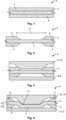
- Figure 1 shows a cross section through a conductor 1.
- the conductor 1 in this case comprises a first metal 2.
- An insulation 5 has been attached to the first metal 2 of the conductor 1 in such a way that the insulation 5 insulates the first metal 2.
- Fig. 2 shows the conductor 1 after the insulation 5 of the conductor 1 has been removed over a predetermined length 6. The removal of the insulation 5 over the predetermined length 6 has had the effect that part of the first metal 2 of the conductor 1 is exposed.
- This exposed region may also be referred to as a stripped region 7.
- Fig. 3 shows the conductor 1 from Figures 1 and 2 after placing into a moulding tool 8.
- the moulding tool 8 in this case comprises a lower part 9 and an upper part 10.
- the moulding tool 8 serves the purpose of forming a bead in the stripped region 7 of the conductor 1, by the upper part 10 of the moulding tool 8 being moved towards the lower part 9.
- Fig. 4 shows the conductor 1 once the upper part 10 of the moulding tool 8 has been moved towards the lower part 9 of the moulding tool 8 and a bead 11 has been created in the conductor 1. This takes place for example by pressing the upper part 10 onto the lower part 9.
- the forming of the bead 11 takes place by means of drop forging, the moulding tool 8 then being a drop forging tool.
- the conductor 1 is displaced in its position in the stripped region 7.
- a depth 12 of the bead 11 substantially coincides with a thickness 13 of the insulation 5.
- the depth 12 of the bead 11 does not coincide with the thickness 13 of the insulation 5.
- Fig. 5 shows the conductor 1 from Fig. 4 after it has been removed from the moulding tool 8.
- the conductor 1 is held down on a workpiece 3 by means of holding-down devices 14.
- the workpiece 3 in this case comprises a second metal 4.
- the first metal 2 of the conductor 1 is welded to the second metal 4 of the workpiece 3 by means of laser radiation 16.
- the bead 11 has the effect that the holding-down devices 14 have to exert a smaller force on the conductor 1 than in the case of the welding processes known from the prior art, since, on account of the bead 11, the first metal 2 of the conductor 1 already lies substantially in contact with the second metal 4 of the workpiece 3, that is to say substantially forms a zero gap. This applies in particular in the welding region 15.
- the conductor 1 and the workpiece 3 form an arrangement 21 of a conductor 1 and a workpiece 3, the conductor 1 comprising a first metal 2 and the workpiece 3 comprising a second metal 4, the conductor 1 the workpiece 3 being welded in a welding region 15 and the conductor 1 being stripped of its insulation in the welding region 15 and comprising a bead 11.
- a depth 12 of the bead 11 substantially coincides with a thickness 13 of the insulation 5 outside the stripped region 7 of the conductor 1.
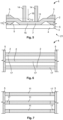
- Fig. 6 shows a multi-core conductor 1 in a plan view.
- three cores 17 have respectively been stripped, the first metal 2 of the cores 17 being visible on account of the stripping of the cores 17.
- this may correspond to the representation of Fig. 2 , the cores 17 being arranged one behind the other and therefore only one being visible.
- Fig. 7 shows the conductor 1 from Fig. 6 once a bead 11 has been formed in each core 17. This may take place by analogy with the process described in Figures 3 and 4 by means of the moulding tool 8, for example by means of drop forging.
- Fig. 8 shows the conductor 1 from Fig. 7 after it has been placed onto a workpiece 3, in plan view.
- the workpiece 3 in this case comprises three conducting regions 19, each core 17 being assigned a conducting region 19.
- the cores 17 lie in contact with the conducting regions 19.
- Each core 17 comprises a welding region 15, at which the conductor 1 or the core 17 of the conductor 1 is welded to the workpiece 3 or the conducting region 19 of the workpiece 3 in a way analogous to Fig. 5 by means of laser radiation 16.
- the cores 17 respectively comprise a further welding region 18, which is likewise arranged in the region of the bead 11 in the stripped region 7 and at which the cores 17 can likewise be welded to the conducting regions 19.
- the conductor 1 and the workpiece 3 in this case again form an arrangement 21 of a conductor 1 on a workpiece 3, in which the conductor 1 is welded to the workpiece 3.
- each core 17 of the conductor 1 is welded to a conducting region 19 of the workpiece 3. If the conducting regions 19 of the workpiece 3 are insulated with respect to one another, various contactings, for example of a battery, can thus be provided.
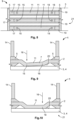
- Fig. 9 shows a cross section through a further conductor 1 held down on a workpiece 3 by means of holding-down devices 14.
- the conductor 1 in Fig. 9 is held down by means of the holding-down devices 14 in the region of the insulation 5, that is to say outside the stripped region 7 or the bead 11. This is possible in particular whenever the depth 12 of the bead 11 coincides with the thickness 13 of the insulation 5, as already described, since mechanical contact between the first metal 2 of the conductor 1 and the second metal 4 of the workpiece 3 is nevertheless possible.
- the first metal 2 of the conductor 1 can be welded in the welding region 15 to the second metal 4 of the workpiece 3 by means of laser radiation 16.
- each of the cores 17 may be welded by means of this process to a corresponding conducting region 19 of the workpiece 3.
- the bead 11 is configured in such a way that there is a distance 20 between the first metal 2 of the conductor 1 and the second metal 4 of the workpiece 3. If, during exposure to the laser radiation 16, the first metal 2 is heated on account of the laser radiation 16, the first metal 2 expands.
- Fig. 10 shows the conductor 1 and the workpiece 3 from Fig. 9 after the first metal 2 has been welded to the second metal 4 in the welding region 15 and the first metal 2 has expanded on account of the laser radiation 16 acting on it.
- the expansion has the effect that the first metal 2 of the conductor 1 then also lies in contact with the workpiece 3 in the further welding region 18 and can likewise be welded there to the workpiece 3 by means of laser radiation 16.
- the conductor 1 and the workpiece 3 once again form an arrangement 21 as already described above.
- Fig. 5 the holding down of the conductor 1 by means of the holding-down devices 14 in the stripped region 7 of the bead 11 is shown.
- the holding-down devices 14 are arranged in such a way that the holding down takes place on the insulation 5. It is also conceivable in combination that one of the holding-down devices 14 holds down the conductor 1 in the region of the bead 11 or the stripped region 7, while the other holding-down device 14 holds down the conductor 1 in the region of the insulation 5. Furthermore, it is alternatively likewise conceivable to provide fewer or more holding-down devices 14, for example only one holding-down device or three holding-down devices. Instead of the holding-down devices 14, an air stream may also be used, by means of which the conductor 1 is pressed onto the workpiece 3.
- the first metal 2 is welded together with the second metal 4 by means of in each case a number of welding points, that is to say by means of respective multiple exposure to the laser radiation 16.
- the welding points may for example be arranged in the form of a cross or spiral.
- the laser radiation 16 may in this case be any laser radiation suitable for welding the first metal 2 and the second metal 4.
- a cross section of the first metal 2 of the conductor 1, and also of the cores 17 of the conductor 1, may in this case be 1 millimetre on 0.2 millimetre. This means that, in the representation of Figures 1 to 5 or 9 and 10 , a thickness of the first metal 2 of 0.2 millimetre is represented, and the cores 17 from Figures 6 to 8 are represented in their width of 1 millimetre.
- the thickness 13 of the insulation 5 may be between 0.1 and 0.5 millimetre, for example 0.3 millimetre.
- the depth 12 of the bead 11 may then likewise lie in this range and be for example 0.3 millimetre.
- the first metal 2 comprises copper or aluminium, is copper or aluminium or comprises a laser-weldable alloy of the stated metals.
- the second metal 4 may comprise aluminium or a laser-weldable alloy with aluminium.
Landscapes
- Engineering & Computer Science (AREA)
- Physics & Mathematics (AREA)
- Optics & Photonics (AREA)
- Plasma & Fusion (AREA)
- Mechanical Engineering (AREA)
- Manufacturing & Machinery (AREA)
- Laser Beam Processing (AREA)
- Manufacture Of Motors, Generators (AREA)
Description
- The invention relates to a welding process of a conductor on a workpiece.
- It is known from the prior art to weld conductors to a workpiece. It may in this case be provided that the conductor has one or more cores, the one or more cores being enclosed by an insulating material. In order to weld the conductor to a workpiece, the conductor is stripped of its insulation in one region, that is to say the insulating material is removed. The stripped region of the conductor is subsequently pressed onto the workpiece, for example by means of holding-down devices. In the case of a multi-core conductor, it may be the case that for this purpose a number of conducting regions that are insulated from one another are arranged in the workpiece. After the pressing down of the conductor onto the workpiece, at least one core of the conductor is in mechanical contact with either the workpiece or at least one conducting region of the workpiece, and can thus be welded to the workpiece by means of a laser welding process.
- On account of the conductor being at a distance from the workpiece as a result of the insulating material, the holding down of the conductor must take place in such a way that the core or the cores of the conductor is/are pressed against the workpiece with a certain expenditure of force. The holding-down devices must be equipped for this and, for this reason, can also only be used in the stripped region of the conductor.
- Document
US 5 676 865 A , on which the preamble ofclaim 1 is based, discloses a welding process in which a bead is formed in a stripped region of a conductor to allow for mechanical contact of the conductor with a workpiece. - One problem addressed by the invention is that of providing an improved welding process.
- These problems are solved by the process for welding a conductor onto a workpiece of the independent patent claim. Advantageous configurations are specified in the dependent patent claims.
- In a process for welding a conductor onto a workpiece, the conductor comprises a first metal and the workpiece comprises a second metal. In order to weld the conductor to the workpiece, the following steps are carried out. First, an insulation of the conductor is removed over a predetermined length. Subsequently, a bead is created in a stripped region of the conductor. The stripped region of the conductor may in this case be the region of the conductor in which the insulation has been removed.
- The bead may be arranged in a manner that the conductor is displaced in the direction of the workpiece. This means that the conductor is not straight in the area of the bead, but bended in a way that the conductor in the area of the removed insulation is closer to the workpiece than in other areas of the conductor.
- Subsequently, the conductor is held down on the workpiece, the holding down having the effect of producing a mechanical contact in a welding region between the conductor and the workpiece. The welding region is in this case arranged in the region of the bead. Subsequently, a laser welding of the conductor onto the workpiece takes place in the welding region.
- The invention is therefore based on the central idea of reducing a distance between the conductor and the workpiece by means of a bead produced in the conductor, which is arranged in the stripped region of the conductor, by the necessary deforming of the conductor already taking place during the forming of the bead and not only when the holding down takes place. The bead may in this case be configured in such a way that a convexity of the conductor in the direction of the workpiece is produced on account of the bead and, as a result, the distance between the conductor and the workpiece is reduced. It may be provided that a further deformation of the conductor, occurring in addition to the bead, takes place during the holding down of the conductor. In particular, the welding process can be improved if a zero gap is produced, that is to say the conductor lies in direct contact with the workpiece.
- After the laser welding, the conductor is welded to the workpiece in a further welding region by means of laser welding. The conductoris therefore respectively welded to the workpiece in a welding region and a further welding region, in order to provide a more secure welded connection.
- The forming of the bead takes place in such a way that, during the holding down, the conductor initially lies in contact with the welding region and does not lie in contact with the further welding region. The thermal expansion of the conductor during the laser welding in the welding region has the effect that the conductor is deformed in such a way that the conductor subsequently lies in contact with the further welding region and can likewise be welded there to the workpiece. This may take place for example by the bead being configured in such a way that the conductor is arranged closer to the workpiece in the welding region than in the further welding region on account of the bead; the conductor is in contact with the workpiece in particular in the welding region and not in the further welding region.
- As a result, the thermal expansion of the conductor during the laser welding can likewise be used to achieve the overall effect of the conductor lying even more advantageously in contact with the workpiece.
- In one embodiment of the process, the workpiece comprises a number of conducting regions. The conductor is part of a multi-core conductor, an insulation being removed during the welding process on all of the cores of the multi-core conductor and a bead being formed in the case of all of the cores of the multi-core conductor. In the subsequent laser welding process, the cores are respectively welded one after the other to a conducting region.
- This makes possible an efficient process for welding a multi-core conductor to conducting regions of a workpiece, such as is used for example in battery production.
- In one embodiment of the process, the conductor is a flat conductor with a rectangular cross section. Such a conductor is particularly well-suited for the welding process described.
- In one embodiment, the holding down takes place in a stripped region of the conductor. This may take place for example by means of a holding-down device, which contacts the conductor in the welding region and holds it down on the workpiece. Alternatively, the holding down may for example also take place by an air stream impinging in the stripped region.
- In one embodiment of the process, the holding down takes place outside the stripped region. This may likewise take place for example by means of a holding-down device or an air stream. It may also be provided for example to use a holding-down device in the stripped region and a holding-down device in the non-stripped region of the conductor. If the conductor is held down outside the stripped region, as a result the stripped region can be of a reduced size.
- In one embodiment of the process, the laser welding in the welding region takes place by means of a number of welding points. The same may also apply in the further welding region. In the case of laser welding, it is generally customary to set a number of welding points at a welding location, for example spirally. The bead allows this to be performed very efficiently in the described welding process, since for example no holding-down devices are necessary in the vicinity of the welding region.
- In one embodiment of the process, a depth of the bead substantially coincides with a thickness of the insulation. In particular, the depth of the bead coincides with the thickness of the insulation. As a result, the conductor is in contact with the workpiece in the welding region when it otherwise lies in contact with the insulation on the workpiece and the bead is configured in such a way that a displacement of the conductor thereby initiated is facing the workpiece. This configuration is particularly well-suited for the holding down of the conductor on the insulation or the holding down of the conductor by means of an air stream.
- In one embodiment of the process, the forming of the bead takes place by means of drop forging. In this case, the conductor is placed into a tool which comprises at least two moulds, the bead being created in the conductor by means of a forging operation. This makes possible a simple and efficient production process of the bead, good reproducibility of the forging result being possible due to the tool used in the drop forging.
- In one embodiment of the process, the first metal comprises aluminium or copper or consists of aluminium or copper. In one embodiment of the process, the second metal comprises aluminium or the first metal is aluminium. In particular, these stated materials are well-suited for the use of the proposed laser welding process. Any light source capable of stimulating emission of which the energy and/or power and/or wavelength is suitable for welding together the metals to be welded may be used as the laser in the laser welding process. Such suitable laser welding processes are known from the prior art.
- The problem addressed by the invention, the technical implementation of the solution and the advantages of the invention are clear from the exemplary embodiments, which are to be described below with the aid of figures, in the schematized representation of which:
- Fig. 1
- shows a conductor at the starting point of a welding process;
- Fig. 2
- shows the conductor after stripping of an insulation;
- Fig. 3
- shows the conductor after placing into a tool;
- Fig. 4
- shows the conductor after the forming of a bead;
- Fig. 5
- shows the conductor after holding down and during a welding operation;
- Fig. 6
- shows a stripped multi-core conductor;
- Fig. 7
- shows a multi-core conductor with beads;
- Fig. 8
- shows a multi-core conductor after welding;
- Fig. 9
- shows a further held-down conductor; and
- Fig. 10
- shows a held-down conductor during the welding operation.
-
Figure 1 shows a cross section through aconductor 1. Theconductor 1 in this case comprises afirst metal 2. Aninsulation 5 has been attached to thefirst metal 2 of theconductor 1 in such a way that theinsulation 5 insulates thefirst metal 2. -
Fig. 2 shows theconductor 1 after theinsulation 5 of theconductor 1 has been removed over apredetermined length 6. The removal of theinsulation 5 over thepredetermined length 6 has had the effect that part of thefirst metal 2 of theconductor 1 is exposed. - This exposed region may also be referred to as a stripped
region 7. -
Fig. 3 shows theconductor 1 fromFigures 1 and 2 after placing into a moulding tool 8. The moulding tool 8 in this case comprises a lower part 9 and an upper part 10. The moulding tool 8 serves the purpose of forming a bead in the strippedregion 7 of theconductor 1, by the upper part 10 of the moulding tool 8 being moved towards the lower part 9. -
Fig. 4 shows theconductor 1 once the upper part 10 of the moulding tool 8 has been moved towards the lower part 9 of the moulding tool 8 and abead 11 has been created in theconductor 1. This takes place for example by pressing the upper part 10 onto the lower part 9. In one exemplary embodiment, the forming of thebead 11 takes place by means of drop forging, the moulding tool 8 then being a drop forging tool. - On account of the
bead 11, theconductor 1 is displaced in its position in the strippedregion 7. In this case, it may be provided that adepth 12 of thebead 11 substantially coincides with athickness 13 of theinsulation 5. In alternative exemplary embodiments, not shown here, thedepth 12 of thebead 11 does not coincide with thethickness 13 of theinsulation 5. -
Fig. 5 shows theconductor 1 fromFig. 4 after it has been removed from the moulding tool 8. Theconductor 1 is held down on aworkpiece 3 by means of holding-downdevices 14. Theworkpiece 3 in this case comprises asecond metal 4. In awelding region 15, thefirst metal 2 of theconductor 1 is welded to thesecond metal 4 of theworkpiece 3 by means oflaser radiation 16. Thebead 11 has the effect that the holding-downdevices 14 have to exert a smaller force on theconductor 1 than in the case of the welding processes known from the prior art, since, on account of thebead 11, thefirst metal 2 of theconductor 1 already lies substantially in contact with thesecond metal 4 of theworkpiece 3, that is to say substantially forms a zero gap. This applies in particular in thewelding region 15. - The
conductor 1 and theworkpiece 3 form anarrangement 21 of aconductor 1 and aworkpiece 3, theconductor 1 comprising afirst metal 2 and theworkpiece 3 comprising asecond metal 4, theconductor 1 theworkpiece 3 being welded in awelding region 15 and theconductor 1 being stripped of its insulation in thewelding region 15 and comprising abead 11. - In this case, it may be provided by analogy with
Fig. 4 that adepth 12 of thebead 11 substantially coincides with athickness 13 of theinsulation 5 outside the strippedregion 7 of theconductor 1. -
Fig. 6 shows amulti-core conductor 1 in a plan view. In aninsulation 5, threecores 17 have respectively been stripped, thefirst metal 2 of thecores 17 being visible on account of the stripping of thecores 17. In cross section, this may correspond to the representation ofFig. 2 , thecores 17 being arranged one behind the other and therefore only one being visible. -
Fig. 7 shows theconductor 1 fromFig. 6 once abead 11 has been formed in each core 17. This may take place by analogy with the process described inFigures 3 and 4 by means of the moulding tool 8, for example by means of drop forging. -
Fig. 8 shows theconductor 1 fromFig. 7 after it has been placed onto aworkpiece 3, in plan view. By means of holding-down devices that are not shown, theconductor 1 can be held down on theworkpiece 3 in a way analogous toFig. 5 . Theworkpiece 3 in this case comprises three conductingregions 19, each core 17 being assigned a conductingregion 19. On account of thebeads 11 of thecores 17, it may be provided, by analogy withFig. 5 , that thecores 17 lie in contact with the conductingregions 19. Eachcore 17 comprises awelding region 15, at which theconductor 1 or thecore 17 of theconductor 1 is welded to theworkpiece 3 or the conductingregion 19 of theworkpiece 3 in a way analogous toFig. 5 by means oflaser radiation 16. Furthermore, thecores 17 respectively comprise afurther welding region 18, which is likewise arranged in the region of thebead 11 in the strippedregion 7 and at which thecores 17 can likewise be welded to the conductingregions 19. - It is analogously also conceivable to weld the
conductor 1 fromFig. 5 additionally to theworkpiece 3 in afurther welding region 18. - The
conductor 1 and theworkpiece 3 in this case again form anarrangement 21 of aconductor 1 on aworkpiece 3, in which theconductor 1 is welded to theworkpiece 3. In particular, eachcore 17 of theconductor 1 is welded to a conductingregion 19 of theworkpiece 3. If the conductingregions 19 of theworkpiece 3 are insulated with respect to one another, various contactings, for example of a battery, can thus be provided. -
Fig. 9 shows a cross section through afurther conductor 1 held down on aworkpiece 3 by means of holding-downdevices 14. By contrast withFig. 5 , theconductor 1 inFig. 9 is held down by means of the holding-downdevices 14 in the region of theinsulation 5, that is to say outside the strippedregion 7 or thebead 11. This is possible in particular whenever thedepth 12 of thebead 11 coincides with thethickness 13 of theinsulation 5, as already described, since mechanical contact between thefirst metal 2 of theconductor 1 and thesecond metal 4 of theworkpiece 3 is nevertheless possible. Thus, thefirst metal 2 of theconductor 1 can be welded in thewelding region 15 to thesecond metal 4 of theworkpiece 3 by means oflaser radiation 16. If a number ofcores 17 are provided, as shown for example inFigures 6 to 8 , each of thecores 17 may be welded by means of this process to a corresponding conductingregion 19 of theworkpiece 3. - In a
further welding region 18, thebead 11 is configured in such a way that there is adistance 20 between thefirst metal 2 of theconductor 1 and thesecond metal 4 of theworkpiece 3. If, during exposure to thelaser radiation 16, thefirst metal 2 is heated on account of thelaser radiation 16, thefirst metal 2 expands. -
Fig. 10 shows theconductor 1 and theworkpiece 3 fromFig. 9 after thefirst metal 2 has been welded to thesecond metal 4 in thewelding region 15 and thefirst metal 2 has expanded on account of thelaser radiation 16 acting on it. The expansion has the effect that thefirst metal 2 of theconductor 1 then also lies in contact with theworkpiece 3 in thefurther welding region 18 and can likewise be welded there to theworkpiece 3 by means oflaser radiation 16. Theconductor 1 and theworkpiece 3 once again form anarrangement 21 as already described above. - It may be provided that the
conductor 1 comprises a flat conductor with a rectangular cross section. In particular, thecores 17 may be flat conductors with a rectangular cross section, whereby the contact of theconductor 1 or of thecores 17 lying on theworkpiece 3 is improved. - In
Fig. 5 , the holding down of theconductor 1 by means of the holding-downdevices 14 in the strippedregion 7 of thebead 11 is shown. InFigures 9 and 10 , the holding-downdevices 14 are arranged in such a way that the holding down takes place on theinsulation 5. It is also conceivable in combination that one of the holding-downdevices 14 holds down theconductor 1 in the region of thebead 11 or the strippedregion 7, while the other holding-down device 14 holds down theconductor 1 in the region of theinsulation 5. Furthermore, it is alternatively likewise conceivable to provide fewer or more holding-downdevices 14, for example only one holding-down device or three holding-down devices. Instead of the holding-downdevices 14, an air stream may also be used, by means of which theconductor 1 is pressed onto theworkpiece 3. - It may be provided that in the
welding region 15 or in thefurther welding region 18 thefirst metal 2 is welded together with thesecond metal 4 by means of in each case a number of welding points, that is to say by means of respective multiple exposure to thelaser radiation 16. The welding points may for example be arranged in the form of a cross or spiral. Thelaser radiation 16 may in this case be any laser radiation suitable for welding thefirst metal 2 and thesecond metal 4. - A cross section of the
first metal 2 of theconductor 1, and also of thecores 17 of theconductor 1, may in this case be 1 millimetre on 0.2 millimetre. This means that, in the representation ofFigures 1 to 5 or9 and 10 , a thickness of thefirst metal 2 of 0.2 millimetre is represented, and thecores 17 fromFigures 6 to 8 are represented in their width of 1 millimetre. - The
thickness 13 of theinsulation 5 may be between 0.1 and 0.5 millimetre, for example 0.3 millimetre. Thedepth 12 of thebead 11 may then likewise lie in this range and be for example 0.3 millimetre. - It may be provided that the
first metal 2 comprises copper or aluminium, is copper or aluminium or comprises a laser-weldable alloy of the stated metals. Thesecond metal 4 may comprise aluminium or a laser-weldable alloy with aluminium. - Although the invention has been described more specifically and illustrated in detail by the preferred exemplary embodiments, the invention is not restricted by the disclosed exemplary embodiments. Other variations may be derived therefrom and from the description of the invention without departing from the scope of protection of the invention, as defined by the appended claims.
-
- 1
- conductor
- 2
- first metal (of the conductor)
- 3
- workpiece
- 4
- second metal (of the workpiece)
- 5
- insulation
- 6
- (predetermined) length
- 7
- (stripped) region
- 8
- moulding tool
- 9
- lower part (of the moulding tool)
- 10
- upper part (of the moulding tool)
- 11
- bead
- 12
- depth (of the bead)
- 13
- thickness (of the insulation)
- 14
- holding-down device
- 15
- welding region
- 16
- laser radiation
- 17
- core
- 18
- further welding region
- 19
- conducting region
- 20
- distance
- 21
- arrangement
Claims (8)
- Process for welding a conductor (1) onto a workpiece (3), wherein the conductor (1) comprises a first metal (2) and the workpiece (3) comprises a second metal (4), with the following steps: removing an insulation (5) of the conductor (1) over a predetermined length (6); forming a bead in a stripped region (7) of the conductor (1); holding down the conductor (1) on the workpiece (3), the holding down having the effect of producing a mechanical contact in a welding region (15) between the conductor (1) and the workpiece (3), wherein the welding region (15) is arranged in the region of the bead; laser welding of the conductor (1) onto the workpiece (3) in the welding region (15), characterized in that, after the laser welding, the conductor (1) is welded to the workpiece (3) in a further welding region (18) by means of laser welding, that the forming of the bead takes place in such a way that the conductor (1) initially lies in contact with the welding region (15) and does not lie in contact with the further welding region (18), that the thermal expansion during the laser welding in the welding region (15) has the effect that the conductor (1) is deformed in such a way that the conductor (1) subsequently lies in contact with the further welding region (18).
- Process according to Claim 1, wherein the workpiece (3) comprises a number of conducting regions (19) and the conductor (1) is part of a multi-core conductor (1), an insulation (5) being removed respectively on all of the cores (17) of the multi-core conductor (1), a bead being formed in the case of all of the cores (17) of the multi-core conductor (1), all of the cores (17) being held down and a core (17) being respectively welded to a conducting region (19).
- Process according to any one of Claims 1 or 2, wherein a depth of the bead substantially coincides with a thickness (13) of the insulation (5).
- Process according to any one of Claims 1 to 3, wherein the conductor (1) is a flat conductor with a rectangular cross section.
- Process according to any one of Claims 1 to 4, wherein the holding down takes place in a stripped region (7) of the conductor (1).
- Process according to any one of Claims 1 to 5, wherein the holding down takes place outside a stripped region (7) of the conductor (1).
- Process according to any one of Claims 1 to 6, wherein the laser welding in the welding region (15) takes place by means of a number of welding points.
- Process according to any one of Claims 1 to 7, wherein the forming of the bead takes place by means of drop forging.
Applications Claiming Priority (1)
| Application Number | Priority Date | Filing Date | Title |
|---|---|---|---|
| DE102019126012.4A DE102019126012A1 (en) | 2019-09-26 | 2019-09-26 | Welding process |
Publications (2)
| Publication Number | Publication Date |
|---|---|
| EP3797920A1 EP3797920A1 (en) | 2021-03-31 |
| EP3797920B1 true EP3797920B1 (en) | 2024-09-11 |
Family
ID=72659664
Family Applications (1)
| Application Number | Title | Priority Date | Filing Date |
|---|---|---|---|
| EP20198447.3A Active EP3797920B1 (en) | 2019-09-26 | 2020-09-25 | Welding process |
Country Status (6)
| Country | Link |
|---|---|
| US (1) | US12070816B2 (en) |
| EP (1) | EP3797920B1 (en) |
| JP (1) | JP7608099B2 (en) |
| KR (1) | KR102847762B1 (en) |
| CN (1) | CN112548370A (en) |
| DE (1) | DE102019126012A1 (en) |
Families Citing this family (2)
| Publication number | Priority date | Publication date | Assignee | Title |
|---|---|---|---|---|
| DE102021210324A1 (en) * | 2021-09-17 | 2023-03-23 | Robert Bosch Gesellschaft mit beschränkter Haftung | Welding method and welding device for laser welding a flexible film to a substrate |
| CN118848242B (en) * | 2024-09-26 | 2024-11-26 | 成都今之榜金属门窗有限公司 | Laser welding equipment and welding method for aluminum alloy door frame production |
Family Cites Families (14)
| Publication number | Priority date | Publication date | Assignee | Title |
|---|---|---|---|---|
| ES2036998T3 (en) * | 1991-03-27 | 1996-08-01 | Seb Sa | ARTICLE CONSTITUTED FROM A PLATE MADE OF A RELATIVELY SOFT METAL AND A CULINARY CONTAINER THAT CONSTITUTES SUCH AN ARTICLE. |
| US5676865A (en) * | 1995-08-25 | 1997-10-14 | Thomas & Betts Corporation | Method of and apparatus for providing welded joints |
| JPH10334955A (en) * | 1997-05-28 | 1998-12-18 | Harness Sogo Gijutsu Kenkyusho:Kk | Laser welding structure of bus bar |
| JP2001068171A (en) | 1999-08-30 | 2001-03-16 | Sumitomo Wiring Syst Ltd | Circuit conductor jointing structure of junction block |
| US6344687B1 (en) | 1999-12-22 | 2002-02-05 | Chih-Kung Huang | Dual-chip packaging |
| US7009142B2 (en) * | 2004-05-20 | 2006-03-07 | Visteon Global Technologies Inc. | System and method for joining flat flexible cables |
| JP2011527637A (en) | 2008-07-09 | 2011-11-04 | エフ・イ−・アイ・カンパニー | Method and apparatus for laser machining |
| JP2010103299A (en) | 2008-10-23 | 2010-05-06 | Sharp Corp | Semiconductor device forming substrate which is interconnected and laser bonding method of the same |
| KR20120105953A (en) * | 2011-03-17 | 2012-09-26 | 엘지전자 주식회사 | Mobile terminal and method for manufacturing the same |
| DE102014226710A1 (en) | 2014-12-19 | 2016-06-23 | Continental Automotive Gmbh | Method and apparatus for welding wire segment pairs |
| US10835993B2 (en) * | 2015-08-05 | 2020-11-17 | Panasonic Intellectual Property Management Co., Ltd. | Laser welding method |
| JP6646872B2 (en) * | 2016-03-09 | 2020-02-14 | 株式会社オートネットワーク技術研究所 | Manufacturing method of electric wire with terminal and electric wire with terminal |
| CN111699594B (en) * | 2018-02-09 | 2022-09-13 | 利萨·德雷克塞迈尔有限责任公司 | Method for connecting at least one electrical contact element to a flat conductor of a vehicle electrical system of a motor vehicle |
| JP7060979B2 (en) | 2018-02-19 | 2022-04-27 | 日本メクトロン株式会社 | Board connection structure and manufacturing method of board connection structure |
-
2019
- 2019-09-26 DE DE102019126012.4A patent/DE102019126012A1/en active Pending
-
2020
- 2020-09-23 JP JP2020158157A patent/JP7608099B2/en active Active
- 2020-09-24 KR KR1020200124277A patent/KR102847762B1/en active Active
- 2020-09-24 CN CN202011015460.3A patent/CN112548370A/en active Pending
- 2020-09-24 US US17/031,077 patent/US12070816B2/en active Active
- 2020-09-25 EP EP20198447.3A patent/EP3797920B1/en active Active
Also Published As
| Publication number | Publication date |
|---|---|
| US12070816B2 (en) | 2024-08-27 |
| KR20210036842A (en) | 2021-04-05 |
| DE102019126012A1 (en) | 2021-04-01 |
| US20210094123A1 (en) | 2021-04-01 |
| KR102847762B1 (en) | 2025-08-20 |
| JP7608099B2 (en) | 2025-01-06 |
| CN112548370A (en) | 2021-03-26 |
| JP2021053701A (en) | 2021-04-08 |
| EP3797920A1 (en) | 2021-03-31 |
Similar Documents
| Publication | Publication Date | Title |
|---|---|---|
| EP3797920B1 (en) | Welding process | |
| JP4654068B2 (en) | Bonded electric wire, method of processing the bonded electric wire, rotating electric machine stator, rotating electric machine stator manufacturing method, and bonded electric wire manufacturing apparatus | |
| US20170117782A1 (en) | Stator coil forming method | |
| US9608338B2 (en) | Cylindrical body, crimp terminal, and manufacturing method thereof, as well as manufacturing apparatus of crimp terminal | |
| KR101877097B1 (en) | Method for welding a cable to a terminal and the terminal obtained therefrom | |
| US20150111442A1 (en) | Terminal-provided wire, method for manufacturing same and jig | |
| CN111054851A (en) | Method for producing two-dimensionally or three-dimensionally shaped flat conductors from metal | |
| JP2017054812A (en) | Metal plate component having improved geometrical shape of connection tab | |
| US12027924B2 (en) | Method for producing a stator arrangement | |
| JP5819156B2 (en) | Press bending apparatus and press bending method for performing V bending of Mg alloy plate | |
| US20250100073A1 (en) | Processing apparatus and method, using plurality of lasers | |
| US20240339249A1 (en) | Wire harness manufacturing method and wire harness | |
| CN103761562B (en) | Double-interface IC card automatic producing device | |
| JPH11214113A (en) | Laser welding method for welding wires to terminal members | |
| JP7502842B2 (en) | Manufacturing method of rectangular wire | |
| US20190160593A1 (en) | Welding method for different kinds of metals | |
| EP3610538B1 (en) | Tool for soldering an electrical conductor with a connection device | |
| JP2001038425A (en) | Burring method of magnesium alloy and its mold | |
| DE69020074T2 (en) | Method for attaching a lead wire to a hook-shaped element, and a rotor and / or stand for an electrical machine in which the method has been used. | |
| JPS6244422B2 (en) | ||
| US20100050726A1 (en) | Superplastically Continuous Roll Forming Titanium | |
| EP2363217B1 (en) | Apparatus for forming workpieces by local heating thereof | |
| JPH06113423A (en) | Flat cable terminal processing method | |
| US6358774B1 (en) | Method of manufacturing a semiconductor device | |
| EP2843780A1 (en) | Electron-beam-supported production of electrical components |
Legal Events
| Date | Code | Title | Description |
|---|---|---|---|
| PUAI | Public reference made under article 153(3) epc to a published international application that has entered the european phase |
Free format text: ORIGINAL CODE: 0009012 |
|
| STAA | Information on the status of an ep patent application or granted ep patent |
Free format text: STATUS: THE APPLICATION HAS BEEN PUBLISHED |
|
| AK | Designated contracting states |
Kind code of ref document: A1 Designated state(s): AL AT BE BG CH CY CZ DE DK EE ES FI FR GB GR HR HU IE IS IT LI LT LU LV MC MK MT NL NO PL PT RO RS SE SI SK SM TR |
|
| AX | Request for extension of the european patent |
Extension state: BA ME |
|
| STAA | Information on the status of an ep patent application or granted ep patent |
Free format text: STATUS: REQUEST FOR EXAMINATION WAS MADE |
|
| 17P | Request for examination filed |
Effective date: 20210915 |
|
| RBV | Designated contracting states (corrected) |
Designated state(s): AL AT BE BG CH CY CZ DE DK EE ES FI FR GB GR HR HU IE IS IT LI LT LU LV MC MK MT NL NO PL PT RO RS SE SI SK SM TR |
|
| STAA | Information on the status of an ep patent application or granted ep patent |
Free format text: STATUS: EXAMINATION IS IN PROGRESS |
|
| 17Q | First examination report despatched |
Effective date: 20230712 |
|
| GRAP | Despatch of communication of intention to grant a patent |
Free format text: ORIGINAL CODE: EPIDOSNIGR1 |
|
| STAA | Information on the status of an ep patent application or granted ep patent |
Free format text: STATUS: GRANT OF PATENT IS INTENDED |
|
| RIC1 | Information provided on ipc code assigned before grant |
Ipc: B23K 101/38 20060101ALN20240321BHEP Ipc: B23K 101/32 20060101ALN20240321BHEP Ipc: H05K 3/32 20060101ALI20240321BHEP Ipc: B23K 26/60 20140101ALI20240321BHEP Ipc: B23K 26/21 20140101ALI20240321BHEP Ipc: B23K 26/22 20060101AFI20240321BHEP |
|
| INTG | Intention to grant announced |
Effective date: 20240409 |
|
| GRAS | Grant fee paid |
Free format text: ORIGINAL CODE: EPIDOSNIGR3 |
|
| GRAA | (expected) grant |
Free format text: ORIGINAL CODE: 0009210 |
|
| STAA | Information on the status of an ep patent application or granted ep patent |
Free format text: STATUS: THE PATENT HAS BEEN GRANTED |
|
| AK | Designated contracting states |
Kind code of ref document: B1 Designated state(s): AL AT BE BG CH CY CZ DE DK EE ES FI FR GB GR HR HU IE IS IT LI LT LU LV MC MK MT NL NO PL PT RO RS SE SI SK SM TR |
|
| REG | Reference to a national code |
Ref country code: GB Ref legal event code: FG4D |
|
| REG | Reference to a national code |
Ref country code: CH Ref legal event code: EP |
|
| REG | Reference to a national code |
Ref country code: DE Ref legal event code: R096 Ref document number: 602020037439 Country of ref document: DE |
|
| REG | Reference to a national code |
Ref country code: IE Ref legal event code: FG4D |
|
| REG | Reference to a national code |
Ref country code: LT Ref legal event code: MG9D |
|
| PG25 | Lapsed in a contracting state [announced via postgrant information from national office to epo] |
Ref country code: NO Free format text: LAPSE BECAUSE OF FAILURE TO SUBMIT A TRANSLATION OF THE DESCRIPTION OR TO PAY THE FEE WITHIN THE PRESCRIBED TIME-LIMIT Effective date: 20241211 |
|
| REG | Reference to a national code |
Ref country code: NL Ref legal event code: MP Effective date: 20240911 |
|
| PG25 | Lapsed in a contracting state [announced via postgrant information from national office to epo] |
Ref country code: GR Free format text: LAPSE BECAUSE OF FAILURE TO SUBMIT A TRANSLATION OF THE DESCRIPTION OR TO PAY THE FEE WITHIN THE PRESCRIBED TIME-LIMIT Effective date: 20241212 Ref country code: FI Free format text: LAPSE BECAUSE OF FAILURE TO SUBMIT A TRANSLATION OF THE DESCRIPTION OR TO PAY THE FEE WITHIN THE PRESCRIBED TIME-LIMIT Effective date: 20240911 |
|
| PG25 | Lapsed in a contracting state [announced via postgrant information from national office to epo] |
Ref country code: BG Free format text: LAPSE BECAUSE OF FAILURE TO SUBMIT A TRANSLATION OF THE DESCRIPTION OR TO PAY THE FEE WITHIN THE PRESCRIBED TIME-LIMIT Effective date: 20240911 |
|
| PG25 | Lapsed in a contracting state [announced via postgrant information from national office to epo] |
Ref country code: LV Free format text: LAPSE BECAUSE OF FAILURE TO SUBMIT A TRANSLATION OF THE DESCRIPTION OR TO PAY THE FEE WITHIN THE PRESCRIBED TIME-LIMIT Effective date: 20240911 |
|
| PG25 | Lapsed in a contracting state [announced via postgrant information from national office to epo] |
Ref country code: HR Free format text: LAPSE BECAUSE OF FAILURE TO SUBMIT A TRANSLATION OF THE DESCRIPTION OR TO PAY THE FEE WITHIN THE PRESCRIBED TIME-LIMIT Effective date: 20240911 |
|
| PG25 | Lapsed in a contracting state [announced via postgrant information from national office to epo] |
Ref country code: RS Free format text: LAPSE BECAUSE OF FAILURE TO SUBMIT A TRANSLATION OF THE DESCRIPTION OR TO PAY THE FEE WITHIN THE PRESCRIBED TIME-LIMIT Effective date: 20241211 Ref country code: ES Free format text: LAPSE BECAUSE OF FAILURE TO SUBMIT A TRANSLATION OF THE DESCRIPTION OR TO PAY THE FEE WITHIN THE PRESCRIBED TIME-LIMIT Effective date: 20240911 |
|
| PG25 | Lapsed in a contracting state [announced via postgrant information from national office to epo] |
Ref country code: RS Free format text: LAPSE BECAUSE OF FAILURE TO SUBMIT A TRANSLATION OF THE DESCRIPTION OR TO PAY THE FEE WITHIN THE PRESCRIBED TIME-LIMIT Effective date: 20241211 Ref country code: NO Free format text: LAPSE BECAUSE OF FAILURE TO SUBMIT A TRANSLATION OF THE DESCRIPTION OR TO PAY THE FEE WITHIN THE PRESCRIBED TIME-LIMIT Effective date: 20241211 Ref country code: LV Free format text: LAPSE BECAUSE OF FAILURE TO SUBMIT A TRANSLATION OF THE DESCRIPTION OR TO PAY THE FEE WITHIN THE PRESCRIBED TIME-LIMIT Effective date: 20240911 Ref country code: HR Free format text: LAPSE BECAUSE OF FAILURE TO SUBMIT A TRANSLATION OF THE DESCRIPTION OR TO PAY THE FEE WITHIN THE PRESCRIBED TIME-LIMIT Effective date: 20240911 Ref country code: GR Free format text: LAPSE BECAUSE OF FAILURE TO SUBMIT A TRANSLATION OF THE DESCRIPTION OR TO PAY THE FEE WITHIN THE PRESCRIBED TIME-LIMIT Effective date: 20241212 Ref country code: FI Free format text: LAPSE BECAUSE OF FAILURE TO SUBMIT A TRANSLATION OF THE DESCRIPTION OR TO PAY THE FEE WITHIN THE PRESCRIBED TIME-LIMIT Effective date: 20240911 Ref country code: ES Free format text: LAPSE BECAUSE OF FAILURE TO SUBMIT A TRANSLATION OF THE DESCRIPTION OR TO PAY THE FEE WITHIN THE PRESCRIBED TIME-LIMIT Effective date: 20240911 Ref country code: BG Free format text: LAPSE BECAUSE OF FAILURE TO SUBMIT A TRANSLATION OF THE DESCRIPTION OR TO PAY THE FEE WITHIN THE PRESCRIBED TIME-LIMIT Effective date: 20240911 |
|
| REG | Reference to a national code |
Ref country code: AT Ref legal event code: MK05 Ref document number: 1722269 Country of ref document: AT Kind code of ref document: T Effective date: 20240911 |
|
| PG25 | Lapsed in a contracting state [announced via postgrant information from national office to epo] |
Ref country code: NL Free format text: LAPSE BECAUSE OF FAILURE TO SUBMIT A TRANSLATION OF THE DESCRIPTION OR TO PAY THE FEE WITHIN THE PRESCRIBED TIME-LIMIT Effective date: 20240911 |
|
| PG25 | Lapsed in a contracting state [announced via postgrant information from national office to epo] |
Ref country code: PT Free format text: LAPSE BECAUSE OF FAILURE TO SUBMIT A TRANSLATION OF THE DESCRIPTION OR TO PAY THE FEE WITHIN THE PRESCRIBED TIME-LIMIT Effective date: 20250113 Ref country code: IS Free format text: LAPSE BECAUSE OF FAILURE TO SUBMIT A TRANSLATION OF THE DESCRIPTION OR TO PAY THE FEE WITHIN THE PRESCRIBED TIME-LIMIT Effective date: 20250111 |
|
| PG25 | Lapsed in a contracting state [announced via postgrant information from national office to epo] |
Ref country code: SM Free format text: LAPSE BECAUSE OF FAILURE TO SUBMIT A TRANSLATION OF THE DESCRIPTION OR TO PAY THE FEE WITHIN THE PRESCRIBED TIME-LIMIT Effective date: 20240911 Ref country code: RO Free format text: LAPSE BECAUSE OF FAILURE TO SUBMIT A TRANSLATION OF THE DESCRIPTION OR TO PAY THE FEE WITHIN THE PRESCRIBED TIME-LIMIT Effective date: 20240911 |
|
| PG25 | Lapsed in a contracting state [announced via postgrant information from national office to epo] |
Ref country code: EE Free format text: LAPSE BECAUSE OF FAILURE TO SUBMIT A TRANSLATION OF THE DESCRIPTION OR TO PAY THE FEE WITHIN THE PRESCRIBED TIME-LIMIT Effective date: 20240911 Ref country code: AT Free format text: LAPSE BECAUSE OF FAILURE TO SUBMIT A TRANSLATION OF THE DESCRIPTION OR TO PAY THE FEE WITHIN THE PRESCRIBED TIME-LIMIT Effective date: 20240911 |
|
| PG25 | Lapsed in a contracting state [announced via postgrant information from national office to epo] |
Ref country code: CZ Free format text: LAPSE BECAUSE OF FAILURE TO SUBMIT A TRANSLATION OF THE DESCRIPTION OR TO PAY THE FEE WITHIN THE PRESCRIBED TIME-LIMIT Effective date: 20240911 Ref country code: PL Free format text: LAPSE BECAUSE OF FAILURE TO SUBMIT A TRANSLATION OF THE DESCRIPTION OR TO PAY THE FEE WITHIN THE PRESCRIBED TIME-LIMIT Effective date: 20240911 |
|
| PG25 | Lapsed in a contracting state [announced via postgrant information from national office to epo] |
Ref country code: SK Free format text: LAPSE BECAUSE OF FAILURE TO SUBMIT A TRANSLATION OF THE DESCRIPTION OR TO PAY THE FEE WITHIN THE PRESCRIBED TIME-LIMIT Effective date: 20240911 |
|
| REG | Reference to a national code |
Ref country code: CH Ref legal event code: PL |
|
| PG25 | Lapsed in a contracting state [announced via postgrant information from national office to epo] |
Ref country code: LU Free format text: LAPSE BECAUSE OF NON-PAYMENT OF DUE FEES Effective date: 20240925 |
|
| REG | Reference to a national code |
Ref country code: DE Ref legal event code: R097 Ref document number: 602020037439 Country of ref document: DE |
|
| PG25 | Lapsed in a contracting state [announced via postgrant information from national office to epo] |
Ref country code: MC Free format text: LAPSE BECAUSE OF FAILURE TO SUBMIT A TRANSLATION OF THE DESCRIPTION OR TO PAY THE FEE WITHIN THE PRESCRIBED TIME-LIMIT Effective date: 20240911 |
|
| PG25 | Lapsed in a contracting state [announced via postgrant information from national office to epo] |
Ref country code: DK Free format text: LAPSE BECAUSE OF FAILURE TO SUBMIT A TRANSLATION OF THE DESCRIPTION OR TO PAY THE FEE WITHIN THE PRESCRIBED TIME-LIMIT Effective date: 20240911 |
|
| REG | Reference to a national code |
Ref country code: BE Ref legal event code: MM Effective date: 20240930 |
|
| PG25 | Lapsed in a contracting state [announced via postgrant information from national office to epo] |
Ref country code: BE Free format text: LAPSE BECAUSE OF NON-PAYMENT OF DUE FEES Effective date: 20240930 |
|
| PLBE | No opposition filed within time limit |
Free format text: ORIGINAL CODE: 0009261 |
|
| STAA | Information on the status of an ep patent application or granted ep patent |
Free format text: STATUS: NO OPPOSITION FILED WITHIN TIME LIMIT |
|
| PG25 | Lapsed in a contracting state [announced via postgrant information from national office to epo] |
Ref country code: CH Free format text: LAPSE BECAUSE OF NON-PAYMENT OF DUE FEES Effective date: 20240930 |
|
| PG25 | Lapsed in a contracting state [announced via postgrant information from national office to epo] |
Ref country code: IE Free format text: LAPSE BECAUSE OF NON-PAYMENT OF DUE FEES Effective date: 20240925 |
|
| 26N | No opposition filed |
Effective date: 20250612 |
|
| GBPC | Gb: european patent ceased through non-payment of renewal fee |
Effective date: 20241211 |
|
| PG25 | Lapsed in a contracting state [announced via postgrant information from national office to epo] |
Ref country code: SE Free format text: LAPSE BECAUSE OF FAILURE TO SUBMIT A TRANSLATION OF THE DESCRIPTION OR TO PAY THE FEE WITHIN THE PRESCRIBED TIME-LIMIT Effective date: 20240911 |
|
| PGFP | Annual fee paid to national office [announced via postgrant information from national office to epo] |
Ref country code: DE Payment date: 20250702 Year of fee payment: 6 |
|
| PGFP | Annual fee paid to national office [announced via postgrant information from national office to epo] |
Ref country code: IT Payment date: 20250825 Year of fee payment: 6 |
|
| PG25 | Lapsed in a contracting state [announced via postgrant information from national office to epo] |
Ref country code: GB Free format text: LAPSE BECAUSE OF NON-PAYMENT OF DUE FEES Effective date: 20241211 |
|
| PGFP | Annual fee paid to national office [announced via postgrant information from national office to epo] |
Ref country code: FR Payment date: 20250808 Year of fee payment: 6 |
|
| PG25 | Lapsed in a contracting state [announced via postgrant information from national office to epo] |
Ref country code: CY Free format text: LAPSE BECAUSE OF FAILURE TO SUBMIT A TRANSLATION OF THE DESCRIPTION OR TO PAY THE FEE WITHIN THE PRESCRIBED TIME-LIMIT; INVALID AB INITIO Effective date: 20200925 |
|
| PG25 | Lapsed in a contracting state [announced via postgrant information from national office to epo] |
Ref country code: HU Free format text: LAPSE BECAUSE OF FAILURE TO SUBMIT A TRANSLATION OF THE DESCRIPTION OR TO PAY THE FEE WITHIN THE PRESCRIBED TIME-LIMIT; INVALID AB INITIO Effective date: 20200925 |