EP3796451B1 - Electrolytic solution, lithium-ion battery, battery module, battery pack and device - Google Patents
Electrolytic solution, lithium-ion battery, battery module, battery pack and device Download PDFInfo
- Publication number
- EP3796451B1 EP3796451B1 EP19880378.5A EP19880378A EP3796451B1 EP 3796451 B1 EP3796451 B1 EP 3796451B1 EP 19880378 A EP19880378 A EP 19880378A EP 3796451 B1 EP3796451 B1 EP 3796451B1
- Authority
- EP
- European Patent Office
- Prior art keywords
- additive
- lithium
- electrolytic solution
- substituted
- unsubstituted
- Prior art date
- Legal status (The legal status is an assumption and is not a legal conclusion. Google has not performed a legal analysis and makes no representation as to the accuracy of the status listed.)
- Active
Links
Images

Classifications
-
- H—ELECTRICITY
- H01—ELECTRIC ELEMENTS
- H01M—PROCESSES OR MEANS, e.g. BATTERIES, FOR THE DIRECT CONVERSION OF CHEMICAL ENERGY INTO ELECTRICAL ENERGY
- H01M10/00—Secondary cells; Manufacture thereof
- H01M10/05—Accumulators with non-aqueous electrolyte
- H01M10/056—Accumulators with non-aqueous electrolyte characterised by the materials used as electrolytes, e.g. mixed inorganic/organic electrolytes
- H01M10/0564—Accumulators with non-aqueous electrolyte characterised by the materials used as electrolytes, e.g. mixed inorganic/organic electrolytes the electrolyte being constituted of organic materials only
- H01M10/0566—Liquid materials
- H01M10/0567—Liquid materials characterised by the additives
-
- H—ELECTRICITY
- H01—ELECTRIC ELEMENTS
- H01M—PROCESSES OR MEANS, e.g. BATTERIES, FOR THE DIRECT CONVERSION OF CHEMICAL ENERGY INTO ELECTRICAL ENERGY
- H01M10/00—Secondary cells; Manufacture thereof
- H01M10/05—Accumulators with non-aqueous electrolyte
- H01M10/052—Li-accumulators
- H01M10/0525—Rocking-chair batteries, i.e. batteries with lithium insertion or intercalation in both electrodes; Lithium-ion batteries
-
- H—ELECTRICITY
- H01—ELECTRIC ELEMENTS
- H01M—PROCESSES OR MEANS, e.g. BATTERIES, FOR THE DIRECT CONVERSION OF CHEMICAL ENERGY INTO ELECTRICAL ENERGY
- H01M10/00—Secondary cells; Manufacture thereof
- H01M10/42—Methods or arrangements for servicing or maintenance of secondary cells or secondary half-cells
- H01M10/4235—Safety or regulating additives or arrangements in electrodes, separators or electrolyte
-
- H—ELECTRICITY
- H01—ELECTRIC ELEMENTS
- H01M—PROCESSES OR MEANS, e.g. BATTERIES, FOR THE DIRECT CONVERSION OF CHEMICAL ENERGY INTO ELECTRICAL ENERGY
- H01M4/00—Electrodes
- H01M4/02—Electrodes composed of, or comprising, active material
- H01M4/36—Selection of substances as active materials, active masses, active liquids
- H01M4/48—Selection of substances as active materials, active masses, active liquids of inorganic oxides or hydroxides
- H01M4/50—Selection of substances as active materials, active masses, active liquids of inorganic oxides or hydroxides of manganese
- H01M4/505—Selection of substances as active materials, active masses, active liquids of inorganic oxides or hydroxides of manganese of mixed oxides or hydroxides containing manganese for inserting or intercalating light metals, e.g. LiMn2O4 or LiMn2OxFy
-
- H—ELECTRICITY
- H01—ELECTRIC ELEMENTS
- H01M—PROCESSES OR MEANS, e.g. BATTERIES, FOR THE DIRECT CONVERSION OF CHEMICAL ENERGY INTO ELECTRICAL ENERGY
- H01M4/00—Electrodes
- H01M4/02—Electrodes composed of, or comprising, active material
- H01M4/36—Selection of substances as active materials, active masses, active liquids
- H01M4/48—Selection of substances as active materials, active masses, active liquids of inorganic oxides or hydroxides
- H01M4/52—Selection of substances as active materials, active masses, active liquids of inorganic oxides or hydroxides of nickel, cobalt or iron
- H01M4/525—Selection of substances as active materials, active masses, active liquids of inorganic oxides or hydroxides of nickel, cobalt or iron of mixed oxides or hydroxides containing iron, cobalt or nickel for inserting or intercalating light metals, e.g. LiNiO2, LiCoO2 or LiCoOxFy
-
- H—ELECTRICITY
- H01—ELECTRIC ELEMENTS
- H01M—PROCESSES OR MEANS, e.g. BATTERIES, FOR THE DIRECT CONVERSION OF CHEMICAL ENERGY INTO ELECTRICAL ENERGY
- H01M10/00—Secondary cells; Manufacture thereof
- H01M10/05—Accumulators with non-aqueous electrolyte
- H01M10/056—Accumulators with non-aqueous electrolyte characterised by the materials used as electrolytes, e.g. mixed inorganic/organic electrolytes
- H01M10/0564—Accumulators with non-aqueous electrolyte characterised by the materials used as electrolytes, e.g. mixed inorganic/organic electrolytes the electrolyte being constituted of organic materials only
- H01M10/0566—Liquid materials
- H01M10/0568—Liquid materials characterised by the solutes
-
- H—ELECTRICITY
- H01—ELECTRIC ELEMENTS
- H01M—PROCESSES OR MEANS, e.g. BATTERIES, FOR THE DIRECT CONVERSION OF CHEMICAL ENERGY INTO ELECTRICAL ENERGY
- H01M4/00—Electrodes
- H01M4/02—Electrodes composed of, or comprising, active material
- H01M2004/026—Electrodes composed of, or comprising, active material characterised by the polarity
- H01M2004/028—Positive electrodes
-
- H—ELECTRICITY
- H01—ELECTRIC ELEMENTS
- H01M—PROCESSES OR MEANS, e.g. BATTERIES, FOR THE DIRECT CONVERSION OF CHEMICAL ENERGY INTO ELECTRICAL ENERGY
- H01M2220/00—Batteries for particular applications
- H01M2220/20—Batteries in motive systems, e.g. vehicle, ship, plane
-
- H—ELECTRICITY
- H01—ELECTRIC ELEMENTS
- H01M—PROCESSES OR MEANS, e.g. BATTERIES, FOR THE DIRECT CONVERSION OF CHEMICAL ENERGY INTO ELECTRICAL ENERGY
- H01M2300/00—Electrolytes
- H01M2300/0017—Non-aqueous electrolytes
- H01M2300/0025—Organic electrolyte
-
- H—ELECTRICITY
- H01—ELECTRIC ELEMENTS
- H01M—PROCESSES OR MEANS, e.g. BATTERIES, FOR THE DIRECT CONVERSION OF CHEMICAL ENERGY INTO ELECTRICAL ENERGY
- H01M4/00—Electrodes
- H01M4/02—Electrodes composed of, or comprising, active material
- H01M4/13—Electrodes for accumulators with non-aqueous electrolyte, e.g. for lithium-accumulators; Processes of manufacture thereof
- H01M4/133—Electrodes based on carbonaceous material, e.g. graphite-intercalation compounds or CFx
-
- H—ELECTRICITY
- H01—ELECTRIC ELEMENTS
- H01M—PROCESSES OR MEANS, e.g. BATTERIES, FOR THE DIRECT CONVERSION OF CHEMICAL ENERGY INTO ELECTRICAL ENERGY
- H01M4/00—Electrodes
- H01M4/02—Electrodes composed of, or comprising, active material
- H01M4/36—Selection of substances as active materials, active masses, active liquids
- H01M4/362—Composites
- H01M4/364—Composites as mixtures
-
- H—ELECTRICITY
- H01—ELECTRIC ELEMENTS
- H01M—PROCESSES OR MEANS, e.g. BATTERIES, FOR THE DIRECT CONVERSION OF CHEMICAL ENERGY INTO ELECTRICAL ENERGY
- H01M4/00—Electrodes
- H01M4/02—Electrodes composed of, or comprising, active material
- H01M4/36—Selection of substances as active materials, active masses, active liquids
- H01M4/38—Selection of substances as active materials, active masses, active liquids of elements or alloys
- H01M4/386—Silicon or alloys based on silicon
-
- H—ELECTRICITY
- H01—ELECTRIC ELEMENTS
- H01M—PROCESSES OR MEANS, e.g. BATTERIES, FOR THE DIRECT CONVERSION OF CHEMICAL ENERGY INTO ELECTRICAL ENERGY
- H01M4/00—Electrodes
- H01M4/02—Electrodes composed of, or comprising, active material
- H01M4/36—Selection of substances as active materials, active masses, active liquids
- H01M4/38—Selection of substances as active materials, active masses, active liquids of elements or alloys
- H01M4/387—Tin or alloys based on tin
-
- H—ELECTRICITY
- H01—ELECTRIC ELEMENTS
- H01M—PROCESSES OR MEANS, e.g. BATTERIES, FOR THE DIRECT CONVERSION OF CHEMICAL ENERGY INTO ELECTRICAL ENERGY
- H01M4/00—Electrodes
- H01M4/02—Electrodes composed of, or comprising, active material
- H01M4/36—Selection of substances as active materials, active masses, active liquids
- H01M4/48—Selection of substances as active materials, active masses, active liquids of inorganic oxides or hydroxides
- H01M4/483—Selection of substances as active materials, active masses, active liquids of inorganic oxides or hydroxides for non-aqueous cells
-
- H—ELECTRICITY
- H01—ELECTRIC ELEMENTS
- H01M—PROCESSES OR MEANS, e.g. BATTERIES, FOR THE DIRECT CONVERSION OF CHEMICAL ENERGY INTO ELECTRICAL ENERGY
- H01M4/00—Electrodes
- H01M4/02—Electrodes composed of, or comprising, active material
- H01M4/36—Selection of substances as active materials, active masses, active liquids
- H01M4/48—Selection of substances as active materials, active masses, active liquids of inorganic oxides or hydroxides
- H01M4/485—Selection of substances as active materials, active masses, active liquids of inorganic oxides or hydroxides of mixed oxides or hydroxides for inserting or intercalating light metals, e.g. LiTi2O4 or LiTi2OxFy
-
- H—ELECTRICITY
- H01—ELECTRIC ELEMENTS
- H01M—PROCESSES OR MEANS, e.g. BATTERIES, FOR THE DIRECT CONVERSION OF CHEMICAL ENERGY INTO ELECTRICAL ENERGY
- H01M4/00—Electrodes
- H01M4/02—Electrodes composed of, or comprising, active material
- H01M4/36—Selection of substances as active materials, active masses, active liquids
- H01M4/58—Selection of substances as active materials, active masses, active liquids of inorganic compounds other than oxides or hydroxides, e.g. sulfides, selenides, tellurides, halogenides or LiCoFy; of polyanionic structures, e.g. phosphates, silicates or borates
- H01M4/583—Carbonaceous material, e.g. graphite-intercalation compounds or CFx
- H01M4/587—Carbonaceous material, e.g. graphite-intercalation compounds or CFx for inserting or intercalating light metals
-
- Y—GENERAL TAGGING OF NEW TECHNOLOGICAL DEVELOPMENTS; GENERAL TAGGING OF CROSS-SECTIONAL TECHNOLOGIES SPANNING OVER SEVERAL SECTIONS OF THE IPC; TECHNICAL SUBJECTS COVERED BY FORMER USPC CROSS-REFERENCE ART COLLECTIONS [XRACs] AND DIGESTS
- Y02—TECHNOLOGIES OR APPLICATIONS FOR MITIGATION OR ADAPTATION AGAINST CLIMATE CHANGE
- Y02E—REDUCTION OF GREENHOUSE GAS [GHG] EMISSIONS, RELATED TO ENERGY GENERATION, TRANSMISSION OR DISTRIBUTION
- Y02E60/00—Enabling technologies; Technologies with a potential or indirect contribution to GHG emissions mitigation
- Y02E60/10—Energy storage using batteries
Definitions
- This application relates to the field of batteries, and in particular, to an electrolytic solution and a lithium-ion battery, a battery module, a battery pack and an apparatus that adopt the electrolytic solution.
- a negative electrode active material is graphite with a small interplanar spacing, and some negative electrode active materials also include a silicon-based material with a higher volume expansion rate. Therefore, during a cyclic process of the lithium-ion battery, the graphite and the silicon-based material in a negative electrode plate are in an ongoing cyclic process of expansion and contraction in size.
- the negative electrode plate expands cyclically and irreversibly and becomes too thick. This not only deteriorates kinetic performance of the battery and leaves the negative electrode active material to be at high risk of detaching, but also continuously damages a solid electrolyte interphase (SEI) film on a surface of the negative electrode plate, and continuously exposes fresh surfaces of the negative electrode active material massively.
- SEI solid electrolyte interphase
- the exposed negative electrode active material is likely to trigger side reactions with an electrolytic solution and deteriorate the cycle performance and the high-temperature storage performance of the battery.
- the positive electrode active material itself does not change in size significantly.
- the positive electrode material is at a high potential and is highly oxidative. Especially for a ternary material that contains a high nickel content, the positive electrode material is prone to side reactions with the electrolytic solution, thereby also deteriorating the performance such as the high-temperature storage performance of the battery. In view of the urgent need to improve the cycle performance and the high-temperature performance of power batteries during long-term service, a new electrolytic solution that matches a high-capacity battery system needs to be developed in practical applications.
- an objective of this application is to provide an electrolytic solution as specified in any of claims 1-9 and a lithium-ion battery as specified in any of claims claim 10-13 and an apparatus as specified in claims 14 or 15 that adopt the electrolytic solution to solve problems in the prior art.
- a first aspect of this application provides an electrolytic solution, including an electrolyte and a solvent, and further including an additive A and an additive B.
- the additive A is selected from at least one of compounds whose chemical structural formula is denoted by Formula I: where, R 1 , R 2 , R 3 , and R 4 are each independently selected from: H; F; Cl; Br; I; saturated or unsaturated, substituted or unsubstituted C 1 ⁇ C 10 aliphatic groups; substituted or unsubstituted C 3 ⁇ C 9 cycloalkyls; substituted or unsubstituted C 1 ⁇ C 10 alkoxies; substituted or unsubstituted C 6 ⁇ C 20 aryls; or, substituted or unsubstituted C 3 ⁇ C 20 heteroaryls;
- Another aspect of this application discloses uses of the electrolytic solution in a field of preparing a lithium-ion battery.
- a second aspect of this application provides a lithium-ion battery, including a positive electrode plate, a negative electrode plate, a separator, and the electrolytic solution described above, where the separator is located between the positive electrode plate and the negative electrode plate.
- a third aspect of this application provides a battery module, including the lithium-ion battery according to the second aspect of this application.
- a fourth aspect of this application provides a battery pack, including the battery module according to the third aspect of this application.
- a fifth aspect of this application provides an apparatus, including the lithium-ion battery according to the second aspect of this application.
- the lithium-ion battery is used as a power supply to the apparatus.
- the additive A and the additive B are introduced into the electrolytic solution of a lithium-ion battery.
- this application enables films to be formed on surfaces of a positive electrode plate and a negative electrode plate concurrently, and enables formation of a highly polymerized, highly ordered, low-resistance tough meshed organic film on the surface of the negative electrode, thereby significantly improving cycle performance and high-temperature storage performance of the lithium-ion battery, and also ensuring excellent kinetic performance of the lithium-ion battery.
- a positive electrode film-forming additive C is used together in the electrolytic solution, so as to optimize components of a solid electrolyte interphase (SEI) film on a positive electrode interface, ensure a relatively high capacity retention rate of the lithium battery during cycles, and further improve the high-temperature storage performance of the battery.
- SEI solid electrolyte interphase
- the battery module, the battery pack, and the apparatus provided in this application include the lithium-ion battery, and therefore, have at least the same advantages as the lithium-ion battery.
- a first aspect of this application provides an electrolytic solution, including an electrolyte and a solvent, and further including an additive A and an additive B.
- the additive A is selected from at least one of compounds whose chemical structural formula is denoted by Formula I: where, R 1 , R 2 , R 3 , and R 4 are each independently selected from: H; F; Cl; Br; I; saturated or unsaturated, substituted or unsubstituted C 1 ⁇ C 10 , C 1 ⁇ C 6 , or C 1 ⁇ C 3 aliphatic groups; substituted or unsubstituted C 3 ⁇ C 9 or C 3 ⁇ C 6 cycloalkyls; substituted or unsubstituted C 1 ⁇ C 10 , C 1 ⁇ C 6 , or C 1 ⁇ C 3 alkoxies; substituted or unsubstituted C 6 ⁇ C 20 or C 6 ⁇ C 12 aryls; or, substituted or unsubstituted C 3 ⁇ C 20 or C 3 ⁇ C
- the aliphatic groups generally mean chain hydrocarbon compounds such as an alkyl, an alkenyl, and an alkynyl.
- the aliphatic groups may be, but without limitation, methyl, ethyl, vinyl, ethynyl, propyl, propenyl, propynyl butyl, butenyl, butynyl, pentyl, hexyl, heptyl, octyl, nonyl, and decyl.
- the aliphatic groups may be monosubstituted or polysubstituted. Substituents of the aliphatic groups include, but without limitation, halogen atoms such as F, Cl, and Br.
- the substituted aliphatic groups may be specifically, but without limitation, fluoroethylene, fluoropropyl, or chlorobutyl.
- the cycloalkyl is meant to be a saturated or unsaturated (but not aromatic) cyclic hydrocarbon, including but not limited to cyclopropyl, cyclobutyl, cyclopentyl, cyclohexyl, or cycloheptyl.
- the cycloalkyls further include a saturated cycloalkyl, in which, optionally, at least one carbon atom may be replaced by a heteroatom.
- the heteroatom may be S, N, P, or O.
- monounsaturated or polyunsaturated (exemplarily, monounsaturated) cycloalkyls whose ring contains no heteroatom are also cycloalkyls unless they are in an aromatic system.
- the cycloalkyls may be monosubstituted or polysubstituted. Substituents of the cycloalkyls include, but without limitation, halogen atoms such as F, Cl, and Br.
- the substituted cycloalkyls may be specifically, but without limitation, 2-fluorocyclopentyl or 3-fluorocyclohexyl.
- the alkoxies include, but without limitation, methoxy, ethoxy, and propoxy.
- the alkoxies may be monosubstituted or polysubstituted.
- Substituents of the alkoxies include, but without limitation, halogen atoms such as F, Cl, and Br.
- the substituted alkoxies may be, but without limitation, fluoropropoxy or trifluoroethoxy.
- an aryl generally means a closed ring system with at least one aromatic ring, and generally includes no heteroatom (for example, N, or O).
- the aryl includes, but without limitation, phenyl, naphthyl, fluoranthenyl, fluorenyl, tetrahydro-naphthyl, indanyl, or anthracenyl.
- the aryls may be monosubstituted or polysubstituted.
- Substituents of the aryls include, but without limitation, halogen atoms such as F, Cl, and Br.
- the substituted aryls may be specifically, but without limitation, monofluorophenyl, fluoro-ethylnaphthyl, or tetrafluorosubstituted naphthyl.
- a heteroaryl means a heterocyclic system, includes at least one aromatic ring, and optionally includes one or more heteroatoms selected from N, O, S, or the like.
- the heterocyclic aryl includes, but without limitation, furyl, thienyl, and the like.
- the heterocyclic aryl may be monosubstituted or polysubstituted.
- Substituents of a heteroaromatic ring include, but without limitation, halogen atoms such as F, Cl, and Br.
- the substituted heteroaryl may be specifically be, but without limitation, fluoromethylfuran or trifluoroethylthiophene.
- the additive A may be a cyclic acid anhydride compound containing an unsaturated bond, include a unique bifunctional structure of olefin and acid anhydride, and trigger ring opening polymerization through free radicals in a charging and discharging process of the lithium-ion battery to form highly ordered, high-molecular-weight long-chain compounds.
- the high-molecular-weight long-chain compounds effectively collide with one another, and re-trigger, through the free radicals, two bonds in a side chain structure to polymerize for a second time to form a highly polymerized, highly ordered, tough meshed organic film.
- the meshed organic film covers the surface of the negative electrode to effectively reduce active positions on the surface of the negative electrode, prevent an electrolytic solvent from reductive decomposition on the surface of the negative electrode, and reduce occurrence of poor resistance of the battery in the charging/discharging process of the lithium battery.
- the electrolytic solution includes only the additive A component, due to a high resistance of components of the SEI film, an initial direct-current resistance of the battery is relatively high, and the battery incurs a problem of abrupt deterioration of high-temperature storage performance.
- the additive B is a lithium phosphate salt or a lithium borate salt containing oxalate, and can form a film on the positive electrode and the negative electrode concurrently.
- a conductivity of the electrolytic solution may be 7.2 mS/cm ⁇ 8.5 mS/cm, 7.2 mS/cm ⁇ 7.3 mS/cm, 7.3 mS/cm ⁇ 7.4 mS/cm, 7.4 mS/cm ⁇ 7.5 mS/cm, 7.5 mS/cm ⁇ 7.6 mS/cm, 7.6 mS/cm ⁇ 7.7 mS/cm, 7.7 mS/cm ⁇ 7.8 mS/cm, 7.8 mS/cm ⁇ 7.9 mS/cm, 7.9 mS/cm ⁇ 8.0 mS/cm, 8.0 mS/cm ⁇ 8.1 mS/cm, 8.1 mS/cm ⁇
- the additive A and the additive B With a synergistic effect of the additive A and the additive B, a more effective interaction effect is achieved under a suitable conductivity range.
- the conductivity in the electrolytic solution is in a range of 7.2 mS/cm ⁇ 8.5 mS/cm, an electrochemical reaction speed on interfaces of the positive and negative electrodes in the lithium battery is moderate. Therefore, the additive B can fully decompose to form a film during battery formation.
- the formed SEI film is very tough, the resistance on the negative electrode interface is significantly reduced, and kinetic cycle performance of the battery cell is excellent.
- R 1 and R 2 in the compound denoted by Formula I each may be independently selected from hydrogen or phenyl. and the value of n 1 may be 0 or 1.
- the additive A may be selected from one or more of compounds whose chemical structural formula is denoted by Formula I-A, Formula I-B, Formula I-C, and Formula I-D: where, R 3 and R 4 are each independently selected from: H; F; Cl; Br; I; saturated or unsaturated, substituted or unsubstituted C1 ⁇ C10, C1 ⁇ C6, or C1 ⁇ C3 aliphatic groups; substituted or unsubstituted C3 ⁇ C9 or C3 ⁇ C6 cycloalkyls; substituted or unsubstituted C1 ⁇ C10, C1 ⁇ C6, or C1 ⁇ C3 alkoxies; substituted or unsubstituted C6 ⁇ C20 or C6 ⁇ C12 aryls; or, substituted or unsubstituted C3
- n 2 in the compound denoted by Formula I may be 0, 1, 2, 3, 4, 5, 6, 7, 8, or 9.
- R 3 may be selected from hydrogen (H), a halogen atom, or an alkyl substituted with a halogen atom.
- Each halogen atom may be independently selected from F or Br.
- R 4 may be selected from H.
- the additive A may be selected from one or more of compounds denoted by:
- meshed toughened film formed by the additive A helps to improve the cycle performance and high-temperature storage features of the lithium-ion battery, and mitigate gas generation of the lithium-ion battery under a high temperature.
- the formed SEI film With a high content of the additive A in the electrolytic solution, the formed SEI film is too thick, gives rise to a relatively high initial resistance, and severely affects kinetic performance such as power output of the lithium-ion battery. Conversely, if the content is too low, no effective SEI film is formed on a surface of a negative electrode material, thereby reducing the resistance during the charge and discharge cycles, and incurring more side reactions.
- a person skilled in the art may select a suitable amount of the additive A.
- the mass of the additive A is 0.01% ⁇ 10%, 0.01% ⁇ 6%, 0.01% ⁇ 0.05%, 0.05% ⁇ 0.1%, 0.1% ⁇ 0.3%, 0.3% ⁇ 0.5%, 0.5% ⁇ 1%, 1% ⁇ 2%, 2% ⁇ 3%, 3% ⁇ 4%, 4% ⁇ 5%, 5% ⁇ 6%, 6% ⁇ 7%, 7% ⁇ 8%, 8% ⁇ 9%, or 9% ⁇ 10% of the total mass of the electrolytic solution.
- the additive B is selected from at least one of oxalate-containing lithium phosphate salts denoted by Formula II-A or II-B: where, A, B, C, D, J, and K are each independently selected from F, Cl, Br or I.
- the mass of the additive B is 0.01% ⁇ 10%, 0.01% ⁇ 5%, 0.01% ⁇ 0.05%, 0.05% ⁇ 0.1%, 0.1% ⁇ 0.3%, 0.3% ⁇ 0.5%, 0.5% ⁇ 1%, 1% ⁇ 2%, 2% ⁇ 3%, 3% ⁇ 4%, 4% ⁇ 5%, 5% ⁇ 6%, 6% ⁇ 7%, 7% ⁇ 8%, 8% ⁇ 9%, or 9% ⁇ 10% of the total mass of the electrolytic solution.
- the additive B can decompose on the surface of the negative electrode plate and participate in the formation of the SEI, thereby effectively mitigating the problem of a high interface resistance of the SEI film formed by only the decomposition of the additive A, and forming a highly polymerized, highly ordered, low-resistance tough meshed organic SEI film.
- a mass ratio of the additive A to the additive B may be 1:0.1 ⁇ 10, 1:0.1 ⁇ 0.2, 1:0.2 ⁇ 0.3, 1:0.3 ⁇ 0.4, 1:0.4 ⁇ 0.5, 1:0.5 ⁇ 0.6, 1:0.6 ⁇ 0.7, 1:0.7 ⁇ 0.8, 1:0.8 ⁇ 0.9, 1:0.9 ⁇ 1, 1:1 ⁇ 1.1, 1:1.1 ⁇ 1.3, 1:1.3 ⁇ 1.5, 1:1.5 ⁇ 2, 1:2 ⁇ 3, 1:3 ⁇ 4, 1:4 ⁇ 5, 1:5 ⁇ 6, 1:6 ⁇ 7, 1:7 ⁇ 8, 1: 8 ⁇ 9, or 1:9 ⁇ 10.
- a relative content of the additive A in relation to the additive B in the electrolytic solution affects film formation quality and interface resistance of the SEI film on the surfaces of the positive and negative electrodes.
- the relative content of the additive A is too high, the content of the additive B is too law in decomposing into a film at the negative electrode interface. Consequently, the initial resistance of the film formed on the negative electrode is still high, and the kinetic performance is deteriorated. If the relative content of the additive A is too low, a highly polymerized, highly ordered, rough meshed organic film cannot be formed on the surface of the negative electrode, many side effects such as severe gas generation under a high temperature occur, and the cycle performance and the high-temperature performance are not improved significantly.
- the electrolytic solution provided in this application may further include an additive C.
- the additive C introduced into the electrolytic solution can optimize components of the SEI film on the positive electrode interface, ensure a relatively high capacity retention rate of the lithium battery during cycles, and further improve the storage performance of the battery.
- R 6 and R 7 are each independently selected from: H; F; Cl; Br; I; saturated or unsaturated, substituted or unsubstituted C1 ⁇ C10, C1 ⁇ C6, or C1 ⁇ C3 aliphatic groups; substituted or unsubstituted C3 ⁇ C9 or C3 ⁇ C6 cycloalkyls; substituted or unsubstituted C1 ⁇ C10, C1 ⁇ C6, or C1 ⁇ C3 alkoxies; substituted or unsubstituted or C6 ⁇ C12 aryls; or, substituted or unsubstituted C3 ⁇ C20 or C3 ⁇ C12 heteroaryls.
- R 6 and R 7 are each independently selected from hydrogen.
- the mass of the additive C is 0.1% ⁇ 8% of the total mass of the electrolytic solution.
- the additive C can form a film on the positive electrode, thereby helping to improve the storage performance of the lithium battery.
- a too high content of the additive C cannot significantly improve the high-temperature storage performance of the lithium battery, and a too low content cannot effectively adjust the components of the SEI film on the positive electrode interface, and many defects such as poor high-temperature storage performance of the battery exist.
- the mass of the additive C is 0.1% ⁇ 5%, 0.1% ⁇ 0.3%, 0.3% ⁇ 0.5%, 0.5% ⁇ 0.7%, 0.7% ⁇ 1%, 1% ⁇ 2%, 2% ⁇ 3%, 3% ⁇ 4%, or 4% ⁇ 5% of the total mass of the electrolytic solution.
- the electrolyte may be an electrolyte applicable to a lithium-ion battery.
- the complex salt of the Lewis acid and LiF may be, but without limitation, one or more of LiPF 6 , LiBF 4 , LiAsF 6 , LiSbF 6 , LiPF 4 (CF3) 2 , LiPF 3 (C 2 F 5 ) 3 , LiPF 3 (CF 3 ) 3 , LiPF 3 (iso-C 3 F 7 ) 3 , or LiPF 5 (iso-C 3 F 7 ), exemplarily may be LiPF 6 , LiBF 4 , LiAsF 6 , or the like, and desirably may be LiPF 6 , LiBF 4 or the like.
- the imine or methylated lithium salt may be, but without limitation, one or more of LiN(SO 2 F) 2 , LiN(SO 2 R F ) 2 , LiN(SO 2 F)(SO 2 R F ) (where R F is C n' F 2n'+1 , and n' is 1, 2, 3, 4, 5, 6, 7, 8, 9, or 10), (CF 2 ) 2 (SO 2 ) 2 NLi(cyclic), (CF 2 ) 3 (SO 2 ) 2 NLi(cyclic), or LiC(SO 2 CF 3 ) 3 , exemplarily may be LiN(SO 2 F) 2 , LiN(SO 2 CF 3 ) 2 , or LiN(SO 2 C 2 F 5 ) 2 , and desirably may be LiN(SO 2 F) 2 or LiN(SO 2 CF 3 ) 2 .
- the lithium salt that uses an oxalate ligand as an anion may be, but without limitation, one or more of bis[oxalate-O,O']lithium borate (LiBOB), difluoro[oxalate-O,O'] lithium borate, difluorobis[oxalate-O,O']lithium phosphate (LiPFO), and tetrafluoro[oxalate-O,O']lithium phosphate, and exemplarily may be LiBOB, LiPFO, or the like.
- LiBOB bis[oxalate-O,O']lithium borate
- LiPFO difluorobis[oxalate-O,O']lithium phosphate
- tetrafluoro[oxalate-O,O']lithium phosphate and exemplarily may be LiBOB, LiPFO, or the like.
- the electrolyte may be, but without limitation, LiPF 6 , LiBF 4 , LiSO 3 F, lithium trifluoro((methylsulfonyl)oxy) borate (LiTFMSB), LiPO 2 F 2 , LiN(SO 2 CF 3 ) 2 , LiN(SO 2 F) 2 , bis[oxalate-O,O'] lithium borate (LiBOB), and difluorobis[oxalate-O,O'] lithium phosphate (LiPFO), and exemplarily may be LiPF 6 .
- the solvent of the electrolytic solution is generally a nonaqueous solvent, exemplarily an organic solvent, and specifically may be, but without limitation, one or more of ethylene carbonate, propylene carbonate, butene carbonate, pentene carbonate, dimethyl carbonate, diethyl carbonate, dipropyl carbonate, ethyl methyl carbonate, or a halogenated derivative thereof.
- a second aspect of this application provides a method for preparing the electrolytic solution according to the first aspect of this application.
- a person skilled in the art may choose a suitable method to prepare the electrolyte by using the foregoing electrolyte, solution, and additives.
- the preparation method may include: dissolving an electrolyte and an additive in a solvent, exemplarily under anhydrous conditions.
- a third aspect of this application enables use of the electrolytic solution according to the first embodiment of this application in the field of preparing a lithium-ion battery.
- the electrolytic solution provided in this application may be applied to a lithium-ion battery to serve as an electrolytic solution of the lithium-ion battery, so as to mitigate gas generation problems of the lithium-ion battery during storage and also to ensure a relatively high capacity retention rate of the lithium battery during cycles and improve the high-temperature storage performance of the lithium-ion battery.
- a fourth aspect of this application provides a lithium-ion battery, including a positive electrode plate, a negative electrode plate, a separator, and the electrolytic solution provided in the first aspect of this application.
- the separator is located between the positive electrode plate and the negative electrode plate.
- FIG. 1 is a three-dimensional view of an implementation of a lithium-ion battery 5.
- FIG. 2 is an exploded view of FIG. 1 .
- the lithium-ion battery 5 includes a casing 51, an electrode assembly 52, a top cover assembly 53, and an electrolytic solution (not shown).
- the electrode assembly 52 generally includes a positive electrode plate, a negative electrode plate, and a separator.
- the separator is generally located between the positive electrode plate and the negative electrode plate.
- the positive electrode plate, the separator, and the negative electrode plate may be layered so as to be suitable for cutting into a target size and to be stacked in sequence, and may also be wound into a target size to form the electrode assembly 52.
- the quantity of electrode assemblies 52 is not limited, and may be one or more. It needs to be noted that the battery shown in FIG. 1 is, but without limitation, a can-shaped battery.
- the lithium-ion battery 5 may also be a pouch-shaped battery. That is, the casing 51 is replaced with a metal laminated film, and the top cover assembly 53 is cancelled.
- a person skilled in the art understands the method for preparing a lithium-ion battery using a positive electrode plate, a negative electrode plate, and separator.
- the method may be the method described in an embodiment of this application.
- the negative electrode plate generally includes a negative electrode current collector and a negative electrode active substance.
- the negative electrode plate applicable to the lithium-ion battery is known to a person skilled in the art.
- the negative electrode current collector may be, but without limitation, a metal foil (such as a copper foil).
- the negative electrode active substance may be, but without limitation, one or more of natural graphite, artificial graphite, soft carbon, hard carbon, mesocarbon microbead, nanocarbon, simple-substance silicon, a silicon-oxygen compound, a silicon-carbon composite, a silicon alloy, a lithium metal, elemental tin, a tin-oxygen compound, a tin-carbon composite, a tin alloy, or a lithium titanate oxide.
- the negative electrode active substance exemplarily includes SiOx, where x is 0.9 ⁇ 1.8, 0.9 ⁇ 1.0, 1.0 ⁇ 1.2, 1.2 ⁇ 1.4, 1.4 ⁇ 1.6, or 1.6 ⁇ 1.8.
- the negative electrode active substance includes a silicon-carbon composite containing SiOx and the like.
- the mass of the compound denoted by Formula I is 0.0005 g ⁇ 0.01 g, 0.0006 g ⁇ 0.009 g, 0.0007 g ⁇ 0.008 g, 0.0008 g ⁇ 0.007 g, 0.0009 g ⁇ 0.006 g, 0.001 g ⁇ 0.005 g, 0.0015 g ⁇ 0.005 g, 0.002 g ⁇ 0.005 g, 0.0025 g ⁇ 0.005 g, 0.003 g ⁇ 0.005 g, 0.0035 g ⁇ 0.005 g, or 0.004 g ⁇ 0.005 g.
- the electrolytic solution provided in this application is particularly suitable for a chemical system in which the negative electrode active substance contains SiOx. Because the SiOx-containing negative electrode active substance exhibits a relatively high volume expansion rate during cycles, an SEI film formed by a conventional film-forming additive on the surface of the negative electrode is not tough. During subsequent charge and discharge cycles, the SEI film formed on the surface of a silicon negative electrode undergoes repeated processes of "formation-rupture-re-formation on a fresh surface". The SEI film keeps thickening, thereby drastically consuming lithium ions in the electrolytic solution and drastically deteriorating the cycle performance of the battery.
- the applicant hereof finds that, when the mass of the additive A in the electrolytic solution is 0.0005 g ⁇ 0.01 g with respect to 1 gram of SiOx material, an appropriate amount of the additive A can form a low-resistance toughened meshed film on the surface of the SiOx material, thereby helping to improve the film quality of the silicon-containing negative electrode and also ensuring high ion conductivity of the battery.
- the content of the additive A in the electrolytic solution is more than 0.01 g with respect to 1 gram of SiOx material, the formed SEI film is too thick, gives rise to a relatively high initial resistance, and severely deteriorates kinetic performance such as power output of the lithium-ion battery. Conversely, if the content is too low, no effective SEI film is formed on the surface of the SiO x material, thereby reducing the resistance during the charge and discharge cycles and incurring more side reactions.
- the thickness of the active substance layer on a single side of the negative electrode plate may be 30 ⁇ m ⁇ 85 ⁇ m, 30 ⁇ m ⁇ 35 ⁇ m, 35 ⁇ m ⁇ 40 ⁇ m, 40 ⁇ m ⁇ 45 ⁇ m, 45 ⁇ m ⁇ 50 ⁇ m, 50 ⁇ m ⁇ 55 ⁇ m, 55 ⁇ m ⁇ 6 0 ⁇ m, 60 ⁇ m ⁇ 65 ⁇ m, 65 ⁇ m ⁇ 70 ⁇ m, 70 ⁇ m ⁇ 75 ⁇ m, 75 ⁇ m ⁇ 80 ⁇ m, or 80 ⁇ m ⁇ 85 ⁇ m.
- the negative electrode includes the SiOx material of a high volume expansion rate. Therefore, when the thickness of the electrode plate is in the above range, a transmission distance of lithium ions in the electrode plate is shortened, and the kinetic performance of the battery is further optimized.
- the positive electrode plate generally includes a positive electrode current collector and a positive electrode active substance.
- the positive electrode plate applicable to the lithium-ion battery is known to a person skilled in the art.
- the positive electrode current collector may be, without limitation, a metal foil (such as an aluminum foil).
- the positive electrode active substance may be, but without limitation, one or more of a lithium cobalt oxide, a lithium nickel oxide, a lithium manganese oxide, a lithium nickel manganese oxide, a lithium nickel cobalt manganese oxide, a lithium nickel cobalt aluminum oxide, or a compound obtained by adding another transition metal or non-transition metal into such lithium transition metal oxides.
- the positive electrode active substance may be, but without limitation, one or more of a layered lithium-containing oxide, a spinel-type lithium-containing oxide, an olivine-type lithium-containing phosphate compound.
- the positive active substance includes a high-nickel ternary positive active substance, and specifically, includes at least one of compounds denoted by Formula IV: Li 1+y Ni a Co b Me 1-a-b O 2-z A z IV where, -0.1 ⁇ y ⁇ 0.2, 0.5 ⁇ a ⁇ 0.9, 0 ⁇ b ⁇ 0.5, 0.5 ⁇ a+b ⁇ 1, 0 ⁇ z ⁇ 0.2, Me includes one or more of Mn, Fe, Cr, Ti, Zn, V, Al, Zr, or Ce, and A includes one or more of S, N, F, Cl, Br, or I.
- Formula IV Li 1+y Ni a Co b Me 1-a-b O 2-z A z IV where, -0.1 ⁇ y ⁇ 0.2, 0.5 ⁇ a ⁇ 0.9, 0 ⁇ b ⁇ 0.5, 0.5 ⁇ a+b ⁇ 1, 0 ⁇ z ⁇ 0.2, Me includes one or more of Mn, Fe, Cr
- the separator may any of various separators applicable to the lithium-ion batteries in the art, and specifically may be, but without limitation, one or more of polyethylene, polypropylene, polyvinylidene fluoride, or a multilayer composite film thereof.
- the electrolytic solution provided in this application may be applied to a lithium-ion battery, so as to mitigate gas generation problems of the lithium-ion battery during storage and also to ensure a relatively high capacity retention rate of the lithium battery during cycles and improve the high-temperature storage performance of the lithium-ion battery.
- the additive A may be used as a gas generation inhibitor, and the additive B may be used as an additive for reducing the initial resistance during film formation.
- the advantages of the two additives are complementary to each other.
- the additive C may be used as a positive electrode film-forming additive and is suitable for use in the electrolytic solution. With the prepared lithium-ion battery, the gas generation problem of the lithium-ion battery during high-temperature storage is mitigated significantly without impairing the cycle performance.
- a fifth aspect of this application provides a battery module, including the lithium-ion battery according to the fourth aspect of this application.
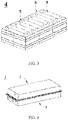
- FIG. 3 is a three-dimensional view of an implementation of the battery module 4.
- the battery module 4 includes a plurality of lithium-ion batteries 5.
- the plurality of batteries 5 are arranged in a longitudinal direction.
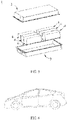
- FIG. 4 is a three-dimensional view of an implementation of a battery pack 1.
- FIG. 5 is an exploded view of FIG. 4 .
- the battery pack 1 includes an upper container part 2, a lower container part 3, and a battery module 4.
- the upper container part 2 and the lower container part 3 are assembled together to form a space for accommodating the battery module 4.
- the battery module 4 is fitted into a space formed by assembling the upper container part 2 and the lower container part 3 together.
- An output electrode of the battery module 4 is led out from either the upper container part 2 or the lower container part 3 or from between the upper container part 2 and the lower container part 3 so as to supply power to the outside or to be charged from the outside.
- the quantity and arrangement of battery modules 4 may be determined according to actual needs.
- this application provides an apparatus, including the lithium-ion battery according to the fourth aspect of this application, or the battery module according to the fifth aspect, or the battery pack according to the sixth aspect.
- the lithium-ion battery may be used as a power supply to the apparatus.
- the apparatus includes a pure electric vehicle, a hybrid electric vehicle, a plug-in hybrid electric vehicle, an electric bicycle, an electric scooter, an electric golf cart, an electric truck, and an energy storage system.
- FIG. 6 is a schematic diagram of an implementation of an apparatus using a lithium-ion battery as a power supply.
- the battery module, the battery pack, and the apparatus include the lithium-ion battery provided in this application, and therefore, have at least the same advantages as the lithium-ion battery, details of which are omitted here.
- a combination of one or more method steps mentioned in this application shall not preclude other method steps existent before or after the combination of steps, or preclude other method steps from being inserted between the explicitly mentioned steps.
- a combination or connection relationship between one or more devices/apparatuses mentioned herein shall not preclude other devices/apparatuses existent before or after the combined devices/apparatuses, or preclude other devices/apparatuses from being inserted between two devices/apparatuses explicitly mentioned herein.
- reference numerals of the method steps are intended only for ease of identification rather than for limiting the arrangement order of the method steps or for limiting the scope of applicability of this application. Any change or adjustment to the relative relationship between the reference numerals shall fall within the scope of applicability of this application to the extent that no substantive change is made to the technical content hereof.
- a lithium-ion battery (battery for short) S1 is prepared according to the following method:
- lithium nickel cobalt manganese oxide LiNi 0.8 Co 0.1 Mn 0.1 O 2
- a binder polyvinylidene fluoride
- a conductive agent conductive carbon black
- NMP N-methylpyrrolidone
- Embodiments 2 ⁇ 33 the batteries in the embodiments are numbered S2 ⁇ S33
- Comparative Embodiments 1 ⁇ 12 the batteries in the comparative embodiments are numbered D1 ⁇ D12
- Table 1 Battery numbe r Negative active substance, SiOx mass percent Mass of the additive A with respect to 1 gram of SiOx (g)
- Type and dosage of the additive (wt%)
- Additive A Additive B
- LiDFOP lithium difluorodioxalate phosphate
- LiTFOP lithium tetrafluorooxalate phosphate
- DTD vinyl sulfate
- the volume expansion rate of the lithium-ion battery stored under a high temperature for n days (%) (Vn-V0)/V0 ⁇ 100%, where n is the number of days of storing the lithium-ion battery under a high temperature.
- Charging the battery under 25°C to a 50% state-of-charge (SOC) by using a 0.5 C constant current/constant voltage charging the battery to 3.85 V with a 0.5 C constant current, and then charging the battery to 0.05 C with a 3.85 V constant voltage); resting the battery for 10 minutes, and then discharging the battery for 10 seconds with a 0.1 C constant current, and recording the voltage U1 after the discharge; and discharging the battery for 30 seconds with a 4 C constant current, and recording the voltage U2 after the discharge.
- Table 2 shows test results of electrical performance of the battery obtained from Comparative Embodiments 1 ⁇ 12 and Embodiments 1 ⁇ 33, including the volume expansion rate of samples D1 ⁇ D12 and S1 ⁇ S33 tested after being stored under 60 °C for 20 days, direct-current resistance under 25 °C, and the capacity retention rate of the samples tested after being stored under 60 °C for 60 days.
- the electrolytic solution (D1 ⁇ D3) includes only the additive A
- the gas generation problem of the battery is mitigated moderately.
- the electrolytic solution (D5 ⁇ D7) includes only the additive B or the additive C
- the SEI film formed on the surfaces of the positive and negative electrodes is not tough.
- the SEI film is prone to rupture when the volume of the active substance increases and decreases during an intercalation and deintercalation of lithium ions. Consequently, the electrolytic solution is prone to side reactions on a fresh surface of the active substance, and the gas generation problem of the battery is still severe.
- the batteries S1 ⁇ S8 are samples, of which the electrolytic solution contains both the additive A and the additive B. After being stored under a high temperature, all the batteries have a low volume expansion rate and a low direct-current resistance.
- the additive A used together (including, mixed) with the additive B a tough SEI film of a high ion conductivity is formed on surfaces of the positive and negative electrodes concurrently, and the interface compatibility between the positive and negative electrodes and the electrolytical solution is improved significantly. This not only significantly mitigates the gas generation problem of the battery cell under a high temperature, but also ensures a relatively low internal resistance of the battery cell and enhances the high-temperature storage performance of the battery cell.
- films can be formed on the surfaces of the positive electrode plate and the negative electrode plate concurrently, and the components and the structure of the SEI films formed on the surface of the negative electrode are further optimized.
- a highly polymerized, highly ordered, low-resistance tough meshed organic film is formed, thereby significantly improving cycle performance and high-temperature storage performance of the lithium-ion battery, and also ensuring excellent kinetic performance of the lithium-ion battery.
- the formula of the electrolytic solution is especially prominent in improving the high-temperature storage performance and the cycle performance of a battery system with a SiOx-containing negative electrode active substance.
- the mass of the additive A is 0.0005 g ⁇ 0.01 g with respect to 1 gram of SiOx material, the additive A can form a low-resistance toughened meshed film on the surface of the SiOx material.
Landscapes
- Chemical & Material Sciences (AREA)
- Engineering & Computer Science (AREA)
- Chemical Kinetics & Catalysis (AREA)
- Electrochemistry (AREA)
- General Chemical & Material Sciences (AREA)
- Manufacturing & Machinery (AREA)
- Inorganic Chemistry (AREA)
- Materials Engineering (AREA)
- Physics & Mathematics (AREA)
- Condensed Matter Physics & Semiconductors (AREA)
- General Physics & Mathematics (AREA)
- Secondary Cells (AREA)
- Primary Cells (AREA)
Description
- This application relates to the field of batteries, and in particular, to an electrolytic solution and a lithium-ion battery, a battery module, a battery pack and an apparatus that adopt the electrolytic solution.
- With increasing depletion of petrochemical energy and deterioration of climate on Earth, the development of new clean energy and the strengthening of energy conservation and emission reduction have become top priorities of all countries in the world. In recent years, the construction of hybrid electric vehicle projects, battery electric vehicle projects, and gridconnected new energy power station projects is speeding up. High-energy-density power batteries have become one of core technologies to be developed vigorously. By virtue of advantages such as high voltage, ultra-high capacity, good cycle performance, and environment friendliness, lithium-ion battery products have been accepted more widely by society.
- With the promotion of new energy vehicles, power-type lithium-ion batteries have been developed immensely. In view of high requirements imposed by new energy vehicles on a cruising range, the lithium-ion batteries are also required to have a high energy density, high cycle performance, and high safety performance. During a charging and discharging process of a lithium-ion battery, a negative electrode active material is graphite with a small interplanar spacing, and some negative electrode active materials also include a silicon-based material with a higher volume expansion rate. Therefore, during a cyclic process of the lithium-ion battery, the graphite and the silicon-based material in a negative electrode plate are in an ongoing cyclic process of expansion and contraction in size. Because a binding effect of a binder between particles gradually diminishes or even vanishes, the negative electrode plate expands cyclically and irreversibly and becomes too thick. This not only deteriorates kinetic performance of the battery and leaves the negative electrode active material to be at high risk of detaching, but also continuously damages a solid electrolyte interphase (SEI) film on a surface of the negative electrode plate, and continuously exposes fresh surfaces of the negative electrode active material massively. The exposed negative electrode active material is likely to trigger side reactions with an electrolytic solution and deteriorate the cycle performance and the high-temperature storage performance of the battery. On the other hand, during the charging and discharging process of the lithium-ion battery, the positive electrode active material itself does not change in size significantly. However, the positive electrode material is at a high potential and is highly oxidative. Especially for a ternary material that contains a high nickel content, the positive electrode material is prone to side reactions with the electrolytic solution, thereby also deteriorating the performance such as the high-temperature storage performance of the battery. In view of the urgent need to improve the cycle performance and the high-temperature performance of power batteries during long-term service, a new electrolytic solution that matches a high-capacity battery system needs to be developed in practical applications.
-
KR 1020160052382 A -
EP 2884557 A1 mentions a jelly roll tape for a rechargeable battery. -
US 2009/130555 A1 relates to a nonaqueous electrolyte battery. -
CN 103 891 036 A (EP 2 770 572 A1 ) states a non-aqueous electrolyte solution and electricitystorage device using the same. -
CN 108 306 048 A describes a lithium ion battery electrolyte and lithium ion battery prepared therefrom. -
JP 2011 060464 A -
CN 104 466 249 A relates to a electrolyte of lithium ion battery taking lithium titanate as cathode. - In view of disadvantages in the prior art described above, an objective of this application is to provide an electrolytic solution as specified in any of claims 1-9 and a lithium-ion battery as specified in any of claims claim 10-13 and an apparatus as specified in claims 14 or 15 that adopt the electrolytic solution to solve problems in the prior art.
- To achieve the foregoing objective and other relevant objectives, a first aspect of this application provides an electrolytic solution, including an electrolyte and a solvent, and further including an additive A and an additive B. The additive A is selected from at least one of compounds whose chemical structural formula is denoted by Formula I:
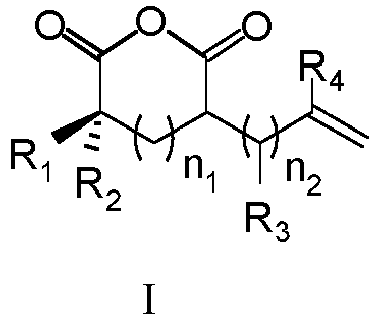
- a value of n1 is 0, 1, 2, 3, 4, or 5;
- a value of n2 is 0, 1, 2, 3, 4, 5, 6, 7, 8, or 9;
- the additive B is selected from at least one of compounds whose chemical structural formula is denoted by Formula II:

- In Formula II, R5 is one or more of F, Cl, Br, or I; M is P or B; when M is P, n + 2m = 6, and m is 1 or 2; when M is B, n + 2m = 4, and m is 0 or 1.
- Another aspect of this application discloses uses of the electrolytic solution in a field of preparing a lithium-ion battery.
- A second aspect of this application provides a lithium-ion battery, including a positive electrode plate, a negative electrode plate, a separator, and the electrolytic solution described above, where the separator is located between the positive electrode plate and the negative electrode plate.
- A third aspect of this application provides a battery module, including the lithium-ion battery according to the second aspect of this application.
- A fourth aspect of this application provides a battery pack, including the battery module according to the third aspect of this application.
- A fifth aspect of this application provides an apparatus, including the lithium-ion battery according to the second aspect of this application. The lithium-ion battery is used as a power supply to the apparatus.
- In the electrolytic solution provided in this application, the additive A and the additive B are introduced into the electrolytic solution of a lithium-ion battery. By using the additive A and the additive B together, this application enables films to be formed on surfaces of a positive electrode plate and a negative electrode plate concurrently, and enables formation of a highly polymerized, highly ordered, low-resistance tough meshed organic film on the surface of the negative electrode, thereby significantly improving cycle performance and high-temperature storage performance of the lithium-ion battery, and also ensuring excellent kinetic performance of the lithium-ion battery. In addition, a positive electrode film-forming additive C is used together in the electrolytic solution, so as to optimize components of a solid electrolyte interphase (SEI) film on a positive electrode interface, ensure a relatively high capacity retention rate of the lithium battery during cycles, and further improve the high-temperature storage performance of the battery.
- The battery module, the battery pack, and the apparatus provided in this application include the lithium-ion battery, and therefore, have at least the same advantages as the lithium-ion battery.
-
-
FIG. 1 is a three-dimensional view of an implementation of a battery according to this application; -
FIG. 2 is an exploded view ofFIG. 1 ; -
FIG. 3 is a three-dimensional view of an implementation of a battery module; -
FIG. 4 is a three-dimensional view of an implementation of a battery pack; -
FIG. 5 is an exploded view ofFIG. 4 ; and -
FIG. 6 is a schematic diagram of an implementation of an apparatus whose power supply is a lithium-ion battery. -
- 1: Battery pack;
- 2: Upper container part;
- 3: Lower container part;
- 4: Battery module;
- 5: Battery;
- 51: Casing;
- 52: Electrode assembly;
- 53: Top cover assembly.
- The following describes in detail an electrolytic solution, a lithium-ion battery, a battery module, a battery pack, and an apparatus according to this application.
- A first aspect of this application provides an electrolytic solution, including an electrolyte and a solvent, and further including an additive A and an additive B. The additive A is selected from at least one of compounds whose chemical structural formula is denoted by Formula I:

- a value of n1 is 0, 1, 2, 3, 4, or 5;
- a value of n2 is 0, 1, 2, 3, 4, 5, 6, 7, 8, or 9;
- the additive B is selected from at least one of compounds whose chemical structural formula is denoted by Formula II:

- In Formula II, R5 is one or more of F, Cl, Br, or I; M is P or B; when M is P, n + 2m = 6, and m is 1 or 2; when M is B, n + 2m = 4, and m is 0 or 1.
- In this application, the aliphatic groups generally mean chain hydrocarbon compounds such as an alkyl, an alkenyl, and an alkynyl. The aliphatic groups may be, but without limitation, methyl, ethyl, vinyl, ethynyl, propyl, propenyl, propynyl butyl, butenyl, butynyl, pentyl, hexyl, heptyl, octyl, nonyl, and decyl. The aliphatic groups may be monosubstituted or polysubstituted. Substituents of the aliphatic groups include, but without limitation, halogen atoms such as F, Cl, and Br. The substituted aliphatic groups may be specifically, but without limitation, fluoroethylene, fluoropropyl, or chlorobutyl.
- In this application, the cycloalkyl is meant to be a saturated or unsaturated (but not aromatic) cyclic hydrocarbon, including but not limited to cyclopropyl, cyclobutyl, cyclopentyl, cyclohexyl, or cycloheptyl. The cycloalkyls further include a saturated cycloalkyl, in which, optionally, at least one carbon atom may be replaced by a heteroatom. Exemplarily, the heteroatom may be S, N, P, or O. In addition, monounsaturated or polyunsaturated (exemplarily, monounsaturated) cycloalkyls whose ring contains no heteroatom are also cycloalkyls unless they are in an aromatic system. The cycloalkyls may be monosubstituted or polysubstituted. Substituents of the cycloalkyls include, but without limitation, halogen atoms such as F, Cl, and Br. The substituted cycloalkyls may be specifically, but without limitation, 2-fluorocyclopentyl or 3-fluorocyclohexyl.
- In this application, the alkoxies include, but without limitation, methoxy, ethoxy, and propoxy. The alkoxies may be monosubstituted or polysubstituted. Substituents of the alkoxies include, but without limitation, halogen atoms such as F, Cl, and Br. The substituted alkoxies may be, but without limitation, fluoropropoxy or trifluoroethoxy.
- In this application, an aryl generally means a closed ring system with at least one aromatic ring, and generally includes no heteroatom (for example, N, or O). The aryl includes, but without limitation, phenyl, naphthyl, fluoranthenyl, fluorenyl, tetrahydro-naphthyl, indanyl, or anthracenyl. The aryls may be monosubstituted or polysubstituted. Substituents of the aryls include, but without limitation, halogen atoms such as F, Cl, and Br. The substituted aryls may be specifically, but without limitation, monofluorophenyl, fluoro-ethylnaphthyl, or tetrafluorosubstituted naphthyl.
- In this application, a heteroaryl means a heterocyclic system, includes at least one aromatic ring, and optionally includes one or more heteroatoms selected from N, O, S, or the like. The heterocyclic aryl includes, but without limitation, furyl, thienyl, and the like. The heterocyclic aryl may be monosubstituted or polysubstituted. Substituents of a heteroaromatic ring include, but without limitation, halogen atoms such as F, Cl, and Br. The substituted heteroaryl may be specifically be, but without limitation, fluoromethylfuran or trifluoroethylthiophene.
- In the electrolytic solution provided in this application, generally the additive A may be a cyclic acid anhydride compound containing an unsaturated bond, include a unique bifunctional structure of olefin and acid anhydride, and trigger ring opening polymerization through free radicals in a charging and discharging process of the lithium-ion battery to form highly ordered, high-molecular-weight long-chain compounds. The high-molecular-weight long-chain compounds effectively collide with one another, and re-trigger, through the free radicals, two bonds in a side chain structure to polymerize for a second time to form a highly polymerized, highly ordered, tough meshed organic film. The meshed organic film covers the surface of the negative electrode to effectively reduce active positions on the surface of the negative electrode, prevent an electrolytic solvent from reductive decomposition on the surface of the negative electrode, and reduce occurrence of poor resistance of the battery in the charging/discharging process of the lithium battery. However, when the electrolytic solution includes only the additive A component, due to a high resistance of components of the SEI film, an initial direct-current resistance of the battery is relatively high, and the battery incurs a problem of abrupt deterioration of high-temperature storage performance. The additive B is a lithium phosphate salt or a lithium borate salt containing oxalate, and can form a film on the positive electrode and the negative electrode concurrently. This significantly improves interface compatibility between the negative electrode and the electrolytic solution, ensures a low internal resistance of a battery cell, and improves the high-temperature storage performance of the battery cell. In the electrolytic solution provided in this application, a conductivity of the electrolytic solution may be 7.2 mS/cm~8.5 mS/cm, 7.2 mS/cm~7.3 mS/cm, 7.3 mS/cm~7.4 mS/cm, 7.4 mS/cm~7.5 mS/cm, 7.5 mS/cm~7.6 mS/cm, 7.6 mS/cm~7.7 mS/cm, 7.7 mS/cm~7.8 mS/cm, 7.8 mS/cm~7.9 mS/cm, 7.9 mS/cm~8.0 mS/cm, 8.0 mS/cm~8.1 mS/cm, 8.1 mS/cm~8.2 mS/cm, 8.2 mS/cm~8.3 mS/cm, 8.3 mS/cm~8.4 mS/cm, or 8.4 mS/cm~8.5 mS/cm. With a synergistic effect of the additive A and the additive B, a more effective interaction effect is achieved under a suitable conductivity range. When the conductivity in the electrolytic solution is in a range of 7.2 mS/cm~8.5 mS/cm, an electrochemical reaction speed on interfaces of the positive and negative electrodes in the lithium battery is moderate. Therefore, the additive B can fully decompose to form a film during battery formation. After the additive A that is easily reduced into a film is added, the formed SEI film is very tough, the resistance on the negative electrode interface is significantly reduced, and kinetic cycle performance of the battery cell is excellent.
- In the electrolytic solution provided in this application, R1 and R2 in the compound denoted by Formula I each may be independently selected from hydrogen or phenyl. and the value of n1 may be 0 or 1. Specifically, the additive A may be selected from one or more of compounds whose chemical structural formula is denoted by Formula I-A, Formula I-B, Formula I-C, and Formula I-D:

- In the electrolytic solution provided in this application, the value of n2 in the compound denoted by Formula I may be 0, 1, 2, 3, 4, 5, 6, 7, 8, or 9. R3 may be selected from hydrogen (H), a halogen atom, or an alkyl substituted with a halogen atom. Each halogen atom may be independently selected from F or Br. R4 may be selected from H. More specifically, the additive A may be selected from one or more of compounds denoted by:

- In the electrolytic solution provided in this application, meshed toughened film formed by the additive A helps to improve the cycle performance and high-temperature storage features of the lithium-ion battery, and mitigate gas generation of the lithium-ion battery under a high temperature. With a high content of the additive A in the electrolytic solution, the formed SEI film is too thick, gives rise to a relatively high initial resistance, and severely affects kinetic performance such as power output of the lithium-ion battery. Conversely, if the content is too low, no effective SEI film is formed on a surface of a negative electrode material, thereby reducing the resistance during the charge and discharge cycles, and incurring more side reactions. A person skilled in the art may select a suitable amount of the additive A. For example, the mass of the additive A is 0.01%~10%, 0.01%~6%, 0.01%~0.05%, 0.05%~0.1%, 0.1%~0.3%, 0.3%~0.5%, 0.5%~1%, 1%~2%, 2%~3%, 3%~4%, 4%~5%, 5%~6%, 6%~7%, 7%~8%, 8%~9%, or 9%~10% of the total mass of the electrolytic solution.
- In the electrolytic solution provided in this application, the additive B is selected from at least one of oxalate-containing lithium phosphate salts denoted by Formula II-A or II-B:

- In the electrolytic solution provided in this application, a person skilled in the art may select a suitable amount of the additive B. For example, the mass of the additive B is 0.01%~10%, 0.01%~5%, 0.01%~0.05%, 0.05%~0.1%, 0.1%~0.3%, 0.3%~0.5%, 0.5%~1%, 1%~2%, 2%~3%, 3%~4%, 4%~5%, 5%~6%, 6%~7%, 7%~8%, 8%~9%, or 9%~10% of the total mass of the electrolytic solution. As an additive for reducing an initial resistance in forming a film, the additive B can decompose on the surface of the negative electrode plate and participate in the formation of the SEI, thereby effectively mitigating the problem of a high interface resistance of the SEI film formed by only the decomposition of the additive A, and forming a highly polymerized, highly ordered, low-resistance tough meshed organic SEI film.
- In the electrolytic solution provided in this application, a mass ratio of the additive A to the additive B may be 1:0.1~10, 1:0.1~0.2, 1:0.2~0.3, 1:0.3~0.4, 1:0.4~0.5, 1:0.5~0.6, 1:0.6~0.7, 1:0.7~0.8, 1:0.8~0.9, 1:0.9~1, 1:1~1.1, 1:1.1~1.3, 1:1.3~1.5, 1:1.5~2, 1:2~3, 1:3~4, 1:4~5, 1:5~6, 1:6~7, 1:7~8, 1: 8~9, or 1:9~10. A relative content of the additive A in relation to the additive B in the electrolytic solution affects film formation quality and interface resistance of the SEI film on the surfaces of the positive and negative electrodes. If the relative content of the additive A is too high, the content of the additive B is too law in decomposing into a film at the negative electrode interface. Consequently, the initial resistance of the film formed on the negative electrode is still high, and the kinetic performance is deteriorated. If the relative content of the additive A is too low, a highly polymerized, highly ordered, rough meshed organic film cannot be formed on the surface of the negative electrode, many side effects such as severe gas generation under a high temperature occur, and the cycle performance and the high-temperature performance are not improved significantly.
- The electrolytic solution provided in this application may further include an additive C. The additive C is selected from at least one of a cyclic sulfite compound containing an S=O group or a cyclic sulfate compound containing an S=O group. The additive C introduced into the electrolytic solution can optimize components of the SEI film on the positive electrode interface, ensure a relatively high capacity retention rate of the lithium battery during cycles, and further improve the storage performance of the battery.
- In the electrolytic solution provided in this application, the chemical structural formula of the S=O containing bonded compound is denoted by Formula III:

- In the electrolytic solution provided in this application, the mass of the additive C is 0.1%~8% of the total mass of the electrolytic solution. In the electrolytic solution provided in this application, the additive C can form a film on the positive electrode, thereby helping to improve the storage performance of the lithium battery. A too high content of the additive C cannot significantly improve the high-temperature storage performance of the lithium battery, and a too low content cannot effectively adjust the components of the SEI film on the positive electrode interface, and many defects such as poor high-temperature storage performance of the battery exist. Exemplarily, the mass of the additive C is 0.1%~5%, 0.1%~0.3%, 0.3%~0.5%, 0.5%~0.7%, 0.7%~1%, 1%~2%, 2%~3%, 3%~4%, or 4%~5% of the total mass of the electrolytic solution.
- In the electrolytic solution provided in this application, a person skilled in the art may choose an electrolyte suitable for the foregoing additives. Generally, the electrolyte may be an electrolyte applicable to a lithium-ion battery. For example, the electrolyte may be, but without limitation, one or more of a complex salt of a Lewis acid and LiF, an imine, or a methylated lithium salt, a lithium salt containing an S(=O)2O structure, a lithium salt containing a P=O or Cl=O structure, or a lithium salt that uses an oxalate ligand as an anion. For another example, the complex salt of the Lewis acid and LiF may be, but without limitation, one or more of LiPF6, LiBF4, LiAsF6, LiSbF6, LiPF4(CF3)2, LiPF3(C2F5)3, LiPF3(CF3)3, LiPF3(iso-C3F7)3, or LiPF5(iso-C3F7), exemplarily may be LiPF6, LiBF4, LiAsF6, or the like, and desirably may be LiPF6, LiBF4 or the like. For another example, the imine or methylated lithium salt may be, but without limitation, one or more of LiN(SO2F)2, LiN(SO2RF)2, LiN(SO2F)(SO2RF) (where RF is Cn'F2n'+1, and n' is 1, 2, 3, 4, 5, 6, 7, 8, 9, or 10), (CF2)2(SO2)2NLi(cyclic), (CF2)3(SO2)2NLi(cyclic), or LiC(SO2CF3)3, exemplarily may be LiN(SO2F)2, LiN(SO2CF3)2, or LiN(SO2C2F5)2, and desirably may be LiN(SO2F)2 or LiN(SO2CF3)2. For another example, the lithium salt containing an S(=O)2O structure may be, but without limitation, one or more of LiSO3F, LiCF3SO3, CH3SO4Li, C2H5SO4Li, C3H7SO4Li, lithium trifluoro((methylsulfonyl)oxy) borate (LiTFMSB), or lithium pentafluoro((methylsulfonyl)oxy)phosphate (LiPFMSP), and exemplarily may be LiSO3F, CH3SO4Li, C2H5SO4Li, LiTFMSB, or the like. For another example, the lithium salt containing a P=O or Cl=O structure may be, but without limitation, one or more of LiPO2F2, Li2PO3F, or LiClO4, and exemplarily, may be LiPO2F2, Li2PO3F, or the like. For another example, the lithium salt that uses an oxalate ligand as an anion may be, but without limitation, one or more of bis[oxalate-O,O']lithium borate (LiBOB), difluoro[oxalate-O,O'] lithium borate, difluorobis[oxalate-O,O']lithium phosphate (LiPFO), and tetrafluoro[oxalate-O,O']lithium phosphate, and exemplarily may be LiBOB, LiPFO, or the like. In some exemplary implementations of this application, the electrolyte may be, but without limitation, LiPF6, LiBF4, LiSO3F, lithium trifluoro((methylsulfonyl)oxy) borate (LiTFMSB), LiPO2F2, LiN(SO2CF3)2, LiN(SO2F)2, bis[oxalate-O,O'] lithium borate (LiBOB), and difluorobis[oxalate-O,O'] lithium phosphate (LiPFO), and exemplarily may be LiPF6.
- In the electrolytic solution provided in this application, a person skilled in the art may choose a solvent suitable for the foregoing additives. The solvent of the electrolytic solution is generally a nonaqueous solvent, exemplarily an organic solvent, and specifically may be, but without limitation, one or more of ethylene carbonate, propylene carbonate, butene carbonate, pentene carbonate, dimethyl carbonate, diethyl carbonate, dipropyl carbonate, ethyl methyl carbonate, or a halogenated derivative thereof.
- A second aspect of this application provides a method for preparing the electrolytic solution according to the first aspect of this application. A person skilled in the art may choose a suitable method to prepare the electrolyte by using the foregoing electrolyte, solution, and additives. For example, the preparation method may include: dissolving an electrolyte and an additive in a solvent, exemplarily under anhydrous conditions.
- A third aspect of this application enables use of the electrolytic solution according to the first embodiment of this application in the field of preparing a lithium-ion battery. The electrolytic solution provided in this application may be applied to a lithium-ion battery to serve as an electrolytic solution of the lithium-ion battery, so as to mitigate gas generation problems of the lithium-ion battery during storage and also to ensure a relatively high capacity retention rate of the lithium battery during cycles and improve the high-temperature storage performance of the lithium-ion battery.
- A fourth aspect of this application provides a lithium-ion battery, including a positive electrode plate, a negative electrode plate, a separator, and the electrolytic solution provided in the first aspect of this application. The separator is located between the positive electrode plate and the negative electrode plate.
FIG. 1 is a three-dimensional view of an implementation of a lithium-ion battery 5.FIG. 2 is an exploded view ofFIG. 1 . Referring toFIG. 1 and FIG. 2 , the lithium-ion battery 5 includes acasing 51, anelectrode assembly 52, atop cover assembly 53, and an electrolytic solution (not shown). Theelectrode assembly 52 generally includes a positive electrode plate, a negative electrode plate, and a separator. The separator is generally located between the positive electrode plate and the negative electrode plate. The positive electrode plate, the separator, and the negative electrode plate may be layered so as to be suitable for cutting into a target size and to be stacked in sequence, and may also be wound into a target size to form theelectrode assembly 52. In the lithium-ion battery 5, the quantity ofelectrode assemblies 52 is not limited, and may be one or more. It needs to be noted that the battery shown inFIG. 1 is, but without limitation, a can-shaped battery. The lithium-ion battery 5 may also be a pouch-shaped battery. That is, thecasing 51 is replaced with a metal laminated film, and thetop cover assembly 53 is cancelled. - A person skilled in the art understands the method for preparing a lithium-ion battery using a positive electrode plate, a negative electrode plate, and separator. For example, the method may be the method described in an embodiment of this application.
- In the lithium-ion battery provided in this application, the negative electrode plate generally includes a negative electrode current collector and a negative electrode active substance. The negative electrode plate applicable to the lithium-ion battery is known to a person skilled in the art. For example, the negative electrode current collector may be, but without limitation, a metal foil (such as a copper foil). For another example, the negative electrode active substance may be, but without limitation, one or more of natural graphite, artificial graphite, soft carbon, hard carbon, mesocarbon microbead, nanocarbon, simple-substance silicon, a silicon-oxygen compound, a silicon-carbon composite, a silicon alloy, a lithium metal, elemental tin, a tin-oxygen compound, a tin-carbon composite, a tin alloy, or a lithium titanate oxide. In an exemplary implementation of this application, the negative electrode active substance exemplarily includes SiOx, where x is 0.9~1.8, 0.9~1.0, 1.0~1.2, 1.2~1.4, 1.4~1.6, or 1.6~1.8. Desirably, the negative electrode active substance includes a silicon-carbon composite containing SiOx and the like. In the lithium-ion battery, with respect to the 1 gram of SiOx material, the mass of the compound denoted by Formula I is 0.0005 g~0.01 g, 0.0006 g~0.009 g, 0.0007 g~0.008 g, 0.0008 g~0.007 g, 0.0009 g~0.006 g, 0.001 g~0.005 g, 0.0015 g~0.005 g, 0.002 g~0.005 g, 0.0025 g~0.005 g, 0.003 g~0.005 g, 0.0035 g~0.005 g, or 0.004 g~0.005 g. The electrolytic solution provided in this application is particularly suitable for a chemical system in which the negative electrode active substance contains SiOx. Because the SiOx-containing negative electrode active substance exhibits a relatively high volume expansion rate during cycles, an SEI film formed by a conventional film-forming additive on the surface of the negative electrode is not tough. During subsequent charge and discharge cycles, the SEI film formed on the surface of a silicon negative electrode undergoes repeated processes of "formation-rupture-re-formation on a fresh surface". The SEI film keeps thickening, thereby drastically consuming lithium ions in the electrolytic solution and drastically deteriorating the cycle performance of the battery. Through meticulous research, the applicant hereof finds that, when the mass of the additive A in the electrolytic solution is 0.0005 g~0.01 g with respect to 1 gram of SiOx material, an appropriate amount of the additive A can form a low-resistance toughened meshed film on the surface of the SiOx material, thereby helping to improve the film quality of the silicon-containing negative electrode and also ensuring high ion conductivity of the battery. When the content of the additive A in the electrolytic solution is more than 0.01 g with respect to 1 gram of SiOx material, the formed SEI film is too thick, gives rise to a relatively high initial resistance, and severely deteriorates kinetic performance such as power output of the lithium-ion battery. Conversely, if the content is too low, no effective SEI film is formed on the surface of the SiOx material, thereby reducing the resistance during the charge and discharge cycles and incurring more side reactions.
- In the lithium-ion battery provided in this application, the thickness of the active substance layer on a single side of the negative electrode plate may be 30 µm~85 µm, 30 µm~35 µm, 35 µm~40 µm, 40 µm~45 µm, 45 µm~50 µm, 50 µm~55 µm, 55 µm~6 0µm, 60 µm~65 µm, 65 µm~70 µm, 70 µm~75 µm, 75 µm~80 µm, or 80 µm~85 µm. The negative electrode includes the SiOx material of a high volume expansion rate. Therefore, when the thickness of the electrode plate is in the above range, a transmission distance of lithium ions in the electrode plate is shortened, and the kinetic performance of the battery is further optimized.
- In the lithium-ion battery provided in this application, the positive electrode plate generally includes a positive electrode current collector and a positive electrode active substance. The positive electrode plate applicable to the lithium-ion battery is known to a person skilled in the art. For example, the positive electrode current collector may be, without limitation, a metal foil (such as an aluminum foil). For another example, the positive electrode active substance may be, but without limitation, one or more of a lithium cobalt oxide, a lithium nickel oxide, a lithium manganese oxide, a lithium nickel manganese oxide, a lithium nickel cobalt manganese oxide, a lithium nickel cobalt aluminum oxide, or a compound obtained by adding another transition metal or non-transition metal into such lithium transition metal oxides. More specifically, the positive electrode active substance may be, but without limitation, one or more of a layered lithium-containing oxide, a spinel-type lithium-containing oxide, an olivine-type lithium-containing phosphate compound.
- In an exemplary implementation of this application, the positive active substance includes a high-nickel ternary positive active substance, and specifically, includes at least one of compounds denoted by Formula IV:
Li1+yNiaCobMe1-a-bO2-zAz IV
where, -0.1 ≤ y ≤ 0.2, 0.5 < a <0.9, 0 < b < 0.5, 0.5 < a+b <1, 0 ≤ z <0.2, Me includes one or more of Mn, Fe, Cr, Ti, Zn, V, Al, Zr, or Ce, and A includes one or more of S, N, F, Cl, Br, or I. - In the lithium-ion battery provided in this application, the separator may any of various separators applicable to the lithium-ion batteries in the art, and specifically may be, but without limitation, one or more of polyethylene, polypropylene, polyvinylidene fluoride, or a multilayer composite film thereof.
- The electrolytic solution provided in this application may be applied to a lithium-ion battery, so as to mitigate gas generation problems of the lithium-ion battery during storage and also to ensure a relatively high capacity retention rate of the lithium battery during cycles and improve the high-temperature storage performance of the lithium-ion battery. The additive A may be used as a gas generation inhibitor, and the additive B may be used as an additive for reducing the initial resistance during film formation. The advantages of the two additives are complementary to each other. The additive C may be used as a positive electrode film-forming additive and is suitable for use in the electrolytic solution. With the prepared lithium-ion battery, the gas generation problem of the lithium-ion battery during high-temperature storage is mitigated significantly without impairing the cycle performance.
- A fifth aspect of this application provides a battery module, including the lithium-ion battery according to the fourth aspect of this application.
- Further, the quantity of lithium-ion batteries included in the battery module may be adjusted according to the application and capacity of the battery module.
FIG. 3 is a three-dimensional view of an implementation of thebattery module 4. Referring toFIG. 3 , thebattery module 4 includes a plurality of lithium-ion batteries 5. The plurality ofbatteries 5 are arranged in a longitudinal direction. - A sixth aspect of this application provides a battery pack, including the lithium-ion battery according to the fourth aspect of this application or the battery module according to the fifth aspect of this application.
FIG. 4 is a three-dimensional view of an implementation of abattery pack 1.FIG. 5 is an exploded view ofFIG. 4 . Referring toFIG. 4 andFIG. 5 , thebattery pack 1 includes anupper container part 2, alower container part 3, and abattery module 4. Theupper container part 2 and thelower container part 3 are assembled together to form a space for accommodating thebattery module 4. Thebattery module 4 is fitted into a space formed by assembling theupper container part 2 and thelower container part 3 together. An output electrode of thebattery module 4 is led out from either theupper container part 2 or thelower container part 3 or from between theupper container part 2 and thelower container part 3 so as to supply power to the outside or to be charged from the outside. The quantity and arrangement ofbattery modules 4 may be determined according to actual needs. - According to a seventh aspect of this application, this application provides an apparatus, including the lithium-ion battery according to the fourth aspect of this application, or the battery module according to the fifth aspect, or the battery pack according to the sixth aspect. The lithium-ion battery may be used as a power supply to the apparatus.
- In exemplary implementations of this application, the apparatus includes a pure electric vehicle, a hybrid electric vehicle, a plug-in hybrid electric vehicle, an electric bicycle, an electric scooter, an electric golf cart, an electric truck, and an energy storage system.
FIG. 6 is a schematic diagram of an implementation of an apparatus using a lithium-ion battery as a power supply. - The battery module, the battery pack, and the apparatus include the lithium-ion battery provided in this application, and therefore, have at least the same advantages as the lithium-ion battery, details of which are omitted here.
- The following describes the implementation of this application with reference to specific embodiments. A person skilled in the art can easily learn about other advantages and effects of this application from the content disclosed in this specification. This application may also be implemented or applied in other different manners. From a perspective of different viewpoints and applications, details in this specification may be modified or changed without departing from the spirit of this application.
- It needs to be noted that unless otherwise explicitly specified herein, process equipment or apparatuses mentioned in the following embodiments are conventional equipment or apparatuses in the art.
- In addition, understandably, unless otherwise specified herein, a combination of one or more method steps mentioned in this application shall not preclude other method steps existent before or after the combination of steps, or preclude other method steps from being inserted between the explicitly mentioned steps. Further, understandably, unless otherwise specified herein, a combination or connection relationship between one or more devices/apparatuses mentioned herein shall not preclude other devices/apparatuses existent before or after the combined devices/apparatuses, or preclude other devices/apparatuses from being inserted between two devices/apparatuses explicitly mentioned herein. Moreover, unless otherwise specified, reference numerals of the method steps are intended only for ease of identification rather than for limiting the arrangement order of the method steps or for limiting the scope of applicability of this application. Any change or adjustment to the relative relationship between the reference numerals shall fall within the scope of applicability of this application to the extent that no substantive change is made to the technical content hereof.
- A lithium-ion battery (battery for short) S1 is prepared according to the following method:
- Mixing lithium nickel cobalt manganese oxide (LiNi0.8Co0.1Mn0.1O2), a binder (polyvinylidene fluoride), and a conductive agent (conductive carbon black) at a mass ratio of 98:1:1, and adding the mixture into an N-methylpyrrolidone (NMP) solvent system; stirring the mixture with a vacuum mixer until the system becomes homogeneous and transparent, so that a positive electrode slurry is obtained; coating a 12 µm-thick aluminum foil with the positive electrode slurry homogeneously; drying the aluminum foil in the air under a room temperature, and relocating the aluminum foil into a 120 °C oven for drying for 1 hour, and then performing cold calendering and slitting to obtain a positive electrode plate.
- Mixing artificial graphite, a conductive agent (conductive carbon black), and a binder (polyacrylate) at a mass ratio of 98:1:1, and adding the mixture into deionized water; stirring the mixture with a vacuum mixer to obtain a negative electrode slurry; coating an aluminum foil with the negative electrode slurry homogeneously; drying the aluminum foil in the air under a room temperature, and relocating the aluminum foil into a 120 °C oven for drying for 1 hour, and then performing cold calendering and slitting to obtain a negative electrode plate.
- Mixing rectified, dehydrated and purified ethylene carbonate (EC) and diethyl carbonate (DEC) homogeneously in a drying room to form an organic solvent; dissolving a fully dried lithium salt LiPF6 in the organic solvent, and then adding an additive into the organic solvent, and mixing them homogeneously to obtain an electrolytic solution. The concentration of the lithium salt is 1 mol/L, the content of the lithium salt is 12.5% of the total mass of the electrolytic solution, and the mass ratio of the EC to the DEC is EC:DEC = 1:1. Specific types and content of the additive is shown in Table 1.
- Sequentially stacking a conventionally slit 0.278 mm-thick positive electrode plate, a 0.109 mm-thick negative electrode plate, and a 0.016 mm-thick high-strength thin-film polyolefin porous film that has undergone ceramic treatment, so that a separator is located between the positive electrode plate and the negative electrode plate for a separation purpose; winding the stacked materials to obtain a bare battery cell; leaving the bare cell of a 2.6 Ah capacity in an outer packaging foil; injecting 10.8 grams of the prepared electrolytic solution into a dried cell; and performing steps such as vacuum packaging, standing, formation, and reshaping to obtain a lithium-ion battery (S1 for short).
- The preparation method in
Embodiments 2~33 (the batteries in the embodiments are numbered S2~S33) and in theComparative Embodiments 1~12 (the batteries in the comparative embodiments are numbered D1~D12) is almost the same as that inEmbodiment 1 except a difference in a formula of the electrolytic solution. Types and dosages of additives in the electrolytic solution inComparative Embodiments 1~12 andEmbodiments 1~33 are shown in Table 1.Table 1 Battery numbe r Negative active substance, SiOx mass percent Mass of the additive A with respect to 1 gram of SiOx (g) Type and dosage of the additive (wt%) Additive A Additive B Additive C Mol. 1 Mol. 2 Mol. 3 Mol .4 LiDF OP LiTF OP DTD D1 Artificial graphite, 0% - 0.5 - - - - - - D2 Artificial graphite, 0% - - 0.5 - - - - - D3 Artificial graphite, 0% - - - 0.5 - - - - D4 Artificial graphite, 0% - - - - - - - - D5 Artificial graphite, 0% - - - - - 0.5 - - D6 Artificial graphite, 0% - - - - - - 0.5 - D7 Artificial graphite, 0% - - - - - - - 0.5 D8 Artificial graphite, 0% - 0.5 - - - - - 0.5 D9 Artificial graphite, 0% - - - - - 0.5 - 0.5 D10 Silicon-carbon composite, 5% - 0.5 - - - - - - D11 Silicon-carbon composite, 5% - - - - - 0.5 - - D12 Silicon-carbon composite, 5% - - - - - - - - S1 Artificial graphite, 0% - 0.1 - - - 0.5 - - S2 Artificial graphite, 0% - 0.5 - - - 0.5 - - S3 Artificial graphite, 0% - 3 - - - 0.5 - - S4 Artificial graphite, 0% - 0.25 0.25 - - 0.5 - - S5 Artificial graphite, 0% - 0.25 - - - 0.5 - - S6 Artificial graphite, 0% - 1 - - - 0.5 - - S7 Artificial graphite, 0% - 5 - - - 0.5 - - S8 Artificial graphite, 0% - 6 - - - 0.5 - - S9 Artificial graphite, 0% - 1 - - - 0.5 - 0.5 S10 Artificial graphite, 0% - 0.5 - - - 0.5 - 0.5 S11 Artificial graphite, 0% - 0.5 - - - 5 - 0.5 S12 Artificial graphite, 0% - 0.5 - - - - 0.5 0.5 S13 Artificial graphite, 0% - - 0.5 - - 0.5 - 0.5 S14 Artificial graphite, 0% - - - 0.5 - 0.5 - 0.5 S15 Artificial graphite, 0% - - 0.5 - - - 0.1 0.5 S16 Artificial graphite, 0% - - 0.5 - - - 0.5 0.5 S17 Artificial graphite, 0% - - 0.5 - - - 5 0.5 S18 Artificial graphite, 0% - - - 0.5 - - 0.5 0.5 S19 Artificial graphite, 0% - - - 0.5 - - 0.1 0.5 S20 Artificial graphite, 0% - - - 0.5 - - 5 0.5 S21 Artificial graphite, 0% - - - - 0.5 0.5 - 0.5 S22 Artificial graphite, 0% - 0.01 - - - 0.5 - 0.5 S23 Artificial graphite, 0% - - 0.01 - - 0.5 - 0.5 S24 Artificial graphite, 0% - 10 - - - 0.5 - 0.5 S25 Artificial graphite, 0% - - 10 - - 0.5 - 0.5 S26 Artificial graphite, 0% - - - 10 - 0.5 - 0.5 S27 Artificial graphite, 0% - 0.5 0.5 0.5 0.5 0.5 - 0.5 S28 Artificial graphite, 0% - 1 1 - - 2 - 0.5 S29 Artificial graphite, 0% - - - 2 2 3 - 0.5 S30 Silicon-carbon composite, 5% 0.0005 0.02 - - - 0.5 - 0.5 S31 Silicon-carbon composite, 5% 0.003 0.12 - - - 0.5 - 0.5 S32 Silicon-carbon composite, 5% 0.005 0.2 - - - 0.5 - 0.5 S33 Silicon-carbon composite, 5% 0.01 0.4 - - - 0.5 - 0.5 - Note: "-" in Table 1 means that no substance is added; LiDFOP: lithium difluorodioxalate phosphate; LiTFOP: lithium tetrafluorooxalate phosphate; DTD: vinyl sulfate;
- Mol. 1:2-octene-succinic anhydride;
- Mol. 2: 1-allyl-2,2'-diphenyl-succinic anhydride;
- Mol. 3: 1-allyl-glutaric anhydride;
- Mol. 4: 1-allyl-adipic anhydride.
- Performing the following tests on batteries S1~S33 and batteries D1~D12:
- Charging the lithium-ion battery to 4.2 V under a room temperature by using a constant current of 1 C, then charging the battery to a current of 0.05 C with a constant voltage of 4.2 V; testing the volume of the battery V0; then leaving the lithium-ion battery in a 60 °C thermostat, and storing the battery for 20 days; taking out the battery at the nth day, and measuring the volume of the battery, and recording the measured value as Vn; and calculating a volume expansion rate of the lithium-ion battery on the 20th day according to the following formula. Results are shown in Table 3.
- The volume expansion rate of the lithium-ion battery stored under a high temperature for n days (%) = (Vn-V0)/V0 × 100%, where n is the number of days of storing the lithium-ion battery under a high temperature.
- Charging the battery under 25°C to a 50% state-of-charge (SOC) by using a 0.5 C constant current/constant voltage (charging the battery to 3.85 V with a 0.5 C constant current, and then charging the battery to 0.05 C with a 3.85 V constant voltage); resting the battery for 10 minutes, and then discharging the battery for 10 seconds with a 0.1 C constant current, and recording the voltage U1 after the discharge; and discharging the battery for 30 seconds with a 4 C constant current, and recording the voltage U2 after the discharge.
- Calculating the direct-current resistance of the lithium-ion battery according to the formula: DCR = (U2-U1)/(4 C-0.1 C).
- Charging the battery to 4.2 V with a constant current of 1C, then charging the battery to a current of 0.05 C with a constant voltage of 4.2 V; resting the battery for 10 minutes, then discharging the battery to a cut-off voltage of 2.8 V with a constant current of 1 C, and recording a
pre-storage capacity CAP 1; charging the battery to a cut-off voltage 4.2 V with a constant current of 1 C, then charging the battery to a current of 0.05 C with a constant voltage of 4.2 V; leaving the lithium-ion battery in a 60 °C oven for 60 days, taking it out and discharging it to 2.8 V with a constant current of 1 C, and recording apost-storage capacity CAP 2; calculating a storage capacity retention rate of the lithium-ion secondary battery according to the following formula:
- Table 2 shows test results of electrical performance of the battery obtained from
Comparative Embodiments 1~12 andEmbodiments 1~33, including the volume expansion rate of samples D1~D12 and S1~S33 tested after being stored under 60 °C for 20 days, direct-current resistance under 25 °C, and the capacity retention rate of the samples tested after being stored under 60 °C for 60 days.Table 2 Battery number Volume expansion rate after being stored under 60 °C 25 °C DCR (mhom) Capacity retention rate after being stored under 60 °C for 60 days 5 days 10 days 15 days 20 days 50% SOC at 4C 30S D1 5.3% 9.6% 12.5% 15.8% 185 75% D2 5.7% 9.5% 12.1% 15.1% 191 76% D3 4.9% 9.1% 12.7% 15.4% 189 75% D4 21.6% 36.6% 44.6% 60.8% 138 64% D5 19.9% 34.8% 42.6% 58.9% 109 65% D6 19.1% 34.1% 42.2% 57.3% 115 66% D7 15.8% 30.8% 40.6% 52.1% 148 79% D8 5.8% 9.9% 12.7% 15.7% 207 82% D9 14.1% 28.6% 39.6% 50.8% 114 74% D10 8.9% 11.1% 17.2% 26.9% 278 70% D11 17.6% 33.1% 39.6% 52.8% 228 69% D12 17.7% 32.2% 40.7% 53.8% 241 68% S1 6.3% 11.9% 14.7% 18.1% 152 79% S2 5.6% 9.8% 12.8% 15.2% 161 81% S3 5.3% 9.4% 12.0% 15.0% 167 80% S4 5.4% 9.0% 12.8% 15.3% 159 80% S5 5.3% 9.4% 12.0% 14.8% 154 80% S6 5.4% 9.0% 12.8% 15.3% 165 81% S7 4.0% 7.6% 11.4% 13.4% 172 80% S8 4.2% 7.5% 11.3% 13.2% 174 80% S9 4.9% 8.9% 12.6% 14.7% 166 83% S10 5.7% 9.4% 13.3% 15.0% 163 84% S11 5.1% 8.9% 12.7% 15.1% 159 83% S12 5.2% 9.1% 12.9% 15.3% 164 83% S13 6.1% 9.5% 13.8% 15.2% 163 83% S14 6.0% 9.3% 12.2% 15.7% 165 83% S15 5.2% 8.9% 12.3% 15.3% 171 84% S16 5.3% 8.2% 12.8% 15.9% 166 83% S17 5.9% 8.6% 13.0% 14.7% 165 84% S18 5.2% 8.9% 12.8% 15.1% 163 83% S19 5.4% 9.2% 12.7% 15.8% 173 83% S20 5.8% 12.3% 15.4% 15.3% 159 83% S21 5.6% 12.1% 14.3% 15.2% 166 83% S22 16.6% 28.4% 36.0% 40.7% 115 80% S23 17.1% 27.7% 35.9% 40.2% 113 80% S24 5.3% 9.6% 12.5% 14.3% 181 85% S25 5.2% 9.7% 12.9% 14.3% 183 85% S26 5.1% 9.8% 12.8% 14.5% 182 85% S27 6.1% 10.1% 12.9% 15.7% 168 83% S28 6.1% 9.5% 12.6% 15.9% 165 84% S29 5.4% 9.8% 11.9% 15.2% 160 85% S30 8.5% 12.4% 19.2% 26.8% 238 77% S31 7.7% 11.5% 18.2% 25.8% 240 78% S32 7.3% 11.6% 18.0% 25.4% 246 79% S33 6.5% 11.5% 17.2% 24.6% 250 79% - As can be seen from Table 2, when the electrolytic solution (D1∼D3) includes only the additive A, the gas generation problem of the battery is mitigated moderately. However, due to a high resistance of the SEI film components formed by decomposition of the additive A, an initial direct-current resistance of the battery is relatively high, and the battery incurs a problem of abrupt deterioration of high-temperature storage performance. When the electrolytic solution (D5~D7) includes only the additive B or the additive C, the SEI film formed on the surfaces of the positive and negative electrodes is not tough. The SEI film is prone to rupture when the volume of the active substance increases and decreases during an intercalation and deintercalation of lithium ions. Consequently, the electrolytic solution is prone to side reactions on a fresh surface of the active substance, and the gas generation problem of the battery is still severe.
- The batteries S1~S8 are samples, of which the electrolytic solution contains both the additive A and the additive B. After being stored under a high temperature, all the batteries have a low volume expansion rate and a low direct-current resistance. Evidently, with the additive A used together (including, mixed) with the additive B, a tough SEI film of a high ion conductivity is formed on surfaces of the positive and negative electrodes concurrently, and the interface compatibility between the positive and negative electrodes and the electrolytical solution is improved significantly. This not only significantly mitigates the gas generation problem of the battery cell under a high temperature, but also ensures a relatively low internal resistance of the battery cell and enhances the high-temperature storage performance of the battery cell. In addition, when the content of the additive A reaches 0.5%, as described in Embodiment S2, effects of suppressing the gas generation of the battery cell under 60 °C are significant. When a high content (>6%) of the additive A is added, as against a conventional dosage of 0.5%, the direct-current resistance of the battery cell in this system increases slightly but without reducing the gas generation under a high temperature significantly. Finally, a best range of the relative content ratio of the additive A to the additive B in the electrolytic solution is 0.5~6. When the content ratio of the additive A to the additive B in the electrolytic solution of the lithium-ion battery is in such a range, films can be formed on the surfaces of the positive electrode plate and the negative electrode plate concurrently, and the components and the structure of the SEI films formed on the surface of the negative electrode are further optimized. A highly polymerized, highly ordered, low-resistance tough meshed organic film is formed, thereby significantly improving cycle performance and high-temperature storage performance of the lithium-ion battery, and also ensuring excellent kinetic performance of the lithium-ion battery.
- As can be learned from Embodiments S30~S33 and Comparative Embodiments D10~D12, the formula of the electrolytic solution is especially prominent in improving the high-temperature storage performance and the cycle performance of a battery system with a SiOx-containing negative electrode active substance. When the mass of the additive A is 0.0005 g~0.01 g with respect to 1 gram of SiOx material, the additive A can form a low-resistance toughened meshed film on the surface of the SiOx material. This helps to improve the film quality of the silicon-containing negative electrode active substance, avoids a problem of repeated "formation-rupture-re-formation on a fresh surface" of the SEI film on the silicon surface in subsequent charge and discharge cycles, and ensures a high ion conductivity and high cycle performance of the battery.
- In conclusion, this application effectively overcomes various disadvantages in the prior art and is of high commercialization value.
Claims (15)
- An electrolytic solution, comprising an electrolyte and a solvent, and further comprising an additive A and an additive B, wherein the additive A is selected from at least one of compounds whose chemical structural formula is denoted by Formula I:
 a value of n1 is 0, 1, 2, 3, 4, or 5;a value of n2 is 0, 1, 2, 3, 4, 5, 6, 7, 8, or 9;the additive B is selected from at least one of compounds whose chemical structural formula is denoted by Formula II:
- The electrolytic solution according to claim 1, wherein the additive A is selected from one or more of compounds whose chemical structural formula is denoted by Formula I-A, Formula I-B, Formula I-C, or Formula I-D:

a value of n2 is 0, 1, 2, 3, 4, 5, 6, 7, 8, or 9. - The electrolytic solution according to claim 1, wherein the additive A is selected from at least one of compounds denoted by:

- The electrolytic solution according to claim 1, wherein the additive B is selected from at least one of compounds denoted by:

- The electrolytic solution according to claim 1, wherein a mass of the additive A is 0.01%~10%, exemplarily 0.1%~6%, of a total mass of the electrolytic solution; and/ora mass of the additive B is 0.01%~10%, exemplarily 0.1%~5%, of the total mass of the electrolytic solution; and/ora mass ratio of the additive A to the additive B is 1:(0.1~10).
- The electrolytic solution according to claim 1, wherein the electrolyte is selected from one or more of LiPF6, LiBF4, LiN(SO2F)2, LiN(CF3SO2)2, LiClO4, LiAsF6, LiB(C2O4)2, LiBF2(C2O4), LiN(SO2RF)2, or LiN(SO2F)(SO2RF), wherein RF is Cn'F2n'+1, and n' is 1, 2, 3, 4, 5, 6, 7, 8, 9, or 10.
- The electrolytic solution according to claim 1, wherein the electrolytic solution further comprises an additive C, and the additive C is selected from at least one of a cyclic sulfite compound containing an S=O group or a cyclic sulfate compound containing an S=O group.
- The electrolytic solution according to claim 7, wherein a chemical structural formula of the cyclic sulfate compound containing an S=O group is denoted by Formula III:


wherein substituents for said aliphatic groups, said cycloalkyls, said alkoxies, said aryls and said heteroaryls are halogen atoms; - The electrolytic solution according to claim 7, wherein a mass of the additive C is 0.1%~8%, exemplarily 0.1%~5%, of a total mass of the electrolytic solution.
- A lithium-ion battery (5), comprising a positive electrode plate, a negative electrode plate, a separator, and the electrolytic solution according to any of claims 1 to 9, wherein the separator is located between the positive electrode plate and the negative electrode plate.
- The lithium-ion battery (5) according to claim 10, wherein a negative electrode active material comprised in the negative electrode plate is selected from one or more of natural graphite, artificial graphite, soft carbon, hard carbon, mesocarbon microbead, nanocarbon, simple-substance silicon, a silicon-oxygen compound, a silicon-carbon composite, a silicon alloy, elemental tin, a tin-oxygen compound, a tin-carbon composite, a tin alloy, or a lithium titanate oxide; exemplarily, the negative electrode active material comprises SiOx (x: 0.9~1.8); and desirably, with respect to 1 gram of the SiOx, a mass of the compound denoted by Formula I is 0.0005 g~0.01 g.
- The lithium-ion battery (5) according to claim 11, wherein a thickness of an active substance layer on a single side of the negative electrode plate is 30 µm~85 µm.
- The lithium-ion battery (5) according to claim 10, wherein the positive electrode plate comprises a positive electrode active substance, and the positive electrode active substance comprises at least one of compounds denoted by Formula IV:
Li1+yNiaCobMe1-a-bO2-zAz IV
in Formula IV, -0.1 ≤ y ≤ 0.2, 0.5 < a <0.9, 0 < b < 0.5, 0.5 < a+b <1, 0 ≤ z <0.2, Me comprises one or more of Mn, Fe, Cr, Ti, Zn, V, Al, Zr, or Ce, and A comprises one or more of S, N, F, Cl, Br, or I. - An apparatus, comprising the lithium-ion battery (5) according to any of claims 10 to 13.
- The apparatus according to claim 14, wherein the apparatus comprises an electric vehicle, a hybrid electric vehicle, a plug-in hybrid electric vehicle, an electric bicycle, an electric scooter, an electric golf cart, an electric truck, an electric ship, and an energy storage system.
Applications Claiming Priority (2)
| Application Number | Priority Date | Filing Date | Title |
|---|---|---|---|
| CN201811275598.XA CN111129585B (en) | 2018-10-30 | 2018-10-30 | Electrolyte and lithium ion battery |
| PCT/CN2019/114197 WO2020088484A1 (en) | 2018-10-30 | 2019-10-30 | Electrolytic solution, lithium ion battery, battery module, battery pack and device |
Publications (3)
| Publication Number | Publication Date |
|---|---|
| EP3796451A1 EP3796451A1 (en) | 2021-03-24 |
| EP3796451A4 EP3796451A4 (en) | 2021-09-15 |
| EP3796451B1 true EP3796451B1 (en) | 2023-01-18 |
Family
ID=70464332
Family Applications (1)
| Application Number | Title | Priority Date | Filing Date |
|---|---|---|---|
| EP19880378.5A Active EP3796451B1 (en) | 2018-10-30 | 2019-10-30 | Electrolytic solution, lithium-ion battery, battery module, battery pack and device |
Country Status (6)
| Country | Link |
|---|---|
| US (1) | US12218307B2 (en) |
| EP (1) | EP3796451B1 (en) |
| CN (2) | CN113555605B (en) |
| ES (1) | ES2937982T3 (en) |
| PT (1) | PT3796451T (en) |
| WO (1) | WO2020088484A1 (en) |
Families Citing this family (4)
| Publication number | Priority date | Publication date | Assignee | Title |
|---|---|---|---|---|
| DE102020121945A1 (en) * | 2020-08-21 | 2022-02-24 | Bayerische Motoren Werke Aktiengesellschaft | battery cell |
| KR102797793B1 (en) * | 2021-07-21 | 2025-04-17 | 컨템포러리 엠퍼렉스 테크놀로지 (홍콩) 리미티드 | Electrolyte, secondary battery, battery module, battery pack and electrical device |
| CN113839095B (en) * | 2021-10-19 | 2023-07-14 | 珠海冠宇电池股份有限公司 | An electrolyte and a battery comprising the electrolyte |
| CN116577680A (en) * | 2023-07-13 | 2023-08-11 | 无锡大派电子有限公司 | A lithium battery analysis lithium detection method and device thereof |
Family Cites Families (16)
| Publication number | Priority date | Publication date | Assignee | Title |
|---|---|---|---|---|
| KR101201271B1 (en) * | 2003-07-17 | 2012-11-14 | 우베 고산 가부시키가이샤 | Lithium secondary battery |
| JP4793378B2 (en) * | 2007-11-16 | 2011-10-12 | ソニー株式会社 | Non-aqueous electrolyte battery |
| KR101065381B1 (en) | 2009-01-22 | 2011-09-16 | 삼성에스디아이 주식회사 | Electrolyte for lithium secondary battery and lithium secondary battery comprising same |
| JP5391944B2 (en) * | 2009-09-07 | 2014-01-15 | 三菱化学株式会社 | Non-aqueous electrolyte and battery using the same |
| CN103891036B (en) * | 2011-10-17 | 2016-01-06 | 宇部兴产株式会社 | Nonaqueous electrolytic solution and employ the electric energy storage device of this nonaqueous electrolytic solution |
| JP5903931B2 (en) * | 2012-02-28 | 2016-04-13 | 三菱化学株式会社 | Non-aqueous electrolyte and non-aqueous electrolyte battery using the same |
| JP6115569B2 (en) * | 2012-07-31 | 2017-04-19 | 宇部興産株式会社 | Non-aqueous electrolyte and power storage device using the same |
| KR102154327B1 (en) * | 2013-12-16 | 2020-09-09 | 삼성에스디아이 주식회사 | Jelly roll tape for rechargeable battery and rechargeable battery having the same |
| CN106663838A (en) * | 2014-08-01 | 2017-05-10 | 宇部兴产株式会社 | Non-aqueous electrolyte and power storage device using same |
| JP6453611B2 (en) * | 2014-10-29 | 2019-01-16 | マクセルホールディングス株式会社 | Lithium secondary battery |
| CN104466249A (en) * | 2014-12-30 | 2015-03-25 | 薛利 | Electrolyte of lithium ion battery taking lithium titanate as cathode |
| CN105958118A (en) * | 2016-05-18 | 2016-09-21 | 东莞市凯欣电池材料有限公司 | Non-aqueous electrolyte solution for high-voltage lithium-ion battery and lithium battery |
| CN106299462A (en) * | 2016-10-08 | 2017-01-04 | 东莞市凯欣电池材料有限公司 | A kind of silicon-carbon composite cathode high-voltage lithium ion batteries |
| CN107706455A (en) * | 2017-09-20 | 2018-02-16 | 惠州亿纬锂能股份有限公司 | A kind of high voltage multiplying power electrolyte for taking into account high temperature performance and the lithium ion battery using the electrolyte |
| CN108306048A (en) * | 2017-12-28 | 2018-07-20 | 骆驼集团武汉光谷研发中心有限公司 | A kind of lithium-ion battery electrolytes and its lithium ion battery of preparation |
| CN108598574A (en) * | 2018-04-16 | 2018-09-28 | 东莞市杉杉电池材料有限公司 | A kind of lithium-ion battery electrolytes and the lithium ion battery containing the electrolyte |
-
2018
- 2018-10-30 CN CN202110806493.8A patent/CN113555605B/en active Active
- 2018-10-30 CN CN201811275598.XA patent/CN111129585B/en active Active
-
2019
- 2019-10-30 WO PCT/CN2019/114197 patent/WO2020088484A1/en not_active Ceased
- 2019-10-30 EP EP19880378.5A patent/EP3796451B1/en active Active
- 2019-10-30 ES ES19880378T patent/ES2937982T3/en active Active
- 2019-10-30 PT PT198803785T patent/PT3796451T/en unknown
-
2020
- 2020-12-23 US US17/132,583 patent/US12218307B2/en active Active
Also Published As
| Publication number | Publication date |
|---|---|
| US20210119257A1 (en) | 2021-04-22 |
| CN111129585A (en) | 2020-05-08 |
| CN113555605B (en) | 2023-05-02 |
| PT3796451T (en) | 2023-02-21 |
| CN111129585B (en) | 2021-09-17 |
| US12218307B2 (en) | 2025-02-04 |
| EP3796451A4 (en) | 2021-09-15 |
| CN113555605A (en) | 2021-10-26 |
| ES2937982T3 (en) | 2023-04-03 |
| EP3796451A1 (en) | 2021-03-24 |
| WO2020088484A1 (en) | 2020-05-07 |
Similar Documents
| Publication | Publication Date | Title |
|---|---|---|
| EP3793013B1 (en) | Lithium-ion battery and electrical apparatus including the same | |
| US12315880B2 (en) | Electrolyte for lithium-ion battery, lithium-ion battery, battery module, battery pack, and apparatus | |
| US12218307B2 (en) | Electrolytic solution, lithium-ion battery, battery module, battery pack and apparatus | |
| EP4734209A1 (en) | Lithium secondary battery and electric device | |
| US10903499B2 (en) | Nonaqueous electrolyte secondary cell | |
| US20260058203A1 (en) | Electrolyte, lithium secondary battery, and electric apparatus | |
| CN109037777A (en) | Lithium ion battery | |
| CN115911560B (en) | Electrolyte, secondary battery and electric equipment | |
| EP4307431B1 (en) | Non-aqueous electrolyte and secondary battery comprising same, battery module, battery pack, and electric device | |
| CN116888794B (en) | Secondary battery, and battery module, battery pack and power consumption device including the same | |
| EP4421916A1 (en) | Lithium-ion secondary battery, battery module, battery pack, and electric apparatus | |
| CN115149102B (en) | Electrolyte, secondary battery and electrical equipment | |
| CN115172880B (en) | Nonaqueous electrolyte and lithium ion battery | |
| EP4235851A1 (en) | Lithium ion battery, battery module, battery pack, and electrical device | |
| EP4726839A1 (en) | Electrolytic solution, battery cell and preparation method therefor, battery, and electrical device | |
| EP4715932A1 (en) | Lithium ion secondary battery and electric device | |
| CN116646598A (en) | Electrolyte and secondary battery | |
| CN116315078A (en) | A kind of electrolyte and secondary battery | |
| KR20240049596A (en) | Secondary battery, secondary battery manufacturing method, battery module, battery pack, and electrical device | |
| CN112490503A (en) | Electrolyte additive, electrolyte and lithium ion battery | |
| CN115621556B (en) | An electrolyte and a lithium-ion battery | |
| US20250066391A1 (en) | Compound, secondary battery containing same, battery module, battery pack, and electric apparatus | |
| EP4621914A1 (en) | Electrolyte, secondary battery, and electric device | |
| EP4611099A1 (en) | Lithium-ion battery containing doped positive electrode active material | |
| EP4354577A1 (en) | Electrolyte, secondary battery, battery module, battery pack, and electric apparatus |
Legal Events
| Date | Code | Title | Description |
|---|---|---|---|
| STAA | Information on the status of an ep patent application or granted ep patent |
Free format text: STATUS: THE INTERNATIONAL PUBLICATION HAS BEEN MADE |
|
| PUAI | Public reference made under article 153(3) epc to a published international application that has entered the european phase |
Free format text: ORIGINAL CODE: 0009012 |
|
| STAA | Information on the status of an ep patent application or granted ep patent |
Free format text: STATUS: REQUEST FOR EXAMINATION WAS MADE |
|
| 17P | Request for examination filed |
Effective date: 20201213 |
|
| AK | Designated contracting states |
Kind code of ref document: A1 Designated state(s): AL AT BE BG CH CY CZ DE DK EE ES FI FR GB GR HR HU IE IS IT LI LT LU LV MC MK MT NL NO PL PT RO RS SE SI SK SM TR |
|
| AX | Request for extension of the european patent |
Extension state: BA ME |
|
| A4 | Supplementary search report drawn up and despatched |
Effective date: 20210817 |
|
| RIC1 | Information provided on ipc code assigned before grant |
Ipc: H01M 10/0568 20100101ALN20210811BHEP Ipc: H01M 4/587 20100101ALN20210811BHEP Ipc: H01M 4/525 20100101ALN20210811BHEP Ipc: H01M 4/485 20100101ALN20210811BHEP Ipc: H01M 4/48 20100101ALN20210811BHEP Ipc: H01M 4/38 20060101ALN20210811BHEP Ipc: H01M 4/36 20060101ALN20210811BHEP Ipc: H01M 4/133 20100101ALN20210811BHEP Ipc: H01M 10/42 20060101ALI20210811BHEP Ipc: H01M 10/0525 20100101ALI20210811BHEP Ipc: H01M 10/0567 20100101AFI20210811BHEP |
|
| DAV | Request for validation of the european patent (deleted) | ||
| DAX | Request for extension of the european patent (deleted) | ||
| GRAP | Despatch of communication of intention to grant a patent |
Free format text: ORIGINAL CODE: EPIDOSNIGR1 |
|
| STAA | Information on the status of an ep patent application or granted ep patent |
Free format text: STATUS: GRANT OF PATENT IS INTENDED |
|
| RIC1 | Information provided on ipc code assigned before grant |
Ipc: H01M 10/0568 20100101ALN20221004BHEP Ipc: H01M 4/587 20100101ALN20221004BHEP Ipc: H01M 4/525 20100101ALN20221004BHEP Ipc: H01M 4/485 20100101ALN20221004BHEP Ipc: H01M 4/48 20100101ALN20221004BHEP Ipc: H01M 4/38 20060101ALN20221004BHEP Ipc: H01M 4/36 20060101ALN20221004BHEP Ipc: H01M 4/133 20100101ALN20221004BHEP Ipc: H01M 10/42 20060101ALI20221004BHEP Ipc: H01M 10/0525 20100101ALI20221004BHEP Ipc: H01M 10/0567 20100101AFI20221004BHEP |
|
| INTG | Intention to grant announced |
Effective date: 20221102 |
|
| GRAS | Grant fee paid |
Free format text: ORIGINAL CODE: EPIDOSNIGR3 |
|
| GRAA | (expected) grant |
Free format text: ORIGINAL CODE: 0009210 |
|
| STAA | Information on the status of an ep patent application or granted ep patent |
Free format text: STATUS: THE PATENT HAS BEEN GRANTED |
|
| AK | Designated contracting states |
Kind code of ref document: B1 Designated state(s): AL AT BE BG CH CY CZ DE DK EE ES FI FR GB GR HR HU IE IS IT LI LT LU LV MC MK MT NL NO PL PT RO RS SE SI SK SM TR |
|
| REG | Reference to a national code |
Ref country code: GB Ref legal event code: FG4D |
|
| REG | Reference to a national code |
Ref country code: DE Ref legal event code: R096 Ref document number: 602019024657 Country of ref document: DE |
|
| REG | Reference to a national code |
Ref country code: CH Ref legal event code: EP |
|
| REG | Reference to a national code |
Ref country code: AT Ref legal event code: REF Ref document number: 1545180 Country of ref document: AT Kind code of ref document: T Effective date: 20230215 Ref country code: IE Ref legal event code: FG4D |
|
| REG | Reference to a national code |
Ref country code: PT Ref legal event code: SC4A Ref document number: 3796451 Country of ref document: PT Date of ref document: 20230221 Kind code of ref document: T Free format text: AVAILABILITY OF NATIONAL TRANSLATION Effective date: 20230215 |
|
| REG | Reference to a national code |
Ref country code: ES Ref legal event code: FG2A Ref document number: 2937982 Country of ref document: ES Kind code of ref document: T3 Effective date: 20230403 |
|
| REG | Reference to a national code |
Ref country code: LT Ref legal event code: MG9D |
|
| REG | Reference to a national code |
Ref country code: NL Ref legal event code: MP Effective date: 20230118 |
|
| REG | Reference to a national code |
Ref country code: AT Ref legal event code: MK05 Ref document number: 1545180 Country of ref document: AT Kind code of ref document: T Effective date: 20230118 |
|
| P01 | Opt-out of the competence of the unified patent court (upc) registered |
Effective date: 20230516 |
|
| PG25 | Lapsed in a contracting state [announced via postgrant information from national office to epo] |
Ref country code: NL Free format text: LAPSE BECAUSE OF FAILURE TO SUBMIT A TRANSLATION OF THE DESCRIPTION OR TO PAY THE FEE WITHIN THE PRESCRIBED TIME-LIMIT Effective date: 20230118 |
|
| PG25 | Lapsed in a contracting state [announced via postgrant information from national office to epo] |
Ref country code: RS Free format text: LAPSE BECAUSE OF FAILURE TO SUBMIT A TRANSLATION OF THE DESCRIPTION OR TO PAY THE FEE WITHIN THE PRESCRIBED TIME-LIMIT Effective date: 20230118 Ref country code: NO Free format text: LAPSE BECAUSE OF FAILURE TO SUBMIT A TRANSLATION OF THE DESCRIPTION OR TO PAY THE FEE WITHIN THE PRESCRIBED TIME-LIMIT Effective date: 20230418 Ref country code: LV Free format text: LAPSE BECAUSE OF FAILURE TO SUBMIT A TRANSLATION OF THE DESCRIPTION OR TO PAY THE FEE WITHIN THE PRESCRIBED TIME-LIMIT Effective date: 20230118 Ref country code: LT Free format text: LAPSE BECAUSE OF FAILURE TO SUBMIT A TRANSLATION OF THE DESCRIPTION OR TO PAY THE FEE WITHIN THE PRESCRIBED TIME-LIMIT Effective date: 20230118 Ref country code: HR Free format text: LAPSE BECAUSE OF FAILURE TO SUBMIT A TRANSLATION OF THE DESCRIPTION OR TO PAY THE FEE WITHIN THE PRESCRIBED TIME-LIMIT Effective date: 20230118 Ref country code: AT Free format text: LAPSE BECAUSE OF FAILURE TO SUBMIT A TRANSLATION OF THE DESCRIPTION OR TO PAY THE FEE WITHIN THE PRESCRIBED TIME-LIMIT Effective date: 20230118 |
|
| PG25 | Lapsed in a contracting state [announced via postgrant information from national office to epo] |
Ref country code: SE Free format text: LAPSE BECAUSE OF FAILURE TO SUBMIT A TRANSLATION OF THE DESCRIPTION OR TO PAY THE FEE WITHIN THE PRESCRIBED TIME-LIMIT Effective date: 20230118 Ref country code: PL Free format text: LAPSE BECAUSE OF FAILURE TO SUBMIT A TRANSLATION OF THE DESCRIPTION OR TO PAY THE FEE WITHIN THE PRESCRIBED TIME-LIMIT Effective date: 20230118 Ref country code: IS Free format text: LAPSE BECAUSE OF FAILURE TO SUBMIT A TRANSLATION OF THE DESCRIPTION OR TO PAY THE FEE WITHIN THE PRESCRIBED TIME-LIMIT Effective date: 20230518 Ref country code: GR Free format text: LAPSE BECAUSE OF FAILURE TO SUBMIT A TRANSLATION OF THE DESCRIPTION OR TO PAY THE FEE WITHIN THE PRESCRIBED TIME-LIMIT Effective date: 20230419 Ref country code: FI Free format text: LAPSE BECAUSE OF FAILURE TO SUBMIT A TRANSLATION OF THE DESCRIPTION OR TO PAY THE FEE WITHIN THE PRESCRIBED TIME-LIMIT Effective date: 20230118 |
|
| REG | Reference to a national code |
Ref country code: DE Ref legal event code: R097 Ref document number: 602019024657 Country of ref document: DE |
|
| PG25 | Lapsed in a contracting state [announced via postgrant information from national office to epo] |
Ref country code: SM Free format text: LAPSE BECAUSE OF FAILURE TO SUBMIT A TRANSLATION OF THE DESCRIPTION OR TO PAY THE FEE WITHIN THE PRESCRIBED TIME-LIMIT Effective date: 20230118 Ref country code: RO Free format text: LAPSE BECAUSE OF FAILURE TO SUBMIT A TRANSLATION OF THE DESCRIPTION OR TO PAY THE FEE WITHIN THE PRESCRIBED TIME-LIMIT Effective date: 20230118 Ref country code: EE Free format text: LAPSE BECAUSE OF FAILURE TO SUBMIT A TRANSLATION OF THE DESCRIPTION OR TO PAY THE FEE WITHIN THE PRESCRIBED TIME-LIMIT Effective date: 20230118 Ref country code: DK Free format text: LAPSE BECAUSE OF FAILURE TO SUBMIT A TRANSLATION OF THE DESCRIPTION OR TO PAY THE FEE WITHIN THE PRESCRIBED TIME-LIMIT Effective date: 20230118 Ref country code: CZ Free format text: LAPSE BECAUSE OF FAILURE TO SUBMIT A TRANSLATION OF THE DESCRIPTION OR TO PAY THE FEE WITHIN THE PRESCRIBED TIME-LIMIT Effective date: 20230118 |
|
| PLBE | No opposition filed within time limit |
Free format text: ORIGINAL CODE: 0009261 |
|
| STAA | Information on the status of an ep patent application or granted ep patent |
Free format text: STATUS: NO OPPOSITION FILED WITHIN TIME LIMIT |
|
| PG25 | Lapsed in a contracting state [announced via postgrant information from national office to epo] |
Ref country code: SK Free format text: LAPSE BECAUSE OF FAILURE TO SUBMIT A TRANSLATION OF THE DESCRIPTION OR TO PAY THE FEE WITHIN THE PRESCRIBED TIME-LIMIT Effective date: 20230118 |
|
| 26N | No opposition filed |
Effective date: 20231019 |
|
| PG25 | Lapsed in a contracting state [announced via postgrant information from national office to epo] |
Ref country code: SI Free format text: LAPSE BECAUSE OF FAILURE TO SUBMIT A TRANSLATION OF THE DESCRIPTION OR TO PAY THE FEE WITHIN THE PRESCRIBED TIME-LIMIT Effective date: 20230118 |
|
| PG25 | Lapsed in a contracting state [announced via postgrant information from national office to epo] |
Ref country code: IT Free format text: LAPSE BECAUSE OF FAILURE TO SUBMIT A TRANSLATION OF THE DESCRIPTION OR TO PAY THE FEE WITHIN THE PRESCRIBED TIME-LIMIT Effective date: 20230118 Ref country code: MC Free format text: LAPSE BECAUSE OF FAILURE TO SUBMIT A TRANSLATION OF THE DESCRIPTION OR TO PAY THE FEE WITHIN THE PRESCRIBED TIME-LIMIT Effective date: 20230118 |
|
| REG | Reference to a national code |
Ref country code: CH Ref legal event code: PL |
|
| REG | Reference to a national code |
Ref country code: BE Ref legal event code: MM Effective date: 20231031 |
|
| PG25 | Lapsed in a contracting state [announced via postgrant information from national office to epo] |
Ref country code: LU Free format text: LAPSE BECAUSE OF NON-PAYMENT OF DUE FEES Effective date: 20231030 |
|
| PG25 | Lapsed in a contracting state [announced via postgrant information from national office to epo] |
Ref country code: LU Free format text: LAPSE BECAUSE OF NON-PAYMENT OF DUE FEES Effective date: 20231030 |
|
| PG25 | Lapsed in a contracting state [announced via postgrant information from national office to epo] |
Ref country code: CH Free format text: LAPSE BECAUSE OF NON-PAYMENT OF DUE FEES Effective date: 20231031 |
|
| PG25 | Lapsed in a contracting state [announced via postgrant information from national office to epo] |
Ref country code: CH Free format text: LAPSE BECAUSE OF NON-PAYMENT OF DUE FEES Effective date: 20231031 |
|
| REG | Reference to a national code |
Ref country code: DE Ref legal event code: R081 Ref document number: 602019024657 Country of ref document: DE Owner name: CONTEMPORARY AMPEREX TECHNOLOGY (HONG KONG) LI, HK Free format text: FORMER OWNER: CONTEMPORARY AMPEREX TECHNOLOGY CO., LIMITED, NINGDE CITY, FUJIAN, CN |
|
| PG25 | Lapsed in a contracting state [announced via postgrant information from national office to epo] |
Ref country code: BE Free format text: LAPSE BECAUSE OF NON-PAYMENT OF DUE FEES Effective date: 20231031 |
|
| REG | Reference to a national code |
Ref country code: GB Ref legal event code: 732E Free format text: REGISTERED BETWEEN 20240829 AND 20240904 |
|
| PG25 | Lapsed in a contracting state [announced via postgrant information from national office to epo] |
Ref country code: IE Free format text: LAPSE BECAUSE OF NON-PAYMENT OF DUE FEES Effective date: 20231030 |
|
| PG25 | Lapsed in a contracting state [announced via postgrant information from national office to epo] |
Ref country code: IE Free format text: LAPSE BECAUSE OF NON-PAYMENT OF DUE FEES Effective date: 20231030 |
|
| PG25 | Lapsed in a contracting state [announced via postgrant information from national office to epo] |
Ref country code: BG Free format text: LAPSE BECAUSE OF FAILURE TO SUBMIT A TRANSLATION OF THE DESCRIPTION OR TO PAY THE FEE WITHIN THE PRESCRIBED TIME-LIMIT Effective date: 20230118 |
|
| PG25 | Lapsed in a contracting state [announced via postgrant information from national office to epo] |
Ref country code: BG Free format text: LAPSE BECAUSE OF FAILURE TO SUBMIT A TRANSLATION OF THE DESCRIPTION OR TO PAY THE FEE WITHIN THE PRESCRIBED TIME-LIMIT Effective date: 20230118 |
|
| REG | Reference to a national code |
Ref country code: ES Ref legal event code: PC2A Owner name: CONTEMPORARY AMPEREX TECHNOLOGY (HONG KONG) LIMITED Effective date: 20241127 |
|
| PG25 | Lapsed in a contracting state [announced via postgrant information from national office to epo] |
Ref country code: CY Free format text: LAPSE BECAUSE OF FAILURE TO SUBMIT A TRANSLATION OF THE DESCRIPTION OR TO PAY THE FEE WITHIN THE PRESCRIBED TIME-LIMIT; INVALID AB INITIO Effective date: 20191030 |
|
| PG25 | Lapsed in a contracting state [announced via postgrant information from national office to epo] |
Ref country code: HU Free format text: LAPSE BECAUSE OF FAILURE TO SUBMIT A TRANSLATION OF THE DESCRIPTION OR TO PAY THE FEE WITHIN THE PRESCRIBED TIME-LIMIT; INVALID AB INITIO Effective date: 20191030 |
|
| PGFP | Annual fee paid to national office [announced via postgrant information from national office to epo] |
Ref country code: GB Payment date: 20250911 Year of fee payment: 7 |
|
| PGFP | Annual fee paid to national office [announced via postgrant information from national office to epo] |
Ref country code: FR Payment date: 20250908 Year of fee payment: 7 |
|
| PGFP | Annual fee paid to national office [announced via postgrant information from national office to epo] |
Ref country code: PT Payment date: 20251001 Year of fee payment: 7 |
|
| PG25 | Lapsed in a contracting state [announced via postgrant information from national office to epo] |
Ref country code: TR Free format text: LAPSE BECAUSE OF FAILURE TO SUBMIT A TRANSLATION OF THE DESCRIPTION OR TO PAY THE FEE WITHIN THE PRESCRIBED TIME-LIMIT Effective date: 20230118 |
|
| PGFP | Annual fee paid to national office [announced via postgrant information from national office to epo] |
Ref country code: DE Payment date: 20250902 Year of fee payment: 7 |
|
| PGFP | Annual fee paid to national office [announced via postgrant information from national office to epo] |
Ref country code: ES Payment date: 20251105 Year of fee payment: 7 |