EP2884557A1 - Jelly roll tape for rechargeable battery and rechargeable battary having the same - Google Patents
Jelly roll tape for rechargeable battery and rechargeable battary having the same Download PDFInfo
- Publication number
- EP2884557A1 EP2884557A1 EP14189041.8A EP14189041A EP2884557A1 EP 2884557 A1 EP2884557 A1 EP 2884557A1 EP 14189041 A EP14189041 A EP 14189041A EP 2884557 A1 EP2884557 A1 EP 2884557A1
- Authority
- EP
- European Patent Office
- Prior art keywords
- jelly roll
- roll tape
- electrode assembly
- rubber
- rechargeable battery
- Prior art date
- Legal status (The legal status is an assumption and is not a legal conclusion. Google has not performed a legal analysis and makes no representation as to the accuracy of the status listed.)
- Granted
Links
Images


Classifications
-
- H—ELECTRICITY
- H01—ELECTRIC ELEMENTS
- H01M—PROCESSES OR MEANS, e.g. BATTERIES, FOR THE DIRECT CONVERSION OF CHEMICAL ENERGY INTO ELECTRICAL ENERGY
- H01M50/00—Constructional details or processes of manufacture of the non-active parts of electrochemical cells other than fuel cells, e.g. hybrid cells
- H01M50/10—Primary casings; Jackets or wrappings
- H01M50/116—Primary casings; Jackets or wrappings characterised by the material
- H01M50/124—Primary casings; Jackets or wrappings characterised by the material having a layered structure
-
- H—ELECTRICITY
- H01—ELECTRIC ELEMENTS
- H01M—PROCESSES OR MEANS, e.g. BATTERIES, FOR THE DIRECT CONVERSION OF CHEMICAL ENERGY INTO ELECTRICAL ENERGY
- H01M50/00—Constructional details or processes of manufacture of the non-active parts of electrochemical cells other than fuel cells, e.g. hybrid cells
- H01M50/50—Current conducting connections for cells or batteries
- H01M50/572—Means for preventing undesired use or discharge
- H01M50/584—Means for preventing undesired use or discharge for preventing incorrect connections inside or outside the batteries
- H01M50/59—Means for preventing undesired use or discharge for preventing incorrect connections inside or outside the batteries characterised by the protection means
- H01M50/595—Tapes
-
- C—CHEMISTRY; METALLURGY
- C09—DYES; PAINTS; POLISHES; NATURAL RESINS; ADHESIVES; COMPOSITIONS NOT OTHERWISE PROVIDED FOR; APPLICATIONS OF MATERIALS NOT OTHERWISE PROVIDED FOR
- C09J—ADHESIVES; NON-MECHANICAL ASPECTS OF ADHESIVE PROCESSES IN GENERAL; ADHESIVE PROCESSES NOT PROVIDED FOR ELSEWHERE; USE OF MATERIALS AS ADHESIVES
- C09J7/00—Adhesives in the form of films or foils
- C09J7/10—Adhesives in the form of films or foils without carriers
-
- C—CHEMISTRY; METALLURGY
- C09—DYES; PAINTS; POLISHES; NATURAL RESINS; ADHESIVES; COMPOSITIONS NOT OTHERWISE PROVIDED FOR; APPLICATIONS OF MATERIALS NOT OTHERWISE PROVIDED FOR
- C09J—ADHESIVES; NON-MECHANICAL ASPECTS OF ADHESIVE PROCESSES IN GENERAL; ADHESIVE PROCESSES NOT PROVIDED FOR ELSEWHERE; USE OF MATERIALS AS ADHESIVES
- C09J7/00—Adhesives in the form of films or foils
- C09J7/30—Adhesives in the form of films or foils characterised by the adhesive composition
-
- H—ELECTRICITY
- H01—ELECTRIC ELEMENTS
- H01M—PROCESSES OR MEANS, e.g. BATTERIES, FOR THE DIRECT CONVERSION OF CHEMICAL ENERGY INTO ELECTRICAL ENERGY
- H01M10/00—Secondary cells; Manufacture thereof
- H01M10/04—Construction or manufacture in general
- H01M10/0431—Cells with wound or folded electrodes
-
- H—ELECTRICITY
- H01—ELECTRIC ELEMENTS
- H01M—PROCESSES OR MEANS, e.g. BATTERIES, FOR THE DIRECT CONVERSION OF CHEMICAL ENERGY INTO ELECTRICAL ENERGY
- H01M10/00—Secondary cells; Manufacture thereof
- H01M10/04—Construction or manufacture in general
- H01M10/0481—Compression means other than compression means for stacks of electrodes and separators
-
- H—ELECTRICITY
- H01—ELECTRIC ELEMENTS
- H01M—PROCESSES OR MEANS, e.g. BATTERIES, FOR THE DIRECT CONVERSION OF CHEMICAL ENERGY INTO ELECTRICAL ENERGY
- H01M10/00—Secondary cells; Manufacture thereof
- H01M10/05—Accumulators with non-aqueous electrolyte
- H01M10/052—Li-accumulators
-
- H—ELECTRICITY
- H01—ELECTRIC ELEMENTS
- H01M—PROCESSES OR MEANS, e.g. BATTERIES, FOR THE DIRECT CONVERSION OF CHEMICAL ENERGY INTO ELECTRICAL ENERGY
- H01M10/00—Secondary cells; Manufacture thereof
- H01M10/05—Accumulators with non-aqueous electrolyte
- H01M10/056—Accumulators with non-aqueous electrolyte characterised by the materials used as electrolytes, e.g. mixed inorganic/organic electrolytes
-
- H—ELECTRICITY
- H01—ELECTRIC ELEMENTS
- H01M—PROCESSES OR MEANS, e.g. BATTERIES, FOR THE DIRECT CONVERSION OF CHEMICAL ENERGY INTO ELECTRICAL ENERGY
- H01M10/00—Secondary cells; Manufacture thereof
- H01M10/05—Accumulators with non-aqueous electrolyte
- H01M10/056—Accumulators with non-aqueous electrolyte characterised by the materials used as electrolytes, e.g. mixed inorganic/organic electrolytes
- H01M10/0564—Accumulators with non-aqueous electrolyte characterised by the materials used as electrolytes, e.g. mixed inorganic/organic electrolytes the electrolyte being constituted of organic materials only
- H01M10/0566—Liquid materials
- H01M10/0569—Liquid materials characterised by the solvents
-
- H—ELECTRICITY
- H01—ELECTRIC ELEMENTS
- H01M—PROCESSES OR MEANS, e.g. BATTERIES, FOR THE DIRECT CONVERSION OF CHEMICAL ENERGY INTO ELECTRICAL ENERGY
- H01M10/00—Secondary cells; Manufacture thereof
- H01M10/05—Accumulators with non-aqueous electrolyte
- H01M10/058—Construction or manufacture
- H01M10/0587—Construction or manufacture of accumulators having only wound construction elements, i.e. wound positive electrodes, wound negative electrodes and wound separators
-
- H—ELECTRICITY
- H01—ELECTRIC ELEMENTS
- H01M—PROCESSES OR MEANS, e.g. BATTERIES, FOR THE DIRECT CONVERSION OF CHEMICAL ENERGY INTO ELECTRICAL ENERGY
- H01M50/00—Constructional details or processes of manufacture of the non-active parts of electrochemical cells other than fuel cells, e.g. hybrid cells
- H01M50/10—Primary casings; Jackets or wrappings
- H01M50/102—Primary casings; Jackets or wrappings characterised by their shape or physical structure
- H01M50/105—Pouches or flexible bags
-
- H—ELECTRICITY
- H01—ELECTRIC ELEMENTS
- H01M—PROCESSES OR MEANS, e.g. BATTERIES, FOR THE DIRECT CONVERSION OF CHEMICAL ENERGY INTO ELECTRICAL ENERGY
- H01M50/00—Constructional details or processes of manufacture of the non-active parts of electrochemical cells other than fuel cells, e.g. hybrid cells
- H01M50/40—Separators; Membranes; Diaphragms; Spacing elements inside cells
- H01M50/409—Separators, membranes or diaphragms characterised by the material
- H01M50/411—Organic material
-
- H—ELECTRICITY
- H01—ELECTRIC ELEMENTS
- H01M—PROCESSES OR MEANS, e.g. BATTERIES, FOR THE DIRECT CONVERSION OF CHEMICAL ENERGY INTO ELECTRICAL ENERGY
- H01M50/00—Constructional details or processes of manufacture of the non-active parts of electrochemical cells other than fuel cells, e.g. hybrid cells
- H01M50/40—Separators; Membranes; Diaphragms; Spacing elements inside cells
- H01M50/409—Separators, membranes or diaphragms characterised by the material
- H01M50/411—Organic material
- H01M50/414—Synthetic resins, e.g. thermoplastics or thermosetting resins
- H01M50/417—Polyolefins
-
- H—ELECTRICITY
- H01—ELECTRIC ELEMENTS
- H01M—PROCESSES OR MEANS, e.g. BATTERIES, FOR THE DIRECT CONVERSION OF CHEMICAL ENERGY INTO ELECTRICAL ENERGY
- H01M50/00—Constructional details or processes of manufacture of the non-active parts of electrochemical cells other than fuel cells, e.g. hybrid cells
- H01M50/40—Separators; Membranes; Diaphragms; Spacing elements inside cells
- H01M50/409—Separators, membranes or diaphragms characterised by the material
- H01M50/431—Inorganic material
- H01M50/434—Ceramics
-
- H—ELECTRICITY
- H01—ELECTRIC ELEMENTS
- H01M—PROCESSES OR MEANS, e.g. BATTERIES, FOR THE DIRECT CONVERSION OF CHEMICAL ENERGY INTO ELECTRICAL ENERGY
- H01M50/00—Constructional details or processes of manufacture of the non-active parts of electrochemical cells other than fuel cells, e.g. hybrid cells
- H01M50/40—Separators; Membranes; Diaphragms; Spacing elements inside cells
- H01M50/409—Separators, membranes or diaphragms characterised by the material
- H01M50/449—Separators, membranes or diaphragms characterised by the material having a layered structure
- H01M50/451—Separators, membranes or diaphragms characterised by the material having a layered structure comprising layers of only organic material and layers containing inorganic material
-
- H—ELECTRICITY
- H01—ELECTRIC ELEMENTS
- H01M—PROCESSES OR MEANS, e.g. BATTERIES, FOR THE DIRECT CONVERSION OF CHEMICAL ENERGY INTO ELECTRICAL ENERGY
- H01M50/00—Constructional details or processes of manufacture of the non-active parts of electrochemical cells other than fuel cells, e.g. hybrid cells
- H01M50/40—Separators; Membranes; Diaphragms; Spacing elements inside cells
- H01M50/409—Separators, membranes or diaphragms characterised by the material
- H01M50/449—Separators, membranes or diaphragms characterised by the material having a layered structure
- H01M50/457—Separators, membranes or diaphragms characterised by the material having a layered structure comprising three or more layers
-
- H—ELECTRICITY
- H01—ELECTRIC ELEMENTS
- H01M—PROCESSES OR MEANS, e.g. BATTERIES, FOR THE DIRECT CONVERSION OF CHEMICAL ENERGY INTO ELECTRICAL ENERGY
- H01M50/00—Constructional details or processes of manufacture of the non-active parts of electrochemical cells other than fuel cells, e.g. hybrid cells
- H01M50/40—Separators; Membranes; Diaphragms; Spacing elements inside cells
- H01M50/46—Separators, membranes or diaphragms characterised by their combination with electrodes
-
- H—ELECTRICITY
- H01—ELECTRIC ELEMENTS
- H01M—PROCESSES OR MEANS, e.g. BATTERIES, FOR THE DIRECT CONVERSION OF CHEMICAL ENERGY INTO ELECTRICAL ENERGY
- H01M50/00—Constructional details or processes of manufacture of the non-active parts of electrochemical cells other than fuel cells, e.g. hybrid cells
- H01M50/50—Current conducting connections for cells or batteries
- H01M50/572—Means for preventing undesired use or discharge
- H01M50/584—Means for preventing undesired use or discharge for preventing incorrect connections inside or outside the batteries
- H01M50/586—Means for preventing undesired use or discharge for preventing incorrect connections inside or outside the batteries inside the batteries, e.g. incorrect connections of electrodes
-
- C—CHEMISTRY; METALLURGY
- C09—DYES; PAINTS; POLISHES; NATURAL RESINS; ADHESIVES; COMPOSITIONS NOT OTHERWISE PROVIDED FOR; APPLICATIONS OF MATERIALS NOT OTHERWISE PROVIDED FOR
- C09J—ADHESIVES; NON-MECHANICAL ASPECTS OF ADHESIVE PROCESSES IN GENERAL; ADHESIVE PROCESSES NOT PROVIDED FOR ELSEWHERE; USE OF MATERIALS AS ADHESIVES
- C09J2203/00—Applications of adhesives in processes or use of adhesives in the form of films or foils
- C09J2203/33—Applications of adhesives in processes or use of adhesives in the form of films or foils for batteries or fuel cells
-
- C—CHEMISTRY; METALLURGY
- C09—DYES; PAINTS; POLISHES; NATURAL RESINS; ADHESIVES; COMPOSITIONS NOT OTHERWISE PROVIDED FOR; APPLICATIONS OF MATERIALS NOT OTHERWISE PROVIDED FOR
- C09J—ADHESIVES; NON-MECHANICAL ASPECTS OF ADHESIVE PROCESSES IN GENERAL; ADHESIVE PROCESSES NOT PROVIDED FOR ELSEWHERE; USE OF MATERIALS AS ADHESIVES
- C09J2409/00—Presence of diene rubber
-
- H—ELECTRICITY
- H01—ELECTRIC ELEMENTS
- H01M—PROCESSES OR MEANS, e.g. BATTERIES, FOR THE DIRECT CONVERSION OF CHEMICAL ENERGY INTO ELECTRICAL ENERGY
- H01M2200/00—Safety devices for primary or secondary batteries
-
- H—ELECTRICITY
- H01—ELECTRIC ELEMENTS
- H01M—PROCESSES OR MEANS, e.g. BATTERIES, FOR THE DIRECT CONVERSION OF CHEMICAL ENERGY INTO ELECTRICAL ENERGY
- H01M2300/00—Electrolytes
- H01M2300/0017—Non-aqueous electrolytes
- H01M2300/0025—Organic electrolyte
- H01M2300/0028—Organic electrolyte characterised by the solvent
-
- H—ELECTRICITY
- H01—ELECTRIC ELEMENTS
- H01M—PROCESSES OR MEANS, e.g. BATTERIES, FOR THE DIRECT CONVERSION OF CHEMICAL ENERGY INTO ELECTRICAL ENERGY
- H01M50/00—Constructional details or processes of manufacture of the non-active parts of electrochemical cells other than fuel cells, e.g. hybrid cells
- H01M50/40—Separators; Membranes; Diaphragms; Spacing elements inside cells
- H01M50/489—Separators, membranes, diaphragms or spacing elements inside the cells, characterised by their physical properties, e.g. swelling degree, hydrophilicity or shut down properties
-
- H—ELECTRICITY
- H01—ELECTRIC ELEMENTS
- H01M—PROCESSES OR MEANS, e.g. BATTERIES, FOR THE DIRECT CONVERSION OF CHEMICAL ENERGY INTO ELECTRICAL ENERGY
- H01M50/00—Constructional details or processes of manufacture of the non-active parts of electrochemical cells other than fuel cells, e.g. hybrid cells
- H01M50/40—Separators; Membranes; Diaphragms; Spacing elements inside cells
- H01M50/489—Separators, membranes, diaphragms or spacing elements inside the cells, characterised by their physical properties, e.g. swelling degree, hydrophilicity or shut down properties
- H01M50/491—Porosity
-
- H—ELECTRICITY
- H01—ELECTRIC ELEMENTS
- H01M—PROCESSES OR MEANS, e.g. BATTERIES, FOR THE DIRECT CONVERSION OF CHEMICAL ENERGY INTO ELECTRICAL ENERGY
- H01M50/00—Constructional details or processes of manufacture of the non-active parts of electrochemical cells other than fuel cells, e.g. hybrid cells
- H01M50/40—Separators; Membranes; Diaphragms; Spacing elements inside cells
- H01M50/489—Separators, membranes, diaphragms or spacing elements inside the cells, characterised by their physical properties, e.g. swelling degree, hydrophilicity or shut down properties
- H01M50/494—Tensile strength
-
- Y—GENERAL TAGGING OF NEW TECHNOLOGICAL DEVELOPMENTS; GENERAL TAGGING OF CROSS-SECTIONAL TECHNOLOGIES SPANNING OVER SEVERAL SECTIONS OF THE IPC; TECHNICAL SUBJECTS COVERED BY FORMER USPC CROSS-REFERENCE ART COLLECTIONS [XRACs] AND DIGESTS
- Y02—TECHNOLOGIES OR APPLICATIONS FOR MITIGATION OR ADAPTATION AGAINST CLIMATE CHANGE
- Y02E—REDUCTION OF GREENHOUSE GAS [GHG] EMISSIONS, RELATED TO ENERGY GENERATION, TRANSMISSION OR DISTRIBUTION
- Y02E60/00—Enabling technologies; Technologies with a potential or indirect contribution to GHG emissions mitigation
- Y02E60/10—Energy storage using batteries
-
- Y—GENERAL TAGGING OF NEW TECHNOLOGICAL DEVELOPMENTS; GENERAL TAGGING OF CROSS-SECTIONAL TECHNOLOGIES SPANNING OVER SEVERAL SECTIONS OF THE IPC; TECHNICAL SUBJECTS COVERED BY FORMER USPC CROSS-REFERENCE ART COLLECTIONS [XRACs] AND DIGESTS
- Y02—TECHNOLOGIES OR APPLICATIONS FOR MITIGATION OR ADAPTATION AGAINST CLIMATE CHANGE
- Y02P—CLIMATE CHANGE MITIGATION TECHNOLOGIES IN THE PRODUCTION OR PROCESSING OF GOODS
- Y02P70/00—Climate change mitigation technologies in the production process for final industrial or consumer products
- Y02P70/50—Manufacturing or production processes characterised by the final manufactured product
-
- Y—GENERAL TAGGING OF NEW TECHNOLOGICAL DEVELOPMENTS; GENERAL TAGGING OF CROSS-SECTIONAL TECHNOLOGIES SPANNING OVER SEVERAL SECTIONS OF THE IPC; TECHNICAL SUBJECTS COVERED BY FORMER USPC CROSS-REFERENCE ART COLLECTIONS [XRACs] AND DIGESTS
- Y10—TECHNICAL SUBJECTS COVERED BY FORMER USPC
- Y10T—TECHNICAL SUBJECTS COVERED BY FORMER US CLASSIFICATION
- Y10T428/00—Stock material or miscellaneous articles
- Y10T428/28—Web or sheet containing structurally defined element or component and having an adhesive outermost layer
- Y10T428/2848—Three or more layers
-
- Y—GENERAL TAGGING OF NEW TECHNOLOGICAL DEVELOPMENTS; GENERAL TAGGING OF CROSS-SECTIONAL TECHNOLOGIES SPANNING OVER SEVERAL SECTIONS OF THE IPC; TECHNICAL SUBJECTS COVERED BY FORMER USPC CROSS-REFERENCE ART COLLECTIONS [XRACs] AND DIGESTS
- Y10—TECHNICAL SUBJECTS COVERED BY FORMER USPC
- Y10T—TECHNICAL SUBJECTS COVERED BY FORMER US CLASSIFICATION
- Y10T428/00—Stock material or miscellaneous articles
- Y10T428/28—Web or sheet containing structurally defined element or component and having an adhesive outermost layer
- Y10T428/2852—Adhesive compositions
- Y10T428/2878—Adhesive compositions including addition polymer from unsaturated monomer
- Y10T428/2883—Adhesive compositions including addition polymer from unsaturated monomer including addition polymer of diene monomer [e.g., SBR, SIS, etc.]
Definitions
- the described technology generally relates to a jelly roll tape for a rechargeable battery and a rechargeable battery having the same. Description of the Related Technology
- Rechargeable batteries include a case which houses an electrode assembly including a positive electrode plate, a negative electrode plate, and a separator interposed between the positive and negative electrode plates with an electrolyte.
- Rechargeable batteries can be classified based on the shapes of their cases, and for example, include cylindrical, prismatic, and pouch types.
- rechargeable batteries can be classified based on the electrolyte used, into polymer electrolyte rechargeable batteries and non-aqueous electrolyte types.
- One inventive aspect is a jelly roll tape for a rechargeable battery and a rechargeable battery having the same, which can increase battery stability by preventing an electrode assembly from moving within a battery case and can further protect edge portions of battery from damage due to external impact.
- Another aspect is a jelly roll tape for an electrode assembly of a rechargeable battery, which does not shrink and has an increased adhesiveness when reacting with an electrolyte.
- the jelly roll tape allows the electrode assembly to properly function without local changes in the battery thickness and further strengthening the adhesion of the electrode assembly at edge portions of battery.
- Another aspect is a rechargeable battery which has stability against external impact and can substantially prevent an electrode assembly from moving within a case.
- jelly roll tape for an electrode assembly of a rechargeable battery
- the jelly roll tape including an adhesive tape reacting with an electrolytic solution and developing and exhibiting an adhesive property and an adhesive layer formed on at least one surface of the adhesive tape, wherein the adhesive layer is a rubber-based adhesive layer.
- the adhesive tape may be an oriented polystyrene (OPS) film.
- the jelly roll tape may further include an electrolyte insoluble film that is not dissolved in the electrolytic solution, the electrolyte insoluble film formed between the adhesive tape and the adhesive layer formed on at least one surface of the adhesive tape.
- the adhesive layer may be a rubber-based adhesive layer.
- the thickness of the electrolyte insoluble film may be adjusted to control a distance between the electrode assembly and the case.
- a rechargeable battery including an electrode assembly including a first electrode plate, a second electrode plate having a different polarity from the first electrode plate, and a separator interposed between the first electrode plate and the second electrode plate, an electrolytic solution, an electrode assembly jelly roll tape adhered to an outer surface of the electrode assembly, and a case housing the electrode assembly and the electrolytic solution, wherein the electrode assembly jelly roll tape is the jelly roll tape.
- jelly roll tape for an electrode assembly of a rechargeable battery
- the jelly roll tape including a first adhesive layer configured to develop an adhesive property based at least in part on a reaction with an electrolytic solution and a second adhesive layer formed on at least one surface of the first adhesive layer, wherein the second adhesive layer is formed at least partially of a rubber-based material.
- the first adhesive layer may comprise an oriented polystyrene (OPS) film.
- the electrode assembly jelly roll tape may be a seal tape.
- the rubber-based material may include one or more of natural rubber, polyisoprene rubber, styrene-butadiene rubber, styrene-isoprene rubber, styrene-isoprene-styrene block copolymer rubber, styrene-butadiene-styrene block copolymer rubber, styrene-ethylene-butylene-styrene block copolymer rubber, styrene-ethylene-propylene-styrene block copolymer rubber, styrene-ethylene-propylene block copolymer rubber, reclaimed rubber, butyl rubber, polyisobutylene, and modified rubbers thereof.
- the jelly roll tape may have a thickness in the range of about 20 ⁇ m to about 50 ⁇ m.
- the OPS film may have a tensile strength in the range of about 200 kgf/cm 2 to about 600 kgf/cm 2 .
- the jelly roll tape may further include an electrolyte insoluble film interposed between the first and second adhesive layers.
- the electrolyte insoluble film may be formed of one or more of polyethyleneterephthalate (PET), polyimide (PI), polyethylene (PE), and polypropylene (PP). The electrolyte insoluble film is adhered to the first and second adhesive layers.
- a rechargeable battery including an electrode assembly including a first electrode plate, a second electrode plate having a different polarity than the first electrode plate, and a separator interposed between the first and second electrode plates, an electrolytic solution, a jelly roll tape attached to an outer surface of the electrode assembly, and a case housing the electrode assembly and the electrolytic solution, wherein the jelly roll tape includes a first adhesive layer configured to develop an adhesive property based at least in part on a reaction with the electrolytic solution and a second adhesive layer formed on at least one surface of the first adhesive layer, wherein the second adhesive layer is formed at least partially of a rubber-based material.
- the first adhesive layer may comprise an oriented polystyrene (OPS) film.
- OPS oriented polystyrene
- the separator may be wrapped around the electrode assembly to form the outermost surface of the electrode assembly.
- the rechargeable battery may be a pouch-type rechargeable battery.
- the electrolytic solution may include a non-aqueous organic solvent and a lithium salt and the non-aqueous organic solvent includes at least one material selected from the group of one or more cyclic carbonate selected from ethylene carbonate (EC), propylene carbonate (PC), 1,2-butylene carbonate, 2,3-butylene carbonate 1,2-pentylene carbonate, and 2,3-pentylene carbonate, one or more linear carbonates selected from diethyl carbonate (DEC), dipropyl carbonate (DPC), methylpropyl carbonate (MPC), ethylmethyl carbonate (EMC), and ethylpropyl carbonate (EPC); one or more esters selected from methylacetate, ethylacetate, propylacetate, methyl propionate, ethyl propionate, ⁇ -butyrolactone,
- the jelly roll tape may be attached to the separator.
- the separator may be formed at least partially of polyethylene (PE) or polypropylene (PP).
- PE polyethylene
- PP polypropylene
- the rechargeable battery may further include a ceramic layer formed on the separator.
- the rechargeable battery further may include a rubber-based adhesive layer formed on the ceramic layer.
- a rechargeable battery including an electrode assembly, an electrolyte, a first adhesive layer attached to an outer surface of the electrode assembly and configured to become an adhesive upon contacting the electrolyte, and a second adhesive layer formed on at least one surface of the first adhesive layer, wherein the second adhesive layer is formed of a rubber-based material.
- the rechargeable battery further includes an electrolyte insoluble film interposed between the first and second adhesive layers.
- the electrolyte insoluble film is formed one or more of polyethyleneterephthalate (PET), polyimide (PI), polyethylene (PE), and polypropylene (PP).
- the jelly roll tape for an electrode assembly of a rechargeable battery does not shrink in use, local increases in the battery thickness are substantially prevented even after prolonged use.
- the jelly roll tape does not constrict the electrode assembly, charging and discharging can be easily performed on electrode plates of the electrode assembly, thereby improving the life characteristics of the battery.
- the jelly roll tape has a relatively low shrinking ratio even at a high temperature, it has excellent high temperature characteristics.
- the electrode assembly accommodated in the case can rotate or move within the case when applied with an external vibration or shock. This movement can cause a short-circuit in the battery, leading to damage to the electrode tabs of the electrode assembly.
- a jelly roll tape is attached to the outer surface of the electrode assembly.
- the jelly roll tape can be independently attached to a seal tape formed on the electrode assembly.
- the adhesiveness of the conventional jelly roll tape particularly when it is used in a polymeric battery, is not strong enough to withstand external impacts.
- the jelly roll tape can be peeled off or the adhesiveness of the tape lost when it reacts with an electrolytic solution. After reacting with the electrolytic solution the jelly roll tape can shrink and constrict the electrode assembly, causing damage to the electrode assembly.
- the overall thickness of the electrode assembly can increase in some regions due to the reaction, resulting in a non-uniform battery thickness which can lead to short-circuits.
- a jelly roll tape for use in an electrode assembly includes an adhesive tape (or first adhesive layer) that reacts with an electrolytic solution and has an adhesive property, and an adhesive layer (or second adhesive layer) formed on at least one surface of the adhesive tape.
- the adhesive tape may be, for example, an oriented polystyrene (OPS) film.
- OPS oriented polystyrene
- a rubber-based adhesive layer may be used as the adhesive layer.
- the jelly roll tape has a sufficiently high adhesiveness when it is employed in a polymer battery.
- the jelly roll tape has a thickness that is as small as possible in consideration of battery capacity.
- the jelly roll tape in order to prevent the jelly roll tape from being broken due to external force, has a thickness of at least about 20 ⁇ m, for example, in the range of about 20 ⁇ m to about 50 ⁇ m.
- the jelly roll tape has a thickness of less than about 20 ⁇ m or greater than about 50 ⁇ m.
- the adhesive tape has a tensile strength of about 200 kgf/cm 2 , for example, in the range of about 200 kgf/cm 2 to about 600 kgf/cm 2 so that the adhesive tape can withstand the pressure applied during charging or discharging. If the tensile strength of the adhesive tape is greater than or equal to about 600 kgf/cm 2 , the adhesive tape may not be released properly from a storage roll, thereby reducing the workability of the tape. In addition, the OPS film may be torn easily, thereby resulting in manufacturing errors or failures. However, according to other embodiments, the tensile strength of the adhesive tape can be less than about 200 kgf/cm 2 or greater than about 600 kgf/cm 2 .
- the rubber-based adhesive layer includes natural rubber, polyisoprene rubber, styrene-butadiene rubber (SBR), styrene-isoprene rubber, styrene-isoprene-styrene block copolymer rubber, styrene-butadiene-styrene block copolymer rubber, styrene-ethylene-butylene-styrene block copolymer rubber, styrene-ethylene-propylene-styrene block copolymer rubber, styrene-ethylene-propylene block copolymer rubber, reclaimed rubber, butyl rubber, polyisobutylene, or modified rubbers thereof.
- SBR styrene-butadiene rubber
- SBR styrene-isoprene rubber
- styrene-isoprene-styrene block copolymer rubber styrene
- the jelly roll tape is formed of multiple layers including the adhesive tape, for example, an OPS film, the adhesive layer formed on at least one surface of the adhesive tape, and an electrolyte insoluble film that is not dissolved when placed in an electrolytic solution interposed between the adhesive tape and the adhesive layer.
- the jelly roll tape can withstand shocks applied to the battery, irrespective of the kind of electrode assembly.
- the electrolyte insoluble film may include, for example, polyethyleneterephthalate (PET), polyimide (PI), polyethylene (PE), or polypropylene (PP).
- PET polyethyleneterephthalate
- PI polyimide
- PE polyethylene
- PP polypropylene
- the adhesive layer formed on at least one surface of the adhesive tape is a rubber-based adhesive layer and maintains its adhesiveness even when it reacts with an electrolyte.
- the rechargeable battery includes an electrode assembly including a first electrode plate, a second electrode plate having a different polarity from the first electrode plate, and a separator interposed between the first and second electrode plates.
- the rechargeable battery also includes an electrolytic solution, an electrode assembly jelly roll tape adhered to an outer surface of the electrode assembly, and a case housing the electrode assembly and the electrolytic solution.
- the electrode assembly jelly roll tape according to at least one embodiment is used in the rechargeable battery.
- the first electrode plate is a positive or negative electrode and the second electrode plate is an electrode having a different polarity from the first electrode plate.
- the rechargeable battery may be of any one of a cylindrical, prismatic battery, or pouch type battery based on the external shape of the case.
- the jelly roll tape has excellent performance when it is employed in a pouch type rechargeable battery. Compared to prismatic or cylindrical rechargeable batteries, pouch-type rechargeable batteries have relatively vulnerable edge portions (R).
- R vulnerable edge portions
- rechargeable batteries can be classified into polymer batteries and non-aqueous batteries based on the electrolyte used.
- the rechargeable battery has superior performance when it is a polymer battery. This is because the rubber-based adhesive layer maintains an adhesive force between the adhesive tape (e.g., OPS) and the electrode assembly. That is to say, in a cylindrical rechargeable battery, the same battery performance can be obtained by using only an acrylate adhesive layer.
- Electrolytes are classified into polymer and non-aqueous electrolytes.
- a polymer electrolyte When a polymer electrolyte is used, it may further include a lithium salt and a non-aqueous electrolytic solution.
- the non-aqueous electrolyte is used in dissolving or dissociating the lithium salt and any type of electrolyte can be used without particular limitation as long as it is used as an electrolyte solvent.
- non-aqueous electrolytic solutions examples include cyclic carbonate, linear carbonate, lactone, ether, ester, sulfoxide, acetonitrile, lactam, ketone, and halogen derivatives thereof, which are used alone or in combination of two or more of these materials.
- examples of the cyclic carbonate include ethylene carbonate (EC), propylene carbonate (PC), butylene carbonate (BC), fluoroethylene carbonate (FEC), and so on
- examples of the linear carbonate include diethyl carbonate (DEC), dipropyl carbonate (DPC), ethyl methyl carbonate (EMC), methyl propyl carbonate (MPC), and so on.
- Examples of the lactone include gamma utyrolactone (GBL), and examples of the ether include dibutylether, tetrahydrofuran, 2-methyl tetrahydrofuran, 1,4-dioxane, 1,2-dimethoxyethane, 1,2-diethoxyethane, and so on.
- Examples of the ester include methyl formate, ethyl formate, propyl formate, methyl acetate, ethyl acetate, propyl acetate, methyl propionate, ethyl propionate, butyl propionate, methyl pivalate, and so on.
- sulfoxide examples include dimethylsulfoxide
- lactam examples include N-methyl-2-pyrrolidone (NMP)
- ketone examples include polymethyl vinyl ketone.
- halogen derivatives of the aforementioned materials may also be used, but the described technology is not limited to the listed solvents of the electrolytic solution.
- the solvents of the electrolytic solution can be used alone or in combination of two or more of these materials.
- the lithium salt is a material that is readily soluble in the above-mentioned non-aqueous electrolyte.
- Nonlimiting examples thereof include LiCl, LiBr, LiI, LiClO 4 , LiBF 4 , LiB 10 Cl 10 , LiPF 6 , LiCF 3 SO 3 , LiCF 3 CO 2 , LiAsF 6 , LiSbF 6 , LiAlCl 4 , CH 3 SO 3 Li, CF 3 SO 3 Li, (CF 3 SO 2 ) 2 NLi, chloroborane lithium, lower aliphatic carboxylic acid lithium, lithium tetraphenyl borate, and imide.
- an additive may be further added to the electrolyte.
- an additive include pyridine, triethylphosphite, triethanolamine, cyclic ether, ethylenediamine, n-glyme, hexaphosphoric triamide, nitrobenzene derivatives, sulfur, quinone imine dyes, N-substituted oxazolidinone, N,N-substituted imidazolidone, ethylene glycol dialkyl ether, ammonium salts, pyrrole, 2-methoxy ethanol, aluminum trichloride, or the like.
- the non-aqueous electrolyte may further include halogen-containing solvents such as carbon tetrachloride or ethylene trifluoride.
- the non-aqueous electrolyte in order to improve incombustibility, additionally includes a halogen containing solvent, such as carbon tetrachloride or trifluoroethylene.
- the non-aqueous electrolyte may additionally include carbon dioxide gas.
- the negative electrode is prepared by a general method that is widely known in the art.
- a slurry is prepared by mixing a binder, an organic solvent, if necessary, a conductive agent, and a dispersant, and stirring the mixture.
- the slurry is coated on a metal current collector and is compressed and subsequently dried, thereby preparing the negative electrode.
- the negative electrode slurry is prepared using a mixture including about 70 wt% to about 98 wt% of a negative electrode active material, about 1 wt% to about 30 wt% of a binder, and about 1 wt% to about 25 wt% of a conductive agent.
- the negative electrode active material is a high-capacity negative electrode active material.
- the negative electrode active material includes one or more of a Si-based active material, a Sn-based active material or alloys thereof, or may be used in combination with graphite.
- the Si-based negative electrode active material is prepared by adding silicon oxide (SiOx, 0.1 ⁇ x ⁇ 1.2), amorphous silicon or alloys with other elements added to silicon.
- the elements include one or more selected from the group consisting of Mg, Ca, Sr, Sn, Ba, Ra, Sc, Y, Ti, Zr, Hf, Rf, V, Nb, Ta, Db, Cr, Mo, W, Sg, Tc, Re, Bh, Fe, Pb, Ru, Os, Hs, Rh, Ir, Pd, Pt, Cu, Ag, Au, Zn, Cd, B, Al, Ga, In, Ti, Ge, P, As, Sb, Bi, S, Se, and Te.
- the Sn-based negative electrode active material includes tin (Sn), tin oxide (SnO 2 ) or alloys with other elements added to Sn.
- the elements include one or more selected from the group consisting of Mg, Ca, Sr, Ba, Ra, Sc, Y, Ti, Zr, Hf, Rf, V, Nb, Ta, Db, Cr, Mo, W, Sg, Tc, Re, Bh, Fe, Pb, Ru, Os, Hs, Rh, Ir, Pd, Pt, Cu, Ag, Au, Zn, Cd, B, Al, Ga, Si, In, Ti, Ge, P, As, Sb, Bi, S, Se, and Te.
- the binder may include, for example, SBR, polyamideimide (PAI), polyvinylidene fluoride (PVDF), polyethylene, polypropylene, polytetrafluoroethylene (PTFE), but is not limited thereto.
- PAI polyamideimide
- PVDF polyvinylidene fluoride
- PTFE polytetrafluoroethylene
- Examples of the conductive agent include, but are not limited to, carbon black, ketjen black, acetylene black, artificial graphite, carbon fibers, carbon nano tubes, amorphous carbon, and so on.
- the slurry is prepared by mixing an SBR binder emulsion with water and homogenizing the mixture with the negative electrode active material or the conductive agent.
- the metal current collector is formed using a metallic material. Any kind of metal can be used so long as it is a highly conductive metal to which the slurry of the negative electrode active material can be easily adhered without causing a chemical reaction in the voltage range of the fabricated battery.
- Representative examples of the metal current collector include copper, nickel, stainless steel, or combinations thereof in the form of a mesh or a foil, but the described technology is not limited thereto.
- the slurry may be coated on the current collector by a doctor blade, submersion, or brushing.
- the amount of the slurry coated on the current collector there is no particular limit to the amount of the slurry coated on the current collector, but the slurry is generally coated to have a thickness of an active material layer formed after removing a solvent or a dispersing medium in the range of about 0.005 mm to about 5 mm, for example, about 0.01 mm to about 0.1 mm.
- the drying is performed in a vacuum oven at a temperature of about 50°C to about 200°C for about 0.5 days to about 3 days.
- a lithium containing transition metal oxide is used as a positive electrode active material for the positive electrode of the rechargeable battery.
- the positive electrode is fabricated using the positive electrode active material by the general method known in the art and the other content regarding preparation of the positive electrode is generally known in the art and detailed descriptions thereof will be omitted.
- the separator is interposed between the positive and negative electrodes.
- An insulating thin film having good ion permeability and mechanical strength can be used as the separator.
- the separator has a pore diameter of about 0.01 ⁇ m to about 10 ⁇ m and a thickness of about 5 ⁇ m to about 300 ⁇ m.
- a sheet or non-woven fabric made of an olefin polymer such as polypropylene and/or a glass fiber or polyethylene, which has chemical resistance and hydrophobicity, can be used as the separator.
- the pore diameter of the separator can be less than about 0.01 ⁇ m or greater than about 10 ⁇ m and have a thickness of less than about 5 ⁇ m or greater than about 300 ⁇ m.
- olefin polymer used as the separator examples include polyethylene, polypropylene, polytetrafluoroethylene (PTFE), multi-layered structures having two or more layers of these materials, composite multi-layered structures such as polyethylene/polypropylene two layered separators, polyethylene/polypropylene/polyethylene three layered separators, or polypropylene/polyethylene/polypropylene three layered separators.
- PTFE polytetrafluoroethylene
- the outermost surface of the electrode assembly is further wrapped by the separator one more turns. Adhesion between electrode assembly and the jelly roll tape is increased when the electrode assembly is wrapped by the separator compared to when the electrode assembly is wrapped by the positive electrode active material or the negative electrode active material.
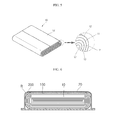
- FIG. 1 is a perspective view of a pouch-type rechargeable battery according to an embodiment.
- a method for fabricating the rechargeable battery is provided for a better understanding of the described technology and may be appropriately modified using technical content known in the art.
- the rechargeable battery includes a case 20, an electrode assembly 10 accommodated in the case 20, and a jelly roll tape 100 adhered to the outer surface of the electrode assembly 10.
- the jelly roll tape 100 used as a seal tape is illustrated.
- the jelly roll tape 100 is used as the seal tape of the electrode assembly according to an embodiment.
- FIG. 3 an embodiment of the jelly roll tape 100 placed on a seal tape (PP) is illustrated.
- the jelly roll tape 100 is adhered to the seal tape.
- the jelly roll tape 100 includes an adhesive tape (e.g., an OPS film) 110 as a base material and an adhesive layer 120 formed on one surface of the OPS film 110.
- an adhesive tape e.g., an OPS film
- an adhesive layer 120 formed on one surface of the OPS film 110.
- the electrode assembly 10 is wrapped with a separator 12 such that the separator 12 forms the outermost surface of the electrode assembly 10.
- the electrode assembly 10 includes a first electrode plate 11 and a second electrode plate 13 with a separator 12 interposed therebetween.
- the separator 12 is wrapped around the first and second electrode plates 11 and 13 to form the outermost surface of the electrode assembly 10.
- a ceramic layer is formed on the separator 12.
- a rubber based adhesive layer can be formed on the ceramic layer.
- the jelly roll tape 100 is adhered to the electrode assembly 10 over the separator 12 as the outermost surface of the electrode assembly 10 and is then housed in the case 20.
- the outermost portion of the electrode assembly is fixed using a typical seal tape and the jelly roll tape 100 is then be separately adhered to the typical seal tape.
- the electrolytic solution 200 and the adhesive tape e.g., OPS layer
- the adhesive tape react with each other to develop or exhibit adhesiveness, thereby preventing the electrode assembly 10 from moving within the battery case.
- This configuration leads to high resistance against external force in an impact test, such as a drop test.
- the rechargeable battery having the jelly roll tape on the electrode assembly is protected against external impact and has a particularly increased shock resistance near edge portions R of the rechargeable battery.
- An adhesive composition containing 70 wt% of rubber as a styrene butadiene based adhesive component is coated on a 40 ⁇ m thick OPS film (OPS25/PSA10 manufactured by SKC, Korea) to a thickness of 5 ⁇ m, followed by drying at room temperature for 24 hours.
- OPS film OPS25/PSA10 manufactured by SKC, Korea
- a jelly roll tape for an electrode assembly was prepared in the same manner as in Example 1, except that different rubber-based adhesive layers and jelly roll tape thicknesses shown in Table 1 were used.
- the thickness of the jelly roll tape is in the range of about 20 ⁇ m to about 40 ⁇ m, it was determined that the jelly roll tape had improved properties as a finishing tape in view its thickness and external appearance. However, when the thickness of the jelly roll tape is greater than or equal to about 40 ⁇ m, it was determined that the jelly roll tape had poor properties as a finishing tape in view its thickness and external appearance.
- a jelly roll tape for an electrode assembly was prepared in the same manner as in Example 1, except that an about 6 ⁇ m thickness of PET was inserted between the OPS film and the adhesive layer.
- a jelly roll tape for an electrode assembly was prepared in the same manner as in Example 1, except that an acryl-based adhesive layer having an acrylic ester polymer as a main component was used.
- OPS films used in Examples 1 to 5 and Comparative Example 1 are substantially the same films except for the adhesive components. Therefore, the basic physical properties of the films are substantially the same as each other. However, in order to investigate the characteristic physical properties of the films, each of the OPS films was adhered to an electrode assembly, dipped in an electrolytic solution, and placed in an oven to measure the shrinking properties of the OPS film.
- Example 1 Comparative Example 1 (OPS40/PSA1) Example 1 (OPS35/PSA5) Example 2 (OPS40/PSA5/ PET6/PSA5) Example 3 (OPS35/PSA5/ PET6/PSA5) Example 4 (OPS20/PSA5/ PET6/PSA5) Heat resistant temperature (°C) in electrolyte submerged state after being adhered to electrode assembly OPS film shrunk at 50°C OPS film shrunk at 80°C OPS film shrunk at 80°C OPS film shrunk at 80°C OPS film shrunk at 80°C OPS film shrunk at 80°C OPS film shrunk at 80°C OPS film shrunk at 80°C OPS film shrunk at 80°C OPS film shrunk at 80°C OPS film shrunk at 80°C OPS film shrunk at 80°C
- the OPS films were dissolved to then react with the electrolytic solution and tended to stick to the stainless steel plates. If a jelly roll tape has adhesiveness exceeding a predetermined level (e.g., about 300 gf/25mm ⁇ ), the adhesiveness was not affected by the reaction with the electrolytic solution.
- a predetermined level e.g., about 300 gf/25mm ⁇
- Example 1 320 300 ⁇ 300 ⁇ 300 ⁇ 300 ⁇ 300 ⁇ 300 ⁇ Example 2 332 300 ⁇ 300 ⁇ 300 ⁇ 300 ⁇ 300 ⁇ Example 3 315 300 ⁇ 300 ⁇ 300 ⁇ 300 ⁇ 300 ⁇ Example 4 345 300 ⁇ 300 ⁇ 300 ⁇ 300 ⁇ 300 ⁇ Example 5 322 300 ⁇ 300 ⁇ 300 ⁇ 300 ⁇ 300 ⁇ Comparative Example 1 300 13 8 7 6 6
- the jelly roll tape of the electrode assembly had good adhesiveness when an acryl-based adhesive layer was used.
- the jelly roll tape including the acryl-based adhesive layer (Comparative Example 1) had initial adhesiveness of 300 gf/25 mm and over time, the adhesive layer was dissolved in the electrolytic solution. Eventually, after 11 days elapsed, the adhesiveness of the jelly roll tape was lowered to 10 gf/25 mm or less and the jelly roll tape lost its adhesiveness.
Landscapes
- Chemical & Material Sciences (AREA)
- Chemical Kinetics & Catalysis (AREA)
- Electrochemistry (AREA)
- General Chemical & Material Sciences (AREA)
- Engineering & Computer Science (AREA)
- Manufacturing & Machinery (AREA)
- Inorganic Chemistry (AREA)
- Organic Chemistry (AREA)
- Ceramic Engineering (AREA)
- Physics & Mathematics (AREA)
- Condensed Matter Physics & Semiconductors (AREA)
- General Physics & Mathematics (AREA)
- Secondary Cells (AREA)
- Cell Separators (AREA)
Abstract
Description
- The described technology generally relates to a jelly roll tape for a rechargeable battery and a rechargeable battery having the same. Description of the Related Technology
- Rechargeable batteries include a case which houses an electrode assembly including a positive electrode plate, a negative electrode plate, and a separator interposed between the positive and negative electrode plates with an electrolyte. Rechargeable batteries can be classified based on the shapes of their cases, and for example, include cylindrical, prismatic, and pouch types. Alternatively, rechargeable batteries can be classified based on the electrolyte used, into polymer electrolyte rechargeable batteries and non-aqueous electrolyte types.
- One inventive aspect is a jelly roll tape for a rechargeable battery and a rechargeable battery having the same, which can increase battery stability by preventing an electrode assembly from moving within a battery case and can further protect edge portions of battery from damage due to external impact.
- Another aspect is a jelly roll tape for an electrode assembly of a rechargeable battery, which does not shrink and has an increased adhesiveness when reacting with an electrolyte. Thus, the jelly roll tape allows the electrode assembly to properly function without local changes in the battery thickness and further strengthening the adhesion of the electrode assembly at edge portions of battery.
- Another aspect is a rechargeable battery which has stability against external impact and can substantially prevent an electrode assembly from moving within a case.
- Another aspect is a jelly roll tape for an electrode assembly of a rechargeable battery, the jelly roll tape including an adhesive tape reacting with an electrolytic solution and developing and exhibiting an adhesive property and an adhesive layer formed on at least one surface of the adhesive tape, wherein the adhesive layer is a rubber-based adhesive layer.
- The adhesive tape may be an oriented polystyrene (OPS) film. The jelly roll tape may further include an electrolyte insoluble film that is not dissolved in the electrolytic solution, the electrolyte insoluble film formed between the adhesive tape and the adhesive layer formed on at least one surface of the adhesive tape.
- The adhesive layer may be a rubber-based adhesive layer.
- The thickness of the electrolyte insoluble film may be adjusted to control a distance between the electrode assembly and the case.
- Another aspect is a rechargeable battery including an electrode assembly including a first electrode plate, a second electrode plate having a different polarity from the first electrode plate, and a separator interposed between the first electrode plate and the second electrode plate, an electrolytic solution, an electrode assembly jelly roll tape adhered to an outer surface of the electrode assembly, and a case housing the electrode assembly and the electrolytic solution, wherein the electrode assembly jelly roll tape is the jelly roll tape.
- Another aspect is a jelly roll tape for an electrode assembly of a rechargeable battery, the jelly roll tape including a first adhesive layer configured to develop an adhesive property based at least in part on a reaction with an electrolytic solution and a second adhesive layer formed on at least one surface of the first adhesive layer, wherein the second adhesive layer is formed at least partially of a rubber-based material.
- The first adhesive layer may comprise an oriented polystyrene (OPS) film. The electrode assembly jelly roll tape may be a seal tape. The rubber-based material may include one or more of natural rubber, polyisoprene rubber, styrene-butadiene rubber, styrene-isoprene rubber, styrene-isoprene-styrene block copolymer rubber, styrene-butadiene-styrene block copolymer rubber, styrene-ethylene-butylene-styrene block copolymer rubber, styrene-ethylene-propylene-styrene block copolymer rubber, styrene-ethylene-propylene block copolymer rubber, reclaimed rubber, butyl rubber, polyisobutylene, and modified rubbers thereof.
- The jelly roll tape may have a thickness in the range of about 20 µm to about 50 µm. The OPS film may have a tensile strength in the range of about 200 kgf/cm2 to about 600 kgf/cm2. The jelly roll tape may further include an electrolyte insoluble film interposed between the first and second adhesive layers. The electrolyte insoluble film may be formed of one or more of polyethyleneterephthalate (PET), polyimide (PI), polyethylene (PE), and polypropylene (PP). The electrolyte insoluble film is adhered to the first and second adhesive layers.
- Another aspect is a rechargeable battery including an electrode assembly including a first electrode plate, a second electrode plate having a different polarity than the first electrode plate, and a separator interposed between the first and second electrode plates, an electrolytic solution, a jelly roll tape attached to an outer surface of the electrode assembly, and a case housing the electrode assembly and the electrolytic solution, wherein the jelly roll tape includes a first adhesive layer configured to develop an adhesive property based at least in part on a reaction with the electrolytic solution and a second adhesive layer formed on at least one surface of the first adhesive layer, wherein the second adhesive layer is formed at least partially of a rubber-based material.
- The first adhesive layer may comprise an oriented polystyrene (OPS) film.
- The separator may be wrapped around the electrode assembly to form the outermost surface of the electrode assembly. The rechargeable battery may be a pouch-type rechargeable battery. The electrolytic solution may include a non-aqueous organic solvent and a lithium salt and the non-aqueous organic solvent includes at least one material selected from the group of one or more cyclic carbonate selected from ethylene carbonate (EC), propylene carbonate (PC), 1,2-butylene carbonate, 2,3-butylene carbonate 1,2-pentylene carbonate, and 2,3-pentylene carbonate, one or more linear carbonates selected from diethyl carbonate (DEC), dipropyl carbonate (DPC), methylpropyl carbonate (MPC), ethylmethyl carbonate (EMC), and ethylpropyl carbonate (EPC); one or more esters selected from methylacetate, ethylacetate, propylacetate, methyl propionate, ethyl propionate, γ-butyrolactone, γ-valerolactone, γ-caprolactone, δ-valerolactone, and ε-caprolactone, one or more ethers selected from tetrahydrofuran, and 2-methyltetrahydrofuran, dibutylether, and polymethylvinyl ketone.
- The jelly roll tape may be attached to the separator. The separator may be formed at least partially of polyethylene (PE) or polypropylene (PP). The rechargeable battery may further include a ceramic layer formed on the separator. The rechargeable battery further may include a rubber-based adhesive layer formed on the ceramic layer.
- Another aspect is a rechargeable battery including an electrode assembly, an electrolyte, a first adhesive layer attached to an outer surface of the electrode assembly and configured to become an adhesive upon contacting the electrolyte, and a second adhesive layer formed on at least one surface of the first adhesive layer, wherein the second adhesive layer is formed of a rubber-based material.
- The rechargeable battery further includes an electrolyte insoluble film interposed between the first and second adhesive layers. The electrolyte insoluble film is formed one or more of polyethyleneterephthalate (PET), polyimide (PI), polyethylene (PE), and polypropylene (PP).
- According to at least one embodiment, since the jelly roll tape for an electrode assembly of a rechargeable battery does not shrink in use, local increases in the battery thickness are substantially prevented even after prolonged use. In addition, since the jelly roll tape does not constrict the electrode assembly, charging and discharging can be easily performed on electrode plates of the electrode assembly, thereby improving the life characteristics of the battery.
- Further, since the jelly roll tape has a relatively low shrinking ratio even at a high temperature, it has excellent high temperature characteristics.
- In addition, since the adhesiveness of the jelly roll tape is maintained even after contact with an electrolyte, it is possible to prevent the electrode assembly from rotating or moving within a case of the battery, thereby further increasing shock resistance at edge portions which are vulnerable to external impact.
- Additional aspects and/or advantages of the described technology will be set forth in part in the description which follows and in part will be obvious from the description or may be learned by practice of the described technology.
-
-
FIG. 1 is a perspective view of a pouch-type rechargeable battery having a jelly roll tape for an electrode assembly according to an embodiment. -
FIG. 2 illustrates an example of the jelly roll tape shown inFIG. 1 used as a seal tape. -
FIG. 3 illustrates a use example in which the jelly roll tape shown inFIG. 1 is placed on a seal tape (e.g. PP) in an electrode assembly according to an embodiment. -
FIG. 4 is a cross-sectional view of a jelly roll tape for an electrode assembly. -
FIG. 5 is a perspective view of an electrode assembly including a jelly roll tape according to an embodiment applied to the assembly. -
FIG. 6 is a cross-sectional view of a pouch-type rechargeable battery according to an embodiment. - In the standard rechargeable battery, the electrode assembly accommodated in the case can rotate or move within the case when applied with an external vibration or shock. This movement can cause a short-circuit in the battery, leading to damage to the electrode tabs of the electrode assembly.
- In order to prevent an electrode assembly from unrolling or moving within a battery case, a jelly roll tape is attached to the outer surface of the electrode assembly. Alternatively, the jelly roll tape can be independently attached to a seal tape formed on the electrode assembly. However, the adhesiveness of the conventional jelly roll tape, particularly when it is used in a polymeric battery, is not strong enough to withstand external impacts. Further, the jelly roll tape can be peeled off or the adhesiveness of the tape lost when it reacts with an electrolytic solution. After reacting with the electrolytic solution the jelly roll tape can shrink and constrict the electrode assembly, causing damage to the electrode assembly. In addition, the overall thickness of the electrode assembly can increase in some regions due to the reaction, resulting in a non-uniform battery thickness which can lead to short-circuits.
- Hereinafter, the described technology will be described in detail. In the following description, embodiments of the described technology are provided and described for a better understanding of the described technology. It will be understood by one skilled in the art that these embodiments may be modified in various forms and are not to be considered limiting of the scope of the described technology.
- According to an embodiment, a jelly roll tape for use in an electrode assembly includes an adhesive tape (or first adhesive layer) that reacts with an electrolytic solution and has an adhesive property, and an adhesive layer (or second adhesive layer) formed on at least one surface of the adhesive tape.
- The adhesive tape may be, for example, an oriented polystyrene (OPS) film. A rubber-based adhesive layer may be used as the adhesive layer. When the rubber-based adhesive layer is used as the adhesive layer, the jelly roll tape has a sufficiently high adhesiveness when it is employed in a polymer battery.
- According to an embodiment, the jelly roll tape has a thickness that is as small as possible in consideration of battery capacity. However, in some embodiments, in order to prevent the jelly roll tape from being broken due to external force, the jelly roll tape has a thickness of at least about 20 µm, for example, in the range of about 20 µm to about 50 µm. However, in other embodiments, the jelly roll tape has a thickness of less than about 20 µm or greater than about 50 µm.
- According to some embodiments, the adhesive tape has a tensile strength of about 200 kgf/cm2, for example, in the range of about 200 kgf/cm2 to about 600 kgf/cm2 so that the adhesive tape can withstand the pressure applied during charging or discharging. If the tensile strength of the adhesive tape is greater than or equal to about 600 kgf/cm2, the adhesive tape may not be released properly from a storage roll, thereby reducing the workability of the tape. In addition, the OPS film may be torn easily, thereby resulting in manufacturing errors or failures. However, according to other embodiments, the tensile strength of the adhesive tape can be less than about 200 kgf/cm2 or greater than about 600 kgf/cm2.
- According to an embodiment, the rubber-based adhesive layer includes natural rubber, polyisoprene rubber, styrene-butadiene rubber (SBR), styrene-isoprene rubber, styrene-isoprene-styrene block copolymer rubber, styrene-butadiene-styrene block copolymer rubber, styrene-ethylene-butylene-styrene block copolymer rubber, styrene-ethylene-propylene-styrene block copolymer rubber, styrene-ethylene-propylene block copolymer rubber, reclaimed rubber, butyl rubber, polyisobutylene, or modified rubbers thereof.
- According to some embodiments, the jelly roll tape is formed of multiple layers including the adhesive tape, for example, an OPS film, the adhesive layer formed on at least one surface of the adhesive tape, and an electrolyte insoluble film that is not dissolved when placed in an electrolytic solution interposed between the adhesive tape and the adhesive layer. With this configuration, the jelly roll tape can withstand shocks applied to the battery, irrespective of the kind of electrode assembly.
- The electrolyte insoluble film may include, for example, polyethyleneterephthalate (PET), polyimide (PI), polyethylene (PE), or polypropylene (PP).
- According to at least one embodiment, the adhesive layer formed on at least one surface of the adhesive tape (e.g., the OPS film) is a rubber-based adhesive layer and maintains its adhesiveness even when it reacts with an electrolyte.
- According to an embodiment, the rechargeable battery includes an electrode assembly including a first electrode plate, a second electrode plate having a different polarity from the first electrode plate, and a separator interposed between the first and second electrode plates. The rechargeable battery also includes an electrolytic solution, an electrode assembly jelly roll tape adhered to an outer surface of the electrode assembly, and a case housing the electrode assembly and the electrolytic solution. Here, the electrode assembly jelly roll tape according to at least one embodiment is used in the rechargeable battery.
- The first electrode plate is a positive or negative electrode and the second electrode plate is an electrode having a different polarity from the first electrode plate.
- The rechargeable battery may be of any one of a cylindrical, prismatic battery, or pouch type battery based on the external shape of the case. The jelly roll tape has excellent performance when it is employed in a pouch type rechargeable battery. Compared to prismatic or cylindrical rechargeable batteries, pouch-type rechargeable batteries have relatively vulnerable edge portions (R). However, according to at least one embodiment, since the electrode assembly jelly roll tape does not lose its adhesiveness even when it comes into contact with an electrolyte, it is possible to substantially prevent the electrode assembly from moving within the case and the jelly roll tape is not easily released when impacted by external force, thereby increasing the safety of the battery.
- In addition, rechargeable batteries can be classified into polymer batteries and non-aqueous batteries based on the electrolyte used. According to at least one embodiment, the rechargeable battery has superior performance when it is a polymer battery. This is because the rubber-based adhesive layer maintains an adhesive force between the adhesive tape (e.g., OPS) and the electrode assembly. That is to say, in a cylindrical rechargeable battery, the same battery performance can be obtained by using only an acrylate adhesive layer.
- Electrolytes are classified into polymer and non-aqueous electrolytes. When a polymer electrolyte is used, it may further include a lithium salt and a non-aqueous electrolytic solution.
- The non-aqueous electrolyte is used in dissolving or dissociating the lithium salt and any type of electrolyte can be used without particular limitation as long as it is used as an electrolyte solvent.
- Examples of the non-aqueous electrolytic solutions include cyclic carbonate, linear carbonate, lactone, ether, ester, sulfoxide, acetonitrile, lactam, ketone, and halogen derivatives thereof, which are used alone or in combination of two or more of these materials. Examples of the cyclic carbonate include ethylene carbonate (EC), propylene carbonate (PC), butylene carbonate (BC), fluoroethylene carbonate (FEC), and so on, and examples of the linear carbonate include diethyl carbonate (DEC), dipropyl carbonate (DPC), ethyl methyl carbonate (EMC), methyl propyl carbonate (MPC), and so on. Examples of the lactone include gamma utyrolactone (GBL), and examples of the ether include dibutylether, tetrahydrofuran, 2-methyl tetrahydrofuran, 1,4-dioxane, 1,2-dimethoxyethane, 1,2-diethoxyethane, and so on. Examples of the ester include methyl formate, ethyl formate, propyl formate, methyl acetate, ethyl acetate, propyl acetate, methyl propionate, ethyl propionate, butyl propionate, methyl pivalate, and so on. Examples of the sulfoxide include dimethylsulfoxide, examples of the lactam include N-methyl-2-pyrrolidone (NMP), and examples of the ketone include polymethyl vinyl ketone. Additionally, halogen derivatives of the aforementioned materials may also be used, but the described technology is not limited to the listed solvents of the electrolytic solution. In addition, the solvents of the electrolytic solution can be used alone or in combination of two or more of these materials.
- The lithium salt is a material that is readily soluble in the above-mentioned non-aqueous electrolyte. Nonlimiting examples thereof include LiCl, LiBr, LiI, LiClO4, LiBF4, LiB10Cl10, LiPF6, LiCF3SO3, LiCF3CO2, LiAsF6, LiSbF6, LiAlCl4, CH3SO3Li, CF3SO3Li, (CF3SO2)2NLi, chloroborane lithium, lower aliphatic carboxylic acid lithium, lithium tetraphenyl borate, and imide. Additionally, in order to improve the charge/discharge characteristics and flame retardancy, an additive may be further added to the electrolyte. Nonlimiting examples of such an additive include pyridine, triethylphosphite, triethanolamine, cyclic ether, ethylenediamine, n-glyme, hexaphosphoric triamide, nitrobenzene derivatives, sulfur, quinone imine dyes, N-substituted oxazolidinone, N,N-substituted imidazolidone, ethylene glycol dialkyl ether, ammonium salts, pyrrole, 2-methoxy ethanol, aluminum trichloride, or the like. If desired, in order to curb combustibility, the non-aqueous electrolyte may further include halogen-containing solvents such as carbon tetrachloride or ethylene trifluoride. In some embodiments, in order to improve incombustibility, the non-aqueous electrolyte additionally includes a halogen containing solvent, such as carbon tetrachloride or trifluoroethylene. Further, in order to improve high-temperature storage characteristics, the non-aqueous electrolyte may additionally include carbon dioxide gas.
- In one embodiment, the negative electrode is prepared by a general method that is widely known in the art. For example, a slurry is prepared by mixing a binder, an organic solvent, if necessary, a conductive agent, and a dispersant, and stirring the mixture. The slurry is coated on a metal current collector and is compressed and subsequently dried, thereby preparing the negative electrode.
- According to an embodiment, the negative electrode slurry is prepared using a mixture including about 70 wt% to about 98 wt% of a negative electrode active material, about 1 wt% to about 30 wt% of a binder, and about 1 wt% to about 25 wt% of a conductive agent.
- The negative electrode active material is a high-capacity negative electrode active material. According to an embodiment, the negative electrode active material includes one or more of a Si-based active material, a Sn-based active material or alloys thereof, or may be used in combination with graphite.
- According to some embodiments, the Si-based negative electrode active material is prepared by adding silicon oxide (SiOx, 0.1≤x≤1.2), amorphous silicon or alloys with other elements added to silicon. Examples of the elements include one or more selected from the group consisting of Mg, Ca, Sr, Sn, Ba, Ra, Sc, Y, Ti, Zr, Hf, Rf, V, Nb, Ta, Db, Cr, Mo, W, Sg, Tc, Re, Bh, Fe, Pb, Ru, Os, Hs, Rh, Ir, Pd, Pt, Cu, Ag, Au, Zn, Cd, B, Al, Ga, In, Ti, Ge, P, As, Sb, Bi, S, Se, and Te.
- According to some embodiments, the Sn-based negative electrode active material includes tin (Sn), tin oxide (SnO2) or alloys with other elements added to Sn. Examples of the elements include one or more selected from the group consisting of Mg, Ca, Sr, Ba, Ra, Sc, Y, Ti, Zr, Hf, Rf, V, Nb, Ta, Db, Cr, Mo, W, Sg, Tc, Re, Bh, Fe, Pb, Ru, Os, Hs, Rh, Ir, Pd, Pt, Cu, Ag, Au, Zn, Cd, B, Al, Ga, Si, In, Ti, Ge, P, As, Sb, Bi, S, Se, and Te.
- The binder may include, for example, SBR, polyamideimide (PAI), polyvinylidene fluoride (PVDF), polyethylene, polypropylene, polytetrafluoroethylene (PTFE), but is not limited thereto.
- Examples of the conductive agent include, but are not limited to, carbon black, ketjen black, acetylene black, artificial graphite, carbon fibers, carbon nano tubes, amorphous carbon, and so on.
- In one embodiment, the slurry is prepared by mixing an SBR binder emulsion with water and homogenizing the mixture with the negative electrode active material or the conductive agent.
- In some embodiments, the metal current collector is formed using a metallic material. Any kind of metal can be used so long as it is a highly conductive metal to which the slurry of the negative electrode active material can be easily adhered without causing a chemical reaction in the voltage range of the fabricated battery. Representative examples of the metal current collector include copper, nickel, stainless steel, or combinations thereof in the form of a mesh or a foil, but the described technology is not limited thereto.
- There is no particular limit to the method of coating the slurry on the current collector. For example, the slurry may be coated on the current collector by a doctor blade, submersion, or brushing. In addition, there is no particular limit to the amount of the slurry coated on the current collector, but the slurry is generally coated to have a thickness of an active material layer formed after removing a solvent or a dispersing medium in the range of about 0.005 mm to about 5 mm, for example, about 0.01 mm to about 0.1 mm.
- Further, there is no particular limit to the method of removing the solvent or dispersing medium, so long as the solvent or dispersing medium can be evaporated as fast as possible within a speed capable of substantially preventing stress concentrations and thus cracks from occurring in the active material layer or substantially preventing the active material layer from being peeled off from the current collector. In an exemplary embodiment, the drying is performed in a vacuum oven at a temperature of about 50°C to about 200°C for about 0.5 days to about 3 days.
- In one embodiment, a lithium containing transition metal oxide is used as a positive electrode active material for the positive electrode of the rechargeable battery. Specific examples thereof include one or more selected from the group consisting of LiCoO2, LiNiO2, LiMnO2, LiMn2O4, Li(NiaCobMnc)O2 (0<a<1, 0<b<1, 0<c<1, a+b+c=1), LiNi1-YCoYO2, LiCo1-YMnYO2, LiNi1-YMnYO2 (0≤Y<1), Li(NiaCobMnc)O4 (0<a<2, 0<b<2, 0<c<2, a+b+c=2), LiMn2-zNizO4, LiMn2-ZCoZO4 (0<Z<2), LiCoPO4, and LiFePO4.
- The positive electrode is fabricated using the positive electrode active material by the general method known in the art and the other content regarding preparation of the positive electrode is generally known in the art and detailed descriptions thereof will be omitted.
- In one embodiment, the separator is interposed between the positive and negative electrodes. An insulating thin film having good ion permeability and mechanical strength can be used as the separator.
- In one embodiment, the separator has a pore diameter of about 0.01 µm to about 10 µm and a thickness of about 5 µm to about 300 µm. A sheet or non-woven fabric made of an olefin polymer such as polypropylene and/or a glass fiber or polyethylene, which has chemical resistance and hydrophobicity, can be used as the separator. However, in other embodiments, the pore diameter of the separator can be less than about 0.01 µm or greater than about 10 µm and have a thickness of less than about 5 µm or greater than about 300 µm.
- Specific examples of the olefin polymer used as the separator include polyethylene, polypropylene, polytetrafluoroethylene (PTFE), multi-layered structures having two or more layers of these materials, composite multi-layered structures such as polyethylene/polypropylene two layered separators, polyethylene/polypropylene/polyethylene three layered separators, or polypropylene/polyethylene/polypropylene three layered separators.
- According to an embodiment, the outermost surface of the electrode assembly is further wrapped by the separator one more turns. Adhesion between electrode assembly and the jelly roll tape is increased when the electrode assembly is wrapped by the separator compared to when the electrode assembly is wrapped by the positive electrode active material or the negative electrode active material.
- Hereinafter, a rechargeable battery including the negative electrode according to an embodiment will be described with reference to
FIG. 1 . -
FIG. 1 is a perspective view of a pouch-type rechargeable battery according to an embodiment. A method for fabricating the rechargeable battery is provided for a better understanding of the described technology and may be appropriately modified using technical content known in the art. - Referring to
FIG. 1 , the rechargeable battery includes acase 20, anelectrode assembly 10 accommodated in thecase 20, and ajelly roll tape 100 adhered to the outer surface of theelectrode assembly 10. - Referring to
FIG. 2 , an embodiment of thejelly roll tape 100 used as a seal tape is illustrated. Thejelly roll tape 100 is used as the seal tape of the electrode assembly according to an embodiment. - Referring to
FIG. 3 , an embodiment of thejelly roll tape 100 placed on a seal tape (PP) is illustrated. In this embodiment, thejelly roll tape 100 is adhered to the seal tape. - Referring to
FIG. 4 , thejelly roll tape 100 includes an adhesive tape (e.g., an OPS film) 110 as a base material and anadhesive layer 120 formed on one surface of theOPS film 110. - Referring to
FIG. 5 , theelectrode assembly 10 is wrapped with aseparator 12 such that theseparator 12 forms the outermost surface of theelectrode assembly 10. Theelectrode assembly 10 includes afirst electrode plate 11 and asecond electrode plate 13 with aseparator 12 interposed therebetween. Thus, theseparator 12 is wrapped around the first andsecond electrode plates electrode assembly 10. According to some embodiments, a ceramic layer is formed on theseparator 12. A rubber based adhesive layer can be formed on the ceramic layer. - Referring to
FIG. 6 , thejelly roll tape 100 is adhered to theelectrode assembly 10 over theseparator 12 as the outermost surface of theelectrode assembly 10 and is then housed in thecase 20. In other embodiments, the outermost portion of the electrode assembly is fixed using a typical seal tape and thejelly roll tape 100 is then be separately adhered to the typical seal tape. Thereafter, as an electrolytic solution is injected, theelectrolytic solution 200 and the adhesive tape (e.g., OPS layer) as the base material of thejelly roll tape 100 react with each other to develop or exhibit adhesiveness, thereby preventing theelectrode assembly 10 from moving within the battery case. This configuration leads to high resistance against external force in an impact test, such as a drop test. - Thus, according to at least one embodiment, the rechargeable battery having the jelly roll tape on the electrode assembly is protected against external impact and has a particularly increased shock resistance near edge portions R of the rechargeable battery.
- The following examples are presented for illustrative purposes only and do not limit the scope of the described technology.
- An adhesive composition containing 70 wt% of rubber as a styrene butadiene based adhesive component is coated on a 40 µm thick OPS film (OPS25/PSA10 manufactured by SKC, Korea) to a thickness of 5 µm, followed by drying at room temperature for 24 hours. Thus, a jelly roll tape having a total thickness of 45 µm is prepared.
- A jelly roll tape for an electrode assembly was prepared in the same manner as in Example 1, except that different rubber-based adhesive layers and jelly roll tape thicknesses shown in Table 1 were used.
- When the thickness of the jelly roll tape is in the range of about 20 µm to about 40 µm, it was determined that the jelly roll tape had improved properties as a finishing tape in view its thickness and external appearance. However, when the thickness of the jelly roll tape is greater than or equal to about 40 µm, it was determined that the jelly roll tape had poor properties as a finishing tape in view its thickness and external appearance.
Table 1 Example 2 3 4 Adhesive layer component Okong SBR, Korea Konish SBR, Japan Ameripol Synpol SBR, America Jelly roll tape thickness (µm) 20 40 35 - A jelly roll tape for an electrode assembly was prepared in the same manner as in Example 1, except that an about 6 µm thickness of PET was inserted between the OPS film and the adhesive layer.
- A jelly roll tape for an electrode assembly was prepared in the same manner as in Example 1, except that an acryl-based adhesive layer having an acrylic ester polymer as a main component was used.
- The physical properties of electrode assembly jelly roll tapes prepared in Examples 1 to 5 and Comparative Example 1 were measured and the results thereof are listed in Table 2. In Table 2, OPS films used in Examples 1 to 5 and Comparative Example 1 are substantially the same films except for the adhesive components. Therefore, the basic physical properties of the films are substantially the same as each other. However, in order to investigate the characteristic physical properties of the films, each of the OPS films was adhered to an electrode assembly, dipped in an electrolytic solution, and placed in an oven to measure the shrinking properties of the OPS film. The OPS film prepared in Comparative Example 1, which includes an acryl-based adhesive layer, shrank at about 50 °C and the OPS film including a rubber-based adhesive layer did not shrink until the temperature became about 80°C, suggesting that the OPS film was better maintained by the rubber-based adhesive layer because the rubber-based adhesive layer was not readily dissolved in the electrolytic solution
- A mixture of 1.1M LiPF6(EC/PC/EP=1/3/6) + 1.2 LiBF4 + 5.0% FEC (flouroethylene carbonate) + 2.0% VC (vinyl carbonate) + 1.0% SA (succinic anhydride) + 3.0% SN (succinontrile) was used as the electrolytic solution.
Table 2 Comparative Example 1 (OPS40/PSA1) Example 1 (OPS35/PSA5) Example 2 (OPS40/PSA5/ PET6/PSA5) Example 3 (OPS35/PSA5/ PET6/PSA5) Example 4 (OPS20/PSA5/ PET6/PSA5) Heat resistant temperature (°C) in electrolyte submerged state after being adhered to electrode assembly OPS film shrunk at 50°C OPS film shrunk at 80°C OPS film shrunk at 80°C OPS film shrunk at 80°C OPS film shrunk at 80°C - Each of the samples of jelly roll tapes according to Examples 1 to 5 and Comparative Example 1 were prepared by adhering OPS films to stainless metal plates, impregnated in an electrolytic solution containing 1.1M LiPF6 (EC/PC/EP=1/3/6) + 1.2 LiBF4 + 5.0% FEC (flouroethylene carbonate) + 2.0% VC (vinyl carbonate) + 1.0% SA (succinic anhydride) + 3.0% SN (succinontrile), and allowed to stand without being disturbed at a high temperature of about 60°C for 10 days. Thereafter, the samples were taken out one by one to measure the adhesiveness and the measurement results are shown in Table 3. When the jelly roll tapes were impregnated in the electrolytic solution, the OPS films were dissolved to then react with the electrolytic solution and tended to stick to the stainless steel plates. If a jelly roll tape has adhesiveness exceeding a predetermined level (e.g., about 300 gf/25mm ↑), the adhesiveness was not affected by the reaction with the electrolytic solution.
Table 3 Elapsed days Initial 4 days 11 days 17 days 25 days 31 days Adhesiveness (gf/25mm) Example 1 320 300 ↑ 300 ↑ 300 ↑ 300 ↑ 300 ↑ Example 2 332 300 ↑ 300 ↑ 300 ↑ 300 ↑ 300 ↑ Example 3 315 300 ↑ 300 ↑ 300 ↑ 300 ↑ 300 ↑ Example 4 345 300 ↑ 300 ↑ 300 ↑ 300 ↑ 300 ↑ Example 5 322 300 ↑ 300 ↑ 300 ↑ 300 ↑ 300 ↑ Comparative Example 1 300 13 8 7 6 6 - As understood from Table 3, the jelly roll tape of the electrode assembly according to embodiments of the described technology had good adhesiveness when an acryl-based adhesive layer was used. The jelly roll tape including the acryl-based adhesive layer (Comparative Example 1) had initial adhesiveness of 300 gf/25 mm and over time, the adhesive layer was dissolved in the electrolytic solution. Eventually, after 11 days elapsed, the adhesiveness of the jelly roll tape was lowered to 10 gf/25 mm or less and the jelly roll tape lost its adhesiveness.
- Although specific types of materials (adhesive compositions, electrolytic solutions, adhesive tapes, etc.) or parameters (thickness, temperature, adhesiveness, etc.) were used in the above examples 1-5, it is expected that substantially the same or similar benefits are obtained from other types of materials or parameters discussed in connection with
FIGS. 1-6 . - It is clear for a person skilled in the art that the disclosed embodiments can also be combined where possible
Claims (15)
- A jelly roll tape (100) for an electrode assembly (10) of a rechargeable battery , the jelly roll tape (100) comprising:a first adhesive layer (110) configured to develop an adhesive property based at least in part on a reaction with an electrolytic solution; anda second adhesive layer (120) formed on at least one surface of the first adhesive layer (110),wherein the second adhesive layer (120) is formed at least partially of a rubber-based material.
- The jelly roll tape of claim 1, wherein the first adhesive layer (110) comprises an oriented polystyrene (OPS) film.
- The jelly roll tape of claim 1 or 2, wherein the electrode assembly jelly roll tape (100) is a seal tape.
- The jelly roll tape of one of claims 1 to 3, wherein the rubber-based material comprises one or more of natural rubber, polyisoprene rubber, styrene-butadiene rubber, styrene-isoprene rubber, styrene-isoprene-styrene block copolymer rubber, styrene-butadiene-styrene block copolymer rubber, styrene-ethylene-butylene-styrene block copolymer rubber, styrene-ethylene-propylene-styrene block copolymer rubber, styrene-ethylene-propylene block copolymer rubber, reclaimed rubber, butyl rubber, polyisobutylene, and modified rubbers thereof.
- The jelly roll tape of one of claims 1 to 4, wherein the jelly roll tape (100) has a thickness in the range of 20 µm to 50 µm.
- The jelly roll tape of one of claims 1 to 5, wherein the OPS film has a tensile strength in the range of 200 kgf/cm2 to 600 kgf/cm2,
- The jelly roll tape of one of claims 1 to 6, further comprising an electrolyte insoluble film interposed between the first and second adhesive layers.
- The jelly roll tape of claim 7, wherein the electrolyte insoluble film is formed of one or more of polyethyleneterephthalate (PET), polyimide (PI), polyethylene (PE), and polypropylene (PP).
- The jelly roll tape of claim 7 or 8, wherein the electrolyte insoluble film is adhered to the first and second adhesive layers (110, 120).
- A rechargeable battery, comprising:an electrode assembly (10) including a first electrode plate (11), a second electrode plate (13) having a different polarity than the first electrode plate (11), and a separator (12) interposed between the first and second electrode plates (11,13);an electrolytic solution (200);a jelly roll tape (100) attached to an outer surface of the electrode assembly (10) according to one of claims 1 to 9; anda case (20) housing the electrode assembly and the electrolytic solution.
- The rechargeable battery of claim 10, wherein the first adhesive layer comprises an oriented polystyrene (OPS) film.
- The rechargeable battery of claim 10, wherein the separator (12) is wrapped around the electrode assembly (10) to form the outermost surface of the electrode assembly (10), and or.
wherein the rechargeable battery is a pouch-type rechargeable battery. - The rechargeable battery of one of claims 10 to 12, wherein the electrolytic solution (200) includes a non-aqueous organic solvent and a lithium salt and wherein the non-aqueous organic solvent includes at least one material selected from the group consisting of: one or more cyclic carbonate selected from ethylene carbonate (EC), propylene carbonate (PC), 1,2-butylene carbonate, 2,3-butylene carbonate 1,2-pentylene carbonate, and 2,3-pentylene carbonate; one or more linear carbonates selected from diethyl carbonate (DEC), dipropyl carbonate (DPC), methylpropyl carbonate (MPC), ethylmethyl carbonate (EMC), and ethylpropyl carbonate (EPC); one or more esters selected from methylacetate, ethylacetate, propylacetate, methyl propionate, ethyl propionate, γ-butyrolactone, γ-valerolactone, γ-caprolactone, δ-valerolactone, and ε-caprolactone; one or more ethers selected from tetrahydrofuran, and 2-methyltetrahydrofuran, dibutylether; and polymethylvinyl ketone.
- The rechargeable battery of one of claims 10 to 13, wherein the jelly roll tape (100) is attached to the separator (12), and/or
wherein the separator (12) is formed at least partially of polyethylene (PE) or polypropylene (PP). - The rechargeable battery of claim 06, further comprising a ceramic layer formed on the separator (12), and /or
a rubber-based adhesive layer formed on the ceramic layer.
Applications Claiming Priority (1)
| Application Number | Priority Date | Filing Date | Title |
|---|---|---|---|
| KR1020130156451A KR102154327B1 (en) | 2013-12-16 | 2013-12-16 | Jelly roll tape for rechargeable battery and rechargeable battery having the same |
Publications (2)
| Publication Number | Publication Date |
|---|---|
| EP2884557A1 true EP2884557A1 (en) | 2015-06-17 |
| EP2884557B1 EP2884557B1 (en) | 2017-12-06 |
Family
ID=51753042
Family Applications (1)
| Application Number | Title | Priority Date | Filing Date |
|---|---|---|---|
| EP14189041.8A Active EP2884557B1 (en) | 2013-12-16 | 2014-10-15 | Jelly roll tape for rechargeable battery and rechargeable battary having the same |
Country Status (5)
| Country | Link |
|---|---|
| US (1) | US10833297B2 (en) |
| EP (1) | EP2884557B1 (en) |
| JP (1) | JP7060316B2 (en) |
| KR (1) | KR102154327B1 (en) |
| CN (1) | CN104710946B (en) |
Cited By (1)
| Publication number | Priority date | Publication date | Assignee | Title |
|---|---|---|---|---|
| EP3796451A4 (en) * | 2018-10-30 | 2021-09-15 | Contemporary Amperex Technology Co., Limited | ELECTROLYTIC SOLUTION, LITHIUM-ION BATTERY, BATTERY MODULE, BATTERY PACK AND DEVICE |
Families Citing this family (29)
| Publication number | Priority date | Publication date | Assignee | Title |
|---|---|---|---|---|
| KR102125492B1 (en) * | 2015-09-22 | 2020-06-22 | 주식회사 엘지화학 | Method and apparatus for attaching seal tape to electrode assembly |
| KR102534101B1 (en) * | 2015-11-12 | 2023-05-18 | 삼성에스디아이 주식회사 | Secondary battery |
| CN109196704A (en) * | 2016-05-31 | 2019-01-11 | 株式会社村田制作所 | Power storage equipment |
| KR102503597B1 (en) * | 2017-11-16 | 2023-02-24 | 삼성에스디아이 주식회사 | Secondary battery |
| US12080898B2 (en) * | 2017-12-22 | 2024-09-03 | Cummins Inc. | Thermal runaway mitigation system for high capacity energy cell |
| KR102594876B1 (en) * | 2018-01-11 | 2023-10-27 | 삼성전자주식회사 | Battery and electronic device using thereof |
| KR102420791B1 (en) * | 2018-01-17 | 2022-07-14 | 주식회사 엘지에너지솔루션 | Metal Can-Type Battery Comprising Protective Layer |
| KR102541550B1 (en) * | 2018-02-27 | 2023-06-08 | 삼성전자주식회사 | Electronic device including a battery structure |
| CN110350236B (en) * | 2018-04-08 | 2021-07-30 | 宁德时代新能源科技股份有限公司 | Electrochemical energy storage device |
| CN110379942A (en) * | 2018-04-12 | 2019-10-25 | 宁德新能源科技有限公司 | Battery core component and electrochemical appliance |
| GB201806956D0 (en) * | 2018-04-27 | 2018-06-13 | Siriwardana Pulathis Nilantha | A door stop |
| KR102692266B1 (en) * | 2018-10-26 | 2024-08-06 | 주식회사 테이팩스 | Tape For Secondary Battery And Lithium Ion Battery Using Same |
| CN111200155A (en) * | 2018-11-19 | 2020-05-26 | 宁德新能源科技有限公司 | Electrode assembly and battery including the same |
| CN109868092A (en) * | 2019-01-28 | 2019-06-11 | 东莞市澳中电子材料有限公司 | A kind of hot melt glue applied to field of lithium |
| CN111171754B (en) * | 2020-02-28 | 2022-08-19 | 东莞澳中新材料科技股份有限公司 | Soluble double-sided pressure-sensitive adhesive tape of base material for lithium battery and preparation method of soluble double-sided pressure-sensitive adhesive tape |
| WO2021220746A1 (en) | 2020-04-30 | 2021-11-04 | 株式会社村田製作所 | Secondary battery |
| CN112689921B (en) * | 2020-05-20 | 2022-09-16 | 宁德新能源科技有限公司 | Electrode assembly and battery |
| WO2021232312A1 (en) * | 2020-05-20 | 2021-11-25 | 宁德新能源科技有限公司 | Battery cell, battery using the battery cell, and electronic device |
| CN115428224A (en) * | 2020-05-21 | 2022-12-02 | 株式会社村田制作所 | Secondary battery |
| CN111995959A (en) * | 2020-08-18 | 2020-11-27 | 澳中新材料科技(韶关)有限公司 | Expandable adhesive tape capable of being engraved with codes and preparation method thereof |
| CN112646505A (en) * | 2020-12-17 | 2021-04-13 | 惠州亿纬创能电池有限公司 | High-temperature-resistant composite expansion film and preparation method and application thereof |
| EP4207437A4 (en) * | 2021-01-29 | 2024-11-27 | Ningde Amperex Technology Limited | ELECTROCHEMICAL APPARATUS AND ELECTRONIC DEVICE |
| CN113097572B (en) * | 2021-03-30 | 2023-02-03 | 宁德新能源科技有限公司 | Electrochemical devices and their electrical equipment |
| CN114262574A (en) * | 2021-12-17 | 2022-04-01 | 宁德新能源科技有限公司 | Adhesive tape and electrochemical device comprising same |
| CN114267885A (en) * | 2021-12-21 | 2022-04-01 | 惠州亿纬锂能股份有限公司 | Anti-drop steel shell button battery and preparation method and application thereof |
| CN115566254B (en) * | 2022-10-26 | 2025-10-24 | 珠海冠宇动力电池有限公司 | A battery |
| CN121569393A (en) * | 2023-08-18 | 2026-02-24 | 株式会社Lg新能源 | Secondary battery |
| CN117276764A (en) * | 2023-09-21 | 2023-12-22 | 宁德新能源科技有限公司 | Secondary batteries and electronic equipment |
| KR20250094334A (en) * | 2023-12-18 | 2025-06-25 | 삼성에스디아이 주식회사 | Sealing tape for all-solid-state rechargeable batteries and all-solid-state rechargeable batteries including the same |
Citations (2)
| Publication number | Priority date | Publication date | Assignee | Title |
|---|---|---|---|---|
| US20110244318A1 (en) * | 2010-04-05 | 2011-10-06 | Samsung Sdi Co., Ltd. | Secondary battery |
| KR20130124053A (en) * | 2012-05-04 | 2013-11-13 | 주식회사 엘지화학 | Adhesive tape and secondary battery manufactured using the same |
Family Cites Families (17)
| Publication number | Priority date | Publication date | Assignee | Title |
|---|---|---|---|---|
| JPH11176475A (en) | 1997-12-15 | 1999-07-02 | Nitto Denko Corp | Adhesive tape or sheet for batteries |
| JP4116784B2 (en) * | 2001-11-08 | 2008-07-09 | 大日本印刷株式会社 | Negative electrode coating composition, negative electrode plate, method for producing the same, and nonaqueous electrolyte secondary battery |
| KR101137633B1 (en) * | 2004-10-28 | 2012-04-19 | 삼성에스디아이 주식회사 | Secondary battery |
| KR100758482B1 (en) | 2004-12-07 | 2007-09-12 | 주식회사 엘지화학 | Surface-treated microporous membrane and electrochemical device prepared thereby |
| KR100709838B1 (en) * | 2005-07-07 | 2007-04-23 | 삼성에스디아이 주식회사 | Electrolyte for lithium secondary battery and lithium secondary battery comprising same |
| US8828591B2 (en) * | 2006-03-02 | 2014-09-09 | Sony Corporation | External packaging material for battery device, nonaqueous electrolyte secondary battery using the same, and battery pack |
| KR100908977B1 (en) * | 2007-03-29 | 2009-07-22 | 삼성에스디아이 주식회사 | Electrode Assembly of Secondary Battery |
| US8048559B2 (en) * | 2009-07-08 | 2011-11-01 | Samsung Sdi Co., Ltd | Secondary battery and method of making the secondary battery |
| KR101136254B1 (en) * | 2010-05-20 | 2012-04-19 | 삼성에스디아이 주식회사 | Secondary battery |
| US8062787B2 (en) * | 2009-09-11 | 2011-11-22 | Samsung Sdi Co., Ltd | Secondary battery and method of manufacturing the secondary battery |
| KR101100990B1 (en) | 2009-12-15 | 2011-12-29 | 삼성에스디아이 주식회사 | Secondary battery |
| EP2477252B1 (en) | 2010-10-04 | 2020-08-19 | LG Chem, Ltd. | Seal tape and secondary battery using the same |
| JP5680371B2 (en) * | 2010-10-29 | 2015-03-04 | 日東電工株式会社 | Battery adhesive tape |
| JP5982131B2 (en) * | 2011-02-28 | 2016-08-31 | 日東電工株式会社 | Battery adhesive tape and battery using the adhesive tape |
| KR101239622B1 (en) * | 2011-03-31 | 2013-03-07 | 주식회사 엘지화학 | Cylindrical Secondary Battery of Improved Safety |
| JP5790179B2 (en) | 2011-06-13 | 2015-10-07 | トヨタ自動車株式会社 | Winding type battery and method for manufacturing winding type battery |
| KR101253199B1 (en) * | 2011-07-25 | 2013-04-10 | 엘지전자 주식회사 | Lighting device |
-
2013
- 2013-12-16 KR KR1020130156451A patent/KR102154327B1/en active Active
-
2014
- 2014-07-03 US US14/323,683 patent/US10833297B2/en active Active
- 2014-08-08 CN CN201410390513.8A patent/CN104710946B/en active Active
- 2014-10-09 JP JP2014207815A patent/JP7060316B2/en active Active
- 2014-10-15 EP EP14189041.8A patent/EP2884557B1/en active Active
Patent Citations (2)
| Publication number | Priority date | Publication date | Assignee | Title |
|---|---|---|---|---|
| US20110244318A1 (en) * | 2010-04-05 | 2011-10-06 | Samsung Sdi Co., Ltd. | Secondary battery |
| KR20130124053A (en) * | 2012-05-04 | 2013-11-13 | 주식회사 엘지화학 | Adhesive tape and secondary battery manufactured using the same |
Cited By (2)
| Publication number | Priority date | Publication date | Assignee | Title |
|---|---|---|---|---|
| EP3796451A4 (en) * | 2018-10-30 | 2021-09-15 | Contemporary Amperex Technology Co., Limited | ELECTROLYTIC SOLUTION, LITHIUM-ION BATTERY, BATTERY MODULE, BATTERY PACK AND DEVICE |
| US12218307B2 (en) | 2018-10-30 | 2025-02-04 | Contemporary Amperex Technology (Hong Kong) Limited | Electrolytic solution, lithium-ion battery, battery module, battery pack and apparatus |
Also Published As
| Publication number | Publication date |
|---|---|
| KR102154327B1 (en) | 2020-09-09 |
| EP2884557B1 (en) | 2017-12-06 |
| KR20150069837A (en) | 2015-06-24 |
| CN104710946A (en) | 2015-06-17 |
| US10833297B2 (en) | 2020-11-10 |
| JP2015118921A (en) | 2015-06-25 |
| JP7060316B2 (en) | 2022-04-26 |
| CN104710946B (en) | 2022-05-03 |
| US20150171383A1 (en) | 2015-06-18 |
Similar Documents
| Publication | Publication Date | Title |
|---|---|---|
| EP2884557B1 (en) | Jelly roll tape for rechargeable battery and rechargeable battary having the same | |
| EP2638597B1 (en) | High performance lithium or lithium ion cell | |
| US7745057B2 (en) | Nonaqueous electrolyte secondary battery | |
| KR101202863B1 (en) | Negative electrode for battery and lithium ion battery using the same | |
| EP2238643B1 (en) | Pouch-type lithium secondary battery | |
| US9553338B2 (en) | Lithium secondary battery | |
| CN108604674A (en) | Positive electrode for secondary battery, method for producing same, and lithium secondary battery including same | |
| EP2634842B1 (en) | Separator including coating layer of organic and inorganic mixture, and battery including the same | |
| KR20170141141A (en) | Electrode for secondary battery and Lithium secondary battery comprising the same | |
| US9859590B2 (en) | Battery | |
| CN107438909B (en) | Pouch type case for secondary battery and pouch type secondary battery including the same | |
| CN105098190A (en) | Negative electrode for rechargeable lithium battery and rechargeable lithium battery including same | |
| KR20190053120A (en) | Multi-layer Electrode for Secondary Battery Comprising Binder with High Crystallinity | |
| JP2021506063A (en) | Electrolytes for lithium secondary batteries and lithium secondary batteries containing them | |
| WO2014141930A1 (en) | Lithium ion secondary battery and charging method therefor | |
| KR20150024175A (en) | Rechargeable lithium battery | |
| KR20190053121A (en) | Multi-layer Electrode for Secondary Battery Comprising Binder with High Crystallinity | |
| US9190647B2 (en) | Nonaqueous electrolyte secondary battery with high temperature and storage characteristics | |
| EP4394953A1 (en) | Electrochemical apparatus and electronic apparatus | |
| US20250349881A1 (en) | Electrolyte composite containing oxide-based solid electrolyte, method of preparing the same, and all-solid-state battery containing the same | |
| KR20250063686A (en) | Method for detecting internal short in secondary battery | |
| KR20070041972A (en) | Electrochemical device with excellent safety during overcharge and high temperature storage | |
| KR20100075086A (en) | Li-ion battery comprising a separator characterized by high elongation |
Legal Events
| Date | Code | Title | Description |
|---|---|---|---|
| PUAI | Public reference made under article 153(3) epc to a published international application that has entered the european phase |
Free format text: ORIGINAL CODE: 0009012 |
|
| 17P | Request for examination filed |
Effective date: 20141015 |
|
| AK | Designated contracting states |
Kind code of ref document: A1 Designated state(s): AL AT BE BG CH CY CZ DE DK EE ES FI FR GB GR HR HU IE IS IT LI LT LU LV MC MK MT NL NO PL PT RO RS SE SI SK SM TR |
|
| AX | Request for extension of the european patent |
Extension state: BA ME |
|
| R17P | Request for examination filed (corrected) |
Effective date: 20151216 |
|
| RBV | Designated contracting states (corrected) |
Designated state(s): AL AT BE BG CH CY CZ DE DK EE ES FI FR GB GR HR HU IE IS IT LI LT LU LV MC MK MT NL NO PL PT RO RS SE SI SK SM TR |
|
| GRAP | Despatch of communication of intention to grant a patent |
Free format text: ORIGINAL CODE: EPIDOSNIGR1 |
|
| STAA | Information on the status of an ep patent application or granted ep patent |
Free format text: STATUS: GRANT OF PATENT IS INTENDED |
|
| INTG | Intention to grant announced |
Effective date: 20170616 |
|
| GRAS | Grant fee paid |
Free format text: ORIGINAL CODE: EPIDOSNIGR3 |
|
| GRAA | (expected) grant |
Free format text: ORIGINAL CODE: 0009210 |
|
| STAA | Information on the status of an ep patent application or granted ep patent |
Free format text: STATUS: THE PATENT HAS BEEN GRANTED |
|
| AK | Designated contracting states |
Kind code of ref document: B1 Designated state(s): AL AT BE BG CH CY CZ DE DK EE ES FI FR GB GR HR HU IE IS IT LI LT LU LV MC MK MT NL NO PL PT RO RS SE SI SK SM TR |
|
| REG | Reference to a national code |
Ref country code: GB Ref legal event code: FG4D |
|
| REG | Reference to a national code |
Ref country code: AT Ref legal event code: REF Ref document number: 953126 Country of ref document: AT Kind code of ref document: T Effective date: 20171215 Ref country code: CH Ref legal event code: EP |
|
| REG | Reference to a national code |
Ref country code: IE Ref legal event code: FG4D |
|
| REG | Reference to a national code |
Ref country code: DE Ref legal event code: R096 Ref document number: 602014018127 Country of ref document: DE |
|
| REG | Reference to a national code |
Ref country code: NL Ref legal event code: MP Effective date: 20171206 |
|
| REG | Reference to a national code |
Ref country code: LT Ref legal event code: MG4D |
|
| PG25 | Lapsed in a contracting state [announced via postgrant information from national office to epo] |
Ref country code: NO Free format text: LAPSE BECAUSE OF FAILURE TO SUBMIT A TRANSLATION OF THE DESCRIPTION OR TO PAY THE FEE WITHIN THE PRESCRIBED TIME-LIMIT Effective date: 20180306 Ref country code: FI Free format text: LAPSE BECAUSE OF FAILURE TO SUBMIT A TRANSLATION OF THE DESCRIPTION OR TO PAY THE FEE WITHIN THE PRESCRIBED TIME-LIMIT Effective date: 20171206 Ref country code: LT Free format text: LAPSE BECAUSE OF FAILURE TO SUBMIT A TRANSLATION OF THE DESCRIPTION OR TO PAY THE FEE WITHIN THE PRESCRIBED TIME-LIMIT Effective date: 20171206 Ref country code: ES Free format text: LAPSE BECAUSE OF FAILURE TO SUBMIT A TRANSLATION OF THE DESCRIPTION OR TO PAY THE FEE WITHIN THE PRESCRIBED TIME-LIMIT Effective date: 20171206 Ref country code: SE Free format text: LAPSE BECAUSE OF FAILURE TO SUBMIT A TRANSLATION OF THE DESCRIPTION OR TO PAY THE FEE WITHIN THE PRESCRIBED TIME-LIMIT Effective date: 20171206 |
|
| REG | Reference to a national code |
Ref country code: AT Ref legal event code: MK05 Ref document number: 953126 Country of ref document: AT Kind code of ref document: T Effective date: 20171206 |
|
| PG25 | Lapsed in a contracting state [announced via postgrant information from national office to epo] |
Ref country code: LV Free format text: LAPSE BECAUSE OF FAILURE TO SUBMIT A TRANSLATION OF THE DESCRIPTION OR TO PAY THE FEE WITHIN THE PRESCRIBED TIME-LIMIT Effective date: 20171206 Ref country code: BG Free format text: LAPSE BECAUSE OF FAILURE TO SUBMIT A TRANSLATION OF THE DESCRIPTION OR TO PAY THE FEE WITHIN THE PRESCRIBED TIME-LIMIT Effective date: 20180306 Ref country code: RS Free format text: LAPSE BECAUSE OF FAILURE TO SUBMIT A TRANSLATION OF THE DESCRIPTION OR TO PAY THE FEE WITHIN THE PRESCRIBED TIME-LIMIT Effective date: 20171206 Ref country code: GR Free format text: LAPSE BECAUSE OF FAILURE TO SUBMIT A TRANSLATION OF THE DESCRIPTION OR TO PAY THE FEE WITHIN THE PRESCRIBED TIME-LIMIT Effective date: 20180307 Ref country code: HR Free format text: LAPSE BECAUSE OF FAILURE TO SUBMIT A TRANSLATION OF THE DESCRIPTION OR TO PAY THE FEE WITHIN THE PRESCRIBED TIME-LIMIT Effective date: 20171206 |
|
| PG25 | Lapsed in a contracting state [announced via postgrant information from national office to epo] |
Ref country code: NL Free format text: LAPSE BECAUSE OF FAILURE TO SUBMIT A TRANSLATION OF THE DESCRIPTION OR TO PAY THE FEE WITHIN THE PRESCRIBED TIME-LIMIT Effective date: 20171206 |
|
| PG25 | Lapsed in a contracting state [announced via postgrant information from national office to epo] |
Ref country code: SK Free format text: LAPSE BECAUSE OF FAILURE TO SUBMIT A TRANSLATION OF THE DESCRIPTION OR TO PAY THE FEE WITHIN THE PRESCRIBED TIME-LIMIT Effective date: 20171206 Ref country code: EE Free format text: LAPSE BECAUSE OF FAILURE TO SUBMIT A TRANSLATION OF THE DESCRIPTION OR TO PAY THE FEE WITHIN THE PRESCRIBED TIME-LIMIT Effective date: 20171206 Ref country code: CZ Free format text: LAPSE BECAUSE OF FAILURE TO SUBMIT A TRANSLATION OF THE DESCRIPTION OR TO PAY THE FEE WITHIN THE PRESCRIBED TIME-LIMIT Effective date: 20171206 |
|
| PG25 | Lapsed in a contracting state [announced via postgrant information from national office to epo] |
Ref country code: SM Free format text: LAPSE BECAUSE OF FAILURE TO SUBMIT A TRANSLATION OF THE DESCRIPTION OR TO PAY THE FEE WITHIN THE PRESCRIBED TIME-LIMIT Effective date: 20171206 Ref country code: PL Free format text: LAPSE BECAUSE OF FAILURE TO SUBMIT A TRANSLATION OF THE DESCRIPTION OR TO PAY THE FEE WITHIN THE PRESCRIBED TIME-LIMIT Effective date: 20171206 Ref country code: AT Free format text: LAPSE BECAUSE OF FAILURE TO SUBMIT A TRANSLATION OF THE DESCRIPTION OR TO PAY THE FEE WITHIN THE PRESCRIBED TIME-LIMIT Effective date: 20171206 Ref country code: IT Free format text: LAPSE BECAUSE OF FAILURE TO SUBMIT A TRANSLATION OF THE DESCRIPTION OR TO PAY THE FEE WITHIN THE PRESCRIBED TIME-LIMIT Effective date: 20171206 Ref country code: RO Free format text: LAPSE BECAUSE OF FAILURE TO SUBMIT A TRANSLATION OF THE DESCRIPTION OR TO PAY THE FEE WITHIN THE PRESCRIBED TIME-LIMIT Effective date: 20171206 |
|
| REG | Reference to a national code |
Ref country code: DE Ref legal event code: R097 Ref document number: 602014018127 Country of ref document: DE |
|
| REG | Reference to a national code |
Ref country code: FR Ref legal event code: PLFP Year of fee payment: 5 |
|
| PLBE | No opposition filed within time limit |
Free format text: ORIGINAL CODE: 0009261 |
|
| STAA | Information on the status of an ep patent application or granted ep patent |
Free format text: STATUS: NO OPPOSITION FILED WITHIN TIME LIMIT |
|
| 26N | No opposition filed |
Effective date: 20180907 |
|
| PG25 | Lapsed in a contracting state [announced via postgrant information from national office to epo] |
Ref country code: SI Free format text: LAPSE BECAUSE OF FAILURE TO SUBMIT A TRANSLATION OF THE DESCRIPTION OR TO PAY THE FEE WITHIN THE PRESCRIBED TIME-LIMIT Effective date: 20171206 Ref country code: DK Free format text: LAPSE BECAUSE OF FAILURE TO SUBMIT A TRANSLATION OF THE DESCRIPTION OR TO PAY THE FEE WITHIN THE PRESCRIBED TIME-LIMIT Effective date: 20171206 |
|
| REG | Reference to a national code |
Ref country code: CH Ref legal event code: PL |
|
| REG | Reference to a national code |
Ref country code: BE Ref legal event code: MM Effective date: 20181031 |
|
| PG25 | Lapsed in a contracting state [announced via postgrant information from national office to epo] |
Ref country code: MC Free format text: LAPSE BECAUSE OF FAILURE TO SUBMIT A TRANSLATION OF THE DESCRIPTION OR TO PAY THE FEE WITHIN THE PRESCRIBED TIME-LIMIT Effective date: 20171206 Ref country code: LU Free format text: LAPSE BECAUSE OF NON-PAYMENT OF DUE FEES Effective date: 20181015 |
|
| REG | Reference to a national code |
Ref country code: IE Ref legal event code: MM4A |
|
| PG25 | Lapsed in a contracting state [announced via postgrant information from national office to epo] |
Ref country code: BE Free format text: LAPSE BECAUSE OF NON-PAYMENT OF DUE FEES Effective date: 20181031 Ref country code: LI Free format text: LAPSE BECAUSE OF NON-PAYMENT OF DUE FEES Effective date: 20181031 Ref country code: CH Free format text: LAPSE BECAUSE OF NON-PAYMENT OF DUE FEES Effective date: 20181031 |
|
| PG25 | Lapsed in a contracting state [announced via postgrant information from national office to epo] |
Ref country code: IE Free format text: LAPSE BECAUSE OF NON-PAYMENT OF DUE FEES Effective date: 20181015 |
|
| PG25 | Lapsed in a contracting state [announced via postgrant information from national office to epo] |
Ref country code: MT Free format text: LAPSE BECAUSE OF NON-PAYMENT OF DUE FEES Effective date: 20181015 |
|
| PG25 | Lapsed in a contracting state [announced via postgrant information from national office to epo] |
Ref country code: TR Free format text: LAPSE BECAUSE OF FAILURE TO SUBMIT A TRANSLATION OF THE DESCRIPTION OR TO PAY THE FEE WITHIN THE PRESCRIBED TIME-LIMIT Effective date: 20171206 |
|
| PG25 | Lapsed in a contracting state [announced via postgrant information from national office to epo] |
Ref country code: PT Free format text: LAPSE BECAUSE OF FAILURE TO SUBMIT A TRANSLATION OF THE DESCRIPTION OR TO PAY THE FEE WITHIN THE PRESCRIBED TIME-LIMIT Effective date: 20171206 |
|
| PG25 | Lapsed in a contracting state [announced via postgrant information from national office to epo] |
Ref country code: MK Free format text: LAPSE BECAUSE OF NON-PAYMENT OF DUE FEES Effective date: 20171206 Ref country code: CY Free format text: LAPSE BECAUSE OF FAILURE TO SUBMIT A TRANSLATION OF THE DESCRIPTION OR TO PAY THE FEE WITHIN THE PRESCRIBED TIME-LIMIT Effective date: 20171206 Ref country code: HU Free format text: LAPSE BECAUSE OF FAILURE TO SUBMIT A TRANSLATION OF THE DESCRIPTION OR TO PAY THE FEE WITHIN THE PRESCRIBED TIME-LIMIT; INVALID AB INITIO Effective date: 20141015 |
|
| PG25 | Lapsed in a contracting state [announced via postgrant information from national office to epo] |
Ref country code: AL Free format text: LAPSE BECAUSE OF FAILURE TO SUBMIT A TRANSLATION OF THE DESCRIPTION OR TO PAY THE FEE WITHIN THE PRESCRIBED TIME-LIMIT Effective date: 20171206 Ref country code: IS Free format text: LAPSE BECAUSE OF FAILURE TO SUBMIT A TRANSLATION OF THE DESCRIPTION OR TO PAY THE FEE WITHIN THE PRESCRIBED TIME-LIMIT Effective date: 20180406 |
|
| REG | Reference to a national code |
Ref country code: DE Ref legal event code: R079 Ref document number: 602014018127 Country of ref document: DE Free format text: PREVIOUS MAIN CLASS: H01M0002020000 Ipc: H01M0050100000 |
|
| P01 | Opt-out of the competence of the unified patent court (upc) registered |
Effective date: 20230528 |
|
| PGFP | Annual fee paid to national office [announced via postgrant information from national office to epo] |
Ref country code: FR Payment date: 20250930 Year of fee payment: 12 |
|
| PGFP | Annual fee paid to national office [announced via postgrant information from national office to epo] |
Ref country code: DE Payment date: 20250930 Year of fee payment: 12 |
|
| PGFP | Annual fee paid to national office [announced via postgrant information from national office to epo] |
Ref country code: GB Payment date: 20251001 Year of fee payment: 12 |