EP3796166B1 - Diagrammdatenbasiertes aufgabenplanungsverfahren, vorrichtung, speichermedium und einrichtung - Google Patents
Diagrammdatenbasiertes aufgabenplanungsverfahren, vorrichtung, speichermedium und einrichtung Download PDFInfo
- Publication number
- EP3796166B1 EP3796166B1 EP19803567.7A EP19803567A EP3796166B1 EP 3796166 B1 EP3796166 B1 EP 3796166B1 EP 19803567 A EP19803567 A EP 19803567A EP 3796166 B1 EP3796166 B1 EP 3796166B1
- Authority
- EP
- European Patent Office
- Prior art keywords
- computing
- quantized value
- data
- graph
- node
- Prior art date
- Legal status (The legal status is an assumption and is not a legal conclusion. Google has not performed a legal analysis and makes no representation as to the accuracy of the status listed.)
- Active
Links
Images




Classifications
-
- G—PHYSICS
- G06—COMPUTING OR CALCULATING; COUNTING
- G06F—ELECTRIC DIGITAL DATA PROCESSING
- G06F9/00—Arrangements for program control, e.g. control units
- G06F9/06—Arrangements for program control, e.g. control units using stored programs, i.e. using an internal store of processing equipment to receive or retain programs
- G06F9/46—Multiprogramming arrangements
- G06F9/48—Program initiating; Program switching, e.g. by interrupt
- G06F9/4806—Task transfer initiation or dispatching
- G06F9/4843—Task transfer initiation or dispatching by program, e.g. task dispatcher, supervisor, operating system
-
- G—PHYSICS
- G06—COMPUTING OR CALCULATING; COUNTING
- G06F—ELECTRIC DIGITAL DATA PROCESSING
- G06F9/00—Arrangements for program control, e.g. control units
- G06F9/06—Arrangements for program control, e.g. control units using stored programs, i.e. using an internal store of processing equipment to receive or retain programs
- G06F9/46—Multiprogramming arrangements
- G06F9/48—Program initiating; Program switching, e.g. by interrupt
- G06F9/4806—Task transfer initiation or dispatching
- G06F9/4843—Task transfer initiation or dispatching by program, e.g. task dispatcher, supervisor, operating system
- G06F9/4881—Scheduling strategies for dispatcher, e.g. round robin, multi-level priority queues
-
- G—PHYSICS
- G06—COMPUTING OR CALCULATING; COUNTING
- G06F—ELECTRIC DIGITAL DATA PROCESSING
- G06F9/00—Arrangements for program control, e.g. control units
- G06F9/06—Arrangements for program control, e.g. control units using stored programs, i.e. using an internal store of processing equipment to receive or retain programs
- G06F9/46—Multiprogramming arrangements
- G06F9/50—Allocation of resources, e.g. of the central processing unit [CPU]
- G06F9/5005—Allocation of resources, e.g. of the central processing unit [CPU] to service a request
- G06F9/5027—Allocation of resources, e.g. of the central processing unit [CPU] to service a request the resource being a machine, e.g. CPUs, Servers, Terminals
- G06F9/5038—Allocation of resources, e.g. of the central processing unit [CPU] to service a request the resource being a machine, e.g. CPUs, Servers, Terminals considering the execution order of a plurality of tasks, e.g. taking priority or time dependency constraints into consideration
-
- G—PHYSICS
- G06—COMPUTING OR CALCULATING; COUNTING
- G06F—ELECTRIC DIGITAL DATA PROCESSING
- G06F16/00—Information retrieval; Database structures therefor; File system structures therefor
- G06F16/20—Information retrieval; Database structures therefor; File system structures therefor of structured data, e.g. relational data
- G06F16/23—Updating
- G06F16/2379—Updates performed during online database operations; commit processing
-
- G—PHYSICS
- G06—COMPUTING OR CALCULATING; COUNTING
- G06F—ELECTRIC DIGITAL DATA PROCESSING
- G06F16/00—Information retrieval; Database structures therefor; File system structures therefor
- G06F16/20—Information retrieval; Database structures therefor; File system structures therefor of structured data, e.g. relational data
- G06F16/27—Replication, distribution or synchronisation of data between databases or within a distributed database system; Distributed database system architectures therefor
-
- G—PHYSICS
- G06—COMPUTING OR CALCULATING; COUNTING
- G06F—ELECTRIC DIGITAL DATA PROCESSING
- G06F16/00—Information retrieval; Database structures therefor; File system structures therefor
- G06F16/90—Details of database functions independent of the retrieved data types
- G06F16/901—Indexing; Data structures therefor; Storage structures
- G06F16/9024—Graphs; Linked lists
-
- G—PHYSICS
- G06—COMPUTING OR CALCULATING; COUNTING
- G06F—ELECTRIC DIGITAL DATA PROCESSING
- G06F9/00—Arrangements for program control, e.g. control units
- G06F9/06—Arrangements for program control, e.g. control units using stored programs, i.e. using an internal store of processing equipment to receive or retain programs
- G06F9/46—Multiprogramming arrangements
- G06F9/48—Program initiating; Program switching, e.g. by interrupt
- G06F9/4806—Task transfer initiation or dispatching
- G06F9/4843—Task transfer initiation or dispatching by program, e.g. task dispatcher, supervisor, operating system
- G06F9/485—Task life-cycle, e.g. stopping, restarting, resuming execution
-
- G—PHYSICS
- G06—COMPUTING OR CALCULATING; COUNTING
- G06F—ELECTRIC DIGITAL DATA PROCESSING
- G06F9/00—Arrangements for program control, e.g. control units
- G06F9/06—Arrangements for program control, e.g. control units using stored programs, i.e. using an internal store of processing equipment to receive or retain programs
- G06F9/46—Multiprogramming arrangements
- G06F9/50—Allocation of resources, e.g. of the central processing unit [CPU]
- G06F9/5061—Partitioning or combining of resources
- G06F9/5066—Algorithms for mapping a plurality of inter-dependent sub-tasks onto a plurality of physical CPUs
-
- G—PHYSICS
- G06—COMPUTING OR CALCULATING; COUNTING
- G06F—ELECTRIC DIGITAL DATA PROCESSING
- G06F9/00—Arrangements for program control, e.g. control units
- G06F9/06—Arrangements for program control, e.g. control units using stored programs, i.e. using an internal store of processing equipment to receive or retain programs
- G06F9/46—Multiprogramming arrangements
- G06F9/50—Allocation of resources, e.g. of the central processing unit [CPU]
- G06F9/5083—Techniques for rebalancing the load in a distributed system
- G06F9/5088—Techniques for rebalancing the load in a distributed system involving task migration
-
- H—ELECTRICITY
- H04—ELECTRIC COMMUNICATION TECHNIQUE
- H04L—TRANSMISSION OF DIGITAL INFORMATION, e.g. TELEGRAPHIC COMMUNICATION
- H04L9/00—Cryptographic mechanisms or cryptographic arrangements for secret or secure communications; Network security protocols
- H04L9/32—Cryptographic mechanisms or cryptographic arrangements for secret or secure communications; Network security protocols including means for verifying the identity or authority of a user of the system or for message authentication, e.g. authorization, entity authentication, data integrity or data verification, non-repudiation, key authentication or verification of credentials
- H04L9/3236—Cryptographic mechanisms or cryptographic arrangements for secret or secure communications; Network security protocols including means for verifying the identity or authority of a user of the system or for message authentication, e.g. authorization, entity authentication, data integrity or data verification, non-repudiation, key authentication or verification of credentials using cryptographic hash functions
- H04L9/3239—Cryptographic mechanisms or cryptographic arrangements for secret or secure communications; Network security protocols including means for verifying the identity or authority of a user of the system or for message authentication, e.g. authorization, entity authentication, data integrity or data verification, non-repudiation, key authentication or verification of credentials using cryptographic hash functions involving non-keyed hash functions, e.g. modification detection codes [MDCs], MD5, SHA or RIPEMD
-
- H—ELECTRICITY
- H04—ELECTRIC COMMUNICATION TECHNIQUE
- H04L—TRANSMISSION OF DIGITAL INFORMATION, e.g. TELEGRAPHIC COMMUNICATION
- H04L9/00—Cryptographic mechanisms or cryptographic arrangements for secret or secure communications; Network security protocols
- H04L9/50—Cryptographic mechanisms or cryptographic arrangements for secret or secure communications; Network security protocols using hash chains, e.g. blockchains or hash trees
-
- G—PHYSICS
- G06—COMPUTING OR CALCULATING; COUNTING
- G06F—ELECTRIC DIGITAL DATA PROCESSING
- G06F2209/00—Indexing scheme relating to G06F9/00
- G06F2209/50—Indexing scheme relating to G06F9/50
- G06F2209/5017—Task decomposition
-
- G—PHYSICS
- G06—COMPUTING OR CALCULATING; COUNTING
- G06F—ELECTRIC DIGITAL DATA PROCESSING
- G06F2209/00—Indexing scheme relating to G06F9/00
- G06F2209/50—Indexing scheme relating to G06F9/50
- G06F2209/5022—Workload threshold
Definitions
- This application relates to the field of graph computing technologies, and in particular, to a graph-data-based task scheduling method and apparatus, a storage medium, and a device.
- graph data may be used for representing information such as a social network, a commodity purchase relationship, a road traffic network, a communications network, and the demand for graph-data-based computing is growing in quantity and complexity.
- a current mainstream graph-data-based task scheduling method is a centralized scheduling method.
- a parameter server is usually used for scheduling and controlling computing tasks in a unified manner.
- the present invention concerns a graph node allocation method according to claim 1. Further aspects of the present invention are defined in the dependent claims.
- a graph-data-based task scheduling method applied to a computing node, the method including:
- a graph-data-based task scheduling apparatus including:
- a computer-readable storage medium stores at least one instruction, at least one program, a code set, or an instruction set, the at least one instruction, the at least one program, the code set, or the instruction set being loaded and executed by a processor to implement the graph-data-based task scheduling method.
- a computer device including a memory and a processor, the memory storing a computer program, the computer program, when executed by the processor, causing the processor to perform the graph-data-based task scheduling method.
- To-be-processed graph data is divided into a plurality of pieces of subgraph data, and distributed processing is performed on the plurality of pieces of subgraph data, thereby greatly improving graph data processing efficiency.
- a first quantized value, a second quantized value, and a third quantized value are obtained separately, and when the second quantized value and the third quantized value do not meet an equilibrium condition, a graph node and the first quantized value are exchanged between a computing node and another computing node.
- the first quantized value and the second quantized value may measure a computing capacity of a computing node
- the third quantized value may measure a load status of the computing node.
- the computing capacity and the load status of the computing node may be quantitatively indicated by using quantized values corresponding to a unit computing task, which is accurate and intuitive.
- the graph nodes and the first quantized values are exchanged between the computing node and the another computing node, to keep that the second quantized value and the third quantized value meet the equilibrium condition.
- computing nodes instead of relying on a specific server or node for task allocation, computing nodes cooperate with each other to allocate graph nodes, and dynamically adjust the allocation, to implement self-organized load balancing and avoid problems of single point failure and network congestion of the specific server, thereby greatly improving task scheduling efficiency.
- such a self-organized dynamic task scheduling method can adapt to computing task scheduling of a larger-scale cluster, and a dynamic increase or decrease of the quantity of computing nodes does not affect existing computing tasks, so that high scalability is achieved.
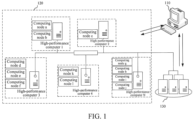
- FIG. 1 is a diagram of an application environment of a graph-data-based task scheduling method in an embodiment.
- the graph-data-based task scheduling method is applied to a distributed graph computing system.
- the distributed graph computing system includes a control node 110, a computing node 120, and a data warehouse 130.
- the control node 110 is connected to the computing node 120 through a blockchain network, and the control node 110 and the computing node 120 are separately connected to the data warehouse 130 through a network.
- the control node 110 may be implemented by using a terminal, the terminal may be a desktop terminal or a mobile terminal, and the mobile terminal may be, for example, a mobile phone, a tablet computer, or a notebook computer.
- the control node 110 may be understood as a terminal configured to observe and modify an execution status, rather than a scheduling core.
- the computing node 120 may be implemented by using a program deployed on one or more servers. For example, computing nodes a, b, c, and the like shown in FIG. 1 are distributed on a high-performance computer 1 to a high-performance computer N respectively. Different high-performance computers distributed in the same network occupy different quantities of computing nodes due to different performance. All control nodes 110 and computing nodes 120 may directly access the data warehouse 130, for example, read an executable file and an input of an algorithm of a computing task, and store a computing result to a specified position.
- the data warehouse 130 may be a centralized storage device, or may be a distributed storage cluster or device.
- the distributed graph computing system includes a plurality of computing nodes, and the graph-data-based task scheduling method may be applied to any computing node.
- a graph-data-based task scheduling method is provided.
- description is made mainly by using an example in which the method is applied to computing node 120 in FIG. 1 .
- the graph-computing-based task scheduling method includes the following steps.
- Step 202 Obtain subgraph data divided from to-be-processed graph data.
- the graph data is structured data organized by using a graph structure and relationship information between entities stored by applying a graph theory.
- the graph data is formed by a graph node and an edge between graph nodes.
- the graph node is a vertex in the graph data and may be used for representing a subject in the graph data.
- different graph nodes in the graph data may be used for representing different individuals.
- each user and each commodity are graph nodes.
- the graph node may include information such as a node identifier and a node attribute of the graph node.
- the edge between graph nodes is an edge in the graph data and may be used for representing a relationship between different subjects in the graph data.
- the graph data when the graph data is used for storing information between individuals in a social network, different graph nodes in the graph data are used for representing different individuals, and the edge in the graph data may be used for representing a relationship between the individuals, for example, a friend relationship.
- the graph data is used for representing a commodity purchasing relationship, each user and each commodity are graph nodes, and the user purchasing the commodity is represented by an edge.
- the to-be-processed graph data is graph data to be processed by the computing node.
- the subgraph data is partial graph data divided from the to-be-processed graph data.
- a large graph may be divided into a specific quantity of subgraphs, to make edges inside the subgraph as dense as possible and edges between the subgraphs as sparse as possible.
- FIG. 3 shows a schematic diagram of dividing a graph into five subgraphs.
- the graph when a size of a graph is relatively small, the graph may be divided through an N-cut algorithm into subgraphs. When a size of a graph is relatively large, the graph may be divided through an approximation algorithm into subgraphs. In addition, during division into the subgraphs, in addition to the division requirements above, load balance also needs to be considered. Therefore, an additional condition is further required, that is, a size of the subgraph formed through division matches a capability of the computing node.
- each computing node may be a program deployed on one or more servers, and computing nodes may form a virtual network structure through a medium, namely, a blockchain.
- the computing nodes may write information such as data, a task execution log, or a computing node status into a new block and add the new block into a blockchain network, to conveniently perform communication coordination between computing nodes and complete a computing task corresponding to the subgraph data, thereby completing a computing task corresponding to the to-be-processed graph data.
- the blockchain network is a carrier and an organization mode for running a blockchain technology and is a decentralized distributed database formed by external communication modules of computing nodes.
- the distributed graph computing system includes a control node, and the control node may communicate with one or more computing nodes in the distributed graph computing system to access the blockchain network.
- the control node may record task information corresponding to graph data into a new block, add the new block into the blockchain network, and broadcast the task information in the blockchain network. In this way, all computing nodes in the blockchain network may receive the broadcast task information.
- the task information is information related to a computing task.
- the computing node may regularly check, by using a timer, a timing program, or the like, task information recorded in a new block recently added into the blockchain network. After detecting that the new block includes task information, the computing node determines its own load status. When the load status indicates that the computing node is not overloaded, the computing node may load the task information from the blockchain network.
- the task information may include an obtaining path of a task-executable file, an algorithm parameter for performing a computing task, an obtaining path of subgraph data, an output path of a computing result, an expected completion time, and the like.
- the computing node may obtain a subgraph structure in a graph structure corresponding to graph data and obtain corresponding subgraph data from a data warehouse according to the obtained subgraph structure.
- the computing node may randomly obtain a specific quantity of graph nodes and corresponding edges from the graph structure corresponding to the graph data according to its own load status, to form a subgraph structure.
- the computing node further obtains subgraph data corresponding to the subgraph structure from the data warehouse according to the obtaining path of the subgraph data recorded in the task information.
- the distributed graph computing system may divide graph data into a corresponding quantity of pieces of subgraph data according to a preset condition based on the quantity of current computing nodes.
- the preset condition may be equal division, random division, or the like, and is not limited in this embodiment.
- Step 204 Perform a unit computing task for a graph node in the subgraph data.
- the unit computing task is a minimum computing allocation unit in the distributed graph computing system, for example, a computing task corresponding to a specific graph node in a current iterative computing process.
- the computing node may perform corresponding computing on a graph node in the obtained subgraph data.
- the computing node pulls, according to information, such as the obtaining path of the task-executable file and the algorithm parameter for performing the computing task, recorded in the task information, the task-executable file and the algorithm parameter for performing the computing task from the data warehouse. Further, after obtaining the subgraph data, the computing node performs the pulled task-executable file according to the algorithm parameter for performing the computing task to perform the unit computing task for the graph node in the subgraph data.
- computing performed on the graph data is iterative computing. As the algorithm is updated iteratively, a new computing task is generated during each iteration. Each graph node in the subgraph data may be driven by the algorithm to continuously generate to-be-completed unit computing tasks.
- Step 206 Obtain a first quantized value, the first quantized value being a quantized value corresponding to a completed unit computing task in a case that data corresponding to the completed unit computing task is formed into blockchain data.
- the blockchain data is data recorded in the new block added to the blockchain network, and the new block in the blockchain network may share recorded information by means of broadcast.
- the quantized value is a value obtained by quantizing the unit computing task.
- one unit computing task corresponds to one unit quantized value.
- the first quantized value is a value obtained by quantizing a completed unit computing task in a computing node in a case that data corresponding to the completed unit computing task is formed into blockchain data.
- the first quantized value may measure a computing capacity of the computing node and correspond to some completed unit computing tasks.
- the first quantized value may be a resource for circulation and exchange in the blockchain network and may be referred to as a currency value, a virtual currency value, or the like.
- the computing node may record data corresponding to some completed unit computing tasks into the blockchain network to form blockchain data, and a quantized value corresponding to the completed unit computing tasks is the first quantized value
- the computing node after performing the unit computing task for the graph node in the subgraph data, the computing node completes a corresponding unit computing task. After completing the corresponding unit computing task, the computing node may obtain global computing data and local computing data for computing on the subgraph data.
- the global computing data is data that needs to be shared and updated globally in a process of computing on the subgraph data by each computing node, and a scale of the global computing data is limited.
- the local computing data is data that is used and updated by only a few computing nodes in a process in which each computing node performs computing on the subgraph data.
- the computing node may record the global computing data in a new block, and add the new block to the blockchain network after the new block is verified by the blockchain network.
- the global computing data forms the blockchain data.
- the computing node may alternatively record all related data from a previous block to a current time, for example, current global computing data, a task execution log, or a computing node status, in a new block, add the new block to the blockchain network, and obtain a corresponding first quantized value.
- the related data recorded in the new block may be actively broadcast, so that all computing nodes in the distributed graph computing system share the recorded related data, for example, the global computing data recorded in the new block.
- the related data recorded in the new block may be spread in a form of a request. The spreading in the form of a request means that the computing node may obtain the related data recorded in the new block by sending a request.
- a graph structure corresponding to the graph data is usually a relatively sparse graph, and consequently, the quantity M of edges in the graph data is much less than a pairwise combination of quantities N of graph nodes: M ⁇ A n 2 .
- N the quantity of graph nodes
- the global computing data is shared globally through a blockchain network, the local computing data is buffered to a corresponding computing node, and the local computing data is obtained in the form of a request, thereby avoiding unnecessary network communication overheads caused by broadcasting a large volume of local computing data.
- Step 208 Obtain a second quantized value, the second quantized value being a quantized value corresponding to the completed unit computing task in a case that the data corresponding to the completed unit computing task is not formed into blockchain data.
- the second quantized value is a value obtained by quantizing a completed unit computing task in a computing node in a case that data corresponding to the completed unit computing task is not formed into blockchain data.
- the second quantized value may measure a computing capacity of the computing node and correspond to other completed unit computing tasks in the computing node.
- the second quantized value may be a resource that is currently owned by the computing node and can be redeemed to the first quantized value and may be referred to as an asset value.
- an asset value corresponding to this part of blockchain data may be converted into a currency value of the same amount of circulated in the blockchain network.
- the computing node after performing the unit computing task for the graph node in the subgraph data, the computing node obtains data.
- the computing node determines, according to data that is not recorded in the blockchain network, a completed unit computing task corresponding to the data.
- the computing node quantizes the determined completed unit computing task to obtain the second quantized value.
- the computing node after performing the unit computing task for the graph node in the subgraph data, the computing node completes a corresponding unit computing task. After completing the corresponding unit computing task, the computing node may obtain the second quantized value corresponding to the completed unit computing task.
- the computing node before writing global computing data into a new block, the computing node obtains a history second quantized value corresponding to the completed unit computing task.
- the history second quantized value corresponds to a completed unit computing task that does not form into blockchain data before the global computing data is written into the new block.
- the first quantized value corresponding to generating the unit computing task corresponding to the written global computing data is subtracted from the history second quantized value to obtain a current second quantized value.
- a corresponding history second quantized value may be converted into the second quantized value.
- a second quantized value that may be redeemed in the future is quickly and conveniently converted into a corresponding first quantized value that can be circulated.
- a sum of the first quantized value and the current second quantized value may indicate a current computing capacity of the computing node.
- Step 210 Determine a third quantized value corresponding to an uncompleted unit computing task in the subgraph data.
- the third quantized value is value obtained by quantizing an uncompleted unit computing task in the computing node.
- the third quantized value may be a value corresponding to a unit computing task to be performed by a computing node, which may be referred to as a liability value, and may measure a load status of the computing node.
- the computing node may convert a third quantized value corresponding to the uncompleted unit computing task into a second quantized value of the same amount, and then convert the second quantized value of the same amount into a first quantized value of the same amount.
- the computing node may obtain a current uncompleted unit computing task in real time, and determine the third quantized value according to the uncompleted unit computing task.
- the first quantized value, the second quantized value, and the third quantized value have the same unit and all correspond to the unit computing task.
- a total task corresponding to graph data is fixed, and a subtask generated from subgraph data in each computing node is also fixed.
- the computing node completes unit computing tasks continuously by performing the unit computing tasks for the graph nodes in the subgraph data.
- the computing node may obtain a current uncompleted unit computing task according to subtasks generated from the subgraph data and current completed unit computing tasks, to thereby determine a corresponding third quantized value.
- a total task corresponding to graph data keeps changing, and a subtask generated from subgraph data in each computing node also keeps changing.
- the computing node may iteratively generate a computing task according to the subgraph data. As the algorithm is updated iteratively, a new computing task is generated during each iteration.
- Each graph node in the subgraph data may continuously generate, through algorithm drive, unit calculation tasks that need to be completed.
- the computing node may determine a third quantized value corresponding to an uncompleted unit computing task in subgraph data according to the subgraph data, the quantity of completed unit computing tasks, content of the completed unit computing task, global computing data shared in a blockchain network, and local computing data.
- Step 212 Exchange the graph node and the first quantized value with another computing node in a case that the second quantized value and the third quantized value fail to meet an equilibrium condition.
- the equilibrium condition is a condition that is preset and used for measuring whether a current computing capacity and a current load status of the computing node are balanced.
- that the second quantized value and the third quantized value meet an equilibrium condition means that a contrast value between a second sum of third quantized values and a first sum of second quantized values falls within a specified range.
- the contrast value is a difference value between two values and may be determined through a mathematical calculation. The mathematical calculation may be direct division of two numbers, division following logarithm-taking, subtraction, division following logarithm-taking following another operation, or the like.
- the contrast value may measure a difference status of one value relative to another value.
- the graph node and the first quantized value may be exchanged between computing nodes, to keep that the second quantized value and the third quantized value meet the equilibrium condition.
- the specified range corresponding to the equilibrium condition may be a preset fixed range, or may be a range determined by a function that varies with time.
- to-be-processed graph data is divided into a plurality of pieces of subgraph data, and then, distributed processing is performed on the plurality of pieces of subgraph data, thereby greatly improving graph data processing efficiency.
- a first quantized value, a second quantized value, and a third quantized value are obtained separately, and when the second quantized value and the third quantized value do not meet an equilibrium condition, a graph node and the first quantized value are exchanged between a computing node and another computing node.
- the first quantized value and the second quantized value may measure a computing capacity of a computing node
- the third quantized value may measure a load status of the computing node.
- the computing capacity and the load status of the computing node may be quantitatively indicated by using quantized values corresponding to a unit computing task, which is accurate and intuitive.
- the graph nodes and the first quantized values are exchanged between the computing node and the another computing node, to keep that the second quantized value and the third quantized value meet the equilibrium condition.
- computing nodes instead of relying on a specific server or node for task allocation, computing nodes cooperate with each other to allocate graph nodes, and dynamically adjust the allocation, to implement self-organized load balancing and avoid problems of single point failure and network congestion of the specific server, thereby greatly improving task scheduling efficiency.
- such a self-organized dynamic task scheduling method can adapt to computing task scheduling of a larger-scale cluster, and a dynamic increase or decrease of the quantity of computing nodes does not affect existing computing tasks, so that high scalability is achieved.
- step 202 may include: obtaining task information corresponding to graph data and broadcast in a blockchain network, and reading, according to the task information, a task-executable file and the subgraph data divided from the graph data.
- step 204 may include: executing the task-executable file according to the subgraph data, the task-executable file being used for indicating the unit computing task for the graph node in the subgraph data.
- the computing node may obtain the task information corresponding to the graph data and broadcast in the blockchain network, and read, according to the task information, the task-executable file and the subgraph data divided from the graph data from locally or from a data warehouse.
- the task-executable file is executed according to the subgraph data, to perform the unit computing task for the graph node in the subgraph data.
- the distributed graph computing system includes a control node, the control node may record task information corresponding to graph data into a new block and add the new block to a blockchain network to broadcast the task information in the blockchain network.
- all computing nodes in the blockchain network may receive the task information corresponding to the graph data through broadcast of the new block.
- the computing node may regularly check, by using a timer, a timing program, or the like, task information recorded in a new block recently added into the blockchain network, to actively obtain task information corresponding to graph data and broadcast in the blockchain network.
- the task information corresponding to the graph data and broadcast in the blockchain network is obtained, the task-executable file and the subgraph data are read according to the task information, and the task-executable file is executed according to the subgraph data, so as to perform the unit computing task.
- the task information may be a very light (that is, a small volume of data) file.
- step 206 may include the following steps.
- Step 402. Write global computing data corresponding to a completed unit computing task into a new block.
- the foregoing blockchain network may include a private blockchain, and a key required for recording data in the blockchain network may be generated in advance according to an asymmetric encryption algorithm standard and stored in a data warehouse.
- the computing node may access the data warehouse to obtain a related key when the key needs to be used.
- the asymmetric encryption algorithm may be an elliptic curve encryption algorithm, an RSA encryption algorithm (an asymmetric encryption algorithm), or the like.
- the computing node may generate a new block according to a corresponding consensus algorithm.
- the consensus algorithm may be a consensus hash algorithm or the like.
- the computing node may write global computing data corresponding to a completed unit computing task into a new block.
- the computing node may write information, such as global data, a task execution log, exchanged data of a graph node, or a computing node status, into a new block.
- the quantity of bits of the consensus hash algorithm may be reduced, to improve processing efficiency, thereby improving system throughput.
- a 128-bit secure hash algorithm instead of a 256-bit SHA may be used.
- POS proof of work
- the distributed graph computing system can achieve better communication efficiency.
- D k represents an average third quantized value of graph nodes in a first party k providing to-be-exchanged graph nodes
- C k represents an average second quantized value of graph nodes in the first party k providing the to-be-exchanged graph nodes
- age(D k ) represents average coin days of graph nodes in the first party k providing the to-be-exchanged graph nodes
- ⁇ and ⁇ are thresholds.
- each computing node may allow, by default, a computing node currently having the largest first quantized value to generate a new block. In this case, generation of the first quantized value is allocated to a computing node with the smallest first quantized value, thereby achieving higher coordination efficiency.
- the first quantized value herein may alternatively be replaced with the second quantized value or the third quantized value.
- complexity may also be controlled by limiting the quantity of consensus prefixes 0, and similar to control of the quantity of bits, the larger the quantity of prefixes 0 of a constrain hash result is, the more difficult a consensus problem is.
- Step 404 Add, after the new block is verified by a blockchain network, the new block into the blockchain network to form blockchain data, and generate a first quantized value corresponding to the unit computing task corresponding to the written global computing data.
- the computing node may add the new block to the blockchain network.
- global computing data written into the new block is formed into blockchain data.
- the computing node may generate a first quantized value corresponding to a unit computing task corresponding to the written global computing data.
- the global computing data corresponding to the completed unit computing task is written into the new block, the new block is added to the blockchain network, and the blockchain data is formed. After the new block is verified by the blockchain network, a first quantized value is rapidly and conveniently generated, and the first quantized value may be circulated and exchanged in the blockchain network.
- step 210 includes the following steps.
- Step 502. Obtain latest global computing data from the blockchain network.
- the computing node may obtain latest global computing data recorded in a new block through the blockchain network. In an embodiment, the computing node may obtain latest global computing data from the blockchain network by regularly checking a new block.
- Step 504. Obtain local computing data corresponding to the completed unit computing task.
- the computing node may read local computing data buffered locally, or obtain buffered local computing data from a neighboring computing node in a subgraph structure.
- Step 506. Determine the third quantized value according to the subgraph data, the quantity of completed unit computing tasks, the global computing data, and the local computing data.
- the computing node may determine the third quantized value according to the subgraph data, the quantity of completed unit computing tasks, the global computing data, and the local computing data.
- the third quantized value may be determined according to the subgraph data, the quantity of completed unit computing tasks, the latest global computing data, and the local computing data, and a load status of a computing node in a period in the future may be accurately and efficiently predicted. Even though the quantity of graph nodes in the subgraph data is changed dynamically, or the quantity of edges is increased dynamically, the current global computing data and local computing data are not affected. A computing node may further perform computing based on the completed computing task, thereby greatly improving graph data processing efficiency.
- the graph-data-based task scheduling method further includes a step of determining whether a second quantized value and a third quantized value meet an equilibrium condition, and the step may include the following steps.
- Step 602. Obtain a first sum of current second quantized values of subgraph data.
- each computing node may determine all completed unit computing tasks that do not form blockchain data in subgraph data in a current computing node, and then determine a first sum of second quantized values.
- Step 604. Obtain a second sum of current third quantized values of the subgraph data.
- each computing node may determine all uncompleted unit computing tasks in subgraph data in the current computing node, and then determine a second sum of third quantized values.
- Step 606. Determine a contrast value of the second sum relative to the first sum.
- the computing node may perform a mathematical calculation on the first sum and the second sum to determine a contrast value of the second sum relative to the first sum.
- the mathematical calculation may be direct division of two numbers, division following logarithm-taking, subtraction, division following logarithm-taking following another operation, or the like.
- the computing node may calculate a contrast value after taking logarithms of the second sum and the first sum. In this way, the contrast value of the second sum relative to the first sum is subject to linear change.
- the second sum may be directly divided by the first sum to obtain the contrast value of the second sum relative to the first sum.
- Step 608. Determine that the second quantized value and the third quantized value fail to meet an equilibrium condition in a case that the contrast value is outside a specified range.
- a specified range may be preset. When the contrast value is outside the specified range, it is determined that the second quantized value and the third quantized value fail to meet the equilibrium condition. When the contrast value falls within the specified range, it is determined that the second quantized value and the third quantized value meet the equilibrium condition.
- a minimum value ⁇ (t) and a maximum value ⁇ (t) of the specified range are both linear decreasing functions that vary with time t, and ⁇ (t) ⁇ ⁇ (t).
- a minimum value ⁇ (t) and a maximum value ⁇ (t) of the specified range are power functions that vary with time t, and ⁇ (t) ⁇ ⁇ (t).
- the foregoing specified range may alternatively be a fixed range, for example, a fixed range determined by a first threshold and a second threshold.
- a contrast value when a contrast value is less than the minimum value of the specified range, a first quantized value of a current computing node is exchanged for a graph node of another computing node, to keep a recalculated contrast value after the exchange within the specified range.
- a contrast value is greater than the maximum value of the specified range, a graph node of a current computing node is exchanged for a first quantized value of another computing node, to keep a recalculated contrast value after the exchange within the specified range.
- a computing node when a contrast value is less than the minimum value of the specified range, a computing node attempts to obtain a new graph node by exchanging a first quantized value, and preferentially exchange fewer first quantized values to obtain a new graph node.
- a contrast value is greater than the maximum value of the specified range, the computing node attempts to swap out owned graph nodes, and preferentially exchange graph nodes that can be exchanged for more first quantized values
- the contrast value is a contrast value of the second sum relative to the first sum.
- the first quantized value of the current computing node is exchanged for the graph node of the another computing node.
- the contrast value is greater than the maximum value of the specified range, the graph node of the current computing node is exchanged for the first quantized value of the another computing node, to keep a recalculated contrast value after the exchange within the specified range.
- the contrast value may alternatively be a contrast value of the first sum relative to the second sum.
- the first quantized value of the current computing node is exchanged for the graph node of the another computing node.
- the graph node of the current computing node is exchanged for the first quantized value of the another computing node, to keep a recalculated contrast value after the exchange within the specified range.
- the contrast value between the first sum of the current second quantized values of the subgraph data and the second sum of the current third quantized values of the subgraph data is determined, and whether the contrast value falls within the specified range is determined.
- the contrast value is outside the specified range, it is determined that the second quantized value and the third quantized value do not meet the equilibrium condition. In this way, whether the second quantized value and the third quantized value meet the equilibrium condition may be rapidly and accurately determined, to efficiently exchange graph nodes and first quantized values between computing nodes, and the graph nodes are allocated dynamically through coordination between the computing nodes, thereby efficiently implementing self-organized load balancing.
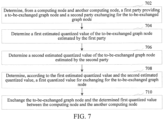
- the step of exchanging a graph node and a first quantized value with another computing node may include the following steps.
- Step 702. Determine, from a computing node and another computing node, a first party providing a to-be-exchanged graph node and a second party exchanging for the to-be-exchanged graph node.
- the computing nodes may exchange a graph node and a first quantized value with each other, to keep that the second quantized value and the third quantized value in each computing node meet the equilibrium condition. That is, a current computing node may exchange a graph node and a first quantized value with another computing node. In this way, a first party providing a to-be-exchanged graph node and a second party exchanging for the to-be-exchanged graph node need to be determined between computing nodes that are about to perform an exchange.
- Step 704. Determine a first estimated quantized value of the to-be-exchanged graph node estimated by the first party.
- the estimated quantized value is an estimated value obtained by quantizing an uncompleted unit computing task owned by a to-be-exchanged graph node.
- the first estimated quantized value is a value obtained by quantizing, by a first party providing a to-be-exchanged graph node, an uncompleted unit computing task owned by the to-be-exchanged graph node.
- the estimated quantized value and the first quantized value have the same unit.
- the computing node may determine a first estimated quantized value according to a relationship between a second quantized value corresponding to the to-be-exchanged graph node and a second quantized value corresponding to the first party and according to a relationship between a third quantized value corresponding to the to-be-exchanged graph node and a third quantized value corresponding to the first party.
- Step 706 Determine a second estimated quantized value of the to-be-exchanged graph node estimated by the second party.
- the second estimated quantized value is a value obtained by quantizing, by a second party exchanging for the to-be-exchanged graph node, an uncompleted unit computing task owned by the to-be-exchanged graph node.
- the computing node when determining a second estimated quantized value, may consider, after the to-be-exchanged graph node is exchanged, an added computation task and a reduced communication distance amount required by the computing node corresponding to the second party. Therefore, the computing node may determine the second estimated quantized value according to a third quantized value of the to-be-exchanged graph node and a communication distance between the to-be-exchanged graph node and a graph node in the second party.
- v i represents the to-be-exchanged graph node
- l represents the second party
- y 2 (v i , l) represents the second estimated quantized value of the to-be-exchanged graph node estimated by the second party
- D represents the third quantized value of the to-be-exchanged graph node
- ⁇ j ⁇ l dist(i, j) represents a sum of communication distances between a graph node j in the second party l and the to-be-exchanged graph node i.
- dist(i, j) may represent a communication distance between the graph node i and the graph node j . Because of a large calculation amount for calculating all communication distances between graph nodes in graph data, the computing node calculates a communication distance between graph nodes by using an approximation method in mathematics. For example, the communication distance between the graph nodes may be calculated by using a local approximation method.
- the graph node i when the graph node i is connected to the graph node j through the edge, it may be approximately considered that a distance between the graph node i and the graph node j is very short. After a computing node corresponding to the second party exchanges for the to-be-exchanged graph node, the communication distance may be reduced for the computing node. Therefore, the second estimated quantized value is higher.
- the communication distance is not reduced for the computing node.
- the computing node may alternatively calculate the communication distance between the graph nodes by using other approximation methods, for example, determining whether there is a common neighboring graph node between two to-be-calculated graph nodes. When there is a common neighboring graph node between the two graph nodes, it may be considered that a communication distance between the two graph nodes is short. After a computing node corresponding to the second party exchanges for the to-be-exchanged graph node, a larger amount of communication is reduced for the computing node. In another example, the computing node may generate a road between every two graph nodes according to a probabilistic road map method, and graph nodes on the same road are considered to have a short communication distance. After a computing node corresponding to the second party exchanges for the to-be-exchanged graph node, a larger amount of communication is reduced for the computing node.
- Step 708 Determine, according to the first estimated quantized value and the second estimated quantized value, a first quantized value for exchanging for the to-be-exchanged graph node.
- the computing node may determine, according to the first estimated quantized value and the second estimated quantized value, a first quantized value used for exchanging for the to-be-exchanged graph node. For example, the computing node may calculate an average value of the first estimated quantized value and the second estimated quantized value, and use the average value as a first quantized value for exchanging for the to-be-exchanged graph node. Alternatively, the computing node may perform, according to a specific weight ratio, weighted summation on the first estimated quantized value and the second estimated quantized value, then obtain an average value, and use the average value as a first quantized value for exchanging for the to-be-exchanged graph node.
- Step 710 Exchange the to-be-exchanged graph node and the determined first quantized value between the computing node and the another computing node.
- the second party may exchange the determined first quantized value for the to-be-exchanged graph node of the first party.
- the first quantized value for exchanging for the to-be-exchanged graph node is determined according to the first estimated quantized value of the to-be-exchanged graph node estimated by the first party and the second estimated quantized value of the to-be-exchanged graph node estimated by the second party. In this way, actual situations of the first party and the second party may be comprehensively considered, and the to-be-exchanged graph node and the first quantized value are exchanged fairly between the computing nodes that are about to perform an exchange.
- a graph-data-based task scheduling method includes the following steps.
- Step 802. Obtain task information corresponding to to-be-processed graph data and broadcast in a blockchain network.
- Step 804. Read, according to the task information, a task-executable file and subgraph data divided from the graph data.
- Step 806 Execute the task-executable file according to the subgraph data, the task-executable file being used for indicating a unit computing task for a graph node in the subgraph data.
- Step 808 Write global computing data corresponding to a completed unit computing task into a new block.
- Step 810 Add, after the new block is verified by a blockchain network, the new block into the blockchain network to form blockchain data, and generate a first quantized value corresponding to the unit computing task corresponding to the written global computing data.
- Step 814 Subtract the first quantized value from the history second quantized value, to obtain a second quantized value.
- Step 816 Obtain latest global computing data from the blockchain network.
- Step 818 Obtain local computing data corresponding to the completed unit computing task.
- Step 820 Determine a third quantized value according to the subgraph data, the quantity of completed unit computing tasks, the global computing data, and the local computing data.
- Step 822 Obtain a first sum of current second quantized values of subgraph data.
- Step 824 Obtain a second sum of current third quantized values of the subgraph data.
- Step 826 Determine a contrast value of the second sum relative to the first sum.
- Step 828 Determine that the second quantized value and the third quantized value fail to meet an equilibrium condition in a case that the contrast value is outside a specified range.
- Step 830 Determine, from a computing node and another computing node, a first party providing a to-be-exchanged graph node and a second party exchanging for the to-be-exchanged graph node, in a case that the second quantized value and the third quantized value fail to meet the equilibrium condition.
- Step 832 Determine a first estimated quantized value of the to-be-exchanged graph node estimated by the first party.
- Step 834 Determine a second estimated quantized value of the to-be-exchanged graph node estimated by the second party.
- Step 836 Determine, according to the first estimated quantized value and the second estimated quantized value, a first quantized value for exchanging for the to-be-exchanged graph node.
- Step 838 Exchange the to-be-exchanged graph node and the determined first quantized value between the computing node and the another computing node.
- to-be-processed graph data is divided into a plurality of pieces of subgraph data, and distributed processing is performed on the plurality of pieces of subgraph data, thereby greatly improving graph data processing efficiency.
- a first quantized value, a second quantized value, and a third quantized value are obtained separately, and when the second quantized value and the third quantized value do not meet an equilibrium condition, a graph node and the first quantized value are exchanged between a computing node and another computing node.
- the first quantized value and the second quantized value may measure a computing capacity of the computing node, and the third quantized value may measure a load status of the computing node.
- the computing capacity and the load status of the computing node may be quantitatively indicated by using quantized values corresponding to a unit computing tasks, which is accurate and intuitive.
- the graph nodes and the first quantized values are exchanged between the computing node and the another computing node, to keep that the second quantized value and the third quantized value meet the equilibrium condition.
- computing nodes instead of relying on a specific server or node for task allocation, computing nodes cooperate with each other to allocate graph nodes, and dynamically adjust the allocation, to implement self-organized load balancing and avoid problems of single point failure and network congestion of the specific server, thereby greatly improving task scheduling efficiency.
- such a self-organized dynamic task scheduling method can adapt to computing task scheduling of a larger-scale cluster, and a dynamic increase or decrease of the quantity of computing nodes does not affect existing computing tasks, so that high scalability is achieved.
- FIG. 8 is a schematic flowchart of a graph-data-based task scheduling method in an embodiment. It is to be understood that although the steps in the flowchart of FIG. 8 are sequentially displayed in accordance with indications of arrows, the steps are not necessarily performed sequentially in the order indicated by the arrows. Unless explicitly specified in this disclosure, the sequence of the steps is not strictly limited, and the steps may be performed in other sequences. Moreover, at least some of the steps in FIG. 8 may include a plurality of sub-steps or a plurality of stages. The sub-steps or stages are not necessarily performed at the same moment, but may be performed at different times. The sub-steps or stages are not necessarily executed sequentially, but may be performed with at least one part of the other steps or sub-steps of other steps or stages in turn.
- a relatively optimized solution may be efficiently obtained by using the foregoing graph-data-based task scheduling method.
- the TSP means how a salesman covers all cities (graph nodes) in the shortest distance and returns to a starting city. This is a non-deterministic polynomial (NP) complete problem, and an approximate solution of the problem is usually obtained.
- NP non-deterministic polynomial
- the TSP may be split into shortest traversing problems in subgraphs, that is, a global optimal solution is approached approximately by looking for a local optimal solution.
- the global computing data is a path in the graph data and a total length
- the local computing data includes a preferable path length in each piece of subgraph data and graph nodes entering and leaving the subgraph.
- the computing process is a process in which the path selection is continuously optimized and the computing nodes coordinate with each other to dynamically allocate graph nodes, to obtain optimal subgraph division under an optimal condition and obtain an optimal solution under the condition.
- each currency in a blockchain corresponds to a completed unit computing task
- each computing node may be driven by an algorithm to continuously generate unit computing tasks that need to be completed, that is, each computing mode is a liability producer.
- the graph nodes may be exchanged by using the currency between different computing nodes, and such a process generally includes a self-organizing policy.
- the simplest self-organizing policy is self-financing, that is, when a task volume generated by graph nodes owned by a computing node per unit time exceeds an average task volume generated by surrounding computing nodes, the computing node is in an accelerated liability state, and the graph nodes of the computing node need to be "sold" to achieve self-financing, that is, a process of balancing uncompleted unit computing tasks (liabilities) and completed unit computing tasks (assets).
- the computing node with an asset surplus may achieve maximum utilization of a computing capacity by "buying" more graph nodes. In this way, an objective of each computing node is to balance liabilities and assets.
- the graph nodes are traded according to a final trading price, that is, an average value of a selling price and a purchase price.
- a purchaser actually sends a purchase price quantity of blockchain currencies C to a seller.
- the currency C herein has the same unit as the asset and the liability of the graph node mentioned above, the currency is different from the asset and the liability.
- the currency herein is a currency that is actually registered by the blockchain and can be circulated, while the asset and the liability mentioned above are future redeemable assets in an account.
- each C i may be converted into an actual currency C through accounting.
- the process of accounting is a process in which a computing node adds a new block and records all transaction information (herein including a log, a global computing parameter, and a node status report) from a previous block to a current time into the new block, attaches the new block to the end of the blockchain, and obtains a specific amount of currency C as a reward. A value of the reward is written down from the asset of the computing node.
- transaction information herein including a log, a global computing parameter, and a node status report
- a graph-data-based task scheduling apparatus 900 including: an obtaining module 901, an execution module 902, a determining module 903, and an exchanging module 904.
- the obtaining module 901 is configured to obtain subgraph data divided from to-be-processed graph data.
- the execution module 902 is configured to perform a unit computing task for a graph node in the subgraph data obtained by the obtaining module 901.
- the obtaining module 901 is further configured to obtain a first quantized value, the first quantized value being a quantized value corresponding to a completed unit computing task in a case that data corresponding to the completed unit computing task is formed into blockchain data.
- the obtaining module 901 is further configured to obtain a second quantized value, the second quantized value being a quantized value corresponding to the completed unit computing task in a case that the data corresponding to the completed unit computing task is not formed into the blockchain data.
- the determining module 903 is configured to determine a third quantized value corresponding to an uncompleted unit computing task in the subgraph data.
- the exchanging module 904 is configured to exchange the graph node and the first quantized value with another computing node in a case that the second quantized value obtained by the obtaining module 901 and the third quantized value obtained by the determining module 903 fail to meet an equilibrium condition.
- the obtaining module 901 is further configured to obtain task information corresponding to graph data and broadcast in a blockchain network, and read, according to the task information, a task-executable file and the subgraph data divided from the graph data.
- the execution module 902 is further configured to execute the task-executable file according to the subgraph data, the task-executable file being used for indicating the unit computing task for a graph node in the subgraph data.
- the obtaining module 901 is further configured to write global computing data corresponding to the completed unit computing task into a new block, add the new block into the blockchain network after the new block is verified by the blockchain network to form blockchain data, and generate a first quantized value corresponding to the unit computing task corresponding to the written global computing data.
- the obtaining module 901 is further configured to obtain a history second quantized value that is obtained before the global computing data is written into the new block, the history second quantized value corresponding to the completed unit computing task that does not form blockchain data before the global computing data is written into the new block, and subtract the first quantized value from the history second quantized value, to obtain the second quantized value.
- the determining module 903 is further configured to obtain latest global computing data from a blockchain network, obtain local computing data corresponding to the completed unit computing task, and determine a third quantized value according to the subgraph data, the quantity of completed unit computing tasks, the global computing data, and the local computing data.
- the obtaining module 901 is further configured to obtain a first sum of current second quantized values of the subgraph data, and obtain a second sum of current third quantized values of the subgraph data.
- the determining module 903 is further configured to determine a contrast value of the second sum relative to the first sum, and determine that the second quantized value and the third quantized value fail to meet the equilibrium condition in a case that the contrast value is outside a specified range.
- a minimum value ⁇ (t) and a maximum value ⁇ (t) of the specified range are linear decreasing functions that vary with time t, and ⁇ (t) ⁇ ⁇ (t).
- the exchanging module 904 is further configured to exchange the first quantized value for a graph node of the another computing node in a case that the contrast value is less than the minimum value of the specified range, the contrast value after the exchange falling within the specified range, and exchange the graph node for a first quantized value of the another computing node in a case that the contrast value is greater than the maximum value of the specified range, the contrast value after the exchange falling within the specified range.
- the exchanging module 904 is further configured to determine, from the computing node and the another computing node, a first party providing a to-be-exchanged graph node and a second party exchanging for the to-be-exchanged graph node, determine a first estimated quantized value of the to-be-exchanged graph node estimated by the first party, determine a second estimated quantized value of the to-be-exchanged graph node estimated by the second party, determine, according to the first estimated quantized value and the second estimated quantized value, a first quantized value for exchanging for the to-be-exchanged graph node, and exchange the to-be-exchanged graph node and the determined first quantized value between the computing node and the another computing node.
- the exchanging module 904 further includes:
- to-be-processed graph data is divided into a plurality of pieces of subgraph data, and distributed processing is performed on the plurality of pieces of subgraph data, thereby greatly improving graph data processing efficiency.
- a first quantized value, a second quantized value, and a third quantized value are obtained separately, and when the second quantized value and the third quantized value do not meet an equilibrium condition, a graph node and the first quantized value are exchanged between a computing node and another computing node.
- the first quantized value and the second quantized value may measure a computing capacity of the computing node, and the third quantized value may measure a load status of the computing node.
- the computing capacity and the load status of the computing node may be quantitatively indicated by using quantized values corresponding to a unit computing tasks, which is accurate and intuitive.
- the graph nodes and the first quantized values are exchanged between the computing node and the another computing node, to keep that the second quantized value and the third quantized value meet the equilibrium condition.
- computing nodes instead of relying on a specific server or node for task allocation, computing nodes cooperate with each other to allocate graph nodes, and dynamically adjust the allocation, to implement self-organized load balancing and avoid problems of single point failure and network congestion of the specific server, thereby greatly improving task scheduling efficiency.
- such a self-organized dynamic task scheduling method can adapt to computing task scheduling of a larger-scale cluster, and a dynamic increase or decrease of the quantity of computing nodes does not affect existing computing tasks, so that high scalability is achieved.
- FIG. 11 shows a diagram of an internal structure of a computer device according to an embodiment.
- the computer device may be a computer device on which the computing node 120 in FIG. 1 is distributed.
- the computer device includes a processor, a memory, and a network interface that are connected through a system bus.
- the memory includes a non-volatile storage medium and an internal memory.
- the non-volatile storage medium of the computer device stores an operating system and may further store a computer program, the computer program, when executed by the processor, causing the processor to implement the graph-data-based task scheduling method.
- the internal memory may also store a computer program, the computer program, when executed by the processor, causing the processor to perform the graph-data-based task scheduling method.
- FIG. 11 is only a block diagram of a partial structure relevant to the solution in this application, and does not limit the computer device to which the solution of this application is applied.
- the computer device may include more components or fewer components than those shown in the figure, or some components may be combined, or a different component deployment may be used.
- the graph-data-based task scheduling apparatus may be implemented in a form of a computer program, and the computer program may be run on the computer device shown in FIG. 11 .
- the memory of the computer device may store program modules forming the graph-data-based task scheduling apparatus, for example, the obtaining module, the execution module, the determining module, and the exchanging module shown in FIG. 9 .
- a computer program formed by the program modules causes the processor to perform the steps in the graph-data-based task scheduling method in the embodiments of this application described in this specification.
- the computer device shown in FIG. 11 may perform steps 202, 206, and 208 through the obtaining module in the graph-data-based task scheduling apparatus shown in FIG. 9 .
- the computer device may perform step 204 through the execution module.
- the computer device may perform step 210 through the determining module.
- the computer device may perform step 212 through the exchanging module, and for details, reference may be made to descriptions of the foregoing steps.
- a computer device including a memory and a processor, the memory storing a computer program, the computer program, when executed by the processor, causing the processor to perform the following steps: obtaining subgraph data divided from to-be-processed graph data, performing a unit computing task for a graph node in the subgraph data, obtaining a first quantized value, the first quantized value being a quantized value corresponding to a completed unit computing task in a case that data corresponding to the completed unit computing task is formed into blockchain data, obtaining a second quantized value, the second quantized value being a quantized value corresponding to the completed unit computing task in a case that the data corresponding to the completed unit computing task is not formed into blockchain data, determining a third quantized value corresponding to an uncompleted unit computing task in the subgraph data, and exchanging the graph node and the first quantized value with another computing node in a case that the second quantized value and the third quantized value fail to meet an equilibrium condition.
- the computer program when the computer program causes the processor to perform the step of obtaining subgraph data divided from to-be-processed graph data, the following steps may be performed: obtaining task information corresponding to the graph data and broadcast in a blockchain network, and reading, according to the task information, a task-executable file and the subgraph data divided from the graph data.
- the computer program causes the processor to perform the step of performing a unit computing task for a graph node in the subgraph data
- the following step may be performed: executing the task-executable file according to the subgraph data, the task-executable file being used for indicating the unit computing task for the graph node in the subgraph data.
- the following steps may be performed: writing global computing data corresponding to the completed unit computing task into a new block, adding, after the new block is verified by a blockchain network, the new block into the blockchain network to form blockchain data, and generating a first quantized value corresponding to the unit computing task corresponding to the written global computing data.
- the following steps may be performed: obtaining a history second quantized value that is obtained before the global computing data is written into the new block, the history second quantized value corresponding to the completed unit computing task that does not form blockchain data before the global computing data is written into the new block, and subtracting the first quantized value from the history second quantized value, to obtain the second quantized value.
- the computer program when the computer program causes the processor to perform the step of determining a third quantized value corresponding to an uncompleted unit computing task in the subgraph data, the following steps may be performed: obtaining latest global computing data from a blockchain network, obtaining local computing data corresponding to the completed unit computing task, and determining the third quantized value according to the subgraph data, the quantity of completed unit computing tasks, the global computing data, and the local computing data.
- the computer program further causes the processor to perform the following steps: obtaining a first sum of current second quantized values of the subgraph data, obtaining a second sum of current third quantized values of the subgraph data, determining a contrast value of the second sum relative to the first sum, and determining that the second quantized value and the third quantized value fail to meet the equilibrium condition in a case that the contrast value is outside a specified range.
- a minimum value ⁇ (t) and a maximum value ⁇ (t) of the specified range are linear decreasing functions that vary with time t, and ⁇ (t) ⁇ ⁇ (t).
- the following steps may be performed: exchanging the first quantized value with the graph node of the another computing node in a case that the contrast value is less than the minimum value of the specified range, the contrast value after the exchange falling within the specified range, and exchanging the graph node with the first quantized value of the another computing node in a case that the contrast value is greater than the maximum value of the specified range, the contrast value after the exchange falling within the specified range.
- the following steps may be performed: determining, from the computing node and the another computing node, a first party providing a to-be-exchanged graph node and a second party exchanging for the to-be-exchanged graph node, determining a first estimated quantized value of the to-be-exchanged graph node estimated by the first party, determining a second estimated quantized value of the to-be-exchanged graph node estimated by the second party, determining, according to the first estimated quantized value and the second estimated quantized value, a first quantized value for exchanging for the to-be-exchanged graph node, and exchanging the to-be-exchanged graph node and the determined first quantized value between the computing node and the another computing node.
- v i represents the to-be-exchanged graph node
- l represents the second party
- y 2 (v i , l) represents the second estimated quantized value of the to-be-exchanged graph node estimated by the second party
- D i represents the third quantized value of the to-be-exchanged graph node
- ⁇ j ⁇ l dist(i, j) represents a sum of communication distances between a graph node j in the second party l and the to-be-exchanged graph node i.
- the computer device divides to-be-processed graph data into a plurality of pieces of subgraph data, and performs distributed processing on the plurality of pieces of subgraph data, thereby greatly improving graph data processing efficiency.
- a first quantized value, a second quantized value, and a third quantized value are obtained separately, and when the second quantized value and the third quantized value do not meet an equilibrium condition, a graph node and the first quantized value are exchanged between a computing node and another computing node.
- the first quantized value and the second quantized value may measure a computing capacity of the computing node, and the third quantized value may measure a load status of the computing node.
- the computing capacity and the load status of the computing node may be quantitatively indicated by using quantized values corresponding to a unit computing tasks, which is accurate and intuitive.
- the graph nodes and the first quantized values are exchanged between the computing node and the another computing node, to keep that the second quantized value and the third quantized value meet the equilibrium condition.
- computing nodes instead of relying on a specific server or node for task allocation, computing nodes cooperate with each other to allocate graph nodes, and dynamically adjust the allocation, to implement self-organized load balancing and avoid problems of single point failure and network congestion of the specific server, thereby greatly improving task scheduling efficiency.
- such a self-organized dynamic task scheduling method can adapt to computing task scheduling of a larger-scale cluster, and a dynamic increase or decrease of the quantity of computing nodes does not affect existing computing tasks, so that high scalability is achieved.
- a computer-readable storage medium storing a computer program, the computer program, when executed by a processor, causing the processor to implement the following steps: obtaining subgraph data divided from to-be-processed graph data, performing a unit computing task for a graph node in the subgraph data, obtaining a first quantized value, the first quantized value being a quantized value corresponding to a completed unit computing task in a case that data corresponding to the completed unit computing task is formed into blockchain data, obtaining a second quantized value, the second quantized value being a quantized value corresponding to the completed unit computing task in a case that the data corresponding to the completed unit computing task is not formed into blockchain data, determining a third quantized value corresponding to an uncompleted unit computing task in the subgraph data, and exchanging the graph node and the first quantized value with another computing node in a case that the second quantized value and the third quantized value fail to meet an equilibrium condition.
- the computer program when the computer program causes the processor to perform the step of obtaining subgraph data divided from to-be-processed graph data, the following steps may be performed: obtaining task information corresponding to the graph data and broadcast in a blockchain network, and reading, according to the task information, a task-executable file and the subgraph data divided from the graph data.
- the computer program causes the processor to perform the step of performing a unit computing task for a graph node in the subgraph data
- the following step may be performed: executing the task-executable file according to the subgraph data, the task-executable file being used for indicating the unit computing task for the graph node in the subgraph data.
- the following steps may be performed: writing global computing data corresponding to the completed unit computing task into a new block, adding, after the new block is verified by a blockchain network, the new block into the blockchain network to form blockchain data, and generating a first quantized value corresponding to the unit computing task corresponding to the written global computing data.
- the following steps may be performed: obtaining a history second quantized value that is obtained before the global computing data is written into the new block, the history second quantized value corresponding to the completed unit computing task that does not form blockchain data before the global computing data is written into the new block, and subtracting the first quantized value from the history second quantized value, to obtain the second quantized value.
- the computer program when the computer program causes the processor to perform the step of determining a third quantized value corresponding to an uncompleted unit computing task in the subgraph data, the following steps may be performed: obtaining latest global computing data from a blockchain network, obtaining local computing data corresponding to the completed unit computing task, and determining the third quantized value according to the subgraph data, the quantity of completed unit computing tasks, the global computing data, and the local computing data.
- the computer program further causes the processor to perform the following steps: obtaining a first sum of current second quantized values of the subgraph data, obtaining a second sum of current third quantized values of the subgraph data, determining a contrast value of the second sum relative to the first sum, and determining that the second quantized value and the third quantized value fail to meet the equilibrium condition in a case that the contrast value is outside a specified range.
- a minimum value ⁇ (t) and a maximum value ⁇ (t) of the specified range are linear decreasing functions that vary with time t, and ⁇ (t) ⁇ ⁇ (t).
- the following steps may be performed: exchanging the first quantized value with the corresponding graph node of the another computing node in a case that the contrast value is less than the minimum value of the specified range, the contrast value after the exchange falling within the specified range, and exchanging the graph node with the first quantized value of the another computing node in a case that the contrast value is greater than the maximum value of the specified range, the contrast value after the exchange falling within the specified range.
- the following steps may be performed: determining, from the computing node and the another computing node, a first party providing a to-be-exchanged graph node and a second party exchanging for the to-be-exchanged graph node, determining a first estimated quantized value of the to-be-exchanged graph node estimated by the first party, determining a second estimated quantized value of the to-be-exchanged graph node estimated by the second party, determining, according to the first estimated quantized value and the second estimated quantized value, a first quantized value for exchanging for the to-be-exchanged graph node, and exchanging the to-be-exchanged graph node and the determined first quantized value between the computing node and the another computing node.
- v i represents the to-be-exchanged graph node
- l represents the second party
- y 2 (v i , l) represents the second estimated quantized value of the to-be-exchanged graph node estimated by the second party
- D i represents the third quantized value of the to-be-exchanged graph node
- ⁇ j ⁇ l dist(i, j) represents a sum of communication distances between a graph node j in the second party l and the to-be-exchanged graph node i.
- to-be-processed graph data is divided into a plurality of pieces of subgraph data, and distributed processing is performed on the plurality of pieces of subgraph data, thereby greatly improving graph data processing efficiency.
- a first quantized value, a second quantized value, and a third quantized value are obtained separately, and when the second quantized value and the third quantized value do not meet an equilibrium condition, a graph node and the first quantized value are exchanged between a computing node and another computing node.
- the first quantized value and the second quantized value may measure a computing capacity of the computing node, and the third quantized value may measure a load status of the computing node.
- the computing capacity and the load status of the computing node may be quantitatively indicated by using quantized values corresponding to a unit computing tasks, which is accurate and intuitive.
- the graph nodes and the first quantized values are exchanged between the computing node and the another computing node, to keep that the second quantized value and the third quantized value meet the equilibrium condition.
- computing nodes instead of relying on a specific server or node for task allocation, computing nodes cooperate with each other to allocate graph nodes, and dynamically adjust the allocation, to implement self-organized load balancing and avoid problems of single point failure and network congestion of the specific server, thereby greatly improving task scheduling efficiency.
- such a self-organized dynamic task scheduling method can adapt to computing task scheduling of a larger-scale cluster, and a dynamic increase or decrease of the quantity of computing nodes does not affect existing computing tasks, so that high scalability is achieved.
- the program may be stored in a computer-readable storage medium.
- the storage medium may be a read-only memory (ROM), a magnetic disk or an optical disc.
Landscapes
- Engineering & Computer Science (AREA)
- Theoretical Computer Science (AREA)
- Software Systems (AREA)
- Physics & Mathematics (AREA)
- General Engineering & Computer Science (AREA)
- General Physics & Mathematics (AREA)
- Databases & Information Systems (AREA)
- Data Mining & Analysis (AREA)
- Computer Security & Cryptography (AREA)
- Computer Networks & Wireless Communication (AREA)
- Signal Processing (AREA)
- Computing Systems (AREA)
- Information Retrieval, Db Structures And Fs Structures Therefor (AREA)
- Advance Control (AREA)
- Management, Administration, Business Operations System, And Electronic Commerce (AREA)
Claims (11)
- Graphenknoten-Zuweisungsverfahren, angewandt auf einen Rechenknoten, wobei das Verfahren umfasst:Gewinnen (202) von Untergraphen-Daten, die von den zu verarbeitenden Graphen-Daten getrennt sind;Durchführen (204) einer Einheitsberechnungsaufgabe für einen Graphenknoten in den Untergraphen-Daten, wobei der Rechenknoten zufällig eine bestimmte Menge von Graphenknoten und entsprechenden Kanten aus einer Graphenstruktur, die den Graphen-Daten entspricht, gemäß seinem eigenen Laststatus erhält, um eine Untergraphenstruktur zu bilden, und die Einheitsberechnungsaufgabe eine minimale Berechnungszuweisungseinheit in einem verteilten Graphenberechnungssystem ist;Erhalten (206) eines ersten quantisierten Wertes, wobei der erste quantisierte Wert ein quantisierter Wert ist, der einer abgeschlossenen Einheitsberechnungsaufgabe in einem Fall entspricht, dass Daten, die der abgeschlossenen Einheitsberechnungsaufgabe entsprechen, in Blockchain-Daten gebildet werden und eine Berechnungskapazität des Rechenknoten messen;Erhalten (208) eines zweiten quantisierten Wertes, wobei der zweite quantisierte Wert ein quantisierter Wert ist, der der abgeschlossenen Einheitsberechnungsaufgabe in einem Fall entspricht, dass die Daten, die der abgeschlossenen Einheitsberechnungsaufgabe entsprechen, nicht in Blockchain-Daten gebildet werden und eine Berechnungskapazität des Rechenknotens messen;Bestimmen (210) eines dritten quantisierten Wertes, der einer nicht abgeschlossenen Einheitsberechnungsaufgabe in den Untergraphen-Daten entspricht, wobei der dritte quantisierte Wert einen Laststatus des Rechenknotens misst; undAustauschen (212) des Graphenknotens und des ersten quantisierten Wertes mit einem anderen Rechenknoten in einem Fall, dass der zweite quantisierte Wert und der dritte quantisierte Wert eine Gleichgewichtsbedingung nicht erfüllen, die eine Bedingung ist, die voreingestellt ist und angewendet wird, um zu messen, ob eine aktuelle Rechenkapazität und ein aktueller Lastzustand des Rechenknotens ausgeglichen sind,wobei das Erhalten eines ersten quantisierten Wertes umfasst:Schreiben von globalen Berechnungsdaten, die der abgeschlossenen Einheitsberechnungsaufgabe entsprechen, in einen neuen Block, wobei die globalen Berechnungsdaten Daten sind, die in einem Prozess des Berechnens auf den Untergraphen-Daten durch jeden Rechenknoten gemeinsam genutzt und global aktualisiert werden müssen, und ein Maßstab der globalen Berechnungsdaten begrenzt ist; undZugeben des neuen Blocks in das Blockchain-Netzwerk, nachdem der neue Block durch ein Blockchain-Netzwerk verifiziert wurde, um Blockchain-Daten zu bilden, und Erzeugen des ersten quantisierten Wertes, der der Einheitsrechenaufgabe entspricht, die den geschriebenen globalen Rechendaten entspricht,wobei das Erhalten eines zweiten quantisierten Wertes umfasst:Erhalten eines zweiten quantisierten Historienwertes, der erhalten wird, bevor die globalen Rechendaten in den neuen Block geschrieben werden, wobei der zweite quantisierte Historienwert einer abgeschlossenen Einheitsrechenaufgabe entspricht, die keine Blockchain-Daten bildet, bevor die globalen Rechendaten in den neuen Block geschrieben werden; undSubtrahieren des ersten quantisierten Wertes von dem historischen zweiten quantisierten Wert, um den zweiten quantisierten Wert zu erhalten,wobei das Verfahren ferner umfasst:Erhalten (602) einer ersten Summe von zweiten quantisierten Werten der Untergraphen-Daten;Erhalten (604) einer zweiten Summe von dritten quantisierten Werten der Untergraphen-Daten;Bestimmen (606) eines Kontrastwertes der zweiten Summe relativ zur ersten Summe; undBestimmen (608), dass der zweite quantisierte Wert und der dritte quantisierte Wert die Gleichgewichtsbedingung nicht erfüllen, wenn der Kontrastwert außerhalb eines bestimmten Bereichs liegt, undwobei das Austauschen des Graphenknotens und des ersten quantisierten Wertes mit einem anderen Rechenknoten umfasst:Austauschen des ersten quantisierten Wertes für einen Graphenknoten des anderen Rechenknotens in einem Fall, dass der Kontrastwert kleiner als ein Minimalwert des spezifizierten Bereichs ist, wobei der Kontrastwert nach dem Austauschen in den spezifizierten Bereich fällt; undAustauschen des Graphenknotens gegen einen ersten quantisierten Wert des anderen Rechenknotens für den Fall, dass der Kontrastwert größer als ein Maximalwert des spezifizierten Bereichs ist, wobei der Kontrastwert nach dem Austauschen innerhalb des spezifizierten Bereichs liegt.
- Verfahren gemäß Anspruch 1, wobei das Erhalten von Untergraphen-Daten, die von zu verarbeitenden Graphen-Daten getrennt sind, umfasst:Erhalten von Aufgabeninformation, die den Graphendaten entspricht und in einem Blockchain-Netzwerk ausgestrahlt wird; undLesen, entsprechend der Aufgabeninformation, einer aufgabenausführbaren Datei und der von den Graphendaten getrennten Untergraphen-Daten; unddas Durchführen einer Einheitsberechnungsaufgabe für einen Graphenknoten in den Untergraphen-Daten umfasst:
Ausführen der aufgabenausführbaren Datei gemäß den Untergraphen-Daten, wobei die aufgabenausführbare Datei zur Angabe der Einheitsberechnungsaufgabe für den Graphenknoten in den Untergraphen-Daten angewendet wird. - Verfahren gemäß Anspruch 1, wobei das Bestimmung eines dritten quantisierten Wertes, der einer nicht abgeschlossenen Einheitsberechnungsaufgabe in den Untergraphen-Daten entspricht, umfasst:Erhalten aktueller globaler Rechendaten aus einem Blockchain-Netzwerk;Erhalten lokaler Rechendaten, die der abgeschlossenen Rechenaufgabe der Einheit entsprechen; undBestimmen des dritten quantisierten Wertes in Abhängigkeit von den Untergraphen-Daten, der Menge der abgeschlossenen Einheitsrechenaufgaben, den globalen Rechendaten und den lokalen Rechendaten.
- Verfahren gemäß Anspruch 1, wobei das Bestimmen eines Kontrastwertes der zweiten Summe relativ zur ersten Summe umfasst:Berechnen des Kontrastwertes nach der folgenden Formel:
 a und m sind beide Konstanten; a > 0, und a ≠ 1; m ≥ 1;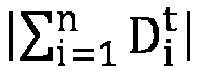

- Verfahren nach Anspruch 4, wobei ein Mindestwert µ(t) und ein Maximalwert λ(t) des spezifizierten Bereichs beide linear abnehmende Funktionen sind, die mit der Zeit t variieren, und µ(t) < λ(t).
- Verfahren gemäß einem der Ansprüche 1 bis 4, wobei das Austauschen des Graphenknotens und des ersten quantisierten Wertes mit einem anderen Rechenknoten umfasst:Bestimmen einer ersten Partei, die einen auszutauschenden Graphenknoten bereitstellt, und einer zweiten Partei, die gegen den auszutauschenden Graphenknoten tauscht, von dem Rechenknoten und dem anderen Rechenknoten;Bestimmen eines ersten geschätzten quantisierten Wertes des auszutauschenden Graphenknotens, der von der ersten Partei geschätzt wurde;Bestimmung eines zweiten geschätzten quantisierten Wertes des auszutauschenden Graphenknotens, der von der zweiten Partei geschätzt wurde;Bestimmen, entsprechend dem ersten geschätzten quantisierten Wert und dem zweiten geschätzten quantisierten Wert, des ersten quantisierten Wertes zum Austauschen für den auszutauschenden Graphenknoten; undAustauschen des auszutauschenden Graphenknotens und des ermittelten ersten quantisierten Wertes zwischen dem Rechenknoten und dem anderen Rechenknoten.
- Verfahren nach Anspruch 6, wobei das Bestimmen eines ersten geschätzten quantisierten Wertes des auszutauschenden Graphenknotens, der von der ersten Partei geschätzt wird, umfasst:Berechnen des ersten geschätzten quantisierten Wertes nach der folgenden Formel:
 vi repräsentiert den auszutauschenden Graphenknoten, wobei k die erste Partei repräsentiert, y1(vi, k) stellt den ersten geschätzten quantisierten Wert des auszutauschenden Graphknotens dar, der von der ersten Partei geschätzt wurde, Di stellt einen dritten quantisierten Wert des auszutauschenden Graphknotens dar, Ci stellt einen zweiten quantisierten Wertes des auszutauschenden Graphenknotens dar,
Dk stellt einen durchschnittlichen dritten quantisierten Wert von Graphenknoten in der ersten Partei k dar,Ck stellt einen durchschnittlichen zweiten quantisierten Wert der Graphenknoten in der ersten Partei k dar, α und β sind Systemparameter, und e ist die Naturkonstante. - Verfahren nach Anspruch 6, wobei das Bestimmen eines zweiten geschätzten quantisierten Wertes des auszutauschenden Graphenknotens, der von der zweiten Partei geschätzt wird, umfasst:Berechnen des zweiten geschätzten quantisierten Wertes nach der folgenden Formel:
 vi stellt den auszutauschenden Graphenknoten dar, wobei I die zweite Partei darstellt, y2(vi, l) stellt den zweiten geschätzten quantisierten Wert des auszutauschenden Graphknotens dar, der von der zweiten Partei geschätzt wurde, Di stellt einen dritten quantisierten Wert des auszutauschenden Graphknotens dar, und ∑j∈l dist(i, j) stellt eine Summe einer Kommunikationsdistanz zwischen einem Graphknoten j in der zweiten Partei l und dem auszutauschenden Graphenknoten i dar.
 - Verfahren nach Anspruch 8, wobei die Kommunikationsentfernung nach der folgenden Formel berechnet wird:

- Computervorrichtung, die einen Speicher und einen Prozessor umfasst, wobei der Speicher ein Computerprogramm speichert, wobei das Computerprogramm, wenn es von dem Prozessor ausgeführt wird, den Prozessor veranlasst, das Graphenknoten-Zuweisungsverfahren gemäß einem der Ansprüche 1 bis 9 durchzuführen.
- Computerlesbares Speichermedium, wobei das Speichermedium mindestens einen Befehl, mindestens ein Programm, einen Codesatz oder einen Befehlssatz speichert, wobei der mindestens eine Befehl, das mindestens eine Programm, der Codesatz oder der Befehlssatz von einem Prozessor geladen und ausgeführt wird, um das Graphenknoten-Zuweisungsverfahren gemäß einem der Ansprüche 1 bis 9 zu implementieren.
Applications Claiming Priority (2)
| Application Number | Priority Date | Filing Date | Title |
|---|---|---|---|
| CN201810466739.XA CN108681482B (zh) | 2018-05-16 | 2018-05-16 | 基于图数据的任务调度方法和装置 |
| PCT/CN2019/080122 WO2019218778A1 (zh) | 2018-05-16 | 2019-03-28 | 基于图数据的任务调度方法、装置、存储介质和设备 |
Publications (3)
| Publication Number | Publication Date |
|---|---|
| EP3796166A1 EP3796166A1 (de) | 2021-03-24 |
| EP3796166A4 EP3796166A4 (de) | 2021-06-16 |
| EP3796166B1 true EP3796166B1 (de) | 2024-03-06 |
Family
ID=63806564
Family Applications (1)
| Application Number | Title | Priority Date | Filing Date |
|---|---|---|---|
| EP19803567.7A Active EP3796166B1 (de) | 2018-05-16 | 2019-03-28 | Diagrammdatenbasiertes aufgabenplanungsverfahren, vorrichtung, speichermedium und einrichtung |
Country Status (7)
| Country | Link |
|---|---|
| US (1) | US11734060B2 (de) |
| EP (1) | EP3796166B1 (de) |
| JP (1) | JP7061693B2 (de) |
| KR (1) | KR102499076B1 (de) |
| CN (1) | CN108681482B (de) |
| SG (1) | SG11202010908TA (de) |
| WO (1) | WO2019218778A1 (de) |
Families Citing this family (14)
| Publication number | Priority date | Publication date | Assignee | Title |
|---|---|---|---|---|
| CN108681482B (zh) * | 2018-05-16 | 2020-12-01 | 腾讯科技(深圳)有限公司 | 基于图数据的任务调度方法和装置 |
| CN109542602B (zh) * | 2018-11-20 | 2021-05-11 | 苏州朗润创新知识产权运营有限公司 | 一种基于区块链的分布式任务处理方法、装置及系统 |
| CN111400521B (zh) * | 2020-02-28 | 2022-06-07 | 苏州浪潮智能科技有限公司 | 一种图数据处理方法、装置、设备、介质 |
| CN111400555B (zh) * | 2020-03-05 | 2023-09-26 | 湖南大学 | 图数据查询任务处理方法、装置、计算机设备和存储介质 |
| US11875357B2 (en) * | 2020-07-09 | 2024-01-16 | Mastercard International Incorporated | Method and system of using miner commitment to reward proofs |
| WO2022146031A1 (en) * | 2020-12-29 | 2022-07-07 | Samsung Electronics Co., Ltd. | Method and device of computing layout selection for efficient dnn inference |
| CN112990332B (zh) * | 2021-03-26 | 2023-06-02 | 杭州海康威视数字技术股份有限公司 | 一种子图规模预测和分布式训练方法、装置及电子设备 |
| CN113114790B (zh) * | 2021-06-10 | 2021-09-14 | 武汉研众科技有限公司 | 一种基于区块链与边缘计算的负载均衡方法与系统 |
| CN113360269A (zh) * | 2021-06-29 | 2021-09-07 | 平安普惠企业管理有限公司 | 一种任务分配方法、装置、服务器及存储介质 |
| CN113434273B (zh) * | 2021-06-29 | 2022-12-23 | 平安科技(深圳)有限公司 | 数据处理方法、装置、系统及存储介质 |
| US12293221B2 (en) * | 2021-12-21 | 2025-05-06 | Sap Se | Cross-process dispatch service in hybrid cloud scenarios |
| CN116541407B (zh) * | 2023-07-07 | 2023-10-10 | 之江实验室 | 一种数据处理的方法、装置、存储介质及电子设备 |
| CN117291273B (zh) * | 2023-11-24 | 2024-02-13 | 合肥微观纪元数字科技有限公司 | 量子计算区块链系统 |
| CN118590548B (zh) * | 2024-08-01 | 2024-10-22 | 苏州爱雄斯通信技术有限公司 | 光通信装置中多任务调度优化方法及系统 |
Family Cites Families (13)
| Publication number | Priority date | Publication date | Assignee | Title |
|---|---|---|---|---|
| US8510538B1 (en) * | 2009-04-13 | 2013-08-13 | Google Inc. | System and method for limiting the impact of stragglers in large-scale parallel data processing |
| US8972378B2 (en) * | 2012-10-22 | 2015-03-03 | Microsoft Corporation | Formulating global statistics for distributed databases |
| WO2014102996A1 (ja) | 2012-12-28 | 2014-07-03 | 株式会社日立製作所 | 情報処理システム |
| CN103631657B (zh) * | 2013-11-19 | 2017-08-25 | 浪潮电子信息产业股份有限公司 | 一种基于MapReduce的任务调度方法 |
| US20150227586A1 (en) * | 2014-02-07 | 2015-08-13 | Futurewei Technologies, Inc. | Methods and Systems for Dynamically Allocating Resources and Tasks Among Database Work Agents in an SMP Environment |
| CN105446979B (zh) * | 2014-06-27 | 2019-02-01 | 华为技术有限公司 | 数据挖掘方法和节点 |
| US10121019B2 (en) * | 2015-06-02 | 2018-11-06 | ALTR Solutions, Inc. | Storing differentials of files in a distributed blockchain |
| US10366204B2 (en) | 2015-08-03 | 2019-07-30 | Change Healthcare Holdings, Llc | System and method for decentralized autonomous healthcare economy platform |
| CN105590321B (zh) * | 2015-12-24 | 2018-12-28 | 华中科技大学 | 一种基于块的子图构建及分布式图处理方法 |
| CN106033476B (zh) * | 2016-05-19 | 2019-07-23 | 西安交通大学 | 一种云计算环境中分布式计算模式下的增量式图计算方法 |
| CN106777351B (zh) * | 2017-01-17 | 2019-08-09 | 中国人民解放军国防科学技术大学 | 基于art树分布式系统图存储计算系统及其方法 |
| CN108681482B (zh) * | 2018-05-16 | 2020-12-01 | 腾讯科技(深圳)有限公司 | 基于图数据的任务调度方法和装置 |
| CN111030802B (zh) * | 2018-05-16 | 2020-12-29 | 腾讯科技(深圳)有限公司 | 图数据的计算任务发布方法、装置、设备和存储介质 |
-
2018
- 2018-05-16 CN CN201810466739.XA patent/CN108681482B/zh active Active
-
2019
- 2019-03-28 EP EP19803567.7A patent/EP3796166B1/de active Active
- 2019-03-28 KR KR1020207032964A patent/KR102499076B1/ko active Active
- 2019-03-28 JP JP2020564236A patent/JP7061693B2/ja active Active
- 2019-03-28 WO PCT/CN2019/080122 patent/WO2019218778A1/zh not_active Ceased
- 2019-03-28 SG SG11202010908TA patent/SG11202010908TA/en unknown
-
2020
- 2020-09-01 US US17/009,342 patent/US11734060B2/en active Active
Also Published As
| Publication number | Publication date |
|---|---|
| KR102499076B1 (ko) | 2023-02-14 |
| US11734060B2 (en) | 2023-08-22 |
| JP7061693B2 (ja) | 2022-04-28 |
| SG11202010908TA (en) | 2020-12-30 |
| EP3796166A4 (de) | 2021-06-16 |
| WO2019218778A1 (zh) | 2019-11-21 |
| CN108681482A (zh) | 2018-10-19 |
| CN108681482B (zh) | 2020-12-01 |
| KR20200142070A (ko) | 2020-12-21 |
| EP3796166A1 (de) | 2021-03-24 |
| JP2021524100A (ja) | 2021-09-09 |
| US20200401445A1 (en) | 2020-12-24 |
Similar Documents
| Publication | Publication Date | Title |
|---|---|---|
| EP3796166B1 (de) | Diagrammdatenbasiertes aufgabenplanungsverfahren, vorrichtung, speichermedium und einrichtung | |
| US11847488B2 (en) | Graph data processing method, method and device for publishing graph data computational tasks, storage medium, and computer apparatus | |
| US11403131B2 (en) | Data analysis for predictive scaling of container(s) based on prior user transaction(s) | |
| US20200050951A1 (en) | Collaborative distributed machine learning | |
| JP7614703B2 (ja) | コンピューティング・システムのパフォーマンス調整 | |
| US12118406B2 (en) | Interactive augmented reality based optimization of machine learning model execution on hybrid cloud | |
| US11449772B2 (en) | Predicting operational status of system | |
| US20170147955A1 (en) | Enterprise resource management tools | |
| US11038755B1 (en) | Computing and implementing a remaining available budget in a cloud bursting environment | |
| CN112446581A (zh) | 在区块链中为风险评估的智能合约发行方和执行提供者实现市场 | |
| Khan et al. | Cloud storage tier optimization through storage object classification | |
| US11539786B2 (en) | Method and system for heterogeneous blockchain service management | |
| CN114581223B (zh) | 分配任务处理方法、设备、分布式计算系统及存储介质 | |
| US20230208725A1 (en) | Allocation of processing resources to processing nodes | |
| US20220188148A1 (en) | Optimization for scheduling of batch jobs | |
| US20230252536A1 (en) | Probability distribution based prediction | |
| US20240095832A1 (en) | System and method for incorporating a mortality risk in a financial instrument | |
| US20230274165A1 (en) | Inference model on restrained gpu memory | |
| US11663506B2 (en) | Estimation of power consumption of proof of work consensus based distributed systems | |
| US10713055B2 (en) | Parallelization of numeric optimizers | |
| HK40022100B (en) | Method and apparatus for issuing graph data calculation task, device and storage medium |
Legal Events
| Date | Code | Title | Description |
|---|---|---|---|
| STAA | Information on the status of an ep patent application or granted ep patent |
Free format text: STATUS: THE INTERNATIONAL PUBLICATION HAS BEEN MADE |
|
| PUAI | Public reference made under article 153(3) epc to a published international application that has entered the european phase |
Free format text: ORIGINAL CODE: 0009012 |
|
| STAA | Information on the status of an ep patent application or granted ep patent |
Free format text: STATUS: REQUEST FOR EXAMINATION WAS MADE |
|
| 17P | Request for examination filed |
Effective date: 20201103 |
|
| AK | Designated contracting states |
Kind code of ref document: A1 Designated state(s): AL AT BE BG CH CY CZ DE DK EE ES FI FR GB GR HR HU IE IS IT LI LT LU LV MC MK MT NL NO PL PT RO RS SE SI SK SM TR |
|
| AX | Request for extension of the european patent |
Extension state: BA ME |
|
| A4 | Supplementary search report drawn up and despatched |
Effective date: 20210519 |
|
| RIC1 | Information provided on ipc code assigned before grant |
Ipc: G06F 9/50 20060101AFI20210512BHEP Ipc: G06F 16/27 20190101ALI20210512BHEP Ipc: G06F 16/901 20190101ALI20210512BHEP Ipc: H04L 9/32 20060101ALI20210512BHEP |
|
| DAV | Request for validation of the european patent (deleted) | ||
| DAX | Request for extension of the european patent (deleted) | ||
| RAP3 | Party data changed (applicant data changed or rights of an application transferred) |
Owner name: TENCENT TECHNOLOGY (SHENZHEN) COMPANY LIMITED |
|
| GRAP | Despatch of communication of intention to grant a patent |
Free format text: ORIGINAL CODE: EPIDOSNIGR1 |
|
| STAA | Information on the status of an ep patent application or granted ep patent |
Free format text: STATUS: GRANT OF PATENT IS INTENDED |
|
| INTG | Intention to grant announced |
Effective date: 20231201 |
|
| RIN1 | Information on inventor provided before grant (corrected) |
Inventor name: ZHENG, BO |
|
| GRAS | Grant fee paid |
Free format text: ORIGINAL CODE: EPIDOSNIGR3 |
|
| GRAA | (expected) grant |
Free format text: ORIGINAL CODE: 0009210 |
|
| STAA | Information on the status of an ep patent application or granted ep patent |
Free format text: STATUS: THE PATENT HAS BEEN GRANTED |
|
| AK | Designated contracting states |
Kind code of ref document: B1 Designated state(s): AL AT BE BG CH CY CZ DE DK EE ES FI FR GB GR HR HU IE IS IT LI LT LU LV MC MK MT NL NO PL PT RO RS SE SI SK SM TR |
|
| REG | Reference to a national code |
Ref country code: CH Ref legal event code: EP |
|
| REG | Reference to a national code |
Ref country code: DE Ref legal event code: R096 Ref document number: 602019047901 Country of ref document: DE |
|
| REG | Reference to a national code |
Ref country code: IE Ref legal event code: FG4D |
|
| REG | Reference to a national code |
Ref country code: LT Ref legal event code: MG9D |
|
| PG25 | Lapsed in a contracting state [announced via postgrant information from national office to epo] |
Ref country code: LT Free format text: LAPSE BECAUSE OF FAILURE TO SUBMIT A TRANSLATION OF THE DESCRIPTION OR TO PAY THE FEE WITHIN THE PRESCRIBED TIME-LIMIT Effective date: 20240306 |
|
| REG | Reference to a national code |
Ref country code: NL Ref legal event code: MP Effective date: 20240306 |
|
| PG25 | Lapsed in a contracting state [announced via postgrant information from national office to epo] |
Ref country code: GR Free format text: LAPSE BECAUSE OF FAILURE TO SUBMIT A TRANSLATION OF THE DESCRIPTION OR TO PAY THE FEE WITHIN THE PRESCRIBED TIME-LIMIT Effective date: 20240607 |
|
| PG25 | Lapsed in a contracting state [announced via postgrant information from national office to epo] |
Ref country code: RS Free format text: LAPSE BECAUSE OF FAILURE TO SUBMIT A TRANSLATION OF THE DESCRIPTION OR TO PAY THE FEE WITHIN THE PRESCRIBED TIME-LIMIT Effective date: 20240606 Ref country code: HR Free format text: LAPSE BECAUSE OF FAILURE TO SUBMIT A TRANSLATION OF THE DESCRIPTION OR TO PAY THE FEE WITHIN THE PRESCRIBED TIME-LIMIT Effective date: 20240306 |
|
| PG25 | Lapsed in a contracting state [announced via postgrant information from national office to epo] |
Ref country code: ES Free format text: LAPSE BECAUSE OF FAILURE TO SUBMIT A TRANSLATION OF THE DESCRIPTION OR TO PAY THE FEE WITHIN THE PRESCRIBED TIME-LIMIT Effective date: 20240306 |
|
| PG25 | Lapsed in a contracting state [announced via postgrant information from national office to epo] |
Ref country code: RS Free format text: LAPSE BECAUSE OF FAILURE TO SUBMIT A TRANSLATION OF THE DESCRIPTION OR TO PAY THE FEE WITHIN THE PRESCRIBED TIME-LIMIT Effective date: 20240606 Ref country code: NO Free format text: LAPSE BECAUSE OF FAILURE TO SUBMIT A TRANSLATION OF THE DESCRIPTION OR TO PAY THE FEE WITHIN THE PRESCRIBED TIME-LIMIT Effective date: 20240606 Ref country code: LT Free format text: LAPSE BECAUSE OF FAILURE TO SUBMIT A TRANSLATION OF THE DESCRIPTION OR TO PAY THE FEE WITHIN THE PRESCRIBED TIME-LIMIT Effective date: 20240306 Ref country code: HR Free format text: LAPSE BECAUSE OF FAILURE TO SUBMIT A TRANSLATION OF THE DESCRIPTION OR TO PAY THE FEE WITHIN THE PRESCRIBED TIME-LIMIT Effective date: 20240306 Ref country code: GR Free format text: LAPSE BECAUSE OF FAILURE TO SUBMIT A TRANSLATION OF THE DESCRIPTION OR TO PAY THE FEE WITHIN THE PRESCRIBED TIME-LIMIT Effective date: 20240607 Ref country code: FI Free format text: LAPSE BECAUSE OF FAILURE TO SUBMIT A TRANSLATION OF THE DESCRIPTION OR TO PAY THE FEE WITHIN THE PRESCRIBED TIME-LIMIT Effective date: 20240306 Ref country code: ES Free format text: LAPSE BECAUSE OF FAILURE TO SUBMIT A TRANSLATION OF THE DESCRIPTION OR TO PAY THE FEE WITHIN THE PRESCRIBED TIME-LIMIT Effective date: 20240306 Ref country code: BG Free format text: LAPSE BECAUSE OF FAILURE TO SUBMIT A TRANSLATION OF THE DESCRIPTION OR TO PAY THE FEE WITHIN THE PRESCRIBED TIME-LIMIT Effective date: 20240306 |
|
| REG | Reference to a national code |
Ref country code: AT Ref legal event code: MK05 Ref document number: 1664229 Country of ref document: AT Kind code of ref document: T Effective date: 20240306 |
|
| PG25 | Lapsed in a contracting state [announced via postgrant information from national office to epo] |
Ref country code: SE Free format text: LAPSE BECAUSE OF FAILURE TO SUBMIT A TRANSLATION OF THE DESCRIPTION OR TO PAY THE FEE WITHIN THE PRESCRIBED TIME-LIMIT Effective date: 20240306 Ref country code: LV Free format text: LAPSE BECAUSE OF FAILURE TO SUBMIT A TRANSLATION OF THE DESCRIPTION OR TO PAY THE FEE WITHIN THE PRESCRIBED TIME-LIMIT Effective date: 20240306 |
|
| PG25 | Lapsed in a contracting state [announced via postgrant information from national office to epo] |
Ref country code: NL Free format text: LAPSE BECAUSE OF FAILURE TO SUBMIT A TRANSLATION OF THE DESCRIPTION OR TO PAY THE FEE WITHIN THE PRESCRIBED TIME-LIMIT Effective date: 20240306 |
|
| PG25 | Lapsed in a contracting state [announced via postgrant information from national office to epo] |
Ref country code: NL Free format text: LAPSE BECAUSE OF FAILURE TO SUBMIT A TRANSLATION OF THE DESCRIPTION OR TO PAY THE FEE WITHIN THE PRESCRIBED TIME-LIMIT Effective date: 20240306 |
|
| PG25 | Lapsed in a contracting state [announced via postgrant information from national office to epo] |
Ref country code: IS Free format text: LAPSE BECAUSE OF FAILURE TO SUBMIT A TRANSLATION OF THE DESCRIPTION OR TO PAY THE FEE WITHIN THE PRESCRIBED TIME-LIMIT Effective date: 20240706 |
|
| PG25 | Lapsed in a contracting state [announced via postgrant information from national office to epo] |
Ref country code: PT Free format text: LAPSE BECAUSE OF FAILURE TO SUBMIT A TRANSLATION OF THE DESCRIPTION OR TO PAY THE FEE WITHIN THE PRESCRIBED TIME-LIMIT Effective date: 20240708 Ref country code: SM Free format text: LAPSE BECAUSE OF FAILURE TO SUBMIT A TRANSLATION OF THE DESCRIPTION OR TO PAY THE FEE WITHIN THE PRESCRIBED TIME-LIMIT Effective date: 20240306 |
|
| PG25 | Lapsed in a contracting state [announced via postgrant information from national office to epo] |
Ref country code: CZ Free format text: LAPSE BECAUSE OF FAILURE TO SUBMIT A TRANSLATION OF THE DESCRIPTION OR TO PAY THE FEE WITHIN THE PRESCRIBED TIME-LIMIT Effective date: 20240306 Ref country code: EE Free format text: LAPSE BECAUSE OF FAILURE TO SUBMIT A TRANSLATION OF THE DESCRIPTION OR TO PAY THE FEE WITHIN THE PRESCRIBED TIME-LIMIT Effective date: 20240306 |
|
| PG25 | Lapsed in a contracting state [announced via postgrant information from national office to epo] |
Ref country code: AT Free format text: LAPSE BECAUSE OF FAILURE TO SUBMIT A TRANSLATION OF THE DESCRIPTION OR TO PAY THE FEE WITHIN THE PRESCRIBED TIME-LIMIT Effective date: 20240306 |
|
| PG25 | Lapsed in a contracting state [announced via postgrant information from national office to epo] |
Ref country code: PL Free format text: LAPSE BECAUSE OF FAILURE TO SUBMIT A TRANSLATION OF THE DESCRIPTION OR TO PAY THE FEE WITHIN THE PRESCRIBED TIME-LIMIT Effective date: 20240306 |
|
| PG25 | Lapsed in a contracting state [announced via postgrant information from national office to epo] |
Ref country code: SK Free format text: LAPSE BECAUSE OF FAILURE TO SUBMIT A TRANSLATION OF THE DESCRIPTION OR TO PAY THE FEE WITHIN THE PRESCRIBED TIME-LIMIT Effective date: 20240306 |
|
| PG25 | Lapsed in a contracting state [announced via postgrant information from national office to epo] |
Ref country code: SM Free format text: LAPSE BECAUSE OF FAILURE TO SUBMIT A TRANSLATION OF THE DESCRIPTION OR TO PAY THE FEE WITHIN THE PRESCRIBED TIME-LIMIT Effective date: 20240306 Ref country code: SK Free format text: LAPSE BECAUSE OF FAILURE TO SUBMIT A TRANSLATION OF THE DESCRIPTION OR TO PAY THE FEE WITHIN THE PRESCRIBED TIME-LIMIT Effective date: 20240306 Ref country code: RO Free format text: LAPSE BECAUSE OF FAILURE TO SUBMIT A TRANSLATION OF THE DESCRIPTION OR TO PAY THE FEE WITHIN THE PRESCRIBED TIME-LIMIT Effective date: 20240306 Ref country code: PT Free format text: LAPSE BECAUSE OF FAILURE TO SUBMIT A TRANSLATION OF THE DESCRIPTION OR TO PAY THE FEE WITHIN THE PRESCRIBED TIME-LIMIT Effective date: 20240708 Ref country code: PL Free format text: LAPSE BECAUSE OF FAILURE TO SUBMIT A TRANSLATION OF THE DESCRIPTION OR TO PAY THE FEE WITHIN THE PRESCRIBED TIME-LIMIT Effective date: 20240306 Ref country code: IS Free format text: LAPSE BECAUSE OF FAILURE TO SUBMIT A TRANSLATION OF THE DESCRIPTION OR TO PAY THE FEE WITHIN THE PRESCRIBED TIME-LIMIT Effective date: 20240706 Ref country code: EE Free format text: LAPSE BECAUSE OF FAILURE TO SUBMIT A TRANSLATION OF THE DESCRIPTION OR TO PAY THE FEE WITHIN THE PRESCRIBED TIME-LIMIT Effective date: 20240306 Ref country code: CZ Free format text: LAPSE BECAUSE OF FAILURE TO SUBMIT A TRANSLATION OF THE DESCRIPTION OR TO PAY THE FEE WITHIN THE PRESCRIBED TIME-LIMIT Effective date: 20240306 Ref country code: AT Free format text: LAPSE BECAUSE OF FAILURE TO SUBMIT A TRANSLATION OF THE DESCRIPTION OR TO PAY THE FEE WITHIN THE PRESCRIBED TIME-LIMIT Effective date: 20240306 |
|
| REG | Reference to a national code |
Ref country code: CH Ref legal event code: PL |
|
| PG25 | Lapsed in a contracting state [announced via postgrant information from national office to epo] |
Ref country code: LU Free format text: LAPSE BECAUSE OF NON-PAYMENT OF DUE FEES Effective date: 20240328 |
|
| PG25 | Lapsed in a contracting state [announced via postgrant information from national office to epo] |
Ref country code: LU Free format text: LAPSE BECAUSE OF NON-PAYMENT OF DUE FEES Effective date: 20240328 |
|
| PG25 | Lapsed in a contracting state [announced via postgrant information from national office to epo] |
Ref country code: IT Free format text: LAPSE BECAUSE OF FAILURE TO SUBMIT A TRANSLATION OF THE DESCRIPTION OR TO PAY THE FEE WITHIN THE PRESCRIBED TIME-LIMIT Effective date: 20240306 |
|
| REG | Reference to a national code |
Ref country code: DE Ref legal event code: R097 Ref document number: 602019047901 Country of ref document: DE |
|
| REG | Reference to a national code |
Ref country code: BE Ref legal event code: MM Effective date: 20240331 |
|
| PG25 | Lapsed in a contracting state [announced via postgrant information from national office to epo] |
Ref country code: IT Free format text: LAPSE BECAUSE OF FAILURE TO SUBMIT A TRANSLATION OF THE DESCRIPTION OR TO PAY THE FEE WITHIN THE PRESCRIBED TIME-LIMIT Effective date: 20240306 |
|
| PG25 | Lapsed in a contracting state [announced via postgrant information from national office to epo] |
Ref country code: MC Free format text: LAPSE BECAUSE OF FAILURE TO SUBMIT A TRANSLATION OF THE DESCRIPTION OR TO PAY THE FEE WITHIN THE PRESCRIBED TIME-LIMIT Effective date: 20240306 |
|
| PLBE | No opposition filed within time limit |
Free format text: ORIGINAL CODE: 0009261 |
|
| STAA | Information on the status of an ep patent application or granted ep patent |
Free format text: STATUS: NO OPPOSITION FILED WITHIN TIME LIMIT |
|
| PG25 | Lapsed in a contracting state [announced via postgrant information from national office to epo] |
Ref country code: DK Free format text: LAPSE BECAUSE OF FAILURE TO SUBMIT A TRANSLATION OF THE DESCRIPTION OR TO PAY THE FEE WITHIN THE PRESCRIBED TIME-LIMIT Effective date: 20240306 |
|
| PG25 | Lapsed in a contracting state [announced via postgrant information from national office to epo] |
Ref country code: BE Free format text: LAPSE BECAUSE OF NON-PAYMENT OF DUE FEES Effective date: 20240331 |
|
| PG25 | Lapsed in a contracting state [announced via postgrant information from national office to epo] |
Ref country code: IE Free format text: LAPSE BECAUSE OF NON-PAYMENT OF DUE FEES Effective date: 20240328 |
|
| PG25 | Lapsed in a contracting state [announced via postgrant information from national office to epo] |
Ref country code: MC Free format text: LAPSE BECAUSE OF FAILURE TO SUBMIT A TRANSLATION OF THE DESCRIPTION OR TO PAY THE FEE WITHIN THE PRESCRIBED TIME-LIMIT Effective date: 20240306 Ref country code: IE Free format text: LAPSE BECAUSE OF NON-PAYMENT OF DUE FEES Effective date: 20240328 Ref country code: DK Free format text: LAPSE BECAUSE OF FAILURE TO SUBMIT A TRANSLATION OF THE DESCRIPTION OR TO PAY THE FEE WITHIN THE PRESCRIBED TIME-LIMIT Effective date: 20240306 Ref country code: BE Free format text: LAPSE BECAUSE OF NON-PAYMENT OF DUE FEES Effective date: 20240331 Ref country code: CH Free format text: LAPSE BECAUSE OF NON-PAYMENT OF DUE FEES Effective date: 20240331 |
|
| 26N | No opposition filed |
Effective date: 20241209 |
|
| PGFP | Annual fee paid to national office [announced via postgrant information from national office to epo] |
Ref country code: DE Payment date: 20250319 Year of fee payment: 7 |
|
| PG25 | Lapsed in a contracting state [announced via postgrant information from national office to epo] |
Ref country code: SI Free format text: LAPSE BECAUSE OF FAILURE TO SUBMIT A TRANSLATION OF THE DESCRIPTION OR TO PAY THE FEE WITHIN THE PRESCRIBED TIME-LIMIT Effective date: 20240306 |
|
| PGFP | Annual fee paid to national office [announced via postgrant information from national office to epo] |
Ref country code: FR Payment date: 20250324 Year of fee payment: 7 |
|
| PGFP | Annual fee paid to national office [announced via postgrant information from national office to epo] |
Ref country code: GB Payment date: 20250324 Year of fee payment: 7 |
|
| PG25 | Lapsed in a contracting state [announced via postgrant information from national office to epo] |
Ref country code: CY Free format text: LAPSE BECAUSE OF FAILURE TO SUBMIT A TRANSLATION OF THE DESCRIPTION OR TO PAY THE FEE WITHIN THE PRESCRIBED TIME-LIMIT; INVALID AB INITIO Effective date: 20190328 |
|
| PG25 | Lapsed in a contracting state [announced via postgrant information from national office to epo] |
Ref country code: HU Free format text: LAPSE BECAUSE OF FAILURE TO SUBMIT A TRANSLATION OF THE DESCRIPTION OR TO PAY THE FEE WITHIN THE PRESCRIBED TIME-LIMIT; INVALID AB INITIO Effective date: 20190328 |