EP3795425B1 - A camera arrangement for mounting in a vehicle - Google Patents
A camera arrangement for mounting in a vehicle Download PDFInfo
- Publication number
- EP3795425B1 EP3795425B1 EP19198047.3A EP19198047A EP3795425B1 EP 3795425 B1 EP3795425 B1 EP 3795425B1 EP 19198047 A EP19198047 A EP 19198047A EP 3795425 B1 EP3795425 B1 EP 3795425B1
- Authority
- EP
- European Patent Office
- Prior art keywords
- fan
- unit
- camera
- camera arrangement
- arrangement
- Prior art date
- Legal status (The legal status is an assumption and is not a legal conclusion. Google has not performed a legal analysis and makes no representation as to the accuracy of the status listed.)
- Active
Links
Images




Classifications
-
- B—PERFORMING OPERATIONS; TRANSPORTING
- B60—VEHICLES IN GENERAL
- B60R—VEHICLES, VEHICLE FITTINGS, OR VEHICLE PARTS, NOT OTHERWISE PROVIDED FOR
- B60R11/00—Arrangements for holding or mounting articles, not otherwise provided for
- B60R11/04—Mounting of cameras operative during drive; Arrangement of controls thereof relative to the vehicle
-
- G—PHYSICS
- G03—PHOTOGRAPHY; CINEMATOGRAPHY; ANALOGOUS TECHNIQUES USING WAVES OTHER THAN OPTICAL WAVES; ELECTROGRAPHY; HOLOGRAPHY
- G03B—APPARATUS OR ARRANGEMENTS FOR TAKING PHOTOGRAPHS OR FOR PROJECTING OR VIEWING THEM; APPARATUS OR ARRANGEMENTS EMPLOYING ANALOGOUS TECHNIQUES USING WAVES OTHER THAN OPTICAL WAVES; ACCESSORIES THEREFOR
- G03B17/00—Details of cameras or camera bodies; Accessories therefor
- G03B17/55—Details of cameras or camera bodies; Accessories therefor with provision for heating or cooling, e.g. in aircraft
-
- G—PHYSICS
- G03—PHOTOGRAPHY; CINEMATOGRAPHY; ANALOGOUS TECHNIQUES USING WAVES OTHER THAN OPTICAL WAVES; ELECTROGRAPHY; HOLOGRAPHY
- G03B—APPARATUS OR ARRANGEMENTS FOR TAKING PHOTOGRAPHS OR FOR PROJECTING OR VIEWING THEM; APPARATUS OR ARRANGEMENTS EMPLOYING ANALOGOUS TECHNIQUES USING WAVES OTHER THAN OPTICAL WAVES; ACCESSORIES THEREFOR
- G03B17/00—Details of cameras or camera bodies; Accessories therefor
- G03B17/56—Accessories
- G03B17/561—Support related camera accessories
-
- H—ELECTRICITY
- H04—ELECTRIC COMMUNICATION TECHNIQUE
- H04N—PICTORIAL COMMUNICATION, e.g. TELEVISION
- H04N23/00—Cameras or camera modules comprising electronic image sensors; Control thereof
- H04N23/50—Constructional details
- H04N23/52—Elements optimising image sensor operation, e.g. for electromagnetic interference [EMI] protection or temperature control by heat transfer or cooling elements
-
- H—ELECTRICITY
- H04—ELECTRIC COMMUNICATION TECHNIQUE
- H04N—PICTORIAL COMMUNICATION, e.g. TELEVISION
- H04N23/00—Cameras or camera modules comprising electronic image sensors; Control thereof
- H04N23/57—Mechanical or electrical details of cameras or camera modules specially adapted for being embedded in other devices
-
- B—PERFORMING OPERATIONS; TRANSPORTING
- B60—VEHICLES IN GENERAL
- B60R—VEHICLES, VEHICLE FITTINGS, OR VEHICLE PARTS, NOT OTHERWISE PROVIDED FOR
- B60R11/00—Arrangements for holding or mounting articles, not otherwise provided for
- B60R2011/0001—Arrangements for holding or mounting articles, not otherwise provided for characterised by position
- B60R2011/0003—Arrangements for holding or mounting articles, not otherwise provided for characterised by position inside the vehicle
- B60R2011/0026—Windows, e.g. windscreen
Definitions
- the present disclosure relates to a camera arrangement for mounting in a vehicle and comprising a carrier arrangement configured so as to be attached to said vehicle in order to support a camera housing which carries a camera unit.
- the camera arrangement comprises a fan unit with a fan wheel which is configured for forcing air heated by said camera arrangement into the interior of said vehicle, and a fan motor for operating said fan wheel.
- detection and sensor systems for road vehicles, by means of which various objects in the surroundings of the vehicles can be detected and analyzed.
- detection and sensor systems may comprise camera units for providing images and video sequences.
- detection systems may comprise equipment such as radar systems, navigation systems, Lidar systems and other sensors and detectors.
- detection and sensor systems can be used in connection with, for example, automated vehicle systems for speed control and collision prevention, and also in the field of autonomously driving vehicles.
- a carrier arrangement can be configured for supporting a camera unit or similar type of equipment.
- a carrier arrangement can be positioned on the inside of a windshield of a vehicle. This means that the camera unit can be positioned in a suitable position in the vehicle, while being supported by the carrier arrangement and configured with a given detection area ahead of the vehicle or around the vehicle.
- the carrier arrangement may comprise a frame or plate which is arranged so as to be attached to a vehicle windshield and which is also connected to a support device which is attached to the frame.
- the support device comprises suitable attachment means which are configured for supporting the camera unit.
- the carrier arrangement is suitably attached to the windscreen by means of a suitable adhesive.
- a previously known camera arrangement of the above-mentioned type is known from the patent document US 2017/184945 .
- This known arrangement is based on a camera arrangement which comprises a mounting device for a camera unit and which is configured to be attached to a windshield of a vehicle.
- the arrangement also comprises a heat transfer device, a fan and a motor for operating said fan.
- the arrangement comprises a fan which is arranged for transporting air through a housing of a camera unit.
- said object is achieved by means of a camera arrangement for mounting in a vehicle and comprising a carrier arrangement with the technical features of claim 1.
- the camera arrangement according to the present disclosure will provide improved cooling of hot air from the electronics and camera unit, and also efficient transport of air away from the windshield, while still achieving a space-saving and efficient camera arrangement.
- the carrier arrangement according to the disclosure is suitably used with a road vehicle such as a car, truck or other road vehicle, but can also in principle be used with any other vehicle having a windshield adapted for mounting the above-mentioned carrier arrangement on an interior side of the windshield.
- a road vehicle such as a car, truck or other road vehicle
- any other vehicle having a windshield adapted for mounting the above-mentioned carrier arrangement on an interior side of the windshield.
- the fan motor axle is arranged with an angle with reference to a vertical axis which is less than 25°.
- the fan motor axle is arranged with an angle with reference to a vertical axis which is less than 5° .
- the camera arrangement also comprises a fan housing which supports said fan unit.
- the fan housing comprises an arrangement of heatsink fins for cooling air which is forced into the interior of the vehicle.
- the fan housing comprises a cover unit which at least partly surrounds the fan wheel and comprises a wall structure for the fan unit.
- the fan housing is shaped with a single outlet, forcing air in one direction, or a double outlet, forcing air in two separate directions.
- the fan housing is configured to be mounted on the underside of the camera housing when said camera arrangement is mounted in the vehicle.
- the camera arrangement comprises an electronics unit, being configured for controlling the operation of the camera unit, which is arranged between the camera housing and the fan housing.
- the fan motor axle is rotatably arranged in the fan motor by means of fluid bearings.
- the carrier arrangement comprises a base plate which is configured to be attached to the inside of a windshield of said vehicle.
- the fan is configured for forcing air in a direction which is substantially parallel to a windshield of said vehicle.
- the fan unit is arranged in an enclosure which defines a space for guiding air past said fan wheel.
- FIG. 1 schematically shows a perspective view of a vehicle 1, which according to an embodiment is a regular car, having a windshield 2.
- the vehicle 1 is equipped with a camera arrangement 3 which is mounted on the inside of the windshield 2, i.e. the side of the windshield 2 facing the interior of the vehicle 1.
- the camera arrangement 3 comprises a carrier arrangement 4 for a camera unit, which will be described in greater detail below.
- the camera arrangement 3 is particularly intended to be used on road vehicles, primarily in the form of cars, trucks and buses and similar vehicles, but can alternatively be used in other vehicles.
- the carrier arrangement 4 comprises a base plate 5 which is formed as a generally U-shaped frame element.
- the upper side of the base plate 5 is suitably provided with an adhesive for gluing it to the inside of the windshield 2.
- the carrier arrangement 4 comprises a support device which is configured as a camera housing 6 with a holder 7 for supporting a camera unit 8 or a similar device.
- the camera unit 8 is suitably of the type which is configured for supplying images or a video stream of a road ahead of the vehicle 1.
- the camera unit 8 comprises an image sensor device, a lens and a control unit.
- Such components are well known in the field of camera technology, and for this reason they are not described in detail here.
- the camera unit 8 can, for example, be used in a vehicle system for detection of road conditions, for speed control, for navigation, or in connection with systems for autonomous driving or similar fields of use. These fields of technology are mentioned here purely as examples.
- the camera unit 8 is shown in Figure 2 separately and in a schematic manner since the camera unit 8 is normally marketed and sold as a piece of equipment which is separate from the carrier arrangement 4.
- the camera housing 6 can be configured for supporting other units than a camera unit 8, for example a radar device or other types of sensors which can be suitable for detection systems in road vehicles.
- the carrier arrangement 4 is suitably configured with a fastening arrangement for attaching the camera housing 6 to the base plate 5.
- a fastening arrangement is not shown in detail in this disclosure.
- the fastening arrangement may be constituted by a plurality of locking elements which are arranged on the camera housing 6 and which are configured for cooperating with corresponding elements arranged on the base plate 5.
- the camera housing 6 is provided with a cooling arrangement in the form of a number of cooling fins 9 for absorbing heat which can be expected to be generated by the camera unit 8 and other related components during operation.
- the camera housing 6 is configured for supporting the camera unit 8 and is also fastened to the base plate 5.
- the base plate 5 is fastened on the inside of the windshield (not shown in Figure 3 ).
- an electronics unit 10 is mounted on the underside of the camera housing 6, which for this reason is formed so as to accommodate the electronics unit 10.
- the electronics unit 10 comprises components for controlling the operation of the camera unit 8.
- the camera housing 6 is provided with a light trap 6a, which can optionally be mounted on the camera housing 6 and which is adapted for reducing disturbing light towards the camera unit 8.
- a cover unit 11 is arranged on the underside of the electronics unit 10. This means that the electronics unit 10 is generally enclosed by the camera housing 6 and the cover unit 11. Also, on the underside of the cover unit 11, a fan unit 12 is mounted. This means that a fan housing is defined on the underside of the cover unit 11, through the fact that the cover unit 11 is arranged so as to accommodate the fan unit 12. This will be described in further detail below with reference to Figures 5 and 6 (see in particular reference numeral 13).
- Figure 4 is a perspective view showing how the electronics unit 10 is mounted in the camera housing 6. It should be noted that, for reasons of clarity, the components shown in Figure 4 are turned upside down as compared with Figure 3 .
- Figure 5 is a perspective view showing how the fan housing 13 - being formed by the cover 11 and including the fan unit 12 - is mounted on the camera housing 6. It should be noted that the components of Figure 5 are also turned upside down as compared with Figure 3 . As indicated in Figure 5 , the electronics unit 10 is mounted in a cavity formed by the camera housing 6, and the cover unit 11 which is formed also as the fan housing 13 is mounted so as to cover the electronics unit 10. The reverse side of the fan housing 13 (i.e. the upper side shown in Figure 5 ) is formed so as to accommodate the fan unit 12. Referring back to Figure 3 , it is clear that the fan unit 12 is mounted on the lowermost end of the camera arrangement 3 when the camera arrangement 3 is mounted in the vehicle 1 during normal operation of the camera arrangement 3.
- Figure 5 also shows the general design of the fan unit 12, i.e. comprising a fan wheel 12a and a fan motor 12b with a fan motor axle 12c for operating the fan wheel 12a.
- the fan wheel 12a is configured for forcing air heated by the camera arrangement 3 into the interior of the vehicle 1.
- the fan motor 12b comprises the fan motor axle 12c which is connected to the fan wheel 12a.
- the fan motor axle 12c is configured with a generally vertical orientation, i.e. extending along a generally vertical axis, when the camera arrangement 3 is mounted in the vehicle 1 in its normal operating condition.
- the fan housing 13 suitably comprises a cover plate 17 which covers and encloses the fan wheel 12a, fan motor 12b and fan motor axle 12c.
- the fan unit 12 is mounted underneath the cover plate 17.
- the fan housing 13 comprises an arrangement of heatsink fins 14 for cooling the air which is forced into the interior of the vehicle 1, i.e. for cooling air which is heated by the components forming part of the camera arrangement 3. More precisely, the heatsink fins 14 are formed as a number of guiding fins 14 which extend from the fan housing 13 and which together are formed as an air duct for guiding air from the fan 12a and towards the interior of the vehicle while cooling the air.
- the fan housing 13 comprises a wall structure 15 which is formed so as to surround the fan wheel 12a and which is at least partly shaped as a wall for the fan unit 12.
- the wall structure 15 is generally circular in order to accommodate the fan wheel 12a.
- the wall structure 15 is also formed so as to connect with the air duct being defined by the heatsink fins 14.
- the fan housing 13 is formed with a wall structure 15 which forms a part of an enclosing structure for the fan unit 12. This means that the fan unit 12 itself does not have to be formed with any wall or side structure to accommodate the fan wheel 12a.
- the fan motor axle 12c is configured with a generally vertical orientation, i.e. along an imaginary axis 12d. According to an embodiment, the fan motor axle 12c defines an angle ⁇ with reference to a vertical axis 16 which is less than 25°. According to a further embodiment, the fan motor axle 12c defines an angle ⁇ with reference to a vertical axis 16 which is less than 5°. This vertical orientation of the fan motor axle 12c allows a compact camera arrangement 3 which can be mounted inside a windshield in a space-saving manner while allowing hot air to be guided away from the camera arrangement 3.
- the fan housing 13 is shaped with an air duct defined along the heatsink fins 14, which consequently defines a single outlet from the fan unit 12 to the interior of the vehicle.
- the fan wheel 12a is configured for forcing air in a direction which is substantially parallel to the windshield 2.
- the fan housing 13 can be designed with several sets of heatsink fans which consequently define two or more outlets for air, in two or more directions along the windscreen.
- FIG. 7 there is shown a simplified side view of an embodiment comprising a fan unit 12 with a fan wheel 12a and a fan motor 12b.
- the fan motor 12b is mounted on a bottom surface of the fan housing 13 so that the fan motor axle 12c extends upwards and generally in a vertical manner, as described above. Furthermore, there is a space, in the vertical direction, between the upper end of the fan motor axle 12c and the underside of the cover plate 17.
- a enclosure 18 is formed for the fan unit 12 in a manner so that the enclosure 18 defines an available space in its upper part between the upper end of the fan motor axle 12c and the cover plate 17 which is used for guiding away air above the fan unit 12, i.e. by passing the fan wheel 12a, and for cooling.
- the embodiment shown in Figure 7 is arranged so that the fan motor 12b is arranged in a recessed section 19 in the bottom surface of the enclosure 18.
- the fan motor 12b is not provided with any specific housing. Instead, the wall structure 15 shown in Figure 6 is used for enclosing the fan motor 12b.
- a fan housing may accommodate more than one fan unit, with corresponding air outlets corresponding to the embodiment mentioned above.
- the fan motor axle 12c is rotatably arranged in the fan motor 12b by means of fluid bearings, which allows efficient operation of the fan unit 12.
- the present disclosure is not limited to the examples above, but may vary freely within the scope of the appended claims.
- the disclosure may relate to different types of vehicles and also different types of a camera units.
Landscapes
- Engineering & Computer Science (AREA)
- Physics & Mathematics (AREA)
- Multimedia (AREA)
- Signal Processing (AREA)
- General Physics & Mathematics (AREA)
- Mechanical Engineering (AREA)
- Aviation & Aerospace Engineering (AREA)
- Electromagnetism (AREA)
- Fittings On The Vehicle Exterior For Carrying Loads, And Devices For Holding Or Mounting Articles (AREA)
- Studio Devices (AREA)
- Cameras Adapted For Combination With Other Photographic Or Optical Apparatuses (AREA)
- Accessories Of Cameras (AREA)
- Camera Bodies And Camera Details Or Accessories (AREA)
Description
- The present disclosure relates to a camera arrangement for mounting in a vehicle and comprising a carrier arrangement configured so as to be attached to said vehicle in order to support a camera housing which carries a camera unit. The camera arrangement comprises a fan unit with a fan wheel which is configured for forcing air heated by said camera arrangement into the interior of said vehicle, and a fan motor for operating said fan wheel.
- Today, there exist different types of detection and sensor systems for road vehicles, by means of which various objects in the surroundings of the vehicles can be detected and analyzed. For this reason, such detection and sensor systems may comprise camera units for providing images and video sequences. Alternatively, such systems may comprise equipment such as radar systems, navigation systems, Lidar systems and other sensors and detectors.
- Furthermore, such detection and sensor systems can be used in connection with, for example, automated vehicle systems for speed control and collision prevention, and also in the field of autonomously driving vehicles.
- According to prior technology, a carrier arrangement can be configured for supporting a camera unit or similar type of equipment. Such a carrier arrangement can be positioned on the inside of a windshield of a vehicle. This means that the camera unit can be positioned in a suitable position in the vehicle, while being supported by the carrier arrangement and configured with a given detection area ahead of the vehicle or around the vehicle.
- It is previously known that the carrier arrangement may comprise a frame or plate which is arranged so as to be attached to a vehicle windshield and which is also connected to a support device which is attached to the frame. Also, the support device comprises suitable attachment means which are configured for supporting the camera unit. Furthermore, the carrier arrangement is suitably attached to the windscreen by means of a suitable adhesive.
- It is a general problem in this field of technology to provide systems which are configured for forcing away and cooling heated air from the camera unit and other relevant components which are heated during operation of the camera unit. In particular, such systems must be compact, silent and also must not obstruct the view of a driver of the vehicle in question. The systems must also be able to adapt to different windshields having different shapes and angles of inclination.
- A previously known camera arrangement of the above-mentioned type is known from the patent document
US 2017/184945 . This known arrangement is based on a camera arrangement which comprises a mounting device for a camera unit and which is configured to be attached to a windshield of a vehicle. The arrangement also comprises a heat transfer device, a fan and a motor for operating said fan. In particular, the arrangement comprises a fan which is arranged for transporting air through a housing of a camera unit. - Even though the arrangement according to
US 2017/184945 is configured in a manner so as to be mounted to a windshield and to transport heated air, there is a need for further improvements within this field of technology. In particular, there is a demand for improved cooling of hot air which has been heated by the electronics and camera unit, while still obtaining an efficient camera arrangement. - Both documents
US 2017/064175 A1 andWO 2020/159914 A1 disclose a carrier arrangement for a camera arrangement according to the preamble ofclaim 1. - For the above-mentioned reasons, it is an object of the present disclosure to provide a carrier arrangement for a camera arrangement by means of which the above-mentioned drawbacks and challenges related to the prior art can be solved.
- In accordance with the disclosure, said object is achieved by means of a camera arrangement for mounting in a vehicle and comprising a carrier arrangement with the technical features of
claim 1. - A number of advantages are obtained by means of the camera arrangement according to the present disclosure. Mainly, the camera arrangement according to the disclosure will provide improved cooling of hot air from the electronics and camera unit, and also efficient transport of air away from the windshield, while still achieving a space-saving and efficient camera arrangement.
- The carrier arrangement according to the disclosure is suitably used with a road vehicle such as a car, truck or other road vehicle, but can also in principle be used with any other vehicle having a windshield adapted for mounting the above-mentioned carrier arrangement on an interior side of the windshield. Other aspects of the present disclosure are disclosed in the dependent claims.
- According to some aspects, the fan motor axle is arranged with an angle with reference to a vertical axis which is less than 25°.
- According to some aspects, the fan motor axle is arranged with an angle with reference to a vertical axis which is less than 5° .
- According to the invention, the camera arrangement also comprises a fan housing which supports said fan unit.
- According to the invention, the fan housing comprises an arrangement of heatsink fins for cooling air which is forced into the interior of the vehicle.
- According to the invention, the fan housing comprises a cover unit which at least partly surrounds the fan wheel and comprises a wall structure for the fan unit.
- According to some aspects, the fan housing is shaped with a single outlet, forcing air in one direction, or a double outlet, forcing air in two separate directions.
- According to the invention, the fan housing is configured to be mounted on the underside of the camera housing when said camera arrangement is mounted in the vehicle.
- According to some aspects, the camera arrangement comprises an electronics unit, being configured for controlling the operation of the camera unit, which is arranged between the camera housing and the fan housing.
- According to some aspects, the fan motor axle is rotatably arranged in the fan motor by means of fluid bearings.
- According to some aspects, the carrier arrangement comprises a base plate which is configured to be attached to the inside of a windshield of said vehicle.
- According to some aspects, the fan is configured for forcing air in a direction which is substantially parallel to a windshield of said vehicle.
- According to some aspects, the fan unit is arranged in an enclosure which defines a space for guiding air past said fan wheel.
- The present disclosure will now be described more in detail with reference to the appended drawings, where:
- Figure 1
- shows a perspective view of a front part of a vehicle;
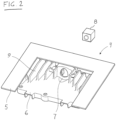
- Figure 2
- shows a perspective view of a carrier arrangement and a camera unit according to the present disclosure;
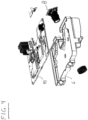
- Figure 3
- shows a perspective view of a camera arrangement according to the disclosure;
- Figure 4
- shows a perspective view of an electronics unit and a camera housing, shown turned upside down as compared with
Figure 3 ; - Figure 5
- shows a perspective view of a fan housing as mounted to the camera housing, also turned upside down as compared with
Figure 3 ; - Figure 6
- shows a perspective view of the fan housing as mounted in a cover unit; and
- Figure 7
- shows a side view of a fan unit according to an embodiment.
-
Figure 1 schematically shows a perspective view of avehicle 1, which according to an embodiment is a regular car, having awindshield 2. According to an embodiment, thevehicle 1 is equipped with acamera arrangement 3 which is mounted on the inside of thewindshield 2, i.e. the side of thewindshield 2 facing the interior of thevehicle 1. Thecamera arrangement 3 comprises acarrier arrangement 4 for a camera unit, which will be described in greater detail below. - The
camera arrangement 3 is particularly intended to be used on road vehicles, primarily in the form of cars, trucks and buses and similar vehicles, but can alternatively be used in other vehicles. - As shown in
Figures 1 and2 , thecarrier arrangement 4 comprises abase plate 5 which is formed as a generally U-shaped frame element. The upper side of thebase plate 5 is suitably provided with an adhesive for gluing it to the inside of thewindshield 2. - Furthermore, the
carrier arrangement 4 comprises a support device which is configured as acamera housing 6 with aholder 7 for supporting acamera unit 8 or a similar device. Thecamera unit 8 is suitably of the type which is configured for supplying images or a video stream of a road ahead of thevehicle 1. For this reason, thecamera unit 8 comprises an image sensor device, a lens and a control unit. Such components are well known in the field of camera technology, and for this reason they are not described in detail here. In this manner, thecamera unit 8 can, for example, be used in a vehicle system for detection of road conditions, for speed control, for navigation, or in connection with systems for autonomous driving or similar fields of use. These fields of technology are mentioned here purely as examples. - Furthermore, it should be noted that the
camera unit 8 is shown inFigure 2 separately and in a schematic manner since thecamera unit 8 is normally marketed and sold as a piece of equipment which is separate from thecarrier arrangement 4. - According to different embodiments, the
camera housing 6 can be configured for supporting other units than acamera unit 8, for example a radar device or other types of sensors which can be suitable for detection systems in road vehicles. - The
carrier arrangement 4 is suitably configured with a fastening arrangement for attaching thecamera housing 6 to thebase plate 5. Such a fastening arrangement is not shown in detail in this disclosure. According to known technology, the fastening arrangement may be constituted by a plurality of locking elements which are arranged on thecamera housing 6 and which are configured for cooperating with corresponding elements arranged on thebase plate 5. - Furthermore, as shown in
Figure 2 , thecamera housing 6 is provided with a cooling arrangement in the form of a number ofcooling fins 9 for absorbing heat which can be expected to be generated by thecamera unit 8 and other related components during operation. - With reference to
Figure 3 , there is shown a perspective view of thecamera arrangement 3 according to the disclosure and in an exploded view. As mentioned above, thecamera housing 6 is configured for supporting thecamera unit 8 and is also fastened to thebase plate 5. Thebase plate 5 is fastened on the inside of the windshield (not shown inFigure 3 ). Furthermore, anelectronics unit 10 is mounted on the underside of thecamera housing 6, which for this reason is formed so as to accommodate theelectronics unit 10. Theelectronics unit 10 comprises components for controlling the operation of thecamera unit 8. - According to the shown embodiment, the
camera housing 6 is provided with a light trap 6a, which can optionally be mounted on thecamera housing 6 and which is adapted for reducing disturbing light towards thecamera unit 8. - Furthermore, a
cover unit 11 is arranged on the underside of theelectronics unit 10. This means that theelectronics unit 10 is generally enclosed by thecamera housing 6 and thecover unit 11. Also, on the underside of thecover unit 11, afan unit 12 is mounted. This means that a fan housing is defined on the underside of thecover unit 11, through the fact that thecover unit 11 is arranged so as to accommodate thefan unit 12. This will be described in further detail below with reference toFigures 5 and6 (see in particular reference numeral 13). -
Figure 4 is a perspective view showing how theelectronics unit 10 is mounted in thecamera housing 6. It should be noted that, for reasons of clarity, the components shown inFigure 4 are turned upside down as compared withFigure 3 . - Furthermore,
Figure 5 is a perspective view showing how the fan housing 13 - being formed by thecover 11 and including the fan unit 12 - is mounted on thecamera housing 6. It should be noted that the components ofFigure 5 are also turned upside down as compared withFigure 3 . As indicated inFigure 5 , theelectronics unit 10 is mounted in a cavity formed by thecamera housing 6, and thecover unit 11 which is formed also as thefan housing 13 is mounted so as to cover theelectronics unit 10. The reverse side of the fan housing 13 (i.e. the upper side shown inFigure 5 ) is formed so as to accommodate thefan unit 12. Referring back toFigure 3 , it is clear that thefan unit 12 is mounted on the lowermost end of thecamera arrangement 3 when thecamera arrangement 3 is mounted in thevehicle 1 during normal operation of thecamera arrangement 3. -
Figure 5 also shows the general design of thefan unit 12, i.e. comprising afan wheel 12a and afan motor 12b with afan motor axle 12c for operating thefan wheel 12a. - The
fan wheel 12a is configured for forcing air heated by thecamera arrangement 3 into the interior of thevehicle 1. Also, thefan motor 12b comprises thefan motor axle 12c which is connected to thefan wheel 12a. Furthermore, thefan motor axle 12c is configured with a generally vertical orientation, i.e. extending along a generally vertical axis, when thecamera arrangement 3 is mounted in thevehicle 1 in its normal operating condition. - Furthermore, the
fan housing 13 suitably comprises acover plate 17 which covers and encloses thefan wheel 12a,fan motor 12b andfan motor axle 12c. In other words, thefan unit 12 is mounted underneath thecover plate 17. - Referring now to
Figure 6 , there is shown how thefan unit 12 is mounted so that it is supported by thefan housing 13.Figure 6 also shows that thefan housing 13 comprises an arrangement ofheatsink fins 14 for cooling the air which is forced into the interior of thevehicle 1, i.e. for cooling air which is heated by the components forming part of thecamera arrangement 3. More precisely, theheatsink fins 14 are formed as a number of guidingfins 14 which extend from thefan housing 13 and which together are formed as an air duct for guiding air from thefan 12a and towards the interior of the vehicle while cooling the air. - Furthermore, the
fan housing 13 comprises awall structure 15 which is formed so as to surround thefan wheel 12a and which is at least partly shaped as a wall for thefan unit 12. Suitably, thewall structure 15 is generally circular in order to accommodate thefan wheel 12a. As shown inFigure 6 , thewall structure 15 is also formed so as to connect with the air duct being defined by theheatsink fins 14. - Consequently, the
fan housing 13 is formed with awall structure 15 which forms a part of an enclosing structure for thefan unit 12. This means that thefan unit 12 itself does not have to be formed with any wall or side structure to accommodate thefan wheel 12a. - As mentioned above, the
fan motor axle 12c is configured with a generally vertical orientation, i.e. along animaginary axis 12d. According to an embodiment, thefan motor axle 12c defines an angle α with reference to avertical axis 16 which is less than 25°. According to a further embodiment, thefan motor axle 12c defines an angle α with reference to avertical axis 16 which is less than 5°. This vertical orientation of thefan motor axle 12c allows acompact camera arrangement 3 which can be mounted inside a windshield in a space-saving manner while allowing hot air to be guided away from thecamera arrangement 3. - According to the embodiment shown in
Figures 5 and6 , thefan housing 13 is shaped with an air duct defined along theheatsink fins 14, which consequently defines a single outlet from thefan unit 12 to the interior of the vehicle. It should be noted that suitably, thefan wheel 12a is configured for forcing air in a direction which is substantially parallel to thewindshield 2. - According to a further embodiment, the
fan housing 13 can be designed with several sets of heatsink fans which consequently define two or more outlets for air, in two or more directions along the windscreen. - With reference to
Figure 7 , there is shown a simplified side view of an embodiment comprising afan unit 12 with afan wheel 12a and afan motor 12b. According to this embodiment, thefan motor 12b is mounted on a bottom surface of thefan housing 13 so that thefan motor axle 12c extends upwards and generally in a vertical manner, as described above. Furthermore, there is a space, in the vertical direction, between the upper end of thefan motor axle 12c and the underside of thecover plate 17. In this manner, a enclosure 18 is formed for thefan unit 12 in a manner so that the enclosure 18 defines an available space in its upper part between the upper end of thefan motor axle 12c and thecover plate 17 which is used for guiding away air above thefan unit 12, i.e. by passing thefan wheel 12a, and for cooling. Furthermore, the embodiment shown inFigure 7 is arranged so that thefan motor 12b is arranged in a recessed section 19 in the bottom surface of the enclosure 18. - Also, it should be noted that the
fan motor 12b is not provided with any specific housing. Instead, thewall structure 15 shown inFigure 6 is used for enclosing thefan motor 12b. - Also, according to a further embodiment, a fan housing may accommodate more than one fan unit, with corresponding air outlets corresponding to the embodiment mentioned above.
- Furthermore, according to an embodiment, the
fan motor axle 12c is rotatably arranged in thefan motor 12b by means of fluid bearings, which allows efficient operation of thefan unit 12. The present disclosure is not limited to the examples above, but may vary freely within the scope of the appended claims. For example, the disclosure may relate to different types of vehicles and also different types of a camera units.
Claims (15)
- A camera arrangement (3) for mounting in a vehicle (1) and comprising a carrier arrangement (4) configured so as to be attached to said vehicle (1) in order to support a camera housing (6) which carries a camera unit (8), said camera arrangement (3) further comprising an electronics unit (10) and a fan unit (12) with a fan wheel (12a) which is configured for forcing air heated by said camera arrangement (3) into the interior of said vehicle (1), and a fan motor (12b) for operating said fan wheel (12a), characterized in that a cover unit (11) is arranged on the underside of the electronics unit (10) such that the electronics unit (10) is enclosed by said camera housing (6) and said cover unit (11), said fan unit (12) being mounted on the underside of the cover unit (11) such that the cover unit (11) defines a fan housing (13) for said fan unit (12) on the underside of the cover unit (11), wherein said fan motor (12b) comprises a fan motor axle (12c) which is connected to the fan wheel (12a) and which is configured with a generally vertical orientation when the camera arrangement (3) is mounted in the vehicle (1), and wherein said fan housing (13) is formed with a wall structure (15) which is formed so as to surround the fan wheel (12a), and which is at least partly shaped as a wall for the fan unit (12), said wall structure (15) having an opening to an air duct being defined by heatsink fins (14) for guiding air from the fan (12a).
- A camera arrangement (3) according to claim 1, characterized in that the fan motor axle (12c) is arranged with an angle (α) with reference to a vertical axis (16) which is less than 25°.
- A camera arrangement (3) according to claim 2, characterized in that the fan motor axle (12c) is arranged with an angle (α) with reference to a vertical axis (16) which is less than 5°.
- A camera arrangement (3) according to any one of claim 1-3, characterized in that the fan housing (13) supports said fan unit (12).
- A camera arrangement (3) according to claim 4, characterized in that the fan housing (13) comprises an arrangement of heatsink fins (14) for cooling air which is forced into the interior of the vehicle (1).
- A camera arrangement (3) according to claim 4 or 5, characterized in that the cover unit (11) at least partly surrounds the fan wheel (12a) and comprises a wall structure (15) for the fan unit (12).
- A camera arrangement (3) according to any one of claims 4-6, characterized in that the fan housing (13) is shaped with a single outlet, forcing air in one direction, or a double outlet, forcing air in two separate directions.
- A camera arrangement (3) according to any one of claims 4-7, characterized in that the fan housing (13) is configured to be mounted on the underside of the camera housing (6) when said camera arrangement (3) is mounted in the vehicle (1).
- A camera arrangement (3) according to any one of claims 4-8, characterized in that the electronics unit (10) is configured for controlling the operation of the camera unit (8) and is arranged between the camera housing (6) and the fan housing (13).
- A camera arrangement (3) according to any one of the preceding claims, characterized in that the fan motor axle (12c) is rotatably arranged in the fan motor (12b) by means of fluid bearings.
- A camera arrangement (3) according to any one of the preceding claims, characterized in that the carrier arrangement (4) comprises a base plate (5) which is configured to be attached to the inside of a windshield (2) of said vehicle (1).
- A camera arrangement (3) according to any one of the preceding claims, characterized in that the fan wheel (12a) is configured for forcing air in a direction which is substantially parallel to a windshield (2) of said vehicle (1).
- A camera arrangement (3) according to any one of the preceding claims, characterized in that the fan unit (12) is arranged in an enclosure (18) which defines a space for guiding air past said fan wheel (12a).
- A camera arrangement (3) according to any one of the preceding claims, characterized in that the fan motor (12b) is arranged in a recessed section in the bottom surface of the enclosure (18) for the fan unit (12).
- A camera arrangement (3) according to any one of the preceding claims, characterized in that the arrangement (3) is configured so that the air flow direction for air passing the fan unit (12) is substantially orthogonal to said fan motor axle (12c) .
Priority Applications (7)
| Application Number | Priority Date | Filing Date | Title |
|---|---|---|---|
| EP19198047.3A EP3795425B1 (en) | 2019-09-18 | 2019-09-18 | A camera arrangement for mounting in a vehicle |
| JP2022515139A JP2022546749A (en) | 2019-09-18 | 2020-09-15 | Camera device for mounting inside a vehicle |
| US17/761,341 US12179674B2 (en) | 2019-09-18 | 2020-09-15 | Camera arrangement for mounting in a vehicle |
| KR1020227008304A KR102696361B1 (en) | 2019-09-18 | 2020-09-15 | Camera array for vehicle mounting |
| PCT/EP2020/075777 WO2021052967A1 (en) | 2019-09-18 | 2020-09-15 | A camera arrangement for mounting in a vehicle |
| CN202080064886.XA CN114402581B (en) | 2019-09-18 | 2020-09-15 | Camera device for installation in a vehicle |
| JP2023201974A JP7792943B2 (en) | 2019-09-18 | 2023-11-29 | Camera device for mounting inside a vehicle |
Applications Claiming Priority (1)
| Application Number | Priority Date | Filing Date | Title |
|---|---|---|---|
| EP19198047.3A EP3795425B1 (en) | 2019-09-18 | 2019-09-18 | A camera arrangement for mounting in a vehicle |
Publications (2)
| Publication Number | Publication Date |
|---|---|
| EP3795425A1 EP3795425A1 (en) | 2021-03-24 |
| EP3795425B1 true EP3795425B1 (en) | 2024-10-30 |
Family
ID=67997488
Family Applications (1)
| Application Number | Title | Priority Date | Filing Date |
|---|---|---|---|
| EP19198047.3A Active EP3795425B1 (en) | 2019-09-18 | 2019-09-18 | A camera arrangement for mounting in a vehicle |
Country Status (6)
| Country | Link |
|---|---|
| US (1) | US12179674B2 (en) |
| EP (1) | EP3795425B1 (en) |
| JP (2) | JP2022546749A (en) |
| KR (1) | KR102696361B1 (en) |
| CN (1) | CN114402581B (en) |
| WO (1) | WO2021052967A1 (en) |
Families Citing this family (1)
| Publication number | Priority date | Publication date | Assignee | Title |
|---|---|---|---|---|
| JPWO2024225065A1 (en) * | 2023-04-27 | 2024-10-31 |
Citations (1)
| Publication number | Priority date | Publication date | Assignee | Title |
|---|---|---|---|---|
| WO2020159914A1 (en) * | 2019-01-28 | 2020-08-06 | Magna Electronics Inc. | Vehicular forward camera module with integrated cooling fan |
Family Cites Families (18)
| Publication number | Priority date | Publication date | Assignee | Title |
|---|---|---|---|---|
| SE526424C2 (en) * | 2003-06-02 | 2005-09-13 | Lear Corp | Active night vision system for an internal passenger compartment of a vehicle and method for controlling said system |
| JP2006319720A (en) * | 2005-05-13 | 2006-11-24 | Matsushita Electric Ind Co Ltd | Image sensor driving apparatus and imaging apparatus using the same |
| JP4757656B2 (en) * | 2006-02-15 | 2011-08-24 | 住友重機械工業株式会社 | Fan motor and electric device |
| JP2008083354A (en) * | 2006-09-27 | 2008-04-10 | Sony Corp | Imaging device |
| US8339453B2 (en) | 2010-07-14 | 2012-12-25 | Trw Automotive U.S. Llc | Apparatus for use in association with a vehicle |
| US20130286280A1 (en) * | 2012-04-26 | 2013-10-31 | Micropower Technologies, Inc. | Wireless Camera System |
| EP2930065B1 (en) * | 2014-04-10 | 2018-09-19 | Continental Automotive GmbH | Protection Cover |
| AT515828B1 (en) * | 2014-05-23 | 2022-02-15 | Fronius Int Gmbh | Cooling device and inverter housing with such a cooling device |
| DE112015002735B4 (en) | 2014-06-11 | 2019-11-21 | Trw Automotive U.S. Llc | Air conditioning a driver assistance camera environment by a cooling fan |
| CN105519245A (en) * | 2014-08-29 | 2016-04-20 | 深圳市大疆创新科技有限公司 | Image capturing module |
| JP6493087B2 (en) * | 2015-08-24 | 2019-04-03 | 株式会社デンソー | In-vehicle camera device |
| US11395444B2 (en) * | 2015-08-24 | 2022-07-19 | Trw Automotive U.S. Llc | Cooling arrangement for a driver assist system |
| US20170113611A1 (en) * | 2015-10-27 | 2017-04-27 | Dura Operating, Llc | Method for stereo map generation with novel optical resolutions |
| JP6510999B2 (en) * | 2016-03-24 | 2019-05-08 | 本田技研工業株式会社 | Sensor bracket |
| FR3051883B1 (en) * | 2016-05-31 | 2018-06-15 | Valeo Vision | DEVICE FOR LIGHTING AND / OR SIGNALING A MOTOR VEHICLE |
| US10356892B2 (en) * | 2017-03-07 | 2019-07-16 | Canon Kabushiki Kaisha | Image pickup apparatus that is improved in heat dissipation efficiency, electronic apparatus, and accessory |
| JP6622332B2 (en) | 2018-02-13 | 2019-12-18 | 株式会社Subaru | Outside monitoring device |
| US12120408B2 (en) * | 2019-01-28 | 2024-10-15 | Magna Electronics Inc. | Vehicular forward camera module with cooling fan and air duct |
-
2019
- 2019-09-18 EP EP19198047.3A patent/EP3795425B1/en active Active
-
2020
- 2020-09-15 US US17/761,341 patent/US12179674B2/en active Active
- 2020-09-15 WO PCT/EP2020/075777 patent/WO2021052967A1/en not_active Ceased
- 2020-09-15 CN CN202080064886.XA patent/CN114402581B/en active Active
- 2020-09-15 JP JP2022515139A patent/JP2022546749A/en active Pending
- 2020-09-15 KR KR1020227008304A patent/KR102696361B1/en active Active
-
2023
- 2023-11-29 JP JP2023201974A patent/JP7792943B2/en active Active
Patent Citations (1)
| Publication number | Priority date | Publication date | Assignee | Title |
|---|---|---|---|---|
| WO2020159914A1 (en) * | 2019-01-28 | 2020-08-06 | Magna Electronics Inc. | Vehicular forward camera module with integrated cooling fan |
Also Published As
| Publication number | Publication date |
|---|---|
| CN114402581A (en) | 2022-04-26 |
| US12179674B2 (en) | 2024-12-31 |
| US20220340090A1 (en) | 2022-10-27 |
| EP3795425A1 (en) | 2021-03-24 |
| WO2021052967A1 (en) | 2021-03-25 |
| CN114402581B (en) | 2025-04-01 |
| KR102696361B1 (en) | 2024-08-19 |
| JP2022546749A (en) | 2022-11-07 |
| KR20220038812A (en) | 2022-03-29 |
| JP7792943B2 (en) | 2025-12-26 |
| JP2024028792A (en) | 2024-03-05 |
Similar Documents
| Publication | Publication Date | Title |
|---|---|---|
| US10766430B2 (en) | Autonomous rear viewing sensor mount | |
| US11813992B2 (en) | Roof module for forming a vehicle roof comprising a support module | |
| US20250030934A1 (en) | Vehicular forward camera module with cooling fan | |
| JP6618222B2 (en) | Device for mounting the camera device on a car | |
| US10514303B2 (en) | Sensor pod with breathable cabin interface | |
| CN113696826A (en) | Sensor mounting structure for vehicle and bracket assembly for vehicle sensor | |
| CN110893745A (en) | Autonomous vehicle lidar cooling system | |
| US5555136A (en) | Interior rearview mirror for motorized vehicles | |
| JP6838262B2 (en) | Stereo camera | |
| US12319349B2 (en) | Vehicle roof with sensor module and trim element | |
| US11668816B2 (en) | Installation structure for vicinity information detection sensor | |
| US11059430B2 (en) | Sensor mount structure | |
| CN112335221A (en) | Camera ring structure for autonomous vehicles | |
| US20220034690A1 (en) | Sensor apparatus with cooling | |
| US20190170545A1 (en) | Sensor mount structure | |
| US10780828B2 (en) | Sensor mount structure | |
| JP7792943B2 (en) | Camera device for mounting inside a vehicle | |
| JP2022063471A (en) | Vehicular sensor mounting structure | |
| JP5851009B2 (en) | In-vehicle camera mounting device | |
| CN111301302B (en) | Motor vehicle-sensor assembly module | |
| CN108473103A (en) | Device for the radar for installing motor vehicles | |
| EP2930065B1 (en) | Protection Cover | |
| US12466493B2 (en) | Bodywork for a motor vehicle | |
| JP7560598B2 (en) | Camera for motor vehicle having specific heat dissipation device - Patent application | |
| EP3572287B1 (en) | A carrier arrangement for mounting a camera unit on a vehicle, and a method for installing such a carrier arrangement |
Legal Events
| Date | Code | Title | Description |
|---|---|---|---|
| PUAI | Public reference made under article 153(3) epc to a published international application that has entered the european phase |
Free format text: ORIGINAL CODE: 0009012 |
|
| STAA | Information on the status of an ep patent application or granted ep patent |
Free format text: STATUS: THE APPLICATION HAS BEEN PUBLISHED |
|
| AK | Designated contracting states |
Kind code of ref document: A1 Designated state(s): AL AT BE BG CH CY CZ DE DK EE ES FI FR GB GR HR HU IE IS IT LI LT LU LV MC MK MT NL NO PL PT RO RS SE SI SK SM TR |
|
| AX | Request for extension of the european patent |
Extension state: BA ME |
|
| STAA | Information on the status of an ep patent application or granted ep patent |
Free format text: STATUS: REQUEST FOR EXAMINATION WAS MADE |
|
| 17P | Request for examination filed |
Effective date: 20210922 |
|
| RBV | Designated contracting states (corrected) |
Designated state(s): AL AT BE BG CH CY CZ DE DK EE ES FI FR GB GR HR HU IE IS IT LI LT LU LV MC MK MT NL NO PL PT RO RS SE SI SK SM TR |
|
| STAA | Information on the status of an ep patent application or granted ep patent |
Free format text: STATUS: EXAMINATION IS IN PROGRESS |
|
| 17Q | First examination report despatched |
Effective date: 20220208 |
|
| REG | Reference to a national code |
Ref country code: DE Ref legal event code: R079 Free format text: PREVIOUS MAIN CLASS: B60R0011040000 Ipc: H04N0005000000 Ref document number: 602019061050 Country of ref document: DE |
|
| GRAP | Despatch of communication of intention to grant a patent |
Free format text: ORIGINAL CODE: EPIDOSNIGR1 |
|
| STAA | Information on the status of an ep patent application or granted ep patent |
Free format text: STATUS: GRANT OF PATENT IS INTENDED |
|
| RAP3 | Party data changed (applicant data changed or rights of an application transferred) |
Owner name: MAGNA ELECTRONICS SWEDEN AB |
|
| RIC1 | Information provided on ipc code assigned before grant |
Ipc: B60R 11/04 20060101ALI20240402BHEP Ipc: H04N 5/00 20110101AFI20240402BHEP |
|
| INTG | Intention to grant announced |
Effective date: 20240417 |
|
| RAP3 | Party data changed (applicant data changed or rights of an application transferred) |
Owner name: MAGNA ELECTRONICS SWEDEN AB |
|
| GRAS | Grant fee paid |
Free format text: ORIGINAL CODE: EPIDOSNIGR3 |
|
| GRAA | (expected) grant |
Free format text: ORIGINAL CODE: 0009210 |
|
| STAA | Information on the status of an ep patent application or granted ep patent |
Free format text: STATUS: THE PATENT HAS BEEN GRANTED |
|
| AK | Designated contracting states |
Kind code of ref document: B1 Designated state(s): AL AT BE BG CH CY CZ DE DK EE ES FI FR GB GR HR HU IE IS IT LI LT LU LV MC MK MT NL NO PL PT RO RS SE SI SK SM TR |
|
| REG | Reference to a national code |
Ref country code: GB Ref legal event code: FG4D |
|
| REG | Reference to a national code |
Ref country code: CH Ref legal event code: EP |
|
| REG | Reference to a national code |
Ref country code: IE Ref legal event code: FG4D |
|
| REG | Reference to a national code |
Ref country code: DE Ref legal event code: R096 Ref document number: 602019061050 Country of ref document: DE |
|
| REG | Reference to a national code |
Ref country code: LT Ref legal event code: MG9D |
|
| REG | Reference to a national code |
Ref country code: NL Ref legal event code: MP Effective date: 20241030 |
|
| PG25 | Lapsed in a contracting state [announced via postgrant information from national office to epo] |
Ref country code: PT Free format text: LAPSE BECAUSE OF FAILURE TO SUBMIT A TRANSLATION OF THE DESCRIPTION OR TO PAY THE FEE WITHIN THE PRESCRIBED TIME-LIMIT Effective date: 20250228 Ref country code: HR Free format text: LAPSE BECAUSE OF FAILURE TO SUBMIT A TRANSLATION OF THE DESCRIPTION OR TO PAY THE FEE WITHIN THE PRESCRIBED TIME-LIMIT Effective date: 20241030 Ref country code: IS Free format text: LAPSE BECAUSE OF FAILURE TO SUBMIT A TRANSLATION OF THE DESCRIPTION OR TO PAY THE FEE WITHIN THE PRESCRIBED TIME-LIMIT Effective date: 20250228 |
|
| PG25 | Lapsed in a contracting state [announced via postgrant information from national office to epo] |
Ref country code: FI Free format text: LAPSE BECAUSE OF FAILURE TO SUBMIT A TRANSLATION OF THE DESCRIPTION OR TO PAY THE FEE WITHIN THE PRESCRIBED TIME-LIMIT Effective date: 20241030 Ref country code: NL Free format text: LAPSE BECAUSE OF FAILURE TO SUBMIT A TRANSLATION OF THE DESCRIPTION OR TO PAY THE FEE WITHIN THE PRESCRIBED TIME-LIMIT Effective date: 20241030 |
|
| REG | Reference to a national code |
Ref country code: AT Ref legal event code: MK05 Ref document number: 1738074 Country of ref document: AT Kind code of ref document: T Effective date: 20241030 |
|
| PG25 | Lapsed in a contracting state [announced via postgrant information from national office to epo] |
Ref country code: BG Free format text: LAPSE BECAUSE OF FAILURE TO SUBMIT A TRANSLATION OF THE DESCRIPTION OR TO PAY THE FEE WITHIN THE PRESCRIBED TIME-LIMIT Effective date: 20241030 |
|
| PG25 | Lapsed in a contracting state [announced via postgrant information from national office to epo] |
Ref country code: ES Free format text: LAPSE BECAUSE OF FAILURE TO SUBMIT A TRANSLATION OF THE DESCRIPTION OR TO PAY THE FEE WITHIN THE PRESCRIBED TIME-LIMIT Effective date: 20241030 |
|
| PG25 | Lapsed in a contracting state [announced via postgrant information from national office to epo] |
Ref country code: NO Free format text: LAPSE BECAUSE OF FAILURE TO SUBMIT A TRANSLATION OF THE DESCRIPTION OR TO PAY THE FEE WITHIN THE PRESCRIBED TIME-LIMIT Effective date: 20250130 |
|
| PG25 | Lapsed in a contracting state [announced via postgrant information from national office to epo] |
Ref country code: AT Free format text: LAPSE BECAUSE OF FAILURE TO SUBMIT A TRANSLATION OF THE DESCRIPTION OR TO PAY THE FEE WITHIN THE PRESCRIBED TIME-LIMIT Effective date: 20241030 Ref country code: LV Free format text: LAPSE BECAUSE OF FAILURE TO SUBMIT A TRANSLATION OF THE DESCRIPTION OR TO PAY THE FEE WITHIN THE PRESCRIBED TIME-LIMIT Effective date: 20241030 Ref country code: GR Free format text: LAPSE BECAUSE OF FAILURE TO SUBMIT A TRANSLATION OF THE DESCRIPTION OR TO PAY THE FEE WITHIN THE PRESCRIBED TIME-LIMIT Effective date: 20250131 |
|
| PG25 | Lapsed in a contracting state [announced via postgrant information from national office to epo] |
Ref country code: PL Free format text: LAPSE BECAUSE OF FAILURE TO SUBMIT A TRANSLATION OF THE DESCRIPTION OR TO PAY THE FEE WITHIN THE PRESCRIBED TIME-LIMIT Effective date: 20241030 |
|
| PG25 | Lapsed in a contracting state [announced via postgrant information from national office to epo] |
Ref country code: RS Free format text: LAPSE BECAUSE OF FAILURE TO SUBMIT A TRANSLATION OF THE DESCRIPTION OR TO PAY THE FEE WITHIN THE PRESCRIBED TIME-LIMIT Effective date: 20250130 |
|
| PG25 | Lapsed in a contracting state [announced via postgrant information from national office to epo] |
Ref country code: SM Free format text: LAPSE BECAUSE OF FAILURE TO SUBMIT A TRANSLATION OF THE DESCRIPTION OR TO PAY THE FEE WITHIN THE PRESCRIBED TIME-LIMIT Effective date: 20241030 |
|
| PG25 | Lapsed in a contracting state [announced via postgrant information from national office to epo] |
Ref country code: DK Free format text: LAPSE BECAUSE OF FAILURE TO SUBMIT A TRANSLATION OF THE DESCRIPTION OR TO PAY THE FEE WITHIN THE PRESCRIBED TIME-LIMIT Effective date: 20241030 |
|
| PG25 | Lapsed in a contracting state [announced via postgrant information from national office to epo] |
Ref country code: EE Free format text: LAPSE BECAUSE OF FAILURE TO SUBMIT A TRANSLATION OF THE DESCRIPTION OR TO PAY THE FEE WITHIN THE PRESCRIBED TIME-LIMIT Effective date: 20241030 |
|
| PG25 | Lapsed in a contracting state [announced via postgrant information from national office to epo] |
Ref country code: RO Free format text: LAPSE BECAUSE OF FAILURE TO SUBMIT A TRANSLATION OF THE DESCRIPTION OR TO PAY THE FEE WITHIN THE PRESCRIBED TIME-LIMIT Effective date: 20241030 |
|
| PG25 | Lapsed in a contracting state [announced via postgrant information from national office to epo] |
Ref country code: SK Free format text: LAPSE BECAUSE OF FAILURE TO SUBMIT A TRANSLATION OF THE DESCRIPTION OR TO PAY THE FEE WITHIN THE PRESCRIBED TIME-LIMIT Effective date: 20241030 |
|
| PG25 | Lapsed in a contracting state [announced via postgrant information from national office to epo] |
Ref country code: CZ Free format text: LAPSE BECAUSE OF FAILURE TO SUBMIT A TRANSLATION OF THE DESCRIPTION OR TO PAY THE FEE WITHIN THE PRESCRIBED TIME-LIMIT Effective date: 20241030 |
|
| PG25 | Lapsed in a contracting state [announced via postgrant information from national office to epo] |
Ref country code: IT Free format text: LAPSE BECAUSE OF FAILURE TO SUBMIT A TRANSLATION OF THE DESCRIPTION OR TO PAY THE FEE WITHIN THE PRESCRIBED TIME-LIMIT Effective date: 20241030 |
|
| REG | Reference to a national code |
Ref country code: DE Ref legal event code: R097 Ref document number: 602019061050 Country of ref document: DE |
|
| PLBE | No opposition filed within time limit |
Free format text: ORIGINAL CODE: 0009261 |
|
| STAA | Information on the status of an ep patent application or granted ep patent |
Free format text: STATUS: NO OPPOSITION FILED WITHIN TIME LIMIT |
|
| PG25 | Lapsed in a contracting state [announced via postgrant information from national office to epo] |
Ref country code: SE Free format text: LAPSE BECAUSE OF FAILURE TO SUBMIT A TRANSLATION OF THE DESCRIPTION OR TO PAY THE FEE WITHIN THE PRESCRIBED TIME-LIMIT Effective date: 20241030 |
|
| 26N | No opposition filed |
Effective date: 20250731 |
|
| PGFP | Annual fee paid to national office [announced via postgrant information from national office to epo] |
Ref country code: DE Payment date: 20250919 Year of fee payment: 7 |
|
| PGFP | Annual fee paid to national office [announced via postgrant information from national office to epo] |
Ref country code: FR Payment date: 20250924 Year of fee payment: 7 |
|
| REG | Reference to a national code |
Ref country code: CH Ref legal event code: H13 Free format text: ST27 STATUS EVENT CODE: U-0-0-H10-H13 (AS PROVIDED BY THE NATIONAL OFFICE) Effective date: 20260504 |