EP3792999B1 - Energy storage module - Google Patents
Energy storage module Download PDFInfo
- Publication number
- EP3792999B1 EP3792999B1 EP20194587.0A EP20194587A EP3792999B1 EP 3792999 B1 EP3792999 B1 EP 3792999B1 EP 20194587 A EP20194587 A EP 20194587A EP 3792999 B1 EP3792999 B1 EP 3792999B1
- Authority
- EP
- European Patent Office
- Prior art keywords
- energy storage
- storage module
- battery cells
- extinguisher
- positive electrode
- Prior art date
- Legal status (The legal status is an assumption and is not a legal conclusion. Google has not performed a legal analysis and makes no representation as to the accuracy of the status listed.)
- Active
Links
Images




Classifications
-
- H—ELECTRICITY
- H01—ELECTRIC ELEMENTS
- H01M—PROCESSES OR MEANS, e.g. BATTERIES, FOR THE DIRECT CONVERSION OF CHEMICAL ENERGY INTO ELECTRICAL ENERGY
- H01M50/00—Constructional details or processes of manufacture of the non-active parts of electrochemical cells other than fuel cells, e.g. hybrid cells
- H01M50/20—Mountings; Secondary casings or frames; Racks, modules or packs; Suspension devices; Shock absorbers; Transport or carrying devices; Holders
- H01M50/233—Mountings; Secondary casings or frames; Racks, modules or packs; Suspension devices; Shock absorbers; Transport or carrying devices; Holders characterised by physical properties of casings or racks, e.g. dimensions
- H01M50/24—Mountings; Secondary casings or frames; Racks, modules or packs; Suspension devices; Shock absorbers; Transport or carrying devices; Holders characterised by physical properties of casings or racks, e.g. dimensions adapted for protecting batteries from their environment, e.g. from corrosion
-
- H—ELECTRICITY
- H01—ELECTRIC ELEMENTS
- H01M—PROCESSES OR MEANS, e.g. BATTERIES, FOR THE DIRECT CONVERSION OF CHEMICAL ENERGY INTO ELECTRICAL ENERGY
- H01M4/00—Electrodes
- H01M4/02—Electrodes composed of, or comprising, active material
- H01M4/62—Selection of inactive substances as ingredients for active masses, e.g. binders, fillers
- H01M4/628—Inhibitors, e.g. gassing inhibitors, corrosion inhibitors
-
- A—HUMAN NECESSITIES
- A62—LIFE-SAVING; FIRE-FIGHTING
- A62C—FIRE-FIGHTING
- A62C3/00—Fire prevention, containment or extinguishing specially adapted for particular objects or places
- A62C3/16—Fire prevention, containment or extinguishing specially adapted for particular objects or places in electrical installations, e.g. cableways
-
- H—ELECTRICITY
- H01—ELECTRIC ELEMENTS
- H01M—PROCESSES OR MEANS, e.g. BATTERIES, FOR THE DIRECT CONVERSION OF CHEMICAL ENERGY INTO ELECTRICAL ENERGY
- H01M10/00—Secondary cells; Manufacture thereof
- H01M10/05—Accumulators with non-aqueous electrolyte
- H01M10/052—Li-accumulators
-
- H—ELECTRICITY
- H01—ELECTRIC ELEMENTS
- H01M—PROCESSES OR MEANS, e.g. BATTERIES, FOR THE DIRECT CONVERSION OF CHEMICAL ENERGY INTO ELECTRICAL ENERGY
- H01M10/00—Secondary cells; Manufacture thereof
- H01M10/05—Accumulators with non-aqueous electrolyte
- H01M10/052—Li-accumulators
- H01M10/0525—Rocking-chair batteries, i.e. batteries with lithium insertion or intercalation in both electrodes; Lithium-ion batteries
-
- H—ELECTRICITY
- H01—ELECTRIC ELEMENTS
- H01M—PROCESSES OR MEANS, e.g. BATTERIES, FOR THE DIRECT CONVERSION OF CHEMICAL ENERGY INTO ELECTRICAL ENERGY
- H01M10/00—Secondary cells; Manufacture thereof
- H01M10/42—Methods or arrangements for servicing or maintenance of secondary cells or secondary half-cells
- H01M10/4235—Safety or regulating additives or arrangements in electrodes, separators or electrolyte
-
- H—ELECTRICITY
- H01—ELECTRIC ELEMENTS
- H01M—PROCESSES OR MEANS, e.g. BATTERIES, FOR THE DIRECT CONVERSION OF CHEMICAL ENERGY INTO ELECTRICAL ENERGY
- H01M10/00—Secondary cells; Manufacture thereof
- H01M10/60—Heating or cooling; Temperature control
- H01M10/61—Types of temperature control
- H01M10/613—Cooling or keeping cold
-
- H—ELECTRICITY
- H01—ELECTRIC ELEMENTS
- H01M—PROCESSES OR MEANS, e.g. BATTERIES, FOR THE DIRECT CONVERSION OF CHEMICAL ENERGY INTO ELECTRICAL ENERGY
- H01M10/00—Secondary cells; Manufacture thereof
- H01M10/60—Heating or cooling; Temperature control
- H01M10/62—Heating or cooling; Temperature control specially adapted for specific applications
- H01M10/627—Stationary installations, e.g. power plant buffering or backup power supplies
-
- H—ELECTRICITY
- H01—ELECTRIC ELEMENTS
- H01M—PROCESSES OR MEANS, e.g. BATTERIES, FOR THE DIRECT CONVERSION OF CHEMICAL ENERGY INTO ELECTRICAL ENERGY
- H01M10/00—Secondary cells; Manufacture thereof
- H01M10/60—Heating or cooling; Temperature control
- H01M10/64—Heating or cooling; Temperature control characterised by the shape of the cells
- H01M10/647—Prismatic or flat cells, e.g. pouch cells
-
- H—ELECTRICITY
- H01—ELECTRIC ELEMENTS
- H01M—PROCESSES OR MEANS, e.g. BATTERIES, FOR THE DIRECT CONVERSION OF CHEMICAL ENERGY INTO ELECTRICAL ENERGY
- H01M10/00—Secondary cells; Manufacture thereof
- H01M10/60—Heating or cooling; Temperature control
- H01M10/65—Means for temperature control structurally associated with the cells
- H01M10/654—Means for temperature control structurally associated with the cells located inside the innermost case of the cells, e.g. mandrels, electrodes or electrolytes
-
- H—ELECTRICITY
- H01—ELECTRIC ELEMENTS
- H01M—PROCESSES OR MEANS, e.g. BATTERIES, FOR THE DIRECT CONVERSION OF CHEMICAL ENERGY INTO ELECTRICAL ENERGY
- H01M10/00—Secondary cells; Manufacture thereof
- H01M10/60—Heating or cooling; Temperature control
- H01M10/65—Means for temperature control structurally associated with the cells
- H01M10/655—Solid structures for heat exchange or heat conduction
- H01M10/6556—Solid parts with flow channel passages or pipes for heat exchange
-
- H—ELECTRICITY
- H01—ELECTRIC ELEMENTS
- H01M—PROCESSES OR MEANS, e.g. BATTERIES, FOR THE DIRECT CONVERSION OF CHEMICAL ENERGY INTO ELECTRICAL ENERGY
- H01M10/00—Secondary cells; Manufacture thereof
- H01M10/60—Heating or cooling; Temperature control
- H01M10/65—Means for temperature control structurally associated with the cells
- H01M10/655—Solid structures for heat exchange or heat conduction
- H01M10/6556—Solid parts with flow channel passages or pipes for heat exchange
- H01M10/6557—Solid parts with flow channel passages or pipes for heat exchange arranged between the cells
-
- H—ELECTRICITY
- H01—ELECTRIC ELEMENTS
- H01M—PROCESSES OR MEANS, e.g. BATTERIES, FOR THE DIRECT CONVERSION OF CHEMICAL ENERGY INTO ELECTRICAL ENERGY
- H01M10/00—Secondary cells; Manufacture thereof
- H01M10/60—Heating or cooling; Temperature control
- H01M10/65—Means for temperature control structurally associated with the cells
- H01M10/656—Means for temperature control structurally associated with the cells characterised by the type of heat-exchange fluid
- H01M10/6561—Gases
-
- H—ELECTRICITY
- H01—ELECTRIC ELEMENTS
- H01M—PROCESSES OR MEANS, e.g. BATTERIES, FOR THE DIRECT CONVERSION OF CHEMICAL ENERGY INTO ELECTRICAL ENERGY
- H01M10/00—Secondary cells; Manufacture thereof
- H01M10/60—Heating or cooling; Temperature control
- H01M10/65—Means for temperature control structurally associated with the cells
- H01M10/656—Means for temperature control structurally associated with the cells characterised by the type of heat-exchange fluid
- H01M10/6567—Liquids
-
- H—ELECTRICITY
- H01—ELECTRIC ELEMENTS
- H01M—PROCESSES OR MEANS, e.g. BATTERIES, FOR THE DIRECT CONVERSION OF CHEMICAL ENERGY INTO ELECTRICAL ENERGY
- H01M10/00—Secondary cells; Manufacture thereof
- H01M10/60—Heating or cooling; Temperature control
- H01M10/65—Means for temperature control structurally associated with the cells
- H01M10/658—Means for temperature control structurally associated with the cells by thermal insulation or shielding
-
- H—ELECTRICITY
- H01—ELECTRIC ELEMENTS
- H01M—PROCESSES OR MEANS, e.g. BATTERIES, FOR THE DIRECT CONVERSION OF CHEMICAL ENERGY INTO ELECTRICAL ENERGY
- H01M4/00—Electrodes
- H01M4/02—Electrodes composed of, or comprising, active material
- H01M4/13—Electrodes for accumulators with non-aqueous electrolyte, e.g. for lithium-accumulators; Processes of manufacture thereof
-
- H—ELECTRICITY
- H01—ELECTRIC ELEMENTS
- H01M—PROCESSES OR MEANS, e.g. BATTERIES, FOR THE DIRECT CONVERSION OF CHEMICAL ENERGY INTO ELECTRICAL ENERGY
- H01M4/00—Electrodes
- H01M4/02—Electrodes composed of, or comprising, active material
- H01M4/13—Electrodes for accumulators with non-aqueous electrolyte, e.g. for lithium-accumulators; Processes of manufacture thereof
- H01M4/133—Electrodes based on carbonaceous material, e.g. graphite-intercalation compounds or CFx
-
- H—ELECTRICITY
- H01—ELECTRIC ELEMENTS
- H01M—PROCESSES OR MEANS, e.g. BATTERIES, FOR THE DIRECT CONVERSION OF CHEMICAL ENERGY INTO ELECTRICAL ENERGY
- H01M4/00—Electrodes
- H01M4/02—Electrodes composed of, or comprising, active material
- H01M4/36—Selection of substances as active materials, active masses, active liquids
- H01M4/362—Composites
- H01M4/364—Composites as mixtures
-
- H—ELECTRICITY
- H01—ELECTRIC ELEMENTS
- H01M—PROCESSES OR MEANS, e.g. BATTERIES, FOR THE DIRECT CONVERSION OF CHEMICAL ENERGY INTO ELECTRICAL ENERGY
- H01M4/00—Electrodes
- H01M4/02—Electrodes composed of, or comprising, active material
- H01M4/36—Selection of substances as active materials, active masses, active liquids
- H01M4/48—Selection of substances as active materials, active masses, active liquids of inorganic oxides or hydroxides
- H01M4/50—Selection of substances as active materials, active masses, active liquids of inorganic oxides or hydroxides of manganese
- H01M4/505—Selection of substances as active materials, active masses, active liquids of inorganic oxides or hydroxides of manganese of mixed oxides or hydroxides containing manganese for inserting or intercalating light metals, e.g. LiMn2O4 or LiMn2OxFy
-
- H—ELECTRICITY
- H01—ELECTRIC ELEMENTS
- H01M—PROCESSES OR MEANS, e.g. BATTERIES, FOR THE DIRECT CONVERSION OF CHEMICAL ENERGY INTO ELECTRICAL ENERGY
- H01M4/00—Electrodes
- H01M4/02—Electrodes composed of, or comprising, active material
- H01M4/36—Selection of substances as active materials, active masses, active liquids
- H01M4/48—Selection of substances as active materials, active masses, active liquids of inorganic oxides or hydroxides
- H01M4/52—Selection of substances as active materials, active masses, active liquids of inorganic oxides or hydroxides of nickel, cobalt or iron
- H01M4/525—Selection of substances as active materials, active masses, active liquids of inorganic oxides or hydroxides of nickel, cobalt or iron of mixed oxides or hydroxides containing iron, cobalt or nickel for inserting or intercalating light metals, e.g. LiNiO2, LiCoO2 or LiCoOxFy
-
- H—ELECTRICITY
- H01—ELECTRIC ELEMENTS
- H01M—PROCESSES OR MEANS, e.g. BATTERIES, FOR THE DIRECT CONVERSION OF CHEMICAL ENERGY INTO ELECTRICAL ENERGY
- H01M4/00—Electrodes
- H01M4/02—Electrodes composed of, or comprising, active material
- H01M4/36—Selection of substances as active materials, active masses, active liquids
- H01M4/58—Selection of substances as active materials, active masses, active liquids of inorganic compounds other than oxides or hydroxides, e.g. sulfides, selenides, tellurides, halogenides or LiCoFy; of polyanionic structures, e.g. phosphates, silicates or borates
- H01M4/5825—Oxygenated metallic salts or polyanionic structures, e.g. borates, phosphates, silicates, olivines
-
- H—ELECTRICITY
- H01—ELECTRIC ELEMENTS
- H01M—PROCESSES OR MEANS, e.g. BATTERIES, FOR THE DIRECT CONVERSION OF CHEMICAL ENERGY INTO ELECTRICAL ENERGY
- H01M4/00—Electrodes
- H01M4/02—Electrodes composed of, or comprising, active material
- H01M4/36—Selection of substances as active materials, active masses, active liquids
- H01M4/58—Selection of substances as active materials, active masses, active liquids of inorganic compounds other than oxides or hydroxides, e.g. sulfides, selenides, tellurides, halogenides or LiCoFy; of polyanionic structures, e.g. phosphates, silicates or borates
- H01M4/583—Carbonaceous material, e.g. graphite-intercalation compounds or CFx
- H01M4/587—Carbonaceous material, e.g. graphite-intercalation compounds or CFx for inserting or intercalating light metals
-
- H—ELECTRICITY
- H01—ELECTRIC ELEMENTS
- H01M—PROCESSES OR MEANS, e.g. BATTERIES, FOR THE DIRECT CONVERSION OF CHEMICAL ENERGY INTO ELECTRICAL ENERGY
- H01M4/00—Electrodes
- H01M4/02—Electrodes composed of, or comprising, active material
- H01M4/62—Selection of inactive substances as ingredients for active masses, e.g. binders, fillers
- H01M4/621—Binders
- H01M4/622—Binders being polymers
-
- H—ELECTRICITY
- H01—ELECTRIC ELEMENTS
- H01M—PROCESSES OR MEANS, e.g. BATTERIES, FOR THE DIRECT CONVERSION OF CHEMICAL ENERGY INTO ELECTRICAL ENERGY
- H01M50/00—Constructional details or processes of manufacture of the non-active parts of electrochemical cells other than fuel cells, e.g. hybrid cells
- H01M50/20—Mountings; Secondary casings or frames; Racks, modules or packs; Suspension devices; Shock absorbers; Transport or carrying devices; Holders
- H01M50/204—Racks, modules or packs for multiple batteries or multiple cells
-
- H—ELECTRICITY
- H01—ELECTRIC ELEMENTS
- H01M—PROCESSES OR MEANS, e.g. BATTERIES, FOR THE DIRECT CONVERSION OF CHEMICAL ENERGY INTO ELECTRICAL ENERGY
- H01M50/00—Constructional details or processes of manufacture of the non-active parts of electrochemical cells other than fuel cells, e.g. hybrid cells
- H01M50/20—Mountings; Secondary casings or frames; Racks, modules or packs; Suspension devices; Shock absorbers; Transport or carrying devices; Holders
- H01M50/204—Racks, modules or packs for multiple batteries or multiple cells
- H01M50/207—Racks, modules or packs for multiple batteries or multiple cells characterised by their shape
- H01M50/209—Racks, modules or packs for multiple batteries or multiple cells characterised by their shape adapted for prismatic or rectangular cells
-
- H—ELECTRICITY
- H01—ELECTRIC ELEMENTS
- H01M—PROCESSES OR MEANS, e.g. BATTERIES, FOR THE DIRECT CONVERSION OF CHEMICAL ENERGY INTO ELECTRICAL ENERGY
- H01M50/00—Constructional details or processes of manufacture of the non-active parts of electrochemical cells other than fuel cells, e.g. hybrid cells
- H01M50/20—Mountings; Secondary casings or frames; Racks, modules or packs; Suspension devices; Shock absorbers; Transport or carrying devices; Holders
- H01M50/251—Mountings; Secondary casings or frames; Racks, modules or packs; Suspension devices; Shock absorbers; Transport or carrying devices; Holders specially adapted for stationary devices, e.g. power plant buffering or backup power supplies
-
- H—ELECTRICITY
- H01—ELECTRIC ELEMENTS
- H01M—PROCESSES OR MEANS, e.g. BATTERIES, FOR THE DIRECT CONVERSION OF CHEMICAL ENERGY INTO ELECTRICAL ENERGY
- H01M50/00—Constructional details or processes of manufacture of the non-active parts of electrochemical cells other than fuel cells, e.g. hybrid cells
- H01M50/20—Mountings; Secondary casings or frames; Racks, modules or packs; Suspension devices; Shock absorbers; Transport or carrying devices; Holders
- H01M50/271—Lids or covers for the racks or secondary casings
-
- H—ELECTRICITY
- H01—ELECTRIC ELEMENTS
- H01M—PROCESSES OR MEANS, e.g. BATTERIES, FOR THE DIRECT CONVERSION OF CHEMICAL ENERGY INTO ELECTRICAL ENERGY
- H01M50/00—Constructional details or processes of manufacture of the non-active parts of electrochemical cells other than fuel cells, e.g. hybrid cells
- H01M50/20—Mountings; Secondary casings or frames; Racks, modules or packs; Suspension devices; Shock absorbers; Transport or carrying devices; Holders
- H01M50/271—Lids or covers for the racks or secondary casings
- H01M50/273—Lids or covers for the racks or secondary casings characterised by the material
-
- H—ELECTRICITY
- H01—ELECTRIC ELEMENTS
- H01M—PROCESSES OR MEANS, e.g. BATTERIES, FOR THE DIRECT CONVERSION OF CHEMICAL ENERGY INTO ELECTRICAL ENERGY
- H01M50/00—Constructional details or processes of manufacture of the non-active parts of electrochemical cells other than fuel cells, e.g. hybrid cells
- H01M50/30—Arrangements for facilitating escape of gases
-
- H—ELECTRICITY
- H01—ELECTRIC ELEMENTS
- H01M—PROCESSES OR MEANS, e.g. BATTERIES, FOR THE DIRECT CONVERSION OF CHEMICAL ENERGY INTO ELECTRICAL ENERGY
- H01M50/00—Constructional details or processes of manufacture of the non-active parts of electrochemical cells other than fuel cells, e.g. hybrid cells
- H01M50/30—Arrangements for facilitating escape of gases
- H01M50/308—Detachable arrangements, e.g. detachable vent plugs or plug systems
-
- H—ELECTRICITY
- H01—ELECTRIC ELEMENTS
- H01M—PROCESSES OR MEANS, e.g. BATTERIES, FOR THE DIRECT CONVERSION OF CHEMICAL ENERGY INTO ELECTRICAL ENERGY
- H01M50/00—Constructional details or processes of manufacture of the non-active parts of electrochemical cells other than fuel cells, e.g. hybrid cells
- H01M50/30—Arrangements for facilitating escape of gases
- H01M50/342—Non-re-sealable arrangements
-
- H—ELECTRICITY
- H01—ELECTRIC ELEMENTS
- H01M—PROCESSES OR MEANS, e.g. BATTERIES, FOR THE DIRECT CONVERSION OF CHEMICAL ENERGY INTO ELECTRICAL ENERGY
- H01M50/00—Constructional details or processes of manufacture of the non-active parts of electrochemical cells other than fuel cells, e.g. hybrid cells
- H01M50/30—Arrangements for facilitating escape of gases
- H01M50/342—Non-re-sealable arrangements
- H01M50/3425—Non-re-sealable arrangements in the form of rupturable membranes or weakened parts, e.g. pierced with the aid of a sharp member
-
- H—ELECTRICITY
- H01—ELECTRIC ELEMENTS
- H01M—PROCESSES OR MEANS, e.g. BATTERIES, FOR THE DIRECT CONVERSION OF CHEMICAL ENERGY INTO ELECTRICAL ENERGY
- H01M50/00—Constructional details or processes of manufacture of the non-active parts of electrochemical cells other than fuel cells, e.g. hybrid cells
- H01M50/30—Arrangements for facilitating escape of gases
- H01M50/35—Gas exhaust passages comprising elongated, tortuous or labyrinth-shaped exhaust passages
- H01M50/358—External gas exhaust passages located on the battery cover or case
-
- H—ELECTRICITY
- H01—ELECTRIC ELEMENTS
- H01M—PROCESSES OR MEANS, e.g. BATTERIES, FOR THE DIRECT CONVERSION OF CHEMICAL ENERGY INTO ELECTRICAL ENERGY
- H01M50/00—Constructional details or processes of manufacture of the non-active parts of electrochemical cells other than fuel cells, e.g. hybrid cells
- H01M50/30—Arrangements for facilitating escape of gases
- H01M50/35—Gas exhaust passages comprising elongated, tortuous or labyrinth-shaped exhaust passages
- H01M50/367—Internal gas exhaust passages forming part of the battery cover or case; Double cover vent systems
-
- H—ELECTRICITY
- H01—ELECTRIC ELEMENTS
- H01M—PROCESSES OR MEANS, e.g. BATTERIES, FOR THE DIRECT CONVERSION OF CHEMICAL ENERGY INTO ELECTRICAL ENERGY
- H01M50/00—Constructional details or processes of manufacture of the non-active parts of electrochemical cells other than fuel cells, e.g. hybrid cells
- H01M50/30—Arrangements for facilitating escape of gases
- H01M50/383—Flame arresting or ignition-preventing means
-
- H—ELECTRICITY
- H01—ELECTRIC ELEMENTS
- H01M—PROCESSES OR MEANS, e.g. BATTERIES, FOR THE DIRECT CONVERSION OF CHEMICAL ENERGY INTO ELECTRICAL ENERGY
- H01M4/00—Electrodes
- H01M4/02—Electrodes composed of, or comprising, active material
- H01M2004/026—Electrodes composed of, or comprising, active material characterised by the polarity
- H01M2004/027—Negative electrodes
-
- H—ELECTRICITY
- H01—ELECTRIC ELEMENTS
- H01M—PROCESSES OR MEANS, e.g. BATTERIES, FOR THE DIRECT CONVERSION OF CHEMICAL ENERGY INTO ELECTRICAL ENERGY
- H01M4/00—Electrodes
- H01M4/02—Electrodes composed of, or comprising, active material
- H01M2004/026—Electrodes composed of, or comprising, active material characterised by the polarity
- H01M2004/028—Positive electrodes
-
- H—ELECTRICITY
- H01—ELECTRIC ELEMENTS
- H01M—PROCESSES OR MEANS, e.g. BATTERIES, FOR THE DIRECT CONVERSION OF CHEMICAL ENERGY INTO ELECTRICAL ENERGY
- H01M2200/00—Safety devices for primary or secondary batteries
-
- H—ELECTRICITY
- H01—ELECTRIC ELEMENTS
- H01M—PROCESSES OR MEANS, e.g. BATTERIES, FOR THE DIRECT CONVERSION OF CHEMICAL ENERGY INTO ELECTRICAL ENERGY
- H01M2220/00—Batteries for particular applications
- H01M2220/10—Batteries in stationary systems, e.g. emergency power source in plant
-
- Y—GENERAL TAGGING OF NEW TECHNOLOGICAL DEVELOPMENTS; GENERAL TAGGING OF CROSS-SECTIONAL TECHNOLOGIES SPANNING OVER SEVERAL SECTIONS OF THE IPC; TECHNICAL SUBJECTS COVERED BY FORMER USPC CROSS-REFERENCE ART COLLECTIONS [XRACs] AND DIGESTS
- Y02—TECHNOLOGIES OR APPLICATIONS FOR MITIGATION OR ADAPTATION AGAINST CLIMATE CHANGE
- Y02E—REDUCTION OF GREENHOUSE GAS [GHG] EMISSIONS, RELATED TO ENERGY GENERATION, TRANSMISSION OR DISTRIBUTION
- Y02E60/00—Enabling technologies; Technologies with a potential or indirect contribution to GHG emissions mitigation
- Y02E60/10—Energy storage using batteries
Definitions
- aspects of embodiments of the present disclosure relate to an energy storage module.
- An energy storage module may be configured to be linked to a renewal energy and/or power system, such as, for example, a solar cell, to store electric power when demand for electric power from a load is low and to use (e.g., to discharge or provide) the stored electric power when demand for electric power is high.
- the energy storage module generally includes (or is) an apparatus including a relatively large quantity of battery cells (e.g., secondary batteries or secondary battery cells).
- the energy storage module generally exhibits high-capacity and high-output characteristics, and research into technology to increase the safety of energy storage modules is being actively conducted.
- the battery cells are generally received in (or placed on or fixed to) multiple trays, which are received (or accommodated) in a rack, and multiple racks are received (or accommodated) in a container box.
- WO 2019/117485 A1 relates to a battery pack with an exhaust structure.
- CN 109585726 A relates to a battery module including a fire extinguishing component and container, a battery box and a vehicle using said battery module.
- CN 207977389 U relates to a safe, explosion-proof square battery module.
- WO 2013/006796 A1 relates to a battery cooling method and system.
- EP 3591737 A1 relates to a rechargeable lithium battery.
- EP 3386003 A1 relates to the deposition of a conductive carbon coated polymer for high temperature lithium ion battery shutdown.
- Embodiments of the present disclosure are related to an energy storage module exhibiting a reduced fire risk and exhibiting increased safety by reducing or minimizing the chance of a fire spreading between adjacent battery cells when a fire occurs.
- an energy storage module includes: a cover member accommodating a plurality of battery cells in an internal receiving space, the battery cells being arranged in a first direction, each of the battery cells including a vent; a top plate coupled to a top of the cover member and including a duct corresponding to the vent of each of the battery cells; a top cover coupled to a top of the top plate and having a discharge opening corresponding to the duct; and an extinguisher sheet between the top cover and the top plate, the extinguisher sheet being configured to emit a fire extinguishing agent at a reference temperature.
- the extinguisher sheet may have an opening corresponding to the duct.
- the extinguisher sheet may extend in the first direction.
- the energy storage module may further include a plurality of insulation spacers respectively between adjacent ones of the battery cells.
- the top plate may have openings respectively corresponding to the insulation spacers.
- the extinguisher sheet may be over the openings in the top plate and over the insulation spacers.
- the extinguisher sheet may have a receiving space with an outer cover comprising polyurea or polyurethane and a fire extinguishing agent in the receiving space.
- the receiving space may be a capsule or tube.
- the fire extinguishing agent may include halogenated carbon.
- the extinguisher sheet may include a plurality of sheets respectively configured to emit the fire extinguishing agent at different temperatures.
- the sheets of the extinguisher sheet may be stacked on each other.
- the energy storage module may further include a plurality of the extinguisher sheets.
- Each of the extinguisher sheets may extend in the first direction.
- a first one of the extinguisher sheets may be between a first electrode terminal of one of the battery cells and the vent of the one of the battery cells, and a second one of the extinguisher sheets may be between a second electrode terminal of the one of the battery cells and the vent of the one of the battery cells.
- the extinguisher sheets may be spaced from the battery cells by a first distance, and an upper end of the duct may be spaced from the battery cells by a second distance, the first distance being greater than the second distance.
- a proportion of the fire extinguishing agent contained in the extinguisher sheet to the total weight of the extinguisher sheet may be in a range from 30% to 50%.
- the fire extinguishing agent may be contained in the extinguisher sheet in an amount of 0.12 g/cm 3 to 0.82 g/cm 3 .
- Each of the battery cells may include: a negative electrode including: a negative electrode current collector; a negative electrode active material layer on the negative electrode current collector; and a negative electrode function layer on the negative electrode active material layer; and a positive electrode including: a positive electrode current collector; and a positive electrode active material layer on the positive electrode current collector.
- the negative electrode function layer may include flake-shaped polyethylene particles
- the positive electrode active material layer may include a first positive electrode active material including at least one composite oxide of lithium and a metal selected from the group consisting of cobalt (Co), manganese (Mn), nickel (Ni), and a combination of these metals, and a second positive electrode active material including a compound represented by the Chemical Formula (1): Li a Fe 1-x M x PO 4 (1) wherein 0.90 ⁇ a ⁇ 1.8, 0 ⁇ x ⁇ 0.7, and M is Mn, Co, Ni, or a combination thereof.
- the flake-shaped polyethylene particles may have an average particle diameter (D50) in a range from 1 ⁇ m to 8 ⁇ m.
- the flake-shaped polyethylene particles may have an average particle diameter (D50) in a range from 2 ⁇ m to 6 ⁇ m.
- the flake-shaped polyethylene particles may have a thickness in a range from 0.2 ⁇ m to 4 ⁇ m.
- the first positive electrode active material and the second positive electrode active material may be contained in a weight ratio in a range from 97:3 to 80:20.
- the energy storage module according to embodiments of the present disclosure suppresses ignition by providing battery cells having a shut-down function by using compositions of negative and positive electrode active materials. Further, energy storage modules according to embodiments of the present disclosure can prevent or reduce heat from spreading to adjacent battery cells by rapidly extinguishing a fire therein and cooling the battery cell(s) when a vent of the battery cell(s) opens (or ruptures) and/or when a fire occurs.
- a first member, a first element, a first region, a first layer, and/or a first section discussed below could be termed a second member, a second element, a second region, a second layer, and/or a second section without departing from the scope of the present disclosure.
- spatially relative terms such as “beneath,” “below,” “lower,” “above,” “upper,” and the like, may be used herein for ease of description to describe one element or feature's relationship to another element(s) or feature(s) as illustrated in the figures. It will be understood that the spatially relative terms are intended to encompass different orientations of the device in use or operation, in addition to the orientation depicted in the figures. For example, if the device in the figures is turned over, elements described as “below” or “beneath” other elements or features would then be oriented “over” or “above” the other elements or features. Thus, the term “below” can encompass both an orientation of above and below.
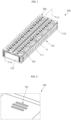
- FIG. 1 is a perspective view of an energy storage module according to an embodiment of the present disclosure
- FIG. 2 is a partially enlarged view of the portion A of FIG. 1
- FIG. 3 is an exploded perspective view of the energy storage module shown in FIGS. 1 and 2
- FIG. 4 is an exploded perspective bottom view of a bottom surface of an extinguisher sheet and of a top cover of the energy storage module shown in FIGS. 1-3 .
- an energy storage module 100 includes a cover member 110, a top plate 140, an extinguisher sheet 150, and a top cover 160.
- the cover member 110 provides an internal space for receiving (or accommodating) battery cells and insulation spacers.
- the cover member 110 includes a bottom plate 111, an end plate (or a plurality of end plates) 112, and a side plate (or a plurality of side plates) 113 which provide a space in which the battery cells and the insulation spacers are arranged, which will be further described below.
- the cover member 110 may fix positions of the battery cells and the insulation spacers and may protect the battery cells from external impacts.
- the top plate 140 is coupled to a top portion (e.g., a top or a top surface) of the cover member 110.
- the top plate 140 may be coupled to the cover member 110 while covering top portions (e.g., top surfaces) of the battery cells.
- positive electrode terminals and negative electrode terminals of the battery cells are exposed to a top portion of (e.g., are exposed through) the top plate 140 (e.g., are exposed to a top portion of the top plate 140), and bus bars 145 are coupled to the terminals of adjacent ones of the battery cells, thereby connecting (e.g., electrically connecting) the battery cells to one another in series, in parallel, or in series/parallel.
- the top plate 140 includes a duct (e.g., a plurality of ducts) 141 corresponding to a vent located on a top surface (e.g., in a cap plate or cap assembly) of each of the battery cells. Accordingly, the gas discharged through the vent of the battery cell may move upwardly along (or through) the duct 141 of the top plate 140.
- a duct e.g., a plurality of ducts
- the configuration and operation of the ducts 141 will be described in more detail below.
- the extinguisher sheet 150 is positioned between the top plate 140 and the top cover 160.
- the extinguisher sheet 150 may be one or more members (or sheets) extending in one direction, for example, in a length direction, of the top plate 140.
- the extinguisher sheet 150 may include an opening (e.g., an opening hole or a plurality of openings or openings holes) positioned to correspond to the duct 141 of the top plate 140. Accordingly, the extinguisher sheet 150 may be positioned such that the openings therein correspond to the ducts 141 of the top plate 140.
- the extinguisher sheet 150 may be coupled to a bottom surface of the top cover 160. When the extinguisher sheet 150 is coupled to the bottom surface of the top cover 160, the extinguisher sheet 150 is positioned above the top plate 140. The configuration and operation of the extinguisher sheet 150 will be described in more detail below.
- the top cover 160 is coupled to the top portion (e.g., the top surface) of the top plate 140.
- the top cover 160 may cover the top plate 140 and the bus bars 145.
- the top cover 160 also covers the extinguisher sheet 150 coupled to its bottom surface 160b, thereby protecting the top plate 140, the bus bars 145, and the extinguisher sheet 150 from external impacts applied to a top surface 160a of the top cover 160.
- the top cover 160 includes discharge openings (e.g., discharge holes) 161 (see, e.g., FIG. 4 ).
- the discharge openings 161 may be arranged in (e.g., adjacent each other in) one direction, for example, in a length direction, of the top cover 160.
- the discharge openings 161 may be positioned to correspond to the ducts 141 of the top plate 140, and each of the discharge openings 161 may include (or may be) a plurality of separate openings (e.g., sub-discharge openings) spaced apart from one another.
- the gas discharged from the vent of the battery cell may be discharged outside of the energy storage module 100 along the duct 141 of the top plate 140 and through the discharge opening 161 of the top cover 160, thereby facilitating user safety by preventing the user's hand from contacting the internal structure of the top cover 160.
- the top cover 160 may further include a protrusion (e.g., a protrusion part) 162 around the discharge opening 161 (e.g., around each of the discharge openings 161).
- the protrusion 162 may protrude from the bottom surface 160b of the top cover 160 to be coupled to (e.g., to extend around) the exterior side (or exterior surface) of the duct 141.
- the protrusion 162 may have a shape that corresponds to the cross-sectional shape of the duct 141.
- FIG. 5A shows energy storage modules that are coupled to a rack according to an embodiment of the present disclosure
- FIGS. 5B and 5C illustrate gas movement from a vent of a battery cell through one of the ducts 141 in the energy storage module 100 according to an embodiment of the present disclosure
- FIG. 5B is a cross-sectional view of the energy storage module 100 along a first direction
- FIG. 5C is a cross-sectional view thereof along a second direction perpendicular to the first direction.
- a plurality of energy storage modules 100 may be combined with (e.g., coupled to) a rack 10.
- the number of energy storage modules 100 may vary according to the desired capacity, and the energy storage modules 100 may be mounted in the rack 10 and then be fixed thereto.
- the rack 10 may include a frame 11 defining its overall external shape and shelves 12 located at different layers (or levels) in the frame 11.
- the shelves 12 may support bottom portions (or bottom surfaces) of the energy storage modules 100 (e.g., the energy storage modules 100 may be placed on or mounted on the shelves 12).
- two shelves 12 are shown in the frame 11, and two energy storage modules 100 are shown mounted on the respective shelves 12.
- the present disclosure is not limited to the number of shelves 12 and energy storage modules 100 in the illustrated embodiment.
- the ducts 141 of the top plate 140 are located to correspond to the vents of the battery cells.
- the gas discharged from the vent may move upwardly along (or through) the duct 141, as indicated by the arrows.
- the top plate 140 may face toward (e.g., the duct 141 may extend toward) the discharge opening 161 of the top cover 160 positioned above the duct 141.
- the shelf 12 of the rack 10 is positioned above the top surface 160a of the top cover 160 so the gas is between (e.g., enter the space between) the top surface 160a of the top cover 160 and the adjacent shelf 12.
- a distance between the top surface 160a of the top cover 160 and the shelf 12 may be in a range from about 3 mm to about 7 mm.
- the distance is greater than or equal to about 3 mm, the heat generated by the energy storage module 100 can be easily discharged to the exterior and, when the distance is less than about 7 mm, a high-temperature inert gas atmosphere can be easily created therein, which will be described in more detail below.
- a phase change may begin to occur in a fire extinguishing agent in the extinguisher sheet 150 at a temperature in a range from about 40 °C to 60 °C, and more specifically, a temperature in a range from 45 °C to 55 °C.
- the fire extinguishing agent may remain inside the extinguisher sheet 150 instead of being sprayed (released) therefrom.
- a gas containing an electrolytic steam may be generated mainly through the vent.
- the gas in the above temperature range may allow a heat-resistant plastic constituting an upper plate 140 and an upper cover 160 to remain unmelted.
- spraying of some of the fire extinguishing agent may begin.
- the high-temperature inert gas may be generated along with flames.
- the inert gas may fill spaces between the top surface 160a of the top cover 160 and the adjacent shelf 12 to create an inert gas atmosphere. Accordingly, oxygen induction can be prevented and the flames generated by the battery cell can be blocked (or extinguished).
- the extinguisher sheet 150 positioned under the top cover 160 may operate (e.g., may emit a fire extinguishing agent) due to the high-temperature inert gas, thereby allowing the fire extinguishing agent to be sprayed (or emitted), which will be described later in more detail.
- FIG. 6 is a perspective view of an energy storage module according to an embodiment of the present disclosure in which the extinguisher sheet is coupled to the top plate
- FIG. 7 is a partially enlarged view of the portion B of FIG. 6
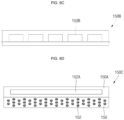
- FIGS. 8A and 8B are cross-sectional views of the energy storage module according to an embodiment of the present disclosure
- FIGS. 9A-9D are cross-sectional views of example configurations of the extinguisher sheet according to embodiments of the present disclosure.
- the extinguisher sheet 150 may be positioned between the top plate 140 and the top cover 160, as described above. As shown in FIG. 6 , the extinguisher sheet 150 may have openings (e.g., opening holes) 151 corresponding to the ducts 141 of the top plate 140. Accordingly, movement of the gas through the ducts 141 may not be influenced by the extinguisher sheet 150 (e.g., the extinguisher sheet 150 may not impede the movement of the gas from the battery cells).
- openings e.g., opening holes
- the extinguisher sheet 150 may operate (e.g., may emit a fire extinguishing agent) in response to heat when the inert gas having a relatively high temperature of, for example, about 200oC, is generated.
- the fire extinguishing agent contained in the extinguisher sheet 150 is sprayed (or emitted) from the extinguisher sheet 150 due to (or in response to) the high-temperature gas.
- the fire extinguishing agent may be sprayed toward (e.g., emitted or directed toward) the top plate 140 and the battery cells with directionality.
- the fire extinguishing agent may reach the underlying insulation spacers through openings (e.g., opening holes) 143 located at front and rear sides of the ducts 141 (e.g., located between the ducts 141) of the top plate 140.
- a fluid guide protrusion 142 may be provided around the opening 143 (e.g., around each of the openings) of top plate 140, thereby more efficiently guiding movement of the fire extinguishing agent.
- the fire extinguishing agent may move along surfaces of the insulation spacers, thereby extinguishing the adjacent battery cell(s) and cooling the battery cell(s).
- the extinguisher sheet 150 may be configured as shown in FIGS. 9A-9D .
- the extinguisher sheet 150 may include a receiving space (or a plurality of receiving spaces) 152 containing a fire extinguishing agent within an outer cover including (or made of) polyurea or polyurethane.
- the receiving space 152 may include a micro-sized fire extinguishing capsule(s) covering (or encapsulating) the fire extinguishing agent therein.
- the fire extinguishing agent may include, for example, halogenated carbon (e.g. a halogen containing hydrocarbon compound, such as a compound consisting only of carbon and halogen atoms), such as a halogenated ketone (e.g. NOVEC).
- the fire extinguishing capsule(s) defining the receiving space 152 may be configured to open (or burst) to spray the fire extinguishing agent when the gas having passed through the duct 141 reaches a relatively high temperature of about 200oC.
- the fire extinguishing agent may start to experience a phase change at about 50oC or at a temperature in a range from about 100 oC to about 200 oC.
- a high temperature atmosphere of, for example, about 200oC the fire extinguishing capsule(s) opens (or bursts) due to increased internal pressure due to the phase change, causing the internal fire extinguishing agent to be sprayed.
- the fire extinguishing capsule may also melt at a temperature of about 200oC, thereby allowing the internal fire extinguishing agent to be sprayed (or emitted).
- a proportion of the fire extinguishing agent contained in the extinguisher sheet 150 to the overall weight of the extinguisher sheet may be in a range from about 30% to about 50%.
- the proportion of the fire extinguishing agent is greater than or equal to about 30%, the battery cell(s) can be appropriately extinguished by the extinguisher sheet 150 and, when the proportion of the fire extinguishing agent is less than or equal to about 50%, the extinguisher sheet 150 can be easily set (or configured) to operate at a temperature of about 200oC.
- the fire extinguishing agent may be contained in the extinguisher sheet 150 in an amount between about 0.12 g/cm 3 to about 0.82 g/cm 3 .
- the extinguisher sheet 150 can appropriately extinguish the battery cell(s) by considering the capacity of the battery cell(s) used in the energy storage module 100 including the extinguisher sheet 150 and, when the amount of the fire extinguishing agent is less than or equal to about 0.82 g/cm 3 , the extinguisher sheet 150 can be easily set (or configured) to operate at a temperature of about 200oC.
- another example extinguisher sheet 150A may include an internal tube-type (e.g., cylindrical) receiving space 152A, which receives (or accommodates or stores) a fire extinguishing agent within the extinguisher sheet 150A.
- an internal tube-type e.g., cylindrical
- another example extinguisher sheet 150B may include receiving spaces 152B arranged therein and spaced apart from one another (e.g., spaced apart from each other at a regular interval).
- the extinguisher sheet includes a plurality of receiving spaces 152B that are spaced apart from one another, different from the tube-type receiving space 152A in the extinguisher sheet 150A described above.
- the receiving spaces 152B of the extinguisher sheet 150B may operate (e.g., may emit or spray the fire extinguishing agent) in response to high-temperature internal gas from the battery cells.
- the extinguisher sheet 150B may emit (or spray) the fire extinguishing agent from the receiving spaces 152B corresponding to (e.g., arranged over or near) the battery cells that vent the high-temperature gas.
- another example extinguisher sheet 150C may have a multi-layer structure including a plurality of layers (or sheets).
- the extinguisher sheet 150C may include a first extinguisher sheet 150 having lower capsule-type receiving spaces 152 and a second extinguisher sheet 150A having an upper tube-type receiving space 152A.
- the first extinguisher sheet 150 and the second extinguisher sheet 150A may have different operating temperatures, thereby allowing the first extinguisher sheet 150 and the second extinguisher sheet 150A to sequentially operate according to the temperature and amount of the vented gas.
- the extinguisher sheet 150C may sequentially operate according to the temperature and generation time (e.g., the continued generation) of gas, thereby constantly (e.g., constantly over a period of time) spraying the fire extinguishing agent.
- the temperature and generation time e.g., the continued generation
- the extinguisher sheet 150C may sequentially operate according to the temperature and generation time (e.g., the continued generation) of gas, thereby constantly (e.g., constantly over a period of time) spraying the fire extinguishing agent.
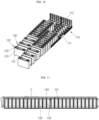
- FIG. 10 illustrates battery cells 120 and insulation spacers 130 arranged on the bottom plate 111 of the energy storage module 100 according to an embodiment of the present disclosure.
- FIG. 11 is a cross-sectional view taken along the line 11-11' of FIG. 1 .
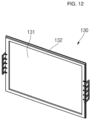
- FIG. 12 is a perspective view of one of the insulation spacers 130 according to an embodiment of the present disclosure.
- FIG. 13 is a partially enlarged view of the portion C of FIG. 11 .
- the battery cells 120 and insulation spacers 130 may be alternately arranged on a top surface of the bottom plate 111 of the cover member 110.
- the battery cells 120 may be arranged in two columns along the top surface of the bottom plate 111, and one of the insulation spacers 130 may be positioned between each of (e.g., between adjacent ones of) the battery cells 120.
- Each of the battery cells 120 may include an electrode assembly accommodated within a case 121, and the electrode assembly may be wound, stacked, or laminated in a state in which a separator is positioned between a positive electrode plate and a negative electrode plate.
- Each of the positive and negative electrode plates include an active material coated on a region (e.g., a coated portion or coated region).
- the battery cells 120 may further include electrode terminals 122 and 123, which are electrically connected to regions of the positive and negative electrode plates that are not coated with the active material (e.g., uncoated portions or uncoated regions).
- the electrode terminals 122 and 123 may be exposed to (e.g., may extend through or above) an upper portion of the case 121.
- the electrode terminals 122 and 123 may be referred to as a first electrode terminal 122 and a second electrode terminal 123, respectively defining, for example, a negative electrode terminal and a positive electrode terminal, but the polarities of the electrode terminals 122 and 123 may be reversed. Occurrences of battery cell ignition can be reduced according to the compositions of the active materials of the battery cells 120, thereby increasing safety of the battery cells 120.
- the active material compositions will be described in more detail below.
- the insulation spacers 130 positioned between each of the battery cells 120 may prevent the battery cells 120 from contacting each other.
- the insulation spacers 130 may maintain distance (e.g., may maintain a space) between each of the battery cells 120 to establish passages for external air, thereby cooling the battery cells 120.
- each of the insulation spacers 130 may include a sheet (e.g., a sheet part) 131 and an edge (e.g., an edge part) 132.
- the sheet 131 may be (may include or employ) a mixture of a flame-retardant (e.g., a non-combustible) sheet that prevents or slows a fire from spreading to neighboring battery cells 120 a heat-insulating sheet that prevents or reduces heat from spreading to neighboring battery cells 120.
- a flame-retardant e.g., a non-combustible
- mica e.g.
- mica paper may be used as the flame-retardant sheet
- ceramic paper including (or represented by) a bio-soluble fiber containing an alkali earth metal may be used as the non-combustible sheet, but aspects of the present disclosure are not limited thereto.
- edge 132 may be provided along peripheral edges of the sheet 131.
- the edge 132 may include (or may be made of) a plastic material and may be coupled to edges of the sheet 131 by a double injection process to fix the shape of the sheet 131.
- the edge 132 may include (or may be made of), for example, polyethylene or polypropylene.
- the fire extinguishing agent when a fire extinguishing agent is injected from above the insulation spacers 130, the fire extinguishing agent may move downwardly along the surface of the sheet 131. Therefore, the fire extinguishing agent may contact the cases 121 of the battery cells 120, thereby extinguishing any fire and cooling the battery cells 120.
- movement of the fire extinguishing agent will be described in greater detail.
- the openings 143 of the top plate 140 are located to correspond to (e.g., arranged above) the insulation spacers 130. Accordingly, the fire extinguishing agent emitted by the extinguisher sheet 150 may pass through the openings 143 of the top plate 140 to reach the insulation spacers 130. In addition, the fire extinguishing agent may move along surfaces of the insulation spacers 130 that face the cases 121 of the battery cells 120, thereby both extinguishing any fire and cooling the battery cells 120.
- the fire extinguishing agent is sprayed from (e.g., is emitted or sprayed from a portion of) the extinguisher sheet 150 that is above (e.g., adjacent to or corresponding to) of the battery cell(s) 120 that has a temperature that is higher than a reference temperature (e.g. 200 °C). Therefore, the fire extinguishing agent may be sprayed from a top portion of (e.g., above) the battery cell(s) 120 that has an elevated temperature.
- the fire extinguishing agent moves along the surfaces of the insulation spacers 130 positioned at front and rear sides of the corresponding battery cell 120, the extinguishing and cooling operations of the corresponding battery cell 120 can both be performed.
- FIG. 14 is a perspective view of an energy storage module according to another embodiment of the present disclosure
- FIG. 15 is a plan view showing an extinguisher sheet that is coupled to a top plate in the energy storage module shown in FIG 14
- FIG. 16 is a partial cross-sectional view of the energy storage module shown in FIGS. 14 and 15 .
- an energy storage module 200 includes a cover member 210, a top plate 240, an extinguisher sheet 250, and a top cover 260.
- the cover member 210, the top plate 240, the extinguisher sheet 250, and the top cover 260 may be similar to those of the energy storage module 100 described above.
- a portion of the top cover 260 that corresponds to the duct 241 may be lower (e.g., nearer to the battery cells) than other portions of the top cover 260.
- gas emitted through the vent may gather at a top portion (e.g., at an upper or outer surface) of the top cover 260 corresponding to the duct 241.
- the gathered gas may be discharged to the exterior by using a separate fan or a suction (e.g., vacuum) component, thereby allowing the gas generated by the battery cell to be discharged quickly.
- FIGS. 17A and 17B are a perspective view and a cross-sectional view of a battery cell used in an energy storage module according to an embodiment of the present disclosure.
- a battery cell 120 is configured such that an electrode assembly 125 is accommodated in a case 121 and a cap plate 124 covers a top portion of the case 121.
- a vent 124a having a smaller thickness than other regions is located roughly at the center of the cap plate 124.
- a duct 141 of the top plate 140 is located to correspond to a top portion of a vent 124a, as described above.
- the electrode assembly 125 may be electrically connected to a first electrode terminal 122 and a second electrode terminal 123 located on the cap plate 124 through a pair of current collectors 126.
- the first electrode terminal 122 will be referred to as a negative electrode terminal and the second electrode terminal 123 will be referred to as a positive electrode terminal, but polarities thereof may also be reversed.
- the electrode assembly 125 may include a negative electrode 125a, a positive electrode 125b positioned to face the negative electrode 125a and a separator 125c positioned between the negative electrode 125a and the positive electrode 125b, and the electrode assembly 125 may be accommodated in the case 121 together with an electrolyte.
- the negative electrode 125a may include a negative electrode current collector, a negative electrode active material layer positioned on the negative electrode current collector, and a negative electrode function layer positioned on the negative electrode active material layer.
- the reaction depending on the temperature may speed up under the same reaction conditions, thereby further increasing a safety improving effect of a lithium secondary battery.
- the flake-shaped polyethylene particles yet to be melted may be distributed to cover pores over a thinner and wider area than the spherical polyethylene particles yet to be melted. If the polyethylene particles are melted at a temperature higher than a set or predetermined temperature to shut down ion passages, a larger electrode plate area may be shut down by the flake-shaped polyethylene particles than by the melted spherical polyethylene particles, thereby increasing the reaction speed.
- the polyethylene particles included in the negative electrode function layer are melted to shut down ion passages, so that ion movement is restricted and a shut-down function is manifested, thereby preventing additional electrochemical reactions from taking place (or reducing a likelihood or degree of the additional electrochemical reactions).
- the flake-shaped polyethylene particles according to an embodiment of the present disclosure are distributed over pores in the composition of the negative electrode function layer throughout a thin and wide area, they are quickly melted down during thermal runaway due to thermal/physical impacts, thereby demonstrating an excellent effect in blocking ion passages.
- polyethylene may be categorized by density into high-density polyethylene (HDPE) (Density: 0.94 g/cc to 0.965 g/cc), medium-density polyethylene (MDPE) (Density: 0.925 g/cc to 0.94 g/cc), low-density polyethylene (LDPE) (Density: 0.91 g/cc to 0.925 g/cc), and very low density polyethylene (VLDPE) (Density: 0.85 g/cc to 0.91 g/cc).
- HDPE high-density polyethylene
- MDPE medium-density polyethylene
- LDPE low-density polyethylene
- VLDPE very low density polyethylene
- the flake-shaped polyethylene particles may be used alone or in mixture of two or more polyethylene (PE) polymers, such as, for example, HDPE, MDPE, or LDPE.
- PE polyethylene
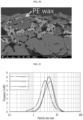
- the flake-shaped polyethylene particles included in the negative electrode function layer positioned on the negative electrode active material layer may have an average particle diameter (D50) in a range from 1 ⁇ m to 8 ⁇ m, for example, from 2 ⁇ m to 6 ⁇ m.
- D50 average particle diameter
- an average particle diameter may be measured using any suitable method generally used in the art such as, for example, by utilizing a particle size analyzer, or by utilizing a transmission electron microscopic (TEM) image or a scanning electron microscopic (SEM) image. Also, the D50 may be easily measured by analyzing data measured by a measuring device using a dynamic light-scattering method to count the number of particles for each particle size range and calculating an average value thereof. In some embodiments, the D50 value may correspond to a particle size at which half of the mass (or volume) of the particles have a larger particle size and the other half of the mass (or volume) of the particles have a smaller particle size.
- TEM transmission electron microscopic
- SEM scanning electron microscopic
- a ratio of a major axis length to a minor axis length of the flake-shaped polyethylene particles may be in a range from 1 to 5, for example, 1.1 to 4.5, or 1.2 to 3.5.
- the flake-shaped polyethylene particles may have a thickness in range from 0.2 ⁇ m to 4 ⁇ m, for example, between 0.3 ⁇ m and 2.5 ⁇ m, or between 0.3 ⁇ m and 1.5 ⁇ m.
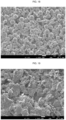
- the polyethylene particles according to the present disclosure have a flake-shape and have a different shape from general polyethylene particles having a spherical shape in a water-dispersible state, as shown in FIG. 18 .
- An average particle size of the flake-shaped polyethylene particles may be defined to be D50, which is a particle size at 50% of a volume ratio (or a mass ratio) in a cumulative size-distribution curve.
- the negative electrode function layer may further include inorganic particles and a binder.
- the flake-shaped polyethylene particles and the inorganic particles and the binder may be contained in the negative electrode function layer in a weight ratio in a range from 80:20 to 99:1, for example, 85:15 to 97:3.
- the content e.g., amount or weight ratio
- cycle-life characteristics and output power characteristics of rechargeable lithium battery cells including the same can be obtained or improved.
- the inorganic particles may include, for example, Al 2 O 3 , SiO 2 , TiO 2 , SnO 2 , CeO 2 , MgO, NiO, CaO, GaO, ZnO, ZrO 2 , Y 2 O 3 , SrTiOs, BaTiOs, Mg(OH) 2 , boehmite or combinations thereof, but aspects of the present disclosure are not limited thereto.
- the negative electrode function layer may further include organic particles including an acryl compound, an imide compound, an amide compound or combinations thereof, but aspects of the present disclosure are not limited thereto.
- the inorganic particles may have spherical shapes, sheet-shapes, cubic shapes or amorphous shapes.
- An average particle diameter (e.g., D50) of the inorganic particles may be in the range from about 1 nm to about 2500 nm. Within the range stated above, the average particle diameter of the inorganic particles may be in the range from about 100 nm to about 2000 nm, or between about 200 nm and about 1000 nm, for example, between about 300 nm and about 800 nm.
- the average particle diameter of the inorganic particles may be a particle size (D50) at 50% of a volume ratio (or mass ratio) in a cumulative particle size-distribution curve.
- the negative electrode function layer may have a thickness in the range from 1 ⁇ m to 10 ⁇ m, specifically, between 3 ⁇ m and 10 ⁇ m.
- a ratio of the thickness of the negative electrode active material layer to the thickness of the negative electrode function layer may be 50:1 to 10:1, or, for example, 30:1 to 10:1.
- the thickness of the negative electrode function layer is within the foregoing range, thermal stability of the resultant rechargeable lithium battery can be remarkably improved while maintaining excellent cycle life characteristics.
- the thickness ratio of the negative active material layer to the negative electrode function layer is within the range stated above, thermal stability of the resultant rechargeable lithium battery can be improved while minimizing or reducing a reduction in the energy density.
- the negative electrode current collector may include a copper foil, a nickel foil, a stainless steel foil, a titanium foil, a nickel foam, a copper foam, a polymer substrate coated with a conductive metal, or a combination thereof.
- the negative electrode active material may include a material capable of reversibly intercalating/deintercalating lithium ions, a lithium metal, a lithium metal alloy, a material being capable of doping/undoping lithium, or a transition metal oxide.
- Examples of the material capable of reversibly intercalating and deintercalating the lithium ions may include a carbon material, e.g., any suitable carbon-based negative electrode active material generally used in a lithium secondary battery.
- Representative examples of the carbon-based negative electrode active material may include crystalline carbon, amorphous carbon, and mixtures thereof.
- Examples of the crystalline carbon may include graphite, such as amorphous, sheet-shaped, flake-shaped, spherical shaped, or fiber-shaped natural graphite or artificial graphite.
- Examples of the amorphous carbon may include soft carbon or hard carbon, a mesophase pitch carbonized product, fired coke, and the like.
- the crystalline carbon may include non-shaped (e.g., amorphous), sheet-shaped, flake-shaped, spherical-shaped, and/or fiber-shaped natural graphite and/or artificial graphite.
- the amorphous carbon may be a soft carbon, a hard carbon, mesophase pitch carbide, fired coke, and/or the like.
- the lithium metal alloy may include an alloy of lithium and a metal selected from the group consisting of Na, K, Rb, Cs, Fr, Be, Mg, Ca, Sr, Si, Sb, Pb, In, Zn, Ba, Ra, Ge, Al, and Sn.
- Examples of the material being capable of doping/undoping lithium may include a silicon-based material, e.g., Si or SiOx (0 ⁇ x ⁇ 2), an Si-Q alloy (wherein the Q is an element selected from the group consisting of an alkali metal, an alkaline-earth metal, Group 13 to 16 elements, a transition metal, a rare earth element, or a combination thereof, and is not Si), a Si-C composite, Sn, SnO 2 , Sn-R (wherein the R is an element selected from the group consisting of an alkali metal, an alkaline-earth metal, Group 13 to 16 elements, a transition metal, a rare earth element, or a combination thereof, and is not Sn), a Sn-C composite, and the like, and at least one of which may be used in a mixture with SiO 2 .
- a silicon-based material e.g., Si or SiOx (0 ⁇ x ⁇ 2)
- an Si-Q alloy wherein the Q is an element selected from the
- Usable examples of the elements Q and R may be selected from the group consisting of Mg, Ca, Sr, Ba, Ra, Sc, Y, Ti, Zr, Hf, Rf, V, Nb, Ta, Db, Cr, Mo, W, Sg, Tc, Re, Bh, Fe, Pb, Ru, Os, Hs, Rh, Ir, Pd, Pt, Cu, Ag, Au, Zn, Cd, B, Al, Ga, Sn, In, Ge, P, As, Sb, Bi, S, Se, Te, Po, and combinations thereof.
- the transition metal oxide may include a lithium titanium oxide.
- the negative electrode active material may be included in an amount of 95 wt % to 99 wt % based on the total weight of the negative active material layer.
- the negative electrode active material layer may further include a negative electrode conductive material and a negative electrode binder.
- Each of the negative electrode conductive material and the negative electrode binder may be included in an amount of 1 wt% to 5 wt% based on the total weight of the negative active material layer.
- the negative electrode conductive material is used to improve the conductivity (e.g., electrical conductivity) of a negative electrode.
- Any suitable electrically conductive material may be used as the negative electrode conductive material, unless the material causes a chemical change (e.g., an undesirable or unwanted change to any of the components of rechargeable lithium battery).
- the negative electrode conductive material may include a carbon-based material, such as natural graphite, artificial graphite, carbon black, acetylene black, ketjen black, carbon fiber and the like; a metal-based material, such as a metal powder or a metal fiber and the like of copper, nickel, aluminium, silver, and the like; a conductive polymer, such as a polyphenylene derivative and the like; or a mixture thereof.
- the negative electrode binder may serve to improve binding properties of the negative active material particles with one another and with a current collector.
- Examples of the negative electrode binder may include a non-water-soluble binder, a water-soluble binder, an amphiprotic binder, or a combination thereof.
- non-water-soluble binder may include polyvinylchloride, carboxylated polyvinylchloride, polyvinylfluoride, an ethylene oxide-containing polymer, polyvinylpyrrolidone, polyurethane, polytetrafluoroethylene, polyvinylidenfluoride, polyethylene, polypropylene, polyamideimide, polyimide, or a combination thereof.
- water-soluble binder may include a styrene-butadiene rubber, an acrylated styrene-butadiene rubber, polyvinyl alcohol, sodium polyacrylate, a copolymer of propylene and a C2 to C8 olefin, a copolymer of (meth)acrylic acid and (meth)acrylic acid alkyl ester, or a combination thereof.
- amphiprotic binder may include an acrylated styrene-based rubber.
- a cellulose-based compound may be further used to provide viscosity.
- the cellulose-based compound may include one or more of carboxylmethyl cellulose, hydroxypropylmethyl cellulose, methyl cellulose, or alkali metal salts thereof.
- the alkali metal may be Na, K, and/or Li.
- the cellulose-based compound may be included in an amount of 0.1 to 3 parts by weight based on 100 parts by weight of the negative electrode active material.
- the positive electrode of the lithium secondary battery may include a positive electrode active material layer including a first positive electrode active material including at least one composite oxide of lithium and a metal of cobalt, manganese, nickel, or a combination thereof, and a second positive electrode active material including a compound represented by the Chemical Formula (1).
- the lithium secondary battery according to an embodiment of the present disclosure may include both of the negative electrode function layer positioned on the negative electrode and the positive electrode active material layer including the first positive electrode active material and the second positive electrode active material, thereby reducing thermal runaway due to thermal/physical impacts and assisting the flake-shaped polyethylene particles in being melted to shut down (or perfectly shut down) ion passages.
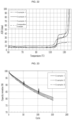
- the ion passages may not be perfectly shut down during thermal runaway due to thermal/physical impacts (see FIG. 25 ).
- the ion passages can be shut down (or perfectly shut down) during thermal runaway due to thermal/physical impacts, thereby obtaining a safety maximizing or increasing effect (see FIG. 26 ).
- the positive electrode 125b may include a positive electrode current collector and a positive electrode active material layer positioned on the positive electrode current collector.
- the positive electrode active material layer may include the first positive electrode active material including at least one composite oxide of lithium and a metal of cobalt, manganese, nickel, or a combination thereof, and the second positive electrode active material including a compound represented by the Chemical Formula (1).
- the positive electrode active material layer may further include a positive electrode function layer positioned on the positive electrode active material layer.
- the first positive electrode active material may be at least one composite oxide of lithium and a metal of cobalt, manganese, nickel, or a combination thereof.
- Examples of the first positive electrode active material may include a compound represented by one of the following Chemical Formulas:
- Li a A 1-b X b D 2 (0.90 ⁇ a ⁇ 1.8, 0 ⁇ b ⁇ 0.5); Li a A 1-b X b O 2-c D c (0.90 ⁇ a ⁇ 1.8, 0 ⁇ b ⁇ 0.5, 0 ⁇ c ⁇ 0.05); Li a E 1-b X b O 2-c D c (0.90 ⁇ a ⁇ 1.8, 0 ⁇ b ⁇ 0.5, 0 ⁇ c ⁇ 0.05); Li a E 2-b X b O 4-c D c (0.90 ⁇ a ⁇ 1.8, 0 ⁇ b ⁇ 0.5, 0 ⁇ c ⁇ 0.05); Li a Ni 1-b-c Co b X c D ⁇ , (0.90 ⁇ a ⁇ 1.8, 0 ⁇ b ⁇ 0.5, 0 ⁇ c ⁇ 0.5, 0 ⁇ ⁇ 2); Li a Ni 1-b-
- A is selected from the group consisting of Ni, Co, Mn, and a combination thereof;
- X is selected from the group consisting of Al, Ni, Co, Mn, Cr, Fe, Mg, Sr, V, a rare earth element, and a combination thereof;
- D is selected from the group consisting of O, F, S, P, and a combination thereof;
- E is selected from the group consisting of Co, Mn, and a combination thereof;
- T is selected from the group consisting of F, S, P, and a combination thereof;
- G is selected from the group consisting of Al, Cr, Mn, Fe, Mg, La, Ce, Sr, V, and a combination thereof;
- Q is selected from the group consisting of Ti, Mo, Mn, and a combination thereof;
- Z is selected from the group consisting of Cr, V, Fe, Sc, Y, and a combination thereof;
- J is selected from the group consisting of V, Cr, Mn, Co, Ni, Cu, and a
- the compounds may have a coating layer on the surface, or may be mixed with another compound having a coating layer.
- the coating layer may include at least one coating element compound selected from the group of an oxide of the coating element, a hydroxide of the coating element, an oxyhydroxide of the coating element, an oxycarbonate of the coating element, and a hydroxyl carbonate of the coating element.
- the compound for the coating layer may be amorphous or crystalline.
- the coating element included in the coating layer may include Mg, Al, Co, K, Na, Ca, Si, Ti, V, Sn, Ge, Ga, B, As, Zr, or a mixture thereof.
- the coating layer may be formed by any suitable coating method (for example, spray coating or dipping) that demonstrates no adverse influence (or substantially no adverse influence) on properties of the positive electrode active material by using these elements in the compound, which will be well understood by one skilled in the art and further description thereof is not necessary here.
- suitable coating method for example, spray coating or dipping
- the first positive electrode active material and the second positive electrode active material may be included in a weight ratio in a range from 97:3 to 80:20, for example, 95:5 to 85:15.
- the first positive electrode active material may be included in an amount in a range from 70 wt % to 99 wt % based on the total weight of the positive electrode active material layer, for example, 85 wt% to 99 wt%, 87 wt% to 95 wt%, or 90 wt% to 98 wt%.
- the amount of the first positive electrode active material satisfies the range, the safety can be improved without a reduction in the capacity.
- the second positive electrode active material may include, for example, LiFePO 4 .
- the second positive electrode active material may be included in an amount in a range from 1 wt % to 15 wt% based on the total weight of the positive electrode active material layer, for example, 2 wt% to 15 wt%, 2 wt% to 12 wt%, or 2 wt% to 10 wt%.
- the amount of the second positive electrode active material satisfies the range, the safety can be improved without a reduction in the capacity.
- usage examples of the positive electrode current collector may include, but not limited to, aluminium and nickel.
- the positive electrode active material layer may further include a positive electrode conductive material and a positive electrode binder.
- Each of the positive electrode conductive material and the positive electrode binder may be included in an amount in a range from 1 wt% to 5 wt% based on the total weight of the positive electrode active material layer.
- the positive electrode conductive material may be used to provide the positive electrode with conductivity (e.g., electrical conductivity), and kinds of the positive electrode conductive material are the same as those of the negative electrode conductive material.
- the positive electrode binder may serve to improve binding properties of the positive active material particles with one another and with a current collector, and examples of the positive electrode binder may include, but are not limited to, polyvinyl alcohol, carboxymethylcellulose, hydroxypropylcellulose, diacetylcellulose, polyvinylchloride, carboxylated polyvinylchloride, polyvinylfluoride, an ethylene oxide-containing polymer, polyvinylpyrrolidone, polyurethane, polytetrafluoroethylene, polyvinylidene fluoride, polyethylene, polypropylene, styrene-butadiene rubber, acrylated styrene-butadiene rubber, epoxy resin, and nylon.
- the electrolyte includes a non-aqueous organic solvent and a lithium salt.
- the non-aqueous organic solvent serves as a medium for transmitting ions taking part in the electrochemical reaction of a battery.
- the non-aqueous organic solvent may include a carbonate-based, ester-based, ether-based, ketone-based, alcohol-based, or aprotic solvent.
- the carbonate-based solvent may include dimethyl carbonate (DMC), diethyl carbonate (DEC), dipropyl carbonate (DPC), methylpropyl carbonate (MPC), ethylpropyl carbonate (EPC), methylethyl carbonate (MEC), ethylene carbonate (EC), propylene carbonate (PC), butylene carbonate (BC), and the like.
- ester-based solvent may include methyl acetate, ethyl acetate, n-propyl acetate, methylpropionate, ethyl propionate, ⁇ -butyrolactone, decanolide, valerolactone, mevalonolactone, caprolactone and the like.
- ether-based solvent may include dibutyl ether, tetraglyme, diglyme, dimethoxyethane, 2-methyltetrahydrofuran, tetrahydrofuran, and the like.
- ketone-based solvent may include cyclohexanone, and the like.
- examples of the alcohol-based solvent may include ethyl alcohol, isopropyl alcohol, and the like
- examples of the aprotic solvent may include nitriles, such as R-CN (wherein R is a C2 to C20 linear, branched, or cyclic hydrocarbon group, or includes a double bond, an aromatic ring, or an ether bond), amides, such as dimethylformamide, dioxolanes, such as 1,3-dioxolane, or sulfolanes.
- the non-aqueous organic solvent may be used alone or in a mixture of more than one material.
- the mixture ratio can be controlled in accordance with desirable battery performance and can be any suitable mixture ratio generally used in the art.
- the carbonate-based solvent may be used by mixing a cyclic carbonate and a chain-type carbonate.
- the cyclic carbonate and the chain-type carbonate are mixed together to a volume ratio in a range from 1:1 to 1:9, excellent performance of the electrolyte may be demonstrated.
- the aromatic hydrocarbon-based organic solvent may be an aromatic hydrocarbon-based compound represented by the following Chemical Formula (2): wherein R1 to R6 are the same or different and are selected from the group consisting of a hydrogen, a halogen, a C1 to C10 alkyl group, a C1 to C10 haloalkyl group, and a combination thereof.
- aromatic hydrocarbon-based organic solvent may be selected from the group consisting of benzene, fluorobenzene, 1,2-difluorobenzene, 1,3-difluorobenzene, 1,4-difluorobenzene, 1,2,3-trifluorobenzene, 1,2,4-trifluorobenzene, chlorobenzene, 1,2-dichlorobenzene, 1,3-dichlorobenzene, 1,4-dichlorobenzene, 1,2,3-trichlorobenzene, 1,2,4-trichlorobenzene, iodobenzene, 1,2-diiodobenzene, 1,3-diiodobenzene, 1,4-diiodobenzene, 1,2,3-triiodobenzene, 1,2,4-triiodobenzene, toluene, fluorotoluene, 2,3-difluorotoluene, 2,
- the non-aqueous electrolyte may further include vinylene carbonate or an ethylene carbonate-based compound represented by the following Chemical Formula (3): wherein R 7 and R 8 are the same or different and are selected from the group consisting of a hydrogen, a halogen group, a cyano group (CN), a nitro group (NO 2 ) and a fluorinated C1 to C5 alkyl group, wherein at least one of the R 7 and R 8 is a halogen group, a cyano group (CN), a nitro group (NO 2 ), or a fluorinated C1 to C5 alkyl group, but both of R 7 and R 8 are not necessarily hydrogens.
- R 7 and R 8 are the same or different and are selected from the group consisting of a hydrogen, a halogen group, a cyano group (CN), a nitro group (NO 2 ) and a fluorinated C1 to C5 alkyl group, wherein at least one of the R 7 and R 8 is
- ethylene carbonate-based compound may include difluoro ethylene carbonate, chloroethylene carbonate, dichloroethylene carbonate, bromoethylenecarbonate, dibromoethylene carbonate, nitroethylene carbonate, cyanoethylenecarbonate, fluoroethylene carbonate, and the like.
- the amount of the additive may be suitably or appropriately controlled.
- the lithium salt dissolved in the organic solvent functions as a supply source of lithium ions in the battery to enable a basic operation of a rechargeable lithium battery and promotes movement of lithium ions between positive and negative electrodes.
- the lithium salt may include as a supporting salt one or more selected from LiPF 6 , LiBF 4 , LiSbF 6 , LiAsF 6 , LiN(SO 2 C 2 F 5 ) 2 , Li(CF 3 SO 2 ) 2 N, LiN(SO 3 C 2 F 5 ) 2 , LiC 4 F 9 SO 3 , LiClO 4 , LiAlO 2 , LiAlCl 4 , LiN(C x F 2x+1 SO 2 )(C y F 2y+1 SO 2 ) where x and y are natural numbers, LiCl, Lil and LiB(C 2 O 4 ) 2 , and lithium bis(oxalato) borate (LiBOB).
- the lithium salt may be used at a concentration in a range from 0.1 M to 2.0 M, and in one embodiment, at a concentration in a range from 0.5 to 2.0 M.
- the electrolyte may demonstrate suitable or appropriate conductivity and viscosity, thereby enhancing lithium ion mobility.
- the separator 125c may be positioned between the positive electrode 125b and the negative electrode 125a.
- the separator 125c may be made of, for example, one selected from a glass fiber, polyester, polyethylene, polypropylene, polytetrafluoroethylene and a combination thereof, and may be a non-woven or woven material.
- the separator made of, for example, a polyolefin-based polymer, such as polyethylene or polypropylene, may be mainly used for a lithium secondary battery.
- a separator coated with a composition including a ceramic component or a polymeric material may be used and, optionally, may have a single-layered structure or a multi-layered structure.
- Example 1 Battery including 2 ⁇ m flake-shaped PE particles
- a positive electrode active material slurry was prepared by mixing 95 wt% of a positive electrode active material having LiCoO 2 /LiFePO 4 (LCO/LFP) mixed to a weight ratio of 9:1, 3 wt% of polyvinylidenfluoride as a binder, and 2 wt% ketjen black as a conductive material in N-methylpyrrolidone as a solvent.
- the positive electrode active material slurry was coated on both surfaces of an Al current collector, dried and pressed to provide a positive electrode (cathode) including a positive electrode active material layer.
- a negative electrode active material slurry was prepared by mixing 98 wt% of graphite, 0.8 wt% of carboxymethyl cellulose and 1.2 wt% of styrene-butadiene rubber in pure water.
- the negative electrode active material slurry was coated on both surfaces of a Cu current collector, dried and pressed to provide a negative electrode (anode) including a negative electrode active material layer.
- the PE/ alumina slurry was coated on the surface of the negative electrode, dried and pressed to provide a coated negative electrode including a coating layer including flake-shaped PE particles.
- the positive electrode, the separator including a PE/PP multi-layered substrate, and the negative electrode including the coating layer including the flake-shaped PE particles were sequentially stacked to fabricate an electrode assembly shown in FIGS. 17A and 17B , followed by injecting an electrolyte, thereby fabricating a secondary battery.
- Example 2 Battery including 4 ⁇ m flake-shaped PE particles
- Example 3 Battery including 6 ⁇ m flake-shaped PE particles
- a secondary battery was fabricated in substantially the same manner as in Example 1, except that a negative electrode was provided using a dispersion liquid prepared by dispersing spherical PE particles having an average particle size of 4 ⁇ m, instead of 2 ⁇ m flake-shaped PE particles, in an alcohol-based solvent.
- a negative electrode (anode) including a coating layer including the flake-shaped PE particles according to Example 1, a separator including a PE/PP multi-layered substrate, and a negative electrode including a coating layer including the flake-shaped PE particles according to Example 1, were sequentially stacked in that order, followed by injecting an electrolyte prepared by dissolving 1M LiBF 4 in propylene carbonate (PC), thereby fabricating a symmetrical coin-type battery shown in FIG. 24 .
- FIG. 24 is a diagram showing symmetrical coin-type batteries fabricated for evaluating resistance increase rates of electrode plates.
- a temperature sensor and a resistance meter were installed on the fabricated symmetrical coin-type battery, and the battery was inserted into a temperature-varying chamber for evaluation. Changes in temperatures and resistances of the symmetrical coin-type battery were evaluated while increasing the temperature at a rate of 10 °C/min, and increase rate evaluation results of AC resistance (ACR) (ohm) of electrode plates depending on the temperature is shown in FIG. 22 .
- ACR AC resistance
- FIG. 22 is a graph showing ACR increase rate evaluation results of electrode plates depending on temperatures.
- AC resistance (ACR) increase rates of electrode plates in Examples 1 to 3 were remarkably increased at a high temperature of 120°C or higher, compared to the ACR increase rate of an electrode plate in Comparative Example.
- ion passages can be effectively shut down during thermal runaway due to thermal/physical impacts. Therefore, it can be expected for a shut-down function to be manifested quickly.
- Lithium secondary batteries fabricated in Examples 1 to 3 were charged at a charge potential of 4.4 V at 0.5C/0.5C rates and then discharged to reach 3.0 V. After 150 cycles, cell capacity decrease rates were measured, and the results are shown in FIG. 23 . At the 51st and 101st cycles, the battery cells were charged at a charge potential of 4.4 V at 0.5C/0.5C and then discharged to reach 3.0 V. Then, capacity retentions were measured to evaluate capacity recovery.
- FIG. 23 is a graph showing capacity retention evaluation results of lithium secondary batteries according to Examples 1 to 3 for 150 cycles.
- the lithium secondary battery according to an embodiment of the present disclosure can effectively demonstrate a shut-down function while maintaining excellent battery characteristics.
Landscapes
- Chemical & Material Sciences (AREA)
- Chemical Kinetics & Catalysis (AREA)
- Electrochemistry (AREA)
- General Chemical & Material Sciences (AREA)
- Engineering & Computer Science (AREA)
- Manufacturing & Machinery (AREA)
- Inorganic Chemistry (AREA)
- Composite Materials (AREA)
- Materials Engineering (AREA)
- Crystallography & Structural Chemistry (AREA)
- Health & Medical Sciences (AREA)
- Public Health (AREA)
- Business, Economics & Management (AREA)
- Emergency Management (AREA)
- Battery Mounting, Suspending (AREA)
Description
- Aspects of embodiments of the present disclosure relate to an energy storage module.
- An energy storage module may be configured to be linked to a renewal energy and/or power system, such as, for example, a solar cell, to store electric power when demand for electric power from a load is low and to use (e.g., to discharge or provide) the stored electric power when demand for electric power is high. The energy storage module generally includes (or is) an apparatus including a relatively large quantity of battery cells (e.g., secondary batteries or secondary battery cells). The energy storage module generally exhibits high-capacity and high-output characteristics, and research into technology to increase the safety of energy storage modules is being actively conducted.
- The battery cells are generally received in (or placed on or fixed to) multiple trays, which are received (or accommodated) in a rack, and multiple racks are received (or accommodated) in a container box.
- However, there have recently been instances of energy storage modules catching fire. Once a fire starts in an energy storage module, it is not easy to extinguish due to the characteristics of the energy storage module.
-
WO 2019/117485 A1 relates to a battery pack with an exhaust structure. -
CN 109585726 A relates to a battery module including a fire extinguishing component and container, a battery box and a vehicle using said battery module. -
CN 207977389 U relates to a safe, explosion-proof square battery module. -
WO 2013/006796 A1 relates to a battery cooling method and system. -
EP 3591737 A1 relates to a rechargeable lithium battery. -
EP 3386003 A1 relates to the deposition of a conductive carbon coated polymer for high temperature lithium ion battery shutdown. - Embodiments of the present disclosure are related to an energy storage module exhibiting a reduced fire risk and exhibiting increased safety by reducing or minimizing the chance of a fire spreading between adjacent battery cells when a fire occurs. These and other aspects and features of the present disclosure will be described in or will be apparent from the following description of embodiments of the present disclosure.
- According to an embodiment of the present disclosure, an energy storage module includes: a cover member accommodating a plurality of battery cells in an internal receiving space, the battery cells being arranged in a first direction, each of the battery cells including a vent; a top plate coupled to a top of the cover member and including a duct corresponding to the vent of each of the battery cells; a top cover coupled to a top of the top plate and having a discharge opening corresponding to the duct; and an extinguisher sheet between the top cover and the top plate, the extinguisher sheet being configured to emit a fire extinguishing agent at a reference temperature.
- The extinguisher sheet may have an opening corresponding to the duct.
- The extinguisher sheet may extend in the first direction.
- The energy storage module may further include a plurality of insulation spacers respectively between adjacent ones of the battery cells.
- The top plate may have openings respectively corresponding to the insulation spacers.
- The extinguisher sheet may be over the openings in the top plate and over the insulation spacers.
- The extinguisher sheet may have a receiving space with an outer cover comprising polyurea or polyurethane and a fire extinguishing agent in the receiving space.
- The receiving space may be a capsule or tube.
- The fire extinguishing agent may include halogenated carbon.
- The extinguisher sheet may include a plurality of sheets respectively configured to emit the fire extinguishing agent at different temperatures.
- The sheets of the extinguisher sheet may be stacked on each other.
- The energy storage module may further include a plurality of the extinguisher sheets.
- Each of the extinguisher sheets may extend in the first direction.
- A first one of the extinguisher sheets may be between a first electrode terminal of one of the battery cells and the vent of the one of the battery cells, and a second one of the extinguisher sheets may be between a second electrode terminal of the one of the battery cells and the vent of the one of the battery cells.
- The extinguisher sheets may be spaced from the battery cells by a first distance, and an upper end of the duct may be spaced from the battery cells by a second distance, the first distance being greater than the second distance.
- A proportion of the fire extinguishing agent contained in the extinguisher sheet to the total weight of the extinguisher sheet may be in a range from 30% to 50%.
- The fire extinguishing agent may be contained in the extinguisher sheet in an amount of 0.12 g/cm3 to 0.82 g/cm3.
- Each of the battery cells may include: a negative electrode including: a negative electrode current collector; a negative electrode active material layer on the negative electrode current collector; and a negative electrode function layer on the negative electrode active material layer; and a positive electrode including: a positive electrode current collector; and a positive electrode active material layer on the positive electrode current collector. The negative electrode function layer may include flake-shaped polyethylene particles, and the positive electrode active material layer may include a first positive electrode active material including at least one composite oxide of lithium and a metal selected from the group consisting of cobalt (Co), manganese (Mn), nickel (Ni), and a combination of these metals, and a second positive electrode active material including a compound represented by the Chemical Formula (1):
LiaFe1-xMxPO4 (1)
wherein 0.90 ≤ a ≤ 1.8, 0 ≤ x ≤ 0.7, and M is Mn, Co, Ni, or a combination thereof. - The flake-shaped polyethylene particles may have an average particle diameter (D50) in a range from 1 µm to 8 µm.
- The flake-shaped polyethylene particles may have an average particle diameter (D50) in a range from 2 µm to 6 µm.
- The flake-shaped polyethylene particles may have a thickness in a range from 0.2 µm to 4 µm.
- The first positive electrode active material and the second positive electrode active material may be contained in a weight ratio in a range from 97:3 to 80:20.
- At least some of the above and other features of the invention are set out in the claims.
- As described above, the energy storage module according to embodiments of the present disclosure suppresses ignition by providing battery cells having a shut-down function by using compositions of negative and positive electrode active materials. Further, energy storage modules according to embodiments of the present disclosure can prevent or reduce heat from spreading to adjacent battery cells by rapidly extinguishing a fire therein and cooling the battery cell(s) when a vent of the battery cell(s) opens (or ruptures) and/or when a fire occurs.
-
-
FIG. 1 is a perspective view of an energy storage module according to an embodiment of the present disclosure. -
FIG. 2 is a partially enlarged view of the portion A ofFIG. 1 . -
FIG. 3 is an exploded perspective view of the energy storage module shown inFIGS. 1 and 2 . -
FIG. 4 is an exploded perspective bottom view of an extinguisher sheet and a top cover of the energy storage module shown inFIGS. 1-3 . -
FIG. 5A shows a plurality of energy storage modules coupled to a rack according to an embodiment of the present disclosure. -
FIGS. 5B and5C illustrate gas movement from a battery cell through a duct in the energy storage module shown inFIGS. 1-4 . -
FIG. 6 is a perspective view of the extinguisher sheet coupled to a top plate of the energy storage module shown inFIGS. 1-4 . -
FIG. 7 is a partially enlarged view of the portion B ofFIG. 6 . -
FIGS. 8A and8B illustrate the extinguisher sheet in the energy storage module according to an embodiment of the present disclosure. -
FIGS. 9A-9D are cross-sectional views of extinguisher sheets according to embodiments of the present disclosure. -
FIG. 10 is a perspective view of battery cells and insulation spacers arranged on a bottom plate of the energy storage module according to an embodiment of the present disclosure. -
FIG. 11 is a cross-sectional view taken along the line 11-11 ofFIG. 1 . -
FIG. 12 is a perspective view illustrating one of the insulation spacers in the energy storage module according to an embodiment of the present disclosure. -
FIG. 13 is a partially enlarged view of the portion C ofFIG. 11 . -
FIG. 14 is a perspective view of an energy storage module according to another embodiment of the present disclosure. -
FIG. 15 is a plan view illustrating an extinguisher sheet that is coupled to a top plate in the energy storage module shown inFIG. 14 . -
FIG. 16 is a cross-sectional view of a part of the energy storage module shown inFIGS. 14 and 15 . -
FIGS. 17A and17B are a perspective view and a cross-sectional view, respectively, of a battery cell of an energy storage module according to an embodiment of the present disclosure. -
FIG. 18 is a scanning electron microscope (SEM) image of polyethylene spherical particles in an aqueous dispersion. -
FIG. 19 is a SEM image of flake-shaped polyethylene particles according to an embodiment of the present disclosure. -
FIG. 20 is a SEM image of an electrode composition according to an embodiment of the present disclosure. -
FIG. 21 is a graph showing particle size distribution analysis results of flake-shaped polyethylene particles contained in electrode compositions prepared according to Examples 1 to 3. -
FIG. 22 is a graph showing ACR increase rate evaluation results of electrode plates depending on temperatures. -
FIG. 23 is a graph showing capacity retention evaluation results of lithium secondary batteries according to Examples for 150 cycles. -
FIG. 24 is a diagram showing a symmetrical coin-type cell fabricated for evaluating resistance increase rates of an electrode plate. -
FIG. 25 is a SEM image showing a cross section of a surface of a negative electrode when a lithium secondary battery not including a positive electrode according to Example is shut down. -
FIG. 26 is a SEM image showing a surface of a negative electrode cross section when a lithium secondary battery including both of a negative electrode with a negative electrode function layer and a positive electrode is shut down. - Hereinafter, embodiments of the present disclosure will be described in detail. The subject matter of the present disclosure may, however, be embodied in many different forms and should not be construed as being limited to the example embodiments set forth herein. Rather, these example embodiments are provided so that this disclosure will be thorough and complete and will fully convey the aspects and features of the present disclosure to those skilled in the art.
- In addition, in the accompanying drawings, sizes or thicknesses of various components or layers may be exaggerated for brevity and clarity. Like numbers refer to like elements throughout. In addition, it will be understood that when an element A is referred to as being "connected to" an element B, the element A can be directly connected to the element B or an intervening element C may be present therebetween such that the element A and the element B are indirectly connected to each other.
- The terminology used herein is for the purpose of describing example embodiments of the present disclosure and is not intended to be limiting of the present disclosure. As used herein, the singular forms are intended to include the plural forms as well, unless the context clearly indicates otherwise.
- Further, the use of "may" when describing embodiments of the present disclosure relates to "one or more embodiments of the present disclosure." Expressions, such as "at least one of," when preceding a list of elements, modify the entire list of elements and do not modify the individual elements of the list. In addition, the use of "between" or "from" when describing ranges of values includes the end values.
- It will be further understood that the terms "comprise," "comprising," "include," "including," "has," and variations thereof, when used in this specification, specify the presence of the stated features, numbers, steps, operations, elements, and/or components but do not preclude the presence or addition of one or more other features, numbers, steps, operations, elements, components, and/or groups thereof. It will be understood that, although the terms first, second, etc. may be used herein to describe various members, elements, regions, layers, and/or sections, these members, elements, regions, layers, and/or sections should not be limited by these terms. These terms are used to distinguish one member, element, region, layer, and/or section from another. Thus, for example, a first member, a first element, a first region, a first layer, and/or a first section discussed below could be termed a second member, a second element, a second region, a second layer, and/or a second section without departing from the scope of the present disclosure.
- Spatially relative terms, such as "beneath," "below," "lower," "above," "upper," and the like, may be used herein for ease of description to describe one element or feature's relationship to another element(s) or feature(s) as illustrated in the figures. It will be understood that the spatially relative terms are intended to encompass different orientations of the device in use or operation, in addition to the orientation depicted in the figures. For example, if the device in the figures is turned over, elements described as "below" or "beneath" other elements or features would then be oriented "over" or "above" the other elements or features. Thus, the term "below" can encompass both an orientation of above and below.
- Hereinafter, a configuration of an energy storage module according to embodiments of the present disclosure will be described.
-
FIG. 1 is a perspective view of an energy storage module according to an embodiment of the present disclosure,FIG. 2 is a partially enlarged view of the portion A ofFIG. 1 ,FIG. 3 is an exploded perspective view of the energy storage module shown inFIGS. 1 and 2 , andFIG. 4 is an exploded perspective bottom view of a bottom surface of an extinguisher sheet and of a top cover of the energy storage module shown inFIGS. 1-3 . - Referring to
FIGS. 1-4 , anenergy storage module 100 according to an embodiment of the present disclosure includes acover member 110, atop plate 140, anextinguisher sheet 150, and atop cover 160. - The
cover member 110 provides an internal space for receiving (or accommodating) battery cells and insulation spacers. Thecover member 110 includes abottom plate 111, an end plate (or a plurality of end plates) 112, and a side plate (or a plurality of side plates) 113 which provide a space in which the battery cells and the insulation spacers are arranged, which will be further described below. In addition, thecover member 110 may fix positions of the battery cells and the insulation spacers and may protect the battery cells from external impacts. - The
top plate 140 is coupled to a top portion (e.g., a top or a top surface) of thecover member 110. Thetop plate 140 may be coupled to thecover member 110 while covering top portions (e.g., top surfaces) of the battery cells. In addition, positive electrode terminals and negative electrode terminals of the battery cells are exposed to a top portion of (e.g., are exposed through) the top plate 140 (e.g., are exposed to a top portion of the top plate 140), andbus bars 145 are coupled to the terminals of adjacent ones of the battery cells, thereby connecting (e.g., electrically connecting) the battery cells to one another in series, in parallel, or in series/parallel. - The
top plate 140 includes a duct (e.g., a plurality of ducts) 141 corresponding to a vent located on a top surface (e.g., in a cap plate or cap assembly) of each of the battery cells. Accordingly, the gas discharged through the vent of the battery cell may move upwardly along (or through) theduct 141 of thetop plate 140. The configuration and operation of theducts 141 will be described in more detail below. - The
extinguisher sheet 150 is positioned between thetop plate 140 and thetop cover 160. Theextinguisher sheet 150 may be one or more members (or sheets) extending in one direction, for example, in a length direction, of thetop plate 140. In addition, theextinguisher sheet 150 may include an opening (e.g., an opening hole or a plurality of openings or openings holes) positioned to correspond to theduct 141 of thetop plate 140. Accordingly, theextinguisher sheet 150 may be positioned such that the openings therein correspond to theducts 141 of thetop plate 140. In addition, theextinguisher sheet 150 may be coupled to a bottom surface of thetop cover 160. When theextinguisher sheet 150 is coupled to the bottom surface of thetop cover 160, theextinguisher sheet 150 is positioned above thetop plate 140. The configuration and operation of theextinguisher sheet 150 will be described in more detail below. - The
top cover 160 is coupled to the top portion (e.g., the top surface) of thetop plate 140. Thetop cover 160 may cover thetop plate 140 and the bus bars 145. Thetop cover 160 also covers theextinguisher sheet 150 coupled to itsbottom surface 160b, thereby protecting thetop plate 140, the bus bars 145, and theextinguisher sheet 150 from external impacts applied to atop surface 160a of thetop cover 160. - The
top cover 160 includes discharge openings (e.g., discharge holes) 161 (see, e.g.,FIG. 4 ). Thedischarge openings 161 may be arranged in (e.g., adjacent each other in) one direction, for example, in a length direction, of thetop cover 160. In addition, thedischarge openings 161 may be positioned to correspond to theducts 141 of thetop plate 140, and each of thedischarge openings 161 may include (or may be) a plurality of separate openings (e.g., sub-discharge openings) spaced apart from one another. Accordingly, the gas discharged from the vent of the battery cell may be discharged outside of theenergy storage module 100 along theduct 141 of thetop plate 140 and through the discharge opening 161 of thetop cover 160, thereby facilitating user safety by preventing the user's hand from contacting the internal structure of thetop cover 160. - The
top cover 160 may further include a protrusion (e.g., a protrusion part) 162 around the discharge opening 161 (e.g., around each of the discharge openings 161). Theprotrusion 162 may protrude from thebottom surface 160b of thetop cover 160 to be coupled to (e.g., to extend around) the exterior side (or exterior surface) of theduct 141. Theprotrusion 162 may have a shape that corresponds to the cross-sectional shape of theduct 141. - Hereinafter, the
duct 141 of thetop plate 140 according to an embodiment of the present disclosure will be described in more detail. -
FIG. 5A shows energy storage modules that are coupled to a rack according to an embodiment of the present disclosure, andFIGS. 5B and5C illustrate gas movement from a vent of a battery cell through one of theducts 141 in theenergy storage module 100 according to an embodiment of the present disclosure. Specifically,FIG. 5B is a cross-sectional view of theenergy storage module 100 along a first direction, andFIG. 5C is a cross-sectional view thereof along a second direction perpendicular to the first direction. - Referring to
FIG. 5A , according to an embodiment of the present disclosure, a plurality ofenergy storage modules 100 may be combined with (e.g., coupled to) arack 10. The number ofenergy storage modules 100 may vary according to the desired capacity, and theenergy storage modules 100 may be mounted in therack 10 and then be fixed thereto. Therack 10 may include aframe 11 defining its overall external shape andshelves 12 located at different layers (or levels) in theframe 11. Theshelves 12 may support bottom portions (or bottom surfaces) of the energy storage modules 100 (e.g., theenergy storage modules 100 may be placed on or mounted on the shelves 12). InFIG. 5A , twoshelves 12 are shown in theframe 11, and twoenergy storage modules 100 are shown mounted on therespective shelves 12. The present disclosure, however, is not limited to the number ofshelves 12 andenergy storage modules 100 in the illustrated embodiment. - As described above, the
ducts 141 of thetop plate 140 are located to correspond to the vents of the battery cells. Referring toFIGS. 5A-5C , the gas discharged from the vent may move upwardly along (or through) theduct 141, as indicated by the arrows. Thetop plate 140 may face toward (e.g., theduct 141 may extend toward) the discharge opening 161 of thetop cover 160 positioned above theduct 141. Here, theshelf 12 of therack 10 is positioned above thetop surface 160a of thetop cover 160 so the gas is between (e.g., enter the space between) thetop surface 160a of thetop cover 160 and theadjacent shelf 12. A distance between thetop surface 160a of thetop cover 160 and theshelf 12 may be in a range from about 3 mm to about 7 mm. When the distance is greater than or equal to about 3 mm, the heat generated by theenergy storage module 100 can be easily discharged to the exterior and, when the distance is less than about 7 mm, a high-temperature inert gas atmosphere can be easily created therein, which will be described in more detail below. - Specifically, when a gas begins to be discharged from a battery cell through a vent, a phase change may begin to occur in a fire extinguishing agent in the
extinguisher sheet 150 at a temperature in a range from about 40 °C to 60 °C, and more specifically, a temperature in a range from 45 °C to 55 °C. However, even in this case, the fire extinguishing agent may remain inside theextinguisher sheet 150 instead of being sprayed (released) therefrom. Meanwhile, when, afterwards, the amount of gas discharged through the vent gradually increases and a temperature around the vent rises and reaches a temperature in a range from 120 °C to 200 °C, specifically, a temperature in a range from about 130 °C to 190 °C, and more specifically, a temperature in a range from 140 °C to 180 °C, a gas containing an electrolytic steam may be generated mainly through the vent. Also, the gas in the above temperature range may allow a heat-resistant plastic constituting anupper plate 140 and anupper cover 160 to remain unmelted. In addition, spraying of some of the fire extinguishing agent may begin. But if a separator in an electrode assembly of the battery cell melts due to a rise in the internal temperature of the battery cell, the high-temperature inert gas may be generated along with flames. As described above, the inert gas may fill spaces between thetop surface 160a of thetop cover 160 and theadjacent shelf 12 to create an inert gas atmosphere. Accordingly, oxygen induction can be prevented and the flames generated by the battery cell can be blocked (or extinguished). In addition, theextinguisher sheet 150 positioned under thetop cover 160 may operate (e.g., may emit a fire extinguishing agent) due to the high-temperature inert gas, thereby allowing the fire extinguishing agent to be sprayed (or emitted), which will be described later in more detail. - Hereinafter, the configuration and operation of the
extinguisher sheet 150 of theenergy storage module 100 according to an embodiment of the present disclosure will be described in more detail. -
FIG. 6 is a perspective view of an energy storage module according to an embodiment of the present disclosure in which the extinguisher sheet is coupled to the top plate, andFIG. 7 is a partially enlarged view of the portion B ofFIG. 6 .FIGS. 8A and8B are cross-sectional views of the energy storage module according to an embodiment of the present disclosure.FIGS. 9A-9D are cross-sectional views of example configurations of the extinguisher sheet according to embodiments of the present disclosure. - Referring to
FIGS. 6 and7 , theextinguisher sheet 150 may be positioned between thetop plate 140 and thetop cover 160, as described above. As shown inFIG. 6 , theextinguisher sheet 150 may have openings (e.g., opening holes) 151 corresponding to theducts 141 of thetop plate 140. Accordingly, movement of the gas through theducts 141 may not be influenced by the extinguisher sheet 150 (e.g., theextinguisher sheet 150 may not impede the movement of the gas from the battery cells). - In addition, referring to
FIGS. 8A and8B , theextinguisher sheet 150 may operate (e.g., may emit a fire extinguishing agent) in response to heat when the inert gas having a relatively high temperature of, for example, about 200ºC, is generated. Here, the fire extinguishing agent contained in theextinguisher sheet 150 is sprayed (or emitted) from theextinguisher sheet 150 due to (or in response to) the high-temperature gas. In addition, because a top portion of theextinguisher sheet 150 is covered by thetop cover 160, the fire extinguishing agent may be sprayed toward (e.g., emitted or directed toward) thetop plate 140 and the battery cells with directionality. In addition, the fire extinguishing agent may reach the underlying insulation spacers through openings (e.g., opening holes) 143 located at front and rear sides of the ducts 141 (e.g., located between the ducts 141) of thetop plate 140. In some embodiments, afluid guide protrusion 142 may be provided around the opening 143 (e.g., around each of the openings) oftop plate 140, thereby more efficiently guiding movement of the fire extinguishing agent. As will be described in more detail below, after reaching the insulation spacers, the fire extinguishing agent may move along surfaces of the insulation spacers, thereby extinguishing the adjacent battery cell(s) and cooling the battery cell(s). - The
extinguisher sheet 150 may be configured as shown inFIGS. 9A-9D . For example, as shown inFIG. 9A , theextinguisher sheet 150 may include a receiving space (or a plurality of receiving spaces) 152 containing a fire extinguishing agent within an outer cover including (or made of) polyurea or polyurethane. - The receiving
space 152 may include a micro-sized fire extinguishing capsule(s) covering (or encapsulating) the fire extinguishing agent therein. The fire extinguishing agent may include, for example, halogenated carbon (e.g. a halogen containing hydrocarbon compound, such as a compound consisting only of carbon and halogen atoms), such as a halogenated ketone (e.g. NOVEC). In some embodiments, the fire extinguishing capsule(s) defining the receivingspace 152 may be configured to open (or burst) to spray the fire extinguishing agent when the gas having passed through theduct 141 reaches a relatively high temperature of about 200ºC. For example, the fire extinguishing agent may start to experience a phase change at about 50ºC or at a temperature in a range from about 100 ºC to about 200 ºC. In a high temperature atmosphere of, for example, about 200ºC, the fire extinguishing capsule(s) opens (or bursts) due to increased internal pressure due to the phase change, causing the internal fire extinguishing agent to be sprayed. In addition, the fire extinguishing capsule may also melt at a temperature of about 200ºC, thereby allowing the internal fire extinguishing agent to be sprayed (or emitted). - A proportion of the fire extinguishing agent contained in the
extinguisher sheet 150 to the overall weight of the extinguisher sheet may be in a range from about 30% to about 50%. When the proportion of the fire extinguishing agent is greater than or equal to about 30%, the battery cell(s) can be appropriately extinguished by theextinguisher sheet 150 and, when the proportion of the fire extinguishing agent is less than or equal to about 50%, theextinguisher sheet 150 can be easily set (or configured) to operate at a temperature of about 200ºC. - In addition, the fire extinguishing agent may be contained in the
extinguisher sheet 150 in an amount between about 0.12 g/cm3 to about 0.82 g/cm3. When the amount of the fire extinguishing agent is greater than about 0.12 g/cm3, theextinguisher sheet 150 can appropriately extinguish the battery cell(s) by considering the capacity of the battery cell(s) used in theenergy storage module 100 including theextinguisher sheet 150 and, when the amount of the fire extinguishing agent is less than or equal to about 0.82 g/cm3, theextinguisher sheet 150 can be easily set (or configured) to operate at a temperature of about 200ºC. - As shown in
FIG. 9B , anotherexample extinguisher sheet 150A may include an internal tube-type (e.g., cylindrical) receivingspace 152A, which receives (or accommodates or stores) a fire extinguishing agent within theextinguisher sheet 150A. - As shown in
FIG. 9C , anotherexample extinguisher sheet 150B may include receivingspaces 152B arranged therein and spaced apart from one another (e.g., spaced apart from each other at a regular interval). In this embodiment, the extinguisher sheet includes a plurality of receivingspaces 152B that are spaced apart from one another, different from the tube-type receiving space 152A in theextinguisher sheet 150A described above. The receivingspaces 152B of theextinguisher sheet 150B may operate (e.g., may emit or spray the fire extinguishing agent) in response to high-temperature internal gas from the battery cells. Therefore, when gas is generated by one or more of the battery cells, theextinguisher sheet 150B may emit (or spray) the fire extinguishing agent from the receivingspaces 152B corresponding to (e.g., arranged over or near) the battery cells that vent the high-temperature gas. - In addition, as shown in
FIG. 9D , another example extinguisher sheet 150C may have a multi-layer structure including a plurality of layers (or sheets). For example, the extinguisher sheet 150C may include afirst extinguisher sheet 150 having lower capsule-type receiving spaces 152 and asecond extinguisher sheet 150A having an upper tube-type receiving space 152A. In this embodiment, thefirst extinguisher sheet 150 and thesecond extinguisher sheet 150A may have different operating temperatures, thereby allowing thefirst extinguisher sheet 150 and thesecond extinguisher sheet 150A to sequentially operate according to the temperature and amount of the vented gas. In addition, according to the duplex operation of the extinguisher sheet 150C, the extinguisher sheet 150C may sequentially operate according to the temperature and generation time (e.g., the continued generation) of gas, thereby constantly (e.g., constantly over a period of time) spraying the fire extinguishing agent. - Hereinafter, configurations and operations of the battery cells and the insulation spacers in the
energy storage module 100 according to an embodiment of the present disclosure will be described. -
FIG. 10 illustratesbattery cells 120 andinsulation spacers 130 arranged on thebottom plate 111 of theenergy storage module 100 according to an embodiment of the present disclosure.FIG. 11 is a cross-sectional view taken along the line 11-11' ofFIG. 1 .FIG. 12 is a perspective view of one of theinsulation spacers 130 according to an embodiment of the present disclosure.FIG. 13 is a partially enlarged view of the portion C ofFIG. 11 . - Referring to
FIG. 10 , thebattery cells 120 andinsulation spacers 130 may be alternately arranged on a top surface of thebottom plate 111 of thecover member 110. For example, thebattery cells 120 may be arranged in two columns along the top surface of thebottom plate 111, and one of theinsulation spacers 130 may be positioned between each of (e.g., between adjacent ones of) thebattery cells 120. - Each of the
battery cells 120 may include an electrode assembly accommodated within acase 121, and the electrode assembly may be wound, stacked, or laminated in a state in which a separator is positioned between a positive electrode plate and a negative electrode plate. Each of the positive and negative electrode plates include an active material coated on a region (e.g., a coated portion or coated region). Thebattery cells 120 may further includeelectrode terminals electrode terminals case 121. Theelectrode terminals first electrode terminal 122 and asecond electrode terminal 123, respectively defining, for example, a negative electrode terminal and a positive electrode terminal, but the polarities of theelectrode terminals battery cells 120, thereby increasing safety of thebattery cells 120. The active material compositions will be described in more detail below. - Referring to
FIG. 11 , theinsulation spacers 130 positioned between each of thebattery cells 120 may prevent thebattery cells 120 from contacting each other. In addition, theinsulation spacers 130 may maintain distance (e.g., may maintain a space) between each of thebattery cells 120 to establish passages for external air, thereby cooling thebattery cells 120. - Referring to
FIG. 12 , each of theinsulation spacers 130 may include a sheet (e.g., a sheet part) 131 and an edge (e.g., an edge part) 132. Thesheet 131 may be (may include or employ) a mixture of a flame-retardant (e.g., a non-combustible) sheet that prevents or slows a fire from spreading to neighboring battery cells 120 a heat-insulating sheet that prevents or reduces heat from spreading to neighboringbattery cells 120. For example, mica (e.g. mica paper) may be used as the flame-retardant sheet, and ceramic paper including (or represented by) a bio-soluble fiber containing an alkali earth metal may be used as the non-combustible sheet, but aspects of the present disclosure are not limited thereto. - In addition, the
edge 132 may be provided along peripheral edges of thesheet 131. Theedge 132 may include (or may be made of) a plastic material and may be coupled to edges of thesheet 131 by a double injection process to fix the shape of thesheet 131. Theedge 132 may include (or may be made of), for example, polyethylene or polypropylene. - As described above, when a fire extinguishing agent is injected from above the
insulation spacers 130, the fire extinguishing agent may move downwardly along the surface of thesheet 131. Therefore, the fire extinguishing agent may contact thecases 121 of thebattery cells 120, thereby extinguishing any fire and cooling thebattery cells 120. Hereinafter, movement of the fire extinguishing agent will be described in greater detail. - As shown in
FIG. 13 , theopenings 143 of thetop plate 140 are located to correspond to (e.g., arranged above) theinsulation spacers 130. Accordingly, the fire extinguishing agent emitted by theextinguisher sheet 150 may pass through theopenings 143 of thetop plate 140 to reach theinsulation spacers 130. In addition, the fire extinguishing agent may move along surfaces of theinsulation spacers 130 that face thecases 121 of thebattery cells 120, thereby both extinguishing any fire and cooling thebattery cells 120. - The fire extinguishing agent is sprayed from (e.g., is emitted or sprayed from a portion of) the
extinguisher sheet 150 that is above (e.g., adjacent to or corresponding to) of the battery cell(s) 120 that has a temperature that is higher than a reference temperature (e.g. 200 °C). Therefore, the fire extinguishing agent may be sprayed from a top portion of (e.g., above) the battery cell(s) 120 that has an elevated temperature. In addition, because the fire extinguishing agent moves along the surfaces of theinsulation spacers 130 positioned at front and rear sides of thecorresponding battery cell 120, the extinguishing and cooling operations of thecorresponding battery cell 120 can both be performed. - Hereinafter, a configuration of an energy storage module according to another embodiment of the present disclosure will be described.
-
FIG. 14 is a perspective view of an energy storage module according to another embodiment of the present disclosure,FIG. 15 is a plan view showing an extinguisher sheet that is coupled to a top plate in the energy storage module shown inFIG 14 , andFIG. 16 is a partial cross-sectional view of the energy storage module shown inFIGS. 14 and 15 . - Referring to
FIGS. 14-16 , anenergy storage module 200 according to another embodiment of the present disclosure includes acover member 210, atop plate 240, anextinguisher sheet 250, and atop cover 260. - The
cover member 210, thetop plate 240, theextinguisher sheet 250, and thetop cover 260 may be similar to those of theenergy storage module 100 described above. - However, when the
top cover 260 is coupled to aduct 241 positioned at an area of thetop plate 240 corresponding to the vent of the battery cell, a portion of thetop cover 260 that corresponds to the duct 241 (e.g., a portion of thetop cover 260 at where theopenings 261 are arranged) may be lower (e.g., nearer to the battery cells) than other portions of thetop cover 260. In this embodiment, gas emitted through the vent may gather at a top portion (e.g., at an upper or outer surface) of thetop cover 260 corresponding to theduct 241. The gathered gas may be discharged to the exterior by using a separate fan or a suction (e.g., vacuum) component, thereby allowing the gas generated by the battery cell to be discharged quickly. - Hereinafter, the active material composition of the
battery cell 120 used in theenergy storage module 100 according to an embodiment of the present disclosure will be described in greater detail. -
FIGS. 17A and17B are a perspective view and a cross-sectional view of a battery cell used in an energy storage module according to an embodiment of the present disclosure. - Referring to
FIGS. 17A and17B , abattery cell 120 is configured such that anelectrode assembly 125 is accommodated in acase 121 and acap plate 124 covers a top portion of thecase 121. In addition, avent 124a having a smaller thickness than other regions is located roughly at the center of thecap plate 124. Aduct 141 of thetop plate 140 is located to correspond to a top portion of avent 124a, as described above. - In addition, the
electrode assembly 125 may be electrically connected to afirst electrode terminal 122 and asecond electrode terminal 123 located on thecap plate 124 through a pair ofcurrent collectors 126. For convenience sake, in the following description, thefirst electrode terminal 122 will be referred to as a negative electrode terminal and thesecond electrode terminal 123 will be referred to as a positive electrode terminal, but polarities thereof may also be reversed. - The
electrode assembly 125 may include anegative electrode 125a, apositive electrode 125b positioned to face thenegative electrode 125a and aseparator 125c positioned between thenegative electrode 125a and thepositive electrode 125b, and theelectrode assembly 125 may be accommodated in thecase 121 together with an electrolyte. - Here, the
negative electrode 125a may include a negative electrode current collector, a negative electrode active material layer positioned on the negative electrode current collector, and a negative electrode function layer positioned on the negative electrode active material layer. - Compared to a case where the negative electrode function layer includes spherical polyethylene particles, in a case where the negative electrode function layer includes flake-shaped polyethylene particles, the reaction depending on the temperature may speed up under the same reaction conditions, thereby further increasing a safety improving effect of a lithium secondary battery.
- The flake-shaped polyethylene particles yet to be melted may be distributed to cover pores over a thinner and wider area than the spherical polyethylene particles yet to be melted. If the polyethylene particles are melted at a temperature higher than a set or predetermined temperature to shut down ion passages, a larger electrode plate area may be shut down by the flake-shaped polyethylene particles than by the melted spherical polyethylene particles, thereby increasing the reaction speed.
- That is to say, during thermal runaway of a battery cell, the polyethylene particles included in the negative electrode function layer are melted to shut down ion passages, so that ion movement is restricted and a shut-down function is manifested, thereby preventing additional electrochemical reactions from taking place (or reducing a likelihood or degree of the additional electrochemical reactions).
- For example, as confirmed from
FIG. 20 , since the flake-shaped polyethylene particles according to an embodiment of the present disclosure are distributed over pores in the composition of the negative electrode function layer throughout a thin and wide area, they are quickly melted down during thermal runaway due to thermal/physical impacts, thereby demonstrating an excellent effect in blocking ion passages. - In general, polyethylene may be categorized by density into high-density polyethylene (HDPE) (Density: 0.94 g/cc to 0.965 g/cc), medium-density polyethylene (MDPE) (Density: 0.925 g/cc to 0.94 g/cc), low-density polyethylene (LDPE) (Density: 0.91 g/cc to 0.925 g/cc), and very low density polyethylene (VLDPE) (Density: 0.85 g/cc to 0.91 g/cc).
- The flake-shaped polyethylene particles may be used alone or in mixture of two or more polyethylene (PE) polymers, such as, for example, HDPE, MDPE, or LDPE.
- The flake-shaped polyethylene particles included in the negative electrode function layer positioned on the negative electrode active material layer may have an average particle diameter (D50) in a range from 1 µm to 8 µm, for example, from 2 µm to 6 µm.
- Unless defined otherwise in the specification of the present disclosure, an average particle diameter (D50) may be measured using any suitable method generally used in the art such as, for example, by utilizing a particle size analyzer, or by utilizing a transmission electron microscopic (TEM) image or a scanning electron microscopic (SEM) image. Also, the D50 may be easily measured by analyzing data measured by a measuring device using a dynamic light-scattering method to count the number of particles for each particle size range and calculating an average value thereof. In some embodiments, the D50 value may correspond to a particle size at which half of the mass (or volume) of the particles have a larger particle size and the other half of the mass (or volume) of the particles have a smaller particle size.
- Meanwhile, a ratio of a major axis length to a minor axis length of the flake-shaped polyethylene particles may be in a range from 1 to 5, for example, 1.1 to 4.5, or 1.2 to 3.5.
- In addition, the flake-shaped polyethylene particles may have a thickness in range from 0.2 µm to 4 µm, for example, between 0.3 µm and 2.5 µm, or between 0.3 µm and 1.5 µm.
- As shown in
FIG. 19 , the polyethylene particles according to the present disclosure have a flake-shape and have a different shape from general polyethylene particles having a spherical shape in a water-dispersible state, as shown inFIG. 18 . An average particle size of the flake-shaped polyethylene particles may be defined to be D50, which is a particle size at 50% of a volume ratio (or a mass ratio) in a cumulative size-distribution curve. - The negative electrode function layer may further include inorganic particles and a binder.
- The flake-shaped polyethylene particles and the inorganic particles and the binder may be contained in the negative electrode function layer in a weight ratio in a range from 80:20 to 99:1, for example, 85:15 to 97:3.
- If the content (e.g., amount or weight ratio) of the flake-shaped polyethylene particles and the inorganic particles is within the range stated above, cycle-life characteristics and output power characteristics of rechargeable lithium battery cells including the same can be obtained or improved.
- The inorganic particles may include, for example, Al2O3, SiO2, TiO2, SnO2, CeO2, MgO, NiO, CaO, GaO, ZnO, ZrO2, Y2O3, SrTiOs, BaTiOs, Mg(OH)2, boehmite or combinations thereof, but aspects of the present disclosure are not limited thereto. In addition to the inorganic particles, the negative electrode function layer may further include organic particles including an acryl compound, an imide compound, an amide compound or combinations thereof, but aspects of the present disclosure are not limited thereto.
- The inorganic particles may have spherical shapes, sheet-shapes, cubic shapes or amorphous shapes. An average particle diameter (e.g., D50) of the inorganic particles may be in the range from about 1 nm to about 2500 nm. Within the range stated above, the average particle diameter of the inorganic particles may be in the range from about 100 nm to about 2000 nm, or between about 200 nm and about 1000 nm, for example, between about 300 nm and about 800 nm. The average particle diameter of the inorganic particles may be a particle size (D50) at 50% of a volume ratio (or mass ratio) in a cumulative particle size-distribution curve.
- The negative electrode function layer may have a thickness in the range from 1 µm to 10 µm, specifically, between 3 µm and 10 µm.
- A ratio of the thickness of the negative electrode active material layer to the thickness of the negative electrode function layer may be 50:1 to 10:1, or, for example, 30:1 to 10:1.
- If the thickness of the negative electrode function layer is within the foregoing range, thermal stability of the resultant rechargeable lithium battery can be remarkably improved while maintaining excellent cycle life characteristics.
- In some embodiments, if the thickness ratio of the negative active material layer to the negative electrode function layer is within the range stated above, thermal stability of the resultant rechargeable lithium battery can be improved while minimizing or reducing a reduction in the energy density.
- Usable examples of the negative electrode current collector may include a copper foil, a nickel foil, a stainless steel foil, a titanium foil, a nickel foam, a copper foam, a polymer substrate coated with a conductive metal, or a combination thereof.
- Usable examples of the negative electrode active material may include a material capable of reversibly intercalating/deintercalating lithium ions, a lithium metal, a lithium metal alloy, a material being capable of doping/undoping lithium, or a transition metal oxide.
- Examples of the material capable of reversibly intercalating and deintercalating the lithium ions may include a carbon material, e.g., any suitable carbon-based negative electrode active material generally used in a lithium secondary battery. Representative examples of the carbon-based negative electrode active material may include crystalline carbon, amorphous carbon, and mixtures thereof. Examples of the crystalline carbon may include graphite, such as amorphous, sheet-shaped, flake-shaped, spherical shaped, or fiber-shaped natural graphite or artificial graphite. Examples of the amorphous carbon may include soft carbon or hard carbon, a mesophase pitch carbonized product, fired coke, and the like.
- The crystalline carbon may include non-shaped (e.g., amorphous), sheet-shaped, flake-shaped, spherical-shaped, and/or fiber-shaped natural graphite and/or artificial graphite. The amorphous carbon may be a soft carbon, a hard carbon, mesophase pitch carbide, fired coke, and/or the like.
- Usable examples of the lithium metal alloy may include an alloy of lithium and a metal selected from the group consisting of Na, K, Rb, Cs, Fr, Be, Mg, Ca, Sr, Si, Sb, Pb, In, Zn, Ba, Ra, Ge, Al, and Sn.
- Examples of the material being capable of doping/undoping lithium may include a silicon-based material, e.g., Si or SiOx (0<x<2), an Si-Q alloy (wherein the Q is an element selected from the group consisting of an alkali metal, an alkaline-earth metal, Group 13 to 16 elements, a transition metal, a rare earth element, or a combination thereof, and is not Si), a Si-C composite, Sn, SnO2, Sn-R (wherein the R is an element selected from the group consisting of an alkali metal, an alkaline-earth metal, Group 13 to 16 elements, a transition metal, a rare earth element, or a combination thereof, and is not Sn), a Sn-C composite, and the like, and at least one of which may be used in a mixture with SiO2. Usable examples of the elements Q and R may be selected from the group consisting of Mg, Ca, Sr, Ba, Ra, Sc, Y, Ti, Zr, Hf, Rf, V, Nb, Ta, Db, Cr, Mo, W, Sg, Tc, Re, Bh, Fe, Pb, Ru, Os, Hs, Rh, Ir, Pd, Pt, Cu, Ag, Au, Zn, Cd, B, Al, Ga, Sn, In, Ge, P, As, Sb, Bi, S, Se, Te, Po, and combinations thereof.
- The transition metal oxide may include a lithium titanium oxide.
- In the negative electrode active material layer, the negative electrode active material may be included in an amount of 95 wt % to 99 wt % based on the total weight of the negative active material layer.
- Optionally, the negative electrode active material layer may further include a negative electrode conductive material and a negative electrode binder.
- Each of the negative electrode conductive material and the negative electrode binder may be included in an amount of 1 wt% to 5 wt% based on the total weight of the negative active material layer.
- The negative electrode conductive material is used to improve the conductivity (e.g., electrical conductivity) of a negative electrode. Any suitable electrically conductive material may be used as the negative electrode conductive material, unless the material causes a chemical change (e.g., an undesirable or unwanted change to any of the components of rechargeable lithium battery). Examples of the negative electrode conductive material may include a carbon-based material, such as natural graphite, artificial graphite, carbon black, acetylene black, ketjen black, carbon fiber and the like; a metal-based material, such as a metal powder or a metal fiber and the like of copper, nickel, aluminium, silver, and the like; a conductive polymer, such as a polyphenylene derivative and the like; or a mixture thereof.
- The negative electrode binder may serve to improve binding properties of the negative active material particles with one another and with a current collector. Examples of the negative electrode binder may include a non-water-soluble binder, a water-soluble binder, an amphiprotic binder, or a combination thereof.
- Examples of the non-water-soluble binder may include polyvinylchloride, carboxylated polyvinylchloride, polyvinylfluoride, an ethylene oxide-containing polymer, polyvinylpyrrolidone, polyurethane, polytetrafluoroethylene, polyvinylidenfluoride, polyethylene, polypropylene, polyamideimide, polyimide, or a combination thereof.
- Examples of the water-soluble binder may include a styrene-butadiene rubber, an acrylated styrene-butadiene rubber, polyvinyl alcohol, sodium polyacrylate, a copolymer of propylene and a C2 to C8 olefin, a copolymer of (meth)acrylic acid and (meth)acrylic acid alkyl ester, or a combination thereof.
- Examples of the amphiprotic binder may include an acrylated styrene-based rubber.
- When the water-soluble binder is used as the negative electrode binder, a cellulose-based compound may be further used to provide viscosity. Examples of the cellulose-based compound may include one or more of carboxylmethyl cellulose, hydroxypropylmethyl cellulose, methyl cellulose, or alkali metal salts thereof. The alkali metal may be Na, K, and/or Li. The cellulose-based compound may be included in an amount of 0.1 to 3 parts by weight based on 100 parts by weight of the negative electrode active material.
- The positive electrode of the lithium secondary battery according to an embodiment of the present disclosure may include a positive electrode active material layer including a first positive electrode active material including at least one composite oxide of lithium and a metal of cobalt, manganese, nickel, or a combination thereof, and a second positive electrode active material including a compound represented by the Chemical Formula (1).
LiaFe1-xMxPO4 (1)
wherein 0.90 ≤ a ≤ 1.8, 0 ≤ x ≤ 0.7, and M is Mn, Co, Ni or combinations thereof. - The lithium secondary battery according to an embodiment of the present disclosure may include both of the negative electrode function layer positioned on the negative electrode and the positive electrode active material layer including the first positive electrode active material and the second positive electrode active material, thereby reducing thermal runaway due to thermal/physical impacts and assisting the flake-shaped polyethylene particles in being melted to shut down (or perfectly shut down) ion passages. In a secondary battery not including the positive electrode according to an embodiment of the present disclosure, the ion passages may not be perfectly shut down during thermal runaway due to thermal/physical impacts (see
FIG. 25 ). However, in a secondary battery including both of the negative electrode including the negative electrode function layer and the positive electrode according to an embodiment of the present disclosure, the ion passages can be shut down (or perfectly shut down) during thermal runaway due to thermal/physical impacts, thereby obtaining a safety maximizing or increasing effect (seeFIG. 26 ). - Meanwhile, the
positive electrode 125b may include a positive electrode current collector and a positive electrode active material layer positioned on the positive electrode current collector. - The positive electrode active material layer may include the first positive electrode active material including at least one composite oxide of lithium and a metal of cobalt, manganese, nickel, or a combination thereof, and the second positive electrode active material including a compound represented by the Chemical Formula (1).
LiaFe1-xMxPO4 (1)
wherein 0.90 ≤ a ≤ 1.8, 0 ≤ x ≤ 0.7, and M is Mn, Co, Ni or combinations thereof. - In addition, the positive electrode active material layer may further include a positive electrode function layer positioned on the positive electrode active material layer.
- The first positive electrode active material may be at least one composite oxide of lithium and a metal of cobalt, manganese, nickel, or a combination thereof. Examples of the first positive electrode active material may include a compound represented by one of the following Chemical Formulas:
- LiaA1-bXbD2 (0.90 ≤ a ≤ 1.8, 0 ≤ b ≤ 0.5); LiaA1-bXbO2-cDc (0.90 ≤ a ≤ 1.8, 0 ≤ b ≤ 0.5, 0 ≤ c ≤ 0.05); LiaE1-bXbO2-cDc (0.90 ≤ a ≤ 1.8, 0 ≤ b ≤ 0.5, 0 ≤ c ≤ 0.05); LiaE2-bXbO4-cDc (0.90 ≤ a ≤ 1.8, 0 ≤ b ≤ 0.5, 0 ≤ c ≤ 0.05); LiaNi1-b-cCobXcDα, (0.90 ≤ a ≤ 1.8, 0 ≤ b ≤ 0.5, 0 ≤ c ≤ 0.5, 0 < α ≤ 2); LiaNi1-b-cCobXcO2-αTα (0.90 ≤ a ≤ 1.8, 0 ≤ b ≤ 0.5, 0 ≤ c ≤ 0.05, 0 < α < 2); LiaNi1-b-cCobXcO2-αT2 (0.90 ≤ a ≤ 1.8, 0 ≤ b ≤ 0.5, 0 ≤ c ≤ 0.05, 0 < α < 2); LiaNi1-b-cMnbXcDα (0.90 ≤ a ≤ 1.8, 0 ≤ b ≤ 0.5, 0 ≤ c ≤ 0.05, 0 < α ≤ 2); LiaNi1-b-cMnbXcO2-αTα (0.90 ≤ a ≤ 1.8, 0 ≤ b ≤ 0.5, 0 ≤ c ≤ 0.05, 0 < α < 2); LiaNi1-b-cMnbXcO2-αT2 ( 0.90 ≤ a ≤ 1.8, 0 ≤ b ≤ 0.5, 0 ≤ c ≤ 0.05, 0 < α < 2); LiaNibEcGdO2 (0.90 ≤ a ≤ 1.8, 0 ≤ b ≤ 0.9, 0 ≤ c ≤ 0.5, 0.001 ≤ d ≤ 0.1); LiaNibCocMndGeO2 (0.90 ≤ a ≤ 1.8, 0 ≤ b ≤ 0.9, 0 ≤ c ≤ 0.5, 0 ≤ d ≤ 0.5, 0.001 ≤ e ≤ 0.1); LiaNiGbO2 (0.90 ≤ a ≤ 1.8, 0.001 ≤ b ≤ 0.1); LiaCoGbO2 (0.90 ≤ a ≤ 1.8, 0.001 ≤ b ≤ 0.1); LiaMn1-bGbO2 (0.90 ≤ a ≤ 1.8, 0.001 ≤ b ≤ 0.1); LiaMn2GbO4 (0.90 ≤ a ≤ 1.8, 0.001 ≤ b ≤ 0.1); LiaMn1-gGgPO4 (0.90 ≤ a ≤ 1.8, 0 ≤ g ≤ 0.5); QO2; QS2; LiQS2; V2O5; LiV2O5; LiZO2; LiNiVO4; Li(3-f)J2(PO4)3 (0 ≤ f ≤ 2); Li(3-f)Fe2(PO4)3 (0 ≤ f ≤ 2); and LiaFePO4 (0.90 ≤ a ≤ 1.8).
- In the above chemical formulas, A is selected from the group consisting of Ni, Co, Mn, and a combination thereof; X is selected from the group consisting of Al, Ni, Co, Mn, Cr, Fe, Mg, Sr, V, a rare earth element, and a combination thereof; D is selected from the group consisting of O, F, S, P, and a combination thereof; E is selected from the group consisting of Co, Mn, and a combination thereof; T is selected from the group consisting of F, S, P, and a combination thereof; G is selected from the group consisting of Al, Cr, Mn, Fe, Mg, La, Ce, Sr, V, and a combination thereof; Q is selected from the group consisting of Ti, Mo, Mn, and a combination thereof; Z is selected from the group consisting of Cr, V, Fe, Sc, Y, and a combination thereof; and J is selected from the group consisting of V, Cr, Mn, Co, Ni, Cu, and a combination thereof.
- Here, the compounds may have a coating layer on the surface, or may be mixed with another compound having a coating layer. The coating layer may include at least one coating element compound selected from the group of an oxide of the coating element, a hydroxide of the coating element, an oxyhydroxide of the coating element, an oxycarbonate of the coating element, and a hydroxyl carbonate of the coating element. The compound for the coating layer may be amorphous or crystalline. The coating element included in the coating layer may include Mg, Al, Co, K, Na, Ca, Si, Ti, V, Sn, Ge, Ga, B, As, Zr, or a mixture thereof. The coating layer may be formed by any suitable coating method (for example, spray coating or dipping) that demonstrates no adverse influence (or substantially no adverse influence) on properties of the positive electrode active material by using these elements in the compound, which will be well understood by one skilled in the art and further description thereof is not necessary here.
- In an embodiment, the first positive electrode active material and the second positive electrode active material may be included in a weight ratio in a range from 97:3 to 80:20, for example, 95:5 to 85:15.
- The first positive electrode active material may be included in an amount in a range from 70 wt % to 99 wt % based on the total weight of the positive electrode active material layer, for example, 85 wt% to 99 wt%, 87 wt% to 95 wt%, or 90 wt% to 98 wt%. When the amount of the first positive electrode active material satisfies the range, the safety can be improved without a reduction in the capacity.
- The second positive electrode active material may include, for example, LiFePO4.
- The second positive electrode active material may be included in an amount in a range from 1 wt % to 15 wt% based on the total weight of the positive electrode active material layer, for example, 2 wt% to 15 wt%, 2 wt% to 12 wt%, or 2 wt% to 10 wt%. When the amount of the second positive electrode active material satisfies the range, the safety can be improved without a reduction in the capacity.
- Usable examples of the positive electrode current collector may include, but not limited to, aluminium and nickel.
- Optionally, the positive electrode active material layer may further include a positive electrode conductive material and a positive electrode binder.
- Each of the positive electrode conductive material and the positive electrode binder may be included in an amount in a range from 1 wt% to 5 wt% based on the total weight of the positive electrode active material layer.
- The positive electrode conductive material may be used to provide the positive electrode with conductivity (e.g., electrical conductivity), and kinds of the positive electrode conductive material are the same as those of the negative electrode conductive material.
- The positive electrode binder may serve to improve binding properties of the positive active material particles with one another and with a current collector, and examples of the positive electrode binder may include, but are not limited to, polyvinyl alcohol, carboxymethylcellulose, hydroxypropylcellulose, diacetylcellulose, polyvinylchloride, carboxylated polyvinylchloride, polyvinylfluoride, an ethylene oxide-containing polymer, polyvinylpyrrolidone, polyurethane, polytetrafluoroethylene, polyvinylidene fluoride, polyethylene, polypropylene, styrene-butadiene rubber, acrylated styrene-butadiene rubber, epoxy resin, and nylon.
- The electrolyte includes a non-aqueous organic solvent and a lithium salt.
- The non-aqueous organic solvent serves as a medium for transmitting ions taking part in the electrochemical reaction of a battery. Examples of the non-aqueous organic solvent may include a carbonate-based, ester-based, ether-based, ketone-based, alcohol-based, or aprotic solvent. Examples of the carbonate-based solvent may include dimethyl carbonate (DMC), diethyl carbonate (DEC), dipropyl carbonate (DPC), methylpropyl carbonate (MPC), ethylpropyl carbonate (EPC), methylethyl carbonate (MEC), ethylene carbonate (EC), propylene carbonate (PC), butylene carbonate (BC), and the like. Examples of the ester-based solvent may include methyl acetate, ethyl acetate, n-propyl acetate, methylpropionate, ethyl propionate, γ-butyrolactone, decanolide, valerolactone, mevalonolactone, caprolactone and the like. Examples of the ether-based solvent may include dibutyl ether, tetraglyme, diglyme, dimethoxyethane, 2-methyltetrahydrofuran, tetrahydrofuran, and the like. Examples of the ketone-based solvent may include cyclohexanone, and the like. In addition, examples of the alcohol-based solvent may include ethyl alcohol, isopropyl alcohol, and the like, and examples of the aprotic solvent may include nitriles, such as R-CN (wherein R is a C2 to C20 linear, branched, or cyclic hydrocarbon group, or includes a double bond, an aromatic ring, or an ether bond), amides, such as dimethylformamide, dioxolanes, such as 1,3-dioxolane, or sulfolanes.
- The non-aqueous organic solvent may be used alone or in a mixture of more than one material. When the non-aqueous organic solvent is used in a mixture, the mixture ratio can be controlled in accordance with desirable battery performance and can be any suitable mixture ratio generally used in the art.
- In addition, the carbonate-based solvent may be used by mixing a cyclic carbonate and a chain-type carbonate. In this case, when the cyclic carbonate and the chain-type carbonate are mixed together to a volume ratio in a range from 1:1 to 1:9, excellent performance of the electrolyte may be demonstrated.
- The aromatic hydrocarbon-based organic solvent may be an aromatic hydrocarbon-based compound represented by the following Chemical Formula (2):

- Examples of the aromatic hydrocarbon-based organic solvent may be selected from the group consisting of benzene, fluorobenzene, 1,2-difluorobenzene, 1,3-difluorobenzene, 1,4-difluorobenzene, 1,2,3-trifluorobenzene, 1,2,4-trifluorobenzene, chlorobenzene, 1,2-dichlorobenzene, 1,3-dichlorobenzene, 1,4-dichlorobenzene, 1,2,3-trichlorobenzene, 1,2,4-trichlorobenzene, iodobenzene, 1,2-diiodobenzene, 1,3-diiodobenzene, 1,4-diiodobenzene, 1,2,3-triiodobenzene, 1,2,4-triiodobenzene, toluene, fluorotoluene, 2,3-difluorotoluene, 2,4-difluorotoluene, 2,5-difluorotoluene, 2,3,4-trifluorotoluene, 2,3,5-trifluorotoluene, chlorotoluene, 2,3-dichlorotoluene, 2,4-dichlorotoluene, 2,5-dichlorotoluene, 2,3,4-trichlorotoluene, 2,3,5-trichlorotoluene, iodotoluene, 2,3-diiodotoluene, 2,4-diiodotoluene, 2,5-diiodotoluene, 2,3,4-triiodotoluene, 2,3,5-triiodotoluene, xylene, and a combination thereof.
- In order to improve the cycle life of a battery, the non-aqueous electrolyte may further include vinylene carbonate or an ethylene carbonate-based compound represented by the following Chemical Formula (3):
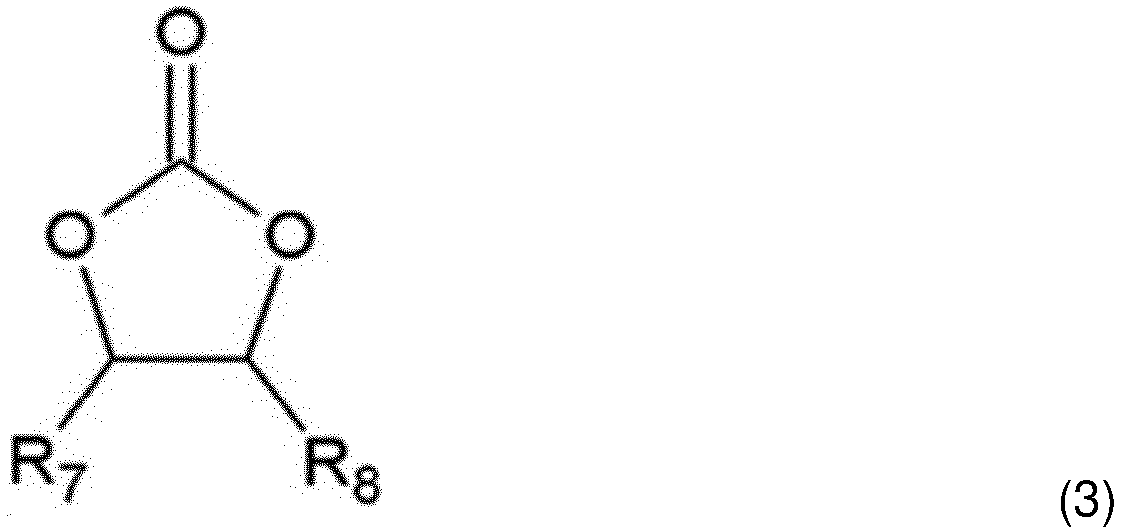
- Representative examples of the ethylene carbonate-based compound may include difluoro ethylene carbonate, chloroethylene carbonate, dichloroethylene carbonate, bromoethylenecarbonate, dibromoethylene carbonate, nitroethylene carbonate, cyanoethylenecarbonate, fluoroethylene carbonate, and the like. When an additive for improving the cycle life is additionally used, the amount of the additive may be suitably or appropriately controlled.
- The lithium salt dissolved in the organic solvent functions as a supply source of lithium ions in the battery to enable a basic operation of a rechargeable lithium battery and promotes movement of lithium ions between positive and negative electrodes. Examples of the lithium salt may include as a supporting salt one or more selected from LiPF6, LiBF4, LiSbF6, LiAsF6, LiN(SO2C2F5)2, Li(CF3SO2)2N, LiN(SO3C2F5)2, LiC4F9SO3, LiClO4, LiAlO2, LiAlCl4, LiN(CxF2x+1SO2)(CyF2y+1SO2) where x and y are natural numbers, LiCl, Lil and LiB(C2O4)2, and lithium bis(oxalato) borate (LiBOB). The lithium salt may be used at a concentration in a range from 0.1 M to 2.0 M, and in one embodiment, at a concentration in a range from 0.5 to 2.0 M. When the lithium salt is included at the above concentration range, the electrolyte may demonstrate suitable or appropriate conductivity and viscosity, thereby enhancing lithium ion mobility.
- As described above, the
separator 125c may be positioned between thepositive electrode 125b and thenegative electrode 125a. Theseparator 125c may be made of, for example, one selected from a glass fiber, polyester, polyethylene, polypropylene, polytetrafluoroethylene and a combination thereof, and may be a non-woven or woven material. - The separator made of, for example, a polyolefin-based polymer, such as polyethylene or polypropylene, may be mainly used for a lithium secondary battery. In order to obtain heat resistance or mechanical strength, a separator coated with a composition including a ceramic component or a polymeric material, may be used and, optionally, may have a single-layered structure or a multi-layered structure.
- The following examples illustrate aspects of the present disclosure in more detail. These examples, however, are provided only for illustrative purposes but are not intended to limit the scope of the present disclosure.
- A positive electrode active material slurry was prepared by mixing 95 wt% of a positive electrode active material having LiCoO2/LiFePO4 (LCO/LFP) mixed to a weight ratio of 9:1, 3 wt% of polyvinylidenfluoride as a binder, and 2 wt% ketjen black as a conductive material in N-methylpyrrolidone as a solvent. The positive electrode active material slurry was coated on both surfaces of an Al current collector, dried and pressed to provide a positive electrode (cathode) including a positive electrode active material layer.
- A negative electrode active material slurry was prepared by mixing 98 wt% of graphite, 0.8 wt% of carboxymethyl cellulose and 1.2 wt% of styrene-butadiene rubber in pure water. The negative electrode active material slurry was coated on both surfaces of a Cu current collector, dried and pressed to provide a negative electrode (anode) including a negative electrode active material layer.
- 48 wt% of flake-shaped PE particles having an average particle size of 2 µm (Major axis length/Minor axis length= about 2, thickness= about 0.6 µm), 47 wt% of alumina (Average particle diameter (D50)= 0.7 µm) and 5 wt% of acrylated styrene-based rubber as a binder were mixed in an alcohol-based solvent to prepare a PE/alumina slurry.
- The PE/ alumina slurry was coated on the surface of the negative electrode, dried and pressed to provide a coated negative electrode including a coating layer including flake-shaped PE particles.
- The positive electrode, the separator including a PE/PP multi-layered substrate, and the negative electrode including the coating layer including the flake-shaped PE particles were sequentially stacked to fabricate an electrode assembly shown in
FIGS. 17A and17B , followed by injecting an electrolyte, thereby fabricating a secondary battery. - A secondary battery was fabricated in substantially the same manner as in Example 1, except that a negative electrode was provided using flake-shaped PE particles having an average particle size of 4 µm (Major axis length/Minor axis length= about 2.4, thickness= about 0.6 µm).
- A secondary battery was fabricated in substantially the same manner as in Example 1, except that a negative electrode was provided using flake-shaped PE particles having an average particle size of 6 µm (Major axis length/Minor axis length= about 2.4, thickness= about 0.6 µm).
- A secondary battery was fabricated in substantially the same manner as in Example 1, except that a negative electrode was provided using a dispersion liquid prepared by dispersing spherical PE particles having an average particle size of 4 µm, instead of 2 µm flake-shaped PE particles, in an alcohol-based solvent.
- A negative electrode (anode) including a coating layer including the flake-shaped PE particles according to Example 1, a separator including a PE/PP multi-layered substrate, and a negative electrode including a coating layer including the flake-shaped PE particles according to Example 1, were sequentially stacked in that order, followed by injecting an electrolyte prepared by dissolving 1M LiBF4 in propylene carbonate (PC), thereby fabricating a symmetrical coin-type battery shown in
FIG. 24 . -
FIG. 24 is a diagram showing symmetrical coin-type batteries fabricated for evaluating resistance increase rates of electrode plates. - A temperature sensor and a resistance meter were installed on the fabricated symmetrical coin-type battery, and the battery was inserted into a temperature-varying chamber for evaluation. Changes in temperatures and resistances of the symmetrical coin-type battery were evaluated while increasing the temperature at a rate of 10 °C/min, and increase rate evaluation results of AC resistance (ACR) (ohm) of electrode plates depending on the temperature is shown in
FIG. 22 . -
FIG. 22 is a graph showing ACR increase rate evaluation results of electrode plates depending on temperatures. - As confirmed from
FIG. 22 , AC resistance (ACR) increase rates of electrode plates in Examples 1 to 3 were remarkably increased at a high temperature of 120°C or higher, compared to the ACR increase rate of an electrode plate in Comparative Example. - From the evaluation results, in the battery cell including the electrode composition according to an embodiment, ion passages can be effectively shut down during thermal runaway due to thermal/physical impacts. Therefore, it can be expected for a shut-down function to be manifested quickly.
- Lithium secondary batteries fabricated in Examples 1 to 3 were charged at a charge potential of 4.4 V at 0.5C/0.5C rates and then discharged to reach 3.0 V. After 150 cycles, cell capacity decrease rates were measured, and the results are shown in
FIG. 23 . At the 51st and 101st cycles, the battery cells were charged at a charge potential of 4.4 V at 0.5C/0.5C and then discharged to reach 3.0 V. Then, capacity retentions were measured to evaluate capacity recovery. -
FIG. 23 is a graph showing capacity retention evaluation results of lithium secondary batteries according to Examples 1 to 3 for 150 cycles. - Referring to
FIG. 23 , even after 150 cycles, it was confirmed that excellent capacity retention ratios (%) were demonstrated. - As a result, the lithium secondary battery according to an embodiment of the present disclosure can effectively demonstrate a shut-down function while maintaining excellent battery characteristics.
- While the subject matter of the present disclosure has been shown and described with reference to embodiments thereof, it will be understood by those of ordinary skill in the art that various changes in form and details may be made therein without departing from the scope of the present disclosure as defined by the following claims.
Explanation of Some Reference Numerals 100, 200: Energy storage module 110, 210: Cover member 120: Battery cell 130: Insulation spacer 131: Sheet 132: Edge 140: Top plate 141: Duct 143: Opening 150, 150A, 150B, 150C: Extinguisher sheet 151: Opening 152, 152A, 152B: Receiving space 160: Top cover
Claims (15)
- An energy storage module (100, 200) comprising:a cover member (110, 210) accommodating a plurality of battery cells (120) in an internal receiving space, the battery cells (120) being arranged in a first direction, each of the battery cells (120) comprising a vent (124a);a top plate (140, 240) coupled to a top of the cover member (110, 210) and comprising a duct (141, 241) corresponding to the vent (124a) of each of the battery cells (120);a top cover (160, 260) coupled to a top of the top plate (140, 240) and having a discharge opening (161, 261) corresponding to the duct (141, 241); andan extinguisher sheet (150, 250) between the top cover (160, 260) and the top plate (140, 240), the extinguisher sheet (150, 250) being configured to emit a fire extinguishing agent at a reference temperature.
- An energy storage module (100, 200) according to claim 1, wherein the extinguisher sheet (150, 250) has an opening (151) corresponding to the duct (141, 241), optionally wherein the extinguisher sheet (150, 250) extends in the first direction.
- An energy storage module (100, 200) according to claim 1 or claim 2, further comprising a plurality of insulation spacers (130) respectively between adjacent ones of the battery cells (120).
- An energy storage module (100, 200) according to claim 3, wherein the top plate (140, 240) has openings (143) respectively corresponding to the insulation spacers (130), optionally wherein the extinguisher sheet (150, 250) is over the openings (143) in the top plate (140, 240) and over the insulation spacers (130).
- An energy storage module (100, 200) according to any one of claims 1 to 4, wherein the extinguisher sheet (150, 150A, 150B, 150C) has a receiving space (152, 152A, 152B) with an outer cover comprising polyurea or polyurethane and a fire extinguishing agent in the receiving space (152, 152A, 152B).
- An energy storage module (100, 200) according to claim 5, wherein the receiving space (152, 152A, 152B) is a capsule or tube.
- An energy storage module (100, 200) according to claim 6, wherein the fire extinguishing agent comprises halogenated carbon.
- An energy storage module (100, 200) according to any one of claims 1 to 7, wherein the extinguisher sheet (150C) comprises a plurality of sheets (150, 150A) respectively configured to emit the fire extinguishing agent at different temperatures, optionally wherein the sheets (150, 150A) of the extinguisher sheet (150C) are stacked on each other.
- An energy storage module (100, 200) according to any one of claims 1 to 8, further comprising a plurality of the extinguisher sheets (150, 250).
- An energy storage module (100, 200) according to claim 9 wherein each of the extinguisher sheets (150, 200) extends in the first direction, optionally wherein: a first one of the extinguisher sheets (150, 250) is between a first electrode terminal (122) of one of the battery cells (120) and the vent (124a) of the one of the battery cells (120,), and
wherein a second one of the extinguisher sheets (150, 250) is between a second electrode terminal (123) of the one of the battery cells (120,) and the vent (124a) of the one of the battery cells (120,). - An energy storage module (100, 200) according to claim 9 or claim 10, wherein the extinguisher sheets (150, 250) are spaced from the battery cells (120) by a first distance, and
wherein an upper end of the duct (141, 241) is spaced from the battery cells (120) by a second distance, the first distance being greater than the second distance. - An energy storage module (100, 200) according to any one of claims 1 to 11, wherein:(i) a proportion of the fire extinguishing agent contained in the extinguisher sheet (150, 250) to the total weight of the extinguisher sheet (150, 250) is in a range from 30% to 50%; and/or(ii) the fire extinguishing agent is contained in the extinguisher sheet (150, 250) in an amount of 0.12 g/cm3 to 0.82 g/cm3.
- An energy storage module (100, 200) according to any one of claims 1 to 12, wherein each of the battery cells (120) comprises:a negative electrode (125a) comprising: a negative electrode current collector; a negative electrode active material layer on the negative electrode current collector; and a negative electrode function layer on the negative electrode active material layer; anda positive electrode (125b) comprising: a positive electrode current collector;
and a positive electrode active material layer on the positive electrode current collector,wherein the negative electrode function layer comprises flake-shaped polyethylene particles, and the positive electrode active material layer comprises a first positive electrode active material comprising at least one composite oxide of lithium and a metal selected from the group consisting of cobalt (Co), manganese (Mn), nickel (Ni), and a combination of these metals, and a second positive electrode active material comprising a compound represented by the Chemical Formula (1):
LiaFe1-xMxPO4 ... (1)
wherein 0.90 ≤ a ≤ 1.8, 0 ≤ x ≤ 0.7, and M is Mn, Co, Ni, or a combination thereof. - An energy storage module (100, 200) according to claim 13, wherein the flake-shaped polyethylene particles have an average particle diameter (D50) in a range from 1 µm to 8 µm, optionally wherein the flake-shaped polyethylene particles have an average particle diameter (D50) in a range from 2 µm to 6 µm.
- An energy storage module (100, 200) according to claim 13 or claim 14, wherein:(i) the flake-shaped polyethylene particles have a thickness in a range from 0.2 µm to 4 µm; and/or(ii) the first positive electrode active material and the second positive electrode active material are contained in a weight ratio in a range from 97:3 to 80:20.
Applications Claiming Priority (1)
| Application Number | Priority Date | Filing Date | Title |
|---|---|---|---|
| KR1020190110361 | 2019-09-05 |
Publications (2)
| Publication Number | Publication Date |
|---|---|
| EP3792999A1 EP3792999A1 (en) | 2021-03-17 |
| EP3792999B1 true EP3792999B1 (en) | 2025-06-18 |
Family
ID=72380985
Family Applications (1)
| Application Number | Title | Priority Date | Filing Date |
|---|---|---|---|
| EP20194587.0A Active EP3792999B1 (en) | 2019-09-05 | 2020-09-04 | Energy storage module |
Country Status (6)
| Country | Link |
|---|---|
| US (1) | US11799167B2 (en) |
| EP (1) | EP3792999B1 (en) |
| KR (1) | KR102914407B1 (en) |
| CN (2) | CN118888751A (en) |
| HU (1) | HUE072298T2 (en) |
| PL (1) | PL3792999T3 (en) |
Families Citing this family (30)
| Publication number | Priority date | Publication date | Assignee | Title |
|---|---|---|---|---|
| KR102259219B1 (en) | 2018-07-03 | 2021-05-31 | 삼성에스디아이 주식회사 | Lithium secondary battery |
| KR102259218B1 (en) | 2018-07-03 | 2021-05-31 | 삼성에스디아이 주식회사 | Electrode for lithium secondary battery, and lithium secondary battery including the same |
| KR102323950B1 (en) | 2018-12-12 | 2021-11-08 | 삼성에스디아이 주식회사 | Electrode for rechargeable lithium battery and rechargeable lithium battery including same |
| KR102425513B1 (en) | 2019-05-03 | 2022-07-25 | 삼성에스디아이 주식회사 | Lithium secondary battery |
| KR102492831B1 (en) | 2019-05-03 | 2023-01-26 | 삼성에스디아이 주식회사 | Lithium secondary battery |
| KR102425515B1 (en) * | 2019-05-03 | 2022-07-25 | 삼성에스디아이 주식회사 | Lithium secondary battery |
| KR102425514B1 (en) | 2019-05-03 | 2022-07-25 | 삼성에스디아이 주식회사 | Lithium secondary battery |
| KR102492832B1 (en) * | 2019-05-03 | 2023-01-26 | 삼성에스디아이 주식회사 | Lithium secondary battery |
| KR102487628B1 (en) | 2019-05-03 | 2023-01-12 | 삼성에스디아이 주식회사 | Rechargeable lithium battery |
| US20230395934A1 (en) * | 2019-09-05 | 2023-12-07 | Samsung Sdi Co., Ltd. | Energy storage module having an extinguisher sheet |
| JP7572782B2 (en) * | 2020-01-30 | 2024-10-24 | 株式会社マキタ | Battery device |
| CN113594637A (en) | 2020-04-30 | 2021-11-02 | 宁德时代新能源科技股份有限公司 | Battery module, device, battery pack, and method and apparatus for manufacturing battery module |
| EP4020691B1 (en) | 2020-07-29 | 2023-10-18 | Contemporary Amperex Technology Co., Limited | Battery module, battery pack, apparatus, and method and device for manufacturing battery module |
| JP7674361B2 (en) | 2020-09-30 | 2025-05-09 | 香港時代新能源科技有限公司 | Battery, device, battery manufacturing method and manufacturing device |
| KR102773790B1 (en) * | 2020-09-30 | 2025-02-27 | 컨템포러리 엠퍼렉스 테크놀로지 (홍콩) 리미티드 | Battery, device, battery manufacturing method and battery manufacturing device |
| JP7569481B2 (en) | 2020-09-30 | 2024-10-18 | 香港時代新能源科技有限公司 | Battery, device, battery manufacturing method and manufacturing device |
| KR102833353B1 (en) * | 2020-10-19 | 2025-07-10 | 주식회사 엘지에너지솔루션 | Battery Rack, Energy Storage System, and Data Storage Device |
| CN112928376B (en) * | 2020-10-19 | 2024-01-23 | 江苏时代新能源科技有限公司 | Box, battery and device |
| CN115699406B (en) | 2020-11-17 | 2024-10-01 | 宁德时代新能源科技股份有限公司 | Battery, device using battery, method for preparing battery, and preparation equipment |
| JP7750934B2 (en) * | 2020-12-04 | 2025-10-07 | エルジー エナジー ソリューション リミテッド | Battery module and battery pack including same |
| CN114982011B (en) | 2020-12-24 | 2024-04-05 | 宁德时代新能源科技股份有限公司 | Battery module, manufacturing method and equipment thereof, battery pack and electricity utilization device |
| CN113285136B (en) * | 2021-03-08 | 2022-12-27 | 深圳供电局有限公司 | Safety protection device for remote communication storage battery pack |
| JP7403561B2 (en) * | 2021-03-23 | 2023-12-22 | 寧徳時代新能源科技股▲分▼有限公司 | Battery case, battery, power consumption device, battery manufacturing method and device |
| KR20220140244A (en) * | 2021-04-09 | 2022-10-18 | 주식회사 엘지에너지솔루션 | Battery pack and device including the same |
| KR102883559B1 (en) | 2021-04-13 | 2025-11-10 | 주식회사 엘지에너지솔루션 | Battery pack |
| WO2023004774A1 (en) | 2021-07-30 | 2023-02-02 | 宁德时代新能源科技股份有限公司 | Battery group, battery pack and electric apparatus |
| KR102931478B1 (en) * | 2021-11-15 | 2026-02-25 | 주식회사 엘지에너지솔루션 | Flame arrester and battery pack including the same |
| DE102022118984A1 (en) * | 2022-07-28 | 2024-02-08 | Man Truck & Bus Se | Electrical energy storage with battery cells protected by a cover film |
| KR102919601B1 (en) * | 2023-04-10 | 2026-01-30 | 미다스앤 주식회사 | Fire extinguishing film for lithium secondary battery and lithium secondary battery pack with fire extinguishing film applied |
| KR20250064349A (en) * | 2023-11-02 | 2025-05-09 | 삼성에스디아이 주식회사 | Battery module and energy storage system |
Family Cites Families (92)
| Publication number | Priority date | Publication date | Assignee | Title |
|---|---|---|---|---|
| DE3842966A1 (en) * | 1988-12-21 | 1990-06-28 | Bayer Ag | TRANSPARENT LAMINATES |
| US6365299B1 (en) | 1995-06-28 | 2002-04-02 | Fuji Photo Film Co., Ltd. | Nonaqueous secondary battery |
| GB9516850D0 (en) | 1995-08-17 | 1995-10-18 | Programme 3 Patent Holdings | High temperature storage battery |
| US6136423A (en) * | 1996-01-11 | 2000-10-24 | Fitzpatrick; Peter J. | Fire fighting apparatus |
| US6719150B2 (en) | 2001-05-30 | 2004-04-13 | Kim Manufacturing Company | Battery rack and system |
| US7078129B2 (en) | 2002-01-11 | 2006-07-18 | Advanced Battery Technology Ltd. | Fire and corrosion resistant thermally stable electrodes and batteries and method for manufacturing same |
| US7385480B2 (en) * | 2003-06-26 | 2008-06-10 | Fitzpatrick Peter J | Fire fighting apparatus |
| KR100853618B1 (en) * | 2006-01-04 | 2008-08-25 | 주식회사 엘지화학 | Medium and large battery packs with safety devices |
| US20110313084A1 (en) * | 2006-07-27 | 2011-12-22 | Ppg Industries Ohio, Inc. | Coating compositions comprising polyurea and graphite |
| KR101067627B1 (en) | 2006-11-13 | 2011-09-26 | 주식회사 엘지화학 | Battery module with compact structure and excellent heat dissipation |
| JP5181743B2 (en) * | 2008-03-11 | 2013-04-10 | パナソニック株式会社 | Power supply equipment and electronic equipment using it |
| CN102144316B (en) | 2008-09-05 | 2015-04-15 | 松下电器产业株式会社 | Battery pack |
| JP5405102B2 (en) | 2008-12-27 | 2014-02-05 | 三洋電機株式会社 | Battery system |
| JP4900534B2 (en) * | 2009-02-24 | 2012-03-21 | パナソニック株式会社 | Battery module and battery module assembly using the same |
| US8557437B2 (en) * | 2009-03-25 | 2013-10-15 | Tdk Corporation | Electrode comprising protective layer for lithium ion secondary battery and lithium ion secondary battery |
| KR101191660B1 (en) | 2010-11-08 | 2012-10-17 | 에스비리모티브 주식회사 | Battery module |
| US9153800B2 (en) | 2010-12-27 | 2015-10-06 | Volvo Construction Equipment Ab | Battery cover provided with fire extinguishing function |
| KR101184790B1 (en) | 2011-02-10 | 2012-09-20 | 제이에스씨 파이로 치미카 | Standalone Means for Firefighting |
| KR101199148B1 (en) | 2011-04-21 | 2012-11-09 | 에스비리모티브 주식회사 | Battery module |
| DE102011075318A1 (en) * | 2011-05-05 | 2012-11-08 | Sb Limotive Company Ltd. | Battery housing for lithium-ion cells |
| US9406917B2 (en) | 2011-07-07 | 2016-08-02 | Federal Express Corporation | Battery cooling method and system |
| WO2013032447A1 (en) | 2011-08-30 | 2013-03-07 | Empire Technology Development Llc | Ferrocene /carbon dioxide releasing system |
| JP5780245B2 (en) * | 2013-01-11 | 2015-09-16 | 三菱電機株式会社 | Battery pack |
| JPWO2014156022A1 (en) | 2013-03-29 | 2017-02-16 | 三洋電機株式会社 | Battery block |
| US9627663B2 (en) | 2013-04-25 | 2017-04-18 | Samsung Sdi Co., Ltd. | Rechargeable battery pack including pack cover |
| US10158102B2 (en) | 2013-08-30 | 2018-12-18 | Gogoro Inc. | Portable electrical energy storage device with thermal runaway mitigation |
| US10347883B2 (en) | 2013-09-30 | 2019-07-09 | Panasonic Intellectual Property Management Co., Ltd. | Battery-affixing frame member, battery-affixing member, and electricity storage device |
| US9692086B2 (en) | 2013-10-03 | 2017-06-27 | The Regents Of The University Of California | Co-solvents with high coulombic efficiency in propylene carbonate based electrolytes |
| JP6198061B2 (en) | 2013-10-28 | 2017-09-20 | 株式会社オートネットワーク技術研究所 | Wiring module |
| US9853267B2 (en) | 2014-02-03 | 2017-12-26 | Ursatech Ltd. | Intumescent battery housing |
| WO2015120742A1 (en) * | 2014-02-13 | 2015-08-20 | 浙江吉利汽车研究院有限公司 | Thermal management and automatic fire-extinguishing system of automobile battery |
| JP6245038B2 (en) | 2014-03-31 | 2017-12-13 | 株式会社Gsユアサ | Power storage device |
| JP6355956B2 (en) | 2014-04-16 | 2018-07-11 | 矢崎エナジーシステム株式会社 | Battery pack and power supply |
| KR20160021325A (en) | 2014-08-14 | 2016-02-25 | (주)대한솔루션 | Battery insulation for vehicle |
| CN104347880A (en) * | 2014-10-14 | 2015-02-11 | 东莞新能源科技有限公司 | Fast-charge Li-ion battery |
| JP6390062B2 (en) | 2014-12-08 | 2018-09-19 | 三菱重工業株式会社 | Battery module |
| KR102344362B1 (en) * | 2015-03-11 | 2021-12-28 | 삼성에스디아이 주식회사 | Battery Module |
| KR20160146349A (en) | 2015-06-12 | 2016-12-21 | 동아전장주식회사 | Radiation plate for battery |
| DE102015212212A1 (en) | 2015-06-30 | 2017-01-05 | Robert Bosch Gmbh | Hold-down device for fixing battery cells in a battery submodule and battery submodule |
| KR102010012B1 (en) * | 2015-11-26 | 2019-08-12 | 주식회사 엘지화학 | Battery pack comprising fire extinguishing apparatus and controlling method using the same |
| EP3352243A4 (en) | 2015-12-09 | 2018-10-17 | LG Chem, Ltd. | Battery pack and vehicle having the battery pack |
| FR3051407B1 (en) | 2016-05-18 | 2018-06-15 | Bluebus | TRANSIT TERRESTRIAL ELECTRIC VEHICLE, BUS-TYPE, HAVING BATTERY PROTECTION COVER (S) |
| JP6352972B2 (en) | 2016-05-19 | 2018-07-04 | 株式会社Subaru | Automotive battery |
| JP2018106879A (en) * | 2016-12-26 | 2018-07-05 | トヨタ自動車株式会社 | Negative electrode with insulating layer |
| WO2018131221A1 (en) * | 2017-01-13 | 2018-07-19 | 株式会社村田製作所 | Lid for cell tray, lid-attached cell tray, and method for manufacturing cell |
| KR102220902B1 (en) | 2017-01-26 | 2021-02-26 | 삼성에스디아이 주식회사 | Battery pack comprising extinguishing system |
| CN206584999U (en) | 2017-03-10 | 2017-10-24 | 深圳市众芯能科技有限公司 | A kind of explosion-proof high security lithium battery for automobile power |
| CN106785225A (en) | 2017-03-14 | 2017-05-31 | 合肥国轩高科动力能源有限公司 | Passive protection battery module structure and manufacturing method thereof |
| CN106654462A (en) | 2017-03-14 | 2017-05-10 | 上海国轩新能源有限公司 | Heat-insulation protective assembly between batteries, manufacturing method, battery pack and electric automobile |
| CN206564279U (en) | 2017-03-14 | 2017-10-17 | 深圳市沃尔核材股份有限公司 | A kind of fire-retardant fireproof thermal insulation board and battery pack |
| SG10201702726QA (en) | 2017-04-03 | 2018-11-29 | Airbus Singapore Private Ltd | Conductive carbon coated polymer for high temperature lithium ion battery shutdown deposited through 3d printing technique |
| WO2018195303A1 (en) | 2017-04-19 | 2018-10-25 | Unifrax I Llc | Insulation barrier for electrochemical battery and electrochemical battery including same |
| CN206834290U (en) | 2017-05-25 | 2018-01-02 | 惠州中科新能源研究院 | A kind of type square cooling battery modules |
| CN109148746A (en) | 2017-06-28 | 2019-01-04 | 比亚迪股份有限公司 | Battery cover board assembly, single battery, battery modules, power battery pack and electric car |
| KR102461577B1 (en) * | 2017-07-17 | 2022-11-01 | 삼성에스디아이 주식회사 | Secondary Battery Module |
| US10930910B2 (en) * | 2017-08-22 | 2021-02-23 | Toyota Jidosha Kabushiki Kaisha | Power storage module |
| CN207199806U (en) | 2017-08-29 | 2018-04-06 | 合肥国轩高科动力能源有限公司 | A heat shield to slow down the spread of battery thermal runaway |
| KR102258179B1 (en) * | 2017-08-30 | 2021-05-28 | 주식회사 엘지에너지솔루션 | Cylindrical secondary battery module |
| CN207474524U (en) * | 2017-09-29 | 2018-06-08 | 郑州宇通客车股份有限公司 | A kind of vehicle and its battery case, battery modules, fire extinguishing component, fire extinguishment container |
| CN109585726B (en) | 2017-09-29 | 2024-03-01 | 宇通客车股份有限公司 | Vehicles and their battery boxes, battery modules, fire extinguishing components, and fire extinguishing containers |
| US20190109331A1 (en) * | 2017-10-09 | 2019-04-11 | GM Global Technology Operations LLC | Fuel cell system with improved ventilation |
| US10912963B2 (en) * | 2017-12-01 | 2021-02-09 | International Business Machines Corporation | Automatically generating fire-fighting foams to combat Li-ion battery failures |
| US20190173074A1 (en) * | 2017-12-04 | 2019-06-06 | Kabushiki Kaisha Toshiba | Battery |
| KR102152886B1 (en) * | 2017-12-11 | 2020-09-07 | 삼성에스디아이 주식회사 | Battery pack |
| CN107887550B (en) | 2017-12-13 | 2023-10-13 | 江苏福瑞士电池科技有限公司 | Aerosol honeycomb plate for preventing thermal runaway expansion of power battery and application of aerosol honeycomb plate |
| WO2019118552A1 (en) | 2017-12-13 | 2019-06-20 | Cadenza Innovation, Inc. | Overcharge electrical disconnect system |
| CN207977389U (en) | 2018-01-29 | 2018-10-16 | 浙江美都海创锂电科技有限公司 | A kind of safety anti-explosive rectangular cell module |
| JP6764023B2 (en) | 2018-02-20 | 2020-09-30 | 積水化学工業株式会社 | Refractory resin compositions, refractory sheets, refractory laminates, and batteries |
| TW201945200A (en) | 2018-02-20 | 2019-12-01 | 日商積水化學工業股份有限公司 | Fireproof laminate and battery |
| JP7000995B2 (en) | 2018-06-04 | 2022-01-19 | 株式会社デンソー | Battery monitoring system |
| KR102259218B1 (en) * | 2018-07-03 | 2021-05-31 | 삼성에스디아이 주식회사 | Electrode for lithium secondary battery, and lithium secondary battery including the same |
| KR102259219B1 (en) | 2018-07-03 | 2021-05-31 | 삼성에스디아이 주식회사 | Lithium secondary battery |
| CN209104230U (en) | 2018-12-27 | 2019-07-12 | 宁德时代新能源科技股份有限公司 | a battery box |
| CN209183609U (en) * | 2018-12-28 | 2019-07-30 | 宁德时代新能源科技股份有限公司 | Battery pack |
| CN209104274U (en) | 2018-12-28 | 2019-07-12 | 宁德时代新能源科技股份有限公司 | battery module |
| CN111106278B (en) * | 2018-12-29 | 2021-02-12 | 宁德时代新能源科技股份有限公司 | Battery pack |
| JP7180407B2 (en) | 2019-01-24 | 2022-11-30 | Tdk株式会社 | battery pack |
| CN113273025A (en) * | 2019-01-25 | 2021-08-17 | 三洋电机株式会社 | Battery pack |
| CN111668404B (en) | 2019-03-07 | 2024-12-03 | 宁德时代新能源科技股份有限公司 | Battery module and battery pack |
| WO2020188949A1 (en) | 2019-03-19 | 2020-09-24 | 三洋電機株式会社 | Battery module |
| EP3944356B1 (en) | 2019-03-19 | 2025-07-09 | SANYO Electric Co., Ltd. | Battery module |
| JP7418410B2 (en) | 2019-03-22 | 2024-01-19 | 三洋電機株式会社 | battery module |
| EP3952007A4 (en) | 2019-03-29 | 2022-06-08 | Mitsubishi Chemical Corporation | Partition member and battery pack |
| KR102487628B1 (en) * | 2019-05-03 | 2023-01-12 | 삼성에스디아이 주식회사 | Rechargeable lithium battery |
| KR102425513B1 (en) * | 2019-05-03 | 2022-07-25 | 삼성에스디아이 주식회사 | Lithium secondary battery |
| KR102487627B1 (en) * | 2019-05-03 | 2023-01-12 | 삼성에스디아이 주식회사 | Negative elecrode for rechargeable lithium battery and rechargeable lithium battery including same |
| KR102425514B1 (en) * | 2019-05-03 | 2022-07-25 | 삼성에스디아이 주식회사 | Lithium secondary battery |
| KR102492832B1 (en) * | 2019-05-03 | 2023-01-26 | 삼성에스디아이 주식회사 | Lithium secondary battery |
| KR102425515B1 (en) * | 2019-05-03 | 2022-07-25 | 삼성에스디아이 주식회사 | Lithium secondary battery |
| KR102492831B1 (en) * | 2019-05-03 | 2023-01-26 | 삼성에스디아이 주식회사 | Lithium secondary battery |
| US11145933B2 (en) | 2019-09-05 | 2021-10-12 | Samsung Sdi Co., Ltd. | Energy storage module |
| CN211404606U (en) * | 2020-03-20 | 2020-09-01 | 中航锂电(洛阳)有限公司 | A safety structure of a battery module and a battery pack |
-
2020
- 2020-06-15 US US16/901,522 patent/US11799167B2/en active Active
- 2020-09-04 CN CN202410920862.XA patent/CN118888751A/en active Pending
- 2020-09-04 PL PL20194587.0T patent/PL3792999T3/en unknown
- 2020-09-04 HU HUE20194587A patent/HUE072298T2/en unknown
- 2020-09-04 CN CN202010919377.2A patent/CN112447975B/en active Active
- 2020-09-04 KR KR1020200113371A patent/KR102914407B1/en active Active
- 2020-09-04 EP EP20194587.0A patent/EP3792999B1/en active Active
Also Published As
| Publication number | Publication date |
|---|---|
| CN118888751A (en) | 2024-11-01 |
| PL3792999T3 (en) | 2025-09-08 |
| CN112447975B (en) | 2024-07-30 |
| US20210074979A1 (en) | 2021-03-11 |
| KR20210029126A (en) | 2021-03-15 |
| HUE072298T2 (en) | 2025-11-28 |
| CN112447975A (en) | 2021-03-05 |
| KR102914407B1 (en) | 2026-01-19 |
| US11799167B2 (en) | 2023-10-24 |
| EP3792999A1 (en) | 2021-03-17 |
Similar Documents
| Publication | Publication Date | Title |
|---|---|---|
| EP3792999B1 (en) | Energy storage module | |
| EP3792998B1 (en) | Energy storage module | |
| EP3793000B1 (en) | Energy storage module | |
| US11764438B2 (en) | Energy storage module having extinguisher sheet | |
| US20240113382A1 (en) | Energy storage module | |
| US11764430B2 (en) | Energy storage module | |
| EP3734703B1 (en) | Rechargeable lithium battery | |
| EP3734705B1 (en) | Rechargeable lithium battery | |
| EP3734707B1 (en) | Rechargeable lithium battery | |
| EP3734704A1 (en) | Rechargeable lithium battery | |
| EP3591737A1 (en) | Rechargeable lithium battery | |
| KR102914406B1 (en) | Energy Storage Module | |
| KR20140139294A (en) | Negative electrode active material for rechargable lithium battery, negative electrode including the same, and rechargable lithium battery including the negative electrode | |
| US20230395934A1 (en) | Energy storage module having an extinguisher sheet | |
| US20220123386A1 (en) | Energy storage module | |
| US20240128557A1 (en) | Energy storage module | |
| KR102914538B1 (en) | Energy Storage Module | |
| KR102914537B1 (en) | Energy Storage Module |
Legal Events
| Date | Code | Title | Description |
|---|---|---|---|
| PUAI | Public reference made under article 153(3) epc to a published international application that has entered the european phase |
Free format text: ORIGINAL CODE: 0009012 |
|
| STAA | Information on the status of an ep patent application or granted ep patent |
Free format text: STATUS: REQUEST FOR EXAMINATION WAS MADE |
|
| 17P | Request for examination filed |
Effective date: 20200904 |
|
| AK | Designated contracting states |
Kind code of ref document: A1 Designated state(s): AL AT BE BG CH CY CZ DE DK EE ES FI FR GB GR HR HU IE IS IT LI LT LU LV MC MK MT NL NO PL PT RO RS SE SI SK SM TR |
|
| AX | Request for extension of the european patent |
Extension state: BA ME |
|
| GRAP | Despatch of communication of intention to grant a patent |
Free format text: ORIGINAL CODE: EPIDOSNIGR1 |
|
| STAA | Information on the status of an ep patent application or granted ep patent |
Free format text: STATUS: GRANT OF PATENT IS INTENDED |
|
| INTG | Intention to grant announced |
Effective date: 20250122 |
|
| GRAS | Grant fee paid |
Free format text: ORIGINAL CODE: EPIDOSNIGR3 |
|
| GRAA | (expected) grant |
Free format text: ORIGINAL CODE: 0009210 |
|
| STAA | Information on the status of an ep patent application or granted ep patent |
Free format text: STATUS: THE PATENT HAS BEEN GRANTED |
|
| AK | Designated contracting states |
Kind code of ref document: B1 Designated state(s): AL AT BE BG CH CY CZ DE DK EE ES FI FR GB GR HR HU IE IS IT LI LT LU LV MC MK MT NL NO PL PT RO RS SE SI SK SM TR |
|
| REG | Reference to a national code |
Ref country code: GB Ref legal event code: FG4D |
|
| REG | Reference to a national code |
Ref country code: CH Ref legal event code: EP |
|
| REG | Reference to a national code |
Ref country code: DE Ref legal event code: R096 Ref document number: 602020052842 Country of ref document: DE |
|
| REG | Reference to a national code |
Ref country code: CH Ref legal event code: EP |
|
| REG | Reference to a national code |
Ref country code: IE Ref legal event code: FG4D |
|
| PG25 | Lapsed in a contracting state [announced via postgrant information from national office to epo] |
Ref country code: FI Free format text: LAPSE BECAUSE OF FAILURE TO SUBMIT A TRANSLATION OF THE DESCRIPTION OR TO PAY THE FEE WITHIN THE PRESCRIBED TIME-LIMIT Effective date: 20250618 |
|
| PGFP | Annual fee paid to national office [announced via postgrant information from national office to epo] |
Ref country code: DE Payment date: 20250910 Year of fee payment: 6 |
|
| REG | Reference to a national code |
Ref country code: LT Ref legal event code: MG9D |
|
| PG25 | Lapsed in a contracting state [announced via postgrant information from national office to epo] |
Ref country code: GR Free format text: LAPSE BECAUSE OF FAILURE TO SUBMIT A TRANSLATION OF THE DESCRIPTION OR TO PAY THE FEE WITHIN THE PRESCRIBED TIME-LIMIT Effective date: 20250919 Ref country code: NO Free format text: LAPSE BECAUSE OF FAILURE TO SUBMIT A TRANSLATION OF THE DESCRIPTION OR TO PAY THE FEE WITHIN THE PRESCRIBED TIME-LIMIT Effective date: 20250918 |
|
| PGFP | Annual fee paid to national office [announced via postgrant information from national office to epo] |
Ref country code: PL Payment date: 20250903 Year of fee payment: 6 |
|
| PG25 | Lapsed in a contracting state [announced via postgrant information from national office to epo] |
Ref country code: BG Free format text: LAPSE BECAUSE OF FAILURE TO SUBMIT A TRANSLATION OF THE DESCRIPTION OR TO PAY THE FEE WITHIN THE PRESCRIBED TIME-LIMIT Effective date: 20250618 |
|
| PGFP | Annual fee paid to national office [announced via postgrant information from national office to epo] |
Ref country code: HU Payment date: 20250929 Year of fee payment: 6 Ref country code: GB Payment date: 20250904 Year of fee payment: 6 |
|
| PG25 | Lapsed in a contracting state [announced via postgrant information from national office to epo] |
Ref country code: HR Free format text: LAPSE BECAUSE OF FAILURE TO SUBMIT A TRANSLATION OF THE DESCRIPTION OR TO PAY THE FEE WITHIN THE PRESCRIBED TIME-LIMIT Effective date: 20250618 |
|
| PGFP | Annual fee paid to national office [announced via postgrant information from national office to epo] |
Ref country code: FR Payment date: 20250908 Year of fee payment: 6 Ref country code: AT Payment date: 20250909 Year of fee payment: 6 |
|
| PG25 | Lapsed in a contracting state [announced via postgrant information from national office to epo] |
Ref country code: RS Free format text: LAPSE BECAUSE OF FAILURE TO SUBMIT A TRANSLATION OF THE DESCRIPTION OR TO PAY THE FEE WITHIN THE PRESCRIBED TIME-LIMIT Effective date: 20250918 |
|
| REG | Reference to a national code |
Ref country code: NL Ref legal event code: MP Effective date: 20250618 |
|
| PG25 | Lapsed in a contracting state [announced via postgrant information from national office to epo] |
Ref country code: LV Free format text: LAPSE BECAUSE OF FAILURE TO SUBMIT A TRANSLATION OF THE DESCRIPTION OR TO PAY THE FEE WITHIN THE PRESCRIBED TIME-LIMIT Effective date: 20250618 |
|
| PG25 | Lapsed in a contracting state [announced via postgrant information from national office to epo] |
Ref country code: NL Free format text: LAPSE BECAUSE OF FAILURE TO SUBMIT A TRANSLATION OF THE DESCRIPTION OR TO PAY THE FEE WITHIN THE PRESCRIBED TIME-LIMIT Effective date: 20250618 |
|
| REG | Reference to a national code |
Ref country code: HU Ref legal event code: AG4A Ref document number: E072298 Country of ref document: HU |
|
| PG25 | Lapsed in a contracting state [announced via postgrant information from national office to epo] |
Ref country code: PT Free format text: LAPSE BECAUSE OF FAILURE TO SUBMIT A TRANSLATION OF THE DESCRIPTION OR TO PAY THE FEE WITHIN THE PRESCRIBED TIME-LIMIT Effective date: 20251020 |
|
| PG25 | Lapsed in a contracting state [announced via postgrant information from national office to epo] |
Ref country code: IS Free format text: LAPSE BECAUSE OF FAILURE TO SUBMIT A TRANSLATION OF THE DESCRIPTION OR TO PAY THE FEE WITHIN THE PRESCRIBED TIME-LIMIT Effective date: 20251018 |
|
| PG25 | Lapsed in a contracting state [announced via postgrant information from national office to epo] |
Ref country code: SM Free format text: LAPSE BECAUSE OF FAILURE TO SUBMIT A TRANSLATION OF THE DESCRIPTION OR TO PAY THE FEE WITHIN THE PRESCRIBED TIME-LIMIT Effective date: 20250618 |
|
| PG25 | Lapsed in a contracting state [announced via postgrant information from national office to epo] |
Ref country code: CZ Free format text: LAPSE BECAUSE OF FAILURE TO SUBMIT A TRANSLATION OF THE DESCRIPTION OR TO PAY THE FEE WITHIN THE PRESCRIBED TIME-LIMIT Effective date: 20250618 |
|
| PG25 | Lapsed in a contracting state [announced via postgrant information from national office to epo] |
Ref country code: EE Free format text: LAPSE BECAUSE OF FAILURE TO SUBMIT A TRANSLATION OF THE DESCRIPTION OR TO PAY THE FEE WITHIN THE PRESCRIBED TIME-LIMIT Effective date: 20250618 |
|
| PG25 | Lapsed in a contracting state [announced via postgrant information from national office to epo] |
Ref country code: SK Free format text: LAPSE BECAUSE OF FAILURE TO SUBMIT A TRANSLATION OF THE DESCRIPTION OR TO PAY THE FEE WITHIN THE PRESCRIBED TIME-LIMIT Effective date: 20250618 Ref country code: RO Free format text: LAPSE BECAUSE OF FAILURE TO SUBMIT A TRANSLATION OF THE DESCRIPTION OR TO PAY THE FEE WITHIN THE PRESCRIBED TIME-LIMIT Effective date: 20250618 |
|
| PG25 | Lapsed in a contracting state [announced via postgrant information from national office to epo] |
Ref country code: ES Free format text: LAPSE BECAUSE OF FAILURE TO SUBMIT A TRANSLATION OF THE DESCRIPTION OR TO PAY THE FEE WITHIN THE PRESCRIBED TIME-LIMIT Effective date: 20250618 |
|
| REG | Reference to a national code |
Ref country code: DE Ref legal event code: R097 Ref document number: 602020052842 Country of ref document: DE |
|
| PG25 | Lapsed in a contracting state [announced via postgrant information from national office to epo] |
Ref country code: DK Free format text: LAPSE BECAUSE OF FAILURE TO SUBMIT A TRANSLATION OF THE DESCRIPTION OR TO PAY THE FEE WITHIN THE PRESCRIBED TIME-LIMIT Effective date: 20250618 |
|
| PG25 | Lapsed in a contracting state [announced via postgrant information from national office to epo] |
Ref country code: IT Free format text: LAPSE BECAUSE OF FAILURE TO SUBMIT A TRANSLATION OF THE DESCRIPTION OR TO PAY THE FEE WITHIN THE PRESCRIBED TIME-LIMIT Effective date: 20250618 |
|
| PLBE | No opposition filed within time limit |
Free format text: ORIGINAL CODE: 0009261 |
|
| STAA | Information on the status of an ep patent application or granted ep patent |
Free format text: STATUS: NO OPPOSITION FILED WITHIN TIME LIMIT |
|
| REG | Reference to a national code |
Ref country code: CH Ref legal event code: H13 Free format text: ST27 STATUS EVENT CODE: U-0-0-H10-H13 (AS PROVIDED BY THE NATIONAL OFFICE) Effective date: 20260425 |
|
| REG | Reference to a national code |
Ref country code: CH Ref legal event code: L10 Free format text: ST27 STATUS EVENT CODE: U-0-0-L10-L00 (AS PROVIDED BY THE NATIONAL OFFICE) Effective date: 20260430 |