EP3792718A1 - Aluminum oxide comprehensive production index decision-making method based on multi-scale deep convolutional network - Google Patents
Aluminum oxide comprehensive production index decision-making method based on multi-scale deep convolutional network Download PDFInfo
- Publication number
- EP3792718A1 EP3792718A1 EP19906600.2A EP19906600A EP3792718A1 EP 3792718 A1 EP3792718 A1 EP 3792718A1 EP 19906600 A EP19906600 A EP 19906600A EP 3792718 A1 EP3792718 A1 EP 3792718A1
- Authority
- EP
- European Patent Office
- Prior art keywords
- indexes
- comprehensive
- layer
- alumina
- alumina production
- Prior art date
- Legal status (The legal status is an assumption and is not a legal conclusion. Google has not performed a legal analysis and makes no representation as to the accuracy of the status listed.)
- Withdrawn
Links
Images

Classifications
-
- G—PHYSICS
- G06—COMPUTING OR CALCULATING; COUNTING
- G06N—COMPUTING ARRANGEMENTS BASED ON SPECIFIC COMPUTATIONAL MODELS
- G06N20/00—Machine learning
-
- C—CHEMISTRY; METALLURGY
- C01—INORGANIC CHEMISTRY
- C01F—COMPOUNDS OF THE METALS BERYLLIUM, MAGNESIUM, ALUMINIUM, CALCIUM, STRONTIUM, BARIUM, RADIUM, THORIUM, OR OF THE RARE-EARTH METALS
- C01F7/00—Compounds of aluminium
- C01F7/02—Aluminium oxide; Aluminium hydroxide; Aluminates
-
- C—CHEMISTRY; METALLURGY
- C22—METALLURGY; FERROUS OR NON-FERROUS ALLOYS; TREATMENT OF ALLOYS OR NON-FERROUS METALS
- C22B—PRODUCTION AND REFINING OF METALS; PRETREATMENT OF RAW MATERIALS
- C22B21/00—Obtaining aluminium
- C22B21/0015—Obtaining aluminium by wet processes
-
- G—PHYSICS
- G06—COMPUTING OR CALCULATING; COUNTING
- G06F—ELECTRIC DIGITAL DATA PROCESSING
- G06F18/00—Pattern recognition
- G06F18/20—Analysing
- G06F18/21—Design or setup of recognition systems or techniques; Extraction of features in feature space; Blind source separation
- G06F18/214—Generating training patterns; Bootstrap methods, e.g. bagging or boosting
-
- G—PHYSICS
- G06—COMPUTING OR CALCULATING; COUNTING
- G06F—ELECTRIC DIGITAL DATA PROCESSING
- G06F18/00—Pattern recognition
- G06F18/20—Analysing
- G06F18/23—Clustering techniques
-
- G—PHYSICS
- G06—COMPUTING OR CALCULATING; COUNTING
- G06F—ELECTRIC DIGITAL DATA PROCESSING
- G06F18/00—Pattern recognition
- G06F18/20—Analysing
- G06F18/24—Classification techniques
- G06F18/241—Classification techniques relating to the classification model, e.g. parametric or non-parametric approaches
- G06F18/2411—Classification techniques relating to the classification model, e.g. parametric or non-parametric approaches based on the proximity to a decision surface, e.g. support vector machines
-
- G—PHYSICS
- G06—COMPUTING OR CALCULATING; COUNTING
- G06N—COMPUTING ARRANGEMENTS BASED ON SPECIFIC COMPUTATIONAL MODELS
- G06N3/00—Computing arrangements based on biological models
- G06N3/02—Neural networks
- G06N3/04—Architecture, e.g. interconnection topology
- G06N3/045—Combinations of networks
-
- G—PHYSICS
- G06—COMPUTING OR CALCULATING; COUNTING
- G06N—COMPUTING ARRANGEMENTS BASED ON SPECIFIC COMPUTATIONAL MODELS
- G06N3/00—Computing arrangements based on biological models
- G06N3/02—Neural networks
- G06N3/04—Architecture, e.g. interconnection topology
- G06N3/0464—Convolutional networks [CNN, ConvNet]
-
- G—PHYSICS
- G06—COMPUTING OR CALCULATING; COUNTING
- G06N—COMPUTING ARRANGEMENTS BASED ON SPECIFIC COMPUTATIONAL MODELS
- G06N3/00—Computing arrangements based on biological models
- G06N3/02—Neural networks
- G06N3/04—Architecture, e.g. interconnection topology
- G06N3/048—Activation functions
-
- G—PHYSICS
- G06—COMPUTING OR CALCULATING; COUNTING
- G06N—COMPUTING ARRANGEMENTS BASED ON SPECIFIC COMPUTATIONAL MODELS
- G06N3/00—Computing arrangements based on biological models
- G06N3/02—Neural networks
- G06N3/08—Learning methods
- G06N3/084—Backpropagation, e.g. using gradient descent
-
- G—PHYSICS
- G06—COMPUTING OR CALCULATING; COUNTING
- G06N—COMPUTING ARRANGEMENTS BASED ON SPECIFIC COMPUTATIONAL MODELS
- G06N3/00—Computing arrangements based on biological models
- G06N3/02—Neural networks
- G06N3/08—Learning methods
- G06N3/09—Supervised learning
-
- G—PHYSICS
- G06—COMPUTING OR CALCULATING; COUNTING
- G06N—COMPUTING ARRANGEMENTS BASED ON SPECIFIC COMPUTATIONAL MODELS
- G06N7/00—Computing arrangements based on specific mathematical models
- G06N7/01—Probabilistic graphical models, e.g. probabilistic networks
-
- G—PHYSICS
- G06—COMPUTING OR CALCULATING; COUNTING
- G06Q—INFORMATION AND COMMUNICATION TECHNOLOGY [ICT] SPECIALLY ADAPTED FOR ADMINISTRATIVE, COMMERCIAL, FINANCIAL, MANAGERIAL OR SUPERVISORY PURPOSES; SYSTEMS OR METHODS SPECIALLY ADAPTED FOR ADMINISTRATIVE, COMMERCIAL, FINANCIAL, MANAGERIAL OR SUPERVISORY PURPOSES, NOT OTHERWISE PROVIDED FOR
- G06Q10/00—Administration; Management
- G06Q10/04—Forecasting or optimisation specially adapted for administrative or management purposes, e.g. linear programming or "cutting stock problem"
-
- G—PHYSICS
- G06—COMPUTING OR CALCULATING; COUNTING
- G06Q—INFORMATION AND COMMUNICATION TECHNOLOGY [ICT] SPECIALLY ADAPTED FOR ADMINISTRATIVE, COMMERCIAL, FINANCIAL, MANAGERIAL OR SUPERVISORY PURPOSES; SYSTEMS OR METHODS SPECIALLY ADAPTED FOR ADMINISTRATIVE, COMMERCIAL, FINANCIAL, MANAGERIAL OR SUPERVISORY PURPOSES, NOT OTHERWISE PROVIDED FOR
- G06Q10/00—Administration; Management
- G06Q10/06—Resources, workflows, human or project management; Enterprise or organisation planning; Enterprise or organisation modelling
- G06Q10/063—Operations research, analysis or management
-
- G—PHYSICS
- G06—COMPUTING OR CALCULATING; COUNTING
- G06Q—INFORMATION AND COMMUNICATION TECHNOLOGY [ICT] SPECIALLY ADAPTED FOR ADMINISTRATIVE, COMMERCIAL, FINANCIAL, MANAGERIAL OR SUPERVISORY PURPOSES; SYSTEMS OR METHODS SPECIALLY ADAPTED FOR ADMINISTRATIVE, COMMERCIAL, FINANCIAL, MANAGERIAL OR SUPERVISORY PURPOSES, NOT OTHERWISE PROVIDED FOR
- G06Q10/00—Administration; Management
- G06Q10/06—Resources, workflows, human or project management; Enterprise or organisation planning; Enterprise or organisation modelling
- G06Q10/063—Operations research, analysis or management
- G06Q10/0631—Resource planning, allocation, distributing or scheduling for enterprises or organisations
-
- G—PHYSICS
- G06—COMPUTING OR CALCULATING; COUNTING
- G06Q—INFORMATION AND COMMUNICATION TECHNOLOGY [ICT] SPECIALLY ADAPTED FOR ADMINISTRATIVE, COMMERCIAL, FINANCIAL, MANAGERIAL OR SUPERVISORY PURPOSES; SYSTEMS OR METHODS SPECIALLY ADAPTED FOR ADMINISTRATIVE, COMMERCIAL, FINANCIAL, MANAGERIAL OR SUPERVISORY PURPOSES, NOT OTHERWISE PROVIDED FOR
- G06Q10/00—Administration; Management
- G06Q10/06—Resources, workflows, human or project management; Enterprise or organisation planning; Enterprise or organisation modelling
- G06Q10/063—Operations research, analysis or management
- G06Q10/0639—Performance analysis of employees; Performance analysis of enterprise or organisation operations
- G06Q10/06395—Quality analysis or management
-
- G—PHYSICS
- G06—COMPUTING OR CALCULATING; COUNTING
- G06Q—INFORMATION AND COMMUNICATION TECHNOLOGY [ICT] SPECIALLY ADAPTED FOR ADMINISTRATIVE, COMMERCIAL, FINANCIAL, MANAGERIAL OR SUPERVISORY PURPOSES; SYSTEMS OR METHODS SPECIALLY ADAPTED FOR ADMINISTRATIVE, COMMERCIAL, FINANCIAL, MANAGERIAL OR SUPERVISORY PURPOSES, NOT OTHERWISE PROVIDED FOR
- G06Q50/00—Information and communication technology [ICT] specially adapted for implementation of business processes of specific business sectors, e.g. utilities or tourism
- G06Q50/04—Manufacturing
-
- G—PHYSICS
- G05—CONTROLLING; REGULATING
- G05B—CONTROL OR REGULATING SYSTEMS IN GENERAL; FUNCTIONAL ELEMENTS OF SUCH SYSTEMS; MONITORING OR TESTING ARRANGEMENTS FOR SUCH SYSTEMS OR ELEMENTS
- G05B19/00—Program-control systems
- G05B19/02—Program-control systems electric
- G05B19/418—Total factory control, i.e. centrally controlling a plurality of machines, e.g. direct or distributed numerical control [DNC], flexible manufacturing systems [FMS], integrated manufacturing systems [IMS] or computer integrated manufacturing [CIM]
-
- G—PHYSICS
- G06—COMPUTING OR CALCULATING; COUNTING
- G06F—ELECTRIC DIGITAL DATA PROCESSING
- G06F17/00—Digital computing or data processing equipment or methods, specially adapted for specific functions
- G06F17/10—Complex mathematical operations
- G06F17/16—Matrix or vector computation, e.g. matrix-matrix or matrix-vector multiplication, matrix factorization
-
- Y—GENERAL TAGGING OF NEW TECHNOLOGICAL DEVELOPMENTS; GENERAL TAGGING OF CROSS-SECTIONAL TECHNOLOGIES SPANNING OVER SEVERAL SECTIONS OF THE IPC; TECHNICAL SUBJECTS COVERED BY FORMER USPC CROSS-REFERENCE ART COLLECTIONS [XRACs] AND DIGESTS
- Y02—TECHNOLOGIES OR APPLICATIONS FOR MITIGATION OR ADAPTATION AGAINST CLIMATE CHANGE
- Y02P—CLIMATE CHANGE MITIGATION TECHNOLOGIES IN THE PRODUCTION OR PROCESSING OF GOODS
- Y02P80/00—Climate change mitigation technologies for sector-wide applications
- Y02P80/40—Minimising material used in manufacturing processes
-
- Y—GENERAL TAGGING OF NEW TECHNOLOGICAL DEVELOPMENTS; GENERAL TAGGING OF CROSS-SECTIONAL TECHNOLOGIES SPANNING OVER SEVERAL SECTIONS OF THE IPC; TECHNICAL SUBJECTS COVERED BY FORMER USPC CROSS-REFERENCE ART COLLECTIONS [XRACs] AND DIGESTS
- Y02—TECHNOLOGIES OR APPLICATIONS FOR MITIGATION OR ADAPTATION AGAINST CLIMATE CHANGE
- Y02P—CLIMATE CHANGE MITIGATION TECHNOLOGIES IN THE PRODUCTION OR PROCESSING OF GOODS
- Y02P90/00—Enabling technologies with a potential contribution to greenhouse gas [GHG] emissions mitigation
- Y02P90/02—Total factory control, e.g. smart factories, flexible manufacturing systems [FMS] or integrated manufacturing systems [IMS]
Definitions
- the invention relates to the technical field of decision-making for comprehensive alumina production, in particular to a decision-making method of comprehensive alumina production indexes based on a multi-scale deep convolutional network.
- Aluminium and alloys thereof have many excellent properties, and besides, aluminium resources are rich, so that the aluminium industry has developed rapidly after coming on the scene.
- Large-scale equipment is beneficial for automatic detection and control of a technological process, and a production control and management system based on a microcomputer and a computer provides great potential for alumina plants to improve labor productivity, reduce raw material consumption and save energy.
- the invention aims to solve the technical problem of providing a decision-making method of comprehensive alumina production indexes based on a multi-scale deep convolutional network to realize management decision-making for comprehensive alumina production in accordance with the deficiencies existing in the prior art.
- the decision-making method of comprehensive alumina production indexes based on a multi-scale deep convolutional network is characterized by comprising the following steps:
- the beneficial effects generated by adopting the above technical solution lie in that: through the adoption of the decision-making method of comprehensive alumina production indexes based on a multi-scale deep convolutional network provided by the invention, effective information in the data generated in the alumina production process can be fully explored, collaborative optimization of the influence weight of different time scale information on alumina production indexes is realized, and the precision of the established prediction model is greatly improved. Effective dispatching of various resources in the alumina production process can be realized, resource waste is reduced, and the production quality and the benefit of alumina production are improved.
- a decision-making method of comprehensive alumina production indexes based on a deep convolutional network comprises the following steps: Step 1: collecting production index data generated in an alumina production process, partitioning the collected production index data into a training dataset, a validation dataset and a test dataset by using a sample partition algorithm, and pre-processing the data by using a data pre-processing algorithm so as to obtain data which can be used for modelling.
- the bottom-layer production process index data in the alumina production process within one month is collected as shown in Table 1.
- Table 1 BOTTOM-LAYER PRODUCTION PROCESS INDEX DATA
- Time sequence number sample 1 3.984314, 4.4, 322,357, 0.327, 2.542941, 803, ..., 7481.451529, 1681.090452, 21.7, 19.9, 2762.857691, 0.875 2 4.317111, 10.2, 333, 253, 0.015, 2.522122, 954, ..., 889 1.41272, 2181.135371, 20.8, 18.32, 2302.865145, 0.784 3 4.884135, 10.7, 323, 317, 0.242, 2.522122, 954, ..., 8891.379545, 2301.061061, 21.2, 19.98, 2372.888571, 0.762 4 4.459016, 10.7, 386, 287, 0.411, 2.522122, 954, ..., 8891.3985
- the upper-layer dispatching index data generated during the alumina production process within one month is collected, as shown in Table 2: TABLE 2 UPPER-LAYER DISPATCHING INDEX DATA TABLE Time sequence number sample 1 1047, 1350, 122, 350, 300, ..., 53808, 2242, 1950, 5400, 2400 2 1180, 1404, 130, 624, 1000, ..., 52014, 2167.3, 400, 2000, 2100 3 804, 1100, 54, 940, 1220, ..., 23343, 972.7, 2040, 4000,2800 4 1197, 2400, 23, 800, 1200, ..., 53140, 2214, 2200, 1600, 1600 5 1542, 1500, 32, 700, 1000, ..., 54278, 2262, 600, 5500, 1200 6 1103, 870, 51, 940, 1370, ..., 54385, 2266, 1480, 6900, 1160 7 1168, 936, 55, 390, 1000, ...,
- ... 292 1234 350, 34, 800, 1000, ..., 54480, 2270, 1600, 5800, 1000 293 1022, 350, 64, 600, 900, ..., 54480, 2270, 1200, 5200, 900 294 957, 350, 60, 800, 1200,..., 53544, 2231, 2400, 5500, 1500 295 933, 1800, 64, 900, 1950, ..., 46248, 1926, 2100, 4800, 1600 296 949, 600, 43, 825, 1200, ..., 53862, 2244, 2100, 6000, 1400 297 1051, 585, 48, 780, 1000, ..., 54480, 2270, 1482, 4800, 1520 298 1033, 429, 52, 546, 1800, ..., 54480, 2270, 1092, 5600, 1080 299 911, 340, 112, 940, 680, ..., 54480, 2270, 1100, 3200, 1320 300 1332,
- the actual alumina yield data generated in the alumina production process within one month is collected, as shown in Table 3: TABLE 3 ACTUAL ALUMINA YIELD DATA Time sequence number 1 2 3 4 5 6 7 8 9 10 alumina yield 6849 6621 6393 6315 6191 6035 6039 6154 6086 6153 Time sequence number ... 292 293 294 295 296 297 298 299 300 Alumina yield ... 6055 5873 6231 6063 6160 6091 6092 6238 6396
- the full connected neural network prediction sub-model uses a single-layer full connected neural network, the number of nodes in the full connected network is consistent with the number of the upper-layer dispatching indexes, and a Sigmoid activation function is selected as an activation function;
- the collected sample data of the alumina upper-layer dispatching indexes is subjected to sample dividing by a setting-aside method, besides, the data is subjected to normalizing treatment, and the processed data is inputted to the full connected neural network, wherein the Sigmoid activation function is selected as the activation function to accelerate the training speed;
- Step 4 constructing a full connected neural network prediction sub-model which reflects the influence of comprehensive alumina production indexes on the current comprehensive alumina production indexes at the past time:
Landscapes
- Engineering & Computer Science (AREA)
- Theoretical Computer Science (AREA)
- Physics & Mathematics (AREA)
- Business, Economics & Management (AREA)
- General Physics & Mathematics (AREA)
- Data Mining & Analysis (AREA)
- Human Resources & Organizations (AREA)
- General Engineering & Computer Science (AREA)
- Artificial Intelligence (AREA)
- Evolutionary Computation (AREA)
- Strategic Management (AREA)
- Economics (AREA)
- Life Sciences & Earth Sciences (AREA)
- Software Systems (AREA)
- Mathematical Physics (AREA)
- Computing Systems (AREA)
- General Health & Medical Sciences (AREA)
- Health & Medical Sciences (AREA)
- Entrepreneurship & Innovation (AREA)
- Biophysics (AREA)
- Biomedical Technology (AREA)
- Molecular Biology (AREA)
- Computational Linguistics (AREA)
- Marketing (AREA)
- Tourism & Hospitality (AREA)
- General Business, Economics & Management (AREA)
- Development Economics (AREA)
- Computer Vision & Pattern Recognition (AREA)
- Game Theory and Decision Science (AREA)
- Operations Research (AREA)
- Quality & Reliability (AREA)
- Chemical & Material Sciences (AREA)
- Educational Administration (AREA)
- Bioinformatics & Cheminformatics (AREA)
- Evolutionary Biology (AREA)
- Bioinformatics & Computational Biology (AREA)
- Organic Chemistry (AREA)
- Manufacturing & Machinery (AREA)
- Primary Health Care (AREA)
- Medical Informatics (AREA)
Abstract
Description
- The invention relates to the technical field of decision-making for comprehensive alumina production, in particular to a decision-making method of comprehensive alumina production indexes based on a multi-scale deep convolutional network.
- Aluminium and alloys thereof have many excellent properties, and besides, aluminium resources are rich, so that the aluminium industry has developed rapidly after coming on the scene. Large-scale equipment is beneficial for automatic detection and control of a technological process, and a production control and management system based on a microcomputer and a computer provides great potential for alumina plants to improve labor productivity, reduce raw material consumption and save energy.
- Although relevant enterprises have performed project improvement and upgradation in the respect of an alumina smelting technology, problems of being poor in quality of raw materials, high in energy consumption of the project and low in product quality also exist. Most of the products are alumina in intermediate state, which can influence the overall technology application management and restrict the product structure.
- In a traditional alumina production process, many control indexes are mainly set manually by knowledge workers such as managers, dispatchers and engineers by experience, and the production system cannot operate under optimized conditions.
- Besides, for massive data produced during production of alumina, it is difficult to effectively mine the information existing in massive data by using a traditional machine learning algorithm.
- The invention aims to solve the technical problem of providing a decision-making method of comprehensive alumina production indexes based on a multi-scale deep convolutional network to realize management decision-making for comprehensive alumina production in accordance with the deficiencies existing in the prior art.
- In order to solve the technical problem, the decision-making method of comprehensive alumina production indexes based on a multi-scale deep convolutional network,is characterized by comprising the following steps:
- Step 1: collecting production index data generated in an alumina production process, partitioning the collected production index data into a training dataset, a validation dataset and a test dataset by using a sample partition algorithm, and pre-processing the data by using a data pre-processing algorithm so as to obtain data which can be used for modelling;
- Step 2: constructing a multi-scale deep splicing convolutional network prediction sub-model which reflects influence of bottom-layerproduction process indexes on comprehensive alumina production indexes:
- Forming an information matrix by sampling value of alumina production process indexes closely related to the final comprehensive alumina production indexes for a period of time, which is expressed as follows:

Wherein Yd is the input of the multi-scale deep splicing convolutional network prediction sub-model reflecting influence of the bottom-layer production process indexes, and contains the characteristic information of influence of the bottom-layer production process indexes on the final comprehensive alumina production indexes, and the size islp × nk ; lp is the number of the bottom-layer production process indexes, nk is the sampling frequency of the bottom-layer production process indexes in a period of time, v(kv ) isany one of the bottom-layer production process indexes, and kv represents a certain sampling time; - The alumina bottom-layer production process indexes include: grinding AO and A/S, ore adjustment Nk, ore adjustment solid content, lime effective calcium, bauxite slurry solid content, bauxite slurry fineness, digestion red mud A/S, digestion red mud N/S, discharge A/S, digestion ak, digestion solid content, green liquor Nk, green liquor ak, green liquor seston, pregnant liquor seston, circulating spent liquor Nc/Nt and NK, circulation efficiency, seed precipitationspent liquor seston, seed precipitation end tank ak, decomposition rate, flat plate filter cake with water and alkali, flat spentseston, decomposition spent liquor ak and water content of red mud filter cakes;
- The multi-scale deep splicing convolutional network prediction sub-model reflecting the influence of bottom-layer production process indexes on comprehensive alumina production indexes comprises 3 multi-scale convolutional layers, 3 pooling layers, 1 common convolutional layer, 1 full connected layer and an output transformation layer;
- The multi-scale convolutional layer uses convolutional kernels of 3 sizes at the same time to perform convolution operations in parallel, and splices the obtained multi-scale features together as the input of the next layer; in a convolutional process, the size of the convolutional kernels is k' × k', k' = 1,3,5, the moving stride is 1, and a filling and complementing manner during convolution isk'/2complementing to ensure that the sizes of output features obtained under the size of each convolutional kernel are consistent;
- The output of the multi-scale convolutional layer comprises two parts: one part of the output is obtained by splicing multi-scale features obtained under different sizes of the convolutional kernels and is used as the input of the next layer; the other part of the output is obtained by optimizing a selection method, firstly, the corresponding output under each scale feature is calculated, and then the corresponding scale feature which maximizes the output is selected as the optimal scale feature of the layer to be used as the output and is directly connected toa final full connected layer;
- The size of the convolutional kernel in the common convolutional layer is 1×1; the downsampling manner in each pooling layer is Max pooling, and the moving stride and downsampling ratio are both sr = 2; all the convolutional layers use a ReLU activation function;
- And the full connected layer is obtained by a cross-layer splicing manner of the optimal scale features of all the convolutional layers, and contains the optimal scale features at various abstract levels;
- Forming an information matrix by sampling value of alumina production process indexes closely related to the final comprehensive alumina production indexes for a period of time, which is expressed as follows:
- Step 3: constructing a full connected neural network prediction sub-model which reflects the influence of alumina upper-layer dispatching indexes on the comprehensive alumina production indexes:
- Forming an information matrix by the sampling value of the upper-layer dispatching index in a period of time, which is expressed as follows:

Wherein Xd is the input of the prediction sub-model reflecting the influence of the upper-layer dispatching indexes on the comprehensive alumina production indexes, the size is lh × nh, lh is the number of the upper-layer dispatching indexes, nh is the sampling frequency of the upper-layer dispatching indexes in a period of time, q(kq ) is any one of the upper-layer dispatching indexes, and kq represents a certain sampling time; - The alumina upper-layer dispatching indexes include: feed quantity, total alkali liquor storage amount, a diaphragm pump, a roller mill, a ball mill, a leaf filter, a reclaimer, a vertical plate, an external discharge pump, an evaporator, roaster operation time, alkali liquor addition amount, whole-day ash discharging amount, total digestion feed quantity, ore breaking quantity and whole-day ore discharging quantity;
- And the full connected neural network prediction sub-model uses a single-layer full connected neural network, the number of nodes in the full connected network is consistent with the number of the upper-layer dispatching indexes, and a Sigmoid activation function is selected as an activation function;
- Forming an information matrix by the sampling value of the upper-layer dispatching index in a period of time, which is expressed as follows:
- Step 4: constructing a full connected neural network prediction sub-model which reflects the influence of comprehensive alumina production indexes on the current comprehensive alumina production indexes at the past time:
- Step 4.1: defining a sample set of historical working conditions: simply expressing working conditions{Xd , Yd } through initial production conditions and Xd of the upper-layer dispatching indexes, and besides, forming the sample setT' = {(Xd, Zd+1)} ⊂ Tof historical working conditions from the corresponding comprehensive alumina production indexes, whereind = 1,2,...,nd ;
The comprehensive alumina production indexes comprise commercial alumina yield, actual alumina yield, aluminium hydroxide yield, alumina soda consumption, alumina energy consumption and alumina grade rate. - Step 4.2: grouping the historical working conditions:
Firstly, adopting an automatic clustering method based on a Gaussian mixed model so as to obtain classification of the historical working conditions; expressing the clustering result asC = {c1, ..., clc }, wherein lc is the number of the obtained historical working conditions; - Step 4.3: searching for the comprehensive alumina production indexes at the past time related to the current conditions so as to obtain comprehensive alumina production index information not only including the correlation information of the comprehensive alumina production indexes at the past time, but also including the correlation information of the historical working conditions and the current working conditions of the comprehensive alumina production indexes,

Wherein K(d(·)) is a kernel function and d(·) represents Euclidean distance;
Giving the working condition Xd at a time d, firstly, calculating the probability that the working condition is distributed to the classification of various existing historical working conditions, and recording the result as P = {pi (Xd |ci )},i = 1,2,..., lc ; then, in the classification of working conditions with the maximum probability, selecting first lk working conditions under the classification of the working conditions through a k-nearest neighbor algorithm, which is denoted as:
Recording the center point of the classification of the remaining working conditions as:
Using δd to express a vector consisting of the correlation between the working condition Xd at the time d and the working conditions in the relevant historical working conditions X̂d = [X̂top-nb, X̂center-nb ]; combining the comprehensive alumina production index information zd , δd corresponding to the historical working condition X̂d related to the working condition at the timed, and the classification probability pd corresponding to the historical working conditions together, and recording the combining result as:
Wherein Zd is used as the input of the full connected neural network prediction sub-model reflecting the influence of the comprehensive alumina production indexes at the past time on the current comprehensive alumina production indexes, and the size is (lc + lk - 1) × 3; Zd not only contains the comprehensive alumina production indexes at the past time, but also the correlation information between the historical working condition and the current working condition of the comprehensive alumina production indexes;
And the sub-model adopts a single-layer full connected neural network, the number of nodes of the full connected network is consistent with the size of input variables, and the Sigmoid activation function is selected as the activation function; - Step 4.1: defining a sample set of historical working conditions: simply expressing working conditions{Xd , Yd } through initial production conditions and Xd of the upper-layer dispatching indexes, and besides, forming the sample setT' = {(Xd, Zd+1)} ⊂ Tof historical working conditions from the corresponding comprehensive alumina production indexes, whereind = 1,2,...,nd ;
- Step 5: building a multi-scale information neural network integrated model for collaborative optimization of sub-model parameters,
Wherein the integrated model consists of a single-layer neural network, the number of input source variables is 3, corresponding to outputs of the three prediction sub-models established in thesteps 2 to 4, and the number of output variables is 1, which indicates the prediction value of comprehensive alumina production indexes; the Sigmoid activation function is selected as the nonlinear activation function of the output nodes; the integrated model trains network parameters of the three prediction sub-models at the same time according to the gradient information of the prediction error loss function of the comprehensive alumina production indexes, i.e. the training errors of the model can be reversely propagated to the input layer of the prediction sub-model reflecting the influence of various types of information on the comprehensive alumina production indexes at the same time, and the weight of each type of input information is subjected to common influence of other input information on the training errors of the model at the same time, so that the collaborative optimization of the influence weight of different time scale information on the comprehensive alumina production indexes is realized, and besides, the complexity of the prediction sub-models is reduced;
In the common training process of a multi-scale information neural network integrated model for collaborative optimization of sub-model parameters, an AdaGrad algorithm is selected for parameter updating of the multi-scale deep splicing convolutional neural network prediction sub-model, and a random gradient descent method is selected for parameter updating of the other two single-layer full connected neural network sub-models. - Step 6: performing optimization decision-making on the comprehensive alumina production indexes through the established models:
According to one or more models established for comprehensive alumina production indexes, performing single-objective or multi-objective optimization decision-making; and giving the boundary conditions of decision-making variables, and performing optimization decision-making through a single-objective or multi-objective optimization algorithm, so as to obtain the optimization decision-making result of the comprehensive alumina production indexes. - The beneficial effects generated by adopting the above technical solution lie in that: through the adoption of the decision-making method of comprehensive alumina production indexes based on a multi-scale deep convolutional network provided by the invention, effective information in the data generated in the alumina production process can be fully explored, collaborative optimization of the influence weight of different time scale information on alumina production indexes is realized, and the precision of the established prediction model is greatly improved. Effective dispatching of various resources in the alumina production process can be realized, resource waste is reduced, and the production quality and the benefit of alumina production are improved.
-
-
FIG. 1 is a flowchart of a decision-making method of comprehensive alumina production indexes based on a multi-scale deep convolutional neural network according to the embodiment of the invention; and -
FIG. 2 is a schematic diagram of a multi-scale convolutional layer according to the embodiment of the invention. - The detailed description of the invention is further elaborated in combination with the drawings and the embodiment. The following embodiment is used to illustrate the invention, but is not intended to limit the scope of the invention.
In this embodiment, a decision-making method of comprehensive alumina production indexes based on a deep convolutional network, as shown inFIG. 1 , comprises the following steps:
Step 1: collecting production index data generated in an alumina production process, partitioning the collected production index data into a training dataset, a validation dataset and a test dataset by using a sample partition algorithm, and pre-processing the data by using a data pre-processing algorithm so as to obtain data which can be used for modelling. - In the embodiment, the bottom-layer production process index data in the alumina production process within one month is collected as shown in Table 1.
TABLE 1 BOTTOM-LAYER PRODUCTION PROCESS INDEX DATA Time sequence number sample 1 3.984314, 4.4, 322,357, 0.327, 2.542941, 803, ..., 7481.451529, 1681.090452, 21.7, 19.9, 2762.857691, 0.875 2 4.317111, 10.2, 333, 253, 0.015, 2.522122, 954, ..., 889 1.41272, 2181.135371, 20.8, 18.32, 2302.865145, 0.784 3 4.884135, 10.7, 323, 317, 0.242, 2.522122, 954, ..., 8891.379545, 2301.061061, 21.2, 19.98, 2372.888571, 0.762 4 4.459016, 10.7, 386, 287, 0.411, 2.522122, 954, ..., 8891.398573, 2441.115933, 18, 16.13, 2492.9, 1.21 5 4.728682, 4.5, 414, 334, 0.011, 2.53603, 909, ..., 9661.381733, 1841.144191, 19.6, 17.13, 2402.882614, 1.267 6 4.829991, 9.5, 319, 329, 0.115, 2.53603, 909, ..., 9661.39877, 2141.104083, 19.2, 17.39, 3362.920118, 0.893 7 4.471074, 9.8, 348, 280, 0.034, 2.53603, 909, ..., 9661.392813, 2341.091925, 21.5, 19.69, 2092.867864, 1.321 8 5.097132, 8.1, 336, 309, 0.274, 2.762571, 937, ..., 8941.385423, 240 1.06701, 20.7, 19.4, 2393.220661, 0.911 9 4.800725, 10.8, 310, 286, 1.139, 2.444321, 834, ..., 9011.401044 1981.127901, 20.9, 18.53, 2282.947068, 1.189 10 4.707379, 9.8, 387, 326, 0.115, 2.444321, 834, ..., 9011.406646 2371.082251, 20, 18.48, 2592.941878, 1.122 6.325167, 6.8, 352, 268, 0.206, 2.50048, 711, ..., 7601.359253 1991.112782, 22.2, 19.95, 2352.901837, 1.273 992 5.404624, 6.4, 344, 341, 0.123, 2.621695, 768, ..., 6861.372769 1811.132686, 21, 18.54, 2322.828949, 1.768 993 5.71134, 6.7, 365, 249, 0.105, 2.621695, 768, ..., 6861.420589 1741.085884, 22, 20.26, 245 2.95857, 0.877 994 4.546926, 12.1, 325, 219, 0.105, 2.566212, 869, ..., 8721.411038 1921.131222, 22.5, 19.89, 2142.839053, 0.792 995 5.190909, 9.2, 340, 290, 0.212, 2.529651, 833, ..., 6981.400877, 204 1.08867, 22.1, 20.3, 2262.776577, 0.876 996 5.048716, 5.8, 318, 307, 0.192, 2.457165, 649, ..., 5091.381772 1991.038839, 22.2, 21.37, 4142.948894, 0.614 997 4.877498, 6.5, 365, 311, 0.074, 2.613749, 778, ..., 6951.364773 2231.082423, 21.8, 20.14, 2603.004254, 0.386 998 5.045372, 3.9, 392, 266, 0.189, 2.613749, 778, ..., 6951.357524 2641.104199, 21.3, 19.29, 2782.925957, 1.077 999 6.107724, 7.4, 330, 320, 0.156, 2.745085, 750, ..., 5871.354931, 243 1.22393, 22.3, 18.22, 4082.972786, 0.22 1000 4.629475, 7.6, 348, 336, 0.143, 2.745085, 750, ..., 5871.352686 2411.172775, 22.4, 19.1, 319 3.00776, 0.218 - In the embodiment, the upper-layer dispatching index data generated during the alumina production process within one month is collected, as shown in Table 2:
TABLE 2 UPPER-LAYER DISPATCHING INDEX DATA TABLE Time sequence number sample 1 1047, 1350, 122, 350, 300, ..., 53808, 2242, 1950, 5400, 2400 2 1180, 1404, 130, 624, 1000, ..., 52014, 2167.3, 400, 2000, 2100 3 804, 1100, 54, 940, 1220, ..., 23343, 972.7, 2040, 4000,2800 4 1197, 2400, 23, 800, 1200, ..., 53140, 2214, 2200, 1600, 1600 5 1542, 1500, 32, 700, 1000, ..., 54278, 2262, 600, 5500, 1200 6 1103, 870, 51, 940, 1370, ..., 54385, 2266, 1480, 6900, 1160 7 1168, 936, 55, 390, 1000, ..., 54480, 2270, 1170, 6000, 2000 8 1175, 624, 40, 546, 1200, ..., 54480, 2270, 2340, 4000, 1600 9 1368, 650, 108, 975, 1500, ..., 53880, 2245, 525, 2800, 1200 10 1181, 500, 35, 550, 1070, ..., 54480, 2270, 1720, 6800, 1000 ... ... 292 1234, 350, 34, 800, 1000, ..., 54480, 2270, 1600, 5800, 1000 293 1022, 350, 64, 600, 900, ..., 54480, 2270, 1200, 5200, 900 294 957, 350, 60, 800, 1200,..., 53544, 2231, 2400, 5500, 1500 295 933, 1800, 64, 900, 1950, ..., 46248, 1926, 2100, 4800, 1600 296 949, 600, 43, 825, 1200, ..., 53862, 2244, 2100, 6000, 1400 297 1051, 585, 48, 780, 1000, ..., 54480, 2270, 1482, 4800, 1520 298 1033, 429, 52, 546, 1800, ..., 54480, 2270, 1092, 5600, 1080 299 911, 340, 112, 940, 680, ..., 54480, 2270, 1100, 3200, 1320 300 1332, 1200, 44, 600, 1200, ..., 51360, 2140, 1500, 2400, 3400 - In the embodiment, the actual alumina yield data generated in the alumina production process within one month is collected, as shown in Table 3:
TABLE 3 ACTUAL ALUMINA YIELD DATA Time sequence number 1 2 3 4 5 6 7 8 9 10 alumina yield 6849 6621 6393 6315 6191 6035 6039 6154 6086 6153 Time sequence number ... 292 293 294 295 296 297 298 299 300 Alumina yield ... 6055 5873 6231 6063 6160 6091 6092 6238 6396 - Step 2: constructing a multi-scale deep splicing convolutional network prediction sub-model which reflects influence of bottom-layer production process indexes on comprehensive alumina production indexes;
Forming an information matrix by sampling value of alumina production process indexes closely related to the final comprehensive alumina production indexes for a period of time, which is expressed as follows:
Wherein Yd is the input of the multi-scale deep splicing convolutional network prediction sub-model reflecting the influence of the bottom-layer production process indexes, and contains the characteristic information of the influence of the bottom-layer production process indexes on the final comprehensive alumina production indexes, and the size is lp × nk ; lp is the number of the bottom-layer production process indexes, nk is the sampling frequency of the bottom-layer production process indexes in a period of time, v(kv ) is any one of the bottom-layer production process indexes, and kv represents a certain sampling time;
The alumina bottom-layer production process indexes include: grinding AO and A/S, ore adjustment Nk, ore adjustment solid content, lime effective calcium, bauxite slurry solid content, bauxite slurry fineness, digestion red mud A/S, digestion red mud N/S, discharge A/S, digestion ak, digestion solid content, green liquor Nk, green liquor ak, green liquor seston, pregnant liquor seston, circulating spent liquor Nc/Nt and NK, circulation efficiency, seed precipitationspent liquor seston, seed precipitation end tank ak, decomposition rate, flat plate filter cake with water and alkali, flat spentseston, decomposition spent liquor ak and water content of red mud filter cakes;
In a period of time, in a process information matrix obtained by sampling, all production process indexes are arranged in sequence according to the front and back processes, and besides, the sampling time is arranged according to the direction of production; the spatial position relation of the process information matrix reflects the spatial distribution of the production process indexes, and at the same time, contains characteristic information including time delay and the like which influences the comprehensive alumina production indexes;
The multi-scale deep splicing convolutional network prediction sub-model reflecting the influence of bottom-layer production process indexes on comprehensive alumina production indexes comprises 3 multi-scale convolutional layers, 3 pooling layers, 1 common convolutional layer, 1 full connected layer and an output transformation layer, wherein the structure of 3 multi-scale convolutional layers is shown inFIG. 2 ;
The multi-scale convolutional layer uses convolutional kernels of 3 sizes at the same time to perform convolution operations in parallel, and splices the obtained multi-scale features together as the input of the next layer; in a convolutional process, the size of the convolutional kernels is k' × k', k' = 1,3,5, the moving stride is 1, and a filling and complementing manner during convolution is k' / 2complementing to ensure that the sizes of output features obtained under the size of each convolutional kernel are consistent;
The output of the multi-scale convolutional layer comprises two parts: one part of the output is obtained by splicing multi-scale features obtained under different sizes of the convolutional kernels and is used as the input of the next layer; the other part of the output is obtained by optimizing a selection method, firstly, the corresponding output under each scale feature is calculated, and then the corresponding scale feature which maximizes the output is selected as the optimal scale feature of the layer to be used as the output and is directly connected toa final full connected layer;
The size of the convolutional kernel in the common convolutional layer is 1×1; the downsampling manner in each pooling layer is Max pooling, and the moving stride and downsampling ratio are both sr = 2; all the convolutional layers use a ReLU activation function;
The full connected layer is obtained by a cross-layer splicing manner of the optimal scale features of all the convolutional layers, and contains the optimal scale features at various abstract levels, and improving the precision of the prediction sub-model which reflects the influence of the production process indexes on the comprehensive alumina production indexes is facilitated;
In the embodiment, the sample data of the bottom-layer production process indexes is subjected to sample dividing by a setting-aside method, besides, the data is subjected to normalizing treatment, and the multi-scale deep splicing convolutional network prediction sub-model is trained through processed data, wherein the sizes of the convolutional kernels are 1×1, 3×3 and 5×5 respectively; the pooling downsampling ratio and amplitude are both set to 2; the number of features of the four convolutional layers are 16, 32, 64, 32 respectively; and in order to solve the problem of gradient disappearance, ReLU is selected as a nonlinear activation function in the multi-scale deep splicing convolutional network; - Step 3: constructing a full connected neural network prediction sub-model which reflects the influence of alumina upper-layer dispatching indexes on the comprehensive alumina production indexes:
- Forming an information matrix by the sampling value of the upper-layer dispatching index in a period of time, which is expressed as follows:

Wherein Xd is the input of the prediction sub-model reflecting the influence of the upper-layer dispatching index on the comprehensive alumina production indexes, the size is lh × nh, lh is the number of the upper-layer dispatching index, nh is the sampling frequency of the upper-layer dispatching indexes in a period of time, q(kq ) is any one of the upper-layer dispatching indexes, kq represents a certain sampling time; - The alumina upper-layer dispatching indexes comprise feed quantity, total alkali liquor storage amount, a diaphragm pump, a roller mill, a ball mill, a leaf filter, a reclaimer, a vertical plate, an external discharge pump, an evaporator, roaster operation time, alkali liquor addition amount, whole-day ash discharging amount, total digestion feed quantity, ore breaking quantity and whole-day ore discharging quantity.
- Forming an information matrix by the sampling value of the upper-layer dispatching index in a period of time, which is expressed as follows:
- The full connected neural network prediction sub-model uses a single-layer full connected neural network, the number of nodes in the full connected network is consistent with the number of the upper-layer dispatching indexes, and a Sigmoid activation function is selected as an activation function;
In the embodiment, the collected sample data of the alumina upper-layer dispatching indexes is subjected to sample dividing by a setting-aside method, besides, the data is subjected to normalizing treatment, and the processed data is inputted to the full connected neural network, wherein the Sigmoid activation function is selected as the activation function to accelerate the training speed;
Step 4: constructing a full connected neural network prediction sub-model which reflects the influence of comprehensive alumina production indexes on the current comprehensive alumina production indexes at the past time: - Step 4.1: defining a sample set of historical working conditions: taking into account the complexity of actual calculation, simply expressing working conditions{Xd, Yd }through initial production conditions including main information and Xd of the upper-layer dispatching indexes, and besides, forming a historical working condition sample setT' = {(Xd,Zd+1)} ⊂ T from the corresponding comprehensive alumina production indexes, whereind = 1,2,...,nd ;
The comprehensive alumina production indexes comprise commercial alumina yield, actual alumina yield, aluminium hydroxide yield, alumina soda consumption, alumina energy consumption and alumina grade rate. - Step 4.2: grouping the historical working conditions:
Wherein firstly, an automatic clustering method based on a Gaussian mixture model is used to obtain the classification of historical working conditions; compared with other methods (such as k-means), the method has the advantages that the probability that a certain working condition belongs to different working condition classifications can be output at the same time; the output probability obviously contains more information than a single judgment which only gives whether it belongs to a certain working condition classification; aGaussian mixture model, like K-means and other methods, cannot guarantee that a global optimal solution can always be obtained, and the complexity of each iterative calculation is high; therefore, in the specific implementation process, firstly the center point of rough working condition classifications is obtained by an AFK-MC2 algorithm, and then the center point as an initial value is introduced into a Gaussian mixture model clustering method for fine iteration, so that a good balance in clustering quality and calculation speed is achieved; the above clustering results are expressed as C = {c 1, ..., clc , wherein lc is the number of the obtained historical working condition classifications;
In the embodiment, the classification of historical working conditions is obtained by an automatic clustering method based on the Gaussian mixture model, firstly, the center point of rough working condition classifications is obtained by the AFK-MC2 algorithm, and then, the center point as the initial value is introduced into the Gaussian mixture model clustering method for fine iteration, so that a good balance in clustering quality and calculation speed is achieved, wherein the number of automatic clusters is 5; - Step 4.3: searching for the comprehensive alumina production indexes at the past time related to the current conditions so as to obtain comprehensive alumina production index information not only including the correlation information of the comprehensive alumina production indexes at the past time, but also including the correlation information of the historical working conditions and the current working conditions of the comprehensive alumina production indexes,
Wherein performing correlation measurement on the comprehensive alumina production indexes at the past time, which are to be selected and related to the current working condition, through a Gaussian kernel function, as shown in the following formula: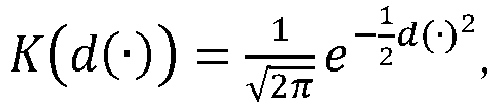
giving the working condition Xd at a time d, firstly, calculating the probability that the working condition is distributed to the classification of various existing historical working conditions, and recording the result as P = {pi (Xd |ci )},i = 1,2, ..., lc; then, in the classification of working conditions with the maximum probability, selecting first lk working conditions under the classification of the working conditions through a k-nearest neighbor algorithm, which is denoted as:
Recording the center point of the classification of the remaining working conditions as:

The sub-model adopts a single-layer full connected neural network, the number of nodes of the network is consistent with the size of input variables, and the Sigmoid activation function is selected as the activation function to accelerate the training speed; - Step 5: building a multi-scale information neural network integrated model for collaborative optimization of sub-model parameters,
Wherein the integrated model consists of a single-layer neural network, the number of input source variables is 3, corresponding to outputs of the three prediction sub-models established in thesteps 2 to 4, and the number of output variables is 1, which indicates the prediction value of comprehensive alumina production indexes; the Sigmoid activation function is selected as the nonlinear activation function of the output nodes; the integrated model trains network parameters of the three prediction sub-models at the same time according to the gradient information of the prediction error loss function of the comprehensive alumina production indexes, i.e. the training errors of the model can be reversely propagated to the input layer of the prediction sub-model reflecting the influence of various types of information on the comprehensive alumina production indexes at the same time, and the weight of each type of input information is subjected to common influence of other input information on the training errors of the model at the same time, so that the collaborative optimization of the influence weight of different time scale information on the comprehensive alumina production indexes is realized, and besides, the complexity of the prediction sub-models is reduced;
In the common training process of a multi-scale information neural network integrated model for collaborative optimization of sub-model parameters, an AdaGrad algorithm is selected for parameter updating of the multi-scale deep splicing convolutional neural network prediction sub-model, and a random gradient descent method is selected for parameter updating of the other two single-layer full connected neural network sub-models. - Step 6: performing optimization decision-making on the comprehensive alumina production indexes through the established models:
According to one or more models established for comprehensive alumina production indexes, performing single-objective or multi-objective optimization decision-making; and giving the boundary conditions of decision-making variables, and performing optimization decision-making through a single-objective or multi-objective optimization algorithm, so as to obtain the optimization decision-making result of the comprehensive alumina production indexes. - Finally, it should be noted that the above embodiment is only used to illustrate without limiting the technical solution of the invention; although the invention has been described in detail with reference to the foregoing embodiment, it should be understood by those skilled in the art that these technical solutions described in the foregoing embodiment may be modified or some or all of its technical features equivalently may be substituted; and however, these modifications or substitutions do not cause the essence of the corresponding technical solution to depart from the scope defined by the claims of the invention.
Claims (7)
- A decision-making method of comprehensive alumina production indexes based on a multi-scale deep convolutional network, comprising the following steps:step 1: collecting production index data generated in an alumina production process, partitioning the collected production index data into a training dataset, a validation dataset and a test dataset by using a sample partition algorithm, and pre-processing the data by using a data pre-processing algorithm so as to obtain data which can be used for modelling;step 2: constructing a multi-scale deep splicing convolutional network prediction sub-model which reflects influence of bottom-layer production process indexes on the comprehensive alumina production indexes;
forming an information matrix by a sampling value of alumina production process indexes closely related to final comprehensive alumina production indexes for a period of time, which is expressed as follows:
wherein the multi-scale deep splicing convolutional network prediction sub-model reflecting the influence of the bottom-layer production process indexes on the comprehensive alumina production indexes comprises 3 multi-scale convolutional layers, 3 pooling layers, 1 common convolutional layer, 1 full connected layer and an output transformation layer;step 3: constructing a full connected neural network prediction sub-model which reflects influence of alumina upper-layer dispatching indexes on the comprehensive alumina production indexes;
forming an information matrix by a sampling value of the upper-layer dispatching indexes in a period of time, which is expressed as follows: step 4: constructing the full connected neural network prediction sub-model which reflects influence of the comprehensive alumina production indexes at a past time on current comprehensive alumina production indexes:step 4.1: defining a sample set of historical working conditions: simply expressing working conditions {Xd, Yd} through initial production conditions and Xd of the upper-layer dispatching indexes, and besides, forming the sample setT' = {(Xd , Z d+1)} ⊂ T of the historical working conditions from corresponding comprehensive alumina production indexes, wherein d = 1,2, ..., nd ;step 4.2: grouping the historical working conditions:
firstly, adopting an automatic clustering method based on a Gaussian mixed model so as to obtain classification of the historical working conditions; expressing a clustering result asC = {c 1, ..., clc }, wherein lc is a number of the obtained historical working conditions;step 4.3: searching for the comprehensive alumina production indexes at the past time related to current working conditions so as to obtain comprehensive alumina production index information not only including correlation information of the comprehensive alumina production indexes at the past time, but also including correlation information of the historical working conditions and the current working conditions of the comprehensive alumina production indexes,
wherein the sub-model adopts a single-layer full connected neural network, the number of nodes of the full connected network is consistent with a size of input variables, and the Sigmoid activation function is selected as an activation function;step 5: building a multi-scale information neural network integrated model for collaborative optimization of sub-model parameters,
the integrated model consists of a single-layer neural network, wherein a number of input source variables is 3, corresponding to outputs of the three prediction sub-models established in the steps 2 to 4, and a number of output variables is 1, which indicates a prediction value of the comprehensive alumina production indexes; the Sigmoid activation function is selected as a nonlinear activation function of output nodes; the integrated model trains network parameters of the three prediction sub-models at the same time according to gradient information of a prediction error loss function of the comprehensive alumina production indexes, i.e. training errors of the integrated model can be reversely propagated to an input layer of the prediction sub-model reflecting influence of various types of information on the comprehensive alumina production indexes at the same time, and a weight of each type of input information is subjected to common influence of other input information on the training errors of the integrated model at the same time, so that the collaborative optimization of influence weight of different time scale information on the comprehensive alumina production indexes is realized, and besides, complexity of the prediction sub-models is reduced; andstep 6: performing optimization decision-making on the comprehensive alumina production indexes through the established models:according to one or more models established for the comprehensive alumina production indexes, performing single-objective or multi-objective optimization decision-making; andgiving boundary conditions of decision-making variables, and performing the optimization decision-making through a single-objective or multi-objective optimization algorithm, so as to obtain an optimization decision-making result of the comprehensive alumina production indexes. - The decision-making method according to claim 1, wherein the bottom-layer production process indexes in the step 2 comprise: grinding AO and A/S, ore adjustment Nk, ore adjustment solid content, lime effective calcium, bauxite slurry solid content, bauxite slurry fineness, digestion red mud A/S, digestion red mud N/S, discharge A/S, digestion ak, digestion solid content, green liquor Nk, green liquor ak, green liquor seston, pregnant liquor seston, circulating spent liquor Nc/Nt and Nk, circulation efficiency, seed precipitation spent liquor seston, seed precipitation end tank ak, decomposition rate, flat plate filter cakes with water and alkali, flat spent seston, decomposition spent liquor ak and water content of red mud filter cakes.
- The decision-making method according to claim 1, wherein the multi-scale convolutional layer in the step 2 uses convolutional kernels of 3 sizes at the same time to perform convolution operations in parallel, and splices multi-scale features obtained together as an input of next layer; in a convolutional process, a size of the convolutional kernels isk' × k', k' = 1,3,5, a moving stride is 1, and a filling and complementing manner during convolution isk'/2complementing to ensure that sizes of the output features obtained under the size of each convolutional kernel are consistent;
an output of the multi-scale convolutional layer comprises two parts: one part of the output is obtained by splicing the multi-scale features obtained under different sizes of the convolutional kernels and is used as the input of the next layer; the other part of the output is obtained by optimizing a selection method, firstly, a corresponding output under each scale feature is calculated, and then a corresponding scale feature which maximizes the output is selected as an optimal scale feature of the layer to be used as the output and is directly connected toa final full connected layer;
the size of the convolutional kernel in the common convolutional layer is 1×1; a downsampling manner in each pooling layer is Max pooling, and the moving stride and a downsampling ratio are both sr = 2; all the convolutional layers use a ReLU activation function; and
the full connected layer is obtained by a cross-layer splicing manner of the optimal scale features of all the convolutional layers, and contains the optimal scale features at various abstract levels. - The decision-making method according to claim 1, wherein the upper-layer dispatching indexes in the step 3 comprise feed quantity, total alkali liquor storage amount, a diaphragm pump, a roller mill, a ball mill, a leaf filter, a reclaimer, a vertical plate, an external discharge pump, an evaporator, roaster operation time, alkali liquor addition amount, whole-day ash discharge amount, total digestion feed quantity, ore breaking quantity and whole-day ore discharge quantity.
- The decision-making method according to claim 1, wherein the comprehensive alumina production indexes in the step 4 comprise commercial alumina yield, actual alumina yield, aluminium hydroxide yield, alumina soda consumption, alumina energy consumption and alumina grade rate.
- The decision-making method according to claim 5, wherein a specific method of the step 4.3 comprises the steps of:performing correlation measurement on the comprehensive alumina production indexes at the past time, which are to be selected and related to the current working condition, through a Gaussian kernel function, as shown in the following formula:
 giving a working condition Xd at a time d, firstly, calculating the probability that the working condition is distributed to the classification of various existing historical working conditions, and recording a result as P = {pi (Xd |ci )}, i = 1,2, ... , lc ; then, in the classification of working conditions with a maximum probability, selecting first lk working conditions under the classification of the working conditions through a k-nearest neighbour algorithm, which is denoted as:
 recording a center point of the classification of the remaining working conditions as:

- The decision-making method according to claim 1, wherein,in a common training process of the multi-scale information neural network integrated model for the collaborative optimization of sub-model parameters, built in the step 5, an AdaGrad algorithm is selected for parameter updating of the multi-scale deep splicing convolutional neural network prediction sub-model, and a random gradient descent method is selected for parameter updating of other two single-layer full connected neural network sub-models.
Applications Claiming Priority (2)
| Application Number | Priority Date | Filing Date | Title |
|---|---|---|---|
| CN201910640653.9A CN110378799B (en) | 2019-07-16 | 2019-07-16 | Alumina comprehensive production index decision method based on multi-scale deep convolution network |
| PCT/CN2019/096331 WO2021007801A1 (en) | 2019-07-16 | 2019-07-17 | Aluminum oxide comprehensive production index decision-making method based on multi-scale deep convolutional network |
Publications (2)
| Publication Number | Publication Date |
|---|---|
| EP3792718A1 true EP3792718A1 (en) | 2021-03-17 |
| EP3792718A4 EP3792718A4 (en) | 2021-05-05 |
Family
ID=68253418
Family Applications (1)
| Application Number | Title | Priority Date | Filing Date |
|---|---|---|---|
| EP19906600.2A Withdrawn EP3792718A4 (en) | 2019-07-16 | 2019-07-17 | DECISION-MAKING PROCESS RELATING TO GLOBAL ALUMINUM OXIDE PRODUCTION INDICES BASED ON A MULTI-SCALE DEEP CONVOLUTION NETWORK |
Country Status (5)
| Country | Link |
|---|---|
| US (1) | US11487962B2 (en) |
| EP (1) | EP3792718A4 (en) |
| JP (1) | JP7078294B2 (en) |
| CN (1) | CN110378799B (en) |
| WO (1) | WO2021007801A1 (en) |
Cited By (1)
| Publication number | Priority date | Publication date | Assignee | Title |
|---|---|---|---|---|
| CN117077979A (en) * | 2023-10-13 | 2023-11-17 | 江苏甬金金属科技有限公司 | A titanium belt production management method and system |
Families Citing this family (38)
| Publication number | Priority date | Publication date | Assignee | Title |
|---|---|---|---|---|
| WO2013179102A1 (en) | 2012-05-29 | 2013-12-05 | NLT-Spine Ltd. | Laterally deflectable implant |
| US10231770B2 (en) | 2015-01-09 | 2019-03-19 | Medtronic Holding Company Sárl | Tumor ablation system |
| CN110363355B (en) * | 2019-07-16 | 2022-11-29 | 东北大学 | Cloud-edge collaborative forecasting system and method for alumina production index |
| CN110866659B (en) * | 2019-12-09 | 2023-08-15 | 东北大学 | On-line prediction method for caustic ratio in high-pressure pipeline digestion process of Bayer process alumina production |
| US11484355B2 (en) | 2020-03-02 | 2022-11-01 | Medtronic Holding Company Sàrl | Inflatable bone tamp and method for use of inflatable bone tamp |
| EP4281916A1 (en) * | 2021-01-19 | 2023-11-29 | Telefonaktiebolaget LM Ericsson (publ) | Method and system to predict network performance using a hybrid model incorporating multiple sub-models |
| CN112861071B (en) * | 2021-02-05 | 2022-09-02 | 哈尔滨工程大学 | High-speed rail traction system anomaly detection method based on depth self-coding |
| CN113608506B (en) * | 2021-06-18 | 2022-10-25 | 东北大学 | Intelligent detection device for alumina operation index |
| CN113642448B (en) * | 2021-08-09 | 2024-01-26 | 中国人民解放军海军航空大学航空作战勤务学院 | Image recognition method and device for sea/ground maneuvering target by air platform |
| CN113674844A (en) * | 2021-08-19 | 2021-11-19 | 浙江远图互联科技股份有限公司 | Hospital outpatient flow prediction and triage system based on multi-head CNN network |
| CN113762609B (en) * | 2021-08-27 | 2024-09-06 | 浙江天垂科技有限公司 | Product quality prediction method and device |
| CN113657042B (en) * | 2021-09-01 | 2024-11-05 | 中国人民解放军国防科技大学 | A method for air quality parameter prediction based on multi-scale attention mechanism |
| CN114386326B (en) * | 2021-12-29 | 2024-10-18 | 浙江大学 | A method for predicting the composition of high-lead slag in smelting furnace based on multi-scale feature extraction of multivariate time series |
| CN114564879B (en) * | 2022-01-11 | 2024-11-05 | 东北大学 | An online prediction method for annealing strip hardness based on multi-scale data fusion |
| CN114912074A (en) * | 2022-04-07 | 2022-08-16 | 华北电力大学 | Intelligent calculation method for manufacturing production based on data space multi-value chain statistical analysis |
| CN114519311B (en) * | 2022-04-21 | 2022-07-22 | 中国海洋大学 | Prediction method, system, storage medium and application of effective wave height in the whole port pool |
| CN114781875B (en) * | 2022-04-25 | 2024-08-02 | 四川中电启明星信息技术有限公司 | Micro-grid economic operation state evaluation method based on deep convolution network |
| CN114841076B (en) * | 2022-05-18 | 2025-05-09 | 杭州电子科技大学 | Abnormal detection method for power battery production process fluctuation based on spatiotemporal graph model |
| CN114781280B (en) * | 2022-06-21 | 2022-09-30 | 烟台国工智能科技有限公司 | Interactive yield optimization method and system based on recurrent neural network |
| CN115358293A (en) * | 2022-07-27 | 2022-11-18 | 南京凯盛国际工程有限公司 | Combination method for reducing interference of system deviation on evaluation result |
| CN115641498A (en) * | 2022-09-01 | 2023-01-24 | 福建师范大学 | Medium-term rainfall forecast post-processing correction method based on space multi-scale convolutional neural network |
| CN115619050B (en) * | 2022-12-19 | 2023-03-28 | 绵阳丰瑞尚雅木业有限公司 | Method and system for predicting processing quality of fireproof aluminum-wood veneer and storage medium |
| WO2024182962A1 (en) * | 2023-03-06 | 2024-09-12 | 青海省地质矿产勘查开发局 | Target selection method for lithium and potassium-containing anticline |
| CN117236571B (en) * | 2023-11-14 | 2024-01-12 | 北京南天智联信息科技股份有限公司 | Planning method and system based on Internet of things |
| CN117436771B (en) * | 2023-12-20 | 2024-03-08 | 天津撒布浪斯探测仪器有限公司 | Intelligent on-line quality monitoring and optimizing control system for vermicular cast iron products |
| CN118114998B (en) * | 2024-01-11 | 2025-05-27 | 浙江大学长三角智慧绿洲创新中心 | Neural network-based water supply pipeline cleaning auxiliary decision-making method |
| CN117575581B (en) * | 2024-01-16 | 2024-04-26 | 江苏中凯金属科技有限公司 | Aluminum rod production method for recycling waste aluminum materials |
| CN117975167B (en) * | 2024-03-27 | 2024-09-10 | 华东交通大学 | Weak spot ore separation method, device, readable storage medium and equipment |
| CN118734992A (en) * | 2024-06-05 | 2024-10-01 | 安徽工业大学科技园有限公司 | A deep learning prediction method based on dynamic weighting mechanism |
| CN118800354B (en) * | 2024-09-14 | 2024-12-06 | 江苏晶晶新材料有限公司 | An intelligent detection and setting system for alumina dissolution process |
| CN118818993B (en) * | 2024-09-20 | 2024-12-27 | 中南大学 | Zinc leaching multi-condition control method and system based on regression DeepRED rule extraction |
| CN119071123B (en) * | 2024-09-27 | 2025-11-11 | 南京大学 | Online automatic modulation classification method based on isolation distribution core |
| CN119067406B (en) * | 2024-11-01 | 2025-03-25 | 浙江广芯微电子有限公司 | Process Parameter Optimization Method for Trench Schottky Structure |
| CN119476037B (en) * | 2024-11-22 | 2025-04-25 | 南京岳家军氢电科技发展有限公司 | Intelligent management system of integrated hydrogen production and hydrogen adding station |
| CN119312987B (en) * | 2024-12-12 | 2025-04-15 | 国网浙江省电力有限公司永康市供电公司 | Comprehensive energy system operation optimization method based on multiple strategy combination optimization |
| CN120123274B (en) * | 2025-02-26 | 2025-09-09 | 杭州电子科技大学 | Method for supporting acceleration cross-layer memory access bandwidth optimization of deep neural network |
| CN120040052A (en) * | 2025-04-24 | 2025-05-27 | 福建南方路面机械股份有限公司 | On-line adjustment method and device for mud treatment formula based on radar belt scale |
| CN121071612B (en) * | 2025-10-30 | 2026-02-17 | 中南大学 | A method for identifying the operating conditions of a belt roaster based on a multi-scale temporal convolutional neural network |
Family Cites Families (13)
| Publication number | Priority date | Publication date | Assignee | Title |
|---|---|---|---|---|
| CN105467946B (en) * | 2015-02-05 | 2018-04-20 | 贵阳铝镁设计研究院有限公司 | A kind of aluminum electrolysis accurately perceives and Intelligent Decision-making Method and MES system |
| CN105259790B (en) * | 2015-11-16 | 2018-03-06 | 中南大学 | A kind of temporal registration method of alumina producing evaporation process Multi-parameter data |
| CN105483310B (en) | 2015-11-23 | 2017-05-10 | 东北大学 | Steelmaking batch grouping and production scheduling method for whole process production |
| JP6639987B2 (en) * | 2016-03-29 | 2020-02-05 | 太平洋セメント株式会社 | How to predict cement quality or manufacturing conditions |
| CN106096632A (en) * | 2016-06-02 | 2016-11-09 | 哈尔滨工业大学 | Based on degree of depth study and the ventricular function index prediction method of MRI image |
| US20200024712A1 (en) * | 2016-09-30 | 2020-01-23 | Uacj Corporation | Device for predicting aluminum product properties, method for predicting aluminum product properties, control program, and storage medium |
| CN106991646B (en) * | 2017-03-28 | 2020-05-26 | 福建帝视信息科技有限公司 | Image super-resolution method based on dense connection network |
| JP6922675B2 (en) * | 2017-11-09 | 2021-08-18 | 日本製鉄株式会社 | Manufacturing process state predictors, methods and programs, and manufacturing process control systems |
| CN108469797B (en) * | 2018-04-28 | 2020-09-29 | 东北大学 | Neural network and evolutionary computation based ore grinding process modeling method |
| CN109033561A (en) * | 2018-07-05 | 2018-12-18 | 平安煤炭开采工程技术研究院有限责任公司 | Mine ventilation system anti-disaster ability evaluation method and device |
| CN108873737B (en) * | 2018-07-18 | 2020-12-25 | 东北大学 | Automatic sorting control and decision-making system based on M-HSTPN model |
| CN109086700B (en) * | 2018-07-20 | 2021-08-13 | 杭州电子科技大学 | A radar one-dimensional range image target recognition method based on deep convolutional neural network |
| CN109376939B (en) * | 2018-11-01 | 2021-08-10 | 三峡大学 | Power grid stability real-time prediction method based on adaptive neural network |
-
2019
- 2019-07-16 CN CN201910640653.9A patent/CN110378799B/en active Active
- 2019-07-17 US US16/955,490 patent/US11487962B2/en active Active
- 2019-07-17 EP EP19906600.2A patent/EP3792718A4/en not_active Withdrawn
- 2019-07-17 JP JP2020541523A patent/JP7078294B2/en active Active
- 2019-07-17 WO PCT/CN2019/096331 patent/WO2021007801A1/en not_active Ceased
Cited By (2)
| Publication number | Priority date | Publication date | Assignee | Title |
|---|---|---|---|---|
| CN117077979A (en) * | 2023-10-13 | 2023-11-17 | 江苏甬金金属科技有限公司 | A titanium belt production management method and system |
| CN117077979B (en) * | 2023-10-13 | 2023-12-26 | 江苏甬金金属科技有限公司 | Titanium belt production management method and system |
Also Published As
| Publication number | Publication date |
|---|---|
| US20210192272A1 (en) | 2021-06-24 |
| WO2021007801A1 (en) | 2021-01-21 |
| US11487962B2 (en) | 2022-11-01 |
| EP3792718A4 (en) | 2021-05-05 |
| CN110378799B (en) | 2022-07-12 |
| JP7078294B2 (en) | 2022-05-31 |
| JP2021534055A (en) | 2021-12-09 |
| CN110378799A (en) | 2019-10-25 |
Similar Documents
| Publication | Publication Date | Title |
|---|---|---|
| US11487962B2 (en) | Decision-making method of comprehensive alumina production indexes based on multi-scale deep convolutional network | |
| CN111144496B (en) | Garbage classification method based on hybrid convolutional neural network | |
| CN107392232B (en) | A method and system for classification of flotation conditions | |
| CN109300111B (en) | Chromosome recognition method based on deep learning | |
| Yin et al. | Recognition of grape leaf diseases using MobileNetV3 and deep transfer learning | |
| CN110533640A (en) | Identification method of track line disease based on improved YOLOv3 network model | |
| CN107451602A (en) | A kind of fruits and vegetables detection method based on deep learning | |
| CN117113162B (en) | Eddar-rock structure background discrimination and graphic method integrating machine learning | |
| CN108388762A (en) | Sinter chemical composition prediction technique based on depth confidence network | |
| CN108647643A (en) | A kind of packed tower liquid flooding state on-line identification method based on deep learning | |
| CN111008726B (en) | Class picture conversion method in power load prediction | |
| CN106257498A (en) | Zinc flotation work condition state division methods based on isomery textural characteristics | |
| CN115797637A (en) | Semi-Supervised Segmentation Models Based on Between-Model and Intra-Model Uncertainty | |
| CN114511850A (en) | Method for identifying image of fruit size and granule of sunshine rose grape | |
| CN115545267A (en) | Flotation recovery rate prediction method based on significance P value and XGboost | |
| Rethik et al. | Attention based mapping for plants leaf to classify diseases using vision transformer | |
| CN114266965A (en) | A multi-task learning-based method for identification of Citrus aurantium diseases and insect pests | |
| CN120822671B (en) | Flotation grade prediction method based on dynamic hypergraph and Informer-GRU | |
| Zhang et al. | Multivariable collaborative modeling with knowledge transfer and its application in soft sensing of iron flotation grade | |
| CN115481715B (en) | A product quality index prediction method and system based on AM-GRU-BPNN | |
| CN116524297B (en) | Weak supervision learning training method based on expert feedback | |
| CN118606739A (en) | A method for optimizing froth velocity by integrating multi-source flotation operating information | |
| Gan et al. | A method for steel surface defect recognition based on deep learning and receptive field block | |
| Li et al. | Corn disease detection based on an improved YOLOX-Tiny network model | |
| CN115690784A (en) | A classification method for scanning electron microscope images of uranium minerals based on deep learning |
Legal Events
| Date | Code | Title | Description |
|---|---|---|---|
| STAA | Information on the status of an ep patent application or granted ep patent |
Free format text: STATUS: UNKNOWN |
|
| STAA | Information on the status of an ep patent application or granted ep patent |
Free format text: STATUS: THE INTERNATIONAL PUBLICATION HAS BEEN MADE |
|
| PUAI | Public reference made under article 153(3) epc to a published international application that has entered the european phase |
Free format text: ORIGINAL CODE: 0009012 |
|
| STAA | Information on the status of an ep patent application or granted ep patent |
Free format text: STATUS: REQUEST FOR EXAMINATION WAS MADE |
|
| 17P | Request for examination filed |
Effective date: 20200710 |
|
| AK | Designated contracting states |
Kind code of ref document: A1 Designated state(s): AL AT BE BG CH CY CZ DE DK EE ES FI FR GB GR HR HU IE IS IT LI LT LU LV MC MK MT NL NO PL PT RO RS SE SI SK SM TR |
|
| AX | Request for extension of the european patent |
Extension state: BA ME |
|
| A4 | Supplementary search report drawn up and despatched |
Effective date: 20210407 |
|
| RIC1 | Information provided on ipc code assigned before grant |
Ipc: G06N 3/08 20060101AFI20210330BHEP Ipc: G06N 3/04 20060101ALI20210330BHEP Ipc: G06N 7/00 20060101ALI20210330BHEP Ipc: G06N 20/00 20190101ALI20210330BHEP Ipc: G05B 19/418 20060101ALI20210330BHEP Ipc: G06Q 10/06 20120101ALI20210330BHEP |
|
| STAA | Information on the status of an ep patent application or granted ep patent |
Free format text: STATUS: THE APPLICATION IS DEEMED TO BE WITHDRAWN |
|
| 18D | Application deemed to be withdrawn |
Effective date: 20211109 |