EP3790495B1 - Simulated orthodontic treatment via augmented visualization in real-time - Google Patents
Simulated orthodontic treatment via augmented visualization in real-time Download PDFInfo
- Publication number
- EP3790495B1 EP3790495B1 EP19800352.7A EP19800352A EP3790495B1 EP 3790495 B1 EP3790495 B1 EP 3790495B1 EP 19800352 A EP19800352 A EP 19800352A EP 3790495 B1 EP3790495 B1 EP 3790495B1
- Authority
- EP
- European Patent Office
- Prior art keywords
- user
- image
- face
- virtual
- electronic
- Prior art date
- Legal status (The legal status is an assumption and is not a legal conclusion. Google has not performed a legal analysis and makes no representation as to the accuracy of the status listed.)
- Active
Links
Images


Classifications
-
- A—HUMAN NECESSITIES
- A61—MEDICAL OR VETERINARY SCIENCE; HYGIENE
- A61B—DIAGNOSIS; SURGERY; IDENTIFICATION
- A61B5/00—Measuring for diagnostic purposes; Identification of persons
- A61B5/0059—Measuring for diagnostic purposes; Identification of persons using light, e.g. diagnosis by transillumination, diascopy, fluorescence
- A61B5/0077—Devices for viewing the surface of the body, e.g. camera, magnifying lens
-
- A—HUMAN NECESSITIES
- A61—MEDICAL OR VETERINARY SCIENCE; HYGIENE
- A61B—DIAGNOSIS; SURGERY; IDENTIFICATION
- A61B6/00—Apparatus or devices for radiation diagnosis; Apparatus or devices for radiation diagnosis combined with radiation therapy equipment
- A61B6/50—Apparatus or devices for radiation diagnosis; Apparatus or devices for radiation diagnosis combined with radiation therapy equipment specially adapted for specific body parts; specially adapted for specific clinical applications
- A61B6/51—Apparatus or devices for radiation diagnosis; Apparatus or devices for radiation diagnosis combined with radiation therapy equipment specially adapted for specific body parts; specially adapted for specific clinical applications for dentistry
-
- A—HUMAN NECESSITIES
- A61—MEDICAL OR VETERINARY SCIENCE; HYGIENE
- A61B—DIAGNOSIS; SURGERY; IDENTIFICATION
- A61B6/00—Apparatus or devices for radiation diagnosis; Apparatus or devices for radiation diagnosis combined with radiation therapy equipment
- A61B6/40—Arrangements for generating radiation specially adapted for radiation diagnosis
- A61B6/4064—Arrangements for generating radiation specially adapted for radiation diagnosis specially adapted for producing a particular type of beam
- A61B6/4085—Cone-beams
-
- A—HUMAN NECESSITIES
- A61—MEDICAL OR VETERINARY SCIENCE; HYGIENE
- A61B—DIAGNOSIS; SURGERY; IDENTIFICATION
- A61B6/00—Apparatus or devices for radiation diagnosis; Apparatus or devices for radiation diagnosis combined with radiation therapy equipment
- A61B6/46—Arrangements for interfacing with the operator or the patient
- A61B6/461—Displaying means of special interest
- A61B6/466—Displaying means of special interest adapted to display 3D data
-
- A—HUMAN NECESSITIES
- A61—MEDICAL OR VETERINARY SCIENCE; HYGIENE
- A61C—DENTISTRY; APPARATUS OR METHODS FOR ORAL OR DENTAL HYGIENE
- A61C7/00—Orthodontics, i.e. obtaining or maintaining the desired position of teeth, e.g. by straightening, evening, regulating, separating, or by correcting malocclusions
- A61C7/002—Orthodontic computer assisted systems
-
- G—PHYSICS
- G06—COMPUTING OR CALCULATING; COUNTING
- G06F—ELECTRIC DIGITAL DATA PROCESSING
- G06F3/00—Input arrangements for transferring data to be processed into a form capable of being handled by the computer; Output arrangements for transferring data from processing unit to output unit, e.g. interface arrangements
- G06F3/01—Input arrangements or combined input and output arrangements for interaction between user and computer
- G06F3/011—Arrangements for interaction with the human body, e.g. for user immersion in virtual reality
-
- G—PHYSICS
- G06—COMPUTING OR CALCULATING; COUNTING
- G06F—ELECTRIC DIGITAL DATA PROCESSING
- G06F3/00—Input arrangements for transferring data to be processed into a form capable of being handled by the computer; Output arrangements for transferring data from processing unit to output unit, e.g. interface arrangements
- G06F3/01—Input arrangements or combined input and output arrangements for interaction between user and computer
- G06F3/048—Interaction techniques based on graphical user interfaces [GUI]
-
- A—HUMAN NECESSITIES
- A61—MEDICAL OR VETERINARY SCIENCE; HYGIENE
- A61C—DENTISTRY; APPARATUS OR METHODS FOR ORAL OR DENTAL HYGIENE
- A61C7/00—Orthodontics, i.e. obtaining or maintaining the desired position of teeth, e.g. by straightening, evening, regulating, separating, or by correcting malocclusions
- A61C7/12—Brackets; Arch wires; Combinations thereof; Accessories therefor
-
- A—HUMAN NECESSITIES
- A61—MEDICAL OR VETERINARY SCIENCE; HYGIENE
- A61C—DENTISTRY; APPARATUS OR METHODS FOR ORAL OR DENTAL HYGIENE
- A61C7/00—Orthodontics, i.e. obtaining or maintaining the desired position of teeth, e.g. by straightening, evening, regulating, separating, or by correcting malocclusions
- A61C7/12—Brackets; Arch wires; Combinations thereof; Accessories therefor
- A61C7/14—Brackets; Fixing brackets to teeth
Definitions
- augmented reality face filters such as the SNAPCHAT or INSTAGRAM products
- these filters are mainly used in popular culture today for only entertainment purposes, such as to visually apply renditions of hair, make-up, eyeglasses, facial hair, and hats in real-time to the face or head of the human subject in a video augmentation.
- Kehler Jacob "Nerdy Glasses and Braces Snapchat lens, on the line social media, August 1, 2016 " describes snapchat lenses.
- the present invention is defined in the claims.
- the invention relates to a method and to a system for simulating orthodontic treatment as defined in independent claims 1 and 5, respectively.
- Embodiments of this invention include the use of computer vision and augmented reality technology to superimpose a computer-generated image on a user's view of the real world to provide a view of one, or combination, of the following:
- This technology can be used both as a tool for treatment planning by a medical/dental professional and as a tool for case presentation to a patient.
- Other intended uses include exploration of treatment options by a patient wanting to visualize their facial appearance during or after treatment, possibly switching or transitioning between before and after appearances for comparison.
- a patient may be able to entertain treatment scenarios without first visiting a medical or dental practitioner, using only superficial imagery data.
- the augmentation may require additional data, such as X-ray or cone beam computed tomography (CBCT) scan data, bite registration data, three-dimensional (3D) oral scan data, virtual articulation data, or calibrated measurements in order to generate a treatment plan that provides a more accurate rendition of the patient after treatment.
- CBCT X-ray or cone beam computed tomography
- two or more treatment scenarios may be generated and presented to the patient, thereby giving the patient a somewhat realistic view of treatment outcome. This can serve to help the patient (or doctor) in deciding on a course of action.
- the cost of treatment may be weighed against the quality of outcome. For example, the patient may forego an expensive treatment due to marginal gains in appearance over a less expensive treatment. Similar rules may be applied to the duration of treatment, where time is treated like a cost.
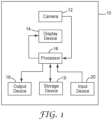
- FIG. 1 is a diagram of a system 10 for simulating orthodontic treatment.
- System 10 includes a processor 16 electronically coupled with a camera 12, a display device 14, an output device 18, a storage device 19, and an input device 20.
- Camera 12 can be implemented with, for example, a digital image sensor providing electronic digital images or video.
- Display device 14 can be implemented with any electronic display, for example a Cathode Ray Tube (CRT), a liquid crystal display (LCD), light emitting diode (LED) display, or organic light emitting diode (OLED) display.
- Output device 18 can be implemented with any device for outputting information, for example a speaker, an LED indicator, or an auxiliary LCD display module.
- Input device 20 can be implemented with any device for entering information or commands, for example a keyboard, microphone, cursor-control device, or touch screen.
- Storage device 19 can be implemented with any electronic device for storing information such as a hard drive, solid state drive, or flash drive. Storage device 19 can optionally be located external to system 10 and accessed via a network connection.
- System 10 can be implemented with, for example, a desktop, notebook, or tablet computer, or a mobile phone.
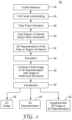
- FIG. 2 is a flow chart of a method 22 for simulating orthodontic treatment.
- This method can be implemented in software or firmware modules for execution by a processor such as processor 16.
- This method is used to visualize a simulation of an orthodontic treatment through augmentation, a virtual overlay onto an image captured of the real world, possibly with manipulation of an estimated 3D representation of a face captured in one or more frames of video in real-time.
- step 24 Facial Detection
- step 26 Full Facial Landmarking
- step 28 Face Pose Estimation
- step 30 Crop Region of Interest Using Facial Landmarks
- step 32 optional 3D Representation of the Face or region of interest
- step 34 optional supplementation of the image or 3D Representation of the Face
- step 36 Visualization
- This step finds a face in a frame of video from camera 12 using a pre-trained model, such as a Viola-Jones Model, an LBPH (Local Binary Pattern Histogram) cascade, or a model trained through deep learning.
- a face context may be created to keep track of this face over multiple frames.
- This face context may contain previous frame data, such as important features used in reprojection, or a point cloud obtained over multiple previous frames.
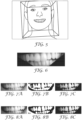
- FIG. 3 is a representation of an image illustrating an example of a detected face as received from camera 12, where the box in the image indicates the area of detection.
- the image in FIG. 3 can optionally be an image of a user with orthodontic appliances in order to virtually remove the appliances rather than virtually adding appliances.
- Landmarks are points of interest describing important structures on the face, and can be found using a shape predictor model which may use an SVM (Support Vector Machine), PCA (Principal Component Analysis), or deep learning and other machine learning algorithms like random forests. These landmarks are used to crop the face or region of interest from the background, and in this example, will be used for rough face pose estimation using a generalized 3D landmark model. They can also be used in the steps below to morph a generalized face mesh to more accurately represent the face detected in the video.
- FIG. 4 is a representation of an image illustrating facial landmarking, where the detected area from the image of FIG. 3 includes dots, or other indicia, for the landmarking.
- an estimated camera extrinsic model can be found by solving the general Perspective N-Point (PNP) problem. Solving the PNP problem assumes the detected landmarks have not been affected by camera lens distortion (radial/tangential lens distortion), or have been undistorted.
- An SfM (Structure from Motion) technique could instead be applied on static (non-moving) parts of the face once the feature matching step below has been completed on multiple sequential frames to obtain a more accurate camera extrinsic model. Knowing the camera extrinsics provides a good 3D point representation of each of the landmarks which can help indicate the pose and further be used for more accurate augmented reality. This allows more accurate cropping of the region of interest for performing augmented reality, but it is not a required step.
- FIG. 5 is a representation of an image illustrating face pose estimation as indicated by the two boxes on the image from FIG. 3 .
- FIG. 6 illustrates a cropped region of interest from the images of FIGS. 3-5 .
- Method 1 The first method that could be employed is to generate a 3D mesh over multiple frames of video, using Reprojection and Mesh reconstruction.
- Reprojection is the process of finding the depth of features in one of the images, turning the features into a 3D point cloud.
- Mesh reconstruction is the technique used to produce a triangle mesh from that point cloud. This assumes more than one image of the same face, where the images have been taken from slightly different angles and locations. The following are the steps of this Method 1.
- Method 2 This method involves a parametric representation of the face or region of interest (e.g., NURBS surface or Bézier surface), or a generic polygonal mesh (i.e., triangles or quadrilaterals), which will be morphed, expanded, or stretched to best fit either a point cloud of the face (see Method 1) or a set of landmarks obtained earlier. If using a generic mesh of a face or region of interest, vertices within the mesh could be assigned weights to landmarks. When the landmarks are found in the image, the vertices of the generic mesh would be pulled towards those landmarks based on their given weights and face pose.
- a parametric representation of the face or region of interest e.g., NURBS surface or Bézier surface
- a generic polygonal mesh i.e., triangles or quadrilaterals
- the topology of the surface could be predefined only in the abstract, such as by graph-theoretical relationships between landmarks or regions outlined by lines between landmarks.
- the NURBS surface or mesh could be generated such that the landmarks coincide with the corners of the surface patches.
- additional points may be necessarily captured in the regions between landmarks, and these points can serve to more accurately define the parameters of the surfaces: control points and polynomial coefficients in the case of NURBS or intermediate vertices in the case of tessellated mesh surfaces.
- Any distinct feature of the face can serve as a landmark or control point in a mesh or parametric model. As such, the accuracy of the model can be improved by increasing the resolution of the video imagery to the extent that these minute features are both visible and recognizable.
- the virtual treatment can be applied, either through augmentation or manipulation of the 3D geometry. This may include pin-pointing locations or areas to apply the simulation.
- augmentation is implemented, where the rendered orthodontic appliance is overlaid onto the region of interest, after estimating the location on the region of interest where the appliance should be placed, or where detected appliances are virtually removed from the region of interest.
- extra steps may need to be taken, such as filling any holes in the image that result from morphing the 3D geometry.
- the rendered orthodontic appliance can be represented by a 2D image or a 3D model.
- various image processing techniques are used on the region of interest to segment and identify the teeth, which include scaling-up the region of interest, noise reduction, applying a segmentation algorithm such as Mean Shift segmentation, histogram equalization, adaptive thresholding on specific channels of multiple color spaces, eroding and dilating (opening/closing), edge detection, and finding contours.
- a segmentation algorithm such as Mean Shift segmentation, histogram equalization, adaptive thresholding on specific channels of multiple color spaces, eroding and dilating (opening/closing), edge detection, and finding contours.
- FIGS. 7A-7C illustrate adaptive thresholding applied to inverted green-red channel of lab color space of region of interest: inverted channel "a" (green-red) of lab color space ( FIG. 7A ), mask after adaptive thresholding applied ( FIG. 7B ), and color image of region of interest with mask applied ( FIG. 7C).
- FIGS. 8A-8C illustrate adaptive thresholding applied to luminance channel of YUV color space of region of interest: channel "Y" (luminance) of YUV color space ( FIG. 8A ), mask after adaptive thresholding applied combined (bitwise and) with mask from Lab color space adaptive threshold ( FIG. 8B ), and final color image of region of interest with combined mask applied ( FIG. 8C ).
- FIGS. 9A and 9B illustrate, respectively, opening and closing of region of interest mask after color space thresholding.
- FIG. 10 illustrates detected edges from canny edge detection.
- Contours can be generated from the detected edges, where individual teeth or groups of teeth can be analyzed or worked with as standalone objects.
- FIG. 11 illustrates closed contours found from detected edges, overlaid onto a color region of interest.
- FIG. 12 illustrates virtual rendering of treatment, in this example brackets and archwires.
- the virtual rendering can involve removing detected appliances such as brackets and archwires.
- the rendered treatment is augmented onto the region of interest.
- Post processing can be done, such as Gaussian blur, to blend the augmented treatment with the original image and make the final image appear more natural, as if it were a part of the original image.
- FIG. 13 illustrates augmentation of treatment, where the virtual brackets and archwires are overlaid on the teeth within the region of interest.
- the augmentation can involve removing detected appliances and displaying the result. Augmentation can be achieved without explicitly segmenting out individual teeth and contours but by doing direct registration of end points of the mouth with end points of teeth. However, identifying each tooth center even approximately provides a more accurate/realistic result.
- Another approach to augmenting images of the face with appliances, restorations, or modified anatomies involves another aspect of 3D modeling.
- the approach described above uses 3D modeling to determine the position, orientation, and scale of the face, which may be mathematically described by a 3D Affine transform in a virtual universe.
- a corresponding transform is then applied to the dental appliances so that they register to the teeth of the patient in somewhat realistic positions and orientations, although 2D image analysis may ultimately be used to find the Facial Axis (FA) points of the teeth at which to place brackets.
- FA Facial Axis
- the video camera may be used as a type of 3D scanner, thereby capturing multiple 2D images of a person's face from different vantage points (i.e., viewpoints and look-at vectors, which together with the image plane form a set of distinct view frustums).
- vantage points i.e., viewpoints and look-at vectors, which together with the image plane form a set of distinct view frustums.
- a 3D model of the person's face (and head) may be generated, originally in the form of a point cloud, then later in the form of a triangular mesh.
- UV mapping or texture mapping
- an image of the 3D model may be rendered onto a 2D plane that is positioned anywhere in the virtual universe according to a view frustum.
- Suitable rendering methods include polygon rendering or ray tracing.
- the color values from the UV map would be applied in the rendering to generate a more realistic, color rendition of the face (as opposed to a monochromatic mesh model shaded only by triangle orientation relative to both the view point and each light source in the scene).
- the 3D model of the face can be combined or integrated (or simply registered) with other 3D models or images that were optionally obtained from different scan sources, such as intraoral scanners, Cone Beam CT (CBCT or 3D X-ray) scanners, MRI scanners, 3D stereoscopic cameras, and the like. Such data would likely have been obtained at earlier dates and used in treatment planning.
- Such other models or images can be stored in and retrieved from, for example, data storage 19.
- the video imagery may serve as the sole source of superficial 3D imagery, thus capturing the soft tissues of the face and whatever dental anatomy may be visible.
- soft tissue data may be captured in CBCT scans (without color information) or in 3D stereoscopic imagery. Regardless, soft tissue data is an essential component in the modeling of certain treatment plans, such as those involving orthognathic surgery, occlusion class correction (via antero-posterior dental movements), significant changes to the anterior proclination of teeth, and cosmetic and plastic surgeries. Embodiments of this invention can thus provide visual feedback to patients on their expected outward appearance resulting from treatment, during or after the treatment, or both during and after.
- a doctor may be able to conscientiously devise one or more treatment plans with a real basis in structural anatomy. These plans may be devised on the doctor's own schedule, without the patient present, and possibly in collaboration with other doctors, technicians, or service providers. Appliances or prostheses may be created and applied to the patient's natural anatomy, and the patient's naturally anatomy can be augmented or modified as part of the treatment plan. 3D virtual models of such appliances and prostheses can be created by, for example, third party labs or service providers and combined with the datasets provided by the doctor. Modified anatomies resulting from treatment can be generated by the doctor, by a third party, or as a collaborative effort using remote software collaboration tools. The treatment plan can be presented back to the patient for review, possible modification, and approval. In some scenarios, the doctor may be the reviewer, and a third party lab or manufacturer is the source of the proposed treatment plan.
- a video camera is used to capture enough frames to generate a 3D model of the patient sufficient to register his/her face to the 3D model comprising the plan, which may be based on other data sources but having at least some anatomical features in common with the newly-captured data.
- a complete re-scan of the patient's face would not be necessary, since a full scan would have already been done at an earlier date in order to facilitate the creation of a detailed treatment plan.
- a partial 3D model of the patient's current anatomy could be created, optionally cropped to remove the portions of anatomy modified by the plan, and best-fit to the plan model.
- the same view frustum may be used to represent a virtual camera, and a 2D rendering of the 3D model may be created on the view plane of this camera. This 2D rendering can then be presented back to the patient (or other observer) in real-time as the patient moves relative to the camera. In effect, the physical and virtual worlds are kept synchronous with one another.
- the same method could be used, except the pixels of these anatomies may need to be colored using previously captured values that were UV mapped onto the mesh of the plan model.
- the color values could be obtained from the current video frame but then transformed to different positions as determined by morphs to the 3D anatomy according to the treatment plan. For example, an orthognathic surgery might prescribe that the mandible be advanced by several millimeters. The color values of the pixels used to render the patient's soft tissues (skin and lips) affected by the advancement would tend not to differ as a result; only their positions in the virtual world and thus the rendering would change.
- the affected pixels in the 2D video image might simply by translated in the image plane according to a 3D Affine transform projected onto the view plane.
- the entire 3D virtual scene may be rendered in real-time and presented back to the patient in sync with their head movements.
- a technique can be employed by which the plan model is continuously augmented or updated while video is being captured for the purpose of presenting the treatment plan to the patient.
- the plan model is continuously augmented or updated while video is being captured for the purpose of presenting the treatment plan to the patient.
- the new images can be used to augment or update the existing model by filling holes, removing or joining islands, and reducing noise. In so doing, the quality of the plan model may be improved in real-time (or after a brief processing delay).
- the dimensional accuracy of the model may be improved by using large, unitary patches of scan data to adjust the positions and orientations of smaller patches that were stitched together with accumulated error.
- This technique could also be used to improve the realism of an avatar-style rendering by updating the texture map to current skin and lighting conditions. Otherwise, the texture map used on the avatar would have come from a previous scan captured at an earlier date and possibly in a different setting.
- the user's facial image or 3D representation can optionally be registered with the image or model of the user's facial anatomy using, for example, PCA or other techniques.
- the images or models are synchronized such that manipulation of one image or representation causes corresponding manipulation of the other image or representation. For example, if the user's facial image is rotated, the registered image or model of the user's facial anatomy is correspondingly rotated.
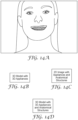
- FIG. 14A illustrates the result of treatment augmentation in a representation of a single image displayed to the user via display device 14 and within a user interface, for example.
- the single image of FIG. 14A can display the result of virtually removing detected appliances worn by the user.
- a 3D representation of the user's face is generated, using the optional step 32, then such 3D representation can be displayed augmented with the virtual treatment (40) as represented by the user interface in FIG. 14B for display on display device 14.
- a supplemented 2D image or a 3D representation is generated, using the optional step 35, then such supplemented 2D image or 3D representation can be displayed augmented with the virtual treatment (42) as represented by the user interfaces in FIGS. 14C and 14D for display on display device 14.
- Method 22 can be executed by processor 16 such that the augmentation is shown to the user on display device 14 in real-time when or shortly after detection of the user's image by camera 12.
- real-time means at a rate of at least one frame per second or, more preferably, at a rate of 15-60 frames per second.
Landscapes
- Engineering & Computer Science (AREA)
- Health & Medical Sciences (AREA)
- Life Sciences & Earth Sciences (AREA)
- Medical Informatics (AREA)
- Physics & Mathematics (AREA)
- General Engineering & Computer Science (AREA)
- Veterinary Medicine (AREA)
- Public Health (AREA)
- General Health & Medical Sciences (AREA)
- Animal Behavior & Ethology (AREA)
- Theoretical Computer Science (AREA)
- Molecular Biology (AREA)
- Biophysics (AREA)
- Heart & Thoracic Surgery (AREA)
- Biomedical Technology (AREA)
- Surgery (AREA)
- Pathology (AREA)
- Human Computer Interaction (AREA)
- Optics & Photonics (AREA)
- Nuclear Medicine, Radiotherapy & Molecular Imaging (AREA)
- High Energy & Nuclear Physics (AREA)
- Radiology & Medical Imaging (AREA)
- General Physics & Mathematics (AREA)
- Oral & Maxillofacial Surgery (AREA)
- Dentistry (AREA)
- Epidemiology (AREA)
- Processing Or Creating Images (AREA)
- Image Processing (AREA)
- Dental Tools And Instruments Or Auxiliary Dental Instruments (AREA)
Applications Claiming Priority (3)
| Application Number | Priority Date | Filing Date | Title |
|---|---|---|---|
| US201862669628P | 2018-05-10 | 2018-05-10 | |
| US201962809806P | 2019-02-25 | 2019-02-25 | |
| PCT/IB2019/053599 WO2019215550A1 (en) | 2018-05-10 | 2019-05-02 | Simulated orthodontic treatment via augmented visualization in real-time |
Publications (3)
| Publication Number | Publication Date |
|---|---|
| EP3790495A1 EP3790495A1 (en) | 2021-03-17 |
| EP3790495A4 EP3790495A4 (en) | 2022-02-09 |
| EP3790495B1 true EP3790495B1 (en) | 2024-07-24 |
Family
ID=68467593
Family Applications (1)
| Application Number | Title | Priority Date | Filing Date |
|---|---|---|---|
| EP19800352.7A Active EP3790495B1 (en) | 2018-05-10 | 2019-05-02 | Simulated orthodontic treatment via augmented visualization in real-time |
Country Status (5)
| Country | Link |
|---|---|
| US (1) | US11517272B2 (https=) |
| EP (1) | EP3790495B1 (https=) |
| JP (1) | JP7744132B2 (https=) |
| CN (1) | CN112087985B (https=) |
| WO (1) | WO2019215550A1 (https=) |
Families Citing this family (37)
| Publication number | Priority date | Publication date | Assignee | Title |
|---|---|---|---|---|
| ES2874777T3 (es) | 2012-10-30 | 2021-11-05 | Univ Southern California | Aparato de ortodoncia con arco de alambre encajado a presión, antideslizante |
| CN109195547B (zh) | 2016-04-18 | 2021-06-18 | 斯威夫特健康系统有限公司 | 具有非滑动的绑扎弓丝的牙齿正畸矫正器 |
| WO2018144634A1 (en) | 2017-01-31 | 2018-08-09 | Swift Health Systems Inc. | Hybrid orthodontic archwires |
| CN110740704B (zh) | 2017-04-21 | 2021-10-29 | 斯威夫特健康系统有限公司 | 间接粘接托盘、非滑动正畸矫正器和使用其的配准系统 |
| ES2936080T3 (es) | 2018-05-22 | 2023-03-14 | Dental Monitoring | Procedimiento de análisis de una situación dental |
| US20200275996A1 (en) | 2019-03-01 | 2020-09-03 | Swift Health Systems Inc. | Indirect bonding trays with bite turbo and orthodontic auxiliary integration |
| CN120689564A (zh) * | 2019-05-14 | 2025-09-23 | 阿莱恩技术有限公司 | 基于3d牙齿模型生成的牙龈线的视觉呈现 |
| KR20210051141A (ko) | 2019-10-30 | 2021-05-10 | 주식회사 스키아 | 환자의 증강 현실 기반의 의료 정보를 제공하는 방법, 장치 및 컴퓨터 프로그램 |
| US12053346B2 (en) | 2019-10-31 | 2024-08-06 | Swift Health Systems Inc. | Indirect orthodontic bonding systems and methods |
| US11937996B2 (en) * | 2019-11-05 | 2024-03-26 | Align Technology, Inc. | Face capture and intraoral scanner and methods of use |
| US11842484B2 (en) | 2021-01-04 | 2023-12-12 | James R. Glidewell Dental Ceramics, Inc. | Teeth segmentation using neural networks |
| US11574468B2 (en) * | 2020-03-31 | 2023-02-07 | Toyota Research Institute, Inc. | Simulation-based learning of driver interactions through a vehicle window |
| FR3111066B1 (fr) * | 2020-06-06 | 2025-07-11 | Olivier Querbes | Procédé et dispositif de reconstruction tridimensionnelle d’un visage avec partie dentée à partir d’une seule image |
| CN116075279A (zh) | 2020-06-11 | 2023-05-05 | 斯威夫特健康系统公司 | 具有非滑动弓形件的正畸矫正器 |
| JP7599290B2 (ja) * | 2020-07-28 | 2024-12-13 | 花王株式会社 | 顔変化出力方法 |
| US12131462B2 (en) * | 2021-01-14 | 2024-10-29 | Motahare Amiri Kamalabad | System and method for facial and dental photography, landmark detection and mouth design generation |
| US20220218438A1 (en) * | 2021-01-14 | 2022-07-14 | Orthosnap Corp. | Creating three-dimensional (3d) animation |
| WO2022192409A2 (en) | 2021-03-12 | 2022-09-15 | Swift Health Systems Inc. | Indirect orthodontic bonding systems and methods |
| CN112967219B (zh) * | 2021-03-17 | 2023-12-05 | 复旦大学附属华山医院 | 基于深度学习网络的二阶段牙体点云补全方法及系统 |
| US12136208B2 (en) | 2021-03-31 | 2024-11-05 | James R. Glidewell Dental Ceramics, Inc. | Automatic clean up of jaw scans |
| US12210802B2 (en) | 2021-04-30 | 2025-01-28 | James R. Glidewell Dental Ceramics, Inc. | Neural network margin proposal |
| WO2022256392A1 (en) * | 2021-06-01 | 2022-12-08 | Align Technology, Inc. | Automated management of clinical modifications to treatment plans using three-dimensional controls |
| CN113516781B (zh) * | 2021-07-12 | 2025-09-19 | 先临三维科技股份有限公司 | 一种三维动态跟踪方法、装置、电子设备和存储介质 |
| US20240324868A1 (en) * | 2021-07-21 | 2024-10-03 | Colgate-Palmolive Company | System and Method for Determining an Oral Health Condition |
| WO2023033870A1 (en) | 2021-09-03 | 2023-03-09 | Swift Health Systems Inc. | Method of administering adhesive to bond orthodontic brackets |
| EP4395687A4 (en) | 2021-09-03 | 2025-07-02 | Swift Health Systems Inc | NON-SLIDING ARCH FORM ORTHODONTIC APPLIANCE |
| GB2614025B (en) * | 2021-09-07 | 2023-12-27 | Neuronav Ltd | Augmented reality surgical navigation system |
| KR102448169B1 (ko) * | 2021-10-05 | 2022-09-28 | 세종대학교산학협력단 | 딥러닝 기반 치아 교정치료 결과 예측 방법 및 장치 |
| US12558163B2 (en) | 2021-10-11 | 2026-02-24 | Hoth Intelligence, Inc. | Method for medical image reconstruction |
| CN114224528B (zh) * | 2021-10-26 | 2023-07-18 | 上海交通大学医学院附属第九人民医院 | 基于虚拟现实交互的口腔数字孪生模型系统及建立方法 |
| US20230363857A1 (en) * | 2021-11-17 | 2023-11-16 | Sdc U.S. Smilepay Spv | Systems and methods for generating an interactive visualization of a treatment plan |
| USD1043994S1 (en) | 2022-01-06 | 2024-09-24 | Swift Health Systems Inc. | Archwire |
| US12295806B2 (en) | 2022-01-10 | 2025-05-13 | James R. Glidewell Dental Ceramics, Inc. | Automatic determination of trim-line for aligners |
| JP7600187B2 (ja) * | 2022-08-22 | 2024-12-16 | 株式会社モリタ製作所 | データ生成装置、データ生成方法、およびデータ生成プログラム |
| US12511836B2 (en) * | 2022-09-16 | 2025-12-30 | IntegrityWare, Inc. | Object shelling and hollowing |
| US20240404106A1 (en) * | 2023-06-01 | 2024-12-05 | International Business Machines Corporation | Training a pose estimation model to determine anatomy keypoints in images |
| CN117237506B (zh) * | 2023-11-15 | 2024-02-02 | 中国科学院长春光学精密机械与物理研究所 | 航拍图像生成模拟激光点云图像的方法 |
Family Cites Families (21)
| Publication number | Priority date | Publication date | Assignee | Title |
|---|---|---|---|---|
| EP0488987B1 (de) * | 1990-11-26 | 1996-01-31 | Michael Dr. Truppe | Verfahren zur Darstellung beweglicher Körper |
| US6632089B2 (en) | 1999-11-30 | 2003-10-14 | Orametrix, Inc. | Orthodontic treatment planning with user-specified simulation of tooth movement |
| EP2258303B1 (en) | 2000-04-19 | 2013-09-18 | OraMetrix, Inc. | System for creating an individual three-dimensional virtual tooth model |
| US7156655B2 (en) * | 2001-04-13 | 2007-01-02 | Orametrix, Inc. | Method and system for comprehensive evaluation of orthodontic treatment using unified workstation |
| US8142187B2 (en) * | 2005-09-23 | 2012-03-27 | Orametrix, Inc. | Method and apparatus for digitally evaluating insertion quality of customized orthodontic arch wire |
| US7613527B2 (en) | 2006-03-16 | 2009-11-03 | 3M Innovative Properties Company | Orthodontic prescription form, templates, and toolbar for digital orthodontics |
| US9326831B2 (en) | 2006-10-20 | 2016-05-03 | Align Technology, Inc. | System and method for positioning three-dimensional brackets on teeth |
| US8504139B2 (en) * | 2009-03-10 | 2013-08-06 | Medtronic Xomed, Inc. | Navigating a surgical instrument |
| FR2977469B1 (fr) * | 2011-07-08 | 2013-08-02 | Francois Duret | Dispositif de mesure tridimensionnelle utilise dans le domaine dentaire |
| JP2013128694A (ja) * | 2011-12-22 | 2013-07-04 | Toshiaki Ko | 歯列矯正シミュレーションプログラムおよび歯列矯正シミュレーション装置 |
| US9345553B2 (en) | 2012-10-31 | 2016-05-24 | Ormco Corporation | Method, system, and computer program product to perform digital orthodontics at one or more sites |
| US9361510B2 (en) * | 2013-12-13 | 2016-06-07 | Intel Corporation | Efficient facial landmark tracking using online shape regression method |
| US9510757B2 (en) * | 2014-05-07 | 2016-12-06 | Align Technology, Inc. | Identification of areas of interest during intraoral scans |
| US9400922B2 (en) * | 2014-05-29 | 2016-07-26 | Beijing Kuangshi Technology Co., Ltd. | Facial landmark localization using coarse-to-fine cascaded neural networks |
| KR20160004862A (ko) * | 2014-07-04 | 2016-01-13 | 주식회사 인스바이오 | 환자맞춤형 치아교정 모의시술과 이를 통한 시뮬레이션 및 치아 교정장치 또는 치아교정 시술유도장치 제작방법 |
| US20160228214A1 (en) | 2014-10-07 | 2016-08-11 | Orametrix, Inc. | Customized orthodontic interface attachment method and device |
| US10874483B2 (en) * | 2015-07-07 | 2020-12-29 | Align Technology, Inc. | Direct fabrication of attachment templates with adhesive |
| WO2018022940A1 (en) * | 2016-07-27 | 2018-02-01 | Align Technology, Inc. | Intraoral scanner with dental diagnostics capabilities |
| US10467815B2 (en) * | 2016-12-16 | 2019-11-05 | Align Technology, Inc. | Augmented reality planning and viewing of dental treatment outcomes |
| EP3462373A1 (en) * | 2017-10-02 | 2019-04-03 | Promaton Holding B.V. | Automated classification and taxonomy of 3d teeth data using deep learning methods |
| US11033361B2 (en) * | 2017-10-19 | 2021-06-15 | Ormco Corporation | Methods for orthodontic treatment planning with augmented visual analysis |
-
2019
- 2019-05-02 EP EP19800352.7A patent/EP3790495B1/en active Active
- 2019-05-02 CN CN201980031042.2A patent/CN112087985B/zh active Active
- 2019-05-02 US US17/051,908 patent/US11517272B2/en active Active
- 2019-05-02 WO PCT/IB2019/053599 patent/WO2019215550A1/en not_active Ceased
- 2019-05-02 JP JP2020563722A patent/JP7744132B2/ja active Active
Also Published As
| Publication number | Publication date |
|---|---|
| CN112087985B (zh) | 2023-05-02 |
| WO2019215550A1 (en) | 2019-11-14 |
| CN112087985A (zh) | 2020-12-15 |
| JP7744132B2 (ja) | 2025-09-25 |
| EP3790495A1 (en) | 2021-03-17 |
| EP3790495A4 (en) | 2022-02-09 |
| JP2021524768A (ja) | 2021-09-16 |
| US20210045701A1 (en) | 2021-02-18 |
| US11517272B2 (en) | 2022-12-06 |
Similar Documents
| Publication | Publication Date | Title |
|---|---|---|
| EP3790495B1 (en) | Simulated orthodontic treatment via augmented visualization in real-time | |
| US12070375B2 (en) | Area of interest overlay on dental site using augmented reality | |
| US12079944B2 (en) | System for viewing of dental treatment outcomes | |
| US10980621B2 (en) | Dental design transfer | |
| EP3952782A1 (en) | Visual presentation of gingival line generated based on 3d tooth model | |
| US11083552B2 (en) | Rendering of dental models | |
| KR20140015239A (ko) | 2d 영상 장치 | |
| US20240024076A1 (en) | Combined face scanning and intraoral scanning | |
| EP3629336B1 (en) | Dental design transfer | |
| ES3014814T3 (en) | Method for generating a virtual 4d head and teeth | |
| CN110992464B (zh) | 渲染牙模型 | |
| BR112020023700A2 (pt) | método de análise de uma situação dentária real de um paciente, dispositivo para implementação deste e uso deste |
Legal Events
| Date | Code | Title | Description |
|---|---|---|---|
| STAA | Information on the status of an ep patent application or granted ep patent |
Free format text: STATUS: THE INTERNATIONAL PUBLICATION HAS BEEN MADE |
|
| PUAI | Public reference made under article 153(3) epc to a published international application that has entered the european phase |
Free format text: ORIGINAL CODE: 0009012 |
|
| STAA | Information on the status of an ep patent application or granted ep patent |
Free format text: STATUS: REQUEST FOR EXAMINATION WAS MADE |
|
| 17P | Request for examination filed |
Effective date: 20201103 |
|
| AK | Designated contracting states |
Kind code of ref document: A1 Designated state(s): AL AT BE BG CH CY CZ DE DK EE ES FI FR GB GR HR HU IE IS IT LI LT LU LV MC MK MT NL NO PL PT RO RS SE SI SK SM TR |
|
| AX | Request for extension of the european patent |
Extension state: BA ME |
|
| DAV | Request for validation of the european patent (deleted) | ||
| DAX | Request for extension of the european patent (deleted) | ||
| A4 | Supplementary search report drawn up and despatched |
Effective date: 20220110 |
|
| RIC1 | Information provided on ipc code assigned before grant |
Ipc: A61C 7/14 20060101ALI20220103BHEP Ipc: A61B 5/00 20060101ALI20220103BHEP Ipc: A61B 6/14 20060101ALI20220103BHEP Ipc: A61B 6/00 20060101ALI20220103BHEP Ipc: A61C 7/12 20060101ALI20220103BHEP Ipc: A61C 7/00 20060101AFI20220103BHEP |
|
| STAA | Information on the status of an ep patent application or granted ep patent |
Free format text: STATUS: EXAMINATION IS IN PROGRESS |
|
| 17Q | First examination report despatched |
Effective date: 20230418 |
|
| GRAP | Despatch of communication of intention to grant a patent |
Free format text: ORIGINAL CODE: EPIDOSNIGR1 |
|
| STAA | Information on the status of an ep patent application or granted ep patent |
Free format text: STATUS: GRANT OF PATENT IS INTENDED |
|
| RIC1 | Information provided on ipc code assigned before grant |
Ipc: A61C 7/14 20060101ALI20240131BHEP Ipc: A61B 5/00 20060101ALI20240131BHEP Ipc: A61B 6/00 20060101ALI20240131BHEP Ipc: A61C 7/12 20060101ALI20240131BHEP Ipc: A61C 7/00 20060101AFI20240131BHEP |
|
| INTG | Intention to grant announced |
Effective date: 20240213 |
|
| RAP1 | Party data changed (applicant data changed or rights of an application transferred) |
Owner name: SOLVENTUM INTELLECTUAL PROPERTIES COMPANY |
|
| GRAS | Grant fee paid |
Free format text: ORIGINAL CODE: EPIDOSNIGR3 |
|
| GRAA | (expected) grant |
Free format text: ORIGINAL CODE: 0009210 |
|
| STAA | Information on the status of an ep patent application or granted ep patent |
Free format text: STATUS: THE PATENT HAS BEEN GRANTED |
|
| P01 | Opt-out of the competence of the unified patent court (upc) registered |
Free format text: CASE NUMBER: APP_35083/2024 Effective date: 20240611 |
|
| AK | Designated contracting states |
Kind code of ref document: B1 Designated state(s): AL AT BE BG CH CY CZ DE DK EE ES FI FR GB GR HR HU IE IS IT LI LT LU LV MC MK MT NL NO PL PT RO RS SE SI SK SM TR |
|
| REG | Reference to a national code |
Ref country code: GB Ref legal event code: FG4D |
|
| REG | Reference to a national code |
Ref country code: CH Ref legal event code: EP |
|
| REG | Reference to a national code |
Ref country code: IE Ref legal event code: FG4D Ref country code: DE Ref legal event code: R096 Ref document number: 602019055803 Country of ref document: DE |
|
| REG | Reference to a national code |
Ref country code: LT Ref legal event code: MG9D |
|
| REG | Reference to a national code |
Ref country code: NL Ref legal event code: MP Effective date: 20240724 |
|
| PG25 | Lapsed in a contracting state [announced via postgrant information from national office to epo] |
Ref country code: PT Free format text: LAPSE BECAUSE OF FAILURE TO SUBMIT A TRANSLATION OF THE DESCRIPTION OR TO PAY THE FEE WITHIN THE PRESCRIBED TIME-LIMIT Effective date: 20241125 |
|
| REG | Reference to a national code |
Ref country code: AT Ref legal event code: MK05 Ref document number: 1705580 Country of ref document: AT Kind code of ref document: T Effective date: 20240724 |
|
| PG25 | Lapsed in a contracting state [announced via postgrant information from national office to epo] |
Ref country code: NL Free format text: LAPSE BECAUSE OF FAILURE TO SUBMIT A TRANSLATION OF THE DESCRIPTION OR TO PAY THE FEE WITHIN THE PRESCRIBED TIME-LIMIT Effective date: 20240724 |
|
| PG25 | Lapsed in a contracting state [announced via postgrant information from national office to epo] |
Ref country code: PT Free format text: LAPSE BECAUSE OF FAILURE TO SUBMIT A TRANSLATION OF THE DESCRIPTION OR TO PAY THE FEE WITHIN THE PRESCRIBED TIME-LIMIT Effective date: 20241125 Ref country code: NL Free format text: LAPSE BECAUSE OF FAILURE TO SUBMIT A TRANSLATION OF THE DESCRIPTION OR TO PAY THE FEE WITHIN THE PRESCRIBED TIME-LIMIT Effective date: 20240724 |
|
| PG25 | Lapsed in a contracting state [announced via postgrant information from national office to epo] |
Ref country code: NO Free format text: LAPSE BECAUSE OF FAILURE TO SUBMIT A TRANSLATION OF THE DESCRIPTION OR TO PAY THE FEE WITHIN THE PRESCRIBED TIME-LIMIT Effective date: 20241024 |
|
| PG25 | Lapsed in a contracting state [announced via postgrant information from national office to epo] |
Ref country code: GR Free format text: LAPSE BECAUSE OF FAILURE TO SUBMIT A TRANSLATION OF THE DESCRIPTION OR TO PAY THE FEE WITHIN THE PRESCRIBED TIME-LIMIT Effective date: 20241025 Ref country code: FI Free format text: LAPSE BECAUSE OF FAILURE TO SUBMIT A TRANSLATION OF THE DESCRIPTION OR TO PAY THE FEE WITHIN THE PRESCRIBED TIME-LIMIT Effective date: 20240724 Ref country code: PL Free format text: LAPSE BECAUSE OF FAILURE TO SUBMIT A TRANSLATION OF THE DESCRIPTION OR TO PAY THE FEE WITHIN THE PRESCRIBED TIME-LIMIT Effective date: 20240724 |
|
| PG25 | Lapsed in a contracting state [announced via postgrant information from national office to epo] |
Ref country code: BG Free format text: LAPSE BECAUSE OF FAILURE TO SUBMIT A TRANSLATION OF THE DESCRIPTION OR TO PAY THE FEE WITHIN THE PRESCRIBED TIME-LIMIT Effective date: 20240724 |
|
| PG25 | Lapsed in a contracting state [announced via postgrant information from national office to epo] |
Ref country code: LV Free format text: LAPSE BECAUSE OF FAILURE TO SUBMIT A TRANSLATION OF THE DESCRIPTION OR TO PAY THE FEE WITHIN THE PRESCRIBED TIME-LIMIT Effective date: 20240724 |
|
| PG25 | Lapsed in a contracting state [announced via postgrant information from national office to epo] |
Ref country code: IS Free format text: LAPSE BECAUSE OF FAILURE TO SUBMIT A TRANSLATION OF THE DESCRIPTION OR TO PAY THE FEE WITHIN THE PRESCRIBED TIME-LIMIT Effective date: 20241124 Ref country code: AT Free format text: LAPSE BECAUSE OF FAILURE TO SUBMIT A TRANSLATION OF THE DESCRIPTION OR TO PAY THE FEE WITHIN THE PRESCRIBED TIME-LIMIT Effective date: 20240724 |
|
| PG25 | Lapsed in a contracting state [announced via postgrant information from national office to epo] |
Ref country code: HR Free format text: LAPSE BECAUSE OF FAILURE TO SUBMIT A TRANSLATION OF THE DESCRIPTION OR TO PAY THE FEE WITHIN THE PRESCRIBED TIME-LIMIT Effective date: 20240724 |
|
| PG25 | Lapsed in a contracting state [announced via postgrant information from national office to epo] |
Ref country code: ES Free format text: LAPSE BECAUSE OF FAILURE TO SUBMIT A TRANSLATION OF THE DESCRIPTION OR TO PAY THE FEE WITHIN THE PRESCRIBED TIME-LIMIT Effective date: 20240724 |
|
| PG25 | Lapsed in a contracting state [announced via postgrant information from national office to epo] |
Ref country code: PL Free format text: LAPSE BECAUSE OF FAILURE TO SUBMIT A TRANSLATION OF THE DESCRIPTION OR TO PAY THE FEE WITHIN THE PRESCRIBED TIME-LIMIT Effective date: 20240724 Ref country code: NO Free format text: LAPSE BECAUSE OF FAILURE TO SUBMIT A TRANSLATION OF THE DESCRIPTION OR TO PAY THE FEE WITHIN THE PRESCRIBED TIME-LIMIT Effective date: 20241024 Ref country code: LV Free format text: LAPSE BECAUSE OF FAILURE TO SUBMIT A TRANSLATION OF THE DESCRIPTION OR TO PAY THE FEE WITHIN THE PRESCRIBED TIME-LIMIT Effective date: 20240724 Ref country code: IS Free format text: LAPSE BECAUSE OF FAILURE TO SUBMIT A TRANSLATION OF THE DESCRIPTION OR TO PAY THE FEE WITHIN THE PRESCRIBED TIME-LIMIT Effective date: 20241124 Ref country code: HR Free format text: LAPSE BECAUSE OF FAILURE TO SUBMIT A TRANSLATION OF THE DESCRIPTION OR TO PAY THE FEE WITHIN THE PRESCRIBED TIME-LIMIT Effective date: 20240724 Ref country code: GR Free format text: LAPSE BECAUSE OF FAILURE TO SUBMIT A TRANSLATION OF THE DESCRIPTION OR TO PAY THE FEE WITHIN THE PRESCRIBED TIME-LIMIT Effective date: 20241025 Ref country code: FI Free format text: LAPSE BECAUSE OF FAILURE TO SUBMIT A TRANSLATION OF THE DESCRIPTION OR TO PAY THE FEE WITHIN THE PRESCRIBED TIME-LIMIT Effective date: 20240724 Ref country code: ES Free format text: LAPSE BECAUSE OF FAILURE TO SUBMIT A TRANSLATION OF THE DESCRIPTION OR TO PAY THE FEE WITHIN THE PRESCRIBED TIME-LIMIT Effective date: 20240724 Ref country code: BG Free format text: LAPSE BECAUSE OF FAILURE TO SUBMIT A TRANSLATION OF THE DESCRIPTION OR TO PAY THE FEE WITHIN THE PRESCRIBED TIME-LIMIT Effective date: 20240724 Ref country code: AT Free format text: LAPSE BECAUSE OF FAILURE TO SUBMIT A TRANSLATION OF THE DESCRIPTION OR TO PAY THE FEE WITHIN THE PRESCRIBED TIME-LIMIT Effective date: 20240724 |
|
| PG25 | Lapsed in a contracting state [announced via postgrant information from national office to epo] |
Ref country code: SM Free format text: LAPSE BECAUSE OF FAILURE TO SUBMIT A TRANSLATION OF THE DESCRIPTION OR TO PAY THE FEE WITHIN THE PRESCRIBED TIME-LIMIT Effective date: 20240724 Ref country code: DK Free format text: LAPSE BECAUSE OF FAILURE TO SUBMIT A TRANSLATION OF THE DESCRIPTION OR TO PAY THE FEE WITHIN THE PRESCRIBED TIME-LIMIT Effective date: 20240724 Ref country code: RO Free format text: LAPSE BECAUSE OF FAILURE TO SUBMIT A TRANSLATION OF THE DESCRIPTION OR TO PAY THE FEE WITHIN THE PRESCRIBED TIME-LIMIT Effective date: 20240724 |
|
| PG25 | Lapsed in a contracting state [announced via postgrant information from national office to epo] |
Ref country code: EE Free format text: LAPSE BECAUSE OF FAILURE TO SUBMIT A TRANSLATION OF THE DESCRIPTION OR TO PAY THE FEE WITHIN THE PRESCRIBED TIME-LIMIT Effective date: 20240724 |
|
| PG25 | Lapsed in a contracting state [announced via postgrant information from national office to epo] |
Ref country code: CZ Free format text: LAPSE BECAUSE OF FAILURE TO SUBMIT A TRANSLATION OF THE DESCRIPTION OR TO PAY THE FEE WITHIN THE PRESCRIBED TIME-LIMIT Effective date: 20240724 |
|
| REG | Reference to a national code |
Ref country code: DE Ref legal event code: R097 Ref document number: 602019055803 Country of ref document: DE |
|
| PG25 | Lapsed in a contracting state [announced via postgrant information from national office to epo] |
Ref country code: SK Free format text: LAPSE BECAUSE OF FAILURE TO SUBMIT A TRANSLATION OF THE DESCRIPTION OR TO PAY THE FEE WITHIN THE PRESCRIBED TIME-LIMIT Effective date: 20240724 Ref country code: IT Free format text: LAPSE BECAUSE OF FAILURE TO SUBMIT A TRANSLATION OF THE DESCRIPTION OR TO PAY THE FEE WITHIN THE PRESCRIBED TIME-LIMIT Effective date: 20240724 |
|
| PLBE | No opposition filed within time limit |
Free format text: ORIGINAL CODE: 0009261 |
|
| STAA | Information on the status of an ep patent application or granted ep patent |
Free format text: STATUS: NO OPPOSITION FILED WITHIN TIME LIMIT |
|
| 26N | No opposition filed |
Effective date: 20250425 |
|
| PGFP | Annual fee paid to national office [announced via postgrant information from national office to epo] |
Ref country code: DE Payment date: 20250423 Year of fee payment: 7 |
|
| PG25 | Lapsed in a contracting state [announced via postgrant information from national office to epo] |
Ref country code: SE Free format text: LAPSE BECAUSE OF FAILURE TO SUBMIT A TRANSLATION OF THE DESCRIPTION OR TO PAY THE FEE WITHIN THE PRESCRIBED TIME-LIMIT Effective date: 20240724 |
|
| REG | Reference to a national code |
Ref country code: CH Ref legal event code: H13 Free format text: ST27 STATUS EVENT CODE: U-0-0-H10-H13 (AS PROVIDED BY THE NATIONAL OFFICE) Effective date: 20251223 |
|
| PG25 | Lapsed in a contracting state [announced via postgrant information from national office to epo] |
Ref country code: LU Free format text: LAPSE BECAUSE OF NON-PAYMENT OF DUE FEES Effective date: 20250502 |
|
| PG25 | Lapsed in a contracting state [announced via postgrant information from national office to epo] |
Ref country code: CH Free format text: LAPSE BECAUSE OF NON-PAYMENT OF DUE FEES Effective date: 20250531 |
|
| GBPC | Gb: european patent ceased through non-payment of renewal fee |
Effective date: 20250502 |
|
| REG | Reference to a national code |
Ref country code: BE Ref legal event code: MM Effective date: 20250531 |
|
| PG25 | Lapsed in a contracting state [announced via postgrant information from national office to epo] |
Ref country code: MC Free format text: LAPSE BECAUSE OF FAILURE TO SUBMIT A TRANSLATION OF THE DESCRIPTION OR TO PAY THE FEE WITHIN THE PRESCRIBED TIME-LIMIT Effective date: 20240724 |
|
| PG25 | Lapsed in a contracting state [announced via postgrant information from national office to epo] |
Ref country code: GB Free format text: LAPSE BECAUSE OF NON-PAYMENT OF DUE FEES Effective date: 20250502 |
|
| PG25 | Lapsed in a contracting state [announced via postgrant information from national office to epo] |
Ref country code: IE Free format text: LAPSE BECAUSE OF NON-PAYMENT OF DUE FEES Effective date: 20250502 |
|
| PG25 | Lapsed in a contracting state [announced via postgrant information from national office to epo] |
Ref country code: BE Free format text: LAPSE BECAUSE OF NON-PAYMENT OF DUE FEES Effective date: 20250531 |
|
| PG25 | Lapsed in a contracting state [announced via postgrant information from national office to epo] |
Ref country code: FR Free format text: LAPSE BECAUSE OF NON-PAYMENT OF DUE FEES Effective date: 20250531 |