EP3790350B1 - Techniques for reservation preamble for low latency detection in a new radio shared spectrum communication system - Google Patents
Techniques for reservation preamble for low latency detection in a new radio shared spectrum communication system Download PDFInfo
- Publication number
- EP3790350B1 EP3790350B1 EP20203712.3A EP20203712A EP3790350B1 EP 3790350 B1 EP3790350 B1 EP 3790350B1 EP 20203712 A EP20203712 A EP 20203712A EP 3790350 B1 EP3790350 B1 EP 3790350B1
- Authority
- EP
- European Patent Office
- Prior art keywords
- reservation preamble
- operator
- reservation
- base station
- preamble
- Prior art date
- Legal status (The legal status is an assumption and is not a legal conclusion. Google has not performed a legal analysis and makes no representation as to the accuracy of the status listed.)
- Active
Links
Images



Classifications
-
- H—ELECTRICITY
- H04—ELECTRIC COMMUNICATION TECHNIQUE
- H04W—WIRELESS COMMUNICATION NETWORKS
- H04W74/00—Wireless channel access
- H04W74/002—Transmission of channel access control information
- H04W74/004—Transmission of channel access control information in the uplink, i.e. towards network
-
- H—ELECTRICITY
- H04—ELECTRIC COMMUNICATION TECHNIQUE
- H04L—TRANSMISSION OF DIGITAL INFORMATION, e.g. TELEGRAPHIC COMMUNICATION
- H04L25/00—Baseband systems
- H04L25/02—Details ; arrangements for supplying electrical power along data transmission lines
- H04L25/03—Shaping networks in transmitter or receiver, e.g. adaptive shaping networks
- H04L25/03828—Arrangements for spectral shaping; Arrangements for providing signals with specified spectral properties
- H04L25/03834—Arrangements for spectral shaping; Arrangements for providing signals with specified spectral properties using pulse shaping
- H04L25/0384—Design of pulse shapes
-
- H—ELECTRICITY
- H04—ELECTRIC COMMUNICATION TECHNIQUE
- H04L—TRANSMISSION OF DIGITAL INFORMATION, e.g. TELEGRAPHIC COMMUNICATION
- H04L5/00—Arrangements affording multiple use of the transmission path
- H04L5/0001—Arrangements for dividing the transmission path
- H04L5/0003—Two-dimensional division
- H04L5/0005—Time-frequency
- H04L5/0007—Time-frequency the frequencies being orthogonal, e.g. OFDM(A) or DMT
-
- H—ELECTRICITY
- H04—ELECTRIC COMMUNICATION TECHNIQUE
- H04W—WIRELESS COMMUNICATION NETWORKS
- H04W16/00—Network planning, e.g. coverage or traffic planning tools; Network deployment, e.g. resource partitioning or cells structures
- H04W16/14—Spectrum sharing arrangements between different networks
-
- H—ELECTRICITY
- H04—ELECTRIC COMMUNICATION TECHNIQUE
- H04W—WIRELESS COMMUNICATION NETWORKS
- H04W72/00—Local resource management
- H04W72/12—Wireless traffic scheduling
- H04W72/1263—Mapping of traffic onto schedule, e.g. scheduled allocation or multiplexing of flows
- H04W72/1268—Mapping of traffic onto schedule, e.g. scheduled allocation or multiplexing of flows of uplink data flows
-
- H—ELECTRICITY
- H04—ELECTRIC COMMUNICATION TECHNIQUE
- H04W—WIRELESS COMMUNICATION NETWORKS
- H04W72/00—Local resource management
- H04W72/20—Control channels or signalling for resource management
-
- H—ELECTRICITY
- H04—ELECTRIC COMMUNICATION TECHNIQUE
- H04L—TRANSMISSION OF DIGITAL INFORMATION, e.g. TELEGRAPHIC COMMUNICATION
- H04L5/00—Arrangements affording multiple use of the transmission path
- H04L5/0001—Arrangements for dividing the transmission path
- H04L5/0014—Three-dimensional division
- H04L5/0016—Time-frequency-code
- H04L5/0021—Time-frequency-code in which codes are applied as a frequency-domain sequences, e.g. MC-CDMA
-
- H—ELECTRICITY
- H04—ELECTRIC COMMUNICATION TECHNIQUE
- H04W—WIRELESS COMMUNICATION NETWORKS
- H04W74/00—Wireless channel access
- H04W74/08—Non-scheduled access, e.g. ALOHA
- H04W74/0808—Non-scheduled access, e.g. ALOHA using carrier sensing, e.g. carrier sense multiple access [CSMA]
- H04W74/0816—Non-scheduled access, e.g. ALOHA using carrier sensing, e.g. carrier sense multiple access [CSMA] with collision avoidance
-
- H—ELECTRICITY
- H04—ELECTRIC COMMUNICATION TECHNIQUE
- H04W—WIRELESS COMMUNICATION NETWORKS
- H04W88/00—Devices specially adapted for wireless communication networks, e.g. terminals, base stations or access point devices
- H04W88/02—Terminal devices
- H04W88/04—Terminal devices adapted for relaying to or from another terminal or user
-
- H—ELECTRICITY
- H04—ELECTRIC COMMUNICATION TECHNIQUE
- H04W—WIRELESS COMMUNICATION NETWORKS
- H04W88/00—Devices specially adapted for wireless communication networks, e.g. terminals, base stations or access point devices
- H04W88/02—Terminal devices
- H04W88/06—Terminal devices adapted for operation in multiple networks or having at least two operational modes, e.g. multi-mode terminals
Definitions
- aspects of this disclosure relate generally to wireless communication networks, and more particularly to techniques for a reservation preamble for low latency detection in a new radio shared spectrum wireless communication network.
- Wireless communication networks are widely deployed to provide various telecommunication services such as telephony, video, data, messaging, and broadcasts.
- Typical wireless communication networks may employ multiple-access technologies capable of supporting communication with multiple users by sharing available system resources (e.g., bandwidth, transmit power). Examples of such multiple-access technologies include code division multiple access (CDMA) systems, time division multiple access (TDMA) systems, frequency division multiple access (FDMA) systems, orthogonal frequency division multiple access (OFDMA) systems, single-carrier frequency division multiple access (SC-FDMA) systems.
- CDMA code division multiple access
- TDMA time division multiple access
- FDMA frequency division multiple access
- OFDMA orthogonal frequency division multiple access
- SC-FDMA single-carrier frequency division multiple access
- 5G communications technology includes enhanced mobile broadband addressing human-centric use cases for access to multimedia content, services and data; ultra-reliable-low latency communications (URLLC) with strict requirements, especially in terms of latency and reliability; and massive machine type communications for a very large number of connected devices and typically transmitting a relatively low volume of non-delay-sensitive information.
- URLLC ultra-reliable-low latency communications
- massive machine type communications for a very large number of connected devices and typically transmitting a relatively low volume of non-delay-sensitive information.
- these improvements should be applicable to other multi-access technologies and the telecommunication standards that employ these technologies.
- MOTOROLA "Uplink Common Control Channel” ,3GPP DRAFT; R1-072711 UL_CCCH, 3RD GENERATION PARTNERSHIP PROJECT (3GPP), MOBILE COMPETENCE CENTRE; 650, ROUTE DES LUCIOLES; F-06921 SOPHIA-ANTIPOLIS CEDEX; FRANCE, vol. RAN WG1, no. Orlando, USA; 20070620, 20 June 2007 (2007-06-20 ) proposes a uplink common control channel, where a common channel and sequence are reserved for UEs to provide feedback on the uplink.
- US 6 330 460 B1 discloses a method for operating a base station serving multiple mobile stations within a predetermined spatial area.
- the base station includes an adaptive antenna array and forward link beam forming circuitry for forming simultaneous multiple forward link beams, each beam being spatially directed and adapted to serve one of the multiple mobile stations.
- the base station receives packets of digital traffic data and sends the packets to the mobile stations via the adaptive antenna array.
- US 2010/255867 discloses a base station apparatus which communicates in uplink with a mobile station using a random access channel is disclosed.
- the base station apparatus includes a preamble-sequence securing unit which secures, as preamble sequences not to be used in signal transmission, some preamble sequences of multiple preamble sequences used in the random access channel; and an interference power estimating unit which estimates interference power using the preamble sequences not to be used in the signal transmission.
- the present aspects generally relate to a frame structure for new radio shared spectrum.
- conventional implementations may be unsuited for facilitating communication between user equipments (UEs) and network entities supporting multiple operators.
- UEs user equipments
- an operator may be or otherwise correspond to a provider of wireless service.
- conventional implementations may either inefficiently utilize available spectrum associated with a particular radio access technology (RAT) across multiple operators, or may be unable to utilize available spectrum in conjunction with another operator.
- RAT radio access technology
- a frame structure that allows for or otherwise facilitates multiple operator communication may be desirable.
- the frame structure may provide shared medium access by multiple operators in a new radio shared spectrum system.
- LBT listen-before-talk
- MCA continuous carrier aggregation
- the present aspects provide a priority-based medium contention scheme for one or more frequency bands that may or may not have an LBT scheme.
- the scheme includes a reservation preamble associated with a particular operator that is transmitted by a network entity to notify one or more network entities (e.g., eNBs) of other operators that the network entity will occupy the medium or channel during a given transmission opportunity (e.g., during a time duration of a number of symbols).
- network entities e.g., eNBs
- certain network entities may have higher assigned priorities than other network entities.
- the present methods and apparatuses may provide an efficient solution, as compared to conventional solutions, by utilizing reservation preambles associated with a distinct operator for announcing to other operators a reservation of at least one transmission opportunity of a given frame in a new radio shared spectrum.
- a UE may efficiently and effectively determine whether a first reservation preamble of a first operator is received on a first time slot of multiple time slots of a downlink channel from a first network entity, and transmit a second reservation preamble of the first operator on an uplink channel to the second network entity based on a determination that the first reservation preamble of the first operator is received.
- the present aspects provide one or more mechanisms for a first network entity to generate a first reservation preamble of a first operator based on at least one of a compressed representation in a signal space, a basis function of the signal space, or a constant amplitude zero autocorrelation waveform (CAZAC) sequences, and transmit, on a first timeslot of multiple time slots of a downlink channel, the first reservation preamble of the first operator to at least a UE.
- CAZAC constant amplitude zero autocorrelation waveform
- CDMA Code Division Multiple Access
- UTRA Universal Terrestrial Radio Access
- CDMA2000 covers IS-2000, IS-95, and IS-856 standards.
- IS-2000 Releases 0 and A are commonly referred to as CDMA2000 1X, 1X, etc.
- IS-856 (TIA-856) is commonly referred to as CDMA2000 1xEV-DO, High Rate Packet Data (HRPD), etc.
- UTRA includes Wideband CDMA (WCDMA) and other variants of CDMA.
- a TDMA system may implement a radio technology such as Global System for Mobile Communications (GSM).
- GSM Global System for Mobile Communications
- An OFDMA system may implement a radio technology such as Ultra Mobile Broadband (UMB), Evolved UTRA (E-UTRA), IEEE 802.11 (Wi-Fi), IEEE 802.16 (WiMAX), IEEE 802.20, Flash-OFDM TM , etc.
- UMB Ultra Mobile Broadband
- E-UTRA Evolved UTRA
- Wi-Fi Wi-Fi
- WiMAX IEEE 802.16
- IEEE 802.20 Flash-OFDM TM
- UMB Ultra Mobile Broadband
- E-UTRA Evolved UTRA
- Wi-Fi Wi-Fi
- WiMAX IEEE 802.16
- IEEE 802.20 Flash-OFDM TM
- UTRA and E-UTRA are part of Universal Mobile Telecommunication System (UMTS).
- 3GPP Long Term Evolution (LTE) and LTE-Advanced (LTE-A) are new releases of
- CDMA2000 and UMB are described in documents from an organization named "3rd Generation Partnership Project 2" (3GPP2).
- 3GPP2 3rd Generation Partnership Project 2
- the techniques described herein may be used for the systems and radio technologies mentioned above as well as other systems and radio technologies, including cellular (e.g., LTE) communications over a shared radio frequency spectrum band.
- LTE Long Term Evolution
- LTE terminology is used in much of the description below, although the techniques are applicable beyond LTE/LTE-A applications (e.g., to 5G networks or other next generation communication systems).
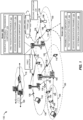
- an example wireless communication network 100 includes at least one UE 110 with a modem 140 having a preamble relay component 150 that may be configured to facilitate reception of a reservation preamble according to a new radio shared spectrum frame structure on one or more downlink communication channels from a network entity such as base station 105 in a wireless communication network 100.
- the at least one base station 105 includes a modem 160 having a reservation preamble transmission component 170 that transmit, via communication channel 135, a reservation preamble of a particular operator based on an indication that the particular operator will transmit data on at least one transmission opportunity of a frame 133.
- the preamble relay component 150 may receive, on a downlink channel from a first network entity (e.g., base station 105), a first reservation preamble 152 of a first operator 112, and transmit, on an uplink channel (e.g., communication channel 136), the second reservation preamble 154 of the first operator 112 to the second network entity (e.g. base station 106). Further, the reservation preamble transmission component 170 may generate a first reservation preamble 152 of a first operator 112 based on at least one of a compressed representation in a signal space, a basis function of the signal space, or a constant amplitude zero autocorrelation waveform (CAZAC) sequences.
- CAZAC constant amplitude zero autocorrelation waveform
- the UE 110 may include the preamble relay component 150, which may be configured to facilitate reception of a reservation preamble according to a new radio shared spectrum frame structure on one or more downlink communication channels from a network entity such as base station 105.
- a reservation preamble associated with a particular operator e.g., first operator 112
- may inform or otherwise indicate to one or more network entities e.g., base station 106 associated with different operators that the base station 105 will transmit data on a transmission opportunity (e.g., formed of a number of subframes of a consistent time duration).
- network entities e.g., base station 106
- the transmitting network entity i.e. base station 105
- the reservation preamble may not be received by the potentially interfering network entity (e.g., base station 106).
- UE 110 may transmit the reservation preamble to the one or more network entities (e.g., base station 106) that may potentially interfere with the transmission of the transmission opportunity associated with the reservation preamble by the network entity.
- UE 110 may transmit one or more transmission opportunities within a frame 133 in accordance with a frame structure that facilities transmission on subframes or symbols associated with multiple or different operators, as illustrated in FIG. 5 .
- preamble relay component 150 may be configured to determine whether a first reservation preamble 152 of a first operator 112 is received on a first time slot of multiple time slots of a downlink channel 135 from a first base station 105 (e.g., which may be a serving eNB).
- a first base station 105 e.g., which may be a serving eNB.
- determination component 156 may determine whether a first reservation preamble 152 of a first operator 112 is received by partitioning a receiver timeframe into multiple segments each with a maximum time duration, accumulating one or more of the multiple segments corresponding to a portion of the first reservation preamble 152, applying a non-coherent cross-correlation operation to each of the accumulated one or more segments, and combining each output of the non-coherent cross-correlation operations to trigger detection of the first reservation preamble 152.
- the non-coherent cross-correlation operation corresponds to at least one of a time-domain non-coherent cross-correlation operation or a frequency-domain non-coherent cross-correlation operation.
- UE 110 and/or preamble relay component 150 may be configured to determine a ratio of a time duration of the second reservation preamble 154 and a time duration of a switching gap.
- the second reservation preamble 154 is aligned with a slot boundary of the first time slot.
- a sequence of the second reservation preamble 154 corresponds to at least one of a punctured or a phase rotated waveform of the first reservation preamble 152.
- UE 110 and/or preamble relay component 150 may execute transceiver 60 to transmit a second reservation preamble 154 of the first operator 112 on an uplink channel 136 to the second base station 106 based on a determination that the first reservation preamble 152 of the first operator 112 is received.
- transceiver 502 may transmit the second reservation preamble 154 at a transmission time corresponding to a time of completion of the determination that the first reservation preamble 152 of the first operator 112 is received.
- an end time of the second reservation preamble 154 corresponds to an end time of the first reservation preamble 152, the end time of the second reservation preamble 154 and the end time of the first reservation preamble 152 being aligned with a slot boundary of the first time slot.
- the UE 110 includes a plurality of transmit antennas 64-a to 64-b. Further, UE 110 and/or preamble relay component 150 may execute transceiver 502 to transmit, on the plurality of transmit antennas 64-a to 64-b, the second reservation preamble 154 by reusing an OFDM frame. Additionally, UE 110 and/or preamble relay component 150 may execute transceiver 502 to transmit the second reservation preamble 154 based on a configurable transmit diversity scheme.
- the configurable transmit diversity scheme includes at least one of a tone interleaving in a frequency domain, sub-band interleaving in the frequency domain, or a cyclic shift diversity in a time domain.
- the UE 110, and in particular preamble relay component 150 may configure the frame structure of frame 133 based on frame configuration information received from the base station 105.
- preamble relay component 150 may be configured to receive an indication including a number of operators from the base station 105, and determine a transmission opportunity structure including at least one uplink timeslot based on the number of operators from the base station 105.
- preamble relay component 150 may be configured to transmit the second reservation preamble 154 of the first operator 112 to the second network entity during the at least one uplink listen-before-talk timeslot.
- UE 110, and in particular preamble relay component 150 may be configured to receive at least one of a duration or a priority of one or more transmission opportunities, and forgo monitoring of one or more timeslots.
- the first network entity includes a plurality of transmit antennas 665.
- base station 105 and/or reservation preamble transmission component 170 may execute transceiver 602 to transmit, on the plurality of transmit antennas 665, the first reservation preamble 152 by reusing an OFDM frame.
- base station 105 and/or reservation preamble transmission component 170 may execute transceiver 602 to transmit the first reservation preamble 152 based on a configurable transmit diversity scheme.
- the configurable transmit diversity scheme includes at least one of a tone interleaving in a frequency domain, a sub-band interleaving in the frequency domain, or a cyclic shift diversity in a time domain.
- the base station 106 and/or reservation preamble transmission component 170 may execute transceiver 602 to receive, on the first timeslot of an uplink channel from the UE 110, a second reservation preamble 154 of the first operator 112 in addition to receiving , on the first timeslot of the downlink channel 135, the first reservation preamble 152 of the first operator 112 to at least the UE 110.
- a sequence of the second reservation preamble 154 corresponds to at least one of a punctured or a phase rotated waveform of the first reservation preamble 152.
- the base station 105 may include the reservation preamble transmission component 170, which may be configured to transmit a reservation preamble of a particular operator based on an indication that the particular operator will transmit data on at least one transmission opportunity of a frame 133. That is, reservation preamble transmission component 170 may notify or inform other network entities (e.g., second base station 106) supporting various operators that may potentially interfere with transmission of transmission opportunities by the first base station 105. In some aspects, the first reservation preamble 152 and the second operator reservation preamble 154 may notify one or more network entities including the base station 106 (e.g., non-serving eNB) that the base station 105 will transmit data on a channel during the portion of the transmission opportunity for a given operator.
- the base station 106 e.g., non-serving eNB
- the reservation preamble transmission component 170 may be configured to control operator access to one or more transmission opportunities by determining whether a highest priority operator has elected not to transmit a corresponding reservation preamble. For example, in some aspects, the first operator 112 may have a highest priority level such that access to at least one transmission opportunity may be made without contention with other operators. If the first operator 112 elects to transmit data on the at least one transmission opportunity, reservation preamble transmission component 170 may be configured to notify or inform other network entities (e.g., base station 106) supporting different operators that base station 105 plans on or will transmit data of the first operator 112 at the at least one transmission opportunity (e.g., so as to avoid or mitigate interference with the other network entities transmitting on the same frequencies).
- network entities e.g., base station 106
- reservation preamble transmission component 170 may be configured to determine whether a second operator 114 has elected to transmit data on the at least one transmission opportunity upon determining that the first operator 112 has not transmitted the first operator reservation preamble 152.
- reservation preamble transmission component 170 may be configured to transmit a second operator reservation preamble 154 to a distinct network entity of at least the first operator 112, for example, based on a determination that the reservation preamble of the first operator 112 has not been transmitted to at least the second base station 106.
- reservation preamble transmission component 170 may make a similar determination to determine whether the third operator may transmit an associated reservation preamble for access to the transmission opportunity. That is, when both the first operator 112 and the second operator 114 have determined or elected not to utilize the transmission opportunity, and correspondingly where the third operator does not detect transmission of neither first operator reservation preamble 152 nor second operator reservation preamble 154, the third operator may or may not transmit an associated reservation preamble via reservation preamble transmission component 170.
- the base stations 105/106 may wirelessly communicate with the UEs 110 via one or more base station antennas. Each of the base stations 105/106 may provide communication coverage for a respective geographic coverage area 130.
- base stations 105/106 may be referred to as a base transceiver station, a radio base station, an access point, an access node, a radio transceiver, a NodeB, eNodeB (eNB), gNodeB (gNB), Home NodeB, a Home eNodeB, a relay, or some other suitable terminology.
- the geographic coverage area 130 for a base station 105/106 may be divided into sectors or cells making up only a portion of the coverage area (not shown).
- the wireless communication network 100 may include base stations 105/106 of different types (e.g., macro base stations or small cell base stations, described below). Additionally, the plurality of base stations 105/106 may operate according to different ones of a plurality of communication technologies (e.g., 5G (New Radio or "NR"), fourth generation (4G)/LTE, 3G, Wi-Fi, Bluetooth, etc.), and thus there may be overlapping geographic coverage areas 130 for different communication technologies.
- 5G New Radio or "NR”
- 4G fourth generation
- 3G Third Generation
- Wi-Fi Wi-Fi
- the wireless communication network 100 may be or include one or any combination of communication technologies, including a new radio (NR) or 5G technology, a Long Term Evolution (LTE) or LTE-Advanced (LTE-A) or MuLTEfire technology, a Wi-Fi technology, a Bluetooth technology, or any other long or short range wireless communication technology.
- LTE/LTE-A/MuLTEfire networks the term evolved node B (eNB) may be generally used to describe the base stations 105/106, while the term UE may be generally used to describe the UEs 110.
- the wireless communication network 100 may be a heterogeneous technology network in which different types of eNBs provide coverage for various geographical regions.
- each eNB or base station 105/106 may provide communication coverage for a macro cell, a small cell, or other types of cell.
- the term "cell” is a 3GPP term that can be used to describe a base station, a carrier or component carrier associated with a base station, or a coverage area (e.g., sector, etc.) of a carrier or base station, depending on context.
- a femto cell may also cover a small geographic area (e.g., a home) and may provide restricted access and/or unrestricted access by the UEs 110 having an association with the femto cell (e.g., in the restricted access case, the UEs 110 in a closed subscriber group (CSG) of the base station 105, which may include the UEs 110 for users in the home, and the like).
- a micro cell may cover a geographic area larger than a pico cell and a femto cell, but smaller than a macro cell.
- An eNB for a macro cell may be referred to as a macro eNB.
- An eNB for a small cell may be referred to as a small cell eNB, a pico eNB, a femto eNB, or a home eNB.
- An eNB may support one or multiple (e.g., two, three, four, and the like) cells (e.g., component carriers).
- the communication networks may be packet-based networks that operate according to a layered protocol stack and data in the user plane may be based on the IP.
- a user plane protocol stack e.g., packet data convergence protocol (PDCP), radio link control (RLC), MAC, etc.
- PDCP packet data convergence protocol
- RLC radio link control
- MAC MAC
- HARQ hybrid automatic repeat/request
- the RRC protocol layer may provide establishment, configuration, and maintenance of an RRC connection between a UE 110 and the base station 105.
- the RRC protocol layer may also be used for core network 115 support of radio bearers for the user plane data.
- the transport channels may be mapped to physical channels.
- the UEs 110 may be dispersed throughout the wireless communication network 100, and each UE 110 may be stationary or mobile.
- a UE 110 may also include or be referred to by those skilled in the art as a mobile station, a subscriber station, a mobile unit, a subscriber unit, a wireless unit, a remote unit, a mobile device, a wireless device, a wireless communications device, a remote device, a mobile subscriber station, an access terminal, a mobile terminal, a wireless terminal, a remote terminal, a handset, a user agent, a mobile client, a client, or some other suitable terminology.
- Each modulated signal may be sent on a different subcarrier and may carry control information (e.g., reference signals, control channels, etc.), overhead information, user data, etc.
- the wireless communication links 135 may transmit bidirectional communications using frequency division duplex (FDD) (e.g., using paired spectrum resources) or time division duplex (TDD) operation (e.g., using unpaired spectrum resources).
- FDD frequency division duplex
- TDD time division duplex
- Frame structures may be defined for FDD (e.g., frame structure type 1) and TDD (e.g., frame structure type 2).
- the wireless communication links 135 may represent one or more broadcast channels.
- UE 110 may be configured to establish one or more wireless communication links 136 with one or more base stations 106.
- the wireless communication links for channel reservation 136 shown in wireless communication network 100 may carry UL transmissions from a UE 110 to a base station 106, or DL transmissions from a base station 106 to a UE 110.
- these UL transmissions may correspond to a communication link from UEs 110 served by the first network entity (e.g. the base station 105) to the potential aggressor of the second network entity (e.g. the base station 106).
- base stations 105/106 or UEs 110 may include multiple antennas for employing antenna diversity schemes to improve communication quality and reliability between base stations 105 and UEs 110. Additionally or alternatively, base stations 105/106 or UEs 110 may employ multiple input multiple output (MIMO) techniques that may take advantage of multi-path environments to transmit multiple spatial layers carrying the same or different coded data.
- MIMO multiple input multiple output
- Wireless communication network 100 may support operation on multiple cells or carriers, a feature which may be referred to as carrier aggregation (CA) or multi-carrier operation.
- a carrier may also be referred to as a component carrier (CC), a layer, a channel, etc.
- CC component carrier
- the terms “carrier,” “component carrier,” “cell,” and “channel” may be used interchangeably herein.
- a UE 110 may be configured with multiple downlink CCs and one or more uplink CCs for carrier aggregation.
- Carrier aggregation may be used with both FDD and TDD component carriers.
- the carriers may or may not be adjacent to each other. Allocation of carriers may be asymmetric with respect to DL and UL (e.g., more or less carriers may be allocated for DL than for UL).
- the component carriers may include a primary component carrier and one or more secondary component carriers.
- a primary component carrier may be referred to as a primary cell (PCell) and a secondary component carrier may be referred to as a secondary cell (SCell).
- PCell primary cell
- SCell secondary cell
- the super high frequency (SHF) band extends between 3 GHz and 30 GHz, and may also be referred to as centimeter wave.
- Communications using the mmW and/or near mmW radio frequency band has extremely high path loss and a short range.
- base stations 105 and/or UEs 110 operating according to the mmW technology may utilize beamforming in their transmissions to compensate for the extremely high path loss and short range.
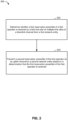
- FIG. 2 is a flow diagram illustrating examples of a method 200 related to detection of at least one reservation preamble in accordance with various aspects of the present disclosure.
- the operations described below are presented in a particular order and/or as being performed by an example component, it should be understood that the ordering of the actions and the components performing the actions may be varied, depending on the implementation.
- the preamble relay component 150 is illustrated as having a number of subcomponents, it should be understood that one or more of the illustrated subcomponents may be separate from, but in communication with, the preamble relay component 150, and/or each other.
- any of actions or components described below with respect to the preamble relay component 150 and/or its subcomponents may be performed by a specially-programmed processor, a processor executing specially-programmed software or computer-readable media, or by any other combination of a hardware component and/or a software component specially configured for performing the described actions or components.
- the dashed lines surrounding one or more blocks may represent optional steps.
- the method 200 may determine whether a first reservation preamble of a first operator is received on a first time slot of multiple time slots of a downlink channel from a first network entity.
- the UE 110 and/or preamble relay component 150 may execute the determination component 156 to determine whether a first reservation preamble 152 of a first operator 112 is received on a first time slot of multiple time slots of a downlink channel 135 from a first base station 105.
- determination component 156 may determine whether a first reservation preamble 152 of a first operator 112 is received by partitioning a receiver timeframe into multiple segments each with a maximum time duration, accumulating one or more of the multiple segments corresponding to a portion of the first reservation preamble 152, applying a non-coherent cross-correlation operation to each of the accumulated one or more segments, and combining each output of the non-coherent cross-correlation operations to trigger detection of the first reservation preamble 152.
- the non-coherent cross-correlation operation corresponds to at least one of a time-domain non-coherent cross-correlation operation or a frequency-domain non-coherent cross-correlation operation.
- the method 200 may transmit a second reservation preamble of the first operator on an uplink channel to a second network entity based on a determination that the first reservation preamble of the first operator is received.
- the UE 110 and/or preamble relay component 150 may execute transceiver 502 to transmit a second reservation preamble 154 of the first operator 112 on an uplink channel to a second base station 106 based on a determination that the first reservation preamble 152 of the first operator 112 is received.
- UE 110 and/or preamble relay component 150 may execute transceiver 60 ( FIG. 1 ) to transmit the second reservation preamble 154 at a transmission time corresponding to a time of completion of the determination that the first reservation preamble 152 of the first operator 112 is received.
- an end time of the second reservation preamble 154 corresponds to an end time of the first reservation preamble 152, the end time of the second reservation preamble 154 and the end time of the first reservation preamble 152 being aligned with a slot boundary of the first time slot.
- method 300 may include determining a ratio of a time duration of the second reservation preamble 154 and a time duration of a switching gap, wherein the second reservation preamble 154 is aligned with a slot boundary of the first time slot.
- a sequence of the second reservation preamble 154 corresponds to at least one of a punctured or a phase rotated waveform of the first reservation preamble 152.
- UE 110 and/or preamble relay component 150 may execute transceiver 502 to transmit the second reservation preamble 154 as a single frequency network (SFN) transmission based on the UE 110 and the first base station 105 both corresponding to the first operator 112.
- SFN single frequency network
- the UE 110 includes a plurality of transmit antennas 656. Further, UE 110 and/or preamble relay component 150 may execute transceiver 502 to transmit, on the plurality of transmit antennas 565, the second reservation preamble 154 by reusing an OFDM frame.
- the configurable transmit diversity scheme includes at least one of a tone interleaving in a frequency domain, sub-band interleaving in the frequency domain, or a cyclic shift diversity in a time domain.
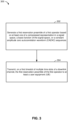
- FIG. 3 is a flow diagram illustrating examples of a method 300 related to transmission of at least one reservation preamble, in accordance with the invention.
- the operations described below are presented in a particular order and/or as being performed by an example component, it should be understood that the ordering of the actions and the components performing the actions may be varied, depending on the implementation.
- the reservation preamble transmission component 170 is illustrated as having a number of subcomponents, it should be understood that one or more of the illustrated subcomponents may be separate from, but in communication with, the reservation preamble transmission component 170, and/or each other.
- any of actions or components described below with respect to the reservation preamble transmission component 170 and/or its subcomponents may be performed by a specially-programmed processor, a processor executing specially-programmed software or computer-readable media, or by any other combination of a hardware component and/or a software component specially configured for performing the described actions or components.
- the dashed lines surrounding one or more blocks may represent optional steps.
- the method 300 is configured to generate a first reservation preamble of a first operator based on at least one of a compressed representation in a signal space, a basis function of the signal space, or a CAZAC sequences.
- the base station 105 and/or reservation preamble transmission component 170 is configured to execute the determination component 172 to generate a first reservation preamble 152 of a first operator 112 based on at least one of a compressed representation in a signal space, a basis function of the signal space, or a CAZAC sequences.
- the method 300 is configured to transmit, on a first timeslot of multiple time slots of a downlink channel, the first reservation preamble of the first operator to at least a UE.
- the base station 105 and/or reservation preamble transmission component 170 is configured to execute transceiver 602 to transmit, on a first timeslot of multiple time slots of a downlink channel 135, the first reservation preamble 152 of the first operator to at least a UE 110.
- base station 105 and/or reservation preamble transmission component 170 may execute transceiver 602 to transmit a plurality of uniformly spaced pilot tones corresponding to the first reservation preamble 152.
- the first network entity includes a plurality of transmit antennas 665.
- base station 105 and/or reservation preamble transmission component 170 may execute transceiver 602 to transmit, on the plurality of transmit antennas 665, the first reservation preamble 152 by reusing an OFDM frame.
- the configurable transmit diversity scheme includes at least one of a tone interleaving in a frequency domain, a sub-band interleaving in the frequency domain, or a cyclic shift diversity in a time domain.
- method 300 may include transmitting , on the first timeslot of an uplink channel from the UE 110, a second reservation preamble 154 of the first operator 112 in response to receiving , on the first timeslot of the downlink channel 135, the first reservation preamble 152 of the first operator 112 to at least the UE 110.
- base station 105 and/or reservation preamble transmission component 170 may execute transceiver 602 to transmit the first reservation preamble 152 as a single frequency transmission based on the UE 110 and the first base station 105 both corresponding to the first operator 112.
- base station 105 and/or reservation preamble transmission component 170 may execute transceiver 602 to transmit data associated with the first operator 112 within a portion of a transmission opportunity on the downlink channel 135 in response to transmitting the first reservation preamble 152 of the first operator 112.
- the first reservation preamble 152 of the first operator 112 notifies the first base station 105 and at least one of a second base station 106 that the first base station 105 will access a channel 135 during the portion of the transmission opportunity.
- method 300 may include restricting access of one or more network entities including at least one of a second base station 106 to the portion of the transmission opportunity based on a determination that the first reservation preamble 152 of the first operator 112 has been transmitted by at least the first base station 105.
- the first operator 112 may have the highest priority and as such, may determine or elect to transmit data on the transmission opportunity 400 without contention from other operators.
- the second operator 114 may transmit on the transmission opportunity if the first operator 112 elects not to transmit the assigned or allocated reservation preamble to the other network entities.
- a third operator may transmit utilize the transmission opportunity 400 and transmit the assigned or allocated reservation preamble when the first operator 112 and second operator 114 forego transmission of their respective reservation preambles.
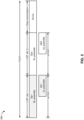
- FIG. 5 is a conceptual diagram of a transmission opportunity 500 including a reservation preamble structure during downlink communications from a network entity, such as base station 105, to a UE, such as UE 110, in accordance with one or more aspects.
- transmission opportunity 400 including a reservation preamble structure may be part of frame 133 in an communication system supporting at least two operators (e.g., OP1 and OP2).
- transmission opportunity 500 may include one or more LBT slots allowing for or facilitating transmission of a reservation preamble of a particular operator assigned to an LBT slot based on a priority level.
- transmission opportunity 500 permits the downlink and uplink reservation preamble relaying scheme according to frequency division duplexing.
- a node such as a UE, may detect a reservation preamble in LBT slot 2. Through the process of early detection (e.g., low latency) of the reservation preamble, the node may transmit a corresponding reservation preamble on the uplink before the end of the LBT slot 2. As such, OP1 may reserve the channel for uplink and downlink communications.
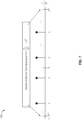
- FIG. 6 is a conceptual diagram of an example of a reservation preamble 600 with a configurable switching gap in accordance with one or more aspects.
- the reservation preamble transmission of the first operator 112 may be part of frame 133 in an communication system supporting at least three operators.
- the reservation preamble 600 may include a system bandwidth of at least one of 20, 40, or 80 MHz.
- the time duration of the reservation preamble 600 may be the summation of T U and T G , where T U corresponds to the waveform samples of a multi-tone transmission, and T G corresponds to the switching gap without active transmissions.
- the downlink and uplink reservation preambles use the same sequence to achieve the single frequency network effect, which would enhance the reliability of channel reservations at the operator-level.
- the ratio of the switching gap to the multi-tone transmission e.g., N 0 /N 1
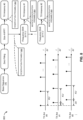
- FIG. 7 is a conceptual diagram of an example of a scenario 700 of frequency mapping of reservation preamble tones in accordance with one or more aspects.
- a network entity such as base station 105
- FFT fast Fourier transform
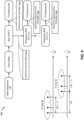
- FIG. 9 is a conceptual diagram of an example of a transmission scheme scenario 900 for a reservation preamble in accordance with one or more aspects.
- the reservation preamble transmission of the first operator 112 may be part of frame 133 in an communication system supporting sub-band interleaving. Similar to FIG. 8 , the reservation preamble 902 may be transmitted using a plurality of antennas. For example, the reservation preamble 902 may be generated using a base sequence and zero filling with a size-N IFFT. After generation, the reservation preamble 902 may be transmitted by transmit antenna 0. Additionally, a modified reservation preamble 904 may be transmitted by transmit antenna 1 with a frequency shift of size L, and a modified reservation preamble 906 may be transmitted by transmit antenna 2 with a frequency shift of 2L.
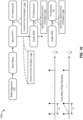
- FIG. 10 is a conceptual diagram of an example of a transmission scheme scenario 1000 for a reservation preamble in accordance with one or more aspects.
- the reservation preamble transmission of the first operator 112 may be part of frame 133 in an communication system supporting cyclic shift diversity. Similar to FIG. 8 , the reservation preamble 1002 may be transmitted using a plurality of antennas. For example, the reservation preamble 1002 may be generated using a base sequence and zero filling with a size-N IFFT. After generation, the reservation preamble 1002 may be transmitted by transmit antenna 0. Additionally, a modified reservation preamble 1004 may be transmitted by transmit antenna 1 with a cyclic shift (e.g., tone-wise phase ramping), and a modified reservation preamble 1006 may be transmitted by transmit antenna 2 with a cyclic shift.
- a cyclic shift e.g., tone-wise phase ramping
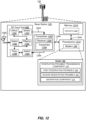
- an UE 110 may include a variety of components, some of which have already been described above, but including components such as one or more processors 1112 and memory 1116 and transceiver 1102 in communication via one or more buses 1144, which may operate in conjunction with modem 140 and preamble relay component 150 to enable one or more of the functions described herein related to performing measurements during a connected mode in a wireless communication system.
- components such as one or more processors 1112 and memory 1116 and transceiver 1102 in communication via one or more buses 1144, which may operate in conjunction with modem 140 and preamble relay component 150 to enable one or more of the functions described herein related to performing measurements during a connected mode in a wireless communication system.
- the one or more processors 1112, modem 1114, memory 1116, transceiver 1102, radio frequency (RF) front end 1188 and one or more antennas 1165 may be configured to support voice and/or data calls (simultaneously or non-simultaneously) in one or more radio access technologies.
- the modem 140 may be the same as or similar to the modem 140 ( FIG. 1 ).
- the one or more processors 1112 can include a modem 140 that uses one or more modem processors.
- the various functions related to preamble relay component 150 may be included in modem 140 and/or processors 1112 and, in an aspect, can be executed by a single processor, while in other aspects, different ones of the functions may be executed by a combination of two or more different processors.
- the one or more processors 1112 may include any one or any combination of a modem processor, or a baseband processor, or a digital signal processor, or a transmit processor, or a receiver processor, or a transceiver processor associated with the transceiver 1102. In other aspects, some of the features of the one or more processors 1112 and/or modem 140 associated with preamble relay component 150 may be performed by transceiver 1102.
- memory 1116 may be configured to store data used herein and/or local versions of applications 1175 or preamble relay component 150 and/or one or more of its subcomponents being executed by at least one processor 1112.
- Memory 1116 can include any type of computer-readable medium usable by a computer or at least one processor 1112, such as random access memory (RAM), read only memory (ROM), tapes, magnetic discs, optical discs, volatile memory, non-volatile memory, and any combination thereof.
- the transceiver 1102 may include at least one receiver 1106 and at least one transmitter 1108.
- the receiver 1106 may include hardware, firmware, and/or software code executable by a processor for receiving data, the code comprising instructions and being stored in a memory (e.g., computer-readable medium).
- the receiver 1106 may be, for example, a RF receiver.
- the receiver 1106 may receive signals transmitted by at least one base station 105. Additionally, the receiver 1106 may process such received signals, and also may obtain measurements of the signals, such as, but not limited to, Ec/Io, SNR, RSRP, RSSI, etc.
- the transmitter 1108 may include hardware, firmware, and/or software code executable by a processor for transmitting data, the code comprising instructions and being stored in a memory (e.g., computer-readable medium).
- a suitable example of the transmitter 1108 may include , but is not limited to, an RF transmitter.
- the UE 110 may include an RF front end 1188, which may operate in communication with one or more antennas 1165 and transceiver 1102 for receiving and transmitting radio transmissions, for example, wireless communications transmitted by at least one base station 105, wireless transmissions received from neighbor UEs 206 and/or 208, or wireless transmissions transmitted by the UE 110.
- the RF front end 1188 may be connected to one or more antennas 1165 and can include one or more low-noise amplifiers (LNAs) 1190, one or more switches 1192, one or more power amplifiers (PAs) 1198, and one or more filters 1196 for transmitting and receiving RF signals.
- LNAs low-noise amplifiers
- PAs power amplifiers
- the LNA 1190 can amplify a received signal at a desired output level.
- each LNA 1190 may have a specified minimum and maximum gain values.
- RF front end 1188 may use one or more switches 1192 to select a particular LNA 1190 and its specified gain value based on a desired gain value for a particular application.
- one or more PA(s) 1198 may be used by the RF front end 1188 to amplify a signal for an RF output at a desired output power level.
- each PA 1198 may have specified minimum and maximum gain values.
- the RF front end 1188 may use one or more switches 1192 to select a particular PA 1198 and a corresponding specified gain value based on a desired gain value for a particular application.
- one or more filters 1196 can be used by the RF front end 1188 to filter a received signal to obtain an input RF signal.
- a respective filter 1196 can be used to filter an output from a respective PA 1198 to produce an output signal for transmission.
- each filter 1196 can be connected to a specific LNA 1190 and/or PA 1198.
- the RF front end 1188 can use one or more switches 1192 to select a transmit or receive path using a specified filter 1196, LNA 1190, and/or PA 1198, based on a configuration as specified by transceiver 1102 and/or processor 1112.
- the transceiver 1102 may be configured to transmit and receive wireless signals through one or more antennas 1165 via RF front end 1188.
- the transceiver 1102 may be tuned to operate at specified frequencies such that the UE 110 can communicate with, for example, one or more base stations 105 or one or more cells associated with one or more base stations 105.
- the modem 140 can configure the transceiver 1102 to operate at a specified frequency and power level based on the UE configuration of the UE 110 and the communication protocol used by the modem 140.
- modem 140 can be a multiband-multimode modem, which can process digital data and communicate with the transceiver 1102 such that the digital data is sent and received using the transceiver 1102.
- the modem 140 can be multiband and be configured to support multiple frequency bands for a specific communications protocol.
- the modem 140 can be multimode and be configured to support multiple operating networks and communications protocols.
- the modem 140 can control one or more components of the UE 110 (e.g., RF front end 1188, transceiver 1102) to enable transmission and/or reception of signals from the network based on a specified modem configuration.
- the modem configuration can be based on the mode of the modem and the frequency band in use.
- the modem configuration can be based on UE configuration information associated with the UE 110 as provided by the network during cell selection and/or cell reselection.
- base station 105 may include a variety of components, some of which have already been described above, but including components such as one or more processors 1212, a memory 1216, and a transceiver 1202 in communication via one or more buses 1244, which may operate in conjunction with modem 160 and the reservation preamble transmission component 170.
- the transceiver 1202, receiver 1206, transmitter 1208, one or more processors 1212, memory 1216, applications 1275, buses 1244, RF front end 1288, LNAs 1290, switches 1292, filters 1296, PAs 1298, and one or more antennas 1265 may be the same as or similar to the corresponding components of UE 110, as described above, but configured or otherwise programmed for base station operations as opposed to UE operations.
- Information and signals may be represented using any of a variety of different technologies and techniques.
- data, instructions, commands, information, signals, bits, symbols, and chips that may be referenced throughout the above description may be represented by voltages, currents, electromagnetic waves, magnetic fields or particles, optical fields or particles, computer-executable code or instructions stored on a computer-readable medium, or any combination thereof.
- a specially-programmed device such as but not limited to a processor, a digital signal processor (DSP), an ASIC, a FPGA or other programmable logic device, a discrete gate or transistor logic, a discrete hardware component, or any combination thereof designed to perform the functions described herein.
- DSP digital signal processor
- a specially-programmed processor may be a microprocessor, but in the alternative, the processor may be any conventional processor, controller, microcontroller, or state machine.
- a specially-programmed processor may also be implemented as a combination of computing devices, e.g., a combination of a DSP and a microprocessor, multiple microprocessors, one or more microprocessors in conjunction with a DSP core, or any other such configuration.
- the functions described herein may be implemented in hardware, software executed by a processor, firmware, or any combination thereof. If implemented in software executed by a processor, the functions may be stored on or transmitted over as one or more instructions or code on a non-transitory computer-readable medium. Other examples and implementations are within the scope and spirit of the disclosure and appended claims. For example, due to the nature of software, functions described above can be implemented using software executed by a specially programmed processor, hardware, firmware, hardwiring, or combinations of any of these. Features implementing functions may also be physically located at various positions, including being distributed such that portions of functions are implemented at different physical locations.
- Computer-readable media includes both computer storage media and communication media including any medium that facilitates transfer of a computer program from one place to another.
- a storage medium may be any available medium that can be accessed by a general purpose or special purpose computer.
- computer-readable media can comprise RAM, ROM, EEPROM, CD-ROM or other optical disk storage, magnetic disk storage or other magnetic storage devices, or any other medium that can be used to carry or store desired program code means in the form of instructions or data structures and that can be accessed by a general-purpose or special-purpose computer, or a general-purpose or special-purpose processor.
- any connection is properly termed a computer-readable medium.
- Disk and disc include compact disc (CD), laser disc, optical disc, digital versatile disc (DVD), floppy disk and Blu-ray disc where disks usually reproduce data magnetically, while discs reproduce data optically with lasers. Combinations of the above are also included within the scope of computer-readable media.
Landscapes
- Engineering & Computer Science (AREA)
- Signal Processing (AREA)
- Computer Networks & Wireless Communication (AREA)
- Physics & Mathematics (AREA)
- Spectroscopy & Molecular Physics (AREA)
- Power Engineering (AREA)
- Mobile Radio Communication Systems (AREA)
Applications Claiming Priority (4)
| Application Number | Priority Date | Filing Date | Title |
|---|---|---|---|
| US201662422919P | 2016-11-16 | 2016-11-16 | |
| US15/811,138 US10687355B2 (en) | 2016-11-16 | 2017-11-13 | Techniques for reservation preamble for low latency detection in a new radio shared spectrum communication system |
| PCT/US2017/061604 WO2018093791A1 (en) | 2016-11-16 | 2017-11-14 | Techniques for reservation preamble for low latency detection in a new radio shared spectrum communication system |
| EP17805088.6A EP3542588B1 (en) | 2016-11-16 | 2017-11-14 | Techniques for reservation preamble for low latency detection in a new radio shared spectrum communication system |
Related Parent Applications (2)
| Application Number | Title | Priority Date | Filing Date |
|---|---|---|---|
| EP17805088.6A Division EP3542588B1 (en) | 2016-11-16 | 2017-11-14 | Techniques for reservation preamble for low latency detection in a new radio shared spectrum communication system |
| EP17805088.6A Division-Into EP3542588B1 (en) | 2016-11-16 | 2017-11-14 | Techniques for reservation preamble for low latency detection in a new radio shared spectrum communication system |
Publications (2)
| Publication Number | Publication Date |
|---|---|
| EP3790350A1 EP3790350A1 (en) | 2021-03-10 |
| EP3790350B1 true EP3790350B1 (en) | 2025-02-26 |
Family
ID=62107920
Family Applications (2)
| Application Number | Title | Priority Date | Filing Date |
|---|---|---|---|
| EP20203712.3A Active EP3790350B1 (en) | 2016-11-16 | 2017-11-14 | Techniques for reservation preamble for low latency detection in a new radio shared spectrum communication system |
| EP17805088.6A Active EP3542588B1 (en) | 2016-11-16 | 2017-11-14 | Techniques for reservation preamble for low latency detection in a new radio shared spectrum communication system |
Family Applications After (1)
| Application Number | Title | Priority Date | Filing Date |
|---|---|---|---|
| EP17805088.6A Active EP3542588B1 (en) | 2016-11-16 | 2017-11-14 | Techniques for reservation preamble for low latency detection in a new radio shared spectrum communication system |
Country Status (8)
| Country | Link |
|---|---|
| US (2) | US10687355B2 (enExample) |
| EP (2) | EP3790350B1 (enExample) |
| JP (2) | JP6980782B2 (enExample) |
| KR (1) | KR102580979B1 (enExample) |
| CN (2) | CN109964532B (enExample) |
| CA (1) | CA3039801A1 (enExample) |
| TW (1) | TWI741068B (enExample) |
| WO (1) | WO2018093791A1 (enExample) |
Families Citing this family (8)
| Publication number | Priority date | Publication date | Assignee | Title |
|---|---|---|---|---|
| US10455455B2 (en) * | 2016-11-04 | 2019-10-22 | Qualcomm Incorporated | Techniques for reservation preamble for prioritized medium contention in a new radio shared spectrum communication system |
| US10687355B2 (en) | 2016-11-16 | 2020-06-16 | Qualcomm Incorporated | Techniques for reservation preamble for low latency detection in a new radio shared spectrum communication system |
| US10772052B2 (en) * | 2017-06-16 | 2020-09-08 | Qualcomm Incorporated | Controlling coexistent radio systems in a wireless device |
| US10708950B2 (en) | 2018-01-16 | 2020-07-07 | Qualcomm Incorporated | Transmission opportunity sharing for autonomous uplink |
| US11089575B2 (en) * | 2018-04-11 | 2021-08-10 | Qualcomm Incorporated | Multi-carrier enhancements for improving reliability in URLLC-U |
| US11089518B2 (en) * | 2018-08-10 | 2021-08-10 | Qualcomm Incorporated | Intertechnology medium sharing for millimeter wave |
| CN115053617B (zh) * | 2020-02-13 | 2025-05-27 | 株式会社Ntt都科摩 | 终端及通信方法 |
| US20220217027A9 (en) * | 2020-02-22 | 2022-07-07 | Nxp Usa, Inc. | Wireless communication device |
Family Cites Families (30)
| Publication number | Priority date | Publication date | Assignee | Title |
|---|---|---|---|---|
| US6330460B1 (en) * | 2000-08-21 | 2001-12-11 | Metawave Communications Corporation | Simultaneous forward link beam forming and learning method for mobile high rate data traffic |
| US20050169231A1 (en) | 2004-02-03 | 2005-08-04 | Sharp Laboratories Of America, Inc. | Method and system for detecting pending transmissions in a wireless data network |
| US7596102B2 (en) * | 2004-12-06 | 2009-09-29 | Sony Ericsson Mobile Communications Ab | Image exchange for image-based push-to-talk user interface |
| US8064444B2 (en) * | 2007-01-12 | 2011-11-22 | Wi-Lan Inc. | Wireless broadcasting system |
| US9357564B2 (en) | 2007-06-19 | 2016-05-31 | Texas Instruments Incorporated | Signaling of random access preamble parameters in wireless networks |
| EP2207290A1 (en) * | 2007-10-30 | 2010-07-14 | NTT DoCoMo, Inc. | Base station device, mobile station, and communication control method |
| US8787266B2 (en) | 2008-06-13 | 2014-07-22 | Infineon Technologies Ag | Medium access control in industrial and automotive wireless with combined wired and wireless sensor networks |
| KR101611271B1 (ko) * | 2008-10-29 | 2016-04-26 | 엘지전자 주식회사 | 다중 반송파 결합 환경에서의 업링크 임의 접속 방법 |
| EP2227062B1 (en) * | 2009-03-04 | 2015-02-18 | Fujitsu Limited | Improvements to short-range wireless networks |
| WO2011130306A1 (en) * | 2010-04-12 | 2011-10-20 | Qualcomm Atheros, Inc. | Delayed acknowledgements for low-overhead communication in a network |
| KR101928448B1 (ko) * | 2010-10-11 | 2018-12-13 | 삼성전자주식회사 | 무선 통신 시스템에서 단말기 내에 복수 개의 이종 통신 모듈이 있을 경우, 시분할 방식으로 간섭을 회피하는 방법 및 장치 |
| WO2012109529A1 (en) * | 2011-02-11 | 2012-08-16 | Interdigital Patent Holdings, Inc. | Method and apparatus for uplink closed loop transmit diversity transmission initial access |
| WO2013006006A2 (ko) | 2011-07-07 | 2013-01-10 | 엘지전자 주식회사 | 무선통신시스템에서 신호 전송 방법 및 장치 |
| US10321419B2 (en) * | 2011-08-10 | 2019-06-11 | Samsung Electronics Co., Ltd. | Method and apparatus for transmitting data using a multi-carrier in a mobile communication system |
| EP2752066B1 (en) * | 2011-08-29 | 2016-09-14 | Marvell World Trade Ltd. | Coexistence of a normal-rate physical layer and a low-rate physical layer in a wireless network |
| US9750018B2 (en) * | 2011-12-16 | 2017-08-29 | Futurewei Technologies, Inc. | System and method for multiple channel bandwidth modes coexistence |
| US9763225B2 (en) * | 2013-10-07 | 2017-09-12 | Qualcomm Incorporated | LTE-U clear channel assessment operations |
| US9949315B2 (en) | 2014-02-24 | 2018-04-17 | Qualcomm Incorporated | Techniques for enabling asynchronous transmissions in an unlicensed radio frequency spectrum band |
| US9310464B2 (en) * | 2014-07-09 | 2016-04-12 | Deere & Company | Determining location of a receiver with a multi-subcarrier signal |
| US9999053B2 (en) * | 2014-11-25 | 2018-06-12 | Electronics And Telecommunications Research Institute | Method and apparatus for configuring resources of random access channel in wireless communication system |
| JP6505862B2 (ja) | 2014-12-03 | 2019-04-24 | ホアウェイ・テクノロジーズ・デュッセルドルフ・ゲーエムベーハー | プリアンブルコーディングによってランダムアクセスを優先順位付けする方法 |
| US9942801B2 (en) | 2014-12-15 | 2018-04-10 | Qualcomm Incorporated | Techniques for reserving a channel of a radio frequency spectrum |
| US10524236B2 (en) * | 2015-03-23 | 2019-12-31 | Qualcomm Incorporated | Uplink transmission control with clear channel assessment |
| US10154485B2 (en) * | 2015-03-24 | 2018-12-11 | Qualcomm Incorporated | Beacons for tiered sharing of spectrum |
| US10917795B2 (en) | 2015-04-02 | 2021-02-09 | Qualcomm Incorporated | Enhanced preamble waveform for coexistence |
| US10165094B2 (en) * | 2015-10-23 | 2018-12-25 | Marvell World Trade Ltd. | Structure for low-power-low-rate data transmission |
| US10485027B2 (en) * | 2016-02-02 | 2019-11-19 | Qualcomm Incorporated | Uplink short transmission techniques using contention-based radio frequency spectrum |
| US10045376B2 (en) * | 2016-02-16 | 2018-08-07 | Mediatek Inc. | Channel access procedure and QoS provisioning for uplink LAA |
| US10687355B2 (en) | 2016-11-16 | 2020-06-16 | Qualcomm Incorporated | Techniques for reservation preamble for low latency detection in a new radio shared spectrum communication system |
| US10856185B2 (en) * | 2016-12-09 | 2020-12-01 | Qualcomm Incorporated | Channel reservation signals for new radio interference management |
-
2017
- 2017-11-13 US US15/811,138 patent/US10687355B2/en active Active
- 2017-11-14 KR KR1020197013716A patent/KR102580979B1/ko active Active
- 2017-11-14 CN CN201780070409.2A patent/CN109964532B/zh active Active
- 2017-11-14 WO PCT/US2017/061604 patent/WO2018093791A1/en not_active Ceased
- 2017-11-14 JP JP2019524981A patent/JP6980782B2/ja active Active
- 2017-11-14 EP EP20203712.3A patent/EP3790350B1/en active Active
- 2017-11-14 CA CA3039801A patent/CA3039801A1/en active Pending
- 2017-11-14 CN CN202310649058.8A patent/CN116527224A/zh active Pending
- 2017-11-14 EP EP17805088.6A patent/EP3542588B1/en active Active
- 2017-11-16 TW TW106139646A patent/TWI741068B/zh active
-
2020
- 2020-05-11 US US16/871,971 patent/US11589383B2/en active Active
-
2021
- 2021-11-17 JP JP2021187039A patent/JP7321233B2/ja active Active
Also Published As
| Publication number | Publication date |
|---|---|
| CN116527224A (zh) | 2023-08-01 |
| EP3790350A1 (en) | 2021-03-10 |
| CA3039801A1 (en) | 2018-05-24 |
| US20180139777A1 (en) | 2018-05-17 |
| KR102580979B1 (ko) | 2023-09-20 |
| EP3542588B1 (en) | 2020-12-16 |
| CN109964532B (zh) | 2023-06-06 |
| EP3542588A1 (en) | 2019-09-25 |
| KR20190079629A (ko) | 2019-07-05 |
| JP2019536360A (ja) | 2019-12-12 |
| JP2022028820A (ja) | 2022-02-16 |
| WO2018093791A1 (en) | 2018-05-24 |
| TW201824803A (zh) | 2018-07-01 |
| US20200275478A1 (en) | 2020-08-27 |
| US10687355B2 (en) | 2020-06-16 |
| TWI741068B (zh) | 2021-10-01 |
| BR112019009824A2 (pt) | 2019-08-13 |
| JP6980782B2 (ja) | 2021-12-15 |
| US11589383B2 (en) | 2023-02-21 |
| CN109964532A (zh) | 2019-07-02 |
| JP7321233B2 (ja) | 2023-08-04 |
Similar Documents
| Publication | Publication Date | Title |
|---|---|---|
| EP3596872B1 (en) | Synchronization signal transmission in a new radio wireless communication system | |
| US10862639B2 (en) | Decoupling of synchronization raster and channel raster | |
| US11589383B2 (en) | Techniques for reservation preamble for low latency detection in a new radio shared spectrum communication system | |
| US11882073B2 (en) | Techniques for signaling dynamic control region for PRACH transmission | |
| US11025386B2 (en) | Signaling information in physical broadcast channel (PBCH) demodulation reference signals (DMRS) | |
| US10327178B2 (en) | Radio resource management procedures for new radio | |
| HK40009116A (en) | Decoupling of synchronization raster and channel raster |
Legal Events
| Date | Code | Title | Description |
|---|---|---|---|
| PUAI | Public reference made under article 153(3) epc to a published international application that has entered the european phase |
Free format text: ORIGINAL CODE: 0009012 |
|
| STAA | Information on the status of an ep patent application or granted ep patent |
Free format text: STATUS: THE APPLICATION HAS BEEN PUBLISHED |
|
| AC | Divisional application: reference to earlier application |
Ref document number: 3542588 Country of ref document: EP Kind code of ref document: P |
|
| AK | Designated contracting states |
Kind code of ref document: A1 Designated state(s): AL AT BE BG CH CY CZ DE DK EE ES FI FR GB GR HR HU IE IS IT LI LT LU LV MC MK MT NL NO PL PT RO RS SE SI SK SM TR |
|
| STAA | Information on the status of an ep patent application or granted ep patent |
Free format text: STATUS: REQUEST FOR EXAMINATION WAS MADE |
|
| 17P | Request for examination filed |
Effective date: 20210723 |
|
| RBV | Designated contracting states (corrected) |
Designated state(s): AL AT BE BG CH CY CZ DE DK EE ES FI FR GB GR HR HU IE IS IT LI LT LU LV MC MK MT NL NO PL PT RO RS SE SI SK SM TR |
|
| STAA | Information on the status of an ep patent application or granted ep patent |
Free format text: STATUS: EXAMINATION IS IN PROGRESS |
|
| 17Q | First examination report despatched |
Effective date: 20230602 |
|
| REG | Reference to a national code |
Free format text: PREVIOUS MAIN CLASS: H04W0074080000 Ipc: H04L0005000000 Ref country code: DE Ref legal event code: R079 Ref document number: 602017088091 Country of ref document: DE Free format text: PREVIOUS MAIN CLASS: H04W0074080000 Ipc: H04L0005000000 |
|
| RIC1 | Information provided on ipc code assigned before grant |
Ipc: H04W 74/0816 20240101ALI20240403BHEP Ipc: H04W 72/20 20230101ALI20240403BHEP Ipc: H04L 25/03 20060101ALI20240403BHEP Ipc: H04W 88/04 20090101ALI20240403BHEP Ipc: H04W 16/14 20090101ALI20240403BHEP Ipc: H04L 5/00 20060101AFI20240403BHEP |
|
| GRAP | Despatch of communication of intention to grant a patent |
Free format text: ORIGINAL CODE: EPIDOSNIGR1 |
|
| STAA | Information on the status of an ep patent application or granted ep patent |
Free format text: STATUS: GRANT OF PATENT IS INTENDED |
|
| INTG | Intention to grant announced |
Effective date: 20240923 |
|
| GRAS | Grant fee paid |
Free format text: ORIGINAL CODE: EPIDOSNIGR3 |
|
| GRAA | (expected) grant |
Free format text: ORIGINAL CODE: 0009210 |
|
| STAA | Information on the status of an ep patent application or granted ep patent |
Free format text: STATUS: THE PATENT HAS BEEN GRANTED |
|
| AC | Divisional application: reference to earlier application |
Ref document number: 3542588 Country of ref document: EP Kind code of ref document: P |
|
| AK | Designated contracting states |
Kind code of ref document: B1 Designated state(s): AL AT BE BG CH CY CZ DE DK EE ES FI FR GB GR HR HU IE IS IT LI LT LU LV MC MK MT NL NO PL PT RO RS SE SI SK SM TR |
|
| REG | Reference to a national code |
Ref country code: GB Ref legal event code: FG4D |
|
| REG | Reference to a national code |
Ref country code: CH Ref legal event code: EP |
|
| REG | Reference to a national code |
Ref country code: DE Ref legal event code: R096 Ref document number: 602017088091 Country of ref document: DE |
|
| REG | Reference to a national code |
Ref country code: IE Ref legal event code: FG4D |
|
| REG | Reference to a national code |
Ref country code: NL Ref legal event code: MP Effective date: 20250226 |
|
| PG25 | Lapsed in a contracting state [announced via postgrant information from national office to epo] |
Ref country code: RS Free format text: LAPSE BECAUSE OF FAILURE TO SUBMIT A TRANSLATION OF THE DESCRIPTION OR TO PAY THE FEE WITHIN THE PRESCRIBED TIME-LIMIT Effective date: 20250526 |
|
| PG25 | Lapsed in a contracting state [announced via postgrant information from national office to epo] |
Ref country code: FI Free format text: LAPSE BECAUSE OF FAILURE TO SUBMIT A TRANSLATION OF THE DESCRIPTION OR TO PAY THE FEE WITHIN THE PRESCRIBED TIME-LIMIT Effective date: 20250226 |
|
| PG25 | Lapsed in a contracting state [announced via postgrant information from national office to epo] |
Ref country code: PL Free format text: LAPSE BECAUSE OF FAILURE TO SUBMIT A TRANSLATION OF THE DESCRIPTION OR TO PAY THE FEE WITHIN THE PRESCRIBED TIME-LIMIT Effective date: 20250226 |
|
| PG25 | Lapsed in a contracting state [announced via postgrant information from national office to epo] |
Ref country code: ES Free format text: LAPSE BECAUSE OF FAILURE TO SUBMIT A TRANSLATION OF THE DESCRIPTION OR TO PAY THE FEE WITHIN THE PRESCRIBED TIME-LIMIT Effective date: 20250226 |
|
| REG | Reference to a national code |
Ref country code: LT Ref legal event code: MG9D |
|
| PG25 | Lapsed in a contracting state [announced via postgrant information from national office to epo] |
Ref country code: NO Free format text: LAPSE BECAUSE OF FAILURE TO SUBMIT A TRANSLATION OF THE DESCRIPTION OR TO PAY THE FEE WITHIN THE PRESCRIBED TIME-LIMIT Effective date: 20250526 Ref country code: IS Free format text: LAPSE BECAUSE OF FAILURE TO SUBMIT A TRANSLATION OF THE DESCRIPTION OR TO PAY THE FEE WITHIN THE PRESCRIBED TIME-LIMIT Effective date: 20250626 |
|
| PG25 | Lapsed in a contracting state [announced via postgrant information from national office to epo] |
Ref country code: NL Free format text: LAPSE BECAUSE OF FAILURE TO SUBMIT A TRANSLATION OF THE DESCRIPTION OR TO PAY THE FEE WITHIN THE PRESCRIBED TIME-LIMIT Effective date: 20250226 |
|
| PG25 | Lapsed in a contracting state [announced via postgrant information from national office to epo] |
Ref country code: HR Free format text: LAPSE BECAUSE OF FAILURE TO SUBMIT A TRANSLATION OF THE DESCRIPTION OR TO PAY THE FEE WITHIN THE PRESCRIBED TIME-LIMIT Effective date: 20250226 |
|
| PG25 | Lapsed in a contracting state [announced via postgrant information from national office to epo] |
Ref country code: PT Free format text: LAPSE BECAUSE OF FAILURE TO SUBMIT A TRANSLATION OF THE DESCRIPTION OR TO PAY THE FEE WITHIN THE PRESCRIBED TIME-LIMIT Effective date: 20250626 Ref country code: LV Free format text: LAPSE BECAUSE OF FAILURE TO SUBMIT A TRANSLATION OF THE DESCRIPTION OR TO PAY THE FEE WITHIN THE PRESCRIBED TIME-LIMIT Effective date: 20250226 |
|
| PG25 | Lapsed in a contracting state [announced via postgrant information from national office to epo] |
Ref country code: GR Free format text: LAPSE BECAUSE OF FAILURE TO SUBMIT A TRANSLATION OF THE DESCRIPTION OR TO PAY THE FEE WITHIN THE PRESCRIBED TIME-LIMIT Effective date: 20250527 Ref country code: BG Free format text: LAPSE BECAUSE OF FAILURE TO SUBMIT A TRANSLATION OF THE DESCRIPTION OR TO PAY THE FEE WITHIN THE PRESCRIBED TIME-LIMIT Effective date: 20250226 |
|
| REG | Reference to a national code |
Ref country code: AT Ref legal event code: MK05 Ref document number: 1771730 Country of ref document: AT Kind code of ref document: T Effective date: 20250226 |
|
| PG25 | Lapsed in a contracting state [announced via postgrant information from national office to epo] |
Ref country code: SE Free format text: LAPSE BECAUSE OF FAILURE TO SUBMIT A TRANSLATION OF THE DESCRIPTION OR TO PAY THE FEE WITHIN THE PRESCRIBED TIME-LIMIT Effective date: 20250226 |
|
| PG25 | Lapsed in a contracting state [announced via postgrant information from national office to epo] |
Ref country code: SM Free format text: LAPSE BECAUSE OF FAILURE TO SUBMIT A TRANSLATION OF THE DESCRIPTION OR TO PAY THE FEE WITHIN THE PRESCRIBED TIME-LIMIT Effective date: 20250226 |
|
| PG25 | Lapsed in a contracting state [announced via postgrant information from national office to epo] |
Ref country code: DK Free format text: LAPSE BECAUSE OF FAILURE TO SUBMIT A TRANSLATION OF THE DESCRIPTION OR TO PAY THE FEE WITHIN THE PRESCRIBED TIME-LIMIT Effective date: 20250226 |
|
| PG25 | Lapsed in a contracting state [announced via postgrant information from national office to epo] |
Ref country code: IT Free format text: LAPSE BECAUSE OF FAILURE TO SUBMIT A TRANSLATION OF THE DESCRIPTION OR TO PAY THE FEE WITHIN THE PRESCRIBED TIME-LIMIT Effective date: 20250226 |
|
| PG25 | Lapsed in a contracting state [announced via postgrant information from national office to epo] |
Ref country code: AT Free format text: LAPSE BECAUSE OF FAILURE TO SUBMIT A TRANSLATION OF THE DESCRIPTION OR TO PAY THE FEE WITHIN THE PRESCRIBED TIME-LIMIT Effective date: 20250226 |
|
| PG25 | Lapsed in a contracting state [announced via postgrant information from national office to epo] |
Ref country code: CZ Free format text: LAPSE BECAUSE OF FAILURE TO SUBMIT A TRANSLATION OF THE DESCRIPTION OR TO PAY THE FEE WITHIN THE PRESCRIBED TIME-LIMIT Effective date: 20250226 Ref country code: EE Free format text: LAPSE BECAUSE OF FAILURE TO SUBMIT A TRANSLATION OF THE DESCRIPTION OR TO PAY THE FEE WITHIN THE PRESCRIBED TIME-LIMIT Effective date: 20250226 |
|
| PG25 | Lapsed in a contracting state [announced via postgrant information from national office to epo] |
Ref country code: RO Free format text: LAPSE BECAUSE OF FAILURE TO SUBMIT A TRANSLATION OF THE DESCRIPTION OR TO PAY THE FEE WITHIN THE PRESCRIBED TIME-LIMIT Effective date: 20250226 |
|
| PG25 | Lapsed in a contracting state [announced via postgrant information from national office to epo] |
Ref country code: SK Free format text: LAPSE BECAUSE OF FAILURE TO SUBMIT A TRANSLATION OF THE DESCRIPTION OR TO PAY THE FEE WITHIN THE PRESCRIBED TIME-LIMIT Effective date: 20250226 |