EP3790232B1 - Verfahren zur erstellung eines terminplans für gemischte kritische computernetzwerke - Google Patents
Verfahren zur erstellung eines terminplans für gemischte kritische computernetzwerke Download PDFInfo
- Publication number
- EP3790232B1 EP3790232B1 EP19196173.9A EP19196173A EP3790232B1 EP 3790232 B1 EP3790232 B1 EP 3790232B1 EP 19196173 A EP19196173 A EP 19196173A EP 3790232 B1 EP3790232 B1 EP 3790232B1
- Authority
- EP
- European Patent Office
- Prior art keywords
- flows
- messages
- network
- time
- transmission times
- Prior art date
- Legal status (The legal status is an assumption and is not a legal conclusion. Google has not performed a legal analysis and makes no representation as to the accuracy of the status listed.)
- Active
Links
Images


Classifications
-
- H—ELECTRICITY
- H04—ELECTRIC COMMUNICATION TECHNIQUE
- H04L—TRANSMISSION OF DIGITAL INFORMATION, e.g. TELEGRAPHIC COMMUNICATION
- H04L47/00—Traffic control in data switching networks
- H04L47/10—Flow control; Congestion control
- H04L47/24—Traffic characterised by specific attributes, e.g. priority or QoS
- H04L47/2416—Real-time traffic
-
- H—ELECTRICITY
- H04—ELECTRIC COMMUNICATION TECHNIQUE
- H04J—MULTIPLEX COMMUNICATION
- H04J3/00—Time-division multiplex systems
- H04J3/02—Details
- H04J3/06—Synchronising arrangements
- H04J3/0635—Clock or time synchronisation in a network
- H04J3/0638—Clock or time synchronisation among nodes; Internode synchronisation
- H04J3/0652—Synchronisation among time division multiple access [TDMA] nodes, e.g. time triggered protocol [TTP]
-
- G—PHYSICS
- G06—COMPUTING OR CALCULATING; COUNTING
- G06Q—INFORMATION AND COMMUNICATION TECHNOLOGY [ICT] SPECIALLY ADAPTED FOR ADMINISTRATIVE, COMMERCIAL, FINANCIAL, MANAGERIAL OR SUPERVISORY PURPOSES; SYSTEMS OR METHODS SPECIALLY ADAPTED FOR ADMINISTRATIVE, COMMERCIAL, FINANCIAL, MANAGERIAL OR SUPERVISORY PURPOSES, NOT OTHERWISE PROVIDED FOR
- G06Q10/00—Administration; Management
- G06Q10/06—Resources, workflows, human or project management; Enterprise or organisation planning; Enterprise or organisation modelling
-
- H—ELECTRICITY
- H04—ELECTRIC COMMUNICATION TECHNIQUE
- H04L—TRANSMISSION OF DIGITAL INFORMATION, e.g. TELEGRAPHIC COMMUNICATION
- H04L12/00—Data switching networks
- H04L12/28—Data switching networks characterised by path configuration, e.g. LAN [Local Area Networks] or WAN [Wide Area Networks]
- H04L12/40—Bus networks
- H04L12/407—Bus networks with decentralised control
- H04L12/413—Bus networks with decentralised control with random access, e.g. carrier-sense multiple-access with collision detection [CSMA-CD]
-
- H—ELECTRICITY
- H04—ELECTRIC COMMUNICATION TECHNIQUE
- H04L—TRANSMISSION OF DIGITAL INFORMATION, e.g. TELEGRAPHIC COMMUNICATION
- H04L12/00—Data switching networks
- H04L12/28—Data switching networks characterised by path configuration, e.g. LAN [Local Area Networks] or WAN [Wide Area Networks]
- H04L12/42—Loop networks
- H04L12/427—Loop networks with decentralised control
- H04L12/43—Loop networks with decentralised control with synchronous transmission, e.g. time division multiplex [TDM], slotted rings
-
- H—ELECTRICITY
- H04—ELECTRIC COMMUNICATION TECHNIQUE
- H04L—TRANSMISSION OF DIGITAL INFORMATION, e.g. TELEGRAPHIC COMMUNICATION
- H04L47/00—Traffic control in data switching networks
- H04L47/50—Queue scheduling
- H04L47/56—Queue scheduling implementing delay-aware scheduling
-
- H—ELECTRICITY
- H04—ELECTRIC COMMUNICATION TECHNIQUE
- H04L—TRANSMISSION OF DIGITAL INFORMATION, e.g. TELEGRAPHIC COMMUNICATION
- H04L47/00—Traffic control in data switching networks
- H04L47/50—Queue scheduling
- H04L47/56—Queue scheduling implementing delay-aware scheduling
- H04L47/564—Attaching a deadline to packets, e.g. earliest due date first
-
- H—ELECTRICITY
- H04—ELECTRIC COMMUNICATION TECHNIQUE
- H04L—TRANSMISSION OF DIGITAL INFORMATION, e.g. TELEGRAPHIC COMMUNICATION
- H04L47/00—Traffic control in data switching networks
- H04L47/50—Queue scheduling
- H04L47/62—Queue scheduling characterised by scheduling criteria
- H04L47/625—Queue scheduling characterised by scheduling criteria for service slots or service orders
- H04L47/6275—Queue scheduling characterised by scheduling criteria for service slots or service orders based on priority
-
- H—ELECTRICITY
- H04—ELECTRIC COMMUNICATION TECHNIQUE
- H04L—TRANSMISSION OF DIGITAL INFORMATION, e.g. TELEGRAPHIC COMMUNICATION
- H04L67/00—Network arrangements or protocols for supporting network services or applications
- H04L67/50—Network services
- H04L67/60—Scheduling or organising the servicing of application requests, e.g. requests for application data transmissions using the analysis and optimisation of the required network resources
- H04L67/62—Establishing a time schedule for servicing the requests
-
- H—ELECTRICITY
- H04—ELECTRIC COMMUNICATION TECHNIQUE
- H04L—TRANSMISSION OF DIGITAL INFORMATION, e.g. TELEGRAPHIC COMMUNICATION
- H04L69/00—Network arrangements, protocols or services independent of the application payload and not provided for in the other groups of this subclass
- H04L69/28—Timers or timing mechanisms used in protocols
-
- H—ELECTRICITY
- H04—ELECTRIC COMMUNICATION TECHNIQUE
- H04Q—SELECTING
- H04Q11/00—Selecting arrangements for multiplex systems
- H04Q11/04—Selecting arrangements for multiplex systems for time-division multiplexing
Definitions
- the invention relates to a method for generating a schedule for the transmission of time-triggered, TT, messages in a network, for example in a TTEthernet or TSN network, wherein the network comprises components, for example nodes and starcouplers, wherein components of said network communicate time-triggered messages according to said schedule and based on a global, network-wide time, and wherein said components communicate rate-constrained, RC messages, wherein for each of said RC messages real-time requirements are provided.
- the invention relates to a computer network, for example a TTEthernet or TSN network, wherein the network comprises components, for example nodes and starcouplers, wherein components of said network communicate time-triggered messages according to said schedule and based on a global, network-wide time, and wherein said components communicate rate-constrained, RC messages, wherein for each of said RC messages real-time requirements are provided.
- the network comprises components, for example nodes and starcouplers, wherein components of said network communicate time-triggered messages according to said schedule and based on a global, network-wide time, and wherein said components communicate rate-constrained, RC messages, wherein for each of said RC messages real-time requirements are provided.
- said components are arranged in a multi-hop fashion.
- a computer network for instance an IEEE 802.3 Ethernet (Institute of Electrical and Electronics Engineers 2018) or TSN (Institute of Electrical and Electronics Engineers 2017), can carry both scheduled and unscheduled communication messages, whereby scheduled communication (time-triggered or TT) messages are transmitted from a sending entity (component) to one or more receiving components (entities) at predefined points in time in a network-wide well-defined time, while unscheduled communication messages are transmitted according to other criteria.
- TT time-triggered or TT
- Appropriate transmission protocols and mechanisms for message handling and message prioritization can be applied, whereby it is ensured that no interference of any scheduled or unscheduled communication message with any given scheduled communication message can occur.
- Non-scheduled messages can be of two types: Rate-Constrained (RC) and Best-Effort (BE).
- RC traffic is sent with a minimum interarrival-time called BAG (Institute of Electrical and Electronics Engineers 2018) and typically has real-time requirements on the maximum allowed end-to-end latency and jitter.
- BE traffic does not have any real-time requirements.
- the communication schedule for TT messages influences the timely behaviour of RC and BE messages due to the fact that TT messages have higher priority over RC and BE messages and are sent first, hence delaying the transmission of RC and BE messages.
- the TT communication schedule may adversely affect the transmission of RC messages such that they do not adhere to their real-time requirements.
- Document US 2008/137679 A1 provides a method for transmitting data in messages via a communication link.
- Document US 2006/242252 A1 provides a scheduling algorithm for scheduling messages on a time-triggered bus in a distributed real-time embedded system, wherein an initial message schedule is determined, the algorithm using an earliest-deadline-first schedule to determine the initial message schedule.
- Document GB 2 390 775 A provides a packet scheduling apparatus that schedules packets on channel/s to a plurality of receivers, wherer a candidate solution is generated using a genetic algorithm.
- Evenly space the TT transmission times may reduce the impact of TT flows on RC flows so that for example the RC worst-case end-to-end travel times (time needed for a message to go from its source to its destination) may be smaller than the deadlines.
- loop step 2 will help to guide the search to the most promising parts of a solution space.
- step 1 If in loop step 1 the delay bound is smaller, a solution is found and the search stops.
- the preservation of real-time properties or the fulfilling of real-time requirements refers to the guaranteed end-to-end latency for the periodic transmission of messages between one sender node and one or several receiver nodes, via well-defined communication channels, known as virtual links (VLs).
- VLs virtual links
- the end-to-end latency is bounded if the transmission methods ensure that the messages are transmitted at their scheduled point in time (within a small deviation derived from the clock synchronization imprecision) without occurring in contention with other scheduled or unscheduled transmissions.
- the second step of the proposed method may relate to changing an existing schedule for TT message transmissions, whereby the changes preserve the transmissions of already scheduled TT messages and guarantee the real-time requirements of RC messages.
- transmission times of a TT message refers to transmission points in time/transmission instants, in particular the earliest transmission instant/point in time at which said TT message is transmitted. In particular, these are the earliest starts of transmissions allowed inside an output port, meaning the transmission of a message will start as soon as possible after this point in time (the transmission can sometimes be delayed by other messages).
- the transmission of TT messages does not interfere with the transmission of other already established TT message transmissions; (b) the modification will not invalidate the real-time requirements of such TT messages, and (c) the modified transmission times of such TT messages allows RC messages to meet their real-time requirements.
- each node is connected to at least one star coupler via a physical link.
- the connection is realized via physical ports on each of the devices.
- Nodes and star couplers have a limited number of ports, and therefore a maximum number of connecting physical links.
- Nodes communicate to each other by exchanging periodic time-triggered (TT) messages and rate-constrained (RC) messages.
- TT time-triggered
- RC rate-constrained
- a time-triggered message characterized by a virtual link, has the following attributes:
- a rate-constrained message characterized by a virtual link, has the following attributes:
- the transmission of time-triggered messages may be characterized by their VLs and follows a schedule. Each VL is routed through the network.
- the routing process consists of finding a multi-hop network path connecting the sender node with each of the receivers (using, for example Steiner Trees [ Steiner, W. 2010. "An evaluation of SMT-based schedule synthesis for time-triggered multi-hop networks.” RTSS ].
- a frame For each physical link on the network path, a frame may be scheduled for periodic transmission according to the respective message attributes.
- Frames are scheduled sequentially such that the transmission point in time of any intermediate hop is not scheduled before the previous frame is received at the respective hop.
- the schedule point in time of each frame may be an offset relative to the period, in which the frame will be transmitted.
- the transmissions are repeated periodically at the given offset.
- the end-to-end latency is guaranteed if the last frames are received at the receiver nodes within the maximum end-to-end latency.
- nodes and star couplers transmit TT frames on each link at their scheduled points in time (within a given time precision) following the schedule for the respective link.
- the schedule for a link comprises the scheduled points in time for all TT frames scheduled on that link.
- the schedule repeats cyclically according to the network cycle, typically the least common multiple of the periods of all VLs.
- RC frames are sent whenever there is no higher-priority TT message ready to be sent. Hence the timely behaviour of RC messages is influenced by the TT transmission schedule.
- a network schedule comprising the periodic transmission of frames for all virtual links satisfying their end-to-end latency and without contention is a complex operation. Therefore, it is typically calculated and distributed offline (prior to operation). This implies that the information regarding the communication needs between nodes is also available prior to operation.
- the invention for example relates to a method to identify the TT messages that adversely impact the RC message transmission and to modify the transmission times of said TT messages in order to guarantee RC real-time requirements (these requirements may comprise the end-to-end latency, and/or jitter), wherein the transmission points in time of the respective TT frames are modified without altering the real-time properties (end-to-end latency) of the already scheduled transmissions and the real-time properties of said new VLs are guaranteed.
- the invention refers to a computer program comprising program code means for performing a method according to the invention when said program is run on a computer.
- the invention relates to a computer program product comprising program code means stored on a computer readable medium for performing a method according to the invention when said program product is run on a computer.
- Figure 1 shows an example of a time-triggered network which comprises or consists of three time-triggered star couplers (i.e. switches) 110, 120, and 130, and six nodes (i.e. end systems) 111, 112, 121, 122, 131, 132. All systems are connected via lines (which preferably are bidirectional) as shown in the figure and have a common time-base, for example as defined in TTEthernet (Institute of Electrical and Electronics Engineers 2018). Time-triggered (TT) messages are transmitted following a pre-configured global cyclic schedule in coexistence with other traffic (rate-constrained and best effort traffic).
- TT Time-triggered
- a global distributed schedule determines exact points in time for the transmission of TT messages between the network systems (also denoted as “devices” or “components”; such systems are, for example, the mentioned nodes and star couplers), in a way that the transmissions through the shared lines is realized without contention.
- the calculation of the schedule is computationally intense, and therefore it is typically performed offline (i.e. prior to the system start-up) and distributed fully or partially to each of the systems of the network.
- the global time base within a known precision, is available to all systems, and used to execute the schedule in a cyclic and coordinated manner.
- Non-scheduled traffic is transmitted during the sparse time between scheduled transmissions, in a way that the interference to scheduled transmissions is either avoided or bounded to a known maximum delay.
- VL virtual links
- a VL defines one sender node (i.e. end system) and one or multiple receivers, as well as a physical path between them.
- the transmission of messages in a VL originates at the sender and propagates through the physical path (communication lines) until the receiver end system nodes are reached.
- Each of these propagation steps implies a scheduled transmission after the reception of the previous message. Additional constraints may be provided for VLs, for example a maximum end-to-end transmission deadline, referring to the maximum allowed interval for the propagation of messages -from sender to receiver(s).
- a time-triggered message characterized by a virtual link, has the following attributes:
- a rate-constrained message characterized by a virtual link, has the following attributes:
- vl a be a TT virtual link with sender node 121 and receiver node 131 in the network depicted in Figure 1 .
- the network path is hence composed by the sequence ⁇ 121, 120, 130, 131 ⁇ , as extracted from Figure 1 .
- Figure 2 illustrates the periodic transmission of TT messages from vl a within the transmission cycles of the three nodes conforming the respective network path (subfigures 150, 160, and 170). Note that in this example only the transmission events are scheduled, hence node 131, the receiver, does not appear.
- 150 represents the cyclic transmission of messages from vl a in node 121, 160 that in node 120, and 170 in node 130.
- Each of the subfigures represent a time cycle of 100 ms starting from the top most point in time (200, 300, and 400) and progressing clockwise. The clock is synchronized globally at every cycle; hence the time progression is homologous for all systems, within a known synchronization precision.
- a transmission event for a TT message of vl a occurs at node 121 which initiates the transmission of a message taking place until time 210.
- Node 120 receives the message and transmits the succeeding message at time 310, being the transmission finished by, at most, 320.
- node 130 transmits a succeeding message at 410, finishing by 420.
- This transmission cycle repeats endlessly in a coordinated manner.
- event 310 can only occur after event 210, as the message transmission in node 120 directly depends on the previous reception of the message transmitted by node 121.
- event 410 depends on the occurrence of event 320.
- the transmission can only be initiated after the previous message of the VL has arrived at the current node.
- Figure 3 provides a detailed representation of the transmission cycle depicted in Figure 2 , including all other scheduled transmissions in the same communication line for node 120 (dark gray), in addition to those of vl a (light gray) already depicted in Figure 2 .
- additional transmissions occur between events 301-310, and 320-321.
- a transmission cycle defines the outgoing transmissions of a message towards one single communication line of the respective node (often referred as ports ). Therefore, 180 depicts only the transmission cycle of node 120 for the communication line between nodes 120 and 130.
- the transmissions of messages shown in Figure 3 have dependencies to previous transmissions from nodes 121, 122 or 110 as part of VL paths traversing node 120.
- the schedule of the TT frames on the timeline may have a major impact on the delays experienced by RC flows since TT traffic has a higher priority.
- the end-to-end latency of RC messages in such networks is analyzed through methods like network calculus ( A. Van Bemten, W. Kellerer. 2016. Network Calculus: A Comprehensive Guide. TUM. https://mediatum.ub.tum.de/doc/1328613/1328613.pdf. ).
- An extension of this analysis which considers the TT message schedule is presented in.
- a preferred timing analysis, which may be used in this invention, is based on the Network Calculus framework [ L. Zhao, P. Pop, Q. Li, J. Chen, and H.
- the schedule of the TT frames on the timeline may have a major impact on the delays experienced by RC flows since TT traffic has a higher priority.
- an optimization metric is built that tries to evenly space out TT frames on the timeline and use optimization objectives to drive the modification of the TT message schedule.
- all the TT flows are scheduled, preferably according to said optimization metric.
- an RC analysis is provided to determine if the RC traffic fulfills the deadline requirements. If this is the case, the method/algorithm stops. If this is not the case, the algorithm identifies the TT messages most likely to be causing delays and attempt to find a better offset, i.e., a modification of transmission times of identified TT messages, preferably using an optimization metric. This second step is repeated until an appropriate schedule is found or a stopping condition is reached.
- the search may stop when a set of offsets fulfilling the deadline conditions is found or when the search algorithm has tried to reschedule all the possible flows without finding an unexplored set of offsets.
- the impact of TT flows may be represented by an arrival curve of the TT traffic, which may be computed using formulas detailed in ( L. Zhao, P. Pop, Q. Li, J. Chen, and H. Xiong, "Timing analysis of rate constrained traffic in TTEthernet using network calculus," Real-Time Systems, 2017 .).
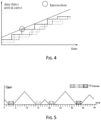
- the main aspect is to compute the impact of TT flows in all possible situations and keep the maximum values, as illustrated in Figure 4 .
- the dotted lines in Figure 4 are the different situations and the plain line staircase represents the maximum of the dotted lines, representing the final TT flows maximum arrival curve. From this staircase arrival curve, a linear arrival curve may be approximated.
- the rate [the increase of the linear curve] of the linear curve is the same as the rate of the staircase curve over a period.
- the value of the burst of the linear curve may be reduced, and consequently, the impact of TT traffic on RC flows is reduced.
- a so-called diversification list may be used to keep track of TT flows that have already been explored and changed in order not to run into an endless loop by trying to modify the schedule of the same TT flow(s).
- the number of times a flow is an intersection can be computed and the flow with the most occurrences that is not in the diversification list may be selected. Finally, if no flow has been found, the first flow in the list of TT flows that is not in the diversification list will be selected.
- the frames are spread over a hyperperiod (that is the least common multiple of all scheduled TT message periods), in order to reduce the initial burst of the aggregated TT flows.
- a hyperperiod that is the least common multiple of all scheduled TT message periods
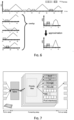
- gain functions between the already scheduled TT frames may be defined, as illustrated in an example in Figure 5 .
- t k end to be the end of the transmission of a TT frame
- t k + 1 start to be the start of the next transmission of a TT frame on the time-line.
- the method presented above may require a large number of optimization functions.
- a number of optimization functions is necessary to define the two linear parts of the gain, i.e., to define the upper and lower bounds of the new offset and the value associated with the gain.
- the number of TT flows increases, so does the number of assertions needed, resulting in an increased runtime of the scheduler.
- the following may be provided: only a period Ti of a flow i (the flow to be rescheduled) is considered and the values excluded by the currently scheduled frames are computed, i.e., if a frame is being transmitted, or if the inter-frame gap is too small to transmit the frame of flow i. Then, the gains, preferably only on the acceptable times, are summed up, as illustrated in Figure 6 .
- TTEthernet is an extension to standard Ethernet currently used in mixed-criticality real-time applications in the aerospace domain but also in emerging industrial automation systems.
- TTEthernet features three types of traffic that represent different criticality levels: TT traffic (used for highly critical traffic with guaranteed end-to-end latency and minimal jitter), RC traffic with deterministic quality of service (QoS) guarantees and non-critical traffic (i.e. BE traffic).
- TT traffic used for highly critical traffic with guaranteed end-to-end latency and minimal jitter
- QoS quality of service
- BE traffic non-critical traffic
- the TTEthernet [7] standard is based on the use of global time synchronization to send Time Triggered (TT) frames at precise, predefined times (encoded in a local schedule table that is part of a globally computed schedule) to ensure the lowest contention and delays.
- the TT flows are defined by their size, period, and offsets (the times their transmission should start) in each output port.
- the synchronization flows have the highest priority in TTEthernet networks, the next priority is used by the TT flows, the two next priorities are used by the AFDX RC HIGH and RC LOW traffic, respectively, while the remaining 4 lowest priorities are reserved for Best-Effort (BE) communication (cf. Fig. 7 ).
- BE Best-Effort
- Satisfiability Modulo Theories is a well-known method, similar to SAT, used to check the satisfiability of first-order logical formulas based on a background theory such as linear integer arithmetic LA Z or bit-vectors ( ) [1], [9].
- Current state-of-the-art TTEthernet scheduling approaches [6] use SMT solvers for generating the static schedule by generating assertions to the context of an SMT solver representing the necessary and sufficient correctness conditions.
- the result of the SMT solver is a solution for the given constraints, representing values for the offsets of individual frames on each device.
- modern SMT solvers like Z3 [2] offer the possibility to include optimization criteria that find the optimal solution given minimization or maximization condition(s).
- Steiner [11] proposes an incremental backtracking algorithm, which we also implemented, that splits the scheduling problem in small increments, scheduling subsets of flows at a time. If a partial solution is found for the subset, additional frames and constraints are added until either the complete schedule is found or a solution to a partial problem cannot be found. In the case of in-feasibility, the problem is backtracked and the size of the added subset is increased. In the worst case the algorithm backtracks to the root, scheduling the complete set of frames in one step.
- the SMT-based approach retains the optimality property of SAT- or MiP-based solutions
- the major downside is that the SMT solver acts as a black box and we are only able to influence it by defining constraints (assertions) and optimization criteria.
- state-of-the-art SMT-based schedulers only take into account the TT flow constraints.
- the RC traffic can be strongly impacted by the placement of the scheduled TT frames and miss their required deadlines.
- TSN Time-Sensitive Networks
- existing SMT-based solutions e.g. [10]
- SMT-based solutions can be extended using our proposed method to consider AVB traffic shaped by CBS by including the network calculus-based AVB analysis results from [12].
- Timing analyses detailed in this paper are based on the Network Calculus framework [8] which is used to compute upper delay and backlog bounds. These bounds depend on the traffic arrival described by the so-called arrival curve ⁇ , which represents the maximum amount of data that can arrive in any time interval, and on the resource availability described by the so-called minimum service curve ⁇ , which represents the minimum amount of data that can be sent in any time interval.
- a function ⁇ ( t ) is an arrival curve for a data flow with an input cumulative function A ( t ), i.e., the number of bits received until time t, iff: ⁇ t , A t ⁇ A ⁇ ⁇ 1 t
- the current state-of-the-art SMT-based schedulers do not consider RC flows.
- the placement of the TT frames on the timeline may have a major impact on the delays experienced by RC flows since TT traffic has a higher priority.
- the main idea of our proposal (described in more detail below) is to use a feedback loop that uses the RC network calculus analysis to check the TT schedule and, if necessary, reschedule problematic flows.
- the RC analysis is called to determine if RC traffic fulfills the deadline requirements. If this is the case, the algorithm stops. If this is not the case, the algorithm identify the flow most likely to be causing delays and attempt to find a better offset, i.e., reschedules, using the optimization function of SMT.
- This second step is repeated until an appropriate schedule is found or a stopping condition is reached.
- the impact of TT flows is represented by the arrival curve of the TT traffic, which is computed using the formulas detailed in [14].
- the main idea is to compute the impact of TT flows in all the possible situations and keep the maximum values, as illustrated in Fig. 4 .
- the dotted lines are the different situations and the plain line staircase is the maximum of the dotted lines, representing the final TT flows maximum arrival curve, denoted ⁇ TT k t .
- the rate of the linear curve is the same as the rate of the staircase curve over a period. Concerning the initial burst of the linear curve, it is computed such as the linear curve is always superior or equal to the staircase curve, with at least one intersection, as illustrated in Fig. 4 . As a result, by modifying the value of the offset associated to the staircase intersection point, we may be able to reduce the value of the burst of the linear curve, and consequently, reduce the impact of TT traffic on RC flows.
- the intersection points are computed within the findIntersections() function.
- Alg. 4 describes the definition of the gain function illustrated in Fig. 5 .
- Line 7 defines the outer bounds of a triangle
- Line 8 (resp. Line 9) defines the right (resp. left) side of the triangle.
- the input port delay is the amount of time necessary for a frame i to arrive at a rate C in : MFS i C in .
- the forwarding process is defined by a minimum (best-case) and maximum (worst-case) delay, denoted WCD fwd n and BCD fwd n , in a switch or end-system n ⁇ ⁇ sw , es ⁇ . All the flows are using the shuffling integration policy in the switches and end-systems, i.e, the TT frames can be delayed by lower priority frames.
- TTEthernet output ports the impact of the TT traffic on RC traffic is computed using the input arrival curves proposed in [14]. Then, the service curves are computed using Th. 3.
- ⁇ i n t is a staircase curve as illustrated in Fig. 8 , with WCD prec the delays in the previous nodes.
- End to end delay bounds finally, the end-to-end delay of a flow is obtained by summing the delays along the path in the end-systems, input ports, switches and links along the path of the flow.
- n max the maximum number of iterations n max , on the maximum time of execution t max , on the iteration where the best result is found n best , on the time necessary to find the best result t best , and on the schedulability sched.
- schedulability the percentage of schedulable flows.
- Table 1.2 Scenarios description scenario TT deadline (s) RC Jitter (s) default 0.004 100 ⁇ 10 -6 1.1 0.004 800 ⁇ 10 -6 1.2 0.004 900 ⁇ 10 -6 1.3 0.004 1000 ⁇ 10 -6 1.4 0.004 1100 ⁇ 10 -6 1.5 0.004 1200 ⁇ 10 -6 2.1 0.002 100 ⁇ 10 -6 2.2 0.002 300 ⁇ 10 -6 2.3 0.002 400 ⁇ 10 -6
- Table 1.4 we present the results of scenarios not finding an acceptable solution, i.e., not all the RC flows are schedulable.
- Table 1.3 Results with a schedulability of 100% for both methods scenario method n max t max (s) default 1 1 101 default 2 1 2.5 1.1 1 1 95 1.1 2 3 3 1.2 1 4 174 1.2 2 691 256 1.3 1 4 170 1.3 2 1110 508 2.1 1 8 46 2.1 2 1 2.3 2.2 1 1841 3934 2.2 2 123 76
- Table 1.4 Results without a schedulability of 100% for both methods scenario method n max t max (s) n best t best (s) sched 1.4 1 55 604 55 604 100% 1.4 2 2000 1190 1053 616 83% 1.5 1 2000 8621 1 115 50% 1.5 2 2000 1180 1535 882 66% 2.3 1 2000 3968 255 891 83% 2.3 2 2000 1023 660 350 83%
- timing performances i.e. t max and t best in scenarios 1.1 and 2.3 because, as expected, an iteration with method 2 is faster than with method 1, e.g. about 4 times faster in scenario 2.3 and up to 40 times faster in the default scenario.
- method 2 is the best method to find solutions in an acceptable time frame. Additionally, we see that our feedback-based method is able to generate schedules for TT flows such that the schedulability of RC traffic is increased for all 9 scenarios (even up to 100%).
Landscapes
- Engineering & Computer Science (AREA)
- Computer Networks & Wireless Communication (AREA)
- Signal Processing (AREA)
- Business, Economics & Management (AREA)
- Entrepreneurship & Innovation (AREA)
- Strategic Management (AREA)
- Economics (AREA)
- Human Resources & Organizations (AREA)
- Development Economics (AREA)
- Game Theory and Decision Science (AREA)
- Educational Administration (AREA)
- Marketing (AREA)
- Operations Research (AREA)
- Quality & Reliability (AREA)
- Tourism & Hospitality (AREA)
- Physics & Mathematics (AREA)
- General Business, Economics & Management (AREA)
- General Physics & Mathematics (AREA)
- Theoretical Computer Science (AREA)
- Computer Security & Cryptography (AREA)
- Data Exchanges In Wide-Area Networks (AREA)
Claims (12)
- Verfahren zum Erzeugen eines Zeitplans für die Übertragung von Flüssen in einem Netzwerk, wobei die Flüsse zeitgetriggerte TT-Flüsse, die TT-Nachrichten umfassen, und ratenbeschränkte RC-Flüsse, die RC-Nachrichten umfassen, enthalten, wobei das Netzwerk Komponenten umfasst und wobei das Netzwerk ein zeitgetriggertes TT-Netzwerk oder ein zeitempfindliches TSN-Netzwerk ist und wobei Komponenten des Netzwerks zeitgetriggerte Nachrichten gemäß dem Zeitplan und basierend auf einer globalen netzwerkweiten Zeit kommunizieren, und wobei die Komponenten ratenbeschränkte RC-Nachrichten kommunizieren, Zeitplan und basierend auf einer globalen, netzwerkweiten Zeit kommunizieren, und, wobei die Komponenten ratenbeschränkte RC-Nachrichten kommunizieren, wobei für jede der RC-Nachrichten Echtzeitanforderungen bereitgestellt werden, und,wobei für jede der RC-Nachrichten die bereitgestellte Echtzeitanforderung eine erste Anforderung umfasst, die eine Worst-Case-End-to-End-Verzögerungsgrenze für die Übertragung der Nachricht ist,wobei das Verfahren dadurch gekennzeichnet ist, dass das Verfahren die folgenden Schritte umfasst:- A1: eine erste Suche nach TT-Übertragungszeiten für TT-Nachrichten, die eine erste Bedingung erfüllen, wobei die erste Bedingung darin besteht, dass TT-Übertragungszeiten für alle TT-Nachrichten festgelegt werden, die in dem Netz kommuniziert werden, und- A2: eine erste Bestimmung, angewandt auf den Satz von TT-Übertragungszeiten, der während der ersten Suche gefunden wurde, ob der gefundene Satz von TT-Übertragungszeiten eine zweite Bedingung erfüllt, wobei die zweite Bedingung darin besteht, dass mit dem Satz von Übertragungszeiten, die auf die TT-Nachrichten angewandt werden, die Echtzeitanforderungen der Nachrichten eines ersten Satzes von Flüssen erfüllt werden, wobei der erste Satz von Flüssen der Satz aller RC-Flüsse ist, und, wobei, wenn der gefundene Satz von TT-Übertragungszeiten die zweite Bedingung nicht erfüllt, der Schritt A1, der folgt, die Schritte umfasst:∘ A11: eine erste Auswahl eines zweiten Satzes von TT-Übertragungszeiten aus dem gefundenen Satz, wobei der zweite Satz von TT-Übertragungszeiten die TT-Übertragungszeiten sind, die im Hinblick auf die Erfüllung der Echtzeitanforderungen des ersten Satzes von Flüssen geändert werden müssen, und∘ A12: eine Berechnung der geänderten Sendezeiten der zweiten Menge von TT-Sendezeiten, wobei das Ergebnis der Berechnung eine neue Menge von TT-Sendezeiten ist, die die erste Bedingung für alle TT-Nachrichten erfüllt, und- A3: Wiederholung der Schritte A1 bis A3, wenn die gefundene Menge von TT-Übertragungszeiten die zweite Bedingung nicht erfüllt, bis eine Menge von Übertragungszeiten gefunden ist, die die zweite Bedingung erfüllt, und- A4: Erstellung des Fahrplans in der Weise, dass der Fahrplan die gefundene Menge von TT-Übertragungszeiten enthält.
- Verfahren nach Anspruch 1, wobei die erste Suche, A1, beinhaltet eine zweite Auswahl für die Wahl, unter einer Vielzahl von Sets von TT-Übertragung mal die erste Bedingung erfüllt, die eine der ersten Optimierungsfunktion, vorzugsweise die erste Optimierung ist mit einem Löser, zum Beispiel eine Satisfiability Modulo Theory, SMT, solver überprüft.
- Verfahren nach Anspruch 1 oder 2, wobei der Schritt A11 umfasst die Schritte- A111: eine Berechnung einer Hyper-Periode, HP, die die mindestens mehrere aller TT fließt Perioden,- A112: eine dritte Auswahl der ersten Reihe von fließt auf der Basis der Hyper-Periode, und- A113: für jeden Ausgang Port identifiziert, wie die Ausgabe eines Knotens des Netzwerks, so dass mindestens eine der fließt der ersten Reihe von fließt durch die Ausgabe, eine Berechnung einer Funktion gewinnen.
- Verfahren nach Anspruch 3,wobei der Schritt A113 die Schritte- A1131 umfasst: die Berechnung von Verstärkungsfunktionen für bereits geplante TT-Rahmen erfolgt nach der folgenden Formel, wobei tende k das Ende einer Rahmenübertragung bezeichnet und tstart k+1 der Beginn der nächsten Übertragung ist:

 und, wobei der Schritt A12 den Schritt:- A121: für mindestens einen der TT-Flüsse eine Berechnung mindestens einer der TT-Übertragungszeiten auf der Grundlage der für die bereits geplanten TT-Rahmen berechneten Verstärkungsfunktionen, wobei der Schritt A121 die folgenden Schritte umfasst: für jede Periode des betrachteten Flusses und für mindestens einen Ausgangsport, durch den der betrachtete Fluss läuft:- A1211: Berechnung einer Gesamtverstärkungsfunktion durch Summierung der Verstärkungsfunktion aller Ströme, die den betrachteten Ausgangsport passieren, und- A1212: Auswahl eines Zeitpunkts t0 als TT-Übertragungszeit am Ausgang, für den der Wert der Gesamtverstärkungsfunktion über den Zeitraum des betrachteten Stroms maximal ist.
 - Verfahren nach Anspruch 4, wobei Schritt A1211 besteht aus:- A12111: Berechnen der Verstärkungsfunktion nur für eine Periode des betrachteten Flusses, und- A12112: Approximieren der Gesamtverstärkungsfunktionen.
- Verfahren nach einem der Ansprüche 1 bis 5, wobei der Schritt A1 von einem Algorithmus geleitet wird, der auf einem Network Calculus, NC, Framework basiert.
- Verfahren nach einem der Ansprüche 1 bis 6, wobei Schritt A2 das Speichern einer Aufzeichnung der Menge der gefundenen TT-Übertragungszeiten umfasst.
- Verfahren nach Anspruch 6 oder 7, wobei der Schritt A2 folgende Schritte umfasst:- A21: Berechnung einer Treppenkurve für die gefundene Menge für jeden Ausgangsport, der als Ausgangsport eines Knotens des Netzes identifiziert wurde, so dass die erste Menge des Flusses durch den betrachteten Ausgangsport verläuft,- A22: für jeden in Schritt A21 betrachteten Ausgangsport eine Annäherung der Treppenkurve durch eine lineare Kurve,- A23: für jeden in Schritt A21 betrachteten Ausgangsport ein Schnittpunkt der Treppenkurve mit der linearen Kurve,- A24: für einen in Schritt A21 betrachteten Ausgangsport die Bestimmung einer Auswirkung eines Flusses, der den Ausgangsport durchläuft, auf der Grundlage des Schnittpunkts der Treppenkurve mit der linearen Kurve, undwobei die erste Auswahl in Schritt A11 das Identifizieren eines der Flüsse des ersten Satzes von Flüssen auf der Grundlage der Auswirkung dieses Flusses, die als groß quantifiziert wird, umfasst.
- Verfahren nach einem der Ansprüche 1 bis 8, wobei der Schritt A2 den folgenden Schritt umfasst: eine zweite Bestimmung, angewandt auf die gefundene Menge, ob die gefundene Menge von TT-Übertragungszeiten eine dritte Bedingung erfüllt, wobei die dritte Bedingung darin besteht, dass mit der auf die Nachrichten angewandten Menge von TT-Übertragungszeiten die Anforderungen an die End-zu-End-Verzögerung im schlimmsten Fall der Nachrichten der ersten Menge von Flüssen erfüllt werden.
- Computernetzwerk, wobei das Netzwerk ein zeitgesteuertes, TT, Netzwerk oder ein zeitempfindliches, TSN, Netzwerk ist, wobei das Computernetzwerk Komponenten umfasst, wobei die Komponenten Flüsse einschließlich zeitgesteuerter, TT-Flüsse, die TT-Nachrichten umfassen, und ratenbeschränkter, RC-Flüsse, die RC-Nachrichten umfassen, kommunizieren, und wobei Komponenten des Netzwerks zeitgesteuerte Nachrichten gemäß einem Zeitplan und basierend auf einer globalen, netzwerkweiten Zeit kommunizieren, und wobei die Komponenten ratenbeschränkte RC-Nachrichten kommunizieren, wobei für jede der RC-Nachrichten Echtzeitanforderungen bereitgestellt werden,
dadurch gekennzeichnet, dass
das Netzwerk angepasst ist, um Mittel zum Erzeugen des Zeitplans mit einem Verfahren gemäß einem der Ansprüche 1 bis 9 zu enthalten. - Computerprogramm mit Programmcodemitteln zur Durchführung aller Schritte nach einem der Ansprüche 1 bis 9, wenn das Computerprogramm auf einem Computer ausgeführt wird.
- Computerprogrammprodukt mit auf einem computerlesbaren Medium gespeicherten Programmcodemitteln zur Durchführung des Verfahrens nach einem der Ansprüche 1 bis 9, wenn das Computerprogrammprodukt auf einem Computer ausgeführt wird.
Priority Applications (3)
| Application Number | Priority Date | Filing Date | Title |
|---|---|---|---|
| EP19196173.9A EP3790232B1 (de) | 2019-09-09 | 2019-09-09 | Verfahren zur erstellung eines terminplans für gemischte kritische computernetzwerke |
| US17/011,250 US11367024B2 (en) | 2019-09-09 | 2020-09-03 | Method for generating a schedule for mixed critical computer networks |
| CN202010940099.9A CN112468412B (zh) | 2019-09-09 | 2020-09-09 | 用于为混合临界计算机网络生成调度表的方法 |
Applications Claiming Priority (1)
| Application Number | Priority Date | Filing Date | Title |
|---|---|---|---|
| EP19196173.9A EP3790232B1 (de) | 2019-09-09 | 2019-09-09 | Verfahren zur erstellung eines terminplans für gemischte kritische computernetzwerke |
Publications (2)
| Publication Number | Publication Date |
|---|---|
| EP3790232A1 EP3790232A1 (de) | 2021-03-10 |
| EP3790232B1 true EP3790232B1 (de) | 2025-06-25 |
Family
ID=67988857
Family Applications (1)
| Application Number | Title | Priority Date | Filing Date |
|---|---|---|---|
| EP19196173.9A Active EP3790232B1 (de) | 2019-09-09 | 2019-09-09 | Verfahren zur erstellung eines terminplans für gemischte kritische computernetzwerke |
Country Status (3)
| Country | Link |
|---|---|
| US (1) | US11367024B2 (de) |
| EP (1) | EP3790232B1 (de) |
| CN (1) | CN112468412B (de) |
Families Citing this family (13)
| Publication number | Priority date | Publication date | Assignee | Title |
|---|---|---|---|---|
| CN116233003A (zh) * | 2019-10-16 | 2023-06-06 | 华为技术有限公司 | 一种对网络进行配置的方法和设备 |
| US11451492B2 (en) * | 2020-12-22 | 2022-09-20 | Honeywell International Inc. | Methods, systems, and apparatuses for enhanced parallelism of time-triggered ethernet traffic using interference-cognizant network scheduling |
| EP4125249B1 (de) * | 2021-07-29 | 2025-06-25 | TTTech Computertechnik Aktiengesellschaft | Verfahren zur konfiguration von echtzeitkommunikation in einem netzwerk mit zeitgesteuertem und ratenkonfiguriertem verkehr |
| CN113794654B (zh) * | 2021-09-15 | 2023-04-25 | 电子科技大学 | 一种tt-fc网络中时间触发消息的分组调度方法 |
| CN114301851B (zh) * | 2022-01-20 | 2023-12-01 | 燕山大学 | 一种面向工业现场的时间敏感网络流量分级调度方法 |
| CN114285541B (zh) * | 2022-01-27 | 2023-06-06 | 重庆邮电大学 | 一种基于时延误差时间触发以太网调度表生成方法 |
| CN114826602B (zh) * | 2022-03-22 | 2023-05-23 | 华南理工大学 | 安全感知的时间敏感网络调度方法、系统、装置及介质 |
| CN115174445B (zh) * | 2022-06-29 | 2023-10-27 | 中国航空无线电电子研究所 | 一种arinc664交换机网络内数据帧的延迟上界分析方法 |
| US12452165B2 (en) | 2023-02-01 | 2025-10-21 | The Boeing Company | Asynchronous data transmission over avionics communication network |
| CN116506347B (zh) * | 2023-04-21 | 2026-02-06 | 北京邮电大学 | 卫星网络的确定性路由构建方法、转发方法和系统 |
| CN118740757B (zh) * | 2024-08-07 | 2026-02-27 | 中国兵器工业计算机应用技术研究所 | 一种总线网络多优先级流量准入控制与动态规划方法 |
| CN119172300B (zh) * | 2024-08-07 | 2026-02-10 | 中国兵器工业计算机应用技术研究所 | 兼顾速率受限流量的总线网络时间触发流量准入规划方法 |
| CN119907125B (zh) * | 2025-01-24 | 2025-11-14 | 西北工业大学 | 一种时间触发流与事件触发流的混合传输方法 |
Family Cites Families (14)
| Publication number | Priority date | Publication date | Assignee | Title |
|---|---|---|---|---|
| US6611519B1 (en) * | 1998-08-19 | 2003-08-26 | Swxtch The Rules, Llc | Layer one switching in a packet, cell, or frame-based network |
| GB2390775B (en) * | 2002-07-12 | 2005-07-20 | Fujitsu Ltd | Packet scheduling |
| EP1595368B1 (de) * | 2003-02-19 | 2007-01-03 | Fujitsu Limited | Ablaufsteuerung für pakete |
| DE102005004464A1 (de) * | 2005-01-31 | 2006-10-26 | Robert Bosch Gmbh | Verfahren zur Speicherung von Botschaften in einem Botschaftsspeicher und Botschaftsspeicher |
| US8473563B2 (en) * | 2005-04-22 | 2013-06-25 | GM Global Technology Operations LLC | Extensible scheduling of messages on time-triggered busses |
| KR101144502B1 (ko) * | 2009-04-28 | 2012-05-11 | 한양대학교 산학협력단 | Ttcan 스케줄링 방법 |
| CN102255803B (zh) * | 2011-07-06 | 2014-02-12 | 北京航空航天大学 | 一种适用于时间触发交换式网络的周期调度时刻表构建方法 |
| CN103414624A (zh) * | 2013-07-29 | 2013-11-27 | 北京汇能精电科技有限公司 | 一种can总线主从应答模式协议的网络调度算法 |
| CN106921591B (zh) * | 2017-03-27 | 2020-05-12 | 西安电子科技大学 | 一种机载航电网络中关键性业务突发处理方法 |
| CN109150559B (zh) * | 2017-06-15 | 2022-05-31 | 中国航空工业集团公司洛阳电光设备研究所 | 时间触发以太网仿真系统 |
| EP3468118B1 (de) * | 2017-10-04 | 2023-10-04 | TTTech Computertechnik AG | Verfahren und vorrichtung zur konfigurierung von echtzeitnetzwerken |
| EP3468115B1 (de) * | 2017-10-09 | 2020-06-17 | TTTech Computertechnik AG | Verfahren zur verbesserung der erreichbarkeit von echtzeit-computernetzwerken |
| CN108712224B (zh) * | 2018-05-10 | 2019-07-16 | 西安电子科技大学 | 最小时延最大匹配的时间触发业务调度表生成方法 |
| CN108777660B (zh) * | 2018-05-29 | 2020-12-01 | 电子科技大学 | 一种在时间触发fc网络中业务调度的方法 |
-
2019
- 2019-09-09 EP EP19196173.9A patent/EP3790232B1/de active Active
-
2020
- 2020-09-03 US US17/011,250 patent/US11367024B2/en active Active
- 2020-09-09 CN CN202010940099.9A patent/CN112468412B/zh active Active
Also Published As
| Publication number | Publication date |
|---|---|
| CN112468412B (zh) | 2024-07-16 |
| EP3790232A1 (de) | 2021-03-10 |
| US20210073689A1 (en) | 2021-03-11 |
| US11367024B2 (en) | 2022-06-21 |
| CN112468412A (zh) | 2021-03-09 |
Similar Documents
| Publication | Publication Date | Title |
|---|---|---|
| EP3790232B1 (de) | Verfahren zur erstellung eines terminplans für gemischte kritische computernetzwerke | |
| Gavriluţ et al. | Traffic-type assignment for TSN-based mixed-criticality cyber-physical systems | |
| Laursen et al. | Routing optimization of AVB streams in TSN networks | |
| Sariowan et al. | SCED: A generalized scheduling policy for guaranteeing quality-of-service | |
| US11943046B2 (en) | Method to configure real-time communications in a network with time-triggered and rate-constrained traffic | |
| Craciunas et al. | An overview of scheduling mechanisms for time-sensitive networks | |
| Bouillard et al. | Exact worst-case delay in FIFO-multiplexing feed-forward networks | |
| Finzi et al. | Integration of SMT-based Scheduling with RC Network Calculus Analysis in TTEthernet Networks. | |
| CN118104214A (zh) | 消除用于工业物联网所使用的时间敏感网络的非确定性中断的联合业务路由及调度方法 | |
| Bujosa et al. | An improved worst-case response time analysis for avb traffic in time-sensitive networks | |
| Finzi et al. | Breaking vs. solving: Analysis and routing of real-time networks with cyclic dependencies using network calculus | |
| Zhao et al. | Improving worst-case end-to-end delay analysis of multiple classes of AVB traffic in TSN networks using network calculus | |
| EP4014448B1 (de) | Planung von übertragungen über ein telekommunikationsnetz | |
| US12245259B2 (en) | Interference reduction in telecommunication networks | |
| Supittayapornpong et al. | Achieving utility-delay-reliability tradeoff in stochastic network optimization with finite buffers | |
| Hotescu et al. | Scheduling rate constrained traffic in end systems of time-aware networks | |
| Garreau et al. | Link between real-time scheduling and time-triggered networks | |
| Gärtner | Flexibility in real-time networks: Analytical approaches for adapting time-sensitive networks to dynamic traffic requirements | |
| Zhao et al. | Incremental Performance Analysis for Accelerating Verification of TSN Network Reconfigurations | |
| Tayvar et al. | The complexity of computing virtual-time in weighted fair queuing schedulers | |
| Bujosa et al. | Introducing Guard Frames to Ensure Schedulability of All TSN Traffic Classes | |
| Diaz et al. | Non-Periodic Traffic Allocation in Time-Aware TSN Networks | |
| Finzi et al. | Impact of as6802 synchronization protocol on time-triggered and rate-constrained traffic | |
| Ghotra et al. | TSN Qbv and Schedule Generation Approaches [J] | |
| Guo et al. | A flow-grained end-to-end delay analysis for RC traffic in TTEthernet |
Legal Events
| Date | Code | Title | Description |
|---|---|---|---|
| PUAI | Public reference made under article 153(3) epc to a published international application that has entered the european phase |
Free format text: ORIGINAL CODE: 0009012 |
|
| STAA | Information on the status of an ep patent application or granted ep patent |
Free format text: STATUS: THE APPLICATION HAS BEEN PUBLISHED |
|
| AK | Designated contracting states |
Kind code of ref document: A1 Designated state(s): AL AT BE BG CH CY CZ DE DK EE ES FI FR GB GR HR HU IE IS IT LI LT LU LV MC MK MT NL NO PL PT RO RS SE SI SK SM TR |
|
| AX | Request for extension of the european patent |
Extension state: BA ME |
|
| STAA | Information on the status of an ep patent application or granted ep patent |
Free format text: STATUS: REQUEST FOR EXAMINATION WAS MADE |
|
| 17P | Request for examination filed |
Effective date: 20210908 |
|
| RBV | Designated contracting states (corrected) |
Designated state(s): AL AT BE BG CH CY CZ DE DK EE ES FI FR GB GR HR HU IE IS IT LI LT LU LV MC MK MT NL NO PL PT RO RS SE SI SK SM TR |
|
| STAA | Information on the status of an ep patent application or granted ep patent |
Free format text: STATUS: EXAMINATION IS IN PROGRESS |
|
| 17Q | First examination report despatched |
Effective date: 20230717 |
|
| REG | Reference to a national code |
Ref country code: DE Ref legal event code: R079 Free format text: PREVIOUS MAIN CLASS: H04L0012400000 Ipc: H04L0069280000 Ref country code: DE Ref legal event code: R079 Ref document number: 602019071473 Country of ref document: DE Free format text: PREVIOUS MAIN CLASS: H04L0012400000 Ipc: H04L0069280000 |
|
| GRAP | Despatch of communication of intention to grant a patent |
Free format text: ORIGINAL CODE: EPIDOSNIGR1 |
|
| STAA | Information on the status of an ep patent application or granted ep patent |
Free format text: STATUS: GRANT OF PATENT IS INTENDED |
|
| RIC1 | Information provided on ipc code assigned before grant |
Ipc: H04W 74/00 20090101ALI20250324BHEP Ipc: H04W 72/00 20090101ALI20250324BHEP Ipc: H04W 56/00 20090101ALI20250324BHEP Ipc: H04L 12/403 20060101ALI20250324BHEP Ipc: H04Q 11/04 20060101ALI20250324BHEP Ipc: H04J 3/06 20060101ALI20250324BHEP Ipc: H04L 12/44 20060101ALI20250324BHEP Ipc: H04L 12/40 20060101ALI20250324BHEP Ipc: H04L 12/413 20060101ALI20250324BHEP Ipc: H04L 69/28 20220101AFI20250324BHEP |
|
| INTG | Intention to grant announced |
Effective date: 20250409 |
|
| GRAS | Grant fee paid |
Free format text: ORIGINAL CODE: EPIDOSNIGR3 |
|
| GRAA | (expected) grant |
Free format text: ORIGINAL CODE: 0009210 |
|
| STAA | Information on the status of an ep patent application or granted ep patent |
Free format text: STATUS: THE PATENT HAS BEEN GRANTED |
|
| AK | Designated contracting states |
Kind code of ref document: B1 Designated state(s): AL AT BE BG CH CY CZ DE DK EE ES FI FR GB GR HR HU IE IS IT LI LT LU LV MC MK MT NL NO PL PT RO RS SE SI SK SM TR |
|
| REG | Reference to a national code |
Ref country code: GB Ref legal event code: FG4D |
|
| REG | Reference to a national code |
Ref country code: CH Ref legal event code: EP |
|
| REG | Reference to a national code |
Ref country code: CH Ref legal event code: EP |
|
| REG | Reference to a national code |
Ref country code: IE Ref legal event code: FG4D |
|
| REG | Reference to a national code |
Ref country code: DE Ref legal event code: R096 Ref document number: 602019071473 Country of ref document: DE |
|
| PG25 | Lapsed in a contracting state [announced via postgrant information from national office to epo] |
Ref country code: FI Free format text: LAPSE BECAUSE OF FAILURE TO SUBMIT A TRANSLATION OF THE DESCRIPTION OR TO PAY THE FEE WITHIN THE PRESCRIBED TIME-LIMIT Effective date: 20250625 |
|
| PGFP | Annual fee paid to national office [announced via postgrant information from national office to epo] |
Ref country code: DE Payment date: 20250919 Year of fee payment: 7 |
|
| REG | Reference to a national code |
Ref country code: LT Ref legal event code: MG9D |
|
| PG25 | Lapsed in a contracting state [announced via postgrant information from national office to epo] |
Ref country code: NO Free format text: LAPSE BECAUSE OF FAILURE TO SUBMIT A TRANSLATION OF THE DESCRIPTION OR TO PAY THE FEE WITHIN THE PRESCRIBED TIME-LIMIT Effective date: 20250925 Ref country code: GR Free format text: LAPSE BECAUSE OF FAILURE TO SUBMIT A TRANSLATION OF THE DESCRIPTION OR TO PAY THE FEE WITHIN THE PRESCRIBED TIME-LIMIT Effective date: 20250926 |
|
| PG25 | Lapsed in a contracting state [announced via postgrant information from national office to epo] |
Ref country code: BG Free format text: LAPSE BECAUSE OF FAILURE TO SUBMIT A TRANSLATION OF THE DESCRIPTION OR TO PAY THE FEE WITHIN THE PRESCRIBED TIME-LIMIT Effective date: 20250625 |
|
| PGFP | Annual fee paid to national office [announced via postgrant information from national office to epo] |
Ref country code: GB Payment date: 20250919 Year of fee payment: 7 |
|
| PG25 | Lapsed in a contracting state [announced via postgrant information from national office to epo] |
Ref country code: HR Free format text: LAPSE BECAUSE OF FAILURE TO SUBMIT A TRANSLATION OF THE DESCRIPTION OR TO PAY THE FEE WITHIN THE PRESCRIBED TIME-LIMIT Effective date: 20250625 |
|
| PGFP | Annual fee paid to national office [announced via postgrant information from national office to epo] |
Ref country code: FR Payment date: 20250922 Year of fee payment: 7 |
|
| PG25 | Lapsed in a contracting state [announced via postgrant information from national office to epo] |
Ref country code: RS Free format text: LAPSE BECAUSE OF FAILURE TO SUBMIT A TRANSLATION OF THE DESCRIPTION OR TO PAY THE FEE WITHIN THE PRESCRIBED TIME-LIMIT Effective date: 20250925 |
|
| PG25 | Lapsed in a contracting state [announced via postgrant information from national office to epo] |
Ref country code: LV Free format text: LAPSE BECAUSE OF FAILURE TO SUBMIT A TRANSLATION OF THE DESCRIPTION OR TO PAY THE FEE WITHIN THE PRESCRIBED TIME-LIMIT Effective date: 20250625 |
|
| REG | Reference to a national code |
Ref country code: NL Ref legal event code: MP Effective date: 20250625 |
|
| PG25 | Lapsed in a contracting state [announced via postgrant information from national office to epo] |
Ref country code: NL Free format text: LAPSE BECAUSE OF FAILURE TO SUBMIT A TRANSLATION OF THE DESCRIPTION OR TO PAY THE FEE WITHIN THE PRESCRIBED TIME-LIMIT Effective date: 20250625 |
|
| PG25 | Lapsed in a contracting state [announced via postgrant information from national office to epo] |
Ref country code: PT Free format text: LAPSE BECAUSE OF FAILURE TO SUBMIT A TRANSLATION OF THE DESCRIPTION OR TO PAY THE FEE WITHIN THE PRESCRIBED TIME-LIMIT Effective date: 20251027 |
|
| REG | Reference to a national code |
Ref country code: AT Ref legal event code: MK05 Ref document number: 1807832 Country of ref document: AT Kind code of ref document: T Effective date: 20250625 |
|
| PG25 | Lapsed in a contracting state [announced via postgrant information from national office to epo] |
Ref country code: IS Free format text: LAPSE BECAUSE OF FAILURE TO SUBMIT A TRANSLATION OF THE DESCRIPTION OR TO PAY THE FEE WITHIN THE PRESCRIBED TIME-LIMIT Effective date: 20251025 |
|
| PG25 | Lapsed in a contracting state [announced via postgrant information from national office to epo] |
Ref country code: AT Free format text: LAPSE BECAUSE OF FAILURE TO SUBMIT A TRANSLATION OF THE DESCRIPTION OR TO PAY THE FEE WITHIN THE PRESCRIBED TIME-LIMIT Effective date: 20250625 Ref country code: SM Free format text: LAPSE BECAUSE OF FAILURE TO SUBMIT A TRANSLATION OF THE DESCRIPTION OR TO PAY THE FEE WITHIN THE PRESCRIBED TIME-LIMIT Effective date: 20250625 |
|
| PG25 | Lapsed in a contracting state [announced via postgrant information from national office to epo] |
Ref country code: CZ Free format text: LAPSE BECAUSE OF FAILURE TO SUBMIT A TRANSLATION OF THE DESCRIPTION OR TO PAY THE FEE WITHIN THE PRESCRIBED TIME-LIMIT Effective date: 20250625 |
|
| PG25 | Lapsed in a contracting state [announced via postgrant information from national office to epo] |
Ref country code: PL Free format text: LAPSE BECAUSE OF FAILURE TO SUBMIT A TRANSLATION OF THE DESCRIPTION OR TO PAY THE FEE WITHIN THE PRESCRIBED TIME-LIMIT Effective date: 20250625 |
|
| PG25 | Lapsed in a contracting state [announced via postgrant information from national office to epo] |
Ref country code: EE Free format text: LAPSE BECAUSE OF FAILURE TO SUBMIT A TRANSLATION OF THE DESCRIPTION OR TO PAY THE FEE WITHIN THE PRESCRIBED TIME-LIMIT Effective date: 20250625 |
|
| PG25 | Lapsed in a contracting state [announced via postgrant information from national office to epo] |
Ref country code: SK Free format text: LAPSE BECAUSE OF FAILURE TO SUBMIT A TRANSLATION OF THE DESCRIPTION OR TO PAY THE FEE WITHIN THE PRESCRIBED TIME-LIMIT Effective date: 20250625 |
|
| PG25 | Lapsed in a contracting state [announced via postgrant information from national office to epo] |
Ref country code: ES Free format text: LAPSE BECAUSE OF FAILURE TO SUBMIT A TRANSLATION OF THE DESCRIPTION OR TO PAY THE FEE WITHIN THE PRESCRIBED TIME-LIMIT Effective date: 20250625 |
|
| PG25 | Lapsed in a contracting state [announced via postgrant information from national office to epo] |
Ref country code: RO Free format text: LAPSE BECAUSE OF FAILURE TO SUBMIT A TRANSLATION OF THE DESCRIPTION OR TO PAY THE FEE WITHIN THE PRESCRIBED TIME-LIMIT Effective date: 20250625 |