EP3789901B1 - Methode zur selektiven authentifizierung eines nutzers einer blockchain im rahmen eines smart contract - Google Patents
Methode zur selektiven authentifizierung eines nutzers einer blockchain im rahmen eines smart contract Download PDFInfo
- Publication number
- EP3789901B1 EP3789901B1 EP20195138.1A EP20195138A EP3789901B1 EP 3789901 B1 EP3789901 B1 EP 3789901B1 EP 20195138 A EP20195138 A EP 20195138A EP 3789901 B1 EP3789901 B1 EP 3789901B1
- Authority
- EP
- European Patent Office
- Prior art keywords
- user
- private key
- smart contract
- contract
- blockchain
- Prior art date
- Legal status (The legal status is an assumption and is not a legal conclusion. Google has not performed a legal analysis and makes no representation as to the accuracy of the status listed.)
- Active
Links
Images


Classifications
-
- G—PHYSICS
- G06—COMPUTING OR CALCULATING; COUNTING
- G06F—ELECTRIC DIGITAL DATA PROCESSING
- G06F21/00—Security arrangements for protecting computers, components thereof, programs or data against unauthorised activity
- G06F21/60—Protecting data
- G06F21/64—Protecting data integrity, e.g. using checksums, certificates or signatures
-
- G—PHYSICS
- G06—COMPUTING OR CALCULATING; COUNTING
- G06Q—INFORMATION AND COMMUNICATION TECHNOLOGY [ICT] SPECIALLY ADAPTED FOR ADMINISTRATIVE, COMMERCIAL, FINANCIAL, MANAGERIAL OR SUPERVISORY PURPOSES; SYSTEMS OR METHODS SPECIALLY ADAPTED FOR ADMINISTRATIVE, COMMERCIAL, FINANCIAL, MANAGERIAL OR SUPERVISORY PURPOSES, NOT OTHERWISE PROVIDED FOR
- G06Q20/00—Payment architectures, schemes or protocols
- G06Q20/30—Payment architectures, schemes or protocols characterised by the use of specific devices or networks
- G06Q20/36—Payment architectures, schemes or protocols characterised by the use of specific devices or networks using electronic wallets or electronic money safes
- G06Q20/367—Payment architectures, schemes or protocols characterised by the use of specific devices or networks using electronic wallets or electronic money safes involving electronic purses or money safes
- G06Q20/3674—Payment architectures, schemes or protocols characterised by the use of specific devices or networks using electronic wallets or electronic money safes involving electronic purses or money safes involving authentication
-
- G—PHYSICS
- G06—COMPUTING OR CALCULATING; COUNTING
- G06Q—INFORMATION AND COMMUNICATION TECHNOLOGY [ICT] SPECIALLY ADAPTED FOR ADMINISTRATIVE, COMMERCIAL, FINANCIAL, MANAGERIAL OR SUPERVISORY PURPOSES; SYSTEMS OR METHODS SPECIALLY ADAPTED FOR ADMINISTRATIVE, COMMERCIAL, FINANCIAL, MANAGERIAL OR SUPERVISORY PURPOSES, NOT OTHERWISE PROVIDED FOR
- G06Q20/00—Payment architectures, schemes or protocols
- G06Q20/38—Payment protocols; Details thereof
- G06Q20/40—Authorisation, e.g. identification of payer or payee, verification of customer or shop credentials; Review and approval of payers, e.g. check credit lines or negative lists
- G06Q20/401—Transaction verification
-
- H—ELECTRICITY
- H04—ELECTRIC COMMUNICATION TECHNIQUE
- H04L—TRANSMISSION OF DIGITAL INFORMATION, e.g. TELEGRAPHIC COMMUNICATION
- H04L9/00—Cryptographic mechanisms or cryptographic arrangements for secret or secure communications; Network security protocols
- H04L9/32—Cryptographic mechanisms or cryptographic arrangements for secret or secure communications; Network security protocols including means for verifying the identity or authority of a user of the system or for message authentication, e.g. authorization, entity authentication, data integrity or data verification, non-repudiation, key authentication or verification of credentials
- H04L9/3236—Cryptographic mechanisms or cryptographic arrangements for secret or secure communications; Network security protocols including means for verifying the identity or authority of a user of the system or for message authentication, e.g. authorization, entity authentication, data integrity or data verification, non-repudiation, key authentication or verification of credentials using cryptographic hash functions
-
- H—ELECTRICITY
- H04—ELECTRIC COMMUNICATION TECHNIQUE
- H04L—TRANSMISSION OF DIGITAL INFORMATION, e.g. TELEGRAPHIC COMMUNICATION
- H04L9/00—Cryptographic mechanisms or cryptographic arrangements for secret or secure communications; Network security protocols
- H04L9/32—Cryptographic mechanisms or cryptographic arrangements for secret or secure communications; Network security protocols including means for verifying the identity or authority of a user of the system or for message authentication, e.g. authorization, entity authentication, data integrity or data verification, non-repudiation, key authentication or verification of credentials
- H04L9/3247—Cryptographic mechanisms or cryptographic arrangements for secret or secure communications; Network security protocols including means for verifying the identity or authority of a user of the system or for message authentication, e.g. authorization, entity authentication, data integrity or data verification, non-repudiation, key authentication or verification of credentials involving digital signatures
-
- G—PHYSICS
- G06—COMPUTING OR CALCULATING; COUNTING
- G06Q—INFORMATION AND COMMUNICATION TECHNOLOGY [ICT] SPECIALLY ADAPTED FOR ADMINISTRATIVE, COMMERCIAL, FINANCIAL, MANAGERIAL OR SUPERVISORY PURPOSES; SYSTEMS OR METHODS SPECIALLY ADAPTED FOR ADMINISTRATIVE, COMMERCIAL, FINANCIAL, MANAGERIAL OR SUPERVISORY PURPOSES, NOT OTHERWISE PROVIDED FOR
- G06Q2220/00—Business processing using cryptography
-
- H—ELECTRICITY
- H04—ELECTRIC COMMUNICATION TECHNIQUE
- H04L—TRANSMISSION OF DIGITAL INFORMATION, e.g. TELEGRAPHIC COMMUNICATION
- H04L9/00—Cryptographic mechanisms or cryptographic arrangements for secret or secure communications; Network security protocols
- H04L9/50—Cryptographic mechanisms or cryptographic arrangements for secret or secure communications; Network security protocols using hash chains, e.g. blockchains or hash trees
Definitions
- the present invention relates to the general field of blockchains and more particularly that of smart contracts .
- Some blockchains allow for the recording of smart contracts, also called autonomous contracts or smart contracts.
- An example of such a blockchain is Ethereum.
- Another example of such a blockchain is Hyperledger.
- a smart contract is a program that is deployed (i.e. stored) in the blockchain and can be executed by any node in the network.
- a smart contract can store data, send and receive payments, store an amount of cryptocurrency (ether in Ethereum), and execute actions in an autonomous and decentralized manner like a software agent.
- a smart contract checks whether a number of input conditions are met and, if so, executes automatically to provide a result encoded in the contract.
- EOA Externally Owned Account
- EVM Ethereum Virtual Machine
- Wallet accounts unlike contract accounts, do not have their own storage capacity or code execution resources.
- Each user account is associated with a public-private key pair of an asymmetric cryptosystem, usually an elliptic curve cryptosystem, the address of the user's account being obtained by hashing the public key in question.
- the private key is known only to the user.
- smart contracts for recording data
- smart contracts for using tokens There are generally two types of smart contracts: smart contracts for recording data and smart contracts for using tokens .
- a data logging smart contract is used to record data or data fingerprints in the distributed ledger of the blockchain. Such a smart contract is deployed on the distributed ledger and is therefore addressable and accessible by all users of the blockchain.
- a second type of smart contract uses tokens , also known as cryptoassets.
- a token is different from a cryptocurrency (such as ether or Bitcoin for example) associated with a blockchain in the sense that it is not recognized by the protocol managing the blockchain.
- Tokens are in fact generated exclusively by smart contracts which are also in charge of operations relating to their ownership, transfers and access rights.
- Cryptoassets have recently enjoyed great success as a means of fundraising in ICO ( Initial Coin Offering ) .
- Smart contracts using tokens are auditable by the nature of the blockchain.
- a user can use different accounts (and therefore different addresses), each account being uniquely associated with a private key-public key pair. All the private keys associated with the account addresses are stored in a key wallet specific to the user.
- a non-deterministic wallet also known by the acronym JBOK (Just a Bunch Of Keys)
- JBOK Just a Bunch Of Keys
- the keys are generated randomly.
- This type of wallet is not structured and its management is therefore complex.
- maintaining the wallet involves performing relatively heavy backup operations.
- the user will no longer have access to their crypto assets.
- FIG. 1 schematically represents the interaction of a user equipped with a deterministic hierarchical wallet with two smart contracts, deployed on a blockchain.
- the user here holds a key wallet 110 containing a first private key, k user 1 , and a second private key, k user 2 , deterministically derived from a master private key, k user m .
- the corresponding public keys in an asymmetric cryptosystem are denoted PK user 1 , PK user 2 .
- PK user 1 k user 1 .
- G And PK user 2 k user 2 . G where G is the generating point of the elliptic curve.
- the user can then transmit, from his account address account user 1 , a trans 1 transaction signed using the private key k user 1 , to the smart contract SC 1 deployed on the blockchain 120. Similarly, it can transmit, from its account address account user 2 a trans 2 transaction signed using the private key k user 2 , to the SC 2 smart contract .
- a third-party user will therefore not be able to correlate the origins of the two transactions.
- Transactions may include data (or data fingerprints) to be recorded when the contracts are of the first type or instructions relating to tokens when the contracts are of the second type.
- the object of the present invention is therefore to propose an authentication method allowing a user to authenticate himself with smart contracts deployed on a blockchain without having to manage the complexity of a key wallet and without compromising the confidentiality of the operations he carries out by means of these contracts.
- one or more branch indices of said path are given by the name of the smart contract and/or the symbol defining this contract and/or the address of this contract on the blockchain.
- the deterministic hierarchical portfolio preferably conforms to the structure of BIP-32.
- a branch of said path has as its index the symbol defining the contract.
- the address of the contract on the blockchain is represented by a plurality of bytes and a sequence of branches of said path have as respective indices the bytes of said plurality.
- the last branch in the branch sequence leads to a leaf of the tree, with the specific private key being generated at that leaf.
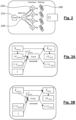
- FIG. 2 schematically represents the structure of such a deterministic hierarchical portfolio.
- the seed, 210, at the origin of the key wallet is a random number (or entropy), for example on 128 or 256 bits. It is generally represented by a mnemonic code consisting of 12 or 24 words taken from a predetermined dictionary containing a predetermined number of words (2048).
- the seed is then hashed (e.g. using the HMAC-SHA hash function 512), to provide on the one hand a master private key, 220, ( k m ) and an associated chain code (not shown).
- a parent private key, 230 the chain code associated with this key and an index number, i , a child private key, 240, of birth order i +1 (the first child corresponding to the zero index).
- the generation of the private key involves a hash function (or a combination of hash functions) preventing us from being able to go back to a parent private key from the private key of a child.
- Generating private keys in a deterministic hierarchical wallet can be done using different methods.
- FIG. 3A represents a first method of generating private keys in a deterministic hierarchical wallet.
- This extended public key is combined with the index, i , of the child key we want to generate, and then the whole thing is hashed using a hash function, Hash .
- the hash result is divided into a left part and a right part.
- the left part is combined with the parent private key, k parent , to give the child private key, k child while the right part gives the code string associated with the child key, CCK child .
- CKD private n The generation operation to go from a parent private key to a child key of index i is noted here CKD private n .
- Fig. 3B represents a second method of generating private keys in a deterministic hierarchical wallet.
- This generation method uses an extended private key instead of an extended public key to generate a private key for the next generation. It is a priori more robust than the normal method since it omits public information from the calculation.
- This extended private key is combined with the index, i , of the child key we want to generate, and then the whole thing is hashed using a hash function, Hash .
- the hash result is divided into a left part and a right part.
- the left part is combined as before with the parent private key, k parent , to give the child private key, k child while the right part gives the code string associated with the child key, CCk child .
- the generation operation to move from a parent private key to a child key of index i is called a reinforced generation operation and denoted CKD private h
- k child CKD private h k parent i
- k child CKD private h ... CKD private h CKD private h k m i 1 ) i 2 , ... , i N
- N is the length of the path in the tree from the seed
- i 1 , ... , i N is the succession of indices of the child keys along the path.
- each elementary CKD priv generation operation can be a normal generation operation CKD private n or a reinforced generation operation CKD private h .
- the indices i used in normal generation operations and enhanced generation operations take their values in distinct intervals.
- indices ranging from 0 to 2 31 -1 are used to generate private keys according to a normal generation operation and indices ranging from 2 31 to 2 32 -1 are used to generate private keys according to a enhanced generation operation.
- a private key can be identified by means of a generation path in the tree starting from the master private key.
- m /0/3 will designate the second generation private key, 4th normal child of the parent key, itself first normal child of the master private key.
- the idea behind the present invention is to provide for each smart contract, SC with which the user must interact a specific private key, k user SC , said specific private key being identified by a generation path within the tree structure, at least one node of this path being indexed by an identifier of the smart contract.
- the address of the user's account from which the user sends transactions to the smart contract is obtained by hashing the public key associated with the specific private key in the asymmetric cryptosystem.
- k user SC CKD private ... CKD private CKD private k user m i 1 ) i 2 , ... , i N where at least one of the indices i 1 ,.., i N is an identifier of the smart contract SC and k user m is the user's master private key.
- PK user SC k user SC .
- the key generation path within the wallet tree structure is given by a succession of branches, according to indices forming a path from the root m of a tree to the leaf identified by the last index: m / ... / Id SC / ... where Id SC is an index uniquely identifying the smart contract SC .
- the portfolio has a tree structure (in the sense of graph theory), with the outgoing arcs of a parent node or, equivalently, the child nodes being indexed by the aforementioned indices.
- the succession of indices (9) defines a path between the root and a leaf of the tree.
- the smart contract is written in a computer language (such as Solidity for example). It includes a "constructor", that is, a function that is executed only once and initializes the state of the contract. When this function is called, it performs an initialization of the contract, for example by assigning a certain number of tokens to the account from which it was deployed on the blockchain.
- the constructor can also assign a symbol to the smart contract (which can be a 3-letter symbol identifying the token that is the object of the contract).
- the contract also has a name which is not necessarily that of the manufacturer.
- the smart contract is associated with a unique address (represented on 20 bytes) where it is stored and which allows it to be addressed.
- the smart contract identifier may result from the selection or combination of the above elements: contract name, symbol defining the contract, contract address. In any case, the identifier must be unique and specific to the smart contract in question so that any two smart contracts deployed on the blockchain are associated with distinct identifiers.
- each node must be between 0 and 2 31 -1, with the MSB being used to distinguish a normal generation from a hardened generation.
- each index can be represented in 4 bytes.
- the path starts at the root of the tree, continues through a series of indices representing successive branches (or nodes), and ends with the symbol SC representing a leaf of the hierarchical portfolio tree structure.
- the generation path of the specific private key could be of the form: m / ... / add SC 19 ... add SC 16 / add SC 15 ... add SC 12 / add SC 11 ... add SC 8 / add SC 7 ... add SC 4 / add SC 3 ... add SC 0
- the index i N is formed by the concatenation of the bytes add SC 3 ... add SC 0
- the index i N -1 is formed by the concatenation of the bytes add SC 7 ... add SC 4 , etc.
- the indices i N -3 , to i N of the different branches in the tree structure uniquely identify the smart contract SC.
- the branch with index i N leads to a leaf of the tree structure.
- the user's private key wallet HD is represented at 410.
- the smart contract-specific private key, 430, SC is generated by means of a path in the wallet tree structure, said path being identified by a succession of branch indices in the hierarchical wallet tree structure.
- the path ends with a leaf with the SYMBOL index uniquely identifying the smart contract.
- the transaction is signed in 420 using said specific private key. More precisely the transaction is hashed using a hash function (or a combination of such functions) and then the ECDSA signature is calculated (components r, s or even ( r , s , v ) where ⁇ identifies the chain (e.g. Ethereum).
- a hash function or a combination of such functions
- the transaction is issued from the EOA ( Externally Owned Account ) public address, obtained by hashing the public key corresponding to said specific private key in the asymmetric cryptosystem.
- the transaction is then propagated on the blockchain P2P network, 440.
- the smart contract SC Upon receipt, the smart contract SC verifies from the signature whether the transaction was indeed issued by the public address EOA. More precisely, the smart contract can deduce from the components of the signature and the account address of the issuer (this address being obtained by hashing the user's public key) having issued the transaction, whether the latter was indeed signed by the specific private key. The smart contract thus authenticates the issuer. It should be noted that this authentication can also be carried out by any node in the blockchain. After authenticating the issuer and ensuring that the various input arguments fulfilled the conditions specified in the contract, the smart contract executes the called function (also called method).
- the called function also called method
Landscapes
- Engineering & Computer Science (AREA)
- Computer Security & Cryptography (AREA)
- Business, Economics & Management (AREA)
- Accounting & Taxation (AREA)
- Computer Networks & Wireless Communication (AREA)
- Signal Processing (AREA)
- Theoretical Computer Science (AREA)
- Finance (AREA)
- General Physics & Mathematics (AREA)
- Physics & Mathematics (AREA)
- General Business, Economics & Management (AREA)
- Strategic Management (AREA)
- Health & Medical Sciences (AREA)
- Bioethics (AREA)
- General Health & Medical Sciences (AREA)
- Computer Hardware Design (AREA)
- Software Systems (AREA)
- General Engineering & Computer Science (AREA)
- Financial Or Insurance-Related Operations Such As Payment And Settlement (AREA)
- Management, Administration, Business Operations System, And Electronic Commerce (AREA)
Claims (6)
- Verfahren zum Authentifizieren eines Benutzers einer Blockchain bei einem Smart Contract, der in der Blockchain eingesetzt wird, wobei der Benutzer ein hierarchisches deterministisches Wallet zum Generieren privater Schlüssel besitzt, das in einer Baumstruktur organisiert ist, wobei der Benutzer eine Transaktion an den Smart Contract übermittelt, wobei das Verfahren Folgendes enthält:- das hierarchische deterministische Wallet enthält einen Pfad innerhalb der Baumstruktur zwischen einem privaten Hauptschlüssel des Benutzers an der Wurzel der Baumstruktur und einem privaten Schlüssel, der für den Smart Contract spezifisch ist, wobei der Benutzer eine ausstellende Kontoadresse besitzt, die durch Hashing eines öffentlichen Schlüssels erhalten wird, der dem spezifischen privaten Schlüssel in einem asymmetrischen Kryptosystem entspricht, wobei der Pfad eine Vielzahl von Verzweigungen innerhalb der Baumstruktur verwendet, wobei jede Verzweigung einen Index trägt, wobei der Smart Contract durch einen oder mehrere Indizes von Verzweigungen, denen der Pfad folgt, eindeutig identifiziert wird;- der Benutzer generiert eine Transaktion und signiert sie mit dem spezifischen privaten Schlüssel, bevor er sie an den Smart Contract übermittelt;- der Smart Contract überprüft nach dem Empfangen der Transaktion die Gültigkeit der Signatur der ausstellenden Kontoadresse und ob die Transaktion tatsächlich von der ausstellenden Kontoadresse ausgestellt wurde.
- Authentifizierungsverfahren nach Anspruch 1, dadurch gekennzeichnet, dass ein oder mehrere Indizes von Verzweigungen des Pfads durch den Namen des Smart Contracts und/oder das diesen Vertrag definierende Symbol und/oder die Adresse dieses Vertrags in der Blockchain gegeben sind.
- Authentifizierungsverfahren nach Anspruch 2, dadurch gekennzeichnet, dass das hierarchische deterministische Wallet mit der BIP-32-Struktur konform ist.
- Authentifizierungsverfahren nach Anspruch 3, dadurch gekennzeichnet, dass eine Verzweigung des Pfads als Index das Symbol hat, das den Vertrag definiert.
- Authentifizierungsverfahren nach Anspruch 3, dadurch gekennzeichnet, dass die Vertragsadresse in der Blockchain durch eine Vielzahl von Bytes dargestellt wird und dass eine Folge von Verzweigungen des Pfads als jeweilige Indizes die Bytes der Vielzahl haben.
- Authentifizierungsverfahren nach Anspruch 5, dadurch gekennzeichnet, dass die letzte Verzweigung der Folge von Verzweigungen zu einem Blatt der Baumstruktur führt, wobei der spezifische private Schlüssel an diesem Blatt generiert wird.
Applications Claiming Priority (1)
| Application Number | Priority Date | Filing Date | Title |
|---|---|---|---|
| FR1909894A FR3100631B1 (fr) | 2019-09-09 | 2019-09-09 | Méthode d’authentification sélective d’un utilisateur de chaine de blocs auprès d’un contrat intelligent |
Publications (2)
| Publication Number | Publication Date |
|---|---|
| EP3789901A1 EP3789901A1 (de) | 2021-03-10 |
| EP3789901B1 true EP3789901B1 (de) | 2024-10-30 |
Family
ID=69468660
Family Applications (1)
| Application Number | Title | Priority Date | Filing Date |
|---|---|---|---|
| EP20195138.1A Active EP3789901B1 (de) | 2019-09-09 | 2020-09-08 | Methode zur selektiven authentifizierung eines nutzers einer blockchain im rahmen eines smart contract |
Country Status (3)
| Country | Link |
|---|---|
| US (1) | US12271894B2 (de) |
| EP (1) | EP3789901B1 (de) |
| FR (1) | FR3100631B1 (de) |
Families Citing this family (7)
| Publication number | Priority date | Publication date | Assignee | Title |
|---|---|---|---|---|
| CN113268712B (zh) * | 2021-05-26 | 2023-08-25 | 西北大学 | 一种基于区块链的公共文化资源确权系统及方法 |
| US11831757B2 (en) * | 2021-06-30 | 2023-11-28 | SafeMoon US, LLC | System and method for generating virtual private keys from user credential information |
| US11902451B2 (en) * | 2021-07-01 | 2024-02-13 | Fujitsu Limited | Cross-blockchain identity and key management |
| CN113989045A (zh) * | 2021-11-02 | 2022-01-28 | 支付宝(杭州)信息技术有限公司 | 基于区块链的汇款汇路管理方法和装置 |
| US20250061238A1 (en) * | 2023-08-16 | 2025-02-20 | The Pnc Financial Services Group, Inc. | Technologies for managing smart contracts |
| CN117335997B (zh) * | 2023-11-29 | 2024-03-19 | 广东电网有限责任公司湛江供电局 | 一种数据处理方法、系统、设备和介质 |
| CN119515385B (zh) * | 2024-11-06 | 2025-12-12 | 上海交通大学 | 支持隐形地址和签名聚合的全功能分层确定性钱包模型 |
Family Cites Families (5)
| Publication number | Priority date | Publication date | Assignee | Title |
|---|---|---|---|---|
| US11538031B2 (en) * | 2017-03-31 | 2022-12-27 | Vijay Madisetti | Method and system for identity and access management for blockchain interoperability |
| KR101919590B1 (ko) * | 2017-05-10 | 2019-02-08 | 주식회사 코인플러그 | 블록체인 데이터베이스 및 이와 연동하는 머클 트리 구조를 통해 사물 인터넷 기기에 대한 비용을 결제하는 방법, 이를 이용한 서버, 서비스 제공 단말, 및 사용자 전자 지갑 |
| US12010228B2 (en) * | 2018-05-15 | 2024-06-11 | Kelvin Zero Inc. | Systems, methods, and devices for secure blockchain transaction and subnetworks |
| US11410168B2 (en) * | 2019-04-03 | 2022-08-09 | Acronis International Gmbh | Method for user management for blockchain-based operations |
| EP3665595B1 (de) * | 2019-05-14 | 2021-11-24 | Advanced New Technologies Co., Ltd. | Verfahren und vorrichtungen für daten-traversal |
-
2019
- 2019-09-09 FR FR1909894A patent/FR3100631B1/fr active Active
-
2020
- 2020-09-08 US US17/014,231 patent/US12271894B2/en active Active
- 2020-09-08 EP EP20195138.1A patent/EP3789901B1/de active Active
Also Published As
| Publication number | Publication date |
|---|---|
| FR3100631A1 (fr) | 2021-03-12 |
| EP3789901A1 (de) | 2021-03-10 |
| FR3100631B1 (fr) | 2022-08-26 |
| US12271894B2 (en) | 2025-04-08 |
| US20210073796A1 (en) | 2021-03-11 |
Similar Documents
| Publication | Publication Date | Title |
|---|---|---|
| EP3789901B1 (de) | Methode zur selektiven authentifizierung eines nutzers einer blockchain im rahmen eines smart contract | |
| JP6908700B2 (ja) | 情報保護のためのシステム及び方法 | |
| EP3790223A1 (de) | Erzeugung eines kontextabhängigen mehrbenutzer-portfolios mit privaten schlüsseln, und verwendung eines solchen portfolios | |
| FR3075534A1 (fr) | Dispositif de stockage de cles numeriques pour signer des transactions sur une chaine de blocs | |
| FR2855691A1 (fr) | Securisation de la distribution de documents numeriques dans un reseau pair a pair | |
| EP4016353B1 (de) | Verfahren zur verschlüsselung und speicherung von computerdateien und entsprechende verschlüsselungs- und speichervorrichtung | |
| FR3107416A1 (fr) | Tokenisation aléatoire efficace dans un environnement dématérialisé | |
| EP4057568A1 (de) | Verfahren zur überprüfung der berechtigung eines terminals, ein identitätsattribut eines benutzers zu prüfen | |
| EP2795833B1 (de) | Authentifizierungsverfahren zwischen einem lesegerät und einem funketikett | |
| WO2017162930A2 (fr) | Dispositif d'authentification biométrique adaptatif par échographie, photographies en lumière visible de contraste et infrarouge, sans divulgation, à travers un réseau informatique décentralisé | |
| WO2022208016A1 (fr) | Procédé et système informatique de stockage decentralisé et de partage de fichiers numériques certifiés | |
| WO2022137192A1 (fr) | Procédé et dispositif de contrôle de l'accès à un service utilisant une chaîne de blocs | |
| EP4012972A1 (de) | Methode zur selektiven weitergabe von daten über eine blockchain | |
| EP4512034B1 (de) | Verfahren, endgerät und server zur verwaltung persönlicher daten | |
| EP4057190A1 (de) | Vereinfachter client und zugehörige architekturen für die übertragung von quantenberechnungen an einen quantenserver | |
| FR2858145A1 (fr) | Procede et systeme de double authentification securise d'un utilisateur lors de l'acces a un service par l'intermediaire d'un reseau ip | |
| KR102332814B1 (ko) | 데이터 자기주권화를 위한 블록체인 구조를 포함하는 블록체인 시스템 | |
| FR3107128A1 (fr) | Procédé et dispositif d'évaluation de correspondance d'ensembles de données structurées protégées par le chiffrement | |
| EP3903210A1 (de) | Gesichertes, verfolgtes kommunikationsnetz | |
| Bold | Security of Decentralized Fintech: A Blockchain and Artificial Intelligence Concept | |
| WO2026053106A1 (fr) | Procédé de stockage de clés de chiffrement dans des blocs de flux de commandes | |
| FR3161085A1 (fr) | Procédé et dispositif de communication sécurisé utilisant un identifiant dérivé de manière déterministe | |
| FR3127304A1 (fr) | Méthode de formation pipelinée d’une chaine de blocs garantissant la vivacité des transactions | |
| EP3284209B1 (de) | Verfahren zur erzeugung und verifizierung eines sicherheitsschlüssels einer virtuellen geldeinheit | |
| FR3149402A1 (fr) | Procédés, terminal et serveur de gestion de données personnelles |
Legal Events
| Date | Code | Title | Description |
|---|---|---|---|
| PUAI | Public reference made under article 153(3) epc to a published international application that has entered the european phase |
Free format text: ORIGINAL CODE: 0009012 |
|
| STAA | Information on the status of an ep patent application or granted ep patent |
Free format text: STATUS: REQUEST FOR EXAMINATION WAS MADE |
|
| 17P | Request for examination filed |
Effective date: 20200908 |
|
| AK | Designated contracting states |
Kind code of ref document: A1 Designated state(s): AL AT BE BG CH CY CZ DE DK EE ES FI FR GB GR HR HU IE IS IT LI LT LU LV MC MK MT NL NO PL PT RO RS SE SI SK SM TR |
|
| AX | Request for extension of the european patent |
Extension state: BA ME |
|
| GRAP | Despatch of communication of intention to grant a patent |
Free format text: ORIGINAL CODE: EPIDOSNIGR1 |
|
| STAA | Information on the status of an ep patent application or granted ep patent |
Free format text: STATUS: GRANT OF PATENT IS INTENDED |
|
| RIC1 | Information provided on ipc code assigned before grant |
Ipc: H04L 9/00 20060101ALI20240319BHEP Ipc: H04L 9/32 20060101ALI20240319BHEP Ipc: G06F 21/64 20130101AFI20240319BHEP |
|
| INTG | Intention to grant announced |
Effective date: 20240418 |
|
| GRAS | Grant fee paid |
Free format text: ORIGINAL CODE: EPIDOSNIGR3 |
|
| GRAA | (expected) grant |
Free format text: ORIGINAL CODE: 0009210 |
|
| STAA | Information on the status of an ep patent application or granted ep patent |
Free format text: STATUS: THE PATENT HAS BEEN GRANTED |
|
| AK | Designated contracting states |
Kind code of ref document: B1 Designated state(s): AL AT BE BG CH CY CZ DE DK EE ES FI FR GB GR HR HU IE IS IT LI LT LU LV MC MK MT NL NO PL PT RO RS SE SI SK SM TR |
|
| RAP3 | Party data changed (applicant data changed or rights of an application transferred) |
Owner name: COMMISSARIAT A L'ENERGIE ATOMIQUE ET AUX ENERGIESALTERNATIVES |
|
| REG | Reference to a national code |
Ref country code: GB Ref legal event code: FG4D Free format text: NOT ENGLISH |
|
| REG | Reference to a national code |
Ref country code: CH Ref legal event code: EP |
|
| REG | Reference to a national code |
Ref country code: DE Ref legal event code: R096 Ref document number: 602020040184 Country of ref document: DE |
|
| REG | Reference to a national code |
Ref country code: IE Ref legal event code: FG4D Free format text: LANGUAGE OF EP DOCUMENT: FRENCH |
|
| REG | Reference to a national code |
Ref country code: LT Ref legal event code: MG9D |
|
| REG | Reference to a national code |
Ref country code: NL Ref legal event code: MP Effective date: 20241030 |
|
| PG25 | Lapsed in a contracting state [announced via postgrant information from national office to epo] |
Ref country code: IS Free format text: LAPSE BECAUSE OF FAILURE TO SUBMIT A TRANSLATION OF THE DESCRIPTION OR TO PAY THE FEE WITHIN THE PRESCRIBED TIME-LIMIT Effective date: 20250228 Ref country code: HR Free format text: LAPSE BECAUSE OF FAILURE TO SUBMIT A TRANSLATION OF THE DESCRIPTION OR TO PAY THE FEE WITHIN THE PRESCRIBED TIME-LIMIT Effective date: 20241030 Ref country code: PT Free format text: LAPSE BECAUSE OF FAILURE TO SUBMIT A TRANSLATION OF THE DESCRIPTION OR TO PAY THE FEE WITHIN THE PRESCRIBED TIME-LIMIT Effective date: 20250228 |
|
| PG25 | Lapsed in a contracting state [announced via postgrant information from national office to epo] |
Ref country code: FI Free format text: LAPSE BECAUSE OF FAILURE TO SUBMIT A TRANSLATION OF THE DESCRIPTION OR TO PAY THE FEE WITHIN THE PRESCRIBED TIME-LIMIT Effective date: 20241030 Ref country code: NL Free format text: LAPSE BECAUSE OF FAILURE TO SUBMIT A TRANSLATION OF THE DESCRIPTION OR TO PAY THE FEE WITHIN THE PRESCRIBED TIME-LIMIT Effective date: 20241030 |
|
| REG | Reference to a national code |
Ref country code: AT Ref legal event code: MK05 Ref document number: 1737622 Country of ref document: AT Kind code of ref document: T Effective date: 20241030 |
|
| PG25 | Lapsed in a contracting state [announced via postgrant information from national office to epo] |
Ref country code: BG Free format text: LAPSE BECAUSE OF FAILURE TO SUBMIT A TRANSLATION OF THE DESCRIPTION OR TO PAY THE FEE WITHIN THE PRESCRIBED TIME-LIMIT Effective date: 20241030 |
|
| PG25 | Lapsed in a contracting state [announced via postgrant information from national office to epo] |
Ref country code: ES Free format text: LAPSE BECAUSE OF FAILURE TO SUBMIT A TRANSLATION OF THE DESCRIPTION OR TO PAY THE FEE WITHIN THE PRESCRIBED TIME-LIMIT Effective date: 20241030 |
|
| PG25 | Lapsed in a contracting state [announced via postgrant information from national office to epo] |
Ref country code: NO Free format text: LAPSE BECAUSE OF FAILURE TO SUBMIT A TRANSLATION OF THE DESCRIPTION OR TO PAY THE FEE WITHIN THE PRESCRIBED TIME-LIMIT Effective date: 20250130 |
|
| PG25 | Lapsed in a contracting state [announced via postgrant information from national office to epo] |
Ref country code: LV Free format text: LAPSE BECAUSE OF FAILURE TO SUBMIT A TRANSLATION OF THE DESCRIPTION OR TO PAY THE FEE WITHIN THE PRESCRIBED TIME-LIMIT Effective date: 20241030 Ref country code: GR Free format text: LAPSE BECAUSE OF FAILURE TO SUBMIT A TRANSLATION OF THE DESCRIPTION OR TO PAY THE FEE WITHIN THE PRESCRIBED TIME-LIMIT Effective date: 20250131 Ref country code: AT Free format text: LAPSE BECAUSE OF FAILURE TO SUBMIT A TRANSLATION OF THE DESCRIPTION OR TO PAY THE FEE WITHIN THE PRESCRIBED TIME-LIMIT Effective date: 20241030 |
|
| PG25 | Lapsed in a contracting state [announced via postgrant information from national office to epo] |
Ref country code: PL Free format text: LAPSE BECAUSE OF FAILURE TO SUBMIT A TRANSLATION OF THE DESCRIPTION OR TO PAY THE FEE WITHIN THE PRESCRIBED TIME-LIMIT Effective date: 20241030 |
|
| PG25 | Lapsed in a contracting state [announced via postgrant information from national office to epo] |
Ref country code: RS Free format text: LAPSE BECAUSE OF FAILURE TO SUBMIT A TRANSLATION OF THE DESCRIPTION OR TO PAY THE FEE WITHIN THE PRESCRIBED TIME-LIMIT Effective date: 20250130 |
|
| PG25 | Lapsed in a contracting state [announced via postgrant information from national office to epo] |
Ref country code: SM Free format text: LAPSE BECAUSE OF FAILURE TO SUBMIT A TRANSLATION OF THE DESCRIPTION OR TO PAY THE FEE WITHIN THE PRESCRIBED TIME-LIMIT Effective date: 20241030 |
|
| PG25 | Lapsed in a contracting state [announced via postgrant information from national office to epo] |
Ref country code: DK Free format text: LAPSE BECAUSE OF FAILURE TO SUBMIT A TRANSLATION OF THE DESCRIPTION OR TO PAY THE FEE WITHIN THE PRESCRIBED TIME-LIMIT Effective date: 20241030 |
|
| PG25 | Lapsed in a contracting state [announced via postgrant information from national office to epo] |
Ref country code: EE Free format text: LAPSE BECAUSE OF FAILURE TO SUBMIT A TRANSLATION OF THE DESCRIPTION OR TO PAY THE FEE WITHIN THE PRESCRIBED TIME-LIMIT Effective date: 20241030 |
|
| PG25 | Lapsed in a contracting state [announced via postgrant information from national office to epo] |
Ref country code: RO Free format text: LAPSE BECAUSE OF FAILURE TO SUBMIT A TRANSLATION OF THE DESCRIPTION OR TO PAY THE FEE WITHIN THE PRESCRIBED TIME-LIMIT Effective date: 20241030 |
|
| PG25 | Lapsed in a contracting state [announced via postgrant information from national office to epo] |
Ref country code: SK Free format text: LAPSE BECAUSE OF FAILURE TO SUBMIT A TRANSLATION OF THE DESCRIPTION OR TO PAY THE FEE WITHIN THE PRESCRIBED TIME-LIMIT Effective date: 20241030 |
|
| PG25 | Lapsed in a contracting state [announced via postgrant information from national office to epo] |
Ref country code: CZ Free format text: LAPSE BECAUSE OF FAILURE TO SUBMIT A TRANSLATION OF THE DESCRIPTION OR TO PAY THE FEE WITHIN THE PRESCRIBED TIME-LIMIT Effective date: 20241030 |
|
| PG25 | Lapsed in a contracting state [announced via postgrant information from national office to epo] |
Ref country code: IT Free format text: LAPSE BECAUSE OF FAILURE TO SUBMIT A TRANSLATION OF THE DESCRIPTION OR TO PAY THE FEE WITHIN THE PRESCRIBED TIME-LIMIT Effective date: 20241030 |
|
| REG | Reference to a national code |
Ref country code: DE Ref legal event code: R097 Ref document number: 602020040184 Country of ref document: DE |
|
| PLBE | No opposition filed within time limit |
Free format text: ORIGINAL CODE: 0009261 |
|
| STAA | Information on the status of an ep patent application or granted ep patent |
Free format text: STATUS: NO OPPOSITION FILED WITHIN TIME LIMIT |
|
| PG25 | Lapsed in a contracting state [announced via postgrant information from national office to epo] |
Ref country code: SE Free format text: LAPSE BECAUSE OF FAILURE TO SUBMIT A TRANSLATION OF THE DESCRIPTION OR TO PAY THE FEE WITHIN THE PRESCRIBED TIME-LIMIT Effective date: 20241030 |
|
| 26N | No opposition filed |
Effective date: 20250731 |
|
| PGFP | Annual fee paid to national office [announced via postgrant information from national office to epo] |
Ref country code: DE Payment date: 20250919 Year of fee payment: 6 |
|
| PGFP | Annual fee paid to national office [announced via postgrant information from national office to epo] |
Ref country code: FR Payment date: 20250923 Year of fee payment: 6 |