EP3789898B1 - Verfahren um einen schlüssel zu generieren - Google Patents
Verfahren um einen schlüssel zu generieren Download PDFInfo
- Publication number
- EP3789898B1 EP3789898B1 EP20194257.0A EP20194257A EP3789898B1 EP 3789898 B1 EP3789898 B1 EP 3789898B1 EP 20194257 A EP20194257 A EP 20194257A EP 3789898 B1 EP3789898 B1 EP 3789898B1
- Authority
- EP
- European Patent Office
- Prior art keywords
- key
- word
- function
- program
- generated
- Prior art date
- Legal status (The legal status is an assumption and is not a legal conclusion. Google has not performed a legal analysis and makes no representation as to the accuracy of the status listed.)
- Active
Links
Images


Classifications
-
- H—ELECTRICITY
- H04—ELECTRIC COMMUNICATION TECHNIQUE
- H04L—TRANSMISSION OF DIGITAL INFORMATION, e.g. TELEGRAPHIC COMMUNICATION
- H04L9/00—Cryptographic mechanisms or cryptographic arrangements for secret or secure communications; Network security protocols
- H04L9/08—Key distribution or management, e.g. generation, sharing or updating, of cryptographic keys or passwords
- H04L9/0861—Generation of secret information including derivation or calculation of cryptographic keys or passwords
-
- G—PHYSICS
- G06—COMPUTING OR CALCULATING; COUNTING
- G06F—ELECTRIC DIGITAL DATA PROCESSING
- G06F21/00—Security arrangements for protecting computers, components thereof, programs or data against unauthorised activity
- G06F21/50—Monitoring users, programs or devices to maintain the integrity of platforms, e.g. of processors, firmware or operating systems
- G06F21/57—Certifying or maintaining trusted computer platforms, e.g. secure boots or power-downs, version controls, system software checks, secure updates or assessing vulnerabilities
- G06F21/572—Secure firmware programming, e.g. of basic input output system [BIOS]
-
- G—PHYSICS
- G06—COMPUTING OR CALCULATING; COUNTING
- G06F—ELECTRIC DIGITAL DATA PROCESSING
- G06F21/00—Security arrangements for protecting computers, components thereof, programs or data against unauthorised activity
- G06F21/60—Protecting data
- G06F21/606—Protecting data by securing the transmission between two devices or processes
-
- G—PHYSICS
- G06—COMPUTING OR CALCULATING; COUNTING
- G06F—ELECTRIC DIGITAL DATA PROCESSING
- G06F8/00—Arrangements for software engineering
- G06F8/60—Software deployment
- G06F8/65—Updates
-
- H—ELECTRICITY
- H04—ELECTRIC COMMUNICATION TECHNIQUE
- H04L—TRANSMISSION OF DIGITAL INFORMATION, e.g. TELEGRAPHIC COMMUNICATION
- H04L63/00—Network architectures or network communication protocols for network security
- H04L63/04—Network architectures or network communication protocols for network security for providing a confidential data exchange among entities communicating through data packet networks
- H04L63/0428—Network architectures or network communication protocols for network security for providing a confidential data exchange among entities communicating through data packet networks wherein the data content is protected, e.g. by encrypting or encapsulating the payload
- H04L63/0435—Network architectures or network communication protocols for network security for providing a confidential data exchange among entities communicating through data packet networks wherein the data content is protected, e.g. by encrypting or encapsulating the payload wherein the sending and receiving network entities apply symmetric encryption, i.e. same key used for encryption and decryption
-
- H—ELECTRICITY
- H04—ELECTRIC COMMUNICATION TECHNIQUE
- H04L—TRANSMISSION OF DIGITAL INFORMATION, e.g. TELEGRAPHIC COMMUNICATION
- H04L67/00—Network arrangements or protocols for supporting network services or applications
- H04L67/34—Network arrangements or protocols for supporting network services or applications involving the movement of software or configuration parameters
-
- H—ELECTRICITY
- H04—ELECTRIC COMMUNICATION TECHNIQUE
- H04L—TRANSMISSION OF DIGITAL INFORMATION, e.g. TELEGRAPHIC COMMUNICATION
- H04L9/00—Cryptographic mechanisms or cryptographic arrangements for secret or secure communications; Network security protocols
- H04L9/06—Cryptographic mechanisms or cryptographic arrangements for secret or secure communications; Network security protocols the encryption apparatus using shift registers or memories for block-wise or stream coding, e.g. DES systems or RC4; Hash functions; Pseudorandom sequence generators
- H04L9/0643—Hash functions, e.g. MD5, SHA, HMAC or f9 MAC
-
- H—ELECTRICITY
- H04—ELECTRIC COMMUNICATION TECHNIQUE
- H04L—TRANSMISSION OF DIGITAL INFORMATION, e.g. TELEGRAPHIC COMMUNICATION
- H04L9/00—Cryptographic mechanisms or cryptographic arrangements for secret or secure communications; Network security protocols
- H04L9/08—Key distribution or management, e.g. generation, sharing or updating, of cryptographic keys or passwords
- H04L9/0861—Generation of secret information including derivation or calculation of cryptographic keys or passwords
- H04L9/0866—Generation of secret information including derivation or calculation of cryptographic keys or passwords involving user or device identifiers, e.g. serial number, physical or biometrical information, DNA, hand-signature or measurable physical characteristics
-
- H—ELECTRICITY
- H04—ELECTRIC COMMUNICATION TECHNIQUE
- H04L—TRANSMISSION OF DIGITAL INFORMATION, e.g. TELEGRAPHIC COMMUNICATION
- H04L9/00—Cryptographic mechanisms or cryptographic arrangements for secret or secure communications; Network security protocols
- H04L9/08—Key distribution or management, e.g. generation, sharing or updating, of cryptographic keys or passwords
- H04L9/0861—Generation of secret information including derivation or calculation of cryptographic keys or passwords
- H04L9/0869—Generation of secret information including derivation or calculation of cryptographic keys or passwords involving random numbers or seeds
-
- H—ELECTRICITY
- H04—ELECTRIC COMMUNICATION TECHNIQUE
- H04L—TRANSMISSION OF DIGITAL INFORMATION, e.g. TELEGRAPHIC COMMUNICATION
- H04L9/00—Cryptographic mechanisms or cryptographic arrangements for secret or secure communications; Network security protocols
- H04L9/08—Key distribution or management, e.g. generation, sharing or updating, of cryptographic keys or passwords
- H04L9/0891—Revocation or update of secret information, e.g. encryption key update or rekeying
-
- H—ELECTRICITY
- H04—ELECTRIC COMMUNICATION TECHNIQUE
- H04L—TRANSMISSION OF DIGITAL INFORMATION, e.g. TELEGRAPHIC COMMUNICATION
- H04L9/00—Cryptographic mechanisms or cryptographic arrangements for secret or secure communications; Network security protocols
- H04L9/32—Cryptographic mechanisms or cryptographic arrangements for secret or secure communications; Network security protocols including means for verifying the identity or authority of a user of the system or for message authentication, e.g. authorization, entity authentication, data integrity or data verification, non-repudiation, key authentication or verification of credentials
- H04L9/3247—Cryptographic mechanisms or cryptographic arrangements for secret or secure communications; Network security protocols including means for verifying the identity or authority of a user of the system or for message authentication, e.g. authorization, entity authentication, data integrity or data verification, non-repudiation, key authentication or verification of credentials involving digital signatures
-
- G—PHYSICS
- G06—COMPUTING OR CALCULATING; COUNTING
- G06F—ELECTRIC DIGITAL DATA PROCESSING
- G06F2221/00—Indexing scheme relating to security arrangements for protecting computers, components thereof, programs or data against unauthorised activity
- G06F2221/03—Indexing scheme relating to G06F21/50, monitoring users, programs or devices to maintain the integrity of platforms
- G06F2221/033—Test or assess software
Definitions
- This description generally relates to methods for protecting an electronic system and more specifically to methods for generating encryption and/or ciphering keys.
- Cryptography is a discipline that focuses, among other things, on protecting messages or content transmitted between two electronic devices (ensuring confidentiality, authenticity, and integrity) using encryption keys. Keys are used to encrypt and decrypt messages. This prevents people who do not have the correct keys from understanding the message.
- US 2006/005046 A1 discloses the generation of a symmetric key to decrypt an update program from information present in clear text in the program and the installed program.
- KR 2009 0051475 A discloses the generation of a symmetric key to decrypt an update program from its version number and a secret symmetric key of the installed program.
- US 2017/115984 A1 discloses a method of generating a symmetric key for decrypting an update program, wherein the symmetric key is decrypted from the update program and secret data held by the electronic device. 1
- One embodiment provides a method of generating a symmetric key, wherein the symmetric key is generated by an electronic device based on a software update program and a secret value held by the electronic device.
- the method comprises: receipt by the device of the software update program transmitted by a server.
- the update program is encrypted.
- the symmetric key is also generated by the server.
- the method comprises a step of generating a first word representative of the update program.
- the first word is representative of the decrypted update program.
- the method comprises a step of generating at least one second word, the second word being representative of the secret value.
- the symmetric key is generated by applying a key derivation function to the first word and at least one of the second words,
- the symmetric key is generated by applying a key derivation function to a third word representative of the first word and one of the second words.
- the generation of a word is performed by a one-way function.
- the secret value is a key that was written into non-volatile memory during the initial programming of the software.
- the secret value is a key that was generated during a previous update of the software.
- Another embodiment provides an electronic system, comprising a server and at least one electronic device, the server and the at least one device electronics comprising a circuit as described above.
- the expressions "about”, “approximately”, “substantially”, and “of the order of” mean to within 10%, preferably to within 5%.
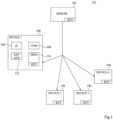
- FIG. 1 represents a system of electronic devices of the type to which the described embodiments apply.
- FIG. 1 represents an electronic system 100 comprising electronic devices. More specifically, the system 100 comprises a server 102 (SERVER) and devices 104 (DEVICE1, DEVICE2, DEVICE3, DEVICE4).
- the electronic system 100 comprises at least one device 104, preferably at least two devices 104. Although only one device 104 (DEVICE1) is detailed, the devices 104 are preferably similar.
- the devices 104 are configured to be able to receive data from the server 102, and optionally, to be able to send data to the server 102.
- the server 102 regularly transmits software updates to the devices 104.
- the devices 104 may be, optionally, configured to transmit data between them without going through the server 102.
- the data transmitted between the devices 104 and the server 102 or between the devices 104 are preferably encrypted so as to protect them from hackers or third parties who would seek to obtain them illegitimately.
- the server 102 and the devices 104 each include at least one encryption key (KEY).
- the encryption and/or ciphering keys are symmetric keys.
- the server 102 encrypts the data using a symmetric encryption key and the device(s) 104 decrypt it, after reception, using the same key as that which enabled the encryption of the message.
- the devices 104 for example all have the same key to encrypt/decrypt the data transmitted between the devices 104 and the server 102.
- the server 102 can then only include a single key to encrypt/decrypt the data transmitted with the devices 104.
- the devices 104 may each have their own encryption key.
- the server 102 then has as many encryption keys as the system includes devices 104. Data to be transmitted is then encrypted. with the key corresponding to the device 104 to which the data is intended. When data is to be transmitted to all the devices 104, each device 104 receives the encrypted data with its encryption key.
- the server 102 and devices 104 may include private keys and public keys for asymmetrically encrypting/decrypting data.
- the generation, by the circuit 112, of the new key is for example carried out by means of software, in which case the circuit 112 comprises a processor, for example the processor 106 or another.
- the generation, by the circuit 112, of the new key can also for example be performed via hardware, i.e., for example, via logic circuits and gates, in which case the circuit 112 comprises the hardware used.
- Embodiments of symmetric key generation methods are described in connection with the figures 2 to 5 .
- the generated symmetric keys may be encryption keys and/or cipher keys.
- a common element of all the described embodiments is that they comprise the local generation of a key based on the software update. These methods are preferably applied each time a device 104 receives a software update program (for example "Firmware image" in English).
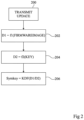
- FIG. 2 represents an embodiment of a method for generating, or updating, a symmetric key.
- the key is generated from a software update program and a secret value, here a previous key.
- the generation or update process comprises a step 200 (TRANSMIT UPDATE) during which the server 102 ( Figure 1 ) provides a software update program to all devices 104.
- the transmitted program has been encrypted by an encryption key, preferably a symmetric key being used only for the transmission of updates, for example a key provided to the device during its initial programming, and stored in a non-volatile memory.
- the key generated by the method described here will preferably not be used for the transmission of updates, but for the transmission of other messages. More specifically, the key generated by the method described here is preferably not used to decrypt the update program.
- the program is encrypted separately for each device with the corresponding key.
- the update program transmitted during step 200 is for example available to the devices 104 for a given period.
- the devices can obtain it, or download it, and decrypt it with their symmetric key, during this period.
- the server 102 keeps for example the current key(s) at least during this entire period.
- a word D1 representative of the update program is generated by the device 104 by applying a function f1() to the software update program.
- the function f1() is preferably a one-way function, i.e. a function whose input value is impossible to obtain from the result.
- the function f1() is for example a hash function, for example the so-called SHA256 function.
- the function f1() is for example a function for generating a signature.
- the software update program is decrypted using the current symmetric key and the f1() function is applied to the decrypted program.
- the f1() function can be applied to the encrypted software update program.
- a word D2 representative of a previous symmetric key is generated by applying a function f2() to a previous symmetric key.
- the previous key is for example a key provided to the device 104 during the initial programming of the system, for example an OEM (Original Equipment Manufacturer) key, different from the key used for transmitting updates. This same previous key is for example used to generate the word D2 for each software update.
- OEM Olinal Equipment Manufacturer
- the previous key is for example a key that was generated during the previous software update, by the same process of generating a symmetric key.
- the function f2() is preferably the same function as the function f1().
- the function f2() can be another function, preferably a one-way function, for example another hash function, for example another signature generation function.
- Steps 202 and 204 are, of course, interchangeable. Thus, it is possible to implement step 204 before step 202. It is also possible to implement steps 202 and 204 simultaneously.
- the new symmetric key (SymKey)
- KDF() a key derivation function
- the KDF() function can be applied to the D1/D2 concatenation of the words D1 and D2.
- the server 102 implements the method as many times as there are devices 104 so as to generate the new keys for all the devices 104.
- steps 202 and 204 are, of course, interchangeable. Thus, it is possible to implement step 204 before step 202. It is also possible to implement steps 202 and 204 simultaneously.
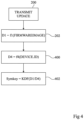
- the function f3() is for example the same function as the function f1() and/or the function f2().
- the function f3() is for example another one-way function.
- the function f3() is for example a function to ensure that the word D3 has a size smaller than the concatenation D1/D2 of the words D1 and D2, for example having the same size as the word D1 and/or the word D2.
- the new encryption key SymKey is obtained by applying the key derivation function KDF() to the third word D3.
- the server 102 performs, before or after step 200 of transmitting the software update program, steps 202, 204, 300 and 302 from the same elements (keys, encrypted or decrypted program) to obtain the same key(s).
- FIG. 4 represents another embodiment of a method of generating, or updating, a key symmetric.
- the key is generated from a software update program and a secret value, here a secret word.
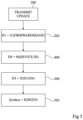
- FIG. 5 represents another embodiment of a method for generating, or updating, a symmetric key.
- the key is generated from a software update program and a secret value, here a secret word.
- the word D5 is obtained by applying a function f5() to the words D1 and D4, for example to the concatenation of the words D1 and D4.
- the function f5() is for example the same function as the function f1() and/or the function f4().
- the function f5() is for example the same function as the function f3() of the Figure 3 .
- the f5() function is another one-way function.
- the f5() function is, for example, a function to ensure that the word D5 has a size smaller than the concatenation D1/D4 of the words D1 and D4, for example, having the same size as the word D1 or the word D4.
- the new symmetric key SymKey is obtained by applying a key derivation function KDF() to the word D5.
- the server 102 performs, before or after step 200 of transmitting the software update program, the steps 202, 400, 500 and 502 from the same elements (keys, encrypted or decrypted program) to obtain the same keys.
- FIG. 6 illustrates an example of a functional situation of a system of the type of that of the Figure 1 .
- the devices 104 DEVICE1, DEVICE2 and DEVICE3 received, for example by downloading it, the software update program. These devices generated, using a generation method as described in relation to the Figure 2 , 3 , 4 Or 5 , a new symmetric key KEY'. Similarly, server 102 generated the new symmetric key KEY'.
- An advantage of some embodiments, in which a new symmetric key is generated from the previously generated key, is that they ensure that all updates have been received by the device 104.
- An advantage of some embodiments, in which a new key is always generated from the same secret value, is that this ensures that if a key is discovered by a third party, for example a hacker, the next key will nevertheless be secret.
- the secret value is never transmitted outside the device and from the server, which ensures that the secret value is not discovered.
- each device has its own, updated key is that transmissions between the server 102 and one of the devices 104 are secure relative to other devices 104. It is therefore not possible for one device 104 to decrypt a message intended for another device 104.
Landscapes
- Engineering & Computer Science (AREA)
- Computer Security & Cryptography (AREA)
- Computer Networks & Wireless Communication (AREA)
- Signal Processing (AREA)
- General Engineering & Computer Science (AREA)
- Theoretical Computer Science (AREA)
- Software Systems (AREA)
- Computer Hardware Design (AREA)
- Physics & Mathematics (AREA)
- General Physics & Mathematics (AREA)
- Computing Systems (AREA)
- Power Engineering (AREA)
- Health & Medical Sciences (AREA)
- Bioethics (AREA)
- General Health & Medical Sciences (AREA)
- Storage Device Security (AREA)
Claims (15)
- Verfahren zum Erzeugen eines ersten symmetrischen Schlüssels (SymKey), bei dem der symmetrische Schlüssel von einer elektronischen Vorrichtung (104) als eine Funktion eines ersten Wortes, das ein Aktualisierungsprogramm für Software repräsentiert, und eines von der elektronischen Vorrichtung gehaltenen geheimen Werts erzeugt wird, wobei das Verfahren einen Schritt aufweist zum Entschlüsseln des Aktualisierungsprogramm für Software mit einem zweiten symmetrischen Schlüssel, der sich vom ersten symmetrischen Schlüssel unterscheidet, und einen Schritt zum Erzeugen eines ersten Wortes (D1), das das Aktualisierungsprogramm repräsentiert, durch Anwenden einer Einwegfunktion auf das entschlüsselte Aktualisierungsprogramm.
- Verfahren nach Anspruch 1, aufweisend das Empfangen durch die Vorrichtung (104) des Aktualisierungsprogramms für Software, das von einem Server (102) gesendet wurde.
- Verfahren nach Anspruch 2, wobei das Aktualisierungsprogramm verschlüsselt ist.
- Verfahren nach Anspruch 2 oder 3, wobei der erste symmetrische Schlüssel ebenfalls von dem Server (102) erzeugt wird.
- Verfahren nach einem der Ansprüche 1 bis 4, aufweisend einen Schritt zum Erzeugen mindestens eines zweiten Wortes (D2, D4), wobei das zweite Wort den geheimen Wert repräsentiert.
- Verfahren nach Anspruch 5, wobei der symmetrische Schlüssel durch Anwenden einer Schlüssel-Bypassfunktion auf das erste Wort (D1) und mindestens eines der zweiten Wörter (D2, D4) erzeugt wird.
- Verfahren nach Anspruch 5, wobei der erste symmetrische Schlüssel durch Anwenden einer Schlüssel-Bypassfunktion auf ein drittes Wort (D3, D5) erzeugt wird, das für das erste Wort und eines der zweiten Wörter repräsentativ ist.
- Verfahren nach einem der Ansprüche 1 bis 7, wobei die Erzeugung eines Wortes (D1, D2, D3, D4, D5) durch eine Einwegfunktion (f1, f2, f3, f4, f5) erfolgt.
- Verfahren nach einem der Ansprüche 1 bis 8, wobei die Erzeugung eines Wortes durch eine Hash-Funktion erfolgt.
- Verfahren nach einem der Ansprüche 1 bis 9, wobei der geheime Wert ein Schlüssel ist, der während der Erstprogrammierung der Software in einen nichtflüchtigen Speicher geschrieben wurde.
- Verfahren nach einem der Ansprüche 1 bis 9, wobei der geheime Wert ein Schlüssel ist, der während einer vorherigen Aktualisierung der Software generiert wurde.
- Verfahren nach einem der Ansprüche 1 bis 9, wobei der geheime Wert eine Kennung der Vorrichtung ist.
- Verfahren nach einem der Ansprüche 1 bis 12, wobei der erzeugte erste Schlüssel nicht zum Entschlüsseln des Aktualisierungsprogramms verwendet wird.
- Elektronische Schaltung mit Mitteln zum Ausführen des Verfahrens nach einem der Ansprüche 1 bis 13.
- Elektronisches System, das einen Server (102) und mindestens eine elektronische Vorrichtung (104) aufweist, wobei der Server (102) und die mindestens eine elektronische Vorrichtung (104) eine Schaltung gemäß Anspruch 14 aufweisen.
Applications Claiming Priority (1)
| Application Number | Priority Date | Filing Date | Title |
|---|---|---|---|
| FR1909823 | 2019-09-06 |
Publications (2)
| Publication Number | Publication Date |
|---|---|
| EP3789898A1 EP3789898A1 (de) | 2021-03-10 |
| EP3789898B1 true EP3789898B1 (de) | 2025-07-09 |
Family
ID=69468656
Family Applications (1)
| Application Number | Title | Priority Date | Filing Date |
|---|---|---|---|
| EP20194257.0A Active EP3789898B1 (de) | 2019-09-06 | 2020-09-03 | Verfahren um einen schlüssel zu generieren |
Country Status (3)
| Country | Link |
|---|---|
| US (1) | US20210075604A1 (de) |
| EP (1) | EP3789898B1 (de) |
| CN (1) | CN112468289B (de) |
Families Citing this family (1)
| Publication number | Priority date | Publication date | Assignee | Title |
|---|---|---|---|---|
| FR3127308B1 (fr) | 2021-09-22 | 2026-01-23 | St Microelectronics Srl | Téléchargement sécurisé de micrologiciel |
Family Cites Families (14)
| Publication number | Priority date | Publication date | Assignee | Title |
|---|---|---|---|---|
| US20060005046A1 (en) * | 2004-06-30 | 2006-01-05 | Seagate Technology Llc | Secure firmware update procedure for programmable security devices |
| JP5116325B2 (ja) * | 2007-03-15 | 2013-01-09 | 株式会社リコー | 情報処理装置、ソフトウェア更新方法及び画像処理装置 |
| KR101425224B1 (ko) * | 2007-11-19 | 2014-07-31 | 삼성전자주식회사 | 펌웨어 업그레이드를 위해 펌웨어를 복호화하는 장치 및방법 |
| JP2009284231A (ja) * | 2008-05-22 | 2009-12-03 | Panasonic Corp | 鍵生成装置、鍵生成方法及び鍵生成プログラム、並びに、電子機器 |
| JP4817153B2 (ja) * | 2009-11-06 | 2011-11-16 | Necインフロンティア株式会社 | 情報端末に組み込まれたソフトウェアの更新時の認証方法、そのシステム及びそのプログラム |
| EP2719115B1 (de) * | 2011-06-10 | 2021-08-11 | Signify Holding B.V. | Sichere protokollausführung in einem netzwerk |
| WO2013024497A1 (en) * | 2011-08-12 | 2013-02-21 | Power-One Italy S.P.A. | Method and system for protected transmission of files |
| US9792439B2 (en) * | 2012-09-19 | 2017-10-17 | Nxp B.V. | Method and system for securely updating firmware in a computing device |
| KR20150074414A (ko) * | 2013-12-24 | 2015-07-02 | 현대자동차주식회사 | 펌웨어 업그레이드 방법 및 그 시스템 |
| US10474454B2 (en) * | 2014-03-20 | 2019-11-12 | Oracle International Corporation | System and method for updating a trusted application (TA) on a device |
| CN104090790B (zh) * | 2014-06-30 | 2017-05-17 | 飞天诚信科技股份有限公司 | 一种安全终端的双芯片方案的固件更新方法 |
| BR112017002747A2 (pt) * | 2014-08-29 | 2018-01-30 | Visa Int Service Ass | método implementado por computador, e, sistema de computador. |
| CN106685653B (zh) * | 2016-12-29 | 2020-07-07 | 同济大学 | 一种基于信息安全技术的车辆远程固件更新方法及装置 |
| US11327735B2 (en) * | 2018-10-16 | 2022-05-10 | Intel Corporation | Attestation manifest derivation and distribution using software update image |
-
2020
- 2020-08-31 US US17/007,599 patent/US20210075604A1/en not_active Abandoned
- 2020-09-03 EP EP20194257.0A patent/EP3789898B1/de active Active
- 2020-09-04 CN CN202010919879.5A patent/CN112468289B/zh active Active
Also Published As
| Publication number | Publication date |
|---|---|
| EP3789898A1 (de) | 2021-03-10 |
| CN112468289A (zh) | 2021-03-09 |
| US20210075604A1 (en) | 2021-03-11 |
| CN112468289B (zh) | 2025-06-24 |
Similar Documents
| Publication | Publication Date | Title |
|---|---|---|
| EP3078155B1 (de) | Verfahren zur aktualisierung eines auf einem speicherserver gespeicherten dateibaums | |
| CA2221016C (fr) | Procede de recuperation de cles mis en oeuvre pour un chiffrement fort de message | |
| EP3238200A1 (de) | Sichere elektronische entität, elektronische vorrichtung und verfahren zur verifizierung der integrität von gespeicherten daten in einer derartigen sicheren elektronischen entität | |
| EP0606792A1 (de) | Verfahren zur Beurkundung einer Informationseinheit durch eine andere | |
| EP3799350A1 (de) | Verschlüsselungsverfahren | |
| EP3732849B1 (de) | Verfahren und system zur identifizierung eines benutzerendgeräts zum empfangen von streaming-geschützten multimedia-inhalten | |
| FR3075423A1 (fr) | Technique de protection d'une cle cryptographique au moyen d'un mot de passe utilisateur | |
| EP1917756B1 (de) | Verfahren zur erstellung eines sitzungsschlüssels und einheiten zur umsetzung dieses verfahrens | |
| EP1890493A1 (de) | Verfahren zum Widerrufen von Sicherheitsmodulen zur Sicherung Rundfunknachrichten | |
| EP3917073A1 (de) | Effizienter sicherer sitzungsaufbau für anonymität in 5g-netzwerken | |
| EP3300292B1 (de) | Geschütztes chiffrier- und dechiffriersystem gegen angriffe über versteckte kanäle | |
| EP3789898B1 (de) | Verfahren um einen schlüssel zu generieren | |
| EP1419640B1 (de) | Verfahren zur herstellung von neuer vorrichtungen und verfahren zum empfang und zur rundfunk von daten in einem digitalen lokalen netzwerk | |
| WO2006040482A2 (fr) | Dispositif et procede de reception d'informations embrouillees, et unite de desembrouillage, systeme de transmission d'informations et emetteur adaptes pour ce dispositif | |
| WO2021099744A1 (fr) | Procede securise d'echange de donnees entre un terminal et un serveur | |
| WO2007066039A2 (fr) | Recouvrement de cles de dechiffrement perimees | |
| EP1756696B1 (de) | Verfahren für sichere softwareaktualisierung in einem sicherheitsmodul | |
| EP4068679B1 (de) | Authentifizierung einer vorrichtung durch kryptographische verarbeitung | |
| FR3032292B1 (fr) | Element securise et procede mis en œuvre dans un tel element securise | |
| EP3059896B1 (de) | Abgleichmethode zwischen einer Multimediaeinheit und mindestens einem Bediener, Multimediaeinheit, Bediener und Personalisierungseinheit für die Umsetzung dieser Methode | |
| FR2892876A1 (fr) | Procede de depot securise de donnees numeriques, procede associe de recuperation de donnees numeriques, dispositifs associes pour la mise en oeuvre des procedes, et systeme comprenant les dits dispositifs | |
| EP1642413B1 (de) | Verfahren zur verschlüsselung/entschlüng einer nachricht sowie dazugehörige vorrichtung | |
| EP1723791B1 (de) | Verfahren zum sichern eines von einem austrahler gesendeten verwürfelten inhalts | |
| EP3899765B1 (de) | Neuinitialisierung eines anwendungsgeheimnisses über das endgerät | |
| EP3340096B1 (de) | Konfigurationsverfahren eines kryptographischen programms, das für die ausführung durch ein endgerät bestimmt ist |
Legal Events
| Date | Code | Title | Description |
|---|---|---|---|
| PUAI | Public reference made under article 153(3) epc to a published international application that has entered the european phase |
Free format text: ORIGINAL CODE: 0009012 |
|
| STAA | Information on the status of an ep patent application or granted ep patent |
Free format text: STATUS: REQUEST FOR EXAMINATION WAS MADE |
|
| 17P | Request for examination filed |
Effective date: 20200903 |
|
| AK | Designated contracting states |
Kind code of ref document: A1 Designated state(s): AL AT BE BG CH CY CZ DE DK EE ES FI FR GB GR HR HU IE IS IT LI LT LU LV MC MK MT NL NO PL PT RO RS SE SI SK SM TR |
|
| AX | Request for extension of the european patent |
Extension state: BA ME |
|
| STAA | Information on the status of an ep patent application or granted ep patent |
Free format text: STATUS: EXAMINATION IS IN PROGRESS |
|
| 17Q | First examination report despatched |
Effective date: 20231110 |
|
| REG | Reference to a national code |
Ref country code: DE Ref legal event code: R079 Free format text: PREVIOUS MAIN CLASS: G06F0021570000 Ref country code: DE Ref legal event code: R079 Ref document number: 602020054113 Country of ref document: DE Free format text: PREVIOUS MAIN CLASS: G06F0021570000 Ipc: H04L0009400000 |
|
| RIC1 | Information provided on ipc code assigned before grant |
Ipc: H04L 9/08 20060101ALI20241220BHEP Ipc: G06F 21/60 20130101ALI20241220BHEP Ipc: G06F 21/57 20130101ALI20241220BHEP Ipc: H04L 9/40 20220101AFI20241220BHEP |
|
| GRAP | Despatch of communication of intention to grant a patent |
Free format text: ORIGINAL CODE: EPIDOSNIGR1 |
|
| STAA | Information on the status of an ep patent application or granted ep patent |
Free format text: STATUS: GRANT OF PATENT IS INTENDED |
|
| INTG | Intention to grant announced |
Effective date: 20250205 |
|
| GRAS | Grant fee paid |
Free format text: ORIGINAL CODE: EPIDOSNIGR3 |
|
| GRAA | (expected) grant |
Free format text: ORIGINAL CODE: 0009210 |
|
| STAA | Information on the status of an ep patent application or granted ep patent |
Free format text: STATUS: THE PATENT HAS BEEN GRANTED |
|
| AK | Designated contracting states |
Kind code of ref document: B1 Designated state(s): AL AT BE BG CH CY CZ DE DK EE ES FI FR GB GR HR HU IE IS IT LI LT LU LV MC MK MT NL NO PL PT RO RS SE SI SK SM TR |
|
| REG | Reference to a national code |
Ref country code: GB Ref legal event code: FG4D Free format text: NOT ENGLISH |
|
| REG | Reference to a national code |
Ref country code: CH Ref legal event code: EP |
|
| REG | Reference to a national code |
Ref country code: IE Ref legal event code: FG4D Free format text: LANGUAGE OF EP DOCUMENT: FRENCH |
|
| REG | Reference to a national code |
Ref country code: DE Ref legal event code: R096 Ref document number: 602020054113 Country of ref document: DE |
|
| PGFP | Annual fee paid to national office [announced via postgrant information from national office to epo] |
Ref country code: DE Payment date: 20250820 Year of fee payment: 6 |
|
| REG | Reference to a national code |
Ref country code: NL Ref legal event code: MP Effective date: 20250709 |
|
| PG25 | Lapsed in a contracting state [announced via postgrant information from national office to epo] |
Ref country code: PT Free format text: LAPSE BECAUSE OF FAILURE TO SUBMIT A TRANSLATION OF THE DESCRIPTION OR TO PAY THE FEE WITHIN THE PRESCRIBED TIME-LIMIT Effective date: 20251110 |
|
| PG25 | Lapsed in a contracting state [announced via postgrant information from national office to epo] |
Ref country code: NL Free format text: LAPSE BECAUSE OF FAILURE TO SUBMIT A TRANSLATION OF THE DESCRIPTION OR TO PAY THE FEE WITHIN THE PRESCRIBED TIME-LIMIT Effective date: 20250709 |
|
| REG | Reference to a national code |
Ref country code: AT Ref legal event code: MK05 Ref document number: 1812908 Country of ref document: AT Kind code of ref document: T Effective date: 20250709 |
|
| PG25 | Lapsed in a contracting state [announced via postgrant information from national office to epo] |
Ref country code: IS Free format text: LAPSE BECAUSE OF FAILURE TO SUBMIT A TRANSLATION OF THE DESCRIPTION OR TO PAY THE FEE WITHIN THE PRESCRIBED TIME-LIMIT Effective date: 20251109 |
|
| PG25 | Lapsed in a contracting state [announced via postgrant information from national office to epo] |
Ref country code: NO Free format text: LAPSE BECAUSE OF FAILURE TO SUBMIT A TRANSLATION OF THE DESCRIPTION OR TO PAY THE FEE WITHIN THE PRESCRIBED TIME-LIMIT Effective date: 20251009 |
|
| REG | Reference to a national code |
Ref country code: LT Ref legal event code: MG9D |
|
| PG25 | Lapsed in a contracting state [announced via postgrant information from national office to epo] |
Ref country code: AT Free format text: LAPSE BECAUSE OF FAILURE TO SUBMIT A TRANSLATION OF THE DESCRIPTION OR TO PAY THE FEE WITHIN THE PRESCRIBED TIME-LIMIT Effective date: 20250709 |
|
| PG25 | Lapsed in a contracting state [announced via postgrant information from national office to epo] |
Ref country code: FI Free format text: LAPSE BECAUSE OF FAILURE TO SUBMIT A TRANSLATION OF THE DESCRIPTION OR TO PAY THE FEE WITHIN THE PRESCRIBED TIME-LIMIT Effective date: 20250709 |
|
| PG25 | Lapsed in a contracting state [announced via postgrant information from national office to epo] |
Ref country code: HR Free format text: LAPSE BECAUSE OF FAILURE TO SUBMIT A TRANSLATION OF THE DESCRIPTION OR TO PAY THE FEE WITHIN THE PRESCRIBED TIME-LIMIT Effective date: 20250709 |
|
| PG25 | Lapsed in a contracting state [announced via postgrant information from national office to epo] |
Ref country code: GR Free format text: LAPSE BECAUSE OF FAILURE TO SUBMIT A TRANSLATION OF THE DESCRIPTION OR TO PAY THE FEE WITHIN THE PRESCRIBED TIME-LIMIT Effective date: 20251010 |
|
| PG25 | Lapsed in a contracting state [announced via postgrant information from national office to epo] |
Ref country code: SE Free format text: LAPSE BECAUSE OF FAILURE TO SUBMIT A TRANSLATION OF THE DESCRIPTION OR TO PAY THE FEE WITHIN THE PRESCRIBED TIME-LIMIT Effective date: 20250709 |
|
| PG25 | Lapsed in a contracting state [announced via postgrant information from national office to epo] |
Ref country code: LV Free format text: LAPSE BECAUSE OF FAILURE TO SUBMIT A TRANSLATION OF THE DESCRIPTION OR TO PAY THE FEE WITHIN THE PRESCRIBED TIME-LIMIT Effective date: 20250709 |
|
| PG25 | Lapsed in a contracting state [announced via postgrant information from national office to epo] |
Ref country code: BG Free format text: LAPSE BECAUSE OF FAILURE TO SUBMIT A TRANSLATION OF THE DESCRIPTION OR TO PAY THE FEE WITHIN THE PRESCRIBED TIME-LIMIT Effective date: 20250709 Ref country code: PL Free format text: LAPSE BECAUSE OF FAILURE TO SUBMIT A TRANSLATION OF THE DESCRIPTION OR TO PAY THE FEE WITHIN THE PRESCRIBED TIME-LIMIT Effective date: 20250709 |
|
| PG25 | Lapsed in a contracting state [announced via postgrant information from national office to epo] |
Ref country code: RS Free format text: LAPSE BECAUSE OF FAILURE TO SUBMIT A TRANSLATION OF THE DESCRIPTION OR TO PAY THE FEE WITHIN THE PRESCRIBED TIME-LIMIT Effective date: 20251009 |
|
| PG25 | Lapsed in a contracting state [announced via postgrant information from national office to epo] |
Ref country code: ES Free format text: LAPSE BECAUSE OF FAILURE TO SUBMIT A TRANSLATION OF THE DESCRIPTION OR TO PAY THE FEE WITHIN THE PRESCRIBED TIME-LIMIT Effective date: 20250709 |
|
| PG25 | Lapsed in a contracting state [announced via postgrant information from national office to epo] |
Ref country code: RO Free format text: LAPSE BECAUSE OF FAILURE TO SUBMIT A TRANSLATION OF THE DESCRIPTION OR TO PAY THE FEE WITHIN THE PRESCRIBED TIME-LIMIT Effective date: 20250709 |
|
| PG25 | Lapsed in a contracting state [announced via postgrant information from national office to epo] |
Ref country code: SM Free format text: LAPSE BECAUSE OF FAILURE TO SUBMIT A TRANSLATION OF THE DESCRIPTION OR TO PAY THE FEE WITHIN THE PRESCRIBED TIME-LIMIT Effective date: 20250709 |
|
| PG25 | Lapsed in a contracting state [announced via postgrant information from national office to epo] |
Ref country code: DK Free format text: LAPSE BECAUSE OF FAILURE TO SUBMIT A TRANSLATION OF THE DESCRIPTION OR TO PAY THE FEE WITHIN THE PRESCRIBED TIME-LIMIT Effective date: 20250709 |
|
| PG25 | Lapsed in a contracting state [announced via postgrant information from national office to epo] |
Ref country code: IT Free format text: LAPSE BECAUSE OF FAILURE TO SUBMIT A TRANSLATION OF THE DESCRIPTION OR TO PAY THE FEE WITHIN THE PRESCRIBED TIME-LIMIT Effective date: 20250709 |
|
| PG25 | Lapsed in a contracting state [announced via postgrant information from national office to epo] |
Ref country code: CZ Free format text: LAPSE BECAUSE OF FAILURE TO SUBMIT A TRANSLATION OF THE DESCRIPTION OR TO PAY THE FEE WITHIN THE PRESCRIBED TIME-LIMIT Effective date: 20250709 |
|
| PG25 | Lapsed in a contracting state [announced via postgrant information from national office to epo] |
Ref country code: SK Free format text: LAPSE BECAUSE OF FAILURE TO SUBMIT A TRANSLATION OF THE DESCRIPTION OR TO PAY THE FEE WITHIN THE PRESCRIBED TIME-LIMIT Effective date: 20250709 Ref country code: EE Free format text: LAPSE BECAUSE OF FAILURE TO SUBMIT A TRANSLATION OF THE DESCRIPTION OR TO PAY THE FEE WITHIN THE PRESCRIBED TIME-LIMIT Effective date: 20250709 |