EP3789425A1 - Polymer layers by reactive printing - Google Patents
Polymer layers by reactive printing Download PDFInfo
- Publication number
- EP3789425A1 EP3789425A1 EP19196281.0A EP19196281A EP3789425A1 EP 3789425 A1 EP3789425 A1 EP 3789425A1 EP 19196281 A EP19196281 A EP 19196281A EP 3789425 A1 EP3789425 A1 EP 3789425A1
- Authority
- EP
- European Patent Office
- Prior art keywords
- composition
- layer
- bis
- polyimide
- substrate
- Prior art date
- Legal status (The legal status is an assumption and is not a legal conclusion. Google has not performed a legal analysis and makes no representation as to the accuracy of the status listed.)
- Withdrawn
Links
- 238000007639 printing Methods 0.000 title description 11
- 229920000642 polymer Polymers 0.000 title description 6
- 239000000203 mixture Substances 0.000 claims abstract description 160
- 238000000034 method Methods 0.000 claims abstract description 87
- 239000004642 Polyimide Substances 0.000 claims abstract description 76
- 229920001721 polyimide Polymers 0.000 claims abstract description 76
- 239000000758 substrate Substances 0.000 claims abstract description 67
- -1 diamine compound Chemical class 0.000 claims abstract description 55
- 239000002253 acid Substances 0.000 claims abstract description 41
- 150000001875 compounds Chemical class 0.000 claims abstract description 41
- 239000002131 composite material Substances 0.000 claims abstract description 26
- 238000004519 manufacturing process Methods 0.000 claims abstract description 14
- 238000007669 thermal treatment Methods 0.000 claims abstract description 14
- 150000008064 anhydrides Chemical class 0.000 claims description 32
- IAZDPXIOMUYVGZ-UHFFFAOYSA-N Dimethylsulphoxide Chemical compound CS(C)=O IAZDPXIOMUYVGZ-UHFFFAOYSA-N 0.000 claims description 26
- ZMXDDKWLCZADIW-UHFFFAOYSA-N N,N-Dimethylformamide Chemical compound CN(C)C=O ZMXDDKWLCZADIW-UHFFFAOYSA-N 0.000 claims description 20
- SECXISVLQFMRJM-UHFFFAOYSA-N N-Methylpyrrolidone Chemical compound CN1CCCC1=O SECXISVLQFMRJM-UHFFFAOYSA-N 0.000 claims description 14
- 125000003118 aryl group Chemical group 0.000 claims description 12
- NAQMVNRVTILPCV-UHFFFAOYSA-N hexane-1,6-diamine Chemical compound NCCCCCCN NAQMVNRVTILPCV-UHFFFAOYSA-N 0.000 claims description 12
- LYCAIKOWRPUZTN-UHFFFAOYSA-N Ethylene glycol Chemical compound OCCO LYCAIKOWRPUZTN-UHFFFAOYSA-N 0.000 claims description 9
- 239000000010 aprotic solvent Substances 0.000 claims description 9
- AVQQQNCBBIEMEU-UHFFFAOYSA-N 1,1,3,3-tetramethylurea Chemical compound CN(C)C(=O)N(C)C AVQQQNCBBIEMEU-UHFFFAOYSA-N 0.000 claims description 8
- FXHOOIRPVKKKFG-UHFFFAOYSA-N N,N-Dimethylacetamide Chemical compound CN(C)C(C)=O FXHOOIRPVKKKFG-UHFFFAOYSA-N 0.000 claims description 8
- 239000012965 benzophenone Substances 0.000 claims description 7
- 238000007641 inkjet printing Methods 0.000 claims description 7
- 238000009997 thermal pre-treatment Methods 0.000 claims description 7
- WZCQRUWWHSTZEM-UHFFFAOYSA-N 1,3-phenylenediamine Chemical compound NC1=CC=CC(N)=C1 WZCQRUWWHSTZEM-UHFFFAOYSA-N 0.000 claims description 6
- CBCKQZAAMUWICA-UHFFFAOYSA-N 1,4-phenylenediamine Chemical compound NC1=CC=C(N)C=C1 CBCKQZAAMUWICA-UHFFFAOYSA-N 0.000 claims description 6
- VLDPXPPHXDGHEW-UHFFFAOYSA-N 1-chloro-2-dichlorophosphoryloxybenzene Chemical compound ClC1=CC=CC=C1OP(Cl)(Cl)=O VLDPXPPHXDGHEW-UHFFFAOYSA-N 0.000 claims description 6
- NVKGJHAQGWCWDI-UHFFFAOYSA-N 4-[4-amino-2-(trifluoromethyl)phenyl]-3-(trifluoromethyl)aniline Chemical compound FC(F)(F)C1=CC(N)=CC=C1C1=CC=C(N)C=C1C(F)(F)F NVKGJHAQGWCWDI-UHFFFAOYSA-N 0.000 claims description 6
- YGYCECQIOXZODZ-UHFFFAOYSA-N 4415-87-6 Chemical compound O=C1OC(=O)C2C1C1C(=O)OC(=O)C12 YGYCECQIOXZODZ-UHFFFAOYSA-N 0.000 claims description 6
- ZHBXLZQQVCDGPA-UHFFFAOYSA-N 5-[(1,3-dioxo-2-benzofuran-5-yl)sulfonyl]-2-benzofuran-1,3-dione Chemical compound C1=C2C(=O)OC(=O)C2=CC(S(=O)(=O)C=2C=C3C(=O)OC(C3=CC=2)=O)=C1 ZHBXLZQQVCDGPA-UHFFFAOYSA-N 0.000 claims description 6
- QIGBRXMKCJKVMJ-UHFFFAOYSA-N Hydroquinone Chemical compound OC1=CC=C(O)C=C1 QIGBRXMKCJKVMJ-UHFFFAOYSA-N 0.000 claims description 6
- 239000004696 Poly ether ether ketone Substances 0.000 claims description 6
- 229920002873 Polyethylenimine Polymers 0.000 claims description 6
- 150000004984 aromatic diamines Chemical class 0.000 claims description 6
- RTZKZFJDLAIYFH-UHFFFAOYSA-N ether Substances CCOCC RTZKZFJDLAIYFH-UHFFFAOYSA-N 0.000 claims description 6
- 229940018564 m-phenylenediamine Drugs 0.000 claims description 6
- 229920002530 polyetherether ketone Polymers 0.000 claims description 6
- ARCGXLSVLAOJQL-UHFFFAOYSA-N trimellitic acid Chemical compound OC(=O)C1=CC=C(C(O)=O)C(C(O)=O)=C1 ARCGXLSVLAOJQL-UHFFFAOYSA-N 0.000 claims description 6
- 239000000969 carrier Substances 0.000 claims description 5
- HLBLWEWZXPIGSM-UHFFFAOYSA-N 4-Aminophenyl ether Chemical compound C1=CC(N)=CC=C1OC1=CC=C(N)C=C1 HLBLWEWZXPIGSM-UHFFFAOYSA-N 0.000 claims description 4
- KIFDSGGWDIVQGN-UHFFFAOYSA-N 4-[9-(4-aminophenyl)fluoren-9-yl]aniline Chemical compound C1=CC(N)=CC=C1C1(C=2C=CC(N)=CC=2)C2=CC=CC=C2C2=CC=CC=C21 KIFDSGGWDIVQGN-UHFFFAOYSA-N 0.000 claims description 4
- WEVYAHXRMPXWCK-UHFFFAOYSA-N Acetonitrile Chemical compound CC#N WEVYAHXRMPXWCK-UHFFFAOYSA-N 0.000 claims description 4
- WYURNTSHIVDZCO-UHFFFAOYSA-N Tetrahydrofuran Chemical compound C1CCOC1 WYURNTSHIVDZCO-UHFFFAOYSA-N 0.000 claims description 4
- 239000011521 glass Substances 0.000 claims description 4
- 229920001343 polytetrafluoroethylene Polymers 0.000 claims description 4
- 239000004810 polytetrafluoroethylene Substances 0.000 claims description 4
- LJGHYPLBDBRCRZ-UHFFFAOYSA-N 3-(3-aminophenyl)sulfonylaniline Chemical compound NC1=CC=CC(S(=O)(=O)C=2C=C(N)C=CC=2)=C1 LJGHYPLBDBRCRZ-UHFFFAOYSA-N 0.000 claims description 3
- CKOFBUUFHALZGK-UHFFFAOYSA-N 3-[(3-aminophenyl)methyl]aniline Chemical compound NC1=CC=CC(CC=2C=C(N)C=CC=2)=C1 CKOFBUUFHALZGK-UHFFFAOYSA-N 0.000 claims description 3
- XUSNPFGLKGCWGN-UHFFFAOYSA-N 3-[4-(3-aminopropyl)piperazin-1-yl]propan-1-amine Chemical compound NCCCN1CCN(CCCN)CC1 XUSNPFGLKGCWGN-UHFFFAOYSA-N 0.000 claims description 3
- YBRVSVVVWCFQMG-UHFFFAOYSA-N 4,4'-diaminodiphenylmethane Chemical compound C1=CC(N)=CC=C1CC1=CC=C(N)C=C1 YBRVSVVVWCFQMG-UHFFFAOYSA-N 0.000 claims description 3
- BKQWDTFZUNGWNV-UHFFFAOYSA-N 4-(3,4-dicarboxycyclohexyl)cyclohexane-1,2-dicarboxylic acid Chemical compound C1C(C(O)=O)C(C(=O)O)CCC1C1CC(C(O)=O)C(C(O)=O)CC1 BKQWDTFZUNGWNV-UHFFFAOYSA-N 0.000 claims description 3
- WKGQZPXKFAWVFD-UHFFFAOYSA-N 4-[4-[1-[4-(4-aminophenoxy)phenyl]-4-methylcyclohexyl]phenoxy]aniline Chemical compound C1CC(C)CCC1(C=1C=CC(OC=2C=CC(N)=CC=2)=CC=1)C(C=C1)=CC=C1OC1=CC=C(N)C=C1 WKGQZPXKFAWVFD-UHFFFAOYSA-N 0.000 claims description 3
- DJQPGZPKGHRJOK-UHFFFAOYSA-N 4-[4-[1-[4-(4-aminophenoxy)phenyl]cyclohexyl]phenoxy]aniline Chemical compound C1=CC(N)=CC=C1OC1=CC=C(C2(CCCCC2)C=2C=CC(OC=3C=CC(N)=CC=3)=CC=2)C=C1 DJQPGZPKGHRJOK-UHFFFAOYSA-N 0.000 claims description 3
- HHLMWQDRYZAENA-UHFFFAOYSA-N 4-[4-[2-[4-(4-aminophenoxy)phenyl]-1,1,1,3,3,3-hexafluoropropan-2-yl]phenoxy]aniline Chemical compound C1=CC(N)=CC=C1OC1=CC=C(C(C=2C=CC(OC=3C=CC(N)=CC=3)=CC=2)(C(F)(F)F)C(F)(F)F)C=C1 HHLMWQDRYZAENA-UHFFFAOYSA-N 0.000 claims description 3
- KMKWGXGSGPYISJ-UHFFFAOYSA-N 4-[4-[2-[4-(4-aminophenoxy)phenyl]propan-2-yl]phenoxy]aniline Chemical compound C=1C=C(OC=2C=CC(N)=CC=2)C=CC=1C(C)(C)C(C=C1)=CC=C1OC1=CC=C(N)C=C1 KMKWGXGSGPYISJ-UHFFFAOYSA-N 0.000 claims description 3
- HYDATEKARGDBKU-UHFFFAOYSA-N 4-[4-[4-(4-aminophenoxy)phenyl]phenoxy]aniline Chemical group C1=CC(N)=CC=C1OC1=CC=C(C=2C=CC(OC=3C=CC(N)=CC=3)=CC=2)C=C1 HYDATEKARGDBKU-UHFFFAOYSA-N 0.000 claims description 3
- IMBDDGNKFSRAQH-UHFFFAOYSA-N 4-[[4-[1-[4-[(4-aminophenyl)methyl]phenyl]cyclohexyl]phenyl]methyl]aniline Chemical compound C1=CC(N)=CC=C1CC1=CC=C(C2(CCCCC2)C=2C=CC(CC=3C=CC(N)=CC=3)=CC=2)C=C1 IMBDDGNKFSRAQH-UHFFFAOYSA-N 0.000 claims description 3
- JLJSUCXJFAXDNT-UHFFFAOYSA-N 4-[[4-[[4-[(4-aminophenyl)methyl]phenyl]methyl]phenyl]methyl]aniline Chemical compound C1=CC(N)=CC=C1CC(C=C1)=CC=C1CC(C=C1)=CC=C1CC1=CC=C(N)C=C1 JLJSUCXJFAXDNT-UHFFFAOYSA-N 0.000 claims description 3
- QQGYZOYWNCKGEK-UHFFFAOYSA-N 5-[(1,3-dioxo-2-benzofuran-5-yl)oxy]-2-benzofuran-1,3-dione Chemical compound C1=C2C(=O)OC(=O)C2=CC(OC=2C=C3C(=O)OC(C3=CC=2)=O)=C1 QQGYZOYWNCKGEK-UHFFFAOYSA-N 0.000 claims description 3
- QHHKLPCQTTWFSS-UHFFFAOYSA-N 5-[2-(1,3-dioxo-2-benzofuran-5-yl)-1,1,1,3,3,3-hexafluoropropan-2-yl]-2-benzofuran-1,3-dione Chemical compound C1=C2C(=O)OC(=O)C2=CC(C(C=2C=C3C(=O)OC(=O)C3=CC=2)(C(F)(F)F)C(F)(F)F)=C1 QHHKLPCQTTWFSS-UHFFFAOYSA-N 0.000 claims description 3
- LGRFSURHDFAFJT-UHFFFAOYSA-N Phthalic anhydride Natural products C1=CC=C2C(=O)OC(=O)C2=C1 LGRFSURHDFAFJT-UHFFFAOYSA-N 0.000 claims description 3
- 239000004952 Polyamide Substances 0.000 claims description 3
- FDLQZKYLHJJBHD-UHFFFAOYSA-N [3-(aminomethyl)phenyl]methanamine Chemical compound NCC1=CC=CC(CN)=C1 FDLQZKYLHJJBHD-UHFFFAOYSA-N 0.000 claims description 3
- ISKQADXMHQSTHK-UHFFFAOYSA-N [4-(aminomethyl)phenyl]methanamine Chemical compound NCC1=CC=C(CN)C=C1 ISKQADXMHQSTHK-UHFFFAOYSA-N 0.000 claims description 3
- GTDPSWPPOUPBNX-UHFFFAOYSA-N ac1mqpva Chemical compound CC12C(=O)OC(=O)C1(C)C1(C)C2(C)C(=O)OC1=O GTDPSWPPOUPBNX-UHFFFAOYSA-N 0.000 claims description 3
- 229920003235 aromatic polyamide Polymers 0.000 claims description 3
- WKDNYTOXBCRNPV-UHFFFAOYSA-N bpda Chemical compound C1=C2C(=O)OC(=O)C2=CC(C=2C=C3C(=O)OC(C3=CC=2)=O)=C1 WKDNYTOXBCRNPV-UHFFFAOYSA-N 0.000 claims description 3
- JHIWVOJDXOSYLW-UHFFFAOYSA-N butyl 2,2-difluorocyclopropane-1-carboxylate Chemical compound CCCCOC(=O)C1CC1(F)F JHIWVOJDXOSYLW-UHFFFAOYSA-N 0.000 claims description 3
- 239000000919 ceramic Substances 0.000 claims description 3
- 239000002184 metal Substances 0.000 claims description 3
- 229920002647 polyamide Polymers 0.000 claims description 3
- SRPWOOOHEPICQU-UHFFFAOYSA-N trimellitic anhydride Chemical compound OC(=O)C1=CC=C2C(=O)OC(=O)C2=C1 SRPWOOOHEPICQU-UHFFFAOYSA-N 0.000 claims description 3
- 239000002904 solvent Substances 0.000 description 20
- 125000001931 aliphatic group Chemical group 0.000 description 13
- 239000000976 ink Substances 0.000 description 12
- 238000005259 measurement Methods 0.000 description 9
- 229920005575 poly(amic acid) Polymers 0.000 description 9
- XLYOFNOQVPJJNP-UHFFFAOYSA-N water Substances O XLYOFNOQVPJJNP-UHFFFAOYSA-N 0.000 description 9
- 238000009835 boiling Methods 0.000 description 7
- 238000006243 chemical reaction Methods 0.000 description 5
- 239000000463 material Substances 0.000 description 5
- 239000003960 organic solvent Substances 0.000 description 5
- 239000002243 precursor Substances 0.000 description 5
- 239000000523 sample Substances 0.000 description 5
- 239000000470 constituent Substances 0.000 description 4
- 125000000524 functional group Chemical group 0.000 description 4
- 125000005647 linker group Chemical group 0.000 description 4
- KWGKDLIKAYFUFQ-UHFFFAOYSA-M lithium chloride Chemical compound [Li+].[Cl-] KWGKDLIKAYFUFQ-UHFFFAOYSA-M 0.000 description 4
- YXFVVABEGXRONW-UHFFFAOYSA-N Toluene Chemical compound CC1=CC=CC=C1 YXFVVABEGXRONW-UHFFFAOYSA-N 0.000 description 3
- JFDZBHWFFUWGJE-UHFFFAOYSA-N benzonitrile Chemical compound N#CC1=CC=CC=C1 JFDZBHWFFUWGJE-UHFFFAOYSA-N 0.000 description 3
- 125000004185 ester group Chemical group 0.000 description 3
- 125000001033 ether group Chemical group 0.000 description 3
- 238000010438 heat treatment Methods 0.000 description 3
- 239000007788 liquid Substances 0.000 description 3
- VLKZOEOYAKHREP-UHFFFAOYSA-N n-Hexane Chemical compound CCCCCC VLKZOEOYAKHREP-UHFFFAOYSA-N 0.000 description 3
- 229920001228 polyisocyanate Polymers 0.000 description 3
- 239000005056 polyisocyanate Substances 0.000 description 3
- 238000010998 test method Methods 0.000 description 3
- 238000004448 titration Methods 0.000 description 3
- RFFLAFLAYFXFSW-UHFFFAOYSA-N 1,2-dichlorobenzene Chemical compound ClC1=CC=CC=C1Cl RFFLAFLAYFXFSW-UHFFFAOYSA-N 0.000 description 2
- HZAXFHJVJLSVMW-UHFFFAOYSA-N 2-Aminoethan-1-ol Chemical compound NCCO HZAXFHJVJLSVMW-UHFFFAOYSA-N 0.000 description 2
- IMNFDUFMRHMDMM-UHFFFAOYSA-N N-Heptane Chemical compound CCCCCCC IMNFDUFMRHMDMM-UHFFFAOYSA-N 0.000 description 2
- 229920002732 Polyanhydride Polymers 0.000 description 2
- VYPSYNLAJGMNEJ-UHFFFAOYSA-N Silicium dioxide Chemical compound O=[Si]=O VYPSYNLAJGMNEJ-UHFFFAOYSA-N 0.000 description 2
- 150000001412 amines Chemical class 0.000 description 2
- 125000003277 amino group Chemical group 0.000 description 2
- 125000004432 carbon atom Chemical group C* 0.000 description 2
- 125000002843 carboxylic acid group Chemical group 0.000 description 2
- 239000011248 coating agent Substances 0.000 description 2
- 238000000576 coating method Methods 0.000 description 2
- 239000007859 condensation product Substances 0.000 description 2
- DMEGYFMYUHOHGS-UHFFFAOYSA-N cycloheptane Chemical compound C1CCCCCC1 DMEGYFMYUHOHGS-UHFFFAOYSA-N 0.000 description 2
- 150000004985 diamines Chemical class 0.000 description 2
- 238000001704 evaporation Methods 0.000 description 2
- 230000008020 evaporation Effects 0.000 description 2
- 125000005462 imide group Chemical group 0.000 description 2
- 239000012535 impurity Substances 0.000 description 2
- 125000000468 ketone group Chemical group 0.000 description 2
- RLSSMJSEOOYNOY-UHFFFAOYSA-N m-cresol Chemical compound CC1=CC=CC(O)=C1 RLSSMJSEOOYNOY-UHFFFAOYSA-N 0.000 description 2
- LQNUZADURLCDLV-UHFFFAOYSA-N nitrobenzene Chemical compound [O-][N+](=O)C1=CC=CC=C1 LQNUZADURLCDLV-UHFFFAOYSA-N 0.000 description 2
- BKIMMITUMNQMOS-UHFFFAOYSA-N nonane Chemical compound CCCCCCCCC BKIMMITUMNQMOS-UHFFFAOYSA-N 0.000 description 2
- 239000002798 polar solvent Substances 0.000 description 2
- 125000000472 sulfonyl group Chemical group *S(*)(=O)=O 0.000 description 2
- GETQZCLCWQTVFV-UHFFFAOYSA-N trimethylamine Chemical compound CN(C)C GETQZCLCWQTVFV-UHFFFAOYSA-N 0.000 description 2
- JTPNRXUCIXHOKM-UHFFFAOYSA-N 1-chloronaphthalene Chemical compound C1=CC=C2C(Cl)=CC=CC2=C1 JTPNRXUCIXHOKM-UHFFFAOYSA-N 0.000 description 1
- RFUFVLXGRWDFHW-UHFFFAOYSA-N 5-isocyanato-2-benzofuran-1,3-dione Chemical compound O=C=NC1=CC=C2C(=O)OC(=O)C2=C1 RFUFVLXGRWDFHW-UHFFFAOYSA-N 0.000 description 1
- 239000004971 Cross linker Substances 0.000 description 1
- XDTMQSROBMDMFD-UHFFFAOYSA-N Cyclohexane Chemical compound C1CCCCC1 XDTMQSROBMDMFD-UHFFFAOYSA-N 0.000 description 1
- 239000004962 Polyamide-imide Substances 0.000 description 1
- 241001422033 Thestylus Species 0.000 description 1
- 235000010724 Wisteria floribunda Nutrition 0.000 description 1
- 150000008065 acid anhydrides Chemical class 0.000 description 1
- 150000007513 acids Chemical class 0.000 description 1
- 239000003570 air Substances 0.000 description 1
- 150000001335 aliphatic alkanes Chemical class 0.000 description 1
- 239000012080 ambient air Substances 0.000 description 1
- 239000003963 antioxidant agent Substances 0.000 description 1
- 239000012736 aqueous medium Substances 0.000 description 1
- 230000000711 cancerogenic effect Effects 0.000 description 1
- 229910052799 carbon Inorganic materials 0.000 description 1
- 231100000315 carcinogenic Toxicity 0.000 description 1
- 150000001805 chlorine compounds Chemical class 0.000 description 1
- 238000011278 co-treatment Methods 0.000 description 1
- 238000005520 cutting process Methods 0.000 description 1
- 150000003997 cyclic ketones Chemical class 0.000 description 1
- 150000001924 cycloalkanes Chemical class 0.000 description 1
- CGZZMOTZOONQIA-UHFFFAOYSA-N cycloheptanone Chemical group O=C1CCCCCC1 CGZZMOTZOONQIA-UHFFFAOYSA-N 0.000 description 1
- DIOQZVSQGTUSAI-NJFSPNSNSA-N decane Chemical compound CCCCCCCCC[14CH3] DIOQZVSQGTUSAI-NJFSPNSNSA-N 0.000 description 1
- 230000001419 dependent effect Effects 0.000 description 1
- 150000001991 dicarboxylic acids Chemical class 0.000 description 1
- 238000004821 distillation Methods 0.000 description 1
- 238000001035 drying Methods 0.000 description 1
- 239000003480 eluent Substances 0.000 description 1
- 150000002148 esters Chemical class 0.000 description 1
- 150000002170 ethers Chemical class 0.000 description 1
- 238000001914 filtration Methods 0.000 description 1
- 239000011888 foil Substances 0.000 description 1
- 238000007646 gravure printing Methods 0.000 description 1
- IQPQWNKOIGAROB-UHFFFAOYSA-N isocyanate group Chemical group [N-]=C=O IQPQWNKOIGAROB-UHFFFAOYSA-N 0.000 description 1
- 125000001261 isocyanato group Chemical group *N=C=O 0.000 description 1
- 231100000219 mutagenic Toxicity 0.000 description 1
- 230000003505 mutagenic effect Effects 0.000 description 1
- DIOQZVSQGTUSAI-UHFFFAOYSA-N n-butylhexane Natural products CCCCCCCCCC DIOQZVSQGTUSAI-UHFFFAOYSA-N 0.000 description 1
- 239000002105 nanoparticle Substances 0.000 description 1
- 231100001223 noncarcinogenic Toxicity 0.000 description 1
- 230000002352 nonmutagenic effect Effects 0.000 description 1
- 231100000252 nontoxic Toxicity 0.000 description 1
- 230000003000 nontoxic effect Effects 0.000 description 1
- TVMXDCGIABBOFY-UHFFFAOYSA-N octane Chemical compound CCCCCCCC TVMXDCGIABBOFY-UHFFFAOYSA-N 0.000 description 1
- 238000005191 phase separation Methods 0.000 description 1
- ISWSIDIOOBJBQZ-UHFFFAOYSA-N phenol group Chemical group C1(=CC=CC=C1)O ISWSIDIOOBJBQZ-UHFFFAOYSA-N 0.000 description 1
- 229920003055 poly(ester-imide) Polymers 0.000 description 1
- 229920003229 poly(methyl methacrylate) Polymers 0.000 description 1
- 229920002312 polyamide-imide Polymers 0.000 description 1
- 229920000768 polyamine Polymers 0.000 description 1
- 229920001601 polyetherimide Polymers 0.000 description 1
- 239000004926 polymethyl methacrylate Substances 0.000 description 1
- 125000002924 primary amino group Chemical group [H]N([H])* 0.000 description 1
- 238000001314 profilometry Methods 0.000 description 1
- 238000004626 scanning electron microscopy Methods 0.000 description 1
- 238000007650 screen-printing Methods 0.000 description 1
- 239000000377 silicon dioxide Substances 0.000 description 1
- 238000004528 spin coating Methods 0.000 description 1
- 238000005507 spraying Methods 0.000 description 1
- 238000003860 storage Methods 0.000 description 1
- 150000000000 tetracarboxylic acids Chemical class 0.000 description 1
- 231100000331 toxic Toxicity 0.000 description 1
- 230000002588 toxic effect Effects 0.000 description 1
- 150000003628 tricarboxylic acids Chemical class 0.000 description 1
- 238000009281 ultraviolet germicidal irradiation Methods 0.000 description 1
- 238000009423 ventilation Methods 0.000 description 1
Images


Classifications
-
- C—CHEMISTRY; METALLURGY
- C09—DYES; PAINTS; POLISHES; NATURAL RESINS; ADHESIVES; COMPOSITIONS NOT OTHERWISE PROVIDED FOR; APPLICATIONS OF MATERIALS NOT OTHERWISE PROVIDED FOR
- C09D—COATING COMPOSITIONS, e.g. PAINTS, VARNISHES OR LACQUERS; FILLING PASTES; CHEMICAL PAINT OR INK REMOVERS; INKS; CORRECTING FLUIDS; WOODSTAINS; PASTES OR SOLIDS FOR COLOURING OR PRINTING; USE OF MATERIALS THEREFOR
- C09D179/00—Coating compositions based on macromolecular compounds obtained by reactions forming in the main chain of the macromolecule a linkage containing nitrogen, with or without oxygen, or carbon only, not provided for in groups C09D161/00 - C09D177/00
- C09D179/04—Polycondensates having nitrogen-containing heterocyclic rings in the main chain; Polyhydrazides; Polyamide acids or similar polyimide precursors
- C09D179/08—Polyimides; Polyester-imides; Polyamide-imides; Polyamide acids or similar polyimide precursors
-
- C—CHEMISTRY; METALLURGY
- C08—ORGANIC MACROMOLECULAR COMPOUNDS; THEIR PREPARATION OR CHEMICAL WORKING-UP; COMPOSITIONS BASED THEREON
- C08G—MACROMOLECULAR COMPOUNDS OBTAINED OTHERWISE THAN BY REACTIONS ONLY INVOLVING UNSATURATED CARBON-TO-CARBON BONDS
- C08G73/00—Macromolecular compounds obtained by reactions forming a linkage containing nitrogen with or without oxygen or carbon in the main chain of the macromolecule, not provided for in groups C08G12/00 - C08G71/00
- C08G73/06—Polycondensates having nitrogen-containing heterocyclic rings in the main chain of the macromolecule
- C08G73/10—Polyimides; Polyester-imides; Polyamide-imides; Polyamide acids or similar polyimide precursors
- C08G73/1003—Preparatory processes
- C08G73/1007—Preparatory processes from tetracarboxylic acids or derivatives and diamines
-
- C—CHEMISTRY; METALLURGY
- C08—ORGANIC MACROMOLECULAR COMPOUNDS; THEIR PREPARATION OR CHEMICAL WORKING-UP; COMPOSITIONS BASED THEREON
- C08G—MACROMOLECULAR COMPOUNDS OBTAINED OTHERWISE THAN BY REACTIONS ONLY INVOLVING UNSATURATED CARBON-TO-CARBON BONDS
- C08G73/00—Macromolecular compounds obtained by reactions forming a linkage containing nitrogen with or without oxygen or carbon in the main chain of the macromolecule, not provided for in groups C08G12/00 - C08G71/00
- C08G73/06—Polycondensates having nitrogen-containing heterocyclic rings in the main chain of the macromolecule
- C08G73/10—Polyimides; Polyester-imides; Polyamide-imides; Polyamide acids or similar polyimide precursors
- C08G73/1003—Preparatory processes
- C08G73/1007—Preparatory processes from tetracarboxylic acids or derivatives and diamines
- C08G73/1028—Preparatory processes from tetracarboxylic acids or derivatives and diamines characterised by the process itself, e.g. steps, continuous
-
- C—CHEMISTRY; METALLURGY
- C08—ORGANIC MACROMOLECULAR COMPOUNDS; THEIR PREPARATION OR CHEMICAL WORKING-UP; COMPOSITIONS BASED THEREON
- C08L—COMPOSITIONS OF MACROMOLECULAR COMPOUNDS
- C08L79/00—Compositions of macromolecular compounds obtained by reactions forming in the main chain of the macromolecule a linkage containing nitrogen with or without oxygen or carbon only, not provided for in groups C08L61/00 - C08L77/00
- C08L79/04—Polycondensates having nitrogen-containing heterocyclic rings in the main chain; Polyhydrazides; Polyamide acids or similar polyimide precursors
- C08L79/08—Polyimides; Polyester-imides; Polyamide-imides; Polyamide acids or similar polyimide precursors
-
- C—CHEMISTRY; METALLURGY
- C09—DYES; PAINTS; POLISHES; NATURAL RESINS; ADHESIVES; COMPOSITIONS NOT OTHERWISE PROVIDED FOR; APPLICATIONS OF MATERIALS NOT OTHERWISE PROVIDED FOR
- C09D—COATING COMPOSITIONS, e.g. PAINTS, VARNISHES OR LACQUERS; FILLING PASTES; CHEMICAL PAINT OR INK REMOVERS; INKS; CORRECTING FLUIDS; WOODSTAINS; PASTES OR SOLIDS FOR COLOURING OR PRINTING; USE OF MATERIALS THEREFOR
- C09D11/00—Inks
- C09D11/02—Printing inks
- C09D11/10—Printing inks based on artificial resins
- C09D11/101—Inks specially adapted for printing processes involving curing by wave energy or particle radiation, e.g. with UV-curing following the printing
-
- C—CHEMISTRY; METALLURGY
- C09—DYES; PAINTS; POLISHES; NATURAL RESINS; ADHESIVES; COMPOSITIONS NOT OTHERWISE PROVIDED FOR; APPLICATIONS OF MATERIALS NOT OTHERWISE PROVIDED FOR
- C09D—COATING COMPOSITIONS, e.g. PAINTS, VARNISHES OR LACQUERS; FILLING PASTES; CHEMICAL PAINT OR INK REMOVERS; INKS; CORRECTING FLUIDS; WOODSTAINS; PASTES OR SOLIDS FOR COLOURING OR PRINTING; USE OF MATERIALS THEREFOR
- C09D11/00—Inks
- C09D11/02—Printing inks
- C09D11/10—Printing inks based on artificial resins
- C09D11/102—Printing inks based on artificial resins containing macromolecular compounds obtained by reactions other than those only involving unsaturated carbon-to-carbon bonds
-
- C—CHEMISTRY; METALLURGY
- C09—DYES; PAINTS; POLISHES; NATURAL RESINS; ADHESIVES; COMPOSITIONS NOT OTHERWISE PROVIDED FOR; APPLICATIONS OF MATERIALS NOT OTHERWISE PROVIDED FOR
- C09D—COATING COMPOSITIONS, e.g. PAINTS, VARNISHES OR LACQUERS; FILLING PASTES; CHEMICAL PAINT OR INK REMOVERS; INKS; CORRECTING FLUIDS; WOODSTAINS; PASTES OR SOLIDS FOR COLOURING OR PRINTING; USE OF MATERIALS THEREFOR
- C09D11/00—Inks
- C09D11/30—Inkjet printing inks
Definitions
- the invention relates to a process of manufacturing a composite comprising a layer of a polyimide and a substrate, wherein the process comprises these steps: i. Providing a first composition comprising at least an acid compound; and a second composition comprising at least a diamine compound; ii. Forming a first layer on the substrate, wherein the first or the second composition can be applied; iii.
- the invention further relates to such a composite, a kit comprising a first composition comprising at least an acid compound and a second composition comprising at least a diamine compound and a use of the kit.
- An approach to create insulating features on flexible substrates and on printed electronics, such as printed circuit boards, is to apply a layer of a polyamic acid, which is then converted into a polyimide layer by a thermal and/or chemical reaction.
- the polyamic acid, a prepolymer is usually prepared from a bisanhydride component and a diamine component. Solutions of the polyamic acid prepolymer have high viscosities at higher concentration, for which reason, inkjet printing of poylamic acid can be conducted only at low polyamic acid concentrations in a printing ink. Accordingly, such a printing process requires huge amounts of organic solvents which either evaporate or need to be recollected and recycled.
- organic solvents used in this process are often toxic, cancerogenic and/or mutagenic. Furthermore, storage lifetime of inks based on polyamic acid is limited.
- Another process relies on aqueous media for the manufacturing of the polyamic acid but requires an addition of monoamines like trimethylamine or ethanolamine to stabilize the polyamic acid solution. Removal of these monoamines prior to application of the polyamic acid in an inkjet ink requires high temperatures of more than 250 °C, and is thus costly.
- Another object of the invention is to provide a process to create a polyimide layer on a substrate which avoids a need for temperatures of more than 300 °C to remove excessive and unwanted amines at any stage.
- Another object is to provide a process to create a polyimide layer on a substrate which uses nontoxic, e.g. non-cancerogenic and non-mutagenic organic solvents. Another object is to provide a process to create a polyimide layer where high amounts of polyimide can be applied to a substrate in one run. Another object is to provide a process to create a polyimide layer where a thick layer of polyimide can be created on a substrate in one run. Another object is to provide a process to create a polyimide layer using non-aqueous inks. Another object is to provide a process in which printing pattern can be varied easily from substrate to substrate. Another object is to provide a process which is fast and easy to use.
- Another object is to provide a process which can be conducted at room temperature or only slightly elevated temperatures. Another object of the present invention is to provide an easy to use way to supply an inkjet applicator with the inks required to prepare on a substrate a polyimide layer or a precursor thereof. Another object of the present invention is to provide concentrated inks for an inkjet applicator to manufacture polyimide layers. Another object is to provide a composite comprising a substrate and a layer of polyimide, which composite, and in particular the polyimide layer is sturdy. Another object is to provide a composite comprising a substrate and a layer of polyimide, which composite, and in particular the polyimide layer is thermally stable.
- Ranges mentioned in this description also include the values specified as limits.
- a range of the type "in the range from X to Y" in relation to a size A therefore means that A can assume the values X, Y and values between X and Y.
- Single sided limited ranges of the type "up to Y" for a size A are correspondingly interpreted as values Y and smaller than Y.
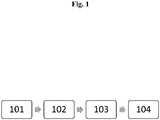
- a first aspect is a process of manufacturing a composite comprising a layer of a polyimide and a substrate wherein the process comprises at least steps i., ii., iii. and iv.
- a polyimide is a polymer where the repeat units of the polymer are connected by imide groups as linking groups.
- the term polyimide includes also polymers where some of the repeat units are connected by imide groups, and some other repeat units are connected by one or more other linking groups. Examples of other linking groups are ether groups, ester groups, sulfonyl groups, ketone groups and amid groups.
- a polyimide can be manufactured by any way known to and considered suitable by a skilled person.
- Conventional reaction patterns are a) to conduct a reaction between a polyanhydride and a polyamine, and b) to conduct a reaction between a polyanhydride and a polyisocyanate, and c) to conduct a reaction using a molecule which comprises both, at least an anhydride and an amino functional group, or a molecule which comprises both, at least an anhydride and an isocyanato functional group, e.g. 5-isocyanato-1,3-dihydro-2-benzofuran-1,3-dione (CAS: 40139-36-4).
- poly refers to the presence of two or more functional groups of the referred kind, i.e. polyisocyanate indicates that each molecule of the polyisocyanate has two or more, i.e. 3, 4, 5, 6 etc. isocyanate groups.
- the repeat units of the polyimide may be all aromatic.
- Another embodiment includes polyimides in which one repeat unit is aromatic, and the other aliphatic.
- Examples of polyimides which comprise both, aromatic and aliphatic repeat units are the condensation products of an aromatic bisanhydride and an aliphatic diamine, or the condensation product of an aliphatic bisanhydride and an aromatic diamine.
- the polyimide may contain one or more further linking groups, such as, e.g. ether groups, ester groups, sulfonyl groups, ketone groups, amid groups, or a combination of two or more thereof.
- further linking groups such as, e.g. ether groups, ester groups, sulfonyl groups, ketone groups, amid groups, or a combination of two or more thereof.
- these polyimides are Polyetherimides, polyesterimide and polyamideimides.
- the substrate can be of any kind known to a skilled person and considered suitable in the present process and to manufacture the subject composite.
- suited substrates are materials selected from the group consisting of polyamide, polyimide, polyaramid, polytetrafluoroethylene, glass, metal, ceramics, Polyethyleneimine (PEI), Polyether ether ketone (PEEK); and combinations thereof.
- PEI Polyethyleneimine
- PEEK Polyether ether ketone
- combinations thereof it is understood that this may refer to a composite of two or more materials, that is an arrangement where layers of two different materials overlap layer by layer. Further combinations thereof may also refer to substrates where two or more materials are adjacent side by side.
- even a combination is perceivable where two or more layers overlap layer by layer but also at least one layer is made by two or more materials arranged side by side.
- Step i comprises providing of a first composition comprising at least an acid compound and a first organic carrier; and a second composition comprising at least a diamine compound and a second organic carrier.
- Providing in the present context can be of any kind known to a skilled person and considered suitable in the present process and/or for the subject first or second composition.
- the viscosity can be measured using a Brookfield DX3TLVKJ0 viscometer equipped with a 75 ml ULA-31EY sample chamber using a YULA-15E spindle (all measurement equipment available from Brookfield Engineering Labs, Inc.). The temperature can be controlled using an external thermostat.
- Calibration of the viscosimeter can be done using calibration standards for Newtonian liquids from "Zentrum fur Messen und Kalibrieren & Analtytik GmbH, DAkks-registration no. D-K-15186-01-00. (DAkks is the national accreditation body for Germany.).
- At least one of the first composition and the second composition preferably both, the first and the second composition, have a viscosity in the range from 1 to 100 mPa*s at 50 °C. The measurement was performed as before, but at 50 °C.
- the molar amount of carboxylic acid groups in the first composition and the molar amount of amine groups in the second composition can be about 2:1, e.g. in the range from1.8:1.2 to 2.2:0.8 or from 1.9:1.1 to 2.1:0.9.
- Anhydride groups count as two carboxylic groups.
- the first composition comprises at least one acid compound which can be of any kind known to and considered suitable for conducting the present process by a skilled person.
- the acid compound can be a polycarboxylic acid or an anhydride thereof. Examples thereof are dicarboxylic, tricarboxylic and tetracarboxylic acids and anhydrides thereof.
- the acid compound may be aromatic, cycloaliphatic or aliphatic, or mixed, such as aliphatic-aromatic, yet preferred aromatic.
- acid compound More specific examples of acid compound are aromatic tricarboxylic polyacids and anhydrides, aromatic tetracarboxylic polyacids and anhydrides, aliphatic tetracarboxylic polyacids and anhydrides, and mixed aliphatic-aromatic polyacids and anhydrides.
- the acid compound can be a mixture of two or more of these.
- the acid compound can comprise other so-called “activated acid groups", such as acid chlorides and active esters.
- the first composition may comprise a total of one or more acid compounds in an amount in the range from 1 to 25 wt.%, e.g. from 10 to 25 wt.%, or from 15 to 25 wt.%, each based on the total amount of the first composition.
- the remainder of the first composition is, as described before, organic carrier and auxiliaries.
- the second composition comprises at least one diamine compound which can be of any kind known to and considered suitable for conducting the present process by a skilled person.
- the diamine compound may be aromatic, cycloaliphatic or aliphatic.
- the diamine may comprise at least a further functional group linking the amine functionalities, such as e.g. ether or ester groups.
- An example of an ether group containing aromatic diamine is 4,4'-Oxydianiline.
- More specific examples of acid compound are aliphatic diamines, aromatic diamines, ether diamines, sulfonyl diamines, mixed, aliphatic-aromatic diamines.
- the diamine compound can comprise a mixture of two or more of above mentioned diamine compounds.
- the second composition may comprise a total of one or more diamine compounds in an amount in the range from 1 to 25 wt.%, e.g. from 10 to 25 wt.%, or from 15 to 25 wt.%, each based on the total amount of the second composition.
- the remainder of the second composition is, as described before, organic carrier and auxiliaries.
- Examples of suited diamine compounds are
- the molecular weight of the acid compound, the molecular weight of the diamine compound, or of each of both compounds is less than 600 g/mol.
- Both, the first and the second composition further comprise an organic carrier.
- the first composition comprises a first organic carrier and the second composition a second organic carrier. Both, the first and the second organic carrier can be the same or different. In an embodiment, the first and the second organic carrier are composed identically and thus, are the same. In another embodiment, the first and the second organic carrier are composed of the same components but the quantitative composition of the second organic carrier is different from the quantitative composition of the first organic carrier.
- a suited organic carrier in the present context is a liquid, at least at a temperature over the range from 20 to 60 °C, which comprises one or more organic solvents.
- the organic carrier can be of any kind or a combination of any two or more organic solvents which are known to and considered suitable for conducting the present process by a skilled person.
- the organic carrier is a composition comprising at least one polar solvent.
- at least one of the polar solvents in the organic carrier is aprotic.
- dipolar aprotic solvents are Dimethylsulfoxide (DMSO), N -Methylpyrrolidone (NMP), N , N -Dimethylformamide (DMF), N , N -Dimethylacetamide (DMAc), N , N , N ', N '-Tetramethylurea (TMU), Tetrahydrofurane and Acetonitril.
- the organic carrier can comprise a combination of two or more dipolar aprotic solvents.
- the organic carrier is a composition comprising at least one of the mentioned dipolar aprotic solvents and at least a further solvent.
- the at least one further solvent can be of any kind known to and considered suitable for conducting the present process by a skilled person.
- the at least one further solvent can be non-polar, and further aliphatic.
- Preferred non-polar aliphatic solvents are found in the group of alkanes and cycloalkanes, in particular those having 6 or more carbon atoms per molecule.
- Examples of non-polar aliphatic solvents are hexane, heptane, octane, nonane, decane, cyclohexane, cycloheptane. Combinations of two or more thereof can be employed.
- Aliphatic and cyclic ketones and ethers are also non-polar aliphatic solvents and preferred when having 4, 5, 6 or more carbon atoms per molecule.
- the at least one further solvent can also comprise aromatic and/or halogenated solvents, such as nitrobenzene, benzonitrile, ⁇ -chloronaphthalene, o -dichlorobenzene, toluene and phenolic solvents such as m-cresol.
- aromatic and/or halogenated solvents such as nitrobenzene, benzonitrile, ⁇ -chloronaphthalene, o -dichlorobenzene, toluene and phenolic solvents such as m-cresol.
- the organic carrier comprises at least 20 wt.%, for example in the range from 20 wt.% to 100 wt.-%, that is more than 30, 40, 50, 60, 70 or 80 wt.% of one or more dipolar aprotic solvents, based on the total weight of the organic carrier. It was found that conditions are less preferred for the manufacture of the composite comprising a polyimide layer, if the organic carrier amounts to less than 50 wt.-% of a composition, e.g. the first or second composition. Potentially suited solvents are as described above.
- Preferred solvents composing the organic carrier are dimethyl sulfoxide (DMSO), N -methyl-2-pyrrolidone (NMP), N , N -dimethylformamide (DMF) and N , N -dimethylacetamide (DMAc), N , N , N' , N' -tetramethylurea (TMU), tetrahydrofurane and acetonitril; or a combination thereof.
- DMSO dimethyl sulfoxide
- NMP N -methyl-2-pyrrolidone
- DMF N -dimethylformamide
- DMAc N -dimethylacetamide
- TMU tetrahydrofurane and acetonitril
- the organic carrier may comprise up to 80 wt.%, for example in the range from 0 to 80 wt.-%, that is at most 70, 60, 50, 40, 30 or 20 wt.-% of at least one further solvent, based on the total weight of the organic carrier, e.g. one or more non-polar aliphatic solvents, as mentioned before.
- a suited non-polar aliphatic solvent is cycloheptanone.
- the organic carrier may further comprise up to 25 wt.-%, e.g. up to 15 wt.-%, or up to 10 wt.-% of further components, the wt.-% based on the total weight of the organic carrier.
- the further components can be of any kind and different from the ones described before. Examples of the further components are impurities, but also auxiliaries, e.g. antioxidants, crosslinkers, nanoparticles of silica and the like.
- the organic carrier comprises less than 1 wt.%, e.g. less than 1.000 ppm of water. Very often, the organic carrier contains no water at all.
- the amount of water in wt.-% or ppm is determined with respect to the total weight of the organic carrier under consideration. The amount of water is determined according to ASTM E203-16 using a Deutsche METROHM KF Coulometer 899 titration system (Karl Fisher Titration).
- the sum of all wt.% of components that form the organic carrier is always 100 wt.%. So, if an embodiment calls for 20 wt.% of dipolar aprotic solvent, the remainder to 100 wt.%, that is 80 wt.%, is formed by other components, such as non-polar aliphatic solvents, impurities, auxiliaries or other.
- a first layer is formed on the substrate.
- the first layer can be formed by application of either the first composition or the second composition onto the substrate.
- Application of the - either first or second - composition to the substrate in step ii. can be performed using any kind of application technique known and considered suited in the present process by a skilled person.
- application to the substrate can be performed by a technique selected from the group consisting of inkjet printing, coating with a doctor blade, roll coating, screen printing, spray coating, spin coating, flexo printing, gravure printing, tampon printing.
- the first layer may be fixated after step ii., as an option. Fixation can be performed by at least partial removal of the first organic carrier. If the first organic carrier is composed of two or more components, removal or only one or some of the components may also lead to fixation of the first layer comprising the first composition.
- the partial or complete removal of the first organic carrier can be conducted by evaporation, e.g. through heating the substrate, heating the first layer, ventilation through an air current, etc. to the first layer.
- a second layer is formed on the first layer, and possibly on the substrate. If the first layer was formed by applying the first composition, then the second layer is formed by applying the second composition. However, if the first layer was formed using the second composition, the second layer is formed by applying the first composition.
- Application of a composition in step iii. can be performed e.g. by using one of the techniques described with the application in step ii.
- the application in step iii. may be performed by the same technique as the application in step ii., or by a different technique.
- the same technique as in step ii. can be used, e.g. inkjet printing.
- step ii. and step iii. the same technique may be used.
- Another embodiment refers to using different techniques for forming a layer on a substrate.
- step iii. produces areas on the substrate, where the first and the second layer overlap at least in part.
- the second layer is positioned at least in part on top of the first layer.
- the overlap regions of the first and second layer form a pattern on the substrate.
- the pattern in the present context refers solely to the areas on the substrate where the overlap regions are.
- the pattern, and later the inventive polyimide layer is formed in the overlap regions of the first layer with the second layer. It may not be necessary to provide the diamine compound and the acid compound in the overlap regions in close-to or exactly equimolar amounts. But it was found of advantage to provide the amine groups of the second composition and the carboxylic acid groups of the first composition in close-to or exactly an molar amount of 1:2. Higher molecular weights of the polyimide in the polyimide layer can be obtained by observing such molar relation.
- the overlap between the first and the second layer is more than 75%, e.g. more than 80%, or more than 90%, or more than 95%, based on the total area on the substrate covered by either the first, the second layer, or a superposition of both layers. Often, the overlap is up to 98%, 99% or even 100%, based on the total area on the substrate covered by either the first, the second layer, or a superposition of both layers.
- a thermal pretreatment can be conducted prior to performing step iv.
- the thermal pretreatment may be conducted at a temperature of up to 95% of the solvent boiling point, wherein the boiling point is given based on the Kelvin scale.
- the %-value refers to the value of the boiling point. If the combined organic carriers comprise two or more solvents, then the %-value refers to the boiling point of that solvent of the organic carriers which has the lowest boiling point.
- the thermal pretreatment can be performed in a manner similar to or identical with the optional fixation step after step ii.
- the process of the invention further includes step iv., which is conducting a thermal treatment on the pattern.
- a thermal treatment By this thermal treatment, a polyimide layer is formed.
- the forming occurs where layer 1 and layer 2 overlap, that is composition 1 and composition 2 are in direct contact.
- the polyimide layer is in direct connection with the substrate, whereby the composite comprising the substrate and a layer of polyimide is obtained.
- the thermal treatment is conducted at temperature in the range from 25 to 180 °C, for example, in the range from 120 to 180 °C, or from 60 to 120 °C.
- the thermal treatment can be conducted by heating the substrate, e.g. on a hot plate, or in an oven, into which the coated substrate is inserted.
- the thermal treatment can be conducted at the operational temperature for a period from 0.1 to 60 minutes, e.g. 0.5 to 30 minutes, or from 1 to 5 minutes.
- an infrared or ultraviolet co-treatment can be conducted. In this event, IR- or UV-irradiation is applied to the substrate and the layers, in addition to the thermal treatment of step iv.
- the polyimide in the layer obtained by the process of the first aspect may have a weight average molecular weight of 5'000 g/mol or more, 10'000 g/mol or more, 50'000 g/mol or more, or 100'000 g/mol or more. It usually does not exceed 500'000 g/mol, or 1'000'000 g/mol at most.
- a preferred range of weight average molecular weight of the polyimide layer can be, for example, in the range from 5'000 to 1'000'000 g/mol, or from 10'000 to 100'000 g/mol, or from 50'000 to 500'000 g/mol.
- the polyimide layer may have a thickness of at least 20 nm.
- the thickness is determined perpendicular to the contact area which is formed by the polyimide layer and the substrate.
- the thickness can be determined by making a scratch through a sample of the composite, where the surface resulting from the scratch is examined by profilometry using a Bruker Dektak XT-E Taktiles Profilometer, radius of the stylus: 12.5 ⁇ m.
- a second aspect of the invention is a kit which comprises a first and a second composition, wherein the first composition comprises at least one acid compound and a first organic carrier; and the second composition comprises at least one diamine compound and a second organic carrier.
- the kit may be particularly useful for ink-jet printing, e.g. to print a precursor pattern.
- Such precursor pattern may be converted into dielectric features by a treatment, e.g. by a treatment with irradiation, e.g. heat.
- the first and second composition and its constituents e.g. the at least one acid compound, the first organic carrier, the diamine compound and the second organic carrier can be of the same kind as described in relation to the first aspect of the invention. So, embodiments described with regard to the first aspect of the invention are also preferred in the second aspect, in particular when referring to features and constituents related to the first or the second composition.
- Both, the first and the second organic carrier can be the same or different.
- the first and the second organic carrier are composed identically and thus, are the same.
- the first and the second organic carrier are composed by the same components but the quantitative composition of the second organic carrier is different from the quantitative composition of the first organic carrier.
- the kit may comprise an amount of the acid compound in the first composition in the range of from 1 to 25 wt.%, the wt.% with respect to the total weight of the first composition.
- the kit may also comprise an amount of the diamine compound in the second composition in the range of from 1 to 25 wt.%, the wt.% with respect to the total weight of the second composition.
- the first and the second composition of the kit may have, independently from the other one, a viscosity in the range from 3 to 100 mPa*s at a temperature of 20 °C. Further, both, the first and the second composition may have such viscosity. The measurement was performed as described before.
- the first and the second composition of the kit may have, independently from the other one, a viscosity in the range from 1 to 100 mPa*s at a temperature of 50 °C. Further, both, the first and the second composition may have such viscosity. The measurement was performed as described before.
- Another embodiment of the first aspect is the process which uses the kit of the second aspect or one of its embodiments.
- a third aspect is a composite comprising a layer of polyimide and a substrate obtainable by a process according to the first aspect or one of its embodiments.
- the kit of the second aspect and its embodiments can be employed to work the process of the first aspect to obtain the composite of the third aspect.
- a fourth aspect is a use of a kit comprising a first and a second composition, each comprising an organic carrier, to manufacture a polyimide layer, wherein the first composition comprises acid compounds and the second composition comprises diamine compounds.
- the first and second composition and its constituents e.g. the at least one acid compound, the first organic carrier, the diamine compound and the second organic carrier can be of the same kind as described in relation to the first aspect of the invention. So, embodiments described with regard to the first aspect of the invention are also preferred in the fourth aspect, in particular when referring to features and constituents related to the first or the second composition. Likely, the kit of the fourth aspect can be of the same kind as described in relation to the second aspect. Embodiments of the second aspect are also preferred with the fourth aspect.
- the polyimide layer may have a thickness of at least 20 nm.
- the thickness is determined perpendicular to the contact area between the polyimide layer and the substrate.
- the thickness can be determined by making a cut through a sample of the composite, where the surface resulting from the cut is examined by Scanning electron microscopy.
- the polyimide layer having a thickness of at least about 20 nm is manufactured so that the first composition and the second composition are applied only once onto each spot of the pattern.
- the pattern consists of a plurality of spots, wherein each spot comprises a superposition of the first composition and the second composition. No further layer comprising either the first composition or the second composition is superimposed on a spot.
- a layer of the described thickness can be prepared with only one printing iteration. This is in advantage over known techniques which usually need more than one iteration of printing and layer forming to achieve such a layer thickness.
- the known art applies a polyimide forming ink several times superimposing on the same spot of substrate to achieve the desired thickness of at least about 20, 25 or 50 nm.
- a fifth aspect is a use of a process as described in the first aspect, wherein a polyimide layer having a thickness of at least about 20 nm, e.g. 25 nm, or at least about 50 nm, which is obtained in a single printing step.
- a polyimide layer having a thickness of at least about 20 nm, e.g. 25 nm, or at least about 50 nm which is obtained in a single printing step.
- the viscosity was measured using a Brookfield DX3TLVKJ0 viscometer. 20 ml of a probe composition were poured into a 75ml ULA-31EY sample chamber using a YULA-15E spindle (all measurement equipment available from Brookfield Engineering Labs, Inc.). The measurements were conducted at a speed of 50 rpm, a shear rate of 61.15/s and a measurement time of 60 seconds. The temperature of (either 20°C or 50°C, as indicated) was controlled using an external thermostat. Calibration of the viscosimeter was done using calibration standards for Newtonian liquids from "Zentrum fur Messen und Kalibrieren & Analtytik GmbH, DAkks-registration no. D-K-15186-01-00. (DAkks is the national accreditation body for Germany.)
- the content of water in a composition was determined using a Deutsche METROHM KF Coulometer 899 titration system and according to ASTM E1064-08.
- Thickness of a polyimide layer was determined be analyzing the difference in height in a direction perpendicular to a substrate on which a layer of polyimide is positioned. For this purpose, a cut is made through the layer of polyimide and the layer is removed from the substrate on one side of the cut. A Dektak XT-E with a cutting tip of 12.5 ⁇ m was used to determine the difference in thickness.
- Average weight number molecular weight ( M w ) of polyimide was determined by GPC using a PSS SECcurity 2 GPC System equipped with one PSS GRAM 10 ⁇ m 30 ⁇ 8x300 mm and two PSS GRAM 10 ⁇ m 1000 ⁇ 8x300 mm GPC columns with a PSS GRAM 10 ⁇ m 8x50 mm precolumn.
- DMSO with 5 g/L LiCl was used as GPC eluent with a flow of 1 ml/min.
- GPC samples were prepared by dissolving 40 mg of the corresponding polyamic acid substrates in 1.5 ml of DMSO with 5 g/L LiCl and filtering them with 0.45 ⁇ m PTFE syringe filter. External calibration was performed with PSS PMMA standards. The elugrams were interpreted utilizing the detector response of the RI detector.
- the ultimate tensile strength was measured according to ASTM D-882-91.
- BTDA 3,3'-4,4'-(Benzophenone)tetracarboxylic anhydride
- FDA 4,4'-(9-Fluorenylidene)dianiline
- Each ink solution had a viscosity of 3 mPas at 20°C and a water content of less than 0.05 wt.%.
- the first ink solution was printed using a Fuji Dimatix printer with 1270 dpi on a glass substrate at room temperature forming a first layer.
- the second ink solution was printed forming a second layer on top of the first layer.
- the layer was cured at 230 °C for 30 minutes to form polyimide.
- a cut was made through the foil using a cutter knife.
- the thickness of the polyimide layer was then analyzed using the profilometer, as described in the test method. The thickness of the polyimide layer was 5 ⁇ m.
- the polyimide layer had an ultimate tensile strength of 13 MPa, measured according to ASTM D-882-91.
Landscapes
- Chemical & Material Sciences (AREA)
- Organic Chemistry (AREA)
- Chemical Kinetics & Catalysis (AREA)
- Life Sciences & Earth Sciences (AREA)
- Engineering & Computer Science (AREA)
- Materials Engineering (AREA)
- Wood Science & Technology (AREA)
- Health & Medical Sciences (AREA)
- Medicinal Chemistry (AREA)
- Polymers & Plastics (AREA)
- Macromolecular Compounds Obtained By Forming Nitrogen-Containing Linkages In General (AREA)
- Laminated Bodies (AREA)
Abstract
Description
- The invention relates to a process of manufacturing a composite comprising a layer of a polyimide and a substrate, wherein the process comprises these steps: i. Providing a first composition comprising at least an acid compound; and a second composition comprising at least a diamine compound; ii. Forming a first layer on the substrate, wherein the first or the second composition can be applied; iii. Forming a second layer on the first layer, and possibly on the substrate, wherein if the first layer is formed by applying the first composition, the second layer is formed by applying the second composition, wherein if the first layer is formed using the second composition, the second layer is formed by applying the first composition; wherein the first and the second layer overlap at least in part thereby forming a pattern on the substrate; iv. Conducting a thermal treatment on the pattern wherein the polyimide layer is formed. The invention further relates to such a composite, a kit comprising a first composition comprising at least an acid compound and a second composition comprising at least a diamine compound and a use of the kit.
- An approach to create insulating features on flexible substrates and on printed electronics, such as printed circuit boards, is to apply a layer of a polyamic acid, which is then converted into a polyimide layer by a thermal and/or chemical reaction. The polyamic acid, a prepolymer, is usually prepared from a bisanhydride component and a diamine component. Solutions of the polyamic acid prepolymer have high viscosities at higher concentration, for which reason, inkjet printing of poylamic acid can be conducted only at low polyamic acid concentrations in a printing ink. Accordingly, such a printing process requires huge amounts of organic solvents which either evaporate or need to be recollected and recycled. The organic solvents used in this process are often toxic, cancerogenic and/or mutagenic. Furthermore, storage lifetime of inks based on polyamic acid is limited. Another process relies on aqueous media for the manufacturing of the polyamic acid but requires an addition of monoamines like trimethylamine or ethanolamine to stabilize the polyamic acid solution. Removal of these monoamines prior to application of the polyamic acid in an inkjet ink requires high temperatures of more than 250 °C, and is thus costly.
- In general terms, it is an object of the present invention to at least partly overcome at least one disadvantage known from the prior art.
- Another object of the invention is to provide a process to create a polyimide layer on a substrate which avoids a need for temperatures of more than 300 °C to remove excessive and unwanted amines at any stage.
- Another object is to provide a process to create a polyimide layer on a substrate which uses nontoxic, e.g. non-cancerogenic and non-mutagenic organic solvents.
Another object is to provide a process to create a polyimide layer where high amounts of polyimide can be applied to a substrate in one run.
Another object is to provide a process to create a polyimide layer where a thick layer of polyimide can be created on a substrate in one run.
Another object is to provide a process to create a polyimide layer using non-aqueous inks.
Another object is to provide a process in which printing pattern can be varied easily from substrate to substrate.
Another object is to provide a process which is fast and easy to use.
Another object is to provide a process which can be conducted at room temperature or only slightly elevated temperatures.
Another object of the present invention is to provide an easy to use way to supply an inkjet applicator with the inks required to prepare on a substrate a polyimide layer or a precursor thereof. Another object of the present invention is to provide concentrated inks for an inkjet applicator to manufacture polyimide layers.
Another object is to provide a composite comprising a substrate and a layer of polyimide, which composite, and in particular the polyimide layer is sturdy.
Another object is to provide a composite comprising a substrate and a layer of polyimide, which composite, and in particular the polyimide layer is thermally stable. - A contribution to achieving at least one of the objects above is made by the claims. A contribution to achieving at least one of the objects above is made by the following embodiments, the number of the embodiment being indicated between vertical bars.
- |1| A process of manufacturing a composite comprising at least a layer of a polyimide and a substrate wherein the process comprises at least these steps:
- i. Providing
a first composition comprising at least an acid compound and a first organic carrier; and
a second composition comprising at least a diamine compound and a second organic carrier; - ii. Forming a first layer on the substrate,
wherein the first or the second composition can be applied; - iii. Forming a second layer on the first layer, and possibly on the substrate, W
herein if the first layer is formed by applying the first composition, the second layer is formed by applying the second composition,
Wherein if the first layer is formed using the second composition, the second layer is formed by applying the first composition;
Wherein the first and the second layer overlap at least in part thereby forming a pattern on the substrate; - iv. Conducting a thermal treatment on the pattern wherein the polyimide layer is formed.
- i. Providing
- |2| The process of embodiment |1|, wherein at least one of the forming steps ii. and iii. comprises inkjet printing.
- |3| The process of embodiment |1| or |2|, wherein the overlap between the first and the second layer is more than 75%, based on the total area on the substrate covered by either the first layer, the second layer or both layers.
- |4| The process of any one of the preceding embodiments, wherein at least one further component is in the first composition, in the second composition or in both compositions.
- |5| The process of any one of the preceding embodiments, wherein the first composition comprises an amount of acid compound in the range from 1 to 25 wt.%, based on the total amount of the first composition.
- |6| The process of any one of the preceding embodiments, wherein the second composition comprises an amount of diamine compound in the range from 1 to 25 wt.%, based on the total amount of the second composition.
- |7| The process of any one of the preceding embodiments, wherein the first or the second, or both organic carriers comprise at least a dipolar aprotic solvent.
- |8| The process of any one of the preceding embodiments, wherein the amount of water in each, the first and the second composition is less than 1 wt.%, based on the total weight of the respective composition.
- |9| The process of any one of the preceding embodiments, wherein the main component of each, the first and the second organic carrier is DMSO.
- |10| The process of any one of the preceding embodiments, wherein the second organic carriers is identical in composition with the first organic carrier.
- |11| The process of any one of the preceding embodiments, wherein at least one of the first composition and the second composition has a viscosity in the range from 3 to 100 mPa*s at 50 rpm, shear rate of 61.15/s and T = 20 °C, using a YULA-15E spindle in a ULA-31 EY chamber.
- |12| The process of any one of the preceding embodiments, wherein at least one of the first composition and the second composition has a viscosity in the range from 1 to 100 mPa*s at 50 rpm, shear rate 61,15/s and T= 50 °C, using a YULA-15E spindle in a ULA-31 EY chamber.
- |13| The process of embodiment |6|, wherein the dipolar aprotic solvent is selected from the group consisting of: Dimethylsulfoxide (DMSO), N-Methylpyrrolidone (NMP), N,N-Dimethylformamide (DMF), N,N-Dimethylacetamide (DMAc), N,N,N',N'-Tetramethylurea (TMU), Tetrahydrofurane and Acetonitril.
- |14| The process of any one of the preceding embodiments, wherein the thermal treatment is conducted at a temperature in the range from 200 to 400 °C.
- |15| The process of any one of the preceding embodiments, wherein a thermal pretreatment is conducted after step ii. or after step iii., or both.
- |16| The process of embodiment |15|, wherein the thermal pretreatment is conducted at a temperature of up to 95% of the solvent boiling point, wherein the boiling point is given based on the Kelvin scale.
- |17| The process of embodiment |15| or |16|, wherein the thermal pretreatment is conducted at a temperature in the range from 25 to 180 °C, for example in the range from 120 to 180 °C, or from 60 to 120 °C.
- |18| The process of any one of the preceding embodiments, wherein at least one of the following features applies:
- a. the at least one diamine compound is selected from the group consisting of
- I. aliphatic diamines, such as Hexamethylenediamine (HMDA);
- II. aromatic diamines, such as 4,4'-(9-Fluorenylidene)dianiline (FDA), p-Phenylenediamine (PPDA), m-Phenylenediamine (MPDA), m-Xylylenediamine, p-Xylylenediamine, 2,2'-Bis(trifluoromethyl)benzidine (TFMB);
- III. ether diamines, such as 2,2-Bis[4-(4-aminophenoxy)phenyl]propane (BAPP), 2,2-Bis[4-(4-aminophenoxy)phenyl]hexafluoropropane, 4,4'-Oxydianiline (ODA), 4,4'-Bis(4-aminophenoxy)biphenyl;
- IV. sulfonyl diamines, such as 3,3'-Sulfonyldianiline;
- V. mixed, aliphatic-aromatic diamines, such as 4,4'-((Cyclohexane-1,1-diylbis(4,1-phenylene))bis(oxy))dianiline, 4,4'-(((4-Methylcyclohexane-1,1-diyl)bis(4,1-phenylene))bis(oxy))dianiline, Bis[4-(4-aminobenzyl)phenyl]methane, 1,1-Bis[4-(4-aminobenzyl)phenyl] cyclohexane, 3,3'-Methylenedianiline, 4,4'-Methylenedianiline; or
- VI. a combination of two or more of the compounds of same or different kind, according to the groups I., II., III., IV. and V.;
- b) the at least one acid compound is a polycarboxylic acid or a polycarboxylic anhydride, preferably selected from the group consisting of
- i. aromatic tricarboxylic polyacids and anhydrides, such as 3,4,4'-(Benzophenone)tricarboxylic anhydride (BTDA), trimellitic acid, trimellitic anhydride, phenylether tricarboxylic acid anhydride;
- ii. aromatic tetracarboxylic polyacids and anhydrides, such as 3,3'-4,4'-(Benzophenone)tetracarboxylic anhydride (BTDA), 4,4'-(Hexafluoroisopropylidene)diphthalic anhydride (6-FDA), Pyromellitic dianhydride (PMDA), 4,4'-Oxydiphtalic anhydride (ODPA), 3,3',4,4'-Biphenyltetracarboxylic dianhydride (BPDA), 3,3',4,4'-Diphenylsulfonetetracarboxylic dianhydride (DSDA), Hydroquinone diphthalic anhydride (HQDA), 4,4'-(4,4'-Isopropylidendiphenoxy) bis(phthalic anhydride);
- iii. aliphatic tetracarboxylic polyacids and anhydrides, such as Cyclobutane-1,2,3,4-tetracarboxylic dianhydride (CBDA), 3,3',4,4'-Bicyclohexyl tetracarboxylic dianhydride;
- iv. mixed, aliphatic-aromatic polyacids and anhydrides, such as Ethylene glycol bis(4-trimellitate anhydride);
- v. or a combination of two or more of the compounds of same or different kind, according to the groups i., ii., iii. and iv.;
- c) the substrate is selected from the group consisting of polyamide, polyimide, polyaramid, polytetrafluoroethylene, glass, metal, ceramics, Polyethyleneimine (PEI), Polyether ether ketone (PEEK);
or a combination of two or more of these features.
- a. the at least one diamine compound is selected from the group consisting of
- |19| The process of any one of the preceding embodiments, wherein the molecular weight of both, the acid compound and of the diamine compound is less than 600 g/mol.
- |20| The process of any one of the preceding embodiments, wherein the first composition is applied only once onto each spot of the pattern.
- |21| The process of any one of the preceding embodiments, wherein the second composition is applied only once onto each spot of the pattern.
- |22| The process of any one of the preceding embodiments, wherein the first composition and the second composition are applied only once onto each spot of the pattern.
- |23| The process of any of the preceding embodiments, wherein the polyimide layer has at least one of these features:
- i) A thickness of at least 20 nm;
- ii) A weight average molecular weight of the polyimide in the range from 5'000 to 1'000'000 g/mol;
- iii) An ultimate tensile strength of 5 MPa or more, for example of 10 MPa or more, or 20 MPa or more, each determined according to ASTM DD-882-91;
or a combination of two or more thereof.
- |24| A kit, e.g. suited for ink-jet printing dielectric features on a substrate, comprising a first and a second composition, wherein
the first composition comprises at least an acid compound and a first organic carrier; and
the second composition comprises at least a diamine compound and a second organic carrier. - |25| The kit of embodiment |24|, wherein
the amount of the acid compound in the first composition is in the range of from 1 to 25 wt.%, the wt.% with respect to the total weight of the first composition; and
the amount of the diamine compound in the second composition is in the range of from 1 to 25 wt.%, the wt.% with respect to the total weight of the second composition. - |26| The kit of embodiment |24| or|25|, wherein at least one [pref. both] of the compositions has a viscosity in the range from 3 to 100 mPa*s at 50 rpm, shear rate of 61.15/s, and T = 20 °C, using a YULA-15E spindle in a ULA-31EY chamber.
- |27| The process of any one of embodiments |1| to |23| using the kit of any one of embodiments |25| to |27|.
- |28| A composite comprising a layer of polyimide and a substrate obtainable by a process according to any one of embodiments |1| to |23| or |27|, or by a process of any one of embodiments |24| to |26|.
- |29| The composite of embodiment |28|, wherein the layer has at least one of these features:
- i) A thickness of at least 20 nm;
- ii) A weight average molecular weight of the polyimide in the range from 5'000 to 1'000'000 g/mol;
- iii) An ultimate tensile strength of 5 MPa or more, for example of 10 MPa or more, or 20 MPa or more, each determined according to ASTM DD-882-91;
or a combination of two or more thereof.
- |30| A use of a kit comprising a first and a second composition, each composition comprising an organic carrier, to manufacture a polyimide layer having a pattern, wherein the first composition further comprises at least an acid compound and the second composition comprises at least a diamine compound.
- |31| The use of embodiment |30|, wherein the polyimide layer has a thickness of more than 20 nm.
- |32| The use of embodiment |30| or |31|, wherein the first composition and the second composition are applied only once onto each spot of the pattern.
- Ranges mentioned in this description also include the values specified as limits. A range of the type "in the range from X to Y" in relation to a size A therefore means that A can assume the values X, Y and values between X and Y. Single sided limited ranges of the type "up to Y" for a size A are correspondingly interpreted as values Y and smaller than Y.
- A contribution to at least partial achievement of at least one of the above objects is made by the independent claims. The dependent claims provide preferred embodiments which contribute to at least partial achievement of at least one of the objects.
- A first aspect is a process of manufacturing a composite comprising a layer of a polyimide and a substrate wherein the process comprises at least steps i., ii., iii. and iv.
- A polyimide is a polymer where the repeat units of the polymer are connected by imide groups as linking groups. The term polyimide includes also polymers where some of the repeat units are connected by imide groups, and some other repeat units are connected by one or more other linking groups. Examples of other linking groups are ether groups, ester groups, sulfonyl groups, ketone groups and amid groups.
- A polyimide can be manufactured by any way known to and considered suitable by a skilled person. Conventional reaction patterns are a) to conduct a reaction between a polyanhydride and a polyamine, and b) to conduct a reaction between a polyanhydride and a polyisocyanate, and c) to conduct a reaction using a molecule which comprises both, at least an anhydride and an amino functional group, or a molecule which comprises both, at least an anhydride and an isocyanato functional group, e.g. 5-isocyanato-1,3-dihydro-2-benzofuran-1,3-dione (CAS: 40139-36-4).
- The prefix "poly" refers to the presence of two or more functional groups of the referred kind, i.e. polyisocyanate indicates that each molecule of the polyisocyanate has two or more, i.e. 3, 4, 5, 6 etc. isocyanate groups.
- The repeat units of the polyimide may be all aromatic. Another embodiment includes polyimides in which one repeat unit is aromatic, and the other aliphatic. Examples of polyimides which comprise both, aromatic and aliphatic repeat units are the condensation products of an aromatic bisanhydride and an aliphatic diamine, or the condensation product of an aliphatic bisanhydride and an aromatic diamine.
- The polyimide may contain one or more further linking groups, such as, e.g. ether groups, ester groups, sulfonyl groups, ketone groups, amid groups, or a combination of two or more thereof. Examples of these polyimides are Polyetherimides, polyesterimide and polyamideimides.
- The substrate can be of any kind known to a skilled person and considered suitable in the present process and to manufacture the subject composite. Examples of suited substrates are materials selected from the group consisting of polyamide, polyimide, polyaramid, polytetrafluoroethylene, glass, metal, ceramics, Polyethyleneimine (PEI), Polyether ether ketone (PEEK); and combinations thereof. In terms of combinations, it is understood that this may refer to a composite of two or more materials, that is an arrangement where layers of two different materials overlap layer by layer. Further combinations thereof may also refer to substrates where two or more materials are adjacent side by side. Moreover, even a combination is perceivable where two or more layers overlap layer by layer but also at least one layer is made by two or more materials arranged side by side.
- Step i. comprises providing of a first composition comprising at least an acid compound and a first organic carrier; and a second composition comprising at least a diamine compound and a second organic carrier.
- Providing in the present context can be of any kind known to a skilled person and considered suitable in the present process and/or for the subject first or second composition.
- In an embodiment, at least one of the first composition and the second composition, preferably both, the first and the second composition have a viscosity in the range from 3 to 100 mPa*s at 50 rpm, shear rate of 61.15/s, T = 20 °C, and a measurement period of 60 seconds. The viscosity can be measured using a Brookfield DX3TLVKJ0 viscometer equipped with a 75 ml ULA-31EY sample chamber using a YULA-15E spindle (all measurement equipment available from Brookfield Engineering Labs, Inc.). The temperature can be controlled using an external thermostat. Calibration of the viscosimeter can be done using calibration standards for Newtonian liquids from "Zentrum fur Messen und Kalibrieren & Analtytik GmbH, DAkks-registration no. D-K-15186-01-00. (DAkks is the national accreditation body for Germany.).
- In a further embodiment, at least one of the first composition and the second composition, preferably both, the first and the second composition, have a viscosity in the range from 1 to 100 mPa*s at 50 °C. The measurement was performed as before, but at 50 °C.
- The molar amount of carboxylic acid groups in the first composition and the molar amount of amine groups in the second composition can be about 2:1, e.g. in the range from1.8:1.2 to 2.2:0.8 or from 1.9:1.1 to 2.1:0.9. Anhydride groups count as two carboxylic groups.
- The first composition comprises at least one acid compound which can be of any kind known to and considered suitable for conducting the present process by a skilled person. The acid compound can be a polycarboxylic acid or an anhydride thereof. Examples thereof are dicarboxylic, tricarboxylic and tetracarboxylic acids and anhydrides thereof. The acid compound may be aromatic, cycloaliphatic or aliphatic, or mixed, such as aliphatic-aromatic, yet preferred aromatic. More specific examples of acid compound are aromatic tricarboxylic polyacids and anhydrides, aromatic tetracarboxylic polyacids and anhydrides, aliphatic tetracarboxylic polyacids and anhydrides, and mixed aliphatic-aromatic polyacids and anhydrides. The acid compound can be a mixture of two or more of these. Moreover, the acid compound can comprise other so-called "activated acid groups", such as acid chlorides and active esters.
- The first composition may comprise a total of one or more acid compounds in an amount in the range from 1 to 25 wt.%, e.g. from 10 to 25 wt.%, or from 15 to 25 wt.%, each based on the total amount of the first composition. The remainder of the first composition is, as described before, organic carrier and auxiliaries.
-
- i. Aromatic tricarboxylic polyacids and anhydrides, such as 3,4,4'-(Benzophenone)tricarboxylic anhydride (BTDA), trimellitic acid, trimellitic anhydride, phenylether tricarboxylic acid anhydride,
- ii. Aromatic tetracarboxylic polyacids and anhydrides, such as 3,3'-4,4'-(Benzophenone)tetracarboxylic anhydride (BTDA), 4,4'-(Hexafluoroisopropylidene)diphthalic anhydride (6-FDA), Pyromellitic dianhydride (PMDA), 4,4'-Oxydiphtalic anhydride (ODPA), 3,3',4,4'-Biphenyltetracarboxylic dianhydride (BPDA), 3,3',4,4'-Diphenylsulfonetetracarboxylic dianhydride (DSDA), Hydroquinone diphthalic anhydride (HQDA), 4,4'-(4,4'-Isopropylidendiphenoxy) bis(phthalic anhydride),
- iii. Aliphatic tetracarboxylic polyacids and anhydrides, such as Cyclobutane-1,2,3,4-tetracarboxylic dianhydride (CBDA), 3,3',4,4'-Bicyclohexyl tetracarboxylic dianhydride,
- iv. Mixed, aliphatic-aromatic polyacids and anhydrides, such as Ethylene glycol bis(4-trimellitate anhydride), or
- v. a combination of two or more of the compounds of same or different kind, according to the groups i., ii., iii. and iv.
- The second composition comprises at least one diamine compound which can be of any kind known to and considered suitable for conducting the present process by a skilled person. The diamine compound may be aromatic, cycloaliphatic or aliphatic. The diamine may comprise at least a further functional group linking the amine functionalities, such as e.g. ether or ester groups. An example of an ether group containing aromatic diamine is 4,4'-Oxydianiline. More specific examples of acid compound are aliphatic diamines, aromatic diamines, ether diamines, sulfonyl diamines, mixed, aliphatic-aromatic diamines. The diamine compound can comprise a mixture of two or more of above mentioned diamine compounds.
- The second composition may comprise a total of one or more diamine compounds in an amount in the range from 1 to 25 wt.%, e.g. from 10 to 25 wt.%, or from 15 to 25 wt.%, each based on the total amount of the second composition. The remainder of the second composition is, as described before, organic carrier and auxiliaries.
-
- I. Aliphatic diamines, such as Hexamethylenediamine (HMDA),
- II. Aromatic diamines, such as 4,4'-(9-Fluorenylidene)dianiline (FDA), p-Phenylenediamine (PPDA), m-Phenylenediamine (MPDA), m-Xylylenediamine, p-Xylylenediamine, 2,2'-Bis(trifluoromethyl)benzidine (TFMB),
- III. Ether diamines, such as 2,2-Bis[4-(4-aminophenoxy)phenyl]propane (BAPP), 2,2-Bis[4-(4-aminophenoxy) phenyl]hexafluoropropane, 4,4'-Oxydianiline (ODA), 4,4'-Bis(4-aminophenoxy)biphenyl,
- IV. Sulfonyl diamines, such as 3,3'-Sulfonyldianiline,
- V. mixed, aliphatic-aromatic diamines, such as 4,4'-((Cyclohexane-1,1-diylbis(4,1-phenylene))bis(oxy))dianiline, 4,4'-(((4-Methylcyclohexane-1,1-diyl)bis(4,1-phenylene))bis(oxy))dianiline, Bis[4-(4-aminobenzyl)phenyl] methane, 1,1-Bis[4-(4-aminobenzyl)phenyl] cyclohexane, 3,3'-Methylenedianiline, 4,4'-Methylenedianiline, or
- VI. a combination of two or more of the compounds of same or different kind, according to the groups I., II., III., IV. and V.
- In a preferred embodiment of the first aspect, the molecular weight of the acid compound, the molecular weight of the diamine compound, or of each of both compounds is less than 600 g/mol.
- Both, the first and the second composition further comprise an organic carrier. The first composition comprises a first organic carrier and the second composition a second organic carrier. Both, the first and the second organic carrier can be the same or different. In an embodiment, the first and the second organic carrier are composed identically and thus, are the same. In another embodiment, the first and the second organic carrier are composed of the same components but the quantitative composition of the second organic carrier is different from the quantitative composition of the first organic carrier.
- A suited organic carrier in the present context is a liquid, at least at a temperature over the range from 20 to 60 °C, which comprises one or more organic solvents. The organic carrier can be of any kind or a combination of any two or more organic solvents which are known to and considered suitable for conducting the present process by a skilled person.
- In an embodiment the organic carrier is a composition comprising at least one polar solvent. In a further embodiment, at least one of the polar solvents in the organic carrier is aprotic.
- Examples of dipolar aprotic solvents are Dimethylsulfoxide (DMSO), N-Methylpyrrolidone (NMP), N,N-Dimethylformamide (DMF), N,N-Dimethylacetamide (DMAc), N,N,N',N'-Tetramethylurea (TMU), Tetrahydrofurane and Acetonitril.
- In a further embodiment, the organic carrier can comprise a combination of two or more dipolar aprotic solvents.
- In a further embodiment the organic carrier is a composition comprising at least one of the mentioned dipolar aprotic solvents and at least a further solvent. The at least one further solvent can be of any kind known to and considered suitable for conducting the present process by a skilled person.
- The at least one further solvent can be non-polar, and further aliphatic. Preferred non-polar aliphatic solvents are found in the group of alkanes and cycloalkanes, in particular those having 6 or more carbon atoms per molecule. Examples of non-polar aliphatic solvents are hexane, heptane, octane, nonane, decane, cyclohexane, cycloheptane. Combinations of two or more thereof can be employed. Aliphatic and cyclic ketones and ethers are also non-polar aliphatic solvents and preferred when having 4, 5, 6 or more carbon atoms per molecule.
- The at least one further solvent can also comprise aromatic and/or halogenated solvents, such as nitrobenzene, benzonitrile, α-chloronaphthalene, o-dichlorobenzene, toluene and phenolic solvents such as m-cresol.
- In a further embodiment, the organic carrier comprises at least 20 wt.%, for example in the range from 20 wt.% to 100 wt.-%, that is more than 30, 40, 50, 60, 70 or 80 wt.% of one or more dipolar aprotic solvents, based on the total weight of the organic carrier. It was found that conditions are less preferred for the manufacture of the composite comprising a polyimide layer, if the organic carrier amounts to less than 50 wt.-% of a composition, e.g. the first or second composition. Potentially suited solvents are as described above. Preferred solvents composing the organic carrier are dimethyl sulfoxide (DMSO), N-methyl-2-pyrrolidone (NMP), N,N-dimethylformamide (DMF) and N,N-dimethylacetamide (DMAc), N,N,N',N'-tetramethylurea (TMU), tetrahydrofurane and acetonitril; or a combination thereof.
- The organic carrier may comprise up to 80 wt.%, for example in the range from 0 to 80 wt.-%, that is at most 70, 60, 50, 40, 30 or 20 wt.-% of at least one further solvent, based on the total weight of the organic carrier, e.g. one or more non-polar aliphatic solvents, as mentioned before. An example of a suited non-polar aliphatic solvent is cycloheptanone.
- The organic carrier may further comprise up to 25 wt.-%, e.g. up to 15 wt.-%, or up to 10 wt.-% of further components, the wt.-% based on the total weight of the organic carrier. The further components can be of any kind and different from the ones described before. Examples of the further components are impurities, but also auxiliaries, e.g. antioxidants, crosslinkers, nanoparticles of silica and the like.
- There is usually little to no water present in the organic carrier. In an embodiment, the organic carrier comprises less than 1 wt.%, e.g. less than 1.000 ppm of water. Very often, the organic carrier contains no water at all. The amount of water in wt.-% or ppm is determined with respect to the total weight of the organic carrier under consideration. The amount of water is determined according to ASTM E203-16 using a Deutsche METROHM KF Coulometer 899 titration system (Karl Fisher Titration).
- The sum of all wt.% of components that form the organic carrier is always 100 wt.%. So, if an embodiment calls for 20 wt.% of dipolar aprotic solvent, the remainder to 100 wt.%, that is 80 wt.%, is formed by other components, such as non-polar aliphatic solvents, impurities, auxiliaries or other.
- In step ii. a first layer is formed on the substrate. The first layer can be formed by application of either the first composition or the second composition onto the substrate. However, it may also be advantageous to apply onto the surface of the substrate a primer before the first or the second composition is applied in order to improve the adhesion of the polyimide layer on the substrate.
- Application of the - either first or second - composition to the substrate in step ii. can be performed using any kind of application technique known and considered suited in the present process by a skilled person. For example, application to the substrate can be performed by a technique selected from the group consisting of inkjet printing, coating with a doctor blade, roll coating, screen printing, spray coating, spin coating, flexo printing, gravure printing, tampon printing.
- The first layer may be fixated after step ii., as an option. Fixation can be performed by at least partial removal of the first organic carrier. If the first organic carrier is composed of two or more components, removal or only one or some of the components may also lead to fixation of the first layer comprising the first composition. The partial or complete removal of the first organic carrier can be conducted by evaporation, e.g. through heating the substrate, heating the first layer, ventilation through an air current, etc. to the first layer.
- In step iii., a second layer is formed on the first layer, and possibly on the substrate. If the first layer was formed by applying the first composition, then the second layer is formed by applying the second composition. However, if the first layer was formed using the second composition, the second layer is formed by applying the first composition. Application of a composition in step iii. can be performed e.g. by using one of the techniques described with the application in step ii. The application in step iii. may be performed by the same technique as the application in step ii., or by a different technique. The same technique as in step ii. can be used, e.g. inkjet printing.
- Throughout both steps, step ii. and step iii., the same technique may be used. Another embodiment refers to using different techniques for forming a layer on a substrate.
- Application according to step iii. produces areas on the substrate, where the first and the second layer overlap at least in part. As a result, the second layer is positioned at least in part on top of the first layer. The overlap regions of the first and second layer form a pattern on the substrate. The pattern in the present context refers solely to the areas on the substrate where the overlap regions are. The pattern, and later the inventive polyimide layer is formed in the overlap regions of the first layer with the second layer. It may not be necessary to provide the diamine compound and the acid compound in the overlap regions in close-to or exactly equimolar amounts. But it was found of advantage to provide the amine groups of the second composition and the carboxylic acid groups of the first composition in close-to or exactly an molar amount of 1:2. Higher molecular weights of the polyimide in the polyimide layer can be obtained by observing such molar relation.
- In another embodiment of the first aspect, the overlap between the first and the second layer is more than 75%, e.g. more than 80%, or more than 90%, or more than 95%, based on the total area on the substrate covered by either the first, the second layer, or a superposition of both layers. Often, the overlap is up to 98%, 99% or even 100%, based on the total area on the substrate covered by either the first, the second layer, or a superposition of both layers.
- In an embodiment of the process, a thermal pretreatment can be conducted prior to performing step iv. The thermal pretreatment may be conducted at a temperature of up to 95% of the solvent boiling point, wherein the boiling point is given based on the Kelvin scale. The %-value refers to the value of the boiling point. If the combined organic carriers comprise two or more solvents, then the %-value refers to the boiling point of that solvent of the organic carriers which has the lowest boiling point. Generally spoken, the thermal pretreatment can be performed in a manner similar to or identical with the optional fixation step after step ii.
- The process of the invention further includes step iv., which is conducting a thermal treatment on the pattern. By this thermal treatment, a polyimide layer is formed. The forming occurs where
layer 1 andlayer 2 overlap, that iscomposition 1 andcomposition 2 are in direct contact. Further, the polyimide layer is in direct connection with the substrate, whereby the composite comprising the substrate and a layer of polyimide is obtained. - In an embodiment of step iv., the thermal treatment is conducted at temperature in the range from 25 to 180 °C, for example, in the range from 120 to 180 °C, or from 60 to 120 °C.
- During the thermal treatment, residual organic carrier, such as solvents are removed, e.g. by evaporation. The thermal treatment can be conducted by heating the substrate, e.g. on a hot plate, or in an oven, into which the coated substrate is inserted. The thermal treatment can be conducted at the operational temperature for a period from 0.1 to 60 minutes, e.g. 0.5 to 30 minutes, or from 1 to 5 minutes. In addition, thereto, an infrared or ultraviolet co-treatment can be conducted. In this event, IR- or UV-irradiation is applied to the substrate and the layers, in addition to the thermal treatment of step iv.
- The polyimide in the layer obtained by the process of the first aspect may have a weight average molecular weight of 5'000 g/mol or more, 10'000 g/mol or more, 50'000 g/mol or more, or 100'000 g/mol or more. It usually does not exceed 500'000 g/mol, or 1'000'000 g/mol at most. A preferred range of weight average molecular weight of the polyimide layer can be, for example, in the range from 5'000 to 1'000'000 g/mol, or from 10'000 to 100'000 g/mol, or from 50'000 to 500'000 g/mol.
- In another embodiment, the polyimide layer may have a thickness of at least 20 nm. The thickness is determined perpendicular to the contact area which is formed by the polyimide layer and the substrate. The thickness can be determined by making a scratch through a sample of the composite, where the surface resulting from the scratch is examined by profilometry using a Bruker Dektak XT-E Taktiles Profilometer, radius of the stylus: 12.5µm.
- A second aspect of the invention is a kit which comprises a first and a second composition, wherein the first composition comprises at least one acid compound and a first organic carrier; and the second composition comprises at least one diamine compound and a second organic carrier.
- The kit may be particularly useful for ink-jet printing, e.g. to print a precursor pattern. Such precursor pattern may be converted into dielectric features by a treatment, e.g. by a treatment with irradiation, e.g. heat.
- The first and second composition and its constituents, e.g. the at least one acid compound, the first organic carrier, the diamine compound and the second organic carrier can be of the same kind as described in relation to the first aspect of the invention. So, embodiments described with regard to the first aspect of the invention are also preferred in the second aspect, in particular when referring to features and constituents related to the first or the second composition.
- Both, the first and the second organic carrier can be the same or different. In an embodiment, the first and the second organic carrier are composed identically and thus, are the same. In another embodiment, the first and the second organic carrier are composed by the same components but the quantitative composition of the second organic carrier is different from the quantitative composition of the first organic carrier.
- In another embodiment, the kit may comprise an amount of the acid compound in the first composition in the range of from 1 to 25 wt.%, the wt.% with respect to the total weight of the first composition. The kit may also comprise an amount of the diamine compound in the second composition in the range of from 1 to 25 wt.%, the wt.% with respect to the total weight of the second composition.
- Each, the first and the second composition of the kit may have, independently from the other one, a viscosity in the range from 3 to 100 mPa*s at a temperature of 20 °C. Further, both, the first and the second composition may have such viscosity. The measurement was performed as described before.
- Each, the first and the second composition of the kit may have, independently from the other one, a viscosity in the range from 1 to 100 mPa*s at a temperature of 50 °C. Further, both, the first and the second composition may have such viscosity. The measurement was performed as described before.
- Another embodiment of the first aspect is the process which uses the kit of the second aspect or one of its embodiments.
- A third aspect is a composite comprising a layer of polyimide and a substrate obtainable by a process according to the first aspect or one of its embodiments. For example, the kit of the second aspect and its embodiments can be employed to work the process of the first aspect to obtain the composite of the third aspect.
- A fourth aspect is a use of a kit comprising a first and a second composition, each comprising an organic carrier, to manufacture a polyimide layer, wherein the first composition comprises acid compounds and the second composition comprises diamine compounds.
- The first and second composition and its constituents, e.g. the at least one acid compound, the first organic carrier, the diamine compound and the second organic carrier can be of the same kind as described in relation to the first aspect of the invention. So, embodiments described with regard to the first aspect of the invention are also preferred in the fourth aspect, in particular when referring to features and constituents related to the first or the second composition. Likely, the kit of the fourth aspect can be of the same kind as described in relation to the second aspect. Embodiments of the second aspect are also preferred with the fourth aspect.
- In an embodiment, the polyimide layer may have a thickness of at least 20 nm. The thickness is determined perpendicular to the contact area between the polyimide layer and the substrate. The thickness can be determined by making a cut through a sample of the composite, where the surface resulting from the cut is examined by Scanning electron microscopy.
- In another embodiment, the polyimide layer having a thickness of at least about 20 nm is manufactured so that the first composition and the second composition are applied only once onto each spot of the pattern. Accordingly, the pattern consists of a plurality of spots, wherein each spot comprises a superposition of the first composition and the second composition. No further layer comprising either the first composition or the second composition is superimposed on a spot. Accordingly, a layer of the described thickness can be prepared with only one printing iteration. This is in advantage over known techniques which usually need more than one iteration of printing and layer forming to achieve such a layer thickness. For example, the known art applies a polyimide forming ink several times superimposing on the same spot of substrate to achieve the desired thickness of at least about 20, 25 or 50 nm.
- A fifth aspect is a use of a process as described in the first aspect, wherein a polyimide layer having a thickness of at least about 20 nm, e.g. 25 nm, or at least about 50 nm, which is obtained in a single printing step. This is in advantage of known techniques which usually need more than one printing and layer forming iteration to achieve such a layer thickness.
- The invention is now further elucidated with reference to the figures. The figures and figure descriptions are exemplary and are not to be considered as limiting the scope of the invention. The figures and descriptions focus on the features of the process relating to the invention and are not intended to be a comprehensive description of already established processes. The skilled person is aware of the technical details required to implement parts of the process which fall outside the focus of the invention, such as standard processes for distillation, phase separation and drying.
- Figure 1
- shows the process of manufacture according to the first aspect.
- Figure 2
- shows a kit, as in the second aspect.
- Figure 3
- shows a composite, side view, as in the third aspect.
- Figure 4
- shows a top view of a first (or second) composition printed with an inkjet.
- Figure 5
- shows a top view of a superimposed first (straight) and second (dashed) composition, which overlap in part.
- Figure 6
- shows another top view of a superimposed first (straight) and second (dashed) composition which overlap in part.
-
-
Figure 1 shows a process according to the first aspect which is a process of manufacturing a composite comprising a layer of a polyimide and a substrate wherein the process comprises at least: step i. 101 providing a first composition comprising an acid compound and a first organic carrier, and a second composition comprising a diamine compound and a second organic carrier; step ii. 102 forming a first layer on the substrate, wherein the first or the second composition can be applied; step iii. 103 forming a second layer on the substrate. If the first layer is formed by applying the first composition, then the second layer is formed by applying the second composition. However, if the first layer is formed using the second composition, the second layer is formed by applying the first composition. The first and the second layer overlap at least in part thereby forming a pattern on the substrate; step iv. 104 conducting a thermal treatment on the pattern wherein the polyimide layer is formed. -
Figure 2 shows akit 201 comprising a first 202 and a second 203 composition. -
Figure 3 shows a composite comprising asubstrate 302 and a layer ofpolyimide 301. -
Figure 4 shows an example of afirst layer 401. -
Figure 5 shows an example of afirst layer 501 and asecond layer 502, which overlap in part. Only the overlapping regions can polymerize to provide the precursor polymer of the polyimide layer. -
Figure 6 shows another example of afirst layer 601 and asecond layer 602, which overlap in part. Only the overlapping regions can polymerize to provide the precursor polymer of the polyimide layer. - The following test methods were used for the purposes of the invention. Unless otherwise stated the measurements were made at ambient temperature 23°C, ambient air pressure 100 kPa (0.986 atm) and relative humidity 50%.
- The viscosity was measured using a Brookfield DX3TLVKJ0 viscometer. 20 ml of a probe composition were poured into a 75ml ULA-31EY sample chamber using a YULA-15E spindle (all measurement equipment available from Brookfield Engineering Labs, Inc.). The measurements were conducted at a speed of 50 rpm, a shear rate of 61.15/s and a measurement time of 60 seconds. The temperature of (either 20°C or 50°C, as indicated) was controlled using an external thermostat. Calibration of the viscosimeter was done using calibration standards for Newtonian liquids from "Zentrum fur Messen und Kalibrieren & Analtytik GmbH, DAkks-registration no. D-K-15186-01-00. (DAkks is the national accreditation body for Germany.)
- The content of water in a composition was determined using a Deutsche METROHM KF Coulometer 899 titration system and according to ASTM E1064-08.
- Thickness of a polyimide layer was determined be analyzing the difference in height in a direction perpendicular to a substrate on which a layer of polyimide is positioned. For this purpose, a cut is made through the layer of polyimide and the layer is removed from the substrate on one side of the cut. A Dektak XT-E with a cutting tip of 12.5 µm was used to determine the difference in thickness.
- Average weight number molecular weight (
Mw ) of polyimide was determined by GPC using a PSS SECcurity2 GPC System equipped with one PSS GRAM 10 µm 30 Å 8x300 mm and two PSS GRAM 10 µm 1000Å 8x300 mm GPC columns with a PSS GRAM 10 µm 8x50 mm precolumn. DMSO with 5 g/L LiCl was used as GPC eluent with a flow of 1 ml/min. GPC samples were prepared by dissolving 40 mg of the corresponding polyamic acid substrates in 1.5 ml of DMSO with 5 g/L LiCl and filtering them with 0.45 µm PTFE syringe filter. External calibration was performed with PSS PMMA standards. The elugrams were interpreted utilizing the detector response of the RI detector. - The ultimate tensile strength was measured according to ASTM D-882-91.
- The invention is now further described with the aid of examples. These examples are for illustrative purposes and are not to be considered as limiting the scope of the invention.
- 10 mmol of 3,3'-4,4'-(Benzophenone)tetracarboxylic anhydride (BTDA) was dissolved in DMSO to generate a first 10 wt% ink solution. Further, 4,4'-(9-Fluorenylidene)dianiline (FDA) was dissolved in DMSO to generate a second ink solution of equal concentration. Each ink solution had a viscosity of 3 mPas at 20°C and a water content of less than 0.05 wt.%. The first ink solution was printed using a Fuji Dimatix printer with 1270 dpi on a glass substrate at room temperature forming a first layer. Subsequently, the second ink solution was printed forming a second layer on top of the first layer. Upon completion of the printing, the layer was cured at 230 °C for 30 minutes to form polyimide. A cut was made through the foil using a cutter knife. The thickness of the polyimide layer was then analyzed using the profilometer, as described in the test method. The thickness of the polyimide layer was 5 µm.
- The polyimide layer had an ultimate tensile strength of 13 MPa, measured according to ASTM D-882-91.
REFERENCE NUMERALS 101 Step i. 102 Step ii. 103 Step iii. 104 Step iv. 201 Kit 202 Composition 1203 Composition 2301 Polyimide layer 302 Substrate 401 First layer 501 First layer 502 Second layer 601 First layer 602 Second layer
Claims (15)
- A process of manufacturing a composite comprising at least a layer of polyimide and a substrate wherein the process comprises at least these steps:i. Providing
a first composition comprising at least an acid compound and a first organic carrier; and
a second composition comprising at least a diamine compound and a second organic carrier;ii. Forming a first layer on the substrate,
wherein the first or the second composition can be applied;iii. Forming a second layer on the first layer,
Wherein if the first layer is formed by applying the first composition, the second layer is formed by applying the second composition,
Wherein if the first layer is formed using the second composition, the second layer is formed by applying the first composition;
Wherein the first and the second layer overlap at least in part thereby forming a pattern on the substrate;iv. Conducting a thermal treatment on the pattern wherein the polyimide layer is formed. - The process of claim 1, wherein at least one of the forming steps ii. and iii. comprises inkjet printing.
- The process of claim 1 or 2, wherein the first composition comprises an amount of acid compound in the range from 1 to 25 wt.%, based on the total amount of the first composition.
- The process of any one of the preceding claims, wherein the second composition comprises an amount of diamine compound in the range from 1 to 25 wt.%, based on the total amount of the second composition.
- The process of any one of the preceding claims, wherein the first or the second, or both organic carriers comprise at least an dipolar aprotic solvent.
- The process of claim 5, wherein the dipolar aprotic solvent is selected from the group consisting of: Dimethylsulfoxide (DMSO), N-Methyl-2-pyrrolidone (NMP), N,N-Dimethylformamide (DMF), N,N-Dimethylacetamide (DMAc), N,N,N',N'-Tetramethylurea (TMU), Tetrahydrofurane and Acetonitril.
- The process of any one of the preceding claims, wherein the thermal treatment is conducted at a temperature in the range from 200 to 400°C.
- The process of any one of the preceding claims, wherein a thermal pretreatment is conducted on the pattern.
- The process of any one of the preceding claims, wherein at least one of the following features applies:a) the at least one diamine compound is selected from the group consisting ofI. aliphatic diamines, such as Hexamethylenediamine (HMDA);II. aromatic diamines, such as 4,4'-(9-Fluorenylidene)dianiline (FDA), p-Phenylenediamine (PPDA), m-Phenylenediamine (MPDA), m-Xylylenediamine, p-Xylylenediamine, 2,2'-Bis(trifluoromethyl)benzidine (TFMB);III. ether diamines, such as 2,2-Bis[4-(4-aminophenoxy)phenyl]propane (BAPP), 2,2-Bis[4-(4-aminophenoxy)phenyl]hexafluoropropane, 4,4'-Oxydianiline (ODA), 4,4'-Bis(4-aminophenoxy)biphenyl;IV. sulfonyl diamines, such as 3,3'-Sulfonyldianiline;V. mixed, aliphatic-aromatic diamines, such as 4,4'-((Cyclohexane-1,1-diylbis(4,1-phenylene))bis(oxy))dianiline, 4,4'-(((4-Methylcyclohexane-1,1-diyl)bis(4,1-phenylene))bis(oxy))dianiline, Bis[4-(4-aminobenzyl)phenyl] methane, 1,1-Bis[4-(4-aminobenzyl)phenyl] cyclohexane, 3,3'-Methylenedianiline, 4,4'-Methylenedianiline; orVI. a combination of two or more of the compounds of same or different kind, according to the groups I., II., III., IV. and V.;b) the at least one acid compound is a polycarboxylic acid or a polycarboxylic anhydride, preferably selected from the group consisting ofi. aromatic tricarboxylic polyacids and anhydrides, such as 3,4,4'-(Benzophenone)tricarboxylic anhydride (BTDA), trimellitic acid, trimellitic anhydride, phenylether tricarboxylic acid anhydride;ii. aromatic tetracarboxylic polyacids and anhydrides, such as 3,3'-4,4'-(Benzophenone)tetracarboxylic anhydride (BTDA), 4,4'-(Hexafluoroisopropylidene)diphthalic anhydride (6-FDA), Pyromellitic dianhydride (PMDA), 4,4'-Oxydiphtalic anhydride (ODPA), 3,3',4,4'-Biphenyltetracarboxylic dianhydride (BPDA), 3,3',4,4'-Diphenylsulfonetetracarboxylic dianhydride (DSDA), Hydroquinone diphthalic anhydride (HQDA), 4,4'-(4,4'-Isopropylidendiphenoxy) bis(phthalic anhydride);iii. aliphatic tetracarboxylic polyacids and anhydrides, such as Cyclobutane-1,2,3,4-tetracarboxylic dianhydride (CBDA), 3,3',4,4'-Bicyclohexyl tetracarboxylic dianhydride;iv. iv. mixed, aliphatic-aromatic polyacids and anhydrides, such as Ethylene glycol bis(4-trimellitate anhydride); orv. a combination of two or more of the compounds of same or different kind, according to the groups i., ii., iii. and iv.;c) the substrate is selected from the group consisting of polyamide, polyimide, polyaramid, polytetrafluoroethylene, glass, metal, ceramics, Polyethyleneimine (PEI), Polyether ether ketone (PEEK);
or a combination of two or more of these features. - The process of any of the preceding claims, wherein the polyimide layer has at least one of these features:i) A thickness of at least 20 nm;ii) A weight average molecular weight in the range from 5'000 to 1'000'000 g/mol;iii) An ultimate tensile strength of 5 MPa or more, for example of 10 MPa or more, or 20 MPa or more, each determined according to ASTM D-882-91;iv) Or a combination of two or more features according to i) to iii).
- A kit comprising a first and a second composition, wherein
the first composition comprises an acid compound and a first organic carrier; and
the second composition comprises a diamine compound and a second organic carrier. - The kit of claim 11, wherein
the amount of the acid compound in the first composition is in the range of from 1 to 25 wt.%, the wt.% with respect to the total weight of the first composition; and th
e amount of the diamine compound in the second composition is in the range of from 1 to 25 wt.%, the wt.% with respect to the total weight of the second composition. - A composite comprising a layer of polyimide and a substrate obtainable by a process according to any one of claims 1 to 10.
- The composite of claim 13, wherein the layer has at least one of these features:i) A thickness of at least 20 nm;ii) A weight average molecular weight in the range from 5'000 to 1'000'000 g/mol;iii) An ultimate tensile strength of 5 MPa or more, for example of 10 MPa or more, or 20 MPa or more, each determined according to ASTM D-882-91.
- A use of a kit comprising a first and a second composition, each comprising an organic carrier, to manufacture a polyimide layer having a pattern, wherein the first composition comprises at least an acid compound and the second composition comprises at least a diamine compound.
Priority Applications (4)
| Application Number | Priority Date | Filing Date | Title |
|---|---|---|---|
| EP19196281.0A EP3789425A1 (en) | 2019-09-09 | 2019-09-09 | Polymer layers by reactive printing |
| US17/753,626 US20220332962A1 (en) | 2019-09-09 | 2020-09-09 | Polymer layers by reactive printing |
| EP20767819.4A EP4028448A1 (en) | 2019-09-09 | 2020-09-09 | Polymer layers by reactive printing |
| PCT/EP2020/075220 WO2021048219A1 (en) | 2019-09-09 | 2020-09-09 | Polymer layers by reactive printing |
Applications Claiming Priority (1)
| Application Number | Priority Date | Filing Date | Title |
|---|---|---|---|
| EP19196281.0A EP3789425A1 (en) | 2019-09-09 | 2019-09-09 | Polymer layers by reactive printing |
Publications (1)
| Publication Number | Publication Date |
|---|---|
| EP3789425A1 true EP3789425A1 (en) | 2021-03-10 |
Family
ID=67902423
Family Applications (2)
| Application Number | Title | Priority Date | Filing Date |
|---|---|---|---|
| EP19196281.0A Withdrawn EP3789425A1 (en) | 2019-09-09 | 2019-09-09 | Polymer layers by reactive printing |
| EP20767819.4A Withdrawn EP4028448A1 (en) | 2019-09-09 | 2020-09-09 | Polymer layers by reactive printing |
Family Applications After (1)
| Application Number | Title | Priority Date | Filing Date |
|---|---|---|---|
| EP20767819.4A Withdrawn EP4028448A1 (en) | 2019-09-09 | 2020-09-09 | Polymer layers by reactive printing |
Country Status (3)
| Country | Link |
|---|---|
| US (1) | US20220332962A1 (en) |
| EP (2) | EP3789425A1 (en) |
| WO (1) | WO2021048219A1 (en) |
Families Citing this family (1)
| Publication number | Priority date | Publication date | Assignee | Title |
|---|---|---|---|---|
| CN114920980A (en) * | 2022-06-07 | 2022-08-19 | 东华大学 | Polyimide aerogel based on ink direct writing technology and preparation method thereof |
Citations (2)
| Publication number | Priority date | Publication date | Assignee | Title |
|---|---|---|---|---|
| JP2014065921A (en) * | 2008-12-12 | 2014-04-17 | Jnc Corp | Ink for inkjet |
| US20180037700A1 (en) * | 2016-08-04 | 2018-02-08 | Tetramer Technologies, Llc | Copolymers Exhibiting Improved Thermo-Oxidative Stability |
-
2019
- 2019-09-09 EP EP19196281.0A patent/EP3789425A1/en not_active Withdrawn
-
2020
- 2020-09-09 EP EP20767819.4A patent/EP4028448A1/en not_active Withdrawn
- 2020-09-09 WO PCT/EP2020/075220 patent/WO2021048219A1/en not_active Ceased
- 2020-09-09 US US17/753,626 patent/US20220332962A1/en not_active Abandoned
Patent Citations (2)
| Publication number | Priority date | Publication date | Assignee | Title |
|---|---|---|---|---|
| JP2014065921A (en) * | 2008-12-12 | 2014-04-17 | Jnc Corp | Ink for inkjet |
| US20180037700A1 (en) * | 2016-08-04 | 2018-02-08 | Tetramer Technologies, Llc | Copolymers Exhibiting Improved Thermo-Oxidative Stability |
Non-Patent Citations (1)
| Title |
|---|
| CHEMICAL ABSTRACTS, Columbus, Ohio, US; abstract no. 40139-36-4 |
Also Published As
| Publication number | Publication date |
|---|---|
| WO2021048219A1 (en) | 2021-03-18 |
| EP4028448A1 (en) | 2022-07-20 |
| US20220332962A1 (en) | 2022-10-20 |
Similar Documents
| Publication | Publication Date | Title |
|---|---|---|
| EP3153539B1 (en) | Method for producing polyimide film | |
| EP0459809B1 (en) | Polyimidosiloxane resin and composition thereof and method of applying same | |
| KR101948819B1 (en) | Polyimide precursor composition, preparation method thereof and polyimide substrate prepared from the composition | |
| TWI773889B (en) | Polyimide precursor composition for improving adhesion property of polyimide film, polyimide film prepared therefrom and preparation method thereof, and electronic device comprising the same | |
| JP4253459B2 (en) | Carbon film structure and manufacturing method thereof | |
| KR100330385B1 (en) | Polyimide Varnish | |
| JP7635775B2 (en) | Polyimide precursor composition and method for producing insulating coating layer using same | |
| JP5928705B2 (en) | Method for producing polyimide precursor solution, polyimide precursor solution using the same, and porous polyimide | |
| CN107261869A (en) | Polyimide composition and method for producing separation membrane | |
| EP3842500A1 (en) | Polyimide varnish comprising aromatic carboxylic acid for conductor coating and manufacturing method therefor | |
| CN107261870A (en) | Polyimide composition and method for producing separation membrane | |
| KR102095599B1 (en) | Method of producing polyimide resin, method of producing polyimide coating, method of producing polyamic acid solution, polyimide coating, and polyamic acid solution | |
| EP1236756A1 (en) | Novel polyimide and circuit substrate comprising the same | |
| KR102292266B1 (en) | Method of producing polyimide resin, method of producing polyimide coating, method of producing polyamic acid solution, polyimide coating and polyamic acid solution | |
| JP2015178541A (en) | Polyimide precursor composition, method for producing polyimide molded body, and polyimide molded body | |
| US20100291377A1 (en) | Method for producing polyimide film and polyamic acid solution composition | |
| EP0604319B1 (en) | Polyimide solution compositions and process for preparing same | |
| KR20210004522A (en) | Polyamic acid composition, method for preparing polyamic acid composition and polyimide comprising the same | |
| US20220332962A1 (en) | Polymer layers by reactive printing | |
| KR102121307B1 (en) | Polyimide Precursor Composition for Improving Adhesion Property of Polyimide Film, and Polyimide Film Prepared Therefrom | |
| KR101332627B1 (en) | Polyamic acid Composition, Polyimide Film And Substrateused For Display Device Using The Same | |
| CN110835416A (en) | Ultrathin polyimide film and preparation method thereof | |
| JP6760083B2 (en) | Polyimide precursor composition and method for producing an insulating coating layer using the polyimide precursor composition | |
| JPH0374702B2 (en) | ||
| EP4696736A1 (en) | Polyimide resin precursor, polyimide resin, and polyimide film |
Legal Events
| Date | Code | Title | Description |
|---|---|---|---|
| PUAI | Public reference made under article 153(3) epc to a published international application that has entered the european phase |
Free format text: ORIGINAL CODE: 0009012 |
|
| STAA | Information on the status of an ep patent application or granted ep patent |
Free format text: STATUS: REQUEST FOR EXAMINATION WAS MADE |
|
| 17P | Request for examination filed |
Effective date: 20190909 |
|
| AK | Designated contracting states |
Kind code of ref document: A1 Designated state(s): AL AT BE BG CH CY CZ DE DK EE ES FI FR GB GR HR HU IE IS IT LI LT LU LV MC MK MT NL NO PL PT RO RS SE SI SK SM TR |
|
| AX | Request for extension of the european patent |
Extension state: BA ME |
|
| RAP3 | Party data changed (applicant data changed or rights of an application transferred) |
Owner name: HERAEUS DEUTSCHLAND GMBH & CO. KG |
|
| STAA | Information on the status of an ep patent application or granted ep patent |
Free format text: STATUS: THE APPLICATION IS DEEMED TO BE WITHDRAWN |
|
| 18D | Application deemed to be withdrawn |
Effective date: 20210911 |