EP3789359A1 - Use of comb polymers as inerting agents for non-swelling layer-silicates - Google Patents
Use of comb polymers as inerting agents for non-swelling layer-silicates Download PDFInfo
- Publication number
- EP3789359A1 EP3789359A1 EP19195210.0A EP19195210A EP3789359A1 EP 3789359 A1 EP3789359 A1 EP 3789359A1 EP 19195210 A EP19195210 A EP 19195210A EP 3789359 A1 EP3789359 A1 EP 3789359A1
- Authority
- EP
- European Patent Office
- Prior art keywords
- mol
- comb polymer
- monomer unit
- group
- monomer units
- Prior art date
- Legal status (The legal status is an assumption and is not a legal conclusion. Google has not performed a legal analysis and makes no representation as to the accuracy of the status listed.)
- Withdrawn
Links
- 229920000642 polymer Polymers 0.000 title claims abstract description 181
- 230000008961 swelling Effects 0.000 title claims abstract description 50
- 239000000178 monomer Substances 0.000 claims abstract description 187
- 125000002091 cationic group Chemical group 0.000 claims abstract description 42
- 125000000129 anionic group Chemical group 0.000 claims abstract description 30
- 229920000233 poly(alkylene oxides) Polymers 0.000 claims abstract description 29
- 239000003795 chemical substances by application Substances 0.000 claims abstract description 11
- 125000003010 ionic group Chemical group 0.000 claims abstract description 9
- 239000000203 mixture Substances 0.000 claims description 90
- 229910052500 inorganic mineral Inorganic materials 0.000 claims description 73
- 239000011707 mineral Substances 0.000 claims description 73
- 239000011230 binding agent Substances 0.000 claims description 62
- 238000000034 method Methods 0.000 claims description 35
- 125000004432 carbon atom Chemical group C* 0.000 claims description 30
- 239000002270 dispersing agent Substances 0.000 claims description 19
- 230000000694 effects Effects 0.000 claims description 19
- 125000000217 alkyl group Chemical group 0.000 claims description 15
- 229920005646 polycarboxylate Polymers 0.000 claims description 15
- 239000000126 substance Substances 0.000 claims description 14
- RTZKZFJDLAIYFH-UHFFFAOYSA-N Diethyl ether Chemical compound CCOCC RTZKZFJDLAIYFH-UHFFFAOYSA-N 0.000 claims description 13
- 239000004014 plasticizer Substances 0.000 claims description 12
- QGZKDVFQNNGYKY-UHFFFAOYSA-O Ammonium Chemical compound [NH4+] QGZKDVFQNNGYKY-UHFFFAOYSA-O 0.000 claims description 10
- 125000002947 alkylene group Chemical group 0.000 claims description 8
- 229920001400 block copolymer Polymers 0.000 claims description 7
- 125000002768 hydroxyalkyl group Chemical group 0.000 claims description 6
- 229910052615 phyllosilicate Inorganic materials 0.000 claims description 6
- 125000003118 aryl group Chemical group 0.000 claims description 5
- 230000002411 adverse Effects 0.000 claims description 4
- 230000002401 inhibitory effect Effects 0.000 claims description 4
- 125000001931 aliphatic group Chemical group 0.000 claims description 3
- 229910001413 alkali metal ion Inorganic materials 0.000 claims description 3
- 229910001420 alkaline earth metal ion Inorganic materials 0.000 claims description 3
- 125000002877 alkyl aryl group Chemical group 0.000 claims description 3
- 229910021645 metal ion Inorganic materials 0.000 claims description 3
- 125000000753 cycloalkyl group Chemical group 0.000 claims description 2
- 150000004760 silicates Chemical class 0.000 claims description 2
- 229910052727 yttrium Inorganic materials 0.000 claims description 2
- 125000001183 hydrocarbyl group Chemical group 0.000 claims 1
- 238000002474 experimental method Methods 0.000 description 48
- 239000004570 mortar (masonry) Substances 0.000 description 28
- XLYOFNOQVPJJNP-UHFFFAOYSA-N water Substances O XLYOFNOQVPJJNP-UHFFFAOYSA-N 0.000 description 28
- 239000004568 cement Substances 0.000 description 25
- NLYAJNPCOHFWQQ-UHFFFAOYSA-N kaolin Chemical compound O.O.O=[Al]O[Si](=O)O[Si](=O)O[Al]=O NLYAJNPCOHFWQQ-UHFFFAOYSA-N 0.000 description 23
- 229910052622 kaolinite Inorganic materials 0.000 description 23
- 229910052900 illite Inorganic materials 0.000 description 21
- VGIBGUSAECPPNB-UHFFFAOYSA-L nonaaluminum;magnesium;tripotassium;1,3-dioxido-2,4,5-trioxa-1,3-disilabicyclo[1.1.1]pentane;iron(2+);oxygen(2-);fluoride;hydroxide Chemical compound [OH-].[O-2].[O-2].[O-2].[O-2].[O-2].[F-].[Mg+2].[Al+3].[Al+3].[Al+3].[Al+3].[Al+3].[Al+3].[Al+3].[Al+3].[Al+3].[K+].[K+].[K+].[Fe+2].O1[Si]2([O-])O[Si]1([O-])O2.O1[Si]2([O-])O[Si]1([O-])O2.O1[Si]2([O-])O[Si]1([O-])O2.O1[Si]2([O-])O[Si]1([O-])O2.O1[Si]2([O-])O[Si]1([O-])O2.O1[Si]2([O-])O[Si]1([O-])O2.O1[Si]2([O-])O[Si]1([O-])O2 VGIBGUSAECPPNB-UHFFFAOYSA-L 0.000 description 21
- 125000002496 methyl group Chemical group [H]C([H])([H])* 0.000 description 19
- 238000002156 mixing Methods 0.000 description 17
- -1 melamine sulfonates Chemical class 0.000 description 15
- 229920001577 copolymer Polymers 0.000 description 14
- 229910052626 biotite Inorganic materials 0.000 description 13
- 238000006116 polymerization reaction Methods 0.000 description 12
- 239000004927 clay Substances 0.000 description 11
- 229910052739 hydrogen Inorganic materials 0.000 description 11
- 238000010526 radical polymerization reaction Methods 0.000 description 11
- 238000006243 chemical reaction Methods 0.000 description 10
- 239000000654 additive Substances 0.000 description 9
- 239000004567 concrete Substances 0.000 description 9
- 239000001257 hydrogen Substances 0.000 description 9
- UFHFLCQGNIYNRP-UHFFFAOYSA-N Hydrogen Chemical compound [H][H] UFHFLCQGNIYNRP-UHFFFAOYSA-N 0.000 description 8
- 239000002202 Polyethylene glycol Substances 0.000 description 8
- 230000000903 blocking effect Effects 0.000 description 8
- 230000000052 comparative effect Effects 0.000 description 8
- 238000005259 measurement Methods 0.000 description 8
- 230000000979 retarding effect Effects 0.000 description 8
- 239000000243 solution Substances 0.000 description 8
- OZAIFHULBGXAKX-UHFFFAOYSA-N 2-(2-cyanopropan-2-yldiazenyl)-2-methylpropanenitrile Chemical compound N#CC(C)(C)N=NC(C)(C)C#N OZAIFHULBGXAKX-UHFFFAOYSA-N 0.000 description 6
- IAYPIBMASNFSPL-UHFFFAOYSA-N Ethylene oxide Chemical group C1CO1 IAYPIBMASNFSPL-UHFFFAOYSA-N 0.000 description 6
- NBIIXXVUZAFLBC-UHFFFAOYSA-N Phosphoric acid Chemical compound OP(O)(O)=O NBIIXXVUZAFLBC-UHFFFAOYSA-N 0.000 description 6
- VYPSYNLAJGMNEJ-UHFFFAOYSA-N Silicium dioxide Chemical compound O=[Si]=O VYPSYNLAJGMNEJ-UHFFFAOYSA-N 0.000 description 6
- 230000015572 biosynthetic process Effects 0.000 description 6
- 238000005755 formation reaction Methods 0.000 description 6
- 229920001519 homopolymer Polymers 0.000 description 6
- 125000000956 methoxy group Chemical group [H]C([H])([H])O* 0.000 description 6
- 229910052618 mica group Inorganic materials 0.000 description 6
- 230000002829 reductive effect Effects 0.000 description 6
- 239000007787 solid Substances 0.000 description 6
- 235000019738 Limestone Nutrition 0.000 description 5
- 239000012987 RAFT agent Substances 0.000 description 5
- 239000002253 acid Substances 0.000 description 5
- 239000007864 aqueous solution Substances 0.000 description 5
- 150000001768 cations Chemical class 0.000 description 5
- 239000011229 interlayer Substances 0.000 description 5
- 150000002500 ions Chemical class 0.000 description 5
- 239000006028 limestone Substances 0.000 description 5
- 238000012712 reversible addition−fragmentation chain-transfer polymerization Methods 0.000 description 5
- AISZNMCRXZWVAT-UHFFFAOYSA-N 2-ethylsulfanylcarbothioylsulfanyl-2-methylpropanenitrile Chemical compound CCSC(=S)SC(C)(C)C#N AISZNMCRXZWVAT-UHFFFAOYSA-N 0.000 description 4
- VEXZGXHMUGYJMC-UHFFFAOYSA-M Chloride anion Chemical compound [Cl-] VEXZGXHMUGYJMC-UHFFFAOYSA-M 0.000 description 4
- 229920003171 Poly (ethylene oxide) Polymers 0.000 description 4
- PPBRXRYQALVLMV-UHFFFAOYSA-N Styrene Chemical compound C=CC1=CC=CC=C1 PPBRXRYQALVLMV-UHFFFAOYSA-N 0.000 description 4
- 238000010560 atom transfer radical polymerization reaction Methods 0.000 description 4
- QBWCMBCROVPCKQ-UHFFFAOYSA-N chlorous acid Chemical compound OCl=O QBWCMBCROVPCKQ-UHFFFAOYSA-N 0.000 description 4
- 238000009826 distribution Methods 0.000 description 4
- 150000002170 ethers Chemical class 0.000 description 4
- 239000000945 filler Substances 0.000 description 4
- 239000003999 initiator Substances 0.000 description 4
- 239000010445 mica Substances 0.000 description 4
- 238000012705 nitroxide-mediated radical polymerization Methods 0.000 description 4
- 229920001223 polyethylene glycol Polymers 0.000 description 4
- 238000002360 preparation method Methods 0.000 description 4
- 230000008569 process Effects 0.000 description 4
- 239000011435 rock Substances 0.000 description 4
- 238000012360 testing method Methods 0.000 description 4
- 229920006163 vinyl copolymer Polymers 0.000 description 4
- NIXOWILDQLNWCW-UHFFFAOYSA-M Acrylate Chemical compound [O-]C(=O)C=C NIXOWILDQLNWCW-UHFFFAOYSA-M 0.000 description 3
- LSNNMFCWUKXFEE-UHFFFAOYSA-M Bisulfite Chemical compound OS([O-])=O LSNNMFCWUKXFEE-UHFFFAOYSA-M 0.000 description 3
- 239000004113 Sepiolite Substances 0.000 description 3
- WYTGDNHDOZPMIW-RCBQFDQVSA-N alstonine Natural products C1=CC2=C3C=CC=CC3=NC2=C2N1C[C@H]1[C@H](C)OC=C(C(=O)OC)[C@H]1C2 WYTGDNHDOZPMIW-RCBQFDQVSA-N 0.000 description 3
- 229910000147 aluminium phosphate Inorganic materials 0.000 description 3
- 150000001732 carboxylic acid derivatives Chemical class 0.000 description 3
- 229910001596 celadonite Inorganic materials 0.000 description 3
- 150000001875 compounds Chemical class 0.000 description 3
- 230000002950 deficient Effects 0.000 description 3
- YGANSGVIUGARFR-UHFFFAOYSA-N dipotassium dioxosilane oxo(oxoalumanyloxy)alumane oxygen(2-) Chemical compound [O--].[K+].[K+].O=[Si]=O.O=[Al]O[Al]=O YGANSGVIUGARFR-UHFFFAOYSA-N 0.000 description 3
- 239000007789 gas Substances 0.000 description 3
- 229910052631 glauconite Inorganic materials 0.000 description 3
- 229910052627 muscovite Inorganic materials 0.000 description 3
- 229910052757 nitrogen Inorganic materials 0.000 description 3
- 229910052625 palygorskite Inorganic materials 0.000 description 3
- ABLZXFCXXLZCGV-UHFFFAOYSA-N phosphonic acid group Chemical group P(O)(O)=O ABLZXFCXXLZCGV-UHFFFAOYSA-N 0.000 description 3
- 125000005496 phosphonium group Chemical group 0.000 description 3
- 229910052903 pyrophyllite Inorganic materials 0.000 description 3
- 125000001453 quaternary ammonium group Chemical group 0.000 description 3
- 150000003254 radicals Chemical class 0.000 description 3
- 150000003839 salts Chemical class 0.000 description 3
- 239000004576 sand Substances 0.000 description 3
- 229910052624 sepiolite Inorganic materials 0.000 description 3
- 235000019355 sepiolite Nutrition 0.000 description 3
- RWSOTUBLDIXVET-UHFFFAOYSA-O sulfonium Chemical compound [SH3+] RWSOTUBLDIXVET-UHFFFAOYSA-O 0.000 description 3
- 239000008030 superplasticizer Substances 0.000 description 3
- 239000000454 talc Substances 0.000 description 3
- 229910052623 talc Inorganic materials 0.000 description 3
- SQAINHDHICKHLX-UHFFFAOYSA-N 1-naphthaldehyde Chemical class C1=CC=C2C(C=O)=CC=CC2=C1 SQAINHDHICKHLX-UHFFFAOYSA-N 0.000 description 2
- LXEKPEMOWBOYRF-QDBORUFSSA-N AAPH Chemical compound Cl.Cl.NC(=N)C(C)(C)\N=N\C(C)(C)C(N)=N LXEKPEMOWBOYRF-QDBORUFSSA-N 0.000 description 2
- IJGRMHOSHXDMSA-UHFFFAOYSA-N Atomic nitrogen Chemical compound N#N IJGRMHOSHXDMSA-UHFFFAOYSA-N 0.000 description 2
- OMPJBNCRMGITSC-UHFFFAOYSA-N Benzoylperoxide Chemical compound C=1C=CC=CC=1C(=O)OOC(=O)C1=CC=CC=C1 OMPJBNCRMGITSC-UHFFFAOYSA-N 0.000 description 2
- OCUCCJIRFHNWBP-IYEMJOQQSA-L Copper gluconate Chemical class [Cu+2].OC[C@@H](O)[C@@H](O)[C@H](O)[C@@H](O)C([O-])=O.OC[C@@H](O)[C@@H](O)[C@H](O)[C@@H](O)C([O-])=O OCUCCJIRFHNWBP-IYEMJOQQSA-L 0.000 description 2
- ROSDSFDQCJNGOL-UHFFFAOYSA-N Dimethylamine Chemical compound CNC ROSDSFDQCJNGOL-UHFFFAOYSA-N 0.000 description 2
- 239000012988 Dithioester Substances 0.000 description 2
- 229920001732 Lignosulfonate Polymers 0.000 description 2
- 229920000877 Melamine resin Polymers 0.000 description 2
- CERQOIWHTDAKMF-UHFFFAOYSA-M Methacrylate Chemical compound CC(=C)C([O-])=O CERQOIWHTDAKMF-UHFFFAOYSA-M 0.000 description 2
- YNAVUWVOSKDBBP-UHFFFAOYSA-N Morpholine Chemical compound C1COCCN1 YNAVUWVOSKDBBP-UHFFFAOYSA-N 0.000 description 2
- 238000005481 NMR spectroscopy Methods 0.000 description 2
- 239000004721 Polyphenylene oxide Substances 0.000 description 2
- 238000002441 X-ray diffraction Methods 0.000 description 2
- LXEKPEMOWBOYRF-UHFFFAOYSA-N [2-[(1-azaniumyl-1-imino-2-methylpropan-2-yl)diazenyl]-2-methylpropanimidoyl]azanium;dichloride Chemical compound Cl.Cl.NC(=N)C(C)(C)N=NC(C)(C)C(N)=N LXEKPEMOWBOYRF-UHFFFAOYSA-N 0.000 description 2
- 230000004075 alteration Effects 0.000 description 2
- 150000001408 amides Chemical class 0.000 description 2
- 150000001450 anions Chemical class 0.000 description 2
- 238000013459 approach Methods 0.000 description 2
- 230000008901 benefit Effects 0.000 description 2
- 235000019400 benzoyl peroxide Nutrition 0.000 description 2
- 239000002981 blocking agent Substances 0.000 description 2
- 229910001919 chlorite Inorganic materials 0.000 description 2
- 229910052619 chlorite group Inorganic materials 0.000 description 2
- 239000008367 deionised water Substances 0.000 description 2
- 229910021641 deionized water Inorganic materials 0.000 description 2
- ZQMIGQNCOMNODD-UHFFFAOYSA-N diacetyl peroxide Chemical compound CC(=O)OOC(C)=O ZQMIGQNCOMNODD-UHFFFAOYSA-N 0.000 description 2
- 239000012990 dithiocarbamate Substances 0.000 description 2
- 150000004659 dithiocarbamates Chemical class 0.000 description 2
- 125000005022 dithioester group Chemical group 0.000 description 2
- 150000002148 esters Chemical class 0.000 description 2
- 238000005227 gel permeation chromatography Methods 0.000 description 2
- 238000004128 high performance liquid chromatography Methods 0.000 description 2
- 150000004677 hydrates Chemical class 0.000 description 2
- 238000006703 hydration reaction Methods 0.000 description 2
- 150000002430 hydrocarbons Chemical group 0.000 description 2
- 125000005462 imide group Chemical group 0.000 description 2
- 238000004519 manufacturing process Methods 0.000 description 2
- PSZYNBSKGUBXEH-UHFFFAOYSA-N naphthalene-1-sulfonic acid Chemical class C1=CC=C2C(S(=O)(=O)O)=CC=CC2=C1 PSZYNBSKGUBXEH-UHFFFAOYSA-N 0.000 description 2
- 125000004433 nitrogen atom Chemical group N* 0.000 description 2
- 229920000620 organic polymer Polymers 0.000 description 2
- 229920000570 polyether Polymers 0.000 description 2
- 238000012545 processing Methods 0.000 description 2
- 239000010453 quartz Substances 0.000 description 2
- 239000011541 reaction mixture Substances 0.000 description 2
- 230000009467 reduction Effects 0.000 description 2
- 238000010992 reflux Methods 0.000 description 2
- 238000003756 stirring Methods 0.000 description 2
- 238000006467 substitution reaction Methods 0.000 description 2
- RRHXZLALVWBDKH-UHFFFAOYSA-M trimethyl-[2-(2-methylprop-2-enoyloxy)ethyl]azanium;chloride Chemical compound [Cl-].CC(=C)C(=O)OCC[N+](C)(C)C RRHXZLALVWBDKH-UHFFFAOYSA-M 0.000 description 2
- 239000012989 trithiocarbonate Substances 0.000 description 2
- 125000000391 vinyl group Chemical group [H]C([*])=C([H])[H] 0.000 description 2
- 238000009736 wetting Methods 0.000 description 2
- 239000012991 xanthate Substances 0.000 description 2
- 0 *C(*)(*)C(*)(*)N Chemical compound *C(*)(*)C(*)(*)N 0.000 description 1
- QLAJNZSPVITUCQ-UHFFFAOYSA-N 1,3,2-dioxathietane 2,2-dioxide Chemical compound O=S1(=O)OCO1 QLAJNZSPVITUCQ-UHFFFAOYSA-N 0.000 description 1
- 238000001644 13C nuclear magnetic resonance spectroscopy Methods 0.000 description 1
- 238000005160 1H NMR spectroscopy Methods 0.000 description 1
- LCPVQAHEFVXVKT-UHFFFAOYSA-N 2-(2,4-difluorophenoxy)pyridin-3-amine Chemical compound NC1=CC=CN=C1OC1=CC=C(F)C=C1F LCPVQAHEFVXVKT-UHFFFAOYSA-N 0.000 description 1
- SMZOUWXMTYCWNB-UHFFFAOYSA-N 2-(2-methoxy-5-methylphenyl)ethanamine Chemical compound COC1=CC=C(C)C=C1CCN SMZOUWXMTYCWNB-UHFFFAOYSA-N 0.000 description 1
- DHNFGUDLVOSIKJ-UHFFFAOYSA-N 3-methyl-1-(3-methylbuta-1,3-dienoxy)buta-1,3-diene Chemical compound CC(=C)C=COC=CC(C)=C DHNFGUDLVOSIKJ-UHFFFAOYSA-N 0.000 description 1
- ATVJXMYDOSMEPO-UHFFFAOYSA-N 3-prop-2-enoxyprop-1-ene Chemical compound C=CCOCC=C ATVJXMYDOSMEPO-UHFFFAOYSA-N 0.000 description 1
- YNKQCPNHMVAWHN-UHFFFAOYSA-N 4-(benzenecarbonothioylsulfanyl)-4-cyanopentanoic acid Chemical compound OC(=O)CCC(C)(C#N)SC(=S)C1=CC=CC=C1 YNKQCPNHMVAWHN-UHFFFAOYSA-N 0.000 description 1
- KWSLGOVYXMQPPX-UHFFFAOYSA-N 5-[3-(trifluoromethyl)phenyl]-2h-tetrazole Chemical compound FC(F)(F)C1=CC=CC(C2=NNN=N2)=C1 KWSLGOVYXMQPPX-UHFFFAOYSA-N 0.000 description 1
- BRLQWZUYTZBJKN-UHFFFAOYSA-N Epichlorohydrin Chemical compound ClCC1CO1 BRLQWZUYTZBJKN-UHFFFAOYSA-N 0.000 description 1
- WOBHKFSMXKNTIM-UHFFFAOYSA-N Hydroxyethyl methacrylate Chemical compound CC(=C)C(=O)OCCO WOBHKFSMXKNTIM-UHFFFAOYSA-N 0.000 description 1
- CERQOIWHTDAKMF-UHFFFAOYSA-N Methacrylic acid Chemical compound CC(=C)C(O)=O CERQOIWHTDAKMF-UHFFFAOYSA-N 0.000 description 1
- 239000004372 Polyvinyl alcohol Substances 0.000 description 1
- OFOBLEOULBTSOW-UHFFFAOYSA-N Propanedioic acid Natural products OC(=O)CC(O)=O OFOBLEOULBTSOW-UHFFFAOYSA-N 0.000 description 1
- GOOHAUXETOMSMM-UHFFFAOYSA-N Propylene oxide Chemical group CC1CO1 GOOHAUXETOMSMM-UHFFFAOYSA-N 0.000 description 1
- 238000003991 Rietveld refinement Methods 0.000 description 1
- 229910000831 Steel Inorganic materials 0.000 description 1
- XTXRWKRVRITETP-UHFFFAOYSA-N Vinyl acetate Chemical compound CC(=O)OC=C XTXRWKRVRITETP-UHFFFAOYSA-N 0.000 description 1
- QYKIQEUNHZKYBP-UHFFFAOYSA-N Vinyl ether Chemical compound C=COC=C QYKIQEUNHZKYBP-UHFFFAOYSA-N 0.000 description 1
- NIXOWILDQLNWCW-UHFFFAOYSA-N acrylic acid group Chemical group C(C=C)(=O)O NIXOWILDQLNWCW-UHFFFAOYSA-N 0.000 description 1
- 230000009471 action Effects 0.000 description 1
- 239000004480 active ingredient Substances 0.000 description 1
- 230000000996 additive effect Effects 0.000 description 1
- 150000001298 alcohols Chemical class 0.000 description 1
- 230000009435 amidation Effects 0.000 description 1
- 238000007112 amidation reaction Methods 0.000 description 1
- 150000001412 amines Chemical class 0.000 description 1
- 238000004458 analytical method Methods 0.000 description 1
- 239000004566 building material Substances 0.000 description 1
- BVKZGUZCCUSVTD-UHFFFAOYSA-N carbonic acid Chemical compound OC(O)=O BVKZGUZCCUSVTD-UHFFFAOYSA-N 0.000 description 1
- 125000002843 carboxylic acid group Chemical group 0.000 description 1
- 238000005341 cation exchange Methods 0.000 description 1
- 239000011083 cement mortar Substances 0.000 description 1
- 239000011509 cement plaster Substances 0.000 description 1
- 239000003638 chemical reducing agent Substances 0.000 description 1
- 150000001805 chlorine compounds Chemical class 0.000 description 1
- 239000000470 constituent Substances 0.000 description 1
- 239000000356 contaminant Substances 0.000 description 1
- 208000012839 conversion disease Diseases 0.000 description 1
- 238000005260 corrosion Methods 0.000 description 1
- 230000007797 corrosion Effects 0.000 description 1
- 230000001419 dependent effect Effects 0.000 description 1
- LSXWFXONGKSEMY-UHFFFAOYSA-N di-tert-butyl peroxide Chemical compound CC(C)(C)OOC(C)(C)C LSXWFXONGKSEMY-UHFFFAOYSA-N 0.000 description 1
- 239000006185 dispersion Substances 0.000 description 1
- 238000007323 disproportionation reaction Methods 0.000 description 1
- 239000010459 dolomite Substances 0.000 description 1
- 229910000514 dolomite Inorganic materials 0.000 description 1
- 230000032050 esterification Effects 0.000 description 1
- 238000005886 esterification reaction Methods 0.000 description 1
- 125000001495 ethyl group Chemical group [H]C([H])([H])C([H])([H])* 0.000 description 1
- 238000001704 evaporation Methods 0.000 description 1
- 230000008020 evaporation Effects 0.000 description 1
- 239000010881 fly ash Substances 0.000 description 1
- 239000011888 foil Substances 0.000 description 1
- 239000012634 fragment Substances 0.000 description 1
- 239000010438 granite Substances 0.000 description 1
- 229910052736 halogen Inorganic materials 0.000 description 1
- 150000002367 halogens Chemical class 0.000 description 1
- 230000036571 hydration Effects 0.000 description 1
- 150000002431 hydrogen Chemical group 0.000 description 1
- 239000000852 hydrogen donor Substances 0.000 description 1
- 230000005660 hydrophilic surface Effects 0.000 description 1
- 125000001165 hydrophobic group Chemical group 0.000 description 1
- 125000002636 imidazolinyl group Chemical group 0.000 description 1
- 229910052738 indium Inorganic materials 0.000 description 1
- 230000002687 intercalation Effects 0.000 description 1
- 238000009830 intercalation Methods 0.000 description 1
- 239000010410 layer Substances 0.000 description 1
- 239000011431 lime mortar Substances 0.000 description 1
- 125000005647 linker group Chemical group 0.000 description 1
- 238000004811 liquid chromatography Methods 0.000 description 1
- 230000014759 maintenance of location Effects 0.000 description 1
- VZCYOOQTPOCHFL-UPHRSURJSA-N maleic acid Chemical compound OC(=O)\C=C/C(O)=O VZCYOOQTPOCHFL-UPHRSURJSA-N 0.000 description 1
- 239000011976 maleic acid Substances 0.000 description 1
- 229910052651 microcline Inorganic materials 0.000 description 1
- 230000007935 neutral effect Effects 0.000 description 1
- 125000000962 organic group Chemical group 0.000 description 1
- 150000002898 organic sulfur compounds Chemical class 0.000 description 1
- 125000004430 oxygen atom Chemical group O* 0.000 description 1
- 239000002245 particle Substances 0.000 description 1
- 150000002978 peroxides Chemical class 0.000 description 1
- 229910052698 phosphorus Inorganic materials 0.000 description 1
- 229920001451 polypropylene glycol Polymers 0.000 description 1
- 229920002451 polyvinyl alcohol Polymers 0.000 description 1
- 235000019422 polyvinyl alcohol Nutrition 0.000 description 1
- 239000000843 powder Substances 0.000 description 1
- 230000035484 reaction time Effects 0.000 description 1
- 238000005215 recombination Methods 0.000 description 1
- 230000006798 recombination Effects 0.000 description 1
- 230000002787 reinforcement Effects 0.000 description 1
- 230000002441 reversible effect Effects 0.000 description 1
- 229910052604 silicate mineral Inorganic materials 0.000 description 1
- 239000002893 slag Substances 0.000 description 1
- 229910001379 sodium hypophosphite Inorganic materials 0.000 description 1
- CHQMHPLRPQMAMX-UHFFFAOYSA-L sodium persulfate Substances [Na+].[Na+].[O-]S(=O)(=O)OOS([O-])(=O)=O CHQMHPLRPQMAMX-UHFFFAOYSA-L 0.000 description 1
- 238000010972 statistical evaluation Methods 0.000 description 1
- 239000010959 steel Substances 0.000 description 1
- 238000012956 testing procedure Methods 0.000 description 1
- VZCYOOQTPOCHFL-UHFFFAOYSA-N trans-butenedioic acid Natural products OC(=O)C=CC(O)=O VZCYOOQTPOCHFL-UHFFFAOYSA-N 0.000 description 1
- 238000006276 transfer reaction Methods 0.000 description 1
- 229910052723 transition metal Inorganic materials 0.000 description 1
- 150000003624 transition metals Chemical class 0.000 description 1
- FZGFBJMPSHGTRQ-UHFFFAOYSA-M trimethyl(2-prop-2-enoyloxyethyl)azanium;chloride Chemical group [Cl-].C[N+](C)(C)CCOC(=O)C=C FZGFBJMPSHGTRQ-UHFFFAOYSA-M 0.000 description 1
- CCVMLEHYQVSFOM-UHFFFAOYSA-N trimethyl-[2-(prop-2-enoylamino)ethyl]azanium;chloride Chemical compound [Cl-].C[N+](C)(C)CCNC(=O)C=C CCVMLEHYQVSFOM-UHFFFAOYSA-N 0.000 description 1
- UZNHKBFIBYXPDV-UHFFFAOYSA-N trimethyl-[3-(2-methylprop-2-enoylamino)propyl]azanium;chloride Chemical compound [Cl-].CC(=C)C(=O)NCCC[N+](C)(C)C UZNHKBFIBYXPDV-UHFFFAOYSA-N 0.000 description 1
- OEIXGLMQZVLOQX-UHFFFAOYSA-N trimethyl-[3-(prop-2-enoylamino)propyl]azanium;chloride Chemical compound [Cl-].C[N+](C)(C)CCCNC(=O)C=C OEIXGLMQZVLOQX-UHFFFAOYSA-N 0.000 description 1
Classifications
-
- C—CHEMISTRY; METALLURGY
- C08—ORGANIC MACROMOLECULAR COMPOUNDS; THEIR PREPARATION OR CHEMICAL WORKING-UP; COMPOSITIONS BASED THEREON
- C08F—MACROMOLECULAR COMPOUNDS OBTAINED BY REACTIONS ONLY INVOLVING CARBON-TO-CARBON UNSATURATED BONDS
- C08F299/00—Macromolecular compounds obtained by interreacting polymers involving only carbon-to-carbon unsaturated bond reactions, in the absence of non-macromolecular monomers
- C08F299/02—Macromolecular compounds obtained by interreacting polymers involving only carbon-to-carbon unsaturated bond reactions, in the absence of non-macromolecular monomers from unsaturated polycondensates
- C08F299/026—Macromolecular compounds obtained by interreacting polymers involving only carbon-to-carbon unsaturated bond reactions, in the absence of non-macromolecular monomers from unsaturated polycondensates from the reaction products of polyepoxides and unsaturated monocarboxylic acids, their anhydrides, halogenides or esters with low molecular weight
-
- C—CHEMISTRY; METALLURGY
- C04—CEMENTS; CONCRETE; ARTIFICIAL STONE; CERAMICS; REFRACTORIES
- C04B—LIME, MAGNESIA; SLAG; CEMENTS; COMPOSITIONS THEREOF, e.g. MORTARS, CONCRETE OR LIKE BUILDING MATERIALS; ARTIFICIAL STONE; CERAMICS; REFRACTORIES; TREATMENT OF NATURAL STONE
- C04B24/00—Use of organic materials as active ingredients for mortars, concrete or artificial stone, e.g. plasticisers
- C04B24/24—Macromolecular compounds
- C04B24/26—Macromolecular compounds obtained by reactions only involving carbon-to-carbon unsaturated bonds
- C04B24/2688—Copolymers containing at least three different monomers
- C04B24/2694—Copolymers containing at least three different monomers containing polyether side chains
-
- C—CHEMISTRY; METALLURGY
- C04—CEMENTS; CONCRETE; ARTIFICIAL STONE; CERAMICS; REFRACTORIES
- C04B—LIME, MAGNESIA; SLAG; CEMENTS; COMPOSITIONS THEREOF, e.g. MORTARS, CONCRETE OR LIKE BUILDING MATERIALS; ARTIFICIAL STONE; CERAMICS; REFRACTORIES; TREATMENT OF NATURAL STONE
- C04B24/00—Use of organic materials as active ingredients for mortars, concrete or artificial stone, e.g. plasticisers
- C04B24/24—Macromolecular compounds
- C04B24/26—Macromolecular compounds obtained by reactions only involving carbon-to-carbon unsaturated bonds
- C04B24/2605—Macromolecular compounds obtained by reactions only involving carbon-to-carbon unsaturated bonds containing polyether side chains
-
- C—CHEMISTRY; METALLURGY
- C04—CEMENTS; CONCRETE; ARTIFICIAL STONE; CERAMICS; REFRACTORIES
- C04B—LIME, MAGNESIA; SLAG; CEMENTS; COMPOSITIONS THEREOF, e.g. MORTARS, CONCRETE OR LIKE BUILDING MATERIALS; ARTIFICIAL STONE; CERAMICS; REFRACTORIES; TREATMENT OF NATURAL STONE
- C04B24/00—Use of organic materials as active ingredients for mortars, concrete or artificial stone, e.g. plasticisers
- C04B24/24—Macromolecular compounds
- C04B24/26—Macromolecular compounds obtained by reactions only involving carbon-to-carbon unsaturated bonds
- C04B24/2641—Polyacrylates; Polymethacrylates
- C04B24/2647—Polyacrylates; Polymethacrylates containing polyether side chains
-
- C—CHEMISTRY; METALLURGY
- C04—CEMENTS; CONCRETE; ARTIFICIAL STONE; CERAMICS; REFRACTORIES
- C04B—LIME, MAGNESIA; SLAG; CEMENTS; COMPOSITIONS THEREOF, e.g. MORTARS, CONCRETE OR LIKE BUILDING MATERIALS; ARTIFICIAL STONE; CERAMICS; REFRACTORIES; TREATMENT OF NATURAL STONE
- C04B28/00—Compositions of mortars, concrete or artificial stone, containing inorganic binders or the reaction product of an inorganic and an organic binder, e.g. polycarboxylate cements
-
- C—CHEMISTRY; METALLURGY
- C04—CEMENTS; CONCRETE; ARTIFICIAL STONE; CERAMICS; REFRACTORIES
- C04B—LIME, MAGNESIA; SLAG; CEMENTS; COMPOSITIONS THEREOF, e.g. MORTARS, CONCRETE OR LIKE BUILDING MATERIALS; ARTIFICIAL STONE; CERAMICS; REFRACTORIES; TREATMENT OF NATURAL STONE
- C04B28/00—Compositions of mortars, concrete or artificial stone, containing inorganic binders or the reaction product of an inorganic and an organic binder, e.g. polycarboxylate cements
- C04B28/02—Compositions of mortars, concrete or artificial stone, containing inorganic binders or the reaction product of an inorganic and an organic binder, e.g. polycarboxylate cements containing hydraulic cements other than calcium sulfates
-
- C—CHEMISTRY; METALLURGY
- C04—CEMENTS; CONCRETE; ARTIFICIAL STONE; CERAMICS; REFRACTORIES
- C04B—LIME, MAGNESIA; SLAG; CEMENTS; COMPOSITIONS THEREOF, e.g. MORTARS, CONCRETE OR LIKE BUILDING MATERIALS; ARTIFICIAL STONE; CERAMICS; REFRACTORIES; TREATMENT OF NATURAL STONE
- C04B28/00—Compositions of mortars, concrete or artificial stone, containing inorganic binders or the reaction product of an inorganic and an organic binder, e.g. polycarboxylate cements
- C04B28/02—Compositions of mortars, concrete or artificial stone, containing inorganic binders or the reaction product of an inorganic and an organic binder, e.g. polycarboxylate cements containing hydraulic cements other than calcium sulfates
- C04B28/04—Portland cements
-
- C—CHEMISTRY; METALLURGY
- C08—ORGANIC MACROMOLECULAR COMPOUNDS; THEIR PREPARATION OR CHEMICAL WORKING-UP; COMPOSITIONS BASED THEREON
- C08F—MACROMOLECULAR COMPOUNDS OBTAINED BY REACTIONS ONLY INVOLVING CARBON-TO-CARBON UNSATURATED BONDS
- C08F283/00—Macromolecular compounds obtained by polymerising monomers on to polymers provided for in subclass C08G
- C08F283/06—Macromolecular compounds obtained by polymerising monomers on to polymers provided for in subclass C08G on to polyethers, polyoxymethylenes or polyacetals
- C08F283/065—Macromolecular compounds obtained by polymerising monomers on to polymers provided for in subclass C08G on to polyethers, polyoxymethylenes or polyacetals on to unsaturated polyethers, polyoxymethylenes or polyacetals
Definitions
- the invention relates to the use of a comb polymer as an inerting agent for non-swelling layer-silicates. Additionally, the invention is concerned with a composition comprising the comb polymer. Further aspects of the invention are related to a method, in particular for plasticizing a mineral binder composition.
- Dispersants or superplasticizers are used in the building industry as plasticizers or water-reducing agents for mineral binder compositions, such as for example concrete, cement mortar, plaster or lime mortar.
- the dispersants are generally organic polymers which are added to the mixing water or admixed with the binder compositions in solid form. In this way, it is advantageously possible to alter both the consistency of the binder composition during processing and the properties in the hardened state.
- Known particularly effective dispersants are, for example, polymers based on polycarboxylate ethers (PCE). Polymers of this kind have a polymer backbone and side chains bonded thereto. Corresponding polymers are described, for example, in EP 1 138 697 A1 (Sika AG).
- sands are being used as an aggregate.
- natural sands which are quarried from e.g. rivers, or manufactured sands, which are produced by crushing of rocks, are being used.
- WO 2010/005117 A1 (W.R. Grace ) describes a method in which polycationic compounds in combination with a hydroxycarboxylic acid or a salt thereof is used to enhance slump retention in cements and concretes having clay-bearing aggregates, wherein the clay otherwise absorbs or diminishes the efficiency of polycarboxylate superplasticizers.
- WO 2016/096970 A1 (BASF SE) describes a method of inhibiting the swelling of clay in subterranean formations with a polyimidazolium compound.
- polycations such as polyimidazolium compounds frequently have chlorides as counter-ions which can be problematic in view of possible corrosion of steel reinforcement in concrete.
- polycations are usually poorly miscible with standard PCEs.
- WO2011/107704 discloses an organic molecule with a cationic charge density of less than 0.5 meq/g, preferably a polyvinylalcohol, to offset the adverse effects of non-swelling clays.
- a cationic charge density of less than 0.5 meq/g preferably a polyvinylalcohol
- the uses, compositions or methods shall reduce the negative influence of non-swelling layer-silicates on the effectiveness of dispersants, in particular of PCE-based dispersants.
- the duration of action should be as long as possible.
- the uses, compositions or methods shall be as effective as possible while having a best possible robustness.
- the uses, compositions or methods as such shall affect the flowability of mineral binder compositions as little as possible.
- the uses, compositions and methods should be as insensitive as possible with regard to fluctuating non-swelling layer-silicate contents in mineral binder compositions.
- the uses, compositions or methods shall be compatible with common additives used for producing mineral binder compositions, or with corresponding processes, respectively.
- the uses, compositions or methods shall be compatible with lignosulfonates, gluconates, naphthalenesulfonates, sulfonated naphthalene-formaldehyde condensates, melamine sulfonates, vinyl copolymers, sulfonated vinyl copolymers, and/or polycarboxylates, especially polycarboxylate ethers.
- the uses, compositions or methods shall be compatible with PCE-based dispersants.
- the uses, compositions or methods should have a content of chloride as low as possible or should be substantially free of chloride.
- the core of the invention is the use of a comb polymer as an inerting agent for non-swelling layer-silicates, said comb polymer comprising:
- the use of the inventive comb polymers allows for a highly efficient reduction of the negative influence of non-swelling layer-silicates on the effectiveness of dispersants, in particular of PCE-based dispersants, in mineral binder compositions containing non-swelling layer-silicates.
- the inventive solution turned out to be highly robust.
- the comb polymers of the invention only have little effect on the flowability of mineral binder compositions.
- the dosage of the comb polymer according to the invention is rather uncritical, especially if a certain threshold has been reached. Therefore, fluctuating contents of non-swelling layer-silicates in mineral binder compositions are much less of an issue with the inventive comb polymers.
- the comb polymers according to the invention can be used as an inerting agent or blocking agent for non-swelling layer-silicates, especially in combination with PCE-based dispersants.
- comb polymers of the present invention show a much lower retarding effect of a mortar composition when compared to commonly used clay-blocking additives, such as e.g. products from the MasterSuna range.
- the comb polymers according to the invention typically have a rather high grafting density of poly(alkylene oxide) side chains, which is in particular higher than the grafting density of usual PCE-based dispersants.
- comb polymers according to the invention are absorbed on the surface of non-swelling layer-silicates and efficiently cover these surfaces.
- single poly(alkylene oxide) side chains such as e.g. methyl polyethylene glycols, which are not part of a comb polymer structure should as well be good blocking additives.
- the comb polymers used according to the invention are much better blocking additives when compared to single poly(alkylene oxide) side chains. Even when using the same or higher dosages of single poly(alkylene oxide) side chains, these single side chains are not able to reduce or prevent intercalation of PCE-based dispersants to the same extent as the inventive comb polymers.
- inventive use of comb polymers turned out to be at least as efficient as the use of known blocking additives such as polycations or like known blocking additives having a strong plasticizing effect.
- a first aspect of the invention relates to the use of a comb polymer as an inerting agent for non-swelling layer-silicates, said comb polymer comprising:
- the monomer units M1 , MC, MA and M3 differ from each other chemically and/or structurally.
- the at least one non-ionic monomer unit M3 does not comprise poly(alkylene oxide) groups, especially it does not comprise poly(ethylene oxide) groups.
- a "polymer” is a substance comprising or consisting of at least 2, especially at least 3, preferably at least 5, polymerized monomer units.
- a “comb polymer” is a polymer comprising a polymer backbone and side chains bonded thereto.
- a "PCE” is a polycarboxylate ether.
- Polycarboxylate ethers are frequently being used as superplasticizers for mineral binders.
- PCE are described, for example, in EP 1 138 697 A1 .
- PCE superplasticizers are structurally different from the comb polymers of the present invention. This is because PCE are designed to have the effect of plastifying a given mineral binder composition, measurable as increased flow, whereas comb polymers of the present invention do not show a plastification.
- the PCE is thus a superplasticzer or polymer P as described below. This has the advantage that comb polymers of the present invention can be combined with standard PCE without the risk of too strong plastification in case of varying amounts of layer-silicate present.
- mineral binder denotes a binder which reacts in the presence of water in a hydration reaction to form solid hydrates or hydrate phases.
- This can be, for example, a hydraulic binder, a latent hydraulic binder, and/or a pozzolanic binder.
- Highly preferred are hydraulic binders. Hydraulic binders can set under water. But it can also be advantageous for the mineral binder to contain other binders in addition to or instead of a hydraulic binder.
- latent hydraulic binders and/or pozzolanic binders are, e.g., slag, fly ash, silica dust and/or natural pozzolans.
- the mineral binder comprises or consists of cement, especially cement of type CEM I, CEM II, CEM III, CEM IV and/or CEM V (according to the standard EN 197-1).
- a mineral binder composition is thus a composition comprising at least one mineral binder, especially cement.
- the mineral binder contains at least 5 wt.-%, especially at least 20 wt.-%, preferably at least 35 wt.-%, especially at least 65 wt.-%, of hydraulic binder, especially cement, and, optionally, 5 to 95 wt.-%, especially 5 to 65 wt.-%, particularly 15 to 35 wt.-%, of latent hydraulic and/or pozzolanic binder.
- clay-inerting agent clay-blocking agent
- clay blocker are meant to be agents capable of reducing or inhibiting adverse effects of swellable and/or non-swellable clays on the effectiveness of dispersants, in particular of PCE-based dispersants, in mineral binder compositions.
- the non-swellable phyllosilicates can be further divided based on their structural set-up into 1:1 minerals (tetrahedral-octahedral), e.g. kaolinite, serpentine, 2:1 minerals (tetrahedral-octahedral-tetrahedral), e.g. micas, palygorskite, sepiolite, and 2:1:1 minerals (tetrahedral-octahedral-tetrahedral-hydroxide octahedral, with one or both of the octahedral sheets being dominated by Mg 2+ ), e.g. chlorite.
- 1:1 minerals tetrahedral-octahedral
- serpentine 2:1 minerals
- tetrahedral-octahedral-tetrahedral e.g. micas, palygorskite, sepiolite
- 2:1:1 minerals
- Interlayer-deficient micas are part of the 2:1 mineral group comprising minerals such as illite, glauconite, celadonite, and phengite.
- Charge-balanced 2:1 layer-silicates include minerals such as talc or pyrophyllite.
- the most common non-swelling layer-silicates are neutral minerals, minerals with a high interlayer charge which is greater than 0.6-0.8 per Si 4 O 10 and/or minerals that are part of the 2:1:1 mineral group.
- Non-swelling layer-silicates can be formed either due to weathering of minerals, as is the case for e.g. kaolinite and illite, or due to magmatic and/or metamorphic processes, as is the case for e.g. biotite, phengite, and muscovite.
- the latter group of minerals is mostly found in source rocks, such as e.g. granite or gneiss, from which the manufactured sands are produced.
- the formation of non-swelling layer-silicates due to weathering of minerals may take place either during the source rock alteration, during the transportation processes, or directly at the depositional site, e.g. river banks.
- Other non-swelling layer-silicates which are not explicitly mentioned here, are also encompassed by the term "non-swelling layer-silicates”.
- the comb polymers according to the present invention are used in compositions comprising such non-swelling layer-silicates, especially kaolinite, serpentine, palygorskite, sepiolite, talc, pyrophyllite, chlorites, mica such as muscovite or biotite, interlayer-deficient mica like illite, glauconite, celadonite, and phengite.
- non-swelling layer-silicates especially kaolinite, serpentine, palygorskite, sepiolite, talc, pyrophyllite, chlorites, mica such as muscovite or biotite, interlayer-deficient mica like illite, glauconite, celadonite, and phengite.
- ionic group or "ionic groups” especially mean groups that, at least at a pH > 10, especially at least at a pH > 12, are present in negatively charged form or in positively charged form.
- groups present in negatively charged form are called “anionic groups”.
- Groups present in positively charged form are called “cationic groups”.
- counter ions which are solely bound by ionic bonding are not to be considered with regard to the charge of the ionic groups.
- cationic monomers and "cationic monomer units” especially mean monomers or polymerized monomers that, at least at a pH > 10, especially at least at a pH > 12, are present in positively charged form. Thereby, counter ions which are bound by ionic bonding are not to be considered with regard to the charge of the "cationic monomers” or the "cationic monomer units".
- anionic monomers and “anionic monomer units” especially mean monomers or polymerized monomers that, at least at a pH > 10, especially at least at a pH > 12, are present in negatively charged form. Also in this case, counter ions which are bound by ionic bonding are not to be considered with regard to the charge of the "anionic monomers” or the “anionic monomer units”.
- anionic monomers are monomers comprising anionic groups such as e.g. hydrogen donor groups or acid groups.
- the anionic groups are more preferably acid groups, for example carboxylic acid, sulfonic acid, phosphoric acid and/or phosphonic acid groups. Preference is given to carboxylic acid groups.
- the anionic groups or acid groups may also take the form of anions in deprotonated form or of a salt with a counter ion or cation.
- Cationic monomers are monomers comprising cationic groups.
- the cationic group is covalently attached to the cationic monomer. It may be a common cationic group which can be attached to organic polymers, in particular an ammonium, sulfonium and/or phosphonium group.
- the cationic groups may also take the form of a salt with a counter ion or anion.
- the cationic group is in particular grafted onto the backbone of the comb polymer. This means that it is not part of the main chain or backbone of the comb polymer. Therefore, it does not connect subunits of the main chain to one another. Thereby it differs, for example, from the condensates of dimethylamine and epichlorohydrin of US 2007287794 A1 .
- non-ionic monomers and “non-ionic monomer units” especially mean monomers or polymerized monomers which do not have any ionic groups, in particular they neither have any anionic groups nor any cationic groups.
- the non-ionic monomers at a pH > 10, especially at a pH > 12, are present in uncharged form.
- the at least one poly(alkylene oxide) side chain-bearing monomer unit M1 does not comprise any ionic groups. Especially, the at least one poly(alkylene oxide) side chain-bearing monomer unit M1 does not comprise any carboxylic acid, sulfonic acid, phosphoric acid, and phosphonic acid groups and/or the at least one poly(alkylene oxide) side chain-bearing monomer unit M1 does not comprise any ammonium, sulfonium and/or phosphonium groups, in particular quaternary ammonium groups.
- the at least one poly(alkylene oxide) side chain-bearing monomer unit M1 is present in uncharged form.
- the at least one poly(alkylene oxide) side chain-bearing monomer unit M1 is bonded to the polymer backbone via ester, ether, amide and/or imide groups.
- the at least one poly(alkylene oxide) side chain-bearing monomer unit M1 preferably includes poly(ethylene oxide) side chains, polypropylene oxide) side chains and/or poly(ethylene oxide/propylene oxide) side chains.
- the number average molecular weight of the poly(alkylene oxide) side chains is in the range of 100 - 10'000 g/mol, especially 250 - 5'000 g/mol, preferably 500 - 3'500 g/mol, in particular 900 - 2'500 g/mol, for example 950 -1'500 g/mol or 1'000 - 1'400 g/mol.
- the side chain-bearing monomer unit M1 includes a structure of the formula I: where
- X -O-.
- m 0 - 2
- R 1 is a mixture of 40-60 mol% of H and 40-60 mol% of -CH 3 .
- the R 4 moiety in the side chain-bearing monomer units M1 based on the total number of R 4 moieties in the monomer units, in particular consists of a poly(ethylene oxide), especially to an extent of at least 50 mol%, especially at least 75 mol%, preferably at least 95 mol% or at least 99 mol%.
- the proportion of ethylene oxide units, based on the total number of alkylene oxide units in the copolymer, is especially more than 75 mol%, especially more than 90 mol%, preferably more than 95 mol% and specifically 100 mol%.
- R 4 has essentially no hydrophobic groups, especially no alkylene oxides having three or more carbon atoms. This especially means that the proportion of alkylene oxides having three or more carbon atoms based on the total number of alkylene oxides is less than 5 mol%, especially less than 2 mol%, preferably less than 1 mol% or less than 0.1 mol%. In particular, there are no alkylene oxides having three or more carbon atoms present, i.e. the proportion thereof is 0 mol%.
- R 1 is selected from the group consisting of H, -CH 3 , and mixtures thereof;
- R 2 and R 3 H;
- R 4 based on the total number of R 4 moieties in the monomer units, consists of a poly(ethylene oxide) especially to an extent of at least 50 mol%, especially at least 75 mol%, preferably at least 95 mol% or at least 99 mol%; and X in at least 75 mol%, particularly in at least 90 mol%, especially in at least 99 mol%, of the total number of monomer units M1 is -O-.
- the cationic group of the cationic monomer unit MC in the comb polymer includes or consists of an ammonium group, a sulfonium group and/or or a phosphonium group, in particular a quaternary ammonium group.
- the cationic group is an ammonium group. Particularly preferably it is a quaternary ammonium group. In this case, a positively charged nitrogen atom is substituted with four organic groups
- the cationic group has formula -N + R 10 R 11 R 12 , wherein R 10 , R 11 and R 12 are independently of one another H, an aliphatic hydrocarbon moiety having 1 to 20 C atoms, a cycloaliphatic hydrocarbon moiety having 5 to 8 C atoms and/or an aryl moiety having 6 to 14 C atoms.
- the positively charged nitrogen atom in the group of formula -N + R 10 R 11 R 12 is chemically or covalently bonded, optionally via a chemical linker group, to the cationic monomer.
- R 10 , R 11 and R 12 are not H, particularly preferably selected from methyl and ethyl.
- the cationic monomer unit MC in the polymer includes or consists of a cationic monomer which has a structure of the formula II: where
- R 6 H or CH 3
- the ionic monomer is selected from [2-(acryloyloxy)-ethyl]trimethylammonium chloride, [2-(acryloylamino)-ethyl]trimethylammonium chloride, [2-(acryloyloxy)-ethyl]trimethy-lammoniummethosulfate, [2-(methacryloyloxy)-ethyl]trimethylammonium chloride or methosulfate, [3-(acryloylamino)-propyl]trimethylammonium chloride, [3-(methacryloylamino)-propyl]trimethylammonium chloride.
- an anionic group of the anionic monomer unit MA in the comb polymer includes or consists of a carboxylic acid, sulfonic acid, phosphoric acid and/or phosphonic acid group.
- the anionic monomer unit MA in the polymer includes or consists of an anionic monomer which has a structure of the formula III where
- R 13 COOM
- R 14 H or CH 3
- R 13 COOM
- R 14 H
- R 15 H
- R 16 COOM
- Corresponding comb polymers can be prepared on the basis of maleic acid monomers.
- the comb polymer comprises at least one further non-ionic monomer unit M3 which especially differs chemically and/or structurally from the monomer units M1, MC and MA .
- the comb polymer comprises at least one further non-ionic monomer unit M3 which especially differs chemically and/or structurally from the monomer units M1, MC and MA .
- multiple different further monomer units M3 may be present. In this way, it is possible to further modify the properties of the comb polymer and to adjust them, for example, with regard to specific applications.
- the non-ionic monomer unit M3 a monomer unit of the formula IV: where R 6' , R 7' , R 8' , m' and p' are the same as defined for R 6 , R 7 , R 8 , m and p as described above in the context of the copolymer;
- the non-ionic monomer unit M3 consists of polymerized vinyl acetate, styrene, alkyl (meth)acrylate and/or hydroxyalkyl (meth)acrylate, especially styrene.
- the comb polymer with respect to the total number of monomer units present in the comb polymer, comprises 20 - 100 mol-%, in particular 50 - 100 mol-%, especially 65 - 100 mol-%, for example 80 - 100 mol-% or 95 - 100 mol-%, of the at least one poly(alkylene oxide) side chain-bearing monomer unit M1 .
- a preferred comb polymer with respect to the total number of monomer units present in the comb polymer, comprises:
- the comb polymer with respect to the total number of monomer units present in the comb polymer, comprises 100 mol-% of the at least one poly(alkylene oxide) side chain-bearing monomer unit M1 .
- the comb polymer can be a homopolymer of identical side chain-bearing monomeric units M1 or a copolymer of at least two different side chain-bearing monomeric units M1.
- Such comb polymers are for example preferred if the comb polymer comprises side chain-bearing monomer units M1 including or consisting of a structure of formula I as shown above wherein parameter p is equal to 1.
- These are for example poly(alkylene oxide) (meth)acrylate based monomer units M1 .
- the comb polymer essentially consists of the at least one poly(alkylene oxide) side chain-bearing monomer unit M1 and the non-ionic monomer unit M3 .
- the comb polymer is a copolymer based on the at least one side chain-bearing monomeric units M1 and the non-ionic monomer unit M3 .
- Such comb polymers are for example preferred if the comb polymer comprises side chain-bearing monomer units M1 including or consisting of a structure of formula I as shown above wherein parameter p is equal to 0.
- These are for example poly(alkylene oxide) alkenyl ether-based monomer units M1 .
- a preferred comb polymer with respect to the total number of monomer units present in the comb polymer, comprises:
- the comb polymer is a block copolymer, whereby at least 75 mol-%, especially at least 90 mol-%, preferably at least 99 mol-%, of the total number of at least one side chain-bearing monomer units M1 are arranged in a first block of the block copolymer.
- the block copolymer comprises a second block in which at least 75 mol-%, especially at least 90 mol-%, preferably at least 99 mol-%, of the total number of at least one cationic monomer units MC are arranged.
- a third block comprising at least one side chain-bearing monomer unit M1 , at least one cationic monomer unit MC and/or at least one non-ionic monomer unit M3.
- the third block has a non-random distribution of the monomer units M1 and/or the cationic monomer units MC in a direction along the polymer backbone.
- non-random distribution is understood in the present case to mean a non-statistical distribution of the monomer units M1 and/or the monomer units MC .
- the structure of the copolymers can be analyzed and determined, for example, by nuclear magnetic resonance spectroscopy (NMR spectroscopy).
- NMR spectroscopy nuclear magnetic resonance spectroscopy
- 13 C and 1 H NMR spectroscopy in particular, the sequence of the monomer units in the copolymer can be determined on the basis of neighboring group effects in the copolymer and by using statistical evaluations.
- non-ionic monomer units M3 may be added, for example in order to control the density of the other monomeric units in the comb polymer and/or in order to adjust the comb polymer for specific needs.
- the molar proportion of the non-ionic monomer units M3 is from 0.0001 - 50 mol-%, in particular 0.0002 - 30 mol-%, especially 0.001 - 25 mol-%, advantageously 0.1 -10 mol-% or 1 - 9 mol-%. This is in particular valid for block copolymers.
- the comb polymer is especially prepared by free-radical polymerization (FRP), e.g. by conventional free-radical polymerization or by controlled free-radical polymerization (also called living free-radical polymerization).
- FRP free-radical polymerization
- a suitable process for conventional free-radical polymerization is, for example, described in EP 1 110 981 .
- unilaterally ethylenically unsaturated poly(alkylene oxide) side chain-bearing monomer units M1' according to formula V, optionally at least one unilaterally ethylenically unsaturated ionic monomer unit MC' and/or MA' according to formula VI and/or VII and, optionally, at least one unilaterally ethylenically unsaturated non-ionic monomer unit M3' according to formula VIII, are polymerized together such that the molar ratio of the cationic monomer units MC to the side chain-bearing monomer units M1 is equal to or less than 0.1, especially less than 0.05, the molar ratio of the anionic monomer units MA to the side chain-bearing monomer units M1 is less than 1, preferably equal to or less than 0.5, and the molar ratio of the non-ionic monomer units M3 to the side chain-bearing monomer units M1 is less than 7, preferably equal to or less than 3.
- R 1 - R 16 , R 6' - R 8' , R 20 , X, Y, Z, m, m', n and p, p' are defined as described above.
- RAFT reversible addition-fragmentation chain-transfer polymerization
- NMP nitroxide-mediated polymerization
- ATRP atom transfer radical polymerization
- RAFT agent a growing free-radical chain adds to what is called a RAFT agent, which leads to formation of an intermediate free radical.
- the RAFT agent then fragments, in such a way as to reform another RAFT agent and a free radical available for propagation. In this way, the probability of propagation is distributed uniformly over all chains.
- the average chain length of the polymer formed is proportional to the RAFT agent concentration and to the reaction conversion.
- RAFT agents used are especially organic sulfur compounds. Particularly suitable are dithioesters, dithiocarbamates, trithiocarbonates and/or xanthates.
- the polymerization can be initiated in a conventional manner by means of initiators or thermal self-initiation.
- nitroxides react reversibly with the active chain end to form what is called a dormant species.
- the equilibrium between active and inactive chain ends is strongly to the side of the dormant species, which means that the concentration of active species is very low. The probability of two active chains meeting and terminating is thus minimized.
- An example of a suitable NMP agent is the substance with Chemical Abstract number 654636-62-1 , commercially available e.g. under the tradename "Blockbuilder MA".
- ATRP atom transfer radical polymerization
- RAFT reversible addition-fragmentation chain-transfer polymerization
- the initiator used for the polymerization is more preferably an azo compound and/or a peroxide as free-radical initiator, which is at least one representative selected from the group consisting of dibenzoyl peroxide (DBPO), di-tert-butyl peroxide, diacetyl peroxide, azobisisobutyronitrile (AIBN), ⁇ , ⁇ '-azodiisobutyramidine dihydrochloride (AAPH) and/or azobisisobutyramidine (AIBA).
- DBPO dibenzoyl peroxide
- AIBN azobisisobutyronitrile
- AAPH ⁇ , ⁇ '-azodiisobutyramidine dihydrochloride
- AIBA azobisisobutyramidine
- ⁇ , ⁇ '-azodiisobutyramidine dihydrochloride (AAPH) is advantageously used as initiator.
- the polymerization is effected at least partly, preferably fully, in an aqueous solution.
- a polycarboxylic acid backbone is synthesized in a first step. Subsequently, side chains are attached to the polycarboxylic acid backbone, for example by esterification, amidation or etherisation reactions with alcohols, amines and the like.
- Such polymer-analogous reactions, as well as resulting copolymers are described, for example, in WO 97/35814 , WO 95/09821 , DE 100 15 135 A1 , EP 1 138 697 A1 , EP 1 348 729 A1 and WO 2005/090416 .
- unilaterally ethylenically unsaturated poly(alkylene oxide) side chain-bearing monomer units M1' and ethylenically unsaturated ionic monomer units MC' and/or MA' and/or the ethylenically unsaturated non-ionic monomer units M3' are preferably at least partly added at different times.
- a portion of the monomer units M1' is converted or polymerized and, after reaching a predetermined conversion, in a second step b), the as yet unconverted monomer units M1' (if present) are polymerized together with ionic monomer unit MC' and/or MA' and/or the non-ionic monomer unit M3'.
- Step a) is especially effected essentially in the absence of ionic monomer units MC' and/or MA' and M3' .
- steps a) and b) are advantageous here to conduct steps a) and b) in immediate succession. In this way, it is possible to maintain the polymerization reaction in steps a) and b) to the best possible degree.
- step a) The polymerization in step a) is especially conducted until 0.1 - 100 mol%, especially 1 - 95 mol%, preferably 10 - 90 mol%, in particular 25 - 85 mol%, especially 60 - 85 mol% of monomer units M1' have been converted or polymerized.
- the conversion of the monomers or the progress of the polymerization can be monitored in a manner known per se, for example, with the aid of liquid chromatography, especially high-performance liquid chromatography (HPLC).
- HPLC high-performance liquid chromatography
- plasticizer in the present context is especially a substance which is capable of improving the flowability of mineral binder compositions, e.g. mortar and/or cement compositions which have been mixed with water, and/or of reducing the water requirement of such compositions. Substances of this kind are also referred to as "superplasticizers”.
- the plasticizer comprises at least one representative from the group consisting of lignosulfonates, gluconates, naphthalenesulfonates, sulfonated naphthalene-formaldehyde condensates, melamine sulfonates, vinyl copolymers, sulfonated vinyl copolymers, polycarboxylates, especially polycarboxylate ethers, or mixtures thereof.
- the plasticizer is a polycarboxylate, especially a polycarboxylate ether. It more preferably has a polycarboxylate backbone and polyether side chains, where the polyether side chains are bonded to the polycarboxylate backbone via ester, ether, amide and/or imide groups. More particularly, the polycarboxylate has a random, statistical, blockwise, alternating or gradient-like monomer distribution.
- the superplasticizer is a polymer P having or consisting of the following substructure units:
- the sequence of the substructure units S1 , S2 , S3 and S4 may be alternating, blockwise or random. It is also possible that the one or more substructure units S1 , S2 , S3 and S4 form a gradient structure. In principle, it is also possible that further structural units are present in addition to the substructure units S1 , S2 , S3 and S4. In particular, the sequences of the substructure units S1 , S2 , S3 and S4 in the polymer P are random or statistical.
- the substructure units S1 , S2 , S3 , and S4 together have a proportion of at least 50% by weight, especially at least 90% by weight, most preferably at least 95% by weight, of the total weight of the polymer P .
- R v especially represents hydrogen and R u is preferably hydrogen and/or a methyl group.
- R v is hydrogen
- R u is a methyl group
- G 4 in each case independently, is preferably hydrogen or a methyl group.
- a ratio a/b in polymer P is greater than the ratio of monomeric units MC/M1 and/or a ratio of MA/M1 in the comb polymer described above.
- the ratio a/b in polymer P is in the range of 1 - 10, in particular 1.5 - 5, especially 2 - 4.
- a weight-average molecular weight (Mw) of the polymer P is particularly in the range of 5'000-150'000 g/mol, preferably 10'000-100'000 g/mol, especially 20'000-90'000 g/mol.
- the weight-average molecular weight (Mw) is determined by gel permeation chromatography (GPC), using polyethylene glycol (PEG) as standard.
- polymers P The preparation of polymers P is known per se to the person skilled in the art. Corresponding superplasticizers or polymers P are also commercially supplied by Sika Buch AG under the ViscoCrete® trade name series.
- a further aspect of the present invention is a composition
- a composition comprising a comb polymer as described above and further comprising a mineral binder, aggregates, a plasticizer and/or non-swelling layer-silicates.
- the comb polymer can be present in premixed form together with at least one of these components, or the comb polymer is present in a mineral binder composition mixed with water.
- the composition comprises the comb polymer as described above, a mineral binder, aggregates, and non-swelling layer-silicates.
- a plasticizer is present as well.
- the comb polymer as described above is used in compositions comprising non-swelling layer-silicates selected from the group of 1:1 minerals, 2:1 minerals, and/or 2:1:1 minerals as described above.
- the comb polymer as described above is used in compositions comprising non-swelling layer-silicates selected from the group consisting of kaolinite, serpentine, palygorskite, sepiolite, chlorites, mica such as muscovite or biotite, interlayer-deficient mica like illite, glauconite, celadonite, and phengite, and charge-balanced minerals such as talc and pyrophyllite.
- non-swelling layer-silicates selected from the group consisting of kaolinite, serpentine, palygorskite, sepiolite, chlorites, mica such as muscovite or biotite, interlayer-deficient mica like illite, glauconite, celadonite, and phengite, and charge-balanced minerals such as talc and pyrophyllite.
- the present invention is concerned with a method comprising the steps of adding to a composition comprising non-swelling layer-silicates, especially a mineral binder composition comprising non-swelling layer-silicates:
- the method as described above is in particular suitable for plasticizing a composition comprising non-swelling layer-silicates, especially a mineral binder composition comprising non-swelling layer-silicates.
- the method is also suitable for retarding said composition and/or for increasing the compressive strength of said composition.
- the addition of the comb polymer is effected before the addition of the plasticizer.
- the plasticizer for mineral binder compositions preferably is a polycarboxylate ether which is chemically and/or structurally different from the comb polymer.
- the comb polymer of the present invention is added to a composition as described above in an amount of 0.01 - 10 wt.-%, preferably 0.05 - 5 wt.-%, more preferably 0.1 - 2 wt.-%, especially 0.25 - 1 wt.-%, each relative to the weight of the mineral binder.
- the mineral binder consists of cement.
- the comb polymer of the present invention is added to a composition as described above in an amount of 0.01 - 10 wt.-%, preferably 0.05 - 5 wt.-%, more preferably 0.1 - 2 wt.-%, especially 0.25 - 1 wt.-%, each relative to the weight of cement.
- a further aspect of the present invention is related to the use of a comb polymer as described above for reducing or inhibiting adverse effects of non-swelling layer-silicates on the effectiveness of dispersants, in particular of PCE-based dispersants, in mineral binder compositions comprising non-swelling layer-silicates.
- the comb polymer as described above can e.g. be used to increase the flowability and/or the processing time of mineral binder compositions comprising non-swelling layer-silicates and a dispersant, in particular a PCE-based dispersant.
- a round-bottom flask equipped with a reflux condenser, stirrer system, thermometer and a gas inlet tube was initially charged with 57.4 g of 50% methoxy polyethylene glycol 1000 methacrylate (0.027 mol; average molecular weight: 1'000 g/mol; ⁇ 20 ethylene oxide units per molecule) and 18 g of deionized water.
- the reaction mixture was heated to 80°C with vigorous stirring. A gentle inert N 2 gas stream is passed through the solution during the whole reaction time.
- the comb polymer thus obtained is a homopolymer comprising about 20 side chain-bearing monomeric units and is referred to as comb polymer P1 .
- This polymer is referred to as comb polymer P2 .
- the mortar mixture used for test purposes had the dry composition described in Table 1.
- Table 1 Dry composition of mortar mixture Component Amount [g] Cement (CEM I 42.5 N; Normo 4; available from Holcim für) 750 g Limestone filler ( ⁇ 125 ⁇ m) 141 g* Sand 0-1 mm 738 g Sand 1-4 mm 1107 g Sand 4-8 mm 1154 g Non-swelling layer-silicates (kaolinite, biotite, illite) for proportions see tables 3 - 10 *In the following experiments the limestone filler was partly replaced with layer-silicates kaolinite, biotite or illite having particle sizes ⁇ 125 ⁇ m so that the combined content of limestone and layer-silicate in the mortar tests was always 141g. The amount of kaolinite, biotite or illite used in each experiment are given in below tables 3 - 10.
- the used kaolinite, biotite, and illite were analyzed by XRD (X-ray diffraction) using a Bruker D8 ADVANCE.
- the samples were analyzed in reflection mode using the following conditions: measuring range between 3 and 65°2 ⁇ , step size: 0.015°2 ⁇ , and time/step: 1.0s.
- the quantitative mineral phase analysis is based on the Rietveld method.
- the used kaolinite consists of 83% kaolinite, 6% quartz, 9% microcline, and 2% illite.
- the used illite consists of 57 % illite, 32 % quartz, 7 %, chlorite, and 4% dolomite.
- the used biotite is a pure mineral phase.
- the dispersing effect was determined by measuring the flow table spread (FTS) of a series of mortar mixtures was measured in accordance with EN 1015-3 at different times.
- FTS flow table spread
- the temperature curve of the mineral binder compositions was recorded as control of hydration and setting behavior, respectively, after mixing. Thereby, the time to onset of the global temperature maximum was determined as a measure of the setting time.
- the air content was measured according to EN 12350-7.
- Table 2 gives an overview of a first series of tests conducted and the results achieved.
- Mixing procedure B was followed for experiments R1 , R2 , and E1 .
- Experiments R1 and R2 are experiments conducted for comparative purposes without the addition of a comb polymer according to the invention.
- Experiment E1 uses the comb polymer P1 which is according to the present invention.
- inventive comb polymer does not have any significant plasticizing effect when compared to standard PCEs or to commercially available, water reducing clay blockers (i.e. MasterSuna SBS 3890).
- inventive comb polymers also have a significantly lower influence on the setting time, i.e. less retardation, when compared to more conventional comb polymers or to commercially available clay blockers which is advantageous.
- Table 3 shows the results of a set of experiments with added kaolinite. Mixing procedure B was followed for experiments R3 - R5 and E2 .
- Experiments R3 - R5 are experiments conducted for comparative purposes without the addition of a comb polymer according to the invention.
- Experiment E2 uses a comb polymer according to the present invention.
- Table 4 shows the results of a set of experiments with added biotite.
- Mixing procedure B was followed for experiments R3 , R6 , and E3.
- R3 and R6 are experiments conducted for comparative purposes without the addition of a comb polymer according to the invention.
- Experiment E3 uses a comb polymer according to the present invention.
- Table 5 shows the results of a set of experiments with added illite.
- Mixing procedure B was followed for experiments R3 , R7 , and E4.
- Experiment R3 and R7 are experiments conducted for comparative purposes without the addition of a comb polymer according to the invention.
- Experiment E4 uses a comb polymer according to the present invention.
- the addition of illite leads to a reduced flow of the respective mortar composition.
- the addition of comb polymer P1 is an effective mean to block the effect of illite on the flow. It can further be seen from the results given in Table 5 that the comb polymer P1, which is according to the present invention, has no retarding effect.
- Table 6 shows the results of a second set of experiments with added illite.
- Mixing procedure B was followed for experiments R3 , R8 , R9 , and E5 .
- Experiments R3 , R8 , and R9 are experiments conducted for comparative purposes without the addition of a comb polymer according to the invention.
- Experiment E5 uses a comb polymer according to the present invention.
- Table 7 shows the results of a set of experiments with added kaolinite in which inventive comb polymers are compared to single MPEG side chain molecules.
- Mixing procedure A was followed for experiments R10 - R14 and E6 .
- Experiments R10 - R14 are experiments conducted for comparative purposes without the addition of a comb polymer according to the invention.
- Experiment E6 uses a comb polymer according to the present invention.
- Table 8 compares the effectiveness of the inventive comb polymer P1 , which was produced via a controlled free-radical polymerization, and the inventive comb polymer P2 , which was produced via conventional free-radical polymerization.
- Mixing procedure B was followed for experiments R3 , R15 , E7 , and E8 .
- Experiments R3 and R15 are experiments conducted for comparative purposes without the addition of a comb polymer according to the invention.
- Experiment E7 and E8 uses a comb polymers according to the present invention.
- Table 9 shows the results of another set of experiments with added kaolinite comparing a comb polymer of the present invention to a polycation type clay blocking additive.
- Mixing procedure B was followed for experiments R3 , R16 , R17 , and E9.
- Experiments R3 , R16 , and R17 are experiments conducted for comparative purposes without the addition of a comb polymer according to the invention.
- Experiment E9 uses a comb polymer according to the present invention.
Landscapes
- Chemical & Material Sciences (AREA)
- Engineering & Computer Science (AREA)
- Ceramic Engineering (AREA)
- Chemical Kinetics & Catalysis (AREA)
- Organic Chemistry (AREA)
- Structural Engineering (AREA)
- Materials Engineering (AREA)
- Inorganic Chemistry (AREA)
- Health & Medical Sciences (AREA)
- Medicinal Chemistry (AREA)
- Polymers & Plastics (AREA)
- Addition Polymer Or Copolymer, Post-Treatments, Or Chemical Modifications (AREA)
- Curing Cements, Concrete, And Artificial Stone (AREA)
- Compositions Of Macromolecular Compounds (AREA)
Abstract
Use of a comb polymer as an inerting agent for non-swelling layer-silicates, said comb polymer comprising:a) at least one poly(alkylene oxide) side chain-bearing monomer unit M1 without ionic groups,b) optionally at least one cationic monomer unit MC,c) optionally at least one anionic monomer unit MA,c) optionally at least one non-ionic monomer unit M3,wherein the molar ratio of the cationic monomer units MC to the side chain-bearing monomer units M1 is equal to or less than 0.1, preferably less than 0.05, the molar ratio of the anionic monomer units MA to the side chain-bearing monomer units M1 is less than 1, preferably equal to or less than 0.5, and the molar ratio of the non-ionic monomer units M3 to the side chain-bearing monomer units M1 is less than 7, preferably equal to or less than 3.
Description
- The invention relates to the use of a comb polymer as an inerting agent for non-swelling layer-silicates. Additionally, the invention is concerned with a composition comprising the comb polymer. Further aspects of the invention are related to a method, in particular for plasticizing a mineral binder composition.
- Dispersants or superplasticizers are used in the building industry as plasticizers or water-reducing agents for mineral binder compositions, such as for example concrete, cement mortar, plaster or lime mortar. The dispersants are generally organic polymers which are added to the mixing water or admixed with the binder compositions in solid form. In this way, it is advantageously possible to alter both the consistency of the binder composition during processing and the properties in the hardened state.
- Known particularly effective dispersants are, for example, polymers based on polycarboxylate ethers (PCE). Polymers of this kind have a polymer backbone and side chains bonded thereto. Corresponding polymers are described, for example, in
EP 1 138 697 A1 (Sika AG). - For the production of building materials sands are being used as an aggregate. Nowadays, mostly natural sands, which are quarried from e.g. rivers, or manufactured sands, which are produced by crushing of rocks, are being used.
- However, high-quality river sands are increasingly becoming a scarce resource. Thus, more low-quality sands have to be used comprising either an unfavorable mineral composition due to the weathering of minerals and formation of secondary alteration products typically found in natural sands, or due to an unfavorable mineralogy of the source rock, typically found in manufactured sands.
- Unfortunately, the presence of certain contaminants or constituents of sands, such as e.g. non-swelling layer-silicates, has a huge impact on the effectiveness of PCE-based admixtures in mortar or concrete production.
- This is because PCEs can be absorbed onto surfaces of non-swelling layer-silicates and, thus, a significant proportion of the added PCEs is lost and cannot adsorb anymore onto cement or cement hydrates so that the desired water-reducing effect cannot be achieved. Furthermore, the hydrophilic surfaces of non-swelling layer-silicates may adsorb water and, thus, reduce the water content in concrete or mortar. Consequently, the flowability of mortar or concrete with a given PCE dosage is significantly reduced if non-swelling layer-silicates are present.
- Concrete producers are typically addressing this problem either by using a higher PCE dosage to compensate the loss of PCE performance, or by adding special additives being able to reduce or block the influence of layer-silicates. Such blocking additives are frequently also called clay blockers.
- Although increasing the PCE dosage is in principle a straightforward solution, it is economically inefficient and can be problematic if the amount of non-swelling layer-silicates is fluctuating. In this case, the concrete producer is constantly forced to monitor the amount of non-swelling layer-silicates, and subsequently adjust the PCE dosage in order to keep a certain flowability, which is costly and highly time-consuming.
- Regarding the so called clay blockers, there are various approaches known nowadays. For example,
WO 2010/005117 A1 (W.R. Grace ) describes a method in which polycationic compounds in combination with a hydroxycarboxylic acid or a salt thereof is used to enhance slump retention in cements and concretes having clay-bearing aggregates, wherein the clay otherwise absorbs or diminishes the efficiency of polycarboxylate superplasticizers. -
WO 2016/096970 A1 (BASF SE) describes a method of inhibiting the swelling of clay in subterranean formations with a polyimidazolium compound. However, polycations, such as polyimidazolium compounds frequently have chlorides as counter-ions which can be problematic in view of possible corrosion of steel reinforcement in concrete. Furthermore, such polycations are usually poorly miscible with standard PCEs. - Finally,
WO2011/107704 (Lafarge) discloses an organic molecule with a cationic charge density of less than 0.5 meq/g, preferably a polyvinylalcohol, to offset the adverse effects of non-swelling clays. However, the efficiency of these molecules is limited. - Additionally there are products on the market with clay-blocking properties which are based on a strong water-reducing effect. Products sold by BASF under the brand "MasterSuna" can be mentioned here.
- However, these approaches have to be improved regarding effectiveness especially when used in conjunction with non-swelling layer-silicates, robustness toward fluctuations of such non-swelling layer-silicates, compatibility with concrete admixtures and/or lower chloride content.
- There is thus a need to develop new and improved solutions which reduce or overcome the aforementioned drawbacks.
- It is an objective of the present invention to provide uses, compositions, and methods which allow for reducing or preventing problems with non-swelling layer-silicates in mineral binder compositions. Desirably, the uses, compositions or methods shall reduce the negative influence of non-swelling layer-silicates on the effectiveness of dispersants, in particular of PCE-based dispersants. Preferably, the duration of action should be as long as possible. Especially, the uses, compositions or methods shall be as effective as possible while having a best possible robustness. Preferably, the uses, compositions or methods as such shall affect the flowability of mineral binder compositions as little as possible. Also, preferably, the uses, compositions and methods should be as insensitive as possible with regard to fluctuating non-swelling layer-silicate contents in mineral binder compositions. Particularly, the uses, compositions or methods shall be compatible with common additives used for producing mineral binder compositions, or with corresponding processes, respectively. Especially, the uses, compositions or methods shall be compatible with lignosulfonates, gluconates, naphthalenesulfonates, sulfonated naphthalene-formaldehyde condensates, melamine sulfonates, vinyl copolymers, sulfonated vinyl copolymers, and/or polycarboxylates, especially polycarboxylate ethers. In particular, the uses, compositions or methods shall be compatible with PCE-based dispersants. Also, the uses, compositions or methods should have a content of chloride as low as possible or should be substantially free of chloride.
- Surprisingly, it has been found that the problem of the invention can be solved by the features of claim 1. Thus, the core of the invention is the use of a comb polymer as an inerting agent for non-swelling layer-silicates, said comb polymer comprising:
- a) at least one poly(alkylene oxide) side chain-bearing monomer unit M1 without ionic groups,
- b) optionally at least one cationic monomer unit MC,
- c) optionally at least one anionic monomer unit MA,
- d) optionally at least one non-ionic monomer unit M3,
- As has been shown, the use of the inventive comb polymers allows for a highly efficient reduction of the negative influence of non-swelling layer-silicates on the effectiveness of dispersants, in particular of PCE-based dispersants, in mineral binder compositions containing non-swelling layer-silicates. Thereby, the inventive solution turned out to be highly robust. Furthermore, the comb polymers of the invention only have little effect on the flowability of mineral binder compositions. Specifically, the dosage of the comb polymer according to the invention is rather uncritical, especially if a certain threshold has been reached. Therefore, fluctuating contents of non-swelling layer-silicates in mineral binder compositions are much less of an issue with the inventive comb polymers. Thus, the comb polymers according to the invention can be used as an inerting agent or blocking agent for non-swelling layer-silicates, especially in combination with PCE-based dispersants.
- It is a further advantage of the comb polymers of the present invention that they show a much lower retarding effect of a mortar composition when compared to commonly used clay-blocking additives, such as e.g. products from the MasterSuna range.
- Specifically, the comb polymers according to the invention typically have a rather high grafting density of poly(alkylene oxide) side chains, which is in particular higher than the grafting density of usual PCE-based dispersants. Without wishing to be bound by theory, it is believed that comb polymers according to the invention are absorbed on the surface of non-swelling layer-silicates and efficiently cover these surfaces.
- In view of this theory, single poly(alkylene oxide) side chains, such as e.g. methyl polyethylene glycols, which are not part of a comb polymer structure should as well be good blocking additives. Nevertheless, it was surprisingly found that the comb polymers used according to the invention are much better blocking additives when compared to single poly(alkylene oxide) side chains. Even when using the same or higher dosages of single poly(alkylene oxide) side chains, these single side chains are not able to reduce or prevent intercalation of PCE-based dispersants to the same extent as the inventive comb polymers.
- Moreover, the inventive use of comb polymers turned out to be at least as efficient as the use of known blocking additives such as polycations or like known blocking additives having a strong plasticizing effect.
- Further aspects of the invention are the subject matter of other independent claims. Especially preferred embodiments of the invention are the subject matter of the dependent claims.
- A first aspect of the invention relates to the use of a comb polymer as an inerting agent for non-swelling layer-silicates, said comb polymer comprising:
- a) at least one poly(alkylene oxide) side chain-bearing monomer unit M1 without ionic groups,
- b) optionally at least one cationic monomer unit MC,
- c) optionally at least one anionic monomer unit MA,
- d) optionally at least one non-ionic monomer unit M3,
- Thereby, the monomer units M1, MC, MA and M3 differ from each other chemically and/or structurally. In particular, the at least one non-ionic monomer unit M3 does not comprise poly(alkylene oxide) groups, especially it does not comprise poly(ethylene oxide) groups.
- Within the present context, a "polymer" is a substance comprising or consisting of at least 2, especially at least 3, preferably at least 5, polymerized monomer units.
- A "comb polymer" is a polymer comprising a polymer backbone and side chains bonded thereto.
- Within the present context a "PCE" is a polycarboxylate ether. Polycarboxylate ethers are frequently being used as superplasticizers for mineral binders. PCE are described, for example, in
EP 1 138 697 A1 . Especially, PCE superplasticizers are structurally different from the comb polymers of the present invention. This is because PCE are designed to have the effect of plastifying a given mineral binder composition, measurable as increased flow, whereas comb polymers of the present invention do not show a plastification. The PCE is thus a superplasticzer or polymer P as described below. This has the advantage that comb polymers of the present invention can be combined with standard PCE without the risk of too strong plastification in case of varying amounts of layer-silicate present. - The term "mineral binder" denotes a binder which reacts in the presence of water in a hydration reaction to form solid hydrates or hydrate phases. This can be, for example, a hydraulic binder, a latent hydraulic binder, and/or a pozzolanic binder. Highly preferred are hydraulic binders. Hydraulic binders can set under water. But it can also be advantageous for the mineral binder to contain other binders in addition to or instead of a hydraulic binder. These are, in particular, latent hydraulic binders and/or pozzolanic binders. Suitable latent hydraulic and/or pozzolanic binders are, e.g., slag, fly ash, silica dust and/or natural pozzolans.
- In particular the mineral binder comprises or consists of cement, especially cement of type CEM I, CEM II, CEM III, CEM IV and/or CEM V (according to the standard EN 197-1).
- A mineral binder composition is thus a composition comprising at least one mineral binder, especially cement.
- In one preferred embodiment, with respect to the overall mineral binder content, the mineral binder contains at least 5 wt.-%, especially at least 20 wt.-%, preferably at least 35 wt.-%, especially at least 65 wt.-%, of hydraulic binder, especially cement, and, optionally, 5 to 95 wt.-%, especially 5 to 65 wt.-%, particularly 15 to 35 wt.-%, of latent hydraulic and/or pozzolanic binder.
- The terms "clay-inerting agent", "clay-blocking agent" and "clay blocker" are meant to be agents capable of reducing or inhibiting adverse effects of swellable and/or non-swellable clays on the effectiveness of dispersants, in particular of PCE-based dispersants, in mineral binder compositions.
- The term "non-swelling layer-silicates" stands in particular for phyllosilicate minerals which do not expand and/or increase their volume when wetted by aqueous solutions or water. Structurally talking, non-swelling layer-silicates are layered silicate minerals and, more specifically, phyllosilicate minerals based on tetrahedral MO4 sheets (M = Si4+, Al3+) and octahedral M(O,OH)6 sheets (M = Al3+, Mg2+, Fe2+/3+, Ca2+, Ba2+, Mn2+/3+/4+). They differ from each other by the order of stacking of tetrahedral and octahedral sheets. The elementary units are bound to each other, forming a stack of layers. The bonding is a result of the formation of an interlayer between two elementary units. Substitution of Si4+ cations by cations with a charge <+4 within the tetrahedral and/or substitution of usually Al3+ cations by cations with a charge ≤+3 within the octahedral sheets leads to charge imbalances which strongly influence the cation exchange capacity of such layered silicates. The non-swellable phyllosilicates can be further divided based on their structural set-up into 1:1 minerals (tetrahedral-octahedral), e.g. kaolinite, serpentine, 2:1 minerals (tetrahedral-octahedral-tetrahedral), e.g. micas, palygorskite, sepiolite, and 2:1:1 minerals (tetrahedral-octahedral-tetrahedral-hydroxide octahedral, with one or both of the octahedral sheets being dominated by Mg2+), e.g. chlorite. Interlayer-deficient micas are part of the 2:1 mineral group comprising minerals such as illite, glauconite, celadonite, and phengite. Charge-balanced 2:1 layer-silicates include minerals such as talc or pyrophyllite. The most common non-swelling layer-silicates are neutral minerals, minerals with a high interlayer charge which is greater than 0.6-0.8 per Si4O10 and/or minerals that are part of the 2:1:1 mineral group.
- Non-swelling layer-silicates can be formed either due to weathering of minerals, as is the case for e.g. kaolinite and illite, or due to magmatic and/or metamorphic processes, as is the case for e.g. biotite, phengite, and muscovite. The latter group of minerals is mostly found in source rocks, such as e.g. granite or gneiss, from which the manufactured sands are produced. The formation of non-swelling layer-silicates due to weathering of minerals may take place either during the source rock alteration, during the transportation processes, or directly at the depositional site, e.g. river banks. Other non-swelling layer-silicates, which are not explicitly mentioned here, are also encompassed by the term "non-swelling layer-silicates".
- Thus, in particular, the comb polymers according to the present invention are used in compositions comprising such non-swelling layer-silicates, especially kaolinite, serpentine, palygorskite, sepiolite, talc, pyrophyllite, chlorites, mica such as muscovite or biotite, interlayer-deficient mica like illite, glauconite, celadonite, and phengite.
- The terms "ionic group" or "ionic groups" especially mean groups that, at least at a pH > 10, especially at least at a pH > 12, are present in negatively charged form or in positively charged form. In the present context, groups present in negatively charged form are called "anionic groups". Groups present in positively charged form are called "cationic groups". Thereby, counter ions which are solely bound by ionic bonding are not to be considered with regard to the charge of the ionic groups.
- The terms "cationic monomers" and "cationic monomer units" especially mean monomers or polymerized monomers that, at least at a pH > 10, especially at least at a pH > 12, are present in positively charged form. Thereby, counter ions which are bound by ionic bonding are not to be considered with regard to the charge of the "cationic monomers" or the "cationic monomer units".
- Likewise, the terms "anionic monomers" and "anionic monomer units" especially mean monomers or polymerized monomers that, at least at a pH > 10, especially at least at a pH > 12, are present in negatively charged form. Also in this case, counter ions which are bound by ionic bonding are not to be considered with regard to the charge of the "anionic monomers" or the "anionic monomer units".
- Especially, anionic monomers are monomers comprising anionic groups such as e.g. hydrogen donor groups or acid groups. The anionic groups are more preferably acid groups, for example carboxylic acid, sulfonic acid, phosphoric acid and/or phosphonic acid groups. Preference is given to carboxylic acid groups. The anionic groups or acid groups may also take the form of anions in deprotonated form or of a salt with a counter ion or cation.
- Cationic monomers are monomers comprising cationic groups. Thereby, the cationic group is covalently attached to the cationic monomer. It may be a common cationic group which can be attached to organic polymers, in particular an ammonium, sulfonium and/or phosphonium group. The cationic groups may also take the form of a salt with a counter ion or anion.
- The cationic group is in particular grafted onto the backbone of the comb polymer. This means that it is not part of the main chain or backbone of the comb polymer. Therefore, it does not connect subunits of the main chain to one another. Thereby it differs, for example, from the condensates of dimethylamine and epichlorohydrin of
US 2007287794 A1 . - The terms "non-ionic monomers" and "non-ionic monomer units" especially mean monomers or polymerized monomers which do not have any ionic groups, in particular they neither have any anionic groups nor any cationic groups. Especially, the non-ionic monomers, at a pH > 10, especially at a pH > 12, are present in uncharged form.
- Also, the at least one poly(alkylene oxide) side chain-bearing monomer unit M1 does not comprise any ionic groups. Especially, the at least one poly(alkylene oxide) side chain-bearing monomer unit M1 does not comprise any carboxylic acid, sulfonic acid, phosphoric acid, and phosphonic acid groups and/or the at least one poly(alkylene oxide) side chain-bearing monomer unit M1 does not comprise any ammonium, sulfonium and/or phosphonium groups, in particular quaternary ammonium groups.
- Especially, the at least one poly(alkylene oxide) side chain-bearing monomer unit M1, at a pH > 10, especially at a pH > 12, is present in uncharged form.
- Especially, the at least one poly(alkylene oxide) side chain-bearing monomer unit M1 is bonded to the polymer backbone via ester, ether, amide and/or imide groups. The at least one poly(alkylene oxide) side chain-bearing monomer unit M1 preferably includes poly(ethylene oxide) side chains, polypropylene oxide) side chains and/or poly(ethylene oxide/propylene oxide) side chains. In particular, the number average molecular weight of the poly(alkylene oxide) side chains is in the range of 100 - 10'000 g/mol, especially 250 - 5'000 g/mol, preferably 500 - 3'500 g/mol, in particular 900 - 2'500 g/mol, for example 950 -1'500 g/mol or 1'000 - 1'400 g/mol.
- Particularly, the side chain-bearing monomer unit M1 includes a structure of the formula I:

- R1, and R2, in each case independently, are H or an alkyl group having 1 to 5 carbon atoms, preferably H or CH3 or mixtures thereof,
- R3, in each case independently, is H, an alkyl group having 1 to 5 carbon atoms, preferably H or CH3 or mixtures thereof, or a group with formula
-(CH2)m-[C=O]p-X-R4,
- m = 0, 1 or 2,
- p = 0 or 1,
- X, in each case independently, is -O- or -NH-,
- R4 is a group of the formula -[AO]n-Ra
where A = C2- to C4-alkylene, Ra is H, a C1- to C20-alkyl group, -cycloalkyl group or -alkylaryl group, - and n = 2-250, especially 10-200, in particular 15 - 50 or 20 - 25.
- More particularly, R1 = H or CH3 and R2 = R3 = H.
- The X group in monomer units M1, advantageously in at least 75 mol%, particularly in at least 90 mol%, especially in at least 95 mol% or at least 99 mol% of the total number of monomer units M1, is -O- (= oxygen atom).
- In a further advantageous embodiment, m = 0, p = 1 and preferably X = -O-. In this case it is possible to prepare the copolymer on the basis of (meth)acrylic esters which are commercially available.
- In another advantageous embodiment, m = 0 - 2, p = 0 and preferably X = -O-. Thereby, it is possible to prepare the copolymer on the basis of vinyl ether, (meth)allyl ether or isoprenyl ether monomers which are commercially available.
- In a particularly advantageous embodiment, R1 is a mixture of 40-60 mol% of H and 40-60 mol% of -CH3.
- The R4 moiety in the side chain-bearing monomer units M1, based on the total number of R4 moieties in the monomer units, in particular consists of a poly(ethylene oxide), especially to an extent of at least 50 mol%, especially at least 75 mol%, preferably at least 95 mol% or at least 99 mol%.
- The proportion of ethylene oxide units, based on the total number of alkylene oxide units in the copolymer, is especially more than 75 mol%, especially more than 90 mol%, preferably more than 95 mol% and specifically 100 mol%.
- More particularly, R4 has essentially no hydrophobic groups, especially no alkylene oxides having three or more carbon atoms. This especially means that the proportion of alkylene oxides having three or more carbon atoms based on the total number of alkylene oxides is less than 5 mol%, especially less than 2 mol%, preferably less than 1 mol% or less than 0.1 mol%. In particular, there are no alkylene oxides having three or more carbon atoms present, i.e. the proportion thereof is 0 mol%.
- Ra is advantageously H and/or a methyl group. Particularly advantageously, A = C2-alkylene and Ra is H or a methyl group.
- More particularly, n = 10-150, especially n = 15-100, preferably n = 17-70, specifically n = 19-45 or n = 20-25. In particular, this achieves excellent blocking effects.
- Particular preference is given to copolymers in which R1 is selected from the group consisting of H, -CH3, and mixtures thereof; R2 and R3 = H; R4, based on the total number of R4 moieties in the monomer units, consists of a poly(ethylene oxide) especially to an extent of at least 50 mol%, especially at least 75 mol%, preferably at least 95 mol% or at least 99 mol%; and X in at least 75 mol%, particularly in at least 90 mol%, especially in at least 99 mol%, of the total number of monomer units M1 is -O-.
- According to a preferred embodiment, the cationic group of the cationic monomer unit MC in the comb polymer includes or consists of an ammonium group, a sulfonium group and/or or a phosphonium group, in particular a quaternary ammonium group.
- In a preferred embodiment of the invention, the cationic group is an ammonium group. Particularly preferably it is a quaternary ammonium group. In this case, a positively charged nitrogen atom is substituted with four organic groups Preferably, the cationic group has formula -N+R10R11R12, wherein R10, R11 and R12 are independently of one another H, an aliphatic hydrocarbon moiety having 1 to 20 C atoms, a cycloaliphatic hydrocarbon moiety having 5 to 8 C atoms and/or an aryl moiety having 6 to 14 C atoms. As indicated by the hyphen, the positively charged nitrogen atom in the group of formula -N+R10R11R12 is chemically or covalently bonded, optionally via a chemical linker group, to the cationic monomer. Preferably, R10, R11 and R12 are not H, particularly preferably selected from methyl and ethyl.
- Especially, the cationic monomer unit MC in the polymer includes or consists of a cationic monomer which has a structure of the formula II:
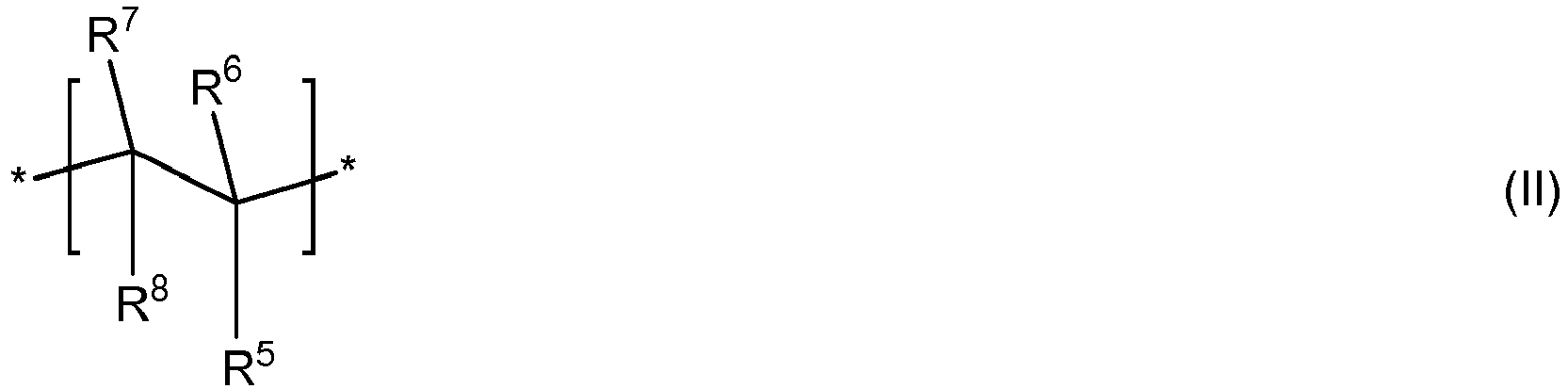
- R5, in each case independently, is -[D]d-[E]e-F, with
- D = -(COO)- and/or -(CONH)-,
- E = an alkylene group having 1 to 5 carbon atoms,
- F = -N+R10R11R12 , -S+R10R11R12 and/or -P+R10R11R12,
wherein R10, R11 and R12 are independently of one another H, an aliphatic hydrocarbon moiety having 1 to 20 C atoms, a cycloaliphatic hydrocarbon moiety having 5 to 8 C atoms and/or an aryl moiety having 6 to 14 C atoms; - whereby
- d = 0 or 1,
- e = 0 or 1,
- R6, R7 and R8, in each case independently, are H or an alkyl group having 1 to 5 carbon atoms.
- Thereby, preferably, R6 = H or CH3, R7 = R8 = H, d = 1 and, especially D = -(COO)-.
- According to a preferred embodiment, F = -N+R10R11R12, e = 1 and, preferably E = an alkylene group having 2 to 3 carbon atoms.
- In a preferred embodiment of the invention, the ionic monomer is selected from [2-(acryloyloxy)-ethyl]trimethylammonium chloride, [2-(acryloylamino)-ethyl]trimethylammonium chloride, [2-(acryloyloxy)-ethyl]trimethy-lammoniummethosulfate, [2-(methacryloyloxy)-ethyl]trimethylammonium chloride or methosulfate, [3-(acryloylamino)-propyl]trimethylammonium chloride, [3-(methacryloylamino)-propyl]trimethylammonium chloride.
- Particularly advantageous according to the invention proved to be the use of [2-(methacryloyloxy)-ethyl]trimethylammonium salts, in particular the chloride. The use is commercially available from Evonik Industries, DE (under the brand name "Visiomer TMAEMC") or from Sigma-Aldrich, DE.
- In a further preferred embodiment, an anionic group of the anionic monomer unit MA in the comb polymer includes or consists of a carboxylic acid, sulfonic acid, phosphoric acid and/or phosphonic acid group.
- Preferably, the anionic monomer unit MA in the polymer includes or consists of an anionic monomer which has a structure of the formula III

- R13, in each case independently, is -COOM, -SO2-OM, -O-PO(OM)2 and/or - PO(OM)2,
- R14 and R15, in each case independently, are H or an alkyl group having 1 to 5 carbon atoms,
- R16, in each case independently, are H, -COOM or an alkyl group having 1 to 5 carbon atoms,
- or where R13 forms a ring together with R16 to give -CO-O-CO-,
- M independently from each other is H+, an alkali metal ion, an alkaline earth metal ion, a di- or trivalent metal ion, an ammonium ion and an organic ammonium group.
- More particularly, R13 = COOM, R14 = H or CH3, R15 = R16 = H. It is thus possible to prepare the copolymer on the basis of acrylic or methacrylic acid monomers, which is of interest from an economic point of view.
- Likewise advantageously, R13 = COOM, R14 = H, R15 = H and R16 = COOM. Corresponding comb polymers can be prepared on the basis of maleic acid monomers.
- It may further be advantageous if the comb polymer comprises at least one further non-ionic monomer unit M3 which especially differs chemically and/or structurally from the monomer units M1, MC and MA. In particular, multiple different further monomer units M3 may be present. In this way, it is possible to further modify the properties of the comb polymer and to adjust them, for example, with regard to specific applications.
- Particularly advantageously, the non-ionic monomer unit M3 a monomer unit of the formula IV:

- Y, in each case independently, is a chemical bond or -O-;
- Z, in each case independently, is absent, is a chemical bond, -O- or -NH-;
- R20, in each case independently, is an alkyl group, cycloalkyl group, alkylaryl group, aryl group, hydroxyalkyl group or acetoxyalkyl group, each having 1-20 carbon atoms.
- Advantageous examples of non-ionic monomer units M3 are those where m' = 0, p' = 0, Z is absent and Y represent a chemical bond and R20 is an alkylaryl group having 6-10 carbon atoms.
- Also suitable are especially further monomer units M3 where m' = 0, p' = 1, Y is -O-, Z represents a chemical bond and R20 is an alkyl group having 1-4 carbon atoms.
- Further suitable are further monomer units M3 where m' = 0, p' = 1, Y is a chemical bond, Z is -O- and R20 is an alkyl group and/or a hydroxyalkyl group having 1-6 carbon atoms.
- Particularly advantageously, the non-ionic monomer unit M3 consists of polymerized vinyl acetate, styrene, alkyl (meth)acrylate and/or hydroxyalkyl (meth)acrylate, especially styrene.
- According to a preferred embodiment, the comb polymer, with respect to the total number of monomer units present in the comb polymer, comprises 20 - 100 mol-%, in particular 50 - 100 mol-%, especially 65 - 100 mol-%, for example 80 - 100 mol-% or 95 - 100 mol-%, of the at least one poly(alkylene oxide) side chain-bearing monomer unit M1.
- Especially, a preferred comb polymer, with respect to the total number of monomer units present in the comb polymer, comprises:
- a) 95 - 100 mol-%, especially 97 - 100 mol-%, particularly or 98 - 100 mol-%, preferably 99.5 mol-%, of the at least one poly(alkylene oxide) side chain-bearing monomer unit M1,
- b) 0 - 1 mol-%, especially 0 - 0.1 mol-%, preferably 0 mol-%, of the at least one cationic monomer unit MC,
- c) 0 - 1 mol-%, especially 0 - 0.1 mol-%, preferably 0 mol-%, of the at least one anionic monomer unit MA,
- d) 0 - 1 mol-%, especially 0 - 0.1 mol-%, preferably 0 mol-%, of the at least one non-ionic monomer unit M3.
- In such or other preferred comb polymers,
- the molar ratio of the cationic monomer units MC to the side chain-bearing monomer units M1 is equal to or less than 0.1, especially less than or equal to 0.05, in particular less than or equal to 0.01 or 0.
- the molar ratio of the anionic monomer units MA to the side chain-bearing monomer units M1 is less than 1, preferably equal to or less than 0.5, especially less than or equal to 0.1, in particular less than or equal to 0.01 or 0.
- the molar ratio of the non-ionic monomer units M3 to the side chain-bearing monomer units M1 is less than 7, especially equal to or less than 3, in particular less than or equal to 0.01 or 0.
- In particular, the comb polymer, with respect to the total number of monomer units present in the comb polymer, comprises 100 mol-% of the at least one poly(alkylene oxide) side chain-bearing monomer unit M1. In this case, the comb polymer can be a homopolymer of identical side chain-bearing monomeric units M1 or a copolymer of at least two different side chain-bearing monomeric units M1.
- Such comb polymers are for example preferred if the comb polymer comprises side chain-bearing monomer units M1 including or consisting of a structure of formula I as shown above wherein parameter p is equal to 1. These are for example poly(alkylene oxide) (meth)acrylate based monomer units M1.
- According to another preferred embodiment, the comb polymer essentially consists of the at least one poly(alkylene oxide) side chain-bearing monomer unit M1 and the non-ionic monomer unit M3. In this case the comb polymer is a copolymer based on the at least one side chain-bearing monomeric units M1 and the non-ionic monomer unit M3. Such comb polymers are for example preferred if the comb polymer comprises side chain-bearing monomer units M1 including or consisting of a structure of formula I as shown above wherein parameter p is equal to 0. These are for example poly(alkylene oxide) alkenyl ether-based monomer units M1.
- For example, a preferred comb polymer, with respect to the total number of monomer units present in the comb polymer, comprises:
- a) 30 - 70 mol-%, especially 40 - 60 mol-%, particularly or 40 - 50 mol-%, of the at least one poly(alkylene oxide) side chain-bearing monomer unit M1, and
- b) 0 - 1 mol-%, especially 0 - 0.1 mol-%, preferably 0 mol-%, of the at least one cationic monomer unit MC,
- c) 0 - 1 mol-%, especially 0 - 0.1 mol-%, preferably 0 mol-%, of the at least one anionic monomer unit MA,
- d) 30 - 70 mol-%, especially 40 - 60 mol-%, particularly or 40 - 50 mol-%, of the at least one non-ionic monomer unit M3.
- In such or other preferred comb polymers,
- the molar ratio of the cationic monomer units MC to the side chain-bearing monomer units M1 is equal to or less than 0.1, especially less than or equal to 0.05, in particular less than or equal to 0.01 or 0.
- the molar ratio of the anionic monomer units MA to the side chain-bearing monomer units M1 is less than 1, preferably equal to or less than 0.5, especially less than or equal to 0.1, in particular less than or equal to 0.01 or 0.
- the molar ratio of the non-ionic monomer units M3 to the side chain-bearing monomer units M1 is 0.1 - 7, especially 0.5 - 5, in particular 0.8 - 3 or 1 - 2.
- In an especially preferred embodiment, the comb polymer is a block copolymer, whereby at least 75 mol-%, especially at least 90 mol-%, preferably at least 99 mol-%, of the total number of at least one side chain-bearing monomer units M1 are arranged in a first block of the block copolymer.
- In particular, the block copolymer comprises a second block in which at least 75 mol-%, especially at least 90 mol-%, preferably at least 99 mol-%, of the total number of at least one cationic monomer units MC are arranged.
- In a further preferred embodiment, between the first block and the second block, there is a third block comprising at least one side chain-bearing monomer unit M1, at least one cationic monomer unit MC and/or at least one non-ionic monomer unit M3. Especially, the third block has a non-random distribution of the monomer units M1 and/or the cationic monomer units MC in a direction along the polymer backbone.
- A "non-random distribution" is understood in the present case to mean a non-statistical distribution of the monomer units M1 and/or the monomer units MC. This means that the side chain-bearing monomer units M1 and/or the ionic units MC are arranged in the third block, for example, in an alternating manner and/or in a gradient structure.
- The structure of the copolymers can be analyzed and determined, for example, by nuclear magnetic resonance spectroscopy (NMR spectroscopy). By 13C and 1H NMR spectroscopy in particular, the sequence of the monomer units in the copolymer can be determined on the basis of neighboring group effects in the copolymer and by using statistical evaluations.
- In all of the structures described above, non-ionic monomer units M3 may be added, for example in order to control the density of the other monomeric units in the comb polymer and/or in order to adjust the comb polymer for specific needs.
- Preferably, if used, the molar proportion of the non-ionic monomer units M3, with respect to the total number of the monomeric units in the comb polymer, is from 0.0001 - 50 mol-%, in particular 0.0002 - 30 mol-%, especially 0.001 - 25 mol-%, advantageously 0.1 -10 mol-% or 1 - 9 mol-%. This is in particular valid for block copolymers.
- The comb polymer is especially prepared by free-radical polymerization (FRP), e.g. by conventional free-radical polymerization or by controlled free-radical polymerization (also called living free-radical polymerization). These polymerization techniques are well known to the skilled person. A suitable process for conventional free-radical polymerization is, for example, described in
EP 1 110 981 . - Thereby, unilaterally ethylenically unsaturated poly(alkylene oxide) side chain-bearing monomer units M1' according to formula V, optionally at least one unilaterally ethylenically unsaturated ionic monomer unit MC' and/or MA' according to formula VI and/or VII and, optionally, at least one unilaterally ethylenically unsaturated non-ionic monomer unit M3' according to formula VIII, are polymerized together such that the molar ratio of the cationic monomer units MC to the side chain-bearing monomer units M1 is equal to or less than 0.1, especially less than 0.05, the molar ratio of the anionic monomer units MA to the side chain-bearing monomer units M1 is less than 1, preferably equal to or less than 0.5, and the molar ratio of the non-ionic monomer units M3 to the side chain-bearing monomer units M1 is less than 7, preferably equal to or less than 3.

- Thereby, R1 - R16, R6'- R8', R20, X, Y, Z, m, m', n and p, p' are defined as described above.
- Among controlled free-radical polymerization techniques, reversible addition-fragmentation chain-transfer polymerization (RAFT), nitroxide-mediated polymerization (NMP) and/or atom transfer radical polymerization (ATRP) can be used.
- In reversible addition-fragmentation chain-transfer polymerization, control over the polymerization is achieved by a reversible chain transfer reaction. Specifically, a growing free-radical chain adds to what is called a RAFT agent, which leads to formation of an intermediate free radical. The RAFT agent then fragments, in such a way as to reform another RAFT agent and a free radical available for propagation. In this way, the probability of propagation is distributed uniformly over all chains. The average chain length of the polymer formed is proportional to the RAFT agent concentration and to the reaction conversion. RAFT agents used are especially organic sulfur compounds. Particularly suitable are dithioesters, dithiocarbamates, trithiocarbonates and/or xanthates. The polymerization can be initiated in a conventional manner by means of initiators or thermal self-initiation.
- In nitroxide-mediated polymerization, nitroxides react reversibly with the active chain end to form what is called a dormant species. The equilibrium between active and inactive chain ends is strongly to the side of the dormant species, which means that the concentration of active species is very low. The probability of two active chains meeting and terminating is thus minimized. An example of a suitable NMP agent is the substance with Chemical Abstract number 654636-62-1, commercially available e.g. under the tradename "Blockbuilder MA".
- In atom transfer radical polymerization (ATRP), the concentration of free radicals is lowered by addition of a transition metal complex and a controlling agent (halogen-based) to such an extent that chain termination reactions, such as disproportionation or recombination, are very substantially suppressed.
- In the present context, reversible addition-fragmentation chain-transfer polymerization (RAFT) has been found to be particularly preferable, especially if block copolymers are to be produced.
- The initiator used for the polymerization is more preferably an azo compound and/or a peroxide as free-radical initiator, which is at least one representative selected from the group consisting of dibenzoyl peroxide (DBPO), di-tert-butyl peroxide, diacetyl peroxide, azobisisobutyronitrile (AIBN), α,α'-azodiisobutyramidine dihydrochloride (AAPH) and/or azobisisobutyramidine (AIBA).
- If the polymerization is effected in an aqueous solution or in water, α,α'-azodiisobutyramidine dihydrochloride (AAPH) is advantageously used as initiator.
- For control of the polymerization, in particular, one or more representatives from the group consisting of dithioesters, dithiocarbamates, trithiocarbonates and/or xanthates are used.
- It has additionally been found to be advantageous if the polymerization is effected at least partly, preferably fully, in an aqueous solution.
- In a second method known as polymer-analogous reaction, a polycarboxylic acid backbone is synthesized in a first step. Subsequently, side chains are attached to the polycarboxylic acid backbone, for example by esterification, amidation or etherisation reactions with alcohols, amines and the like. Such polymer-analogous reactions, as well as resulting copolymers, are described, for example, in
WO 97/35814 WO 95/09821 DE 100 15 135 A1 ,EP 1 138 697 A1 ,EP 1 348 729 A1 andWO 2005/090416 . Details about the polymer-analogous reaction are disclosed, for example, inEP 1 138 697 B1 on page 7, line 20 to page 8, line 50, as well as in its Examples, or inEP 1 061 089 B1 on page 4, line 54 to page 5, line 38 as well as in its Examples. - For formation of copolymers having block and/or gradient structures, unilaterally ethylenically unsaturated poly(alkylene oxide) side chain-bearing monomer units M1' and ethylenically unsaturated ionic monomer units MC' and/or MA' and/or the ethylenically unsaturated non-ionic monomer units M3' are preferably at least partly added at different times.
- In a further preferred embodiment, in the polymerization, in a first step a), a portion of the monomer units M1' is converted or polymerized and, after reaching a predetermined conversion, in a second step b), the as yet unconverted monomer units M1' (if present) are polymerized together with ionic monomer unit MC' and/or MA' and/or the non-ionic monomer unit M3'. Step a) is especially effected essentially in the absence of ionic monomer units MC' and/or MA' and M3'.
- In this way, in a simple and inexpensive manner, a copolymer having a section consisting essentially of polymerized monomer units M1' followed by a section having a gradient structure can be produced.
- It is advantageous here to conduct steps a) and b) in immediate succession. In this way, it is possible to maintain the polymerization reaction in steps a) and b) to the best possible degree.
- The polymerization in step a) is especially conducted until 0.1 - 100 mol%, especially 1 - 95 mol%, preferably 10 - 90 mol%, in particular 25 - 85 mol%, especially 60 - 85 mol% of monomer units M1' have been converted or polymerized.
- The conversion of the monomers or the progress of the polymerization can be monitored in a manner known per se, for example, with the aid of liquid chromatography, especially high-performance liquid chromatography (HPLC).
- What is meant by the term "plasticizer" in the present context is especially a substance which is capable of improving the flowability of mineral binder compositions, e.g. mortar and/or cement compositions which have been mixed with water, and/or of reducing the water requirement of such compositions. Substances of this kind are also referred to as "superplasticizers".
- More particularly, the plasticizer comprises at least one representative from the group consisting of lignosulfonates, gluconates, naphthalenesulfonates, sulfonated naphthalene-formaldehyde condensates, melamine sulfonates, vinyl copolymers, sulfonated vinyl copolymers, polycarboxylates, especially polycarboxylate ethers, or mixtures thereof.
- More particularly, the plasticizer is a polycarboxylate, especially a polycarboxylate ether. It more preferably has a polycarboxylate backbone and polyether side chains, where the polyether side chains are bonded to the polycarboxylate backbone via ester, ether, amide and/or imide groups. More particularly, the polycarboxylate has a random, statistical, blockwise, alternating or gradient-like monomer distribution.
- More preferably, the superplasticizer is a polymer P having or consisting of the following substructure units:
- a) a molar parts of a substructure unit S1 of the formula X

- b) b molar parts of a substructure unit S2 of the formula XI

- c) c molar parts of a substructure unit S3 of the formula (XII)

- d) d molar parts of a substructure unit S4 of the formula (XIII)

- L independently represents H+, an alkali metal ion, alkaline earth metal ion, a di- or trivalent metal ion, an ammonium ion or an organic ammonium group,
- each Ru independently of the others is hydrogen or a methyl group,
- each Rv independently of the others is hydrogen or COOM,
- r = 0, 1 or 2,
- t = 0 or 1,
- G1 and G2 is independently a C1- to C20-alkyl group, -cycloalkyl group, -alkylaryl group or is -[A'O]s-G4,
- where A' = C2- to C4-alkylene, G4 is H, a C1- to C20-alkyl group, -cycloalkyl group or -alkylaryl group,
- and s = 2-250,
- G3 is independently NH2, -NG5G6, -OG7NG8G9,
- where G5 and G6 are independently
- a C1- to C20-alkyl group, -cycloalkyl group, -alkylaryl group or -aryl group,
- or are a hydroxyalkyl group or are an acetoxyethyl group (CH3-CO-O-CH2-CH2-) or a hydroxyisopropyl group (HO-CH(CH3)-CH2-) or an acetoxyisopropyl group (CH3-CO-O-CH(CH3)-CH2-);
- or G5 and G6 together form a ring of which the nitrogen is part, in order to construct a morpholine or imidazoline ring;
- G7 is a C2-C4-alkylene group,
- G8and G9 each independently represent a C1- to C20-alkyl group, - cycloalkyl group, -alkylaryl group, -aryl group or a hydroxyalkyl group,


- where G5 and G6 are independently
- The sequence of the substructure units S1, S2, S3 and S4 may be alternating, blockwise or random. It is also possible that the one or more substructure units S1, S2, S3 and S4 form a gradient structure. In principle, it is also possible that further structural units are present in addition to the substructure units S1, S2, S3 and S4. In particular, the sequences of the substructure units S1, S2, S3 and S4 in the polymer P are random or statistical.
- Preferably, the substructure units S1, S2, S3, and S4 together have a proportion of at least 50% by weight, especially at least 90% by weight, most preferably at least 95% by weight, of the total weight of the polymer P.
- In the polymer P, Rv especially represents hydrogen and Ru is preferably hydrogen and/or a methyl group.
- Preferably, in the polymer P, r = 0 and t = 1. Also advantageously, r = 1-2 and t = 0.
- More particularly, in the polymer P, Rv is hydrogen, Ru is a methyl group, r = 1-2 and t = 0.
- G1 and/or G2 in the polymer P, in each case independently, are advantageously -[A'O]s-G4 with s = 8-200, especially 20-70, and A' is a C2- to C4-alkylene.
- In the polymer P, G4, in each case independently, is preferably hydrogen or a methyl group.
- Especially, a ratio a/b in polymer P is greater than the ratio of monomeric units MC/M1 and/or a ratio of MA/M1 in the comb polymer described above. In particular the ratio a/b in polymer P is in the range of 1 - 10, in particular 1.5 - 5, especially 2 - 4.
- Very particularly advantageous polymers P are those where
- a) the Ru and Rv moieties are hydrogen,
- b) r = 0,
- c) t = 1,
- d) G1 and G2, in each case independently, are -[A'O]s-G4 with s = 20-70 and A' = C2-alkylene,
- e) G4 represents a methyl group and/or
- f) a/b/c/d = (0.5-0.8) / (0.2-0.4) / (0.001-0.005) / 0
- Likewise advantageous polymers P are those where
- a) t = 0 and r = 1-2,
- b) G1, in each case independently, is -[A'O]s-G4 with s = 8-200, especially 20-70,
- c) G4 represents hydrogen or a methyl group, especially hydrogen,
- d) and/or A' is a C2- to C4-alkylene, especially a C2-alkylene.
- A weight-average molecular weight (Mw) of the polymer P is particularly in the range of 5'000-150'000 g/mol, preferably 10'000-100'000 g/mol, especially 20'000-90'000 g/mol. The weight-average molecular weight (Mw) is determined by gel permeation chromatography (GPC), using polyethylene glycol (PEG) as standard.
- The preparation of polymers P is known per se to the person skilled in the art. Corresponding superplasticizers or polymers P are also commercially supplied by Sika Schweiz AG under the ViscoCrete® trade name series.
- A further aspect of the present invention is a composition comprising a comb polymer as described above and further comprising a mineral binder, aggregates, a plasticizer and/or non-swelling layer-silicates. Thus, the comb polymer can be present in premixed form together with at least one of these components, or the comb polymer is present in a mineral binder composition mixed with water.
- Especially, the composition comprises the comb polymer as described above, a mineral binder, aggregates, and non-swelling layer-silicates. In particular, a plasticizer is present as well. The comb polymer as described above is used in compositions comprising non-swelling layer-silicates selected from the group of 1:1 minerals, 2:1 minerals, and/or 2:1:1 minerals as described above. Thus, in particular, the comb polymer as described above is used in compositions comprising non-swelling layer-silicates selected from the group consisting of kaolinite, serpentine, palygorskite, sepiolite, chlorites, mica such as muscovite or biotite, interlayer-deficient mica like illite, glauconite, celadonite, and phengite, and charge-balanced minerals such as talc and pyrophyllite.
- Moreover the present invention is concerned with a method comprising the steps of adding to a composition comprising non-swelling layer-silicates, especially a mineral binder composition comprising non-swelling layer-silicates:
- (i) a comb polymer as described above, and
- (ii) a plasticizer as described above.
- The method as described above is in particular suitable for plasticizing a composition comprising non-swelling layer-silicates, especially a mineral binder composition comprising non-swelling layer-silicates. The method is also suitable for retarding said composition and/or for increasing the compressive strength of said composition.
- Preferably, the addition of the comb polymer is effected before the addition of the plasticizer. However, it is for example also possible to add the comb polymer and the plasticizer simultaneously. The plasticizer for mineral binder compositions preferably is a polycarboxylate ether which is chemically and/or structurally different from the comb polymer.
- According to a preferred embodiment, the comb polymer of the present invention is added to a composition as described above in an amount of 0.01 - 10 wt.-%, preferably 0.05 - 5 wt.-%, more preferably 0.1 - 2 wt.-%, especially 0.25 - 1 wt.-%, each relative to the weight of the mineral binder. According to a preferred embodiment, the mineral binder consists of cement. Therefore, according to a preferred embodiment, the comb polymer of the present invention is added to a composition as described above in an amount of 0.01 - 10 wt.-%, preferably 0.05 - 5 wt.-%, more preferably 0.1 - 2 wt.-%, especially 0.25 - 1 wt.-%, each relative to the weight of cement.
- A further aspect of the present invention is related to the use of a comb polymer as described above for reducing or inhibiting adverse effects of non-swelling layer-silicates on the effectiveness of dispersants, in particular of PCE-based dispersants, in mineral binder compositions comprising non-swelling layer-silicates. Thereby, the comb polymer as described above can e.g. be used to increase the flowability and/or the processing time of mineral binder compositions comprising non-swelling layer-silicates and a dispersant, in particular a PCE-based dispersant.
- Further advantageous embodiments and combinations of features of the invention will emerge from the following exemplary embodiments and the totality of the patent claims.
- For the preparation of a non-ionic homopolymer by means of controlled free radical polymerization, a round-bottom flask equipped with a reflux condenser, stirrer system, thermometer and a gas inlet tube was initially charged with 57.4 g of 50% methoxy polyethylene glycol1000 methacrylate (0.027 mol; average molecular weight: 1'000 g/mol; ∼ 20 ethylene oxide units per molecule) and 18 g of deionized water. The reaction mixture was heated to 80°C with vigorous stirring. A gentle inert N2 gas stream is passed through the solution during the whole reaction time. 378 mg of 4-cyano-4-(thiobenzoylthio)pentanoic acid (1.35 mmol) were then added to the mixture. Once the substance had fully dissolved, 67 mg of AIBN (0.41 mmol) were added. From then on, the conversion was regularly checked by means of HPLC.
- When the conversion, based on methoxy polyethylene glycol methacrylate, had reached 90%, the reaction was stopped. A clear, reddish, aqueous solution was obtained having a solids content of around 40 wt.% which was diluted with water to obtain a solids content of around 30 wt.%.
- The comb polymer thus obtained is a homopolymer comprising about 20 side chain-bearing monomeric units and is referred to as comb polymer P1.
- For the preparation of a non-ionic homopolymer by conventional free radical polymerization, a round-bottom flask equipped with a reflux condenser, stirrer system, thermometer and a gas inlet tube was initially charged with 186 g of deionized water. At a temperature of 100°C, 796 g of 50% methoxy polyethylene glycol1000 methacrylate (0.37 mol, average molecular weight: 1'000 g/mol; ∼ 20 ethylene oxide units per molecule) was added within 180 minutes. Additionally a solution of 4.5 g sodium hypophosphite and 6.7 g of water was added within 175 minutes and a solution of 0.93 g sodium persulfate and 5.0 g water was added within 190 minutes. Once all the solutions were added, the reaction mixture was cooled down. A clear, colorless solution was obtained having a solids content of around 40 wt.% which was diluted with water to obtain a solids content of around 30 wt.%.
- This polymer is referred to as comb polymer P2.
- The mortar mixture used for test purposes had the dry composition described in Table 1.
Table 1: Dry composition of mortar mixture Component Amount [g] Cement (CEM I 42.5 N; Normo 4; available from Holcim Schweiz) 750 g Limestone filler (< 125 µm) 141 g* Sand 0-1 mm 738 g Sand 1-4 mm 1107 g Sand 4-8 mm 1154 g Non-swelling layer-silicates (kaolinite, biotite, illite) for proportions see tables 3 - 10 *In the following experiments the limestone filler was partly replaced with layer-silicates kaolinite, biotite or illite having particle sizes < 125 µm so that the combined content of limestone and layer-silicate in the mortar tests was always 141g. The amount of kaolinite, biotite or illite used in each experiment are given in below tables 3 - 10. - The used kaolinite, biotite, and illite were analyzed by XRD (X-ray diffraction) using a Bruker D8 ADVANCE. The samples were analyzed in reflection mode using the following conditions: measuring range between 3 and 65°2θ, step size: 0.015°2θ, and time/step: 1.0s. The quantitative mineral phase analysis is based on the Rietveld method.
- The used kaolinite consists of 83% kaolinite, 6% quartz, 9% microcline, and 2% illite. The used illite consists of 57 % illite, 32 % quartz, 7 %, chlorite, and 4% dolomite. The used biotite is a pure mineral phase.
- To make a mortar mixture two procedures were followed:
- Procedure A: The sands, the limestone filler, the cement and the non-swelling layer-silicates (if added) were dry-mixed in a Hobart mixer for 1 minute. Within 30 seconds, the mixing water (ratio of water to cement w/c is indicated in the tables below) was added and the mixture was mixed for a further 2.5 minutes. The total wet mixing time was 3 minutes in each case. Prior to the addition to the mortar mixture, the respective comb polymer and optionally a PCE-type superplasticizer (Sika® ViscoCrete® 3082; available from Sika, Schweiz) were mixed into the mixing water (for proportions see tables below).
- Procedure B (mixing in accordance with EN 480-1): The water is split in 50% wetting water and 50% of rest water. The sands, the limestone filler, the cement and the non-swelling layer-silicates (if added) were dry-mixed in a Hobart mixer for 1 minute. The wetting water was added and after 30 seconds of mixing, the mortar was stored for 2 min in the mixer without stirring (mixer was covered with a foil to avoid water evaporation). Afterwards the mixer was started again, cement was added and after 30 seconds of mixing, the rest water was added and the mixture was mixed for a further 2.5 minutes. Prior to the addition to the mortar mixture, the respective comb polymer and optionally a PCE-type superplasticizer (Sika® ViscoCrete® 3082; available from Sika, Schweiz) were mixed into the rest water (for proportions see results section).
- To determine the effectiveness of the comb polymers according to the present invention in the mortar mixture, the dispersing effect was determined by measuring the flow table spread (FTS) of a series of mortar mixtures was measured in accordance with EN 1015-3 at different times.
- Also, the temperature curve of the mineral binder compositions (mortar mixtures, cement pastes) was recorded as control of hydration and setting behavior, respectively, after mixing. Thereby, the time to onset of the global temperature maximum was determined as a measure of the setting time.
- The air content was measured according to EN 12350-7.
- In the tests, all of the admixtures (comb polymer and optionally PCE) have been added as aqueous solutions or dispersions with a content of active ingredients of 30 wt.-%. Kaolinite, biotite, and illite were added as a powder.
- The dosages of PCEs, comb polymers and non-swelling layer-silicates are given in the following tables 1 - 8 in wt-% relative to the weight of cement.
- Table 2 gives an overview of a first series of tests conducted and the results achieved. Mixing procedure B was followed for experiments R1, R2, and E1. Experiments R1 and R2 are experiments conducted for comparative purposes without the addition of a comb polymer according to the invention. Experiment E1 uses the comb polymer P1 which is according to the present invention.
Table 2 (all wt.-% are given with respect to the cement content in the mineral binder composition) Experiment → R1 R2 E1 ↓ Components w/c ratio 0.47 0.47 0.47 Kaolinite [wt.%] 0 0 0 Comb Polymer 0 B1 P1 - Proportion [wt.-%] 0.5 0.5 PCE [wt.-%] 0.5 0 0 FTS# [mm] after - 0 min 204 238 132 - 30 min 195 221 - - 60 min 176 194 - Setting time [h] 14.8 15.3 10.2 B1 = MasterSuna SBS 3890 (BASF), not according to the present invention
# = flow table spread according to EN 1015-3. The time "0 min" corresponds to the first measurement immediately after the mixing of the mortar sample. - The experiments show the water reduction capabilities of the different comb polymers and the PCE via workability with constant dosage and constant w/c.
- The data in Table 2 clearly shows that the inventive comb polymer does not have any significant plasticizing effect when compared to standard PCEs or to commercially available, water reducing clay blockers (i.e. MasterSuna SBS 3890). The inventive comb polymers also have a significantly lower influence on the setting time, i.e. less retardation, when compared to more conventional comb polymers or to commercially available clay blockers which is advantageous.
- Table 3 shows the results of a set of experiments with added kaolinite. Mixing procedure B was followed for experiments R3 - R5 and E2. Experiments R3 - R5 are experiments conducted for comparative purposes without the addition of a comb polymer according to the invention. Experiment E2 uses a comb polymer according to the present invention.
Table 3 (all wt.-% are given with respect to the cement content in the mineral binder composition) Experiment → R3 R4 R5 E2 ↓ Components w/c ratio 0.46 0.46 0.46 0.46 Kaolinite [wt.%] 0 7.5 7.5 7.5 Comb polymer 0 0 B1 P1 - Proportion [wt.-%] 0.24 0.24 PCE [wt.-%] 0.5 0.5 0.5 0.5 FTS# [mm] after - 0 min 200 150 194 196 - 30 min 192 130 178 180 - 60 min 168 - 166 170 Setting time [h] 14.2 12.7 15.3 12.3 B1 = MasterSuna SBS 3890 (BASF), not according to the present invention
# = flow table spread according to EN 1015-3. The time "0 min" corresponds to the first measurement immediately after the making-up of the mortar sample. - As can be deduced from the results given in Table 3 the addition of kaolinite leads to a reduced flow of the respective mortar composition. The addition of comb polymers B1 and P1 is an effective mean to block the effect of kaolinite on the flow. It can further be seen from the results given in Table 3 that a comb polymer P1, which is according to the present invention, has no retarding effect while the commercial clay blocker B1 shows a strong retarding effect. Comb polymer P1 is thus advantageous.
- Table 4 shows the results of a set of experiments with added biotite. Mixing procedure B was followed for experiments R3, R6, and E3. R3 and R6 are experiments conducted for comparative purposes without the addition of a comb polymer according to the invention. Experiment E3 uses a comb polymer according to the present invention.
Table 4 (all wt.-% are given with respect to the cement content in the mineral binder composition) Experiment → R3 R6 E3 ↓ Components w/c ratio 0.46 0.46 0.46 Biotite [wt.%] 0 5 5 Comb polymer 0 0 P1 - Proportion [wt.-%] 0.2 PCE [wt.-%] 0.5 0.5 0.5 FTS# [mm] after - 0 min 200 146 186 Setting time [h] 14.2 12.7 12.2 # = flow table spread according to EN 1015-3. The time "0 min" corresponds to the first measurement immediately after the making-up of the mortar sample. - As can be deduced from the results given in Table 4 the addition of biotite leads to a reduced flow of the respective mortar composition. The addition of comb polymer P1 is an effective mean to block the effect of biotite on the flow. It can further be seen from the results given in Table 4 that a comb polymer P1, which is according to the present invention, has no retarding effect.
- Table 5 shows the results of a set of experiments with added illite. Mixing procedure B was followed for experiments R3, R7, and E4. Experiment R3 and R7 are experiments conducted for comparative purposes without the addition of a comb polymer according to the invention. Experiment E4 uses a comb polymer according to the present invention.
Table 5 (all wt.-% are given with respect to the cement content in the mineral binder composition) Experiment → R3 R7 E4 ↓ Components w/c ratio 0.46 0.46 0.46 Illite [wt.%] 0 5 5 Comb polymer 0 0 P1 - Proportion [wt.-%] 0.2 PCE [wt.-%] 0.5 0.5 0.5 FTS# [mm] after - 0 min 200 164 200 Setting time [h] 14.2 11.8 11.5 # = flow table spread according to EN 1015-3. The time "0 min" corresponds to the first measurement immediately after the making-up of the mortar sample. - As can be deduced from the results given in Table 5 the addition of illite leads to a reduced flow of the respective mortar composition. The addition of comb polymer P1 is an effective mean to block the effect of illite on the flow. It can further be seen from the results given in Table 5 that the comb polymer P1, which is according to the present invention, has no retarding effect.
- Table 6 shows the results of a second set of experiments with added illite. Mixing procedure B was followed for experiments R3, R8, R9, and E5. Experiments R3, R8, and R9 are experiments conducted for comparative purposes without the addition of a comb polymer according to the invention. Experiment E5 uses a comb polymer according to the present invention.
Table 6 (all wt.-% are given with respect to the cement content in the mineral binder composition) Experiment → R3 R8 R9 E5 ↓ Components w/c ratio 0.46 0.46 0.46 0.46 Illite [wt.%] 0 10 10 10 Comb polymer 0 0 B1 P1 - Proportion [wt.-%] 0.8 0.8 PCE [wt.-%] 0.5 0.5 0.5 0.5 FTS# [mm] after - 0 min 200 128 196 198 - 30 min 173 171 - 60 min 156 148 Setting time [h] 14.2 11 15.3 12.5 B1 = MasterSuna SBS 3890 (BASF), not according to the present invention
# = flow table spread according to EN 1015-3. The time "0 min" corresponds to the first measurement immediately after the making-up of the mortar sample. - As can be deduced from the results given in Table 6 the addition of high amounts of illite leads to a much more reduced flow of the respective mortar composition and, thus, requires higher dosages of comb polymers to offset the effect of illite. The addition of comb polymers B1 or P1 is an effective mean to block the effect of illite on the flow. Again, it can be seen from the results given in Table 6 that a comb polymer P1, which is according to the present invention, has no retarding effect while a commercial clay blocker shows a strong retarding effect. Comb polymer P1 is thus advantageous.
- Table 7 shows the results of a set of experiments with added kaolinite in which inventive comb polymers are compared to single MPEG side chain molecules. Mixing procedure A was followed for experiments R10 - R14 and E6. Experiments R10 - R14 are experiments conducted for comparative purposes without the addition of a comb polymer according to the invention. Experiment E6 uses a comb polymer according to the present invention.
Table 7 (all wt.-% are given with respect to the cement content in the mineral binder composition) Experiment → R10 R11 R12 R13 R14 E6 ↓ Components w/c 0.48 0.48 0.48 0.48 0.48 0.48 Kaolinite [wt.%] 0 7.5 7.5 7.5 7.5 7.5 Comb polymer 0 0 0 0 0 P1 - Proportion [wt.-%] 0.27 MPEG 0 0 B2 B3 B4 0 - Proportion [wt.-%] 0.27 0.27 0.27 PCE [wt.-%] 0.5 0.5 0.5 0.5 0.5 0.5 FTS# [mm] after - 0 min 188 153 154 164 177 190 - 30 min 155 140 138 150 153 176 - 60 min 152 135 - 142 155 170 B2 = methoxy polyethylene glycol1000 (average molecular weight: 1'000 g/mol)
B3 = methoxy polyethylene glycol3000 (average molecular weight: 3'000 g/mol)
B4 = methoxy polyethylene glycol5000 (average molecular weight: 5'000 g/mol)
# = flow table spread according to EN 1015-3. The time "0 min" corresponds to the first measurement immediately after the making-up of the mortar sample. - As evident from Table 7, single MPEG side chains are less effective when compared with the inventive comb polymer P1.
- Table 8 compares the effectiveness of the inventive comb polymer P1, which was produced via a controlled free-radical polymerization, and the inventive comb polymer P2, which was produced via conventional free-radical polymerization. Mixing procedure B was followed for experiments R3, R15, E7, and E8. Experiments R3 and R15 are experiments conducted for comparative purposes without the addition of a comb polymer according to the invention. Experiment E7 and E8 uses a comb polymers according to the present invention.
Table 8 (all wt.-% are given with respect to the cement content in the mineral binder composition) Experiment → R3 R15 E7 E8 ↓ Components w/c ratio 0.46 0.46 0.46 0.46 Kaolinite [wt.%] 0 7.5 7.5 7.5 Comb polymer 0 0 P1 P2 - Proportion [wt.-%] 0.25 0.25 PCE [wt.-%] 0.5 0.5 0.5 0.5 FTS# [mm] after - 0 min 200 152 201 200 - 30 min 192 131 176 183 - 60 min 168 - 164 160 Setting time [h] 14.2 12.1 12.0 12.0 # = flow table spread according to EN 1015-3. The time "0 min" corresponds to the first measurement immediately after the making-up of the mortar sample. - It is evident from Table 8 that both inventive polymers P1 and P2, having similar side chain lengths of 1'000 g/mol, show a similar effectiveness in blocking the effect of layer-silicates, although they were produced with different polymerization processes.
- Table 9 shows the results of another set of experiments with added kaolinite comparing a comb polymer of the present invention to a polycation type clay blocking additive. Mixing procedure B was followed for experiments R3, R16, R17, and E9. Experiments R3, R16, and R17 are experiments conducted for comparative purposes without the addition of a comb polymer according to the invention. Experiment E9 uses a comb polymer according to the present invention.
Table 9 (all wt.-% are given with respect to the cement content in the mineral binder composition) Experiment → R3 R16 R17 E9 ↓ Components w/c ratio 0.46 0.46 0.46 0.46 Kaolinite [wt.%] 0 7.5 7.5 7.5 Comb polymer 0 0 B2 P1 - Proportion [wt.-%] 0.25 0.25 PCE [wt.-%] 0.5 0.5 0.5 0.5 FTS# [mm] after - 0 min 200 152 193 201 - 30 min 192 131 185 176 - 60 min 168 - 156 164 Setting time [h] 14.2 12.1 12.4 12.0 B2 = Floset EVA 250 L (SNF Floerger), not according to the present invention
# = flow table spread according to EN 1015-3. The time "0 min" corresponds to the first measurement immediately after the making-up of the mortar sample. - As can be deduced from the results given in Table 9 the addition of kaolinite leads to a reduced flow of the respective mortar composition. The addition of polycation B2 and P1 is an effective mean to block the effect of kaolinite on the flow and P1 is as efficient as B2 despite of its completely different structure.
Claims (16)
- Use of a comb polymer as an inerting agent for non-swelling layer-silicates, said comb polymer comprising:a) at least one poly(alkylene oxide) side chain-bearing monomer unit M1 without ionic groups,b) optionally at least one cationic monomer unit MC,c) optionally at least one anionic monomer unit MA,d) optionally at least one non-ionic monomer unit M3,wherein the molar ratio of the cationic monomer units MC to the side chain-bearing monomer units M1 is equal to or less than 0.1, preferably less than 0.05, the molar ratio of the anionic monomer units MA to the side chain-bearing monomer units M1 is less than 1, preferably equal to or less than 0.5, and the molar ratio of the non-ionic monomer units M3 to the side chain-bearing monomer units M1 is less than 7, preferably equal to or less than 3.
- Use of a comb polymer according to claim 1, wherein the side chain-bearing monomer unit M1 includes a structure of the formula I
 R1, and R2, in each case independently, are H or an alkyl group having 1 to 5 carbon atoms,R3, in each case independently, is H, an alkyl group having 1 to 5 carbon atoms, preferably H or CH3 or mixtures thereof, or a group with formula
-(CH2)m-[C=O]p-X-R4,
m = 0, 1 or 2,p = 0 or 1,X, in each case independently, is -O- or -NH-,R4 is a group of the formula -[AO]n-Rawhere A = C2- to C4-alkylene, Ra is H, a C1- to C20-alkyl group, -cycloalkyl group or -alkylaryl group,and n = 2-250, especially 10-200. - Use of a comb polymer according to any of the preceding claims, wherein the cationic monomer unit MC in the polymer includes or consists of a monomer which has a structure of the formula II,
 R5, in each case independently, is -[D]d-[E]e-F, withD = -(COO)- and/or -(CONH)-,E = an alkylene group having 1 to 5 carbon atoms,F = -N+R10R11R12 , -S+R10R11R12 and/or -P+R10R11R12,
wherein R10, R11 and R12 are independently of one another H, an aliphatic hydrocarbon moiety having 1 to 20 C atoms, a cycloaliphatic hydrocarbon moiety having 5 to 8 C atoms and/or an aryl moiety having 6 to 14 C atoms;
wherebyd = 0 or 1,e = 0 or 1,R6, R7 and R8, in each case independently, are H or an alkyl group having 1 to 5 carbon atoms. - Use of a comb polymer according to any of the preceding claims, wherein the anionic monomer unit MA in the polymer includes or consists of a monomer which has a structure of the formula III,
 R13, in each case independently, is -COOM, -SO2-OM, -O-PO(OM)2 and/or -PO(OM)2,R14 and R15, in each case independently, are H or an alkyl group having 1 to 5 carbon atoms,R16, in each case independently, are H, -COOM or an alkyl group having 1 to 5 carbon atoms,or where R13 forms a ring together with R16 to give -CO-O-CO-,M independently from each other is H+, an alkali metal ion, an alkaline earth metal ion, a di- or trivalent metal ion, an ammonium ion and an organic ammonium group.
 - Use of a comb polymer according to any of the preceding claims, wherein the non-ionic monomer M3 has a structure of the formula IV,
 R6', R7', R8', m' and p' are the same as defined for R6, R7, R8, m and p,Y, in each case independently, is a chemical bond or -O-,Z, in each case independently, is a chemical bond, -O- or -NH-,R20, in each case independently, is an alkyl group, cycloalkyl group, alkylaryl group, aryl group, hydroxyalkyl group or acetoxyalkyl group, each having 1-20 carbon atoms.
 - Use of a comb polymer according to any of claims 1 to 5, wherein the comb polymer, with respect to the total number of monomer units present in the comb polymer, comprises:a) 95 - 100 mol-%, especially 97 - 100 mol-%, particularly or 98 - 100 mol-%, preferably 99.5 mol-%, of the at least one poly(alkylene oxide) side chain-bearing monomer unit M1,b) 0 - 1 mol-%, especially 0 - 0.1 mol-%, preferably 0 mol-%, of the at least one cationic monomer unit MC,c) 0 - 1 mol-%, especially 0 - 0.1 mol-%, preferably 0 mol-%, of the at least one anionic monomer unit MA,d) 0 - 1 mol-%, especially 0 - 0.1 mol-%, preferably 0 mol-%, of the at least one non-ionic monomer unit M3.
- Use of a comb polymer according to any of claims 1 to 5, wherein the comb polymer, with respect to the total number of monomer units present in the comb polymer, comprises:a) 30 - 70 mol-%, especially 40 - 60 mol-%, particularly or 40 - 50 mol-%, of the at least one poly(alkylene oxide) side chain-bearing monomer unit M1, andb) 0 - 1 mol-%, especially 0 - 0.1 mol-%, preferably 0 mol-%, of the at least one cationic monomer unit MC,c) 0 - 1 mol-%, especially 0 - 0.1 mol-%, preferably 0 mol-%, of the at least one anionic monomer unit MA,d) 30 - 70 mol-%, especially 40 - 60 mol-%, particularly or 40 - 50 mol-%, of the at least one non-ionic monomer unit M3.
- Use of a comb polymer according to any of the preceding claims, wherein the comb polymer essentially consists of the at least one poly(alkylene oxide) side chain-bearing monomer unit M1 and, optionally, the non-ionic monomer unit M3.
- Use of a comb polymer according to any of the preceding claims, wherein the comb polymer consists of the at least one poly(alkylene oxide) side chain-bearing monomer unit M1 and the at least one cationic monomer unit MC.
- Use of a comb polymer according to any of the preceding claims, wherein the comb polymer is a block polymer, whereby, at least 75 mol-%, especially at least 90 mol-%, preferably at least 99 mol-%, of the total number of the at least one side chain-bearing monomer units M1 are arranged in a first block of the block copolymer and wherein the block copolymer comprises a second block in which at least 75 mol-%, especially at least 90 mol-%, preferably at least 99 mol-%, of the total number of the at least one cationic monomer units MC are arranged.
- Use of a comb polymer according to any of claims 1 to 11 for reducing or inhibiting adverse effects of non-swelling layer-silicates on the effectiveness of dispersants, in particular of PCE-based dispersants, in mineral binder compositions.
- Composition comprising a comb polymer according to any of claims 1 to 11 and further comprising a mineral binder, aggregates, and/or non-swelling layer-silicates.
- Composition according to claim 12, characterized in that the non-swelling layer silicates are selected from the group consisting of 1:1 phyllosilicate minerals, 2:1 phyllosilicate minerals, and/or 2:1:1 phyllosilicate minerals.
- Composition according to claim 12, characterized in that it comprises 0.01 - 10 wt.-%, preferably 0.05 - 5 wt.-%, more preferably 0.1 - 2 wt.-%, especially 0.25 - 1 wt.-%, each relative to the weight of the mineral binder, of a comb polymer according to any of claims 1 - 10.
- Method, in particular for plasticizing a mineral binder composition, comprising the steps of adding to a composition comprising non-swelling layer-silicates, especially a mineral binder composition comprising non-swelling layer-silicates (i) a comb polymer according to any of claims 1 to 10, and (ii) a plasticizer for mineral binder compositions.
- Method according to claim 14, characterized in that the plasticizer for mineral binder compositions is a polycarboxylate ether which is chemically and/or structurally different from the comb polymer.
Priority Applications (6)
| Application Number | Priority Date | Filing Date | Title |
|---|---|---|---|
| EP19195210.0A EP3789359A1 (en) | 2019-09-03 | 2019-09-03 | Use of comb polymers as inerting agents for non-swelling layer-silicates |
| CN202410791781.4A CN118598571A (en) | 2019-09-03 | 2020-09-03 | Use of comb polymers as inerting agents for non-swelling phyllosilicates |
| EP20764130.9A EP4025545A1 (en) | 2019-09-03 | 2020-09-03 | Use of comb polymers as inerting agents for non-swelling layer-silicates |
| CN202080057651.8A CN114222723B (en) | 2019-09-03 | 2020-09-03 | Use of comb polymers as inerting agents for non-swelling phyllosilicates |
| PCT/EP2020/074684 WO2021043944A1 (en) | 2019-09-03 | 2020-09-03 | Use of comb polymers as inerting agents for non-swelling layer-silicates |
| US17/636,123 US20220388904A1 (en) | 2019-09-03 | 2020-09-03 | Use of comb polymers as inerting agents for non-swelling layer- silicates |
Applications Claiming Priority (1)
| Application Number | Priority Date | Filing Date | Title |
|---|---|---|---|
| EP19195210.0A EP3789359A1 (en) | 2019-09-03 | 2019-09-03 | Use of comb polymers as inerting agents for non-swelling layer-silicates |
Publications (1)
| Publication Number | Publication Date |
|---|---|
| EP3789359A1 true EP3789359A1 (en) | 2021-03-10 |
Family
ID=67875240
Family Applications (2)
| Application Number | Title | Priority Date | Filing Date |
|---|---|---|---|
| EP19195210.0A Withdrawn EP3789359A1 (en) | 2019-09-03 | 2019-09-03 | Use of comb polymers as inerting agents for non-swelling layer-silicates |
| EP20764130.9A Pending EP4025545A1 (en) | 2019-09-03 | 2020-09-03 | Use of comb polymers as inerting agents for non-swelling layer-silicates |
Family Applications After (1)
| Application Number | Title | Priority Date | Filing Date |
|---|---|---|---|
| EP20764130.9A Pending EP4025545A1 (en) | 2019-09-03 | 2020-09-03 | Use of comb polymers as inerting agents for non-swelling layer-silicates |
Country Status (4)
| Country | Link |
|---|---|
| US (1) | US20220388904A1 (en) |
| EP (2) | EP3789359A1 (en) |
| CN (2) | CN114222723B (en) |
| WO (1) | WO2021043944A1 (en) |
Families Citing this family (1)
| Publication number | Priority date | Publication date | Assignee | Title |
|---|---|---|---|---|
| FR3118028B1 (en) * | 2020-12-23 | 2023-12-15 | S N F Sa | Process for inerting clays in hydraulic compositions intended for construction |
Citations (17)
| Publication number | Priority date | Publication date | Assignee | Title |
|---|---|---|---|---|
| WO1995009821A2 (en) | 1993-09-29 | 1995-04-13 | W.R. Grace & Co.-Conn. | Improved cement admixture product having improved rheological properties and process of forming same |
| WO1997035814A1 (en) | 1996-03-26 | 1997-10-02 | Arco Chemical Technology, L.P. | Cement additives |
| EP1061089A1 (en) | 1999-06-15 | 2000-12-20 | Sika AG, vorm. Kaspar Winkler & Co. | Multipurpose, cement dispersing polymers for high flow and high strength concrete |
| EP1110981A2 (en) | 1999-12-20 | 2001-06-27 | Kao Corporation | Concrete admixture |
| DE10015135A1 (en) | 2000-03-29 | 2001-10-04 | Basf Ag | Process for modifying polymers containing acid groups |
| EP1138697A1 (en) | 2000-03-29 | 2001-10-04 | Sika AG, vorm. Kaspar Winkler & Co. | Polymers for cement dispersing admixtures |
| EP1348729A1 (en) | 2002-03-25 | 2003-10-01 | Sika Schweiz AG | Polymers in solid changing state |
| WO2005090416A1 (en) | 2004-03-19 | 2005-09-29 | Sika Technology Ag | Polymer comprising amide and ester groups method for production and use thereof |
| US20070287794A1 (en) | 2004-09-21 | 2007-12-13 | Lafarge | Method for Inerting Impurities |
| WO2010005117A1 (en) | 2008-07-11 | 2010-01-14 | W.R. Grace & Co.-Conn. | Slump retaining admixture for modifying clay activity in concrete |
| WO2011107704A1 (en) | 2010-03-02 | 2011-09-09 | Lafarge | Method for inerting non-bloating clays |
| WO2011121230A1 (en) * | 2010-04-02 | 2011-10-06 | Lafarge | Fluidizing mixture for a hydraulic composition |
| EP2463317A1 (en) * | 2010-12-09 | 2012-06-13 | BASF Construction Polymers GmbH | Additive for construction material mixtures containing a fluid phase |
| WO2013164471A1 (en) * | 2012-05-04 | 2013-11-07 | W.R. Grace & Co.-Conn. | Method for treating clay and clay-bearing aggregates and compositions therefor |
| WO2014106572A1 (en) * | 2013-01-07 | 2014-07-10 | Sika Technology Ag | Liquefier having cationic side chains |
| WO2016096970A1 (en) | 2014-12-17 | 2016-06-23 | Basf Se | Method of stabilizing clay using a polyimidazolium compound |
| US9546110B2 (en) * | 2015-06-15 | 2017-01-17 | Gcp Applied Technologies Inc. | Superplasticizing admixture for cementitious compositions |
Family Cites Families (21)
| Publication number | Priority date | Publication date | Assignee | Title |
|---|---|---|---|---|
| DE10357880B4 (en) * | 2003-12-11 | 2008-05-29 | Clariant Produkte (Deutschland) Gmbh | Fuel oils from middle distillates and oils of vegetable or animal origin with improved cold properties |
| DE102004063793A1 (en) * | 2004-12-30 | 2006-07-13 | Stockhausen Gmbh | High cationic polymer dispersions, process for their preparation and their use |
| CN1295182C (en) * | 2005-02-28 | 2007-01-17 | 江苏省建筑科学研究院有限公司 | Amphoteric carboxylic acid comb grafted copolymer as concrete super-plasticizing agent |
| US8344084B2 (en) * | 2005-06-14 | 2013-01-01 | Basf Construction Polymers Gmbh | Liquid admixture composition |
| DE102005032194B4 (en) * | 2005-07-09 | 2008-11-27 | Celanese Emulsions Gmbh | Aqueous plastic dispersions, process for their preparation and their use |
| US7973110B2 (en) * | 2008-06-16 | 2011-07-05 | Construction Research & Technology Gmbh | Copolymer synthesis process |
| CN101475671B (en) * | 2009-01-12 | 2010-06-09 | 江苏博特新材料有限公司 | Comb-shaped copolymer cement dispersant |
| CN101602833B (en) * | 2009-06-08 | 2010-12-08 | 江苏博特新材料有限公司 | A kind of preparation method of comb copolymer concrete superplasticizer |
| US20110054081A1 (en) * | 2009-09-02 | 2011-03-03 | Frank Dierschke | Formulation and its use |
| CN101659529A (en) * | 2009-09-16 | 2010-03-03 | 江苏博特新材料有限公司 | Comb-shaped graft copolymer cement dispersant and composite cement dispersant |
| CN102770111A (en) * | 2010-03-02 | 2012-11-07 | 巴斯夫欧洲公司 | Block copolymers and their use |
| US20120058060A1 (en) * | 2010-04-13 | 2012-03-08 | Air Products And Chemicals, Inc. | Cationic/Cationogenic Comb Copolymer Compositions and Personal Care Products Containing the Same |
| US8461245B2 (en) * | 2011-02-15 | 2013-06-11 | W.R. Grace & Co.-Conn. | Copolymers for treating construction aggregates |
| FR2985727B1 (en) * | 2012-01-16 | 2014-05-09 | Snf Sas | NEW COMBINED POLYMERS USED IN COSMETICS AND DETERGENCE |
| CN103059216B (en) * | 2012-11-27 | 2015-10-07 | 江苏苏博特新材料股份有限公司 | A kind of dispersion agent, its preparation method and the application in anionic polyacrylamide water-dispersible emulsion polymerization thereof |
| FR3025204B1 (en) * | 2014-08-28 | 2018-08-10 | Chryso | BLOCK COPOLYMERS FOR USE AS FLUIDIFYERS |
| KR20170080628A (en) * | 2014-10-31 | 2017-07-10 | 다우 글로벌 테크놀로지스 엘엘씨 | Synthetic water retention agent and rheology modifier for use in cement admixtures |
| WO2017033590A1 (en) * | 2015-08-25 | 2017-03-02 | 株式会社日本触媒 | Cement additive, cement composition, and cement additive raw material |
| EP3548446A1 (en) * | 2016-12-01 | 2019-10-09 | Huntsman International LLC | Functionalized polyacrylate polymer compositions |
| CN112672985A (en) * | 2018-10-05 | 2021-04-16 | Sika技术股份公司 | Comb polymers as blocking additives for swelling clays |
| FR3108329B1 (en) * | 2020-03-20 | 2023-09-08 | Snf Sa | NEW COMPLEXES OF WATER-SOLUBLE POLYMERS IN INVERSE EMULSION FORM AND THEIR USES |
-
2019
- 2019-09-03 EP EP19195210.0A patent/EP3789359A1/en not_active Withdrawn
-
2020
- 2020-09-03 WO PCT/EP2020/074684 patent/WO2021043944A1/en not_active Ceased
- 2020-09-03 EP EP20764130.9A patent/EP4025545A1/en active Pending
- 2020-09-03 CN CN202080057651.8A patent/CN114222723B/en active Active
- 2020-09-03 CN CN202410791781.4A patent/CN118598571A/en active Pending
- 2020-09-03 US US17/636,123 patent/US20220388904A1/en active Pending
Patent Citations (17)
| Publication number | Priority date | Publication date | Assignee | Title |
|---|---|---|---|---|
| WO1995009821A2 (en) | 1993-09-29 | 1995-04-13 | W.R. Grace & Co.-Conn. | Improved cement admixture product having improved rheological properties and process of forming same |
| WO1997035814A1 (en) | 1996-03-26 | 1997-10-02 | Arco Chemical Technology, L.P. | Cement additives |
| EP1061089A1 (en) | 1999-06-15 | 2000-12-20 | Sika AG, vorm. Kaspar Winkler & Co. | Multipurpose, cement dispersing polymers for high flow and high strength concrete |
| EP1110981A2 (en) | 1999-12-20 | 2001-06-27 | Kao Corporation | Concrete admixture |
| DE10015135A1 (en) | 2000-03-29 | 2001-10-04 | Basf Ag | Process for modifying polymers containing acid groups |
| EP1138697A1 (en) | 2000-03-29 | 2001-10-04 | Sika AG, vorm. Kaspar Winkler & Co. | Polymers for cement dispersing admixtures |
| EP1348729A1 (en) | 2002-03-25 | 2003-10-01 | Sika Schweiz AG | Polymers in solid changing state |
| WO2005090416A1 (en) | 2004-03-19 | 2005-09-29 | Sika Technology Ag | Polymer comprising amide and ester groups method for production and use thereof |
| US20070287794A1 (en) | 2004-09-21 | 2007-12-13 | Lafarge | Method for Inerting Impurities |
| WO2010005117A1 (en) | 2008-07-11 | 2010-01-14 | W.R. Grace & Co.-Conn. | Slump retaining admixture for modifying clay activity in concrete |
| WO2011107704A1 (en) | 2010-03-02 | 2011-09-09 | Lafarge | Method for inerting non-bloating clays |
| WO2011121230A1 (en) * | 2010-04-02 | 2011-10-06 | Lafarge | Fluidizing mixture for a hydraulic composition |
| EP2463317A1 (en) * | 2010-12-09 | 2012-06-13 | BASF Construction Polymers GmbH | Additive for construction material mixtures containing a fluid phase |
| WO2013164471A1 (en) * | 2012-05-04 | 2013-11-07 | W.R. Grace & Co.-Conn. | Method for treating clay and clay-bearing aggregates and compositions therefor |
| WO2014106572A1 (en) * | 2013-01-07 | 2014-07-10 | Sika Technology Ag | Liquefier having cationic side chains |
| WO2016096970A1 (en) | 2014-12-17 | 2016-06-23 | Basf Se | Method of stabilizing clay using a polyimidazolium compound |
| US9546110B2 (en) * | 2015-06-15 | 2017-01-17 | Gcp Applied Technologies Inc. | Superplasticizing admixture for cementitious compositions |
Also Published As
| Publication number | Publication date |
|---|---|
| CN114222723A (en) | 2022-03-22 |
| US20220388904A1 (en) | 2022-12-08 |
| EP4025545A1 (en) | 2022-07-13 |
| CN114222723B (en) | 2024-06-28 |
| CN118598571A (en) | 2024-09-06 |
| WO2021043944A1 (en) | 2021-03-11 |
Similar Documents
| Publication | Publication Date | Title |
|---|---|---|
| US12338175B2 (en) | Comb polymers as blocking additives for swelling clays | |
| CA2936567C (en) | Additive for hydraulically setting compositions | |
| AU2006218089A1 (en) | Phosphorus-containing copolymers, method for the production thereof, and use thereof | |
| AU2016256163B2 (en) | Accelerator composition | |
| EP3313801B1 (en) | Additive for hydraulically setting compositions | |
| CN108025972B (en) | Preparation of dispersants by living radical polymerization | |
| AU2021291334A1 (en) | Method for the increase of workability of a binder composition comprising portland cement, calcined clay, and limestone | |
| CN105271900A (en) | Polycarboxylate superplasticizer with super high early strength and preparation method of polycarboxylate superplasticizer | |
| CN114437299A (en) | Anti-mud polycarboxylate superplasticizer mother liquor | |
| CN108025975B (en) | Copolymers with gradient structure as dispersants for alkaline activated binders | |
| US10689303B2 (en) | Additive containing a superplasticizer and a copolymer | |
| CN114222723B (en) | Use of comb polymers as inerting agents for non-swelling phyllosilicates | |
| Chen | Synthesis of a macromer, MPEGAA, used to prepare an AMPS-modified polyacrylic acid superplasticizer | |
| US12129324B2 (en) | Production of dispersants by nitroxide-mediated solution polymerization | |
| WO2022013126A1 (en) | Clay blocking additives for gypsum compositions | |
| CN105199094A (en) | Reactive intermediate and reactive macromonomer | |
| WO2016079213A1 (en) | Rheology modifier for inorganic suspensions | |
| Chao et al. | Polycarboxylate Superplasticizers With Low Sensitivity to Clay via RAFT Polymerization |
Legal Events
| Date | Code | Title | Description |
|---|---|---|---|
| STAA | Information on the status of an ep patent application or granted ep patent |
Free format text: STATUS: UNKNOWN |
|
| PUAI | Public reference made under article 153(3) epc to a published international application that has entered the european phase |
Free format text: ORIGINAL CODE: 0009012 |
|
| STAA | Information on the status of an ep patent application or granted ep patent |
Free format text: STATUS: THE APPLICATION HAS BEEN PUBLISHED |
|
| AK | Designated contracting states |
Kind code of ref document: A1 Designated state(s): AL AT BE BG CH CY CZ DE DK EE ES FI FR GB GR HR HU IE IS IT LI LT LU LV MC MK MT NL NO PL PT RO RS SE SI SK SM TR |
|
| AX | Request for extension of the european patent |
Extension state: BA ME |
|
| STAA | Information on the status of an ep patent application or granted ep patent |
Free format text: STATUS: THE APPLICATION IS DEEMED TO BE WITHDRAWN |
|
| 18D | Application deemed to be withdrawn |
Effective date: 20210911 |