EP3789348A1 - Water purifying agent and method for making it - Google Patents
Water purifying agent and method for making it Download PDFInfo
- Publication number
- EP3789348A1 EP3789348A1 EP19195343.9A EP19195343A EP3789348A1 EP 3789348 A1 EP3789348 A1 EP 3789348A1 EP 19195343 A EP19195343 A EP 19195343A EP 3789348 A1 EP3789348 A1 EP 3789348A1
- Authority
- EP
- European Patent Office
- Prior art keywords
- purifying agent
- water purifying
- seashell
- water
- powder
- Prior art date
- Legal status (The legal status is an assumption and is not a legal conclusion. Google has not performed a legal analysis and makes no representation as to the accuracy of the status listed.)
- Withdrawn
Links
- XLYOFNOQVPJJNP-UHFFFAOYSA-N water Substances O XLYOFNOQVPJJNP-UHFFFAOYSA-N 0.000 title claims abstract description 76
- 239000012629 purifying agent Substances 0.000 title claims abstract description 36
- 238000000034 method Methods 0.000 title claims abstract description 13
- 239000000843 powder Substances 0.000 claims abstract description 16
- 239000000126 substance Substances 0.000 claims abstract description 10
- 244000005700 microbiome Species 0.000 claims abstract description 9
- 238000001354 calcination Methods 0.000 claims abstract description 4
- 239000011148 porous material Substances 0.000 claims abstract description 4
- 238000012216 screening Methods 0.000 claims abstract description 4
- 238000001179 sorption measurement Methods 0.000 abstract description 3
- 230000007613 environmental effect Effects 0.000 description 7
- 239000007787 solid Substances 0.000 description 7
- 230000007423 decrease Effects 0.000 description 5
- ZAMOUSCENKQFHK-UHFFFAOYSA-N Chlorine atom Chemical compound [Cl] ZAMOUSCENKQFHK-UHFFFAOYSA-N 0.000 description 3
- 239000000460 chlorine Substances 0.000 description 3
- 229910052801 chlorine Inorganic materials 0.000 description 3
- OYPRJOBELJOOCE-UHFFFAOYSA-N Calcium Chemical compound [Ca] OYPRJOBELJOOCE-UHFFFAOYSA-N 0.000 description 2
- 239000003463 adsorbent Substances 0.000 description 2
- 239000011575 calcium Substances 0.000 description 2
- 229910052791 calcium Inorganic materials 0.000 description 2
- 238000012986 modification Methods 0.000 description 2
- 230000004048 modification Effects 0.000 description 2
- 239000002245 particle Substances 0.000 description 2
- 239000002912 waste gas Substances 0.000 description 2
- 241000894006 Bacteria Species 0.000 description 1
- BVKZGUZCCUSVTD-UHFFFAOYSA-M Bicarbonate Chemical compound OC([O-])=O BVKZGUZCCUSVTD-UHFFFAOYSA-M 0.000 description 1
- VEXZGXHMUGYJMC-UHFFFAOYSA-M Chloride anion Chemical compound [Cl-] VEXZGXHMUGYJMC-UHFFFAOYSA-M 0.000 description 1
- 241000195493 Cryptophyta Species 0.000 description 1
- DGAQECJNVWCQMB-PUAWFVPOSA-M Ilexoside XXIX Chemical compound C[C@@H]1CC[C@@]2(CC[C@@]3(C(=CC[C@H]4[C@]3(CC[C@@H]5[C@@]4(CC[C@@H](C5(C)C)OS(=O)(=O)[O-])C)C)[C@@H]2[C@]1(C)O)C)C(=O)O[C@H]6[C@@H]([C@H]([C@@H]([C@H](O6)CO)O)O)O.[Na+] DGAQECJNVWCQMB-PUAWFVPOSA-M 0.000 description 1
- FYYHWMGAXLPEAU-UHFFFAOYSA-N Magnesium Chemical compound [Mg] FYYHWMGAXLPEAU-UHFFFAOYSA-N 0.000 description 1
- 241000237502 Ostreidae Species 0.000 description 1
- 241000237509 Patinopecten sp. Species 0.000 description 1
- ZLMJMSJWJFRBEC-UHFFFAOYSA-N Potassium Chemical compound [K] ZLMJMSJWJFRBEC-UHFFFAOYSA-N 0.000 description 1
- QAOWNCQODCNURD-UHFFFAOYSA-L Sulfate Chemical compound [O-]S([O-])(=O)=O QAOWNCQODCNURD-UHFFFAOYSA-L 0.000 description 1
- 239000002253 acid Substances 0.000 description 1
- 239000000853 adhesive Substances 0.000 description 1
- 230000001070 adhesive effect Effects 0.000 description 1
- 238000013019 agitation Methods 0.000 description 1
- QVGXLLKOCUKJST-UHFFFAOYSA-N atomic oxygen Chemical compound [O] QVGXLLKOCUKJST-UHFFFAOYSA-N 0.000 description 1
- 238000007664 blowing Methods 0.000 description 1
- 238000009395 breeding Methods 0.000 description 1
- 230000001488 breeding effect Effects 0.000 description 1
- 239000013043 chemical agent Substances 0.000 description 1
- ATNHDLDRLWWWCB-AENOIHSZSA-M chlorophyll a Chemical compound C1([C@@H](C(=O)OC)C(=O)C2=C3C)=C2N2C3=CC(C(CC)=C3C)=[N+]4C3=CC3=C(C=C)C(C)=C5N3[Mg-2]42[N+]2=C1[C@@H](CCC(=O)OC\C=C(/C)CCC[C@H](C)CCC[C@H](C)CCCC(C)C)[C@H](C)C2=C5 ATNHDLDRLWWWCB-AENOIHSZSA-M 0.000 description 1
- 229930002868 chlorophyll a Natural products 0.000 description 1
- -1 cosmids Substances 0.000 description 1
- 238000007599 discharging Methods 0.000 description 1
- 239000006185 dispersion Substances 0.000 description 1
- 230000005611 electricity Effects 0.000 description 1
- 238000005516 engineering process Methods 0.000 description 1
- 239000008187 granular material Substances 0.000 description 1
- 239000010842 industrial wastewater Substances 0.000 description 1
- 239000010954 inorganic particle Substances 0.000 description 1
- 239000011777 magnesium Substances 0.000 description 1
- 229910052749 magnesium Inorganic materials 0.000 description 1
- 239000012528 membrane Substances 0.000 description 1
- 239000005416 organic matter Substances 0.000 description 1
- 239000011146 organic particle Substances 0.000 description 1
- 239000001301 oxygen Substances 0.000 description 1
- 229910052760 oxygen Inorganic materials 0.000 description 1
- 235000020636 oyster Nutrition 0.000 description 1
- 230000035515 penetration Effects 0.000 description 1
- 239000011591 potassium Substances 0.000 description 1
- 229910052700 potassium Inorganic materials 0.000 description 1
- 235000020637 scallop Nutrition 0.000 description 1
- 235000015170 shellfish Nutrition 0.000 description 1
- 239000011734 sodium Substances 0.000 description 1
- 229910052708 sodium Inorganic materials 0.000 description 1
- 230000001954 sterilising effect Effects 0.000 description 1
- 239000000725 suspension Substances 0.000 description 1
- 231100000331 toxic Toxicity 0.000 description 1
- 230000002588 toxic effect Effects 0.000 description 1
- 239000002699 waste material Substances 0.000 description 1
- 239000002351 wastewater Substances 0.000 description 1
Images
Classifications
-
- C—CHEMISTRY; METALLURGY
- C02—TREATMENT OF WATER, WASTE WATER, SEWAGE, OR SLUDGE
- C02F—TREATMENT OF WATER, WASTE WATER, SEWAGE, OR SLUDGE
- C02F1/00—Treatment of water, waste water, or sewage
- C02F1/28—Treatment of water, waste water, or sewage by sorption
- C02F1/281—Treatment of water, waste water, or sewage by sorption using inorganic sorbents
-
- B—PERFORMING OPERATIONS; TRANSPORTING
- B01—PHYSICAL OR CHEMICAL PROCESSES OR APPARATUS IN GENERAL
- B01J—CHEMICAL OR PHYSICAL PROCESSES, e.g. CATALYSIS OR COLLOID CHEMISTRY; THEIR RELEVANT APPARATUS
- B01J2220/00—Aspects relating to sorbent materials
- B01J2220/40—Aspects relating to the composition of sorbent or filter aid materials
- B01J2220/48—Sorbents characterised by the starting material used for their preparation
- B01J2220/4875—Sorbents characterised by the starting material used for their preparation the starting material being a waste, residue or of undefined composition
- B01J2220/4881—Residues from shells, e.g. eggshells, mollusk shells
-
- C—CHEMISTRY; METALLURGY
- C02—TREATMENT OF WATER, WASTE WATER, SEWAGE, OR SLUDGE
- C02F—TREATMENT OF WATER, WASTE WATER, SEWAGE, OR SLUDGE
- C02F2101/00—Nature of the contaminant
- C02F2101/30—Organic compounds
- C02F2101/305—Endocrine disruptive agents
-
- C—CHEMISTRY; METALLURGY
- C02—TREATMENT OF WATER, WASTE WATER, SEWAGE, OR SLUDGE
- C02F—TREATMENT OF WATER, WASTE WATER, SEWAGE, OR SLUDGE
- C02F2101/00—Nature of the contaminant
- C02F2101/30—Organic compounds
- C02F2101/34—Organic compounds containing oxygen
-
- C—CHEMISTRY; METALLURGY
- C02—TREATMENT OF WATER, WASTE WATER, SEWAGE, OR SLUDGE
- C02F—TREATMENT OF WATER, WASTE WATER, SEWAGE, OR SLUDGE
- C02F2303/00—Specific treatment goals
- C02F2303/02—Odour removal or prevention of malodour
-
- C—CHEMISTRY; METALLURGY
- C02—TREATMENT OF WATER, WASTE WATER, SEWAGE, OR SLUDGE
- C02F—TREATMENT OF WATER, WASTE WATER, SEWAGE, OR SLUDGE
- C02F3/00—Biological treatment of water, waste water, or sewage
- C02F3/02—Aerobic processes
- C02F3/10—Packings; Fillings; Grids
- C02F3/105—Characterized by the chemical composition
- C02F3/107—Inorganic materials, e.g. sand, silicates
-
- Y—GENERAL TAGGING OF NEW TECHNOLOGICAL DEVELOPMENTS; GENERAL TAGGING OF CROSS-SECTIONAL TECHNOLOGIES SPANNING OVER SEVERAL SECTIONS OF THE IPC; TECHNICAL SUBJECTS COVERED BY FORMER USPC CROSS-REFERENCE ART COLLECTIONS [XRACs] AND DIGESTS
- Y02—TECHNOLOGIES OR APPLICATIONS FOR MITIGATION OR ADAPTATION AGAINST CLIMATE CHANGE
- Y02W—CLIMATE CHANGE MITIGATION TECHNOLOGIES RELATED TO WASTEWATER TREATMENT OR WASTE MANAGEMENT
- Y02W10/00—Technologies for wastewater treatment
- Y02W10/10—Biological treatment of water, waste water, or sewage
Definitions
- the present invention relates to a water purifying technology and, more particularly, to a water purifying agent and the method for making it.
- a conventional water purifying method comprises directly discharging water from the entire water area (such as the pond or the like) and then injecting clean water into the water area.
- Another conventional water purifying method comprises using a chemical agent, such as chlorine or the like, to sterilize and disinfect the water area.
- the chlorine is toxic and easily endangers the human health.
- the chlorine is not environmentally friendly, and easily causes a pollution.
- Another conventional water purifying method comprises using an ultraviolet device to irradiate the water area for a sterilizing purpose.
- the ultraviolet lamp has a determined longevity, has a high cost of replacement, and increases the electricity cost.
- Another conventional water purifying method comprises blowing air into the water area for an aerating purpose. However, such a method needs to use an energy source, thereby increasing the cost.
- the primary objective of the present invention is to provide a water purifying agent which has a high specific surface area and has a better adsorption capacity, such that the water purifying agent is served as an adsorbent with a specified requirement.
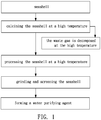
- a method for making a water purifying agent comprising preparing a natural seashell, calcining the seashell at a high temperature to clear organic substances from the seashell, processing and reacting the seashell at a high temperature, and grinding and screening the seashell, to form a water purifying agent with a porous structure.
- the water purifying agent is used individually or served as a carrier of a microorganism for a specified purpose, so as to purify a water quality.
- a water purifying agent comprising a powder having a porous structure.
- the powder has an interior provided with a plurality of pores.
- the powder is made of a natural seashell which is processed at a high temperature, and is ground and screened to form the porous structure.
- the powder is used individually or served as a carrier of a microorganism for a specified purpose, so as to purify a water quality.
- a method for making a water purifying agent in accordance with the preferred embodiment of the present invention comprises preparing a natural seashell, calcining the seashell at a high temperature to clear organic substances from the seashell, processing and reacting the seashell at a high temperature, and grinding and screening the seashell, to form a water purifying agent with a porous structure.
- the water purifying agent is used individually or served as a carrier of a microorganism (or microbe or animalcule) for a specified purpose, so as to purify a water quality.
- a waste gas is produced after the seashell is calcined at the high temperature to clear organic substances. The waste gas is decomposed at the high temperature and is drained out when reaching the emission standard.
- the seashell is the shell of a shellfish, an oyster, a clam, a scallop or the like.
- the seashell is calcined at the temperature of 800-1200 ° C.
- the organic substances include flesh, membrane, gel or the like, that is remains in the seashell.
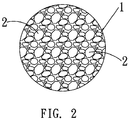
- a water purifying agent in accordance with the preferred embodiment of the present invention comprises a powder 1 having a porous structure.
- the powder 1 has an interior provided with a plurality of pores 2.
- the powder 1 is made of a natural seashell which is processed at a high temperature, and is ground and screened to form the porous structure.
- the powder 1 is used individually or served as a carrier (such as a breeding house or the like) of a microorganism for a specified purpose, so as to purify a water quality.
- the powder 1 has a diameter of 0.4-10 ⁇ m.
- the water purifying agent has a high specific surface area and has a better adsorption capacity, such that the water purifying agent is served as an adsorbent with a specified requirement.
- the water purifying agent is produced without using an energy.
- the water purifying agent is made of the natural seashell without causing a chemical pollution.
- the water purifying agent is used individually or served as a carrier of a microorganism for a specified purpose, so as to purify a water quality.
- the water purifying agent includes natural alkaline biological calcium with a PH value greater than ten (PH>10), so as to neutralize the acid ecological water.
- the water purifying agent improves the TDS (total dissolved solids) in the environmental water.
- the TDS means the total amount of solid substances (including soluble hydrogen carbonate ions, chloride, sulfate, calcium, magnesium, sodium and potassium, volatile and non-volatile solids) that are dissolved in the water.
- the water purifying agent also decreases the SS (suspended solids) in the environmental water.
- the SS means the total amount of organic or inorganic particles that are suspended in the water due to agitation or flow. These particles generally contain colloidal (or gum) suspensions, dispersions, and floe. The suspended solids hinder penetration of light in the water. If the suspended solids are deposited in the riverbed, they will hinder the water flow.
- the water purifying agent also decreases the COD (chemical oxygen demand) in the environmental water.
- the COD means the total amount of organic substances that are chemically oxidized in the water. In general, the COD indicates the polluted extent of the industrial wastewater or the wastewater that is not decomposed biologically by the microbes.
- the water purifying agent also decreases the TNC (total number of colony) in the environmental water. The TNC means the total number of viable bacteria contained in the water sample. Further, the water purifying agent also decreases the turbidity in the environmental water.
- the source of turbidity includes adhesive particles, cosmids, granules, fine organic matter, plankton or microorganisms.
- the water purifying agent also increases the SD (transparency) in the environmental water.
- the SD means the extent to which light can penetrate water.
- the water purifying agent also decreases the CHL-a (chlorophyll-a) in the environmental water. When the CHL-a is high in the water, the high value means that the algae in the water are overgrown.
Landscapes
- Chemical & Material Sciences (AREA)
- Inorganic Chemistry (AREA)
- Life Sciences & Earth Sciences (AREA)
- Hydrology & Water Resources (AREA)
- Engineering & Computer Science (AREA)
- Environmental & Geological Engineering (AREA)
- Water Supply & Treatment (AREA)
- Organic Chemistry (AREA)
- Biological Treatment Of Waste Water (AREA)
Abstract
A method includes preparing a natural seashell, calcining the seashell at a high temperature to clear organic substances from the seashell, processing and reacting the seashell at a high temperature, and grinding and screening the seashell, to form a water purifying agent. The water purifying agent includes a powder having a porous structure. The powder has an interior provided with a plurality of pores. Thus, the water purifying agent is used individually or served as a carrier of a microorganism for a specified purpose, so as to purify the water quality. In addition, the water purifying agent has a high specific surface area and has a good adsorption capacity.
Description
- The present invention relates to a water purifying technology and, more particularly, to a water purifying agent and the method for making it.
- A conventional water purifying method comprises directly discharging water from the entire water area (such as the pond or the like) and then injecting clean water into the water area. However, such a method wastes the water source and easily breaks the ecosystem of the water area. Another conventional water purifying method comprises using a chemical agent, such as chlorine or the like, to sterilize and disinfect the water area. However, the chlorine is toxic and easily endangers the human health. In addition, the chlorine is not environmentally friendly, and easily causes a pollution. Another conventional water purifying method comprises using an ultraviolet device to irradiate the water area for a sterilizing purpose. However, the ultraviolet lamp has a determined longevity, has a high cost of replacement, and increases the electricity cost. Another conventional water purifying method comprises blowing air into the water area for an aerating purpose. However, such a method needs to use an energy source, thereby increasing the cost.
- The primary objective of the present invention is to provide a water purifying agent which has a high specific surface area and has a better adsorption capacity, such that the water purifying agent is served as an adsorbent with a specified requirement.
- In accordance with the present invention, there is provided a method for making a water purifying agent, comprising preparing a natural seashell, calcining the seashell at a high temperature to clear organic substances from the seashell, processing and reacting the seashell at a high temperature, and grinding and screening the seashell, to form a water purifying agent with a porous structure. The water purifying agent is used individually or served as a carrier of a microorganism for a specified purpose, so as to purify a water quality.
- In accordance with the present invention, there is also provided a water purifying agent comprising a powder having a porous structure. The powder has an interior provided with a plurality of pores. The powder is made of a natural seashell which is processed at a high temperature, and is ground and screened to form the porous structure. The powder is used individually or served as a carrier of a microorganism for a specified purpose, so as to purify a water quality.
- Further benefits and advantages of the present invention will become apparent after a careful reading of the detailed description with appropriate reference to the accompanying drawings.
- In the drawings:
-
FIG. 1 is a flow chart of a method for making a water purifying agent in accordance with the preferred embodiment of the present invention. -
FIG. 2 is a schematic enlarged view of a water purifying agent in accordance with the preferred embodiment of the present invention. - Referring to the drawings and initially to
FIG. 1 , a method for making a water purifying agent in accordance with the preferred embodiment of the present invention comprises preparing a natural seashell, calcining the seashell at a high temperature to clear organic substances from the seashell, processing and reacting the seashell at a high temperature, and grinding and screening the seashell, to form a water purifying agent with a porous structure. The water purifying agent is used individually or served as a carrier of a microorganism (or microbe or animalcule) for a specified purpose, so as to purify a water quality. A waste gas is produced after the seashell is calcined at the high temperature to clear organic substances. The waste gas is decomposed at the high temperature and is drained out when reaching the emission standard. - In the preferred embodiment of the present invention, the seashell is the shell of a shellfish, an oyster, a clam, a scallop or the like.
- In the preferred embodiment of the present invention, the seashell is calcined at the temperature of 800-1200 ° C.
- In the preferred embodiment of the present invention, the organic substances include flesh, membrane, gel or the like, that is remains in the seashell.
- Referring to
FIG. 2 , a water purifying agent in accordance with the preferred embodiment of the present invention comprises a powder 1 having a porous structure. The powder 1 has an interior provided with a plurality ofpores 2. The powder 1 is made of a natural seashell which is processed at a high temperature, and is ground and screened to form the porous structure. The powder 1 is used individually or served as a carrier (such as a breeding house or the like) of a microorganism for a specified purpose, so as to purify a water quality. - In the preferred embodiment of the present invention, the powder 1 has a diameter of 0.4-10 µm.
- In the preferred embodiment of the present invention, the water purifying agent has a high specific surface area and has a better adsorption capacity, such that the water purifying agent is served as an adsorbent with a specified requirement. In addition, the water purifying agent is produced without using an energy. Further, the water purifying agent is made of the natural seashell without causing a chemical pollution. Thus, the water purifying agent is used individually or served as a carrier of a microorganism for a specified purpose, so as to purify a water quality.
- In the preferred embodiment of the present invention, the water purifying agent includes natural alkaline biological calcium with a PH value greater than ten (PH>10), so as to neutralize the acid ecological water.
- Accordingly, the water purifying agent improves the TDS (total dissolved solids) in the environmental water. The TDS means the total amount of solid substances (including soluble hydrogen carbonate ions, chloride, sulfate, calcium, magnesium, sodium and potassium, volatile and non-volatile solids) that are dissolved in the water. In addition, the water purifying agent also decreases the SS (suspended solids) in the environmental water. The SS means the total amount of organic or inorganic particles that are suspended in the water due to agitation or flow. These particles generally contain colloidal (or gum) suspensions, dispersions, and floe. The suspended solids hinder penetration of light in the water. If the suspended solids are deposited in the riverbed, they will hinder the water flow. If the suspended solids are deposited in the reservoir area, they will reduce the water storage space of the reservoir. Further, the water purifying agent also decreases the COD (chemical oxygen demand) in the environmental water. The COD means the total amount of organic substances that are chemically oxidized in the water. In general, the COD indicates the polluted extent of the industrial wastewater or the wastewater that is not decomposed biologically by the microbes. Further, the water purifying agent also decreases the TNC (total number of colony) in the environmental water. The TNC means the total number of viable bacteria contained in the water sample. Further, the water purifying agent also decreases the turbidity in the environmental water. The source of turbidity includes adhesive particles, cosmids, granules, fine organic matter, plankton or microorganisms. Further, the water purifying agent also increases the SD (transparency) in the environmental water. The SD means the extent to which light can penetrate water. Further, the water purifying agent also decreases the CHL-a (chlorophyll-a) in the environmental water. When the CHL-a is high in the water, the high value means that the algae in the water are overgrown.
- Although the invention has been explained in relation to its preferred embodiment(s) as mentioned above, it is to be understood that many other possible modifications and variations can be made without departing from the scope of the present invention. It is, therefore, contemplated that the appended claim or claims will cover such modifications and variations that fall within the scope of the invention.
Claims (3)
- A method for making a water purifying agent, comprising:preparing a natural seashell;calcining the seashell at a high temperature to clear organic substances from the seashell;processing and reacting the seashell at a high temperature; andgrinding and screening the seashell, to form a water purifying agent with a porous structure;wherein the water purifying agent is used individually or served as a carrier of a microorganism for a specified purpose, so as to purify a water quality.
- A water purifying agent comprising:a powder (1) having a porous structure;wherein:the powder has an interior provided with a plurality of pores (2);the powder is made of a natural seashell which is processed at a high temperature, and is ground and screened to form the porous structure; andthe powder is used individually or served as a carrier of a microorganism for a specified purpose, so as to purify a water quality.
- The water purifying agent of claim 2, wherein the powder has a diameter of 0.4-10 µm.
Priority Applications (1)
| Application Number | Priority Date | Filing Date | Title |
|---|---|---|---|
| EP19195343.9A EP3789348A1 (en) | 2019-09-04 | 2019-09-04 | Water purifying agent and method for making it |
Applications Claiming Priority (1)
| Application Number | Priority Date | Filing Date | Title |
|---|---|---|---|
| EP19195343.9A EP3789348A1 (en) | 2019-09-04 | 2019-09-04 | Water purifying agent and method for making it |
Publications (1)
| Publication Number | Publication Date |
|---|---|
| EP3789348A1 true EP3789348A1 (en) | 2021-03-10 |
Family
ID=67999538
Family Applications (1)
| Application Number | Title | Priority Date | Filing Date |
|---|---|---|---|
| EP19195343.9A Withdrawn EP3789348A1 (en) | 2019-09-04 | 2019-09-04 | Water purifying agent and method for making it |
Country Status (1)
| Country | Link |
|---|---|
| EP (1) | EP3789348A1 (en) |
Cited By (2)
| Publication number | Priority date | Publication date | Assignee | Title |
|---|---|---|---|---|
| JP2022162431A (en) * | 2021-04-12 | 2022-10-24 | 敏明 楠 | Water quality purification agent and water quality purification method |
| CN116087454A (en) * | 2023-03-22 | 2023-05-09 | 成都理工大学 | Method for quantitatively analyzing contribution of algae source to CODMn of water body |
Citations (5)
| Publication number | Priority date | Publication date | Assignee | Title |
|---|---|---|---|---|
| WO2001067866A1 (en) * | 2000-03-13 | 2001-09-20 | Surfcera Co., Ltd. | Antibacterial agent comprising shell, method for purifying water by using the antibacterial agent and method for washing farm product by using the antibacterial agent |
| JP2003231604A (en) * | 1999-03-17 | 2003-08-19 | Surfcera Kk | Aqueous solution of antimicrobial agent |
| JP2004351306A (en) * | 2003-05-28 | 2004-12-16 | Central Res Inst Of Electric Power Ind | Water purification material that makes effective use of attached husks |
| WO2009104670A1 (en) * | 2008-02-19 | 2009-08-27 | 東京ナノ・バイオテクノロジー株式会社 | Antimicrobial and antiviral agent and method for use thereof |
| CN107232235A (en) * | 2016-06-14 | 2017-10-10 | 舟山赛莱特海洋科技有限公司 | A kind of micro-nano shell water disinfectant and preparation method thereof |
-
2019
- 2019-09-04 EP EP19195343.9A patent/EP3789348A1/en not_active Withdrawn
Patent Citations (5)
| Publication number | Priority date | Publication date | Assignee | Title |
|---|---|---|---|---|
| JP2003231604A (en) * | 1999-03-17 | 2003-08-19 | Surfcera Kk | Aqueous solution of antimicrobial agent |
| WO2001067866A1 (en) * | 2000-03-13 | 2001-09-20 | Surfcera Co., Ltd. | Antibacterial agent comprising shell, method for purifying water by using the antibacterial agent and method for washing farm product by using the antibacterial agent |
| JP2004351306A (en) * | 2003-05-28 | 2004-12-16 | Central Res Inst Of Electric Power Ind | Water purification material that makes effective use of attached husks |
| WO2009104670A1 (en) * | 2008-02-19 | 2009-08-27 | 東京ナノ・バイオテクノロジー株式会社 | Antimicrobial and antiviral agent and method for use thereof |
| CN107232235A (en) * | 2016-06-14 | 2017-10-10 | 舟山赛莱特海洋科技有限公司 | A kind of micro-nano shell water disinfectant and preparation method thereof |
Cited By (2)
| Publication number | Priority date | Publication date | Assignee | Title |
|---|---|---|---|---|
| JP2022162431A (en) * | 2021-04-12 | 2022-10-24 | 敏明 楠 | Water quality purification agent and water quality purification method |
| CN116087454A (en) * | 2023-03-22 | 2023-05-09 | 成都理工大学 | Method for quantitatively analyzing contribution of algae source to CODMn of water body |
Similar Documents
| Publication | Publication Date | Title |
|---|---|---|
| US8192626B2 (en) | Wastewater chemical/biological treatment method for open water discharge | |
| Van Den Hende et al. | Up-scaling aquaculture wastewater treatment by microalgal bacterial flocs: from lab reactors to an outdoor raceway pond | |
| Andreo-Martínez et al. | Domestic wastewaters reuse reclaimed by an improved horizontal subsurface-flow constructed wetland: A case study in the southeast of Spain | |
| KR102620469B1 (en) | Systems and methods for handling contaminated fluids with low environmental impact | |
| CN104071951B (en) | Fish pond culture wastewater treatment process and device | |
| Khanzada et al. | Microalgae as a sustainable biological system for improving leachate quality | |
| Lertsutthiwong et al. | Immobilization of nitrite oxidizing bacteria using biopolymeric chitosan media | |
| Akpor et al. | Microbial roles and dynamics in wastewater treatment systems: An overview | |
| Mtethiwa et al. | Efficiency of oxidation ponds in wastewater treatment | |
| US20120021494A1 (en) | Enhanced photosynthesis and photocatalysis water treatment/biomass growth process | |
| CN103648987A (en) | System for decomposing organic compounds and method of operation thereof | |
| Majid et al. | Eco-friendly solutions for urban wastewater: evaluating constructed wetlands and filtration methods | |
| Irshad et al. | Current practices and emerging trends in abattoir effluent treatment in India: a review. | |
| US20210060521A1 (en) | Water Purifying Agent and Method for Making It | |
| Ngilangil et al. | Effectiveness of Vetiver (Vetiver zizanioides) in Purifying Wastewater from Pig Farm. | |
| KR20220111172A (en) | A device for purifying the water quality of reservoirs and removing green algae using anionic radical circulation ceramics | |
| CN109942124A (en) | A kind of light degradation handles the system and method for antibiotic in aquiculture sewerage | |
| JP7750748B2 (en) | Organic matter decomposition materials and their use | |
| Ali et al. | An overview on bioremediation strategies for waste water treatment and environmental sustainability | |
| JP4052549B2 (en) | Photocatalyst based on granulated artificial lightweight aggregate, production method thereof and use thereof | |
| US20210061692A1 (en) | Water Deodorizer and Method for Making It | |
| CN109775930A (en) | Treatment method of landfill leachate based on GY-3 type packing matrix | |
| CN112408585A (en) | Water purifier and method for producing the same | |
| Yamamoto | Characteristics of closed recirculating systems | |
| KR20190004168A (en) | A waste water of stock raising disposal plant |
Legal Events
| Date | Code | Title | Description |
|---|---|---|---|
| PUAI | Public reference made under article 153(3) epc to a published international application that has entered the european phase |
Free format text: ORIGINAL CODE: 0009012 |
|
| STAA | Information on the status of an ep patent application or granted ep patent |
Free format text: STATUS: THE APPLICATION HAS BEEN PUBLISHED |
|
| AK | Designated contracting states |
Kind code of ref document: A1 Designated state(s): AL AT BE BG CH CY CZ DE DK EE ES FI FR GB GR HR HU IE IS IT LI LT LU LV MC MK MT NL NO PL PT RO RS SE SI SK SM TR |
|
| AX | Request for extension of the european patent |
Extension state: BA ME |
|
| STAA | Information on the status of an ep patent application or granted ep patent |
Free format text: STATUS: THE APPLICATION IS DEEMED TO BE WITHDRAWN |
|
| 18D | Application deemed to be withdrawn |
Effective date: 20210911 |