EP3789228B1 - Vehicular display device - Google Patents
Vehicular display device Download PDFInfo
- Publication number
- EP3789228B1 EP3789228B1 EP20191727.5A EP20191727A EP3789228B1 EP 3789228 B1 EP3789228 B1 EP 3789228B1 EP 20191727 A EP20191727 A EP 20191727A EP 3789228 B1 EP3789228 B1 EP 3789228B1
- Authority
- EP
- European Patent Office
- Prior art keywords
- light
- reflected
- angle
- hologram
- brightness
- Prior art date
- Legal status (The legal status is an assumption and is not a legal conclusion. Google has not performed a legal analysis and makes no representation as to the accuracy of the status listed.)
- Active
Links
Images


Classifications
-
- G—PHYSICS
- G02—OPTICS
- G02B—OPTICAL ELEMENTS, SYSTEMS OR APPARATUS
- G02B27/00—Optical systems or apparatus not provided for by any of the groups G02B1/00 - G02B26/00, G02B30/00
- G02B27/01—Head-up displays
- G02B27/0101—Head-up displays characterised by optical features
- G02B27/0103—Head-up displays characterised by optical features comprising holographic elements
-
- B—PERFORMING OPERATIONS; TRANSPORTING
- B60—VEHICLES IN GENERAL
- B60K—ARRANGEMENT OR MOUNTING OF PROPULSION UNITS OR OF TRANSMISSIONS IN VEHICLES; ARRANGEMENT OR MOUNTING OF PLURAL DIVERSE PRIME-MOVERS IN VEHICLES; AUXILIARY DRIVES FOR VEHICLES; INSTRUMENTATION OR DASHBOARDS FOR VEHICLES; ARRANGEMENTS IN CONNECTION WITH COOLING, AIR INTAKE, GAS EXHAUST OR FUEL SUPPLY OF PROPULSION UNITS IN VEHICLES
- B60K35/00—Instruments specially adapted for vehicles; Arrangement of instruments in or on vehicles
- B60K35/20—Output arrangements, i.e. from vehicle to user, associated with vehicle functions or specially adapted therefor
- B60K35/21—Output arrangements, i.e. from vehicle to user, associated with vehicle functions or specially adapted therefor using visual output, e.g. blinking lights or matrix displays
- B60K35/23—Head-up displays [HUD]
-
- B—PERFORMING OPERATIONS; TRANSPORTING
- B60—VEHICLES IN GENERAL
- B60K—ARRANGEMENT OR MOUNTING OF PROPULSION UNITS OR OF TRANSMISSIONS IN VEHICLES; ARRANGEMENT OR MOUNTING OF PLURAL DIVERSE PRIME-MOVERS IN VEHICLES; AUXILIARY DRIVES FOR VEHICLES; INSTRUMENTATION OR DASHBOARDS FOR VEHICLES; ARRANGEMENTS IN CONNECTION WITH COOLING, AIR INTAKE, GAS EXHAUST OR FUEL SUPPLY OF PROPULSION UNITS IN VEHICLES
- B60K35/00—Instruments specially adapted for vehicles; Arrangement of instruments in or on vehicles
- B60K35/40—Instruments specially adapted for improving the visibility thereof to the user, e.g. fogging prevention or anti-reflection arrangements
- B60K35/425—Anti-reflection arrangements
-
- B—PERFORMING OPERATIONS; TRANSPORTING
- B60—VEHICLES IN GENERAL
- B60K—ARRANGEMENT OR MOUNTING OF PROPULSION UNITS OR OF TRANSMISSIONS IN VEHICLES; ARRANGEMENT OR MOUNTING OF PLURAL DIVERSE PRIME-MOVERS IN VEHICLES; AUXILIARY DRIVES FOR VEHICLES; INSTRUMENTATION OR DASHBOARDS FOR VEHICLES; ARRANGEMENTS IN CONNECTION WITH COOLING, AIR INTAKE, GAS EXHAUST OR FUEL SUPPLY OF PROPULSION UNITS IN VEHICLES
- B60K35/00—Instruments specially adapted for vehicles; Arrangement of instruments in or on vehicles
- B60K35/60—Instruments characterised by their location or relative disposition in or on vehicles
-
- G—PHYSICS
- G02—OPTICS
- G02B—OPTICAL ELEMENTS, SYSTEMS OR APPARATUS
- G02B27/00—Optical systems or apparatus not provided for by any of the groups G02B1/00 - G02B26/00, G02B30/00
- G02B27/0018—Optical systems or apparatus not provided for by any of the groups G02B1/00 - G02B26/00, G02B30/00 with means for preventing ghost images
-
- G—PHYSICS
- G02—OPTICS
- G02B—OPTICAL ELEMENTS, SYSTEMS OR APPARATUS
- G02B27/00—Optical systems or apparatus not provided for by any of the groups G02B1/00 - G02B26/00, G02B30/00
- G02B27/01—Head-up displays
- G02B27/0179—Display position adjusting means not related to the information to be displayed
-
- B—PERFORMING OPERATIONS; TRANSPORTING
- B60—VEHICLES IN GENERAL
- B60K—ARRANGEMENT OR MOUNTING OF PROPULSION UNITS OR OF TRANSMISSIONS IN VEHICLES; ARRANGEMENT OR MOUNTING OF PLURAL DIVERSE PRIME-MOVERS IN VEHICLES; AUXILIARY DRIVES FOR VEHICLES; INSTRUMENTATION OR DASHBOARDS FOR VEHICLES; ARRANGEMENTS IN CONNECTION WITH COOLING, AIR INTAKE, GAS EXHAUST OR FUEL SUPPLY OF PROPULSION UNITS IN VEHICLES
- B60K2360/00—Indexing scheme associated with groups B60K35/00 or B60K37/00 relating to details of instruments or dashboards
- B60K2360/20—Optical features of instruments
- B60K2360/29—Holographic features
-
- B—PERFORMING OPERATIONS; TRANSPORTING
- B60—VEHICLES IN GENERAL
- B60K—ARRANGEMENT OR MOUNTING OF PROPULSION UNITS OR OF TRANSMISSIONS IN VEHICLES; ARRANGEMENT OR MOUNTING OF PLURAL DIVERSE PRIME-MOVERS IN VEHICLES; AUXILIARY DRIVES FOR VEHICLES; INSTRUMENTATION OR DASHBOARDS FOR VEHICLES; ARRANGEMENTS IN CONNECTION WITH COOLING, AIR INTAKE, GAS EXHAUST OR FUEL SUPPLY OF PROPULSION UNITS IN VEHICLES
- B60K2360/00—Indexing scheme associated with groups B60K35/00 or B60K37/00 relating to details of instruments or dashboards
- B60K2360/20—Optical features of instruments
- B60K2360/33—Illumination features
- B60K2360/334—Projection means
-
- B—PERFORMING OPERATIONS; TRANSPORTING
- B60—VEHICLES IN GENERAL
- B60K—ARRANGEMENT OR MOUNTING OF PROPULSION UNITS OR OF TRANSMISSIONS IN VEHICLES; ARRANGEMENT OR MOUNTING OF PLURAL DIVERSE PRIME-MOVERS IN VEHICLES; AUXILIARY DRIVES FOR VEHICLES; INSTRUMENTATION OR DASHBOARDS FOR VEHICLES; ARRANGEMENTS IN CONNECTION WITH COOLING, AIR INTAKE, GAS EXHAUST OR FUEL SUPPLY OF PROPULSION UNITS IN VEHICLES
- B60K2360/00—Indexing scheme associated with groups B60K35/00 or B60K37/00 relating to details of instruments or dashboards
- B60K2360/60—Structural details of dashboards or instruments
- B60K2360/66—Projection screens or combiners
-
- B—PERFORMING OPERATIONS; TRANSPORTING
- B60—VEHICLES IN GENERAL
- B60K—ARRANGEMENT OR MOUNTING OF PROPULSION UNITS OR OF TRANSMISSIONS IN VEHICLES; ARRANGEMENT OR MOUNTING OF PLURAL DIVERSE PRIME-MOVERS IN VEHICLES; AUXILIARY DRIVES FOR VEHICLES; INSTRUMENTATION OR DASHBOARDS FOR VEHICLES; ARRANGEMENTS IN CONNECTION WITH COOLING, AIR INTAKE, GAS EXHAUST OR FUEL SUPPLY OF PROPULSION UNITS IN VEHICLES
- B60K2360/00—Indexing scheme associated with groups B60K35/00 or B60K37/00 relating to details of instruments or dashboards
- B60K2360/77—Instrument locations other than the dashboard
- B60K2360/785—Instrument locations other than the dashboard on or in relation to the windshield or windows
-
- G—PHYSICS
- G02—OPTICS
- G02B—OPTICAL ELEMENTS, SYSTEMS OR APPARATUS
- G02B27/00—Optical systems or apparatus not provided for by any of the groups G02B1/00 - G02B26/00, G02B30/00
- G02B27/01—Head-up displays
- G02B27/0101—Head-up displays characterised by optical features
- G02B27/0103—Head-up displays characterised by optical features comprising holographic elements
- G02B2027/0105—Holograms with particular structures
-
- G—PHYSICS
- G02—OPTICS
- G02B—OPTICAL ELEMENTS, SYSTEMS OR APPARATUS
- G02B27/00—Optical systems or apparatus not provided for by any of the groups G02B1/00 - G02B26/00, G02B30/00
- G02B27/01—Head-up displays
- G02B27/0101—Head-up displays characterised by optical features
- G02B2027/0118—Head-up displays characterised by optical features comprising devices for improving the contrast of the display / brillance control visibility
-
- G—PHYSICS
- G02—OPTICS
- G02B—OPTICAL ELEMENTS, SYSTEMS OR APPARATUS
- G02B27/00—Optical systems or apparatus not provided for by any of the groups G02B1/00 - G02B26/00, G02B30/00
- G02B27/01—Head-up displays
- G02B27/0179—Display position adjusting means not related to the information to be displayed
- G02B2027/0183—Adaptation to parameters characterising the motion of the vehicle
Definitions
- the present invention relates to a vehicular display device.
- Japanese Patent Application Laid-open No. 11-91401 discloses a vehicular holographic display device including an information display source that generates information to be displayed as light, and a combiner having a hologram that is arranged in a dark color concealing part provided on a peripheral edge part of a windshield of a vehicle, diffracts light toward an observer, and displays the light as a virtual image.
- JP2011227281A discloses a vehicular display device comprising a reflection-type hologram.
- An object of the present invention is to provide a vehicular display device capable of improving the visibility of a display image and improving the degree of freedom in the arrangement of a projection device.
- a vehicular display device includes a reflection-type hologram disposed inside a windshield of a vehicle and including a first surface facing a side of an eye range of the vehicle; and a projection device that projects display light of a P wave toward the first surface, wherein the hologram outputs the display light, which is incident on the first surface from the projection device, as diffracted light directed to the eye range, and has diffraction characteristics of condensing the diffracted light in the eye range, the projection device is disposed such that a part of the display light is reflected toward the eye range when an incident angle of the display light on the windshield is within a predetermined angle range, and the projection device is disposed such that an angle difference between an incident angle included in the predetermined angle range and a Brewster angle is equal to or less a predetermined value.
- the projection device is disposed such that the predetermined angle range includes the Brewster angle.
- the projection device is disposed such that a brightness ratio between brightness of reflected light reflected by the windshield toward the eye range and brightness of the diffracted light is equal to or less than a predetermined value.
- the brightness of the reflected light includes brightness of light reflected by a surface of the windshield on a vehicle interior side and brightness of light reflected by a boundary surface between the windshield and an outside of the vehicle after passing through the surface on the vehicle interior side.
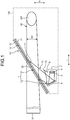
- FIG. 1 is a schematic configuration diagram of a vehicular display device according to an embodiment
- FIG. 2 is a diagram explaining the diffraction of light by a hologram according to the embodiment
- FIG. 3 is a diagram explaining light reflected by a windshield
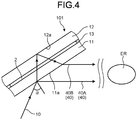
- FIG. 4 is a diagram explaining first reflected light and second reflected light of the embodiment
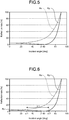
- FIG. 5 is a diagram illustrating reflection characteristics in the windshield of the embodiment
- FIG. 6 is a diagram explaining a method for determining the arrangement of a projection device according to the embodiment.
- a vehicular display device 1 of the present embodiment is a head-up display device mounted on a vehicle 100 such as an automobile.
- the vehicular display device 1 has a hologram 2 and a projection device 3.
- the hologram 2 is disposed inside a windshield 101 of the vehicle 100.
- the windshield 101 is a laminated glass and has an inner glass 11, an outer glass 12, and an intermediate film 13.
- the intermediate film 13 and the hologram 2 are sealed between the inner glass 11 and the outer glass 12.
- the intermediate film 13 is made of a synthetic resin such as polymer.
- the hologram 2 may be integrally formed with the intermediate film 13 or may be inserted into the intermediate film 13, for example.
- the hologram 2 is a transparent film processed to have desired diffraction characteristics.
- the hologram 2 of the present embodiment is a reflection-type hologram.
- the hologram 2 has a first surface 21 and a second surface 22. The hologram 2 diffracts light incident on the first surface 21 and emits the diffracted light from the first surface 21.
- the hologram 2 when light is incident on the first surface 21 at a first angle ⁇ 1, the hologram 2 outputs diffracted light 30 from the first surface 21.
- the hologram 2 is formed such that the emission angle of the diffracted light 30 is a second angle ⁇ 2.
- the second angle ⁇ 2 is determined such that the diffracted light 30 is directed to an eye range ER.
- the eye range ER is a region assumed as the position of eyes of a driver in the vehicle 100.
- the first angle ⁇ 1 and the second angle ⁇ 2 differ depending on positions along a height direction H.
- the hologram 2 is formed to condense the diffracted light 30 toward the eye range ER.
- the hologram 2 allows the light to pass therethrough. That is, the hologram 2 selectively reflects the light, which is incident at the first angle ⁇ 1, toward the eye range ER. Furthermore, the hologram 2 allows light incident on the second surface 22 to pass through toward the eye range ER.
- the projection device 3 has a casing 7, an image display device 4, a polarizer 5, a mirror 6, and a cover 8.
- the casing 7 is disposed inside a dashboard of the vehicle 100, for example.
- the casing 7 has an opening 7a and is fixed to the vehicle 100 with the opening 7a facing upward.
- the dashboard is formed with an opening corresponding to the opening 7a of the casing 7.
- the image display device 4, the polarizer 5, and the mirror 6 are received inside the casing 7.
- the cover 8 closes the opening 7a of the casing 7.
- the cover 8 is a transparent member and allows display light 10 to pass therethrough.
- the image display device 4 is a device that outputs display light, and for example, is a liquid crystal display device or a laser scanner.
- the polarizer 5 is an optical system that converts the display light output from the image display device 4 into a P wave.
- the polarizer 5 is, for example, a polarizing filter that allows the P wave selectively to pass therethrough.
- the display light output from the image display device 4 is polarized into the display light 10 of the P wave by passing through the polarizer 5.
- the mirror 6 is a reflecting device that reflects the display light 10, which is output from the image display device 4 via the polarizer 5, toward the hologram 2.
- the mirror 6 of the present embodiment is a magnifying mirror.
- the shape of the reflecting surface of the mirror 6 is a free-form surface and the mirror 6 magnifies the display light 10 of the P wave and reflects the magnified light toward the hologram 2. That is, the projection device 3 projects the display light 10 of the P toward the first surface 21 of the hologram 2.
- the hologram 2 outputs the display light 10, which is incident from the mirror 6, as the diffracted light 30 directed to the eye range ER.
- the diffracted light 30 causes a display image 31 to be visually recognized.
- the diffracted light 30 allows the user to visually recognize the display image 31 as a virtual image.
- the display image 31 is an image formed in front of the vehicular display device 1 in a vehicle front-rear direction L from the hologram 2.
- the hologram 2 of the present embodiment has diffraction characteristics of condensing the diffracted light 30 in the eye range ER.
- the width WL of the diffracted light 30 directed to the eye range ER becomes narrower from the hologram 2 toward the eye range ER.
- the width WL is the width of the diffracted light 30 in a height direction H.
- the hologram 2 may be configured such that the width of the diffracted light 30 in a vehicle width direction also becomes narrower toward the eye range ER.
- the hologram 2 of the present embodiment can magnify the display image 31 and allow a user to visually recognize the magnified image.
- FIG. 3 illustrates reflected light 40 reflected by the windshield 101.
- FIG. 3 illustrates a virtual display surface 4i instead of the image display device 4.
- the virtual display surface 4i is a position where the display surface of the image display device 4 is to be disposed when there is no mirror 6.
- the virtual display surface 4i is directly projected on the hologram 2.
- the virtual display surface 4i is a position where a virtual image is formed when the mirror 6 is directly viewed from above.
- the projection device 3 of the present embodiment is disposed such that at least a part of the display light 10 is reflected by the windshield 101 toward the eye range ER. A part of the display light 10 is reflected by the windshield 101 and becomes the reflected light 40 directed to the eye range ER.
- the diffracted light 30 and the reflected light 40 reflected toward the eye range ER are superimposed, the visibility of the display image 31 may be reduced.
- the reflected light 40 may generate ghost overlapping the display image 31 and reduce the visibility of the display image 31. Note that, in the following description, the reflected light 40 is assumed to indicate reflected light superimposed on the display image 31.
- the reflected light 40 includes first reflected light 40A and second reflected light 40B.
- the first reflected light 40A is reflected light that is reflected by a surface 11a of the inner glass 11 on a vehicle interior side.
- the second reflected light 40B is reflected light that is reflected by a boundary surface 12a between the outer glass 12 and the outside of the vehicle.
- the second reflected light 40B is light in which the display light 10 passes through the surface 11a on the vehicle interior side, is incident on the inner glass 11, passes through the hologram 2, and is reflected by the boundary surface 12a.
- the vehicular display device 1 of the present embodiment is configured such that the reflected light 40 becomes less visible by a user.
- the projection device 3 is disposed such that an incident angle ⁇ of the display light incident on the inner glass 11 matches with the Brewster angle ⁇ of the windshield 101, or the incident angle ⁇ has a value closer to the Brewster angle ⁇ .
- the Brewster angle ⁇ is an angle determined by, for example, a refractive index of the inner glass 11.
- FIG. 5 illustrates an example of the reflection characteristics of the inner glass 11.
- a horizontal axis denotes the incident angle ⁇ [deg] with respect to the inner glass 11 and a vertical axis denotes a refractive index [%] of the inner glass 11.
- FIG. 5 illustrates a reflection rate Rs for the S wave and a reflection rate Rp for the P wave.
- the reflection rate Rp for the P wave is 0 at the Brewster angle ⁇ . Accordingly, when the display light 10 of the P wave is incident on the inner glass 11 at the Brewster angle ⁇ , the reflection rate is 0 or substantially 0.
- values of a minimum incident angle ⁇ 1 and a maximum incident angle ⁇ 2 are determined as will be described below.
- the minimum incident angle ⁇ 1 is a minimum value of the incident angle ⁇ of the display light 10 that generates the reflected light 40.
- the display light 10 projected from one end P1 of the virtual display surface 4i is reflected toward the eye range ER when the incident angle ⁇ is within a predetermined angle range R ⁇ .
- the minimum incident angle ⁇ 1 is a minimum value of the angle range R ⁇ . When the incident angle ⁇ is smaller than the minimum incident angle ⁇ 1, the display light 10 at one end P1 is reflected toward a region below the eye range ER.
- the display light 10 projected from the other end P2 of the virtual display surface 4i is reflected toward the eye range ER when the incident angle ⁇ is within the predetermined angle range R ⁇ .
- the maximum incident angle ⁇ 2 is a maximum value of the angle range R ⁇ .
- the display light 10 at the other end P2 is reflected toward a region above the eye range ER.
- the projection device 3 is disposed such that an angle difference ⁇ between an incident angle ⁇ x ( ⁇ 1 ⁇ x ⁇ 2) included in the aforementioned predetermined angle range R ⁇ and the Brewster angle ⁇ is equal to or less than a predetermined value ⁇ 1. That is, the projection device 3 is disposed such that the following Equation (1) is satisfied. The projection device 3 is disposed in this manner, so that the following Equation (2) and Equation (3) are satisfied. ⁇ x ⁇ ⁇ ⁇ ⁇ 1 ⁇ 1 ⁇ ⁇ ⁇ ⁇ 1 ⁇ 2 ⁇ ⁇ ⁇ ⁇ 1
- the projection device 3 may be disposed such that, for example, the following Equation (4) is satisfied. That is, the projection device 3 may be disposed such that the Brewster angle ⁇ is equal to or larger than the minimum incident angle ⁇ 1 and is equal to or smaller than the maximum incident angle ⁇ 2.
- the predetermined angle range Ry may include the Brewster angle ⁇ . ⁇ 1 ⁇ ⁇ ⁇ ⁇ 2
- the predetermined value ⁇ 1 is determined, for example, on the basis of an upper limit value Rx of the reflection rate Rp of the P wave illustrated in FIG. 6 .
- the upper limit value Rx is an upper limit value that is allowable as the reflection rate Rp of the P wave on the inner glass 11 from the standpoint of suppressing ghost.
- An angle range ⁇ 0 is a range of the incident angle ⁇ in which the reflection rate Rp of the P wave is equal to or less than the upper limit value Rx.
- the angle range ⁇ 0 is the range of the incident angle ⁇ from the minimum value ⁇ 1 to the maximum value ⁇ 2.
- the predetermined value ⁇ 1 may be determined by the following Equation (5).
- the predetermined value ⁇ 1 is determined as in the following Equation (5), so that the brightness of the reflected light 40 can be set to have a value within an allowable range.
- ⁇ 1 ⁇ 2 ⁇ ⁇
- the minimum incident angle ⁇ 1 and the maximum incident angle ⁇ 2 may also be determined on the basis of the aforementioned angle range ⁇ 0.
- the projection device 3 is disposed such that, for example, the predetermined angle range Ry is included in the angle range ⁇ 0.
- the projection device 3 is disposed such that the minimum incident angle ⁇ 1 is equal to or larger than the minimum value ⁇ 1 of the angle range ⁇ 0 and the maximum incident angle ⁇ 2 is equal to or smaller than the maximum value ⁇ 2 of the angle range ⁇ 0.
- the projection device 3 of the present embodiment is disposed such that a brightness ratio BI between the brightness BR of the reflected light 40 reflected by the windshield 101 and the brightness BD of the diffracted light 30 is equal to or smaller than a predetermined value BT.
- the brightness BR of the reflected light 40 is, for example, the total value of the brightness BR1 of the first reflected light 40A and the brightness BR2 of the second reflected light 40B.
- the brightness BR1 of the first reflected light 40A is expressed by the following Equation (6) and the brightness BR2 of the second reflected light 40B is expressed by the following Equation (7).
- Wt is the transmittance of the windshield 101
- Wr is the surface reflection rate on the windshield 101
- Hd is the diffraction efficiency of the hologram 2
- Lt is the brightness of the display light 10 incident on the windshield 101.
- the brightness BD of the diffracted light 30 is expressed by the following Equation (8).
- the brightness ratio BI is expressed by the following Equation (9) .
- the value of the brightness ratio BI may differ depending on a reflection position on the windshield 101.
- the projection device 3 is disposed such that, for example, a maximum value of the brightness ratio BI is equal to or smaller than the predetermined value BT.
- the predetermined value BT is appropriately determined, for example, from the standpoint of improving the visibility of the display image 31. By determining the predetermined value BT to a small value, contrast between the brightness of the display image 31 and the brightness of the reflected light 40 is increased and the reflected light 40 is less conspicuous.
- the diffraction efficiency Hd of the hologram 2 and the surface reflection rate Wr of the windshield 101 are determined such that the brightness ratio BI is equal to or smaller than the predetermined value BT or the brightness ratio BI is as small as possible.
- the surface reflection rate Wr differs depending on the incident angle ⁇ of the display light 10 on the windshield 101. Therefore, an optimal arrangement of the projection device 3 is adopted so as to minimize the brightness ratio BI.
- the vehicular display device 1 of the present embodiment has the reflection-type hologram 2 and the projection device 3.
- the hologram 2 is disposed inside the windshield 101 of the vehicle 100.
- the hologram 2 has the first surface 21 facing the eye range ER of the vehicle 100.
- the projection device 3 projects the display light 10 of the P wave toward the first surface 21.
- the hologram 2 outputs the display light 10, which is incident on the first surface 21 from the projection device 3, as the diffracted light 30 directed to the eye range ER.
- the hologram 2 has the diffraction characteristics of condensing the diffracted light 30 in the eye range ER.
- the projection device 3 is disposed such that a part of the display light 10 is reflected toward the eye range ER when the incident angle ⁇ of the display light 10 on the windshield 101 is within the predetermined angle range Ry.
- the projection device 3 is disposed such that the angle difference ⁇ between the incident angle ⁇ x included in the predetermined angle range R ⁇ and the Brewster angle ⁇ is equal to or smaller than the predetermined value ⁇ 1.
- the predetermined value ⁇ 1 may be determined such that the reflection rate Rp of the P wave on the surface 11a on the vehicle interior side is equal to or smaller than the upper limit value Rx.
- the projection device 3 is disposed in such a positional relation that the reflected light 40 is directed to the eye range ER, the brightness of the reflected light 40 is reduced.
- the angle difference ⁇ is equal to or smaller than the predetermined value ⁇ 1
- the reflection rate Rp of the display light 10 of the P wave reflected by the surface 11a on the vehicle interior side is suppressed.
- both the improvement of the visibility of the display image 31 and the improvement of the degree of freedom in the arrangement of the projection device 3 are achieved.
- the projection device 3 of the present embodiment is disposed such that the predetermined angle range R ⁇ includes the Brewster angle ⁇ .
- the predetermined angle range R ⁇ includes the Brewster angle ⁇ , so that the reflection rate Rp is reduced and the visibility of the display image 31 is improved.
- the projection device 3 of the present embodiment is disposed such that the brightness ratio BI between the brightness BR of the reflected light 40 reflected by the windshield 101 toward the eye range ER and the brightness BD of the diffracted light 30 is equal to or less than the predetermined value BT. With this, the reflected light 40 is less conspicuous than the diffracted light 30, resulting in the improvement of the visibility of the display image 31.
- the brightness BR of the reflected light 40 includes the brightness BR1 of the first reflected light 40A and the brightness BR2 of the second reflected light 40B.
- the first reflected light 40A is light reflected by the surface 11a on the vehicle interior side.
- the second reflected light 40B is light reflected by the boundary surface 12a between the windshield 101 and the outside of the vehicle after passing through the surface 11a on the vehicle interior side.
- the predetermined angle range R ⁇ does not necessarily include the Brewster angle ⁇ .
- the predetermined angle range R ⁇ is appropriately determined such that it is possible to reduce the reflection rate Rp on the windshield 101.
- the projection device is disposed such that an angle difference between an incident angle included in a predetermined angle range and the Brewster angle is equal to or smaller than the predetermined value.
- it is possible to improve the visibility of a display image by suppressing the brightness of reflected light and to improve the degree of freedom in the arrangement of the projection device.
Landscapes
- Engineering & Computer Science (AREA)
- Physics & Mathematics (AREA)
- Chemical & Material Sciences (AREA)
- Combustion & Propulsion (AREA)
- Transportation (AREA)
- Mechanical Engineering (AREA)
- General Physics & Mathematics (AREA)
- Optics & Photonics (AREA)
- Instrument Panels (AREA)
- Devices For Indicating Variable Information By Combining Individual Elements (AREA)
- Diffracting Gratings Or Hologram Optical Elements (AREA)
- Holo Graphy (AREA)
Description
- The present invention relates to a vehicular display device.
- In the related art, there is a display device using a hologram.
Japanese Patent Application Laid-open No. 11-91401 - When the hologram is disposed inside the windshield, it is necessary to consider the reflection of the display light by the surface of the windshield. From the standpoint of improving the visibility of the display image, it is preferable to dispose a projection device such that reflected light is directed in a direction different from the eye range. However, since there is a mounting position limitation in the vehicle, it is not always possible to dispose the projection device at a desired position.
JP2011227281A - An object of the present invention is to provide a vehicular display device capable of improving the visibility of a display image and improving the degree of freedom in the arrangement of a projection device.
- A vehicular display device according to one aspect of the present invention includes a reflection-type hologram disposed inside a windshield of a vehicle and including a first surface facing a side of an eye range of the vehicle; and a projection device that projects display light of a P wave toward the first surface, wherein the hologram outputs the display light, which is incident on the first surface from the projection device, as diffracted light directed to the eye range, and has diffraction characteristics of condensing the diffracted light in the eye range, the projection device is disposed such that a part of the display light is reflected toward the eye range when an incident angle of the display light on the windshield is within a predetermined angle range, and the projection device is disposed such that an angle difference between an incident angle included in the predetermined angle range and a Brewster angle is equal to or less a predetermined value.
- According to another aspect of the present invention, in the vehicular display device, it is preferable that the projection device is disposed such that the predetermined angle range includes the Brewster angle.
- According to still another aspect of the present invention, in the vehicular display device, it is preferable that the projection device is disposed such that a brightness ratio between brightness of reflected light reflected by the windshield toward the eye range and brightness of the diffracted light is equal to or less than a predetermined value.
- According to still another aspect of the present invention, in the vehicular display device, it is preferable that the brightness of the reflected light includes brightness of light reflected by a surface of the windshield on a vehicle interior side and brightness of light reflected by a boundary surface between the windshield and an outside of the vehicle after passing through the surface on the vehicle interior side.
- The above and other objects, features, advantages and technical and industrial significance of this invention will be better understood by reading the following detailed description of presently preferred embodiments of the invention, when considered in connection with the accompanying drawings.
-
-
FIG. 1 is a schematic configuration diagram of a vehicular display device according to an embodiment; -
FIG. 2 is a diagram explaining the diffraction of light by a hologram according to the embodiment; -
FIG. 3 is a diagram explaining light reflected by a windshield; -
FIG. 4 is a diagram explaining first reflected light and second reflected light of the embodiment; -
FIG. 5 is a diagram illustrating reflection characteristics in the windshield of the embodiment; and -
FIG. 6 is a diagram explaining a method for determining the arrangement of a projection device according to the embodiment. - Hereinafter, a vehicular display device according to an embodiment of the present invention will be described in detail with reference to the drawings.
- With reference to
FIG. 1 to FIG. 6 , the embodiment will be described. The present embodiment relates to a vehicular display device.FIG. 1 is a schematic configuration diagram of a vehicular display device according to an embodiment;FIG. 2 is a diagram explaining the diffraction of light by a hologram according to the embodiment;FIG. 3 is a diagram explaining light reflected by a windshield;FIG. 4 is a diagram explaining first reflected light and second reflected light of the embodiment;FIG. 5 is a diagram illustrating reflection characteristics in the windshield of the embodiment; andFIG. 6 is a diagram explaining a method for determining the arrangement of a projection device according to the embodiment. - As illustrated in
FIG. 1 , avehicular display device 1 of the present embodiment is a head-up display device mounted on avehicle 100 such as an automobile. Thevehicular display device 1 has ahologram 2 and aprojection device 3. Thehologram 2 is disposed inside awindshield 101 of thevehicle 100. Thewindshield 101 is a laminated glass and has aninner glass 11, anouter glass 12, and anintermediate film 13. Theintermediate film 13 and thehologram 2 are sealed between theinner glass 11 and theouter glass 12. Theintermediate film 13 is made of a synthetic resin such as polymer. Thehologram 2 may be integrally formed with theintermediate film 13 or may be inserted into theintermediate film 13, for example. - The
hologram 2 is a transparent film processed to have desired diffraction characteristics. Thehologram 2 of the present embodiment is a reflection-type hologram. Thehologram 2 has afirst surface 21 and asecond surface 22. Thehologram 2 diffracts light incident on thefirst surface 21 and emits the diffracted light from thefirst surface 21. - As illustrated in
FIG. 2 , when light is incident on thefirst surface 21 at a first angle θ1, thehologram 2 outputs diffractedlight 30 from thefirst surface 21. Thehologram 2 is formed such that the emission angle of thediffracted light 30 is a second angle θ2. The second angle θ2 is determined such that thediffracted light 30 is directed to an eye range ER. The eye range ER is a region assumed as the position of eyes of a driver in thevehicle 100. In thehologram 2 of the present embodiment, the first angle θ1 and the second angle θ2 differ depending on positions along a height direction H. As will be described below, thehologram 2 is formed to condense thediffracted light 30 toward the eye range ER. - When the incident angle of light on the
first surface 21 is different from the first angle θ1, thehologram 2 allows the light to pass therethrough. That is, thehologram 2 selectively reflects the light, which is incident at the first angle θ1, toward the eye range ER. Furthermore, thehologram 2 allows light incident on thesecond surface 22 to pass through toward the eye range ER. - The
projection device 3 has acasing 7, animage display device 4, apolarizer 5, amirror 6, and acover 8. Thecasing 7 is disposed inside a dashboard of thevehicle 100, for example. Thecasing 7 has an opening 7a and is fixed to thevehicle 100 with the opening 7a facing upward. The dashboard is formed with an opening corresponding to the opening 7a of thecasing 7. Theimage display device 4, thepolarizer 5, and themirror 6 are received inside thecasing 7. Thecover 8 closes the opening 7a of thecasing 7. Thecover 8 is a transparent member and allowsdisplay light 10 to pass therethrough. - The
image display device 4 is a device that outputs display light, and for example, is a liquid crystal display device or a laser scanner. Thepolarizer 5 is an optical system that converts the display light output from theimage display device 4 into a P wave. Thepolarizer 5 is, for example, a polarizing filter that allows the P wave selectively to pass therethrough. The display light output from theimage display device 4 is polarized into thedisplay light 10 of the P wave by passing through thepolarizer 5. - The
mirror 6 is a reflecting device that reflects thedisplay light 10, which is output from theimage display device 4 via thepolarizer 5, toward thehologram 2. Themirror 6 of the present embodiment is a magnifying mirror. The shape of the reflecting surface of themirror 6 is a free-form surface and themirror 6 magnifies thedisplay light 10 of the P wave and reflects the magnified light toward thehologram 2. That is, theprojection device 3 projects thedisplay light 10 of the P toward thefirst surface 21 of thehologram 2. - As illustrated in
FIG. 1 , thehologram 2 outputs thedisplay light 10, which is incident from themirror 6, as the diffracted light 30 directed to the eye range ER. When a user views thehologram 2 from the eye range ER, the diffracted light 30 causes adisplay image 31 to be visually recognized. The diffractedlight 30 allows the user to visually recognize thedisplay image 31 as a virtual image. Thedisplay image 31 is an image formed in front of thevehicular display device 1 in a vehicle front-rear direction L from thehologram 2. - The
hologram 2 of the present embodiment has diffraction characteristics of condensing the diffracted light 30 in the eye range ER. For example, the width WL of the diffracted light 30 directed to the eye range ER becomes narrower from thehologram 2 toward the eye range ER. The width WL is the width of the diffracted light 30 in a height direction H. Note that thehologram 2 may be configured such that the width of the diffracted light 30 in a vehicle width direction also becomes narrower toward the eye range ER. Thehologram 2 of the present embodiment can magnify thedisplay image 31 and allow a user to visually recognize the magnified image. - Furthermore, the
vehicular display device 1 of the present embodiment can suppress the generation of ghost due to reflected light and improve the visibility of thedisplay image 31 as will be described below.FIG. 3 illustrates reflected light 40 reflected by thewindshield 101.FIG. 3 illustrates avirtual display surface 4i instead of theimage display device 4. Thevirtual display surface 4i is a position where the display surface of theimage display device 4 is to be disposed when there is nomirror 6. When an image is displayed on thevirtual display surface 4i, the image is directly projected on thehologram 2. In other words, thevirtual display surface 4i is a position where a virtual image is formed when themirror 6 is directly viewed from above. - The
projection device 3 of the present embodiment is disposed such that at least a part of thedisplay light 10 is reflected by thewindshield 101 toward the eye range ER. A part of thedisplay light 10 is reflected by thewindshield 101 and becomes the reflected light 40 directed to the eye range ER. When the diffractedlight 30 and the reflected light 40 reflected toward the eye range ER are superimposed, the visibility of thedisplay image 31 may be reduced. The reflected light 40 may generate ghost overlapping thedisplay image 31 and reduce the visibility of thedisplay image 31. Note that, in the following description, the reflectedlight 40 is assumed to indicate reflected light superimposed on thedisplay image 31. - As illustrated in
FIG. 4 , the reflectedlight 40 includes first reflected light 40A and second reflected light 40B. The first reflected light 40A is reflected light that is reflected by asurface 11a of theinner glass 11 on a vehicle interior side. The second reflected light 40B is reflected light that is reflected by aboundary surface 12a between theouter glass 12 and the outside of the vehicle. The second reflected light 40B is light in which the display light 10 passes through thesurface 11a on the vehicle interior side, is incident on theinner glass 11, passes through thehologram 2, and is reflected by theboundary surface 12a. - The
vehicular display device 1 of the present embodiment is configured such that the reflectedlight 40 becomes less visible by a user. Specifically, theprojection device 3 is disposed such that an incident angle α of the display light incident on theinner glass 11 matches with the Brewster angle β of thewindshield 101, or the incident angle α has a value closer to the Brewster angle β. The Brewster angle β is an angle determined by, for example, a refractive index of theinner glass 11.FIG. 5 illustrates an example of the reflection characteristics of theinner glass 11. InFIG. 5 , a horizontal axis denotes the incident angle α [deg] with respect to theinner glass 11 and a vertical axis denotes a refractive index [%] of theinner glass 11.FIG. 5 illustrates a reflection rate Rs for the S wave and a reflection rate Rp for the P wave. - The reflection rate Rp for the P wave is 0 at the Brewster angle β. Accordingly, when the
display light 10 of the P wave is incident on theinner glass 11 at the Brewster angle β, the reflection rate is 0 or substantially 0. In thevehicular display device 1 of the present embodiment, values of a minimum incident angle γ1 and a maximum incident angle γ2 are determined as will be described below. As illustrated inFIG. 3 , the minimum incident angle γ1 is a minimum value of the incident angle α of thedisplay light 10 that generates the reflectedlight 40. Thedisplay light 10 projected from one end P1 of thevirtual display surface 4i is reflected toward the eye range ER when the incident angle α is within a predetermined angle range Rγ. The minimum incident angle γ1 is a minimum value of the angle range Rγ. When the incident angle α is smaller than the minimum incident angle γ1, thedisplay light 10 at one end P1 is reflected toward a region below the eye range ER. - The
display light 10 projected from the other end P2 of thevirtual display surface 4i is reflected toward the eye range ER when the incident angle α is within the predetermined angle range Rγ. The maximum incident angle γ2 is a maximum value of the angle range Rγ. When the incident angle α is larger than the maximum incident angle γ2, thedisplay light 10 at the other end P2 is reflected toward a region above the eye range ER. - The
projection device 3 is disposed such that an angle difference δ between an incident angle αx (γ1≤αx≤γ2) included in the aforementioned predetermined angle range Rγ and the Brewster angle β is equal to or less than a predetermined value δ1. That is, theprojection device 3 is disposed such that the following Equation (1) is satisfied. Theprojection device 3 is disposed in this manner, so that the following Equation (2) and Equation (3) are satisfied.


- The
projection device 3 may be disposed such that, for example, the following Equation (4) is satisfied. That is, theprojection device 3 may be disposed such that the Brewster angle β is equal to or larger than the minimum incident angle γ1 and is equal to or smaller than the maximum incident angle γ2. In other words, the predetermined angle range Ry may include the Brewster angle β.
- The predetermined value δ1 is determined, for example, on the basis of an upper limit value Rx of the reflection rate Rp of the P wave illustrated in
FIG. 6 . The upper limit value Rx is an upper limit value that is allowable as the reflection rate Rp of the P wave on theinner glass 11 from the standpoint of suppressing ghost. An angle range α0 is a range of the incident angle α in which the reflection rate Rp of the P wave is equal to or less than the upper limit value Rx. The angle range α0 is the range of the incident angle α from the minimum value α1 to the maximum value α2. - In the example illustrated in
FIG. 6 , a difference between the Brewster angle β and the maximum value α2 is smaller than a difference between the Brewster angle β and the minimum value α1. In such a case, the predetermined value δ1 may be determined by the following Equation (5). The predetermined value δ1 is determined as in the following Equation (5), so that the brightness of the reflected light 40 can be set to have a value within an allowable range.
- Furthermore, the minimum incident angle γ1 and the maximum incident angle γ2 may also be determined on the basis of the aforementioned angle range α0. In such a case, the
projection device 3 is disposed such that, for example, the predetermined angle range Ry is included in the angle range α0. In other words, theprojection device 3 is disposed such that the minimum incident angle γ1 is equal to or larger than the minimum value α1 of the angle range α0 and the maximum incident angle γ2 is equal to or smaller than the maximum value α2 of the angle range α0. - Furthermore, the
projection device 3 of the present embodiment is disposed such that a brightness ratio BI between the brightness BR of the reflected light 40 reflected by thewindshield 101 and the brightness BD of the diffractedlight 30 is equal to or smaller than a predetermined value BT. The brightness BR of the reflectedlight 40 is, for example, the total value of the brightness BR1 of the first reflected light 40A and the brightness BR2 of the second reflected light 40B. The brightness BR1 of the first reflected light 40A is expressed by the following Equation (6) and the brightness BR2 of the second reflected light 40B is expressed by the following Equation (7). Note that Wt is the transmittance of thewindshield 101, Wr is the surface reflection rate on thewindshield 101, Hd is the diffraction efficiency of thehologram 2, and Lt is the brightness of thedisplay light 10 incident on thewindshield 101.

- Furthermore, the brightness BD of the diffracted
light 30 is expressed by the following Equation (8). The brightness ratio BI is expressed by the following Equation (9) .

- The value of the brightness ratio BI may differ depending on a reflection position on the
windshield 101. Theprojection device 3 is disposed such that, for example, a maximum value of the brightness ratio BI is equal to or smaller than the predetermined value BT. The predetermined value BT is appropriately determined, for example, from the standpoint of improving the visibility of thedisplay image 31. By determining the predetermined value BT to a small value, contrast between the brightness of thedisplay image 31 and the brightness of the reflectedlight 40 is increased and the reflectedlight 40 is less conspicuous. - The diffraction efficiency Hd of the
hologram 2 and the surface reflection rate Wr of thewindshield 101 are determined such that the brightness ratio BI is equal to or smaller than the predetermined value BT or the brightness ratio BI is as small as possible. Note that the surface reflection rate Wr differs depending on the incident angle α of thedisplay light 10 on thewindshield 101. Therefore, an optimal arrangement of theprojection device 3 is adopted so as to minimize the brightness ratio BI. - As described above, the
vehicular display device 1 of the present embodiment has the reflection-type hologram 2 and theprojection device 3. Thehologram 2 is disposed inside thewindshield 101 of thevehicle 100. Thehologram 2 has thefirst surface 21 facing the eye range ER of thevehicle 100. Theprojection device 3 projects thedisplay light 10 of the P wave toward thefirst surface 21. Thehologram 2 outputs thedisplay light 10, which is incident on thefirst surface 21 from theprojection device 3, as the diffracted light 30 directed to the eye range ER. Thehologram 2 has the diffraction characteristics of condensing the diffracted light 30 in the eye range ER. - The
projection device 3 is disposed such that a part of thedisplay light 10 is reflected toward the eye range ER when the incident angle α of thedisplay light 10 on thewindshield 101 is within the predetermined angle range Ry. Theprojection device 3 is disposed such that the angle difference δ between the incident angle αx included in the predetermined angle range Rγ and the Brewster angle β is equal to or smaller than the predetermined value δ1. The predetermined value δ1 may be determined such that the reflection rate Rp of the P wave on thesurface 11a on the vehicle interior side is equal to or smaller than the upper limit value Rx. - According to the
vehicular display device 1 of the present embodiment, although theprojection device 3 is disposed in such a positional relation that the reflectedlight 40 is directed to the eye range ER, the brightness of the reflectedlight 40 is reduced. By setting the angle difference δ to be equal to or smaller than the predetermined value δ1, the reflection rate Rp of thedisplay light 10 of the P wave reflected by thesurface 11a on the vehicle interior side is suppressed. As a consequence, both the improvement of the visibility of thedisplay image 31 and the improvement of the degree of freedom in the arrangement of theprojection device 3 are achieved. - The
projection device 3 of the present embodiment is disposed such that the predetermined angle range Rγ includes the Brewster angle β. The predetermined angle range Rγ includes the Brewster angle β, so that the reflection rate Rp is reduced and the visibility of thedisplay image 31 is improved. - The
projection device 3 of the present embodiment is disposed such that the brightness ratio BI between the brightness BR of the reflected light 40 reflected by thewindshield 101 toward the eye range ER and the brightness BD of the diffractedlight 30 is equal to or less than the predetermined value BT. With this, the reflectedlight 40 is less conspicuous than the diffractedlight 30, resulting in the improvement of the visibility of thedisplay image 31. - In the present embodiment, the brightness BR of the reflected
light 40 includes the brightness BR1 of the first reflected light 40A and the brightness BR2 of the second reflected light 40B. The first reflected light 40A is light reflected by thesurface 11a on the vehicle interior side. The second reflected light 40B is light reflected by theboundary surface 12a between thewindshield 101 and the outside of the vehicle after passing through thesurface 11a on the vehicle interior side. By so doing, the reflectedlight 40 becomes less visible, resulting in the improvement of the visibility of thedisplay image 31. - The modified example of the embodiment will be described. The arrangement and characteristics of the
hologram 2 are not limited to the arrangement and characteristics illustrated in the aforementioned embodiment. The predetermined angle range Rγ does not necessarily include the Brewster angle β. The predetermined angle range Rγ is appropriately determined such that it is possible to reduce the reflection rate Rp on thewindshield 101. - The contents disclosed in the aforementioned embodiment and modified example can be combined and executed as appropriate.
- In the vehicular display device according to the present embodiment, the projection device is disposed such that an angle difference between an incident angle included in a predetermined angle range and the Brewster angle is equal to or smaller than the predetermined value. In accordance with the vehicular display device according to the present embodiment, it is possible to improve the visibility of a display image by suppressing the brightness of reflected light and to improve the degree of freedom in the arrangement of the projection device.
Claims (4)
- A vehicular display device comprising:a reflection-type hologram (2) disposed inside a windshield (101) of a vehicle (100) and including a first surface (21) facing a side of an eye range (ER) of the vehicle; anda projection device (3) that projects display light (10) of a P wave toward the first surface (21), whereinthe hologram (2) outputs the display light (10), which is incident on the first surface (21) from the projection device (3), as diffracted light (30) directed to the eye range (ER),the projection device (3) is disposed such that a part of the display light (10) is reflected toward the eye range (ER) when an incident angle of the display light (10) on the windshield (101) is within a predetermined angle range (Rγ), andthe projection device (3) is disposed such that an angle difference (δ) between an incident angle (αx) included in the predetermined angle range (Rγ) and a Brewster angle (β) is equal to or less a predetermined value (δ1), characterized in that the hologram (2) has diffraction characteristics of condensing the diffracted light (30) in the eye range (ER).
- The vehicular display device according to claim 1, wherein
the projection device (3) is disposed such that the predetermined angle range (Rγ) includes the Brewster angle (β). - The vehicular display device according to claim 1 or 2, wherein
the projection device (3) is disposed such that a brightness ratio (BI) between brightness (BR) of reflected light (40) reflected by the windshield (101) toward the eye range (ER) and brightness (BD) of the diffracted light (30) is equal to or less than a predetermined value. - The vehicular display device according to claim 3, wherein
the brightness (BR) of the reflected light (40) includes brightness (BR1) of light reflected by a surface (11a) of the windshield (101) on a vehicle interior side and brightness (BR2) of light reflected by a boundary surface (12a) between the windshield (101) and an outside of the vehicle after passing through the surface on the vehicle interior side.
Applications Claiming Priority (1)
| Application Number | Priority Date | Filing Date | Title |
|---|---|---|---|
| JP2019161913A JP2021039298A (en) | 2019-09-05 | 2019-09-05 | Vehicle display device |
Publications (2)
| Publication Number | Publication Date |
|---|---|
| EP3789228A1 EP3789228A1 (en) | 2021-03-10 |
| EP3789228B1 true EP3789228B1 (en) | 2021-07-28 |
Family
ID=72147992
Family Applications (1)
| Application Number | Title | Priority Date | Filing Date |
|---|---|---|---|
| EP20191727.5A Active EP3789228B1 (en) | 2019-09-05 | 2020-08-19 | Vehicular display device |
Country Status (4)
| Country | Link |
|---|---|
| US (1) | US20210072537A1 (en) |
| EP (1) | EP3789228B1 (en) |
| JP (1) | JP2021039298A (en) |
| CN (1) | CN112444997A (en) |
Families Citing this family (2)
| Publication number | Priority date | Publication date | Assignee | Title |
|---|---|---|---|---|
| US20250020919A1 (en) * | 2021-12-16 | 2025-01-16 | Intuitive Surgical Operations, Inc. | Image artifact mitigation in a display system having a folded optical path |
| CN120972364A (en) * | 2024-05-15 | 2025-11-18 | 华为技术有限公司 | A head-up display module and a vehicle |
Family Cites Families (7)
| Publication number | Priority date | Publication date | Assignee | Title |
|---|---|---|---|---|
| US5053755A (en) * | 1989-05-18 | 1991-10-01 | Hughes Aircraft Company | Automotive head-up display with high brightness in daytime and high contrast in nighttime |
| JP3453837B2 (en) * | 1993-09-14 | 2003-10-06 | 株式会社デンソー | Head-up display |
| JPH07230059A (en) * | 1994-02-17 | 1995-08-29 | Nippondenso Co Ltd | Hologram display device |
| JPH1191401A (en) | 1997-09-18 | 1999-04-06 | Asahi Glass Co Ltd | Holographic display for vehicles |
| JP2013127489A (en) * | 2010-03-29 | 2013-06-27 | Panasonic Corp | See-through display |
| JP2011227281A (en) * | 2010-04-20 | 2011-11-10 | Panasonic Corp | Transmission type display device |
| US9285588B2 (en) * | 2010-10-01 | 2016-03-15 | Panasonic Intellectual Property Management Co., Ltd. | See-through display device and vehicle having see-through display device mounted thereon |
-
2019
- 2019-09-05 JP JP2019161913A patent/JP2021039298A/en not_active Abandoned
-
2020
- 2020-08-19 EP EP20191727.5A patent/EP3789228B1/en active Active
- 2020-09-02 US US17/009,785 patent/US20210072537A1/en not_active Abandoned
- 2020-09-03 CN CN202010916605.0A patent/CN112444997A/en not_active Withdrawn
Also Published As
| Publication number | Publication date |
|---|---|
| EP3789228A1 (en) | 2021-03-10 |
| US20210072537A1 (en) | 2021-03-11 |
| JP2021039298A (en) | 2021-03-11 |
| CN112444997A (en) | 2021-03-05 |
Similar Documents
| Publication | Publication Date | Title |
|---|---|---|
| JP3573765B2 (en) | Vehicle head-up display device | |
| US11520143B2 (en) | Display device for vehicle | |
| WO2020183844A1 (en) | Head-up display device | |
| CN110174766A (en) | Display apparatus | |
| WO2015122473A1 (en) | Head-up display device | |
| EP3789228B1 (en) | Vehicular display device | |
| JP2019144414A (en) | Display device for vehicle | |
| US11561394B2 (en) | Information display apparatus and reflecting mirror used therein | |
| US11448880B2 (en) | Virtual image display device shifting light of an image to create a virtual image | |
| JP2011227281A (en) | Transmission type display device | |
| WO2019106993A1 (en) | Virtual image display device, case, and opening cover | |
| US20180370362A1 (en) | Vehicle display device | |
| CN112444995B (en) | Display device for vehicle | |
| US10324287B2 (en) | Heads-up display device | |
| JP6598701B2 (en) | In-vehicle display device | |
| JPH1123997A (en) | Vehicle head-up display | |
| WO2019012739A1 (en) | Virtual image display device | |
| JP7447160B2 (en) | Vehicle display device | |
| JPH07101266A (en) | Head up display for vehicle | |
| JP2023011117A (en) | vehicle display | |
| JP2022114280A (en) | In-vehicle display device | |
| JP2021113903A (en) | Vehicle display device |
Legal Events
| Date | Code | Title | Description |
|---|---|---|---|
| PUAI | Public reference made under article 153(3) epc to a published international application that has entered the european phase |
Free format text: ORIGINAL CODE: 0009012 |
|
| STAA | Information on the status of an ep patent application or granted ep patent |
Free format text: STATUS: REQUEST FOR EXAMINATION WAS MADE |
|
| 17P | Request for examination filed |
Effective date: 20200819 |
|
| AK | Designated contracting states |
Kind code of ref document: A1 Designated state(s): AL AT BE BG CH CY CZ DE DK EE ES FI FR GB GR HR HU IE IS IT LI LT LU LV MC MK MT NL NO PL PT RO RS SE SI SK SM TR |
|
| AX | Request for extension of the european patent |
Extension state: BA ME |
|
| GRAP | Despatch of communication of intention to grant a patent |
Free format text: ORIGINAL CODE: EPIDOSNIGR1 |
|
| STAA | Information on the status of an ep patent application or granted ep patent |
Free format text: STATUS: GRANT OF PATENT IS INTENDED |
|
| INTG | Intention to grant announced |
Effective date: 20210510 |
|
| GRAS | Grant fee paid |
Free format text: ORIGINAL CODE: EPIDOSNIGR3 |
|
| GRAA | (expected) grant |
Free format text: ORIGINAL CODE: 0009210 |
|
| STAA | Information on the status of an ep patent application or granted ep patent |
Free format text: STATUS: THE PATENT HAS BEEN GRANTED |
|
| AK | Designated contracting states |
Kind code of ref document: B1 Designated state(s): AL AT BE BG CH CY CZ DE DK EE ES FI FR GB GR HR HU IE IS IT LI LT LU LV MC MK MT NL NO PL PT RO RS SE SI SK SM TR |
|
| REG | Reference to a national code |
Ref country code: GB Ref legal event code: FG4D |
|
| REG | Reference to a national code |
Ref country code: CH Ref legal event code: EP |
|
| REG | Reference to a national code |
Ref country code: AT Ref legal event code: REF Ref document number: 1414435 Country of ref document: AT Kind code of ref document: T Effective date: 20210815 |
|
| REG | Reference to a national code |
Ref country code: IE Ref legal event code: FG4D |
|
| REG | Reference to a national code |
Ref country code: DE Ref legal event code: R096 Ref document number: 602020000295 Country of ref document: DE |
|
| REG | Reference to a national code |
Ref country code: LT Ref legal event code: MG9D |
|
| REG | Reference to a national code |
Ref country code: NL Ref legal event code: MP Effective date: 20210728 |
|
| REG | Reference to a national code |
Ref country code: AT Ref legal event code: MK05 Ref document number: 1414435 Country of ref document: AT Kind code of ref document: T Effective date: 20210728 |
|
| PG25 | Lapsed in a contracting state [announced via postgrant information from national office to epo] |
Ref country code: HR Free format text: LAPSE BECAUSE OF FAILURE TO SUBMIT A TRANSLATION OF THE DESCRIPTION OR TO PAY THE FEE WITHIN THE PRESCRIBED TIME-LIMIT Effective date: 20210728 Ref country code: FI Free format text: LAPSE BECAUSE OF FAILURE TO SUBMIT A TRANSLATION OF THE DESCRIPTION OR TO PAY THE FEE WITHIN THE PRESCRIBED TIME-LIMIT Effective date: 20210728 Ref country code: NL Free format text: LAPSE BECAUSE OF FAILURE TO SUBMIT A TRANSLATION OF THE DESCRIPTION OR TO PAY THE FEE WITHIN THE PRESCRIBED TIME-LIMIT Effective date: 20210728 Ref country code: PT Free format text: LAPSE BECAUSE OF FAILURE TO SUBMIT A TRANSLATION OF THE DESCRIPTION OR TO PAY THE FEE WITHIN THE PRESCRIBED TIME-LIMIT Effective date: 20211129 Ref country code: NO Free format text: LAPSE BECAUSE OF FAILURE TO SUBMIT A TRANSLATION OF THE DESCRIPTION OR TO PAY THE FEE WITHIN THE PRESCRIBED TIME-LIMIT Effective date: 20211028 Ref country code: BG Free format text: LAPSE BECAUSE OF FAILURE TO SUBMIT A TRANSLATION OF THE DESCRIPTION OR TO PAY THE FEE WITHIN THE PRESCRIBED TIME-LIMIT Effective date: 20211028 Ref country code: AT Free format text: LAPSE BECAUSE OF FAILURE TO SUBMIT A TRANSLATION OF THE DESCRIPTION OR TO PAY THE FEE WITHIN THE PRESCRIBED TIME-LIMIT Effective date: 20210728 Ref country code: LT Free format text: LAPSE BECAUSE OF FAILURE TO SUBMIT A TRANSLATION OF THE DESCRIPTION OR TO PAY THE FEE WITHIN THE PRESCRIBED TIME-LIMIT Effective date: 20210728 Ref country code: SE Free format text: LAPSE BECAUSE OF FAILURE TO SUBMIT A TRANSLATION OF THE DESCRIPTION OR TO PAY THE FEE WITHIN THE PRESCRIBED TIME-LIMIT Effective date: 20210728 Ref country code: RS Free format text: LAPSE BECAUSE OF FAILURE TO SUBMIT A TRANSLATION OF THE DESCRIPTION OR TO PAY THE FEE WITHIN THE PRESCRIBED TIME-LIMIT Effective date: 20210728 Ref country code: ES Free format text: LAPSE BECAUSE OF FAILURE TO SUBMIT A TRANSLATION OF THE DESCRIPTION OR TO PAY THE FEE WITHIN THE PRESCRIBED TIME-LIMIT Effective date: 20210728 |
|
| PG25 | Lapsed in a contracting state [announced via postgrant information from national office to epo] |
Ref country code: PL Free format text: LAPSE BECAUSE OF FAILURE TO SUBMIT A TRANSLATION OF THE DESCRIPTION OR TO PAY THE FEE WITHIN THE PRESCRIBED TIME-LIMIT Effective date: 20210728 Ref country code: LV Free format text: LAPSE BECAUSE OF FAILURE TO SUBMIT A TRANSLATION OF THE DESCRIPTION OR TO PAY THE FEE WITHIN THE PRESCRIBED TIME-LIMIT Effective date: 20210728 Ref country code: GR Free format text: LAPSE BECAUSE OF FAILURE TO SUBMIT A TRANSLATION OF THE DESCRIPTION OR TO PAY THE FEE WITHIN THE PRESCRIBED TIME-LIMIT Effective date: 20211029 |
|
| PG25 | Lapsed in a contracting state [announced via postgrant information from national office to epo] |
Ref country code: DK Free format text: LAPSE BECAUSE OF FAILURE TO SUBMIT A TRANSLATION OF THE DESCRIPTION OR TO PAY THE FEE WITHIN THE PRESCRIBED TIME-LIMIT Effective date: 20210728 |
|
| REG | Reference to a national code |
Ref country code: DE Ref legal event code: R097 Ref document number: 602020000295 Country of ref document: DE |
|
| PG25 | Lapsed in a contracting state [announced via postgrant information from national office to epo] |
Ref country code: SM Free format text: LAPSE BECAUSE OF FAILURE TO SUBMIT A TRANSLATION OF THE DESCRIPTION OR TO PAY THE FEE WITHIN THE PRESCRIBED TIME-LIMIT Effective date: 20210728 Ref country code: SK Free format text: LAPSE BECAUSE OF FAILURE TO SUBMIT A TRANSLATION OF THE DESCRIPTION OR TO PAY THE FEE WITHIN THE PRESCRIBED TIME-LIMIT Effective date: 20210728 Ref country code: RO Free format text: LAPSE BECAUSE OF FAILURE TO SUBMIT A TRANSLATION OF THE DESCRIPTION OR TO PAY THE FEE WITHIN THE PRESCRIBED TIME-LIMIT Effective date: 20210728 Ref country code: MC Free format text: LAPSE BECAUSE OF FAILURE TO SUBMIT A TRANSLATION OF THE DESCRIPTION OR TO PAY THE FEE WITHIN THE PRESCRIBED TIME-LIMIT Effective date: 20210728 Ref country code: EE Free format text: LAPSE BECAUSE OF FAILURE TO SUBMIT A TRANSLATION OF THE DESCRIPTION OR TO PAY THE FEE WITHIN THE PRESCRIBED TIME-LIMIT Effective date: 20210728 Ref country code: CZ Free format text: LAPSE BECAUSE OF FAILURE TO SUBMIT A TRANSLATION OF THE DESCRIPTION OR TO PAY THE FEE WITHIN THE PRESCRIBED TIME-LIMIT Effective date: 20210728 Ref country code: AL Free format text: LAPSE BECAUSE OF FAILURE TO SUBMIT A TRANSLATION OF THE DESCRIPTION OR TO PAY THE FEE WITHIN THE PRESCRIBED TIME-LIMIT Effective date: 20210728 |
|
| PLBE | No opposition filed within time limit |
Free format text: ORIGINAL CODE: 0009261 |
|
| STAA | Information on the status of an ep patent application or granted ep patent |
Free format text: STATUS: NO OPPOSITION FILED WITHIN TIME LIMIT |
|
| 26N | No opposition filed |
Effective date: 20220429 |
|
| PG25 | Lapsed in a contracting state [announced via postgrant information from national office to epo] |
Ref country code: IT Free format text: LAPSE BECAUSE OF FAILURE TO SUBMIT A TRANSLATION OF THE DESCRIPTION OR TO PAY THE FEE WITHIN THE PRESCRIBED TIME-LIMIT Effective date: 20210728 Ref country code: FR Free format text: LAPSE BECAUSE OF NON-PAYMENT OF DUE FEES Effective date: 20210928 |
|
| PG25 | Lapsed in a contracting state [announced via postgrant information from national office to epo] |
Ref country code: LU Free format text: LAPSE BECAUSE OF NON-PAYMENT OF DUE FEES Effective date: 20220819 |
|
| REG | Reference to a national code |
Ref country code: BE Ref legal event code: MM Effective date: 20220831 |
|
| PG25 | Lapsed in a contracting state [announced via postgrant information from national office to epo] |
Ref country code: IE Free format text: LAPSE BECAUSE OF NON-PAYMENT OF DUE FEES Effective date: 20220819 Ref country code: HU Free format text: LAPSE BECAUSE OF FAILURE TO SUBMIT A TRANSLATION OF THE DESCRIPTION OR TO PAY THE FEE WITHIN THE PRESCRIBED TIME-LIMIT; INVALID AB INITIO Effective date: 20200819 |
|
| PG25 | Lapsed in a contracting state [announced via postgrant information from national office to epo] |
Ref country code: BE Free format text: LAPSE BECAUSE OF NON-PAYMENT OF DUE FEES Effective date: 20220831 |
|
| REG | Reference to a national code |
Ref country code: CH Ref legal event code: PL |
|
| PG25 | Lapsed in a contracting state [announced via postgrant information from national office to epo] |
Ref country code: CY Free format text: LAPSE BECAUSE OF FAILURE TO SUBMIT A TRANSLATION OF THE DESCRIPTION OR TO PAY THE FEE WITHIN THE PRESCRIBED TIME-LIMIT Effective date: 20210728 Ref country code: CH Free format text: LAPSE BECAUSE OF NON-PAYMENT OF DUE FEES Effective date: 20230831 |
|
| PG25 | Lapsed in a contracting state [announced via postgrant information from national office to epo] |
Ref country code: MK Free format text: LAPSE BECAUSE OF FAILURE TO SUBMIT A TRANSLATION OF THE DESCRIPTION OR TO PAY THE FEE WITHIN THE PRESCRIBED TIME-LIMIT Effective date: 20210728 |
|
| PG25 | Lapsed in a contracting state [announced via postgrant information from national office to epo] |
Ref country code: TR Free format text: LAPSE BECAUSE OF FAILURE TO SUBMIT A TRANSLATION OF THE DESCRIPTION OR TO PAY THE FEE WITHIN THE PRESCRIBED TIME-LIMIT Effective date: 20210728 |
|
| PG25 | Lapsed in a contracting state [announced via postgrant information from national office to epo] |
Ref country code: MT Free format text: LAPSE BECAUSE OF FAILURE TO SUBMIT A TRANSLATION OF THE DESCRIPTION OR TO PAY THE FEE WITHIN THE PRESCRIBED TIME-LIMIT Effective date: 20210728 |
|
| GBPC | Gb: european patent ceased through non-payment of renewal fee |
Effective date: 20240819 |
|
| PG25 | Lapsed in a contracting state [announced via postgrant information from national office to epo] |
Ref country code: GB Free format text: LAPSE BECAUSE OF NON-PAYMENT OF DUE FEES Effective date: 20240819 |
|
| PGFP | Annual fee paid to national office [announced via postgrant information from national office to epo] |
Ref country code: DE Payment date: 20250702 Year of fee payment: 6 |