EP3786975A1 - Verfahren zur sicheren steuerung und system - Google Patents
Verfahren zur sicheren steuerung und system Download PDFInfo
- Publication number
- EP3786975A1 EP3786975A1 EP20190369.7A EP20190369A EP3786975A1 EP 3786975 A1 EP3786975 A1 EP 3786975A1 EP 20190369 A EP20190369 A EP 20190369A EP 3786975 A1 EP3786975 A1 EP 3786975A1
- Authority
- EP
- European Patent Office
- Prior art keywords
- information
- input unit
- command
- processor
- actuation
- Prior art date
- Legal status (The legal status is an assumption and is not a legal conclusion. Google has not performed a legal analysis and makes no representation as to the accuracy of the status listed.)
- Granted
Links
Images


Classifications
-
- A—HUMAN NECESSITIES
- A61—MEDICAL OR VETERINARY SCIENCE; HYGIENE
- A61G—TRANSPORT, PERSONAL CONVEYANCES, OR ACCOMMODATION SPECIALLY ADAPTED FOR PATIENTS OR DISABLED PERSONS; OPERATING TABLES OR CHAIRS; CHAIRS FOR DENTISTRY; FUNERAL DEVICES
- A61G13/00—Operating tables; Auxiliary appliances therefor
- A61G13/02—Adjustable operating tables; Controls therefor
-
- G—PHYSICS
- G16—INFORMATION AND COMMUNICATION TECHNOLOGY [ICT] SPECIALLY ADAPTED FOR SPECIFIC APPLICATION FIELDS
- G16H—HEALTHCARE INFORMATICS, i.e. INFORMATION AND COMMUNICATION TECHNOLOGY [ICT] SPECIALLY ADAPTED FOR THE HANDLING OR PROCESSING OF MEDICAL OR HEALTHCARE DATA
- G16H40/00—ICT specially adapted for the management or administration of healthcare resources or facilities; ICT specially adapted for the management or operation of medical equipment or devices
- G16H40/60—ICT specially adapted for the management or administration of healthcare resources or facilities; ICT specially adapted for the management or operation of medical equipment or devices for the operation of medical equipment or devices
- G16H40/63—ICT specially adapted for the management or administration of healthcare resources or facilities; ICT specially adapted for the management or operation of medical equipment or devices for the operation of medical equipment or devices for local operation
-
- G—PHYSICS
- G06—COMPUTING OR CALCULATING; COUNTING
- G06F—ELECTRIC DIGITAL DATA PROCESSING
- G06F21/00—Security arrangements for protecting computers, components thereof, programs or data against unauthorised activity
- G06F21/30—Authentication, i.e. establishing the identity or authorisation of security principals
- G06F21/31—User authentication
- G06F21/36—User authentication by graphic or iconic representation
-
- G—PHYSICS
- G06—COMPUTING OR CALCULATING; COUNTING
- G06F—ELECTRIC DIGITAL DATA PROCESSING
- G06F3/00—Input arrangements for transferring data to be processed into a form capable of being handled by the computer; Output arrangements for transferring data from processing unit to output unit, e.g. interface arrangements
- G06F3/01—Input arrangements or combined input and output arrangements for interaction between user and computer
- G06F3/011—Arrangements for interaction with the human body, e.g. for user immersion in virtual reality
-
- G—PHYSICS
- G06—COMPUTING OR CALCULATING; COUNTING
- G06F—ELECTRIC DIGITAL DATA PROCESSING
- G06F3/00—Input arrangements for transferring data to be processed into a form capable of being handled by the computer; Output arrangements for transferring data from processing unit to output unit, e.g. interface arrangements
- G06F3/01—Input arrangements or combined input and output arrangements for interaction between user and computer
- G06F3/011—Arrangements for interaction with the human body, e.g. for user immersion in virtual reality
- G06F3/014—Hand-worn input/output arrangements, e.g. data gloves
-
- G—PHYSICS
- G06—COMPUTING OR CALCULATING; COUNTING
- G06F—ELECTRIC DIGITAL DATA PROCESSING
- G06F3/00—Input arrangements for transferring data to be processed into a form capable of being handled by the computer; Output arrangements for transferring data from processing unit to output unit, e.g. interface arrangements
- G06F3/01—Input arrangements or combined input and output arrangements for interaction between user and computer
- G06F3/017—Gesture based interaction, e.g. based on a set of recognized hand gestures
-
- G—PHYSICS
- G06—COMPUTING OR CALCULATING; COUNTING
- G06F—ELECTRIC DIGITAL DATA PROCESSING
- G06F3/00—Input arrangements for transferring data to be processed into a form capable of being handled by the computer; Output arrangements for transferring data from processing unit to output unit, e.g. interface arrangements
- G06F3/01—Input arrangements or combined input and output arrangements for interaction between user and computer
- G06F3/048—Interaction techniques based on graphical user interfaces [GUI]
- G06F3/0487—Interaction techniques based on graphical user interfaces [GUI] using specific features provided by the input device, e.g. functions controlled by the rotation of a mouse with dual sensing arrangements, or of the nature of the input device, e.g. tap gestures based on pressure sensed by a digitiser
- G06F3/0488—Interaction techniques based on graphical user interfaces [GUI] using specific features provided by the input device, e.g. functions controlled by the rotation of a mouse with dual sensing arrangements, or of the nature of the input device, e.g. tap gestures based on pressure sensed by a digitiser using a touch-screen or digitiser, e.g. input of commands through traced gestures
-
- G—PHYSICS
- G06—COMPUTING OR CALCULATING; COUNTING
- G06F—ELECTRIC DIGITAL DATA PROCESSING
- G06F3/00—Input arrangements for transferring data to be processed into a form capable of being handled by the computer; Output arrangements for transferring data from processing unit to output unit, e.g. interface arrangements
- G06F3/01—Input arrangements or combined input and output arrangements for interaction between user and computer
- G06F3/048—Interaction techniques based on graphical user interfaces [GUI]
- G06F3/0487—Interaction techniques based on graphical user interfaces [GUI] using specific features provided by the input device, e.g. functions controlled by the rotation of a mouse with dual sensing arrangements, or of the nature of the input device, e.g. tap gestures based on pressure sensed by a digitiser
- G06F3/0488—Interaction techniques based on graphical user interfaces [GUI] using specific features provided by the input device, e.g. functions controlled by the rotation of a mouse with dual sensing arrangements, or of the nature of the input device, e.g. tap gestures based on pressure sensed by a digitiser using a touch-screen or digitiser, e.g. input of commands through traced gestures
- G06F3/04883—Interaction techniques based on graphical user interfaces [GUI] using specific features provided by the input device, e.g. functions controlled by the rotation of a mouse with dual sensing arrangements, or of the nature of the input device, e.g. tap gestures based on pressure sensed by a digitiser using a touch-screen or digitiser, e.g. input of commands through traced gestures for inputting data by handwriting, e.g. gesture or text
-
- A—HUMAN NECESSITIES
- A61—MEDICAL OR VETERINARY SCIENCE; HYGIENE
- A61G—TRANSPORT, PERSONAL CONVEYANCES, OR ACCOMMODATION SPECIALLY ADAPTED FOR PATIENTS OR DISABLED PERSONS; OPERATING TABLES OR CHAIRS; CHAIRS FOR DENTISTRY; FUNERAL DEVICES
- A61G2203/00—General characteristics of devices
- A61G2203/10—General characteristics of devices characterised by specific control means, e.g. for adjustment or steering
- A61G2203/16—Touchpads
Definitions
- the present invention relates to a method for the safe control of a medical device via an input unit using a verification unit, the input unit communicating with the verification unit via a communication channel.
- the invention also relates to a system with at least one processor and at least one memory, the at least one memory containing instructions for carrying out a method for safe control.
- Medical devices in an operating theater generally have an operating unit which is arranged on the medical device or is permanently connected to the medical device. This ensures that the association between the operating unit and the medical device is clearly given and that control signals from the operating unit actually only reach the corresponding medical device.
- the network structure means that the safety requirements required in the field of medical products are no longer guaranteed.
- a separate release switch is assigned to an operating unit, which communicates with the medical device via a logically and physically separate signal path.
- the control command is only executed if the release switch of this operating unit is actuated at the same time. It can thus be ensured that a command that arrives at the medical device but was not sent by the corresponding operating unit is not executed by the medical device.
- One of the special features of this method is that, in a first step, before a control command is generated at all, an unambiguous connection is established between the input unit and the medical device. This is done using the context information mentioned.
- This context information which is generated by the verification unit, enables the verification unit to uniquely assign a control message, and thus a control command, to the input unit in the further course of the method.
- the input unit can identify itself to the verification unit by means of the identification information, which either has this context information or has derived information that clearly enables a conclusion to be drawn about the context information.
- unambiguous includes, on the one hand, the mathematically exact uniqueness.
- the identification information could have a checksum of the context information and not the context information itself. If, for example, a checksum method is used that offers over a billion, a trillion or more checksum options, the assignment of the identification information to the context information should still be understood as unambiguous , since it is impractical to guess the correct checksum by accident without actually knowing the context information.
- the generation of the context information by the verification unit, the sending of the context information to the input unit and the later sending of the identification information from the input unit to the verification unit ensure that only this unambiguous association is permissible for controlling the medical device.
- This second actuation requires that the user, with continuous contact, for example, move his finger from the first actuation point in the release area to a second actuation point within the control area. If this second actuation does not take place, the method continues to wait for the second actuation, at least for a predetermined time.
- the method preferably jumps back to an initial state.
- the targeted shifting of the actuation point on the input unit from the release area to the control area can only be simulated by chance with a low probability. This ensures that the user actually wants to control the medical device via the input unit.
- the actual control of the medical device via the input unit also ensures that the control is actively intended by the user and that it is carried out without a doubt and exclusively via the uniquely assigned input unit. This is done on the basis of two independent checks, both of which have to be concluded positively so that the medical device is actually activated.
- command derived from the control command should be understood to the effect that it is not necessary for the verification unit to correspond exactly to the control command sent by the input unit. It is thus also possible for the verification unit to receive a control command in a specific format or with specific information, but a command must be derived therefrom which corresponds to the input format or the input information that the medical device expects.
- the input unit only sends the displacement information, but not exclusively checks itself whether the displacement within the Control area by the user follows the predetermined form. If, for example, the input unit were to simply use a bit to indicate whether the shift is taking place in accordance with the specified form, then the toggling of a bit on the transmission path could lead to an incorrect conclusion in the verification unit. Instead, the verification unit evaluates the displacement information in order to check the form of the displacement on the input unit.
- the displacement information can be designed in a variety of ways.
- the displacement information can directly contain the length and direction of the third actuation.
- the displacement information can, however, also convey the coordinates of the current point of contact. Knowing the last point of contact, the length and direction of the third actuation can also be determined.
- a starting position of the relocation can also be transmitted in order to carry out further checks and plausibility considerations.
- the second check is also carried out, in which it is checked whether the identification information corresponds to the context information.
- the aim of this check is to determine whether the sender of the identification information is in possession of the context information. If the identification information has the context information or is the same as the context information, this determination is particularly easy to make. However, it can be quite sufficient for the identification information to contain only parts of the context information, provided that it is ensured that knowledge of the context information is not simulated in a practicable manner.
- the identification information can also contain information derived from the context information, such as the checksum explained above. Since it is checked at least periodically, preferably continuously, whether the identification information in the control message corresponds to the context information, it is continuously ensured that control commands are only accepted in the context of the unambiguous association between the input unit and the verification unit.
- actuation, touching, movement and holding can take place both haptically, i.e. in physical contact with the input unit, such as with a touchscreen, as well as virtually, such as in connection with virtual reality glasses when the user touches a virtual surface from his perspective.
- the method is so safe that it can meet safety class C in accordance with the IEC 62304 standard. Regulatory requirements from abroad can also be met, see for example "General Principles of Software Validation", available at https://www.fda.gov/regulatory-information/search-fda-guidance-documents/general-principles-software- validation. This means, among other things, that the process can also be used with the highest security requirements.
- the respective subsequent steps of the method are not carried out if the touch is ended while the method is being carried out.
- the method is continued with the first detection if the touch is ended while the method is being carried out.
- the displacement information has a command processor and a verification processor and provides the control command or the command derived from the control command for the fourth transmission with the command processor and enables the fourth transmission with the verification processor.
- the context information has a device identification of the verification unit.
- the context information has a device identification of the input device.
- the context information has at least one element selected from a group consisting of time information, session information, sequence information and start information.
- This refinement enables one or more further checks to ensure that a control command is only given in the context of the unambiguous association between the input device and the verification unit.
- the plausibility of control messages can also be checked. For example, the time information can be used to check whether the control messages arrive in the correct chronological order, whether the intervals between the control messages do not exceed a maximum interval and whether the transit time of the control message from the input device to the verification unit does not exceed a maximum value.
- the session information On the basis of the session information, it can be checked whether the control message is in the context of the last first acquisition or whether older context information may be transmitted here, which should no longer be understood as valid.
- the sequence information makes it possible to check whether the control messages are received in the correct order or makes it possible to bring incoming control messages asynchronously into the correct order.
- the start information also called seed information, supplies a specific start value that cannot be determined randomly in a practicable manner. For example, the start information can be a randomly generated number, in particular a large number. If one of these checks fails, the received control message can be discarded or the control can be aborted and the method can be continued with the step of the first acquisition.
- the predetermined shape is an oval shape, an elliptical shape or a circular shape.
- the communication channel is exactly one physical and / or one logical channel, and in particular the control command is sent as exactly one message.
- This refinement is advantageous because it is not necessary to use multiple physical and / or logical channels. In addition, it is particularly not necessary to send the control command in several messages. This enables a simplified structure for the connection between the input unit and the verification unit.
- the method is continued with the first detection if the displacement information is repeated identically or within a predetermined tolerance range.
- control messages can preferably be discarded and / or the control can be aborted and / or the method can be continued with the first detection.
- the object is achieved by a system with at least one processor and at least one memory, the at least one memory containing instructions which, when executed by the at least one processor, cause the at least one processor to carry out a previously described method executes.
- the at least one processor has a command processor and a verification processor, the verification processor being designed for the first and second checking as well as for releasing the control command or the command derived from the control command, and the command processor for providing the control command or the the control command derived command is formed.
- this refinement is particularly safe since, on the one hand, the provision of the control command and, on the other hand, the release of the control command, i.e., that the control command can actually be sent, take place by means of two different components. Since the verification processor can then be designed in a very simple manner and can therefore also be designed cost-effectively for a high security class, the required security of the verification unit can overall be achieved cost-effectively.
- the input unit has a touchscreen or a gesture detection unit, in particular in connection with virtual reality glasses.
- This refinement enables the system to be implemented both on the basis of an actual touch and on the basis of a virtual touch. This is particularly interesting in view of the increasing use of virtual reality glasses, since the user can then safely control them even without haptic contact with a surface.
- the input unit is designed for input by means of the hand and / or fingers of a user.
- This type of input is particularly simple and intuitive.
- the medical device is an operating table.
- This refinement is advantageous because the continuous third actuation within the control area takes place intuitively for exactly as long as the operating table is to be moved.
- Figure 1 shows a method for the secure control of a medical device 50 via an input unit 52.
- the method uses a verification unit 54, wherein the Input unit 52 communicates with the verification unit 54 via a communication channel 56a, 56b.
- the method has a first detection 12, by the input unit 52, of a first actuation at a first actuation point 58 within a release area on the input unit 52.
- the first actuation 64a is a touch and a continuous holding of the touch.
- step 14 the method 10 is continued with the first detection 12 if the touch is ended. This check takes place in the background in this configuration and is therefore not assigned to a specific point in the course of the procedure. In other configurations, the method is stopped when the touch is ended and / or the method is set to a defined starting state and / or the user is informed of the end of the touch by a message.
- the input unit 52 sends a request 106 to the verification unit 54 in order to receive unambiguous context information 62 from there.
- the context information 62 establishes a clear association between the actuation on the input unit 52 and the verification unit 54.
- the verification unit 54 In response to the request 106 by the input unit 52, the verification unit 54 generates the context information in step 18.
- the context information 62 When the context information 62 is generated, it is sent by a second transmission 20 from the verification unit 54 to the input unit 52.
- step 14 a second detection 22 by the input unit 52, a second actuation 64b.
- the second actuation 64b is a movement from the first actuation point 58 to a second actuation point 66 within a control area 68a on the input unit 52. This movement takes place when the touch is continuously held. It should be recalled here, see step 14, that the method 10 starts with the first acquisition 12 continued if the touch is terminated. If the second actuation 64a has been detected, then in step 24 the medical device 50 is activated with repetitive steps, which are explained in more detail below. Here, too, it should be recalled that the method 10 is continued with the first acquisition 12 if the touch is ended 14.
- a third detection 26 of a third actuation 64c is carried out by the input unit 52.
- the third actuation 64c is a displacement within the control area 68a with continued holding of the contact.
- a third transmission 28 from the input unit 52 to the verification unit 54, of a control message 70 which has a control command 72, identification information 74 and displacement information 76.
- the control command 72 is assigned to the control area 68a.
- the further control area 68b sends a further control command that is different from the control command 72.
- the identification information 74 has the context information 62 or information derived from the context information 62. This information can be obtained, for example, by shortening or expanding the context information 62, or it can be the result of a calculation, such as a checksum, based on the context information 62.
- the displacement information 76 has information in which the length and direction of the displacement are contained or can be determined therefrom. The time resolution when determining the displacement is selected such that the form of the movement carried out by the user on the control area 68a can be determined from a plurality of displacement information items 76.
- a first check 30 by the verification unit 54 it is checked whether the displacement information that has been received so far or most recently from at least a subset of the third actuations that have taken place shows that the displacement on the input unit 52 follows a predetermined form. For example, by looking at the To recognize individual, usually short segments of the third actuation of a circular arc, a circular shape can be deduced from this.
- the verification unit 54 checks whether the identification information 74 corresponds to the context information 62. In particular, it should be checked that the identification information 74 was made with knowledge of the context information 62 and was not generated accidentally.
- a fourth sending 34 takes place, by the verification unit 54, to the medical device 50, of the control command or of a command derived from the control command.
- the medical device 50 is now actually activated. This can mean, for example, that the medical device 50 or a part thereof is displaced.
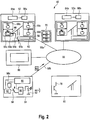
- Figure 2 shows a system 48 with a command processor 80, a verification processor 82, a first input device processor 84a in the input unit 52 and a second input device processor 84b in a further input unit 52a.
- a central control 86 of the system 48 is also shown.
- the input unit 52 is connected to the verification unit 54 via a network 88. This can be, for example, the KARL STORZ® Communication Bus (SCB).
- SCB KARL STORZ® Communication Bus
- the medical device 50 is an operating table here and has a receiver 78.
- the verification unit 54 has a logic circuit 90 which only sends a command via the transmitter 92, in particular by means of infrared transmission, when there is a control command from the command processor 80 or a command derived from the control command has been provided for the fourth transmission 34 and the verification processor 82 also enables the fourth transmission 34 by means of the symbolically illustrated switch 94.
- the system 48 furthermore has a memory which is composed of a first memory 96a in the input unit 52, a second memory 96b in the further input unit 52a and a third memory 96c in the verification unit 54.
- the first memory 96a and the third memory 96c contain instructions which, when they are executed by the at least one processor, cause the at least one processor to execute a method 10 as described above.
- the command ContextinformationRequest () 104 is first executed in the input unit 52. Then the Get Context Information () message 106 is sent to the command processor 80, which here is in connection with the communication channel 56a, 56b. In principle, however, it is also possible to send the message directly to the verification processor 82, but this would increase the complexity of the verification processor 82.
- the command processor 80 requests the context information 62 from the verification processor 82, which is then sent back to the input unit 52 via the command processor 80 (not shown).
- the context information 62 is linked to the control area 68a by means of the command Add configuration information to command element () 110.
- control message 70 is generated by means of the command Generate control message () 112.
- the control message 70 is sent to the command processor 80 by means of the control message Send () 114 message.
- the control command 72 is separated from the other elements of the control message 70, that is to say from the identification information 74 and the displacement information 76, by means of the control command Separate () 116.
- the control command 72 or a command derived from the control command 72 for sending is made available by means of the message Control command provide () 118 to the transmitter 92.
- the identification information 74 and the relocation information 76 are forwarded to the verification processor 82 by means of the message Forward security information ().
- the first check 30 and the second check 32 are carried out by means of the command Safeguard Information Evaluate () 122. If the first checking 30 and the second checking 32 have been concluded positively, the release () 124 is used to release to the transmitter 92 that the provided control command 72 can be sent.
- the message 126 can be used to confirm the successful or unsuccessful execution of the control command 72 from the command processor 82 to the input unit 52.
Landscapes
- Engineering & Computer Science (AREA)
- Theoretical Computer Science (AREA)
- General Engineering & Computer Science (AREA)
- Health & Medical Sciences (AREA)
- Physics & Mathematics (AREA)
- General Physics & Mathematics (AREA)
- Biomedical Technology (AREA)
- Human Computer Interaction (AREA)
- General Health & Medical Sciences (AREA)
- Public Health (AREA)
- Medical Informatics (AREA)
- Epidemiology (AREA)
- General Business, Economics & Management (AREA)
- Primary Health Care (AREA)
- Business, Economics & Management (AREA)
- Computer Security & Cryptography (AREA)
- Animal Behavior & Ethology (AREA)
- Software Systems (AREA)
- Life Sciences & Earth Sciences (AREA)
- Computer Hardware Design (AREA)
- Veterinary Medicine (AREA)
- User Interface Of Digital Computer (AREA)
- Measurement Of The Respiration, Hearing Ability, Form, And Blood Characteristics Of Living Organisms (AREA)
- Apparatus For Radiation Diagnosis (AREA)
- Infusion, Injection, And Reservoir Apparatuses (AREA)
- Accommodation For Nursing Or Treatment Tables (AREA)
- Manipulator (AREA)
Abstract
Description
- Die vorliegende Erfindung betrifft ein Verfahren zur sicheren Steuerung eines medizinischen Geräts über eine Eingabeeinheit unter Verwendung einer Verifikationseinheit, wobei die Eingabeeinheit mit der Verifikationseinheit über einen Kommunikationskanal kommuniziert. Die Erfindung betrifft ferner ein System mit mindestens einem Prozessor und mindestens einem Speicher, wobei der mindestens eine Speicher Anweisungen enthält, um ein Verfahren zur sicheren Steuerung auszuführen.
- Medizinische Geräte in einem Operationssaal weisen in der Regel eine Bedieneinheit auf, die an dem medizinischen Gerät angeordnet ist oder fest mit dem medizinischen Gerät verbunden ist. Auf diese Weise ist sichergestellt, dass die Zuordnung zwischen der Bedieneinheit und dem medizinischen Gerät eindeutig gegeben ist und Steuersignale von der Bedieneinheit auch tatsächlich nur das entsprechende medizinische Gerät erreichen.
- Heutige Operationssäle verfügen über eine umfangreiche Netzwerkstruktur, sei diese kabelgebunden oder kabellos, die es ermöglicht, medizinische Geräte mit einer Bedieneinheit zu steuern, die über das Netzwerk mit dem medizinischen Gerät verbunden ist. Dies ermöglicht eine große Flexibilität bei der Anordnung der Bedieneinheit und es kann ermöglicht werden, ein medizinisches Gerät mittels mehrerer Bedieneinheiten zu steuern.
- Die Netzwerkstruktur führt jedoch dazu, dass die im Bereich der Medizinprodukte geforderten Sicherheitsanforderungen nicht mehr ohne Weiteres gewährleistet sind. Um dennoch die erforderliche Sicherheit zu gewährleisten, wird einer Bedieneinheit ein separater Freigabeschalter zugeordnet, der mit dem medizinischen Gerät über einen logisch und physikalisch getrennten Signalpfad kommuniziert. Wenn das medizinische Gerät von der Bedieneinheit einen Steuerbefehl erhält, wird der Steuerbefehl nur dann ausgeführt, wenn gleichzeitig der Freigabeschalter dieser Bedieneinheit betätigt wird. So kann sichergestellt werden, dass ein Befehl, der am medizinischen Gerät ankommt, aber nicht von der entsprechenden Bedieneinheit gesendet wurde, vom medizinischen Gerät nicht ausgeführt wird.
- Eine solche Lösung ist zuverlässig und kann prinzipiell mit beliebigen medizinischen Geräten und Bedieneinheit eingesetzt werden. Um die notwendige Sicherheit zu erzielen, insbesondere die Sicherheitsklasse C nach der Norm IEC 62304, ist es jedoch erforderlich, den Freigabeschalter jeweils über den genannten, vom Netzwerk separaten Signalpfad mit dem medizinischen Gerät zu verbinden.
- Es ist eine Aufgabe der vorliegenden Erfindung, ein Verfahren zur sicheren Steuerung sowie ein entsprechendes System aufzuzeigen, bei denen auch ohne einen separaten Freigabeschalter die für medizinische Geräte erforderliche Sicherheit gewährleistet werden kann.
- Gemäß einem ersten Aspekt wird die Aufgabe gelöst durch ein Verfahren zur sicheren Steuerung eines medizinischen Geräts über eine Eingabeeinheit unter Verwendung einer Verifikationseinheit, wobei die Eingabeeinheit mit der Verifikationseinheit über einen Kommunikationskanal kommuniziert, das Verfahren mit den Schritten:
- erstes Erfassen, durch die Eingabeeinheit, einer ersten Betätigung an einem ersten Betätigungspunkt innerhalb eines Freigabebereichs auf der Eingabeeinheit, wobei die erste Betätigung eine Berührung und ein fortwährendes Halten der Berührung ist, wobei das Verfahren mit dem ersten Erfassen fortgesetzt wird, falls die Berührung beendet wird,
- erstes Senden, von der Eingabeeinheit an die Verifikationseinheit, einer Anforderung einer eindeutigen Kontextinformation, die eine eindeutige Zuordnung zwischen der Betätigung auf der Eingabeeinheit und der Verifikationseinheit herstellt,
- Erzeugen, durch die Verifikationseinheit, der Kontextinformation,
- zweites Senden, durch die Verifikationseinheit an die Eingabeeinheit, der Kontextinformation,
- zweites Erfassen, durch die Eingabeeinheit, einer zweiten Betätigung, wobei die zweite Betätigung eine Bewegung vom ersten Betätigungspunkt zu einem zweiten Betätigungspunkt innerhalb eines Steuerbereichs auf der Eingabeeinheit bei fortwährendem Halten der Berührung ist, wobei das Verfahren mit dem ersten Erfassen fortgesetzt wird, falls die Berührung beendet wird, und
- Ansteuern des medizinischen Geräts mit den folgenden sich wiederholenden Schritten, wobei das Verfahren mit dem ersten Erfassen fortgesetzt wird, falls die Berührung beendet wird:
- drittes Erfassen, durch die Eingabeeinheit, einer dritten Betätigung, wobei die dritte Betätigung eine Verlagerung innerhalb des Steuerbereichs bei fortwährendem Halten der Berührung ist,
- drittes Senden, von der Eingabeeinheit an die Verifikationseinheit, einer Steuernachricht, die einen Steuerbefehl, eine Identifikationsinformation und eine Verlagerungsinformation aufweist, wobei der Steuerbefehl dem Steuerbereich zugeordnet ist, die Identifikationsinformation die Kontextinformation oder eine aus der Kontextinformation abgeleitete Information aufweist und die Verlagerungsinformation Informationen aufweist, in der Länge und Richtung der Verlagerung enthalten sind oder daraus ermittelt werden können,
- erstes Überprüfen, durch die Verifikationseinheit, ob die Verlagerungsinformationen von zumindest einer Teilmenge der erfolgten dritten Betätigungen zeigt, dass die Verlagerung auf der Eingabeeinheit einer vorgegebenen Form folgt,
- zweites Überprüfen, durch die Verifikationseinheit, ob die Identifikationsinformation mit der Kontextinformation korrespondiert, und
- viertes Senden, durch die Verifikationseinheit an das medizinische Gerät, des Steuerbefehls oder eines aus dem Steuerbefehl abgeleiteten Befehls, wenn das erste Überprüfen und das zweite Überprüfen positiv abgeschlossen wurden.
- Eine der Besonderheiten dieses Verfahrens ist, dass zunächst in einem ersten Schritt, bevor überhaupt ein Steuerbefehl erzeugt wird, eine eindeutige Verbindung zwischen der Eingabeeinheit und dem medizinischen Gerät hergestellt wird. Dies erfolgt über die genannte Kontextinformation. Diese Kontextinformation, die von der Verifikationseinheit erzeugt wird, gibt der Verifikationseinheit die Möglichkeit, im weiteren Verlauf des Verfahrens, eine Steuernachricht, und damit einen Steuerbefehl, eindeutig der Eingabeeinheit zuzuordnen. Ferner kann sich die Eingabeeinheit gegenüber der Verifikationseinheit mittels der Identifikationsinformation identifizieren, die entweder diese Kontextinformation aufweist oder eine abgeleitete Information aufweist, die eindeutig einen Rückschluss auf die Kontextinformation ermöglicht.
- Der Begriff "eindeutig" wie er in dieser Anmeldung verwendet wird umfasst einerseits die mathematisch exakte Eindeutigkeit. Andererseits soll im Rahmen der Offenbarung auch eine solche Information als eindeutig verstanden werden, die sich nicht erraten lässt oder nur mit einer impraktikablen Anzahl an Versuchen durch Probieren ermittelt werden kann. So könnte die Identifikationsinformation beispielsweise eine Prüfsumme der Kontextinformation aufweisen und nicht die Kontextinformation selbst. Verwendet man beispielsweise ein Prüfsummenverfahren, welches über eine Milliarde, eine Billion oder mehr Möglichkeiten der Prüfsumme bietet, so soll die Zuordnung der Identifikationsinformation zur Kontextinformation immer noch als eindeutig verstanden werden, da es nicht praktikabel ist, durch Zufall die korrekte Prüfsumme zu erraten ohne die Kontextinformation tatsächlich zu kennen.
- Somit wird durch das Erzeugen der Kontextinformation durch die Verifikationseinheit, das Senden der Kontextinformation an die Eingabeeinheit und das spätere Senden der Identifikationsinformation von der Eingabeeinheit an die Verifikationseinheit sichergestellt, dass nur diese eindeutige Zuordnung zum Steuern des medizinischen Geräts zulässig ist.
- Ferner ist sichergestellt, dass die eindeutige Zuordnung nur aktiv durch den Benutzer hergestellt werden kann. Es erfordert nämlich die Eingabe des Benutzers an der Eingabeeinheit in einem speziellen Bereich der Eingabeeinheit, nämlich dem Freigabebereich. Nur dann sendet die Eingabeeinheit überhaupt die Anforderung für die Kontextinformation.
- Eine versehentliche oder falsche Bedienung der Eingabeeinheit wird danach durch das Erfordernis der zweiten Betätigung verhindert. Diese zweite Betätigung erfordert es, dass der Benutzer unter kontinuierlicher Berührung beispielsweise seinen Finger vom ersten Betätigungspunkt im Freigabebereich zu einem zweiten Betätigungspunkt innerhalb des Steuerbereichs verlagert. Findet diese zweite Betätigung nicht statt, wartet das Verfahren weiterhin auf die zweite Betätigung, zumindest für eine vorgegebene Zeit.
- Endet die Berührung, selbst wenn sie nur kurzzeitig unterbrochen wird, springt das Verfahren bevorzugt in einen Ausgangszustand zurück. Die gezielte Verlagerung des Betätigungspunkts auf der Eingabeeinheit vom Freigabebereich zum Steuerbereich kann nur mit geringer Wahrscheinlichkeit zufällig nachgebildet werden. Somit wird sichergestellt, dass der Benutzer auch tatsächlich das medizinische Gerät über die Eingabeeinheit steuern will.
- Auch die tatsächliche Steuerung des medizinischen Geräts über die Eingabeeinheit stellt sicher, dass die Steuerung aktiv durch den Benutzer gewollt ist und zweifelsfrei und ausschließlich über die eindeutig zugeordnete Eingabeeinheit erfolgt. Dies erfolgt anhand zweier unabhängiger Überprüfungen, die beide positiv abgeschlossen werden müssen, damit das medizinische Gerät tatsächlich angesteuert wird.
- Zum einen wird überprüft, ob eine Betätigung des Benutzers innerhalb des Steuerbereichs der Eingabeeinheit einer vorgegebenen Form folgt. Bevorzugt erfordert ein Folgen der vorgegebenen Form eine möglichst häufige Änderung hinsichtlich der Länge und/oder der Richtung der einzelnen Stücke der Verlagerung, die erforderlich sind, um der Form zu folgen.
- Zwar ist es grundsätzlich möglich, auch eine sehr einfache Form zu verwenden, beispielsweise eine Gerade, doch kann es dabei schwierig sein, eine tatsächliche gleichmäßige Bewegung, d.h. Verlagerungen, die stets dieselbe Länge und Richtung haben, von einer Situation zu unterscheiden, wenn aufgrund eines Systemfehlers immer wieder ein eingefrorener Wert von Länge und Richtung gesendet wird. Wird die Form hingegen mit vielen und ggf. fortlaufenden Richtungsänderungen erzeugt, so sind eingefrorene Werte von Länge und Richtung der Verlagerung schnell zu erkennen.
- Der Begriff des aus dem Steuerbefehl abgeleiteten Befehls soll dahingehend verstanden werden, dass es nicht erforderlich ist, dass die Verifikationseinheit dem von der Eingabeeinheit gesendeten Steuerbefehl exakt entspricht. So ist es auch möglich, dass die Verifikationseinheit einen Steuerbefehl in einem bestimmten Format oder mit einer bestimmten Information erhält, daraus aber ein Befehl abgeleitet werden muss, der dem Eingabeformat oder der Eingabeinformation entspricht, die das medizinische Gerät erwartet.
- Es sei dabei darauf hingewiesen, dass die Eingabeeinheit lediglich die Verlagerungsinformation sendet, nicht jedoch ausschließlich selbst prüft, ob die Verlagerung innerhalb des Steuerbereichs durch den Benutzer der vorgegebenen Form folgt. Würde die Eingabeeinheit nämlich beispielsweise einfach anhand eines Bits mitteilen, ob die Verlagerung gemäß der vorgegebenen Form erfolgt, so könnte das Kippen eines Bits auf der Übertragungsstrecke bei der Verifikationseinheit zu einem fehlerhaften Rückschluss führen. Stattdessen wertet die Verifikationseinheit die Verlagerungsinformation aus, um die Form der Verlagerung auf der Eingabeeinheit zu überprüfen.
- Grundsätzlich können alle Verlagerungsinformationen von allen erfolgten dritten Betätigungen berücksichtigt werden. Es ist in aller Regel aber ausreichend, lediglich eine Teilmenge der erfolgten dritten Betätigungen auszuwerten, insbesondere wenn die dritten Betätigungen in einem sehr engen zeitlichen Raster erfolgen. Ferner kann es hilfreich sein, bestimmte Verlagerungsinformationen außer Acht zu lassen, beispielsweise wenn der Benutzer die Betätigung für eine kurze Zeit ruhen lässt, z.B. für einen Zeitraum von bis zu einigen hundert Millisekunden.
- Die Verlagerungsinformation kann auf vielfältige Weise ausgestaltet sein. So kann die Verlagerungsinformation beispielsweise unmittelbar die Länge und die Richtung der dritten Betätigung enthalten. Die Verlagerungsinformation kann aber auch die Koordinaten des aktuellen Berührungspunkts übermitteln. So kann in Kenntnis des letzten Berührungspunkts auch Länge und die Richtung der dritten Betätigung ermittelt werden. Zudem kann auch eine Startposition der Verlagerung übermittelt werden, um weitere Überprüfungen und Plausibilitätsbetrachtungen durchzuführen.
- Ferner wird auch die zweite Überprüfung durchgeführt, bei der geprüft wird, ob die Identifikationsinformation mit der Kontextinformation korrespondiert. Ziel dieser Überprüfung ist es zu ermitteln, ob der Sender der Identifikationsinformation im Besitz der Kontextinformation ist. Wenn die Identifikationsinformation die Kontextinformation aufweist oder gleich der Kontextinformation ist, ist diese Feststellung besonders einfach zu treffen. Es kann aber durchaus ausreichend sein, dass die Identifikationsinformation nur Teile der Kontextinformation enthält, sofern sichergestellt ist, dass die Kenntnis der Kontextinformation nicht auf eine praktikable Weise vorgetäuscht werden.
- Die Identifikationsinformation kann auch Information enthalten, die aus der Kontextinformation abgeleitet ist, wie beispielsweise die oben erläuterte Prüfsumme. Da zumindest periodisch, bevorzugt kontinuierlich, geprüft wird, ob die Identifikationsinformation in der Steuernachricht mit der Kontextinformation korrespondiert, wird fortlaufend sichergestellt, dass Steuerbefehle ausschließlich im Kontext der eindeutigen Zuordnung zwischen der Eingabeeinheit und der Verifikationseinheit akzeptiert werden.
- Da ferner sowohl der eindeutige Beginn des Steuervorgangs als auch der fortlaufende Wunsch nach einer aktiven Steuerung durch den Benutzer geprüft werden, ist eine sichere Steuerung gegeben.
- Es sei darauf hingewiesen, dass die Betätigung, Berührung, Bewegung und Halten sowohl haptisch, also in physikalischem Kontakt mit der Eingabeeinheit erfolgen können, wie zum Beispiel bei einem Touchscreen, als auch virtuell erfolgen können, wie zum Beispiel in Verbindung mit einer Virtual Reality Brille, wenn der Benutzer aus seiner Perspektive eine virtuelle Oberfläche berührt.
- Das Verfahren ist aufgrund der vorgeschlagenen Ausgestaltung so sicher, dass es gemäß der Norm IEC 62304 die Sicherheitsklasse C erfüllen kann. Auch regulatorische Vorgaben aus dem Ausland können erfüllt werden, siehe z.B. "General Principles of Software Validation", abrufbar unter https://www.fda.gov/regulatory-information/search-fda-guidance-documents/general-principles-software-validation. Das heißt unter anderem, dass das Verfahren auch bei höchsten Sicherheitsanforderungen eingesetzt werden kann.
- Dadurch ist die Aufgabe vollständig gelöst.
- Bei einer vorteilhaften Ausgestaltung werden die jeweils nachfolgenden Schritte des Verfahrens nicht ausgeführt, falls während der Ausführung des Verfahrens die Berührung beendet wird.
- Auf diese Weise wird sichergestellt, dass bei einer unterbrochenen Berührung keine Ansteuerung stattfinden kann oder eine begonnene Ansteuerung beendet wird.
- Bei einer weiteren vorteilhaften Ausgestaltung wird das Verfahren mit dem ersten Erfassen fortgesetzt, falls während der Ausführung des Verfahrens die Berührung beendet wird.
- Auf diese Weise wird sichergestellt, dass das Verfahren bei einer unterbrochenen Berührung in einen definierten Ausgangszustand zurückkehrt und damit keine Ansteuerung stattfinden kann oder eine begonnene Ansteuerung beendet wird.
- Bei einer weiteren vorteilhaften Ausgestaltung weist die Verlagerungsinformation einen Befehlsprozessor und einen Verifikationsprozessor auf und stellt mit dem Befehlsprozessor den Steuerbefehl oder den aus dem Steuerbefehl abgeleiteten Befehl für das vierte Senden bereit und gibt mit dem Verifikationsprozessor das vierte Senden frei.
- Diese Ausgestaltung ist besonders sicher, da einerseits das Bereitstellen des Steuerbefehls und andererseits das Freigeben des Steuerbefehls, sprich, dass der Steuerbefehl tatsächlich gesendet werden kann, mittels zweier unterschiedlicher physikalischer Bauteile erfolgen. Da der Verifikationsprozessor dann sehr einfach ausgestaltet werden kann und damit auch kostengünstig für eine hohe Sicherheitsklasse ausgelegt werden kann, kann insgesamt die erforderliche Sicherheit der Verifikationseinheit kostengünstig erzielt werden.
- Bei einer weiteren vorteilhaften Ausgestaltung weist die Kontextinformation eine Geräteidentifikation der Verifikationseinheit auf.
- Auf diese Weise kann während des Verfahrens überprüft werden, ob die von der Eingabeeinheit gesendete Identifikationsinformation tatsächlich für die Verifikationseinheit bestimmt ist. Diese Prüfung kann auch über ein weiteres Element erfolgen, welches sowohl von der Eingabeeinheit als auch von der Verifikationseinheit unabhängig ist. Alternativ oder zusätzlich ist es möglich, dass die Kontextinformation eine Geräteidentifikation des Eingabegeräts aufweist.
- Bei einer weiteren vorteilhaften Ausgestaltung weist die Kontextinformation mindestens ein Element auf ausgewählt aus einer Gruppe bestehend aus einer Zeitinformation, einer Sitzungsinformation, einer Sequenzinformation und einer Startinformation.
- Diese Ausgestaltung ermöglicht eine oder mehrere weitere Überprüfungen, um sicherzustellen, dass ein Steuerbefehl nur im Kontext der eindeutigen Zuordnung zwischen dem Eingabegerät und der Verifikationseinheit erfolgt. Ferner kann auch die Plausibilität von Steuernachrichten überprüft werden. So kann anhand der Zeitinformation beispielsweise überprüft werden, ob die Steuernachrichten in zeitlich korrekter Reihenfolge eintreffen, ob die Abstände zwischen den Steuernachrichten einen Höchstabstand nicht überschreiten und ob die Laufzeit der Steuernachricht vom Eingabegerät zur Verifikationseinheit einen Höchstwert nicht überschreitet.
- Anhand der Sitzungsinformation kann überprüft werden, ob die Steuernachricht im Kontext des zuletzt erfolgten ersten Erfassens steht oder ob hier möglicherweise eine ältere Kontextinformation übermittelt wird, die nicht mehr als gültig verstanden werden soll. Die Sequenzinformation erlaubt es zu überprüfen, ob die Steuernachrichten in der richtigen Reihenfolge eingehen oder ermöglicht es, asynchron eingehende Steuernachrichten in die richtige Reihenfolge zu bringen. Die Startinformation, auch Seedinformation genannt, liefert einen spezifischen Startwert, der nicht auf praktikable Weise zufällig ermittelt werden kann. So kann die Startinformation beispielsweise eine zufällig erzeugte Zahl sein, insbesondere eine große Zahl. Schlägt eine dieser Überprüfungen fehl, kann die empfangene Steuernachricht verworfen werden oder die Steuerung abgebrochen werden und das Verfahren mit dem Schritt des ersten Erfassens fortgesetzt werden.
- Bei einer weiteren vorteilhaften Ausgestaltung ist die vorgegebene Form eine Ovalform, eine Ellipsenform oder eine Kreisform.
- Bei dieser Ausgestaltung ergeben sich im Formverlauf besonders viele Änderungen der Bewegungsrichtung. Somit kann schnell erkannt werden, falls die Steuernachricht eingefrorene Verlagerungsinformationen enthält, die nur scheinbar auf eine dritte Betätigung hinweisen.
- Bei einer weiteren vorteilhaften Ausgestaltung der Erfindung ist der Kommunikationskanal genau ein physikalischer und/oder ein logischer Kanal, und wird insbesondere der Steuerbefehl als genau eine Nachricht gesendet.
- Diese Ausgestaltung ist vorteilhaft, da es nicht erforderlich ist, mehrfache physikalische und/oder logische Kanäle zu verwenden. Zudem ist es insbesondere nicht erforderlich, den Steuerbefehl in mehreren Nachrichten zu senden. Dies ermöglicht einen vereinfachten Aufbau für die Verbindung zwischen der Eingabeeinheit und der Verifikationseinheit.
- Bei einer weiteren vorteilhaften Ausgestaltung der Erfindung wird das Verfahren mit dem ersten Erfassen fortgesetzt, falls sich die Verlagerungsinformation identisch oder innerhalb eines vorgegebenen Toleranzbereichs wiederholt.
- Wie bereits erläutert wird es als vorteilhaft angesehen, wenn das Verfahren so durchgeführt wird, dass ein periodisches oder fortlaufendes Ändern der Steuernachricht und insbesondere der Verlagerungsinformation erwartet werden darf. Insbesondere wird es einem Benutzer nicht gelingen, eine Bewegung so durchzuführen, dass die Verlagerungsinformationen identisch sind oder sich wiederholen. Je nach Auslegung kann außerdem ein Toleranzbereich festgelegt werden, innerhalb dessen eine Verlagerungsinformation immer noch als identisch angesehen werden soll. Dies bedeutet, dass wenn eine identische oder sich wiederholende Verlagerungsinformation erkannt wird, davon auszugehen ist, dass die Betätigung nicht durch einen Benutzer erfolgt, sondern anderweitig erzeugt wird, beispielsweise mittels eines sogenannten Replay. In einem solchen Zustand können bevorzugt Steuernachrichten verworfen werden und/oder die Steuerung abgebrochen werden und/oder das Verfahren mit dem ersten Erfassen fortgesetzt werden.
- Gemäß einem zweiten Aspekt wird die Aufgabe gelöst durch ein System mit mindestens einem Prozessor und mindestens einem Speicher, wobei der mindestens eine Speicher Anweisungen enthält, die bewirken, wenn sie von dem mindestens einen Prozessor ausgeführt werden, dass der mindestens eine Prozessor ein zuvor beschriebenes Verfahren ausführt.
- Bei einer vorteilhaften Ausgestaltung weist der mindestens eine Prozessor einen Befehlsprozessor und einen Verifikationsprozessor auf, wobei der Verifikationsprozessor für das erste und zweite Überprüfen sowie ein Freigeben des Steuerbefehls oder des aus dem Steuerbefehl abgeleiteten Befehls ausgebildet ist und der Befehlsprozessor für ein Bereitstellen des Steuerbefehls oder des aus dem Steuerbefehl abgeleiteten Befehls ausgebildet ist.
- Diese Ausgestaltung ist, wie bereits weiter oben erläutert, besonders sicher, da einerseits das Bereitstellen des Steuerbefehls und andererseits das Freigeben des Steuerbefehls, sprich, dass der Steuerbefehl tatsächlich gesendet werden kann, mittels zweier unterschiedlicher Bauteile erfolgen. Da der Verifikationsprozessor dann sehr einfach ausgestaltet werden kann und damit auch kostengünstig für eine hohe Sicherheitsklasse ausgelegt werden kann, kann insgesamt die erforderliche Sicherheit der Verifikationseinheit kostengünstig erzielt werden.
- Bei einer weiteren vorteilhaften Ausgestaltung weist die Eingabeeinheit einen Touchscreen oder eine Gestenerfassungseinheit auf, insbesondere in Verbindung mit einer Virtual Reality-Brille.
- Diese Ausgestaltung ermöglicht es, das System sowohl auf Basis einer tatsächlichen Berührung als auch auf Basis einer virtuellen Berührung zu realisieren. Dies ist insbesondere im Hinblick auf die zunehmende Verwendung von Virtual Reality-Brillen interessant, da eine Steuerung dann vom Benutzer auch ohne eine haptische Berührung einer Oberfläche sicher erfolgen kann.
- Bei einer weiteren vorteilhaften Ausgestaltung ist die Eingabeeinheit für eine Eingabe mittels Hand und/oder Finger eines Benutzers ausgebildet.
- Eine solche Art der Eingabe ist besonders einfach und intuitiv.
- Bei einer weiteren vorteilhaften Ausgestaltung ist das medizinische Gerät ein Operationstisch.
- Diese Ausgestaltung ist vorteilhaft, da die fortlaufende dritte Betätigung innerhalb des Steuerbereichs intuitiv genau so lange erfolgt, wie der Operationstisch verlagert werden soll. Zudem ist es auf einfache Weise möglich, auf der Eingabeeinheit mindestens zwei Steuerbereiche bereitzustellen, die unterschiedliche Steuerbefehle erzeugen. So können verschiedene Elemente des Operationstischs und/oder verschiedene Bewegungsrichtungen eines Elements des Operationstischs angesteuert werden.
- Es versteht sich, dass die vorstehend genannten und die nachstehend noch zu erläuternden Merkmale nicht nur in der jeweils angegebenen Kombination, sondern auch in anderen Kombinationen oder in Alleinstellung verwendbar sind, ohne den Rahmen der vorliegenden Erfindung zu verlassen.
- Ausführungsbeispiele der Erfindung sind in der Zeichnung dargestellt und werden in der nachfolgenden Beschreibung näher erläutert. Es zeigen:
- Figur 1
- ein Ausführungsbeispiel eines Verfahrens zur sicheren Steuerung eines medizinischen Geräts über eine Eingabeeinheit;
- Figur 2
- ein Ausführungsbeispiel eines Systems mit mindestens einem Prozessor, der ein Verfahren zur sicheren Steuerung eines medizinischen Geräts über eine Eingabeeinheit ausführt; und
- Figur 3
- eine Ausführungsform eines Verlaufs von Befehlen und Nachrichten bei einem Verfahren zur sicheren Steuerung eines medizinischen Geräts über eine Eingabeeinheit.
- Die nachfolgenden Erläuterungen erfolgen auf Basis einer Zusammenschau der
Figur 1 bis 3 . -
Figur 1 zeigt ein Verfahren zur sicheren Steuerung eines medizinischen Geräts 50 über eine Eingabeeinheit 52. Das Verfahren verwendet eine Verifikationseinheit 54, wobei die Eingabeeinheit 52 mit der Verifikationseinheit 54 über einen Kommunikationskanal 56a, 56b kommuniziert. - Das Verfahren weist ein erstes Erfassen 12, durch die Eingabeeinheit 52, einer ersten Betätigung an einem ersten Betätigungspunkt 58 innerhalb eines Freigabebereichs auf der Eingabeeinheit 52 auf. Dabei ist die erste Betätigung 64a eine Berührung und ein fortwährendes Halten der Berührung.
- Es ist hier anhand des Schritts 14 symbolisch dargestellt, dass das Verfahren 10 mit dem ersten Erfassen 12 fortgesetzt wird, falls die Berührung beendet wird. Diese Überprüfung findet bei dieser Ausgestaltung im Hintergrund statt und ist daher nicht einem konkreten Punkt im Ablauf des Verfahrens zugeordnet. Bei anderen Ausgestaltungen wird das Verfahren bei Beendigung der Berührung gestoppt und/oder wird das Verfahren in einen definierten Ausgangszustand gesetzt und/oder wird der Benutzer durch einen Hinweis auf das Beenden der Berührung hingewiesen.
- Im Schritt des ersten Sendens 16 sendet die Eingabeeinheit 52 eine Anforderung 106 an die Verifikationseinheit 54, um von dort eine eindeutige Kontextinformation 62 zu erhalten. Die Kontextinformation 62 stellt eine eindeutige Zuordnung zwischen der Betätigung auf der Eingabeeinheit 52 und der Verifikationseinheit 54 her.
- Auf die Anforderung 106 durch die Eingabeeinheit 52 erzeugt die Verifikationseinheit 54 im Schritt 18 die Kontextinformation.
- Wenn die Kontextinformation 62 erzeugt ist, wird sie durch ein zweites Senden 20 von der Verifikationseinheit 54 an die Eingabeeinheit 52 gesendet.
- Es folgt dann ein zweites Erfassen 22, durch die Eingabeeinheit 52, einer zweiten Betätigung 64b. Die zweite Betätigung 64b ist eine Bewegung vom ersten Betätigungspunkt 58 zu einem zweiten Betätigungspunkt 66 innerhalb eines Steuerbereichs 68a auf der Eingabeeinheit 52. Diese Bewegung erfolgt bei fortwährendem Halten der Berührung. Es sei hier daran erinnert, siehe Schritt 14, dass das Verfahren 10 mit dem ersten Erfassen 12 fortgesetzt wird, falls die Berührung beendet wird. Wenn die zweite Betätigung 64a erfasst wurde, wird nun im Schritt 24 das medizinische Gerät 50 mit sich wiederholenden Schritten angesteuert, die nachfolgend näher erläutert werden. Auch hier sei erneut daran erinnert, dass das Verfahren 10 mit dem ersten Erfassen 12 fortgesetzt wird, falls die Berührung beendet wird 14.
- Zunächst wird durch die Eingabeeinheit 52 ein drittes Erfassen 26 einer dritten Betätigung 64c durchgeführt. Bei der dritten Betätigung 64c handelt es sich um eine Verlagerung innerhalb des Steuerbereichs 68a bei fortwährendem Halten der Berührung.
- Es folgt ein drittes Senden 28, von der Eingabeeinheit 52 an die Verifikationseinheit 54, einer Steuernachricht 70, die einen Steuerbefehl 72, eine Identifikationsinformation 74 und eine Verlagerungsinformation 76 aufweist. Der Steuerbefehl 72 ist dem Steuerbereich 68a zugeordnet. Bei der hier gezeigten Ausführungsform sendet beispielsweise der weitere Steuerbereich 68b einen weiteren Steuerbefehl, der verschieden vom Steuerbefehl 72 ist.
- Die Identifikationsinformation 74 weist die Kontextinformation 62 oder eine aus der Kontextinformation 62 abgeleitete Information auf. Dabei kann diese Information beispielsweise durch ein Verkürzen oder ein Erweitern der Kontextinformation 62 erhalten sein oder das Ergebnis einer Berechnung, wie beispielsweise einer Prüfsumme, auf Basis der Kontextinformation 62 sein. Die Verlagerungsinformation 76 weist Informationen auf, in der Länge und Richtung der Verlagerung enthalten sind oder daraus ermittelt werden können. Die zeitliche Auflösung bei der Ermittlung der Verlagerung ist dabei so gewählt, dass aus einer Mehrzahl von Verlagerungsinformationen 76 die Form der vom Benutzer durchgeführten Bewegung auf dem Steuerbereich 68a ermittelt werden kann.
- Bei einem ersten Überprüfen 30, durch die Verifikationseinheit 54, wird überprüft, ob die Verlagerungsinformationen, die bisher oder zuletzt erhalten wurden, von zumindest einer Teilmenge der erfolgten dritten Betätigungen zeigt, dass die Verlagerung auf der Eingabeeinheit 52 einer vorgegebenen Form folgt. Ist beispielsweise durch Betrachtung der einzelnen, üblicherweise kurzen Segmente der dritten Betätigung ein Kreisbogen zu erkennen, so kann daraus auf eine Kreisform geschlossen werden.
- Bei einem zweiten Überprüfen 32 wird durch die Verifikationseinheit 54 überprüft, ob die Identifikationsinformation 74 mit der Kontextinformation 62 korrespondiert. Dabei soll insbesondere überprüft werden, dass die Identifikationsinformation 74 in Kenntnis der Kontextinformation 62 erfolgt ist und nicht zufällig erzeugt wurde.
- Wenn das erste Überprüfen 30 und das zweite Überprüfen 32 positiv abgeschlossen wurden, erfolgt ein viertes Senden 34, durch die Verifikationseinheit 54, an das medizinische Gerät 50, des Steuerbefehls oder eines aus dem Steuerbefehl abgeleiteten Befehls. Das medizinische Gerät 50 wird nun tatsächlich angesteuert. Dies kann beispielsweise bedeuten, dass sich das medizinische Gerät 50 oder ein Teil davon verlagert.
- Bei der hier gezeigten Ausführungsform des Verfahrens 10 ist zu erkennen, dass sowohl bei einem negativen Ergebnis des ersten Überprüfens 30, siehe den NEIN-Pfad, als auch bei einem negativen Ergebnis des zweiten Überprüfens 32, siehe den NEIN-Pfad, jeweils eine Rückkehr zum ersten Erfassen 12 erfolgt. Es ist grundsätzlich aber auch möglich, bei einem negativen Ergebnis zunächst zum dritten Erfassen 26 zu springen und erst nach mehreren negativen Prüfungen zurück zum ersten Erfassen 12 zu springen.
-
Figur 2 zeigt ein System 48 mit einem Befehlsprozessor 80, einem Verifikationsprozessor 82, einem ersten Eingabegerätprozessor 84a in der Eingabeeinheit 52 und einem zweiten Eingabegerätprozessor 84b in einer weiteren Eingabeeinheit 52a. Ferner ist eine Zentralsteuerung 86 des Systems 48 dargestellt. Die Eingabeeinheit 52 ist über ein Netzwerk 88 mit der Verifikationseinheit 54 verbunden. Hierbei kann es sich beispielsweise um den KARL STORZ® Communication Bus (SCB) handeln. - Das medizinische Gerät 50 ist hier ein Operationstisch und weist einen Empfänger 78 auf. Die Verifikationseinheit 54 weist eine Logikschaltung 90 auf, die nur dann über den Sender 92 einen Befehl sendet, insbesondere mittels Infrarot-Übertragung, wenn sowohl vom Befehlsprozessor 80 ein Steuerbefehl oder ein aus dem Steuerbefehl abgeleiteter Befehl für das vierte Senden 34 bereitgestellt wurde als auch der Verifikationsprozessor 82 das vierte Senden 34 mittels des symbolisch dargestellten Schalters 94 freigibt. Das System 48 weist ferner einen Speicher auf, der sich aus einem ersten Speicher 96a in der Eingabeeinheit 52, einem zweiten Speicher 96b in der weiteren Eingabeeinheit 52a und einem dritten Speicher 96c in der Verifikationseinheit 54 zusammensetzt. Bei der hier gezeigten Ausführungsform enthalten der erste Speicher 96a und der dritte Speicher 96c Anweisungen, die bewirken, wenn sie von dem mindestens einen Prozessor ausgeführt werden, dass der mindestens eine Prozessor ein Verfahren 10 wie zuvor beschrieben ausführt.
- In
Figur 3 wird anhand eines Ausführungsbeispiels der Verlauf 100 von Befehlen und Nachrichten an bzw. zwischen den verschiedenen Elementen dargestellt. Zunächst sei auf den Befehl KontextinformationErzeugen() 102 hingewiesen. Dieser wird permanent von dem Verifikationsprozessor 82 ausgeführt, so dass periodisch, z.B. im Abstand von mehreren hundert Millisekunden, insbesondere 200ms bis 800ms, stets eine neue Kontextinformation 62 erzeugt wird. - In der Eingabeeinheit 52 wird zunächst der Befehl KontextinformationAnfordern() 104 ausgeführt. Dann wird die Nachricht KontextinformationHolen() 106 an den Befehlsprozessor 80 gesendet, der hier in Verbindung mit dem Kommunikationskanal 56a, 56b steht. Es ist grundsätzlich aber auch möglich, die Nachricht direkt an den Verifikationsprozessor 82 zu senden, doch würde dies die Komplexität des Verifikationsprozessors 82 erhöhen. Mittels der Nachricht KontextinformationHolen() 108 fordert der Befehlsprozessor 80 die Kontextinformation 62 vom Verifikationsprozessor 82 an, die dann über den Befehlsprozessor 80 zurück zur Eingabeeinheit 52 gesendet wird (nicht gezeigt).
- Mittels des Befehls KonfigurationsinformationZuBefehlselementHinzufügen() 110 wird die Kontextinformation 62 mit dem Steuerbereich 68a verknüpft.
- Die nachfolgenden Befehle und Nachrichten werden innerhalb einer Schleife durchgeführt bzw. gesendet.
- Zunächst wird mittels des Befehls SteuernachrichtErzeugen() 112 die Steuernachricht 70 erzeugt. Mittels der Nachricht SteuernachrichtSenden() 114 wird die Steuernachricht 70 an den Befehlsprozessor 80 gesendet. Dort wird mittels des Befehls SteuerbefehlAbtrennen() 116 der Steuerbefehl 72 von den weiteren Elementen der Steuernachricht 70, also von der Identifikationsinformation 74 und der Verlagerungsinformation 76, getrennt.
- Mittels der Nachricht SteuerbefehlBereitstellen() 118 an den Sender 92 wird der Steuerbefehl 72 oder ein aus dem Steuerbefehl 72 abgeleiteter Befehl zum Senden bereitgestellt. Mittels der Nachricht SicherheitsinformationWeiterleiten() werden die Identifikationsinformation 74 und die Verlagerungsinformation 76 an den Verifikationsprozessor 82 weitergeleitet. Mittels des Befehls SicherungsinformationAuswerten() 122 werden das erste Überprüfen 30 und das zweite Überprüfen 32 durchgeführt. Wenn das erste Überprüfen 30 und das zweite Überprüfen 32 positiv abgeschlossen wurden, erfolgt über die Nachricht Freigeben() 124 die Freigabe an den Sender 92, dass der bereitgestellte Steuerbefehl 72 gesendet werden kann. Optional kann über die Nachricht 126 eine Bestätigung vom Befehlsprozessor 82 an die Eingabeeinheit 52 über das erfolgreiche oder nicht-erfolgreiche Ausführen des Steuerbefehls 72 erfolgen.
Claims (14)
- Verfahren (10) zur sicheren Steuerung eines medizinischen Geräts (50) über eine Eingabeeinheit (50) unter Verwendung einer Verifikationseinheit (54), wobei die Eingabeeinheit (52) mit der Verifikationseinheit (54) über einen Kommunikationskanal (56a, 56b) kommuniziert, das Verfahren (10) mit den Schritten:- erstes Erfassen (12), durch die Eingabeeinheit (52), einer ersten Betätigung (64a) an einem ersten Betätigungspunkt (58) innerhalb eines Freigabebereichs (60) auf der Eingabeeinheit (52), wobei die erste Betätigung (64a) eine Berührung und ein Fortbestehen der Berührung ist,- erstes Senden (16), von der Eingabeeinheit (52) an die Verifikationseinheit (54), einer Anforderung (106) einer eindeutigen Kontextinformation (62), die eine eindeutige Zuordnung zwischen der Betätigung auf der Eingabeeinheit (52) und der Verifikationseinheit (54) herstellt,- Erzeugen (18), durch die Verifikationseinheit (54), der Kontextinformation (62),- zweites Senden (20), durch die Verifikationseinheit (54) an die Eingabeeinheit (52), der Kontextinformation (62),- zweites Erfassen (22), durch die Eingabeeinheit (52), einer zweiten Betätigung (64b), die bei fortwährendem Halten der Berührung der ersten Betätigung folgt, wobei die zweite Betätigung (64b) eine Bewegung vom ersten Betätigungspunkt (58) zu einem zweiten Betätigungspunkt (66) innerhalb eines Steuerbereichs (68a) auf der Eingabeeinheit (52) bei fortwährendem Halten der Berührung ist, und- Ansteuern (24) des medizinischen Geräts (50) mit den folgenden sich wiederholenden Schritten:- drittes Erfassen (26), durch die Eingabeeinheit (52), einer dritten Betätigung (64c), wobei die dritte Betätigung eine Verlagerung innerhalb des Steuerbereichs (68a) bei fortwährendem Halten der Berührung ist,- drittes Senden (28), von der Eingabeeinheit (52) an die Verifikationseinheit (54), einer Steuernachricht (70), die einen Steuerbefehl (72), eine Identifikationsinformation (74) und eine Verlagerungsinformation (76) aufweist, wobei der Steuerbefehl (72) dem Steuerbereich (68a) zugeordnet ist, die Identifikationsinformation (74) die Kontextinformation (62) oder eine aus der Kontextinformation (62) abgeleitete Information aufweist und die Verlagerungsinformation (76) Informationen aufweist, in der Länge und Richtung der Verlagerung enthalten sind oder daraus ermittelt werden können,- erstes Überprüfen (30), durch die Verifikationseinheit (54), ob die Verlagerungsinformationen (76) von zumindest einer Teilmenge der erfolgten dritten Betätigungen zeigt, dass die Verlagerung auf der Eingabeeinheit (52) einer vorgegebenen Form folgt,- zweites Überprüfen (32), durch die Verifikationseinheit (54), ob die Identifikationsinformation (74) mit der Kontextinformation korrespondiert (62), und- viertes Senden (34), durch die Verifikationseinheit (54) an das medizinische Gerät (50), des Steuerbefehls (72) oder eines aus dem Steuerbefehl (72) abgeleiteten Befehls, wenn das erste Überprüfen (30) und das zweite Überprüfen (32) positiv abgeschlossen wurden.
- Verfahren nach Anspruch 1, wobei die jeweils nachfolgenden Schritte des Verfahrens nicht ausgeführt werden, falls während der Ausführung des Verfahrens die Berührung beendet wird.
- Verfahren nach einem der vorhergehenden Ansprüche, wobei das wobei das Verfahren (10) mit dem ersten Erfassen (12) fortgesetzt wird (14), falls während der Ausführung des Verfahrens die Berührung beendet wird.
- Verfahren nach einem der vorhergehenden Ansprüche, wobei die Verifikationseinheit (54) einen Befehlsprozessor (80) und einen Verifikationsprozessor (82) aufweist und mit dem Befehlsprozessor (80) den Steuerbefehl (72) oder den aus dem Steuerbefehl (72) abgeleiteten Befehl für das vierte Senden (34) bereitstellt und mit dem Verifikationsprozessor (82) das vierte Senden (34) freigibt.
- Verfahren nach einem der vorhergehenden Ansprüche, wobei die Kontextinformation (62) eine Geräteidentifikation der Verifikationseinheit (54) aufweist.
- Verfahren nach einem der vorhergehenden Ansprüche, wobei die Kontextinformation (62) mindestens ein Element ausgewählt aus einer Gruppe bestehend aus einer Zeitinformation, einer Sitzungsinformation, einer Sequenzinformation und einer Startinformation aufweist.
- Verfahren nach einem der vorhergehenden Ansprüche, wobei die vorgegebene Form eine Ovalform, eine Ellipsenform oder eine Kreisform ist.
- Verfahren nach einem der vorhergehenden Ansprüche, wobei der Kommunikationskanal (56a, 56b) genau ein physikalischer und/oder ein logischer Kanal ist, und insbesondere der Steuerbefehl (72) als genau eine Nachricht gesendet wird.
- Verfahren nach einem der vorhergehenden Ansprüche, wobei das Verfahren (10) mit dem ersten Erfassen (12) fortgesetzt wird, falls sich die Verlagerungsinformation (76) identisch oder innerhalb eines vorgegebenen Toleranzbereichs wiederholt.
- System (48) mit mindestens einem Prozessor und mindestens einem Speicher (96a, 96c), wobei der mindestens eine Speicher (96a, 96c) Anweisungen enthält, die bewirken, wenn sie von dem mindestens einen Prozessor ausgeführt werden, dass der mindestens eine Prozessor ein Verfahren (10) nach einem der vorhergehenden Ansprüche ausführt.
- System nach Anspruch 10, wobei der mindestens eine Prozessor einen Befehlsprozessor (80) und einen Verifikationsprozessor (82) aufweist, wobei der Verifikationsprozessor (82) für das erste und zweite Überprüfen (30, 32) sowie ein Freigeben (124) des Steuerbefehls (72) oder des aus dem Steuerbefehl (72) abgeleiteten Befehls ausgebildet ist und der Befehlsprozessor (80) für ein Bereitstellen des Steuerbefehls (72) oder des aus dem Steuerbefehl (72) abgeleiteten Befehls ausgebildet ist.
- System nach Anspruch 10 oder 11, wobei die Eingabeeinheit (52) einen Touchscreen oder eine Gestenerfassungseinheit, insbesondere in Verbindung mit einer Virtual Reality-Brille, aufweist.
- System nach einem der Ansprüche 10 bis 12, wobei die Eingabeeinheit (52) für eine Eingabe mittels Hand und/oder Finger eines Benutzers ausgebildet ist.
- System nach einem der Ansprüche 10 bis 13, wobei das medizinische Gerät (50) ein Operationstisch ist.
Applications Claiming Priority (1)
| Application Number | Priority Date | Filing Date | Title |
|---|---|---|---|
| DE102019122868.9A DE102019122868B4 (de) | 2019-08-26 | 2019-08-26 | Verfahren zur sicheren Steuerung und System |
Publications (2)
| Publication Number | Publication Date |
|---|---|
| EP3786975A1 true EP3786975A1 (de) | 2021-03-03 |
| EP3786975B1 EP3786975B1 (de) | 2021-10-27 |
Family
ID=72046691
Family Applications (1)
| Application Number | Title | Priority Date | Filing Date |
|---|---|---|---|
| EP20190369.7A Active EP3786975B1 (de) | 2019-08-26 | 2020-08-10 | Verfahren zur sicheren steuerung und system |
Country Status (4)
| Country | Link |
|---|---|
| US (1) | US11058597B2 (de) |
| EP (1) | EP3786975B1 (de) |
| CN (1) | CN112435739B (de) |
| DE (1) | DE102019122868B4 (de) |
Citations (2)
| Publication number | Priority date | Publication date | Assignee | Title |
|---|---|---|---|---|
| DE102013100428A1 (de) * | 2013-01-16 | 2014-07-17 | MAQUET GmbH | Verfahren und Vorrichtung zur drahtlosen Steuerung eines Operationstischs |
| US20170140169A1 (en) * | 2013-04-01 | 2017-05-18 | Passtouch, Llc | System and method for signature pathway authentication and identification |
Family Cites Families (10)
| Publication number | Priority date | Publication date | Assignee | Title |
|---|---|---|---|---|
| CN100568250C (zh) * | 2004-11-12 | 2009-12-09 | 皇家飞利浦电子股份有限公司 | 用于提供用户识别和认证的用户接口及其方法 |
| US9439736B2 (en) * | 2009-07-22 | 2016-09-13 | St. Jude Medical, Atrial Fibrillation Division, Inc. | System and method for controlling a remote medical device guidance system in three-dimensions using gestures |
| FI125658B (fi) * | 2011-10-12 | 2015-12-31 | Merivaara Oy | Menetelmä leikkauspöydän ohjaamiseksi kannettavalla laitteella |
| DE102012220672A1 (de) * | 2012-11-13 | 2014-05-15 | Trumpf Medizin Systeme Gmbh + Co. Kg | Medizinisches Steuerungssystem |
| DE102013219155A1 (de) * | 2013-09-24 | 2015-03-26 | Siemens Aktiengesellschaft | Verfahren zur Steuerung von Bewegungen eines medizinischen Gerätes, Steuergerät hierfür sowie medizinisches Gerät |
| DE102013226244B4 (de) * | 2013-12-17 | 2026-05-07 | Siemens Healthineers Ag | Medizintechnische Steuerung |
| WO2015102685A1 (en) * | 2013-12-31 | 2015-07-09 | General Electric Company | Touch screen display device and method of touch input control |
| CN104750406B (zh) * | 2013-12-31 | 2019-12-24 | 深圳迈瑞生物医疗电子股份有限公司 | 监护设备及其显示界面布局调整方法、装置 |
| US10675468B2 (en) * | 2015-09-18 | 2020-06-09 | Medtronic, Inc. | Electrical stimulation therapy for inducing patient sensations |
| US10891040B2 (en) * | 2016-04-01 | 2021-01-12 | Gambro Lundia Ab | Systems and methods including bar-type parameter adjustment elements |
-
2019
- 2019-08-26 DE DE102019122868.9A patent/DE102019122868B4/de active Active
-
2020
- 2020-08-10 EP EP20190369.7A patent/EP3786975B1/de active Active
- 2020-08-25 US US17/002,206 patent/US11058597B2/en active Active
- 2020-08-25 CN CN202010867669.6A patent/CN112435739B/zh active Active
Patent Citations (2)
| Publication number | Priority date | Publication date | Assignee | Title |
|---|---|---|---|---|
| DE102013100428A1 (de) * | 2013-01-16 | 2014-07-17 | MAQUET GmbH | Verfahren und Vorrichtung zur drahtlosen Steuerung eines Operationstischs |
| US20170140169A1 (en) * | 2013-04-01 | 2017-05-18 | Passtouch, Llc | System and method for signature pathway authentication and identification |
Also Published As
| Publication number | Publication date |
|---|---|
| DE102019122868B4 (de) | 2021-05-27 |
| US20210059884A1 (en) | 2021-03-04 |
| CN112435739B (zh) | 2022-11-01 |
| US11058597B2 (en) | 2021-07-13 |
| DE102019122868A1 (de) | 2021-03-04 |
| EP3786975B1 (de) | 2021-10-27 |
| CN112435739A (zh) | 2021-03-02 |
Similar Documents
| Publication | Publication Date | Title |
|---|---|---|
| DE3779694T2 (de) | Rechnernetzwerksystem. | |
| DE10353950B4 (de) | Steuerungssystem | |
| EP2266297B1 (de) | Automatische busadressvergabe mittels kollisionsprüfung | |
| EP3026513B1 (de) | Redundantes Automatisierungssystem und Verfahren zum Betrieb | |
| DE69707664T2 (de) | Verfahren zur auswahl eines elektronischen moduls aus mehreren im abfragefeld eines endgeräts | |
| WO2016005085A1 (de) | Verfahren zum verarbeiten von daten für eine fahrfunktion eines fahrzeuges | |
| DE102013002647B3 (de) | Kraftwagen mit einem Fahrzeugkommunikationsbus und Verfahren zum Erzeugen von Busnachrichten | |
| EP3298730B1 (de) | Bussystem und verfahren zum zuteilen von adressen von busteilnehmern eines bussystems | |
| EP3786975B1 (de) | Verfahren zur sicheren steuerung und system | |
| EP0509114B1 (de) | Verfahren zum Übertragen von Daten an mehrere Datenstationen | |
| EP2745205B1 (de) | Verfahren zum betreiben eines steuerungsnetzwerk und steuerungsnetzwerk | |
| DE102019116657B4 (de) | System und Verfahren zur kombinierten Energieübertragung und Datenübertragung in einem Automatisierungssystem | |
| DE102019208612B4 (de) | Verfahren zum Betrieb einer Magnetresonanzeinrichtung mit einer Patientenliege und Magnetresonanzeinrichtung | |
| EP3133447B1 (de) | Sicherheitsschalter | |
| DE102009005266A1 (de) | Anbindung eines Kommunikationscontrollers in Sicherheitsarchitekturen | |
| WO2025007174A2 (de) | Touch-screen-eingabesystem und eingabeverfahren | |
| EP1586917A2 (de) | Verfahren zur Auswahl eines oder mehrer Transponder | |
| DE102015215847B3 (de) | Vorrichtung und Verfahren zur Erhöhung der funktionalen Sicherheit in einem Fahrzeug. | |
| DE102018222476A1 (de) | Informationsvorrichtung zum Informieren eines Fahrers und Verfahren zum Informieren eines Fahrers | |
| DE102018129614B4 (de) | Mit einer Funktionalität zur Operationsbeteiligung versehenes Computer-Eingabesystem und Eingabeverfahren | |
| EP0936515B1 (de) | Mehrprozessor-Steuervorrichtung | |
| EP3544566B1 (de) | Operationstisch und verfahren zur ansteuerung von aktuatoren in einem operationstisch | |
| DE102024001526A1 (de) | Verfahren zur Erkennung eines Fahrerübernahmewunsches für einen Wechsel von einem automatisierten Fahrbetrieb in einen manuellen Fahrbetrieb eines Fahrzeuges | |
| DE102023116849A1 (de) | Steuerungssystem und Betriebsverfahren für das Steuerungssystem | |
| DE102020105080B3 (de) | Vorrichtung zur sicheren Durchführung einer Ansteuerung und System |
Legal Events
| Date | Code | Title | Description |
|---|---|---|---|
| PUAI | Public reference made under article 153(3) epc to a published international application that has entered the european phase |
Free format text: ORIGINAL CODE: 0009012 |
|
| STAA | Information on the status of an ep patent application or granted ep patent |
Free format text: STATUS: THE APPLICATION HAS BEEN PUBLISHED |
|
| AK | Designated contracting states |
Kind code of ref document: A1 Designated state(s): AL AT BE BG CH CY CZ DE DK EE ES FI FR GB GR HR HU IE IS IT LI LT LU LV MC MK MT NL NO PL PT RO RS SE SI SK SM TR |
|
| AX | Request for extension of the european patent |
Extension state: BA ME |
|
| STAA | Information on the status of an ep patent application or granted ep patent |
Free format text: STATUS: REQUEST FOR EXAMINATION WAS MADE |
|
| 17P | Request for examination filed |
Effective date: 20210302 |
|
| RBV | Designated contracting states (corrected) |
Designated state(s): AL AT BE BG CH CY CZ DE DK EE ES FI FR GB GR HR HU IE IS IT LI LT LU LV MC MK MT NL NO PL PT RO RS SE SI SK SM TR |
|
| GRAP | Despatch of communication of intention to grant a patent |
Free format text: ORIGINAL CODE: EPIDOSNIGR1 |
|
| STAA | Information on the status of an ep patent application or granted ep patent |
Free format text: STATUS: GRANT OF PATENT IS INTENDED |
|
| INTG | Intention to grant announced |
Effective date: 20210615 |
|
| GRAS | Grant fee paid |
Free format text: ORIGINAL CODE: EPIDOSNIGR3 |
|
| GRAA | (expected) grant |
Free format text: ORIGINAL CODE: 0009210 |
|
| STAA | Information on the status of an ep patent application or granted ep patent |
Free format text: STATUS: THE PATENT HAS BEEN GRANTED |
|
| AK | Designated contracting states |
Kind code of ref document: B1 Designated state(s): AL AT BE BG CH CY CZ DE DK EE ES FI FR GB GR HR HU IE IS IT LI LT LU LV MC MK MT NL NO PL PT RO RS SE SI SK SM TR |
|
| REG | Reference to a national code |
Ref country code: GB Ref legal event code: FG4D Free format text: NOT ENGLISH |
|
| REG | Reference to a national code |
Ref country code: CH Ref legal event code: EP |
|
| REG | Reference to a national code |
Ref country code: DE Ref legal event code: R096 Ref document number: 502020000304 Country of ref document: DE |
|
| REG | Reference to a national code |
Ref country code: AT Ref legal event code: REF Ref document number: 1442561 Country of ref document: AT Kind code of ref document: T Effective date: 20211115 |
|
| REG | Reference to a national code |
Ref country code: IE Ref legal event code: FG4D Free format text: LANGUAGE OF EP DOCUMENT: GERMAN |
|
| REG | Reference to a national code |
Ref country code: LT Ref legal event code: MG9D |
|
| REG | Reference to a national code |
Ref country code: NL Ref legal event code: MP Effective date: 20211027 |
|
| PG25 | Lapsed in a contracting state [announced via postgrant information from national office to epo] |
Ref country code: RS Free format text: LAPSE BECAUSE OF FAILURE TO SUBMIT A TRANSLATION OF THE DESCRIPTION OR TO PAY THE FEE WITHIN THE PRESCRIBED TIME-LIMIT Effective date: 20211027 Ref country code: LT Free format text: LAPSE BECAUSE OF FAILURE TO SUBMIT A TRANSLATION OF THE DESCRIPTION OR TO PAY THE FEE WITHIN THE PRESCRIBED TIME-LIMIT Effective date: 20211027 Ref country code: FI Free format text: LAPSE BECAUSE OF FAILURE TO SUBMIT A TRANSLATION OF THE DESCRIPTION OR TO PAY THE FEE WITHIN THE PRESCRIBED TIME-LIMIT Effective date: 20211027 Ref country code: BG Free format text: LAPSE BECAUSE OF FAILURE TO SUBMIT A TRANSLATION OF THE DESCRIPTION OR TO PAY THE FEE WITHIN THE PRESCRIBED TIME-LIMIT Effective date: 20220127 |
|
| PG25 | Lapsed in a contracting state [announced via postgrant information from national office to epo] |
Ref country code: IS Free format text: LAPSE BECAUSE OF FAILURE TO SUBMIT A TRANSLATION OF THE DESCRIPTION OR TO PAY THE FEE WITHIN THE PRESCRIBED TIME-LIMIT Effective date: 20220227 Ref country code: SE Free format text: LAPSE BECAUSE OF FAILURE TO SUBMIT A TRANSLATION OF THE DESCRIPTION OR TO PAY THE FEE WITHIN THE PRESCRIBED TIME-LIMIT Effective date: 20211027 Ref country code: PT Free format text: LAPSE BECAUSE OF FAILURE TO SUBMIT A TRANSLATION OF THE DESCRIPTION OR TO PAY THE FEE WITHIN THE PRESCRIBED TIME-LIMIT Effective date: 20220228 Ref country code: PL Free format text: LAPSE BECAUSE OF FAILURE TO SUBMIT A TRANSLATION OF THE DESCRIPTION OR TO PAY THE FEE WITHIN THE PRESCRIBED TIME-LIMIT Effective date: 20211027 Ref country code: NO Free format text: LAPSE BECAUSE OF FAILURE TO SUBMIT A TRANSLATION OF THE DESCRIPTION OR TO PAY THE FEE WITHIN THE PRESCRIBED TIME-LIMIT Effective date: 20220127 Ref country code: NL Free format text: LAPSE BECAUSE OF FAILURE TO SUBMIT A TRANSLATION OF THE DESCRIPTION OR TO PAY THE FEE WITHIN THE PRESCRIBED TIME-LIMIT Effective date: 20211027 Ref country code: LV Free format text: LAPSE BECAUSE OF FAILURE TO SUBMIT A TRANSLATION OF THE DESCRIPTION OR TO PAY THE FEE WITHIN THE PRESCRIBED TIME-LIMIT Effective date: 20211027 Ref country code: HR Free format text: LAPSE BECAUSE OF FAILURE TO SUBMIT A TRANSLATION OF THE DESCRIPTION OR TO PAY THE FEE WITHIN THE PRESCRIBED TIME-LIMIT Effective date: 20211027 Ref country code: GR Free format text: LAPSE BECAUSE OF FAILURE TO SUBMIT A TRANSLATION OF THE DESCRIPTION OR TO PAY THE FEE WITHIN THE PRESCRIBED TIME-LIMIT Effective date: 20220128 Ref country code: ES Free format text: LAPSE BECAUSE OF FAILURE TO SUBMIT A TRANSLATION OF THE DESCRIPTION OR TO PAY THE FEE WITHIN THE PRESCRIBED TIME-LIMIT Effective date: 20211027 |
|
| REG | Reference to a national code |
Ref country code: DE Ref legal event code: R097 Ref document number: 502020000304 Country of ref document: DE |
|
| PG25 | Lapsed in a contracting state [announced via postgrant information from national office to epo] |
Ref country code: SM Free format text: LAPSE BECAUSE OF FAILURE TO SUBMIT A TRANSLATION OF THE DESCRIPTION OR TO PAY THE FEE WITHIN THE PRESCRIBED TIME-LIMIT Effective date: 20211027 Ref country code: SK Free format text: LAPSE BECAUSE OF FAILURE TO SUBMIT A TRANSLATION OF THE DESCRIPTION OR TO PAY THE FEE WITHIN THE PRESCRIBED TIME-LIMIT Effective date: 20211027 Ref country code: RO Free format text: LAPSE BECAUSE OF FAILURE TO SUBMIT A TRANSLATION OF THE DESCRIPTION OR TO PAY THE FEE WITHIN THE PRESCRIBED TIME-LIMIT Effective date: 20211027 Ref country code: EE Free format text: LAPSE BECAUSE OF FAILURE TO SUBMIT A TRANSLATION OF THE DESCRIPTION OR TO PAY THE FEE WITHIN THE PRESCRIBED TIME-LIMIT Effective date: 20211027 Ref country code: DK Free format text: LAPSE BECAUSE OF FAILURE TO SUBMIT A TRANSLATION OF THE DESCRIPTION OR TO PAY THE FEE WITHIN THE PRESCRIBED TIME-LIMIT Effective date: 20211027 Ref country code: CZ Free format text: LAPSE BECAUSE OF FAILURE TO SUBMIT A TRANSLATION OF THE DESCRIPTION OR TO PAY THE FEE WITHIN THE PRESCRIBED TIME-LIMIT Effective date: 20211027 |
|
| PLBE | No opposition filed within time limit |
Free format text: ORIGINAL CODE: 0009261 |
|
| STAA | Information on the status of an ep patent application or granted ep patent |
Free format text: STATUS: NO OPPOSITION FILED WITHIN TIME LIMIT |
|
| 26N | No opposition filed |
Effective date: 20220728 |
|
| PG25 | Lapsed in a contracting state [announced via postgrant information from national office to epo] |
Ref country code: AL Free format text: LAPSE BECAUSE OF FAILURE TO SUBMIT A TRANSLATION OF THE DESCRIPTION OR TO PAY THE FEE WITHIN THE PRESCRIBED TIME-LIMIT Effective date: 20211027 |
|
| PG25 | Lapsed in a contracting state [announced via postgrant information from national office to epo] |
Ref country code: MC Free format text: LAPSE BECAUSE OF FAILURE TO SUBMIT A TRANSLATION OF THE DESCRIPTION OR TO PAY THE FEE WITHIN THE PRESCRIBED TIME-LIMIT Effective date: 20211027 |
|
| PG25 | Lapsed in a contracting state [announced via postgrant information from national office to epo] |
Ref country code: LU Free format text: LAPSE BECAUSE OF NON-PAYMENT OF DUE FEES Effective date: 20220810 |
|
| REG | Reference to a national code |
Ref country code: BE Ref legal event code: MM Effective date: 20220831 |
|
| P01 | Opt-out of the competence of the unified patent court (upc) registered |
Effective date: 20230527 |
|
| PG25 | Lapsed in a contracting state [announced via postgrant information from national office to epo] |
Ref country code: IE Free format text: LAPSE BECAUSE OF NON-PAYMENT OF DUE FEES Effective date: 20220810 |
|
| PG25 | Lapsed in a contracting state [announced via postgrant information from national office to epo] |
Ref country code: BE Free format text: LAPSE BECAUSE OF NON-PAYMENT OF DUE FEES Effective date: 20220831 |
|
| REG | Reference to a national code |
Ref country code: CH Ref legal event code: PL |
|
| PG25 | Lapsed in a contracting state [announced via postgrant information from national office to epo] |
Ref country code: CY Free format text: LAPSE BECAUSE OF FAILURE TO SUBMIT A TRANSLATION OF THE DESCRIPTION OR TO PAY THE FEE WITHIN THE PRESCRIBED TIME-LIMIT Effective date: 20211027 Ref country code: CH Free format text: LAPSE BECAUSE OF NON-PAYMENT OF DUE FEES Effective date: 20230831 |
|
| PG25 | Lapsed in a contracting state [announced via postgrant information from national office to epo] |
Ref country code: MK Free format text: LAPSE BECAUSE OF FAILURE TO SUBMIT A TRANSLATION OF THE DESCRIPTION OR TO PAY THE FEE WITHIN THE PRESCRIBED TIME-LIMIT Effective date: 20211027 Ref country code: HU Free format text: LAPSE BECAUSE OF FAILURE TO SUBMIT A TRANSLATION OF THE DESCRIPTION OR TO PAY THE FEE WITHIN THE PRESCRIBED TIME-LIMIT; INVALID AB INITIO Effective date: 20200810 |
|
| PG25 | Lapsed in a contracting state [announced via postgrant information from national office to epo] |
Ref country code: MT Free format text: LAPSE BECAUSE OF FAILURE TO SUBMIT A TRANSLATION OF THE DESCRIPTION OR TO PAY THE FEE WITHIN THE PRESCRIBED TIME-LIMIT Effective date: 20211027 |
|
| PGFP | Annual fee paid to national office [announced via postgrant information from national office to epo] |
Ref country code: DE Payment date: 20250827 Year of fee payment: 6 |
|
| PGFP | Annual fee paid to national office [announced via postgrant information from national office to epo] |
Ref country code: IT Payment date: 20250825 Year of fee payment: 6 |
|
| PGFP | Annual fee paid to national office [announced via postgrant information from national office to epo] |
Ref country code: GB Payment date: 20250826 Year of fee payment: 6 |
|
| PGFP | Annual fee paid to national office [announced via postgrant information from national office to epo] |
Ref country code: AT Payment date: 20251020 Year of fee payment: 5 Ref country code: FR Payment date: 20250825 Year of fee payment: 6 |
|
| PG25 | Lapsed in a contracting state [announced via postgrant information from national office to epo] |
Ref country code: TR Free format text: LAPSE BECAUSE OF FAILURE TO SUBMIT A TRANSLATION OF THE DESCRIPTION OR TO PAY THE FEE WITHIN THE PRESCRIBED TIME-LIMIT Effective date: 20211027 |
|
| PG25 | Lapsed in a contracting state [announced via postgrant information from national office to epo] |
Ref country code: SI Free format text: LAPSE BECAUSE OF FAILURE TO SUBMIT A TRANSLATION OF THE DESCRIPTION OR TO PAY THE FEE WITHIN THE PRESCRIBED TIME-LIMIT Effective date: 20211027 |