EP3786920B1 - Information processing device and information processing method - Google Patents
Information processing device and information processing method Download PDFInfo
- Publication number
- EP3786920B1 EP3786920B1 EP19791627.3A EP19791627A EP3786920B1 EP 3786920 B1 EP3786920 B1 EP 3786920B1 EP 19791627 A EP19791627 A EP 19791627A EP 3786920 B1 EP3786920 B1 EP 3786920B1
- Authority
- EP
- European Patent Office
- Prior art keywords
- driver
- range
- host vehicle
- information
- vehicle
- Prior art date
- Legal status (The legal status is an assumption and is not a legal conclusion. Google has not performed a legal analysis and makes no representation as to the accuracy of the status listed.)
- Active
Links
Images










Classifications
-
- G—PHYSICS
- G06—COMPUTING OR CALCULATING; COUNTING
- G06V—IMAGE OR VIDEO RECOGNITION OR UNDERSTANDING
- G06V40/00—Recognition of biometric, human-related or animal-related patterns in image or video data
- G06V40/10—Human or animal bodies, e.g. vehicle occupants or pedestrians; Body parts, e.g. hands
- G06V40/18—Eye characteristics, e.g. of the iris
-
- G—PHYSICS
- G06—COMPUTING OR CALCULATING; COUNTING
- G06V—IMAGE OR VIDEO RECOGNITION OR UNDERSTANDING
- G06V20/00—Scenes; Scene-specific elements
- G06V20/50—Context or environment of the image
- G06V20/59—Context or environment of the image inside of a vehicle, e.g. relating to seat occupancy, driver state or inner lighting conditions
- G06V20/597—Recognising the driver's state or behaviour, e.g. attention or drowsiness
-
- B—PERFORMING OPERATIONS; TRANSPORTING
- B60—VEHICLES IN GENERAL
- B60K—ARRANGEMENT OR MOUNTING OF PROPULSION UNITS OR OF TRANSMISSIONS IN VEHICLES; ARRANGEMENT OR MOUNTING OF PLURAL DIVERSE PRIME-MOVERS IN VEHICLES; AUXILIARY DRIVES FOR VEHICLES; INSTRUMENTATION OR DASHBOARDS FOR VEHICLES; ARRANGEMENTS IN CONNECTION WITH COOLING, AIR INTAKE, GAS EXHAUST OR FUEL SUPPLY OF PROPULSION UNITS IN VEHICLES
- B60K35/00—Instruments specially adapted for vehicles; Arrangement of instruments in or on vehicles
- B60K35/10—Input arrangements, i.e. from user to vehicle, associated with vehicle functions or specially adapted therefor
-
- B—PERFORMING OPERATIONS; TRANSPORTING
- B60—VEHICLES IN GENERAL
- B60K—ARRANGEMENT OR MOUNTING OF PROPULSION UNITS OR OF TRANSMISSIONS IN VEHICLES; ARRANGEMENT OR MOUNTING OF PLURAL DIVERSE PRIME-MOVERS IN VEHICLES; AUXILIARY DRIVES FOR VEHICLES; INSTRUMENTATION OR DASHBOARDS FOR VEHICLES; ARRANGEMENTS IN CONNECTION WITH COOLING, AIR INTAKE, GAS EXHAUST OR FUEL SUPPLY OF PROPULSION UNITS IN VEHICLES
- B60K35/00—Instruments specially adapted for vehicles; Arrangement of instruments in or on vehicles
- B60K35/20—Output arrangements, i.e. from vehicle to user, associated with vehicle functions or specially adapted therefor
- B60K35/21—Output arrangements, i.e. from vehicle to user, associated with vehicle functions or specially adapted therefor using visual output, e.g. blinking lights or matrix displays
- B60K35/22—Display screens
-
- B—PERFORMING OPERATIONS; TRANSPORTING
- B60—VEHICLES IN GENERAL
- B60K—ARRANGEMENT OR MOUNTING OF PROPULSION UNITS OR OF TRANSMISSIONS IN VEHICLES; ARRANGEMENT OR MOUNTING OF PLURAL DIVERSE PRIME-MOVERS IN VEHICLES; AUXILIARY DRIVES FOR VEHICLES; INSTRUMENTATION OR DASHBOARDS FOR VEHICLES; ARRANGEMENTS IN CONNECTION WITH COOLING, AIR INTAKE, GAS EXHAUST OR FUEL SUPPLY OF PROPULSION UNITS IN VEHICLES
- B60K35/00—Instruments specially adapted for vehicles; Arrangement of instruments in or on vehicles
- B60K35/20—Output arrangements, i.e. from vehicle to user, associated with vehicle functions or specially adapted therefor
- B60K35/21—Output arrangements, i.e. from vehicle to user, associated with vehicle functions or specially adapted therefor using visual output, e.g. blinking lights or matrix displays
- B60K35/23—Head-up displays [HUD]
-
- B—PERFORMING OPERATIONS; TRANSPORTING
- B60—VEHICLES IN GENERAL
- B60K—ARRANGEMENT OR MOUNTING OF PROPULSION UNITS OR OF TRANSMISSIONS IN VEHICLES; ARRANGEMENT OR MOUNTING OF PLURAL DIVERSE PRIME-MOVERS IN VEHICLES; AUXILIARY DRIVES FOR VEHICLES; INSTRUMENTATION OR DASHBOARDS FOR VEHICLES; ARRANGEMENTS IN CONNECTION WITH COOLING, AIR INTAKE, GAS EXHAUST OR FUEL SUPPLY OF PROPULSION UNITS IN VEHICLES
- B60K35/00—Instruments specially adapted for vehicles; Arrangement of instruments in or on vehicles
- B60K35/50—Instruments characterised by their means of attachment to or integration in the vehicle
-
- B—PERFORMING OPERATIONS; TRANSPORTING
- B60—VEHICLES IN GENERAL
- B60K—ARRANGEMENT OR MOUNTING OF PROPULSION UNITS OR OF TRANSMISSIONS IN VEHICLES; ARRANGEMENT OR MOUNTING OF PLURAL DIVERSE PRIME-MOVERS IN VEHICLES; AUXILIARY DRIVES FOR VEHICLES; INSTRUMENTATION OR DASHBOARDS FOR VEHICLES; ARRANGEMENTS IN CONNECTION WITH COOLING, AIR INTAKE, GAS EXHAUST OR FUEL SUPPLY OF PROPULSION UNITS IN VEHICLES
- B60K35/00—Instruments specially adapted for vehicles; Arrangement of instruments in or on vehicles
- B60K35/60—Instruments characterised by their location or relative disposition in or on vehicles
-
- B—PERFORMING OPERATIONS; TRANSPORTING
- B60—VEHICLES IN GENERAL
- B60K—ARRANGEMENT OR MOUNTING OF PROPULSION UNITS OR OF TRANSMISSIONS IN VEHICLES; ARRANGEMENT OR MOUNTING OF PLURAL DIVERSE PRIME-MOVERS IN VEHICLES; AUXILIARY DRIVES FOR VEHICLES; INSTRUMENTATION OR DASHBOARDS FOR VEHICLES; ARRANGEMENTS IN CONNECTION WITH COOLING, AIR INTAKE, GAS EXHAUST OR FUEL SUPPLY OF PROPULSION UNITS IN VEHICLES
- B60K35/00—Instruments specially adapted for vehicles; Arrangement of instruments in or on vehicles
- B60K35/80—Arrangements for controlling instruments
- B60K35/81—Arrangements for controlling instruments for controlling displays
-
- B—PERFORMING OPERATIONS; TRANSPORTING
- B60—VEHICLES IN GENERAL
- B60Q—ARRANGEMENT OF SIGNALLING OR LIGHTING DEVICES, THE MOUNTING OR SUPPORTING THEREOF OR CIRCUITS THEREFOR, FOR VEHICLES IN GENERAL
- B60Q9/00—Arrangement or adaptation of signal devices not provided for in one of main groups B60Q1/00 - B60Q7/00, e.g. haptic signalling
-
- G—PHYSICS
- G06—COMPUTING OR CALCULATING; COUNTING
- G06V—IMAGE OR VIDEO RECOGNITION OR UNDERSTANDING
- G06V20/00—Scenes; Scene-specific elements
- G06V20/50—Context or environment of the image
- G06V20/56—Context or environment of the image exterior to a vehicle by using sensors mounted on the vehicle
- G06V20/58—Recognition of moving objects or obstacles, e.g. vehicles or pedestrians; Recognition of traffic objects, e.g. traffic signs, traffic lights or roads
-
- G—PHYSICS
- G08—SIGNALLING
- G08G—TRAFFIC CONTROL SYSTEMS
- G08G1/00—Traffic control systems for road vehicles
- G08G1/16—Anti-collision systems
- G08G1/161—Decentralised systems, e.g. inter-vehicle communication
-
- B—PERFORMING OPERATIONS; TRANSPORTING
- B60—VEHICLES IN GENERAL
- B60K—ARRANGEMENT OR MOUNTING OF PROPULSION UNITS OR OF TRANSMISSIONS IN VEHICLES; ARRANGEMENT OR MOUNTING OF PLURAL DIVERSE PRIME-MOVERS IN VEHICLES; AUXILIARY DRIVES FOR VEHICLES; INSTRUMENTATION OR DASHBOARDS FOR VEHICLES; ARRANGEMENTS IN CONNECTION WITH COOLING, AIR INTAKE, GAS EXHAUST OR FUEL SUPPLY OF PROPULSION UNITS IN VEHICLES
- B60K2360/00—Indexing scheme associated with groups B60K35/00 or B60K37/00 relating to details of instruments or dashboards
- B60K2360/149—Instrument input by detecting viewing direction not otherwise provided for
-
- B—PERFORMING OPERATIONS; TRANSPORTING
- B60—VEHICLES IN GENERAL
- B60K—ARRANGEMENT OR MOUNTING OF PROPULSION UNITS OR OF TRANSMISSIONS IN VEHICLES; ARRANGEMENT OR MOUNTING OF PLURAL DIVERSE PRIME-MOVERS IN VEHICLES; AUXILIARY DRIVES FOR VEHICLES; INSTRUMENTATION OR DASHBOARDS FOR VEHICLES; ARRANGEMENTS IN CONNECTION WITH COOLING, AIR INTAKE, GAS EXHAUST OR FUEL SUPPLY OF PROPULSION UNITS IN VEHICLES
- B60K35/00—Instruments specially adapted for vehicles; Arrangement of instruments in or on vehicles
- B60K35/20—Output arrangements, i.e. from vehicle to user, associated with vehicle functions or specially adapted therefor
- B60K35/25—Output arrangements, i.e. from vehicle to user, associated with vehicle functions or specially adapted therefor using haptic output
-
- B—PERFORMING OPERATIONS; TRANSPORTING
- B60—VEHICLES IN GENERAL
- B60K—ARRANGEMENT OR MOUNTING OF PROPULSION UNITS OR OF TRANSMISSIONS IN VEHICLES; ARRANGEMENT OR MOUNTING OF PLURAL DIVERSE PRIME-MOVERS IN VEHICLES; AUXILIARY DRIVES FOR VEHICLES; INSTRUMENTATION OR DASHBOARDS FOR VEHICLES; ARRANGEMENTS IN CONNECTION WITH COOLING, AIR INTAKE, GAS EXHAUST OR FUEL SUPPLY OF PROPULSION UNITS IN VEHICLES
- B60K35/00—Instruments specially adapted for vehicles; Arrangement of instruments in or on vehicles
- B60K35/20—Output arrangements, i.e. from vehicle to user, associated with vehicle functions or specially adapted therefor
- B60K35/26—Output arrangements, i.e. from vehicle to user, associated with vehicle functions or specially adapted therefor using acoustic output
Definitions
- This disclosure relates to an information processing device and an information processing method.
- An information processing device configured to warn a driver of a vehicle of inattentive driving, for example, has been known ( see JP 2007/226666 A , for example).
- JP 2007/226666 A discloses a navigation system including a navigation unit.
- the navigation unit includes a configuration having a CPU which sets a warning level based on at least one of a geographical situation around a host vehicle, a neighboring vehicle situation, and a driving situation of a host vehicle.
- the navigation unit also includes a configuration which warns inattentive driving based on a set warning level when inattentive driving of a driver is detected by an image processor which determines the inattentive driving of the driver.
- JP 4 502844 B2 discloses a warning device and a warning method.
- a direction which should be watched by a driver is predicted by a line-of-sight direction predicting part based on information showing the traveling circumstance of a line-of-sight detection object vehicle, and a direction which is actually watched by the driver is detected by a line-of-sight direction detecting part.
- Warning information is transmitted to a peripheral vehicle according to adaptability.
- JP 4 502844 B2 it is thus possible to urge the peripheral vehicle to pay attention, and it is possible for the driver of the peripheral vehicle to grasp whether or not the driver of the line-of-sight detection object vehicle drives by paying attention to any dangerous factor without paying attention more than necessary.
- US 2015/154461 A1 describes a driving support apparatus which includes a line-of-data judgment unit configured to judge a type of line-of-sight data indicating a direction of the line of sight of a driver; an estimation unit configured to estimate an attentive watching state of the driver on a target area to be attentively watched by performing based on the target area being set depending on a driving situation based on vehicle state information and a direction of the line of sight indicated by a plurality of pieces of line-of-sight data acquired in a judgment time; and a confidence-level-calculation unit configured to calculate a confidence level of an estimation result of the attentive watching state by performing based on one of setting accuracy of the target area, and a configuration state of line-of-sight data associated with each type of the plurality of pieces of line-of-sight data acquired in the judgment time.
- a line-of-data judgment unit configured to judge a type of line-of-sight data indicating a direction of the line of sight of a driver
- an estimation unit configured to estimate
- JP 2007/226666 A may determine the driver as driving inattentively when the driver is looking at a predetermined direction for safety confirmation in a location where safety confirmation is required, such as an intersection. Such determination may lead unnecessary warning to the driver.
- the information processing device and the information processing method of the present disclosure configured as described above can prevent unnecessary warning.
- An on-vehicle information processing device and an on-vehicle information processing method in the first embodiment are used in an on-vehicle information processing device 10 installed in a host vehicle 1.
- FIG. 1 is a block diagram illustrating a system configuration of the on-vehicle information processing device of the first embodiment.
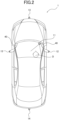
- FIG. 2 is a schematic drawing illustrating a configuration of a camera for a driver, outside cameras, and a sound output part of the on-vehicle information processing device of the first embodiment.
- FIG. 3 is a schematic drawing illustrating a configuration of vibration parts of the on-vehicle information processing device of the first embodiment.
- FIG. 4 is a schematic drawing illustrating the configuration of a display part of the on-vehicle information processing device of the first embodiment.
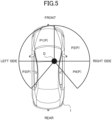
- FIG. 5 is a drawing describing allowable ranges set by a setting part of the on-vehicle information processing device of the first embodiment.
- the configuration of the on-vehicle information processing device of the first embodiment will be described with reference to FIGs. 1 to 5 .
- the on-vehicle information processing device 10 includes a camera 11 for a driver, outside cameras 12 to 15, a camera Electronic Control Unit (ECU) 16, an on-vehicle system 20, a sound output part 40 as an output part, a vibration part 50 as an output part, and a display part 60 as an output part.
- ECU Camera Electronic Control Unit
- the camera 11 for a driver is disposed in a vehicle interior of a host vehicle 1.
- the camera 11 for a driver faces a face and eyes of a driver D to photograph the face and the eyes of the driver D.
- the outside cameras 12 to 15 include the outside camera 12 attached to a right portion of the host vehicle 1 to photograph a right of the host vehicle 1, the outside camera 13 attached to a front portion of the host vehicle 1 to photograph a front of the host vehicle 1, the outside camera 14 attached to a rear portion of the host vehicle 1 to photograph a rear of the host vehicle 1, and the outside camera 15 attached to a left portion of the host vehicle 1 to photograph a left of the host vehicle 1.
- the region around the host vehicle 1 can be completely monitored by the four outside cameras 12 to 15.
- the camera ECU 16 is connected to the outside cameras 12 to 15 to electronically control the outside cameras 12 to 15.
- the on-vehicle system 20 includes a driver monitoring part 21, a positional information acquisition part 22, a map information storage part 23, a vehicle information acquisition part 24, a sensor value monitoring part 25, a sound output control part 26, an information display control part 27, and a control part 30.
- the driver monitoring part 21 is connected to the camera 11 for a driver to monitor a direction of the driver D's face and a direction of the driver D's line of sight from the image photographed by the camera 11 for a driver.
- the direction of the driver D's face and the direction of the driver D's line of sight are represented as a direction of a driver D's sight.
- the positional information acquisition part 22 receives signals from a GPS satellite to acquire the positional information on the host vehicle 1 based on the received signals.
- the map information storage part 23 stores map information.
- the map information includes information on the number of lanes of a road, information on an intersection and a merging point, and information on a destination and a traveling route provided from a navigation system that navigates a traveling route to a destination.
- the vehicle information acquisition part 24 acquires vehicle information such as information on a steering angle of a steering wheel, information on transition of a speed, and information on a blinker.
- vehicle information such as information on a steering angle of a steering wheel, information on transition of a speed, and information on a blinker.
- the information on a blinker includes information whether a right blinker or a left blinker is turned on or turned off.
- the sensor value monitoring part 25 is connected to the camera ECU 16 to monitor another vehicle approaching the host vehicle 1 based on the image data photographed by the outside cameras 12 to 15 and sonar data acquired by a sonar. Both or one of the image data and the sonar data may be used when monitoring another vehicle approaching the host vehicle 1.
- the sensor value monitoring part 25 is connected to the control part 30 to send another vehicle information as monitoring information to the control part 30.
- the sound output control part 26 is connected to the control part 30 to control the sound output part 40 and the vibration part 50 based on processing information from the control part 30.
- the sound output part 40 may be a speaker disposed in the vehicle interior of the host vehicle 1.
- the sound output part 40 notifies the driver D of information through hearing.
- the sound output part 40 outputs information, for example, "please keep your eyes on the road” and "please look ahead, and close to the front vehicle".
- the vibration part 50 is disposed in a seat surface 52 of a driver's seat 51 of the host vehicle 1.
- the vibration part 50 notifies the driver D of information through stimulus with vibration (tactile sensation).
- the vibration part 50 includes a left front vibration part 50a disposed in a left front portion of the seat surface 52, a right front vibration part 50b disposed in a right front portion of the seat surface 52, a right rear vibration part 50c disposed in a right rear portion of the seat surface 52, and a left rear vibration part 50d disposed in a left rear portion of the seat surface 52.
- the left front vibration part 50a vibrates to notify the driver D of the information on the left front side of the host vehicle 1.
- the right front vibration part 50b vibrates to notify the driver D of the information on the right front side of the host vehicle 1.
- the right rear vibration part 50c vibrates to notify the driver D of the information on the right rear side of the host vehicle 1.
- the left rear vibration part 50d vibrates to notify the driver D of the information on the left rear portion of the host vehicle 1.
- the driver D thereby recognizes which direction the information relates to through the tactile sensation.
- the vibration part 50 may be disposed in a back surface 53 of the driver's seat 51.
- the vibration part 50 may be disposed in a passenger seat or a back seat.
- the information display control part 27 is connected to the control part 30 to control information to be displayed on the display part 60 based on the processing information from the control part 30.
- the display part 60 may be a liquid crystal panel attached to a meter device 61 of the host vehicle 1.
- the display part 60 notifies the driver D of information through vision.
- the display part 60 displays the information, for example, "please keep your eyes on the road” and "please look ahead, and close to the front vehicle".
- the display part 60 is not limited as long as it can notify information visually.
- the display part 60 may be, for example, a liquid crystal display, a display integrated with a touch panel, and a head-up display.
- the display part 60 gives not only the driver D but also a passenger the information.
- the control part 30 includes a driver information acquisition part 31, a host vehicle information acquisition part 32, an another vehicle information acquisition part 33, a setting part 34, and an inattentive driving determination part 35.
- the control part 30 controls the entire on-vehicle information processing device 10.
- the driver information acquisition part 31 acquires monitoring information monitored by the driver monitoring part 21. Namely, the driver information acquisition part 31 acquires driver information on the driver D.
- the host vehicle information acquisition part 32 acquires the positional information acquired by the positional information acquisition part 22, the storage information stored in the map information storage part 23, and the vehicle information acquired by the vehicle information acquisition part 24. Namely, the host vehicle information acquisition part 32 acquires the host vehicle information on the host vehicle 1.
- the another vehicle information acquisition part 33 acquires another vehicle information on another vehicle from the monitoring information monitored by the sensor value monitoring part 25.
- the setting part 34 sets an allowable range P for the driver D's sight based on the host vehicle information acquired by the host vehicle information acquisition unit 32.
- the allowable range P for the driver D's sight set by the setting part 34 is a certain range for the driver D to look at for safety confirmation.
- the allowable range P for the driver D's sight includes a first range P1, a second range P2, a third range P3, and a fourth range P4.
- the first range P1 is a left front range from a position where the driver D turns his or her face or eyes to the front to a position where the driver D turns his or her face or eyes to the left at 90°.
- the second range P2 is a right front range from a position where the driver D turns his or her face or eyes to the front to a position where the driver D turns his or her face or eyes to the right at 90°.
- the third range P3 is a left rear range from a position where the driver D turns his or her face or eyes to the left to a position where the driver D turns his or her face or eyes to the left at 45°.
- the fourth range P4 is a right rear range from a position where the driver D turns his or her face or eyes to the right to a position where the driver D turns his or her face or eyes to the right at 45°.
- the allowable range P for the driver D's sight is set as a plane having a certain range, not as a line.
- the setting part 34 sets the allowable range P for the driver D's sight depending on a situation. For example, when the host vehicle 1 turns left at an intersection with a traffic light, the setting part 34 sets the direction of the driver D's sight as the first range P1. When the host vehicle 1 turns right at the intersection with the traffic light, the setting part 34 sets the direction of the driver D's sight as the second range P2. When the host vehicle 1 turns left at the intersection without the traffic light, the setting part 34 sets the direction of the driver D's sight as the first range P1 and the second range P2. When the host vehicle 1 turns right at the intersection without the traffic light, the setting part 34 sets the direction of the driver D's sight as the first range P1 and the second range P2.
- the setting part 34 sets the direction of the driver D's sight as the first range P1 and the third range P3. In this situation, the driver D is required to confirm the safety on the left rear side.
- the setting part 34 sets the direction of the driver D's sight as the second range P2 and the fourth range P4. In this situation, the driver D is also required to confirm the safety on the right rear side.
- a method of setting the allowable range P for the driver D's sight includes a method of using information on a blinker, a method of using the positional information on the host vehicle, and a method of using another vehicle information. Any method may be used.
- the inattentive driving determination part 35 determines whether or not the driver D of the host vehicle 1 is looking at the allowable range P set by the setting part 34 based on the allowable range P set by the setting part 34 and the driver information acquired by the driver information acquisition part 31.
- the control part 30 is connected to the driver monitoring part 21, the positional information acquisition part 22, the map information storage part 23, the vehicle information acquisition part 24, the sensor value monitoring part 25, the sound output control part 26, and the information display control part 27.
- the monitoring information of the driver monitoring part 21, the positional information of the positional information acquisition part 22, the map information of the map information storage part 23, the vehicle information of the vehicle information acquisition part 24, and the monitoring information of the sensor value monitoring part 25 are input to the control part 30.
- the control part 30 executes an after-described inattentive driving determination process based on the monitoring information of the driver monitoring part 21, the map information of the map information storage part 23, the vehicle information of the vehicle information acquisition part 24, and the monitoring information of the sensor value monitoring part 25.
- the control part 30 outputs the result of the inattentive driving determination process to the sound output control part 26 and the information display control part 27.
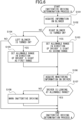
- FIG. 6 is a flowchart describing an inattentive driving determination process A of the first embodiment.
- FIG. 7 is a flowchart describing an inattentive driving determination process B of the first embodiment.
- FIG. 8 is a flowchart describing an inattentive driving determination process C of the first embodiment.
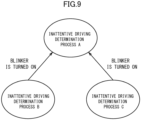
- FIG. 9 is a drawing describing transition of the inattentive driving determination process of the first embodiment.
- the inattentive driving determination process of the first embodiment will be described with reference to FIGs. 6 to 9 .
- Step S101 the host vehicle information acquisition part 32 acquires the information on the blinker as the host vehicle information (Step S101).
- the control part 30 determines whether or not the right blinker of the host vehicle 1 is turned on (Step S102).
- the setting part 34 sets the allowable range P in the direction of the driver D's sight as the second range P2 (Step S103), and the process proceeds to Step S106.
- the control part 30 determines whether or not the left blinker of the host vehicle 1 is turned on (Step S104).
- Step S104 When the control part 30 determines that the left blinker of the host vehicle 1 is turned on (YES in Step S104), the setting part 34 sets the allowable range P in the direction of the driver D's sight as the first range P1 (Step S105), and the process proceeds to Step S106. On the other hand, when the setting part 34 determines that the left blinker of the host vehicle 1 is turned off (No in Step S104), the inattentive driving determination process A ends.
- Step S106 the driver information acquisition part 31 acquires the monitoring information on the driver D.
- the inattentive driving determination part 35 determines whether or not the driver D is looking at the allowable range P set by the setting part 34 (Step S107).
- the inattentive driving determination process A ends.
- Step S108 the control part 30 controls the sound output part 40 through the sound output control part 26 to warn the inattentive driving (Step S108), and the inattentive driving determination process A ends.
- the control part 30 may vibrate the vibration part 50, which is disposed in the seat surface 52 of the driver's seat 51, corresponding to the allowable range P set by the setting part 34 through the sound output control part 26.
- the control part 30 may display on the display part 60 through the information display control part 27 to warn the inattentive driving.
- the control part 30 may determine the necessity of a predetermined notification based on the allowable range P and the driver information on the driver D of the host vehicle 1. Alternatively, before Step S108, the control part 30 may determine the possibility of the predetermined notification based on the allowable range P and the driver information on the driver D of the host vehicle 1. Alternatively, before Step S108, the control part 30 may determine the inevitability of the predetermined notification based on the allowable range P and the driver information on the driver D of the host vehicle 1.
- the host vehicle information acquisition part 32 acquires the positional information on the host vehicle 1 as the host vehicle information (Step S201). Next, the host vehicle information acquisition part 32 acquires a traveling route of the host vehicle 1 as the host vehicle information (Step S202).
- Step S203 determines whether or not the host vehicle 1 approaches a merging point at which the host vehicle 1 merges into the main lane from the merging lane.
- Step S204 determines whether or not the host vehicle 1 merges in the left direction from the traveling direction of the host vehicle 1 (Step S204).
- Step S204 When the control part 30 determines that the host vehicle 1 merges in the left direction from the traveling direction of the host vehicle 1 (Yes in Step S204), the setting part 34 sets the allowable range P in the direction of the driver D' sight as the first range P1 and the third range P3 (Step S205), and the process proceeds to Step S211.
- the setting part 34 sets the allowable range P in the direction of the driver D's sight as the second range P2 and the fourth range P4 (Step S206), and the process proceeds to Step S211.
- Step S203 when the control part 30 determines that the host vehicle 1 does not approach the merging point at which the host vehicle 1 merges into the main lane from the merging lane (No in Step S203), the control part 30 determines whether or not the host vehicle 1 approaches the intersection at which the host vehicle 1 turns right (Step S207).
- the setting part 34 sets the allowable range P in the direction of the driver D's sight as the second range P2 (Step S208), and the process proceeds to Step S211.
- control part 30 determines that the host vehicle 1 does not approach the intersection at which the host vehicle 1 turns right (No in Step S207)
- the control part 30 determines whether or not the host vehicle 1 approaches the intersection at which the host vehicle 1 turns left (Step S209).
- Step S210 the setting part 34 sets the allowable range P in the direction of the driver D's sight as the first range P1 (Step S210), and the process proceeds to Step S211.
- the control part 30 determines that the host vehicle 1 does not approach the intersection at which the host vehicle 1 turns left (No in Step S209), the inattentive driving determination process Bends.
- Step S211 the driver information acquisition part 31 acquires the monitoring information on the driver D (Step S211).
- the inattentive driving determination part 35 determines whether or not the driver D is looking at the allowable range P set by the setting part 34 (Step S212).
- Step S212 When the inattentive driving determination part 35 determines that the driver D is looking at the allowable range P set by the setting part 34 (Yes in Step S212), the inattentive driving determination process B ends. On the other hand, when the inattentive driving determination part 35 determines that the driver D is not looking at the allowable range P set by the setting part 34 (No in Step S212), the control part 30 controls the sound output part 40 through the sound output control part 26 to warn the inattentive driving (Step S213), and the inattentive driving determination process B ends. In Step S213, the control part 30 may vibrate the vibration part 50, which is disposed in the seat surface 52 of the driver's seat 51, corresponding to the allowable range P set by the setting part 34 through the sound output control part 26. Alternatively, in Step S213, the control part may display on the display part 60 through the information display control part 27 to warn the inattentive driving.
- control part 30 may determine the necessity of the predetermined notification based on the allowable range P and the driver information on the driver D of the host vehicle 1. Alternatively, before Step S213, the control part 30 may determine the possibility of the predetermined notification based on the allowable range P and the driver information on the driver D of the host vehicle 1. Alternatively, before Step S213, the control part 30 may determine the inevitability of the predetermined notification based on the allowable range P and the driver information on the driver D of the host vehicle 1.
- Step S301 the another vehicle information acquisition part 33 acquires the another vehicle information.
- the control part 30 determines whether or not another vehicle that the host vehicle 1 may contact travels in the right direction of the host vehicle 1 (Step S302).
- Step S302 the setting part 34 sets the allowable range P in the direction of the driver D's sight as the second range P2 and the fourth range P4 (Step S304), and the process proceeds to Step S306.
- the control part 30 determines that another vehicle that the host vehicle 1 may contact does not travel in the right direction of the host vehicle 1 (No in Step S302), the control part 30 determines whether or not another vehicle that the host vehicle 1 may contact travels in the left direction of the host vehicle 1 (Step S303).
- Step S303 When the control part 30 determines that another vehicle that the host vehicle 1 may contact travels in the left direction of the host vehicle 1 (Yes in Step S303), the setting part 34 sets the allowable range P in the direction of the driver D's sight as the first range P1 and the third range P3 (Step S305), and the process proceeds to Step S306. On the other hand, when the control part 30 determines that another vehicle that the host vehicle 1 may contact does not travel in the left direction of the host vehicle 1 (No in Step S303), the inattentive driving determination process C ends.
- Step S306 the driver information acquisition part 31 acquires the monitoring information on the driver D (Step S306).
- the inattentive driving determination part 35 determines whether or not the driver D is looking at the allowable range P set by the setting part 34 (Step S307).
- the control part 30 controls the sound output part 40 through the sound output control part 26 to warn the inattentive driving (Step S308), and the inattentive driving determination process C ends.
- Step S308 the control part 30 may vibrate the vibration part 50, which is disposed in the seat surface 52 of the driver's seat 51, corresponding to the allowable range P set by the setting part 34 through the sound output control part 26.
- the control part 30 may display on the display part 60 through the information display control part 27 to warn the inattentive driving.
- the control part 30 may determine the necessity of the predetermined notification based on the allowable range P and the driver information on the driver D of the host vehicle 1. Alternatively, before Step S308, the control part 30 may determine the possibility of the predetermined notification based on the allowable range P and the driver information on the driver D of the host vehicle 1. Alternatively, before Step S308, the control part 30 may determine the inevitability based on the allowable range P and the driver information on the driver D of the host vehicle 1. Alternatively, the control part 30 may determine the presence/absence of the traffic light on the road on which the host vehicle 1 travels with the map information and the camera provided in the host vehicle 1, for example, to set the allowable range P as the first range P1 and the second range P2 at the intersection without the traffic light.
- FIG. 10 is a drawing describing the operation of the on-vehicle information processing device 10 of the first embodiment.
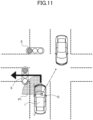
- FIG. 11 is a drawing describing the operation of the on-vehicle information processing device 10 of the first embodiment.
- FIG. 12 is a drawing describing the operation of the on-vehicle information processing device 10 of the first embodiment.
- FIG. 13 is a drawing describing the operation of the on-vehicle information processing device 10 of the first embodiment.
- the operations of the on-vehicle information processing device 10 of the first embodiment will be described with reference to FIGs. 10 to 13 .
- the host vehicle 1 is traveling on a merging lane T1 of a freeway, and is about to merge into a main lane T2.
- the allowable range P for the driver D's sight is set as the second range P2 and the fourth range P4 (Step S206 of FIG. 7 ).
- the display part 60 displays an image "please keep your eyes on the road", and the sound output part 40 makes a sound "please keep your eyes on the road”, and the right front vibration part 50b and the right rear vibration part 50c vibrate (Step S213).
- the host vehicle 1 is about to turn left at the intersection with a traffic light S by turning on the left blinker.
- the allowable range P for the driver D's sight is set as the first range P1 (Step S105 in FIG. 6 ).
- the display part 60 displays the image "please keep your eyes on the road”, and the sound output part 40 makes the sound "please keep your eyes on the road”, and the left front vibration part 50a vibrates (Step S108).
- the host vehicle 1 is about to turn left at the intersection without the traffic light.
- the allowable range P for the driver D's sight is set as the first range P1 and the second range P2 (Step S210 in FIG. 7 ).
- the display part 60 displays the image "please keep your eyes on the road", and the sound output part 40 makes the sound "please keep your eyes on the road”, and the left front vibration part 50a and the right front vibration part 50b vibrate (Step S213).
- the allowable range P for the driver D's sight is set as the second range P2 and the fourth range P4 (Step S304 in FIG. 8 ).
- the display part 60 displays an image "please confirm safety”, and the sound output part 40 makes a sound "please confirm safety”, and the right front vibration part 50b and the right rear vibration part 50c vibrate (Step S308).
- the on-vehicle information processing device 10 of the first embodiment includes the host vehicle information acquisition part 32 that acquires the host vehicle information on the host vehicle 1, the setting part 34 that sets the allowable range P for the driver D's sight of the host vehicle 1 based on the host vehicle information, the driver information acquisition part 31 that acquires the driver information on the driver D, the determination part (inattentive driving determination part 35) that determines whether or not the driver D is looking at the allowable range P based on the allowable range P and the driver information, and the output part (sound output part 40, vibration part 50, display part 60) that outputs the predetermined notification based on the determination of the determination part (inattentive driving determination part 35) ( FIG. 6 ).
- the location where safety confirmation is required for example, an intersection
- the host vehicle information such as the information on the blinker
- the allowable range P for the driver D's sight in that location can be set.
- the on-vehicle information processing device 10 of the first embodiment includes the another vehicle information acquisition part 33 that acquires the another vehicle information on another vehicle N.
- the setting part 34 sets the allowable range P based on the another vehicle information ( FIG. 8 ).
- the location where the safety confirmation is required such as a location where another vehicle N approaches the host vehicle 1 is thereby specified based on the another vehicle information acquired from at least one of the outside cameras 12 to 15 and the sonar, and the allowable range P for the driver D's sight in that location can be set.
- the driver D is not looking at the direction in which the safety confirmation is required by the driver D in the location where the safety confirmation is required, the necessity of the safety confirmation can be notified.
- the driver D is looking at the direction in which the safety confirmation is required by the driver D in the location where the safety confirmation is required, the driver is prevented from being determined as inattentively driving. As a result, an unnecessary notification can be prevented.
- the host vehicle information includes the positional information on the position of the host vehicle 1, and the setting part 34 sets the allowable range P based on the positional information ( FIG. 7 ).
- the location where the safety confirmation is required such as a merging point and an intersection is thereby specified based on the positional information on the host vehicle 1, and the allowable range P for the driver D' sight in that location can be set. Accordingly, when the driver D is not looking at the direction in which the safety confirmation is required by the driver D in the location where the safety confirmation is required, the necessity of the safety confirmation can be notified. On the other hand, when the driver D is looking at the direction in which the safety confirmation is required by the driver D in the location where the safety confirmation is required, the driver can be prevented from being determined as inattentively driving. As a result, an unnecessary notification can be prevented.
- the on-vehicle information processing method of the first embodiment includes a host vehicle information acquisition step (Step S101 in FIG. 6 ) of acquiring host vehicle information on the host vehicle 1, a setting step (Steps S103, S105) of setting the allowable range P for the driver D's sight of the host vehicle 1, a driver information acquisition step (Step S 106) of acquiring the driver information on the driver D, a determination step (Step S 107) of determining whether or not the driver D is looking at the allowable range P based on the allowable range P and the driver information, and an output step (Step S108) of outputting a predetermined notification based on the determination of the determination step ( FIG. 6 ).
- the location where the safety confirmation is required such as an intersection is thereby specified based on the host vehicle information such as the information on the blinker, and the allowable range P for the driver D's sight in that location can be set. Accordingly, when the driver D is not looking at the direction in which the safety confirmation is required in the location where the safety confirmation is required, the necessity of the safety confirmation can be notified. On the other hand, when the driver D is looking at the direction in which the safety confirmation is required in the location where the safety confirmation is required, the driver can be prevented from being determined as inattentively driving. As a result, an unnecessary notification can be prevented.
- the on-vehicle information processing method includes an another vehicle information acquisition step (Step S301 in FIG. 8 ) of acquiring the another vehicle information on the another vehicle N, and the setting step (Steps S304, S305) sets the allowable range P based on the another vehicle information ( FIG. 8 ).
- the location where the safety confirmation is required such as a location where the another vehicle N approaches the host vehicle 1 is thereby specified based on the another vehicle information acquired from the outside cameras 12 to 15, and the allowable range P for the driver D's sight in that location can be set. Accordingly, when the driver D is not looking at the direction in which the safety confirmation is required in the location where the safety confirmation is required, the safety confirmation can be notified. On the other hand, when the driver D is looking at the direction in which the safety confirmation is required in the location where the safety confirmation is required, the driver can be prevented from being determined as inattentively driving. As a result, an unnecessary notification can be prevented.
- the host vehicle information includes the positional information on the position of the host vehicle 1 (Step S201 in FIG. 7 ), and the setting step (Steps S205, S206, S208, S210) sets the allowable range P based on the positional information ( FIG. 7 ).
- the location where the safety confirmation is required such as a merging point and an intersection is thereby specified based on the positional information on the host vehicle 1, and the allowable range P for the driver D's sight in that location can be set. Accordingly, when the driver D is not looking at the direction in which the safety confirmation is required in the location where the safety confirmation is required, the necessity of the safety confirmation can be notified. On the other hand, when the driver D is looking at the direction in which the safety confirmation is required in the location where the safety confirmation is required, the driver can be prevented from being determined as inattentively driving. As a result, an unnecessary notification can be prevented.
- the traffic light of the lane on which the host vehicle 1 travels is blue
- the traffic light of the lane intersecting with the lane on which the host vehicle 1 travels is red. Accordingly, there is almost no need for the driver D of the host vehicle 1 to pay attention to another vehicle traveling on the lane intersecting with the lane on which the host vehicle 1 travels and the direction opposite to the direction in which the host vehicle 1 turns. For this reason, at the intersection with the traffic light, it is appropriate to set the allowable range P for the driver D's sight as the first range P1 or the second range P2.
- the on-vehicle information processing device and the on-vehicle information processing method of the second embodiment differ from the on-vehicle information processing device and the on-vehicle information processing method of the first embodiment in that the on-vehicle information processing device and the on-vehicle information processing method of the second embodiment include an obstacle information acquisition part and an obstacle determination part.
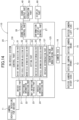
- FIG. 14 is a view illustrating the configuration of the on-vehicle information processing device 110 of the second embodiment.
- the configuration of the on-vehicle information processing device 110 of the second embodiment will be described with reference to FIG. 14 .
- the sensor value monitoring part 125 is connected to the camera ECU 16 to monitor another vehicle approaching the host vehicle 1 from the image data photographed by the outside cameras 12 to 15 and the sonar data acquired by the sonar.
- the sensor value monitoring part 125 monitors obstacles around the host vehicle 1 from the image data photographed by the outside cameras 12 to 15 and the sonar data acquired by the sonar.
- the obstacle obstructs the traveling of the host vehicle 1, and includes, for example, a wall along a road, a pylon placed on a road, a falling object on a road, another vehicle parked on a road, a depressed part on a road, and a front vehicle in the traveling direction of the host vehicle 1.
- both of or one of the image data and the sonar data may be used.
- the sensor value monitoring part 125 is connected to the control part 30 to send the another vehicle information and the obstacle information as the monitoring information to the control part 30.
- control part 130 includes an obstacle information acquisition part 136 and an obstacle determination part 137.
- the obstacle information acquisition part 136 acquires the obstacle information on the obstacle during the traveling of the host vehicle 1 from the monitoring information by the sensor value monitoring part 125.
- the obstacle determination part 137 determines whether or not a distance between the host vehicle 1 and the obstacle in front of the host vehicle 1 in the traveling direction is sufficient based on the obstacle information acquired by the obstacle information acquisition part 136.
- FIG. 15 is a flowchart describing an obstacle determination process of the second embodiment.
- the obstacle determination process can be executed when acquiring the blinker information (inattentive driving determination process A of first embodiment), when acquiring the positional information on the host vehicle 1 (inattentive driving determination process B of first embodiment), and when acquiring the another vehicle information (inattentive driving determination process C of first embodiment).
- the obstacle determination process is executed when acquiring the blinker information (inattentive driving determination process A of first embodiment).
- the host vehicle information acquisition part 32 acquires the information on the blinker as the host vehicle information (Step S401).
- the control part 130 determines whether or not the right blinker of the host vehicle 1 is turned on (Step S402).
- Step S402 determines that the right blinker of the host vehicle 1 is turned on (Yes in Step S402)
- the setting part 34 sets the allowable range P in the direction of the driver D's sight as the second range P2 (Step S403), and the process proceeds to Step S406.
- the control part 130 determines whether or not the left blinker of the host vehicle 1 is turned on (Step S404).
- Step S404 the setting part 34 sets the allowable range P in the direction of the driver D's sight as the first range P1 (Step S405), and the process proceeds to Step S406.
- the control part 130 determines that the left blinker of the host vehicle 1 is turned off (NO in Step S404)
- the obstacle determination process ends.
- Step S406 the driver information acquisition part 31 acquires the monitoring information on the driver D.
- the inattentive driving determination part 35 determines whether or not the driver D is looking at the allowable range P set by the setting part 34 (Step S407).
- Step S409 the control part 130 controls the sound output part 40 through the sound output control part 26 to warn the inattentive driving (Step S408), and the process proceeds to Step S409.
- the control part 130 may vibrate the vibration part 50, which is disposed in the seat surface 52 of the driver's seat 51, corresponding to the allowable range P set by the setting part 34 through the sound output control part 26.
- the control part 130 may display on the display part 60 through the information display control part 27 to warn the inattentive driving.
- Step S409 the obstacle information acquisition part 136 acquires the obstacle information.
- the obstacle determination part 137 determines whether or not a distance to another vehicle as a front obstacle is sufficient (Step S410).
- Step S410 When the obstacle determination part 137 determines a sufficient distance to another vehicle (YES in Step S410), the obstacle determination process ends. On the other hand, when the obstacle determination part 137 determines an insufficient distance to another vehicle (NO in Step S410), the control part 130 controls the sound output part 40 through the sound output control part 26 to notify the insufficient distance to the front vehicle (Step S411), and the obstacle determination process ends. In Step S411, the control part 130 may vibrate the left front vibration part 50a and the right front vibration part 50b through the sound output control part 26. In Step S411, the control part 130 may display the notification as the insufficient distance to the front vehicle on the display part 60 through the information display control part 27.
- FIG. 16 is a drawing describing the operation of the on-vehicle information processing device 110 of the second embodiment.
- FIG. 17 is a drawing describing the operation of the on-vehicle information processing device 110 of the second embodiment.
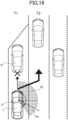
- FIG. 18 is a drawing describing the operation of the on-vehicle information processing device 110 of the second embodiment.
- FIG. 19 is a drawing describing the operation of the on-vehicle information processing device 110 of the second embodiment.
- FIG. 20 is a drawing describing the operation of the on-vehicle information processing device 110 of the second embodiment.
- the operation of the on-vehicle information processing device 110 of the second embodiment will be described with reference to FIGs. 16 to 20 .
- the host vehicle 1 is traveling on the merging lane T1 of a freeway, and is about to merge into the main lane T2.
- the allowable range P for the driver D's sight is set as the second range P2 and the fourth range P4.
- the display part 60, the sound output part 40, and the vibration part 50 output no safety confirmation.
- the display part 60 displays on an image "please pay attention to the front vehicle", and the sound output part 40 makes a sound "please pay attention to the front vehicle”, and the left front vibration part 50a and the right front vibration part 50b vibrate (Step S411 in FIG. 15 ).
- the host vehicle 1 is traveling on the merging lane T1 of the freeway, and is about to merge into the main lane T2.
- the allowable range P for the driver D's sight is set as the first range P1 and the third range P3.
- the display part 60, the sound output part 40, and the vibration part 50 output no safety confirmation.
- the display part 60 displays the image "please pay attention to the front vehicle”
- the sound output part 40 makes the sound "please pay attention to the front vehicle”
- the left front vibration part 50a and the right front vibration part 50b vibrate Step S411 of FIG. 15 ).
- the host vehicle 1 is about to turn left at the intersection without the traffic light.
- the allowable range P for the driver D's sight is set as the first range P1.
- the display part 60, the sound output part 40, and the vibration part 50 output no safety confirmation.
- the display part 60, the sound output part 40, and the vibration part 50 output safety confirmation.
- the host vehicle 1 is traveling on the merging lane T1 of the freeway, and is about to merge into the main lane T2.
- the allowable range P for the driver D's sight is set as the second range P2 and the fourth range P4.
- the display part 60, the sound output part 40, and the vibration part 50 output no safety confirmation.
- the display part 60 displays an image "no road ahead, and please pay attention to the surrounding"
- the sound output part 40 makes a sound "no road ahead, and please pay attention to the surrounding”
- the left front vibration part 50a and the right front vibration part 50b vibrate (Step S411 of FIG. 15 ).
- the host vehicle 1 is traveling on the merging lane T1 of the freeway, and is about to merge into the main lane T2.
- the allowable range P for the driver D's sight is set as the second range P2 and the fourth range P4.
- the display part 60, the sound output part 40, and the vibration part 50 output no safety confirmation.
- the display part 60 displays an image "please pay attention to the front obstacle”
- the sound output part 40 makes a sound "please pay attention to the front obstacle”
- the left front vibration part 50a and the right front vibration part 50b vibrate Step S411 of FIG. 15 ).
- the on-vehicle information processing device 10 of the second embodiment includes the obstacle information acquisition part 136 that acquires the obstacle information on the obstacle.
- the determination part determines whether or not the obstacle approaches the host vehicle 1 based on the obstacle information, and the output part (sound output part 40, vibration part 50, and display part 60) outputs the predetermined notification based on the determination of the determination part (obstacle determination part 137) on the obstacle ( FIG. 13 ).
- the driver D is thereby notified to look ahead when the driver D is looking at the direction in which the safety confirmation is required in the location where the safety confirmation is required, and the host vehicle 1 may contact the front obstacle. Safer driving can be therefore supported.
- the on-vehicle information processing method of the second embodiment includes the obstacle information acquisition step (Step S410 of FIG. 13 ) of acquiring the obstacle information on the obstacle.
- the determination step (Step S411 of FIG. 13 ) determines whether or not the obstacle approaches the host vehicle 1 based on the obstacle information, and the output step (Step S412 of FIG. 13 ) outputs the predetermined notification based on the determination of the determination step on the obstacle (Step S411 of FIG. 13 ).
- the driver D is thereby notified to look ahead when the driver D is looking at the direction in which the safety confirmation is required in the location where the safety confirmation is required, and the host vehicle 1 may contact the obstacle in front of the host vehicle 1 in the traveling direction. Safer driving can be therefore supported.
- the other configurations and effects of the second embodiment are substantially similar to those in the first embodiment; and thus, the description thereof will be omitted.
- the on-vehicle information processing device and the on-vehicle information processing method of the present disclosure are described based on the first embodiment and the second embodiment.
- the specific configuration and the operation are not limited to the embodiments, any combination of the embodiments, changes in design and additions are allowed as long as they do not depart from the gist of the invention according to each claim.
- the location where the safety confirmation is required includes the merging point on the freeway, the intersection without the traffic light, and the intersection with the traffic light.
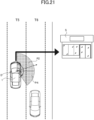
- the location where the safety confirmation is required is not limited thereto. As illustrated in FIG. 21 , for example the location where the safety confirmation is required may include a location where the host vehicle 1 turns right toward a destination across an opposing lane T6 of a traveling lane T5 on a road having one lane on one side.
- the location where the safety confirmation is required may include a location where the host vehicle 1 requires the lane change.
- the location where the safety confirmation is required may include a location where temporary stop is required in front of a crossing.
- the first embodiment and the second embodiment show the examples in which the inattentive driving determination process A uses the information on the blinker to set the allowable range P for the driver D's sight, and the inattentive driving determination process B uses the positional information on the host vehicle 1 to set the allowable range P for the driver D's sight, and the inattentive driving determination process C uses the another vehicle information to set the allowable range P for the driver D's sight.
- the inattentive driving determination processes A to C can use any of the information on the blinker, the positional information on the host vehicle 1, and the another vehicle information.
- the first embodiment and the second embodiment show the examples using the sound output part 40, the vibration part 50, and the display part 60 as the output parts.
- the output parts are not limited thereto, and a virtual image may be displayed using a head-up display device, for example.
- the first embodiment and the second embodiment show the examples using the host vehicle 1 equipped with the on-vehicle information processing devices 10, 110 as a right-hand drive vehicle.
- the host vehicle equipped with the on-vehicle information processing device may be a left-hand drive vehicle.
- the first embodiment and the second embodiment show the examples having four ranges, the first range P1, the second range P2, the third range P3, and the fourth range P4 as the allowable ranges P for the driver D's sight. However, two allowable ranges or five or more allowable ranges may be used.
- the second embodiment shows the example in which the obstacle determination part 137 determines the distance between the host vehicle 1 and the obstacle in front of the host vehicle in the traveling direction.
- the obstacle determination part may determine the allowable range for the driver D's sight of the host vehicle 1 based on the obstacle information acquired by the obstacle information acquisition part 136.
- the allowable range for the driver D's sight which is determined by the obstacle determination part 137 represents a direction in a certain range for the driver D's to be looked at for avoiding contact and collision to the obstacle.
- the allowable range for the driver D's sight which is determined by the obstacle determination part 137 is similar to the allowable range for the driver D's sight which is set by the setting part 34, and includes the first range P1, the second range P2, the third range P3, and the fourth range P4.
- the second embodiment shows the example in which the obstacle determination process is used for the inattentive driving determination process A of the first embodiment.
- the obstacle determination process may be used for the inattentive driving determination process B or the inattentive driving determination process C of the first embodiment.
- the second embodiment shows the example in which the obstacle determination process is executed based on the obstacle determination process.
- the obstacle determination process may notify regardless of the allowable range set by the setting part 34 when the host vehicle 1 travels too fast.
- the first and second embodiments show the examples in which the information processing device and the information processing method of the present disclosure are applied to a road having two lanes on one side.
- the information processing device and the information processing method of the present disclosure may be applied to a road having three lanes on one side.
Landscapes
- Engineering & Computer Science (AREA)
- Mechanical Engineering (AREA)
- Chemical & Material Sciences (AREA)
- Combustion & Propulsion (AREA)
- Transportation (AREA)
- Physics & Mathematics (AREA)
- General Physics & Mathematics (AREA)
- Multimedia (AREA)
- Theoretical Computer Science (AREA)
- Human Computer Interaction (AREA)
- General Health & Medical Sciences (AREA)
- Ophthalmology & Optometry (AREA)
- Health & Medical Sciences (AREA)
- Traffic Control Systems (AREA)
- Control Of Driving Devices And Active Controlling Of Vehicle (AREA)
Description
- This disclosure relates to an information processing device and an information processing method.
- An information processing device configured to warn a driver of a vehicle of inattentive driving, for example, has been known (see
JP 2007/226666 A -
JP 2007/226666 A -
JP 4 502844 B2 JP 4 502844 B2 JP 4 502844 B2 -
US 2015/154461 A1 describes a driving support apparatus which includes a line-of-data judgment unit configured to judge a type of line-of-sight data indicating a direction of the line of sight of a driver; an estimation unit configured to estimate an attentive watching state of the driver on a target area to be attentively watched by performing based on the target area being set depending on a driving situation based on vehicle state information and a direction of the line of sight indicated by a plurality of pieces of line-of-sight data acquired in a judgment time; and a confidence-level-calculation unit configured to calculate a confidence level of an estimation result of the attentive watching state by performing based on one of setting accuracy of the target area, and a configuration state of line-of-sight data associated with each type of the plurality of pieces of line-of-sight data acquired in the judgment time. - However, the system disclosed in
JP 2007/226666 A - It is, therefore, an object of the present disclosure to provide an information processing device and an information processing method that prevent unnecessary warning.
- The invention is set out in the appended claims.
- The information processing device and the information processing method of the present disclosure configured as described above can prevent unnecessary warning.
-
-
FIG. 1 is a block diagram illustrating a system configuration of an on-vehicle information processing device of a first embodiment. -
FIG. 2 is a schematic drawing illustrating a configuration of a camera for a driver, outside cameras, and a sound output part of the on-vehicle information processing device according to the first embodiment. -
FIG. 3 is a schematic drawing illustrating a configuration of vibration parts of the on-vehicle information processing device according to the first embodiment. -
FIG. 4 is a schematic drawing illustrating a configuration of a display part of the on-vehicle information processing device according to the first embodiment. -
FIG. 5 is a drawing describing allowable ranges set by a setting part of the on-vehicle information processing device according to the first embodiment. -
FIG. 6 is a flowchart describing an inattentive driving determination process A of the first embodiment. -
FIG. 7 is a flowchart describing an inattentive driving determination process B of the first embodiment. -
FIG. 8 is a flowchart describing an inattentive driving determination process C of the first embodiment. -
FIG. 9 is a drawing describing transition of the inattentive driving determination process of the first embodiment. -
FIG. 10 is a drawing describing an operation of the on-vehicle information processing device of the first embodiment. -
FIG. 11 is a drawing describing the operation of the on-vehicle information processing device of the first embodiment. -
FIG. 12 is a drawing describing the operation of the on-vehicle information processing device of the first embodiment. -
FIG. 13 is a drawing describing the operation of the on-vehicle information processing device of the first embodiment. -
FIG. 14 is a block diagram illustrating a configuration of an on-vehicle information processing device of a second embodiment. -
FIG. 15 is a flowchart describing an obstacle determination process of the second embodiment. -
FIG. 16 is a drawing describing an operation of an on-vehicle information processing device of the second embodiment. -
FIG. 17 is a drawing describing the operation of the on-vehicle information processing device of the second embodiment. -
FIG. 18 is a drawing describing the operation of the on-vehicle information processing device of the second embodiment. -
FIG. 19 is a drawing describing the operation of the on-vehicle information processing device of the second embodiment. -
FIG. 20 is a drawing describing the operation of the on-vehicle information processing device of the second embodiment. -
FIG. 21 is a drawing describing a location where safety conformation is required in another embodiment. - Hereinafter, embodiments of an information processing device and an information processing method according to the present disclosure will be described based on first and second embodiments illustrated in the drawings.
- An on-vehicle information processing device and an on-vehicle information processing method in the first embodiment are used in an on-vehicle
information processing device 10 installed in ahost vehicle 1. - (Configuration of On-Vehicle Information Processing Device)
FIG. 1 is a block diagram illustrating a system configuration of the on-vehicle information processing device of the first embodiment.FIG. 2 is a schematic drawing illustrating a configuration of a camera for a driver, outside cameras, and a sound output part of the on-vehicle information processing device of the first embodiment.FIG. 3 is a schematic drawing illustrating a configuration of vibration parts of the on-vehicle information processing device of the first embodiment.FIG. 4 is a schematic drawing illustrating the configuration of a display part of the on-vehicle information processing device of the first embodiment.FIG. 5 is a drawing describing allowable ranges set by a setting part of the on-vehicle information processing device of the first embodiment. Hereinafter, the configuration of the on-vehicle information processing device of the first embodiment will be described with reference toFIGs. 1 to 5 . - The on-vehicle
information processing device 10 includes acamera 11 for a driver,outside cameras 12 to 15, a camera Electronic Control Unit (ECU) 16, an on-vehicle system 20, asound output part 40 as an output part, avibration part 50 as an output part, and adisplay part 60 as an output part. - As illustrated in
FIG. 2 , thecamera 11 for a driver is disposed in a vehicle interior of ahost vehicle 1. Thecamera 11 for a driver faces a face and eyes of a driver D to photograph the face and the eyes of the driver D. - The
outside cameras 12 to 15 include theoutside camera 12 attached to a right portion of thehost vehicle 1 to photograph a right of thehost vehicle 1, theoutside camera 13 attached to a front portion of thehost vehicle 1 to photograph a front of thehost vehicle 1, theoutside camera 14 attached to a rear portion of thehost vehicle 1 to photograph a rear of thehost vehicle 1, and theoutside camera 15 attached to a left portion of thehost vehicle 1 to photograph a left of thehost vehicle 1. The region around thehost vehicle 1 can be completely monitored by the fouroutside cameras 12 to 15. - As illustrated in
FIG. 1 , the camera ECU 16 is connected to theoutside cameras 12 to 15 to electronically control theoutside cameras 12 to 15. - The on-
vehicle system 20 includes adriver monitoring part 21, a positionalinformation acquisition part 22, a mapinformation storage part 23, a vehicleinformation acquisition part 24, a sensorvalue monitoring part 25, a soundoutput control part 26, an informationdisplay control part 27, and acontrol part 30. - The
driver monitoring part 21 is connected to thecamera 11 for a driver to monitor a direction of the driver D's face and a direction of the driver D's line of sight from the image photographed by thecamera 11 for a driver. The direction of the driver D's face and the direction of the driver D's line of sight are represented as a direction of a driver D's sight. - The positional
information acquisition part 22 receives signals from a GPS satellite to acquire the positional information on thehost vehicle 1 based on the received signals. - The map
information storage part 23 stores map information. The map information includes information on the number of lanes of a road, information on an intersection and a merging point, and information on a destination and a traveling route provided from a navigation system that navigates a traveling route to a destination. - The vehicle
information acquisition part 24 acquires vehicle information such as information on a steering angle of a steering wheel, information on transition of a speed, and information on a blinker. The information on a blinker includes information whether a right blinker or a left blinker is turned on or turned off. - The sensor
value monitoring part 25 is connected to thecamera ECU 16 to monitor another vehicle approaching thehost vehicle 1 based on the image data photographed by theoutside cameras 12 to 15 and sonar data acquired by a sonar. Both or one of the image data and the sonar data may be used when monitoring another vehicle approaching thehost vehicle 1. The sensorvalue monitoring part 25 is connected to thecontrol part 30 to send another vehicle information as monitoring information to thecontrol part 30. - The sound
output control part 26 is connected to thecontrol part 30 to control thesound output part 40 and thevibration part 50 based on processing information from thecontrol part 30. As illustrated inFIG. 2 , thesound output part 40 may be a speaker disposed in the vehicle interior of thehost vehicle 1. Thesound output part 40 notifies the driver D of information through hearing. Thesound output part 40 outputs information, for example, "please keep your eyes on the road" and "please look ahead, and close to the front vehicle". - As illustrated in
FIG. 3 , thevibration part 50 is disposed in aseat surface 52 of a driver'sseat 51 of thehost vehicle 1. Thevibration part 50 notifies the driver D of information through stimulus with vibration (tactile sensation). Thevibration part 50 includes a leftfront vibration part 50a disposed in a left front portion of theseat surface 52, a rightfront vibration part 50b disposed in a right front portion of theseat surface 52, a rightrear vibration part 50c disposed in a right rear portion of theseat surface 52, and a leftrear vibration part 50d disposed in a left rear portion of theseat surface 52. - The left
front vibration part 50a vibrates to notify the driver D of the information on the left front side of thehost vehicle 1. The rightfront vibration part 50b vibrates to notify the driver D of the information on the right front side of thehost vehicle 1. The rightrear vibration part 50c vibrates to notify the driver D of the information on the right rear side of thehost vehicle 1. The leftrear vibration part 50d vibrates to notify the driver D of the information on the left rear portion of thehost vehicle 1. - The driver D thereby recognizes which direction the information relates to through the tactile sensation. The
vibration part 50 may be disposed in aback surface 53 of the driver'sseat 51. Thevibration part 50 may be disposed in a passenger seat or a back seat. - The information
display control part 27 is connected to thecontrol part 30 to control information to be displayed on thedisplay part 60 based on the processing information from thecontrol part 30. As illustrated inFIG. 4 , thedisplay part 60 may be a liquid crystal panel attached to ameter device 61 of thehost vehicle 1. Thedisplay part 60 notifies the driver D of information through vision. Thedisplay part 60 displays the information, for example, "please keep your eyes on the road" and "please look ahead, and close to the front vehicle". - The
display part 60 is not limited as long as it can notify information visually. For example, thedisplay part 60 may be, for example, a liquid crystal display, a display integrated with a touch panel, and a head-up display. Thedisplay part 60 gives not only the driver D but also a passenger the information. - As illustrated in
FIG. 1 , thecontrol part 30 includes a driverinformation acquisition part 31, a host vehicleinformation acquisition part 32, an another vehicleinformation acquisition part 33, a settingpart 34, and an inattentivedriving determination part 35. Thecontrol part 30 controls the entire on-vehicleinformation processing device 10. - The driver
information acquisition part 31 acquires monitoring information monitored by thedriver monitoring part 21. Namely, the driverinformation acquisition part 31 acquires driver information on the driver D. - The host vehicle
information acquisition part 32 acquires the positional information acquired by the positionalinformation acquisition part 22, the storage information stored in the mapinformation storage part 23, and the vehicle information acquired by the vehicleinformation acquisition part 24. Namely, the host vehicleinformation acquisition part 32 acquires the host vehicle information on thehost vehicle 1. - The another vehicle
information acquisition part 33 acquires another vehicle information on another vehicle from the monitoring information monitored by the sensorvalue monitoring part 25. - The setting
part 34 sets an allowable range P for the driver D's sight based on the host vehicle information acquired by the host vehicleinformation acquisition unit 32. The allowable range P for the driver D's sight set by the settingpart 34 is a certain range for the driver D to look at for safety confirmation. - As illustrated in
FIG. 5 , the allowable range P for the driver D's sight includes a first range P1, a second range P2, a third range P3, and a fourth range P4. The first range P1 is a left front range from a position where the driver D turns his or her face or eyes to the front to a position where the driver D turns his or her face or eyes to the left at 90°. The second range P2 is a right front range from a position where the driver D turns his or her face or eyes to the front to a position where the driver D turns his or her face or eyes to the right at 90°. The third range P3 is a left rear range from a position where the driver D turns his or her face or eyes to the left to a position where the driver D turns his or her face or eyes to the left at 45°. The fourth range P4 is a right rear range from a position where the driver D turns his or her face or eyes to the right to a position where the driver D turns his or her face or eyes to the right at 45°. Namely, the allowable range P for the driver D's sight is set as a plane having a certain range, not as a line. - The setting
part 34 sets the allowable range P for the driver D's sight depending on a situation. For example, when thehost vehicle 1 turns left at an intersection with a traffic light, the settingpart 34 sets the direction of the driver D's sight as the first range P1. When thehost vehicle 1 turns right at the intersection with the traffic light, the settingpart 34 sets the direction of the driver D's sight as the second range P2. When thehost vehicle 1 turns left at the intersection without the traffic light, the settingpart 34 sets the direction of the driver D's sight as the first range P1 and the second range P2. When thehost vehicle 1 turns right at the intersection without the traffic light, the settingpart 34 sets the direction of the driver D's sight as the first range P1 and the second range P2. - When the
host vehicle 1 merges from the merging lane into a main lane on the left side of thehost vehicle 1, the settingpart 34 sets the direction of the driver D's sight as the first range P1 and the third range P3. In this situation, the driver D is required to confirm the safety on the left rear side. When thehost vehicle 1 merges from the merging lane into the main lane on the right side of thehost vehicle 1, the settingpart 34 sets the direction of the driver D's sight as the second range P2 and the fourth range P4. In this situation, the driver D is also required to confirm the safety on the right rear side. - A method of setting the allowable range P for the driver D's sight includes a method of using information on a blinker, a method of using the positional information on the host vehicle, and a method of using another vehicle information. Any method may be used.
- The inattentive
driving determination part 35 determines whether or not the driver D of thehost vehicle 1 is looking at the allowable range P set by the settingpart 34 based on the allowable range P set by the settingpart 34 and the driver information acquired by the driverinformation acquisition part 31. - The
control part 30 is connected to thedriver monitoring part 21, the positionalinformation acquisition part 22, the mapinformation storage part 23, the vehicleinformation acquisition part 24, the sensorvalue monitoring part 25, the soundoutput control part 26, and the informationdisplay control part 27. - The monitoring information of the
driver monitoring part 21, the positional information of the positionalinformation acquisition part 22, the map information of the mapinformation storage part 23, the vehicle information of the vehicleinformation acquisition part 24, and the monitoring information of the sensorvalue monitoring part 25 are input to thecontrol part 30. Thecontrol part 30 executes an after-described inattentive driving determination process based on the monitoring information of thedriver monitoring part 21, the map information of the mapinformation storage part 23, the vehicle information of the vehicleinformation acquisition part 24, and the monitoring information of the sensorvalue monitoring part 25. Thecontrol part 30 outputs the result of the inattentive driving determination process to the soundoutput control part 26 and the informationdisplay control part 27. - (Inattentive Driving Determination Process)
FIG. 6 is a flowchart describing an inattentive driving determination process A of the first embodiment.FIG. 7 is a flowchart describing an inattentive driving determination process B of the first embodiment.FIG. 8 is a flowchart describing an inattentive driving determination process C of the first embodiment. -
FIG. 9 is a drawing describing transition of the inattentive driving determination process of the first embodiment. Hereinafter, the inattentive driving determination process of the first embodiment will be described with reference toFIGs. 6 to 9 . - (Inattentive Driving Determination Process A) As illustrated in
FIG. 6 , as soon as the inattentive driving determination process A starts, the host vehicleinformation acquisition part 32 acquires the information on the blinker as the host vehicle information (Step S101). Next, thecontrol part 30 determines whether or not the right blinker of thehost vehicle 1 is turned on (Step S102). When thecontrol part 30 determines that the right blinker of thehost vehicle 1 is turned on (Yes in Step S102), the settingpart 34 sets the allowable range P in the direction of the driver D's sight as the second range P2 (Step S103), and the process proceeds to Step S106. On the other hand, when thecontrol part 30 determines that the right blinker of thehost vehicle 1 is turned off (No in Step S102), thecontrol part 30 determines whether or not the left blinker of thehost vehicle 1 is turned on (Step S104). - When the
control part 30 determines that the left blinker of thehost vehicle 1 is turned on (YES in Step S104), the settingpart 34 sets the allowable range P in the direction of the driver D's sight as the first range P1 (Step S105), and the process proceeds to Step S106. On the other hand, when the settingpart 34 determines that the left blinker of thehost vehicle 1 is turned off (No in Step S104), the inattentive driving determination process A ends. - In Step S106, the driver
information acquisition part 31 acquires the monitoring information on the driver D. Next, the inattentivedriving determination part 35 determines whether or not the driver D is looking at the allowable range P set by the setting part 34 (Step S107). When the inattentivedriving determination part 35 determines that the driver D is looking at the allowable range P set by the setting part 34 (Yes in Step S107), the inattentive driving determination process A ends. - On the other hand, when the inattentive
driving determination part 35 determines that the driver D is looking outside the allowable range P set by the setting part 34 (No in Step S107), thecontrol part 30 controls thesound output part 40 through the soundoutput control part 26 to warn the inattentive driving (Step S108), and the inattentive driving determination process A ends. In Step S108, thecontrol part 30 may vibrate thevibration part 50, which is disposed in theseat surface 52 of the driver'sseat 51, corresponding to the allowable range P set by the settingpart 34 through the soundoutput control part 26. In Step S108, thecontrol part 30 may display on thedisplay part 60 through the informationdisplay control part 27 to warn the inattentive driving. - Before Step S108, the
control part 30 may determine the necessity of a predetermined notification based on the allowable range P and the driver information on the driver D of thehost vehicle 1. Alternatively, before Step S108, thecontrol part 30 may determine the possibility of the predetermined notification based on the allowable range P and the driver information on the driver D of thehost vehicle 1. Alternatively, before Step S108, thecontrol part 30 may determine the inevitability of the predetermined notification based on the allowable range P and the driver information on the driver D of thehost vehicle 1. - (Inattentive Driving Determination Process B) As illustrated in
FIG. 7 , as soon as the inattentive driving determination process B starts, the host vehicleinformation acquisition part 32 acquires the positional information on thehost vehicle 1 as the host vehicle information (Step S201). Next, the host vehicleinformation acquisition part 32 acquires a traveling route of thehost vehicle 1 as the host vehicle information (Step S202). - Next, the
control part 30 determines whether or not thehost vehicle 1 approaches a merging point at which thehost vehicle 1 merges into the main lane from the merging lane (Step S203). When thecontrol part 30 determines that thehost vehicle 1 approaches the merging point at which thehost vehicle 1 merges into the main lane from the merging lane (Yes in Step S203), thecontrol part 30 determines whether or not thehost vehicle 1 merges in the left direction from the traveling direction of the host vehicle 1 (Step S204). - When the
control part 30 determines that thehost vehicle 1 merges in the left direction from the traveling direction of the host vehicle 1 (Yes in Step S204), the settingpart 34 sets the allowable range P in the direction of the driver D' sight as the first range P1 and the third range P3 (Step S205), and the process proceeds to Step S211. On the other hand, when thecontrol part 30 determines that thehost vehicle 1 merges in the right direction from the traveling direction of the host vehicle 1 (No in Step S204), the settingpart 34 sets the allowable range P in the direction of the driver D's sight as the second range P2 and the fourth range P4 (Step S206), and the process proceeds to Step S211. - In Step S203, when the
control part 30 determines that thehost vehicle 1 does not approach the merging point at which thehost vehicle 1 merges into the main lane from the merging lane (No in Step S203), thecontrol part 30 determines whether or not thehost vehicle 1 approaches the intersection at which thehost vehicle 1 turns right (Step S207). When thecontrol part 30 determines that thehost vehicle 1 approaches the intersection at which thehost vehicle 1 turns right (Yes in Step S207), the settingpart 34 sets the allowable range P in the direction of the driver D's sight as the second range P2 (Step S208), and the process proceeds to Step S211. On the other hand, when thecontrol part 30 determines that thehost vehicle 1 does not approach the intersection at which thehost vehicle 1 turns right (No in Step S207), thecontrol part 30 determines whether or not thehost vehicle 1 approaches the intersection at which thehost vehicle 1 turns left (Step S209). - When the
control part 30 determines that thehost vehicle 1 approaches the intersection at which thehost vehicle 1 turns left (Yes in Step S209), the settingpart 34 sets the allowable range P in the direction of the driver D's sight as the first range P1 (Step S210), and the process proceeds to Step S211. On the other hand, when thecontrol part 30 determines that thehost vehicle 1 does not approach the intersection at which thehost vehicle 1 turns left (No in Step S209), the inattentive driving determination process Bends. - In Step S211, the driver
information acquisition part 31 acquires the monitoring information on the driver D (Step S211). Next, the inattentivedriving determination part 35 determines whether or not the driver D is looking at the allowable range P set by the setting part 34 (Step S212). - When the inattentive
driving determination part 35 determines that the driver D is looking at the allowable range P set by the setting part 34 (Yes in Step S212), the inattentive driving determination process B ends. On the other hand, when the inattentivedriving determination part 35 determines that the driver D is not looking at the allowable range P set by the setting part 34 (No in Step S212), thecontrol part 30 controls thesound output part 40 through the soundoutput control part 26 to warn the inattentive driving (Step S213), and the inattentive driving determination process B ends. In Step S213, thecontrol part 30 may vibrate thevibration part 50, which is disposed in theseat surface 52 of the driver'sseat 51, corresponding to the allowable range P set by the settingpart 34 through the soundoutput control part 26. Alternatively, in Step S213, the control part may display on thedisplay part 60 through the informationdisplay control part 27 to warn the inattentive driving. - Before Step S213, the
control part 30 may determine the necessity of the predetermined notification based on the allowable range P and the driver information on the driver D of thehost vehicle 1. Alternatively, before Step S213, thecontrol part 30 may determine the possibility of the predetermined notification based on the allowable range P and the driver information on the driver D of thehost vehicle 1. Alternatively, before Step S213, thecontrol part 30 may determine the inevitability of the predetermined notification based on the allowable range P and the driver information on the driver D of thehost vehicle 1. - (Inattentive Driving Determination Process C) As illustrated in
FIG. 8 , as soon as the inattentive driving determination process C starts, the another vehicleinformation acquisition part 33 acquires the another vehicle information (Step S301). Next, thecontrol part 30 determines whether or not another vehicle that thehost vehicle 1 may contact travels in the right direction of the host vehicle 1 (Step S302). - When the
control part 30 determines that another vehicle that thehost vehicle 1 may contact travels in the right direction of the host vehicle 1 (Yes in Step S302), the settingpart 34 sets the allowable range P in the direction of the driver D's sight as the second range P2 and the fourth range P4 (Step S304), and the process proceeds to Step S306. On the other hand, when thecontrol part 30 determines that another vehicle that thehost vehicle 1 may contact does not travel in the right direction of the host vehicle 1 (No in Step S302), thecontrol part 30 determines whether or not another vehicle that thehost vehicle 1 may contact travels in the left direction of the host vehicle 1 (Step S303). - When the
control part 30 determines that another vehicle that thehost vehicle 1 may contact travels in the left direction of the host vehicle 1 (Yes in Step S303), the settingpart 34 sets the allowable range P in the direction of the driver D's sight as the first range P1 and the third range P3 (Step S305), and the process proceeds to Step S306. On the other hand, when thecontrol part 30 determines that another vehicle that thehost vehicle 1 may contact does not travel in the left direction of the host vehicle 1 (No in Step S303), the inattentive driving determination process C ends. - In Step S306, the driver
information acquisition part 31 acquires the monitoring information on the driver D (Step S306). Next, the inattentivedriving determination part 35 determines whether or not the driver D is looking at the allowable range P set by the setting part 34 (Step S307). - When the inattentive
driving determination part 35 determines that the driver D is looking at the allowable range P set by the setting part 34 (Yes in Step S307), the inattentive driving determination process C ends. On the other hand, when the inattentivedriving determination part 35 determines that the driver D is not looking at the allowable range P set by the setting part 34 (No in Step S307), thecontrol part 30 controls thesound output part 40 through the soundoutput control part 26 to warn the inattentive driving (Step S308), and the inattentive driving determination process C ends. In Step S308, thecontrol part 30 may vibrate thevibration part 50, which is disposed in theseat surface 52 of the driver'sseat 51, corresponding to the allowable range P set by the settingpart 34 through the soundoutput control part 26. Alternatively, thecontrol part 30 may display on thedisplay part 60 through the informationdisplay control part 27 to warn the inattentive driving. - Before Step S308, the
control part 30 may determine the necessity of the predetermined notification based on the allowable range P and the driver information on the driver D of thehost vehicle 1. Alternatively, before Step S308, thecontrol part 30 may determine the possibility of the predetermined notification based on the allowable range P and the driver information on the driver D of thehost vehicle 1. Alternatively, before Step S308, thecontrol part 30 may determine the inevitability based on the allowable range P and the driver information on the driver D of thehost vehicle 1. Alternatively, thecontrol part 30 may determine the presence/absence of the traffic light on the road on which thehost vehicle 1 travels with the map information and the camera provided in thehost vehicle 1, for example, to set the allowable range P as the first range P1 and the second range P2 at the intersection without the traffic light. - (Change in Inattentive Driving Determination Process) As illustrated in
FIG. 9 , during the inattentive driving determination process B or the inattentive driving determination process C, when the host vehicleinformation acquisition part 32 acquires the information on which the right blinker or the left blinker of thehost vehicle 1 is turned on, the process is changed to the inattentive driving determination process A to be executed. - (Operation of ON-Vehicle Information Processing Device)
FIG. 10 is a drawing describing the operation of the on-vehicleinformation processing device 10 of the first embodiment.FIG. 11 is a drawing describing the operation of the on-vehicleinformation processing device 10 of the first embodiment.FIG. 12 is a drawing describing the operation of the on-vehicleinformation processing device 10 of the first embodiment.FIG. 13 is a drawing describing the operation of the on-vehicleinformation processing device 10 of the first embodiment. Hereinafter, the operations of the on-vehicleinformation processing device 10 of the first embodiment will be described with reference toFIGs. 10 to 13 . - As illustrated in
FIG. 10 , thehost vehicle 1 is traveling on a merging lane T1 of a freeway, and is about to merge into a main lane T2. In this situation, the allowable range P for the driver D's sight is set as the second range P2 and the fourth range P4 (Step S206 ofFIG. 7 ). When the driver D is looking at outside the second range P2 and the fourth range P4, thedisplay part 60 displays an image "please keep your eyes on the road", and thesound output part 40 makes a sound "please keep your eyes on the road", and the rightfront vibration part 50b and the rightrear vibration part 50c vibrate (Step S213). - As illustrated in
FIG. 11 , thehost vehicle 1 is about to turn left at the intersection with a traffic light S by turning on the left blinker. In this situation, the allowable range P for the driver D's sight is set as the first range P1 (Step S105 inFIG. 6 ). When the driver D is looking outside the first range P1, thedisplay part 60 displays the image "please keep your eyes on the road", and thesound output part 40 makes the sound "please keep your eyes on the road", and the leftfront vibration part 50a vibrates (Step S108). - As illustrated in
FIG. 12 , thehost vehicle 1 is about to turn left at the intersection without the traffic light. In this situation, the allowable range P for the driver D's sight is set as the first range P1 and the second range P2 (Step S210 inFIG. 7 ). When the driver D is looking outside the first range P1 and the second range P2, thedisplay part 60 displays the image "please keep your eyes on the road", and thesound output part 40 makes the sound "please keep your eyes on the road", and the leftfront vibration part 50a and the rightfront vibration part 50b vibrate (Step S213). - As illustrated in
FIG. 13 , while thehost vehicle 1 is traveling on a left lane T3, another vehicle N traveling on a right lane T4 at a fast speed is approaching thehost vehicle 1 from the back of thehost vehicle 1. In this situation, the allowable range P for the driver D's sight is set as the second range P2 and the fourth range P4 (Step S304 inFIG. 8 ). When the driver D is looking outside the second range P2 and the fourth range P4, thedisplay part 60 displays an image "please confirm safety", and thesound output part 40 makes a sound "please confirm safety", and the rightfront vibration part 50b and the rightrear vibration part 50c vibrate (Step S308). - The on-vehicle
information processing device 10 of the first embodiment includes the host vehicleinformation acquisition part 32 that acquires the host vehicle information on thehost vehicle 1, the settingpart 34 that sets the allowable range P for the driver D's sight of thehost vehicle 1 based on the host vehicle information, the driverinformation acquisition part 31 that acquires the driver information on the driver D, the determination part (inattentive driving determination part 35) that determines whether or not the driver D is looking at the allowable range P based on the allowable range P and the driver information, and the output part (sound output part 40,vibration part 50, display part 60) that outputs the predetermined notification based on the determination of the determination part (inattentive driving determination part 35) (FIG. 6 ). - With this configuration, the location where safety confirmation is required, for example, an intersection, is specified based on the host vehicle information such as the information on the blinker, and the allowable range P for the driver D's sight in that location can be set. When the driver D is not looking at the direction in which the safety confirmation is required in the location where the safety confirmation is required, the necessity of the safety confirmation can be notified. On the other hand, when the driver D is looking at the direction in which the safety confirmation is required in the location where the safety confirmation is required, the driver can be prevented from being determined as inattentively driving. As a result, an unnecessary notification can be prevented.
- The on-vehicle
information processing device 10 of the first embodiment includes the another vehicleinformation acquisition part 33 that acquires the another vehicle information on another vehicle N.The setting part 34 sets the allowable range P based on the another vehicle information (FIG. 8 ). - The location where the safety confirmation is required such as a location where another vehicle N approaches the
host vehicle 1 is thereby specified based on the another vehicle information acquired from at least one of theoutside cameras 12 to 15 and the sonar, and the allowable range P for the driver D's sight in that location can be set. When the driver D is not looking at the direction in which the safety confirmation is required by the driver D in the location where the safety confirmation is required, the necessity of the safety confirmation can be notified. On the other hand, when the driver D is looking at the direction in which the safety confirmation is required by the driver D in the location where the safety confirmation is required, the driver is prevented from being determined as inattentively driving. As a result, an unnecessary notification can be prevented. - In the on-vehicle
information processing device 10 of the first embodiment, the host vehicle information includes the positional information on the position of thehost vehicle 1, and the settingpart 34 sets the allowable range P based on the positional information (FIG. 7 ). - The location where the safety confirmation is required such as a merging point and an intersection is thereby specified based on the positional information on the
host vehicle 1, and the allowable range P for the driver D' sight in that location can be set. Accordingly, when the driver D is not looking at the direction in which the safety confirmation is required by the driver D in the location where the safety confirmation is required, the necessity of the safety confirmation can be notified. On the other hand, when the driver D is looking at the direction in which the safety confirmation is required by the driver D in the location where the safety confirmation is required, the driver can be prevented from being determined as inattentively driving. As a result, an unnecessary notification can be prevented. - The on-vehicle information processing method of the first embodiment includes a host vehicle information acquisition step (Step S101 in
FIG. 6 ) of acquiring host vehicle information on thehost vehicle 1, a setting step (Steps S103, S105) of setting the allowable range P for the driver D's sight of thehost vehicle 1, a driver information acquisition step (Step S 106) of acquiring the driver information on the driver D, a determination step (Step S 107) of determining whether or not the driver D is looking at the allowable range P based on the allowable range P and the driver information, and an output step (Step S108) of outputting a predetermined notification based on the determination of the determination step (FIG. 6 ). - The location where the safety confirmation is required such as an intersection is thereby specified based on the host vehicle information such as the information on the blinker, and the allowable range P for the driver D's sight in that location can be set. Accordingly, when the driver D is not looking at the direction in which the safety confirmation is required in the location where the safety confirmation is required, the necessity of the safety confirmation can be notified. On the other hand, when the driver D is looking at the direction in which the safety confirmation is required in the location where the safety confirmation is required, the driver can be prevented from being determined as inattentively driving. As a result, an unnecessary notification can be prevented.
- The on-vehicle information processing method includes an another vehicle information acquisition step (Step S301 in
FIG. 8 ) of acquiring the another vehicle information on the another vehicle N, and the setting step (Steps S304, S305) sets the allowable range P based on the another vehicle information (FIG. 8 ). - The location where the safety confirmation is required such as a location where the another vehicle N approaches the
host vehicle 1 is thereby specified based on the another vehicle information acquired from theoutside cameras 12 to 15, and the allowable range P for the driver D's sight in that location can be set. Accordingly, when the driver D is not looking at the direction in which the safety confirmation is required in the location where the safety confirmation is required, the safety confirmation can be notified. On the other hand, when the driver D is looking at the direction in which the safety confirmation is required in the location where the safety confirmation is required, the driver can be prevented from being determined as inattentively driving. As a result, an unnecessary notification can be prevented. - In the on-vehicle information processing method of the first embodiment, the host vehicle information includes the positional information on the position of the host vehicle 1 (Step S201 in
FIG. 7 ), and the setting step (Steps S205, S206, S208, S210) sets the allowable range P based on the positional information (FIG. 7 ). - The location where the safety confirmation is required such as a merging point and an intersection is thereby specified based on the positional information on the
host vehicle 1, and the allowable range P for the driver D's sight in that location can be set. Accordingly, when the driver D is not looking at the direction in which the safety confirmation is required in the location where the safety confirmation is required, the necessity of the safety confirmation can be notified. On the other hand, when the driver D is looking at the direction in which the safety confirmation is required in the location where the safety confirmation is required, the driver can be prevented from being determined as inattentively driving. As a result, an unnecessary notification can be prevented. - At the intersection with the traffic light, when the traffic light of the lane on which the
host vehicle 1 travels is blue, the traffic light of the lane intersecting with the lane on which thehost vehicle 1 travels is red. Accordingly, there is almost no need for the driver D of thehost vehicle 1 to pay attention to another vehicle traveling on the lane intersecting with the lane on which thehost vehicle 1 travels and the direction opposite to the direction in which thehost vehicle 1 turns. For this reason, at the intersection with the traffic light, it is appropriate to set the allowable range P for the driver D's sight as the first range P1 or the second range P2. - On the other hand, at the intersection without the traffic light, another vehicle may travel on the lane intersecting with the lane on which the
host vehicle 1 travels. Accordingly, there is high necessity for the driver D of thehost vehicle 1 to pay attention to the lane intersecting with the lane on which thehost vehicle 1 travels, and to look at the direction opposite to the direction in which thehost vehicle 1 turns. For this reason, at the intersection without the traffic light, it is appropriate to set the allowable range P for the driver D's sight as the first range P1 and the second range P2. - With this configuration, the driver D is not notified even when the driver D is looking in the direction opposite to the direction in which the
host vehicle 1 turns at the intersection without the traffic light. This configuration contributes to reduce the notification in unnecessary timing for the driver and the complicated warning. - An on-vehicle information processing device and an on-vehicle information processing method of the second embodiment will be described. The same terms and the same reference numbers as those in the first embodiment are used for the parts which are the same or similar to those in the first embodiment.
- The on-vehicle information processing device and the on-vehicle information processing method of the second embodiment differ from the on-vehicle information processing device and the on-vehicle information processing method of the first embodiment in that the on-vehicle information processing device and the on-vehicle information processing method of the second embodiment include an obstacle information acquisition part and an obstacle determination part.
- (Configuration of On-Vehicle Information Processing Device)
FIG. 14 is a view illustrating the configuration of the on-vehicleinformation processing device 110 of the second embodiment. Hereinafter, the configuration of the on-vehicleinformation processing device 110 of the second embodiment will be described with reference toFIG. 14 . - The sensor
value monitoring part 125 is connected to thecamera ECU 16 to monitor another vehicle approaching thehost vehicle 1 from the image data photographed by theoutside cameras 12 to 15 and the sonar data acquired by the sonar. The sensorvalue monitoring part 125 monitors obstacles around thehost vehicle 1 from the image data photographed by theoutside cameras 12 to 15 and the sonar data acquired by the sonar. The obstacle obstructs the traveling of thehost vehicle 1, and includes, for example, a wall along a road, a pylon placed on a road, a falling object on a road, another vehicle parked on a road, a depressed part on a road, and a front vehicle in the traveling direction of thehost vehicle 1. When monitoring the obstacle around thehost vehicle 1, both of or one of the image data and the sonar data may be used. The sensorvalue monitoring part 125 is connected to thecontrol part 30 to send the another vehicle information and the obstacle information as the monitoring information to thecontrol part 30. - As illustrated in
FIG. 14 , thecontrol part 130 includes an obstacleinformation acquisition part 136 and anobstacle determination part 137. - The obstacle
information acquisition part 136 acquires the obstacle information on the obstacle during the traveling of thehost vehicle 1 from the monitoring information by the sensorvalue monitoring part 125. Theobstacle determination part 137 determines whether or not a distance between thehost vehicle 1 and the obstacle in front of thehost vehicle 1 in the traveling direction is sufficient based on the obstacle information acquired by the obstacleinformation acquisition part 136. - (Obstacle Determination Process)
FIG. 15 is a flowchart describing an obstacle determination process of the second embodiment. Hereinafter, the obstacle determination process of the second embodiment will be described with reference toFIG. 15 . The obstacle determination process can be executed when acquiring the blinker information (inattentive driving determination process A of first embodiment), when acquiring the positional information on the host vehicle 1 (inattentive driving determination process B of first embodiment), and when acquiring the another vehicle information (inattentive driving determination process C of first embodiment). In the second embodiment, as one example, the obstacle determination process is executed when acquiring the blinker information (inattentive driving determination process A of first embodiment). - (Obstacle Determination Process) As illustrated in
FIG. 15 , as soon as the obstacle determination process starts, the host vehicleinformation acquisition part 32 acquires the information on the blinker as the host vehicle information (Step S401). Next, thecontrol part 130 determines whether or not the right blinker of thehost vehicle 1 is turned on (Step S402). - When the
control part 130 determines that the right blinker of thehost vehicle 1 is turned on (Yes in Step S402), the settingpart 34 sets the allowable range P in the direction of the driver D's sight as the second range P2 (Step S403), and the process proceeds to Step S406. On the other hand, when thecontrol part 130 determines that the right blinker of thehost vehicle 1 is turned off (NO in Step S402), thecontrol part 130 determines whether or not the left blinker of thehost vehicle 1 is turned on (Step S404). - When the
control part 130 determines that the left blinker of thehost vehicle 1 is turned on (Yes in Step S404), the settingpart 34 sets the allowable range P in the direction of the driver D's sight as the first range P1 (Step S405), and the process proceeds to Step S406. On the other hand, when thecontrol part 130 determines that the left blinker of thehost vehicle 1 is turned off (NO in Step S404), the obstacle determination process ends. - In Step S406, the driver
information acquisition part 31 acquires the monitoring information on the driver D. Next, the inattentivedriving determination part 35 determines whether or not the driver D is looking at the allowable range P set by the setting part 34 (Step S407). - When the inattentive
driving determination part 35 determines that the driver D is looking at the allowable range P set by the setting part 34 (YES in Step S407), the process proceeds to Step S409. On the other hand, when the inattentivedriving determination part 35 determines that the driver D is looking outside the allowable range P set by the setting part 34 (NO in Step S407), thecontrol part 130 controls thesound output part 40 through the soundoutput control part 26 to warn the inattentive driving (Step S408), and the process proceeds to Step S409. In Step S408, thecontrol part 130 may vibrate thevibration part 50, which is disposed in theseat surface 52 of the driver'sseat 51, corresponding to the allowable range P set by the settingpart 34 through the soundoutput control part 26. In Step S408, thecontrol part 130 may display on thedisplay part 60 through the informationdisplay control part 27 to warn the inattentive driving. - In Step S409, the obstacle
information acquisition part 136 acquires the obstacle information. Next, theobstacle determination part 137 determines whether or not a distance to another vehicle as a front obstacle is sufficient (Step S410). - When the
obstacle determination part 137 determines a sufficient distance to another vehicle (YES in Step S410), the obstacle determination process ends. On the other hand, when theobstacle determination part 137 determines an insufficient distance to another vehicle (NO in Step S410), thecontrol part 130 controls thesound output part 40 through the soundoutput control part 26 to notify the insufficient distance to the front vehicle (Step S411), and the obstacle determination process ends. In Step S411, thecontrol part 130 may vibrate the leftfront vibration part 50a and the rightfront vibration part 50b through the soundoutput control part 26. In Step S411, thecontrol part 130 may display the notification as the insufficient distance to the front vehicle on thedisplay part 60 through the informationdisplay control part 27. - (Operation of On-Vehicle Information Processing Device)
FIG. 16 is a drawing describing the operation of the on-vehicleinformation processing device 110 of the second embodiment.FIG. 17 is a drawing describing the operation of the on-vehicleinformation processing device 110 of the second embodiment.FIG. 18 is a drawing describing the operation of the on-vehicleinformation processing device 110 of the second embodiment.FIG. 19 is a drawing describing the operation of the on-vehicleinformation processing device 110 of the second embodiment.FIG. 20 is a drawing describing the operation of the on-vehicleinformation processing device 110 of the second embodiment. Hereinafter, the operation of the on-vehicleinformation processing device 110 of the second embodiment will be described with reference toFIGs. 16 to 20 . - As illustrated in
FIG. 16 , thehost vehicle 1 is traveling on the merging lane T1 of a freeway, and is about to merge into the main lane T2. In this situation, the allowable range P for the driver D's sight is set as the second range P2 and the fourth range P4. When the driver D is looking at the second range P2 and the fourth range P4, thedisplay part 60, thesound output part 40, and thevibration part 50 output no safety confirmation. However, when a distance between thehost vehicle 1 and the front another vehicle N is insufficient, thedisplay part 60 displays on an image "please pay attention to the front vehicle", and thesound output part 40 makes a sound "please pay attention to the front vehicle", and the leftfront vibration part 50a and the rightfront vibration part 50b vibrate (Step S411 inFIG. 15 ). - As illustrated in
FIG. 17 , thehost vehicle 1 is traveling on the merging lane T1 of the freeway, and is about to merge into the main lane T2. In this case, the allowable range P for the driver D's sight is set as the first range P1 and the third range P3. When the driver D is looking at the first range P1 and the third range P3, thedisplay part 60, thesound output part 40, and thevibration part 50 output no safety confirmation. However, when the distance between thehost vehicle 1 and the front another vehicle N is insufficient, thedisplay part 60 displays the image "please pay attention to the front vehicle", thesound output part 40 makes the sound "please pay attention to the front vehicle", and the leftfront vibration part 50a and the rightfront vibration part 50b vibrate (Step S411 ofFIG. 15 ). - As illustrated in
FIG. 18 , thehost vehicle 1 is about to turn left at the intersection without the traffic light. In this case, the allowable range P for the driver D's sight is set as the first range P1. When the driver D is looking at the first range P1, thedisplay part 60, thesound output part 40, and thevibration part 50 output no safety confirmation. When the driver D is not looking at the first range P1, thedisplay part 60, thesound output part 40, and thevibration part 50 output safety confirmation. However, when the distance between thehost vehicle 1 and the front another vehicle N is insufficient, the driver D needs to pay attention to the front of thehost vehicle 1, and thedisplay part 60 displays the image "please play attention to the front vehicle", thesound output part 40 make the sound "please pay attention to the front vehicle", and the leftfront vibration part 50a and the rightfront vibration part 50b vibrate (Step S411 ofFIG. 15 ). - As illustrated in
FIG. 19 , thehost vehicle 1 is traveling on the merging lane T1 of the freeway, and is about to merge into the main lane T2. In this case, the allowable range P for the driver D's sight is set as the second range P2 and the fourth range P4. When the driver D is looking at the second range P2 and the fourth range P4, thedisplay part 60, thesound output part 40, and thevibration part 50 output no safety confirmation. However, when a distance between a wall W along a road and thehost vehicle 1 is insufficient, thedisplay part 60 displays an image "no road ahead, and please pay attention to the surrounding", thesound output part 40 makes a sound "no road ahead, and please pay attention to the surrounding", and the leftfront vibration part 50a and the rightfront vibration part 50b vibrate (Step S411 ofFIG. 15 ). - As illustrated in
FIG. 20 , thehost vehicle 1 is traveling on the merging lane T1 of the freeway, and is about to merge into the main lane T2. In this case, the allowable range P for the driver D's sight is set as the second range P2 and the fourth range P4. When the driver D is looking at the second range P2 and the fourth range P4, thedisplay part 60, thesound output part 40, and thevibration part 50 output no safety confirmation. However, when a distance between thehost vehicle 1 and a pylon M is insufficient, thedisplay part 60 displays an image "please pay attention to the front obstacle", thesound output part 40 makes a sound "please pay attention to the front obstacle", and the leftfront vibration part 50a and the rightfront vibration part 50b vibrate (Step S411 ofFIG. 15 ). - The on-vehicle
information processing device 10 of the second embodiment includes the obstacleinformation acquisition part 136 that acquires the obstacle information on the obstacle. The determination part (obstacle determination part 137) determines whether or not the obstacle approaches thehost vehicle 1 based on the obstacle information, and the output part (sound output part 40,vibration part 50, and display part 60) outputs the predetermined notification based on the determination of the determination part (obstacle determination part 137) on the obstacle (FIG. 13 ). - The driver D is thereby notified to look ahead when the driver D is looking at the direction in which the safety confirmation is required in the location where the safety confirmation is required, and the
host vehicle 1 may contact the front obstacle. Safer driving can be therefore supported. - The on-vehicle information processing method of the second embodiment includes the obstacle information acquisition step (Step S410 of
FIG. 13 ) of acquiring the obstacle information on the obstacle. The determination step (Step S411 ofFIG. 13 ) determines whether or not the obstacle approaches thehost vehicle 1 based on the obstacle information, and the output step (Step S412 ofFIG. 13 ) outputs the predetermined notification based on the determination of the determination step on the obstacle (Step S411 ofFIG. 13 ). - The driver D is thereby notified to look ahead when the driver D is looking at the direction in which the safety confirmation is required in the location where the safety confirmation is required, and the
host vehicle 1 may contact the obstacle in front of thehost vehicle 1 in the traveling direction. Safer driving can be therefore supported. In addition, the other configurations and effects of the second embodiment are substantially similar to those in the first embodiment; and thus, the description thereof will be omitted. - As described above, the on-vehicle information processing device and the on-vehicle information processing method of the present disclosure are described based on the first embodiment and the second embodiment. However, the specific configuration and the operation are not limited to the embodiments, any combination of the embodiments, changes in design and additions are allowed as long as they do not depart from the gist of the invention according to each claim.
- In the first embodiment and the second embodiment, the location where the safety confirmation is required includes the merging point on the freeway, the intersection without the traffic light, and the intersection with the traffic light. However, the location where the safety confirmation is required is not limited thereto. As illustrated in
FIG. 21 , for example the location where the safety confirmation is required may include a location where thehost vehicle 1 turns right toward a destination across an opposing lane T6 of a traveling lane T5 on a road having one lane on one side. The location where the safety confirmation is required may include a location where thehost vehicle 1 requires the lane change. The location where the safety confirmation is required may include a location where temporary stop is required in front of a crossing. - The first embodiment and the second embodiment show the examples in which the inattentive driving determination process A uses the information on the blinker to set the allowable range P for the driver D's sight, and the inattentive driving determination process B uses the positional information on the
host vehicle 1 to set the allowable range P for the driver D's sight, and the inattentive driving determination process C uses the another vehicle information to set the allowable range P for the driver D's sight. However, the inattentive driving determination processes A to C can use any of the information on the blinker, the positional information on thehost vehicle 1, and the another vehicle information. - The first embodiment and the second embodiment show the examples using the
sound output part 40, thevibration part 50, and thedisplay part 60 as the output parts. However, the output parts are not limited thereto, and a virtual image may be displayed using a head-up display device, for example. - The first embodiment and the second embodiment show the examples using the
host vehicle 1 equipped with the on-vehicleinformation processing devices - The first embodiment and the second embodiment show the examples having four ranges, the first range P1, the second range P2, the third range P3, and the fourth range P4 as the allowable ranges P for the driver D's sight. However, two allowable ranges or five or more allowable ranges may be used.
- The second embodiment shows the example in which the
obstacle determination part 137 determines the distance between thehost vehicle 1 and the obstacle in front of the host vehicle in the traveling direction. However, the obstacle determination part may determine the allowable range for the driver D's sight of thehost vehicle 1 based on the obstacle information acquired by the obstacleinformation acquisition part 136. In this case, the allowable range for the driver D's sight which is determined by theobstacle determination part 137 represents a direction in a certain range for the driver D's to be looked at for avoiding contact and collision to the obstacle. The allowable range for the driver D's sight which is determined by theobstacle determination part 137 is similar to the allowable range for the driver D's sight which is set by the settingpart 34, and includes the first range P1, the second range P2, the third range P3, and the fourth range P4. - The second embodiment shows the example in which the obstacle determination process is used for the inattentive driving determination process A of the first embodiment. However, the obstacle determination process may be used for the inattentive driving determination process B or the inattentive driving determination process C of the first embodiment.
- The second embodiment shows the example in which the obstacle determination process is executed based on the obstacle determination process. However, the obstacle determination process may notify regardless of the allowable range set by the setting
part 34 when thehost vehicle 1 travels too fast. - The first and second embodiments show the examples in which the information processing device and the information processing method of the present disclosure are applied to a road having two lanes on one side. However, the information processing device and the information processing method of the present disclosure may be applied to a road having three lanes on one side.
Claims (8)
- An information processing device (10, 110) comprising:a host vehicle information acquisition part (32) configured to acquire host vehicle information on a host vehicle (1) including positional information on a position of the host vehicle (1);a setting part (34) configured to set an allowable range (P) for a driver (D)'s sight of a host vehicle (1)'s driver by using the host vehicle information including the positional information;a driver monitoring part (21) connected to a driver camera (11) and configured to monitor a direction of the driver (D)'s face and a direction of the driver (D)'s line of sight from an image taken by the driver camera (11),a driver information acquisition part (31) configured to acquire from the driver monitoring part (21) driver information including information on the direction of the driver (D)'s sight;a determination part (35) configured to determine whether or not the driver (D) is looking at the allowable range (P) based on the allowable range (P) and the driver information including the information on the direction of the driver (D)'s sight; andan output part (40, 50, 60) configured to output a predetermined notification to notify the driver about inattentive driving when the determination part (35) determines that the driver does not look at the allowable range, characterized in that the allowable range (P) includes a first range (P1), a second range (P2), a third range (P3), and a fourth range (P4), wherein the first range (P1) is a left front range of the driver, the second range (P2) is a right front range of the driver, the third range (P3) is a left rear range of the driver, and the fourth range (P4) is a right rear range of the driver, andwherein the setting part (34) is configured to set the allowable range (P) to the first range (P1) and the second range (P2) when the setting part (34) determines that the host vehicle is at an intersection without a traffic light.
- The information processing device (10, 110) according to claim 1,wherein the host vehicle information includes information on an operation of a blinker of the host vehicle (1), andwherein the setting part (34) is configured to set the allowable range (P) for the driver's sight-based on the information on the operation of the blinker of the host vehicle (1).
- The information processing device (10, 110) according to claim 1, comprising:an another vehicle information acquisition part (33) configured to acquire another vehicle information on another vehicle (N),wherein the setting part is configured to set (34) the allowable range (P) by using the another vehicle information,wherein the setting part (34) is configured to set the allowable range (P) to the second range (P2) and the fourth range (P4) when the another vehicle (N) that the host vehicle (1) may contact travels in the right direction of the host vehicle (1), andwherein the setting part (34) is configured to set the allowable range (P) to the first range (P1) and the third range (P3) when the another vehicle (N) that the host vehicle (1) may contact travels in the left direction of the host vehicle (1).
- The information processing device (10, 110) according to claim 3,
wherein the setting part (34) is configured to set the allowable range (P) to the first range (P1) when the host vehicle (1) is at an intersection with a traffic light and a left blinker of the host vehicle (1) is turned on, and to set the allowable range (P) to the second range (P2) when the host vehicle (1) is at an intersection with a traffic light and a right blinker of the host vehicle (1) is turned on. - The information processing device (10, 110) according to any one of claims 1 to 4, comprising:an obstacle information acquisition part (136) configured to acquire obstacle information on an obstacle during traveling of the vehicle,wherein the determination part (35) determines whether or not the obstacle approaches the host vehicle (1) based on the obstacle information, andwherein the output part (40, 50, 60) outputs the predetermined notification to notify the driver about inattentive driving based on the determination of the determination part (35) on the obstacle.
- An information processing method comprising:a host vehicle information acquisition step of acquiring host vehicle information on of a host vehicle (1) including positional information on a position of the host vehicle (1);a setting step of setting an allowable range (P) for a driver (D)'s sight of a driver (D) of the host vehicle (1) by using the host vehicle information including the positional information;taking an image of the driver (D) using a driver camera (11);monitoring a direction of the driver (D)'s face and a direction of the driver (D)'s line of sight using an image taken by a driver camera (11);a driver information acquisition step of acquiring driver information on the driver (D) including information on the direction of the driver (D)'s sight;a determination step of determining whether or not the driver (D) is looking at the allowable range (P) based on the allowable range (P) and the driver information including the information on the direction of the driver (D)'s sight; andan outputting step of instructing an output part to output a predetermined notification to inform the driver about inattentive driving when the determination step determines that the driver (D) does not look at the allowable range characterized in that the allowable range (P) includes a first range (P1), a second range (P2), a third range (P3), and a fourth range (P4), wherein the first range (P1) is a left front range of the driver, the second range (P2) is a right front range of the driver, the third range (P3) is a left rear range of the driver, and the fourth range (P4) is a right rear range of the driver, andwherein the setting step includes setting the allowable range (P) to the first range (P1) and the second range (P2) when the host vehicle (1) is at an intersection without a traffic light.
- The information processing method according to claim 6, comprising:an another vehicle information acquisition step of acquiring another vehicle information on another vehicle (N),wherein the setting step sets the allowable range (P) by using the another vehicle information.
- The information processing method according to any one of claims 6 to 7, comprising:an obstacle information acquisition step of acquiring obstacle information on an obstacle,wherein the determination step determines whether or not the obstacle approaches the host vehicle (1) based on the obstacle information, andwherein the output step instructs output of the predetermined notification based on the determination of the determination step on the obstacle.
Applications Claiming Priority (2)
| Application Number | Priority Date | Filing Date | Title |
|---|---|---|---|
| JP2018081998A JP7187169B2 (en) | 2018-04-23 | 2018-04-23 | Information processing device and information processing method |
| PCT/JP2019/002684 WO2019207872A1 (en) | 2018-04-23 | 2019-01-28 | Information processing device and information processing method |
Publications (3)
| Publication Number | Publication Date |
|---|---|
| EP3786920A1 EP3786920A1 (en) | 2021-03-03 |
| EP3786920A4 EP3786920A4 (en) | 2022-01-05 |
| EP3786920B1 true EP3786920B1 (en) | 2024-05-01 |
Family
ID=68294959
Family Applications (1)
| Application Number | Title | Priority Date | Filing Date |
|---|---|---|---|
| EP19791627.3A Active EP3786920B1 (en) | 2018-04-23 | 2019-01-28 | Information processing device and information processing method |
Country Status (4)
| Country | Link |
|---|---|
| US (1) | US11900698B2 (en) |
| EP (1) | EP3786920B1 (en) |
| JP (1) | JP7187169B2 (en) |
| WO (1) | WO2019207872A1 (en) |
Families Citing this family (9)
| Publication number | Priority date | Publication date | Assignee | Title |
|---|---|---|---|---|
| RU2769360C1 (en) | 2019-05-15 | 2022-03-30 | Ниссан Мотор Ко., Лтд. | Display control method and display control device |
| JP2021089479A (en) * | 2019-12-02 | 2021-06-10 | 株式会社デンソー | Consciousness determination device and consciousness determination method |
| JP2021196941A (en) * | 2020-06-16 | 2021-12-27 | トヨタ自動車株式会社 | Driver monitoring system |
| JP2022161317A (en) * | 2021-04-08 | 2022-10-21 | 株式会社デンソー | vehicle warning device |
| TWI807548B (en) * | 2021-10-18 | 2023-07-01 | 國立陽明交通大學 | Vehicular positioning method and system of utilizing repeated feature object, computer-readable medium |
| US11922706B2 (en) * | 2022-01-17 | 2024-03-05 | Veoneer Us, Llc | Systems and methods for dynamic attention area |
| JP7800395B2 (en) * | 2022-11-21 | 2026-01-16 | トヨタ自動車株式会社 | Information processing device and information processing method |
| JP7790392B2 (en) | 2023-04-10 | 2025-12-23 | トヨタ自動車株式会社 | Monitoring device, monitoring computer program, and monitoring method |
| US20250269790A1 (en) * | 2024-02-23 | 2025-08-28 | Ford Global Technologies, Llc | Vehicle communications |
Citations (1)
| Publication number | Priority date | Publication date | Assignee | Title |
|---|---|---|---|---|
| JP2000351337A (en) * | 1999-06-10 | 2000-12-19 | Mazda Motor Corp | Mobile control device |
Family Cites Families (22)
| Publication number | Priority date | Publication date | Assignee | Title |
|---|---|---|---|---|
| JP2937030B2 (en) * | 1994-09-14 | 1999-08-23 | 三菱電機株式会社 | Image processing device and person state determination device |
| JP2000172966A (en) * | 1998-12-11 | 2000-06-23 | Nissan Motor Co Ltd | Alarm device |
| JP3752958B2 (en) * | 2000-04-17 | 2006-03-08 | 日産自動車株式会社 | Vehicle lighting device |
| JP3835161B2 (en) * | 2000-11-20 | 2006-10-18 | 日産自動車株式会社 | Visibility assist device for vehicle |
| JP2002205615A (en) * | 2001-01-05 | 2002-07-23 | Nissan Motor Co Ltd | Visibility assist device for vehicles |
| JP4502844B2 (en) * | 2005-02-25 | 2010-07-14 | アルパイン株式会社 | Warning device and warning method |
| JP2007226666A (en) | 2006-02-24 | 2007-09-06 | Aisin Aw Co Ltd | Driving support method and driving support device |
| US8558718B2 (en) * | 2010-09-20 | 2013-10-15 | Honda Motor Co., Ltd. | Method of controlling a collision warning system using line of sight |
| WO2013051307A1 (en) * | 2011-10-06 | 2013-04-11 | 本田技研工業株式会社 | Warning device |
| JP5657809B2 (en) * | 2011-10-06 | 2015-01-21 | 本田技研工業株式会社 | Armpit detector |
| DE102014109079A1 (en) * | 2013-06-28 | 2014-12-31 | Harman International Industries, Inc. | DEVICE AND METHOD FOR DETECTING THE INTEREST OF A DRIVER ON A ADVERTISING ADVERTISEMENT BY PURSUING THE OPERATOR'S VIEWS |
| JP6292054B2 (en) * | 2013-11-29 | 2018-03-14 | 富士通株式会社 | Driving support device, method, and program |
| JP2015179368A (en) * | 2014-03-19 | 2015-10-08 | 株式会社日本自動車部品総合研究所 | Road marking recognition device and road marking recognition program |
| JP2015231818A (en) | 2014-06-10 | 2015-12-24 | 株式会社デンソー | Drive support device |
| JP6304272B2 (en) * | 2016-02-04 | 2018-04-04 | トヨタ自動車株式会社 | Vehicle alert device |
| JP6841635B2 (en) | 2016-11-15 | 2021-03-10 | 株式会社東光高岳 | Manufacturing method of magnetic core |
| JP6551377B2 (en) * | 2016-12-15 | 2019-07-31 | トヨタ自動車株式会社 | Vehicle alert device |
| JP2019091281A (en) * | 2017-11-15 | 2019-06-13 | オムロン株式会社 | Inattentive driving determination device, inattentive driving determination method, and program for determining inattentive driving |
| US10023204B1 (en) * | 2017-12-01 | 2018-07-17 | StradVision, Inc. | Driving assisting method and driving assisting device using the same |
| JP6844568B2 (en) * | 2018-03-27 | 2021-03-17 | 日本電気株式会社 | Extra findings determination device, extra findings determination system, extra findings determination method, program |
| US11423674B2 (en) * | 2020-10-22 | 2022-08-23 | Ford Global Technologies, Llc | Vehicle occupant gaze detection |
| JP2022159732A (en) * | 2021-04-05 | 2022-10-18 | キヤノン株式会社 | Display control device, display control method, moving object, program and storage medium |
-
2018
- 2018-04-23 JP JP2018081998A patent/JP7187169B2/en active Active
-
2019
- 2019-01-28 US US17/049,461 patent/US11900698B2/en active Active
- 2019-01-28 EP EP19791627.3A patent/EP3786920B1/en active Active
- 2019-01-28 WO PCT/JP2019/002684 patent/WO2019207872A1/en not_active Ceased
Patent Citations (1)
| Publication number | Priority date | Publication date | Assignee | Title |
|---|---|---|---|---|
| JP2000351337A (en) * | 1999-06-10 | 2000-12-19 | Mazda Motor Corp | Mobile control device |
Also Published As
| Publication number | Publication date |
|---|---|
| JP7187169B2 (en) | 2022-12-12 |
| EP3786920A1 (en) | 2021-03-03 |
| EP3786920A4 (en) | 2022-01-05 |
| US20210253025A1 (en) | 2021-08-19 |
| US11900698B2 (en) | 2024-02-13 |
| WO2019207872A1 (en) | 2019-10-31 |
| JP2019191788A (en) | 2019-10-31 |
Similar Documents
| Publication | Publication Date | Title |
|---|---|---|
| EP3786920B1 (en) | Information processing device and information processing method | |
| US11597396B2 (en) | Vehicle control device | |
| CN112533812B (en) | Vehicle travel control method and travel control device | |
| JP4650349B2 (en) | Vehicle display system | |
| JP5657809B2 (en) | Armpit detector | |
| EP3372466B1 (en) | Autonomous vehicle operating apparatus and autonomous vehicle operating method | |
| JP6428713B2 (en) | Information display device | |
| EP3971858A1 (en) | Driving assistance method and driving assistance system | |
| JP7147852B2 (en) | VEHICLE TRIP CONTROL METHOD AND TRIP CONTROL DEVICE | |
| JP4702106B2 (en) | Blind spot support information notification device and program | |
| JP6736268B2 (en) | Image processing apparatus, image display system, and image processing method | |
| CN108128244B (en) | Display device for vehicle | |
| KR20200036351A (en) | Apparatus for controlling a vehicle, system having the same and method thereof | |
| JP2017151606A (en) | Oversight warning system and computer program | |
| JP7147858B2 (en) | VEHICLE TRIP CONTROL METHOD AND TRIP CONTROL DEVICE | |
| KR102262879B1 (en) | Blind spot detection and notification method according to the driving path characteristics of the vehicle | |
| WO2017018192A1 (en) | Information display apparatus | |
| CN110383361A (en) | Method and apparatus for reminding driver to start at optical signal equipment | |
| JP2016224553A (en) | Vehicle traffic information display system | |
| JP6984118B2 (en) | Driving support device | |
| JP2023001221A (en) | notification controller | |
| US12558959B2 (en) | Driving assistance device | |
| JP2021093041A (en) | Vehicle controller, vehicle control method and traffic management system | |
| KR20210056501A (en) | Vehicle lane change assistance system and method | |
| JP2024160632A (en) | Control device |
Legal Events
| Date | Code | Title | Description |
|---|---|---|---|
| STAA | Information on the status of an ep patent application or granted ep patent |
Free format text: STATUS: THE INTERNATIONAL PUBLICATION HAS BEEN MADE |
|
| PUAI | Public reference made under article 153(3) epc to a published international application that has entered the european phase |
Free format text: ORIGINAL CODE: 0009012 |
|
| STAA | Information on the status of an ep patent application or granted ep patent |
Free format text: STATUS: REQUEST FOR EXAMINATION WAS MADE |
|
| 17P | Request for examination filed |
Effective date: 20201119 |
|
| AK | Designated contracting states |
Kind code of ref document: A1 Designated state(s): AL AT BE BG CH CY CZ DE DK EE ES FI FR GB GR HR HU IE IS IT LI LT LU LV MC MK MT NL NO PL PT RO RS SE SI SK SM TR |
|
| AX | Request for extension of the european patent |
Extension state: BA ME |
|
| DAV | Request for validation of the european patent (deleted) | ||
| DAX | Request for extension of the european patent (deleted) | ||
| A4 | Supplementary search report drawn up and despatched |
Effective date: 20211207 |
|
| RIC1 | Information provided on ipc code assigned before grant |
Ipc: G06K 9/00 20060101ALI20211201BHEP Ipc: B60W 50/14 20200101ALI20211201BHEP Ipc: G08G 1/16 20060101AFI20211201BHEP |
|
| STAA | Information on the status of an ep patent application or granted ep patent |
Free format text: STATUS: EXAMINATION IS IN PROGRESS |
|
| 17Q | First examination report despatched |
Effective date: 20230627 |
|
| GRAP | Despatch of communication of intention to grant a patent |
Free format text: ORIGINAL CODE: EPIDOSNIGR1 |
|
| STAA | Information on the status of an ep patent application or granted ep patent |
Free format text: STATUS: GRANT OF PATENT IS INTENDED |
|
| RIC1 | Information provided on ipc code assigned before grant |
Ipc: G06V 40/18 20220101ALI20231218BHEP Ipc: G06V 20/59 20220101ALI20231218BHEP Ipc: B60W 50/14 20200101ALI20231218BHEP Ipc: G08G 1/16 20060101AFI20231218BHEP |
|
| INTG | Intention to grant announced |
Effective date: 20240109 |
|
| GRAS | Grant fee paid |
Free format text: ORIGINAL CODE: EPIDOSNIGR3 |
|
| GRAA | (expected) grant |
Free format text: ORIGINAL CODE: 0009210 |
|
| STAA | Information on the status of an ep patent application or granted ep patent |
Free format text: STATUS: THE PATENT HAS BEEN GRANTED |
|
| AK | Designated contracting states |
Kind code of ref document: B1 Designated state(s): AL AT BE BG CH CY CZ DE DK EE ES FI FR GB GR HR HU IE IS IT LI LT LU LV MC MK MT NL NO PL PT RO RS SE SI SK SM TR |
|
| REG | Reference to a national code |
Ref country code: GB Ref legal event code: FG4D |
|
| REG | Reference to a national code |
Ref country code: CH Ref legal event code: EP |
|
| REG | Reference to a national code |
Ref country code: IE Ref legal event code: FG4D |
|
| REG | Reference to a national code |
Ref country code: DE Ref legal event code: R096 Ref document number: 602019051506 Country of ref document: DE |
|
| REG | Reference to a national code |
Ref country code: LT Ref legal event code: MG9D |
|
| REG | Reference to a national code |
Ref country code: NL Ref legal event code: MP Effective date: 20240501 |
|
| PG25 | Lapsed in a contracting state [announced via postgrant information from national office to epo] |
Ref country code: IS Free format text: LAPSE BECAUSE OF FAILURE TO SUBMIT A TRANSLATION OF THE DESCRIPTION OR TO PAY THE FEE WITHIN THE PRESCRIBED TIME-LIMIT Effective date: 20240901 |
|
| PG25 | Lapsed in a contracting state [announced via postgrant information from national office to epo] |
Ref country code: BG Free format text: LAPSE BECAUSE OF FAILURE TO SUBMIT A TRANSLATION OF THE DESCRIPTION OR TO PAY THE FEE WITHIN THE PRESCRIBED TIME-LIMIT Effective date: 20240501 |
|
| PG25 | Lapsed in a contracting state [announced via postgrant information from national office to epo] |
Ref country code: FI Free format text: LAPSE BECAUSE OF FAILURE TO SUBMIT A TRANSLATION OF THE DESCRIPTION OR TO PAY THE FEE WITHIN THE PRESCRIBED TIME-LIMIT Effective date: 20240501 Ref country code: HR Free format text: LAPSE BECAUSE OF FAILURE TO SUBMIT A TRANSLATION OF THE DESCRIPTION OR TO PAY THE FEE WITHIN THE PRESCRIBED TIME-LIMIT Effective date: 20240501 |
|
| PG25 | Lapsed in a contracting state [announced via postgrant information from national office to epo] |
Ref country code: GR Free format text: LAPSE BECAUSE OF FAILURE TO SUBMIT A TRANSLATION OF THE DESCRIPTION OR TO PAY THE FEE WITHIN THE PRESCRIBED TIME-LIMIT Effective date: 20240802 |
|
| PG25 | Lapsed in a contracting state [announced via postgrant information from national office to epo] |
Ref country code: PT Free format text: LAPSE BECAUSE OF FAILURE TO SUBMIT A TRANSLATION OF THE DESCRIPTION OR TO PAY THE FEE WITHIN THE PRESCRIBED TIME-LIMIT Effective date: 20240902 |
|
| REG | Reference to a national code |
Ref country code: AT Ref legal event code: MK05 Ref document number: 1683499 Country of ref document: AT Kind code of ref document: T Effective date: 20240501 |
|
| PG25 | Lapsed in a contracting state [announced via postgrant information from national office to epo] |
Ref country code: NL Free format text: LAPSE BECAUSE OF FAILURE TO SUBMIT A TRANSLATION OF THE DESCRIPTION OR TO PAY THE FEE WITHIN THE PRESCRIBED TIME-LIMIT Effective date: 20240501 |
|
| PG25 | Lapsed in a contracting state [announced via postgrant information from national office to epo] |
Ref country code: ES Free format text: LAPSE BECAUSE OF FAILURE TO SUBMIT A TRANSLATION OF THE DESCRIPTION OR TO PAY THE FEE WITHIN THE PRESCRIBED TIME-LIMIT Effective date: 20240501 |
|
| PG25 | Lapsed in a contracting state [announced via postgrant information from national office to epo] |
Ref country code: AT Free format text: LAPSE BECAUSE OF FAILURE TO SUBMIT A TRANSLATION OF THE DESCRIPTION OR TO PAY THE FEE WITHIN THE PRESCRIBED TIME-LIMIT Effective date: 20240501 |
|
| PG25 | Lapsed in a contracting state [announced via postgrant information from national office to epo] |
Ref country code: PL Free format text: LAPSE BECAUSE OF FAILURE TO SUBMIT A TRANSLATION OF THE DESCRIPTION OR TO PAY THE FEE WITHIN THE PRESCRIBED TIME-LIMIT Effective date: 20240501 |
|
| PG25 | Lapsed in a contracting state [announced via postgrant information from national office to epo] |
Ref country code: LV Free format text: LAPSE BECAUSE OF FAILURE TO SUBMIT A TRANSLATION OF THE DESCRIPTION OR TO PAY THE FEE WITHIN THE PRESCRIBED TIME-LIMIT Effective date: 20240501 |
|
| PG25 | Lapsed in a contracting state [announced via postgrant information from national office to epo] |
Ref country code: PT Free format text: LAPSE BECAUSE OF FAILURE TO SUBMIT A TRANSLATION OF THE DESCRIPTION OR TO PAY THE FEE WITHIN THE PRESCRIBED TIME-LIMIT Effective date: 20240902 Ref country code: PL Free format text: LAPSE BECAUSE OF FAILURE TO SUBMIT A TRANSLATION OF THE DESCRIPTION OR TO PAY THE FEE WITHIN THE PRESCRIBED TIME-LIMIT Effective date: 20240501 Ref country code: NO Free format text: LAPSE BECAUSE OF FAILURE TO SUBMIT A TRANSLATION OF THE DESCRIPTION OR TO PAY THE FEE WITHIN THE PRESCRIBED TIME-LIMIT Effective date: 20240801 Ref country code: NL Free format text: LAPSE BECAUSE OF FAILURE TO SUBMIT A TRANSLATION OF THE DESCRIPTION OR TO PAY THE FEE WITHIN THE PRESCRIBED TIME-LIMIT Effective date: 20240501 Ref country code: LV Free format text: LAPSE BECAUSE OF FAILURE TO SUBMIT A TRANSLATION OF THE DESCRIPTION OR TO PAY THE FEE WITHIN THE PRESCRIBED TIME-LIMIT Effective date: 20240501 Ref country code: IS Free format text: LAPSE BECAUSE OF FAILURE TO SUBMIT A TRANSLATION OF THE DESCRIPTION OR TO PAY THE FEE WITHIN THE PRESCRIBED TIME-LIMIT Effective date: 20240901 Ref country code: HR Free format text: LAPSE BECAUSE OF FAILURE TO SUBMIT A TRANSLATION OF THE DESCRIPTION OR TO PAY THE FEE WITHIN THE PRESCRIBED TIME-LIMIT Effective date: 20240501 Ref country code: GR Free format text: LAPSE BECAUSE OF FAILURE TO SUBMIT A TRANSLATION OF THE DESCRIPTION OR TO PAY THE FEE WITHIN THE PRESCRIBED TIME-LIMIT Effective date: 20240802 Ref country code: FI Free format text: LAPSE BECAUSE OF FAILURE TO SUBMIT A TRANSLATION OF THE DESCRIPTION OR TO PAY THE FEE WITHIN THE PRESCRIBED TIME-LIMIT Effective date: 20240501 Ref country code: ES Free format text: LAPSE BECAUSE OF FAILURE TO SUBMIT A TRANSLATION OF THE DESCRIPTION OR TO PAY THE FEE WITHIN THE PRESCRIBED TIME-LIMIT Effective date: 20240501 Ref country code: BG Free format text: LAPSE BECAUSE OF FAILURE TO SUBMIT A TRANSLATION OF THE DESCRIPTION OR TO PAY THE FEE WITHIN THE PRESCRIBED TIME-LIMIT Effective date: 20240501 Ref country code: AT Free format text: LAPSE BECAUSE OF FAILURE TO SUBMIT A TRANSLATION OF THE DESCRIPTION OR TO PAY THE FEE WITHIN THE PRESCRIBED TIME-LIMIT Effective date: 20240501 Ref country code: RS Free format text: LAPSE BECAUSE OF FAILURE TO SUBMIT A TRANSLATION OF THE DESCRIPTION OR TO PAY THE FEE WITHIN THE PRESCRIBED TIME-LIMIT Effective date: 20240801 |
|
| PG25 | Lapsed in a contracting state [announced via postgrant information from national office to epo] |
Ref country code: DK Free format text: LAPSE BECAUSE OF FAILURE TO SUBMIT A TRANSLATION OF THE DESCRIPTION OR TO PAY THE FEE WITHIN THE PRESCRIBED TIME-LIMIT Effective date: 20240501 |
|
| PG25 | Lapsed in a contracting state [announced via postgrant information from national office to epo] |
Ref country code: EE Free format text: LAPSE BECAUSE OF FAILURE TO SUBMIT A TRANSLATION OF THE DESCRIPTION OR TO PAY THE FEE WITHIN THE PRESCRIBED TIME-LIMIT Effective date: 20240501 |
|
| PG25 | Lapsed in a contracting state [announced via postgrant information from national office to epo] |
Ref country code: CZ Free format text: LAPSE BECAUSE OF FAILURE TO SUBMIT A TRANSLATION OF THE DESCRIPTION OR TO PAY THE FEE WITHIN THE PRESCRIBED TIME-LIMIT Effective date: 20240501 |
|
| PG25 | Lapsed in a contracting state [announced via postgrant information from national office to epo] |
Ref country code: RO Free format text: LAPSE BECAUSE OF FAILURE TO SUBMIT A TRANSLATION OF THE DESCRIPTION OR TO PAY THE FEE WITHIN THE PRESCRIBED TIME-LIMIT Effective date: 20240501 Ref country code: SK Free format text: LAPSE BECAUSE OF FAILURE TO SUBMIT A TRANSLATION OF THE DESCRIPTION OR TO PAY THE FEE WITHIN THE PRESCRIBED TIME-LIMIT Effective date: 20240501 |
|
| PG25 | Lapsed in a contracting state [announced via postgrant information from national office to epo] |
Ref country code: SM Free format text: LAPSE BECAUSE OF FAILURE TO SUBMIT A TRANSLATION OF THE DESCRIPTION OR TO PAY THE FEE WITHIN THE PRESCRIBED TIME-LIMIT Effective date: 20240501 |
|
| PG25 | Lapsed in a contracting state [announced via postgrant information from national office to epo] |
Ref country code: SM Free format text: LAPSE BECAUSE OF FAILURE TO SUBMIT A TRANSLATION OF THE DESCRIPTION OR TO PAY THE FEE WITHIN THE PRESCRIBED TIME-LIMIT Effective date: 20240501 Ref country code: SK Free format text: LAPSE BECAUSE OF FAILURE TO SUBMIT A TRANSLATION OF THE DESCRIPTION OR TO PAY THE FEE WITHIN THE PRESCRIBED TIME-LIMIT Effective date: 20240501 Ref country code: RO Free format text: LAPSE BECAUSE OF FAILURE TO SUBMIT A TRANSLATION OF THE DESCRIPTION OR TO PAY THE FEE WITHIN THE PRESCRIBED TIME-LIMIT Effective date: 20240501 Ref country code: EE Free format text: LAPSE BECAUSE OF FAILURE TO SUBMIT A TRANSLATION OF THE DESCRIPTION OR TO PAY THE FEE WITHIN THE PRESCRIBED TIME-LIMIT Effective date: 20240501 Ref country code: DK Free format text: LAPSE BECAUSE OF FAILURE TO SUBMIT A TRANSLATION OF THE DESCRIPTION OR TO PAY THE FEE WITHIN THE PRESCRIBED TIME-LIMIT Effective date: 20240501 Ref country code: CZ Free format text: LAPSE BECAUSE OF FAILURE TO SUBMIT A TRANSLATION OF THE DESCRIPTION OR TO PAY THE FEE WITHIN THE PRESCRIBED TIME-LIMIT Effective date: 20240501 |
|
| REG | Reference to a national code |
Ref country code: DE Ref legal event code: R097 Ref document number: 602019051506 Country of ref document: DE |
|
| PG25 | Lapsed in a contracting state [announced via postgrant information from national office to epo] |
Ref country code: IT Free format text: LAPSE BECAUSE OF FAILURE TO SUBMIT A TRANSLATION OF THE DESCRIPTION OR TO PAY THE FEE WITHIN THE PRESCRIBED TIME-LIMIT Effective date: 20240501 |
|
| PLBE | No opposition filed within time limit |
Free format text: ORIGINAL CODE: 0009261 |
|
| STAA | Information on the status of an ep patent application or granted ep patent |
Free format text: STATUS: NO OPPOSITION FILED WITHIN TIME LIMIT |
|
| 26N | No opposition filed |
Effective date: 20250204 |
|
| PG25 | Lapsed in a contracting state [announced via postgrant information from national office to epo] |
Ref country code: SI Free format text: LAPSE BECAUSE OF FAILURE TO SUBMIT A TRANSLATION OF THE DESCRIPTION OR TO PAY THE FEE WITHIN THE PRESCRIBED TIME-LIMIT Effective date: 20240501 |
|
| REG | Reference to a national code |
Ref country code: CH Ref legal event code: PL |
|
| PG25 | Lapsed in a contracting state [announced via postgrant information from national office to epo] |
Ref country code: SE Free format text: LAPSE BECAUSE OF FAILURE TO SUBMIT A TRANSLATION OF THE DESCRIPTION OR TO PAY THE FEE WITHIN THE PRESCRIBED TIME-LIMIT Effective date: 20240501 |
|
| PG25 | Lapsed in a contracting state [announced via postgrant information from national office to epo] |
Ref country code: MC Free format text: LAPSE BECAUSE OF FAILURE TO SUBMIT A TRANSLATION OF THE DESCRIPTION OR TO PAY THE FEE WITHIN THE PRESCRIBED TIME-LIMIT Effective date: 20240501 Ref country code: LU Free format text: LAPSE BECAUSE OF NON-PAYMENT OF DUE FEES Effective date: 20250128 |
|
| GBPC | Gb: european patent ceased through non-payment of renewal fee |
Effective date: 20250128 |
|
| PG25 | Lapsed in a contracting state [announced via postgrant information from national office to epo] |
Ref country code: BE Free format text: LAPSE BECAUSE OF NON-PAYMENT OF DUE FEES Effective date: 20250131 Ref country code: GB Free format text: LAPSE BECAUSE OF NON-PAYMENT OF DUE FEES Effective date: 20250128 |
|
| PG25 | Lapsed in a contracting state [announced via postgrant information from national office to epo] |
Ref country code: CH Free format text: LAPSE BECAUSE OF NON-PAYMENT OF DUE FEES Effective date: 20250131 |
|
| REG | Reference to a national code |
Ref country code: BE Ref legal event code: MM Effective date: 20250131 |
|
| PGFP | Annual fee paid to national office [announced via postgrant information from national office to epo] |
Ref country code: FR Payment date: 20251217 Year of fee payment: 8 |
|
| PG25 | Lapsed in a contracting state [announced via postgrant information from national office to epo] |
Ref country code: IE Free format text: LAPSE BECAUSE OF NON-PAYMENT OF DUE FEES Effective date: 20250128 |
|
| PGFP | Annual fee paid to national office [announced via postgrant information from national office to epo] |
Ref country code: DE Payment date: 20251217 Year of fee payment: 8 |