EP3784506B1 - Motorcycle front suspension - Google Patents
Motorcycle front suspension Download PDFInfo
- Publication number
- EP3784506B1 EP3784506B1 EP19722214.4A EP19722214A EP3784506B1 EP 3784506 B1 EP3784506 B1 EP 3784506B1 EP 19722214 A EP19722214 A EP 19722214A EP 3784506 B1 EP3784506 B1 EP 3784506B1
- Authority
- EP
- European Patent Office
- Prior art keywords
- motorcycle
- front suspension
- steering member
- rod
- motorcycle front
- Prior art date
- Legal status (The legal status is an assumption and is not a legal conclusion. Google has not performed a legal analysis and makes no representation as to the accuracy of the status listed.)
- Active
Links
Images


Classifications
-
- B—PERFORMING OPERATIONS; TRANSPORTING
- B60—VEHICLES IN GENERAL
- B60G—VEHICLE SUSPENSION ARRANGEMENTS
- B60G3/00—Resilient suspensions for a single wheel
- B60G3/01—Resilient suspensions for a single wheel the wheel being mounted for sliding movement, e.g. in or on a vertical guide
-
- B—PERFORMING OPERATIONS; TRANSPORTING
- B62—LAND VEHICLES FOR TRAVELLING OTHERWISE THAN ON RAILS
- B62K—CYCLES; CYCLE FRAMES; CYCLE STEERING DEVICES; RIDER-OPERATED TERMINAL CONTROLS SPECIALLY ADAPTED FOR CYCLES; CYCLE AXLE SUSPENSIONS; CYCLE SIDECARS, FORECARS, OR THE LIKE
- B62K21/00—Steering devices
- B62K21/02—Front wheel forks or equivalent, e.g. single tine
-
- B—PERFORMING OPERATIONS; TRANSPORTING
- B62—LAND VEHICLES FOR TRAVELLING OTHERWISE THAN ON RAILS
- B62K—CYCLES; CYCLE FRAMES; CYCLE STEERING DEVICES; RIDER-OPERATED TERMINAL CONTROLS SPECIALLY ADAPTED FOR CYCLES; CYCLE AXLE SUSPENSIONS; CYCLE SIDECARS, FORECARS, OR THE LIKE
- B62K25/00—Axle suspensions
- B62K25/005—Axle suspensions characterised by the axle being supported at one end only
-
- B—PERFORMING OPERATIONS; TRANSPORTING
- B62—LAND VEHICLES FOR TRAVELLING OTHERWISE THAN ON RAILS
- B62K—CYCLES; CYCLE FRAMES; CYCLE STEERING DEVICES; RIDER-OPERATED TERMINAL CONTROLS SPECIALLY ADAPTED FOR CYCLES; CYCLE AXLE SUSPENSIONS; CYCLE SIDECARS, FORECARS, OR THE LIKE
- B62K25/00—Axle suspensions
- B62K25/04—Axle suspensions for mounting axles resiliently on cycle frame or fork
- B62K25/06—Axle suspensions for mounting axles resiliently on cycle frame or fork with telescopic fork, e.g. including auxiliary rocking arms
- B62K25/08—Axle suspensions for mounting axles resiliently on cycle frame or fork with telescopic fork, e.g. including auxiliary rocking arms for front wheel
-
- B—PERFORMING OPERATIONS; TRANSPORTING
- B62—LAND VEHICLES FOR TRAVELLING OTHERWISE THAN ON RAILS
- B62K—CYCLES; CYCLE FRAMES; CYCLE STEERING DEVICES; RIDER-OPERATED TERMINAL CONTROLS SPECIALLY ADAPTED FOR CYCLES; CYCLE AXLE SUSPENSIONS; CYCLE SIDECARS, FORECARS, OR THE LIKE
- B62K25/00—Axle suspensions
- B62K25/04—Axle suspensions for mounting axles resiliently on cycle frame or fork
- B62K25/12—Axle suspensions for mounting axles resiliently on cycle frame or fork with rocking arm pivoted on each fork leg
- B62K25/14—Axle suspensions for mounting axles resiliently on cycle frame or fork with rocking arm pivoted on each fork leg with single arm on each fork leg
- B62K25/16—Axle suspensions for mounting axles resiliently on cycle frame or fork with rocking arm pivoted on each fork leg with single arm on each fork leg for front wheel
-
- B—PERFORMING OPERATIONS; TRANSPORTING
- B60—VEHICLES IN GENERAL
- B60G—VEHICLE SUSPENSION ARRANGEMENTS
- B60G2200/00—Indexing codes relating to suspension types
- B60G2200/40—Indexing codes relating to the wheels in the suspensions
- B60G2200/44—Indexing codes relating to the wheels in the suspensions steerable
-
- B—PERFORMING OPERATIONS; TRANSPORTING
- B60—VEHICLES IN GENERAL
- B60G—VEHICLE SUSPENSION ARRANGEMENTS
- B60G2200/00—Indexing codes relating to suspension types
- B60G2200/40—Indexing codes relating to the wheels in the suspensions
- B60G2200/46—Indexing codes relating to the wheels in the suspensions camber angle
-
- B—PERFORMING OPERATIONS; TRANSPORTING
- B60—VEHICLES IN GENERAL
- B60G—VEHICLE SUSPENSION ARRANGEMENTS
- B60G2204/00—Indexing codes related to suspensions per se or to auxiliary parts
- B60G2204/40—Auxiliary suspension parts; Adjustment of suspensions
- B60G2204/421—Pivoted lever mechanisms for mounting suspension elements, e.g. Watt linkage
-
- B—PERFORMING OPERATIONS; TRANSPORTING
- B60—VEHICLES IN GENERAL
- B60G—VEHICLE SUSPENSION ARRANGEMENTS
- B60G2300/00—Indexing codes relating to the type of vehicle
- B60G2300/12—Cycles; Motorcycles
-
- B—PERFORMING OPERATIONS; TRANSPORTING
- B62—LAND VEHICLES FOR TRAVELLING OTHERWISE THAN ON RAILS
- B62K—CYCLES; CYCLE FRAMES; CYCLE STEERING DEVICES; RIDER-OPERATED TERMINAL CONTROLS SPECIALLY ADAPTED FOR CYCLES; CYCLE AXLE SUSPENSIONS; CYCLE SIDECARS, FORECARS, OR THE LIKE
- B62K2202/00—Motorised scooters
Definitions
- the present invention relates to the technical field of suspensions for transport vehicles, and relates in particular to a motorcycle front suspension according to the preamble of claim 1.
- a motorcycle front suspension is disclosed in CN 102963476 A .
- the steering arm is mechanically connected to the steering of the motorcycle.
- shock absorber group which typically comprises a spring and a damper, also engages the oscillating arm.
- the shock absorber group mechanically connects the single rigid arm fork and the front wheel pin to each other.
- the shock absorber group is rigidly connected to the front wheel pin and to the fork: typically, the attachment foot, or lower end of the shock absorber group, is connected to the wheel pin by means of a rigid bracket.
- solutions are known, e.g. such as the one described in European patent EP2996929B1 , in which the attachment foot is connected to the front wheel pin in non-rigid manner.
- the oscillating arm front suspensions of the prior art described above have the drawback of not reacting in optimum manner to loads, being characterized by a marked pro-dive or anti-dive effect, defined by the trajectory run by the instantaneous center of rotation of the wheel assembly with the diving of the suspension so that the contact point of the tire with the ground also follows a complex trajectory.
- the general object of the present disclosure is to provide a front suspension which can overcome the aforesaid drawback, totally or at least in part.
- the motorcycle 1 is a scooter, comprising a front wheel 2 and a rear wheel 3, a traction engine 4, a supporting frame 5, a saddle 6, a steering handlebar 7 rotationally attached to the supporting frame 5.
- the motorcycle 1 further comprises a steering tube 8 fixed to the steering handlebar 7 so as to rotate integrally therewith.
- the motorcycle 1 further comprises a front mudguard 9, preferably fixed either directly or indirectly to the steering tube 8 so as to rotate integrally therewith.
- the motorcycle 1 further comprises a motorcycle front suspension 10 adapted and configured to secure the front wheel 2 to the steering tube 8, so that said front suspension 10 is operatively interposed between the steering tube 8 and the front wheel 2.
- a motorcycle front suspension 10 adapted and configured to secure the front wheel 2 to the steering tube 8, so that said front suspension 10 is operatively interposed between the steering tube 8 and the front wheel 2.
- part of the front suspension 10 is covered by a covering hood 20 substantially for needs of appearance. This covering hood was removed in the remaining figures 2-5 .
- the traction engine 4 is either directly or indirectly operatively connected to a driving wheel of the motorcycle 1, in the example to the rear wheel 3.
- the traction engine 4 is an internal combustion engine. According to an alternative embodiment, the traction engine 4 is an electric or hybrid engine.
- Reference numeral 10 indicates as a whole a motorcycle front suspension comprising a fork 11 having a steering member 12, mechanically connected or adapted to be connected to the steering handlebar 7 of the motorcycle 1.
- the steering member 12 is a bar or a plate.
- the fork 11 has a top end portion mechanically coupled to the steering tube 8 so as to be able to rotate integrally therewith.
- the front motorcycle suspension 10 further comprises:
- the rod 13 is, for example, a cylindrical or substantially cylindrical rod made of metallic material, e.g. steel or aluminum.
- the rod 13 may also be a rod with a quadrangular or rectangular, or substantially rectangular or quadrangular, cross-section.
- steering member 12 is shown as a flattened bar of reduced length, such member may also be a bar or an arm or a rod having for example a length such as to protrude with respect to a remaining portion of the fork 11, and be, for example, a straight projecting bar having a quadrangular or circular cross-section, etc.
- the motorcycle front suspension 10 further comprises a shock absorber group 40, comprising a spring 43 and a damper 50, said shock absorber group 40 extending from an attachment head 41, mechanically connected to the steering member 12, to an attachment foot 42, pivotally joined to the second end 26 of the oscillating arm 14.
- a shock absorber group 40 comprising a spring 43 and a damper 50
- said shock absorber group 40 extending from an attachment head 41, mechanically connected to the steering member 12, to an attachment foot 42, pivotally joined to the second end 26 of the oscillating arm 14.
- the steering member 12 either forms part or constitutes a first branch of the fork 11 and the attachment head 41 either forms part or constitutes a second branch of the fork 11.
- the third branch of the fork 11 is defined by the top portion connected to the steering tube 8.
- the spring 43 is a helical spring interposed between the attachment head 41 and the attachment foot 42 of the shock absorber group 40 in order to apply an elastic thrust force which tends to move the attachment head 41 and the attachment foot 42 apart.
- the spring 43 preferably surrounds the damper 50.
- the oscillating arm 14 carries a rotation pin 33 of the associable front wheel 2 of the motorcycle 1.
- Such rotation pin 33 defines a rotation axis X-X for the front wheel 2.
- such rotation pin 33 has an end portion forcibly engaged and locked by interference within a housing formed inside the second end portion of the oscillating arm 14. More preferably, the rotation pin 33 is locked in said housing so as to prevent a rotation of the rotation pin 33 with respect to the oscillating arm 14.
- the steering member 12 cantilevers with respect to the fork 11 so that the median longitudinal plane of the associable front wheel 2 passes on the fork axis.
- the steering member 12 can be substantially null and the rod 13 may be connected at the sliding axis of the shock absorber group 40, for example the rod 13 can be connected as closer as possible to the attachment head 41, for example immediately above or beside the attachment head 41.
- the branch defined by the shock absorber group 40, the branch defined by the oscillating arm 14 and the branch defined by the rod 13 form are closed together so as to form a triangle instead of a quadrilateral.
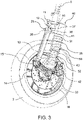
- the attachment foot 42 of the shock absorber group 40 is rotatably and slidingly connected on the rotation pin 33 ( Fig. 5 ).
- the attachment foot 42 and therefore the shock absorber group 40 are axially unconstrained from the rotation pin 33.
- transversal forces that is to say force directed orthogonally with respect to the plane of the wheel 2
- stress the same shock absorber group 40 In fact such a kind of stresses through said sliding coupling are absorbed and transferred to the oscillating arm 14 and to the rod 13.
- the shock absorber group is therefore unaffected by said stresses being more smooth along the straight trajectory of compression-expansion.
- the attachment foot 42 comprises a shaped portion 42' which is connected to the rotation pin 33.
- the rod 13 is rotatably mounted at his first end portion at the attachment head 41 of the shock absorber group 40. In this way it results that the rod 13 has a length of about two times the oscillating arm 14.
- the rotatable connection of the rod 13 at the attachment head 41 of the shock absorber group 40 allows to transfer the transversal loads - through the arm 14 and the rod 13 - to a more stable point of the fork 11 which falls outside the volume defined by the wheel 2, that is to say the monoblock 80 which constitutes a single connection piece between the shock absorber group 40 and the steering tube 8, besides the steering member 12.
- the rotation pin 33 protrudes from the oscillating arm 14 to engage inside a housing 73 defined in the attachment foot 42 and to cross through it completely so as to protrude from the opposite side with respect to the input side and to protrude from such housing so as to allow the engagement of the hub of the front wheel 2 on a projecting portion of the rotation pin 33.
- At least one bearing 74 is operatively interposed between the rotation pin 33 and the housing 73, e.g. ball or roller bearings, preferably also accommodated inside the housing 73.
- the housing 73 e.g. ball or roller bearings, preferably also accommodated inside the housing 73.
- two bearings 74 arranged inside the housing 73 are provided without thereby introducing any limitation.
- the bearing 74 and in particular the couple of bearings 74 allows the attachment foot 42 to rotate and to be slidingly free of moving along the axis X-X.
- the attachment foot 42 is therefore counterposed between the oscillating arm 14 and the abutment portion of the wheel 2.
- the rotation axis X-X defined by rotation pin 33 is inclined with respect to a horizontal plane of a preset angle such that when the motorcycle front suspension 10 supports at least part of the weight of the motorcycle 1, the rotation axis X-X of the front wheel 2 is parallel to said horizontal plane.
- a preset angle is preferably in the 0.5°-1.5° range and is, for example, equal to about 1°, e.g. equal to 1.15°.
- the rod 13 is pivotally hinged or adapted to be pivotally hinged to said steering member 12 through coupling means which define a hinge axis substantially parallel to the rotation axis X-X of the front wheel 2.
- the aforesaid coupling means comprise a connecting bracket 25 arranged at an end portion of the rod 13 and having two mutually parallel walls 26 and said hinge axis is perpendicular to said parallel walls 26.
- the three hinge axes that is to say the axis at the end portion of the rod 13 and the hinge axes of the oscillating arm are parallel each to other. Since the common axis between the shock absorber group 40 and he oscillating arm 14 is the rotation axis X-X of the wheel 2 (that is to say the wheel group formed by: rim, tire and disk of the brake) it follows that all the above axes are perpendicular to the median plane of the wheel 2.
- the aforesaid connecting bracket 25 may be a piece fixed to the rod 13 or may be an element integrated in the rod 13 and forming a single piece therewith.
- a hinge pin 27 is inserted in the parallel walls 26 of the connecting bracket 25 and preferably said hinge pin 27 passes through a through hole formed in the steering member 12.
- the damper 50 comprises:
- the shock absorber group is "jacketed", i.e. provided with a cylindrical coupling which makes it possible to impose the linearity of the trajectory of the front wheel 2.
- the first portion 51 is conveniently a jacket
- the second portion 52 is a lining
- the third portion 53 is a stem.
- the damper 50 is a hydraulic damper.
- the damper 50 comprises two bushings 61,62, e.g. two plastic bushings, operatively interposed between the first portion 51 and the second portion 52 of the damper 50, in which the said first portion 51 and said second portion 52 are adapted and configured to mutually slide on said bushings 61,62.
- One of such bushings, bushing 61 in the example is preferably coupled to the first portion 51 to slide therewith with respect to the second portion 52 and on the second portion 52 and the other of such bushings, bushing 62 in the example, is preferably coupled to the second portion 52 to slide along it with respect to the first portion 51 and on the first portion 51.
- the aforesaid bushings 61,62 are axially spaced apart one from the other so as to define a distance between the two bushings 61,62. More preferably, said distance varies during the mutual sliding between the first portion 51 and the second portion 52 of the damper 50, in particular increasing with the sinking of the shock absorber group 40.
- the aforesaid front suspension 10 may be provided on a motorcycle 1 having a front mudguard 9, comprising two lateral walls and a top wall interposed between said lateral walls, wherein said two lateral walls and said top wall delimit an internal space of said front mudguard 9 and wherein said first end of said rod 13 of the front suspension 10 is accommodated in the inner space of the mudguard.
- the part of the suspension which forms the rotating union between the rod 13 and the steering member 12 is contained in a less exposed and more protected area, also allowing to limit the impact of appearance of this part of the motorcycle 1 having a nature which is strictly functional.
- the aforesaid motorcycle front suspension has an improved ability to react in optimum manner to loads allowing to reduce or eliminate the pro-dive or anti-dive effect of the oscillating arm front suspensions of the prior art.
Landscapes
- Engineering & Computer Science (AREA)
- Mechanical Engineering (AREA)
- Axle Suspensions And Sidecars For Cycles (AREA)
Description
- The present invention relates to the technical field of suspensions for transport vehicles, and relates in particular to a motorcycle front suspension according to the preamble of claim 1. An example of such a motorcycle front suspension is disclosed in
CN 102963476 A . - In the field of motorcycles, and in particular of mopeds, it is known to use an oscillating arm type suspension on the forecarriage.
- In particular, it is a single arm, hence asymmetric, system comprising a single rigid arm fork, also named steering arm, on which an oscillating arm pivots, which ends on the pin of the front wheel.
- The steering arm is mechanically connected to the steering of the motorcycle.
- Furthermore, the shock absorber group, which typically comprises a spring and a damper, also engages the oscillating arm.
- The shock absorber group mechanically connects the single rigid arm fork and the front wheel pin to each other.
- Usually, the shock absorber group is rigidly connected to the front wheel pin and to the fork: typically, the attachment foot, or lower end of the shock absorber group, is connected to the wheel pin by means of a rigid bracket. However, solutions are known, e.g. such as the one described in
European patent EP2996929B1 , in which the attachment foot is connected to the front wheel pin in non-rigid manner. - The oscillating arm front suspensions of the prior art described above have the drawback of not reacting in optimum manner to loads, being characterized by a marked pro-dive or anti-dive effect, defined by the trajectory run by the instantaneous center of rotation of the wheel assembly with the diving of the suspension so that the contact point of the tire with the ground also follows a complex trajectory.
- The general object of the present disclosure is to provide a front suspension which can overcome the aforesaid drawback, totally or at least in part.
- Such object is achieved by a motorcycle front suspension as defined in general in claim 1. Preferred and advantageous embodiments of the aforesaid motorcycle suspension are defined in the accompanying dependent claims.
- The invention will be better understood from the following detailed description of particular embodiments, provided by way of example and consequently not limiting in any manner, with reference to the accompanying drawings which are briefly described in the following paragraph.
-
-
Figure 1 shows a side view of a non-limiting example of embodiment of a motorcycle comprising a front suspension. -
Figure 2 shows a three-dimensional partial section view of a part of the motorcycle offigure 1 in which the motorcycle front suspension is shown in greater detail. -
Figure 3 schematically shows a three-dimensional view of the motorcycle front suspension. -
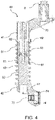
Figure 4 shows a side section view of a shock absorber group of the motorcycle front suspension. -
Figure 5 shows a section view of the suspension mounted on a front wheel. - Similar or equivalent elements in the accompanying figures are indicated by means of the same reference numbers.
- The annexed figures show an embodiment of a transport vehicle and in particular of a motorcycle 1. In the particular example shown in the figures, without thereby introducing any limitation, the motorcycle 1 is a scooter, comprising a
front wheel 2 and arear wheel 3, atraction engine 4, a supporting frame 5, asaddle 6, a steering handlebar 7 rotationally attached to the supporting frame 5. - The motorcycle 1 further comprises a
steering tube 8 fixed to the steering handlebar 7 so as to rotate integrally therewith. The motorcycle 1 further comprises afront mudguard 9, preferably fixed either directly or indirectly to thesteering tube 8 so as to rotate integrally therewith. - The motorcycle 1 further comprises a
motorcycle front suspension 10 adapted and configured to secure thefront wheel 2 to thesteering tube 8, so that saidfront suspension 10 is operatively interposed between thesteering tube 8 and thefront wheel 2. In the particular example shown infigure 1 , without thereby introducing any limitation, part of thefront suspension 10 is covered by a coveringhood 20 substantially for needs of appearance. This covering hood was removed in the remainingfigures 2-5 . - The
traction engine 4 is either directly or indirectly operatively connected to a driving wheel of the motorcycle 1, in the example to therear wheel 3. - According to an embodiment, the
traction engine 4 is an internal combustion engine. According to an alternative embodiment, thetraction engine 4 is an electric or hybrid engine. -
Reference numeral 10 indicates as a whole a motorcycle front suspension comprising afork 11 having asteering member 12, mechanically connected or adapted to be connected to the steering handlebar 7 of the motorcycle 1. For example and without limitation thesteering member 12 is a bar or a plate. In the particular non-limiting example shown in the figures, thefork 11 has a top end portion mechanically coupled to thesteering tube 8 so as to be able to rotate integrally therewith. - The
front motorcycle suspension 10 further comprises: - an oscillating
arm 14 having afirst end 15 and asecond end 16; - a
rod 13 having a first end, pivotally joined to thesteering member 12, and having a second end pivotally joined to thefirst end 15 of the oscillatingarm 14. - The
rod 13 is, for example, a cylindrical or substantially cylindrical rod made of metallic material, e.g. steel or aluminum. Therod 13 may also be a rod with a quadrangular or rectangular, or substantially rectangular or quadrangular, cross-section. - It is worth noting that although the
steering member 12 is shown as a flattened bar of reduced length, such member may also be a bar or an arm or a rod having for example a length such as to protrude with respect to a remaining portion of thefork 11, and be, for example, a straight projecting bar having a quadrangular or circular cross-section, etc. - The
motorcycle front suspension 10 further comprises ashock absorber group 40, comprising aspring 43 and adamper 50, saidshock absorber group 40 extending from anattachment head 41, mechanically connected to thesteering member 12, to anattachment foot 42, pivotally joined to thesecond end 26 of the oscillatingarm 14. In other words, it is worth noting that thesteering member 12 either forms part or constitutes a first branch of thefork 11 and theattachment head 41 either forms part or constitutes a second branch of thefork 11. The third branch of thefork 11 is defined by the top portion connected to thesteering tube 8. - For example, the
spring 43 is a helical spring interposed between theattachment head 41 and theattachment foot 42 of theshock absorber group 40 in order to apply an elastic thrust force which tends to move theattachment head 41 and theattachment foot 42 apart. Thespring 43 preferably surrounds thedamper 50. - In accordance with an embodiment, the oscillating
arm 14 carries arotation pin 33 of the associablefront wheel 2 of the motorcycle 1.Such rotation pin 33 defines a rotation axis X-X for thefront wheel 2. Preferably,such rotation pin 33 has an end portion forcibly engaged and locked by interference within a housing formed inside the second end portion of the oscillatingarm 14. More preferably, therotation pin 33 is locked in said housing so as to prevent a rotation of therotation pin 33 with respect to the oscillatingarm 14. - According to an embodiment, the
steering member 12 cantilevers with respect to thefork 11 so that the median longitudinal plane of the associablefront wheel 2 passes on the fork axis. As an alternative, thesteering member 12 can be substantially null and therod 13 may be connected at the sliding axis of theshock absorber group 40, for example therod 13 can be connected as closer as possible to theattachment head 41, for example immediately above or beside theattachment head 41. In the above alternative way, the branch defined by theshock absorber group 40, the branch defined by theoscillating arm 14 and the branch defined by therod 13 form are closed together so as to form a triangle instead of a quadrilateral. - In an advantageous way, the
attachment foot 42 of theshock absorber group 40 is rotatably and slidingly connected on the rotation pin 33 (Fig. 5 ). In such a way theattachment foot 42 and therefore theshock absorber group 40 are axially unconstrained from therotation pin 33. This allows to prevent that transversal forces, that is to say force directed orthogonally with respect to the plane of thewheel 2, stress the sameshock absorber group 40. In fact such a kind of stresses through said sliding coupling are absorbed and transferred to the oscillatingarm 14 and to therod 13. The shock absorber group is therefore unaffected by said stresses being more smooth along the straight trajectory of compression-expansion. - From the constructive point of view, the
attachment foot 42 comprises a shaped portion 42' which is connected to therotation pin 33. - Additionally, as shown in
figure 3 , therod 13 is rotatably mounted at his first end portion at theattachment head 41 of theshock absorber group 40. In this way it results that therod 13 has a length of about two times the oscillatingarm 14. The rotatable connection of therod 13 at theattachment head 41 of theshock absorber group 40 allows to transfer the transversal loads - through thearm 14 and the rod 13 - to a more stable point of thefork 11 which falls outside the volume defined by thewheel 2, that is to say themonoblock 80 which constitutes a single connection piece between theshock absorber group 40 and thesteering tube 8, besides thesteering member 12. - Preferably, the
rotation pin 33 protrudes from the oscillatingarm 14 to engage inside ahousing 73 defined in theattachment foot 42 and to cross through it completely so as to protrude from the opposite side with respect to the input side and to protrude from such housing so as to allow the engagement of the hub of thefront wheel 2 on a projecting portion of therotation pin 33. - According to an advantageous embodiment, at least one
bearing 74 is operatively interposed between therotation pin 33 and thehousing 73, e.g. ball or roller bearings, preferably also accommodated inside thehousing 73. In the particular example shown infigure 4 , twobearings 74 arranged inside thehousing 73 are provided without thereby introducing any limitation. - The
bearing 74 and in particular the couple ofbearings 74 allows theattachment foot 42 to rotate and to be slidingly free of moving along the axis X-X. Theattachment foot 42 is therefore counterposed between theoscillating arm 14 and the abutment portion of thewheel 2. - According to an advantageous embodiment, the rotation axis X-X defined by
rotation pin 33 is inclined with respect to a horizontal plane of a preset angle such that when themotorcycle front suspension 10 supports at least part of the weight of the motorcycle 1, the rotation axis X-X of thefront wheel 2 is parallel to said horizontal plane. Such predetermined angle is preferably in the 0.5°-1.5° range and is, for example, equal to about 1°, e.g. equal to 1.15°. - According to an advantageous embodiment, the
rod 13 is pivotally hinged or adapted to be pivotally hinged to said steeringmember 12 through coupling means which define a hinge axis substantially parallel to the rotation axis X-X of thefront wheel 2. For example, the aforesaid coupling means comprise a connectingbracket 25 arranged at an end portion of therod 13 and having two mutuallyparallel walls 26 and said hinge axis is perpendicular to saidparallel walls 26. - In particular, the three hinge axes, that is to say the axis at the end portion of the
rod 13 and the hinge axes of the oscillating arm are parallel each to other. Since the common axis between theshock absorber group 40 and he oscillatingarm 14 is the rotation axis X-X of the wheel 2 (that is to say the wheel group formed by: rim, tire and disk of the brake) it follows that all the above axes are perpendicular to the median plane of thewheel 2. - The aforesaid connecting
bracket 25 may be a piece fixed to therod 13 or may be an element integrated in therod 13 and forming a single piece therewith. - Preferably, a
hinge pin 27 is inserted in theparallel walls 26 of the connectingbracket 25 and preferably saidhinge pin 27 passes through a through hole formed in the steeringmember 12. - With reference to
figure 4 , according to a particularly advantageous embodiment, thedamper 50 comprises: - a
first portion 51 connected to theattachment head 41 and asecond portion 52 connected to theattachment foot 42, wherein thefirst portion 51 and thesecond portion 52 are adapted to slide relative to each other; and - a
third portion 53 surrounded by thefirst portion 51 and adapted to slide inside thesecond portion 52. - In such manner, the shock absorber group is "jacketed", i.e. provided with a cylindrical coupling which makes it possible to impose the linearity of the trajectory of the
front wheel 2. Indeed, thefirst portion 51 is conveniently a jacket, thesecond portion 52 is a lining and thethird portion 53 is a stem. Preferably, thedamper 50 is a hydraulic damper. - Again with reference to
figure 4 , according to a particularly advantageous embodiment, thedamper 50 comprises twobushings first portion 51 and thesecond portion 52 of thedamper 50, in which the saidfirst portion 51 and saidsecond portion 52 are adapted and configured to mutually slide on saidbushings first portion 51 to slide therewith with respect to thesecond portion 52 and on thesecond portion 52 and the other of such bushings, bushing 62 in the example, is preferably coupled to thesecond portion 52 to slide along it with respect to thefirst portion 51 and on thefirst portion 51. - Preferably, the
aforesaid bushings bushings first portion 51 and thesecond portion 52 of thedamper 50, in particular increasing with the sinking of theshock absorber group 40. - According to an advantageous embodiment, the
aforesaid front suspension 10 may be provided on a motorcycle 1 having afront mudguard 9, comprising two lateral walls and a top wall interposed between said lateral walls, wherein said two lateral walls and said top wall delimit an internal space of saidfront mudguard 9 and wherein said first end of saidrod 13 of thefront suspension 10 is accommodated in the inner space of the mudguard. In such manner, the part of the suspension which forms the rotating union between therod 13 and the steeringmember 12 is contained in a less exposed and more protected area, also allowing to limit the impact of appearance of this part of the motorcycle 1 having a nature which is strictly functional. - On the basis of the explanation above, it is thus possible to understand how a motorcycle front suspension of the type described above allows to achieve the purposes indicated above with reference to the prior art.
- Indeed, the aforesaid motorcycle front suspension has an improved ability to react in optimum manner to loads allowing to reduce or eliminate the pro-dive or anti-dive effect of the oscillating arm front suspensions of the prior art.
- Notwithstanding the principle of the invention, embodiments and details may be greatly varied with respect to that described and illustrated herein exclusively by way of non-limiting example without departing from the scope of protection of the invention as defined in the appended claims.
Claims (13)
- Motorcycle front suspension (10) comprising:- a fork (11) having a steering member (12) mechanically connected or adapted to be connected to a handlebar (7) of a motorcycle (1);- an oscillating arm (14) having a first end and a second end;- a rod (13) having a first end, pivotally joined to said steering member (12), and having a second end pivotally joined to the first end of the oscillating arm (14);- a shock absorber group (40), comprising a spring (43) and a damper (50), said group (40) extending from an attachment head (41), mechanically connected to the steering member (12), to an attachment foot (42), pivotally joined to the second end of the oscillating arm (14);wherein said oscillating arm (14) carries a rotation pin (33) of an associable front wheel (2), the rotation pin (33) defining a rotation axis (X-X) for the front wheel (2),characterized in thatsaid shock absorber group (40) at said attachment foot (42) is rotatably and slidingly coupled to said rotation pin (33).
- Motorcycle front suspension (10) according to claim 1, wherein the rod (13) is rotatably joined to said steering member (12) substantially at said attachment head (41).
- Motorcycle front suspension (10) according to claims 1 or 2, wherein said rod (13) is pivotally hinged or adapted to be pivotally hinged to said steering member (12) through coupling means which define a hinge axis substantially parallel to said rotation axis (X-X).
- Motorcycle front suspension (10) according to any one of preceding claims, wherein the damper (50) comprises:- a first portion (51) connected to the attachment head (41) and a second portion (52) connected to the attachment foot (42), wherein the first portion (51) and the second portion (52) are adapted to slide relative to each other; and- a third portion (53) surrounded by the first portion (51) and adapted to slide inside the second portion (52).
- Motorcycle front suspension (10) according to claim 4, wherein the first portion (51) is a jacket, the second portion (52) is a lining and the third portion (53) is a stem.
- Motorcycle front suspension (10) according to claims 4 or 5, wherein said damper (50) comprises two bushings (61,62) operatively interposed between the first portion (51) and the second portion (52) and wherein said first and second portion are adapted to slide relative to each other on said bushings (61,62).
- Motorcycle front suspension (10) according to claim 6, wherein said bushings (61,62) are axially spaced apart one from the other so that a distance is defined between the two bushings (61,62).
- Motorcycle front suspension (10) according to claim 7, wherein said distance varies during the mutual sliding between the first portion (51) and the second portion (52).
- Motorcycle front suspension (10) according to claim 2, wherein said rotation axis (X-X) is inclined with respect to an horizontal plane of a preset angle such that when the motorcycle front suspension (10) supports at least part of a motorcycle (1) weight, the rotation axis (X-X) is parallel to said horizontal plane.
- Motorcycle front suspension (10) according to claim 2, wherein the steering member (12) cantilevers with respect to the fork (11) so that the associable front wheel (2) longitudinal plane passes on the fork axis.
- Motorcycle (1) comprising at least one motorcycle front suspension (10) according to any of the previous claims.
- Motorcycle (1) according to claim 11, wherein said motorcycle (1) comprises a front mudguard (9), comprising two lateral walls and a top wall interposed between said lateral walls, wherein said two lateral walls and said top wall delimit an internal space of said front mudguard (9) and wherein said first end of said rod (13) is housed within said internal pace.
- Motorcycle (1) according to claims 11 or 12, wherein the motorcycle (1) is a scooter.
Applications Claiming Priority (2)
| Application Number | Priority Date | Filing Date | Title |
|---|---|---|---|
| IT102018000004941A IT201800004941A1 (en) | 2018-04-27 | 2018-04-27 | FRONT MOTORCYCLE SUSPENSION |
| PCT/IB2019/053261 WO2019207445A1 (en) | 2018-04-27 | 2019-04-19 | Motorcycle front suspension |
Publications (2)
| Publication Number | Publication Date |
|---|---|
| EP3784506A1 EP3784506A1 (en) | 2021-03-03 |
| EP3784506B1 true EP3784506B1 (en) | 2023-01-18 |
Family
ID=63014837
Family Applications (1)
| Application Number | Title | Priority Date | Filing Date |
|---|---|---|---|
| EP19722214.4A Active EP3784506B1 (en) | 2018-04-27 | 2019-04-19 | Motorcycle front suspension |
Country Status (6)
| Country | Link |
|---|---|
| US (1) | US11319016B2 (en) |
| EP (1) | EP3784506B1 (en) |
| CN (1) | CN112020446B (en) |
| IT (1) | IT201800004941A1 (en) |
| TW (1) | TWI794480B (en) |
| WO (1) | WO2019207445A1 (en) |
Families Citing this family (6)
| Publication number | Priority date | Publication date | Assignee | Title |
|---|---|---|---|---|
| IT201600116483A1 (en) * | 2016-11-17 | 2018-05-17 | Piaggio & C Spa | Telescopic front suspension with anti-sinking effect |
| IT201600124367A1 (en) * | 2016-12-07 | 2018-06-07 | Piaggio & C Spa | SUSPENSION UNIT FOR MOTORCYCLES, WHEEL UNIT FOR MOTORCYCLES, MOTORCYCLE ADVANCES AND MOTORCYCLES RELATIVE |
| IT201800021073A1 (en) * | 2018-12-27 | 2020-06-27 | Piaggio & C Spa | FRONT MOTORCYCLE SUSPENSION WITH SWING ARM |
| US20240010295A1 (en) * | 2020-12-17 | 2024-01-11 | Piaggio & C. Spa | An oscillating arm front suspension for saddle riding vehicles |
| CN115163725B (en) * | 2021-04-06 | 2025-05-06 | 重庆利城减震器有限责任公司 | Motorcycle shock absorber |
| CN114802573B (en) * | 2022-03-23 | 2023-06-16 | 宗申·比亚乔佛山摩托车企业有限公司 | Steering damping device for front wheel of motorcycle |
Family Cites Families (22)
| Publication number | Priority date | Publication date | Assignee | Title |
|---|---|---|---|---|
| DE808191C (en) * | 1950-05-20 | 1951-07-12 | Ernst Heinkel A G | Front wheel support arm for scooters and similar vehicles with double telescopic suspension |
| IT1033014B (en) * | 1977-02-10 | 1979-07-10 | Piaggio & C Spa | SUSPENSION OF THE FRONT WHEEL OF TWO OR THREE-WHEELED VEHICLES |
| US4542910A (en) * | 1982-01-25 | 1985-09-24 | Yamaha Hatsudoki Kabushiki Kaisha | Motorcycle suspension system |
| JPS58141981A (en) * | 1982-02-17 | 1983-08-23 | 本田技研工業株式会社 | motorcycle |
| US4526249A (en) * | 1983-05-25 | 1985-07-02 | Parker James G | Front suspension system for a motorcycle |
| GB2154960B (en) * | 1985-09-17 | 1988-04-27 | Terence Anthony Haynes | An improved motorcycle front fork assembly |
| JPH01145691U (en) * | 1988-03-17 | 1989-10-06 | ||
| US5417305A (en) * | 1993-09-13 | 1995-05-23 | Parker; James G. | Front swing arm suspension system for a motorcycle |
| US6260869B1 (en) * | 1997-07-31 | 2001-07-17 | Excelsior-Henderson Motorcyle Co. | Motorcycle front suspension system |
| JP4544681B2 (en) * | 2000-02-15 | 2010-09-15 | 本田技研工業株式会社 | Front suspension structure |
| US6908092B2 (en) * | 2002-08-26 | 2005-06-21 | Honda Giken Kogyo Kabushiki Kaisha | Link type suspension for vehicle such as motorcycle |
| CN101386327A (en) * | 2007-09-15 | 2009-03-18 | 山东双兴集团有限公司 | Tricycle front-mounting apparatus |
| IT1401130B1 (en) * | 2010-07-16 | 2013-07-12 | Piaggio & C Spa | MOTORCYCLE SUSPENSION SYSTEM |
| CN103112542A (en) * | 2012-12-19 | 2013-05-22 | 朱景州 | Rocker arm type motorcycle damping device |
| CN102963476A (en) * | 2012-12-19 | 2013-03-13 | 黄跃科 | Shock-resistant front fork of tricycle |
| CN103043166B (en) * | 2013-01-14 | 2015-04-22 | 袁和凯 | Front damping device for motor tricycle or electro-tricycle |
| CN103158826B (en) * | 2013-03-29 | 2015-09-30 | 重庆宗申发动机制造有限公司 | Motor-tricycle torsion bar type front-end equipment |
| ITPD20130136A1 (en) * | 2013-05-16 | 2014-11-17 | Piaggio & C Spa | MOTORCYCLE SUSPENSION |
| JP2017047764A (en) * | 2015-09-01 | 2017-03-09 | ヤマハ発動機株式会社 | Saddle-riding type vehicle |
| IT201600116483A1 (en) * | 2016-11-17 | 2018-05-17 | Piaggio & C Spa | Telescopic front suspension with anti-sinking effect |
| CN106627946A (en) * | 2016-12-30 | 2017-05-10 | 徐中芝 | Balanced type suspension frame and motor vehicle |
| CN206781990U (en) * | 2017-06-12 | 2017-12-22 | 徐扬 | A kind of wushu electro-tricycle steering damper apparatus |
-
2018
- 2018-04-27 IT IT102018000004941A patent/IT201800004941A1/en unknown
-
2019
- 2019-04-19 EP EP19722214.4A patent/EP3784506B1/en active Active
- 2019-04-19 CN CN201980028357.1A patent/CN112020446B/en active Active
- 2019-04-19 US US17/044,167 patent/US11319016B2/en active Active
- 2019-04-19 WO PCT/IB2019/053261 patent/WO2019207445A1/en not_active Ceased
- 2019-04-25 TW TW108114461A patent/TWI794480B/en active
Also Published As
| Publication number | Publication date |
|---|---|
| CN112020446A (en) | 2020-12-01 |
| CN112020446B (en) | 2024-07-26 |
| TW201945240A (en) | 2019-12-01 |
| WO2019207445A1 (en) | 2019-10-31 |
| IT201800004941A1 (en) | 2019-10-27 |
| US11319016B2 (en) | 2022-05-03 |
| TWI794480B (en) | 2023-03-01 |
| EP3784506A1 (en) | 2021-03-03 |
| US20210031867A1 (en) | 2021-02-04 |
Similar Documents
| Publication | Publication Date | Title |
|---|---|---|
| EP3784506B1 (en) | Motorcycle front suspension | |
| EP3331754B1 (en) | Motor vehicle front suspension | |
| EP3331711B1 (en) | Motor vehicle wheel suspension, motor vehicle assembly, motor vehicle forecarriage and motor vehicle thereof | |
| US8672076B2 (en) | Motorcycle rear-wheels transmission and suspension system | |
| CA2657101C (en) | Front wheel suspension structure for saddle-type vehicle, and vehicle incorporating same | |
| US7891688B2 (en) | Bicycle frame with articulating linkage mounting arrangement | |
| US20200216134A1 (en) | Vehicle having a suspension assembly including a swing arm | |
| US9783259B2 (en) | Front wheel suspension device for saddle-ride type vehicle | |
| US8567548B2 (en) | Independent rear drive system | |
| EP3378751B1 (en) | Rear fender supporting structure of saddle-type vehicle | |
| US10549811B2 (en) | Front wheel suspension device for saddle-ride type vehicle | |
| JP2009046016A (en) | Saddle-type vehicle equipped with a fork protector and a fork protector | |
| US6568497B1 (en) | Protective structure for axle joints | |
| US20150329169A1 (en) | Suspension system for the front wheel of single-track two- wheeled vehicles namely motorcycles and bicycles | |
| EP3683128B1 (en) | Tilting mechanism of vehicle having two front wheels | |
| JPH07102796B2 (en) | Hydraulic disc brake device for front wheels of saddle type vehicle for rough land traveling | |
| EP4402044B1 (en) | Saddle-ride motorcycle of scooter type with quadrilateral rear suspension | |
| JP3157567U (en) | Saddle-type vehicle equipped with a fork protector and a fork protector | |
| JP6816086B2 (en) | Saddle-type vehicle | |
| JPS62139777A (en) | motorcycle front suspension |
Legal Events
| Date | Code | Title | Description |
|---|---|---|---|
| STAA | Information on the status of an ep patent application or granted ep patent |
Free format text: STATUS: UNKNOWN |
|
| STAA | Information on the status of an ep patent application or granted ep patent |
Free format text: STATUS: THE INTERNATIONAL PUBLICATION HAS BEEN MADE |
|
| PUAI | Public reference made under article 153(3) epc to a published international application that has entered the european phase |
Free format text: ORIGINAL CODE: 0009012 |
|
| STAA | Information on the status of an ep patent application or granted ep patent |
Free format text: STATUS: REQUEST FOR EXAMINATION WAS MADE |
|
| 17P | Request for examination filed |
Effective date: 20200811 |
|
| AK | Designated contracting states |
Kind code of ref document: A1 Designated state(s): AL AT BE BG CH CY CZ DE DK EE ES FI FR GB GR HR HU IE IS IT LI LT LU LV MC MK MT NL NO PL PT RO RS SE SI SK SM TR |
|
| AX | Request for extension of the european patent |
Extension state: BA ME |
|
| DAV | Request for validation of the european patent (deleted) | ||
| DAX | Request for extension of the european patent (deleted) | ||
| GRAP | Despatch of communication of intention to grant a patent |
Free format text: ORIGINAL CODE: EPIDOSNIGR1 |
|
| STAA | Information on the status of an ep patent application or granted ep patent |
Free format text: STATUS: GRANT OF PATENT IS INTENDED |
|
| INTG | Intention to grant announced |
Effective date: 20221006 |
|
| GRAS | Grant fee paid |
Free format text: ORIGINAL CODE: EPIDOSNIGR3 |
|
| GRAA | (expected) grant |
Free format text: ORIGINAL CODE: 0009210 |
|
| STAA | Information on the status of an ep patent application or granted ep patent |
Free format text: STATUS: THE PATENT HAS BEEN GRANTED |
|
| AK | Designated contracting states |
Kind code of ref document: B1 Designated state(s): AL AT BE BG CH CY CZ DE DK EE ES FI FR GB GR HR HU IE IS IT LI LT LU LV MC MK MT NL NO PL PT RO RS SE SI SK SM TR |
|
| REG | Reference to a national code |
Ref country code: GB Ref legal event code: FG4D |
|
| REG | Reference to a national code |
Ref country code: CH Ref legal event code: EP |
|
| REG | Reference to a national code |
Ref country code: DE Ref legal event code: R096 Ref document number: 602019024527 Country of ref document: DE |
|
| REG | Reference to a national code |
Ref country code: NL Ref legal event code: FP |
|
| REG | Reference to a national code |
Ref country code: AT Ref legal event code: REF Ref document number: 1544480 Country of ref document: AT Kind code of ref document: T Effective date: 20230215 Ref country code: IE Ref legal event code: FG4D |
|
| REG | Reference to a national code |
Ref country code: LT Ref legal event code: MG9D |
|
| P01 | Opt-out of the competence of the unified patent court (upc) registered |
Effective date: 20230529 |
|
| PG25 | Lapsed in a contracting state [announced via postgrant information from national office to epo] |
Ref country code: RS Free format text: LAPSE BECAUSE OF FAILURE TO SUBMIT A TRANSLATION OF THE DESCRIPTION OR TO PAY THE FEE WITHIN THE PRESCRIBED TIME-LIMIT Effective date: 20230118 Ref country code: PT Free format text: LAPSE BECAUSE OF FAILURE TO SUBMIT A TRANSLATION OF THE DESCRIPTION OR TO PAY THE FEE WITHIN THE PRESCRIBED TIME-LIMIT Effective date: 20230518 Ref country code: NO Free format text: LAPSE BECAUSE OF FAILURE TO SUBMIT A TRANSLATION OF THE DESCRIPTION OR TO PAY THE FEE WITHIN THE PRESCRIBED TIME-LIMIT Effective date: 20230418 Ref country code: LV Free format text: LAPSE BECAUSE OF FAILURE TO SUBMIT A TRANSLATION OF THE DESCRIPTION OR TO PAY THE FEE WITHIN THE PRESCRIBED TIME-LIMIT Effective date: 20230118 Ref country code: LT Free format text: LAPSE BECAUSE OF FAILURE TO SUBMIT A TRANSLATION OF THE DESCRIPTION OR TO PAY THE FEE WITHIN THE PRESCRIBED TIME-LIMIT Effective date: 20230118 Ref country code: HR Free format text: LAPSE BECAUSE OF FAILURE TO SUBMIT A TRANSLATION OF THE DESCRIPTION OR TO PAY THE FEE WITHIN THE PRESCRIBED TIME-LIMIT Effective date: 20230118 Ref country code: ES Free format text: LAPSE BECAUSE OF FAILURE TO SUBMIT A TRANSLATION OF THE DESCRIPTION OR TO PAY THE FEE WITHIN THE PRESCRIBED TIME-LIMIT Effective date: 20230118 |
|
| PG25 | Lapsed in a contracting state [announced via postgrant information from national office to epo] |
Ref country code: SE Free format text: LAPSE BECAUSE OF FAILURE TO SUBMIT A TRANSLATION OF THE DESCRIPTION OR TO PAY THE FEE WITHIN THE PRESCRIBED TIME-LIMIT Effective date: 20230118 Ref country code: PL Free format text: LAPSE BECAUSE OF FAILURE TO SUBMIT A TRANSLATION OF THE DESCRIPTION OR TO PAY THE FEE WITHIN THE PRESCRIBED TIME-LIMIT Effective date: 20230118 Ref country code: IS Free format text: LAPSE BECAUSE OF FAILURE TO SUBMIT A TRANSLATION OF THE DESCRIPTION OR TO PAY THE FEE WITHIN THE PRESCRIBED TIME-LIMIT Effective date: 20230518 Ref country code: GR Free format text: LAPSE BECAUSE OF FAILURE TO SUBMIT A TRANSLATION OF THE DESCRIPTION OR TO PAY THE FEE WITHIN THE PRESCRIBED TIME-LIMIT Effective date: 20230419 Ref country code: FI Free format text: LAPSE BECAUSE OF FAILURE TO SUBMIT A TRANSLATION OF THE DESCRIPTION OR TO PAY THE FEE WITHIN THE PRESCRIBED TIME-LIMIT Effective date: 20230118 |
|
| REG | Reference to a national code |
Ref country code: DE Ref legal event code: R097 Ref document number: 602019024527 Country of ref document: DE |
|
| PG25 | Lapsed in a contracting state [announced via postgrant information from national office to epo] |
Ref country code: SM Free format text: LAPSE BECAUSE OF FAILURE TO SUBMIT A TRANSLATION OF THE DESCRIPTION OR TO PAY THE FEE WITHIN THE PRESCRIBED TIME-LIMIT Effective date: 20230118 Ref country code: RO Free format text: LAPSE BECAUSE OF FAILURE TO SUBMIT A TRANSLATION OF THE DESCRIPTION OR TO PAY THE FEE WITHIN THE PRESCRIBED TIME-LIMIT Effective date: 20230118 Ref country code: EE Free format text: LAPSE BECAUSE OF FAILURE TO SUBMIT A TRANSLATION OF THE DESCRIPTION OR TO PAY THE FEE WITHIN THE PRESCRIBED TIME-LIMIT Effective date: 20230118 Ref country code: DK Free format text: LAPSE BECAUSE OF FAILURE TO SUBMIT A TRANSLATION OF THE DESCRIPTION OR TO PAY THE FEE WITHIN THE PRESCRIBED TIME-LIMIT Effective date: 20230118 Ref country code: CZ Free format text: LAPSE BECAUSE OF FAILURE TO SUBMIT A TRANSLATION OF THE DESCRIPTION OR TO PAY THE FEE WITHIN THE PRESCRIBED TIME-LIMIT Effective date: 20230118 |
|
| PLBE | No opposition filed within time limit |
Free format text: ORIGINAL CODE: 0009261 |
|
| STAA | Information on the status of an ep patent application or granted ep patent |
Free format text: STATUS: NO OPPOSITION FILED WITHIN TIME LIMIT |
|
| PG25 | Lapsed in a contracting state [announced via postgrant information from national office to epo] |
Ref country code: SK Free format text: LAPSE BECAUSE OF FAILURE TO SUBMIT A TRANSLATION OF THE DESCRIPTION OR TO PAY THE FEE WITHIN THE PRESCRIBED TIME-LIMIT Effective date: 20230118 |
|
| REG | Reference to a national code |
Ref country code: CH Ref legal event code: PL |
|
| 26N | No opposition filed |
Effective date: 20231019 |
|
| PG25 | Lapsed in a contracting state [announced via postgrant information from national office to epo] |
Ref country code: LU Free format text: LAPSE BECAUSE OF NON-PAYMENT OF DUE FEES Effective date: 20230419 |
|
| REG | Reference to a national code |
Ref country code: BE Ref legal event code: MM Effective date: 20230430 |
|
| REG | Reference to a national code |
Ref country code: AT Ref legal event code: UEP Ref document number: 1544480 Country of ref document: AT Kind code of ref document: T Effective date: 20230118 |
|
| PG25 | Lapsed in a contracting state [announced via postgrant information from national office to epo] |
Ref country code: MC Free format text: LAPSE BECAUSE OF FAILURE TO SUBMIT A TRANSLATION OF THE DESCRIPTION OR TO PAY THE FEE WITHIN THE PRESCRIBED TIME-LIMIT Effective date: 20230118 |
|
| PG25 | Lapsed in a contracting state [announced via postgrant information from national office to epo] |
Ref country code: SI Free format text: LAPSE BECAUSE OF FAILURE TO SUBMIT A TRANSLATION OF THE DESCRIPTION OR TO PAY THE FEE WITHIN THE PRESCRIBED TIME-LIMIT Effective date: 20230118 Ref country code: MC Free format text: LAPSE BECAUSE OF FAILURE TO SUBMIT A TRANSLATION OF THE DESCRIPTION OR TO PAY THE FEE WITHIN THE PRESCRIBED TIME-LIMIT Effective date: 20230118 Ref country code: LI Free format text: LAPSE BECAUSE OF NON-PAYMENT OF DUE FEES Effective date: 20230430 Ref country code: CH Free format text: LAPSE BECAUSE OF NON-PAYMENT OF DUE FEES Effective date: 20230430 |
|
| REG | Reference to a national code |
Ref country code: IE Ref legal event code: MM4A |
|
| PG25 | Lapsed in a contracting state [announced via postgrant information from national office to epo] |
Ref country code: BE Free format text: LAPSE BECAUSE OF NON-PAYMENT OF DUE FEES Effective date: 20230430 |
|
| PG25 | Lapsed in a contracting state [announced via postgrant information from national office to epo] |
Ref country code: IE Free format text: LAPSE BECAUSE OF NON-PAYMENT OF DUE FEES Effective date: 20230419 |
|
| PG25 | Lapsed in a contracting state [announced via postgrant information from national office to epo] |
Ref country code: IE Free format text: LAPSE BECAUSE OF NON-PAYMENT OF DUE FEES Effective date: 20230419 |
|
| PG25 | Lapsed in a contracting state [announced via postgrant information from national office to epo] |
Ref country code: IT Free format text: LAPSE BECAUSE OF FAILURE TO SUBMIT A TRANSLATION OF THE DESCRIPTION OR TO PAY THE FEE WITHIN THE PRESCRIBED TIME-LIMIT Effective date: 20230118 |
|
| PG25 | Lapsed in a contracting state [announced via postgrant information from national office to epo] |
Ref country code: BG Free format text: LAPSE BECAUSE OF FAILURE TO SUBMIT A TRANSLATION OF THE DESCRIPTION OR TO PAY THE FEE WITHIN THE PRESCRIBED TIME-LIMIT Effective date: 20230118 |
|
| PG25 | Lapsed in a contracting state [announced via postgrant information from national office to epo] |
Ref country code: BG Free format text: LAPSE BECAUSE OF FAILURE TO SUBMIT A TRANSLATION OF THE DESCRIPTION OR TO PAY THE FEE WITHIN THE PRESCRIBED TIME-LIMIT Effective date: 20230118 |
|
| PGFP | Annual fee paid to national office [announced via postgrant information from national office to epo] |
Ref country code: NL Payment date: 20250424 Year of fee payment: 7 |
|
| PGFP | Annual fee paid to national office [announced via postgrant information from national office to epo] |
Ref country code: DE Payment date: 20250424 Year of fee payment: 7 |
|
| PGFP | Annual fee paid to national office [announced via postgrant information from national office to epo] |
Ref country code: AT Payment date: 20250417 Year of fee payment: 7 |
|
| PG25 | Lapsed in a contracting state [announced via postgrant information from national office to epo] |
Ref country code: CY Free format text: LAPSE BECAUSE OF FAILURE TO SUBMIT A TRANSLATION OF THE DESCRIPTION OR TO PAY THE FEE WITHIN THE PRESCRIBED TIME-LIMIT; INVALID AB INITIO Effective date: 20190419 |
|
| PG25 | Lapsed in a contracting state [announced via postgrant information from national office to epo] |
Ref country code: HU Free format text: LAPSE BECAUSE OF FAILURE TO SUBMIT A TRANSLATION OF THE DESCRIPTION OR TO PAY THE FEE WITHIN THE PRESCRIBED TIME-LIMIT; INVALID AB INITIO Effective date: 20190419 |
|
| PG25 | Lapsed in a contracting state [announced via postgrant information from national office to epo] |
Ref country code: TR Free format text: LAPSE BECAUSE OF FAILURE TO SUBMIT A TRANSLATION OF THE DESCRIPTION OR TO PAY THE FEE WITHIN THE PRESCRIBED TIME-LIMIT Effective date: 20230118 |
|
| PGFP | Annual fee paid to national office [announced via postgrant information from national office to epo] |
Ref country code: GB Payment date: 20260312 Year of fee payment: 8 |
|
| PGFP | Annual fee paid to national office [announced via postgrant information from national office to epo] |
Ref country code: FR Payment date: 20260331 Year of fee payment: 8 |