EP3783525B1 - Verfahren zur detektion eines objekts in der umgebung eines fahrzeugs, zugehöriges system und fahrzeug - Google Patents
Verfahren zur detektion eines objekts in der umgebung eines fahrzeugs, zugehöriges system und fahrzeug Download PDFInfo
- Publication number
- EP3783525B1 EP3783525B1 EP19193138.5A EP19193138A EP3783525B1 EP 3783525 B1 EP3783525 B1 EP 3783525B1 EP 19193138 A EP19193138 A EP 19193138A EP 3783525 B1 EP3783525 B1 EP 3783525B1
- Authority
- EP
- European Patent Office
- Prior art keywords
- vehicle
- data
- machine learning
- learning unit
- sensor
- Prior art date
- Legal status (The legal status is an assumption and is not a legal conclusion. Google has not performed a legal analysis and makes no representation as to the accuracy of the status listed.)
- Active
Links
Images


Classifications
-
- G—PHYSICS
- G06—COMPUTING OR CALCULATING; COUNTING
- G06V—IMAGE OR VIDEO RECOGNITION OR UNDERSTANDING
- G06V20/00—Scenes; Scene-specific elements
- G06V20/50—Context or environment of the image
- G06V20/56—Context or environment of the image exterior to a vehicle by using sensors mounted on the vehicle
- G06V20/58—Recognition of moving objects or obstacles, e.g. vehicles or pedestrians; Recognition of traffic objects, e.g. traffic signs, traffic lights or roads
-
- G—PHYSICS
- G06—COMPUTING OR CALCULATING; COUNTING
- G06F—ELECTRIC DIGITAL DATA PROCESSING
- G06F18/00—Pattern recognition
- G06F18/20—Analysing
- G06F18/25—Fusion techniques
- G06F18/253—Fusion techniques of extracted features
-
- G—PHYSICS
- G06—COMPUTING OR CALCULATING; COUNTING
- G06V—IMAGE OR VIDEO RECOGNITION OR UNDERSTANDING
- G06V10/00—Arrangements for image or video recognition or understanding
- G06V10/70—Arrangements for image or video recognition or understanding using pattern recognition or machine learning
- G06V10/77—Processing image or video features in feature spaces; using data integration or data reduction, e.g. principal component analysis [PCA] or independent component analysis [ICA] or self-organising maps [SOM]; Blind source separation
- G06V10/80—Fusion, i.e. combining data from various sources at the sensor level, preprocessing level, feature extraction level or classification level
- G06V10/806—Fusion, i.e. combining data from various sources at the sensor level, preprocessing level, feature extraction level or classification level of extracted features
-
- G—PHYSICS
- G06—COMPUTING OR CALCULATING; COUNTING
- G06V—IMAGE OR VIDEO RECOGNITION OR UNDERSTANDING
- G06V10/00—Arrangements for image or video recognition or understanding
- G06V10/70—Arrangements for image or video recognition or understanding using pattern recognition or machine learning
- G06V10/82—Arrangements for image or video recognition or understanding using pattern recognition or machine learning using neural networks
-
- G—PHYSICS
- G06—COMPUTING OR CALCULATING; COUNTING
- G06F—ELECTRIC DIGITAL DATA PROCESSING
- G06F18/00—Pattern recognition
- G06F18/20—Analysing
- G06F18/24—Classification techniques
- G06F18/243—Classification techniques relating to the number of classes
- G06F18/24323—Tree-organised classifiers
Definitions
- the invention is concerned with a method for detecting an object in surroundings of a second vehicle, wherein a first vehicle and the second vehicle each comprise at least one respective sensor for generating sensor data and a machine learning unit for recognizing an object type (e.g. car, person, bicycle, dog) of the object on the basis of the respective sensor data.
- the invention is also concerned with a system for performing the method.
- the invention also provides two different types of vehicles that may be operated as the first and the second vehicle in said system.
- Common known self-driving vehicles detect objects in its surroundings by means of at least one sensor and a machine learning unit.
- a machine learning unit receives image data (camera images) from an image sensor (camera) and an artificial neural network of the machine learning unit recognizes object types (e.g. car, person, bicycle, dog) of objects on the basis of the image data.
- the artificial neural network comprises several layers of artificial neurons (multi-layer network).
- a typical structure of such a neural network comprises a bottom layer or final layer which generates an output indicating the object type of the object. This final step is also named "classification". In other words, information about known objects types is stored in this final layer.
- the remaining, higher layers or preceding layers of the neural network provide preprocessing steps, i.e.
- the neural network For receiving the image data, the neural network comprises a top layer or input layer.
- the image data will also be processed by the neural network such that the described object features are extracted from the image data and a representation of these object features is provided to the final layer e.g. by the penultimate layer (layer before the final layer).
- the final layer or bottom layer of the neural network will not associate this set of object features with any of the known object types.
- the bottom layer will therefore deliver no output.
- the object recognition will not indicate that an object is present at all, as the extracted features are not associated with an object.
- One example for a new or unknown object type may be a "wolf", if the neural network has only been trained to recognize dogs and cats.
- the described problem may arise with a machine learning unit in general, not only an artificial neural network.
- Another type of machine learning unit may comprise, e.g., a decision tree.
- Document EP 3 511 863 A1 relates to learning representation of detected objects.
- the disclosure relates to technologies for distributable learning of a compact representation of detected objects in order to associate multiple observations from multiple vehicles by identifying a subset of features of a first object and a second object as being more determinative than other features of the first object and the second object based on a comparison of a similarity score.
- Document US 2019 / 0205765 A1 describes an artificial neural network that is designed to indicate when an object cannot be recognized based on the available sensor data. In the case of an unrecognizable object, a new artificial neural network is trained by a server.
- the invention provides a method for detecting an object in the surroundings of a vehicle.
- this vehicle is termed "second vehicle", as the steps performed by this vehicle follow the steps that are performed by a first vehicle.
- This first vehicle and the second vehicle each comprise at least one image sensor for generating sensor data and a machine learning unit for recognizing an object type of the object on the basis of the respective sensor data.
- the at least one image sensor may comprise a camera, for example. Accordingly, the sensor data may comprise image data of the camera.
- the object type that may be recognized by the respective machine learning unit of the first and the second vehicle may indicate, for example, that the object is a car or a person or a bicycle or an animal, just to name a few exemplary object types.
- the machine learning unit in each of the two vehicles receive sensor data from the at least one image sensor of the respective vehicle. On the basis of the received sensor data, it may decide or signal or indicate that an object of a specific, known object type is present in the surroundings of the respective vehicle.
- the machine learning unit can be an artificial neural network or a decision tree.
- the machine learning unit may comprise an input logic which may receive the sensor data from the at least one sensor.
- the classification output signal that indicates the object type of the object is produced or generated by a classification output logic.
- the input logic may be the said top layer and the classification output logic may be said bottom layer of the neural network.
- at least one intermediate processing element is provided in the machine learning unit.
- such an intermediate processing element can be an intermediate layer of artificial neurons.
- the inventive method comprises steps that are performed in the first vehicle.
- the first vehicle uses at least one additional sensor, i.e. an additional sensor that is not used in connection with the machine learning unit.
- an additional sensor can be, e.g., a radar or a sonar.
- the at least one additional sensor is used for detecting the object independently from the machine learning unit. It is then verified that the two following conditions apply or are fulfilled:
- the first condition says that the at least one additional sensor signals that the object is in the surrounding of the first vehicle. In other words, the presence of the object is detected in the surroundings of the first vehicle or near the first vehicle by means of the at least one additional sensor.
- the object type of the detected object may stay unknown.
- the second condition says that the classification output logic of the machine learning unit of the first vehicle fails to provide a corresponding classification output signal indicating a known object type.
- the machine learning unit fails to recognize the object type of the detected object. If the first vehicle would only rely on the output of the machine learning unit, this would result in an undetected object.
- the two conditions are fulfilled, i.e. if a) the at least one additional sensor signals that the object is present in the surroundings of the first vehicle and b) a classification output logic of the machine learning unit of the first vehicle fails to provide a corresponding classification output signal indicating a known object type, then predefined representation data of at least one intermediate processing element of the machine learning unit is extracted.
- the classification output logic i.e.
- representation data comprise a representation of object features of the object as they have been extracted from the sensor data by the machine learning unit.
- object features may comprise, e.g., edges and/or color and/or contrast and/or texture. All that the machine learning unit fails to do is to successfully associate these extracted object features with one known object type. Nevertheless, the extracted representation data may still be used to at least recognize that there is an object at all, even if the object type may stay unknown.
- these extracted representation data are transferred as reference data to the machine learning unit of the second vehicle.
- the second vehicle information is now available which object features of the object could be successfully extracted by the machine learning unit of the first vehicle although the final classification of the object type was not possible.
- the second vehicle is now enabled to use these reference data to at least detect the presence of the object in its surroundings without knowing the object type. An additional sensor is not needed in the second vehicle for this.
- the machine learning unit of the second vehicle operates a predefined detection logic which comprises that at least one intermediate processing element of the machine learning unit of the second vehicle (i.e. not the classification output logic) is linked to the detection logic.
- representation data of the at least one intermediate processing element of the machine learning unit of the second vehicle is available to the detection logic.
- the detection logic compares these local representation data with the received reference data. In other words, the detection logic verifies or observes, if the machine learning unit of the second vehicle observes similar or comparable or the same object features as the machine learning unit of the first vehicle did when the at least one additional sensor of the first vehicle detected the object.
- the detection logic detects that the (local) representation data and the received reference data fulfil a predefined similarity criterion, an auxiliary detection signal is generated indicating that the object of unknown object type has been detected.
- the auxiliary detection signal of the detection logic signals that the object is present in the surroundings of the second vehicle.
- the detection unit may be provided as a replacement or supplement to the classification output logic of the machine learning unit of the second vehicle. This would consequently prevent a generation of a classification output signal even if an object of known object type is detected.
- the detection logic might be linked to the at least one intermediate processing element as an additional logic, i.e. the classification output logic may still be in operation.
- the invention provides the advantage, that in the second vehicle -without the need of at least one additional sensor- the machine learning unit and its detection logic is still be able to signal the presence of the object of unknown object type only on the basis of the at least one sensor which provides the sensor data for the machine learning unit of the second vehicle.
- the machine learning unit may be based on any of the previously mentioned machine learning method or algorithm. Also, a combination of at least two machine learning algorithms may be provided.
- the first vehicle and in the second vehicle each comprises a respective machine learning unit which provides or comprises an artificial neural network. Consequently, the respective classification output logic comprises a final layer or bottom layer or output layer of the neural network. In other words, the classification output logic is constituted at least partially by this bottom layer or final layer.
- the respective at least one intermediate processing element from which the representation data are taken comprises at least one intermediate or higher layer of the neural network, i.e. at least one layer each of which is not the last layer or bottom layer.
- the respective representation data that are extracted from the machine learning unit comprise layer data of the at least one higher layer (i.e. the at least one intermediate processing element). Such layer data may describe a respective state of at least one artificial neuron of that respective layer.
- each machine learning unit uses a respective artificial neural network in each machine learning unit to provide the advantage that the representation data provide a higher-level representation or abstract representation of the object as compared to the raw sensor data.
- the type and/or structure of the artificial neural networks of both vehicles are identical or based on the same neural network prototype. This make the representation data compatible.
- the respective machine learning unit each comprises a decision tree.
- the respective classification output logic comprises the leaves of the decision tree which perform the actual classification regarding the object type of an observed object.
- the respective at least one intermediate processing element comprises at least one decision node of the decision tree.
- the respective representation data which is extracted from the decision tree comprise node data of the at least one decision node. Such node data may describe or indicate the decision that has been made at that node based on sensor data.
- the advantage may be realized that a part of the decision tree may be replaced by said detection logic on the basis of the reference data.
- the at least one additional sensor that is used in the first vehicle for detecting the object without the need of the machine learning unit comprises a radar or sonar (ultrasonic detector) or lidar. This type of additional sensor allows for detecting the presence of the object without the need of interpreting or recognizing its object type.
- the invention also comprises additional embodiments which provide additional advantages.
- a digital map database for storing different reference data of several different objects of unknown object type.
- more than one object may be observed by the first vehicle or by several vehicles which act as a respective first vehicle.
- corresponding reference data will then be available.
- This digital map database may be located, e.g. in an internet server or in a server cloud of the Internet.
- the reference data of each object are stored together with respective location data indicating a spatial area or place or position where the respective object has been observed.
- the corresponding reference data for this spatial area are transferred to the second vehicle.
- the second vehicle is provided with those reference data that belong to at least one object of unknown object type that has been observed in the corresponding spatial area.
- the detection logic of the machine learning unit of the second vehicle only uses the reference data for the spatial area in which the second vehicle is currently driving in. This ensures that in the second vehicle representation data are only compared against those reference data that describe at least one object which may actually be present in the spatial area.
- the detection logic compares the local extracted representation data with the reference data on the basis of a mathematical distance measure.
- a distance measure provides only none-negative distance values, i.e. values equal or greater than 0.
- the similarity criterion comprises that the distance measure indicates a distance that is smaller than a predefined threshold. In other words, if the reference data and the extracted representation data yield a distance value smaller than the predefined threshold, then the similarity criterion is fulfilled.
- One distance measure can be the distance between vectors. For this, the representation data and the extracted reference data can each be written as a respective vector. Another version of a mathematical distance measure is a so-called distance matrix.
- At least a part of the classification output logic and/or at least one intermediate processing element of the machine learning unit of the second vehicle is replaced by the detection logic.
- the replaced part of the machine learning unit cannot generate a classification output signal anymore, as it has been replaced by the detection logic. Only the auxiliary detection signal is possible in this case for the replaced part. This embodiment has been proven especially advantageous in regard to a decision tree.
- the at least one sensor for generating sensor data in the first vehicle and/or in the second vehicle respectively comprises a camera and the sensor data comprise image data accordingly.
- a camera has proven suitable regarding the detection of an object on the basis of a machine learning unit.
- the first vehicle and the second vehicle build or constitute a system which is also part of the invention.
- the system is for detecting an object in surroundings of a second vehicle.
- the system comprising at least two vehicles, wherein each vehicle comprises at least one sensor for generating sensor data and a machine learning unit for detecting the object on the basis of the sensor data.
- Each sensor may be designed to provide its respective sensor data on the basis of observations of the surroundings of the respective vehicle.
- the respective machine learning unit of each vehicle is designed to detect the object on the basis of the sensor data.
- the system may comprise several vehicles of the described type. However, at least one of these vehicles or several of these vehicles may be operated as a respective first vehicle, i.e. at least one of the vehicles additionally comprises at least one additional sensor for detecting the object independently of the respective machine learning unit of the vehicle. The remaining at least one vehicle may be operated as a respective second vehicle in the described sense.
- the system is designed to perform an embodiment of the inventive method by operating the at least one vehicle with the respective at least one additional sensor as a respective first vehicle and the at least one remaining vehicle as a respective second vehicle in the described sense.
- the invention provides a vehicle for the inventive system wherein the vehicle comprises at least one sensor for generating sensor data and a machine learning unit for detecting an object on the basis of the sensor data in the surroundings of the vehicle.
- This vehicle also comprises at least one additional sensor for detecting the object independently of the machine learning unit.
- a control unit of the vehicle is designed to perform the following steps which has already been described in connection with the method.
- the at least one additional sensor signals that the object is in the surroundings of the first vehicle and b) a classification output logic of the machine learning unit of the vehicle fails to provide a corresponding classification output signal indicating a known object type
- predefined representation data of at least one intermediate processing element of the machine learning unit is extracted, wherein the representation data comprise a representation of object features of the object as they have been extracted from the sensor data by the machine learning unit.
- the invention also comprises embodiments of the vehicle that comprise features as they have already been described in connection with embodiments of the inventive method. For this reason, the corresponding embodiments of the vehicle are not described here again.
- the invention also provides a vehicle that may be operated as a second vehicle in the system.
- This vehicle for the inventive system comprises at least one sensor for generating sensor data and a machine learning unit for detecting the object on the basis of the sensor data in the surroundings of the vehicle.
- a control unit of the vehicle is designed to perform the following steps.
- Reference data for the machine learning unit are received and the machine learning unit operates a predefined detection logic which comprises that at least one intermediate processing element (i.e. not the classification output logic) of the machine learning unit is linked to the detection logic and the detection logic compares representation data of the at least one linked intermediate processing element with the received reference data. If the detection logic detects that the representation data and the received reference data fulfill a predefined similarity criterion, an auxiliary detection signal is generated indicating that an object of unknown object type has been detected.
- the invention also comprises embodiments of this vehicle which are based on features that have already been described in connection with embodiments of the inventive method. These corresponding embodiments of the vehicle are therefore not described here again.
- Each vehicle of the inventive system is preferably designed as a motor vehicle, especially a passenger vehicle or a truck or a bus.
- Each vehicle may be designed as an autonomously driving vehicle comprising a corresponding electronic control unit providing an autopilot functionality.
- the invention also comprises the combination of the features of the described embodiments.
- Fig. 1 shows a system 10 that may be based on several vehicles 11, 12, 13. At least one vehicle 11 may be operated or may function as a first vehicle 11 in system 10. At least one remaining vehicle 12, 13 may be operated or may function as a second vehicle in system 10. Each vehicle 11, 12, 13 may comprise at least one sensor 14 and a respective machine learning unit 15. The at least one sensor 14 may comprise at least one camera or more general at least one image sensor. A capture area or region of coverage 16 of sensor 14 may aim or may be directed towards respective surroundings 17, 17' of the respective vehicle 11, 12, 13. Fig. 1 shows this for the first vehicle 11 and for one second vehicle 12.
- the respective at least one sensor 14 may generate or produce sensor data 18, e.g. image data in the case of a camera.
- the sensor data 18 may be provided to the machine learning unit 15 of the respective vehicle 11, 12, 13.
- Each machine learning unit 15 may be based on an artificial neural network 19 as it is shown in Fig. 1 for the first vehicle 11.
- the respective machine learning unit 15 may produce or generate or output a classification output signal 20. If in the surroundings 17 within the region of coverage 16 an object 21 is detected or seen or described by sensor data 18, the classification output signal 20 may describe an object type of the detected object 21.
- classification output signal 20 may signal that the object 21 is one of a vehicle, a specific stationary object (e.g. a pole or traffic light), a pedestrian, and an animal.
- the classification output signal 20 may be fed into or maybe provided to an electronic control unit that provides an autopilot functionality.
- the electronic control unit may then adapt a planned driving trajectory of vehicle 11 in order to avoid e.g. a collision with object 21.
- the same may be implemented in the other vehicles 12, 13 of the system 10.
- the machine learning unit 15 may have the following structure.
- the sensor data 18 may be provided as an input to an input logic 22.
- the final classification i.e. the generation of the classification output signal indicating a known object type, may be performed by a classification output logic 23.
- at least one intermediate processing element 24, 25 may be provided between the input logic 22 and the output logic 23.
- the input logic 22 may be provided by an input layer or top layer
- the classification output logic 23 may be provided by a bottom layer or final layer or output layer
- the at least one intermediate processing element 24, 25 may each be provided by a respective intermediate layer of the neural network 19 (multilayer neural network).
- machine learning unit 15 For detecting or recognizing an object type of a detected object 21, machine learning unit 15 must be trained or prepared in such a way, that the object type of the object 21 is known. In the case that object 21 is of unknown object type, no classification output signal 20 indicating a known object type is generated. Accordingly, the electronic control unit providing the autopilot functionality may not react to the appearance of the object 21.
- the system 10 may prevent that due to a failure 26 of providing a classification output signal 20 in the case of an object 21 of unknown object type, no information about the object 21 in the respective surroundings 17, 17' of the respective vehicle 11, 12, 13 is missing or emitted. This may be achieved as follows.
- At least one additional sensor 27 may be provided which may generate a detection signal 28 indicating the presence of an object 21 in the surroundings 17.
- the additional sensor 27 may be a close range sensor and/or a radar 29 and/or lidar and/or sonar.
- the respective machine learning unit 15 may operate or provide an additional detection logic 30 which may be able to generate an auxiliary detection signal 31 in the case that in the region of coverage 16 of the second vehicle 12, 13 in the surroundings 17' of that vehicle 12, 13 an object 21 of unknown object type is detected or visible or detectable.
- the respective machine learning unit 15 of vehicle 12, 13 may not generate the classification output signal 20 due to an unknown object type of object 21, the detection logic 30 may still generate an auxiliary detection signal 31.
- an electronic control unit 32 may detect that the at least one additional sensor 27 signals that an object 21 is in the surroundings 17 of the first vehicle 11 and at the same time the classification output logic 23 of the machine learning unit 15 of the first vehicle 11 fails to provide the corresponding classification output signal 20 indicating a known object type.
- predefined representation data 33 of at least one intermediate processing element 25 of the machine learning unit 15 is extracted or selected, wherein the representation data 33 comprise a representation of object features of the object 21 as they have been extracted from the sensor data 18 by the machine learning unit 15.
- these representation data 33 are transferred as reference data 34 to the respective machine learning unit 15 of each vehicle 12, 13 that is operated as a respective second vehicle.
- This transferal of reference data 34 may comprise the additional feature that the reference data 34 are transferred from the first vehicle to a digital map database 35 first.
- the first vehicle 11 transfers the reference data 34 together with location data 36 indicating a spatial area 37 in which the object 21 has been detected by the at least one additional sensor 27 in step S10.
- a current position 38 of vehicle 11 may be derived or determined.
- Vehicle 11 may comprise a receiver module 39 for receiving from a GNSS 40 a position signal 41 indicating, for example, a geographic position or geographic coordinates of the position 38.
- the GNSS global navigation satellite system
- the GNSS global navigation satellite system
- GPS global positioning system
- the second vehicle For downloading adequate reference data 34 from the digital map database 35, the second vehicle, e.g. vehicle 12, may determine its current position and may determine, in which spatial area 37 vehicle 12 is currently driving. This may be performed by an electronic control unit 42 of the second vehicle 12. From the database 35, those reference data 34 describing at least one object that has been observed in the spatial area 37 and that was of unknown object type, may be transferred to vehicle 12.
- Fig. 2 illustrates, how in the second vehicle 12, the detection of object 21 may be performed, although the object 21 in surroundings 17' of the second vehicle 12 is of unknown object type and although no additional sensor 27 is present.
- the description also accounts for or applies to vehicles 13.
- each machine learning unit 15 may operate an extraction module 43 which may be based on an artificial neural network and which may provide, e.g. bounding box information or bounding box data indicating where in e.g. a camera image or generally where inside the sensor data 18 or which part of the sensor data 18 describes object 21.
- a selection 18' of sensor data 18 may then be further processed by an artificial neural network 19 in the described way.
- object 21 is of unknown object type for machine learning unit 15 of second vehicle 12, there will be a failure 26 of producing or generating the classification output signal 20 by the classification output logic 23, i.e. the bottom layer of neural network 19.
- At least one intermediate processing element 25, e.g. at least one intermediate layer of neural network 19, may be linked to the detection logic 30.
- Detection logic 30 may be based, e.g. on a program module for a processing unit of electronic control unit 42.
- Detection logic 30 may determine a current position 38' of second vehicle 12 and may determine which spatial area 37 second vehicle 12 is in.
- Corresponding location data 36 may be provided to the digital map database 35 and for spatial area 37, corresponding reference data 34 may be transferred to second vehicle 12.
- Each vehicle 11, 12, 13 may be linked to the digital database 35 on the basis of, e.g., a mobile communication connection and/or WIFI-connection. The link to database 35 may also be based on an internet connection.
- Detection logic 30 may also receive representation data 33' from at least one intermediate processing element 25 of neural network 19 of machine learning unit 15 of second vehicle 12. On the basis of a similarity criterion 44, detection logic 30 may compare the received reference data 34 with the representation data 33'. If according to the similarity criterion 44, the representation data 33' correspond or provide a minimum degree of similarity with regard to reference data 34, the described auxiliary detection signal 31 may be generated by detection logic 30. Thus, although no additional sensor 27 may be available (absence of additional sensor 27) and although no classification output signal 20 may be generated, the presence of object 21 in the surroundings 17' may nevertheless be signaled by the auxiliary detection signal 31. Thus, an electronic control unit providing autopilot functionality in the second vehicle 12 (and similar in vehicles 13), may still be able to plan a driving trajectory around object 21 for avoiding a collision, although the object type of object 21 is unknown.
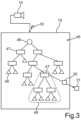
- Fig. 3 illustrates an alternative implementation where in the vehicles 11, 12, 13 by the respective machine learning unit 15, a decision tree 45 may be provided.
- a decision tree 45 may comprise an input logic 22 as a root 46 of the tree, a respective intermediate processing element as a respective decision node 47 (represented as a rectangle) and a classification output logic as leaves 48 of the decision tree 45 (the leaves 48 are represented by a respective triangle). For the sake of clarity, only one respective reference sign is shown for decision nodes 47 and the leaves 48.
- the detection logic 30 may be linked to at least one intermediate processing element in the form of at least one node 47. It may also be possible to replace a sub tree 49 by the detection logic 30. Whenever a decision node 47 is reached to which detection logic 30 is linked (shown as node 47'), detection logic 30 may interpret this as detection of an unknown object and may therefore generate the auxiliary detection signal 31.
- machine learning unit 15 may be trained or prepared to detect at least one of the following object types: vehicle, animal, pedestrian, and cyclist.
- Object 21 of unknown object type may be, e.g., a power plane, a scaffolding a barrier, just to name some examples.
- a preferred embodiment provides a solution that enables an object recognition device to also provide an output even in the case that an object of unknown object type is encountered.
- a first vehicle uses at least one additional sensor (radar, sonar) for detecting objects. If the at least one additional sensor indicates that there is an object in the surroundings 17 of the first vehicle and the artificial neural network of the object recognition device does not provide a corresponding output signal, it is assumed that the object is of unknown object type (such that the final layer stays silent).
- layer data of the penultimate layer and/or any higher layer i.e. at least one layer before the final layer that stores the information about object types
- These layer data comprise a representation of the object features of the object as they have been extracted from the camera images of the camera. These extracted layer data are called comparison data, in the following
- a second vehicle is provided with these comparison data.
- an object recognition device with a camera and an artificial neural network is also present.
- the camera images may show an object of unknown object type.
- the neural network has a special additional comparison mechanism.
- the penultimate and/or another higher layer is not only linked to the final layer for recognizing an object of known (! object type. But additionally, the penultimate layer (or any other higher layer) is also linked to a comparison unit that compares layer data from the penultimate / higher layer (as they can be extracted from the neural network of the second vehicle and as they represent object features of the object in the surroundings 17' of the second vehicle) to the received comparison data.
- the comparison can be performed on the basis of a so-called distance matrix.
- the comparison unit detects that a predefined distance measure indicating a mathematical distance between the extracted layer data of the penultimate / higher layer on one side and the received comparison data on the other side, a signal is generated that indicates that an object of unknown object type has been detected.
- the object recognition device of the second vehicle provides the signal that there is an object.
- a digital map database may be provided for storing different comparison data for different unknown object types.
- the comparison data are associated with a respective specific spatial area, where these comparison data have been generated. Whenever the second vehicle enters such an area, it will download the comparison data for this area. The comparison unit then has to perform comparisons of layer data from the penultimate / higher layer only with comparison data that are valid for this area.
- Self-driving vehicles are built and/or trained to recognize a relatively small set of limited set of objects on the basis of an artificial neural network. When encountering an object of an object type that is not in this set, this may provide a problem. Current vehicles will not deal with this problem. They have to update their internal model by retraining their neural network. They may also re-route their planned driving route in order to avoid a section of a road, where the problem that may arise. Additionally, or alternatively, they may send pictures to a backend server (internet server) or they may exchange pictures among each other in order to describe the object that may cause the problem.
- a backend server internet server
- machine-learning algorithms have multiple layers of representation (multilayer neural networks). Starting from a top layer that may receive sensor data, the deeper the layer, the closer to the final object classification one gets. With each layer, the sensor data are processed further in order to obtain a higher level of representation (evaluation and/or description of edges and/or colors and/or contrast and/or textures and/or patterns). If an unknown object (not part of the set of trained object types) is encountered, the last layer or bottom layer will not be able to classify the high level representation for signaling one of the known object types.
- a vehicle that encounters such an unknown object may record the higher-level representation in the form layer data of at least one layer higher than the last layer. Additionally, the position or spatial area where this object has been encountered, may also be signaled as location data or position data. Based on these location data, a spatial database may be created where layer data may be stored as reference data that may be associated with a respective spatial area where the corresponding object has been observed.
- a second vehicle may download those reference data of local unknown objects for the spatial area where the vehicle is currently driving through.
- Data layer of the neural network of the second vehicle may then be compared to the reference data in order to enable the second vehicle to recognize the object on the basis of its neural network without any additional sensor, only the camera that also provides the sensor data for the neural network.
- a vehicle whenever a vehicle detects an object it cannot classify by means of its neural network, it sends its layer data, i.e. the higher-level representation, to the spatial database.
- Other vehicles may download these layer data as reference data when they approach the corresponding spatial area where the object has been observed. Now, these other vehicles are able to compare their own sensor input and/or layer data with the reference data in order to recognize this object.
Landscapes
- Engineering & Computer Science (AREA)
- Theoretical Computer Science (AREA)
- Evolutionary Computation (AREA)
- Physics & Mathematics (AREA)
- General Physics & Mathematics (AREA)
- Computer Vision & Pattern Recognition (AREA)
- Multimedia (AREA)
- Artificial Intelligence (AREA)
- General Health & Medical Sciences (AREA)
- Databases & Information Systems (AREA)
- Computing Systems (AREA)
- Health & Medical Sciences (AREA)
- Medical Informatics (AREA)
- Software Systems (AREA)
- Data Mining & Analysis (AREA)
- Life Sciences & Earth Sciences (AREA)
- Bioinformatics & Cheminformatics (AREA)
- Bioinformatics & Computational Biology (AREA)
- Evolutionary Biology (AREA)
- General Engineering & Computer Science (AREA)
- Traffic Control Systems (AREA)
- Image Analysis (AREA)
Claims (7)
- Ein computerimplementiertes Verfahren zum Erkennen eines Objekts (21) in einer Umgebung (17') eines zweiten Fahrzeugs (12), wobei ein erstes Fahrzeug (11) und das zweite Fahrzeug (12) jeweils mindestens einen Bildsensor (14) zum Erzeugen von Sensordaten (18) und eine maschinelle Lerneinheit (15) zum Erkennen eines Objekttyps (21) auf der Grundlage der jeweiligen Sensordaten (18) umfassen, wobeider mindestens eine Bildsensor (14) des zweiten Fahrzeugs (12) Sensordaten erzeugt, die das Objekt (21) beschreiben, unddas erste Fahrzeug (11) mindestens einen zusätzlichen Sensor (27) verwendet, um die Anwesenheit des Objekts (21) unabhängig von der maschinellen Lerneinheit (15) zu erkennen , wobei der mindestens eine zusätzliche Sensor (27) mindestens einen der folgenden Sensoren umfasst: Radar, Sonar oder Lidar, und, fallsa) der mindestens eine weitere Sensor (27) signalisiert, dass sich das Objekt (21) in der Umgebung (17) des ersten Fahrzeugs (11) befindet undb) eine Klassifizierungsausgabelogik (23) der maschinellen Lerneinheit (15) des ersten Fahrzeugs (11) liefert kein entsprechendes Klassifizierungsausgabesignal (20), das einen bekannten Objekttyp anzeigt (26),vordefinierte Repräsentationsdaten (33) mindestens eines Zwischenverarbeitungselements (25) der maschinellen Lerneinheit (15) des ersten Fahrzeugs extrahiert werden, wobei die Repräsentationsdaten (33) eine Repräsentation von Objektmerkmalen des Objekts (21) umfassen, wie sie von der maschinellen Lerneinheit (15) des ersten Fahrzeugs aus den Sensordaten (18) extrahiert wurden, unddie extrahierten vordefinierten Repräsentationsdaten (33) als Referenzdaten (34) an die maschinelle Lerneinheit (15) des zweiten Fahrzeugs (12) übertragen werden, wobeidie maschinelle Lerneinheit (15) des zweiten Fahrzeugs (12) Sensordaten von dem mindestens einen Sensor des zweiten Fahrzeugs (12) empfängt unddie maschinelle Lerneinheit (15) des zweiten Fahrzeugs (12) eine vordefinierte Erkennungslogik (30) betreibt, die umfasst, dass mindestens ein Zwischenverarbeitungselement (25) der maschinellen Lerneinheit (15) des zweiten Fahrzeugs (12) mit der vordefinierten Erkennungslogik (30) derart verknüpft ist, dass vordefinierte Darstellungsdaten (33') des mindestens einen Zwischenverarbeitungselements (25) der maschinellen Lerneinheit des zweiten Fahrzeugs (12) der vordefinierten Erkennungslogik (30) zur Verfügung stehen und die vordefinierte Erkennungslogik (30) die vordefinierten Darstellungsdaten (33') des mindestens einen Zwischenverarbeitungselements (25) der maschinellen Lerneinheit des zweiten Fahrzeugs (12) mit den empfangenen Referenzdaten (34) vergleicht, wobei• im ersten Fahrzeug (11) und im zweiten Fahrzeug (12) die jeweilige maschinelle Lerneinheit (15) jeweils ein künstliches neuronales Netzwerk (19) umfasst und die jeweilige Klassifizierungsausgabelogik (23) eine letzte Schicht des neuronalen Netzwerks (19) umfasst und das jeweilige mindestens eine Zwischenverarbeitungselement (25) mindestens eine Zwischenschicht des jeweiligen neuronalen Netzwerks (19) umfasst und die jeweiligen vordefinierten Darstellungsdaten (33) Schichtdaten der mindestens einen Zwischenschicht umfassen, oder• im ersten Fahrzeug (11) und im zweiten Fahrzeug (12) umfasst die jeweilige maschinelle Lerneinheit (15) jeweils einen Entscheidungsbaum (45) und die jeweilige Klassifizierungsausgabelogik (23) umfasst Blätter (48) des Entscheidungsbaums (45) und das jeweilige mindestens eine Zwischenverarbeitungselement umfasst mindestens einen Entscheidungsknoten (47) des Entscheidungsbaums (45) und die jeweiligen vordefinierten Darstellungsdaten (33) umfassen Knotendaten des mindestens einen Entscheidungsknotens (47),und wenn die vordefinierte Erkennungslogik (30) erkennt, dass die vordefinierten Darstellungsdaten (33') und die empfangenen Referenzdaten (34) ein vordefiniertes Ähnlichkeitskriterium (44) erfüllen, wird ein Hilfserkennungssignal (31) erzeugt, das anzeigt, dass das Objekt (21) unbekannten Objekttyps erkannt wurde.
- Verfahren nach Anspruch 1, wobei zur Übertragung der Referenzdaten (34) vom ersten Fahrzeug (11) zum zweiten Fahrzeug (12) eine digitale Kartendatenbank ( 35) zur Verfügung gestellt wird , in der unterschiedliche Referenzdaten (34) mehrerer unterschiedlicher Objekte (21) unbekannten Objekttyps zusammen mit jeweiligen Standortdaten (36) gespeichert sind, die einen räumlichen Bereich (37) angeben, in dem das jeweilige Objekt (21) beobachtet wurde, und wobei vor oder immer dann, wenn das zweite Fahrzeug (12) in einen jeweiligen räumlichen Bereich (37) einfährt, die entsprechenden Referenzdaten (34) für diesen räumlichen Bereich (37) zum zweiten Fahrzeug (12) übertragen werden.
- Verfahren nach Anspruch 2, wobei die vordefinierte Erkennungslogik (30) der maschinellen Lerneinheit (15) des zweiten Fahrzeugs (12) nur die Referenzdaten (34) für den Raumbereich (37) verwendet, in dem sich das zweite Fahrzeug (12) aktuell befindet.
- Verfahren nach einem der vorhergehenden Ansprüche, wobei die vordefinierte Erkennungslogik (30) die vordefinierten Darstellungsdaten (33') mit den Referenzdaten (34) auf der Grundlage eines mathematischen Distanzmaßes vergleicht und das Ähnlichkeitskriterium (44) umfasst, dass das Distanzmaß eine Distanz anzeigt, die kleiner als ein vordefinierter Schwellenwert ist.
- Verfahren nach einem der vorhergehenden Ansprüche, wobei durch die vordefinierte Erkennungslogik (30) zumindest ein Teil (49) der Klassifizierungsausgabelogik (23) oder zumindest ein Zwischenverarbeitungselement (25) der maschinellen Lerneinheit (15) des zweiten Fahrzeugs (12) ersetzt wird.
- Verfahren nach einem der vorhergehenden Ansprüche, wobei der mindestens eine Sensor (14) zum Erzeugen von Sensordaten (18) im ersten Fahrzeug (11) oder im zweiten Fahrzeug (12) jeweils eine Kamera umfasst und die Sensordaten (18) Bilddaten umfassen.
- System (10) zum Erkennen eines Objekts (21) in einer Umgebung (17') eines zweiten Fahrzeugs (12), wobei das System (10) mindestens zwei Fahrzeuge (11, 12, 13) umfasst, wobei jedes Fahrzeug (11, 12, 13) mindestens einen Sensor (14) zum Erzeugen von Sensordaten (18) und eine maschinelle Lerneinheit (15) zum Erkennen des Objekts (21) auf Basis der Sensordaten (18) umfasst und wobei mindestens eines der Fahrzeuge (11) mindestens einen weiteren Sensor (27) zum Erkennen des Objekts (21) unabhängig von seiner maschinellen Lerneinheit (15) umfasst, wobei
das System (10) Mittel zum Durchführen eines Verfahrens nach einem der vorhergehenden Ansprüche umfasst, indem das mindestens eine Fahrzeug (11) mit dem jeweiligen mindestens einen zusätzlichen Sensor (27) als jeweiliges erstes Fahrzeug (11) und das mindestens eine andere Fahrzeug (12) der mindestens zwei Fahrzeuge (11, 12, 13) als jeweiliges zweites Fahrzeug (12) betrieben wird.
Priority Applications (1)
| Application Number | Priority Date | Filing Date | Title |
|---|---|---|---|
| EP19193138.5A EP3783525B1 (de) | 2019-08-22 | 2019-08-22 | Verfahren zur detektion eines objekts in der umgebung eines fahrzeugs, zugehöriges system und fahrzeug |
Applications Claiming Priority (1)
| Application Number | Priority Date | Filing Date | Title |
|---|---|---|---|
| EP19193138.5A EP3783525B1 (de) | 2019-08-22 | 2019-08-22 | Verfahren zur detektion eines objekts in der umgebung eines fahrzeugs, zugehöriges system und fahrzeug |
Publications (2)
| Publication Number | Publication Date |
|---|---|
| EP3783525A1 EP3783525A1 (de) | 2021-02-24 |
| EP3783525B1 true EP3783525B1 (de) | 2025-05-21 |
Family
ID=67734573
Family Applications (1)
| Application Number | Title | Priority Date | Filing Date |
|---|---|---|---|
| EP19193138.5A Active EP3783525B1 (de) | 2019-08-22 | 2019-08-22 | Verfahren zur detektion eines objekts in der umgebung eines fahrzeugs, zugehöriges system und fahrzeug |
Country Status (1)
| Country | Link |
|---|---|
| EP (1) | EP3783525B1 (de) |
Families Citing this family (1)
| Publication number | Priority date | Publication date | Assignee | Title |
|---|---|---|---|---|
| US11853741B2 (en) * | 2022-01-10 | 2023-12-26 | GM Global Technology Operations LLC | Federated learning for connected camera |
Family Cites Families (5)
| Publication number | Priority date | Publication date | Assignee | Title |
|---|---|---|---|---|
| US8416296B2 (en) | 2009-04-14 | 2013-04-09 | Behavioral Recognition Systems, Inc. | Mapper component for multiple art networks in a video analysis system |
| JP6729516B2 (ja) * | 2017-07-27 | 2020-07-22 | トヨタ自動車株式会社 | 識別装置 |
| US10438371B2 (en) * | 2017-09-22 | 2019-10-08 | Zoox, Inc. | Three-dimensional bounding box from two-dimensional image and point cloud data |
| US11328210B2 (en) * | 2017-12-29 | 2022-05-10 | Micron Technology, Inc. | Self-learning in distributed architecture for enhancing artificial neural network |
| US10963706B2 (en) * | 2018-01-13 | 2021-03-30 | Toyota Jidosha Kabushiki Kaisha | Distributable representation learning for associating observations from multiple vehicles |
-
2019
- 2019-08-22 EP EP19193138.5A patent/EP3783525B1/de active Active
Also Published As
| Publication number | Publication date |
|---|---|
| EP3783525A1 (de) | 2021-02-24 |
Similar Documents
| Publication | Publication Date | Title |
|---|---|---|
| US11455808B2 (en) | Method for the classification of parking spaces in a surrounding region of a vehicle with a neural network | |
| US12315226B2 (en) | System and method for 3D object detection using multi-resolution features recovery using panoptic segmentation information | |
| CN109117709B (zh) | 用于自动驾驶车辆的碰撞避免系统 | |
| KR102246706B1 (ko) | 자율 주행 장치 및 이상 도로 상황에서 자율 주행 장치 운용 방법 | |
| US12100221B2 (en) | Methods and electronic devices for detecting objects in surroundings of a self-driving car | |
| US20120128210A1 (en) | Method for Traffic Sign Recognition | |
| US10853964B2 (en) | Image recognition system | |
| US11847837B2 (en) | Image-based lane detection and ego-lane recognition method and apparatus | |
| EP4246460A2 (de) | Fahrzeugidentifikationssystem | |
| US11250279B2 (en) | Generative adversarial network models for small roadway object detection | |
| JP2025511842A (ja) | 物体の軌道を予測するための方法 | |
| JP2023541967A (ja) | 自車両の自動運転及び支援運転における環境特徴の連続適応型検出コンピュータ実装方法 | |
| US12545295B2 (en) | Image-based generation of descriptive and perceptive messages of automotive scenes | |
| EP3783525B1 (de) | Verfahren zur detektion eines objekts in der umgebung eines fahrzeugs, zugehöriges system und fahrzeug | |
| US12482278B2 (en) | Method and apparatus for determining and classifying at least one object in a sensing area of a sensor | |
| Al Mamun et al. | Efficient lane marking detection using deep learning technique with differential and cross-entropy loss. | |
| US20250111279A1 (en) | Learning apparatus, generation method, moving object system, and storage medium | |
| US11113566B2 (en) | Image processing system, method, and apparatus specifying an object included in a captured image outside a vehicle | |
| US12391275B2 (en) | Efficient detection of structure and status of traffic lights | |
| EP4287147A1 (de) | Trainingsverfahren, verwendung, softwareprogramm und system zur detektion von unbekannten objekten | |
| CN117755334A (zh) | 一种入侵检测方法、装置以及车辆 | |
| Juyal et al. | Anomalous activity detection using deep learning techniques in autonomous vehicles | |
| JP2021056620A (ja) | 物体認識システム、先進運転支援システム及びプログラム | |
| JP2025501383A (ja) | センサデータと予想とのマッチングによる風景の特性のより高い安全インテグリティでの認識 | |
| US20230410533A1 (en) | Method, processor circuit and computer-readable storage medium for pedestrian detection by a processor circuit of a motor vehicle |
Legal Events
| Date | Code | Title | Description |
|---|---|---|---|
| PUAI | Public reference made under article 153(3) epc to a published international application that has entered the european phase |
Free format text: ORIGINAL CODE: 0009012 |
|
| STAA | Information on the status of an ep patent application or granted ep patent |
Free format text: STATUS: THE APPLICATION HAS BEEN PUBLISHED |
|
| AK | Designated contracting states |
Kind code of ref document: A1 Designated state(s): AL AT BE BG CH CY CZ DE DK EE ES FI FR GB GR HR HU IE IS IT LI LT LU LV MC MK MT NL NO PL PT RO RS SE SI SK SM TR |
|
| AX | Request for extension of the european patent |
Extension state: BA ME |
|
| STAA | Information on the status of an ep patent application or granted ep patent |
Free format text: STATUS: REQUEST FOR EXAMINATION WAS MADE |
|
| 17P | Request for examination filed |
Effective date: 20210824 |
|
| RBV | Designated contracting states (corrected) |
Designated state(s): AL AT BE BG CH CY CZ DE DK EE ES FI FR GB GR HR HU IE IS IT LI LT LU LV MC MK MT NL NO PL PT RO RS SE SI SK SM TR |
|
| STAA | Information on the status of an ep patent application or granted ep patent |
Free format text: STATUS: EXAMINATION IS IN PROGRESS |
|
| 17Q | First examination report despatched |
Effective date: 20230131 |
|
| REG | Reference to a national code |
Ref country code: DE Ref legal event code: R079 Ref document number: 602019070170 Country of ref document: DE Free format text: PREVIOUS MAIN CLASS: G06K0009000000 Ipc: G06F0018250000 |
|
| GRAP | Despatch of communication of intention to grant a patent |
Free format text: ORIGINAL CODE: EPIDOSNIGR1 |
|
| STAA | Information on the status of an ep patent application or granted ep patent |
Free format text: STATUS: GRANT OF PATENT IS INTENDED |
|
| RIC1 | Information provided on ipc code assigned before grant |
Ipc: G06V 20/58 20220101ALI20241202BHEP Ipc: G06V 10/82 20220101ALI20241202BHEP Ipc: G06V 10/80 20220101ALI20241202BHEP Ipc: G06F 18/25 20230101AFI20241202BHEP |
|
| INTG | Intention to grant announced |
Effective date: 20241212 |
|
| GRAS | Grant fee paid |
Free format text: ORIGINAL CODE: EPIDOSNIGR3 |
|
| GRAA | (expected) grant |
Free format text: ORIGINAL CODE: 0009210 |
|
| STAA | Information on the status of an ep patent application or granted ep patent |
Free format text: STATUS: THE PATENT HAS BEEN GRANTED |
|
| AK | Designated contracting states |
Kind code of ref document: B1 Designated state(s): AL AT BE BG CH CY CZ DE DK EE ES FI FR GB GR HR HU IE IS IT LI LT LU LV MC MK MT NL NO PL PT RO RS SE SI SK SM TR |
|
| REG | Reference to a national code |
Ref country code: GB Ref legal event code: FG4D |
|
| REG | Reference to a national code |
Ref country code: CH Ref legal event code: EP |
|
| REG | Reference to a national code |
Ref country code: DE Ref legal event code: R096 Ref document number: 602019070170 Country of ref document: DE |
|
| REG | Reference to a national code |
Ref country code: IE Ref legal event code: FG4D |
|
| REG | Reference to a national code |
Ref country code: NL Ref legal event code: MP Effective date: 20250521 |
|
| PG25 | Lapsed in a contracting state [announced via postgrant information from national office to epo] |
Ref country code: FI Free format text: LAPSE BECAUSE OF FAILURE TO SUBMIT A TRANSLATION OF THE DESCRIPTION OR TO PAY THE FEE WITHIN THE PRESCRIBED TIME-LIMIT Effective date: 20250521 Ref country code: PT Free format text: LAPSE BECAUSE OF FAILURE TO SUBMIT A TRANSLATION OF THE DESCRIPTION OR TO PAY THE FEE WITHIN THE PRESCRIBED TIME-LIMIT Effective date: 20250922 Ref country code: ES Free format text: LAPSE BECAUSE OF FAILURE TO SUBMIT A TRANSLATION OF THE DESCRIPTION OR TO PAY THE FEE WITHIN THE PRESCRIBED TIME-LIMIT Effective date: 20250521 |
|
| REG | Reference to a national code |
Ref country code: LT Ref legal event code: MG9D |
|
| PG25 | Lapsed in a contracting state [announced via postgrant information from national office to epo] |
Ref country code: NO Free format text: LAPSE BECAUSE OF FAILURE TO SUBMIT A TRANSLATION OF THE DESCRIPTION OR TO PAY THE FEE WITHIN THE PRESCRIBED TIME-LIMIT Effective date: 20250821 Ref country code: GR Free format text: LAPSE BECAUSE OF FAILURE TO SUBMIT A TRANSLATION OF THE DESCRIPTION OR TO PAY THE FEE WITHIN THE PRESCRIBED TIME-LIMIT Effective date: 20250822 |
|
| PG25 | Lapsed in a contracting state [announced via postgrant information from national office to epo] |
Ref country code: PL Free format text: LAPSE BECAUSE OF FAILURE TO SUBMIT A TRANSLATION OF THE DESCRIPTION OR TO PAY THE FEE WITHIN THE PRESCRIBED TIME-LIMIT Effective date: 20250521 Ref country code: NL Free format text: LAPSE BECAUSE OF FAILURE TO SUBMIT A TRANSLATION OF THE DESCRIPTION OR TO PAY THE FEE WITHIN THE PRESCRIBED TIME-LIMIT Effective date: 20250521 |
|
| PG25 | Lapsed in a contracting state [announced via postgrant information from national office to epo] |
Ref country code: BG Free format text: LAPSE BECAUSE OF FAILURE TO SUBMIT A TRANSLATION OF THE DESCRIPTION OR TO PAY THE FEE WITHIN THE PRESCRIBED TIME-LIMIT Effective date: 20250521 |
|
| PG25 | Lapsed in a contracting state [announced via postgrant information from national office to epo] |
Ref country code: HR Free format text: LAPSE BECAUSE OF FAILURE TO SUBMIT A TRANSLATION OF THE DESCRIPTION OR TO PAY THE FEE WITHIN THE PRESCRIBED TIME-LIMIT Effective date: 20250521 |
|
| PG25 | Lapsed in a contracting state [announced via postgrant information from national office to epo] |
Ref country code: RS Free format text: LAPSE BECAUSE OF FAILURE TO SUBMIT A TRANSLATION OF THE DESCRIPTION OR TO PAY THE FEE WITHIN THE PRESCRIBED TIME-LIMIT Effective date: 20250821 |
|
| PG25 | Lapsed in a contracting state [announced via postgrant information from national office to epo] |
Ref country code: IS Free format text: LAPSE BECAUSE OF FAILURE TO SUBMIT A TRANSLATION OF THE DESCRIPTION OR TO PAY THE FEE WITHIN THE PRESCRIBED TIME-LIMIT Effective date: 20250921 |
|
| PG25 | Lapsed in a contracting state [announced via postgrant information from national office to epo] |
Ref country code: LV Free format text: LAPSE BECAUSE OF FAILURE TO SUBMIT A TRANSLATION OF THE DESCRIPTION OR TO PAY THE FEE WITHIN THE PRESCRIBED TIME-LIMIT Effective date: 20250521 |
|
| REG | Reference to a national code |
Ref country code: AT Ref legal event code: MK05 Ref document number: 1797373 Country of ref document: AT Kind code of ref document: T Effective date: 20250521 |
|
| PGFP | Annual fee paid to national office [announced via postgrant information from national office to epo] |
Ref country code: DE Payment date: 20251031 Year of fee payment: 7 |
|
| PG25 | Lapsed in a contracting state [announced via postgrant information from national office to epo] |
Ref country code: AT Free format text: LAPSE BECAUSE OF FAILURE TO SUBMIT A TRANSLATION OF THE DESCRIPTION OR TO PAY THE FEE WITHIN THE PRESCRIBED TIME-LIMIT Effective date: 20250521 Ref country code: DK Free format text: LAPSE BECAUSE OF FAILURE TO SUBMIT A TRANSLATION OF THE DESCRIPTION OR TO PAY THE FEE WITHIN THE PRESCRIBED TIME-LIMIT Effective date: 20250521 Ref country code: SM Free format text: LAPSE BECAUSE OF FAILURE TO SUBMIT A TRANSLATION OF THE DESCRIPTION OR TO PAY THE FEE WITHIN THE PRESCRIBED TIME-LIMIT Effective date: 20250521 |
|
| PG25 | Lapsed in a contracting state [announced via postgrant information from national office to epo] |
Ref country code: CZ Free format text: LAPSE BECAUSE OF FAILURE TO SUBMIT A TRANSLATION OF THE DESCRIPTION OR TO PAY THE FEE WITHIN THE PRESCRIBED TIME-LIMIT Effective date: 20250521 |
|
| PG25 | Lapsed in a contracting state [announced via postgrant information from national office to epo] |
Ref country code: EE Free format text: LAPSE BECAUSE OF FAILURE TO SUBMIT A TRANSLATION OF THE DESCRIPTION OR TO PAY THE FEE WITHIN THE PRESCRIBED TIME-LIMIT Effective date: 20250521 |
|
| PG25 | Lapsed in a contracting state [announced via postgrant information from national office to epo] |
Ref country code: RO Free format text: LAPSE BECAUSE OF FAILURE TO SUBMIT A TRANSLATION OF THE DESCRIPTION OR TO PAY THE FEE WITHIN THE PRESCRIBED TIME-LIMIT Effective date: 20250521 Ref country code: SK Free format text: LAPSE BECAUSE OF FAILURE TO SUBMIT A TRANSLATION OF THE DESCRIPTION OR TO PAY THE FEE WITHIN THE PRESCRIBED TIME-LIMIT Effective date: 20250521 |
|
| PG25 | Lapsed in a contracting state [announced via postgrant information from national office to epo] |
Ref country code: IT Free format text: LAPSE BECAUSE OF FAILURE TO SUBMIT A TRANSLATION OF THE DESCRIPTION OR TO PAY THE FEE WITHIN THE PRESCRIBED TIME-LIMIT Effective date: 20250521 |
|
| REG | Reference to a national code |
Ref country code: CH Ref legal event code: H13 Free format text: ST27 STATUS EVENT CODE: U-0-0-H10-H13 (AS PROVIDED BY THE NATIONAL OFFICE) Effective date: 20260324 |
|
| PLBE | No opposition filed within time limit |
Free format text: ORIGINAL CODE: 0009261 |
|
| STAA | Information on the status of an ep patent application or granted ep patent |
Free format text: STATUS: NO OPPOSITION FILED WITHIN TIME LIMIT |