EP3783479B1 - Optimized compute hardware for machine learning operations - Google Patents
Optimized compute hardware for machine learning operations Download PDFInfo
- Publication number
- EP3783479B1 EP3783479B1 EP20200955.1A EP20200955A EP3783479B1 EP 3783479 B1 EP3783479 B1 EP 3783479B1 EP 20200955 A EP20200955 A EP 20200955A EP 3783479 B1 EP3783479 B1 EP 3783479B1
- Authority
- EP
- European Patent Office
- Prior art keywords
- graphics
- memory
- input
- bit
- processor
- Prior art date
- Legal status (The legal status is an assumption and is not a legal conclusion. Google has not performed a legal analysis and makes no representation as to the accuracy of the status listed.)
- Active
Links
Images


















Classifications
-
- G—PHYSICS
- G06—COMPUTING OR CALCULATING; COUNTING
- G06N—COMPUTING ARRANGEMENTS BASED ON SPECIFIC COMPUTATIONAL MODELS
- G06N3/00—Computing arrangements based on biological models
- G06N3/02—Neural networks
- G06N3/08—Learning methods
- G06N3/084—Backpropagation, e.g. using gradient descent
-
- G—PHYSICS
- G06—COMPUTING OR CALCULATING; COUNTING
- G06T—IMAGE DATA PROCESSING OR GENERATION, IN GENERAL
- G06T1/00—General purpose image data processing
- G06T1/20—Processor architectures; Processor configuration, e.g. pipelining
-
- G—PHYSICS
- G06—COMPUTING OR CALCULATING; COUNTING
- G06F—ELECTRIC DIGITAL DATA PROCESSING
- G06F17/00—Digital computing or data processing equipment or methods, specially adapted for specific functions
- G06F17/10—Complex mathematical operations
- G06F17/16—Matrix or vector computation, e.g. matrix-matrix or matrix-vector multiplication, matrix factorization
-
- G—PHYSICS
- G06—COMPUTING OR CALCULATING; COUNTING
- G06F—ELECTRIC DIGITAL DATA PROCESSING
- G06F7/00—Methods or arrangements for processing data by operating upon the order or content of the data handled
- G06F7/38—Methods or arrangements for performing computations using exclusively denominational number representation, e.g. using binary, ternary, decimal representation
- G06F7/48—Methods or arrangements for performing computations using exclusively denominational number representation, e.g. using binary, ternary, decimal representation using non-contact-making devices, e.g. tube, solid state device; using unspecified devices
- G06F7/544—Methods or arrangements for performing computations using exclusively denominational number representation, e.g. using binary, ternary, decimal representation using non-contact-making devices, e.g. tube, solid state device; using unspecified devices for evaluating functions by calculation
- G06F7/5443—Sum of products
-
- G—PHYSICS
- G06—COMPUTING OR CALCULATING; COUNTING
- G06F—ELECTRIC DIGITAL DATA PROCESSING
- G06F9/00—Arrangements for program control, e.g. control units
- G06F9/06—Arrangements for program control, e.g. control units using stored programs, i.e. using an internal store of processing equipment to receive or retain programs
- G06F9/30—Arrangements for executing machine instructions, e.g. instruction decode
- G06F9/30003—Arrangements for executing specific machine instructions
- G06F9/30007—Arrangements for executing specific machine instructions to perform operations on data operands
- G06F9/3001—Arithmetic instructions
- G06F9/30014—Arithmetic instructions with variable precision
-
- G—PHYSICS
- G06—COMPUTING OR CALCULATING; COUNTING
- G06F—ELECTRIC DIGITAL DATA PROCESSING
- G06F9/00—Arrangements for program control, e.g. control units
- G06F9/06—Arrangements for program control, e.g. control units using stored programs, i.e. using an internal store of processing equipment to receive or retain programs
- G06F9/30—Arrangements for executing machine instructions, e.g. instruction decode
- G06F9/30003—Arrangements for executing specific machine instructions
- G06F9/30007—Arrangements for executing specific machine instructions to perform operations on data operands
- G06F9/30036—Instructions to perform operations on packed data, e.g. vector, tile or matrix operations
-
- G—PHYSICS
- G06—COMPUTING OR CALCULATING; COUNTING
- G06F—ELECTRIC DIGITAL DATA PROCESSING
- G06F9/00—Arrangements for program control, e.g. control units
- G06F9/06—Arrangements for program control, e.g. control units using stored programs, i.e. using an internal store of processing equipment to receive or retain programs
- G06F9/30—Arrangements for executing machine instructions, e.g. instruction decode
- G06F9/30145—Instruction analysis, e.g. decoding, instruction word fields
- G06F9/3016—Decoding the operand specifier, e.g. specifier format
-
- G—PHYSICS
- G06—COMPUTING OR CALCULATING; COUNTING
- G06F—ELECTRIC DIGITAL DATA PROCESSING
- G06F9/00—Arrangements for program control, e.g. control units
- G06F9/06—Arrangements for program control, e.g. control units using stored programs, i.e. using an internal store of processing equipment to receive or retain programs
- G06F9/30—Arrangements for executing machine instructions, e.g. instruction decode
- G06F9/30181—Instruction operation extension or modification
- G06F9/30192—Instruction operation extension or modification according to data descriptor, e.g. dynamic data typing
-
- G—PHYSICS
- G06—COMPUTING OR CALCULATING; COUNTING
- G06F—ELECTRIC DIGITAL DATA PROCESSING
- G06F9/00—Arrangements for program control, e.g. control units
- G06F9/06—Arrangements for program control, e.g. control units using stored programs, i.e. using an internal store of processing equipment to receive or retain programs
- G06F9/30—Arrangements for executing machine instructions, e.g. instruction decode
- G06F9/38—Concurrent instruction execution, e.g. pipeline or look ahead
- G06F9/3836—Instruction issuing, e.g. dynamic instruction scheduling or out of order instruction execution
- G06F9/3851—Instruction issuing, e.g. dynamic instruction scheduling or out of order instruction execution from multiple instruction streams, e.g. multistreaming
-
- G—PHYSICS
- G06—COMPUTING OR CALCULATING; COUNTING
- G06F—ELECTRIC DIGITAL DATA PROCESSING
- G06F9/00—Arrangements for program control, e.g. control units
- G06F9/06—Arrangements for program control, e.g. control units using stored programs, i.e. using an internal store of processing equipment to receive or retain programs
- G06F9/30—Arrangements for executing machine instructions, e.g. instruction decode
- G06F9/38—Concurrent instruction execution, e.g. pipeline or look ahead
- G06F9/3885—Concurrent instruction execution, e.g. pipeline or look ahead using a plurality of independent parallel functional units
- G06F9/3887—Concurrent instruction execution, e.g. pipeline or look ahead using a plurality of independent parallel functional units controlled by a single instruction for multiple data lanes [SIMD]
-
- G—PHYSICS
- G06—COMPUTING OR CALCULATING; COUNTING
- G06F—ELECTRIC DIGITAL DATA PROCESSING
- G06F9/00—Arrangements for program control, e.g. control units
- G06F9/06—Arrangements for program control, e.g. control units using stored programs, i.e. using an internal store of processing equipment to receive or retain programs
- G06F9/30—Arrangements for executing machine instructions, e.g. instruction decode
- G06F9/38—Concurrent instruction execution, e.g. pipeline or look ahead
- G06F9/3885—Concurrent instruction execution, e.g. pipeline or look ahead using a plurality of independent parallel functional units
- G06F9/3888—Concurrent instruction execution, e.g. pipeline or look ahead using a plurality of independent parallel functional units controlled by a single instruction for multiple threads [SIMT] in parallel
-
- G—PHYSICS
- G06—COMPUTING OR CALCULATING; COUNTING
- G06N—COMPUTING ARRANGEMENTS BASED ON SPECIFIC COMPUTATIONAL MODELS
- G06N3/00—Computing arrangements based on biological models
- G06N3/02—Neural networks
- G06N3/04—Architecture, e.g. interconnection topology
- G06N3/044—Recurrent networks, e.g. Hopfield networks
- G06N3/0442—Recurrent networks, e.g. Hopfield networks characterised by memory or gating, e.g. long short-term memory [LSTM] or gated recurrent units [GRU]
-
- G—PHYSICS
- G06—COMPUTING OR CALCULATING; COUNTING
- G06N—COMPUTING ARRANGEMENTS BASED ON SPECIFIC COMPUTATIONAL MODELS
- G06N3/00—Computing arrangements based on biological models
- G06N3/02—Neural networks
- G06N3/04—Architecture, e.g. interconnection topology
- G06N3/045—Combinations of networks
-
- G—PHYSICS
- G06—COMPUTING OR CALCULATING; COUNTING
- G06N—COMPUTING ARRANGEMENTS BASED ON SPECIFIC COMPUTATIONAL MODELS
- G06N3/00—Computing arrangements based on biological models
- G06N3/02—Neural networks
- G06N3/04—Architecture, e.g. interconnection topology
- G06N3/0464—Convolutional networks [CNN, ConvNet]
-
- G—PHYSICS
- G06—COMPUTING OR CALCULATING; COUNTING
- G06N—COMPUTING ARRANGEMENTS BASED ON SPECIFIC COMPUTATIONAL MODELS
- G06N3/00—Computing arrangements based on biological models
- G06N3/02—Neural networks
- G06N3/04—Architecture, e.g. interconnection topology
- G06N3/0495—Quantised networks; Sparse networks; Compressed networks
-
- G—PHYSICS
- G06—COMPUTING OR CALCULATING; COUNTING
- G06N—COMPUTING ARRANGEMENTS BASED ON SPECIFIC COMPUTATIONAL MODELS
- G06N3/00—Computing arrangements based on biological models
- G06N3/02—Neural networks
- G06N3/06—Physical realisation, i.e. hardware implementation of neural networks, neurons or parts of neurons
- G06N3/063—Physical realisation, i.e. hardware implementation of neural networks, neurons or parts of neurons using electronic means
-
- G—PHYSICS
- G06—COMPUTING OR CALCULATING; COUNTING
- G06N—COMPUTING ARRANGEMENTS BASED ON SPECIFIC COMPUTATIONAL MODELS
- G06N3/00—Computing arrangements based on biological models
- G06N3/02—Neural networks
- G06N3/08—Learning methods
-
- G—PHYSICS
- G06—COMPUTING OR CALCULATING; COUNTING
- G06N—COMPUTING ARRANGEMENTS BASED ON SPECIFIC COMPUTATIONAL MODELS
- G06N3/00—Computing arrangements based on biological models
- G06N3/02—Neural networks
- G06N3/08—Learning methods
- G06N3/0895—Weakly supervised learning, e.g. semi-supervised or self-supervised learning
-
- G—PHYSICS
- G06—COMPUTING OR CALCULATING; COUNTING
- G06N—COMPUTING ARRANGEMENTS BASED ON SPECIFIC COMPUTATIONAL MODELS
- G06N3/00—Computing arrangements based on biological models
- G06N3/02—Neural networks
- G06N3/08—Learning methods
- G06N3/09—Supervised learning
-
- G—PHYSICS
- G06—COMPUTING OR CALCULATING; COUNTING
- G06N—COMPUTING ARRANGEMENTS BASED ON SPECIFIC COMPUTATIONAL MODELS
- G06N3/00—Computing arrangements based on biological models
- G06N3/02—Neural networks
- G06N3/08—Learning methods
- G06N3/098—Distributed learning, e.g. federated learning
-
- G—PHYSICS
- G06—COMPUTING OR CALCULATING; COUNTING
- G06F—ELECTRIC DIGITAL DATA PROCESSING
- G06F2207/00—Indexing scheme relating to methods or arrangements for processing data by operating upon the order or content of the data handled
- G06F2207/38—Indexing scheme relating to groups G06F7/38 - G06F7/575
- G06F2207/3804—Details
- G06F2207/3808—Details concerning the type of numbers or the way they are handled
- G06F2207/3812—Devices capable of handling different types of numbers
- G06F2207/382—Reconfigurable for different fixed word lengths
-
- G—PHYSICS
- G06—COMPUTING OR CALCULATING; COUNTING
- G06N—COMPUTING ARRANGEMENTS BASED ON SPECIFIC COMPUTATIONAL MODELS
- G06N3/00—Computing arrangements based on biological models
- G06N3/02—Neural networks
- G06N3/04—Architecture, e.g. interconnection topology
- G06N3/048—Activation functions
Definitions
- Embodiments relate generally to data processing and more particularly to machine learning processing via a general-purpose graphics processing unit.
- graphics processors typically implement processing techniques such as pipelining that attempt to process, in parallel, as much graphics data as possible throughout the different parts of the graphics pipeline.
- graphics processors with single instruction, multiple thread (SIMT) architectures are designed to maximize the amount of parallel processing in the graphics pipeline.
- SIMT single instruction, multiple thread
- groups of parallel threads attempt to execute program instructions synchronously together as often as possible to increase processing efficiency.
- a general overview of software and hardware for SIMT architectures can be found in Shane Cook, CUDA Programming, Chapter 3, pages 37-51 (2013 ) and/or Nicholas Wilt, CUDA Handbook, A Comprehensive Guide to GPU Programming, Sections 2.6.2 to 3.1.2 (June 2013 ).
- Document XP033177137 relates to FPGA Acceleration of Recurrent Neural Network based Language Model.
- An FPGA implementation framework for RNNLM training acceleration is presented.
- the hardware implementation primarily targets at reducing data communication load.
- a multi-thread based computation engine is utilized which can successfully mask the long memory latency and reuse frequent accessed data.
- Document XP080735985 relates to a method to train Bit Fully Convolution Network (BFCN), a fully convolutional neural network that has low bit-width weights and activations. Because most of its computation-intensive convolutions are accomplished between low bit-width numbers, a BFCN can be accelerated by an efficient bit-convolution implementation. On CPU, the dot product operation between two bit vectors can be reduced to bitwise operations and popcounts, which can offer much higher throughput than 32-bit multiplications and additions.
- BFCN Bit Fully Convolution Network
- Document XP055502076 relates to the effect of limited precision data representation and computation on neural network training.
- the rounding scheme plays a crucial role in determining the network's behavior during training.
- the results show that deep networks can be trained using only 16-bit wide fixed-point number representation when using stochastic rounding, and incur little to no degradation in the classification accuracy.
- US 2015/378741 A relates to a method for improving power, performance, area (PPA) for mixed precision computations in a processing environment.
- the method includes determining a braiding factor as a number of units of work encoded into a physical thread.
- a value of the braiding factor is determined based on a mix of precision requirements presented for individual units of work.
- a graphics processing unit is communicatively coupled to host/processor cores to accelerate graphics operations, machine-learning operations, pattern analysis operations, and various general-purpose GPU (GPGPU) functions.
- the GPU may be communicatively coupled to the host processor/cores over a bus or another interconnect (e.g., a high-speed interconnect such as PCIe or NVLink).
- the GPU may be integrated on the same package or chip as the cores and communicatively coupled to the cores over an internal processor bus/interconnect (i.e., internal to the package or chip).
- the parallel processor 200 includes a parallel processing unit 202.
- the parallel processing unit includes an I/O unit 204 that enables communication with other devices, including other instances of the parallel processing unit 202.
- the I/O unit 204 may be directly connected to other devices.
- the I/O unit 204 connects with other devices via the use of a hub or switch interface, such as memory hub 105.
- the connections between the memory hub 105 and the I/O unit 204 form a communication link 113.
- the I/O unit 204 connects with a host interface 206 and a memory crossbar 216, where the host interface 206 receives commands directed to performing processing operations and the memory crossbar 216 receives commands directed to performing memory operations.
- the host interface 206 can direct work operations to perform those commands to a front end 208.
- the front end 208 couples with a scheduler 210, which is configured to distribute commands or other work items to a processing cluster array 212.
- the scheduler 210 ensures that the processing cluster array 212 is properly configured and in a valid state before tasks are distributed to the processing clusters of the processing cluster array 212.
- the scheduler 210 is implemented via firmware logic executing on a microcontroller.
- the microcontroller implemented scheduler 210 is configurable to perform complex scheduling and work distribution operations at coarse and fine granularity, enabling rapid preemption and context switching of threads executing on the processing array 212.
- the host software can prove workloads for scheduling on the processing array 212 via one of multiple graphics processing doorbells. The workloads can then be automatically distributed across the processing array 212 by the scheduler 210 logic within the scheduler microcontroller.
- any number of instances of the parallel processing unit 202 can be included.
- multiple instances of the parallel processing unit 202 can be provided on a single add-in card, or multiple add-in cards can be interconnected.
- the different instances of the parallel processing unit 202 can be configured to inter-operate even if the different instances have different numbers of processing cores, different amounts of local parallel processor memory, and/or other configuration differences.
- some instances of the parallel processing unit 202 can include higher precision floating point units relative to other instances.
- Systems incorporating one or more instances of the parallel processing unit 202 or the parallel processor 200 can be implemented in a variety of configurations and form factors, including but not limited to desktop, laptop, or handheld personal computers, servers, workstations, game consoles, and/or embedded systems.
- Operation of the processing cluster 214 can be controlled via a pipeline manager 232 that distributes processing tasks to SIMT parallel processors.
- the pipeline manager 232 receives instructions from the scheduler 210 of Fig. 2 and manages execution of those instructions via a graphics multiprocessor 234 and/or a texture unit 236.
- the illustrated graphics multiprocessor 234 is an exemplary instance of a SIMT parallel processor. However, various types of SIMT parallel processors of differing architectures may be included within the processing cluster 214.
- One or more instances of the graphics multiprocessor 234 can be included within a processing cluster 214.
- the graphics multiprocessor 234 can process data and a data crossbar 240 can be used to distribute the processed data to one of multiple possible destinations, including other shader units.
- the pipeline manager 232 can facilitate the distribution of processed data by specifying destinations for processed data to be distributed vis the data crossbar 240.
- Each graphics multiprocessor 234 within the processing cluster 214 can include an identical set of functional execution logic (e.g., arithmetic logic units, load-store units, etc.).
- the functional execution logic can be configured in a pipelined manner in which new instructions can be issued before previous instructions are complete.
- the functional execution logic supports a variety of operations including integer and floating-point arithmetic, comparison operations, Boolean operations, bit-shifting, and computation of various algebraic functions.
- the same functional-unit hardware can be leveraged to perform different operations and any combination of functional units may be present.
- Each processing cluster 214 may include an MMU 245 (memory management unit) that is configured to map virtual addresses into physical addresses.
- MMU 245 memory management unit
- the MMU 245 includes a set of page table entries (PTEs) used to map a virtual address to a physical address of a tile and optionally a cache line index.
- PTEs page table entries
- the MMU 245 may include address translation lookaside buffers (TLB) or caches that may reside within the graphics multiprocessor 234 or the L1 cache or processing cluster 214.
- TLB address translation lookaside buffers
- the physical address is processed to distribute surface data access locality to allow efficient request interleaving among partition units.
- the cache line index may be used to determine whether a request for a cache line is a hit or miss.
- a processing cluster 214 may be configured such that each graphics multiprocessor 234 is coupled to a texture unit 236 for performing texture mapping operations, e.g., determining texture sample positions, reading texture data, and filtering the texture data.
- Texture data is read from an internal texture L1 cache (not shown) or in some embodiments from the L1 cache within graphics multiprocessor 234 and is fetched from an L2 cache, local parallel processor memory, or system memory, as needed.
- Each graphics multiprocessor 234 outputs processed tasks to the data crossbar 240 to provide the processed task to another processing cluster 214 for further processing or to store the processed task in an L2 cache, local parallel processor memory, or system memory via the memory crossbar 216.
- a preROP 242 (pre-raster operations unit) is configured to receive data from graphics multiprocessor 234, direct data to ROP units, which may be located with partition units as described herein (e.g., partition units 220A-220N of FIG. 2 ).
- the preROP 242 unit can perform optimizations for color blending, organize pixel color data, and perform address translations.
- processing units e.g., graphics multiprocessor 234, texture units 236, preROPs 242, etc.
- graphics multiprocessor 234, texture units 236, preROPs 242, etc. may be included within a processing cluster 214.
- texture units 236, preROPs 242, etc. may be included within a processing cluster 214.
- a parallel processing unit as described herein may include any number of instances of the processing cluster 214.
- each processing cluster 214 can be configured to operate independently of other processing clusters 214 using separate and distinct processing units, L1 caches, etc.
- FIG. 2D shows a graphics multiprocessor 234, according to one embodiment.
- the graphics multiprocessor 234 couples with the pipeline manager 232 of the processing cluster 214.
- the graphics multiprocessor 234 has an execution pipeline including but not limited to an instruction cache 252, an instruction unit 254, an address mapping unit 256, a register file 258, one or more general purpose graphics processing unit (GPGPU) cores 262, and one or more load/store units 266.
- the GPGPU cores 262 and load/store units 266 are coupled with cache memory 272 and shared memory 270 via a memory and cache interconnect 268.
- the instruction cache 252 receives a stream of instructions to execute from the pipeline manager 232.
- the instructions are cached in the instruction cache 252 and dispatched for execution by the instruction unit 254.
- the instruction unit 254 can dispatch instructions as thread groups (e.g., warps), with each thread of the thread group assigned to a different execution unit within GPGPU core 262.
- An instruction can access any of a local, shared, or global address space by specifying an address within a unified address space.
- the address mapping unit 256 can be used to translate addresses in the unified address space into a distinct memory address that can be accessed by the load/store units 266.
- the register file 258 provides a set of registers for the functional units of the graphics multiprocessor 234.
- the register file 258 provides temporary storage for operands connected to the data paths of the functional units (e.g., GPGPU cores 262, load/store units 266) of the graphics multiprocessor 234.
- the register file 258 is divided between each of the functional units such that each functional unit is allocated a dedicated portion of the register file 258.
- the register file 258 is divided between the different warps being executed by the graphics multiprocessor 234.
- the GPGPU cores 262 include SIMD logic capable of performing a single instruction on multiple sets of data.
- GPGPU cores 262 can physically execute SIMD4, SIMD8, and SIMD16 instructions and logically execute SIMD1, SIMD2, and SIMD32 instructions.
- the SIMD instructions for the GPGPU cores can be generated at compile time by a shader compiler or automatically generated when executing programs written and compiled for single program multiple data (SPMD) or SIMT architectures. Multiple threads of a program configured for the SIMT execution model can executed via a single SIMD instruction. For example and in one embodiment, eight SIMT threads that perform the same or similar operations can be executed in parallel via a single SIMD8 logic unit.
- the memory and cache interconnect 268 is an interconnect network that connects each of the functional units of the graphics multiprocessor 234 to the register file 258 and to the shared memory 270.
- the memory and cache interconnect 268 is a crossbar interconnect that allows the load/store unit 266 to implement load and store operations between the shared memory 270 and the register file 258.
- the register file 258 can operate at the same frequency as the GPGPU cores 262, thus data transfer between the GPGPU cores 262 and the register file 258 is very low latency.
- the shared memory 270 can be used to enable communication between threads that execute on the functional units within the graphics multiprocessor 234.
- the cache memory 272 can be used as a data cache for example, to cache texture data communicated between the functional units and the texture unit 236.
- the shared memory 270 can also be used as a program managed cached. Threads executing on the GPGPU cores 262 can programmatically store data within the shared memory in addition to the automatically cached data that is stored within the cache memory 272.
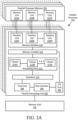
- FIGs. 3A-3B illustrate additional graphics multiprocessors, according to embodiments.
- the illustrated graphics multiprocessors 325, 350 are variants of the graphics multiprocessor 234 of Fig. 2C .
- the illustrated graphics multiprocessors 325, 350 can be configured as a streaming multiprocessor (SM) capable of simultaneous execution of a large number of execution threads.
- SM streaming multiprocessor
- FIG. 3A shows a graphics multiprocessor 325 according to an additional embodiment.
- the graphics multiprocessor 325 includes multiple additional instances of execution resource units relative to the graphics multiprocessor 234 of FIG. 2D .
- the graphics multiprocessor 325 can include multiple instances of the instruction unit 332A-332B, register file 334A-334B, and texture unit(s) 344A-344B.
- the graphics multiprocessor 325 also includes multiple sets of graphics or compute execution units (e.g., GPGPU core 336A-336B, GPGPU core 337A-337B, GPGPU core 338A-338B) and multiple sets of load/store units 340A-340B.
- the execution resource units have a common instruction cache 330, texture and/or data cache memory 342, and shared memory 346.
- the various components can communicate via an interconnect fabric 327.
- the interconnect fabric 327 includes one or more crossbar switches to enable communication between the various components of the graphics multiprocessor 325.
- the interconnect fabric 327 is a separate, high-speed network fabric layer upon which each component of the graphics multiprocessor 325 is stacked.
- the components of the graphics multiprocessor 325 communicate with remote components via the interconnect fabric 327.
- the GPGPU cores 336A-336B, 337A-337B, and 3378A-338B can each communicate with shared memory 346 via the interconnect fabric 327.
- the interconnect fabric 327 can arbitrate communication within the graphics multiprocessor 325 to ensure a fair bandwidth allocation between components.
- FIG. 3B shows a graphics multiprocessor 350 according to an additional embodiment.
- the graphics processor includes multiple sets of execution resources 356A-356D, where each set of execution resource includes multiple instruction units, register files, GPGPU cores, and load store units, as illustrated in FIG. 2D and FIG. 3A .
- the execution resources 356A-356D can work in concert with texture unit(s) 360A-360D for texture operations, while sharing an instruction cache 354, and shared memory 362.
- the execution resources 356A-356D can share an instruction cache 354 and shared memory 362, as well as multiple instances of a texture and/or data cache memory 358A-358B.
- the various components can communicate via an interconnect fabric 352 similar to the interconnect fabric 327 of FIG. 3A .
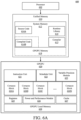
- processor 407 includes 24 cores, each with its own L1 cache, twelve shared L2 caches, and twelve shared L3 caches. In this embodiment, one of the L2 and L3 caches are shared by two adjacent cores.
- the processor 407 and the graphics accelerator integration module 446 connect with system memory 441, which may include processor memories 401-402
- a proxy circuit 425 communicatively couples the graphics acceleration module 446 to the coherence bus 464, allowing the graphics acceleration module 446 to participate in the cache coherence protocol as a peer of the cores.
- an interface 435 provides connectivity to the proxy circuit 425 over high-speed link 440 (e.g., a PCIe bus, NVLink, etc.) and an interface 437 connects the graphics acceleration module 446 to the link 440.
- high-speed link 440 e.g., a PCIe bus, NVLink, etc.
- an accelerator integration circuit 436 provides cache management, memory access, context management, and interrupt management services on behalf of a plurality of graphics processing engines 431, 432, N of the graphics acceleration module 446.
- the graphics processing engines 431, 432, N may each comprise a separate graphics processing unit (GPU).
- the graphics processing engines 431, 432, N may comprise different types of graphics processing engines within a GPU such as graphics execution units, media processing engines (e.g., video encoders/decoders), samplers, and blit engines.
- the graphics acceleration module may be a GPU with a plurality of graphics processing engines 431-432, N or the graphics processing engines 431-432, N may be individual GPUs integrated on a common package, line card, or chip.
- the accelerator integration circuit 436 includes a memory management unit (MMU) 439 for performing various memory management functions such as virtual-to-physical memory translations (also referred to as effective-to-real memory translations) and memory access protocols for accessing system memory 441.
- the MMU 439 may also include a translation lookaside buffer (TLB) (not shown) for caching the virtual/effective to physical/real address translations.
- the accelerator integration circuit 436 includes a fetch unit 491 to fetch commands, instructions, work descriptors, etc., that define operations to be performed.
- a cache 438 stores commands and data for efficient access by the graphics processing engines 431-432, N.
- the data stored in cache 438 and graphics memories 433-434, N is kept coherent with the core caches 462A-462D, 456 and system memory 411. As mentioned, this may be accomplished via proxy circuit 425 which takes part in the cache coherency mechanism on behalf of cache 438 and memories 433-434, N (e.g., sending updates to the cache 438 related to modifications/accesses of cache lines on processor caches 462A-462D, 456 and receiving updates from the cache 438).
- a set of registers 449 store context data for threads executed by the graphics processing engines 431-432, N and a context management circuit 448 manages the thread contexts.
- the context management circuit 448 may perform save and restore operations to save and restore contexts of the various threads during contexts switches (e.g., where a first thread is saved and a second thread is stored so that the second thread can be execute by a graphics processing engine).
- the context management circuit 448 may store current register values to a designated region in memory (e.g., identified by a context pointer). It may then restore the register values when returning to the context.
- an interrupt management circuit 447 receives and processes interrupts received from system devices.
- virtual/effective addresses from a graphics processing engine 431 are translated to real/physical addresses in system memory 411 by the MMU 439.
- One embodiment of the accelerator integration circuit 436 supports multiple (e.g., 4, 8, 16) graphics accelerator modules 446 and/or other accelerator devices.
- the graphics accelerator module 446 may be dedicated to a single application executed on the processor 407 or may be shared between multiple applications.
- a virtualized graphics execution environment is presented in which the resources of the graphics processing engines 431-432, N are shared with multiple applications or virtual machines (VMs).
- the resources may be subdivided into "slices" which are allocated to different VMs and/or applications based on the processing requirements and priorities associated with the VMs and/or applications.
- the accelerator integration circuit acts as a bridge to the system for the graphics acceleration module 446 and provides address translation and system memory cache services.
- the accelerator integration circuit 436 may provide virtualization facilities for the host processor to manage virtualization of the graphics processing engines, interrupts, and memory management.
- One function of the accelerator integration circuit 436 is the physical separation of the graphics processing engines 431-432, N so that they appear to the system as independent units.
- one or more graphics memories 433-434, M are coupled to each of the graphics processing engines 431-432, N, respectively.
- the graphics memories 433-434, M store instructions and data being processed by each of the graphics processing engines 431-432, N.
- the graphics memories 433-434, M may be volatile memories such as DRAMs (including stacked DRAMs), GDDR memory (e.g., GDDR5, GDDR6), or HBM, and/or may be non-volatile memories such as 3D XPoint or Nano-Ram.
- biasing techniques are used to ensure that the data stored in graphics memories 433-434, M is data which will be used most frequently by the graphics processing engines 431-432, N and preferably not used by the cores 460A-460D (at least not frequently).
- the biasing mechanism attempts to keep data needed by the cores (and preferably not the graphics processing engines 431-432, N) within the caches 462A-462D, 456 of the cores and system memory 411.
- FIG. 4C illustrates another embodiment in which the accelerator integration circuit 436 is integrated within the processor 407.
- the graphics processing engines 431-432, N communicate directly over the high-speed link 440 to the accelerator integration circuit 436 via interface 437 and interface 435 (which, again, may be utilize any form of bus or interface protocol).
- the accelerator integration circuit 436 may perform the same operations as those described with respect to FIG. 4B , but potentially at a higher throughput given its close proximity to the coherency bus 462 and caches 462A-462D, 426.
- One embodiment supports different programming models including a dedicated-process programming model (no graphics acceleration module virtualization) and shared programming models (with virtualization).
- the latter may include programming models which are controlled by the accelerator integration circuit 436 and programming models which are controlled by the graphics acceleration module 446.
- graphics processing engines 431-432, N are dedicated to a single application or process under a single operating system.
- the single application can funnel other application requests to the graphics engines 431-432, N, providing virtualization within a VM/partition.
- the graphics processing engines 431-432, N may be shared by multiple VM/application partitions.
- the shared models require a system hypervisor to virtualize the graphics processing engines 431-432, N to allow access by each operating system.
- the graphics processing engines 431-432, N are owned by the operating system. In both cases, the operating system can virtualize the graphics processing engines 431-432, N to provide access to each process or application.
- the graphics acceleration module 446 or an individual graphics processing engine 431-432, N selects a process element using a process handle.
- process elements are stored in system memory 411 and are addressable using the effective address to real address translation techniques described herein.
- the process handle may be an implementation-specific value provided to the host process when registering its context with the graphics processing engine 431-432, N (that is, calling system software to add the process element to the process element linked list).
- the lower 16-bits of the process handle may be the offset of the process element within the process element linked list.
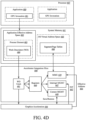
- FIG. 4D illustrates an exemplary accelerator integration slice 490.
- a "slice” comprises a specified portion of the processing resources of the accelerator integration circuit 436.
- Application effective address space 482 within system memory 411 stores process elements 483.
- the process elements 483 are stored in response to GPU invocations 481 from applications 480 executed on the processor 407.
- a process element 483 contains the process state for the corresponding application 480.
- a work descriptor (WD) 484 contained in the process element 483 can be a single job requested by an application or may contain a pointer to a queue of jobs. In the latter case, the WD 484 is a pointer to the job request queue in the application's address space 482.
- the graphics acceleration module 446 and/or the individual graphics processing engines 431-432, N can be shared by all or a subset of the processes in the system.
- Embodiments of the invention include an infrastructure for setting up the process state and sending a WD 484 to a graphics acceleration module 446 to start a job in a virtualized environment.
- the dedicated-process programming model is implementation-specific.
- a single process owns the graphics acceleration module 446 or an individual graphics processing engine 431. Because the graphics acceleration module 446 is owned by a single process, the hypervisor initializes the accelerator integration circuit 436 for the owning partition and the operating system initializes the accelerator integration circuit 436 for the owning process at the time when the graphics acceleration module 446 is assigned.
- a WD fetch unit 491 in the accelerator integration slice 490 fetches the next WD 484 which includes an indication of the work to be done by one of the graphics processing engines of the graphics acceleration module 446.
- Data from the WD 484 may be stored in registers 449 and used by the MMU 439, interrupt management circuit 447 and/or context management circuit 446 as illustrated.
- the MMU 439 includes segment/page walk circuitry for accessing segment/page tables 486 within the OS virtual address space 485.
- the interrupt management circuit 447 may process interrupt events 492 received from the graphics acceleration module 446.
- an effective address 493 generated by a graphics processing engine 431-432, N is translated to a real address by the MMU 439.
- the same set of registers 449 are duplicated for each graphics processing engine 431-432, N and/or graphics acceleration module 446 and may be initialized by the hypervisor or operating system. Each of these duplicated registers may be included in an accelerator integration slice 490. Exemplary registers that may be initialized by the hypervisor are shown in Table 1. Table 1 - Hypervisor Initialized Registers 1 Slice Control Register 2 Real Address (RA) Scheduled Processes Area Pointer 3 Authority Mask Override Register 4 Interrupt Vector Table Entry Offset 5 Interrupt Vector Table Entry Limit 6 State Register 7 Logical Partition ID 8 Real address (RA) Hypervisor Accelerator Utilization Record Pointer 9 Storage Description Register
- Table 2 Exemplary registers that may be initialized by the operating system are shown in Table 2.
- Table 2 Operating System Initialized Registers 1 Process and Thread Identification 2 Effective Address (EA) Context Save/Restore Pointer 3 Virtual Address (VA) Accelerator Utilization Record Pointer 4 Virtual Address (VA) Storage Segment Table Pointer 5 Authority Mask 6 Work descriptor
- each WD 484 is specific to a particular graphics acceleration module 446 and/or graphics processing engine 431-432, N. It contains all the information a graphics processing engine 431-432, N requires to do its work or it can be a pointer to a memory location where the application has set up a command queue of work to be completed.
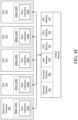
- FIG. 4E illustrates additional details for one embodiment of a shared model.
- This embodiment includes a hypervisor real address space 498 in which a process element list 499 is stored.
- the hypervisor real address space 498 is accessible via a hypervisor 496 which virtualizes the graphics acceleration module engines for the operating system 495.
- the shared programming models allow for all or a subset of processes from all or a subset of partitions in the system to use a graphics acceleration module 446.
- the system hypervisor 496 owns the graphics acceleration module 446 and makes its function available to all operating systems 495.
- the graphics acceleration module 446 may adhere to the following requirements: 1) An application's job request must be autonomous (that is, the state does not need to be maintained between jobs), or the graphics acceleration module 446 must provide a context save and restore mechanism. 2) An application's job request is guaranteed by the graphics acceleration module 446 to complete in a specified amount of time, including any translation faults, or the graphics acceleration module 446 provides the ability to preempt the processing of the job. 3) The graphics acceleration module 446 must be guaranteed fairness between processes when operating in the directed shared programming model.
- the ability to access GPU attached memory 420-423 without cache coherence overheads can be critical to the execution time of an offloaded computation.
- cache coherence overhead can significantly reduce the effective write bandwidth seen by a GPU 410-413.
- the efficiency of operand setup, the efficiency of results access, and the efficiency of GPU computation all play a role in determining the effectiveness of GPU offload.
- the bias table entry associated with each access to the GPU-attached memory 420-423 is accessed prior the actual access to the GPU memory, causing the following operations.
- First, local requests from the GPU 410-413 that find their page in GPU bias are forwarded directly to a corresponding GPU memory 420-423.
- Local requests from the GPU that find their page in host bias are forwarded to the processor 405 (e.g., over a high-speed link as discussed above).
- requests from the processor 405 that find the requested page in host processor bias complete the request like a normal memory read.
- requests directed to a GPU-biased page may be forwarded to the GPU 410-413. The GPU may then transition the page to a host processor bias if it is not currently using the page.
- a vertex processing unit 504 may be configured to perform the functions of one or more of a vertex processing unit 504, a tessellation control processing unit 508, a tessellation evaluation processing unit 512, a geometry processing unit 516, and a fragment/pixel processing unit 524.
- the functions of data assembler 502, primitive assemblers 506, 514, 518, tessellation unit 510, rasterizer 522, and raster operations unit 526 may also be performed by other processing engines within a processing cluster (e.g., processing cluster 214 of FIG. 3 ) and a corresponding partition unit (e.g., partition unit 220A-220N of FIG. 2 ).
- the graphics processing pipeline 500 may also be implemented using dedicated processing units for one or more functions.
- one or more portions of the graphics processing pipeline 500 can be performed by parallel processing logic within a general-purpose processor (e.g., CPU). In one embodiment, one or more portions of the graphics processing pipeline 500 can access on-chip memory (e.g., parallel processor memory 222 as in FIG. 2 ) via a memory interface 528, which may be an instance of the memory interface 218 of FIG. 2 .
- a general-purpose processor e.g., CPU
- on-chip memory e.g., parallel processor memory 222 as in FIG. 2
- memory interface 528 may be an instance of the memory interface 218 of FIG. 2 .
- a first instance of a primitive assembler 506 receives vertex attributes from the vertex processing unit 50.
- the primitive assembler 506 readings stored vertex attributes as needed and constructs graphics primitives for processing by tessellation control processing unit 508.
- the graphics primitives include triangles, line segments, points, patches, and so forth, as supported by various graphics processing application programming interfaces (APIs).
- a tessellation unit 510 is configured to receive the tessellation factors for edges of a patch and to tessellate the patch into multiple geometric primitives such as line, triangle, or quadrilateral primitives, which are transmitted to a tessellation evaluation processing unit 512.
- the tessellation evaluation processing unit 512 operates on parameterized coordinates of the subdivided patch to generate a surface representation and vertex attributes for each vertex associated with the geometric primitives.
- the geometry processing unit 516 can add or delete elements in the geometry stream.
- the geometry processing unit 516 outputs the parameters and vertices specifying new graphics primitives to primitive assembler 518.
- the primitive assembler 518 receives the parameters and vertices from the geometry processing unit 516 and constructs graphics primitives for processing by a viewport scale, cull, and clip unit 520.
- the geometry processing unit 516 reads data that is stored in parallel processor memory or system memory for use in processing the geometry data.
- the viewport scale, cull, and clip unit 520 performs clipping, culling, and viewport scaling and outputs processed graphics primitives to a rasterizer 522.
- the rasterizer 522 can perform depth culling and other depth-based optimizations.
- the rasterizer 522 also performs scan conversion on the new graphics primitives to generate fragments and output those fragments and associated coverage data to the fragment/pixel processing unit 524.
- the fragment/pixel processing unit 524 is a programmable execution unit that is configured to execute fragment shader programs or pixel shader programs.
- the fragment/pixel processing unit 524 transforming fragments or pixels received from rasterizer 522, as specified by the fragment or pixel shader programs.
- the fragment/pixel processing unit 524 may be programmed to perform operations included but not limited to texture mapping, shading, blending, texture correction and perspective correction to produce shaded fragments or pixels that are output to a raster operations unit 526.
- the fragment/pixel processing unit 524 can read data that is stored in either the parallel processor memory or the system memory for use when processing the fragment data.
- Fragment or pixel shader programs may be configured to shade at sample, pixel, tile, or other granularities depending on the sampling rate configured for the processing units.
- the raster operations unit 526 is a processing unit that performs raster operations including, but not limited to stencil, z test, blending, and the like, and outputs pixel data as processed graphics data to be stored in graphics memory (e.g., parallel processor memory 222 as in FIG. 2 , and/or system memory 104 as in FIG 1 , to be displayed on the one or more display device(s) 110 or for further processing by one of the one or more processor(s) 102 or parallel processor(s) 112.
- the raster operations unit 526 is configured to compress z or color data that is written to memory and decompress z or color data that is read from memory.
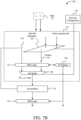
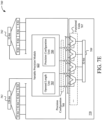
- the 16-byte input is a 128-bit input that can contain sixteen 8-bit input values, which can be, for example, input values for use in a convolution operation.
- the 4-byte input is a 32-bit input which can contain sixteen 2-bit inputs which can be, for example, ternary weights for use in a convolution operation.
- Instructions of this type can perform a variable number of Fused Multiply Add (FMADD), binary operations (e.g., XNOR), or some matrix operations, such as a dot-product.
- FMADD Fused Multiply Add
- binary operations e.g., XNOR
- some matrix operations such as a dot-product.
- the number of operations performed in a cycle can be determined based on the size of the lowest sized data-type relative to a 32-bit lane of input. For example, where the instruction operates on a second value that includes a vector of sixteen 2-bit inputs, sixteen operations are performed. Where the instruction operates on a second input that includes a vector of eight
- An exemplary type of machine learning algorithm is a neural network.
- a simple type of neural network is a feedforward network.
- a feedforward network may be implemented as an acyclic graph in which the nodes are arranged in layers.
- a feedforward network topology includes an input layer and an output layer that are separated by at least one hidden layer.
- the hidden layer transforms input received by the input layer into a representation that is useful for generating output in the output layer.
- the network nodes are fully connected via edges to the nodes in adjacent layers, but there are no edges between nodes within each layer.
- Data received at the nodes of an input layer of a feedforward network are propagated (i.e., "fed forward") to the nodes of the output layer via an activation function that calculates the states of the nodes of each successive layer in the network based on coefficients ("weights") respectively associated with each of the edges connecting the layers.
- the output from the neural network algorithm can take various forms.
- Training a neural network involves selecting a network topology, using a set of training data representing a problem being modeled by the network, and adjusting the weights until the network model performs with a minimal error for all instances of the training data set. For example, during a supervised learning training process for a neural network, the output produced by the network in response to the input representing an instance in a training data set is compared to the "correct" labeled output for that instance, an error signal representing the difference between the output and the labeled output is calculated, and the weights associated with the connections are adjusted to minimize that error as the error signal is backward propagated through the layers of the network. The network is considered “trained” when the errors for each of the outputs generated from the instances of the training data set are minimized.
- the accuracy of a machine learning algorithm can be affected significantly by the quality of the data set used to train the algorithm.
- the training process can be computationally intensive and may require a significant amount of time on a conventional general-purpose processor.
- parallel processing hardware is used to train many types of machine learning algorithms. This is particularly useful for optimizing the training of neural networks, as the computations performed in adjusting the coefficients in neural networks lend themselves naturally to parallel implementations.
- many machine learning algorithms and software applications have been adapted to make use of the parallel processing hardware within general-purpose graphics processing devices.
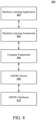
- FIG. 8 is a generalized diagram of a machine learning software stack 800.
- a machine learning application 802 can be configured to train a neural network using a training dataset or to use a trained deep neural network to implement machine intelligence.
- the machine learning application 802 can include training and inference functionality for a neural network and/or specialized software that can be used to train a neural network before deployment.
- the machine learning application 802 can implement any type of machine intelligence including but not limited to image recognition, mapping and localization, autonomous navigation, speech synthesis, medical imaging, or language translation.
- Hardware acceleration for the machine learning application 802 can be enabled via a machine learning framework 804.
- the machine learning framework 804 can provide a library of machine learning primitives.
- Machine learning primitives are basic operations that are commonly performed by machine learning algorithms. Without the machine learning framework 804, developers of machine learning algorithms would be required to create and optimize the main computational logic associated with the machine learning algorithm, then re-optimize the computational logic as new parallel processors are developed. Instead, the machine learning application can be configured to perform the necessary computations using the primitives provided by the machine learning framework 804.
- Exemplary primitives include tensor convolutions, activation functions, and pooling, which are computational operations that are performed while training a convolutional neural network (CNN).
- CNN convolutional neural network
- the machine learning framework 804 can also provide primitives to implement basic linear algebra subprograms performed by many machine-learning algorithms, such as matrix and vector operations.
- FIG. 9 illustrates a highly-parallel general-purpose graphics processing unit 900, according to an embodiment.
- the general-purpose processing unit (GPGPU) 900 can be configured to be particularly efficient in processing the type of computational workloads associated with training deep neural networks. Additionally, the GPGPU 900 can be linked directly to other instances of the GPGPU to create a multi-GPU cluster to improve training speed for particularly deep neural networks.
- the GPGPU 900 includes a host interface 902 to enable a connection with a host processor.
- the host interface 902 is a PCI Express interface.
- the host interface can also be a vendor specific communications interface or communications fabric.
- the GPGPU 900 receives commands from the host processor and uses a global scheduler 904 to distribute execution threads associated with those commands to a set of compute clusters 906A-906H.
- the compute clusters 906A-H share a cache memory 908.
- the cache memory 908 can serve as a higher-level cache for cache memories within the compute clusters 906A-906H.
- each compute cluster 906A-906H includes a set of graphics multiprocessors, such as the graphics multiprocessor 400 of FIG. 4A .
- the graphics multiprocessors of the compute cluster multiple types of integer and floating point logic units that can perform computational operations at a range of precisions including suited for machine learning computations.
- at least a subset of the floating point units in each of the compute clusters 906A-906H can be configured to perform 16-bit or 32-bit floating point operations, while a different subset of the floating point units can be configured to perform 64-bit floating point operations.
- Multiple instances of the GPGPU 900 can be configured to operate as a compute cluster.
- the communication mechanism used by the compute cluster for synchronization and data exchange varies across embodiments.
- the multiple instances of the GPGPU 900 communicate over the host interface 902.
- the GPGPU 900 includes an I/O hub 909 that couples the GPGPU 900 with a GPU link 910 that enables a direct connection to other instances of the GPGPU.
- the GPU link 910 is coupled to a dedicated GPU-to-GPU bridge that enables communication and synchronization between multiple instances of the GPGPU 900.
- the GPU link 910 couples with a high speed interconnect to transmit and receive data to other GPGPUs or parallel processors.
- the multiple instances of the GPGPU 900 are located in separate data processing systems and communicate via a network device that is accessible via the host interface 902.
- the GPU link 910 can be configured to enable a connection to a host processor in addition to or as an alternative to the host interface 902.
- While the illustrated configuration of the GPGPU 900 can be configured to train neural networks, one embodiment provides alternate configuration of the GPGPU 900 that can be configured for deployment within a high performance or low power inferencing platform.
- the GPGPU 900 includes fewer of the compute clusters 906A-906H relative to the training configuration. Additionally memory technology associated with the memory 914A-914B may differ between inferencing and training configurations.
- the inferencing configuration of the GPGPU 900 can support inferencing specific instructions.
- an inferencing configuration can provide support for one or more 8-bit integer dot product instructions, which are commonly used during inferencing operations for deployed neural networks.
- FIG. 10 illustrates a multi-GPU computing system 1000, according to an embodiment.
- the multi-GPU computing system 1000 can include a processor 1002 coupled to multiple GPGPUs 1006A-1006D via a host interface switch 1004.
- the host interface switch 1004 in one embodiment, is a PCI express switch device that couples the processor 1002 to a PCI express bus over which the processor 1002 can communicate with the set of GPGPUs 1006A-1006D.
- Each of the multiple GPGPUs 1006A-1006D can be an instance of the GPGPU 900 of FIG. 9 .
- the GPGPUs 1006A-D can interconnect via a set of high-speed point to point GPU to GPU links 1016.
- the high-speed GPU to GPU links can connect to each of the GPGPUs 1006A-1006D via a dedicated GPU link, such as the GPU link 910 as in FIG. 9 .
- the P2P GPU links 1016 enable direct communication between each of the GPGPUs 1006A-1006D without requiring communication over the host interface bus to which the processor 1002 is connected. With GPU-to-GPU traffic directed to the P2P GPU links, the host interface bus remains available for system memory access or to communicate with other instances of the multi-GPU computing system 1000, for example, via one or more network devices.
- the GPGPUs 1006A-1006D connect to the processor 1002 via the host interface switch 1004, in one embodiment the processor 1002 includes direct support for the P2P GPU links 1016 and can connect directly to the GPGPUs 1006A-1006D.
- the computing architecture provided by embodiments described herein can be configured to perform the types of parallel processing that is particularly suited for training and deploying neural networks for machine learning.
- a neural network can be generalized as a network of functions having a graph relationship. As is well-known in the art, there are a variety of types of neural network implementations used in machine learning.
- One exemplary type of neural network is the feedforward network, as previously described.
- Convolution is a specialized kind of mathematical operation performed by two functions to produce a third function that is a modified version of one of the two original functions.
- the first function to the convolution can be referred to as the input, while the second function can be referred to as the convolution kernel.
- the output may be referred to as the feature map.
- the input to a convolution layer can be a multidimensional array of data that defines the various color components of an input image.
- the convolution kernel can be a multidimensional array of parameters, where the parameters are adapted by the training process for the neural network.
- Recurrent neural networks are a family of feedforward neural networks that include feedback connections between layers. RNNs enable modeling of sequential data by sharing parameter data across different parts of the neural network.
- the architecture for a RNN includes cycles. The cycles represent the influence of a present value of a variable on its own value at a future time, as at least a portion of the output data from the RNN is used as feedback for processing subsequent input in a sequence. This feature makes RNNs particularly useful for language processing due to the variable nature in which language data can be composed.
- Deep learning is machine learning using deep neural networks.
- the deep neural networks used in deep learning are artificial neural networks composed of multiple hidden layers, as opposed to shallow neural networks that include only a single hidden layer. Deeper neural networks are generally more computationally intensive to train. However, the additional hidden layers of the network enable multistep pattern recognition that results in reduced output error relative to shallow machine learning techniques.
- a learning model can be applied to the network to train the network to perform specific tasks.
- the learning model describes how to adjust the weights within the model to reduce the output error of the network.
- Backpropagation of errors is a common method used to train neural networks. An input vector is presented to the network for processing. The output of the network is compared to the desired output using a loss function and an error value is calculated for each of the neurons in the output layer. The error values are then propagated backwards until each neuron has an associated error value which roughly represents its contribution to the original output. The network can then learn from those errors using an algorithm, such as the stochastic gradient descent algorithm, to update the weights of the of the neural network.
- an algorithm such as the stochastic gradient descent algorithm
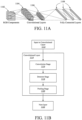
- FIG. 11A-11B illustrate an exemplary convolutional neural network.
- FIG. 11A illustrates various layers within a CNN.
- an exemplary CNN used to model image processing can receive input 1102 describing the red, green, and blue (RGB) components of an input image.
- the input 1102 can be processed by multiple convolutional layers (e.g., convolutional layer 1104, convolutional layer 1106).
- the output from the multiple convolutional layers may optionally be processed by a set of fully connected layers 1108.
- Neurons in a fully connected layer have full connections to all activations in the previous layer, as previously described for a feedforward network.
- the output from the fully connected layers 1108 can be used to generate an output result from the network.
- the activations within the fully connected layers 1108 can be computed using matrix multiplication instead of convolution. Not all CNN implementations are make use of fully connected layers 1108.
- the convolutional layer 1106 can generate output for the CNN.
- the convolutional layers are sparsely connected, which differs from traditional neural network configuration found in the fully connected layers 1108.
- Traditional neural network layers are fully connected, such that every output unit interacts with every input unit.
- the convolutional layers are sparsely connected because the output of the convolution of a field is input (instead of the respective state value of each of the nodes in the field) to the nodes of the subsequent layer, as illustrated.
- the kernels associated with the convolutional layers perform convolution operations, the output of which is sent to the next layer.
- the dimensionality reduction performed within the convolutional layers is one aspect that enables the CNN to scale to process large images.
- FIG. 11B illustrates exemplary computation stages within a convolutional layer of a CNN.
- Input to a convolutional layer 1112 of a CNN can be processed in three stages of a convolutional layer 1114.
- the three stages can include a convolution stage 1116, a detector stage 1118, and a pooling stage 1120.
- the convolution layer 1114 can then output data to a successive convolutional layer.
- the final convolutional layer of the network can generate output feature map data or provide input to a fully connected layer, for example, to generate a classification value for the input to the CNN.
- the convolution stage 1116 performs several convolutions in parallel to produce a set of linear activations.
- the convolution stage 1116 can include an affine transformation, which is any transformation that can be specified as a linear transformation plus a translation. Affine transformations include rotations, translations, scaling, and combinations of these transformations.
- the convolution stage computes the output of functions (e.g., neurons) that are connected to specific regions in the input, which can be determined as the local region associated with the neuron.
- the neurons compute a dot product between the weights of the neurons and the region in the local input to which the neurons are connected.
- the output from the convolution stage 1116 defines a set of linear activations that are processed by successive stages of the convolutional layer 1114.
- the linear activations can be processed by a detector stage 1118.
- each linear activation is processed by a non-linear activation function.
- the non-linear activation function increases the nonlinear properties of the overall network without affecting the receptive fields of the convolution layer.
- Non-linear activation functions may be used.
- ReLU rectified linear unit
- the pooling stage 1120 uses a pooling function that replaces the output of the convolutional layer 1106 with a summary statistic of the nearby outputs.
- the pooling function can be used to introduce translation invariance into the neural network, such that small translations to the input do not change the pooled outputs. Invariance to local translation can be useful in scenarios where the presence of a feature in the input data is more important than the precise location of the feature.
- Various types of pooling functions can be used during the pooling stage 1120, including max pooling, average pooling, and l2-norm pooling. Additionally, some CNN implementations do not include a pooling stage. Instead, such implementations substitute and additional convolution stage having an increased stride relative to previous convolution stages.
- FIG. 12 illustrates an exemplary recurrent neural network 1200.
- RNN recurrent neural network
- the previous state of the network influences the output of the current state of the network.
- RNNs can be built in a variety of ways using a variety of functions. The use of RNNs generally revolves around using mathematical models to predict the future based on a prior sequence of inputs. For example, an RNN may be used to perform statistical language modeling to predict an upcoming word given a previous sequence of words.
- the illustrated RNN 1200 can be described has having an input layer 1202 that receives an input vector, hidden layers 1204 to implement a recurrent function, a feedback mechanism 1205 to enable a 'memory' of previous states, and an output layer 1206 to output a result.
- the RNN 1200 operates based on time-steps.
- the state of the RNN at a given time step is influenced based on the previous time step via the feedback mechanism 1205.
- the state of the hidden layers 1204 is defined by the previous state and the input at the current time step.
- An initial input (x 1 ) at a first time step can be processed by the hidden layer 1204.
- a second input (x 2 ) can be processed by the hidden layer 1204 using state information that is determined during the processing of the initial input (x 1 ).
- the specific mathematical function used in the hidden layers 1204 can vary depending on the specific implementation details of the RNN 1200.
- RNN long short term memory
- LSTM RNNs are capable of learning long-term dependencies that may be necessary for processing longer sequences of language.
- a variant on the CNN is a convolutional deep belief network, which has a structure similar to a CNN and is trained in a manner similar to a deep belief network.
- a deep belief network is a generative neural network that is composed of multiple layers of stochastic (random) variables. DBNs can be trained layer-by-layer using greedy unsupervised learning. The learned weights of the DBN can then be used to provide pre-train neural networks by determining an optimal initial set of weights for the neural network.
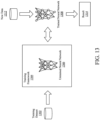
- FIG. 13 illustrates training and deployment of a deep neural network.
- the neural network is trained using a training dataset 1302.
- Various training frameworks have been developed to enable hardware acceleration of the training process.
- the machine learning framework 804 of FIG. 8 may be configured as a training framework 1304.
- the training framework 1304 can hook into an untrained neural network 1306 and enable the untrained neural net to be trained using the parallel processing resources described herein to generate a trained neural net 1308.
- the initial weights may be chosen randomly or by pre-training using a deep belief network.
- the training cycle then be performed in either a supervised or unsupervised manner.
- Supervised learning is a learning method in which training is performed as a mediated operation, such as when the training dataset 1302 includes input paired with the desired output for the input, or where the training dataset includes input having known output and the output of the neural network is manually graded.
- the network processes the inputs and compares the resulting outputs against a set of expected or desired outputs. Errors are then propagated back through the system.
- the training framework 1304 can adjust to adjust the weights that control the untrained neural network 1306.
- the training framework 1304 can provide tools to monitor how well the untrained neural network 1306 is converging towards a model suitable to generating correct answers based on known input data.
- the training process occurs repeatedly as the weights of the network are adjusted to refine the output generated by the neural network.
- the training process can continue until the neural network reaches a statistically desired accuracy associated with a trained neural net 1308.
- the trained neural network 1308 can then be deployed to implement any number of machine learning operations.
- Unsupervised learning is a learning method in which the network attempts to train itself using unlabeled data.
- the training dataset 1302 will include input data without any associated output data.
- the untrained neural network 1306 can learn groupings within the unlabeled input and can determine how individual inputs are related to the overall dataset.
- Unsupervised training can be used to generate a self-organizing map, which is a type of trained neural network 1307 capable of performing operations useful in reducing the dimensionality of data.
- Unsupervised training can also be used to perform anomaly detection, which allows the identification of data points in an input dataset that deviate from the normal patterns of the data.
- Semi-supervised learning is a technique in which in the training dataset 1302 includes a mix of labeled and unlabeled data of the same distribution.
- Incremental learning is a variant of supervised learning in which input data is continuously used to further train the model. Incremental learning enables the trained neural network 1308 to adapt to the new data 1312 without forgetting the knowledge instilled within the network during initial training.
- the training process for particularly deep neural networks may be too computationally intensive for a single compute node.
- a distributed network of computational nodes can be used to accelerate the training process.
- FIG. 14 is a block diagram illustrating distributed learning.
- Distributed learning is a training model that uses multiple distributed computing nodes to perform supervised or unsupervised training of a neural network.
- the distributed computational nodes can each include one or more host processors and one or more of the general-purpose processing nodes, such as the highly-parallel general-purpose graphics processing unit 900 as in FIG. 900.
- distributed learning can be performed model parallelism 1402, data parallelism 1404, or a combination of model and data parallelism 1404.
- model parallelism 1402 different computational nodes in a distributed system can perform training computations for different parts of a single network. For example, each layer of a neural network can be trained by a different processing node of the distributed system.
- the benefits of model parallelism include the ability to scale to particularly large models. Splitting the computations associated with different layers of the neural network enables the training of very large neural networks in which the weights of all layers would not fit into the memory of a single computational node. In some instances, model parallelism can be particularly useful in performing unsupervised training of large neural networks.
- data parallelism 1404 the different nodes of the distributed network have a complete instance of the model and each node receives a different portion of the data. The results from the different nodes are then combined. While different approaches to data parallelism are possible, data parallel training approaches all require a technique of combining results and synchronizing the model parameters between each node. Exemplary approaches to combining data include parameter averaging and update based data parallelism. Parameter averaging trains each node on a subset of the training data and sets the global parameters (e.g., weights, biases) to the average of the parameters from each node. Parameter averaging uses a central parameter server that maintains the parameter data.
- parameter averaging trains each node on a subset of the training data and sets the global parameters (e.g., weights, biases) to the average of the parameters from each node. Parameter averaging uses a central parameter server that maintains the parameter data.
- Update based data parallelism is similar to parameter averaging except that instead of transferring parameters from the nodes to the parameter server, the updates to the model are transferred. Additionally, update based data parallelism can be performed in a decentralized manner, where the updates are compressed and transferred between nodes.
- a hybrid parallelism technique of combined model and data parallelism 1406 can be implemented, for example, in a distributed system in which each computational node includes multiple GPUs. Each node can have a complete instance of the model with separate GPUs within each node are used to train different portions of the model.
- Distributed training has increased overhead relative to training on a single machine.
- the parallel processors and GPGPUs described herein can each implement various techniques to reduce the overhead of distributed training, including techniques to enable high bandwidth GPU-to-GPU data transfer and accelerated remote data synchronization.
- Machine learning can be applied to solve a variety of technological problems, including but not limited to computer vision, autonomous driving and navigation, speech recognition, and language processing.
- Computer vision has traditionally been one of the most active research areas for machine learning applications.
- Applications of computer vision range from reproducing human visual abilities, such as recognizing faces, to creating new categories of visual abilities.
- computer vision applications can be configured to recognize sound waves from the vibrations induced in objects visible in a video.
- Parallel processor accelerated machine learning enables computer vision applications to be trained using significantly larger training dataset than previously feasible and enables inferencing systems to be deployed using low power parallel processors.
- Parallel processor accelerated machine learning has autonomous driving applications including lane and road sign recognition, obstacle avoidance, navigation, and driving control. Accelerated machine learning techniques can be used to train driving models based on datasets that define the appropriate responses to specific training input.
- the parallel processors described herein can enable rapid training of the increasingly complex neural networks used for autonomous driving solutions and enables the deployment of low power inferencing processors in a mobile platform suitable for integration into autonomous vehicles.
- ASR automatic speech recognition
- HMMs hidden Markov models
- GMMs Gaussian mixture models
- Parallel processor accelerated machine learning can also be used to accelerate natural language processing.
- Automatic learning procedures can make use of statistical inference algorithms to produce models that are robust to erroneous or unfamiliar input.
- Exemplary natural language processor applications include automatic machine translation between human languages.
- Training platforms are generally highly parallel and include optimizations to accelerate multi-GPU single node training and multi-node, multi-GPU training.
- Exemplary parallel processors suited for training include the highly-parallel general-purpose graphics processing unit 900 of FIG. 900 and the multi-GPU computing system 1000 of FIG. 1000.
- deployed machine learning platforms generally include lower power parallel processors suitable for use in products such as cameras, autonomous robots, and autonomous vehicles.
- FIG. 15 illustrates an exemplary inferencing system on a chip (SOC) 1500 suitable for performing inferencing using a trained model.
- the SOC 1500 can integrate processing components including a media processor 1502, a vision processor 1504, a GPGPU 1506 and a multi-core processor 1508.
- the SOC 1500 can additionally include an on-chip memory 1505 that can enable a shared on-chip data pool that is accessible by each of the processing components.
- the processing components can be optimized for low power operation to enable deployment to a variety of machine learning platforms, including autonomous vehicles and autonomous robots.
- one implementation of the SOC 1500 can be used as a portion of the main control system for an autonomous vehicle. Where the SOC 1500 is configured for use in autonomous vehicles the SOC is designed and configured for compliance with the relevant functional safety standards of the deployment jurisdiction.
- the multi-core processor 1508 can include control logic to assist with sequencing and synchronization of data transfers and shared memory operations performed by the media processor 1502 and the vision processor 1504.
- the multi-core processor 1508 can also function as an application processor to execute software applications that can make use of the inferencing compute capability of the GPGPU 1506. For example, at least a portion of the navigation and driving logic can be implemented in software executing on the multi-core processor 1508. Such software can directly issue computational workloads to the GPGPU 1506 or the computational workloads can be issued to the multi-core processor 1508, which can offload at least a portion of those operations to the GPGPU 1506.
- the GPGPU 1506 can include compute clusters such as a low power configuration of the compute clusters 906A-906H within the highly-parallel general-purpose graphics processing unit 900.
- the compute clusters within the GPGPU 1506 can support instruction that are specifically optimized to perform inferencing computations on a trained neural network.
- the GPGPU 1506 can support instructions to perform low precision computations such as 8-bit and 4-bit integer vector operations.
- graphics processor 1800 includes a block image transfer (BLIT) engine 1804 to perform two-dimensional (2D) rasterizer operations including, for example, bit-boundary block transfers.
- 2D graphics operations are performed using one or more components of graphics processing engine (GPE) 1810.
- GPE 1810 is a compute engine for performing graphics operations, including three-dimensional (3D) graphics operations and media operations.
- media pipeline 1816 includes fixed function or programmable logic units to perform one or more specialized media operations, such as video decode acceleration, video de-interlacing, and video encode acceleration in place of, or on behalf of video codec engine 1806.
- media pipeline 1816 additionally includes a thread spawning unit to spawn threads for execution on 3D/Media sub-system 1815. The spawned threads perform computations for the media operations on one or more graphics execution units included in 3D/Media sub-system 1815.
- FIG. 19 is a block diagram of a graphics processing engine 1910 of a graphics processor in accordance with some embodiments.
- the graphics processing engine (GPE) 1910 is a version of the GPE 1810 shown in FIG. 18 .
- Elements of FIG. 19 having the same reference numbers (or names) as the elements of any other figure herein can operate or function in any manner similar to that described elsewhere herein, but are not limited to such.
- the 3D pipeline 1812 and media pipeline 1816 of FIG. 18 are illustrated.
- the media pipeline 1816 is optional in some embodiments of the GPE 1910 and may not be explicitly included within the GPE 1910.
- a separate media and/or image processor is coupled to the GPE 1910.
- the commands for the 3D pipeline 1812 can also include references to data stored in memory, such as but not limited to vertex and geometry data for the 3D pipeline 1812 and/or image data and memory objects for the media pipeline 1816.
- the 3D pipeline 1812 and media pipeline 1816 process the commands and data by performing operations via logic within the respective pipelines or by dispatching one or more execution threads to a graphics core array 1914.
- the 3D pipeline 1812 can execute one or more shader programs, such as vertex shaders, geometry shaders, pixel shaders, fragment shaders, compute shaders, or other shader programs, by processing the instructions and dispatching execution threads to the graphics core array 1914.
- the graphics core array 1914 provides a unified block of execution resources.
- Multi-purpose execution logic e.g., execution units
- within the graphic core array 1914 includes support for various 3D API shader languages and can execute multiple simultaneous execution threads associated with multiple shaders.
- Output data generated by threads executing on the graphics core array 1914 can output data to memory in a unified return buffer (URB) 1918.
- the URB 1918 can store data for multiple threads.
- the URB 1918 may be used to send data between different threads executing on the graphics core array 1914.
- the URB 1918 may additionally be used for synchronization between threads on the graphics core array and fixed function logic within the shared function logic 1920.
- graphics core array 1914 is scalable, such that the array includes a variable number of graphics cores, each having a variable number of execution units based on the target power and performance level of GPE 1910.
- execution resources are dynamically scalable, such that execution resources may be enabled or disabled as needed.
- the graphics core array 1914 couples with shared function logic 1920 that includes multiple resources that are shared between the graphics cores in the graphics core array.
- the shared functions within the shared function logic 1920 are hardware logic units that provide specialized supplemental functionality to the graphics core array 1914.
- shared function logic 1920 includes but is not limited to sampler 1921, math 1922, and inter-thread communication (ITC) 1923 logic.
- ITC inter-thread communication
- some embodiments implement one or more cache(s) 1925 within the shared function logic 1920.
- a shared function is implemented where the demand for a given specialized function is insufficient for inclusion within the graphics core array 1914. Instead a single instantiation of that specialized function is implemented as a stand-alone entity in the shared function logic 1920 and shared among the execution resources within the graphics core array 1914.
- the precise set of functions that are shared between the graphics core array 1914 and included within the graphics core array 1914 varies between embodiments.
- FIG. 20 is a block diagram of another embodiment of a graphics processor 2000. Elements of FIG. 20 having the same reference numbers (or names) as the elements of any other figure herein can operate or function in any manner similar to that described elsewhere herein, but are not limited to such.
- graphics processor 2000 includes a ring interconnect 2002, a pipeline front-end 2004, a media engine 2037, and graphics cores 2080A-2080N.
- ring interconnect 2002 couples the graphics processor to other processing units, including other graphics processors or one or more general-purpose processor cores.
- the graphics processor is one of many processors integrated within a multi-core processing system.
- graphics processor 2000 receives batches of commands via ring interconnect 2002. The incoming commands are interpreted by a command streamer 2003 in the pipeline front-end 2004.
- graphics processor 2000 includes scalable execution logic to perform 3D geometry processing and media processing via the graphics core(s) 2080A-2080N.
- command streamer 2003 supplies commands to geometry pipeline 2036.
- command streamer 2003 supplies the commands to a video front end 2034, which couples with a media engine 2037.
- media engine 2037 includes a Video Quality Engine (VQE) 2030 for video and image post-processing and a multi-format encode/decode (MFX) 2033 engine to provide hardware-accelerated media data encode and decode.
- geometry pipeline 2036 and media engine 2037 each generate execution threads for the thread execution resources provided by at least one graphics core 2080A.
- graphics processor 2000 includes scalable thread execution resources featuring modular cores 2080A-2080N (sometimes referred to as core slices), each having multiple sub-cores 2050A-550N, 2060A-2060N (sometimes referred to as core sub-slices).
- graphics processor 2000 can have any number of graphics cores 2080A through 2080N.
- graphics processor 2000 includes a graphics core 2080A having at least a first sub-core 2050A and a second sub-core 2060A.
- the graphics processor is a low power processor with a single sub-core (e.g., 2050A).
- graphics processor 2000 includes multiple graphics cores 2080A-2080N, each including a set of first sub-cores 2050A-2050N and a set of second sub-cores 2060A-2060N.
- Each sub-core in the set of first sub-cores 2050A-2050N includes at least a first set of execution units 2052A-2052N and media/texture samplers 2054A-2054N.
- Each sub-core in the set of second sub-cores 2060A-2060N includes at least a second set of execution units 2062A-2062N and samplers 2064A-2064N.
- each sub-core 2050A-2050N, 2060A-2060N shares a set of shared resources 2070A-2070N.
- the shared resources include shared cache memory and pixel operation logic. Other shared resources may also be included in the various embodiments of the graphics processor.
- FIG. 21 illustrates thread execution logic 2100 including an array of processing elements employed in some embodiments of a GPE. Elements of FIG. 21 having the same reference numbers (or names) as the elements of any other figure herein can operate or function in any manner similar to that described elsewhere herein, but are not limited to such.
- thread execution logic 2100 includes a shader processor 2102, a thread dispatcher 2104, instruction cache 2106, a scalable execution unit array including a plurality of execution units 2108A-2108N, a sampler 2110, a data cache 2112, and a data port 2114.
- the scalable execution unit array can dynamically scale by enabling or disabling one or more execution units (e.g., any of execution unit 2108A, 2108B, 2108C, 2108D, through 2108N-1 and 2108N) based on the computational requirements of a workload.
- the included components are interconnected via an interconnect fabric that links to each of the components.
- thread execution logic 2100 includes one or more connections to memory, such as system memory or cache memory, through one or more of instruction cache 2106, data port 2114, sampler 2110, and execution units 2108A-2108N.
- each execution unit e.g. 2108A
- the array of execution units 2108A-2108N is scalable to include any number individual execution units.
- the execution units 2108A-2108N are primarily used to execute shader programs.
- a shader processor 2102 can process the various shader programs and dispatch execution threads associated with the shader programs via a thread dispatcher 2104.
- the thread dispatcher includes logic to arbitrate thread initiation requests from the graphics and media pipelines and instantiate the requested threads on one or more execution unit in the execution units 2108A-2108N.
- the geometry pipeline e.g., 2036 of FIG. 20
- thread dispatcher 2104 can also process runtime thread spawning requests from the executing shader programs.
- the execution units 2108A-2108N support an instruction set that includes native support for many standard 3D graphics shader instructions, such that shader programs from graphics libraries (e.g., Direct 3D and OpenGL) are executed with a minimal translation.
- the execution units support vertex and geometry processing (e.g., vertex programs, geometry programs, vertex shaders), pixel processing (e.g., pixel shaders, fragment shaders) and general-purpose processing (e.g., compute and media shaders).
- Each of the execution units 2108A-2108N is capable of multi-issue single instruction multiple data (SIMD) execution and multi-threaded operation enables an efficient execution environment in the face of higher latency memory accesses.
- SIMD single instruction multiple data
- Each hardware thread within each execution unit has a dedicated high-bandwidth register file and associated independent thread-state. Execution is multi-issue per clock to pipelines capable of integer, single and double precision floating point operations, SIMD branch capability, logical operations, transcendental operations, and other miscellaneous operations.
- dependency logic within the execution units 2108A-2108N causes a waiting thread to sleep until the requested data has been returned. While the waiting thread is sleeping, hardware resources may be devoted to processing other threads. For example, during a delay associated with a vertex shader operation, an execution unit can perform operations for a pixel shader, fragment shader, or another type of shader program, including a different vertex shader.
- Each execution unit in execution units 2108A-2108N operates on arrays of data elements.
- the number of data elements is the "execution size," or the number of channels for the instruction.
- An execution channel is a logical unit of execution for data element access, masking, and flow control within instructions.
- the number of channels may be independent of the number of physical Arithmetic Logic Units (ALUs) or Floating Point Units (FPUs) for a particular graphics processor.
- ALUs Arithmetic Logic Units
- FPUs Floating Point Units
- execution units 2108A-2108N support integer and floating-point data types.
- pixel processor logic within the shader processor 2102 is invoked to further compute output information and cause results to be written to output surfaces (e.g., color buffers, depth buffers, stencil buffers, etc.).
- output surfaces e.g., color buffers, depth buffers, stencil buffers, etc.
- a pixel shader or fragment shader calculates the values of the various vertex attributes that are to be interpolated across the rasterized object.
- the 128-bit instruction format 2210 includes an access/address mode field 2226 specifying, for example, whether direct register addressing mode or indirect register addressing mode is used. When direct register addressing mode is used, the register address of one or more operands is directly provided by bits in the instruction.
- complete geometric objects can be processed by a geometry shader 2319 via one or more threads dispatched to execution units 2352A-2352B, or can proceed directly to the clipper 2329.
- the geometry shader operates on entire geometric objects, rather than vertices or patches of vertices as in previous stages of the graphics pipeline. If the tessellation is disabled the geometry shader 2319 receives input from the vertex shader 2307. In some embodiments, geometry shader 2319 is programmable by a geometry shader program to perform geometry tessellation if the tessellation units are disabled.
- FIG. 24A is a block diagram illustrating a graphics processor command format 2400 according to some embodiments.
- FIG. 24B is a block diagram illustrating a graphics processor command sequence 2410 according to an embodiment.
- the solid lined boxes in FIG. 24A illustrate the components that are generally included in a graphics command while the dashed lines include components that are optional or that are only included in a sub-set of the graphics commands.
- the exemplary graphics processor command format 2400 of FIG. 24A includes data fields to identify a target client 2402 of the command, a command operation code (opcode) 2404, and the relevant data field 2406 for the command.
- opcode command operation code
- a sub-opcode 2405 and a command size 2408 are also included in some commands.
- client 2402 specifies the client unit of the graphics device that processes the command data.
- a graphics processor command parser examines the client field of each command to condition the further processing of the command and route the command data to the appropriate client unit.
- the graphics processor client units include a memory interface unit, a render unit, a 2D unit, a 3D unit, and a media unit. Each client unit has a corresponding processing pipeline that processes the commands. Once the command is received by the client unit, the client unit reads the opcode 2404 and, if present, sub-opcode 2405 to determine the operation to perform. The client unit performs the command using information in data field 2406.
- an explicit command size 2408 is expected to specify the size of the command.
- the command parser automatically determines the size of at least some of the commands based on the command opcode. In some embodiments commands are aligned via multiples of a double word.
- FIG. 24B shows an exemplary graphics processor command sequence 2410.
- software or firmware of a data processing system that features an embodiment of a graphics processor uses a version of the command sequence shown to set up, execute, and terminate a set of graphics operations.
- a sample command sequence is shown and described for purposes of example only as embodiments are not limited to these specific commands or to this command sequence.
- the commands may be issued as batch of commands in a command sequence, such that the graphics processor will process the sequence of commands in at least partially concurrence.
- the graphics processor command sequence 2410 may begin with a pipeline flush command 2412 to cause any active graphics pipeline to complete the currently pending commands for the pipeline.
- the 3D pipeline 2422 and the media pipeline 2424 do not operate concurrently.
- the pipeline flush is performed to cause the active graphics pipeline to complete any pending commands.
- the command parser for the graphics processor will pause command processing until the active drawing engines complete pending operations and the relevant read caches are invalidated.
- any data in the render cache that is marked 'dirty' can be flushed to memory.
- pipeline flush command 2412 can be used for pipeline synchronization or before placing the graphics processor into a low power state.
- a pipeline select command 2413 is used when a command sequence requires the graphics processor to explicitly switch between pipelines. In some embodiments, a pipeline select command 2413 is required only once within an execution context before issuing pipeline commands unless the context is to issue commands for both pipelines. In some embodiments, a pipeline flush command 2412 is required immediately before a pipeline switch via the pipeline select command 2413.
- a pipeline control command 2414 configures a graphics pipeline for operation and is used to program the 3D pipeline 2422 and the media pipeline 2424. In some embodiments, pipeline control command 2414 configures the pipeline state for the active pipeline. In one embodiment, the pipeline control command 2414 is used for pipeline synchronization and to clear data from one or more cache memories within the active pipeline before processing a batch of commands.
- return buffer state commands 2416 are used to configure a set of return buffers for the respective pipelines to write data. Some pipeline operations require the allocation, selection, or configuration of one or more return buffers into which the operations write intermediate data during processing. In some embodiments, the graphics processor also uses one or more return buffers to store output data and to perform cross thread communication. In some embodiments, the return buffer state 2416 includes selecting the size and number of return buffers to use for a set of pipeline operations.
- the remaining commands in the command sequence differ based on the active pipeline for operations. Based on a pipeline determination 2420, the command sequence is tailored to the 3D pipeline 2422 beginning with the 3D pipeline state 2430 or the media pipeline 2424 beginning at the media pipeline state 2440.
- the commands to configure the 3D pipeline state 2430 include 3D state setting commands for vertex buffer state, vertex element state, constant color state, depth buffer state, and other state variables that are to be configured before 3D primitive commands are processed. The values of these commands are determined at least in part based on the particular 3D API in use. In some embodiments, 3D pipeline state 2430 commands are also able to selectively disable or bypass certain pipeline elements if those elements will not be used.
- 3D primitive 2432 command is used to submit 3D primitives to be processed by the 3D pipeline. Commands and associated parameters that are passed to the graphics processor via the 3D primitive 2432 command are forwarded to the vertex fetch function in the graphics pipeline.
- the vertex fetch function uses the 3D primitive 2432 command data to generate vertex data structures. The vertex data structures are stored in one or more return buffers.
- 3D primitive 2432 command is used to perform vertex operations on 3D primitives via vertex shaders. To process vertex shaders, 3D pipeline 2422 dispatches shader execution threads to graphics processor execution units.
- 3D pipeline 2422 is triggered via an execute 2434 command or event.
- a register write triggers command execution.
- execution is triggered via a 'go' or 'kick' command in the command sequence.
- command execution is triggered using a pipeline synchronization command to flush the command sequence through the graphics pipeline.
- the 3D pipeline will perform geometry processing for the 3D primitives. Once operations are complete, the resulting geometric objects are rasterized and the pixel engine colors the resulting pixels. Additional commands to control pixel shading and pixel back end operations may also be included for those operations.
- the graphics processor command sequence 2410 follows the media pipeline 2424 path when performing media operations.
- the specific use and manner of programming for the media pipeline 2424 depends on the media or compute operations to be performed. Specific media decode operations may be offloaded to the media pipeline during media decode.
- the media pipeline can also be bypassed and media decode can be performed in whole or in part using resources provided by one or more general purpose processing cores.
- the media pipeline also includes elements for general-purpose graphics processor unit (GPGPU) operations, where the graphics processor is used to perform SIMD vector operations using computational shader programs that are not explicitly related to the rendering of graphics primitives.
- GPGPU general-purpose graphics processor unit
- media pipeline 2424 is configured in a similar manner as the 3D pipeline 2422.
- a set of commands to configure the media pipeline state 2440 are dispatched or placed into a command queue before the media object commands 2442.
- the commands for the media pipeline state 2440 include data to configure the media pipeline elements that will be used to process the media objects. This includes data to configure the video decode and video encode logic within the media pipeline, such as encode or decode format.
- commands for the media pipeline state 2440 enable support the use of one or more pointers to "indirect" state elements that contain a batch of state settings.
- media object commands 2442 supply pointers to media objects for processing by the media pipeline.
- the media objects include memory buffers containing video data to be processed.
- all media pipeline states must be valid before issuing a media object command 2442.
- the media pipeline 2424 is triggered via an execute command 2444 or an equivalent execute event (e.g., register write).
- Output from media pipeline 2424 may then be post processed by operations provided by the 3D pipeline 2422 or the media pipeline 2424.
- GPGPU operations are configured and executed in a similar manner as media operations.
- FIG. 25 illustrates exemplary graphics software architecture for a data processing system 2500 according to some embodiments.
- software architecture includes a 3D graphics application 2510, an operating system 2520, and at least one processor 2530.
- processor 2530 includes a graphics processor 2532 and one or more general-purpose processor core(s) 2534.
- the graphics application 2510 and operating system 2520 each execute in the system memory 2550 of the data processing system.
- 3D graphics application 2510 contains one or more shader programs including shader instructions 2512.
- the shader language instructions may be in a high-level shader language, such as the High Level Shader Language (HLSL) or the OpenGL Shader Language (GLSL).
- the application also includes executable instructions 2514 in a machine language suitable for execution by the general-purpose processor core(s) 2534.
- the application also includes graphics objects 2516 defined by vertex data.
- high-level shaders are compiled into low-level shaders during the compilation of the 3D graphics application 2510.
- the shader instructions 2512 are provided in an intermediate form, such as a version of the Standard Portable Intermediate Representation (SPIR) used by the Vulkan API.
- SPIR Standard Portable Intermediate Representation
- user mode graphics driver 2526 contains a back-end shader compiler 2527 to convert the shader instructions 2512 into a hardware specific representation.
- shader instructions 2512 in the GLSL high-level language are passed to a user mode graphics driver 2526 for compilation.
- user mode graphics driver 2526 uses operating system kernel mode functions 2528 to communicate with a kernel mode graphics driver 2529.
- kernel mode graphics driver 2529 communicates with graphics processor 2532 to dispatch commands and instructions.
- One or more aspects of at least one embodiment may be implemented by representative code stored on a machine-readable medium which represents and/or defines logic within an integrated circuit such as a processor.
- the machine-readable medium may include instructions which represent various logic within the processor. When read by a machine, the instructions may cause the machine to fabricate the logic to perform the techniques described herein.
- Such representations known as "IP cores," are reusable units of logic for an integrated circuit that may be stored on a tangible, machine-readable medium as a hardware model that describes the structure of the integrated circuit.
- the hardware model may be supplied to various customers or manufacturing facilities, which load the hardware model on fabrication machines that manufacture the integrated circuit.
- the integrated circuit may be fabricated such that the circuit performs operations described in association with any of the embodiments described herein.
- FIG. 26 is a block diagram illustrating an IP core development system 2600 that may be used to manufacture an integrated circuit to perform operations according to an embodiment.
- the IP core development system 2600 may be used to generate modular, re-usable designs that can be incorporated into a larger design or used to construct an entire integrated circuit (e.g., an SOC integrated circuit).
- a design facility 2630 can generate a software simulation 2610 of an IP core design in a high level programming language (e.g., C/C++).
- the software simulation 2610 can be used to design, test, and verify the behavior of the IP core using a simulation model 2612.
- the simulation model 2612 may include functional, behavioral, and/or timing simulations.
- a register transfer level (RTL) design 2615 can then be created or synthesized from the simulation model 2612.
- the RTL design 2615 is an abstraction of the behavior of the integrated circuit that models the flow of digital signals between hardware registers, including the associated logic performed using the modeled digital signals.
- lower-level designs at the logic level or transistor level may also be created, designed, or synthesized. Thus, the particular details of the initial design and simulation may vary.
- the RTL design 2615 or equivalent may be further synthesized by the design facility into a hardware model 2620, which may be in a hardware description language (HDL), or some other representation of physical design data.
- the HDL may be further simulated or tested to verify the IP core design.
- the IP core design can be stored for delivery to a 3 rd party fabrication facility 2665 using non-volatile memory 2640 (e.g., hard disk, flash memory, or any non-volatile storage medium).
- the IP core design may be transmitted (e.g., via the Internet) over a wired connection 2650 or wireless connection 2660.
- the fabrication facility 2665 may then fabricate an integrated circuit that is based at least in part on the IP core design.
- the fabricated integrated circuit can be configured to perform operations in accordance with at least one embodiment described herein.
- FIGs. 27-29 illustrated exemplary integrated circuits and associated graphics processors that may be fabricated using one or more IP cores, according to various embodiments described herein. In addition to what is illustrated, other logic and circuits may be included, including additional graphics processors/cores, peripheral interface controllers, or general purpose processor cores.
- FIG. 28 is a block diagram illustrating an exemplary graphics processor 2810 of a system on a chip integrated circuit that may be fabricated using one or more IP cores, according to an embodiment.
- Graphics processor 2810 can be a variant of the graphics processor 2710 of FIG. 27 .
- Graphics processor 2810 includes a vertex processor 2805 and one or more fragment processor(s) 2815A-2815N (e.g., 2815A, 2815B, 2815C, 2815D, through 2815N-1, and 2815N).
Landscapes
- Engineering & Computer Science (AREA)
- Theoretical Computer Science (AREA)
- Physics & Mathematics (AREA)
- Software Systems (AREA)
- General Physics & Mathematics (AREA)
- General Engineering & Computer Science (AREA)
- Mathematical Physics (AREA)
- Data Mining & Analysis (AREA)
- Computing Systems (AREA)
- Biomedical Technology (AREA)
- Biophysics (AREA)
- Health & Medical Sciences (AREA)
- Life Sciences & Earth Sciences (AREA)
- Evolutionary Computation (AREA)
- General Health & Medical Sciences (AREA)
- Molecular Biology (AREA)
- Computational Linguistics (AREA)
- Artificial Intelligence (AREA)
- Pure & Applied Mathematics (AREA)
- Mathematical Optimization (AREA)
- Mathematical Analysis (AREA)
- Computational Mathematics (AREA)
- Multimedia (AREA)
- Databases & Information Systems (AREA)
- Algebra (AREA)
- Neurology (AREA)
- Image Processing (AREA)
- Advance Control (AREA)
- Image Generation (AREA)
- Executing Machine-Instructions (AREA)
Applications Claiming Priority (3)
| Application Number | Priority Date | Filing Date | Title |
|---|---|---|---|
| IN201741015868 | 2017-05-05 | ||
| US15/869,564 US10776699B2 (en) | 2017-05-05 | 2018-01-12 | Optimized compute hardware for machine learning operations |
| EP18170154.1A EP3407183B1 (en) | 2017-05-05 | 2018-04-30 | Optimized compute hardware for machine learning operations |
Related Parent Applications (2)
| Application Number | Title | Priority Date | Filing Date |
|---|---|---|---|
| EP18170154.1A Division EP3407183B1 (en) | 2017-05-05 | 2018-04-30 | Optimized compute hardware for machine learning operations |
| EP18170154.1A Division-Into EP3407183B1 (en) | 2017-05-05 | 2018-04-30 | Optimized compute hardware for machine learning operations |
Publications (2)
| Publication Number | Publication Date |
|---|---|
| EP3783479A1 EP3783479A1 (en) | 2021-02-24 |
| EP3783479B1 true EP3783479B1 (en) | 2025-07-02 |
Family
ID=64015318
Family Applications (2)
| Application Number | Title | Priority Date | Filing Date |
|---|---|---|---|
| EP20200955.1A Active EP3783479B1 (en) | 2017-05-05 | 2018-04-30 | Optimized compute hardware for machine learning operations |
| EP18170154.1A Active EP3407183B1 (en) | 2017-05-05 | 2018-04-30 | Optimized compute hardware for machine learning operations |
Family Applications After (1)
| Application Number | Title | Priority Date | Filing Date |
|---|---|---|---|
| EP18170154.1A Active EP3407183B1 (en) | 2017-05-05 | 2018-04-30 | Optimized compute hardware for machine learning operations |
Country Status (7)
| Country | Link |
|---|---|
| US (4) | US10776699B2 (pl) |
| EP (2) | EP3783479B1 (pl) |
| CN (4) | CN108805797B (pl) |
| DK (1) | DK3783479T3 (pl) |
| ES (2) | ES3041429T3 (pl) |
| FI (1) | FI3783479T3 (pl) |
| PL (2) | PL3407183T3 (pl) |
Families Citing this family (92)
| Publication number | Priority date | Publication date | Assignee | Title |
|---|---|---|---|---|
| US10635969B2 (en) | 2016-10-14 | 2020-04-28 | International Business Machines Corporation | Core utilization optimization by dividing computational blocks across cores |
| US10878310B2 (en) * | 2016-11-29 | 2020-12-29 | Mellanox Technologies, Ltd. | Accelerated convolution in convolutional neural networks |
| US10409614B2 (en) | 2017-04-24 | 2019-09-10 | Intel Corporation | Instructions having support for floating point and integer data types in the same register |
| US10474458B2 (en) | 2017-04-28 | 2019-11-12 | Intel Corporation | Instructions and logic to perform floating-point and integer operations for machine learning |
| US10776699B2 (en) | 2017-05-05 | 2020-09-15 | Intel Corporation | Optimized compute hardware for machine learning operations |
| US11243880B1 (en) * | 2017-09-15 | 2022-02-08 | Groq, Inc. | Processor architecture |
| EP3682330B1 (en) * | 2017-09-21 | 2022-08-24 | Huawei Technologies Co., Ltd. | Multi-thread systolic array |
| US10902318B2 (en) | 2017-11-06 | 2021-01-26 | Neuralmagic Inc. | Methods and systems for improved transforms in convolutional neural networks |
| US20190156214A1 (en) | 2017-11-18 | 2019-05-23 | Neuralmagic Inc. | Systems and methods for exchange of data in distributed training of machine learning algorithms |
| US11436525B2 (en) * | 2017-12-01 | 2022-09-06 | Deepwave Digital, Inc. | Artificial intelligence radio transceiver |
| CN108388446A (zh) * | 2018-02-05 | 2018-08-10 | 上海寒武纪信息科技有限公司 | 运算模块以及方法 |
| US10528346B2 (en) | 2018-03-29 | 2020-01-07 | Intel Corporation | Instructions for fused multiply-add operations with variable precision input operands |
| US11216732B2 (en) | 2018-05-31 | 2022-01-04 | Neuralmagic Inc. | Systems and methods for generation of sparse code for convolutional neural networks |
| US11449363B2 (en) | 2018-05-31 | 2022-09-20 | Neuralmagic Inc. | Systems and methods for improved neural network execution |
| US10832133B2 (en) | 2018-05-31 | 2020-11-10 | Neuralmagic Inc. | System and method of executing neural networks |
| US10963787B2 (en) * | 2018-05-31 | 2021-03-30 | Neuralmagic Inc. | Systems and methods for generation of sparse code for convolutional neural networks |
| US20190378016A1 (en) * | 2018-06-07 | 2019-12-12 | International Business Machines Corporation | Distributed computing architecture for large model deep learning |
| US11275713B2 (en) * | 2018-06-09 | 2022-03-15 | International Business Machines Corporation | Bit-serial linear algebra processor |
| US12443833B2 (en) | 2018-08-27 | 2025-10-14 | Red Hat, Inc. | Systems and methods for neural network convolutional layer matrix multiplication using cache memory |
| US20220075598A1 (en) * | 2018-09-23 | 2022-03-10 | Groq, Inc. | Systems and Methods for Numerical Precision in Digital Multiplier Circuitry |
| US11983616B2 (en) * | 2018-10-01 | 2024-05-14 | Expedera, Inc. | Methods and apparatus for constructing digital circuits for performing matrix operations |
| WO2020072274A1 (en) | 2018-10-01 | 2020-04-09 | Neuralmagic Inc. | Systems and methods for neural network pruning with accuracy preservation |
| US12699899B1 (en) * | 2018-10-16 | 2026-08-04 | Red Hat, Inc. | Systems and methods for generation of sparse-dense matrix multiplication code for neural network and other applications |
| CN111178491A (zh) * | 2018-11-09 | 2020-05-19 | 佳能株式会社 | 神经网络模型的训练和应用方法、装置、系统及存储介质 |
| KR102809535B1 (ko) * | 2018-11-13 | 2025-05-22 | 삼성전자주식회사 | 뉴럴 네트워크를 이용한 데이터 처리 방법 및 이를 지원하는 전자 장치 |
| US11544559B2 (en) | 2019-01-08 | 2023-01-03 | Neuralmagic Inc. | System and method for executing convolution in a neural network |
| US11550971B1 (en) | 2019-01-18 | 2023-01-10 | X Development Llc | Physics simulation on machine-learning accelerated hardware platforms |
| US11150720B2 (en) | 2019-02-04 | 2021-10-19 | Sateesh Kumar Addepalli | Systems and methods for power management of hardware utilizing virtual multilane architecture |
| US11544525B2 (en) | 2019-02-04 | 2023-01-03 | Sateesh Kumar Addepalli | Systems and methods for artificial intelligence with a flexible hardware processing framework |
| US11507662B2 (en) * | 2019-02-04 | 2022-11-22 | Sateesh Kumar Addepalli | Systems and methods of security for trusted artificial intelligence hardware processing |
| US11423454B2 (en) | 2019-02-15 | 2022-08-23 | Sateesh Kumar Addepalli | Real-time customizable AI model collaboration and marketplace service over a trusted AI model network |
| US11119674B2 (en) * | 2019-02-19 | 2021-09-14 | Macronix International Co., Ltd. | Memory devices and methods for operating the same |
| JP7408671B2 (ja) | 2019-03-15 | 2024-01-05 | インテル コーポレイション | シストリックアレイに対するブロックスパース演算のためのアーキテクチャ |
| US11934342B2 (en) | 2019-03-15 | 2024-03-19 | Intel Corporation | Assistance for hardware prefetch in cache access |
| US12182035B2 (en) | 2019-03-15 | 2024-12-31 | Intel Corporation | Systems and methods for cache optimization |
| CN113396401A (zh) | 2019-03-15 | 2021-09-14 | 英特尔公司 | 多贴片存储器管理 |
| WO2020194032A1 (en) * | 2019-03-26 | 2020-10-01 | Mipsology SAS | Accelerating neuron computations in artificial neural networks by skipping bits |
| US12205006B2 (en) | 2019-03-26 | 2025-01-21 | Mipsology SAS | Accelerating neuron computations in artificial neural networks by skipping bits |
| EP3953867A1 (en) * | 2019-04-08 | 2022-02-16 | Mipsology SAS | Accelerating neuron computations in artificial neural networks by selecting input data |
| US11176493B2 (en) * | 2019-04-29 | 2021-11-16 | Google Llc | Virtualizing external memory as local to a machine learning accelerator |
| US11507349B2 (en) * | 2019-06-26 | 2022-11-22 | Microsoft Technology Licensing, Llc | Neural processing element with single instruction multiple data (SIMD) compute lanes |
| US11222092B2 (en) | 2019-07-16 | 2022-01-11 | Facebook Technologies, Llc | Optimization for deconvolution |
| WO2021026225A1 (en) | 2019-08-08 | 2021-02-11 | Neuralmagic Inc. | System and method of accelerating execution of a neural network |
| CN114041116B (zh) * | 2019-08-23 | 2025-03-14 | 阿里巴巴集团控股有限公司 | 数据移动任务优化的方法和装置 |
| CN110661682B (zh) * | 2019-09-19 | 2021-05-25 | 上海天旦网络科技发展有限公司 | 通用互联数据自动分析系统、方法、设备 |
| US12443398B2 (en) * | 2019-10-02 | 2025-10-14 | Nvidia Corporation | Kernel fusion for machine learning |
| US11861761B2 (en) | 2019-11-15 | 2024-01-02 | Intel Corporation | Graphics processing unit processing and caching improvements |
| US11663746B2 (en) | 2019-11-15 | 2023-05-30 | Intel Corporation | Systolic arithmetic on sparse data |
| US11307860B1 (en) * | 2019-11-22 | 2022-04-19 | Blaize, Inc. | Iterating group sum of multiple accumulate operations |
| US12153920B2 (en) | 2019-12-13 | 2024-11-26 | Intel Corporation | Apparatuses, methods, and systems for instructions to multiply values of one |
| US11650819B2 (en) * | 2019-12-13 | 2023-05-16 | Intel Corporation | Apparatuses, methods, and systems for instructions to multiply floating-point values of about one |
| US11847450B2 (en) * | 2019-12-13 | 2023-12-19 | Intel Corporation | Apparatuses, methods, and systems for instructions to multiply values of zero |
| US11875154B2 (en) | 2019-12-13 | 2024-01-16 | Intel Corporation | Apparatuses, methods, and systems for instructions to multiply floating-point values of about zero |
| US11175338B2 (en) | 2019-12-31 | 2021-11-16 | Alibaba Group Holding Limited | System and method for compacting test data in many-core processors |
| US12566958B2 (en) | 2020-01-14 | 2026-03-03 | Red Hat, Inc. | System and method of training a neural network |
| US11561795B2 (en) * | 2020-03-30 | 2023-01-24 | Arm Limited | Accumulating data values and storing in first and second storage devices |
| US11500858B2 (en) | 2020-04-08 | 2022-11-15 | International Business Machines Corporation | Generating three-dimensional spikes using low-power computing hardware |
| US12645911B1 (en) | 2020-04-14 | 2026-06-02 | Red Hat, Inc. | System and method of executing neural networks using compression and tensor columns |
| US12670370B1 (en) | 2020-04-22 | 2026-06-30 | Red Hat, Inc. | Systems and methods for activation sparse and kernel sparse general matrix multiplication in neural networks |
| US12038823B2 (en) * | 2020-04-23 | 2024-07-16 | Intuit Inc. | Hierarchical attention time-series (HAT) model for behavior prediction |
| US11614920B2 (en) * | 2020-05-07 | 2023-03-28 | Meta Platforms, Inc. | Bypassing zero-value multiplications in a hardware multiplier |
| US12530573B1 (en) | 2020-05-19 | 2026-01-20 | Red Hat, Inc. | Efficient execution of group-sparsified neural networks |
| US20210389948A1 (en) * | 2020-06-10 | 2021-12-16 | Arm Limited | Mixed-element-size instruction |
| US11188329B1 (en) * | 2020-06-24 | 2021-11-30 | Micron Technology, Inc. | Dynamic precision bit string accumulation |
| US11610281B2 (en) | 2020-08-25 | 2023-03-21 | Samsung Electronics Co., Ltd. | Methods and apparatus for implementing cache policies in a graphics processing unit |
| CN112200310B (zh) * | 2020-08-28 | 2023-11-24 | 星宸科技股份有限公司 | 智能处理器、数据处理方法及存储介质 |
| US11175957B1 (en) * | 2020-09-22 | 2021-11-16 | International Business Machines Corporation | Hardware accelerator for executing a computation task |
| US12579611B2 (en) * | 2020-09-30 | 2026-03-17 | US Technology International Private Limited | Method and system for image processing through an artificial neural network implemented in an adapter card in a host-computing system |
| US11556757B1 (en) | 2020-12-10 | 2023-01-17 | Neuralmagic Ltd. | System and method of executing deep tensor columns in neural networks |
| US12197601B2 (en) * | 2020-12-26 | 2025-01-14 | Intel Corporation | Hardware offload circuitry |
| US20220269950A1 (en) * | 2021-02-25 | 2022-08-25 | Samsung Electronics Co., Ltd. | Neural network operation method and device |
| US11556337B2 (en) * | 2021-04-12 | 2023-01-17 | Analog Devices International Unlimited Company | Parallel matrix multiplication technique optimized for memory fetches |
| CN115249104B (zh) * | 2021-04-28 | 2026-06-23 | 中国移动通信集团上海有限公司 | 用于移动网络的功能特性模拟评估方法和装置 |
| US12141683B2 (en) * | 2021-04-30 | 2024-11-12 | Intel Corporation | Performance scaling for dataflow deep neural network hardware accelerators |
| US12282774B2 (en) * | 2021-06-25 | 2025-04-22 | Intel Corporation | Vector processor utilizing massively fused operations |
| CN113485844B (zh) * | 2021-07-30 | 2022-03-15 | 上海壁仞智能科技有限公司 | 云端服务系统及其操作方法 |
| CN113704689B (zh) * | 2021-08-25 | 2022-11-11 | 北京大学 | 一种基于昇腾ai处理器的矩阵乘算子的处理方法及装置 |
| US11979176B2 (en) | 2021-09-09 | 2024-05-07 | Hughes Network Systems, Llc | Configurable modem architecture for satellite communications |
| CN114168194B (zh) * | 2021-09-15 | 2025-04-22 | 上海自然而然信息科技有限公司 | 用于控制计算设备的方法、计算设备和计算机存储介质 |
| US11960982B1 (en) | 2021-10-21 | 2024-04-16 | Neuralmagic, Inc. | System and method of determining and executing deep tensor columns in neural networks |
| KR102548283B1 (ko) * | 2021-12-22 | 2023-06-27 | (주)뉴로컴즈 | 콘볼루션 신경망 컴퓨팅 장치 |
| JP7842968B2 (ja) * | 2022-04-14 | 2026-04-09 | ソニーグループ株式会社 | 送信装置、受信装置、送信方法および受信方法 |
| US12165041B2 (en) * | 2022-06-09 | 2024-12-10 | Recogni Inc. | Low power hardware architecture for handling accumulation overflows in a convolution operation |
| US12008472B2 (en) | 2022-06-29 | 2024-06-11 | David Cook | Apparatus and method for generating a compiled artificial intelligence (AI) model |
| US20230008622A1 (en) * | 2022-09-22 | 2023-01-12 | Richard Boyd | Kernel Decomposition and Activation Broadcasting in Deep Neural Networks (DNNs) |
| US20230097092A1 (en) * | 2022-11-01 | 2023-03-30 | Intel Corporation | Method and system of video coding with inline downscaling hardware |
| CN118276822A (zh) * | 2024-04-24 | 2024-07-02 | 北京地平线信息技术有限公司 | 多精度操作数计算方法、装置、设备和介质 |
| CN118364887B (zh) * | 2024-06-20 | 2024-09-06 | 广东阿尔派电力科技股份有限公司 | 一种能量管理监控的智能调度方法及系统 |
| EP4722917A1 (en) * | 2024-10-01 | 2026-04-08 | Nxp B.V. | Neural network processor and method |
| CN119201232B (zh) * | 2024-11-22 | 2025-04-11 | 芯来智融半导体科技(上海)有限公司 | 指令处理设备、系统和方法 |
| US20260178692A1 (en) * | 2024-12-23 | 2026-06-25 | Advanced Micro Devices, Inc. | Mixed-precision matrix multiplication |
| CN121210391B (zh) * | 2025-11-28 | 2026-04-07 | 上海壁仞科技股份有限公司 | 通用计算单元和指令调度方法 |
Citations (2)
| Publication number | Priority date | Publication date | Assignee | Title |
|---|---|---|---|---|
| US20140201450A1 (en) * | 2011-09-15 | 2014-07-17 | Kjetil B. Haugen | Optimized Matrix and Vector Operations In Instruction Limited Algorithms That Perform EOS Calculations |
| US20150378741A1 (en) * | 2014-06-27 | 2015-12-31 | Samsung Electronics Company, Ltd. | Architecture and execution for efficient mixed precision computations in single instruction multiple data/thread (simd/t) devices |
Family Cites Families (30)
| Publication number | Priority date | Publication date | Assignee | Title |
|---|---|---|---|---|
| US5644524A (en) * | 1993-11-30 | 1997-07-01 | Texas Instruments Incorporated | Iterative division apparatus, system and method employing left most one's detection and left most one's detection with exclusive or |
| US5761103A (en) * | 1995-03-08 | 1998-06-02 | Texas Instruments Incorporated | Left and right justification of single precision mantissa in a double precision rounding unit |
| US6366998B1 (en) * | 1998-10-14 | 2002-04-02 | Conexant Systems, Inc. | Reconfigurable functional units for implementing a hybrid VLIW-SIMD programming model |
| JP2001042903A (ja) * | 1999-07-27 | 2001-02-16 | Toshiba Corp | 雨水排水制御装置 |
| US6675286B1 (en) * | 2000-04-27 | 2004-01-06 | University Of Washington | Multimedia instruction set for wide data paths |
| US7873812B1 (en) | 2004-04-05 | 2011-01-18 | Tibet MIMAR | Method and system for efficient matrix multiplication in a SIMD processor architecture |
| US7584237B1 (en) * | 2005-10-11 | 2009-09-01 | Advanced Micro Devices, Inc. | Fast hardware divider |
| TWI344795B (en) * | 2006-06-08 | 2011-07-01 | Via Tech Inc | Decoding of context adaptive variable length codes in computational core of programmable graphics processing unit |
| US7921279B2 (en) * | 2008-03-19 | 2011-04-05 | International Business Machines Corporation | Operand and result forwarding between differently sized operands in a superscalar processor |
| GB2476800A (en) * | 2010-01-07 | 2011-07-13 | Linear Algebra Technologies Ltd | Sparse matrix vector multiplier using a bit map of non-zero elements to control scheduling of arithmetic operations |
| US8682639B2 (en) * | 2010-09-21 | 2014-03-25 | Texas Instruments Incorporated | Dedicated memory window for emulation address |
| GB2488985A (en) * | 2011-03-08 | 2012-09-19 | Advanced Risc Mach Ltd | Mixed size data processing operation with integrated operand conversion instructions |
| US20130054852A1 (en) * | 2011-08-24 | 2013-02-28 | Charles Fuoco | Deadlock Avoidance in a Multi-Node System |
| US8984042B2 (en) * | 2012-02-09 | 2015-03-17 | International Business Machines Corporation | Mixed precision estimate instruction computing narrow precision result for wide precision inputs |
| US9355068B2 (en) * | 2012-06-29 | 2016-05-31 | Intel Corporation | Vector multiplication with operand base system conversion and re-conversion |
| US8874933B2 (en) * | 2012-09-28 | 2014-10-28 | Intel Corporation | Instruction set for SHA1 round processing on 128-bit data paths |
| US9990202B2 (en) * | 2013-06-28 | 2018-06-05 | Intel Corporation | Packed data element predication processors, methods, systems, and instructions |
| US9465578B2 (en) * | 2013-12-13 | 2016-10-11 | Nvidia Corporation | Logic circuitry configurable to perform 32-bit or dual 16-bit floating-point operations |
| US20150277904A1 (en) * | 2014-03-28 | 2015-10-01 | Roger Espasa | Method and apparatus for performing a plurality of multiplication operations |
| US9785565B2 (en) * | 2014-06-30 | 2017-10-10 | Microunity Systems Engineering, Inc. | System and methods for expandably wide processor instructions |
| US10223333B2 (en) | 2014-08-29 | 2019-03-05 | Nvidia Corporation | Performing multi-convolution operations in a parallel processing system |
| US20160139919A1 (en) * | 2014-11-14 | 2016-05-19 | Intel Corporation | Machine Level Instructions to Compute a 3D Z-Curve Index from 3D Coordinates |
| US20160188327A1 (en) * | 2014-12-24 | 2016-06-30 | Elmoustapha Ould-Ahmed-Vall | Apparatus and method for fused multiply-multiply instructions |
| US10114554B1 (en) * | 2015-01-20 | 2018-10-30 | Intellectual Property Systems, LLC | Arrangements for storing more data in faster memory when using a hierarchical memory structure |
| US10229468B2 (en) * | 2015-06-03 | 2019-03-12 | Intel Corporation | Automated conversion of GPGPU workloads to 3D pipeline workloads |
| US10891538B2 (en) | 2016-08-11 | 2021-01-12 | Nvidia Corporation | Sparse convolutional neural network accelerator |
| US10528864B2 (en) | 2016-08-11 | 2020-01-07 | Nvidia Corporation | Sparse convolutional neural network accelerator |
| US10776699B2 (en) | 2017-05-05 | 2020-09-15 | Intel Corporation | Optimized compute hardware for machine learning operations |
| US10534838B2 (en) * | 2017-09-29 | 2020-01-14 | Intel Corporation | Bit matrix multiplication |
| US11880683B2 (en) * | 2017-10-31 | 2024-01-23 | Advanced Micro Devices, Inc. | Packed 16 bits instruction pipeline |
-
2018
- 2018-01-12 US US15/869,564 patent/US10776699B2/en active Active
- 2018-04-30 ES ES20200955T patent/ES3041429T3/es active Active
- 2018-04-30 EP EP20200955.1A patent/EP3783479B1/en active Active
- 2018-04-30 EP EP18170154.1A patent/EP3407183B1/en active Active
- 2018-04-30 PL PL18170154T patent/PL3407183T3/pl unknown
- 2018-04-30 ES ES18170154T patent/ES2914299T3/es active Active
- 2018-04-30 PL PL20200955.1T patent/PL3783479T3/pl unknown
- 2018-04-30 FI FIEP20200955.1T patent/FI3783479T3/fi active
- 2018-04-30 DK DK20200955.1T patent/DK3783479T3/da active
- 2018-05-07 CN CN201810427080.7A patent/CN108805797B/zh active Active
- 2018-05-07 CN CN202110826628.7A patent/CN113538206B/zh active Active
- 2018-05-07 CN CN202010802305.XA patent/CN111932435B/zh active Active
- 2018-05-07 CN CN202511328766.7A patent/CN121235894A/zh active Pending
-
2020
- 2020-08-03 US US16/983,107 patent/US11334796B2/en active Active
-
2022
- 2022-05-12 US US17/742,581 patent/US12314727B2/en active Active
-
2025
- 2025-04-22 US US19/186,020 patent/US20250362924A1/en active Pending
Patent Citations (2)
| Publication number | Priority date | Publication date | Assignee | Title |
|---|---|---|---|---|
| US20140201450A1 (en) * | 2011-09-15 | 2014-07-17 | Kjetil B. Haugen | Optimized Matrix and Vector Operations In Instruction Limited Algorithms That Perform EOS Calculations |
| US20150378741A1 (en) * | 2014-06-27 | 2015-12-31 | Samsung Electronics Company, Ltd. | Architecture and execution for efficient mixed precision computations in single instruction multiple data/thread (simd/t) devices |
Non-Patent Citations (1)
| Title |
|---|
| MARK HARRIS: "Mixed-Precision Programming with CUDA 8", 19 October 2016 (2016-10-19), XP055509917, Retrieved from the Internet <URL:https://devblogs.nvidia.com/mixed-precision-programming-cuda-8/> [retrieved on 20180926] * |
Also Published As
| Publication number | Publication date |
|---|---|
| CN113538206A (zh) | 2021-10-22 |
| CN121235894A (zh) | 2025-12-30 |
| FI3783479T3 (fi) | 2025-09-25 |
| PL3783479T3 (pl) | 2025-11-17 |
| EP3407183A2 (en) | 2018-11-28 |
| US12314727B2 (en) | 2025-05-27 |
| CN108805797A (zh) | 2018-11-13 |
| DK3783479T3 (en) | 2025-09-22 |
| ES2914299T3 (es) | 2022-06-09 |
| EP3783479A1 (en) | 2021-02-24 |
| CN111932435A (zh) | 2020-11-13 |
| US10776699B2 (en) | 2020-09-15 |
| US20250362924A1 (en) | 2025-11-27 |
| CN111932435B (zh) | 2024-08-27 |
| US20180322390A1 (en) | 2018-11-08 |
| ES3041429T3 (en) | 2025-11-12 |
| US11334796B2 (en) | 2022-05-17 |
| EP3407183A3 (en) | 2019-02-13 |
| CN113538206B (zh) | 2024-06-04 |
| US20210019631A1 (en) | 2021-01-21 |
| EP3407183B1 (en) | 2022-03-09 |
| PL3407183T3 (pl) | 2022-06-20 |
| CN108805797B (zh) | 2026-03-03 |
| US20220343174A1 (en) | 2022-10-27 |
Similar Documents
| Publication | Publication Date | Title |
|---|---|---|
| US12314727B2 (en) | Optimized compute hardware for machine learning operations | |
| US12106210B2 (en) | Scaling half-precision floating point tensors for training deep neural networks | |
| US12148063B2 (en) | Compute optimizations for low precision machine learning operations | |
| EP3396624A1 (en) | Multiply-accumulate "0" data gating | |
| EP4036715A1 (en) | Specialized fixed function hardware for efficient convolution |
Legal Events
| Date | Code | Title | Description |
|---|---|---|---|
| PUAI | Public reference made under article 153(3) epc to a published international application that has entered the european phase |
Free format text: ORIGINAL CODE: 0009012 |
|
| STAA | Information on the status of an ep patent application or granted ep patent |
Free format text: STATUS: THE APPLICATION HAS BEEN PUBLISHED |
|
| AC | Divisional application: reference to earlier application |
Ref document number: 3407183 Country of ref document: EP Kind code of ref document: P |
|
| AK | Designated contracting states |
Kind code of ref document: A1 Designated state(s): AL AT BE BG CH CY CZ DE DK EE ES FI FR GB GR HR HU IE IS IT LI LT LU LV MC MK MT NL NO PL PT RO RS SE SI SK SM TR |
|
| STAA | Information on the status of an ep patent application or granted ep patent |
Free format text: STATUS: REQUEST FOR EXAMINATION WAS MADE |
|
| 17P | Request for examination filed |
Effective date: 20210824 |
|
| RBV | Designated contracting states (corrected) |
Designated state(s): AL AT BE BG CH CY CZ DE DK EE ES FI FR GB GR HR HU IE IS IT LI LT LU LV MC MK MT NL NO PL PT RO RS SE SI SK SM TR |
|
| STAA | Information on the status of an ep patent application or granted ep patent |
Free format text: STATUS: EXAMINATION IS IN PROGRESS |
|
| 17Q | First examination report despatched |
Effective date: 20220331 |
|
| GRAP | Despatch of communication of intention to grant a patent |
Free format text: ORIGINAL CODE: EPIDOSNIGR1 |
|
| STAA | Information on the status of an ep patent application or granted ep patent |
Free format text: STATUS: GRANT OF PATENT IS INTENDED |
|
| INTG | Intention to grant announced |
Effective date: 20250204 |
|
| GRAS | Grant fee paid |
Free format text: ORIGINAL CODE: EPIDOSNIGR3 |
|
| GRAA | (expected) grant |
Free format text: ORIGINAL CODE: 0009210 |
|
| STAA | Information on the status of an ep patent application or granted ep patent |
Free format text: STATUS: THE PATENT HAS BEEN GRANTED |
|
| AC | Divisional application: reference to earlier application |
Ref document number: 3407183 Country of ref document: EP Kind code of ref document: P |
|
| AK | Designated contracting states |
Kind code of ref document: B1 Designated state(s): AL AT BE BG CH CY CZ DE DK EE ES FI FR GB GR HR HU IE IS IT LI LT LU LV MC MK MT NL NO PL PT RO RS SE SI SK SM TR |
|
| REG | Reference to a national code |
Ref country code: GB Ref legal event code: FG4D |
|
| REG | Reference to a national code |
Ref country code: CH Ref legal event code: EP |
|
| P01 | Opt-out of the competence of the unified patent court (upc) registered |
Free format text: CASE NUMBER: APP_28481/2025 Effective date: 20250615 |
|
| REG | Reference to a national code |
Ref country code: DE Ref legal event code: R096 Ref document number: 602018083330 Country of ref document: DE |
|
| REG | Reference to a national code |
Ref country code: IE Ref legal event code: FG4D |
|
| REG | Reference to a national code |
Ref country code: DK Ref legal event code: T3 Effective date: 20250918 |
|
| REG | Reference to a national code |
Ref country code: FI Ref legal event code: FGE |
|
| REG | Reference to a national code |
Ref country code: NL Ref legal event code: FP |
|
| REG | Reference to a national code |
Ref country code: ES Ref legal event code: FG2A Ref document number: 3041429 Country of ref document: ES Kind code of ref document: T3 Effective date: 20251112 |
|
| PG25 | Lapsed in a contracting state [announced via postgrant information from national office to epo] |
Ref country code: PT Free format text: LAPSE BECAUSE OF FAILURE TO SUBMIT A TRANSLATION OF THE DESCRIPTION OR TO PAY THE FEE WITHIN THE PRESCRIBED TIME-LIMIT Effective date: 20251103 |
|
| PG25 | Lapsed in a contracting state [announced via postgrant information from national office to epo] |
Ref country code: IS Free format text: LAPSE BECAUSE OF FAILURE TO SUBMIT A TRANSLATION OF THE DESCRIPTION OR TO PAY THE FEE WITHIN THE PRESCRIBED TIME-LIMIT Effective date: 20251102 |
|
| PG25 | Lapsed in a contracting state [announced via postgrant information from national office to epo] |
Ref country code: NO Free format text: LAPSE BECAUSE OF FAILURE TO SUBMIT A TRANSLATION OF THE DESCRIPTION OR TO PAY THE FEE WITHIN THE PRESCRIBED TIME-LIMIT Effective date: 20251002 |
|
| REG | Reference to a national code |
Ref country code: LT Ref legal event code: MG9D |
|
| PG25 | Lapsed in a contracting state [announced via postgrant information from national office to epo] |
Ref country code: HR Free format text: LAPSE BECAUSE OF FAILURE TO SUBMIT A TRANSLATION OF THE DESCRIPTION OR TO PAY THE FEE WITHIN THE PRESCRIBED TIME-LIMIT Effective date: 20250702 |
|
| PG25 | Lapsed in a contracting state [announced via postgrant information from national office to epo] |
Ref country code: GR Free format text: LAPSE BECAUSE OF FAILURE TO SUBMIT A TRANSLATION OF THE DESCRIPTION OR TO PAY THE FEE WITHIN THE PRESCRIBED TIME-LIMIT Effective date: 20251003 |
|
| PG25 | Lapsed in a contracting state [announced via postgrant information from national office to epo] |
Ref country code: CZ Free format text: LAPSE BECAUSE OF FAILURE TO SUBMIT A TRANSLATION OF THE DESCRIPTION OR TO PAY THE FEE WITHIN THE PRESCRIBED TIME-LIMIT Effective date: 20250702 Ref country code: SE Free format text: LAPSE BECAUSE OF FAILURE TO SUBMIT A TRANSLATION OF THE DESCRIPTION OR TO PAY THE FEE WITHIN THE PRESCRIBED TIME-LIMIT Effective date: 20250702 |
|
| PG25 | Lapsed in a contracting state [announced via postgrant information from national office to epo] |
Ref country code: LV Free format text: LAPSE BECAUSE OF FAILURE TO SUBMIT A TRANSLATION OF THE DESCRIPTION OR TO PAY THE FEE WITHIN THE PRESCRIBED TIME-LIMIT Effective date: 20250702 |
|
| PG25 | Lapsed in a contracting state [announced via postgrant information from national office to epo] |
Ref country code: BG Free format text: LAPSE BECAUSE OF FAILURE TO SUBMIT A TRANSLATION OF THE DESCRIPTION OR TO PAY THE FEE WITHIN THE PRESCRIBED TIME-LIMIT Effective date: 20250702 |
|
| PG25 | Lapsed in a contracting state [announced via postgrant information from national office to epo] |
Ref country code: RS Free format text: LAPSE BECAUSE OF FAILURE TO SUBMIT A TRANSLATION OF THE DESCRIPTION OR TO PAY THE FEE WITHIN THE PRESCRIBED TIME-LIMIT Effective date: 20251002 |
|
| PG25 | Lapsed in a contracting state [announced via postgrant information from national office to epo] |
Ref country code: SM Free format text: LAPSE BECAUSE OF FAILURE TO SUBMIT A TRANSLATION OF THE DESCRIPTION OR TO PAY THE FEE WITHIN THE PRESCRIBED TIME-LIMIT Effective date: 20250702 |
|
| REG | Reference to a national code |
Ref country code: DE Ref legal event code: R097 Ref document number: 602018083330 Country of ref document: DE |
|
| PGFP | Annual fee paid to national office [announced via postgrant information from national office to epo] |
Ref country code: GB Payment date: 20260325 Year of fee payment: 9 |
|
| PGFP | Annual fee paid to national office [announced via postgrant information from national office to epo] |
Ref country code: IE Payment date: 20260324 Year of fee payment: 9 |
|
| PGFP | Annual fee paid to national office [announced via postgrant information from national office to epo] |
Ref country code: BE Payment date: 20260323 Year of fee payment: 9 |
|
| PGFP | Annual fee paid to national office [announced via postgrant information from national office to epo] |
Ref country code: NL Payment date: 20260327 Year of fee payment: 9 |
|
| PGFP | Annual fee paid to national office [announced via postgrant information from national office to epo] |
Ref country code: FR Payment date: 20260323 Year of fee payment: 9 |
|
| PG25 | Lapsed in a contracting state [announced via postgrant information from national office to epo] |
Ref country code: SK Free format text: LAPSE BECAUSE OF FAILURE TO SUBMIT A TRANSLATION OF THE DESCRIPTION OR TO PAY THE FEE WITHIN THE PRESCRIBED TIME-LIMIT Effective date: 20250702 Ref country code: EE Free format text: LAPSE BECAUSE OF FAILURE TO SUBMIT A TRANSLATION OF THE DESCRIPTION OR TO PAY THE FEE WITHIN THE PRESCRIBED TIME-LIMIT Effective date: 20250702 |
|
| PLBE | No opposition filed within time limit |
Free format text: ORIGINAL CODE: 0009261 |
|
| STAA | Information on the status of an ep patent application or granted ep patent |
Free format text: STATUS: NO OPPOSITION FILED WITHIN TIME LIMIT |
|
| REG | Reference to a national code |
Ref country code: CH Ref legal event code: L10 Free format text: ST27 STATUS EVENT CODE: U-0-0-L10-L00 (AS PROVIDED BY THE NATIONAL OFFICE) Effective date: 20260518 |
|
| 26N | No opposition filed |
Effective date: 20260407 |
|
| PG25 | Lapsed in a contracting state [announced via postgrant information from national office to epo] |
Ref country code: LT Free format text: LAPSE BECAUSE OF FAILURE TO SUBMIT A TRANSLATION OF THE DESCRIPTION OR TO PAY THE FEE WITHIN THE PRESCRIBED TIME-LIMIT Effective date: 20250702 |
|
| PGFP | Annual fee paid to national office [announced via postgrant information from national office to epo] |
Ref country code: ES Payment date: 20260519 Year of fee payment: 9 |
|
| PGFP | Annual fee paid to national office [announced via postgrant information from national office to epo] |
Ref country code: DK Payment date: 20260413 Year of fee payment: 9 Ref country code: PL Payment date: 20260327 Year of fee payment: 9 |
|
| PGFP | Annual fee paid to national office [announced via postgrant information from national office to epo] |
Ref country code: IT Payment date: 20260326 Year of fee payment: 9 |
|
| PGFP | Annual fee paid to national office [announced via postgrant information from national office to epo] |
Ref country code: DE Payment date: 20260317 Year of fee payment: 9 |
|
| PGFP | Annual fee paid to national office [announced via postgrant information from national office to epo] |
Ref country code: AT Payment date: 20260325 Year of fee payment: 9 Ref country code: FI Payment date: 20260415 Year of fee payment: 9 |
|
| PGFP | Annual fee paid to national office [announced via postgrant information from national office to epo] |
Ref country code: TR Payment date: 20260428 Year of fee payment: 9 |