EP3783065B1 - Polyarylene sulfide resin composition, extrusion-molded article, method for manufacturing extrusion-molded article, and transportation machine or generator - Google Patents
Polyarylene sulfide resin composition, extrusion-molded article, method for manufacturing extrusion-molded article, and transportation machine or generator Download PDFInfo
- Publication number
- EP3783065B1 EP3783065B1 EP19788722.7A EP19788722A EP3783065B1 EP 3783065 B1 EP3783065 B1 EP 3783065B1 EP 19788722 A EP19788722 A EP 19788722A EP 3783065 B1 EP3783065 B1 EP 3783065B1
- Authority
- EP
- European Patent Office
- Prior art keywords
- polyarylene sulfide
- mass
- sulfide resin
- pipe
- resin composition
- Prior art date
- Legal status (The legal status is an assumption and is not a legal conclusion. Google has not performed a legal analysis and makes no representation as to the accuracy of the status listed.)
- Active
Links
Images

Classifications
-
- C—CHEMISTRY; METALLURGY
- C08—ORGANIC MACROMOLECULAR COMPOUNDS; THEIR PREPARATION OR CHEMICAL WORKING-UP; COMPOSITIONS BASED THEREON
- C08L—COMPOSITIONS OF MACROMOLECULAR COMPOUNDS
- C08L81/00—Compositions of macromolecular compounds obtained by reactions forming in the main chain of the macromolecule a linkage containing sulfur with or without nitrogen, oxygen or carbon only; Compositions of polysulfones; Compositions of derivatives of such polymers
-
- B—PERFORMING OPERATIONS; TRANSPORTING
- B29—WORKING OF PLASTICS; WORKING OF SUBSTANCES IN A PLASTIC STATE IN GENERAL
- B29C—SHAPING OR JOINING OF PLASTICS; SHAPING OF MATERIAL IN A PLASTIC STATE, NOT OTHERWISE PROVIDED FOR; AFTER-TREATMENT OF THE SHAPED PRODUCTS, e.g. REPAIRING
- B29C48/00—Extrusion moulding, i.e. expressing the moulding material through a die or nozzle which imparts the desired form; Apparatus therefor
- B29C48/25—Component parts, details or accessories; Auxiliary operations
- B29C48/30—Extrusion nozzles or dies
- B29C48/32—Extrusion nozzles or dies with annular openings, e.g. for forming tubular articles
-
- B—PERFORMING OPERATIONS; TRANSPORTING
- B32—LAYERED PRODUCTS
- B32B—LAYERED PRODUCTS, i.e. PRODUCTS BUILT-UP OF STRATA OF FLAT OR NON-FLAT, e.g. CELLULAR OR HONEYCOMB, FORM
- B32B1/00—Layered products having a non-planar shape
- B32B1/08—Tubular products
-
- B—PERFORMING OPERATIONS; TRANSPORTING
- B32—LAYERED PRODUCTS
- B32B—LAYERED PRODUCTS, i.e. PRODUCTS BUILT-UP OF STRATA OF FLAT OR NON-FLAT, e.g. CELLULAR OR HONEYCOMB, FORM
- B32B27/00—Layered products comprising a layer of synthetic resin
- B32B27/06—Layered products comprising a layer of synthetic resin as the main or only constituent of a layer, which is next to another layer of the same or of a different material
- B32B27/08—Layered products comprising a layer of synthetic resin as the main or only constituent of a layer, which is next to another layer of the same or of a different material of synthetic resin
-
- B—PERFORMING OPERATIONS; TRANSPORTING
- B32—LAYERED PRODUCTS
- B32B—LAYERED PRODUCTS, i.e. PRODUCTS BUILT-UP OF STRATA OF FLAT OR NON-FLAT, e.g. CELLULAR OR HONEYCOMB, FORM
- B32B27/00—Layered products comprising a layer of synthetic resin
- B32B27/18—Layered products comprising a layer of synthetic resin characterised by the use of special additives
- B32B27/20—Layered products comprising a layer of synthetic resin characterised by the use of special additives using fillers, pigments, thixotroping agents
-
- B—PERFORMING OPERATIONS; TRANSPORTING
- B32—LAYERED PRODUCTS
- B32B—LAYERED PRODUCTS, i.e. PRODUCTS BUILT-UP OF STRATA OF FLAT OR NON-FLAT, e.g. CELLULAR OR HONEYCOMB, FORM
- B32B27/00—Layered products comprising a layer of synthetic resin
- B32B27/28—Layered products comprising a layer of synthetic resin comprising synthetic resins not wholly covered by any one of the sub-groups B32B27/30 - B32B27/42
- B32B27/286—Layered products comprising a layer of synthetic resin comprising synthetic resins not wholly covered by any one of the sub-groups B32B27/30 - B32B27/42 comprising polysulphones; polysulfides
-
- B—PERFORMING OPERATIONS; TRANSPORTING
- B32—LAYERED PRODUCTS
- B32B—LAYERED PRODUCTS, i.e. PRODUCTS BUILT-UP OF STRATA OF FLAT OR NON-FLAT, e.g. CELLULAR OR HONEYCOMB, FORM
- B32B27/00—Layered products comprising a layer of synthetic resin
- B32B27/30—Layered products comprising a layer of synthetic resin comprising vinyl (co)polymers; comprising acrylic (co)polymers
- B32B27/308—Layered products comprising a layer of synthetic resin comprising vinyl (co)polymers; comprising acrylic (co)polymers comprising acrylic (co)polymers
-
- B—PERFORMING OPERATIONS; TRANSPORTING
- B32—LAYERED PRODUCTS
- B32B—LAYERED PRODUCTS, i.e. PRODUCTS BUILT-UP OF STRATA OF FLAT OR NON-FLAT, e.g. CELLULAR OR HONEYCOMB, FORM
- B32B27/00—Layered products comprising a layer of synthetic resin
- B32B27/38—Layered products comprising a layer of synthetic resin comprising epoxy resins
-
- B—PERFORMING OPERATIONS; TRANSPORTING
- B60—VEHICLES IN GENERAL
- B60K—ARRANGEMENT OR MOUNTING OF PROPULSION UNITS OR OF TRANSMISSIONS IN VEHICLES; ARRANGEMENT OR MOUNTING OF PLURAL DIVERSE PRIME-MOVERS IN VEHICLES; AUXILIARY DRIVES FOR VEHICLES; INSTRUMENTATION OR DASHBOARDS FOR VEHICLES; ARRANGEMENTS IN CONNECTION WITH COOLING, AIR INTAKE, GAS EXHAUST OR FUEL SUPPLY OF PROPULSION UNITS IN VEHICLES
- B60K11/00—Arrangement in connection with cooling of propulsion units
- B60K11/02—Arrangement in connection with cooling of propulsion units with liquid cooling
- B60K11/04—Arrangement or mounting of radiators, radiator shutters, or radiator blinds
-
- C—CHEMISTRY; METALLURGY
- C08—ORGANIC MACROMOLECULAR COMPOUNDS; THEIR PREPARATION OR CHEMICAL WORKING-UP; COMPOSITIONS BASED THEREON
- C08L—COMPOSITIONS OF MACROMOLECULAR COMPOUNDS
- C08L63/00—Compositions of epoxy resins; Compositions of derivatives of epoxy resins
-
- C—CHEMISTRY; METALLURGY
- C08—ORGANIC MACROMOLECULAR COMPOUNDS; THEIR PREPARATION OR CHEMICAL WORKING-UP; COMPOSITIONS BASED THEREON
- C08L—COMPOSITIONS OF MACROMOLECULAR COMPOUNDS
- C08L81/00—Compositions of macromolecular compounds obtained by reactions forming in the main chain of the macromolecule a linkage containing sulfur with or without nitrogen, oxygen or carbon only; Compositions of polysulfones; Compositions of derivatives of such polymers
- C08L81/02—Polythioethers; Polythioether-ethers
-
- F—MECHANICAL ENGINEERING; LIGHTING; HEATING; WEAPONS; BLASTING
- F16—ENGINEERING ELEMENTS AND UNITS; GENERAL MEASURES FOR PRODUCING AND MAINTAINING EFFECTIVE FUNCTIONING OF MACHINES OR INSTALLATIONS; THERMAL INSULATION IN GENERAL
- F16L—PIPES; JOINTS OR FITTINGS FOR PIPES; SUPPORTS FOR PIPES, CABLES OR PROTECTIVE TUBING; MEANS FOR THERMAL INSULATION IN GENERAL
- F16L11/00—Hoses, i.e. flexible pipes
- F16L11/04—Hoses, i.e. flexible pipes made of rubber or flexible plastics
-
- B—PERFORMING OPERATIONS; TRANSPORTING
- B32—LAYERED PRODUCTS
- B32B—LAYERED PRODUCTS, i.e. PRODUCTS BUILT-UP OF STRATA OF FLAT OR NON-FLAT, e.g. CELLULAR OR HONEYCOMB, FORM
- B32B2250/00—Layers arrangement
- B32B2250/24—All layers being polymeric
-
- B—PERFORMING OPERATIONS; TRANSPORTING
- B32—LAYERED PRODUCTS
- B32B—LAYERED PRODUCTS, i.e. PRODUCTS BUILT-UP OF STRATA OF FLAT OR NON-FLAT, e.g. CELLULAR OR HONEYCOMB, FORM
- B32B2262/00—Composition or structural features of fibres which form a fibrous or filamentary layer or are present as additives
- B32B2262/02—Synthetic macromolecular fibres
- B32B2262/0246—Acrylic resin fibres
-
- B—PERFORMING OPERATIONS; TRANSPORTING
- B32—LAYERED PRODUCTS
- B32B—LAYERED PRODUCTS, i.e. PRODUCTS BUILT-UP OF STRATA OF FLAT OR NON-FLAT, e.g. CELLULAR OR HONEYCOMB, FORM
- B32B2262/00—Composition or structural features of fibres which form a fibrous or filamentary layer or are present as additives
- B32B2262/02—Synthetic macromolecular fibres
- B32B2262/0261—Polyamide fibres
-
- B—PERFORMING OPERATIONS; TRANSPORTING
- B32—LAYERED PRODUCTS
- B32B—LAYERED PRODUCTS, i.e. PRODUCTS BUILT-UP OF STRATA OF FLAT OR NON-FLAT, e.g. CELLULAR OR HONEYCOMB, FORM
- B32B2262/00—Composition or structural features of fibres which form a fibrous or filamentary layer or are present as additives
- B32B2262/10—Inorganic fibres
-
- B—PERFORMING OPERATIONS; TRANSPORTING
- B32—LAYERED PRODUCTS
- B32B—LAYERED PRODUCTS, i.e. PRODUCTS BUILT-UP OF STRATA OF FLAT OR NON-FLAT, e.g. CELLULAR OR HONEYCOMB, FORM
- B32B2262/00—Composition or structural features of fibres which form a fibrous or filamentary layer or are present as additives
- B32B2262/10—Inorganic fibres
- B32B2262/101—Glass fibres
-
- B—PERFORMING OPERATIONS; TRANSPORTING
- B32—LAYERED PRODUCTS
- B32B—LAYERED PRODUCTS, i.e. PRODUCTS BUILT-UP OF STRATA OF FLAT OR NON-FLAT, e.g. CELLULAR OR HONEYCOMB, FORM
- B32B2262/00—Composition or structural features of fibres which form a fibrous or filamentary layer or are present as additives
- B32B2262/10—Inorganic fibres
- B32B2262/103—Metal fibres
-
- B—PERFORMING OPERATIONS; TRANSPORTING
- B32—LAYERED PRODUCTS
- B32B—LAYERED PRODUCTS, i.e. PRODUCTS BUILT-UP OF STRATA OF FLAT OR NON-FLAT, e.g. CELLULAR OR HONEYCOMB, FORM
- B32B2262/00—Composition or structural features of fibres which form a fibrous or filamentary layer or are present as additives
- B32B2262/10—Inorganic fibres
- B32B2262/105—Ceramic fibres
-
- B—PERFORMING OPERATIONS; TRANSPORTING
- B32—LAYERED PRODUCTS
- B32B—LAYERED PRODUCTS, i.e. PRODUCTS BUILT-UP OF STRATA OF FLAT OR NON-FLAT, e.g. CELLULAR OR HONEYCOMB, FORM
- B32B2262/00—Composition or structural features of fibres which form a fibrous or filamentary layer or are present as additives
- B32B2262/10—Inorganic fibres
- B32B2262/106—Carbon fibres, e.g. graphite fibres
-
- B—PERFORMING OPERATIONS; TRANSPORTING
- B32—LAYERED PRODUCTS
- B32B—LAYERED PRODUCTS, i.e. PRODUCTS BUILT-UP OF STRATA OF FLAT OR NON-FLAT, e.g. CELLULAR OR HONEYCOMB, FORM
- B32B2264/00—Composition or properties of particles which form a particulate layer or are present as additives
- B32B2264/10—Inorganic particles
- B32B2264/101—Glass
-
- B—PERFORMING OPERATIONS; TRANSPORTING
- B32—LAYERED PRODUCTS
- B32B—LAYERED PRODUCTS, i.e. PRODUCTS BUILT-UP OF STRATA OF FLAT OR NON-FLAT, e.g. CELLULAR OR HONEYCOMB, FORM
- B32B2264/00—Composition or properties of particles which form a particulate layer or are present as additives
- B32B2264/10—Inorganic particles
- B32B2264/102—Oxide or hydroxide
-
- B—PERFORMING OPERATIONS; TRANSPORTING
- B32—LAYERED PRODUCTS
- B32B—LAYERED PRODUCTS, i.e. PRODUCTS BUILT-UP OF STRATA OF FLAT OR NON-FLAT, e.g. CELLULAR OR HONEYCOMB, FORM
- B32B2264/00—Composition or properties of particles which form a particulate layer or are present as additives
- B32B2264/10—Inorganic particles
- B32B2264/104—Oxysalt, e.g. carbonate, sulfate, phosphate or nitrate particles
-
- B—PERFORMING OPERATIONS; TRANSPORTING
- B32—LAYERED PRODUCTS
- B32B—LAYERED PRODUCTS, i.e. PRODUCTS BUILT-UP OF STRATA OF FLAT OR NON-FLAT, e.g. CELLULAR OR HONEYCOMB, FORM
- B32B2264/00—Composition or properties of particles which form a particulate layer or are present as additives
- B32B2264/10—Inorganic particles
- B32B2264/105—Metal
-
- B—PERFORMING OPERATIONS; TRANSPORTING
- B32—LAYERED PRODUCTS
- B32B—LAYERED PRODUCTS, i.e. PRODUCTS BUILT-UP OF STRATA OF FLAT OR NON-FLAT, e.g. CELLULAR OR HONEYCOMB, FORM
- B32B2264/00—Composition or properties of particles which form a particulate layer or are present as additives
- B32B2264/10—Inorganic particles
- B32B2264/107—Ceramic
-
- B—PERFORMING OPERATIONS; TRANSPORTING
- B32—LAYERED PRODUCTS
- B32B—LAYERED PRODUCTS, i.e. PRODUCTS BUILT-UP OF STRATA OF FLAT OR NON-FLAT, e.g. CELLULAR OR HONEYCOMB, FORM
- B32B2307/00—Properties of the layers or laminate
- B32B2307/50—Properties of the layers or laminate having particular mechanical properties
- B32B2307/54—Yield strength; Tensile strength
-
- B—PERFORMING OPERATIONS; TRANSPORTING
- B32—LAYERED PRODUCTS
- B32B—LAYERED PRODUCTS, i.e. PRODUCTS BUILT-UP OF STRATA OF FLAT OR NON-FLAT, e.g. CELLULAR OR HONEYCOMB, FORM
- B32B2307/00—Properties of the layers or laminate
- B32B2307/70—Other properties
- B32B2307/732—Dimensional properties
-
- B—PERFORMING OPERATIONS; TRANSPORTING
- B32—LAYERED PRODUCTS
- B32B—LAYERED PRODUCTS, i.e. PRODUCTS BUILT-UP OF STRATA OF FLAT OR NON-FLAT, e.g. CELLULAR OR HONEYCOMB, FORM
- B32B2307/00—Properties of the layers or laminate
- B32B2307/70—Other properties
- B32B2307/752—Corrosion inhibitor
-
- B—PERFORMING OPERATIONS; TRANSPORTING
- B32—LAYERED PRODUCTS
- B32B—LAYERED PRODUCTS, i.e. PRODUCTS BUILT-UP OF STRATA OF FLAT OR NON-FLAT, e.g. CELLULAR OR HONEYCOMB, FORM
- B32B2597/00—Tubular articles, e.g. hoses, pipes
Definitions
- the present invention relates to a polyarylene sulfide resin composition for extrusion molding; an extrusion molded article including the polyarylene sulfide resin composition; a method for producing an extrusion molded article using the polyarylene sulfide resin composition; and a transportation machine or an electric generator equipped with the extrusion molded article as a pipe for circulating long-life coolant (LLC).
- LLC long-life coolant
- Polyarylene sulfide resins represented by a polyphenylene sulfide resin, have high heat resistance, mechanical properties, chemical resistance, dimensional stability, and flame resistance. Therefore, the polyarylene sulfide resins are widely used as materials for components of electrical/electronic devices, vehicle devices, chemical devices, and the like.
- Examples of resin compositions utilizing the above-mentioned excellent properties of the polyarylene sulfide resin include a proposed composition of the polyarylene sulfide resin and an olefin based co-polymer comprised of 10 to 50% by mass of an ⁇ -olefin structural unit and 50 to 90% by mass of an ⁇ , ⁇ -unsaturated carboxylic alkyl ester structural unit (see Patent Document 1).
- Such a polyarylene sulfide resin composition provides a molded article having various excellent properties such as impact resistance, tensile elongation, surface condition, and the like, without including a reinforcing agent such as a glass fiber.
- Patent Document 1 Japanese Unexamined Patent Application, Publication No. H06-179791
- JP 2014-218076 relates to resin composition for insert molding on a metal insert member subjected to a physical treatment and/or a chemical treatment.
- the resin composition contains (A) 100 parts by mass of a polyarylene sulfide resin, (B) 3 to 55 parts by mass of an epoxy group-containing olefin-based copolymer, and (C) 5 to 60 parts by mass of a polystyrene-based resin, where a ratio of a content of the (B) epoxy group-containing olefin-based copolymer to a content of the (C) polystyrene-based resin, ((B)/(C)), is 0.3 to 5.0.
- JP S61 21156 discloses a polyarylene sulfide resin composition obtained by melt incorporating a polyarylene sulfide with an ⁇ -olefin-glycidyl methacrylate copolymer and if necessary a filler.
- the alpha-olefin-glycidyl methacrylate copolymer preferably has 0.5-30 wt%, preferably 3-15 wt% content of glycidyl methacrylate, and ethylene or propylene is used as the ⁇ -olefin.
- the amount of the above-mentioned copolymer to be incorporated is 5-90 parts by weight, based on 100 parts by weight of polyarylene sulfide.
- US 2013/273287 describes components formed of blow molded thermoplastic compositions and methods for forming the thermoplastic compositions. Formation methods include dynamic vulcanization of a composition that includes an impact modifier dispersed throughout a polyarylene sulfide. A crosslinking agent is combined with the other components of the composition following dispersal of the impact modifier. The crosslinking agent reacts with the impact modifier to form crosslinks within and among the polymer chains of the impact modifier.
- JP 2008-111063 provides extruded hollow molded articles including at least one layer comprising (a) a polyphenylene sulfide (PPS) resin composition, wherein the polyphenylene sulfide resin composition constituting the (a) layer is obtained by compounding (a2) 3-50 parts by weight epoxy group-containing ⁇ -olefin-based copolymer and (a3) 5-80 parts by weight crosslinked elastomer resin composition with (a1) 100 parts by weight PPS resin.
- PPS polyphenylene sulfide
- JP 2006-001955 relates to a polyarylene sulfide resin composition obtained by compounding (A) 100 parts by weight of a polyarylene sulfide resin having ⁇ 0.55 g content of nitrogen element based on 1 kg of the resin with (B) 0.5-50 parts by weight of an olefinic copolymer consisting essentially of an ⁇ -olefin and a glycidyl ester of an ⁇ , ⁇ -unsaturated acid.
- Polyarylene sulfide resin compositions can be desirably applied to products of extrusion molding such as tubes.
- the polyarylene sulfide resin composition described in, for example, Examples in Patent Document 1 has poor extrusion moldability due to its high melt index and melt viscosity.
- the resin tubes are desired to have flexibility whereby no cracking or splitting occurs even when the tubes are pushed onto the pipe fittings such as the nipples.
- the polyarylene sulfide resin composition described in Patent Document 1 may lead to tube cracking when a tube made of the resin composition is pushed onto a pipe fitting such as a nipple for connection. Therefore, it is desired to provide polyarylene sulfide resin compositions which have improved flexibility properties.
- the present invention has been made in view of the above-mentioned problems and an object of the present invention is to provide a polyarylene sulfide resin composition for extrusion molding, the composition having both good extrusion moldability and flexibility, for example, whereby no cracking or splitting occurs even when a resin tube is pushed onto a pipe fitting such as a nipple; an extrusion-molded article produced using the polyarylene sulfide resin composition; a method for producing an extrusion-molded article using the polyarylene sulfide resin composition; and a transportation machine or an electric generator equipped with the extrusion molded article as a pipe that circulates a long-life coolant (LLC).
- LLC long-life coolant
- a polyarylene sulfide resin composition which contains as a resin component (A), a polyarylene sulfide resin (A1) having a peak molecular weight of 50000 or more and an epoxy group-containing olefin based copolymer (A2) at a predetermined composition, including a structural unit derived from an ⁇ -olefin (A2a), a structural unit derived from a glycidyl ester of an ⁇ , ⁇ -unsaturated acid (A2b), and a structural unit derived from (meth)acrylic acid ester (A2c), which has a ratio of a mass of the resin component (A) relative to a total mass of the polyarylene sulfide resin composition of 95% by mass or more, and which has nominal tensile strain at break as measured according to ISO527-1, 2 of 40% or more.
- the present invention has been completed. More specifically, the present invention has been completed. More specifically, the present invention has been completed. More specifically, the
- a polyarylene sulfide resin composition is a composition used as a material for extrusion molding.
- the polyarylene sulfide resin composition includes, as a resin component (A), a polyarylene sulfide resin (A1) and an epoxy group-containing olefin based copolymer (A2).
- a ratio of a mass of the resin component (A) relative to a total mass of the polyarylene sulfide resin composition is 95% by mass or more.
- a content of the epoxy group-containing olefin based copolymer (A2) is 33 parts by mass or more and 55 parts by mass or less when a mass of the polyarylene sulfide resin (A1) is considered as 100 parts by mass.
- the polyarylene sulfide resin composition includes or does not include a colorant (B).
- the epoxy group-containing olefin based copolymer (A2) includes a structural unit derived from an ⁇ -olefin (A2a), a structural unit derived from a glycidyl ester of an ⁇ , ⁇ -unsaturated acid (A2b), and a structural unit derived from (meth)acrylic acid ester (A2c).
- Ratios of a mass of the structural unit (A2b) and a mass of the structural unit (A2c) relative to a mass of the epoxy group-containing olefin based copolymer (A2) are 2% by mass or more and 5% by mass or less and 20% by mass or more and 40% by mass or less, respectively.
- a nominal tensile strain at break as measured according to ISO527-1, 2 of the polyarylene sulfide resin composition is 40% or more.
- Such a polyarylene sulfide resin composition has good extrusion moldability and, in particular, is easily extrusion-molded into even a long pipe such as those having a length of 100 cm or more. More specifically, the above-described polyarylene sulfide resin composition can be produced well by extrusion molding into even a cylindrical pipe which has, in a shape immediately after extrusion, an outer diameter of 8.0 mm or more and 50.0 mm or less, an inner diameter of 5.0 mm or more and 49.5 mm or less, a thickness of 0.5 mm or more and 3.0 mm or less, and a length of 100 cm or more.
- the above-described polyarylene sulfide resin composition is preferably used for extrusion molding a pipe which is used to connect to a pipe fitting by pushing the pipe onto the pipe fitting while expanding a diameter of the pipe by elastic deformation.
- a method for adjusting the nominal tensile strain at break of the polyarylene sulfide resin composition is not particularly limited.
- Examples of the method for preparing the nominal tensile strain at break of the polyarylene sulfide resin composition include, for example, a method of adjusting an amount of addition or a type of an elastomeric component such as an olefin based copolymer, a method of adjusting an amount of addition or a type of a plasticizer component, and a method of adjusting a peak molecular weight of the polyarylene sulfide resin (A1).
- the extrusion molded article made of the above-described polyarylene sulfide resin composition is not changed in mechanical properties such as tensile strength and is less likely to swell, embrittle, deform, and the like even when it is brought into contact with a so-called "long-life coolant (LLC)" including an organic solvent component such as ethylene glycol and glycerol, and water for a long time. That is, the extrusion molded article made of the above-described polyarylene sulfide resin composition has excellent durability against water or an organic solvent, in particular, the "long-life coolant (LLC)".
- LLC long-life coolant
- the above-described polyarylene sulfide resin composition is suitably used as a material for extrusion-molding a pipe for circulating the "LLC" or a joint for connecting the pipe in, for example, a transportation machine which is driven by an internal-combustion engine such as a four-wheeled vehicle.
- the polyarylene sulfide resin composition consists of, as the resin component (A), the polyarylene sulfide resin (A1) and the epoxy group-containing olefin based copolymer (A2).
- the polyarylene sulfide resin composition exerts the above-mentioned effects by including the polyarylene sulfide resin (A1) and the epoxy group-containing olefin based copolymer (A2) so that the polyarylene sulfide resin composition has the nominal tensile strain at break as measured according to ISO527-1, 2 of 40% or more.
- a proportion of a total mass of the polyarylene sulfide resin (A1) and the epoxy group-containing olefin based copolymer (A2) in a mass of the resin component (A) is not particularly limited unless it interferes with the object of the present invention.
- the proportion of a total mass of the polyarylene sulfide resin (A1) and the epoxy group-containing olefin based copolymer (A2) in a mass of the resin component (A) is 100% by mass.
- the ratio of a mass of the resin component (A) relative to a total mass of the polyarylene sulfide resin composition is 95% by mass or more, preferably 96% by mass or more, more preferably 97% by mass or more, and particularly preferably 98% by mass or more.
- the polyarylene sulfide resin (hereinafter may also be referred to as PAS resin) (A1) is a resin mainly composed of, as a repeating unit, -(Ar-S)- wherein "Ar" represents an arylene group.
- PAS resin having a commonly known molecular structure may be used.
- the PAS resin (A1) may be composed of only a linear molecule or may include a branched molecule.
- the arylene group included in a main chain of the PAS resin (A1) may or may not have a substituent.
- the arylene group included in a main chain preferably has no substituent, for example, from the viewpoint that the PAS resin (A1) is easily and inexpensively produced and obtained.
- Examples of the substituent on the arylene group include an alkyl group containing 1 or more and 4 or less carbon atoms, an alkoxy group containing 1 or more and 4 or less carbon atoms, an acyl group containing 2 or more and 4 or less carbon atoms, an amino group, a monoalkylamino group which has an alkyl moiety containing 1 or more and 4 or less carbon atoms, and a dialkylamino group which has an alkyl moiety containing 1 or more and 4 or less carbon atoms, etc.
- alkyl group containing 1 or more and 4 or less carbon atoms include a methyl group, an ethyl group, an n-propyl group, an isopropyl group, and an n-butyl group, etc.
- alkoxy group containing 1 or more and 4 or less carbon atoms include a methoxy group, an ethoxy group, an n-propyloxy group, an isopropyloxy group, and an n-butyloxy group, etc.
- Specific examples of the acyl group containing 2 or more and 4 or less carbon atoms include an acetyl group, a propionyl group, and butanoyl group, etc.
- the monoalkylamino group which has an alkyl moiety containing 1 or more and 4 or less carbon atoms include a methylamino group, an ethylamino group, an n-propylamino group, an isopropylamino group, and an n-butylamino group, etc.
- Specific examples of the dialkylamino group which has an alkyl moiety containing 1 or more and 4 or less carbon atoms include a dimethylamino group, a diethylamino group, a di-n-propylamino group, a diisopropylamino group, and a di-n-butylamino group, etc.
- the arylene group in -(Ar-S)- is not particularly limited, but examples thereof include a p-phenylene group, an m-phenylene group, an o-phenylene group, a substituted phenylene group, a p, p'-diphenylene sulfone group, a p, p'-biphenylene group, a p, p'-diphenylene ether group, a p, p'-diphenylene carbonyl group, a naphthalene group, and the like.
- arylene sulfide groups including such arylene groups, homopolymers including repeating units of the same type, as well as polymers including repeating units of different types of arylene sulfide groups are preferred depending on applications.
- a resin including a repeating unit of a p-phenylene sulfide group as an arylene group is preferred as the homopolymer depending on applications.
- the homopolymer including a repeating unit of a p-phenylene sulfide group has extremely high heat resistance, and exhibits high strength, high stiffness, and even high dimensional stability over a wide range of temperatures. Use of such a homopolymer can provide a molded article having very excellent physical properties.
- a resin which includes a combination of two or more types of different arylene sulfide groups among those including the above-mentioned arylene groups can be used as the copolymer.
- the combination of the arylene sulfide groups a combination including a p-phenylene sulfide group and an m-phenylene sulfide group is preferred from the viewpoints that a polyarylene sulfide resin composition having good moldability and a molded article having good physical properties such as heat resistance and a mechanical property can be obtained.
- a polymer containing a p-phenylene sulfide group in a proportion of 70% by mole or more is more preferred, and a polymer containing a p-phenylene sulfide group in a proportion of 80% by mole or more is even more preferred.
- a PAS resin having a phenylene sulfide group is referred to as a polyphenylene sulfide resin.
- the PAS resin (A1) may be produced by conventionally known polymerization methods.
- the PAS resin produced by a common polymerization method is usually washed with water or acetone for several times, and then washed with acetic acid, ammonium chloride, and the like, in order to remove by-product impurities and the like.
- the resultant PAS resin (A1) has carboxyl terminal groups at the ends at a predetermined proportion by weight.
- the peak molecular weight of the PAS resin (A1) is 50000 or more and preferably 55000 or more, from the viewpoint of easy availability of a polyarylene sulfide resin composition exhibiting a desired nominal tensile strain at break. Further, the peak molecular weight of the PAS resin (A1) is preferably 100000 or less and more preferably 80000 or less, from the viewpoint of achievement of both a desired nominal tensile strain at break and good extrusion moldability.
- the peak molecular weight of the PAS resin (A1) falling within the above-described range easily enables the polyarylene sulfide resin composition to have both good extrusion moldability and flexibility, for example, whereby no cracking or splitting occurs even when the resin tube is pushed onto a pipe fitting such as a nipple.
- the peak molecular weight of the PAS resin (A1) may be measured by a high-temperature gel permeation chromatographic method as the peak top molecular weight of a molecular weight distribution converted to standard polystyrene.
- the high-temperature gel permeation chromatographic method can be performed, for example, using a device such as SSC-7000 manufactured by Senshu Scientific Co., Ltd. (UV detector: detection wavelength 360 nm).
- a solution in which a polyarylene sulfide resin is dissolved in 1-chloronaphthalene, which is a solvent, under conditions at 230°C for 10 minutes so as to give a concentration of 0.05% by mass may be used as a measurement sample.
- the peak molecular weight of the PAS resin (A1) may be adjusted by adjusting polymerization conditions under which the PAS resin (A1) is produced, according to a well-known method.
- a melt viscosity of the PAS resin (A1) measured at a shear rate of 1216 sec -1 and at 310°C is preferably 50 to 300 Pa ⁇ s, more preferably 80 to 300 Pa ⁇ s, and particularly preferably 100 to 300 Pa ⁇ s from the viewpoints of good extrusion moldability and, in particular, easiness of extrusion molding of a long pipe such as those having a length of 100 cm or more.
- the polyarylene sulfide resin composition contains the epoxy group-containing olefin based copolymer (A2).
- A2 an olefin based copolymer including the structural unit derived from an ⁇ -olefin (A2a), the structural unit derived from a glycidyl ester of an ⁇ , ⁇ -unsaturated acid (A2b), and the structural unit derived from (meth)acrylic acid ester (A2c) is used.
- the epoxy group-containing olefin based copolymer (A2) may be used in combination of two or more.
- the epoxy group-containing olefin based copolymer (A2) may be a block copolymer or a random copolymer, the copolymer including the structural unit (A2a), the structural unit (A2b), and the structural unit (A2c).
- the random copolymer is particularly preferred from the viewpoint that a desired effect due to use of the epoxy group-containing olefin based copolymer (A2) is easily achieved.
- the epoxy group-containing olefin based copolymer (A2) is preferably a non-graft copolymer.
- the epoxy group-containing olefin based copolymer (A2) is the random copolymer or the non-graft copolymer, a block composed of only a certain structural unit is less likely to be unevenly distributed in a main chain or a graft chain of the epoxy group-containing olefin based copolymer (A2).
- the structural unit (A2a), the structural unit (A2b), and the structural unit (A2c) included in the epoxy group-containing olefin based copolymer (A2) are not unevenly distributed in a molecule of the polymer, an effect that each structural unit exhibits is likely to be exerted to the desired extent.
- the epoxy group-containing olefin based copolymer (A2) is preferably a random copolymer or a non-graft copolymer.
- the ratios of a mass of the structural unit (A2b) and a mass of the structural unit (A2c) relative to a mass of the epoxy group-containing olefin based copolymer (A2) are 2% by mass or more and 5% by mass or less and 20% by mass or more and 40% by mass or less, respectively.
- the ratios of a mass of the structural unit (A2b) and a mass of the structural unit (A2c) relative to a mass of the epoxy group-containing olefin based copolymer (A2) are preferably 2.5% by mass or more and 4% by mass or less and 25% by mass or more and 35% by mass or less, respectively.
- the epoxy group-containing olefin based copolymer (A2) including the structural unit (A2b) in an amount falling within the above-described range allows the polyarylene sulfide resin composition having good extrusion moldability to be easily obtained. Furthermore, the epoxy group-containing olefin based copolymer (A2) including the structural unit (A2c) in an amount falling within the above-described range easily achieves both good extrusion moldability and flexibility, for example, whereby no cracking or splitting occurs even when the resin tube is pushed onto a pipe fitting such as a nipple.
- (meth)acrylic acid ester may also be hereinafter referred to as (meth)acrylate.
- (meth)acrylic acid glycidyl ester may also be referred to as glycidyl (meth)acrylate.
- (meth)acrylic acid means both acrylic acid and methacrylic acid
- (meth)acrylate means both acrylate and methacrylate.
- the ⁇ -olefin providing the structural unit (A2a) is not particularly limited. Examples thereof include ethylene, propylene, and butylene, etc. Ethylene is particularly preferred.
- the ⁇ -olefin may be used alone, or in combination of two or more.
- the epoxy group-containing olefin based copolymer (A2) including the structural unit derived from an ⁇ -olefin easily imparts flexibility to a molded article formed with the polyarylene sulfide resin composition.
- the glycidyl ester of an ⁇ , ⁇ -unsaturated acid is not particularly limited. Examples thereof include acrylic acid glycidyl ester, methacrylic acid glycidyl ester, and ethacrylic acid glycidyl ester, etc. and methacrylic acid glycidyl ester is particularly preferred.
- the glycidyl ester of an ⁇ , ⁇ -unsaturated acid may be used alone or in combination of two or more.
- the (meth)acrylic acid ester is not particularly limited. Examples thereof include acrylic acid ester such as methyl acrylate, ethyl acrylate, n-propyl acrylate, isopropyl acrylate, n-butyl acrylate, n-hexyl acrylate, isobutyl acrylate, n-amyl acrylate, and n-octyl acrylate; methacrylic acid ester such as methyl methacrylate, ethyl methacrylate, n-propyl methacrylate, isopropyl methacrylate, n-butyl methacrylate, n-hexyl methacrylate, isobutyl methacrylate, n-amyl methacrylate, and n-octyl methacrylate, and the like. Among these, methyl acrylate is particularly preferred.
- the (meth)acrylic acid ester may be used alone, or in combination of
- the epoxy group-containing olefin based copolymer (A2) including the structural unit (A2a), the structural unit (A2b), and the structural unit (A2c) may be produced by copolymerization according to a conventionally known method.
- the above-described copolymer usually may be obtained by copolymerization according to a well-known radical polymerization reaction.
- the epoxy group-containing olefin based copolymer (A2) may contain a structural unit derived from other copolymerization components than the ⁇ -olefin, the glycidyl ester of an ⁇ , ⁇ -unsaturated acid and the (meth)acrylic acid ester, in addition to the structural unit (A2a), the structural unit (A2b), and the structural unit (A2c), unless it interferes with the effect of the present invention.
- epoxy group-containing olefin based copolymer (A2) include a glycidyl methacrylate-modified ethylene based copolymer, a glycidyl ether-modified ethylene copolymer, and the like. Among these, glycidyl methacrylate-modified ethylene based copolymer is preferred.
- Examples of the glycidyl methacrylate-modified ethylene based copolymer include an ethylene-glycidyl methacrylate-methyl acrylate copolymer, an ethylene-glycidyl methacrylate-ethyl acrylate copolymer, an ethylene-glycidyl methacrylate-propyl acrylate copolymer, an ethylene-glycidyl methacrylate-butyl acrylate copolymer, and the like.
- the ethylene-glycidyl methacrylate-methyl acrylate copolymer is preferred.
- Specific examples of the ethylene-glycidyl methacrylate-methyl acrylate copolymer include "BONDFAST" (manufactured by SUMITOMO CHEMICAL COMPANY, LIMITED) and the like.
- a content of the epoxy group-containing olefin based copolymer (A2) is 33 parts by mass or more and 55 parts by mass or less, more preferably 37 parts by mass or more and 55 parts by mass or less, and particularly preferably 39 parts by mass or more and 51 parts by mass or less when a mass of the polyarylene sulfide resin (A1) is considered as 100 parts by mass.
- the content is 33 parts by mass or more, sufficient toughness is easily obtained.
- the content is 55 parts by mass or less, a surface defect such as a streak or surface roughness is less likely to occur on a surface of a molded article upon extrusion molding, for example, a pipe.
- the content of the epoxy group-containing olefin based copolymer (A2) falling within the above-described range is capable of imparting to an extrusion molded article flexibility, for example, whereby no cracking or splitting occurs even when the resin tube is pushed onto a pipe fitting such as a nipple, and allows an extrusion molded article having good mechanical property and chemical resistance to be easily formed.
- the proportion of a total mass of the polyarylene sulfide resin (A1) and the epoxy group-containing olefin based copolymer (A2) in a mass of the resin component (A) is 100% by mass.
- the polyarylene sulfide resin composition may or may not include a colorant (B).
- a colorant (B) When the polyarylene sulfide resin composition includes the colorant (B), an extrusion molded article having excellent designability may be produced, or various machines produced using extrusion molded articles may be easily assembled or produced by coloring the extrusion molded articles with different colors.
- Both dye and pigment may be used as the colorant (B), as long as the colorant has durability, that is, is not faded or discolored under extrusion molding conditions.
- the colorant (B) is preferably a pigment from the viewpoints of durability upon extrusion molding and good light resistance, weather resistance, and the like in an extrusion molded article.
- colorant (B) Various commercially available colorants may be used as the colorant (B).
- carbon black and various compounds which are classified as Pigment or Dye in Color Index (C.I.; published by The Society of Dyers and Colorists) and to which the color index (C. I.) numbers are given may be preferably used as the colorant (B).
- the colorant (B) may be used in combination of two or more.
- a combination of pigment and dye may be used as the colorant (B).
- An amount of use of the colorant (B) is not particularly limited as long as a ratio of a mass of the resin component (A) in a mass of the polyarylene sulfide resin composition is 95% by mass or more.
- the polyarylene sulfide resin composition may include various additives (C) conventionally formulated in the polyarylene sulfide resin, in addition to the above-mentioned components, unless they interfere with the object of the present invention, in order to impart a desired physical property to the composition.
- Suitable examples of the additive (C) include one or more selected from the group consisting of an antioxidant, a releasing agent, a corrosion inhibitor, and a nucleating agent.
- An amount of use of the additive (C) is not particularly limited as long as a ratio of a mass of the resin component (A) in a mass of the polyarylene sulfide resin composition is 95% by mass or more.
- the polyarylene sulfide resin composition may include a filler (D) unless it interferes with the object of the present invention.
- a content of the filler (D) in the polyarylene sulfide resin composition is 5% by mass or less, preferably 3% by mass or less, more preferably 1% by mass or less, and particularly preferably 0% by mass from the viewpoint of extrusion moldability of the polyarylene sulfide resin composition.
- the filler (D) include an inorganic fiber such as a glass fiber, a carbon fiber, a silica fiber, a silica/alumina fiber, a zirconia fiber, a boron nitride fiber, a boron fiber, a potassium titanate fiber, and a metal fiber (e.g., a stainless fiber, an aluminum fiber, a titanium fiber, a copper fiber, and a brass fiber, etc.); an organic fiber such as a polyamide fiber, a fluororesin fiber, and an acrylic resin fiber, etc.; a powdery inorganic filler such as silica, quartz powder, a glass bead, glass powder, silicate (e.g., calcium silicate, aluminum silicate, kaolin, talc, clay, diatomaceous earth, and wollastonite, etc.), a metal oxide (e.g., iron oxide, titanium oxide, zinc oxide, and alumina, etc.), a carbonate (e.g., calcium carbonate (e
- a method for producing a polyarylene sulfide resin composition is not particularly limited and may be appropriately selected from conventionally known methods for producing a resin composition as long as components of the resin composition may be uniformly mixed. Examples thereof include a method in which components are melt-kneaded and extruded with a melt kneading device such as a single or twin screw extruder, and then the resultant resin composition is processed into a desired form such as powder, flake, and pellet.
- An extrusion molded article may be produced by extrusion-molding the above-mentioned polyarylene sulfide resin composition.
- the extrusion molded article is the same as common extrusion molded articles except that the above-mentioned polyarylene sulfide resin composition is used as a material.
- a method for producing the extrusion molded article is not particularly limited.
- a cylindrical pipe is extrusion-molded using a die for a tube.
- the pipe may be a multilayered pipe or a monolayered pipe. Since cracking or splitting is less likely to occur even when the pipe is pushed onto a pipe fitting such as a nipple, the pipe is preferably a monolayered pipe made of the above-mentioned polyarylene sulfide resin composition.
- a pipe formed by extrusion molding using the above-mentioned polyarylene sulfide resin composition is not changed in mechanical properties such as tensile strength and is less likely to swell, embrittle, deform, and the like even when it is brought into contact with a so-called "long-life coolant (LLC)" including an organic solvent component such as ethylene glycol and glycerol, and water for a long time. That is, the pipe formed by extrusion molding using the above-mentioned polyarylene sulfide resin composition has excellent durability against water or an organic solvent, in particular, the "LLC". Therefore, the pipe formed by extrusion molding using the above-mentioned polyarylene sulfide resin composition is suitably used as a pipe that circulates the LLC.
- LLC long-life coolant
- the pipe formed by extrusion molding using the above-mentioned polyarylene sulfide resin composition is less likely to cause cracking or splitting even when the pipe is connected to a pipe fitting by pushing the pipe onto the pipe fitting while expanding a diameter of the pipe. Therefore, the pipe formed by extrusion molding using the above-mentioned polyarylene sulfide resin composition is suitably used as a pipe which is connected to a pipe fitting by pushing the pipe onto the pipe fitting while expanding a diameter of the pipe.
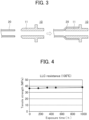
- FIGs. 1 to 3 all illustrate cross-sections of a pipe 20 and a pipe fitting 10 perpendicular to a radial direction of the pipe 20 and the pipe fitting 10.
- FIG. 1 illustrates a state in which the pipe 20 made of a polyarylene sulfide resin composition is connected to the pipe fitting 10 that includes a connection portion 11 having a plurality of steps of which outer diameter is expanded from an open end of the connection portion 11 towards a base side by pushing the pipe 20 onto the pipe fitting 10 while expanding the diameter of the pipe 20. States before and after the connection are illustrated in FIG. 1.
- FIG. 2 illustrates a state in which the pipe 20 made of the polyarylene sulfide resin composition is connected to the pipe fitting 10 which includes an almost spindle-shaped connection portion 11 having a smooth surface by pushing the pipe 20 onto the pipe fitting 10 while expanding the diameter of the pipe 20. States before and after the connection are illustrated in FIG. 2 .
- FIG. 1 illustrates a state in which the pipe 20 made of a polyarylene sulfide resin composition is connected to the pipe fitting 10 that includes an almost spindle-shaped connection portion 11 having a smooth surface by pushing the pipe 20 onto the pipe fitting 10 while expanding the diameter of the pipe
- FIG. 3 illustrates a state in which the pipe 20 made of the polyarylene sulfide resin composition is connected to the pipe fitting 10 which has a smooth surface and which includes a cylindrical connection portion 11 having an outer diameter slightly larger than an inner diameter of the pipe 20 made of a polyarylene sulfide resin composition by pushing the pipe 20 onto the pipe fitting 10 while expanding the diameter of the pipe 20.
- the connection portion 11 illustrated in FIG. 3 since portions which abut on the pipe 20 at the open end of the connection portion 11 are chamfered, the diameter of the pipe 20 is easily expanded. States before and after the connection are illustrated in FIG. 3 .
- the pipe formed by extrusion molding using the above-mentioned polyarylene sulfide resin composition has preferably a cylindrical shape which has, in a shape immediately after extrusion, an outer diameter of 8.0 mm or more and 50.0 mm or less, an inner diameter of 5.0 mm or more and 49.5 mm or less, a thickness of 0.5 mm or more and 3.0 mm or less, and a length of 100 cm or more.
- the outer diameter, the inner diameter, and the thickness of the pipe are preferably uniform.
- the outer diameter, the inner diameter, and the thickness of the pipe may be changed from position to position, as necessary.
- An upper limit of the length is not particularly limited as long as the pipe is extrusion moldable. Considering productivity, a molded article which is continuously long as possible is preferably formed.
- the upper limit of the length may be, for example, 500 cm or less, 300 cm or less, or 200 cm or less.
- the thus-produced long pipe is also preferably used in a state in which the pipe is cut into a desired length of less than 100 cm. Further, the long pipe may be produced as a straight pipe and then processed so as to change its shape by a well-known method such as bending or embossing.
- the extrusion molded article and the pipe as described above are particularly preferably used as circulation pipe systems included in automobiles such as four-wheeled vehicles and motorcycles, transportation machines such as aircrafts and ships, internal-combustion engines such as electric generators and cooling systems with circulating a long-life coolant (LLC).
- automobiles such as four-wheeled vehicles and motorcycles
- transportation machines such as aircrafts and ships
- internal-combustion engines such as electric generators and cooling systems with circulating a long-life coolant (LLC).
- LLC long-life coolant
- A1-1 FORTRON KPS (manufactured by Kureha Corporation, melt viscosity: 130 Pa ⁇ s (shear rate: 1216 sec -1 at 310°C), peak molecular weight: 65000).
- A1-2 Polyphenylene sulfide resin obtained by a polymerization method described in Japanese Unexamined Patent Application, Publication No. 2006-063255 (peak molecular weight: 41000). The peak molecular weights of A1-1 and A1-2 were obtained by measuring as follows.
- A1-1 or A1-2 was heated to melt in an oil bath at 230°C for 10 min using 1-chloronaphthalene as a solvent to thereby prepare a solution having a concentration of 0.05% by mass.
- a peak top molecular weight of a molecular weight distribution converted to standard polystyrene was measured by high-temperature gel permeation chromatographic (GPC) measurement using SSC-7000 UV detector, manufactured by Senshu Scientific Co., Ltd. (detection wavelength: 360 nm) as a measurement device.
- A2-1 BONDFAST (registered trademark) BF-7L, manufactured by SUMITOMO CHEMICAL COMPANY, LIMITED, ethylene (70% by mass) - glycidyl methacrylate (3% by mass) - methyl acrylate (27% by mass) copolymer.
- A2-2 BONDFAST (registered trademark) BF-E, manufactured by SUMITOMO CHEMICAL COMPANY, LIMITED, ethylene (88% by mass) - glycidyl methacrylate (12% by mass) copolymer.
- ⁇ (A2") component olefin based copolymer containing no epoxy group>
- A2-3 ENGAGE 8003, manufactured by Dow Chemical Japan Limited, ethylene-octene copolymer.
- the pellets made of the resin compositions of Examples and Comparative Examples were used to produce test specimens according to ISO3167 (width: 10 mm, thickness: 4 mm) by injection molding at a cylinder temperature of 320°C and a mold temperature of 150°C. These test specimens were used to measure the tensile strength (MPa) and the nominal tensile strain at break (%) according to ISO527-1, 2.
- FIG. 4 illustrates a graph showing a change in tensile strength (MPa) over exposure time in this test. It can be seen from FIG. 4 that the polyarylene sulfide resin composition of Example 1 changed little in tensile strength even when the composition was exposed to the LLC for such a long time as 1000 hours.
- Pellets made of the polyarylene sulfide resin compositions of Examples and Comparative Examples were formed into cylindrical pipes each having an outer diameter of 20 mm, an inner diameter of 16.6 mm, a thickness of 1.7 mm, and a length of 120 cm under the following extrusion molding condition.
- the resultant molded articles were observed for appearance and shape and the test results were determined according to criteria described below. In the case where there was no surface defect such as a streak or surface roughness or shape defect such as distortion, it was determined as "Good”. In the case where there was the above-mentioned surface defect or shape defect, it was determined as "Poor".
- the test results are presented in Table 1. Extrusion molding condition: cylinder temperature: 310°C
- the pipe-shaped molded articles obtained in the long pipe molding test were cut to have a length of 15 cm to thereby obtain tube-like test specimens.
- the resultant tube-like test specimens were pushed onto nipples, which were fixed with jigs, for 15 mm at a rate of 500 mm / min from above using an autograph tester and then the presence or absence of cracking in the tube-like test specimen was confirmed. In the case where there was no cracking, it was determined as "Good”. In the case where there was cracking, it was determined as "Poor".
- the test results are presented in Table 1.
- a shape of the nipple (pipe fitting) is illustrated in the schematic FIG. 1 .
Landscapes
- Engineering & Computer Science (AREA)
- Chemical & Material Sciences (AREA)
- Mechanical Engineering (AREA)
- Organic Chemistry (AREA)
- Health & Medical Sciences (AREA)
- Chemical Kinetics & Catalysis (AREA)
- Medicinal Chemistry (AREA)
- Polymers & Plastics (AREA)
- General Engineering & Computer Science (AREA)
- Transportation (AREA)
- Combustion & Propulsion (AREA)
- Manufacturing & Machinery (AREA)
- Compositions Of Macromolecular Compounds (AREA)
- Extrusion Moulding Of Plastics Or The Like (AREA)
- Rigid Pipes And Flexible Pipes (AREA)
Description
- The present invention relates to a polyarylene sulfide resin composition for extrusion molding; an extrusion molded article including the polyarylene sulfide resin composition; a method for producing an extrusion molded article using the polyarylene sulfide resin composition; and a transportation machine or an electric generator equipped with the extrusion molded article as a pipe for circulating long-life coolant (LLC).
- Polyarylene sulfide resins, represented by a polyphenylene sulfide resin, have high heat resistance, mechanical properties, chemical resistance, dimensional stability, and flame resistance. Therefore, the polyarylene sulfide resins are widely used as materials for components of electrical/electronic devices, vehicle devices, chemical devices, and the like.
- Examples of resin compositions utilizing the above-mentioned excellent properties of the polyarylene sulfide resin include a proposed composition of the polyarylene sulfide resin and an olefin based co-polymer comprised of 10 to 50% by mass of an α-olefin structural unit and 50 to 90% by mass of an α,β-unsaturated carboxylic alkyl ester structural unit (see Patent Document 1). Such a polyarylene sulfide resin composition provides a molded article having various excellent properties such as impact resistance, tensile elongation, surface condition, and the like, without including a reinforcing agent such as a glass fiber.
- Patent Document 1:
Japanese Unexamined Patent Application, Publication No. H06-179791 -
JP 2014-218076 -
JP S61 21156 -
US 2013/273287 describes components formed of blow molded thermoplastic compositions and methods for forming the thermoplastic compositions. Formation methods include dynamic vulcanization of a composition that includes an impact modifier dispersed throughout a polyarylene sulfide. A crosslinking agent is combined with the other components of the composition following dispersal of the impact modifier. The crosslinking agent reacts with the impact modifier to form crosslinks within and among the polymer chains of the impact modifier. -
JP 2008-111063 -
JP 2006-001955 - Polyarylene sulfide resin compositions can be desirably applied to products of extrusion molding such as tubes. However, the polyarylene sulfide resin composition described in, for example, Examples in Patent Document 1 has poor extrusion moldability due to its high melt index and melt viscosity.
- Furthermore, it is a requirement that resin tubes or the like can be pushed onto pipe fittings such as nipples for connection whilst expanding the tube diameters to easily form fluid flow paths using the tubes. That is, the resin tubes are desired to have flexibility whereby no cracking or splitting occurs even when the tubes are pushed onto the pipe fittings such as the nipples. However, the polyarylene sulfide resin composition described in Patent Document 1 may lead to tube cracking when a tube made of the resin composition is pushed onto a pipe fitting such as a nipple for connection. Therefore, it is desired to provide polyarylene sulfide resin compositions which have improved flexibility properties.
- The present invention has been made in view of the above-mentioned problems and an object of the present invention is to provide a polyarylene sulfide resin composition for extrusion molding, the composition having both good extrusion moldability and flexibility, for example, whereby no cracking or splitting occurs even when a resin tube is pushed onto a pipe fitting such as a nipple; an extrusion-molded article produced using the polyarylene sulfide resin composition; a method for producing an extrusion-molded article using the polyarylene sulfide resin composition; and a transportation machine or an electric generator equipped with the extrusion molded article as a pipe that circulates a long-life coolant (LLC). Means for Solving the Problems
- The present inventors have found that the above problems can be solved by using for extrusion molding, a polyarylene sulfide resin composition which contains as a resin component (A), a polyarylene sulfide resin (A1) having a peak molecular weight of 50000 or more and an epoxy group-containing olefin based copolymer (A2) at a predetermined composition, including a structural unit derived from an α-olefin (A2a), a structural unit derived from a glycidyl ester of an α,β-unsaturated acid (A2b), and a structural unit derived from (meth)acrylic acid ester (A2c), which has a ratio of a mass of the resin component (A) relative to a total mass of the polyarylene sulfide resin composition of 95% by mass or more, and which has nominal tensile strain at break as measured according to ISO527-1, 2 of 40% or more. Thus, the present invention has been completed. More specifically, the present invention provides the followings.
-
- (1) A polyarylene sulfide resin composition for extrusion molding, the composition including:
- a resin component (A), the resin component (A) consisting of a polyarylene sulfide resin (A1) and an epoxy group-containing olefin based copolymer (A2),
- in which the composition includes or does not includes a colorant (B),
- wherein the polyarylene sulfide resin (A1) has a peak molecular weight of 50000 or more,
- in which a ratio of a mass of the resin component (A) relative to a total mass of the polyarylene sulfide resin composition is 95% by mass or more,
- in which a mass of the epoxy group-containing olefin based copolymer (A2) is 33 parts by mass or more and 55 parts by mass or less when a mass of the polyarylene sulfide resin (A1) is considered as 100 parts by mass,
- in which the epoxy group-containing olefin based copolymer (A2) includes a structural unit derived from an α-olefin (A2a), a structural unit derived from a glycidyl ester of an α,β-unsaturated acid (A2b), and a structural unit derived from (meth)acrylic acid ester (A2c),
- in which ratios of a mass of the structural unit (A2b) and a mass of the structural unit (A2c) relative to a mass of the epoxy group-containing olefin based copolymer (A2) are 2% by mass or more and 5% by mass or less and 20% by mass or more and 40% by mass or less, respectively,
- the composition having a nominal tensile strain at break of 40% or more as measured according to ISO527-1, 2.
- (2) The polyarylene sulfide resin composition for extrusion molding according to (1), in which the polyarylene sulfide resin (A1) has a peak molecular weight of 55000 or more.
- (3) The polyarylene sulfide resin composition for extrusion molding according to (1) or (2), in which the composition includes, as an additive (C), one or more selected from the group consisting of an antioxidant, a releasing agent, a corrosion inhibitor, and a nucleating agent.
- (4) The polyarylene sulfide resin composition for extrusion molding according to any one of (1) to (3), which is for use in extrusion molding a pipe that circulates a long-life coolant.
- (5) The polyarylene sulfide resin composition for extrusion molding according to (4), which is for use in extrusion molding a pipe that is used to connect to a pipe fitting by pushing the pipe onto the pipe fitting while expanding a diameter of the pipe.
- (6) The polyarylene sulfide resin composition for extrusion molding according to (4) or (5), which is for use in extrusion molding a cylindrical pipe which has, in a shape immediately after extrusion, an outer diameter of 8.0 mm or more and 50.0 mm or less, an inner diameter of 5.0 mm or more and 49.5 mm or less, a thickness of 0.5 mm or more and 3.0 mm or less, and a length of 100 cm or more.
- (7) An extrusion molded article including:
the polyarylene sulfide resin composition according to any one of (1) to (3). - (8) The extrusion molded article according to (7), in which the article is a pipe that circulates a long-life coolant.
- (9) The extrusion molded article according to (8), in which the article is a pipe used to connect to a pipe fitting by pushing the pipe onto the pipe fitting while expanding a diameter of the pipe.
- (10) The extrusion molded article according to (9), in which the article is a cylindrical pipe which has, in a shape immediately after extrusion, an outer diameter of 8.0 mm or more and 50.0 mm or less, an inner diameter of 5.0 mm or more and 49.5 mm or less, a thickness of 0.5 mm or more and 3.0 mm or less, and a length of 100 cm or more.
- (11) A method for producing the extrusion molded article according to any one of (7) to (10), the method including:
extrusion-molding the polyarylene sulfide resin composition according to any one of (1) to (3). - (12) A device, including:
- an internal-combustion engine; and
- a circulating system that circulates a long-life coolant that cools the internal-combustion engine,
- in which the circulating system includes, as a pipe, the extrusion molded article according to (9) or (10), and
- in which the device is a transportation machine or an electric generator.
-
-
FIG. 1 is a diagram illustrating one aspect of a method for connecting a pipe made of a polyarylene sulfide resin composition to a pipe fitting by pushing the pipe onto the pipe fitting while expanding a diameter of the pipe; -
FIG. 2 is a diagram illustrating another aspect of a method for connecting a pipe made of the polyarylene sulfide resin composition to a pipe fitting by pushing the pipe over the pipe fitting while expanding a diameter of the pipe; -
FIG. 3 is a diagram illustrating still another aspect of a method for connecting a pipe made of the polyarylene sulfide resin composition to a pipe fitting by pushing the pipe onto the pipe fitting while expanding a diameter of the pipe; and -
FIG. 4 is a graph illustrating a change in tensile strength (MPa) over exposure time in a test in which a test specimen for measuring tensile strength of the polyarylene sulfide resin composition of Example 1 was exposed to a long-life coolant including ethylene glycol and water at 130°C for 1000 hours. - Embodiments of the present invention will now be described. It is noted that the present invention is not limited to the following embodiments.
- A polyarylene sulfide resin composition is a composition used as a material for extrusion molding. The polyarylene sulfide resin composition includes, as a resin component (A), a polyarylene sulfide resin (A1) and an epoxy group-containing olefin based copolymer (A2). A ratio of a mass of the resin component (A) relative to a total mass of the polyarylene sulfide resin composition is 95% by mass or more. A content of the epoxy group-containing olefin based copolymer (A2) is 33 parts by mass or more and 55 parts by mass or less when a mass of the polyarylene sulfide resin (A1) is considered as 100 parts by mass. The polyarylene sulfide resin composition includes or does not include a colorant (B). The epoxy group-containing olefin based copolymer (A2) includes a structural unit derived from an α-olefin (A2a), a structural unit derived from a glycidyl ester of an α,β-unsaturated acid (A2b), and a structural unit derived from (meth)acrylic acid ester (A2c). Ratios of a mass of the structural unit (A2b) and a mass of the structural unit (A2c) relative to a mass of the epoxy group-containing olefin based copolymer (A2) are 2% by mass or more and 5% by mass or less and 20% by mass or more and 40% by mass or less, respectively. A nominal tensile strain at break as measured according to ISO527-1, 2 of the polyarylene sulfide resin composition is 40% or more.
- Such a polyarylene sulfide resin composition has good extrusion moldability and, in particular, is easily extrusion-molded into even a long pipe such as those having a length of 100 cm or more. More specifically, the above-described polyarylene sulfide resin composition can be produced well by extrusion molding into even a cylindrical pipe which has, in a shape immediately after extrusion, an outer diameter of 8.0 mm or more and 50.0 mm or less, an inner diameter of 5.0 mm or more and 49.5 mm or less, a thickness of 0.5 mm or more and 3.0 mm or less, and a length of 100 cm or more.
- Furthermore, since the nominal tensile strain at break as measured according to ISO527-1, 2 of the polyarylene sulfide resin composition is 40% or more, cracking or splitting is less likely to occur in an extrusion molded article made of such a polyarylene sulfide resin composition when the extrusion molded article is elastically deformed. Therefore, the above-described polyarylene sulfide resin composition is preferably used for extrusion molding a pipe which is used to connect to a pipe fitting by pushing the pipe onto the pipe fitting while expanding a diameter of the pipe by elastic deformation.
- A method for adjusting the nominal tensile strain at break of the polyarylene sulfide resin composition is not particularly limited. Examples of the method for preparing the nominal tensile strain at break of the polyarylene sulfide resin composition include, for example, a method of adjusting an amount of addition or a type of an elastomeric component such as an olefin based copolymer, a method of adjusting an amount of addition or a type of a plasticizer component, and a method of adjusting a peak molecular weight of the polyarylene sulfide resin (A1).
- Moreover, the extrusion molded article made of the above-described polyarylene sulfide resin composition is not changed in mechanical properties such as tensile strength and is less likely to swell, embrittle, deform, and the like even when it is brought into contact with a so-called "long-life coolant (LLC)" including an organic solvent component such as ethylene glycol and glycerol, and water for a long time. That is, the extrusion molded article made of the above-described polyarylene sulfide resin composition has excellent durability against water or an organic solvent, in particular, the "long-life coolant (LLC)". Therefore, the above-described polyarylene sulfide resin composition is suitably used as a material for extrusion-molding a pipe for circulating the "LLC" or a joint for connecting the pipe in, for example, a transportation machine which is driven by an internal-combustion engine such as a four-wheeled vehicle.
- Essential or optional components to be included in the polyarylene sulfide resin composition and a method for producing the polyarylene sulfide resin composition will now be described.
- The polyarylene sulfide resin composition consists of, as the resin component (A), the polyarylene sulfide resin (A1) and the epoxy group-containing olefin based copolymer (A2). The polyarylene sulfide resin composition exerts the above-mentioned effects by including the polyarylene sulfide resin (A1) and the epoxy group-containing olefin based copolymer (A2) so that the polyarylene sulfide resin composition has the nominal tensile strain at break as measured according to ISO527-1, 2 of 40% or more.
- A proportion of a total mass of the polyarylene sulfide resin (A1) and the epoxy group-containing olefin based copolymer (A2) in a mass of the resin component (A) is not particularly limited unless it interferes with the object of the present invention. The proportion of a total mass of the polyarylene sulfide resin (A1) and the epoxy group-containing olefin based copolymer (A2) in a mass of the resin component (A) is 100% by mass.
- The ratio of a mass of the resin component (A) relative to a total mass of the polyarylene sulfide resin composition is 95% by mass or more, preferably 96% by mass or more, more preferably 97% by mass or more, and particularly preferably 98% by mass or more.
- The polyarylene sulfide resin (hereinafter may also be referred to as PAS resin) (A1) is a resin mainly composed of, as a repeating unit, -(Ar-S)- wherein "Ar" represents an arylene group. In the present invention, a PAS resin having a commonly known molecular structure may be used. The PAS resin (A1) may be composed of only a linear molecule or may include a branched molecule.
- The arylene group included in a main chain of the PAS resin (A1) may or may not have a substituent. The arylene group included in a main chain preferably has no substituent, for example, from the viewpoint that the PAS resin (A1) is easily and inexpensively produced and obtained.
- Examples of the substituent on the arylene group include an alkyl group containing 1 or more and 4 or less carbon atoms, an alkoxy group containing 1 or more and 4 or less carbon atoms, an acyl group containing 2 or more and 4 or less carbon atoms, an amino group, a monoalkylamino group which has an alkyl moiety containing 1 or more and 4 or less carbon atoms, and a dialkylamino group which has an alkyl moiety containing 1 or more and 4 or less carbon atoms, etc.
- Specific examples of the alkyl group containing 1 or more and 4 or less carbon atoms include a methyl group, an ethyl group, an n-propyl group, an isopropyl group, and an n-butyl group, etc. Specific examples of the alkoxy group containing 1 or more and 4 or less carbon atoms include a methoxy group, an ethoxy group, an n-propyloxy group, an isopropyloxy group, and an n-butyloxy group, etc. Specific examples of the acyl group containing 2 or more and 4 or less carbon atoms include an acetyl group, a propionyl group, and butanoyl group, etc. Specific examples of the monoalkylamino group which has an alkyl moiety containing 1 or more and 4 or less carbon atoms include a methylamino group, an ethylamino group, an n-propylamino group, an isopropylamino group, and an n-butylamino group, etc. Specific examples of the dialkylamino group which has an alkyl moiety containing 1 or more and 4 or less carbon atoms include a dimethylamino group, a diethylamino group, a di-n-propylamino group, a diisopropylamino group, and a di-n-butylamino group, etc.
- The arylene group in -(Ar-S)- is not particularly limited, but examples thereof include a p-phenylene group, an m-phenylene group, an o-phenylene group, a substituted phenylene group, a p, p'-diphenylene sulfone group, a p, p'-biphenylene group, a p, p'-diphenylene ether group, a p, p'-diphenylene carbonyl group, a naphthalene group, and the like. Among arylene sulfide groups including such arylene groups, homopolymers including repeating units of the same type, as well as polymers including repeating units of different types of arylene sulfide groups are preferred depending on applications.
- A resin including a repeating unit of a p-phenylene sulfide group as an arylene group is preferred as the homopolymer depending on applications. The homopolymer including a repeating unit of a p-phenylene sulfide group has extremely high heat resistance, and exhibits high strength, high stiffness, and even high dimensional stability over a wide range of temperatures. Use of such a homopolymer can provide a molded article having very excellent physical properties.
- A resin which includes a combination of two or more types of different arylene sulfide groups among those including the above-mentioned arylene groups can be used as the copolymer. Among the combination of the arylene sulfide groups, a combination including a p-phenylene sulfide group and an m-phenylene sulfide group is preferred from the viewpoints that a polyarylene sulfide resin composition having good moldability and a molded article having good physical properties such as heat resistance and a mechanical property can be obtained. Furthermore, a polymer containing a p-phenylene sulfide group in a proportion of 70% by mole or more is more preferred, and a polymer containing a p-phenylene sulfide group in a proportion of 80% by mole or more is even more preferred. It is noted that a PAS resin having a phenylene sulfide group is referred to as a polyphenylene sulfide resin.
- The PAS resin (A1) may be produced by conventionally known polymerization methods. The PAS resin produced by a common polymerization method is usually washed with water or acetone for several times, and then washed with acetic acid, ammonium chloride, and the like, in order to remove by-product impurities and the like. As a result, the resultant PAS resin (A1) has carboxyl terminal groups at the ends at a predetermined proportion by weight.
- The peak molecular weight of the PAS resin (A1) is 50000 or more and preferably 55000 or more, from the viewpoint of easy availability of a polyarylene sulfide resin composition exhibiting a desired nominal tensile strain at break. Further, the peak molecular weight of the PAS resin (A1) is preferably 100000 or less and more preferably 80000 or less, from the viewpoint of achievement of both a desired nominal tensile strain at break and good extrusion moldability. The peak molecular weight of the PAS resin (A1) falling within the above-described range easily enables the polyarylene sulfide resin composition to have both good extrusion moldability and flexibility, for example, whereby no cracking or splitting occurs even when the resin tube is pushed onto a pipe fitting such as a nipple.
- The peak molecular weight of the PAS resin (A1) may be measured by a high-temperature gel permeation chromatographic method as the peak top molecular weight of a molecular weight distribution converted to standard polystyrene. The high-temperature gel permeation chromatographic method can be performed, for example, using a device such as SSC-7000 manufactured by Senshu Scientific Co., Ltd. (UV detector: detection wavelength 360 nm). A solution in which a polyarylene sulfide resin is dissolved in 1-chloronaphthalene, which is a solvent, under conditions at 230°C for 10 minutes so as to give a concentration of 0.05% by mass may be used as a measurement sample. Further, the peak molecular weight of the PAS resin (A1) may be adjusted by adjusting polymerization conditions under which the PAS resin (A1) is produced, according to a well-known method.
- A melt viscosity of the PAS resin (A1) measured at a shear rate of 1216 sec-1 and at 310°C is preferably 50 to 300 Pa·s, more preferably 80 to 300 Pa·s, and particularly preferably 100 to 300 Pa·s from the viewpoints of good extrusion moldability and, in particular, easiness of extrusion molding of a long pipe such as those having a length of 100 cm or more.
- The polyarylene sulfide resin composition contains the epoxy group-containing olefin based copolymer (A2). As the epoxy group-containing olefin based copolymer (A2), an olefin based copolymer including the structural unit derived from an α-olefin (A2a), the structural unit derived from a glycidyl ester of an α,β-unsaturated acid (A2b), and the structural unit derived from (meth)acrylic acid ester (A2c) is used. The epoxy group-containing olefin based copolymer (A2) may be used in combination of two or more.
- The epoxy group-containing olefin based copolymer (A2) may be a block copolymer or a random copolymer, the copolymer including the structural unit (A2a), the structural unit (A2b), and the structural unit (A2c). The random copolymer is particularly preferred from the viewpoint that a desired effect due to use of the epoxy group-containing olefin based copolymer (A2) is easily achieved. Further, the epoxy group-containing olefin based copolymer (A2) is preferably a non-graft copolymer.
- When the epoxy group-containing olefin based copolymer (A2) is the random copolymer or the non-graft copolymer, a block composed of only a certain structural unit is less likely to be unevenly distributed in a main chain or a graft chain of the epoxy group-containing olefin based copolymer (A2). In this case, since the structural unit (A2a), the structural unit (A2b), and the structural unit (A2c) included in the epoxy group-containing olefin based copolymer (A2) are not unevenly distributed in a molecule of the polymer, an effect that each structural unit exhibits is likely to be exerted to the desired extent. For the above reason, the epoxy group-containing olefin based copolymer (A2) is preferably a random copolymer or a non-graft copolymer.
- The ratios of a mass of the structural unit (A2b) and a mass of the structural unit (A2c) relative to a mass of the epoxy group-containing olefin based copolymer (A2) are 2% by mass or more and 5% by mass or less and 20% by mass or more and 40% by mass or less, respectively. The ratios of a mass of the structural unit (A2b) and a mass of the structural unit (A2c) relative to a mass of the epoxy group-containing olefin based copolymer (A2) are preferably 2.5% by mass or more and 4% by mass or less and 25% by mass or more and 35% by mass or less, respectively.
- The epoxy group-containing olefin based copolymer (A2) including the structural unit (A2b) in an amount falling within the above-described range allows the polyarylene sulfide resin composition having good extrusion moldability to be easily obtained. Furthermore, the epoxy group-containing olefin based copolymer (A2) including the structural unit (A2c) in an amount falling within the above-described range easily achieves both good extrusion moldability and flexibility, for example, whereby no cracking or splitting occurs even when the resin tube is pushed onto a pipe fitting such as a nipple.
- It is noted that (meth)acrylic acid ester may also be hereinafter referred to as (meth)acrylate. For example, (meth)acrylic acid glycidyl ester may also be referred to as glycidyl (meth)acrylate. Further, as used herein, the term "(meth)acrylic acid" means both acrylic acid and methacrylic acid, and the term "(meth)acrylate" means both acrylate and methacrylate.
- The α-olefin providing the structural unit (A2a) is not particularly limited. Examples thereof include ethylene, propylene, and butylene, etc. Ethylene is particularly preferred. The α-olefin may be used alone, or in combination of two or more. The epoxy group-containing olefin based copolymer (A2) including the structural unit derived from an α-olefin easily imparts flexibility to a molded article formed with the polyarylene sulfide resin composition.
- The glycidyl ester of an α,β-unsaturated acid is not particularly limited. Examples thereof include acrylic acid glycidyl ester, methacrylic acid glycidyl ester, and ethacrylic acid glycidyl ester, etc. and methacrylic acid glycidyl ester is particularly preferred. The glycidyl ester of an α,β-unsaturated acid may be used alone or in combination of two or more.
- The (meth)acrylic acid ester is not particularly limited. Examples thereof include acrylic acid ester such as methyl acrylate, ethyl acrylate, n-propyl acrylate, isopropyl acrylate, n-butyl acrylate, n-hexyl acrylate, isobutyl acrylate, n-amyl acrylate, and n-octyl acrylate; methacrylic acid ester such as methyl methacrylate, ethyl methacrylate, n-propyl methacrylate, isopropyl methacrylate, n-butyl methacrylate, n-hexyl methacrylate, isobutyl methacrylate, n-amyl methacrylate, and n-octyl methacrylate, and the like. Among these, methyl acrylate is particularly preferred. The (meth)acrylic acid ester may be used alone, or in combination of two or more.
- The epoxy group-containing olefin based copolymer (A2) including the structural unit (A2a), the structural unit (A2b), and the structural unit (A2c) may be produced by copolymerization according to a conventionally known method. For example, the above-described copolymer usually may be obtained by copolymerization according to a well-known radical polymerization reaction.
- The epoxy group-containing olefin based copolymer (A2) may contain a structural unit derived from other copolymerization components than the α-olefin, the glycidyl ester of an α,β-unsaturated acid and the (meth)acrylic acid ester, in addition to the structural unit (A2a), the structural unit (A2b), and the structural unit (A2c), unless it interferes with the effect of the present invention.
- More specific examples of the epoxy group-containing olefin based copolymer (A2) include a glycidyl methacrylate-modified ethylene based copolymer, a glycidyl ether-modified ethylene copolymer, and the like. Among these, glycidyl methacrylate-modified ethylene based copolymer is preferred.
- Examples of the glycidyl methacrylate-modified ethylene based copolymer include an ethylene-glycidyl methacrylate-methyl acrylate copolymer, an ethylene-glycidyl methacrylate-ethyl acrylate copolymer, an ethylene-glycidyl methacrylate-propyl acrylate copolymer, an ethylene-glycidyl methacrylate-butyl acrylate copolymer, and the like. Among these, the ethylene-glycidyl methacrylate-methyl acrylate copolymer is preferred. Specific examples of the ethylene-glycidyl methacrylate-methyl acrylate copolymer include "BONDFAST" (manufactured by SUMITOMO CHEMICAL COMPANY, LIMITED) and the like.
- A content of the epoxy group-containing olefin based copolymer (A2) is 33 parts by mass or more and 55 parts by mass or less, more preferably 37 parts by mass or more and 55 parts by mass or less, and particularly preferably 39 parts by mass or more and 51 parts by mass or less when a mass of the polyarylene sulfide resin (A1) is considered as 100 parts by mass. When the content is 33 parts by mass or more, sufficient toughness is easily obtained. Further, when the content is 55 parts by mass or less, a surface defect such as a streak or surface roughness is less likely to occur on a surface of a molded article upon extrusion molding, for example, a pipe. The content of the epoxy group-containing olefin based copolymer (A2) falling within the above-described range is capable of imparting to an extrusion molded article flexibility, for example, whereby no cracking or splitting occurs even when the resin tube is pushed onto a pipe fitting such as a nipple, and allows an extrusion molded article having good mechanical property and chemical resistance to be easily formed.
- The proportion of a total mass of the polyarylene sulfide resin (A1) and the epoxy group-containing olefin based copolymer (A2) in a mass of the resin component (A) is 100% by mass.
- The polyarylene sulfide resin composition may or may not include a colorant (B). When the polyarylene sulfide resin composition includes the colorant (B), an extrusion molded article having excellent designability may be produced, or various machines produced using extrusion molded articles may be easily assembled or produced by coloring the extrusion molded articles with different colors.
- Both dye and pigment may be used as the colorant (B), as long as the colorant has durability, that is, is not faded or discolored under extrusion molding conditions. The colorant (B) is preferably a pigment from the viewpoints of durability upon extrusion molding and good light resistance, weather resistance, and the like in an extrusion molded article.
- Various commercially available colorants may be used as the colorant (B). For example, carbon black, and various compounds which are classified as Pigment or Dye in Color Index (C.I.; published by The Society of Dyers and Colorists) and to which the color index (C. I.) numbers are given may be preferably used as the colorant (B). The colorant (B) may be used in combination of two or more. A combination of pigment and dye may be used as the colorant (B).
- An amount of use of the colorant (B) is not particularly limited as long as a ratio of a mass of the resin component (A) in a mass of the polyarylene sulfide resin composition is 95% by mass or more.
- The polyarylene sulfide resin composition may include various additives (C) conventionally formulated in the polyarylene sulfide resin, in addition to the above-mentioned components, unless they interfere with the object of the present invention, in order to impart a desired physical property to the composition. Suitable examples of the additive (C) include one or more selected from the group consisting of an antioxidant, a releasing agent, a corrosion inhibitor, and a nucleating agent. An amount of use of the additive (C) is not particularly limited as long as a ratio of a mass of the resin component (A) in a mass of the polyarylene sulfide resin composition is 95% by mass or more.
- The polyarylene sulfide resin composition may include a filler (D) unless it interferes with the object of the present invention. A content of the filler (D) in the polyarylene sulfide resin composition is 5% by mass or less, preferably 3% by mass or less, more preferably 1% by mass or less, and particularly preferably 0% by mass from the viewpoint of extrusion moldability of the polyarylene sulfide resin composition. Specific examples of the filler (D) include an inorganic fiber such as a glass fiber, a carbon fiber, a silica fiber, a silica/alumina fiber, a zirconia fiber, a boron nitride fiber, a boron fiber, a potassium titanate fiber, and a metal fiber (e.g., a stainless fiber, an aluminum fiber, a titanium fiber, a copper fiber, and a brass fiber, etc.); an organic fiber such as a polyamide fiber, a fluororesin fiber, and an acrylic resin fiber, etc.; a powdery inorganic filler such as silica, quartz powder, a glass bead, glass powder, silicate (e.g., calcium silicate, aluminum silicate, kaolin, talc, clay, diatomaceous earth, and wollastonite, etc.), a metal oxide (e.g., iron oxide, titanium oxide, zinc oxide, and alumina, etc.), a carbonate (e.g., calcium carbonate and magnesium carbonate, etc.), a sulfate (e.g., calcium sulfate and barium sulfate, etc.), silicon carbide, silicon nitride, boron nitride, and various metal powder; and a plate-like filler such as mica, glass flake, and various metal foils. These inorganic fillers may be used in combination of two or more.
- A method for producing a polyarylene sulfide resin composition is not particularly limited and may be appropriately selected from conventionally known methods for producing a resin composition as long as components of the resin composition may be uniformly mixed. Examples thereof include a method in which components are melt-kneaded and extruded with a melt kneading device such as a single or twin screw extruder, and then the resultant resin composition is processed into a desired form such as powder, flake, and pellet.
- An extrusion molded article may be produced by extrusion-molding the above-mentioned polyarylene sulfide resin composition. The extrusion molded article is the same as common extrusion molded articles except that the above-mentioned polyarylene sulfide resin composition is used as a material.
- A method for producing the extrusion molded article is not particularly limited. For example, a cylindrical pipe is extrusion-molded using a die for a tube. When the extrusion molded article is a pipe, the pipe may be a multilayered pipe or a monolayered pipe. Since cracking or splitting is less likely to occur even when the pipe is pushed onto a pipe fitting such as a nipple, the pipe is preferably a monolayered pipe made of the above-mentioned polyarylene sulfide resin composition.
- As mentioned above, a pipe formed by extrusion molding using the above-mentioned polyarylene sulfide resin composition is not changed in mechanical properties such as tensile strength and is less likely to swell, embrittle, deform, and the like even when it is brought into contact with a so-called "long-life coolant (LLC)" including an organic solvent component such as ethylene glycol and glycerol, and water for a long time. That is, the pipe formed by extrusion molding using the above-mentioned polyarylene sulfide resin composition has excellent durability against water or an organic solvent, in particular, the "LLC". Therefore, the pipe formed by extrusion molding using the above-mentioned polyarylene sulfide resin composition is suitably used as a pipe that circulates the LLC.
- Further, the pipe formed by extrusion molding using the above-mentioned polyarylene sulfide resin composition is less likely to cause cracking or splitting even when the pipe is connected to a pipe fitting by pushing the pipe onto the pipe fitting while expanding a diameter of the pipe. Therefore, the pipe formed by extrusion molding using the above-mentioned polyarylene sulfide resin composition is suitably used as a pipe which is connected to a pipe fitting by pushing the pipe onto the pipe fitting while expanding a diameter of the pipe.
- Referring to
FIGs. 1 to 3 , an aspect in which a pipe is connected to a pipe fitting by pushing the pipe onto the pipe fitting while expanding a diameter of the pipe will now be described.FIGs. 1 to 3 all illustrate cross-sections of apipe 20 and a pipe fitting 10 perpendicular to a radial direction of thepipe 20 and thepipe fitting 10. -
FIG. 1 illustrates a state in which thepipe 20 made of a polyarylene sulfide resin composition is connected to the pipe fitting 10 that includes aconnection portion 11 having a plurality of steps of which outer diameter is expanded from an open end of theconnection portion 11 towards a base side by pushing thepipe 20 onto the pipe fitting 10 while expanding the diameter of thepipe 20. States before and after the connection are illustrated inFIG. 1. FIG. 2 illustrates a state in which thepipe 20 made of the polyarylene sulfide resin composition is connected to the pipe fitting 10 which includes an almost spindle-shapedconnection portion 11 having a smooth surface by pushing thepipe 20 onto the pipe fitting 10 while expanding the diameter of thepipe 20. States before and after the connection are illustrated inFIG. 2 .FIG. 3 illustrates a state in which thepipe 20 made of the polyarylene sulfide resin composition is connected to the pipe fitting 10 which has a smooth surface and which includes acylindrical connection portion 11 having an outer diameter slightly larger than an inner diameter of thepipe 20 made of a polyarylene sulfide resin composition by pushing thepipe 20 onto the pipe fitting 10 while expanding the diameter of thepipe 20. In theconnection portion 11 illustrated inFIG. 3 , since portions which abut on thepipe 20 at the open end of theconnection portion 11 are chamfered, the diameter of thepipe 20 is easily expanded. States before and after the connection are illustrated inFIG. 3 . - The pipe formed by extrusion molding using the above-mentioned polyarylene sulfide resin composition has preferably a cylindrical shape which has, in a shape immediately after extrusion, an outer diameter of 8.0 mm or more and 50.0 mm or less, an inner diameter of 5.0 mm or more and 49.5 mm or less, a thickness of 0.5 mm or more and 3.0 mm or less, and a length of 100 cm or more. The outer diameter, the inner diameter, and the thickness of the pipe are preferably uniform. The outer diameter, the inner diameter, and the thickness of the pipe may be changed from position to position, as necessary.
- An upper limit of the length is not particularly limited as long as the pipe is extrusion moldable. Considering productivity, a molded article which is continuously long as possible is preferably formed. The upper limit of the length may be, for example, 500 cm or less, 300 cm or less, or 200 cm or less. The thus-produced long pipe is also preferably used in a state in which the pipe is cut into a desired length of less than 100 cm. Further, the long pipe may be produced as a straight pipe and then processed so as to change its shape by a well-known method such as bending or embossing.
- The extrusion molded article and the pipe as described above are particularly preferably used as circulation pipe systems included in automobiles such as four-wheeled vehicles and motorcycles, transportation machines such as aircrafts and ships, internal-combustion engines such as electric generators and cooling systems with circulating a long-life coolant (LLC).
- The present invention will now be specifically described with reference to Examples and Comparative Examples, but the present invention is not limited to these Examples.
- In Examples and Comparative Examples, the following materials were used as materials for a polyarylene sulfide resin composition.
- A1-1: FORTRON KPS (manufactured by Kureha Corporation, melt viscosity: 130 Pa·s (shear rate: 1216 sec-1 at 310°C), peak molecular weight: 65000).
- A1-2: Polyphenylene sulfide resin obtained by a polymerization method described in
Japanese Unexamined Patent Application, Publication No. 2006-063255 - A1-1 or A1-2 was heated to melt in an oil bath at 230°C for 10 min using 1-chloronaphthalene as a solvent to thereby prepare a solution having a concentration of 0.05% by mass. A peak top molecular weight of a molecular weight distribution converted to standard polystyrene was measured by high-temperature gel permeation chromatographic (GPC) measurement using SSC-7000 UV detector, manufactured by Senshu Scientific Co., Ltd. (detection wavelength: 360 nm) as a measurement device.
- A2-1: BONDFAST (registered trademark) BF-7L, manufactured by SUMITOMO CHEMICAL COMPANY, LIMITED, ethylene (70% by mass) - glycidyl methacrylate (3% by mass) - methyl acrylate (27% by mass) copolymer.
- A2-2: BONDFAST (registered trademark) BF-E, manufactured by SUMITOMO CHEMICAL COMPANY, LIMITED, ethylene (88% by mass) - glycidyl methacrylate (12% by mass) copolymer.
- A2-3: ENGAGE 8003, manufactured by Dow Chemical Japan Limited, ethylene-octene copolymer.
- Components in amounts presented in Table 1 were melt-kneaded with a twin screw extruder at a cylinder temperature of 320°C to thereby produce pellets made of resin compositions of Examples and Comparative Examples. The resultant resin compositions were used to evaluate tensile strength and nominal tensile strain at break according to the following method. Evaluation results of these mechanical properties are presented in Table 1.
- The pellets made of the resin compositions of Examples and Comparative Examples were used to produce test specimens according to ISO3167 (width: 10 mm, thickness: 4 mm) by injection molding at a cylinder temperature of 320°C and a mold temperature of 150°C. These test specimens were used to measure the tensile strength (MPa) and the nominal tensile strain at break (%) according to ISO527-1, 2.
- The test specimen for measuring tensile strength made of the polyarylene sulfide resin composition of Example 1 were exposed to a long-life coolant (LLC) including ethylene glycol and water at 130°C for 1000 hours.
FIG. 4 illustrates a graph showing a change in tensile strength (MPa) over exposure time in this test. It can be seen fromFIG. 4 that the polyarylene sulfide resin composition of Example 1 changed little in tensile strength even when the composition was exposed to the LLC for such a long time as 1000 hours. - Pellets made of the polyarylene sulfide resin compositions of Examples and Comparative Examples were formed into cylindrical pipes each having an outer diameter of 20 mm, an inner diameter of 16.6 mm, a thickness of 1.7 mm, and a length of 120 cm under the following extrusion molding condition. The resultant molded articles were observed for appearance and shape and the test results were determined according to criteria described below. In the case where there was no surface defect such as a streak or surface roughness or shape defect such as distortion, it was determined as "Good". In the case where there was the above-mentioned surface defect or shape defect, it was determined as "Poor". The test results are presented in Table 1. Extrusion molding condition: cylinder temperature: 310°C
- The pipe-shaped molded articles obtained in the long pipe molding test were cut to have a length of 15 cm to thereby obtain tube-like test specimens. The resultant tube-like test specimens were pushed onto nipples, which were fixed with jigs, for 15 mm at a rate of 500 mm / min from above using an autograph tester and then the presence or absence of cracking in the tube-like test specimen was confirmed. In the case where there was no cracking, it was determined as "Good". In the case where there was cracking, it was determined as "Poor". The test results are presented in Table 1. A shape of the nipple (pipe fitting) is illustrated in the schematic
FIG. 1 . Furthermore, a maximum outer diameter at a connection portion of the nipple is 19 mm.[Table 1] Ex. 1 Ex. 2 Ex. 3 Comp. ex. 1 Comp. ex. 2 Comp. ex. 3 (A1) component (parts by mass) A1-1 100 100 100 100 100 - A1-2 - - - - - 100 (A2) component (parts by mass) A2-1 44 34 55 - 18 44 (A2') component (parts by mass) A2-2 - - - 7 - - (A2") component (parts by mass) A2-3 - - - 36 - - Tensile strength MPa 37 40 34 40 51 36 Nominal tensile strain at break % 94 45 100 25 17 30 Long pipe molding test Good Good Good Poor Good Good Insertion test onto nipple Good Good Good Poor Poor Poor - It can be seen from Table 1 that, when the polyarylene sulfide resin compositions of Examples 1 to 3, which include the polyarylene sulfide resin (A1) and the epoxy group-containing olefin based copolymer (A2) satisfying the predetermined requirements at respective predetermined ratio and which have the nominal tensile strain at break of 40% or more, were used, long pipes of more than 100cm in length were easily extrusion molded and cracking or splitting was less likely to occur in the pipe even when pushed onto a nipple for connection.
- Meanwhile, when the polyarylene sulfide resin composition of Comparative Example 1, which includes a combination of the epoxy group-containing olefin based copolymer (A2'), which did not satisfy the predetermined requirements, and the olefin based copolymer, containing no epoxy group (A2") and which has the nominal tensile strain at break of less than 40%, was used, it was difficult to extrusion mold a pipe of length more than 100cm and cracking occurred in the pipe when pushed onto a nipple for connection. Furthermore, when the polyarylene sulfide resin compositions of Comparative Examples 2 and 3, which include the epoxy group-containing olefin based copolymer (A2) satisfying the predetermined requirements but which have the nominal tensile strain at break of less than 40%, were used, a long pipe of more than 100 cm was extrusion molded satisfactorily but cracking occurred in the pipe when pushed onto a nipple for connection.
-
- 10
- Pipe fitting
- 11
- Connection portion
- 20
- Pipe
Claims (12)
- A polyarylene sulfide resin composition for extrusion molding, the composition comprising:a resin component (A), the resin component (A) consisting of a polyarylene sulfide resin (A1) and an epoxy group-containing olefin based copolymer (A2),wherein the composition includes or does not include a colorant (B),wherein the polyarylene sulfide resin (A1) has a peak molecular weight of 50000 or more, wherein a ratio of a mass of the resin component (A) relative to a total mass of the polyarylene sulfide resin composition is 95% by mass or more,wherein a mass of the epoxy group-containing olefin based copolymer (A2) is 33 parts by mass or more and 55 parts by mass or less when a mass of the polyarylene sulfide resin (A1) is considered as 100 parts by mass,wherein the epoxy group-containing olefin based copolymer (A2) includes a structural unit derived from an α-olefin (A2a), a structural unit derived from a glycidyl ester of an α,β-unsaturated acid (A2b), and a structural unit derived from (meth)acrylic acid ester (A2c), wherein ratios of a mass of the structural unit (A2b) and a mass of the structural unit (A2c) relative to a mass of the epoxy group-containing olefin based copolymer (A2) are 2% by mass or more and 5% by mass or less and 20% by mass or more and 40% by mass or less, respectively,the composition having a nominal tensile strain at break of 40% or more as measured according to ISO527-1, 2.
- The polyarylene sulfide resin composition for extrusion molding according to claim 1,
wherein the polyarylene sulfide resin (A1) has a peak molecular weight of 55000 or more. - The polyarylene sulfide resin composition for extrusion molding according to claim 1 or 2, wherein the composition includes, as an additive (C), one or more selected from the group consisting of an antioxidant, a releasing agent, a corrosion inhibitor, and a nucleating agent.
- The polyarylene sulfide resin composition for extrusion molding according to any one of claims 1 to 3, which is for use in extrusion molding a pipe that circulates a long-life coolant.
- The polyarylene sulfide resin composition for extrusion molding according to claim 4, which is for use in extrusion molding a pipe that is used to connect to a pipe fitting by pushing the pipe onto the pipe fitting while expanding a diameter of the pipe.
- The polyarylene sulfide resin composition for extrusion molding according to claim 4 or 5, which is for use in extrusion molding a cylindrical pipe which has, in a shape immediately after extrusion, an outer diameter of 8.0 mm or more and 50.0 mm or less, an inner diameter of 5.0 mm or more and 49.5 mm or less, a thickness of 0.5 mm or more and 3.0 mm or less, and a length of 100 cm or more.
- An extrusion molded article comprising:
the polyarylene sulfide resin composition according to any one of claims 1 to 3. - The extrusion molded article according to claim 7, wherein the article is a pipe that circulates a long-life coolant.
- The extrusion molded article according to claim 8, wherein the article is a pipe that is used to connect to a pipe fitting by pushing the pipe onto the pipe fitting while expanding a diameter of the pipe.
- The extrusion molded article according to claim 9, wherein the article is a cylindrical pipe which has, in a shape immediately after extrusion, an outer diameter of 8.0 mm or more and 50.0 mm or less, an inner diameter of 5.0 mm or more and 49.5 mm or less, a thickness of 0.5 mm or more and 3.0 mm or less, and a length of 100 cm or more.
- A method for producing the extrusion molded article according to any one of claims 7 to 10, the method comprising:
extrusion-molding the polyarylene sulfide resin composition according to any one of claims 1 to 3. - A device, comprising:an internal-combustion engine; anda circulating system that circulates a long-life coolant that cools the internal-combustion engine,wherein the circulating system includes, as a pipe, the extrusion molded article according to claim 9 or 10, andwherein the device is a transportation machine or an electric generator.
Applications Claiming Priority (2)
| Application Number | Priority Date | Filing Date | Title |
|---|---|---|---|
| JP2018079010A JP6823005B2 (en) | 2018-04-17 | 2018-04-17 | Polyarylene sulfide resin composition, extruded product, manufacturing method of extruded product, and transport aircraft or generator |
| PCT/JP2019/015458 WO2019203062A1 (en) | 2018-04-17 | 2019-04-09 | Polyarylene sulfide resin composition, extrusion-molded article, method for manufacturing extrusion-molded article, and transportation machine or generator |
Publications (3)
| Publication Number | Publication Date |
|---|---|
| EP3783065A1 EP3783065A1 (en) | 2021-02-24 |
| EP3783065A4 EP3783065A4 (en) | 2021-06-16 |
| EP3783065B1 true EP3783065B1 (en) | 2024-03-13 |
Family
ID=68239090
Family Applications (1)
| Application Number | Title | Priority Date | Filing Date |
|---|---|---|---|
| EP19788722.7A Active EP3783065B1 (en) | 2018-04-17 | 2019-04-09 | Polyarylene sulfide resin composition, extrusion-molded article, method for manufacturing extrusion-molded article, and transportation machine or generator |
Country Status (3)
| Country | Link |
|---|---|
| EP (1) | EP3783065B1 (en) |
| JP (1) | JP6823005B2 (en) |
| WO (1) | WO2019203062A1 (en) |
Families Citing this family (1)
| Publication number | Priority date | Publication date | Assignee | Title |
|---|---|---|---|---|
| JP6987183B1 (en) * | 2020-06-29 | 2021-12-22 | ポリプラスチックス株式会社 | Polyarylene sulfide resin composition for extrusion or blow molding |
Family Cites Families (16)
| Publication number | Priority date | Publication date | Assignee | Title |
|---|---|---|---|---|
| JPS6121156A (en) * | 1984-07-09 | 1986-01-29 | Dainippon Ink & Chem Inc | Polyarylene sulfide resin composition |
| JP3159700B2 (en) * | 1990-08-06 | 2001-04-23 | 日本ケーブル・システム株式会社 | Control cable |
| JP3973700B2 (en) | 1992-12-15 | 2007-09-12 | 大日本インキ化学工業株式会社 | Resin composition |
| JP2000063668A (en) * | 1998-08-21 | 2000-02-29 | Kureha Chem Ind Co Ltd | Heat medium piping |
| JP4633390B2 (en) * | 2004-06-15 | 2011-02-16 | ポリプラスチックス株式会社 | Polyarylene sulfide resin composition |
| JP2006036824A (en) * | 2004-07-23 | 2006-02-09 | Toray Ind Inc | Automotive engine cooling resin molded parts |
| JP5132031B2 (en) * | 2004-08-30 | 2013-01-30 | Dic株式会社 | Fluid piping member comprising polyarylene sulfide resin composition |
| JP4961927B2 (en) * | 2006-09-22 | 2012-06-27 | Dic株式会社 | Polyarylene sulfide resin composition and fluid piping |
| JP4876855B2 (en) * | 2006-10-31 | 2012-02-15 | 東レ株式会社 | Extruded hollow molded article and method for producing the same |
| WO2009088092A1 (en) * | 2008-01-08 | 2009-07-16 | Rikkyo Gakuin | Composition containing polyphenylene sulfide resin, and process for producing the same |
| US9493646B2 (en) * | 2012-04-13 | 2016-11-15 | Ticona Llc | Blow molded thermoplastic composition |
| JP6325295B2 (en) * | 2013-04-09 | 2018-05-16 | ポリプラスチックス株式会社 | Insert molding resin composition, metal resin composite molded body using the same, and method for producing the same |
| JP6634682B2 (en) * | 2015-02-12 | 2020-01-22 | Dic株式会社 | Polyarylene sulfide resin composition, molded article thereof, and electric vehicle part |
| JP6590181B2 (en) * | 2015-02-12 | 2019-10-16 | Dic株式会社 | Resin composition for water parts and piping for fluid |
| JP6634681B2 (en) * | 2015-02-12 | 2020-01-22 | Dic株式会社 | Polyarylene sulfide resin composition, molded article thereof, and electric vehicle part |
| JP6614428B2 (en) * | 2015-02-12 | 2019-12-04 | Dic株式会社 | Resin composition for water parts and piping for fluid |
-
2018
- 2018-04-17 JP JP2018079010A patent/JP6823005B2/en active Active
-
2019
- 2019-04-09 EP EP19788722.7A patent/EP3783065B1/en active Active
- 2019-04-09 WO PCT/JP2019/015458 patent/WO2019203062A1/en not_active Ceased
Also Published As
| Publication number | Publication date |
|---|---|
| WO2019203062A1 (en) | 2019-10-24 |
| EP3783065A4 (en) | 2021-06-16 |
| EP3783065A1 (en) | 2021-02-24 |
| JP6823005B2 (en) | 2021-01-27 |
| JP2019183077A (en) | 2019-10-24 |
Similar Documents
| Publication | Publication Date | Title |
|---|---|---|
| CN106795371B (en) | Thermoplastic polymer composition with improved mechanical property | |
| KR102805933B1 (en) | Polyamide moulding composition for extrusion blow moulding | |
| JPH07502768A (en) | Lubricated polyacetal composition | |
| EP3385331B1 (en) | Polyamide resin composition with high fluidity | |
| CA2597062A1 (en) | Thermoplastic vulcanisate blend | |
| KR101025965B1 (en) | Polyarylene sulfide resin composition and paint molded article | |
| CN107501714B (en) | A kind of polypropene composition and preparation method thereof | |
| JP2001072917A (en) | Melt-processible, curable coating composition | |
| BR112017008483B1 (en) | USE OF AT LEAST ONE CATALYST TO FORM A COMPOSITION, COMPOSITION COMPRISING POLYAMIDE, USE OF COMPOSITION AND FLEXIBLE TUBE COMPRISING LAYER OF SUCH COMPOSITION | |
| US5674579A (en) | Flexible translucent polyamide composition | |
| EP3783065B1 (en) | Polyarylene sulfide resin composition, extrusion-molded article, method for manufacturing extrusion-molded article, and transportation machine or generator | |
| AU663704B2 (en) | Flexible thermoplastic compositions comprising nylon | |
| CN114213750A (en) | Multilayer pipeline | |
| JP7303004B2 (en) | Polyamide resin composition and molded article | |
| JP3500747B2 (en) | Thermoplastic resin composition | |
| JPH10279800A (en) | Polyphenylene sulfide resin composition | |
| JP3285481B2 (en) | Automotive components made of polyacetal resin | |
| CN114040944B (en) | Ternary polymer blends, in particular for pipe extrusion, thermoplastic pipes made from such blends and use thereof | |
| KR102341867B1 (en) | cylindrical injection-molded article | |
| KR101735653B1 (en) | Therplastic polyketone resin composition having inhibited gelation | |
| KR102275120B1 (en) | Polyamide resin composition and molded artice manufactured therefrom | |
| CN108570193A (en) | Polypropylene resin composite and its shaped article | |
| EP0890616A1 (en) | Resin composition | |
| WO2021157606A1 (en) | Polyamide resin composition | |
| EP4169983B1 (en) | Polyarylene sulfide resin composition for extrusion or blow molding |
Legal Events
| Date | Code | Title | Description |
|---|---|---|---|
| STAA | Information on the status of an ep patent application or granted ep patent |
Free format text: STATUS: THE INTERNATIONAL PUBLICATION HAS BEEN MADE |
|
| PUAI | Public reference made under article 153(3) epc to a published international application that has entered the european phase |
Free format text: ORIGINAL CODE: 0009012 |
|
| STAA | Information on the status of an ep patent application or granted ep patent |
Free format text: STATUS: REQUEST FOR EXAMINATION WAS MADE |
|
| 17P | Request for examination filed |
Effective date: 20201113 |
|
| AK | Designated contracting states |
Kind code of ref document: A1 Designated state(s): AL AT BE BG CH CY CZ DE DK EE ES FI FR GB GR HR HU IE IS IT LI LT LU LV MC MK MT NL NO PL PT RO RS SE SI SK SM TR |
|
| AX | Request for extension of the european patent |
Extension state: BA ME |
|
| A4 | Supplementary search report drawn up and despatched |
Effective date: 20210519 |
|
| RIC1 | Information provided on ipc code assigned before grant |
Ipc: C08L 81/02 20060101AFI20210512BHEP Ipc: C08L 23/00 20060101ALI20210512BHEP Ipc: C08L 63/00 20060101ALI20210512BHEP Ipc: B29C 48/32 20190101ALI20210512BHEP Ipc: F16L 11/04 20060101ALI20210512BHEP Ipc: B32B 1/08 20060101ALI20210512BHEP Ipc: B60K 15/03 20060101ALI20210512BHEP Ipc: C08K 3/00 20180101ALI20210512BHEP Ipc: C08L 23/04 20060101ALI20210512BHEP Ipc: C08L 81/00 20060101ALI20210512BHEP |
|
| DAV | Request for validation of the european patent (deleted) | ||
| DAX | Request for extension of the european patent (deleted) | ||
| STAA | Information on the status of an ep patent application or granted ep patent |
Free format text: STATUS: EXAMINATION IS IN PROGRESS |
|
| 17Q | First examination report despatched |
Effective date: 20220324 |
|
| RIN1 | Information on inventor provided before grant (corrected) |
Inventor name: MORIYA, SHOTARO Inventor name: OHNISHI, KATSUHEI |
|
| GRAP | Despatch of communication of intention to grant a patent |
Free format text: ORIGINAL CODE: EPIDOSNIGR1 |
|
| STAA | Information on the status of an ep patent application or granted ep patent |
Free format text: STATUS: GRANT OF PATENT IS INTENDED |
|
| INTG | Intention to grant announced |
Effective date: 20231002 |
|
| GRAS | Grant fee paid |
Free format text: ORIGINAL CODE: EPIDOSNIGR3 |
|
| GRAA | (expected) grant |
Free format text: ORIGINAL CODE: 0009210 |
|
| STAA | Information on the status of an ep patent application or granted ep patent |
Free format text: STATUS: THE PATENT HAS BEEN GRANTED |
|
| AK | Designated contracting states |
Kind code of ref document: B1 Designated state(s): AL AT BE BG CH CY CZ DE DK EE ES FI FR GB GR HR HU IE IS IT LI LT LU LV MC MK MT NL NO PL PT RO RS SE SI SK SM TR |
|
| REG | Reference to a national code |
Ref country code: GB Ref legal event code: FG4D |
|
| REG | Reference to a national code |
Ref country code: CH Ref legal event code: EP |
|
| REG | Reference to a national code |
Ref country code: DE Ref legal event code: R096 Ref document number: 602019048267 Country of ref document: DE |
|
| REG | Reference to a national code |
Ref country code: IE Ref legal event code: FG4D |
|
| PG25 | Lapsed in a contracting state [announced via postgrant information from national office to epo] |
Ref country code: LT Free format text: LAPSE BECAUSE OF FAILURE TO SUBMIT A TRANSLATION OF THE DESCRIPTION OR TO PAY THE FEE WITHIN THE PRESCRIBED TIME-LIMIT Effective date: 20240313 |
|
| REG | Reference to a national code |
Ref country code: LT Ref legal event code: MG9D |
|
| PG25 | Lapsed in a contracting state [announced via postgrant information from national office to epo] |
Ref country code: GR Free format text: LAPSE BECAUSE OF FAILURE TO SUBMIT A TRANSLATION OF THE DESCRIPTION OR TO PAY THE FEE WITHIN THE PRESCRIBED TIME-LIMIT Effective date: 20240614 |
|
| REG | Reference to a national code |
Ref country code: NL Ref legal event code: MP Effective date: 20240313 |
|
| PG25 | Lapsed in a contracting state [announced via postgrant information from national office to epo] |
Ref country code: RS Free format text: LAPSE BECAUSE OF FAILURE TO SUBMIT A TRANSLATION OF THE DESCRIPTION OR TO PAY THE FEE WITHIN THE PRESCRIBED TIME-LIMIT Effective date: 20240613 Ref country code: HR Free format text: LAPSE BECAUSE OF FAILURE TO SUBMIT A TRANSLATION OF THE DESCRIPTION OR TO PAY THE FEE WITHIN THE PRESCRIBED TIME-LIMIT Effective date: 20240313 |
|
| PG25 | Lapsed in a contracting state [announced via postgrant information from national office to epo] |
Ref country code: ES Free format text: LAPSE BECAUSE OF FAILURE TO SUBMIT A TRANSLATION OF THE DESCRIPTION OR TO PAY THE FEE WITHIN THE PRESCRIBED TIME-LIMIT Effective date: 20240313 |
|
| PG25 | Lapsed in a contracting state [announced via postgrant information from national office to epo] |
Ref country code: RS Free format text: LAPSE BECAUSE OF FAILURE TO SUBMIT A TRANSLATION OF THE DESCRIPTION OR TO PAY THE FEE WITHIN THE PRESCRIBED TIME-LIMIT Effective date: 20240613 Ref country code: NO Free format text: LAPSE BECAUSE OF FAILURE TO SUBMIT A TRANSLATION OF THE DESCRIPTION OR TO PAY THE FEE WITHIN THE PRESCRIBED TIME-LIMIT Effective date: 20240613 Ref country code: LT Free format text: LAPSE BECAUSE OF FAILURE TO SUBMIT A TRANSLATION OF THE DESCRIPTION OR TO PAY THE FEE WITHIN THE PRESCRIBED TIME-LIMIT Effective date: 20240313 Ref country code: HR Free format text: LAPSE BECAUSE OF FAILURE TO SUBMIT A TRANSLATION OF THE DESCRIPTION OR TO PAY THE FEE WITHIN THE PRESCRIBED TIME-LIMIT Effective date: 20240313 Ref country code: GR Free format text: LAPSE BECAUSE OF FAILURE TO SUBMIT A TRANSLATION OF THE DESCRIPTION OR TO PAY THE FEE WITHIN THE PRESCRIBED TIME-LIMIT Effective date: 20240614 Ref country code: FI Free format text: LAPSE BECAUSE OF FAILURE TO SUBMIT A TRANSLATION OF THE DESCRIPTION OR TO PAY THE FEE WITHIN THE PRESCRIBED TIME-LIMIT Effective date: 20240313 Ref country code: ES Free format text: LAPSE BECAUSE OF FAILURE TO SUBMIT A TRANSLATION OF THE DESCRIPTION OR TO PAY THE FEE WITHIN THE PRESCRIBED TIME-LIMIT Effective date: 20240313 Ref country code: BG Free format text: LAPSE BECAUSE OF FAILURE TO SUBMIT A TRANSLATION OF THE DESCRIPTION OR TO PAY THE FEE WITHIN THE PRESCRIBED TIME-LIMIT Effective date: 20240313 |
|
| REG | Reference to a national code |
Ref country code: AT Ref legal event code: MK05 Ref document number: 1665742 Country of ref document: AT Kind code of ref document: T Effective date: 20240313 |
|
| PG25 | Lapsed in a contracting state [announced via postgrant information from national office to epo] |
Ref country code: SE Free format text: LAPSE BECAUSE OF FAILURE TO SUBMIT A TRANSLATION OF THE DESCRIPTION OR TO PAY THE FEE WITHIN THE PRESCRIBED TIME-LIMIT Effective date: 20240313 Ref country code: LV Free format text: LAPSE BECAUSE OF FAILURE TO SUBMIT A TRANSLATION OF THE DESCRIPTION OR TO PAY THE FEE WITHIN THE PRESCRIBED TIME-LIMIT Effective date: 20240313 |
|
| PG25 | Lapsed in a contracting state [announced via postgrant information from national office to epo] |
Ref country code: NL Free format text: LAPSE BECAUSE OF FAILURE TO SUBMIT A TRANSLATION OF THE DESCRIPTION OR TO PAY THE FEE WITHIN THE PRESCRIBED TIME-LIMIT Effective date: 20240313 |
|
| PG25 | Lapsed in a contracting state [announced via postgrant information from national office to epo] |
Ref country code: NL Free format text: LAPSE BECAUSE OF FAILURE TO SUBMIT A TRANSLATION OF THE DESCRIPTION OR TO PAY THE FEE WITHIN THE PRESCRIBED TIME-LIMIT Effective date: 20240313 |
|
| PG25 | Lapsed in a contracting state [announced via postgrant information from national office to epo] |
Ref country code: IS Free format text: LAPSE BECAUSE OF FAILURE TO SUBMIT A TRANSLATION OF THE DESCRIPTION OR TO PAY THE FEE WITHIN THE PRESCRIBED TIME-LIMIT Effective date: 20240713 |
|
| PG25 | Lapsed in a contracting state [announced via postgrant information from national office to epo] |
Ref country code: SM Free format text: LAPSE BECAUSE OF FAILURE TO SUBMIT A TRANSLATION OF THE DESCRIPTION OR TO PAY THE FEE WITHIN THE PRESCRIBED TIME-LIMIT Effective date: 20240313 Ref country code: PT Free format text: LAPSE BECAUSE OF FAILURE TO SUBMIT A TRANSLATION OF THE DESCRIPTION OR TO PAY THE FEE WITHIN THE PRESCRIBED TIME-LIMIT Effective date: 20240715 |
|
| PG25 | Lapsed in a contracting state [announced via postgrant information from national office to epo] |
Ref country code: EE Free format text: LAPSE BECAUSE OF FAILURE TO SUBMIT A TRANSLATION OF THE DESCRIPTION OR TO PAY THE FEE WITHIN THE PRESCRIBED TIME-LIMIT Effective date: 20240313 Ref country code: CZ Free format text: LAPSE BECAUSE OF FAILURE TO SUBMIT A TRANSLATION OF THE DESCRIPTION OR TO PAY THE FEE WITHIN THE PRESCRIBED TIME-LIMIT Effective date: 20240313 |
|
| PG25 | Lapsed in a contracting state [announced via postgrant information from national office to epo] |
Ref country code: AT Free format text: LAPSE BECAUSE OF FAILURE TO SUBMIT A TRANSLATION OF THE DESCRIPTION OR TO PAY THE FEE WITHIN THE PRESCRIBED TIME-LIMIT Effective date: 20240313 |
|
| PG25 | Lapsed in a contracting state [announced via postgrant information from national office to epo] |
Ref country code: PL Free format text: LAPSE BECAUSE OF FAILURE TO SUBMIT A TRANSLATION OF THE DESCRIPTION OR TO PAY THE FEE WITHIN THE PRESCRIBED TIME-LIMIT Effective date: 20240313 |
|
| PG25 | Lapsed in a contracting state [announced via postgrant information from national office to epo] |
Ref country code: SK Free format text: LAPSE BECAUSE OF FAILURE TO SUBMIT A TRANSLATION OF THE DESCRIPTION OR TO PAY THE FEE WITHIN THE PRESCRIBED TIME-LIMIT Effective date: 20240313 |
|
| PG25 | Lapsed in a contracting state [announced via postgrant information from national office to epo] |
Ref country code: SM Free format text: LAPSE BECAUSE OF FAILURE TO SUBMIT A TRANSLATION OF THE DESCRIPTION OR TO PAY THE FEE WITHIN THE PRESCRIBED TIME-LIMIT Effective date: 20240313 Ref country code: SK Free format text: LAPSE BECAUSE OF FAILURE TO SUBMIT A TRANSLATION OF THE DESCRIPTION OR TO PAY THE FEE WITHIN THE PRESCRIBED TIME-LIMIT Effective date: 20240313 Ref country code: RO Free format text: LAPSE BECAUSE OF FAILURE TO SUBMIT A TRANSLATION OF THE DESCRIPTION OR TO PAY THE FEE WITHIN THE PRESCRIBED TIME-LIMIT Effective date: 20240313 Ref country code: PT Free format text: LAPSE BECAUSE OF FAILURE TO SUBMIT A TRANSLATION OF THE DESCRIPTION OR TO PAY THE FEE WITHIN THE PRESCRIBED TIME-LIMIT Effective date: 20240715 Ref country code: PL Free format text: LAPSE BECAUSE OF FAILURE TO SUBMIT A TRANSLATION OF THE DESCRIPTION OR TO PAY THE FEE WITHIN THE PRESCRIBED TIME-LIMIT Effective date: 20240313 Ref country code: IS Free format text: LAPSE BECAUSE OF FAILURE TO SUBMIT A TRANSLATION OF THE DESCRIPTION OR TO PAY THE FEE WITHIN THE PRESCRIBED TIME-LIMIT Effective date: 20240713 Ref country code: EE Free format text: LAPSE BECAUSE OF FAILURE TO SUBMIT A TRANSLATION OF THE DESCRIPTION OR TO PAY THE FEE WITHIN THE PRESCRIBED TIME-LIMIT Effective date: 20240313 Ref country code: CZ Free format text: LAPSE BECAUSE OF FAILURE TO SUBMIT A TRANSLATION OF THE DESCRIPTION OR TO PAY THE FEE WITHIN THE PRESCRIBED TIME-LIMIT Effective date: 20240313 Ref country code: AT Free format text: LAPSE BECAUSE OF FAILURE TO SUBMIT A TRANSLATION OF THE DESCRIPTION OR TO PAY THE FEE WITHIN THE PRESCRIBED TIME-LIMIT Effective date: 20240313 |
|
| REG | Reference to a national code |
Ref country code: CH Ref legal event code: PL |
|
| PG25 | Lapsed in a contracting state [announced via postgrant information from national office to epo] |
Ref country code: LU Free format text: LAPSE BECAUSE OF NON-PAYMENT OF DUE FEES Effective date: 20240409 |
|
| REG | Reference to a national code |
Ref country code: DE Ref legal event code: R097 Ref document number: 602019048267 Country of ref document: DE |
|
| REG | Reference to a national code |
Ref country code: BE Ref legal event code: MM Effective date: 20240430 |
|
| PG25 | Lapsed in a contracting state [announced via postgrant information from national office to epo] |
Ref country code: LU Free format text: LAPSE BECAUSE OF NON-PAYMENT OF DUE FEES Effective date: 20240409 |
|
| PG25 | Lapsed in a contracting state [announced via postgrant information from national office to epo] |
Ref country code: MC Free format text: LAPSE BECAUSE OF FAILURE TO SUBMIT A TRANSLATION OF THE DESCRIPTION OR TO PAY THE FEE WITHIN THE PRESCRIBED TIME-LIMIT Effective date: 20240313 |
|
| PG25 | Lapsed in a contracting state [announced via postgrant information from national office to epo] |
Ref country code: DK Free format text: LAPSE BECAUSE OF FAILURE TO SUBMIT A TRANSLATION OF THE DESCRIPTION OR TO PAY THE FEE WITHIN THE PRESCRIBED TIME-LIMIT Effective date: 20240313 |
|
| PG25 | Lapsed in a contracting state [announced via postgrant information from national office to epo] |
Ref country code: BE Free format text: LAPSE BECAUSE OF NON-PAYMENT OF DUE FEES Effective date: 20240430 |
|
| PLBE | No opposition filed within time limit |
Free format text: ORIGINAL CODE: 0009261 |
|
| STAA | Information on the status of an ep patent application or granted ep patent |
Free format text: STATUS: NO OPPOSITION FILED WITHIN TIME LIMIT |
|
| PG25 | Lapsed in a contracting state [announced via postgrant information from national office to epo] |
Ref country code: MC Free format text: LAPSE BECAUSE OF FAILURE TO SUBMIT A TRANSLATION OF THE DESCRIPTION OR TO PAY THE FEE WITHIN THE PRESCRIBED TIME-LIMIT Effective date: 20240313 Ref country code: DK Free format text: LAPSE BECAUSE OF FAILURE TO SUBMIT A TRANSLATION OF THE DESCRIPTION OR TO PAY THE FEE WITHIN THE PRESCRIBED TIME-LIMIT Effective date: 20240313 Ref country code: BE Free format text: LAPSE BECAUSE OF NON-PAYMENT OF DUE FEES Effective date: 20240430 Ref country code: CH Free format text: LAPSE BECAUSE OF NON-PAYMENT OF DUE FEES Effective date: 20240430 |
|
| 26N | No opposition filed |
Effective date: 20241216 |
|
| GBPC | Gb: european patent ceased through non-payment of renewal fee |
Effective date: 20240613 |
|
| PG25 | Lapsed in a contracting state [announced via postgrant information from national office to epo] |
Ref country code: IE Free format text: LAPSE BECAUSE OF NON-PAYMENT OF DUE FEES Effective date: 20240409 |
|
| PG25 | Lapsed in a contracting state [announced via postgrant information from national office to epo] |
Ref country code: SI Free format text: LAPSE BECAUSE OF FAILURE TO SUBMIT A TRANSLATION OF THE DESCRIPTION OR TO PAY THE FEE WITHIN THE PRESCRIBED TIME-LIMIT Effective date: 20240313 |
|
| PG25 | Lapsed in a contracting state [announced via postgrant information from national office to epo] |
Ref country code: FR Free format text: LAPSE BECAUSE OF NON-PAYMENT OF DUE FEES Effective date: 20240513 |
|
| PG25 | Lapsed in a contracting state [announced via postgrant information from national office to epo] |
Ref country code: GB Free format text: LAPSE BECAUSE OF NON-PAYMENT OF DUE FEES Effective date: 20240613 |
|
| PGFP | Annual fee paid to national office [announced via postgrant information from national office to epo] |
Ref country code: DE Payment date: 20250422 Year of fee payment: 7 |
|
| PGFP | Annual fee paid to national office [announced via postgrant information from national office to epo] |
Ref country code: IT Payment date: 20250424 Year of fee payment: 7 |
|
| PG25 | Lapsed in a contracting state [announced via postgrant information from national office to epo] |
Ref country code: CY Free format text: LAPSE BECAUSE OF FAILURE TO SUBMIT A TRANSLATION OF THE DESCRIPTION OR TO PAY THE FEE WITHIN THE PRESCRIBED TIME-LIMIT; INVALID AB INITIO Effective date: 20190409 |
|
| PG25 | Lapsed in a contracting state [announced via postgrant information from national office to epo] |
Ref country code: HU Free format text: LAPSE BECAUSE OF FAILURE TO SUBMIT A TRANSLATION OF THE DESCRIPTION OR TO PAY THE FEE WITHIN THE PRESCRIBED TIME-LIMIT; INVALID AB INITIO Effective date: 20190409 |