EP3782909A1 - End bay assembly with deployable step and deployable step constructions - Google Patents
End bay assembly with deployable step and deployable step constructions Download PDFInfo
- Publication number
- EP3782909A1 EP3782909A1 EP19215980.4A EP19215980A EP3782909A1 EP 3782909 A1 EP3782909 A1 EP 3782909A1 EP 19215980 A EP19215980 A EP 19215980A EP 3782909 A1 EP3782909 A1 EP 3782909A1
- Authority
- EP
- European Patent Office
- Prior art keywords
- assembly
- step plate
- plate
- fixed
- receptacle
- Prior art date
- Legal status (The legal status is an assumption and is not a legal conclusion. Google has not performed a legal analysis and makes no representation as to the accuracy of the status listed.)
- Granted
Links
Images



Classifications
-
- B—PERFORMING OPERATIONS; TRANSPORTING
- B64—AIRCRAFT; AVIATION; COSMONAUTICS
- B64D—EQUIPMENT FOR FITTING IN OR TO AIRCRAFT; FLIGHT SUITS; PARACHUTES; ARRANGEMENT OR MOUNTING OF POWER PLANTS OR PROPULSION TRANSMISSIONS IN AIRCRAFT
- B64D11/00—Passenger or crew accommodation; Flight-deck installations not otherwise provided for
- B64D11/06—Arrangements of seats, or adaptations or details specially adapted for aircraft seats
- B64D11/0648—Lower frame constructions
-
- B—PERFORMING OPERATIONS; TRANSPORTING
- B64—AIRCRAFT; AVIATION; COSMONAUTICS
- B64D—EQUIPMENT FOR FITTING IN OR TO AIRCRAFT; FLIGHT SUITS; PARACHUTES; ARRANGEMENT OR MOUNTING OF POWER PLANTS OR PROPULSION TRANSMISSIONS IN AIRCRAFT
- B64D11/00—Passenger or crew accommodation; Flight-deck installations not otherwise provided for
- B64D11/06—Arrangements of seats, or adaptations or details specially adapted for aircraft seats
- B64D11/0693—Width modification of seat assemblies, e.g. for class modification
-
- B—PERFORMING OPERATIONS; TRANSPORTING
- B64—AIRCRAFT; AVIATION; COSMONAUTICS
- B64D—EQUIPMENT FOR FITTING IN OR TO AIRCRAFT; FLIGHT SUITS; PARACHUTES; ARRANGEMENT OR MOUNTING OF POWER PLANTS OR PROPULSION TRANSMISSIONS IN AIRCRAFT
- B64D11/00—Passenger or crew accommodation; Flight-deck installations not otherwise provided for
- B64D11/06—Arrangements of seats, or adaptations or details specially adapted for aircraft seats
- B64D11/0639—Arrangements of seats, or adaptations or details specially adapted for aircraft seats with features for adjustment or converting of seats
- B64D11/0644—Adjustable arm rests
-
- E—FIXED CONSTRUCTIONS
- E06—DOORS, WINDOWS, SHUTTERS, OR ROLLER BLINDS IN GENERAL; LADDERS
- E06C—LADDERS
- E06C1/00—Ladders in general
- E06C1/005—Ladders in use as furniture or ladders in relation to furniture, e.g. in cupboards
Definitions
- Passenger cabins are commonly configured with seating areas and object stowage areas.
- object stowage areas can be provided under seats and in overhead compartments or bins. While under seat stowage is easily accessible by passengers and flight crew, overhead stowage can be difficult to reach and access, particularly by those short in stature.
- Seating areas on commercial aircraft are commonly divided into seating classes, where the primary differentiators among classes are seating density and seat construction.
- economy class seat constructions typically include closely spaced rows of attached seats having pivotable inboard armrests and a fixed armrest positioned along the aisle.
- Premium class seat constructions typically have a greater seat pitch between rows as well as adjustable seat features.
- armrests along the aisle may adjust vertically to provide a raised armrest position for comfort and a lowered armrest position for ingress and egress. The ability to lower an armrest to a height near or equal that of the seat bottom greatly facilitates access for those with limited mobility.
- Some vertically adjustable armrest constructions can include a fixed end bay and an armrest assembly that tracks vertically within the end bay between the raised and lowered positions.
- the present invention aims to provide an improved system that extends the overhead reach of the flight crew.
- the present invention provides a step assembly including a base attachable to a fixed assembly and including a mounting plate having a low profile and a fixed receptacle to be received in the fixed assembly, a step plate pivotally attached along a first end to the base along a lower end of the receptacle, the step plate pivotable between a stowed position in which the step plate is housed within the fixed receptacle and a deployed position in which the step plate is outside of the fixed receptacle, the step plate having a first side for supporting a foot, and a release mechanism for releasing the step plate from the stowed position to the deployed position.
- the release mechanism includes a clip retaining the step plate in the stowed position until released, the clip mounted in an upper end of the receptacle to engage a second end of the step plate in the stowed position, the clip user actuated to release the step plate from the stowed position.
- the release mechanism includes a one of a user actuatable release button, located, or at least locatable in use, along a side of the fixed assembly, a magnetic locking device releasable by a magnetic key
- a pivoting lever pivotally is attached, or at least attachable in use, to the fixed assembly, the pivoting lever moveable between a latching position at which the second end of the step plate is retained by the clip when the step plate is pivoted upward to the stowed position and an unlatching position at which the step plate is released by the clip to pivot from the stowed position to the deployed position, wherein the pivoting lever automatically pivots to the latching position as the step plate is returned to the stowed position thereby automatically engaging the second end of the step plate with the clip.
- the step assembly further includes a ridge positioned along a second end of the step plate atop the first side.
- movement of the step plate is spring biased toward at least one of the stowed and deployed positions.
- the present invention provides an armrest assembly according to the forst aspect of the present invention and including a fixed assembly, embodied as a fixed housing, an armrest moveable relative to the fixed housing, and a step assembly attached to the fixed housing.
- the fixed housing includes a first side positionable facing an aisle, a second side positionable facing away from the aisle, a first end, and a second end, wherein the step assembly is attached to the first side or the first end.
- a first portion of the base is attached to the first side of the fixed housing, a second portion of the base wraps around a corner junction between the first side and the first end of the fixed housing, and a third portion of the base is attached to the first end of the fixed housing.
- the step assembly includes a door pivotally attached along one end to the base along an upper end of the receptacle, the door pivotable between a closed position covering an opening to the receptable and concealing the step, and an open position within the receptacle and revealing the step, wherein the door is spring biased toward the closed position and moved to the open position by pressing the door toward the open position.
- the step assembly includes a lock for locking the door in the closed position and a release mechanism for unlocking the lock.
- the fixed assembly is an armrest assembly including a fixed housing and an armrest moveable relative to the fixed housing, the fixed housing having a first side positionable facing an aisle, a second side positionable facing away from the aisle, a first end, and a second end, wherein the step assembly is installed in the first side with the door facing the aisle.
- the step assembly includes a release mechanism located in the first side for releasing the door to allow the door to be moved toward the open position.
- Embodiments of the present invention may include one or more or any combination of the above aspects, features and configurations.
- a step assembly is provided for an aircraft passenger cabin environment.
- the step assembly may be used by flight attendants to extend their vertical reach to access and load overhead bins and other elevated stowage compartments.
- a step assembly according to these descriptions, of which the drawings are a part, can built into an aisle-side end bay of a passenger seat or other accessible support structure below elevated passenger cabin features that are otherwise challenging to reach for some attendants and other users.
- the step assembly has a stowed position and a deployed position. In the stowed position, a deployable step plate is in a low-profile or relatively flush position relative to the support structure on which or in which the step assembly is mounted.
- the deployable step plate In the deployed position, the deployable step plate extends outward from a support structure to hold the weight of a user and any items they are lifting.
- the step assembly is sunken into a support structure such as a seating end bay, and to use the step plate an attendant can insert a foot onto the step plate or into a sunken receptacle where the step plate stows.
- a pivoting door or plate may cover the receptacle, in various examples, to close out the step assembly or receptacle for aesthetic purposes and to reduce its appearance and likelihood of notice and use by passengers accordingly.
- a step assembly may include a spring-return or lift-assist feature to help restore the stowed position after use.
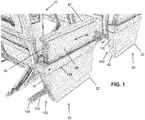
- FIG. 1 a non-limiting example of a passenger seat, generally referenced as seat 20, having an aisle-side end bay 30 is shown to illustrate an expected environment and use of inventive step assemblies according to these descriptions.
- the end bay 30 has a fixed main housing 32 connected to a floor of the passenger cabin.
- An armrest 34 can be adjustably lowered from the illustrated elevated deployed position to a stowed position where the sidewalls 36 and end walls 38 of the armrest 34 are lowered into the fixed main housing 32.
- the top side 40 of the armrest 34 can be used to support the arm of a seat occupant in a desired deployed position raised from the stowed position. In the stowed position, access for entry and egress into the seating row is facilitated and minimally constricted, an advantage that can serve limited mobility passengers or can serve general freedom of access and comfort for any passenger or flight attendant.
- an inventive step assembly 100 is implemented as installed in a rearward end wall 42 of an end bay housing 32.
- Two end bays are shown in FIG. 1 , each with a respective deployable step assembly 100, according to the present invention.
- the step assembly 100 in the more forward end bay is shown in a stowed position.
- the step assembly 100 in the more rearward end bay is shown in a deployed position.
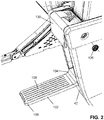
- FIG. 2 is an enlarged view of the step assembly 100 in a deployed position for use.
- FIG. 3 shows the step assembly 100, generally in a deployed position, without illustration of an end bay, for illustration of portions of the step assembly 100 that are sunken when installed in an end bay end wall 42 as in FIGS. 1 and 2 .
- the step assembly 100 includes a deployable step plate 102 pivotally attached to a base 110.
- the base 110 is fixedly attached to the end bay when the step assembly 100 is installed, and is accordingly treated as stationary in these descriptions.
- the base 110 has a mounting plate 112 with openings for receiving connectors such as screws, bolts, rivets or other fasteners by which the mounting plate 112 is to be attached to a support structure such as the illustrated end bay.
- the mounting plate 112 is generally low profile when installed into a support structure, and thus may be flush with, sunken, or slightly raised.
- the mounting plate 112 is generally vertical or partially inclined to match a support structure when installed.
- a fixed receptacle 120 for receiving the pivotable step plate 102 in the stowed position extends into the host support structure from the mounting plate 112 in a direction opposite that in which the step plate 102 extends from the base 110 in the deployed position.
- the fixed receptacle 120 is sunken into a host support structure such as the end bay.
- a first end 104 of the step plate 102 is pivotally attached the base along a lower end of the receptacle 120.
- the step plate 102 transitions from a stowed position to a deployed position corresponding respectively to the stowed and deployed positions of the step assembly 100.
- the step plate 102 pivots about the first end 104 from the deployed position to the stowed position.
- the step plate 102 has a first side 108 for supporting the foot of a flight attendant or other user in the stowed position in which the first side 108 is generally horizontal, and faces generally vertically upward, to provide a safe step surface.
- the first side 108 of the step plate 102 has traction grooves in the illustrated example to prevent slipping when used as a step surface.
- Other traction features including textures, embossing, or abrasives may be used in other examples with or in lieu of the traction grooves.
- a ridge 114 extends from the first side 108 of the step plate 102 at the second end 106, providing anti-slip engagement when used as a step surface.
- the step plate 102 Upon pivoting into the stowed position, the step plate 102 is upright or inclined to match the end bay, such that the first side 108 of the step plate 102 faces into the receptacle 120 and a second side 116 of the step plate 102, opposite the first side 108, faces outward.
- the second side 116 in the stowed position of the step assembly 100, covers or closes out the receptacle, essentially flush with the rearward end wall of the end bay for aesthetic purposes and to reduce its appearance and likelihood of notice and use by passengers accordingly.
- the base 110 includes a clip 122 ( FIG. 3 ) that retains the step plate 102 in the upright or inclined stowed position until released.
- the clip 122 is mounted in an upper end of the receptacle 120 to engage the second end 106 of the step plate 102 in the stowed position.
- the clip 122 can be user actuated to release the step plate 102 from the stowed position by various user actuatable release mechanisms in various implementations of the deployable step assembly 100. Three particular examples of release mechanisms are shown in FIGS. 1 and 2 .
- An optional first example of a release mechanism includes a user actuatable release button 124 ( FIG. 1 ) located along the outer side or aisle facing side of the end bay facing away from any seat occupants to prevent use by passengers.
- a user actuatable release button 124 FIG. 1
- the step plate 102 is released by the clip to pivot from the stowed position to the stowed position.
- An optional second example of a release mechanism includes a magnetic locking device 126 ( FIG. 2 ) released by a magnetic key, for example available only to authorized users such as flight attendants.
- a magnetic locking device 126 FIG. 2
- the step plate 102 is released by the clip 122 to pivot from the stowed position to the deployed position.
- An optional third example of a release mechanism includes a pivoting lever 130, for example pivotally attached to the top of the rearward end wall of the end bay housing.
- the pivoting lever 130 is shown in its latching position, at which the second end 106 of the step plate 102 will be retained by the clip if the step plate 102 is pivoted upward to the stowed position.
- the pivoting lever 130 is shown in its unlatching position, at which the step plate 102 is released by the clip 122 to pivot from the stowed position to the deployed position.
- the pivoting lever 130 automatically pivots to the latching position as the step plate 102 is returned to the stowed position, thereby automatically engaging the second end 106 of the step plate 102 with the clip.
- a user such as a flight attendant can pivot the lever to the unlatching position.
- Movement of the step plate 102 from the stowed position may be assisted by spring biasing and/or by gravity as the step plate 102 pivots downward to the deployed position. Movement of the step plate 102 from the deployed position to the upright or inclined stowed position may also be assisted by spring biasing and/or by gravity.
- the step plate 102 may be loaded with a spring for auto reset to the upright position upon being released from the horizontal stowed position.
- the step plate 102 can also or alternatively be flipped up with a motion of a user's foot or by other user action.
- the second or upper end of the upright step plate 102 in the stowed position can be pushed down to unfold the step plate 102 down to the deployed position.
- the step plate 102 may be released to spring upward to the stowed position when tapped, at the deployed position, by a user, for example by foot.
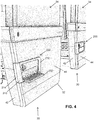
- the inventive step assembly 200 is implemented as an assembly mountable on the aisle facing sidewall 44 of an end bay housing 32.
- Two end bays 30 are shown in FIG. 4 , each with a respective deployable step assembly 200, according to the present invention.
- the step assembly 200 in the more forward end bay 30 is shown in a stowed position.
- the step assembly 200 in the more rearward end bay is shown in a deployed position.
- FIG. 5 is an enlarged view of the step assembly 200 in a deployed position for use.
- FIG. 6 shows the step assembly 200, generally in a stowed position, with a user's foot engaging the step assembly 200 thereof to deploy the step plate 202 thereof.
- the step plate 202 is pivotally attached to a base 210.
- the base 210 is fixedly attached to the end bay when the step assembly 200 is installed, and is accordingly treated as stationary in these descriptions.
- the base 210 in the illustrated embodiment, mounts externally upon at least one outer wall of the end bay housing 32.
- the step assembly 200 of FIGS. 4-6 mounts to and resides along one or more outer wall of the end bay without having sunken portions.
- the base 210 has a first mounting plate 212 for mounting on the sidewall 33 of the end bay housing or other support structure.
- the base in the illustrated embodiment has a partial wrap-around feature implemented as a second mounting plate 214, connected to the first mounting plate 212, for mounting on the rearward end wall 42 of the end bay housing 32 or other support structure.
- the second mounting plate 214 is generally transverse or perpendicular to the first mounting plate 212 such that, together, the mounting plates wrap around and engage the corner junction of the end wall 42 and sidewall 44 of the end bay housing.
- the first mounting plate 212 without having a sunken portion, is raised relative to the sidewall 44 of the end bay but is generally low profile when installed.
- the first mounting plate 212 and second mounting plate 214 are each generally vertical or partially inclined to match their host support structure when installed, which is the end bay 30 in the illustrated example.
- a shallow receptacle 220 for receiving the pivotable step plate 202 in the stowed position is defined in the outer side 218 of the first mounting plate 212.
- a mounting side of the mounting plate, opposite the outer side 218, is fixed to the host support structure such as the end bay sidewall 44. This may be done by screws, bolts, rivets, adhesive, or any combination of these and/or other attachment elements.
- a first end 204 ( FIG. 5 ) of the step plate 202 is pivotally attached the base along a lower end of the receptacle 220.
- the step plate 202 pivots about the first end 204 from the stowed position 224 to the stowed position.
- the step plate 202 has a first side 208 for supporting the foot of a flight attendant or other user in the stowed position in which the first side 208 is generally horizontal, and faces generally vertically upward, to provide a safe step surface.
- the first side 208 of the step plate 202 has traction grooves in the illustrated example to prevent slipping when used as a step surface.
- Other traction features including textures, embossing, or abrasives may be used in other examples with or in lieu of the traction grooves to provide anti-slip engagement when used as a step surface.
- the step assembly 200 is installed to deploy the step plate 202 toward an aisle away from a passenger seat.
- the step plate 202 can flipped down by the foot of a flight attendant for use in extending his or her reach toward overhead bins and such.
- the hinge by which the step plate 202 pivots step assembly 200 may be spring loaded to provide positive locking and unlocking in each of the stowed and deployed position.
- a hinge spring or other spring may provide lift assist in raising the step plate 202 to the upright stowed position. For example, a use may tap the step plate 202 in either the stowed position or deployed position to transition the step plate 202 to the either position.
- the base 210 serves as a housing that receives the first side 208 of step plate 202 in the receptacle 220 in the stowed position of the step assembly 200.
- the second side 209 of the step plate 202 in the stowed position of the step assembly 200, covers or closes out the receptacle, essentially flush with the outer side of the first mounting plate 212, for aesthetic purposes and to reduce the appearance of the step assembly and likelihood of notice and use by passengers accordingly.
- the base 210 is made of, or includes in its construction, durable plastic.
- the step plate 202 can be made of metal for strength and durability. Other materials can be used in combination with those particularly described.
- the aisle marker lights 222 may be included on the base, for example on the first mounting plate above the step plate 202.
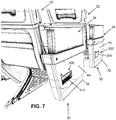
- the inventive step assembly 300 is implemented as installed in an aisle facing sidewall 44 of an end bay housing 32.
- Two end bays 30 are shown in FIG. 7 , each with a respective sunken step assembly 300, according to the present invention.
- the step assembly 300 in the more forward end bay is shown with a door 314 thereof in a closed position.
- the door 314 of the step assembly 300 in the more rearward end bay is shown in a closed position.
- the step assembly 300 has a sunken receptacle 320 mounted in the end bay housing 32.
- the door 314 is pivotally attached to the sidewall 44 or a mounting plate along an upper end of the receptacle 320.
- the door 314 may be spring loaded to maintain its stowed position, and/or gravity may return the door to the stowed position when the step assembly 300 is not in use.
- the outer side of the door 314 in the closed position, covers or closes out the receptacle, essentially flush with the sidewall 44 of the end bay 32 for aesthetic purposes and to reduce its appearance and likelihood of notice and use by passengers accordingly.
- the step assembly 300 has a step plate 302 that is accessible for use upon opening of the door 314. As the door pivots along its upper edge to the open position, the lower edge of the door swings to expose the step plate 302 for use.
- the step plate 302 may be implemented as stationary within end bay. Alternatively, this step-in design in at least one example folds inward as the door is pivoted open, defining the receptacle as the door opens.
- the step plate 302 may be pivotally attached along a first edge 304 thereof to the sidewall 44 or a mounting plate along a lower end of the receptacle 320, and upon the door opening, the step plate 302 pivots down from an upright essentially vertical stowed position 322 to an inward deployed horizontal position. Pivoting inward movement of the step plate 302 may be prompted simply by the inward pivoting movement of the door 314 as a foot of a flight attendant or other user is inserted into the step assembly 300 as shown in FIG. 8 , with the door generally returning to the closed position ahead of the step plate 302 returning to its stowed position 322.
- This step-in design with the pivoting step plate 302 may be particularly useful to permit lowering of the armrest 34 into the fixed main housing 32 by the step plate 302 being in a low profile or flush position within the end bay in the stowed position.
- a lockout mechanism may be included that prevents the armrest 34 from lowering into the housing 32 when the door 314 is open, and permits the armrest 34 from lowering when the door is closed.
Landscapes
- Engineering & Computer Science (AREA)
- Aviation & Aerospace Engineering (AREA)
- Vehicle Step Arrangements And Article Storage (AREA)
- Chair Legs, Seat Parts, And Backrests (AREA)
- Seats For Vehicles (AREA)
Abstract
Description
- Passenger cabins are commonly configured with seating areas and object stowage areas. In aircraft passenger cabins, object stowage areas can be provided under seats and in overhead compartments or bins. While under seat stowage is easily accessible by passengers and flight crew, overhead stowage can be difficult to reach and access, particularly by those short in stature.
- Seating areas on commercial aircraft are commonly divided into seating classes, where the primary differentiators among classes are seating density and seat construction. For example, economy class seat constructions typically include closely spaced rows of attached seats having pivotable inboard armrests and a fixed armrest positioned along the aisle. Premium class seat constructions typically have a greater seat pitch between rows as well as adjustable seat features. For example, armrests along the aisle may adjust vertically to provide a raised armrest position for comfort and a lowered armrest position for ingress and egress. The ability to lower an armrest to a height near or equal that of the seat bottom greatly facilitates access for those with limited mobility. Some vertically adjustable armrest constructions can include a fixed end bay and an armrest assembly that tracks vertically within the end bay between the raised and lowered positions.
- The invention aims to provide an improved system that extends the overhead reach of the flight crew. To achieve the foregoing, according to a first aspect, the present invention provides a step assembly including a base attachable to a fixed assembly and including a mounting plate having a low profile and a fixed receptacle to be received in the fixed assembly, a step plate pivotally attached along a first end to the base along a lower end of the receptacle, the step plate pivotable between a stowed position in which the step plate is housed within the fixed receptacle and a deployed position in which the step plate is outside of the fixed receptacle, the step plate having a first side for supporting a foot, and a release mechanism for releasing the step plate from the stowed position to the deployed position.
- In some embodiments, the release mechanism includes a clip retaining the step plate in the stowed position until released, the clip mounted in an upper end of the receptacle to engage a second end of the step plate in the stowed position, the clip user actuated to release the step plate from the stowed position.
- In some embodiments, the release mechanism includes a one of a user actuatable release button, located, or at least locatable in use, along a side of the fixed assembly, a magnetic locking device releasable by a magnetic key In some embodiments a pivoting lever pivotally is attached, or at least attachable in use, to the fixed assembly, the pivoting lever moveable between a latching position at which the second end of the step plate is retained by the clip when the step plate is pivoted upward to the stowed position and an unlatching position at which the step plate is released by the clip to pivot from the stowed position to the deployed position, wherein the pivoting lever automatically pivots to the latching position as the step plate is returned to the stowed position thereby automatically engaging the second end of the step plate with the clip.
- In some embodiments, the step assembly further includes a ridge positioned along a second end of the step plate atop the first side.
- In some embodiments, movement of the step plate is spring biased toward at least one of the stowed and deployed positions.
- According to a second aspect, the present invention provides an armrest assembly according to the forst aspect of the present invention and including a fixed assembly, embodied as a fixed housing, an armrest moveable relative to the fixed housing, and a step assembly attached to the fixed housing.
- In some embodiments, the fixed housing includes a first side positionable facing an aisle, a second side positionable facing away from the aisle, a first end, and a second end, wherein the step assembly is attached to the first side or the first end.
- In some embodiments, a first portion of the base is attached to the first side of the fixed housing, a second portion of the base wraps around a corner junction between the first side and the first end of the fixed housing, and a third portion of the base is attached to the first end of the fixed housing.
- In some embodiments, the step assembly includes a door pivotally attached along one end to the base along an upper end of the receptacle, the door pivotable between a closed position covering an opening to the receptable and concealing the step, and an open position within the receptacle and revealing the step, wherein the door is spring biased toward the closed position and moved to the open position by pressing the door toward the open position.
- In some embodiments, the step assembly includes a lock for locking the door in the closed position and a release mechanism for unlocking the lock.
- In some embodiments, the fixed assembly is an armrest assembly including a fixed housing and an armrest moveable relative to the fixed housing, the fixed housing having a first side positionable facing an aisle, a second side positionable facing away from the aisle, a first end, and a second end, wherein the step assembly is installed in the first side with the door facing the aisle.
- In some embodiments, the step assembly includes a release mechanism located in the first side for releasing the door to allow the door to be moved toward the open position.
- Embodiments of the present invention may include one or more or any combination of the above aspects, features and configurations.
- The present invention is better understood when consideration is given to the following detailed description thereof. Such description makes reference to the included drawings, which are not necessarily to scale, and in which some features may be exaggerated, and some features may be omitted or may be represented schematically in the interest of clarity. Like reference numbers in the drawings may represent and refer to the same or similar element, feature, or function. In the drawings:
-
FIG. 1 is a perspective view of a deployable step assembly, according to the present invention, shown in a deployed position from an end of a passenger seat end bay; -
FIG. 2 is a perspective view of the deployable step assembly ofFIG. 1 , shown in a stowed position in the passenger seat end bay; -
FIG. 3 is a perspective view of the deployable step assembly ofFIG. 1 , in a deployed position, without illustration of an end bay; -
FIG. 4 is a perspective view of another deployable step assembly, according to the present invention, shown in a deployed position from a side of a passenger seat end bay; -
FIG. 5 is a perspective view of the deployable step assembly ofFIG. 4 , shown in a stowed position in the passenger seat end bay; -
FIG. 6 is a perspective view of the deployable step assembly ofFIG. 1 , in a deployed position; -
FIG. 7 is a perspective view of a sunken step assembly in a passenger seat end bay, according to the present invention, shown with a door thereof pivoted to an open position; and -
FIG. 8 is a perspective view of the sunken step ofFIG. 7 , shown as opening by user action. - The description set forth below in connection with the appended drawings is intended to be a description of various, illustrative embodiments of the disclosed subject matter. Specific features and functionalities are described in connection with each illustrative embodiment; however, it will be apparent to those skilled in the art that the disclosed embodiments may be practiced without each of those specific features and functionalities. The aspects, features and functions described below in connection with one embodiment are intended to be applicable to the other embodiments described below except where expressly stated or where an aspect, feature or function is incompatible with an embodiment.
- In various embodiments, a step assembly is provided for an aircraft passenger cabin environment. The step assembly may be used by flight attendants to extend their vertical reach to access and load overhead bins and other elevated stowage compartments. A step assembly according to these descriptions, of which the drawings are a part, can built into an aisle-side end bay of a passenger seat or other accessible support structure below elevated passenger cabin features that are otherwise challenging to reach for some attendants and other users. In some of the described examples, the step assembly has a stowed position and a deployed position. In the stowed position, a deployable step plate is in a low-profile or relatively flush position relative to the support structure on which or in which the step assembly is mounted. In the deployed position, the deployable step plate extends outward from a support structure to hold the weight of a user and any items they are lifting. The some described examples, the step assembly is sunken into a support structure such as a seating end bay, and to use the step plate an attendant can insert a foot onto the step plate or into a sunken receptacle where the step plate stows. A pivoting door or plate may cover the receptacle, in various examples, to close out the step assembly or receptacle for aesthetic purposes and to reduce its appearance and likelihood of notice and use by passengers accordingly. A step assembly may include a spring-return or lift-assist feature to help restore the stowed position after use.
- Referring to
FIG. 1 , a non-limiting example of a passenger seat, generally referenced asseat 20, having an aisle-side end bay 30 is shown to illustrate an expected environment and use of inventive step assemblies according to these descriptions. Theend bay 30 has a fixedmain housing 32 connected to a floor of the passenger cabin. Anarmrest 34 can be adjustably lowered from the illustrated elevated deployed position to a stowed position where thesidewalls 36 and end walls 38 of thearmrest 34 are lowered into the fixedmain housing 32. Thetop side 40 of thearmrest 34 can be used to support the arm of a seat occupant in a desired deployed position raised from the stowed position. In the stowed position, access for entry and egress into the seating row is facilitated and minimally constricted, an advantage that can serve limited mobility passengers or can serve general freedom of access and comfort for any passenger or flight attendant. - In the example of
FIGS. 1-3 , aninventive step assembly 100 is implemented as installed in arearward end wall 42 of anend bay housing 32. Two end bays are shown inFIG. 1 , each with a respectivedeployable step assembly 100, according to the present invention. Thestep assembly 100 in the more forward end bay is shown in a stowed position. Thestep assembly 100 in the more rearward end bay is shown in a deployed position.FIG. 2 is an enlarged view of thestep assembly 100 in a deployed position for use.FIG. 3 shows thestep assembly 100, generally in a deployed position, without illustration of an end bay, for illustration of portions of thestep assembly 100 that are sunken when installed in an endbay end wall 42 as inFIGS. 1 and2 . - The
step assembly 100 includes adeployable step plate 102 pivotally attached to abase 110. Thebase 110 is fixedly attached to the end bay when thestep assembly 100 is installed, and is accordingly treated as stationary in these descriptions. Thebase 110 has amounting plate 112 with openings for receiving connectors such as screws, bolts, rivets or other fasteners by which themounting plate 112 is to be attached to a support structure such as the illustrated end bay. Themounting plate 112 is generally low profile when installed into a support structure, and thus may be flush with, sunken, or slightly raised. Themounting plate 112 is generally vertical or partially inclined to match a support structure when installed. Afixed receptacle 120 for receiving thepivotable step plate 102 in the stowed position extends into the host support structure from themounting plate 112 in a direction opposite that in which thestep plate 102 extends from thebase 110 in the deployed position. When installed, thefixed receptacle 120 is sunken into a host support structure such as the end bay. - A
first end 104 of thestep plate 102 is pivotally attached the base along a lower end of thereceptacle 120. Thestep plate 102 transitions from a stowed position to a deployed position corresponding respectively to the stowed and deployed positions of thestep assembly 100. Thestep plate 102 pivots about thefirst end 104 from the deployed position to the stowed position. Asecond end 106 of thestep plate 102, opposite thefirst end 104, extends outward from thereceptacle 120 in the deployed position. Thestep plate 102 has afirst side 108 for supporting the foot of a flight attendant or other user in the stowed position in which thefirst side 108 is generally horizontal, and faces generally vertically upward, to provide a safe step surface. Thefirst side 108 of thestep plate 102 has traction grooves in the illustrated example to prevent slipping when used as a step surface. Other traction features including textures, embossing, or abrasives may be used in other examples with or in lieu of the traction grooves. For example, aridge 114 extends from thefirst side 108 of thestep plate 102 at thesecond end 106, providing anti-slip engagement when used as a step surface. - Upon pivoting into the stowed position, the
step plate 102 is upright or inclined to match the end bay, such that thefirst side 108 of thestep plate 102 faces into thereceptacle 120 and asecond side 116 of thestep plate 102, opposite thefirst side 108, faces outward. As shown in the forward end bay example ofFIG. 1 , thesecond side 116, in the stowed position of thestep assembly 100, covers or closes out the receptacle, essentially flush with the rearward end wall of the end bay for aesthetic purposes and to reduce its appearance and likelihood of notice and use by passengers accordingly. - The
base 110 includes a clip 122 (FIG. 3 ) that retains thestep plate 102 in the upright or inclined stowed position until released. Theclip 122 is mounted in an upper end of thereceptacle 120 to engage thesecond end 106 of thestep plate 102 in the stowed position. Theclip 122 can be user actuated to release thestep plate 102 from the stowed position by various user actuatable release mechanisms in various implementations of thedeployable step assembly 100. Three particular examples of release mechanisms are shown inFIGS. 1 and2 . - An optional first example of a release mechanism includes a user actuatable release button 124 (
FIG. 1 ) located along the outer side or aisle facing side of the end bay facing away from any seat occupants to prevent use by passengers. When the release button is pressed, thestep plate 102 is released by the clip to pivot from the stowed position to the stowed position. - An optional second example of a release mechanism includes a magnetic locking device 126 (
FIG. 2 ) released by a magnetic key, for example available only to authorized users such as flight attendants. When the release mechanism is actuated by a magnetic key, thestep plate 102 is released by theclip 122 to pivot from the stowed position to the deployed position. - An optional third example of a release mechanism includes a pivoting
lever 130, for example pivotally attached to the top of the rearward end wall of the end bay housing. InFIG. 1 , the pivotinglever 130 is shown in its latching position, at which thesecond end 106 of thestep plate 102 will be retained by the clip if thestep plate 102 is pivoted upward to the stowed position. InFIG. 2 , the pivotinglever 130 is shown in its unlatching position, at which thestep plate 102 is released by theclip 122 to pivot from the stowed position to the deployed position. In at least one example, the pivotinglever 130 automatically pivots to the latching position as thestep plate 102 is returned to the stowed position, thereby automatically engaging thesecond end 106 of thestep plate 102 with the clip. To release thestep plate 102 from the stowed position, a user such as a flight attendant can pivot the lever to the unlatching position. - Movement of the
step plate 102 from the stowed position may be assisted by spring biasing and/or by gravity as thestep plate 102 pivots downward to the deployed position. Movement of thestep plate 102 from the deployed position to the upright or inclined stowed position may also be assisted by spring biasing and/or by gravity. For example, thestep plate 102 may be loaded with a spring for auto reset to the upright position upon being released from the horizontal stowed position. Thestep plate 102 can also or alternatively be flipped up with a motion of a user's foot or by other user action. - In other options, the second or upper end of the
upright step plate 102 in the stowed position can be pushed down to unfold thestep plate 102 down to the deployed position. Thestep plate 102 may be released to spring upward to the stowed position when tapped, at the deployed position, by a user, for example by foot. - In the example of
FIGS. 4-6 , theinventive step assembly 200 is implemented as an assembly mountable on theaisle facing sidewall 44 of anend bay housing 32. Twoend bays 30 are shown inFIG. 4 , each with a respectivedeployable step assembly 200, according to the present invention. Thestep assembly 200 in the moreforward end bay 30 is shown in a stowed position. Thestep assembly 200 in the more rearward end bay is shown in a deployed position.FIG. 5 is an enlarged view of thestep assembly 200 in a deployed position for use.FIG. 6 shows thestep assembly 200, generally in a stowed position, with a user's foot engaging thestep assembly 200 thereof to deploy thestep plate 202 thereof. - The
step plate 202 is pivotally attached to abase 210. Thebase 210 is fixedly attached to the end bay when thestep assembly 200 is installed, and is accordingly treated as stationary in these descriptions. Thebase 210, in the illustrated embodiment, mounts externally upon at least one outer wall of theend bay housing 32. In contrast to the sunken aspects of thestep assembly 100 ofFIGS. 1-3 , and thestep assembly 300 ofFIGS. 7-8 , thestep assembly 200 ofFIGS. 4-6 mounts to and resides along one or more outer wall of the end bay without having sunken portions. - The
base 210 has afirst mounting plate 212 for mounting on the sidewall 33 of the end bay housing or other support structure. The base in the illustrated embodiment has a partial wrap-around feature implemented as asecond mounting plate 214, connected to the first mountingplate 212, for mounting on therearward end wall 42 of theend bay housing 32 or other support structure. Thesecond mounting plate 214 is generally transverse or perpendicular to the first mountingplate 212 such that, together, the mounting plates wrap around and engage the corner junction of theend wall 42 andsidewall 44 of the end bay housing. - The
first mounting plate 212, without having a sunken portion, is raised relative to thesidewall 44 of the end bay but is generally low profile when installed. Thefirst mounting plate 212 and second mountingplate 214 are each generally vertical or partially inclined to match their host support structure when installed, which is theend bay 30 in the illustrated example. Ashallow receptacle 220 for receiving thepivotable step plate 202 in the stowed position is defined in theouter side 218 of the first mountingplate 212. When installed, a mounting side of the mounting plate, opposite theouter side 218, is fixed to the host support structure such as theend bay sidewall 44. This may be done by screws, bolts, rivets, adhesive, or any combination of these and/or other attachment elements. - A first end 204 (
FIG. 5 ) of thestep plate 202 is pivotally attached the base along a lower end of thereceptacle 220. Thestep plate 202 pivots about thefirst end 204 from the stowed position 224 to the stowed position. Asecond end 206 of thestep plate 202, opposite thefirst end 204, extends outward from the receptacle in the stowed position. Thestep plate 202 has afirst side 208 for supporting the foot of a flight attendant or other user in the stowed position in which thefirst side 208 is generally horizontal, and faces generally vertically upward, to provide a safe step surface. Thefirst side 208 of thestep plate 202 has traction grooves in the illustrated example to prevent slipping when used as a step surface. Other traction features including textures, embossing, or abrasives may be used in other examples with or in lieu of the traction grooves to provide anti-slip engagement when used as a step surface. - As shown in
FIG. 4 , by attaching the first mounting plate to the sidewall of the end bay, thestep assembly 200 is installed to deploy thestep plate 202 toward an aisle away from a passenger seat. As shown inFIG. 6 , thestep plate 202 can flipped down by the foot of a flight attendant for use in extending his or her reach toward overhead bins and such. The hinge by which thestep plate 202pivots step assembly 200 may be spring loaded to provide positive locking and unlocking in each of the stowed and deployed position. A hinge spring or other spring may provide lift assist in raising thestep plate 202 to the upright stowed position. For example, a use may tap thestep plate 202 in either the stowed position or deployed position to transition thestep plate 202 to the either position. - The
base 210 serves as a housing that receives thefirst side 208 ofstep plate 202 in thereceptacle 220 in the stowed position of thestep assembly 200. As shown in the forward end bay example ofFIG. 4 , the second side 209 of thestep plate 202, in the stowed position of thestep assembly 200, covers or closes out the receptacle, essentially flush with the outer side of the first mountingplate 212, for aesthetic purposes and to reduce the appearance of the step assembly and likelihood of notice and use by passengers accordingly. - In at least one example, the
base 210 is made of, or includes in its construction, durable plastic. Thestep plate 202 can be made of metal for strength and durability. Other materials can be used in combination with those particularly described. As shown in the illustrated example, theaisle marker lights 222 may be included on the base, for example on the first mounting plate above thestep plate 202. - In the example of
FIGS. 7-8 , theinventive step assembly 300 is implemented as installed in anaisle facing sidewall 44 of anend bay housing 32. Twoend bays 30 are shown inFIG. 7 , each with a respectivesunken step assembly 300, according to the present invention. Thestep assembly 300 in the more forward end bay is shown with adoor 314 thereof in a closed position. Thedoor 314 of thestep assembly 300 in the more rearward end bay is shown in a closed position. - The
step assembly 300 has asunken receptacle 320 mounted in theend bay housing 32. Thedoor 314 is pivotally attached to thesidewall 44 or a mounting plate along an upper end of thereceptacle 320. Thedoor 314 may be spring loaded to maintain its stowed position, and/or gravity may return the door to the stowed position when thestep assembly 300 is not in use. As shown in the forward end bay example ofFIG. 7 , the outer side of thedoor 314, in the closed position, covers or closes out the receptacle, essentially flush with thesidewall 44 of theend bay 32 for aesthetic purposes and to reduce its appearance and likelihood of notice and use by passengers accordingly. - Within the
receptacle 320, thestep assembly 300 has astep plate 302 that is accessible for use upon opening of thedoor 314. As the door pivots along its upper edge to the open position, the lower edge of the door swings to expose thestep plate 302 for use. Thestep plate 302 may be implemented as stationary within end bay. Alternatively, this step-in design in at least one example folds inward as the door is pivoted open, defining the receptacle as the door opens. In that example, thestep plate 302 may be pivotally attached along afirst edge 304 thereof to thesidewall 44 or a mounting plate along a lower end of thereceptacle 320, and upon the door opening, thestep plate 302 pivots down from an upright essentially vertical stowed position 322 to an inward deployed horizontal position. Pivoting inward movement of thestep plate 302 may be prompted simply by the inward pivoting movement of thedoor 314 as a foot of a flight attendant or other user is inserted into thestep assembly 300 as shown inFIG. 8 , with the door generally returning to the closed position ahead of thestep plate 302 returning to its stowed position 322. This step-in design with the pivotingstep plate 302 may be particularly useful to permit lowering of the armrest 34 into the fixedmain housing 32 by thestep plate 302 being in a low profile or flush position within the end bay in the stowed position. A lockout mechanism may be included that prevents the armrest 34 from lowering into thehousing 32 when thedoor 314 is open, and permits the armrest 34 from lowering when the door is closed. - While the foregoing description provides embodiments of the invention by way of example only, it is envisioned that other embodiments that are within the scope of the invention as defined in the appended claims may perform similar functions and/or achieve similar results.
Claims (14)
- A step assembly (100, 200, 300), comprising:a base (110, 210) attachable to a fixed assembly and including a mounting plate (112, 212, 214) having a low profile and a fixed receptacle (120, 220, 320) to be received in the fixed assembly;a step plate (102, 202, 302) pivotally attached along a first end (104, 204, 304 to the base (110, 210) along a lower end of the receptacle (120, 220, 320), the step plate (102, 202, 302) pivotable between a stowed position in which the step plate (102, 202, 302) is housed within the fixed receptacle (120, 220, 320) and a deployed position in which the step plate (102, 202, 302) is outside of the fixed receptacle (120, 220, 320), the step plate (102, 202, 302) having a first side (108, 208) for supporting a foot; anda release mechanism for releasing the step plate (102, 202, 302) from the stowed position to the deployed position.
- The step assembly (100) according to claim 1, wherein the release mechanism comprises a clip (122) retaining the step plate (102) in the stowed position until released, the clip (122) mounted in an upper end of the receptacle (120) to engage a second end (106) of the step plate (102) in the stowed position, the clip (122) user actuated to release the step plate (102) from the stowed position.
- The step assembly (100) according to claim 2, wherein the release mechanism comprises a user actuatable release button (124) located, or at least locatable in use, along a side of the fixed assembly.
- The step assembly (100) according to claim 2 or 3, wherein the release mechanism comprises a magnetic locking device (126) releasable by a magnetic key.
- The step assembly (100) of according to one or more of claims 2-4, wherein the release mechanism comprises a pivoting lever (130) pivotally attached, or at least attachable in use, to the fixed assembly, the pivoting lever (130) moveable between a latching position at which the second end (106) of the step plate (102) is retained by the clip (122) when the step plate (102) is pivoted upward to the stowed position and an unlatching position at which the step plate (102) is released by the clip (122) to pivot from the stowed position to the deployed position, wherein the pivoting lever (130) automatically pivots to the latching position as the step plate (102) is returned to the stowed position thereby automatically engaging the second end (106) of the step plate (102) with the clip (122).
- The step assembly (100, 200) according to one or more of the preceding claims, further comprising a ridge positioned along a second end (106, 206) of the step plate (102, 202) atop the first side (108, 208).
- The step assembly (100, 200, 300) according to one or more of the preceding claims, wherein movement of the step plate (102, 202, 302) is spring biased toward at least one of the stowed and deployed positions.
- An armrest (34) assembly, comprising:A fixed assembly, embodied as a fixed housing;an armrest (34) moveable relative to the fixed housing; anda step assembly (100, 200, 300) according to one or more of the preceding claims and attached to the fixed housing,
- The armrest (34) assembly according to claim 8, wherein the fixed housing comprises a first side (108, 208) positionable facing an aisle, a second side (116, 209) positionable facing away from the aisle, a first end (104, 204), and a second end (106, 206), wherein the step assembly (100, 200) is attached to the first side (108, 208) or the first end (104, 204).
- The armrest (34) assembly according to claim 9, wherein a first portion of the base (110, 210) is attached to the first side (108, 208) of the fixed housing, a second portion of the base (110, 210) wraps around a corner junction (42, 44) between the first side (108, 208) and the first end (104, 204) of the fixed housing, and a third portion of the base (110, 210) is attached to the first end (104, 204) of the fixed housing.
- The step assembly (300) according one or more of claims 1-7, comprising:
a door (314) pivotally attached along one end to the basealong an upper end of the receptacle (320), the door (314) pivotable between a closed position covering an opening to the receptable (320) and concealing the step, and an open position within the receptacle (320) and revealing the step (302), wherein the door (314) is spring biased toward the closed position and moved to the open position by pressing the door (314) toward the open position. - The step assembly (300) according to claim 11, further comprising a lock for locking the door (314) in the closed position and a release mechanism for unlocking the lock.
- The step assembly (300) according to claim 11 or 12, wherein the fixed assembly is an armrest (34) assembly comprising a fixed housing and an armrest (34) moveable relative to the fixed housing, the fixed housing having a first side positionable facing an aisle, a second side positionable facing away from the aisle, a first end, and a second end, wherein the step assembly (300) is installed in the first side with the door (314) facing the aisle.
- The step assembly (300) according to claim 13, further comprising a release mechanism located in the first side for releasing the door (314) to allow the door (314) to be moved toward the open position.
Applications Claiming Priority (1)
| Application Number | Priority Date | Filing Date | Title |
|---|---|---|---|
| US16/545,178 US11407514B2 (en) | 2019-08-20 | 2019-08-20 | End bay assembly with deployable step and deployable step constructions |
Publications (2)
| Publication Number | Publication Date |
|---|---|
| EP3782909A1 true EP3782909A1 (en) | 2021-02-24 |
| EP3782909B1 EP3782909B1 (en) | 2022-11-30 |
Family
ID=68916374
Family Applications (1)
| Application Number | Title | Priority Date | Filing Date |
|---|---|---|---|
| EP19215980.4A Active EP3782909B1 (en) | 2019-08-20 | 2019-12-13 | End bay assembly with deployable step and deployable step constructions |
Country Status (4)
| Country | Link |
|---|---|
| US (1) | US11407514B2 (en) |
| EP (1) | EP3782909B1 (en) |
| CN (1) | CN112407290B (en) |
| CA (1) | CA3063220A1 (en) |
Cited By (2)
| Publication number | Priority date | Publication date | Assignee | Title |
|---|---|---|---|---|
| EP4140887A1 (en) * | 2021-08-31 | 2023-03-01 | Safran Seats USA LLC | Foldable attendant step |
| EP4434884A1 (en) * | 2023-03-21 | 2024-09-25 | Safran Seats | Deployable step |
Families Citing this family (4)
| Publication number | Priority date | Publication date | Assignee | Title |
|---|---|---|---|---|
| USD916000S1 (en) * | 2018-04-06 | 2021-04-13 | Rockwell Collins, Inc. | Passenger seating apparatus |
| EP4308455B1 (en) * | 2021-03-16 | 2025-12-24 | Safran Seats | Aircraft cabin furniture incorporating equipment for crew and for a passenger |
| US20230211868A1 (en) * | 2022-01-05 | 2023-07-06 | Bell Textron Inc. | Folding step system |
| FR3133578A1 (en) * | 2022-03-18 | 2023-09-22 | Antar Daouk | EMERGENCY EVACUATION ASSISTANCE DEVICE FOR A VEHICLE, VEHICLE AND LIQUID RETENTION DEVICE EQUIPPED WITH SUCH EMERGENCY EVACUATION ASSISTANCE DEVICE |
Citations (7)
| Publication number | Priority date | Publication date | Assignee | Title |
|---|---|---|---|---|
| DE2620683A1 (en) * | 1976-05-11 | 1977-11-17 | Maschf Augsburg Nuernberg Ag | ENTRANCE ARRANGEMENT FOR A COMMUNITY VEHICLE |
| US5195609A (en) * | 1992-01-30 | 1993-03-23 | Aircraft Products Company | Automatically retractable step |
| EP1078852A2 (en) * | 1999-08-27 | 2001-02-28 | Koito Industries, Ltd. | Aircraft seat apparatus |
| DE102007015549A1 (en) * | 2007-03-30 | 2008-10-02 | Airbus Deutschland Gmbh | Climbing module for aircraft, has climbing device with step device comprising two dimensional step section, where step device is moved between two positions and is rotatably supported around rotation axis |
| DE202012003042U1 (en) * | 2012-03-26 | 2013-06-27 | Zim Flugsitz Gmbh | airplane seat |
| US20150274302A1 (en) * | 2013-04-04 | 2015-10-01 | B/E Aerospace, Inc. | Passenger seat with drop-down armrest assembly |
| US20160288898A1 (en) * | 2015-04-01 | 2016-10-06 | B/E Aerospace, Inc. | Stowable elevated footstep for an aircraft galley |
Family Cites Families (11)
| Publication number | Priority date | Publication date | Assignee | Title |
|---|---|---|---|---|
| US4526421A (en) * | 1982-09-30 | 1985-07-02 | Ptc Aerospace Inc. | Multi-passenger aircraft seat having composite panel frame |
| US6471002B1 (en) | 2000-12-04 | 2002-10-29 | The Eastern Company | Folding foot step with anti-skid surface |
| EP2386484B1 (en) * | 2010-05-10 | 2012-07-11 | Eurocopter Deutschland GmbH | Integrated maintenance step on helicopter fuselage and methods for mounting and dismounting the step |
| US20140110193A1 (en) * | 2012-10-24 | 2014-04-24 | Deere & Company | Folding step assembly |
| US8905354B2 (en) * | 2013-01-31 | 2014-12-09 | Bell Helicopter Textron Inc. | External maintenance step and hand hold |
| US10029793B2 (en) * | 2015-06-04 | 2018-07-24 | B/E Aerospace, Inc. | Deployable seatback holder for portable electronic devices |
| WO2017176722A1 (en) * | 2016-04-04 | 2017-10-12 | B/E Aerospace, Inc. | Tray table deployable from lower seatback area |
| TWI807423B (en) * | 2016-11-14 | 2023-07-01 | 醣基生醫股份有限公司 | Antibody-drug conjugates |
| US10427610B2 (en) * | 2017-09-22 | 2019-10-01 | GM Global Technology Operations LLC | Accessory tray for a vehicle |
| US10723273B1 (en) * | 2019-01-25 | 2020-07-28 | Toyota Motor Engineering & Manufacturing North America, Inc. | Roof access device for a vehicle |
| US10870489B2 (en) * | 2019-05-24 | 2020-12-22 | B/E Aerospace, Inc. | Position adjustable armrest assemblies for passenger seats |
-
2019
- 2019-08-20 US US16/545,178 patent/US11407514B2/en active Active
- 2019-11-29 CA CA3063220A patent/CA3063220A1/en active Pending
- 2019-12-13 CN CN201911282167.0A patent/CN112407290B/en active Active
- 2019-12-13 EP EP19215980.4A patent/EP3782909B1/en active Active
Patent Citations (7)
| Publication number | Priority date | Publication date | Assignee | Title |
|---|---|---|---|---|
| DE2620683A1 (en) * | 1976-05-11 | 1977-11-17 | Maschf Augsburg Nuernberg Ag | ENTRANCE ARRANGEMENT FOR A COMMUNITY VEHICLE |
| US5195609A (en) * | 1992-01-30 | 1993-03-23 | Aircraft Products Company | Automatically retractable step |
| EP1078852A2 (en) * | 1999-08-27 | 2001-02-28 | Koito Industries, Ltd. | Aircraft seat apparatus |
| DE102007015549A1 (en) * | 2007-03-30 | 2008-10-02 | Airbus Deutschland Gmbh | Climbing module for aircraft, has climbing device with step device comprising two dimensional step section, where step device is moved between two positions and is rotatably supported around rotation axis |
| DE202012003042U1 (en) * | 2012-03-26 | 2013-06-27 | Zim Flugsitz Gmbh | airplane seat |
| US20150274302A1 (en) * | 2013-04-04 | 2015-10-01 | B/E Aerospace, Inc. | Passenger seat with drop-down armrest assembly |
| US20160288898A1 (en) * | 2015-04-01 | 2016-10-06 | B/E Aerospace, Inc. | Stowable elevated footstep for an aircraft galley |
Cited By (4)
| Publication number | Priority date | Publication date | Assignee | Title |
|---|---|---|---|---|
| EP4140887A1 (en) * | 2021-08-31 | 2023-03-01 | Safran Seats USA LLC | Foldable attendant step |
| US11760245B2 (en) | 2021-08-31 | 2023-09-19 | Safran Seats Usa Llc | Foldable attendant step |
| EP4434884A1 (en) * | 2023-03-21 | 2024-09-25 | Safran Seats | Deployable step |
| WO2024194052A1 (en) * | 2023-03-21 | 2024-09-26 | Safran Seats | Deployable step |
Also Published As
| Publication number | Publication date |
|---|---|
| EP3782909B1 (en) | 2022-11-30 |
| CN112407290B (en) | 2024-12-13 |
| US20210053686A1 (en) | 2021-02-25 |
| CA3063220A1 (en) | 2021-02-20 |
| US11407514B2 (en) | 2022-08-09 |
| CN112407290A (en) | 2021-02-26 |
Similar Documents
| Publication | Publication Date | Title |
|---|---|---|
| US11407514B2 (en) | End bay assembly with deployable step and deployable step constructions | |
| CN111976995B (en) | Position adjustable armrest assembly for passenger seat | |
| US6024411A (en) | Seat mounted cupholder adapted for seat riser fold and tumble mechanism | |
| US9650146B2 (en) | Convertible cabin attendant seat | |
| US6036252A (en) | Automotive bench seat with fixed rollers and linear floor latch | |
| US6227619B1 (en) | Seat riser fold and tumble mechanism with rollers and skid plate | |
| US8091945B2 (en) | Vehicle seating system | |
| US6361098B1 (en) | Seat riser fold and tumble mechanism | |
| CN101056780A (en) | Vehicle seating apparatus | |
| US7240949B1 (en) | Adjustable seat assembly | |
| US7455342B2 (en) | Stowable ottoman for a vehicle passenger cabin | |
| US8851568B2 (en) | Retractable passenger seat | |
| US7469952B2 (en) | Low profile seat stowage mechanization | |
| CN111071452B (en) | Armrest assembly with in-arm cup holder | |
| CN112061401B (en) | Bridge type table with extensible aircraft seat, mounting device and storage device | |
| EP3757008B1 (en) | Braking table system for an aircraft | |
| US12617325B2 (en) | Support device for an aircraft cabin interior layout assembly, related assembly and method | |
| EP2353931B1 (en) | Seating unit with tray assembly | |
| GB2602937A (en) | Storage box | |
| JP7017134B2 (en) | Vehicle seat | |
| EP4585514A1 (en) | Foldable table system | |
| GB2399281A (en) | Folding vehicle seat | |
| CN100542892C (en) | aircraft luggage compartment | |
| JP6162000B2 (en) | 4-seater car | |
| GB2598335A (en) | Vehicle ramp assembly |
Legal Events
| Date | Code | Title | Description |
|---|---|---|---|
| PUAI | Public reference made under article 153(3) epc to a published international application that has entered the european phase |
Free format text: ORIGINAL CODE: 0009012 |
|
| STAA | Information on the status of an ep patent application or granted ep patent |
Free format text: STATUS: THE APPLICATION HAS BEEN PUBLISHED |
|
| AK | Designated contracting states |
Kind code of ref document: A1 Designated state(s): AL AT BE BG CH CY CZ DE DK EE ES FI FR GB GR HR HU IE IS IT LI LT LU LV MC MK MT NL NO PL PT RO RS SE SI SK SM TR |
|
| AX | Request for extension of the european patent |
Extension state: BA ME |
|
| STAA | Information on the status of an ep patent application or granted ep patent |
Free format text: STATUS: REQUEST FOR EXAMINATION WAS MADE |
|
| 17P | Request for examination filed |
Effective date: 20210824 |
|
| RBV | Designated contracting states (corrected) |
Designated state(s): AL AT BE BG CH CY CZ DE DK EE ES FI FR GB GR HR HU IE IS IT LI LT LU LV MC MK MT NL NO PL PT RO RS SE SI SK SM TR |
|
| GRAP | Despatch of communication of intention to grant a patent |
Free format text: ORIGINAL CODE: EPIDOSNIGR1 |
|
| STAA | Information on the status of an ep patent application or granted ep patent |
Free format text: STATUS: GRANT OF PATENT IS INTENDED |
|
| INTG | Intention to grant announced |
Effective date: 20220816 |
|
| GRAS | Grant fee paid |
Free format text: ORIGINAL CODE: EPIDOSNIGR3 |
|
| GRAA | (expected) grant |
Free format text: ORIGINAL CODE: 0009210 |
|
| STAA | Information on the status of an ep patent application or granted ep patent |
Free format text: STATUS: THE PATENT HAS BEEN GRANTED |
|
| AK | Designated contracting states |
Kind code of ref document: B1 Designated state(s): AL AT BE BG CH CY CZ DE DK EE ES FI FR GB GR HR HU IE IS IT LI LT LU LV MC MK MT NL NO PL PT RO RS SE SI SK SM TR |
|
| REG | Reference to a national code |
Ref country code: CH Ref legal event code: EP Ref country code: GB Ref legal event code: FG4D |
|
| REG | Reference to a national code |
Ref country code: AT Ref legal event code: REF Ref document number: 1534508 Country of ref document: AT Kind code of ref document: T Effective date: 20221215 |
|
| REG | Reference to a national code |
Ref country code: IE Ref legal event code: FG4D |
|
| REG | Reference to a national code |
Ref country code: DE Ref legal event code: R096 Ref document number: 602019022497 Country of ref document: DE |
|
| REG | Reference to a national code |
Ref country code: LT Ref legal event code: MG9D |
|
| REG | Reference to a national code |
Ref country code: NL Ref legal event code: MP Effective date: 20221130 |
|
| PG25 | Lapsed in a contracting state [announced via postgrant information from national office to epo] |
Ref country code: SE Free format text: LAPSE BECAUSE OF FAILURE TO SUBMIT A TRANSLATION OF THE DESCRIPTION OR TO PAY THE FEE WITHIN THE PRESCRIBED TIME-LIMIT Effective date: 20221130 Ref country code: PT Free format text: LAPSE BECAUSE OF FAILURE TO SUBMIT A TRANSLATION OF THE DESCRIPTION OR TO PAY THE FEE WITHIN THE PRESCRIBED TIME-LIMIT Effective date: 20230331 Ref country code: NO Free format text: LAPSE BECAUSE OF FAILURE TO SUBMIT A TRANSLATION OF THE DESCRIPTION OR TO PAY THE FEE WITHIN THE PRESCRIBED TIME-LIMIT Effective date: 20230228 Ref country code: LT Free format text: LAPSE BECAUSE OF FAILURE TO SUBMIT A TRANSLATION OF THE DESCRIPTION OR TO PAY THE FEE WITHIN THE PRESCRIBED TIME-LIMIT Effective date: 20221130 Ref country code: FI Free format text: LAPSE BECAUSE OF FAILURE TO SUBMIT A TRANSLATION OF THE DESCRIPTION OR TO PAY THE FEE WITHIN THE PRESCRIBED TIME-LIMIT Effective date: 20221130 Ref country code: ES Free format text: LAPSE BECAUSE OF FAILURE TO SUBMIT A TRANSLATION OF THE DESCRIPTION OR TO PAY THE FEE WITHIN THE PRESCRIBED TIME-LIMIT Effective date: 20221130 |
|
| REG | Reference to a national code |
Ref country code: AT Ref legal event code: MK05 Ref document number: 1534508 Country of ref document: AT Kind code of ref document: T Effective date: 20221130 |
|
| PG25 | Lapsed in a contracting state [announced via postgrant information from national office to epo] |
Ref country code: RS Free format text: LAPSE BECAUSE OF FAILURE TO SUBMIT A TRANSLATION OF THE DESCRIPTION OR TO PAY THE FEE WITHIN THE PRESCRIBED TIME-LIMIT Effective date: 20221130 Ref country code: PL Free format text: LAPSE BECAUSE OF FAILURE TO SUBMIT A TRANSLATION OF THE DESCRIPTION OR TO PAY THE FEE WITHIN THE PRESCRIBED TIME-LIMIT Effective date: 20221130 Ref country code: LV Free format text: LAPSE BECAUSE OF FAILURE TO SUBMIT A TRANSLATION OF THE DESCRIPTION OR TO PAY THE FEE WITHIN THE PRESCRIBED TIME-LIMIT Effective date: 20221130 Ref country code: IS Free format text: LAPSE BECAUSE OF FAILURE TO SUBMIT A TRANSLATION OF THE DESCRIPTION OR TO PAY THE FEE WITHIN THE PRESCRIBED TIME-LIMIT Effective date: 20230330 Ref country code: HR Free format text: LAPSE BECAUSE OF FAILURE TO SUBMIT A TRANSLATION OF THE DESCRIPTION OR TO PAY THE FEE WITHIN THE PRESCRIBED TIME-LIMIT Effective date: 20221130 Ref country code: GR Free format text: LAPSE BECAUSE OF FAILURE TO SUBMIT A TRANSLATION OF THE DESCRIPTION OR TO PAY THE FEE WITHIN THE PRESCRIBED TIME-LIMIT Effective date: 20230301 |
|
| PG25 | Lapsed in a contracting state [announced via postgrant information from national office to epo] |
Ref country code: NL Free format text: LAPSE BECAUSE OF FAILURE TO SUBMIT A TRANSLATION OF THE DESCRIPTION OR TO PAY THE FEE WITHIN THE PRESCRIBED TIME-LIMIT Effective date: 20221130 |
|
| P01 | Opt-out of the competence of the unified patent court (upc) registered |
Effective date: 20230608 |
|
| PG25 | Lapsed in a contracting state [announced via postgrant information from national office to epo] |
Ref country code: SM Free format text: LAPSE BECAUSE OF FAILURE TO SUBMIT A TRANSLATION OF THE DESCRIPTION OR TO PAY THE FEE WITHIN THE PRESCRIBED TIME-LIMIT Effective date: 20221130 Ref country code: RO Free format text: LAPSE BECAUSE OF FAILURE TO SUBMIT A TRANSLATION OF THE DESCRIPTION OR TO PAY THE FEE WITHIN THE PRESCRIBED TIME-LIMIT Effective date: 20221130 Ref country code: EE Free format text: LAPSE BECAUSE OF FAILURE TO SUBMIT A TRANSLATION OF THE DESCRIPTION OR TO PAY THE FEE WITHIN THE PRESCRIBED TIME-LIMIT Effective date: 20221130 Ref country code: DK Free format text: LAPSE BECAUSE OF FAILURE TO SUBMIT A TRANSLATION OF THE DESCRIPTION OR TO PAY THE FEE WITHIN THE PRESCRIBED TIME-LIMIT Effective date: 20221130 Ref country code: CZ Free format text: LAPSE BECAUSE OF FAILURE TO SUBMIT A TRANSLATION OF THE DESCRIPTION OR TO PAY THE FEE WITHIN THE PRESCRIBED TIME-LIMIT Effective date: 20221130 Ref country code: AT Free format text: LAPSE BECAUSE OF FAILURE TO SUBMIT A TRANSLATION OF THE DESCRIPTION OR TO PAY THE FEE WITHIN THE PRESCRIBED TIME-LIMIT Effective date: 20221130 |
|
| REG | Reference to a national code |
Ref country code: CH Ref legal event code: PL |
|
| REG | Reference to a national code |
Ref country code: BE Ref legal event code: MM Effective date: 20221231 |
|
| PG25 | Lapsed in a contracting state [announced via postgrant information from national office to epo] |
Ref country code: SK Free format text: LAPSE BECAUSE OF FAILURE TO SUBMIT A TRANSLATION OF THE DESCRIPTION OR TO PAY THE FEE WITHIN THE PRESCRIBED TIME-LIMIT Effective date: 20221130 Ref country code: LU Free format text: LAPSE BECAUSE OF NON-PAYMENT OF DUE FEES Effective date: 20221213 Ref country code: AL Free format text: LAPSE BECAUSE OF FAILURE TO SUBMIT A TRANSLATION OF THE DESCRIPTION OR TO PAY THE FEE WITHIN THE PRESCRIBED TIME-LIMIT Effective date: 20221130 |
|
| REG | Reference to a national code |
Ref country code: DE Ref legal event code: R097 Ref document number: 602019022497 Country of ref document: DE |
|
| PLBE | No opposition filed within time limit |
Free format text: ORIGINAL CODE: 0009261 |
|
| STAA | Information on the status of an ep patent application or granted ep patent |
Free format text: STATUS: NO OPPOSITION FILED WITHIN TIME LIMIT |
|
| PG25 | Lapsed in a contracting state [announced via postgrant information from national office to epo] |
Ref country code: LI Free format text: LAPSE BECAUSE OF NON-PAYMENT OF DUE FEES Effective date: 20221231 Ref country code: IE Free format text: LAPSE BECAUSE OF NON-PAYMENT OF DUE FEES Effective date: 20221213 Ref country code: CH Free format text: LAPSE BECAUSE OF NON-PAYMENT OF DUE FEES Effective date: 20221231 |
|
| 26N | No opposition filed |
Effective date: 20230831 |
|
| PG25 | Lapsed in a contracting state [announced via postgrant information from national office to epo] |
Ref country code: SI Free format text: LAPSE BECAUSE OF FAILURE TO SUBMIT A TRANSLATION OF THE DESCRIPTION OR TO PAY THE FEE WITHIN THE PRESCRIBED TIME-LIMIT Effective date: 20221130 Ref country code: BE Free format text: LAPSE BECAUSE OF NON-PAYMENT OF DUE FEES Effective date: 20221231 |
|
| PG25 | Lapsed in a contracting state [announced via postgrant information from national office to epo] |
Ref country code: CY Free format text: LAPSE BECAUSE OF FAILURE TO SUBMIT A TRANSLATION OF THE DESCRIPTION OR TO PAY THE FEE WITHIN THE PRESCRIBED TIME-LIMIT Effective date: 20221130 |
|
| PG25 | Lapsed in a contracting state [announced via postgrant information from national office to epo] |
Ref country code: MK Free format text: LAPSE BECAUSE OF FAILURE TO SUBMIT A TRANSLATION OF THE DESCRIPTION OR TO PAY THE FEE WITHIN THE PRESCRIBED TIME-LIMIT Effective date: 20221130 Ref country code: IT Free format text: LAPSE BECAUSE OF FAILURE TO SUBMIT A TRANSLATION OF THE DESCRIPTION OR TO PAY THE FEE WITHIN THE PRESCRIBED TIME-LIMIT Effective date: 20221130 Ref country code: HU Free format text: LAPSE BECAUSE OF FAILURE TO SUBMIT A TRANSLATION OF THE DESCRIPTION OR TO PAY THE FEE WITHIN THE PRESCRIBED TIME-LIMIT; INVALID AB INITIO Effective date: 20191213 |
|
| PG25 | Lapsed in a contracting state [announced via postgrant information from national office to epo] |
Ref country code: MC Free format text: LAPSE BECAUSE OF FAILURE TO SUBMIT A TRANSLATION OF THE DESCRIPTION OR TO PAY THE FEE WITHIN THE PRESCRIBED TIME-LIMIT Effective date: 20221130 |
|
| PG25 | Lapsed in a contracting state [announced via postgrant information from national office to epo] |
Ref country code: TR Free format text: LAPSE BECAUSE OF FAILURE TO SUBMIT A TRANSLATION OF THE DESCRIPTION OR TO PAY THE FEE WITHIN THE PRESCRIBED TIME-LIMIT Effective date: 20221130 Ref country code: MC Free format text: LAPSE BECAUSE OF FAILURE TO SUBMIT A TRANSLATION OF THE DESCRIPTION OR TO PAY THE FEE WITHIN THE PRESCRIBED TIME-LIMIT Effective date: 20221130 |
|
| PG25 | Lapsed in a contracting state [announced via postgrant information from national office to epo] |
Ref country code: BG Free format text: LAPSE BECAUSE OF FAILURE TO SUBMIT A TRANSLATION OF THE DESCRIPTION OR TO PAY THE FEE WITHIN THE PRESCRIBED TIME-LIMIT Effective date: 20221130 |
|
| PG25 | Lapsed in a contracting state [announced via postgrant information from national office to epo] |
Ref country code: MT Free format text: LAPSE BECAUSE OF FAILURE TO SUBMIT A TRANSLATION OF THE DESCRIPTION OR TO PAY THE FEE WITHIN THE PRESCRIBED TIME-LIMIT Effective date: 20221130 |
|
| PGFP | Annual fee paid to national office [announced via postgrant information from national office to epo] |
Ref country code: DE Payment date: 20251126 Year of fee payment: 7 |
|
| PGFP | Annual fee paid to national office [announced via postgrant information from national office to epo] |
Ref country code: GB Payment date: 20251120 Year of fee payment: 7 |
|
| PGFP | Annual fee paid to national office [announced via postgrant information from national office to epo] |
Ref country code: FR Payment date: 20251120 Year of fee payment: 7 |