EP3782215B1 - Protection of a metal substrate for solid oxide fuel cells by inkjet printing - Google Patents
Protection of a metal substrate for solid oxide fuel cells by inkjet printing Download PDFInfo
- Publication number
- EP3782215B1 EP3782215B1 EP19712280.7A EP19712280A EP3782215B1 EP 3782215 B1 EP3782215 B1 EP 3782215B1 EP 19712280 A EP19712280 A EP 19712280A EP 3782215 B1 EP3782215 B1 EP 3782215B1
- Authority
- EP
- European Patent Office
- Prior art keywords
- interconnector
- layer
- metallic
- fuel
- ceramic material
- Prior art date
- Legal status (The legal status is an assumption and is not a legal conclusion. Google has not performed a legal analysis and makes no representation as to the accuracy of the status listed.)
- Active
Links
Images

Classifications
-
- H—ELECTRICITY
- H01—ELECTRIC ELEMENTS
- H01M—PROCESSES OR MEANS, e.g. BATTERIES, FOR THE DIRECT CONVERSION OF CHEMICAL ENERGY INTO ELECTRICAL ENERGY
- H01M8/00—Fuel cells; Manufacture thereof
- H01M8/02—Details
- H01M8/0202—Collectors; Separators, e.g. bipolar separators; Interconnectors
- H01M8/0204—Non-porous and characterised by the material
- H01M8/0223—Composites
- H01M8/0228—Composites in the form of layered or coated products
-
- H—ELECTRICITY
- H01—ELECTRIC ELEMENTS
- H01M—PROCESSES OR MEANS, e.g. BATTERIES, FOR THE DIRECT CONVERSION OF CHEMICAL ENERGY INTO ELECTRICAL ENERGY
- H01M8/00—Fuel cells; Manufacture thereof
- H01M8/02—Details
- H01M8/0202—Collectors; Separators, e.g. bipolar separators; Interconnectors
- H01M8/0204—Non-porous and characterised by the material
- H01M8/0206—Metals or alloys
-
- B—PERFORMING OPERATIONS; TRANSPORTING
- B33—ADDITIVE MANUFACTURING TECHNOLOGY
- B33Y—ADDITIVE MANUFACTURING, i.e. MANUFACTURING OF THREE-DIMENSIONAL [3D] OBJECTS BY ADDITIVE DEPOSITION, ADDITIVE AGGLOMERATION OR ADDITIVE LAYERING, e.g. BY 3D PRINTING, STEREOLITHOGRAPHY OR SELECTIVE LASER SINTERING
- B33Y10/00—Processes of additive manufacturing
-
- C—CHEMISTRY; METALLURGY
- C25—ELECTROLYTIC OR ELECTROPHORETIC PROCESSES; APPARATUS THEREFOR
- C25B—ELECTROLYTIC OR ELECTROPHORETIC PROCESSES FOR THE PRODUCTION OF COMPOUNDS OR NON-METALS; APPARATUS THEREFOR
- C25B9/00—Cells or assemblies of cells; Constructional parts of cells; Assemblies of constructional parts, e.g. electrode-diaphragm assemblies; Process-related cell features
- C25B9/60—Constructional parts of cells
- C25B9/65—Means for supplying current; Electrode connections; Electric inter-cell connections
-
- H—ELECTRICITY
- H01—ELECTRIC ELEMENTS
- H01M—PROCESSES OR MEANS, e.g. BATTERIES, FOR THE DIRECT CONVERSION OF CHEMICAL ENERGY INTO ELECTRICAL ENERGY
- H01M8/00—Fuel cells; Manufacture thereof
- H01M8/02—Details
- H01M8/0202—Collectors; Separators, e.g. bipolar separators; Interconnectors
- H01M8/0204—Non-porous and characterised by the material
- H01M8/0215—Glass; Ceramic materials
-
- H—ELECTRICITY
- H01—ELECTRIC ELEMENTS
- H01M—PROCESSES OR MEANS, e.g. BATTERIES, FOR THE DIRECT CONVERSION OF CHEMICAL ENERGY INTO ELECTRICAL ENERGY
- H01M8/00—Fuel cells; Manufacture thereof
- H01M8/02—Details
- H01M8/0202—Collectors; Separators, e.g. bipolar separators; Interconnectors
- H01M8/0247—Collectors; Separators, e.g. bipolar separators; Interconnectors characterised by the form
-
- H—ELECTRICITY
- H01—ELECTRIC ELEMENTS
- H01M—PROCESSES OR MEANS, e.g. BATTERIES, FOR THE DIRECT CONVERSION OF CHEMICAL ENERGY INTO ELECTRICAL ENERGY
- H01M8/00—Fuel cells; Manufacture thereof
- H01M8/02—Details
- H01M8/0271—Sealing or supporting means around electrodes, matrices or membranes
- H01M8/028—Sealing means characterised by their material
- H01M8/0282—Inorganic material
-
- H—ELECTRICITY
- H01—ELECTRIC ELEMENTS
- H01M—PROCESSES OR MEANS, e.g. BATTERIES, FOR THE DIRECT CONVERSION OF CHEMICAL ENERGY INTO ELECTRICAL ENERGY
- H01M8/00—Fuel cells; Manufacture thereof
- H01M8/02—Details
- H01M8/0271—Sealing or supporting means around electrodes, matrices or membranes
- H01M8/0286—Processes for forming seals
-
- H—ELECTRICITY
- H01—ELECTRIC ELEMENTS
- H01M—PROCESSES OR MEANS, e.g. BATTERIES, FOR THE DIRECT CONVERSION OF CHEMICAL ENERGY INTO ELECTRICAL ENERGY
- H01M8/00—Fuel cells; Manufacture thereof
- H01M8/10—Fuel cells with solid electrolytes
- H01M8/12—Fuel cells with solid electrolytes operating at high temperature, e.g. with stabilised ZrO2 electrolyte
- H01M8/1213—Fuel cells with solid electrolytes operating at high temperature, e.g. with stabilised ZrO2 electrolyte characterised by the electrode/electrolyte combination or the supporting material
-
- H—ELECTRICITY
- H01—ELECTRIC ELEMENTS
- H01M—PROCESSES OR MEANS, e.g. BATTERIES, FOR THE DIRECT CONVERSION OF CHEMICAL ENERGY INTO ELECTRICAL ENERGY
- H01M8/00—Fuel cells; Manufacture thereof
- H01M8/10—Fuel cells with solid electrolytes
- H01M8/12—Fuel cells with solid electrolytes operating at high temperature, e.g. with stabilised ZrO2 electrolyte
- H01M2008/1293—Fuel cells with solid oxide electrolytes
-
- Y—GENERAL TAGGING OF NEW TECHNOLOGICAL DEVELOPMENTS; GENERAL TAGGING OF CROSS-SECTIONAL TECHNOLOGIES SPANNING OVER SEVERAL SECTIONS OF THE IPC; TECHNICAL SUBJECTS COVERED BY FORMER USPC CROSS-REFERENCE ART COLLECTIONS [XRACs] AND DIGESTS
- Y02—TECHNOLOGIES OR APPLICATIONS FOR MITIGATION OR ADAPTATION AGAINST CLIMATE CHANGE
- Y02E—REDUCTION OF GREENHOUSE GAS [GHG] EMISSIONS, RELATED TO ENERGY GENERATION, TRANSMISSION OR DISTRIBUTION
- Y02E60/00—Enabling technologies; Technologies with a potential or indirect contribution to GHG emissions mitigation
- Y02E60/30—Hydrogen technology
- Y02E60/36—Hydrogen production from non-carbon containing sources, e.g. by water electrolysis
-
- Y—GENERAL TAGGING OF NEW TECHNOLOGICAL DEVELOPMENTS; GENERAL TAGGING OF CROSS-SECTIONAL TECHNOLOGIES SPANNING OVER SEVERAL SECTIONS OF THE IPC; TECHNICAL SUBJECTS COVERED BY FORMER USPC CROSS-REFERENCE ART COLLECTIONS [XRACs] AND DIGESTS
- Y02—TECHNOLOGIES OR APPLICATIONS FOR MITIGATION OR ADAPTATION AGAINST CLIMATE CHANGE
- Y02E—REDUCTION OF GREENHOUSE GAS [GHG] EMISSIONS, RELATED TO ENERGY GENERATION, TRANSMISSION OR DISTRIBUTION
- Y02E60/00—Enabling technologies; Technologies with a potential or indirect contribution to GHG emissions mitigation
- Y02E60/30—Hydrogen technology
- Y02E60/50—Fuel cells
Definitions
- the present invention regards a method for depositing a material layer on a metallic support for solid oxide cells, such as fuel cells or cells for high-temperature electrolysis, and the metallic support obtained with such method.
- such material layer is a protective material, in particular a protective ceramic material.
- the fuel cells or the cells for electrolysis are electrochemical devices that directly convert the chemical energy of an oxidation reaction into electrical energy.
- the typical structure of a fuel cell comprises two porous electrodes, anode and cathode, separated by a membrane, or electrolyte, which allows ionic transport.
- the solid oxide fuel cells comprise an oxygen-ion conductor ceramic membrane.
- the operating temperature of this cell type varies between 600 °C and 900 °C.
- the solid oxide cells are typically employed in the construction of fuel stacks for the cogeneration of electrical and thermal energy, for both mobile and stationary applications and in the production of fuel gases by means of electrolysis.
- the anode is usually constituted by a mixture of nickel oxide and zirconium stabilized with yttrium ("YSZ”)
- the electrolyte is constituted by zirconium stabilized with yttrium (“YSZ”)
- the cathode is generally constituted by mixed oxides with structure of perovskite type, for example the most common are indicated with "LSCF” and "LSM”.
- the solid oxide cells can have both planar and tubular configuration.
- cells supported by the electrolyte or cells supported by the electrode (anode or cathode), or cells with metallic support.
- the cells are normally produced starting from raw materials in powder form.
- the ceramic and/or metallic powders are deposited according to the shape that one wishes to confer to the cell, and subsequently they are sintered at high temperature - typically between 1000°C and 1400°C - in order to obtain a compact manufactured item.
- the sintering of completely ceramic cells can provide for various stages of sintering in air.
- stack is normally composed of a certain number of cells arranged in series, connected to each other by means of metallic interconnectors that are flat or even have complex geometry.
- SRE single repeating element
- sealant material is applied on the perimeter of the cell, at the interface between cell and steel of the interconnector, and at the steel-steel interface between two contiguous interconnectors.
- the sealant material is generally a ceramic material, a vitreous material or a glass-ceramic material.
- the metallic elements released by the steel can also react with the sealant material, causing a degradation or breakage of the stack.
- the high-temperature oxidation of the interconnectors can generally be limited by means of the application, on the metal, of a protective ceramic coating.
- a protective ceramic coating must have a heat expansion coefficient compatible with the materials of the interconnector and of the cell.
- the coating must also ensure the electrical conductivity at the interface between steel of the interconnector and the cell, in particular between steel of the interconnector and air-side electrode. The electrical conductivity is instead not necessary in the area of the interconnector which is not in contact with the cell.
- Such coating is typically composed of cobalt and manganese oxides.
- the coating protects the metal from the oxidizing atmosphere, while maintaining a good electrical conductivity.
- this coating on an interconnector with simple geometry can be carried out by means of conventional technologies, e.g. screen printing, dip coating, i.e. coating via immersion, and other types.
- the single metallic component can be managed with relative simplicity according to the most appropriate temperature and atmospheric conditions set by the process.
- the relatively simple geometry allows coating the metal by using suitable ceramic coatings with conventional methods.
- a first technology provides for applying a protective layer by means of cold spraying.
- This method provides for nebulizing, by means of compressed air, an ink containing a very diluted quantity of ceramic powder. Even if this method is relatively simple and does not require large investments, it does not allow obtaining a high resolution, so that it is not possible to selectively cover some more complex part of the interconnector without having to mask the area that must remain uncovered. If it is desired to cover the surface with materials of different composition, it is necessary to carry out successive depositions, each time masking surfaces that must not be covered. This method is in fact more commonly applied when a uniform coating is requested that is constituted by only one material, generally on wide surfaces with simple geometry.
- This method is also characterized by a waste of material, which can exceed 70% (Overspray).
- a second technology provides for depositing the material by means of plasma spray (Thermal Spray).
- Plasma Spray This method consists of spraying molten particles on a substrate. As in the case of cold spraying, this method is not very suitable for obtaining a good resolution and it is therefore necessary to mask the piece if it is desired to cover with more than one material or if it is desired to leave some areas uncovered.
- a third technology provides for depositing the material by means of immersion in a suspension containing the ceramic material (dip coating). After having been dipped, the substrate is slowly extracted from the suspension, allowing the fluid to flow downward, leaving a thin ink layer.
- This method cannot be applied on three-dimensional surfaces which do not allow the flow of the fluid along the vertical axis, such as concave surfaces or cavities. If the substrate has a hollow three-dimensional structure, it is necessary to close the access channels in order to prevent the penetration of the fluid therein. Nevertheless, also this method has a poor resolution and it is necessary to mask the areas that must not be covered or which must be covered with another material in a new deposition step.
- a fourth deposition technique consists of applying the protective coating by means of screen printing. This technique consists of pressing the ink through a polymer fabric with geometry corresponding to the image to be printed. This technique allows obtaining a good resolution and it is not necessary to mask the areas that must remain uncovered. The technique is however limited to planar surfaces and does not allow accessing small channels or three-dimensional structures.
- a fifth deposition technique consists of applying the protective coating by means of electrochemical deposition.
- the piece is immersed in a saline solution containing the precursor of the material that is deposited on the metal by means of the application of a potential.
- a saline solution containing the precursor of the material that is deposited on the metal by means of the application of a potential.
- This method allows effectively coating three-dimensional surfaces, also complex surfaces, but limits the selection of the materials to the elements that can be deposited through electrochemical deposition and can only be applied on conductive surfaces. Also with this method, it is necessary to mask the surfaces that must not be covered.
- One object of the present invention is to improve the state of the art.
- Another object of the present invention is to provide a deposition method which allows applying a protective ceramic material layer on metallic supports of complex geometry, such as the metallic interconnectors of the fuel cells.
- Another object of the present invention is to provide a deposition method as indicated above which also allows simultaneously depositing multiple materials on an interconnector, so as to cover different areas of the interconnector itself without having to mask the surfaces that must not be covered.
- Another object of the present invention is to provide a method as stated above that allows applying layers with high resolution and only on the surface to be covered, drastically reducing the waste of material.
- Another object of the present invention is to provide a deposition method that allows depositing successive thin layers of different composition in order to create a composition gradient within the protective coating.
- Another object of the present invention is to provide a method for depositing a protective layer on an interconnector for protecting the metal of the matter from high-temperature oxidation, ensuring a low electrical resistance to contact with the electrodes.
- Another object of the present invention is to provide a method for depositing a protective layer for protecting the air-electrode from evaporation or diffusion of elements released by the metal constituting the interconnector.
- Another object of the present invention is to provide a method for depositing a protective layer for protecting the sealant material, typically a glass or a glass-ceramic, from the reaction with the elements constituting the metallic interconnector.
- reference number 1 overall indicates a metallic interconnector or support of a fuel stack.
- the metallic support 1 can be made of steel, if desired in ferritic steel containing a certain percentage of chromium, e.g. 22%.
- One such interconnector can for example be as described in the patent application published with number US9627698 .
- the interconnector 1 can have a substantially plate-like configuration with thickness equal to about 0.5-5 mm.
- the interconnector 1 comprises a first side or first surface 1a or anode during use set to come into contact, at a respective intermediate portion 1d1, with the fuel and a second side or second surface 1b during use set to come into contact with air.
- the second side or second surface 1b is during use not in contact with the electrodes of the stack at a respective edge portion 1e2, while the surface of the crests 7 of the zone 5, which will be better described hereinbelow, is in contact with the cathode.
- the interconnector 1 further comprises an intermediate portion 1d1, 1d2, for example with circular, square or rectangular border and an edge portion 1e1, 1e2, e.g. annular, extended around the intermediate portion 1d1, 1d2.
- the edge portion 1e1, 1e2 has edge zones 1f, if desired projecting, for example four edge zones 1f.
- the surface 1e1 of the side 1a is during use set to come into contact with air.
- the zone of such side 1a belonging to the intermediate portion 1d1 comprises a contact area 2 on which, during use, the fuel cell is positioned on the side exposed to the fuel.
- This area 2 has the function of electrically connecting the fuel-electrode to the metal of the interconnector 1 and of collecting the current generated by the oxidation reaction of the fuel in the cell.
- the contact area 2 can have geometry, e.g. with circular, square or rectangular border. This area 2 can have grid-like structure that is rather complex.
- this area 2 is preferably maintained not coated or it is covered, preferably entirely, with a metallic or ceramic layer that has electrical conductor properties, e.g. with thickness between 1 and 20 micrometers, preferably 10 micrometers.
- a metallic or ceramic layer that has electrical conductor properties, e.g. with thickness between 1 and 20 micrometers, preferably 10 micrometers.
- Such layer is for example a thin layer of nickel or of an oxide such as SrTiO3 or Co2MnO4.
- a first cord or layer of vitreous sealant 8 can be applied, preferably continuous and annular and which serves to seal the interface between the metal of the interconnector 1 and the edge of the cell that is positioned on such contact area 2.
- the cord or layer of sealant 8 can have a thickness for example between about 50 and about 200 micron, if desired about 100 micron.
- Such cord 8 can for example be applied via screen printing or via extrusion, e.g. by syringe.
- the area of the perimeter 2a, on which the sealant to the cell edge is deposited, can be covered by a first intermediate layer, e.g. with thickness equal to about 1-20 micrometers made with an insulating material, for example identical to that used for the entire the surface 1e1, or with an insulating material dedicated for the interface between metal and glass.
- the first intermediate layer would be placed between the interconnector and the cord or layer of sealant 8.
- Such perimeter 2a can be coated with at least one ceramic insulating layer which can be constituted by a glass-ceramic material, by aluminum oxide, zirconium oxide or by a mixture of such materials.
- the interconnector then delimits multiple through slots or holes 4, e.g. four holes 4, each at a respective edge zone 1f of the interconnector 1, which serve for the passage of the fuel through the stack.
- a second cord of sealant material 9 preferably continuous and annular, around or on the perimeter or on the ring zone 4a delimiting each hole 4 and between one interconnector and the next.
- the cord of sealant material 9 can have a thickness between about 0.2 and about 0.8 mm, if desired equal to about 0.5-0.6 mm.
- Such cord 9 can be applied, if desired, via extrusion, e.g. by syringe, or by means of screen-printed preforms.
- the interface between metal of the interconnector 1 and sealant can be coated with a glass-ceramic material, with aluminum oxide, zirconium oxide or with a mixture of these materials.
- the ring zone 4a or in any case an annular zone around one or all the holes 4 can be drawn or in any case in relief from the part of the air side 1b and flat or recessed from the part of the fuel side 1a. This drawing allows reducing the gap between the rings of two interconnectors 1 placed in series or in succession, thus reducing the thickness of the cord necessary for the sealant.
- the cord of sealant material 9, if provided, is applied on the fuel side 1a (nondrawn ring), but it could also be deposited on the other side 1b.
- the area around the holes 4a on which the sealant is deposited can be covered with a material identical to that used for the entire area exposed to air, or with a dedicated material at the interface between the metal of the interconnector 1 and glass.
- the zone of such side 1b belonging to the intermediate portion 1d2 comprises a channel-like or corrugated structure 5 for the distribution of the air on the surface of the electrode.
- this structure is constituted by crests 7 which come into contact with the air-electrode alternated with channels 6 which serve for the distribution of air between the metal of the interconnector 1 and the electrode. More particularly, the air distribution channels 6 are not in contact with the electrode, while the crests 7 are in contact therewith.
- This structure with crests 7 and channels 6 can be entirely printed or coated with a layer 10 of ink with electrical conductor and anti-corrosive properties, such as an oxide of spinel type such as CuMn 2 O 4 or Co 2 MnO 4 or an oxide of perovskite type such as LaMnO 3 or LaCrO 3 .
- electrical conductor and anti-corrosive properties such as an oxide of spinel type such as CuMn 2 O 4 or Co 2 MnO 4 or an oxide of perovskite type such as LaMnO 3 or LaCrO 3 .
- the crests 7 can be printed or coated with a conductive material layer 10a as indicated above and the channels 6 with an insulating material layer 10b, such as glass-ceramic or aluminum oxide, zirconium oxide or a mixture of these materials.
- the metal of the interconnector 1 and the printed conductive layer 10, 10a it is possible to apply one or more thin layers of a material which becomes conductive by reaction with the steel at high temperature.
- Such thin layers have the function of modifying the surface of the steel and improving the adhesion of the conductive layer thereon.
- this intermediate layer would be placed between the interconnector and the printed conductive layer.
- Such layer can for example be constituted by a lanthanum precursor which, by reaction with the chromium of the steel, forms a thin layer of LaCrO 3 .
- a ceramic insulating material can be printed, by means of inkjet printing, over the entire area of the interconnector 1 that is not in contact with the air or fuel electrodes.
- a conductive ceramic or metallic material can be printed, by means of inkjet printing, on the area of the interconnector 1 which is contact with the electrodes aria or fuel.
- the entire area of the interconnector 1, except for the contact area 2 and the crests 7 of the corrugated structure 5 can be coated with a ceramic insulating material, such as a glass-ceramic, aluminum oxide, zirconium oxide or a mixture of these materials.
- the metallic interconnector 1 and the layers of protective material are co-sintered at high temperature in a single production stage.
- the deposition method can comprise a step for preparing at least one surface 1a, 1b of the metallic support 1.
- such preparation step can consist of washing the surface 1a and/or 1b the metallic support 1 with solvents, acids, or other products suitable for eliminating all the impurities from the entire surface 1a and 1b of the metallic support 1.
- the metallic support 1 can be washed with a surfactant bath in order to remove possible residues of mechanical processing and possibly at a later stage in an aqueous solution containing acids, such as for example citric acid, in order to remove possible residues of free iron.
- a surfactant bath in order to remove possible residues of mechanical processing and possibly at a later stage in an aqueous solution containing acids, such as for example citric acid, in order to remove possible residues of free iron.
- the method also comprises a step for preparing a digital apparatus or printer for inkjet printing.
- one or more digital images must be prepared, to be printed on the metallic interconnector or support 1.
- image or images can also comprise different colors, to be applied by means of different inks, both on the air side and on the fuel side.
- the inks must also be prepared, and the optimal operating parameters must be set for the printer machine.
- Such step can also provide for handling and movement of the pieces (interconnectors) and for the alignment of the printing heads above a respective face of such pieces.
- this step can also provide for locking the piece, for example on a printing tray, and preheating it, for example between 40° and 150°C, and then printing one or more digital images on the surface 1a and/or 1b of the metallic interconnector 1 by applying one or more layers of ink with ceramic material base on such surface 1a, 1b.
- Such digital images are such to reproduce the layer 10, 10a, 10b or possible other layers to be applied on the metallic interconnector, in particular between the layer 8 and the interconnector or between the layer 9 and the interconnector.
- the solvent of the ink or inks applied during the printing step can be evaporated or allowed to evaporate, for example between about 40°C and about 120°C and, if necessary, the piece 1 is rotated and the loading is repeated in order to print on the opposite side 1b, 1a.
- the solvent of the ink or inks applied during the printing step can be evaporated or allowed to evaporate, for example between about 40°C and about 120°C and, if necessary, the piece 1 is rotated and the loading is repeated in order to print on the opposite side 1b, 1a.
- a step is provided for heating, for example at high temperature, if desired between about 600°C and about 1000°C, the printed metallic interconnector 1, so as to remove the organic part of the ink and allow the adhesion of the material layer on the metallic support.
- Such step can be conducted by drying and sintering, as indicated above in an oven, the piece 1 so as to cook it by means of a suitable thermal cycle for removing the organic residues of the ink and for allowing the material to bind to the metallic surface and form a dense layer. More particularly, during such step, the interconnector is placed in an oven and a sintering cycle is executed, for example up to about 950°C.
- the organic binders burn at about 300-450°C, while the temperature of 950°C is necessary for allowing the adhesion of the layer on the steel of the interconnector and the increase of the density of the layer itself.
- This process is typically carried out in an oven, where only the interconnector is sintered. This step could also be conducted in situ in the final step of stack construction.
- the image comprises at least one first image for the first side 1a of the interconnector 1 and at least one second image for the second side 1b of the interconnector 1 and during the printing step the first image is printed on the first surface 1a and the second image is printed subsequently or previously on the second surface 1b of the interconnector.
- the first image and the second image are obtained by means of different printing steps.
- a first image could for example correspond with the layer between the layers 8 and 9 and the interconnector and a second image with the layer 10, 10a, 10b.
- Multiple first images could be applied in one or multiple subsequent steps, each corresponding to the layer between the layer 8 or 9 and the interconnector or to parts thereof and multiple second images could be applied in one or multiple subsequent steps, each corresponding to the layer 10, 10a, 10b or to parts thereof.
- this can be composed of oxides of copper, manganese, cobalt, nickel, iron, niobium and is preferably a mixed copper-manganese oxide.
- Such mixed oxide can have different stoichiometries, such as CuMn 2 O 4 , or Cu 1.3 Mn 1.7 O 4 .
- Such ink is in particular usable for the conductive layer 10, 10a, even if it can also be used on the contact area 2.
- the insulating ink usable in a method according to the present invention can instead be mainly composed of a refractory oxide belonging to the group composed of aluminum, zirconium, titanium, silicon, barium, strontium, lanthanum, cerium, yttrium, magnesium, calcium, zinc and phosphorus.
- a refractory oxide belonging to the group composed of aluminum, zirconium, titanium, silicon, barium, strontium, lanthanum, cerium, yttrium, magnesium, calcium, zinc and phosphorus.
- Such ink can be composed of oxides of the abovementioned elements, or by salts, precursors (e.g. tetraethyl orthosilicate), or by elements in elementary form (e.g. aluminum).
- This ink can also be a mixture of a vitreous material and of other oxides, giving rise, following thermal treatment, to a composite material.
- This ink serves for making an insulating layer to be applied over the entire area of the interconnector 1, except for the contact area 2 and the crests 7.
- an insulating layer is applied on the edge portion 1e1, at the perimeter 2a of the contact area 2 and on the ring zone 4a delimiting each hole 4.
- the insulating ink can also be composed of a vitreous material or glass-ceramic material composed of powders of a vitreous material which, following thermal treatment, partially or completely crystallizes, forming a so-called glass-ceramic material.
- This material can be composed of silicon, boron, aluminum, magnesium, calcium, barium, strontium, phosphorus, zinc, yttrium, cerium, titanium.
- This ink is applied as an alternative or in addition to the ink indicated in the preceding paragraph (refractory oxide) and constitutes an insulating layer.
- This ink serves for making an insulating layer to be applied over the entire area of the interconnector 1 except for the contact area 2 and the crests 7.
- such layer is applied on the edge portion 1e1, at the perimeter 2a of the contact area 2 and on the ring zone 4a delimiting each hole 4.
- This layer can be in particular applied on the crests 7, even if it can be applied over the entire corrugated area 5 or on other surfaces of the edge portions 1e1, 1e2.
- the oxide of spinel type has general formula A 1+x B 2-x O 4 , where both A and B can be one or more elements of the transition metal group, such as Mn, Ti, Fe, Cr, Co, Cu, Ni, Nb.
- Such material is preferably but not exclusively an oxide with composition CuMn 2 O 4 or Co 2 MnO 4 .
- Such material is preferably but not exclusively an oxide with composition SrTiO 3 , or LaCrO 3 or LaMnO 3 or La 0.7 Sr 0.3 MnO 3 .
- This layer can be applied in particular on the contact area 2, even if it can be applied on the crests 7 as well as over the entire corrugated area 5 or on other surfaces of the edge portions 1e1, 1e2. If desired, this layer can be applied in combination with the layer constituted by an oxide of spinel type described in the preceding paragraph.
- an ink layer applicable by means of inkjet printing according to the present invention can comprise a ceramic material layer set to be transformed into an electrically conductive layer via reaction with the metallic support at high temperature, such ceramic material being selected from the group constituted by lanthanum, cerium, yttrium, strontium, titanium, niobium, phosphorus, zinc or mixtures thereof.
- These elements, in the form of oxides or salts, can be applied between the steel of the interconnector and the conductive layer.
- the area of greater interest for the application of one such layer are the crests 7 or the entire corrugated zone 5, but there are no contraindications for applying it over the entire surface which will be covered with the conductive layer.
- an ink layer applicable by means of inkjet printing according to the present invention comprises a ceramic material with electrical insulation and anti-corrosion protective properties, for example with electrical resistance R > 2 kOhm ⁇ cm 2 at 750°C, such ceramic material being selected from the group constituted by aluminum oxide, silicon oxide and/or zirconium oxide, phosphorus oxide and by a vitreous phase.
- This layer is preferably applied below the layers of cord 8, 9, but it can also be applied over all the surfaces except for the contact area 2 and the crests 7.
- such layer is applied at the perimeter 2a of the contact area 2 and on the ring zone 4a delimiting each hole 4.
- An ink layer applicable by means of inkjet printing according to the present invention can then comprise a salt or an organometallic precursor which, following thermal treatment, is transformed into an insulating metallic oxide with anti-corrosive barrier properties against the diffusion of elements, for example with electrical resistance R > 2 kOhm ⁇ cm 2 at 750°C.
- an ink layer applicable by means of inkjet printing according to the present invention comprises a vitreous material or glass-ceramic material with electrical insulation and anti-corrosion protective properties, such ceramic material being selected from the group constituted by barium, silicon, boron, magnesium, aluminum, strontium, calcium, phosphorus, yttrium and/or cerium.
- An ink layer applicable by means of inkjet printing according to the present invention can then comprise a metallic material with electrical conductor and anti-corrosion protective properties in reducing atmosphere, such material being selected from the group constituted by nickel, copper, manganese, iron, cobalt, niobium, titanium.
- an ink layer applicable by means of inkjet printing according to the present invention comprises a first thin layer composed of lanthanum and cerium in contact with the metallic interconnector and a layer of greater thickness composed of copper and manganese, applied above first layer.
- This ink is applicable in particular on the area of contact with the electrodes, in particular the contact area 2, the area of the crests 7 or the channel-like or corrugated structure 5.
- this method allows considerably eliminating or reducing the waste of material, since the percentage of overspray is practically zero. This allows employing low quantities of protective material with respect to other deposition technologies.
- this method allows extreme flexibility in the deposition of layers with geometry that is even quite complex, and it does not require masking the piece or interconnector if materials of different type are printed.
- This method also allows depositing successive layers of different composition in order to create a composition gradient within the protective coating.
- the gradient coating constituted by a specific number of thin layers or by a protective layer of greater thickness, can be deposited in a single printing step, without requiring intermediate handling of the piece.
- a method according to the present invention can also comprise a step of heat treatment of the metallic support 1, e.g. between about 40°C and about 150°C, in order to facilitate the evaporation of the solvent contained in the ink.
- the interconnector can be inserted in an oven where a thermal cycle in air is executed up to about 950°C.
- the method according to the invention due to the characteristics of inkjet printing technology, allows selectively depositing, on the metallic interconnector of the stack of fuel cells, an anti-corrosion protective ceramic material layer, also in an effective and inexpensive manner.
- the deposition is selective in the sense that it accurately reproduces the distribution of the material according to the constructed digital image.
- the present invention can be applied both in the field of fuel cells and in that of cells for electrolysis, so that each time in the present description reference is made for example to the application of a stack of fuel cells, it must be intended that the same concepts can be applied to stacks of cells for electrolysis without any limitation.
- a conductive coating e.g. copper-manganese oxide
- an insulating layer e.g. aluminum oxide, zirconium oxide or a glass-ceramic material
- an insulating coating within the gas distribution channels and over the entire surface not covered with other materials.
- the applied insulating material layer has barrier function and improves the compatibility and adhesion between the sealant and the steel of the interconnector.
Landscapes
- Chemical & Material Sciences (AREA)
- Engineering & Computer Science (AREA)
- Manufacturing & Machinery (AREA)
- Chemical Kinetics & Catalysis (AREA)
- Electrochemistry (AREA)
- Life Sciences & Earth Sciences (AREA)
- Sustainable Development (AREA)
- Sustainable Energy (AREA)
- General Chemical & Material Sciences (AREA)
- Composite Materials (AREA)
- Ceramic Engineering (AREA)
- Materials Engineering (AREA)
- Organic Chemistry (AREA)
- Metallurgy (AREA)
- Inorganic Chemistry (AREA)
- Fuel Cell (AREA)
- Other Surface Treatments For Metallic Materials (AREA)
- Electrolytic Production Of Non-Metals, Compounds, Apparatuses Therefor (AREA)
- Laminated Bodies (AREA)
- Electrolytic Production Of Metals (AREA)
- Oxygen, Ozone, And Oxides In General (AREA)
- Hybrid Cells (AREA)
- Chemically Coating (AREA)
Description
- The present invention regards a method for depositing a material layer on a metallic support for solid oxide cells, such as fuel cells or cells for high-temperature electrolysis, and the metallic support obtained with such method.
- According to one version of the present invention such material layer is a protective material, in particular a protective ceramic material.
- As is known, the fuel cells or the cells for electrolysis are electrochemical devices that directly convert the chemical energy of an oxidation reaction into electrical energy.
- The typical structure of a fuel cell comprises two porous electrodes, anode and cathode, separated by a membrane, or electrolyte, which allows ionic transport.
- There are different types of fuel cells, which are essentially different with regard to the type of membrane, and consequently for the operating temperature.
- In particular, the solid oxide fuel cells (SOFC) comprise an oxygen-ion conductor ceramic membrane. The operating temperature of this cell type varies between 600 °C and 900 °C.
- The solid oxide cells are typically employed in the construction of fuel stacks for the cogeneration of electrical and thermal energy, for both mobile and stationary applications and in the production of fuel gases by means of electrolysis.
- In such cells, the anode is usually constituted by a mixture of nickel oxide and zirconium stabilized with yttrium ("YSZ"), the electrolyte is constituted by zirconium stabilized with yttrium ("YSZ"), while the cathode is generally constituted by mixed oxides with structure of perovskite type, for example the most common are indicated with "LSCF" and "LSM".
- The solid oxide cells can have both planar and tubular configuration.
- In addition, there are different types of cells in relation to the element of the cell that ensure the mechanical support.
- There are in fact cells supported by the electrolyte, or cells supported by the electrode (anode or cathode), or cells with metallic support.
- The cells are normally produced starting from raw materials in powder form.
- The ceramic and/or metallic powders are deposited according to the shape that one wishes to confer to the cell, and subsequently they are sintered at high temperature - typically between 1000°C and 1400°C - in order to obtain a compact manufactured item.
- The sintering of completely ceramic cells can provide for various stages of sintering in air.
- It must also be observed that the so-called stack is normally composed of a certain number of cells arranged in series, connected to each other by means of metallic interconnectors that are flat or even have complex geometry.
- The combination of a metallic interconnector and a cell is normally termed "single repeating element" (SRE).
- In order to prevent the direct combustion of the fuel with the air within the stack, it is necessary to separate the two gaseous atmospheres by means of a sealant material. Such sealant material is applied on the perimeter of the cell, at the interface between cell and steel of the interconnector, and at the steel-steel interface between two contiguous interconnectors.
- The sealant material is generally a ceramic material, a vitreous material or a glass-ceramic material.
- The high operating temperatures cause the oxidation of these metallic components, with reduction of the electrical conductivity; in addition, there is a release of volatile elements which damage the catalyst properties of the cells.
- The metallic elements released by the steel can also react with the sealant material, causing a degradation or breakage of the stack.
- The high-temperature oxidation of the interconnectors can generally be limited by means of the application, on the metal, of a protective ceramic coating. Such coating must have a heat expansion coefficient compatible with the materials of the interconnector and of the cell. The coating must also ensure the electrical conductivity at the interface between steel of the interconnector and the cell, in particular between steel of the interconnector and air-side electrode. The electrical conductivity is instead not necessary in the area of the interconnector which is not in contact with the cell.
- Such coating is typically composed of cobalt and manganese oxides.
- The coating protects the metal from the oxidizing atmosphere, while maintaining a good electrical conductivity.
- The application of this coating on an interconnector with simple geometry can be carried out by means of conventional technologies, e.g. screen printing, dip coating, i.e. coating via immersion, and other types.
- In this case, the single metallic component can be managed with relative simplicity according to the most appropriate temperature and atmospheric conditions set by the process.
- With regard to the interconnectors, and if planar surfaces are to be covered, the relatively simple geometry allows coating the metal by using suitable ceramic coatings with conventional methods.
- Instead, in the case of metallic interconnectors with more or less complex three-dimensional surfaces, some areas of the interconnector - indeed due to their three-dimensional geometry - can be hard to access with a coating employing conventional deposition technologies.
- Various conventional technologies are known for depositing ceramic coatings on metallic interconnectors for SOFC stacks.
- A first technology provides for applying a protective layer by means of cold spraying. This method provides for nebulizing, by means of compressed air, an ink containing a very diluted quantity of ceramic powder. Even if this method is relatively simple and does not require large investments, it does not allow obtaining a high resolution, so that it is not possible to selectively cover some more complex part of the interconnector without having to mask the area that must remain uncovered. If it is desired to cover the surface with materials of different composition, it is necessary to carry out successive depositions, each time masking surfaces that must not be covered. This method is in fact more commonly applied when a uniform coating is requested that is constituted by only one material, generally on wide surfaces with simple geometry.
- This method is also characterized by a waste of material, which can exceed 70% (Overspray).
- A second technology provides for depositing the material by means of plasma spray (Thermal Spray). This method consists of spraying molten particles on a substrate. As in the case of cold spraying, this method is not very suitable for obtaining a good resolution and it is therefore necessary to mask the piece if it is desired to cover with more than one material or if it is desired to leave some areas uncovered.
- A third technology provides for depositing the material by means of immersion in a suspension containing the ceramic material (dip coating). After having been dipped, the substrate is slowly extracted from the suspension, allowing the fluid to flow downward, leaving a thin ink layer. This method cannot be applied on three-dimensional surfaces which do not allow the flow of the fluid along the vertical axis, such as concave surfaces or cavities. If the substrate has a hollow three-dimensional structure, it is necessary to close the access channels in order to prevent the penetration of the fluid therein. Nevertheless, also this method has a poor resolution and it is necessary to mask the areas that must not be covered or which must be covered with another material in a new deposition step.
- A fourth deposition technique consists of applying the protective coating by means of screen printing. This technique consists of pressing the ink through a polymer fabric with geometry corresponding to the image to be printed. This technique allows obtaining a good resolution and it is not necessary to mask the areas that must remain uncovered. The technique is however limited to planar surfaces and does not allow accessing small channels or three-dimensional structures.
- A fifth deposition technique consists of applying the protective coating by means of electrochemical deposition. In this case, the piece is immersed in a saline solution containing the precursor of the material that is deposited on the metal by means of the application of a potential. On such matter, see the USA patent application published with number
US9627698 - This method allows effectively coating three-dimensional surfaces, also complex surfaces, but limits the selection of the materials to the elements that can be deposited through electrochemical deposition and can only be applied on conductive surfaces. Also with this method, it is necessary to mask the surfaces that must not be covered.
-
DE102013205718A1 andUS2013230644A1 disclose respective solutions according to the state of the art. - One object of the present invention is to improve the state of the art.
- Another object of the present invention is to provide a deposition method which allows applying a protective ceramic material layer on metallic supports of complex geometry, such as the metallic interconnectors of the fuel cells.
- Another object of the present invention is to provide a deposition method as indicated above which also allows simultaneously depositing multiple materials on an interconnector, so as to cover different areas of the interconnector itself without having to mask the surfaces that must not be covered.
- Another object of the present invention is to provide a method as stated above that allows applying layers with high resolution and only on the surface to be covered, drastically reducing the waste of material.
- Another object of the present invention is to provide a deposition method that allows depositing successive thin layers of different composition in order to create a composition gradient within the protective coating.
- Another object of the present invention is to provide a method for depositing a protective layer on an interconnector for protecting the metal of the matter from high-temperature oxidation, ensuring a low electrical resistance to contact with the electrodes.
- Another object of the present invention is to provide a method for depositing a protective layer for protecting the air-electrode from evaporation or diffusion of elements released by the metal constituting the interconnector.
- Another object of the present invention is to provide a method for depositing a protective layer for protecting the sealant material, typically a glass or a glass-ceramic, from the reaction with the elements constituting the metallic interconnector.
- These and other objects are achieved by the method for depositing a material layer on a metallic support for fuel cells according to
claims - The dependent claims refer to preferred and advantageous embodiments of the invention.
- Other characteristics and advantages of the invention will be more evident from the description of an embodiment of a method for depositing a material layer on a metallic support for solid oxide cells, as well as an interconnector obtained with one such method, illustrated as a non-limiting example in the set of drawings in which:
-
figures 1 and 2 illustrate respective faces of an interconnector; -
figure 3 is a side view with transparent parts of the interconnector offigure 1 ; -
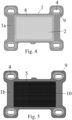
figures 4 and 5 illustrate respective faces of an interconnector according to the present invention and treated with a method in accordance with the present invention; and -
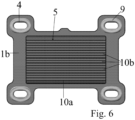
figure 6 illustrate a respective face or air side of an interconnector according to the present invention, treated with another method in accordance with the present invention. - In the enclosed drawings, equivalent parts or components are marked with the same reference numbers.
- With reference to the enclosed figures,
reference number 1 overall indicates a metallic interconnector or support of a fuel stack. - The
metallic support 1 can be made of steel, if desired in ferritic steel containing a certain percentage of chromium, e.g. 22%. - The selection of this material is in any case non-limiting for the purposes of the present invention.
- One such interconnector can for example be as described in the patent application published with number
US9627698 - More particularly, the
interconnector 1 can have a substantially plate-like configuration with thickness equal to about 0.5-5 mm. - In addition, the
interconnector 1 comprises a first side or first surface 1a or anode during use set to come into contact, at a respective intermediate portion 1d1, with the fuel and a second side orsecond surface 1b during use set to come into contact with air. The second side orsecond surface 1b is during use not in contact with the electrodes of the stack at a respective edge portion 1e2, while the surface of the crests 7 of thezone 5, which will be better described hereinbelow, is in contact with the cathode. - The
interconnector 1 further comprises an intermediate portion 1d1, 1d2, for example with circular, square or rectangular border and an edge portion 1e1, 1e2, e.g. annular, extended around the intermediate portion 1d1, 1d2. The edge portion 1e1, 1e2 has edge zones 1f, if desired projecting, for example four edge zones 1f. The surface 1e1 of the side 1a is during use set to come into contact with air. - First of all, relative to the fuel side 1a of the interconnector 1 (see
figure 1 ), the latter or better yet the zone of such side 1a belonging to the intermediate portion 1d1 comprises acontact area 2 on which, during use, the fuel cell is positioned on the side exposed to the fuel. Thisarea 2 has the function of electrically connecting the fuel-electrode to the metal of theinterconnector 1 and of collecting the current generated by the oxidation reaction of the fuel in the cell. - The
contact area 2 can have geometry, e.g. with circular, square or rectangular border. Thisarea 2 can have grid-like structure that is rather complex. - In accordance with the present invention, this
area 2 is preferably maintained not coated or it is covered, preferably entirely, with a metallic or ceramic layer that has electrical conductor properties, e.g. with thickness between 1 and 20 micrometers, preferably 10 micrometers. Such layer is for example a thin layer of nickel or of an oxide such as SrTiO3 or Co2MnO4. - At the
perimeter 2a ofsuch contact area 2, a first cord or layer ofvitreous sealant 8 can be applied, preferably continuous and annular and which serves to seal the interface between the metal of theinterconnector 1 and the edge of the cell that is positioned onsuch contact area 2. The cord or layer ofsealant 8 can have a thickness for example between about 50 and about 200 micron, if desired about 100 micron.Such cord 8 can for example be applied via screen printing or via extrusion, e.g. by syringe. - The area of the
perimeter 2a, on which the sealant to the cell edge is deposited, can be covered by a first intermediate layer, e.g. with thickness equal to about 1-20 micrometers made with an insulating material, for example identical to that used for the entire the surface 1e1, or with an insulating material dedicated for the interface between metal and glass. In such case, the first intermediate layer would be placed between the interconnector and the cord or layer ofsealant 8. -
Such perimeter 2a can be coated with at least one ceramic insulating layer which can be constituted by a glass-ceramic material, by aluminum oxide, zirconium oxide or by a mixture of such materials. - The interconnector then delimits multiple through slots or
holes 4, e.g. fourholes 4, each at a respective edge zone 1f of theinterconnector 1, which serve for the passage of the fuel through the stack. - In order to prevent the diffusion of the fuel into the air compartment, it is possible to seal these
holes 4, applying a second cord ofsealant material 9, preferably continuous and annular, around or on the perimeter or on thering zone 4a delimiting eachhole 4 and between one interconnector and the next. The cord ofsealant material 9 can have a thickness between about 0.2 and about 0.8 mm, if desired equal to about 0.5-0.6 mm.Such cord 9 can be applied, if desired, via extrusion, e.g. by syringe, or by means of screen-printed preforms. - In such case, the interface between metal of the
interconnector 1 and sealant can be coated with a glass-ceramic material, with aluminum oxide, zirconium oxide or with a mixture of these materials. - The
ring zone 4a or in any case an annular zone around one or all theholes 4 can be drawn or in any case in relief from the part of theair side 1b and flat or recessed from the part of the fuel side 1a. This drawing allows reducing the gap between the rings of twointerconnectors 1 placed in series or in succession, thus reducing the thickness of the cord necessary for the sealant. - The cord of
sealant material 9, if provided, is applied on the fuel side 1a (nondrawn ring), but it could also be deposited on theother side 1b. - The area around the
holes 4a on which the sealant is deposited can be covered with a material identical to that used for the entire area exposed to air, or with a dedicated material at the interface between the metal of theinterconnector 1 and glass. - With regard instead to the
air side 1b of the interconnector 1 (seefigures 2, 3 and5 ), this or better yet the zone ofsuch side 1b belonging to the intermediate portion 1d2 comprises a channel-like orcorrugated structure 5 for the distribution of the air on the surface of the electrode. - In particular, this structure is constituted by crests 7 which come into contact with the air-electrode alternated with
channels 6 which serve for the distribution of air between the metal of theinterconnector 1 and the electrode. More particularly, theair distribution channels 6 are not in contact with the electrode, while the crests 7 are in contact therewith. - This structure with crests 7 and
channels 6 can be entirely printed or coated with alayer 10 of ink with electrical conductor and anti-corrosive properties, such as an oxide of spinel type such as CuMn2O4 or Co2MnO4 or an oxide of perovskite type such as LaMnO3 or LaCrO3. - Alternatively, as illustrated in
figure 6 , the crests 7 can be printed or coated with aconductive material layer 10a as indicated above and thechannels 6 with an insulatingmaterial layer 10b, such as glass-ceramic or aluminum oxide, zirconium oxide or a mixture of these materials. - In addition, at the interface between the metal of the
interconnector 1 and the printedconductive layer - A ceramic insulating material can be printed, by means of inkjet printing, over the entire area of the
interconnector 1 that is not in contact with the air or fuel electrodes. - In addition, a conductive ceramic or metallic material can be printed, by means of inkjet printing, on the area of the
interconnector 1 which is contact with the electrodes aria or fuel. - In substance, the entire area of the
interconnector 1, except for thecontact area 2 and the crests 7 of thecorrugated structure 5 can be coated with a ceramic insulating material, such as a glass-ceramic, aluminum oxide, zirconium oxide or a mixture of these materials. - Preferably, but not exclusively, the
metallic interconnector 1 and the layers of protective material are co-sintered at high temperature in a single production stage. - According to one version of the present invention, the deposition method can comprise a step for preparing at least one
surface 1a, 1b of themetallic support 1. - In particular, such preparation step can consist of washing the surface 1a and/or 1b the
metallic support 1 with solvents, acids, or other products suitable for eliminating all the impurities from theentire surface 1a and 1b of themetallic support 1. - More particularly, the
metallic support 1 can be washed with a surfactant bath in order to remove possible residues of mechanical processing and possibly at a later stage in an aqueous solution containing acids, such as for example citric acid, in order to remove possible residues of free iron. - The method also comprises a step for preparing a digital apparatus or printer for inkjet printing.
- Also one or more digital images must be prepared, to be printed on the metallic interconnector or
support 1. Such image or images can also comprise different colors, to be applied by means of different inks, both on the air side and on the fuel side. - Then, the inks must also be prepared, and the optimal operating parameters must be set for the printer machine.
- Such step can also provide for handling and movement of the pieces (interconnectors) and for the alignment of the printing heads above a respective face of such pieces.
- More in detail, this step can also provide for locking the piece, for example on a printing tray, and preheating it, for example between 40° and 150°C, and then printing one or more digital images on the surface 1a and/or 1b of the
metallic interconnector 1 by applying one or more layers of ink with ceramic material base onsuch surface 1a, 1b. - Such digital images are such to reproduce the
layer layer 8 and the interconnector or between thelayer 9 and the interconnector. - If multiple layers of equivalent or different materials must be applied, the same can be applied simultaneously. This is clearly applied to the case in which it is not necessary to apply an ink layer on a previously-applied layer; in such case, the application will be consecutive and will take place in different steps. This can be attained with a single-pass printer. In this case, different layers can be printed consecutively by two different heads in the same printing process.
- Then, the solvent of the ink or inks applied during the printing step can be evaporated or allowed to evaporate, for example between about 40°C and about 120°C and, if necessary, the
piece 1 is rotated and the loading is repeated in order to print on theopposite side 1b, 1a. In order to accelerate the drying of the deposited material, it is possible to pre-arrange a slightly-ventilated post-heating. - Following the printing, a step is provided for heating, for example at high temperature, if desired between about 600°C and about 1000°C, the printed
metallic interconnector 1, so as to remove the organic part of the ink and allow the adhesion of the material layer on the metallic support. - The organic part can comprise organic solvents of the glycol-ether family, having boiling temperatures comprised between 150°C and 210°C and "evaporation rate" >0.01 (n-BuAc=1).
- Such step can be conducted by drying and sintering, as indicated above in an oven, the
piece 1 so as to cook it by means of a suitable thermal cycle for removing the organic residues of the ink and for allowing the material to bind to the metallic surface and form a dense layer. More particularly, during such step, the interconnector is placed in an oven and a sintering cycle is executed, for example up to about 950°C. The organic binders burn at about 300-450°C, while the temperature of 950°C is necessary for allowing the adhesion of the layer on the steel of the interconnector and the increase of the density of the layer itself. This process is typically carried out in an oven, where only the interconnector is sintered. This step could also be conducted in situ in the final step of stack construction. - Preferably, the image comprises at least one first image for the first side 1a of the
interconnector 1 and at least one second image for thesecond side 1b of theinterconnector 1 and during the printing step the first image is printed on the first surface 1a and the second image is printed subsequently or previously on thesecond surface 1b of the interconnector. Clearly, the first image and the second image are obtained by means of different printing steps. - On such matter, a first image could for example correspond with the layer between the
layers layer layer layer - Hereinbelow, the inks or layers applicable in a method according to the present invention will be indicated in detail.
- First, with reference to the conductive ink usable in a method according to the present invention, this can be composed of oxides of copper, manganese, cobalt, nickel, iron, niobium and is preferably a mixed copper-manganese oxide. Such mixed oxide can have different stoichiometries, such as CuMn2O4, or Cu1.3Mn1.7O4. Such ink is in particular usable for the
conductive layer contact area 2. - The insulating ink usable in a method according to the present invention can instead be mainly composed of a refractory oxide belonging to the group composed of aluminum, zirconium, titanium, silicon, barium, strontium, lanthanum, cerium, yttrium, magnesium, calcium, zinc and phosphorus. Such ink can be composed of oxides of the abovementioned elements, or by salts, precursors (e.g. tetraethyl orthosilicate), or by elements in elementary form (e.g. aluminum). This ink can also be a mixture of a vitreous material and of other oxides, giving rise, following thermal treatment, to a composite material. This ink serves for making an insulating layer to be applied over the entire area of the
interconnector 1, except for thecontact area 2 and the crests 7. Preferably, such layer is applied on the edge portion 1e1, at theperimeter 2a of thecontact area 2 and on thering zone 4a delimiting eachhole 4. - The insulating ink can also be composed of a vitreous material or glass-ceramic material composed of powders of a vitreous material which, following thermal treatment, partially or completely crystallizes, forming a so-called glass-ceramic material. This material can be composed of silicon, boron, aluminum, magnesium, calcium, barium, strontium, phosphorus, zinc, yttrium, cerium, titanium. This ink is applied as an alternative or in addition to the ink indicated in the preceding paragraph (refractory oxide) and constitutes an insulating layer. This ink serves for making an insulating layer to be applied over the entire area of the
interconnector 1 except for thecontact area 2 and the crests 7. Preferably, such layer is applied on the edge portion 1e1, at theperimeter 2a of thecontact area 2 and on thering zone 4a delimiting eachhole 4. - An ink layer applicable by means of inkjet printing according to the present invention can also comprise a ceramic material layer with electrical conduction and anti-corrosion protective properties, for example electrical conductivity σ=1-250Scm-1 in air at 750°C or better yet σ=60-225 Scm-1, such ceramic material being constituted by an oxide of spinel type composed of one or more elements selected from the group constituted by copper, manganese, iron, cobalt, nickel, niobium, or mixtures thereof. This layer can be in particular applied on the crests 7, even if it can be applied over the entire
corrugated area 5 or on other surfaces of the edge portions 1e1, 1e2. The oxide of spinel type has general formula A1+xB2-xO4, where both A and B can be one or more elements of the transition metal group, such as Mn, Ti, Fe, Cr, Co, Cu, Ni, Nb. Such material is preferably but not exclusively an oxide with composition CuMn2O4 or Co2MnO4. - If desired, an ink layer applicable by means of inkjet printing according to the present invention can comprise a ceramic material layer with electrical conduction and anti-corrosion protective properties, constituted by an oxide of perovskite type with general formula ABMO3, where A is an element belonging to the rare-earth group (e.g. A= La, Nd, Pr) which can be entirely or partly substituted by an element B belonging to the alkaline-earth metal group (e.g. B= Sr, Ca, Ba, Mg), and M is a transition metal (e.g. M= Mn, Ti, Fe, Cr, Co, Cu, Ni). Such material is preferably but not exclusively an oxide with composition SrTiO3, or LaCrO3 or LaMnO3 or La0.7Sr0.3MnO3. This layer can be applied in particular on the
contact area 2, even if it can be applied on the crests 7 as well as over the entirecorrugated area 5 or on other surfaces of the edge portions 1e1, 1e2. If desired, this layer can be applied in combination with the layer constituted by an oxide of spinel type described in the preceding paragraph. - If desired, an ink layer applicable by means of inkjet printing according to the present invention can comprise a ceramic material layer set to be transformed into an electrically conductive layer via reaction with the metallic support at high temperature, such ceramic material being selected from the group constituted by lanthanum, cerium, yttrium, strontium, titanium, niobium, phosphorus, zinc or mixtures thereof. These elements, in the form of oxides or salts, can be applied between the steel of the interconnector and the conductive layer. The area of greater interest for the application of one such layer are the crests 7 or the entire
corrugated zone 5, but there are no contraindications for applying it over the entire surface which will be covered with the conductive layer. - If desired, an ink layer applicable by means of inkjet printing according to the present invention comprises a ceramic material with electrical insulation and anti-corrosion protective properties, for example with electrical resistance R > 2 kOhm·cm2 at 750°C, such ceramic material being selected from the group constituted by aluminum oxide, silicon oxide and/or zirconium oxide, phosphorus oxide and by a vitreous phase. This layer is preferably applied below the layers of
cord contact area 2 and the crests 7. Preferably, such layer is applied at theperimeter 2a of thecontact area 2 and on thering zone 4a delimiting eachhole 4. - An ink layer applicable by means of inkjet printing according to the present invention can then comprise a salt or an organometallic precursor which, following thermal treatment, is transformed into an insulating metallic oxide with anti-corrosive barrier properties against the diffusion of elements, for example with electrical resistance R > 2 kOhm·cm2 at 750°C.
- If desired, an ink layer applicable by means of inkjet printing according to the present invention comprises a vitreous material or glass-ceramic material with electrical insulation and anti-corrosion protective properties, such ceramic material being selected from the group constituted by barium, silicon, boron, magnesium, aluminum, strontium, calcium, phosphorus, yttrium and/or cerium.
- An ink layer applicable by means of inkjet printing according to the present invention can then comprise a metallic material with electrical conductor and anti-corrosion protective properties in reducing atmosphere, such material being selected from the group constituted by nickel, copper, manganese, iron, cobalt, niobium, titanium.
- If desired, an ink layer applicable by means of inkjet printing according to the present invention comprises a first thin layer composed of lanthanum and cerium in contact with the metallic interconnector and a layer of greater thickness composed of copper and manganese, applied above first layer. This ink is applicable in particular on the area of contact with the electrodes, in particular the
contact area 2, the area of the crests 7 or the channel-like orcorrugated structure 5. - There are multiple technical advantages conferred by this method.
- Unlike other coating techniques, this method allows considerably eliminating or reducing the waste of material, since the percentage of overspray is practically zero. This allows employing low quantities of protective material with respect to other deposition technologies.
- In addition, due to the high resolution obtainable by means of an inkjet printing, this method allows extreme flexibility in the deposition of layers with geometry that is even quite complex, and it does not require masking the piece or interconnector if materials of different type are printed.
- This method also allows depositing successive layers of different composition in order to create a composition gradient within the protective coating. The gradient coating, constituted by a specific number of thin layers or by a protective layer of greater thickness, can be deposited in a single printing step, without requiring intermediate handling of the piece.
- A method according to the present invention can also comprise a step of heat treatment of the
metallic support 1, e.g. between about 40°C and about 150°C, in order to facilitate the evaporation of the solvent contained in the ink. - After the printing and drying, the interconnector can be inserted in an oven where a thermal cycle in air is executed up to about 950°C.
- Thus, in such a manner it was possible to verify that the invention attains the proposed objects.
- The method according to the invention, due to the characteristics of inkjet printing technology, allows selectively depositing, on the metallic interconnector of the stack of fuel cells, an anti-corrosion protective ceramic material layer, also in an effective and inexpensive manner.
- As stated above, the deposition is selective in the sense that it accurately reproduces the distribution of the material according to the constructed digital image.
- Hence, the problems relative to the corrosion of all the metallic parts of the single repeating element are effectively eliminated - such parts exposed to the gas flow - even if such parts have complex geometry.
- It is specified that the present invention can be applied both in the field of fuel cells and in that of cells for electrolysis, so that each time in the present description reference is made for example to the application of a stack of fuel cells, it must be intended that the same concepts can be applied to stacks of cells for electrolysis without any limitation.
- As can be verified, due to the method according to the present invention it is possible to print different materials on areas of the interconnector that must perform one or more of the above-described objects.
- With this method it is possible, for example, to apply a conductive coating (e.g. copper-manganese oxide) only on the contact area between metal and electrode, an insulating layer (e.g. aluminum oxide, zirconium oxide or a glass-ceramic material) on the contact area between the metal and the sealant material, an insulating coating within the gas distribution channels and over the entire surface not covered with other materials.
- In addition, the applied insulating material layer has barrier function and improves the compatibility and adhesion between the sealant and the steel of the interconnector.
- It is important to observe that by means of the method according to the present invention, it is possible to apply multiple layers of material simultaneously, without having to mask the piece and without requiring intermediate handling operations.
- Modifications and variations of the invention are possible within the protective scope defined by the claims.
Claims (24)
- Method for depositing a material layer on a metallic interconnector or support (1) for fuel cells or cells for electrolysis, comprising the following steps of:- preparing at least one surface of a metallic interconnector or support (1);- preparing a digital apparatus for inkjet printing;- preparing at least one digital image to be printed on said metallic interconnector or support (1);- printing, by means of said digital apparatus, said at least one image on said at least one surface (1a, 1b) of said metallic interconnector (1) by applying at least one layer of ink with ceramic and/or metal material base on such surface (1a, 1b);- evaporating the solvent of the ink applied during the printing step, or allowing such solvent to evaporate;- heating said printed metallic interconnector (1), so as to remove the organic part of the ink and allow the adhesion of the material layer on the metallic support,wherein said interconnector (1) comprises a first side or first surface (1a) or anode set to come into contact, during use, at a respective intermediate portion (1d1) with the fuel and a second side or second surface (1b, 1e1) set to come into contact, during use, with air, said interconnector (1) also comprising an intermediate portion (1d1, 1d2) and an edge portion (1e1, 1e2) extended around said intermediate portion (1d1, 1d2), the edge portion (1e1, 1e2) having edge zones (1f) in which through slots or holes (4) are delimited, and wherein the zone of said first side (1a) belonging to the intermediate portion (1d1) comprises a contact area (2) on which, during use, the fuel cell is positioned on the side exposed to the fuel, such contact area (2) having the function of electrically connecting the fuel-electrode to the interconnector (1) and of collecting the current generated by the oxidation reaction of the fuel in the respective cell, andwherein said printing step is conducted by applying a glass-ceramic or refractory insulating layer at the perimeter (2a) of said contact area (2) and subsequently, on top of such glass-ceramic or refractory insulating layer, a cord or layer of sealant (8) is applied.
- Method according to claim 1, wherein said heating step is conducted at a temperature between 600 and 1000°C and preferably at 950°C.
- Method according to any previous claim, wherein during said printing step at least one first image is printed on said first surface (1a) of said metallic interconnector (1), and at least one second image is printed on said second surface (1b) of said metallic interconnector (1).
- Method according to any previous claim, wherein during said printing step, all or part of said contact area (2) is covered with a ceramic or metallic layer which has electrical conductor properties.
- Method for depositing a material layer on a metallic interconnector or support (1) for fuel cells or cells for electrolysis, comprising the following steps of:- preparing at least one surface of a metallic interconnector or support (1);- preparing a digital apparatus for inkjet printing;- preparing at least one digital image to be printed on said metallic interconnector or support (1);- printing, by means of said digital apparatus, said at least one image on said at least one surface (1a, 1b) of said metallic interconnector (1) by applying at least one layer of ink with ceramic and/or metal material base on such surface (1a, 1b);- evaporating the solvent of the ink applied during the printing step, or allowing such solvent to evaporate;- heating said printed metallic interconnector (1), so as to remove the organic part of the ink and allow the adhesion of the material layer on the metallic support,wherein said interconnector (1) comprises a first side or first surface (1a) or anode set to come into contact, during use, at a respective intermediate portion (1d1) with the fuel and a second side or second surface (1b, 1e2) set to come into contact, during use, with air, said interconnector (1) also comprising an intermediate portion (1d1, 1d2) and an edge portion (1e1, 1e2) extended around said intermediate portion (1d1, 1d2), the edge portion (1e1, 1e2) having edge zones (1f) in which through slots or holes (4) are delimited, and wherein the zone of said first side (1a) belonging to the intermediate portion (1d1) comprises a contact area (2) on which, during use, the fuel cell is positioned on the side exposed to the fuel, such contact area (2) having the function of electrically connecting the fuel-electrode to the interconnector (1) and of collecting the current generated by the oxidation reaction of the fuel in the respective cell, andwherein during said printing step, a glass-ceramic or refractory insulating layer is applied around or on the perimeter or on the ring zone (4a) for delimiting each hole (4) and between one interconnector and the next and subsequently, on top of such glass-ceramic or refractory insulating layer, a cord of sealant material (9) is applied.
- Method for depositing a material layer on a metallic interconnector or support (1) for fuel cells or cells for electrolysis, comprising the following steps of:- preparing at least one surface of a metallic interconnector or support (1);- preparing a digital apparatus for inkjet printing;- preparing at least one digital image to be printed on said metallic interconnector or support (1);- printing, by means of said digital apparatus, said at least one image on said at least one surface (1a, 1b) of said metallic interconnector (1) by applying at least one layer of ink with ceramic and/or metal material base on such surface (1a, 1b);- evaporating the solvent of the ink applied during the printing step, or allowing such solvent to evaporate;- heating said printed metallic interconnector (1), so as to remove the organic part of the ink and allow the adhesion of the material layer on the metallic support,wherein said interconnector (1) comprises a first side or first surface (1a) or anode set to come into contact, during use, at a respective intermediate portion (1d1) with the fuel and a second side or second surface (1b, 1e2) set to come into contact, during use, with air, said interconnector (1) also comprising an intermediate portion (1d1, 1d2) and an edge portion (1e1, 1e2) extended around said intermediate portion (1d1, 1d2), the edge portion (1e1, 1e2) having edge zones (1f) in which through slots or holes (4) are delimited, and wherein the zone of said first side (1a) belonging to the intermediate portion (1d1) comprises a contact area (2) on which, during use, the fuel cell is positioned on the side exposed to the fuel, such contact area (2) having the function of electrically connecting the fuel-electrode to the interconnector (1) and of collecting the current generated by the oxidation reaction of the fuel in the respective cell, andwherein with reference to the zone of the second side (1b) of the interconnector (1) belonging to the intermediate portion (1d2), a channel-like or corrugated structure (5) is provided for distributing air on the surface of the electrode, said channel-like or corrugated structure (5) being constituted by crests (7) which come into contact with the air-electrode alternated with channels (6) which serve for distributing the air between the interconnector (1) and the electrode, and wherein during said printing step said channel-like or corrugated structure (5) is printed or entirely covered or covered only at the crests (7) with an ink layer (10, 10a) with electrical conductor and anti-corrosive properties.
- Method according to any one of the preceding claims, wherein said at least one ink layer comprises a ceramic material layer with electrical conduction and anticorrosion protection properties, such ceramic material being constituted by an oxide of spinel type with general formula A1+xB2-xO4, where both A and B can be one or more elements of the group of transition metals, such as Mn, Ti, Fe, Cr, Co, Cu, Ni, Nb.
- Method according to any one of the preceding claims, wherein said at least one ink layer comprises a ceramic material layer with electrical conduction and anticorrosion protection properties, such ceramic material being constituted by an oxide of perovskite type with general formula ABMO3, where A is an element belonging to the group of the rare earth elements which can be entirely or partly substituted by an element B belonging to the group of alkaline earth metals, and M is a transition metal.
- Method according to any one of the preceding claims, wherein said at least one ink layer comprises a ceramic material layer with electrical conduction and anticorrosion protection properties, such ceramic material being constituted by salts or other precursors which, via reaction at high temperature, form an oxide of perovskite type or an oxide of spinel type with electrical conduction and anti-corrosion protection properties, such layer being preferably constituted by salts of copper, cobalt, manganese, iron, nickel titanium, lanthanum, strontium, calcium, barium, magnesium.
- Method according to any one of the preceding claims, wherein said at least one ink layer comprises a ceramic material layer with electrical conduction and anticorrosion protection properties, such ceramic material being constituted by metals which, via reaction at high temperature, form an oxide of spinel type with aerial electrical conduction or anti-corrosion protective properties, such layer being preferably constituted by copper, cobalt, manganese, iron, nickel, titanium.
- Method according to any one of the preceding claims, wherein said at least one ink layer comprises a ceramic material layer with electrical conduction and anticorrosion protective properties, such ceramic material being constituted by salts or other precursors which, via reaction with the steel of the interconnector, at high temperature, form oxides with electrical conduction or anti-corrosion protective properties, such layer being preferably constituted by salts or oxides of lanthanum, strontium, cerium, yttrium, niobium, cobalt, copper, manganese, titanium, phosphorus, zinc.
- Method according to any one of the preceding claims, wherein said coating with electrical conduction and anti-corrosion protective properties is constituted by at least two layers resulting from the combination of claims 7-11, such layer being preferably constituted by a layer of oxide of spinel type and an oxide of perovskite type.
- Method according to any one of the preceding claims, wherein said at least one ink layer comprises a refractory ceramic material with electrical insulation and anticorrosion protective properties, such ceramic material being selected from the group constituted by aluminum oxide, silicon oxide, zirconium oxide, phosphorus oxide or mixtures thereof.
- Method according to any one of the preceding claims, wherein said at least one ink layer comprises a composite material with electrical insulation and anti-corrosion protective properties, such ceramic material being constituted by a mixture of isolating oxides according to claim 13 and by a vitreous or glass-ceramic phase.
- Method according to any one of the preceding claims, wherein said at least one ink layer comprises a precursor which, following thermal treatment, is transformed into an insulating metallic oxide with anti-corrosive barrier properties against the diffusion of elements, such precursor preferably consisting of aluminum which, following thermal treatment, is transformed into aluminum oxide.
- Method according to any one of the preceding claims, wherein said at least one ink layer comprises a vitreous or glass-ceramic material with electrical insulation and anti-corrosion protective properties, such vitreous or glass-ceramic material being composed preferably but not exclusively by elements of the group constituted by barium, silicon, boron, magnesium, aluminum calcium, strontium, phosphorus, yttrium, lanthanum, cerium.
- Method according to any one of the preceding claims, wherein said coating with electrical insulation and anti-corrosion protective properties is composed of at least two layers resulting from the combination of claims 13-16, such double layer being composed preferably but not exclusively by a layer of aluminum oxide or zirconium oxide or by a glass-ceramic material layer.
- Method according to any one of the preceding claims, comprising a step for executing a thermal treatment of said metallic interconnector in order to facilitate the consolidation of the material layer thereon.
- Method according to any one of the preceding claims, wherein the electrically conductive ceramic material is printed, by means of inkjet printing, on the contact area between the metal and the air-electrode.
- Method according to any one of the preceding claims, wherein the electrically conductive ceramic material is printed, by means of inkjet printing, on the contact area between the metal and the fuel-electrode.
- Method according to any one of the preceding claims, wherein the insulating ceramic material is printed, by means of inkjet printing, on the entire area of the interconnector which is not in contact or is not set to come into contact with the air or fuel electrodes.
- Method according to any one of the preceding claims, wherein an insulating ceramic material layer is printed, by means of inkjet printing, on the area of the interconnector which is in contact or is not set to come into contact with the fuel-electrode.
- Method according to claim 1, wherein an insulating ceramic material layer is printed, by means of inkjet printing, on the zone of application of the sealant cord (8, 9), so as to be situated between the interconnector and the sealant cord (8, 9).
- Metallic interconnector or support (1) for fuel cells or cells for electrolysis treated with a method according to any one of the preceding claims.
Applications Claiming Priority (2)
| Application Number | Priority Date | Filing Date | Title |
|---|---|---|---|
| IT201800004765A IT201800004765A1 (en) | 2018-04-20 | 2018-04-20 | PROTECTION OF A METALLIC SUBSTRATE FOR SOLID OXIDE CELL STACKS BY INKJET PRINTING |
| PCT/IB2019/051426 WO2019202413A1 (en) | 2018-04-20 | 2019-02-21 | Protection of a metal substrate for solid oxide fuel cells by inkjet printing |
Publications (2)
| Publication Number | Publication Date |
|---|---|
| EP3782215A1 EP3782215A1 (en) | 2021-02-24 |
| EP3782215B1 true EP3782215B1 (en) | 2023-11-08 |
Family
ID=62952279
Family Applications (1)
| Application Number | Title | Priority Date | Filing Date |
|---|---|---|---|
| EP19712280.7A Active EP3782215B1 (en) | 2018-04-20 | 2019-02-21 | Protection of a metal substrate for solid oxide fuel cells by inkjet printing |
Country Status (12)
| Country | Link |
|---|---|
| US (1) | US12062819B2 (en) |
| EP (1) | EP3782215B1 (en) |
| JP (1) | JP7377853B2 (en) |
| KR (1) | KR102696247B1 (en) |
| CN (1) | CN112602215B (en) |
| CA (1) | CA3097301A1 (en) |
| DK (1) | DK3782215T3 (en) |
| ES (1) | ES2971799T3 (en) |
| FI (1) | FI3782215T3 (en) |
| IT (1) | IT201800004765A1 (en) |
| MX (1) | MX2020010931A (en) |
| WO (1) | WO2019202413A1 (en) |
Families Citing this family (1)
| Publication number | Priority date | Publication date | Assignee | Title |
|---|---|---|---|---|
| DE102020133553A1 (en) * | 2020-12-15 | 2022-06-15 | Schaeffler Technologies AG & Co. KG | Method of making a bipolar plate for an electrochemical cell and bipolar plate |
Family Cites Families (21)
| Publication number | Priority date | Publication date | Assignee | Title |
|---|---|---|---|---|
| US6653009B2 (en) * | 2001-10-19 | 2003-11-25 | Sarnoff Corporation | Solid oxide fuel cells and interconnectors |
| EP1624520B1 (en) | 2002-03-27 | 2011-08-24 | Topsøe Fuel Cell A/S | Thin film solid oxide fuel cell (SOFC) and its method of production |
| JP2003346826A (en) | 2002-05-27 | 2003-12-05 | Nissan Motor Co Ltd | Solid oxide fuel cell |
| CA2512011A1 (en) * | 2003-01-10 | 2004-07-29 | Qinetiq Nanomaterials Limited | Improvements in and relating to deposited structures |
| JP3985698B2 (en) | 2003-03-05 | 2007-10-03 | セイコーエプソン株式会社 | Manufacturing method of fuel cell |
| WO2004110599A2 (en) * | 2003-05-27 | 2004-12-23 | Haering Thomas | Multilayered structures and methods for producing the same |
| US7285347B2 (en) * | 2003-11-03 | 2007-10-23 | Korea Institute Of Energy Research | Anode-supported flat-tubular solid oxide fuel cell stack and fabrication method of the same |
| WO2006053727A2 (en) * | 2004-11-18 | 2006-05-26 | Behr Gmbh & Co. Kg | Device for carrying out a chemical reaction |
| FR2895573A1 (en) * | 2005-12-27 | 2007-06-29 | St Microelectronics Sa | Fuel cell for silicon support plate has catalyst and electrolyte layers placed on transparent thin conductor layer supported by support plate which is provided with gas supply transversal channels, where conductor layer is gold layer |
| GB2448890B (en) * | 2007-05-01 | 2013-03-13 | Ceres Ip Co Ltd | A method of disposing a water gas shift catalyst on a metal substrate |
| ES2708085T3 (en) * | 2008-06-13 | 2019-04-08 | Ceres Ip Co Ltd | Method for the deposition of ceramic films |
| US20120321995A1 (en) * | 2011-06-20 | 2012-12-20 | Xerox Corporation | System and Method for Selective Deposition of A Catalyst Layer for PEM Fuel Cells Utilizing Inkjet Printing |
| US10431833B2 (en) * | 2012-03-01 | 2019-10-01 | Bloom Energy Corporation | Coatings for metal interconnects to reduce SOFC degradation |
| US9452475B2 (en) * | 2012-03-01 | 2016-09-27 | Bloom Energy Corporation | Coatings for SOFC metallic interconnects |
| TWI566461B (en) * | 2012-03-01 | 2017-01-11 | 博隆能源股份有限公司 | Coatings for sofc metallic interconnects |
| JP6181371B2 (en) * | 2012-03-30 | 2017-08-16 | 本田技研工業株式会社 | Metal separator for fuel cell and manufacturing method thereof |
| EP2675005A1 (en) * | 2012-06-11 | 2013-12-18 | HTceramix S.A. | Gas distribution element for a fuel cell |
| IN2013CH02660A (en) * | 2013-06-19 | 2015-10-02 | Nonferrous Materials Technology Dev Ct | |
| DE102013212624A1 (en) | 2013-06-28 | 2014-12-31 | Robert Bosch Gmbh | High temperature cell with porous gas guide channel layer |
| US10236528B2 (en) * | 2016-07-18 | 2019-03-19 | Northwestern University | Three dimensional extrusion printed electrochemical devices |
| WO2018042477A1 (en) | 2016-08-29 | 2018-03-08 | FCO Power株式会社 | Interconnector, solid oxide fuel cell stack, and method for manufacturing solid oxide fuel cell stack |
-
2018
- 2018-04-20 IT IT201800004765A patent/IT201800004765A1/en unknown
-
2019
- 2019-02-21 CA CA3097301A patent/CA3097301A1/en active Pending
- 2019-02-21 US US17/049,273 patent/US12062819B2/en active Active
- 2019-02-21 JP JP2021506080A patent/JP7377853B2/en active Active
- 2019-02-21 ES ES19712280T patent/ES2971799T3/en active Active
- 2019-02-21 EP EP19712280.7A patent/EP3782215B1/en active Active
- 2019-02-21 MX MX2020010931A patent/MX2020010931A/en unknown
- 2019-02-21 CN CN201980031122.8A patent/CN112602215B/en active Active
- 2019-02-21 FI FIEP19712280.7T patent/FI3782215T3/en active
- 2019-02-21 WO PCT/IB2019/051426 patent/WO2019202413A1/en not_active Ceased
- 2019-02-21 KR KR1020207032457A patent/KR102696247B1/en active Active
- 2019-02-21 DK DK19712280.7T patent/DK3782215T3/en active
Also Published As
| Publication number | Publication date |
|---|---|
| CN112602215B (en) | 2024-08-16 |
| IT201800004765A1 (en) | 2019-10-20 |
| JP7377853B2 (en) | 2023-11-10 |
| KR20210038419A (en) | 2021-04-07 |
| FI3782215T3 (en) | 2024-02-08 |
| CN112602215A (en) | 2021-04-02 |
| US20210218037A1 (en) | 2021-07-15 |
| MX2020010931A (en) | 2021-03-25 |
| ES2971799T3 (en) | 2024-06-07 |
| DK3782215T3 (en) | 2024-02-12 |
| CA3097301A1 (en) | 2019-10-24 |
| KR102696247B1 (en) | 2024-08-16 |
| JP2021522672A (en) | 2021-08-30 |
| US12062819B2 (en) | 2024-08-13 |
| EP3782215A1 (en) | 2021-02-24 |
| WO2019202413A1 (en) | 2019-10-24 |
Similar Documents
| Publication | Publication Date | Title |
|---|---|---|
| JP5718810B2 (en) | Ceramic film deposition method | |
| US5942349A (en) | Fuel cell interconnect device | |
| US8163353B2 (en) | Fabrication of copper-based anodes via atmosphoric plasma spraying techniques | |
| US9054348B2 (en) | Protective coatings for metal alloys and methods incorporating the same | |
| JPH06302332A (en) | Method of attaching interconnections to electrodes | |
| JP2014049320A (en) | Solid oxide fuel cell and method for manufacturing the same | |
| US20120064436A1 (en) | Interconnecting plate for solid oxide fuel cell and manufacturing method thereof, and solid oxide fuel cell using the interconnecting plate | |
| US20080299436A1 (en) | Composite ceramic electrolyte structure and method of forming; and related articles | |
| CN1953258A (en) | Electrochemcial cell structures and methods of making the same | |
| KR101657242B1 (en) | high temperature solid oxide cell comprising barrier layer, manufacturing method thereof | |
| TW202438198A (en) | Binder jet printing of metallic interconnect for solid oxide electrochemical cell stack | |
| EP3782215B1 (en) | Protection of a metal substrate for solid oxide fuel cells by inkjet printing | |
| JP2008153213A (en) | Ceramic electrolyte structure, manufacturing method and related articles | |
| RU2775273C2 (en) | Paint-jet printing in protection of metal substrate for solid oxide fuel elements | |
| JP5550223B2 (en) | Ceramic electrolyte processing method and related products | |
| CN101842932B (en) | Functional layer and manufacturing method of high temperature fuel cell | |
| Yu | The Performance of Spinel-Based Interconnect Coating and Cathode-Side Contact Layer for Solid Oxide Fuel Cell | |
| TW202432892A (en) | Method of forming an interconnect coating for an electrochemical device stack using laser sintering | |
| Satardekar | Materials Development for the Fabrication of Metal-Supported Solid Oxide Fuel Cells by Co-sintering | |
| RU2020136869A (en) | INKJET PRINTING IN THE PROTECTION OF A METAL SUBSTRATE FOR SOLID OXIDE FUEL CELLS | |
| JP2019175567A (en) | Collector |
Legal Events
| Date | Code | Title | Description |
|---|---|---|---|
| STAA | Information on the status of an ep patent application or granted ep patent |
Free format text: STATUS: UNKNOWN |
|
| STAA | Information on the status of an ep patent application or granted ep patent |
Free format text: STATUS: THE INTERNATIONAL PUBLICATION HAS BEEN MADE |
|
| PUAI | Public reference made under article 153(3) epc to a published international application that has entered the european phase |
Free format text: ORIGINAL CODE: 0009012 |
|
| STAA | Information on the status of an ep patent application or granted ep patent |
Free format text: STATUS: REQUEST FOR EXAMINATION WAS MADE |
|
| 17P | Request for examination filed |
Effective date: 20201014 |
|
| AK | Designated contracting states |
Kind code of ref document: A1 Designated state(s): AL AT BE BG CH CY CZ DE DK EE ES FI FR GB GR HR HU IE IS IT LI LT LU LV MC MK MT NL NO PL PT RO RS SE SI SK SM TR |
|
| AX | Request for extension of the european patent |
Extension state: BA ME |
|
| DAV | Request for validation of the european patent (deleted) | ||
| DAX | Request for extension of the european patent (deleted) | ||
| STAA | Information on the status of an ep patent application or granted ep patent |
Free format text: STATUS: EXAMINATION IS IN PROGRESS |
|
| 17Q | First examination report despatched |
Effective date: 20210803 |
|
| GRAP | Despatch of communication of intention to grant a patent |
Free format text: ORIGINAL CODE: EPIDOSNIGR1 |
|
| STAA | Information on the status of an ep patent application or granted ep patent |
Free format text: STATUS: GRANT OF PATENT IS INTENDED |
|
| INTG | Intention to grant announced |
Effective date: 20230605 |
|
| GRAS | Grant fee paid |
Free format text: ORIGINAL CODE: EPIDOSNIGR3 |
|
| GRAA | (expected) grant |
Free format text: ORIGINAL CODE: 0009210 |
|
| STAA | Information on the status of an ep patent application or granted ep patent |
Free format text: STATUS: THE PATENT HAS BEEN GRANTED |
|
| RAP3 | Party data changed (applicant data changed or rights of an application transferred) |
Owner name: SOLYDERA S.P.A. |
|
| AK | Designated contracting states |
Kind code of ref document: B1 Designated state(s): AL AT BE BG CH CY CZ DE DK EE ES FI FR GB GR HR HU IE IS IT LI LT LU LV MC MK MT NL NO PL PT RO RS SE SI SK SM TR |
|
| REG | Reference to a national code |
Ref country code: GB Ref legal event code: FG4D |
|
| REG | Reference to a national code |
Ref country code: CH Ref legal event code: EP |
|
| REG | Reference to a national code |
Ref country code: DE Ref legal event code: R096 Ref document number: 602019041016 Country of ref document: DE |
|
| REG | Reference to a national code |
Ref country code: IE Ref legal event code: FG4D |
|
| REG | Reference to a national code |
Ref country code: FI Ref legal event code: FGE |
|
| REG | Reference to a national code |
Ref country code: DK Ref legal event code: T3 Effective date: 20240208 |
|
| REG | Reference to a national code |
Ref country code: NL Ref legal event code: FP |
|
| REG | Reference to a national code |
Ref country code: LT Ref legal event code: MG9D |
|
| PG25 | Lapsed in a contracting state [announced via postgrant information from national office to epo] |
Ref country code: GR Free format text: LAPSE BECAUSE OF FAILURE TO SUBMIT A TRANSLATION OF THE DESCRIPTION OR TO PAY THE FEE WITHIN THE PRESCRIBED TIME-LIMIT Effective date: 20240209 |
|
| PG25 | Lapsed in a contracting state [announced via postgrant information from national office to epo] |
Ref country code: IS Free format text: LAPSE BECAUSE OF FAILURE TO SUBMIT A TRANSLATION OF THE DESCRIPTION OR TO PAY THE FEE WITHIN THE PRESCRIBED TIME-LIMIT Effective date: 20240308 |
|
| PG25 | Lapsed in a contracting state [announced via postgrant information from national office to epo] |
Ref country code: LT Free format text: LAPSE BECAUSE OF FAILURE TO SUBMIT A TRANSLATION OF THE DESCRIPTION OR TO PAY THE FEE WITHIN THE PRESCRIBED TIME-LIMIT Effective date: 20231108 |
|
| REG | Reference to a national code |
Ref country code: EE Ref legal event code: FG4A Ref document number: E024046 Country of ref document: EE Effective date: 20240207 |
|
| PG25 | Lapsed in a contracting state [announced via postgrant information from national office to epo] |
Ref country code: LT Free format text: LAPSE BECAUSE OF FAILURE TO SUBMIT A TRANSLATION OF THE DESCRIPTION OR TO PAY THE FEE WITHIN THE PRESCRIBED TIME-LIMIT Effective date: 20231108 Ref country code: IS Free format text: LAPSE BECAUSE OF FAILURE TO SUBMIT A TRANSLATION OF THE DESCRIPTION OR TO PAY THE FEE WITHIN THE PRESCRIBED TIME-LIMIT Effective date: 20240308 Ref country code: GR Free format text: LAPSE BECAUSE OF FAILURE TO SUBMIT A TRANSLATION OF THE DESCRIPTION OR TO PAY THE FEE WITHIN THE PRESCRIBED TIME-LIMIT Effective date: 20240209 Ref country code: BG Free format text: LAPSE BECAUSE OF FAILURE TO SUBMIT A TRANSLATION OF THE DESCRIPTION OR TO PAY THE FEE WITHIN THE PRESCRIBED TIME-LIMIT Effective date: 20240208 Ref country code: PT Free format text: LAPSE BECAUSE OF FAILURE TO SUBMIT A TRANSLATION OF THE DESCRIPTION OR TO PAY THE FEE WITHIN THE PRESCRIBED TIME-LIMIT Effective date: 20240308 |
|
| PG25 | Lapsed in a contracting state [announced via postgrant information from national office to epo] |
Ref country code: SE Free format text: LAPSE BECAUSE OF FAILURE TO SUBMIT A TRANSLATION OF THE DESCRIPTION OR TO PAY THE FEE WITHIN THE PRESCRIBED TIME-LIMIT Effective date: 20231108 Ref country code: RS Free format text: LAPSE BECAUSE OF FAILURE TO SUBMIT A TRANSLATION OF THE DESCRIPTION OR TO PAY THE FEE WITHIN THE PRESCRIBED TIME-LIMIT Effective date: 20231108 Ref country code: PL Free format text: LAPSE BECAUSE OF FAILURE TO SUBMIT A TRANSLATION OF THE DESCRIPTION OR TO PAY THE FEE WITHIN THE PRESCRIBED TIME-LIMIT Effective date: 20231108 Ref country code: NO Free format text: LAPSE BECAUSE OF FAILURE TO SUBMIT A TRANSLATION OF THE DESCRIPTION OR TO PAY THE FEE WITHIN THE PRESCRIBED TIME-LIMIT Effective date: 20240208 Ref country code: LV Free format text: LAPSE BECAUSE OF FAILURE TO SUBMIT A TRANSLATION OF THE DESCRIPTION OR TO PAY THE FEE WITHIN THE PRESCRIBED TIME-LIMIT Effective date: 20231108 Ref country code: HR Free format text: LAPSE BECAUSE OF FAILURE TO SUBMIT A TRANSLATION OF THE DESCRIPTION OR TO PAY THE FEE WITHIN THE PRESCRIBED TIME-LIMIT Effective date: 20231108 |
|
| REG | Reference to a national code |
Ref country code: ES Ref legal event code: FG2A Ref document number: 2971799 Country of ref document: ES Kind code of ref document: T3 Effective date: 20240607 |
|
| REG | Reference to a national code |
Ref country code: AT Ref legal event code: UEP Ref document number: 1630464 Country of ref document: AT Kind code of ref document: T Effective date: 20231108 |
|
| PG25 | Lapsed in a contracting state [announced via postgrant information from national office to epo] |
Ref country code: CZ Free format text: LAPSE BECAUSE OF FAILURE TO SUBMIT A TRANSLATION OF THE DESCRIPTION OR TO PAY THE FEE WITHIN THE PRESCRIBED TIME-LIMIT Effective date: 20231108 |
|
| PG25 | Lapsed in a contracting state [announced via postgrant information from national office to epo] |
Ref country code: SK Free format text: LAPSE BECAUSE OF FAILURE TO SUBMIT A TRANSLATION OF THE DESCRIPTION OR TO PAY THE FEE WITHIN THE PRESCRIBED TIME-LIMIT Effective date: 20231108 |
|
| PG25 | Lapsed in a contracting state [announced via postgrant information from national office to epo] |
Ref country code: SM Free format text: LAPSE BECAUSE OF FAILURE TO SUBMIT A TRANSLATION OF THE DESCRIPTION OR TO PAY THE FEE WITHIN THE PRESCRIBED TIME-LIMIT Effective date: 20231108 Ref country code: SK Free format text: LAPSE BECAUSE OF FAILURE TO SUBMIT A TRANSLATION OF THE DESCRIPTION OR TO PAY THE FEE WITHIN THE PRESCRIBED TIME-LIMIT Effective date: 20231108 Ref country code: RO Free format text: LAPSE BECAUSE OF FAILURE TO SUBMIT A TRANSLATION OF THE DESCRIPTION OR TO PAY THE FEE WITHIN THE PRESCRIBED TIME-LIMIT Effective date: 20231108 Ref country code: CZ Free format text: LAPSE BECAUSE OF FAILURE TO SUBMIT A TRANSLATION OF THE DESCRIPTION OR TO PAY THE FEE WITHIN THE PRESCRIBED TIME-LIMIT Effective date: 20231108 |
|
| REG | Reference to a national code |
Ref country code: DE Ref legal event code: R097 Ref document number: 602019041016 Country of ref document: DE |
|
| PLBE | No opposition filed within time limit |
Free format text: ORIGINAL CODE: 0009261 |
|
| STAA | Information on the status of an ep patent application or granted ep patent |
Free format text: STATUS: NO OPPOSITION FILED WITHIN TIME LIMIT |
|
| PG25 | Lapsed in a contracting state [announced via postgrant information from national office to epo] |
Ref country code: MC Free format text: LAPSE BECAUSE OF FAILURE TO SUBMIT A TRANSLATION OF THE DESCRIPTION OR TO PAY THE FEE WITHIN THE PRESCRIBED TIME-LIMIT Effective date: 20231108 |
|
| PG25 | Lapsed in a contracting state [announced via postgrant information from national office to epo] |
Ref country code: LU Free format text: LAPSE BECAUSE OF NON-PAYMENT OF DUE FEES Effective date: 20240221 |
|
| 26N | No opposition filed |
Effective date: 20240809 |
|
| PG25 | Lapsed in a contracting state [announced via postgrant information from national office to epo] |
Ref country code: SI Free format text: LAPSE BECAUSE OF FAILURE TO SUBMIT A TRANSLATION OF THE DESCRIPTION OR TO PAY THE FEE WITHIN THE PRESCRIBED TIME-LIMIT Effective date: 20231108 |
|
| PG25 | Lapsed in a contracting state [announced via postgrant information from national office to epo] |
Ref country code: SI Free format text: LAPSE BECAUSE OF FAILURE TO SUBMIT A TRANSLATION OF THE DESCRIPTION OR TO PAY THE FEE WITHIN THE PRESCRIBED TIME-LIMIT Effective date: 20231108 Ref country code: LU Free format text: LAPSE BECAUSE OF NON-PAYMENT OF DUE FEES Effective date: 20240221 |
|
| PG25 | Lapsed in a contracting state [announced via postgrant information from national office to epo] |
Ref country code: IE Free format text: LAPSE BECAUSE OF NON-PAYMENT OF DUE FEES Effective date: 20240221 |
|
| PG25 | Lapsed in a contracting state [announced via postgrant information from national office to epo] |
Ref country code: IE Free format text: LAPSE BECAUSE OF NON-PAYMENT OF DUE FEES Effective date: 20240221 |
|
| PG25 | Lapsed in a contracting state [announced via postgrant information from national office to epo] |
Ref country code: CY Free format text: LAPSE BECAUSE OF FAILURE TO SUBMIT A TRANSLATION OF THE DESCRIPTION OR TO PAY THE FEE WITHIN THE PRESCRIBED TIME-LIMIT; INVALID AB INITIO Effective date: 20190221 |
|
| PG25 | Lapsed in a contracting state [announced via postgrant information from national office to epo] |
Ref country code: HU Free format text: LAPSE BECAUSE OF FAILURE TO SUBMIT A TRANSLATION OF THE DESCRIPTION OR TO PAY THE FEE WITHIN THE PRESCRIBED TIME-LIMIT; INVALID AB INITIO Effective date: 20190221 |
|
| PG25 | Lapsed in a contracting state [announced via postgrant information from national office to epo] |
Ref country code: TR Free format text: LAPSE BECAUSE OF FAILURE TO SUBMIT A TRANSLATION OF THE DESCRIPTION OR TO PAY THE FEE WITHIN THE PRESCRIBED TIME-LIMIT Effective date: 20231108 |
|
| REG | Reference to a national code |
Ref country code: CH Ref legal event code: U11 Free format text: ST27 STATUS EVENT CODE: U-0-0-U10-U11 (AS PROVIDED BY THE NATIONAL OFFICE) Effective date: 20260301 |
|
| PGFP | Annual fee paid to national office [announced via postgrant information from national office to epo] |
Ref country code: NL Payment date: 20260226 Year of fee payment: 8 |
|
| PGFP | Annual fee paid to national office [announced via postgrant information from national office to epo] |
Ref country code: GB Payment date: 20260227 Year of fee payment: 8 |
|
| PGFP | Annual fee paid to national office [announced via postgrant information from national office to epo] |
Ref country code: ES Payment date: 20260302 Year of fee payment: 8 |
|
| PGFP | Annual fee paid to national office [announced via postgrant information from national office to epo] |
Ref country code: DE Payment date: 20260227 Year of fee payment: 8 Ref country code: DK Payment date: 20260225 Year of fee payment: 8 |
|
| PGFP | Annual fee paid to national office [announced via postgrant information from national office to epo] |
Ref country code: AT Payment date: 20260227 Year of fee payment: 8 |
|
| PGFP | Annual fee paid to national office [announced via postgrant information from national office to epo] |
Ref country code: FI Payment date: 20260225 Year of fee payment: 8 Ref country code: BE Payment date: 20260227 Year of fee payment: 8 Ref country code: IT Payment date: 20260225 Year of fee payment: 8 |
|
| PGFP | Annual fee paid to national office [announced via postgrant information from national office to epo] |
Ref country code: FR Payment date: 20260225 Year of fee payment: 8 |
|
| PGFP | Annual fee paid to national office [announced via postgrant information from national office to epo] |
Ref country code: CH Payment date: 20260301 Year of fee payment: 8 |
|
| PGFP | Annual fee paid to national office [announced via postgrant information from national office to epo] |
Ref country code: EE Payment date: 20260219 Year of fee payment: 8 |