EP3782017B1 - Providing audio information with a digital assistant - Google Patents
Providing audio information with a digital assistant Download PDFInfo
- Publication number
- EP3782017B1 EP3782017B1 EP19729898.7A EP19729898A EP3782017B1 EP 3782017 B1 EP3782017 B1 EP 3782017B1 EP 19729898 A EP19729898 A EP 19729898A EP 3782017 B1 EP3782017 B1 EP 3782017B1
- Authority
- EP
- European Patent Office
- Prior art keywords
- audio information
- communication
- electronic device
- external sound
- type
- Prior art date
- Legal status (The legal status is an assumption and is not a legal conclusion. Google has not performed a legal analysis and makes no representation as to the accuracy of the status listed.)
- Active
Links
Images


Classifications
-
- G—PHYSICS
- G06—COMPUTING OR CALCULATING; COUNTING
- G06F—ELECTRIC DIGITAL DATA PROCESSING
- G06F3/00—Input arrangements for transferring data to be processed into a form capable of being handled by the computer; Output arrangements for transferring data from processing unit to output unit, e.g. interface arrangements
- G06F3/01—Input arrangements or combined input and output arrangements for interaction between user and computer
- G06F3/011—Arrangements for interaction with the human body, e.g. for user immersion in virtual reality
-
- G—PHYSICS
- G06—COMPUTING OR CALCULATING; COUNTING
- G06F—ELECTRIC DIGITAL DATA PROCESSING
- G06F3/00—Input arrangements for transferring data to be processed into a form capable of being handled by the computer; Output arrangements for transferring data from processing unit to output unit, e.g. interface arrangements
- G06F3/01—Input arrangements or combined input and output arrangements for interaction between user and computer
- G06F3/011—Arrangements for interaction with the human body, e.g. for user immersion in virtual reality
- G06F3/013—Eye tracking input arrangements
-
- G—PHYSICS
- G06—COMPUTING OR CALCULATING; COUNTING
- G06F—ELECTRIC DIGITAL DATA PROCESSING
- G06F3/00—Input arrangements for transferring data to be processed into a form capable of being handled by the computer; Output arrangements for transferring data from processing unit to output unit, e.g. interface arrangements
- G06F3/16—Sound input; Sound output
- G06F3/165—Management of the audio stream, e.g. setting of volume, audio stream path
-
- G—PHYSICS
- G06—COMPUTING OR CALCULATING; COUNTING
- G06F—ELECTRIC DIGITAL DATA PROCESSING
- G06F3/00—Input arrangements for transferring data to be processed into a form capable of being handled by the computer; Output arrangements for transferring data from processing unit to output unit, e.g. interface arrangements
- G06F3/16—Sound input; Sound output
- G06F3/167—Audio in a user interface, e.g. using voice commands for navigating, audio feedback
-
- G—PHYSICS
- G10—MUSICAL INSTRUMENTS; ACOUSTICS
- G10L—SPEECH ANALYSIS TECHNIQUES OR SPEECH SYNTHESIS; SPEECH RECOGNITION; SPEECH OR VOICE PROCESSING TECHNIQUES; SPEECH OR AUDIO CODING OR DECODING
- G10L15/00—Speech recognition
- G10L15/04—Segmentation; Word boundary detection
-
- G—PHYSICS
- G10—MUSICAL INSTRUMENTS; ACOUSTICS
- G10L—SPEECH ANALYSIS TECHNIQUES OR SPEECH SYNTHESIS; SPEECH RECOGNITION; SPEECH OR VOICE PROCESSING TECHNIQUES; SPEECH OR AUDIO CODING OR DECODING
- G10L15/00—Speech recognition
- G10L15/22—Procedures used during a speech recognition process, e.g. man-machine dialogue
-
- G—PHYSICS
- G10—MUSICAL INSTRUMENTS; ACOUSTICS
- G10L—SPEECH ANALYSIS TECHNIQUES OR SPEECH SYNTHESIS; SPEECH RECOGNITION; SPEECH OR VOICE PROCESSING TECHNIQUES; SPEECH OR AUDIO CODING OR DECODING
- G10L15/00—Speech recognition
- G10L15/22—Procedures used during a speech recognition process, e.g. man-machine dialogue
- G10L2015/226—Procedures used during a speech recognition process, e.g. man-machine dialogue using non-speech characteristics
- G10L2015/227—Procedures used during a speech recognition process, e.g. man-machine dialogue using non-speech characteristics of the speaker; Human-factor methodology
-
- H—ELECTRICITY
- H04—ELECTRIC COMMUNICATION TECHNIQUE
- H04R—LOUDSPEAKERS, MICROPHONES, GRAMOPHONE PICK-UPS OR LIKE ACOUSTIC ELECTROMECHANICAL TRANSDUCERS; ELECTRIC HEARING AIDS; PUBLIC ADDRESS SYSTEMS
- H04R1/00—Details of transducers, loudspeakers or microphones
- H04R1/20—Arrangements for obtaining desired frequency or directional characteristics
- H04R1/32—Arrangements for obtaining desired frequency or directional characteristics for obtaining desired directional characteristic only
- H04R1/40—Arrangements for obtaining desired frequency or directional characteristics for obtaining desired directional characteristic only by combining a number of identical transducers
- H04R1/406—Arrangements for obtaining desired frequency or directional characteristics for obtaining desired directional characteristic only by combining a number of identical transducers microphones
Definitions
- the present disclosure relates generally to an electronic device implementing a digital assistant, and more specifically to the electronic device providing audio information with the digital assistant.
- a digital assistant interprets natural language input in spoken and/or textual form and determines a user request based on the input. The digital assistant then performs actions based on the user request. The actions include providing information and/or performing tasks responsive to the user request.
- US2015/280670A1 discloses a technique which includes outputting, by a computing device associated with a user and for playback at a first volume level by an audio output device, first audio data, receiving, by the computing device, audio input data, and responsive to determining, by the computing device, that the audio input data includes speech associated with an entity different from the user, determining, by the computing device and based at least in part on the audio input data, whether to output second audio data.
- the method may also include, responsive to determining to output the second audio data: determining, by the computing device, a second volume level lower than the first volume level, and outputting, by the computing device and for playback at the second volume level by the audio output device, the second audio data.
- a computer-readable storage medium storing one or more programs configured to be executed by one or more processors of an electronic device, the one or more programs including instructions for performing the method.
- an electronic device comprising: a speaker; one or more processors; and memory storing one or more programs configured to be executed by the one or more processors, the one or more programs including instructions for performing the method.
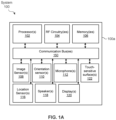
- FIGs. 1A and 1B depict an exemplary system for providing audio information to a user, according to various embodiments.
- the communication of the second type includes conversational sounds. In some embodiments, the communication of the second type includes compressed audio. In some embodiments, the communication of the second type includes a lexical utterance reproduced by an electronic device. In some embodiments, the technique further includes determining the external sound is a lexical utterance reproduced by an electronic device by determining a location corresponding to a source of the external sound. In some embodiments, the location is determined with a directional microphone array.
- a technique for providing audio information includes receiving speech input from a source, the speech input including one or more instructions; detecting one or more visual characteristics associated with the source of the speech input; detecting the speech input has stopped; in response to detecting the speech input has stopped, determining whether the one or more visual characteristics associated with the source indicate that further speech input from the source is expected; in accordance with a determination that further speech input from the source is not expected, providing a response to the one or more instructions; in accordance with a determination that further speech input from the source is expected, forgoing providing a response to the one or more instructions.
- the one or more visual characteristics include eye gaze, facial expression, hand gesture, or a combination thereof.
- the technique further includes, in accordance with the determination that further speech input from the source is expected, forgoing providing the response to the one or more instructions for a predetermined time; and after the predetermined time and in accordance with a determination that the speech input from the source has not resumed, providing a response to the to the one or more instructions.
- FIGs. 1A and 1B depict exemplary system 100 for providing audio information to a user, according to various embodiments.
- system 100 includes device 100a.
- Device 100a includes various components, such as processor(s) 102, RF circuitry(ies) 104, memory(ies) 106, image sensor(s) 108, orientation sensor(s) 110, microphone(s) 112, location sensor(s) 116, speaker(s) 118, display(s) 120, and touch-sensitive surface(s) 122. These components optionally communicate over communication bus(es) 150 of device 100a.
- elements of system 100 are implemented in a base station device (e.g., a computing device, such as a remote server, mobile device, or laptop) and other elements of the system 100 are implemented in an auxiliary device (such as an audio playback device, television, monitor, or head-mounted display (HMD) device), where the auxiliary device is in communication with the base station device.
- a base station device e.g., a computing device, such as a remote server, mobile device, or laptop
- auxiliary device such as an audio playback device, television, monitor, or head-mounted display (HMD) device
- HMD head-mounted display
- device 100a is implemented in a base station device or an auxiliary device.
- system 100 includes two (or more) devices in communication, such as through a wired connection or a wireless connection.
- First device 100b e.g., a base station device
- processor(s) 102 e.g., a base station device
- RF circuitry(ies) 104 e.g., RF circuitry
- memory(ies) 106 e.g., EEPROM
- These components optionally communicate over communication bus(es) 150 of device 100b.
- Second device 100c (e.g., an auxiliary device) includes various components, such as processor(s) 102, RF circuitry(ies) 104, memory(ies) 106, image sensor(s) 108, orientation sensor(s) 110, microphone(s) 112, location sensor(s) 116, speaker(s) 118, display(s) 120, and touch-sensitive surface(s) 122. These components optionally communicate over communication bus(es) 150 of device 100c.
- System 100 includes processor(s) 102 and memory(ies) 106.
- Processor(s) 102 include one or more general processors, one or more graphics processors, and/or one or more digital signal processors.
- memory(ies) 106 are one or more non-transitory computer-readable storage mediums (e.g., flash memory, random access memory) that store computer-readable instructions configured to be executed by processor(s) 102 to perform the techniques described below.
- System 100 includes RF circuitry(ies) 104.
- RF circuitry(ies) 104 optionally include circuitry for communicating with electronic devices, networks, such as the Internet, intranets, and/or a wireless network, such as cellular networks and wireless local area networks (LANs).
- RF circuitry(ies) 104 optionally includes circuitry for communicating using near-field communication and/or short-range communication, such as Bluetooth ® .
- System 100 includes display(s) 120.
- display(s) 120 include a first display (e.g., a left eye display panel) and a second display (e.g., a right eye display panel), each display for displaying images to a respective eye of the user.
- Corresponding images are simultaneously displayed on the first display and the second display.
- the corresponding images include the same virtual objects and/or representations of the same physical objects from different viewpoints, resulting in a parallax effect that provides a user with the illusion of depth of the objects on the displays.
- display(s) 120 include a single display.
- Corresponding images are simultaneously displayed on a first area and a second area of the single display for each eye of the user.
- the corresponding images include the same virtual objects and/or representations of the same physical objects from different viewpoints, resulting in a parallax effect that provides a user with the illusion of depth of the objects on the single display.
- system 100 includes touch-sensitive surface(s) 122 for receiving user inputs, such as tap inputs and swipe inputs.
- touch-sensitive surface(s) 122 for receiving user inputs, such as tap inputs and swipe inputs.
- display(s) 120 and touch-sensitive surface(s) 122 form touch-sensitive display(s).
- Image sensor(s) 108 optionally include one or more visible light image sensor, such as charged coupled device (CCD) sensors, and/or complementary metal-oxide-semiconductor (CMOS) sensors operable to obtain images of physical objects from the real environment.
- Image sensor(s) also optionally include one or more infrared (IR) sensor(s), such as a passive IR sensor or an active IR sensor, for detecting infrared light from the real environment.
- IR infrared
- an active IR sensor includes an IR emitter, such as an IR dot emitter, for emitting infrared light into the real environment.
- Image sensor(s) 108 also optionally include one or more event camera(s) configured to capture movement of physical objects in the real environment.
- Image sensor(s) 108 also optionally include one or more depth sensor(s) configured to detect the distance of physical objects from system 100.
- system 100 uses CCD sensors, event cameras, and depth sensors in combination to detect the physical environment around system 100.
- image sensor(s) 108 include a first image sensor and a second image sensor. The first image sensor and the second image sensor are optionally configured to capture images of physical objects in an environment from two distinct perspectives.
- system 100 uses image sensor(s) 108 to receive user inputs, such as hand gestures.
- system 100 uses image sensor(s) 108 to detect the position and orientation of system 100 and/or display(s) 120 in the environment.
- system 100 uses image sensor(s) 108 to track the position and orientation of one or more objects in the environment.
- system 100 includes microphones(s) 112.
- System 100 uses microphone(s) 112 to detect sound from the user and/or the environment of the user.
- microphone(s) 112 includes an array of microphones (including a plurality of microphones) that optionally operate in tandem, such as to identify ambient noise or to locate the source of sound in space of the environment.
- System 100 includes orientation sensor(s) 110 for detecting orientation and/or movement of system 100 and/or display(s) 120.
- system 100 uses orientation sensor(s) 110 to track changes in the position and/or orientation of system 100 and/or display(s) 120, such as with respect to physical objects in the environment.
- Orientation sensor(s) 110 optionally include one or more gyroscopes and/or one or more accelerometers.
- system 100 implements a digital assistant.
- the digital assistant interprets natural language input in spoken and/or textual form and determines one or more instructions based on the input.
- the digital assistant then performs actions based on the instructions.
- the actions include providing audio information and/or performing tasks responsive to the instructions.
- digital assistant can refer to any information processing system capable of interpreting natural language input and performing actions responsive to the input.
- the natural language input requests either an informational answer or performance of a task by the digital assistant.
- the digital assistant responds to the input by providing requested information in an audio format and/or by performing the requested task. For example, when a user asks the digital assistant "What is the weather forecast for tomorrow?", the digital assistant may respond with the audio answer of "Tomorrow is forecast to be sunny, with a high of 75 degrees and a low of 60 degrees”. As another example, when a user requests "Set an alarm for 6:00 am tomorrow", the digital assistant performs the task of setting a respective alarm and provides an audio confirmation of "An alarm has been set for 6:00 am tomorrow".
- visual information is provided in addition to or instead of audio information (e.g., text, video, animations, etc.).
- the provided information includes media content (e.g., music or video content) and the digital assistant controls playback of the media content (e.g., starting and stopping the music or video content).
- system 100 stops providing the audio information until the conversation between the user and the other person has concluded. In this way, system 100 provides audio information with the digital assistant in a more polite manner.
- system 100 before providing audio information (or resuming the provision of stopped audio information), detects visual characteristics that indicate it is appropriate for the audio information to be provided by the digital assistant. For example, when a user provides a request but stops speaking to think (e.g., "Schedule a meeting for Monday at 9:00 am with Tom and also "), system 100 detects that additional speech is expected and waits to provide audio information.
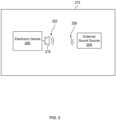
- FIG. 2 depicts an example of electronic device 200 providing audio information 202 in an environment 210, according to various embodiments.
- electronic device 200 is an embodiment of system 100, as described in reference to FIGs. 1A-1B .
- Audio information 202 is provided using speaker(s) 218 in response to a received input.
- the received input is a natural language input in spoken or textual form that includes one or more instructions for a digital assistant implemented by electronic device 200.
- Electronic device 200 determines the one or more instructions based on the received input and provides audio information 202 based on the one or more instructions.
- the received input includes a triggering command (e.g., "Hello Computer") that identifies the input as instructions for the digital assistant.
- a triggering command e.g., "Hello Computer
- electronic device 200 determines whether visual characteristics of the user indicate that further input is expected before providing audio information 202. Examples of visual characteristics include eye gaze, facial expressions, and/or hand gestures. For example, if electronic device 200 detects a person's eyes gazing upward after they have stopped speaking, then electronic device 200 determines that further speech is expected from the person because the upward gaze indicates the person is thinking. In some embodiments, after determining that further input is expected, electronic device 200 waits for a predetermined time. If no further input is provided during the predetermined time, then electronic device 200 proceeds with providing audio information 202. If the visual characteristics of the user do not indicate that further input is expected, then electronic device 200 proceeds with providing audio information 202 after the input from the user has stopped.
- visual characteristics of the user indicate that further input is expected before providing audio information 202.
- electronic device 200 determines whether external sound 206 warrants stopping the provision of the audio information 202 based on the type of external sound 206. For some types of external sounds 206, stopping audio information 202 is unnecessary. For example, conversational sounds that indicate a person is listening or thinking, such as “hmm”, “um”, “okay”, “uh huh”, “yes”, “I see”, and the like, would not warrant stopping the provision of audio information 202.
- external sounds 206 are compressed audio (e.g., sounds from media content such as music or video) or speech being reproduced by an electronic device (e.g., lexical utterances emitted by a television).
- compressed audio e.g., sounds from media content such as music or video
- speech being reproduced by an electronic device e.g., lexical utterances emitted by a television.
- electronic device 200 determines that external sound 206 has characteristics consistent with compressed audio, then electronic device 200 continues providing audio information 202 (e.g., compressed audio is a type of external sound that does not warrant stopping audio information 202).
- electronic device 200 determines that external sound 206 has characteristics consistent with compressed audio, electronic device 200 further determines characteristics of the external sound source 204 and/or the content of the compressed audio. Based on the characteristics of the external sound source 204 emitting the compressed audio and/or the content of the compressed audio, electronic device 200 can continue providing audio information 202 or stop the audio information 202. For example, if electronic device 200 determines external sound source 204 is a television or other device emitting low-priority audio, then electronic device 200 continues providing audio information 202.
- Examples of low-priority audio include prerecorded audio such as music or movies, television programs, or radio broadcasts. However, if electronic device 200 determines external sound source 204 is a telephone or other device emitting high-priority audio, then electronic device 200 can stop providing audio information 202 so as to not distract from the high-priority audio. Examples of high-priority audio include audio of a person speaking in approximately real-time (e.g., a telephone conversion), an alarm, or a warning message.
- external sounds 206 of a type that convey more substantial information are conversations between people, or otherwise include high-priority audio warrant stopping the provision of audio information 202.
- These types of external sounds 206 include directly-vocalized lexical utterances (e.g., external sound 206 emitted by a person speaking in the environment 210). For example, if a person begins speaking to another person in the environment 210 while audio information 202 is being provided, then electronic device 200 can stop the provision of audio information 202 upon detecting the speech. Stopping the provision of audio information 202 allows the two people to have a conversation without being distracted or interrupted by audio information 202.
- audio information 202 is stopped without a user needing to say a silencing or triggering command, such as "stop”, "quiet", “end”, and the like. In some embodiments, stopping the audio information 202 includes fading out the audio information 202.
- electronic device 200 determines the type of external sound 206 based at least in part on a location of the external sound source 204 in the environment 210.
- the location of the external sound source 204 is determined using a microphone array capable of detecting a direction and/or distance of a sound source. If the location of external sound source 204 corresponds to a person (and, optionally, the external sound 204 is not a conversational sound indicate the person is listening or thinking), then electronic device 200 determines that external sound 204 is substantial and stops the provision of audio information 202. However, if the location of external sound source 204 is determined to correspond to an electronic device (e.g., a television or loudspeaker), then electronic device 200 continues to provide audio information 202. In this way, electronic device 200 does not stop providing audio information 202 even when the external sound 206 being emitted by the electronic device sounds like human speech (e.g., a lexical utterance being spoken in a television program).
- human speech e.g., a lexical utter
- electronic device 200 after stopping the provision of audio information 202, electronic device 200 waits to resume the audio information 202 until an appropriate time. For example, if a person is speaking to another person in the environment 210, electronic device 200 waits to resume audio information 202 until further communication between the two people is no longer expected. In some embodiments, electronic device 200 detects that further communication is expected based on visual characteristics of one or more people making the external sounds 206, such as eye gaze, facial expressions, and/or hand gestures. For example, if electronic device 200 detects a person's eyes gazing upward after they have stopped speaking, then electronic device 200 determines that further speech is expected from the person because the upward gaze indicates the person is thinking.
- visual characteristics of one or more people making the external sounds 206 such as eye gaze, facial expressions, and/or hand gestures. For example, if electronic device 200 detects a person's eyes gazing upward after they have stopped speaking, then electronic device 200 determines that further speech is expected from the person because the upward gaze indicates the person is thinking.
- electronic device 200 determines it is appropriate for the audio information 202 to continue, electronic device 200 provides resumed audio information 202.
- electronic device 200 determines it is appropriate for audio information 202 to continue based on visual characteristics of one or more people, such as eye gaze, facial expressions, and/or hand gestures. For example, if system detects a person's eyes are gazing in the direction speaker(s) 218, then electronic device 200 determines that providing resumed audio information is appropriate.
- the audio information 202 is divided into predefined segments, and the resumed audio information begins with the segment where the audio information 202 was stopped. In this way, the resumed audio information can begin with a full phrase or word.
- the resumed audio information includes a rephrased version of a previously provided segment of audio information 202. The rephrased version of the previously provided segment of audio information 202 reminds the listener of where the audio information 202 was stopped without repeating the same (e.g., verbatim) audio information.
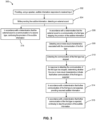
- Process 300 can be performed using an electronic device (e.g., 100a, 200).
- the electronic device is, for example, a desktop computer, a laptop computer, a handheld mobile device, an audio playback device, a television, a monitor, a head-mounted display (HMD) device, or a heads-up display device.
- HMD head-mounted display
- process 300 is performed using two or more electronic devices, such as a user device that is communicatively coupled to another device, such as a base device. In these embodiments, the operations of process 300 are distributed in any manner between the user device and the other device.
- blocks of process 300 are depicted in a particular order in FIG. 3 , it should be appreciated that these blocks can be performed in other orders. Further, one or more blocks of process 300 can be partially performed, optionally performed, combined with another block(s), and/or additional blocks can be performed.
- audio information (e.g., 202) responsive to received input is provided using a speaker (e.g., 118, 218).
- the received input includes a triggering command.
- an external sound e.g. 206 is detected.
- the provision of the audio information is stopped.
- stopping the provision of the audio information includes fading out the audio information.
- the communication of the first type includes a directly-vocalized lexical utterance.
- the directly-vocalized lexical utterance excludes silencing commands.
- the external sound is determined to be a directly-vocalized lexical utterance by determining a location corresponding to a source of the external sound (e.g., 204). In some embodiments, the location corresponding to the source of the external sound is determined with a directional microphone array.
- one or more visual characteristics associated with the communication of the first type are detected.
- the one or more visual characteristics include eye gaze, facial expression, hand gesture, or a combination thereof.
- the communication of the first type is detected to have stopped.
- resumed audio information is provided.
- the resumed audio information is provided after stopping the provision of the audio information and in accordance with a determination that the communication of the first type has stopped.
- the audio information is divided into predefined segments, and the resumed audio information begins with the segment where the audio information was stopped.
- the resumed audio information includes a rephrased version of a previously provided segment of the audio information.
- the communication of the second type includes conversational sounds (e.g., sounds that indicate a person is listening or thinking, such as "hmm”, “um”, “okay”, “uh huh", “yes”, “I see”, and the like).
- the communication of the second type includes compressed audio.
- the communication of the second type includes a lexical utterance (e.g., speech) reproduced by an electronic device.
- the external sound is determined to be a lexical utterance reproduced by an electronic device by determining a location corresponding to a source of the external sound (e.g., 204). In some embodiments, the location of the source of the external sound is determined with a directional microphone array.
- Process 400 can be performed using an electronic device (e.g., 100a, 200).
- the electronic device is, for example, a desktop computer, a laptop computer, a handheld mobile device, an audio playback device, a television, a monitor, a head-mounted display (HMD) device, or a heads-up display device.
- HMD head-mounted display
- process 400 is performed using two or more electronic devices, such as a user device that is communicatively coupled to another device, such as a base device. In these embodiments, the operations of process 400 are distributed in any manner between the user device and the other device.
- blocks of process 400 are depicted in a particular order in FIG. 4 , it should be appreciated that these blocks can be performed in other orders. Further, one or more blocks of process 400 can be partially performed, optionally performed, combined with another block(s), and/or additional blocks can be performed.
- speech input including one or more instructions is received from a source.
- one or more visual characteristics associated with the source of the speech input are detected.
- the one or more visual characteristics include eye gaze, facial expression, hand gesture, or a combination thereof.
- the speech input is detected to have stopped.
- a response to the one or more instructions is provided.
- a response to the one or more instructions is not provided.
- the response to the one or more instructions is not provided for a predetermined time. After the predetermined time, and in accordance with a determination that the speech input from the source has not resumed, a response to the to the one or more instructions is provided.
- Executable instructions for performing the features of methods 300 and/or 400 described above are, optionally, included in a transitory or non-transitory computer-readable storage medium (e.g., memory(ies) 106) or other computer program product configured for execution by one or more processors (e.g., processor(s) 102). Further, some operations in method 300 are, optionally, included in method 400 and some operations in method 400 are, optionally, included in method 300.
Landscapes
- Engineering & Computer Science (AREA)
- Theoretical Computer Science (AREA)
- Physics & Mathematics (AREA)
- Health & Medical Sciences (AREA)
- Human Computer Interaction (AREA)
- General Engineering & Computer Science (AREA)
- Audiology, Speech & Language Pathology (AREA)
- Multimedia (AREA)
- General Physics & Mathematics (AREA)
- Acoustics & Sound (AREA)
- General Health & Medical Sciences (AREA)
- Computational Linguistics (AREA)
- Otolaryngology (AREA)
- Signal Processing (AREA)
- User Interface Of Digital Computer (AREA)
- Circuits Of Receivers In General (AREA)
Description
- The present disclosure relates generally to an electronic device implementing a digital assistant, and more specifically to the electronic device providing audio information with the digital assistant.
- A digital assistant interprets natural language input in spoken and/or textual form and determines a user request based on the input. The digital assistant then performs actions based on the user request. The actions include providing information and/or performing tasks responsive to the user request.
-
US2015/280670A1 discloses a technique which includes outputting, by a computing device associated with a user and for playback at a first volume level by an audio output device, first audio data, receiving, by the computing device, audio input data, and responsive to determining, by the computing device, that the audio input data includes speech associated with an entity different from the user, determining, by the computing device and based at least in part on the audio input data, whether to output second audio data. The method may also include, responsive to determining to output the second audio data: determining, by the computing device, a second volume level lower than the first volume level, and outputting, by the computing device and for playback at the second volume level by the audio output device, the second audio data. -
WO2018/043112A1 discloses an information presentation apparatus and an information presentation method that are capable of making presentation information outputted as audio easily understandable to a user. The information presentation apparatus is provided with: an acquisition unit that acquires presentation information to be presented to a user; a generation unit that generates support information to be presented to the user together with the presentation information on the basis of the acquired presentation information and synthesizes audio corresponding to the generated support information; and a presentation unit that presents the audio synthesized in accordance with the support information as speech of a first agent. - There is provided a method according to claim 1. Optional features are set out in the dependent claims.
- There is also provided a computer-readable storage medium storing one or more programs configured to be executed by one or more processors of an electronic device, the one or more programs including instructions for performing the method.
- There is also provided an electronic device comprising: a speaker; one or more processors; and memory storing one or more programs configured to be executed by the one or more processors, the one or more programs including instructions for performing the method.
- For a better understanding of the various described embodiments, reference should be made to the Detailed Description below, in conjunction with the following drawings in which like reference numerals refer to corresponding parts throughout the figures.
-
FIGs. 1A and1B depict an exemplary system for providing audio information to a user, according to various embodiments. - In some embodiments, the communication of the second type includes conversational sounds. In some embodiments, the communication of the second type includes compressed audio. In some embodiments, the communication of the second type includes a lexical utterance reproduced by an electronic device. In some embodiments, the technique further includes determining the external sound is a lexical utterance reproduced by an electronic device by determining a location corresponding to a source of the external sound. In some embodiments, the location is determined with a directional microphone array.
- According to some embodiments, a technique for providing audio information includes receiving speech input from a source, the speech input including one or more instructions; detecting one or more visual characteristics associated with the source of the speech input; detecting the speech input has stopped; in response to detecting the speech input has stopped, determining whether the one or more visual characteristics associated with the source indicate that further speech input from the source is expected; in accordance with a determination that further speech input from the source is not expected, providing a response to the one or more instructions; in accordance with a determination that further speech input from the source is expected, forgoing providing a response to the one or more instructions.
- In some embodiments, the one or more visual characteristics include eye gaze, facial expression, hand gesture, or a combination thereof. In some embodiments, the technique further includes, in accordance with the determination that further speech input from the source is expected, forgoing providing the response to the one or more instructions for a predetermined time; and after the predetermined time and in accordance with a determination that the speech input from the source has not resumed, providing a response to the to the one or more instructions.
- For a better understanding of the various described embodiments, reference should be made to the Detailed Description below, in conjunction with the following drawings in which like reference numerals refer to corresponding parts throughout the figures.
-
FIGs. 1A and1B depict an exemplary system for providing audio information to a user, according to various embodiments. -
FIG. 2 depicts an example of electronic device providing audio information in an environment, according to various embodiments. -
FIG. 3 depicts a flow chart of an exemplary process for providing audio information, according to various embodiments. -
FIG. 4 depicts a flow chart of another exemplary process for providing audio information, according to various embodiments. - The following description sets forth exemplary methods, parameters, and the like. It should be recognized, however, that such description is not intended as a limitation on the scope of the present disclosure but is instead provided as a description of exemplary embodiments.
-
FIGs. 1A and1B depictexemplary system 100 for providing audio information to a user, according to various embodiments. - In some embodiments, as illustrated in
FIG. 1A ,system 100 includes device 100a. Device 100a includes various components, such as processor(s) 102, RF circuitry(ies) 104, memory(ies) 106, image sensor(s) 108, orientation sensor(s) 110, microphone(s) 112, location sensor(s) 116, speaker(s) 118, display(s) 120, and touch-sensitive surface(s) 122. These components optionally communicate over communication bus(es) 150 of device 100a. - In some embodiments, elements of
system 100 are implemented in a base station device (e.g., a computing device, such as a remote server, mobile device, or laptop) and other elements of thesystem 100 are implemented in an auxiliary device (such as an audio playback device, television, monitor, or head-mounted display (HMD) device), where the auxiliary device is in communication with the base station device. In some embodiments, device 100a is implemented in a base station device or an auxiliary device. - As illustrated in
FIG. 1B , in some embodiments,system 100 includes two (or more) devices in communication, such as through a wired connection or a wireless connection.First device 100b (e.g., a base station device) includes processor(s) 102, RF circuitry(ies) 104, memory(ies) 106. These components optionally communicate over communication bus(es) 150 ofdevice 100b.Second device 100c (e.g., an auxiliary device) includes various components, such as processor(s) 102, RF circuitry(ies) 104, memory(ies) 106, image sensor(s) 108, orientation sensor(s) 110, microphone(s) 112, location sensor(s) 116, speaker(s) 118, display(s) 120, and touch-sensitive surface(s) 122. These components optionally communicate over communication bus(es) 150 ofdevice 100c. -
System 100 includes processor(s) 102 and memory(ies) 106. Processor(s) 102 include one or more general processors, one or more graphics processors, and/or one or more digital signal processors. In some embodiments, memory(ies) 106 are one or more non-transitory computer-readable storage mediums (e.g., flash memory, random access memory) that store computer-readable instructions configured to be executed by processor(s) 102 to perform the techniques described below. -
System 100 includes RF circuitry(ies) 104. RF circuitry(ies) 104 optionally include circuitry for communicating with electronic devices, networks, such as the Internet, intranets, and/or a wireless network, such as cellular networks and wireless local area networks (LANs). RF circuitry(ies) 104 optionally includes circuitry for communicating using near-field communication and/or short-range communication, such as Bluetooth®. -
System 100 includes display(s) 120. In some embodiments, display(s) 120 include a first display (e.g., a left eye display panel) and a second display (e.g., a right eye display panel), each display for displaying images to a respective eye of the user. Corresponding images are simultaneously displayed on the first display and the second display. Optionally, the corresponding images include the same virtual objects and/or representations of the same physical objects from different viewpoints, resulting in a parallax effect that provides a user with the illusion of depth of the objects on the displays. In some embodiments, display(s) 120 include a single display. Corresponding images are simultaneously displayed on a first area and a second area of the single display for each eye of the user. Optionally, the corresponding images include the same virtual objects and/or representations of the same physical objects from different viewpoints, resulting in a parallax effect that provides a user with the illusion of depth of the objects on the single display. - In some embodiments,
system 100 includes touch-sensitive surface(s) 122 for receiving user inputs, such as tap inputs and swipe inputs. In some embodiments, display(s) 120 and touch-sensitive surface(s) 122 form touch-sensitive display(s). -
System 100 includes image sensor(s) 108. Image sensors(s) 108 optionally include one or more visible light image sensor, such as charged coupled device (CCD) sensors, and/or complementary metal-oxide-semiconductor (CMOS) sensors operable to obtain images of physical objects from the real environment. Image sensor(s) also optionally include one or more infrared (IR) sensor(s), such as a passive IR sensor or an active IR sensor, for detecting infrared light from the real environment. For example, an active IR sensor includes an IR emitter, such as an IR dot emitter, for emitting infrared light into the real environment. Image sensor(s) 108 also optionally include one or more event camera(s) configured to capture movement of physical objects in the real environment. Image sensor(s) 108 also optionally include one or more depth sensor(s) configured to detect the distance of physical objects fromsystem 100. In some embodiments,system 100 uses CCD sensors, event cameras, and depth sensors in combination to detect the physical environment aroundsystem 100. In some embodiments, image sensor(s) 108 include a first image sensor and a second image sensor. The first image sensor and the second image sensor are optionally configured to capture images of physical objects in an environment from two distinct perspectives. In some embodiments,system 100 uses image sensor(s) 108 to receive user inputs, such as hand gestures. In some embodiments,system 100 uses image sensor(s) 108 to detect the position and orientation ofsystem 100 and/or display(s) 120 in the environment. For example,system 100 uses image sensor(s) 108 to track the position and orientation of one or more objects in the environment. - In some embodiments,
system 100 includes microphones(s) 112.System 100 uses microphone(s) 112 to detect sound from the user and/or the environment of the user. In some embodiments, microphone(s) 112 includes an array of microphones (including a plurality of microphones) that optionally operate in tandem, such as to identify ambient noise or to locate the source of sound in space of the environment. -
System 100 includes orientation sensor(s) 110 for detecting orientation and/or movement ofsystem 100 and/or display(s) 120. For example,system 100 uses orientation sensor(s) 110 to track changes in the position and/or orientation ofsystem 100 and/or display(s) 120, such as with respect to physical objects in the environment. Orientation sensor(s) 110 optionally include one or more gyroscopes and/or one or more accelerometers. - In some embodiments,
system 100 implements a digital assistant. The digital assistant interprets natural language input in spoken and/or textual form and determines one or more instructions based on the input. The digital assistant then performs actions based on the instructions. In some embodiments, the actions include providing audio information and/or performing tasks responsive to the instructions. The term "digital assistant" can refer to any information processing system capable of interpreting natural language input and performing actions responsive to the input. - Typically, the natural language input requests either an informational answer or performance of a task by the digital assistant. The digital assistant responds to the input by providing requested information in an audio format and/or by performing the requested task. For example, when a user asks the digital assistant "What is the weather forecast for tomorrow?", the digital assistant may respond with the audio answer of "Tomorrow is forecast to be sunny, with a high of 75 degrees and a low of 60 degrees". As another example, when a user requests "Set an alarm for 6:00 am tomorrow", the digital assistant performs the task of setting a respective alarm and provides an audio confirmation of "An alarm has been set for 6:00 am tomorrow".
- In some embodiments, visual information is provided in addition to or instead of audio information (e.g., text, video, animations, etc.). Furthermore, in some embodiments, the provided information includes media content (e.g., music or video content) and the digital assistant controls playback of the media content (e.g., starting and stopping the music or video content).
- In some cases, it would be advantageous to interrupt the provision of audio information by the digital assistant. For example, if a user begins speaking to another person while the digital assistant is providing audio information, then the user may not hear the information being provided by the digital assistant. In this case,
system 100 stops providing the audio information until the conversation between the user and the other person has concluded. In this way,system 100 provides audio information with the digital assistant in a more polite manner. - Furthermore, in some embodiments, before providing audio information (or resuming the provision of stopped audio information),
system 100 detects visual characteristics that indicate it is appropriate for the audio information to be provided by the digital assistant. For example, when a user provides a request but stops speaking to think (e.g., "Schedule a meeting for Monday at 9:00 am with Tom and also ..."),system 100 detects that additional speech is expected and waits to provide audio information. -
FIG. 2 depicts an example ofelectronic device 200 providingaudio information 202 in anenvironment 210, according to various embodiments. In some embodiments,electronic device 200 is an embodiment ofsystem 100, as described in reference toFIGs. 1A-1B .Audio information 202 is provided using speaker(s) 218 in response to a received input. In some embodiments, the received input is a natural language input in spoken or textual form that includes one or more instructions for a digital assistant implemented byelectronic device 200.Electronic device 200 determines the one or more instructions based on the received input and providesaudio information 202 based on the one or more instructions. In some embodiments, the received input includes a triggering command (e.g., "Hello Computer") that identifies the input as instructions for the digital assistant. - In some embodiments, after the input from the user has stopped,
electronic device 200 determines whether visual characteristics of the user indicate that further input is expected before providingaudio information 202. Examples of visual characteristics include eye gaze, facial expressions, and/or hand gestures. For example, ifelectronic device 200 detects a person's eyes gazing upward after they have stopped speaking, thenelectronic device 200 determines that further speech is expected from the person because the upward gaze indicates the person is thinking. In some embodiments, after determining that further input is expected,electronic device 200 waits for a predetermined time. If no further input is provided during the predetermined time, thenelectronic device 200 proceeds with providingaudio information 202. If the visual characteristics of the user do not indicate that further input is expected, thenelectronic device 200 proceeds with providingaudio information 202 after the input from the user has stopped. - If
electronic device 200 detectsexternal sound 206 from externalsound source 204 while providingaudio information 202, thenelectronic device 200 determines whetherexternal sound 206 warrants stopping the provision of theaudio information 202 based on the type ofexternal sound 206. For some types ofexternal sounds 206, stoppingaudio information 202 is unnecessary. For example, conversational sounds that indicate a person is listening or thinking, such as "hmm", "um", "okay", "uh huh", "yes", "I see", and the like, would not warrant stopping the provision ofaudio information 202. Other types ofexternal sounds 206 also would not warrant stopping the provision ofaudio information 202, such asexternal sounds 206 that are compressed audio (e.g., sounds from media content such as music or video) or speech being reproduced by an electronic device (e.g., lexical utterances emitted by a television). - In some embodiments, if
electronic device 200 determines thatexternal sound 206 has characteristics consistent with compressed audio, thenelectronic device 200 continues providing audio information 202 (e.g., compressed audio is a type of external sound that does not warrant stopping audio information 202). In other embodiments, whenelectronic device 200 determines thatexternal sound 206 has characteristics consistent with compressed audio,electronic device 200 further determines characteristics of theexternal sound source 204 and/or the content of the compressed audio. Based on the characteristics of theexternal sound source 204 emitting the compressed audio and/or the content of the compressed audio,electronic device 200 can continue providingaudio information 202 or stop theaudio information 202. For example, ifelectronic device 200 determines externalsound source 204 is a television or other device emitting low-priority audio, thenelectronic device 200 continues providingaudio information 202. Examples of low-priority audio include prerecorded audio such as music or movies, television programs, or radio broadcasts. However, ifelectronic device 200 determines externalsound source 204 is a telephone or other device emitting high-priority audio, thenelectronic device 200 can stop providingaudio information 202 so as to not distract from the high-priority audio. Examples of high-priority audio include audio of a person speaking in approximately real-time (e.g., a telephone conversion), an alarm, or a warning message. - Generally,
external sounds 206 of a type that convey more substantial information, are conversations between people, or otherwise include high-priority audio warrant stopping the provision ofaudio information 202. These types ofexternal sounds 206 include directly-vocalized lexical utterances (e.g.,external sound 206 emitted by a person speaking in the environment 210). For example, if a person begins speaking to another person in theenvironment 210 whileaudio information 202 is being provided, thenelectronic device 200 can stop the provision ofaudio information 202 upon detecting the speech. Stopping the provision ofaudio information 202 allows the two people to have a conversation without being distracted or interrupted byaudio information 202. Similarly, a person in theenvironment 210 making a follow-up request to the digital assistant or otherwise conveying substantial speech would also warrant stopping the provision ofaudio information 202. Notably,audio information 202 is stopped without a user needing to say a silencing or triggering command, such as "stop", "quiet", "end", and the like. In some embodiments, stopping theaudio information 202 includes fading out theaudio information 202. - In some embodiments,
electronic device 200 determines the type ofexternal sound 206 based at least in part on a location of theexternal sound source 204 in theenvironment 210. In some embodiments, the location of theexternal sound source 204 is determined using a microphone array capable of detecting a direction and/or distance of a sound source. If the location of externalsound source 204 corresponds to a person (and, optionally, theexternal sound 204 is not a conversational sound indicate the person is listening or thinking), thenelectronic device 200 determines thatexternal sound 204 is substantial and stops the provision ofaudio information 202. However, if the location of externalsound source 204 is determined to correspond to an electronic device (e.g., a television or loudspeaker), thenelectronic device 200 continues to provideaudio information 202. In this way,electronic device 200 does not stop providingaudio information 202 even when theexternal sound 206 being emitted by the electronic device sounds like human speech (e.g., a lexical utterance being spoken in a television program). - In some embodiments, after stopping the provision of
audio information 202,electronic device 200 waits to resume theaudio information 202 until an appropriate time. For example, if a person is speaking to another person in theenvironment 210,electronic device 200 waits to resumeaudio information 202 until further communication between the two people is no longer expected. In some embodiments,electronic device 200 detects that further communication is expected based on visual characteristics of one or more people making theexternal sounds 206, such as eye gaze, facial expressions, and/or hand gestures. For example, ifelectronic device 200 detects a person's eyes gazing upward after they have stopped speaking, thenelectronic device 200 determines that further speech is expected from the person because the upward gaze indicates the person is thinking. - Once
electronic device 200 determines it is appropriate for theaudio information 202 to continue,electronic device 200 provides resumedaudio information 202. In some embodiments,electronic device 200 determines it is appropriate foraudio information 202 to continue based on visual characteristics of one or more people, such as eye gaze, facial expressions, and/or hand gestures. For example, if system detects a person's eyes are gazing in the direction speaker(s) 218, thenelectronic device 200 determines that providing resumed audio information is appropriate. - In some embodiments, the
audio information 202 is divided into predefined segments, and the resumed audio information begins with the segment where theaudio information 202 was stopped. In this way, the resumed audio information can begin with a full phrase or word. In some embodiments, the resumed audio information includes a rephrased version of a previously provided segment ofaudio information 202. The rephrased version of the previously provided segment ofaudio information 202 reminds the listener of where theaudio information 202 was stopped without repeating the same (e.g., verbatim) audio information. - Turning now to
FIG. 3 , a flow chart ofexemplary process 300 for providing audio information is depicted, according to various embodiments.Process 300 can be performed using an electronic device (e.g., 100a, 200). The electronic device is, for example, a desktop computer, a laptop computer, a handheld mobile device, an audio playback device, a television, a monitor, a head-mounted display (HMD) device, or a heads-up display device. It should be recognized that, in other embodiments,process 300 is performed using two or more electronic devices, such as a user device that is communicatively coupled to another device, such as a base device. In these embodiments, the operations ofprocess 300 are distributed in any manner between the user device and the other device. Although the blocks ofprocess 300 are depicted in a particular order inFIG. 3 , it should be appreciated that these blocks can be performed in other orders. Further, one or more blocks ofprocess 300 can be partially performed, optionally performed, combined with another block(s), and/or additional blocks can be performed. - At
block 302, audio information (e.g., 202) responsive to received input is provided using a speaker (e.g., 118, 218). In some embodiments, the received input includes a triggering command. - At
block 304, while providing the audio information, an external sound (e.g. 206) is detected. - At
block 306, in accordance with a determination that the external sound is a communication of a first type, the provision of the audio information is stopped. In some embodiments, stopping the provision of the audio information includes fading out the audio information. In some embodiments, the communication of the first type includes a directly-vocalized lexical utterance. Optionally, the directly-vocalized lexical utterance excludes silencing commands. - In some embodiments, the external sound is determined to be a directly-vocalized lexical utterance by determining a location corresponding to a source of the external sound (e.g., 204). In some embodiments, the location corresponding to the source of the external sound is determined with a directional microphone array.
- At
block 308, after stopping the provision of the audio information, one or more visual characteristics associated with the communication of the first type are detected. The one or more visual characteristics include eye gaze, facial expression, hand gesture, or a combination thereof. - At
block 310, the communication of the first type is detected to have stopped. - At
block 312, in response to detecting the communication of the first type has stopped, a determination is made whether the one or more visual characteristics indicate that further communication of the first type is expected. - At
block 314, in accordance with a determination that further communication of the first type is not expected, resumed audio information is provided. In some embodiments, the resumed audio information is provided after stopping the provision of the audio information and in accordance with a determination that the communication of the first type has stopped. In some embodiments, the audio information is divided into predefined segments, and the resumed audio information begins with the segment where the audio information was stopped. In some embodiments, the resumed audio information includes a rephrased version of a previously provided segment of the audio information. - At
block 316, in accordance with a determination that further communication of the first type is expected, the provision of the audio information continues to be stopped. - At
block 318, in accordance with a determination that the external sound is a communication of a second type, the provision of the audio information is continued. In some embodiments, the communication of the second type includes conversational sounds (e.g., sounds that indicate a person is listening or thinking, such as "hmm", "um", "okay", "uh huh", "yes", "I see", and the like). In some embodiments, the communication of the second type includes compressed audio. In some embodiments, the communication of the second type includes a lexical utterance (e.g., speech) reproduced by an electronic device. In some embodiments, the external sound is determined to be a lexical utterance reproduced by an electronic device by determining a location corresponding to a source of the external sound (e.g., 204). In some embodiments, the location of the source of the external sound is determined with a directional microphone array. - Turning now to
FIG. 4 , a flow chart ofexemplary process 400 for providing audio information is depicted, according to various embodiments.Process 400 can be performed using an electronic device (e.g., 100a, 200). The electronic device is, for example, a desktop computer, a laptop computer, a handheld mobile device, an audio playback device, a television, a monitor, a head-mounted display (HMD) device, or a heads-up display device. It should be recognized that, in other embodiments,process 400 is performed using two or more electronic devices, such as a user device that is communicatively coupled to another device, such as a base device. In these embodiments, the operations ofprocess 400 are distributed in any manner between the user device and the other device. Although the blocks ofprocess 400 are depicted in a particular order inFIG. 4 , it should be appreciated that these blocks can be performed in other orders. Further, one or more blocks ofprocess 400 can be partially performed, optionally performed, combined with another block(s), and/or additional blocks can be performed. - At
block 402, speech input including one or more instructions is received from a source. - At
block 404, one or more visual characteristics associated with the source of the speech input are detected. The one or more visual characteristics include eye gaze, facial expression, hand gesture, or a combination thereof. - At
block 406, the speech input is detected to have stopped. - At
block 408, in response to detecting the speech input has stopped, a determination is made whether the one or more visual characteristics associated with the source indicate that further speech input from the source is expected. - At
block 410, in accordance with a determination that further speech input from the source is not expected, a response to the one or more instructions is provided. - At
block 412, in accordance with a determination that further speech input from the source is expected, a response to the one or more instructions is not provided. In some embodiments, in accordance with the determination that further speech input from the source is expected, the response to the one or more instructions is not provided for a predetermined time. After the predetermined time, and in accordance with a determination that the speech input from the source has not resumed, a response to the to the one or more instructions is provided. - Executable instructions for performing the features of
methods 300 and/or 400 described above are, optionally, included in a transitory or non-transitory computer-readable storage medium (e.g., memory(ies) 106) or other computer program product configured for execution by one or more processors (e.g., processor(s) 102). Further, some operations inmethod 300 are, optionally, included inmethod 400 and some operations inmethod 400 are, optionally, included inmethod 300. - The foregoing descriptions of specific embodiments have been presented for purposes of illustration and description. They are not intended to be exhaustive or to limit the scope of the claims to the precise forms disclosed, and it should be understood that many modifications and variations are possible in light of the above teaching.
Claims (14)
- A method, comprising:providing (302), using a speaker (118), audio information responsive to received input;while providing the audio information, detecting (304) an external sound;in accordance with a determination that the external sound is a communication of a first type, stopping (306) the provision of the audio information;in accordance with a determination that the external sound is a communication of a second type, continuing (318) the provision of the audio information;after stopping (306) the provision of the audio information:detecting (308) a gaze direction of a user associated with the communication of the first type; anddetecting (310) the communication of the first type has stopped;in response to detecting the communication of the first type has stopped, determining (312) whether the gaze direction of the user is in a first direction or a second direction;in accordance with a determination that the gaze direction of the user is in the first direction, providing (314) resumed audio information; andin accordance with a determination that the gaze direction of the user is in the second direction, continuing (316) to stop the provision of the audio information.
- The method of claim 1, wherein stopping (306) the provision of the audio information includes fading out the audio information.
- The method of any of claims 1-2, further comprising:
after stopping (306) the provision of the audio information and in accordance with a determination that the communication of the first type has stopped, providing resumed audio information. - The method of claim 3, wherein the audio information is divided into predefined segments, and the resumed audio information begins with the segment where the audio information was stopped.
- The method of claim 4, wherein the resumed audio information includes a rephrased version of a previously provided segment of the audio information.
- The method of any of claims 1-5, wherein the communication of the first type includes a directly-vocalized lexical utterance.
- The method of claim 6, wherein the directly-vocalized lexical utterance excludes silencing commands.
- The method of claim 6, further comprising:
determining the external sound is a directly-vocalized lexical utterance by determining a location corresponding to a source of the external sound. - The method of any of claims 1-8, wherein the communication of the second type includes conversational sounds.
- The method of any of claims 1-9, wherein the communication of the second type includes compressed audio.
- The method of any of claims 1-10, wherein the communication of the second type includes a lexical utterance reproduced by an electronic device.
- The method of claim 11, further comprising:
determining the external sound is a lexical utterance reproduced by an electronic device by determining a location corresponding to a source of the external sound. - A computer-readable storage medium storing one or more programs configured to be executed by one or more processors of an electronic device, the one or more programs including instructions for performing the method of any of claims 1-12.
- An electronic device (100a), comprising:a speaker (118);one or more processors (102); andmemory (106) storing one or more programs configured to be executed by the one or more processors, the one or more programs including instructions for performing the method of any of claims 1-12.
Priority Applications (2)
| Application Number | Priority Date | Filing Date | Title |
|---|---|---|---|
| EP25173842.3A EP4571487A3 (en) | 2018-06-01 | 2019-04-24 | Providing audio information with a digital assistant |
| EP25208683.0A EP4654001A3 (en) | 2018-06-01 | 2019-04-24 | Providing audio information with a digital assistant |
Applications Claiming Priority (2)
| Application Number | Priority Date | Filing Date | Title |
|---|---|---|---|
| US201862679644P | 2018-06-01 | 2018-06-01 | |
| PCT/US2019/028976 WO2019231587A1 (en) | 2018-06-01 | 2019-04-24 | Providing audio information with a digital assistant |
Related Child Applications (3)
| Application Number | Title | Priority Date | Filing Date |
|---|---|---|---|
| EP25173842.3A Division EP4571487A3 (en) | 2018-06-01 | 2019-04-24 | Providing audio information with a digital assistant |
| EP25173842.3A Division-Into EP4571487A3 (en) | 2018-06-01 | 2019-04-24 | Providing audio information with a digital assistant |
| EP25208683.0A Division EP4654001A3 (en) | 2018-06-01 | 2019-04-24 | Providing audio information with a digital assistant |
Publications (2)
| Publication Number | Publication Date |
|---|---|
| EP3782017A1 EP3782017A1 (en) | 2021-02-24 |
| EP3782017B1 true EP3782017B1 (en) | 2025-06-18 |
Family
ID=66821327
Family Applications (3)
| Application Number | Title | Priority Date | Filing Date |
|---|---|---|---|
| EP25173842.3A Withdrawn EP4571487A3 (en) | 2018-06-01 | 2019-04-24 | Providing audio information with a digital assistant |
| EP25208683.0A Pending EP4654001A3 (en) | 2018-06-01 | 2019-04-24 | Providing audio information with a digital assistant |
| EP19729898.7A Active EP3782017B1 (en) | 2018-06-01 | 2019-04-24 | Providing audio information with a digital assistant |
Family Applications Before (2)
| Application Number | Title | Priority Date | Filing Date |
|---|---|---|---|
| EP25173842.3A Withdrawn EP4571487A3 (en) | 2018-06-01 | 2019-04-24 | Providing audio information with a digital assistant |
| EP25208683.0A Pending EP4654001A3 (en) | 2018-06-01 | 2019-04-24 | Providing audio information with a digital assistant |
Country Status (6)
| Country | Link |
|---|---|
| US (3) | US11609739B2 (en) |
| EP (3) | EP4571487A3 (en) |
| KR (3) | KR102884843B1 (en) |
| CN (2) | CN118897621A (en) |
| AU (2) | AU2019279597B2 (en) |
| WO (1) | WO2019231587A1 (en) |
Families Citing this family (7)
| Publication number | Priority date | Publication date | Assignee | Title |
|---|---|---|---|---|
| AU2019279597B2 (en) | 2018-06-01 | 2021-11-18 | Apple Inc. | Providing audio information with a digital assistant |
| SE545310C2 (en) * | 2019-12-20 | 2023-06-27 | Tobii Ab | Improved turn-taking |
| US11740856B2 (en) * | 2021-01-07 | 2023-08-29 | Meta Platforms, Inc. | Systems and methods for resolving overlapping speech in a communication session |
| US12487466B2 (en) | 2022-07-28 | 2025-12-02 | Snap Inc. | Magnified overlays correlated with virtual markers |
| US12210667B2 (en) | 2022-08-05 | 2025-01-28 | Snap Inc. | Medical image overlays for augmented reality experiences |
| US12400650B2 (en) * | 2022-10-11 | 2025-08-26 | Snap Inc. | Media control tools for managing communications between devices |
| CN116015996B (en) * | 2023-03-28 | 2023-06-02 | 南昌航天广信科技有限责任公司 | Digital conference audio processing method and system |
Family Cites Families (35)
| Publication number | Priority date | Publication date | Assignee | Title |
|---|---|---|---|---|
| JP3272906B2 (en) * | 1995-05-29 | 2002-04-08 | シャープ株式会社 | Gaze direction detecting method and apparatus and man-machine interface apparatus including the same |
| TWI241828B (en) * | 2004-02-18 | 2005-10-11 | Partner Tech Corp | Handheld personal data assistant (PDA) for communicating with a mobile in music-playing operation |
| US20050191971A1 (en) * | 2004-02-26 | 2005-09-01 | Boone Michael K. | Assisted listening device |
| CN1780374A (en) * | 2004-11-24 | 2006-05-31 | 上海乐金广电电子有限公司 | Multifunctional controlling method by key operating technology in digit signalling receiver |
| US20120072936A1 (en) * | 2010-09-20 | 2012-03-22 | Microsoft Corporation | Automatic Customized Advertisement Generation System |
| US8954177B2 (en) * | 2011-06-01 | 2015-02-10 | Apple Inc. | Controlling operation of a media device based upon whether a presentation device is currently being worn by a user |
| EP3413575A1 (en) * | 2011-08-05 | 2018-12-12 | Samsung Electronics Co., Ltd. | Method for controlling electronic apparatus based on voice recognition and electronic apparatus applying the same |
| US20150109191A1 (en) | 2012-02-16 | 2015-04-23 | Google Inc. | Speech Recognition |
| US9601113B2 (en) * | 2012-05-16 | 2017-03-21 | Xtreme Interactions Inc. | System, device and method for processing interlaced multimodal user input |
| JP5720656B2 (en) * | 2012-11-02 | 2015-05-20 | ヤマハ株式会社 | Music system management method |
| EP2760015A1 (en) * | 2013-01-23 | 2014-07-30 | BlackBerry Limited | Event-triggered hands-free multitasking for media playback |
| KR102698417B1 (en) * | 2013-02-07 | 2024-08-26 | 애플 인크. | Voice trigger for a digital assistant |
| US9270244B2 (en) * | 2013-03-13 | 2016-02-23 | Personics Holdings, Llc | System and method to detect close voice sources and automatically enhance situation awareness |
| US9368114B2 (en) * | 2013-03-14 | 2016-06-14 | Apple Inc. | Context-sensitive handling of interruptions |
| US9110635B2 (en) * | 2013-12-03 | 2015-08-18 | Lenova (Singapore) Pte. Ltd. | Initiating personal assistant application based on eye tracking and gestures |
| EP2921899B1 (en) | 2014-03-21 | 2018-07-04 | Samsung Electronics Co., Ltd | Head-mounted display and method of operating the same |
| KR20150112337A (en) * | 2014-03-27 | 2015-10-07 | 삼성전자주식회사 | display apparatus and user interaction method thereof |
| US8874448B1 (en) * | 2014-04-01 | 2014-10-28 | Google Inc. | Attention-based dynamic audio level adjustment |
| AU2015266863B2 (en) | 2014-05-30 | 2018-03-15 | Apple Inc. | Multi-command single utterance input method |
| KR102188268B1 (en) * | 2014-10-08 | 2020-12-08 | 엘지전자 주식회사 | Mobile terminal and method for controlling the same |
| KR20160071732A (en) * | 2014-12-12 | 2016-06-22 | 삼성전자주식회사 | Method and apparatus for processing voice input |
| US9911416B2 (en) * | 2015-03-27 | 2018-03-06 | Qualcomm Incorporated | Controlling electronic device based on direction of speech |
| US9646628B1 (en) * | 2015-06-26 | 2017-05-09 | Amazon Technologies, Inc. | Noise cancellation for open microphone mode |
| US10331312B2 (en) | 2015-09-08 | 2019-06-25 | Apple Inc. | Intelligent automated assistant in a media environment |
| US10747498B2 (en) | 2015-09-08 | 2020-08-18 | Apple Inc. | Zero latency digital assistant |
| JP2017090611A (en) | 2015-11-09 | 2017-05-25 | 三菱自動車工業株式会社 | Speech recognition control system |
| EP3188495B1 (en) * | 2015-12-30 | 2020-11-18 | GN Audio A/S | A headset with hear-through mode |
| US20170318374A1 (en) * | 2016-05-02 | 2017-11-02 | Microsoft Technology Licensing, Llc | Headset, an apparatus and a method with automatic selective voice pass-through |
| US9922655B2 (en) * | 2016-05-31 | 2018-03-20 | International Business Machines Corporation | System, method, and recording medium for controlling dialogue interruptions by a speech output device |
| US9877100B1 (en) * | 2016-08-29 | 2018-01-23 | Motorola Mobility Llc | Audio sensing to alert device user |
| EP3506083A4 (en) | 2016-08-29 | 2019-08-07 | Sony Corporation | INFORMATION PRESENTATION APPARATUS AND INFORMATION PRESENTATION METHOD |
| US11449167B2 (en) * | 2017-06-26 | 2022-09-20 | Inpris Innovative Products Fromisrael, Ltd | Systems using dual touch and sound control, and methods thereof |
| CN111684820B (en) * | 2018-02-23 | 2022-04-26 | 雅马哈株式会社 | Control device, vehicle, sound reproducing device, and program |
| AU2019279597B2 (en) | 2018-06-01 | 2021-11-18 | Apple Inc. | Providing audio information with a digital assistant |
| US10681453B1 (en) * | 2019-06-12 | 2020-06-09 | Bose Corporation | Automatic active noise reduction (ANR) control to improve user interaction |
-
2019
- 2019-04-24 AU AU2019279597A patent/AU2019279597B2/en active Active
- 2019-04-24 CN CN202410930317.9A patent/CN118897621A/en active Pending
- 2019-04-24 EP EP25173842.3A patent/EP4571487A3/en not_active Withdrawn
- 2019-04-24 US US17/056,126 patent/US11609739B2/en active Active
- 2019-04-24 KR KR1020247009443A patent/KR102884843B1/en active Active
- 2019-04-24 KR KR1020207034292A patent/KR102488285B1/en active Active
- 2019-04-24 WO PCT/US2019/028976 patent/WO2019231587A1/en not_active Ceased
- 2019-04-24 EP EP25208683.0A patent/EP4654001A3/en active Pending
- 2019-04-24 CN CN201980033654.5A patent/CN112154412B/en active Active
- 2019-04-24 EP EP19729898.7A patent/EP3782017B1/en active Active
- 2019-04-24 KR KR1020237001029A patent/KR102651249B1/en active Active
-
2022
- 2022-02-17 AU AU2022201037A patent/AU2022201037B2/en active Active
-
2023
- 2023-03-20 US US18/123,886 patent/US11861265B2/en active Active
- 2023-11-14 US US18/389,485 patent/US12147733B2/en active Active
Also Published As
| Publication number | Publication date |
|---|---|
| EP4654001A2 (en) | 2025-11-26 |
| CN112154412B (en) | 2024-07-16 |
| US20240086147A1 (en) | 2024-03-14 |
| KR102651249B1 (en) | 2024-03-27 |
| US20230229387A1 (en) | 2023-07-20 |
| AU2022201037A1 (en) | 2022-03-10 |
| US11609739B2 (en) | 2023-03-21 |
| EP4654001A3 (en) | 2026-01-21 |
| EP4571487A2 (en) | 2025-06-18 |
| WO2019231587A1 (en) | 2019-12-05 |
| KR102884843B1 (en) | 2025-11-13 |
| AU2022201037B2 (en) | 2023-05-25 |
| US12147733B2 (en) | 2024-11-19 |
| EP3782017A1 (en) | 2021-02-24 |
| CN118897621A (en) | 2024-11-05 |
| KR20240042222A (en) | 2024-04-01 |
| EP4571487A3 (en) | 2025-08-06 |
| KR102488285B1 (en) | 2023-01-13 |
| AU2019279597A1 (en) | 2020-12-10 |
| KR20230010845A (en) | 2023-01-19 |
| KR20210005200A (en) | 2021-01-13 |
| CN112154412A (en) | 2020-12-29 |
| AU2019279597B2 (en) | 2021-11-18 |
| US11861265B2 (en) | 2024-01-02 |
| US20210224031A1 (en) | 2021-07-22 |
Similar Documents
| Publication | Publication Date | Title |
|---|---|---|
| EP3782017B1 (en) | Providing audio information with a digital assistant | |
| US10402162B2 (en) | Automatic speech recognition (ASR) feedback for head mounted displays (HMD) | |
| US12032155B2 (en) | Method and head-mounted unit for assisting a hearing-impaired user | |
| KR102115222B1 (en) | Electronic device for controlling sound and method for operating thereof | |
| CN104303177B (en) | Execute the method and earphone computing device of real-time phonetic translation | |
| CN115605948B (en) | Arbitration among multiple potentially responding electronic devices | |
| US11644902B2 (en) | Gesture-based content transfer | |
| WO2019107145A1 (en) | Information processing device and information processing method | |
| CN115620728B (en) | Audio processing method and device, storage medium and intelligent glasses | |
| WO2020026850A1 (en) | Information processing device, information processing method, and program | |
| US12405703B2 (en) | Digital assistant interactions in extended reality | |
| KR20180138017A (en) | Device and system for voice recognition | |
| WO2016206646A1 (en) | Method and system for urging machine device to generate action | |
| KR20200058354A (en) | Electronic device for controlling sound and method for operating thereof | |
| US20260082106A1 (en) | Dynamic replay of av content based on lack of user understanding |
Legal Events
| Date | Code | Title | Description |
|---|---|---|---|
| STAA | Information on the status of an ep patent application or granted ep patent |
Free format text: STATUS: UNKNOWN |
|
| STAA | Information on the status of an ep patent application or granted ep patent |
Free format text: STATUS: THE INTERNATIONAL PUBLICATION HAS BEEN MADE |
|
| PUAI | Public reference made under article 153(3) epc to a published international application that has entered the european phase |
Free format text: ORIGINAL CODE: 0009012 |
|
| STAA | Information on the status of an ep patent application or granted ep patent |
Free format text: STATUS: REQUEST FOR EXAMINATION WAS MADE |
|
| 17P | Request for examination filed |
Effective date: 20201117 |
|
| AK | Designated contracting states |
Kind code of ref document: A1 Designated state(s): AL AT BE BG CH CY CZ DE DK EE ES FI FR GB GR HR HU IE IS IT LI LT LU LV MC MK MT NL NO PL PT RO RS SE SI SK SM TR |
|
| AX | Request for extension of the european patent |
Extension state: BA ME |
|
| DAV | Request for validation of the european patent (deleted) | ||
| DAX | Request for extension of the european patent (deleted) | ||
| STAA | Information on the status of an ep patent application or granted ep patent |
Free format text: STATUS: EXAMINATION IS IN PROGRESS |
|
| 17Q | First examination report despatched |
Effective date: 20220725 |
|
| GRAP | Despatch of communication of intention to grant a patent |
Free format text: ORIGINAL CODE: EPIDOSNIGR1 |
|
| STAA | Information on the status of an ep patent application or granted ep patent |
Free format text: STATUS: GRANT OF PATENT IS INTENDED |
|
| INTG | Intention to grant announced |
Effective date: 20250225 |
|
| GRAS | Grant fee paid |
Free format text: ORIGINAL CODE: EPIDOSNIGR3 |
|
| GRAA | (expected) grant |
Free format text: ORIGINAL CODE: 0009210 |
|
| STAA | Information on the status of an ep patent application or granted ep patent |
Free format text: STATUS: THE PATENT HAS BEEN GRANTED |
|
| AK | Designated contracting states |
Kind code of ref document: B1 Designated state(s): AL AT BE BG CH CY CZ DE DK EE ES FI FR GB GR HR HU IE IS IT LI LT LU LV MC MK MT NL NO PL PT RO RS SE SI SK SM TR |
|
| REG | Reference to a national code |
Ref country code: GB Ref legal event code: FG4D |
|
| REG | Reference to a national code |
Ref country code: CH Ref legal event code: EP |
|
| REG | Reference to a national code |
Ref country code: DE Ref legal event code: R096 Ref document number: 602019071239 Country of ref document: DE |
|
| REG | Reference to a national code |
Ref country code: CH Ref legal event code: EP |
|
| P01 | Opt-out of the competence of the unified patent court (upc) registered |
Free format text: CASE NUMBER: APP_28040/2025 Effective date: 20250611 |
|
| REG | Reference to a national code |
Ref country code: IE Ref legal event code: FG4D |
|
| REG | Reference to a national code |
Ref country code: NL Ref legal event code: FP |
|
| PG25 | Lapsed in a contracting state [announced via postgrant information from national office to epo] |
Ref country code: FI Free format text: LAPSE BECAUSE OF FAILURE TO SUBMIT A TRANSLATION OF THE DESCRIPTION OR TO PAY THE FEE WITHIN THE PRESCRIBED TIME-LIMIT Effective date: 20250618 |
|
| REG | Reference to a national code |
Ref country code: LT Ref legal event code: MG9D |
|
| PG25 | Lapsed in a contracting state [announced via postgrant information from national office to epo] |
Ref country code: NO Free format text: LAPSE BECAUSE OF FAILURE TO SUBMIT A TRANSLATION OF THE DESCRIPTION OR TO PAY THE FEE WITHIN THE PRESCRIBED TIME-LIMIT Effective date: 20250918 Ref country code: GR Free format text: LAPSE BECAUSE OF FAILURE TO SUBMIT A TRANSLATION OF THE DESCRIPTION OR TO PAY THE FEE WITHIN THE PRESCRIBED TIME-LIMIT Effective date: 20250919 |
|
| PG25 | Lapsed in a contracting state [announced via postgrant information from national office to epo] |
Ref country code: BG Free format text: LAPSE BECAUSE OF FAILURE TO SUBMIT A TRANSLATION OF THE DESCRIPTION OR TO PAY THE FEE WITHIN THE PRESCRIBED TIME-LIMIT Effective date: 20250618 |
|
| PG25 | Lapsed in a contracting state [announced via postgrant information from national office to epo] |
Ref country code: HR Free format text: LAPSE BECAUSE OF FAILURE TO SUBMIT A TRANSLATION OF THE DESCRIPTION OR TO PAY THE FEE WITHIN THE PRESCRIBED TIME-LIMIT Effective date: 20250618 |
|
| PG25 | Lapsed in a contracting state [announced via postgrant information from national office to epo] |
Ref country code: RS Free format text: LAPSE BECAUSE OF FAILURE TO SUBMIT A TRANSLATION OF THE DESCRIPTION OR TO PAY THE FEE WITHIN THE PRESCRIBED TIME-LIMIT Effective date: 20250918 |
|
| PG25 | Lapsed in a contracting state [announced via postgrant information from national office to epo] |
Ref country code: LV Free format text: LAPSE BECAUSE OF FAILURE TO SUBMIT A TRANSLATION OF THE DESCRIPTION OR TO PAY THE FEE WITHIN THE PRESCRIBED TIME-LIMIT Effective date: 20250618 |
|
| PG25 | Lapsed in a contracting state [announced via postgrant information from national office to epo] |
Ref country code: PT Free format text: LAPSE BECAUSE OF FAILURE TO SUBMIT A TRANSLATION OF THE DESCRIPTION OR TO PAY THE FEE WITHIN THE PRESCRIBED TIME-LIMIT Effective date: 20251020 |
|
| REG | Reference to a national code |
Ref country code: AT Ref legal event code: MK05 Ref document number: 1804821 Country of ref document: AT Kind code of ref document: T Effective date: 20250618 |
|
| PG25 | Lapsed in a contracting state [announced via postgrant information from national office to epo] |
Ref country code: IS Free format text: LAPSE BECAUSE OF FAILURE TO SUBMIT A TRANSLATION OF THE DESCRIPTION OR TO PAY THE FEE WITHIN THE PRESCRIBED TIME-LIMIT Effective date: 20251018 |
|
| PG25 | Lapsed in a contracting state [announced via postgrant information from national office to epo] |
Ref country code: AT Free format text: LAPSE BECAUSE OF FAILURE TO SUBMIT A TRANSLATION OF THE DESCRIPTION OR TO PAY THE FEE WITHIN THE PRESCRIBED TIME-LIMIT Effective date: 20250618 Ref country code: SM Free format text: LAPSE BECAUSE OF FAILURE TO SUBMIT A TRANSLATION OF THE DESCRIPTION OR TO PAY THE FEE WITHIN THE PRESCRIBED TIME-LIMIT Effective date: 20250618 |
|
| PG25 | Lapsed in a contracting state [announced via postgrant information from national office to epo] |
Ref country code: CZ Free format text: LAPSE BECAUSE OF FAILURE TO SUBMIT A TRANSLATION OF THE DESCRIPTION OR TO PAY THE FEE WITHIN THE PRESCRIBED TIME-LIMIT Effective date: 20250618 |
|
| PG25 | Lapsed in a contracting state [announced via postgrant information from national office to epo] |
Ref country code: PL Free format text: LAPSE BECAUSE OF FAILURE TO SUBMIT A TRANSLATION OF THE DESCRIPTION OR TO PAY THE FEE WITHIN THE PRESCRIBED TIME-LIMIT Effective date: 20250618 |
|
| PG25 | Lapsed in a contracting state [announced via postgrant information from national office to epo] |
Ref country code: EE Free format text: LAPSE BECAUSE OF FAILURE TO SUBMIT A TRANSLATION OF THE DESCRIPTION OR TO PAY THE FEE WITHIN THE PRESCRIBED TIME-LIMIT Effective date: 20250618 |
|
| PG25 | Lapsed in a contracting state [announced via postgrant information from national office to epo] |
Ref country code: RO Free format text: LAPSE BECAUSE OF FAILURE TO SUBMIT A TRANSLATION OF THE DESCRIPTION OR TO PAY THE FEE WITHIN THE PRESCRIBED TIME-LIMIT Effective date: 20250618 Ref country code: SK Free format text: LAPSE BECAUSE OF FAILURE TO SUBMIT A TRANSLATION OF THE DESCRIPTION OR TO PAY THE FEE WITHIN THE PRESCRIBED TIME-LIMIT Effective date: 20250618 |
|
| PG25 | Lapsed in a contracting state [announced via postgrant information from national office to epo] |
Ref country code: ES Free format text: LAPSE BECAUSE OF FAILURE TO SUBMIT A TRANSLATION OF THE DESCRIPTION OR TO PAY THE FEE WITHIN THE PRESCRIBED TIME-LIMIT Effective date: 20250618 |