EP3780221B1 - Lithium rechargeable battery and card with built-in battery - Google Patents
Lithium rechargeable battery and card with built-in battery Download PDFInfo
- Publication number
- EP3780221B1 EP3780221B1 EP19776980.5A EP19776980A EP3780221B1 EP 3780221 B1 EP3780221 B1 EP 3780221B1 EP 19776980 A EP19776980 A EP 19776980A EP 3780221 B1 EP3780221 B1 EP 3780221B1
- Authority
- EP
- European Patent Office
- Prior art keywords
- positive electrode
- negative electrode
- electrode plate
- secondary battery
- lithium secondary
- Prior art date
- Legal status (The legal status is an assumption and is not a legal conclusion. Google has not performed a legal analysis and makes no representation as to the accuracy of the status listed.)
- Active
Links
Images


Classifications
-
- G—PHYSICS
- G06—COMPUTING OR CALCULATING; COUNTING
- G06K—GRAPHICAL DATA READING; PRESENTATION OF DATA; RECORD CARRIERS; HANDLING RECORD CARRIERS
- G06K19/00—Record carriers for use with machines and with at least a part designed to carry digital markings
- G06K19/06—Record carriers for use with machines and with at least a part designed to carry digital markings characterised by the kind of the digital marking, e.g. shape, nature, code
- G06K19/067—Record carriers with conductive marks, printed circuits or semiconductor circuit elements, e.g. credit or identity cards also with resonating or responding marks without active components
- G06K19/07—Record carriers with conductive marks, printed circuits or semiconductor circuit elements, e.g. credit or identity cards also with resonating or responding marks without active components with integrated circuit chips
- G06K19/0701—Record carriers with conductive marks, printed circuits or semiconductor circuit elements, e.g. credit or identity cards also with resonating or responding marks without active components with integrated circuit chips at least one of the integrated circuit chips comprising an arrangement for power management
- G06K19/0702—Record carriers with conductive marks, printed circuits or semiconductor circuit elements, e.g. credit or identity cards also with resonating or responding marks without active components with integrated circuit chips at least one of the integrated circuit chips comprising an arrangement for power management the arrangement including a battery
- G06K19/0704—Record carriers with conductive marks, printed circuits or semiconductor circuit elements, e.g. credit or identity cards also with resonating or responding marks without active components with integrated circuit chips at least one of the integrated circuit chips comprising an arrangement for power management the arrangement including a battery the battery being rechargeable, e.g. solar batteries
-
- H—ELECTRICITY
- H01—ELECTRIC ELEMENTS
- H01M—PROCESSES OR MEANS, e.g. BATTERIES, FOR THE DIRECT CONVERSION OF CHEMICAL ENERGY INTO ELECTRICAL ENERGY
- H01M10/00—Secondary cells; Manufacture thereof
- H01M10/04—Construction or manufacture in general
- H01M10/0436—Small-sized flat cells or batteries for portable equipment
-
- H—ELECTRICITY
- H01—ELECTRIC ELEMENTS
- H01M—PROCESSES OR MEANS, e.g. BATTERIES, FOR THE DIRECT CONVERSION OF CHEMICAL ENERGY INTO ELECTRICAL ENERGY
- H01M10/00—Secondary cells; Manufacture thereof
- H01M10/05—Accumulators with non-aqueous electrolyte
- H01M10/052—Li-accumulators
- H01M10/0525—Rocking-chair batteries, i.e. batteries with lithium insertion or intercalation in both electrodes; Lithium-ion batteries
-
- H—ELECTRICITY
- H01—ELECTRIC ELEMENTS
- H01M—PROCESSES OR MEANS, e.g. BATTERIES, FOR THE DIRECT CONVERSION OF CHEMICAL ENERGY INTO ELECTRICAL ENERGY
- H01M10/00—Secondary cells; Manufacture thereof
- H01M10/05—Accumulators with non-aqueous electrolyte
- H01M10/058—Construction or manufacture
- H01M10/0585—Construction or manufacture of accumulators having only flat construction elements, i.e. flat positive electrodes, flat negative electrodes and flat separators
-
- H—ELECTRICITY
- H01—ELECTRIC ELEMENTS
- H01M—PROCESSES OR MEANS, e.g. BATTERIES, FOR THE DIRECT CONVERSION OF CHEMICAL ENERGY INTO ELECTRICAL ENERGY
- H01M4/00—Electrodes
- H01M4/02—Electrodes composed of, or comprising, active material
- H01M4/13—Electrodes for accumulators with non-aqueous electrolyte, e.g. for lithium-accumulators; Processes of manufacture thereof
- H01M4/131—Electrodes based on mixed oxides or hydroxides, or on mixtures of oxides or hydroxides, e.g. LiCoOx
-
- H—ELECTRICITY
- H01—ELECTRIC ELEMENTS
- H01M—PROCESSES OR MEANS, e.g. BATTERIES, FOR THE DIRECT CONVERSION OF CHEMICAL ENERGY INTO ELECTRICAL ENERGY
- H01M4/00—Electrodes
- H01M4/02—Electrodes composed of, or comprising, active material
- H01M4/13—Electrodes for accumulators with non-aqueous electrolyte, e.g. for lithium-accumulators; Processes of manufacture thereof
- H01M4/133—Electrodes based on carbonaceous material, e.g. graphite-intercalation compounds or CFx
-
- H—ELECTRICITY
- H01—ELECTRIC ELEMENTS
- H01M—PROCESSES OR MEANS, e.g. BATTERIES, FOR THE DIRECT CONVERSION OF CHEMICAL ENERGY INTO ELECTRICAL ENERGY
- H01M4/00—Electrodes
- H01M4/02—Electrodes composed of, or comprising, active material
- H01M4/36—Selection of substances as active materials, active masses, active liquids
- H01M4/48—Selection of substances as active materials, active masses, active liquids of inorganic oxides or hydroxides
- H01M4/52—Selection of substances as active materials, active masses, active liquids of inorganic oxides or hydroxides of nickel, cobalt or iron
- H01M4/525—Selection of substances as active materials, active masses, active liquids of inorganic oxides or hydroxides of nickel, cobalt or iron of mixed oxides or hydroxides containing iron, cobalt or nickel for inserting or intercalating light metals, e.g. LiNiO2, LiCoO2 or LiCoOxFy
-
- H—ELECTRICITY
- H01—ELECTRIC ELEMENTS
- H01M—PROCESSES OR MEANS, e.g. BATTERIES, FOR THE DIRECT CONVERSION OF CHEMICAL ENERGY INTO ELECTRICAL ENERGY
- H01M4/00—Electrodes
- H01M4/02—Electrodes composed of, or comprising, active material
- H01M4/36—Selection of substances as active materials, active masses, active liquids
- H01M4/58—Selection of substances as active materials, active masses, active liquids of inorganic compounds other than oxides or hydroxides, e.g. sulfides, selenides, tellurides, halogenides or LiCoFy; of polyanionic structures, e.g. phosphates, silicates or borates
- H01M4/583—Carbonaceous material, e.g. graphite-intercalation compounds or CFx
- H01M4/587—Carbonaceous material, e.g. graphite-intercalation compounds or CFx for inserting or intercalating light metals
-
- H—ELECTRICITY
- H01—ELECTRIC ELEMENTS
- H01M—PROCESSES OR MEANS, e.g. BATTERIES, FOR THE DIRECT CONVERSION OF CHEMICAL ENERGY INTO ELECTRICAL ENERGY
- H01M50/00—Constructional details or processes of manufacture of the non-active parts of electrochemical cells other than fuel cells, e.g. hybrid cells
- H01M50/10—Primary casings; Jackets or wrappings
- H01M50/116—Primary casings; Jackets or wrappings characterised by the material
- H01M50/117—Inorganic material
- H01M50/119—Metals
-
- H—ELECTRICITY
- H01—ELECTRIC ELEMENTS
- H01M—PROCESSES OR MEANS, e.g. BATTERIES, FOR THE DIRECT CONVERSION OF CHEMICAL ENERGY INTO ELECTRICAL ENERGY
- H01M50/00—Constructional details or processes of manufacture of the non-active parts of electrochemical cells other than fuel cells, e.g. hybrid cells
- H01M50/10—Primary casings; Jackets or wrappings
- H01M50/116—Primary casings; Jackets or wrappings characterised by the material
- H01M50/121—Organic material
-
- H—ELECTRICITY
- H01—ELECTRIC ELEMENTS
- H01M—PROCESSES OR MEANS, e.g. BATTERIES, FOR THE DIRECT CONVERSION OF CHEMICAL ENERGY INTO ELECTRICAL ENERGY
- H01M50/00—Constructional details or processes of manufacture of the non-active parts of electrochemical cells other than fuel cells, e.g. hybrid cells
- H01M50/10—Primary casings; Jackets or wrappings
- H01M50/116—Primary casings; Jackets or wrappings characterised by the material
- H01M50/124—Primary casings; Jackets or wrappings characterised by the material having a layered structure
-
- H—ELECTRICITY
- H01—ELECTRIC ELEMENTS
- H01M—PROCESSES OR MEANS, e.g. BATTERIES, FOR THE DIRECT CONVERSION OF CHEMICAL ENERGY INTO ELECTRICAL ENERGY
- H01M50/00—Constructional details or processes of manufacture of the non-active parts of electrochemical cells other than fuel cells, e.g. hybrid cells
- H01M50/10—Primary casings; Jackets or wrappings
- H01M50/131—Primary casings; Jackets or wrappings characterised by physical properties, e.g. gas permeability, size or heat resistance
- H01M50/133—Thickness
-
- H—ELECTRICITY
- H01—ELECTRIC ELEMENTS
- H01M—PROCESSES OR MEANS, e.g. BATTERIES, FOR THE DIRECT CONVERSION OF CHEMICAL ENERGY INTO ELECTRICAL ENERGY
- H01M50/00—Constructional details or processes of manufacture of the non-active parts of electrochemical cells other than fuel cells, e.g. hybrid cells
- H01M50/20—Mountings; Secondary casings or frames; Racks, modules or packs; Suspension devices; Shock absorbers; Transport or carrying devices; Holders
- H01M50/204—Racks, modules or packs for multiple batteries or multiple cells
- H01M50/207—Racks, modules or packs for multiple batteries or multiple cells characterised by their shape
- H01M50/209—Racks, modules or packs for multiple batteries or multiple cells characterised by their shape adapted for prismatic or rectangular cells
-
- H—ELECTRICITY
- H01—ELECTRIC ELEMENTS
- H01M—PROCESSES OR MEANS, e.g. BATTERIES, FOR THE DIRECT CONVERSION OF CHEMICAL ENERGY INTO ELECTRICAL ENERGY
- H01M50/00—Constructional details or processes of manufacture of the non-active parts of electrochemical cells other than fuel cells, e.g. hybrid cells
- H01M50/40—Separators; Membranes; Diaphragms; Spacing elements inside cells
- H01M50/409—Separators, membranes or diaphragms characterised by the material
- H01M50/411—Organic material
-
- H—ELECTRICITY
- H01—ELECTRIC ELEMENTS
- H01M—PROCESSES OR MEANS, e.g. BATTERIES, FOR THE DIRECT CONVERSION OF CHEMICAL ENERGY INTO ELECTRICAL ENERGY
- H01M50/00—Constructional details or processes of manufacture of the non-active parts of electrochemical cells other than fuel cells, e.g. hybrid cells
- H01M50/40—Separators; Membranes; Diaphragms; Spacing elements inside cells
- H01M50/409—Separators, membranes or diaphragms characterised by the material
- H01M50/411—Organic material
- H01M50/414—Synthetic resins, e.g. thermoplastics or thermosetting resins
-
- H—ELECTRICITY
- H01—ELECTRIC ELEMENTS
- H01M—PROCESSES OR MEANS, e.g. BATTERIES, FOR THE DIRECT CONVERSION OF CHEMICAL ENERGY INTO ELECTRICAL ENERGY
- H01M50/00—Constructional details or processes of manufacture of the non-active parts of electrochemical cells other than fuel cells, e.g. hybrid cells
- H01M50/40—Separators; Membranes; Diaphragms; Spacing elements inside cells
- H01M50/409—Separators, membranes or diaphragms characterised by the material
- H01M50/411—Organic material
- H01M50/414—Synthetic resins, e.g. thermoplastics or thermosetting resins
- H01M50/417—Polyolefins
-
- H—ELECTRICITY
- H01—ELECTRIC ELEMENTS
- H01M—PROCESSES OR MEANS, e.g. BATTERIES, FOR THE DIRECT CONVERSION OF CHEMICAL ENERGY INTO ELECTRICAL ENERGY
- H01M50/00—Constructional details or processes of manufacture of the non-active parts of electrochemical cells other than fuel cells, e.g. hybrid cells
- H01M50/40—Separators; Membranes; Diaphragms; Spacing elements inside cells
- H01M50/409—Separators, membranes or diaphragms characterised by the material
- H01M50/411—Organic material
- H01M50/429—Natural polymers
-
- H—ELECTRICITY
- H01—ELECTRIC ELEMENTS
- H01M—PROCESSES OR MEANS, e.g. BATTERIES, FOR THE DIRECT CONVERSION OF CHEMICAL ENERGY INTO ELECTRICAL ENERGY
- H01M50/00—Constructional details or processes of manufacture of the non-active parts of electrochemical cells other than fuel cells, e.g. hybrid cells
- H01M50/40—Separators; Membranes; Diaphragms; Spacing elements inside cells
- H01M50/409—Separators, membranes or diaphragms characterised by the material
- H01M50/411—Organic material
- H01M50/429—Natural polymers
- H01M50/4295—Natural cotton, cellulose or wood
-
- H—ELECTRICITY
- H01—ELECTRIC ELEMENTS
- H01M—PROCESSES OR MEANS, e.g. BATTERIES, FOR THE DIRECT CONVERSION OF CHEMICAL ENERGY INTO ELECTRICAL ENERGY
- H01M50/00—Constructional details or processes of manufacture of the non-active parts of electrochemical cells other than fuel cells, e.g. hybrid cells
- H01M50/40—Separators; Membranes; Diaphragms; Spacing elements inside cells
- H01M50/409—Separators, membranes or diaphragms characterised by the material
- H01M50/44—Fibrous material
-
- H—ELECTRICITY
- H01—ELECTRIC ELEMENTS
- H01M—PROCESSES OR MEANS, e.g. BATTERIES, FOR THE DIRECT CONVERSION OF CHEMICAL ENERGY INTO ELECTRICAL ENERGY
- H01M50/00—Constructional details or processes of manufacture of the non-active parts of electrochemical cells other than fuel cells, e.g. hybrid cells
- H01M50/40—Separators; Membranes; Diaphragms; Spacing elements inside cells
- H01M50/463—Separators, membranes or diaphragms characterised by their shape
-
- H—ELECTRICITY
- H01—ELECTRIC ELEMENTS
- H01M—PROCESSES OR MEANS, e.g. BATTERIES, FOR THE DIRECT CONVERSION OF CHEMICAL ENERGY INTO ELECTRICAL ENERGY
- H01M4/00—Electrodes
- H01M4/02—Electrodes composed of, or comprising, active material
- H01M2004/021—Physical characteristics, e.g. porosity, surface area
-
- H—ELECTRICITY
- H01—ELECTRIC ELEMENTS
- H01M—PROCESSES OR MEANS, e.g. BATTERIES, FOR THE DIRECT CONVERSION OF CHEMICAL ENERGY INTO ELECTRICAL ENERGY
- H01M4/00—Electrodes
- H01M4/02—Electrodes composed of, or comprising, active material
- H01M2004/026—Electrodes composed of, or comprising, active material characterised by the polarity
- H01M2004/027—Negative electrodes
-
- H—ELECTRICITY
- H01—ELECTRIC ELEMENTS
- H01M—PROCESSES OR MEANS, e.g. BATTERIES, FOR THE DIRECT CONVERSION OF CHEMICAL ENERGY INTO ELECTRICAL ENERGY
- H01M4/00—Electrodes
- H01M4/02—Electrodes composed of, or comprising, active material
- H01M2004/026—Electrodes composed of, or comprising, active material characterised by the polarity
- H01M2004/028—Positive electrodes
-
- H—ELECTRICITY
- H01—ELECTRIC ELEMENTS
- H01M—PROCESSES OR MEANS, e.g. BATTERIES, FOR THE DIRECT CONVERSION OF CHEMICAL ENERGY INTO ELECTRICAL ENERGY
- H01M2220/00—Batteries for particular applications
- H01M2220/30—Batteries in portable systems, e.g. mobile phone, laptop
-
- Y—GENERAL TAGGING OF NEW TECHNOLOGICAL DEVELOPMENTS; GENERAL TAGGING OF CROSS-SECTIONAL TECHNOLOGIES SPANNING OVER SEVERAL SECTIONS OF THE IPC; TECHNICAL SUBJECTS COVERED BY FORMER USPC CROSS-REFERENCE ART COLLECTIONS [XRACs] AND DIGESTS
- Y02—TECHNOLOGIES OR APPLICATIONS FOR MITIGATION OR ADAPTATION AGAINST CLIMATE CHANGE
- Y02E—REDUCTION OF GREENHOUSE GAS [GHG] EMISSIONS, RELATED TO ENERGY GENERATION, TRANSMISSION OR DISTRIBUTION
- Y02E60/00—Enabling technologies; Technologies with a potential or indirect contribution to GHG emissions mitigation
- Y02E60/10—Energy storage using batteries
-
- Y—GENERAL TAGGING OF NEW TECHNOLOGICAL DEVELOPMENTS; GENERAL TAGGING OF CROSS-SECTIONAL TECHNOLOGIES SPANNING OVER SEVERAL SECTIONS OF THE IPC; TECHNICAL SUBJECTS COVERED BY FORMER USPC CROSS-REFERENCE ART COLLECTIONS [XRACs] AND DIGESTS
- Y02—TECHNOLOGIES OR APPLICATIONS FOR MITIGATION OR ADAPTATION AGAINST CLIMATE CHANGE
- Y02P—CLIMATE CHANGE MITIGATION TECHNOLOGIES IN THE PRODUCTION OR PROCESSING OF GOODS
- Y02P70/00—Climate change mitigation technologies in the production process for final industrial or consumer products
- Y02P70/50—Manufacturing or production processes characterised by the final manufactured product
Definitions
- the present invention relates to a lithium secondary battery and a card with built-in battery.
- smart cards with built-in battery are being put into practical use.
- Examples of smart cards with built-in primary battery include credit cards with one-time password display function.
- Examples of smart cards with built-in secondary battery include cards with fingerprint authentication and wireless communication functions provided with wireless communication IC, ASIC for fingerprint analysis, and a fingerprint sensor.
- Such batteries for smart cards are generally required to have properties such as a thickness of less than 0.45 mm, a high capacity and a low resistance, a bending resistance, and a thermal resistance to withstand the processing temperature.
- Patent Literature 1 JP2017-79192A discloses a secondary battery to be built in a plate member such as a card and having a sufficient strength even in the case where the plate member is bent and deformed.
- the secondary battery includes an electrode assembly including a positive electrode and a negative electrode, a sheet-like laminate film-covered body the outer peripheral side of which is welded while covering the electrode assembly, and a positive electrode connection terminal and a negative electrode connection terminal with one end side connected to the electrode assembly and the other end side extending outward from the laminate film-covered body.
- Patent Literature 2 JP2006-331838A discloses a thin battery on the surface of which large wrinkles are less likely to occur and which has excellent flexibility.
- the thin battery includes: a battery body accommodating a separator, a positive electrode layer, and a negative electrode layer between a positive electrode current collector and a negative electrode current collector; and a seal part including a frame member made of resin and hermetically sealing the periphery of the battery body, wherein 100 ⁇ m ⁇ D1 ⁇ 320 ⁇ m and D1/D2 ⁇ 0.85 are satisfied when the thickness of the seal part is referred to as D1, and the maximum thickness of the battery center is referred to as D2.
- powder-dispersed positive electrodes produced by applying a positive electrode mixture containing a positive electrode active material, a conductive agent, a binder, and the like, followed by drying, are employed.
- powder-dispersed positive electrodes generally contain a relatively large amount (e.g., about 10% by weight) of components (such as binders and conductive agents) that do not contribute to the capacity of battery, resulting in a low packing density of the positive electrode active material, i.e., lithium complex oxide. Accordingly, the powder-dispersed positive electrode should be greatly improved from the viewpoint of the capacity and charge/discharge efficiency.
- Some attempts have been made to improve the capacity and charge/discharge efficiency by positive electrodes or layers of positive electrode active material composed of lithium complex oxide sintered plate. In this case, since the positive electrode or the layer of positive electrode active material contains no binder or conductive agent, high capacity and satisfactory charge/discharge efficiency can be expected due to a high packing density of lithium complex oxide.
- Patent Literature 3 JP5587052B discloses a positive electrode including a positive electrode current collector and a positive electrode active material layer connected to the positive electrode current collector with a conductive bonding layer therebetween.
- the positive electrode active material layer is composed of a lithium complex oxide sintered plate, and the sintered plate has a thickness of 30 ⁇ m or more, a porosity of 3 to 30%, and an open pore rate of 70% or more.
- Patent Literature 4 discloses use of an oriented sintered plate including a plurality of primary grains composed of lithium complex oxide such as lithium cobaltate (LiCoO 2 ), the plurality of primary grains being oriented at an average orientation angle of over 0° and 30° or less to the plate face in the positive electrode plate, as a positive electrode of a lithium secondary battery including a solid electrolyte.
- lithium complex oxide such as lithium cobaltate (LiCoO 2 )
- LiCoO 2 lithium cobaltate
- the inventors have now found that, in a lithium secondary battery in the form of a film-covered battery including a positive electrode sintered plate, wrinkles are less likely to occur in the vicinity of the end of the positive electrode plate, even if bending is repeated, when the portions of the negative electrode layer and the separator corresponding to the outer extension of the battery are deviated toward the positive electrode plate side from the portions of the negative electrode layer and the separator corresponding to the body of the battery.
- wrinkles are less likely to occur in the vicinity of the end of the positive electrode plate, also in the case where a repeated bending test over hundreds of times required in JIS is performed on a film-covered lithium secondary battery satisfying the aforementioned conditions in the form of a card with built-in battery.
- an object of the present invention is to provide a lithium secondary battery in film-covered form including a lithium composite oxide sintered plate as a positive electrode plate, wherein wrinkles are less likely to occur in the vicinity of the end of the positive electrode plate even if the battery (particularly, in the form of a card with built-in battery) is repeatedly bent.
- a card with built-in battery comprising: a resin substrate; and the aforementioned lithium secondary battery embedded within the resin substrate.
- FIGs 1A and 1B schematically show an example of a lithium secondary battery of the present invention.
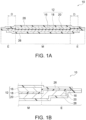
- a lithium secondary battery 10 shown in Figures 1A and 1B has a positive electrode plate 16, a separator 18, a negative electrode layer 20, an electrolytic solution (not shown), and a pair of exterior films 26.
- the positive electrode plate 16 is a lithium complex oxide sintered plate.
- the negative electrode layer 20 contains carbon and has a size larger than the size of the positive electrode plate 16.
- the separator 18 is interposed between the positive electrode plate 16 and the negative electrode layer 20 and has a size larger than the sizes of the positive electrode plate 16 and the negative electrode layer 20.
- the positive electrode plate 16, the negative electrode layer 20, and the separator 18 are impregnated with the electrolytic solution.
- the pair of exterior films 26 have outer peripheral edges sealed with each other to form an internal space, and the internal space accommodates the positive electrode plate 16, the negative electrode layer 20, the separator 18, and the electrolytic solution.
- the separator 18 has an outer peripheral portion in close contact with at least the outer peripheral edge of the exterior film 26 on the positive electrode plate 16 side or a peripheral region in the vicinity thereof, to separate a compartment accommodating the positive electrode plate 16 and a compartment accommodating the negative electrode layer 20 from each other.
- the lithium secondary battery 10 includes a body M in which a multi-layer structure including the positive electrode plate 16, the separator 18, the negative electrode layer 20, and the pair of exterior films 26 exists throughout the entire area, and an outer extension E which is located outwardly of the outer peripheral edge of the positive electrode plate 16 and includes the separator 18, the negative electrode layer 20, and the pair of exterior films 26.
- the portions of the negative electrode layer 20 and the separator 18 corresponding to the outer extension E are deviated toward the positive electrode plate 16 side from the portions of the negative electrode layer 20 and the separator 18 corresponding to the body M.
- wrinkles are less likely to occur in the vicinity of the end of the positive electrode plate, even if bending is repeated, when the portions of the negative electrode layer 20 and the separator 18 corresponding to the outer extension E are deviated toward the positive electrode plate 16 side from the portions of the negative electrode layer 20 and the separator 18 corresponding to the body M.
- wrinkles are less likely to occur in the vicinity of the end of the positive electrode plate, even in the case where the lithium secondary battery 10 in the form of a card with built-in battery that satisfies the aforementioned conditions is subjected to a repeated bending test over hundreds of times required in JIS.
- the cards with built-in film-covered battery including a lithium complex oxide sintered plate (positive electrode plate) as disclosed in Patent Literatures 3 and 4 have a problem that wrinkles are likely to occur on the card surface in the vicinity of the end of the positive electrode plate in the case where a repeated bending test over hundreds of times required in JIS is performed, as described above.
- the lithium secondary battery of the present invention can effectively reduce such wrinkles.
- the lithium secondary battery 10 of the present invention is preferably a thin secondary battery capable to be built in a card, more preferably a thin secondary battery for being embedded in a resin substrate to form a card.
- a card with built-in battery including a resin substrate and a lithium secondary battery embedded in the resin substrate.
- the card with built-in battery typically includes a pair of resin films and a lithium secondary battery interposed between the pair of resin films, and the resin films are preferably bonded to each other by an adhesive or thermally fused with each other by hot pressing.
- the portions of the negative electrode layer 20 and the separator 18 corresponding to the outer extension E are deviated toward the positive electrode plate 16 side from the portions of the negative electrode layer 20 and the separator 18 corresponding to the body M.
- the phrase "being deviated toward the positive electrode plate 16 side” means that, when a center line passing through the center in the thickness direction of the negative electrode layer 20 or the separator 18 is drawn in a cross section of the lithium secondary battery 10, the center line in the outer extension E is shifted toward the positive electrode plate 16 side (that is, toward the exterior film 26 in contact with the positive electrode plate 16) from the center line in the body M.
- the portions of the negative electrode layer 20 and the separator 18 corresponding to the outer extension E enters (cuts into) the outer region around the positive electrode plate 16.
- the positive electrode plate 16 is a lithium complex oxide sintered plate.
- the fact that the positive electrode plate 16 is a sintered plate means that the positive electrode plate 16 contains no binder. This is because, even if a binder is contained in a green seat, the binder disappears or burns out during firing. Then, since the positive electrode plate 16 contains no binder, there is an advantage that deterioration of the positive electrode due to the electrolytic solution can be avoided.
- the lithium complex oxide constituting the sintered plate is particularly preferably lithium cobaltate (typically, LiCoO 2 (which will be hereinafter abbreviated as LCO)).
- LCO lithium cobaltate
- Various lithium complex oxide sintered plates or LCO sintered plates are known, and those disclosed in Patent Literature 3 ( JP5587052B ) and Patent Literature 4 ( WO2017/146088 ) can be used, for example.
- the positive electrode plate 16 that is, the lithium complex oxide sintered plate is an oriented positive electrode plate including a plurality of primary grains composed of lithium complex oxide, the plurality of primary grains being oriented at an average orientation angle of over 0° and 30° or less to the plate face of the positive electrode plate.
- Figure 3 shows an example of a SEM image in a cross section perpendicular to the plate face of the oriented positive electrode plate 16
- Figure 4 shows an electron backscatter diffraction (EBSD: Electron Backscatter Diffraction) image in a cross section perpendicular to the plate face of the oriented positive electrode plate 16.
- EBSD Electron Backscatter Diffraction
- Figure 5 shows an area-based histogram showing the distribution of orientation angles of primary grains 11 in the EBSD image shown in Figure 4 .
- the discontinuity of crystal orientation can be observed.
- the orientation angle of each primary grain 11 is indicated by the shading of color. A darker color indicates a smaller orientation angle.
- the orientation angle is a tilt angle formed by plane (003) of the primary grains 11 to the plate face direction.
- the points shown in black within the oriented positive electrode plate 16 represent pores.
- the oriented positive electrode plate 16 is an oriented sintered body composed of the plurality of primary grains 11 bound to each other.
- the primary grains 11 are each mainly in the form of a plate but may include rectangular, cubic, and spherical grains.
- the cross-sectional shape of each primary grain 11 is not particularly limited and may be a rectangular shape, a polygonal shape other than the rectangular shape, a circular shape, an elliptical shape, or a complex shape other than above.
- the primary grains 11 are composed of a lithium complex oxide.
- the lithium complex oxide is an oxide represented by Li x MO 2 (where 0.05 ⁇ x ⁇ 1.10 is satisfied, M represents at least one transition metal, and M typically contains one or more of Co, Ni, and Mn).
- the lithium complex oxide has a layered rock-salt structure.
- the layered rock-salt structure refers to a crystalline structure in which lithium layers and transition metal layers other than lithium are alternately stacked with oxygen layers interposed therebetween, that is, a crystalline structure in which transition metal ion layers and single lithium layers are alternately stacked with oxide ions therebetween (typically, an ⁇ -NaFeO 2 structure, i.e., a cubic rock-salt structure in which transition metal and lithium are regularly disposed in the [111] axis direction).
- lithium complex oxide examples include Li x CoO 2 (lithium cobaltate), Li x NiO 2 (lithium nickelate), Li x MnO 2 (lithium manganate), Li x NiMnO 2 (lithium nickel manganate), Li x NiCoO 2 (lithium nickel cobaltate), Li x CoNiMnO 2 (lithium cobalt nickel manganate), and Li x CoMnO 2 (lithium cobalt manganate), particularly preferably Li x CoO 2 (lithium cobaltate, typically LiCoO 2 ).
- the lithium complex oxide may contain one or more elements selected from Mg, Al, Si, Ca, Ti, V, Cr, Fe, Cu, Zn, Ga, Ge, Sr, Y, Zr, Nb, Mo, Ag, Sn, Sb, Te, Ba, Bi, and W.
- the average of the orientation angles of the primary grains 11, that is, the average orientation angle is over 0° and 30° or less.
- the oriented positive electrode plate 16 expands and contracts smoothly since the oriented positive electrode plate 16 expands and contracts more in the thickness direction than in the plate face direction, as described above, and thus the lithium ions also move in and out smoothly.
- the average orientation angle of the primary grains 11 is obtained by the following method. First, three horizontal lines that divide the oriented positive electrode plate 16 into four equal parts in the thickness direction and three vertical lines that divide the oriented positive electrode plate 16 into four equal parts in the plate face direction are drawn in an EBSD image of a rectangular region of 95 ⁇ m ⁇ 125 ⁇ m observed at a magnification of 1000 times, as shown in Figure 4 . Next, the average orientation angle of the primary grains 11 is obtained by arithmetically averaging the orientation angles of all the primary grains 11 intersecting at least one of the three horizontal lines and the three vertical lines. The average orientation angle of the primary grains 11 is preferably 30° or less, more preferably 25° or less, from the viewpoint of further improving the rate characteristics. From the viewpoint of further improving the rate characteristics, the average orientation angle of the primary grains 11 is preferably 2° or more, more preferably 5° or more.
- the orientation angles of the primary grains 11 may be widely distributed from 0° to 90°, but most of them are preferably distributed in the region of over 0° and 30° or less. That is, when a cross section of the oriented sintered body constituting the oriented positive electrode plate 16 is analyzed by EBSD, the total area of the primary grains 11 with an orientation angle of over 0° and 30° or less to the plate face of the oriented positive electrode plate 16 (which will be hereinafter referred to as low-angle primary grains) out of the primary grains 11 contained in the cross section analyzed is preferably 70% or more, more preferably 80% or more, with respect to the total area of the primary grains 11 contained in the cross section (specifically, 30 primary grains 11 used for calculating the average orientation angle).
- the proportion of the primary grains 11 with high mutual adhesion can be increased, so that the rate characteristic can be further improved.
- the total area of grains with an orientation angle of 20° or less among the low-angle primary grains is more preferably 50% or more with respect to the total area of 30 primary grains 11 used for calculating the average orientation angle.
- the total area of grains with an orientation angle of 10° or less among the low-angle primary grains is more preferably 15% or more with respect to the total area of 30 primary grains 11 used for calculating the average orientation angle.
- the cross section of each primary grain 11 extends in a predetermined direction, typically in a substantially rectangular shape, as shown in Figures 3 and 4 . That is, when the cross section of the oriented sintered body is analyzed by EBSD, the total area of the primary grains 11 with an aspect ratio of 4 or more in the primary grains 11 contained in the cross section analyzed is preferably 70% or more, more preferably 80% or more, with respect to the total area of the primary grains 11 contained in the cross section (specifically, 30 primary grains 11 used for calculating the average orientation angle).
- the mutual adhesion between the primary grains 11 can be further improved by above, as a result of which the rate characteristic can be further improved.
- the aspect ratio of each primary grain 11 is a value obtained by dividing the maximum Feret diameter of the primary grain 11 by the minimum Feret diameter.
- the maximum Feret diameter is the maximum distance between two parallel straight lines that interpose the primary grain 11 therebetween on the EBSD image in observation of the cross section.
- the minimum Feret diameter is the minimum distance between two parallel straight lines that interpose the primary grain 11 therebetween on the EBSD image.
- the mean diameter of the plurality of primary grains constituting the oriented sintered body is preferably 5 ⁇ m or more.
- the mean diameter of the 30 primary grains 11 used for calculating the average orientation angle is preferably 5 ⁇ m or more, more preferably 7 ⁇ m or more, further preferably 12 ⁇ m or more.
- the mean diameter of the primary grains 11 is a value obtained by arithmetically averaging the equivalent circle diameters of the primary grains 11.
- An equivalent circle diameter is the diameter of a circle having the same area as each primary grain 11 on the EBSD image.
- the denseness of the oriented sintered body constituting the oriented positive electrode plate 16 is preferably 70% or more, more preferably 80% or more, further preferably 90% or more. Thereby, the mutual adhesion between the primary grains 11 can be further improved, so that the rate characteristic can be further improved.
- the denseness of the oriented sintered body is calculated by polishing a cross section of the positive electrode plate with CP (cross-section polisher) polishing, thereafter observing the cross section at a magnification of 1000 times with SEM, and binarizing the SEM image obtained.
- the average equivalent circle diameter of pores formed inside the oriented sintered body is not particularly limited but is preferably 8 ⁇ m or less. The smaller the average equivalent circle diameter of the pores, the mutual adhesion between the primary grains 11 can be improved more.
- the average equivalent circle diameter of the pores is a value obtained by arithmetically averaging the equivalent circle diameters of 10 pores on the EBSD image.
- An equivalent circle diameter is the diameter of a circle having the same area as each pore on the EBSD image.
- the pores formed inside the oriented sintered body may be open pores connected to the outside of the oriented positive electrode plate 16 but preferably do not pass through the oriented positive electrode plate 16.
- the pores may be closed pores.
- the thickness of the positive electrode plate 16 is 70 to 120 ⁇ m, preferably 80 to 100 ⁇ m, further preferably 80 to 95 ⁇ m, particularly preferably 85 to 95 ⁇ m.
- the thickness within such a range can suppress the deterioration of the battery characteristics (particularly, the increase of the resistance value) due to repeated charging and discharging and further reduce the wrinkles in the vicinity of the end of the positive electrode plate 16 due to repeated bending more effectively, while improving the energy density of the lithium secondary battery 10 by increasing the capacity of the active material per unit area.
- the size of the positive electrode plate 16 is preferably 5 mm ⁇ 5 mm square or more, more preferably 10 mm ⁇ 10 mm to 200 mm ⁇ 200 mm square, further preferably 10 mm ⁇ 10 mm to 100 mm ⁇ 100 mm square, in other words, preferably 25 mm 2 or more, more preferably 100 to 40000 mm 2 , further preferably 100 to 10000 mm 2 .
- the negative electrode layer 20 contains carbon as the negative electrode active material.
- the carbon include graphite, pyrolytic carbon, cokes, resin fired materials, mesophase small spheres, and mesophase pitches, preferably graphite.
- Graphite may be any of natural graphite and artificial graphite.
- the negative electrode layer 20 preferably further contains a binder.
- the binder include styrene butadiene rubber (SBR), polyvinylidene fluoride (PVDF), and polytetrafluoroethylene (PTFE), preferably styrene butadiene rubber (SBR) or polyvinylidene fluoride (PVDF).
- the thickness of the negative electrode layer 20 is 70 to 160 ⁇ m, preferably 80 to 150 ⁇ m, further preferably 90 to 140 ⁇ m, particularly preferably 100 to 130 ⁇ m.
- the thickness within such a range can reduce the wrinkles in the vicinity of the end of the positive electrode plate 16 due to repeated bending more effectively while improving the energy density of the lithium secondary battery 10 by increasing the capacity of the active material per unit area.
- the separator 18 include separators made of polyolefin, polyimide, polyester (e.g., polyethylene terephthalate (PET)), or cellulose.
- the polyolefin include polypropylene (PP), polyethylene (PE), and combination of these. From the viewpoint of being inexpensive, separators made of polyolefin or cellulose are preferable.
- the surface of the separator 18 may be coated with ceramics such as alumina (Al 2 O 3 ), magnesia (MgO), and silica (SiO 2 ). Meanwhile, from the viewpoint of excellent heat resistance, separators made of polyimide or cellulose are preferable.
- separators made of polyimide, polyester (e.g., polyethylene terephthalate (PET)), or cellulose themselves have not only excellent heat resistance, but also the component of the electrolytic liquid, ⁇ -butyrolactone (GBL), having excellent heat resistance exhibits excellent wettability thereon. Accordingly, in the case of using an electrolytic solution containing GBL, the electrolytic solution can sufficiently penetrate into the separator (without repelling).
- Separators made of polyimide are particularly preferable from the viewpoint of the heat resistance. Separators made of polyimide are commercially available and have an advantage of being capable of preventing or delaying the extension of lithium dendrite that deposits during overcharge and the resulting short circuit more effectively by having an extremely complicated microstructure.
- the electrolytic solution (not shown) is not specifically limited, and commercially available electrolytic solutions for lithium batteries such as a solution obtained by dissolving a lithium salt (e.g., LiPF 6 ) in an organic solvent (e.g., a mixed solvent of ethylene carbonate (EC) and methylethyl carbonate (MEC), a mixed solvent of ethylene carbonate (EC) and diethyl carbonate (DEC), or a mixed solvent of ethylene carbonate (EC) and ethyl methyl carbonate (EMC)) may be used.
- a lithium salt e.g., LiPF 6
- organic solvent e.g., a mixed solvent of ethylene carbonate (EC) and methylethyl carbonate (MEC
- MEC methylethyl carbonate
- DEC diethyl carbonate
- EMC ethyl methyl carbonate
- the electrolytic solution preferably contains lithium borofluoride (LiBF 4 ) in a non-aqueous solvent.
- the non-aqueous solvent may be a single solvent composed of ⁇ -butyrolactone (GBL) or may be a mixed solvent composed of ⁇ -butyrolactone (GBL) and ethylene carbonate (EC).
- the non-aqueous solvent has an increased boiling point by containing ⁇ -butyrolactone (GBL), which considerably improves the heat resistance.
- the volume ratio of EC:GBL in the non-aqueous solvent is preferably 0:1 to 1:1 (GBL ratio: 50 to 100% by volume), more preferably 0:1 to 1:1.5 (GBL ratio: 60 to 100% by volume), further preferably 0:1 to 1:2 (GBL ratio: 66.6 to 100% by volume), particularly preferably 0:1 to 1:3 (GBL ratio: 75 to 100% by volume).
- the lithium borofluoride (LiBF 4 ) to be dissolved in the non-aqueous solvent is an electrolyte having a high decomposition temperature, which also considerably improves the heat resistance.
- the LiBF 4 concentration in the electrolytic solution is preferably 0.5 to 2 mol/L, more preferably 0.6 to 1.9 mol/L, further preferably 0.7 to 1.7 mol/L, particularly preferably 0.8 to 1.5 mol/L.
- the electrolytic solution preferably further contains vinylene carbonate (VC) and/or fluoroethylene carbonate (FEC) and/or vinyl ethylene carbonate (VEC) as additives. Both VC and FEC have excellent heat resistance. Accordingly, a SEI film having excellent heat resistance can be formed on the surface of the negative electrode layer 20 by the electrolytic solution containing such additives.
- VC vinylene carbonate
- FEC fluoroethylene carbonate
- VEC vinyl ethylene carbonate
- SEI film having excellent heat resistance can be formed on the surface of the negative electrode layer 20 by the electrolytic solution containing such additives.
- the thickness of the lithium secondary battery 10 is preferably 350 to 500 ⁇ m, more preferably 380 to 450 ⁇ m, further preferably 400 to 430 ⁇ m.
- the thickness within such a range can make a thin lithium battery suitable for being built in a thin device such as a smart card. Further, it also contributes to reducing the wrinkles in the vicinity of the end of the positive electrode plate 16 due to repeated bending.
- the battery elements 12 that are components of the lithium secondary battery 10 and the electrolytic solution are packaged and sealed with the pair of exterior films 26.
- the lithium secondary battery 10 is in the form of a so-called film-covered battery.
- the battery elements 12 are defined as containing the positive electrode plate 16, the separator 18, and the negative electrode layer 20 and typically further contain a positive electrode current collector (not shown) and a negative electrode current collector (not shown).
- the positive electrode current collector and the negative electrode current collector are not specifically limited but are preferably metal foils such as copper foils and aluminum foils.
- the positive electrode current collector is preferably interposed between the positive electrode plate 16 and the exterior film 26, and the negative electrode current collector is preferably interposed between the negative electrode layer 20 and the exterior film 26. Further, the positive electrode current collector is preferably provided with a positive electrode terminal extending from the positive electrode current collector, and the negative electrode current collector is preferably provided with a negative electrode terminal extending from the negative electrode current collector.
- the outer edges of the lithium secondary battery 10 are preferably sealed by the exterior films 26 thermally fused with each other. The sealing by thermal fusion is preferably performed using a heat bar (referred to also as heating bar) generally used for heat sealing applications.
- the outer peripheral edges of the pair of exterior films 26 are typically in the form of the four sides of the lithium secondary battery 10 and are preferably sealed throughout all the outer peripheral four sides.
- the thickness per piece of the exterior films 26 is preferably 50 to 80 ⁇ m, more preferably 55 to 70 ⁇ m, further preferably 55 to 65 ⁇ m.
- Preferable examples of the exterior film 26 include a laminate film containing a resin film and a metal foil, more preferably an aluminum laminate film containing a resin film and an aluminum foil.
- the laminate film is preferably provided with resin films on both sides of the metal foil such as an aluminum foil.
- the resin film on one side of the metal foil (which will be hereinafter referred to as a surface protective film) be composed of a material with excellent reinforcing properties such as nylon, polyamide, polyethylene terephthalate, polyimide, polytetrafluoroethylene, and polychlorotrifluoroethylene, and the resin film on the other side of the metal foil be composed of a heat sealing material such as polypropylene.
- the negative electrode layer 20 has a size larger than the size of the positive electrode plate 16
- the separator 18 has a size larger than the sizes of the positive electrode plate 16 and the negative electrode layer 20.
- the separator 18 has an outer peripheral portion in close contact with at least the outer peripheral edge of the exterior film 26 on the positive electrode plate 16 side or a peripheral region in the vicinity thereof to separate a compartment accommodating the positive electrode plate 16 and a compartment accommodating the negative electrode layer 20 from each other. Further, the outer peripheral portion of the separator 18 may be in close contact also with the outer peripheral edge of the exterior film 26 on the negative electrode layer 20 side or a peripheral region in the vicinity thereof.
- the end of the positive electrode plate 16 and the end of the negative electrode layer 20 are preferably apart from each other at a distance D of 50 to 2000 ⁇ m, more preferably 200 to 1500 ⁇ m, further preferably 200 to 1000 ⁇ m, particularly preferably 200 to 800 ⁇ m, particularly more preferably 450 to 600 ⁇ m, most preferably 450 to 550 ⁇ m, throughout the outer peripheries of the positive electrode plate 16 and the negative electrode layer 20.
- the distance D between the end of the positive electrode plate 16 and the end of the negative electrode layer 20 means the distance from the end of the positive electrode plate 16 to the end of the negative electrode layer 20 in the vicinity thereof, as shown in Figure 1A .
- the distance D means a width of the negative electrode layer 20 extending from the positive electrode plate 16.
- the oriented positive electrode plate or the oriented sintered plate that is preferably used for the lithium secondary battery of the present invention may be produced by any production method but is preferably produced through (1) production of LiCoO 2 template particles, (2) production of matrix particles, (3) production of green sheet, and (4) production of oriented sintered plate, as exemplified below.
- CosOa raw material powder is mixed with Li 2 CO 3 raw material powder.
- the mixed powder obtained is fired at 500 to 900°C for 1 to 20 hours, to synthesize LiCoO 2 powder.
- the resultant LiCoO 2 powder is milled into a volume-based D50 particle diameter of 0.1 to 10 ⁇ m with a pot mill to yield platy LiCoO 2 particles capable of conducting lithium ions in parallel with the plate surface.
- the resultant LiCoO 2 particles are susceptible to cleavage along a cleavage plane.
- the LiCoO 2 particles are cleaved by crushing, thereby producing LiCoO 2 template particles.
- Such LiCoO 2 particles are also produced by a procedure involving grain growth in a green sheet from LiCoO 2 powder slurry and crushing the green sheet, or a procedure involving synthesis of platy crystals, such as a flux process, a hydrothermal synthesis process, a single crystal growth process using a melt, and a sol gel process.
- the profile of the primary grains 11 constituting the oriented positive electrode plate 16 can be controlled, as described below:
- Co 3 O 4 raw material powder is used as the matrix particles.
- the volume-based D50 particle diameter of the CosOa raw material powder may be any value, e.g., 0.1 to 1.0 ⁇ m and is preferably smaller than the volume-based D50 particle diameter of LiCoO 2 template particles.
- the matrix particles may also be produced by heating a Co(OH) 2 raw material at 500 °C to 800 °C for 1 to 10 hours.
- Co(OH) 2 particles may be used, or LiCoO 2 particles may be used as the matrix particles.
- the profile of the primary grains 11 constituting the oriented positive electrode plate 16 can be controlled, as described below:
- Mixed powder is obtained by mixing the LiCoO 2 template particles with the matrix particles at 100:0 to 3:97. While mixing the mixed powder, a dispersion medium, a binder, a plasticizer, and a dispersant, the mixture is stirred under reduced pressure, defoamed, and adjusted to a desired viscosity, to form a slurry. Next, the slurry prepared is subjected to a forming procedure capable of applying a shear force to the LiCoO 2 template particles, thereby forming a green body. Thus, the average orientation angle of the primary grains 11 can be adjusted to over 0° and 30° or less.
- the forming procedure capable of applying a shear force to the LiCoO 2 template particles preferably includes a doctor blade process. In the case of using the doctor blade process, the slurry prepared is cast on a PET film, thereby forming the green body, i.e., a green sheet.
- the profile of the primary grains 11 constituting the oriented positive electrode plate 16 can be controlled, as described below:
- the green body of the slurry is placed on a setter made of zirconia, followed by heating at 500 to 900°C for 1 to 10 hours (primary firing), to obtain a sintered plate as an intermediate.
- the sintered plate is placed on a zirconia setter while being vertically interposed between lithium sheets (e.g., Li 2 CO 3 -containing sheets), followed by secondary firing, to obtain a LiCoO 2 sintered plate.
- the setter on which the sintered plate interposed between the lithium sheets is placed is put into an alumina sheath, followed by firing in the atmosphere at 700 to 850°C for 1 to 20 hours.
- the sintered plate is further vertically interposed between lithium sheets, followed by firing at 750 to 900°C for 1 to 40 hours, to obtain a LiCoO 2 sintered plate.
- This firing process may be performed in one or two steps. In the case of firing in two separate steps, the temperature in the first firing step is preferably lower than that in the second firing step.
- the total amount of the lithium sheets used in the secondary firing may be such that the molar ratio Li/Co the amount of Li in the green sheet and the lithium sheets with respect to the amount of Co in the green sheet is 1.0.
- the profile of the primary grains 11 constituting the oriented positive electrode plate 16 can be controlled, as described below:
- the lithium secondary battery 10 in the form of a film-covered battery as schematically shown in Figures 1A and 1B was produced by procedures as shown in Figures 2A and 2B . Specifically, the procedures were as follows.
- a LiCoOz sintered plate (which will be hereinafter referred to as LCO sintered plate) with a thickness of 90 ⁇ m was prepared.
- the LCO sintered plate was produced according to the aforementioned method for producing a lithium complex oxide sintered plate and satisfied the aforementioned various preferable conditions of the lithium complex oxide sintered plate.
- the sintered plate was cut into a square of 10.5 mm ⁇ 9.5 mm with a laser processing machine, to obtain positive electrode plates 16 in the form of a plurality of chips.
- FIG. 2A shows the positive electrode plates 16 in the form of the plurality of chips, but there is no limitation to this, and the positive electrode plate 16 that is one piece not divided into the form of chips may be used to form the positive electrode assembly 17.
- the positive electrode current collector 14 was fixed to the exterior film 26 with an adhesive.
- a positive electrode terminal 15 was fixed to the positive electrode current collector 14 by welding so as to extend from the positive electrode current collector 14.
- the negative electrode layer 20 (a carbon layer with a thickness of 130 ⁇ m) was placed on the other of the exterior films 26 via a negative electrode current collector 22 (a copper foil with a thickness of 10 ⁇ m) to form a negative electrode assembly 19.
- the negative electrode current collector 22 was fixed to the exterior film 26 with an adhesive.
- a negative electrode terminal 23 was fixed to the negative electrode current collector 22 by welding so as to extend from the negative electrode current collector 22.
- the negative electrode 20 that is a carbon layer was a coated film containing a mixture of graphite as an active material and polyvinylidene fluoride (PVDF) as a binder.
- PVDF polyvinylidene fluoride
- a porous polypropylene film (with a thickness of 25 ⁇ m and a porosity of 55%, manufactured by Polypore International, Inc.) was prepared.
- the positive electrode assembly 17, the separator 18, and the negative electrode assembly 19 were sequentially stacked so that the positive electrode plate 16 and the negative electrode layer 20 each face the separator 18, to obtain a laminate 28 with both sides covered by the exterior films 26 and the outer peripheral portions of the exterior films 26 protruding from the outer edges of the battery elements 12.
- the battery elements 12 thus constructed within the laminate 28 had a quadrangular shape with a size of 2.3 cm ⁇ 3.2 cm and a thickness of 0.33 mm.
- the three sides A of the laminate 28 obtained were sealed.
- the sealing was performed by hot-pressing the outer peripheral portion of the laminate 28 at 200°C and 1.5 MPa for 15 seconds using a patch jig (heat bar) adjusted to a sealing width of 2.0 mm, to thermally fuse the outer peripheral portions of the exterior films 26 (aluminum laminate films) with each other.
- the laminate 28 was put into a vacuum dryer 34, to remove moisture and dry the adhesive.
- the side B was temporarily sealed within a glovebox 38 in a reduced-pressure atmosphere with an absolute pressure of 5 kPa using a simple sealer, by inserting an injection device 36 into a gap formed between the pair of exterior films 26 on one remaining side B unsealed of the laminate 28 with the three outer edge sides A sealed, and injecting the electrolytic solution 24 therein.
- the electrolytic solution used was obtained by dissolving LiPF 6 in a mixed solvent containing ethylene carbonate (EC) and methylethyl carbonate (MEC) at 3:7 (volume ratio) to a concentration of 1.0 mol/L and further dissolving vinylene carbonate (VC) therein to a concentration of 2% by weight.
- EC ethylene carbonate
- MEC methylethyl carbonate
- VC vinylene carbonate
- the side B' generated by cutting off the temporary sealing was sealed within the glovebox 38 in a reduced-pressure atmosphere with an absolute pressure of 5 kPa. This sealing was also performed by hot-pressing the outer peripheral portion of the laminate 28 at 200°C and 1.5 MPa for 15 seconds, to thermally fuse the outer peripheral portions of the exterior films 26 (aluminum laminate films) with each other.
- the side B' was sealed with the pair of exterior films 26, to form the lithium secondary battery 10 in the form of a film-covered battery.
- the lithium secondary battery 10 was taken out from the glovebox 38, and excess portions on the outer peripheries of the exterior films 26 were cut off, to adjust the shape of the lithium secondary battery 10.
- the lithium secondary battery 10 with the four outer edge sides of the battery elements 12 sealed by the pair of exterior films 26 and with the electrolytic solution 24 injected therein was obtained.
- the lithium secondary battery 10 obtained had a rectangular shape with a size of 38 mm ⁇ 27 mm and a thickness of 0.45 mm or less, and a capacity of 30 mAh.
- the lithium secondary battery produced was evaluated as follows.
- a cross section of the lithium secondary battery 10 was captured with a laser microscope, and the cross-sectional shapes of the negative electrode layer 20 and the separator 18 were observed, to determine whether or not the portions of the negative electrode layer 20 and the separator 18 corresponding to the outer extension E were deviated toward the positive electrode plate 16 side from the portions of the negative electrode layer and the separator corresponding to the body M.
- the results were as shown in Table 1, and the deviation of the outer extension E was observed therein.
- Figure 6 shows a laser microscope image obtained by capturing a cross section of the lithium secondary battery produced in Example 1.
- the distance D between the end of the positive electrode plate and the end of the negative electrode layer was measured as follows. First, a transmission X-ray image of the lithium secondary battery was captured from the positive electrode side under the following conditions:
- the exterior film 26 and the positive electrode current collector 14 are transparent, so that the contrast between the positive electrode plate 16 and the negative electrode current collector 22 (copper foil) can be observed. Since the region of the negative electrode current collector 22 (copper foil) is the same as the region of the negative electrode layer 20, the distance D between the end of the positive electrode plate 16 and the end of the negative electrode layer 20 can be measured based on the contrast between the positive electrode plate 16 and the negative electrode current collector 22 (copper foil).
- the distance from the end of the positive electrode plate 16 (a whole positive electrode plate composed of a plurality of positive electrode plate chips) to the end of the negative electrode layer 20 was measured at three points on each of the four sides of the lithium secondary battery 10, to determine average values D 1 , D 2 , D 2 , and D 4 of the distance on each of the four sides.
- Table 1 shows the minimum value among D 1 to D 4 as a typical value of the distance D between the end of the positive electrode plate 16 and the end of the negative electrode layer 20 in the lithium secondary battery 10.
- the film-covered battery obtained was embedded in an epoxy resin, to produce a card with built-in battery having a rectangular shape with a thickness of 0.76 mm and a size of 86 mm ⁇ 54 mm.
- the card with built-in battery was subjected to a bending test according to JIS X 6305-1. Specifically, the card was set in a card holder of a bending tester and subjected to a bending test of 1000 times in total by bending to make the front surface convex in the longitudinal direction 250 times, bending to make the front surface convex in the short direction 250 times, bending to make the back surface convex in the longitudinal direction 250 times, and bending to make the back surface convex in the short direction 250 times.
- the surface profile of the battery-embedded part in the card was measured using a surface roughness meter (TALYSURF, manufactured by TAYLOR HOBSON). That is, a protrusion was generated on the exterior film around the battery-embedded part of the card by the repeated bending test to some extent, and its height was measured. Specifically, as schematically shown in Figure 6 , a peak corresponding to the protrusion was specified on the surface profile obtained, then a base line BL of the peak was drawn, and the distance in the perpendicular direction from the base line BL to the peak top PT was measured as a height H of the protrusion, to determine the presence or absence of a wrinkle according to the following criteria. The results were as shown in Table 1.
- a battery was produced and evaluated in the same manner as in Example 1 except that the thickness of the positive electrode plate 16 was changed to 70 ⁇ m, and the thickness of the negative electrode layer 20 was changed to 80 ⁇ m. The results were as shown in Table 1, and the deviation of the outer extension E was observed therein.
- a battery was produced and evaluated in the same manner as in Example 1 except that the thickness of the positive electrode plate 16 was changed to 120 ⁇ m, and the thickness of the negative electrode layer 20 was changed to 160 ⁇ m. The results were as shown in Table 1, and the deviation of the outer extension E was observed therein.
- a battery was produced and evaluated in the same manner as in Example 1 except that the size of the negative electrode layer 20 was slightly reduced, and the distance D between the end of the positive electrode plate 16 and the end of the negative electrode layer 20 was changed to 200 ⁇ m. The results were as shown in Table 1, and the deviation of the outer extension E was observed therein.
- a battery was produced and evaluated in the same manner as in Example 1 except that: 1) the thickness of the positive electrode plate 16 was changed to 80 ⁇ m, and the thickness of the negative electrode layer 20 was changed to 90 ⁇ m; and 2) the size of the negative electrode layer 20 was further reduced, and the distance D between the end of the positive electrode plate 16 and the end of the negative electrode layer 20 was changed to 50 ⁇ m .
- the results were as shown in Table 1.
- a battery was produced and evaluated in the same manner as in Example 1 except that the size of the negative electrode layer 20 was further reduced, and the distance D between the end of the positive electrode plate 16 and the end of the negative electrode layer 20 was changed to 30 ⁇ m.
- the results were as shown in Table 1, and the deviation of the outer extension E could not be observed therein.
- the outlines of the exterior films 26 following the shapes of the positive electrode plate 16 and the negative electrode layer 20 did not converge toward the outer peripheral edge in multiple steps, and wrinkles occurred in the vicinity of the end of the positive electrode plate 16.
Landscapes
- Chemical & Material Sciences (AREA)
- Chemical Kinetics & Catalysis (AREA)
- Electrochemistry (AREA)
- General Chemical & Material Sciences (AREA)
- Engineering & Computer Science (AREA)
- Inorganic Chemistry (AREA)
- Manufacturing & Machinery (AREA)
- Materials Engineering (AREA)
- Life Sciences & Earth Sciences (AREA)
- Computer Hardware Design (AREA)
- Microelectronics & Electronic Packaging (AREA)
- Wood Science & Technology (AREA)
- Sustainable Development (AREA)
- Sustainable Energy (AREA)
- Physics & Mathematics (AREA)
- General Physics & Mathematics (AREA)
- Theoretical Computer Science (AREA)
- Battery Electrode And Active Subsutance (AREA)
- Secondary Cells (AREA)
- Cell Separators (AREA)
- Sealing Battery Cases Or Jackets (AREA)
Description
- The present invention relates to a lithium secondary battery and a card with built-in battery.
- In recent years, smart cards with built-in battery are being put into practical use. Examples of smart cards with built-in primary battery include credit cards with one-time password display function. Examples of smart cards with built-in secondary battery include cards with fingerprint authentication and wireless communication functions provided with wireless communication IC, ASIC for fingerprint analysis, and a fingerprint sensor. Such batteries for smart cards are generally required to have properties such as a thickness of less than 0.45 mm, a high capacity and a low resistance, a bending resistance, and a thermal resistance to withstand the processing temperature.
- Secondary batteries or cards with secondary battery for such applications have been proposed. For example, Patent Literature 1 (
JP2017-79192A JP2006-331838A - Meanwhile, such powder-dispersed positive electrodes generally contain a relatively large amount (e.g., about 10% by weight) of components (such as binders and conductive agents) that do not contribute to the capacity of battery, resulting in a low packing density of the positive electrode active material, i.e., lithium complex oxide. Accordingly, the powder-dispersed positive electrode should be greatly improved from the viewpoint of the capacity and charge/discharge efficiency. Some attempts have been made to improve the capacity and charge/discharge efficiency by positive electrodes or layers of positive electrode active material composed of lithium complex oxide sintered plate. In this case, since the positive electrode or the layer of positive electrode active material contains no binder or conductive agent, high capacity and satisfactory charge/discharge efficiency can be expected due to a high packing density of lithium complex oxide. For example, Patent Literature 3 (
JP5587052B WO2017/146088 ) discloses use of an oriented sintered plate including a plurality of primary grains composed of lithium complex oxide such as lithium cobaltate (LiCoO2), the plurality of primary grains being oriented at an average orientation angle of over 0° and 30° or less to the plate face in the positive electrode plate, as a positive electrode of a lithium secondary battery including a solid electrolyte. -
- Patent Literature 1:
JP2017-79192A - Patent Literature 2:
JP2006-331838A - Patent Literature 3:
JP5587052B - Patent Literature 4:
WO2017/146088 - Patent Literature 5:
US 6,465,125 B1 describes nonaqueous electrolyte secondary battery and method of manufacturing nonaqueous electrolyte secondary battery. - Patent Literature 6:
JP 2006-269295 A1 - However, such cards with built-in film-covered battery including a lithium complex oxide sintered plate (positive electrode plate), as disclosed in Patent Literatures 3 and 4, have a problem that wrinkles are likely to occur on the card surface in the vicinity of the end of the positive electrode plate when a repeated bending test over hundreds of times required by JIS (Japanese Industrial Standards) is performed.
- The inventors have now found that, in a lithium secondary battery in the form of a film-covered battery including a positive electrode sintered plate, wrinkles are less likely to occur in the vicinity of the end of the positive electrode plate, even if bending is repeated, when the portions of the negative electrode layer and the separator corresponding to the outer extension of the battery are deviated toward the positive electrode plate side from the portions of the negative electrode layer and the separator corresponding to the body of the battery. In particular, they have found that wrinkles are less likely to occur in the vicinity of the end of the positive electrode plate, also in the case where a repeated bending test over hundreds of times required in JIS is performed on a film-covered lithium secondary battery satisfying the aforementioned conditions in the form of a card with built-in battery.
- Accordingly, an object of the present invention is to provide a lithium secondary battery in film-covered form including a lithium composite oxide sintered plate as a positive electrode plate, wherein wrinkles are less likely to occur in the vicinity of the end of the positive electrode plate even if the battery (particularly, in the form of a card with built-in battery) is repeatedly bent.
- According to an aspect of the present invention, there is provided a lithium secondary battery as defined in appended claim 1.
- According to another aspect of the present invention, there is provided a card with built-in battery, comprising: a resin substrate; and the aforementioned lithium secondary battery embedded within the resin substrate.
-
-
Figure 1A is a schematic sectional view of conceptually showing an example of a lithium secondary battery of the present invention. -
Figure 1B is a schematic sectional view showing an enlarged structure of the outer extension of the lithium secondary battery shown inFigure 1A . -
Figure 2A illustrates an example of the first half of the production process of the lithium secondary battery. -
Figure 2B illustrates an example of the latter half of the production process of the lithium secondary battery, showing steps subsequent to the steps shown inFigure 2A .Figure 2B includes an image of a film-covered battery at the right end. -
Figure 3 is a SEM image showing an example of a cross section perpendicular to the plate face of an oriented positive electrode plate. -
Figure 4 is an EBSD image in the cross section of the oriented positive electrode plate shown inFigure 3 . -
Figure 5 is an area-based histogram showing the distribution of orientation angles of primary grains in the EBSD image shown inFigure 4 . -
Figure 6 is a laser microscope image capturing a cross section of a lithium secondary battery produced in Example 1. -
Figure 7 is a schematic diagram of a surface profile illustrating a height H of a protrusion generated on a card surface due to a repeated bending test. -
Figures 1A and 1B schematically show an example of a lithium secondary battery of the present invention. A lithiumsecondary battery 10 shown inFigures 1A and 1B has apositive electrode plate 16, aseparator 18, anegative electrode layer 20, an electrolytic solution (not shown), and a pair ofexterior films 26. Thepositive electrode plate 16 is a lithium complex oxide sintered plate. Thenegative electrode layer 20 contains carbon and has a size larger than the size of thepositive electrode plate 16. Theseparator 18 is interposed between thepositive electrode plate 16 and thenegative electrode layer 20 and has a size larger than the sizes of thepositive electrode plate 16 and thenegative electrode layer 20. Thepositive electrode plate 16, thenegative electrode layer 20, and theseparator 18 are impregnated with the electrolytic solution. The pair ofexterior films 26 have outer peripheral edges sealed with each other to form an internal space, and the internal space accommodates thepositive electrode plate 16, thenegative electrode layer 20, theseparator 18, and the electrolytic solution. Theseparator 18 has an outer peripheral portion in close contact with at least the outer peripheral edge of theexterior film 26 on thepositive electrode plate 16 side or a peripheral region in the vicinity thereof, to separate a compartment accommodating thepositive electrode plate 16 and a compartment accommodating thenegative electrode layer 20 from each other. Further, the lithiumsecondary battery 10 includes a body M in which a multi-layer structure including thepositive electrode plate 16, theseparator 18, thenegative electrode layer 20, and the pair ofexterior films 26 exists throughout the entire area, and an outer extension E which is located outwardly of the outer peripheral edge of thepositive electrode plate 16 and includes theseparator 18, thenegative electrode layer 20, and the pair ofexterior films 26. The portions of thenegative electrode layer 20 and theseparator 18 corresponding to the outer extension E are deviated toward thepositive electrode plate 16 side from the portions of thenegative electrode layer 20 and theseparator 18 corresponding to the body M. In this way, in the lithiumsecondary battery 10 in the form of a film-covered battery including a positive electrode sintered plate, wrinkles are less likely to occur in the vicinity of the end of the positive electrode plate, even if bending is repeated, when the portions of thenegative electrode layer 20 and theseparator 18 corresponding to the outer extension E are deviated toward thepositive electrode plate 16 side from the portions of thenegative electrode layer 20 and theseparator 18 corresponding to the body M. In particular, wrinkles are less likely to occur in the vicinity of the end of the positive electrode plate, even in the case where the lithiumsecondary battery 10 in the form of a card with built-in battery that satisfies the aforementioned conditions is subjected to a repeated bending test over hundreds of times required in JIS. - That is, the cards with built-in film-covered battery including a lithium complex oxide sintered plate (positive electrode plate) as disclosed in Patent Literatures 3 and 4 have a problem that wrinkles are likely to occur on the card surface in the vicinity of the end of the positive electrode plate in the case where a repeated bending test over hundreds of times required in JIS is performed, as described above. In this respect, the lithium secondary battery of the present invention can effectively reduce such wrinkles. This is probably because the outlines of the
exterior films 26 following the shapes of thepositive electrode plate 16 and thenegative electrode layer 20 each have a cross-sectional shape converging toward the outer peripheral edge in multiple steps by forming the portions of thenegative electrode layer 20 and theseparator 18 corresponding to the outer extension E to be deviated toward thepositive electrode plate 16 side from the portions corresponding to the body M, as specifically shown inFigure 1B , as a result of which the end of thepositive electrode plate 16 becomes less likely to push up theexterior film 26. Accordingly, the lithiumsecondary battery 10 of the present invention is preferably a thin secondary battery capable to be built in a card, more preferably a thin secondary battery for being embedded in a resin substrate to form a card. That is, another preferable aspect of the present invention provides a card with built-in battery including a resin substrate and a lithium secondary battery embedded in the resin substrate. The card with built-in battery typically includes a pair of resin films and a lithium secondary battery interposed between the pair of resin films, and the resin films are preferably bonded to each other by an adhesive or thermally fused with each other by hot pressing. - As described above, the portions of the
negative electrode layer 20 and theseparator 18 corresponding to the outer extension E are deviated toward thepositive electrode plate 16 side from the portions of thenegative electrode layer 20 and theseparator 18 corresponding to the body M. Here, the phrase "being deviated toward thepositive electrode plate 16 side" means that, when a center line passing through the center in the thickness direction of thenegative electrode layer 20 or theseparator 18 is drawn in a cross section of the lithiumsecondary battery 10, the center line in the outer extension E is shifted toward thepositive electrode plate 16 side (that is, toward theexterior film 26 in contact with the positive electrode plate 16) from the center line in the body M. In other words, the portions of thenegative electrode layer 20 and theseparator 18 corresponding to the outer extension E enters (cuts into) the outer region around thepositive electrode plate 16. - The
positive electrode plate 16 is a lithium complex oxide sintered plate. The fact that thepositive electrode plate 16 is a sintered plate means that thepositive electrode plate 16 contains no binder. This is because, even if a binder is contained in a green seat, the binder disappears or burns out during firing. Then, since thepositive electrode plate 16 contains no binder, there is an advantage that deterioration of the positive electrode due to the electrolytic solution can be avoided. The lithium complex oxide constituting the sintered plate is particularly preferably lithium cobaltate (typically, LiCoO2 (which will be hereinafter abbreviated as LCO)). Various lithium complex oxide sintered plates or LCO sintered plates are known, and those disclosed in Patent Literature 3 (JP5587052B WO2017/146088 ) can be used, for example. - According to a preferable aspect of the present invention, the
positive electrode plate 16, that is, the lithium complex oxide sintered plate is an oriented positive electrode plate including a plurality of primary grains composed of lithium complex oxide, the plurality of primary grains being oriented at an average orientation angle of over 0° and 30° or less to the plate face of the positive electrode plate.Figure 3 shows an example of a SEM image in a cross section perpendicular to the plate face of the orientedpositive electrode plate 16, andFigure 4 shows an electron backscatter diffraction (EBSD: Electron Backscatter Diffraction) image in a cross section perpendicular to the plate face of the orientedpositive electrode plate 16. Further,Figure 5 shows an area-based histogram showing the distribution of orientation angles ofprimary grains 11 in the EBSD image shown inFigure 4 . In the EBSD image shown inFigure 4 , the discontinuity of crystal orientation can be observed. InFigure 4 , the orientation angle of eachprimary grain 11 is indicated by the shading of color. A darker color indicates a smaller orientation angle. The orientation angle is a tilt angle formed by plane (003) of theprimary grains 11 to the plate face direction. InFigures 3 and4 , the points shown in black within the orientedpositive electrode plate 16 represent pores. - The oriented
positive electrode plate 16 is an oriented sintered body composed of the plurality ofprimary grains 11 bound to each other. Theprimary grains 11 are each mainly in the form of a plate but may include rectangular, cubic, and spherical grains. The cross-sectional shape of eachprimary grain 11 is not particularly limited and may be a rectangular shape, a polygonal shape other than the rectangular shape, a circular shape, an elliptical shape, or a complex shape other than above. - The
primary grains 11 are composed of a lithium complex oxide. The lithium complex oxide is an oxide represented by LixMO2 (where 0.05 < x < 1.10 is satisfied, M represents at least one transition metal, and M typically contains one or more of Co, Ni, and Mn). The lithium complex oxide has a layered rock-salt structure. The layered rock-salt structure refers to a crystalline structure in which lithium layers and transition metal layers other than lithium are alternately stacked with oxygen layers interposed therebetween, that is, a crystalline structure in which transition metal ion layers and single lithium layers are alternately stacked with oxide ions therebetween (typically, an α-NaFeO2 structure, i.e., a cubic rock-salt structure in which transition metal and lithium are regularly disposed in the [111] axis direction). Examples of the lithium complex oxide include LixCoO2 (lithium cobaltate), LixNiO2 (lithium nickelate), LixMnO2 (lithium manganate), LixNiMnO2 (lithium nickel manganate), LixNiCoO2 (lithium nickel cobaltate), LixCoNiMnO2 (lithium cobalt nickel manganate), and LixCoMnO2 (lithium cobalt manganate), particularly preferably LixCoO2 (lithium cobaltate, typically LiCoO2). The lithium complex oxide may contain one or more elements selected from Mg, Al, Si, Ca, Ti, V, Cr, Fe, Cu, Zn, Ga, Ge, Sr, Y, Zr, Nb, Mo, Ag, Sn, Sb, Te, Ba, Bi, and W. - As shown in
Figures 4 and5 , the average of the orientation angles of theprimary grains 11, that is, the average orientation angle is over 0° and 30° or less. This brings various advantages as follows. First, since eachprimary grain 11 lies in a direction inclined from the thickness direction, the adhesion between the primary grains can be improved. As a result, the lithium ion conductivity between a certainprimary grain 11 and each of otherprimary grains 11 adjacent to theprimary grain 11 on both sides in the longitudinal direction can be improved, so that the rate characteristic can be improved. Secondly, the rate characteristic can be further improved. This is because, when lithium ions move in and out, the orientedpositive electrode plate 16 expands and contracts smoothly since the orientedpositive electrode plate 16 expands and contracts more in the thickness direction than in the plate face direction, as described above, and thus the lithium ions also move in and out smoothly. - The average orientation angle of the
primary grains 11 is obtained by the following method. First, three horizontal lines that divide the orientedpositive electrode plate 16 into four equal parts in the thickness direction and three vertical lines that divide the orientedpositive electrode plate 16 into four equal parts in the plate face direction are drawn in an EBSD image of a rectangular region of 95 µm × 125 µm observed at a magnification of 1000 times, as shown inFigure 4 . Next, the average orientation angle of theprimary grains 11 is obtained by arithmetically averaging the orientation angles of all theprimary grains 11 intersecting at least one of the three horizontal lines and the three vertical lines. The average orientation angle of theprimary grains 11 is preferably 30° or less, more preferably 25° or less, from the viewpoint of further improving the rate characteristics. From the viewpoint of further improving the rate characteristics, the average orientation angle of theprimary grains 11 is preferably 2° or more, more preferably 5° or more. - As shown in
Figure 5 , the orientation angles of theprimary grains 11 may be widely distributed from 0° to 90°, but most of them are preferably distributed in the region of over 0° and 30° or less. That is, when a cross section of the oriented sintered body constituting the orientedpositive electrode plate 16 is analyzed by EBSD, the total area of theprimary grains 11 with an orientation angle of over 0° and 30° or less to the plate face of the oriented positive electrode plate 16 (which will be hereinafter referred to as low-angle primary grains) out of theprimary grains 11 contained in the cross section analyzed is preferably 70% or more, more preferably 80% or more, with respect to the total area of theprimary grains 11 contained in the cross section (specifically, 30primary grains 11 used for calculating the average orientation angle). Thereby, the proportion of theprimary grains 11 with high mutual adhesion can be increased, so that the rate characteristic can be further improved. Further, the total area of grains with an orientation angle of 20° or less among the low-angle primary grains is more preferably 50% or more with respect to the total area of 30primary grains 11 used for calculating the average orientation angle. Further, the total area of grains with an orientation angle of 10° or less among the low-angle primary grains is more preferably 15% or more with respect to the total area of 30primary grains 11 used for calculating the average orientation angle. - Since the
primary grains 11 are each mainly in the form of a plate, the cross section of eachprimary grain 11 extends in a predetermined direction, typically in a substantially rectangular shape, as shown inFigures 3 and4 . That is, when the cross section of the oriented sintered body is analyzed by EBSD, the total area of theprimary grains 11 with an aspect ratio of 4 or more in theprimary grains 11 contained in the cross section analyzed is preferably 70% or more, more preferably 80% or more, with respect to the total area of theprimary grains 11 contained in the cross section (specifically, 30primary grains 11 used for calculating the average orientation angle). Specifically, in the EBSD image as shown inFigure 4 , the mutual adhesion between theprimary grains 11 can be further improved by above, as a result of which the rate characteristic can be further improved. The aspect ratio of eachprimary grain 11 is a value obtained by dividing the maximum Feret diameter of theprimary grain 11 by the minimum Feret diameter. The maximum Feret diameter is the maximum distance between two parallel straight lines that interpose theprimary grain 11 therebetween on the EBSD image in observation of the cross section. The minimum Feret diameter is the minimum distance between two parallel straight lines that interpose theprimary grain 11 therebetween on the EBSD image. - The mean diameter of the plurality of primary grains constituting the oriented sintered body is preferably 5 µm or more. Specifically, the mean diameter of the 30
primary grains 11 used for calculating the average orientation angle is preferably 5 µm or more, more preferably 7 µm or more, further preferably 12 µm or more. Thereby, since the number of grain boundaries between theprimary grains 11 in the direction in which lithium ions conduct is reduced, and the lithium ion conductivity as a whole is improved, the rate characteristic can be further improved. The mean diameter of theprimary grains 11 is a value obtained by arithmetically averaging the equivalent circle diameters of theprimary grains 11. An equivalent circle diameter is the diameter of a circle having the same area as eachprimary grain 11 on the EBSD image. - The denseness of the oriented sintered body constituting the oriented
positive electrode plate 16 is preferably 70% or more, more preferably 80% or more, further preferably 90% or more. Thereby, the mutual adhesion between theprimary grains 11 can be further improved, so that the rate characteristic can be further improved. The denseness of the oriented sintered body is calculated by polishing a cross section of the positive electrode plate with CP (cross-section polisher) polishing, thereafter observing the cross section at a magnification of 1000 times with SEM, and binarizing the SEM image obtained. The average equivalent circle diameter of pores formed inside the oriented sintered body is not particularly limited but is preferably 8 µm or less. The smaller the average equivalent circle diameter of the pores, the mutual adhesion between theprimary grains 11 can be improved more. As a result, the rate characteristic can be improved more. The average equivalent circle diameter of the pores is a value obtained by arithmetically averaging the equivalent circle diameters of 10 pores on the EBSD image. An equivalent circle diameter is the diameter of a circle having the same area as each pore on the EBSD image. The pores formed inside the oriented sintered body may be open pores connected to the outside of the orientedpositive electrode plate 16 but preferably do not pass through the orientedpositive electrode plate 16. The pores may be closed pores. - The thickness of the
positive electrode plate 16 is 70 to 120 µm, preferably 80 to 100 µm, further preferably 80 to 95 µm, particularly preferably 85 to 95 µm. The thickness within such a range can suppress the deterioration of the battery characteristics (particularly, the increase of the resistance value) due to repeated charging and discharging and further reduce the wrinkles in the vicinity of the end of thepositive electrode plate 16 due to repeated bending more effectively, while improving the energy density of the lithiumsecondary battery 10 by increasing the capacity of the active material per unit area. Further, the size of thepositive electrode plate 16 is preferably 5 mm × 5 mm square or more, more preferably 10 mm × 10 mm to 200 mm × 200 mm square, further preferably 10 mm × 10 mm to 100 mm × 100 mm square, in other words, preferably 25 mm2 or more, more preferably 100 to 40000 mm2, further preferably 100 to 10000 mm2. - The
negative electrode layer 20 contains carbon as the negative electrode active material. Examples of the carbon include graphite, pyrolytic carbon, cokes, resin fired materials, mesophase small spheres, and mesophase pitches, preferably graphite. Graphite may be any of natural graphite and artificial graphite. Thenegative electrode layer 20 preferably further contains a binder. Examples of the binder include styrene butadiene rubber (SBR), polyvinylidene fluoride (PVDF), and polytetrafluoroethylene (PTFE), preferably styrene butadiene rubber (SBR) or polyvinylidene fluoride (PVDF). In particular, in the case of using γ-butyrolactone (GBL) having excellent heat resistance as the electrolytic solution, use of styrene butadiene rubber (SBR) as the binder is more preferable since it is less likely to be dissolved in GBL, and deterioration of binder functions due to heating can be avoided. - The thickness of the
negative electrode layer 20 is 70 to 160 µm, preferably 80 to 150 µm, further preferably 90 to 140 µm, particularly preferably 100 to 130 µm. The thickness within such a range can reduce the wrinkles in the vicinity of the end of thepositive electrode plate 16 due to repeated bending more effectively while improving the energy density of the lithiumsecondary battery 10 by increasing the capacity of the active material per unit area. - Preferable examples of the
separator 18 include separators made of polyolefin, polyimide, polyester (e.g., polyethylene terephthalate (PET)), or cellulose. Examples of the polyolefin include polypropylene (PP), polyethylene (PE), and combination of these. From the viewpoint of being inexpensive, separators made of polyolefin or cellulose are preferable. Further, the surface of theseparator 18 may be coated with ceramics such as alumina (Al2O3), magnesia (MgO), and silica (SiO2). Meanwhile, from the viewpoint of excellent heat resistance, separators made of polyimide or cellulose are preferable. Unlike widely used separators made of polyolefin with poor heat resistance, separators made of polyimide, polyester (e.g., polyethylene terephthalate (PET)), or cellulose themselves have not only excellent heat resistance, but also the component of the electrolytic liquid, γ-butyrolactone (GBL), having excellent heat resistance exhibits excellent wettability thereon. Accordingly, in the case of using an electrolytic solution containing GBL, the electrolytic solution can sufficiently penetrate into the separator (without repelling). Separators made of polyimide are particularly preferable from the viewpoint of the heat resistance. Separators made of polyimide are commercially available and have an advantage of being capable of preventing or delaying the extension of lithium dendrite that deposits during overcharge and the resulting short circuit more effectively by having an extremely complicated microstructure. - The electrolytic solution (not shown) is not specifically limited, and commercially available electrolytic solutions for lithium batteries such as a solution obtained by dissolving a lithium salt (e.g., LiPF6) in an organic solvent (e.g., a mixed solvent of ethylene carbonate (EC) and methylethyl carbonate (MEC), a mixed solvent of ethylene carbonate (EC) and diethyl carbonate (DEC), or a mixed solvent of ethylene carbonate (EC) and ethyl methyl carbonate (EMC)) may be used.
- In the case of forming a lithium secondary battery having excellent heat resistance, the electrolytic solution preferably contains lithium borofluoride (LiBF4) in a non-aqueous solvent. In this case, the non-aqueous solvent may be a single solvent composed of γ-butyrolactone (GBL) or may be a mixed solvent composed of γ-butyrolactone (GBL) and ethylene carbonate (EC). The non-aqueous solvent has an increased boiling point by containing γ-butyrolactone (GBL), which considerably improves the heat resistance. From such a viewpoint, the volume ratio of EC:GBL in the non-aqueous solvent is preferably 0:1 to 1:1 (GBL ratio: 50 to 100% by volume), more preferably 0:1 to 1:1.5 (GBL ratio: 60 to 100% by volume), further preferably 0:1 to 1:2 (GBL ratio: 66.6 to 100% by volume), particularly preferably 0:1 to 1:3 (GBL ratio: 75 to 100% by volume). The lithium borofluoride (LiBF4) to be dissolved in the non-aqueous solvent is an electrolyte having a high decomposition temperature, which also considerably improves the heat resistance. The LiBF4 concentration in the electrolytic solution is preferably 0.5 to 2 mol/L, more preferably 0.6 to 1.9 mol/L, further preferably 0.7 to 1.7 mol/L, particularly preferably 0.8 to 1.5 mol/L.
- The electrolytic solution preferably further contains vinylene carbonate (VC) and/or fluoroethylene carbonate (FEC) and/or vinyl ethylene carbonate (VEC) as additives. Both VC and FEC have excellent heat resistance. Accordingly, a SEI film having excellent heat resistance can be formed on the surface of the
negative electrode layer 20 by the electrolytic solution containing such additives. - The thickness of the lithium
secondary battery 10 is preferably 350 to 500 µm, more preferably 380 to 450 µm, further preferably 400 to 430 µm. The thickness within such a range can make a thin lithium battery suitable for being built in a thin device such as a smart card. Further, it also contributes to reducing the wrinkles in the vicinity of the end of thepositive electrode plate 16 due to repeated bending. - The outer peripheral edges of the pair of
exterior films 26 are sealed with each other to form an internal space, and the internal space accommodatesbattery elements 12 and the electrolytic solution. That is, as shown inFigures 1A and 1B , thebattery elements 12 that are components of the lithiumsecondary battery 10 and the electrolytic solution are packaged and sealed with the pair ofexterior films 26. As a result, the lithiumsecondary battery 10 is in the form of a so-called film-covered battery. Here, thebattery elements 12 are defined as containing thepositive electrode plate 16, theseparator 18, and thenegative electrode layer 20 and typically further contain a positive electrode current collector (not shown) and a negative electrode current collector (not shown). The positive electrode current collector and the negative electrode current collector are not specifically limited but are preferably metal foils such as copper foils and aluminum foils. The positive electrode current collector is preferably interposed between thepositive electrode plate 16 and theexterior film 26, and the negative electrode current collector is preferably interposed between thenegative electrode layer 20 and theexterior film 26. Further, the positive electrode current collector is preferably provided with a positive electrode terminal extending from the positive electrode current collector, and the negative electrode current collector is preferably provided with a negative electrode terminal extending from the negative electrode current collector. The outer edges of the lithiumsecondary battery 10 are preferably sealed by theexterior films 26 thermally fused with each other. The sealing by thermal fusion is preferably performed using a heat bar (referred to also as heating bar) generally used for heat sealing applications. The outer peripheral edges of the pair ofexterior films 26 are typically in the form of the four sides of the lithiumsecondary battery 10 and are preferably sealed throughout all the outer peripheral four sides. - Commercially available exterior films may be used as the
exterior films 26. The thickness per piece of theexterior films 26 is preferably 50 to 80 µm, more preferably 55 to 70 µm, further preferably 55 to 65 µm. Preferable examples of theexterior film 26 include a laminate film containing a resin film and a metal foil, more preferably an aluminum laminate film containing a resin film and an aluminum foil. The laminate film is preferably provided with resin films on both sides of the metal foil such as an aluminum foil. In this case, it is preferable that the resin film on one side of the metal foil (which will be hereinafter referred to as a surface protective film) be composed of a material with excellent reinforcing properties such as nylon, polyamide, polyethylene terephthalate, polyimide, polytetrafluoroethylene, and polychlorotrifluoroethylene, and the resin film on the other side of the metal foil be composed of a heat sealing material such as polypropylene. - As described above, the
negative electrode layer 20 has a size larger than the size of thepositive electrode plate 16, whereas theseparator 18 has a size larger than the sizes of thepositive electrode plate 16 and thenegative electrode layer 20. Theseparator 18 has an outer peripheral portion in close contact with at least the outer peripheral edge of theexterior film 26 on thepositive electrode plate 16 side or a peripheral region in the vicinity thereof to separate a compartment accommodating thepositive electrode plate 16 and a compartment accommodating thenegative electrode layer 20 from each other. Further, the outer peripheral portion of theseparator 18 may be in close contact also with the outer peripheral edge of theexterior film 26 on thenegative electrode layer 20 side or a peripheral region in the vicinity thereof. - The end of the
positive electrode plate 16 and the end of thenegative electrode layer 20 are preferably apart from each other at a distance D of 50 to 2000 µm, more preferably 200 to 1500 µm, further preferably 200 to 1000 µm, particularly preferably 200 to 800 µm, particularly more preferably 450 to 600 µm, most preferably 450 to 550 µm, throughout the outer peripheries of thepositive electrode plate 16 and thenegative electrode layer 20. Here, the distance D between the end of thepositive electrode plate 16 and the end of thenegative electrode layer 20 means the distance from the end of thepositive electrode plate 16 to the end of thenegative electrode layer 20 in the vicinity thereof, as shown inFigure 1A . In other words, the distance D means a width of thenegative electrode layer 20 extending from thepositive electrode plate 16. - The oriented positive electrode plate or the oriented sintered plate that is preferably used for the lithium secondary battery of the present invention may be produced by any production method but is preferably produced through (1) production of LiCoO2 template particles, (2) production of matrix particles, (3) production of green sheet, and (4) production of oriented sintered plate, as exemplified below.
- CosOa raw material powder is mixed with Li2CO3 raw material powder. The mixed powder obtained is fired at 500 to 900°C for 1 to 20 hours, to synthesize LiCoO2 powder. The resultant LiCoO2 powder is milled into a volume-based D50 particle diameter of 0.1 to 10 µm with a pot mill to yield platy LiCoO2 particles capable of conducting lithium ions in parallel with the plate surface. The resultant LiCoO2 particles are susceptible to cleavage along a cleavage plane. The LiCoO2 particles are cleaved by crushing, thereby producing LiCoO2 template particles. Such LiCoO2 particles are also produced by a procedure involving grain growth in a green sheet from LiCoO2 powder slurry and crushing the green sheet, or a procedure involving synthesis of platy crystals, such as a flux process, a hydrothermal synthesis process, a single crystal growth process using a melt, and a sol gel process.
- In this step, the profile of the
primary grains 11 constituting the orientedpositive electrode plate 16 can be controlled, as described below: - The proportion of the total area of low-angle primary grains with an orientation angle of over 0° and 30° or less can be controlled by adjusting at least one of the aspect ratio and the particle diameter of the LiCoO2 template particles. Specifically, the proportion of the total area of low-angle primary grains can be increased, as the aspect ratio of the LiCoO2 template particles is increased, and as the particle diameter of the LiCoO2 template particles is increased. The aspect ratio and the particle diameter of the LiCoO2 template particles each can be controlled by adjusting at least one of the particle diameter of the Co3O4 raw material powder and the Li2CO3 raw material powder, the milling conditions (such as the milling time, the milling energy, and the milling procedure) during milling, and classification after milling.
- The proportion of the total area of the
primary grains 11 with an aspect ratio of 4 or more can be controlled by adjusting the aspect ratio of the LiCoO2 template particles. Specifically, the proportion of the total area of theprimary grains 11 with an aspect ratio of 4 or more can be increased, as the aspect ratio of the LiCoO2 template particles is increased. The procedure of adjusting the aspect ratio of the LiCoO2 template particles is as described above. - The mean diameter of the
primary grains 11 can be controlled by adjusting the particle diameter of the LiCoO2 template particles. - The denseness of the oriented
positive electrode plate 16 can be controlled by adjusting the particle diameter of the LiCoO2 template particles. Specifically, the denseness of the orientedpositive electrode plate 16 can be increased, as the particle diameter of the LiCoO2 template particles is reduced. - Co3O4 raw material powder is used as the matrix particles. The volume-based D50 particle diameter of the CosOa raw material powder may be any value, e.g., 0.1 to 1.0 µm and is preferably smaller than the volume-based D50 particle diameter of LiCoO2 template particles. The matrix particles may also be produced by heating a Co(OH)2 raw material at 500 °C to 800 °C for 1 to 10 hours. In addition to Co3O4, Co(OH)2 particles may be used, or LiCoO2 particles may be used as the matrix particles.
- In this step, the profile of the
primary grains 11 constituting the orientedpositive electrode plate 16 can be controlled, as described below: - The proportion of the total area of low-angle primary grains with an orientation angle of over 0° and 30° or less can be controlled by adjusting the ratio of the particle diameter of the matrix particles with respect to the particle diameter of the LiCoO2 template particles (which will be hereinafter referred to as "particle diameter ratio matrix/template"). Specifically, since the matrix particles are more easily incorporated into the LiCoO2 template particles in the firing step, which will be described below, as the particle diameter ratio matrix/template is reduced, that is, as the particle diameter of the matrix particles decreases. Therefore, the proportion of the total area of low-angle primary grains can be increased.
- The proportion of the total area of the
primary grains 11 with an aspect ratio of 4 or more can be controlled by adjusting the particle diameter ratio matrix/template. Specifically, the proportion of the total area of theprimary grains 11 with an aspect ratio of 4 or more can be increased, as the particle diameter ratio matrix/template is reduced, that is, as the particle diameter of the matrix particles decreases. - The denseness of the oriented
positive electrode plate 16 can be controlled by adjusting the particle diameter ratio matrix/template. Specifically, the denseness of the orientedpositive electrode plate 16 can be increased, as the particle diameter ratio matrix/template is reduced, that is, as the particle diameter of the matrix particles decreases. - Mixed powder is obtained by mixing the LiCoO2 template particles with the matrix particles at 100:0 to 3:97. While mixing the mixed powder, a dispersion medium, a binder, a plasticizer, and a dispersant, the mixture is stirred under reduced pressure, defoamed, and adjusted to a desired viscosity, to form a slurry. Next, the slurry prepared is subjected to a forming procedure capable of applying a shear force to the LiCoO2 template particles, thereby forming a green body. Thus, the average orientation angle of the
primary grains 11 can be adjusted to over 0° and 30° or less. The forming procedure capable of applying a shear force to the LiCoO2 template particles preferably includes a doctor blade process. In the case of using the doctor blade process, the slurry prepared is cast on a PET film, thereby forming the green body, i.e., a green sheet. - In this step, the profile of the
primary grains 11 constituting the orientedpositive electrode plate 16 can be controlled, as described below: - The proportion of the total area of low-angle primary grains with an orientation angle of over 0° and 30° or less can be controlled by adjusting the forming speed. Specifically, the proportion of the total area of low-angle primary grains can be increased, as the forming speed is increased.
- The mean diameter of the
primary grains 11 can be controlled by adjusting the density of the green body. Specifically, the mean diameter of theprimary grains 11 can be increased, as the density of the green body is increased. - The denseness of the oriented
positive electrode plate 16 can be controlled also by adjusting the mixing ratio of the LiCoO2 template particles and the matrix particles. Specifically, the denseness of the orientedpositive electrode plate 16 can be reduced, as the number of the LiCoO2 template particles is increased. - The green body of the slurry is placed on a setter made of zirconia, followed by heating at 500 to 900°C for 1 to 10 hours (primary firing), to obtain a sintered plate as an intermediate. The sintered plate is placed on a zirconia setter while being vertically interposed between lithium sheets (e.g., Li2CO3-containing sheets), followed by secondary firing, to obtain a LiCoO2 sintered plate. Specifically, the setter on which the sintered plate interposed between the lithium sheets is placed is put into an alumina sheath, followed by firing in the atmosphere at 700 to 850°C for 1 to 20 hours. Thereafter, the sintered plate is further vertically interposed between lithium sheets, followed by firing at 750 to 900°C for 1 to 40 hours, to obtain a LiCoO2 sintered plate. This firing process may be performed in one or two steps. In the case of firing in two separate steps, the temperature in the first firing step is preferably lower than that in the second firing step. The total amount of the lithium sheets used in the secondary firing may be such that the molar ratio Li/Co the amount of Li in the green sheet and the lithium sheets with respect to the amount of Co in the green sheet is 1.0.
- In this step, the profile of the
primary grains 11 constituting the orientedpositive electrode plate 16 can be controlled, as described below: - The proportion of the total area of low-angle primary grains with an orientation angle of over 0° and 30° or less can be controlled by adjusting the heating rate during firing. Specifically, sintering between the matrix particles is more suppressed, as the heating rate is increased, so that the proportion of the total area of low-angle primary grains can be increased.
- The proportion of the total area of low-angle primary grains with an orientation angle of over 0° and 30° or less can be controlled also by adjusting the temperature to heat the intermediate. Specifically, sintering between the matrix grains is more suppressed, as the temperature to heat the intermediate is reduced, so that the proportion of the total area of low-angle primary grains can be increased.
- The mean diameter of the
primary grains 11 can be controlled by adjusting at least one of the heating rate during firing and the temperature to heat the intermediate. Specifically, the mean diameter of theprimary grains 11 can be increased, as the heating rate is increased, and as the temperature to heat the intermediate is reduced. - The mean diameter of the
primary grains 11 can be controlled also by adjusting at least one of the amount of Li (e.g., Li2CO3) and the amount of a sinter aid (e.g., boric acid and bismuth oxide) during firing. Specifically, the mean diameter of theprimary grains 11 can be increased, as the amount of Li is increased, and as the amount of the sinter aid is increased. - The denseness of the oriented
positive electrode plate 16 can be controlled by adjusting the profile during firing. Specifically, the denseness of the orientedpositive electrode plate 16 can be increased, as the firing temperature is slowed, and as the firing time is increased. - The invention will be illustrated in more detail by the following examples.
- The lithium
secondary battery 10 in the form of a film-covered battery as schematically shown inFigures 1A and 1B was produced by procedures as shown inFigures 2A and2B . Specifically, the procedures were as follows. - First, a LiCoOz sintered plate (which will be hereinafter referred to as LCO sintered plate) with a thickness of 90 µm was prepared. The LCO sintered plate was produced according to the aforementioned method for producing a lithium complex oxide sintered plate and satisfied the aforementioned various preferable conditions of the lithium complex oxide sintered plate. The sintered plate was cut into a square of 10.5 mm × 9.5 mm with a laser processing machine, to obtain
positive electrode plates 16 in the form of a plurality of chips. - As the
exterior films 26, two pieces of aluminum laminate films (with a thickness of 61 µm and a three-layer structure of polypropylene film/aluminum foil/nylon film, manufactured by Showa Denko packaging Co., Ltd.) were prepared. As shown inFigure 2A , thepositive electrode plates 16 in the form of the plurality of chips were placed on one of theexterior films 26 via a positive electrode current collector 14 (an aluminum foil with a thickness of 9 µm), to form apositive electrode assembly 17.Figure 2A shows thepositive electrode plates 16 in the form of the plurality of chips, but there is no limitation to this, and thepositive electrode plate 16 that is one piece not divided into the form of chips may be used to form thepositive electrode assembly 17. At this time, the positive electrodecurrent collector 14 was fixed to theexterior film 26 with an adhesive. Apositive electrode terminal 15 was fixed to the positive electrodecurrent collector 14 by welding so as to extend from the positive electrodecurrent collector 14. Meanwhile, the negative electrode layer 20 (a carbon layer with a thickness of 130 µm) was placed on the other of theexterior films 26 via a negative electrode current collector 22 (a copper foil with a thickness of 10 µm) to form anegative electrode assembly 19. At this time, the negative electrodecurrent collector 22 was fixed to theexterior film 26 with an adhesive. Anegative electrode terminal 23 was fixed to the negative electrodecurrent collector 22 by welding so as to extend from the negative electrodecurrent collector 22. Further, thenegative electrode 20 that is a carbon layer was a coated film containing a mixture of graphite as an active material and polyvinylidene fluoride (PVDF) as a binder. - As the
separator 18, a porous polypropylene film (with a thickness of 25 µm and a porosity of 55%, manufactured by Polypore International, Inc.) was prepared. As shown inFigure 2A , thepositive electrode assembly 17, theseparator 18, and thenegative electrode assembly 19 were sequentially stacked so that thepositive electrode plate 16 and thenegative electrode layer 20 each face theseparator 18, to obtain a laminate 28 with both sides covered by theexterior films 26 and the outer peripheral portions of theexterior films 26 protruding from the outer edges of thebattery elements 12. The battery elements 12 (the positive electrodecurrent collector 14, thepositive electrode plate 16, theseparator 18, thenegative electrode layer 20, and the negative electrode current collector 22) thus constructed within the laminate 28 had a quadrangular shape with a size of 2.3 cm × 3.2 cm and a thickness of 0.33 mm. - As shown in
Figure 2A , the three sides A of the laminate 28 obtained were sealed. The sealing was performed by hot-pressing the outer peripheral portion of the laminate 28 at 200°C and 1.5 MPa for 15 seconds using a patch jig (heat bar) adjusted to a sealing width of 2.0 mm, to thermally fuse the outer peripheral portions of the exterior films 26 (aluminum laminate films) with each other. After sealing the three sides A, the laminate 28 was put into avacuum dryer 34, to remove moisture and dry the adhesive. - As shown in
Figure 2B , the side B was temporarily sealed within aglovebox 38 in a reduced-pressure atmosphere with an absolute pressure of 5 kPa using a simple sealer, by inserting aninjection device 36 into a gap formed between the pair ofexterior films 26 on one remaining side B unsealed of the laminate 28 with the three outer edge sides A sealed, and injecting theelectrolytic solution 24 therein. The electrolytic solution used was obtained by dissolving LiPF6 in a mixed solvent containing ethylene carbonate (EC) and methylethyl carbonate (MEC) at 3:7 (volume ratio) to a concentration of 1.0 mol/L and further dissolving vinylene carbonate (VC) therein to a concentration of 2% by weight. Thus, the laminate with the side B temporarily sealed was initially charged, followed by aging for 7 days. Finally, the outer peripheral portion of the remaining one side B (the end portion not including the battery elements) was cut off to perform degassing. - As shown in
Figure 2B , the side B' generated by cutting off the temporary sealing was sealed within theglovebox 38 in a reduced-pressure atmosphere with an absolute pressure of 5 kPa. This sealing was also performed by hot-pressing the outer peripheral portion of the laminate 28 at 200°C and 1.5 MPa for 15 seconds, to thermally fuse the outer peripheral portions of the exterior films 26 (aluminum laminate films) with each other. Thus, the side B' was sealed with the pair ofexterior films 26, to form the lithiumsecondary battery 10 in the form of a film-covered battery. The lithiumsecondary battery 10 was taken out from theglovebox 38, and excess portions on the outer peripheries of theexterior films 26 were cut off, to adjust the shape of the lithiumsecondary battery 10. Thus, the lithiumsecondary battery 10 with the four outer edge sides of thebattery elements 12 sealed by the pair ofexterior films 26 and with theelectrolytic solution 24 injected therein was obtained. The lithiumsecondary battery 10 obtained had a rectangular shape with a size of 38 mm × 27 mm and a thickness of 0.45 mm or less, and a capacity of 30 mAh. - The lithium secondary battery produced was evaluated as follows.
- A cross section of the lithium
secondary battery 10 was captured with a laser microscope, and the cross-sectional shapes of thenegative electrode layer 20 and theseparator 18 were observed, to determine whether or not the portions of thenegative electrode layer 20 and theseparator 18 corresponding to the outer extension E were deviated toward thepositive electrode plate 16 side from the portions of the negative electrode layer and the separator corresponding to the body M. The results were as shown in Table 1, and the deviation of the outer extension E was observed therein. Further,Figure 6 shows a laser microscope image obtained by capturing a cross section of the lithium secondary battery produced in Example 1. - The distance D between the end of the positive electrode plate and the end of the negative electrode layer was measured as follows. First, a transmission X-ray image of the lithium secondary battery was captured from the positive electrode side under the following conditions:
- Measuring device: Three-dimensional measurement X-ray CT apparatus (TDM1300-IWITDM1000-IW, switchable, manufactured by Yamato Scientific Co., Ltd.);
- Measurement mode: Microfocus X-ray transmission observation (DR method);
- Tube voltage: 70 kV;
- Tube current: 60 µA;
- Al filter (1 mm); and
- Irradiation time: 134 seconds.
- According to the technique of transmission X-ray photography, the
exterior film 26 and the positive electrode current collector 14 (aluminum foil) are transparent, so that the contrast between thepositive electrode plate 16 and the negative electrode current collector 22 (copper foil) can be observed. Since the region of the negative electrode current collector 22 (copper foil) is the same as the region of thenegative electrode layer 20, the distance D between the end of thepositive electrode plate 16 and the end of thenegative electrode layer 20 can be measured based on the contrast between thepositive electrode plate 16 and the negative electrode current collector 22 (copper foil). Specifically, the distance from the end of the positive electrode plate 16 (a whole positive electrode plate composed of a plurality of positive electrode plate chips) to the end of thenegative electrode layer 20 was measured at three points on each of the four sides of the lithiumsecondary battery 10, to determine average values D1, D2, D2, and D4 of the distance on each of the four sides. Table 1 shows the minimum value among D1 to D4 as a typical value of the distance D between the end of thepositive electrode plate 16 and the end of thenegative electrode layer 20 in the lithiumsecondary battery 10. - The film-covered battery obtained was embedded in an epoxy resin, to produce a card with built-in battery having a rectangular shape with a thickness of 0.76 mm and a size of 86 mm × 54 mm. The card with built-in battery was subjected to a bending test according to JIS X 6305-1. Specifically, the card was set in a card holder of a bending tester and subjected to a bending test of 1000 times in total by bending to make the front surface convex in the longitudinal direction 250 times, bending to make the front surface convex in the short direction 250 times, bending to make the back surface convex in the longitudinal direction 250 times, and bending to make the back surface convex in the short direction 250 times. Thereafter, the surface profile of the battery-embedded part in the card was measured using a surface roughness meter (TALYSURF, manufactured by TAYLOR HOBSON). That is, a protrusion was generated on the exterior film around the battery-embedded part of the card by the repeated bending test to some extent, and its height was measured. Specifically, as schematically shown in
Figure 6 , a peak corresponding to the protrusion was specified on the surface profile obtained, then a base line BL of the peak was drawn, and the distance in the perpendicular direction from the base line BL to the peak top PT was measured as a height H of the protrusion, to determine the presence or absence of a wrinkle according to the following criteria. The results were as shown in Table 1. - No wrinkle: The height H of the protrusion was less than 40 µm
- Wrinkle occurred: The height H of the protrusion was 40 µm or more
- A battery was produced and evaluated in the same manner as in Example 1 except that the thickness of the
positive electrode plate 16 was changed to 70 µm, and the thickness of thenegative electrode layer 20 was changed to 80 µm. The results were as shown in Table 1, and the deviation of the outer extension E was observed therein. - A battery was produced and evaluated in the same manner as in Example 1 except that the thickness of the
positive electrode plate 16 was changed to 120 µm, and the thickness of thenegative electrode layer 20 was changed to 160 µm. The results were as shown in Table 1, and the deviation of the outer extension E was observed therein. - A battery was produced and evaluated in the same manner as in Example 1 except that the size of the
negative electrode layer 20 was slightly reduced, and the distance D between the end of thepositive electrode plate 16 and the end of thenegative electrode layer 20 was changed to 200 µm. The results were as shown in Table 1, and the deviation of the outer extension E was observed therein. - A battery was produced and evaluated in the same manner as in Example 1 except that: 1) the thickness of the
positive electrode plate 16 was changed to 80 µm, and the thickness of thenegative electrode layer 20 was changed to 90 µm; and 2) the size of thenegative electrode layer 20 was further reduced, and the distance D between the end of thepositive electrode plate 16 and the end of thenegative electrode layer 20 was changed to 50 µm . The results were as shown in Table 1. - A battery was produced and evaluated in the same manner as in Example 1 except that the size of the
negative electrode layer 20 was further reduced, and the distance D between the end of thepositive electrode plate 16 and the end of thenegative electrode layer 20 was changed to 30 µm. The results were as shown in Table 1, and the deviation of the outer extension E could not be observed therein. At this time, the outlines of theexterior films 26 following the shapes of thepositive electrode plate 16 and thenegative electrode layer 20 did not converge toward the outer peripheral edge in multiple steps, and wrinkles occurred in the vicinity of the end of thepositive electrode plate 16. -
Table 1 Production conditions Cross-sectional shapes of negative electrode layer and separator Thickness of battery (µm) Repeated bending test Thickness of positive electrode plate (µm) Thickness of negative electrode layer (µm) Distance D between end of positive electrode plate and end of negative electrode layer (µm) Whether outer extension deviated toward positive electrode plate Presence or absence of wrinkle on surface of card Example 1 90 130 500 Deviated 440 None Example 2 70 80 500 Deviated 380 None Example 3 120 160 500 Deviated 500 None Example 4 90 130 200 Deviated 440 None Example 5 80 90 50 Deviated 400 None Example 6* 90 130 30 Not deviated 440 Present Symbol * represents a comparative example.
Claims (11)
- A lithium secondary battery (10) comprising:a positive electrode plate (16) which is a lithium complex oxide sintered plate;a negative electrode layer (20) which has a size larger than the size of the positive electrode plate (16) and contains carbon;a separator (18) which is interposed between the positive electrode plate (16) and the negative electrode layer (20) and has a size larger than the sizes of the positive electrode plate (16) and the negative electrode layer (20);an electrolytic solution with which the positive electrode plate (16), the negative electrode layer (20), and the separator (18) are impregnated; anda pair of exterior films (26) having outer peripheral edges sealed with each other to form an internal space, the internal space accommodating the positive electrode plate (16), the negative electrode layer (20), the separator (18), and the electrolytic solution,wherein the separator (18) has an outer peripheral portion in close contact with at least the outer peripheral edge of the exterior film (26) on the positive electrode plate (16) side or a peripheral region in the vicinity thereof, so as to separate a compartment accommodating the positive electrode and a compartment accommodating the negative electrode from each other,wherein the lithium secondary battery (10) comprises:a body (M) in which a multi-layer structure including the positive electrode plate (16), the separator (18), the negative electrode layer (20), and the pair of exterior films (26) exists throughout the entire area of the body (M); andan outer extension (E) which is located outwardly of the outer peripheral edge of the positive electrode plate (16) and includes the separator (18), the negative electrode layer (20), and the pair of exterior films (26),wherein the portions of the negative electrode layer (20) and the separator (18) corresponding to the outer extension (E) are deviated toward the positive electrode plate (16) side from the portions of the negative electrode layer (20) and the separator (18) corresponding to the body (M),wherein the portions of the negative electrode layer (20) and the separator (18) corresponding to the outer extension (E) enter the outer region around the positive electrode plate (16), andwherein the positive electrode plate (16) has a thickness of 70 to 120 µm and the negative electrode layer (20) has a thickness of 70 to 160 µm.
- The lithium secondary battery (10) according to claim 1, which is a thin secondary battery capable to be built in a card.
- The lithium secondary battery (10) according to claim 1 or 2, wherein the lithium secondary battery (10) has a thickness of 350 to 500 µm.
- The lithium secondary battery (10) according to any one of claims 1 to 3, wherein the end of the positive electrode plate (16) and the end of the negative electrode layer (20) are apart from each other at a distance of 50 to 2000 µm throughout the outer periphery of the positive electrode plate (16) and the negative electrode layer (20).
- The lithium secondary battery (10) according to any one of claims 1 to 4, wherein the exterior films (26) have a thickness per piece of 50 to 80 µm.
- The lithium secondary battery (10) according to any one of claims 1 to 5, wherein each of the exterior films (26) is a laminate film containing a resin film and a metal foil.
- The lithium secondary battery (10) according to any one of claims 1 to 6, wherein the separator (18) is made of polyolefin, polyimide, or cellulose.
- The lithium secondary battery (10) according to any one of claims 1 to 7, wherein the lithium complex oxide is lithium cobaltate.
- The lithium secondary battery (10) according to any one of claims 1 to 8, wherein the lithium complex oxide sintered plate is an oriented positive electrode plate (16) containing a plurality of primary grains composed of the lithium complex oxide, the plurality of primary grains being oriented at an average orientation angle of over 0° and 30° or less with respect to the plate face of the positive electrode plate (16).
- The lithium secondary battery (10) according to any one of claims 1 to 9, wherein the battery elements (12) further comprise a positive electrode current collector and a negative electrode current collector.
- A card with built-in battery, comprising:a resin substrate; andthe lithium secondary battery (10) according to any one of claims 1 to 10, the lithium secondary battery (10) being embedded within the resin substrate
Applications Claiming Priority (2)
| Application Number | Priority Date | Filing Date | Title |
|---|---|---|---|
| JP2018063175 | 2018-03-28 | ||
| PCT/JP2019/007464 WO2019187917A1 (en) | 2018-03-28 | 2019-02-27 | Lithium rechargeable battery and card with built-in battery |
Publications (3)
| Publication Number | Publication Date |
|---|---|
| EP3780221A1 EP3780221A1 (en) | 2021-02-17 |
| EP3780221A4 EP3780221A4 (en) | 2021-12-22 |
| EP3780221B1 true EP3780221B1 (en) | 2024-09-11 |
Family
ID=68061211
Family Applications (1)
| Application Number | Title | Priority Date | Filing Date |
|---|---|---|---|
| EP19776980.5A Active EP3780221B1 (en) | 2018-03-28 | 2019-02-27 | Lithium rechargeable battery and card with built-in battery |
Country Status (7)
| Country | Link |
|---|---|
| US (1) | US11664499B2 (en) |
| EP (1) | EP3780221B1 (en) |
| JP (1) | JP6919064B2 (en) |
| KR (1) | KR102365328B1 (en) |
| CN (1) | CN111868992B (en) |
| TW (1) | TWI755585B (en) |
| WO (1) | WO2019187917A1 (en) |
Families Citing this family (2)
| Publication number | Priority date | Publication date | Assignee | Title |
|---|---|---|---|---|
| JP7726454B2 (en) * | 2022-01-04 | 2025-08-20 | エルジー エナジー ソリューション リミテッド | Electrode assembly including a negative electrode with an extension |
| JP7646721B2 (en) | 2023-03-31 | 2025-03-17 | プライムプラネットエナジー&ソリューションズ株式会社 | Electricity storage module and manufacturing method thereof |
Family Cites Families (25)
| Publication number | Priority date | Publication date | Assignee | Title |
|---|---|---|---|---|
| JP3980505B2 (en) | 1998-08-31 | 2007-09-26 | 株式会社東芝 | Thin lithium ion secondary battery |
| US6465125B1 (en) * | 1998-09-17 | 2002-10-15 | Kabushiki Kaisha Toshiba | Nonaqueous electrolyte secondary battery and method of manufacturing nonaqueous electrolyte secondary battery |
| JP2001052742A (en) * | 1999-08-09 | 2001-02-23 | Yuasa Corp | Sheet secondary battery |
| JP2006004816A (en) | 2004-06-18 | 2006-01-05 | Fuji Xerox Co Ltd | IC card |
| JP2006269288A (en) * | 2005-03-24 | 2006-10-05 | Ngk Spark Plug Co Ltd | Thin battery |
| JP2006269295A (en) * | 2005-03-24 | 2006-10-05 | Ngk Spark Plug Co Ltd | Thin battery and manufacturing method thereof |
| US20060237543A1 (en) * | 2005-04-20 | 2006-10-26 | Ngk Spark Plug Co., Ltd. | Card, manufacturing method of card, and thin type battery for card |
| JP2006331838A (en) | 2005-05-26 | 2006-12-07 | Ngk Spark Plug Co Ltd | Thin battery |
| JP5105765B2 (en) * | 2006-04-20 | 2012-12-26 | Necエナジーデバイス株式会社 | Lithium ion secondary battery |
| US20110014520A1 (en) * | 2008-07-25 | 2011-01-20 | Tomohiro Ueda | Bipolar battery |
| JP5010051B2 (en) * | 2009-09-18 | 2012-08-29 | パナソニック株式会社 | Charge / discharge method of positive electrode active material in lithium secondary battery, and charge / discharge system including lithium secondary battery, battery pack, battery module, electronic device, and vehicle |
| JP5149927B2 (en) * | 2010-03-05 | 2013-02-20 | 株式会社日立製作所 | Positive electrode material for lithium secondary battery, lithium secondary battery, and secondary battery module using the same |
| JP5587052B2 (en) | 2010-06-23 | 2014-09-10 | 日本碍子株式会社 | Positive electrode of lithium secondary battery and lithium secondary battery |
| JP5838322B2 (en) * | 2011-08-29 | 2016-01-06 | パナソニックIpマネジメント株式会社 | Thin battery |
| WO2014050569A1 (en) * | 2012-09-26 | 2014-04-03 | 日本碍子株式会社 | Positive electrode for lithium ion secondary batteries and lithium ion secondary battery using same |
| JP6075390B2 (en) * | 2012-12-13 | 2017-02-08 | 株式会社村田製作所 | battery |
| CA2924766C (en) * | 2013-12-10 | 2019-06-11 | Kabushiki Kaisha Nihon Micronics | Secondary battery and method of manufacturing the same |
| KR102256294B1 (en) * | 2014-07-14 | 2021-05-26 | 삼성에스디아이 주식회사 | Flexible secondary battery |
| WO2016052176A1 (en) * | 2014-09-30 | 2016-04-07 | 日本碍子株式会社 | Method for producing lithium cobalt oxide oriented sintered plate |
| JP6730016B2 (en) | 2015-10-22 | 2020-07-29 | マクセルホールディングス株式会社 | Electrochemical element and card equipped with the same |
| KR101803628B1 (en) | 2016-02-16 | 2017-12-28 | 엘지전자 주식회사 | refrigerator |
| KR102643570B1 (en) | 2016-02-24 | 2024-03-04 | 엔지케이 인슐레이터 엘티디 | Plate-shaped lithium complex oxide |
| WO2017188238A1 (en) * | 2016-04-25 | 2017-11-02 | 日本碍子株式会社 | Method for manufacturing positive electrode |
| EP3352256B1 (en) * | 2016-04-25 | 2020-01-01 | NGK Insulators, Ltd. | Positive electrode |
| JP6374634B1 (en) * | 2017-02-13 | 2018-08-15 | 日本碍子株式会社 | Lithium composite oxide sintered plate |
-
2019
- 2019-02-27 JP JP2020510469A patent/JP6919064B2/en active Active
- 2019-02-27 CN CN201980005615.4A patent/CN111868992B/en active Active
- 2019-02-27 WO PCT/JP2019/007464 patent/WO2019187917A1/en not_active Ceased
- 2019-02-27 EP EP19776980.5A patent/EP3780221B1/en active Active
- 2019-02-27 KR KR1020207016492A patent/KR102365328B1/en active Active
- 2019-03-15 TW TW108108795A patent/TWI755585B/en active
-
2020
- 2020-06-17 US US16/903,790 patent/US11664499B2/en active Active
Also Published As
| Publication number | Publication date |
|---|---|
| CN111868992B (en) | 2024-04-23 |
| CN111868992A (en) | 2020-10-30 |
| JP6919064B2 (en) | 2021-08-11 |
| JPWO2019187917A1 (en) | 2020-12-03 |
| KR102365328B1 (en) | 2022-02-24 |
| EP3780221A4 (en) | 2021-12-22 |
| KR20200087193A (en) | 2020-07-20 |
| TW201943125A (en) | 2019-11-01 |
| EP3780221A1 (en) | 2021-02-17 |
| TWI755585B (en) | 2022-02-21 |
| US11664499B2 (en) | 2023-05-30 |
| US20200313123A1 (en) | 2020-10-01 |
| WO2019187917A1 (en) | 2019-10-03 |
Similar Documents
| Publication | Publication Date | Title |
|---|---|---|
| KR102368342B1 (en) | Manufacturing method of lithium secondary battery and battery-embedded device | |
| US11658280B2 (en) | Lithium secondary battery and card with built-in battery | |
| CN114730913A (en) | Lithium secondary battery and method for measuring state of charge thereof | |
| US11664499B2 (en) | Lithium rechargeable battery and card with built-in battery | |
| US11424455B2 (en) | Lithium secondary battery and card with built-in battery | |
| JP6957737B2 (en) | Lithium secondary battery and built-in battery card | |
| EP3780220A1 (en) | Lithium rechargeable battery and card with built-in battery |
Legal Events
| Date | Code | Title | Description |
|---|---|---|---|
| STAA | Information on the status of an ep patent application or granted ep patent |
Free format text: STATUS: THE INTERNATIONAL PUBLICATION HAS BEEN MADE |
|
| PUAI | Public reference made under article 153(3) epc to a published international application that has entered the european phase |
Free format text: ORIGINAL CODE: 0009012 |
|
| STAA | Information on the status of an ep patent application or granted ep patent |
Free format text: STATUS: REQUEST FOR EXAMINATION WAS MADE |
|
| 17P | Request for examination filed |
Effective date: 20200813 |
|
| AK | Designated contracting states |
Kind code of ref document: A1 Designated state(s): AL AT BE BG CH CY CZ DE DK EE ES FI FR GB GR HR HU IE IS IT LI LT LU LV MC MK MT NL NO PL PT RO RS SE SI SK SM TR |
|
| AX | Request for extension of the european patent |
Extension state: BA ME |
|
| DAV | Request for validation of the european patent (deleted) | ||
| DAX | Request for extension of the european patent (deleted) | ||
| A4 | Supplementary search report drawn up and despatched |
Effective date: 20211119 |
|
| RIC1 | Information provided on ipc code assigned before grant |
Ipc: H01M 4/02 20060101ALN20211115BHEP Ipc: H01M 10/0585 20100101ALI20211115BHEP Ipc: H01M 4/525 20100101ALI20211115BHEP Ipc: H01M 50/463 20210101ALI20211115BHEP Ipc: H01M 50/44 20210101ALI20211115BHEP Ipc: H01M 50/429 20210101ALI20211115BHEP Ipc: H01M 50/417 20210101ALI20211115BHEP Ipc: H01M 50/414 20210101ALI20211115BHEP Ipc: H01M 50/133 20210101ALI20211115BHEP Ipc: H01M 50/124 20210101ALI20211115BHEP Ipc: H01M 50/121 20210101ALI20211115BHEP Ipc: H01M 50/119 20210101ALI20211115BHEP Ipc: H01M 10/04 20060101ALI20211115BHEP Ipc: H01M 4/587 20100101ALI20211115BHEP Ipc: H01M 10/0566 20100101ALI20211115BHEP Ipc: H01M 4/131 20100101ALI20211115BHEP Ipc: H01M 10/0525 20100101AFI20211115BHEP |
|
| GRAP | Despatch of communication of intention to grant a patent |
Free format text: ORIGINAL CODE: EPIDOSNIGR1 |
|
| STAA | Information on the status of an ep patent application or granted ep patent |
Free format text: STATUS: GRANT OF PATENT IS INTENDED |
|
| RIC1 | Information provided on ipc code assigned before grant |
Ipc: H01M 4/02 20060101ALN20240319BHEP Ipc: H01M 10/0585 20100101ALI20240319BHEP Ipc: H01M 4/525 20100101ALI20240319BHEP Ipc: H01M 50/463 20210101ALI20240319BHEP Ipc: H01M 50/44 20210101ALI20240319BHEP Ipc: H01M 50/429 20210101ALI20240319BHEP Ipc: H01M 50/417 20210101ALI20240319BHEP Ipc: H01M 50/414 20210101ALI20240319BHEP Ipc: H01M 50/133 20210101ALI20240319BHEP Ipc: H01M 50/124 20210101ALI20240319BHEP Ipc: H01M 50/121 20210101ALI20240319BHEP Ipc: H01M 50/119 20210101ALI20240319BHEP Ipc: H01M 10/04 20060101ALI20240319BHEP Ipc: H01M 4/587 20100101ALI20240319BHEP Ipc: H01M 10/0566 20100101ALI20240319BHEP Ipc: H01M 4/131 20100101ALI20240319BHEP Ipc: H01M 10/0525 20100101AFI20240319BHEP |
|
| INTG | Intention to grant announced |
Effective date: 20240404 |
|
| GRAS | Grant fee paid |
Free format text: ORIGINAL CODE: EPIDOSNIGR3 |
|
| GRAA | (expected) grant |
Free format text: ORIGINAL CODE: 0009210 |
|
| STAA | Information on the status of an ep patent application or granted ep patent |
Free format text: STATUS: THE PATENT HAS BEEN GRANTED |
|
| AK | Designated contracting states |
Kind code of ref document: B1 Designated state(s): AL AT BE BG CH CY CZ DE DK EE ES FI FR GB GR HR HU IE IS IT LI LT LU LV MC MK MT NL NO PL PT RO RS SE SI SK SM TR |
|
| REG | Reference to a national code |
Ref country code: GB Ref legal event code: FG4D |
|
| REG | Reference to a national code |
Ref country code: CH Ref legal event code: EP |
|
| REG | Reference to a national code |
Ref country code: DE Ref legal event code: R096 Ref document number: 602019058740 Country of ref document: DE |
|
| REG | Reference to a national code |
Ref country code: IE Ref legal event code: FG4D |
|
| REG | Reference to a national code |
Ref country code: LT Ref legal event code: MG9D |
|
| PG25 | Lapsed in a contracting state [announced via postgrant information from national office to epo] |
Ref country code: NO Free format text: LAPSE BECAUSE OF FAILURE TO SUBMIT A TRANSLATION OF THE DESCRIPTION OR TO PAY THE FEE WITHIN THE PRESCRIBED TIME-LIMIT Effective date: 20241211 |
|
| REG | Reference to a national code |
Ref country code: NL Ref legal event code: MP Effective date: 20240911 |
|
| PG25 | Lapsed in a contracting state [announced via postgrant information from national office to epo] |
Ref country code: GR Free format text: LAPSE BECAUSE OF FAILURE TO SUBMIT A TRANSLATION OF THE DESCRIPTION OR TO PAY THE FEE WITHIN THE PRESCRIBED TIME-LIMIT Effective date: 20241212 Ref country code: FI Free format text: LAPSE BECAUSE OF FAILURE TO SUBMIT A TRANSLATION OF THE DESCRIPTION OR TO PAY THE FEE WITHIN THE PRESCRIBED TIME-LIMIT Effective date: 20240911 |
|
| PG25 | Lapsed in a contracting state [announced via postgrant information from national office to epo] |
Ref country code: BG Free format text: LAPSE BECAUSE OF FAILURE TO SUBMIT A TRANSLATION OF THE DESCRIPTION OR TO PAY THE FEE WITHIN THE PRESCRIBED TIME-LIMIT Effective date: 20240911 |
|
| PG25 | Lapsed in a contracting state [announced via postgrant information from national office to epo] |
Ref country code: LV Free format text: LAPSE BECAUSE OF FAILURE TO SUBMIT A TRANSLATION OF THE DESCRIPTION OR TO PAY THE FEE WITHIN THE PRESCRIBED TIME-LIMIT Effective date: 20240911 |
|
| PG25 | Lapsed in a contracting state [announced via postgrant information from national office to epo] |
Ref country code: HR Free format text: LAPSE BECAUSE OF FAILURE TO SUBMIT A TRANSLATION OF THE DESCRIPTION OR TO PAY THE FEE WITHIN THE PRESCRIBED TIME-LIMIT Effective date: 20240911 |
|
| PG25 | Lapsed in a contracting state [announced via postgrant information from national office to epo] |
Ref country code: RS Free format text: LAPSE BECAUSE OF FAILURE TO SUBMIT A TRANSLATION OF THE DESCRIPTION OR TO PAY THE FEE WITHIN THE PRESCRIBED TIME-LIMIT Effective date: 20241211 Ref country code: ES Free format text: LAPSE BECAUSE OF FAILURE TO SUBMIT A TRANSLATION OF THE DESCRIPTION OR TO PAY THE FEE WITHIN THE PRESCRIBED TIME-LIMIT Effective date: 20240911 |
|
| PG25 | Lapsed in a contracting state [announced via postgrant information from national office to epo] |
Ref country code: RS Free format text: LAPSE BECAUSE OF FAILURE TO SUBMIT A TRANSLATION OF THE DESCRIPTION OR TO PAY THE FEE WITHIN THE PRESCRIBED TIME-LIMIT Effective date: 20241211 Ref country code: NO Free format text: LAPSE BECAUSE OF FAILURE TO SUBMIT A TRANSLATION OF THE DESCRIPTION OR TO PAY THE FEE WITHIN THE PRESCRIBED TIME-LIMIT Effective date: 20241211 Ref country code: LV Free format text: LAPSE BECAUSE OF FAILURE TO SUBMIT A TRANSLATION OF THE DESCRIPTION OR TO PAY THE FEE WITHIN THE PRESCRIBED TIME-LIMIT Effective date: 20240911 Ref country code: HR Free format text: LAPSE BECAUSE OF FAILURE TO SUBMIT A TRANSLATION OF THE DESCRIPTION OR TO PAY THE FEE WITHIN THE PRESCRIBED TIME-LIMIT Effective date: 20240911 Ref country code: GR Free format text: LAPSE BECAUSE OF FAILURE TO SUBMIT A TRANSLATION OF THE DESCRIPTION OR TO PAY THE FEE WITHIN THE PRESCRIBED TIME-LIMIT Effective date: 20241212 Ref country code: FI Free format text: LAPSE BECAUSE OF FAILURE TO SUBMIT A TRANSLATION OF THE DESCRIPTION OR TO PAY THE FEE WITHIN THE PRESCRIBED TIME-LIMIT Effective date: 20240911 Ref country code: ES Free format text: LAPSE BECAUSE OF FAILURE TO SUBMIT A TRANSLATION OF THE DESCRIPTION OR TO PAY THE FEE WITHIN THE PRESCRIBED TIME-LIMIT Effective date: 20240911 Ref country code: BG Free format text: LAPSE BECAUSE OF FAILURE TO SUBMIT A TRANSLATION OF THE DESCRIPTION OR TO PAY THE FEE WITHIN THE PRESCRIBED TIME-LIMIT Effective date: 20240911 |
|
| REG | Reference to a national code |
Ref country code: AT Ref legal event code: MK05 Ref document number: 1723522 Country of ref document: AT Kind code of ref document: T Effective date: 20240911 |
|
| PG25 | Lapsed in a contracting state [announced via postgrant information from national office to epo] |
Ref country code: NL Free format text: LAPSE BECAUSE OF FAILURE TO SUBMIT A TRANSLATION OF THE DESCRIPTION OR TO PAY THE FEE WITHIN THE PRESCRIBED TIME-LIMIT Effective date: 20240911 |
|
| PG25 | Lapsed in a contracting state [announced via postgrant information from national office to epo] |
Ref country code: PT Free format text: LAPSE BECAUSE OF FAILURE TO SUBMIT A TRANSLATION OF THE DESCRIPTION OR TO PAY THE FEE WITHIN THE PRESCRIBED TIME-LIMIT Effective date: 20250113 Ref country code: IS Free format text: LAPSE BECAUSE OF FAILURE TO SUBMIT A TRANSLATION OF THE DESCRIPTION OR TO PAY THE FEE WITHIN THE PRESCRIBED TIME-LIMIT Effective date: 20250111 |
|
| PG25 | Lapsed in a contracting state [announced via postgrant information from national office to epo] |
Ref country code: RO Free format text: LAPSE BECAUSE OF FAILURE TO SUBMIT A TRANSLATION OF THE DESCRIPTION OR TO PAY THE FEE WITHIN THE PRESCRIBED TIME-LIMIT Effective date: 20240911 Ref country code: SM Free format text: LAPSE BECAUSE OF FAILURE TO SUBMIT A TRANSLATION OF THE DESCRIPTION OR TO PAY THE FEE WITHIN THE PRESCRIBED TIME-LIMIT Effective date: 20240911 |
|
| PG25 | Lapsed in a contracting state [announced via postgrant information from national office to epo] |
Ref country code: EE Free format text: LAPSE BECAUSE OF FAILURE TO SUBMIT A TRANSLATION OF THE DESCRIPTION OR TO PAY THE FEE WITHIN THE PRESCRIBED TIME-LIMIT Effective date: 20240911 Ref country code: AT Free format text: LAPSE BECAUSE OF FAILURE TO SUBMIT A TRANSLATION OF THE DESCRIPTION OR TO PAY THE FEE WITHIN THE PRESCRIBED TIME-LIMIT Effective date: 20240911 |
|
| PG25 | Lapsed in a contracting state [announced via postgrant information from national office to epo] |
Ref country code: CZ Free format text: LAPSE BECAUSE OF FAILURE TO SUBMIT A TRANSLATION OF THE DESCRIPTION OR TO PAY THE FEE WITHIN THE PRESCRIBED TIME-LIMIT Effective date: 20240911 Ref country code: PL Free format text: LAPSE BECAUSE OF FAILURE TO SUBMIT A TRANSLATION OF THE DESCRIPTION OR TO PAY THE FEE WITHIN THE PRESCRIBED TIME-LIMIT Effective date: 20240911 |
|
| PG25 | Lapsed in a contracting state [announced via postgrant information from national office to epo] |
Ref country code: SK Free format text: LAPSE BECAUSE OF FAILURE TO SUBMIT A TRANSLATION OF THE DESCRIPTION OR TO PAY THE FEE WITHIN THE PRESCRIBED TIME-LIMIT Effective date: 20240911 Ref country code: IT Free format text: LAPSE BECAUSE OF FAILURE TO SUBMIT A TRANSLATION OF THE DESCRIPTION OR TO PAY THE FEE WITHIN THE PRESCRIBED TIME-LIMIT Effective date: 20240911 |
|
| REG | Reference to a national code |
Ref country code: DE Ref legal event code: R097 Ref document number: 602019058740 Country of ref document: DE |
|
| PG25 | Lapsed in a contracting state [announced via postgrant information from national office to epo] |
Ref country code: DK Free format text: LAPSE BECAUSE OF FAILURE TO SUBMIT A TRANSLATION OF THE DESCRIPTION OR TO PAY THE FEE WITHIN THE PRESCRIBED TIME-LIMIT Effective date: 20240911 |
|
| PLBE | No opposition filed within time limit |
Free format text: ORIGINAL CODE: 0009261 |
|
| STAA | Information on the status of an ep patent application or granted ep patent |
Free format text: STATUS: NO OPPOSITION FILED WITHIN TIME LIMIT |
|
| 26N | No opposition filed |
Effective date: 20250612 |
|
| PG25 | Lapsed in a contracting state [announced via postgrant information from national office to epo] |
Ref country code: SE Free format text: LAPSE BECAUSE OF FAILURE TO SUBMIT A TRANSLATION OF THE DESCRIPTION OR TO PAY THE FEE WITHIN THE PRESCRIBED TIME-LIMIT Effective date: 20240911 |
|
| PG25 | Lapsed in a contracting state [announced via postgrant information from national office to epo] |
Ref country code: MC Free format text: LAPSE BECAUSE OF FAILURE TO SUBMIT A TRANSLATION OF THE DESCRIPTION OR TO PAY THE FEE WITHIN THE PRESCRIBED TIME-LIMIT Effective date: 20240911 |
|
| REG | Reference to a national code |
Ref country code: CH Ref legal event code: PL |
|
| PG25 | Lapsed in a contracting state [announced via postgrant information from national office to epo] |
Ref country code: LU Free format text: LAPSE BECAUSE OF NON-PAYMENT OF DUE FEES Effective date: 20250227 |
|
| PG25 | Lapsed in a contracting state [announced via postgrant information from national office to epo] |
Ref country code: CH Free format text: LAPSE BECAUSE OF NON-PAYMENT OF DUE FEES Effective date: 20250228 |
|
| GBPC | Gb: european patent ceased through non-payment of renewal fee |
Effective date: 20250227 |
|
| REG | Reference to a national code |
Ref country code: BE Ref legal event code: MM Effective date: 20250228 |
|
| PG25 | Lapsed in a contracting state [announced via postgrant information from national office to epo] |
Ref country code: GB Free format text: LAPSE BECAUSE OF NON-PAYMENT OF DUE FEES Effective date: 20250227 |
|
| PG25 | Lapsed in a contracting state [announced via postgrant information from national office to epo] |
Ref country code: FR Free format text: LAPSE BECAUSE OF NON-PAYMENT OF DUE FEES Effective date: 20250228 |
|
| PG25 | Lapsed in a contracting state [announced via postgrant information from national office to epo] |
Ref country code: BE Free format text: LAPSE BECAUSE OF NON-PAYMENT OF DUE FEES Effective date: 20250228 |
|
| PG25 | Lapsed in a contracting state [announced via postgrant information from national office to epo] |
Ref country code: IE Free format text: LAPSE BECAUSE OF NON-PAYMENT OF DUE FEES Effective date: 20250227 |
|
| PGFP | Annual fee paid to national office [announced via postgrant information from national office to epo] |
Ref country code: DE Payment date: 20260102 Year of fee payment: 8 |