EP3779537A2 - Glasfaser mit reduziertem durchmesser - Google Patents
Glasfaser mit reduziertem durchmesser Download PDFInfo
- Publication number
- EP3779537A2 EP3779537A2 EP20190998.3A EP20190998A EP3779537A2 EP 3779537 A2 EP3779537 A2 EP 3779537A2 EP 20190998 A EP20190998 A EP 20190998A EP 3779537 A2 EP3779537 A2 EP 3779537A2
- Authority
- EP
- European Patent Office
- Prior art keywords
- optical fibre
- coating layer
- micrometers
- present disclosure
- primary
- Prior art date
- Legal status (The legal status is an assumption and is not a legal conclusion. Google has not performed a legal analysis and makes no representation as to the accuracy of the status listed.)
- Pending
Links
- 239000013307 optical fiber Substances 0.000 title claims abstract description 139
- 239000011247 coating layer Substances 0.000 claims abstract description 112
- 239000011521 glass Substances 0.000 claims abstract description 60
- 238000005253 cladding Methods 0.000 claims abstract description 45
- 238000000576 coating method Methods 0.000 claims description 69
- 239000011248 coating agent Substances 0.000 claims description 66
- 238000011065 in-situ storage Methods 0.000 claims description 30
- 230000003287 optical effect Effects 0.000 claims description 15
- 239000000835 fiber Substances 0.000 claims description 7
- 238000000034 method Methods 0.000 description 33
- 230000008569 process Effects 0.000 description 22
- 238000005452 bending Methods 0.000 description 12
- 239000004071 soot Substances 0.000 description 7
- 238000013461 design Methods 0.000 description 5
- 238000005516 engineering process Methods 0.000 description 5
- 238000004519 manufacturing process Methods 0.000 description 5
- 238000007740 vapor deposition Methods 0.000 description 5
- 239000002245 particle Substances 0.000 description 4
- 238000000151 deposition Methods 0.000 description 3
- 230000008021 deposition Effects 0.000 description 3
- 239000006185 dispersion Substances 0.000 description 3
- 238000004886 process control Methods 0.000 description 3
- 238000012360 testing method Methods 0.000 description 3
- 238000004804 winding Methods 0.000 description 3
- 230000008901 benefit Effects 0.000 description 2
- 230000005540 biological transmission Effects 0.000 description 2
- 238000004891 communication Methods 0.000 description 2
- YBMRDBCBODYGJE-UHFFFAOYSA-N germanium dioxide Chemical group O=[Ge]=O YBMRDBCBODYGJE-UHFFFAOYSA-N 0.000 description 2
- 239000000463 material Substances 0.000 description 2
- 239000000203 mixture Substances 0.000 description 2
- 238000012986 modification Methods 0.000 description 2
- 230000004048 modification Effects 0.000 description 2
- 239000005373 porous glass Substances 0.000 description 2
- 230000009467 reduction Effects 0.000 description 2
- 239000007858 starting material Substances 0.000 description 2
- ZAMOUSCENKQFHK-UHFFFAOYSA-N Chlorine atom Chemical compound [Cl] ZAMOUSCENKQFHK-UHFFFAOYSA-N 0.000 description 1
- 241000196324 Embryophyta Species 0.000 description 1
- 244000137852 Petrea volubilis Species 0.000 description 1
- 238000005229 chemical vapour deposition Methods 0.000 description 1
- 229910052801 chlorine Inorganic materials 0.000 description 1
- 239000000460 chlorine Substances 0.000 description 1
- 230000008030 elimination Effects 0.000 description 1
- 238000003379 elimination reaction Methods 0.000 description 1
- 238000005265 energy consumption Methods 0.000 description 1
- 238000003682 fluorination reaction Methods 0.000 description 1
- 230000004927 fusion Effects 0.000 description 1
- 230000005484 gravity Effects 0.000 description 1
- 230000007062 hydrolysis Effects 0.000 description 1
- 238000006460 hydrolysis reaction Methods 0.000 description 1
- 230000006872 improvement Effects 0.000 description 1
- 239000010410 layer Substances 0.000 description 1
- 230000007774 longterm Effects 0.000 description 1
- 238000012856 packing Methods 0.000 description 1
- 230000002085 persistent effect Effects 0.000 description 1
- 230000000644 propagated effect Effects 0.000 description 1
- 238000006467 substitution reaction Methods 0.000 description 1
- 238000005019 vapor deposition process Methods 0.000 description 1
- 239000012855 volatile organic compound Substances 0.000 description 1
Images
Classifications
-
- G—PHYSICS
- G02—OPTICS
- G02B—OPTICAL ELEMENTS, SYSTEMS OR APPARATUS
- G02B6/00—Light guides; Structural details of arrangements comprising light guides and other optical elements, e.g. couplings
- G02B6/02—Optical fibres with cladding with or without a coating
- G02B6/02395—Glass optical fibre with a protective coating, e.g. two layer polymer coating deposited directly on a silica cladding surface during fibre manufacture
Definitions
- the present disclosure relates to a field of optical fibre. More particularly, the present disclosure relates to optical fibre with a reduced diameter.
- optical fibres have acquired an increasingly important role in the field of communications.
- optical fibre refers to a medium associated with transmission of information in the form of light pulses along a strand made of glass or plastic.
- the optical fibre consists of a core and a cladding.
- the cladding surrounds the core of the optical fibre and has relatively lower refractive index.
- the core amplifies the optical signal and the cladding confines the optical signal inside the core of the optical fibre.
- a primary coating layer surrounds the cladding and has relatively low refractive index.
- a secondary coating layer surrounds the primary coating layer.
- optical fibres having primary and secondary coatings are characterized by In-situ Modulus of coatings, coating geometry parameters like diameter of outer coating and Coat-Clad Concentricity error and non - circularity of coating (Coat ovality)
- coating geometry parameters like diameter of outer coating and Coat-Clad Concentricity error and non - circularity of coating (Coat ovality)
- Coat ovality non - circularity of coating
- the optical fibres needs to evolved as fusion of multiple fibres or have the capability of all the fibres in one.
- G652.D category fibres have already taken millions of kms in current FTTX infrastructure.
- the one advantage that G652D has, is its ultra-splicing capabilities but average macro-bending characteristics.
- the G657A2 and G657A1 optical fibres have been developed and evolved.
- the replacement of G652.D fibres with G657.A2 or G657 A1 can be a solution however, G657.A2 or G657 A1 has their own issues when it comes to splicing capabilities. It is usually noticed that there is a persisting problem of using G.657.A2 fibres, because of OTDR artifacts that occur when splicing them to standard single mode fibres i.e. G.652D.
- G657A2 has a mode field diameter is the range as same as mode field diameter as that of G.652.D or the exactly same.
- the present disclosure provides an optical fibre.
- the optical fibre includes a glass core, a glass cladding, a primary coating layer and a secondary coating layer.
- the secondary coating layer has a secondary in-situ modulus greater than or equal to 1.14 giga pascal.
- the optical fibre is compliant with G657.A2 bend-insensitive fibre that splices seamlessly with standard single mode fibres. Further, the optical fibre that is compliant with G657.A2 bend insensitive fibre, has an optimized design with the same mode field diameter as standard G.652.D fibres to ensure full compatibility with a G.652.D installed optical fibre base.
- the optical fibre enables next-level cable designs and bend performance, while streamlining field optical time domain reflectometer (OTDR) testing protocols.
- OTDR field optical time domain reflectometer
- the optical fibre has extreme bend performance of a G.657A2 category optical fibre with the splicing convenience of a G.657.A1 design.
- the optical fibre has a bend -insensitive property that assists in conserving optical power in closures and other locations where bending losses can quickly add up, further improving optical power margins.
- the optical fibre further includes a primary coating layer sandwiched between the glass cladding and the secondary coating layer.
- the primary coating layer has one of a primary in-situ modulus is in the range of 0.3 to 0.6 mega pascal and a primary coating thickness in the range of 2.5 micrometers to 15 micrometers.
- the secondary coating layer has a secondary coating thickness in the range of 2.5 to 25 micrometers.
- the optical fibre has a diameter of 160 to 180 micrometers.
- the present disclosure provides an optical fibre.
- the optical fibre includes a glass core, a glass cladding and a secondary coating layer.
- the secondary coating layer has a secondary coating thickness in the range of 2.5 to 25 micrometers.
- the optical fibre further includes a primary coating layer sandwiched between the glass cladding and the secondary coating layer.
- the primary coating layer has at least one a primary coating thickness in the range of 2.5 micrometers to 15 micrometers and a primary in-situ modulus is in the range of 0.3 to 0.6 mega pascal.
- the secondary coating layer has a secondary in-situ modulus greater than or equal to 1.14 giga pascal.
- the optical fibre has a diameter of 160 to 180 micrometers.
- the present disclosure provides an optical fibre.
- the optical fibre includes a glass core, a glass cladding and a coating over the glass cladding.
- the glass cladding surrounds the glass core.
- the glass cladding has a cladding refractive index.
- the coating has a coating refractive index. Absolute difference between the cladding refractive index and the coating refractive index is greater than 0.01.
- the coating includes a primary coating layer and a secondary coating layer.
- the primary coating layer has one or more of a primary in-situ modulus in a range of 0.3 to 0.6 mega pascal and a primary coating thickness in a range of 2.5 micrometers to 15 micrometers.
- the secondary coating layer has one or more of a secondary in-situ modulus greater than or equal to 1.14 giga pascal and a secondary coating thickness in a range of 2.5 to 25 micrometers.
- the primary coating layer has diameter of up to 130-155 micrometers.
- the secondary coating layer has diameter in a range of about 160 micrometers to 180 micrometers with a tolerance of ⁇ 5 micrometer.
- the primary coating layer has in-situ modulus in range of 0.3 to 0.6 mega-Pascal. Further, the secondary coating layer has in-situ modulus of at least or more than 1.14 giga-pascal.
- the reduced diameter optical fibre is achieved by modifying the coating die design.
- the optical fibre has reduced diameter, wherein reduction in overall diameter impacts the strength and durability of the optical fibre, wherein the strength and durability of the optical fibre with reduced diameter is maintained at desired strength and durability by having a secondary coating layer with an in-situ modulus of at least or more than 1.2 giga-pascal.
- the optical fibre 100 having in situ modulus of at least 1.2 or more make the optical fibre 100 to have reduced diameter, optimum coating characteristics, better striping capabilities, flexibility of splicing with other fibres and desired macro bend characteristics.
- the reduced diameter optical fibre significantly increases the packing density of the optical fibre cables.
- the present disclosure provides an optical fibre.
- the optical fibre includes a glass core, a glass cladding, a primary coating layer and a secondary coating layer.
- the glass core is an innermost portion of the optical fibre.
- the glass cladding surrounds the core.
- the primary coating layer surrounds the glass cladding.
- the primary coating layer is an inner coating layer.
- the primary coating layer helps in retaining optical properties of the optical fibre and of low in -situ modulus.
- the secondary coating layer surrounds the primary coating layer and provides strength and rigidity to the optical fibre and generally has higher in-situ modulus than primary coating.
- the secondary coating layer prevents micro-bending losses in the optical fibre.
- the optical fibre is associated with one or more process control parameters.
- the one or more process control parameters include pressure control process parameters, concentricity control process parameters and the like.
- the primary coating layer has diameter of up to 130-155 micrometers.
- the primary coating layer has diameter of up to 130-160 micrometers.
- the secondary coating layer has diameter in a range of about 155 micrometers to 180 micrometers.
- the secondary coating layer has diameter in a range of about 160 micrometers to 180 micrometers.
- the primary coating layer has in-situ modulus of about 0.25 mega-Pascal. Further, the secondary coating layer has in-situ modulus of about 1.2 giga-pascal or more.
- the optical fibre has diameter of about 190 Micrometer.
- the optical fibre has maximum diameter of 195 micrometers.
- the optical fibre has induced micro-bending loss of value up to 3 decibels per kilometer.
- the induced micro-bending loss is determined with the help of sand paper method.
- quality of the optical fibre is achieved by controlling a pressure control process parameter.
- the pressure control process parameter has a pressure in a range of about 3 bar to 7 bar. Further, pressure control process parameter is maintained for the primary coating layer and the secondary coating layer.
- pressure control maintains a pressure difference between the primary coating layer and the secondary coating layer.
- the pressure difference associated between the primary coating layer and the secondary coating layer has value up to 2 bar.
- the pressure difference associated between the primary coating layer and the secondary coating layer provides high control over geometry of the optical fibre.
- the quality of the optical fibre is achieved by controlling a coating concentricity control process parameter.
- the optical fibre is associated with coating concentricity control process parameter.
- the coating concentricity control process parameter controls the concentricity of coating on the optical fibre.
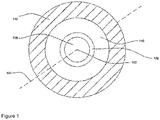
- FIG. 1 illustrates a cross-sectional view of an optical fibre 100, in accordance with various embodiments of the present disclosure.
- optical fibre is a thin flexible fibre that is used for transmission of information as light pulses.
- the optical fibre 100 is used as a medium that carries light from one end to other end.
- optical fibres are used in telecommunications to transmit telephone signals, internet communication, cable television signals and the like.
- the optical fibre 100 is defined along a longitudinal axis 104 passing through a geometrical center 102 of the optical fibre 100.
- longitudinal axis of the optical fibre is an imaginary axis along lengthwise direction of the optical fibre.
- the longitudinal axis 104 passes through the geometrical center 102.
- the geometrical center 102 of the optical fibre 100 is central point of the optical fibre 100. In other words, the geometrical center 102 of the optical fibre 100 is defined as midpoint of the diameter of the optical fibre 100.
- the optical fibre 100 is circular in shape. In an embodiment of the present disclosure, the optical fibre 100 may be of any shape. In an embodiment of the present disclosure, the optical fibre 100 is identical to G657A1 optical fibre. In another embodiment of the present disclosure, the optical fibre 100 is identical to G657A2 optical fibre. In yet another embodiment of the present disclosure, the optical fibre 100 is identical to G657B3 optical fibre.
- the optical fibre 100 is manufactured by manufacturing a preform using various preform manufacturing techniques.
- the various preform manufacturing techniques includes but may not be limited to outside vapor deposition (OVD), Rod-in-Cylinder or Rod-in Tube, vapor axial deposition (VAD), PCVD and modified chemical vapor deposition (MCVD) or suitable combination of any of them.
- the preform is manufactured using the outside vapor deposition.
- a preform is made from ultra-pure vapors using a traversing burner and form fine soot particles of glass.
- the soot particles are deposited on surface of a rotating target rod. After the deposition of soot particles on the surface of the rotating target rod, the rotating target rod is removed and preform is manufactured.
- the preform is manufactured using the outside vapor deposition.
- the outside vapor deposition is used to manufacture a porous glass preform.
- the porous glass preform is fabricated by the deposition of fine soot particles onto the surface of a mandrel through flame hydrolysis.
- the starting material is deposited over a rotating mandrel and porous soot preform is grown on the mandrel.
- the starting material is volatile organic compound that includes but may not be limited to SiCI4, GeCI4 and O2.
- the porous soot preform is heated to create a transparent glass preform that further drawn into optical fibre.
- the optical fibre 100 is drawn from the preform.
- tip of the preform is lowered into a draw furnace.
- gasses are injected into the furnace to provide a clean atmosphere.
- tightly controlled temperatures in the furnace soften the tip of the preform.
- the softening point of the preform tip is reached and gravity takes over and allows a molten gob to fall freely until stretched into a thin strand of the optical fibre 100.
- the optical fibre 100 includes a glass core 106, a glass cladding 108, a primary coating layer 110, and a secondary coating layer 112.
- the center of the glass core 106 of the optical fibre 100 and the geometrical center 102 of the optical fibre 100 coincide with each other.
- the glass core 106 is an innermost portion of the optical fibre 100.
- glass core of the optical fibre facilitates propagation of light.
- the refractive index of the core 106 may be of any suitable value.
- the glass core 106 is associated with doped composition of GeO2 and chlorine.
- fluorination of the glass core 106 is performed.
- the optical fibre 100 includes the glass cladding 108.
- the glass cladding 108 surrounds the glass core 106.
- glass cladding has lower refractive index than glass core.
- the lower refractive index of the glass cladding 108 enables total internal reflection of light waves inside the glass core 106 and propagation of light waves within the glass core 106. In general, total internal reflection is a phenomenon that occurs when a propagated wave strikes a medium boundary at an angle larger than particular critical angle.
- the glass cladding 108 surrounds the glass core 106.
- refractive index of the cladding 108 may be of any suitable value.
- the glass cladding 108 may have any suitable composition.
- the glass cladding may be down doped or up-doped.
- the optical fibre 100 includes the primary coating layer 110.
- the primary coating layer 110 sandwiched between the glass cladding 108 and the secondary coating layer 112 of the optical fibre 100.
- the primary coating layer 110 is an inner coating layer.
- the primary coating 110 layer is by nature has relatively low modulus and hence protected by a relatively high modulus the secondary coating layer 112.
- the functions of primary coating 110 are to protect the glass core 106 and glass cladding 108, increase the mechanical strength, suppress ingression of moisture, reduce the micro bending loss (Soft/low modulus primary coating provides cushioning and reduce optical power loss due to the phenomenon of micro-bending) and provide the long term reliability.
- the primary coating layer 110 helps in retaining optical properties and of low in-situ modulus.
- the fraction of tensile load carried by a uniformly thick, linear elastic coating is generally given by: Ec * Ac / Ec * Ac + Eg * Ag where, E is the elastic modulus, A is the cross-sectional area, and subscripts g and c represent glass and coating respectively.
- the secondary coating layer surrounds the primary coating layer and provides strength and rigidity to the optical fibre as it is hard in nature and resists external impact on the optical fibre 100 and generally has high in-situ modulus than primary coating layer.
- the primary coating layer 110 has a diameter in a range of 130 to 155 micrometers. In another embodiment of the present disclosure, the diameter of the primary coating layer 110 may vary.
- the thickness of the primary coating layer 110 has a primary coating thickness is in the range of 2.5 to 15 micrometers. In an embodiment of the present disclosure, the primary coating thickness may vary.
- the primary coating layer 110 has a primary in-situ modulus is in the range of 0.3 to 0.6 mega-pascal. In another embodiment of the present disclosure, primary in-situ modulus may vary.
- the optical fibre 100 is associated with a microbending loss.
- the primary function of the coatings (primary coating layer 110) is to reduce the microbending loss.
- the microbending loss is determined by various methods and one of the method is sandpaper method.
- the optical fibre 100 is wind on a spool.
- the spool has diameter of about 140 millimeters.
- the spool is associated with winding tension.
- winding tension has a value of about 250 grams.
- value of winding tension may vary.
- sandpaper is posted on surface of the spool.
- the sandpaper is posted using double sided tape. Further, the sandpaper method or test provides the micro-bending induced loss.
- the induced micro-bending loss has a value of up to 3 decibels per kilometer for the optical fibre 100.
- the optical fibre (100) has a mode field diameter is in the range of 8.2 micrometers to 9.7 micrometers at a wavelength of 1310 nanometers.
- the optical fibre has at least one of macro-bend loss up to 0.5 decibel per turn corresponding to wavelength of 1550 nanometer at bending radius of 7.5 millimeter.
- the optical fibre has a macro-bend loss up to 1.0 decibel per turn corresponding to wavelength of 1625 nanometer at bending radius of 7.5 millimeter.
- the optical fibre 100 has at least one of a dispersion of up to 18 picosecond/(nanometer-kilometer) at wavelength of 1550 nanometer.
- the optical fibre 100 has a zero dispersion wavelength in range of about 1300 nanometer to 1324 nanometer.
- the optical fibre 100 has a cable cut off wavelength of up to 1260 nanometer.
- the optical fibre 100 has a core clad concentricity error of upto 0.5.
- the optical fibre 100 has cladding non-circularity percentage of upto 0.7 percent.
- the optical fibre 100 has a zero dispersion slope of upto 0.092 picosecond/(nanometer2.kilometer).
- the optical fibre 100 has a prof testing (kpsi) of at least 100 or more. Further, the optical fibre 100 has a coating strip force in between 1.3-5.0 Newton. Further, the optical fibre 100 has a fibre curl of at least 4 meters or more. Further the optical fibre 100 with in situ modulus of primary coating layer 110 is in the range of 0.3 to 0.6 mega-pascal and in- situ modulus of primary coating of secondary coating layer 112 is in the range of at least or more than 1.2 giga-pascal, wherein the coating in situ values creates a balance between to have the optical fibre 100, desired macrobend characteristics and optimum strip force characteristics and splicing characteristics with almost all the optical fibres.
- the optical fibre 100 includes the secondary coating layer 112.
- the secondary coating layer 112 surrounds the primary coating layer 110.
- the secondary coating layer 112 is an outer coating layer.
- the secondary coating layer 112 may be made of any suitable material.
- the primary coating layer 110 and secondary coating layer 112, that concentrically covers the glass cladding 108 in the present disclosure referred as a coating (110, 112).
- the coating (110, 112) has a coating refractive index.
- the secondary coating layer 112 has diameter of about 195 micrometers. In another embodiment of the present disclosure, the second coating layer 112 has diameter in a range of about 160-180 micrometers. In ananother embodiment of the present invention, the overall diameter of the optical fibre (100) is upto 190 micrometers. In yet another embodiment of the present disclosure, the diameter of the secondary coating layer 112 may vary. Further, the secondary coating layer 112 has a secondary in-situ modulus is greater than or equal to 1.14 giga-pascal. In an embodiment of the present disclosure, the secondary in-situ modulus may vary. In an embodiment of the present disclosure, the secondary coating layer 112 has a secondary coating thickness is in the range of 2.5 to 25 micrometers. In an embodiment of the present disclosure, the secondary coating thickness may vary.
- the application of the coating on the optical fibre 100 is associated with one or more control process parameters.
- the one or more control process parameters for the application of the primary and secondary coating on the optical fibre 100 include pressure control process parameters, coating concentricity control process parameters and the like.
- the control process parameters are set to achieve the optimum coating geometry parameters like diameter of the outer coating and mitigate the coating-cladding concentricity (coating concentricity control) and Non - circularity of coating (coat ovality).
- pressure control process parameter has pressure maintained in a range of about 3 bar to 7 bar. In another embodiment of the present disclosure, range of pressure may vary.
- pressure control process parameter is maintained in the range of about 3 bar to 7 bar for the primary coating layer 110 and the secondary coating layer 112. In an embodiment of the present disclosure, pressure control process parameter maintains a pressure difference between the primary coating layer 110 and the secondary coating layer 112.
- the optical fibre 100 has a diameter less than 200 micrometers, preferably less than or equal to 195 micrometers is achieved with the pressure difference associated between the primary coating layer 110 and the secondary coating layer 112 has a maintained value of up to 2 bar. In another embodiment of the present disclosure, the pressure difference associated between the primary coating layer 110 and the secondary coating layer 112 may vary.
- the optical fibre 100 is associated with coating concentricity control process parameter.
- the Process control process parameter for primary and secondary coating layer controls the diameter of the optical fibre 100 and optical fibre 100 may subject to uncontrolled coating concentricity.
- the coating concentricity control process parameter controls concentricity of coating on the optical fibre 100.
- coating concentricity control process parameter manages refractive index of the primary coating layer 110.
- coating concentricity control process parameter manages refractive index of the secondary coating layer 112.
- sufficient refractive index difference between the cladding 108 and the primary coating layer 110 generates diffraction pattern with high contrast patterns for concentricity monitors.
- the reference wavelength is about 633 nanometers.
- the optical fibre 100 is characterized by a diameter. In an embodiment of the present disclosure, the optical fibre 100 has diameter of about 190 micrometers. In an another embodiment of the present disclosure, the optical fibre 100 has maximum diameter of about 195 micrometers. In another embodiment of the present disclosure, the diameter of the optical fibre 100 may vary. In an embodiment of the present disclosure, the optical fibre 100 belongs to ITU-T G657 category of fibres. However, the optical fibre 100 is not limited to the above mentioned category of fibres.
- the present disclosure provides numerous advantages over the prior art.
- the present disclosure provides an improved method for fabrication of the optical fibre soot preform.
- the method provides leapfrog improvement that provides high material efficiency and stoichiometric energy consumption.
- the method provides elimination of many steps and processes. Further, the method provides substantial reduction in overall footprint of plant.
Landscapes
- Physics & Mathematics (AREA)
- General Physics & Mathematics (AREA)
- Optics & Photonics (AREA)
- Surface Treatment Of Glass Fibres Or Filaments (AREA)
Applications Claiming Priority (1)
| Application Number | Priority Date | Filing Date | Title |
|---|---|---|---|
| IN201921032716 | 2019-08-13 |
Publications (2)
| Publication Number | Publication Date |
|---|---|
| EP3779537A2 true EP3779537A2 (de) | 2021-02-17 |
| EP3779537A3 EP3779537A3 (de) | 2021-06-09 |
Family
ID=72086807
Family Applications (1)
| Application Number | Title | Priority Date | Filing Date |
|---|---|---|---|
| EP20190998.3A Pending EP3779537A3 (de) | 2019-08-13 | 2020-08-13 | Glasfaser mit reduziertem durchmesser |
Country Status (1)
| Country | Link |
|---|---|
| EP (1) | EP3779537A3 (de) |
Citations (2)
| Publication number | Priority date | Publication date | Assignee | Title |
|---|---|---|---|---|
| WO2009062131A1 (en) * | 2007-11-09 | 2009-05-14 | Draka Comteq, B.V. | Microbend- resistant optical fiber |
| WO2019212796A1 (en) * | 2018-04-30 | 2019-11-07 | Corning Incorporated | Small diameter low attenuation optical fiber |
Family Cites Families (5)
| Publication number | Priority date | Publication date | Assignee | Title |
|---|---|---|---|---|
| NL8702395A (nl) * | 1987-10-08 | 1989-05-01 | Philips Nv | Optische vezel voorzien van een kunststofbedekking. |
| US6810185B2 (en) * | 2002-01-31 | 2004-10-26 | Corning Incorporated | Higher order mode stripping optical fiber and modules and systems utilizing the same |
| US7272289B2 (en) * | 2005-09-30 | 2007-09-18 | Corning Incorporated | Low bend loss optical fiber |
| US8837892B2 (en) * | 2011-09-16 | 2014-09-16 | Corning Incorporated | Few mode optical fibers for mode division multiplexing |
| US20170097465A1 (en) * | 2015-06-30 | 2017-04-06 | Corning Incorporated | Optical fiber with large effective area and low bending loss |
-
2020
- 2020-08-13 EP EP20190998.3A patent/EP3779537A3/de active Pending
Patent Citations (2)
| Publication number | Priority date | Publication date | Assignee | Title |
|---|---|---|---|---|
| WO2009062131A1 (en) * | 2007-11-09 | 2009-05-14 | Draka Comteq, B.V. | Microbend- resistant optical fiber |
| WO2019212796A1 (en) * | 2018-04-30 | 2019-11-07 | Corning Incorporated | Small diameter low attenuation optical fiber |
Also Published As
| Publication number | Publication date |
|---|---|
| EP3779537A3 (de) | 2021-06-09 |
Similar Documents
| Publication | Publication Date | Title |
|---|---|---|
| US12032203B2 (en) | Reduced diameter optical fibre | |
| US8428411B2 (en) | Single-mode optical fiber | |
| EP3532880B1 (de) | Einzelmodus-glasfaser mit geringem krümmungsverlust | |
| US8798423B2 (en) | Single-mode optical fiber | |
| US9341771B2 (en) | Bend-resistant multimode optical fiber | |
| US8639079B2 (en) | Multimode optical fiber | |
| US9964697B2 (en) | Optical fiber | |
| TWI522667B (zh) | A kind of bending insensitive single mode fiber | |
| US11573368B2 (en) | Universal optical fibre with double trench | |
| JP4763106B2 (ja) | 光ファイバ | |
| US11719878B2 (en) | Ultra reduced diameter optical fibre | |
| CN101226258B (zh) | 低弯曲损耗、低非线性效应的单模光纤 | |
| US11573369B2 (en) | Universal optical fibre compatible with rod-in-cylinder | |
| CA2509263C (en) | Optical fibre having low splice loss and method for making it | |
| US20210247566A1 (en) | Optical fibre having centerline core profile | |
| EP4254028A1 (de) | Für flachbandkabel geeignete einmodenglasfaser | |
| EP4485021A2 (de) | Glasfaserkabel und glasfaser mit doppelgraben | |
| EP4254026A1 (de) | Optische faser mit einem profil des brechungsindexes zur abschwächungsverminderung | |
| EP4485022A1 (de) | Glasfaserkabel und glasfaser mit reduziertem durchmesser | |
| CN110873925A (zh) | 一种细直径耦合器用980光纤 | |
| HK1086338B (en) | Optical fibre having low splice loss and method for making it | |
| KR20050084469A (ko) | 접속손실이 낮은 광섬유 및 그 제조방법 |
Legal Events
| Date | Code | Title | Description |
|---|---|---|---|
| PUAI | Public reference made under article 153(3) epc to a published international application that has entered the european phase |
Free format text: ORIGINAL CODE: 0009012 |
|
| STAA | Information on the status of an ep patent application or granted ep patent |
Free format text: STATUS: THE APPLICATION HAS BEEN PUBLISHED |
|
| AK | Designated contracting states |
Kind code of ref document: A2 Designated state(s): AL AT BE BG CH CY CZ DE DK EE ES FI FR GB GR HR HU IE IS IT LI LT LU LV MC MK MT NL NO PL PT RO RS SE SI SK SM TR |
|
| AX | Request for extension of the european patent |
Extension state: BA ME |
|
| PUAL | Search report despatched |
Free format text: ORIGINAL CODE: 0009013 |
|
| AK | Designated contracting states |
Kind code of ref document: A3 Designated state(s): AL AT BE BG CH CY CZ DE DK EE ES FI FR GB GR HR HU IE IS IT LI LT LU LV MC MK MT NL NO PL PT RO RS SE SI SK SM TR |
|
| RIC1 | Information provided on ipc code assigned before grant |
Ipc: G02B 6/02 20060101AFI20210504BHEP |
|
| STAA | Information on the status of an ep patent application or granted ep patent |
Free format text: STATUS: REQUEST FOR EXAMINATION WAS MADE |
|
| 17P | Request for examination filed |
Effective date: 20211209 |
|
| RBV | Designated contracting states (corrected) |
Designated state(s): AL AT BE BG CH CY CZ DE DK EE ES FI FR GB GR HR HU IE IS IT LI LT LU LV MC MK MT NL NO PL PT RO RS SE SI SK SM TR |
|
| STAA | Information on the status of an ep patent application or granted ep patent |
Free format text: STATUS: EXAMINATION IS IN PROGRESS |
|
| 17Q | First examination report despatched |
Effective date: 20220608 |