EP3779521A1 - Optical lens - Google Patents
Optical lens Download PDFInfo
- Publication number
- EP3779521A1 EP3779521A1 EP19776849.2A EP19776849A EP3779521A1 EP 3779521 A1 EP3779521 A1 EP 3779521A1 EP 19776849 A EP19776849 A EP 19776849A EP 3779521 A1 EP3779521 A1 EP 3779521A1
- Authority
- EP
- European Patent Office
- Prior art keywords
- cyclic olefin
- constitutional unit
- optical lens
- based copolymer
- formula
- Prior art date
- Legal status (The legal status is an assumption and is not a legal conclusion. Google has not performed a legal analysis and makes no representation as to the accuracy of the status listed.)
- Pending
Links
- 230000003287 optical effect Effects 0.000 title claims abstract description 66
- -1 cyclic olefin Chemical class 0.000 claims abstract description 132
- JRZJOMJEPLMPRA-UHFFFAOYSA-N olefin Natural products CCCCCCCC=C JRZJOMJEPLMPRA-UHFFFAOYSA-N 0.000 claims abstract description 108
- 229920001577 copolymer Polymers 0.000 claims abstract description 89
- 125000004432 carbon atom Chemical group C* 0.000 claims abstract description 25
- 229920002554 vinyl polymer Polymers 0.000 claims abstract description 23
- 239000004711 α-olefin Substances 0.000 claims abstract description 18
- 150000002430 hydrocarbons Chemical group 0.000 claims description 27
- 125000005843 halogen group Chemical group 0.000 claims description 21
- 125000002950 monocyclic group Chemical group 0.000 claims description 20
- 229910052731 fluorine Inorganic materials 0.000 claims description 13
- 125000001153 fluoro group Chemical group F* 0.000 claims description 13
- 125000000391 vinyl group Chemical group [H]C([*])=C([H])[H] 0.000 claims description 13
- 150000001875 compounds Chemical class 0.000 claims description 12
- 125000004435 hydrogen atom Chemical group [H]* 0.000 claims description 12
- NNBZCPXTIHJBJL-UHFFFAOYSA-N decalin Chemical compound C1CCCC2CCCCC21 NNBZCPXTIHJBJL-UHFFFAOYSA-N 0.000 claims description 10
- 230000009477 glass transition Effects 0.000 claims description 9
- 125000003367 polycyclic group Chemical group 0.000 claims description 8
- IGGDKDTUCAWDAN-UHFFFAOYSA-N 1-vinylnaphthalene Chemical compound C1=CC=C2C(C=C)=CC=CC2=C1 IGGDKDTUCAWDAN-UHFFFAOYSA-N 0.000 claims description 7
- KXYAVSFOJVUIHT-UHFFFAOYSA-N 2-vinylnaphthalene Chemical compound C1=CC=CC2=CC(C=C)=CC=C21 KXYAVSFOJVUIHT-UHFFFAOYSA-N 0.000 claims description 6
- OGOYZCQQQFAGRI-UHFFFAOYSA-N 9-ethenylanthracene Chemical compound C1=CC=C2C(C=C)=C(C=CC=C3)C3=CC2=C1 OGOYZCQQQFAGRI-UHFFFAOYSA-N 0.000 claims description 6
- 229930015698 phenylpropene Natural products 0.000 claims description 5
- HJWLCRVIBGQPNF-UHFFFAOYSA-N prop-2-enylbenzene Chemical compound C=CCC1=CC=CC=C1 HJWLCRVIBGQPNF-UHFFFAOYSA-N 0.000 claims description 5
- PXXNTAGJWPJAGM-UHFFFAOYSA-N vertaline Natural products C1C2C=3C=C(OC)C(OC)=CC=3OC(C=C3)=CC=C3CCC(=O)OC1CC1N2CCCC1 PXXNTAGJWPJAGM-UHFFFAOYSA-N 0.000 claims description 5
- 125000001118 alkylidene group Chemical group 0.000 claims description 4
- 239000000126 substance Substances 0.000 abstract description 4
- 238000001746 injection moulding Methods 0.000 description 24
- 238000000465 moulding Methods 0.000 description 12
- 229920005989 resin Polymers 0.000 description 10
- 239000011347 resin Substances 0.000 description 10
- 238000000034 method Methods 0.000 description 9
- 239000000463 material Substances 0.000 description 8
- VGGSQFUCUMXWEO-UHFFFAOYSA-N Ethene Chemical compound C=C VGGSQFUCUMXWEO-UHFFFAOYSA-N 0.000 description 6
- 239000005977 Ethylene Substances 0.000 description 6
- PPBRXRYQALVLMV-UHFFFAOYSA-N Styrene Chemical compound C=CC1=CC=CC=C1 PPBRXRYQALVLMV-UHFFFAOYSA-N 0.000 description 6
- 230000000052 comparative effect Effects 0.000 description 6
- JFNLZVQOOSMTJK-KNVOCYPGSA-N norbornene Chemical compound C1[C@@H]2CC[C@H]1C=C2 JFNLZVQOOSMTJK-KNVOCYPGSA-N 0.000 description 6
- 238000004519 manufacturing process Methods 0.000 description 5
- 229920000642 polymer Polymers 0.000 description 5
- 238000003384 imaging method Methods 0.000 description 4
- 238000005160 1H NMR spectroscopy Methods 0.000 description 3
- 239000000654 additive Substances 0.000 description 3
- 238000010438 heat treatment Methods 0.000 description 3
- 238000005259 measurement Methods 0.000 description 3
- 239000011342 resin composition Substances 0.000 description 3
- AFFLGGQVNFXPEV-UHFFFAOYSA-N 1-decene Chemical compound CCCCCCCCC=C AFFLGGQVNFXPEV-UHFFFAOYSA-N 0.000 description 2
- CRSBERNSMYQZNG-UHFFFAOYSA-N 1-dodecene Chemical compound CCCCCCCCCCC=C CRSBERNSMYQZNG-UHFFFAOYSA-N 0.000 description 2
- GQEZCXVZFLOKMC-UHFFFAOYSA-N 1-hexadecene Chemical compound CCCCCCCCCCCCCCC=C GQEZCXVZFLOKMC-UHFFFAOYSA-N 0.000 description 2
- LIKMAJRDDDTEIG-UHFFFAOYSA-N 1-hexene Chemical compound CCCCC=C LIKMAJRDDDTEIG-UHFFFAOYSA-N 0.000 description 2
- KWKAKUADMBZCLK-UHFFFAOYSA-N 1-octene Chemical compound CCCCCCC=C KWKAKUADMBZCLK-UHFFFAOYSA-N 0.000 description 2
- HFDVRLIODXPAHB-UHFFFAOYSA-N 1-tetradecene Chemical compound CCCCCCCCCCCCC=C HFDVRLIODXPAHB-UHFFFAOYSA-N 0.000 description 2
- 238000001644 13C nuclear magnetic resonance spectroscopy Methods 0.000 description 2
- WSSSPWUEQFSQQG-UHFFFAOYSA-N 4-methyl-1-pentene Chemical compound CC(C)CC=C WSSSPWUEQFSQQG-UHFFFAOYSA-N 0.000 description 2
- VEXZGXHMUGYJMC-UHFFFAOYSA-N Hydrochloric acid Chemical compound Cl VEXZGXHMUGYJMC-UHFFFAOYSA-N 0.000 description 2
- 125000000217 alkyl group Chemical group 0.000 description 2
- 125000002029 aromatic hydrocarbon group Chemical group 0.000 description 2
- 125000003118 aryl group Chemical group 0.000 description 2
- 125000000753 cycloalkyl group Chemical group 0.000 description 2
- 239000000203 mixture Substances 0.000 description 2
- VAMFXQBUQXONLZ-UHFFFAOYSA-N n-alpha-eicosene Natural products CCCCCCCCCCCCCCCCCCC=C VAMFXQBUQXONLZ-UHFFFAOYSA-N 0.000 description 2
- JFNLZVQOOSMTJK-UHFFFAOYSA-N norbornene Chemical compound C1C2CCC1C=C2 JFNLZVQOOSMTJK-UHFFFAOYSA-N 0.000 description 2
- CCCMONHAUSKTEQ-UHFFFAOYSA-N octadec-1-ene Chemical compound CCCCCCCCCCCCCCCCC=C CCCMONHAUSKTEQ-UHFFFAOYSA-N 0.000 description 2
- YWAKXRMUMFPDSH-UHFFFAOYSA-N pentene Chemical compound CCCC=C YWAKXRMUMFPDSH-UHFFFAOYSA-N 0.000 description 2
- 230000000704 physical effect Effects 0.000 description 2
- 229920005604 random copolymer Polymers 0.000 description 2
- 239000002904 solvent Substances 0.000 description 2
- 239000003381 stabilizer Substances 0.000 description 2
- XBFJAVXCNXDMBH-UHFFFAOYSA-N tetracyclo[6.2.1.1(3,6).0(2,7)]dodec-4-ene Chemical compound C1C(C23)C=CC1C3C1CC2CC1 XBFJAVXCNXDMBH-UHFFFAOYSA-N 0.000 description 2
- QVLAWKAXOMEXPM-UHFFFAOYSA-N 1,1,1,2-tetrachloroethane Chemical class ClCC(Cl)(Cl)Cl QVLAWKAXOMEXPM-UHFFFAOYSA-N 0.000 description 1
- 229940106006 1-eicosene Drugs 0.000 description 1
- FIKTURVKRGQNQD-UHFFFAOYSA-N 1-eicosene Natural products CCCCCCCCCCCCCCCCCC=CC(O)=O FIKTURVKRGQNQD-UHFFFAOYSA-N 0.000 description 1
- RNFJDJUURJAICM-UHFFFAOYSA-N 2,2,4,4,6,6-hexaphenoxy-1,3,5-triaza-2$l^{5},4$l^{5},6$l^{5}-triphosphacyclohexa-1,3,5-triene Chemical compound N=1P(OC=2C=CC=CC=2)(OC=2C=CC=CC=2)=NP(OC=2C=CC=CC=2)(OC=2C=CC=CC=2)=NP=1(OC=1C=CC=CC=1)OC1=CC=CC=C1 RNFJDJUURJAICM-UHFFFAOYSA-N 0.000 description 1
- OLGHJTHQWQKJQQ-UHFFFAOYSA-N 3-ethylhex-1-ene Chemical compound CCCC(CC)C=C OLGHJTHQWQKJQQ-UHFFFAOYSA-N 0.000 description 1
- YPVPQMCSLFDIKA-UHFFFAOYSA-N 3-ethylpent-1-ene Chemical compound CCC(CC)C=C YPVPQMCSLFDIKA-UHFFFAOYSA-N 0.000 description 1
- YHQXBTXEYZIYOV-UHFFFAOYSA-N 3-methylbut-1-ene Chemical compound CC(C)C=C YHQXBTXEYZIYOV-UHFFFAOYSA-N 0.000 description 1
- LDTAOIUHUHHCMU-UHFFFAOYSA-N 3-methylpent-1-ene Chemical compound CCC(C)C=C LDTAOIUHUHHCMU-UHFFFAOYSA-N 0.000 description 1
- SUJVAMIXNUAJEY-UHFFFAOYSA-N 4,4-dimethylhex-1-ene Chemical compound CCC(C)(C)CC=C SUJVAMIXNUAJEY-UHFFFAOYSA-N 0.000 description 1
- KLCNJIQZXOQYTE-UHFFFAOYSA-N 4,4-dimethylpent-1-ene Chemical compound CC(C)(C)CC=C KLCNJIQZXOQYTE-UHFFFAOYSA-N 0.000 description 1
- OPMUAJRVOWSBTP-UHFFFAOYSA-N 4-ethyl-1-hexene Chemical compound CCC(CC)CC=C OPMUAJRVOWSBTP-UHFFFAOYSA-N 0.000 description 1
- SUWJESCICIOQHO-UHFFFAOYSA-N 4-methylhex-1-ene Chemical compound CCC(C)CC=C SUWJESCICIOQHO-UHFFFAOYSA-N 0.000 description 1
- IJGRMHOSHXDMSA-UHFFFAOYSA-N Atomic nitrogen Chemical compound N#N IJGRMHOSHXDMSA-UHFFFAOYSA-N 0.000 description 1
- 238000005481 NMR spectroscopy Methods 0.000 description 1
- ISWSIDIOOBJBQZ-UHFFFAOYSA-N Phenol Chemical compound OC1=CC=CC=C1 ISWSIDIOOBJBQZ-UHFFFAOYSA-N 0.000 description 1
- OAICVXFJPJFONN-UHFFFAOYSA-N Phosphorus Chemical compound [P] OAICVXFJPJFONN-UHFFFAOYSA-N 0.000 description 1
- NWBSMOHZFZYBLB-UHFFFAOYSA-L [Cl-].[Cl-].C1=CC2=CC=CC=C2C1[Zr+2](=C(C)C)C1C2=CC=CC=C2C=C1 Chemical compound [Cl-].[Cl-].C1=CC2=CC=CC=C2C1[Zr+2](=C(C)C)C1C2=CC=CC=C2C=C1 NWBSMOHZFZYBLB-UHFFFAOYSA-L 0.000 description 1
- 239000006096 absorbing agent Substances 0.000 description 1
- 238000010521 absorption reaction Methods 0.000 description 1
- 150000001412 amines Chemical class 0.000 description 1
- 239000003963 antioxidant agent Substances 0.000 description 1
- 230000003078 antioxidant effect Effects 0.000 description 1
- 239000002216 antistatic agent Substances 0.000 description 1
- 125000003710 aryl alkyl group Chemical group 0.000 description 1
- 125000001797 benzyl group Chemical group [H]C1=C([H])C([H])=C(C([H])=C1[H])C([H])([H])* 0.000 description 1
- 229920001400 block copolymer Polymers 0.000 description 1
- 238000000071 blow moulding Methods 0.000 description 1
- 238000001460 carbon-13 nuclear magnetic resonance spectrum Methods 0.000 description 1
- 239000003795 chemical substances by application Substances 0.000 description 1
- 238000000748 compression moulding Methods 0.000 description 1
- 238000001816 cooling Methods 0.000 description 1
- 238000007334 copolymerization reaction Methods 0.000 description 1
- 125000000113 cyclohexyl group Chemical group [H]C1([H])C([H])([H])C([H])([H])C([H])(*)C([H])([H])C1([H])[H] 0.000 description 1
- 125000002704 decyl group Chemical group [H]C([H])([H])C([H])([H])C([H])([H])C([H])([H])C([H])([H])C([H])([H])C([H])([H])C([H])([H])C([H])([H])C([H])([H])* 0.000 description 1
- 235000014113 dietary fatty acids Nutrition 0.000 description 1
- 229940069096 dodecene Drugs 0.000 description 1
- 125000003438 dodecyl group Chemical group [H]C([H])([H])C([H])([H])C([H])([H])C([H])([H])C([H])([H])C([H])([H])C([H])([H])C([H])([H])C([H])([H])C([H])([H])C([H])([H])C([H])([H])* 0.000 description 1
- 230000000694 effects Effects 0.000 description 1
- 125000001495 ethyl group Chemical group [H]C([H])([H])C([H])([H])* 0.000 description 1
- 238000001125 extrusion Methods 0.000 description 1
- 238000010101 extrusion blow moulding Methods 0.000 description 1
- 239000000194 fatty acid Substances 0.000 description 1
- 229930195729 fatty acid Natural products 0.000 description 1
- 150000004665 fatty acids Chemical class 0.000 description 1
- 239000000835 fiber Substances 0.000 description 1
- 238000001914 filtration Methods 0.000 description 1
- 239000003063 flame retardant Substances 0.000 description 1
- 125000004051 hexyl group Chemical group [H]C([H])([H])C([H])([H])C([H])([H])C([H])([H])C([H])([H])C([H])([H])* 0.000 description 1
- 230000001771 impaired effect Effects 0.000 description 1
- 238000002347 injection Methods 0.000 description 1
- 239000007924 injection Substances 0.000 description 1
- 238000010102 injection blow moulding Methods 0.000 description 1
- 230000010354 integration Effects 0.000 description 1
- 125000001449 isopropyl group Chemical group [H]C([H])([H])C([H])(*)C([H])([H])[H] 0.000 description 1
- 238000004898 kneading Methods 0.000 description 1
- 239000004611 light stabiliser Substances 0.000 description 1
- 239000000314 lubricant Substances 0.000 description 1
- 229910052751 metal Inorganic materials 0.000 description 1
- 239000002184 metal Substances 0.000 description 1
- 239000006078 metal deactivator Substances 0.000 description 1
- 125000002496 methyl group Chemical group [H]C([H])([H])* 0.000 description 1
- 238000012986 modification Methods 0.000 description 1
- 230000004048 modification Effects 0.000 description 1
- TVMXDCGIABBOFY-UHFFFAOYSA-N n-Octanol Natural products CCCCCCCC TVMXDCGIABBOFY-UHFFFAOYSA-N 0.000 description 1
- 125000000740 n-pentyl group Chemical group [H]C([H])([H])C([H])([H])C([H])([H])C([H])([H])C([H])([H])* 0.000 description 1
- 125000001624 naphthyl group Chemical group 0.000 description 1
- 239000002667 nucleating agent Substances 0.000 description 1
- 125000002347 octyl group Chemical group [H]C([*])([H])C([H])([H])C([H])([H])C([H])([H])C([H])([H])C([H])([H])C([H])([H])C([H])([H])[H] 0.000 description 1
- 125000001997 phenyl group Chemical group [H]C1=C([H])C([H])=C(*)C([H])=C1[H] 0.000 description 1
- 125000000286 phenylethyl group Chemical group [H]C1=C([H])C([H])=C(C([H])=C1[H])C([H])([H])C([H])([H])* 0.000 description 1
- 229910052698 phosphorus Inorganic materials 0.000 description 1
- 239000011574 phosphorus Substances 0.000 description 1
- 239000004014 plasticizer Substances 0.000 description 1
- 229920005668 polycarbonate resin Polymers 0.000 description 1
- 239000004431 polycarbonate resin Substances 0.000 description 1
- 229920001225 polyester resin Polymers 0.000 description 1
- 239000004645 polyester resin Substances 0.000 description 1
- 238000006116 polymerization reaction Methods 0.000 description 1
- 239000000843 powder Substances 0.000 description 1
- 238000001556 precipitation Methods 0.000 description 1
- 125000001436 propyl group Chemical group [H]C([*])([H])C([H])([H])C([H])([H])[H] 0.000 description 1
- 150000003839 salts Chemical class 0.000 description 1
- 239000012748 slip agent Substances 0.000 description 1
- 239000000243 solution Substances 0.000 description 1
- 125000004079 stearyl group Chemical group [H]C([*])([H])C([H])([H])C([H])([H])C([H])([H])C([H])([H])C([H])([H])C([H])([H])C([H])([H])C([H])([H])C([H])([H])C([H])([H])C([H])([H])C([H])([H])C([H])([H])C([H])([H])C([H])([H])C([H])([H])C([H])([H])[H] 0.000 description 1
- 125000003944 tolyl group Chemical group 0.000 description 1
- 239000006097 ultraviolet radiation absorber Substances 0.000 description 1
Classifications
-
- C—CHEMISTRY; METALLURGY
- C08—ORGANIC MACROMOLECULAR COMPOUNDS; THEIR PREPARATION OR CHEMICAL WORKING-UP; COMPOSITIONS BASED THEREON
- C08F—MACROMOLECULAR COMPOUNDS OBTAINED BY REACTIONS ONLY INVOLVING CARBON-TO-CARBON UNSATURATED BONDS
- C08F232/00—Copolymers of cyclic compounds containing no unsaturated aliphatic radicals in a side chain, and having one or more carbon-to-carbon double bonds in a carbocyclic ring system
- C08F232/08—Copolymers of cyclic compounds containing no unsaturated aliphatic radicals in a side chain, and having one or more carbon-to-carbon double bonds in a carbocyclic ring system having condensed rings
-
- C—CHEMISTRY; METALLURGY
- C08—ORGANIC MACROMOLECULAR COMPOUNDS; THEIR PREPARATION OR CHEMICAL WORKING-UP; COMPOSITIONS BASED THEREON
- C08F—MACROMOLECULAR COMPOUNDS OBTAINED BY REACTIONS ONLY INVOLVING CARBON-TO-CARBON UNSATURATED BONDS
- C08F210/00—Copolymers of unsaturated aliphatic hydrocarbons having only one carbon-to-carbon double bond
- C08F210/02—Ethene
-
- C—CHEMISTRY; METALLURGY
- C08—ORGANIC MACROMOLECULAR COMPOUNDS; THEIR PREPARATION OR CHEMICAL WORKING-UP; COMPOSITIONS BASED THEREON
- C08F—MACROMOLECULAR COMPOUNDS OBTAINED BY REACTIONS ONLY INVOLVING CARBON-TO-CARBON UNSATURATED BONDS
- C08F232/00—Copolymers of cyclic compounds containing no unsaturated aliphatic radicals in a side chain, and having one or more carbon-to-carbon double bonds in a carbocyclic ring system
-
- G—PHYSICS
- G02—OPTICS
- G02B—OPTICAL ELEMENTS, SYSTEMS OR APPARATUS
- G02B1/00—Optical elements characterised by the material of which they are made; Optical coatings for optical elements
- G02B1/04—Optical elements characterised by the material of which they are made; Optical coatings for optical elements made of organic materials, e.g. plastics
- G02B1/041—Lenses
-
- G—PHYSICS
- G02—OPTICS
- G02B—OPTICAL ELEMENTS, SYSTEMS OR APPARATUS
- G02B3/00—Simple or compound lenses
-
- G—PHYSICS
- G02—OPTICS
- G02B—OPTICAL ELEMENTS, SYSTEMS OR APPARATUS
- G02B3/00—Simple or compound lenses
- G02B3/0087—Simple or compound lenses with index gradient
-
- C—CHEMISTRY; METALLURGY
- C08—ORGANIC MACROMOLECULAR COMPOUNDS; THEIR PREPARATION OR CHEMICAL WORKING-UP; COMPOSITIONS BASED THEREON
- C08F—MACROMOLECULAR COMPOUNDS OBTAINED BY REACTIONS ONLY INVOLVING CARBON-TO-CARBON UNSATURATED BONDS
- C08F212/00—Copolymers of compounds having one or more unsaturated aliphatic radicals, each having only one carbon-to-carbon double bond, and at least one being terminated by an aromatic carbocyclic ring
- C08F212/02—Monomers containing only one unsaturated aliphatic radical
- C08F212/32—Monomers containing only one unsaturated aliphatic radical containing two or more rings
-
- C—CHEMISTRY; METALLURGY
- C08—ORGANIC MACROMOLECULAR COMPOUNDS; THEIR PREPARATION OR CHEMICAL WORKING-UP; COMPOSITIONS BASED THEREON
- C08F—MACROMOLECULAR COMPOUNDS OBTAINED BY REACTIONS ONLY INVOLVING CARBON-TO-CARBON UNSATURATED BONDS
- C08F4/00—Polymerisation catalysts
- C08F4/42—Metals; Metal hydrides; Metallo-organic compounds; Use thereof as catalyst precursors
- C08F4/44—Metals; Metal hydrides; Metallo-organic compounds; Use thereof as catalyst precursors selected from light metals, zinc, cadmium, mercury, copper, silver, gold, boron, gallium, indium, thallium, rare earths or actinides
- C08F4/60—Metals; Metal hydrides; Metallo-organic compounds; Use thereof as catalyst precursors selected from light metals, zinc, cadmium, mercury, copper, silver, gold, boron, gallium, indium, thallium, rare earths or actinides together with refractory metals, iron group metals, platinum group metals, manganese, rhenium technetium or compounds thereof
- C08F4/62—Refractory metals or compounds thereof
- C08F4/64—Titanium, zirconium, hafnium or compounds thereof
- C08F4/659—Component covered by group C08F4/64 containing a transition metal-carbon bond
- C08F4/65908—Component covered by group C08F4/64 containing a transition metal-carbon bond in combination with an ionising compound other than alumoxane, e.g. (C6F5)4B-X+
-
- G—PHYSICS
- G02—OPTICS
- G02B—OPTICAL ELEMENTS, SYSTEMS OR APPARATUS
- G02B3/00—Simple or compound lenses
- G02B2003/0093—Simple or compound lenses characterised by the shape
Definitions
- the present invention relates to an optical lens.
- a cyclic olefin-based polymer In optical lenses such as an imaging lens, an f ⁇ lens, and a pickup lens, a cyclic olefin-based polymer is used.
- the cyclic olefin-based polymer used in molded products such as the optical lenses is required to have characteristics such as high transparency, excellent dimensional stability, and excellent heat resistance.
- the imaging lens used for example, in smartphones, digital cameras, and the like is required to have a further improved refractive index while maintaining a low birefringence value.
- Patent Document 1 Japanese Unexamined Patent Publication No. 10-287713
- Patent Document 2 Japanese Unexamined Patent Publication No. 2010-235719
- Patent Document 1 describes a cyclic olefin-based copolymer obtained from (A) linear or branched ⁇ -olefin having 2 to 20 carbon atoms, (B) cyclic olefin represented by a predetermined chemical formula, and (C) aromatic vinyl compound, in which a limiting viscosity [ ⁇ ] of the copolymer is within a range of 0.1 to 10 dl/g, and a content ratio of a constitutional unit derived from (B) cyclic olefin and a content ratio of a constitutional unit derived from (C) aromatic vinyl compound satisfy a specific relationship.
- Patent Document 2 describes a cyclic olefin-based polymer containing a constitutional unit (A), which is derived from ethylene or an ⁇ -olefin having 3 to 20 carbon atoms, at 30 to 70 mol%, a constitutional unit (B), which is derived from a cyclic olefin represented by a predetermined chemical formula, at 20 to 50 mol%, and a constitutional unit (C), which is derived from an aromatic vinyl compound, at 0.1 to 20 mol%, in which a limiting viscosity [ ⁇ ], 1 H-NMR, and a glass transition temperature of the polymer satisfy a predetermined condition.
- A constitutional unit
- B which is derived from a cyclic olefin represented by a predetermined chemical formula
- C constitutional unit which is derived from an aromatic vinyl compound, at 0.1 to 20 mol%, in which a limiting viscosity [ ⁇ ], 1 H-NMR, and a glass transition temperature of the polymer satisfy a predetermined condition.
- the present invention has been made in consideration of the circumstances described above, and an object thereof is to provide an optical lens which has a high refractive index and of which the Abbe number can be adjusted to a value lower than the Abbe number of the conventional resin materials.
- the inventors of the present invention conducted an intensive examination. As a result, the inventors have found that by using a cyclic olefin-based copolymer having a constitutional unit (A) derived from an ⁇ -olefin having 2 to 20 carbon atoms, a constitutional unit (B) derived from a cyclic olefin, and a constitutional unit (C) derived from an aromatic vinyl compound represented by General Formula (C-1), it is possible to adjust the Abbe number of an obtained optical lens to a value lower than the Abbe number of the conventional resin materials while the optical lens has a high refractive index.
- A constitutional unit derived from an ⁇ -olefin having 2 to 20 carbon atoms
- a constitutional unit (B) derived from a cyclic olefin a constitutional unit (C) derived from an aromatic vinyl compound represented by General Formula (C-1)
- any one of all Rs represented by R 1 to R 10 is a hydrocarbon group having a vinyl group represented by Formula (D-1), and * in Formula (D-1) represents a bond.
- R 1 s and R 4 s may be the same or different respectively in a case where m is 2 or more
- a plurality of R 6 s and R 9 s may be the same or different respectively in a case where n is 2 or more
- R 21 , and R 22 each independently represent a hydrogen atom, a halogen atom except for a fluorine atom, or a hydrocarbon group having 1 to 20 carbon atoms that may be substituted with a halogen atom except for a fluorine atom
- R 1 and R 2 , R 2 and R 3 , R 3 and R 4 , R 6 and R 7 , R 7 and R 8 , and R 8 and R 9 may form
- the following optical lens is provided.
- an optical lens constituted with a molded product containing a cyclic olefin-based copolymer which has a high refractive index and of which the Abbe number can be adjusted to a value lower than the Abbe number of the conventional resin materials.
- the cyclic olefin-based copolymer (P) has a constitutional unit (A) derived from an ⁇ -olefin having 2 to 20 carbon atoms, a constitutional unit (B) derived from a cyclic olefin, and a constitutional unit (C) derived from an aromatic vinyl compound represented by Formula (C-1).
- any one of all Rs represented by R 1 to R 10 is a hydrocarbon group having a vinyl group represented by Formula (D-1), and * in Formula (D-1) represents a bond.
- the cyclic olefin-based copolymer (P) has the constitutional unit (A) derived from an ⁇ -olefin having 2 to 20 carbon atoms, the constitutional unit (B) derived from a cyclic olefin, and the constitutional unit (C) derived from an aromatic vinyl compound represented by (C-1). Therefore, the copolymer (P) satisfies a high refractive index required to optical lenses and the like, and the Abbe number of the copolymer can be adjusted to a low value.
- the constitutional unit (A) according to the present embodiment is a constitutional unit derived from an ⁇ -olefin having 2 to 20 carbon atoms.
- the ⁇ -olefin having 2 to 20 carbon atoms may be linear or branched, and examples thereof include a linear ⁇ -olefin having 2 to 20 carbon atoms such as ethylene, propylene, 1-butene, 1-pentene, 1-hexene, 1-octene, 1-decene, 1-dodecene, 1-tetradecene, 1-hexadecene, 1-octadecene, or 1-eicosene; a branched ⁇ -olefin having 4 to 20 carbon atoms such as 3-methyl-1-butene, 3-methyl-1-pentene, 3-ethyl-1-pentene, 4-methyl-1-pentene, 4-methyl-1-hexene, 4,4-dimethyl-1-hexene, 4,4-dimethyl-1-pentene, 4-ethyl-1-hexene, or 3-ethyl-1-hexene; and the like.
- a linear ⁇ -olefin having 2 to 4 carbon atoms is preferable, and ethylene is particularly preferable.
- One kind of each of these linear or branched ⁇ -olefins can be used singly, or two or more kinds of these linear or branched ⁇ -olefins can be used in combination.
- the content of the constitutional unit (A) in the cyclic olefin-based copolymer (P) according to the present embodiment is preferably 10 mol% or more and 80 mol% or less, more preferably 30 mol% or more and 75 mol% or less, even more preferably 40 mol% or more and 70 mol% or less, and particularly preferably 50 mol% or more and 70 mol% or less.
- the content of the constitutional unit (A) is the lower limit described above or more, the heat resistance or the dimensional stability of the obtained molded product can be improved. Furthermore, in a case where the content of the constitutional unit (A) is the upper limit described above or less, the transparency of the obtained molded product and the like can be improved.
- the content of the constitutional unit (A) can be measured, for example, by 1 H-NMR or 13 C-NMR.
- the constitutional unit (B) according to the present embodiment is a constitutional unit derived from a cyclic olefin. From the viewpoint of further improving the refractive index of the obtained molded product, it is preferable that the constitutional unit (B) according to the present embodiment contains a constitutional unit derived from a compound represented by the following Formula (B-1).
- R 1 to R 18 , R a , and R b each independently represent a hydrogen atom, a halogen atom, or a hydrocarbon group which may be substituted with a halogen atom, R 15 to R 18 may form a monocyclic ring or a polycyclic ring by being bonded to each other, the monocyclic ring or the polycyclic ring may have a double bond, and R 15 and R 16 or R 17 and R 18 may form an alkylidene group.
- R 1 to R 18 and R a and R b preferably each represent a hydrocarbon group having 1 to 20 carbon atoms.
- m in Formula (B-1) is preferably a positive integer.
- the constitutional unit (B) preferably contains at least one kind of constitutional unit selected from a constitutional unit derived from bicyclo[2.2.1]-2-heptene, a constitutional unit derived from tetracyclo[4.4.0.1 2,5 .1 7,10 ]-3-dodecene, a constitutional unit derived from hexacyclo[6,6,1,1 3,6 ,1 10,13 ,0 2,7, 0 9,14 ]heptadecene-4.
- the constitutional unit (C) according to the present embodiment is a constitutional unit derived from an aromatic vinyl compound represented by General Formula (C-1).
- One kind of the compound according to the present embodiment may be used singly, or two or more kinds of the compounds according to the present embodiment may be used in combination.
- any one of all Rs represented by R 1 to R 10 is a hydrocarbon group having a vinyl group represented by Formula (D-1), and * in Formula (D-1) represents a bond.
- R 1 s and R 4 s may be the same or different respectively in a case where m is 2 or more
- a plurality of R 6 s and R 9 s may be the same or different respectively in a case where n is 2 or more
- R 21 , and R 22 each independently represent a hydrogen atom, a halogen atom except for a fluorine atom, or a hydrocarbon group having 1 to 20 carbon atoms that may be substituted with a halogen atom except for a fluorine atom
- R 1 and R 2 , R 2 and R 3 , R 3 and R 4 , R 6 and R 7 , R 7 and R 8 , and R 8 and R 9 may form
- m, n, and q represent 0, 1 or 2, and q represents 1 or 2 in a case where both of m and n represent 0. More preferably, both of m and n represent 0 and q represents 1; or m represents 0, n represents 1 or 2, and q represents 0 or 1. m preferably represents 0 or 1. n preferably represents 1 or 2. q preferably represents 0.
- R 1 to R 10 other than the hydrocarbon group having a vinyl group represented by Formula (D-1) and R 21 and R 22 in Formula (D-1) preferably represent a hydrogen atom or a hydrocarbon group having 1 to 20 carbon atoms, and more preferably represent a hydrogen atom.
- Examples of the hydrocarbon group having 1 to 20 carbon atoms include an alkyl group having 1 to 20 carbon atoms, a cycloalkyl group having 3 to 15 carbon atoms, an aromatic hydrocarbon group, and the like. More specifically, examples of the alkyl group include a methyl group, an ethyl group, a propyl group, an isopropyl group, an amyl group, a hexyl group, an octyl group, a decyl group, a dodecyl group, an octadecyl group, and the like. Examples of the cycloalkyl group include a cyclohexyl group, and the like.
- aromatic hydrocarbon group examples include an aryl group and an aralkyl group such as a phenyl group, a tolyl group, a naphthyl group, a benzyl group, and a phenyl ethyl group . These hydrocarbon groups may be substituted with a halogen atom except for a fluorine atom.
- the structure represented by (C-1) for example, at least one kind of compound selected from allylbenzene, 1-vinylnaphthalene, 2-vinylnaphthalene, and 9-vinylanthracene is preferable, and at least one kind of compound selected from 1-vinylnaphthalene, 2-vinylnaphthalene, and 9-vinylanthracene is particularly preferable.
- the compounds may be excellently copolymerized with the ⁇ -olefin from which the constitutional unit (A) is derived and the cyclic olefin from which the constitutional unit (B) is derived, more aromatic rings can be efficiently introduced into the obtained cyclic olefin-based copolymer, and accordingly, particularly the refractive index could be adjusted to a high value and the Abbe number could be adjusted to a low value.
- the aromatic vinyl compound represented by General Formula (C-1) does not include styrene.
- styrene is used as the aromatic vinyl compound, it is difficult to adjust the Abbe number to an optimal range which is, for example, 30 or more and 50 or less.
- the content of the constitutional unit (C) in the cyclic olefin-based copolymer (P) according to the present embodiment is preferably 1 mol% or more and 95 mol% or less, more preferably 2 mol% or more and 60 mol% or less, and even more preferably 3 mol% or more and 40 mol% or less.
- the refractive index can be kept high while the Abbe number can be further reduced. Furthermore, in a case where the content of the constitutional unit (C) is the upper limit described above or less, the balance between the refractive index and the Abbe number in the obtained molded product can be further improved.
- the content of the constitutional unit (B) and the constitutional unit (C) can be measured, for example, by 1 H-NMR or 13 C-NMR.
- the copolymerization type of the cyclic olefin-based copolymer (P) according to the present embodiment is not particularly limited, and examples thereof include a random copolymer, a block copolymer, and the like.
- a random copolymer is preferable as the cyclic olefin-based copolymer (P) according to the present embodiment.
- the cyclic olefin-based copolymer (P) according to the present embodiment can be manufactured, for example, by appropriately selecting conditions according to the methods described in Japanese Unexamined Patent Publication No. 60-168708 , Japanese Unexamined Patent Publication No. 61-120816 , Japanese Unexamined Patent Publication No. 61-115912 , Japanese Unexamined Patent Publication No. 61-115916 , Japanese Unexamined Patent Publication No. 61-271308 , Japanese Unexamined Patent Publication No. 61-272216 , Japanese Unexamined Patent Publication No. 62-252406 , Japanese Unexamined Patent Publication No. 62-252407 , Japanese Unexamined Patent Publication No. 2007-314806 , Japanese Unexamined Patent Publication No. 2010-241932 , and the like.
- a refractive index (nd) of the injection molding sheet measured based on ASTM D542 at a wavelength of 589 nm is preferably 1.545 or higher, preferably 1.550 or higher, and more preferably 1.555 or higher.
- the upper limit of the refractive index (nd) is not particularly limited, but is 1.580 or lower for example.
- the refractive index is within the above range, it is possible to further reduce the thickness of the molded product, which is obtained using the cyclic olefin-based copolymer (P) according to the present embodiment, while maintaining excellent optical characteristics of the molded product.
- the refractive index (nd) of the optical lens according to the present embodiment which is measured at a wavelength of 589 nm on the basis of ASTM D542, is preferably 1.545 or higher, preferably 1.550 or higher, and more preferably 1.555 or higher.
- the upper limit of the refractive index (nd) is not particularly limited, for example is 1.580 or lower.
- a haze of the injection molding sheet measured based on JIS K7136 is preferably less than 5%.
- the haze of the optical lens according to the present embodiment which is measured at a thickness of 1.0 mm on the basis of JIS K7136, is preferably less than 5%.
- the Abbe number (v) of a molded product which is obtained using the cyclic olefin-based copolymer (P) according to the present embodiment, to a more suitable range, in a case where an injection molding sheet which is formed of the cyclic olefin-based copolymer (P) and has a thickness of 1.0 mm is prepared, the Abbe number (v) of the injection molding sheet is preferably 30 or more and 55 or less, more preferably 35 or more and 50 or less, and even more preferably 40 or more and 47 or less.
- the Abbe number (v) of the injection molding sheet can be calculated from refractive indices of the injection molding sheet measured at 23°C at wavelengths of 486 nm, 589 nm, and 656 nm by using the following equation.
- ⁇ nD ⁇ 1 / nF ⁇ nC
- the Abbe number (v) of the optical lens according to the present embodiment is preferably 30 or more and 55 or less, more preferably 35 or more and 50 or less, and even more preferably 40 or more and 47 or less.
- the birefringence of a molded product which is obtained from the cyclic olefin-based copolymer (P) according to the present embodiment, to a more suitable range, in a case where an injection molding sheet which is formed of the cyclic olefin-based copolymer (P) and has a thickness of 1.0 mm is prepared, the birefringence of the injection molding sheet is preferably 1 nm or higher and 200 nm or lower, more preferably less than 40 nm, and even more preferably less than 30 nm.
- the birefringence of the injection molding sheet is an average of phase differences of 20 to 35 mm from a gate direction that are measured at a measurement wavelength of 650 nm by using KOBRA CCD manufactured by Oji Scientific Instruments.
- the birefringence of the optical lens according to the present embodiment is preferably 1 nm or higher and 200 nm or lower, more preferably less than 40 nm, and even more preferably less than 30 nm.
- a glass transition temperature (Tg) of the cyclic olefin-based copolymer (P) according to the present embodiment that is measured using a differential scanning calorimeter (DSC) is preferably 100°C or higher and 180°C or lower, more preferably 120°C or higher and 170°C or lower, and even more preferably 130°C or higher and 160°C or lower.
- a limiting viscosity [ ⁇ ] (in decalin at 135°C) of the cyclic olefin-based copolymer (P) according to the present embodiment is 0.05 to 5.00 dl/g for example.
- the limiting viscosity [ ⁇ ] is preferably 0.20 to 4.00 dl/g, more preferably 0.30 to 2.00 dl/g, and particularly preferably 0.40 to 1.00 dl/g.
- the molded product according to the present embodiment is a molded product containing the cyclic olefin-based copolymer (P) according to the present embodiment.
- the molded product according to the present embodiment contains the cyclic olefin-based copolymer (P) according to the present embodiment. Therefore, in the molded product, heat resistance, transparency, birefringence, chemical resistance, low hygroscopicity, and the like are excellently balanced. Furthermore, the molded product has a higher refractive index and an Abbe number lower than the Abbe number of the conventional resin materials. Accordingly, the molded product is suited for being used as an optical lens.
- the molded product according to the present embodiment has excellent optical characteristics. Therefore, the molded product can be suitably used as an optical lens such as a spectacle lens, an f ⁇ lens, a pickup lens, an imaging lens, a sensor lens, a prism, a light guide plate, or an in-vehicle camera lens. Because the molded product has a high refractive index and an Abbe number lower than the Abbe number of the conventional resin materials, the molded product can be particularly suitably used as an imaging lens.
- the content of the cyclic olefin-based copolymer (P) in the molded product according to the present embodiment is preferably 50% by mass or more and 100% by mass or less, more preferably 70% by mass or more and 100% by mass or less, even more preferably 80% by mass or more and 100% by mass or less, and particularly preferably 90% by mass or more and 100% by mass or less.
- the molded product according to the present embodiment can be obtained by molding a resin composition containing the cyclic olefin-based copolymer (P) in a predetermined shape.
- a resin composition containing the cyclic olefin-based copolymer (P) known methods can be used without particular limitation.
- the method varies with the use and the shape of the molded product, for example, it is possible to use extrusion molding, injection molding, compression molding, inflation molding, blow molding, extrusion blow molding, injection blow molding, press molding, vacuum molding, powder slush molding, calendar molding, expansion molding, and the like. Among these, from the viewpoint of molding properties and productivity, an injection molding method is preferable.
- the molding conditions are appropriately selected according to the purpose of use and the molding method.
- the temperature of a resin is appropriately selected within a range of 150°C to 400°C, preferably within a range of 200°C to 350°C, and more preferably within a range of 230°C to 330°C.
- the molded product according to the present embodiment can be used in various forms such as the shapes of a lens, a sphere, a rod, a plate, a cylinder, a barrel, a tube, fiber, a film, and a sheet.
- additives for example, a phenol-based stabilizer, a higher fatty acid metal salt, an antioxidant, an ultraviolet absorber, a hindered amine-based light stabilizer, a hydrochloric acid absorber, a metal deactivator, an antistatic agent, an antifogging agent, a lubricant, a slip agent, a nucleating agent, a plasticizer, a flame retardant, a phosphorus-based stabilizer, and the like can be contained in molded product to such a degree that does not impair the objects of the present invention.
- the proportion of the additives to be mixed may be appropriately set.
- the optical lens according to the present embodiment is constituted with the molded product according to the present embodiment.
- the optical lens according to the present embodiment may be made into an optical lens system by being combined with an optical lens different from the optical lens described above.
- the optical lens system according to the present embodiment includes a first optical lens, which is constituted with the molded product containing the cyclic olefin-based copolymer (P) according to the present embodiment, and a second optical lens different from the first optical lens.
- the second optical lens is not particularly limited.
- the second optical lens it is possible to use an optical lens constituted with at least one kind of resin selected from a polycarbonate resin and a polyester resin.
- present inventions are not limited to the embodiments, and as long as the objects of the present inventions can be achieved, modification, amelioration, and the like are also included in the inventions.
- the cyclic olefin-based copolymers (P-2) to (P-6), (P-8), and (P-10) to (P-12) described in Table 1 were obtained by performing the same operation as that in Manufacturing Example 1, except that a value of the content of each of the constitutional units constituting the cyclic olefin-based copolymer was adjusted to the value described in Table 1, and the cyclic olefin and the aromatic cyclic vinyl compound described in Table 1 were used as a cyclic olefin and an aromatic cyclic vinyl compound.
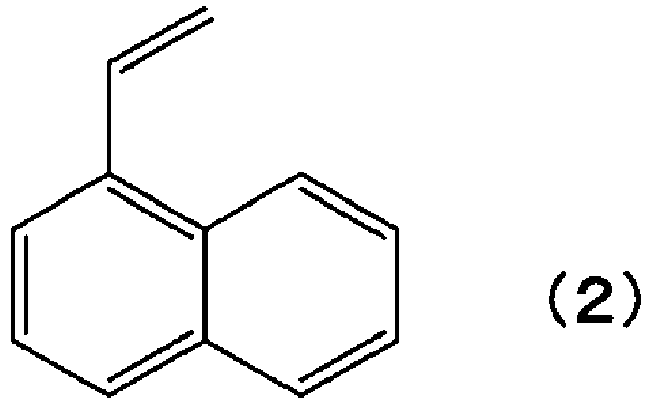
- 1-VN means 1-vinylnaphthalene represented by Formula (2)
- 2-VN means 2-vinylnaphthalene represented by Formula (3)
- 9-VA means 9-vinylanthracene represented by Formula (4)
- AB means allylbenzene represented by Formula (5).
- TD means tetracyclo[4.4.0.1 2,5 .1 7,10 ]-3-dodecene
- CPDTD means hexacyclo[6,6,1,1 3 , 6 ,1 10,13 ,0 2,7 ,0 9,14 ]heptadecene-4.
- NB means bicyclo[2.2.1]hept-2-ene (common name: norbornene) represented by the following formula.
- [Table 1] Example 1
- Example 2 Example 3
- Example 4 Example 5
- Example 6 Example 7 Comparative
- Example 1 Example 8
- Composition Constitutional unit (A) (derived from ethylene) (mol%)
- Constitutional unit (B) (derived from norbornene, tetracyclododecene, or hexacycl
- a glass transition temperature Tg of the cyclic olefin-based copolymer was measured in a nitrogen (N2) atmosphere.
- the cyclic olefin-based copolymer was heated to 200°C from room temperature at a heating rate of 10°C/min and then kept as it was for 5 minutes. Thereafter, the copolymer was cooled to -20°C at a cooling rate of 10°C/min and then kept as it was for 5 minutes. From a heat absorption curve formed at the time of heating the copolymer to 200°C at a heating rate of 10°C/min, the glass transition temperature (Tg) of the cyclic olefin-based copolymer was determined.
- the cyclic olefin-based copolymers synthesized in Manufacturing Examples 1 to 6, 8, and 10 to 12 were kneaded for 5 minutes at a kneading temperature of 280°C and 50 rpm. Then, by using an injection molding machine manufactured by Xplore Instruments BV, the copolymers were subjected to injection molding under the conditions of a cylinder temperature of 280°C, an injection pressure of 12 to 15 bar, and a mold temperature of 135°C, thereby preparing respectively injection molding sheets having a thickness of 1.0 mm.
- a refractive index (nd) at a wavelength of 589 nm was measured on the basis of ASTM D542.
- the optical lenses obtained in the examples had a high refractive index and an Abbe number which was lower than the Abbe number of the optical lens obtained in the comparative example. That is, the optical lenses obtained in the examples satisfied various characteristics required to optical lenses and had a high refractive index and a low Abbe number.
- Tg was higher than Tg in Examples 8 and 9 using NB represented by Formula (B-1), in which m represents 0, as a cyclic olefin from which the constitutional unit (B) is derived.
- the optical lens of the comparative example in which the cyclic olefin-based copolymer that did not contain the constitutional unit (C) derived from the aromatic vinyl compound was used, had a high Abbe number. In the comparative example, the intended optical lens was not obtained.
- the present invention also includes the following aspects.
Landscapes
- Chemical & Material Sciences (AREA)
- Physics & Mathematics (AREA)
- Medicinal Chemistry (AREA)
- Health & Medical Sciences (AREA)
- Chemical Kinetics & Catalysis (AREA)
- Polymers & Plastics (AREA)
- Organic Chemistry (AREA)
- Optics & Photonics (AREA)
- General Physics & Mathematics (AREA)
- Addition Polymer Or Copolymer, Post-Treatments, Or Chemical Modifications (AREA)
- Crystallography & Structural Chemistry (AREA)
- Engineering & Computer Science (AREA)
- Materials Engineering (AREA)
Abstract
Description
- The present invention relates to an optical lens.
- In optical lenses such as an imaging lens, an fθ lens, and a pickup lens, a cyclic olefin-based polymer is used. The cyclic olefin-based polymer used in molded products such as the optical lenses is required to have characteristics such as high transparency, excellent dimensional stability, and excellent heat resistance.
- Furthermore, for miniaturization and thinning, the imaging lens used, for example, in smartphones, digital cameras, and the like is required to have a further improved refractive index while maintaining a low birefringence value.
- Examples of techniques relating to the cyclic olefin-based polymer used in the optical lenses include those described in Patent Document 1 (Japanese Unexamined Patent Publication No.
10-287713 2010-235719 - Patent Document 1 describes a cyclic olefin-based copolymer obtained from (A) linear or branched α-olefin having 2 to 20 carbon atoms, (B) cyclic olefin represented by a predetermined chemical formula, and (C) aromatic vinyl compound, in which a limiting viscosity [η] of the copolymer is within a range of 0.1 to 10 dl/g, and a content ratio of a constitutional unit derived from (B) cyclic olefin and a content ratio of a constitutional unit derived from (C) aromatic vinyl compound satisfy a specific relationship.
- Patent Document 2 describes a cyclic olefin-based polymer containing a constitutional unit (A), which is derived from ethylene or an α-olefin having 3 to 20 carbon atoms, at 30 to 70 mol%, a constitutional unit (B), which is derived from a cyclic olefin represented by a predetermined chemical formula, at 20 to 50 mol%, and a constitutional unit (C), which is derived from an aromatic vinyl compound, at 0.1 to 20 mol%, in which a limiting viscosity [η], 1H-NMR, and a glass transition temperature of the polymer satisfy a predetermined condition.
-
- [Patent Document 1] Japanese Unexamined Patent Publication No.
10-287713 - [Patent Document 2] Japanese Unexamined Patent Publication No.
2010-235719 - According to the examination conducted by the inventors of the present invention, it has been revealed that for the uses such as optical lenses, in order to improve image quality and improve a degree of freedom in designing the optical lenses, a resin material of which the Abbe number is adjusted to a value lower than the Abbe number of the conventional resin materials is required.
- The present invention has been made in consideration of the circumstances described above, and an object thereof is to provide an optical lens which has a high refractive index and of which the Abbe number can be adjusted to a value lower than the Abbe number of the conventional resin materials.
- In order to achieve the above object, the inventors of the present invention conducted an intensive examination. As a result, the inventors have found that by using a cyclic olefin-based copolymer having a constitutional unit (A) derived from an α-olefin having 2 to 20 carbon atoms, a constitutional unit (B) derived from a cyclic olefin, and a constitutional unit (C) derived from an aromatic vinyl compound represented by General Formula (C-1), it is possible to adjust the Abbe number of an obtained optical lens to a value lower than the Abbe number of the conventional resin materials while the optical lens has a high refractive index.


- In Formula (C-1), any one of all Rs represented by R1 to R10 is a hydrocarbon group having a vinyl group represented by Formula (D-1), and * in Formula (D-1) represents a bond.
- In Formulas (C-1) and (D-1), all of m, n, and q represent 0 or a positive integer, q represents a positive integer in a case where both of m and n represent 0,
a plurality of R1s and R4s may be the same or different respectively in a case where m is 2 or more, a plurality of R6s and R9s may be the same or different respectively in a case where n is 2 or more,
R1 to R10 other than the hydrocarbon group having a vinyl group represented by Formula (D-1), R21, and R22 each independently represent a hydrogen atom, a halogen atom except for a fluorine atom, or a hydrocarbon group having 1 to 20 carbon atoms that may be substituted with a halogen atom except for a fluorine atom,
R1 and R2, R2 and R3, R3 and R4, R6 and R7, R7 and R8, and R8 and R9 may form a monocyclic ring by being bonded to each other, and the monocyclic ring may have a double bond. - That is, according to the present invention, the following optical lens is provided.
- [1] An optical lens constituted with a molded product containing a cyclic olefin-based copolymer having a constitutional unit (A) derived from an α-olefin having 2 to 20 carbon atoms,
a constitutional unit (B) derived from a cyclic olefin, and
a constitutional unit (C) derived from an aromatic vinyl compound represented by General Formula (C-1).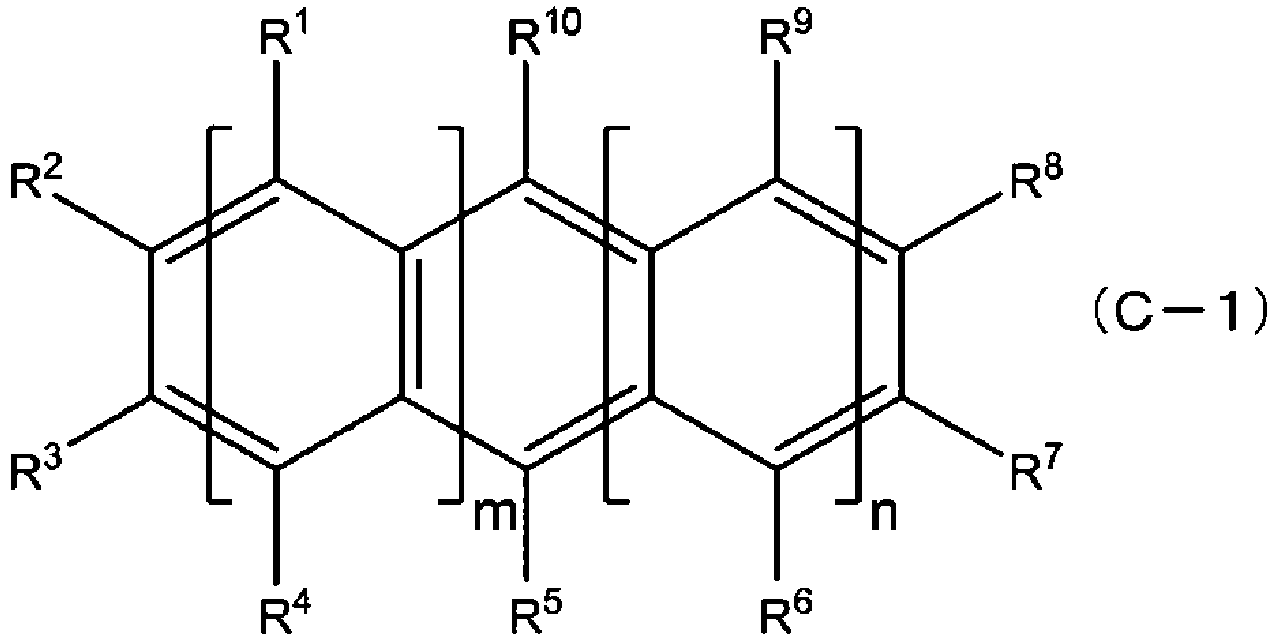
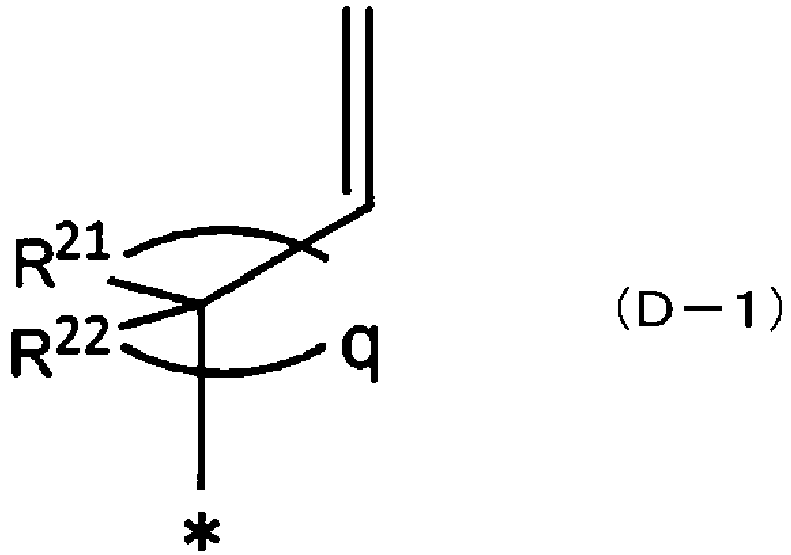
In Formula (C-1), any one of all Rs represented by R1 to R10 is a hydrocarbon group having a vinyl group represented by Formula (D-1), and * in Formula (D-1) represents a bond.
In Formulas (C-1) and (D-1), all of m, n, and q represent 0 or a positive integer, q represents a positive integer in a case where both of m and n represent 0,
a plurality of R1s and R4s may be the same or different respectively in a case where m is 2 or more, and a plurality of R6s and R9s may be the same or different respectively in a case where n is 2 or more,
R1 to R10 other than the hydrocarbon group having a vinyl group represented by Formula (D-1), R21, and R22 each independently represent a hydrogen atom, a halogen atom except for a fluorine atom, or a hydrocarbon group having 1 to 20 carbon atoms that may be substituted with a halogen atom except for a fluorine atom,
R1 and R2, R2 and R3, R3 and R4, R6 and R7, R7 and R8, and R8 and R9 may form a monocyclic ring by being bonded to each other, and the monocyclic ring may have a double bond. - [2] The optical lens described in [1],
which has an Abbe number (v) 30 or more and 55 or less. - [3] The optical lens described in [1] or [2],
in which in a case where a total content of the constitutional unit (A), the constitutional unit (B), and the constitutional unit (C) in the cyclic olefin-based copolymer is 100 mol%, a content of the constitutional unit (A) in the cyclic olefin-based copolymer is 10 mol% or more and 80 mol% or less. - [4] The optical lens described in any one of [1] to [3],
in which in a case where a total content of the constitutional unit (B) and the constitutional unit (C) in the cyclic olefin-based copolymer is 100 mol%, a content of the constitutional unit (C) in the cyclic olefin-based copolymer is 1 mol% or more and 95 mol% or less. - [5] The optical lens described in any one of [1] to [4],
in which the cyclic olefin contains a compound represented by Formula (B-1).
In Formula (B-1), n is 0 or 1, m is 0 or a positive integer, q is 0 or 1, R1 to R18, Ra, and Rb each independently represent a hydrogen atom, a halogen atom, or a hydrocarbon group which may be substituted with a halogen atom, R15 to R18 may form a monocyclic ring or a polycyclic ring by being bonded to each other, the monocyclic ring or the polycyclic ring may have a double bond, and R15 and R16 or R17 and R18 may form an alkylidene group. - [6] The optical lens described in [5], in which m in Formula (B-1) represents a positive integer.
- [7] The optical lens described in any one of [1] to [6], in which in General Formulas (C-1) and (D-1), all of m, n, and q represent 0, 1, or 2, and in a case where both of m and n represent 0, q represents 1 or 2.
- [8] The optical lens described in any one of [1] to [7],
in which a glass transition temperature (Tg) of the cyclic olefin-based copolymer measured using a differential scanning calorimeter (DSC) is 100°C or higher and 180°C or lower. - [9] The optical lens described in any one of [1] to [8],
in which a limiting viscosity [η] of the cyclic olefin-based copolymer measured in decalin at 135°C is 0.05 dl/g or higher and 5.00 dl/g or lower. - [10] The optical lens described in any one of [1] to [9],
which has a birefringence 1 nm or higher and 200 nm or lower. - [11] The optical lens described in any one of [1] to [10],
in which the aromatic vinyl compound contains at least one kind of compound selected from allylbenzene, 1-vinylnaphthalene, 2-vinylnaphthalene, and 9-vinylanthracene. - [12] The optical lens described in any one of [1] to [11],
in which q in Formula (D-1) represents 0. - According to the present invention, it is possible to provide an optical lens constituted with a molded product containing a cyclic olefin-based copolymer which has a high refractive index and of which the Abbe number can be adjusted to a value lower than the Abbe number of the conventional resin materials.
- Hereinafter, the present invention will be described based on embodiments. In the present embodiments, unless otherwise specified, "A to B" that indicates a range of numerical values represents "A or more and B or less".
- First, a cyclic olefin-based copolymer (P) according to the present embodiment will be described.
- The cyclic olefin-based copolymer (P) according to the present embodiment has a constitutional unit (A) derived from an α-olefin having 2 to 20 carbon atoms, a constitutional unit (B) derived from a cyclic olefin, and a constitutional unit (C) derived from an aromatic vinyl compound represented by Formula (C-1).


- In Formula (C-1), any one of all Rs represented by R1 to R10 is a hydrocarbon group having a vinyl group represented by Formula (D-1), and * in Formula (D-1) represents a bond.
- In Formulas (C-1) and (D-1), all of m, n, and q represent 0 or a positive integer, q represents a positive integer in a case where both of m and n represent 0,
a plurality of R1s and R4s may be the same or different respectively in a case where m is 2 or more, and a plurality of R6s and R9s may be the same or different respectively in a case where n is 2 or more,
R1 to R10 other than the hydrocarbon group having a vinyl group represented by Formula (D-1), R21, and R22 each independently represent a hydrogen atom, a halogen atom except for a fluorine atom, or a hydrocarbon group having 1 to 20 carbon atoms that may be substituted with a halogen atom except for a fluorine atom,
R1 and R2, R2 and R3, R3 and R4, R6 and R7, R7 and R8, and R8 and R9 may form a monocyclic ring by being bonded to each other, and the monocyclic ring may have a double bond.) - The cyclic olefin-based copolymer (P) according to the present embodiment has the constitutional unit (A) derived from an α-olefin having 2 to 20 carbon atoms, the constitutional unit (B) derived from a cyclic olefin, and the constitutional unit (C) derived from an aromatic vinyl compound represented by (C-1). Therefore, the copolymer (P) satisfies a high refractive index required to optical lenses and the like, and the Abbe number of the copolymer can be adjusted to a low value.
- Therefore, in a case where the cyclic olefin-based copolymer (P) according to the present embodiment is used, it is possible to obtain a molded product which has a high refractive index and an Abbe number lower than the Abbe number of the conventional resin materials .
- The constitutional unit (A) according to the present embodiment is a constitutional unit derived from an α-olefin having 2 to 20 carbon atoms.
- The α-olefin having 2 to 20 carbon atoms may be linear or branched, and examples thereof include a linear α-olefin having 2 to 20 carbon atoms such as ethylene, propylene, 1-butene, 1-pentene, 1-hexene, 1-octene, 1-decene, 1-dodecene, 1-tetradecene, 1-hexadecene, 1-octadecene, or 1-eicosene; a branched α-olefin having 4 to 20 carbon atoms such as 3-methyl-1-butene, 3-methyl-1-pentene, 3-ethyl-1-pentene, 4-methyl-1-pentene, 4-methyl-1-hexene, 4,4-dimethyl-1-hexene, 4,4-dimethyl-1-pentene, 4-ethyl-1-hexene, or 3-ethyl-1-hexene; and the like. Among these, a linear α-olefin having 2 to 4 carbon atoms is preferable, and ethylene is particularly preferable. One kind of each of these linear or branched α-olefins can be used singly, or two or more kinds of these linear or branched α-olefins can be used in combination.
- In a case where the total content of the constitutional unit (A), the constitutional unit (B), and the constitutional unit (C) in the cyclic olefin-based copolymer (P) according to the present embodiment is 100 mol%, the content of the constitutional unit (A) in the cyclic olefin-based copolymer (P) according to the present embodiment is preferably 10 mol% or more and 80 mol% or less, more preferably 30 mol% or more and 75 mol% or less, even more preferably 40 mol% or more and 70 mol% or less, and particularly preferably 50 mol% or more and 70 mol% or less.
- In a case where the content of the constitutional unit (A) is the lower limit described above or more, the heat resistance or the dimensional stability of the obtained molded product can be improved. Furthermore, in a case where the content of the constitutional unit (A) is the upper limit described above or less, the transparency of the obtained molded product and the like can be improved.
- In the present embodiment, the content of the constitutional unit (A) can be measured, for example, by 1H-NMR or 13C-NMR.
- The constitutional unit (B) according to the present embodiment is a constitutional unit derived from a cyclic olefin. From the viewpoint of further improving the refractive index of the obtained molded product, it is preferable that the constitutional unit (B) according to the present embodiment contains a constitutional unit derived from a compound represented by the following Formula (B-1).

- (In Formula [B-1], n is 0 or 1, m is 0 or a positive integer, q is 0 or 1, R1 to R18, Ra, and Rb each independently represent a hydrogen atom, a halogen atom, or a hydrocarbon group which may be substituted with a halogen atom, R15 to R18 may form a monocyclic ring or a polycyclic ring by being bonded to each other, the monocyclic ring or the polycyclic ring may have a double bond, and R15 and R16 or R17 and R18 may form an alkylidene group.)
- R1 to R18 and Ra and Rb preferably each represent a hydrocarbon group having 1 to 20 carbon atoms.
- From the viewpoint of adjusting the glass transition temperature (Tg) of the obtained cyclic olefin-based copolymer to an optimal value, m in Formula (B-1) is preferably a positive integer.
- Among these, the constitutional unit (B) according to the present embodiment preferably contains at least one kind of constitutional unit selected from a constitutional unit derived from bicyclo[2.2.1]-2-heptene, a constitutional unit derived from tetracyclo[4.4.0.12,5.17,10]-3-dodecene, a constitutional unit derived from hexacyclo[6,6,1,13,6,110,13,02,7,09,14]heptadecene-4. and the like, more preferably contains at least one kind of constitutional unit selected from a constitutional unit derived from bicyclo[2.2.1]-2-heptene and a constitutional unit derived from tetracyclo [4.4.0.12,5.17,10] -3-dodecene, and particularly preferably contains a constitutional unit derived from tetracyclo [4.4.0.12,5.17,10] -3-dodecene.
- The constitutional unit (C) according to the present embodiment is a constitutional unit derived from an aromatic vinyl compound represented by General Formula (C-1).
- One kind of the compound according to the present embodiment may be used singly, or two or more kinds of the compounds according to the present embodiment may be used in combination.
- In Formula (C-1), any one of all Rs represented by R1 to R10 is a hydrocarbon group having a vinyl group represented by Formula (D-1), and * in Formula (D-1) represents a bond.
- In Formulas (C-1) and (D-1), all of m, n, and q represent 0 or a positive integer, q represents a positive integer in a case where both of m and n represent 0,
a plurality of R1s and R4s may be the same or different respectively in a case where m is 2 or more, a plurality of R6s and R9s may be the same or different respectively in a case where n is 2 or more,
R1 to R10 other than the hydrocarbon group having a vinyl group represented by Formula (D-1), R21, and R22 each independently represent a hydrogen atom, a halogen atom except for a fluorine atom, or a hydrocarbon group having 1 to 20 carbon atoms that may be substituted with a halogen atom except for a fluorine atom,
R1 and R2, R2 and R3, R3 and R4, R6 and R7, R7 and R8, and R8 and R9 may form a monocyclic ring by being bonded to each other, and the monocyclic ring may have a double bond. - Preferably, in Formulas (C-1) and (D-1), all of m, n, and q represent 0, 1 or 2, and q represents 1 or 2 in a case where both of m and n represent 0. More preferably, both of m and n represent 0 and q represents 1; or m represents 0, n represents 1 or 2, and q represents 0 or 1. m preferably represents 0 or 1. n preferably represents 1 or 2. q preferably represents 0.
- Among Rs represented by R1 to R10 in Formula (C-1), R1 to R10 other than the hydrocarbon group having a vinyl group represented by Formula (D-1) and R21 and R22 in Formula (D-1) preferably represent a hydrogen atom or a hydrocarbon group having 1 to 20 carbon atoms, and more preferably represent a hydrogen atom.
- Examples of the hydrocarbon group having 1 to 20 carbon atoms include an alkyl group having 1 to 20 carbon atoms, a cycloalkyl group having 3 to 15 carbon atoms, an aromatic hydrocarbon group, and the like. More specifically, examples of the alkyl group include a methyl group, an ethyl group, a propyl group, an isopropyl group, an amyl group, a hexyl group, an octyl group, a decyl group, a dodecyl group, an octadecyl group, and the like. Examples of the cycloalkyl group include a cyclohexyl group, and the like. Examples of the aromatic hydrocarbon group include an aryl group and an aralkyl group such as a phenyl group, a tolyl group, a naphthyl group, a benzyl group, and a phenyl ethyl group . These hydrocarbon groups may be substituted with a halogen atom except for a fluorine atom.
- Among these, as the structure represented by (C-1) according to the present embodiment, for example, at least one kind of compound selected from allylbenzene, 1-vinylnaphthalene, 2-vinylnaphthalene, and 9-vinylanthracene is preferable, and at least one kind of compound selected from 1-vinylnaphthalene, 2-vinylnaphthalene, and 9-vinylanthracene is particularly preferable. It is considered that in a case where these particularly preferable aromatic vinyl compounds are used, the compounds may be excellently copolymerized with the α-olefin from which the constitutional unit (A) is derived and the cyclic olefin from which the constitutional unit (B) is derived, more aromatic rings can be efficiently introduced into the obtained cyclic olefin-based copolymer, and accordingly, particularly the refractive index could be adjusted to a high value and the Abbe number could be adjusted to a low value.
- The aromatic vinyl compound represented by General Formula (C-1) according to the present embodiment does not include styrene. In a case where styrene is used as the aromatic vinyl compound, it is difficult to adjust the Abbe number to an optimal range which is, for example, 30 or more and 50 or less.
- In a case where the total content of the constitutional unit (B) and the constitutional unit (C) in the cyclic olefin-based copolymer (P) according to the present embodiment is 100 mol%, the content of the constitutional unit (C) in the cyclic olefin-based copolymer (P) according to the present embodiment is preferably 1 mol% or more and 95 mol% or less, more preferably 2 mol% or more and 60 mol% or less, and even more preferably 3 mol% or more and 40 mol% or less.
- In a case where the content of the constitutional unit (C) is the lower limit described above or more, in the obtained molded product, the refractive index can be kept high while the Abbe number can be further reduced. Furthermore, in a case where the content of the constitutional unit (C) is the upper limit described above or less, the balance between the refractive index and the Abbe number in the obtained molded product can be further improved.
- In the present embodiment, the content of the constitutional unit (B) and the constitutional unit (C) can be measured, for example, by 1H-NMR or 13C-NMR.
- The copolymerization type of the cyclic olefin-based copolymer (P) according to the present embodiment is not particularly limited, and examples thereof include a random copolymer, a block copolymer, and the like. In the present embodiment, from the viewpoint of making it possible to obtain a molded product excellent in optical properties such as transparency, Abbe number, refractive index, and birefringence, as the cyclic olefin-based copolymer (P) according to the present embodiment, a random copolymer is preferable.
- The cyclic olefin-based copolymer (P) according to the present embodiment can be manufactured, for example, by appropriately selecting conditions according to the methods described in Japanese Unexamined Patent Publication No.
60-168708 61-120816 61-115912 61-115916 61-271308 61-272216 62-252406 62-252407 2007-314806 2010-241932 - In a case where an injection molding sheet having a thickness of 1.0 mm is prepared using the cyclic olefin-based copolymer (P) according to the present embodiment, a refractive index (nd) of the injection molding sheet measured based on ASTM D542 at a wavelength of 589 nm is preferably 1.545 or higher, preferably 1.550 or higher, and more preferably 1.555 or higher. The upper limit of the refractive index (nd) is not particularly limited, but is 1.580 or lower for example.
- In a case where the refractive index is within the above range, it is possible to further reduce the thickness of the molded product, which is obtained using the cyclic olefin-based copolymer (P) according to the present embodiment, while maintaining excellent optical characteristics of the molded product.
- The refractive index (nd) of the optical lens according to the present embodiment, which is measured at a wavelength of 589 nm on the basis of ASTM D542, is preferably 1.545 or higher, preferably 1.550 or higher, and more preferably 1.555 or higher. The upper limit of the refractive index (nd) is not particularly limited, for example is 1.580 or lower.
- From the viewpoint of further improving the transparency of the molded product obtained using the cyclic olefin-based copolymer (P) according to the present embodiment, in a case where an injection molding sheet which is formed of the cyclic olefin-based copolymer (P) and has a thickness of 1.0 mm is prepared, a haze of the injection molding sheet measured based on JIS K7136 is preferably less than 5%.
- The haze of the optical lens according to the present embodiment, which is measured at a thickness of 1.0 mm on the basis of JIS K7136, is preferably less than 5%.
- From the viewpoint of adjusting an Abbe number (v) of a molded product, which is obtained using the cyclic olefin-based copolymer (P) according to the present embodiment, to a more suitable range, in a case where an injection molding sheet which is formed of the cyclic olefin-based copolymer (P) and has a thickness of 1.0 mm is prepared, the Abbe number (v) of the injection molding sheet is preferably 30 or more and 55 or less, more preferably 35 or more and 50 or less, and even more preferably 40 or more and 47 or less.
- The Abbe number (v) of the injection molding sheet can be calculated from refractive indices of the injection molding sheet measured at 23°C at wavelengths of 486 nm, 589 nm, and 656 nm by using the following equation.

- nD: refractive index at wavelength of 589 nm
- nC: refractive index at wavelength of 656 nm
- nF: refractive index at wavelength of 486 nm
- The Abbe number (v) of the optical lens according to the present embodiment is preferably 30 or more and 55 or less, more preferably 35 or more and 50 or less, and even more preferably 40 or more and 47 or less.
- From the viewpoint of adjusting the birefringence of a molded product, which is obtained from the cyclic olefin-based copolymer (P) according to the present embodiment, to a more suitable range, in a case where an injection molding sheet which is formed of the cyclic olefin-based copolymer (P) and has a thickness of 1.0 mm is prepared, the birefringence of the injection molding sheet is preferably 1 nm or higher and 200 nm or lower, more preferably less than 40 nm, and even more preferably less than 30 nm.
- In the present embodiment, the birefringence of the injection molding sheet is an average of phase differences of 20 to 35 mm from a gate direction that are measured at a measurement wavelength of 650 nm by using KOBRA CCD manufactured by Oji Scientific Instruments.
- The birefringence of the optical lens according to the present embodiment is preferably 1 nm or higher and 200 nm or lower, more preferably less than 40 nm, and even more preferably less than 30 nm.
- From the viewpoint of further improving the heat resistance of the obtained molded product while excellently maintaining the transparency, the Abbe number, the birefringence, and the refractive index of the molded product, a glass transition temperature (Tg) of the cyclic olefin-based copolymer (P) according to the present embodiment that is measured using a differential scanning calorimeter (DSC) is preferably 100°C or higher and 180°C or lower, more preferably 120°C or higher and 170°C or lower, and even more preferably 130°C or higher and 160°C or lower.
- A limiting viscosity [η] (in decalin at 135°C) of the cyclic olefin-based copolymer (P) according to the present embodiment is 0.05 to 5.00 dl/g for example. The limiting viscosity [η] is preferably 0.20 to 4.00 dl/g, more preferably 0.30 to 2.00 dl/g, and particularly preferably 0.40 to 1.00 dl/g.
- The molded product according to the present embodiment is a molded product containing the cyclic olefin-based copolymer (P) according to the present embodiment.
- The molded product according to the present embodiment contains the cyclic olefin-based copolymer (P) according to the present embodiment. Therefore, in the molded product, heat resistance, transparency, birefringence, chemical resistance, low hygroscopicity, and the like are excellently balanced. Furthermore, the molded product has a higher refractive index and an Abbe number lower than the Abbe number of the conventional resin materials. Accordingly, the molded product is suited for being used as an optical lens.
- The molded product according to the present embodiment has excellent optical characteristics. Therefore, the molded product can be suitably used as an optical lens such as a spectacle lens, an fθ lens, a pickup lens, an imaging lens, a sensor lens, a prism, a light guide plate, or an in-vehicle camera lens. Because the molded product has a high refractive index and an Abbe number lower than the Abbe number of the conventional resin materials, the molded product can be particularly suitably used as an imaging lens.
- In a case where the total amount of the molded product is 100% by mass, from the viewpoint of further improving the balance among the performances of transparency, birefringence, Abbe number, and refractive index, the content of the cyclic olefin-based copolymer (P) in the molded product according to the present embodiment is preferably 50% by mass or more and 100% by mass or less, more preferably 70% by mass or more and 100% by mass or less, even more preferably 80% by mass or more and 100% by mass or less, and particularly preferably 90% by mass or more and 100% by mass or less.
- The molded product according to the present embodiment can be obtained by molding a resin composition containing the cyclic olefin-based copolymer (P) in a predetermined shape. As the method for obtaining the molded product by molding the resin composition containing the cyclic olefin-based copolymer (P), known methods can be used without particular limitation. Although the method varies with the use and the shape of the molded product, for example, it is possible to use extrusion molding, injection molding, compression molding, inflation molding, blow molding, extrusion blow molding, injection blow molding, press molding, vacuum molding, powder slush molding, calendar molding, expansion molding, and the like. Among these, from the viewpoint of molding properties and productivity, an injection molding method is preferable. The molding conditions are appropriately selected according to the purpose of use and the molding method. For example, for injection molding, generally, the temperature of a resin is appropriately selected within a range of 150°C to 400°C, preferably within a range of 200°C to 350°C, and more preferably within a range of 230°C to 330°C.
- The molded product according to the present embodiment can be used in various forms such as the shapes of a lens, a sphere, a rod, a plate, a cylinder, a barrel, a tube, fiber, a film, and a sheet.
- If necessary, as long as the excellent physical properties of the molded product according to the present embodiment are not impaired, as optional components, known additives can be contained in the molded product according to the present embodiment. As the additives, for example, a phenol-based stabilizer, a higher fatty acid metal salt, an antioxidant, an ultraviolet absorber, a hindered amine-based light stabilizer, a hydrochloric acid absorber, a metal deactivator, an antistatic agent, an antifogging agent, a lubricant, a slip agent, a nucleating agent, a plasticizer, a flame retardant, a phosphorus-based stabilizer, and the like can be contained in molded product to such a degree that does not impair the objects of the present invention. The proportion of the additives to be mixed may be appropriately set.
- The optical lens according to the present embodiment is constituted with the molded product according to the present embodiment. The optical lens according to the present embodiment may be made into an optical lens system by being combined with an optical lens different from the optical lens described above.
- That is, the optical lens system according to the present embodiment includes a first optical lens, which is constituted with the molded product containing the cyclic olefin-based copolymer (P) according to the present embodiment, and a second optical lens different from the first optical lens.
- The second optical lens is not particularly limited. For example, as the second optical lens, it is possible to use an optical lens constituted with at least one kind of resin selected from a polycarbonate resin and a polyester resin.
- Hitherto, the embodiments of the present invention have been described. However, the embodiments are merely examples of the present invention, and various constitutions other than the embodiments can also be adopted.
- Furthermore, the present inventions are not limited to the embodiments, and as long as the objects of the present inventions can be achieved, modification, amelioration, and the like are also included in the inventions.
- Hereinafter, the present invention will be further described on the basis of examples, but the present invention is not limited thereto.
- According to the method described in paragraphs "0107" and "0108" of Japanese Unexamined Patent Publication No.
2010-235719 - A white powder-like
ethylene·tetracyclododecene·1-vinylnaphthalene copolymer was obtained. - In this way, a cyclic olefin-based copolymer (P-1) was obtained.
- The cyclic olefin-based copolymers (P-2) to (P-6), (P-8), and (P-10) to (P-12) described in Table 1 were obtained by performing the same operation as that in Manufacturing Example 1, except that a value of the content of each of the constitutional units constituting the cyclic olefin-based copolymer was adjusted to the value described in Table 1, and the cyclic olefin and the aromatic cyclic vinyl compound described in Table 1 were used as a cyclic olefin and an aromatic cyclic vinyl compound.
- In Table 1, 1-VN means 1-vinylnaphthalene represented by Formula (2), and 2-VN means 2-vinylnaphthalene represented by Formula (3). 9-VA means 9-vinylanthracene represented by Formula (4), and AB means allylbenzene represented by Formula (5). TD means tetracyclo[4.4.0.12,5.17,10]-3-dodecene, and CPDTD means hexacyclo[6,6,1,13,6,110,13,02,7,09,14]heptadecene-4.


- NB means bicyclo[2.2.1]hept-2-ene (common name: norbornene) represented by the following formula.

[Table 1] Example 1 Example 2 Example 3 Example 4 Example 5 Example 6 Example 7 Comparative Example 1 Example 8 Example 9 Cyclic olefin-based copolymer P-1 P-2 P-3 P-4 P-5 P-6 P-8 P-10 P-11 P-12 Cyclic olefin from which constitutional unit (B) is derived TD TD TD TD TD CPDTD CPDTD TD NB NB Aromatic cyclic vinyl compound from which constitutional unit (C) is derived 1-VN 1-VN 2-VN 2-VN 9-VA 9-VA AB - 1-VN 9-VA Composition Constitutional unit (A) (derived from ethylene) (mol%) 61 58 60 58 60 70 65 65 50 50 Constitutional unit (B) (derived from norbornene, tetracyclododecene, or hexacycloheptadecene) (mol%) 35 34 34 32 37 27 25 35 46 44 Constitutional unit (C) (mol%) 4 8 6 10 3 3 10 0 4 6 Tg (°C) 143 144 142 140 149 153 132 150 117 106 [η] (dl/g) 0.45 0.45 0.45 0.45 0.45 0.45 0.45 0.45 0.45 0.45 Refractive index (nd) 1.555 1.565 1.562 1.572 1.566 1.566 1.555 1.543 1.543 1.556 Abbe number 49 44 46 41 42 42 51 56 50 41 - In each of the examples and the comparative example, various physical properties were measured or evaluated by the following method. The obtained results are shown in Table 1.
- The content of ethylene, tetracyclo[4.4.0.12,5.17,10] -3-dodecene, hexacyclo[6,6,1,13,6,110,13,02,7,09,14]heptadecene-4, bicyclo[2.2.1]hept-2-ene, and the aromatic vinyl compound was measured under the following conditions by using a nuclear magnetic resonance spectrometer "ECA 500" manufactured by JEOL Ltd.
- Solvent: deuterated tetrachloroethane
- Sample concentration: 50 to 100 g/l-solvent
- Pulse repetition time: 5.5 seconds
- Number of times of integration: 6,000 to 16,000
- Measurement temperature: 120°C
- From a 13C-NMR spectrum measured under the above conditions, the composition of ethylene, tetracyclo[4.4.0.12,5.17,10]-3-dodecene, hexacyclo[6,6,1,13,6,110,13,02,7,09,14]heptadecene-4, bicyclo[2.2.1]hept-2-ene, and the aromatic vinyl compound were quantified respectively.
- By using DSC-6220 manufactured by Shimadzu Corporation, a glass transition temperature Tg of the cyclic olefin-based copolymer was measured in a nitrogen (N2) atmosphere. The cyclic olefin-based copolymer was heated to 200°C from room temperature at a heating rate of 10°C/min and then kept as it was for 5 minutes. Thereafter, the copolymer was cooled to -20°C at a cooling rate of 10°C/min and then kept as it was for 5 minutes. From a heat absorption curve formed at the time of heating the copolymer to 200°C at a heating rate of 10°C/min, the glass transition temperature (Tg) of the cyclic olefin-based copolymer was determined.
- By using a mobile viscometer (manufactured by RIGOSHA & Co., Ltd., type: VNR053U), 0.25 to 0.30 g of the cyclic olefin-based copolymer was dissolved in 25 ml of decalin, thereby obtaining a sample. On the basis of ASTM J1601, the specific viscosity of the cyclic olefin-based copolymer was measured at 135°C, a ratio between the specific viscosity and the concentration was extrapolated to a concentration 0, thereby determining a limiting viscosity [η] of the cyclic olefin-based copolymer.
- By using a compact kneader manufactured by Xplore Instruments BV, the cyclic olefin-based copolymers synthesized in Manufacturing Examples 1 to 6, 8, and 10 to 12 were kneaded for 5 minutes at a kneading temperature of 280°C and 50 rpm. Then, by using an injection molding machine manufactured by Xplore Instruments BV, the copolymers were subjected to injection molding under the conditions of a cylinder temperature of 280°C, an injection pressure of 12 to 15 bar, and a mold temperature of 135°C, thereby preparing respectively injection molding sheets having a thickness of 1.0 mm.
- For each of the 30 mm x 30 mm x 1.0 mm (thickness) injection molding sheets molded using the micro-compounder, by using KOBRA CCD manufactured by Oji Scientific Instruments, an average of phase differences of 20 to 35 mm from a gate direction at a measurement wavelength of 650 nm was determined.
- Then, the birefringence was evaluated on the basis of the following standards.
- A: the average of phase differences was less than 30 nm.
- B: the average of phase differences was 30 or more nm and less than 40 nm.
- C: the average of phase differences was 40 nm or more.
- By using a refractometer (KPR200 manufactured by Shimadzu Corporation), for each of the 30 mm x 30 mm x 1.0 mm (thickness) injection molding sheets molded using the micro-compounder, a refractive index (nd) at a wavelength of 589 nm was measured on the basis of ASTM D542.
- For each of the 30 mm x 30 mm x 1.0 mm (thickness) injection molding sheets molded using the micro-compounder, the refractive index was measured using the Abbe refractometer at wavelengths of 486 nm, 589 nm, and 656 nm at 23°C. Furthermore, by using the following equation, an Abbe number (v) was calculated.

- nD: refractive index at wavelength of 589 nm
- nC: refractive index at wavelength of 656 nm
- nF: refractive index at wavelength of 486 nm
- As shown in the above tables, the optical lenses obtained in the examples had a high refractive index and an Abbe number which was lower than the Abbe number of the optical lens obtained in the comparative example. That is, the optical lenses obtained in the examples satisfied various characteristics required to optical lenses and had a high refractive index and a low Abbe number. In Examples 1 to 7 using TD and CPDTD represented by Formula (B-1), in which m represents a positive integer, as a cyclic olefin from which the constitutional unit (B) is derived, Tg was higher than Tg in Examples 8 and 9 using NB represented by Formula (B-1), in which m represents 0, as a cyclic olefin from which the constitutional unit (B) is derived. In contrast, the optical lens of the comparative example, in which the cyclic olefin-based copolymer that did not contain the constitutional unit (C) derived from the aromatic vinyl compound was used, had a high Abbe number. In the comparative example, the intended optical lens was not obtained.
- The present application claims priority based on Japanese Patent Application No.
2018-066628 filed on March 30, 2018 - The present invention also includes the following aspects.
- 1. A cyclic olefin-based copolymer having a constitutional unit (A) derived from an α-olefin having 2 to 20 carbon atoms,
a constitutional unit (B) derived from a cyclic olefin, and
a constitutional unit (C) derived from an aromatic vinyl compound represented by General Formula (C-1).

(In Formula (C-1), any one of all Rs represented by R1 to R10 is a hydrocarbon group having a vinyl group represented by Formula (D-1), and * in Formula (D-1) represents a bond.
In Formulas (C-1) and (D-1), all of m, n, and q represent 0 or a positive integer, q represents a positive integer in a case where both of m and n represent 0,
a plurality of R1s and R4s may be the same or different respectively in a case where m is 2 or more, a plurality of R6s and R9s may be the same or different respectively in a case where n is 2 or more,
R1 to R10 other than the hydrocarbon group having a vinyl group represented by Formula (D-1), R21, and R22 each independently represent a hydrogen atom, a halogen atom except for a fluorine atom, or a hydrocarbon group having 1 to 20 carbon atoms that may be substituted with a halogen atom except for a fluorine atom,
R1 and R2, R2 and R3, R3 and R4, R6 and R7, R7 and R8, and R8 and R9 may form a monocyclic ring by being bonded to each other, and the monocyclic ring may have a double bond.) - 2. The cyclic olefin-based copolymer described in 1.,
in which in a case where a total content of the constitutional unit (A), the constitutional unit (B), and the constitutional unit (C) in the cyclic olefin-based copolymer is 100 mol%, a content of the constitutional unit (A) in the cyclic olefin-based copolymer is 10 mol% or more and 80 mol% or less. - 3. The cyclic olefin-based copolymer described in 1. or 2., in which in a case where a total content of the constitutional unit (B) and the constitutional unit (C) in the cyclic olefin-based copolymer is 100 mol%, a content of the constitutional unit (C) in the cyclic olefin-based copolymer is 1 mol% or more and 95 mol% or less.
- 4. The cyclic olefin-based copolymer described in any one of 1. to 3.,
in which the cyclic olefin contains a compound represented by Formula (B-1).
(In Formula [B-1], n is 0 or 1, m is 0 or a positive integer, q is 0 or 1, R1 to R18, Ra, and Rb each independently represent a hydrogen atom, a halogen atom, or a hydrocarbon group which may be substituted with a halogen atom, R15 to R18 may form a monocyclic ring or a polycyclic ring by being bonded to each other, the monocyclic ring or the polycyclic ring may have a double bond, and R15 and R16 or R17 and R18 may form an alkylidene group.) - 5. The cyclic olefin-based copolymer described in any one of 1. to 4., in which in General Formulas (C-1) and (D-1), all of m, n, and q represent 0, 1, or 2, and q represents 1 or 2 in a case where both of m and n represent 0.
- 6. The cyclic olefin-based copolymer described in any one of 1. to 5.,
in which in a case where an injection molding sheet which is formed of the cyclic olefin-based copolymer and has a thickness of 1.0 mm is prepared, an Abbe number (v) of the injection molding sheet is 30 or more and 55 or less. - 7. The cyclic olefin-based copolymer described in any one of 1. to 6.,
in which a glass transition temperature (Tg) of the cyclic olefin-based copolymer measured using a differential scanning calorimeter (DSC) is 100°C or higher and 180°C or lower. - 8. The cyclic olefin-based copolymer described in any one of 1. to 7.,
which has a limiting viscosity [η], measured in decalin at 135°C, of 0.05 dl/g or higher and 5.00 dl/g or lower. - 9. The cyclic olefin-based copolymer described in any one of 1. to 8.,
in which in a case where an injection molding sheet which is formed of the cyclic olefin-based copolymer and has a thickness of 1.0 mm is prepared, a birefringence of the injection molding sheet is 1 nm or higher and 200 nm or lower. - 10. The cyclic olefin-based copolymer described in any one of 1. to 9.,
in which the aromatic vinyl compound contains at least one kind of compound selected from allylbenzene, 1-vinylnaphthalene, 2-vinylnaphthalene, and 9-vinylanthracene. - 11. The cyclic olefin-based copolymer described in any one of 1. to 10.,
in which q in Formula (D-1) represents 0. - 12. A resin composition containing the cyclic olefin-based copolymer described in any one of 1. to 11.
- 13. A molded product containing the cyclic olefin-based copolymer described in any one of 1. to 11.
- 14. The molded product described in 13., which is an optical lens.
Claims (12)
- An optical lens constituted with a molded product containing a cyclic olefin-based copolymer having a constitutional unit (A) derived from an α-olefin having 2 to 20 carbon atoms, a constitutional unit (B) derived from a cyclic olefin, and a constitutional unit (C) derived from an aromatic vinyl compound represented by General Formula (C-1),


in Formulas (C-1) and (D-1), all of m, n, and q represent 0 or a positive integer, q represents a positive integer in a case where both of m and n represent 0,
a plurality of R1s and R4s may be the same or different respectively in a case where m is 2 or more, a plurality of R6s and R9s may be the same or different respectively in a case where n is 2 or more,
R1 to R10 other than the hydrocarbon group having a vinyl group represented by Formula (D-1), R21, and R22 each independently represent a hydrogen atom, a halogen atom except for a fluorine atom, or a hydrocarbon group having 1 to 20 carbon atoms that may be substituted with a halogen atom except for a fluorine atom,
R1 and R2, R2 and R3, R3 and R4, R6 and R7, R7 and R8, and R8 and R9 may form a monocyclic ring by being bonded to each other, and the monocyclic ring may have a double bond. - The optical lens according to claim 1,
wherein an Abbe number (v) is 30 or more and 55 or less. - The optical lens according to claim 1 or 2,
wherein in a case where a total content of the constitutional unit (A), the constitutional unit (B), and the constitutional unit (C) in the cyclic olefin-based copolymer is 100 mol%, a content of the constitutional unit (A) in the cyclic olefin-based copolymer is 10 mol% or more and 80 mol% or less. - The optical lens according to any one of claims 1 to 3,
wherein in a case where a total content of the constitutional unit (B) and the constitutional unit (C) in the cyclic olefin-based copolymer is 100 mol%, a content of the constitutional unit (C) in the cyclic olefin-based copolymer is 1 mol% or more and 95 mol% or less. - The optical lens according to any one of claims 1 to 4,
wherein the cyclic olefin contains a compound represented by Formula (B-1),
- The optical lens according to claim 5,
wherein m in Formula (B-1) represents a positive integer. - The optical lens according to any one of claims 1 to 6,
wherein in General Formulas (C-1) and (D-1), all of m, n, and q represent 0, 1, or 2, and q represents 1 or 2 in a case where both of m and n represent 0. - The optical lens according to any one of claims 1 to 7,
wherein a glass transition temperature (Tg) of the cyclic olefin-based copolymer measured using a differential scanning calorimeter (DSC) is 100°C or higher and 180°C or lower. - The optical lens according to any one of claims 1 to 8,
wherein a limiting viscosity [η] of the cyclic olefin-based copolymer measured in decalin at 135°C is 0.05 dl/g or higher and 5.00 dl/g or lower. - The optical lens according to any one of claims 1 to 9,
wherein a birefringence is 1 nm or higher and 200 nm or lower. - The optical lens according to any one of claims 1 to 10,
wherein the aromatic vinyl compound contains at least one kind of compound selected from allylbenzene, 1-vinylnaphthalene, 2-vinylnaphthalene, and 9-vinylanthracene. - The optical lens according to any one of claims 1 to 11,
wherein q in Formula (D-1) represents 0.
Applications Claiming Priority (2)
| Application Number | Priority Date | Filing Date | Title |
|---|---|---|---|
| JP2018066628 | 2018-03-30 | ||
| PCT/JP2019/010964 WO2019188447A1 (en) | 2018-03-30 | 2019-03-15 | Optical lens |
Publications (2)
| Publication Number | Publication Date |
|---|---|
| EP3779521A1 true EP3779521A1 (en) | 2021-02-17 |
| EP3779521A4 EP3779521A4 (en) | 2022-01-12 |
Family
ID=68061490
Family Applications (1)
| Application Number | Title | Priority Date | Filing Date |
|---|---|---|---|
| EP19776849.2A Pending EP3779521A4 (en) | 2018-03-30 | 2019-03-15 | OPTICAL LENS |
Country Status (7)
| Country | Link |
|---|---|
| US (1) | US12043684B2 (en) |
| EP (1) | EP3779521A4 (en) |
| JP (1) | JP7028961B2 (en) |
| KR (1) | KR20200131872A (en) |
| CN (1) | CN111971589B (en) |
| TW (1) | TWI854973B (en) |
| WO (1) | WO2019188447A1 (en) |
Family Cites Families (26)
| Publication number | Priority date | Publication date | Assignee | Title |
|---|---|---|---|---|
| JPS60168708A (en) | 1984-02-03 | 1985-09-02 | Mitsui Petrochem Ind Ltd | Novel random copolymer and its production |
| JPS61115912A (en) | 1984-11-12 | 1986-06-03 | Mitsui Petrochem Ind Ltd | Novel random multicomponent copolymer |
| JPS61115916A (en) | 1984-11-12 | 1986-06-03 | Mitsui Petrochem Ind Ltd | Novel polymer |
| JPS61120816A (en) | 1984-11-19 | 1986-06-07 | Mitsui Petrochem Ind Ltd | Novel polymer |
| JPH0723411B2 (en) | 1986-04-26 | 1995-03-15 | 三井石油化学工業株式会社 | Cyclic olefin-based random copolymer |
| JPH0780973B2 (en) | 1986-04-26 | 1995-08-30 | 三井石油化学工業株式会社 | Cyclic olefin-based random copolymer |
| JPH07643B2 (en) | 1985-05-24 | 1995-01-11 | 三井石油化学工業株式会社 | Process for producing amorphous cyclic olefin random copolymer |
| JPH062786B2 (en) | 1985-05-28 | 1994-01-12 | 三井石油化学工業株式会社 | Preparation of cyclic olefin random copolymer |
| JP2007314806A (en) | 1994-04-22 | 2007-12-06 | Mitsui Chemicals Inc | Production method of cycloolefin copolymer and copolymer produced thereby |
| JP2000502130A (en) | 1995-12-07 | 2000-02-22 | エクソン・ケミカル・パテンツ・インク | Tackifier and method for obtaining tackifier |
| JP3817015B2 (en) | 1997-04-14 | 2006-08-30 | 三井化学株式会社 | Cyclic olefin copolymer and use thereof |
| JP2002333501A (en) * | 2001-03-09 | 2002-11-22 | Showa Denko Kk | Composition for plastic lens, plastic lens obtained by curing the same and method for producing the plastic lens |
| JP2005330465A (en) * | 2004-04-21 | 2005-12-02 | Mitsui Chemicals Inc | Ethylene-cyclic olefin copolymer and its optical component |
| JP2006143799A (en) * | 2004-11-17 | 2006-06-08 | Tosoh Corp | Transparent resin composition and optical film comprising the same |
| WO2006104049A1 (en) | 2005-03-25 | 2006-10-05 | Zeon Corporation | Norbornene addition copolymer and moldings |
| JP4821530B2 (en) * | 2006-09-19 | 2011-11-24 | Jsr株式会社 | Thin optical lens |
| JP2009046613A (en) | 2007-08-21 | 2009-03-05 | Fujifilm Corp | Cycloolefin copolymers and films |
| JP2009080424A (en) * | 2007-09-27 | 2009-04-16 | Teijin Chem Ltd | Optical member |
| JP5594712B2 (en) | 2009-03-30 | 2014-09-24 | 三井化学株式会社 | Polymer and optical material using the same |
| JP5227237B2 (en) | 2009-04-03 | 2013-07-03 | 三井化学株式会社 | α-Olefin / Cyclic Olefin Copolymer, Process for Producing the Same, and Molded Body Containing α-Olefin / Cyclic Olefin Copolymer |
| JP5609117B2 (en) * | 2010-01-07 | 2014-10-22 | 三菱瓦斯化学株式会社 | Polyester resin and optical lens |
| JP2012008547A (en) * | 2010-05-28 | 2012-01-12 | Sumitomo Chemical Co Ltd | Optical film |
| JP2012233118A (en) | 2011-05-06 | 2012-11-29 | Kaneka Corp | Curable composition |
| JP6734840B2 (en) * | 2015-03-13 | 2020-08-05 | 大阪ガスケミカル株式会社 | Resin composition and optical lens |
| JP6303219B1 (en) | 2016-10-19 | 2018-04-04 | ソリッドビジョン株式会社 | Image processing system and image processing method |
| JP2018145425A (en) * | 2017-03-06 | 2018-09-20 | ポリプラスチックス株式会社 | Cyclic olefin resin composition, method for producing the same, and molding |
-
2019
- 2019-03-15 CN CN201980024829.6A patent/CN111971589B/en active Active
- 2019-03-15 WO PCT/JP2019/010964 patent/WO2019188447A1/en not_active Ceased
- 2019-03-15 EP EP19776849.2A patent/EP3779521A4/en active Pending
- 2019-03-15 KR KR1020207029392A patent/KR20200131872A/en not_active Ceased
- 2019-03-15 JP JP2020510671A patent/JP7028961B2/en active Active
- 2019-03-15 US US17/043,359 patent/US12043684B2/en active Active
- 2019-03-26 TW TW108110526A patent/TWI854973B/en active
Also Published As
| Publication number | Publication date |
|---|---|
| CN111971589A (en) | 2020-11-20 |
| US20210024675A1 (en) | 2021-01-28 |
| EP3779521A4 (en) | 2022-01-12 |
| JP7028961B2 (en) | 2022-03-02 |
| JPWO2019188447A1 (en) | 2021-02-12 |
| TW201942153A (en) | 2019-11-01 |
| CN111971589B (en) | 2024-08-13 |
| TWI854973B (en) | 2024-09-11 |
| WO2019188447A1 (en) | 2019-10-03 |
| KR20200131872A (en) | 2020-11-24 |
| US12043684B2 (en) | 2024-07-23 |
Similar Documents
| Publication | Publication Date | Title |
|---|---|---|
| JP4759518B2 (en) | Polycarbonate having low photoelastic constant and film comprising the same | |
| US12091498B2 (en) | Resin composition, molded body, optical lens, and optical lens unit | |
| TW202043302A (en) | Cyclic olefin resin composition, molded product and optical component | |
| US12043684B2 (en) | Optical lens | |
| JP6986986B2 (en) | Fluorine-containing cyclic olefin-based copolymers and molded products | |
| JP7514600B2 (en) | Optical Components | |
| EP4095168B1 (en) | Optical component | |
| JP2024075159A (en) | Cyclic olefin resin composition, molded article, and optical component | |
| JP7792502B2 (en) | Cyclic olefin copolymer, cyclic olefin copolymer composition, molded article, and optical component | |
| JP7312580B2 (en) | Cyclic olefin copolymer pellets, molded article, and method for producing cyclic olefin copolymer pellets | |
| TWI918620B (en) | Optical components | |
| JP2018165357A (en) | Optical component | |
| WO2025169955A1 (en) | Lens unit, imaging unit, and electronic device | |
| JP2025151736A (en) | Cyclic olefin copolymer and optical component | |
| JP2024075160A (en) | Recycled cyclic olefin resin composition, molded body and optical component | |
| JP2021138879A (en) | Olefinic resin composition and molded article |
Legal Events
| Date | Code | Title | Description |
|---|---|---|---|
| STAA | Information on the status of an ep patent application or granted ep patent |
Free format text: STATUS: THE INTERNATIONAL PUBLICATION HAS BEEN MADE |
|
| PUAI | Public reference made under article 153(3) epc to a published international application that has entered the european phase |
Free format text: ORIGINAL CODE: 0009012 |
|
| STAA | Information on the status of an ep patent application or granted ep patent |
Free format text: STATUS: REQUEST FOR EXAMINATION WAS MADE |
|
| 17P | Request for examination filed |
Effective date: 20201012 |
|
| AK | Designated contracting states |
Kind code of ref document: A1 Designated state(s): AL AT BE BG CH CY CZ DE DK EE ES FI FR GB GR HR HU IE IS IT LI LT LU LV MC MK MT NL NO PL PT RO RS SE SI SK SM TR |
|
| AX | Request for extension of the european patent |
Extension state: BA ME |
|
| DAV | Request for validation of the european patent (deleted) | ||
| DAX | Request for extension of the european patent (deleted) | ||
| A4 | Supplementary search report drawn up and despatched |
Effective date: 20211214 |
|
| RIC1 | Information provided on ipc code assigned before grant |
Ipc: G02B 3/00 20060101ALI20211208BHEP Ipc: C08J 5/18 20060101ALI20211208BHEP Ipc: C08F 232/00 20060101ALI20211208BHEP Ipc: C08F 212/02 20060101ALI20211208BHEP Ipc: C08F 210/00 20060101ALI20211208BHEP Ipc: G02B 1/04 20060101AFI20211208BHEP |
|
| RAP3 | Party data changed (applicant data changed or rights of an application transferred) |
Owner name: MITSUI CHEMICALS, INC. |
|
| STAA | Information on the status of an ep patent application or granted ep patent |
Free format text: STATUS: EXAMINATION IS IN PROGRESS |
|
| 17Q | First examination report despatched |
Effective date: 20240702 |
|
| TPAC | Observations filed by third parties |
Free format text: ORIGINAL CODE: EPIDOSNTIPA |