EP3779501B1 - Vehicle systems and methods utilizing lidar data for road condition estimation - Google Patents
Vehicle systems and methods utilizing lidar data for road condition estimation Download PDFInfo
- Publication number
- EP3779501B1 EP3779501B1 EP20189826.9A EP20189826A EP3779501B1 EP 3779501 B1 EP3779501 B1 EP 3779501B1 EP 20189826 A EP20189826 A EP 20189826A EP 3779501 B1 EP3779501 B1 EP 3779501B1
- Authority
- EP
- European Patent Office
- Prior art keywords
- point cloud
- lidar point
- lidar
- patch
- vehicle
- Prior art date
- Legal status (The legal status is an assumption and is not a legal conclusion. Google has not performed a legal analysis and makes no representation as to the accuracy of the status listed.)
- Active
Links
Images









Classifications
-
- G—PHYSICS
- G01—MEASURING; TESTING
- G01S—RADIO DIRECTION-FINDING; RADIO NAVIGATION; DETERMINING DISTANCE OR VELOCITY BY USE OF RADIO WAVES; LOCATING OR PRESENCE-DETECTING BY USE OF THE REFLECTION OR RERADIATION OF RADIO WAVES; ANALOGOUS ARRANGEMENTS USING OTHER WAVES
- G01S17/00—Systems using the reflection or reradiation of electromagnetic waves other than radio waves, e.g. lidar systems
- G01S17/88—Lidar systems specially adapted for specific applications
- G01S17/89—Lidar systems specially adapted for specific applications for mapping or imaging
-
- G—PHYSICS
- G01—MEASURING; TESTING
- G01S—RADIO DIRECTION-FINDING; RADIO NAVIGATION; DETERMINING DISTANCE OR VELOCITY BY USE OF RADIO WAVES; LOCATING OR PRESENCE-DETECTING BY USE OF THE REFLECTION OR RERADIATION OF RADIO WAVES; ANALOGOUS ARRANGEMENTS USING OTHER WAVES
- G01S7/00—Details of systems according to groups G01S13/00, G01S15/00, G01S17/00
- G01S7/48—Details of systems according to groups G01S13/00, G01S15/00, G01S17/00 of systems according to group G01S17/00
- G01S7/4802—Details of systems according to groups G01S13/00, G01S15/00, G01S17/00 of systems according to group G01S17/00 using analysis of echo signal for target characterisation; Target signature; Target cross-section
-
- B—PERFORMING OPERATIONS; TRANSPORTING
- B60—VEHICLES IN GENERAL
- B60W—CONJOINT CONTROL OF VEHICLE SUB-UNITS OF DIFFERENT TYPE OR DIFFERENT FUNCTION; CONTROL SYSTEMS SPECIALLY ADAPTED FOR HYBRID VEHICLES; ROAD VEHICLE DRIVE CONTROL SYSTEMS FOR PURPOSES NOT RELATED TO THE CONTROL OF A PARTICULAR SUB-UNIT
- B60W40/00—Estimation or calculation of non-directly measurable driving parameters for road vehicle drive control systems not related to the control of a particular sub unit, e.g. by using mathematical models
- B60W40/02—Estimation or calculation of non-directly measurable driving parameters for road vehicle drive control systems not related to the control of a particular sub unit, e.g. by using mathematical models related to ambient conditions
- B60W40/06—Road conditions
-
- B—PERFORMING OPERATIONS; TRANSPORTING
- B60—VEHICLES IN GENERAL
- B60W—CONJOINT CONTROL OF VEHICLE SUB-UNITS OF DIFFERENT TYPE OR DIFFERENT FUNCTION; CONTROL SYSTEMS SPECIALLY ADAPTED FOR HYBRID VEHICLES; ROAD VEHICLE DRIVE CONTROL SYSTEMS FOR PURPOSES NOT RELATED TO THE CONTROL OF A PARTICULAR SUB-UNIT
- B60W40/00—Estimation or calculation of non-directly measurable driving parameters for road vehicle drive control systems not related to the control of a particular sub unit, e.g. by using mathematical models
- B60W40/02—Estimation or calculation of non-directly measurable driving parameters for road vehicle drive control systems not related to the control of a particular sub unit, e.g. by using mathematical models related to ambient conditions
- B60W40/06—Road conditions
- B60W40/064—Degree of grip
-
- B—PERFORMING OPERATIONS; TRANSPORTING
- B60—VEHICLES IN GENERAL
- B60W—CONJOINT CONTROL OF VEHICLE SUB-UNITS OF DIFFERENT TYPE OR DIFFERENT FUNCTION; CONTROL SYSTEMS SPECIALLY ADAPTED FOR HYBRID VEHICLES; ROAD VEHICLE DRIVE CONTROL SYSTEMS FOR PURPOSES NOT RELATED TO THE CONTROL OF A PARTICULAR SUB-UNIT
- B60W40/00—Estimation or calculation of non-directly measurable driving parameters for road vehicle drive control systems not related to the control of a particular sub unit, e.g. by using mathematical models
- B60W40/02—Estimation or calculation of non-directly measurable driving parameters for road vehicle drive control systems not related to the control of a particular sub unit, e.g. by using mathematical models related to ambient conditions
- B60W40/06—Road conditions
- B60W40/068—Road friction coefficient
-
- B—PERFORMING OPERATIONS; TRANSPORTING
- B60—VEHICLES IN GENERAL
- B60W—CONJOINT CONTROL OF VEHICLE SUB-UNITS OF DIFFERENT TYPE OR DIFFERENT FUNCTION; CONTROL SYSTEMS SPECIALLY ADAPTED FOR HYBRID VEHICLES; ROAD VEHICLE DRIVE CONTROL SYSTEMS FOR PURPOSES NOT RELATED TO THE CONTROL OF A PARTICULAR SUB-UNIT
- B60W50/00—Details of control systems for road vehicle drive control not related to the control of a particular sub-unit, e.g. process diagnostic or vehicle driver interfaces
- B60W50/08—Interaction between the driver and the control system
- B60W50/14—Means for informing the driver, warning the driver or prompting a driver intervention
-
- G—PHYSICS
- G01—MEASURING; TESTING
- G01S—RADIO DIRECTION-FINDING; RADIO NAVIGATION; DETERMINING DISTANCE OR VELOCITY BY USE OF RADIO WAVES; LOCATING OR PRESENCE-DETECTING BY USE OF THE REFLECTION OR RERADIATION OF RADIO WAVES; ANALOGOUS ARRANGEMENTS USING OTHER WAVES
- G01S17/00—Systems using the reflection or reradiation of electromagnetic waves other than radio waves, e.g. lidar systems
- G01S17/02—Systems using the reflection of electromagnetic waves other than radio waves
- G01S17/06—Systems determining position data of a target
- G01S17/42—Simultaneous measurement of distance and other co-ordinates
-
- G—PHYSICS
- G01—MEASURING; TESTING
- G01S—RADIO DIRECTION-FINDING; RADIO NAVIGATION; DETERMINING DISTANCE OR VELOCITY BY USE OF RADIO WAVES; LOCATING OR PRESENCE-DETECTING BY USE OF THE REFLECTION OR RERADIATION OF RADIO WAVES; ANALOGOUS ARRANGEMENTS USING OTHER WAVES
- G01S17/00—Systems using the reflection or reradiation of electromagnetic waves other than radio waves, e.g. lidar systems
- G01S17/88—Lidar systems specially adapted for specific applications
- G01S17/93—Lidar systems specially adapted for specific applications for anti-collision purposes
- G01S17/931—Lidar systems specially adapted for specific applications for anti-collision purposes of land vehicles
-
- G—PHYSICS
- G06—COMPUTING OR CALCULATING; COUNTING
- G06V—IMAGE OR VIDEO RECOGNITION OR UNDERSTANDING
- G06V20/00—Scenes; Scene-specific elements
- G06V20/50—Context or environment of the image
- G06V20/56—Context or environment of the image exterior to a vehicle by using sensors mounted on the vehicle
-
- B—PERFORMING OPERATIONS; TRANSPORTING
- B60—VEHICLES IN GENERAL
- B60W—CONJOINT CONTROL OF VEHICLE SUB-UNITS OF DIFFERENT TYPE OR DIFFERENT FUNCTION; CONTROL SYSTEMS SPECIALLY ADAPTED FOR HYBRID VEHICLES; ROAD VEHICLE DRIVE CONTROL SYSTEMS FOR PURPOSES NOT RELATED TO THE CONTROL OF A PARTICULAR SUB-UNIT
- B60W50/00—Details of control systems for road vehicle drive control not related to the control of a particular sub-unit, e.g. process diagnostic or vehicle driver interfaces
- B60W50/08—Interaction between the driver and the control system
- B60W50/14—Means for informing the driver, warning the driver or prompting a driver intervention
- B60W2050/146—Display means
-
- B—PERFORMING OPERATIONS; TRANSPORTING
- B60—VEHICLES IN GENERAL
- B60W—CONJOINT CONTROL OF VEHICLE SUB-UNITS OF DIFFERENT TYPE OR DIFFERENT FUNCTION; CONTROL SYSTEMS SPECIALLY ADAPTED FOR HYBRID VEHICLES; ROAD VEHICLE DRIVE CONTROL SYSTEMS FOR PURPOSES NOT RELATED TO THE CONTROL OF A PARTICULAR SUB-UNIT
- B60W2420/00—Indexing codes relating to the type of sensors based on the principle of their operation
- B60W2420/40—Photo, light or radio wave sensitive means, e.g. infrared sensors
- B60W2420/408—Radar; Laser, e.g. lidar
-
- B—PERFORMING OPERATIONS; TRANSPORTING
- B60—VEHICLES IN GENERAL
- B60W—CONJOINT CONTROL OF VEHICLE SUB-UNITS OF DIFFERENT TYPE OR DIFFERENT FUNCTION; CONTROL SYSTEMS SPECIALLY ADAPTED FOR HYBRID VEHICLES; ROAD VEHICLE DRIVE CONTROL SYSTEMS FOR PURPOSES NOT RELATED TO THE CONTROL OF A PARTICULAR SUB-UNIT
- B60W2552/00—Input parameters relating to infrastructure
- B60W2552/40—Coefficient of friction
Definitions
- the present disclosure relates generally to the automotive and vehicle safety fields. More particularly, the present disclosure relates to vehicle systems and methods utilizing LIDAR data for road condition estimation.
- road condition estimation is local and camera based, and may include segmenting a camera image of the drivable surface in front of a vehicle into MxN patches and assessing the textural characteristics of each portion of the patches for road surface slipperiness, road rutting, etc.
- the pre-emptive knowledge or estimation of road condition is especially important in autonomous driving (AD) settings, where an AD setting may be turned off to ensure safety conditions specifically if a road surface ahead is predicted to be too slippery or a path with the greatest expected friction may be preferred in such situations, for example.
- AD autonomous driving
- Most camera-based systems can detect and analyze the road surface ahead with high confidence and high reliability up to about 50m under well-lit conditions, with the road condition within several meters of the wheel tracks being the most important for path planning, for example.
- LIDAR sensors are generally capable of detecting the road surface in terms of relative road surface location (x and y coordinates), road surface height (z coordinate), and reflectance (r) reliably up to 70-100m ahead.
- this information can be used to predict the road surface condition within several meters of the wheel tracks, assisting in path planning significantly.
- LIDAR sensors can operate at significant distances ahead of a vehicle as compared to conventional front-facing cameras, the relative position of the road surface, the height of accumulation on the road surface, and the scaled reflectance index of each road surface point can be used with a machine learning (ML) model to predict slippery road surfaces ahead, raise alerts, and selectively disable AD mode.
- ML machine learning
- MxN patches have been superimposed on a front-facing camera image of a road surface to predict a patchiness index of the road surface up to 30-50m ahead.
- five lateral patches may be used, for example, including a patch under each vehicle wheel, a center patch between the vehicle wheel patches, and two side patches outside of the vehicle wheel patches.
- Such a front-facing camera image 10 with the superimposed patches and a bird's eye view (BEV) transformation 12 of the front-facing camera image 10 with the superimposed patches broken into columns and rows are shown in FIG. 1 . It is possible to extend this framework to predict road condition farther in front of the vehicle more reliably using x, y, z, and r LIDAR measurements.
- LIDAR sensors have been used to detect the depth of water on the road surface ahead of a vehicle, with the LIDAR sensor mounted close to the ground to enhance visibility.
- this setup is not scalable to long-range object or road surface detection. For such applications, a higher LIDAR sensor mounting position on the vehicle is preferred.
- Such higher LIDAR sensor mounting positions have been used, however, typically to track reflectance on a road surface along two straight-line paths, supposedly where the wheels will contact the road surface.
- These one-dimensional (1-D) signals along the wheel paths correspond to the reflectance (r) along the wheel paths and can be used to detect the presence of water or ice along the wheel paths using statistical and/or ML models.
- the 1-D signals are vendor and scenario sensitive and do not provide a view of the entire road condition ahead. Dividing the road surface ahead into patches and using both accumulation height (z) and reflectance (r) parameters would provide a holistic view of road condition and aid motion control and path planning for AD, as well as advanced driver assistance systems (ADAS), modalities.
- ADAS advanced driver assistance systems
- LIDAR sensor systems have been used generally to detect road unevenness, such as road irregularities and potholes, and maneuver a vehicle away from such road unevenness, without maximizing the inputs from the perception sensor to control switching between AD/ADAS modalities and aid in path planning.
- WO 2018/119902 A1 describes a ground environment detection method where the method includes: scanning a ground environment by using laser sounding signals having different operating wavelengths, receiving a reflected signal that is reflected back by the ground environment, determining scanning spot information of each scanning spot of the ground environment based on the reflected signal, determining space coordinate information and a laser reflection feature of each scanning spot based on each piece of scanning spot information, partitioning the ground environment into sub-regions having different laser reflection features, and determining a ground environment type of each subregion.
- the present disclosure provides systems and methods utilizing LIDAR data for road condition estimation that segment the road surface ahead of a vehicle into MxN patches and, optionally, BEV transform this construct. For each segment, x, y, z, and r are then determined - taking full advantage of position, accumulation height, and reflectance information to aid motion control and path planning for AD, as well as ADAS, modalities.
- the LIDAR point clouds are utilized with the MxN patches, as opposed to simply clustering the road surface based on absolute r indices, as relative variations in r are observed for the same road surface and the associated deterministic values are not always consistent.
- r is learnable, but not always the values, so clustering based on r index is unreliable and non-generalizable.
- the MxN patches on the road surface are designed to find patterns on the road surface that should have been clustered if r was a reliable and repeatable entity.
- the present disclosure provides a method for estimating road condition ahead of a vehicle utilizing a LIDAR sensor, the method including: obtaining a LIDAR point cloud from the LIDAR sensor; detecting a ground plane or drivable surface in the LIDAR point cloud; superimposing an MxN matrix on at least a portion of the LIDAR point cloud; for each patch of the LIDAR point cloud defined by the MxN matrix, statistically evaluating a relative position, a feature elevation, and a scaled reflectance index; from the statistically evaluated relative position, feature elevation, and scaled reflectance index, determining a slipperiness probability for each patch of the LIDAR point cloud; and, based on the determined slipperiness probability for each patch of the LIDAR point cloud, one or more of alerting a driver of the vehicle to an upcoming slippery road condition, enabling/disabling one of a driver assist and an autonomous driving functionality, providing a display of an estimated road condition ahead to the driver of the vehicle for one or more of motion and
- the LIDAR sensor is coupled to the vehicle above the ground plane or drivable surface.
- the method further includes transforming the LIDAR point cloud from a three-dimensional LIDAR point cloud to a bird's-eye-view LIDAR point cloud.
- Detecting the ground plane or drivable surface in the LIDAR point cloud includes detecting the ground plane or drivable surface in the LIDAR point cloud using one of an unsupervised iterative algorithm and a supervised deep learning/machine learning algorithm.
- the scaled reflectance index is scaled by its relative distance from the LIDAR sensor.
- the present disclosure provides a non-transitory computer readable medium for estimating road condition ahead of a vehicle stored in a memory and executed by a processor to perform the steps including: obtaining a LIDAR point cloud from a LIDAR sensor; detecting a ground plane or drivable surface in the LIDAR point cloud; superimposing an MxN matrix on at least a portion of the LIDAR point cloud; for each patch of the LIDAR point cloud defined by the MxN matrix, statistically evaluating a relative position, a feature elevation, and a scaled reflectance index; from the statistically evaluated relative position, feature elevation, and scaled reflectance index, determining a slipperiness probability for each patch of the LIDAR point cloud; and, based on the determined slipperiness probability for each patch of the LIDAR point cloud, one or more of alerting a driver of the vehicle to an upcoming slippery road condition, enabling/disabling one of a driver assist and an autonomous driving functionality, providing a display of an estimated road condition ahead
- the LIDAR sensor is coupled to the vehicle above the ground plane or drivable surface.
- the steps further include transforming the LIDAR point cloud from a three-dimensional LIDAR point cloud to a bird's-eye-view LIDAR point cloud.
- Detecting the ground plane or drivable surface in the LIDAR point cloud includes detecting the ground plane or drivable surface in the LIDAR point cloud using one of an unsupervised iterative algorithm and a supervised deep learning/machine learning algorithm.
- the scaled reflectance index is scaled by its relative distance from the LIDAR sensor.
- the present disclosure provides a system for estimating road condition ahead of a vehicle, the system including: a LIDAR sensor operable for generating a LIDAR point cloud; a processor executing a road condition estimation algorithm stored in a memory, the road condition estimation algorithm performing the steps including: detecting a ground plane or drivable surface in the LIDAR point cloud; superimposing an MxN matrix on at least a portion of the LIDAR point cloud; for each patch of the LIDAR point cloud defined by the MxN matrix, statistically evaluating a relative position, a feature elevation, and a scaled reflectance index; and, from the statistically evaluated relative position, feature elevation, and scaled reflectance index, determining a slipperiness probability for each patch of the LIDAR point cloud; and a vehicle control system operable for, based on the determined slipperiness probability for each patch of the LIDAR point cloud, one or more of alerting a driver of the vehicle to an upcoming slippery road condition, enabling/disabling one
- the LIDAR sensor is coupled to the vehicle above the ground plane or drivable surface.
- the steps performed by the road condition estimation algorithm further include transforming the LIDAR point cloud from a three-dimensional LIDAR point cloud to a bird's-eye-view LIDAR point cloud.
- Detecting the ground plane or drivable surface in the LIDAR point cloud includes detecting the ground plane or drivable surface in the LIDAR point cloud using one of an unsupervised iterative algorithm and a supervised deep learning/machine learning algorithm.
- the scaled reflectance index is scaled by its relative distance from the LIDAR sensor.
- the present disclosure provides systems and methods utilizing LIDAR data for road condition estimation that segment the road surface ahead of a vehicle into MxN patches and, optionally, BEV transform this construct. For each segment, x, y, z, and r are then determined - taking full advantage of position, accumulation height, and reflectance information to aid motion control and path planning for AD, as well as ADAS, modalities.
- the LIDAR point clouds are utilized with the MxN patches, as opposed to simply clustering the road surface based on absolute r indices, as relative variations in r are observed for the same road surface and the associated deterministic values are not always consistent.
- r is learnable, but not always the values, so clustering based on r index is unreliable and non-generalizable.
- the MxN patches on the road surface are designed to find patterns on the road surface that should have been clustered if r was a reliable and repeatable entity.
- FIG. 2 is a front-facing camera image 14 and a corresponding LIDAR point cloud 16, highlighting z and r indices.
- the ground plane or drivable surface 18 is shown, as well as objects with larger z values.
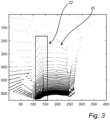
- FIG. 3 is a BEV LIDAR point cloud showing a ground plane or drivable surface and z values as intensity
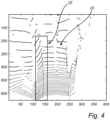
- FIG. 4 is a BEV LIDAR point cloud showing a ground plane or drivable surface and r values as intensity.
- a divider 22 is highlighted, which has a different z and r than the surrounding road surface 20.
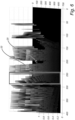
- FIG. 5 is a 3-D surface plot of the BEV LIDAR point cloud of FIG. 3 showing the ground plane or drivable surface and z values as intensity
- FIG. 6 is a 3-D surface plot of the BEV LIDAR point cloud of FIG. 4 showing the ground plane or drivable surface and r values as intensity
- the divider 22 is highlighted, which has a different z and r values than the surrounding road surface 20.
- the r metrics vary with respect to distance from the LIDAR sensor. The pattern changes across sharp edges, but the r values are not consistent across the surface. The z values are more consistent across the surface.
- surface-level clustering using r may be feasible for short distances but is not scalable/generalizable.
- a patch scheme utilizing both z and r is preferable.
- FIG. 7 is another 3-D surface plot of the BEV LIDAR point cloud of FIG. 4 showing a ground plane or drivable surface and r values as intensity, scaled as r/x (or r/x 2 , depending on the LIDAR specifications).
- the scaling of r by the distance, x, from the LIDAR sensor improves relative surface classification performance.
- FIG. 8 is another front-facing camera image 24 and a corresponding LIDAR point cloud 26, highlighting z and r indices.
- the road surface 20 is shown, as well as an area off the road surface 28 that has a different surface texture.
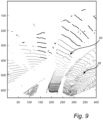
- FIG. 9 is a BEV LIDAR point cloud showing a ground plane or drivable surface and z values as intensity
- FIG. 10 is a BEV LIDAR point cloud showing a ground plane or drivable surface and scaled r values, r/x, as intensity.
- the off-road surface 28 is highlighted, which has a different z and r/x values than the surrounding road surface 20.
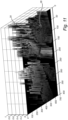
- FIG. 11 is a 3-D surface plot of the BEV LIDAR point cloud of FIG. 9 showing the ground plane or drivable surface and z values as intensity
- FIG. 12 is a 3-D surface plot of the BEV LIDAR point cloud of FIG. 10 showing the ground plane or drivable surface and scaled r values, r/x, as intensity.
- the off-road surface 28 is highlighted, which has a different z and r/x values than the surrounding road surface 20.
- different surfaces may represent a variation in textural patterns, z values, etc., and clustering based on r metrics only is not feasible to distinguish such surfaces.
- patches on the road surface 20 are used to generate pseudo-clusters to estimate slipperiness, p, per patch, proving an indication of safety to proceed, allowing for path planning, etc.
- the relative position of a given ground patch (x, y), ground height (z), and scaled reflectance (r/x or r/x 2 , depending on the LIDAR specifications) are thus used for patch classification in terms of slipperiness probability (p). This provides for a robust discrimination between a ground plane or drivable surface, objects, different surfaces, and the road condition.
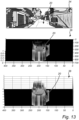
- FIG. 13 is a front-facing camera image 34, a corresponding 3-D surface plot 36 of the BEV LIDAR point cloud showing a ground plane or drivable surface 20 and z values as intensity, and a corresponding 3-D surface plot 38 of the BEV LIDAR point cloud showing a ground plane or drivable surface 20 and scaled r values, r/x or r/x 2 , depending on the LIDAR specifications, as intensity.
- FIG. 14 is a front-facing camera image 44, a corresponding 3-D surface plot 46 of the BEV LIDAR point cloud showing a ground plane or drivable surface 20 and an adjacent surface 28 and z values as intensity, and a corresponding 3-D surface plot 48 of the BEV LIDAR point cloud showing a ground plane or drivable surface 20 and an adjacent surface 28 and scaled r values, r/x, as intensity.
- the off-road surface 28 is highlighted, which has a different z and r/x values than the surrounding road surface 20.
- different surfaces may represent a variation in textural patterns, z values, etc., and clustering based on r metrics only is not feasible to distinguish such surfaces.
- patches on the road surface 20 are used to generate pseudo-clusters to estimate slipperiness, p, per patch, proving an indication of safety to proceed, allowing for path planning, etc.
- the relative position of a given ground patch (x, y), ground height (z), and scaled reflectance (r/x or r/x 2 , depending on the LIDAR specifications) are thus used for patch classification in terms of slipperiness probability (p). This provides for a robust discrimination between a ground plane or drivable surface, objects, different surfaces, and the road condition.
- the road condition estimation system 50 of the present disclosure is implemented largely in software executed by a processor resident in a vehicle and/or the cloud.
- the road condition estimation system 50 includes a LIDAR sensor 52 that is coupled to the vehicle and is operable for obtaining a LIDAR point cloud 62 that is utilized by the road condition estimation system 50.
- this LIDAR sensor 52 may be disposed at a position on the vehicle that is significantly above the ground plane and road surface, such that the LIDAR sensor 52 is provided with a clear line of sight in front of the vehicle.
- the LIDAR sensor 52 is minimally impacted by many visibility conditions that would significantly impact a comparable front-facing camera.
- the LIDAR point cloud data includes four fields per reflected signal point, x, y, z, and r, with x, y, z corresponding to the 3-D location of the given objects/surfaces with respect to the LIDAR sensor 52, z specifically corresponding to the height of a reflected object/surface, and r referring to the associated reflectance index, which is different for different surfaces and surface coverings.
- the road condition estimation method 60 begins with the road condition estimation algorithm 54 detecting the ground plane or drivable surface 64 in the LIDAR point cloud 62. This can be done using an unsupervised iterative algorithm, or a supervised deep learningIML algorithm.
- the MxN matrix is superimposed on the drivable surface ahead of the vehicle 66 in the LIDAR point cloud 62.
- the MxN matrix may be a 5x3 matrix, with columns disposed along each expected wheel path, a column disposed between the expected wheel paths, and columns disposed outside of the expected wheel paths.
- the MxN matrix extends at least 70-100m ahead of the vehicle on the ground plane or drivable surface, such that the predictive capability of the road condition estimation system 50 is maximized.
- each patch of the MxN matrix is statistically evaluated to determine relative position (x, y), feature elevation (z), and scaled reflectance (r/x or r/x 2 , depending on the LIDAR specifications) 68, as described in greater detail herein above.
- the statistical features extracted from each patch may include average, standard deviation, distribution of relative position (x, y), height, and scaled reflectance metrics within the patch.
- each road patch is classified to indicate the extent of roughness or slipperiness 70. Thus, a probabilistic determination is made for each road patch related to ice/snow/slush/water/etc. and road condition for the drivable surface is estimated.
- the predicted slipperiness indices, p, ahead of the vehicle can be formatted and displayed visually to a driver of the vehicle and or fed into the AD function to allow for enhanced vehicle motion and trajectory planning 74.
- the relative positions of road patches can be converted to global coordinate positions and the slipperiness probability updated for each global coordinate position with each new LIDAR frame 52 76.
- the same patch on the road surface may be visible in multiple LIDAR frames 52, and updating the associated slipperiness probability with respect to global coordinate positions may thus optimize path planning information. All data, of course, may be transmitted to the cloud for use by other vehicles as well.
- FIG. 16 is a 3-D LIDAR point cloud 52 including a superimposed MxN matrix 80. As shown, the matrix 80 covers up to 15m sideways and up to 70m ahead on the road surface, with a 5x3 patch arrangement.
- FIG. 17 is a BEV LIDAR point cloud 52 including a superimposed MxN matrix 80. Again, as shown, the matrix 80 covers up to 15m sideways and up to 70m ahead on the road surface, with a 5x3 patch arrangement.
- the LIDAR perception sensor utilized here provides the capability to extend vision over camera images to instances with low standing sun, poor lighting, and night-time vision conditions.
- the framework provided segments the ground plane LIDAR point cloud into several segments and applies statistical features within the ground plane or drivable surface patches to describe a complete road condition in front of the vehicle. Based on the segmented ground plane or drivable surface point clouds, a probability map of slipperiness underneath the vehicle wheels and in the nearby vicinity can be generated, which can be used to warn a driver, turn off AD mode (to ensure safety), and plan vehicle path/trajectory accordingly to minimize vehicle slippage or hydroplaning. As LIDAR frames continue to be acquired, the probability of slipperiness can be updated for global coordinates to allow for optimal vehicle control and path planning applications involving AD functionalities.
- Computer-readable media may include computer-readable storage media, which corresponds to a tangible medium such as data storage media, or communication media including any medium that facilitates transfer of a computer program from one place to another, e.g., according to a communication protocol.
- Computer-readable media generally may correspond to (1) a tangible computer-readable storage medium that is non-transitory or (2) a communication medium, such as a signal or carrier wave.
- Data storage media may be any available media that can be accessed by one or more computers or one or more processors to retrieve instructions, code and/or data structures for implementation of the techniques described in this disclosure.
- a computer program product may include a computer-readable medium.
- such computer-readable storage media can include random-access memory (RAM), read-only memory (ROM), electrically erasable-programmable read-only memory (EEPROM), compact disc read-only memory (CD-ROM) or other optical disc storage, magnetic disk storage, or other magnetic storage devices, flash memory, or any other medium that can be used to store desired program code in the form of instructions or data structures and that can be accessed by a computer. Also, any connection is properly termed a computer-readable medium.
- RAM random-access memory
- ROM read-only memory
- EEPROM electrically erasable-programmable read-only memory
- CD-ROM compact disc read-only memory
- flash memory or any other medium that can be used to store desired program code in the form of instructions or data structures and that can be accessed by a computer.
- any connection is properly termed a computer-readable medium.
- IR infrared
- RF radio frequency
- microwave the coaxial cable, fiber optic cable, twisted pair, DSL, or wireless technologies, such as IR, RF, and microwave are included in the definition of medium.
- computer-readable storage media and data storage media do not include connections, carrier waves, signals, or other transitory media, but are instead directed to non-transitory, tangible storage media.
- Disk and disc includes compact disc (CD), laser disc, optical disc, digital versatile disc (DVD), and Blu-ray disc, where disks usually reproduce data magnetically, while discs reproduce data optically with lasers. Combinations of the above should also be included within the scope of computer-readable media.
- processors such as one or more digital signal processors (DSPs), general purpose microprocessors, application specific integrated circuits (ASICs), field programmable gate arrays (FPGAs), complex programmable logic devices (CPLDs), or other equivalent integrated or discrete logic circuitry.
- DSPs digital signal processors
- ASICs application specific integrated circuits
- FPGAs field programmable gate arrays
- CPLDs complex programmable logic devices
- processors such as one or more digital signal processors (DSPs), general purpose microprocessors, application specific integrated circuits (ASICs), field programmable gate arrays (FPGAs), complex programmable logic devices (CPLDs), or other equivalent integrated or discrete logic circuitry.
- DSPs digital signal processors
- ASICs application specific integrated circuits
- FPGAs field programmable gate arrays
- CPLDs complex programmable logic devices
- the techniques of this disclosure may be implemented in a wide variety of devices or apparatuses, including an integrated circuit (IC) or a set of ICs (e.g., a chip set).
- IC integrated circuit
- a set of ICs e.g., a chip set.
- Various components, modules, or units are described in this disclosure to emphasize functional aspects of devices configured to perform the disclosed techniques, but do not necessarily require realization by different hardware units. Rather, as described above, various units may be combined in a hardware unit or provided by a collection of interoperative hardware units, including one or more processors as described above, in conjunction with suitable software and/or firmware.
- the LIDAR perception sensor utilized here provides the capability to extend vision over camera images to instances with low standing sun, poor lighting, and night-time vision conditions.
- the framework provided segments the ground plane or drivable surface LIDAR point cloud into several segments and applies statistical features within the ground plane or drivable surface patches to describe a complete road condition in front of the vehicle.
- a probability map of slipperiness underneath the vehicle wheels and in the nearby vicinity can be generated, which can be used to warn a driver, turn off AD mode (to ensure safety), and plan vehicle path/trajectory accordingly to minimize vehicle slippage or hydroplaning.
- the probability of slipperiness can be updated for particular global coordinates to allow for optimal vehicle control and path planning applications involving AD functionalities.
Landscapes
- Engineering & Computer Science (AREA)
- Physics & Mathematics (AREA)
- Automation & Control Theory (AREA)
- General Physics & Mathematics (AREA)
- Transportation (AREA)
- Mechanical Engineering (AREA)
- Computer Networks & Wireless Communication (AREA)
- Electromagnetism (AREA)
- Radar, Positioning & Navigation (AREA)
- Remote Sensing (AREA)
- Mathematical Physics (AREA)
- Human Computer Interaction (AREA)
- Multimedia (AREA)
- Theoretical Computer Science (AREA)
- Traffic Control Systems (AREA)
- Optical Radar Systems And Details Thereof (AREA)
Description
- The present disclosure relates generally to the automotive and vehicle safety fields. More particularly, the present disclosure relates to vehicle systems and methods utilizing LIDAR data for road condition estimation.
- Some modern vehicles report measured road condition to the cloud for subsequent use by other vehicles. The pre-emptive knowledge or estimation of road condition (i.e., slipperiness or friction) can significantly reduce road condition-related accidents. Often such road condition estimation is local and camera based, and may include segmenting a camera image of the drivable surface in front of a vehicle into MxN patches and assessing the textural characteristics of each portion of the patches for road surface slipperiness, road rutting, etc.
- The pre-emptive knowledge or estimation of road condition is especially important in autonomous driving (AD) settings, where an AD setting may be turned off to ensure safety conditions specifically if a road surface ahead is predicted to be too slippery or a path with the greatest expected friction may be preferred in such situations, for example. Most camera-based systems can detect and analyze the road surface ahead with high confidence and high reliability up to about 50m under well-lit conditions, with the road condition within several meters of the wheel tracks being the most important for path planning, for example.
- LIDAR sensors are generally capable of detecting the road surface in terms of relative road surface location (x and y coordinates), road surface height (z coordinate), and reflectance (r) reliably up to 70-100m ahead. Thus, this information can be used to predict the road surface condition within several meters of the wheel tracks, assisting in path planning significantly.
- When a vehicle is in AD mode, the early detection of detrimental (i.e., slippery) road conditions in the form of ice patches, slush patches, water patches, etc. is necessary to trigger a stop to AD functionalities and guide a human driver to take over for assured safety conditions. Thus, advance warning of road conditions is imperative. Again, relative slipperiness analysis of the road surface ahead can also lend useful insights for path planning.
- Because LIDAR sensors can operate at significant distances ahead of a vehicle as compared to conventional front-facing cameras, the relative position of the road surface, the height of accumulation on the road surface, and the scaled reflectance index of each road surface point can be used with a machine learning (ML) model to predict slippery road surfaces ahead, raise alerts, and selectively disable AD mode.
- To date, MxN patches have been superimposed on a front-facing camera image of a road surface to predict a patchiness index of the road surface up to 30-50m ahead. Here, five lateral patches may be used, for example, including a patch under each vehicle wheel, a center patch between the vehicle wheel patches, and two side patches outside of the vehicle wheel patches. Such a front-facing
camera image 10 with the superimposed patches and a bird's eye view (BEV)transformation 12 of the front-facingcamera image 10 with the superimposed patches broken into columns and rows are shown inFIG. 1 . It is possible to extend this framework to predict road condition farther in front of the vehicle more reliably using x, y, z, and r LIDAR measurements. - To date, LIDAR sensors have been used to detect the depth of water on the road surface ahead of a vehicle, with the LIDAR sensor mounted close to the ground to enhance visibility. However, this setup is not scalable to long-range object or road surface detection. For such applications, a higher LIDAR sensor mounting position on the vehicle is preferred.
- Such higher LIDAR sensor mounting positions have been used, however, typically to track reflectance on a road surface along two straight-line paths, supposedly where the wheels will contact the road surface. These one-dimensional (1-D) signals along the wheel paths correspond to the reflectance (r) along the wheel paths and can be used to detect the presence of water or ice along the wheel paths using statistical and/or ML models. However, the 1-D signals are vendor and scenario sensitive and do not provide a view of the entire road condition ahead. Dividing the road surface ahead into patches and using both accumulation height (z) and reflectance (r) parameters would provide a holistic view of road condition and aid motion control and path planning for AD, as well as advanced driver assistance systems (ADAS), modalities.
- Finally, existing LIDAR sensor systems have been used generally to detect road unevenness, such as road irregularities and potholes, and maneuver a vehicle away from such road unevenness, without maximizing the inputs from the perception sensor to control switching between AD/ADAS modalities and aid in path planning. This could be done through the superimposition of spatial patches on the road surface to generate pseudo-clusters indicative of the probability of a road condition (slipperiness, ice, snow, slush, and water), p, to provide a holistic view of road condition and aid motion control and path planning for AD, as well as ADAS, modalities.
-
WO 2018/119902 A1 describes a ground environment detection method where the method includes: scanning a ground environment by using laser sounding signals having different operating wavelengths, receiving a reflected signal that is reflected back by the ground environment, determining scanning spot information of each scanning spot of the ground environment based on the reflected signal, determining space coordinate information and a laser reflection feature of each scanning spot based on each piece of scanning spot information, partitioning the ground environment into sub-regions having different laser reflection features, and determining a ground environment type of each subregion. - Thus, in various exemplary embodiments, the present disclosure provides systems and methods utilizing LIDAR data for road condition estimation that segment the road surface ahead of a vehicle into MxN patches and, optionally, BEV transform this construct. For each segment, x, y, z, and r are then determined - taking full advantage of position, accumulation height, and reflectance information to aid motion control and path planning for AD, as well as ADAS, modalities.
- The LIDAR point clouds are utilized with the MxN patches, as opposed to simply clustering the road surface based on absolute r indices, as relative variations in r are observed for the same road surface and the associated deterministic values are not always consistent. Thus, if there is a uniform pitch of black road surface ahead, ideally all points would have the same r index, but this is not the practical case, as the distance from the LIDAR sensor, light scattering, and variations in scanning patterns all have significant impacts. The context of r is learnable, but not always the values, so clustering based on r index is unreliable and non-generalizable. Accordingly, the MxN patches on the road surface are designed to find patterns on the road surface that should have been clustered if r was a reliable and repeatable entity.
- In one exemplary embodiment, the present disclosure provides a method for estimating road condition ahead of a vehicle utilizing a LIDAR sensor, the method including: obtaining a LIDAR point cloud from the LIDAR sensor; detecting a ground plane or drivable surface in the LIDAR point cloud; superimposing an MxN matrix on at least a portion of the LIDAR point cloud; for each patch of the LIDAR point cloud defined by the MxN matrix, statistically evaluating a relative position, a feature elevation, and a scaled reflectance index; from the statistically evaluated relative position, feature elevation, and scaled reflectance index, determining a slipperiness probability for each patch of the LIDAR point cloud; and, based on the determined slipperiness probability for each patch of the LIDAR point cloud, one or more of alerting a driver of the vehicle to an upcoming slippery road condition, enabling/disabling one of a driver assist and an autonomous driving functionality, providing a display of an estimated road condition ahead to the driver of the vehicle for one or more of motion and path planning purposes, updating a past determined slipperiness probability for each patch of a past LIDAR point cloud, and reporting the determined slipperiness probability for each patch of the LIDAR point cloud to a cloud server. The LIDAR sensor is coupled to the vehicle above the ground plane or drivable surface. The method further includes transforming the LIDAR point cloud from a three-dimensional LIDAR point cloud to a bird's-eye-view LIDAR point cloud. Detecting the ground plane or drivable surface in the LIDAR point cloud includes detecting the ground plane or drivable surface in the LIDAR point cloud using one of an unsupervised iterative algorithm and a supervised deep learning/machine learning algorithm. The scaled reflectance index is scaled by its relative distance from the LIDAR sensor.
- In another exemplary embodiment, the present disclosure provides a non-transitory computer readable medium for estimating road condition ahead of a vehicle stored in a memory and executed by a processor to perform the steps including: obtaining a LIDAR point cloud from a LIDAR sensor; detecting a ground plane or drivable surface in the LIDAR point cloud; superimposing an MxN matrix on at least a portion of the LIDAR point cloud; for each patch of the LIDAR point cloud defined by the MxN matrix, statistically evaluating a relative position, a feature elevation, and a scaled reflectance index; from the statistically evaluated relative position, feature elevation, and scaled reflectance index, determining a slipperiness probability for each patch of the LIDAR point cloud; and, based on the determined slipperiness probability for each patch of the LIDAR point cloud, one or more of alerting a driver of the vehicle to an upcoming slippery road condition, enabling/disabling one of a driver assist and an autonomous driving functionality, providing a display of an estimated road condition ahead to the driver of the vehicle for one or more of motion and path planning purposes, updating a past determined slipperiness probability for each patch of a past LIDAR point cloud, and reporting the determined slipperiness probability for each patch of the LIDAR point cloud to a cloud server. The LIDAR sensor is coupled to the vehicle above the ground plane or drivable surface. The steps further include transforming the LIDAR point cloud from a three-dimensional LIDAR point cloud to a bird's-eye-view LIDAR point cloud. Detecting the ground plane or drivable surface in the LIDAR point cloud includes detecting the ground plane or drivable surface in the LIDAR point cloud using one of an unsupervised iterative algorithm and a supervised deep learning/machine learning algorithm. The scaled reflectance index is scaled by its relative distance from the LIDAR sensor.
- In a further exemplary embodiment, the present disclosure provides a system for estimating road condition ahead of a vehicle, the system including: a LIDAR sensor operable for generating a LIDAR point cloud; a processor executing a road condition estimation algorithm stored in a memory, the road condition estimation algorithm performing the steps including: detecting a ground plane or drivable surface in the LIDAR point cloud; superimposing an MxN matrix on at least a portion of the LIDAR point cloud; for each patch of the LIDAR point cloud defined by the MxN matrix, statistically evaluating a relative position, a feature elevation, and a scaled reflectance index; and, from the statistically evaluated relative position, feature elevation, and scaled reflectance index, determining a slipperiness probability for each patch of the LIDAR point cloud; and a vehicle control system operable for, based on the determined slipperiness probability for each patch of the LIDAR point cloud, one or more of alerting a driver of the vehicle to an upcoming slippery road condition, enabling/disabling one of a driver assist and an autonomous driving functionality, providing a display of an estimated road condition ahead to the driver of the vehicle for one or more of motion and path planning purposes, updating a past determined slipperiness probability for each patch of a past LIDAR point cloud, and reporting the determined slipperiness probability for each patch of the LIDAR point cloud to a cloud server. The LIDAR sensor is coupled to the vehicle above the ground plane or drivable surface. The steps performed by the road condition estimation algorithm further include transforming the LIDAR point cloud from a three-dimensional LIDAR point cloud to a bird's-eye-view LIDAR point cloud. Detecting the ground plane or drivable surface in the LIDAR point cloud includes detecting the ground plane or drivable surface in the LIDAR point cloud using one of an unsupervised iterative algorithm and a supervised deep learning/machine learning algorithm. The scaled reflectance index is scaled by its relative distance from the LIDAR sensor.
- The present disclosure is illustrated and described herein with reference to the various drawings, in which like reference numbers are used to denote like system components/method steps, as appropriate, and in which:
-
FIG. 1 is a front-facing camera image with superimposed patches and a BEV transformation of the front-facing camera image with the superimposed patches broken into columns and rows, in accordance with one aspect of the present disclosure; -
FIG. 2 is a front-facing camera image and a corresponding LIDAR point cloud, highlighting z and r indices, in accordance with one aspect of the present disclosure; -
FIG. 3 is a BEV LIDAR point cloud showing a ground plane or drivable surface and z values as intensity, in accordance with one aspect of the present disclosure; -
FIG. 4 is a BEV LIDAR point cloud showing a ground plane or drivable surface and r values as intensity, in accordance with one aspect of the present disclosure; -
FIG. 5 is a three-dimensional (3-D) surface plot of the BEV LIDAR point cloud ofFIG. 3 showing a ground plane or drivable surface and z values as intensity, in accordance with one aspect of the present disclosure; -
FIG. 6 is a 3-D surface plot of the BEV LIDAR point cloud ofFIG. 4 showing a ground plane or drivable surface and r values as intensity, in accordance with one aspect of the present disclosure; -
FIG. 7 is another 3-D surface plot of the BEV LIDAR point cloud ofFIG. 4 showing a ground plane or drivable surface and r values as intensity, scaled as r/x, in accordance with one aspect of the present disclosure; -
FIG. 8 is a front-facing camera image and a corresponding LIDAR point cloud, highlighting z and r indices, in accordance with another aspect of the present disclosure; -
FIG. 9 is a BEV LIDAR point cloud showing a ground plane or drivable surface and z values as intensity, in accordance with another aspect of the present disclosure; -
FIG. 10 is a BEV LIDAR point cloud showing a ground plane or drivable surface and scaled r values, r/x, as intensity, in accordance with another aspect of the present disclosure; -
FIG. 11 is a 3-D surface plot of the BEV LIDAR point cloud ofFIG. 9 showing a ground plane or drivable surface and z values as intensity, in accordance with another aspect of the present disclosure; -
FIG. 12 is a 3-D surface plot of the BEV LIDAR point cloud ofFIG. 10 showing a ground plane or drivable surface and scaled r values, r/x, as intensity, in accordance with another aspect of the present disclosure; -
FIG. 13 is a front-facing camera image, a corresponding 3-D surface plot of the BEV LIDAR point cloud showing a ground plane or drivable surface and z values as intensity, and a corresponding 3-D surface plot of the BEV LIDAR point cloud showing a ground plane or drivable surface and scaled r values, r/x, as intensity, in accordance with a further aspect of the present disclosure; -
FIG. 14 is a front-facing camera image, a corresponding 3-D surface plot of the BEV LIDAR point cloud showing a ground plane or drivable surface and an adjacent surface and z values as intensity, and a corresponding 3-D surface plot of the BEV LIDAR point cloud showing a ground plane or drivable surface and an adjacent surface and scaled r values, r/x, as intensity, in accordance with a still further aspect of the present disclosure; -
FIG. 15 is schematic diagram and flowchart illustrating one exemplary embodiment of the road condition estimation system and method of the present disclosure; -
FIG. 16 is a 3-D LIDAR point cloud including a superimposed MxN matrix, in accordance with one aspect of the present disclosure; and -
FIG. 17 is a BEV LIDAR point cloud including a superimposed MxN matrix, in accordance with one aspect of the present disclosure. - The present disclosure provides systems and methods utilizing LIDAR data for road condition estimation that segment the road surface ahead of a vehicle into MxN patches and, optionally, BEV transform this construct. For each segment, x, y, z, and r are then determined - taking full advantage of position, accumulation height, and reflectance information to aid motion control and path planning for AD, as well as ADAS, modalities.
- The LIDAR point clouds are utilized with the MxN patches, as opposed to simply clustering the road surface based on absolute r indices, as relative variations in r are observed for the same road surface and the associated deterministic values are not always consistent. Thus, if there is a uniform pitch of black road surface ahead, ideally all points would have the same r index, but this is not the practical case, as the distance from the LIDAR sensor, light scattering, and variations in scanning patterns all have significant impacts. The context of r is learnable, but not always the values, so clustering based on r index is unreliable and non-generalizable. Accordingly, the MxN patches on the road surface are designed to find patterns on the road surface that should have been clustered if r was a reliable and repeatable entity.
-
FIG. 2 is a front-facingcamera image 14 and a correspondingLIDAR point cloud 16, highlighting z and r indices. The ground plane ordrivable surface 18 is shown, as well as objects with larger z values. -
FIG. 3 is a BEV LIDAR point cloud showing a ground plane or drivable surface and z values as intensity, whileFIG. 4 is a BEV LIDAR point cloud showing a ground plane or drivable surface and r values as intensity. Here, adivider 22 is highlighted, which has a different z and r than the surroundingroad surface 20. -
FIG. 5 is a 3-D surface plot of the BEV LIDAR point cloud ofFIG. 3 showing the ground plane or drivable surface and z values as intensity, whileFIG. 6 is a 3-D surface plot of the BEV LIDAR point cloud ofFIG. 4 showing the ground plane or drivable surface and r values as intensity. Again, thedivider 22 is highlighted, which has a different z and r values than the surroundingroad surface 20. The r metrics vary with respect to distance from the LIDAR sensor. The pattern changes across sharp edges, but the r values are not consistent across the surface. The z values are more consistent across the surface. Thus, surface-level clustering using r may be feasible for short distances but is not scalable/generalizable. Thus, a patch scheme utilizing both z and r is preferable. -
FIG. 7 is another 3-D surface plot of the BEV LIDAR point cloud ofFIG. 4 showing a ground plane or drivable surface and r values as intensity, scaled as r/x (or r/x2, depending on the LIDAR specifications). The scaling of r by the distance, x, from the LIDAR sensor improves relative surface classification performance. -
FIG. 8 is another front-facingcamera image 24 and a correspondingLIDAR point cloud 26, highlighting z and r indices. Theroad surface 20 is shown, as well as an area off theroad surface 28 that has a different surface texture. -
FIG. 9 is a BEV LIDAR point cloud showing a ground plane or drivable surface and z values as intensity, whileFIG. 10 is a BEV LIDAR point cloud showing a ground plane or drivable surface and scaled r values, r/x, as intensity. Again, the off-road surface 28 is highlighted, which has a different z and r/x values than the surroundingroad surface 20. -
FIG. 11 is a 3-D surface plot of the BEV LIDAR point cloud ofFIG. 9 showing the ground plane or drivable surface and z values as intensity, whileFIG. 12 is a 3-D surface plot of the BEV LIDAR point cloud ofFIG. 10 showing the ground plane or drivable surface and scaled r values, r/x, as intensity. Again, the off-road surface 28 is highlighted, which has a different z and r/x values than the surroundingroad surface 20. As shown, different surfaces may represent a variation in textural patterns, z values, etc., and clustering based on r metrics only is not feasible to distinguish such surfaces. Thus, patches on theroad surface 20 are used to generate pseudo-clusters to estimate slipperiness, p, per patch, proving an indication of safety to proceed, allowing for path planning, etc. The relative position of a given ground patch (x, y), ground height (z), and scaled reflectance (r/x or r/x2, depending on the LIDAR specifications) are thus used for patch classification in terms of slipperiness probability (p). This provides for a robust discrimination between a ground plane or drivable surface, objects, different surfaces, and the road condition. -
FIG. 13 is a front-facingcamera image 34, a corresponding 3-D surface plot 36 of the BEV LIDAR point cloud showing a ground plane ordrivable surface 20 and z values as intensity, and a corresponding 3-D surface plot 38 of the BEV LIDAR point cloud showing a ground plane ordrivable surface 20 and scaled r values, r/x or r/x2, depending on the LIDAR specifications, as intensity. -
FIG. 14 is a front-facingcamera image 44, a corresponding 3-D surface plot 46 of the BEV LIDAR point cloud showing a ground plane ordrivable surface 20 and anadjacent surface 28 and z values as intensity, and a corresponding 3-D surface plot 48 of the BEV LIDAR point cloud showing a ground plane ordrivable surface 20 and anadjacent surface 28 and scaled r values, r/x, as intensity. Again, the off-road surface 28 is highlighted, which has a different z and r/x values than the surroundingroad surface 20. As shown, different surfaces may represent a variation in textural patterns, z values, etc., and clustering based on r metrics only is not feasible to distinguish such surfaces. Thus, patches on theroad surface 20 are used to generate pseudo-clusters to estimate slipperiness, p, per patch, proving an indication of safety to proceed, allowing for path planning, etc. The relative position of a given ground patch (x, y), ground height (z), and scaled reflectance (r/x or r/x2, depending on the LIDAR specifications) are thus used for patch classification in terms of slipperiness probability (p). This provides for a robust discrimination between a ground plane or drivable surface, objects, different surfaces, and the road condition. - Referring now specifically to
FIG. 15 , in one exemplary embodiment, the roadcondition estimation system 50 of the present disclosure is implemented largely in software executed by a processor resident in a vehicle and/or the cloud. The roadcondition estimation system 50 includes aLIDAR sensor 52 that is coupled to the vehicle and is operable for obtaining aLIDAR point cloud 62 that is utilized by the roadcondition estimation system 50. As discussed above, thisLIDAR sensor 52 may be disposed at a position on the vehicle that is significantly above the ground plane and road surface, such that theLIDAR sensor 52 is provided with a clear line of sight in front of the vehicle. Advantageously, theLIDAR sensor 52 is minimally impacted by many visibility conditions that would significantly impact a comparable front-facing camera. The LIDAR point cloud data includes four fields per reflected signal point, x, y, z, and r, with x, y, z corresponding to the 3-D location of the given objects/surfaces with respect to theLIDAR sensor 52, z specifically corresponding to the height of a reflected object/surface, and r referring to the associated reflectance index, which is different for different surfaces and surface coverings. The roadcondition estimation method 60 begins with the roadcondition estimation algorithm 54 detecting the ground plane ordrivable surface 64 in theLIDAR point cloud 62. This can be done using an unsupervised iterative algorithm, or a supervised deep learningIML algorithm. Subsequently, the MxN matrix is superimposed on the drivable surface ahead of thevehicle 66 in theLIDAR point cloud 62. By way of example only, the MxN matrix may be a 5x3 matrix, with columns disposed along each expected wheel path, a column disposed between the expected wheel paths, and columns disposed outside of the expected wheel paths. Optionally, the MxN matrix extends at least 70-100m ahead of the vehicle on the ground plane or drivable surface, such that the predictive capability of the roadcondition estimation system 50 is maximized. Subsequently, each patch of the MxN matrix is statistically evaluated to determine relative position (x, y), feature elevation (z), and scaled reflectance (r/x or r/x2, depending on the LIDAR specifications) 68, as described in greater detail herein above. The statistical features extracted from each patch may include average, standard deviation, distribution of relative position (x, y), height, and scaled reflectance metrics within the patch. Subsequently, each road patch is classified to indicate the extent of roughness orslipperiness 70. Thus, a probabilistic determination is made for each road patch related to ice/snow/slush/water/etc. and road condition for the drivable surface is estimated. - Based on the predicted slipperiness index, p, for each patch and the overall matrix, alarms can be raised, ADAS functionalities can be implemented, and/or an active AD mode can be disabled 72 by the
vehicle control system 56. Alternatively or in addition, the predicted slipperiness indices, p, ahead of the vehicle can be formatted and displayed visually to a driver of the vehicle and or fed into the AD function to allow for enhanced vehicle motion and trajectory planning 74. Alternatively or in addition, as the vehicle moves and more LIDAR frames 52 are acquired, the relative positions of road patches can be converted to global coordinate positions and the slipperiness probability updated for each global coordinate position with eachnew LIDAR frame 52 76. The same patch on the road surface may be visible in multiple LIDAR frames 52, and updating the associated slipperiness probability with respect to global coordinate positions may thus optimize path planning information. All data, of course, may be transmitted to the cloud for use by other vehicles as well. -
FIG. 16 is a 3-DLIDAR point cloud 52 including asuperimposed MxN matrix 80. As shown, thematrix 80 covers up to 15m sideways and up to 70m ahead on the road surface, with a 5x3 patch arrangement. -
FIG. 17 is a BEVLIDAR point cloud 52 including asuperimposed MxN matrix 80. Again, as shown, thematrix 80 covers up to 15m sideways and up to 70m ahead on the road surface, with a 5x3 patch arrangement. - The LIDAR perception sensor utilized here provides the capability to extend vision over camera images to instances with low standing sun, poor lighting, and night-time vision conditions. The framework provided segments the ground plane LIDAR point cloud into several segments and applies statistical features within the ground plane or drivable surface patches to describe a complete road condition in front of the vehicle. Based on the segmented ground plane or drivable surface point clouds, a probability map of slipperiness underneath the vehicle wheels and in the nearby vicinity can be generated, which can be used to warn a driver, turn off AD mode (to ensure safety), and plan vehicle path/trajectory accordingly to minimize vehicle slippage or hydroplaning. As LIDAR frames continue to be acquired, the probability of slipperiness can be updated for global coordinates to allow for optimal vehicle control and path planning applications involving AD functionalities.
- In one or more examples, the functions described may be implemented in hardware, software, firmware, or any combination thereof. If implemented in software, the functions may be stored on or transmitted over as one or more instructions or code on a computer-readable medium and executed by a hardware-based processing unit. Computer-readable media may include computer-readable storage media, which corresponds to a tangible medium such as data storage media, or communication media including any medium that facilitates transfer of a computer program from one place to another, e.g., according to a communication protocol. In this manner, computer-readable media generally may correspond to (1) a tangible computer-readable storage medium that is non-transitory or (2) a communication medium, such as a signal or carrier wave. Data storage media may be any available media that can be accessed by one or more computers or one or more processors to retrieve instructions, code and/or data structures for implementation of the techniques described in this disclosure. A computer program product may include a computer-readable medium.
- By way of example, and not limitation, such computer-readable storage media can include random-access memory (RAM), read-only memory (ROM), electrically erasable-programmable read-only memory (EEPROM), compact disc read-only memory (CD-ROM) or other optical disc storage, magnetic disk storage, or other magnetic storage devices, flash memory, or any other medium that can be used to store desired program code in the form of instructions or data structures and that can be accessed by a computer. Also, any connection is properly termed a computer-readable medium. For example, if instructions are transmitted from a website, server, or other remote source using a coaxial cable, fiber optic cable, twisted pair, digital subscriber line (DSL), or wireless technologies such as infrared (IR), radio frequency (RF), and microwave, then the coaxial cable, fiber optic cable, twisted pair, DSL, or wireless technologies, such as IR, RF, and microwave are included in the definition of medium. It should be understood, however, that computer-readable storage media and data storage media do not include connections, carrier waves, signals, or other transitory media, but are instead directed to non-transitory, tangible storage media. Disk and disc, as used herein, includes compact disc (CD), laser disc, optical disc, digital versatile disc (DVD), and Blu-ray disc, where disks usually reproduce data magnetically, while discs reproduce data optically with lasers. Combinations of the above should also be included within the scope of computer-readable media.
- Instructions may be executed by one or more processors, such as one or more digital signal processors (DSPs), general purpose microprocessors, application specific integrated circuits (ASICs), field programmable gate arrays (FPGAs), complex programmable logic devices (CPLDs), or other equivalent integrated or discrete logic circuitry. Accordingly, the term "processor," as used herein may refer to any of the foregoing structure or any other structure suitable for implementation of the techniques described herein. In addition, in some aspects, the functionality described herein may be provided within dedicated hardware and/or software modules. Also, the techniques could be fully implemented in one or more circuits or logic elements.
- The techniques of this disclosure may be implemented in a wide variety of devices or apparatuses, including an integrated circuit (IC) or a set of ICs (e.g., a chip set). Various components, modules, or units are described in this disclosure to emphasize functional aspects of devices configured to perform the disclosed techniques, but do not necessarily require realization by different hardware units. Rather, as described above, various units may be combined in a hardware unit or provided by a collection of interoperative hardware units, including one or more processors as described above, in conjunction with suitable software and/or firmware.
- Thus again, the LIDAR perception sensor utilized here provides the capability to extend vision over camera images to instances with low standing sun, poor lighting, and night-time vision conditions. The framework provided segments the ground plane or drivable surface LIDAR point cloud into several segments and applies statistical features within the ground plane or drivable surface patches to describe a complete road condition in front of the vehicle. Based on the segmented ground plane or drivable surface point clouds, a probability map of slipperiness underneath the vehicle wheels and in the nearby vicinity can be generated, which can be used to warn a driver, turn off AD mode (to ensure safety), and plan vehicle path/trajectory accordingly to minimize vehicle slippage or hydroplaning. As LIDAR frames continue to be acquired, the probability of slipperiness can be updated for particular global coordinates to allow for optimal vehicle control and path planning applications involving AD functionalities.
- Although the present disclosure is illustrated and described herein with reference to preferred embodiments and specific examples thereof, it will be readily apparent to persons of ordinary skill in the art that other embodiments and examples may perform similar functions and/or achieve like results.
Claims (12)
- A method for estimating road condition ahead of a vehicle (66) utilizing a LIDAR sensor (52), the method comprising:obtaining a LIDAR point cloud (62) from the LIDAR sensor;detecting a ground plane or drivable surface (64) in the LIDAR point cloud;superimposing an MxN matrix on at least a portion of the LIDAR point cloud, the MxN matrix comprising MxN patches;for each patch of the LIDAR point cloud defined by the MxN matrix, statistically evaluating (68) a relative position (x,y), a feature elevation (z), and a scaled reflectance index (r) comprising r/x or r/x2;from the statistically evaluated relative position, feature elevation, and scaled reflectance index, determining a slipperiness probability for each patch of the LIDAR point cloud; andbased on the determined slipperiness probability for each patch of the LIDAR point cloud, one or more of alerting a driver of the vehicle to an upcoming slippery road condition, enabling/disabling one of a driver assist and an autonomous driving functionality, providing a display of an estimated road condition ahead to the driver of the vehicle for one or more of motion and path planning purposes, updating a past determined slipperiness probability for each patch of a past LIDAR point cloud, and reporting the determined slipperiness probability for each patch of the LIDAR point cloud to a cloud server.
- The method of claim 1, wherein the LIDAR sensor is coupled to the vehicle and disposed above the ground plane or drivable surface.
- The method of claim 1, further comprising transforming the LIDAR point cloud from a three-dimensional LIDAR point cloud to a bird's-eye-view LIDAR point cloud.
- The method of claim 1, wherein detecting the ground plane or drivable surface in the LIDAR point cloud comprises detecting the ground plane or drivable surface in the LIDAR point cloud using one of an unsupervised iterative algorithm and a supervised deep learning/machine learning algorithm.
- A non-transitory computer readable medium for estimating road condition ahead of a vehicle (66) stored in a memory and executed by a processor to perform the steps comprising:obtaining a LIDAR point cloud (62) from a LIDAR sensor (52);detecting a ground plane or drivable surface (64) in the LIDAR point cloud;superimposing an MxN matrix on at least a portion of the LIDAR point cloud, the MxN matrix comprising MxN patches;for each patch of the LIDAR point cloud defined by the MxN matrix, statistically evaluating (68) a relative position (x, y), a feature elevation (z), and a scaled reflectance index (r) comprising r/x or r/x2;from the statistically evaluated relative position, feature elevation, and scaled reflectance index, determining a slipperiness probability for each patch of the LIDAR point cloud; andbased on the determined slipperiness probability for each patch of the LIDAR point cloud, one or more of alerting a driver of the vehicle to an upcoming slippery road condition, enabling/disabling one of a driver assist and an autonomous driving functionality, providing a display of an estimated road condition ahead to the driver of the vehicle for one or more of motion and path planning purposes, updating a past determined slipperiness probability for each patch of a past LIDAR point cloud, and reporting the determined slipperiness probability for each patch of the LIDAR point cloud to a cloud server.
- The computer readable medium of claim 5, wherein the LIDAR sensor is coupled to the vehicle and disposed above the ground plane or drivable surface.
- The computer readable medium of claim 5, wherein the steps further comprise transforming the LIDAR point cloud from a three-dimensional LIDAR point cloud to a bird's-eye-view LIDAR point cloud.
- The computer readable medium of claim 5, wherein detecting the ground plane or drivable surface in the LIDAR point cloud comprises detecting the ground plane or drivable surface in the LIDAR point cloud using one of an unsupervised iterative algorithm and a supervised deep learning/machine learning algorithm.
- A system (50) for estimating road condition ahead of a vehicle, the system comprising:a LIDAR sensor (52) operable for generating a LIDAR point cloud (62);a processor executing a road condition estimation algorithm stored in a memory, the road condition estimation algorithm performing the steps comprising:detecting a ground plane or drivable surface (64) in the LIDAR point cloud;superimposing an MxN matrix on at least a portion of the LIDAR point cloud, the MxN matrix comprising MxN patches;for each patch of the LIDAR point cloud defined by the MxN matrix, statistically evaluating (68) a relative position (x,y), a feature elevation (z), and a scaled reflectance index (r) comprising r/x or r/x2; andfrom the statistically evaluated relative position, feature elevation, and scaled reflectance index, determining a slipperiness probability for each patch of the LIDAR point cloud; anda vehicle control system operable for, based on the determined slipperiness probability for each patch of the LIDAR point cloud, one or more of alerting a driver of the vehicle to an upcoming slippery road condition, enabling/disabling one of a driver assist and an autonomous driving functionality, providing a display of an estimated road condition ahead to the driver of the vehicle for one or more of motion and path planning purposes, updating a past determined slipperiness probability for each patch of a past LIDAR point cloud, and reporting the determined slipperiness probability for each patch of the LIDAR point cloud to a cloud server.
- The system of claim 9, wherein the LIDAR sensor is coupled to the vehicle and disposed above the ground plane or drivable surface.
- The system of claim 9, wherein the steps performed by the road condition estimation algorithm further comprise transforming the LIDAR point cloud from a three-dimensional LIDAR point cloud to a bird's-eye-view LIDAR point cloud.
- The system of claim 9, wherein detecting the ground plane or drivable surface in the LIDAR point cloud comprises detecting the ground plane or drivable surface in the LIDAR point cloud using one of an unsupervised iterative algorithm and a supervised deep learning/machine learning algorithm.
Applications Claiming Priority (1)
| Application Number | Priority Date | Filing Date | Title |
|---|---|---|---|
| US16/541,264 US11592566B2 (en) | 2019-08-15 | 2019-08-15 | Vehicle systems and methods utilizing LIDAR data for road condition estimation |
Publications (2)
| Publication Number | Publication Date |
|---|---|
| EP3779501A1 EP3779501A1 (en) | 2021-02-17 |
| EP3779501B1 true EP3779501B1 (en) | 2024-06-05 |
Family
ID=71994370
Family Applications (1)
| Application Number | Title | Priority Date | Filing Date |
|---|---|---|---|
| EP20189826.9A Active EP3779501B1 (en) | 2019-08-15 | 2020-08-06 | Vehicle systems and methods utilizing lidar data for road condition estimation |
Country Status (2)
| Country | Link |
|---|---|
| US (1) | US11592566B2 (en) |
| EP (1) | EP3779501B1 (en) |
Cited By (1)
| Publication number | Priority date | Publication date | Assignee | Title |
|---|---|---|---|---|
| US20240118424A1 (en) * | 2022-10-04 | 2024-04-11 | Kodiak Robotics, Inc. | Systems and methods for detecting water along driving routes |
Families Citing this family (16)
| Publication number | Priority date | Publication date | Assignee | Title |
|---|---|---|---|---|
| US12420801B2 (en) * | 2019-11-28 | 2025-09-23 | Nira Dynamics Ab | Methods, apparatuses, systems and computer program products for estimating road condition information |
| DE102019135751B4 (en) * | 2019-12-23 | 2024-11-14 | Nira Dynamics Ab | Methods, devices, systems and computer program products for estimating a road surface temperature |
| JPWO2021199609A1 (en) * | 2020-04-03 | 2021-10-07 | ||
| CN112835085B (en) * | 2020-07-09 | 2022-04-12 | 北京京东乾石科技有限公司 | Method and device for determining vehicle position |
| US12162517B2 (en) * | 2020-12-29 | 2024-12-10 | Here Global B.V. | Autonomous driving pattern profile |
| SE547609C2 (en) * | 2021-03-02 | 2025-10-28 | Klimator Ab | Method and arrangement for determining a condition of a road surface |
| KR102681992B1 (en) * | 2021-08-17 | 2024-07-04 | 충북대학교 산학협력단 | Single stage 3-Dimension multi-object detecting apparatus and method for autonomous driving |
| KR20230117819A (en) * | 2022-02-03 | 2023-08-10 | 한화에어로스페이스 주식회사 | Driving apparatus and driving controlling method |
| CN114578371B (en) * | 2022-03-03 | 2023-04-25 | 吉林大学 | System and method for detecting water depth of road surface in front of automobile |
| US12479452B2 (en) * | 2022-05-09 | 2025-11-25 | Continental Autonomous Mobility US, LLC | User-assisted drive-able area detection |
| CN114842438B (en) * | 2022-05-26 | 2024-06-14 | 重庆长安汽车股份有限公司 | Terrain detection method, system and readable storage medium for autonomous driving vehicle |
| CN115311229A (en) * | 2022-08-05 | 2022-11-08 | 武汉中观自动化科技有限公司 | Laser radar-based pavement disease detection and classification method and system and storage medium |
| JP7790323B2 (en) * | 2022-11-15 | 2025-12-23 | トヨタ自動車株式会社 | Vehicle control device |
| CN117292140B (en) * | 2023-10-17 | 2024-04-02 | 小米汽车科技有限公司 | Point cloud data processing method and device, vehicle and storage medium |
| US20250318454A1 (en) * | 2024-04-12 | 2025-10-16 | Raven Industries, Inc. | Systems and methods for an agricultural system |
| CN119408548A (en) * | 2024-10-24 | 2025-02-11 | 奇瑞新能源汽车股份有限公司 | A method for estimating road elevation ahead of an axle based on laser radar and related equipment |
Citations (2)
| Publication number | Priority date | Publication date | Assignee | Title |
|---|---|---|---|---|
| US20140307247A1 (en) * | 2013-04-11 | 2014-10-16 | Google Inc. | Methods and Systems for Detecting Weather Conditions Including Wet Surfaces Using Vehicle Onboard Sensors |
| US20180203113A1 (en) * | 2017-01-17 | 2018-07-19 | Delphi Technologies, Inc. | Ground classifier system for automated vehicles |
Family Cites Families (17)
| Publication number | Priority date | Publication date | Assignee | Title |
|---|---|---|---|---|
| DE19932094A1 (en) | 1999-07-09 | 2001-01-25 | Daimler Chrysler Ag | Multi-sensory, predictive road condition detection |
| JP3817611B2 (en) | 2003-03-14 | 2006-09-06 | 国土交通省国土技術政策総合研究所長 | Road surface condition judgment method in visible image type road surface condition grasping device |
| PT2531837T (en) * | 2010-02-04 | 2021-07-06 | Force Tech | Apparatus and method for measuring retroreflectivity of a surface |
| EP2852831A4 (en) | 2012-05-23 | 2016-04-20 | Raqib Omer | Road surface condition classification method and system |
| GB2504932A (en) | 2012-08-13 | 2014-02-19 | Nissan Motor Mfg Uk Ltd | Vehicle with water depth sensors |
| DE102013101639A1 (en) | 2013-02-19 | 2014-09-04 | Continental Teves Ag & Co. Ohg | Method and device for determining a road condition |
| EP2821307B1 (en) | 2013-07-03 | 2016-09-28 | Volvo Car Corporation | A vehicle system, a vehicle and a method for autonomous road irregularity avoidance |
| US9139204B1 (en) | 2014-06-12 | 2015-09-22 | GM Global Technology Operations LLC | Road surface condition detection with recursive adaptive learning and validation |
| DE102014212032A1 (en) * | 2014-06-24 | 2015-12-24 | Robert Bosch Gmbh | Method for detecting a roadway and corresponding detection system |
| US9598087B2 (en) | 2014-12-12 | 2017-03-21 | GM Global Technology Operations LLC | Systems and methods for determining a condition of a road surface |
| US9453941B2 (en) | 2014-12-22 | 2016-09-27 | GM Global Technology Operations LLC | Road surface reflectivity detection by lidar sensor |
| EP3367084B1 (en) | 2015-10-22 | 2023-09-06 | Kyocera Corporation | Road surface state determination device and method |
| EP3299993A1 (en) | 2016-09-22 | 2018-03-28 | OmniKlima AB | Method and arrangement for determining a condition of a road surface |
| JP6798032B2 (en) | 2016-12-29 | 2020-12-09 | 華為技術有限公司Huawei Technologies Co.,Ltd. | Ground environment detection method and equipment |
| JP6664360B2 (en) | 2017-09-08 | 2020-03-13 | 本田技研工業株式会社 | Judgment device and vehicle |
| TWI652449B (en) | 2017-12-11 | 2019-03-01 | 財團法人車輛研究測試中心 | Dynamic ground detection method for three-dimensional sensor |
| CN109188448B (en) * | 2018-09-07 | 2020-03-06 | 百度在线网络技术(北京)有限公司 | Point cloud non-ground point filtering method and device and storage medium |
-
2019
- 2019-08-15 US US16/541,264 patent/US11592566B2/en active Active
-
2020
- 2020-08-06 EP EP20189826.9A patent/EP3779501B1/en active Active
Patent Citations (2)
| Publication number | Priority date | Publication date | Assignee | Title |
|---|---|---|---|---|
| US20140307247A1 (en) * | 2013-04-11 | 2014-10-16 | Google Inc. | Methods and Systems for Detecting Weather Conditions Including Wet Surfaces Using Vehicle Onboard Sensors |
| US20180203113A1 (en) * | 2017-01-17 | 2018-07-19 | Delphi Technologies, Inc. | Ground classifier system for automated vehicles |
Cited By (1)
| Publication number | Priority date | Publication date | Assignee | Title |
|---|---|---|---|---|
| US20240118424A1 (en) * | 2022-10-04 | 2024-04-11 | Kodiak Robotics, Inc. | Systems and methods for detecting water along driving routes |
Also Published As
| Publication number | Publication date |
|---|---|
| US20210048529A1 (en) | 2021-02-18 |
| EP3779501A1 (en) | 2021-02-17 |
| US11592566B2 (en) | 2023-02-28 |
Similar Documents
| Publication | Publication Date | Title |
|---|---|---|
| EP3779501B1 (en) | Vehicle systems and methods utilizing lidar data for road condition estimation | |
| US11884279B2 (en) | System and method for providing vehicle safety distance and speed alerts under slippery road conditions | |
| EP3842307B1 (en) | System and method for providing vehicle safety distance and speed alerts under slippery road conditions | |
| EP3734389B1 (en) | Vehicle positioning method and apparatus | |
| US8890951B2 (en) | Clear path detection with patch smoothing approach | |
| US11138880B2 (en) | Vehicle-sourced infrastructure quality metrics | |
| US9963069B2 (en) | Alarm method for reversing a vehicle by sensing obstacles using structured light | |
| US10525873B2 (en) | Turn by turn activation of turn signals | |
| CN113370911B (en) | Position and orientation adjustment methods, devices, equipment and media for vehicle-mounted sensors | |
| JP3822515B2 (en) | Obstacle detection device and method | |
| US8605947B2 (en) | Method for detecting a clear path of travel for a vehicle enhanced by object detection | |
| US20190073783A1 (en) | Estimating distance to an object using a sequence of images recorded by a monocular camera | |
| EP3784505A1 (en) | Device and method for determining a center of a trailer tow coupler | |
| CN108375775A (en) | The method of adjustment of vehicle-mounted detection equipment and its parameter, medium, detection system | |
| CN109840454B (en) | Target positioning method, device, storage medium and equipment | |
| CN114084129A (en) | Fusion-based vehicle automatic driving control method and system | |
| GB2552027A (en) | A system for use in a vehicle | |
| CN118928462B (en) | Multi-dimensional perception automatic driving avoidance method and device | |
| Morden et al. | Driving in the rain: a survey toward visibility estimation through windshields | |
| Hwang et al. | Vision-based vehicle detection and tracking algorithm design | |
| Shen et al. | Review of uneven road surface information perception methods for suspension preview control | |
| JP7850795B2 (en) | Information processing device, control method, program, and storage medium | |
| CN115965841A (en) | High beam detection method, device and electronic equipment based on Levision fusion | |
| Hsu et al. | Object recognition system design in regions of interest based on AdaBoost algorithm | |
| Teoh et al. | Driver Drowsiness Detection Based on LiDAR-Based Road Boundary Detection |
Legal Events
| Date | Code | Title | Description |
|---|---|---|---|
| PUAI | Public reference made under article 153(3) epc to a published international application that has entered the european phase |
Free format text: ORIGINAL CODE: 0009012 |
|
| STAA | Information on the status of an ep patent application or granted ep patent |
Free format text: STATUS: THE APPLICATION HAS BEEN PUBLISHED |
|
| AK | Designated contracting states |
Kind code of ref document: A1 Designated state(s): AL AT BE BG CH CY CZ DE DK EE ES FI FR GB GR HR HU IE IS IT LI LT LU LV MC MK MT NL NO PL PT RO RS SE SI SK SM TR |
|
| AX | Request for extension of the european patent |
Extension state: BA ME |
|
| STAA | Information on the status of an ep patent application or granted ep patent |
Free format text: STATUS: REQUEST FOR EXAMINATION WAS MADE |
|
| 17P | Request for examination filed |
Effective date: 20210817 |
|
| RBV | Designated contracting states (corrected) |
Designated state(s): AL AT BE BG CH CY CZ DE DK EE ES FI FR GB GR HR HU IE IS IT LI LT LU LV MC MK MT NL NO PL PT RO RS SE SI SK SM TR |
|
| STAA | Information on the status of an ep patent application or granted ep patent |
Free format text: STATUS: EXAMINATION IS IN PROGRESS |
|
| 17Q | First examination report despatched |
Effective date: 20221115 |
|
| P01 | Opt-out of the competence of the unified patent court (upc) registered |
Effective date: 20230828 |
|
| GRAP | Despatch of communication of intention to grant a patent |
Free format text: ORIGINAL CODE: EPIDOSNIGR1 |
|
| STAA | Information on the status of an ep patent application or granted ep patent |
Free format text: STATUS: GRANT OF PATENT IS INTENDED |
|
| RIC1 | Information provided on ipc code assigned before grant |
Ipc: G01S 17/931 20200101ALN20231221BHEP Ipc: G01S 17/42 20060101ALN20231221BHEP Ipc: B60W 40/064 20120101ALN20231221BHEP Ipc: B60W 40/06 20120101ALN20231221BHEP Ipc: G01S 7/48 20060101AFI20231221BHEP |
|
| RIC1 | Information provided on ipc code assigned before grant |
Ipc: G01S 17/931 20200101ALN20240108BHEP Ipc: G01S 17/42 20060101ALN20240108BHEP Ipc: B60W 40/064 20120101ALN20240108BHEP Ipc: B60W 40/06 20120101ALN20240108BHEP Ipc: G01S 7/48 20060101AFI20240108BHEP |
|
| INTG | Intention to grant announced |
Effective date: 20240123 |
|
| GRAS | Grant fee paid |
Free format text: ORIGINAL CODE: EPIDOSNIGR3 |
|
| GRAA | (expected) grant |
Free format text: ORIGINAL CODE: 0009210 |
|
| STAA | Information on the status of an ep patent application or granted ep patent |
Free format text: STATUS: THE PATENT HAS BEEN GRANTED |
|
| AK | Designated contracting states |
Kind code of ref document: B1 Designated state(s): AL AT BE BG CH CY CZ DE DK EE ES FI FR GB GR HR HU IE IS IT LI LT LU LV MC MK MT NL NO PL PT RO RS SE SI SK SM TR |
|
| REG | Reference to a national code |
Ref country code: CH Ref legal event code: EP |
|
| REG | Reference to a national code |
Ref country code: DE Ref legal event code: R096 Ref document number: 602020031894 Country of ref document: DE |
|
| REG | Reference to a national code |
Ref country code: IE Ref legal event code: FG4D |
|
| REG | Reference to a national code |
Ref country code: LT Ref legal event code: MG9D |
|
| PG25 | Lapsed in a contracting state [announced via postgrant information from national office to epo] |
Ref country code: BG Free format text: LAPSE BECAUSE OF FAILURE TO SUBMIT A TRANSLATION OF THE DESCRIPTION OR TO PAY THE FEE WITHIN THE PRESCRIBED TIME-LIMIT Effective date: 20240605 |
|
| REG | Reference to a national code |
Ref country code: NL Ref legal event code: MP Effective date: 20240605 |
|
| PG25 | Lapsed in a contracting state [announced via postgrant information from national office to epo] |
Ref country code: FI Free format text: LAPSE BECAUSE OF FAILURE TO SUBMIT A TRANSLATION OF THE DESCRIPTION OR TO PAY THE FEE WITHIN THE PRESCRIBED TIME-LIMIT Effective date: 20240605 Ref country code: HR Free format text: LAPSE BECAUSE OF FAILURE TO SUBMIT A TRANSLATION OF THE DESCRIPTION OR TO PAY THE FEE WITHIN THE PRESCRIBED TIME-LIMIT Effective date: 20240605 |
|
| PG25 | Lapsed in a contracting state [announced via postgrant information from national office to epo] |
Ref country code: GR Free format text: LAPSE BECAUSE OF FAILURE TO SUBMIT A TRANSLATION OF THE DESCRIPTION OR TO PAY THE FEE WITHIN THE PRESCRIBED TIME-LIMIT Effective date: 20240906 |
|
| PG25 | Lapsed in a contracting state [announced via postgrant information from national office to epo] |
Ref country code: ES Free format text: LAPSE BECAUSE OF FAILURE TO SUBMIT A TRANSLATION OF THE DESCRIPTION OR TO PAY THE FEE WITHIN THE PRESCRIBED TIME-LIMIT Effective date: 20240605 |
|
| PG25 | Lapsed in a contracting state [announced via postgrant information from national office to epo] |
Ref country code: LV Free format text: LAPSE BECAUSE OF FAILURE TO SUBMIT A TRANSLATION OF THE DESCRIPTION OR TO PAY THE FEE WITHIN THE PRESCRIBED TIME-LIMIT Effective date: 20240605 |
|
| PG25 | Lapsed in a contracting state [announced via postgrant information from national office to epo] |
Ref country code: NO Free format text: LAPSE BECAUSE OF FAILURE TO SUBMIT A TRANSLATION OF THE DESCRIPTION OR TO PAY THE FEE WITHIN THE PRESCRIBED TIME-LIMIT Effective date: 20240905 Ref country code: LV Free format text: LAPSE BECAUSE OF FAILURE TO SUBMIT A TRANSLATION OF THE DESCRIPTION OR TO PAY THE FEE WITHIN THE PRESCRIBED TIME-LIMIT Effective date: 20240605 Ref country code: HR Free format text: LAPSE BECAUSE OF FAILURE TO SUBMIT A TRANSLATION OF THE DESCRIPTION OR TO PAY THE FEE WITHIN THE PRESCRIBED TIME-LIMIT Effective date: 20240605 Ref country code: GR Free format text: LAPSE BECAUSE OF FAILURE TO SUBMIT A TRANSLATION OF THE DESCRIPTION OR TO PAY THE FEE WITHIN THE PRESCRIBED TIME-LIMIT Effective date: 20240906 Ref country code: FI Free format text: LAPSE BECAUSE OF FAILURE TO SUBMIT A TRANSLATION OF THE DESCRIPTION OR TO PAY THE FEE WITHIN THE PRESCRIBED TIME-LIMIT Effective date: 20240605 Ref country code: ES Free format text: LAPSE BECAUSE OF FAILURE TO SUBMIT A TRANSLATION OF THE DESCRIPTION OR TO PAY THE FEE WITHIN THE PRESCRIBED TIME-LIMIT Effective date: 20240605 Ref country code: BG Free format text: LAPSE BECAUSE OF FAILURE TO SUBMIT A TRANSLATION OF THE DESCRIPTION OR TO PAY THE FEE WITHIN THE PRESCRIBED TIME-LIMIT Effective date: 20240605 Ref country code: RS Free format text: LAPSE BECAUSE OF FAILURE TO SUBMIT A TRANSLATION OF THE DESCRIPTION OR TO PAY THE FEE WITHIN THE PRESCRIBED TIME-LIMIT Effective date: 20240905 |
|
| PG25 | Lapsed in a contracting state [announced via postgrant information from national office to epo] |
Ref country code: NL Free format text: LAPSE BECAUSE OF FAILURE TO SUBMIT A TRANSLATION OF THE DESCRIPTION OR TO PAY THE FEE WITHIN THE PRESCRIBED TIME-LIMIT Effective date: 20240605 |
|
| REG | Reference to a national code |
Ref country code: AT Ref legal event code: MK05 Ref document number: 1692842 Country of ref document: AT Kind code of ref document: T Effective date: 20240605 |
|
| PG25 | Lapsed in a contracting state [announced via postgrant information from national office to epo] |
Ref country code: NL Free format text: LAPSE BECAUSE OF FAILURE TO SUBMIT A TRANSLATION OF THE DESCRIPTION OR TO PAY THE FEE WITHIN THE PRESCRIBED TIME-LIMIT Effective date: 20240605 |
|
| PG25 | Lapsed in a contracting state [announced via postgrant information from national office to epo] |
Ref country code: PT Free format text: LAPSE BECAUSE OF FAILURE TO SUBMIT A TRANSLATION OF THE DESCRIPTION OR TO PAY THE FEE WITHIN THE PRESCRIBED TIME-LIMIT Effective date: 20241007 |
|
| PG25 | Lapsed in a contracting state [announced via postgrant information from national office to epo] |
Ref country code: PT Free format text: LAPSE BECAUSE OF FAILURE TO SUBMIT A TRANSLATION OF THE DESCRIPTION OR TO PAY THE FEE WITHIN THE PRESCRIBED TIME-LIMIT Effective date: 20241007 |
|
| PG25 | Lapsed in a contracting state [announced via postgrant information from national office to epo] |
Ref country code: PL Free format text: LAPSE BECAUSE OF FAILURE TO SUBMIT A TRANSLATION OF THE DESCRIPTION OR TO PAY THE FEE WITHIN THE PRESCRIBED TIME-LIMIT Effective date: 20240605 |
|
| PG25 | Lapsed in a contracting state [announced via postgrant information from national office to epo] |
Ref country code: EE Free format text: LAPSE BECAUSE OF FAILURE TO SUBMIT A TRANSLATION OF THE DESCRIPTION OR TO PAY THE FEE WITHIN THE PRESCRIBED TIME-LIMIT Effective date: 20240605 |
|
| PG25 | Lapsed in a contracting state [announced via postgrant information from national office to epo] |
Ref country code: AT Free format text: LAPSE BECAUSE OF FAILURE TO SUBMIT A TRANSLATION OF THE DESCRIPTION OR TO PAY THE FEE WITHIN THE PRESCRIBED TIME-LIMIT Effective date: 20240605 Ref country code: IS Free format text: LAPSE BECAUSE OF FAILURE TO SUBMIT A TRANSLATION OF THE DESCRIPTION OR TO PAY THE FEE WITHIN THE PRESCRIBED TIME-LIMIT Effective date: 20241005 |
|
| PG25 | Lapsed in a contracting state [announced via postgrant information from national office to epo] |
Ref country code: CZ Free format text: LAPSE BECAUSE OF FAILURE TO SUBMIT A TRANSLATION OF THE DESCRIPTION OR TO PAY THE FEE WITHIN THE PRESCRIBED TIME-LIMIT Effective date: 20240605 |
|
| PG25 | Lapsed in a contracting state [announced via postgrant information from national office to epo] |
Ref country code: RO Free format text: LAPSE BECAUSE OF FAILURE TO SUBMIT A TRANSLATION OF THE DESCRIPTION OR TO PAY THE FEE WITHIN THE PRESCRIBED TIME-LIMIT Effective date: 20240605 Ref country code: SK Free format text: LAPSE BECAUSE OF FAILURE TO SUBMIT A TRANSLATION OF THE DESCRIPTION OR TO PAY THE FEE WITHIN THE PRESCRIBED TIME-LIMIT Effective date: 20240605 |
|
| PG25 | Lapsed in a contracting state [announced via postgrant information from national office to epo] |
Ref country code: SM Free format text: LAPSE BECAUSE OF FAILURE TO SUBMIT A TRANSLATION OF THE DESCRIPTION OR TO PAY THE FEE WITHIN THE PRESCRIBED TIME-LIMIT Effective date: 20240605 |
|
| PG25 | Lapsed in a contracting state [announced via postgrant information from national office to epo] |
Ref country code: SM Free format text: LAPSE BECAUSE OF FAILURE TO SUBMIT A TRANSLATION OF THE DESCRIPTION OR TO PAY THE FEE WITHIN THE PRESCRIBED TIME-LIMIT Effective date: 20240605 Ref country code: SK Free format text: LAPSE BECAUSE OF FAILURE TO SUBMIT A TRANSLATION OF THE DESCRIPTION OR TO PAY THE FEE WITHIN THE PRESCRIBED TIME-LIMIT Effective date: 20240605 Ref country code: RO Free format text: LAPSE BECAUSE OF FAILURE TO SUBMIT A TRANSLATION OF THE DESCRIPTION OR TO PAY THE FEE WITHIN THE PRESCRIBED TIME-LIMIT Effective date: 20240605 Ref country code: PL Free format text: LAPSE BECAUSE OF FAILURE TO SUBMIT A TRANSLATION OF THE DESCRIPTION OR TO PAY THE FEE WITHIN THE PRESCRIBED TIME-LIMIT Effective date: 20240605 Ref country code: IS Free format text: LAPSE BECAUSE OF FAILURE TO SUBMIT A TRANSLATION OF THE DESCRIPTION OR TO PAY THE FEE WITHIN THE PRESCRIBED TIME-LIMIT Effective date: 20241005 Ref country code: EE Free format text: LAPSE BECAUSE OF FAILURE TO SUBMIT A TRANSLATION OF THE DESCRIPTION OR TO PAY THE FEE WITHIN THE PRESCRIBED TIME-LIMIT Effective date: 20240605 Ref country code: CZ Free format text: LAPSE BECAUSE OF FAILURE TO SUBMIT A TRANSLATION OF THE DESCRIPTION OR TO PAY THE FEE WITHIN THE PRESCRIBED TIME-LIMIT Effective date: 20240605 Ref country code: AT Free format text: LAPSE BECAUSE OF FAILURE TO SUBMIT A TRANSLATION OF THE DESCRIPTION OR TO PAY THE FEE WITHIN THE PRESCRIBED TIME-LIMIT Effective date: 20240605 |
|
| PG25 | Lapsed in a contracting state [announced via postgrant information from national office to epo] |
Ref country code: IT Free format text: LAPSE BECAUSE OF FAILURE TO SUBMIT A TRANSLATION OF THE DESCRIPTION OR TO PAY THE FEE WITHIN THE PRESCRIBED TIME-LIMIT Effective date: 20240605 |
|
| REG | Reference to a national code |
Ref country code: DE Ref legal event code: R097 Ref document number: 602020031894 Country of ref document: DE |
|
| REG | Reference to a national code |
Ref country code: CH Ref legal event code: PL |
|
| PLBE | No opposition filed within time limit |
Free format text: ORIGINAL CODE: 0009261 |
|
| STAA | Information on the status of an ep patent application or granted ep patent |
Free format text: STATUS: NO OPPOSITION FILED WITHIN TIME LIMIT |
|
| PG25 | Lapsed in a contracting state [announced via postgrant information from national office to epo] |
Ref country code: DK Free format text: LAPSE BECAUSE OF FAILURE TO SUBMIT A TRANSLATION OF THE DESCRIPTION OR TO PAY THE FEE WITHIN THE PRESCRIBED TIME-LIMIT Effective date: 20240605 |
|
| PG25 | Lapsed in a contracting state [announced via postgrant information from national office to epo] |
Ref country code: LU Free format text: LAPSE BECAUSE OF NON-PAYMENT OF DUE FEES Effective date: 20240806 |
|
| PG25 | Lapsed in a contracting state [announced via postgrant information from national office to epo] |
Ref country code: CH Free format text: LAPSE BECAUSE OF NON-PAYMENT OF DUE FEES Effective date: 20240831 Ref country code: MC Free format text: LAPSE BECAUSE OF FAILURE TO SUBMIT A TRANSLATION OF THE DESCRIPTION OR TO PAY THE FEE WITHIN THE PRESCRIBED TIME-LIMIT Effective date: 20240605 |
|
| 26N | No opposition filed |
Effective date: 20250306 |
|
| REG | Reference to a national code |
Ref country code: BE Ref legal event code: MM Effective date: 20240831 |
|
| PG25 | Lapsed in a contracting state [announced via postgrant information from national office to epo] |
Ref country code: BE Free format text: LAPSE BECAUSE OF NON-PAYMENT OF DUE FEES Effective date: 20240831 |
|
| PG25 | Lapsed in a contracting state [announced via postgrant information from national office to epo] |
Ref country code: IE Free format text: LAPSE BECAUSE OF NON-PAYMENT OF DUE FEES Effective date: 20240806 |
|
| PG25 | Lapsed in a contracting state [announced via postgrant information from national office to epo] |
Ref country code: SE Free format text: LAPSE BECAUSE OF FAILURE TO SUBMIT A TRANSLATION OF THE DESCRIPTION OR TO PAY THE FEE WITHIN THE PRESCRIBED TIME-LIMIT Effective date: 20240605 |
|
| PGFP | Annual fee paid to national office [announced via postgrant information from national office to epo] |
Ref country code: DE Payment date: 20250724 Year of fee payment: 6 |
|
| PGFP | Annual fee paid to national office [announced via postgrant information from national office to epo] |
Ref country code: GB Payment date: 20250724 Year of fee payment: 6 |
|
| PGFP | Annual fee paid to national office [announced via postgrant information from national office to epo] |
Ref country code: FR Payment date: 20250723 Year of fee payment: 6 |
|
| PG25 | Lapsed in a contracting state [announced via postgrant information from national office to epo] |
Ref country code: CY Free format text: LAPSE BECAUSE OF FAILURE TO SUBMIT A TRANSLATION OF THE DESCRIPTION OR TO PAY THE FEE WITHIN THE PRESCRIBED TIME-LIMIT; INVALID AB INITIO Effective date: 20200806 |
|
| PG25 | Lapsed in a contracting state [announced via postgrant information from national office to epo] |
Ref country code: HU Free format text: LAPSE BECAUSE OF FAILURE TO SUBMIT A TRANSLATION OF THE DESCRIPTION OR TO PAY THE FEE WITHIN THE PRESCRIBED TIME-LIMIT; INVALID AB INITIO Effective date: 20200806 |