EP3779126B1 - Inner cowl comprising an external turning vane for ifs-mounted secondary flow systems - Google Patents
Inner cowl comprising an external turning vane for ifs-mounted secondary flow systems Download PDFInfo
- Publication number
- EP3779126B1 EP3779126B1 EP20189320.3A EP20189320A EP3779126B1 EP 3779126 B1 EP3779126 B1 EP 3779126B1 EP 20189320 A EP20189320 A EP 20189320A EP 3779126 B1 EP3779126 B1 EP 3779126B1
- Authority
- EP
- European Patent Office
- Prior art keywords
- inlet
- inner cowl
- vane body
- vane
- height
- Prior art date
- Legal status (The legal status is an assumption and is not a legal conclusion. Google has not performed a legal analysis and makes no representation as to the accuracy of the status listed.)
- Active
Links
Images



Classifications
-
- F—MECHANICAL ENGINEERING; LIGHTING; HEATING; WEAPONS; BLASTING
- F02—COMBUSTION ENGINES; HOT-GAS OR COMBUSTION-PRODUCT ENGINE PLANTS
- F02C—GAS-TURBINE PLANTS; AIR INTAKES FOR JET-PROPULSION PLANTS; CONTROLLING FUEL SUPPLY IN AIR-BREATHING JET-PROPULSION PLANTS
- F02C9/00—Controlling gas-turbine plants; Controlling fuel supply in air- breathing jet-propulsion plants
- F02C9/16—Control of working fluid flow
- F02C9/18—Control of working fluid flow by bleeding, bypassing or acting on variable working fluid interconnections between turbines or compressors or their stages
-
- F—MECHANICAL ENGINEERING; LIGHTING; HEATING; WEAPONS; BLASTING
- F01—MACHINES OR ENGINES IN GENERAL; ENGINE PLANTS IN GENERAL; STEAM ENGINES
- F01D—NON-POSITIVE DISPLACEMENT MACHINES OR ENGINES, e.g. STEAM TURBINES
- F01D17/00—Regulating or controlling by varying flow
- F01D17/10—Final actuators
- F01D17/105—Final actuators by passing part of the fluid
-
- B—PERFORMING OPERATIONS; TRANSPORTING
- B64—AIRCRAFT; AVIATION; COSMONAUTICS
- B64D—EQUIPMENT FOR FITTING IN OR TO AIRCRAFT; FLIGHT SUITS; PARACHUTES; ARRANGEMENT OR MOUNTING OF POWER PLANTS OR PROPULSION TRANSMISSIONS IN AIRCRAFT
- B64D33/00—Arrangement in aircraft of power plant parts or auxiliaries not otherwise provided for
- B64D33/02—Arrangement in aircraft of power plant parts or auxiliaries not otherwise provided for of combustion air intakes
-
- F—MECHANICAL ENGINEERING; LIGHTING; HEATING; WEAPONS; BLASTING
- F02—COMBUSTION ENGINES; HOT-GAS OR COMBUSTION-PRODUCT ENGINE PLANTS
- F02C—GAS-TURBINE PLANTS; AIR INTAKES FOR JET-PROPULSION PLANTS; CONTROLLING FUEL SUPPLY IN AIR-BREATHING JET-PROPULSION PLANTS
- F02C6/00—Plural gas-turbine plants; Combinations of gas-turbine plants with other apparatus; Adaptations of gas-turbine plants for special use
- F02C6/04—Gas-turbine plants providing heated or pressurised working fluid for other apparatus, e.g. without mechanical power output
- F02C6/06—Gas-turbine plants providing heated or pressurised working fluid for other apparatus, e.g. without mechanical power output providing compressed gas
- F02C6/08—Gas-turbine plants providing heated or pressurised working fluid for other apparatus, e.g. without mechanical power output providing compressed gas the gas being bled from the gas-turbine compressor
-
- F—MECHANICAL ENGINEERING; LIGHTING; HEATING; WEAPONS; BLASTING
- F02—COMBUSTION ENGINES; HOT-GAS OR COMBUSTION-PRODUCT ENGINE PLANTS
- F02C—GAS-TURBINE PLANTS; AIR INTAKES FOR JET-PROPULSION PLANTS; CONTROLLING FUEL SUPPLY IN AIR-BREATHING JET-PROPULSION PLANTS
- F02C7/00—Features, components parts, details or accessories, not provided for in, or of interest apart form groups F02C1/00 - F02C6/00; Air intakes for jet-propulsion plants
- F02C7/04—Air intakes for gas-turbine plants or jet-propulsion plants
-
- F—MECHANICAL ENGINEERING; LIGHTING; HEATING; WEAPONS; BLASTING
- F02—COMBUSTION ENGINES; HOT-GAS OR COMBUSTION-PRODUCT ENGINE PLANTS
- F02C—GAS-TURBINE PLANTS; AIR INTAKES FOR JET-PROPULSION PLANTS; CONTROLLING FUEL SUPPLY IN AIR-BREATHING JET-PROPULSION PLANTS
- F02C7/00—Features, components parts, details or accessories, not provided for in, or of interest apart form groups F02C1/00 - F02C6/00; Air intakes for jet-propulsion plants
- F02C7/04—Air intakes for gas-turbine plants or jet-propulsion plants
- F02C7/045—Air intakes for gas-turbine plants or jet-propulsion plants having provisions for noise suppression
-
- F—MECHANICAL ENGINEERING; LIGHTING; HEATING; WEAPONS; BLASTING
- F02—COMBUSTION ENGINES; HOT-GAS OR COMBUSTION-PRODUCT ENGINE PLANTS
- F02C—GAS-TURBINE PLANTS; AIR INTAKES FOR JET-PROPULSION PLANTS; CONTROLLING FUEL SUPPLY IN AIR-BREATHING JET-PROPULSION PLANTS
- F02C7/00—Features, components parts, details or accessories, not provided for in, or of interest apart form groups F02C1/00 - F02C6/00; Air intakes for jet-propulsion plants
- F02C7/04—Air intakes for gas-turbine plants or jet-propulsion plants
- F02C7/05—Air intakes for gas-turbine plants or jet-propulsion plants having provisions for obviating the penetration of damaging objects or particles
- F02C7/055—Air intakes for gas-turbine plants or jet-propulsion plants having provisions for obviating the penetration of damaging objects or particles with intake grids, screens or guards
-
- F—MECHANICAL ENGINEERING; LIGHTING; HEATING; WEAPONS; BLASTING
- F02—COMBUSTION ENGINES; HOT-GAS OR COMBUSTION-PRODUCT ENGINE PLANTS
- F02C—GAS-TURBINE PLANTS; AIR INTAKES FOR JET-PROPULSION PLANTS; CONTROLLING FUEL SUPPLY IN AIR-BREATHING JET-PROPULSION PLANTS
- F02C7/00—Features, components parts, details or accessories, not provided for in, or of interest apart form groups F02C1/00 - F02C6/00; Air intakes for jet-propulsion plants
- F02C7/12—Cooling of plants
- F02C7/16—Cooling of plants characterised by cooling medium
- F02C7/18—Cooling of plants characterised by cooling medium the medium being gaseous, e.g. air
-
- F—MECHANICAL ENGINEERING; LIGHTING; HEATING; WEAPONS; BLASTING
- F02—COMBUSTION ENGINES; HOT-GAS OR COMBUSTION-PRODUCT ENGINE PLANTS
- F02K—JET-PROPULSION PLANTS
- F02K3/00—Plants including a gas turbine driving a compressor or a ducted fan
- F02K3/02—Plants including a gas turbine driving a compressor or a ducted fan in which part of the working fluid by-passes the turbine and combustion chamber
- F02K3/04—Plants including a gas turbine driving a compressor or a ducted fan in which part of the working fluid by-passes the turbine and combustion chamber the plant including ducted fans, i.e. fans with high volume, low pressure outputs, for augmenting the jet thrust, e.g. of double-flow type
-
- F—MECHANICAL ENGINEERING; LIGHTING; HEATING; WEAPONS; BLASTING
- F02—COMBUSTION ENGINES; HOT-GAS OR COMBUSTION-PRODUCT ENGINE PLANTS
- F02K—JET-PROPULSION PLANTS
- F02K3/00—Plants including a gas turbine driving a compressor or a ducted fan
- F02K3/02—Plants including a gas turbine driving a compressor or a ducted fan in which part of the working fluid by-passes the turbine and combustion chamber
- F02K3/04—Plants including a gas turbine driving a compressor or a ducted fan in which part of the working fluid by-passes the turbine and combustion chamber the plant including ducted fans, i.e. fans with high volume, low pressure outputs, for augmenting the jet thrust, e.g. of double-flow type
- F02K3/075—Plants including a gas turbine driving a compressor or a ducted fan in which part of the working fluid by-passes the turbine and combustion chamber the plant including ducted fans, i.e. fans with high volume, low pressure outputs, for augmenting the jet thrust, e.g. of double-flow type controlling flow ratio between flows
-
- F—MECHANICAL ENGINEERING; LIGHTING; HEATING; WEAPONS; BLASTING
- F02—COMBUSTION ENGINES; HOT-GAS OR COMBUSTION-PRODUCT ENGINE PLANTS
- F02K—JET-PROPULSION PLANTS
- F02K3/00—Plants including a gas turbine driving a compressor or a ducted fan
- F02K3/08—Plants including a gas turbine driving a compressor or a ducted fan with supplementary heating of the working fluid; Control thereof
- F02K3/105—Heating the by-pass flow
- F02K3/115—Heating the by-pass flow by means of indirect heat exchange
-
- F—MECHANICAL ENGINEERING; LIGHTING; HEATING; WEAPONS; BLASTING
- F05—INDEXING SCHEMES RELATING TO ENGINES OR PUMPS IN VARIOUS SUBCLASSES OF CLASSES F01-F04
- F05D—INDEXING SCHEME FOR ASPECTS RELATING TO NON-POSITIVE-DISPLACEMENT MACHINES OR ENGINES, GAS-TURBINES OR JET-PROPULSION PLANTS
- F05D2220/00—Application
- F05D2220/30—Application in turbines
- F05D2220/32—Application in turbines in gas turbines
-
- F—MECHANICAL ENGINEERING; LIGHTING; HEATING; WEAPONS; BLASTING
- F05—INDEXING SCHEMES RELATING TO ENGINES OR PUMPS IN VARIOUS SUBCLASSES OF CLASSES F01-F04
- F05D—INDEXING SCHEME FOR ASPECTS RELATING TO NON-POSITIVE-DISPLACEMENT MACHINES OR ENGINES, GAS-TURBINES OR JET-PROPULSION PLANTS
- F05D2240/00—Components
- F05D2240/10—Stators
- F05D2240/12—Fluid guiding means, e.g. vanes
- F05D2240/127—Vortex generators, turbulators, or the like, for mixing
-
- F—MECHANICAL ENGINEERING; LIGHTING; HEATING; WEAPONS; BLASTING
- F05—INDEXING SCHEMES RELATING TO ENGINES OR PUMPS IN VARIOUS SUBCLASSES OF CLASSES F01-F04
- F05D—INDEXING SCHEME FOR ASPECTS RELATING TO NON-POSITIVE-DISPLACEMENT MACHINES OR ENGINES, GAS-TURBINES OR JET-PROPULSION PLANTS
- F05D2260/00—Function
- F05D2260/60—Fluid transfer
- F05D2260/606—Bypassing the fluid
-
- Y—GENERAL TAGGING OF NEW TECHNOLOGICAL DEVELOPMENTS; GENERAL TAGGING OF CROSS-SECTIONAL TECHNOLOGIES SPANNING OVER SEVERAL SECTIONS OF THE IPC; TECHNICAL SUBJECTS COVERED BY FORMER USPC CROSS-REFERENCE ART COLLECTIONS [XRACs] AND DIGESTS
- Y02—TECHNOLOGIES OR APPLICATIONS FOR MITIGATION OR ADAPTATION AGAINST CLIMATE CHANGE
- Y02T—CLIMATE CHANGE MITIGATION TECHNOLOGIES RELATED TO TRANSPORTATION
- Y02T50/00—Aeronautics or air transport
- Y02T50/60—Efficient propulsion technologies, e.g. for aircraft
Definitions
- This disclosure relates generally to gas turbine engines, and more particularly to secondary flow system arrangements for gas turbine engines.
- a gas turbine engine may employ secondary flow system inlets that are positioned about the low pressure compressor in the inner fixed structure section of the inner cowl in general fluid communication with a fan duct of the gas turbine engine. More specifically, the inner surface of the outer nacelle and the outer surface of the inner cowl at the low pressure compressor section define a fan duct through which fan airflow is received. This fan duct is the source of airflow for IFS-mounted secondary flow systems.
- US 10,233,869 B2 discloses a turbofan engine having a fan portion in fluid communication with a core stream and a bypass stream of air separated by splitters disposed both upstream and downstream of the fan portion. A fluid passage is defined between the splitters.
- the turbofan engine has a plurality of vortex generators, each of the vortex generators positioned on the leading edge of a respective fan blade proximate the upstream splitter and the core stream.
- US 2017/328280 A1 discloses a heat sink for location in a fluid flow, including a heat sink base and a plurality of heat dissipating elements, such as elongate fins, extending from the base of the heat sink.
- US 4,836,473 A discloses reducing the pressure drag on the skin of an aircraft by rigidly securing boundary layer influencing members to the skin of the aircraft.
- the vane body is oriented at a non-zero angle with respect to a centerline axis of the inlet.
- the inner cowl comprises an inner fixed structure (IFS).
- IFS inner fixed structure
- the vane body is disposed relative to the inlet such that a wake vortex generated by the vane body during operation of the gas turbine engine is completely or nearly completely ingested by the inlet.
- the vane body is configured to convert kinetic energy associated with a circumferential flow direction into a vortex to introduce a higher momentum flow of the vortex into the inlet of the secondary flow system to minimize propagation of a flow separation off a sidewall of the inlet.
- the vane body is configured to straighten the airflow diverted by a bifurcation of the gas turbine engine.
- the first height is a maximum height of the vane body and the second height is a maximum height of the inlet.
- the vane body is oriented at a non-zero angle with respect to a centerline axis of the inlet.
- a first height of the vane body is less than a second height of the inlet.
- the inner cowl comprises an inner fixed structure (IFS).
- IFS inner fixed structure
- the vane body is disposed relative to the inlet such that a wake vortex generated by the vane body during operation of the gas turbine engine is completely or nearly completely ingested by the inlet.
- the vane body is configured to convert kinetic energy associated with a circumferential flow direction into a vortex to introduce a higher momentum flow of the vortex into the inlet of the secondary flow system to minimize propagation of a flow separation off a sidewall of the inlet.
- the vane body is configured to straighten the airflow diverted by a bifurcation of the gas turbine engine.
- An external turning vane of the present disclosure is provided forward from a secondary flow system inlet.
- a wake vortex generated by the external turning body may be completely or nearly completely ingested by the inlet for improving secondary flow system inlet total pressure recovery.
- An external turning vane of the present disclosure minimizes air flow separation inside of the inlet.
- FIG. 1 illustrates a schematic view of a gas turbine engine, in accordance with various embodiments.
- Gas turbine engine 100 may include core engine 120.
- Core air flow C flows through core engine 120 and is expelled through exhaust outlet 118 surrounding tail cone 122.
- Core engine 120 drives a fan 112 arranged in a bypass flow path B.
- Air in bypass flow path B flows in the aft direction (z-direction) along bypass flow path B.
- At least a portion of bypass flow path B may be defined by outer nacelle 104 and inner cowl 106 (also referred to herein as an inner fixed structure (IFS)).
- Fan case 132 may surround fan 112.
- Fan case 132 may be housed within outer nacelle 104.
- Outer nacelle 104 typically comprises two halves which are typically mounted to a pylon. According to various embodiments, multiple guide vanes 114 may extend radially between core engine 120 and fan case 132. Upper bifurcation 144 and lower bifurcation 142 may extend radially between the outer nacelle 104 and inner cowl 106 in locations opposite one another to accommodate engine components such as wires and fluids, for example.
- Inner cowl 106 may surround core engine 120 and provide core compartment 124.
- Various components may be provided in core compartment 124 such as fluid conduits, compressed air ducts, and/or air-oil coolers, for example.
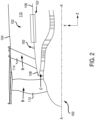
- FIG. 2 elements with like element numbering, as depicted in FIG. 1 , are intended to be the same and will not necessarily be repeated for the sake of clarity.
- the front section of a gas turbine engine 100 having an example secondary flow system 102 constructed in accordance with the present disclosure may generally include outer nacelle 104, inner cowl 106, a splitter 108, fan blades 112, exit guide vanes 114 and a fan duct 110 associated therewith.
- airflow entering into the gas turbine engine 100 may be split by the splitter 108 into bypass flow path B flowing through the fan duct 110 and core air flow C flowing into the low pressure compressor.
- the secondary flow system 102 of the gas turbine engine 100 of FIG. 2 may be disposed on an outer surface of the inner fixed structure, and generally composed of at least one secondary flow system 152 and an external turning vane 162 adjacent thereto.
- the external turning vane is disposed downstream, or aft, of exit guide vanes 114.
- secondary flow system 152 receives bypass air through an inlet 354.
- inlet 354 is in fluid communication with bypass flow path B.
- the upper bifurcation 144 may divert airflow through bypass flow path B around the upper bifurcation 144.
- the upper bifurcation 144 may tend to turn the bypass air, illustrated by arrow 398 in FIG. 3A , in the circumferential direction, causing the bypass air to enter inlet 354 at an angle with respect to a centerline axis 390 of inlet 354.
- This circumferential flow migration of the bypass air may tend to cause flow separation at a sidewall located circumferentially adjacent upper bifurcation 144, such as the upper side 302, of inlet 354, which may result in a total pressure deficit and decreased system mass air flow.
- an external turning vane is provided, which may improve total pressure distribution across the inlet 354 and maximize system mass air flow.
- external turning vane 162 is disposed in front of inlet 354. That is, external turning vane 162 is disposed upstream from inlet 354. In various embodiments, external turning vane 162 is formed as a plate. In this regard, external turning vane 162 comprises a vane body 163 extending radially from the IFS 106. In various embodiments, external turning vane 162 is made of a metal such as a steel alloy, stainless steel, titanium, aluminum, or any other metal or alloy thereof. In various embodiments, external turning vane 162 comprises one or more machined metal parts. In various embodiments, external turning vane 162 comprises a fiber-reinforced composite material.
- External turning vane 162 may be configured to turn bypass air in an axial direction (e.g., parallel to a centerline axis A-A' of the gas turbine engine 100 (see FIG. 2 )), illustrated by arrow 399, entering inlet 354, for example, such that the bypass air enters inlet 354 substantially parallel to centerline axis 390.
- wake vortices 395 may be generated by external turning vane 162 and ingested by inlet 354.
- external turning vane 162 may be placed in front of inlet 354 such that the wake vortices 395 generated thereby are completely ingested by inlet 354.
- external turning vane 162 is placed in front of inlet 354 such that the wake vortices 395 generated thereby are completely or nearly completely ingested by inlet 354 at or near upper side 302, which tends to minimize flow separation from upper side 302, improve total pressure distribution across the inlet 354, and maximize system mass air flow through secondary flow system 152.
- External turning vane 162 may be configured to turn the airflow (e.g., see bypass air 398 of FIG. 3A ) in the bypass flow path such that the wake vortices 395 of the external turning vane 162 are directed at the portion of the inlet 354 challenged by flow separation.
- External turning vane 162 may be configured to convert kinetic energy associated with a circumferential flow direction (e.g., see bypass air 398 of FIG. 3A ) into a vortex (e.g., wake vortices 395) to introduce a higher momentum flow of the vortex into the inlet 354 of the secondary flow system 152 to minimize propagation of a flow separation off a sidewall (e.g., upper side 302) of the inlet 354.
- the term "higher momentum flow” means that the momentum of the wake vortices 395 is greater than the local momentum of the circumferential flow of bypass air 398.
- the aerodynamic effects of external turning vane 162 are further enhanced by optimizing the angle of the external turning vane 162 relative to centerline axis 390 to provide optimal vortex size and sidewall (e.g., upper side 302) interaction.
- external turning vane 162 is oriented at a non-zero angle with respect to centerline axis 390.
- external turning vane 162 is angled towards centerline axis 390.
- External turning vane 162 may be angled towards centerline axis 390 with the forward edge 364 pointed towards centerline axis 390.
- a height 381 (also referred to herein as a first height), as measured in the radial direction, of external turning vane 162 may be less than or equal to a height 382 (also referred to herein as a second height) of the inlet 354. In this manner, the aerodynamic effects of external turning vane 162 are minimized or eliminated at locations radially outward from inlet 354.
- height 381 is the maximum height of external turning vane 162.
- height 382 is the maximum height of inlet 354.
- the length 383 of external turning vane 162 is greater than the height 381 of external turning vane 162.
- External turning vane 162 may be attached to IFS 106 via any known method suitable for attaching vanes to a cowl structure.
- external turning vane 162 may be attached to IFS 106 via one or more fasteners, such as a rivet, a threaded fastener, a bolt, or a screw, among other types of fasteners.
- external turning vane 162 may be bonded to IFS 106 via an adhesive.
Landscapes
- Engineering & Computer Science (AREA)
- Chemical & Material Sciences (AREA)
- Combustion & Propulsion (AREA)
- Mechanical Engineering (AREA)
- General Engineering & Computer Science (AREA)
- Physics & Mathematics (AREA)
- Fluid Mechanics (AREA)
- Aviation & Aerospace Engineering (AREA)
- Structures Of Non-Positive Displacement Pumps (AREA)
Description
- This disclosure relates generally to gas turbine engines, and more particularly to secondary flow system arrangements for gas turbine engines.
- A gas turbine engine may employ secondary flow system inlets that are positioned about the low pressure compressor in the inner fixed structure section of the inner cowl in general fluid communication with a fan duct of the gas turbine engine. More specifically, the inner surface of the outer nacelle and the outer surface of the inner cowl at the low pressure compressor section define a fan duct through which fan airflow is received. This fan duct is the source of airflow for IFS-mounted secondary flow systems.
-
US 10,233,869 B2 -
US 2017/328280 A1 discloses a heat sink for location in a fluid flow, including a heat sink base and a plurality of heat dissipating elements, such as elongate fins, extending from the base of the heat sink. -
US 4,836,473 A discloses reducing the pressure drag on the skin of an aircraft by rigidly securing boundary layer influencing members to the skin of the aircraft. - From a first aspect of the invention, an inner cowl for a gas turbine engine as claimed in claim 1 is provided.
- In various embodiments, the vane body is oriented at a non-zero angle with respect to a centerline axis of the inlet.
- In various embodiments, a first height of the vane body is less than a second height of the inlet.
- In various embodiments, the inner cowl comprises an inner fixed structure (IFS).
- In various embodiments, the vane body is disposed relative to the inlet such that a wake vortex generated by the vane body during operation of the gas turbine engine is completely or nearly completely ingested by the inlet.
- In various embodiments, the vane body is configured to convert kinetic energy associated with a circumferential flow direction into a vortex to introduce a higher momentum flow of the vortex into the inlet of the secondary flow system to minimize propagation of a flow separation off a sidewall of the inlet.
- In various embodiments, the vane body is configured to straighten the airflow diverted by a bifurcation of the gas turbine engine.
- In various embodiments, the first height is a maximum height of the vane body and the second height is a maximum height of the inlet.
- From a further aspect of the invention, a gas turbine engine as claimed in claim 9 is disclosed.
- In various embodiments, the vane body is oriented at a non-zero angle with respect to a centerline axis of the inlet.
- In various embodiments, a first height of the vane body is less than a second height of the inlet.
- In various embodiments, the inner cowl comprises an inner fixed structure (IFS).
- In various embodiments, the vane body is disposed relative to the inlet such that a wake vortex generated by the vane body during operation of the gas turbine engine is completely or nearly completely ingested by the inlet.
- In various embodiments, the vane body is configured to convert kinetic energy associated with a circumferential flow direction into a vortex to introduce a higher momentum flow of the vortex into the inlet of the secondary flow system to minimize propagation of a flow separation off a sidewall of the inlet.
- In various embodiments, the vane body is configured to straighten the airflow diverted by a bifurcation of the gas turbine engine.
- These features and elements as well as the operation thereof will become more apparent in light of the following description and the accompanying drawings. It should be understood, however, the following description and drawings are intended to be exemplary in nature and non-limiting.
-
-
Figure 1 illustrates a cross-section, schematic view of a nacelle for a gas turbine engine, in accordance with various embodiments; -
Figure 2 illustrates a cross-section, schematic view of a section of a secondary flow system installed on a gas turbine engine nacelle, in accordance with various embodiments; -
Figure 3A illustrates a perspective view of an external turning vane for an inlet to a secondary flow system for a gas turbine engine, in accordance with various embodiments; and -
Figure 3B illustrates a perspective view of the external turning vane ofFIG. 3A and a wake vortex generated by the external turning vane ingested by the inlet, in accordance with various embodiments. - The detailed description of exemplary embodiments herein makes reference to the accompanying drawings, which show exemplary embodiments by way of illustration. While these exemplary embodiments are described in sufficient detail to enable those skilled in the art to practice the disclosure, it should be understood that other embodiments may be realized and that logical changes and adaptations in design and construction may be made in accordance with this disclosure and the teachings herein. Thus, the detailed description herein is presented for purposes of illustration only and not of limitation. The scope of the disclosure is defined by the appended claims.
- An external turning vane of the present disclosure is provided forward from a secondary flow system inlet. A wake vortex generated by the external turning body may be completely or nearly completely ingested by the inlet for improving secondary flow system inlet total pressure recovery. An external turning vane of the present disclosure minimizes air flow separation inside of the inlet.
-
FIG. 1 illustrates a schematic view of a gas turbine engine, in accordance with various embodiments. An xyz-axis is provided for ease of illustration.Gas turbine engine 100 may includecore engine 120. Core air flow C flows throughcore engine 120 and is expelled throughexhaust outlet 118 surroundingtail cone 122. -
Core engine 120 drives afan 112 arranged in a bypass flow path B. Air in bypass flow path B flows in the aft direction (z-direction) along bypass flow path B. At least a portion of bypass flow path B may be defined byouter nacelle 104 and inner cowl 106 (also referred to herein as an inner fixed structure (IFS)).Fan case 132 may surroundfan 112.Fan case 132 may be housed withinouter nacelle 104. -
Outer nacelle 104 typically comprises two halves which are typically mounted to a pylon. According to various embodiments,multiple guide vanes 114 may extend radially betweencore engine 120 andfan case 132.Upper bifurcation 144 andlower bifurcation 142 may extend radially between theouter nacelle 104 andinner cowl 106 in locations opposite one another to accommodate engine components such as wires and fluids, for example. -
Inner cowl 106 may surroundcore engine 120 and providecore compartment 124. Various components may be provided incore compartment 124 such as fluid conduits, compressed air ducts, and/or air-oil coolers, for example. - With respect to
FIG. 2 , elements with like element numbering, as depicted inFIG. 1 , are intended to be the same and will not necessarily be repeated for the sake of clarity. - Referring to
FIG. 2 , the front section of agas turbine engine 100 having an examplesecondary flow system 102 constructed in accordance with the present disclosure is provided. Among other things, the front section of thegas turbine engine 100 may generally includeouter nacelle 104,inner cowl 106, asplitter 108,fan blades 112,exit guide vanes 114 and afan duct 110 associated therewith. Moreover, airflow entering into thegas turbine engine 100 may be split by thesplitter 108 into bypass flow path B flowing through thefan duct 110 and core air flow C flowing into the low pressure compressor. - The
secondary flow system 102 of thegas turbine engine 100 ofFIG. 2 may be disposed on an outer surface of the inner fixed structure, and generally composed of at least onesecondary flow system 152 and anexternal turning vane 162 adjacent thereto. In various embodiments, the external turning vane is disposed downstream, or aft, ofexit guide vanes 114. - With reference to
FIG. 3A ,secondary flow system 152 receives bypass air through aninlet 354. In this regard,inlet 354 is in fluid communication with bypass flow path B. Theupper bifurcation 144 may divert airflow through bypass flow path B around theupper bifurcation 144. Theupper bifurcation 144 may tend to turn the bypass air, illustrated byarrow 398 inFIG. 3A , in the circumferential direction, causing the bypass air to enterinlet 354 at an angle with respect to acenterline axis 390 ofinlet 354. This circumferential flow migration of the bypass air may tend to cause flow separation at a sidewall located circumferentially adjacentupper bifurcation 144, such as theupper side 302, ofinlet 354, which may result in a total pressure deficit and decreased system mass air flow. In this regard, an external turning vane is provided, which may improve total pressure distribution across theinlet 354 and maximize system mass air flow. - In various embodiments,
external turning vane 162 is disposed in front ofinlet 354. That is,external turning vane 162 is disposed upstream frominlet 354. In various embodiments,external turning vane 162 is formed as a plate. In this regard,external turning vane 162 comprises a vane body 163 extending radially from theIFS 106. In various embodiments,external turning vane 162 is made of a metal such as a steel alloy, stainless steel, titanium, aluminum, or any other metal or alloy thereof. In various embodiments,external turning vane 162 comprises one or more machined metal parts. In various embodiments,external turning vane 162 comprises a fiber-reinforced composite material.External turning vane 162 may be configured to turn bypass air in an axial direction (e.g., parallel to a centerline axis A-A' of the gas turbine engine 100 (seeFIG. 2 )), illustrated byarrow 399, enteringinlet 354, for example, such that the bypass air entersinlet 354 substantially parallel tocenterline axis 390. - With reference to
FIG. 3B , due to the aerodynamic effects ofexternal turning vane 162,wake vortices 395 may be generated byexternal turning vane 162 and ingested byinlet 354. In this regard,external turning vane 162 may be placed in front ofinlet 354 such that thewake vortices 395 generated thereby are completely ingested byinlet 354. In various embodiments,external turning vane 162 is placed in front ofinlet 354 such that thewake vortices 395 generated thereby are completely or nearly completely ingested byinlet 354 at or nearupper side 302, which tends to minimize flow separation fromupper side 302, improve total pressure distribution across theinlet 354, and maximize system mass air flow throughsecondary flow system 152.External turning vane 162 may be configured to turn the airflow (e.g., seebypass air 398 ofFIG. 3A ) in the bypass flow path such that thewake vortices 395 of theexternal turning vane 162 are directed at the portion of theinlet 354 challenged by flow separation.External turning vane 162 may be configured to convert kinetic energy associated with a circumferential flow direction (e.g., seebypass air 398 ofFIG. 3A ) into a vortex (e.g., wake vortices 395) to introduce a higher momentum flow of the vortex into theinlet 354 of thesecondary flow system 152 to minimize propagation of a flow separation off a sidewall (e.g., upper side 302) of theinlet 354. As used herein, the term "higher momentum flow" means that the momentum of thewake vortices 395 is greater than the local momentum of the circumferential flow ofbypass air 398. - In various embodiments, the aerodynamic effects of
external turning vane 162 are further enhanced by optimizing the angle of theexternal turning vane 162 relative tocenterline axis 390 to provide optimal vortex size and sidewall (e.g., upper side 302) interaction. In various embodiments,external turning vane 162 is oriented at a non-zero angle with respect tocenterline axis 390. In various embodiments,external turning vane 162 is angled towardscenterline axis 390.External turning vane 162 may be angled towardscenterline axis 390 with theforward edge 364 pointed towardscenterline axis 390. In various embodiments, a height 381 (also referred to herein as a first height), as measured in the radial direction, ofexternal turning vane 162 may be less than or equal to a height 382 (also referred to herein as a second height) of theinlet 354. In this manner, the aerodynamic effects ofexternal turning vane 162 are minimized or eliminated at locations radially outward frominlet 354. In various embodiments,height 381 is the maximum height ofexternal turning vane 162. In various embodiments,height 382 is the maximum height ofinlet 354. In various embodiments, thelength 383 ofexternal turning vane 162 is greater than theheight 381 ofexternal turning vane 162. -
External turning vane 162 may be attached toIFS 106 via any known method suitable for attaching vanes to a cowl structure. For example,external turning vane 162 may be attached toIFS 106 via one or more fasteners, such as a rivet, a threaded fastener, a bolt, or a screw, among other types of fasteners. Furthermore,external turning vane 162 may be bonded toIFS 106 via an adhesive. - Benefits, other advantages, and solutions to problems have been described herein with regard to specific embodiments.
Claims (9)
- An inner cowl (106) of a gas turbine engine (100), characterised by the inner cowl (106)comprising:an inlet (354) for a secondary flow system (152) disposed on the inner cowl, the inlet (354) in fluid communication with a bypass flow path (B); andan external turning vane (162) disposed upstream from the inlet (354), the external turning vane (162) comprising a vane body (163) extending radially from the inner cowl and disposed upstream from the inlet (354) of the secondary flow system (152), the vane body (163) configured to turn an airflow in the bypass flow path (B) towards an axial direction and to introduce higher momentum flow of a vortex into the inlet (354) to minimize flow separation on a sidewall of the inlet (354).
- The inner cowl (106) of claim 1, wherein the vane body (163) is oriented at a non-zero angle with respect to a centerline axis of the inlet (354).
- The inner cowl (106) of claim 1 or 2, wherein a first height (381) of the vane body (163) is less than a second height (382) of the inlet (354).
- The inner cowl (106) of claim 3, wherein the first height (381) is a maximum height of the vane body (163) and the second height (382) is a maximum height of the inlet (354).
- The inner cowl (106) of any preceding claim, wherein the inner cowl comprises an inner fixed structure (IFS).
- The inner cowl (106) of any preceding claim, wherein the vane body (163) is disposed relative to the inlet (354) such that a wake vortex (395) generated by the vane body (163) during operation of the gas turbine engine (100) is completely or nearly completely ingested by the inlet (354).
- The inner cowl (106) of any preceding claim, wherein the vane body (163) is configured to convert kinetic energy associated with a circumferential flow direction into a vortex to introduce a higher momentum flow of the vortex into the inlet (354) of the secondary flow system (152) to minimize propagation of a flow separation off a sidewall of the inlet (354).
- The inner cowl (106) of any preceding claim, wherein the vane body (163) is configured to straighten the airflow diverted by a bifurcation of the gas turbine engine (100).
- A gas turbine engine (100), comprising:an outer nacelle (104); andan inner cowl (106) as claimed in any preceding claim, the inner cowl defining a bypass flow path (B) along with the outer nacelle (104)for receiving fan airflow.
Applications Claiming Priority (1)
| Application Number | Priority Date | Filing Date | Title |
|---|---|---|---|
| US16/534,150 US11022047B2 (en) | 2019-08-07 | 2019-08-07 | External turning vane for IFS-mounted secondary flow systems |
Publications (2)
| Publication Number | Publication Date |
|---|---|
| EP3779126A1 EP3779126A1 (en) | 2021-02-17 |
| EP3779126B1 true EP3779126B1 (en) | 2025-03-19 |
Family
ID=71948462
Family Applications (1)
| Application Number | Title | Priority Date | Filing Date |
|---|---|---|---|
| EP20189320.3A Active EP3779126B1 (en) | 2019-08-07 | 2020-08-04 | Inner cowl comprising an external turning vane for ifs-mounted secondary flow systems |
Country Status (2)
| Country | Link |
|---|---|
| US (1) | US11022047B2 (en) |
| EP (1) | EP3779126B1 (en) |
Families Citing this family (2)
| Publication number | Priority date | Publication date | Assignee | Title |
|---|---|---|---|---|
| US11739698B2 (en) | 2022-01-19 | 2023-08-29 | General Electric Company | Aero-acoustically dampened bleed valve |
| US12510004B2 (en) | 2024-06-14 | 2025-12-30 | General Electric Company | Outward facing load reacting bodies for use with unison rings |
Citations (1)
| Publication number | Priority date | Publication date | Assignee | Title |
|---|---|---|---|---|
| US8240616B2 (en) * | 2009-04-22 | 2012-08-14 | Miller Daniel N | Method and system for global flow field management using distributed, surface-embedded, nano-scale boundary layer actuation |
Family Cites Families (22)
| Publication number | Priority date | Publication date | Assignee | Title |
|---|---|---|---|---|
| US3744745A (en) | 1971-09-30 | 1973-07-10 | Mc Donnell Douglas Corp | Liftvanes |
| US3934846A (en) | 1974-10-08 | 1976-01-27 | The United States Of America As Represented By The Secretary Of The Air Force | Device to reduce flow induced pressure oscillations in open cavities |
| DE3521329A1 (en) | 1985-06-14 | 1986-12-18 | Messerschmitt-Bölkow-Blohm GmbH, 8012 Ottobrunn | Vortex generator and boundary layer deflector arrangement |
| US4782658A (en) * | 1987-05-07 | 1988-11-08 | Rolls-Royce Plc | Deicing of a geared gas turbine engine |
| US6050527A (en) * | 1997-12-19 | 2000-04-18 | The Boeing Company | Flow control device to eliminate cavity resonance |
| DE10162238A1 (en) * | 2001-12-18 | 2003-07-10 | Rolls Royce Deutschland | Air intake system of a PTL drive |
| US8257036B2 (en) | 2004-04-09 | 2012-09-04 | Norris Thomas R | Externally mounted vortex generators for flow duct passage |
| US7344107B2 (en) * | 2004-10-26 | 2008-03-18 | The Boeing Company | Dual flow APU inlet and associated systems and methods |
| US20080203218A1 (en) * | 2007-02-26 | 2008-08-28 | Honeywell International, Inc. | Systems And Methods For Reducing Pressure Loss Of Air Flowing From A First Area To A Second Area |
| US7966831B2 (en) | 2007-08-28 | 2011-06-28 | General Electric Company | Apparatus and method for suppressing dynamic pressure instability in bleed duct |
| US8024935B2 (en) * | 2008-11-21 | 2011-09-27 | Honeywell International Inc. | Flush inlet scoop design for aircraft bleed air system |
| FR2982588B1 (en) * | 2011-11-10 | 2013-11-22 | Aircelle Sa | COMPOSITE PANEL WITH INTEGRATED SAMPLING ECOPE |
| US9108737B2 (en) * | 2012-08-24 | 2015-08-18 | United Technologies Corporation | Nacelle scoop inlet |
| FR3001257B1 (en) * | 2013-01-18 | 2018-05-11 | Safran Aircraft Engines | ACOUSTICALLY OPTIMIZED AIR INLET HANDLE |
| US9810147B2 (en) * | 2013-10-31 | 2017-11-07 | The Boeing Company | Angled inlet system for a precooler |
| US10145304B2 (en) | 2014-01-13 | 2018-12-04 | United Technologies Corporation | Dual function air diverter and variable area fan nozzle |
| GB201408415D0 (en) * | 2014-05-13 | 2014-06-25 | Rolls Royce Plc | Bifurcation fairing |
| US20150369065A1 (en) * | 2014-06-18 | 2015-12-24 | United Technologies Corporation | Nacelle air scoop assembly |
| FR3024494B1 (en) * | 2014-07-31 | 2016-07-22 | Airbus Operations Sas | AIRCRAFT TURBOMACHINE COMPRISING A DEFLECTOR |
| US10233869B2 (en) | 2015-08-27 | 2019-03-19 | Rolls Royce North American Technologies Inc. | System and method for creating a fluidic barrier from the leading edge of a fan blade |
| GB201608523D0 (en) | 2016-05-16 | 2016-06-29 | Rolls Royce Plc | Heat sink |
| US10253785B2 (en) | 2016-08-31 | 2019-04-09 | Unison Industries, Llc | Engine heat exchanger and method of forming |
-
2019
- 2019-08-07 US US16/534,150 patent/US11022047B2/en active Active
-
2020
- 2020-08-04 EP EP20189320.3A patent/EP3779126B1/en active Active
Patent Citations (1)
| Publication number | Priority date | Publication date | Assignee | Title |
|---|---|---|---|---|
| US8240616B2 (en) * | 2009-04-22 | 2012-08-14 | Miller Daniel N | Method and system for global flow field management using distributed, surface-embedded, nano-scale boundary layer actuation |
Also Published As
| Publication number | Publication date |
|---|---|
| US11022047B2 (en) | 2021-06-01 |
| US20210040897A1 (en) | 2021-02-11 |
| EP3779126A1 (en) | 2021-02-17 |
Similar Documents
| Publication | Publication Date | Title |
|---|---|---|
| US11643938B2 (en) | Bleed air extraction device for a gas turbine engine | |
| US7192245B2 (en) | Rotor assembly with cooling air deflectors and method | |
| US4466587A (en) | Nacelle installation | |
| EP2568119B1 (en) | Airfoil for a gas turbine engine with an improved trailing edge cooling arrangement | |
| KR20080063131A (en) | Guide vanes and methods of manufacturing the same | |
| JPH063145B2 (en) | Turbine engine assembly | |
| US12492642B2 (en) | Outlet guide vane assembly for a turbofan engine | |
| US8845286B2 (en) | Inter-turbine ducts with guide vanes | |
| US11566583B2 (en) | Fluid scoop for a thrust reverser system | |
| EP3231997A1 (en) | Gas turbine engine airfoil bleed | |
| US20240117766A1 (en) | Waste heat recovery system | |
| EP3483395B1 (en) | Inter-turbine ducts with flow control mechanisms | |
| EP3779126B1 (en) | Inner cowl comprising an external turning vane for ifs-mounted secondary flow systems | |
| US12276199B2 (en) | Outlet guide vane assembly for a turbofan engine | |
| US10519976B2 (en) | Fluid diodes with ridges to control boundary layer in axial compressor stator vane | |
| US20200056496A1 (en) | Turbine-tip clearance control system offtake | |
| EP3354848B1 (en) | Inter-turbine ducts with multiple splitter blades | |
| US20230036206A1 (en) | Cooling air delivery assembly | |
| EP3265662B1 (en) | Gas turbine exhaust assembly | |
| US20250223909A1 (en) | Outlet guide vane assembly for a turbofan engine | |
| US12577911B2 (en) | Particle separation system upstream of a heat exchanger in a gas turbine engine | |
| US12392284B1 (en) | Cyclonic separator for gas turbine engine | |
| EP3118416B1 (en) | A gas turbine engine |
Legal Events
| Date | Code | Title | Description |
|---|---|---|---|
| PUAI | Public reference made under article 153(3) epc to a published international application that has entered the european phase |
Free format text: ORIGINAL CODE: 0009012 |
|
| STAA | Information on the status of an ep patent application or granted ep patent |
Free format text: STATUS: THE APPLICATION HAS BEEN PUBLISHED |
|
| AK | Designated contracting states |
Kind code of ref document: A1 Designated state(s): AL AT BE BG CH CY CZ DE DK EE ES FI FR GB GR HR HU IE IS IT LI LT LU LV MC MK MT NL NO PL PT RO RS SE SI SK SM TR |
|
| AX | Request for extension of the european patent |
Extension state: BA ME |
|
| STAA | Information on the status of an ep patent application or granted ep patent |
Free format text: STATUS: REQUEST FOR EXAMINATION WAS MADE |
|
| 17P | Request for examination filed |
Effective date: 20210817 |
|
| RBV | Designated contracting states (corrected) |
Designated state(s): AL AT BE BG CH CY CZ DE DK EE ES FI FR GB GR HR HU IE IS IT LI LT LU LV MC MK MT NL NO PL PT RO RS SE SI SK SM TR |
|
| STAA | Information on the status of an ep patent application or granted ep patent |
Free format text: STATUS: EXAMINATION IS IN PROGRESS |
|
| 17Q | First examination report despatched |
Effective date: 20230213 |
|
| RAP3 | Party data changed (applicant data changed or rights of an application transferred) |
Owner name: RTX CORPORATION |
|
| GRAP | Despatch of communication of intention to grant a patent |
Free format text: ORIGINAL CODE: EPIDOSNIGR1 |
|
| STAA | Information on the status of an ep patent application or granted ep patent |
Free format text: STATUS: GRANT OF PATENT IS INTENDED |
|
| INTG | Intention to grant announced |
Effective date: 20241015 |
|
| GRAS | Grant fee paid |
Free format text: ORIGINAL CODE: EPIDOSNIGR3 |
|
| GRAA | (expected) grant |
Free format text: ORIGINAL CODE: 0009210 |
|
| STAA | Information on the status of an ep patent application or granted ep patent |
Free format text: STATUS: THE PATENT HAS BEEN GRANTED |
|
| AK | Designated contracting states |
Kind code of ref document: B1 Designated state(s): AL AT BE BG CH CY CZ DE DK EE ES FI FR GB GR HR HU IE IS IT LI LT LU LV MC MK MT NL NO PL PT RO RS SE SI SK SM TR |
|
| REG | Reference to a national code |
Ref country code: GB Ref legal event code: FG4D |
|
| REG | Reference to a national code |
Ref country code: CH Ref legal event code: EP |
|
| REG | Reference to a national code |
Ref country code: DE Ref legal event code: R096 Ref document number: 602020047835 Country of ref document: DE |
|
| REG | Reference to a national code |
Ref country code: IE Ref legal event code: FG4D |
|
| PG25 | Lapsed in a contracting state [announced via postgrant information from national office to epo] |
Ref country code: RS Free format text: LAPSE BECAUSE OF FAILURE TO SUBMIT A TRANSLATION OF THE DESCRIPTION OR TO PAY THE FEE WITHIN THE PRESCRIBED TIME-LIMIT Effective date: 20250619 |
|
| PG25 | Lapsed in a contracting state [announced via postgrant information from national office to epo] |
Ref country code: FI Free format text: LAPSE BECAUSE OF FAILURE TO SUBMIT A TRANSLATION OF THE DESCRIPTION OR TO PAY THE FEE WITHIN THE PRESCRIBED TIME-LIMIT Effective date: 20250319 |
|
| REG | Reference to a national code |
Ref country code: LT Ref legal event code: MG9D |
|
| PG25 | Lapsed in a contracting state [announced via postgrant information from national office to epo] |
Ref country code: NO Free format text: LAPSE BECAUSE OF FAILURE TO SUBMIT A TRANSLATION OF THE DESCRIPTION OR TO PAY THE FEE WITHIN THE PRESCRIBED TIME-LIMIT Effective date: 20250619 |
|
| PG25 | Lapsed in a contracting state [announced via postgrant information from national office to epo] |
Ref country code: HR Free format text: LAPSE BECAUSE OF FAILURE TO SUBMIT A TRANSLATION OF THE DESCRIPTION OR TO PAY THE FEE WITHIN THE PRESCRIBED TIME-LIMIT Effective date: 20250319 |
|
| PG25 | Lapsed in a contracting state [announced via postgrant information from national office to epo] |
Ref country code: LV Free format text: LAPSE BECAUSE OF FAILURE TO SUBMIT A TRANSLATION OF THE DESCRIPTION OR TO PAY THE FEE WITHIN THE PRESCRIBED TIME-LIMIT Effective date: 20250319 |
|
| PG25 | Lapsed in a contracting state [announced via postgrant information from national office to epo] |
Ref country code: BG Free format text: LAPSE BECAUSE OF FAILURE TO SUBMIT A TRANSLATION OF THE DESCRIPTION OR TO PAY THE FEE WITHIN THE PRESCRIBED TIME-LIMIT Effective date: 20250319 Ref country code: GR Free format text: LAPSE BECAUSE OF FAILURE TO SUBMIT A TRANSLATION OF THE DESCRIPTION OR TO PAY THE FEE WITHIN THE PRESCRIBED TIME-LIMIT Effective date: 20250620 |
|
| REG | Reference to a national code |
Ref country code: NL Ref legal event code: MP Effective date: 20250319 |
|
| REG | Reference to a national code |
Ref country code: AT Ref legal event code: MK05 Ref document number: 1777096 Country of ref document: AT Kind code of ref document: T Effective date: 20250319 |
|
| PG25 | Lapsed in a contracting state [announced via postgrant information from national office to epo] |
Ref country code: NL Free format text: LAPSE BECAUSE OF FAILURE TO SUBMIT A TRANSLATION OF THE DESCRIPTION OR TO PAY THE FEE WITHIN THE PRESCRIBED TIME-LIMIT Effective date: 20250319 |
|
| PG25 | Lapsed in a contracting state [announced via postgrant information from national office to epo] |
Ref country code: SE Free format text: LAPSE BECAUSE OF FAILURE TO SUBMIT A TRANSLATION OF THE DESCRIPTION OR TO PAY THE FEE WITHIN THE PRESCRIBED TIME-LIMIT Effective date: 20250319 |
|
| PG25 | Lapsed in a contracting state [announced via postgrant information from national office to epo] |
Ref country code: SM Free format text: LAPSE BECAUSE OF FAILURE TO SUBMIT A TRANSLATION OF THE DESCRIPTION OR TO PAY THE FEE WITHIN THE PRESCRIBED TIME-LIMIT Effective date: 20250319 |
|
| PG25 | Lapsed in a contracting state [announced via postgrant information from national office to epo] |
Ref country code: ES Free format text: LAPSE BECAUSE OF FAILURE TO SUBMIT A TRANSLATION OF THE DESCRIPTION OR TO PAY THE FEE WITHIN THE PRESCRIBED TIME-LIMIT Effective date: 20250319 Ref country code: PT Free format text: LAPSE BECAUSE OF FAILURE TO SUBMIT A TRANSLATION OF THE DESCRIPTION OR TO PAY THE FEE WITHIN THE PRESCRIBED TIME-LIMIT Effective date: 20250721 |
|
| PGFP | Annual fee paid to national office [announced via postgrant information from national office to epo] |
Ref country code: DE Payment date: 20250724 Year of fee payment: 6 |
|
| PG25 | Lapsed in a contracting state [announced via postgrant information from national office to epo] |
Ref country code: PL Free format text: LAPSE BECAUSE OF FAILURE TO SUBMIT A TRANSLATION OF THE DESCRIPTION OR TO PAY THE FEE WITHIN THE PRESCRIBED TIME-LIMIT Effective date: 20250319 Ref country code: IT Free format text: LAPSE BECAUSE OF FAILURE TO SUBMIT A TRANSLATION OF THE DESCRIPTION OR TO PAY THE FEE WITHIN THE PRESCRIBED TIME-LIMIT Effective date: 20250319 |
|
| PGFP | Annual fee paid to national office [announced via postgrant information from national office to epo] |
Ref country code: GB Payment date: 20250725 Year of fee payment: 6 |
|
| PG25 | Lapsed in a contracting state [announced via postgrant information from national office to epo] |
Ref country code: AT Free format text: LAPSE BECAUSE OF FAILURE TO SUBMIT A TRANSLATION OF THE DESCRIPTION OR TO PAY THE FEE WITHIN THE PRESCRIBED TIME-LIMIT Effective date: 20250319 |
|
| PGFP | Annual fee paid to national office [announced via postgrant information from national office to epo] |
Ref country code: FR Payment date: 20250725 Year of fee payment: 6 |
|
| PG25 | Lapsed in a contracting state [announced via postgrant information from national office to epo] |
Ref country code: CZ Free format text: LAPSE BECAUSE OF FAILURE TO SUBMIT A TRANSLATION OF THE DESCRIPTION OR TO PAY THE FEE WITHIN THE PRESCRIBED TIME-LIMIT Effective date: 20250319 Ref country code: EE Free format text: LAPSE BECAUSE OF FAILURE TO SUBMIT A TRANSLATION OF THE DESCRIPTION OR TO PAY THE FEE WITHIN THE PRESCRIBED TIME-LIMIT Effective date: 20250319 |
|
| PG25 | Lapsed in a contracting state [announced via postgrant information from national office to epo] |
Ref country code: RO Free format text: LAPSE BECAUSE OF FAILURE TO SUBMIT A TRANSLATION OF THE DESCRIPTION OR TO PAY THE FEE WITHIN THE PRESCRIBED TIME-LIMIT Effective date: 20250319 |
|
| PG25 | Lapsed in a contracting state [announced via postgrant information from national office to epo] |
Ref country code: SK Free format text: LAPSE BECAUSE OF FAILURE TO SUBMIT A TRANSLATION OF THE DESCRIPTION OR TO PAY THE FEE WITHIN THE PRESCRIBED TIME-LIMIT Effective date: 20250319 |
|
| PG25 | Lapsed in a contracting state [announced via postgrant information from national office to epo] |
Ref country code: IS Free format text: LAPSE BECAUSE OF FAILURE TO SUBMIT A TRANSLATION OF THE DESCRIPTION OR TO PAY THE FEE WITHIN THE PRESCRIBED TIME-LIMIT Effective date: 20250719 |
|
| REG | Reference to a national code |
Ref country code: DE Ref legal event code: R097 Ref document number: 602020047835 Country of ref document: DE |
|
| PG25 | Lapsed in a contracting state [announced via postgrant information from national office to epo] |
Ref country code: DK Free format text: LAPSE BECAUSE OF FAILURE TO SUBMIT A TRANSLATION OF THE DESCRIPTION OR TO PAY THE FEE WITHIN THE PRESCRIBED TIME-LIMIT Effective date: 20250319 |
|
| PLBE | No opposition filed within time limit |
Free format text: ORIGINAL CODE: 0009261 |
|
| STAA | Information on the status of an ep patent application or granted ep patent |
Free format text: STATUS: NO OPPOSITION FILED WITHIN TIME LIMIT |
|
| REG | Reference to a national code |
Ref country code: CH Ref legal event code: L10 Free format text: ST27 STATUS EVENT CODE: U-0-0-L10-L00 (AS PROVIDED BY THE NATIONAL OFFICE) Effective date: 20260128 |
|
| 26N | No opposition filed |
Effective date: 20251222 |
|
| REG | Reference to a national code |
Ref country code: CH Ref legal event code: H13 Free format text: ST27 STATUS EVENT CODE: U-0-0-H10-H13 (AS PROVIDED BY THE NATIONAL OFFICE) Effective date: 20260324 |
|
| PG25 | Lapsed in a contracting state [announced via postgrant information from national office to epo] |
Ref country code: MC Free format text: LAPSE BECAUSE OF FAILURE TO SUBMIT A TRANSLATION OF THE DESCRIPTION OR TO PAY THE FEE WITHIN THE PRESCRIBED TIME-LIMIT Effective date: 20250319 |
|
| PG25 | Lapsed in a contracting state [announced via postgrant information from national office to epo] |
Ref country code: LU Free format text: LAPSE BECAUSE OF NON-PAYMENT OF DUE FEES Effective date: 20250804 |
|
| PG25 | Lapsed in a contracting state [announced via postgrant information from national office to epo] |
Ref country code: CH Free format text: LAPSE BECAUSE OF NON-PAYMENT OF DUE FEES Effective date: 20250831 |