EP3779094B1 - Ein dachfenster - Google Patents
Ein dachfenster Download PDFInfo
- Publication number
- EP3779094B1 EP3779094B1 EP20210451.9A EP20210451A EP3779094B1 EP 3779094 B1 EP3779094 B1 EP 3779094B1 EP 20210451 A EP20210451 A EP 20210451A EP 3779094 B1 EP3779094 B1 EP 3779094B1
- Authority
- EP
- European Patent Office
- Prior art keywords
- frame
- igu
- edge
- window
- skylight
- Prior art date
- Legal status (The legal status is an assumption and is not a legal conclusion. Google has not performed a legal analysis and makes no representation as to the accuracy of the status listed.)
- Active
Links
Images


Classifications
-
- E—FIXED CONSTRUCTIONS
- E04—BUILDING
- E04D—ROOF COVERINGS; SKY-LIGHTS; GUTTERS; ROOF-WORKING TOOLS
- E04D13/00—Special arrangements or devices in connection with roof coverings; Protection against birds; Roof drainage ; Sky-lights
- E04D13/03—Sky-lights; Domes; Ventilating sky-lights
- E04D13/0305—Supports or connecting means for sky-lights of flat or domed shape
-
- E—FIXED CONSTRUCTIONS
- E04—BUILDING
- E04D—ROOF COVERINGS; SKY-LIGHTS; GUTTERS; ROOF-WORKING TOOLS
- E04D13/00—Special arrangements or devices in connection with roof coverings; Protection against birds; Roof drainage ; Sky-lights
- E04D13/03—Sky-lights; Domes; Ventilating sky-lights
- E04D13/0305—Supports or connecting means for sky-lights of flat or domed shape
- E04D13/0315—Supports or connecting means for sky-lights of flat or domed shape characterised by a curb frame
-
- E—FIXED CONSTRUCTIONS
- E04—BUILDING
- E04D—ROOF COVERINGS; SKY-LIGHTS; GUTTERS; ROOF-WORKING TOOLS
- E04D13/00—Special arrangements or devices in connection with roof coverings; Protection against birds; Roof drainage ; Sky-lights
- E04D13/03—Sky-lights; Domes; Ventilating sky-lights
- E04D13/033—Sky-lights; Domes; Ventilating sky-lights provided with means for controlling the light-transmission or the heat-reflection, (e.g. shields, reflectors, cleaning devices)
-
- E—FIXED CONSTRUCTIONS
- E04—BUILDING
- E04D—ROOF COVERINGS; SKY-LIGHTS; GUTTERS; ROOF-WORKING TOOLS
- E04D13/00—Special arrangements or devices in connection with roof coverings; Protection against birds; Roof drainage ; Sky-lights
- E04D13/03—Sky-lights; Domes; Ventilating sky-lights
- E04D13/035—Sky-lights; Domes; Ventilating sky-lights characterised by having movable parts
- E04D13/0351—Sky-lights; Domes; Ventilating sky-lights characterised by having movable parts the parts pivoting about a fixed axis
- E04D13/0352—Sky-lights; Domes; Ventilating sky-lights characterised by having movable parts the parts pivoting about a fixed axis the parts being of domed or pyramidal shape
Definitions
- the present invention relates to a skylight window for being installed in or on a roof of a building, wherein the skylight window comprises:
- skylight windows originates from industry buildings, where it was desired to provide more daylight to the interior of the building in a cost-efficient way.
- Many industry buildings are made with substantially flat roofs and the most cost-efficient way to provide more daylight in such a building was to cut a hole in the roof and cover it with a translucent or transparent material.
- proper skylight windows were developed with a particular view to improving the water tightness by improving the exterior integration of skylight windows with the roofing covering of the roof structure and improving thermal insulation of the skylight window has also been a focus area.
- Interior integration with ceilings etc. has, however, not been given much attention, and it is also desired to increase the amount of daylight reaching the interior of the building relative to the pane area.
- US4972638 discloses a skylight window.
- WO 2009/080026 discloses a skylight window with weather shield.
- a roof window of the kind mentioned in the introduction which is furthermore characterised in that an exposed frame surface of the frame side member extends between the groove and the IGU, said exposed frame surface having a first edge extending in the longitudinal direction along the groove and a second edge extending in the longitudinal direction along an interior side of the IGU, and that the exposed frame surface has an overall width corresponding to the total distance between the first edge and the second edge measured along the exposed frame surface and perpendicular to the longitudinal direction of 40 mm or less.
- the IGU comes very close to the lining panel, which covers the inwards facing surface created in the roof structure when making the opening in the roof.
- the majority of the window frame can be made from materials, which are not suitable for being exposed towards the interior of the building, for example because they are not resistant to UV radiation or not easily cleaned.
- the skylight window itself appears less bulky when seen from the inside. Fourthly, that a possible difference between colour or texture of the exposed frame surface and of the lining panel will not be easily seen.
- the overall width is to be understood as the total distance between the first edge and the second edge measured along the exposed surface and perpendicular to the longitudinal direction.
- the exposed surface may be composed of two or more sections extending in continuation of each other, the width is not necessary measured along a straight line but may be the total of the widths of the two or more sections. Minor irregularities, such as holes for the reception of screws, pins, or like fasteners, are, however, not to be considered when determining the overall width.
- the exposed frame surface has an overall width in the interval of 3-38 mm, specifically in the interval of 12-36 mm, and more specifically in the interval of 18-24 mm.
- the exposed frame surface has an overall width between the first edge and the second edge measured perpendicular to the longitudinal direction being 30% or less of the overall frame height (H), such as 20% or less of the overall frame height (H).
- the exposed frame surface may be curved and/or composed of two or more sections extending in continuation of each other when seen in a cross-section perpendicular to the longitudinal direction of the frame side member. This may allow the distance between the first edges of two frame side members located on opposite sides of the IGU to be larger than the distance between the second edges thereof. This means that the two lining panels attached to these side frame members will be slightly retracted in relation to the frame opening and that the area between the lining panels in parallel with the frame plane may be larger than the exposed interior surface of the IGU. This may contribute to increasing the amount of daylight reaching the room underneath the skylight window as less light will be blocked by the lining panel and as the exposed frame surface may reflect light into the room.
- the exposed frame surface being inclined with respect to the height direction so that the second edge is located at a distance from the first edge in a direction parallel to the frame plane. It is presently preferred that this distance is 15mm or less to achieve an optimal transition between the exposed frame surface and the lining panel.
- the exposed frame surface may be provided with light reflecting coating.
- each frame side member comprises a first leg projecting in the height direction along an edge of the IGU and a second leg projecting substantially in parallel with the frame plane along an interior side of the IGU.
- each frame side member having a cross-sectional shape resembling the letter L in a plane extending perpendicular to the longitudinal direction. It is, however, also possible to provide each frame member with a third leg projecting opposite the second leg, i.e. away from the frame opening. Such a third leg may contribute to the stability of the window frame in the mounted state and/or be used for the attachment of a roofing material to the window frame.
- a third leg to which a roofing material is connected is also known as a curb flange and usually has a triangular cross-sectional shape in a plane perpendicular to the longitudinal direction.
- the IGU extends beyond the groove in a direction parallel to the frame plane, so that the groove is located underneath an interior side of the IGU when seen in the height direction.
- This provides good thermal insulating properties as the IGU will usually provide better insulation than most common frame materials.
- Another potential advantage is that the edge of the IGU will be hidden from view from inside the building, which may not only be advantageous from an aesthetic point of view. It may also allow an increased inflow of light, since the distance keepers, sealings, and protective maskings usually found at the edges of an IGU will be located above the frame side members, not on the exposed interior surface of the IGU.
- the IGU may be connected to the window frame by an adhesive bond, such as an adhesive applied directly onto the window frame and/or the IGU or adhesive tape applied to one or both surfaces to be joined. It is also possible to use a glue or to locally soften the material of the window frame so that it may adhere to the surface of the IGU. Adhesion promoters may be applied to the window frame and/or the IGU, one example being the application of a masking on the IGU, another being a roughening of the surface of the frame side member to which the IGU is to be attached. The adhesive or glue bond may be supplemented with a mechanical retainment of the IGU.
- an adhesive bond such as an adhesive applied directly onto the window frame and/or the IGU or adhesive tape applied to one or both surfaces to be joined. It is also possible to use a glue or to locally soften the material of the window frame so that it may adhere to the surface of the IGU. Adhesion promoters may be applied to the window frame and/or the IGU, one example being the application of a mask
- the adhesive bond provides better mechanical rigidity of the window by allowing a uniform transmission of loads from the IGU to the window frame, whereby the IGU will hinder deformation of the window frame.
- the adhesive bond also ensures a durable air tightness of the window by providing a continuous airtight connection along the periphery of the IGU. Furthermore, the adhesive bond enhances the burglary resistance as it will not be immediately possible for a burglar to detach the IGU from the window frame.
- the frame side member may in principle be made from any suitable material, but in one embodiment at least one of them comprises an extruded profile with hollow chambers, preferably made from polyvinylchloride (PVC), or a pultruded profile, made for example from polyurethane (PUR) reinforced with glass fibres.
- Insulating members made for example from expanded polystyrene (EPS) or mineral wool may be arranged in the hollow chambers or recesses in the frame side members.
- EPS expanded polystyrene
- mineral wool may be arranged in the hollow chambers or recesses in the frame side members.
- the weather shield pane may be curved, forming a dome above the IGU and the window frame, protecting them from precipitation, dirt, etc., but it is also possible to use a planar weather shield pane. It may be of glass or clear polymer and may comprise only a single layer.
- the height of the space between the weather shield pane and the IGU is bigger than the height of the IGU measured in the height direction, and the space is filled with ambient air. It is, however, also possible to have a shorter distance between the weather shield pane and the IGU and/or to provide an inert gas, such as argon, an aerogel, or a vacuum in the space between them.
- an inert gas such as argon, an aerogel, or a vacuum in the space between them.
- the weather shield pane may be provided as a unitary structure, which is detachably attached to the window frame. This may have the effect of providing for easy access to clean the IGU and/or be of advantage during installation of the skylight window, e.g. when positioning or attaching the window frame or when attaching roofing felt to cover a joint between the window frame and the roof structure.
- Mechanical fasteners or fittings are preferably used for fastening a weather shield pane to the window frame in a detachable manner.
- the skylight window further comprises a weather shield skirt extending along an edge of the weather shield pane.
- the weather shield skirt preferably extends toward the interior down to or past a most exterior surface of the frame side member.
- the weather shield skirt preferably extends along all sides of weather shield pane, i.e. surrounding the window frame on an outward side of all four sides of the window frame.
- the weather shield skirt may comprise an L-shaped profile, wherein one leg of the L-shape is attached to the exterior or interior side of the weather shield pane and the other extends down along an outer surface of the frame side member.
- Weather shield skirt may be manufactured from or include metal and/or may be attached to the weather shield pane by means of an adhesive.
- the translucent layers of the IGU may be of glass or a polymer, such as polycarbonate, and for most purposes they are preferably transparent.
- One or more of the layers may be laminated and/or tempered.
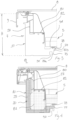
- a prior art skylight window 1 is shown installed on a flat roof 2 of a building and covering an opening (not shown) in the roof.
- the skylight window 1 comprises a weather shield 3 protecting a window portion 4, which includes an Insulating Glazing Unit (IGU) 5 and a frame 7 supporting the IGU.
- IGU Insulating Glazing Unit
- a roofing felt may in a conventional manner be positioned to seal the joint between the window frame 7 and the roof 2.
- an inclined curb flange 40 is provided on the window frame 7 for this purpose.
- the weather shield 3 is attached to the window frame 7 so as to protect the window portion 4 of the skylight window 1.
- the weather shield 3 comprises a transparent weather shield pane 8 and a weather shield skirt 9, which projects down towards the roof 2 along outer sides of the window frame 7 on all four sides of the window frame 7.
- the weather shield pane 8 is flat, but it may also be slightly curved.
- the entire window frame 7 is positioned above the exterior surface of the roof 2, said frame resting on the roof surface, but it may also be positioned so that a part of the window frame 7 is embedded in the roof, i.e. positioned below the exterior roof surface level.
- the space between the IGU 5 and the weather shield pane 8 may be sealed and filled with an inert gas to provide the skylight window with desired thermal insulating properties, but in the embodiments shown in the drawing the space is ventilated.
- the frame side member 10 of the window frame 7 of the prior art skylight window comprises a hollow-box structure, which can for example be made from polyvinylchloride (PVC) by extrusion, and blocks of insulating material 81 are inserted in some of the hollow boxes.
- PVC polyvinylchloride
- the weather shield pane 8 is attached to an exterior side 10t of the frame side member 10 and the IGU 5 is supported by a leg 72 of the window frame extending in an inwards direction.
- a sealing gasket 76 is arranged between the frame leg 72 and the interior major surface 5d of the IGU 5.
- a groove 50 is provided for receiving a lining panel (not shown).
- lining panels are used for covering the inwards facing surface of the opening in the roof structure, i.e. the surface extending between a ceiling on the interior side of the building and the skylight window, and will therefore not be described in further detail here.
- FIG. 3 a cross-sectional view corresponding to Fig. 2 but showing a window according to the invention is shown.
- the frame member etc. extending perpendicularly to the one shown, i.e. in the background in a true cross-section, have been removed for clarity reasons.
- the IGU 5 of the window in Fig. 3 is positioned considerably deeper in the window frame 7 and the width of the exposed frame surface 77, i.e. the distance between the lining panel reception groove 50 and the interior major surface 5d of the IGU is considerably smaller.
- the IGU is attached to the window frame 7 by a strip of adhesive material 78 replacing the sealing gasket 76 in the prior art window.
- the exposed frame surface 77 is composed of first section 77a adjacent to the groove 50 and a second section 77b adjacent to the IGU 5 meeting at an edge 73 and extending in continuation of each other, but it could have been straight or following a continuous curve.
- the total width, also called the overall width, of the exposed frame surface 77 measured perpendicular to the longitudinal direction L of the frame side member 10, i.e. in plane with the paper in Fig. 3 , is 36 mm, said first section 77a measuring 5 mm and said second section 77b measuring 31 mm. This corresponds to about 20% of the overall height H of the window frame 7.
- the deep position of the IGU compared to the prior art window in Fig. 2 provides improved thermal insulating properties and makes room for a screening device, such as a roller blind (not shown), to be mounted in the protected spacing between the weather shield pane 8 and the IGU 5.
- a screening device such as a roller blind (not shown)
- Fig. 4 showing a more detailed view of a window as in Fig. 3 , this may allow the load bearing frame side member 20 to be designed as a fairly slim L-shaped profile, where a block of insulating material 81 is arranged between the vertical leg 25 of the frame side member 10 and the IGU 5, but the space occupied by the block of insulating material 81 could also be occupied by other things, such as a screening device, a motor for driving a screening device, or a ventilation unit.
- the weather shield pane 8 is supported by a hollow frame extension profile 27 attached to the vertical leg 25 of the frame side member 10, but it could also have been supported directly on the load bearing frame side member 20.
- Cover members 80, 82 cover the frame extension profile 27 and the block of insulating material 81, respectively, protecting them from view and from UV radiation.
- weather shield skirt 9 is shown as attached to the exterior side of the weather shield pane 8 in Fig. 2 , it is here attached to the interior side of the weather shield.
- Fig. 5 shows a second embodiment of the invention, where the overall shape of the window frame 7 is the same as in Fig. 3 and Fig. 4 , but where the frame extension profile 27 and the cover member 82 have been replaced by one continuous stepped profile 14.
- the profile 14 supports the weather shield pane 8 and extends down to the IGU 5, where a leg 79 of the stepped profile 14 extends underneath the outermost edge of IGU.
- This embodiment allows the skylight window to also be provided in an openable version, where the IGU is attached to the stepped profile 14 instead of to the window frame 7 and where the stepped profile 14 is connected to the window frame 7 by one or more hinges (not shown). Is this way the same components can be used for both fixed and openable skylight windows.
- FIG. 6 A further embodiment of the invention is shown in Fig. 6 .
- the lining panel reception groove 50 is located higher on the frame side member 10 such that the main part of the window frame 7 is positioned below the IGU 5, but the exposed frame surface 77 remains substantially the same.
- the weather shield pane 8 is here curved and located closer to the IGU 5, and this skylight window too can be made openable by connecting the frame extension profile 27 to the load bearing frame side member 20 using one or more hinges (not shown), such that the frame extension profile 27 can be used as a sash.
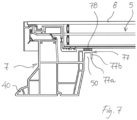
- FIG. 7 A still further embodiment of the invention is shown in Fig. 7 .
- the exposed frame surface 77 has been inclined in the embodiments shown in Figs 3-6 , it is here composed of a horizontal first section 77a adjacent to the groove 50 and a vertical second section 77b adjacent to the IGU 5.
- weather shield pane 8 is here attached to the IGU 5 rather than to the window frame 7.
Landscapes
- Engineering & Computer Science (AREA)
- Architecture (AREA)
- Civil Engineering (AREA)
- Structural Engineering (AREA)
- Securing Of Glass Panes Or The Like (AREA)
Claims (11)
- Dachfenster (1) zur Installation in oder an einem Dach (2) eines Gebäudes, wobei das Dachfenster (1) Folgendes umfasst:einen Fensterrahmen (7), der vier Rahmenseitenglieder (10) aufweist, die eine Rahmenöffnung begrenzen und eine Rahmenebene definieren, und wobei mindestens einige der Rahmenseitenglieder eine Nut (50) umfassen, die dazu ausgestaltet ist, einen Rand einer Verkleidungsplatte aufzunehmen und sich in einer Längsrichtung des jeweiligen Rahmenseitenglieds erstreckt,eine Isolierglaseinheit (5), abgekürzt IGE, die auf dem Fensterrahmen gestützt ist und die Rahmenöffnung abdeckt, wobei die IGE mindestens zwei durchscheinende Schichten (5c - 5e) mit einem abgedichteten Raum dazwischen umfasst, wobei in dem Raum bzw. den Räumen zwischen den durchscheinenden Schichten ein Inertgas wie Argon oder Krypton oder ein Vakuum vorhanden ist, undeine Wetterschutzscheibe (3), die zum Schutz eines Fensterabschnitts (4) des Dachfensters (1) ausgestaltet ist, wobei der Fensterabschnitt (4) den Fensterrahmen (7) und die IGE (5) umfasst und die Wetterschutzscheibe in einem Abstand von einer Außenseite der IGE angeordnet ist, so dass ein Raum zwischen ihnen vorhanden ist,wobei der Fensterrahmen eine Gesamthöhe (H) in einer senkrecht zu der Rahmenebene verlaufenden Höhenrichtung aufweist und wobei jedes Rahmenseitenglied eine Längsrichtung aufweist, die sich entlang einer Umfangsseite (5a) der IGE erstreckt,dadurch gekennzeichnet, dasssich eine freiliegende Rahmenfläche (77) des Rahmenseitenglieds zwischen der Nut (50) und der IGE (5) erstreckt, wobei die freiliegende Rahmenfläche einen ersten Rand (771), der sich in der Längsrichtung entlang der Nut erstreckt, und einen zweiten Rand (773), der sich in der Längsrichtung entlang einer Innenseite der IGE erstreckt, aufweist, und dass die freiliegende Rahmenfläche (77), gemessen entlang der freiliegenden Rahmenfläche und senkrecht zu der Längsrichtung, eine dem Gesamtabstand zwischen dem ersten Rand und dem zweiten Rand entsprechende Gesamtbreite von 40 mm oder weniger aufweist.
- Dachfenster nach Anspruch 1, wobei die freiliegende Rahmenfläche gekrümmt ist und/oder aus zwei oder mehr Abschnitten besteht, die sich in Fortsetzung zueinander erstrecken.
- Dachfenster nach Anspruch 1 oder 2, wobei die freiliegende Rahmenfläche bezüglich der Höhenrichtung geneigt ist, so dass der zweite Rand in einer parallel zu der Rahmenebene verlaufenden Richtung in einem Abstand von dem ersten Rand angeordnet ist.
- Dachfenster nach Anspruch 3, wobei der Abstand zwischen dem ersten Rand und dem zweiten Rand in einer parallel zu der Rahmenebene verlaufenden Richtung 15 mm oder weniger beträgt.
- Dachfenster nach einem oder mehreren der vorhergehenden Ansprüche, wobei jedes Rahmenseitenglied einen ersten Schenkel, der in der Höhenrichtung entlang eines Rands der IGE vorsteht, und einen zweiten Schenkel, der im Wesentlichen parallel zu der Rahmenebene entlang einer Innenseite der IGE vorsteht, umfasst.
- Dachfenster nach Anspruch 5, wobei jedes Rahmenseitenglied eine Querschnittsform aufweist, die in einer sich senkrecht zu der Längsrichtung erstreckenden Ebene dem Buchstaben L ähnelt.
- Dachfenster nach Anspruch 5 oder 6, wobei sich die IGE in einer parallel zur Rahmenebene verlaufenden Richtung über die Nut hinaus erstreckt, so dass sich die Nut in der Höhenrichtung gesehen unterhalb einer Innenseite der IGE befindet.
- Dachfenster nach einem oder mehreren der vorhergehenden Ansprüche, wobei die IGE durch eine Klebeverbindung mit dem Fensterrahmen verbunden ist.
- Dachfenster nach einem oder mehreren der vorhergehenden Ansprüche, wobei jedes Rahmenseitenglied ein vorzugsweise aus Polyvinylchlorid (PVC) hergestelltes extrudiertes Profil mit Hohlkammern oder ein beispielsweise aus glasfaserverstärktem Polyurethan hergestelltes pultrudiertes Profil umfasst.
- Dachfenster nach einem oder mehreren der vorhergehenden Ansprüche, wobei die Höhe des Raums zwischen der Wetterschutzscheibe und der IGE größer als die in der Höhenrichtung gemessene Höhe der IGE ist und wobei der Raum mit Umgebungsluft gefüllt ist.
- Dachfenster nach einem oder mehreren der vorhergehenden Ansprüche, wobei die freiliegende Rahmenfläche senkrecht zu der Längsrichtung gemessen eine Gesamtbreite zwischen dem ersten Rand und dem zweiten Rand aufweist, die 30% oder weniger der Gesamtrahmenhöhe (H), wie etwa 20% oder weniger der Gesamtrahmenhöhe (H), beträgt.
Applications Claiming Priority (1)
| Application Number | Priority Date | Filing Date | Title |
|---|---|---|---|
| EP20155247.8A EP3779090B1 (de) | 2020-02-03 | 2020-02-03 | Ein dachfenster |
Publications (4)
| Publication Number | Publication Date |
|---|---|
| EP3779094A2 EP3779094A2 (de) | 2021-02-17 |
| EP3779094A3 EP3779094A3 (de) | 2021-04-07 |
| EP3779094C0 EP3779094C0 (de) | 2025-06-18 |
| EP3779094B1 true EP3779094B1 (de) | 2025-06-18 |
Family
ID=69468360
Family Applications (2)
| Application Number | Title | Priority Date | Filing Date |
|---|---|---|---|
| EP20155247.8A Active EP3779090B1 (de) | 2020-02-03 | 2020-02-03 | Ein dachfenster |
| EP20210451.9A Active EP3779094B1 (de) | 2020-02-03 | 2020-11-27 | Ein dachfenster |
Family Applications Before (1)
| Application Number | Title | Priority Date | Filing Date |
|---|---|---|---|
| EP20155247.8A Active EP3779090B1 (de) | 2020-02-03 | 2020-02-03 | Ein dachfenster |
Country Status (2)
| Country | Link |
|---|---|
| EP (2) | EP3779090B1 (de) |
| PL (1) | PL3779094T3 (de) |
Families Citing this family (3)
| Publication number | Priority date | Publication date | Assignee | Title |
|---|---|---|---|---|
| BE1029229B1 (nl) * | 2021-03-22 | 2022-10-18 | Skylux N V | Dak- of raamsamenstel met inzetstuk |
| PL246599B1 (pl) * | 2022-03-03 | 2025-02-17 | Fakro Pp Spolka Z Ograniczona Odpowiedzialnoscia | Okno dachowe z pakietem szybowym |
| BE1032336B1 (nl) | 2024-01-16 | 2025-08-18 | Skylux Nv | Dakraamsamenstel en kit en werkwijze voor het samenstellen van een dergelijk dakraamsamenstel |
Family Cites Families (10)
| Publication number | Priority date | Publication date | Assignee | Title |
|---|---|---|---|---|
| US4972638A (en) * | 1989-04-21 | 1990-11-27 | Rolscreen Company | Skylight flashing |
| GB2439319A (en) * | 2006-06-22 | 2007-12-27 | Metal Window Co Ltd | Rooflight comprising a water deflector |
| CN101874140B (zh) | 2007-12-20 | 2014-05-21 | Vkr控股公司 | 用于天窗的防风雨罩及其使用 |
| US20100269426A1 (en) | 2009-04-22 | 2010-10-28 | Crystalite Inc. | Glazed skylight assembly |
| GB2492380B (en) * | 2011-06-30 | 2017-01-25 | The Metal Window Co Ltd | Window thermal shield |
| GB2514119B (en) * | 2013-05-13 | 2016-09-07 | Glazing Vision Ltd | Rooflight assembly |
| EP2868831B1 (de) * | 2013-10-31 | 2016-08-10 | JET Tageslicht und RWA GmbH | Lichtkuppel, Klappe und/oder Rauchabzugseinrichtung |
| EP3101195A1 (de) * | 2015-06-01 | 2016-12-07 | FAKRO PP Sp. z o.o. | Dachluke mit verglasungseinheit |
| EP3346071B1 (de) * | 2017-01-06 | 2021-03-10 | VKR Holding A/S | Fensteranordnung |
| PL126314U1 (pl) * | 2017-04-28 | 2018-11-05 | Ryszard Florek | Okno dachów płaskich z osłoną zewnętrzną |
-
2020
- 2020-02-03 EP EP20155247.8A patent/EP3779090B1/de active Active
- 2020-11-27 EP EP20210451.9A patent/EP3779094B1/de active Active
- 2020-11-27 PL PL20210451.9T patent/PL3779094T3/pl unknown
Also Published As
| Publication number | Publication date |
|---|---|
| EP3779090A1 (de) | 2021-02-17 |
| EP3779094A3 (de) | 2021-04-07 |
| PL3779094T3 (pl) | 2025-07-28 |
| EP3779094C0 (de) | 2025-06-18 |
| EP3779090B1 (de) | 2025-09-10 |
| EP3779094A2 (de) | 2021-02-17 |
Similar Documents
| Publication | Publication Date | Title |
|---|---|---|
| EP3911830B1 (de) | Öffnungsabdeckung mit überlappender vig-einheit und mit einem strukturrahmenteil verbundenen verbindungsprofil | |
| US6401428B1 (en) | Fenestration sealed frame, insulating glazing panels | |
| US8943769B2 (en) | Pane module for use in a window | |
| EP3795770B1 (de) | Dachfenster | |
| EP3779094B1 (de) | Ein dachfenster | |
| CA1196763A (en) | Ventilating skylight | |
| EP2318634B1 (de) | Dichtungsmembran zur abdichtung von lücken zwischen rahmen eines fensters und rauen öffnungen | |
| US4570394A (en) | Ventilating skylight | |
| WO2021156313A1 (en) | A skylight window | |
| US20190323283A1 (en) | A pane module adapted to be installed on a window frame and a method for making a pane module | |
| CN100419202C (zh) | 一种包括带有板单元的框架的板件 | |
| US5993925A (en) | Protective windows for ornamental windows | |
| EP3795771B1 (de) | Dachfenster | |
| EP3779093B1 (de) | Ein dachfenster | |
| EP3779088A1 (de) | Klappfenster mit einem igu in der nähe des fensterrahmens | |
| CN214785206U (zh) | 一种密封垫圈和一种面板系统 | |
| EP3859093A1 (de) | Adapterrahmen zum installieren eines dachfensters, system mit einem dachfenster und verfahren zum installieren eines dachfensters unter verwendung eines adapterrahmens | |
| CN113802749A (zh) | 在包括多个面板的面板系统中使用的面板及其制造方法 | |
| CN113802779A (zh) | 包括具有包围镶板元件的型材元件的面板的面板系统 | |
| CN113802781A (zh) | 具有带有安装型材和铰链的安装和铰链组件的面板系统 | |
| CA2414589A1 (en) | Skylight assembly |
Legal Events
| Date | Code | Title | Description |
|---|---|---|---|
| PUAI | Public reference made under article 153(3) epc to a published international application that has entered the european phase |
Free format text: ORIGINAL CODE: 0009012 |
|
| STAA | Information on the status of an ep patent application or granted ep patent |
Free format text: STATUS: THE APPLICATION HAS BEEN PUBLISHED |
|
| AK | Designated contracting states |
Kind code of ref document: A2 Designated state(s): AL AT BE BG CH CY CZ DE DK EE ES FI FR GB GR HR HU IE IS IT LI LT LU LV MC MK MT NL NO PL PT RO RS SE SI SK SM TR |
|
| AX | Request for extension of the european patent |
Extension state: BA ME |
|
| PUAL | Search report despatched |
Free format text: ORIGINAL CODE: 0009013 |
|
| AK | Designated contracting states |
Kind code of ref document: A3 Designated state(s): AL AT BE BG CH CY CZ DE DK EE ES FI FR GB GR HR HU IE IS IT LI LT LU LV MC MK MT NL NO PL PT RO RS SE SI SK SM TR |
|
| AX | Request for extension of the european patent |
Extension state: BA ME |
|
| RIC1 | Information provided on ipc code assigned before grant |
Ipc: E04D 13/03 20060101AFI20210304BHEP Ipc: E04D 13/035 20060101ALI20210304BHEP |
|
| STAA | Information on the status of an ep patent application or granted ep patent |
Free format text: STATUS: REQUEST FOR EXAMINATION WAS MADE |
|
| 17P | Request for examination filed |
Effective date: 20211007 |
|
| RBV | Designated contracting states (corrected) |
Designated state(s): AL AT BE BG CH CY CZ DE DK EE ES FI FR GB GR HR HU IE IS IT LI LT LU LV MC MK MT NL NO PL PT RO RS SE SI SK SM TR |
|
| STAA | Information on the status of an ep patent application or granted ep patent |
Free format text: STATUS: EXAMINATION IS IN PROGRESS |
|
| 17Q | First examination report despatched |
Effective date: 20241017 |
|
| GRAP | Despatch of communication of intention to grant a patent |
Free format text: ORIGINAL CODE: EPIDOSNIGR1 |
|
| STAA | Information on the status of an ep patent application or granted ep patent |
Free format text: STATUS: GRANT OF PATENT IS INTENDED |
|
| INTG | Intention to grant announced |
Effective date: 20250203 |
|
| GRAS | Grant fee paid |
Free format text: ORIGINAL CODE: EPIDOSNIGR3 |
|
| GRAA | (expected) grant |
Free format text: ORIGINAL CODE: 0009210 |
|
| STAA | Information on the status of an ep patent application or granted ep patent |
Free format text: STATUS: THE PATENT HAS BEEN GRANTED |
|
| AK | Designated contracting states |
Kind code of ref document: B1 Designated state(s): AL AT BE BG CH CY CZ DE DK EE ES FI FR GB GR HR HU IE IS IT LI LT LU LV MC MK MT NL NO PL PT RO RS SE SI SK SM TR |
|
| REG | Reference to a national code |
Ref country code: GB Ref legal event code: FG4D |
|
| REG | Reference to a national code |
Ref country code: CH Ref legal event code: EP |
|
| REG | Reference to a national code |
Ref country code: DE Ref legal event code: R096 Ref document number: 602020052862 Country of ref document: DE |
|
| REG | Reference to a national code |
Ref country code: CH Ref legal event code: EP |
|
| REG | Reference to a national code |
Ref country code: IE Ref legal event code: FG4D |
|
| U01 | Request for unitary effect filed |
Effective date: 20250709 |
|
| U07 | Unitary effect registered |
Designated state(s): AT BE BG DE DK EE FI FR IT LT LU LV MT NL PT RO SE SI Effective date: 20250716 |
|
| PG25 | Lapsed in a contracting state [announced via postgrant information from national office to epo] |
Ref country code: NO Free format text: LAPSE BECAUSE OF FAILURE TO SUBMIT A TRANSLATION OF THE DESCRIPTION OR TO PAY THE FEE WITHIN THE PRESCRIBED TIME-LIMIT Effective date: 20250918 Ref country code: GR Free format text: LAPSE BECAUSE OF FAILURE TO SUBMIT A TRANSLATION OF THE DESCRIPTION OR TO PAY THE FEE WITHIN THE PRESCRIBED TIME-LIMIT Effective date: 20250919 |
|
| PG25 | Lapsed in a contracting state [announced via postgrant information from national office to epo] |
Ref country code: HR Free format text: LAPSE BECAUSE OF FAILURE TO SUBMIT A TRANSLATION OF THE DESCRIPTION OR TO PAY THE FEE WITHIN THE PRESCRIBED TIME-LIMIT Effective date: 20250618 |
|
| PG25 | Lapsed in a contracting state [announced via postgrant information from national office to epo] |
Ref country code: RS Free format text: LAPSE BECAUSE OF FAILURE TO SUBMIT A TRANSLATION OF THE DESCRIPTION OR TO PAY THE FEE WITHIN THE PRESCRIBED TIME-LIMIT Effective date: 20250918 |
|
| U20 | Renewal fee for the european patent with unitary effect paid |
Year of fee payment: 6 Effective date: 20251008 |
|
| PG25 | Lapsed in a contracting state [announced via postgrant information from national office to epo] |
Ref country code: IS Free format text: LAPSE BECAUSE OF FAILURE TO SUBMIT A TRANSLATION OF THE DESCRIPTION OR TO PAY THE FEE WITHIN THE PRESCRIBED TIME-LIMIT Effective date: 20251018 |
|
| PGFP | Annual fee paid to national office [announced via postgrant information from national office to epo] |
Ref country code: GB Payment date: 20251016 Year of fee payment: 6 |
|
| PG25 | Lapsed in a contracting state [announced via postgrant information from national office to epo] |
Ref country code: SM Free format text: LAPSE BECAUSE OF FAILURE TO SUBMIT A TRANSLATION OF THE DESCRIPTION OR TO PAY THE FEE WITHIN THE PRESCRIBED TIME-LIMIT Effective date: 20250618 |
|
| PG25 | Lapsed in a contracting state [announced via postgrant information from national office to epo] |
Ref country code: CZ Free format text: LAPSE BECAUSE OF FAILURE TO SUBMIT A TRANSLATION OF THE DESCRIPTION OR TO PAY THE FEE WITHIN THE PRESCRIBED TIME-LIMIT Effective date: 20250618 |
|
| PGFP | Annual fee paid to national office [announced via postgrant information from national office to epo] |
Ref country code: PL Payment date: 20251014 Year of fee payment: 6 |
|
| PG25 | Lapsed in a contracting state [announced via postgrant information from national office to epo] |
Ref country code: SK Free format text: LAPSE BECAUSE OF FAILURE TO SUBMIT A TRANSLATION OF THE DESCRIPTION OR TO PAY THE FEE WITHIN THE PRESCRIBED TIME-LIMIT Effective date: 20250618 |
|
| PG25 | Lapsed in a contracting state [announced via postgrant information from national office to epo] |
Ref country code: ES Free format text: LAPSE BECAUSE OF FAILURE TO SUBMIT A TRANSLATION OF THE DESCRIPTION OR TO PAY THE FEE WITHIN THE PRESCRIBED TIME-LIMIT Effective date: 20250618 |