EP3778682A1 - Resin composition, secondary coating material for optical fiber, and optical fiber - Google Patents
Resin composition, secondary coating material for optical fiber, and optical fiber Download PDFInfo
- Publication number
- EP3778682A1 EP3778682A1 EP19782095.4A EP19782095A EP3778682A1 EP 3778682 A1 EP3778682 A1 EP 3778682A1 EP 19782095 A EP19782095 A EP 19782095A EP 3778682 A1 EP3778682 A1 EP 3778682A1
- Authority
- EP
- European Patent Office
- Prior art keywords
- meth
- acrylate
- resin composition
- monomer
- mass
- Prior art date
- Legal status (The legal status is an assumption and is not a legal conclusion. Google has not performed a legal analysis and makes no representation as to the accuracy of the status listed.)
- Granted
Links
Images
Classifications
-
- C—CHEMISTRY; METALLURGY
- C09—DYES; PAINTS; POLISHES; NATURAL RESINS; ADHESIVES; COMPOSITIONS NOT OTHERWISE PROVIDED FOR; APPLICATIONS OF MATERIALS NOT OTHERWISE PROVIDED FOR
- C09D—COATING COMPOSITIONS, e.g. PAINTS, VARNISHES OR LACQUERS; FILLING PASTES; CHEMICAL PAINT OR INK REMOVERS; INKS; CORRECTING FLUIDS; WOODSTAINS; PASTES OR SOLIDS FOR COLOURING OR PRINTING; USE OF MATERIALS THEREFOR
- C09D175/00—Coating compositions based on polyureas or polyurethanes; Coating compositions based on derivatives of such polymers
- C09D175/04—Polyurethanes
- C09D175/14—Polyurethanes having carbon-to-carbon unsaturated bonds
-
- C—CHEMISTRY; METALLURGY
- C08—ORGANIC MACROMOLECULAR COMPOUNDS; THEIR PREPARATION OR CHEMICAL WORKING-UP; COMPOSITIONS BASED THEREON
- C08F—MACROMOLECULAR COMPOUNDS OBTAINED BY REACTIONS ONLY INVOLVING CARBON-TO-CARBON UNSATURATED BONDS
- C08F290/00—Macromolecular compounds obtained by polymerising monomers on to polymers modified by introduction of aliphatic unsaturated end or side groups
- C08F290/02—Macromolecular compounds obtained by polymerising monomers on to polymers modified by introduction of aliphatic unsaturated end or side groups on to polymers modified by introduction of unsaturated end groups
- C08F290/06—Polymers provided for in subclass C08G
- C08F290/067—Polyurethanes; Polyureas
-
- C—CHEMISTRY; METALLURGY
- C03—GLASS; MINERAL OR SLAG WOOL
- C03C—CHEMICAL COMPOSITION OF GLASSES, GLAZES OR VITREOUS ENAMELS; SURFACE TREATMENT OF GLASS; SURFACE TREATMENT OF FIBRES OR FILAMENTS MADE FROM GLASS, MINERALS OR SLAGS; JOINING GLASS TO GLASS OR OTHER MATERIALS
- C03C13/00—Fibre or filament compositions
- C03C13/04—Fibre optics, e.g. core and clad fibre compositions
-
- C—CHEMISTRY; METALLURGY
- C03—GLASS; MINERAL OR SLAG WOOL
- C03C—CHEMICAL COMPOSITION OF GLASSES, GLAZES OR VITREOUS ENAMELS; SURFACE TREATMENT OF GLASS; SURFACE TREATMENT OF FIBRES OR FILAMENTS MADE FROM GLASS, MINERALS OR SLAGS; JOINING GLASS TO GLASS OR OTHER MATERIALS
- C03C25/00—Surface treatment of fibres or filaments made from glass, minerals or slags
- C03C25/10—Coating
- C03C25/104—Coating to obtain optical fibres
- C03C25/1065—Multiple coatings
-
- C—CHEMISTRY; METALLURGY
- C03—GLASS; MINERAL OR SLAG WOOL
- C03C—CHEMICAL COMPOSITION OF GLASSES, GLAZES OR VITREOUS ENAMELS; SURFACE TREATMENT OF GLASS; SURFACE TREATMENT OF FIBRES OR FILAMENTS MADE FROM GLASS, MINERALS OR SLAGS; JOINING GLASS TO GLASS OR OTHER MATERIALS
- C03C25/00—Surface treatment of fibres or filaments made from glass, minerals or slags
- C03C25/10—Coating
- C03C25/24—Coatings containing organic materials
- C03C25/26—Macromolecular compounds or prepolymers
- C03C25/32—Macromolecular compounds or prepolymers obtained otherwise than by reactions involving only carbon-to-carbon unsaturated bonds
- C03C25/326—Polyureas; Polyurethanes
-
- C—CHEMISTRY; METALLURGY
- C03—GLASS; MINERAL OR SLAG WOOL
- C03C—CHEMICAL COMPOSITION OF GLASSES, GLAZES OR VITREOUS ENAMELS; SURFACE TREATMENT OF GLASS; SURFACE TREATMENT OF FIBRES OR FILAMENTS MADE FROM GLASS, MINERALS OR SLAGS; JOINING GLASS TO GLASS OR OTHER MATERIALS
- C03C25/00—Surface treatment of fibres or filaments made from glass, minerals or slags
- C03C25/10—Coating
- C03C25/465—Coatings containing composite materials
- C03C25/47—Coatings containing composite materials containing particles, fibres or flakes, e.g. in a continuous phase
-
- C—CHEMISTRY; METALLURGY
- C03—GLASS; MINERAL OR SLAG WOOL
- C03C—CHEMICAL COMPOSITION OF GLASSES, GLAZES OR VITREOUS ENAMELS; SURFACE TREATMENT OF GLASS; SURFACE TREATMENT OF FIBRES OR FILAMENTS MADE FROM GLASS, MINERALS OR SLAGS; JOINING GLASS TO GLASS OR OTHER MATERIALS
- C03C25/00—Surface treatment of fibres or filaments made from glass, minerals or slags
- C03C25/10—Coating
- C03C25/48—Coating with two or more coatings having different compositions
-
- C—CHEMISTRY; METALLURGY
- C08—ORGANIC MACROMOLECULAR COMPOUNDS; THEIR PREPARATION OR CHEMICAL WORKING-UP; COMPOSITIONS BASED THEREON
- C08F—MACROMOLECULAR COMPOUNDS OBTAINED BY REACTIONS ONLY INVOLVING CARBON-TO-CARBON UNSATURATED BONDS
- C08F2/00—Processes of polymerisation
- C08F2/46—Polymerisation initiated by wave energy or particle radiation
- C08F2/48—Polymerisation initiated by wave energy or particle radiation by ultraviolet or visible light
- C08F2/50—Polymerisation initiated by wave energy or particle radiation by ultraviolet or visible light with sensitising agents
-
- C—CHEMISTRY; METALLURGY
- C08—ORGANIC MACROMOLECULAR COMPOUNDS; THEIR PREPARATION OR CHEMICAL WORKING-UP; COMPOSITIONS BASED THEREON
- C08F—MACROMOLECULAR COMPOUNDS OBTAINED BY REACTIONS ONLY INVOLVING CARBON-TO-CARBON UNSATURATED BONDS
- C08F220/00—Copolymers of compounds having one or more unsaturated aliphatic radicals, each having only one carbon-to-carbon double bond, and only one being terminated by only one carboxyl radical or a salt, anhydride ester, amide, imide or nitrile thereof
- C08F220/02—Monocarboxylic acids having less than ten carbon atoms; Derivatives thereof
- C08F220/10—Esters
- C08F220/26—Esters containing oxygen in addition to the carboxy oxygen
- C08F220/30—Esters containing oxygen in addition to the carboxy oxygen containing aromatic rings in the alcohol moiety
-
- C—CHEMISTRY; METALLURGY
- C08—ORGANIC MACROMOLECULAR COMPOUNDS; THEIR PREPARATION OR CHEMICAL WORKING-UP; COMPOSITIONS BASED THEREON
- C08G—MACROMOLECULAR COMPOUNDS OBTAINED OTHERWISE THAN BY REACTIONS ONLY INVOLVING UNSATURATED CARBON-TO-CARBON BONDS
- C08G18/00—Polymeric products of isocyanates or isothiocyanates
- C08G18/06—Polymeric products of isocyanates or isothiocyanates with compounds having active hydrogen
- C08G18/08—Processes
- C08G18/10—Prepolymer processes involving reaction of isocyanates or isothiocyanates with compounds having active hydrogen in a first reaction step
- C08G18/12—Prepolymer processes involving reaction of isocyanates or isothiocyanates with compounds having active hydrogen in a first reaction step using two or more compounds having active hydrogen in the first polymerisation step
-
- C—CHEMISTRY; METALLURGY
- C08—ORGANIC MACROMOLECULAR COMPOUNDS; THEIR PREPARATION OR CHEMICAL WORKING-UP; COMPOSITIONS BASED THEREON
- C08G—MACROMOLECULAR COMPOUNDS OBTAINED OTHERWISE THAN BY REACTIONS ONLY INVOLVING UNSATURATED CARBON-TO-CARBON BONDS
- C08G18/00—Polymeric products of isocyanates or isothiocyanates
- C08G18/06—Polymeric products of isocyanates or isothiocyanates with compounds having active hydrogen
- C08G18/28—Polymeric products of isocyanates or isothiocyanates with compounds having active hydrogen characterised by the compounds used containing active hydrogen
- C08G18/40—High-molecular-weight compounds
- C08G18/48—Polyethers
- C08G18/4825—Polyethers containing two hydroxy groups
-
- C—CHEMISTRY; METALLURGY
- C08—ORGANIC MACROMOLECULAR COMPOUNDS; THEIR PREPARATION OR CHEMICAL WORKING-UP; COMPOSITIONS BASED THEREON
- C08G—MACROMOLECULAR COMPOUNDS OBTAINED OTHERWISE THAN BY REACTIONS ONLY INVOLVING UNSATURATED CARBON-TO-CARBON BONDS
- C08G18/00—Polymeric products of isocyanates or isothiocyanates
- C08G18/06—Polymeric products of isocyanates or isothiocyanates with compounds having active hydrogen
- C08G18/28—Polymeric products of isocyanates or isothiocyanates with compounds having active hydrogen characterised by the compounds used containing active hydrogen
- C08G18/65—Low-molecular-weight compounds having active hydrogen with high-molecular-weight compounds having active hydrogen
- C08G18/66—Compounds of groups C08G18/42, C08G18/48, or C08G18/52
- C08G18/6666—Compounds of group C08G18/48 or C08G18/52
-
- C—CHEMISTRY; METALLURGY
- C08—ORGANIC MACROMOLECULAR COMPOUNDS; THEIR PREPARATION OR CHEMICAL WORKING-UP; COMPOSITIONS BASED THEREON
- C08G—MACROMOLECULAR COMPOUNDS OBTAINED OTHERWISE THAN BY REACTIONS ONLY INVOLVING UNSATURATED CARBON-TO-CARBON BONDS
- C08G18/00—Polymeric products of isocyanates or isothiocyanates
- C08G18/06—Polymeric products of isocyanates or isothiocyanates with compounds having active hydrogen
- C08G18/28—Polymeric products of isocyanates or isothiocyanates with compounds having active hydrogen characterised by the compounds used containing active hydrogen
- C08G18/67—Unsaturated compounds having active hydrogen
- C08G18/671—Unsaturated compounds having only one group containing active hydrogen
- C08G18/672—Esters of acrylic or alkyl acrylic acid having only one group containing active hydrogen
-
- C—CHEMISTRY; METALLURGY
- C08—ORGANIC MACROMOLECULAR COMPOUNDS; THEIR PREPARATION OR CHEMICAL WORKING-UP; COMPOSITIONS BASED THEREON
- C08G—MACROMOLECULAR COMPOUNDS OBTAINED OTHERWISE THAN BY REACTIONS ONLY INVOLVING UNSATURATED CARBON-TO-CARBON BONDS
- C08G18/00—Polymeric products of isocyanates or isothiocyanates
- C08G18/06—Polymeric products of isocyanates or isothiocyanates with compounds having active hydrogen
- C08G18/28—Polymeric products of isocyanates or isothiocyanates with compounds having active hydrogen characterised by the compounds used containing active hydrogen
- C08G18/67—Unsaturated compounds having active hydrogen
- C08G18/675—Low-molecular-weight compounds
- C08G18/6755—Unsaturated carboxylic acids
-
- C—CHEMISTRY; METALLURGY
- C08—ORGANIC MACROMOLECULAR COMPOUNDS; THEIR PREPARATION OR CHEMICAL WORKING-UP; COMPOSITIONS BASED THEREON
- C08G—MACROMOLECULAR COMPOUNDS OBTAINED OTHERWISE THAN BY REACTIONS ONLY INVOLVING UNSATURATED CARBON-TO-CARBON BONDS
- C08G18/00—Polymeric products of isocyanates or isothiocyanates
- C08G18/06—Polymeric products of isocyanates or isothiocyanates with compounds having active hydrogen
- C08G18/70—Polymeric products of isocyanates or isothiocyanates with compounds having active hydrogen characterised by the isocyanates or isothiocyanates used
- C08G18/72—Polyisocyanates or polyisothiocyanates
- C08G18/74—Polyisocyanates or polyisothiocyanates cyclic
- C08G18/76—Polyisocyanates or polyisothiocyanates cyclic aromatic
- C08G18/7614—Polyisocyanates or polyisothiocyanates cyclic aromatic containing only one aromatic ring
-
- C—CHEMISTRY; METALLURGY
- C08—ORGANIC MACROMOLECULAR COMPOUNDS; THEIR PREPARATION OR CHEMICAL WORKING-UP; COMPOSITIONS BASED THEREON
- C08G—MACROMOLECULAR COMPOUNDS OBTAINED OTHERWISE THAN BY REACTIONS ONLY INVOLVING UNSATURATED CARBON-TO-CARBON BONDS
- C08G18/00—Polymeric products of isocyanates or isothiocyanates
- C08G18/06—Polymeric products of isocyanates or isothiocyanates with compounds having active hydrogen
- C08G18/70—Polymeric products of isocyanates or isothiocyanates with compounds having active hydrogen characterised by the isocyanates or isothiocyanates used
- C08G18/72—Polyisocyanates or polyisothiocyanates
- C08G18/74—Polyisocyanates or polyisothiocyanates cyclic
- C08G18/76—Polyisocyanates or polyisothiocyanates cyclic aromatic
- C08G18/7614—Polyisocyanates or polyisothiocyanates cyclic aromatic containing only one aromatic ring
- C08G18/7621—Polyisocyanates or polyisothiocyanates cyclic aromatic containing only one aromatic ring being toluene diisocyanate including isomer mixtures
-
- C—CHEMISTRY; METALLURGY
- C08—ORGANIC MACROMOLECULAR COMPOUNDS; THEIR PREPARATION OR CHEMICAL WORKING-UP; COMPOSITIONS BASED THEREON
- C08K—Use of inorganic or non-macromolecular organic substances as compounding ingredients
- C08K3/00—Use of inorganic substances as compounding ingredients
- C08K3/18—Oxygen-containing compounds, e.g. metal carbonyls
- C08K3/20—Oxides; Hydroxides
- C08K3/22—Oxides; Hydroxides of metals
-
- C—CHEMISTRY; METALLURGY
- C08—ORGANIC MACROMOLECULAR COMPOUNDS; THEIR PREPARATION OR CHEMICAL WORKING-UP; COMPOSITIONS BASED THEREON
- C08K—Use of inorganic or non-macromolecular organic substances as compounding ingredients
- C08K9/00—Use of pretreated ingredients
- C08K9/04—Ingredients treated with organic substances
-
- C—CHEMISTRY; METALLURGY
- C08—ORGANIC MACROMOLECULAR COMPOUNDS; THEIR PREPARATION OR CHEMICAL WORKING-UP; COMPOSITIONS BASED THEREON
- C08L—COMPOSITIONS OF MACROMOLECULAR COMPOUNDS
- C08L75/00—Compositions of polyureas or polyurethanes; Compositions of derivatives of such polymers
- C08L75/04—Polyurethanes
-
- C—CHEMISTRY; METALLURGY
- C09—DYES; PAINTS; POLISHES; NATURAL RESINS; ADHESIVES; COMPOSITIONS NOT OTHERWISE PROVIDED FOR; APPLICATIONS OF MATERIALS NOT OTHERWISE PROVIDED FOR
- C09D—COATING COMPOSITIONS, e.g. PAINTS, VARNISHES OR LACQUERS; FILLING PASTES; CHEMICAL PAINT OR INK REMOVERS; INKS; CORRECTING FLUIDS; WOODSTAINS; PASTES OR SOLIDS FOR COLOURING OR PRINTING; USE OF MATERIALS THEREFOR
- C09D175/00—Coating compositions based on polyureas or polyurethanes; Coating compositions based on derivatives of such polymers
- C09D175/04—Polyurethanes
-
- C—CHEMISTRY; METALLURGY
- C09—DYES; PAINTS; POLISHES; NATURAL RESINS; ADHESIVES; COMPOSITIONS NOT OTHERWISE PROVIDED FOR; APPLICATIONS OF MATERIALS NOT OTHERWISE PROVIDED FOR
- C09D—COATING COMPOSITIONS, e.g. PAINTS, VARNISHES OR LACQUERS; FILLING PASTES; CHEMICAL PAINT OR INK REMOVERS; INKS; CORRECTING FLUIDS; WOODSTAINS; PASTES OR SOLIDS FOR COLOURING OR PRINTING; USE OF MATERIALS THEREFOR
- C09D4/00—Coating compositions, e.g. paints, varnishes or lacquers, based on organic non-macromolecular compounds having at least one polymerisable carbon-to-carbon unsaturated bond ; Coating compositions, based on monomers of macromolecular compounds of groups C09D183/00 - C09D183/16
-
- C—CHEMISTRY; METALLURGY
- C09—DYES; PAINTS; POLISHES; NATURAL RESINS; ADHESIVES; COMPOSITIONS NOT OTHERWISE PROVIDED FOR; APPLICATIONS OF MATERIALS NOT OTHERWISE PROVIDED FOR
- C09D—COATING COMPOSITIONS, e.g. PAINTS, VARNISHES OR LACQUERS; FILLING PASTES; CHEMICAL PAINT OR INK REMOVERS; INKS; CORRECTING FLUIDS; WOODSTAINS; PASTES OR SOLIDS FOR COLOURING OR PRINTING; USE OF MATERIALS THEREFOR
- C09D4/00—Coating compositions, e.g. paints, varnishes or lacquers, based on organic non-macromolecular compounds having at least one polymerisable carbon-to-carbon unsaturated bond ; Coating compositions, based on monomers of macromolecular compounds of groups C09D183/00 - C09D183/16
- C09D4/06—Organic non-macromolecular compounds having at least one polymerisable carbon-to-carbon unsaturated bond in combination with a macromolecular compound other than an unsaturated polymer of groups C09D159/00 - C09D187/00
-
- C—CHEMISTRY; METALLURGY
- C09—DYES; PAINTS; POLISHES; NATURAL RESINS; ADHESIVES; COMPOSITIONS NOT OTHERWISE PROVIDED FOR; APPLICATIONS OF MATERIALS NOT OTHERWISE PROVIDED FOR
- C09D—COATING COMPOSITIONS, e.g. PAINTS, VARNISHES OR LACQUERS; FILLING PASTES; CHEMICAL PAINT OR INK REMOVERS; INKS; CORRECTING FLUIDS; WOODSTAINS; PASTES OR SOLIDS FOR COLOURING OR PRINTING; USE OF MATERIALS THEREFOR
- C09D5/00—Coating compositions, e.g. paints, varnishes or lacquers, characterised by their physical nature or the effects produced; Filling pastes
- C09D5/002—Priming paints
-
- C—CHEMISTRY; METALLURGY
- C09—DYES; PAINTS; POLISHES; NATURAL RESINS; ADHESIVES; COMPOSITIONS NOT OTHERWISE PROVIDED FOR; APPLICATIONS OF MATERIALS NOT OTHERWISE PROVIDED FOR
- C09D—COATING COMPOSITIONS, e.g. PAINTS, VARNISHES OR LACQUERS; FILLING PASTES; CHEMICAL PAINT OR INK REMOVERS; INKS; CORRECTING FLUIDS; WOODSTAINS; PASTES OR SOLIDS FOR COLOURING OR PRINTING; USE OF MATERIALS THEREFOR
- C09D7/00—Features of coating compositions, not provided for in group C09D5/00; Processes for incorporating ingredients in coating compositions
- C09D7/40—Additives
- C09D7/60—Additives non-macromolecular
- C09D7/61—Additives non-macromolecular inorganic
-
- C—CHEMISTRY; METALLURGY
- C09—DYES; PAINTS; POLISHES; NATURAL RESINS; ADHESIVES; COMPOSITIONS NOT OTHERWISE PROVIDED FOR; APPLICATIONS OF MATERIALS NOT OTHERWISE PROVIDED FOR
- C09D—COATING COMPOSITIONS, e.g. PAINTS, VARNISHES OR LACQUERS; FILLING PASTES; CHEMICAL PAINT OR INK REMOVERS; INKS; CORRECTING FLUIDS; WOODSTAINS; PASTES OR SOLIDS FOR COLOURING OR PRINTING; USE OF MATERIALS THEREFOR
- C09D7/00—Features of coating compositions, not provided for in group C09D5/00; Processes for incorporating ingredients in coating compositions
- C09D7/40—Additives
- C09D7/60—Additives non-macromolecular
- C09D7/61—Additives non-macromolecular inorganic
- C09D7/62—Additives non-macromolecular inorganic modified by treatment with other compounds
-
- C—CHEMISTRY; METALLURGY
- C09—DYES; PAINTS; POLISHES; NATURAL RESINS; ADHESIVES; COMPOSITIONS NOT OTHERWISE PROVIDED FOR; APPLICATIONS OF MATERIALS NOT OTHERWISE PROVIDED FOR
- C09D—COATING COMPOSITIONS, e.g. PAINTS, VARNISHES OR LACQUERS; FILLING PASTES; CHEMICAL PAINT OR INK REMOVERS; INKS; CORRECTING FLUIDS; WOODSTAINS; PASTES OR SOLIDS FOR COLOURING OR PRINTING; USE OF MATERIALS THEREFOR
- C09D7/00—Features of coating compositions, not provided for in group C09D5/00; Processes for incorporating ingredients in coating compositions
- C09D7/40—Additives
- C09D7/66—Additives characterised by particle size
- C09D7/68—Particle size between 100-1000 nm
-
- C—CHEMISTRY; METALLURGY
- C03—GLASS; MINERAL OR SLAG WOOL
- C03C—CHEMICAL COMPOSITION OF GLASSES, GLAZES OR VITREOUS ENAMELS; SURFACE TREATMENT OF GLASS; SURFACE TREATMENT OF FIBRES OR FILAMENTS MADE FROM GLASS, MINERALS OR SLAGS; JOINING GLASS TO GLASS OR OTHER MATERIALS
- C03C2213/00—Glass fibres or filaments
-
- C—CHEMISTRY; METALLURGY
- C08—ORGANIC MACROMOLECULAR COMPOUNDS; THEIR PREPARATION OR CHEMICAL WORKING-UP; COMPOSITIONS BASED THEREON
- C08K—Use of inorganic or non-macromolecular organic substances as compounding ingredients
- C08K3/00—Use of inorganic substances as compounding ingredients
- C08K3/18—Oxygen-containing compounds, e.g. metal carbonyls
- C08K3/20—Oxides; Hydroxides
- C08K3/22—Oxides; Hydroxides of metals
- C08K2003/2217—Oxides; Hydroxides of metals of magnesium
- C08K2003/222—Magnesia, i.e. magnesium oxide
-
- C—CHEMISTRY; METALLURGY
- C08—ORGANIC MACROMOLECULAR COMPOUNDS; THEIR PREPARATION OR CHEMICAL WORKING-UP; COMPOSITIONS BASED THEREON
- C08K—Use of inorganic or non-macromolecular organic substances as compounding ingredients
- C08K3/00—Use of inorganic substances as compounding ingredients
- C08K3/18—Oxygen-containing compounds, e.g. metal carbonyls
- C08K3/20—Oxides; Hydroxides
- C08K3/22—Oxides; Hydroxides of metals
- C08K2003/2227—Oxides; Hydroxides of metals of aluminium
-
- C—CHEMISTRY; METALLURGY
- C08—ORGANIC MACROMOLECULAR COMPOUNDS; THEIR PREPARATION OR CHEMICAL WORKING-UP; COMPOSITIONS BASED THEREON
- C08K—Use of inorganic or non-macromolecular organic substances as compounding ingredients
- C08K3/00—Use of inorganic substances as compounding ingredients
- C08K3/18—Oxygen-containing compounds, e.g. metal carbonyls
- C08K3/20—Oxides; Hydroxides
- C08K3/22—Oxides; Hydroxides of metals
- C08K2003/2231—Oxides; Hydroxides of metals of tin
-
- C—CHEMISTRY; METALLURGY
- C08—ORGANIC MACROMOLECULAR COMPOUNDS; THEIR PREPARATION OR CHEMICAL WORKING-UP; COMPOSITIONS BASED THEREON
- C08K—Use of inorganic or non-macromolecular organic substances as compounding ingredients
- C08K3/00—Use of inorganic substances as compounding ingredients
- C08K3/18—Oxygen-containing compounds, e.g. metal carbonyls
- C08K3/20—Oxides; Hydroxides
- C08K3/22—Oxides; Hydroxides of metals
- C08K2003/2237—Oxides; Hydroxides of metals of titanium
-
- C—CHEMISTRY; METALLURGY
- C08—ORGANIC MACROMOLECULAR COMPOUNDS; THEIR PREPARATION OR CHEMICAL WORKING-UP; COMPOSITIONS BASED THEREON
- C08K—Use of inorganic or non-macromolecular organic substances as compounding ingredients
- C08K3/00—Use of inorganic substances as compounding ingredients
- C08K3/18—Oxygen-containing compounds, e.g. metal carbonyls
- C08K3/20—Oxides; Hydroxides
- C08K3/22—Oxides; Hydroxides of metals
- C08K2003/2244—Oxides; Hydroxides of metals of zirconium
-
- C—CHEMISTRY; METALLURGY
- C08—ORGANIC MACROMOLECULAR COMPOUNDS; THEIR PREPARATION OR CHEMICAL WORKING-UP; COMPOSITIONS BASED THEREON
- C08K—Use of inorganic or non-macromolecular organic substances as compounding ingredients
- C08K3/00—Use of inorganic substances as compounding ingredients
- C08K3/18—Oxygen-containing compounds, e.g. metal carbonyls
- C08K3/20—Oxides; Hydroxides
- C08K3/22—Oxides; Hydroxides of metals
- C08K2003/2296—Oxides; Hydroxides of metals of zinc
-
- C—CHEMISTRY; METALLURGY
- C08—ORGANIC MACROMOLECULAR COMPOUNDS; THEIR PREPARATION OR CHEMICAL WORKING-UP; COMPOSITIONS BASED THEREON
- C08K—Use of inorganic or non-macromolecular organic substances as compounding ingredients
- C08K2201/00—Specific properties of additives
- C08K2201/002—Physical properties
- C08K2201/005—Additives being defined by their particle size in general
-
- C—CHEMISTRY; METALLURGY
- C08—ORGANIC MACROMOLECULAR COMPOUNDS; THEIR PREPARATION OR CHEMICAL WORKING-UP; COMPOSITIONS BASED THEREON
- C08K—Use of inorganic or non-macromolecular organic substances as compounding ingredients
- C08K3/00—Use of inorganic substances as compounding ingredients
- C08K3/34—Silicon-containing compounds
- C08K3/36—Silica
-
- G—PHYSICS
- G02—OPTICS
- G02B—OPTICAL ELEMENTS, SYSTEMS OR APPARATUS
- G02B6/00—Light guides; Structural details of arrangements comprising light guides and other optical elements, e.g. couplings
- G02B6/02—Optical fibres with cladding with or without a coating
- G02B6/02395—Glass optical fibre with a protective coating, e.g. two layer polymer coating deposited directly on a silica cladding surface during fibre manufacture
Definitions
- the present disclosure relates to a resin composition, a secondary coating material for optical fiber, and an optical fiber.
- an optical fiber has a coating resin layer for protecting a glass fiber which is an optical transmission medium.
- the optical fiber has been required to have excellent lateral pressure characteristics in order to reduce an increase in transmission loss induced by micro-bend generated when lateral pressure is applied to the optical fiber.
- Patent Literature 1 JP 2014-219550A
- a resin composition according to one embodiment of the present disclosure comprises a base resin containing a urethane (meth)acrylate oligomer, a monomer having a phenoxy group, and a photopolymerization initiator, and hydrophobic inorganic oxide particles, wherein the viscosity is 300 mPa ⁇ s or more and 4200 mPa ⁇ s or less at 45°C and the content of the monomer having a phenoxy group is 1% by mass or more and 30% by mass or less based on the total amount of the base resin.
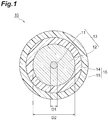
- FIG. 1 is a schematic cross-section diagram showing an example of the optical fiber according to the present embodiment.
- a resin composition containing a filler tends to have high viscosity and poor application property.
- the amount of the diluting monomer added is increased in order to adjust the viscosity of the resin composition, the proportion of the oligomer decreases, and the coating film formed from the resin composition tends to become brittle.
- the amount of the diluting monomer added is increased, the Young's modulus of the coating film formed from the resin composition increases or decreases, or the thickness of the coating film decreases to decrease the strength of the resin layer. Therefore, the resin composition used for the coating resin layer of the optical fiber is required to satisfy both application properties and coating film properties.
- An object of the present disclosure is to provide a resin composition achieving both application properties and coating film properties and an optical fiber having a coating resin layer formed from the resin composition.
- the present disclosure can provide a resin composition achieving both application properties and coating film properties and an optical fiber having a coating resin layer formed from the resin composition.
- the resin composition according to one embodiment of the present disclosure comprises a base resin containing urethane (meth)acrylate oligomer, a monomer having a phenoxy group, and a photopolymerization initiator, and hydrophobic inorganic oxide particles, wherein the viscosity is 300 mPa ⁇ s or more and 4200 mPa ⁇ s or less at 45°C and the content of the monomer having a phenoxy group is 1% by mass or more and 30% by mass or less based on the total amount of the base resin.
- Such a resin composition can achieve both application properties and coating film properties.
- an optical fiber having excellent lateral pressure characteristics can be prepared by using the above resin composition as an ultraviolet-curable resin composition for coating the optical fiber.
- the base resin may further contain a monomer having no phenoxy group. Moreover, when the viscosity of the monomer having no phenoxy group is 50 mPa ⁇ s or less at 25°C, the application properties of the resin composition is easy to be improved.
- the monomer having a phenoxy group may be at least one selected from the group consisting of 2-phenoxyethyl (meth)acrylate, 3-phenoxybenzyl (meth)acrylate, phenoxy diethylene glycol (meth)acrylate, and phenoxypolyethylene glycol (meth)acrylate.
- the above inorganic oxide particles may be at least one selected from the group consisting of silicon dioxide, zirconium dioxide, aluminum oxide, magnesium oxide, titanium oxide, tin oxide and zinc oxide because these have excellent dispersibility in the resin composition and can easily form a hard coating film.
- An optical fiber according to one aspect of the present disclosure comprises a glass fiber comprising a core and cladding, a primary resin layer contacting with the glass fiber and coating the glass fiber, and a secondary resin layer coating the primary resin layer, and the secondary resin layer comprises the cured product of the resin composition.
- Application of the resin composition according to the present embodiment to the secondary resin layer can improve the lateral pressure characteristics of the optical fiber.
- the resin composition according to the present embodiment comprises a base resin containing a urethane (meth)acrylate oligomer, a monomer having a phenoxy group, and a photopolymerization initiator; and hydrophobic inorganic oxide particles.
- (Meth)acrylate means an acrylate or a methacrylate corresponding to it. The same applies to (meth)acrylic acid or the like.
- the base resin according to the present embodiment contains a monomer having a phenoxy group in an amount of 1% by mass or more and 30% by mass or less based on the total amount of the base resin.
- the base resin contains a monomer having a phenoxy group in such a range, which can improve application properties of the resin composition and form a coating film having a Young's modulus suitable as a resin for coating optical fiber.
- the content of the monomer having a phenoxy group is preferably 2% by mass or more and 28% by mass or less, and more preferably 3% by mass or more and 25% by mass or less.
- the monomer having a phenoxy group examples include 2-phenoxyethyl (meth)acrylate, 3-phenoxybenzyl (meth)acrylate, phenoxydiethylene glycol (meth)acrylate, phenoxypolyethylene glycol (meth)acrylate, and nonylphenoxypolyethylene glycol (meth)acrylate.
- the monomer having a phenoxy group may be at least one selected from the group consisting of 2-phenoxyethyl (meth)acrylate, 3-phenoxybenzyl (meth)acrylate, phenoxydiethylene glycol (meth)acrylate, and phenoxypolyethylene glycol (meth)acrylate.
- 2-phenoxyethyl (meth)acrylate or 3-phenoxybenzyl (meth)acrylate is preferable as the monomer having a phenoxy group.
- the monomer having a phenoxy group may be used in combination of two or more.
- the viscosity of the monomer having a phenoxy group is preferably 50 mPa ⁇ s or less at 25°C, more preferably 1 mPa ⁇ s or more and 30 mPa ⁇ s or less, and still more preferably 1 mPa ⁇ s or more and 25 mPa ⁇ s or less.
- the base resin may further contain a monomer having no phenoxy group.
- the viscosity of the monomer having no phenoxy group is preferably 50 mPa ⁇ s or less at 25°C, more preferably 1 mPa ⁇ s or more and 30 mPa ⁇ s or less, and still more preferably 1 mPa ⁇ s or more and 25 mPa ⁇ s or less.
- the monomer having no phenoxy group may be a monofunctional monomer having one polymerizable group or a polyfunctional monomer having two or more polymerizable groups.
- a monomer having no phenoxy group may be used by mixing two or more monomers.
- Examples of the monofunctional monomer having no phenoxy group include (meth)acrylate monomers such as methyl (meth)acrylate, ethyl (meth)acrylate, propyl (meth)acrylate, n-butyl (meth)acrylate, sec-butyl (meth)acrylate, tert-butyl (meth)acrylate, isobutyl (meth)acrylate, n-pentyl (meth)acrylate, isopentyl (meth)acrylate, hexyl (meth)acrylate, heptyl (meth)acrylate, isoamyl (meth)acrylate, 2-ethylhexyl (meth)acrylate, n-octyl (meth)acrylate, isooctyl (meth)acrylate, isodecyl (meth)acrylate, lauryl (meth)acrylate, 4-tert-butylcyclohexanol (meth)
- isobornyl (meth)acrylate or 4-tert-butylcyclohexanol (meth)acrylate is preferable, and isobornyl (meth)acrylate is more preferable as the monofunctional monomer.
- Examples of the multifunctional monomer having no phenoxy group include ethylene glycol di(meth)acrylate, polyethylene glycol di(meth)acrylate, polypropylene glycol di(meth)acrylate, neopentyl glycol di(meth)acrylate, tripropylene glycol di(meth)acrylate, di(meth)acrylate of alkylene oxide adduct of bisphenol A, tetraethylene glycol di(meth)acrylate, hydroxypivalic acid neopentyl glycol di(meth)acrylate, 1,4-butanediol di(meth)acrylate, 1,6-hexanediol di(meth)acrylate, 1,9-nonanediol di(meth)acrylate, 1,12-dodecanediol di(meth)acrylate, 1,14-tetradecanediol di(meth)acrylate, 1,16-hexadecanediol di(me
- tripropylene glycol di(meth)acrylate 1,6-hexanediol (meth)acrylate, and trimethylolpropane tri(meth)acrylate may be used as the polyfunctional monomer.
- tripropylene glycol di(meth)acrylate is preferable as the polyfunctional monomer.
- the base resin contains the monomer (monomer having phenoxy group and monomer having no phenoxy group) preferably at 21% by mass or more and 45% by mass or less, and more preferably at 22% by mass or more and 43% by mass or less based on the total amount of the base resin. Containing the monomer in the above range results in easy preparation of the resin composition that is better in the balance between application properties and coating film properties.
- the resin composition according to the present embodiment includes a urethane (meth)acrylate oligomer.
- An oligomer obtained by reacting a polyol compound, a polyisocyanate compound, and a hydroxyl group-containing (meth)acrylate compound can be used as the urethane (meth)acrylate oligomer.
- polystramethylene glycol examples include polytetramethylene glycol, polypropylene glycol and bisphenol A-ethylene oxide addition diol.
- the number average molecular weight of the polyol compound may be 400 to 1000.
- polyisocyanate compound examples includes 2,4-tolylene diisocyanate, 2,6-tolylene diisocyanate, isophorone diisocyanate, and dicyclohexylmethane 4,4'-diisocyanate.
- hydroxyl group-containing (meth)acrylate compound examples include 2-hydroxyethyl (meth)acrylate, 2-hydroxybutyl (meth)acrylate, 1,6-hexanediol mono(meth)acrylate, pentaerythritol tri(meth)acrylate, 2-hydroxypropyl (meth)acrylate, and tripropylene glycol mono(meth)acrylate.
- An organotin compound is generally used as a catalyst for synthesizing a urethane (meth)acrylate oligomer.
- the organotin compound include dibutyltin dilaurate, dibutyltin diacetate, dibutyltin maleate, dibutyltin bis(2-ethylhexyl mercaptoacetate), dibutyltin bis(isooctyl mercaptoacetate), and dibutyltin oxide. From the view point of easy availability or catalyst performance, it is preferable that dibutyltin dilaurate or dibutyltin diacetate be used as catalyst.
- lower alcohols having 5 or less carbon atoms may be used.
- the lower alcohols include methanol, ethanol, 1-propanol, 2-propanol, 1-butanol, 2-butanol, 2-methyl-2-propanol, 1-pentanol, 2-pentanol, 3-pentanol, 2-methyl-1-butanol, 3-methyl-1-butanol, 2-methyl-2-butanol, 3-methyl-2-butanol, and 2,2-dimethyl-1-propanol.
- the resin composition according to the present embodiment may further contain an epoxy (meth)acrylate oligomer.
- An oligomer obtained by reacting a compound having a (meth)acryloyl group with an epoxy resin having two or more glycidyl groups can be used as the epoxy (meth)acrylate oligomer.
- the photopolymerization initiator can be appropriately selected from known radical photopolymerization initiators and used.
- the photopolymerization initiator include 1-hydroxycyclohexyl phenyl ketone, 2,2-dimethoxy-2-phenylacetophenone, 1-(4-isopropylphenyl)-2-hydroxy-2-methylpropan-1-one, 2,4,4-trimethylpentylphosphine oxide, 2,4,4-trimethylbenzoyldiphenylphosphine oxide, 2-methyl-1-[4-(methylthio)phenyl]-2-morpholino-propan-1 -one (Omnirad 907 manufactured by IGM Resins), 2,4,6-trimethylbenzoyldiphenylphosphine oxide (Omnirad TPO manufactured by IGM Resins), and bis(2,4,6-trimethylbenzoyl) phenylphosphine oxide (Omnirad 819, manufactured by IGM Resins).
- the inorganic oxide particles according to the present embodiment are spherical particles having a surface subjected to hydrophobic treatment.
- the hydrophobic treatment according to the present embodiment is introduction of a hydrophobic group onto the surface of the inorganic oxide particles.
- the inorganic oxide particles having a hydrophobic group introduced have excellent dispersibility in the resin composition.
- the hydrophobic group may be a reactive group such as a (meth)acryloyl group, or a non-reactive group such as a hydrocarbon group (for example, an alkyl group) or an aryl group (for example, a phenyl group).
- the resin layer having high Young's modulus is easy to form.
- the inorganic oxide particles according to the present embodiment are dispersed in a dispersion medium.
- Using the inorganic oxide dispersed in the dispersion medium allows for uniform dispersion of the inorganic oxide particles in the resin composition and then improvement of the storage stability of the resin composition.
- the dispersion medium is not particularly limited as long as curing of the resin composition is not obstructed.
- the dispersion medium may be reactive or non-reactive.
- a monomer such as a (meth)acryloyl compound and an epoxy compound
- examples of the (meth)acryloyl compound include 1,6-hexanediol di(meth)acrylate, EO-modified bisphenol A di(meth)acrylate, polyethylene glycol di(meth)acrylate, PO-modified bisphenol A di(meth)acrylate, polypropylene glycol di(meth)acrylate, and polytetramethylene glycol di(meth)acrylate.
- the (meth)acryloyl compound compounds exemplified by monomers described above may be used.
- the non-reactive dispersion medium may include a ketone solvent such as methyl ethyl ketone (MEK), an alcohol solvent such as propylene glycol monomethyl ether (PGME), or an ester solvent such as propylene glycol monomethyl ether acetate (PGMEA).
- MEK methyl ethyl ketone
- PGME propylene glycol monomethyl ether
- PMEA propylene glycol monomethyl ether acetate
- the resin composition may be prepared by mixing the base resin and the inorganic oxide particles dispersed in the dispersion medium and removing a part of the dispersion medium. When the dispersion medium including the inorganic oxide particles is observed with an optical microscope (about 100 times magnification) and particles are not observed, the inorganic oxide particles are regarded to be dispersed as the primary particles.
- the above inorganic oxide particles are at least one selected from the group consisting of silicon dioxide (silica), zirconium dioxide (zirconia), aluminum oxide (alumina), magnesium oxide (magnesia), titanium oxide (titania), tin oxide, and zinc oxide.
- silicon dioxide silicon dioxide
- zirconium dioxide zirconia
- aluminum oxide alumina
- magnesium oxide magnesium oxide
- titanium oxide titanium oxide
- tin oxide zinc oxide
- hydrophobic silica particles are more preferable to be used as the inorganic oxide particles according to the present embodiment.
- the average primary particle diameter of the inorganic oxide particles is preferably 200 nm or less, more preferably 5 nm or more and 200 nm or less, and further preferably 10 nm or more and 100 nm or less.
- the average primary particle diameter can be measured with image analysis of electron microscope pictures, a light scattering method and the BET method, for example.
- the dispersion medium in which the primary particle of the inorganic oxide is dispersed appears to be visually transparent when the diameter of the primary particle is small. When the diameter of the primary particle diameter is relatively large (40 nm or more), the dispersion medium in which the primary particle is dispersed appears to be clouded. However, the precipitate is not observed.
- the content of the inorganic oxide particles is preferably 1% by mass or more and 60% by mass or less, more preferably 7% by mass or more and 50% by mass or less, and still more preferably 9% by mass or more and 40% by mass or less based on the total amount of the resin composition.
- the content of the inorganic oxide particles of 1 % by mass or more allows for easy formation of the resin layer having excellent lateral pressure characteristics.
- the content of the inorganic oxide particles is 60% by mass or less, resulting in easy improvement in the application properties of the resin composition.
- the resin composition may further contain a silane coupling agent, a photoacid generator, a leveling agent, an antifoaming agent, an antioxidant, or the like.
- the silane coupling agent is not particularly limited as long as it does not disturb curing of the resin composition.
- examples of the silane coupling agent include tetramethyl silicate, tetraethyl silicate, mercaptopropyl trimethoxysilane, vinyltrichlorosilane, vinyltriethoxysilane, vinyltris( ⁇ -methoxy-ethoxy)silane, ⁇ -(3,4-epoxycyclohexyl)-ethyltrimethoxysilane, dimethoxydimethylsilane, diethoxydimethylsilane, 3-acryloxypropyltrimethoxysilane, ⁇ -glycidoxypropyltrimethoxysilane, ⁇ -glycidoxypropylmethyldiethoxysilane, ⁇ -methacryloxypropyltrimethoxysilane, N-( ⁇ -aminoethyl)- ⁇ -aminopropyltrimethoxysilane,
- an onium salt having an A + B - structure may be used.
- the photoacid generator include sulfonium salts such as UVACURE 1590 (manufactured by Daicel-Cytec), CPI-100P, 110P, 210S (San-Apro Ltd.) and iodonium salts such as Omnicat 250 (manufactured by IGM Resins), WPI-113 (manufactured by FUJIFILM Wako Pure Chemical Corporation), Rp-2074 (manufactured by Rhodia Japan Ltd.).
- the viscosity of the resin composition according to the present embodiment is 300 mPa ⁇ s or more and 4200 mPa ⁇ s or less at 45°C, preferably 400 mPa ⁇ s or more and 4000 mPa ⁇ s or less, and more preferably 500 mPa ⁇ s or more and 3500 mPa ⁇ s or less.
- the viscosity of the resin composition is in the above range, which can improve the application properties of the resin composition.
- FIG. 1 is a schematic cross-section diagram showing an example of the optical fiber according to the present embodiment.
- the optical fiber 10 comprises the glass fiber 13 including the core 11 and the cladding 12, and the coating resin layer 16 including the primary resin layer 14 provided on the outer periphery of the glass fiber 13 and the secondary resin layer 15.
- the cladding 12 surrounds the core 11.
- the core 11 and the cladding 12 mainly include glass such as silica glass, germanium-added silica can be used, for example, in the core 11, and pure silica or fluorine-added silica can be used in the cladding 12.
- the outside diameter (D2) of the glass fiber 13 is about 125 ⁇ m, and the diameter (D1) of the core 11 constituting the glass fiber 13 is about 7 to 15 ⁇ m.
- the thickness of the coating resin layer 16 is typically about 60 to 70 ⁇ m.
- the thickness of each of the primary resin layer 14 and the secondary resin layer 15 may be about 10 to 50 ⁇ m, and for example, the thickness of the primary resin layer 14 may be 35 ⁇ m and the thickness of the secondary resin layer 15 may be 25 ⁇ m.
- the outside diameter of the optical fiber 10 may be about 245 to 265 ⁇ m.
- the resin composition according to the present embodiment can be applied to the secondary resin layer.
- the secondary resin layer can be formed by curing a resin composition including the above base resin and inorganic oxide particles.
- the resin composition according to the present embodiment is suitable as a secondary coating material for optical fiber. Accordingly, the lateral pressure characteristics of the optical fiber can be improved.
- the Young's modulus of the secondary resin layer is preferably 1300 MPa or more at 23°C, more preferably 1300 to 2600 MPa, and further preferably 1300 to 2500 MPa.
- the Young's modulus of the secondary resin layer of 1300 MPa or more is easy to improve the lateral pressure characteristics, and the Young's modulus of 2600 MPa or less is hard to cause a crack or the like in the secondary resin layer due to provision of appropriate toughness with the secondary resin layer.
- the inorganic oxide particles dispersed in the dispersion medium remain to be dispersed in the resin layer even after curing of the resin layer.
- reactive dispersion medium the inorganic oxide particles are mixed together with the dispersion medium into the resin layer and are incorporated in the resin layer with the dispersion condition maintained.
- non-reactive dispersion medium at least a part of the dispersion medium evaporates and disappears from the resin composition.
- the inorganic oxide particles remain in the resin composition with the dispersion condition remained and are also present in the postcure resin layer with the dispersion condition remained. Electron microscopic observation shows that the primary particle of the inorganic oxide particles present in the resin layer is dispersed.
- the primary resin layer 14 can be formed by curing a resin composition including a urethane (meth)acrylate oligomer, a monomer, a photopolymerization initiator and a silane coupling agent.
- a resin composition for the primary resin layer Prior art techniques can be used for a resin composition for the primary resin layer.
- a urethane (meth)acrylate oligomer, a monomer, a photopolymerization initiator and a silane coupling agent may be appropriately selected from compounds exemplified in the above base resin.
- the resin composition constituting the primary resin layer has composition different from the base resin forming the secondary resin layer.
- a urethane acrylate oligomer (UA) obtained by reacting a polypropylene glycol having a molecular weight of 600, 2,4-tolylene diisocyanate, and hydroxyethyl acrylate, and an epoxy acrylate oligomer (EA) were prepared.
- 3-phenoxybenzyl acrylate (trade name "Light Acrylate POB-A” of Kyoeisha Chemical Co., Ltd.), 2-phenoxyethyl acrylate (trade name “Light Acrylate PO-A” of Kyoeisha Chemical Co., Ltd.), phenoxydiethylene glycol acrylate (trade name "Light Acrylate P2H-A” of Kyoeisha Chemical Co., Ltd.), and phenoxy polyethylene glycol acrylate (trade name "Light acrylate P-200A” of Kyoeisha Chemical Co., Ltd.) were prepared.
- isobornyl acrylate (trade name "IBXA” of Osaka Organic Chemical Industry Co., Ltd.) and tripropylene glycol diacrylate (trade name "TPGDA” of Daicel-Allnex Co., Ltd.) were prepared.
- hydrophobic silica particles having an average particle size of 70 to 100 nm hydrophobic silica particles having an average particle size of 40 to 60 nm, and hydrophobic silica particles having an average particle size of 10 to 15 nm were prepared. These silica particles had a methacryloyl group and were dispersed in methyl ethyl ketone (MEK).
- MEK methyl ethyl ketone
- the base resin was prepared by mixing the above oligomer, monomer, and photopolymerization initiator. The base resin and the silica particles were mixed, and then most of MEK as a dispersion medium was removed under reduced pressure to prepare the respective resin compositions. The content of MEK in the resin composition was 5% by mass or less.
- the value of the monomer is the content based on the total amount of the base resin
- the value of the oligomer is the content based on the total amount of the monomer, oligomer, and silica particles
- the value of silica particles is the content based on the total amount of the resin composition.
- the viscosity at 45°C of the resin composition was measured by using a "digital viscometer DV-II" of Brookfield Co., Ltd. (spindle used: No. 18 and rotation speed: 10 rpm) which is a B-type viscometer.
- Each of the resin composition was applied onto a polyethylene terephthalate (PET) film by using a spin coater, and then cured using an electrodeless UV lamp system "VPS6 (D bulb)" manufactured by Heraeus at a condition of 1000 ⁇ 100 mJ/cm 2 to form a resin layer having a thickness of 200 ⁇ 20 ⁇ m (a coating film) on the PET film.
- VPS6 electrodeless UV lamp system
- the resin layer was peeled off from the PET film to obtain a resin film.
- a resin film was punched into a dumbbell shape of JIS K 7127 type 5 and pulled under a condition of 23 ⁇ 2°C and 50 ⁇ 10% RH using a tensile tester at a tension speed of 1 mm/min and a gauge length of 25 mm, and a stress-strain curve was obtained. Young's modulus was determined by 2.5 % secant line.
- a resin composition A1 was obtained by mixing 75 parts by mass of a urethane acrylate oligomer obtained by reacting polypropylene glycol having a molecular weight of 2000, 2,4-tolylene diisocyanate, hydroxy ethyl acrylate, and methanol; 12 parts by mass of nonylphenoxypolyethylene glycol acrylate; 6 parts by mass of N-vinyl caprolactam; 2 parts by mass of 1,6-hexanediol diacrylate; 1 part by mass of 2,4,6-trimethylbenzoyldiphenylphosphine oxide (Omnirad TPO); and 1 part by mass of 3-mercaptopropyltrimethoxysilane (MPTS).
- a urethane acrylate oligomer obtained by reacting polypropylene glycol having a molecular weight of 2000, 2,4-tolylene diisocyanate, hydroxy ethyl acrylate, and methanol
- a primary resin layer having a thickness of 35 ⁇ m was formed on the outer periphery of a glass fiber having a diameter of 125 ⁇ m and composed of the core and the cladding by using the resin composition A1, each of the resin composition prepared in Examples or Comparative Examples was further applied onto the outer periphery of the primary resin layer to form a secondary resin layer, and an optical fiber was produced.
- the linear speed was set at 1500 m/min.
- the application properties of the resin composition were evaluated by confirming the presence or absence of a disconnection.
- the case where there was no disconnection was regarded as "OK”, and the case where the disconnection was confirmed was regarded as "NG”.
- the viscosity of the resin composition is too high, the coating diameter in forming the secondary resin layer is not stable, and disconnection is easy to occur.
- the viscosity of the resin composition is too low, the self-aligning force is difficult to work and uneven thickness is easy to occur.
- 10 Optical fiber
- 11 Core
- 12 Clad
- 13 Glass fiber
- 14 Primary resin layer
- 15 Secondary resin layer
- 16 Coating resin layer.
Landscapes
- Chemical & Material Sciences (AREA)
- Organic Chemistry (AREA)
- Life Sciences & Earth Sciences (AREA)
- Chemical Kinetics & Catalysis (AREA)
- Engineering & Computer Science (AREA)
- Materials Engineering (AREA)
- Health & Medical Sciences (AREA)
- Medicinal Chemistry (AREA)
- Polymers & Plastics (AREA)
- General Chemical & Material Sciences (AREA)
- Geochemistry & Mineralogy (AREA)
- General Life Sciences & Earth Sciences (AREA)
- Wood Science & Technology (AREA)
- Physics & Mathematics (AREA)
- Composite Materials (AREA)
- Inorganic Chemistry (AREA)
- Optics & Photonics (AREA)
- General Physics & Mathematics (AREA)
- Nanotechnology (AREA)
- Macromonomer-Based Addition Polymer (AREA)
- Optical Fibers, Optical Fiber Cores, And Optical Fiber Bundles (AREA)
- Compositions Of Macromolecular Compounds (AREA)
- Polymerisation Methods In General (AREA)
Abstract
Description
- The present disclosure relates to a resin composition, a secondary coating material for optical fiber, and an optical fiber.
- This application claims priority based on Japanese Patent Application No.
2018-070649 filed on April 2, 2018 - Generally, an optical fiber has a coating resin layer for protecting a glass fiber which is an optical transmission medium. The optical fiber has been required to have excellent lateral pressure characteristics in order to reduce an increase in transmission loss induced by micro-bend generated when lateral pressure is applied to the optical fiber.
- Patent Literature 1:
JP 2014-219550A - A resin composition according to one embodiment of the present disclosure comprises a base resin containing a urethane (meth)acrylate oligomer, a monomer having a phenoxy group, and a photopolymerization initiator, and hydrophobic inorganic oxide particles, wherein the viscosity is 300 mPa·s or more and 4200 mPa·s or less at 45°C and the content of the monomer having a phenoxy group is 1% by mass or more and 30% by mass or less based on the total amount of the base resin.
- [
FIG. 1] FIG. 1 is a schematic cross-section diagram showing an example of the optical fiber according to the present embodiment. - A resin composition containing a filler tends to have high viscosity and poor application property. On the other hand, when the amount of the diluting monomer added is increased in order to adjust the viscosity of the resin composition, the proportion of the oligomer decreases, and the coating film formed from the resin composition tends to become brittle. In addition, when the amount of the diluting monomer added is increased, the Young's modulus of the coating film formed from the resin composition increases or decreases, or the thickness of the coating film decreases to decrease the strength of the resin layer. Therefore, the resin composition used for the coating resin layer of the optical fiber is required to satisfy both application properties and coating film properties.
- An object of the present disclosure is to provide a resin composition achieving both application properties and coating film properties and an optical fiber having a coating resin layer formed from the resin composition.
- The present disclosure can provide a resin composition achieving both application properties and coating film properties and an optical fiber having a coating resin layer formed from the resin composition.
- First, the contents of the embodiment of the present disclosure will be described by listing. The resin composition according to one embodiment of the present disclosure comprises a base resin containing urethane (meth)acrylate oligomer, a monomer having a phenoxy group, and a photopolymerization initiator, and hydrophobic inorganic oxide particles, wherein the viscosity is 300 mPa·s or more and 4200 mPa·s or less at 45°C and the content of the monomer having a phenoxy group is 1% by mass or more and 30% by mass or less based on the total amount of the base resin.
- Such a resin composition can achieve both application properties and coating film properties. In addition, an optical fiber having excellent lateral pressure characteristics can be prepared by using the above resin composition as an ultraviolet-curable resin composition for coating the optical fiber.
- In order to adjust the balance between application properties and coating film properties, the base resin may further contain a monomer having no phenoxy group. Moreover, when the viscosity of the monomer having no phenoxy group is 50 mPa·s or less at 25°C, the application properties of the resin composition is easy to be improved.
- The monomer having a phenoxy group may be at least one selected from the group consisting of 2-phenoxyethyl (meth)acrylate, 3-phenoxybenzyl (meth)acrylate, phenoxy diethylene glycol (meth)acrylate, and phenoxypolyethylene glycol (meth)acrylate. Thereby, it becomes easy to adjust the balance between the application properties and the coating film properties of the resin composition.
- The above inorganic oxide particles may be at least one selected from the group consisting of silicon dioxide, zirconium dioxide, aluminum oxide, magnesium oxide, titanium oxide, tin oxide and zinc oxide because these have excellent dispersibility in the resin composition and can easily form a hard coating film.
- An optical fiber according to one aspect of the present disclosure comprises a glass fiber comprising a core and cladding, a primary resin layer contacting with the glass fiber and coating the glass fiber, and a secondary resin layer coating the primary resin layer, and the secondary resin layer comprises the cured product of the resin composition. Application of the resin composition according to the present embodiment to the secondary resin layer can improve the lateral pressure characteristics of the optical fiber.
- Specific examples of a resin composition, a secondary coating material for optical fiber, and an optical fiber according to the present embodiment will be described referring to the drawings as necessary. The present invention is not limited to these illustrations but is indicated by the claims and intended to include meanings equivalent to the claims and all modifications within the claims. In the following description, the same reference numerals are given to the same elements in the description of the drawing, and redundant explanations are omitted.
- The resin composition according to the present embodiment comprises a base resin containing a urethane (meth)acrylate oligomer, a monomer having a phenoxy group, and a photopolymerization initiator; and hydrophobic inorganic oxide particles.
- (Meth)acrylate means an acrylate or a methacrylate corresponding to it. The same applies to (meth)acrylic acid or the like.
- The base resin according to the present embodiment contains a monomer having a phenoxy group in an amount of 1% by mass or more and 30% by mass or less based on the total amount of the base resin. The base resin contains a monomer having a phenoxy group in such a range, which can improve application properties of the resin composition and form a coating film having a Young's modulus suitable as a resin for coating optical fiber. The content of the monomer having a phenoxy group is preferably 2% by mass or more and 28% by mass or less, and more preferably 3% by mass or more and 25% by mass or less.
- Examples of the monomer having a phenoxy group include 2-phenoxyethyl (meth)acrylate, 3-phenoxybenzyl (meth)acrylate, phenoxydiethylene glycol (meth)acrylate, phenoxypolyethylene glycol (meth)acrylate, and nonylphenoxypolyethylene glycol (meth)acrylate. From the viewpoint of adjusting the balance between the application properties and the coating film properties of the resin composition, the monomer having a phenoxy group may be at least one selected from the group consisting of 2-phenoxyethyl (meth)acrylate, 3-phenoxybenzyl (meth)acrylate, phenoxydiethylene glycol (meth)acrylate, and phenoxypolyethylene glycol (meth)acrylate. Among them, 2-phenoxyethyl (meth)acrylate or 3-phenoxybenzyl (meth)acrylate is preferable as the monomer having a phenoxy group. The monomer having a phenoxy group may be used in combination of two or more.
- From the viewpoint of improving the application properties of the resin composition, the viscosity of the monomer having a phenoxy group is preferably 50 mPa·s or less at 25°C, more preferably 1 mPa·s or more and 30 mPa·s or less, and still more preferably 1 mPa·s or more and 25 mPa·s or less.
- The base resin may further contain a monomer having no phenoxy group. The viscosity of the monomer having no phenoxy group is preferably 50 mPa·s or less at 25°C, more preferably 1 mPa·s or more and 30 mPa·s or less, and still more preferably 1 mPa·s or more and 25 mPa·s or less. Thereby, the resin composition excellent in the balance between application properties and coating film properties can be obtained.
- The monomer having no phenoxy group may be a monofunctional monomer having one polymerizable group or a polyfunctional monomer having two or more polymerizable groups. A monomer having no phenoxy group may be used by mixing two or more monomers.
- Examples of the monofunctional monomer having no phenoxy group include (meth)acrylate monomers such as methyl (meth)acrylate, ethyl (meth)acrylate, propyl (meth)acrylate, n-butyl (meth)acrylate, sec-butyl (meth)acrylate, tert-butyl (meth)acrylate, isobutyl (meth)acrylate, n-pentyl (meth)acrylate, isopentyl (meth)acrylate, hexyl (meth)acrylate, heptyl (meth)acrylate, isoamyl (meth)acrylate, 2-ethylhexyl (meth)acrylate, n-octyl (meth)acrylate, isooctyl (meth)acrylate, isodecyl (meth)acrylate, lauryl (meth)acrylate, 4-tert-butylcyclohexanol (meth)acrylate, tetrahydrofurfuryl (meth)acrylate, benzyl (meth)acrylate, dicyclopentenyl (meth)acrylate, dicyclopentenyloxyethyl (meth)acrylate, dicyclopentanyl (meth)acrylate, nonylphenol polyethylene glycol (meth)acrylate, and isobornyl (meth)acrylate; carboxyl group containing monomers such as (meth)acrylic acid, (meth)acrylic acid dimer, carboxyethyl (meth)acrylate, carboxypentyl (meth)acrylate, and ω-carboxy-polycaprolactone (meth)acrylate; heterocycle containing (meth)acrylates such as N-acryloyl morpholine, N-vinyl pyrrolidone, N-vinyl caprolactam, N-acryloylpiperidine, N-methacryloylpiperidine, N-acryloylpyrrolidine, 3-(3-pyridine) propyl (meth)acrylate, and cyclic trimethylolpropane formal acrylate; maleimide monomers such as maleimide, N-cyclohexyl maleimide, and N-phenyl maleimide; amide monomers such as (meth)acrylamide, N, N-dimethyl (meth)acrylamide, N, N-diethyl (meth)acrylamide, N-hexyl (meth)acrylamide, N-methyl (meth)acrylamide, N-isopropyl (meth)acrylamide, N-butyl (meth)acrylamide, N-methylol (meth)acrylamide, and N-methylolpropane (meth)acrylamide; aminoalkyl (meth)acrylate monomers such as aminoethyl (meth)acrylate, aminopropyl (meth)acrylate, N, N-dimethylaminoethyl (meth)acrylate, and tert-butylaminoethyl (meth)acrylate; and succinimide monomers such as N-(meth)acryloyloxymethylene succinimide, N-(meth)acryloyl-6-oxyhexamethylene succinimide, and N-(meth)acryloyl-8-oxyoctamethylene succinimide.
- From the viewpoint of adjusting the Young's modulus of the coating film formed from the resin composition, isobornyl (meth)acrylate or 4-tert-butylcyclohexanol (meth)acrylate is preferable, and isobornyl (meth)acrylate is more preferable as the monofunctional monomer.
- Examples of the multifunctional monomer having no phenoxy group include ethylene glycol di(meth)acrylate, polyethylene glycol di(meth)acrylate, polypropylene glycol di(meth)acrylate, neopentyl glycol di(meth)acrylate, tripropylene glycol di(meth)acrylate, di(meth)acrylate of alkylene oxide adduct of bisphenol A, tetraethylene glycol di(meth)acrylate, hydroxypivalic acid neopentyl glycol di(meth)acrylate, 1,4-butanediol di(meth)acrylate, 1,6-hexanediol di(meth)acrylate, 1,9-nonanediol di(meth)acrylate, 1,12-dodecanediol di(meth)acrylate, 1,14-tetradecanediol di(meth)acrylate, 1,16-hexadecanediol di(meth)acrylate, 1,20-eicosanediol di(meth)acrylate, isopentyl diol di(meth)acrylate, 3-ethyl-1, 8-octanediol di(meth)acrylate, EO adduct of bisphenol A di(meth)acrylate, trimethylol propane tri(meth)acrylate, trimethylol octane tri(meth)acrylate, trimethylol propane polyethoxy tri(meth)acrylate, trimethylol propane polypropoxy tri(meth)acrylate, trimethylol propane polyethoxy polypropoxy tri(meth)acrylate, tris[(meth)acryloyloxyethyl] isocyanurate, pentaerythritol tri(meth)acrylate, pentaerythritol polyethoxy tetra(meth)acrylate, pentaerythritol polypropoxy tetra(meth)acrylate, pentaerythritol tetra(meth)acrylate, ditrimethylol propane tetra(meth)acrylate, dipentaerythritol tetra(meth)acrylate, dipentaerythritol penta(meth)acrylate, dipentaerythritol hexa(meth)acrylate, and caprolactone-modified tris[(meth)acryloyloxyethyl] isocyanurate.
- From the viewpoint of forming a coating film having a desired Young's modulus while reducing the viscosity of the resin composition, tripropylene glycol di(meth)acrylate, 1,6-hexanediol (meth)acrylate, and trimethylolpropane tri(meth)acrylate may be used as the polyfunctional monomer. Among them, tripropylene glycol di(meth)acrylate is preferable as the polyfunctional monomer.
- The base resin contains the monomer (monomer having phenoxy group and monomer having no phenoxy group) preferably at 21% by mass or more and 45% by mass or less, and more preferably at 22% by mass or more and 43% by mass or less based on the total amount of the base resin. Containing the monomer in the above range results in easy preparation of the resin composition that is better in the balance between application properties and coating film properties.
- The resin composition according to the present embodiment includes a urethane (meth)acrylate oligomer. An oligomer obtained by reacting a polyol compound, a polyisocyanate compound, and a hydroxyl group-containing (meth)acrylate compound can be used as the urethane (meth)acrylate oligomer.
- Examples of the polyol compound include polytetramethylene glycol, polypropylene glycol and bisphenol A-ethylene oxide addition diol. The number average molecular weight of the polyol compound may be 400 to 1000. Examples of the polyisocyanate compound includes 2,4-tolylene diisocyanate, 2,6-tolylene diisocyanate, isophorone diisocyanate, and dicyclohexylmethane 4,4'-diisocyanate. Examples of the hydroxyl group-containing (meth)acrylate compound include 2-hydroxyethyl (meth)acrylate, 2-hydroxybutyl (meth)acrylate, 1,6-hexanediol mono(meth)acrylate, pentaerythritol tri(meth)acrylate, 2-hydroxypropyl (meth)acrylate, and tripropylene glycol mono(meth)acrylate.
- An organotin compound is generally used as a catalyst for synthesizing a urethane (meth)acrylate oligomer. Examples of the organotin compound include dibutyltin dilaurate, dibutyltin diacetate, dibutyltin maleate, dibutyltin bis(2-ethylhexyl mercaptoacetate), dibutyltin bis(isooctyl mercaptoacetate), and dibutyltin oxide. From the view point of easy availability or catalyst performance, it is preferable that dibutyltin dilaurate or dibutyltin diacetate be used as catalyst.
- When the urethane (meth)acrylate oligomer is synthesized, lower alcohols having 5 or less carbon atoms may be used. Examples of the lower alcohols include methanol, ethanol, 1-propanol, 2-propanol, 1-butanol, 2-butanol, 2-methyl-2-propanol, 1-pentanol, 2-pentanol, 3-pentanol, 2-methyl-1-butanol, 3-methyl-1-butanol, 2-methyl-2-butanol, 3-methyl-2-butanol, and 2,2-dimethyl-1-propanol.
- The resin composition according to the present embodiment may further contain an epoxy (meth)acrylate oligomer. An oligomer obtained by reacting a compound having a (meth)acryloyl group with an epoxy resin having two or more glycidyl groups can be used as the epoxy (meth)acrylate oligomer.
- The photopolymerization initiator can be appropriately selected from known radical photopolymerization initiators and used. Examples of the photopolymerization initiator include 1-hydroxycyclohexyl phenyl ketone, 2,2-dimethoxy-2-phenylacetophenone,
1-(4-isopropylphenyl)-2-hydroxy-2-methylpropan-1-one, 2,4,4-trimethylpentylphosphine oxide, 2,4,4-trimethylbenzoyldiphenylphosphine oxide, 2-methyl-1-[4-(methylthio)phenyl]-2-morpholino-propan-1 -one (Omnirad 907 manufactured by IGM Resins), 2,4,6-trimethylbenzoyldiphenylphosphine oxide (Omnirad TPO manufactured by IGM Resins), and bis(2,4,6-trimethylbenzoyl) phenylphosphine oxide (Omnirad 819, manufactured by IGM Resins). - The inorganic oxide particles according to the present embodiment are spherical particles having a surface subjected to hydrophobic treatment. The hydrophobic treatment according to the present embodiment is introduction of a hydrophobic group onto the surface of the inorganic oxide particles. The inorganic oxide particles having a hydrophobic group introduced have excellent dispersibility in the resin composition. The hydrophobic group may be a reactive group such as a (meth)acryloyl group, or a non-reactive group such as a hydrocarbon group (for example, an alkyl group) or an aryl group (for example, a phenyl group). In the case of the inorganic oxide particles having a reactive group, the resin layer having high Young's modulus is easy to form.
- The inorganic oxide particles according to the present embodiment are dispersed in a dispersion medium. Using the inorganic oxide dispersed in the dispersion medium allows for uniform dispersion of the inorganic oxide particles in the resin composition and then improvement of the storage stability of the resin composition. The dispersion medium is not particularly limited as long as curing of the resin composition is not obstructed. The dispersion medium may be reactive or non-reactive.
- As the reactive dispersion medium, a monomer such as a (meth)acryloyl compound and an epoxy compound may be used. Examples of the (meth)acryloyl compound include 1,6-hexanediol di(meth)acrylate, EO-modified bisphenol A di(meth)acrylate, polyethylene glycol di(meth)acrylate, PO-modified bisphenol A di(meth)acrylate, polypropylene glycol di(meth)acrylate, and polytetramethylene glycol di(meth)acrylate. As the (meth)acryloyl compound, compounds exemplified by monomers described above may be used.
- The non-reactive dispersion medium may include a ketone solvent such as methyl ethyl ketone (MEK), an alcohol solvent such as propylene glycol monomethyl ether (PGME), or an ester solvent such as propylene glycol monomethyl ether acetate (PGMEA). In the case of the non-reactive dispersion medium, the resin composition may be prepared by mixing the base resin and the inorganic oxide particles dispersed in the dispersion medium and removing a part of the dispersion medium. When the dispersion medium including the inorganic oxide particles is observed with an optical microscope (about 100 times magnification) and particles are not observed, the inorganic oxide particles are regarded to be dispersed as the primary particles.
- Due to excellent dispersion properties in the resin composition and easy formation of the hard coating film, it is preferable that the above inorganic oxide particles are at least one selected from the group consisting of silicon dioxide (silica), zirconium dioxide (zirconia), aluminum oxide (alumina), magnesium oxide (magnesia), titanium oxide (titania), tin oxide, and zinc oxide. From the viewpoint of excellent inexpensiveness, easy surface treatment, permeability to ultraviolet ray, and easy provision of a resin layer with appropriate hardness, hydrophobic silica particles are more preferable to be used as the inorganic oxide particles according to the present embodiment.
- From the view point of increasing a Young's modulus of the resin layer, the average primary particle diameter of the inorganic oxide particles is preferably 200 nm or less, more preferably 5 nm or more and 200 nm or less, and further preferably 10 nm or more and 100 nm or less. The average primary particle diameter can be measured with image analysis of electron microscope pictures, a light scattering method and the BET method, for example. The dispersion medium in which the primary particle of the inorganic oxide is dispersed appears to be visually transparent when the diameter of the primary particle is small. When the diameter of the primary particle diameter is relatively large (40 nm or more), the dispersion medium in which the primary particle is dispersed appears to be clouded. However, the precipitate is not observed.
- The content of the inorganic oxide particles is preferably 1% by mass or more and 60% by mass or less, more preferably 7% by mass or more and 50% by mass or less, and still more preferably 9% by mass or more and 40% by mass or less based on the total amount of the resin composition. The content of the inorganic oxide particles of 1 % by mass or more allows for easy formation of the resin layer having excellent lateral pressure characteristics. The content of the inorganic oxide particles is 60% by mass or less, resulting in easy improvement in the application properties of the resin composition.
- The resin composition may further contain a silane coupling agent, a photoacid generator, a leveling agent, an antifoaming agent, an antioxidant, or the like.
- The silane coupling agent is not particularly limited as long as it does not disturb curing of the resin composition. Examples of the silane coupling agent include tetramethyl silicate, tetraethyl silicate, mercaptopropyl trimethoxysilane, vinyltrichlorosilane, vinyltriethoxysilane, vinyltris(β-methoxy-ethoxy)silane, β-(3,4-epoxycyclohexyl)-ethyltrimethoxysilane, dimethoxydimethylsilane, diethoxydimethylsilane, 3-acryloxypropyltrimethoxysilane, γ-glycidoxypropyltrimethoxysilane, γ-glycidoxypropylmethyldiethoxysilane, γ-methacryloxypropyltrimethoxysilane, N-(β-aminoethyl)-γ-aminopropyltrimethoxysilane, N-(β-aminoethyl)-γ-aminopropyltrimethyldimethoxysilane, N-phenyl-γ-aminopropyltrimethoxysilane, γ-chloropropyltrimethoxysilane, γ-mercaptopropyltrimethoxysilane, γ-aminopropyltrimethoxysilane, bis-[3-(triethoxysilyl)propyl]tetrasulfide, bis- [3 -(triethoxysilyl)propyl] disulfide, γ-trimethoxysilylpropyldimethylthiocarbamyl tetrasulfide, and γ-trimethoxysilylpropyl benzothiazyl tetrasulfide.
- As the photoacid generator, an onium salt having an A+B- structure may be used. Examples of the photoacid generator include sulfonium salts such as UVACURE 1590 (manufactured by Daicel-Cytec), CPI-100P, 110P, 210S (San-Apro Ltd.) and iodonium salts such as Omnicat 250 (manufactured by IGM Resins), WPI-113 (manufactured by FUJIFILM Wako Pure Chemical Corporation), Rp-2074 (manufactured by Rhodia Japan Ltd.).
- The viscosity of the resin composition according to the present embodiment is 300 mPa·s or more and 4200 mPa·s or less at 45°C, preferably 400 mPa·s or more and 4000 mPa·s or less, and more preferably 500 mPa·s or more and 3500 mPa·s or less. The viscosity of the resin composition is in the above range, which can improve the application properties of the resin composition.
-
FIG. 1 is a schematic cross-section diagram showing an example of the optical fiber according to the present embodiment. Theoptical fiber 10 comprises theglass fiber 13 including thecore 11 and thecladding 12, and the coating resin layer 16 including the primary resin layer 14 provided on the outer periphery of theglass fiber 13 and thesecondary resin layer 15. - The
cladding 12 surrounds thecore 11. Thecore 11 and thecladding 12 mainly include glass such as silica glass, germanium-added silica can be used, for example, in thecore 11, and pure silica or fluorine-added silica can be used in thecladding 12. - In
FIG. 1 , for example, the outside diameter (D2) of theglass fiber 13 is about 125 µm, and the diameter (D1) of the core 11 constituting theglass fiber 13 is about 7 to 15 µm. - The thickness of the coating resin layer 16 is typically about 60 to 70 µm. The thickness of each of the primary resin layer 14 and the
secondary resin layer 15 may be about 10 to 50 µm, and for example, the thickness of the primary resin layer 14 may be 35 µm and the thickness of thesecondary resin layer 15 may be 25 µm. The outside diameter of theoptical fiber 10 may be about 245 to 265 µm. - The resin composition according to the present embodiment can be applied to the secondary resin layer. The secondary resin layer can be formed by curing a resin composition including the above base resin and inorganic oxide particles. The resin composition according to the present embodiment is suitable as a secondary coating material for optical fiber. Accordingly, the lateral pressure characteristics of the optical fiber can be improved.
- The Young's modulus of the secondary resin layer is preferably 1300 MPa or more at 23°C, more preferably 1300 to 2600 MPa, and further preferably 1300 to 2500 MPa. The Young's modulus of the secondary resin layer of 1300 MPa or more is easy to improve the lateral pressure characteristics, and the Young's modulus of 2600 MPa or less is hard to cause a crack or the like in the secondary resin layer due to provision of appropriate toughness with the secondary resin layer.
- The inorganic oxide particles dispersed in the dispersion medium remain to be dispersed in the resin layer even after curing of the resin layer. When reactive dispersion medium is used, the inorganic oxide particles are mixed together with the dispersion medium into the resin layer and are incorporated in the resin layer with the dispersion condition maintained. When non-reactive dispersion medium is used, at least a part of the dispersion medium evaporates and disappears from the resin composition. However, the inorganic oxide particles remain in the resin composition with the dispersion condition remained and are also present in the postcure resin layer with the dispersion condition remained. Electron microscopic observation shows that the primary particle of the inorganic oxide particles present in the resin layer is dispersed.
- The primary resin layer 14 can be formed by curing a resin composition including a urethane (meth)acrylate oligomer, a monomer, a photopolymerization initiator and a silane coupling agent. Prior art techniques can be used for a resin composition for the primary resin layer. A urethane (meth)acrylate oligomer, a monomer, a photopolymerization initiator and a silane coupling agent may be appropriately selected from compounds exemplified in the above base resin. The resin composition constituting the primary resin layer has composition different from the base resin forming the secondary resin layer.
- Hereinafter, the results of evaluation test using Examples and Comparative Examples according to the present disclosure will be shown, and the present disclosure is described in more detail. The present invention is not limited to these examples.
- As the oligomer, a urethane acrylate oligomer (UA) obtained by reacting a polypropylene glycol having a molecular weight of 600, 2,4-tolylene diisocyanate, and hydroxyethyl acrylate, and an epoxy acrylate oligomer (EA) were prepared.
- As a monomer having a phenoxy group, 3-phenoxybenzyl acrylate (trade name "Light Acrylate POB-A" of Kyoeisha Chemical Co., Ltd.), 2-phenoxyethyl acrylate (trade name "Light Acrylate PO-A" of Kyoeisha Chemical Co., Ltd.), phenoxydiethylene glycol acrylate (trade name "Light Acrylate P2H-A" of Kyoeisha Chemical Co., Ltd.), and phenoxy polyethylene glycol acrylate (trade name "Light acrylate P-200A" of Kyoeisha Chemical Co., Ltd.) were prepared.
- As a monomer having no phenoxy group, isobornyl acrylate (trade name "IBXA" of Osaka Organic Chemical Industry Co., Ltd.) and tripropylene glycol diacrylate (trade name "TPGDA" of Daicel-Allnex Co., Ltd.) were prepared.
- As a photopolymerization initiator, 1-hydroxycyclohexyl phenyl ketone and 2,4,6-trimethylbenzoyldiphenylphosphine oxide were prepared.
- As inorganic oxide particles, hydrophobic silica particles having an average particle size of 70 to 100 nm, hydrophobic silica particles having an average particle size of 40 to 60 nm, and hydrophobic silica particles having an average particle size of 10 to 15 nm were prepared. These silica particles had a methacryloyl group and were dispersed in methyl ethyl ketone (MEK).
- The base resin was prepared by mixing the above oligomer, monomer, and photopolymerization initiator. The base resin and the silica particles were mixed, and then most of MEK as a dispersion medium was removed under reduced pressure to prepare the respective resin compositions. The content of MEK in the resin composition was 5% by mass or less.
- In Table 1 and Table 2, the value of the monomer is the content based on the total amount of the base resin, the value of the oligomer is the content based on the total amount of the monomer, oligomer, and silica particles, and the value of silica particles is the content based on the total amount of the resin composition.
- The following evaluation was conducted using the resin compositions obtained in Examples and Comparative Examples. The results are shown in Tables 1 and 2.
- The viscosity at 45°C of the resin composition was measured by using a "digital viscometer DV-II" of Brookfield Co., Ltd. (spindle used: No. 18 and rotation speed: 10 rpm) which is a B-type viscometer.
- Each of the resin composition was applied onto a polyethylene terephthalate (PET) film by using a spin coater, and then cured using an electrodeless UV lamp system "VPS6 (D bulb)" manufactured by Heraeus at a condition of 1000 ± 100 mJ/cm2 to form a resin layer having a thickness of 200 ± 20 µm (a coating film) on the PET film. The resin layer was peeled off from the PET film to obtain a resin film.
- A resin film was punched into a dumbbell shape of JIS K 7127 type 5 and pulled under a condition of 23 ± 2°C and 50 ± 10% RH using a tensile tester at a tension speed of 1 mm/min and a gauge length of 25 mm, and a stress-strain curve was obtained. Young's modulus was determined by 2.5 % secant line.
- A resin composition A1 was obtained by mixing 75 parts by mass of a urethane acrylate oligomer obtained by reacting polypropylene glycol having a molecular weight of 2000, 2,4-tolylene diisocyanate, hydroxy ethyl acrylate, and methanol; 12 parts by mass of nonylphenoxypolyethylene glycol acrylate; 6 parts by mass of N-vinyl caprolactam; 2 parts by mass of 1,6-hexanediol diacrylate; 1 part by mass of 2,4,6-trimethylbenzoyldiphenylphosphine oxide (Omnirad TPO); and 1 part by mass of 3-mercaptopropyltrimethoxysilane (MPTS).
- A primary resin layer having a thickness of 35 µm was formed on the outer periphery of a glass fiber having a diameter of 125 µm and composed of the core and the cladding by using the resin composition A1, each of the resin composition prepared in Examples or Comparative Examples was further applied onto the outer periphery of the primary resin layer to form a secondary resin layer, and an optical fiber was produced. The linear speed was set at 1500 m/min.
- For the produced optical fiber, the application properties of the resin composition were evaluated by confirming the presence or absence of a disconnection. The case where there was no disconnection was regarded as "OK", and the case where the disconnection was confirmed was regarded as "NG". When the viscosity of the resin composition is too high, the coating diameter in forming the secondary resin layer is not stable, and disconnection is easy to occur. On the other hand, when the viscosity of the resin composition is too low, the self-aligning force is difficult to work and uneven thickness is easy to occur.
[Table 1] Examples 1 2 3 4 5 6 7 8 9 10 11 12 Oligomer (% by mass) UA 29.1 28.5 27 27 27 27 31.5 24 22.5 37.2 41 31.2 EA 8.7 8.6 8.1 8.1 8.1 8.1 9.5 7.2 6.8 11.1 - - Monomer having a phenoxy group (% by mass) POB-A - - - 10 - - - - - - - - PO-A 3 5 10 - - - 10 20 25 16.7 10 20 P2H-A - - - - 10 - - - - - - - P-200A - - - - - 10 - - - - - - Monomer having no phenoxy group (% by mass) 20.4 20.0 18.9 18.9 18.9 18.9 22.1 16.8 15.8 26.0 22.1 16.8 Silica particles (% by mass) 40 40 40 40 40 40 30 40 40 9 30 40 Average particle size of silica particles (nm) 70-100 40-60 10-15 10-15 10-15 10-15 10-15 10-15 10-15 10-15 10-15 10-15 Viscosity at 45°C (mPa·s) 2000 2200 2580 2740 2580 2580 1100 1200 1200 500 1150 1200 Young's modulus (MPa) 1900 1980 2300 2350 2000 1800 1900 2300 2300 1500 1800 2100 Application property OK OK OK OK OK OK OK OK OK OK OK OK [Table 2] Comparative Examples 1 2 3 4 Oligomer (% by mass) UA 30 30 30 20.7 EA 9 9 9 6.2 Monomer having a phenoxy group (% by mass) POB-A - - - - PO-A - - - 31 P2H-A - - - - P-200A - - - - Monomer having no phenoxy group (% by mass) 21 21 21 14.5 Silica particles (% by mass) 40 40 40 40 Average particle size of silica particles (nm) 70-100 40-60 10-15 10-15 Viscosity at 45°C (mPa·s) 4200 5530 6400 200 Young's modulus (MPa) 1950 2000 2250 2300 Application property NG NG NG NG - It was confirmed that the resin composition in Examples achieved both application properties and coating film properties.
- 10: Optical fiber, 11: Core, 12: Clad, 13: Glass fiber, 14: Primary resin layer, 15: Secondary resin layer, 16: Coating resin layer.
Claims (9)
- A resin composition comprising a base resin containing a urethane (meth)acrylate oligomer, a monomer having a phenoxy group, and a photopolymerization initiator, and hydrophobic inorganic oxide particles, wherein
a viscosity is 300 mPa·s or more and 4200 mPa·s or less at 45°C, and
a content of the monomer having a phenoxy group is 1% by mass or more and 30% by mass or less based on the total amount of the base resin. - The resin composition according to claim 1, wherein the base resin further contains a monomer having no phenoxy group.
- The resin composition according to claim 2, wherein a viscosity of the monomer having no phenoxy group is 50 mPa·s or less at 25°C.
- The resin composition according to any one of claim 1 to claim 3, wherein the monomer having a phenoxy group is at least one selected from the group consisting of 2-phenoxyethyl (meth)acrylate, 3-phenoxybenzyl (meth)acrylate, phenoxydiethylene glycol (meth) acrylate, and phenoxypolyethylene glycol (meth) acrylate.
- The resin composition according to any one of claim 1 to claim 4, wherein the inorganic oxide particles are at least one selected from the group consisting of silicon dioxide, zirconium dioxide, aluminum oxide, magnesium oxide, titanium oxide, tin oxide, and zinc oxide.
- The resin composition according to any one of claim 1 to claim 5, wherein an average primary particle diameter of the inorganic oxide particles is 200 nm or less.
- The resin composition according to any one of claim 1 to claim 6, wherein a content of the inorganic oxide particles is 1% by mass or more and 60% by mass or less based on the total amount of the resin composition.
- A secondary coating material for optical fiber, comprising the resin composition according to any one of claim 1 to claim 7.
- An optical fiber comprising:a glass fiber comprising a core and cladding;a primary resin layer contacting with the glass fiber and coating the glass fiber; anda secondary resin layer coating the primary resin layer,wherein the secondary resin layer comprises a cured product of the resin composition according to any one of claim 1 to claim 7.
Applications Claiming Priority (2)
| Application Number | Priority Date | Filing Date | Title |
|---|---|---|---|
| JP2018070649 | 2018-04-02 | ||
| PCT/JP2019/014681 WO2019194198A1 (en) | 2018-04-02 | 2019-04-02 | Resin composition, secondary coating material for optical fiber, and optical fiber |
Publications (3)
| Publication Number | Publication Date |
|---|---|
| EP3778682A1 true EP3778682A1 (en) | 2021-02-17 |
| EP3778682A4 EP3778682A4 (en) | 2021-12-15 |
| EP3778682B1 EP3778682B1 (en) | 2024-09-11 |
Family
ID=68100539
Family Applications (1)
| Application Number | Title | Priority Date | Filing Date |
|---|---|---|---|
| EP19782095.4A Active EP3778682B1 (en) | 2018-04-02 | 2019-04-02 | Resin composition, secondary coating material for optical fiber, and optical fiber |
Country Status (8)
| Country | Link |
|---|---|
| US (1) | US11629269B2 (en) |
| EP (1) | EP3778682B1 (en) |
| JP (1) | JP7255588B2 (en) |
| KR (1) | KR102666777B1 (en) |
| CN (1) | CN111902442B (en) |
| RU (1) | RU2020135063A (en) |
| TW (1) | TWI869340B (en) |
| WO (1) | WO2019194198A1 (en) |
Cited By (5)
| Publication number | Priority date | Publication date | Assignee | Title |
|---|---|---|---|---|
| US20200262749A1 (en) * | 2018-10-04 | 2020-08-20 | Sumitomo Electric Industries, Ltd. | Resin composition and optical fiber |
| EP3984973A4 (en) * | 2019-06-14 | 2022-07-27 | Sumitomo Electric Industries, Ltd. | COMPOSITION OF RESIN, OPTICAL FIBER AND METHOD FOR MANUFACTURING OPTICAL FIBER |
| US11629269B2 (en) | 2018-04-02 | 2023-04-18 | Sumitomo Electric Industries, Ltd. | Resin composition, secondary coating material for optical fiber, and optical fiber |
| EP3950752B1 (en) * | 2019-06-11 | 2024-02-21 | Sumitomo Electric Industries, Ltd. | Resin composition, optical fiber, and method for producing optical fiber |
| US11914186B2 (en) | 2018-04-16 | 2024-02-27 | Sumitomo Electric Industries, Ltd. | Optical fiber |
Families Citing this family (3)
| Publication number | Priority date | Publication date | Assignee | Title |
|---|---|---|---|---|
| CN113439094A (en) * | 2019-02-18 | 2021-09-24 | 住友电气工业株式会社 | Resin composition for coating optical fiber |
| JP7609066B2 (en) * | 2019-06-17 | 2025-01-07 | 住友電気工業株式会社 | Resin composition, optical fiber, and method for producing optical fiber |
| US20220363913A1 (en) * | 2020-09-25 | 2022-11-17 | Sumitomo Electric Industries, Ltd. | Resin composition, method for producing resin composition, optical fiber, and method for producing optical fiber |
Family Cites Families (36)
| Publication number | Priority date | Publication date | Assignee | Title |
|---|---|---|---|---|
| JPS632834A (en) * | 1986-04-09 | 1988-01-07 | Mitsubishi Petrochem Co Ltd | Primary coating material for optical glass fiber |
| JPH0269706A (en) | 1988-09-06 | 1990-03-08 | Sumitomo Electric Ind Ltd | coated optical fiber |
| JP2907544B2 (en) * | 1989-05-12 | 1999-06-21 | ディーエスエム ナムローゼ フェンノートシャップ | Photocurable colored secondary optical fiber coating |
| JP3292348B2 (en) * | 1994-10-11 | 2002-06-17 | ジェイエスアール株式会社 | Liquid curable resin composition |
| DE19535935A1 (en) * | 1995-09-27 | 1997-04-03 | Basf Lacke & Farben | Radiation-curable coating |
| US5908873A (en) | 1995-12-20 | 1999-06-01 | Borden Chemicals, Inc. | Peelable bonded ribbon matrix material; optical fiber bonded ribbon arrays containing same; and process for preparing said optical fiber bonded ribbon arrays |
| JP3787189B2 (en) * | 1996-03-04 | 2006-06-21 | Jsr株式会社 | Liquid curable resin composition |
| JP2000007717A (en) | 1998-06-19 | 2000-01-11 | Takeda Chem Ind Ltd | UV curable resin composition |
| JP3882028B2 (en) | 1998-07-07 | 2007-02-14 | Jsr株式会社 | Liquid curable resin composition |
| US6304705B1 (en) | 1999-07-27 | 2001-10-16 | Lucent Technologies Inc. | Mode coupling buffered optical fiber apparatus and method for making |
| JP3912532B2 (en) | 2002-02-21 | 2007-05-09 | 住友電気工業株式会社 | Coated optical fiber core, coated optical fiber core with connector, and optical fiber cable |
| EP1489117B1 (en) * | 2002-03-18 | 2007-05-09 | Dai Nippon Printing Co., Ltd. | Resin composition and optical element |
| JP2004204206A (en) | 2002-03-29 | 2004-07-22 | Mitsubishi Chemicals Corp | Photocurable composition, production method thereof, and cured product |
| EP1596234A4 (en) | 2003-02-20 | 2006-03-22 | Sumitomo Electric Industries | COATED OPTICAL FIBER AND COATED OPTICAL FIBER HAVING A CONNECTOR |
| US7238731B2 (en) * | 2004-03-08 | 2007-07-03 | Ecology Coating, Inc. | Environmentally friendly coating compositions for coating metal objects, coated objects therefrom, and methods, processes and assemblages for coating thereof |
| JP2005301237A (en) * | 2004-03-15 | 2005-10-27 | Jsr Corp | Liquid curable resin composition |
| JP2005301236A (en) | 2004-03-15 | 2005-10-27 | Jsr Corp | Liquid curable resin composition |
| JP4555061B2 (en) | 2004-09-28 | 2010-09-29 | Jsr株式会社 | Radiation curable liquid resin composition for optical fiber up jacket |
| CN101080431A (en) | 2004-10-15 | 2007-11-28 | 帝斯曼知识产权资产管理有限公司 | Radiation curable coating composition |
| JP2007046047A (en) * | 2005-07-14 | 2007-02-22 | Sanyo Chem Ind Ltd | Active energy ray-curable resin composition |
| ATE423175T1 (en) | 2006-12-05 | 2009-03-15 | Dsm Ip Assets Bv | RADIATION CURED COATING COMPOSITION |
| BR112012012500B1 (en) | 2009-11-26 | 2019-07-02 | Prysmian S.P.A. | OPTICAL FIBER |
| JP2012219110A (en) * | 2011-04-04 | 2012-11-12 | Bridgestone Corp | Solid photosetting resin composition |
| JP2014516094A (en) | 2011-05-13 | 2014-07-07 | スリーエム イノベイティブ プロパティズ カンパニー | Benzyl (meth) acrylate monomer suitable for microstructured optical films |
| AR087305A1 (en) | 2011-07-28 | 2014-03-12 | Regeneron Pharma | STABILIZED FORMULATIONS CONTAINING ANTI-PCSK9 ANTIBODIES, PREPARATION METHOD AND KIT |
| JP5962094B2 (en) | 2012-03-16 | 2016-08-03 | 凸版印刷株式会社 | Manufacturing method of laminated substrate |
| KR102180159B1 (en) * | 2012-11-27 | 2020-11-18 | 교에이샤 케미칼 주식회사 | Composition for hardcoat and molded article with hardcoat layer |
| JP2014219550A (en) | 2013-05-08 | 2014-11-20 | 住友電気工業株式会社 | Coated optical fiber |
| JP6245015B2 (en) * | 2014-03-24 | 2017-12-13 | 住友電気工業株式会社 | Optical fiber |
| JP2018503707A (en) | 2014-11-18 | 2018-02-08 | オーエフエス ファイテル,エルエルシー | Low density UV curable optical fiber coating agent, fiber manufactured therewith, and fiber manufacturing method |
| KR101755272B1 (en) * | 2015-10-29 | 2017-07-07 | 한국화학연구원 | Surface modified inorganic particle and Photo-curable coating composition comprising the same |
| JP2018077303A (en) | 2016-11-08 | 2018-05-17 | 住友電気工業株式会社 | Optical fiber core |
| JP7255588B2 (en) | 2018-04-02 | 2023-04-11 | 住友電気工業株式会社 | Resin composition, secondary coating material for optical fiber, and optical fiber |
| EP3862372A4 (en) * | 2018-10-04 | 2022-07-20 | Sumitomo Electric Industries, Ltd. | Resin composition and optical fiber |
| US20210053870A1 (en) * | 2018-11-16 | 2021-02-25 | Sumitomo Electric Industries, Ltd. | Resin composition, optical fiber and method for manufacturing optical fiber |
| KR102881276B1 (en) * | 2019-06-11 | 2025-11-04 | 스미토모 덴키 고교 가부시키가이샤 | Resin composition, optical fiber and method for producing optical fiber |
-
2019
- 2019-04-02 JP JP2020512270A patent/JP7255588B2/en active Active
- 2019-04-02 KR KR1020207031067A patent/KR102666777B1/en active Active
- 2019-04-02 EP EP19782095.4A patent/EP3778682B1/en active Active
- 2019-04-02 US US16/637,512 patent/US11629269B2/en active Active
- 2019-04-02 CN CN201980022116.6A patent/CN111902442B/en active Active
- 2019-04-02 TW TW108111723A patent/TWI869340B/en active
- 2019-04-02 RU RU2020135063A patent/RU2020135063A/en unknown
- 2019-04-02 WO PCT/JP2019/014681 patent/WO2019194198A1/en not_active Ceased
Cited By (6)
| Publication number | Priority date | Publication date | Assignee | Title |
|---|---|---|---|---|
| US11629269B2 (en) | 2018-04-02 | 2023-04-18 | Sumitomo Electric Industries, Ltd. | Resin composition, secondary coating material for optical fiber, and optical fiber |
| US11914186B2 (en) | 2018-04-16 | 2024-02-27 | Sumitomo Electric Industries, Ltd. | Optical fiber |
| US20200262749A1 (en) * | 2018-10-04 | 2020-08-20 | Sumitomo Electric Industries, Ltd. | Resin composition and optical fiber |
| EP3862372A4 (en) * | 2018-10-04 | 2022-07-20 | Sumitomo Electric Industries, Ltd. | Resin composition and optical fiber |
| EP3950752B1 (en) * | 2019-06-11 | 2024-02-21 | Sumitomo Electric Industries, Ltd. | Resin composition, optical fiber, and method for producing optical fiber |
| EP3984973A4 (en) * | 2019-06-14 | 2022-07-27 | Sumitomo Electric Industries, Ltd. | COMPOSITION OF RESIN, OPTICAL FIBER AND METHOD FOR MANUFACTURING OPTICAL FIBER |
Also Published As
| Publication number | Publication date |
|---|---|
| KR102666777B1 (en) | 2024-05-20 |
| TW201942164A (en) | 2019-11-01 |
| KR20200140842A (en) | 2020-12-16 |
| WO2019194198A1 (en) | 2019-10-10 |
| RU2020135063A (en) | 2022-05-04 |
| TWI869340B (en) | 2025-01-11 |
| JPWO2019194198A1 (en) | 2021-05-13 |
| EP3778682A4 (en) | 2021-12-15 |
| CN111902442A (en) | 2020-11-06 |
| EP3778682B1 (en) | 2024-09-11 |
| CN111902442B (en) | 2023-04-04 |
| JP7255588B2 (en) | 2023-04-11 |
| US11629269B2 (en) | 2023-04-18 |
| RU2020135063A3 (en) | 2022-05-04 |
| US20200216714A1 (en) | 2020-07-09 |
Similar Documents
| Publication | Publication Date | Title |
|---|---|---|
| EP3778682B1 (en) | Resin composition, secondary coating material for optical fiber, and optical fiber | |
| US11603331B2 (en) | Optical fiber | |
| EP3783409B1 (en) | Optical fiber | |
| EP3882286B1 (en) | Resin composition and optical fiber | |
| US11573367B2 (en) | Resin composition and optical fiber | |
| EP3862372A1 (en) | Resin composition and optical fiber | |
| EP4005993B1 (en) | Optical fiber ribbon and optical fiber cable | |
| EP3882287B1 (en) | Resin composition, optical fiber and method for manufacturing optical fiber | |
| EP3988514A1 (en) | Resin composition, secondary coating material for optical fiber, optical fiber, and method for manufacturing optical fiber | |
| EP3988590A1 (en) | Optical fiber | |
| EP3950752B1 (en) | Resin composition, optical fiber, and method for producing optical fiber | |
| EP3882288B1 (en) | Resin composition, optical fiber and method for manufacturing optical fiber | |
| US12025829B2 (en) | Resin composition, optical fiber and method for producing optical fiber | |
| US11472735B2 (en) | Optical fiber | |
| US11947161B2 (en) | Resin composition, optical fiber secondary coating material, optical fiber and manufacturing method of optical fiber | |
| US12054629B2 (en) | Resin composition, optical fiber, and method for manufacturing optical fiber |
Legal Events
| Date | Code | Title | Description |
|---|---|---|---|
| STAA | Information on the status of an ep patent application or granted ep patent |
Free format text: STATUS: THE INTERNATIONAL PUBLICATION HAS BEEN MADE |
|
| PUAI | Public reference made under article 153(3) epc to a published international application that has entered the european phase |
Free format text: ORIGINAL CODE: 0009012 |
|
| STAA | Information on the status of an ep patent application or granted ep patent |
Free format text: STATUS: REQUEST FOR EXAMINATION WAS MADE |
|
| 17P | Request for examination filed |
Effective date: 20200915 |
|
| AK | Designated contracting states |
Kind code of ref document: A1 Designated state(s): AL AT BE BG CH CY CZ DE DK EE ES FI FR GB GR HR HU IE IS IT LI LT LU LV MC MK MT NL NO PL PT RO RS SE SI SK SM TR |
|
| AX | Request for extension of the european patent |
Extension state: BA ME |
|
| DAV | Request for validation of the european patent (deleted) | ||
| DAX | Request for extension of the european patent (deleted) | ||
| A4 | Supplementary search report drawn up and despatched |
Effective date: 20211115 |
|
| RIC1 | Information provided on ipc code assigned before grant |
Ipc: C09D 175/04 20060101ALI20211109BHEP Ipc: C09D 7/62 20180101ALI20211109BHEP Ipc: C09D 7/61 20180101ALI20211109BHEP Ipc: C09D 4/06 20060101ALI20211109BHEP Ipc: C08K 9/04 20060101ALI20211109BHEP Ipc: C08K 3/36 20060101ALI20211109BHEP Ipc: C08K 3/22 20060101ALI20211109BHEP Ipc: C08G 18/48 20060101ALI20211109BHEP Ipc: C08G 18/76 20060101ALI20211109BHEP Ipc: C08G 18/67 20060101ALI20211109BHEP Ipc: G02B 6/02 20060101ALI20211109BHEP Ipc: C03C 25/48 20060101ALI20211109BHEP Ipc: C03C 25/47 20180101ALI20211109BHEP Ipc: C03C 25/326 20180101ALI20211109BHEP Ipc: C03C 25/1065 20180101ALI20211109BHEP Ipc: C08F 290/06 20060101AFI20211109BHEP |
|
| GRAP | Despatch of communication of intention to grant a patent |
Free format text: ORIGINAL CODE: EPIDOSNIGR1 |
|
| STAA | Information on the status of an ep patent application or granted ep patent |
Free format text: STATUS: GRANT OF PATENT IS INTENDED |
|
| INTG | Intention to grant announced |
Effective date: 20240503 |
|
| P01 | Opt-out of the competence of the unified patent court (upc) registered |
Free format text: CASE NUMBER: APP_37255/2024 Effective date: 20240621 |
|
| GRAS | Grant fee paid |
Free format text: ORIGINAL CODE: EPIDOSNIGR3 |
|
| GRAA | (expected) grant |
Free format text: ORIGINAL CODE: 0009210 |
|
| STAA | Information on the status of an ep patent application or granted ep patent |
Free format text: STATUS: THE PATENT HAS BEEN GRANTED |
|
| AK | Designated contracting states |
Kind code of ref document: B1 Designated state(s): AL AT BE BG CH CY CZ DE DK EE ES FI FR GB GR HR HU IE IS IT LI LT LU LV MC MK MT NL NO PL PT RO RS SE SI SK SM TR |
|
| REG | Reference to a national code |
Ref country code: GB Ref legal event code: FG4D |
|
| REG | Reference to a national code |
Ref country code: CH Ref legal event code: EP |
|
| REG | Reference to a national code |
Ref country code: DE Ref legal event code: R096 Ref document number: 602019058747 Country of ref document: DE |
|
| REG | Reference to a national code |
Ref country code: NL Ref legal event code: FP Ref country code: IE Ref legal event code: FG4D |
|
| REG | Reference to a national code |
Ref country code: LT Ref legal event code: MG9D |
|
| PG25 | Lapsed in a contracting state [announced via postgrant information from national office to epo] |
Ref country code: NO Free format text: LAPSE BECAUSE OF FAILURE TO SUBMIT A TRANSLATION OF THE DESCRIPTION OR TO PAY THE FEE WITHIN THE PRESCRIBED TIME-LIMIT Effective date: 20241211 |
|
| PG25 | Lapsed in a contracting state [announced via postgrant information from national office to epo] |
Ref country code: GR Free format text: LAPSE BECAUSE OF FAILURE TO SUBMIT A TRANSLATION OF THE DESCRIPTION OR TO PAY THE FEE WITHIN THE PRESCRIBED TIME-LIMIT Effective date: 20241212 Ref country code: FI Free format text: LAPSE BECAUSE OF FAILURE TO SUBMIT A TRANSLATION OF THE DESCRIPTION OR TO PAY THE FEE WITHIN THE PRESCRIBED TIME-LIMIT Effective date: 20240911 |
|
| PG25 | Lapsed in a contracting state [announced via postgrant information from national office to epo] |
Ref country code: BG Free format text: LAPSE BECAUSE OF FAILURE TO SUBMIT A TRANSLATION OF THE DESCRIPTION OR TO PAY THE FEE WITHIN THE PRESCRIBED TIME-LIMIT Effective date: 20240911 |
|
| PG25 | Lapsed in a contracting state [announced via postgrant information from national office to epo] |
Ref country code: LV Free format text: LAPSE BECAUSE OF FAILURE TO SUBMIT A TRANSLATION OF THE DESCRIPTION OR TO PAY THE FEE WITHIN THE PRESCRIBED TIME-LIMIT Effective date: 20240911 |
|
| PG25 | Lapsed in a contracting state [announced via postgrant information from national office to epo] |
Ref country code: HR Free format text: LAPSE BECAUSE OF FAILURE TO SUBMIT A TRANSLATION OF THE DESCRIPTION OR TO PAY THE FEE WITHIN THE PRESCRIBED TIME-LIMIT Effective date: 20240911 |
|
| PG25 | Lapsed in a contracting state [announced via postgrant information from national office to epo] |
Ref country code: RS Free format text: LAPSE BECAUSE OF FAILURE TO SUBMIT A TRANSLATION OF THE DESCRIPTION OR TO PAY THE FEE WITHIN THE PRESCRIBED TIME-LIMIT Effective date: 20241211 Ref country code: ES Free format text: LAPSE BECAUSE OF FAILURE TO SUBMIT A TRANSLATION OF THE DESCRIPTION OR TO PAY THE FEE WITHIN THE PRESCRIBED TIME-LIMIT Effective date: 20240911 |
|
| PG25 | Lapsed in a contracting state [announced via postgrant information from national office to epo] |
Ref country code: RS Free format text: LAPSE BECAUSE OF FAILURE TO SUBMIT A TRANSLATION OF THE DESCRIPTION OR TO PAY THE FEE WITHIN THE PRESCRIBED TIME-LIMIT Effective date: 20241211 Ref country code: NO Free format text: LAPSE BECAUSE OF FAILURE TO SUBMIT A TRANSLATION OF THE DESCRIPTION OR TO PAY THE FEE WITHIN THE PRESCRIBED TIME-LIMIT Effective date: 20241211 Ref country code: LV Free format text: LAPSE BECAUSE OF FAILURE TO SUBMIT A TRANSLATION OF THE DESCRIPTION OR TO PAY THE FEE WITHIN THE PRESCRIBED TIME-LIMIT Effective date: 20240911 Ref country code: HR Free format text: LAPSE BECAUSE OF FAILURE TO SUBMIT A TRANSLATION OF THE DESCRIPTION OR TO PAY THE FEE WITHIN THE PRESCRIBED TIME-LIMIT Effective date: 20240911 Ref country code: GR Free format text: LAPSE BECAUSE OF FAILURE TO SUBMIT A TRANSLATION OF THE DESCRIPTION OR TO PAY THE FEE WITHIN THE PRESCRIBED TIME-LIMIT Effective date: 20241212 Ref country code: FI Free format text: LAPSE BECAUSE OF FAILURE TO SUBMIT A TRANSLATION OF THE DESCRIPTION OR TO PAY THE FEE WITHIN THE PRESCRIBED TIME-LIMIT Effective date: 20240911 Ref country code: ES Free format text: LAPSE BECAUSE OF FAILURE TO SUBMIT A TRANSLATION OF THE DESCRIPTION OR TO PAY THE FEE WITHIN THE PRESCRIBED TIME-LIMIT Effective date: 20240911 Ref country code: BG Free format text: LAPSE BECAUSE OF FAILURE TO SUBMIT A TRANSLATION OF THE DESCRIPTION OR TO PAY THE FEE WITHIN THE PRESCRIBED TIME-LIMIT Effective date: 20240911 |
|
| REG | Reference to a national code |
Ref country code: AT Ref legal event code: MK05 Ref document number: 1722627 Country of ref document: AT Kind code of ref document: T Effective date: 20240911 |
|
| PG25 | Lapsed in a contracting state [announced via postgrant information from national office to epo] |
Ref country code: PT Free format text: LAPSE BECAUSE OF FAILURE TO SUBMIT A TRANSLATION OF THE DESCRIPTION OR TO PAY THE FEE WITHIN THE PRESCRIBED TIME-LIMIT Effective date: 20250113 Ref country code: IS Free format text: LAPSE BECAUSE OF FAILURE TO SUBMIT A TRANSLATION OF THE DESCRIPTION OR TO PAY THE FEE WITHIN THE PRESCRIBED TIME-LIMIT Effective date: 20250111 |
|
| PG25 | Lapsed in a contracting state [announced via postgrant information from national office to epo] |
Ref country code: RO Free format text: LAPSE BECAUSE OF FAILURE TO SUBMIT A TRANSLATION OF THE DESCRIPTION OR TO PAY THE FEE WITHIN THE PRESCRIBED TIME-LIMIT Effective date: 20240911 Ref country code: SM Free format text: LAPSE BECAUSE OF FAILURE TO SUBMIT A TRANSLATION OF THE DESCRIPTION OR TO PAY THE FEE WITHIN THE PRESCRIBED TIME-LIMIT Effective date: 20240911 |
|
| PG25 | Lapsed in a contracting state [announced via postgrant information from national office to epo] |
Ref country code: AT Free format text: LAPSE BECAUSE OF FAILURE TO SUBMIT A TRANSLATION OF THE DESCRIPTION OR TO PAY THE FEE WITHIN THE PRESCRIBED TIME-LIMIT Effective date: 20240911 Ref country code: EE Free format text: LAPSE BECAUSE OF FAILURE TO SUBMIT A TRANSLATION OF THE DESCRIPTION OR TO PAY THE FEE WITHIN THE PRESCRIBED TIME-LIMIT Effective date: 20240911 |
|
| PG25 | Lapsed in a contracting state [announced via postgrant information from national office to epo] |
Ref country code: PL Free format text: LAPSE BECAUSE OF FAILURE TO SUBMIT A TRANSLATION OF THE DESCRIPTION OR TO PAY THE FEE WITHIN THE PRESCRIBED TIME-LIMIT Effective date: 20240911 Ref country code: CZ Free format text: LAPSE BECAUSE OF FAILURE TO SUBMIT A TRANSLATION OF THE DESCRIPTION OR TO PAY THE FEE WITHIN THE PRESCRIBED TIME-LIMIT Effective date: 20240911 |
|
| PG25 | Lapsed in a contracting state [announced via postgrant information from national office to epo] |
Ref country code: IT Free format text: LAPSE BECAUSE OF FAILURE TO SUBMIT A TRANSLATION OF THE DESCRIPTION OR TO PAY THE FEE WITHIN THE PRESCRIBED TIME-LIMIT Effective date: 20240911 Ref country code: SK Free format text: LAPSE BECAUSE OF FAILURE TO SUBMIT A TRANSLATION OF THE DESCRIPTION OR TO PAY THE FEE WITHIN THE PRESCRIBED TIME-LIMIT Effective date: 20240911 |
|
| REG | Reference to a national code |
Ref country code: DE Ref legal event code: R097 Ref document number: 602019058747 Country of ref document: DE |
|
| PG25 | Lapsed in a contracting state [announced via postgrant information from national office to epo] |
Ref country code: DK Free format text: LAPSE BECAUSE OF FAILURE TO SUBMIT A TRANSLATION OF THE DESCRIPTION OR TO PAY THE FEE WITHIN THE PRESCRIBED TIME-LIMIT Effective date: 20240911 |
|
| PLBE | No opposition filed within time limit |
Free format text: ORIGINAL CODE: 0009261 |
|
| STAA | Information on the status of an ep patent application or granted ep patent |
Free format text: STATUS: NO OPPOSITION FILED WITHIN TIME LIMIT |
|
| 26N | No opposition filed |
Effective date: 20250612 |
|
| PG25 | Lapsed in a contracting state [announced via postgrant information from national office to epo] |
Ref country code: SE Free format text: LAPSE BECAUSE OF FAILURE TO SUBMIT A TRANSLATION OF THE DESCRIPTION OR TO PAY THE FEE WITHIN THE PRESCRIBED TIME-LIMIT Effective date: 20240911 |
|
| REG | Reference to a national code |
Ref country code: DE Ref legal event code: R119 Ref document number: 602019058747 Country of ref document: DE |
|
| REG | Reference to a national code |
Ref country code: CH Ref legal event code: H13 Free format text: ST27 STATUS EVENT CODE: U-0-0-H10-H13 (AS PROVIDED BY THE NATIONAL OFFICE) Effective date: 20251125 |
|
| PG25 | Lapsed in a contracting state [announced via postgrant information from national office to epo] |
Ref country code: LU Free format text: LAPSE BECAUSE OF NON-PAYMENT OF DUE FEES Effective date: 20250402 |
|
| PG25 | Lapsed in a contracting state [announced via postgrant information from national office to epo] |
Ref country code: MC Free format text: LAPSE BECAUSE OF FAILURE TO SUBMIT A TRANSLATION OF THE DESCRIPTION OR TO PAY THE FEE WITHIN THE PRESCRIBED TIME-LIMIT Effective date: 20240911 |
|
| REG | Reference to a national code |
Ref country code: BE Ref legal event code: MM Effective date: 20250430 |
|
| PG25 | Lapsed in a contracting state [announced via postgrant information from national office to epo] |
Ref country code: DE Free format text: LAPSE BECAUSE OF NON-PAYMENT OF DUE FEES Effective date: 20251104 |
|
| PG25 | Lapsed in a contracting state [announced via postgrant information from national office to epo] |
Ref country code: BE Free format text: LAPSE BECAUSE OF NON-PAYMENT OF DUE FEES Effective date: 20250430 |
|
| PG25 | Lapsed in a contracting state [announced via postgrant information from national office to epo] |
Ref country code: CH Free format text: LAPSE BECAUSE OF NON-PAYMENT OF DUE FEES Effective date: 20250430 |
|
| PGFP | Annual fee paid to national office [announced via postgrant information from national office to epo] |
Ref country code: GB Payment date: 20260313 Year of fee payment: 8 |
|
| PG25 | Lapsed in a contracting state [announced via postgrant information from national office to epo] |
Ref country code: IE Free format text: LAPSE BECAUSE OF NON-PAYMENT OF DUE FEES Effective date: 20250402 |
|
| PGFP | Annual fee paid to national office [announced via postgrant information from national office to epo] |
Ref country code: NL Payment date: 20260317 Year of fee payment: 8 |
|
| PGFP | Annual fee paid to national office [announced via postgrant information from national office to epo] |
Ref country code: FR Payment date: 20260309 Year of fee payment: 8 |