EP3778434A1 - Automatische türsequenzierung zum entleeren von abfällen aus mehrkammerpacker - Google Patents
Automatische türsequenzierung zum entleeren von abfällen aus mehrkammerpacker Download PDFInfo
- Publication number
- EP3778434A1 EP3778434A1 EP20191061.9A EP20191061A EP3778434A1 EP 3778434 A1 EP3778434 A1 EP 3778434A1 EP 20191061 A EP20191061 A EP 20191061A EP 3778434 A1 EP3778434 A1 EP 3778434A1
- Authority
- EP
- European Patent Office
- Prior art keywords
- compartment
- truck body
- refuse
- packing unit
- packing
- Prior art date
- Legal status (The legal status is an assumption and is not a legal conclusion. Google has not performed a legal analysis and makes no representation as to the accuracy of the status listed.)
- Withdrawn
Links
- 238000007599 discharging Methods 0.000 title description 6
- 238000012163 sequencing technique Methods 0.000 title description 3
- 238000012856 packing Methods 0.000 claims abstract description 176
- 238000000034 method Methods 0.000 claims description 6
- 238000004519 manufacturing process Methods 0.000 claims 1
- 239000000463 material Substances 0.000 description 56
- 239000002131 composite material Substances 0.000 description 9
- 230000006870 function Effects 0.000 description 6
- 239000002184 metal Substances 0.000 description 4
- 229910052751 metal Inorganic materials 0.000 description 4
- 239000010813 municipal solid waste Substances 0.000 description 4
- 238000002360 preparation method Methods 0.000 description 4
- 230000001681 protective effect Effects 0.000 description 4
- 238000013461 design Methods 0.000 description 2
- 238000012986 modification Methods 0.000 description 2
- 230000004048 modification Effects 0.000 description 2
- 230000002787 reinforcement Effects 0.000 description 2
- 239000010794 food waste Substances 0.000 description 1
- 239000011521 glass Substances 0.000 description 1
- 238000012423 maintenance Methods 0.000 description 1
- 150000002739 metals Chemical class 0.000 description 1
- 239000000203 mixture Substances 0.000 description 1
- 239000000123 paper Substances 0.000 description 1
- 229920003023 plastic Polymers 0.000 description 1
- 239000004033 plastic Substances 0.000 description 1
- 238000005204 segregation Methods 0.000 description 1
- 238000012549 training Methods 0.000 description 1
- 239000010925 yard waste Substances 0.000 description 1
Images






Classifications
-
- B—PERFORMING OPERATIONS; TRANSPORTING
- B65—CONVEYING; PACKING; STORING; HANDLING THIN OR FILAMENTARY MATERIAL
- B65F—GATHERING OR REMOVAL OF DOMESTIC OR LIKE REFUSE
- B65F3/00—Vehicles particularly adapted for collecting refuse
- B65F3/14—Vehicles particularly adapted for collecting refuse with devices for charging, distributing or compressing refuse in the interior of the tank of a refuse vehicle
- B65F3/20—Vehicles particularly adapted for collecting refuse with devices for charging, distributing or compressing refuse in the interior of the tank of a refuse vehicle with charging pistons, plates, or the like
- B65F3/208—Vehicles particularly adapted for collecting refuse with devices for charging, distributing or compressing refuse in the interior of the tank of a refuse vehicle with charging pistons, plates, or the like the charging pistons, plates or the like oscillating about a horizontal axis
-
- B—PERFORMING OPERATIONS; TRANSPORTING
- B65—CONVEYING; PACKING; STORING; HANDLING THIN OR FILAMENTARY MATERIAL
- B65F—GATHERING OR REMOVAL OF DOMESTIC OR LIKE REFUSE
- B65F3/00—Vehicles particularly adapted for collecting refuse
- B65F3/001—Vehicles particularly adapted for collecting refuse for segregated refuse collecting, e.g. vehicles with several compartments
-
- B—PERFORMING OPERATIONS; TRANSPORTING
- B65—CONVEYING; PACKING; STORING; HANDLING THIN OR FILAMENTARY MATERIAL
- B65F—GATHERING OR REMOVAL OF DOMESTIC OR LIKE REFUSE
- B65F3/00—Vehicles particularly adapted for collecting refuse
- B65F3/14—Vehicles particularly adapted for collecting refuse with devices for charging, distributing or compressing refuse in the interior of the tank of a refuse vehicle
- B65F3/20—Vehicles particularly adapted for collecting refuse with devices for charging, distributing or compressing refuse in the interior of the tank of a refuse vehicle with charging pistons, plates, or the like
- B65F3/205—Vehicles particularly adapted for collecting refuse with devices for charging, distributing or compressing refuse in the interior of the tank of a refuse vehicle with charging pistons, plates, or the like with two or more movable and co-operating plates or the like for charging refuse from the loading hopper to the interior of a refuse vehicle
-
- B—PERFORMING OPERATIONS; TRANSPORTING
- B65—CONVEYING; PACKING; STORING; HANDLING THIN OR FILAMENTARY MATERIAL
- B65F—GATHERING OR REMOVAL OF DOMESTIC OR LIKE REFUSE
- B65F3/00—Vehicles particularly adapted for collecting refuse
- B65F3/24—Vehicles particularly adapted for collecting refuse with devices for unloading the tank of a refuse vehicle
-
- B—PERFORMING OPERATIONS; TRANSPORTING
- B65—CONVEYING; PACKING; STORING; HANDLING THIN OR FILAMENTARY MATERIAL
- B65F—GATHERING OR REMOVAL OF DOMESTIC OR LIKE REFUSE
- B65F3/00—Vehicles particularly adapted for collecting refuse
- B65F3/14—Vehicles particularly adapted for collecting refuse with devices for charging, distributing or compressing refuse in the interior of the tank of a refuse vehicle
- B65F2003/146—Sensors, e.g. pressure sensors
Definitions
- the present invention relates to trucks for refuse packing, and especially to the discharge of separate materials from multi-compartment truck bodies.
- FIG. 1 shows a conventional single compartment, rear-loading garbage truck 10, including chassis 12, wheels 14, body 16, and cab 18.
- the body 16 extends longitudinally from a front end 20 to a back end 22, where a packing unit 24 is integral with the body or supported by the chassis or both the body and chassis. Hydraulic cylinders 26 are mounted to the body or other support structure 28 to operate the packing unit 24. It is known for the packing unit 24 to be attached to the body 16 by a hinged connection at the top rear edge of the body 16, which permits the packing unit 24 to be pivoted upward to an open position exposing the rear opening of the compartment.
- Raising the packing unit 24 allows refuse compacted in the compartment to be discharged through an opening at the back end 22 of the body 16.
- Prior art packing units 24 included plates on a side confronting the compartment opening to contain refuse being compacted in the compartment until the packing unit is raised. When the packing unit is raised to permit discharge of compacted refuse, the compartment opening at the back end 22 of the body 16 is opened, with some refuse typically spilling out of the compartment before the process of discharging the compacted refuse begins. If only one type of material is collected in a single compartment, opening of the single compartment and spilling of material is acceptable.
- the sump of a packer unit for a multi-compartment truck body may be divided into separate sumps by dividers to keep the materials separated during collection.
- the tailgate unit may have a separate sweep blade and associated pack blade to move material from each portion of the sump into a storage compartment.
- a single sweep blade may be provided with slots to accommodate the dividers, allowing a single sweep blade and single pack blade to move material from multiple sumps into multiple compartments, reducing the redundant hydraulic actuators and materials required to provide separate sweep and pack blades for each sump and compartment.
- U.S. Pat. No. 5123801 discloses a multicompartment truck body with four refuse collecting compartments.
- the '801 patent employs a separate packing unit for each compartment.
- Each of the separate packing units includes a structure defining a sump, a sweep blade, a pack blade, hydraulic actuators for the sweep and pack blades, as well as hydraulic actuators to raise and lower each of the packing units.
- the design of the '801 patent allows separate discharge from each of the compartments by raising the separate packing unit for the relevant compartment at a location for each type of material.
- the design of the '801 patent requires redundant structures and hydraulic systems for each of the individual packing units, which increases the cost and weight of the truck body. Separate packing units also require more maintenance and have increased costs of operation.
- the '320 patent discloses a multi-compartment truck body with a single tailgate unit and a divided sump serviced by a single, slotted sweep blade connected to a single pack blade.
- the '320 patent discloses a fixed rear wall that spans all of the compartments and extends downward from the upper rear edge of the truck body to a location where a sweep blade moves material into the compartments. This fixed rear wall remains in place and partially retains materials in the compartments when the packiing unit is raised.
- the several compartments are open below a bottom edge of the fixed rear wall when the tailgate unit is raised, which can result in spillage and mixing of materials.
- the fixed rear wall will obstruct discharge of the compacted materials from the compartments.
- a multiple-compartment refuse truck body is provided with a shield arranged to selectively close a rear opening of a compartment so that when the tailgate or packer unit is raised, the material in the compartment is contained and does not mix with the material contained in the other compartments.
- a shield is configured to span the rear opening of a compartment in a multiple-compartment refuse truck body from an upper rear edge to a lower edge of the opening so that the rear opening is closed when the packer unit is raised.
- a shield for closure of a rear compartment opening in a multi-compartment refuse truck body is connected to the truck body at an upper rear edge of the truck body by a pivoting or hinged connection, allowing the shield to be rotated away from the opening to allow material to be discharged from the compartment without interference.
- a shield arranged to close a rear opening of a compartment in a multi-compartment truck body is a segmented shield, with an upper segment having an upper end hingedly connected to the truck body at an upper rear edge of the truck body and a lower segment hingedly connected to a lower end of the upper segment.
- a multi-compartment truck body for collecting separate types of material includes a segmented shield arranged between the truck body and a tailgate packer unit, where a segmented shield closes a rear opening of at least one compartment or all of the compartments when the tailgate packer unit is raised.
- the truck body includes actuators arranged to pivot an upper shield segment connected at an upper rear edge of the truck body to open the rear opening for discharge of material.
- the truck body includes actuators arranged to pivot a lower shield segment connected at a lower edge of the upper shield segment.
- the lower shield segment may be pivoted away from a lower edge of a compartment rear opening when the tailgate packer unit is closed, allowing material to be moved between the lower edge of the compartment rear opening and the lower shield segment and into the compartment.
- one disclosed embodiment of a segmented or composite shield has a first position for a packing mode where the lower shield segment is angulated (raised) relative to the upper shield segment, to provide a stationary guide such that the sweep and pack blade can push or pack refuse under the lower shield segment into the compartment.
- both shield segments are fixed or held to the body in a substantially straight configuration, thereby closing at least one or all the rear openings of compartments of a multi-compartment truck body while the packing unit is raised, and another of the segmented shields is pivoted away from the truck body to open the rear opening of a compartment before a discharge ram for that compartment is actuated to discharge material.
- the disclosed truck body includes actuators such as hydraulic cylinders for moving the lower shield segment between the angulated packing position and the closed position.
- the disclosed truck body may also be provided with actuators for lifting each composite shield from the closed position to an open position during discharge of refuse from a compartment equipped with a disclosed composite shield. Powered opening of the composite shield during refuse discharge may facilitate complete emptying of the compartments associated with the composite shield.
- all three compartments are provided with segmented shields that can be placed in each of the packing, closed and open positions by actuators.
- each of the shield lower segments are in the angulated packing position.
- the packing unit mates with the rear of the truck body to define separate channels for material to move from one of the sump sections into a compartment aligned with the sump section without mingling with material from the other sump sections.
- a lower end of the packing unit may be locked to the truck body by latches.
- the latches have actuators to move the latches from a locked position holding the packing unit against the truck body to an unlocked position allowing the packing unit to be raised.
- the packing unit is connected to the upper rear edge of the truck body by a pivoting or hinge-type connection which allows the packing unit to pivot up and away from the rear openings of the compartments to a raised position where material can be discharged from the compartments.
- a refuse truck body comprises a main compartment and at least one side compartment, with each compartment having a rear opening extending from a roof edge to a floor edge at the rear of the truck body.
- a respective pushing device is provided for discharging refuse from each compartment.
- a segmented shield is provided for the opening of each compartment.
- Actuators are provided to move the segmented doors between the packing, closed and open positions.
- a control system is operatively connected to actuators that unlock the packing unit, actuators that raise the packing unit, actuators that angulate the lower shield segments between the packing and closed positions, actuators that move the segmented shields to the open position, and actuators that discharge material from each compartment.
- the disclosed truck body includes a control interface of levers, buttons or switches (control inputs) that allow an operator to select from several operational modes.
- a control input is provided for unlocking and raising the tailgate packer unit in preparation for discharging material from any of the compartments.
- the control system is configured to first move all shield lower segments to the closed position before unlocking and then raising the packing unit. This ensures that no material is inadvertently discharged when the packing unit is raised. After the packing unit is unlocked and raised, another control input is actuated to discharge material from one of the compartments.
- control system When the control system receives a signal from the control input to discharge material from a compartment, the control system first raises the segmented door for the selected compartment and then operates a discharge ram to push material out of the compartment. After the material has been discharged, the control system returns the discharge ram to a retracted position and closes the segmented shield for the compartment.
- the control system ensures that all segmented shields are closed before lowering and then locking the packing unit in its lowered position.
- the control system may be configured to place the lower shield segments in the packing position when the packing unit is in the lowered position.
- the control system may be configured to ensure that the lower shield segments are in the packing position before the sweep and pack blades will function to move material from the tailgate sumps into the compartments.
- FIG. 2 shows an exemplary multi-compartment truck body 100 and packing unit 101 from above with the roof removed to show structures within the truck body 100 and packing unit 101.
- the body 100 has a frame 102 with front wall 104 and side walls 106, 108.
- Two laterally spaced internal walls 110, 112 cooperate with the side and front walls to define three longitudinally extending compartments 114, 116, 118.
- At the back end 120 of the truck body two longitudinally extending, laterally spaced refuse separators 122, 124 in the packing unit 101 align with rear edges of the walls 110, 112, respectively, to define separate loading channels for segregated refuse.
- the refuse separators 122, 124 define three distinct collection sumps 126, 128, 130 in the packing unit 101.
- the refuse separators 122, 124 extend forwardly to abut the rear edges of walls 110, 112, when the packing unit 101 is in the loading position shown in Figures 3A - 3D so that three separate loading channels are formed, each separate loading channel associated with a sump 126, 128, 130 and a compartment 114, 116, 118.
- the three refuse compartments 114, 116, 118 extend longitudinally from the front (facing the cab 18 of the refuse collecting vehicle) toward the back (adjacent the packing unit 101) of the body 100.
- Each compartment 114, 116, 118 has a height defined between a loading floor 103 and a ceiling 105, at a rear opening 107 (as shown in Figure 8 for a two-compartment truck body).
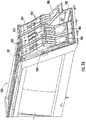
- FIG 2A is a rear perspective view of the truck body 100 of Figure 2 with the packing unit 101 removed to show the three segmented shields 182 arranged to close each of the rear openings 107 of the three compartments 114, 116, 118.
- Each segmented shield 182 includes an upper segment 184 and a lower segment 186.
- the upper segments 184 are hingedly connected at the upper rear edge of the truck body 100, and the lower segments 186 are hingedly connected to the lower edge of the upper segments 184.
- the two segmented shields 182 covering the rear openings of the left compartment 114 and center compartment 116 are shown in the closed position where the lower segment 186 and the upper segment 184 are against a rear edge of the divider walls 110, 112, closing the rear opening 107 of the left and center compartments 114,116.
- Raised side walls 204 on the upper shield segments 184 provide stop limits against the packing unit 101 the packing unit is in the loading position of Figures 3A-3D .
- the segmented shield 182 for the right compartment 118 is shown with the lower segment 186 angulated relative to the upper door segment 184 to a packing position which will be explained with reference to Figures 3A-3D .
- Lower segment actuators 202 are arranged to move the lower segment 186 of each shield 182 between the closed position and the packing position. Hydraulic rod and cylinder actuators are illustrated, but other actuators maybe employed with suitable system modifications.
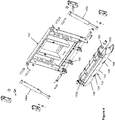
- FIG 4 is an exploded view of a sweep blade 132 and connected pack blade 152 for use in the three-compartment truck body of Figures 2 and 2A .
- the sweep blade 132 is connected to a lower edge of the pack blade 152 at a hinged joint 160.
- the sweep blade 132 extends laterally across all the sumps 126, 128, 130, and has three sections 140, 142, 144 corresponding to the three collection sumps, wherein the sweep blade sections 140, 142, 144 are movable respectively within each sump 126, 128, 130.
- the sweep blade 132 includes two slots 134, 136 that accommodate the refuse separators 122, 124, respectively, allowing the sweep blade sections to extend to the bottom of each sump 126, 128, 130, while the refuse separators 122, 124 keep different types of refuse segregated.
- the sweep blade 132 illustrated in Figure 4 is a single blade that includes slots 134, 136 and is rotated about the hinged connection 160 to the pack blade 152 by two or more hydraulic actuators 146a and 146c, shown in Figure 4 .
- the sweep blade 132 could be constructed of separate blade segments, each connected at a hinge connection to a lower edge of the pack blade 152.
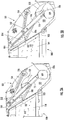
- FIGS 3A-3D are side sectional views of a truck body 100 and associated packer unit 101 according to aspects of the invention.
- the packing unit 101 is shown in the position where refuse 109 is deposited into the sumps, which will be referred to as the "loading" position of the packer 101.
- the upper shield segment 184 is closed against a rear edge of the divider wall 110, while the lower shield segment 186 is angulated to the packing position.
- the packing position of the lower shield segment 186 defines an opening between the lower shield segment 186 and the floor of the compartment 114 at the bottom of compartment opening 107.
- a packing cycle is performed by a sweep type packing unit 101 that can be incorporated into a refuse collecting vehicle having a body 100 divided into separate compartments 114, 116, 118 by divider walls 110, 112 as shown in Figures 2 and 2A .
- a pack blade 152 and connected sweep blade 132 move refuse 109 from separated sumps126, 128, 130 into the compartments 114, 116, 118.
- the left divider wall 110 and left compartment 114 are shown in Figures 3A-3D .
- a packing cycle begins in Figure 3A , with the pack blade 152 in a retracted position and the sweep blade 132 in an open position. Refuse 109 has been deposited in the left sump 126 associated with left compartment 114.
- the pack blade 152 is moved to an extended position. With the pack blade 152 in the extended position and the sweep blade open as shown in Figure 3B , the sweep blade 132 is positioned in the sump 126 with refuse 109 between the sweep blade 132 and the opening 107 to the compartment 114.
- the sweep blade 132 is rotated to sweep the bottom edge of the sweep blade 132 through an arc concentric with a curved bottom of the sump 126, during which refuse 109 is swept from the sump 126 toward the opening 107 of the compartment 114.
- the sweep blade is held in the swept position while the pack blade 152 is retracted to move refuse 109 through the opening between the lower shield segment 186 and the floor 103 of the compartment 114, with the lower segment 186 guiding refuse 109 into the compartment 114.
- the sump 126 is now empty and ready to receive another load of segregated refuse 109.
- the packer unit 101 employs a single pack blade 152 and a single, slotted sweep blade 132, so the packing cycle described for sump 126 and compartment 114 is identical for sumps 128 and 130 and associated compartments 116 and 118.
- Retraction of actuators (hydraulic cylinders) 146 moves the sweep blade 132 from the closed (swept) position to the open position as shown in Figures 3A and 3B .
- Retraction of actuators (hydraulic cylinders) 154 move the pack blade 152 from the retracted to the extended position as shown in Figures 3B and 3C .
- Extension of hydraulic actuators 146 moves the sweep blade 132 from the open position to the swept position as shown Figures 3C and 3D .
- the pack blade 152 is retracted and in cooperation with the angled sweep blade 132, pushes the swept refuse 109 through the channels between refuse separators 122, 124 into compartment openings 107 while maintaining segregation of the refuse between the refuse separators 122, 124.
- the rearward edges 111 of refuse separators 122, 124 are positioned and inclined so that the oblique, linear movement of the pack blade 152 closely follows the edges 111 of the refuse separators 122, 124.
- the pack blade 152 has a lower edge that is pivotally connected along a transverse axis to an upper edge of the sweep blade 132; a first drive system 146a, 146b, 146c pivots the sweep blade 132 around the transverse axis, over an included angle that follows the shape of the sumps 126, 128, 130; and a second drive system 154a, 154b displaces the pack blade 152 and sweep blade 132 obliquely from the sumps 126, 128, 130 to the floors 103 of the compartments 114, 116, 118.
- Refuse in each compartment 114, 116, 118 is packed as the pack blade 152 and sweep blade 132 sections 140, 142, 144, push the refuse 109 into the openings 107 at the rear of the compartments 114, 116, 118.
- the refuse 109 is pushed against packing faces 162, 164, 166 on the ejection cylinders 168, 170, 172.
- the ejection cylinders 168, 170, 172 retract as the compartments 114, 116, 118 fill with packed refuse.
- the entire packing unit 101 pivots upwardly to expose the compartment openings 107 at the rear of the body 100.
- the ejection cylinders 168, 170, 172 are extended to push the refuse out the back end of the truck into three different dumping stations for the respective three different kinds of refuse.
- hydraulic lower segment actuators 202 are connected between the upper segment 284 and lower segment 286 of the composite shields 282 to selectively angulate the lower segment 286 relative to the upper segment 284 to a packing position as shown in Figures 3A-3D .
- This embodiment of a multi-compartment refuse collecting truck body 200 differs from the first embodiment 100 of Figures 2-4 primarily with respect to the number of compartments, and the number of associated structures.
- the structure and function of the packer unit 201 is substantially identical to that of packer unit 101, with the exception that the packer unit 201 has one refuse divider 222, dividing the sump into two collection sumps 226, 228 and the sweep blade 232 has a single slot to accommodate the divider 222.
- the structure and function of the multi-compartment refuse collecting truck body 200 is substantially identical to the structure and function of the refuse collecting truck body 100 and will be described in detail only with respect to how the truck body 200 differs from the truck body 100
- Refuse collecting truck body 200 mounts actuators 221 (hydraulic cylinders) to open and close segmented shields 282 inside the compartments 214, 216. As shown in Figures 6-8 , the actuators 221 are mounted within a protective metal box 223 at the upper inside corners of each compartment 214, 216.
- the protective metal boxes 223 extend the length of the compartments 214, 216, so that the compartment has a substantially constant cross-sectional shape that facilitates the packing and discharge of refuse.
- the protective boxes 223 include reinforcements 225 to support the actuators 221.
- the packing face 262 connected to an ejection cylinder for each compartment 214, 216 has a sectional shape that corresponds to the sectional shape of the compartment, including the protective metal boxes 223, so that actuation of an ejection cylinder to advance the packing face 262 toward the compartment rear opening 207 ejects substantially all refuse from the compartment.
- the lower potion of the packing face 262 has a plow shape to scoop refuse from the floor 203 of the compartments 214, 216 and move the refuse to the rear opening 207 of the compartment 214, 216.
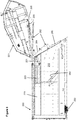
- Figure 5 shows the truck body 200 in a condition to receive refuse.
- the packing unit 201 is in it is lowered loading position and is locked to the truck body 200 by latches 205.
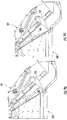
- the position of the latches 205 is controlled by an actuator 206, so the packing unit 201 cannot be raised to the dumping position shown in Figures 6 and 7 unless the actuator 206 moves the latch 205 to an unlocked position.
- the lower segments 286 of the segmented shields 282 are in the angulated packing position to define a path for refuse into the compartments 214, 216 and are not visible in the view of Figure 5 .
- the sweep blade 232 is shown in the open position with the pack blade 252 retracted, corresponding to the positions shown in Figure 3A .
- the truck body 200 and packing unit 201 can receive two types of refuse in the sumps 226, 228.
- a packing cycle as illustrated in Figures 3A-3D will move refuse from the sumps 226, 228 into the compartments 214, 216 as previously described.
- the lower shield segments 286 are moved from the packing position shown in Figures 3A-3D to a closed position in line with the upper shield segments 284 and against the rear end of the truck body 200 to close the compartment 214, 216.
- Figures 9A and 9B show the relative positions of the sweep blade 232 and lower shield segment 286 with the sweep blade 232 in the swept position and the pack blade 252 retracted.
- the lower edge of the lower shield segment 286 has clearance to move across a face of the sweep blade 232 to the closed position without the need to open the sweep blade 232.
- the lower shield segments 286 can be moved from the packing position to the closed position by extension of the lower segment actuators 202 as shown in Figures 9A and 9B before the packing unit 201 is raised.
- the upper shield segments are held in the closed position by the packing unit 201 and by the retracted actuators 221.
- the actuators 221 are maintained in their retracted state, holding the segmented shields 282 in the closed position.
- Figures 3A - 3D illustrate the position of the lower shield segments 186 and the packing unit 101 during collection and packing of refuse. It will be understood that the positions of shield segments 284 and 286 of truck body 200 will correspond to the positions descried for shield segments 184 and 186 in the following discussion.
- the vehicle is taken to a site for the offloading of refuse into collection stations for each type of refuse.
- the disclosed multi-compartment refuse collecting truck bodies 100, 200 incorporate segmented shields 182, 282, that can be closed to prevent spillage and mixing of refuse that is intended to be kept separate.
- a control system is provided to ensure the correct sequence of operations for a desired function.
- the control system is operatively connected to the packing unit locking actuators 206 that unlock the packing unit 201, packing unit actuators 280 that raise the packing unit, lower segment actuators 202 that angulate the lower shield segments 286 between the packing and closed positions, shield opening actuators 221 that move the segmented shields 182, 282 to the open position, and ejection cylinders 168, 170, 172 that discharge material from each compartment 114, 116, 118.
- the disclosed truck body 100, 200 includes a control interface 250 of levers, buttons or switches (control inputs) that allow an operator to select from several operational modes.
- a control input is provided for unlocking and raising the packer unit 101, 201 in preparation for discharging material from any of the compartments.
- the control system is configured to first operate the loser segment actuators 202 to move all the shield lower segments 186, 286 to the closed position before operating packing unit locking actuator 206 to unlock the packing unit 101, 201 and then operating the packing unit actuators 280 to raise packing unit 101, 201 to the unloading position. This ensures that no material is inadvertently discharged when the packing unit 101, 201 is raised.
- control input is actuated to discharge material from one of the compartments 114, 116, 118.
- the control system receives a signal from the control input to discharge material from a compartment, the control system first extends the shield opening actuators 221 to raise the segmented door 182, 282 for the selected compartment and then operates the ejection cylinder 168, 170, 172 to push material out of the selected compartment. After the material has been discharged, the control system retracts the shield opening actuators 221 to close the segmented shield 182, 282 for the compartment.
- the control system When receiving a control input to lower the packing unit 101, 201, the control system ensures that all segmented shields 182, 282 are closed before lowering and then locking the packing unit 101, 201 in its lowered (loading) position.
- the control system may be configured to place the lower shield segments 186, 286 in the packing position when the packing unit 101, 201 is in the lowered position.
- the control system may be configured to ensure that the lower shield segments 186, 286 are in the packing position before the sweep and pack blades will function to move material from the tailgate sumps into the compartments, e.g., the lower shield segments 186, 286 must be in the packing position before a packing cycle can begin.
- the control system may be constructed to perform all of the above-described operations or may perform one or more of the above-described operations.
- the control system may ensure the correct sequence of operations using hydraulic sequence valves in cooperation with hydraulic actuators for each moveable element.
- the control system may include a microcontroller configured to receive signals from control inputs and actuators associated with each moveable element. The microcontroller will execute a sequence of programmed instructions in a pre-determined sequence to ensure coordinated operation of the moving structures of the disclosed multi-compartment refuse collecting truck bodies.
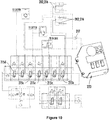
- Figure 10 is a hydraulic schematic showing a control system based upon hydraulic sequencing valves 215a -215e that can be used to control operation of the actuators to move components of the truck bodies 100, 200 in a coordinated fashion. It will be understood by those skilled in the art that similar functionality can be produced using electronic controls and that the disclosed functionality is not limited to a control system employing hydraulic sequence valves.
- An example of a control box 223 associated with such an electronic control system is shown in Figure 10 .
- the control box 223 may include a microcontroller with memory loaded with firmware configured to receive inputs from the control interface 250 and actuate hydraulic valves according to a programmed sequence to produce the coordinated sequence of actions described above.
- the use of electronic controls, including the connection and programming of a control box 223 are well-understood and can be implemented by those skilled in the art.
Landscapes
- Engineering & Computer Science (AREA)
- Mechanical Engineering (AREA)
- Refuse-Collection Vehicles (AREA)
Applications Claiming Priority (1)
| Application Number | Priority Date | Filing Date | Title |
|---|---|---|---|
| EP19191956 | 2019-08-15 |
Publications (1)
| Publication Number | Publication Date |
|---|---|
| EP3778434A1 true EP3778434A1 (de) | 2021-02-17 |
Family
ID=67659033
Family Applications (1)
| Application Number | Title | Priority Date | Filing Date |
|---|---|---|---|
| EP20191061.9A Withdrawn EP3778434A1 (de) | 2019-08-15 | 2020-08-14 | Automatische türsequenzierung zum entleeren von abfällen aus mehrkammerpacker |
Country Status (1)
| Country | Link |
|---|---|
| EP (1) | EP3778434A1 (de) |
Cited By (1)
| Publication number | Priority date | Publication date | Assignee | Title |
|---|---|---|---|---|
| US20230029433A1 (en) * | 2021-07-23 | 2023-01-26 | Micromatic Llc | Cart tipper protection device and process |
Citations (6)
| Publication number | Priority date | Publication date | Assignee | Title |
|---|---|---|---|---|
| EP0359083A1 (de) * | 1988-09-16 | 1990-03-21 | BRIVIO PIERINO & C. S.r.l. | Müllsammelfahrzeug |
| US5123801A (en) | 1990-09-27 | 1992-06-23 | Daniel Harold W O | Refuse collecting vehicle |
| US5816766A (en) * | 1997-02-11 | 1998-10-06 | Toccoa Metal Technologies, Inc. | Refuse vehicle dumping system |
| US7118320B2 (en) | 2003-03-21 | 2006-10-10 | Fanotech Enviro Inc. | Multiple compartment waste collection container |
| US20190009983A1 (en) * | 2017-07-10 | 2019-01-10 | Air-Flo Manufacturing Co., Inc. | Shield for three compartment rear load packer |
| US20200039167A1 (en) * | 2017-07-10 | 2020-02-06 | Air-Flo Manufacturing Co., Inc. | Automatic Door Sequencing for Discharging Refuse from Multi-Compartment Packer |
-
2020
- 2020-08-14 EP EP20191061.9A patent/EP3778434A1/de not_active Withdrawn
Patent Citations (6)
| Publication number | Priority date | Publication date | Assignee | Title |
|---|---|---|---|---|
| EP0359083A1 (de) * | 1988-09-16 | 1990-03-21 | BRIVIO PIERINO & C. S.r.l. | Müllsammelfahrzeug |
| US5123801A (en) | 1990-09-27 | 1992-06-23 | Daniel Harold W O | Refuse collecting vehicle |
| US5816766A (en) * | 1997-02-11 | 1998-10-06 | Toccoa Metal Technologies, Inc. | Refuse vehicle dumping system |
| US7118320B2 (en) | 2003-03-21 | 2006-10-10 | Fanotech Enviro Inc. | Multiple compartment waste collection container |
| US20190009983A1 (en) * | 2017-07-10 | 2019-01-10 | Air-Flo Manufacturing Co., Inc. | Shield for three compartment rear load packer |
| US20200039167A1 (en) * | 2017-07-10 | 2020-02-06 | Air-Flo Manufacturing Co., Inc. | Automatic Door Sequencing for Discharging Refuse from Multi-Compartment Packer |
Cited By (2)
| Publication number | Priority date | Publication date | Assignee | Title |
|---|---|---|---|---|
| US20230029433A1 (en) * | 2021-07-23 | 2023-01-26 | Micromatic Llc | Cart tipper protection device and process |
| US12391469B2 (en) * | 2021-07-23 | 2025-08-19 | Micromatic Llc | Cart tipper protection device and process |
Similar Documents
| Publication | Publication Date | Title |
|---|---|---|
| US6210094B1 (en) | Refuse collection system | |
| US7070382B2 (en) | Full eject manual/automated side loader | |
| US10752439B2 (en) | Shield for three compartment rear load packer | |
| US5813818A (en) | Multi-compartment side bucket refuse collection system | |
| US20090067965A1 (en) | Side-loading refuse collection apparatus and method | |
| US5885049A (en) | Ejection mechanism for refuse trucks | |
| US6146078A (en) | Refuse body having single-stage packing and full ejection | |
| EP0368077A1 (de) | Müllsammelbehälter mit mehreren Kammern | |
| US5681140A (en) | Multiple compartment body for waste materials | |
| US6234739B1 (en) | Compaction mechanism for refuse and recyclables collection vehicles | |
| US11518612B2 (en) | Multi-compartment refuse collecting truck body and control system | |
| WO1996025350A9 (en) | Multiple compartment body for waste materials | |
| US5716103A (en) | Multi-compartmentalized dumping body with segmented bulkhead | |
| EP3778434A1 (de) | Automatische türsequenzierung zum entleeren von abfällen aus mehrkammerpacker | |
| US6435802B1 (en) | Multi compartment residential manual side loading collection vehicle | |
| US11173682B2 (en) | Automatic door sequencing for discharging refuse from multi-compartment packer | |
| EP0535072B1 (de) | Müllsammel- und transportsystem | |
| US5823728A (en) | Segmented residential front loading refuse collection vehicle | |
| CA3092716A1 (en) | Multi-compartment refuse collecting truck body and control system | |
| AU715010B2 (en) | A container | |
| US20190177085A1 (en) | Multi-Compartment Rear Load Packer | |
| EP0473603B1 (de) | Anordnung zum laden und entladen von mindestens zwei arten von abfallmaterialien | |
| EP1177145B1 (de) | Müllsammel- und transportsystem | |
| CA2454330A1 (en) | Multi-compartment vehicle | |
| EP0963922A1 (de) | Einschüttgehäuse eines Müllsammelfahrzeugs zum getrennten Sammeln von Müll |
Legal Events
| Date | Code | Title | Description |
|---|---|---|---|
| PUAI | Public reference made under article 153(3) epc to a published international application that has entered the european phase |
Free format text: ORIGINAL CODE: 0009012 |
|
| STAA | Information on the status of an ep patent application or granted ep patent |
Free format text: STATUS: THE APPLICATION HAS BEEN PUBLISHED |
|
| AK | Designated contracting states |
Kind code of ref document: A1 Designated state(s): AL AT BE BG CH CY CZ DE DK EE ES FI FR GB GR HR HU IE IS IT LI LT LU LV MC MK MT NL NO PL PT RO RS SE SI SK SM TR |
|
| AX | Request for extension of the european patent |
Extension state: BA ME |
|
| STAA | Information on the status of an ep patent application or granted ep patent |
Free format text: STATUS: REQUEST FOR EXAMINATION WAS MADE |
|
| 17P | Request for examination filed |
Effective date: 20210811 |
|
| RBV | Designated contracting states (corrected) |
Designated state(s): AL AT BE BG CH CY CZ DE DK EE ES FI FR GB GR HR HU IE IS IT LI LT LU LV MC MK MT NL NO PL PT RO RS SE SI SK SM TR |
|
| P01 | Opt-out of the competence of the unified patent court (upc) registered |
Effective date: 20230525 |
|
| STAA | Information on the status of an ep patent application or granted ep patent |
Free format text: STATUS: EXAMINATION IS IN PROGRESS |
|
| 17Q | First examination report despatched |
Effective date: 20240416 |
|
| STAA | Information on the status of an ep patent application or granted ep patent |
Free format text: STATUS: THE APPLICATION IS DEEMED TO BE WITHDRAWN |
|
| 18D | Application deemed to be withdrawn |
Effective date: 20240817 |