EP3777789B1 - Device for eye surgery - Google Patents
Device for eye surgery Download PDFInfo
- Publication number
- EP3777789B1 EP3777789B1 EP19727439.2A EP19727439A EP3777789B1 EP 3777789 B1 EP3777789 B1 EP 3777789B1 EP 19727439 A EP19727439 A EP 19727439A EP 3777789 B1 EP3777789 B1 EP 3777789B1
- Authority
- EP
- European Patent Office
- Prior art keywords
- ring
- coupling
- metallic ring
- lens
- coupling ring
- Prior art date
- Legal status (The legal status is an assumption and is not a legal conclusion. Google has not performed a legal analysis and makes no representation as to the accuracy of the status listed.)
- Active
Links
Images



Classifications
-
- A—HUMAN NECESSITIES
- A61—MEDICAL OR VETERINARY SCIENCE; HYGIENE
- A61F—FILTERS IMPLANTABLE INTO BLOOD VESSELS; PROSTHESES; DEVICES PROVIDING PATENCY TO, OR PREVENTING COLLAPSING OF, TUBULAR STRUCTURES OF THE BODY, e.g. STENTS; ORTHOPAEDIC, NURSING OR CONTRACEPTIVE DEVICES; FOMENTATION; TREATMENT OR PROTECTION OF EYES OR EARS; BANDAGES, DRESSINGS OR ABSORBENT PADS; FIRST-AID KITS
- A61F9/00—Methods or devices for treatment of the eyes; Devices for putting in contact-lenses; Devices to correct squinting; Apparatus to guide the blind; Protective devices for the eyes, carried on the body or in the hand
- A61F9/007—Methods or devices for eye surgery
-
- A—HUMAN NECESSITIES
- A61—MEDICAL OR VETERINARY SCIENCE; HYGIENE
- A61B—DIAGNOSIS; SURGERY; IDENTIFICATION
- A61B17/00—Surgical instruments, devices or methods
- A61B17/12—Surgical instruments, devices or methods for ligaturing or otherwise compressing tubular parts of the body, e.g. blood vessels or umbilical cord
- A61B17/12009—Implements for ligaturing other than by clamps or clips, e.g. using a loop with a slip knot
-
- A—HUMAN NECESSITIES
- A61—MEDICAL OR VETERINARY SCIENCE; HYGIENE
- A61B—DIAGNOSIS; SURGERY; IDENTIFICATION
- A61B3/00—Apparatus for testing the eyes; Instruments for examining the eyes
- A61B3/10—Objective types, i.e. instruments for examining the eyes independent of the patients' perceptions or reactions
- A61B3/12—Objective types, i.e. instruments for examining the eyes independent of the patients' perceptions or reactions for looking at the eye fundus, e.g. ophthalmoscopes
- A61B3/125—Objective types, i.e. instruments for examining the eyes independent of the patients' perceptions or reactions for looking at the eye fundus, e.g. ophthalmoscopes with contact lenses
-
- A—HUMAN NECESSITIES
- A61—MEDICAL OR VETERINARY SCIENCE; HYGIENE
- A61F—FILTERS IMPLANTABLE INTO BLOOD VESSELS; PROSTHESES; DEVICES PROVIDING PATENCY TO, OR PREVENTING COLLAPSING OF, TUBULAR STRUCTURES OF THE BODY, e.g. STENTS; ORTHOPAEDIC, NURSING OR CONTRACEPTIVE DEVICES; FOMENTATION; TREATMENT OR PROTECTION OF EYES OR EARS; BANDAGES, DRESSINGS OR ABSORBENT PADS; FIRST-AID KITS
- A61F2/00—Filters implantable into blood vessels; Prostheses, i.e. artificial substitutes or replacements for parts of the body; Appliances for connecting them with the body; Devices providing patency to, or preventing collapsing of, tubular structures of the body, e.g. stents
- A61F2/02—Prostheses implantable into the body
- A61F2/14—Eye parts, e.g. lenses or corneal implants; Artificial eyes
- A61F2/142—Cornea, e.g. artificial corneae, keratoprostheses or corneal implants for repair of defective corneal tissue
-
- A—HUMAN NECESSITIES
- A61—MEDICAL OR VETERINARY SCIENCE; HYGIENE
- A61F—FILTERS IMPLANTABLE INTO BLOOD VESSELS; PROSTHESES; DEVICES PROVIDING PATENCY TO, OR PREVENTING COLLAPSING OF, TUBULAR STRUCTURES OF THE BODY, e.g. STENTS; ORTHOPAEDIC, NURSING OR CONTRACEPTIVE DEVICES; FOMENTATION; TREATMENT OR PROTECTION OF EYES OR EARS; BANDAGES, DRESSINGS OR ABSORBENT PADS; FIRST-AID KITS
- A61F2/00—Filters implantable into blood vessels; Prostheses, i.e. artificial substitutes or replacements for parts of the body; Appliances for connecting them with the body; Devices providing patency to, or preventing collapsing of, tubular structures of the body, e.g. stents
- A61F2/02—Prostheses implantable into the body
- A61F2/14—Eye parts, e.g. lenses or corneal implants; Artificial eyes
- A61F2/145—Corneal inlays, onlays, or lenses for refractive correction
- A61F2/1453—Corneal lenses connected to distinct attachment means
-
- A—HUMAN NECESSITIES
- A61—MEDICAL OR VETERINARY SCIENCE; HYGIENE
- A61F—FILTERS IMPLANTABLE INTO BLOOD VESSELS; PROSTHESES; DEVICES PROVIDING PATENCY TO, OR PREVENTING COLLAPSING OF, TUBULAR STRUCTURES OF THE BODY, e.g. STENTS; ORTHOPAEDIC, NURSING OR CONTRACEPTIVE DEVICES; FOMENTATION; TREATMENT OR PROTECTION OF EYES OR EARS; BANDAGES, DRESSINGS OR ABSORBENT PADS; FIRST-AID KITS
- A61F9/00—Methods or devices for treatment of the eyes; Devices for putting in contact-lenses; Devices to correct squinting; Apparatus to guide the blind; Protective devices for the eyes, carried on the body or in the hand
- A61F9/0008—Introducing ophthalmic products into the ocular cavity or retaining products therein
- A61F9/0017—Introducing ophthalmic products into the ocular cavity or retaining products therein implantable in, or in contact with, the eye, e.g. ocular inserts
-
- A—HUMAN NECESSITIES
- A61—MEDICAL OR VETERINARY SCIENCE; HYGIENE
- A61F—FILTERS IMPLANTABLE INTO BLOOD VESSELS; PROSTHESES; DEVICES PROVIDING PATENCY TO, OR PREVENTING COLLAPSING OF, TUBULAR STRUCTURES OF THE BODY, e.g. STENTS; ORTHOPAEDIC, NURSING OR CONTRACEPTIVE DEVICES; FOMENTATION; TREATMENT OR PROTECTION OF EYES OR EARS; BANDAGES, DRESSINGS OR ABSORBENT PADS; FIRST-AID KITS
- A61F9/00—Methods or devices for treatment of the eyes; Devices for putting in contact-lenses; Devices to correct squinting; Apparatus to guide the blind; Protective devices for the eyes, carried on the body or in the hand
- A61F9/007—Methods or devices for eye surgery
- A61F9/008—Methods or devices for eye surgery using laser
- A61F9/009—Auxiliary devices making contact with the eyeball and coupling in laser light, e.g. goniolenses
-
- B—PERFORMING OPERATIONS; TRANSPORTING
- B60—VEHICLES IN GENERAL
- B60Q—ARRANGEMENT OF SIGNALLING OR LIGHTING DEVICES, THE MOUNTING OR SUPPORTING THEREOF OR CIRCUITS THEREFOR, FOR VEHICLES IN GENERAL
- B60Q1/00—Arrangement of optical signalling or lighting devices, the mounting or supporting thereof or circuits therefor
- B60Q1/26—Arrangement of optical signalling or lighting devices, the mounting or supporting thereof or circuits therefor the devices being primarily intended to indicate the vehicle, or parts thereof, or to give signals, to other traffic
- B60Q1/30—Arrangement of optical signalling or lighting devices, the mounting or supporting thereof or circuits therefor the devices being primarily intended to indicate the vehicle, or parts thereof, or to give signals, to other traffic for indicating rear of vehicle, e.g. by means of reflecting surfaces
-
- F—MECHANICAL ENGINEERING; LIGHTING; HEATING; WEAPONS; BLASTING
- F21—LIGHTING
- F21S—NON-PORTABLE LIGHTING DEVICES; SYSTEMS THEREOF; VEHICLE LIGHTING DEVICES SPECIALLY ADAPTED FOR VEHICLE EXTERIORS
- F21S41/00—Illuminating devices specially adapted for vehicle exteriors, e.g. headlamps
- F21S41/30—Illuminating devices specially adapted for vehicle exteriors, e.g. headlamps characterised by reflectors
- F21S41/32—Optical layout thereof
- F21S41/36—Combinations of two or more separate reflectors
- F21S41/365—Combinations of two or more separate reflectors successively reflecting the light
-
- F—MECHANICAL ENGINEERING; LIGHTING; HEATING; WEAPONS; BLASTING
- F21—LIGHTING
- F21S—NON-PORTABLE LIGHTING DEVICES; SYSTEMS THEREOF; VEHICLE LIGHTING DEVICES SPECIALLY ADAPTED FOR VEHICLE EXTERIORS
- F21S43/00—Signalling devices specially adapted for vehicle exteriors, e.g. brake lamps, direction indicator lights or reversing lights
- F21S43/10—Signalling devices specially adapted for vehicle exteriors, e.g. brake lamps, direction indicator lights or reversing lights characterised by the light source
- F21S43/13—Signalling devices specially adapted for vehicle exteriors, e.g. brake lamps, direction indicator lights or reversing lights characterised by the light source characterised by the type of light source
- F21S43/14—Light emitting diodes [LED]
-
- F—MECHANICAL ENGINEERING; LIGHTING; HEATING; WEAPONS; BLASTING
- F21—LIGHTING
- F21S—NON-PORTABLE LIGHTING DEVICES; SYSTEMS THEREOF; VEHICLE LIGHTING DEVICES SPECIALLY ADAPTED FOR VEHICLE EXTERIORS
- F21S43/00—Signalling devices specially adapted for vehicle exteriors, e.g. brake lamps, direction indicator lights or reversing lights
- F21S43/30—Signalling devices specially adapted for vehicle exteriors, e.g. brake lamps, direction indicator lights or reversing lights characterised by reflectors
-
- F—MECHANICAL ENGINEERING; LIGHTING; HEATING; WEAPONS; BLASTING
- F21—LIGHTING
- F21S—NON-PORTABLE LIGHTING DEVICES; SYSTEMS THEREOF; VEHICLE LIGHTING DEVICES SPECIALLY ADAPTED FOR VEHICLE EXTERIORS
- F21S43/00—Signalling devices specially adapted for vehicle exteriors, e.g. brake lamps, direction indicator lights or reversing lights
- F21S43/30—Signalling devices specially adapted for vehicle exteriors, e.g. brake lamps, direction indicator lights or reversing lights characterised by reflectors
- F21S43/31—Optical layout thereof
-
- F—MECHANICAL ENGINEERING; LIGHTING; HEATING; WEAPONS; BLASTING
- F21—LIGHTING
- F21V—FUNCTIONAL FEATURES OR DETAILS OF LIGHTING DEVICES OR SYSTEMS THEREOF; STRUCTURAL COMBINATIONS OF LIGHTING DEVICES WITH OTHER ARTICLES, NOT OTHERWISE PROVIDED FOR
- F21V7/00—Reflectors for light sources
- F21V7/0025—Combination of two or more reflectors for a single light source
-
- A—HUMAN NECESSITIES
- A61—MEDICAL OR VETERINARY SCIENCE; HYGIENE
- A61B—DIAGNOSIS; SURGERY; IDENTIFICATION
- A61B17/00—Surgical instruments, devices or methods
- A61B2017/00831—Material properties
- A61B2017/00862—Material properties elastic or resilient
-
- A—HUMAN NECESSITIES
- A61—MEDICAL OR VETERINARY SCIENCE; HYGIENE
- A61B—DIAGNOSIS; SURGERY; IDENTIFICATION
- A61B17/00—Surgical instruments, devices or methods
- A61B2017/00831—Material properties
- A61B2017/00867—Material properties shape memory effect
-
- A—HUMAN NECESSITIES
- A61—MEDICAL OR VETERINARY SCIENCE; HYGIENE
- A61B—DIAGNOSIS; SURGERY; IDENTIFICATION
- A61B17/00—Surgical instruments, devices or methods
- A61B2017/00831—Material properties
- A61B2017/00876—Material properties magnetic
-
- A—HUMAN NECESSITIES
- A61—MEDICAL OR VETERINARY SCIENCE; HYGIENE
- A61B—DIAGNOSIS; SURGERY; IDENTIFICATION
- A61B17/00—Surgical instruments, devices or methods
- A61B2017/00831—Material properties
- A61B2017/00902—Material properties transparent or translucent
- A61B2017/00907—Material properties transparent or translucent for light
-
- A—HUMAN NECESSITIES
- A61—MEDICAL OR VETERINARY SCIENCE; HYGIENE
- A61B—DIAGNOSIS; SURGERY; IDENTIFICATION
- A61B17/00—Surgical instruments, devices or methods
- A61B17/12—Surgical instruments, devices or methods for ligaturing or otherwise compressing tubular parts of the body, e.g. blood vessels or umbilical cord
- A61B2017/12004—Surgical instruments, devices or methods for ligaturing or otherwise compressing tubular parts of the body, e.g. blood vessels or umbilical cord for haemostasis, for prevention of bleeding
-
- A—HUMAN NECESSITIES
- A61—MEDICAL OR VETERINARY SCIENCE; HYGIENE
- A61F—FILTERS IMPLANTABLE INTO BLOOD VESSELS; PROSTHESES; DEVICES PROVIDING PATENCY TO, OR PREVENTING COLLAPSING OF, TUBULAR STRUCTURES OF THE BODY, e.g. STENTS; ORTHOPAEDIC, NURSING OR CONTRACEPTIVE DEVICES; FOMENTATION; TREATMENT OR PROTECTION OF EYES OR EARS; BANDAGES, DRESSINGS OR ABSORBENT PADS; FIRST-AID KITS
- A61F9/00—Methods or devices for treatment of the eyes; Devices for putting in contact-lenses; Devices to correct squinting; Apparatus to guide the blind; Protective devices for the eyes, carried on the body or in the hand
- A61F9/007—Methods or devices for eye surgery
- A61F9/008—Methods or devices for eye surgery using laser
- A61F2009/00861—Methods or devices for eye surgery using laser adapted for treatment at a particular location
- A61F2009/00872—Cornea
Definitions
- This invention belongs to the field of ophthalmology.
- the object of the present invention is a device designed for:
- EOH Expulsive ocular haemorrhage
- the predisposing factors of EOH are arteriosclerosis and/or hypertension in elderly patients, increased intraocular pressure, increased extraocular pressure, decreased scleral stiffness and severe myopia.
- During surgery there are other predisposing factors such as sudden increase in blood pressure, cough, loss of vitreous humour, as well as any pressure on the eyeball.
- EOH may occur in any type of intraocular surgery, although there is a special predisposition in surgeries wherein the intraocular content is exposed, as it happens, among others, in penetrating keratoplasty surgery.
- the appearance of EOH is usually unexpected and, due to this, the surgeon is not usually prepared to treat it efficiently immediately.
- EOH EOH
- posterior sclerotomies are performed that allow the drainage of blood from the supracoroid haemorrhage, with or without the aid of intraocular surgery to replace structures such as the retina.
- US 2005288697 A1 discloses a ring for vitreous surgery, adapted to support a contact lens for the vitreous surgery on a patient's eye.
- the ring comprises: a ring body; a flange having a contact surface of a curved shape to be fitted with a curved shape of a sclera of the eye, the flange being provided on an outer edge of the ring body; a hole provided in the flange, in which an intraocular insertion surgical instrument is insertable; and a projection provided in the vicinity of the hole on the contact surface of the flange, the projection being able to bite into a conjunctiva of the eye.
- US 2012099077 A1 discloses an ophthalmoscopic surgical contact lens for placement on an eye of a patient.
- the surgical contact lens includes an optic surrounded by a rim and at least one flange.
- the optic includes an aspheric anterior surface and a posterior surface having a shape substantially corresponding to the shape of a human cornea.
- the rim comprising an edge surrounding the optic, provides the user with a gripping surface conducive to manual positioning and repositioning of the lens against a human eye.
- the flange may include a plurality of tabs extending from a periphery of the flange, wherein each tab is shaped and configured to conform to the curvature of a human sclera.
- Various embodiments of the contact lenses disclosed facilitate the visualization of structures within the interior of an eye, such as may be necessary during vitreoretinal surgical procedures.
- US 2012140180 A1 refers to a holding device for contact lens for vitreous surgery, a holding device set, and contact lens for vitreous surgery, and lens set. It discloses a lens holding ring held by a string-like body stretched along a surface of an eyeball by being supported by a plurality of cannulas inserted to a sclera, and fixed to the surface of the eyeball by a tensile stress of the string-like body, and in this state, it holds a surgery lens on the eyeball.
- the lens holding ring comprises a lens holder including an opening into which a lens is inserted, and engagement parts provided at positions opposed to each other across the opening.
- Each engagement part has an engagement structure of engaging with the string-like body for fixing the lens holder to the surface of the eyeball so as to interpose the lens holder therein, and has a folded part on the tip of the engagement part for preventing coming-off of the string-like body.
- the present invention solves the above problems by means of a novel device particularly designed to stop an EOH almost immediately.
- the particular design of this device also allows the performance of combined surgery of penetrating keratoplasty and posterior segment of the eyeball, as well as surgery of the experimental posterior segment in globes with media opacity.
- the present invention is directed to a device for ophthalmological surgery comprising mainly two components: a metallic ring; and a locking element attachable to said metallic ring.
- the main function of the metallic ring is purely structural and so the material of which it is made is primarily a biocompatible metal commonly used in the field of ophthalmology, such as steel, nitinol or titanium.
- the ring may be covered or contain a series of modules to facilitate its attachment to the locking element. The geometry of these modules makes it possible for the ring to be adapted to the surface of the eyeball, as well as to fix it to the locking element by means of sealing mechanisms described in the following sections.
- the number of modules that the ring can have may be from 0 to 50 and the material of which the modules are made may be any of the biocompatible materials used in the field of ophthalmology such as steel, titanium or polymeric base: polyethylene (PE), polyethylene terephthalate (PEFT), polypropylene (PP), polycaprolactone (PEEK), polyamide (PA), polytetrafluoroethylene (PTFE), polyurethane (PU - TPU), polyarylketone (PAA), polystyrene (PS), polyvinyl chloride (PVC), acrylonitrile butadiene styrene (ABS), poly lactic acid (PLA) or similar either in terms of molecular weight or the mixture of various materials.
- PE polyethylene
- PEFT polyethylene terephthalate
- PP polypropylene
- PEEK polycaprolactone
- PA polyamide
- PTFE polytetrafluoroethylene
- PU - TPU polyurethane
- the diameter of the metallic ring is similar to that of similar rings currently used in the context of ophthalmology, such as the Flieringa ring.
- the metallic ring of the present invention may have a diameter between 11 mm and 24mm.
- the metallic ring of the invention may have a cross section of different shapes as long as they allow it to be attached to the locking element, as will be explained below in this document.
- the metallic ring may have a circular cross section, in which case it would be similar to the Flieringa ring.
- the metallic ring may have a parallelepipedic cross section, e.g. rectangular, square, or similar.
- the shape of the cross section of the modules attached to the metallic ring may coincide with the shape of the cross section of the metallic ring and may have a circular or parallelepipedal shape.
- the metallic ring may contain one or more protrusions ("tabs") of the same materials used in the metallic ring or in the modules to be used as fasteners and facilitate the separation of the closure element when required during the surgical process.
- tabs protrusions
- the coupling ring has the function of ensuring the tightness/fixation of the system by joining the metallic ring to the lens.
- the coupling ring is attached to the lens along the entire circumference of the inner or outer edge of the lens.
- the coupling ring can be made of any of the biocompatible materials used in the field of ophthalmology such as steel, titanium, nitinol or polymeric base: polyethylene (PE), polyethylene terephthalate (PEFT), polypropylene (PP), polycaprolactone (PEEK), polyamide (PA), polytetrafluoroethylene (PTFE), polyurethane (PU - TPU), polyarylketone (PAA), polystyrene (PS), polyvinyl chloride (PVC), acrylonitrile butadiene styrene (ABS), poly lactic acid (PLA) or similar either in terms of molecular weight or the mixture of various materials.
- PE polyethylene
- PEFT polyethylene terephthalate
- PP
- it can be a magnet with magnetic properties e.g. of neodymium, an electromagnet, or it can be covered or contain a series of modules to facilitate its coupling to the metallic ring.
- the geometry of these modules allows the coupling ring to be adapted and/or fixed to the metallic ring by means of sealing mechanisms described in the following sections.
- the number of modules that the coupling ring can have may be from 0 to 50 and the material of which the modules are made may be any of the biocompatible materials used in the field of ophthalmology such as steel, titanium or polymeric base: polyethylene (PE), polyethylene terephthalate (PEFT), polypropylene (PP), polycaprolactone (PEEK), polyamide (PA), polytetrafluoroethylene (PTFE), polyurethane (PU - TPU), polyarylketone (PAA), polystyrene (PS), polyvinyl chloride (PVC), acrylonitrile butadiene styrene (ABS), poly lactic acid (PLA) or similar either in terms of molecular weight or the mixture of various materials.
- PE polyethylene
- PEFT polyethylene terephthalate
- PP polypropylene
- PEEK polycaprolactone
- PA polyamide
- PTFE polytetrafluoroethylene
- PU - TPU polyurethane
- the coupling ring has the particular characteristic of being configured for coupling to the metallic ring by means of one or more of the connections described below:
- the material of which the coupling ring is composed depends on the mechanism used to ensure fixation and/or closure and may be and/or contain any of the biocompatible materials used in the field of ophthalmology such as steel, titanium or polymeric base: polyethylene (PE), polyethylene terephthalate (PEFT), polypropylene (PP), polycaprolactone (PEEK), polyamide (PA), polytetrafluoroethylene (PTFE), polyurethane (PU - TPU), polyarylketone (PAA), polystyrene (PS), polyvinyl chloride (PVC), acrylonitrile butadiene styrene (ABS), poly lactic acid (PLA) or similar either in terms of molecular weight or the mixture of various materials.
- PE polyethylene
- PEFT polyethylene terephthalate
- PP polypropylene
- PEEK polycaprolactone
- PA polyamide
- PTFE polytetrafluoroethylene
- PU - TPU polyurethane
- the coupling ring may be or contain a magnetic or ferromagnetic material to ensure its closure, while for the sealed connection the coupling ring material shall be of elastomeric origin in the field of ophthalmology, preferably medical grade silicone or polyurethane.
- the metallic ring of the invention it is possible to use the metallic ring of the invention to perform functions similar to those of the Flieringa ring and, in the event of an EOH, the surgeon can quickly attach the locking element to the metallic ring by means of the coupling ring. Thanks to the lens attached to the coupling ring, bleeding is blocked much more quickly than with solutions currently in use.
- the diameter of the locking element can be between 12 mm and 18 mm.
- the coupling between the coupling ring and the metallic ring can be carried out in different ways.
- the coupling ring has magnetic properties for the coupling of the metallic ring. That is, the coupling ring is shaped like a magnet in such a way that it attracts the metallic ring. This configuration is advantageous because it allows an almost immediate coupling of the locking element to the metallic ring.
- both the coupling ring and the metallic ring can have any cross section shape as long as it allows the described magnetic coupling.
- the coupling ring has a cross section with a cavity whose shape is complementary to the shape of the cross section of the metallic ring.
- the coupling ring has a channel which runs along its entire circumference on one side and which has a cross section complementary to the cross section of the metallic ring.
- the cross sectional shape of the metallic ring is complementary to the cross sectional cavity shape of the coupling ring.
- the cavity of the coupling ring may be shaped like a parallelepiped (it could be rectangular, square, etc.), in which case the metallic ring would have a correspondingly parallelepipedic cross section (correspondingly, it could also be rectangular, square, etc.).
- the cavity of the coupling ring may be semicircular, in which case the metallic ring would have a circular cross section.
- the metallic ring would be very similar to a Flieringa ring.
- the coupling between the coupling ring and the metallic ring can be performed in other ways different from the magnetic coupling.
- it may be a threaded coupling, in which case the coupling ring and the metallic ring include additional threads that enable them to be coupled.
- the device of the invention may in addition comprise fixing clips for the coupling between the coupling ring and the metallic ring.
- any coupling system that allows a quick coupling between the two elements could be used.
- the coupling ring may contain fixation (or anchorage) elements to be able to adapt in the same coupling ring different types of lenses for posterior segment surgery and for combined surgery of penetrating and posterior segment keratoplasty.
- fixation elements can have different diameters and/or heights so that they can be optimally adapted to the different types of lenses available for surgery.
- the lens can in principle be of any shape, type and material as long as it blocks the bleeding when fixed to the metallic ring through the coupling ring.
- the lens is a transparent lens made of plastic, for example of polymethylmethacrylate.
- the lens is made of a material compatible with paracentesis, such as silicone.
- the lens has a range of central curvature in its optical zone for correct visualisation and with the possibility of adapting lenses in the context of surgery combined with the posterior segment of the eyeball, being just as useful as the temporary keratoprosthetics currently used, with the advantage that the time of application is much faster.
- the lens design must allow for the adaptation of surgical lenses that assist in the visualisation of the posterior segment (curvature around 20o in the optical zone), the lens is similar to a rigid corneoscleral lens with a central curvature in its optical zone, transition zone and anchorage zone to the coupling ring.
- the device of the invention adequately solves the problems described above, as it makes it possible to deal with an EOH in an almost immediate manner. Below is a brief description of how to use this device.
- the device When the device is used according to the invention, it is based on a situation in which the metal ring is sutured to the sclera.
- the use of metallic rings of this type sutured to sclera in penetrating keratoplasty surgeries, such as the Flieringa ring, is well known.
- the ring helps maintain the architecture of the eyeball when the inner contents are exposed by removing the injured cornea.
- it has been used to counteract the hypotonia caused by the surgical procedure and thus decrease the likelihood of EOH. If an EOH occurs in this situation, it can be stopped almost immediately by coupling the locking element to the metallic ring. To do this, the coupling ring simply needs to be attached to the metallic ring by means of the magnetic, mechanical or sealed connection in question.
- the lens serves as a barrier to prevent bleeding.
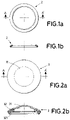
- Figures 1a and 1b show a first example of a metallic ring (2) according to the invention which has a rectangular cross section. As can be seen, the rectangle constituting the cross section has a certain inclination, in such a way that the upper surface of the metallic ring (2) has a conical surface. This configuration is necessary for a good coupling with the coupling ring (32), as will be explained later.
- the dimensions of this metallic ring (2) can range from 11 mm to 24 mm.
- Figures 2a and 2b show the locking element (3) which consists of the lens (31) and the coupling ring (32).
- the lens (3) has a convex shape similar to the lenses commonly used in this field.
- the coupling ring (32) has an essentially rectangular cross sectional shape with a cavity (321) on the lower side, which also has a rectangular shape which is complementary to the rectangular shape of the metallic ring (2) described above.
- the cavity (321) forms a rectangular-shaped recessed channel that runs along the entire circumference of the lower side of the coupling ring (32).
- the curvature of the lens (3) causes the channel formed by the cavity (321) of the coupling ring (32) to be oriented with a certain inward inclination.
- the coupling ring (32) has magnetic properties.
- Figures 3a and 3b show the process of coupling the locking element (3) to the metallic ring (2). It can be observed that the metallic ring (2) fits perfectly into the channel formed on the bottom surface of the coupling ring (32). The magnetism of the coupling ring (32) attracts the metallic ring (2), thus preventing it from being unintentionally uncoupled.
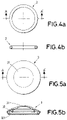
- Figures 4a and 4b show a second example of a metallic ring (2) according to the invention which has a circular cross section. It would therefore be a ring (2) very similar to the well-known Flieringa ring.
- Figures 5a and 5b show a second example of the locking element (3) wherein the coupling ring (32) has a semicircular cross section cavity (321). Therefore, in this case, the lower surface of the coupling ring (32) has a semicircular channel that runs along its entire circumference. Also, in this example, the semicircular channel formed by the cavity (321) of the coupling ring (32) is oriented with a certain inward inclination, a consequence of the very curvature of the lens (31) to which it is fixed. As in the first example, the coupling ring (32) has magnetic properties.
- Figures 6a and 6b show the coupling of the locking element (3) on the metallic ring (2) of this second example of the device (1) according to the invention.
- Figure 9 shows a third example of a device of the invention, with a metallic ring (2) and a locking element (3), in which the connection between these components is a sealed connection.
- the sealed connection consists of connection by means of a material of elastomeric nature of the coupling ring (32) with the metallic ring (2).
- the coupling ring (32) is made of an elastomer material, preferably medical silicone or polyurethane.
- Figure 12 shows an example of a device of the invention with a metallic ring (2) and a locking element (3), in which the joint between these components is a mechanical connection.
- the metallic ring (2) has grooves (40) and the coupling ring (32) has protrusions (41), in such a way that the metallic ring (2) can be fixed and/or sealed with the coupling ring (32).
- Figure 13 shows an example of a device of the invention with a metallic ring (2) and a locking element (3), in which the connection between these components is a magnetic connection as described above.
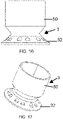
- Figures 16 and 17 show an example of a coupling ring (32) of a locking element (3) of a device of the invention to which a surgical lens (50) has been adapted.
- Figures 14 and 15 show only the coupling ring (32) from Figures 16 and 17 , which can be fitted with various types of surgical lenses.
Landscapes
- Health & Medical Sciences (AREA)
- Engineering & Computer Science (AREA)
- Life Sciences & Earth Sciences (AREA)
- Ophthalmology & Optometry (AREA)
- Biomedical Technology (AREA)
- Veterinary Medicine (AREA)
- Heart & Thoracic Surgery (AREA)
- Animal Behavior & Ethology (AREA)
- General Health & Medical Sciences (AREA)
- Public Health (AREA)
- Vascular Medicine (AREA)
- Surgery (AREA)
- General Engineering & Computer Science (AREA)
- Nuclear Medicine, Radiotherapy & Molecular Imaging (AREA)
- Physics & Mathematics (AREA)
- Optics & Photonics (AREA)
- Transplantation (AREA)
- Molecular Biology (AREA)
- Medical Informatics (AREA)
- Cardiology (AREA)
- Oral & Maxillofacial Surgery (AREA)
- Reproductive Health (AREA)
- Microelectronics & Electronic Packaging (AREA)
- Biophysics (AREA)
- Mechanical Engineering (AREA)
- Prostheses (AREA)
Description
- This invention belongs to the field of ophthalmology.
- The object of the present invention is a device designed for:
- 1. Stopping an expulsive ocular haemorrhage immediately during ocular surgery.
- 2. Improving intraoperative visualisation of the inside of the eyeball during keratoplasty surgeries.
- 3. Facilitating posterior segment surgery (including but not limited to laser surgery) during combined keratoplasty and posterior segment surgeries.
- 4. Performing experimental intraocular surgery especially when the cornea has opacities.
- In addition, it is a system that allows the use of different types of lenses in the context of eye surgery.
- Expulsive ocular haemorrhage (EOH) is one of the most serious complications in the context of ocular surgery. The predisposing factors of EOH are arteriosclerosis and/or hypertension in elderly patients, increased intraocular pressure, increased extraocular pressure, decreased scleral stiffness and severe myopia. During surgery there are other predisposing factors such as sudden increase in blood pressure, cough, loss of vitreous humour, as well as any pressure on the eyeball. EOH may occur in any type of intraocular surgery, although there is a special predisposition in surgeries wherein the intraocular content is exposed, as it happens, among others, in penetrating keratoplasty surgery. The appearance of EOH is usually unexpected and, due to this, the surgeon is not usually prepared to treat it efficiently immediately.
- The main goal of treating EOH is to stop the bleeding as soon as possible. Currently, this is done either with a rapid suture in those cases wherein the only communication between the inside and outside of the globe is a solution of continuity, or in cases of corneal transplant surgery by applying the finger on the surgical wound in order to plug it or using a blocking lens. Once the situation is stabilised, posterior sclerotomies are performed that allow the drainage of blood from the supracoroid haemorrhage, with or without the aid of intraocular surgery to replace structures such as the retina.
- However, at present there is no sufficiently rapid and effective solution as would be desirable.
- In the process of EOH treatment the origin and possible related complications such as the detachment of isolated choroids or associated with retinal detachment must be verified. A correct visualisation is essential for a correct therapeutic decision.
- In this sense, not only in cases of EOH during penetrating keratoplasty but also in those of combined surgery involving a complete corneal and retina transplant, a correct visualisation is required that until now has been made through the use of temporary keratoprosthetics anchored to the ocular wall through sutures. In the context of an EOH the suture is difficult because the displaced intraocular content hinders the process. In addition, in the surgical process, certain lenses are necessary that require the collaboration of an assistant in order to obtain a correct visualisation.
- Finally, part of the experimental ophthalmologic surgery is developed with human eyeballs as well as those from other species. Generally, the main problem that is usually found is the opacity of corneal media caused by the passage of hours due to the interruption of the metabolism. In this sense, there are no alternatives to temporary keratoprosthetics.
-
US 2005288697 A1 discloses a ring for vitreous surgery, adapted to support a contact lens for the vitreous surgery on a patient's eye. The ring comprises: a ring body; a flange having a contact surface of a curved shape to be fitted with a curved shape of a sclera of the eye, the flange being provided on an outer edge of the ring body; a hole provided in the flange, in which an intraocular insertion surgical instrument is insertable; and a projection provided in the vicinity of the hole on the contact surface of the flange, the projection being able to bite into a conjunctiva of the eye. -
US 2012099077 A1 discloses an ophthalmoscopic surgical contact lens for placement on an eye of a patient. The surgical contact lens includes an optic surrounded by a rim and at least one flange. The optic includes an aspheric anterior surface and a posterior surface having a shape substantially corresponding to the shape of a human cornea. The rim, comprising an edge surrounding the optic, provides the user with a gripping surface conducive to manual positioning and repositioning of the lens against a human eye. The flange may include a plurality of tabs extending from a periphery of the flange, wherein each tab is shaped and configured to conform to the curvature of a human sclera. Various embodiments of the contact lenses disclosed facilitate the visualization of structures within the interior of an eye, such as may be necessary during vitreoretinal surgical procedures. -
US 2012140180 A1 refers to a holding device for contact lens for vitreous surgery, a holding device set, and contact lens for vitreous surgery, and lens set. It discloses a lens holding ring held by a string-like body stretched along a surface of an eyeball by being supported by a plurality of cannulas inserted to a sclera, and fixed to the surface of the eyeball by a tensile stress of the string-like body, and in this state, it holds a surgery lens on the eyeball. The lens holding ring comprises a lens holder including an opening into which a lens is inserted, and engagement parts provided at positions opposed to each other across the opening. Each engagement part has an engagement structure of engaging with the string-like body for fixing the lens holder to the surface of the eyeball so as to interpose the lens holder therein, and has a folded part on the tip of the engagement part for preventing coming-off of the string-like body. - The present invention solves the above problems by means of a novel device particularly designed to stop an EOH almost immediately. The particular design of this device also allows the performance of combined surgery of penetrating keratoplasty and posterior segment of the eyeball, as well as surgery of the experimental posterior segment in globes with media opacity.
- The present invention is directed to a device for ophthalmological surgery comprising mainly two components: a metallic ring; and a locking element attachable to said metallic ring.
- Each of these components is described in more detail below.
- This is a structural ring suitable to be sutured to the sclera of a patient's eye. Rings similar to this one, such as the Flieringa ring, are commonly used in this field to avoid the collapsing of the anterior segment when certain interventions are performed, such as keratoplasty combined with cataract extraction or extracapsular extraction in an eye with very high level of myopia.
- The main function of the metallic ring is purely structural and so the material of which it is made is primarily a biocompatible metal commonly used in the field of ophthalmology, such as steel, nitinol or titanium. However, the ring may be covered or contain a series of modules to facilitate its attachment to the locking element. The geometry of these modules makes it possible for the ring to be adapted to the surface of the eyeball, as well as to fix it to the locking element by means of sealing mechanisms described in the following sections. The number of modules that the ring can have may be from 0 to 50 and the material of which the modules are made may be any of the biocompatible materials used in the field of ophthalmology such as steel, titanium or polymeric base: polyethylene (PE), polyethylene terephthalate (PEFT), polypropylene (PP), polycaprolactone (PEEK), polyamide (PA), polytetrafluoroethylene (PTFE), polyurethane (PU - TPU), polyarylketone (PAA), polystyrene (PS), polyvinyl chloride (PVC), acrylonitrile butadiene styrene (ABS), poly lactic acid (PLA) or similar either in terms of molecular weight or the mixture of various materials.
- The diameter of the metallic ring is similar to that of similar rings currently used in the context of ophthalmology, such as the Flieringa ring. For example, the metallic ring of the present invention may have a diameter between 11 mm and 24mm.
- As for the shape of its cross section, the metallic ring of the invention may have a cross section of different shapes as long as they allow it to be attached to the locking element, as will be explained below in this document. For example, the metallic ring may have a circular cross section, in which case it would be similar to the Flieringa ring. Alternatively, the metallic ring may have a parallelepipedic cross section, e.g. rectangular, square, or similar. The shape of the cross section of the modules attached to the metallic ring may coincide with the shape of the cross section of the metallic ring and may have a circular or parallelepipedal shape.
- Optionally, the metallic ring may contain one or more protrusions ("tabs") of the same materials used in the metallic ring or in the modules to be used as fasteners and facilitate the separation of the closure element when required during the surgical process.
- This is a locking element that can be fitted to the metallic ring and which comprises two different parts: a lens and a coupling ring.
- The coupling ring has the function of ensuring the tightness/fixation of the system by joining the metallic ring to the lens. The coupling ring is attached to the lens along the entire circumference of the inner or outer edge of the lens. In addition, the coupling ring can be made of any of the biocompatible materials used in the field of ophthalmology such as steel, titanium, nitinol or polymeric base: polyethylene (PE), polyethylene terephthalate (PEFT), polypropylene (PP), polycaprolactone (PEEK), polyamide (PA), polytetrafluoroethylene (PTFE), polyurethane (PU - TPU), polyarylketone (PAA), polystyrene (PS), polyvinyl chloride (PVC), acrylonitrile butadiene styrene (ABS), poly lactic acid (PLA) or similar either in terms of molecular weight or the mixture of various materials. In addition, it can be a magnet with magnetic properties e.g. of neodymium, an electromagnet, or it can be covered or contain a series of modules to facilitate its coupling to the metallic ring. The geometry of these modules allows the coupling ring to be adapted and/or fixed to the metallic ring by means of sealing mechanisms described in the following sections. The number of modules that the coupling ring can have may be from 0 to 50 and the material of which the modules are made may be any of the biocompatible materials used in the field of ophthalmology such as steel, titanium or polymeric base: polyethylene (PE), polyethylene terephthalate (PEFT), polypropylene (PP), polycaprolactone (PEEK), polyamide (PA), polytetrafluoroethylene (PTFE), polyurethane (PU - TPU), polyarylketone (PAA), polystyrene (PS), polyvinyl chloride (PVC), acrylonitrile butadiene styrene (ABS), poly lactic acid (PLA) or similar either in terms of molecular weight or the mixture of various materials.
- In addition, the coupling ring has the particular characteristic of being configured for coupling to the metallic ring by means of one or more of the connections described below:
- Magnetic connection: The magnetic connection consists of the electromagnetic force closing of the coupling ring with the metallic ring. For this purpose, both in the modules present in the coupling ring or in the metallic ring itself, a magnetic material and a ferromagnetic material must be used to guarantee the connection. For this purpose, the modules of the coupling ring and/or the metallic ring may be and/or contain one or more magnetic elements, preferably neodymium magnets or electromagnets.
- Mechanical connection: The mechanical connection consists of the mechanical closing of the coupling ring with the metallic ring. For this purpose, the coupling ring and/or its modules shall have a grooved and protruding or threaded mechanism which allows the metallic ring to be fixed and/or sealed with the coupling ring.
- Sealed connection: The sealed connection consists of the closing by means of an elastomeric material of the coupling ring with the metallic ring. The coupling ring is made of an elastomer material, preferably medical silicone or polyurethane.
- The material of which the coupling ring is composed depends on the mechanism used to ensure fixation and/or closure and may be and/or contain any of the biocompatible materials used in the field of ophthalmology such as steel, titanium or polymeric base: polyethylene (PE), polyethylene terephthalate (PEFT), polypropylene (PP), polycaprolactone (PEEK), polyamide (PA), polytetrafluoroethylene (PTFE), polyurethane (PU - TPU), polyarylketone (PAA), polystyrene (PS), polyvinyl chloride (PVC), acrylonitrile butadiene styrene (ABS), poly lactic acid (PLA) or similar either in terms of molecular weight or the mixture of various materials. In the case of magnetic connection, the coupling ring may be or contain a magnetic or ferromagnetic material to ensure its closure, while for the sealed connection the coupling ring material shall be of elastomeric origin in the field of ophthalmology, preferably medical grade silicone or polyurethane.
- Thanks to this configuration, as mentioned above, it is possible to use the metallic ring of the invention to perform functions similar to those of the Flieringa ring and, in the event of an EOH, the surgeon can quickly attach the locking element to the metallic ring by means of the coupling ring. Thanks to the lens attached to the coupling ring, bleeding is blocked much more quickly than with solutions currently in use. The diameter of the locking element can be between 12 mm and 18 mm.
- In the device of the present invention, the coupling between the coupling ring and the metallic ring can be carried out in different ways.
- In a preferred embodiment of the invention, the coupling ring has magnetic properties for the coupling of the metallic ring. That is, the coupling ring is shaped like a magnet in such a way that it attracts the metallic ring. This configuration is advantageous because it allows an almost immediate coupling of the locking element to the metallic ring.
- In principle, both the coupling ring and the metallic ring can have any cross section shape as long as it allows the described magnetic coupling. However, in a particularly preferred embodiment of the invention, the coupling ring has a cross section with a cavity whose shape is complementary to the shape of the cross section of the metallic ring. In other words, the coupling ring has a channel which runs along its entire circumference on one side and which has a cross section complementary to the cross section of the metallic ring. In this way, during the magnetic coupling described, the metallic ring would be inserted tightly into the cavity, thus being enclosed in its interior to prevent a possible decoupling. This configuration is advantageous because it increases the rigidity of the coupling between the locking element and the metallic ring.
- Two examples are described below wherein the cross sectional shape of the metallic ring is complementary to the cross sectional cavity shape of the coupling ring. In a first example, the cavity of the coupling ring may be shaped like a parallelepiped (it could be rectangular, square, etc.), in which case the metallic ring would have a correspondingly parallelepipedic cross section (correspondingly, it could also be rectangular, square, etc.). In a second example, the cavity of the coupling ring may be semicircular, in which case the metallic ring would have a circular cross section. In this second example, the metallic ring would be very similar to a Flieringa ring.
- In alternative invention embodiments, the coupling between the coupling ring and the metallic ring can be performed in other ways different from the magnetic coupling. For example, it may be a threaded coupling, in which case the coupling ring and the metallic ring include additional threads that enable them to be coupled. Alternatively, the device of the invention may in addition comprise fixing clips for the coupling between the coupling ring and the metallic ring. In general, any coupling system that allows a quick coupling between the two elements could be used.
- In other alternative embodiments of the invention, the coupling ring may contain fixation (or anchorage) elements to be able to adapt in the same coupling ring different types of lenses for posterior segment surgery and for combined surgery of penetrating and posterior segment keratoplasty. These fixation elements can have different diameters and/or heights so that they can be optimally adapted to the different types of lenses available for surgery.
- The lens can in principle be of any shape, type and material as long as it blocks the bleeding when fixed to the metallic ring through the coupling ring.
- In a preferred embodiment of the invention, the lens is a transparent lens made of plastic, for example of polymethylmethacrylate. In an alternative preferred embodiment, the lens is made of a material compatible with paracentesis, such as silicone.
- In addition, the lens has a range of central curvature in its optical zone for correct visualisation and with the possibility of adapting lenses in the context of surgery combined with the posterior segment of the eyeball, being just as useful as the temporary keratoprosthetics currently used, with the advantage that the time of application is much faster.
- Thus, given that the normal cornea has about 44 diopters (7.67 mm and 25.8º), and bearing in mind that on the other hand, the lens design must allow for the adaptation of surgical lenses that assist in the visualisation of the posterior segment (curvature around 20º in the optical zone), the lens is similar to a rigid corneoscleral lens with a central curvature in its optical zone, transition zone and anchorage zone to the coupling ring.
- The device of the invention adequately solves the problems described above, as it makes it possible to deal with an EOH in an almost immediate manner. Below is a brief description of how to use this device.
- Currently, for EOHs in combined posterior segment eye surgery and keratoplasty, temporary keratoprosthetics (Eckardt or Landers) are used. In order to be able to place them, the picture must have been previously stabilised, which is quite a difficult question considering that although we can act with systemic drugs, we cannot act in a topical way. Keratoprosthetics should be placed using sutures and high molecular weight viscoelastics should be used to counteract bleeding. This process is slow and laborious, which can lead to loss of intraocular content as the closure is not immediate. Once the keratoprosthetics are in place, it is possible to act internally on the globe and externally with drainage sclerotomies.
- When the device is used according to the invention, it is based on a situation in which the metal ring is sutured to the sclera. The use of metallic rings of this type sutured to sclera in penetrating keratoplasty surgeries, such as the Flieringa ring, is well known. The ring helps maintain the architecture of the eyeball when the inner contents are exposed by removing the injured cornea. For many years it has been used to counteract the hypotonia caused by the surgical procedure and thus decrease the likelihood of EOH. If an EOH occurs in this situation, it can be stopped almost immediately by coupling the locking element to the metallic ring. To do this, the coupling ring simply needs to be attached to the metallic ring by means of the magnetic, mechanical or sealed connection in question. The lens serves as a barrier to prevent bleeding.
- This new device has a number of advantages over current surgical practices:
- Before the sudden appearance of a EOH, the device of the invention allows immediate action to be taken for the rapid recovery of the hermeticity of the eyeball, avoiding further damage that could be irreparable. Current treatments require more time, thus increasing the risk of loss of intraocular content.
- The device of the invention allows EOH to be treated in a simpler, cleaner and controlled way, without sutures, the use of viscoelastic, or temporary keratoprosthetics.
- The device of the invention replaces the temporary keratoprosthetics, allowing the adaptation of surgical lenses that assist the visualisation of the posterior segment.
- The device of the invention, in the version of it that allows paracentesis (e.g. silicone lens), allows surgery through the lens.
- The device of the invention is useful in experimental surgery both in terms of experimental animals and with eyes that have been donated. This device could be especially useful for training novice surgeons who want to perform intraocular surgery on human globes, since corneal edema is often observed, making it impossible to perform certain surgeries. In this case the opaque cornea would be replaced by the device of invention.
-
-
Figures 1a and 1b respectively show a top view and a cross section of a first example of the metallic ring according to the present invention. -
Figures 2a and 2b respectively show a top view and a cross section of a first example of the locking element according to the present invention. -
Figures 3a and 3b respectively show a view of the first example of invention device before the coupling of the locking element to the metallic ring and after the coupling of the locking element to the metallic ring. -
Figures 4a and 4b respectively show a top view and a cross section of a second example of the metallic ring according to the present invention. -
Figures 5a and 5b respectively show a top view and a cross section of a second example of the locking element according to the present invention. -
Figures 6a and 6b respectively show a view of the second example of invention device before the coupling of the locking element to the metallic ring and after the coupling of the locking element to the metallic ring. -
Figures 7 and 8 show an example of a metallic ring of the invention. In the case ofFigure 8 , a perspective view of half a metallic ring is shown. -
Figure 9 shows an example of a device of the invention with a metallic ring and a locking element, in which the connection between these components is a sealed connection. -
Figures 10 and11 respectively show a locking element and a metallic ring from an example of the device of the invention, in which the connection between these components is a mechanical connection. -
Figure 12 shows the components ofFigures 10 and11 and the way in which the mechanical connection between them takes place. -
Figure 13 shows an example of a device of the invention with a metallic ring and a locking element, where the connection between these components is a magnetic connection. -
Figures 14 and 15 show a locking element of an example of the device of the invention to which a surgical lens can be adapted. -
Figures 16 and 17 show the locking element ofFigures 14 and 15 to which a surgical lens has been adapted. - Some particular examples of devices according to the present invention are described below, making reference to the attached figures wherein the different parts that composed it can be observed.
-
Figures 1a and 1b show a first example of a metallic ring (2) according to the invention which has a rectangular cross section. As can be seen, the rectangle constituting the cross section has a certain inclination, in such a way that the upper surface of the metallic ring (2) has a conical surface. This configuration is necessary for a good coupling with the coupling ring (32), as will be explained later. The dimensions of this metallic ring (2) can range from 11 mm to 24 mm. -
Figures 2a and 2b show the locking element (3) which consists of the lens (31) and the coupling ring (32). The lens (3) has a convex shape similar to the lenses commonly used in this field. The coupling ring (32), on the other hand, has an essentially rectangular cross sectional shape with a cavity (321) on the lower side, which also has a rectangular shape which is complementary to the rectangular shape of the metallic ring (2) described above. In other words, the cavity (321) forms a rectangular-shaped recessed channel that runs along the entire circumference of the lower side of the coupling ring (32). As can be seen, the curvature of the lens (3) causes the channel formed by the cavity (321) of the coupling ring (32) to be oriented with a certain inward inclination. In addition, the coupling ring (32) has magnetic properties. -
Figures 3a and 3b show the process of coupling the locking element (3) to the metallic ring (2). It can be observed that the metallic ring (2) fits perfectly into the channel formed on the bottom surface of the coupling ring (32). The magnetism of the coupling ring (32) attracts the metallic ring (2), thus preventing it from being unintentionally uncoupled. -
Figures 4a and 4b show a second example of a metallic ring (2) according to the invention which has a circular cross section. It would therefore be a ring (2) very similar to the well-known Flieringa ring. -
Figures 5a and 5b show a second example of the locking element (3) wherein the coupling ring (32) has a semicircular cross section cavity (321). Therefore, in this case, the lower surface of the coupling ring (32) has a semicircular channel that runs along its entire circumference. Also, in this example, the semicircular channel formed by the cavity (321) of the coupling ring (32) is oriented with a certain inward inclination, a consequence of the very curvature of the lens (31) to which it is fixed. As in the first example, the coupling ring (32) has magnetic properties. - Finally,
Figures 6a and 6b show the coupling of the locking element (3) on the metallic ring (2) of this second example of the device (1) according to the invention. -
Figure 9 shows a third example of a device of the invention, with a metallic ring (2) and a locking element (3), in which the connection between these components is a sealed connection. - The sealed connection consists of connection by means of a material of elastomeric nature of the coupling ring (32) with the metallic ring (2). For this purpose, the coupling ring (32) is made of an elastomer material, preferably medical silicone or polyurethane.
-
Figure 12 shows an example of a device of the invention with a metallic ring (2) and a locking element (3), in which the joint between these components is a mechanical connection. In this example, the metallic ring (2) has grooves (40) and the coupling ring (32) has protrusions (41), in such a way that the metallic ring (2) can be fixed and/or sealed with the coupling ring (32). -
Figure 13 shows an example of a device of the invention with a metallic ring (2) and a locking element (3), in which the connection between these components is a magnetic connection as described above. -
Figures 16 and 17 show an example of a coupling ring (32) of a locking element (3) of a device of the invention to which a surgical lens (50) has been adapted. -
Figures 14 and 15 show only the coupling ring (32) fromFigures 16 and 17 , which can be fitted with various types of surgical lenses.
Claims (15)
- Device (1) for eye surgery, that comprises:- a metallic ring (2) suitable for suturing to the sclera of a patient's eye; and- a locking element (3) which can be coupled to the metallic ring (2), wherein the locking element (3) comprises a lens (31),characterized in that the locking element (3) additionally comprises a coupling ring (32) fixed to the lens (31) along the entire circumference of the inner edge of that lens (31), the coupling ring (32) being configured for coupling to the metallic ring (2).
- Device (1) according to Claim 1, wherein the coupling ring (32) has a cross section which has a cavity (321) whose shape is complementary to the shape of the cross section of the metallic ring (2).
- Device (1) according to Claim 2, wherein:- the cavity (321) of the coupling ring (32) is parallelepiped and the metallic ring (2) has a correspondingly parallelepipedic cross section, or- the cavity (321) of the coupling ring (32) is semicircular and the metallic ring (2) has a circular cross section.
- Device (1) according to Claim 1, wherein for the coupling between the coupling ring (32) and the metallic ring (2):- the coupling ring (32) and the metallic ring (2) include additional threads which allow their coupling, or- the device (1) further comprises fixing clips.
- Device (1) according to any of the preceding claims, wherein the lens (31) is a transparent plastic lens.
- Device (1) according to any of Claims 1-5, wherein the lens (31) is made of a material compatible with paracentesis.
- Device (1) according to Claim 6, wherein the material compatible with paracentesis is silicone.
- Device (1) according to any of the preceding claims, in which the lens (31) is a lens for posterior segment surgery.
- Device (1) according to any of the foregoing claims, in which the coupling ring (32) comprises a fixation system for the placement of different types of lenses for posterior segment surgery and for combined penetrating and posterior segment keratoplasty surgery.
- Device (1) according to Claim 1, in which the connection between the coupling ring (32) and the metallic ring (2) is a magnetic connection, in which the coupling ring (32) comprises:- a magnetic material and the metallic ring (2) comprises a ferromagnetic material, or- a ferromagnetic material and the metallic ring (2) comprises a magnetic material.
- Device (1) according to Claim 10, in which the part with magnetic material comprises neodymium magnets or electromagnets.
- Device (1) according to Claim 1, in which the connection between the coupling ring (32) and the metallic ring (2) is:- a mechanical connection in which the coupling ring (32) has a mechanism of grooves (40) and protrusions (41) which allows fixing to the metallic ring (2), or- a sealed connection, in which the coupling ring (32) is made of an elastomer material.
- Device (1) according to Claim 1, in which the connection between the coupling ring (32) and the metallic ring (2) is a sealed connection, in which the coupling ring (32) is a medical silicone or polyurethane gasket made of an elastomer material.
- Device (1) according to Claim 1, in which the metallic ring (2):- is covered with one or more modules made of steel, titanium or polymer-based materials, or- comprises at least one tab protruding from it.
- Device (1) according to Claim 1, in which the coupling ring (32) is made of steel, titanium, nitinol or polymer-based materials.
Applications Claiming Priority (2)
| Application Number | Priority Date | Filing Date | Title |
|---|---|---|---|
| ES201830501U ES1211339Y (en) | 2018-04-10 | 2018-04-10 | Device for ophthalmic surgery |
| PCT/ES2019/070251 WO2019197700A1 (en) | 2018-04-10 | 2019-04-10 | Device for ophthalmologic surgery |
Publications (2)
| Publication Number | Publication Date |
|---|---|
| EP3777789A1 EP3777789A1 (en) | 2021-02-17 |
| EP3777789B1 true EP3777789B1 (en) | 2022-05-25 |
Family
ID=62003512
Family Applications (1)
| Application Number | Title | Priority Date | Filing Date |
|---|---|---|---|
| EP19727439.2A Active EP3777789B1 (en) | 2018-04-10 | 2019-04-10 | Device for eye surgery |
Country Status (6)
| Country | Link |
|---|---|
| US (1) | US20210369499A1 (en) |
| EP (1) | EP3777789B1 (en) |
| JP (1) | JP2021520864A (en) |
| CA (1) | CA3094270A1 (en) |
| ES (2) | ES1211339Y (en) |
| WO (1) | WO2019197700A1 (en) |
Families Citing this family (1)
| Publication number | Priority date | Publication date | Assignee | Title |
|---|---|---|---|---|
| US12440384B2 (en) | 2021-11-15 | 2025-10-14 | Amo Development, Llc | Patient interface for ophthalmic laser surgery employing scleral support structures to reduce intraocular pressure |
Family Cites Families (13)
| Publication number | Priority date | Publication date | Assignee | Title |
|---|---|---|---|---|
| US4550713A (en) * | 1983-03-10 | 1985-11-05 | Hyman Frederic E Dr | Method and apparatus for opposing deformity, displacement, and expulsion of the ocular tissues during open eye surgery |
| US4913545A (en) * | 1988-10-06 | 1990-04-03 | Volk Donald A | Adapter for lens retaining ring for use in connection with eye examination |
| US5021057A (en) * | 1990-06-28 | 1991-06-04 | Vitreoretinal Development, Inc. | Corneal expulsive hemorrhage instrument |
| US6718194B2 (en) * | 2000-11-17 | 2004-04-06 | Ge Medical Systems Global Technology Company, Llc | Computer assisted intramedullary rod surgery system with enhanced features |
| US6863667B2 (en) * | 2001-01-29 | 2005-03-08 | Intralase Corp. | Ocular fixation and stabilization device for ophthalmic surgical applications |
| JP4791009B2 (en) * | 2004-06-25 | 2011-10-12 | 株式会社ニデック | Vitreous surgery contact lens retaining ring |
| US7673989B2 (en) * | 2005-02-03 | 2010-03-09 | General Scientific Corporation | Telemicroscopic loupes with removable, replaceable lens cap to adjust for working distance |
| US20060176582A1 (en) * | 2005-02-09 | 2006-08-10 | Thunk It, Llc | Refrigerator magnet with a magnifying apparatus |
| WO2009088947A2 (en) * | 2008-01-02 | 2009-07-16 | Arcscan, Inc. | Components for an ultrasonic arc scanning apparatus |
| JP5457144B2 (en) * | 2009-08-18 | 2014-04-02 | Hoya株式会社 | Vitreous surgery contact lens holding device, holding device set, and vitreous surgery contact lens |
| EP2613688B1 (en) * | 2010-10-26 | 2015-04-08 | Alcon Research, Ltd | Ophthalmoscopic surgical contact lens |
| US9925088B2 (en) * | 2014-06-06 | 2018-03-27 | Janssen Biotech, Inc. | Sub-retinal tangential needle catheter guide and introducer |
| CN206491874U (en) * | 2016-09-07 | 2017-09-15 | 爱博诺德(北京)医疗科技有限公司 | Lamp body for corneal astigmatism real-time positioning apparatus |
-
2018
- 2018-04-10 ES ES201830501U patent/ES1211339Y/en active Active
-
2019
- 2019-04-10 EP EP19727439.2A patent/EP3777789B1/en active Active
- 2019-04-10 JP JP2020551497A patent/JP2021520864A/en active Pending
- 2019-04-10 ES ES19727439T patent/ES2926281T3/en active Active
- 2019-04-10 WO PCT/ES2019/070251 patent/WO2019197700A1/en not_active Ceased
- 2019-04-10 US US16/982,948 patent/US20210369499A1/en not_active Abandoned
- 2019-04-10 CA CA3094270A patent/CA3094270A1/en active Pending
Also Published As
| Publication number | Publication date |
|---|---|
| ES2926281T3 (en) | 2022-10-25 |
| ES1211339U (en) | 2018-04-30 |
| JP2021520864A (en) | 2021-08-26 |
| WO2019197700A1 (en) | 2019-10-17 |
| CA3094270A1 (en) | 2019-10-17 |
| EP3777789A1 (en) | 2021-02-17 |
| ES1211339Y (en) | 2018-07-20 |
| US20210369499A1 (en) | 2021-12-02 |
Similar Documents
| Publication | Publication Date | Title |
|---|---|---|
| US8684743B2 (en) | Model human eye and face manikin for use therewith | |
| US8197540B2 (en) | Ocular implant iris diaphragm | |
| RU2661003C2 (en) | Intraocular lens structure | |
| US20160030163A1 (en) | Surgical Apparatus and Method Of Implanting The Same | |
| WO2018147463A1 (en) | Artificial lens capsule | |
| EP3777789B1 (en) | Device for eye surgery | |
| US20170354494A1 (en) | Intraocular lens and methods for implanting the same | |
| US20220008193A1 (en) | Fastening device for an intraocular lens | |
| Mandal et al. | Management of ectopia lentis in children | |
| AU2020265827B2 (en) | Ocular protection ring | |
| Wilson et al. | Secondary IOL in congenital cataract surgery | |
| Balamurugan et al. | Jagat and Bala intraocular lens supporting system: An artificial platform for intraocular lens implantation in an aphakic patient with inadequate capsular support | |
| US9320526B1 (en) | Punctum plug | |
| US11911313B2 (en) | Device for securing additional devices in an eye without interfering with vision | |
| Althomali | Management of congenital cataract | |
| Mehta | Management of Lenticular Injury | |
| WO2017048202A1 (en) | Iris fixated intraocular lens | |
| Avcı et al. | Intraocular Lens Dislocation | |
| Malyugin | Managing small pupils: A surgeon's step-wise approach to treatment. | |
| Park et al. | An improved temporary. keratoprosthesis | |
| RU2633948C1 (en) | Artificial lens capsule | |
| Ashworth et al. | Intraocular lens implantation in the capsular bag and posterior capsulotomy techniques | |
| Ram et al. | Jagat and Bala intraocular lens supporting system: An artificial platform for intraocular lens implantation in an aphakic patient with inadequate capsular support | |
| RU2329019C1 (en) | Implant for presbyopia surgery and related implantation technique | |
| Idiong et al. | The results of phacoemulsification with the implantation of the intraocular lense |
Legal Events
| Date | Code | Title | Description |
|---|---|---|---|
| STAA | Information on the status of an ep patent application or granted ep patent |
Free format text: STATUS: UNKNOWN |
|
| STAA | Information on the status of an ep patent application or granted ep patent |
Free format text: STATUS: THE INTERNATIONAL PUBLICATION HAS BEEN MADE |
|
| PUAI | Public reference made under article 153(3) epc to a published international application that has entered the european phase |
Free format text: ORIGINAL CODE: 0009012 |
|
| STAA | Information on the status of an ep patent application or granted ep patent |
Free format text: STATUS: REQUEST FOR EXAMINATION WAS MADE |
|
| 17P | Request for examination filed |
Effective date: 20201106 |
|
| AK | Designated contracting states |
Kind code of ref document: A1 Designated state(s): AL AT BE BG CH CY CZ DE DK EE ES FI FR GB GR HR HU IE IS IT LI LT LU LV MC MK MT NL NO PL PT RO RS SE SI SK SM TR |
|
| AX | Request for extension of the european patent |
Extension state: BA ME |
|
| DAV | Request for validation of the european patent (deleted) | ||
| DAX | Request for extension of the european patent (deleted) | ||
| GRAP | Despatch of communication of intention to grant a patent |
Free format text: ORIGINAL CODE: EPIDOSNIGR1 |
|
| STAA | Information on the status of an ep patent application or granted ep patent |
Free format text: STATUS: GRANT OF PATENT IS INTENDED |
|
| INTG | Intention to grant announced |
Effective date: 20211206 |
|
| GRAS | Grant fee paid |
Free format text: ORIGINAL CODE: EPIDOSNIGR3 |
|
| GRAA | (expected) grant |
Free format text: ORIGINAL CODE: 0009210 |
|
| STAA | Information on the status of an ep patent application or granted ep patent |
Free format text: STATUS: THE PATENT HAS BEEN GRANTED |
|
| AK | Designated contracting states |
Kind code of ref document: B1 Designated state(s): AL AT BE BG CH CY CZ DE DK EE ES FI FR GB GR HR HU IE IS IT LI LT LU LV MC MK MT NL NO PL PT RO RS SE SI SK SM TR |
|
| REG | Reference to a national code |
Ref country code: GB Ref legal event code: FG4D |
|
| REG | Reference to a national code |
Ref country code: CH Ref legal event code: EP |
|
| REG | Reference to a national code |
Ref country code: DE Ref legal event code: R096 Ref document number: 602019015238 Country of ref document: DE |
|
| REG | Reference to a national code |
Ref country code: AT Ref legal event code: REF Ref document number: 1493969 Country of ref document: AT Kind code of ref document: T Effective date: 20220615 |
|
| REG | Reference to a national code |
Ref country code: IE Ref legal event code: FG4D |
|
| REG | Reference to a national code |
Ref country code: NL Ref legal event code: FP |
|
| REG | Reference to a national code |
Ref country code: SE Ref legal event code: TRGR |
|
| REG | Reference to a national code |
Ref country code: LT Ref legal event code: MG9D |
|
| REG | Reference to a national code |
Ref country code: AT Ref legal event code: MK05 Ref document number: 1493969 Country of ref document: AT Kind code of ref document: T Effective date: 20220525 |
|
| REG | Reference to a national code |
Ref country code: ES Ref legal event code: FG2A Ref document number: 2926281 Country of ref document: ES Kind code of ref document: T3 Effective date: 20221025 |
|
| PG25 | Lapsed in a contracting state [announced via postgrant information from national office to epo] |
Ref country code: PT Free format text: LAPSE BECAUSE OF FAILURE TO SUBMIT A TRANSLATION OF THE DESCRIPTION OR TO PAY THE FEE WITHIN THE PRESCRIBED TIME-LIMIT Effective date: 20220926 Ref country code: NO Free format text: LAPSE BECAUSE OF FAILURE TO SUBMIT A TRANSLATION OF THE DESCRIPTION OR TO PAY THE FEE WITHIN THE PRESCRIBED TIME-LIMIT Effective date: 20220825 Ref country code: LT Free format text: LAPSE BECAUSE OF FAILURE TO SUBMIT A TRANSLATION OF THE DESCRIPTION OR TO PAY THE FEE WITHIN THE PRESCRIBED TIME-LIMIT Effective date: 20220525 Ref country code: HR Free format text: LAPSE BECAUSE OF FAILURE TO SUBMIT A TRANSLATION OF THE DESCRIPTION OR TO PAY THE FEE WITHIN THE PRESCRIBED TIME-LIMIT Effective date: 20220525 Ref country code: GR Free format text: LAPSE BECAUSE OF FAILURE TO SUBMIT A TRANSLATION OF THE DESCRIPTION OR TO PAY THE FEE WITHIN THE PRESCRIBED TIME-LIMIT Effective date: 20220826 Ref country code: FI Free format text: LAPSE BECAUSE OF FAILURE TO SUBMIT A TRANSLATION OF THE DESCRIPTION OR TO PAY THE FEE WITHIN THE PRESCRIBED TIME-LIMIT Effective date: 20220525 Ref country code: BG Free format text: LAPSE BECAUSE OF FAILURE TO SUBMIT A TRANSLATION OF THE DESCRIPTION OR TO PAY THE FEE WITHIN THE PRESCRIBED TIME-LIMIT Effective date: 20220825 Ref country code: AT Free format text: LAPSE BECAUSE OF FAILURE TO SUBMIT A TRANSLATION OF THE DESCRIPTION OR TO PAY THE FEE WITHIN THE PRESCRIBED TIME-LIMIT Effective date: 20220525 |
|
| PG25 | Lapsed in a contracting state [announced via postgrant information from national office to epo] |
Ref country code: RS Free format text: LAPSE BECAUSE OF FAILURE TO SUBMIT A TRANSLATION OF THE DESCRIPTION OR TO PAY THE FEE WITHIN THE PRESCRIBED TIME-LIMIT Effective date: 20220525 Ref country code: PL Free format text: LAPSE BECAUSE OF FAILURE TO SUBMIT A TRANSLATION OF THE DESCRIPTION OR TO PAY THE FEE WITHIN THE PRESCRIBED TIME-LIMIT Effective date: 20220525 Ref country code: LV Free format text: LAPSE BECAUSE OF FAILURE TO SUBMIT A TRANSLATION OF THE DESCRIPTION OR TO PAY THE FEE WITHIN THE PRESCRIBED TIME-LIMIT Effective date: 20220525 Ref country code: IS Free format text: LAPSE BECAUSE OF FAILURE TO SUBMIT A TRANSLATION OF THE DESCRIPTION OR TO PAY THE FEE WITHIN THE PRESCRIBED TIME-LIMIT Effective date: 20220925 |
|
| PG25 | Lapsed in a contracting state [announced via postgrant information from national office to epo] |
Ref country code: SM Free format text: LAPSE BECAUSE OF FAILURE TO SUBMIT A TRANSLATION OF THE DESCRIPTION OR TO PAY THE FEE WITHIN THE PRESCRIBED TIME-LIMIT Effective date: 20220525 Ref country code: SK Free format text: LAPSE BECAUSE OF FAILURE TO SUBMIT A TRANSLATION OF THE DESCRIPTION OR TO PAY THE FEE WITHIN THE PRESCRIBED TIME-LIMIT Effective date: 20220525 Ref country code: RO Free format text: LAPSE BECAUSE OF FAILURE TO SUBMIT A TRANSLATION OF THE DESCRIPTION OR TO PAY THE FEE WITHIN THE PRESCRIBED TIME-LIMIT Effective date: 20220525 Ref country code: EE Free format text: LAPSE BECAUSE OF FAILURE TO SUBMIT A TRANSLATION OF THE DESCRIPTION OR TO PAY THE FEE WITHIN THE PRESCRIBED TIME-LIMIT Effective date: 20220525 Ref country code: DK Free format text: LAPSE BECAUSE OF FAILURE TO SUBMIT A TRANSLATION OF THE DESCRIPTION OR TO PAY THE FEE WITHIN THE PRESCRIBED TIME-LIMIT Effective date: 20220525 Ref country code: CZ Free format text: LAPSE BECAUSE OF FAILURE TO SUBMIT A TRANSLATION OF THE DESCRIPTION OR TO PAY THE FEE WITHIN THE PRESCRIBED TIME-LIMIT Effective date: 20220525 |
|
| REG | Reference to a national code |
Ref country code: DE Ref legal event code: R097 Ref document number: 602019015238 Country of ref document: DE |
|
| PG25 | Lapsed in a contracting state [announced via postgrant information from national office to epo] |
Ref country code: AL Free format text: LAPSE BECAUSE OF FAILURE TO SUBMIT A TRANSLATION OF THE DESCRIPTION OR TO PAY THE FEE WITHIN THE PRESCRIBED TIME-LIMIT Effective date: 20220525 |
|
| PLBE | No opposition filed within time limit |
Free format text: ORIGINAL CODE: 0009261 |
|
| STAA | Information on the status of an ep patent application or granted ep patent |
Free format text: STATUS: NO OPPOSITION FILED WITHIN TIME LIMIT |
|
| 26N | No opposition filed |
Effective date: 20230228 |
|
| PG25 | Lapsed in a contracting state [announced via postgrant information from national office to epo] |
Ref country code: SI Free format text: LAPSE BECAUSE OF FAILURE TO SUBMIT A TRANSLATION OF THE DESCRIPTION OR TO PAY THE FEE WITHIN THE PRESCRIBED TIME-LIMIT Effective date: 20220525 |
|
| PG25 | Lapsed in a contracting state [announced via postgrant information from national office to epo] |
Ref country code: LU Free format text: LAPSE BECAUSE OF NON-PAYMENT OF DUE FEES Effective date: 20230410 |
|
| REG | Reference to a national code |
Ref country code: BE Ref legal event code: MM Effective date: 20230430 |
|
| PG25 | Lapsed in a contracting state [announced via postgrant information from national office to epo] |
Ref country code: MC Free format text: LAPSE BECAUSE OF FAILURE TO SUBMIT A TRANSLATION OF THE DESCRIPTION OR TO PAY THE FEE WITHIN THE PRESCRIBED TIME-LIMIT Effective date: 20220525 |
|
| PG25 | Lapsed in a contracting state [announced via postgrant information from national office to epo] |
Ref country code: MC Free format text: LAPSE BECAUSE OF FAILURE TO SUBMIT A TRANSLATION OF THE DESCRIPTION OR TO PAY THE FEE WITHIN THE PRESCRIBED TIME-LIMIT Effective date: 20220525 |
|
| REG | Reference to a national code |
Ref country code: IE Ref legal event code: MM4A |
|
| PG25 | Lapsed in a contracting state [announced via postgrant information from national office to epo] |
Ref country code: BE Free format text: LAPSE BECAUSE OF NON-PAYMENT OF DUE FEES Effective date: 20230430 |
|
| PG25 | Lapsed in a contracting state [announced via postgrant information from national office to epo] |
Ref country code: IE Free format text: LAPSE BECAUSE OF NON-PAYMENT OF DUE FEES Effective date: 20230410 |
|
| PG25 | Lapsed in a contracting state [announced via postgrant information from national office to epo] |
Ref country code: IE Free format text: LAPSE BECAUSE OF NON-PAYMENT OF DUE FEES Effective date: 20230410 |
|
| PG25 | Lapsed in a contracting state [announced via postgrant information from national office to epo] |
Ref country code: BG Free format text: LAPSE BECAUSE OF FAILURE TO SUBMIT A TRANSLATION OF THE DESCRIPTION OR TO PAY THE FEE WITHIN THE PRESCRIBED TIME-LIMIT Effective date: 20220525 |
|
| PG25 | Lapsed in a contracting state [announced via postgrant information from national office to epo] |
Ref country code: BG Free format text: LAPSE BECAUSE OF FAILURE TO SUBMIT A TRANSLATION OF THE DESCRIPTION OR TO PAY THE FEE WITHIN THE PRESCRIBED TIME-LIMIT Effective date: 20220525 |
|
| PGFP | Annual fee paid to national office [announced via postgrant information from national office to epo] |
Ref country code: NL Payment date: 20250418 Year of fee payment: 7 |
|
| PGFP | Annual fee paid to national office [announced via postgrant information from national office to epo] |
Ref country code: DE Payment date: 20250422 Year of fee payment: 7 |
|
| PGFP | Annual fee paid to national office [announced via postgrant information from national office to epo] |
Ref country code: GB Payment date: 20250423 Year of fee payment: 7 Ref country code: ES Payment date: 20250507 Year of fee payment: 7 |
|
| PGFP | Annual fee paid to national office [announced via postgrant information from national office to epo] |
Ref country code: IT Payment date: 20250424 Year of fee payment: 7 |
|
| PGFP | Annual fee paid to national office [announced via postgrant information from national office to epo] |
Ref country code: FR Payment date: 20250425 Year of fee payment: 7 |
|
| PGFP | Annual fee paid to national office [announced via postgrant information from national office to epo] |
Ref country code: CH Payment date: 20250501 Year of fee payment: 7 |
|
| PG25 | Lapsed in a contracting state [announced via postgrant information from national office to epo] |
Ref country code: CY Free format text: LAPSE BECAUSE OF FAILURE TO SUBMIT A TRANSLATION OF THE DESCRIPTION OR TO PAY THE FEE WITHIN THE PRESCRIBED TIME-LIMIT; INVALID AB INITIO Effective date: 20190410 |
|
| PGFP | Annual fee paid to national office [announced via postgrant information from national office to epo] |
Ref country code: SE Payment date: 20250429 Year of fee payment: 7 |
|
| PG25 | Lapsed in a contracting state [announced via postgrant information from national office to epo] |
Ref country code: HU Free format text: LAPSE BECAUSE OF FAILURE TO SUBMIT A TRANSLATION OF THE DESCRIPTION OR TO PAY THE FEE WITHIN THE PRESCRIBED TIME-LIMIT; INVALID AB INITIO Effective date: 20190410 |
|
| PG25 | Lapsed in a contracting state [announced via postgrant information from national office to epo] |
Ref country code: TR Free format text: LAPSE BECAUSE OF FAILURE TO SUBMIT A TRANSLATION OF THE DESCRIPTION OR TO PAY THE FEE WITHIN THE PRESCRIBED TIME-LIMIT Effective date: 20220525 |