EP3774795B1 - 4-(1h- imidazol- 5- yl) -1h-pyrrolo [2, 3-b] pyridines for use in the treatment of leukaemias, lymphomas and solid tumors - Google Patents
4-(1h- imidazol- 5- yl) -1h-pyrrolo [2, 3-b] pyridines for use in the treatment of leukaemias, lymphomas and solid tumors Download PDFInfo
- Publication number
- EP3774795B1 EP3774795B1 EP19715027.9A EP19715027A EP3774795B1 EP 3774795 B1 EP3774795 B1 EP 3774795B1 EP 19715027 A EP19715027 A EP 19715027A EP 3774795 B1 EP3774795 B1 EP 3774795B1
- Authority
- EP
- European Patent Office
- Prior art keywords
- alkyl
- nmr
- mhz
- ppm
- methyl
- Prior art date
- Legal status (The legal status is an assumption and is not a legal conclusion. Google has not performed a legal analysis and makes no representation as to the accuracy of the status listed.)
- Active
Links
- 0 *C(c(cc1Cl)ccc1F)N Chemical compound *C(c(cc1Cl)ccc1F)N 0.000 description 22
- JEXIDMFGKKASDF-UHFFFAOYSA-N Brc(cc1)ccc1-c1c(-c2c(cc[nH]3)c3ncc2)[n](C2CCCCC2)cn1 Chemical compound Brc(cc1)ccc1-c1c(-c2c(cc[nH]3)c3ncc2)[n](C2CCCCC2)cn1 JEXIDMFGKKASDF-UHFFFAOYSA-N 0.000 description 2
- HWIOZBFQFCZUOZ-UHFFFAOYSA-N C(CC1)CCC1c1c(-c2c(cc[nH]3)c3ncc2)[n](C2CCCCC2)cn1 Chemical compound C(CC1)CCC1c1c(-c2c(cc[nH]3)c3ncc2)[n](C2CCCCC2)cn1 HWIOZBFQFCZUOZ-UHFFFAOYSA-N 0.000 description 2
- XZHWPPBEGIVKDD-UHFFFAOYSA-N CC1(C)CC(C[n]2c(-c3c(cc[nH]4)c4ncc3)c(-c(cc3)ccc3F)nc2)C1 Chemical compound CC1(C)CC(C[n]2c(-c3c(cc[nH]4)c4ncc3)c(-c(cc3)ccc3F)nc2)C1 XZHWPPBEGIVKDD-UHFFFAOYSA-N 0.000 description 2
- HPAIWIMOMZPZMQ-UHFFFAOYSA-N CNC(N(CC1)CCC1[n]1c(-c2c(cc[nH]3)c3ncc2)c(-c(cc2)ccc2F)nc1)=O Chemical compound CNC(N(CC1)CCC1[n]1c(-c2c(cc[nH]3)c3ncc2)c(-c(cc2)ccc2F)nc1)=O HPAIWIMOMZPZMQ-UHFFFAOYSA-N 0.000 description 2
- WACVMKMOAXAOIC-UHFFFAOYSA-N COCCC[n]1c(-c2c(cc[nH]3)c3ncc2)c(-c(cc2)ccc2F)nc1 Chemical compound COCCC[n]1c(-c2c(cc[nH]3)c3ncc2)c(-c(cc2)ccc2F)nc1 WACVMKMOAXAOIC-UHFFFAOYSA-N 0.000 description 2
- XBOVNMPNHJMHHT-UHFFFAOYSA-N C[n]1cnc(C[n]2c(-c3c(cc[nH]4)c4ncc3)c(-c(cc3)ccc3F)nc2)c1 Chemical compound C[n]1cnc(C[n]2c(-c3c(cc[nH]4)c4ncc3)c(-c(cc3)ccc3F)nc2)c1 XBOVNMPNHJMHHT-UHFFFAOYSA-N 0.000 description 2
- KINPMBFCIYMYBU-UHFFFAOYSA-N C[n]1nc(C[n]2c(-c3c(cc[nH]4)c4ncc3)c(-c(cc3)ccc3F)nc2)cc1 Chemical compound C[n]1nc(C[n]2c(-c3c(cc[nH]4)c4ncc3)c(-c(cc3)ccc3F)nc2)cc1 KINPMBFCIYMYBU-UHFFFAOYSA-N 0.000 description 2
- FBNJSPOPGGFERG-UHFFFAOYSA-N Clc1cc(-c2c(-c3c(cc[nH]4)c4ncc3)[n](C3CCCCC3)cn2)ccc1 Chemical compound Clc1cc(-c2c(-c3c(cc[nH]4)c4ncc3)[n](C3CCCCC3)cn2)ccc1 FBNJSPOPGGFERG-UHFFFAOYSA-N 0.000 description 2
- HSJHCQOSQKSWQA-UHFFFAOYSA-N Fc(c(F)c1)ccc1-c1c(-c2c(cc[nH]3)c3ncc2)[n](Cc2ccccc2)cn1 Chemical compound Fc(c(F)c1)ccc1-c1c(-c2c(cc[nH]3)c3ncc2)[n](Cc2ccccc2)cn1 HSJHCQOSQKSWQA-UHFFFAOYSA-N 0.000 description 2
- DZPPBYLITPMLCZ-UHFFFAOYSA-N Fc(cc1)ccc1-c1c(-c2c(cc[nH]3)c3ncc2)[n](Cc2n[nH]cn2)cn1 Chemical compound Fc(cc1)ccc1-c1c(-c2c(cc[nH]3)c3ncc2)[n](Cc2n[nH]cn2)cn1 DZPPBYLITPMLCZ-UHFFFAOYSA-N 0.000 description 2
- PUNMEGNVQDTWFI-QAQDUYKDSA-N O[C@H](CC1)CC[C@@H]1[n]1c(-c2c(cc[nH]3)c3ncc2)c(-c(cc2)ccc2F)nc1 Chemical compound O[C@H](CC1)CC[C@@H]1[n]1c(-c2c(cc[nH]3)c3ncc2)c(-c(cc2)ccc2F)nc1 PUNMEGNVQDTWFI-QAQDUYKDSA-N 0.000 description 2
- PBAAJCSSUDPONN-UHFFFAOYSA-N Brc1cc(-c2c(-c3c(cc[nH]4)c4ncc3)[n](C3CCCCC3)cn2)ccc1 Chemical compound Brc1cc(-c2c(-c3c(cc[nH]4)c4ncc3)[n](C3CCCCC3)cn2)ccc1 PBAAJCSSUDPONN-UHFFFAOYSA-N 0.000 description 1
- UUYSYIJAUZMREM-UHFFFAOYSA-N C(CC1)CCC1[n]1c(-c2c(cc[nH]3)c3ncc2)c(-c2cnccc2)nc1 Chemical compound C(CC1)CCC1[n]1c(-c2c(cc[nH]3)c3ncc2)c(-c2cnccc2)nc1 UUYSYIJAUZMREM-UHFFFAOYSA-N 0.000 description 1
- WWPLSVSMPUXHPH-UHFFFAOYSA-N C(CC1)CCC1c1c[n](C2CCCCC2)cn1 Chemical compound C(CC1)CCC1c1c[n](C2CCCCC2)cn1 WWPLSVSMPUXHPH-UHFFFAOYSA-N 0.000 description 1
- KKKDZZRICRFGSD-UHFFFAOYSA-N C(c1ccccc1)[n]1cncc1 Chemical compound C(c1ccccc1)[n]1cncc1 KKKDZZRICRFGSD-UHFFFAOYSA-N 0.000 description 1
- NZIOPFOFDPUUNX-WGLCLXCSSA-N C/C=N\C(\CCCC(C1)C=NC(c(cc2)ccc2F)=C1c1c(cc[nH]2)c2ncc1)=C/C1CCC1 Chemical compound C/C=N\C(\CCCC(C1)C=NC(c(cc2)ccc2F)=C1c1c(cc[nH]2)c2ncc1)=C/C1CCC1 NZIOPFOFDPUUNX-WGLCLXCSSA-N 0.000 description 1
- AXHQDEVPAPZTBO-UHFFFAOYSA-N CC(C)(C)OC(N(CC1)CCC1[n]1c(-c2c(cc[nH]3)c3ncc2)c(-c(cc2)ccc2F)nc1)=O Chemical compound CC(C)(C)OC(N(CC1)CCC1[n]1c(-c2c(cc[nH]3)c3ncc2)c(-c(cc2)ccc2F)nc1)=O AXHQDEVPAPZTBO-UHFFFAOYSA-N 0.000 description 1
- RYDWCNDKJOZJGV-UHFFFAOYSA-N CC(C)CC[n]1c(-c2c(cc[nH]3)c3ncc2)c(-c(cc2)ccc2F)nc1 Chemical compound CC(C)CC[n]1c(-c2c(cc[nH]3)c3ncc2)c(-c(cc2)ccc2F)nc1 RYDWCNDKJOZJGV-UHFFFAOYSA-N 0.000 description 1
- AFRVBWRZURZMQC-UHFFFAOYSA-N CC(C1)(CC1N(C)C)[n]1c(-c2c(cc[nH]3)c3ncc2)c(-c(cc2)ccc2F)nc1 Chemical compound CC(C1)(CC1N(C)C)[n]1c(-c2c(cc[nH]3)c3ncc2)c(-c(cc2)ccc2F)nc1 AFRVBWRZURZMQC-UHFFFAOYSA-N 0.000 description 1
- AAMOSFXCSPQJDX-UHFFFAOYSA-N CC(N(CC1)CCC1[n]1c(-c2c(cc[nH]3)c3ncc2)c(-c(cc2)ccc2F)nc1)=O Chemical compound CC(N(CC1)CCC1[n]1c(-c2c(cc[nH]3)c3ncc2)c(-c(cc2)ccc2F)nc1)=O AAMOSFXCSPQJDX-UHFFFAOYSA-N 0.000 description 1
- RUQJISYGDMTRGD-WGSAOQKQSA-N CC(N[C@H](CC1)CC[C@@H]1[n]1c(-c2c(cc[nH]3)c3ncc2)c(-c(cc2)ccc2F)nc1)=O Chemical compound CC(N[C@H](CC1)CC[C@@H]1[n]1c(-c2c(cc[nH]3)c3ncc2)c(-c(cc2)ccc2F)nc1)=O RUQJISYGDMTRGD-WGSAOQKQSA-N 0.000 description 1
- KQYMVVJLFRMYEK-UHFFFAOYSA-N CC(c1ccccc1)[n]1c(-c2c(cc[nH]3)c3ncc2)c(-c(cc2)ccc2F)nc1 Chemical compound CC(c1ccccc1)[n]1c(-c2c(cc[nH]3)c3ncc2)c(-c(cc2)ccc2F)nc1 KQYMVVJLFRMYEK-UHFFFAOYSA-N 0.000 description 1
- MPFBIBCIVSPGIJ-UHFFFAOYSA-N CC1(C)CC(CCCC(C2)C=NC(c(cc3)ccc3F)=C2c2c(cc[nH]3)c3ncc2)C1 Chemical compound CC1(C)CC(CCCC(C2)C=NC(c(cc3)ccc3F)=C2c2c(cc[nH]3)c3ncc2)C1 MPFBIBCIVSPGIJ-UHFFFAOYSA-N 0.000 description 1
- WMOPTUKSOWQFSR-UHFFFAOYSA-N CC1(C)CC(CCCC2C(c3c(cc[nH]4)c4ncc3)=C(c(cc3)ccc3F)N=C2)C1 Chemical compound CC1(C)CC(CCCC2C(c3c(cc[nH]4)c4ncc3)=C(c(cc3)ccc3F)N=C2)C1 WMOPTUKSOWQFSR-UHFFFAOYSA-N 0.000 description 1
- PBHRVLSZMJNGJY-UHFFFAOYSA-N CCC(C=CC1CCCc2c[n](C)nc2)C(c(cc2)ccc2F)=C1c1c(cc[nH]2)c2ncc1 Chemical compound CCC(C=CC1CCCc2c[n](C)nc2)C(c(cc2)ccc2F)=C1c1c(cc[nH]2)c2ncc1 PBHRVLSZMJNGJY-UHFFFAOYSA-N 0.000 description 1
- IHMXVSZXHFTOFN-UHFFFAOYSA-N CCC1OCCC1 Chemical compound CCC1OCCC1 IHMXVSZXHFTOFN-UHFFFAOYSA-N 0.000 description 1
- AILZEXMVCHHZDU-UHFFFAOYSA-N CCOC(N1CCC(C)CC1)=O Chemical compound CCOC(N1CCC(C)CC1)=O AILZEXMVCHHZDU-UHFFFAOYSA-N 0.000 description 1
- CGVDIFFKAAGEIO-UHFFFAOYSA-N CCOC(c1nc(-c(cc2)ccc2F)c(-c2c(cc[nH]3)c3ncc2)[n]1C1CCCCC1)=O Chemical compound CCOC(c1nc(-c(cc2)ccc2F)c(-c2c(cc[nH]3)c3ncc2)[n]1C1CCCCC1)=O CGVDIFFKAAGEIO-UHFFFAOYSA-N 0.000 description 1
- BSLUVWRPOMKWTE-UHFFFAOYSA-N CN(C)C1(C[n]2c(-c3c(cc[nH]4)c4ncc3)c(-c(cc3)ccc3F)nc2)CCC1 Chemical compound CN(C)C1(C[n]2c(-c3c(cc[nH]4)c4ncc3)c(-c(cc3)ccc3F)nc2)CCC1 BSLUVWRPOMKWTE-UHFFFAOYSA-N 0.000 description 1
- XRIOCZFHGGLAHN-UHFFFAOYSA-N CN(C)CCC(N(CC1)CCC1[n]1c(-c2c(cc[nH]3)c3ncc2)c(-c(cc2)ccc2F)nc1)=O Chemical compound CN(C)CCC(N(CC1)CCC1[n]1c(-c2c(cc[nH]3)c3ncc2)c(-c(cc2)ccc2F)nc1)=O XRIOCZFHGGLAHN-UHFFFAOYSA-N 0.000 description 1
- ZZDDPDSZVJRHHZ-OYRHEFFESA-N CN(C)CCS(N[C@H](CC1)CC[C@H]1[n]1c(-c2c(cc[nH]3)c3ncc2)c(-c(cc2)ccc2F)nc1)(=O)=O Chemical compound CN(C)CCS(N[C@H](CC1)CC[C@H]1[n]1c(-c2c(cc[nH]3)c3ncc2)c(-c(cc2)ccc2F)nc1)(=O)=O ZZDDPDSZVJRHHZ-OYRHEFFESA-N 0.000 description 1
- KITWHXKFDQIMRZ-KDURUIRLSA-N CN(C)[C@H](CC1)CC[C@H]1[n]1c(-c2c(cc[nH]3)c3ncc2)c(-c(cc2)ccc2F)nc1 Chemical compound CN(C)[C@H](CC1)CC[C@H]1[n]1c(-c2c(cc[nH]3)c3ncc2)c(-c(cc2)ccc2F)nc1 KITWHXKFDQIMRZ-KDURUIRLSA-N 0.000 description 1
- QNMBNOSUWREBKR-UHFFFAOYSA-N CN(CC1)CCC1(C[n]1c(-c2c(cc[nH]3)c3ncc2)c(-c(cc2)ccc2F)nc1)F Chemical compound CN(CC1)CCC1(C[n]1c(-c2c(cc[nH]3)c3ncc2)c(-c(cc2)ccc2F)nc1)F QNMBNOSUWREBKR-UHFFFAOYSA-N 0.000 description 1
- ZCAPWVMMSQAHIV-UHFFFAOYSA-N CN1CC(C[n]2c(-c3c(cc[nH]4)c4ncc3)c(-c(cc3)ccc3F)nc2)C1 Chemical compound CN1CC(C[n]2c(-c3c(cc[nH]4)c4ncc3)c(-c(cc3)ccc3F)nc2)C1 ZCAPWVMMSQAHIV-UHFFFAOYSA-N 0.000 description 1
- RJEIWLUUZDPVJW-UHFFFAOYSA-N CN1CCC(C[n]2c(-c3c(cc[nH]4)c4ncc3)c(-c(cc3)ccc3F)nc2)CC1 Chemical compound CN1CCC(C[n]2c(-c3c(cc[nH]4)c4ncc3)c(-c(cc3)ccc3F)nc2)CC1 RJEIWLUUZDPVJW-UHFFFAOYSA-N 0.000 description 1
- FGPPANQTBYDZSH-UHFFFAOYSA-N CNC(N1CCC(CCC2C(c3c(cc[nH]4)c4ncc3)=C(c(cc3)ccc3F)N=C2)CC1)=O Chemical compound CNC(N1CCC(CCC2C(c3c(cc[nH]4)c4ncc3)=C(c(cc3)ccc3F)N=C2)CC1)=O FGPPANQTBYDZSH-UHFFFAOYSA-N 0.000 description 1
- IUVXQELODLCNHA-MAEOIBBWSA-N COC([C@H](CC1)CC[C@H]1[n]1c(-c2c(cc[nH]3)c3ncc2)c(-c(cc2)ccc2F)nc1)=O Chemical compound COC([C@H](CC1)CC[C@H]1[n]1c(-c2c(cc[nH]3)c3ncc2)c(-c(cc2)ccc2F)nc1)=O IUVXQELODLCNHA-MAEOIBBWSA-N 0.000 description 1
- OGJRNNVTFVZHSY-UHFFFAOYSA-N COCc([nH]1)cc2c1nccc2C=C Chemical compound COCc([nH]1)cc2c1nccc2C=C OGJRNNVTFVZHSY-UHFFFAOYSA-N 0.000 description 1
- MKKXCNOYMLFDBC-UHFFFAOYSA-N COCc([nH]c1ncc2)c3c1c2-c1c(-c(cc2)ccc2F)nc[n]1C1C3CCCC1 Chemical compound COCc([nH]c1ncc2)c3c1c2-c1c(-c(cc2)ccc2F)nc[n]1C1C3CCCC1 MKKXCNOYMLFDBC-UHFFFAOYSA-N 0.000 description 1
- UGZQHGVWABYZAD-IYARVYRRSA-N CO[C@H](CC1)CC[C@@H]1[n]1c(-c2c(cc[nH]3)c3ncc2)c(-c(cc2)ccc2F)nc1 Chemical compound CO[C@H](CC1)CC[C@@H]1[n]1c(-c2c(cc[nH]3)c3ncc2)c(-c(cc2)ccc2F)nc1 UGZQHGVWABYZAD-IYARVYRRSA-N 0.000 description 1
- OBYUENAPDJXWLB-MXRACREMSA-N CO[C@H]1CC[C@H](CCC2C(c3c(cc[nH]4)c4ncc3)=C(c(cc3)ccc3F)N=C2)CC1 Chemical compound CO[C@H]1CC[C@H](CCC2C(c3c(cc[nH]4)c4ncc3)=C(c(cc3)ccc3F)N=C2)CC1 OBYUENAPDJXWLB-MXRACREMSA-N 0.000 description 1
- RUTNGRBMZAORIO-UHFFFAOYSA-N CS(N(CC1)CCC1[n]1c(-c2c(cc[nH]3)c3ncc2)c(-c(cc2)ccc2F)nc1)(=O)=O Chemical compound CS(N(CC1)CCC1[n]1c(-c2c(cc[nH]3)c3ncc2)c(-c(cc2)ccc2F)nc1)(=O)=O RUTNGRBMZAORIO-UHFFFAOYSA-N 0.000 description 1
- GNPMCGNTWCIPBE-IYARVYRRSA-N CS(N[C@H](CC1)CC[C@@H]1[n]1c(-c2c(cc[nH]3)c3ncc2)c(-c(cc2)ccc2F)nc1)(=O)=O Chemical compound CS(N[C@H](CC1)CC[C@@H]1[n]1c(-c2c(cc[nH]3)c3ncc2)c(-c(cc2)ccc2F)nc1)(=O)=O GNPMCGNTWCIPBE-IYARVYRRSA-N 0.000 description 1
- GNPMCGNTWCIPBE-HDICACEKSA-N CS(N[C@H](CC1)CC[C@H]1[n]1c(-c2c(cc[nH]3)c3ncc2)c(-c(cc2)ccc2F)nc1)(=O)=O Chemical compound CS(N[C@H](CC1)CC[C@H]1[n]1c(-c2c(cc[nH]3)c3ncc2)c(-c(cc2)ccc2F)nc1)(=O)=O GNPMCGNTWCIPBE-HDICACEKSA-N 0.000 description 1
- XTYILFXNLBKIFI-PHIMTYICSA-N C[C@H](CC1)CC[C@H]1NS(CCN(C)C)(=O)=O Chemical compound C[C@H](CC1)CC[C@H]1NS(CCN(C)C)(=O)=O XTYILFXNLBKIFI-PHIMTYICSA-N 0.000 description 1
- RRJMGIPXPFPNRG-UHFFFAOYSA-N C[n]1c2nccc(-c3c(-c(cc4)ccc4F)nc[n]3CC3(CCN(C)CC3)O)c2cc1 Chemical compound C[n]1c2nccc(-c3c(-c(cc4)ccc4F)nc[n]3CC3(CCN(C)CC3)O)c2cc1 RRJMGIPXPFPNRG-UHFFFAOYSA-N 0.000 description 1
- GERKCHHSPHTLTE-UHFFFAOYSA-N C[n]1nc(C[n]2c(-c3c(cc[nH]4)c4ncc3)c(-c(cc3)ccc3F)nc2)nc1 Chemical compound C[n]1nc(C[n]2c(-c3c(cc[nH]4)c4ncc3)c(-c(cc3)ccc3F)nc2)nc1 GERKCHHSPHTLTE-UHFFFAOYSA-N 0.000 description 1
- IAEHXTYSTTUCAE-UHFFFAOYSA-N C[n]1nc(C[n]2c(-c3c(cc[nH]4)c4ncc3)c(-c(cc3Cl)ccc3F)nc2)cc1 Chemical compound C[n]1nc(C[n]2c(-c3c(cc[nH]4)c4ncc3)c(-c(cc3Cl)ccc3F)nc2)cc1 IAEHXTYSTTUCAE-UHFFFAOYSA-N 0.000 description 1
- ROBIWQWBHDLQFX-UHFFFAOYSA-N C[n]1nc(C[n]2c(C3=C4C=CNC4NC=C3)c(-c(cc3)ccc3F)nc2)nc1 Chemical compound C[n]1nc(C[n]2c(C3=C4C=CNC4NC=C3)c(-c(cc3)ccc3F)nc2)nc1 ROBIWQWBHDLQFX-UHFFFAOYSA-N 0.000 description 1
- NHXHCMCFIILSBU-UHFFFAOYSA-N C[n]1ncc(C[n]2c(-c3c(cc[nH]4)c4ncc3)c(-c(cc3)ccc3F)nc2)c1 Chemical compound C[n]1ncc(C[n]2c(-c3c(cc[nH]4)c4ncc3)c(-c(cc3)ccc3F)nc2)c1 NHXHCMCFIILSBU-UHFFFAOYSA-N 0.000 description 1
- GULREHMMRDMVJR-UHFFFAOYSA-N C[n]1nnc(C[n]2c(-c3c(cc[nH]4)c4ncc3)c(-c(cc3)ccc3F)nc2)c1 Chemical compound C[n]1nnc(C[n]2c(-c3c(cc[nH]4)c4ncc3)c(-c(cc3)ccc3F)nc2)c1 GULREHMMRDMVJR-UHFFFAOYSA-N 0.000 description 1
- OODVLWBWWBERHN-UHFFFAOYSA-N Cc(cc1)ccc1-c1c(-c2c(cc[nH]3)c3ncc2)[n](Cc2n[n](C)nc2)cn1 Chemical compound Cc(cc1)ccc1-c1c(-c2c(cc[nH]3)c3ncc2)[n](Cc2n[n](C)nc2)cn1 OODVLWBWWBERHN-UHFFFAOYSA-N 0.000 description 1
- HMOMHLUPUSPUFV-UHFFFAOYSA-N Cc1cc(CCCC(C2)C=NC(c3ccc(C)cc3)=C2c2c(cc[nH]3)c3ncc2)n[o]1 Chemical compound Cc1cc(CCCC(C2)C=NC(c3ccc(C)cc3)=C2c2c(cc[nH]3)c3ncc2)n[o]1 HMOMHLUPUSPUFV-UHFFFAOYSA-N 0.000 description 1
- COCCUJBGYIBCHM-UHFFFAOYSA-N Cc1cc(C[n]2c(-c3c(cc[nH]4)c4ncc3)c(-c(cc3)ccc3F)nc2)n[o]1 Chemical compound Cc1cc(C[n]2c(-c3c(cc[nH]4)c4ncc3)c(-c(cc3)ccc3F)nc2)n[o]1 COCCUJBGYIBCHM-UHFFFAOYSA-N 0.000 description 1
- DMRXCDKXIOLLGX-UHFFFAOYSA-N Cc1nc(C[n]2c(-c3c(cc[nH]4)c4ncc3)c(-c(cc3)ccc3F)nc2)c[o]1 Chemical compound Cc1nc(C[n]2c(-c3c(cc[nH]4)c4ncc3)c(-c(cc3)ccc3F)nc2)c[o]1 DMRXCDKXIOLLGX-UHFFFAOYSA-N 0.000 description 1
- QTYHJPCMWDEJBQ-UHFFFAOYSA-N Cc1nc(C[n]2c(-c3c(cc[nH]4)c4ncc3)c(-c(cc3)ccc3F)nc2)c[s]1 Chemical compound Cc1nc(C[n]2c(-c3c(cc[nH]4)c4ncc3)c(-c(cc3)ccc3F)nc2)c[s]1 QTYHJPCMWDEJBQ-UHFFFAOYSA-N 0.000 description 1
- NHNLRUBKQGOVDS-UHFFFAOYSA-N Cc1ncc(C[n]2c(-c3c(cc[nH]4)c4ncc3)c(-c(cc3)ccc3F)nc2)[s]1 Chemical compound Cc1ncc(C[n]2c(-c3c(cc[nH]4)c4ncc3)c(-c(cc3)ccc3F)nc2)[s]1 NHNLRUBKQGOVDS-UHFFFAOYSA-N 0.000 description 1
- ZJDKCYWPEFJSJF-UHFFFAOYSA-N Cc1nnc(C[n]2c(-c3c(cc[nH]4)c4ncc3)c(-c(cc3)ccc3F)nc2)[o]1 Chemical compound Cc1nnc(C[n]2c(-c3c(cc[nH]4)c4ncc3)c(-c(cc3)ccc3F)nc2)[o]1 ZJDKCYWPEFJSJF-UHFFFAOYSA-N 0.000 description 1
- OATXIUUZGDBLJM-UHFFFAOYSA-N FC(OCCC[n]1c(-c2c(cc[nH]3)c3ncc2)c(-c(cc2)ccc2F)nc1)(F)F Chemical compound FC(OCCC[n]1c(-c2c(cc[nH]3)c3ncc2)c(-c(cc2)ccc2F)nc1)(F)F OATXIUUZGDBLJM-UHFFFAOYSA-N 0.000 description 1
- OOLFAIYYOKTHQD-UHFFFAOYSA-N FC(Oc1ccc(C[n]2c(-c3c(cc[nH]4)c4ncc3)c(-c(cc3)ccc3F)nc2)cc1)(F)F Chemical compound FC(Oc1ccc(C[n]2c(-c3c(cc[nH]4)c4ncc3)c(-c(cc3)ccc3F)nc2)cc1)(F)F OOLFAIYYOKTHQD-UHFFFAOYSA-N 0.000 description 1
- LXYIKGVJUVGQKH-JCNLHEQBSA-N FC([C@H](CC1)CC[C@@H]1[n]1c(-c2c(cc[nH]3)c3ncc2)c(-c(cc2)ccc2F)nc1)(F)F Chemical compound FC([C@H](CC1)CC[C@@H]1[n]1c(-c2c(cc[nH]3)c3ncc2)c(-c(cc2)ccc2F)nc1)(F)F LXYIKGVJUVGQKH-JCNLHEQBSA-N 0.000 description 1
- NPSALHWFAUIERN-UHFFFAOYSA-N Fc(c(Cl)c1)ccc1-c1c(-c2c(cc[nH]3)c3ncc2)[n](Cc2ccccc2)cn1 Chemical compound Fc(c(Cl)c1)ccc1-c1c(-c2c(cc[nH]3)c3ncc2)[n](Cc2ccccc2)cn1 NPSALHWFAUIERN-UHFFFAOYSA-N 0.000 description 1
- WXXOFIFDKHONNP-UHFFFAOYSA-N Fc(c(F)c1)ccc1-c1c(-c2c(cc[nH]3)c3ncc2)[n](C2CCCCC2)cn1 Chemical compound Fc(c(F)c1)ccc1-c1c(-c2c(cc[nH]3)c3ncc2)[n](C2CCCCC2)cn1 WXXOFIFDKHONNP-UHFFFAOYSA-N 0.000 description 1
- WRTALRUGXDBPDW-UHFFFAOYSA-N Fc(cc1)ccc1-c1c(-c2c(cc[nH]3)c3ncc2)[n](C2(CC3)CN3CC2)cn1 Chemical compound Fc(cc1)ccc1-c1c(-c2c(cc[nH]3)c3ncc2)[n](C2(CC3)CN3CC2)cn1 WRTALRUGXDBPDW-UHFFFAOYSA-N 0.000 description 1
- SQKOTJOHBTUATR-UHFFFAOYSA-N Fc(cc1)ccc1-c1c(-c2c(cc[nH]3)c3ncc2)[n](C2CCCC2)cn1 Chemical compound Fc(cc1)ccc1-c1c(-c2c(cc[nH]3)c3ncc2)[n](C2CCCC2)cn1 SQKOTJOHBTUATR-UHFFFAOYSA-N 0.000 description 1
- NEAHAOSNCXLSCL-UHFFFAOYSA-N Fc(cc1)ccc1-c1c(-c2c(cc[nH]3)c3ncc2)[n](C2CCCCC2)c(Br)n1 Chemical compound Fc(cc1)ccc1-c1c(-c2c(cc[nH]3)c3ncc2)[n](C2CCCCC2)c(Br)n1 NEAHAOSNCXLSCL-UHFFFAOYSA-N 0.000 description 1
- ZZXAZGDDFXFBLZ-UHFFFAOYSA-N Fc(cc1)ccc1-c1c(-c2c(cc[nH]3)c3ncc2)[n](C2CCCCC2)c(I)n1 Chemical compound Fc(cc1)ccc1-c1c(-c2c(cc[nH]3)c3ncc2)[n](C2CCCCC2)c(I)n1 ZZXAZGDDFXFBLZ-UHFFFAOYSA-N 0.000 description 1
- CPDVWRAEVIUDHW-UHFFFAOYSA-N Fc(cc1)ccc1-c1c(-c2c(cc[nH]3)c3ncc2)[n](C2CCCCC2)cn1 Chemical compound Fc(cc1)ccc1-c1c(-c2c(cc[nH]3)c3ncc2)[n](C2CCCCC2)cn1 CPDVWRAEVIUDHW-UHFFFAOYSA-N 0.000 description 1
- ZLANZKXMBJDHNW-UHFFFAOYSA-N Fc(cc1)ccc1-c1c(-c2c(cc[nH]3)c3ncc2)[n](C2CCNCC2)cn1 Chemical compound Fc(cc1)ccc1-c1c(-c2c(cc[nH]3)c3ncc2)[n](C2CCNCC2)cn1 ZLANZKXMBJDHNW-UHFFFAOYSA-N 0.000 description 1
- HTDPGADLKBFTSO-UHFFFAOYSA-N Fc(cc1)ccc1-c1c(-c2c(cc[nH]3)c3ncc2)[n](C2COCC2)cn1 Chemical compound Fc(cc1)ccc1-c1c(-c2c(cc[nH]3)c3ncc2)[n](C2COCC2)cn1 HTDPGADLKBFTSO-UHFFFAOYSA-N 0.000 description 1
- NDPYRNNDYJACBH-UHFFFAOYSA-N Fc(cc1)ccc1-c1c(-c2c(cc[nH]3)c3ncc2)[n](CC2OCCC2)cn1 Chemical compound Fc(cc1)ccc1-c1c(-c2c(cc[nH]3)c3ncc2)[n](CC2OCCC2)cn1 NDPYRNNDYJACBH-UHFFFAOYSA-N 0.000 description 1
- BTJYNKTYTSOCQX-UHFFFAOYSA-N Fc(cc1)ccc1-c1c(-c2c(cc[nH]3)c3ncc2)[n](CC2OCCNC2)cn1 Chemical compound Fc(cc1)ccc1-c1c(-c2c(cc[nH]3)c3ncc2)[n](CC2OCCNC2)cn1 BTJYNKTYTSOCQX-UHFFFAOYSA-N 0.000 description 1
- RYRHAXLUHPYYFR-UHFFFAOYSA-N Fc(cc1)ccc1-c1c(-c2c(cc[nH]3)c3ncc2)[n](CCN2CCOCC2)cn1 Chemical compound Fc(cc1)ccc1-c1c(-c2c(cc[nH]3)c3ncc2)[n](CCN2CCOCC2)cn1 RYRHAXLUHPYYFR-UHFFFAOYSA-N 0.000 description 1
- UCEWGIGSHQMIDT-UHFFFAOYSA-N Fc(cc1)ccc1-c1c(-c2c(cc[nH]3)c3ncc2)[n](CCc2ccccc2)cn1 Chemical compound Fc(cc1)ccc1-c1c(-c2c(cc[nH]3)c3ncc2)[n](CCc2ccccc2)cn1 UCEWGIGSHQMIDT-UHFFFAOYSA-N 0.000 description 1
- WZWMYFMXXAJBTL-UHFFFAOYSA-N Fc(cc1)ccc1-c1c(-c2c(cc[nH]3)c3ncc2)[n](Cc2c[nH]cn2)cn1 Chemical compound Fc(cc1)ccc1-c1c(-c2c(cc[nH]3)c3ncc2)[n](Cc2c[nH]cn2)cn1 WZWMYFMXXAJBTL-UHFFFAOYSA-N 0.000 description 1
- JYEGSFSRAKLQOE-UHFFFAOYSA-N Fc(cc1)ccc1-c1c(-c2c(cc[nH]3)c3ncc2)[n](Cc2c[o]cn2)cn1 Chemical compound Fc(cc1)ccc1-c1c(-c2c(cc[nH]3)c3ncc2)[n](Cc2c[o]cn2)cn1 JYEGSFSRAKLQOE-UHFFFAOYSA-N 0.000 description 1
- JUHLCLSQFQYEQF-UHFFFAOYSA-N Fc(cc1)ccc1-c1c(-c2c(cc[nH]3)c3ncc2)[n](Cc2cnccc2)cn1 Chemical compound Fc(cc1)ccc1-c1c(-c2c(cc[nH]3)c3ncc2)[n](Cc2cnccc2)cn1 JUHLCLSQFQYEQF-UHFFFAOYSA-N 0.000 description 1
- GNGJFRCXKLSWGN-UHFFFAOYSA-N Fc(cc1)ccc1-c1c(-c2c(cc[nH]3)c3ncc2)[n](Cc2n[nH]cc2)cn1 Chemical compound Fc(cc1)ccc1-c1c(-c2c(cc[nH]3)c3ncc2)[n](Cc2n[nH]cc2)cn1 GNGJFRCXKLSWGN-UHFFFAOYSA-N 0.000 description 1
- FSLQXXCCGVDPJO-UHFFFAOYSA-N Fc(cc1)ccc1-c1c(-c2c(cc[nH]3)c3ncc2)[n](Cc2n[nH]nn2)cn1 Chemical compound Fc(cc1)ccc1-c1c(-c2c(cc[nH]3)c3ncc2)[n](Cc2n[nH]nn2)cn1 FSLQXXCCGVDPJO-UHFFFAOYSA-N 0.000 description 1
- MAUGOQULRMJUSN-UHFFFAOYSA-N Fc(cc1)ccc1-c1c(-c2c(cc[nH]3)c3ncc2)[n](Cc2n[o]cc2)cn1 Chemical compound Fc(cc1)ccc1-c1c(-c2c(cc[nH]3)c3ncc2)[n](Cc2n[o]cc2)cn1 MAUGOQULRMJUSN-UHFFFAOYSA-N 0.000 description 1
- PJBFWKGKADDMSO-UHFFFAOYSA-N Fc(cc1)ccc1-c1c(-c2c(cc[nH]3)c3ncc2)[n](Cc2ncc[nH]2)cn1 Chemical compound Fc(cc1)ccc1-c1c(-c2c(cc[nH]3)c3ncc2)[n](Cc2ncc[nH]2)cn1 PJBFWKGKADDMSO-UHFFFAOYSA-N 0.000 description 1
- XXUFWFNAKHSUAL-UHFFFAOYSA-N Fc(cc1)ccc1C(N=CC(CCC1CCNCC1)C1)=C1c1c(cc[nH]2)c2ncc1 Chemical compound Fc(cc1)ccc1C(N=CC(CCC1CCNCC1)C1)=C1c1c(cc[nH]2)c2ncc1 XXUFWFNAKHSUAL-UHFFFAOYSA-N 0.000 description 1
- COFRFOXDRLTMHE-UHFFFAOYSA-N Fc(cc1)ccc1C(N=CC1CCC2CCC2)=C1c1c(cc[nH]2)c2ncc1 Chemical compound Fc(cc1)ccc1C(N=CC1CCC2CCC2)=C1c1c(cc[nH]2)c2ncc1 COFRFOXDRLTMHE-UHFFFAOYSA-N 0.000 description 1
- XBEYOLBILLCVRG-UHFFFAOYSA-N Fc(cc1)ccc1C(N=CC1CCCC2OCCC2)=C1c1c(cc[nH]2)c2ncc1 Chemical compound Fc(cc1)ccc1C(N=CC1CCCC2OCCC2)=C1c1c(cc[nH]2)c2ncc1 XBEYOLBILLCVRG-UHFFFAOYSA-N 0.000 description 1
- YRPLBHYIYOJPDQ-UHFFFAOYSA-N Fc(cc1)ccc1C1=C(c2c(cc[nH]3)c3ncc2)N(Cc2c[s]nc2)C=CCCC1 Chemical compound Fc(cc1)ccc1C1=C(c2c(cc[nH]3)c3ncc2)N(Cc2c[s]nc2)C=CCCC1 YRPLBHYIYOJPDQ-UHFFFAOYSA-N 0.000 description 1
- ZCFXTUZQQATEQO-UHFFFAOYSA-N Fc1c[nH]c2nccc(-c3c(-c(cc4)ccc4F)nc[n]3C3CCCCC3)c12 Chemical compound Fc1c[nH]c2nccc(-c3c(-c(cc4)ccc4F)nc[n]3C3CCCCC3)c12 ZCFXTUZQQATEQO-UHFFFAOYSA-N 0.000 description 1
- RYTMNQUMJMJOTB-UHFFFAOYSA-N Fc1ccc(-c(nc[n]2Cc3ccccc3)c2Br)nc1 Chemical compound Fc1ccc(-c(nc[n]2Cc3ccccc3)c2Br)nc1 RYTMNQUMJMJOTB-UHFFFAOYSA-N 0.000 description 1
- HTCQFCIRBBKAKE-UHFFFAOYSA-N Fc1ccc(-c2c(-c3c(cc[nH]4)c4ncc3)[n](C3CCCCC3)cn2)c(F)c1 Chemical compound Fc1ccc(-c2c(-c3c(cc[nH]4)c4ncc3)[n](C3CCCCC3)cn2)c(F)c1 HTCQFCIRBBKAKE-UHFFFAOYSA-N 0.000 description 1
- OMXXTNGJMHIXDQ-UHFFFAOYSA-N Fc1ccc(C2N=CN(Cc3n[nH]cc3)C2c2c(cc[nH]3)c3ncc2)cc1 Chemical compound Fc1ccc(C2N=CN(Cc3n[nH]cc3)C2c2c(cc[nH]3)c3ncc2)cc1 OMXXTNGJMHIXDQ-UHFFFAOYSA-N 0.000 description 1
- GTTCAMOYGLCKCU-UHFFFAOYSA-N Fc1ccccc1-c1c(-c2c(cc[nH]3)c3ncc2)[n](C2CCCCC2)cn1 Chemical compound Fc1ccccc1-c1c(-c2c(cc[nH]3)c3ncc2)[n](C2CCCCC2)cn1 GTTCAMOYGLCKCU-UHFFFAOYSA-N 0.000 description 1
- OXZDSWDBIYMCBL-UHFFFAOYSA-N Ic([n](C1CCCCC1)cn1)c1I Chemical compound Ic([n](C1CCCCC1)cn1)c1I OXZDSWDBIYMCBL-UHFFFAOYSA-N 0.000 description 1
- CEZYFUQBEUSAGI-UHFFFAOYSA-N NC(c1nc(-c(cc2)ccc2F)c(-c2c(cc[nH]3)c3ncc2)[n]1C1CCCCC1)=O Chemical compound NC(c1nc(-c(cc2)ccc2F)c(-c2c(cc[nH]3)c3ncc2)[n]1C1CCCCC1)=O CEZYFUQBEUSAGI-UHFFFAOYSA-N 0.000 description 1
- GGBXNGRRJMDOJV-UHFFFAOYSA-N Nc1cc(-c2c(-c(cc3)ccc3F)nc[n]2C2CCCCC2)c(cc[nH]2)c2n1 Chemical compound Nc1cc(-c2c(-c(cc3)ccc3F)nc[n]2C2CCCCC2)c(cc[nH]2)c2n1 GGBXNGRRJMDOJV-UHFFFAOYSA-N 0.000 description 1
- LYOURFBXYZKHTA-UHFFFAOYSA-N OC1(C[n]2c(-c3c(cc[nH]4)c4ncc3)c(-c(cc3)ccc3F)nc2)CCC1 Chemical compound OC1(C[n]2c(-c3c(cc[nH]4)c4ncc3)c(-c(cc3)ccc3F)nc2)CCC1 LYOURFBXYZKHTA-UHFFFAOYSA-N 0.000 description 1
- DQJNGLOXJYMUJF-UHFFFAOYSA-N OCc([nH]c1ncc2)cc1c2-c1c(-c(cc2)ccc2F)nc[n]1C1CCCCC1 Chemical compound OCc([nH]c1ncc2)cc1c2-c1c(-c(cc2)ccc2F)nc[n]1C1CCCCC1 DQJNGLOXJYMUJF-UHFFFAOYSA-N 0.000 description 1
- KMJXLBLTJDBTNG-UHFFFAOYSA-N OCc1cc2c(C=O)ccnc2[nH]1 Chemical compound OCc1cc2c(C=O)ccnc2[nH]1 KMJXLBLTJDBTNG-UHFFFAOYSA-N 0.000 description 1
- CSXIGNJHARXBPX-IRXDYDNUSA-N O[C@@H](CCC1)C[C@H]1[n]1c(-c2c(cc[nH]3)c3ncc2)c(-c(cc2)ccc2F)nc1 Chemical compound O[C@@H](CCC1)C[C@H]1[n]1c(-c2c(cc[nH]3)c3ncc2)c(-c(cc2)ccc2F)nc1 CSXIGNJHARXBPX-IRXDYDNUSA-N 0.000 description 1
- PUNMEGNVQDTWFI-CALCHBBNSA-N O[C@H](CC1)CC[C@H]1[n]1c(-c2c(cc[nH]3)c3ncc2)c(-c(cc2)ccc2F)nc1 Chemical compound O[C@H](CC1)CC[C@H]1[n]1c(-c2c(cc[nH]3)c3ncc2)c(-c(cc2)ccc2F)nc1 PUNMEGNVQDTWFI-CALCHBBNSA-N 0.000 description 1
- CSXIGNJHARXBPX-IAGOWNOFSA-N O[C@H](CCC1)C[C@@H]1[n]1c(-c2c(cc[nH]3)c3ncc2)c(-c(cc2)ccc2F)nc1 Chemical compound O[C@H](CCC1)C[C@@H]1[n]1c(-c2c(cc[nH]3)c3ncc2)c(-c(cc2)ccc2F)nc1 CSXIGNJHARXBPX-IAGOWNOFSA-N 0.000 description 1
- IFHCGQWOKNYYIU-WQPWZGNVSA-N O[C@H]1CC[C@@H](CCC2C(c3c(cc[nH]4)c4ncc3)=C(c(cc3)ccc3F)N=C2)CC1 Chemical compound O[C@H]1CC[C@@H](CCC2C(c3c(cc[nH]4)c4ncc3)=C(c(cc3)ccc3F)N=C2)CC1 IFHCGQWOKNYYIU-WQPWZGNVSA-N 0.000 description 1
- FZWWOSHSFDYRQS-LYNLNPNLSA-N O[C@H]1C[C@H](CCC2C(c3c(cc[nH]4)c4ncc3)=C(c(cc3)ccc3F)N=C2)CCC1 Chemical compound O[C@H]1C[C@H](CCC2C(c3c(cc[nH]4)c4ncc3)=C(c(cc3)ccc3F)N=C2)CCC1 FZWWOSHSFDYRQS-LYNLNPNLSA-N 0.000 description 1
Images
Classifications
-
- C—CHEMISTRY; METALLURGY
- C07—ORGANIC CHEMISTRY
- C07D—HETEROCYCLIC COMPOUNDS
- C07D471/00—Heterocyclic compounds containing nitrogen atoms as the only ring hetero atoms in the condensed system, at least one ring being a six-membered ring with one nitrogen atom, not provided for by groups C07D451/00 - C07D463/00
- C07D471/02—Heterocyclic compounds containing nitrogen atoms as the only ring hetero atoms in the condensed system, at least one ring being a six-membered ring with one nitrogen atom, not provided for by groups C07D451/00 - C07D463/00 in which the condensed system contains two hetero rings
- C07D471/04—Ortho-condensed systems
-
- A—HUMAN NECESSITIES
- A61—MEDICAL OR VETERINARY SCIENCE; HYGIENE
- A61K—PREPARATIONS FOR MEDICAL, DENTAL OR TOILETRY PURPOSES
- A61K31/00—Medicinal preparations containing organic active ingredients
- A61K31/33—Heterocyclic compounds
- A61K31/395—Heterocyclic compounds having nitrogen as a ring hetero atom, e.g. guanethidine or rifamycins
- A61K31/435—Heterocyclic compounds having nitrogen as a ring hetero atom, e.g. guanethidine or rifamycins having six-membered rings with one nitrogen as the only ring hetero atom
- A61K31/4353—Heterocyclic compounds having nitrogen as a ring hetero atom, e.g. guanethidine or rifamycins having six-membered rings with one nitrogen as the only ring hetero atom ortho- or peri-condensed with heterocyclic ring systems
- A61K31/437—Heterocyclic compounds having nitrogen as a ring hetero atom, e.g. guanethidine or rifamycins having six-membered rings with one nitrogen as the only ring hetero atom ortho- or peri-condensed with heterocyclic ring systems the heterocyclic ring system containing a five-membered ring having nitrogen as a ring hetero atom, e.g. indolizine, beta-carboline
-
- A—HUMAN NECESSITIES
- A61—MEDICAL OR VETERINARY SCIENCE; HYGIENE
- A61P—SPECIFIC THERAPEUTIC ACTIVITY OF CHEMICAL COMPOUNDS OR MEDICINAL PREPARATIONS
- A61P35/00—Antineoplastic agents
-
- A—HUMAN NECESSITIES
- A61—MEDICAL OR VETERINARY SCIENCE; HYGIENE
- A61P—SPECIFIC THERAPEUTIC ACTIVITY OF CHEMICAL COMPOUNDS OR MEDICINAL PREPARATIONS
- A61P35/00—Antineoplastic agents
- A61P35/02—Antineoplastic agents specific for leukemia
-
- C—CHEMISTRY; METALLURGY
- C07—ORGANIC CHEMISTRY
- C07D—HETEROCYCLIC COMPOUNDS
- C07D519/00—Heterocyclic compounds containing more than one system of two or more relevant hetero rings condensed among themselves or condensed with a common carbocyclic ring system not provided for in groups C07D453/00 or C07D455/00
Definitions
- the present invention relates to novel heterocyclic compounds useful in the treatment of leukaemias, lymphomas and solid tumors.
- CLL B-cell chronic lymphocytic leukemia
- CLL is a lymphoproliferative malignancy with highly heterogeneous disease course and unclear pathogenesis.
- CLL is the most common adult leukemia in western countries, however it is still considered as incurable, despite extensive effort invested in development of novel therapeutic strategies.
- CLL is characterized by a monoclonal expansion of dysfunctional mature B-lymphocytes that accumulate in both peripheral blood and lymphatic organs, which results in clinical complications such as hypertrophy of organs, reduced function of the immune system, anemia and others. It is believed that the disease evolves as a result of defects in apoptosis and cell signaling pathways which orchestrate interaction of the leukemic cells with their supporting microenvironment and regulate cell migration.
- the migration (so called homing) of leukemic cells to proliferative centers in lymphatic organs is a key process of the disease pathogenesis, because it enables interaction of the leukemic cells with their immediate environment (micro-environment). This interaction then leads to uncontrolled proliferation of tumor cells and is responsible for clinical progression of the disease.
- the protective tumor micro-environment also helps the leukemic cells to survive and evolve and contributes to development of tumor resistance to therapy.
- chemo- and immuno-therapy such as FCR; fludarabine+cyclophosphamide and rituximab, which is a monoclonal antibody against surface receptor of B-lymphocytes
- chemo- and immuno-therapy such as FCR; fludarabine+cyclophosphamide and rituximab, which is a monoclonal antibody against surface receptor of B-lymphocytes
- novel inhibitors targeting pro-survival B cell receptor (BCR) or anti-apoptotic B-cell lymphoma 2 (BCL2) signaling which are in different phases of clinical testing or already approved for use in various patient subgroups.
- the present invention presents novel heterocyclic compounds for use in treatment of CLL as well as other cancer types (specified further in the document), with the structurally closest compound proposed for the treatment of CLL being inhibitor PF670462, described in WO 2014/023271 .
- the present invention aims at providing more active compounds.
- WO 2014/023271 has described the use of casein kinase I (CK1) inhibitors for treatment of CLL.
- CK1 casein kinase I
- tested and claimed were D4476, PF670462, IC261 and PF4800567.
- the present invention relates to compounds of general formula I or pharmaceutically acceptable salts thereof wherein:
- the compounds of formula I can be in the form of free bases or in the form of addition salts with pharmaceutically acceptable organic or inorganic acids, such as hydrochloric acid.
- Halogens are selected from fluorine, chlorine, bromine and iodine.
- Alkyl is a branched or linear saturated hydrocarbyl.
- Alkenyl is a branched or linear hydrocarbyl comprising at least one double bond.
- Cycloalkyl is a saturated hydrocarbyl comprising at least one aliphatic cycle.
- Cycloalkenyl is a hydrocarbyl comprising at least one aliphatic cycle and at least one double bond in the cycle.
- Aryl is a hydrocarbyl comprising at least one aromatic cycle.
- Heteroaryl is a heterohydrocarbyl comprising at least one aromatic cycle comprising at least one heteroatom selected from O, S, N.
- Heterocyclyl or heterocycloalkyl is a heterohydrocarbyl comprising at least one aliphatic cycle which contains at least one heteroatom selected from O, S, N in the cycle.
- Cyclic structures can thus contain one or more cycles, whereas the cycles can be conjugated or connected by a C1-C3 linker.
- R1 is a C6-C10 aryl, optionally substituted.
- the substituent(s) is/are preferably in meta and/or para position of the aryl ring.
- the substituent is a halogen atom.
- R1 is a phenyl substituted by halogen atom.
- R1 is phenyl substituted by one or two halogens, at least one of them being fluorine.
- R1 is p-fluoro-phenyl, optionally further substituted by a fluorine or chlorine in the meta position.
- R1 is a C4-C6 heteroaryl comprising at least one, preferably one or two heteroatoms, optionally substituted.
- the substituent is a halogen atom.
- R1 is a pyridine substituted by halogen atom.
- R1 is pyridyl substituted by one or two halogens, at least one of them being fluorine.
- R1 is 5-fluoropyridin-2-yl, optionally further substituted by a fluorine or chlorine.
- R2 is selected from
- R2 is selected from
- R1 is p-fluoro-phenyl or m-chloro-p-fluoro-phenyl
- R2 is cyclohexyl, cyclohexylmethyl, cyclobutyl, cyclobutylmethyl, methyl, ethyl, propyl, butyl, piperidinyl, piperidinylmethyl, tetrahydrofuryl, tetrahydrofurylmethyl, morpholinyl, morpholinylmethyl, phenyl, benzyl, thiophenyl, thiophenylmethyl, oxazolyl, oxazolylmethyl, thiazolyl, thiazolylmethyl, isothiazolyl, isothiazolylmethyl, isoxazolyl, isoxazolylmethyl, triazolyl, triazolylmethyl, pyrazolyl, pyrazolylmethyl, imidazolyl, imidazolylmethyl,
- R3 is selected from hydrogen, halogen (preferably iodo), methyl, ethyl, propyl, isopropyl, tert-butyl or CF 3 . Most preferably, R3 is H, methyl or I.
- R4 is hydrogen, halogen or C1 to C4 alkyl.
- the present invention relates to compounds listed in Table 1 of this patent application.
- the compound of formula I is selected from the following: or a salt thereof, such as dihydrochloride.
- the present invention further includes the compounds of formula I for use in a method of treatment of leukaemias, lymphomas and other solid tumors.
- the compounds of the invention have been found to decrease viability of cancer cells through induction of apoptosis and block their migration, which is one of the key processes involved in pathogenesis of several cancer types. Thus, these compounds act on cancer cells synergistically through targeting cell viability and cell migration.
- Described is a method of treatment of leukaemias, lymphomas and other solid tumors, in a subject in need of such treatment, wherein at least one compound of formula I is administered to said subject.
- the subject is preferably a mammal, more preferably a human.
- the leukaemias that can be treated by the compounds of formula I are preferably leukaemias of lymphoid origin or of myeloid origin.
- the leukaemias are chronic lymphocytic leukaemia, acute lymphocytic leukaemia, chronic myeloid leukaemia, acute myeloid leukaemia.
- the leukaemia to be treated by the compound of the invention is chronic lymphocytic leukaemia.
- lymphomas that that can be treated by the compounds of formula I are preferably non-Hodgkin lymphomas, such as Burkitt lymphoma, mantle cell lymphoma, follicular lymphoma, and diffuse large B-cell lymphoma.
- non-Hodgkin lymphomas such as Burkitt lymphoma, mantle cell lymphoma, follicular lymphoma, and diffuse large B-cell lymphoma.
- the solid tumors that can be treated by the compounds of formula I are preferably epithelial tumors or melanoma, in particular breast cancer, melanoma, prostate cancer, pancreatic cancer, ovarian canccer, hepatocellular carcinoma.
- the present invention further provides a pharmaceutical preparation comprising at least one compound of formula I, and at least one pharmaceutically acceptable auxiliary substance.
- auxiliary substances typically include solvents, fillers, binders, and other excipients.
- NMR spectra were obtained in indicated deuterated solvents; chemical shifts are quoted in parts per million ( ⁇ ) referenced to the appropriate deuterated solvent employed. Multiplicities are indicated by s (singlet), d (doublet), t (triplet), q (quartet), p (pentet), quin (quintet), sept (septet), m (multiplet) or (br) broad, or combinations thereof. Coupling constant values are given in Hz.
- the compound was prepared according to General procedure A using 1 H -pyrrolo[2,3- b ]pyridine-4-carbaldehyde, cyclohexanamine, 1-fluoro-3-(isocyano(tosyl)methyl)benzene and K 2 CO 3 .
- Reaction time 200 minutes for the formation of the imine, then additional 20 hours for the cyclization step.
- the residue obtained after the workup was purified two times by preparative TLC (hexane/ethyl acetate, 4:3; then ethyl acetate/dichloromethane, 4:1). The product was obtained as a white solid (15 mg; 18 %).
- the compound was prepared according to General procedure A using 1 H -pyrrolo[2,3- b ]pyridine-4-carbaldehyde, cyclohexanamine, 1-fluoro-2-(isocyano(tosyl)methyl)benzene and K 2 CO 3 .
- Reaction time 210 minutes for the formation of the imine, then additional 14 hours at 25 °C plus 20 hours at 80 °C for the cyclization step.
- the residue obtained after the workup was purified by column chromatography (hexane/acetone, 1:1) and then by preparative TLC (ethyl acetate/dichloromethane, 4:1). The product was obtained as a colorless wax (2 mg; 2 %).
- the compound was prepared according to General procedure A using 1 H -pyrrolo[2,3- b ]pyridine-4-carbaldehyde, cyclohexanamine,1-fluoro-4-(isocyano(tosyl)methyl)benzene and K 2 CO 3 .
- Reaction time 4.5 hours for the formation of the imine, then additional 23 hours for the cyclization step.
- the residue obtained after the workup was purified by three times by column chromatography (ethyl acetone/hexane, 2:3; then ethyl acetate/dichloromethane, 4:1; then acetone/dichloromethane, 3:10).
- the product was obtained as a white solid (1.35 g, 44 %).
- the compound was prepared according to General procedure A using 1 H -pyrrolo[2,3- b ]pyridine-4-carbaldehyde, cyclohexanamine, 2,4-difluoro-1-(isocyano(tosyl)methyl)benzene and K 2 CO 3 .
- Acetonitrile was used instead of DMF.
- Reaction time 3 hours for the formation of the imine, then additional 18 hours at 75 °C for the cyclization step.
- the residue obtained after the workup was purified two times by preparative TLC (hexane/acetone, 4:3; then ethyl acetate/dichloromethane, 4:1). The product was obtained as a colorless wax (14 mg, 15 %).
- the compound was prepared according to General procedure A using 1 H -pyrrolo[2,3- b ]pyridine-4-carbaldehyde, cyclohexanamine, 1-chloro-3-(isocyano(tosyl)methyl)benzene and K 2 CO 3 . Reaction time: 3 hours for the formation of the imine, then additional 18 hours for the cyclization step.
- the residue obtained after the workup was purified by preparative TLC (hexane/acetone, 4:3). So obtained material was 3 times triturated with dichloromethane (0.3 mL) and dried in a vacuum. The product was obtained as a white solid (16 mg, 15 %).
- the compound was prepared according to General procedure A using 1 H -pyrrolo[2,3- b ]pyridine-4-carbaldehyde, cyclohexanamine, 1-bromo-3-(isocyano(tosyl)methyl)benzene and K 2 CO 3 .
- Reaction time 3.5 hours for the formation of the imine, then additional 18 hours for the cyclization step.
- the residue obtained after the workup was purified by column chromatography (hexane/acetone/methanol, 10:10:1). So obtained material was 3 times triturated with a mixture of dichloromethane/hexane (0.5 mL + 0.5 mL) and dried in a vacuum. The product was obtained as a white solid (6 mg, 6 %).
- the compound was prepared according to General procedure A using 1 H -pyrrolo[2,3- b ]pyridine-4-carbaldehyde, cyclohexanamine, 1-((isocyano(phenyl)methyl)sulfonyl)-4-methylbenzene and K 2 CO 3 . Reaction time: 3 hours 20 minutes for the formation of the imine, then additional 16 hours for the cyclization step.
- the residue obtained after the workup was purified by preparative TLC (hexane/acetone, 10:6). So obtained material was triturated 3 times with a mixture of dichloromethane/hexane (0.25 mL + 0.25 mL) and dried in a vacuum. The product was obtained as a white solid (7 mg, 9 %).
- the compound was prepared according to General procedure A using 1 H -pyrrolo[2,3- b ]pyridine-4-carbaldehyde, cyclohexanamine, 1-chloro-4-(isocyano(tosyl)methyl)benzene and K 2 CO 3 . Reaction time: 3 hours 20 minutes for the formation of the imine, then additional 16 hours for the cyclization step.
- the residue obtained after the workup was purified by preparative TLC (hexane/acetone, 10:6). So obtained material was triturated 3 times with a mixture of dichloromethane/hexane (0.25 mL + 0.25 mL) and dried in a vacuum. The product was obtained as a white solid (38 mg, 42 %).
- the compound was prepared according to General procedure A using 1 H -pyrrolo[2,3-b]pyridine-4-carbaldehyde, cyclohexanamine,1-bromo-4-(isocyano(tosyl)methyl)benzene and K 2 CO 3 . Reaction time: 3 hours 30 minutes for the formation of the imine, then additional 14 hours for the cyclization step.
- the residue obtained after the workup was purified two times by preparative TLC (hexane/acetone, 4:3; then dichloromethane/ethyl acetate, 1:4). The product was obtained as a white solid (11 mg, 11 %).
- the compound was prepared according to General procedure A using 1 H -pyrrolo[2,3- b ]pyridine-4-carbaldehyde, tert-butyl-4-aminopiperidine-1-carboxylate, 1-fluoro-4-(isocyano(tosyl)methyl)benzene and K 2 CO 3 . Reaction times: 3 hours for the formation of the imine, then additional 18 hours for the cyclization step.
- the residue obtained after the workup was purified by column chromatography (hexane/acetone, 10:6). So obtained material was then recrystallized from a mixture of dichloromethane/hexane (0.15 mL + 0.3 mL). The product was obtained as a white solid (12 mg, 11 %).
- the compound was prepared according to General procedure A using 1 H -pyrrolo[2,3- b ]pyridine-4-carbaldehyde, 2-morpholinoethan-1-amine, 1-fluoro-4-(isocyano(tosyl)methyl)benzene and K 2 CO 3 . Reaction time: 3.5 hours for the formation of the imine, then additional 18 hours for the cyclization step. The residue obtained after the workup was purified by preparative TLC (methanol/acetone, 1:20). The product was obtained as a white solid (54 mg, 57 %).
- the compound was prepared according to General procedure A using 1 H -pyrrolo[2,3- b ]pyridine-4-carbaldehyde, 2-morpholinoethan-1-amine, 1-fluoro-4-(isocyano(tosyl)methyl)benzene and K 2 CO 3 .
- Reaction time 220 minutes for the formation of the imine, then additional 15 hours for the cyclization step.
- the residue obtained after the workup was purified two times by preparative TLC (dichloromethane/methanol, 9:1; then dichloromethane/methanol, 8:1). The product was obtained as a pale yellow solid (20 mg, 23 %).
- the compound was prepared according to General procedure A using 1 H -pyrrolo[2,3- b ]pyridine-4-carbaldehyde, 1-methylpiperidin-4-amine, 1-fluoro-4-(isocyano(tosyl)methyl)benzene and K 2 CO 3 . Reaction time: 315 minutes for the formation of the imine, then additional 18 hours for the cyclization step.
- the residue obtained after the workup was purified two times by preparative TLC (hexane/acetone, 1:1; then dichloromethane/methanol, 12:1). So obtained material was then purified using reverse phase HPLC (acetonitrile/H 2 O, gradient from 60 % to 95% of acetonitrile). The product was obtained as a white solid (10 mg, 11 %).
- the compound was prepared according to General procedure A using 1 H -pyrrolo[2,3- b ]pyridine-4-carbaldehyde, 3-methylbutan-1-amine, 1-fluoro-4-(isocyano(tosyl)methyl)benzene and K 2 CO 3 . Reaction time: 3 hours 40 minutes for the formation of the imine, then additional 18 hours for the cyclization step.
- the residue obtained after the workup was purified two times by preparative TLC (hexane/acetone, 4:3; then dichloromethane/ethyl acetate, 1:4). The product was obtained as pale beige solid (26 mg, 31 %).
- the compound was prepared according to General procedure A using 1 H -pyrrolo[2,3- b ]pyridine-4-carbaldehyde, tetrahydrofuran-3-amine, 1-fluoro-4-(isocyano(tosyl)methyl)benzene and K 2 CO 3 . Reaction time: 3 hours 40 minutes for the formation of the imine, then additional 18 hours for the cyclization step.
- the residue obtained after the workup was purified by preparative TLC 2 times (hexane/acetone, 1:1; then dichloromethane/methanol, 12:1). The product was obtained as a colorless wax (11 mg, 13 %).
- the compound was prepared according to General procedure A using 1 H -pyrrolo[2,3- b ]pyridine-4-carbaldehyde, cyclobutanamine, 1-fluoro-4-(isocyano(tosyl)methyl)benzene and K 2 CO 3 . Reaction time: 4 hours for the formation of the imine, then additional 14 hours for the cyclization step.
- the residue obtained after the workup was purified two times by preparative TLC (hexane/acetone, 3:2; then dichloromethane/ethyl acetate, 1:5). The product was obtained as a colorless wax (14 mg, 18 %).
- the compound was prepared according to General procedure A using 1 H -pyrrolo[2,3- b ]pyridine-4-carbaldehyde, cyclopentanamine, 1-fluoro-4-(isocyano(tosyl)methyl)benzene and K 2 CO 3 . Reaction time: 3.5 hours for the formation of the imine, then additional 18 hours for the cyclization step. The residue obtained after the workup was purified two times by preparative TLC (hexane/acetone, 4:3; then dichloromethane/ethyl acetate, 1:4). The product was obtained as a colorless wax (18 mg, 22 %).
- the compound was prepared according to General procedure A using 1 H -pyrrolo[2,3- b ]pyridine-4-carbaldehyde, cycloheptanamine, 1-fluoro-4-(isocyano(tosyl)methyl)benzene and K 2 CO 3 . Reaction time: 3 hours for the formation of the imine, then additional 18 hours for the cyclization step. The residue obtained after the workup was purified two times by preparative TLC (hexane/acetone, 5:3; then dichloromethane/ethyl acetate, 1:5). The product was obtained as a colorless wax (16 mg; 18 %).
- the compound was prepared according to General procedure A using 1 H -pyrrolo[2,3- b ]pyridine-4-carbaldehyde, 2-isopropoxyethan-1-amine, 1-fluoro-4-(isocyano(tosyl)methyl)benzene and K 2 CO 3 . Reaction time: 4.5 hours for the formation of the imine, then additional 18 hours for the cyclization step.
- the residue obtained after the workup was purified by preparative TLC (dichloromethane/acetone, 1:1). So obtained material was then dissolved in dichloromethane (4 mL), hexane (1.5 mL) was added, the solvent was evaporated so that the residual volume was 2 mL, and the solution was allowed to stand at 25 °C overnight. The solid was collected by filtration and dried in a vacuum. The product was obtained as a white solid (20 mg, 23 %).
- the compound was prepared according to General procedure A using 1 H -pyrrolo[2,3- b ]pyridine-4-carbaldehyde, N 1 , N 1 -dimethylethane-1,2-diamine, 1-fluoro-4-(isocyano(tosyl)methyl)benzene and K 2 CO 3 . Reaction time: 4.5 hours for the formation of the imine, then additional 18 hours for the cyclization step. The residue obtained after the workup was purified by preparative TLC (methanol/acetone, 1:20; + 1 % of triethylamine). The product was obtained as a white solid (58 mg, 69 %).
- the compound was prepared according to General procedure A using 1 H -pyrrolo[2,3- b ]pyridine-4-carbaldehyde, benzylamine, 1-fluoro-4-(isocyano(tosyl)methyl)benzene and K 2 CO 3 . Reaction time: 3 hours for the formation of the imine, then additional 23 hours for the cyclization step.
- the residue obtained after the workup was purified by preparative TLC (hexane/acetone, 4:3). So obtained material was then dissolved in dichloromethane (3 mL), hexane (2 mL) was added, the solvent was evaporated so that the residual volume was 1 mL, and the solution was allowed to stand at 25 °C overnight. The solid was collected by filtration and dried in a vacuum.The product was obtained as a beige solid (40 mg, 46 %).
- the compound was prepared according to General procedure A using 1 H -pyrrolo[2,3- b ]pyridine-4-carbaldehyde, furan-3-ylmethanamine, 1-fluoro-4-(isocyano(tosyl)methyl)benzene and K 2 CO 3 . Reaction time: 3 hours for the formation of the imine, then additional 23 hours for the cyclization step.
- the residue obtained after the workup was purified by preparative TLC (hexane/acetone, 4:3).). So obtained material was then dissolved in dichloromethane (3 mL), hexane (2 mL) was added, the solvent was evaporated so that the residual volume was 1 mL, and the solution was allowed to stand at 25 °C overnight. The solid was collected by filtration and dried in a vacuum. The product was obtained as beige solid (23 mg, 27 %).
- the compound was prepared according to General procedure A using 1 H -pyrrolo[2,3- b ]pyridine-4-carbaldehyde, 3-methoxypropan-1-amine, 1-fluoro-4-(isocyano(tosyl)methyl)benzene and K 2 CO 3 . Reaction time: 2 hours for the formation of the imine, then additional 13 hours for the cyclization step.
- the residue obtained after the workup was purified by preparative TLC (hexane/acetone, 3:4).). So obtained material was then dissolved in dichloromethane (2 mL), hexane (2 mL) was added, the solvent was evaporated so that the residual volume was 0.5 mL, and the solution was allowed to stand at 25 °C overnight. The solid was collected by filtration and dried in a vacuum. The product was obtained as a beige solid (39 mg,46 %).
- the compound was prepared according to General procedure A using 1 H -pyrrolo[2,3- b ]pyridine-4-carbaldehyde, 2 M solution of methanamine in tetrahydrofuran, 1-fluoro-4-(isocyano(tosyl)methyl)benzene and K 2 CO 3 . Reaction time: 2 hours for the formation of the imine, then additional 13 hours for the cyclization step. The residue obtained after the workup was purified by column chromatography (hexane/acetone, gradient from 3:4 to 1:2). The product was obtained as a colorless wax (42 mg; 60 %).
- the compound was prepared according to General procedure A using 1 H -pyrrolo[2,3- b ]pyridine-4-carbaldehyde, (1-methylazetidin-3-yl)methanamine, 1-fluoro-4-(isocyano(tosyl)methyl)benzene and K 2 CO 3 . Reaction time: 3.5 hours for the formation of the imine, then additional 24 hours for the cyclization step. The residue obtained after the workup was purified by preparative TLC (dichloromethane/7 M NH 3 in methanol, 12:1). The product was obtained as a white solid (40 mg, 46 %).
- the compound was prepared according to General procedure A using 1 H -pyrrolo[2,3- b ]pyridine-4-carbaldehyde, (tetrahydrofuran-2-yl)methanamine, 1-fluoro-4-(isocyano(tosyl)methyl)benzene and K 2 CO 3 . Reaction time: 3.5 hours for the formation of the imine, then additional 24 hours for the cyclization step. The residue obtained after the workup was purified by preparative TLC (hexane/acetone, 7:6).
- the compound was prepared according to General procedure A using 1 H -pyrrolo[2,3- b ]pyridine-4-carbaldehyde, trans-4-methoxycyclohexan-1-amine hydrochloride, 1-fluoro-4-(isocyano(tosyl)methyl)benzene and K 2 CO 3 . Reaction time: 3.5 hours for the formation of the imine, then additional 15 hours for the cyclization step. The residue obtained after the workup was purified by preparative TLC (hexane/acetone, 4:5).
- the compound was prepared according to General procedure A using 1 H -pyrrolo[2,3- b ]pyridine-4-carbaldehyde, (3,3-dimethylcyclobutyl)methanamine hydrochloride, 1-fluoro-4-(isocyano(tosyl)methyl)benzene andK 2 CO 3 .
- Reaction time 3.5 hours for the formation of the imine, then additional 15 hours for the cyclization step.
- the residue obtained after the workup was purified by two times preparative TLC (dichloromethane/ethyl acetate, 1:4; then hexane/acetone, 2:1). The product was obtained as a colorless wax (7 mg, 8 %).
- the compound was prepared according to General procedure A using 1 H -pyrrolo[2,3- b ]pyridine-4-carbaldehyde, 2-methylprop-2-en-1-amine, 1-fluoro-4-(isocyano(tosyl)methyl)benzene and K 2 CO 3 . Reaction time: 3 hours 15 minutes for the formation of the imine, then additional 16 hours for the cyclization step. The residue obtained after the workup was purified two times by preparative TLC (hexane/acetone, 8:5; then dichloromethane/ethyl acetate, 1:4). The product was obtained as a white solid (23 mg, 46 %).
- the compound was prepared according to General procedure A using 1 H -pyrrolo[2,3- b ]pyridine-4-carbaldehyde, cis-4-aminocyclohexan-1-ol hydrochloride, 1-fluoro-4-(isocyano(tosyl)methyl)benzene andK 2 CO 3 . Reaction time: 4 hours for the formation of the imine, then additional 19 hours for the cyclization step. The residue obtained after the workup was purified two times by preparative TLC (acetone; then dichloromethane/methanol, 15:1). The product was obtained as a white solid (15 mg, 17%).
- the compound was prepared according to General procedure A using 1 H -pyrrolo[2,3- b ]pyridine-4-carbaldehyde, trans-4-aminocyclohexan-1-ol hydrochloride, 1-fluoro-4-(isocyano(tosyl)methyl)benzene andK 2 CO 3 .
- Reaction time 4 hours for the formation of the imine, then additional 19 hours for the cyclization step.
- the residue obtained after the workup was purified by preparative TLC (acetone). So obtained material was then dissolved in methanol (3 mL), dichloromethane (3 mL) was added, the solvent was evaporated so that the residual volume was 0.5 mL, and the solution was allowed to stand at 25 °C overnight. The solid was collected by filtration and dried in a vacuum. The product was obtained as a white solid (17 mg, 31 %).
- the compound was prepared according to General procedure A using 1 H -pyrrolo[2,3- b ]pyridine-4-carbaldehyde, methyl cis-4-aminocyclohexane-1-carboxylate hydrochloride, 1-fluoro-4-(isocyano(tosyl)methyl)benzene andK 2 CO 3 .
- Reaction time 1 hour 15 minutes for the formation of the imine, then additional 16 hours for the cyclization step.
- the residue obtained after the workup was purified two times by preparative TLC (acetone/hexane, 5:4; then ethyl acetate/acetone, 10:1). The product was obtained as a colorless wax (14 mg, 14%).
- the compound was prepared according to General procedure A using 1H-pyrrolo[2,3- b ]pyridine-4-carbaldehyde, methyl trans-4-aminocyclohexane-1-carboxylate hydrochloride, 1-fluoro-4-(isocyano(tosyl)methyl)benzene and K 2 CO 3 .
- Reaction time 1 hour 15 minutes for the formation of the imine, then additional 16 hours for the cyclization step.
- the residue obtained after the workup was purified two times by preparative TLC (acetone/hexane, 5:4; then ethyl acetate/acetone, 10:1). The product was obtained as a colorless wax (9 mg, 9%).
- the compound was prepared according to General procedure A using 1 H -pyrrolo[2,3- b ]pyridine-4-carbaldehyde, 4,4-difluorocyclohexan-1-amine hydrochloride, 1-fluoro-4-(isocyano(tosyl)methyl)benzene andK 2 CO 3 .
- Reaction time 2 hours for the formation of the imine, then additional 14 hours for the cyclization step.
- the residue obtained after the workup was purified three times by preparative TLC (acetone/hexane, 2:3; then ethyl acetate/dichloromethane, 4:1; then acetone/hexane, 1:1).
- the product was obtained as a colorless wax (12 mg, 13%).
- the compound was prepared according to General procedure A using 1 H -pyrrolo[2,3- b ]pyridine-4-carbaldehyde, trans-4-(trifluoromethyl)cyclohexan-1-amine hydrochloride, 1-fluoro-4-(isocyano(tosyl)methyl)benzene andK 2 CO 3 .
- Reaction time 2 hours for the formation of the imine, then additional 14 hours for the cyclization step.
- the residue obtained after the workup was purified two times by preparative TLC (acetone/hexane, 2:3; then ethyl acetate/dichloromethane, 4:1). The product was obtained as a pale green wax (4 mg, 4 %).
- the compound was prepared according to General procedure B using 2-methyl-4-(4,4,5,5-tetramethyl-1,3,2-dioxaborolan-2-yl)-1 H -pyrrolo[2,3- b ]pyridine. Reaction temperature: 100 °C. Reaction time: 16 hours. The residue obtained after the workup was purified two times by preparative TLC (hexane/acetone, 2:1; then ethyl acetate/dichloromethane, 4:1). The product was obtained as a white solid (10 mg, 29%).
- the compound was prepared according to General procedure A using 1 H -pyrrolo[2,3- b ]pyridine-4-carbaldehyde,cyclohexanamine, 3-(isocyano(tosyl)methyl)thiophene and K 2 CO 3 .
- Reaction time 140 minutes for the formation of the imine, then additional 15 hours for the cyclization step.
- the residue obtained after the workup was purified two times by preparative TLC 2 times (acetone/hexane, 2:3; then ethyl acetate/dichloromethane, 5:1). The product was obtained as a white solid (4 mg; 10 %).
- the compound was prepared according to General procedure A using 1 H -pyrrolo[2,3- b ]pyridine-4-carbaldehyde, cyclohexanamine, 3-(isocyano(tosyl)methyl)pyridine (30 mg; 0.110 mmol) andK 2 CO 3 .
- Reaction time 165 minutes for the formation of the imine, then additional 18 hours at 25 °C plus 2 hous at 50 °C for the cyclization step.
- the residue obtained after the workup was purified two times by preparative TLC (ethyl acetate/methanol, 20:1; then ethyl acetone/dichloromethane, 3:2). The product was obtained as a white solid (3.5 mg; 9 %).
- the compound was prepared according to General procedure A using 2-(methoxymethyl)-1 H- pyrrolo[2,3- b ]pyridine-4-carbaldehyde, cyclohexaneamine, 1-fluoro-4-(isocyano(tosyl)methyl) benzene and K 2 CO 3 .
- Reaction time 4 hours for the formation of the imine, then additional 14 hours for the cyclization step.
- the residue obtained after the workup was purified by column chromatography (hexane/acetone; 1:1) and then two times by preparative TLC (hexane/acetone; 1:1; then ethyl acetate/toluene, 2:1). The product was obtained as a white solid (7 mg; 3 %).
- the compound was prepared according to General procedure A using 1 H -pyrrolo[2,3- b ]pyridine-4-carbaldehyde, tert -butyl (cis-4-aminocyclohexyl)carbamate, 1-fluoro-4-(isocyano(tosyl)methyl)benzene and K 2 CO 3 . Reaction times: 3 hours 15 minutes for the formation of the imine, then additional 14 hours for the cyclization step. The residue obtained after the workup was purified by column chromatography (hexane/acetone, 5:4). The product was obtained as a white solid (148 mg, 37 % , ca. 80 % purity).
- the compound was prepared according to General procedure A using 1 H -pyrrolo[2,3- b ]pyridine-4-carbaldehyde, tert-butyl (trans-4-aminocyclohexyl)carbamate, 1-fluoro-4-(isocyano(tosyl)methyl) benzene and K 2 CO 3 . Reaction times: 3 hours 15 minutes for the formation of the imine, then additional 14 hours for the cyclization step. The residue obtained after the workup was purified by column chromatography (hexane/acetone, 5:4). The product was obtained as a white solid (131 mg, 33 %, ca. 80 % purity).
- the compound was prepared according to General procedure A using 1 H -pyrrolo[2,3- b ]pyridine-4-carbaldehyde, 3-(trifluoromethoxy)propylamine hydrochloride, 1-fluoro-4-(isocyano(tosyl)methyl) benzene and K 2 CO 3 . Reaction time: 3 hours for the formation of the imine, then additional 14 hours for the cyclization step.
- the residue obtained after the workup was purified by column chromatography (hexane/acetone, 1:1) and then by recrystallization from a mixture of dichloromethane/hexane (4:10). The product was obtained as a white solid (40 mg, 30 % ).
- the compound was prepared according to General procedure A using 1 H -pyrrolo[2,3- b ]pyridine-4-carbaldehyde, 2-aminomethylfuran, 1-fluoro-4-(isocyano(tosyl)methyl)benzene and K 2 CO 3 (3 eq.). Reaction time: 3 hours for the formation of the imine, then additional 14 hours for the cyclization step. The residue obtained after the workup was purified by preparative TLC (hexane/acetone, 1:1). The product was obtained as a white solid (15 mg, 15 %).
- the compound was prepared according to General procedure A using 1 H -pyrrolo[2,3- b ]pyridine-4-carbaldehyde, 3-(aminomethyl)pyridine, 1-fluoro-4-(isocyano(tosyl)methyl)benzene and K 2 CO 3 (3 eq.). Reaction time: 3 hours for the formation of the imine, then additional 14 hours for the cyclization step. The residue obtained after the workup was purified by preparative TLC (acetone). The product was obtained as an off-white solid (20 mg, 19 % ).
- the compound was prepared according to General procedure A using 1 H -pyrrolo[2,3- b ]pyridine-4-carbaldehyde, 4-(aminomethyl)pyridine, 1-fluoro-4-(isocyano(tosyl)methyl)benzene and K 2 CO 3 (3 eq.). Reaction time: 3 hours for the formation of the imine, then additional 14 hours for the cyclization step. The residue obtained after the workup was purified two times by preparative TLC (acetone, then dichloromethane/methanol, 10:1). The product was obtained as a white solid (23 mg, 22 %).
- the compound was prepared according to General procedure A using 1 H -pyrrolo[2,3- b ]pyridine-4-carbaldehyde, 2-(aminomethyl)thiophene, 1-fluoro-4-(isocyano(tosyl)methyl)benzene and K 2 CO 3 (3 eq.). Reaction time: 3 hours for the formation of the imine, then additional 14 hours for the cyclization step.
- the residue obtained after the workup was purified by column chromatography (hexane/acetone, 1:1). The obtained solid was triturated with hexane (5 mL) and dried in a vacuum. The product was obtained as a pale yellow solid (35 mg, 33 % ).
- the compound was prepared according to General procedure A using 1 H -pyrrolo[2,3- b ]pyridine-4-carbaldehyde, 4-(trifluoromethoxy)benzylamine, 1-fluoro-4-(isocyano(tosyl)methyl)benzene and K 2 CO 3 (3 eq.). Reaction time: 3 hours for the formation of the imine, then additional 14 hours for the cyclization step.
- the residue obtained after the workup was purified by column chromatography (hexane/acetone, 1:1). The obtained solid was triturated with hexane (5 mL) and dried in a vacuum. The product was obtained as a pale yellow solid (45 mg, 35 %).
- the compound was prepared according to General procedure A using 1 H -pyrrolo[2,3- b ]pyridine-4-carbaldehyde, 1-azabicyclo[2.2.1]heptan-4-amine dihydrochloride, 1-fluoro-4-(isocyano(tosyl)methyl) benzene and K 2 CO 3 (4 eq.). Reaction time: 3 hours for the formation of the imine, then additional 14 hours for the cyclization step. The residue obtained after the workup was purified two times by preparative TLC (dichloromethane/methanol/7.0 M NH 3 in methanol, 9/1/0.02; then acetone/methanol/7.0 M NH 3 in methanol, 9:1:0.03). The product was obtained as a white solid (15 mg, 14 % ).
- the compound was prepared according to General procedure A using 1 H -pyrrolo[2,3- b ]pyridine-4-carbaldehyde, 2-phenylethylamine, 1-fluoro-4-(isocyano(tosyl)methyl)benzene and K 2 CO 3 (3 eq.). Reaction time: 3 hours for the formation of the imine, then additional 14 hours for the cyclization step.
- the residue obtained after the workup was purified by column chromatography (hexane/acetone, 3:2). The obtained solid was triturated with a mixture of dichloromethane/hexane (3 mL + 3 mL) and dried in a vacuum. The product was obtained as a white solid (70 mg, 64 %).
- the compound was prepared according to General procedure A using 1 H -pyrrolo[2,3- b ]pyridine-4-carbaldehyde, cyclohexanemethylamine,1-fluoro-4-(isocyano(tosyl)methyl)benzene and K 2 CO 3 (3 eq.). Reaction time: 3 hours for the formation of the imine, then additional 14 hours for the cyclization step.
- the residue obtained after the workup was purified by column chromatography (hexane/acetone, 3:2) and then by recrystallization from a mixture of diethyl ether/hexane (2:7). The product was obtained as a white solid (30 mg, 28 %).
- the compound was prepared according to General procedure A using 1 H -pyrrolo[2,3- b ]pyridine-4-carbaldehyde, cis-3-(aminomethyl)- N , N -dimethylcyclobutan-1-amine ( CAS: 1909287-66-6 ), 1-fluoro-4-(isocyano(tosyl)methyl)benzene and K 2 CO 3 (3 eq.). Reaction time: 3 hours for the formation of the imine, then additional 14 hours for the cyclization step.
- the compound was prepared according to General procedure A using 1 H -pyrrolo[2,3- b ]pyridine-4-carbaldehyde, cis-N1,N1-dimethylcyclohexane-1,4-diamine dihydrochloride ( CAS: 1031289-75-4 ), 1-fluoro-4-(isocyano(tosyl)methyl)benzene and K 2 CO 3 (3 eq.). Reaction time: 3 hours for the formation of the imine, then additional 14 hours for the cyclization step.
- the compound was prepared according to General procedure A using 1 H -pyrrolo[2,3- b ]pyridine-4-carbaldehyde, 1-(aminomethyl)cyclobutan-1-ol, 1-fluoro-4-(isocyano(tosyl)methyl)benzene and K 2 CO 3 . Reaction time: 3 hours for the formation of the imine, then additional 14 hours for the cyclization step.
- the residue obtained after the workup was purified by column chromatography (acetone/hexane, 4/1) and then by preparative TLC (acetone/hexane, 3:1). The product was obtained as a white solid (50 mg, 49 %).
- the compound was prepared according to General procedure A using 1 H -pyrrolo[2,3- b ]pyridine-4-carbaldehyde, (1-methyl-1H-imidazol-4-yl)methanamine, 1-fluoro-4-(isocyano(tosyl)methyl)benzene and K 2 CO 3 (2 eq.). Reaction time: 3 hours for the formation of the imine, then additional 14 hours for the cyclization step. The residue obtained after the workup was purified by column chromatography (dichloromethane/methanol/7.0 M NH 3 in methanol, 9:1:0.05). The product was obtained as a white solid (80 mg, 83 %).
- the compound was prepared according to General procedure A using 1 H -pyrrolo[2,3- b ]pyridine-4-carbaldehyde, (1-methyl-1H-pyrazol-4-yl)methanamine ( CAS: 400877-05-6 ), 1-fluoro-4-(isocyano(tosyl)methyl)benzene and K 2 CO 3 (2 eq.). Reaction time: 3 hours for the formation of the imine, then additional 14 hours for the cyclization step. The residue obtained after the workup was purified by column chromatography (dichloromethane/methanol, 92:8). The product was obtained as a white solid (80 mg, 75 %).
- the compound was prepared according to General procedure A using 1 H -pyrrolo[2,3- b ]pyridine-4-carbaldehyde, (1-methyl-1H-pyrazol-3-yl)methanamine (CAS: 612511-81-6 ), 1-fluoro-4-(isocyano(tosyl)methyl)benzene (83 mg; 0.287 mmol) and K 2 CO 3 (2 eq.). Reaction time: 3 hours for the formation of the imine, then additional 14 hours for the cyclization step. The residue obtained after the workup was purified by column chromatography (dichloromethane/methanol, 94:6). The product was obtained as a white solid (65 mg, 61 %).
- the compound was prepared according to General procedure A using 1 H -pyrrolo[2,3- b ]pyridine-4-carbaldehyde, C-(2-methyl-2 H -pyrazol-3-yl)-methylamine ( CAS: 863548-52-1 ), 1-fluoro-4-(isocyano(tosyl)methyl)benzene and K 2 CO 3 (2 eq.). Reaction time: 3 hours for the formation of the imine, then additional 14 hours for the cyclization step. The residue obtained after the workup was purified by column chromatography (dichloromethane/methanol, 94:6). The product was obtained as a white solid (50 mg, 24 %).
- the compound was prepared according to General procedure A using 1 H -pyrrolo[2,3- b ]pyridine-4-carbaldehyde, 2-aminomethyl pyridine, 1-fluoro-4-(isocyano(tosyl)methyl)benzene and K 2 CO 3 (2 eq.). Reaction time: 3 hours for the formation of the imine, then additional 14 hours for the cyclization step.
- the residue obtained after the workup was purified two times by column chromatography (acetone, 100%; then ethylacetate/methanol, 9:1). The product was obtained as an off white solid (35 mg, 33 %).
- the compound was prepared according to General procedure A using 1 H -pyrrolo[2,3- b ]pyridine-4-carbaldehyde, C-(1-Methyl-piperidin-4-yl)-methylamine ( CAS: 7149-42-0 ), 1-fluoro-4-(isocyano(tosyl)methyl)benzene and K 2 CO 3 (2 eq.). Reaction time: 3 hours for the formation of the imine, then additional 16 hours for the cyclization step.
- the compound was prepared according to General procedure A using 1 H -pyrrolo[2,3- b ]pyridine-4-carbaldehyde, 4-oxazolemethanamine hydrochloride ( CAS: 1072806-60-0 ), 1-fluoro-4-(isocyano(tosyl)methyl)benzene and K 2 CO 3 (3 eq.). Reaction time: 3 hours for the formation of the imine, then additional 16 hours for the cyclization step. The residue obtained after the workup was purified by column chromatography (acetone/hexane, 4:1). The product was obtained as a white solid (70 mg, 68 %).
- the compound was prepared according to General procedure A using 1 H -pyrrolo[2,3- b ]pyridine-4-carbaldehyde, (R)-(tetrahydrofuran-3-yl)methanamine hydrochloride ( CAS: 1400744-17-3 ), 1-fluoro-4-(isocyano(tosyl)methyl)benzene and K 2 CO 3 (3 eq.). Reaction time: 3 hours for the formation of the imine, then additional 16 hours for the cyclization step. The residue obtained after the workup was purified by column chromatography (acetone/hexane, 4:1). The product was obtained as a white solid (60 mg, 58 %).
- the compound was prepared according to General procedure A using 1 H -pyrrolo[2,3- b ]pyridine-4-carbaldehyde, (S)-(tetrahydrofuran-3-yl)methanamine hydrochloride ( CAS: 1403763-27-8 ), 1-fluoro-4-(isocyano(tosyl)methyl)benzene and K 2 CO 3 (3 eq.). Reaction time: 3 hours for the formation of the imine, then additional 16 hours for the cyclization step. The residue obtained after the workup was purified by column chromatography (acetone/hexane, 4:1). The product was obtained as a light yellow solid (80 mg, 78 %).
- the compound was prepared according to General procedure A using 1 H -pyrrolo[2,3- b ]pyridine-4-carbaldehyde, (1-methyl-1H-1,2,4-triazol-3-yl)methanamine ( CAS: 785760-73-8 ), 1-fluoro-4-(isocyano(tosyl)methyl)benzene and K 2 CO 3 (2 eq.). Reaction time: 3 hours for the formation of the imine, then additional 16 hours for the cyclization step. The residue obtained after the workup was purified by column chromatography (dichloromethane/methanol, 9:1), and then by preparative TLC (dichloromethane/methanol, 9:1). The product was obtained as a white solid (12 mg, 11 %).
- the compound was prepared according to General procedure A using 1 H -pyrrolo[2,3- b ]pyridine-4-carbaldehyde, [(5-methyl-4 H -1,2,4-triazol-3-yl)methyl]amine dihydrochloride ( CAS: 131052-49-8 ), 1-fluoro-4-(isocyano(tosyl)methyl)benzene and K 2 CO 3 (4 eq.). Reaction time: 3 hours for the formation of the imine, then additional 16 hours for the cyclization step. The residue obtained after the workup was purified by column chromatography (dichloromethane/methanol, 85:15). The product was obtained as a white solid (70 mg, 65 %).
- the compound was prepared according to General procedure A using 1 H -pyrrolo[2,3- b ]pyridine-4-carbaldehyde, [(2-methyl-1,3-thiazol-4-yl)methyl]amine dihydrochloride ( CAS: 1072806-63-3 ), 1-fluoro-4-(isocyano(tosyl)methyl)benzene and K 2 CO 3 (3 eq.). Reaction time: 3 hours for the formation of the imine, then additional 16 hours for the cyclization step. The residue obtained after the workup was purified by column chromatography (acetone/methanol, 95:5). The product was obtained as a pale yellow solid (40 mg, 36 %).
- the compound was prepared according to General procedure A using 1 H -pyrrolo[2,3- b ]pyridine-4-carbaldehyde, C-(1H-pyrazol-3-yl)-methylamine ( CAS: 37599-58-9 ), 1-fluoro-4-(isocyano(tosyl) methyl)benzene and K 2 CO 3 (2 eq.). Reaction time: 3 hours for the formation of the imine, then additional 16 hours for the cyclization step. The residue obtained after the workup was purified two times by column chromatography (acetone/methanol, 95:5, and then acetone/methanol, 98:2). The product was obtained as a white solid (40 mg, 39 %).
- the compound was prepared according to General procedure A using 1 H -pyrrolo[2,3- b ]pyridine-4-carbaldehyde, (1H-imidazol-4-yl)methanamine dihydrochloride ( CAS: 72631-80-2 ), 1-fluoro-4-(isocyano(tosyl)methyl)benzene and K 2 CO 3 (4 eq.). Reaction time: 3 hours for the formation of the imine, then additional 16 hours for the cyclization step. The residue obtained after the workup was purified by column chromatography (dichloromethane/methanol, 85:15). The product was obtained as a white solid (80 mg, 78 %).
- the compound was prepared according to General procedure A using 1 H -pyrrolo[2,3- b ]pyridine-4-carbaldehyde, (5-methyl-1,3,4-oxadiazol-2-yl)methanamine hydrochloride ( CAS: 1172088-56-0 ), 1-fluoro-4-(isocyano(tosyl)methyl)benzene and K 2 CO 3 (3 eq.). Reaction time: 3 hours for the formation of the imine, then additional 16 hours for the cyclization step. The residue obtained after the workup was purified by column chromatography (dichloromethane/methanol, 95:5), and then by two times preparative TLC (dichloromethane/methanol, 95:5, and then acetone). The product was obtained as a white solid (7 mg, 7 %).
- the compound was prepared according to General procedure A using 1H-pyrrolo[2,3-b]pyridine-4-carbaldehyde, (2-methyl-1,3-oxazol-4-yl)methanamine ( CAS: 1065073-45-1 ), 1-fluoro-4-(isocyano (tosyl)methyl)benzene and K 2 CO 3 (2 eq.). Reaction time: 3 hours for the formation of the imine, then additional 16 hours for the cyclization step. The residue obtained after the workup was purified by column chromatography (acetone/methanol, 98:2). The product was obtained as an off white solid (65 mg, 61 %).
- the compound was prepared according to General procedure A using 1 H -pyrrolo[2,3- b ]pyridine-4-carbaldehyde, (1-methyl-1H-1,2,3-triazol-4-yl)methanamine hydrochloride ( CAS: 612511-67-8 ), 1-fluoro-4-(isocyano(tosyl)methyl)benzene and K 2 CO 3 (3 eq.). Reaction time: 3 hours for the formation of the imine, then additional 16 hours for the cyclization step. The residue obtained after the workup was purified by column chromatography (dichloromethane/methanol, 9:1). The product was obtained as a light yellow solid (170 mg, 80 %).
- the compound was prepared according to General procedure A using 1 H -pyrrolo[2,3- b ]pyridine-4-carbaldehyde, 1-morpholin-2-ylmethanamine ( CAS: 116143-27-2 ), 1-fluoro-4-(isocyano(tosyl) methyl)benzene and K 2 CO 3 (2 eq.). Reaction time: 3 hours for the formation of the imine, then additional 16 hours for the cyclization step. The residue obtained after the workup was purified two times by column chromatography (dichloromethane/methanol/7 M NH 3 in methanol, 85:15:2). The obtained solid was triturated with diethyl ether (10 mL) and dried in a vacuum. The product was obtained as a white solid (115 mg, 53 %).
- the compound was prepared according to General procedure A using 1 H -pyrrolo[2,3- b ]pyridine-4-carbaldehyde, (5-methylisoxazol-3-yl)methylamine ( CAS: 154016-48-5 ), 1-fluoro-4-(isocyano(tosyl)methyl)benzene and K 2 CO 3 (2 eq.). Reaction time: 3 hours for the formation of the imine, then additional 16 hours for the cyclization step. The residue obtained after the workup was purified by column chromatography (acetone/hexane, 3:2), and then two times by preparative TLC (acetone/hexane, 1:1, and then dichloromethane/methanol, 95:5). The product was obtained as a white solid (40 mg, 19 %).
- the compound was prepared according to General procedure A using 1 H -pyrrolo[2,3- b ]pyridine-4-carbaldehyde, (1-methyl-1 H -imidazol-5-yl)methylamine ( CAS: 486414-86-2 ), 1-fluoro-4-(isocyano(tosyl)methyl)benzene and K 2 CO 3 (2 eq.). Reaction time: 3 hours for the formation of the imine, then additional 16 hours for the cyclization step. The residue obtained after the workup was purified by column chromatography (dichloromethane/methanol/7 M NH 3 in methanol, 9:1:0.2). The product was obtained as a white solid (50 mg, 47 %).
- the compound was prepared according to General procedure A using 1 H -pyrrolo[2,3- b ]pyridine-4-carbaldehyde, cyclohexylamine ( CAS: 108-91-8 ), 1-((isocyano(p-tolyl)methyl)sulfonyl)-4-methylbenzene ( CAS: 1330529-37-7 ), K 2 CO 3 (2 eq.) and methanol (3 mL). Reaction time: 3 hours for the formation of the imine, then additional 16 hours for the cyclization step. The reaction mixture was concentrated in vacuo and the residue obtained after the workup was purified by column chromatography (acetone/hexane, 2:3). The product was obtained as a white solid (40 mg, 46 %).
- the compound was prepared according to General procedure A using 1 H -pyrrolo[2,3- b ]pyridine-4-carbaldehyde, oxazol-5-yl-methylamine ( CAS: 847644-09-1 ), 1-fluoro-4-(isocyano(tosyl)methyl) benzene and K 2 CO 3 (2 eq.). Reaction time: 3 hours for the formation of the imine, then additional 16 hours for the cyclization step. The residue obtained after the workup was purified by column chromatography (acetone/methanol, 95:5). The product was obtained as a white solid (45 mg, 44 %).
- the compound was prepared according to General procedure A using 1 H -pyrrolo[2,3- b ]pyridine-4-carbaldehyde, 4-(aminomethyl)-1-methylpiperidin-4-ol (2 eq.; CAS: 26228-68-2 ), 1-fluoro-4-(isocyano(tosyl)methyl)benzene and K 2 CO 3 (2 eq.). Reaction time: 3 hours for the formation of the imine, then additional 16 hours for the cyclization step.
- the compound was prepared according to General procedure A using 1 H -pyrrolo[2,3- b ]pyridine-4-carbaldehyde, (2-methyl-2 H -1,2,3-triazol-4-yl)methanamine ( CAS: 791584-15-1 ), 1-fluoro-4-(isocyano(tosyl)methyl)benzene and K 2 CO 3 (2 eq.). Reaction time: 3 hours for the formation of the imine, then additional 16 hours for the cyclization step. The residue obtained after the workup was purified by column chromatography (acetone/methanol, 98:2). The product was obtained as a white solid (60 mg, 56 %).
- the compound was prepared according to General procedure A using 1 H -pyrrolo[2,3- b ]pyridine-4-carbaldehyde, [2-(trifluoromethyl)-1,3-oxazol-4-yl]methanamine ( CAS: 1780694-01-0 ), 1-fluoro-4-(isocyano(tosyl)methyl)benzene and K 2 CO 3 (2 eq.). Reaction time: 3 hours for the formation of the imine, then additional 16 hours for the cyclization step. The residue obtained after the workup was purified by column chromatography (acetone/hexane, 3:2). The product was obtained as a light yellow solid (50 mg, 41 %).
- the compound was prepared according to General procedure A using 1 H -pyrrolo[2,3- b ]pyridine-4-carbaldehyde, (1-methyl-1 H -imidazol-2-yl)methanamine ( CAS: 124312-73-8 ), 1-fluoro-4-(isocyano(tosyl)methyl)benzene and K 2 CO 3 (2 eq.). Reaction time: 3 hours for the formation of the imine, then additional 16 hours for the cyclization step. The residue obtained after the workup was purified by column chromatography (dichloromethane/methanol, 85:15). The product was obtained as a light brown solid (50 mg, 47 %).
- the compound was prepared according to General procedure A using 1 H -pyrrolo[2,3- b ]pyridine-4-carbaldehyde, cis- N 1, N 1-dimethylcyclobutane-1,3-diamine ( CAS: 1821830-18-5 ), 1-fluoro-4-(isocyano(tosyl)methyl)benzene and K 2 CO 3 (2 eq.). Reaction time: 3 hours for the formation of the imine, then additional 16 hours for the cyclization step. The residue obtained after the workup was purified by column chromatography (dichloromethane/methanol/7 M NH 3 in methanol, 85:15:2). The obtained solid was triturated with diethyl ether (5 mL), filtered and dried in vacuo. The product was obtained as a light yellow solid (75 mg, 58 %).
- the compound was prepared according to General procedure A using 1 H- pyrrolo[2,3- b ]pyridine-4-carbaldehyde, trans- N 1, N 1-dimethylcyclobutane-1,3-diamine ( CAS: 1821832-50-1 ), 1-fluoro-4-(isocyano(tosyl)methyl)benzene and K 2 CO 3 (2 eq.). Reaction time: 3 hours for the formation of the imine, then additional 16 hours for the cyclization step.
- the compound was prepared according to General procedure A using 1 H -pyrrolo[2,3- b ]pyridine-4-carbaldehyde, trans- N 1, N 1-dimethylcyclohexane-1,4-diamine hydrochloride ( CAS: 1388893-25-1 ), 1-fluoro-4-(isocyano(tosyl)methyl)benzene and K 2 CO 3 (4 eq.). Reaction time: 3 hours for the formation of the imine, then additional 16 hours for the cyclization step. The residue obtained after the workup was purified by column chromatography (dichloromethane/methanol/7 M NH 3 in methanol, 85:15:2). The product was obtained as a white solid (120 mg, 52 %).
- the compound was prepared according to General procedure A using 1 H -pyrrolo[2,3- b ]pyridine-4-carbaldehyde, (4-fluoro-1-methylpiperidin-4-yl)methanamine dihydrochloride, 1-fluoro-4-(isocyano (tosyl)methyl)benzene and K 2 CO 3 (6 eq.). Reaction time: 3 hours for the formation of the imine, then additional 16 hours for the cyclization step.
- the residue obtained after the workup was purified by column chromatography (dichloromethane/methanol/7 M NH 3 in methanol, 8:2:0.2), and then by preparative TLC (acetone/methanol/7 M NH 3 in methanol, 9:1:0.2). The product was obtained as an off-white solid (65 mg, 28 %).
- the compound was prepared according to General procedure A using 1 H -pyrrolo[2,3- b ]pyridine-4-carbaldehyde, thiazol-4-ylmethanamine dihydrochloride, 1-fluoro-4-(isocyano(tosyl)methyl)benzene.
- Cs 2 CO 3 (6.5 eq.) was used instead of K 2 CO 3 and MeCN (3 mL) was used as the solvent instead of DMF.
- Reaction time 3 hours 30 minutes for the formation of the imine, then additional 13 hours for the cyclization step.
- the compound was prepared according to General procedure A using 1 H -pyrrolo[2,3- b ]pyridine-4-carbaldehyde, ethyl glycinate hydrochloride, 1-fluoro-4-(isocyano(tosyl)methyl)benzene and K 2 CO 3 . Reaction time: 2 hours for the formation of the imine, then additional 22 hours for the cyclization step.
- the residue obtained after the workup was purified by column chromatography (hexane/acetone, gradient from 2:1 to 1:1) and then by recrystallization from a mixture of ethyl acetate/hexane (1:1). The product was obtained as a white solid (303 mg, 30 %).
- the compound was prepared according to General procedure A using 1 H -pyrrolo[2,3- b ]pyridine-4-carbaldehyde, (1-methylpyrrolidin-3-yl)methanamine, 1-fluoro-4-(isocyano(tosyl)methyl)benzene and K 2 CO 3 . Reaction time: 5 hours for the formation of the imine, then additional 15 hours for the cyclization step. The solvent was evaporated and the residue was purified by column chromatography (dichloromethane/7 M NH 3 in methanol, 10:1). The product was obtained as a white solid (73 mg, 49 %).
- the compound was prepared according to General procedure A using 1 H -pyrrolo[2,3- b ]pyridine-4-carbaldehyde, isothiazol-4-ylmethanamine hydrochloride, 1-fluoro-4-(isocyano(tosyl)methyl)benzene and K 2 CO 3 and methanol (3 mL) instead of DMF. Reaction time: 1 hour 40 minutes for the formation of the imine, then additional 16 hours for the cyclization step. The solvent was evaporated and the residue was purified by column chromatography (hexane/acetone, 5:4) and then by preparative TLC 2 times (dichloromethane/methanol, 20:1; then pentane/propan-2-ol, 12:5). The product was obtained as a white solid (14 mg, 11 %).
- the compound was prepared according to General procedure A using 1 H -pyrrolo[2,3- b ]pyridine-4-carbaldehyde, (2 H -tetrazol-5-yl)methanamine, 1-fluoro-4-(isocyano(tosyl)methyl)benzene and K 2 CO 3 . Reaction time: 2 hours for the formation of the imine, then additional 16 hours for the cyclization step. The solvent was evaporated and the residue was purified by column chromatography (THF/7 M NH 3 in methanol, 10:3). So obtained material was then recrystallized from a mixture of methanol/diethyl ether (1:10). The product was obtained as a white solid (99 mg, 64 %).
- the compound was prepared according to General procedure A using 1 H -pyrrolo[2,3- b ]pyridine-4-carbaldehyde, 2-amino-1-(pyrrolidin-1-yl)ethan-1-one, 1-fluoro-4-(isocyano(tosyl)methyl)benzene and K 2 CO 3 . Reaction time: 2 hours for the formation of the imine, then additional 16 hours for the cyclization step. The solvent was evaporated and the residue was purified by column chromatography (THF/7 M NH 3 in methanol, 10:3). So obtained material was then recrystallized from a mixture of methanol/diethyl ether (1:10). The product was obtained as a white solid (99 mg, 64 %).
- the compound was prepared according to General procedure A using 1 H -pyrrolo[2,3- b ]pyridine-4-carbaldehyde, 2-amino- N,N -dimethylacetamide, 1-fluoro-4-(isocyano(tosyl)methyl)benzene and K 2 CO 3 . Reaction time: 2 hours for the formation of the imine, then additional 16 hours for the cyclization step. The solvent was evaporated and the residue was purified by column chromatography (dichloromethane/ethanol, 10:1). So obtained material was then recrystallized from a mixture of methanol/diethyl ether (1:10). The product was obtained as a white solid (77 mg, 56 %).
- N -((3-chloro-4-fluorophenyl)(tosyl)methyl)formamide (653 mg, 1.92 mmol) in THF (11 mL) was added POCl 3 (763 mg, 4.98 mmol) and the mixture was stirred for 30 minutes at 25 °C. Then, 2,6-lutidine (1.79 mL, 15.3 mmol) was added dropwise at 0 °C and the resulting mixture was stirred at 25 °C for 18 hours.
- the compound was prepared according to General procedure A using 1 H -pyrrolo[2,3- b ]pyridine-4-carbaldehyde (140 mg, 0.958 mmol), benzylamine (256 mg, 2.40 mmol), 2-chloro-1-fluoro-4-(isocyano(tosyl)methyl)benzene (prepared as described above, used as crude) and K 2 CO 3 (199 mg, 1,44 mmol). Reaction time: 100 minutes for the formation of the imine, then additional 16 hours for the cyclization step.
- the compound was prepared according to General procedure A using 1 H -pyrrolo[2,3- b ]pyridine-4-carbaldehyde (140 mg, 0.958 mmol), (1-methylpiperidin-4-yl)methanamine (246 mg, 1.92 mmol, 2 eq.), 2-chloro-1-fluoro-4-(isocyano(tosyl)methyl)benzene (prepared as described above, used as crude) and K 2 CO 3 (265 mg, 1.92 mmol, 2 eq.). Reaction time: 100 minutes for the formation of the imine, then additional 20 hours for the cyclization step.
- the compound was prepared according to General procedure A using 1 H -pyrrolo[2,3- b ]pyridine-4-carbaldehyde (140 mg, 0.958 mmol), (1r,4r)- N 1 , N 1 -dimethylcyclohexane-1,4-diamine hydrochloride (342 mg, 1.92 mmol, 2 eq.), 2-chloro-1-fluoro-4-(isocyano(tosyl)methyl)benzene (prepared as described above, used as crude) and K 2 CO 3 (530 mg, 3.83 mmol, 4 eq.). Reaction time: 2 hours for the formation of the imine, then additional 20 hours for the cyclization step.
- the compound was prepared according to General procedure A using 1H-pyrrolo[2,3- b ]pyridine-4-carbaldehyde (140 mg, 0.958 mmol), (1-methyl-1 H -pyrazol-3-yl)methanamine (213 mg, 1.92 mmol, 2 eq.), 2-chloro-1-fluoro-4-(isocyano(tosyl)methyl)benzene (prepared as described above, used as crude) and K 2 CO 3 (265 mg, 1.92 mmol, 2 eq.). Reaction time: 100 minutes for the formation of the imine, then additional 20 hours for the cyclization step. The residue obtained after the workup was purified by column chromatography (hexane/acetone, gradient from 4:1 to 1:4). The product was obtained as a white solid (207 mg, 53 %).
- the compound was prepared according to General procedure A using 1 H -pyrrolo[2,3- b ]pyridine-4-carbaldehyde, 1-(1-methyl-1 H -pyrazol-4-yl)ethan-1-amine (2 eq.), 1-fluoro-4-(isocyano(tosyl)methyl) benzene and K 2 CO 3 . Reaction time: 3.5 hours for the formation of the imine, then additional 14 hours for the cyclization step. The residue obtained after the workup was purified by column chromatography (hexane/acetone, 1:2). So obtained material was then recrystallized from a mixture of hexane/acetone (1:1) and the crystals were washed with acetone (0.5 mL). The product was obtained as a white solid (28 mg, 14 %).
- the compound was prepared according to General procedure A using 1 H -pyrrolo[2,3- b ]pyridine-4-carbaldehyde, 1-phenylethan-1-amine, 1-fluoro-4-(isocyano(tosyl)methyl)benzene and K 2 CO 3 . Reaction time: 3.5 hours for the formation of the imine, then additional 14 hours for the cyclization step.
- the residue obtained after the workup was purified by column chromatography (hexane/acetone, 2:1) and then by preparative TLC (ethyl acetate/dichloromethane, 3:1). The product was obtained as a white solid (7 mg, 6 %).
- the compound was prepared according to General procedure A using 5-fluoro-1 H -pyrrolo[2,3- b ]pyridine-4-carbaldehyde (1 eq.), cyclohexanamine, 1-fluoro-4-(isocyano(tosyl)methyl)benzene and K 2 CO 3 .
- Methanol 2.5 mL was used as a solvent instead of DMF.
- Reaction time 4.5 hours for the formation of the imine, then additional 14 hours for the cyclization step.
- the solvent was evaporated and the residue was purified by column chromatography (hexane/acetone, 2:1). The product was obtained as a white solid (17 mg, 17 %).
Landscapes
- Chemical & Material Sciences (AREA)
- Organic Chemistry (AREA)
- Health & Medical Sciences (AREA)
- General Health & Medical Sciences (AREA)
- Public Health (AREA)
- Veterinary Medicine (AREA)
- Medicinal Chemistry (AREA)
- Animal Behavior & Ethology (AREA)
- Life Sciences & Earth Sciences (AREA)
- Pharmacology & Pharmacy (AREA)
- Nuclear Medicine, Radiotherapy & Molecular Imaging (AREA)
- Chemical Kinetics & Catalysis (AREA)
- General Chemical & Material Sciences (AREA)
- Oncology (AREA)
- Hematology (AREA)
- Epidemiology (AREA)
- Pharmaceuticals Containing Other Organic And Inorganic Compounds (AREA)
- Nitrogen Condensed Heterocyclic Rings (AREA)
Description
- The present invention relates to novel heterocyclic compounds useful in the treatment of leukaemias, lymphomas and solid tumors.
- B-cell chronic lymphocytic leukemia (CLL) is a lymphoproliferative malignancy with highly heterogeneous disease course and unclear pathogenesis. CLL is the most common adult leukemia in western countries, however it is still considered as incurable, despite extensive effort invested in development of novel therapeutic strategies. CLL is characterized by a monoclonal expansion of dysfunctional mature B-lymphocytes that accumulate in both peripheral blood and lymphatic organs, which results in clinical complications such as hypertrophy of organs, reduced function of the immune system, anemia and others. It is believed that the disease evolves as a result of defects in apoptosis and cell signaling pathways which orchestrate interaction of the leukemic cells with their supporting microenvironment and regulate cell migration. The migration (so called homing) of leukemic cells to proliferative centers in lymphatic organs is a key process of the disease pathogenesis, because it enables interaction of the leukemic cells with their immediate environment (micro-environment). This interaction then leads to uncontrolled proliferation of tumor cells and is responsible for clinical progression of the disease. The protective tumor micro-environment also helps the leukemic cells to survive and evolve and contributes to development of tumor resistance to therapy.
- Currently, no curative therapeutic strategy exists for CLL patients, which are typically treated when they develop an aggressive form of the disease with clinical symptoms. The standard treatment is a combination of chemo- and immuno-therapy (such as FCR; fludarabine+cyclophosphamide and rituximab, which is a monoclonal antibody against surface receptor of B-lymphocytes) and, more recently, also novel inhibitors targeting pro-survival B cell receptor (BCR) or anti-apoptotic B-cell lymphoma 2 (BCL2) signaling, which are in different phases of clinical testing or already approved for use in various patient subgroups. Despite the fact that new treatment options have significantly enhanced patients' response to therapy, additional improvements are needed in order to prevent relapse of the disease and/or emergence of resistance. This creates a real need for new therapeutic agents which could target the disease more efficiently, with lower side effects and burden for the treated patients and/or act in combination with current therapeutic strategies to achieve final eradication of the disease. The drugs applied in therapy of CLL are also commonly applied in case of other leukemia and lymphoma types, based on similar mechanisms of the disease pathogenesis and common singaling pathways which are disrupted. Targeting of the microenvironmental interactions, cell adhesion and cell migration mechanisms can be successfully applied also in other cancer types, such as solid tumors, whose progression and dissemination often depends on the same general mechanisms and cell signaling pathway activity.
- There is a need to develop novel, more efficacious compounds which could be useful for treatment of CLL as well as other leukemias and lymphomas and other cancer types and could be prepared by practical and easy processes.
- With the main focus on CLL, the present invention presents novel heterocyclic compounds for use in treatment of CLL as well as other cancer types (specified further in the document), with the structurally closest compound proposed for the treatment of CLL being inhibitor PF670462, described in
WO 2014/023271 . The present invention aims at providing more active compounds. -
WO 2014/023271 has described the use of casein kinase I (CK1) inhibitors for treatment of CLL. In particular, tested and claimed were D4476, PF670462, IC261 and PF4800567. - The structural formula of PF670462 is

- The present invention relates to compounds of general formula I or pharmaceutically acceptable salts thereof

- R1 is a C6-C14 aryl,C4-C8 cycloalkyl, C3-C10 heteroaryl comprising at least one heteratom selected from S, O, N, or C3-C7 cycloheteroalkylcomprising at least one heteratom selected from S, O, N, wherein the aryl, cycloalkyl, cycloheteroalkyl or heteroaryl may optionally be substituted by at least one substituent selected independently from C1-C4 alkyl, halogen, OH, O(C1-C4 alkyl), O(C5-C6 aryl or heteroaryl), SH, S(C1-C4 alkyl), CN, NH2, NH(C1-C4 alkyl), N(C1-C4 alkyl)2, CF3, C2F5, OCF3, OC2F5;
- R2 is selected from the group consisting of
- linear or branched C1-C10 alkyl, preferably C1-C6 alkyl,
- linear or branched C1-C10 alkenyl, preferably C1-C6 alkenyl,
- C3-C8 cycloalkyl, preferably, C4-C7 cycloalkyl, wherein optionally 1-2 carbon atoms are replaced by a heteroatom selected from S, O, N,
- C3-C8 cycloalkenyl, wherein optionally 1-2 carbon atoms are replaced by a heteroatom selected from S, O, N,
- C3-C8-cycloalkyl-C1-C4-alkyl, wherein optionally 1-2 carbon atoms are replaced by a heteroatom selected from S, O, N,
- C6-C14 aryl,
- C6-C14-aryl-C1-C4-alkyl,
- C3-C10 heteroaryl comprising at least one heteratom selected from S, O, N,
- C3-C10-heteroaryl-C1-C4-alkyl comprising at least one heteroatom selected from S, O, N in the aromatic ring,
- R3 is selected from hydrogen, halogen, CF3, C2F5,CN, C1-C4 alkyl, said alkyl being optionally substituted by at least one substituent selected from C1-C4 alkyl, halogen, OH, NH2, NH(C1-C4 alkyl), NH(C5-C6 aryl or heteroaryl), N(C1-C4 alkyl)2, N(C5-C6 aryl or heteroaryl)2, O(C1-C4 alkyl), O(C5-C6 aryl or heteroaryl), SH, S(C1-C4 alkyl), S(C5-C6 aryl or heteroaryl), OCF3, OC2F5, COO(C1-C4 alkyl), CONH(C1-C4 alkyl), CON(C1-C4 alkyl), CF3, C2F5;
- R4 is selected from hydrogen, CF3, C2F5,CN, C1-C4 alkyl, optionally substituted by at least one substituent selected from C1-C4 alkyl, halogen, OH, O(C1-C4 alkyl), O(C5-C6 aryl or heteroaryl), SH, S(C1-C4 alkyl), S(C5-C6 aryl or heteroaryl), OCF3, OC2F5,CF3, C2F5;
- R5 is selected from H, C1-C2 alkyl, halogen; preferably R5 is H;
- R6 is selected from H, C1-C2 alkyl, halogen; preferably R6 is H;
- R7 is selected from H, halogen, OH, O(C1-C4 alkyl), CF3, C2F5, CN, NH2, NH(C1-C4 alkyl), N(C1-C4 alkyl)2, C1-C4 alkyl, where alkyl is optionally substituted by at least one substituent selected from C1-C4 alkyl, halogen, OH, O(C1-C4 alkyl), O(C5-C6 aryl or heteroaryl), SH, S(C1-C4 alkyl), S(C5-C6 aryl or heteroaryl), OCF3, OC2F5,CF3, C2F5; preferably R7 is H.
- The compounds of formula I can be in the form of free bases or in the form of addition salts with pharmaceutically acceptable organic or inorganic acids, such as hydrochloric acid.
- Halogens are selected from fluorine, chlorine, bromine and iodine.
- Alkyl is a branched or linear saturated hydrocarbyl.
- Alkenyl is a branched or linear hydrocarbyl comprising at least one double bond.
- Cycloalkyl is a saturated hydrocarbyl comprising at least one aliphatic cycle.
- Cycloalkenyl is a hydrocarbyl comprising at least one aliphatic cycle and at least one double bond in the cycle.
- Aryl is a hydrocarbyl comprising at least one aromatic cycle.
- Heteroaryl is a heterohydrocarbyl comprising at least one aromatic cycle comprising at least one heteroatom selected from O, S, N.
- Heterocyclyl or heterocycloalkyl is a heterohydrocarbyl comprising at least one aliphatic cycle which contains at least one heteroatom selected from O, S, N in the cycle.
- Cyclic structures can thus contain one or more cycles, whereas the cycles can be conjugated or connected by a C1-C3 linker.
- In a preferred embodiment, R1 is a C6-C10 aryl, optionally substituted. The substituent(s) is/are preferably in meta and/or para position of the aryl ring. Preferably, the substituent is a halogen atom. More preferably, R1 is a phenyl substituted by halogen atom. Even more preferably, R1 is phenyl substituted by one or two halogens, at least one of them being fluorine. Most preferably, R1 is p-fluoro-phenyl, optionally further substituted by a fluorine or chlorine in the meta position.
- In a preferred embodiment R1 is a C4-C6 heteroaryl comprising at least one, preferably one or two heteroatoms, optionally substituted. Preferably, the substituent is a halogen atom. More preferably, R1 is a pyridine substituted by halogen atom. Even more preferably, R1 is pyridyl substituted by one or two halogens, at least one of them being fluorine. Most preferably, R1 is 5-fluoropyridin-2-yl, optionally further substituted by a fluorine or chlorine.
- In a preferred embodiment, R2 is selected from
- C3-C8 cycloalkyl, preferably C4-C7 cycloalkyl, wherein optionally 1-2 carbon atoms are replaced by a heteroatom selected from S, O, N, and which is optionally substituted by one or more substituents selected independently from halogen, hydroxy, methoxy, ethoxy, methyl, ethyl, propyl, isopropyl, amino, methylamino, dimethylamino, methylsulfonamido, methylcarbonyl, methylaminocarbonyl, ethylsulfonamido, ethylcarbonyl, ethylaminocarbonyl, methoxycarbonyl, ethoxycarbonyl, dimethylaminoethylsulfonamido, dimethylaminoethylcarbonyl, dimethylaminopropylsulfonamido, dimethylaminopropylcarbonyl, OCF3, OC2F5, CF3, C2F5;
- C3-C8-cycloalkyl-C1-C2-alkyl, wherein optionally 1-2 carbon atoms are replaced by a heteroatom selected from S, O, N, and which is optionally substituted by one or more substituents selected independently from halogen, hydroxy, methoxy, ethoxy, methyl, ethyl, propyl, isopropyl, amino, methylamino, dimethylamino, methylsulfonamido, methylcarbonyl, methylaminocarbonyl, ethylsulfonamido, ethylcarbonyl, ethylaminocarbonyl, methoxycarbonyl, ethoxycarbonyl, dimethylaminoethylsulfonamido, dimethylaminoethylcarbonyl, dimethylaminopropylsulfonamido, dimethylaminopropylcarbonyl, OCF3, OC2F5, CF3, C2F5;
- C6-C14-aryl, which is optionally substituted by one or more substituents selected independently from halogen, hydroxy, methoxy, ethoxy, methyl, ethyl, propyl, isopropyl, amino, methylamino, dimethylamino, methylsulfonamido, methylcarbonyl, methylaminocarbonyl, ethylsulfonamido, ethylcarbonyl, ethylaminocarbonyl, methoxycarbonyl, ethoxycarbonyl, dimethylaminoethylsulfonamido, dimethylaminoethylcarbonyl, dimethylaminopropylsulfonamido, dimethylaminopropylcarbonyl, OCF3, OC2F5,CF3, C2F5;
- C6-C14-aryl-C1-C2-alkyl, which is optionally substituted by one or more substituents selected independently from halogen, hydroxy, methoxy, ethoxy, methyl, ethyl, propyl, isopropyl, amino, methylamino, dimethylamino, methylsulfonamido, methylcarbonyl, methylaminocarbonyl, ethylsulfonamido, ethylcarbonyl, ethylaminocarbonyl, methoxycarbonyl, ethoxycarbonyl, dimethylaminoethylsulfonamido, dimethylaminoethylcarbonyl, dimethylaminopropylsulfonamido, dimethylaminopropylcarbonyl, OCF3, OC2F5,CF3, C2F5;
- C3-C10-heteroaryl comprising one or two or three heteratoms selected from S, O, N in the aromatic ring, and which is optionally substituted by one or more substituents selected independently from halogen, hydroxy, methoxy, ethoxy, methyl, ethyl, propyl, isopropyl, amino, methylamino, dimethylamino, methylsulfonamido, methylcarbonyl, methylaminocarbonyl, ethylsulfonamido, ethylcarbonyl, ethylaminocarbonyl, methoxycarbonyl, ethoxycarbonyl, dimethylaminoethylsulfonamido, dimethylaminoethylcarbonyl, dimethylaminopropylsulfonamido, dimethylaminopropylcarbonyl, OCF3, OC2F5,CF3, C2F5;
- C3-C10-heteroaryl-C1-C2-alkyl comprising one or two or three heteratoms selected from S, O, N in the aromatic ring, and which is optionally substituted by one or more substituents selected independently from halogen, hydroxy, methoxy, ethoxy, methyl, ethyl, propyl, isopropyl, amino, methylamino, dimethylamino, methylsulfonamido, methylcarbonyl, methylaminocarbonyl, ethylsulfonamido, ethylcarbonyl, ethylaminocarbonyl, methoxycarbonyl, ethoxycarbonyl, dimethylaminoethylsulfonamido, dimethylaminoethylcarbonyl, dimethylaminopropylsulfonamido, dimethylaminopropylcarbonyl, OCF3, OC2F5,CF3, C2F5;
- C1-C6 alkyl, which is optionally substituted by one or more substituents selected independently from halogen, hydroxy, methoxy, ethoxy, amino, methylamino, dimethylamino, methylsulfonamido, methylcarbonyl, methylaminocarbonyl, ethylsulfonamido, ethylcarbonyl, ethylaminocarbonyl, methoxycarbonyl, ethoxycarbonyl, dimethylaminoethylsulfonamido, dimethylaminoethylcarbonyl, dimethylaminopropylsulfonamido, dimethylaminopropylcarbonyl, OCF3, OC2F5,CF3, C2F5.
- In a preferred embodiment, R2 is selected from
- C3-C6-heteroaryl-methyl wherein the heteroaryl comprises one heteroatom selected from O, S, N and is optionally substituted by one or more substituents selected independently from halogen, hydroxy, methoxy, ethoxy, methyl, ethyl, propyl, isopropyl, amino, methylamino, dimethylamino, methylsulfonamido, hydroxymethyl, hydroxyethyl, hydroxypropyl, methoxymethyl, methoxyethyl, methoxypropyl, dimethylaminomethyl, dimethylaminoethyl, dimethylaminopropyl, methylcarbonyl, methylaminocarbonyl, ethylsulfonamido, ethylcarbonyl, ethylaminocarbonyl, methoxycarbonyl, ethoxycarbonyl, dimethylaminoethylsulfonamido, dimethylaminoethylcarbonyl, dimethylaminopropylsulfonamido, dimethylaminopropylcarbonyl, OCF3, OC2F5,CF3, C2F5;
- C3-C6-heteroaryl wherein the heteroaryl comprises one or two or three heteroatoms selected from O, S, N, preferably N, and is optionally substituted by one or more substituents selected independently from halogen, hydroxy, methoxy, ethoxy, methyl, ethyl, propyl, isopropyl, amino, methylamino, dimethylamino, methylsulfonamido, hydroxymethyl, hydroxyethyl, hydroxypropyl, methoxymethyl, methoxyethyl, methoxypropyl, dimethylaminomethyl, dimethylaminoethyl, dimethylaminopropyl, methylcarbonyl, methylaminocarbonyl, ethylsulfonamido, ethylcarbonyl, ethylaminocarbonyl, methoxycarbonyl, ethoxycarbonyl, dimethylaminoethylsulfonamido, dimethylaminoethylcarbonyl, dimethylaminopropylsulfonamido, dimethylaminopropylcarbonyl, OCF3, OC2F5,CF3, C2F5;
- cyclohexyl or cyclohexylmethyl wherein the cyclohexyl ring is optionally substituted by one or more substituents selected independently from halogen, hydroxy, methoxy, ethoxy, methyl, ethyl, propyl, isopropyl, amino, methylamino, dimethylamino, methylsulfonamido, hydroxymethyl, hydroxyethyl, hydroxypropyl, methoxymethyl, methoxyethyl, methoxypropyl, dimethylaminomethyl, dimethylaminoethyl, dimethylaminopropyl, methylcarbonyl, methylaminocarbonyl, ethylsulfonamido, ethylcarbonyl, ethylaminocarbonyl, methoxycarbonyl, ethoxycarbonyl, dimethylaminoethylsulfonamido, dimethylaminoethylcarbonyl, dimethylaminopropylsulfonamido, dimethylaminopropylcarbonyl, OCF3, OC2F5, CF3, C2F5;
- cyclopentyl or cyclopentylmethyl wherein the cyclopentyl ring is optionally substituted by one or more substituents selected independently from halogen, hydroxy, methoxy, ethoxy, methyl, ethyl, propyl, isopropyl, amino, methylamino, dimethylamino, methylsulfonamido, hydroxymethyl, hydroxyethyl, hydroxypropyl, methoxymethyl, methoxyethyl, methoxypropyl, dimethylaminomethyl, dimethylaminoethyl, dimethylaminopropyl, methylcarbonyl, methylaminocarbonyl, ethylsulfonamido, ethylcarbonyl, ethylaminocarbonyl, methoxycarbonyl, ethoxycarbonyl, dimethylaminoethylsulfonamido, dimethylaminoethylcarbonyl, dimethylaminopropylsulfonamido, dimethylaminopropylcarbonyl, OCF3, OC2F5, CF3, C2F5;
- cyclobutyl or cyclobutylmethyl wherein the cyclobutyl ring is optionally substituted by one or more substituents selected independently from halogen, hydroxy, methoxy, ethoxy, methyl, ethyl, propyl, isopropyl, amino, methylamino, dimethylamino, methylsulfonamido, hydroxymethyl, hydroxyethyl, hydroxypropyl, methoxymethyl, methoxyethyl, methoxypropyl, dimethylaminomethyl, dimethylaminoethyl, dimethylaminopropyl, methylcarbonyl, methylaminocarbonyl, ethylsulfonamido, ethylcarbonyl, ethylaminocarbonyl, methoxycarbonyl, ethoxycarbonyl, dimethylaminoethylsulfonamido, dimethylaminoethylcarbonyl, dimethylaminopropylsulfonamido, dimethylaminopropylcarbonyl, OCF3, OC2F5, CF3, C2F5;
- C1-C6 alkyl, substituted by halogen, OH, O(C1-C3 alkyl), OCF3, OC2F5, CF3, C2F5;
- benzyl, optionally substituted by one or more substituents selected independently from halogen, hydroxy, methoxy, ethoxy, methyl, ethyl, propyl, isopropyl, amino, methylamino, dimethylamino, methylsulfonamido, hydroxymethyl, hydroxyethyl, hydroxypropyl, methoxymethyl, methoxyethyl, methoxypropyl, dimethylaminomethyl, dimethylaminoethyl, dimethylaminopropyl, methylcarbonyl, methylaminocarbonyl, ethylsulfonamido, ethylcarbonyl, ethylaminocarbonyl, methoxycarbonyl, ethoxycarbonyl, dimethylaminoethylsulfonamido, dimethylaminoethylcarbonyl, dimethylaminopropylsulfonamido, dimethylaminopropylcarbonyl, OCF3, OC2F5,CF3, C2F5;
- C5-C6 cycloalkyl, wherein 1-2 carbon atoms, preferably 1 carbon atom, are replaced by a heteroatom selected from S, O, N; optionally substituted by one or more substituents selected independently from halogen, hydroxy, methoxy, ethoxy, methyl, ethyl, propyl, isopropyl, amino, methylamino, dimethylamino, methylsulfonamido, hydroxymethyl, hydroxyethyl, hydroxypropyl, methoxymethyl, methoxyethyl, methoxypropyl, dimethylaminomethyl, dimethylaminoethyl, dimethylaminopropyl, methylcarbonyl, methylaminocarbonyl, ethylsulfonamido, ethylcarbonyl, ethylaminocarbonyl, methoxycarbonyl, ethoxycarbonyl, dimethylaminoethylsulfonamido, dimethylaminoethylcarbonyl, dimethylaminopropylsulfonamido, dimethylaminopropylcarbonyl, OCF3, OC2F5,CF3, C2F5;
- C5-C6-cycloalkyl-C1-C2-alkyl, wherein 1-2 carbon atoms, preferably 1 carbon atom, are replaced by a heteroatom selected from S, O, N; optionally substituted by one or more substituents selected independently from halogen, hydroxy, methoxy, ethoxy, methyl, ethyl, propyl, isopropyl, amino, methylamino, dimethylamino, methylsulfonamido, hydroxymethyl, hydroxyethyl, hydroxypropyl, methoxymethyl, methoxyethyl, methoxypropyl, dimethylaminomethyl, dimethylaminoethyl, dimethylaminopropyl, methylcarbonyl, methylaminocarbonyl, ethylsulfonamido, ethylcarbonyl, ethylaminocarbonyl, methoxycarbonyl, ethoxycarbonyl, dimethylaminoethylsulfonamido, dimethylaminoethylcarbonyl, dimethylaminopropylsulfonamido, dimethylaminopropylcarbonyl, OCF3, OC2F5,CF3, C2F5.
- In a preferred embodiment, R1 is p-fluoro-phenyl or m-chloro-p-fluoro-phenyl, and
R2 is cyclohexyl, cyclohexylmethyl, cyclobutyl, cyclobutylmethyl, methyl, ethyl, propyl, butyl, piperidinyl, piperidinylmethyl, tetrahydrofuryl, tetrahydrofurylmethyl, morpholinyl, morpholinylmethyl, phenyl, benzyl, thiophenyl, thiophenylmethyl, oxazolyl, oxazolylmethyl, thiazolyl, thiazolylmethyl, isothiazolyl, isothiazolylmethyl, isoxazolyl, isoxazolylmethyl, triazolyl, triazolylmethyl, pyrazolyl, pyrazolylmethyl, imidazolyl, imidazolylmethyl, pyridyl, pyridylmethyl, furyl or furanylmethyl, wherein the substituent group of R2 is optionally further substituted by one or more substituents selected independently from hydroxy, methoxy, ethoxy, methyl, ethyl, propyl, isopropyl, amino, methylamino, dimethylamino, hydroxymethyl, hydroxyethyl, hydroxypropyl, methoxymethyl, methoxyethyl, methoxypropyl, dimethylaminomethyl, dimethylaminoethyl, dimethylaminopropyl, methylsulfonamido, methylcarbonyl, methylaminocarbonyl, ethylsulfonamido, ethylcarbonyl, ethylaminocarbonyl, methoxycarbonyl, ethoxycarbonyl, dimethylaminoethylsulfonamido, dimethylaminoethylcarbonyl, dimethylaminopropylsulfonamido, dimethylaminopropylcarbonyl, OCF3, OC2F5,CF3, C2F5. - Preferably, R3 is selected from hydrogen, halogen (preferably iodo), methyl, ethyl, propyl, isopropyl, tert-butyl or CF3. Most preferably, R3 is H, methyl or I.
- In a preferred embodiment, R4 is hydrogen, halogen or C1 to C4 alkyl.
- In one preferred embodiment, the present invention relates to compounds listed in Table 1 of this patent application.
- Particularly preferred are the following compounds (in the form of free bases or in the form of salts with pharmaceutically acceptable acids):


- Most preferably, the compound of formula I is selected from the following:


- The present invention further includes the compounds of formula I for use in a method of treatment of leukaemias, lymphomas and other solid tumors. The compounds of the invention have been found to decrease viability of cancer cells through induction of apoptosis and block their migration, which is one of the key processes involved in pathogenesis of several cancer types. Thus, these compounds act on cancer cells synergistically through targeting cell viability and cell migration.
- Described is a method of treatment of leukaemias, lymphomas and other solid tumors, in a subject in need of such treatment, wherein at least one compound of formula I is administered to said subject. The subject is preferably a mammal, more preferably a human.
- The leukaemias that can be treated by the compounds of formula I are preferably leukaemias of lymphoid origin or of myeloid origin. In particulars, the leukaemias are chronic lymphocytic leukaemia, acute lymphocytic leukaemia, chronic myeloid leukaemia, acute myeloid leukaemia. Most preferably, the leukaemia to be treated by the compound of the invention is chronic lymphocytic leukaemia.
- The lymphomas that that can be treated by the compounds of formula I are preferably non-Hodgkin lymphomas, such as Burkitt lymphoma, mantle cell lymphoma, follicular lymphoma, and diffuse large B-cell lymphoma.
- The solid tumors that can be treated by the compounds of formula I are preferably epithelial tumors or melanoma, in particular breast cancer, melanoma, prostate cancer, pancreatic cancer, ovarian canccer, hepatocellular carcinoma.
- The present invention further provides a pharmaceutical preparation comprising at least one compound of formula I, and at least one pharmaceutically acceptable auxiliary substance. The auxiliary substances typically include solvents, fillers, binders, and other excipients.
-
-
Figure 1 shows data for viability of primary CLL cells when exposed to compound of formula I (preparatory example 3 of the invention), compared with PF670462 (structurally closest compound proposed for the treatment of CLL) and ibrutinib, a drug used in therapy of CLL, which was described to have cytotoxic effects on primary CLL cells. Compound from preparatory example 3 has similar dose-dependent cytotoxic effects to ibrutinib, while PF670462 lacks this effect. -
Figures 2A and C show data obtained by western blotting analysis of primary CLL cells and shows increase of cleaved PARP, a marker of apoptosis, when exposed to the compound described in preparatory example 3, but not in case of PF670462 treatment.Figure 2B shows corresponding flow cytometric analysis of the same primary sample as in 2A and shows decrease in cell viability, corresponding to the increased PARP cleavage. C-D show the same for another 4 primary CLL samples. -
Figure 3 shows the inhibitory effects of presented compounds in a migration assay as described in Example II.3. -
Figure 4 demonstrates selective toxicity of the compounds of formula I, represented by a preparative example 3, towards cancer cells. The tested compound (A) shows significantly higher cytotoxic effects towards cancer cells than nonmalignant controls and also higher cytotoxicity than PF670462 compound (B). - All commercially available reagents were used as supplied without further purification. The reaction solvents were purchased anhydrous and were stored under nitrogen. Unless noted otherwise, the reactions were carried out in oven-dried glassware under atmosphere of nitrogen. Column chromatography was carried out using silica gel (pore
size 60 Å, 230-400 mesh particle size, 40-63 µm particle size). Purification by preparative thin layer chromatography was performed using plates from Merck (PLC Silica gel 60 F254, 1 mm). Reverse phase column chromatography was carried out using C18-reversed phase silica gel (pore size 90 Å, 230-400 mesh particle size, 40-63 µm particle size). NMR spectra were obtained in indicated deuterated solvents; chemical shifts are quoted in parts per million (δ) referenced to the appropriate deuterated solvent employed. Multiplicities are indicated by s (singlet), d (doublet), t (triplet), q (quartet), p (pentet), quin (quintet), sept (septet), m (multiplet) or (br) broad, or combinations thereof. Coupling constant values are given in Hz. - To a solutionof the corresponding aldehyde (1.2 eq.; unless stated otherwise) in DMF (2 mL per 0.3 mmol of aldehyde; unless stated otherwise) was added the corresponding amine (2.5 eq.; unless stated otherwise) and the resulting solution was stirred at 25 °C to form the corresponding imine. Then, the corresponding isocyano(tosyl)methyl)arene reagent (1 eq.; unless stated otherwise) and K2CO3 (1.5 eq.; unless stated otherwise∗) were added and the reaction mixture was stirred at 25 °C (unless stated otherwise). The reaction was stopped after the time indicated for each particular reaction. The reaction progress was monitored by TLC.
- A saturated aqueous solution of NH4Cl (10 mL per 1 mmol of aldehyde) was added to the reaction mixture, which was then extracted with EtOAc (2 × 30 mL per 1 mmol of aldehyde). The combined organic extracts were washed with H2O (2 × 25 mL per 1 mmol of aldehyde), dried over MgSO4, filtered, and the solvent was evaporated in vacuo to provide the crude product. The residue obtained after the workup was purified using column chromatography or preparative TLC (unless stated otherwise).
∗ note: in cases when the amine was used as HCl salt, 4 eq. of K2CO3 were used - To a degassed solutionof 5-bromo-1-cyclohexyl-4-(4-fluorophenyl)-1H-imidazole (1 eq.) in DMF/H2O (2.6 + 0.4 mL per 0.1 mmol of 5-bromo-1-cyclohexyl-4-(4-fluorophenyl)-1H-imidazole) was added the corresponding boronate/boronic acid (2 eq.), K2CO3 (4 eq.), methanesulfonato(tri-t-butylphosphino)(2'-amino-1,1'-biphenyl-2-yl)palladium(11) (0.1 eq; CAS:1445086-17-8) and the resulting mixture was stirred at 85 °C under nitrogen atmosphere (unless stated otherwise). The reaction progress was monitored by TLC. The reaction was stopped after the time indicated for each particular reaction. The solvent was evaporated in vacuo and the residue was purified using column chromatography or preparative TLC (unless stated otherwise).
-
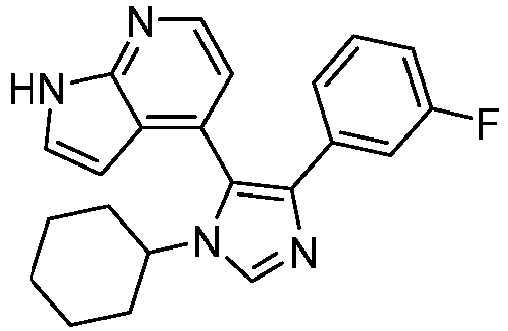
- The compound was prepared according to General procedure A using 1H-pyrrolo[2,3-b]pyridine-4-carbaldehyde, cyclohexanamine, 1-fluoro-3-(isocyano(tosyl)methyl)benzene and K2CO3. Reaction time: 200 minutes for the formation of the imine, then additional 20 hours for the cyclization step. The residue obtained after the workup was purified two times by preparative TLC (hexane/ethyl acetate, 4:3; then ethyl acetate/dichloromethane, 4:1). The product was obtained as a white solid (15 mg; 18 %). 1H NMR (500 MHz, CDCl3) δ (ppm) 11.02 (s, 1H), 8.45 (d, J = 4.86 Hz, 1H), 7.90 (s, 1H), 7.41 (d, J = 3.51 Hz, 1H), 7.19 - 7.13 (m, 2H), 7.09 - 7.03 (m, 2H), 6.81 - 6.76 (m, 1H), 6.20 (d, J = 3.49 Hz, 1H), 3.67 (tt, J = 11.97, 3.71 Hz, 1H), 2.07 - 2.01 (m, 1H), 2.00 - 1.93 (m, 1H), 1.83 - 1.74 (m, 2H), 1.70 - 1.59 (m, 3H), 1.22 - 1.04 (m, 3H).
- 13C NMR (126 MHz, CDCl3) δ (ppm) 163.0 (d, J = 244.13 Hz), 149.2, 143.1, 137.4 (d, J = 2.68 Hz), 136.5 (d, J = 8.29 Hz), 135.0, 131.5, 129.7 (d, J = 8.30 Hz), 126.6, 125.2, 122.2 (d, J = 2.79 Hz), 121.0, 118.0, 113.5 (d, J = 6.68 Hz), 113.3 (d, J = 8.24 Hz), 100.3, 55.5, 35.3, 34.5, 25.7, 25.7, 25.2.
- 19F NMR (471 MHz, CDCl3) δ (ppm) -110.7 - -115.5 (m).
- HRMS calculated for C22H22FN4[M+H]+ 361.1823, found 361.1822.
-
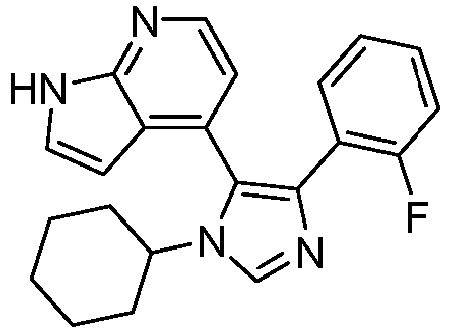
- The compound was prepared according to General procedure A using 1H-pyrrolo[2,3-b]pyridine-4-carbaldehyde, cyclohexanamine, 1-fluoro-2-(isocyano(tosyl)methyl)benzene and K2CO3. Reaction time: 210 minutes for the formation of the imine, then additional 14 hours at 25 °C plus 20 hours at 80 °C for the cyclization step. The residue obtained after the workup was purified by column chromatography (hexane/acetone, 1:1) and then by preparative TLC (ethyl acetate/dichloromethane, 4:1). The product was obtained as a colorless wax (2 mg; 2 %).
- 1H NMR (500 MHz, CDCl3) δ (ppm) 9.87 (s, 1H), 8.34 (s, 1H), 8.15 (s, 1H), 7.48 - 7.43 (m, 1H), 7.31 (d, J = 3.55 Hz, 1H), 7.21 - 7.14 (m, 1H), 7.07 - 6.97 (m, 2H), 6.91 - 6.81 (m, 1H), 6.16 (d, J = 3.59 Hz, 1H), 3.93 - 3.84 (m, 1H), 2.12 - 2.05 (m, 1H), 2.04 - 1.97 (m, 1H), 1.87 - 1.79 (m, 2H), 1.73 - 1.61 (m, 3H), 1.22 -1.10 (m, 3H).
- 13C NMR (126 MHz, CDCl3) δ (ppm) 159.8 (d, J = 249.91 Hz), 148.2, 142.2, 135.2, 133.4, 131.3, 131.1 (d, J = 3.09 Hz), 129.5 (d, J = 8.06 Hz), 126.9, 126.4, 124.2 (d, J = 3.56 Hz), 117.5, 116.0, 115.9, 100.4, 56.2, 35.3, 34.4, 25.8, 25.7, 25.2.
- 19F NMR (471 MHz, CDCl3) δ (ppm) -113.54.
-

- The compound was prepared according to General procedure A using 1H-pyrrolo[2,3-b]pyridine-4-carbaldehyde, cyclohexanamine,1-fluoro-4-(isocyano(tosyl)methyl)benzene and K2CO3. Reaction time: 4.5 hours for the formation of the imine, then additional 23 hours for the cyclization step. The residue obtained after the workup was purified by three times by column chromatography (ethyl acetone/hexane, 2:3; then ethyl acetate/dichloromethane, 4:1; then acetone/dichloromethane, 3:10). The product was obtained as a white solid (1.35 g, 44 %).
- 1H NMR (500 MHz, CDCl3) δ (ppm) 10.31 (s, 1H), 8.43 (d, J = 4.90 Hz, 1H), 7.89 (s, 1H), 7.40 - 7.33 (m, 3H), 7.05 (d, J = 4.88 Hz, 1H), 6.85 - 6.79 (m, 2H), 6.18 (d, J = 3.50 Hz, 1H), 3.68 (tt, J = 12.03, 3.71 Hz, 1H), 2.09 - 2.01 (m, 1H), 1.99 - 1.92 (m, 1H), 1.84 - 1.74 (m, 2H), 1.69 - 1.59 (m, 3H), 1.19 - 1.06 (m, 3H).
- 13C NMR (126 MHz, CDCl3) δ (ppm) 161.9 (d, J = 245.77 Hz), 149.1, 143.3, 137.7, 134.8, 131.6, 130.1, 128.4 (d, J = 7.85 Hz), 126.4, 124.4, 120.9, 118.1, 115.2 (d, J = 21.38 Hz), 100.5, 55.5, 35.3, 34.5, 25.8, 25.7, 25.2.
- HRMS calculated for C22H22FN4[M+H]+ 361.1823, found 361.1827.
-

- The compound was prepared according to General procedure A using 1H-pyrrolo[2,3-b]pyridine-4-carbaldehyde, cyclohexanamine, 2,4-difluoro-1-(isocyano(tosyl)methyl)benzene and K2CO3. Acetonitrile was used instead of DMF. Reaction time: 3 hours for the formation of the imine, then additional 18 hours at 75 °C for the cyclization step. The residue obtained after the workup was purified two times by preparative TLC (hexane/acetone, 4:3; then ethyl acetate/dichloromethane, 4:1). The product was obtained as a colorless wax (14 mg, 15 %).
- 1H NMR (500 MHz, CDCl3) δ (ppm) 10.73 (s, 1H), 8.36 (d, J = 4.92 Hz, 1H), 7.96 (s, 1H), 7.44 - 7.35 (m, 1H), 7.32 (d, J = 3.52 Hz, 1H), 6.96 (d, J = 4.90 Hz, 1H), 6.77 - 6.71 (m, 1H), 6.63 - 6.58 (m, 1H), 6.14 (d, J = 3.53 Hz, 1H), 3.87 (tt, J = 11.96, 3.71 Hz, 1H), 2.11 -2.05 (m, 1H), 2.05 - 1.97 (m, 1H), 1.85 - 1.76 (m, 2H), 1.74 - 1.60 (m, 3H), 1.23 - 1.07 (m, 3H).
- 13C NMR (126 MHz, CDCl3) δ (ppm) 162.3 (dd, J = 248.67, 11.71 Hz), 159.9 (dd, J = 252.20, 11.99 Hz), 148.9, 142.6, 135.4, 133.7, 131.9 (dd, J = 9.39, 4.97 Hz), 131.3, 126.8, 126.2, 120.5, 118.7 (dd, J = 14.60, 3.70 Hz), 117.3, 111.3 (dd, J = 21.31, 3.64 Hz), 104.1 (t, J = 25.73 Hz), 100.2, 55.7, 35.4, 34.4, 25.8, 25.7, 25.2.
- 19F NMR (471 MHz, CDCl3) δ (ppm) -109.55 (d, J = 7.76 Hz), -111.43 (d, J = 7.45 Hz).
- HRMS calculated for C22H21F2N4[M+H]+ 379.1729, found 379.1727.
-

- The compound was prepared according to General procedure A using 1H-pyrrolo[2,3-b]pyridine-4-carbaldehyde, cyclohexanamine, 1-chloro-3-(isocyano(tosyl)methyl)benzene and K2CO3. Reaction time: 3 hours for the formation of the imine, then additional 18 hours for the cyclization step. The residue obtained after the workup was purified by preparative TLC (hexane/acetone, 4:3). So obtained material was 3 times triturated with dichloromethane (0.3 mL) and dried in a vacuum. The product was obtained as a white solid (16 mg, 15 %).
- 1H NMR (500 MHz, DMSO-d6 ) δ (ppm) 11.89 (s, 1H), 8.36 (d, J = 4.81 Hz, 1H), 8.13 (s, 1H), 7.50 (dd, J = 3.44, 2.51 Hz, 1H), 7.40 - 7.34 (m, 1H), 7.15- 7.05 (m, 4H), 6.03 (dd, J = 3.49, 1.85 Hz, 1H), 3.60 - 3.49 (m, 1H), 1.98 - 1.90 (m, 1H), 1.82 - 1.64 (m, 5H), 1.55 - 1.49 (m, 1H), 1.17 - 1.02 (m, 2H), 1.00 - 0.90 (m, 1H).
- 13C NMR (126 MHz, DMSO-d6 ) δ (ppm) 148.7, 142.9, 135.8, 135.3, 132.8, 129.9, 129.8, 127.4, 125.7, 125.2, 125.1, 123.8, 119.6, 117.1, 98.6, 54.6, 33.9, 33.4, 25.1, 25.1, 24.5.
- HRMS calculated for C22H22ClN4[M+H]+ 377.1528, found 377.1527.
-

- The compound was prepared according to General procedure A using 1H-pyrrolo[2,3-b]pyridine-4-carbaldehyde, cyclohexanamine, 1-bromo-3-(isocyano(tosyl)methyl)benzene and K2CO3. Reaction time: 3.5 hours for the formation of the imine, then additional 18 hours for the cyclization step. The residue obtained after the workup was purified by column chromatography (hexane/acetone/methanol, 10:10:1). So obtained material was 3 times triturated with a mixture of dichloromethane/hexane (0.5 mL + 0.5 mL) and dried in a vacuum. The product was obtained as a white solid (6 mg, 6 %).
- 1H NMR (500 MHz, DMSO-d6 ) δ (ppm) 11.89 (s, 1H), 8.36 (d, J = 4.81 Hz, 1H), 8.11 (s, 1H), 7.53 (t, J = 1.84 Hz, 1H), 7.50 (d, J = 3.48 Hz, 1H), 7.26 - 7.21 (m, 1H), 7.14 (dt, J = 7.95, 1.27 Hz, 1H), 7.09 (d, J = 4.79 Hz, 1H), 7.04 (t, J = 7.88 Hz, 1H), 6.03 (d, J = 3.47 Hz, 1H), 3.59 - 3.50 (m, 1H), 1.97 - 1.91 (m, 1H), 1.83 - 1.63 (m, 5H), 1.57 - 1.50 (m, 1H), 1.18 - 1.03 (m, 2H), 1.00 - 0.92 (m, 1H).
- 13C NMR (126 MHz, DMSO-d6 ) δ (ppm) 148.7, 142.9, 137.1, 135.8, 135.2, 130.1, 129.9, 128.5, 128.1, 127.4, 125.1, 124.2, 121.5, 119.6, 117.1, 98.6, 54.6, 33.9, 33.4, 25.1, 25.1, 24.5.
- HRMS calculated for C22H22BrN4[M+H]+ 423.1004, found 423.1002.
-

- To a solution of 1H-pyrrolo[2,3-b]pyridine-4-carbaldehyde (42 mg; 0.289 mmol) in tetrahydrofuran (2 mL) was added cyclohexanamine (0.067 mL; 0.600 mmol) and the resulting solution was stirred at 25 °Cfor 210 minutes. Then,2,4-dichloro-1-(isocyano(tosyl)methyl)benzene (81 mg; 0.240 mmol), Cs2CO3 (117 mg; 0,360 mmol) and boron trifluoride diethyl etherate (0.088 mL; 0.720 mmol) were added. The resulting mixture was stirred at 60 °C for 16 hours and then at 70 °Cfor additional 7 hours. The solvent was evaporated in vacuo and The residue obtained after the workup was purified by column chromatography (hexane/acetone, 1:1) and then by preparative TLC (dichloromethane/ethyl acetate, 1:4). The product was obtained as a colorless wax (2 mg, 2 %).
- 1H NMR (500 MHz, CDCl3) δ (ppm) 9.96 (s, 1H), 8.30 (d, J = 5.04 Hz, 1H), 8.27 (s, 1H), 7.34 (d, J= 3.55 Hz, 1H), 7.29 (d, J = 2.11 Hz, 1H), 7.23 (d, J = 8.31 Hz, 1H), 7.10 (dd, J = 8.33, 2.13 Hz, 1H), 6.95 (d, J = 4.99 Hz, 1H), 6.18 (d, J = 3.58 Hz, 1H), 3.94 (tt, J = 11.92, 3.68 Hz, 1H), 2.11 -2.00(m, 2H), 1.86 - 1.65 (m, 5H), 1.24 - 1.09 (m, 3H).
- 13C NMR (126 MHz, CDCl3) δ (ppm) 147.5, 141.5, 135.2, 134.9, 134.6, 133.0, 130.9, 130.2, 129.9, 127.2, 127.0, 120.8, 117.4, 100.4, 56.6, 35.3, 34.3, 25.7, 25.7, 25.1.
- Preparative Example 8: 4-(1-cyclohexyl-4-phenyl-1H-imidazol-5-yl)-1H-pyrrolo[2,3-b]pyridine

- The compound was prepared according to General procedure A using 1H-pyrrolo[2,3-b]pyridine-4-carbaldehyde, cyclohexanamine, 1-((isocyano(phenyl)methyl)sulfonyl)-4-methylbenzene and K2CO3. Reaction time: 3
hours 20 minutes for the formation of the imine, then additional 16 hours for the cyclization step. The residue obtained after the workup was purified by preparative TLC (hexane/acetone, 10:6). So obtained material was triturated 3 times with a mixture of dichloromethane/hexane (0.25 mL + 0.25 mL) and dried in a vacuum. The product was obtained as a white solid (7 mg, 9 %). - 1H NMR (500 MHz, CDCl3) δ (ppm) 9.80 (s, 1H), 8.44 (d, J = 4.88 Hz, 1H), 8.23 (s, 1H), 7.46 - 7.40 (m, 2H), 7.38 (d, J = 3.51 Hz, 1H), 7.21 -7.13 (m, 3H), 7.08 (d, J = 4.87 Hz, 1H), 6.19 (d, J = 3.51 Hz, 1H), 3.72 (tt, J = 11.95, 3.69 Hz, 1H), 2.09 - 2.03 (m, 1H), 2.00 - 1.94 (m, 1H), 1.85 - 1.76 (m, 2H), 1.74 - 1.60 (m, 3H), 1.21 - 1.04 (m, 3H).
- 13C NMR (126 MHz, CDCl3) δ (ppm) 148.9, 143.4, 134.2, 130.3, 128.6, 127.8, 126.9, 126.7, 124.9, 120.8, 118.2, 100.4, 56.3, 35.2, 34.4, 25.7, 25.6, 25.1.
- HRMS calculated for C22H23N4[M+H]+ 343.1917, found 343.1920.
-

- The compound was prepared according to General procedure A using 1H-pyrrolo[2,3-b]pyridine-4-carbaldehyde, cyclohexanamine, 1-chloro-4-(isocyano(tosyl)methyl)benzene and K2CO3. Reaction time: 3
hours 20 minutes for the formation of the imine, then additional 16 hours for the cyclization step. The residue obtained after the workup was purified by preparative TLC (hexane/acetone, 10:6). So obtained material was triturated 3 times with a mixture of dichloromethane/hexane (0.25 mL + 0.25 mL) and dried in a vacuum. The product was obtained as a white solid (38 mg, 42 %). - 1H NMR (500 MHz, acetone-d6 ) δ (ppm) 10.90 (s, 1H), 8.38 (d, J = 4.76 Hz, 1H), 7.95 (s, 1H), 7.52 - 7.49 (m, 1H), 7.42 - 7.38 (m, 2H), 7.14 - 7.10 (m, 2H), 7.09 (d, J = 4.79 Hz, 1H), 6.14 (dd, J = 3.49, 1.96 Hz, 1H), 3.70 (tt, J = 11.80, 3.89 Hz, 1H), 2.08 - 2.06 (m, 1H), 1.96 - 1.89 (m, 1H), 1.83 - 1.70 (m, 4H), 1.62 - 1.55 (m, 1H), 1.24 - 1.12 (m, 2H), 1.12 - 1.03 (m, 1H).
- 13C NMR (126 MHz, acetone-d6 ) δ (ppm) 150.3, 144.3, 137.6, 136.1, 135.1, 132.0, 131.9, 128.8, 128.4, 127.6, 125.9, 121.1, 118.5, 100.3, 55.9, 35.4, 34.8, 26.4, 26.3, 25.8.
- HRMS calculated for C22H22ClN4 [M+H]+ 377.1528, found 377.1526.
-

- The compound was prepared according to General procedure A using 1H-pyrrolo[2,3-b]pyridine-4-carbaldehyde, cyclohexanamine,1-bromo-4-(isocyano(tosyl)methyl)benzene and K2CO3. Reaction time: 3 hours 30 minutes for the formation of the imine, then additional 14 hours for the cyclization step. The residue obtained after the workup was purified two times by preparative TLC (hexane/acetone, 4:3; then dichloromethane/ethyl acetate, 1:4). The product was obtained as a white solid (11 mg, 11 %).
- 1H NMR (500 MHz, CDCl3) δ (ppm) 10.53 (s, 1H), 8.44 (d, J = 4.88 Hz, 1H), 7.92 (s, 1H), 7.38 (d, J = 3.53 Hz, 1H), 7.29 - 7.22 (m, 4H), 7.05 (d, J = 4.84 Hz, 1H), 6.18 (d, J = 3.57 Hz, 1H), 3.67 (tt, J = 12.00, 3.73 Hz, 1H), 2.08 - 2.01 (m, 1H), 1.98 - 1.92 (m, 1H), 1.84 - 1.73 (m, 2H), 1.70 - 1.59 (m, 3H), 1.21 - 1.02 (m, 3H).
- 13C NMR (126 MHz, CDCl3) δ (ppm) 149.1, 143.3, 137.3, 135.0, 132.8, 131.5, 131.4, 128.2, 126.6, 125.0, 120.8, 120.8, 118.0, 100.5, 55.6, 35.2, 34.5, 25.7, 25.7, 25.2.
- HRMS calculated for C22H22BrN4[M+H]+ 423.1004, found 423.1002.
-

- The compound was prepared according to General procedure A using 1H-pyrrolo[2,3-b]pyridine-4-carbaldehyde, tert-butyl-4-aminopiperidine-1-carboxylate, 1-fluoro-4-(isocyano(tosyl)methyl)benzene and K2CO3. Reaction times: 3 hours for the formation of the imine, then additional 18 hours for the cyclization step. The residue obtained after the workup was purified by column chromatography (hexane/acetone, 10:6). So obtained material was then recrystallized from a mixture of dichloromethane/hexane (0.15 mL + 0.3 mL). The product was obtained as a white solid (12 mg, 11 %). 1H NMR (500 MHz, CDCl3) δ (ppm) 10.40 (s, 1H), 8.45 (d, J = 4.88 Hz, 1H), 7.95 (s, 1H), 7.41 - 7.34 (m, 3H), 7.07 (d, J = 4.88 Hz, 1H), 6.86 - 6.80 (m, 2H), 6.19 (d, J = 3.53 Hz, 1H), 4.24 - 4.11 (m, 2H), 3.84 (tt, J = 11.67, 4.38 Hz, 1H), 2.60 - 2.44 (m, 2H), 2.02 - 1.95 (m, 1H), 1.93 - 1.80 (m, 3H), 1.44 (s, 9H).
- 13C NMR (126 MHz, CDCl3) δ (ppm) 162.1 (d, J = 246.53 Hz), 154.5, 149.0, 143.4, 137.8, 134.7, 131.0, 129.5 (d, J = 3.25 Hz), 128.4 (d, J = 8.02 Hz), 126.8, 124.4, 120.8, 118.0, 115.4 (d, J = 21.40 Hz), 100.3, 80.3, 54.0, 43.1, 34.0, 33.4, 28.5.
- HRMS calculated for C26H29FN5O2[M+H]+ 462.2300, found 462.2302.
-

- The compound was prepared according to General procedure A using 1H-pyrrolo[2,3-b]pyridine-4-carbaldehyde, 2-morpholinoethan-1-amine, 1-fluoro-4-(isocyano(tosyl)methyl)benzene and K2CO3. Reaction time: 3.5 hours for the formation of the imine, then additional 18 hours for the cyclization step. The residue obtained after the workup was purified by preparative TLC (methanol/acetone, 1:20). The product was obtained as a white solid (54 mg, 57 %).
- 1H NMR (500 MHz, CDCl3) δ (ppm) 11.16 (s, 1H), 8.43 (d, J = 4.87 Hz, 1H), 7.87 (s, 1H), 7.43 - 7.37 (m, 3H), 7.09 (d, J = 4.87 Hz, 1H), 6.86 - 6.80 (m, 2H), 6.18 (d, J = 3.41 Hz, 1H), 4.00 - 3.88 (m, 2H), 3.61 - 3.52 (m, 4H), 2.43 (t, J = 6.41 Hz, 2H), 2.29 - 2.20 (m, 4H).
- 13C NMR (126 MHz, CDCl3) δ (ppm) 161.9 (d, J = 245.65 Hz), 149.3, 143.1, 138.6, 138.4 , 131.5, 130.4 (d, J = 3.17 Hz), 128.3 (d, J = 7.97 Hz), 126.5, 124.7, 120.6, 117.8, 115.2 (d, J = 21.44 Hz), 100.6, 66.8, 58.9, 53.6, 42.9.
- 19F NMR (471 MHz, CDCl3) δ (ppm) -115.77.
- HRMS calculated for C22H23FN5O[M+H]+ 392.1881, found 392.1883.
-

- The compound was prepared according to General procedure A using 1H-pyrrolo[2,3-b]pyridine-4-carbaldehyde, 2-morpholinoethan-1-amine, 1-fluoro-4-(isocyano(tosyl)methyl)benzene and K2CO3. Reaction time: 220 minutes for the formation of the imine, then additional 15 hours for the cyclization step. The residue obtained after the workup was purified two times by preparative TLC (dichloromethane/methanol, 9:1; then dichloromethane/methanol, 8:1). The product was obtained as a pale yellow solid (20 mg, 23 %).
- 1H NMR (300 MHz, CDCl3) δ (ppm) 10.05 (s, 1H), 8.45 (d, J = 4.89 Hz, 1H), 8.07 (s, 1H), 7.42 - 7.33 (m, 3H), 7.08 (d, J = 4.92 Hz, 1H), 6.89 - 6.79 (m, 2H), 6.19 (d, J = 3.56 Hz, 1H), 4.09 - 3.87 (m, 3H), 3.31 - 3.12 (m, 2H), 2.12 - 1.78 (m, 4H).
- HRMS calculated for C21H20FN4O[M+H]+ 363.1616, found 363.1619.
-

- The compound was prepared according to General procedure A using 1H-pyrrolo[2,3-b]pyridine-4-carbaldehyde, 1-methylpiperidin-4-amine, 1-fluoro-4-(isocyano(tosyl)methyl)benzene and K2CO3. Reaction time: 315 minutes for the formation of the imine, then additional 18 hours for the cyclization step. The residue obtained after the workup was purified two times by preparative TLC (hexane/acetone, 1:1; then dichloromethane/methanol, 12:1). So obtained material was then purified using reverse phase HPLC (acetonitrile/H2O, gradient from 60 % to 95% of acetonitrile). The product was obtained as a white solid (10 mg, 11 %).
- 1H NMR (500 MHz, acetone-d6 ) δ (ppm) 10.90 (s, 1H), 8.37 (d, J = 4.73 Hz, 1H), 7.95 (s, 1H), 7.52 - 7.47 (m, 1H), 7.47 - 7.39 (m, 2H), 7.09 (d, J = 4.79 Hz, 1H), 6.91 - 6.83 (m, 2H), 6.14 (dd, J = 3.59, 1.86 Hz, 1H), 3.68 (tt, J = 11.96, 4.21 Hz, 1H), 2.84 - 2.75 (m, 2H), 2.12 (s, 3H), 2.01 - 1.91 (m, 3H), 1.84 - 1.74 (m, 2H), 1.72 - 1.65 (m, 1H).
- 13C NMR (126 MHz, acetone-d6 ) δ (ppm) 162.3 (d, J = 243.27 Hz), 150.3, 144.3, 138.2, 136.0, 132.7 (d, J = 3.11 Hz), 131.9, 128.7 (d, J = 7.91 Hz), 127.6, 125.4, 121.2, 118.6, 115.4 (d, J = 21.41 Hz), 100.3, 55.6, 55.6, 54.1, 46.1, 34.6, 34.0.
- 19F NMR (471 MHz, acetone-d6 ) δ (ppm) -118.38.
- HRMS calculated for C22H23FN5[M+H]+ 376.1932, found 376.1930.
-

- The compound was prepared according to General procedure A using 1H-pyrrolo[2,3-b]pyridine-4-carbaldehyde, 3-methylbutan-1-amine, 1-fluoro-4-(isocyano(tosyl)methyl)benzene and K2CO3. Reaction time: 3
hours 40 minutes for the formation of the imine, then additional 18 hours for the cyclization step. The residue obtained after the workup was purified two times by preparative TLC (hexane/acetone, 4:3; then dichloromethane/ethyl acetate, 1:4). The product was obtained as pale beige solid (26 mg, 31 %). - 1H NMR (500 MHz, CDCl3) δ (ppm) 10.08 (s, 1H), 8.43 (d, J = 4.88 Hz, 1H), 7.98 (s, 1H), 7.44 - 7.36 (m, 3H), 7.09 (d, J = 4.93 Hz, 1H), 6.89 - 6.81 (m, 2H), 6.18 (d, J = 3.51 Hz, 1H), 3.95 - 3.80 (m, 2H), 1.46 - 1.36 (m, 3H), 0.70 (dd, J = 17.54, 5.89 Hz, 6H).
- 13C NMR (126 MHz, CDCl3) δ (ppm) 162.2 (d, J = 246.57 Hz), 149.0, 143.2, 137.6, 137.3, 131.0, 129.2 (d, J = 2.31 Hz), 128.5 (d, J = 7.96 Hz), 126.5, 124.9, 120.5, 117.9, 115.4 (d, J = 21.53 Hz), 100.7, 44.6, 39.8, 25.4, 22.2.
- 19F NMR (471 MHz, CDCl3) δ (ppm) -114.93.
- HRMS calculated for C21H22FN4[M+H]+ 349.1823, found 349.1826.
-

- The compound was prepared according to General procedure A using 1H-pyrrolo[2,3-b]pyridine-4-carbaldehyde, tetrahydrofuran-3-amine, 1-fluoro-4-(isocyano(tosyl)methyl)benzene and K2CO3. Reaction time: 3
hours 40 minutes for the formation of the imine, then additional 18 hours for the cyclization step. The residue obtained after the workup was purified bypreparative TLC 2 times (hexane/acetone, 1:1; then dichloromethane/methanol, 12:1). The product was obtained as a colorless wax (11 mg, 13 %). - 1H NMR (500 MHz, CDCl3) δ (ppm) 10.62 (d, J = 16.50 Hz, 1H), 8.44 (app t, J = 4.84, 3.67 Hz, 1H), 7.96 (d, J = 9.46 Hz, 1H), 7.44 - 7.36 (m, 3H), 7.06 (dd, J = 17.25, 4.82 Hz, 1H), 6.87 - 6.80 (m, 2H), 6.20 (dd, J = 27.42, 3.50 Hz, 1H), 4.55 - 4.48 (m, 1H), 4.21 - 4.15 (m, 1H), 4.12 - 4.01 (m, 1H), 3.88 - 3.73 (m, 2H), 2.38 - 2.24 (m, 1H), 2.17 - 2.11 (m, 1H).
- 13C NMR (126 MHz, CDCl3) δ (ppm) 162.0 (d, J = 245.95 Hz), 149.2, 143.3 (d, J= 5.54 Hz), 138.1, 135.1 (d, J = 9.55 Hz), 131.2 (d, J = 1.73 Hz), 129.9 (t, J = 3.60 Hz), 128.4 (dd, J = 7.88, 3.18 Hz), 126.6 (d, J = 8.09 Hz), 124.7 (d, J = 5.73 Hz), 120.8 (d, J = 12.72 Hz), 118.2 (d, J = 17.35 Hz), 115.3 (d, J = 21.51 Hz), 100.4, 73.7, 67.3, 34.9, 29.4.
- 19F NMR (471 MHz, CDCl3) δ (ppm) -115.41.
- HRMS calculated for C20H18FN4O[M+H]+ 349.1459, found 349.1455.
-

- The compound was prepared according to General procedure A using 1H-pyrrolo[2,3-b]pyridine-4-carbaldehyde, cyclobutanamine, 1-fluoro-4-(isocyano(tosyl)methyl)benzene and K2CO3. Reaction time: 4 hours for the formation of the imine, then additional 14 hours for the cyclization step. The residue obtained after the workup was purified two times by preparative TLC (hexane/acetone, 3:2; then dichloromethane/ethyl acetate, 1:5). The product was obtained as a colorless wax (14 mg, 18 %).
- 1H NMR (500 MHz, CDCl3) δ (ppm) 10.62 (s, 1H), 8.42 (d, J = 4.88 Hz, 1H), 8.02 (s, 1H), 7.42 - 7.36 (m, 3H), 7.05 (d, J = 4.87 Hz, 1H), 6.86 - 6.80 (m, 2H), 6.17 (d, J = 3.48 Hz, 1H), 4.37 (p, J = 8.42 Hz, 1H), 2.41 - 2.30 (m, 2H), 2.28 - 2.18 (m, 2H), 1.86 - 1.77 (m, 1H), 1.71 - 1.61 (m, 1H).
- 13C NMR (126 MHz, CDCl3) δ (ppm) 162.0 (d, J = 245.88 Hz), 149.1, 143.1, 138.0, 135.2, 131.4, 129.9 (d, J = 3.14 Hz), 128.4 (d, J = 8.01 Hz), 126.4, 124.6, 120.7, 117.9, 115.3 (d, J = 21.43 Hz), 100.6, 50.2,31.0, 15.1.
- 19F NMR (471 MHz, CDCl3) δ (ppm) -115.46.
- HRMS calculated for C20H18FN4[M+H]+ 333.1510, found 333.1508.
-

- The compound was prepared according to General procedure A using 1H-pyrrolo[2,3-b]pyridine-4-carbaldehyde, cyclopentanamine, 1-fluoro-4-(isocyano(tosyl)methyl)benzene and K2CO3. Reaction time: 3.5 hours for the formation of the imine, then additional 18 hours for the cyclization step. The residue obtained after the workup was purified two times by preparative TLC (hexane/acetone, 4:3; then dichloromethane/ethyl acetate, 1:4). The product was obtained as a colorless wax (18 mg, 22 %).
- 1H NMR (500 MHz, CDCl3) δ (ppm) 10.14 (s, 1H), 8.42 (d, J = 4.84 Hz, 1H), 7.95 (s, 1H), 7.41 - 7.35 (m, 3H), 7.08 (d, J = 4.86 Hz, 1H), 6.87 - 6.80 (m, 2H), 6.20 (d, J = 3.53 Hz, 1H), 4.24 (p, J = 7.08 Hz, 1H), 2.06 - 1.92 (m, 2H), 1.89 - 1.81 (m, 4H), 1.64 - 1.54 (m, 2H).
- 13C NMR (126 MHz, CDCl3) δ (ppm) 162.0 (d, J = 246.24 Hz), 149.0, 143.3, 137.5, 134.6, 131.5, 129.6 (d, J = 2.84 Hz), 128.4 (d, J = 8.06 Hz), 126.4, 125.2, 120.9, 118.2, 115.3 (d, J = 21.45 Hz), 100.6, 57.3, 34.6, 33.9, 24.19, 24.16.
- 19F NMR (471 MHz, CDCl3) δ (ppm) -115.31.
- HRMS calculated for C21H20FN4[M+H]+ 347.1667, found 347.1668.
-

- The compound was prepared according to General procedure A using 1H-pyrrolo[2,3-b]pyridine-4-carbaldehyde, cycloheptanamine, 1-fluoro-4-(isocyano(tosyl)methyl)benzene and K2CO3. Reaction time: 3 hours for the formation of the imine, then additional 18 hours for the cyclization step. The residue obtained after the workup was purified two times by preparative TLC (hexane/acetone, 5:3; then dichloromethane/ethyl acetate, 1:5). The product was obtained as a colorless wax (16 mg; 18 %).
- 1H NMR (500 MHz, CDCl3) δ (ppm) 10.94 (s, 1H), 8.44 (d, J = 4.88 Hz, 1H), 7.89 (s, 1H), 7.41 - 7.35 (m, 3H), 7.05 (d, J = 4.88 Hz, 1H), 6.85 - 6.79 (m, 2H), 6.20 (d, J = 3.48 Hz, 1H), 3.88 (tt, J = 10.28, 4.17 Hz, 1H), 2.09 - 1.98 (m, 2H), 1.96 - 1.82 (m, 2H), 1.74 - 1.64 (m, 2H), 1.57 - 1.47 (m, 4H), 1.31 - 1.18 (m, 2H).
- 13C NMR (126 MHz, CDCl3) δ (ppm) 161.9 (d, J = 245.62 Hz), 149.3, 143.1, 137.6, 134.9, 131.7, 130.2 (d, J = 3.25 Hz), 128.3 (d, J = 7.83 Hz), 126.5, 124.2, 121.0, 118.1, 115.2 (d, J = 21.44 Hz), 100.4, 57.4, 37.2, 36.4, 27.6, 27.5, 24.8, 24.7.
- HRMS calculated for C23H24FN4[M+H]+ 375.1980, found 375.1984.
-

- The compound was prepared according to General procedure A using 1H-pyrrolo[2,3-b]pyridine-4-carbaldehyde, 2-isopropoxyethan-1-amine, 1-fluoro-4-(isocyano(tosyl)methyl)benzene and K2CO3. Reaction time: 4.5 hours for the formation of the imine, then additional 18 hours for the cyclization step. The residue obtained after the workup was purified by preparative TLC (dichloromethane/acetone, 1:1). So obtained material was then dissolved in dichloromethane (4 mL), hexane (1.5 mL) was added, the solvent was evaporated so that the residual volume was 2 mL, and the solution was allowed to stand at 25 °C overnight. The solid was collected by filtration and dried in a vacuum. The product was obtained as a white solid (20 mg, 23 %).
- 1H NMR (500 MHz, CDCl3) δ (ppm) 9.85 (s, 1H), 8.41 (d, J = 4.88 Hz, 1H), 7.90 (s, 1H), 7.43 - 7.37 (m, 2H), 7.34 (d, J = 3.52 Hz, 1H), 7.09 (d, J = 4.85 Hz, 1H), 6.86 - 6.81 (m, 2H), 6.19 (d, J = 3.52 Hz, 1H), 4.00 - 3.88 (m, 2H), 3.45 - 3.37 (m, 3H), 1.06 (d, J = 6.07 Hz, 6H).
- 13C NMR (126 MHz, CDCl3) δ (ppm) 161.9 (d, J = 245.73 Hz), 149.1, 143.5, 138.8, 138.3, 131.4, 130.3 (d, J = 3.03 Hz), 128.3 (d, J = 7.88 Hz), 126.2, 124.5, 120.5, 118.2, 115.2 (d, J = 21.40 Hz), 100.9, 72.5, 66.9, 46.1, 22.0.
- 19F NMR (471 MHz, CDCl3) δ (ppm) -115.79.
- HRMS calculated for C21H22FN4O[M+H]+ 365.1772, found 365.1776.
-
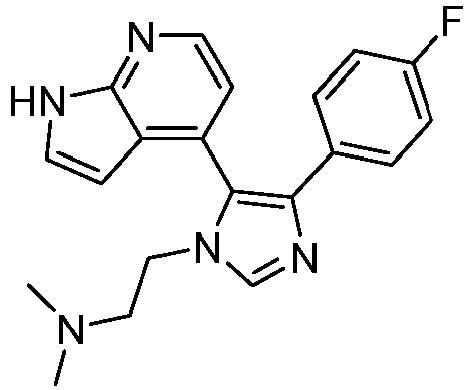
- The compound was prepared according to General procedure A using 1H-pyrrolo[2,3-b]pyridine-4-carbaldehyde, N1 ,N1 -dimethylethane-1,2-diamine, 1-fluoro-4-(isocyano(tosyl)methyl)benzene and K2CO3. Reaction time: 4.5 hours for the formation of the imine, then additional 18 hours for the cyclization step. The residue obtained after the workup was purified by preparative TLC (methanol/acetone, 1:20; + 1 % of triethylamine). The product was obtained as a white solid (58 mg, 69 %).
- 1H NMR (500 MHz, methanol-d4 ) δ (ppm) 8.32 (d, J = 4.90 Hz, 1H), 7.98 (s, 1H), 7.42 (d, J = 3.51 Hz, 1H), 7.34 - 7.28 (m, 2H), 7.14 (d, J = 4.90 Hz, 1H), 6.91 - 6.84 (m, 2H), 6.14 (d, J = 3.50 Hz, 1H), 4.13 - 3.98 (m, 2H), 2.38 (td, J = 6.93, 5.35 Hz, 2H), 2.03 (s, 6H).
- 13C NMR (126 MHz, methanol-d4 ) δ (ppm) 163.3 (d, J = 244.89 Hz), 149.8, 143.7, 140.0, 139.4, 132.2, 131.6 (d, J = 3.25 Hz), 129.6 (d, J = 8.10 Hz), 128.4, 126.3, 122.0, 118.7, 115.9 (d, J = 21.77 Hz), 100.7, 60.1, 45.3, 44.4.
- 19F NMR (471 MHz, methanol-d4 ) δ (ppm) -117.59.
- HRMS calculated for C20H21FN5[M+H]+ 350.1776, found 350.1779.
-

- The compound was prepared according to General procedure A using 1H-pyrrolo[2,3-b]pyridine-4-carbaldehyde, benzylamine, 1-fluoro-4-(isocyano(tosyl)methyl)benzene and K2CO3. Reaction time: 3 hours for the formation of the imine, then additional 23 hours for the cyclization step. The residue obtained after the workup was purified by preparative TLC (hexane/acetone, 4:3). So obtained material was then dissolved in dichloromethane (3 mL), hexane (2 mL) was added, the solvent was evaporated so that the residual volume was 1 mL, and the solution was allowed to stand at 25 °C overnight. The solid was collected by filtration and dried in a vacuum.The product was obtained as a beige solid (40 mg, 46 %).
- 1H NMR (500 MHz, CDCl3) δ (ppm) 9.92 (s, 1H), 8.24 (d, J = 4.92 Hz, 1H), 7.68 (s, 1H), 7.37 - 7.32 (m, 2H), 7.24 (d, J = 3.58 Hz, 1H), 7.19 - 7.11 (m, 3H), 6.86 (d, J = 4.93 Hz, 1H), 6.84 - 6.80 (m, 2H), 6.80 - 6.74 (m, 2H), 6.07 (d, J = 3.50 Hz, 1H), 4.97 (d, J = 15.42 Hz, 1H),4.86 (d, J = 15.29 Hz, 1H).
- 13C NMR (126 MHz, CDCl3) δ (ppm) 162.0 (d, J = 245.90 Hz), 149.0, 143.2, 138.9, 138.2, 136.1, 131.2, 130.3 (d, J = 3.04 Hz), 129.0, 128.3 (d, J = 8.01 Hz), 128.2, 127.2, 126.2, 125.1, 120.5, 118.1, 115.2 (d, J = 21.44 Hz), 100.8,49.5.
- HRMS calculated for C23H18FN4[M+H]+ 369.1510, found 369.1512.
-

- The compound was prepared according to General procedure A using 1H-pyrrolo[2,3-b]pyridine-4-carbaldehyde, furan-3-ylmethanamine, 1-fluoro-4-(isocyano(tosyl)methyl)benzene and K2CO3. Reaction time: 3 hours for the formation of the imine, then additional 23 hours for the cyclization step. The residue obtained after the workup was purified by preparative TLC (hexane/acetone, 4:3).). So obtained material was then dissolved in dichloromethane (3 mL), hexane (2 mL) was added, the solvent was evaporated so that the residual volume was 1 mL, and the solution was allowed to stand at 25 °C overnight. The solid was collected by filtration and dried in a vacuum. The product was obtained as beige solid (23 mg, 27 %).
- 1H NMR (500 MHz, CDCl3) δ (ppm) 9.66 (s, 1H), 8.39 (d, J = 4.96 Hz, 1H), 7.80 (s, 1H), 7.43 - 7.38 (m, 2H), 7.35 - 7.32 (m, 2H), 7.07 (d, J = 4.89 Hz, 1H), 6.86 - 6.82 (m, 2H), 6.25 (dd, J = 3.33, 1.85 Hz, 1H), 6.19 (d, J = 3.52 Hz, 1H), 5.97 (dd, J = 3.25, 0.81 Hz, 1H), 4.97 (d, J = 15.59 Hz, 1H), 4.89 (d, J = 15.54 Hz, 1H).
- 13C NMR (126 MHz, CDCl3) δ (ppm) 162.1 (d, J = 246.14 Hz), 148.8, 148.5, 143.3, 143.2, 138.6, 137.9, 131.0, 130.0 (d, J = 2.70 Hz), 128.4 (d, J = 8.06 Hz), 126.3, 124.7, 120.5, 118.2, 115.3 (d, J = 21.56 Hz), 110.7, 109.4, 100.9, 42.4.
- HRMS calculated for C21H16FN4O[M+H]+ 359.1303, found 359.1306.
-

- The compound was prepared according to General procedure A using 1H-pyrrolo[2,3-b]pyridine-4-carbaldehyde, 3-methoxypropan-1-amine, 1-fluoro-4-(isocyano(tosyl)methyl)benzene and K2CO3. Reaction time: 2 hours for the formation of the imine, then additional 13 hours for the cyclization step. The residue obtained after the workup was purified by preparative TLC (hexane/acetone, 3:4).). So obtained material was then dissolved in dichloromethane (2 mL), hexane (2 mL) was added, the solvent was evaporated so that the residual volume was 0.5 mL, and the solution was allowed to stand at 25 °C overnight. The solid was collected by filtration and dried in a vacuum. The product was obtained as a beige solid (39 mg,46 %).
- 1H NMR (500 MHz, CDCl3) δ (ppm) 10.06 (s, 1H), 8.43 (d, J = 4.89 Hz, 1H), 7.77 (s, 1H), 7.43 - 7.37 (m, 2H), 7.35 (d, J = 3.54 Hz, 1H), 7.09 (d, J = 4.88 Hz, 1H), 6.87 - 6.80 (m, 2H), 6.17 (d, J = 3.57 Hz, 1H), 4.06 - 3.91 (m, 2H), 3.19 (s, 3H), 3.16 (t, J = 5.79 Hz, 2H), 1.71 - 1.61 (m, 2H).
- 13C NMR (126 MHz, CDCl3) δ (ppm) 162.0 (d, J = 245.82 Hz), 149.1, 143.4, 138.7, 138.2, 131.4, 130.2 (d, J = 3.20 Hz), 128.3 (d, J = 7.85 Hz), 126.3, 124.6, 120.4, 117.9, 115.2 (d, J = 21.39 Hz), 100.8, 68.4, 58.7, 42.7, 30.8.
- 19F NMR (471 MHz, CDCl3) δ (ppm) -115.66.
- HRMS calculated for C20H20FN4O[M+H]+ 351.1616, found 351.1619.
-

- The compound was prepared according to General procedure A using 1H-pyrrolo[2,3-b]pyridine-4-carbaldehyde, 2 M solution of methanamine in tetrahydrofuran, 1-fluoro-4-(isocyano(tosyl)methyl)benzene and K2CO3. Reaction time: 2 hours for the formation of the imine, then additional 13 hours for the cyclization step. The residue obtained after the workup was purified by column chromatography (hexane/acetone, gradient from 3:4 to 1:2). The product was obtained as a colorless wax (42 mg; 60 %).
- 1H NMR (500 MHz, CDCl3) δ (ppm) 10.03 (s, 1H), 8.42 (d, J = 4.87 Hz, 1H), 7.74 (s, 1H), 7.43 - 7.38 (m, 2H), 7.35 (d, J = 3.58 Hz, 1H), 7.07 (d, J = 4.85 Hz, 1H), 6.88 - 6.82 (m, 2H), 6.18 (d, J = 3.49 Hz, 1H), 3.52 (s, 3H).
- 13C NMR (126 MHz, CDCl3) δ (ppm) 162.0 (d, J = 245.75 Hz), 149.1, 143.4, 138.8, 138.6, 131.1, 130.4 (d, J = 3.17 Hz), 128.4 (d, J = 8.07 Hz), 126.1, 125.5, 120.2, 117.9, 115.3 (d, J = 21.40 Hz), 100.9, 32.7.
- HRMS calculated for C17H14FN4[M+H]+ 293.1197, found 293.1199.
-

- The compound was prepared according to General procedure A using 1H-pyrrolo[2,3-b]pyridine-4-carbaldehyde, (1-methylazetidin-3-yl)methanamine, 1-fluoro-4-(isocyano(tosyl)methyl)benzene and K2CO3. Reaction time: 3.5 hours for the formation of the imine, then additional 24 hours for the cyclization step. The residue obtained after the workup was purified by preparative TLC (dichloromethane/7 M NH3 in methanol, 12:1). The product was obtained as a white solid (40 mg, 46 %).
- 1H NMR (500 MHz, acetone-d6 ) δ (ppm) 11.00 (s, 1H), 8.37 (d, J = 4.78 Hz, 1H), 7.82 (s, 1H), 7.50 (d, J = 3.51 Hz, 1H), 7.46 - 7.41 (m, 2H), 7.11 (d, J = 4.76 Hz, 1H), 6.91 - 6.84 (m, 2H), 6.13 (d, J = 3.49 Hz, 1H), 4.15 (dd, J = 14.11, 7.51 Hz, 1H), 4.05 (dd, J = 14.13, 7.64 Hz, 1H), 3.05 - 2.98 (m, 2H), 2.72 - 2.66 (m, 2H), 2.41 (tt, J = 7.42, 5.51 Hz, 1H), 2.07 (s, 3H).
- 13C NMR (126 MHz, acetone-d6 ) δ (ppm) 162.3 (d, J = 243.32 Hz), 150.3, 144.2, 138.74, 138.72, 132.6 (d, J = 3.17 Hz), 131.7, 128.8 (d, J = 7.94 Hz), 127.6, 125.6, 120.9, 118.4, 115.4 (d, J = 21.30 Hz), 100.4, 60.0, 49.4, 45.9, 31.9.
- 19F NMR (471 MHz, acetone-d6 ) δ (ppm) -118.23.
- HRMS calculated for C21H21FN5[M+H]+ 362.1776, found 362.1779.
-

- The compound was prepared according to General procedure A using 1H-pyrrolo[2,3-b]pyridine-4-carbaldehyde, (tetrahydrofuran-2-yl)methanamine, 1-fluoro-4-(isocyano(tosyl)methyl)benzene and K2CO3. Reaction time: 3.5 hours for the formation of the imine, then additional 24 hours for the cyclization step. The residue obtained after the workup was purified by preparative TLC (hexane/acetone, 7:6). So obtained material was then dissolved in dichloromethane (2 mL), hexane (1 mL) was added, the solvent was evaporated so that the residual volume was 1 mL, and the solution was allowed to stand at 25 °C overnight. The solid was collected by filtration and dried in a vacuum. The product was obtained as a white solid (35 mg, 40 %).
- 1H NMR (500 MHz, CDCl3) δ (ppm) 10.33 (s, 1H), 8.42 (d, J = 4.88 Hz, 1H), 7.91 (d, J = 5.64 Hz, 1H), 7.42 - 7.33 (m, 3H), 7.08 (dd, J = 11.71, 4.92 Hz, 1H), 6.88 - 6.80 (m, 2H), 6.19 (dd, J = 6.00, 3.42 Hz, 1H), 4.00 - 3.81 (m, 3H), 3.79 - 3.74 (m, 1H), 3.73 - 3.65 (m, 1H), 1.81 - 1.66 (m, 3H), 1.34 - 1.25 (m, 1H).
- 13C NMR (126 MHz, CDCl3) δ (ppm) 161.9 (d, J = 245.65 Hz), 149.2, 143.3, 138.8 (d, J = 17.46 Hz), 138.3 (d, J = 15.23 Hz), 131.5, 130.4 (d, J = 3.13 Hz), 128.4 (d, J = 7.83 Hz), 126.3, 124.9 (d, J = 22.09 Hz), 120.6, 118.2 (d, J = 26.88 Hz), 115.2 (d, J = 21.43 Hz), 100.8 (d, J = 6.25 Hz), 68.4 (d, J = 3.89 Hz), 49.4, 49.2, 28.8 (d, J = 7.25 Hz), 25.7 (d, J = 2.52 Hz).
- 19F NMR (471 MHz, CDCl3) δ (ppm) -115.85.
- HRMS calculated for C21H20FN4O[M+H]+ 363.1616, found 363.1620.
-

- The compound was prepared according to General procedure A using 1H-pyrrolo[2,3-b]pyridine-4-carbaldehyde, trans-4-methoxycyclohexan-1-amine hydrochloride, 1-fluoro-4-(isocyano(tosyl)methyl)benzene and K2CO3. Reaction time: 3.5 hours for the formation of the imine, then additional 15 hours for the cyclization step. The residue obtained after the workup was purified by preparative TLC (hexane/acetone, 4:5). So obtained material was then dissolved in dichloromethane (2 mL), hexane (1.5 mL) was added, the solvent was evaporated so that the residual volume was 1.5 mL, and the solution was allowed to stand at 25 °C overnight. The solid was collected by filtration and dried in a vacuum. The product was obtained as a white solid (29 mg, 31 %).
- 1H NMR (500 MHz, CDCl3) δ (ppm) 9.39 (s, 1H), 8.44 (d, J = 4.88 Hz, 1H), 8.14 (s, 1H), 7.42 - 7.35 (m, 3H), 7.06 (d, J = 4.88 Hz, 1H), 6.91 - 6.81 (m, 2H), 6.16 (d, J = 3.58 Hz, 1H), 3.76 (tt, J = 11.89, 3.73 Hz, 1H), 3.30 (s, 3H), 3.22 - 3.15 (m, 1H), 2.16 - 2.05 (m, 3H), 2.04 - 1.97 (m, 1H), 1.84 - 1.73 (m, 2H), 1.16 - 1.02 (m, 2H).
- 13C NMR (126 MHz, CDCl3) δ (ppm) 162.1 (d, J = 247.58 Hz), 154.5, 148.8, 143.6, 136.7, 134.3, 128.6 (d, J = 8.03 Hz), 126.6, 124.7, 120.5, 118.1, 115.6 (d, J = 21.71 Hz), 100.4, 77.7, 56.2, 55.3, 32.7, 32.1, 30.8, 30.8.
- HRMS calculated for C23H24FN4O[M+H]+ 391.1929, found 391.1932.
-

- The compound was prepared according to General procedure A using 1H-pyrrolo[2,3-b]pyridine-4-carbaldehyde, (3,3-dimethylcyclobutyl)methanamine hydrochloride, 1-fluoro-4-(isocyano(tosyl)methyl)benzene andK2CO3. Reaction time: 3.5 hours for the formation of the imine, then additional 15 hours for the cyclization step. The residue obtained after the workup was purified by two times preparative TLC (dichloromethane/ethyl acetate, 1:4; then hexane/acetone, 2:1). The product was obtained as a colorless wax (7 mg, 8 %).
- 1H NMR (500 MHz, CDCl3) δ (ppm) 10.08 (s, 1H), 8.42 (d, J = 4.88 Hz, 1H), 7.72 (s, 1H), 7.40 - 7.34 (m, 3H), 7.06 (d, J = 4.88 Hz, 1H), 6.86 - 6.80 (m, 2H), 6.18 (d, J = 3.54 Hz, 1H), 3.86 - 3.72 (m, 2H), 2.37 (hept, J = 8.20 Hz, 1H), 1.77 - 1.70 (m, 2H), 1.39 - 1.32 (m, 2H), 1.03 (s, 3H), 0.95 (s, 3H).
- 13C NMR (126 MHz, CDCl3) δ (ppm) 161.9 (d, J = 245.71 Hz), 149.1, 143.3, 138.4, 137.3, 131.6, 130.3 (d, J = 3.17 Hz), 128.3 (d, J = 8.01 Hz), 126.2, 124.7, 120.6, 118.1, 115.2 (d, J = 21.37 Hz), 100.8, 52.0, 39.0, 31.7, 31.1, 29.0, 28.5.
- 19F NMR (471 MHz, CDCl3) δ (ppm) -115.80.
- HRMS calculated for C23H24FN4[M+H]+ 375.1980, found 375.1984.
-

- The compound was prepared according to General procedure A using 1H-pyrrolo[2,3-b]pyridine-4-carbaldehyde, 2-methylprop-2-en-1-amine, 1-fluoro-4-(isocyano(tosyl)methyl)benzene and K2CO3. Reaction time: 3 hours 15 minutes for the formation of the imine, then additional 16 hours for the cyclization step. The residue obtained after the workup was purified two times by preparative TLC (hexane/acetone, 8:5; then dichloromethane/ethyl acetate, 1:4). The product was obtained as a white solid (23 mg, 46 %).
- 1H NMR (500 MHz, CDCl3) δ (ppm) 11.00 (s, 1H), 8.40 (d, J = 4.88 Hz, 1H), 7.72 (s, 1H), 7.45 - 7.39 (m, 2H), 7.35 (d, J = 3.98 Hz, 1H), 7.08 (d, J = 4.90 Hz, 1H), 6.86 - 6.81 (m, 2H), 6.15 (d, J = 3.48 Hz, 1H), 4.85 - 4.80 (m, 1H), 4.58 - 4.53 (m, 1H), 4.44 - 4.23 (m, 2H), 1.56 (s, 3H).
- 13C NMR (126 MHz, CDCl3) δ (ppm) 161.9 (d, J = 245.60 Hz), 149.3, 142.9, 140.6, 138.7, 138.4, 131.3, 130.5 (d, J = 3.17 Hz), 128.3 (d, J = 8.02 Hz), 126.3, 125.2, 120.6, 117.7, 115.2 (d, J = 21.42 Hz), 113.6, 100.7,51.3, 19.9.
- 19F NMR (471 MHz, CDCl3) δ (ppm) -115.83.
- HRMS calculated for C20H18FN4[M+H]+ 333.1510, found 333.1513.
-

- The compound was prepared according to General procedure A using 1H-pyrrolo[2,3-b]pyridine-4-carbaldehyde, cis-4-aminocyclohexan-1-ol hydrochloride, 1-fluoro-4-(isocyano(tosyl)methyl)benzene andK2CO3. Reaction time: 4 hours for the formation of the imine, then additional 19 hours for the cyclization step. The residue obtained after the workup was purified two times by preparative TLC (acetone; then dichloromethane/methanol, 15:1). The product was obtained as a white solid (15 mg, 17%).
- 1H NMR (500 MHz, methanol-d4 ) δ (ppm) 8.31 (d, J = 4.94 Hz, 1H), 8.05 (s, 1H), 7.41 (d, J = 3.51 Hz, 1H), 7.31 - 7.24 (m, 2H), 7.09 (d, J = 4.97 Hz, 1H), 6.88 - 6.82 (m, 2H), 6.13 (d, J = 3.50 Hz, 1H), 3.88 (p, J = 2.94 Hz, 1H), 3.78 (tt, J = 12.12, 3.67 Hz, 1H), 2.23 - 2.11 (m, 2H), 1.86 - 1.75 (m, 3H), 1.74 - 1.67 (m, 1H), 1.45 - 1.37 (m, 1H), 1.36 - 1.28 (m, 1H).
- 13C NMR (126 MHz, methanol-d4 ) δ (ppm) 163.2 (d, J = 244.81 Hz), 149.8, 143.7, 138.8, 136.6, 132.4, 131.6 (d, J = 3.24 Hz), 129.6 (d, J = 8.02 Hz), 128.3, 126.1, 122.3, 118.8, 115.9 (d, J = 21.62 Hz), 100.5, 64.9, 56.3, 32.59, 32.56, 29.3, 28.8.
- 19F NMR (471 MHz, methanol-d4 ) δ (ppm) -117.74.
- HRMS calculated for C22H22FN4O[M+H]+ 377.1772, found 377.1775.
-

- The compound was prepared according to General procedure A using 1H-pyrrolo[2,3-b]pyridine-4-carbaldehyde, trans-4-aminocyclohexan-1-ol hydrochloride, 1-fluoro-4-(isocyano(tosyl)methyl)benzene andK2CO3. Reaction time: 4 hours for the formation of the imine, then additional 19 hours for the cyclization step. The residue obtained after the workup was purified by preparative TLC (acetone). So obtained material was then dissolved in methanol (3 mL), dichloromethane (3 mL) was added, the solvent was evaporated so that the residual volume was 0.5 mL, and the solution was allowed to stand at 25 °C overnight. The solid was collected by filtration and dried in a vacuum. The product was obtained as a white solid (17 mg, 31 %).
- 1H NMR (500 MHz, methanol-d4 ) δ (ppm) 8.32 (d, J = 4.88 Hz, 1H), 8.04 (s, 1H), 7.42 (d, J = 3.52 Hz, 1H), 7.29 - 7.25 (m, 2H), 7.09 (d, J = 4.89 Hz, 1H), 6.88 - 6.83 (m, 2H), 6.12 (d, J = 3.51 Hz, 1H), 3.75 (tt, J = 11.60, 4.16 Hz, 1H), 3.59 (tt, J = 11.01, 4.04 Hz, 1H), 2.08 - 2.03 (m, 1H), 2.00 - 1.86 (m, 5H), 1.21 - 1.13 (m, 1H), 1.13 - 1.03 (m, 1H).
- 13C NMR (126 MHz, methanol-d4 ) δ (ppm) 163.2 (d, J = 244.83 Hz), 149.8, 143.7, 138.9, 136.6, 132.3, 131.6 (d, J = 3.20 Hz), 129.6 (d, J = 7.85 Hz), 128.4, 126.2, 122.3, 118.8, 115.9 (d, J = 21.76 Hz), 100.4, 69.8, 56.1, 35.08, 35.86, 33.3, 32.9.
- 19F NMR (471 MHz, methanol-d4 ) δ (ppm) -117.68.
- HRMS calculated for C22H22FN4O[M+H]+ 377.1772, found 377.1774.
-

- The compound was prepared according to General procedure A using 1H-pyrrolo[2,3-b]pyridine-4-carbaldehyde, methyl cis-4-aminocyclohexane-1-carboxylate hydrochloride, 1-fluoro-4-(isocyano(tosyl)methyl)benzene andK2CO3. Reaction time: 1 hour 15 minutes for the formation of the imine, then additional 16 hours for the cyclization step. The residue obtained after the workup was purified two times by preparative TLC (acetone/hexane, 5:4; then ethyl acetate/acetone, 10:1). The product was obtained as a colorless wax (14 mg, 14%).
- 1H NMR (500 MHz, methanol-d4 ) δ (ppm) 8.31 (d, J = 4.92 Hz, 1H), 7.98 (s, 1H), 7.41 (d, J = 3.51 Hz, 1H), 7.30 - 7.24 (m, 2H), 7.08 (d, J = 4.91 Hz, 1H), 6.90 - 6.80 (m, 2H), 6.12 (d, J = 3.51 Hz, 1H), 3.81 (tt, J = 11.61, 4.14 Hz, 1H), 3.70 (s, 3H), 2.60 (tt, J = 5.21, 2.68 Hz, 1H), 2.23 - 2.10 (m, 2H), 1.95 - 1.77 (m, 4H), 1.49 - 1.41 (m, 1H), 1.41 - 1.32 (m, 1H).
- 13C NMR (126 MHz, methanol-d4 ) δ (ppm) 176.3, 163.2 (d, J = 244.78 Hz), 149.8, 143.7, 138.9, 136.7, 132.4, 131.6 (d, J = 3.19 Hz), 129.6 (d, J = 8.02 Hz), 128.4, 126.0, 122.4, 118.9, 115.9 (d, J = 21.58 Hz), 100.5, 56.4, 52.2, 39.0, 31.9, 31.4, 27.41, 27.38.
- 19F NMR (471 MHz, methanol-d4 ) δ (ppm) -117.69.
- HRMS calculated for C24H24FN4O2[M+H]+ 419.1878, found 419.1880.
-

- The compound was prepared according to General procedure A using 1H-pyrrolo[2,3-b]pyridine-4-carbaldehyde, methyl trans-4-aminocyclohexane-1-carboxylate hydrochloride, 1-fluoro-4-(isocyano(tosyl)methyl)benzene and K2CO3. Reaction time: 1 hour 15 minutes for the formation of the imine, then additional 16 hours for the cyclization step. The residue obtained after the workup was purified two times by preparative TLC (acetone/hexane, 5:4; then ethyl acetate/acetone, 10:1). The product was obtained as a colorless wax (9 mg, 9%).
- 1H NMR (500 MHz, methanol-d4 ) δ (ppm) 8.40 - 8.31 (m, 2H), 7.44 (d, J = 3.54 Hz, 1H), 7.32 - 7.26 (m, 2H), 7.13 (d, J = 4.95 Hz, 1H), 6.94 - 6.88 (m, 2H), 6.14 (d, J = 3.51 Hz, 1H), 3.82 (tt, J = 12.20, 3.63 Hz, 1H), 3.61 (s, 3H), 2.40 (tt, J = 12.29, 3.43 Hz, 1H), 2.17 - 2.12 (m, 1H), 2.09 - 1.97 (m, 3H), 1.93 - 1.83 (m, 2H), 1.28 - 1.16 (m, 2H).
- 13C NMR (126 MHz, methanol-d4 ) δ (ppm) 176.9, 164.6 (d, J = 246.14 Hz), 149.8, 143.8, 136.4, 131.1, 129.9 (d, J = 8.19 Hz), 128.7, 126.5, 122.2, 118.8, 116.2 (d, J = 22.06 Hz), 100.3, 56.6, 52.2, 42.9, 34.1, 33.7, 29.13, 29.11.
- HRMS calculated for C24H24FN4O2[M+H]+ 419.1878, found 419.1880.
-

- The compound was prepared according to General procedure A using 1H-pyrrolo[2,3-b]pyridine-4-carbaldehyde, 4,4-difluorocyclohexan-1-amine hydrochloride, 1-fluoro-4-(isocyano(tosyl)methyl)benzene andK2CO3. Reaction time: 2 hours for the formation of the imine, then additional 14 hours for the cyclization step. The residue obtained after the workup was purified three times by preparative TLC (acetone/hexane, 2:3; then ethyl acetate/dichloromethane, 4:1; then acetone/hexane, 1:1). The product was obtained as a colorless wax (12 mg, 13%).
- 1H NMR (500 MHz, CDCl3) δ (ppm) 10.66 (s, 1H), 8.45 (d, J = 4.88 Hz, 1H), 7.84 (s, 1H), 7.40 (d, J = 3.53 Hz, 1H), 7.38 - 7.33 (m, 2H), 7.06 (d, J = 4.88 Hz, 1H), 6.86 - 6.79 (m, 2H), 6.19 (d, J = 3.46 Hz, 1H), 3.86 - 3.76 (m, 1H), 2.21 - 1.976 (m, 7H), 1.73 -1.51 (m, 2H).
- 13C NMR (126 MHz, CDCl3) δ (ppm) 161.8 (d, J = 245.99 Hz), 149.1, 143.2, 138.4, 134.6 , 131.3, 130.1 (d, J = 3.20 Hz), 128.2 (d, J = 7.91 Hz), 126.5, 124.2, 121.5 (dd, J = 243.78, 239.80 Hz), 120.7, 117.8, 115.1 (d, J = 21.39 Hz), 100.1, 52.9, 32.8 (td, J = 25.17, 8.90 Hz), 30.5 (d, J = 10.32 Hz), 29.9 (d, J = 10.29 Hz).
- 19F NMR (471 MHz, CDCl3) δ (ppm) -94.72 (d, J = 240.75 Hz), -102.52 (d, J = 240.25 Hz), -115.62. HRMS calculated for C22H20F3N4[M+H]+ 397.1635, found 397.1634.
-

- The compound was prepared according to General procedure A using 1H-pyrrolo[2,3-b]pyridine-4-carbaldehyde, trans-4-(trifluoromethyl)cyclohexan-1-amine hydrochloride, 1-fluoro-4-(isocyano(tosyl)methyl)benzene andK2CO3. Reaction time: 2 hours for the formation of the imine, then additional 14 hours for the cyclization step. The residue obtained after the workup was purified two times by preparative TLC (acetone/hexane, 2:3; then ethyl acetate/dichloromethane, 4:1). The product was obtained as a pale green wax (4 mg, 4 %).
- 1H NMR (500 MHz, CDCl3) δ (ppm) 9.83 (s, 1H), 8.45 (s, 1H), 7.91 (s, 1H), 7.42 - 7.32 (m, 3H), 7.05 (d, J = 4.73 Hz, 1H), 6.88 - 6.78 (m, 2H), 6.18 (d, J = 2.46 Hz, 1H), 3.71 (tt, J = 11.84, 3.44 Hz, 1H),2.20 - 1.95 (m, 7H), 1.77 (pd, J = 12.89, 3.61 Hz, 2H).
- 13C NMR (126 MHz, CDCl3) δ (ppm) 162.0 (d, J = 246.17 Hz), 149.0, 143.6, 138.0, 134.6, 131.2, 129.9 (d, J = 3.08 Hz), 128.4 (d, J = 8.04 Hz), 126.5, 126.1, 124.4, 120.8, 118.1, 115.2, 100.4, 54.4, 41.0 (q, J = 27.05 Hz), 32.9 (d, J = 82.21 Hz), 24.4 (d, J = 7.12 Hz).
- 19F NMR (471 MHz, CDCl3) δ (ppm) -73.63, -115.38.
- HRMS calculated for C23H21F4N4[M+H]+ 429.1697, found 429.1694.
-

- To a solution of tert-butyl 4-(4-(4-fluorophenyl)-5-(1H-pyrrolo[2,3-b]pyridin-4-yl)-1H-imidazol-1-yl)piperidine-1-carboxylate (53 mg, 0.115 mmol) in dichloromethane (2 mL) was added TFA (0.2 mL). The resulting mixture was stirred at 25 °C for 2 hours. Then, a saturated aqueous solution of NaHCO3 (1.5 mL) was added to the mixture and the solvents were evaporated in vacuo. The residue obtained after the workup was purified by column chromatography (dichloromethane/7 M NH3 in methanol, 8:1). The product was obtained as a colorless wax (16 mg, 38 %).
- 1H NMR (500 MHz, methanol-d4 ) δ (ppm) 8.32 (d, J = 4.96 Hz, 1H), 8.06 (s, 1H), 7.41 (d, J = 3.51 Hz, 1H), 7.30 - 7.25 (m, 2H), 7.09 (d, J = 4.96 Hz, 1H), 6.88 - 6.83 (m, 2H), 6.12 (d, J = 3.51 Hz, 1H), 3.87 (ddd, J = 16.11, 10.58, 4.44 Hz, 1H), 3.11 - 2.98 (m, 2H), 2.44 (td, J = 12.63, 2.74 Hz, 1H), 2.40 - 2.31 (m, 1H), 2.06 - 1.96 (m, 1H), 1.96 - 1.84 (m, 3H).
- 13C NMR (126 MHz, methanol-d4 ) δ (ppm) 163.2 (d, J = 245.04 Hz), 149.8, 143.8, 139.0, 136.7, 132.2, 131.5 (d, J = 3.21 Hz), 129.6 (d, J = 8.11 Hz), 128.4, 126.0, 122.3, 118.8, 115.9 (d, J = 21.78 Hz), 100.4, 55.1, 46.2, 46.2, 35.3, 34.9.
- 19F NMR (471 MHz, methanol-d4 ) δ (ppm) -117.59.
- HRMS calculated for C21H21FN5[M+H]+ 362.1776, found 362.1774.
-

- To a degassed solution of 4-bromo-2-methyl-1H-pyrrolo[2,3-b]pyridine (122 mg; 0.578 mmol) in dioxane (3.0 mL) were added potassium acetate (141 mg; 1.45 mmol), 4,4,4',4',5,5,5',5'-octamethyl-2,2'-bi(1,3,2-dioxaborolane) (293 mg; 1.156 mmol), (2-dicyclohexylphosphino-2',6'-dimethoxybiphenyl) [2-(2'-amino-1,1'-biphenyl)]palladium(II) methanesulfonate (18 mg; 0.023 mmol; CAS: 1445085-82-4) and the mixture was stirred at 90 °C for 3.5 hours. The solvent was evaporated in vacuo and the residue was purified by column chromatography (dichloromethane/methanol, 10:1). The product was obtained as a gray solid (57 mg, 75 % yield; ca. 70 % purity).
- 1H NMR (500 MHz, CDCl3) δ (ppm) 10.45 (s, 1H), 8.19 (d, J = 4.89 Hz, 1H), 7.43 (d, J = 4.78 Hz, 1H), 6.60 (s, 1H), 2.55 (s, 3H), 1.40 (s, 12H).
- 13C NMR (126 MHz, CDCl3) δ (ppm) 148.7, 148.0, 139.2, 137.7, 127.1, 121.6, 100.7, 84.2, 25.1, 14.3. HRMS calculated for C14H20BN2O2[M+H]+259.1615, found 259.1613.
-

- The compound was prepared according to General procedure B using 2-methyl-4-(4,4,5,5-tetramethyl-1,3,2-dioxaborolan-2-yl)-1H-pyrrolo[2,3-b]pyridine. Reaction temperature: 100 °C. Reaction time: 16 hours. The residue obtained after the workup was purified two times by preparative TLC (hexane/acetone, 2:1; then ethyl acetate/dichloromethane, 4:1). The product was obtained as a white solid (10 mg, 29%).
- 1H NMR (500 MHz, CDCl3) δ (ppm) 10.90 (s, 1H), 8.30 (d, J = 4.92 Hz, 1H), 7.88 (s, 1H), 7.41 - 7.35 (m, 2H), 6.98 (d, J = 4.94 Hz, 1H), 6.86 - 6.80 (m, 2H), 5.88 (s, 1H), 3.66 (tt, J = 12.03, 3.73 Hz, 1H), 2.51 (s, 3H), 2.07 - 2.01 (m, 1H), 2.00 - 1.95 (m, 1H), 1.82 - 1.75 (m, 2H), 1.72 - 1.59 (m, 3H), 1.21 - 1.06 (m, 3H).
- 13C NMR (126 MHz, CDCl3) δ (ppm) 161.9 (d, J = 245.59 Hz), 149.5, 141.3, 138.2, 137.3, 134.6, 130.2 (d, J = 3.16 Hz), 130.0, 128.2 (d, J = 7.85 Hz), 124.7, 122.7, 117.9, 115.2 (d, J = 21.40 Hz), 98.0, 55.4, 35.3, 34.4, 25.8, 25.7, 25.2, 14.4.
- HRMS calculated for C23H24FN4[M+H]+375.1980, found 375.1980.
-

- To a solution of 4-methylbenzenesulfinic acid (668 mg; 4.28 mmol) in toluene/acetonitrile (2 + 2 mL) were added formamide (0.283 mL; 7.12 mmol), thiophene-3-carbaldehyde (0.250 mL; 2.85 mmol) and trimethylsilylchloride (0.398 mL; 3.14 mmol) and the mixture was stirred at 50 °C for 5 hours. Hexane (1 mL), diethylether (2 mL) and H2O (7 mL) were added and the resulting mixture was stirred at 0 °C for 10 minutes. The precipitate was collected by filtration, washed with diethylether (1 mL) and hexane (1 mL) and dried in a vacuum. The product was obtained as a white solid (124 mg, 15 %).
- 1H NMR (300 MHz, DMSO-d6 ) δ (ppm) 9.63 (d, J = 10.40 Hz, 1H), 7.97 (d, J = 1.31 Hz, 1H), 7.73 - 7.63 (m, 3H), 7.59 (dd, J = 4.96, 2.99 Hz, 1H), 7.44 - 7.39 (m, 2H), 7.27 (dd, J = 5.04, 1.28 Hz, 1H), 6.49 (d, J = 10.41 Hz, 1H), 2.41 (s, 3H).
-

- To a cold solution (0 °C) of N-(thiophen-3-yl(tosyl)methyl)formamide (71 mg; 0.240 mmol) in tetrahydrofuran (2.5 mL) was added trimethylamine (0.167 mL; 1.20 mmol), followed by dropwise addition of POCl3 (0.025 mL; 0.264 mmol) and the resulting mixture was stirred at 0 °C for 1 hour. A saturated aqueous solution of NaHCO3 (0.5 mL), a saturated aqueous solution of NH4Cl (20 mL) and ethyl acetate (20 mL) were added to the mixture, the layers were separated, and the aqueous part was washed with ethyl acetate (2 × 20 mL). Organic extracts were combined, dried over MgSO4, filtered, and the solvent was evaporated in vacuo. The residue obtained after the workup was purified by column chromatography (hexane/acetone, 3:1). The product was obtained as a white solid (40 mg, 60 %).
- 1H NMR (500 MHz, acetone-d 6) δ (ppm) 7.69 - 7.65 (m, 2H), 7.62 - 7.54 (m, 2H), 7.51 - 7.47 (m, 2H), 7.16 (dd, J = 4.84, 1.56 Hz, 1H), 6.52 (s, 1H).
- 13C NMR (126 MHz, acetone-d 6) δ (ppm) 166.2, 147.5, 132.2, 131.0, 130.7, 129.0, 128.6, 128.1, 127.8, 72.7, 21.7.
-

- The compound was prepared according to General procedure A using 1H-pyrrolo[2,3-b]pyridine-4-carbaldehyde,cyclohexanamine, 3-(isocyano(tosyl)methyl)thiophene and K2CO3. Reaction time: 140 minutes for the formation of the imine, then additional 15 hours for the cyclization step. The residue obtained after the workup was purified two times by
preparative TLC 2 times (acetone/hexane, 2:3; then ethyl acetate/dichloromethane, 5:1). The product was obtained as a white solid (4 mg; 10 %). - 1H NMR (500 MHz, CDCl3) δ (ppm) 10.08 (s, 1H), 8.44 (d, J = 4.88 Hz, 1H), 7.80 (s, 1H), 7.37 (dd, J = 3.62, 1.88 Hz, 1H), 7.15 (dd, J = 3.03, 1.26 Hz, 1H), 7.14 - 7.06 (m, 2H), 6.99 (dd, J = 5.11, 1.25 Hz, 1H), 6.24 (dd, J = 3.66, 1.48 Hz, 1H), 3.65 (tt, J = 12.02, 3.77 Hz, 1H), 2.08 - 2.01 (m, 1H), 1.97 - 1.92 (m, 1H), 1.82 - 1.72 (m, 2H), 1.69 - 1.59 (m, 3H), 1.20 - 1.06 (m, 3H).
- 13C NMR (126 MHz, CDCl3) δ (ppm) 149.1, 143.4, 135.5, 135.4, 134.6, 131.8, 126.5, 126.2, 125.0, 124.0, 121.0, 120.3, 118.3, 100.7, 55.4, 35.2, 34.5, 25.8, 25.7, 25.2.
- HRMS calculated for C20H21N4S[M+H]+ 349.1481, found 349.1479.
-

- To a cold solution (-78 °C) of 3-(isocyanomethyl)pyridine (146 mg; 1.236 mmol) in tetrahydrofuran (5.0 mL) was added dropwise 2.5 M solution of n-BuLi in hexane (0.734 mL). After 5 minutes of stirring at -78 °C, a solution of 4-methylbenzenesulfonyl fluoride (378 mg; 2.17 mmol) in tetrahydrofuran (2 mL) was added dropwise. The mixture was removed from cooling bath and stirred at 25 °C for 60 minutes. A saturated aqueous solution of NH4Cl (20 mL) and ethyl acetate (20 mL) were added to the mixture, the layers were separated, and the aqueous part was washed with ethyl acetate (2 ×15 mL). Organic extracts were combined, dried over MgSO4, filtered, and the solvent was evaporated in vacuo. The residue obtained after the workup was purified by column chromatography (hexane/ethyl acetate, 1:2). The product was obtained as a brown wax (42 mg, 9 %).
- 1H NMR (500 MHz, acetone-d 6) δ (ppm) 8.72 (dd, J = 4.79, 1.62 Hz, 1H), 8.61 (dd, J = 2.34, 1.15 Hz, 1H), 7.87 - 7.83 (m, 1H), 7.76 - 7.73 (m, 2H), 7.56 - 7.52 (m, 3H), 6.59 (s, 1H), 2.50 (s, 3H).
- 13C NMR (126 MHz, acetone-d 6) δ (ppm) 167.4, 152.5, 150.5, 148.0, 136.8, 131.9, 131.1, 131.0, 124.7, 124.5, 74.3, 21.7.
-
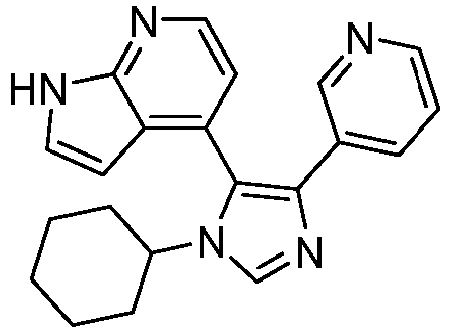
- The compound was prepared according to General procedure A using 1H-pyrrolo[2,3-b]pyridine-4-carbaldehyde, cyclohexanamine, 3-(isocyano(tosyl)methyl)pyridine (30 mg; 0.110 mmol) andK2CO3. Reaction time: 165 minutes for the formation of the imine, then additional 18 hours at 25 °C plus 2 hous at 50 °C for the cyclization step. The residue obtained after the workup was purified two times by preparative TLC (ethyl acetate/methanol, 20:1; then ethyl acetone/dichloromethane, 3:2). The product was obtained as a white solid (3.5 mg; 9 %).
- 1H NMR (500 MHz, acetone-d 6) δ (ppm) 10.93 (s, 1H), 8.56 (d, J = 2.19 Hz, 1H), 8.39 (d, J = 4.76 Hz, 1H), 8.25 (dd, J = 4.73, 1.68 Hz, 1H), 8.00 (s, 1H), 7.70 (dt, J = 7.95, 2.00 Hz, 1H), 7.51 (d, J = 3.51 Hz, 1H), 7.14 - 7.08 (m, 2H), 6.15 (d, J = 3.43 Hz, 1H), 3.74 (tt, J = 11.97, 3.91 Hz, 1H), 2.04 - 1.87 (m, 2H), 1.86 - 1.70 (m, 4H), 1.62 - 1.56 (m, 1H), 1.24 -1.15 (m, 2H), 1.14 -1.03 (m, 1H).
- 13C NMR (126 MHz, acetone-d 6) δ (ppm) 150.3, 148.3, 147.9, 144.3, 136.5, 136.1, 133.5, 131.9, 131.6, 127.7, 126.4, 123.8, 121.1, 118.5, 100.2, 55.9, 35.4, 34.9, 26.4, 26.3, 25.8.
- HRMS calculated for C21H22N5[M+H]+ 344.1870, found 344.1868.
-

- To a solution of 4-(4-fluorophenyl)-1H-imidazole (440 mg; 2.71 mmol) in dichloromethane (8 mL) were added triethylamine (0.8 mL), phenylboronic acid (496 mg; 4.07 mmol), copper(II) acetate (74 mg; 0.407 mmol) and the resulting mixture was stirred at 25 °C for 16 hours under oxygen atmosphere.The solvent was evaporated in vacuo and the residue was purified by column chromatography (ethyl acetate/hexane, 1:1). The product was obtained as a white solid (500 mg, 77 %). 1H NMR (500 MHz, CDCl3) δ (ppm) 7.92 (d, J = 1.36 Hz, 1H), 7.83 - 7.79 (m, 2H), 7.54 - 7.49 (m, 3H), 7.47 - 7.43 (m, 2H), 7.43 - 7.38 (m, 1H), 7.12 - 7.07 (m, 2H).
- 13C NMR (126 MHz, CDCl3) δ (ppm) 162.4 (d, J = 245.97 Hz), 142.3, 137.3, 135.8, 130.2, 129.8 (d, J = 3.18 Hz), 127.9, 126.8 (d, J = 7.98 Hz), 121.6, 115.7 (d, J = 21.48 Hz), 113.7.
- 19F NMR (471 MHz, CDCl3) δ (ppm) -115.15.
- HRMS calculated for C15H12FN2[M+H]+ 239.0979, found 239.0981.
-

- To a cold solution (0 °C) of 4-(4-fluorophenyl)-1-phenyl-1H-imidazole (500 mg; 2.10 mmol) in dichloromethane (6 mL) was added N-bromosuccinimide (392 mg; 2.20 mmol) and the resulting mixture was stirred at 0 °C for 75 minutes. The solvent was evaporated in vacuo and the residue was purified by column chromatography (ethyl acetate/hexane, 1:1). The product was obtained as a beige solid (473 mg, 78%).
- 1H NMR (500 MHz, CDCl3) δ (ppm) 8.05 - 7.96 (m, 2H), 7.85 (s, 1H), 7.58 - 7.50 (m, 3H), 7.44 - 7.38 (m, 2H), 7.17-7.11 (m, 2H).
- 13C NMR (126 MHz, CDCl3) δ (ppm) 162.5 (d, J = 247.19 Hz), 138.6, 138.0, 135.5, 129.7, 129.6, 128.8 (d, J = 8.13 Hz), 126.8, 115.5 (d, J = 21.67 Hz), 100.8.
- HRMS calculated for C15H11BrFN2[M+H]+ 317.0084, found 317.0086.
-

- To a degassed solution of 5-bromo-4-(4-fluorophenyl)-1-phenyl-1H-imidazole (31.0 mg; 0.098 mmol) in dioxane/H2O (2.1 mL + 0.3 mL) were added 4-(4,4,5,5-tetramethyl-1,3,2-dioxaborolan-2-yl)-1H-pyrrolo[2,3-b]pyridine (35.8 mg; 0.147 mmol), potassium tert-butoxide (44.0 mg; 0.392 mmol), methanesulfonato(tri-t-butylphosphino)(2'-amino-1,1'-biphenyl-2-yl)palladium(II) (3.4 mg; 5.88 µmol; CAS:1445086-17-8) and the resulting mixture was stirred for 15 hours at reflux. The solvent was evaporated and the residue was purified by preparative TLC (acetone/hexane, 1:1). The product was obtained as a white solid (2 mg, 6 %).
- 1H NMR (500 MHz, methanol-d 4) δ (ppm) 8.21 (s, 1H), 8.10 (d, J = 4.98 Hz, 1H), 7.40 - 7.35 (m, 2H), 7.34 - 7.29 (m, 3H), 7.27 (d, J = 3.52 Hz, 1H), 7.23 - 7.18 (m, 2H), 6.97 - 6.91 (m, 2H), 6.86 (d, J = 4.99 Hz, 1H), 6.01 (d, J = 3.51 Hz, 1H).
- 13C NMR (126 MHz, methanol-d 4) δ (ppm) 163.6 (d, J = 245.72 Hz), 149.5, 143.1, 139.8, 139.8, 137.3, 131.5, 130.8 (d, J = 3.11 Hz), 130.5, 130.2 (d, J = 8.15 Hz), 129.7, 128.0, 127.0, 126.6, 121.8, 118.9, 116.1 (d, J = 21.87 Hz), 101.0.
- 19F NMR (471 MHz, methanol-d 4) δ (ppm) -116.71.
- HRMS calculated for C22H16FN4[M+H]+ 355.1354, found 355.1350.
-

- To a solution of 4-(4-fluorophenyl)-1H-imidazole (96 mg; 0.592 mmol) in dichloromethane (2.0 mL) were added triethylamine (0.20 mL), 3-(4,4,5,5-tetramethyl-1,3,2-dioxaborolan-2-yl)pyridine (182 mg; 0.888 mmol), DMAP (108 mg; 0.888 mmol), copper(II) acetate (118 mg; 0.651 mmol) and the resulting mixture was stirred at 25 °C for 17 hours.The solvent was evaporated and the residue was purified by column chromatography (dichloromethane/methanol, 12:1). The product was obtained as a white solid (152 mg, 81 %).
- 1H NMR (500 MHz, CDCl3) δ (ppm) 9.16 - 8.62 (br m, 2H), 7.95 (s, 1H), 7.85 - 7.75 (m, 3H), 7.62 - 7.45 (br m, 2H), 7.13 - 7.07 (m, 2H).
- 13C NMR (126 MHz, CDCl3) δ (ppm) 162.5 (d, J = 246.29 Hz), 148.94, 148.91, 142.8, 135.7, 129.5 (d, J = 2.54 Hz), 128.8, 126.9 (d, J = 7.98 Hz), 124.9, 115.8 (d, J = 21.59 Hz), 113.5.
- 19F NMR (471 MHz, CDCl3) δ (ppm) -114.69.
- HRMS calculated for C14H11FN3[M+H]+ 240.0932, found 240.0930.
-

- To a cold solution (0 °C) of 3-(4-(4-fluorophenyl)-1H-imidazol-1-yl)pyridine (73 mg; 0.305 mmol) in dichloromethane (2 mL) was added N-bromosuccinimide (57 mg; 0.320 mmol) and the resulting mixture was stirred at 0 °C for 3 hours. The solvent was evaporated and the residue was purified by column chromatography (dichloromethane/acetone, 3:1). The product was obtained as a white solid (36 mg, 87 %).
- 1H NMR (500 MHz, methanol-d 4) δ (ppm) 8.77 - 8.73 (m, 2H), 8.15 (s, 1H), 8.04 (ddd, J = 8.18, 2.52, 1.45 Hz, 1H), 7.96 - 7.91 (m, 2H), 7.68 (dd, J = 8.10, 4.88 Hz, 1H), 7.22 - 7.17 (m, 2H).
- 13C NMR (126 MHz, methanol-d 4) δ (ppm) 163.9 (d, J = 246.19 Hz), 151.2, 148.3, 140.4, 140.3, 136.5, 134.1, 130.2 (d, J = 8.19 Hz), 130.1 (d, J = 3.20 Hz), 125.8, 116.3 (d, J = 21.90 Hz), 102.0.
- 19F NMR (471 MHz, methanol-d 4) δ (ppm) -115.98.
- HRMS calculated for C14H10BrFN3[M+H]+ 318.0037, found 318.0036.
-

- To a degassed solution of 3-(5-bromo-4-(4-fluorophenyl)-1H-imidazol-1-yl)pyridine (31.0 mg; 0.097 mmol) in dimethoxyethane/H2O (1.8 mL + 0.30 mL) were added 4-(4,4,5,5-tetramethyl-1,3,2-dioxaborolan-2-yl)-1H-pyrrolo[2,3-b]pyridine (36.0 mg; 0.146 mmol), sodium methoxide (21.0 mg; 0.388 mmol), methanesulfonato(tri-t-butylphosphino)(2'-amino-1,1'-biphenyl-2-yl)palladium(II) (5.50 mg; 9.70 µmol; CAS:1445086-17-8) and the resulting mixture was stirred at reflux for 6 hours. The solvent was evaporated and the residue was purified by preparative TLC (acetone/dichloromethane, 1:1). The product was obtained as a yellow solid (13 mg, 38 %).
- 1H NMR (500 MHz, acetone-d 6) δ (ppm) 10.81 (s, 1H), 8.50 (d, J = 2.58 Hz, 1H), 8.47 (dd, J = 4.83, 1.50 Hz, 1H), 8.21 (d, J = 4.81 Hz, 1H), 8.09 (s, 1H), 7.62 (ddd, J = 8.14, 2.61, 1.50 Hz, 1H), 7.55 - 7.50 (m, 2H), 7.39 (dd, J = 3.46, 2.39 Hz, 1H), 7.31 (dd, J = 8.13, 4.70 Hz, 1H), 6.98 - 6.93 (m, 3H), 6.09 (dd, J = 3.52, 1.85 Hz, 1H).
- 13C NMR (126 MHz, acetone-d 6) δ (ppm) 162.7 (d, J = 244.01 Hz), 150.1, 149.9, 147.1, 143.9, 139.9, 139.4, 134.2, 133.5, 131.9 (d, J = 3.17 Hz), 130.6, 129.3 (d, J = 8.03 Hz), 127.5, 126.1, 124.6, 120.6, 118.7, 115.7 (d, J = 21.47 Hz), 100.6.
- 19F NMR (471 MHz, acetone-d 6) δ (ppm) -117.34.
- HRMS calculated for C21H15FN5[M+H]+ 356.1306, found 356.1304.
-

- To a cold solution (0 °C) of 4-(4-fluorophenyl)-1H-imidazole (106 mg; 0.654 mmol) in dichloromethane/tetrahydrofuran (3 mL + 3 mL) was added N-bromosuccinimide (122 mg; 0.687 mmol) and the resulting mixture was stirred at 0 °C for 75 minutes. The solvent was evaporated and the residue was purified by column chromatography (ethyl acetate/methanol, 100:1). The product was obtained as a white solid (138 mg, 87 %).
- 1H NMR (500 MHz, methanol-d 4) δ (ppm) 7.80 - 7.60 (m, 3H), 7.25 - 7.15 (m, 2H).
- 13C NMR (126 MHz, methanol-d 4) δ (ppm) 163.8 (d, J = 246.74 Hz), 136.9, 130.0 (d, J = 8.30 Hz), 128.4, 116.6 (d, J = 21.91 Hz), 112.3.
- 19F NMR (471 MHz, methanol-d 4) δ (ppm) -115.57.
- HRMS calculated for C9H7BrFN2[M+H]+ 240.9771, found 240.9774.
-

- To a solution of 5-bromo-4-(4-fluorophenyl)-1H-imidazole (236 mg; 0.979 mmol) in acetonitrile (10 mL) were added triethylamine (1.0 mL), thiophen-3-ylboronic acid (150 mg; 1.17 mmol), DMAP (179 mg; 1.47 mmol), copper(II) acetate (196 mg; 1.08 mmol) and the resulting mixture was stirred at 40 °C for 6 hours. Then, additional thiophen-3-ylboronic acid (150 mg; 1.17 mmol) was added and the mixture was stirred for additional 16 hours. The solvent was evaporated and the residue was purified by column chromatography (toluene/acetone, 15:1) a then by preparative TLC (toluene/acetone, 20:1). The product was obtained as colorless wax (68 mg, 22 %).
- 1H NMR (500 MHz, CDCl3) δ (ppm) 8.03 - 7.95 (m, 2H), 7.84 (s, 1H), 7.48 (dd, J = 5.09, 3.21 Hz, 1H), 7.43 (dd, J = 3.24, 1.43 Hz, 1H), 7.19 (dd, J = 5.17, 1.44 Hz, 1H), 7.16-7.10 (m, 2H).
- 13C NMR (126 MHz, CDCl3) δ (ppm) 162.5 (d, J = 247.42 Hz), 138.6 , 138.2 , 133.5 , 128.9 (d, J = 3.40 Hz), 128.8 (d, J = 8.17 Hz), 126.7 , 125.2, 121.1 , 115.5 (d, J = 21.54 Hz), 100.8.
- HRMS calculated for C13H9BrFN2S[M+H]+ 324.9656, found 324.9654.
-

- To a cold solution (-65 °C) of methyl 4-chloro-1H-pyrrolo[2,3-b]pyridine-2-carboxylate(1.11 g; 5.28 mmol) in tetrahydrofuran (16 mL) was added 1 M solution of LiAlH4 in tetrahydrofuran (6.86 mL; 6.86 mmol) and the resulting mixture was stirred at -65 °C for 90 minutes and then at 25 °C for 30 minutes. A saturated aqueous solution of NH4Cl and H2O (50 + 50 mL) were added and the mixture was extracted with ethyl acetate (3 × 60 mL). The combined organic extracts were dried over MgSO4, filtered, and the solvent was evaporated in vacuo. The residue was purified by column chromatography (ethyl acetate/methanol; 33:1). The product was obtained as a white solid (0.850 g, 88 %).
- 1H NMR (500 MHz, methanol-d 4) δ (ppm) 8.06 (d, J = 5.29 Hz, 1H), 7.11 (d, J = 5.30 Hz, 1H), 6.47 (s, 1H), 4.76 (d, J= 0.82 Hz, 2H).
- 13C NMR (126 MHz, methanol-d 4) δ (ppm) 150.4, 143.4, 142.8, 136.6, 121.6, 116.7, 97.1, 58.5. HRMS calculated for C8H8ClN2O[M+H]+ 183.0320, found 183.0323.
-

- To a degassed solution of (4-chloro-1H-pyrrolo[2,3-b]pyridin-2-yl)methanol (840 mg; 4.60 mmol) in dimethoxyethane/H2O (12 mL + 4.0 mL) were added potassium trifluoro(vinyl)borate (1.05 g; 7.82 mmol), cesium carbonate (5.99 g; 18.4 mmol), bis(di-tert-butyl(4-dimethylaminophenyl) phosphine)dichloropalladium(II) (98 mg; 0.138 mmol; CAS:887919-35-9) and the resulting mixture was stirred at reflux for 5 hours. The solvent was evaporated and the residue was purified by column chromatography (methanol/dichloromethane, gradient from 1:15 to 1:10). The product was obtained as a yellow solid (763 mg, 95 %).
- 1H NMR (500 MHz, acetone-d 6) δ (ppm) 10.92 (s, 1H), 8.17 (d, J = 4.96 Hz, 1H), 7.13 (d, J = 5.02 Hz, 1H), 7.09 (dd, J = 17.71, 11.13 Hz, 1H), 6.60 (s, 1H), 6.12 (dd, J = 17.75, 1.10 Hz, 1H), 5.56 (dd, J = 11.13, 1.11 Hz, 1H), 4.83 (d, J = 3.35 Hz, 2H), 4.36 (app s, 1H).
- 13C NMR (126 MHz, acetone-d 6) δ (ppm) 151.1, 143.3, 142.2, 137.1, 135.2, 119.2, 118.7, 113.1, 96.9, 58.6.
- HRMS calculated for C10H11N2O[M+H]+ 175.0866, found 175.0864.
-

- To a cold solution (0 °C) of (4-vinyl-1H-pyrrolo[2,3-b]pyridin-2-yl)methanol (750 mg; 4.31 mmol) in dioxane/H2O (18 + 6 mL) were added 2,6-lutidine (1.00 mL; 924 mg; 8.62 mmol), NaIO4 (3.62 g; 17.2 mmol), K2OsO4.2H2O (48 mg; 0.129 mmol) and the resulting mixture was stirred at 25 °C for 9 hours. A solution of Na2S2O3 (2.6 g) in H2O (100 mL) was added and the resulting mixture was extracted with ethyl acetate (3 × 70 mL). The combined organic extracts were dried over MgSO4, filtered, and the solvent was evaporated in vacuo. The residue was purified by column chromatography (acetone/dichloromethane; gradient from 1:2 to 1:0). The product was obtained as a yellow solid (272 mg, 36 %).
- 1H NMR (500 MHz, acetone-d 6) δ (ppm) 11.10 (s, 1H), 10.37 (s, 1H), 8.45 (d, J = 4.79 Hz, 1H), 7.55 (d, J = 4.81 Hz, 1H), 7.00 (s, 1H), 4.89 (d, J = 5.94 Hz, 2H), 4.50 (t, J = 5.89 Hz, 1H).
- 13C NMR (126 MHz, acetone-d 6) δ (ppm) 193.9, 151.9, 146.4, 143.3, 133.5, 118.7, 118.2, 98.2, 58.6. HRMS calculated for C9H9N2O2[M+H]+ 177.0659, found 177.0655.
-

- To a solution of 2-(hydroxymethyl)-1H-pyrrolo[2,3-b]pyridine-4-carbaldehyde (97 mg; 0.551 mmol) in acetonitrile (8 mL) was added cyclohexaneamine (0.189 mL; 163 mg; 1.65 mmol) and the resulting mixture was stirred at 25 °C for 4 hours. Then, 1-fluoro-4-(isocyano(tosyl)methyl)benzene (159 mg; 0.551 mmol) and cesium carbonate (269 mg; 0.827 mmol) were added and the resulting mixture was stirred at 50 °C for 16 hours. Then methanol (6 mL) and additional 1-fluoro-4-(isocyano(tosyl)methyl)benzene (159 mg; 0.551 mmol) were added and the resulting mixture was stirred at 60 °C for additional 8 hours. The solvent was evaporated and the residue was purified by column chromatography (ethyl acetate/methanol, 20:1). So obtained material was then recrystallized from a hot solution of dichloromethane/ethyl acetate (1 mL + 1 mL) and washed 2 times with a solution of hexane/ethyl acetate (0.15 mL + 0.15 mL) and then washed with a solution of acetone/chloroform (0.5 mL + 0.5 mL) and dried in a vacuum. The product was obtained as a pale yellow solid (68 mg, 32 %).
- 1H NMR (500 MHz, methanol-d 4) δ (ppm) 8.27 (d, J = 4.92 Hz, 1H), 8.02 (s, 1H), 7.31 - 7.26 (m, 2H), 7.05 (d, J = 4.97 Hz, 1H), 6.87 - 6.82 (m, 2H), 6.04 (app t, J = 0.90 Hz, 1H), 4.70 (d, J = 0.92 Hz, 2H), 3.70 (tt, J = 11.85, 3.78 Hz, 1H), 2.07 - 2.02 (m, 1H), 1.96 - 1.90 (m, 1H), 1.82 - 1.69 (m, 4H), 1.64 - 1.59 (m, 1H), 1.26 - 1.05 (m, 3H).
- 13C NMR (126 MHz, methanol-d 4) δ (ppm) 163.2 (d, J = 244.68 Hz), 150.2, 143.5, 143.3, 138.6, 136.6, 132.1, 131.7 (d, J = 3.18 Hz), 129.5 (d, J = 7.86 Hz), 126.0, 123.0, 119.0, 115.9 (d, J = 21.76 Hz), 97.9, 58.5, 56.9, 35.7, 35.1, 26.7, 26.6, 26.1.
- 19F NMR (471 MHz, methanol-d 4) δ (ppm) -117.83.
- HRMS calculated for C23H24FN4O[M+H]+391.1929, found 391.1932.
-

- To a cold solution (0 °C) of (4-chloro-1H-pyrrolo[2,3-b]pyridin-2-yl)methanol (930 mg; 5.09 mmol) in tetrahydrofuran (25 mL) was added PBr3 (0.958 mL; 2.76 g; 10.2 mmol) the resulting mixture was stirred for 12 hours while being allowed to warm to 25 °C. Then, the mixture was cooled to 0 °C and methanol (12 mL) followed by a suspension of sodium methoxide (2.43 g; 45.0 mmol) in methanol (32 mL) were added and the resulting mixture was stirred at 25 °C for 5 hours. Then, additional suspension of sodium methoxide (270 mg; 5.09 mmol) in methanol (12 mL) was added and the resulting mixture was stirred at 25 °C for additional 19 hours. A saturated aqueous solution of NH4Cl (6 mL) was added and all solvents were evaporated in vacuo. The residue was purified by column chromatography (ethyl acetate). The product was obtained as a white solid (568 mg, 57 %).
- 1H NMR (500 MHz, acetone-d 6) δ (ppm) 11.16 (s, 1H), 8.16 (d, J = 5.18 Hz, 1H), 7.13 (d, J = 5.20 Hz, 1H), 6.51 (s, 1H), 4.65 (s, 2H), 3.37 (s, 3H).
- 13C NMR (126 MHz, acetone-d 6) δ (ppm) 144.2, 139.0, 135.2, 120.3, 116.5, 116.4, 98.3, 67.9, 58.2. HRMS calculated for C9H10ClN2O[M+H]+ 197.0476, found 197.0478.
-

- To a degassed solution of 4-chloro-2-(methoxymethyl)-1H-pyrrolo[2,3-b]pyridine (548 mg; 2.79 mmol) in dioxane/H2O (12 mL + 4.0 mL) were added potassium trifluoro(vinyl)borate (746 mg; 5.57 mmol), cesium carbonate (3.64 g; 11.2 mmol), bis(di-tert-butyl(4-dimethylaminophenyl)phosphine) dichloropalladium(II) (98 mg; 0.138 mmol; CAS:887919-35-9) and the resulting mixture was stirred at reflux for 2 hours. The solvent was evaporated and the residue was purified by column chromatography (ethyl acetate). The product was obtained as a yellow solid (290 mg, 55 %).
- 1H NMR (500 MHz, CDCl3) δ (ppm) 11.69 (s, 1H), 8.31 (d, J = 5.08 Hz, 1H), 7.14 (d, J = 5.11 Hz, 1H), 7.04 (dd, J = 17.67, 11.03 Hz, 1H), 6.59 (s, 1H), 6.10 (dd, J = 17.69, 0.94 Hz, 1H), 5.60 (dd, J = 11.04, 0.91 Hz, 1H), 4.72 (s, 2H), 3.44 (s, 3H).
- 13C NMR (126 MHz, CDCl3) δ (ppm) 150.1, 142.4, 137.7, 136.9, 134.0, 119.1, 118.9, 112.7, 98.3, 68.1, 58.2.
- HRMS calculated for C11H13N2O[M+H]+ 189.1022, found 189.1019.
-

- To a solution of 2-(methoxymethyl)-4-vinyl-1H-pyrrolo[2,3-b]pyridine (277 mg; 1.47 mmol) in dioxane/H2O (6 + 2 mL) were added 2,6-lutidine (0.342 mL; 315 mg; 2.94 mmol), NaIO4 (1.26 g; 5.88 mmol) and K2OsO4.2H2O (13.5 mg; 0.037 mmol), and the resulting mixture was stirred at 25 °C for 15 hours. A solution of Na2S2O3 (1.0 g) in H2O (60 mL) was added and the resulting mixture was extracted with ethyl acetate (3 × 40 mL). The combined organic extracts were dried over MgSO4, filtered, and the solvent was evaporated in vacuo. The residue was purified by column chromatography (hexane/ethyl acetate; 1:1). The crude product (272 mg; ca. 60 % purity) was used without further purification in the next step.
- 1H NMR (500 MHz, CDCl3) δ (ppm) 11.15 (s, 1H), 10.35 (s, 1H), 8.56 (d, J = 4.95 Hz, 1H), 7.51 (d, J = 4.86 Hz, 1H), 7.07 (s, 1H), 4.77 (s, 2H), 3.47 (s, 3H).
- 13C NMR (126 MHz, CDCl3) δ (ppm) 192.8 (d, J = 4.95 Hz), 150.9, 142.7, 141.2, 133.2, 118.4, 118.0, 99.6, 68.0, 58.5.
- HRMS calculated for C10H11N2O2[M+H]+ 191.0815, found 191.0817.
-

- The compound was prepared according to General procedure A using 2-(methoxymethyl)-1H-pyrrolo[2,3-b]pyridine-4-carbaldehyde, cyclohexaneamine, 1-fluoro-4-(isocyano(tosyl)methyl) benzene and K2CO3. Reaction time: 4 hours for the formation of the imine, then additional 14 hours for the cyclization step. The residue obtained after the workup was purified by column chromatography (hexane/acetone; 1:1) and then two times by preparative TLC (hexane/acetone; 1:1; then ethyl acetate/toluene, 2:1). The product was obtained as a white solid (7 mg; 3 %).
- 1H NMR (500 MHz, CDCl3) δ (ppm) 11.05 (s, 1H), 8.43 (d, J = 4.88 Hz, 1H), 7.81 (s, 1H), 7.39 - 7.34 (m, 2H), 7.04 (d, J = 4.90 Hz, 1H), 6.84 - 6.78 (m, 2H), 6.05 (s, 1H), 4.67 - 4.55 (m, 2H), 3.67 (tt, J = 11.97, 3.75 Hz, 1H), 3.39 (s, 3H), 2.09 - 2.04 (m, 1H), 1.96 - 1.91 (m, 1H), 1.83 - 1.73 (m, 2H), 1.69 - 1.61 (m, 3H), 1.21 - 1.13 (m, 2H), 1.12 - 1.03 (m, 1H).
- 13C NMR (126 MHz, CDCl3) δ (ppm) 161.8 (d, J = 245.41 Hz), 149.7, 143.1, 137.9, 137.6, 134.9, 131.5, 130.6 (d, J = 3.08 Hz), 128.2 (d, J = 7.81 Hz), 124.4, 121.4, 118.0, 115.1 (d, J = 21.35 Hz), 99.0, 68.0, 58.3, 55.3, 35.2, 34.6, 25.8, 25.7, 25.2.
- 19F NMR (471 MHz, CDCl3) δ (ppm) -116.20.
- HRMS calculated for C24H26FN4O [M+H]+ 405.2085, found 405.2087.
-
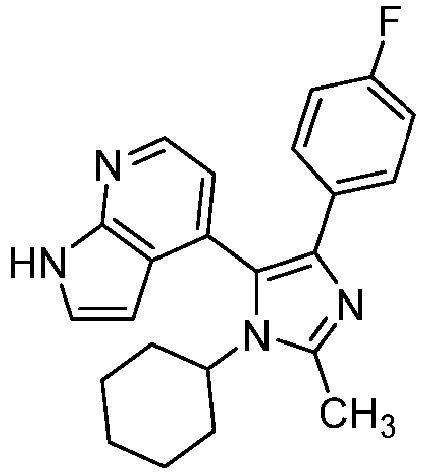
- To a cold solution (-78 °C) of 4-(1-cyclohexyl-4-(4-fluorophenyl)-1H-imidazol-5-yl)-1H-pyrrolo[2,3-b]pyridine (215 mg; 0.596 mmol) in tetrahydrofuran (13 mL) were added 1,2-bis(dimethylamino)ethane (0.268 mL; 208 mg; 1.79 mmol), then dropwise 2.5 M solution of n-BuLi in hexane (0.596 mL; 1.49 mmol) and the resulting mixture was stirred at -78 °C for 70 minutes. Then, a solution of iodomethane (127 mg; 0.894) in tetrahydrofuran (3 mL) was added and the resulting mixture was stirred at -78 °C for 40 minutes and then at 25 °C for 30 minutes. A saturated aqueous solution of NH4Cl (20 mL) was added and the mixture was extracted with ethyl acetate (2 × 25 mL). The combined organic extracts were dried over MgSO4, filtered, and the solvent was evaporated in vacuo. The residue was purified by column chromatography (ethyl acetate). So obtained material was purified using reverse phase HPLC (acetonitrile/H2O, gradient from 60 % to 95% of acetonitrile; stationary phase: NUCLEODUR® C18 HTec, 5 µm, length: 250 mm, diameter: 21 mm). The product was obtained as a white solid (12.5 mg; 6 %).
- 1H NMR (500 MHz, CDCl3) δ (ppm) 9.86 (s, 1H), 8.41 (s, 1H), 7.37 - 7.27 (m, 3H), 7.06 - 6.98 (m, 1H), 6.83 - 6.75 (m, 2H), 6.22 (d, J = 3.49 Hz, 1H), 3.78 - 3.67 (m, 1H), 2.73 (s, 3H), 1.93 - 1.83 (m, 3H), 1.80 - 1. 71 (m, 3H), 1.62 - 1.56 (m, 1H), 1.13 - 0.96 (m, 3H).
- 13C NMR (126 MHz, CDCl3) δ (ppm) 161.9 (d, J = 245.96 Hz), 148.9, 144.8, 143.3, 135.5, 132.2, 129.5, 128.3 (d, J = 7.88 Hz), 126.3, 125.0, 121.5, 118.8, 115.2 (d, J = 21.38 Hz), 100.7, 57.3, 32.3, 26.2, 26.1, 25.2.
- HRMS calculated for C23H24FN4[M+H]+ 375.1980, found 375.1982.
-

- To a solution of 1-cyclohexyl-1H-imidazole (1.845 g; 12.28 mmol) in DMF (30 mL) was added N-iodosuccinimide (6.079 g; 27.0 mmol) and the resulting mixture was stirred at 85 °C for 15 hours. A solution of Na2S2O3 (2.5 g) in H2O (100 mL) and ethyl acetate (150 mL) were added, the layers were separated and the organic phase was washed with H2O (3 × 100 mL). The combined organic extracts were dried over MgSO4, filtered, and the solvent was evaporated in vacuo. The residue was purified by column chromatography (hexane/ethyl acetate; 3:1). The product was obtained as a yellow wax (2.36 g; 48 %).
- 1H NMR (500 MHz, CDCl3) δ (ppm) 7.64 (s, 1H), 3.92 (tt, J = 11.90, 3.68 Hz, 1H), 2.14 - 2.08 (m, 2H), 1.96 - 1.90 (m, 2H), 1.81 - 1.75 (m, 1H), 1.61 - 1.52 (m, 2H), 1.49 - 1.40 (m, 2H), 1.30 - 1.20 (m, 1H).
- 13C NMR (126 MHz, CDCl3) δ (ppm) 138.4, 95.7, 82.4, 60.5, 34.1, 25.7, 25.3.
- HRMS calculated for C9H13I2N2[M+H]+ 402.9163, found 402.9164.
-
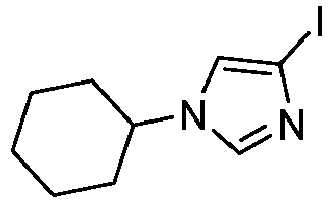
- To a cold solution (0 °C) of 1-cyclohexyl-4,5-diiodo-1H-imidazole (2.84 g; 7.06 mmol) in tetrahydrofuran (20 mL) was added dropwise 3 M solution of MeMgCl in tetrahydrofuran (2.59 mL; 7.77 mmol) and the resulting mixture was stirred at 0 °C for 45 minutes. A saturated aqueous solution of NH4Cl (30 mL) was added and the mixture was extracted with dichloromethane (3 × 100 mL). The combined organic extracts were dried over MgSO4, filtered, and the solvent was evaporated in vacuo. The residue was purified by column chromatography (ethyl acetate/hexane; 2:3). The product was obtained as a yellow wax (1.67 g, 86 %).
- 1H NMR (500 MHz, CDCl3) δ (ppm) 7.45 (d, J = 1.53 Hz, 1H), 7.03 (d, J = 1.52 Hz, 1H), 3.89 (tt, J = 11.77, 3.84 Hz, 1H), 2.12 - 2.06 (m, 2H), 1.92 - 1.86 (m, 2H), 1.77 - 1.72 (m, 1H), 1.55 - 1.63 (m, 2H), 1.44 - 1.35 (m, 2H), 1.26 - 1.18 (m, 1H).
- 13C NMR (126 MHz, CDCl3) δ (ppm) 137.0, 122.9, 81.2, 57.5, 34.4, 25.4, 25.2.
- HRMS calculated for C9H14IN2[M+H]+ 277.0196, found 277.0198.
-

- To a degassed solution of 1-cyclohexyl-4-iodo-1H-imidazole (980 mg; 3.55 mmol) in 1-butanol/H2O (8.0 mL + 1.60 mL) were added potassium cyclohex-1-en-1-yltrifluoroborate (689 mg; 3.66 mmol), K3PO4 (2.64 g; 12.4 mmol), (2-dicyclohexylphosphino-2',6'-dimethoxybiphenyl) [2-(2'-amino-1,1'-biphenyl)]palladium(II) methanesulfonate (55 mg; 0.071 mmol; CAS:1445085-82-4), 2-dicyclohexylphosphino-2',6'-dimethoxybiphenyl (73 mg, 0.178 mmo; CAS: 657408-07-6) and the resulting mixture was stirred at 80 °C for 5 hours. The solvent was evaporated in vacuo and the residue was purified by column chromatography (ethyl acetate). The product was obtained as a yellow wax (307 mg, 38 %).
- 1H NMR (500 MHz, CDCl3) δ (ppm) 7.55 (d, J = 1.33 Hz, 1H), 6.82 (d, J = 1.25 Hz, 1H), 6.45 (tt, J = 3.88, 1.73 Hz, 1H), 3.86 (tt, J = 11.82, 3.85 Hz, 1H), 2.33 - 2.27 (m, 2H), 2.21 - 2.16 (m, 2H), 2.13 - 2.07 (m,2H), 1.93 - 1.86 (m, 2H), 1.77 - 1.71 (m, 3H), 1.67 - 1.60 (m, 4H), 1.45 - 1.35 (m, 2H), 1.28 - 1.19 (m, 1H).
- 13C NMR (126 MHz, CDCl3) δ (ppm) 143.1, 135.0, 129.5, 122.1, 111.8, 57.1, 34.5, 26.2, 25.5, 25.4, 25.4, 22.8, 22.6.
- HRMS calculated for C15H23N2[M+H]+ 231.1856, found 231.1855.
-
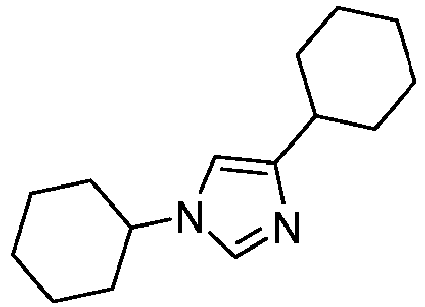
- To a solution of 4-(cyclohex-1-en-1-yl)-1-cyclohexyl-1H-imidazole (298 mg; 1.29 mmol) in ethanol (10 mL) was added Pd(OH)2/C (60 mg; 10-20 % Pd basis) and the resulting mixture was stirred in a hydrogenator under hydrogen atmosphere (70 bar) at 50 °C for 18 hours. The solvent was evaporated in vacuo and the residue was purified by column chromatography (ethyl acetate). The product was obtained as a yellow wax (194 mg, 65 %).
- 1H NMR (500 MHz, CDCl3) δ (ppm) 7.44 (d, J = 1.39 Hz, 1H), 6.62 (s, 1H), 3.82 (tt, J = 11.82, 3.87 Hz, 1H), 2.52 (tt, J = 11.16, 3.62 Hz, 1H), 2.12 - 2.06 (m, 2H), 2.05 - 1.98 (m, 2H), 1.91 - 1.85 (m, 2H), 1.82 - 1.66 (m, 4H), 1.64 - 1.55 (m, 2H), 1.42 - 1.31 (m, 6H), 1.28 - 1.18 (m, 2H).
- 13C NMR (126 MHz, CDCl3) δ (ppm) 148.2, 134.2, 111.5, 56.9, 37.7, 34.5, 33.2, 26.6, 26.5, 25.6, 25.4. HRMS calculated for C15H25N2[M+H]+ 233.2012, found 233.2013.
-

- To a cold solution (-3 °C) of 1,4-dicyclohexyl-1H-imidazole(194 mg; 0.835 mmol) in dichloromethane (5 mL) was added N-bromosuccinimide (156 mg; 0.877 mmol) and the resulting mixture was stirred at - 3 °C for 105 minutes. The solvent was evaporated and the residue was purified by column chromatography (ethyl acetate/hexane, 1:1). The product was obtained as a pale yellow solid (145 mg, 56 %).
- 1H NMR (500 MHz, CDCl3) δ (ppm) 7.68 (s, 1H), 3.95 (tt, J = 11.94, 3.66 Hz, 1H), 2.63 (tt, J = 11.83, 3.81 Hz, 1H), 2.16 - 2.09 (m, 2H), 1.96 - 1.90 (m, 2H), 1.86 - 1.80 (m, 2H), 1.79 - 1.65 (m, 6H), 1.63 - 1.53 (m, 2H), 1.46 - 1.25 (m, 6H).
- 13C NMR (126 MHz, CDCl3) δ (ppm) 143.3, 134.1, 99.2, 57.0, 36.8, 33.8, 31.8, 26.7, 26.0, 25.7, 25.3. HRMS calculated for C15H24BrN2[M+H]+ 311.1117, found 311.1119.
-
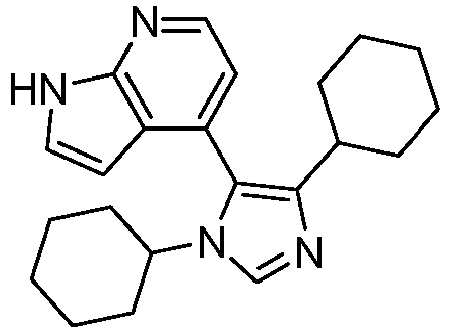
- To a degassed solution of 5-bromo-1,4-dicyclohexyl-1H-imidazole (58.0 mg; 0.186 mmol) in dimethoxyethane/H2O (3.0 mL + 0.43 mL) were added 4-(4,4,5,5-tetramethyl-1,3,2-dioxaborolan-2-yl)-1H-pyrrolo[2,3-b]pyridine (68.0 mg; 0.280 mmol), K3PO4 (138 mg; 0.651 mmol), 2-dicyclohexylphosphino-2',6'-dimethoxybiphenyl (3.80 mg; 0.0093 mmol), (2-dicyclohexylphosphino-2',6'-dimethoxybiphenyl) [2-(2'-amino-1,1'-biphenyl)]palladium(II) methanesulfonate (4.40 mg; 5.58 µmol; CAS:1445085-82-4) and the resulting mixture was stirred at reflux for 4.5 hours. The solvent was evaporated and the residue was purified by column chromatography (ethyl acetate/methanol, gradient from 1:0 to 30:1). So obtained material was purified two times by preparative TLC (acetone/hexane, 1:1; then dichloromethane/methanol, 35:1). The product was obtained as a pale yellow wax (4 mg; 4 %).
- 1H NMR (500 MHz, CDCl3) δ (ppm) 9.53 (s, 1H), 8.68 (s, 1H), 8.49 (d, J = 4.82 Hz, 1H), 7.51 (d, J = 3.55 Hz, 1H), 7.02 (d, J = 4.79 Hz, 1H), 6.20 (d, J = 3.51 Hz, 1H), 3.75 (tt, J = 12.09, 3.71 Hz, 1H), 2.55 - 2.44 (m, 1H), 2.05 - 1.99 (m, 1H), 1.98 - 1.93 (m, 1H), 1.85 - 1.55 (m, 16H), 1.15 - 1.06 (m, 2H).
- HRMS calculated for C22H29N4 [M+H]+ 349.2387, found 349.2390.
-

- To a solution of 4-(4-(4-fluorophenyl)-1-(piperidin-4-yl)-1H-imidazol-5-yl)-1H-pyrrolo[2,3-b]pyridine (22.5 mg; 0.0623 mmol) in acetonitrile (2 mL) was added pyridine (24.6 mg; 0.312 mmol), followed by acetic anhydride (0.0065 mL; 7.0 mg; 0.0685 mmol) and the resulting mixture was stirred at 25 °C for 45 minutes. Then, methanol (2 mL) was added and the solvent was evaporated in vacuo. The residue was purified by preparative TLC (acetone/methanol, 20:1). The product was obtained as a white solid (17 mg, 68 %).
- 1H NMR (500 MHz, methanol-d 4) δ (ppm) 8.33 (app t, J = 4.58 Hz, 1H), 8.09 (s, 1H), 7.42 (dd, J = 6.03, 3.49 Hz, 1H), 7.31 - 7.25 (m, 2H), 7.12 (dd, J = 9.43, 4.94 Hz, 1H), 6.89 - 6.82 (m, 2H), 6.13 (dd, J = 10.83, 3.51 Hz, 1H), 4.64 - 4.53 (m, 1H), 4.06 - 3.97 (m, 1H), 3.98 - 3.87 (m, 1H), 3.03 - 2.86 (m, 1H), 2.52 - 2.34 (m, 1H), 2.08 (d, J = 6.76 Hz, 4H), 2.05 - 1.96 (m, 1H), 1.96 - 1.85 (m, 2H).
- 13C NMR (126 MHz, methanol-d 4) δ (ppm) 171.5, 163.3 (d, J = 245.02 Hz), 149.8, 143.8 (d, J = 5.36 Hz), 139.0 (d, J = 2.63 Hz), 136.8, 132.1, 131.5 (d, J = 3.22 Hz), 129.6 (d, J = 8.04 Hz), 128.5 (d, J = 9.41 Hz), 126.0, 122.3 (d, J = 3.97 Hz), 118.9, 115.9 (d, J = 21.75 Hz), 100.4, 54.9, 46.6, 41.8, 34.8, 34.4, 34.1, 33.8, 21.1.
- 19F NMR (471 MHz, methanol-d 4) δ (ppm) -117.50.
- HRMS calculated for C23H23FN5O[M+H]+ 404.1881, found 404.1884.
-
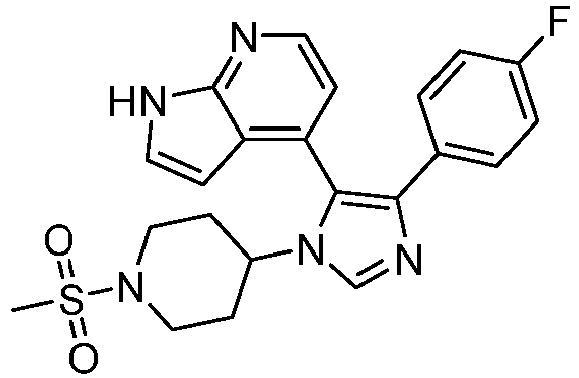
- To a solution of 4-(4-(4-fluorophenyl)-1-(piperidin-4-yl)-1H-imidazol-5-yl)-1H-pyrrolo[2,3-b]pyridine (22.5 mg; 0.0623 mmol) in acetonitrile (2 mL) was added pyridine (24.6 mg; 0.312 mmol), then methanesulfonyl chloride (0.0053 mL; 7.8 mg; 0.0685 mmol) and the resulting mixture was stirred at 25 °C for 45 minutes. Then, additional methanesulfonyl chloride (0.0030 mL; 4.4 mg; 0.0384 mmol) was added and the resulting mixture was stirred for additional 50 minutes. Then, methanol (2 mL) was added and the solvent was evaporated in vacuo. The residue was purified by preparative TLC (acetone/dichloromethane, 3:2). The product was obtained as a white solid (17 mg, 68 %).
- 1H NMR (500 MHz, methanol-d 4) δ (ppm) 8.33 (d, J = 4.94 Hz, 1H), 8.13 (s, 1H), 7.42 (d, J = 3.51 Hz, 1H), 7.33 - 7.25 (m, 2H), 7.12 (d, J = 4.91 Hz, 1H), 6.92 - 6.82 (m, 2H), 6.14 (d, J = 3.48 Hz, 1H), 3.90 (tt, J = 11.77, 4.42 Hz, 1H), 3.82 - 3.70 (m, 2H), 2.76 (s, 3H), 2.71 - 2.63 (m, 1H), 2.62 - 2.54 (m, 1H), 2.17 - 2.06 (m, 3H), 2.03 - 1.97 (m, 1H).
- 13C NMR (126 MHz, methanol-d 4) δ (ppm) 163.3 (d, J = 244.92 Hz), 149.8, 143.8, 139.1, 136.9, 132.0, 131.4 (d, J = 3.19 Hz), 129.6 (d, J = 8.09 Hz), 128.5, 126.0, 122.4, 118.9, 115.9 (d, J = 21.79 Hz), 100.4, 54.5, 46.32, 46.29, 35.1, 34.2, 33.8.
- 19F NMR (471 MHz, methanol-d 4) δ (ppm) -117.50.
- HRMS calculated for C22H23FN5O2S[M+H]+ 440.1551, found 440.1554.
-

- To a cold solution (-25 °C) of 4-(4-(4-fluorophenyl)-1-(piperidin-4-yl)-1H-imidazol-5-yl)-1H-pyrrolo[2,3-b]pyridine (20.0 mg; 0.055 mmol) in acetonitrile (1.5 mL) was added pyridine (22 mg; 0.278 mmol), then 4-nitrophenyl chloroformate (12.5 mg; 0.061 mmol) and the resulting mixture was stirred for 90 minutes while being allowed to warm to 25 °C. Then, ethanol (5 mL) and 1 M solution of NaHMDS in tetrahydrofuran (0.066 mL; 0.066 mmol) were added and the resulting mixture was stirred at 50 °C for 20 hours. Then, additional 1 M solution of NaHMDS in tetrahydrofuran (0.066 mL) was added and the resulting mixture was stirred at 50 °C for additional 4 hours. A saturated aqueous solution of NH4Cl (1 mL) was added and the solvent was evaporated in vacuo. The residue was purified by column chromatography (ethyl acetate/acetone, 10:1) and then by preparative TLC (ethyl acetate/acetone, 6:1). The product was obtained as a white solid (6 mg, 26 %).
- 1H NMR (500 MHz, acetone-d 6) δ (ppm) 10.92 (s, 1H), 8.37 (d, J = 4.81 Hz, 1H), 8.01 (s, 1H), 7.50 (dd, J = 3.54, 2.28 Hz, 1H), 7.45 - 7.39 (m, 2H), 7.11 (d, J = 4.78 Hz, 1H), 6.90 - 6.84 (m, 2H), 6.15 (dd, J = 3.52, 1.81 Hz, 1H), 4.22 - 4.08 (m, 2H), 4.06 (q, J = 7.06 Hz, 2H), 3.95 (tt, J = 11.81, 4.17 Hz, 1H), 2.78 - 2.54 (m, 3H), 1.98 - 1.88 (m, 3H), 1.19 (t, J = 7.10 Hz, 3H).
- 13C NMR (126 MHz, acetone-d 6) δ (ppm) 162.3 (d, J = 243.15 Hz), 155.6, 150.2, 144.3, 138.2, 136.1, 132.6 (d, J = 3.14 Hz), 131.7, 128.7 (d, J = 7.91 Hz), 127.6, 125.3, 121.2, 118.6, 115.4 (d, J = 21.44 Hz), 100.3, 61.7, 54.1, 43.80, 43.76, 34.3, 33.8, 15.0.
- 19F NMR (471 MHz, acetone-d 6) δ (ppm) -118.30.
- HRMS calculated for C24H25FN5O2[M+H]+ 434.1987, found 434.1990.
-

- To a cold solution (-25 °C) of 4-(4-(4-fluorophenyl)-1-(piperidin-4-yl)-1H-imidazol-5-yl)-1H-pyrrolo[2,3-b]pyridine (20.0 mg; 0.055 mmol) in acetonitrile (1.5 mL) was added pyridine (22 mg; 0.278 mmol), then 4-nitrophenyl chloroformate (12.5 mg; 0.061 mmol) and the resulting mixture was stirred for 90 minutes while being allowed to warm to 25 °C. The precipitate was filtered off and the filtrate was concentrated to dryness in vacuo. So obtained material was dissolved in 2.0 M solution of methylamine in THF (3 mL) and the resulting mixture was stirrred under nitrogen atmosphere at 25 °C for 18 hours and then at 50 °C for additional 3 hours. Then the solvent was evaporated and the residue was purified by preparative TLC (dichloromethane/acetone/methanol, 10:10:1). The product was obtained as a white solid (7 mg, 30 %).
- 1H NMR (500 MHz, acetone-d 6) δ (ppm) 10.93 (s, 1H), 8.37 (d, J = 4.73 Hz, 1H), 7.99 (s, 1H), 7.50 (dd, J = 3.49, 2.00 Hz, 1H), 7.46 - 7.37 (m, 2H), 7.10 (d, J = 4.78 Hz, 1H), 6.91 - 6.83 (m, 2H), 6.15 (dd, J = 3.50, 1.55 Hz, 1H), 5.77 (app d, J = 5.29 Hz, 1H), 4.13 - 4.03 (m, 2H), 3.92 (tt, J = 11.80, 4.23 Hz, 1H), 2.66 (d, J = 4.52 Hz, 3H), 2.63 - 2.57 (m, 1H), 2.55 - 2.48 (m, 1H), 2.03 - 1.97 (m, 1H), 1.94 - 1.84 (m, 3H).
- 13C NMR (126 MHz, acetone-d 6) δ (ppm) 162.3 (d, J = 243.32 Hz), 158.5, 150.3, 144.3, 138.1, 136.1, 132.6 (d, J = 3.11 Hz), 131.8, 128.7 (d, J = 7.80 Hz), 127.6, 125.3, 121.2, 118.6, 115.4 (d, J = 21.52 Hz), 100.3, 54.4, 43.9, 43.9, 34.4, 34.0, 27.7.
- 19F NMR (471 MHz, acetone-d 6) δ (ppm) -118.33.
- HRMS calculated for C23H24FN6O[M+H]+ 419.1990, found 419.1993.
-

- The compound was prepared according to General procedure A using 1H-pyrrolo[2,3-b]pyridine-4-carbaldehyde, tert-butyl (cis-4-aminocyclohexyl)carbamate, 1-fluoro-4-(isocyano(tosyl)methyl)benzene and K2CO3. Reaction times: 3 hours 15 minutes for the formation of the imine, then additional 14 hours for the cyclization step. The residue obtained after the workup was purified by column chromatography (hexane/acetone, 5:4). The product was obtained as a white solid (148 mg, 37 %, ca. 80 % purity).
- 1H NMR (500 MHz, CDCl3) δ (ppm) 10.31 (s, 1H), 8.35 (d, J = 4.79 Hz, 1H), 7.95 (br s, 1H), 7.34 - 7.24 (m, 3H), 6.98 (d, J = 4.85 Hz, 1H), 6.77 (t, J = 8.75 Hz, 2H), 6.11 (d, J = 3.50 Hz, 1H), 4.87 (br s, 1H), 3.73 - 3.67 (m, 2H), 3.62 - 3.56 (m, 1H), 3.37 - 3.29 (m, 1H), 1.87 - 1.72 (m, 4H), 1.70 - 1.63 (m, 2H), 1.39 (s, 9H).
- HRMS calculated for C27H31FN5O2 [M+H]+ 476.2456, found 476.2459.
-

- To a solution of tert-butyl (cis-4-(4-(4-fluorophenyl)-5-(1H-pyrrolo[2,3-b]pyridin-4-yl)-1H-imidazol-1-yl)cyclohexyl)carbamate (600 mg, 1.262 mmol) in dichloromethane (15 mL) was added TFA (1.5 mL) and the resulting mixture was stirred at 25 °C for 16 hours. A saturated aqueous solution of NaHCO3 (30 mL) was added and the mixture was extracted with ethyl acetate (2 × 100 mL). The combined organic extracts were dried over MgSO4, filtered, and the solvent was evaporated in vacuo. The residue was purified by column chromatography (dichloromethane/7 M NH3 in methanol, 10:1). The product was obtained as a white solid (290 mg, 61 %).
- 1H NMR (500 MHz, methanol-d 4) δ (ppm) 8.31 (d, J = 4.95 Hz, 1H), 8.16 (s, 1H), 7.41 (d, J = 3.51 Hz, 1H), 7.30 - 7.26 (m, 2H), 7.08 (d, J = 4.91 Hz, 1H), 6.88 - 6.84 (m, 2H), 6.12 (d, J = 3.54 Hz, 1H), 3.76 (tt, J = 11.66, 3.93 Hz, 1H), 3.05 (t, J = 3.40 Hz, 1H), 2.16 - 2.07 (m, 2H), 1.87 - 1.81 (m, 1H), 1.74 - 1.65 (m, 3H), 1.54 - 1.46 (m, 1H), 1.44 - 1.38 (m, 1H).
- 13C NMR (126 MHz, methanol-d 4) δ (ppm) 163.2 (d, J = 245.02 Hz), 149.8, 143.7, 138.7, 137.0, 132.4, 131.6 (d, J = 3.25 Hz), 129.6 (d, J = 8.09 Hz), 128.3, 126.0, 122.3, 118.8, 115.9 (d, J = 21.80 Hz), 100.4, 56.1, 48.5, 32.3, 32.2, 29.1, 28.6.
- HRMS calculated for C22H23FN5[M+H]+ 376.1932, found 376.1934.
-

- To a cold solution (0 °C) of cis-4-(4-(4-fluorophenyl)-5-(1H-pyrrolo[2,3-b]pyridin-4-yl)-1H-imidazol-1-yl)cyclohexan-1-amine (290 mg; 0.772 mmol) in dichloromethane (20 mL) and THF (4.0 mL) was added triethylamine (0.332 mL; 234 mg; 2.32 mmol), then methanesulfonyl chloride (0.065 mL; 97 mg; 0.849 mmol) and the resulting mixture was stirred at 0 °C for 20 minutes.
- Then, aqueous saturated solution of NaHCO3 (25 mL) was added and the mixture was extracted with CH2Cl2 (2 × 100 mL). The organic extracts were dried over MgSO4, filtered, and the solvent was evaporated in vacuo. The residue was purified by column chromatography (acetone/hexane, 1:1). The product was obtained as a white solid (200 mg, 57 %).
- 1H NMR (500 MHz, acetone-d 6) δ (ppm) 10.90 (s, 1H), 8.37 (d, J = 4.81 Hz, 1H), 8.01 (s, 1H), 7.50 (dd, J = 3.53, 2.37 Hz, 1H), 7.48 - 7.38 (m, 2H), 7.09 (d, J = 4.77 Hz, 1H), 6.93 - 6.82 (m, 2H), 6.20 (app d, J = 7.38 Hz, 1H), 6.15 (dd, J = 3.51, 1.83 Hz, 1H), 3.78 (tt, J = 11.86, 3.80 Hz, 1H), 3.64 (tt, J = 6.24, 2.90 Hz, 1H), 2.93 (s, 3H), 2.26 - 2.15 (m, 2H), 1.96 - 1.89 (m, 3H), 1.86 - 1.80 (m, 1H), 1.62 - 1.53 (m, 1H), 1.52 - 1.44 (m, 1H).
- 13C NMR (126 MHz, acetone-d 6) δ (ppm) 162.2 (d, J = 243.18 Hz), 150.2, 144.3, 137.9, 136.1, 132.7 (d, J = 3.15 Hz), 131.9, 128.7 (d, J = 7.76 Hz), 127.5, 125.3, 121.2, 118.6, 115.4 (d, J = 21.46 Hz), 100.3, 54.7, 48.4, 41.1, 31.4, 31.3, 30.4, 28.9.
- 19F NMR (471 MHz, acetone-d 6) δ (ppm) -118.39.
- HRMS calculated for C23H25FN5O2S[M+H]+ 454.1708, found 454.1705.
-

- To a cold solution (-25 °C) of cis-4-(4-(4-fluorophenyl)-5-(1H-pyrrolo[2,3-b]pyridin-4-yl)-1H-imidazol-1-yl)cyclohexan-1-amine (22.0 mg; 0.0586 mmol) in acetonitrile (2 mL) was added pyridine (0.0234 mL; 23.0 mg; 0.293 mmol), then acetic anhydride (0.0066 mL; 7.2 mg; 0.070 mmol) the resulting mixture was stirred at 25 °C for 150 minutes. Methanol (3 mL) was added and the solvents were evaporated in vacuo. The residue obtained after the workup was purified by preparative TLC (acetone/methanol, 15:1). The product was obtained as a white solid (16 mg, 65 %).
- 1H NMR (500 MHz, methanol-d 4) δ (ppm) 8.32 (d, J = 4.95 Hz, 1H), 8.09 (s, 1H), 7.42 (d, J = 3.51 Hz, 1H), 7.33 - 7.25 (m, 2H), 7.09 (d, J = 4.95 Hz, 1H), 6.91 - 6.83 (m, 2H), 6.12 (d, J = 3.52 Hz, 1H), 3.96 (t, J = 3.21 Hz, 1H), 3.81 (tt, J = 11.59, 3.83 Hz, 1H), 2.08 - 1.98 (m, 2H), 2.00 (s, 3H), 1.95 - 1.90 (m, 1H), 1.86 - 1.75 (m, 3H), 1.52 - 1.44 (m, 1H), 1.44 - 1.35 (m, 1H).
- 13C NMR (126 MHz, methanol-d 4) δ (ppm) 172.8, 163.3 (d, J = 244.97 Hz), 149.8, 143.8, 138.8, 136.7, 132.3, 131.6 (d, J = 2.08 Hz), 129.6 (d, J = 7.78 Hz), 128.4, 126.1, 122.3, 118.8, 115.9 (d, J = 21.74 Hz), 100.4, 55.9, 44.6, 30.04, 30.01, 29.95, 29.5, 22.7.
- 19F NMR (471 MHz, methanol-d 4) δ (ppm) -117.67.
- HRMS calculated for C24H25FN5O[M+H]+ 418.2038, found 418.2035.
-

- The compound was prepared according to General procedure A using 1H-pyrrolo[2,3-b]pyridine-4-carbaldehyde, tert-butyl (trans-4-aminocyclohexyl)carbamate, 1-fluoro-4-(isocyano(tosyl)methyl) benzene and K2CO3. Reaction times: 3 hours 15 minutes for the formation of the imine, then additional 14 hours for the cyclization step. The residue obtained after the workup was purified by column chromatography (hexane/acetone, 5:4). The product was obtained as a white solid (131 mg, 33 %, ca. 80 % purity).
- 1H NMR (500 MHz, CDCl3) δ (ppm) 10.33 (s, 1H), 8.41 (d, J = 4.83 Hz, 1H), 7.84 (s, 1H), 7.42 - 7.29 (m, 3H), 7.04 (d, J = 4.87 Hz, 1H), 6.88 - 6.77 (m, 2H), 6.16 (d, J = 3.51 Hz, 1H), 4.32 (br s, 1H), 3.69 (tt, J = 12.05, 3.62 Hz, 1H), 3.52 - 3.35 (m, 1H), 2.10 - 1.95 (m, 4H), 1.87 - 1.74 (m, 2H), 1.41 (s, 9H), 1.09 - 0.92 (m, 2H).
- 13C NMR (126 MHz, CDCl3) δ (ppm) 162.7, 161.9 (d, J = 245.76 Hz), 149.1, 143.3, 138.1, 134.7, 131.5, 130.2 (d, J = 3.08 Hz), 128.3 (d, J = 8.00 Hz), 126.5, 124.4, 120.8, 118.0, 115.2 (d, J = 21.37 Hz), 100.4, 79.7, 54.5, 48.8, 33.6, 32.9, 32.4, 32.3, 28.5.
- HRMS calculated for C27H31FN5O2[M+H]+ 476.2456, found 476.2458.
-

- To a solution of tert-butyl (trans-4-(4-(4-fluorophenyl)-5-(1H-pyrrolo[2,3-b]pyridin-4-yl)-1H-imidazol-1-yl)cyclohexyl)carbamate (121 mg, 0.254 mmol) in dichloromethane (4 mL) was added TFA (0.4 mL) and the resulting mixture was stirred at 25 °C for 1 hour. Saturated aqueous solution of NaHCO3 (10 mL) was added and the mixture was extracted with dichloromethane (20 mL) and then with ethyl acetate (4 × 20 mL). The combined organic extracts were dried over MgSO4, filtered, and the solvent was evaporated in vacuo. The residue was purified by column chromatography (dichloromethane/7 M NH3 in methanol, 10:1). The product was obtained as a white solid (54 mg, 56 %).
- 1H NMR (500 MHz, methanol-d 4) δ (ppm) 8.32 (d, J = 4.99 Hz, 1H), 8.04 (s, 1H), 7.42 (d, J = 3.51 Hz, 1H), 7.30 - 7.25 (m, 2H), 7.08 (d, J = 4.92 Hz, 1H), 6.88 - 6.83 (m, 2H), 6.13 (d, J = 3.50 Hz, 1H), 3.79 - 3.69 (m, 1H), 2.71 (tt, J = 11.28, 3.84 Hz, 1H), 2.07 - 2.02 (m, 1H), 2.00 - 1.85 (m, 5H), 1.11 - 0.96 (m, 2H).
- 13C NMR (126 MHz, methanol-d 4) δ (ppm) 163.2 (d, J = 244.83 Hz), 149.8, 143.7, 138.8, 136.6, 132.4, 131.6 (d, J = 3.25 Hz), 129.6 (d, J = 8.07 Hz), 128.4, 126.1, 122.3, 118.8, 115.9 (d, J = 21.74 Hz), 100.4, 56.2, 50.2, 35.2, 35.2, 34.0, 33.5.
- HRMS calculated for C22H23FN5[M+H]+ 376.1932, found 376.1935.
-
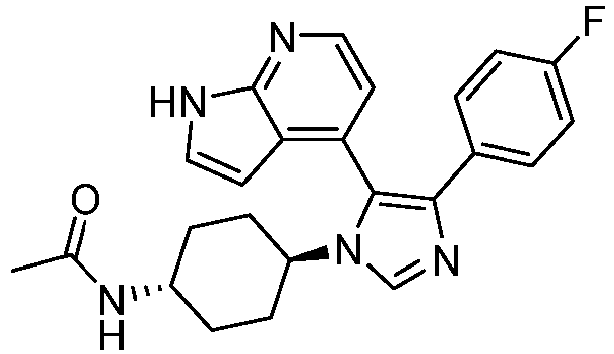
- To a solution of trans-4-(4-(4-fluorophenyl)-5-(1H-pyrrolo[2,3-b]pyridin-4-yl)-1H-imidazol-1-yl)cyclohexan-1-amine (20.0 mg; 0.0533 mmol) in acetonitrile (2 mL) was added pyridine (0.0215 mL; 21.0 mg; 0.266 mmol), then acetic anhydride (0.0055 mL; 6.0 mg; 0.0586 mmol) and the resulting mixture was stirred at 25 °C for 45 minutes. Methanol (2 mL) was added and the solvent was evaporated in vacuo. The residue was purified by preparative TLC (acetone/methanol, 20:1). The product was obtained as a white solid (12 mg, 54 %).
- 1H NMR (500 MHz, methanol-d 4) δ (ppm) 8.32 (d, J = 4.96 Hz, 1H), 8.08 (s, 1H), 7.42 (d, J = 3.55 Hz, 1H), 7.30 - 7.24 (m, 2H), 7.09 (d, J = 4.90 Hz, 1H), 6.89 - 6.83 (m, 2H), 6.13 (d, J = 3.50 Hz, 1H), 3.79 - 3.73 (m, 1H), 3.68 (tt, J = 11.72, 3.83 Hz, 1H), 2.11 - 2.05 (m, 1H), 1.99 - 1.87 (m, 5H), 1.86 (s, 3H), 1.17 - 1.07 (m, 1H), 1.07 - 1.02 (m, 1H).
- 13C NMR (126 MHz, methanol-d 4) δ (ppm) 172.5, 163.2 (d, J = 245.06 Hz), 149.8, 143.7, 138.9, 136.7, 132.4, 131.6 (d, J = 3.19 Hz), 129.6 (d, J = 8.01 Hz), 128.4, 126.1, 122.4, 118.8, 115.9 (d, J = 21.79 Hz), 100.4, 56.0, 33.9, 33.5, 32.4, 32.3, 30.7, 22.6.
- 19F NMR (471 MHz, methanol-d 4) δ (ppm) -117.71.
- HRMS calculated for C24H25FN5O[M+H]+ 418.2038, found 418.2035.
-

- To a solution of trans-4-(4-(4-fluorophenyl)-5-(1H-pyrrolo[2,3-b]pyridin-4-yl)-1H-imidazol-1-yl)cyclohexan-1-amine (20.0 mg; 0.0533 mmol) in acetonitrile (2 mL) was added pyridine (0.0215 mL; 21.0 mg; 0.266 mmol), then methanesulfonyl chloride (0.0045 mL; 6.7 mg; 0.0585 mmol) and the resulting mixture was stirred at 25 °C for 45 minutes. Then, additional methanesulfonyl chloride (0.0030 mL; 4.4 mg; 0.0384 mmol) was added and the resulting mixture was stirred for additional 50 minutes. Methanol (2 mL) was added and the solvents were evaporated in vacuo. The residue was purified by preparative TLC (acetone/dichloromethane, 3:2). The product was obtained as a white solid (6 mg, 25 %).
- 1H NMR (500 MHz, acetone-d 6) δ (ppm) 10.89 (br s, 1H), 8.37 (d, J = 4.80 Hz, 1H), 7.96 (s, 1H), 7.50 (dd, J = 3.50, 1.78 Hz, 1H), 7.46 - 7.38 (m, 2H), 7.09 (d, J = 4.78 Hz, 1H), 6.90 - 6.83 (m, 2H), 6.15 (dd, J = 3.54, 1.71 Hz, 1H), 5.83 (d, J = 7.69 Hz, 1H), 3.73 (tt, J = 11.73, 3.96 Hz, 1H), 3.38 - 3.29 (m, 1H), 2.89 (s, 3H), 2.13 - 2.07 (m, 3H), 2.03 - 1.92 (m, 3H), 1.33 - 1.18 (m, 2H).
- 13C NMR (126 MHz, acetone-d 6) δ (ppm) 161.3, 150.3, 144.3, 138.1, 135.8, 132.7 (d, J = 3.16 Hz), 131.9, 128.7 (d, J = 8.02 Hz), 127.6, 125.4, 121.2, 118.6, 115.4 (d, J = 21.38 Hz), 100.3, 54.7, 52.4, 41.6, 33.9, 33.8, 33.8, 33.3.
- 19F NMR (471 MHz, acetone-d 6) δ (ppm) -118.38.
- HRMS calculated for C23H25FN5O2S[M+H]+ 454.1708, found 454.1711.
-

- The compound was prepared according to General procedure A using 1H-pyrrolo[2,3-b]pyridine-4-carbaldehyde, 3-(trifluoromethoxy)propylamine hydrochloride, 1-fluoro-4-(isocyano(tosyl)methyl) benzene and K2CO3. Reaction time: 3 hours for the formation of the imine, then additional 14 hours for the cyclization step. The residue obtained after the workup was purified by column chromatography (hexane/acetone, 1:1) and then by recrystallization from a mixture of dichloromethane/hexane (4:10). The product was obtained as a white solid (40 mg, 30 %).
- 1H NMR (500 MHz, CDCl3) δ (ppm) 10.22 (s, 1H), 8.45 (s, 1H), 7.79 (s, 1H), 7.43 - 7.34 (m, 3H), 7.09 (d, J = 4.77 Hz, 1H), 6.84 (t, J = 8.76 Hz, 2H), 6.18 (d, J = 3.54 Hz, 1H), 4.14 - 3.95 (m, 2H), 3.78 (t, J = 5.80 Hz, 2H), 1.87 - 1.70 (m, 2H).
- 13C NMR (126 MHz, CDCl3) δ (ppm) 162.0 (d, J = 246.10 Hz), 149.1, 143.4, 139.3, 138.1, 131.1, 130.1 (d, J = 3.14 Hz), 128.4 (d, J = 7.91 Hz), 126.5, 124.5, 121.5 (q, J = 255.12 Hz), 120.4, 117.8, 115.3 (d, J = 21.46 Hz), 100.5, 63.5 (q, J = 3.26 Hz), 42.0, 30.0.
- 19F NMR (471 MHz, CDCl3) δ (ppm) -61.05, -115.41.
- HRMS calculated for C20H17F4N4O[M+H]+ 405.1333, found 405.1335.
-

- The compound was prepared according to General procedure A using 1H-pyrrolo[2,3-b]pyridine-4-carbaldehyde, 2-aminomethylfuran, 1-fluoro-4-(isocyano(tosyl)methyl)benzene and K2CO3 (3 eq.). Reaction time: 3 hours for the formation of the imine, then additional 14 hours for the cyclization step. The residue obtained after the workup was purified by preparative TLC (hexane/acetone, 1:1). The product was obtained as a white solid (15 mg, 15 %).
- 1H NMR (500 MHz, acetone-d 6) δ (ppm) 10.88 (s, 1H), 8.35 (s, 1H), 7.84 (s, 1H), 7.51 - 7.43 (m, 3H), 7.42 - 7.37 (m, 1H), 7.07 (d, J = 4.68 Hz, 1H), 6.93 - 6.85 (m, 2H), 6.26 (dd, J = 3.24, 1.86 Hz, 1H), 6.11 (dd, J = 3.60, 1.78 Hz, 1H), 6.01 - 5.94 (m, 1H), 5.17 (d, J = 16.02 Hz, 1H), 5.02 (d, J = 15.80 Hz, 1H).
- 13C NMR (126 MHz, acetone-d 6) δ (ppm) 162.4 (d, J = 243.32 Hz), 150.7, 150.3, 144.1, 143.8, 139.0, 132.5 (d, J = 3.15 Hz), 131.2, 128.9 (d, J = 7.83 Hz), 127.4, 127.3, 125.8, 120.8, 118.5, 115.5 (d, J = 21.46 Hz), 111.3, 109.4, 100.6, 42.6.
- HRMS calculated for C21H16FN4O[M+H]+ 359.1303, found 359.1301.
-

- The compound was prepared according to General procedure A using 1H-pyrrolo[2,3-b]pyridine-4-carbaldehyde, 3-(aminomethyl)pyridine, 1-fluoro-4-(isocyano(tosyl)methyl)benzene and K2CO3 (3 eq.). Reaction time: 3 hours for the formation of the imine, then additional 14 hours for the cyclization step. The residue obtained after the workup was purified by preparative TLC (acetone). The product was obtained as an off-white solid (20 mg, 19 %).
- 1H NMR (500 MHz, CDCl3) δ (ppm) 9.63 (s, 1H), 8.45 (d, J = 4.49 Hz, 1H), 8.33 (d, J = 4.89 Hz, 1H), 8.13 (s, 1H), 7.80 (s, 1H), 7.43 - 7.38 (m, 2H), 7.31 (d, J = 3.55 Hz, 1H), 7.17 - 7.11 (m, 2H), 6.93 (d, J = 4.85 Hz, 1H), 6.87 - 6.81 (m, 2H), 6.11 (d, J = 3.51 Hz, 1H), 5.12 - 4.94 (m, 2H).
- 13C NMR (126 MHz, CDCl3) δ (ppm) 162.1 (d, J = 246.24 Hz), 149.7, 148.9, 148.6, 143.4, 139.4, 138.1, 134.7, 131.7, 130.9, 130.0 (d, J = 3.19 Hz), 128.3 (d, J = 7.89 Hz), 126.4, 124.8, 123.7, 120.4, 118.0, 115.3 (d, J = 21.57 Hz), 100.6, 47.2.
- HRMS calculated for C22H17FN5[M+H]+ 370.1463, found 370.1461.
-

- The compound was prepared according to General procedure A using 1H-pyrrolo[2,3-b]pyridine-4-carbaldehyde, 4-(aminomethyl)pyridine, 1-fluoro-4-(isocyano(tosyl)methyl)benzene and K2CO3 (3 eq.). Reaction time: 3 hours for the formation of the imine, then additional 14 hours for the cyclization step. The residue obtained after the workup was purified two times by preparative TLC (acetone, then dichloromethane/methanol, 10:1). The product was obtained as a white solid (23 mg, 22 %).
- 1H NMR (500 MHz, CDCl3) δ (ppm) 9.61 (s, 1H), 8.45 (s, 2H), 8.31 (s, 1H), 7.82 (s, 1H), 7.46 - 7.40 (m, 2H), 7.28 (d, J = 3.57 Hz, 1H), 6.90 (d, J = 4.88 Hz, 1H), 6.88 - 6.83 (m, 2H), 6.76 (d, J = 4.95 Hz, 2H), 6.08 (d, J = 3.53 Hz, 1H), 5.08 (d, J = 16.02 Hz, 1H), 4.98 (d, J = 16.31 Hz, 1H).
- 13C NMR (126 MHz, CDCl3) δ (ppm) 162.1 (d, J = 246.50 Hz), 150.3, 148.8, 145.3, 143.3, 139.5, 138.4, 130.7, 130.0 (d, J = 3.48 Hz), 128.3 (d, J = 7.83 Hz), 126.4, 124.9, 121.5, 120.3, 117.9, 115.3 (d, J = 21.66 Hz), 100.6, 48.3.
- HRMS calculated for C22H17FN5[M+H]+ 370.1463, found 370.1466.
-

- The compound was prepared according to General procedure A using 1H-pyrrolo[2,3-b]pyridine-4-carbaldehyde, 2-(aminomethyl)thiophene, 1-fluoro-4-(isocyano(tosyl)methyl)benzene and K2CO3 (3 eq.). Reaction time: 3 hours for the formation of the imine, then additional 14 hours for the cyclization step. The residue obtained after the workup was purified by column chromatography (hexane/acetone, 1:1). The obtained solid was triturated with hexane (5 mL) and dried in a vacuum. The product was obtained as a pale yellow solid (35 mg, 33 %).
- 1H NMR (500 MHz, CDCl3) δ (ppm) 10.26 (s, 1H), 8.40 (s, 1H), 7.79 (s, 1H), 7.45 - 7.38 (m, 2H), 7.35 (d, J = 3.53 Hz, 1H), 7.18 (dd, J = 5.14, 1.20 Hz, 1H), 7.04 (d, J = 4.72 Hz, 1H), 6.92 - 6.75 (m, 3H), 6.66 - 6.62 (m, 1H), 6.18 (d, J = 3.55 Hz, 1H), 5.19 (d, J = 15.66 Hz, 1H), 5.10 (d, J = 15.63 Hz, 1H).
- 13C NMR (126 MHz, CDCl3) δ (ppm) 162.0 (d, J = 245.79 Hz), 149.1, 143.3, 139.0, 138.3, 137.9, 131.1, 130.3 (d, J = 3.13 Hz), 128.4 (d, J = 7.96 Hz), 127.1, 126.9, 126.3, 126.3, 124.7, 120.6, 118.1, 115.2 (d, J = 21.44 Hz), 100.8, 44.3.
- HRMS calculated for C21H16FN4S[M+H]+ 375.1074, found 375.1075.
-

- The compound was prepared according to General procedure A using 1H-pyrrolo[2,3-b]pyridine-4-carbaldehyde, 4-(trifluoromethoxy)benzylamine, 1-fluoro-4-(isocyano(tosyl)methyl)benzene and K2CO3 (3 eq.). Reaction time: 3 hours for the formation of the imine, then additional 14 hours for the cyclization step. The residue obtained after the workup was purified by column chromatography (hexane/acetone, 1:1). The obtained solid was triturated with hexane (5 mL) and dried in a vacuum. The product was obtained as a pale yellow solid (45 mg, 35 %).
- 1H NMR (500 MHz, CDCl3) δ (ppm) 10.03 (s, 1H), 8.31 (d, J = 4.91 Hz, 1H), 7.78 (s, 1H), 7.43 - 7.39 (m, 2H), 7.29 (d, J = 3.58 Hz, 1H), 7.03 - 6.99 (m, 2H), 6.91 (d, J = 4.85 Hz, 1H), 6.89 - 6.80 (m, 4H), 6.07 (d, J = 3.53 Hz, 1H), 5.04 (d, J = 15.44 Hz, 1H), 4.96 (d, J = 14.68 Hz, 1H).
- 13C NMR (126 MHz, CDCl3) δ (ppm) 162.0 (d, J = 245.99 Hz), 149.0, 143.3, 139.3, 138.2, 134.9, 131.1, 130.2 (d, J = 3.30 Hz), 128.6, 128.3 (d, J = 7.97 Hz), 126.3, 124.9, 121.4, 120.5, 119.5, 117.9, 115.3 (d, J = 21.51 Hz), 100.6, 48.9.
- HRMS calculated for C24H17F4N4O[M+H]+ 453.1333, found 453.1335.
-

- The compound was prepared according to General procedure A using 1H-pyrrolo[2,3-b]pyridine-4-carbaldehyde, 1-azabicyclo[2.2.1]heptan-4-amine dihydrochloride, 1-fluoro-4-(isocyano(tosyl)methyl) benzene and K2CO3 (4 eq.). Reaction time: 3 hours for the formation of the imine, then additional 14 hours for the cyclization step. The residue obtained after the workup was purified two times by preparative TLC (dichloromethane/methanol/7.0 M NH3 in methanol, 9/1/0.02; then acetone/methanol/7.0 M NH3 in methanol, 9:1:0.03). The product was obtained as a white solid (15 mg, 14 %).
- 1H NMR (500 MHz, acetone-d6) δ (ppm) 10.92 (s, 1H), 8.37 (d, J = 4.74 Hz, 1H), 7.81 (s, 1H), 7.51 (d, J = 3.51 Hz, 1H), 7.41 - 7.36 (m, 2H), 7.16 (d, J = 4.79 Hz, 1H), 6.86 - 6.79 (m, 2H), 6.17 (d, J = 3.51 Hz, 1H), 2.99 - 2.84 (m, 2H), 2.82 - 2.72 (m, 2H), 2.60 - 2.45 (m, 2H), 1.97 - 1.87 (m, 1H), 1.80 - 1.69 (m, 1H), 1.69 - 1.60 (m, 1H), 1.29 - 1.26 (m, 1H).
- 13C NMR (126 MHz, acetone-d6) δ (ppm) 162.2 (d, J = 243.02 Hz), 150.0, 143.9, 139.1, 137.4, 133.7, 132.6 (d, J = 3.15 Hz), 128.5 (d, J = 7.83 Hz), 127.6, 127.5, 126.2, 122.5, 120.2, 115.4 (d, J = 21.33 Hz), 100.7, 69.6, 63.1, 55.9 (d, J = 9.88 Hz), 38.0, 37.5.
- HRMS calculated for C22H21FN5[M+H]+ 374.1776, found 374.1781.
-

- The compound was prepared according to General procedure A using 1H-pyrrolo[2,3-b]pyridine-4-carbaldehyde, 2-phenylethylamine, 1-fluoro-4-(isocyano(tosyl)methyl)benzene and K2CO3 (3 eq.). Reaction time: 3 hours for the formation of the imine, then additional 14 hours for the cyclization step. The residue obtained after the workup was purified by column chromatography (hexane/acetone, 3:2). The obtained solid was triturated with a mixture of dichloromethane/hexane (3 mL + 3 mL) and dried in a vacuum. The product was obtained as a white solid (70 mg, 64 %).
- 1H NMR (500 MHz, CDCl3) δ (ppm) 10.40 (s, 1H), 8.43 (d, J = 4.86 Hz, 1H), 7.56 (s, 1H), 7.44 - 7.35 (m, 3H), 7.25 - 7.14 (m, 3H), 6.99 (d, J = 4.79 Hz, 1H), 6.94 - 6.78 (m, 4H), 6.20 (d, J = 3.45 Hz, 1H), 4.19 - 3.95 (m, 2H), 2.75 (t, J = 7.13 Hz, 2H).
- 13C NMR (126 MHz, CDCl3) δ (ppm) 161.9 (d, J = 245.79 Hz), 149.2, 143.3, 138.8, 137.9, 137.2, 131.5, 130.3 (d, J = 3.21 Hz), 128.9, 128.7, 128.3 (d, J = 7.89 Hz), 127.1, 126.4, 124.6, 120.5, 117.9, 115.2 (d, J = 21.44 Hz), 100.8, 47.4, 37.6.
- HRMS calculated for C24H20FN4[M+H]+ 383.1667, found 383.1670.
-

- The compound was prepared according to General procedure A using 1H-pyrrolo[2,3-b]pyridine-4-carbaldehyde, cyclohexanemethylamine,1-fluoro-4-(isocyano(tosyl)methyl)benzene and K2CO3 (3 eq.). Reaction time: 3 hours for the formation of the imine, then additional 14 hours for the cyclization step. The residue obtained after the workup was purified by column chromatography (hexane/acetone, 3:2) and then by recrystallization from a mixture of diethyl ether/hexane (2:7). The product was obtained as a white solid (30 mg, 28 %).
- 1H NMR (500 MHz, CDCl3) δ (ppm) 10.36 (s, 1H), 8.43 (s, 1H), 7.73 (s, 1H), 7.43 - 7.34 (m, 3H), 7.08 (d, J = 4.66 Hz, 1H), 6.83 (t, J = 8.61 Hz, 2H), 6.18 (d, J = 3.47 Hz, 1H), 3.77 - 3.59 (m, 2H), 1.63 - 1.51 (m, 3H), 1.47 - 1.31 (m, 3H), 1.08 - 0.96 (m, 3H), 0.77 - 0.64 (m, 2H).
- 13C NMR (126 MHz, CDCl3) δ (ppm) 161.9 (d, J = 245.69 Hz), 149.1, 143.2, 138.4, 138.3, 131.7, 130.3, 128.3 (d, J = 7.88 Hz), 126.3, 125.0, 120.6, 118.0, 115.2 (d, J = 21.44 Hz), 100.8, 52.1, 39.0, 30.5 (d, J = 7.77 Hz), 26.2, 25.6.
- HRMS calculated for C23H24FN4[M+H]+ 375.1980, found 375.1982.
-

- The compound was prepared according to General procedure A using 1H-pyrrolo[2,3-b]pyridine-4-carbaldehyde, cis-3-(aminomethyl)-N,N-dimethylcyclobutan-1-amine (CAS: 1909287-66-6), 1-fluoro-4-(isocyano(tosyl)methyl)benzene and K2CO3 (3 eq.). Reaction time: 3 hours for the formation of the imine, then additional 14 hours for the cyclization step. The residue obtained after the workup was purified by preparative TLC (dichloromethane/methanol/7.0 M NH3 in methanol, 9:1:0.5) and then by recrystallization from a mixture of diethylether/hexane (4:7). The product was obtained as a white solid (75 mg, 68 %).
- 1H NMR (500 MHz, CDCl3) δ (ppm) 11.18 (s, 1H), 8.41 (d, J = 4.88 Hz, 1H), 7.68 (s, 1H), 7.44 - 7.35 (m, 3H), 7.05 (d, J = 4.88 Hz, 1H), 6.87 - 6.78 (m, 2H), 6.17 (dd, J = 3.50, 1.62 Hz, 1H), 3.92 - 3.75 (m, 2H), 2.40 - 2.32 (m, 1H), 2.10 - 2.03 (m, 3H), 2.02 (s, 6H), 1.46 - 1.33 (m, 2H).
- 13C NMR (126 MHz, CDCl3) δ (ppm) 161.8 (d, J = 245.42 Hz), 149.4, 143.1, 138.8, 137.6, 131.6, 130.6 (d, J = 3.18 Hz), 128.3 (d, J = 7.93 Hz), 126.4, 124.6, 120.6, 117.8, 115.1 (d, J = 21.40 Hz), 100.5, 57.4, 51.5, 41.7, 32.4, 28.0.
- HRMS calculated for C23H25FN5[M+H]+ 390.2089, found 390.2084.
-

- The compound was prepared according to General procedure A using 1H-pyrrolo[2,3-b]pyridine-4-carbaldehyde, cis-N1,N1-dimethylcyclohexane-1,4-diamine dihydrochloride (CAS: 1031289-75-4), 1-fluoro-4-(isocyano(tosyl)methyl)benzene and K2CO3 (3 eq.). Reaction time: 3 hours for the formation of the imine, then additional 14 hours for the cyclization step. The residue obtained after the workup was purified two times by preparative TLC (dichloromethane/methanol/7.0 M NH3 in methanol, 9/1/0.05; then acetone/methanol/7.0 M NH3 in methanol, 9:1:0.05). The product was obtained as a white solid (35 mg, 29 %).
- 1H NMR (701 MHz, methanol-d4) δ (ppm) 8.32 (d, J = 4.94 Hz, 1H), 8.05 (s, 1H), 7.41 (d, J = 3.48 Hz, 1H), 7.30 - 7.23 (m, 2H), 7.09 (d, J = 4.88 Hz, 1H), 6.88 - 6.80 (m, 2H), 6.12 (d, J = 3.54 Hz, 1H), 3.73 (tt, J = 12.10, 3.90 Hz, 1H), 2.37 - 2.30 (m, 1H), 2.21 (s, 6H), 2.15 - 2.09 (m, 1H), 2.03 - 1.95 (m, 2H), 1.94 - 1.82 (m, 3H), 1.21 - 1.13 (m, 1H), 1.12 - 1.05 (m, 1H).
- 13C NMR (176 MHz, methanol-d4) δ (ppm) 163.2 (d, J = 244.77 Hz), 149.8, 143.8, 138.9, 136.6, 132.3, 131.6 (d, J = 3.08 Hz), 129.6 (d, J = 8.05 Hz), 128.4, 126.1, 122.3, 118.8, 115.9 (d, J = 21.66 Hz), 100.4, 63.5, 56.3, 41.6, 34.1, 33.7, 28.2, 28.2.
- HRMS calculated for C24H27FN5[M+H]+ 404.2260, found 404.2265.
-

- The compound was prepared according to General procedure A using 1H-pyrrolo[2,3-b]pyridine-4-carbaldehyde, 1-(aminomethyl)cyclobutan-1-ol, 1-fluoro-4-(isocyano(tosyl)methyl)benzene and K2CO3. Reaction time: 3 hours for the formation of the imine, then additional 14 hours for the cyclization step. The residue obtained after the workup was purified by column chromatography (acetone/hexane, 4/1) and then by preparative TLC (acetone/hexane, 3:1). The product was obtained as a white solid (50 mg, 49 %).
- 1H NMR (701 MHz, acetone-d 6) δ (ppm) 10.96 (s, 1H), 8.40 (d, J = 4.77 Hz, 1H), 8.10 (s, 1H), 7.53 - 7.43 (m, 3H), 7.17 (d, J = 4.73 Hz, 1H), 6.94 - 6.85 (m, 2H), 6.17 (dd, J = 3.50, 1.78 Hz, 1H), 4.65 (br s, 1H), 4.13 (d, J = 14.54 Hz, 1H), 3.97 (d, J = 14.54 Hz, 1H), 1.95 - 1.90 (m, 1H), 1.90 - 1.81 (m, 2H), 1.79 - 1.73 (m, 1H), 1.49 - 1.43 (m, 1H), 0.90 - 0.83 (m, 1H).
- 13C NMR (176 MHz, acetone-d 6) δ 162.4 (d, J = 243.60 Hz), 150.3, 144.1, 139.4, 136.9, 131.8 (d, J = 3.38 Hz), 131.3, 129.1 (d, J = 7.89 Hz), 127.6, 127.5, 121.0, 118.9, 115.5 (d, J = 21.59 Hz), 100.6, 74.3, 52.6, 34.8, 34.7, 12.2.
- HRMS calculated for C21H20FN4O[M+H]+ 363.1616, found 363.1619.
-

- The compound was prepared according to General procedure A using 1H-pyrrolo[2,3-b]pyridine-4-carbaldehyde, (1-methyl-1H-imidazol-4-yl)methanamine, 1-fluoro-4-(isocyano(tosyl)methyl)benzene and K2CO3 (2 eq.). Reaction time: 3 hours for the formation of the imine, then additional 14 hours for the cyclization step. The residue obtained after the workup was purified by column chromatography (dichloromethane/methanol/7.0 M NH3 in methanol, 9:1:0.05). The product was obtained as a white solid (80 mg, 83 %).
- 1H NMR (500 MHz, CDCl3) δ (ppm) 10.10 (br s, 1H), 8.38 (d, J = 4.9 Hz, 1H), 7.95 (s, 1H), 7.46 - 7.37 (m, 2H), 7.38 - 7.30 (m, 2H), 7.10 (d, J = 4.9 Hz, 1H), 6.90 - 6.78 (m, 2H), 6.41 (s, 1H), 6.17 (d, J = 3.5 Hz, 1H), 4.92 (q, J= 14.9 Hz, 2H), 3.56 (s, 3H).
- 13C NMR (126 MHz, CDCl3) δ (ppm) 162.06 (d, J = 246.2 Hz), 148.97, 143.21, 138.24, 138.02, 137.87, 137.28, 130.97, 129.65 (d, J = 2.1 Hz), 128.54 (d, J = 8.0 Hz), 126.23, 124.80, 120.45, 118.65, 118.06, 115.30 (d, J = 21.6 Hz), 100.89, 43.75, 33.57.
- 19F NMR (471 MHz, CDCl3) δ (ppm) -115.28.
- HRMS calculated for C21H18FN6[M+H]+ 373.1571, found 373.1575.
-

- The compound was prepared according to General procedure A using 1H-pyrrolo[2,3-b]pyridine-4-carbaldehyde, (1-methyl-1H-pyrazol-4-yl)methanamine (CAS: 400877-05-6), 1-fluoro-4-(isocyano(tosyl)methyl)benzene and K2CO3 (2 eq.). Reaction time: 3 hours for the formation of the imine, then additional 14 hours for the cyclization step. The residue obtained after the workup was purified by column chromatography (dichloromethane/methanol, 92:8). The product was obtained as a white solid (80 mg, 75 %).
- 1H NMR (500 MHz, CDCl3) δ (ppm) 10.36 (s, 1H), 8.43 (br s, 1H), 7.95 (s, 1H), 7.52 - 7.31 (m, 3H), 7.10 (s, 1H), 7.05 (d, J = 4.5 Hz, 1H), 7.01 (s, 1H), 6.84 (t, J = 8.4 Hz, 2H), 6.17 (d, J = 3.5 Hz, 1H), 4.90 (q, J = 15.1 Hz, 2H), 3.77 (s, 3H).
- 13C NMR (126 MHz, CDCl3) δ (ppm) 162.12 (d, J = 246.4 Hz), 149.04, 143.17, 138.59, 138.21, 137.57, 130.88, 129.49 (d, J = 2.9 Hz), 129.40, 128.47 (d, J = 8.1 Hz), 126.54, 124.80, 120.60, 118.09, 116.32, 115.37 (d, J = 21.5 Hz), 100.67, 40.56, 39.14.
- 19F NMR (471 MHz, CDCl3) δ (ppm) -115.05.
- HRMS calculated for C21H18FN6[M+H]+ 373.1571, found 373.1575.
-

- The compound was prepared according to General procedure A using 1H-pyrrolo[2,3-b]pyridine-4-carbaldehyde, (1-methyl-1H-pyrazol-3-yl)methanamine (CAS: 612511-81-6), 1-fluoro-4-(isocyano(tosyl)methyl)benzene (83 mg; 0.287 mmol) and K2CO3 (2 eq.). Reaction time: 3 hours for the formation of the imine, then additional 14 hours for the cyclization step. The residue obtained after the workup was purified by column chromatography (dichloromethane/methanol, 94:6). The product was obtained as a white solid (65 mg, 61 %).
- 1H NMR (500 MHz, CDCl3) δ (ppm) 10.75 (s, 1H), 8.41 (d, J = 4.9 Hz, 1H), 7.84 (s, 1H), 7.41 (dd, J = 8.6, 5.4 Hz, 2H), 7.36 (d, J = 3.5 Hz, 1H), 7.19 (d, J = 2.3 Hz, 1H), 7.09 (d, J = 4.8 Hz, 1H), 6.83 (t, J = 8.7 Hz, 2H), 6.19 (d, J = 3.5 Hz, 1H), 5.80 (d, J = 2.3 Hz, 1H), 5.10 - 4.85 (m, 2H), 3.81 (s, 3H).
- 13C NMR (126 MHz, CDCl3) δ (ppm) 161.96 (d, J = 245.8 Hz), 149.18, 147.15, 143.05, 138.33, 138.08, 131.35, 131.12, 130.15 (d, J = 3.1 Hz), 128.42 (d, J = 7.9 Hz), 126.32, 124.93, 120.62, 118.07, 115.21 (d, J = 21.4 Hz), 104.92, 100.78, 43.43, 39.02.
- 19F NMR (471 MHz, CDCl3) δ (ppm) -115.64.
- HRMS calculated for C21H18FN6[M+H]+ 373.1571, found 373.1569.
-

- To a cold solution (-78 °C) of 4-(1-cyclohexyl-4-(4-fluorophenyl)-1N-imidazol-5-yl)-1N-pyrrolo[2,3-b]pyridine (145 mg; 0.403 mmol) in tetrahydrofuran (10 mL) was added dropwise 1.5 M solution of n-BuLi in hexane (0.670 mL; 1.01 mmol) and the resulting mixture was stirred at -78 °C for 60 minutes. Then, a solution of iodine (61 mg; 0.483) in tetrahydrofuran (5 mL) was added dropwise and the resulting mixture was stirred at -78 °C for 30 minutes and then at 25 °C for 120 minutes. A saturated aqueous solution of NH4Cl (20 mL) was added and the mixture was extracted with ethyl acetate (2 × 50 mL). The combined organic extracts were dried over MgSO4, filtered, and the solvent was evaporated in vacuo. The residue was purified by column chromatography (acetone/hexane, 3:7). The product was obtained as a white solid (75 mg, 38 %).
- 1H NMR (500 MHz, CDCl3) δ (ppm) 10.38 (s, 1H), 8.43 (s, 1H), 7.39 (d, J = 3.48 Hz, 1H), 7.26 - 7.21 (m, 2H), 7.07 (d, J = 4.65 Hz, 1H), 6.80 - 6.72 (m, 2H), 6.24 (d, J = 3.43 Hz, 1H), 4.02 - 3.89 (m, 1H), 2.12 - 1.92 (m, 1H), 1.89 - 1.81 (m, 1H), 1.80 - 1.62 (m, 4H), 1.58 - 1.52 (m, 1H), 1.19 - 1.06 (m, 2H), 1.04 - 0.92 (m, 1H).
- 13C NMR (126 MHz, CDCl3) δ (ppm) 162.0 (d, J = 246.03 Hz), 148.7, 143.5, 142.7, 142.2, 132.3, 132.0, 129.7 (d, J = 3.13 Hz), 128.2 (d, J = 7.92 Hz), 126.7, 121.8, 119.0, 115.1 (dd, J = 21.40, 2.25 Hz), 100.8, 53.6, 31.9, 26.3, 26.2, 25.0.
- HRMS calculated for C22H21FIN4[M+H]+ 487.0789, found 487.0792.
-

- To a solution of 4-(4-(4-fluorophenyl)-1-(piperidin-4-yl)-1H-imidazol-5-yl)-1H-pyrrolo[2,3-b]pyridine (100 mg; 0.2766 mmol) in acetonitrile (5 mL) was added K2CO3 (114 mg; 0.830 mmol), followed by 3-(dimethylamino)propanoyl chloride hydrochloride (52 mg; 0.3043 mmol) and the resulting mixture was stirred at 25 °C for 72 h. The solvent was evaporated, H2O (20 mL) was added and the mixture was extracted with ethyl acetate (2 × 50 mL). The combined organic extracts were dried over MgSO4, filtered, and the solvent was evaporated. The residue was purified by preparative TLC (dichloromethane/methanol/7 M NH3 in methanol, 9:1:0.2). The product was obtained as a white solid (12 mg, 10 %).
- 1H NMR (300 MHz, methanol-d4) δ (ppm) 8.34 (d, J = 5.03 Hz, 1H), 8.09 (s, 1H), 7.47 - 7.38 (m, 1H), 7.28 (dd, J = 8.54, 5.47 Hz, 2H), 7.13 (t, J = 4.96 Hz, 1H), 6.86 (t, J = 8.67 Hz, 2H), 6.18 - 6.10 (m, 1H), 4.59 (apparent t, J = 14.93 Hz, 1H), 4.13 - 3.93 (m, 2H), 3.09 - 2.84 (m, 1H), 2.70 - 2.52 (m, 4H), 2.51 - 2.34 (m, 1H), 2.26 (s, 6H), 2.15 - 1.87 (m, 4H).
- HRMS calculated for C26H30FN6O[M+H]+ 461.2460, found 461.2461.
-

- To a solution of cis-4-(4-(4-fluorophenyl)-5-(1H-pyrrolo[2,3-b]pyridin-4-yl)-1H-imidazol-1-yl)cyclohexan-1-amine (75 mg; 0.199 mmol) in dichloromethane (8 mL) was added triethylamine (0.168 mL; 1.198 mmol), followed by 2-(dimethylamino)ethane-1-sulfonyl chloride hydrochloride (50 mg; 0.239 mmol) and the resulting mixture was stirred at 25 °C for 16 h. Then, aqueous saturated solution of NaHCO3 (25 mL) was added and the mixture was extracted with CH2Cl2 (2 × 100 mL). The organic extracts were dried over MgSO4, filtered, and the solvent was evaporated in vacuo. The residue was purified by column chromatography (acetone/hexane, 4:1). The product was obtained as a white solid (40 mg, 43 %).
- 1H NMR (500 MHz, acetone-d6) δ (ppm) 10.87 (s, 1H), 8.36 (d, J = 4.80 Hz, 1H), 8.00 (s, 1H), 7.49 (dd, J = 3.49, 2.41 Hz, 1H), 7.44 - 7.39 (m, 2H), 7.08 (d, J = 4.73 Hz, 1H), 6.93 - 6.83 (m, 2H), 6.69 (dd, J = 16.53, 9.92 Hz, 1H), 6.33 (d, J = 7.31 Hz, 1H), 6.14 (dd, J = 3.59, 1.88 Hz, 1H), 6.09 (d, J = 16.57 Hz, 1H), 5.91 (d, J = 9.95 Hz, 1H), 3.77 (tt, J = 11.75, 3.80 Hz, 1H), 3.49 (dt, J = 6.97, 3.46 Hz, 1H), 2.27 - 2.16 (m, 2H), 1.96 - 1.86 (m, 3H), 1.84 - 1.76 (m, 1H), 1.54 (tt, J = 13.64, 4.04 Hz, 1H), 1.45 (tt, J = 13.67, 3.78 Hz, 1H).
- 13C NMR (126 MHz, acetone-d6) δ (ppm) 161.3 (d, J = 242.99 Hz), 149.3, 143.3, 137.8, 136.9, 135.1, 131.7 (d, J = 3.03 Hz), 130.9, 127.7 (d, J = 7.78 Hz), 126.5, 124.4, 120.2, 117.6, 114.4 (d, J = 21.37 Hz), 99.3, 53.7, 47.4, 30.1, 30.1, 27.9.
- 19F NMR (471 MHz, acetone-d6) δ (ppm) -118.41.
- HRMS calculated for C24H25FN5O2S[M+H]+ 466.1708, found 466.1709.
-
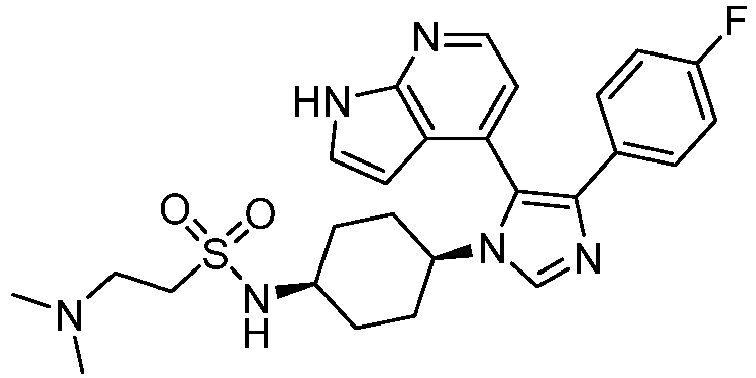
- To a solution of N-((1R,4s)-4-(4-(4-fluorophenyl)-5-(1H-pyrrolo[2,3-b]pyridin-4-yl)-1H-imidazol-1-yl)cyclohexyl)ethenesulfonamide (66 mg; 0.142 mmol) in tetrahydrofuran (2 mL) and acetonitrile (5 mL) was added triethylamine (0.118 mL; 0.850 mmol), followed by dimethylamine hydrochloride (58 mg; 0.709 mmol) and the resulting mixture was stirred at 25 °C for 16 h. The solvent was evaporated, H2O (15 mL) was added, and the mixture was extracted with CH2Cl2 (2 × 35 mL). The combined organic extracts were dried over MgSO4, filtered, and the solvent was evaporated in vacuo. The residue was purified by column chromatography (dichloromethane/methanol/7 M NH3 in methanol, 9:1:0.2). The product was obtained as a white solid (53 mg, 73 %).
- 1H NMR (500 MHz, DMSO-d6) δ (ppm) 11.87 (s, 1H), 8.34 (d, J = 4.78 Hz, 1H), 8.12 (s, 1H), 7.48 (t, J = 2.95 Hz, 1H), 7.35 (d, J = 8.35 Hz, 1H), 7.33 - 7.25 (m, 2H), 7.06 (d, J = 4.79 Hz, 1H), 7.00 - 6.92 (m, 2H), 6.02 (dd, J = 3.51, 1.83 Hz, 1H), 3.59 - 3.49 (m, 1H), 3.50 - 3.45 (m, 1H), 3.20 - 3.12 (m, 2H), 2.63 (t, J = 7.52 Hz, 2H), 2.17 (s, 6H), 2.12 - 2.02 (m, 2H), 1.82 - 1.75 (m, 1H), 1.75 - 1.60 (m, 3H), 1.40 (tt, J = 13.71, 3.83 Hz, 1H), 1.30 (tt, J = 14.01, 3.96 Hz, 1H).
- 13C NMR (126 MHz, DMSO-d6) δ (ppm) 160.6 (d, J = 243.04 Hz), 148.8, 143.0, 136.0, 135.6, 131.2 (d, J = 2.85 Hz), 130.1, 127.4 (d, J = 7.81 Hz), 127.3, 124.2, 119.7, 117.2, 114.8 (d, J = 21.34 Hz), 98.6, 54.8, 53.3, 53.0, 49.9, 46.6, 44.8, 30.3, 28.1, 27.5.
- 19F NMR (471 MHz, DMSO-d6) δ (ppm) -116.50.
- HRMS calculated for C26H32FN6O2S[M+H]+ 511.2286, found 511.2289.
-

- The compound was prepared according to General procedure A using 1H-pyrrolo[2,3-b]pyridine-4-carbaldehyde, C-(2-methyl-2H-pyrazol-3-yl)-methylamine (CAS: 863548-52-1), 1-fluoro-4-(isocyano(tosyl)methyl)benzene and K2CO3 (2 eq.). Reaction time: 3 hours for the formation of the imine, then additional 14 hours for the cyclization step. The residue obtained after the workup was purified by column chromatography (dichloromethane/methanol, 94:6). The product was obtained as a white solid (50 mg, 24 %).
- 1H NMR (500 MHz, CDCl3) δ (ppm) 9.98 (s, 1H), 8.41 (apparent s, 1H), 7.75 (apparent s, 1H), 7.41 (dd, J = 8.59, 5.26 Hz, 2H), 7.36 (d, J = 2.46 Hz, 1H), 7.32 (apparent s, 1H), 7.00 (apparent s, 1H), 6.85 (t, J = 8.37 Hz, 2H), 6.16 (apparent s, 1H), 5.95 (apparents, 1H), 5.00 (dd, J = 29.90, 12.15 Hz, 2H), 3.49 (s, 3H).
- 13C NMR (126 MHz, CDCl3) δ (ppm) 162.1 (d, J = 246.37 Hz), 148.9, 143.4, 139.1, 138.8, 137.8, 136.3, 130.7, 129.8 (d, J = 2.60 Hz), 128.4 (d, J = 7.95 Hz), 126.6, 124.7, 120.5, 118.1, 115.4 (d, J = 21.55 Hz), 107.0, 100.6, 40.9, 36.5.
- 19F NMR (471 MHz, CDCl3) δ (ppm) -115.03.
- HRMS calculated for C21H18PN6[M+H]+ 373.1571, found 373.1572.
-

- To a solution of cis-4-(4-(4-fluorophenyl)-5-(1H-pyrrolo[2,3-b]pyridin-4-yl)-1H-imidazol-1-yl)cyclohexan-1-amine (55 mg; 0.146 mmol) in tetrahydrofuran (1 mL) and dimethylformamide (0.50 mL) was added triethylamine (0.041 mL; 0.293 mmol), followed by 3-(dimethylamino)-1-propanesulfonyl chloride hydrochloride (58 mg; 0.709 mmol; CAS: 118646-42-7) and the resulting mixture was stirred at 25 °C for 16 h. The solvent was evaporated, H2O (10 mL) was added and the mixture was extracted with CH2Cl2 (2 × 40 mL). The combined organic extracts were dried over MgSO4, filtered, and the solvent was evaporated in vacuo. The residue was purified by preparative TLC (dichloromethane/methanol/7 M NH3 in methanol, 9:1:0.2). The product was obtained as a white solid (16 mg, 21 %).
- 1H NMR (500 MHz, methanol-d4) δ (ppm) 8.32 (d, J = 4.89 Hz, 1H), 8.10 (s, 1H), 7.41 (d, J = 3.52 Hz, 1H), 7.32 - 7.23 (m, 2H), 7.09 (d, J = 4.91 Hz, 1H), 6.90 - 6.82 (m, 2H), 6.12 (d, J = 3.52 Hz, 1H), 3.79 (tt, J = 11.78, 3.81 Hz, 1H), 3.57 (t, J = 3.34 Hz, 1H), 3.12 - 3.03 (m, 2H), 2.50 - 2.44 (m, 2H), 2.27 (s, 6H), 2.14 - 2.02 (m, 2H), 1.99 - 1.88 (m, 4H), 1.90 -1.77 (m, 2H), 1.53 (tt, J = 13.96, 3.98 Hz, 1H), 1.44 (tt, J = 13.24, 3.56 Hz, 1H).
- 13C NMR (126 MHz, methanol-d4) δ (ppm) 163.3 (d, J = 244.82 Hz), 149.8, 143.8, 138.8, 136.7, 132.3, 131.6 (d, J = 3.38 Hz), 129.6 (d, J = 8.06 Hz), 128.4, 126.1, 122.3, 118.8, 115.9 (d, J = 21.80 Hz), 100.4, 58.6, 55.7, 51.6, 48.3 (HSQC), 45.3, 31.7, 31.7, 29.6, 29.1, 22.8.
- 19F NMR (471 MHz, methanol-d4) δ (ppm) -117.68.
- HRMS calculated for C27H34FN6O2S[M+H]+ 525.2442, found 525.2442.
-

- The compound was prepared according to General procedure A using 1H-pyrrolo[2,3-b]pyridine-4-carbaldehyde, 2-aminomethyl pyridine, 1-fluoro-4-(isocyano(tosyl)methyl)benzene and K2CO3 (2 eq.). Reaction time: 3 hours for the formation of the imine, then additional 14 hours for the cyclization step. The residue obtained after the workup was purified two times by column chromatography (acetone, 100%; then ethylacetate/methanol, 9:1). The product was obtained as an off white solid (35 mg, 33 %). 1H NMR (500 MHz, acetone-d6) δ (ppm) 10.82 (s, 1H), 8.39 (ddd, J = 4.82, 1.94, 1.00 Hz, 1H), 8.24 (d, J = 4.82 Hz, 1H), 7.95 (s, 1H), 7.58 (td, J = 7.69, 1.78 Hz, 1H), 7.51 - 7.45 (m, 2H), 7.44 - 7.40 (m, 1H), 7.16 (ddd, J = 7.54, 4.82, 1.10 Hz, 1H), 6.96 (d, J = 4.81 Hz, 1H), 6.92 - 6.86 (m, 2H), 6.78 (dt, J = 7.74, 0.94 Hz, 1H), 6.07 (dd, J = 3.53, 1.85 Hz, 1H), 5.37 - 5.07 (m, 2H).
- 13C NMR (126 MHz, acetone-d 6) δ (ppm) 162.3 (d, J = 243.15 Hz), 157.5, 150.20, 150.17, 144.0, 139.9, 138.8, 137.5, 132.6 (d, J = 3.13 Hz), 131.4, 128.8 (d, J = 7.80 Hz), 127.3, 127.2, 126.1, 123.4, 121.9, 120.8, 120.8, 118.4, 115.4 (d, J = 21.41 Hz), 100.6, 100.5, 51.2.
- 19F NMR (471 MHz, acetone-d6) δ (ppm) -118.16.
- HRMS calculated for C22H17FN5[M+H]+ 370.1463, found 370.1460.
-

- The compound was prepared according to General procedure A using 1H-pyrrolo[2,3-b]pyridine-4-carbaldehyde, C-(1-Methyl-piperidin-4-yl)-methylamine (CAS: 7149-42-0), 1-fluoro-4-(isocyano(tosyl)methyl)benzene and K2CO3 (2 eq.). Reaction time: 3 hours for the formation of the imine, then additional 16 hours for the cyclization step. The residue obtained after the workup was purified by column chromatography (dichloromethane/7 M NH3 in methanol, 99:1), and then by preparative TLC (dichloromethane/methanol/7 M NH3 in methanol, 9:1:0.2). The product was obtained as a white solid (35 mg, 32 %).
- 1H NMR (500 MHz, acetone-d6) δ (ppm) 10.91 (s, 1H), 8.37 (d, J = 4.78 Hz, 1H), 7.80 (s, 1H), 7.49 (dd, J = 3.60, 2.02 Hz, 1H), 7.47 - 7.42 (m, 2H), 7.11 (d, J = 4.77 Hz, 1H), 6.93 - 6.84 (m, 2H), 6.12 (dd, J = 3.59, 1.75 Hz, 1H), 3.82 (ddd, J = 67.03, 14.01, 6.93 Hz, 2H), 2.63 (t, J = 11.24 Hz, 2H), 2.08 (s, 3H), 1.63 (t, J = 11.62 Hz, 2H), 1.36 - 1.28 (m, 3H), 1.15 - 1.01 (m, 2H).
- 13C NMR (126 MHz, acetone-d 6) δ (ppm) 162.3 (d, J = 243.03 Hz), 150.3, 144.2, 139.5, 138.7, 132.7 (d, J = 3.09 Hz), 131.9, 128.8 (d, J = 7.91 Hz), 127.5, 127.3, 125.8, 120.9, 118.4, 115.4 (d, J = 21.48 Hz), 100.5, 100.4, 55.7, 51.5, 46.4, 37.2, 29.5 (HMBC).
- 19F NMR (471 MHz, acetone-d6) δ (ppm) -118.32.
- HRMS calculated for C23H25FN5[M+H]+ 390.2089, found 390.2085.
-

- The compound was prepared according to General procedure A using 1H-pyrrolo[2,3-b]pyridine-4-carbaldehyde, 4-oxazolemethanamine hydrochloride (CAS: 1072806-60-0), 1-fluoro-4-(isocyano(tosyl)methyl)benzene and K2CO3 (3 eq.). Reaction time: 3 hours for the formation of the imine, then additional 16 hours for the cyclization step. The residue obtained after the workup was purified by column chromatography (acetone/hexane, 4:1). The product was obtained as a white solid (70 mg, 68 %).
- 1H NMR (500 MHz, acetone-d6) δ (ppm) 10.88 (s, 1H), 8.34 (d, J = 4.81 Hz, 1H), 8.04 (d, J = 1.07 Hz, 1H), 7.90 (s, 1H), 7.50 (d, J = 1.03 Hz, 1H), 7.48 - 7.43 (m, 3H), 7.13 (d, J = 4.82 Hz, 1H), 6.93 - 6.82 (m, 2H), 6.10 (dd, J = 3.57, 1.87 Hz, 1H), 5.09 (d, J = 15.67 Hz, 1H), 4.96 (d, J = 15.64 Hz, 1H).
- 13C NMR (126 MHz, acetone-d6) δ (ppm) 162.3 (d, J = 243.35 Hz), 152.9, 150.2 (d, J = 17.03 Hz), 144.1, 139.3, 138.7, 137.5, 137.2, 132.5 (d, J = 3.21 Hz), 131.3, 128.9 (d, J = 7.84 Hz), 127.4, 127.2, 125.8, 120.8 (d, J = 3.05 Hz), 118.5, 115.4 (d, J= 21.58 Hz), 100.5 (d, J= 7.00 Hz), 41.6.
- 19F NMR (471 MHz, acetone-d6) δ (ppm) -118.14.
- HRMS calculated for C20H15FN5O[M+H]+ 360.1255, found 360.1256.
-

- The compound was prepared according to General procedure A using 1H-pyrrolo[2,3-b]pyridine-4-carbaldehyde, (R)-(tetrahydrofuran-3-yl)methanamine hydrochloride (CAS: 1400744-17-3), 1-fluoro-4-(isocyano(tosyl)methyl)benzene and K2CO3 (3 eq.). Reaction time: 3 hours for the formation of the imine, then additional 16 hours for the cyclization step. The residue obtained after the workup was purified by column chromatography (acetone/hexane, 4:1). The product was obtained as a white solid (60 mg, 58 %).
- 1H NMR (500 MHz, acetone-d6) δ (ppm) 10.93 (s, 1H), 8.38 (d, J = 3.24 Hz, 1H), 7.88 (s, 1H), 7.53 - 7.47 (m, 1H), 7.48 - 7.42 (m, 2H), 7.14 (dd, J = 4.81, 2.60 Hz, 1H), 6.95 - 6.82 (m, 2H), 6.14 (d, J = 6.47 Hz, 1H), 4.00 (td, J = 14.98, 7.69 Hz, 1H), 3.88 (td, J = 13.93, 8.02 Hz, 1H), 3.65 - 3.55 (m, 1H), 3.54 - 3.45 (m, 2H), 3.27 (ddd, J = 14.30, 8.74, 5.24 Hz, 1H), 2.35 (dp, J = 13.62, 7.58 Hz, 1H), 1.77 (dtd, J = 13.32, 7.95, 5.50 Hz, 1H), 1.43 (dt, J = 13.28, 6.90 Hz, 1H).
- 13C NMR (126 MHz, acetone-d6) δ (ppm) 162.3 (d, J = 243.32 Hz), 150.3, 144.3, 139.1, 138.8, 132.6 (d, J = 3.13 Hz), 131.8, 128.8 (d, J = 7.80 Hz), 127.6, 127.4, 125.7, 120.9, 118.40, 118.36, 115.4 (d, J = 21.39 Hz), 100.5, 100.4, 71.4, 70.96, 67.6, 48.64, 48.59, 41.03, 40.99, 29.2 (HSQC).
- 19F NMR (471 MHz, acetone-d6) δ (ppm) -118.20.
- HRMS calculated for C21H20FN4O[M+H]+ 363.1616, found 363.1618.
-

- The compound was prepared according to General procedure A using 1H-pyrrolo[2,3-b]pyridine-4-carbaldehyde, (S)-(tetrahydrofuran-3-yl)methanamine hydrochloride (CAS: 1403763-27-8), 1-fluoro-4-(isocyano(tosyl)methyl)benzene and K2CO3 (3 eq.). Reaction time: 3 hours for the formation of the imine, then additional 16 hours for the cyclization step. The residue obtained after the workup was purified by column chromatography (acetone/hexane, 4:1). The product was obtained as a light yellow solid (80 mg, 78 %).
- 1H NMR (500 MHz, acetone-d6) δ (ppm) 10.92 (s, 1H), 8.39 (apparent s, 1H), 7.88 (s, 1H), 7.58 - 7.35 (m, 3H), 7.20 - 7.09 (m, 1H), 6.88 (apparent t, J = 8.54 Hz, 2H), 6.14 (dd, J = 9.57, 3.56 Hz, 1H), 4.01 (td, J = 14.86, 7.58 Hz, 1H), 3.88 (td, J = 13.82, 7.96 Hz, 1H), 3.66 - 3.54 (m, 1H), 3.54 - 3.45 (m, 2H), 3.32 - 3.23 (m, 1H), 2.35 (dq, J = 13.78, 7.64, 6.86 Hz, 1H), 1.77 (dtd, J = 13.29, 7.95, 5.51 Hz, 1H), 1.42 (dt, J = 13.37, 6.92 Hz, 1H).
- 13C NMR (126 MHz, acetone-d6) δ (ppm) 162.3 (d, J = 243.24 Hz), 150.3, 150.1, 144.3, 139.0, 132.6, 131.8, 128.8 (d, J = 7.91 Hz), 127.6, 127.4, 120.9, 118.4, 115.4 (d, J = 21.50 Hz), 100.5, 100.4, 71.04, 70.96, 67.6, 48.6, 41.02, 40.99, 29.9.
- 19F NMR (471 MHz, acetone-d 6) δ (ppm) -118.19.
- HRMS calculated for C21H20FN4O[M+H]+ 363.1616, found 363.1617.
-

- The compound was prepared according to General procedure A using 1H-pyrrolo[2,3-b]pyridine-4-carbaldehyde, (1-methyl-1H-1,2,4-triazol-3-yl)methanamine (CAS: 785760-73-8), 1-fluoro-4-(isocyano(tosyl)methyl)benzene and K2CO3 (2 eq.). Reaction time: 3 hours for the formation of the imine, then additional 16 hours for the cyclization step. The residue obtained after the workup was purified by column chromatography (dichloromethane/methanol, 9:1), and then by preparative TLC (dichloromethane/methanol, 9:1). The product was obtained as a white solid (12 mg, 11 %).
- 1H NMR (500 MHz, methanol-d4) δ (ppm) 8.24 (d, J = 4.69 Hz, 1H), 8.14 (s, 1H), 8.07 (s, 1H), 7.46 - 7.29 (m, 3H), 7.04 (d, J = 4.93 Hz, 1H), 6.87 (apparent t, J = 8.51 Hz, 2H), 6.00 (d, J = 3.39 Hz, 1H), 5.29 - 5.08 (m, 2H), 3.70 (s, 3H).
- 13C NMR (126 MHz, methanol-d4) δ (ppm) 163.3 (d, J = 245.24 Hz), 160.2, 149.6, 146.4, 143.5, 140.3, 139.2, 131.6, 131.3 (d, J = 2.88 Hz), 129.6 (d, J = 8.10 Hz), 128.0, 126.7, 122.1, 118.7, 116.0 (d, J = 21.78 Hz), 100.7, 44.0, 36.3.
- 19F NMR (471 MHz, methanol-d4) δ (ppm) -118.25.
- HRMS calculated for C20H17FN7[M+H]+ 374.1524, found 374.1526.
-

- The compound was prepared according to General procedure A using 1H-pyrrolo[2,3-b]pyridine-4-carbaldehyde, [(5-methyl-4H-1,2,4-triazol-3-yl)methyl]amine dihydrochloride (CAS: 131052-49-8), 1-fluoro-4-(isocyano(tosyl)methyl)benzene and K2CO3 (4 eq.). Reaction time: 3 hours for the formation of the imine, then additional 16 hours for the cyclization step. The residue obtained after the workup was purified by column chromatography (dichloromethane/methanol, 85:15). The product was obtained as a white solid (70 mg, 65 %).
- 1H NMR (500 MHz, DMSO-d6) δ (ppm) 13.40 (s, 1H), 11.77 (s, 1H), 8.27 (d, J = 4.85 Hz, 1H), 7.96 (s, 1H), 7.42 (apparent t, J = 2.97 Hz, 1H), 7.36 - 7.27 (m, 2H), 7.03 (d, J = 4.81 Hz, 1H), 7.00 - 6.94 (m, 2H), 5.92 (dd, J = 3.51, 1.85 Hz, 1H), 5.23 - 4.80 (m, 2H), 2.25 (s, 3H).
- 13C NMR (126 MHz, DMSO-d6) δ (ppm) 160.7 (d, J = 242.92 Hz), 158.7, 153.3, 148.7, 142.6, 138.8, 136.6, 131.0 (d, J = 2.10 Hz), 129.4, 127.6 (d, J = 7.92 Hz), 126.9, 124.9, 119.3, 117.0, 114.9 (d, J = 21.38 Hz), 99.1, 42.3, 11.4.
- 19F NMR (471 MHz, DMSO-d6) δ (ppm) -116.28.
- HRMS calculated for C20H17FN7[M+H]+ 374.1524, found 374.1526.
-

- The compound was prepared according to General procedure A using 1H-pyrrolo[2,3-b]pyridine-4-carbaldehyde, [(2-methyl-1,3-thiazol-4-yl)methyl]amine dihydrochloride (CAS: 1072806-63-3), 1-fluoro-4-(isocyano(tosyl)methyl)benzene and K2CO3 (3 eq.). Reaction time: 3 hours for the formation of the imine, then additional 16 hours for the cyclization step. The residue obtained after the workup was purified by column chromatography (acetone/methanol, 95:5). The product was obtained as a pale yellow solid (40 mg, 36 %).
- 1H NMR (500 MHz, DMSO-d6) δ (ppm) 11.76 (s, 1H), 8.27 (d, J = 4.88 Hz, 1H), 7.99 (s, 1H), 7.42 (t, J = 2.98 Hz, 1H), 7.37 - 7.30 (m, 2H), 7.03 (d, J = 4.82 Hz, 1H), 7.00 - 6.93 (m, 2H), 6.77 (s, 1H), 5.93 (dd, J = 3.49, 1.86 Hz, 1H), 5.22 - 4.93 (m, 2H), 2.52 (s, 3H).
- 13C NMR (126 MHz, DMSO-d6) δ (ppm) 165.9, 160.7 (d, J = 242.99 Hz), 150.7, 148.7, 142.6, 138.7, 136.8, 131.0 (d, J = 3.07 Hz), 129.6, 127.5 (d, J = 8.18 Hz), 126.9, 124.7, 119.3, 117.0, 116.2, 114.9 (d, J = 21.36 Hz), 99.0, 44.6, 18.6.
- 19F NMR (471 MHz, DMSO-d6) δ (ppm) -111.52.
- HRMS calculated for C21H17FN5S[M+H]+ 390.1183, found 390.1186.
-
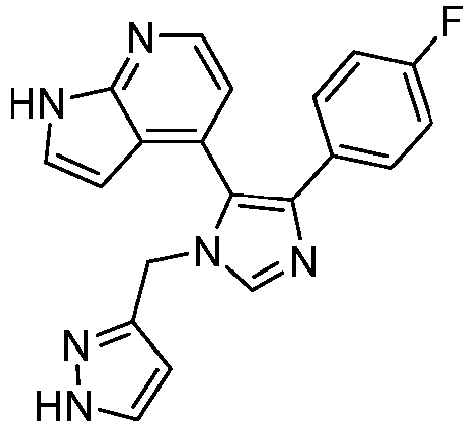
- The compound was prepared according to General procedure A using 1H-pyrrolo[2,3-b]pyridine-4-carbaldehyde, C-(1H-pyrazol-3-yl)-methylamine (CAS: 37599-58-9), 1-fluoro-4-(isocyano(tosyl) methyl)benzene and K2CO3 (2 eq.). Reaction time: 3 hours for the formation of the imine, then additional 16 hours for the cyclization step. The residue obtained after the workup was purified two times by column chromatography (acetone/methanol, 95:5, and then acetone/methanol, 98:2). The product was obtained as a white solid (40 mg, 39 %).
- 1H NMR (500 MHz, methanol-d4) δ (ppm) 8.25 (d, J = 4.95 Hz, 1H), 7.96 (s, 1H), 7.45 (s, 1H), 7.36 (d, J = 3.51 Hz, 1H), 7.34 - 7.28 (m, 2H), 7.03 (d, J = 4.94 Hz, 1H), 6.90 - 6.84 (m, 2H), 6.06 (d, J = 3.53 Hz, 1H), 5.82 (apparent s, 1H), 5.25 - 5.02 (m, 2H).
- 13C NMR (126 MHz, methanol-d4) δ (ppm) 163.3 (d, J = 244.97 Hz), 149.7, 148.8, 143.5, 139.8, 139.5, 131.9, 131.6 (d, J = 3.13 Hz), 130.7, 129.7 (d, J = 8.02 Hz), 128.1, 126.6, 122.0, 118.7, 115.9 (d, J = 21.80 Hz), 104.8, 100.8, 44.2.
- 19F NMR (471 MHz, methanol-d4) δ (ppm) -117.57.
- HRMS calculated for C20H16FN6[M+H]+ 359.1415, found 359.1412.
-

- The compound was prepared according to General procedure A using 1H-pyrrolo[2,3-b]pyridine-4-carbaldehyde, (1H-imidazol-4-yl)methanamine dihydrochloride (CAS: 72631-80-2), 1-fluoro-4-(isocyano(tosyl)methyl)benzene and K2CO3 (4 eq.). Reaction time: 3 hours for the formation of the imine, then additional 16 hours for the cyclization step. The residue obtained after the workup was purified by column chromatography (dichloromethane/methanol, 85:15). The product was obtained as a white solid (80 mg, 78 %).
- 1H NMR (500 MHz, DMSO-d6) δ (ppm) 11.98 (br s, 1H), 11.80 (s, 1H), 8.31 (d, J = 4.79 Hz, 1H), 7.88 (s, 1H), 7.56 (s, 1H), 7.43 (t, J = 2.97 Hz, 1H), 7.34 - 7.28 (m, 2H), 7.14 (d, J = 4.79 Hz, 1H), 7.00 - 6.93 (m, 2H), 6.62 (s, 1H), 5.97 (dd, J = 3.46, 1.85 Hz, 1H), 5.02 - 4.77 (m, 2H).
- 13C NMR (126 MHz, DMSO-d6) δ (ppm) 160.7 (d, J = 242.89 Hz), 148.8, 142.7, 138.3, 136.7, 135.5, 131.3 (d, J = 2.91 Hz), 129.8, 127.6 (d, J = 8.04 Hz), 126.9, 124.7, 119.2, 117.1, 114.8 (d, J = 21.38 Hz), 99.2, 42.2.
- 19F NMR (471 MHz, DMSO-d6) δ (ppm) -116.43.
- HRMS calculated for C20H16FN6[M+H]+ 359.1415, found 359.1414.
-

- The compound was prepared according to General procedure A using 1H-pyrrolo[2,3-b]pyridine-4-carbaldehyde, (5-methyl-1,3,4-oxadiazol-2-yl)methanamine hydrochloride (CAS: 1172088-56-0), 1-fluoro-4-(isocyano(tosyl)methyl)benzene and K2CO3 (3 eq.). Reaction time: 3 hours for the formation of the imine, then additional 16 hours for the cyclization step. The residue obtained after the workup was purified by column chromatography (dichloromethane/methanol, 95:5), and then by two times preparative TLC (dichloromethane/methanol, 95:5, and then acetone). The product was obtained as a white solid (7 mg, 7 %).
- 1H NMR (500 MHz, methanol-d4) δ (ppm) 8.29 (s, 1H), 8.12 (s, 1H), 7.41 - 7.31 (m, 3H), 7.09 (d, J = 4.85 Hz, 1H), 6.92 - 6.85 (m, 2H), 6.01 (d, J = 3.51 Hz, 1H), 5.50 - 5.34 (m, 2H), 2.31 (s, 3H).
- 13C NMR (126 MHz, methanol-d4) δ (ppm) 166.5, 163.5, 163.4 (d, J = 245.48 Hz), 149.7, 143.7, 140.5, 139.9, 131.1 (d, J = 3.31 Hz), 130.9, 129.6 (d, J = 8.04 Hz), 128.4, 126.4, 121.9, 118.6, 116.0 (d, J = 21.79 Hz), 100.4, 41.1, 10.3.
- 19F NMR (471 MHz, methanol-d4) δ (ppm) -117.12.
- HRMS calculated for C20H16FN6O[M+H]+ 375.1364, found 375.1367.
-

- The compound was prepared according to General procedure A using 1H-pyrrolo[2,3-b]pyridine-4-carbaldehyde, (2-methyl-1,3-oxazol-4-yl)methanamine (CAS: 1065073-45-1), 1-fluoro-4-(isocyano (tosyl)methyl)benzene and K2CO3 (2 eq.). Reaction time: 3 hours for the formation of the imine, then additional 16 hours for the cyclization step. The residue obtained after the workup was purified by column chromatography (acetone/methanol, 98:2). The product was obtained as an off white solid (65 mg, 61 %).
- 1H NMR (500 MHz, DMSO-d6) δ (ppm) 11.80 (s, 1H), 8.31 (d, J = 4.78 Hz, 1H), 7.94 (s, 1H), 7.43 (dd, J = 3.47, 2.45 Hz, 1H), 7.39 (d, J = 1.14 Hz, 1H), 7.35 - 7.28 (m, 2H), 7.09 (d, J = 4.80 Hz, 1H), 7.01 - 6.94 (m, 2H), 5.94 (dd, J = 3.40, 1.79 Hz, 1H), 4.97 - 4.76 (m, 2H), 2.29 (s, 3H).
- 13C NMR (126 MHz, DMSO-d6) δ (ppm) 161.3, 160.7 (d, J = 242.93 Hz), 148.7, 142.7, 138.6, 136.9, 136.1, 135.7, 131.1 (d, J = 3.12 Hz), 129.6, 127.5 (d, J = 7.99 Hz), 127.0, 124.6, 119.3, 117.0, 114.8 (d, J = 21.37 Hz), 99.0, 40.5, 13.3.
- HRMS calculated for C21H17FN5O[M+H]+ 374.1412, found 374.1413.
-

- The compound was prepared according to General procedure A using 1H-pyrrolo[2,3-b]pyridine-4-carbaldehyde, (1-methyl-1H-1,2,3-triazol-4-yl)methanamine hydrochloride (CAS: 612511-67-8), 1-fluoro-4-(isocyano(tosyl)methyl)benzene and K2CO3 (3 eq.). Reaction time: 3 hours for the formation of the imine, then additional 16 hours for the cyclization step. The residue obtained after the workup was purified by column chromatography (dichloromethane/methanol, 9:1). The product was obtained as a light yellow solid (170 mg, 80 %).
- 1H NMR (500 MHz, acetone-d 6) δ (ppm) 10.90 (s, 1H), 8.36 (s, 1H), 7.90 (s, 1H), 7.50 - 7.43 (m, 3H), 7.42 (s, 1H), 7.12 (d, J = 4.66 Hz, 1H), 6.88 (apparent t, J = 8.84 Hz, 2H), 6.09 (dd, J = 3.55, 1.74 Hz, 1H), 5.25 - 5.06 (m, 2H), 3.96 (s, 3H).
- 13C NMR (126 MHz, acetone-d 6) δ (ppm) 162.3 (d, J = 243.38 Hz), 150.2, 144.1, 144.0, 139.1, 132.5 (d, J = 2.77 Hz), 131.3, 128.8 (d, J = 7.82 Hz), 127.4, 127.2, 125.8, 124.5, 120.9, 118.6, 115.4 (d, J = 21.47 Hz), 100.6, 100.5, 41.3, 36.6.
- 19F NMR (471 MHz, acetone-d 6) δ (ppm) -118.11.
- HRMS calculated for C20H17FN7[M+H]+ 374.1524, found 374.1521.
-

- The compound was prepared according to General procedure A using 1H-pyrrolo[2,3-b]pyridine-4-carbaldehyde, 1-morpholin-2-ylmethanamine (CAS: 116143-27-2), 1-fluoro-4-(isocyano(tosyl) methyl)benzene and K2CO3 (2 eq.). Reaction time: 3 hours for the formation of the imine, then additional 16 hours for the cyclization step. The residue obtained after the workup was purified two times by column chromatography (dichloromethane/methanol/7 M NH3 in methanol, 85:15:2). The obtained solid was triturated with diethyl ether (10 mL) and dried in a vacuum. The product was obtained as a white solid (115 mg, 53 %).
- 1H NMR (500 MHz, DMSO-d 6) δ (ppm) 11.85 (s, 1H), 8.34 (d, J = 4.76 Hz, 1H), 7.88 (d, J = 7.21 Hz, 1H), 7.47 (dd, J = 6.71, 3.49 Hz, 1H), 7.37 - 7.25 (m, 2H), 7.09 (dd, J = 21.85, 4.87 Hz, 1H), 7.02 - 6.90 (m, 2H), 5.99 (d, J = 25.31 Hz, 1H), 5.05 (br s, 1H), 3.97 - 3.87 (m, 1H), 3.84 - 3.62 (m, 2H), 3.47 - 3.15 (m, 3H, overlaped with H2O), 2.72 - 2.62 (m, 1H), 2.61 - 2.54 (m, 1H), 2.22 (t, J = 11.23 Hz, 1H).
- 13C NMR (126 MHz, DMSO-d 6) δ (ppm) 160.7 (d, J = 242.79 Hz), 148.8, 142.8, 139.0, 136.74, 136.68, 131.1, 129.8, 127.5 (d, J = 7.90 Hz), 127.22, 127.19, 124.73, 124.66, 119.4, 117.2, 117.1, 114.8 (d, J = 21.47 Hz), 99.0, 73.6, 66.0, 47.1, 44.2, 39.4 (HSQC).
- 19F NMR (471 MHz, DMSO-d 6) δ (ppm) -116.4 (d, J = 15.43 Hz).
- HRMS calculated for C21H21FN5O[M+H]+ 378.1725, found 378.1722.
-

- The compound was prepared according to General procedure A using 1H-pyrrolo[2,3-b]pyridine-4-carbaldehyde, (5-methylisoxazol-3-yl)methylamine (CAS: 154016-48-5), 1-fluoro-4-(isocyano(tosyl)methyl)benzene and K2CO3 (2 eq.). Reaction time: 3 hours for the formation of the imine, then additional 16 hours for the cyclization step. The residue obtained after the workup was purified by column chromatography (acetone/hexane, 3:2), and then two times by preparative TLC (acetone/hexane, 1:1, and then dichloromethane/methanol, 95:5). The product was obtained as a white solid (40 mg, 19 %).
- 1H NMR (500 MHz, CDCl3) δ (ppm) 10.32 (br s, 1H), 8.43 (s, 1H), 7.96 (s, 1H), 7.55 - 7.38 (m, 3H), 7.08 (d, J = 4.43 Hz, 1H), 6.85 (t, J = 8.48 Hz, 2H), 6.28 - 6.13 (m, 1H), 5.62 (s, 1H), 5.19 - 4.87 (m, 2H), 2.33 (s, 3H).
- 13C NMR (126 MHz, CDCl3) δ (ppm) 171.1, 162.2 (d, J = 246.63 Hz), 159.5, 148.7, 142.9, 138.7, 138.3, 130.5, 129.5 (d, J = 3.00 Hz), 128.5 (d, J = 7.97 Hz), 126.7, 124.9, 120.7, 118.0, 115.4 (d, J = 21.48 Hz), 100.7, 100.6, 41.4, 12.4.
- 19F NMR (471 MHz, CDCl3) δ (ppm) -114.87.
- HRMS calculated for C21H17FN5O[M+H]+ 374.1412, found 374.1415.
-

- The compound was prepared according to General procedure A using 1H-pyrrolo[2,3-b]pyridine-4-carbaldehyde, (1-methyl-1H-imidazol-5-yl)methylamine (CAS: 486414-86-2), 1-fluoro-4-(isocyano(tosyl)methyl)benzene and K2CO3 (2 eq.). Reaction time: 3 hours for the formation of the imine, then additional 16 hours for the cyclization step. The residue obtained after the workup was purified by column chromatography (dichloromethane/methanol/7 M NH3 in methanol, 9:1:0.2). The product was obtained as a white solid (50 mg, 47 %).
- 1H NMR (500 MHz, DMSO-d 6) δ (ppm) 11.82 (s, 1H), 8.30 (d, J = 4.81 Hz, 1H), 7.88 (s, 1H), 7.45 (apparent s, 1H), 7.40 (s, 1H), 7.37 - 7.29 (m, 2H), 7.05 (d, J = 4.84 Hz, 1H), 6.97 (apparent t, J = 8.77 Hz, 2H), 6.25 (s, 1H), 5.97 (d, J = 2.84 Hz, 1H), 5.15 - 5.00 (m, 2H), 3.27 (s, 3H).
- 13C NMR (126 MHz, DMSO-d 6) δ (ppm) 160.7 (d, J = 243.24 Hz), 148.7, 142.7, 138.8, 138.2, 137.1, 131.0 (d, J = 2.99 Hz), 129.6, 128.3, 127.6 (d, J = 8.05 Hz), 127.2, 126.4, 124.6, 119.3, 117.0, 114.9 (d, J = 21.33 Hz), 98.9, 38.5, 30.6.
- 19F NMR (471 MHz, DMSO-d 6) δ (ppm) -116.20.
- HRMS calculated for C21H18FN6[M+H]+ 373.1571, found 373.1572.
-

- The compound was prepared according to General procedure A using 1H-pyrrolo[2,3-b]pyridine-4-carbaldehyde, cyclohexylamine (CAS: 108-91-8), 1-((isocyano(p-tolyl)methyl)sulfonyl)-4-methylbenzene (CAS: 1330529-37-7), K2CO3 (2 eq.) and methanol (3 mL). Reaction time: 3 hours for the formation of the imine, then additional 16 hours for the cyclization step. The reaction mixture was concentrated in vacuo and the residue obtained after the workup was purified by column chromatography (acetone/hexane, 2:3). The product was obtained as a white solid (40 mg, 46 %).
- 1H NMR (500 MHz, CD3OD) δ (ppm) 8.29 (d, J = 4.91 Hz, 1H), 8.01 (s, 1H), 7.39 (d, J = 3.47 Hz, 1H), 7.15 (d, J = 7.84 Hz, 2H), 7.05 (d, J = 4.93 Hz, 1H), 6.92 (d, J = 7.84 Hz, 2H), 6.12 (d, J = 3.46 Hz, 1H), 3.72 (tt, J = 12.16, 3.91 Hz, 1H), 2.21 (s, 3H), 2.07 - 1.98 (m, 1H), 1.98 - 1.89 (m, 1H), 1.84 - 1.69 (m, 4H), 1.64 - 1.56 (m, 1H), 1.26 - 1.04 (m, 3H).
- 13C NMR (126 MHz, CD3OD) δ (ppm) 149.7, 143.6, 139.7, 137.6, 136.4, 132.9, 132.4, 129.8, 128.1, 127.8, 125.7, 122.5, 118.9, 100.6, 56.8, 35.8, 35.1, 26.7, 26.7, 26.1, 21.1.
- HRMS calculated for C23H25N4[M+H]+ 357.2074, found 357.2077.
-

- The compound was prepared according to General procedure A using 1H-pyrrolo[2,3-b]pyridine-4-carbaldehyde, oxazol-5-yl-methylamine (CAS: 847644-09-1), 1-fluoro-4-(isocyano(tosyl)methyl) benzene and K2CO3 (2 eq.). Reaction time: 3 hours for the formation of the imine, then additional 16 hours for the cyclization step. The residue obtained after the workup was purified by column chromatography (acetone/methanol, 95:5). The product was obtained as a white solid (45 mg, 44 %).
- 1H NMR (500 MHz, CDCl3) δ (ppm) 10.62 (s, 1H), 8.43 (d, J = 4.90 Hz, 1H), 7.83 (s, 1H), 7.76 (s, 1H), 7.52 - 7.33 (m, 3H), 7.05 (d, J = 4.85 Hz, 1H), 6.94 - 6.76 (m, 2H), 6.63 (s, 1H), 6.17 (d, J = 3.54 Hz, 1H), 5.04 (apparent q, J = 16.01 Hz, 2H).
- 13C NMR (126 MHz, CDCl3) δ (ppm) 162.1 (d, J = 246.18 Hz), 151.6, 149.2, 146.4, 143.3, 139.1, 138.0, 130.6, 130.0 (d, J = 3.17 Hz), 128.4 (d, J = 8.02 Hz), 126.7, 125.5, 124.7, 120.6, 118.0, 115.3 (d, J = 21.63 Hz), 100.4, 40.0.
- 19F NMR (471 MHz, CDCl3) δ (ppm) -113.18 - -116.87 (m).
- HRMS calculated for C20H15FN5O[M+H]+ 360.1255, found 360.1258.
-

- The compound was prepared according to General procedure A using 1H-pyrrolo[2,3-b]pyridine-4-carbaldehyde, 4-(aminomethyl)-1-methylpiperidin-4-ol (2 eq.; CAS: 26228-68-2), 1-fluoro-4-(isocyano(tosyl)methyl)benzene and K2CO3 (2 eq.). Reaction time: 3 hours for the formation of the imine, then additional 16 hours for the cyclization step. The residue obtained after the workup was purified by column chromatography (dichloromethane/methanol/7 M NH3 in methanol, 8:2:0.5), and then by preparative TLC (dichloromethane/methanol/7 M NH3 in methanol, 85:10:5). The product was obtained as a white solid (35 mg, 30 %).
- 1H NMR (500 MHz, methanol-d 4) δ (ppm) 8.27 (d, J = 4.93 Hz, 1H), 7.95 (s, 1H), 7.34 (d, J = 3.51 Hz, 1H), 7.27 - 7.21 (m, 2H), 7.08 (d, J = 4.95 Hz, 1H), 6.88 - 6.81 (m, 2H), 6.05 (d, J = 3.51 Hz, 1H), 4.02 (d, J = 14.61 Hz, 1H), 3.87 (d, J = 14.61 Hz, 1H), 2.32 - 2.18 (m, 2H), 2.16 - 2.08 (m, 2H), 2.05 (s, 3H), 1.36 - 1.19 (m, 4H), 1.05 - 0.97 (m, 1H).
- 13C NMR (126 MHz, methanol-d 4) δ (ppm) 163.3 (d, J = 245.06 Hz), 149.9, 143.6, 141.0, 139.0, 132.3, 131.6 (d, J = 3.21 Hz), 129.9 (d, J = 8.12 Hz), 128.3, 127.1, 121.9, 119.0, 115.9 (d, J = 21.80 Hz), 100.9, 68.8, 56.5, 51.62, 51.57, 45.7, 35.2, 34.9.
- HRMS calculated for C23H25FN5O[M+H]+ 406.2038, found 406.2040.
-

- The compound was prepared according to General procedure A using 1H-pyrrolo[2,3-b]pyridine-4-carbaldehyde, (2-methyl-2H-1,2,3-triazol-4-yl)methanamine (CAS: 791584-15-1), 1-fluoro-4-(isocyano(tosyl)methyl)benzene and K2CO3 (2 eq.). Reaction time: 3 hours for the formation of the imine, then additional 16 hours for the cyclization step. The residue obtained after the workup was purified by column chromatography (acetone/methanol, 98:2). The product was obtained as a white solid (60 mg, 56 %).
- 1H NMR (500 MHz, CDCl3) δ (ppm) 10.19 (s, 1H), 8.42 (s, 1H), 7.95 (s, 1H), 7.47 - 7.34 (m, 3H), 7.07 (d, J = 4.82 Hz, 1H), 7.04 (s, 1H), 6.84 (apparent t, J = 8.51 Hz, 2H), 6.16 (d, J = 3.55 Hz, 1H), 5.06 (apparent q, J = 15.37 Hz, 2H), 4.08 (s, 3H).
- 13C NMR (126 MHz, CDCl3) δ (ppm) 162.1 (d, J = 246.20 Hz), 148.9, 143.2, 143.0, 138.4, 138.0, 133.0, 130.7, 129.5 (d, J = 2.91 Hz), 128.5 (d, J = 8.07 Hz), 126.6, 124.7, 120.6, 118.1, 115.4 (d, J = 21.46 Hz), 100.7, 41.9, 40.9.
- 19F NMR (471 MHz, CDCl3) δ (ppm) -115.01.
- HRMS calculated for C20H17FN7[M+H]+ 374.1524, found 374.1527.
-

- The compound was prepared according to General procedure A using 1H-pyrrolo[2,3-b]pyridine-4-carbaldehyde, [2-(trifluoromethyl)-1,3-oxazol-4-yl]methanamine (CAS: 1780694-01-0), 1-fluoro-4-(isocyano(tosyl)methyl)benzene and K2CO3 (2 eq.). Reaction time: 3 hours for the formation of the imine, then additional 16 hours for the cyclization step. The residue obtained after the workup was purified by column chromatography (acetone/hexane, 3:2). The product was obtained as a light yellow solid (50 mg, 41 %).
- 1H NMR (500 MHz, acetone-d 6) δ (ppm) 10.89 (br s, 1H), 8.35 (d, J = 4.80 Hz, 1H), 7.96 (s, 1H), 7.76 (s, 1H), 7.49 - 7.44 (m, 3H), 7.11 (d, J = 4.76 Hz, 1H), 6.92 - 6.86 (m, 2H), 6.06 (dd, J = 3.51, 1.83 Hz, 1H), 5.24 - 5.07 (m, 2H).
- 13C NMR (126 MHz, acetone-d 6) δ (ppm) 162.4 (d, J = 243.40 Hz), 151.1 (q, 1 J C-F = 43.74 Hz), 150.2, 144.2, 140.7, 139.4, 139.0, 138.9, 132.3 (d, J = 2.70 Hz), 131.1, 128.8 (d, J = 7.98 Hz), 127.5, 127.3, 125.7, 120.9, 118.4, 118.4 (q, 1 J C-F = 269.23 Hz), 115.5 (d, J = 21.63 Hz), 100.3, 100.2, 41.3.
- 19F NMR (471 MHz, acetone-d 6) δ (ppm) -66.83, -117.97.
- HRMS calculated for C21H14F4N5O[M+H]+ 428.1129, found 428.1132.
-

- The compound was prepared according to General procedure A using 1H-pyrrolo[2,3-b]pyridine-4-carbaldehyde, (1-methyl-1H-imidazol-2-yl)methanamine (CAS: 124312-73-8), 1-fluoro-4-(isocyano(tosyl)methyl)benzene and K2CO3 (2 eq.). Reaction time: 3 hours for the formation of the imine, then additional 16 hours for the cyclization step. The residue obtained after the workup was purified by column chromatography (dichloromethane/methanol, 85:15). The product was obtained as a light brown solid (50 mg, 47 %).
- 1H NMR (500 MHz, CDCl3) δ (ppm) 10.25 (s, 1H), 8.41 (s, 1H), 7.72 (s, 1H), 7.44 - 7.34 (m, 3H), 7.04 (d, J = 4.70 Hz, 1H), 6.96 (s, 1H), 6.86 - 6.80 (m, 2H), 6.73 (d, J = 1.18 Hz, 1H), 6.18 (d, J = 3.47 Hz, 1H), 5.13 - 4.98 (m, 2H), 3.11 (s, 3H).
- 13C NMR (126 MHz, CDCl3) δ (ppm) 162.0 (d, J = 246.10 Hz), 149.1, 143.4, 141.7, 138.9, 138.1, 130.8, 130.1 (d, J = 3.20 Hz), 128.4 (d, J = 7.88 Hz), 128.3, 126.6, 124.5, 122.3, 120.4, 118.0, 115.3 (d, J = 21.52 Hz), 100.6, 41.7, 32.6.
- 19F NMR (471 MHz, CDCl3) δ (ppm) -115.46.
- HRMS calculated for C21H18FN6[M+H]+ 373.1571, found 373.1569.
-

- The compound was prepared according to General procedure A using 1H-pyrrolo[2,3-b]pyridine-4-carbaldehyde, cis-N1,N1-dimethylcyclobutane-1,3-diamine (CAS: 1821830-18-5), 1-fluoro-4-(isocyano(tosyl)methyl)benzene and K2CO3 (2 eq.). Reaction time: 3 hours for the formation of the imine, then additional 16 hours for the cyclization step. The residue obtained after the workup was purified by column chromatography (dichloromethane/methanol/7 M NH3 in methanol, 85:15:2). The obtained solid was triturated with diethyl ether (5 mL), filtered and dried in vacuo. The product was obtained as a light yellow solid (75 mg, 58 %).
- 1H NMR (500 MHz, CD3OD) δ (ppm) 8.30 (d, J = 4.95 Hz, 1H), 8.16 (s, 1H), 7.40 (d, J = 3.51 Hz, 1H), 7.34 - 7.25 (m, 2H), 7.07 (d, J = 4.92 Hz, 1H), 6.91 - 6.83 (m, 2H), 6.09 (d, J = 3.51 Hz, 1H), 4.25 - 4.15 (m, 1H), 2.58 - 2.48 (m, 2H), 2.47 - 2.40 (m, 1H), 2.27 - 2.20 (m, 2H), 2.18 (s, 6H).
- 13C NMR (126 MHz, CD3OD) δ (ppm) 163.3 (d, J = 245.00 Hz), 149.7, 143.6, 139.3, 137.1, 132.1, 131.5 (d, J = 3.22 Hz), 129.7 (d, J = 7.96 Hz), 128.3, 126.4, 122.2, 118.7, 115.9 (d, J = 21.81 Hz), 100.6, 55.6, 44.3, 41.8, 37.5, 36.9.
- 19F NMR (471 MHz, CD3OD) δ (ppm) -117.52.
- HRMS calculated for C22H23FN5[M+H]+ 376.1932, found 376.1930.
-

- The compound was prepared according to General procedure A using 1H-pyrrolo[2,3-b]pyridine-4-carbaldehyde, trans-N1,N1-dimethylcyclobutane-1,3-diamine (CAS: 1821832-50-1), 1-fluoro-4-(isocyano(tosyl)methyl)benzene and K2CO3 (2 eq.). Reaction time: 3 hours for the formation of the imine, then additional 16 hours for the cyclization step. The residue obtained after the workup was purified by column chromatography (dichloromethane/methanol/7 M NH3 in methanol, 85:15:2), and then by preparative TLC (dichloromethane/methanol/7 M NH3 in methanol, 9:1:0.2). The product was obtained as a white solid (75 mg, 58 %).
- 1H NMR (500 MHz, methanol-d 4) δ (ppm) 8.30 (d, J = 4.91 Hz, 1H), 8.22 (s, 1H), 7.39 (d, J = 3.51 Hz, 1H), 7.34 - 7.27 (m, 2H), 7.05 (d, J = 4.88 Hz, 1H), 6.91 - 6.82 (m, 2H), 6.07 (d, J = 3.50 Hz, 1H), 4.59 (tt, J = 8.44, 6.06 Hz, 1H), 3.00 - 2.92 (m, 1H), 2.60 - 2.46 (m, 2H), 2.40 - 2.32 (m, 1H), 2.31 - 2.23 (m, 1H), 2.10 (s, 6H).
- 13C NMR (126 MHz, methanol-d 4) δ (ppm) 163.3 (d, J = 245.01 Hz), 149.7, 143.6, 139.5, 136.9, 132.2, 131.5 (d, J = 3.17 Hz), 129.7 (d, J = 8.10 Hz), 128.2, 126.6, 122.2, 118.7, 115.9 (d, J = 21.76 Hz), 100.6, 58.6, 48.4, 42.3, 35.4, 34.8.
- 19F NMR (471 MHz, methanol-d 4) δ (ppm) -115.45 - -120.14 (m).
- HRMS calculated for C22H23FN5[M+H]+ 376.1932, found 376.1931.
-

- The compound was prepared according to General procedure A using 1H-pyrrolo[2,3-b]pyridine-4-carbaldehyde, trans-N1,N1-dimethylcyclohexane-1,4-diamine hydrochloride (CAS: 1388893-25-1), 1-fluoro-4-(isocyano(tosyl)methyl)benzene and K2CO3 (4 eq.). Reaction time: 3 hours for the formation of the imine, then additional 16 hours for the cyclization step. The residue obtained after the workup was purified by column chromatography (dichloromethane/methanol/7 M NH3 in methanol, 85:15:2). The product was obtained as a white solid (120 mg, 52 %).
- 1H NMR (500 MHz, methanol-d 4) δ (ppm) 8.38 (apparent s, 1H), 8.12 (s, 1H), 7.46 (d, J = 3.51 Hz, 1H), 7.37 - 7.28 (m, 2H), 7.15 (d, J = 4.85 Hz, 1H), 6.94 - 6.85 (m, 2H), 6.17 (d, J = 3.52 Hz, 1H), 3.92 - 3.81 (m, 1H), 3.38 - 3.33 (m, 1H), 2.81 (s, 6H), 2.34 - 2.25 (m, 1H), 2.22 - 2.10 (m, 3H), 2.08 - 1.97 (m, 2H), 1.55 (qd, J = 12.56, 3.72 Hz, 1H), 1.45 (qd, J = 12.36, 4.26 Hz, 1H).
- 13C NMR (126 MHz, methanol-d 4) δ (ppm) 163.3 (d, J = 245.14 Hz), 149.8, 143.8, 139.1, 136.6, 132.0, 131.4 (d, J = 2.97 Hz), 129.6 (d, J = 7.97 Hz), 128.5, 126.1, 122.4, 118.9, 115.9 (d, J = 21.71 Hz), 100.4, 64.9, 55.0, 40.4, 32.9, 32.6, 26.4.
- 19F NMR (471 MHz, methanol-d 4) δ (ppm) -117.18 - -117.76 (m).
- HRMS calculated for C24H27FN5[M+H]+ 404.2245, found 404.2244.
-

- The compound was prepared according to General procedure A using 1H-pyrrolo[2,3-b]pyridine-4-carbaldehyde, (4-fluoro-1-methylpiperidin-4-yl)methanamine dihydrochloride, 1-fluoro-4-(isocyano (tosyl)methyl)benzene and K2CO3 (6 eq.). Reaction time: 3 hours for the formation of the imine, then additional 16 hours for the cyclization step. The residue obtained after the workup was purified by column chromatography (dichloromethane/methanol/7 M NH3 in methanol, 8:2:0.2), and then by preparative TLC (acetone/methanol/7 M NH3 in methanol, 9:1:0.2). The product was obtained as an off-white solid (65 mg, 28 %).
- 1H NMR (500 MHz, CDCl3) δ (ppm) 10.16 (s, 1H), 8.37 (d, J = 4.87 Hz, 1H), 7.84 (d, J = 2.58 Hz, 1H), 7.42 - 7.34 (m, 2H), 7.31 (dd, J = 3.60, 1.50 Hz, 1H), 7.02 (d, J = 4.88 Hz, 1H), 6.86 - 6.79 (m, 2H), 6.12 (d, J = 3.36 Hz, 1H), 4.02 (ddd, J = 55.56, 22.58, 15.24 Hz, 2H), 2.70 - 2.50 (m, 2H), 2.26 (s, 3H), 2.24 - 2.18 (m, 2H), 1.67 - 1.50 (m, 3H), 1.40 - 1.30 (m, 1H).
- 13C NMR (126 MHz, CDCl3) δ (ppm) 162.0 (d, J = 245.63 Hz), 149.2, 143.5, 139.1 (d, J = 4.58 Hz), 138.6, 130.9, 130.4 (d, J = 3.13 Hz), 128.4 (d, J = 7.99 Hz), 126.4, 125.4, 120.3, 118.1, 115.2 (d, J = 21.42 Hz), 100.5, 52.8, 52.6, 50.5, 45.6, 32.2, 32.0.
- 19F NMR (471 MHz, CDCl3) δ (ppm) -115.67 - -115.80 (m).
- HRMS calculated for C23H24F2N5[M+H]+ 408.1994, found 408.1992.
-

- The compound was prepared according to General procedure A using 1H-pyrrolo[2,3-b]pyridine-4-carbaldehyde, thiazol-4-ylmethanamine dihydrochloride, 1-fluoro-4-(isocyano(tosyl)methyl)benzene. Cs2CO3 (6.5 eq.) was used instead of K2CO3 and MeCN (3 mL) was used as the solvent instead of DMF. Reaction time: 3 hours 30 minutes for the formation of the imine, then additional 13 hours for the cyclization step. The residue obtained after the workup was purified by
column chromatography 3 times (hexane/acetone, 1:1; then ethyl acetate/methanol, 15:1; then acetone/dichloromethane, 4:1. The product was obtained as a white solid (4 mg, 4 %). - 1H NMR (500 MHz, methanol-d 4) δ (ppm) 8.81 (d, J = 2.0 Hz, 1H), 8.23 (d, J = 4.9 Hz, 1H), 8.04 (s, 1H), 7.37 - 7.28 (m, 3H), 7.02 (d, J = 4.9 Hz, 1H), 6.91 - 6.83 (m, 3H), 6.01 (d, J = 3.5 Hz, 1H), 5.34 (d, J = 15.3 Hz, 1H), 5.23 (d, J = 15.4 Hz, 1H).
- 13C NMR (126 MHz, methanol-d 4) δ (ppm) 163.31 (d, J = 244.8 Hz), 155.93, 152.97, 149.64, 143.47, 140.26, 139.59, 131.94, 131.48 (d, J = 3.2 Hz), 128.14, 126.45, 121.97, 118.58, 118.22, 115.94 (d, J = 21.8 Hz), 100.68, 46.26.
- 19F NMR (471 MHz, methanol-d 4) δ (ppm) -117.51.
-

- The compound was prepared according to General procedure A using 1H-pyrrolo[2,3-b]pyridine-4-carbaldehyde, ethyl glycinate hydrochloride, 1-fluoro-4-(isocyano(tosyl)methyl)benzene and K2CO3. Reaction time: 2 hours for the formation of the imine, then additional 22 hours for the cyclization step. The residue obtained after the workup was purified by column chromatography (hexane/acetone, gradient from 2:1 to 1:1) and then by recrystallization from a mixture of ethyl acetate/hexane (1:1). The product was obtained as a white solid (303 mg, 30 %).
- 1H NMR (500 MHz, CDCl3) δ (ppm) 10.44 (s, 1H), 8.40 (d, J = 4.8 Hz, 1H), 7.99 (s, 1H), 7.47 - 7.39 (m, 2H), 7.37 (d, J = 3.5 Hz, 1H), 7.07 (d, J = 4.8 Hz, 1H), 6.90 - 6.80 (m, 2H), 6.18 (d, J = 3.5 Hz, 1H), 4.73 - 4.44 (m, 2H), 4.10 (dd, J = 7.1, 1.8 Hz, 2H), 1.15 (t, J = 7.1 Hz, 3H).
- 13C NMR (126 MHz, CDCl3) δ (ppm) 167.35, 162.18 (d, J = 246.5 Hz), 148.75, 142.89, 138.92, 138.15, 130.40, 129.42 (d, J = 3.4 Hz), 128.55 (d, J = 8.0 Hz), 126.74, 125.08, 120.67, 117.93, 115.38 (d, J = 21.4 Hz), 100.69, 62.30, 46.93, 14.09.
- 19F NMR (471 MHz, CDCl3) δ (ppm) -114.93.
- HRMS calculated for C20H18FN4O2 [M+H]+ 365.1408, found 365.1411.
-

- The compound was prepared according to General procedure A using 1H-pyrrolo[2,3-b]pyridine-4-carbaldehyde, (1-methylpyrrolidin-3-yl)methanamine, 1-fluoro-4-(isocyano(tosyl)methyl)benzene and K2CO3. Reaction time: 5 hours for the formation of the imine, then additional 15 hours for the cyclization step. The solvent was evaporated and the residue was purified by column chromatography (dichloromethane/7 M NH3 in methanol, 10:1). The product was obtained as a white solid (73 mg, 49 %).
- 1H NMR (500 MHz, methanol-d 4) δ (ppm) 8.22 (d, J = 4.9 Hz, 1H), 7.87 (s, 1H), 7.29 (s, 1H), 7.23 - 7.15 (m, 2H), 7.08 - 6.99 (m, 1H), 6.81 - 6.72 (m, 2H), 6.03 - 5.94 (m, 1H), 3.97 - 3.89 (m, 1H), 3.87 - 3.77 (m, 1H), 2.37 - 2.23 (m, 3H), 2.19 - 2.04 (m, 4H), 2.04 - 1.92 (m, 1H), 1.68 - 1.57 (m, 1H), 1.29 - 1.16 (m, 1H).
- 13C NMR (126 MHz, methanol-d 4) δ (ppm) 163.30 (d, J = 245.1 Hz), 149.81, 143.74, 139.82, 139.68, 132.26, 131.53 (d, J = 3.3 Hz), 129.71 (d, J = 8.1 Hz), 128.34, 126.30, 121.91, 118.46, 115.94 (d, J = 21.8 Hz), 100.67, 60.16, 56.34, 50.86, 42.03, 29.32.
- 19F NMR (471 MHz, methanol-d 4) δ (ppm) -117.54.
- HRMS calculated for C22H23FN5 [M+H]+ 376.1932, found 376.1933.
-

- The compound was prepared according to General procedure A using 1H-pyrrolo[2,3-b]pyridine-4-carbaldehyde, isothiazol-4-ylmethanamine hydrochloride, 1-fluoro-4-(isocyano(tosyl)methyl)benzene and K2CO3 and methanol (3 mL) instead of DMF. Reaction time: 1
hour 40 minutes for the formation of the imine, then additional 16 hours for the cyclization step. The solvent was evaporated and the residue was purified by column chromatography (hexane/acetone, 5:4) and then bypreparative TLC 2 times (dichloromethane/methanol, 20:1; then pentane/propan-2-ol, 12:5). The product was obtained as a white solid (14 mg, 11 %). - 1H NMR (500 MHz, methanol-d 4) δ (ppm) 8.30 - 8.23 (m, 2H), 8.09 (s, 1H), 7.94 (s, 1H), 7.36 - 7.28 (m, 3H), 7.01 (d, J = 4.9 Hz, 1H), 6.90 - 6.83 (m, 2H), 5.98 (d, J = 3.5 Hz, 1H), 5.38 - 5.21 (m, 2H).
- 13C NMR (126 MHz, methanol-d 4) δ (ppm) 163.35 (d, J = 245.2 Hz), 157.82, 149.68, 147.71, 143.58, 139.94, 136.13, 131.84, 131.36 (d, J = 3.2 Hz), 129.64 (d, J = 7.9 Hz), 128.38, 126.27, 121.90, 118.50, 115.98 (d, J = 21.8 Hz), 100.49, 42.96.
- 19F NMR (471 MHz, methanol-d 4) δ (ppm) -117.37.
- HRMS calculated for C20H15FN5S [M+H]+ 376.1027, found 376.1028.
-

- The compound was prepared according to General procedure A using 1H-pyrrolo[2,3-b]pyridine-4-carbaldehyde, (2H-tetrazol-5-yl)methanamine, 1-fluoro-4-(isocyano(tosyl)methyl)benzene and K2CO3. Reaction time: 2 hours for the formation of the imine, then additional 16 hours for the cyclization step. The solvent was evaporated and the residue was purified by column chromatography (THF/7 M NH3 in methanol, 10:3). So obtained material was then recrystallized from a mixture of methanol/diethyl ether (1:10). The product was obtained as a white solid (99 mg, 64 %).
- 1H NMR (500 MHz, methanol-d 4) δ (ppm) 8.23 (d, J = 4.9 Hz, 1H), 7.94 (s, 1H), 7.36 - 7.26 (m, 3H), 7.04 (d, J = 4.9 Hz, 1H), 6.91 - 6.80 (m, 2H), 6.06 (d, J = 3.5 Hz, 1H), 5.40 - 5.17 (m, 2H).
- 13C NMR (126 MHz, methanol-d 4) δ (ppm) 163.27 (d, J = 244.8 Hz), 149.66, 143.47, 139.90, 139.31, 131.64 (d, J = 1.9 Hz), 129.96, 129.74 (d, J = 8.1 Hz), 128.02, 126.71, 122.04, 118.80, 115.87 (d, J = 21.8 Hz), 100.84, 41.81.
- 19F NMR (471 MHz, methanol-d 4) δ (ppm) -117.70.
- HRMS calculated for C18H14FN8 [M+H]+ 361.1320, found 361.1323.
-

- The compound was prepared according to General procedure A using 1H-pyrrolo[2,3-b]pyridine-4-carbaldehyde, 2-amino-1-(pyrrolidin-1-yl)ethan-1-one, 1-fluoro-4-(isocyano(tosyl)methyl)benzene and K2CO3. Reaction time: 2 hours for the formation of the imine, then additional 16 hours for the cyclization step. The solvent was evaporated and the residue was purified by column chromatography (THF/7 M NH3 in methanol, 10:3). So obtained material was then recrystallized from a mixture of methanol/diethyl ether (1:10). The product was obtained as a white solid (99 mg, 64 %).
- 1H NMR (500 MHz, methanol-d 4) δ (ppm) 8.28 (d, J = 4.9 Hz, 1H), 7.92 (s, 1H), 7.40 (d, J = 3.5 Hz, 1H), 7.38 - 7.28 (m, 2H), 7.06 (d, J = 4.9 Hz, 1H), 6.92 - 6.84 (m, 2H), 6.13 (d, J = 3.5 Hz, 1H), 4.80 - 4.76 (m, 1H), 4.67 - 4.59 (m, 1H), 3.27 - 3.18 (m, 2H), 3.02 - 2.90 (m, 2H), 1.82 - 1.64 (m, 4H).
- 13C NMR (126 MHz, methanol-d 4) δ (ppm) 166.91, 163.31 (d, J = 245.1 Hz), 149.77, 143.63, 141.15, 139.01, 131.79, 131.53 (d, J = 3.2 Hz), 129.61 (d, J = 7.9 Hz), 128.24, 126.73, 122.05, 118.77, 115.97 (d, J = 21.7 Hz), 100.89, 48.06, 47.27, 46.81, 26.76, 24.85.
- 19F NMR (471 MHz, methanol-d 4) δ (ppm) -117.56.
- HRMS calculated for C22H21FN5O [M+H]+ 390.1725, found 390.1728.
-

- The compound was prepared according to General procedure A using 1H-pyrrolo[2,3-b]pyridine-4-carbaldehyde, 2-amino-N,N-dimethylacetamide, 1-fluoro-4-(isocyano(tosyl)methyl)benzene and K2CO3. Reaction time: 2 hours for the formation of the imine, then additional 16 hours for the cyclization step. The solvent was evaporated and the residue was purified by column chromatography (dichloromethane/ethanol, 10:1). So obtained material was then recrystallized from a mixture of methanol/diethyl ether (1:10). The product was obtained as a white solid (77 mg, 56 %).
- 1H NMR (500 MHz, methanol-d 4) δ (ppm) 8.27 (d, J = 4.9 Hz, 1H), 7.89 (s, 1H), 7.38 (d, J = 3.5 Hz, 1H), 7.36 - 7.29 (m, 2H), 7.04 (d, J = 5.0 Hz, 1H), 6.92 - 6.84 (m, 2H), 6.11 (d, J = 3.5 Hz, 1H), 4.92 (d, J = 16.7 Hz, 1H), 4.71 (d, J = 16.7 Hz, 1H), 2.81 (s, 3H), 2.73 (s, 3H).
- 13C NMR (126 MHz, methanol-d 4) δ (ppm) 168.69, 163.30 (d, J = 244.9 Hz), 149.78, 143.57, 141.20, 138.98, 131.72, 131.59 (d, J = 3.1 Hz), 129.68 (d, J = 8.1 Hz), 128.16, 126.92, 121.96, 118.60, 115.94 (d, J = 21.8 Hz), 100.90, 47.34, 36.44, 36.10.
- 19F NMR (471 MHz, methanol-d 4) δ (ppm) -117.60.
- HRMS calculated for C20H19FN5O [M+H]+ 364.1568, found 364.1571.
-

- To a cold solution (-78 °C) of 4-(1-cyclohexyl-4-(4-fluorophenyl)-1H-imidazol-5-yl)-1H-pyrrolo[2,3-b]pyridine (148 mg; 0.411 mmol) in tetrahydrofuran (20 mL) were added 1,2-bis(dimethylamino)ethane (TMEDA; 0.185 mL; 143 mg; 1.23 mmol), then dropwise 2.5 M solution of n-BuLi in hexane (0.411 mL; 1.028 mmol) and the resulting mixture was stirred at -78 °C for 60 minutes. Then, a solution of bromine (98.5 mg; 0.617 mmol) in tetrahydrofuran (3 mL) was added and the resulting mixture was stirred at -78 °C for 40 minutes. A saturated aqueous solution of NH4Cl (15 mL) and solution of Na2S2O3 (0.50 g) in water (15 mL) were added and the mixture was extracted with ethyl acetate (2 × 25 mL). The combined organic extracts were dried over MgSO4, filtered, and the solvent was evaporated in vacuo. The residue was purified by column chromatography (dichloromethane/acetone, 5:1). So obtained material was triturated with Et2O. The product was obtained as a white solid (27 mg, 15 %).
- 1H NMR (500 MHz, methanol-d 4) δ (ppm) 8.38 (d, J = 4.8 Hz, 1H), 8.01 (s, 1H), 7.54 (s, 1H), 7.30 - 7.23 (m, 2H), 7.13 (d, J = 4.8 Hz, 1H), 6.87 - 6.83 (m, 2H), 3.52 - 3.46 (m, 1H), 2.15 - 2.11 (m, 1H), 1.99 - 1.95 (m, 1H), 1.89 - 1.83 (m, 1H), 1.81 - 1.71 (m, 2H), 1.68 - 1.62 (m, 1H), 1.62 - 1.57 (m, 1H), 1.24 - 1.17 (m, 1H), 1.14 - 1.02 (m, 2H).
- 13C NMR (126 MHz, methanol-d 4) δ (ppm) 163.16 (d, J = 244.7 Hz), 148.69, 144.94, 139.37, 135.79, 132.66, 131.81, 129.47 (d, J = 8.0 Hz), 128.48, 123.93, 120.90, 119.60, 115.84 (d, J = 21.6 Hz), 88.18, 57.21, 36.18, 34.35, 26.71, 26.53, 26.16.
- 19F NMR (471 MHz, methanol-d 4) δ (ppm) -117.96.
- HRMS calculated for C22H21BrFN4 [M+H]+ 361.1823, found 361.1827.
-

- To a cold solution (-78 °C) of 4-(1-cyclohexyl-4-(4-fluorophenyl)-1H-imidazol-5-yl)-1H-pyrrolo[2,3-b]pyridine (66 mg; 0.183 mmol) in tetrahydrofuran (11 mL) were added 1,2-bis(dimethylamino)ethane (TMEDA; 0.0824 mL; 63.8 mg; 0.549 mmol), then dropwise 1.33 M solution of n-BuLi in hexane (0.372 mL; 0.494 mmol) and the resulting mixture was stirred at -78 °C for 60 minutes. Then, a solution of bromotrichloromethane (61.7 mg; 0.311 mmol) in tetrahydrofuran (2 mL) was added and the resulting mixture was stirred at -78 °C for 60 minutes and then at 25 °C for 30 minutes. A saturated aqueous solution of NH4Cl (20 mL) was added and the mixture was extracted with ethyl acetate (3 × 25 mL). The combined organic extracts were dried over MgSO4, filtered, and the solvent was evaporated in vacuo. The residue was purified by
column chromatography 2 times (hexane/ethyl acetate, 1:1; then hexane/acetone, 3:1). The product was obtained as a white solid (24 mg, 30 %). - 1H NMR (300 MHz, CDCl3) δ (ppm) 10.18 (s, 1H), 8.42 (s, 1H), 7.41 (d, J = 3.6 Hz, 1H), 7.26 - 7.18 (m, 2H), 7.10 (d, J = 4.9 Hz, 1H), 6.79 (t, J = 8.8 Hz, 2H), 6.27 (d, J = 3.5 Hz, 1H), 3.96 - 3.71 (m, 1H), 2.33 - 2.13 (m, 1H), 2.13 - 1.89 (m, 1H), 1.89 - 1.67 (m, 4H), 1.64 - 1.51 (m, 1H), 1.18 - 0.94 (m, 3H).
- 13C NMR (126 MHz, CDCl3) δ (ppm) 162.03 (d, J = 246.4 Hz), 147.68, 141.79, 139.51, 129.53, 129.50, 128.28 (d, J = 7.9 Hz), 127.01, 115.22 (d, J = 21.6 Hz), 100.95, 31.53, 26.18, 26.12, 24.98.
- 19F NMR (471 MHz, methanol-d 4) δ (ppm) -115.17.
- HRMS calculated for C22H21BrFN4 [M+H]+ 439.0928, found 439.0925.
-

- To a solution of 4-(2-bromo-1-cyclohexyl-4-(4-fluorophenyl)-1H-imidazol-5-yl)-1H-pyrrolo[2,3-b]pyridine (66 mg; 0.183 mmol) in DMF (1.5 mL) was added sodium methanethiolate (80.0 mg, 1.14 mmol) ) and the resulting mixture was stirred at 90 °C for 16 hours. Ethyl acetate (40 mL) was added and the mixture was washed with an aqueous solution of LiCl (10 % w/w, 20 mL) and then with water (25 mL). The organic part was dried over MgSO4, filtered, and the solvent was evaporated in vacuo. The residue was purified by column chromatography two times (dichloromethane/acetone, 20:1; then hexane/ethyl acetate, 4:3). The product was obtained as a beige solid (6 mg, 26 %).
- 1H NMR (300 MHz, CDCl3) δ (ppm) 9.84 (s, 1H), 8.41 (d, J = 5.0 Hz, 1H), 7.36 - 7.29 (m, 2H), 7.05 (d, J = 5.0 Hz, 1H), 6.85 - 6.74 (m, 2H), 6.26 (d, J = 3.2 Hz, 1H), 3.76 (s, 1H), 2.30 - 2.13 (m, 1H), 2.14 - 1.95 (m, 1H), 1.83 - 1.72 (m, 4H), 1.62 - 1.49 (m, 1H), 1.17 - 0.98 (m, 3H).
- HRMS calculated for C23H24FN4S [M+H]+ 407.1700, found 407.1703.
-

- To sodium 4-methylbenzenesulfinate (2.23 g, 12.52 mmol) was added water (17 mL) and the mixture was stirred for 15 minutes. Then 2-methoxy-2-methylpropane (5 mL) and concentrated HCl (1.04 mL) were added and the resulting mixture was stirred for 15 minutes. The organic phase was separated, diluted with toluene (10 mL) and concentrated in vacuo to the volume of approx. 5 mL. The precipitate was collected by filttation, washed with hexane (2 × 10 mL) and dried in vacuo. The product was obtained as an off-white solid (1.43 g, 73 %). So obtained material was used directly in the next step.
-

- To a solution of 4-methylbenzenesulfinic acid (1005 mg, 6.44 mmol) in toluene/acetonitrile (1.5 + 1.5 mL) were added formamide (427µL, 10.7 mmol), 3-chloro-4-fluorobenzaldehyde (680 mg, 4.29 mmol) and chlorotrimethylsilane (598 µL, 4.72 mmol) and the mixture was stirred at 50 °C for 12 hours. Then, water (3 mL) and 2-methoxy-2-methylpropane (4 mL) were added and the mixture was stirred at 0 °C (ice bath) for 15 minutes. The precipitate was collected by filtration, washed with water (10 mL) and dried in vacuo. The product was obtained as a white solid (701 mg, 48 %).
- NMR shifts for major rotamer:
- 1H NMR (500 MHz, DMSO-d 6) δ (ppm) 9.75 (d, J = 10.6 Hz, 1H), 7.97 (s, 1H), 7.87 - 7.83 (m, 1H), 7.76 - 7.70 (m, 2H), 7.63 - 7.59 (m, 1H), 7.49 - 7.42 (m, 3H), 6.54 (d, J = 10.5 Hz, 1H), 2.42 (s, 3H).
- 19F NMR (471 MHz, DMSO-d 6) δ (ppm) -114.98.
- NMR is in agreement with the published data. (patent:
US2016/0257690 A1 ) -

- To a solution of N-((3-chloro-4-fluorophenyl)(tosyl)methyl)formamide (653 mg, 1.92 mmol) in THF (11 mL) was added POCl3 (763 mg, 4.98 mmol) and the mixture was stirred for 30 minutes at 25 °C. Then, 2,6-lutidine (1.79 mL, 15.3 mmol) was added dropwise at 0 °C and the resulting mixture was stirred at 25 °C for 18 hours. Ethyl acetate (50 mL) was added and the organic phase was washed with a saturated aqueous solution of NaHCO3 (30 mL) and then by a solution of K2CO3 (3.3 g) in water (50 mL). The organic phase was dried over MgSO4, filtered, and the solvent was evaporated in vacuo. So obtained crude product was directly used in the next step (cyclization).
-
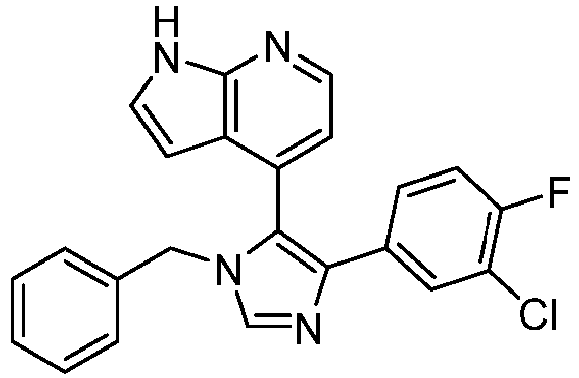
- The compound was prepared according to General procedure A using 1H-pyrrolo[2,3-b]pyridine-4-carbaldehyde (140 mg, 0.958 mmol), benzylamine (256 mg, 2.40 mmol), 2-chloro-1-fluoro-4-(isocyano(tosyl)methyl)benzene (prepared as described above, used as crude) and K2CO3 (199 mg, 1,44 mmol). Reaction time: 100 minutes for the formation of the imine, then additional 16 hours for the cyclization step. The residue obtained after the workup was purified by column chromatography two times (hexane/ethyl acetate, 10:4; then pentane/acetone, 3:1) and then by recrystallization from chloroform. The product was obtained as a white solid (147 mg, 38 %).
- 1H NMR (500 MHz, CDCl3) δ (ppm) 10.03 (s, 1H), 8.34 (s, 1H), 7.78 (s, 1H), 7.65 (dd, J = 7.2, 2.1 Hz, 1H), 7.34 (d, J = 3.5 Hz, 1H), 7.24 - 7.19 (m, 3H), 7.18 - 7.11 (m, 1H), 6.94 (d, J = 4.7 Hz, 1H), 6.91 - 6.81 (m, 3H), 6.14 (d, J = 3.5 Hz, 1H), 5.05 (d, J = 15.4 Hz, 1H), 4.93 (d, J = 15.4 Hz, 1H).
- 13C NMR (126 MHz, CDCl3) δ (ppm) 157.18 (d, J = 248.5 Hz), 148.61, 142.87, 138.40, 137.63, 135.84, 131.30 (d, J = 3.8 Hz), 130.90, 129.01, 128.86, 128.35, 127.16, 126.55, 126.22 (d, J = 7.0 Hz), 125.62, 121.04 (d, J = 17.8 Hz), 120.59, 117.97, 116.38 (d, J = 21.2 Hz), 100.70, 49.66.
- 19F NMR (471 MHz, CDCl3) δ (ppm) -118.09.
- HRMS calculated for C23H17ClFN4 [M+H]+ 403.1120, found 403.1116.
-

- The compound was prepared according to General procedure A using 1H-pyrrolo[2,3-b]pyridine-4-carbaldehyde (140 mg, 0.958 mmol), (1-methylpiperidin-4-yl)methanamine (246 mg, 1.92 mmol, 2 eq.), 2-chloro-1-fluoro-4-(isocyano(tosyl)methyl)benzene (prepared as described above, used as crude) and K2CO3 (265 mg, 1.92 mmol, 2 eq.). Reaction time: 100 minutes for the formation of the imine, then additional 20 hours for the cyclization step. The residue obtained after the workup was purified by column chromatography (dichloromethane/7 M NH3 in methanol, gradient from 1:0 to 13:1) and then by recrystallization from hexane/Et2O/acetone (1 + 1 + 03 mL). The product was obtained as a beige solid (226 mg, 38 %).
- 1H NMR (500 MHz, methanol-d 4) δ (ppm) 8.34 (d, J = 4.9 Hz, 1H), 7.95 (s, 1H), 7.48 - 7.39 (m, 2H), 7.18 -7.12 (m, 2H), 7.03 - 6.93 (m, 1H), 6.09 (d, J = 3.5 Hz, 1H), 4.02 - 3.89 (m, 1H), 3.89 - 3.74 (m, 1H), 2.76 - 2.60 (m, 2H), 1.78 - 1.63 (m, 2H), 1.33 (s, 3H), 1.13 - 0.95 (m, 2H).
- l3C NMR (126 MHz, methanol-d 4) δ (ppm) 158.23 (d, J = 247.6 Hz), 149.85, 143.80, 140.45, 138.07, 132.92 (d, J = 3.9 Hz), 131.84, 129.71, 128.57, 127.77 (d, J = 7.1 Hz), 127.17, 121.82, 121.57 (d, J = 18.1 Hz), 118.46, 117.35 (d, J = 21.4 Hz), 100.53, 52.04, 46.10, 37.33, 30.13, 30.02.
- 19F NMR (471 MHz, CDCl3) δ (ppm) -120.41 - -120.49 (m).
- HRMS calculated for C23H24ClFN5 [M+H]+ 424.1699, found 424.1700.
-

- The compound was prepared according to General procedure A using 1H-pyrrolo[2,3-b]pyridine-4-carbaldehyde (140 mg, 0.958 mmol), (1r,4r)-N 1,N 1-dimethylcyclohexane-1,4-diamine hydrochloride (342 mg, 1.92 mmol, 2 eq.), 2-chloro-1-fluoro-4-(isocyano(tosyl)methyl)benzene (prepared as described above, used as crude) and K2CO3 (530 mg, 3.83 mmol, 4 eq.). Reaction time: 2 hours for the formation of the imine, then additional 20 hours for the cyclization step. The residue obtained after the workup was purified by column chromatography (dichloromethane/7 M NH3 in methanol, gradient from 1:0 to 12:1) and then by recrystallization from hexane/acetone. The product was obtained as a white solid (140 mg, 33 %).
- 1H NMR (500 MHz, methanol-d 4) δ (ppm) 8.37 (d, J = 4.9 Hz, 1H), 8.09 (s, 1H), 7.46 (d, J = 3.5 Hz, 1H), 7.43 (dd, J = 7.2,2.2 Hz, 1H), 7.17 -7.10 (m, 2H), 7.02 - 6.94 (m, 1H), 6.14 (d, J = 3.5 Hz, 1H), 3.80 - 3.69 (m, 1H), 2.40 - 2.30 (m, 1H), 2.23 (s, 6H), 2.18 - 2.12 (m, 1H), 2.05 - 1.83 (m, 5H), 1.26 - 1.03 (m, 2H).
- 13C NMR (126 MHz, methanol-d 4) δ (ppm) 158.19 (d, J = 247.6 Hz), 149.83, 143.86, 137.42, 136.91, 132.95 (d, J = 3.9 Hz), 131.86, 129.65, 128.63, 127.70 (d, J = 7.2 Hz), 126.76, 122.21, 121.55 (d, J = 17.9 Hz), 118.72, 117.33 (d, J = 21.5 Hz), 100.29, 63.51, 56.44, 41.62, 34.07, 33.71, 28.18, 28.15.
- 19F NMR (471 MHz, methanol-d 4) δ (ppm) -120.59.
- HRMS calculated for C24H26ClFN5 [M+H]+ 438.1855, found 438.1859.
-

- The compound was prepared according to General procedure A using 1H-pyrrolo[2,3-b]pyridine-4-carbaldehyde (140 mg, 0.958 mmol), (1-methyl-1H-pyrazol-3-yl)methanamine (213 mg, 1.92 mmol, 2 eq.), 2-chloro-1-fluoro-4-(isocyano(tosyl)methyl)benzene (prepared as described above, used as crude) and K2CO3 (265 mg, 1.92 mmol, 2 eq.). Reaction time: 100 minutes for the formation of the imine, then additional 20 hours for the cyclization step. The residue obtained after the workup was purified by column chromatography (hexane/acetone, gradient from 4:1 to 1:4). The product was obtained as a white solid (207 mg, 53 %).
- 1H NMR (500 MHz, Methanol-d 4) δ (ppm) 8.28 (d, J = 5.0 Hz, 1H), 7.97 (s, 1H), 7.45 (dd, J = 7.2,2.2 Hz, 1H), 7.38 (d, J = 3.5 Hz, 1H), 7.33 (d, J = 2.3 Hz, 1H), 7.20 - 7.13 (m, 1H), 7.07 (d, J = 5.0 Hz, 1H), 7.01 - 6.94 (m, 1H), 6.03 (d, J = 3.5 Hz, 1H), 5.74 (d, J = 2.3 Hz, 1H), 5.12 (d, J = 15.4 Hz, 1H), 5.02 (d, J = 15.3 Hz, 1H), 3.71 (s, 3H).
- 13C NMR (126 MHz, Methanol-d 4) δ (ppm) 158.23 (d, J = 247.9 Hz), 149.74, 148.53, 143.55, 140.10, 138.02, 133.09, 132.93 (d, J = 3.8 Hz), 131.55, 129.67, 128.24, 127.74 (d, J = 7.2 Hz), 127.16, 121.93, 121.65, 121.50, 118.63, 117.35 (d, J = 21.6 Hz), 105.55, 100.68, 44.22, 38.71.
- HRMS calculated for C21H17ClFN6 [M+H]+ 407.1182, found 407.1184.
-

- To a cold solution (-78 °C) of 4-(1-cyclohexyl-4-(4-fluorophenyl)-1H-imidazol-5-yl)-1H-pyrrolo[2,3-b]pyridine (35 mg; 0.0971 mmol) in tetrahydrofuran (10 mL) were added 1,2-bis(dimethylamino)ethane (TMEDA; 0.0437 mL; 33.9 mg; 0.291 mmol), then dropwise 1.6 M solution of n-BuLi in hexane (0.152mL; 0.243 mmol) and the resulting mixture was stirred at -78 °C for 45 minutes. Then, a solution of 1-chloropyrrolidine-2,5-dione (NCS, 19.5 mg; 0.146 mmol) in tetrahydrofuran (2.5 mL) was added and the resulting mixture was stirred at -78 °C for 15 minutes. A saturated aqueous solution of NH4Cl (5 mL), and solution of Na2S2O3 (0.20 g) in water (15 mL) were added and the mixture was extracted with ethyl acetate (2 × 25 mL). The combined organic extracts were dried over MgSO4, filtered, and the solvent was evaporated in vacuo. The residue was purified by column chromatography two times (hexane/acetone, 5:1; then hexane/ethyl acetate, 1:2). So obtained material was dissolved in ethyl acetate (7 mL) and washed with water (5×5 mL). The organic phase was dried over MgSO4, filtered, and the solvent was evaporated in vacuo. The product was obtained as a white solid (8 mg; 21 %).
- 1H NMR (500 MHz, methanol-d 4) δ (ppm) 8.38 (d, J = 4.8 Hz, 1H), 8.01 (s, 1H), 7.48 (s, 1H), 7.30 - 7.24 (m, 2H), 7.11 (d, J = 4.8 Hz, 1H), 6.88 - 6.84 (m, 2H), 3.58 - 3.51 (m, 1H), 2.12 - 2.04 (m, 1H), 2.01 - 1.94 (m, 1H), 1.88 - 1.82 (m, 1H), 1.81 - 1.72 (m, 2H), 1.70 - 1.64 (m, 1H), 1.65 - 1.57 (m, 2H), 1.24 - 1.18 (m, 2H).
- 13C NMR (126 MHz, methanol-d 4) δ (ppm) 163.19 (d, J = 244.8 Hz), 148.31, 145.11, 139.19, 135.95, 132.11, 131.64, 131.37, 129.57 (d, J = 7.9 Hz), 125.79, 125.06, 124.39, 120.76, 119.11, 118.42, 115.86 (d, J = 21.5 Hz), 104.45, 57.23, 36.04, 34.39, 26.71, 26.54, 26.14.
- HRMS calculated for C22H21ClFN4 [M+H]+ 395.1433, found 395.1430.
-

- The compound was prepared according to General procedure A using 1H-pyrrolo[2,3-b]pyridine-4-carbaldehyde, 1-(1-methyl-1H-pyrazol-4-yl)ethan-1-amine (2 eq.), 1-fluoro-4-(isocyano(tosyl)methyl) benzene and K2CO3. Reaction time: 3.5 hours for the formation of the imine, then additional 14 hours for the cyclization step. The residue obtained after the workup was purified by column chromatography (hexane/acetone, 1:2). So obtained material was then recrystallized from a mixture of hexane/acetone (1:1) and the crystals were washed with acetone (0.5 mL). The product was obtained as a white solid (28 mg, 14 %).
- Mixture of 2 rotamers:
- 1H NMR (500 MHz, methanol-d 4) δ (ppm) 8.31 (dd, J = 20.7, 4.9 Hz, 2H), 7.97 (d, J = 14.5 Hz, 2H), 7.43 (d, J = 5.8 Hz, 2H), 7.38 (d, J = 3.5 Hz, 1H), 7.34 -7.25 (m, 6H), 7.16 (s, 1H), 7.13 (d, J = 4.9 Hz, 1H), 7.05 (d, J = 4.9 Hz, 1H), 6.86 (d, J = 3.3 Hz, 4H), 6.16 (d, J = 3.5 Hz, 1H), 6.04 (d, J = 3.5 Hz, 1H), 5.21 (dd, J = 18.7, 7.0 Hz, 2H), 3.81 (s, 3H), 3.74 (s, 3H), 1.74 (dd, J = 19.3, 7.0 Hz, 6H).
- 13C NMR (126 MHz, methanol-d 4) δ (ppm) 163.27 (d, J = 246.5 Hz), 149.76, 143.68, 143.66, 139.19, 139.10, 138.12, 138.05, 137.22, 137.17, 132.34, 132.25, 131.54, 131.52, 130.38, 130.32, 129.67, 129.61, 129.55, 128.41, 128.27, 126.15, 124.28, 123.89, 122.37, 119.02, 118.83, 116.01, 115.83, 100.63, 100.44, 38.89, 38.80, 22.69, 22.64.
- 19F NMR (471 MHz, methanol-d 4) δ (ppm) -117.64.
- HRMS calculated for C22H20FN6 [M+H]+ 387.1728, found 387.1725.
-

- The compound was prepared according to General procedure A using 1H-pyrrolo[2,3-b]pyridine-4-carbaldehyde, 1-phenylethan-1-amine, 1-fluoro-4-(isocyano(tosyl)methyl)benzene and K2CO3. Reaction time: 3.5 hours for the formation of the imine, then additional 14 hours for the cyclization step. The residue obtained after the workup was purified by column chromatography (hexane/acetone, 2:1) and then by preparative TLC (ethyl acetate/dichloromethane, 3:1). The product was obtained as a white solid (7 mg, 6 %).
- Mixture of 2 rotamers:
- 1H NMR (500 MHz, methanol-d 4) δ (ppm) 8.44 - 8.29 (m, 3H), 8.06 (d, J = 4.8 Hz, 1H), 7.50 (d, J = 3.5 Hz, 1H), 7.37 - 7.27 (m, 4H), 7.27 - 7.17 (m, 4H), 7.15 (d, J = 3.5 Hz, 1H), 7.13 - 7.03 (m, 3H), 6.95 - 6.79 (m, 8H), 6.57 (d, J = 4.9 Hz, 1H), 6.29 (d, J = 3.5 Hz, 1H), 5.67 (d, J = 3.5 Hz, 1H), 5.37 (q, J = 7.1 Hz, 1H), 5.20 (q, J = 7.1 Hz, 1H), 1.93 - 1.81 (m, 6H).
- 13C NMR (126 MHz, methanol-d 4) δ (ppm) 163.54 (d, J = 245.7 Hz), 163.51 (d, J = 245.7 Hz), 149.65, 149.54, 143.40, 143.37, 142.77, 141.94, 138.28, 138.16, 136.99, 131.37, 130.22, 130.09, 129.95, 129.87, 129.75, 129.69, 129.63, 129.05, 128.90, 128.69, 128.00, 127.18, 127.02, 126.96, 126.81, 122.33, 122.23, 119.28, 118.59, 116.21, 116.04, 116.03, 100.63, 100.26, 57.61, 57.50, 22.34, 22.09.
- 19F NMR (471 MHz, methanol-d 4) δ (ppm) -116.60, -116.64.
- HRMS calculated for C24H20FN4 [M+H]+ 383.1667, found 383.1666.
-

- The compound was prepared according to General procedure A using 5-fluoro-1H-pyrrolo[2,3-b]pyridine-4-carbaldehyde (1 eq.), cyclohexanamine, 1-fluoro-4-(isocyano(tosyl)methyl)benzene and K2CO3. Methanol (2.5 mL) was used as a solvent instead of DMF. Reaction time: 4.5 hours for the formation of the imine, then additional 14 hours for the cyclization step. The solvent was evaporated and the residue was purified by column chromatography (hexane/acetone, 2:1). The product was obtained as a white solid (17 mg, 17 %).
- 1H NMR (500 MHz, methanol-d 4) δ (ppm) 8.30 (s, 1H), 8.11 (s, 1H), 7.49 (s, 1H), 7.32 (dt, 2H), 6.91 (dt, J = 8.9 Hz, 2H), 6.08 (s, 1H), 3.65 (tt, J = 11.8, 3.7 Hz, 1H), 2.09 (d, J = 12.6 Hz, 1H), 1.96 - 1.85 (m, 2H), 1.85 - 1.80 (m, 1H), 1.80 - 1.73 (m, 2H), 1.67 - 1.61 (m, 1H), 1.32 - 1.20 (m, 2H), 1.16 - 1.06 (m, 1H).
- 13C NMR (126 MHz, methanol-d 4) δ (ppm) 161.94 (d, J = 245.1 Hz), 154.05, 152.13, 145.17, 138.53, 136.00, 131.00, 130.75, 130.11, 130.09, 129.17, 127.94 (d, J = 7.9 Hz), 121.05, 121.03, 118.21, 116.93, 116.80, 114.60 (d, J = 21.8 Hz), 99.18, 99.14, 56.02, 34.13, 33.77, 25.30, 25.24, 24.66.
- 19F NMR (471 MHz, methanol-d 4) δ (ppm) -117.45, 142.39.
- HRMS calculated for C22H21F2N4 [M+H]+ 379.1729, found 379.1727.
-

- To a solution of 1H-pyrrolo[2,3-b]pyridine-4-carbaldehyde in DMF (1.20 mL) was added AcOH (0.40 mL) and the mixture was stirred at 40 °C while a solution of SelectFluor (177 mg, 0.697 mmol, CAS: 140681-55-6) in DMF (0.8 mL) was added over 1 hour. Then, the resulting mixture was stirred for additional 70 minutes at 40 °C. Ethyl acetate (40 mL) was added and the organic phase was washed with saturated aqueous solution of NaHCO3 (2 × 25 mL) and then with 10 % aqueous solution of LiCl (15 mL). The organic extract was dried over MgSO4, filtered, and the solvent was evaporated in vacuo. The residue obtained after the workup was purified by column chromatography (hexane/acetone, 3:1). The product was obtained as a yellow solid (9 mg, 14 %, ca. 85 % purity). So obtained material was used in the next step (cyclization).
- 1H NMR (500 MHz, acetone-d 6) δ (ppm) 10.58 (d, J = 2.8 Hz, 1H), 8.51 (d, J = 4.9 Hz, 1H), 7.66 (d, J = 2.3 Hz, 1H), 7.62 (d, J = 4.9 Hz, 1H).
- 13C NMR (126 MHz, acetone-d 6) δ (ppm) 190.99 (d, J = 10.8 Hz), 144.95, 144.82, 143.01, 134.51 (d, J = 5.6 Hz), 115.07, 112.63 (d, J = 27.6 Hz), 107.64 (d, J = 14.6 Hz).
- 19F NMR (471 MHz, acetone-d 6) δ (ppm) -165.78.
-

- The compound was prepared according to General procedure A using 3-fluoro-1H-pyrrolo[2,3-b]pyridine-4-carbaldehyde (27 mg, 0.165 mmol, prepared as described above), cyclohexanamine (40.9 mg, 0.413 mmol), 1-fluoro-4-(isocyano(tosyl)methyl)benzene (47.6 mg, 0.165 mmol) and K2CO3 (34 mg, 0.248 mmol). Reaction time: 2 hours for the formation of the imine, then additional 20 hours for the cyclization step. The residue obtained after the workup was purified by column chromatography (hexane/acetone, 10:4). The product was obtained as a white solid (19 mg, 31 %).
- 1H NMR (500 MHz, CDCl3) δ 9.32 (s, 1H), 8.43 (d, 1H), 7.93 (s, 1H), 7.36 (dd, J = 8.8, 5.4 Hz, 2H), 7.14 (d, J = 2.2 Hz, 1H), 7.05 (d, J = 4.8 Hz, 1H), 6.89-6.81 (m, 2H), 3.72 - 3.66 (m, 1H), 2.13 - 2.07 (m, 1H), 2.00 - 1.94 (m, 1H), 1.85 - 1.75 (m, 2H), 1.74 - 1.67 (m, 1H), 1.66 - 1.62 (m, 1H), 1.60 - 1.53 (m, 1H), 1.20 -1.08 (m, 3H).
- 13C NMR (126 MHz, CDCl3) δ (ppm) 162.06 (d, J = 246.2 Hz), 144.96, 144.69, 143.06 (d, J = 248.2 Hz), 137.72, 134.59, 129.66 (d, J = 26.8 Hz), 128.59 (d, J = 7.9 Hz), 123.42, 119.16, 115.34 (d, J = 21.5 Hz), 109.51 (d, J = 12.4 Hz), 108.97 (d, J = 26.3 Hz), 55.95, 35.48, 33.78, 25.84, 25.65, 25.23.
- 19F NMR (471 MHz, CDCl3) δ (ppm) -115.32, -170.20.
- HRMS calculated for C22H21F2N4 [M+H]+ 379.1729, found 379.1727.
-
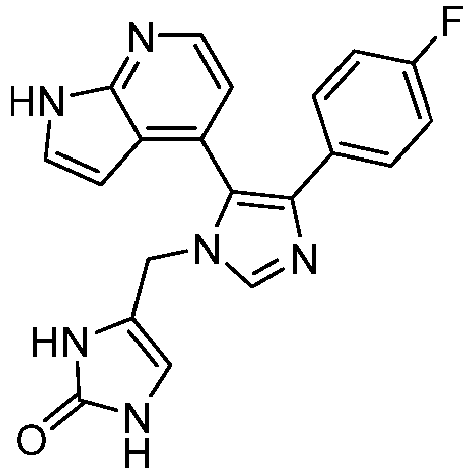
- The compound was prepared according to General procedure A using 1H-pyrrolo[2,3-b]pyridine-4-carbaldehyde (150 mg, 1.03mmol), 4-(aminomethyl)-1,3-dihydro-2H-imidazol-2-one dihydrochloride (318 mg, 1.71 mmol), 1-fluoro-4-(isocyano(tosyl)methyl)benzene (247 mg, 0.855 mmol) and K2CO3 [709 mg, 5.13 mmol (413 mg was added together with amine, 296 mg was added together with the TOSMIC reagent)]. Methanol (9.0 mL) was used as a solvent instead of DMF. Reaction time: 2 hours for the formation of the imine, then additional 18 hours for the cyclization step. The solvent was evaporated and the residue was purified by column chromatography two times (dichloromethane/methanol, gradient from 10:1 to 4:1; then acetone/methanol, 5:1). So obtained material was triturated with methanol (0.3 mL). The product was obtained as a yellow solid (58 mg, 18%).
- 1H NMR (500 MHz, methanol-d 6) δ (ppm) 8.29 (d, J = 5.0 Hz, 1H), 7.93 (s, 1H), 7.38 (d, J = 3.5 Hz, 1H), 7.36 - 7.27 (m, 2H), 7.08 (d, J = 5.0 Hz, 1H), 6.96 - 6.82 (m, 2H), 6.08 (d, J = 3.5 Hz, 1H), 5.59 (s, 1H), 4.95 - 4.84 (m, 2H).
- 13C NMR (126 MHz, DMSO-d 6) δ (ppm) 163.34 (d, J = 245.2 Hz), 156.81, 149.66, 143.52, 139.81, 139.70, 131.95, 131.42, 131.39, 129.67 (d, J = 7.9 Hz), 128.26, 126.31, 122.06, 118.63, 118.55, 115.97 (d, J = 21.8 Hz), 109.80, 100.62, 42.06.
- 19F NMR (471 MHz, DMSO-d 6) δ (ppm) -118.20.
- HRMS calculated for C20H16FN6O [M+H]+ 375.1364, found 375.1366.
-

- The compound was prepared according to General procedure A using 1H-pyrrolo[2,3-b]pyridine-4-carbaldehyde (50 mg, 342 mmol), (2-methyl-2H-tetrazol-5-yl)methanamine hydrochloride (102 mg, 0.684 mmol), 1-fluoro-4-(isocyano(tosyl)methyl)benzene (98.9 mg, 0.342 mmol) and K2CO3 (189 mg, 1.37 mmol). Methanol (2.0 mL) was used as a solvent instead of DMF. Reaction time: 3.5 hours for the formation of the imine, then additional 21 hours for the cyclization step. The solvent was evaporated and the residue was purified by column chromatography (hexane/acetone, 2:3). So obtained material was recrystallized from methano|/Et2O (0.3 + 0.8 mL). The product was obtained as a white solid (16 mg, 13 %).
- 1H NMR (500 MHz, DMSO-d 6) δ (ppm) 11.78 (s, 1H), 8.26 (d, J = 4.8 Hz, 1H), 8.07 (s, 1H), 7.46 - 7.39 (m, 1H), 7.38 -7.29 (m, 2H), 7.03 - 6.93 (m, 3H), 5.88 - 5.81 (m, 1H), 5.41 (d, J = 16.1 Hz, 1H), 5.27 (d, J = 16.2 Hz, 1H), 4.17 (s, 3H).
- 13C NMR (126 MHz, DMSO-d 6) δ (ppm) 162.01, 160.77 (d, J = 243.0 Hz), 148.65, 142.68, 138.94, 137.00, 130.86 (d, J = 2.9 Hz), 129.13, 127.46 (d, J = 7.9 Hz), 127.01, 124.66, 119.29, 116.96, 114.92 (d, J = 21.4 Hz), 98.72.
- 19F NMR (471 MHz, DMSO-d 6) δ (ppm) -116.10.
- HRMS calculated for C19H16FN8 [M+H]+ 375.1476, found 375.1473.
-

- The compound was prepared according to General procedure A using 1H-pyrrolo[2,3-b]pyridine-4-carbaldehyde, (2-methylthiazol-5-yl)methanamine (2 eq.), 1-fluoro-4-(isocyano(tosyl)methyl)benzene and K2CO3. Reaction time: 2 hours for the formation of the imine, then additional 22 hours for the cyclization step. The residue obtained after the workup was purified by column chromatography (dichloromethane/acetone, 2:3). So obtained material was recrystallized from methanol/diethyl ether (0.2 + 0.5 mL). The product was obtained as a white solid (13 mg, 14 %).
- 1H NMR (500 MHz, methanol-d 4) δ (ppm) 8.29 (d, J = 4.9 Hz, 1H), 8.05 (s, 1H), 7.36 (d, J = 3.5 Hz, 1H), 7.32 (s, 2H), 7.07 (d, J = 4.9 Hz, 1H), 6.94 - 6.83 (m, 3H), 6.00 (d, J = 3.5 Hz, 1H), 5.41 (d, J = 15.8 Hz, 1H), 5.31 (d, J = 15.8 Hz, 1H), 2.50 (s, 3H).
- 13C NMR (126 MHz, methanol-d 4) δ (ppm) 169.58, 163.38 (d, J = 245.4 Hz), 149.74, 143.62, 141.65, 139.99, 139.75, 135.05, 131.64, 131.30 (d, J = 3.2 Hz), 129.68 (d, J = 8.0 Hz), 128.27, 126.20, 121.91, 118.55, 115.99 (d, J = 21.9 Hz), 100.60, 42.68, 18.66.
- 19F NMR (471 MHz, methanol-d 4) δ (ppm) -117.31.
- HRMS calculated for C21H17FN5S [M+H]+ 390.1183, found 390.1181.
-

- The compound was prepared according to General procedure A using 1H-pyrrolo[2,3-b]pyridine-4-carbaldehyde, (1H-1,2,3-triazol-4-yl)methanamine hydrochloride (2 eq.), 1-fluoro-4-(isocyano(tosyl)methyl)benzene and K2CO3 (4 eq.). Reaction time: 2 hours for the formation of the imine, then additional 20 hours for the cyclization step. The residue obtained after the workup was purified by column chromatography (dichloromethane/methanol, 10:1) and then by preparative TLC (dichloromethane/methanol, 9:1). The product was obtained as a white solid (10 mg, 10 %).
- 1H NMR (500 MHz, methanol-d 4) δ (ppm) 8.27 (d, J = 4.9 Hz, 1H), 8.03 (s, 1H), 7.35 (d, J = 3.5 Hz, 1H), 7.34 - 7.28 (m, 2H), 7.20 (s, 1H), 7.05 (d, J = 4.9 Hz, 1H), 6.90 - 6.82 (m, 2H), 6.02 (d, J = 3.5 Hz, 1H), 5.31 (d, J = 15.6 Hz, 1H), 5.21 (d, J = 15.7 Hz, 1H).
- 13C NMR (126 MHz, methanol-d 4) δ (ppm) 163.32 (d, J = 245.1 Hz), 149.69, 143.55, 139.96, 139.65, 131.78, 131.46, 131.43, 129.67 (d, J = 8.1 Hz), 128.22, 126.37, 121.95, 118.63, 115.95 (d, J = 21.8 Hz), 100.64,41.64.
- 19F NMR (471 MHz, methanol-d 4) δ (ppm) -117.45.
- HRMS calculated for C19H15FN7 [M+H]+ 360.1367, found 360.1366.
-

- The compound was prepared according to General procedure A using 1H-pyrrolo[2,3-b]pyridine-4-carbaldehyde, (1H-1,2,4-triazol-3-yl)methanamine hydrochloride (2 eq.), 1-fluoro-4-(isocyano(tosyl)methyl)benzene and K2CO3 (4 eq.). Reaction time: 2 hours for the formation of the imine, then additional 21 hours for the cyclization step. The residue obtained after the workup was purified by column chromatography (dichloromethane/methanol, 8:1). The product was obtained as a white solid (36 mg, 35 %).
- 1H NMR (500 MHz, methanol-d 4) δ (ppm) 8.27 - 8.18 (m, 2H), 8.04 (s, 1H), 7.37 -7.25 (m, 3H), 7.01 (d, J = 5.0 Hz, 1H), 6.93 - 6.83 (m, 2H), 6.03 (d, J = 3.5 Hz, 1H), 5.29 (d, J = 15.6 Hz, 1H), 5.16 (d, J = 15.8 Hz, 1H).
- 13C NMR (126 MHz, methanol-d 4) δ (ppm) 163.31 (d, J = 244.9 Hz), 149.65, 143.44, 140.29, 139.46, 131.61, 131.51 (d, J = 3.3 Hz), 129.65 (d, J =8.1 Hz), 128.05, 126.59, 122.02, 118.64, 115.94 (d, J = 21.8 Hz), 100.69,43.65.
- 19F NMR (471 MHz, methanol-d 4) δ (ppm) -117.52.
- HRMS calculated for C19H15FN7 [M+H]+ 360.1367, found 360.1365.
-

- To a cold solution (-78 °C) of 4-(1-cyclohexyl-4-(4-fluorophenyl)-1H-imidazol-5-yl)-1H-pyrrolo[2,3-b]pyridine (91 mg; 0.252 mmol) in tetrahydrofuran (10 mL) were added 1,2-bis(dimethylamino)ethane (TMEDA; 0.113 mL; 88.0 mg; 0.757 mmol), then dropwise 2.5 M solution of n-BuLi in hexane (0.272 mL; 0.680 mmol) and the resulting mixture was stirred at -78 °C for 60 minutes. Then, a solution of perchloroethane (101 mg; 0.428 mmol) in tetrahydrofuran (2.0 mL) was added and the resulting mixture was stirred at -78 °C for 60 minutes. A saturated aqueous solution of NH4Cl(5 mL) and water (25 mL) were added and the mixture was extracted with ethyl acetate (2 × 30 mL). The combined organic extracts were dried over MgSO4, filtered, and the solvent was evaporated in vacuo. The residue was purified by column chromatography (hexane/acetone, 2:1). The product was obtained as a white solid (54 mg; 54 %).
- 1H NMR (300 MHz, CDCl3) δ (ppm) 10.19 (s, 1H), 8.43 (d, J = 5.0 Hz, 1H), 7.40 (d, J = 3.6 Hz, 1H), 7.31 -7.20 (m, 3H), 7.07 (d, J = 5.0 Hz, 1H), 6.87 - 6.72 (m, 2H), 6.26 (d, J = 3.5 Hz, 1H), 3.86 - 3.60 (m, 1H), 2.32 - 2.15 (m, 1H), 2.15 - 1.94 (m, 1H), 1.89 - 1.69 (m, 4H), 1.65 - 1.51 (m, 1H), 1.17 - 0.94 (m, 3H).
- 13C NMR (126 MHz, CDCl3) δ (ppm) 162.01 (d, J = 246.4 Hz), 147.89, 141.97, 137.68, 132.55, 132.23, 129.56 (d, J = 3.2 Hz), 128.25 (d, J = 8.1 Hz), 127.00, 125.86, 121.93, 118.57, 115.23 (d, J = 21.5 Hz), 100.81, 57.98, 31.38, 26.10, 26.03, 24.99.
- 19F NMR (471 MHz, CDCl3) δ (ppm) -115.25.
- HRMS calculated for C22H21ClFN4 [M+H]+ 395.1433, found 395.1433.
-

- The compound was prepared according to General procedure A using 1H-pyrrolo[2,3-b]pyridine-4-carbaldehyde (50 mg, 0.342 mmol, 1 eq.), (1H-imidazol-2-yl)methanamine dihydrochloride (91.4 mg, 0.684 mmol, 2 eq.), 1-fluoro-4-(isocyano(tosyl)methyl)benzene (98.9 mg, 0.342 mmol) and K2CO3 (284 mg, 2.05 mmol, 6 eq.). Reaction time: 2 hours for the formation of the imine, then additional 18 hours for the cyclization step. The residue obtained after the workup was purified by column chromatography (dichloromethane/methanol, gradient from 8:1 to 6:1). So obtained material was triturated with methanol (1 mL), the solid was dried in vacuo. The product was obtained as a white solid (12 mg, 10 %).
- 1H NMR (500 MHz, methanol-d 4) δ (ppm) 8.21 (d, J = 5.0 Hz, 1H), 7.96 (s, 1H), 7.37 - 7.27 (m, 3H), 6.91 (d, J = 4.9 Hz, 1H), 6.90 - 6.76 (m, 4H), 6.03 (d, J = 3.5 Hz, 1H), 5.24 (d, J = 15.6 Hz, 1H), 5.09 (d, J = 15.8 Hz, 1H).
- 13C NMR (126 MHz, methanol-d 4) δ (ppm) 163.33 (d, J = 245.2 Hz), 149.64, 143.56, 143.45, 140.00, 139.66, 131.47, 129.62 (d, J = 8.1 Hz), 128.13, 126.43, 122.01, 118.51, 115.94 (d, J = 21.7 Hz), 100.63, 43.93.
- 19F NMR (471 MHz, methanol-d 4) δ (ppm) -117.46.
- HRMS calculated for C20H16PN6 [M+H]+ 359.1415, found 359.1417.
-

- The compound was prepared according to General procedure A using 1H-pyrrolo[2,3-b]pyridine-4-carbaldehyde (50 mg, 0.342 mmol, 1 eq.), (1R,3R)-3-aminocyclohexan-1-ol hydrochloride (104 mg, 0.684 mmol, 2 eq.), 1-fluoro-4-(isocyano(tosyl)methyl)benzene (98.9 mg, 0.342 mmol) and K2CO3 (165 mg, 1.20 mmol, 3.5 eq.). Reaction time: 2 hours for the formation of the imine, then additional 18 hours for the cyclization step. The residue obtained after the workup was purified by column chromatography (dichloromethane/acetone, 1:2). The product was obtained as a beige solid (30 mg, 23 %).
- 1H NMR (500 MHz, acetone-d 6) δ (ppm) 10.92 (s, 1H), 8.37 (s, 1H), 7.95 (s, 1H), 7.51 - 7.35 (m, 3H), 7.11 - 7.03 (m, 1H), 6.89 - 6.80 (m, 2H), 6.14 - 6.08 (m, 1H), 4.25 (s, 1H), 4.14 (d, J = 25.4 Hz, 1H), 2.10 - 1.98 (m, 3H), 1.94 -1.71 (m, 2H), 1.71 -1.41 (m, 5H).
- 13C NMR (126 MHz, acetone-d 6) δ (ppm) 162.20 (d, J = 242.9 Hz), 150.23, 144.16, 144.11, 136.15, 132.79, 131.99, 128.78, 128.75, 128.72, 128.69, 127.35 (d, J = 9.0 Hz), 127.23, 127.16, 121.22, 118.59, 118.48, 115.36 (d, J = 21.6 Hz), 100.60, 100.39, 66.40, 66.30, 50.93, 50.88, 41.73, 41.07, 35.56, 34.94, 32.37, 32.32, 20.44, 20.36.
- 19F NMR (471 MHz, acetone-d 6) δ (ppm) -118.49.
- HRMS calculated for C22H22FN4O [M+H]+ 377.1772, found 377.1769.
-

- The compound was prepared according to General procedure A using 1H-pyrrolo[2,3-b]pyridine-4-carbaldehyde (50 mg, 0.342 mmol, 1 eq.), (1S,3S)-3-aminocyclohexan-1-ol hydrochloride (104 mg, 0.684 mmol, 2 eq.), 1-fluoro-4-(isocyano(tosyl)methyl)benzene (98.9 mg, 0.342 mmol) and K2CO3 (165 mg, 1.20 mmol, 3.5 eq.). Reaction time: 2 hours for the formation of the imine, then additional 18 hours for the cyclization step. The residue obtained after the workup was purified by column chromatography (dichloromethane/acetone, 1:2). The product was obtained as a beige solid (22 mg, 17 %).
- 1H NMR (500 MHz, acetone-d 6) δ (ppm) 10.91 (s, 1H), 8.41 - 8.29 (m, 1H), 7.94 (s, 1H), 7.51 - 7.34 (m, 3H), 7.11 - 7.03 (m, 1H), 6.92 - 6.81 (m, 2H), 6.17 - 6.06 (m, 1H), 4.31 - 4.20 (m, 1H), 4.14 (d, J = 25.3 Hz, 1H), 2.11 -1.95 (m, 3H), 1.93 -1.71 (m, 2H), 1.71 -1.41 (m,5H).
- 13C NMR (126 MHz, acetone-d 6) δ (ppm) 162.20 (d, J = 243.1 Hz), 150.23, 144.17, 144.12, 137.90, 136.15, 132.79, 131.99, 128.78, 128.75, 128.72, 128.69, 127.35 (d, J = 9.0 Hz), 127.22, 125.42, 121.20, 118.59, 118.47, 115.36 (d, J = 21.4 Hz), 100.60, 100.39, 66.40, 66.30, 50.92, 50.88, 41.72, 41.06, 35.56, 34.94, 32.37, 32.32, 31.98, 20.44, 20.36.
- 19F NMR (471 MHz, acetone-d 6) δ (ppm) -118.49.
- HRMS calculated for C22H22FN4O [M+H]+ 377.1772, found 377.1774.
-

- The compound was prepared according to General procedure A using 1H-pyrrolo[2,3-b]pyridine-4-carbaldehyde, isoxazol-3-ylmethanamine (2 eq.), 1-fluoro-4-(isocyano(tosyl)methyl)benzene and K2CO3. Reaction time: 2 hours for the formation of the imine, then additional 16 hours for the cyclization step. The solvent was evaporated and the residue was purified by column chromatography (hexane/acetone, gradient from 4:5 to 1:2). So obtained material was then recrystallized from diethyl ether and then purified by preparative TLC (ethyl acetate/acetone, 3:1). The product was obtained as a white solid (17 mg, 17 %).
- 1H NMR (500 MHz, methanol-d 4) δ (ppm) 8.47 (d, J = 1.7 Hz, 1H), 8.26 (d, J = 5.0 Hz, 1H), 8.06 (s, 1H), 7.38 -7.27 (m, 3H), 7.04 (d, J = 5.0 Hz, 1H), 6.93 - 6.82 (m, 2H), 6.08 - 6.03 (m, 2H), 5.34 (d, J = 16.1 Hz, 1H), 5.20 (d, J = 16.1 Hz, 1H).
- 13C NMR (126 MHz, methanol-d 4) δ (ppm) 163.37 (d, J = 245.2 Hz), 161.32, 160.39, 149.74, 143.57, 140.24, 139.78, 131.37, 131.33, 129.70 (d, J = 8.0 Hz), 128.28, 126.55, 121.92, 118.61, 115.98 (d, J = 21.8 Hz), 104.27, 100.64, 42.02.
- 19F NMR (471 MHz, methanol-d 4) δ (ppm) -117.31.
- HRMS calculated for C20H15FN5O [M+H]+ 360.1255, found 360.1252.
-

- The compound was prepared according to General procedure A using 1H-pyrrolo[2,3-b]pyridine-4-carbaldehyde, (1-(trifluoromethyl)-1H-pyrazol-4-yl)methanamine hydrochloride (2 eq.), 1-fluoro-4-(isocyano(tosyl)methyl)benzene and K2CO3 (3.5 eq.). Reaction time: 2 hours for the formation of the imine, then additional 16 hours for the cyclization step. The solvent was evaporated and the residue was purified by column chromatography (hexane/acetone, 10:8). So obtained material was then recrystallized from hexane/diethyl ether (1.5 + 1.5 mL). The product was obtained as a white solid (61 mg, 17 %).
- 1H NMR (500 MHz, methanol-d 4) δ (ppm) 8.30 (d, J = 4.9 Hz, 1H), 8.05 (s, 1H), 7.49 (s, 1H), 7.40 - 7.29 (m, 4H), 7.08 (d, J = 4.9 Hz, 1H), 6.92 - 6.82 (m, 2H), 5.96 (d, J = 3.5 Hz, 1H), 5.19 - 5.05 (m, 2H).
- 13C NMR (126 MHz, methanol-d 4) δ (ppm) 163.33 (d, J = 245.2 Hz), 149.67, 144.05, 143.62, 139.93, 139.79, 131.99, 131.37 (d, J = 3.3 Hz), 129.61 (d, J = 8.0 Hz), 128.97, 128.39, 126.14, 121.96, 121.49, 119.11 (q, J = 786.5, 261.9 Hz), 118.50, 115.97 (d, J = 21.8 Hz), 100.44, 40.59.
- 19F NMR (471 MHz, methanol-d 4) δ (ppm) -62.26, -117.40.
- HRMS calculated for C21H15F4N6 [M+H]+ 427.1289, found 427.1291.
-

- A mixture of ethyl 2-(4-(4-fluorophenyl)-5-(1H-pyrrolo[2,3-b]pyridin-4-yl)-1H-imidazol-1-yl)acetate (39 mg, 0.107 mmol) and N 1,N 1-dimethylethane-1,2-diamine (220 µL, 2.08 mmol) was stirred in a pressure tube at 100 °C for 3.5 hours. Volatile compounds were evaporated and the residue was purified by column chromatography (dichloromethane/7 M NH3 in methanol, 6:1) and then by preparative TLC (dichloromethane/7 M NH3 in methanol, 6:1). The product was obtained as a beige solid (27 mg, 62 %). 1H NMR (500 MHz, methanol-d 4) δ (ppm) 8.28 (d, J = 5.0 Hz, 1H), 7.95 (s, 1H), 7.37 (d, J = 3.5 Hz, 1H), 7.35 - 7.29 (m, 2H), 7.08 (d, J = 4.9 Hz, 1H), 6.91 - 6.82 (m, 2H), 6.10 (d, J = 3.5 Hz, 1H), 4.69 (d, J = 16.6 Hz, 1H), 4.54 (d, J = 16.4 Hz, 1H), 3.19 - 3.06 (m, 2H), 2.20 - 2.08 (m, 8H).
- 13C NMR (126 MHz, methanol-d 4) δ (ppm) 168.88, 163.28 (d, J = 244.9 Hz), 149.75, 143.60, 141.10, 139.25, 131.59, 131.51 (d, J = 3.2 Hz), 129.61 (d, J = 8.1 Hz), 128.16, 126.65, 122.05, 118.68, 115.95 (d, J = 21.8 Hz), 100.96, 58.75, 45.39, 37.98.
- 19F NMR (471 MHz, methanol-d 4) δ (ppm) -117.44.
- HRMS calculated for C22H24FN6O [M+H]+ 407.1990, found 407.1986.
-

- A mixture of ethyl 2-(4-(4-fluorophenyl)-5-(1H-pyrrolo[2,3-b]pyridin-4-yl)-1H-imidazol-1-yl)acetate (41 mg, 0.113 mmol) and (4-methylthiazol-2-yl)methanamine (112 mg, 0.874 mmol) was stirred in a pressure tube at 90 °C for 11 hours and then at 100 °C for 4 hours. Volatile compounds were evaporated and the residue was purified by column chromatography (acetone/methanol, 20:1). So obtained material was triturated with diethyl ether, the solid was dried in vacuo. The product was obtained as a beige solid (18 mg, 36 %).
- 1H NMR (500 MHz, methanol-d 4) δ (ppm) 8.22 (d, J = 4.9 Hz, 1H), 7.96 (s, 1H), 7.35 - 7.30 (m, 3H), 7.04 (d, J = 5.0 Hz, 1H), 6.98 (q, J = 1.1 Hz, 1H), 6.91 - 6.85 (m, 2H), 6.07 (d, J = 3.5 Hz, 1H), 4.83 (br s, 1H), 4.62 (d, J = 16.9 Hz, 1H), 4.45 (d, J = 9.5 Hz, 2H), 2.36 (d, J = 1.0 Hz, 3H).
- 13C NMR (126 MHz, methanol-d 4) δ (ppm) 169.33, 169.24, 163.32 (d, J = 244.9 Hz), 153.34, 149.77, 147.92, 143.59, 141.15, 139.33, 131.50 (d, J = 3.4 Hz), 131.45, 129.67 (d, J = 7.9 Hz), 128.17, 126.72, 122.04, 118.62, 115.95 (d, J = 21.8 Hz), 115.39, 100.95,41.51, 16.62.
- 19F NMR (471 MHz, methanol-d 4) δ (ppm) -117.49.
- HRMS calculated for C23H20FN6OS[M+H]+ 447.1398, found 477.1402.
-

- To a cold solution (-78 °C) of 4-(1-cyclohexyl-4-(4-fluorophenyl)-1H-imidazol-5-yl)-1H-pyrrolo[2,3-b]pyridine (191 mg; 0.530 mmol) in tetrahydrofuran (30 mL) were added 1,2-bis(dimethylamino)ethane (0.318 mL; 246 mg; 2.12 mmol), then dropwise 1.2 M solution of n-BuLi in hexane (1.325 mL; 1.59 mmol) and the resulting mixture was stirred at -78 °C for 60 minutes. Then, a solution of ethyl chloroformate (230 mg; 2.12 mmol) in tetrahydrofuran (4.0 mL) was added dropwise and the resulting mixture was allowed to warm to -68 °C over 60 minutes. Then, EtOH (4 mL) and 21 % solution of NaOEt in EtOH (0.80 mL) were added and the resulting mixture was stirred at 25 °C for 10 minutes. A saturated aqueous solution of NH4Cl(10 mL) was added and the solvents were removed in vacuo. Water (30 mL) was added and the mixture was extracted with ethyl acetate (2 × 40 mL). The combined organic extracts were dried over MgSO4, filtered, and the solvent was evaporated in vacuo. The residue was purified by column chromatography (hexane/acetone, 3:1). The product was obtained as a orange wax (120 mg, 52%).
- 1H NMR (500 MHz, CDCl3) δ (ppm) 10.69 (s, 1H), 8.45 (s, 1H), 7.40 (d, J = 3.5 Hz, 1H), 7.32 - 7.27 (m, 2H), 7.11 (d, J = 4.8 Hz, 1H), 6.80 - 6.74 (m, 2H), 6.19 (d, J = 3.5 Hz, 1H), 4.55 - 4.46 (m, 2H), 4.45 - 4.36 (m, 1H), 2.19 - 2.14 (m, 1H), 2.05 - 1.94 (m, 1H), 1.89 - 1.83 (m, 1H), 1.80 - 1.64 (m, 3H), 1.54 -1.50 (s, 1H), 1.48 (t, J = 7.1 Hz, 3H), 1.14 - 1.00 (m, 3H).
- 13C NMR (126 MHz, CDCl3) δ (ppm) 162.13 (d, J = 246.3 Hz), 159.83, 148.69, 142.65, 139.17, 137.32, 132.34, 129.67 (d, J = 3.3 Hz), 129.62, 128.84 (d, J = 8.1 Hz), 126.87, 121.61, 118.62, 115.09 (d, J = 21.5 Hz), 100.59, 62.02, 59.47, 32.05, 31.64, 26.26, 26.20, 24.87, 14.52.
- 19F NMR (471 MHz, CDCl3) δ (ppm) -115.17.
- HRMS calculated for C25H26FN4O2[M+H]+ 433.2034, found 433.2038.
-

- The compound was prepared according to General procedure A using 1H-pyrrolo[2,3-b]pyridine-4-carbaldehyde, 1-(aminomethyl)-N,N-dimethylcyclobutan-1-amine (2 eq.), 1-fluoro-4-(isocyano(tosyl) methyl)benzene and K2CO3. Reaction time: 2.5 hours for the formation of the imine, then additional 18 hours for the cyclization step. The residue obtained after the workup was purified by column chromatography (acetone/triethylamine, gradient from 100:1 to 100:2). So obtained material was then recrystallized from hexane/acetone (1.5 + 0.3 mL). The product was obtained as a white solid (30 mg, 27%).
- 1H NMR (500 MHz, DMSO-d 6) δ (ppm) 11.80 (s, 1H), 8.34 (d, J = 4.8 Hz, 1H), 8.02 (s, 1H), 7.50 - 7.44 (m, 1H), 7.36 - 7.28 (m, 2H), 7.10 (d, J = 4.8 Hz, 1H), 7.01 - 6.93 (m, 2H), 6.00 (dd, J = 3.5, 1.8 Hz, 1H), 4.07 (d, J = 14.8 Hz, 1H), 3.93 (d, J = 14.8 Hz, 1H), 1.92 (s, 6H), 1.87 - 1.80 (m, 2H), 1.45 - 1.33 (m, 3H), 0.96 - 0.88 (m, 1H).
- 13C NMR (126 MHz, DMSO-d 6) δ (ppm) 160.65 (d, J = 242.9 Hz), 148.84, 142.77, 139.10, 136.25, 131.25 (d, J = 3.0 Hz), 130.21, 127.65 (d, J = 7.8 Hz), 127.18, 125.44, 119.39, 117.33, 114.78 (d, J = 21.1 Hz), 99.10, 63.33, 46.40, 37.11, 25.80, 25.65, 12.46.
- 19F NMR (471 MHz, DMSO-d 6) δ (ppm) -116.51.
- HRMS calculated for C23H25FN5[M+H]+ 390.2089, found 390.2088.
-

- A mixture of ethyl 1-cyclohexyl-4-(4-fluorophenyl)-5-(1H-pyrrolo[2,3-b]pyridin-4-yl)-1H-imidazole-2-carboxylate (32 mg, 0.0740 mmol) and 7 M solution of NH3 in methanol (5 mL) was stirred in a pressure tube at 90 °C for 14 hours. The solvent was evaporated and the residue was purified by column chromatography (hexane/acetone, 10:4). So obtained material was then recrystallized from hexane/dichloromethane. The product was obtained as a white solid (13 mg, 43 %).
- 1H NMR (500 MHz, CDCl3) δ (ppm) 10.29 (s, 1H), 8.44 (d, J = 5.0 Hz, 1H), 7.63 (s, 1H), 7.40 (d, J = 3.6 Hz, 1H), 7.30 - 7.21 (m, 2H), 7.13 (d, J = 4.9 Hz, 1H), 6.83 - 6.77 (m, 2H), 6.24 (d, J = 3.5 Hz, 1H), 5.61 (br s, 1H), 4.55 (br s, 1H), 2.90 (br s, 2H), 2.36 - 2.21 (m, 1H), 2.08 (br s, 1H), 1.87 - 1.80 (m, 1H), 1.78 - 1.64 (m, 3H), 1.53 - 1.47 (m, 1H), 1.17 -1.02 (m, 3H).
- 13C NMR (126 MHz, CDCl3) δ (ppm) 162.14 (d, J = 246.8 Hz), 161.10, 147.84, 141.93, 138.98, 137.74, 133.25, 129.58 (d, J = 3.2 Hz), 129.02, 128.45 (d, J = 8.0 Hz), 127.04, 122.06, 118.72, 115.31 (d, J = 21.4 Hz), 100.90, 59.25, 32.06, 31.56, 26.22, 26.17, 24.82.
- 19F NMR (471 MHz, CDCl3) δ (ppm) -114.92.
- HRMS calculated for C23H23FN5O[M+H]+ 404.1881, found 404.1884.
-
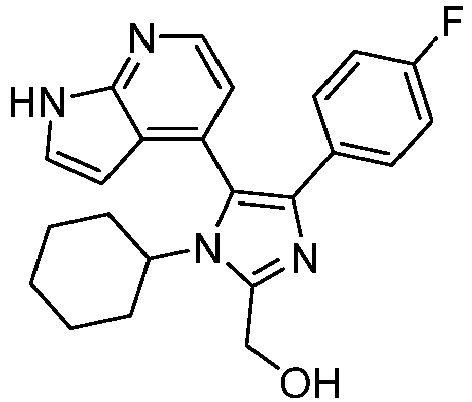
- To a cold solution (-78 °C) of ethyl 1-cyclohexyl-4-(4-fluorophenyl)-5-(1H-pyrrolo[2,3-b]pyridin-4-yl)-1H-imidazole-2-carboxylate (24 mg, 0.0555 mmol) in tetrahydrofuran (3.0 mL) was added 2 M solution of LiAlH4 in tetrahydrofuran (41.6 µL; 0.0832 mmol) and the resulting mixture was stirred at 25 °C for 15 minutes. A saturated aqueous solution of NH4Cl(5 mL) and water (15 mL) were added and the mixture was extracted with ethyl acetate (3 × 20 mL). The combined organic extracts were dried over MgSO4, filtered, and the solvent was evaporated in vacuo. The residue was purified by column chromatography (hexane/acetone, 1:1). The product was obtained as a white solid (10 mg, 46 %).
- 1H NMR (500 MHz, methanol-d 4) δ (ppm) 8.30 (d, J = 4.9 Hz, 1H), 7.42 (d, J = 3.5 Hz, 1H), 7.26 - 7.17 (m, 2H), 7.11 (d, J = 4.9 Hz, 1H), 6.84 - 6.74 (m, 2H), 6.16 (d, J = 3.5 Hz, 1H), 4.84 (s, 2H), 4.12 - 4.03 (m, 1H), 2.04 - 1.93 (m, 2H), 1.90 - 1.84 (m, 1H), 1.78 - 1.62 (m, 3H), 1.57 - 1.50 (m, 1H), 1.20 - 1.09 (m, 2H), 0.99 - 0.88 (m, 1H).
- 13C NMR (126 MHz, methanol-d 4) δ (ppm) 163.13 (d, J = 244.6 Hz), 149.62, 148.79, 143.40, 137.99, 133.80, 131.62 (d, J = 3.2 Hz), 129.62 (d, J = 8.0 Hz), 128.33, 127.23, 123.33, 119.96, 115.74 (d, J = 21.8 Hz), 100.73, 59.46, 57.98, 34.21, 33.96, 27.26, 27.14, 26.16.
- 19F NMR (471 MHz, methanol-d 4) δ (ppm) -117.94.
- HRMS calculated for C23H24FN4O[M+H]+ 391.1929, found 391. 1931.
-

- The compound was prepared according to General procedure A using 1H-pyrrolo[2,3-b]pyridine-4-carbaldehyde, (4-methylmorpholin-2-yl)methanamine (2 eq.), 1-fluoro-4-(isocyano(tosyl)methyl) benzene and K2CO3. Reaction time: 2 hours for the formation of the imine, then additional 16 hours for the cyclization step. The solvent was evaporated and the residue was purified by column chromatography (acetone/triethylamine/methanol, 100:5:2). So obtained material was then recrystallized from hexane/acetone (2.0 + 0.5 mL). The product was obtained as a white solid (44 mg, 33 %).
- 1H NMR (500 MHz, methanol-d 4) δ (ppm) 8.32 (apparent t, J = 5.5 Hz, 1H), 7.91 (d, J = 3.7 Hz, 1H), 7.45 - 7.36 (m, 1H), 7.36 - 7.24 (m, 2H), 7.13 (dd, J = 34.1, 5.0 Hz, 1H), 6.98 - 6.83 (m, 2H), 6.09 (dd, J = 31.9, 3.4 Hz, 1H), 4.13 - 4.03 (m, 1H), 4.02 - 3.91 (m, 1H), 3.82 - 3.74 (m, 1H), 3.52 - 3.43 (m, 1H), 3.41 - 3.34 (m, 1H), 2.55 (apparent t, J = 10.0 Hz, 1H), 2.42 - 2.24 (m, 1H), 2.12 (d, J = 6.7 Hz, 3H), 2.00 (apparent t, J = 11.7 Hz, 1H), 1.61 (q, J = 10.4 Hz, 1H).
- 13C NMR (126 MHz, Methanol-d 4) δ (ppm) 163.29 (d, J = 245.3 Hz), 149.82, 143.67, 140.69, 139.33, 132.03, 131.54, 129.77, 129.70, 129.64, 128.31, 126.55, 126.38, 122.03, 118.75, 118.63, 115.93 (d, J = 21.8 Hz), 100.82, 100.71, 75.02, 67.20, 58.10, 55.32, 46.06.
- 19F NMR (471 MHz, methanol-d 4) δ (ppm) -113.69 (d, J = 13.9 Hz).
- HRMS calculated for C22H23FN5O[M+H]+ 392.1881, found 392.1884.
-

- The compound was prepared according to General procedure A using 1H-pyrrolo[2,3-b]pyridine-4-carbaldehyde, 6-(aminomethyl)morpholin-3-one (2 eq.), 1-fluoro-4-(isocyano(tosyl)methyl)benzene and K2CO3. Reaction time: 2 hours for the formation of the imine, then additional 16 hours for the cyclization step. The residue obtained after the workup was purified by column chromatography (acetone). The product was obtained as a white solid (34 mg, 30 %).
- 1H NMR (500 MHz, methanol-d 4) δ (ppm) 8.33 (d, J = 4.9 Hz, 1H), 7.98 (s, 1H), 7.41 (d, J = 3.5 Hz, 1H), 7.34 - 7.27 (m, 2H), 7.15 (dd, J = 15.6, 5.0 Hz, 1H), 6.91 - 6.84 (m, 2H), 6.11 (d, J = 3.4 Hz, 1H), 4.22 - 4.12 (m, 1H), 4.11 - 4.00 (m, 2H), 3.95 (t, J = 16.6 Hz, 1H), 3.83 -3.65 (m, 1H), 3.05 - 2.89 (m, 2H).
- 13C NMR (126 MHz, methanol-d 4) δ (ppm) 170.53, 163.33 (d, J = 245.1 Hz), 149.81, 143.76, 140.58, 140.50, 139.35, 131.84, 131.46 (d, J = 3.3 Hz), 129.69 (d, J = 8.1 Hz), 128.43 (d, J = 10.4 Hz), 122.03, 118.79 (d, J = 13.2 Hz), 115.96 (d, J = 21.8 Hz), 100.64 (d, J = 19.3 Hz), 72.88, 67.97 (d, J = 12.2 Hz), 48.07, 44.16 (d, J = 9.2 Hz).
- 19F NMR (471 MHz, methanol-d 4) δ (ppm) -117.48 (d, J = 5.2 Hz).
- HRMS calculated for C21H19FN5O2[M+H]+ 392.1517, found 392.1519.
-

- To a cold solution (-78 °C) of 4-(1-cyclohexyl-4-(4-fluorophenyl)-1H-imidazol-5-yl)-1H-pyrrolo[2,3-b]pyridine (74 mg; 0.205 mmol) in tetrahydrofuran (8 mL) were added 1,2-bis(dimethylamino)ethane (0.092 mL; 71.6 mg; 0.616 mmol), then dropwise 1.6 M solution of n-BuLi in hexane (0.320 mL; 0.513 mmol), and the resulting mixture was stirred at -78 °C for 50 minutes. Then, a suspension of N-methyl-N-methylenemethanaminium iodide (114 mg; 0.616 mmol) in tetrahydrofuran (5.0 mL) was added and the resulting mixture was allowed to warm to 25 °C and stirred for 20 hours. Then, water (20 mL) was added and pH was adjusted to ca. 1 using concentrated (35 %) aqueous solution of HCl and the resulting mixture was stirred at 25 °C for 6 hours. A saturated aqueous solution of NaHCO3 (20 mL) was added and the mixture was extracted with ethyl acetate (2 × 40 mL). The combined organic extracts were dried over MgSO4, filtered, and the solvent was evaporated in vacuo. The residue was purified by column chromatography (ethyl acetate/7 M NH3 in methanol, gradient from 10:0 to 10:1) and then by preparative TLC (dichloromethane/acetone, 4:1 + 0.5 % 7 M NH3 in methanol). The product was obtained as an orange wax (4.5 mg; 5 %).
- 1H NMR (500 MHz, methanol-d 4) δ (ppm) 8.29 (d, J = 5.0 Hz, 1H), 7.41 (d, J = 3.5 Hz, 1H), 7.22 - 7.17 (m, 2H), 7.14 (d, J = 4.9 Hz, 1H), 6.83 - 6.76 (m, 2H), 6.13 (d, J = 3.5 Hz, 1H), 4.25 - 4.17 (m, 1H), 3.74 - 3.65 (m, 2H), 2.34 (s, 6H), 2.01 - 1.94 (m, 1H), 1.93 - 1.84 (m, 1H), 1.82 - 1.76 (m, 1H), 1.76 - 1.68 (m, 1H), 1.64 - 1.57 (m, 1H), 1.55 - 1.46 (m, 2H), 1.21 - 1.13 (m, 2H), 0.87 - 0.77 (m, 1H).
- 13C NMR (126 MHz, methanol-d 4) δ (ppm) 163.08 (d, J = 244.7 Hz), 149.56, 147.28, 143.27, 138.02, 134.29, 131.69 (d, J = 3.3 Hz), 129.63 (d, J = 8.0 Hz), 128.26, 126.97, 123.57, 120.31, 115.66 (d, J = 21.7 Hz), 100.85, 59.71, 57.39, 45.56, 34.11, 33.62, 27.39, 27.25, 26.24.
- 19F NMR (471 MHz, methanol-d 4) δ (ppm) -118.08.
- HRMS calculated for C25H29FN5[M+H]+ 418.2402, found 418.2403.
-

- To a degassed solution of 5-bromo-1-cyclohexyl-4-(4-luorophenyl)-1H-imidazole (45.0 mg; 0.133 mmol) in dioxane/H2O (1.8 mL + 0.30 mL) were added 4-(4,4,5,5-tetramethyl-1,3,2-dioxaborolan-2-yl)-1H-pyrrolo[2,3-b]pyridine (55.0 mg; 0.213 mmol), sodium methoxide (28.7 mg; 0.532 mmol), methanesulfonato(tri-t-butylphosphino)(2'-amino-1,1'-biphenyl-2-yl)palladium(II) (7.6 mg; 13.3 µmol; CAS:1445086-17-8) and the resulting mixture was stirred at 90 °C for 15 hours. The solvent was evaporated and the residue was purified by column chromatography (acetone/hexane, 1:1) and then by preparative TLC (dichloromethane/acetone, 2:1). The product was obtained as a white solid (19 mg, 38 %).
- 1H NMR (500 MHz, methanol-d 4) δ 7.98 (s, 1H), 7.38 - 7.34 (m, 2H), 6.97 (d, J = 3.5 Hz, 1H), 6.91 - 6.85 (m, 2H), 6.34 (s, 1H), 5.90 (d, J = 3.5 Hz, 1H), 3.82 - 3.74 (m, 1H), 2.06 - 1.95 (m, 2H), 1.83 - 1.76 (m, 3H), 1.75 - 1.68 (m, 1H), 1.66 - 1.60 (m, 1H), 1.30 -1.20 (m, 2H), 1.18 - 1.10 (m, 1H).
- 13C NMR (126 MHz, methanol-d 4) δ 163.16 (d, J = 244.4 Hz), 157.42, 148.76, 138.05, 136.25, 134.53, 131.78, 131.75, 129.54 (d, J = 7.9 Hz), 126.61, 122.80, 115.81 (d, J = 21.7 Hz), 113.99, 106.01, 100.49, 35.87, 35.10, 26.74, 26.69, 26.13.
- 19F NMR (471 MHz, methanol-d 4) δ (ppm) -118.10
- HRMS calculated for C22H23FN5[M+H]+ 376.1932, found 376.1934.
-

- To a degassed solution of 1-cyclohexyl-4-iodo-1H-imidazole (281 mg; 1.02 mmol) in 1-butanol/H2O (10.0 mL + 2.0 mL) were added (3,4-difluorophenyl)boronic acid (322 mg; 2.04 mmol), K3PO4 (758 mg; 3.57 mmol), (2-dicyclohexylphosphino-2',6'-dimethoxybiphenyl) [2-(2'-amino-1,1'-biphenyl)]palladium(II) methanesulfonate (39.8 mg; 0.051 mmol; CAS:1445085-82-4 and the resulting mixture was stirred at 90 °C for 2 hours and then at 100 °C for 4 hours and then at 110 °C for 14 hours. The solvent was evaporated in vacuo. The residue was mixed with water (100 mL) and extracted with ethyl acetate (3 × 50 mL). The combined organic extracts were dried over MgSO4, filtered, and the solvent was evaporated in vacuo. The residue was purified by column chromatography (ethyl acetate/hexane, 1:1). The product was obtained as a yellow wax (158 mg, 59 %).
- 1H NMR (500 MHz, CDCl3) δ (ppm) 9.34 (s, 1H), 7.82 - 7.78 (m, 1H), 7.74 - 7.67 (m, 1H), 7.34 (s, 1H), 7.31 - 7.27 (m, 1H), 4.44 - 4.33 (m, 1H), 2.30 - 2.22 (m, 2H), 2.00 - 1.95 (m, 2H), 1.85 - 1.70 (m, 3H), 1.52 (q, J = 13.0 Hz, 2H), 1.36 - 1.26 (m, 1H).
- 13C NMR (126 MHz, Chloroform-d) δ (ppm) 151.54, 151.51, 151.38, 149.65, 149.51, 134.78, 133.91, 124.04, 124.01, 123.98, 123.95, 117.99, 117.85, 116.54, 116.38, 101.49, 58.37, 33.62, 25.66, 25.05.
- 19F NMR (471 MHz, CDCl3) δ (ppm) -134.66 (d, J = 21.3 Hz), -135.24 (d, J = 20.9 Hz).
- HRMS calculated for C15H16F2N2 [M+H]+ 263.1354, found 263.1357.
-

- To a cold solution (0 °C) of 1-cyclohexyl-4-(3,4-difluorophenyl)-IH-iniidazole (158 mg; 0.602 mmol) in dichloromethane (15 mL) was added N-bromosuccinimide (113 mg; 0.632 mmol) and the resulting mixture was stirred at 0 °C for 60 minutes. Water (80 mL) and Na2S2O3 (50 mg) were added and the mixture was extracted with ethyl acetate (3 × 50 mL). The combined organic extracts were dried over MgSO4, filtered, and the solvent was evaporated in vacuo. The residue obtained after the workup was purified by column chromatography (ethyl acetate/hexane, 1:3). The product was obtained as a white solid (138 mg, 67 %).
- 1H NMR (500 MHz, CDCl3) δ (ppm) 8.35 (s, 1H), 7.82 (ddd, J = 11.5, 7.6, 2.2 Hz, 1H), 7.79 - 7.73 (m, 1H), 7.29 - 7.20 (m, 1H), 4.17 - 4.10 (m, 1H), 2.24 - 2.14 (m, 2H), 1.99 (dt, J = 14.0, 3.3 Hz, 2H), 1.84 - 1.68 (m, 3H), 1.48 (qt, J = 13.1, 3.5 Hz, 2H), 1.38 - 1.29 (m, 1H).
- 13C NMR (126 MHz, CDCl3) δ (ppm) 151.45 (dd, J = 10.9, 9.8 Hz), 149.48 (dd, J = 11.2, 5.4 Hz), 134.74, 134.22, 127.08, 123.87 (dd, J = 6.4, 3.7 Hz), 117.84 (d, J = 17.6 Hz), 116.38 (d, J = 19.2 Hz), 101.32, 58.19, 33.64, 25.67, 25.08.
- 19F NMR (471 MHz, CDCl3) δ (ppm) -136.77 (d, J = 21.4 Hz), -137.18 (d, J = 16.3 Hz).
- HRMS calculated for C15H16BrF2N2 [M+H]+ 341.0459, found 341.0457.
-

- To a degassed solution of 5-bromo-1-cyclohexyl-4-(3,4-difluorophenyl)-1H-imidazole (30.0 mg; 0.0879mmol) in dioxane/H2O (2.4 mL + 0.40 mL) were added 4-(4,4,5,5-tetramethyl-1,3,2-dioxaborolan-2-yl)-1H-pyrrolo[2,3-b]pyridine (34.3 mg; 0.140 mmol), sodium methoxide (19.0 mg; 0.351 mmol), methanesulfonato(tri-t-butylphosphino)(2'-amino-1,1'-biphenyl-2-yl)palladium(II) (5.0 mg; 8.8 µmol; CAS:1445086-17-8) and the resulting mixture was stirred at 100 °C for 16 hours. Water (30 mL) was added and the mixture was extracted with ethyl acetate (3 × 20 mL). The combined organic extracts were dried over MgSO4, filtered, and the solvent was evaporated in vacuo. The residue was purified by column chromatography (acetone/hexane, 1:3). The product was obtained as a yellow solid (12 mg, 36 %).
- 1H NMR (500 MHz, CDCl3) δ (ppm) 10.63 (s, 1H), 8.51 (s, 1H), 8.47 (d, J = 4.9 Hz, 1H), 7.47 (d, J = 3.5 Hz, 1H), 7.25 - 7.18 (m, 2H), 7.09 (d, J = 5.0 Hz, 1H), 6.97 (q, J = 8.5 Hz, 1H), 6.18 (d, J = 3.5 Hz, 1H), 3.72 (tt, J = 12.1, 3.8 Hz, 1H), 2.10 - 2.02 (m, 1H), 1.99 - 1.92 (m, 1H), 1.87 -1.70 (m, 4H), 1.67 - 1.61 (m, 1H), 1.21 - 1.05 (m, 3H).
- 13C NMR (126 MHz, CDCl3) δ (ppm) 151.24 (dd, J = 26.8, 12.6 Hz), 149.26 (dd, J = 29.2, 12.8 Hz), 148.32, 142.60, 134.73, 134.07, 129.65, 127.71, 125.19, 123.43 (dd, J = 6.4, 3.7 Hz), 121.09, 117.81, 117.77, 117.63, 116.03 (d, J = 19.1 Hz), 100.06, 56.75, 34.98, 34.31, 25.60, 25.56, 24.92.
- 19F NMR (471 MHz, CDCl3) δ (ppm) -136.97 (dt, J = 19.9, 9.8 Hz), -137.98.
- HRMS calculated for C22H21F2N4[M+H]+ 379.1729, found 379.1732.
-

- NaH (60 % in mineral oil, 1.85 g, 46.27 mmol) was added portionwise to a solution of imidazole (3.00 g, 44.06 mmol) in DMF (25 mL) at 0 °C and the mixture was stirred at 0 °C for 15 min. Benzyl bromide (5.23 mL, 44.06 mmol) was added dropwise and the resulting reaction mixture was stirred at 25 °C for 3 hours. The reaction mixture was quenched with water (150 mL), and extracted with EtOAc (2 × 200 mL). The organic extracts were washed with brine (100 mL), dried over MgSO4, filtered, and the solvents were evaporated in vacuo. The residue was purified by column chromatography (dichloromethane/methanol, 20/1). The product was obtained as light orange solid (6.76 g, 97 %).
- 1H NMR (500 MHz, CDCl3) δ (ppm) 7.54 (s, 1H), 7.37 - 7.27 (m, 3H), 7.17 - 7.12 (m, 2H), 7.07 (s, 1H), 6.89 (d, J = 1.37 Hz, 1H), 5.10 (s, 2H).
- 13C NMR (126 MHz, CDCl3) δ (ppm) 137.5, 136.2, 129.8, 129.0, 128.3, 127.4, 119.4, 50.9.
- HRMS calculated for C10H11N2[M+H]+ 159.0917, found 159.0915.
-

- To a solution of 1-benzyl-1H-imidazole (2.50 g; 15.80 mmol) in DMF (20 mL) was added N-iodosuccinimide (8.17 g; 36.34 mmol) and the resulting mixture was stirred at 80 °C for 15 hours. A saturated aqueous solution of Na2S2O3 (110 mL) was added and the mixture was extracted with ethyl acetate (2 × 200 mL). The layers were separated and the organic phase was washed with H2O (100 mL). The combined organic extracts were dried over MgSO4, filtered, and the solvent was evaporated in vacuo. The residue was purified by column chromatography (hexane/ethyl acetate; 7:3). The product was obtained as a white solid (2.40 g; 37 %).
- 1H NMR (500 MHz, CDCl3) δ (ppm) 7.62 (s, 1H), 7.41 - 7.32 (m, 3H), 7.18 - 7.11 (m, 2H), 5.16 (s, 2H).
- 13C NMR (126 MHz, CDCl3) δ (ppm) 141.4, 134.9, 129.2, 128.7, 127.5, 96.3, 83.0, 53.5.
- HRMS calculated for C10H9I2N2[M+H]+ 410.8850, found 410.8853.
-

- To a cold solution (0 °C) of 1-benzyl-4,5-diiodo-1H-imidazole (2.40 g; 5.85 mmol) in tetrahydrofuran (20 mL) was added dropwise 2 M solution of MeMgCl in tetrahydrofuran (3.22 mL; 6.43 mmol) and the resulting mixture was stirred at 0 °C for 30 minutes. A saturated aqueous solution of NH4Cl (30 mL) was added and the mixture was extracted with ethyl acetate (2 × 100 mL). The combined organic extracts were dried over MgSO4, filtered, and the solvent was evaporated in vacuo. The residue was purified by column chromatography (hexane/ethyl acetate; 1:1). The product was obtained as a white solid (1.38 g, 83 %).
- 1H NMR (500 MHz, CDCl3) δ (ppm) 7.51 (d, J = 1.44 Hz, 1H), 7.40 - 7.32 (m, 3H), 7.20 - 7.16 (m, 2H), 6.98 (d, J = 1.55 Hz, 1H), 5.10 (s, 2H).
- 13C NMR (126 MHz, CDCl3) δ (ppm) 139.0, 135.3, 129.3, 128.8, 127.7, 125.0, 81.8, 51.4.
- HRMS calculated for C10H10IN2[M+H]+ 284.9883, found 284.9884.
-

- To a degassed solution of 1-benzyl-4-iodo-1H-imidazole (139 mg; 0.489 mmol) in 1-butanol/H2O (5.0 mL + 1.0 mL) were added (3,4-difluorophenyl)boronic acid (155 mg; 0.979 mmol), K3PO4 (364 mg; 0.171 mmol), (2-dicyclohexylphosphino-2',6'-dimethoxybiphenyl) [2-(2'-amino-1,1'-biphcnyl)]palladium(II) mcthancsulfonatc (19.1 mg; 0.0245 mmol; CAS:1445085-82-4) and the resulting mixture was stirred at 110 °C for 2.5 hours. The solvent was evaporated in vacuo, the residue was mixed with water (50 mL) and extracted with ethyl acetate (3 × 30 mL). The combined organic extracts were dried over MgSO4, filtered, and the solvent was evaporated in vacuo. The residue was purified by column chromatography (ethyl acetate/hexane, 2:3). The product was obtained as a yellow wax (90 mg, 68 %).
- 1H NMR (500 MHz, CDCl3) δ (ppm) 8.04 (s, 1H), 7.58 (ddd, J = 11.6, 7.6, 2.1 Hz, 1H), 7.53 - 7.48 (m, 1H), 7.42 - 7.35 (m, 3H), 7.26 (s, 1H, overlapped with CDCl3), 7.25 (d, J = 1.7 Hz, 1H), 7.17 - 7.11 (m, 2H), 5.21 (s, 2H).
- 13C NMR (126 MHz, CDCl3) δ (ppm) 151.32 (dd, J = 101.4, 12.9 Hz), 149.34 (dd, J = 102.3, 12.8 Hz), 139.42, 137.57, 135.14, 129.66, 129.38, 128.93, 127.85, 121.56 - 121.11 (m), 117.73 (d, J = 17.6 Hz), 115.48, 114.25 (d, J = 18.8 Hz), 51.83.
- 19F NMR (471 MHz, CDCl3) δ (ppm) -137.58 (dt, J = 20.7, 9.9 Hz), -139.38.
- HRMS calculated for C16H13F2N2 [M+H]+ 271.1041, found 271.1043.
-

- To a cold solution (0 °C) of 1-benzyl-4-(3,4-difluorophenyl)-1H-imidazole (100 mg; 0.370 mmol) in dichloromethane (5 mL) was added N-bromosuccinimide (69.1 mg; 0.388 mmol) and the resulting mixture was stirred at 0 °C for 30 minutes. Water (30 mL) and Na2S2O3 (50 mg) were added and the mixture was extracted with ethyl acetate (3 × 20 mL). The combined organic extracts were dried over MgSO4, filtered, and the solvent was evaporated in vacuo. The residue obtained after the workup was purified by column chromatography (ethyl acetate/hexane, gradient from 1:3 to 1:1). The product was obtained as a white solid (87 mg, 67 %).
- 1H NMR (300 MHz, CDCl3) δ (ppm) 7.91 - 7.86 (m, 1H), 7.87 - 7.79 (m, 1H), 7.78 - 7.71 (m, 1H), 7.45 - 7.33 (m, 3H), 7.25 - 7.15 (m, 3H), 5.22 (s, 2H).
- HRMS calculated for C16H12BrF2N2 [M+H]+ 349.0146, found 349.0147.
-

- To a degassed solution of 5-bromo-1-cyclohexyl-4-(3,4-difluorophenyl)-1H-imidazole (37.3 mg; 0.107 mmol) in dioxane/H2O (2.4 mL + 0.40 mL) were added 4-(4,4,5,5-tetramethyl-1,3,2-dioxaborolan-2-yl)-1H-pyrrolo[2,3-b]pyridine (44.4 mg; 0.182 mmol), sodium methoxide (23.1 mg; 0.427 mmol), methanesulfonato(tri-t-butylphosphino)(2'-amino-1,1'-biphenyl-2-yl)palladium(II) (6.1 mg; 10.7 µmol; CAS:1445086-17-8) and the resulting mixture was stirred at 100 °C for 15 hours. The solvent was evaporated and the residue was purified by column chromatography (acetone/hexane, gradient from 1:2 to 1:1). So obtained material was recrystallized from acetone/hexane/chloroform. The product was obtained as a white solid (23 mg, 56 %).
- 1H NMR (500 MHz, CDCl3) δ (ppm) 10.15 (s, 1H), 8.34 (d, J = 4.9 Hz, 1H), 7.99 (s, 1H), 7.37 (d, J = 3.5 Hz, 1H), 7.31 (ddd, J = 11.9, 7.7, 2.1 Hz, 1H), 7.24 - 7.19 (m, 3H), 7.17 - 7.12 (m, 1H), 6.96 (d, J = 5.1 Hz, 1H), 6.95 - 6.90 (m, 1H), 6.90 - 6.87 (m, 2H), 6.15 (d, J = 3.5 Hz, 1H), 5.18 - 4.91 (m, 2H).
- 13C NMR (126 MHz, CDCl3) δ (ppm) 151.06 (dd, J = 77.3, 12.8 Hz), 149.09 (dd, J = 79.1, 12.7 Hz), 147.94, 142.16, 138.22, 137.06, 135.29, 130.93, 130.12 - 129.89 (m), 129.11, 128.58, 127.32, 127.07, 125.47, 122.89 (dd, J = 6.4, 3.5 Hz), 120.95, 117.88, 117.36 (d, J = 17.4 Hz), 115.75 (d, J = 18.9 Hz), 100.70, 50.00.
- 19F NMR (471 MHz, CDCl3) δ (ppm) -137.69 (d, J = 21.7 Hz), -139.34 (d, J = 21.2 Hz).
- HRMS calculated for C23H17F2N4[M+H]+ 387.1416, found 387.1416.
-

- To a cold solution (-30 °C) of 1-benzyl-4-iodo-1H-imidazole (800 mg; 2.81 mmol) in tetrahydrofuran (15 mL) was added 2 M solution of MeMgCl in tetrahydrofuran (1.83 mL; 3.66 mmol) and the resulting mixture was stirre at 0 °C for 2 hours. Trimethyl borate (314 mL, 2.81 mmol) was added dropwise at - 60 °C and the resulting reaction mixture was stirred at 0 °C for 3 hours. The solvent was evaporated in vacuo to afford the crude boronate as a white solid (1.05 g, 4.56 mmol). To a degassed solution of the crude boronate (1.05 g, 4.56 mmol) in dioxane/H2O (20 mL + 4 mL) were added 5-fluoro-2-iodopyridine (752 mg, 3.37 mmol), K3PO4 (1.79 g; 8.43 mmol), bis(di-tert-butyl(4-dimethylaminophenyl)phosphine)dichloropalladium(II) (CAS: 887919-35-9, 50 mg, 0.070 mmol), palladium(II)acetate (19 mg, 0.0843 mmol), (4-(N,N-dimethylamino)phenyl)di-tert-butyl phosphine (CAS: 932710-63-9, 52 mg, 0.196 mmol) and the resulting mixture was stirred at 100 °C for 16 hours. The solvent was evaporated in vacuo, the residue was mixed with water (100 mL), and the mixture was extracted with EtOAc (2 × 100 mL). The combined organic extracts were dried over MgSO4, filtered, and the solvents were evaporated in vacuo. The residue was purified by column chromatography (hexane/acetone, 1/1). The product was obtained as a light orange solid (350 mg, 49 % over 2 steps).
- 1H NMR (500 MHz, CDCl3) δ (ppm) 8.35 (s, 1H), 7.98 (dd, J = 9.13, 4.57 Hz, 1H), 7.60 (s, 1H), 7.53 (s, 1H), 7.41 (td, J = 8.52, 2.82 Hz, 1H), 7.38 - 7.31 (m, 3H), 7.24 - 7.20 (m, 2H), 5.14 (s, 2H).
- 13C NMR (126 MHz, CDCl3) δ (ppm) 158.5 (d, J = 253.96 Hz), 149.7, 142.0, 137.6, 137.2 (d, J = 23.92 Hz), 135.7, 129.2, 128.6, 127.7, 123.6 (d, J = 18.47 Hz), 120.2, 118.0, 51.5.
- 19F NMR (471 MHz, CDCl3) δ (ppm) -129.98.
- HRMS calculated for C15H13FN3[M+H]+ 254.1088, found 254.1090.
-

- A solution of N-bromosuccinimide (236 mg; 1.33 mmol) in dichloromethane (5 mL) was added to a solution of 2-(1-benzyl-1H-imidazol-4-yl)-5-fluoropyridine (350 mg; 1.38 mmol) in dichloromethane (20 mL) at 25 °C and the mixture was stirred at 25 °C for 16 hours. The solvent was evaporated and the residue was purified by column chromatography (hexane/acetone, 3:2). The product was obtained as a white solid (270 mg, 59 %).
- 1H NMR (500 MHz, CDCl3) δ (ppm) 8.51 (d, J = 2.90 Hz, 1H), 8.05 (dd, J = 8.81, 4.46 Hz, 1H), 7.78 (s, 1H), 7.45 (td, J = 8.48, 2.91 Hz, 1H), 7.40 - 7.31 (m, 3H), 7.25 - 7.18 (m, 2H), 5.23 (s, 2H).
- 13C NMR (126 MHz, CDCl3) δ (ppm) 158.6 (d, J = 255.99 Hz), 148.51, 148.48, 138.0, 137.6, 137.3 (d, J = 23.71 Hz), 135.0, 129.2, 128.6, 127.5, 123.4 (d, J = 18.56 Hz), 122.4 (d, J = 4.30 Hz), 50.2.
- 19F NMR (471 MHz, CDCl3) δ (ppm) -128.79.
- HRMS calculated for C15H12BrFN3[M+H]+ 332.0193, found 332.0196.
-

- The compound was prepared according to General procedure A using 1H-pyrrolo[2,3-b]pyridine-4-carbaldehyde, 1,4-dimethyl-1,4-diazepan-6-amine (CAS: 129295-47-2), 1-fluoro-4-(isocyano(tosyl)methyl)benzene and K2CO3 (2 eq.). Reaction time: 3 hours for the formation of the imine, then additional 16 hours for the cyclization step. The residue obtained after the workup was purified by column chromatography (dichloromethane/methanol/7 M NH3 in methanol, 9:1:0.2). The product was obtained as a white solid (60 mg, 52 %).
- 1H NMR (500 MHz, DMSO-d 6) δ (ppm) 11.90 (s, 1H), 8.35 (d, J = 4.7 Hz, 1H), 8.15 (s, 1H), 7.50 (t, J = 3.0 Hz, 1H), 7.35 - 7.27 (m, 2H), 7.05 (d, J = 4.7 Hz, 1H), 7.00 - 6.93 (m, 2H), 6.05 (dd, J = 3.5, 1.8 Hz, 1H), 3.86 (p, J = 6.2 Hz, 1H), 2.87 - 2.75 (m, 3H), 2.68 (dd, J = 13.5, 5.4 Hz, 1H), 2.63 - 2.55 (m, 2H), 2.49 - 2.42 (m, 2H), 2.22 (s, 3H), 2.17 (s, 3H).
- 13C NMR (126 MHz, DMSO-d 6) δ (ppm) 160.64 (d, J = 243.0 Hz), 148.76, 142.96, 135.92, 135.70, 131.14 (d, J = 3.1 Hz), 130.03, 127.35 (d, J = 7.9 Hz), 127.35, 124.17, 119.78, 117.36, 114.85 (d, J = 21.4 Hz), 98.67, 62.63, 62.17, 59.07, 53.51, 46.95, 46.91.
- 19F NMR (471 MHz, DMSO-d 6) δ (ppm) -116.50.
- HRMS calculated for C23H26FN6[M+H]+405.2197, found 405.2195.
-

- To a solution of 4-methylbenzenesulfinic acid (1038 mg, 6.65 mmol) in toluene/acetonitrile (2 + 2 mL) were added formamide (440 µL, 11.1 mmol), 5-fluoropicolinaldehyde (554 mg, 4.43 mmol) and chlorotrimethylsilane (617 µL, 4.87 mmol) and the mixture was stirred at 50 °C for 3 hours. Then, water (6 mL) and 2-methoxy-2-methylpropane (6 mL) were added and the mixture was stirred at 0 °C (ice bath) for 15 minutes. The precipitate was collected by filtration, washed with water (50 mL), then washed with Et2O (10 mL) and dried in vacuo. The product was obtained as a white solid (820 mg, 48 %).
- NMR shifts for major rotamers:
1H NMR (300 MHz, DMSO-d 6) δ (ppm) 9.54 (d, J = 10.2 Hz, 1H), 8.57 (d, J = 2.7 Hz, 1H), 8.03 (d, J = 1.3 Hz, 1H), 7.93 - 7.78 (m, 2H), 7.66 - 7.56 (m, 2H), 7.45 - 7.37 (m, 2H), 6.58 (d, J = 10.3 Hz, 1H), 2.41 (s, 3H). -

- Dichloromethane (5.0 mL) and 1H-pyrrolo[2,3-b]pyridine-4-carbaldehyde (52 mg, 0.357 mmol) were added to a mixture of N-((5-fluoropyridin-2-yl)(tosyl)methyl)formamide (100 mg, 0.324 mmol) and 5-(2-hydroxyethyl)-3,4-dimethylthiazol-3-ium iodide (14 mg, 0.0486 mmol, CAS: 16311-69-6), and the mixture was stirred at 35 °C for 5 min. Triethylamine (0.678 mL, 4.865 mmol) was added in one portion and the reaction mixture was stirred at 35 °C for additional 45 min. The solvents were evaporated in vacuo, ethanol (8 mL), acetic acid (92 µL, 1.622 mmol) and benzylamine (177 µL, 1.622 mmol) were added to the residue and the resulting mixture was stirred at reflux for 16 hours. The reaction mixture was cooled to 25 °C, quenched with water (25 mL), and extracted with EtOAc (2 × 35 mL). The combined organic extracts were dried over MgSO4, filtered, and the solvents were evaporated in vacuo. The residue was purified by column chromatography two times (dichloromethane/methanol, gradient from 98:2 to 95:5; then acetone/hexane, 1:1 to 95:5). The product was obtained as a pale yellow solid (70 mg, 59%).
- 1H NMR (500 MHz, CDCl3) δ (ppm) 10.32 (s, 1H), 8.32 (d, J = 4.9 Hz, 1H), 8.19 (d, J = 2.9 Hz, 1H), 7.79 (s, 1H), 7.52 (dd, J = 8.8, 4.4 Hz, 1H), 7.31 (d, J = 3.6 Hz, 1H), 7.25 - 7.16 (m, 4H), 6.99 (d, J = 4.9 Hz, 1H), 6.94 - 6.84 (m, 2H), 6.12 (d, J = 3.6 Hz, 1H), 5.11 - 4.92 (m, 2H).
- 13C NMR (126 MHz, CDCl3) δ (ppm) 158.23 (d, J = 255.5 Hz), 149.42 (d, J = 3.5 Hz), 148.60, 142.43, 138.88, 138.59, 137.45 (d, J = 23.4 Hz), 136.00, 131.55, 128.94, 128.25, 127.44, 127.15, 126.20, 123.00 (d, J = 18.6 Hz), 122.07 (d, J = 3.4 Hz), 120.78, 118.04, 100.70, 49.57.
- 19F NMR (471 MHz, CDCl3) δ (ppm) -129.99.
- HRMS calculated for C22H17FN5[M+H]+370.1463, found 370.1466.
- Primary cells were isolated from peripheral blood (PB) of CLL patients monitored and treated at the Dept. of Internal Medicine - Hematology and Oncology, University Hospital Brno according to international criteria. All samples including age-matched non-malignant controls were taken after written informed consent in accordance with the Declaration of Helsinki under protocols approved by the Ethical Committee of the University Hospital Brno. Cells were separated using non-B cell depletion techniques (RosetteSep kits, StemCell). The separation efficiency was assessed by flow-cytometry. All tested CLL samples contained ≥98% leukemic B cells and the nonmalignant controls contained 70-80% B cells. Freshly isolated cells were used in case of experiments presented in Example II.4 (Table 3). Data presented in Example II.1 (Table 1) are based on work with primary PB CLL cells from one sampling of a CLL patient "GH" (preparative examples 1-95) and "HN" (96-179), which were aliquoted (50×106 per vial) and viably frozen in a freezing medium (10% DMSO, 20% FBS, 70% RPMI-1640) and stored longterm in a liquid nitrogen tank. The cells were thawed 2 hours prior to experiment, freezing medium was removed by centrifugation and cells were kept in normal culture conditions.
- The leukemia and lymphoma-derived cell lines [MEC-1 cell line (derived from chronic lymphocytic leukemia - CLL), Nalm-16 (acute lymphocytic leukemia - ALL), K562 (chronic myeloid leukemia - CML), HL-60 (acute myeloid leukemia - AML), Maver-1 and Mino (mantle cell lymphoma - MCL), BL-41 (Burkitt lymphoma - BL), WSU-NHL (follicular lymphoma - FL), SUDHL (diffuse large B-cell lymphoma - DLBCL)], primary CLL cells and nonmalignant control primary cells were cultured in suspension in flasks under the following conditions: RPMI 1640 medium (Hyclone) supplemented with 10% fetal bovine serum (FBS, Gibco) and 1% penicillin/streptomycin (Life Technologies), 37°C, 5 % CO2 and 95 % relative humidity, with optimal
culture cell density 5×10⁶ cells/mL in case of primary cells and 0.5-1×10⁶ cells/mL in case of cell lines. The adherent cell lines [A375 (derived from malignant melanoma), MDA-MB-231 and MCF-7 (breast cancer), MIA-PA-CA and PANC1 (pancreatic cancer), PC3 (prostate cancer), OVCAR4 (ovarian cancer) and HEPG2 (hepatocellular carcinoma)] were cultured on plates under the same conditions using RPMI1640 or DMEM medium (Gibco) according to instructions provided by the distributor (DSMZ/ATCC). - Cytotoxicity of compounds of formula I was tested in two models representative for leukemia (primary CLL cells) and lymphoma (Maver-1 cells). The primary CLL cells and Maver-1 cells (MCL-derived) were incubated with inhibitors at 100 µM concentration or corresponding amount of solvent (DMSO, Sigma Aldrich) as 0.1×10⁶ cells/200µl per well in a 96-well plate. Experiments were performed in technical duplicates. Viability of cells was assessed after 6 hours in case of primary CLL cells and after 24 hours in case of Maver-1 cells.
- Viability of cells was assessed by flow cytometric analysis (Accuri C6 flow cytometer, BD Biosciences) according to TMRE staining (Tetramethylrhodamine, 2 µM, 15 min at room temperature; Invitrogen), which is able to determine mitochondrial membrane potential in cells and therefore measure cell viability as well as induction of apoptosis in cells. Apoptosis-induced reduction of mitochondrial potential is detected as lower TMRE fluorescence. Viable cells (TMRE positive) were assessed in each experiment and obtained results were normalized to control (no inhibitor) condition. Relative values are presented, showing ratio to the effect of PF670462 (as the closest prior art). Relative value <1 indicates a higher cytotoxicity than PF670462.
- Table 1 shows cytotoxicity data of compounds of formula I, expressed relative to PF670462 which is structurally closest compound proposed for the treatment of chronic lymphocytic leukaemia (CLL). Results obtained from primary CLL cells and MCL-derived Maver-1 cell line are presented.
Table 1 Preparative example number Compound of formula I Viability of cells Compound of formula I (100 µM), relative to PF670462 (100 µM) CLL primary cells Maver-1 cells (mantle cell lymphoma) 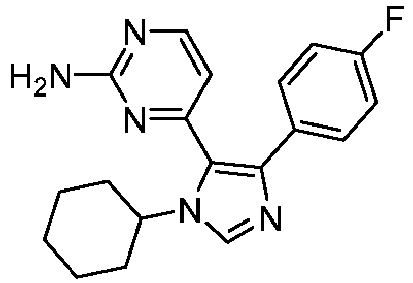
1.00 1.00 PF670462 = standard 3 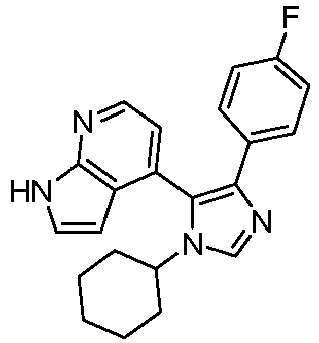
0.30 0.27 28 
0.67 n.d. 31 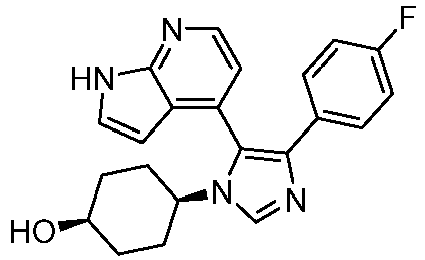
0.78 n.d. 32 
0.67 n.d. 33 
0.63 0.12 75 
0.83 0.66 74 
0.73 0.46 34 
0.55 0.89 78 
0.87 n.d. 79 
0.86 n.d. 68 
0.81 n.d. 69 
0.84 0.85 70 
0.72 0.11 71 
0.87 0.87 35 
0.60 0.44 36 
0.68 0.01 37 
0.51 n.d. 14 
0.77 0.70 11 
0.30 0.06 13 
0.47 n.d. 19 
0.22 0.33 12 
0.80 n.d. 16 
0.67 n.d. 18 
0.33 n.d. 17 
0.52 n.d. 29 
0.21 0.03 23 
0.37 0.46 22 
0.17 0.27 47 
0.78 n.d. 50 
0.63 0.48 30 
0.69 n.d. 24 
0.30 n.d. 20 
0.68 n.d. 21 
0.72 n.d. 15 
0.13 n.d. 25 
0.81 n.d. 80 
0.49 0.42 81 
0.60 0.10 82 
0.80 n.d. 83 
0.78 n.d. 84 
0.48 0.08 85 
0.01 0.04 86 
0.76 n.d. 87 
0.10 0.03 88 
0.15 0.05 89 
0.59 0.70 90 
0.23 0.52 91 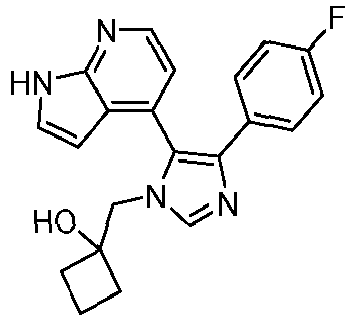
n.d. 0.69 92 
n.d. 0.81 93 
n.d. 0.75 94 
n.d. 0.81 8 
0.32 0.04 1 
0.18 0.06 2 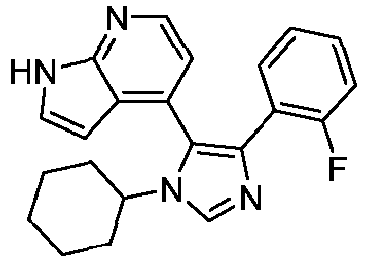
0.37 0.32 4 
0.21 0.21 9 
0.50 0.30 5 
0.24 0.54 7 
0.34 0.84 10 
0.61 0.46 6 
0.37 0.42 44 
0.81 n.d. 42 
0.76 0.12 67 
0.66 0.71 61 
0.35 0.02 95 
0.02 0.01 39 
0.10 0.02 56 
0.67 0.79 60 
0.93 0.84 97 
0.18 0.01 98 
0.16 0.03 100 
0.01 0.00 102 
0.68 0.69 106 
n.d. 0.07 108 
0.74 0.82 109 
0.87 0.31 114 
0.78 0.27 119 
0.87 n.d. 123 
0.58 0.78 124 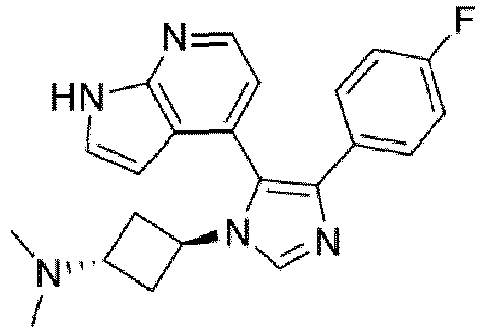
0.55 0.53 125 
0.28 0.26 126 
0.64 0.71 127 
n.d. 0.72 129 
0.78 0.86 130 
0.89 n.d. 134 
0.22 0.01 135 
0.09 0.00 136 
0.47 0.00 140 
0.01 0.00 141 
0.43 0.00 142 
0.05 0.00 143 
0.66 n.d. 144 
0.36 0.01 145 
n.d. 0.42 146 
0.16 0.00 147 
0.08 0.03 149 
0.11 0.00 152 
n.d. 0.62 153 
1.17 0.87 155 
0.01 0.00 158 
0.76 n.d. 163 
0.57 0.10 165 
0.00 0.00 166 
0.07 0.04 169 
0.12 0.00 170 
0.56 0.06 173 
0.02 0.01 179 
0.01 0.00 184 
n.d. 0.57 - Cytotoxicity of selected compounds of formula I was tested on a panel of cell lines representative for main types of leukemia and lymphoma, selection of epithelial solid tumors and melanoma.
- The tested cell lines were incubated with inhibitors at 30 µM concentration or corresponding amount of solvent (DMSO, Sigma Aldrich) in standard culture conditions, seeded as 105 cells/500µl per well in a 24-well plate. Experiments were performed in technical duplicates and 2-3 biological repetitions per cell line. Viability of cells was assessed after 24 hours.
- Viability of cells was assessed by flow cytometric analysis (Accuri C6, BD Biosciences) according to TMRE staining (details in Example II.1). Viable cells (TMRE positive) were assessed in each experiment and obtained results were normalized to control (no inhibitor) condition. Relative values are presented as a mean value, showing ratio to the effect of control. Relative value <1 = lower viability than control condition.
- The tested compounds were the following:


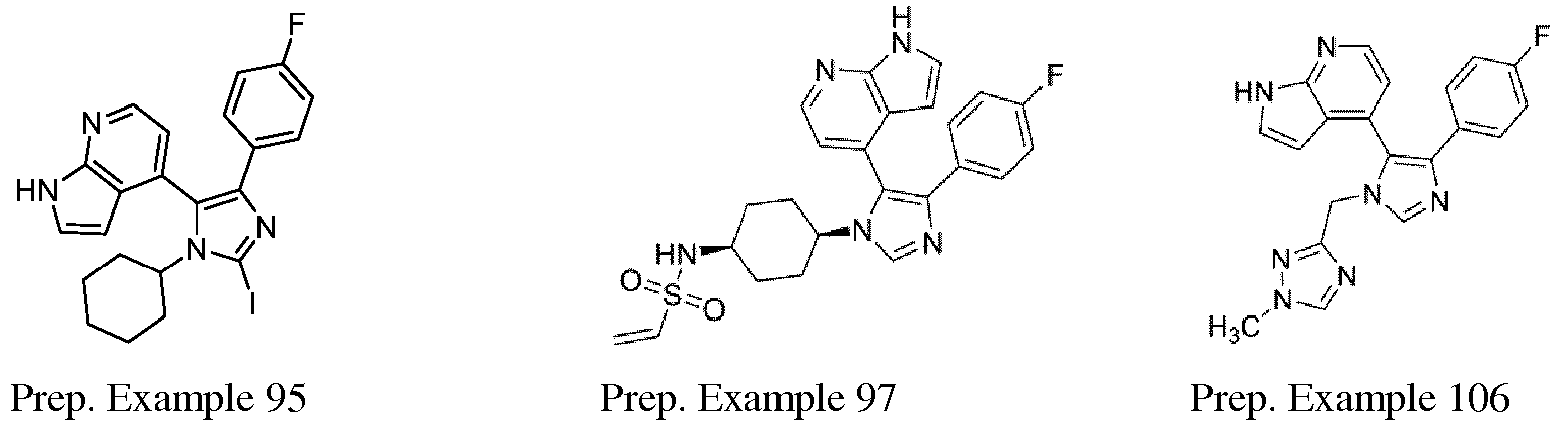


- Table 2 shows average viability of cancer cell lines on selected compounds of formula I. The tested concentration was 30 µM, and the results are expressed as cell viability relative to control (Ctrl). PF670462 (PF) is included for comparison. (n.d. = not determined). Abbreviations: leukemia types - chronic lymphocytic leukemia (CLL), acute lymphocytic leukaemia (ALL), chronic myeloid leukaemia (CML), acute myeloid leukaemia (AML), lymphoma types - mantle cell lymphoma (MCL), Burkitt lymphoma (BL), diffuse large B-cell lymphoma (DLBCL), and follicular lymphoma (FL).


- The migration assay was performed in HTS Transwell®-96 well plates (Corning Incorporated) with 5.0 µm pore size polycarbonate membranes. Cell migration was induced by 200 ng/ml of CCL19 (R&D Systems, 361-MI-025) recombinant chemokine, which is involved in CLL cell homing to lymphoid organs, a process crucial for the pathogenesis of CLL or other leukemias and lymphomas. Maver-1 cells (0.3×10⁵ cells/well) were seeded according to manufacturer's instructions and incubated for 4h with the inhibitors at
final concentration 3 µM or with corresponding amount of DMSO. The absolute number of transmigrated cells was quantified by Accuri C6 flow cytometer (BD Biosciences). Obtained values are presented inFigure 3 as Relative migration = ratio of cell counts in the inhibitor-treated and control conditions. Experiments were performed in technical duplicates. - To prove that compounds of formula I selectively target cancer cells, the cytotoxicity towards cancer cells (primary CLL cells) and their nonmalignant counterparts (primary healthy B cells) was tested with the compound described in preparative example 3. PF670462, which is the structurally closest compound proposed for the treatment of chronic lymphocytic leukaemia (CLL), was used as a negative control. Ibrutinib (PCI-32765, DC Chemicals), a drug used for therapy of CLL with described cytotoxic effects towards primary CLL cells (Amin NA, Balasubramanian S, Saiya-Cork K, Shedden K, Hu N, Malek SN. Clin Cancer Res. 2017;23(4):1049-1059), was used as a positive control. Obtained data show that the cytotoxic effects are dose-dependent (
Figure 1 ), caused by apoptosis (Figure 2 ) and selective to cancer cells (Table 3,Figure 4 ). - Both primary CLL cells and primary nonmalignant control cells were incubated for 6 hours with inhibitors PF670462 or preparative example 3 at 30 µM concentration. Corresponding amount of solvent (DMSO) was used as a control (data presented in Table 3). For the experiment presented in
Figure 1 , the cells were incubated for 6 h with indicated doses of inhibitors (PF670462, prep. example 3 or ibrutinib) or DMSO as a control. To confirm by an independent method that compound of preparative example 3 induces apoptosis in primary CLL cells, the cells were treated overnight by 10 µM concentration of the compound, PF670462 inhibitor or DMSO (Figure 2 ). - Viability and induction of apoptosis in primary CLL and nonmalignant control cells was assessed by flow cytometric analysis (Accuri C6, BD Biosciences) according to TMRE staining (details in Example 11.1, data presented in
Figure 1 , Table 3 andFigure 4 ). Viable cells (TMRE positive) were assessed in each experiment and obtained results were normalized to control (no inhibitor) condition. Alternatively (Figure 2 ), induction of apoptosis was assessed by western blotting analysis (performed essentially as described in Bryja V, Schulte G, Arenas E. Cell Signal. 2007;19(3):610-616) and detection of cleaved PARP protein by cs-9541 antibody (Cell Signaling). Actin was detected as a loading control (cs-4970, Cell Signaling), Anti-Rabbit IgG, F(ab')2 fragment - Peroxidase conjugated secondary antibody (A6667, Sigma) and Immobilon Western Chemilluminiscent HRP Substrate (Millipore) were used for signal detection. Cleaved PARP serves as a sensitive apoptosis marker. - Table 3 shows that 30 µM PF670462 inhibitor is not able to induce apoptosis in primary CLL cells or nonmalignant control (healthy) cells, in contrast to compound described in preparative example 3. Average cell viability is presented. Cytotoxic effect of the tested compound (prep. example 3) is selective towards cancer cells - it is significantly stronger in case of primary CLL cells compared to healthy cells. Data are presented in graphs in
Figure 4 .
-
Figure 1 shows that the apoptosis of primary CLL cells is induced dose-dependently by compound from preparatory example 3 but not PF670462. Compound from preparatory example 3 shows similar cytotoxic effects as ibrutinib. -
Figure 2 confirms that the effects observed for compound described in prepararatory example 3 (Table 3) are caused by induction of apoptosis in primary CLL cells. Increased PARP cleavage, a sensitive apoptosis marker, is detectable after overnight incubation of primary CLL cells with 10 µM inhibitor from preparatory example 3, but not in case of PF670462 treatment.Figures 2A and B show data obtained by western blotting analysis of cleaved PARP (A) and flow cytometric analysis (B) from the same primary sample to illustrate that the methods are complementary. C-D show the same for another 4 primary CLL samples. - In order to demonstrate that the compounds are orally bioavailable, pharmacokinetic studies were carried out as described below.
- Male Balb/c mice (10-12 weeks old, body weight 24.1 to 30.8 g and average body weight across all groups 26.8 g, SD = 1.7 g) were used in this study. The animals were randomly assigned to the treatment groups before the pharmacokinetic study; all animals were fasted for 4 h before dosing. The time points indicated in Table 4 were set for this pharmacokinetic study. Each of the time point treatment group included 4 animals. There was also control group of 2 animals. The compounds were dosed orally as the corresponding dihydrochlorides dissolved in physiological saline (c = 3-4 mg/mL) at the dose of 20 mg/kg.
- Mice were injected IP with 2,2,2-tribromoethanol at the dose of 150 mg/kg prior to drawing the blood. Blood collection was performed from the orbital sinus in microtainers containing K2EDTA. Animals were sacrificed by cervical dislocation after the blood samples collection. All samples were immediately processed, flash-frozen and stored at -70°C until subsequent analysis.
- Plasma samples (50 µL) were mixed with 200 µL of internal standard solution. After mixing by pipetting and centrifuging for 4 min at 6,000 rpm, 0.5 µL of each supernatant was injected into LC-MS/MS system.
- The analyzed compound (as a dihydrochloride salt) was dissolved in DMSO, and the resulting solution with concentration of 2 mg/mL was used for calibration standards preparation (stock solution). A series of calibration standards was prepared by consecutively dilution of stock compound solution with blank mouse plasma to a final concentration of 40 000, 20 000, 10 000, 5 000, 2 500, 1 000, 500, 250, 100, 50, and 20 ng/mL. Standard plasma samples (50 µL) were mixed with 200 µL of internal standard. After mixing by pipetting and centrifuging for 4 min at 6,000 rpm, 0.5 µL of each supernatant was injected into LC-MS/MS system. Signal corresponding to the free base was analyzed and quantified (Table 4).
- The regression analysis of the analyzed compound was performed by plotting the peak area ratio (y-axis) against the compound concentration in calibration standards (x-axis, ng/mL). The validity of the calibration curve (relationship between peak area ratio and compound concentration) was proved by the correlation coefficient (R) calculated for the quadratic regression.
- The concentrations of the analyzed compound in plasma samples below the lower limit of quantitation (LLOQ - 5 ng/mL to 20 ng/mL) were designated as zero.
Table 4 compound Prep. Example conc. at 15 min [µM] conc. at 30 min [µM] conc. at 60 min [µM] conc. at 120 min [µM] conc. at 240 min [µM] conc. at 600 min [µM] R 107 4.78 2.42 2.30 0.43 0.24 0 0.9999 94 0.44 0.21 0.18 0.07 0 0 0.9994 92 9.52 6.63 4.52 0.79 0.05 0 0.9998 82 1.37 0.26 0.09 0.04 0.02 0 0.9999 123 1.35 0.92 0.52 0.13 0 0 0.9999 103 2.17 0.58 0.13 0.08 0.04 0 0.9998 122 2.73 0.73 0.30 0.16 0.04 0 0.9999 113 8.01 3.53 1.03 1.12 0.25 0 0.9998 102 0.62 0.72 0.40 0.53 0.48 0 0.9997 151 18.90 7.24 3.98 0.77 0.41 0 0.9997 154 13.88 8.76 7.86 2.45 0.52 0 0.9999 126 2.38 1.83 0.84 0.76 0.38 0 0.9999
Claims (15)
- Compound of general formula I
 R1 is selected from the group consisting of C6-C14 aryl, C4-C8 cycloalkyl, C3-C10 heteroaryl comprising at least one heteratom selected from S, O, N, and C3-C7 cycloheteroalkyl comprising at least one heteratom selected from S, O, N, wherein the aryl, cycloalkyl, cycloheteroalkyl or heteroaryl may optionally be substituted by at least one substituent selected independently from C1-C4 alkyl, halogen, OH, O(C1-C4 alkyl), O(C5-C6 aryl or heteroaryl), SH, S(C1-C4 alkyl), CN, NH2, NH(C1-C4 alkyl), N(C1-C4 alkyl)2, CF3, C2F5, OCF3, OC2F5;R2 is selected from the group consisting of- linear or branched C1-C10 alkyl,- linear or branched C1-C10 alkenyl,- C3-C8 cycloalkyl, wherein optionally 1-2 carbon atoms are replaced by a heteroatom selected from S, O, N,- C3-C8 cycloalkenyl, wherein optionally 1-2 carbon atoms are replaced by a heteroatom selected from S, O, N,- C3-C8-cycloalkyl-C1-C4-alkyl, wherein optionally 1-2 carbon atoms are replaced by a heteroatom selected from S, O, N,- C6-C14 aryl,- C6-C14-aryl-C1-C4-alkyl,- C3-C10 heteroaryl comprising at least one heteratom selected from S, O, N, and- C3-C10-heteroaryl-C1-C4-alkyl comprising at least one heteroatom selected from S, O, N in the aromatic ring,
wherein each of the listed substituents can optionally be substituted by at least one substituent selected independently from C1-C4 alkyl, halogen, OH, HO-C1-C4 alkyl, O(CI-C4 alkyl), (C1-C4 alkyl)-O-C1-C4 alkyl, O(C5-C6 aryl or heteroaryl), SH, S(C1-C4 alkyl), S(C5-C6 aryl or heteroaryl), CF3, CF3-(C1-C4 alkyl)-, C2F5, OCF3, CF3O-(C1-C4 alkyl)-, OC2F5, amino (NH2), NO2, N3, C1-C4 alkylamino, di(C1-C4 alkyl)amino, (C5-C6 aryl or heteroaryl)amino, di(C5-C6 aryl or heteroaryl)amino, NH2-(C1-C4 alkyl)-, (C1-C4 alkyl)-NH-C1-C4 alkyl, (C1-C4 alkyl)2-N-C1-C4-alkyl, =O, =S,CN, =N-OH, =N-O(C1-C4 alkyl), -COOH, HOOC-(C1-C4 alkyl)-, -CONH2,-CONH(C1-C4 alkyl), -CON(C1-C4 alkyl)2, NH2CO-(C1-C4 alkyl)-, (C1-C4 alkyl)-CONH-(C1-C4 alkyl)-, (C1-C4 alkyl)2N-CO-(C1-C4 alkyl)-, -COO(C1-C4 alkyl), (C1-C4 alkyl)-COO(C1-C4 alkyl)-, (C1-C4 alkyl)-O-CO-(C1-C4 alkyl)-, NH2S(O)2-(C1-C4 alkyl)-, (C1-C4 alkyl)-S(O)2NH(C1-C4 alkyl)-, (C1-C4 alkyl)2N-S(O)2-(C1-C4 alkyl)-, (C1-C4 alkyl)NH-S(O)2-(C1-C4 alkyl)-, -CO(C1-C4 alkyl), -CO(C5-C6 aryl or heteroaryl), (C1-C4 alkyl)-S(O)2-, (C1-C4 alkyl)-S(O)-,(C1-C4 alkyl)-S(O)2-NH-, (C1-C4 alkyl)-S(O)2-N(C1-C4 alkyl)-, (C1-C4 alkyl)-O-CO-, (C1-C4 alkyl)-NH-CO-, (C1-C4 alkyl)2N-CO-,(C1-C4 alkyl)-NH-(SO)2-, (C1-C4 alkyl)2N-(SO)2-, (C1-C4 alkyl)-CO-NH-,(Cl-C4 alkyl)-CO-N(C1-C4 alkyl)-,(Cl-C4 alkyl)-OCO-NH-,(C1-C4 alkyl)-OCO-N(C1-C4 alkyl)-,(C1-C4 alkyl)-CO-NH-CO-, (C1-C4 alkyl)-CO-N(C1-C4 alkyl)-CO-,NH2-CO-NH-,(C1-C4 alkyl)-NH-CO-NH-, (C1-C4 alkyl)2N-CO-NH-, NH2-CO-N(C1-C4 alkyl)-, (C1-C4 alkyl)-NH-CO-N(C1-C4 alkyl)-, (C1-C4 alkyl)2N-CO-N(C1-C4 alkyl)-, NH2-S(O)2-NH-, (C1-C4 alkyl)-NH-S(O)2-NH-, (C1-C4 alkyl)2N-S(O)2-NH-,NH2-S(O)2-N(C1-C4 alkyl)-, (C1-C4 alkyl)-NH-S(O)2-N(C1-C4 alkyl)-, (C1-C4 alkyl)2N-S(O)2-N(C1-C4 alkyl)-, (C1-C4 alkyl)2N-(C1-C4 alkylene)-CO-, (C1-C4 alkyl)2N-(C1-C4 alkylene)-SO2-, (C1-C4 alkyl)2N-(C1-C4 alkylene)-SO2-NH-, (C1-C4 alkyl)2N-(C1-C4 alkylene)-NH-SO2-;R3 is selected from the group consisting of hydrogen, halogen, CF3, C2F5, CN, C1-C4 alkyl, said alkyl being optionally substituted by at least one substituent selected from C1-C4 alkyl, halogen, OH, NH2, NH(C1-C4 alkyl), NH(C5-C6 aryl or heteroaryl), N(C1-C4 alkyl)2, N(C5-C6 aryl or heteroaryl)2, O(C1-C4 alkyl), O(C5-C6 aryl or heteroaryl), SH, S(C1-C4 alkyl), S(C5-C6 aryl or heteroaryl), OCF3, OC2F5, COO(C1-C4 alkyl), CONH(C1-C4 alkyl), CON(C1-C4 alkyl), CF3, and C2F5;R4 is selected the group consisting of hydrogen, CF3, C2F5, CN, and C1-C4 alkyl, optionally substituted by at least one substituent selected from C1-C4 alkyl, halogen, OH, O(CI-C4 alkyl), O(C5-C6 aryl or heteroaryl), SH, S(C1-C4 alkyl), S(C5-C6 aryl or heteroaryl), OCF3, OC2F5, CF3, C2F5;R5 is selected from H, C1-C2 alkyl, halogen;R6 is selected from H, C1-C2 alkyl, halogen;R7 is selected from H, halogen, OH, O(CI-C4 alkyl), CF3, C2F5, CN, NH2, NH(C1-C4 alkyl), N(C1-C4 alkyl)2, C1-C4 alkyl, where alkyl is optionally substituted by at least one substituent selected from C1-C4 alkyl, halogen, OH, O(CI-C4 alkyl), O(C5-C6 aryl or heteroaryl), SH, S(C1-C4 alkyl), S(C5-C6 aryl or heteroaryl), OCF3, OC2F5, CF3, C2F5;or pharmaceutically acceptable salts thereof. - Compound according to claim 1, wherein R1 is a C6-C10 aryl substituted by one or two halogens; or wherein R1 is a C4-C6 heteroaryl substituted by one or two halogens.
- Compound according to any one of the preceding claims, wherein R2 is selected from- C3-C8 cycloalkyl, wherein optionally 1-2 carbon atoms are replaced by a heteroatom selected from S, O, N, and which is optionally substituted by one or more substituents selected independently from halogen, hydroxy, methoxy, ethoxy, methyl, ethyl, propyl, isopropyl, amino, methylamino, dimethylamino, hydroxymethyl, hydroxyethyl, hydroxypropyl, methoxymethyl, methoxyethyl, methoxypropyl, dimethylaminomethyl, dimethylaminoethyl, dimethylaminopropyl, methylsulfonamido, methylcarbonyl, methylaminocarbonyl, ethylsulfonamido, ethylcarbonyl, ethylaminocarbonyl, methoxycarbonyl, ethoxycarbonyl, dimethylaminoethylsulfonamido, dimethylaminoethylcarbonyl, dimethylaminopropylsulfonamido, dimethylaminopropylcarbonyl, OCF3, OC2F5, CF3, C2F5;- C3-C8-cycloalkyl-C1-C2-alkyl, wherein optionally 1-2 carbon atoms are replaced by a heteroatom selected from S, O, N, and which is optionally substituted by one or more substituents selected independently from halogen, hydroxy, methoxy, ethoxy, methyl, ethyl, propyl, isopropyl, amino, methylamino, dimethylamino, hydroxymethyl, hydroxyethyl, hydroxypropyl, methoxymethyl, methoxyethyl, methoxypropyl, dimethylaminomethyl, dimethylaminoethyl, dimethylaminopropyl, methylsulfonamido, methylcarbonyl, methylaminocarbonyl, ethylsulfonamido, ethylcarbonyl, ethylaminocarbonyl, methoxycarbonyl, ethoxycarbonyl, dimethylaminoethylsulfonamido, dimethylaminoethylcarbonyl, dimethylaminopropylsulfonamido, dimethylaminopropylcarbonyl, OCF3, OC2F5, CF3, C2F5;- C6-C14-aryl, which is optionally substituted by one or more substituents selected independently from halogen, hydroxy, methoxy, ethoxy, methyl, ethyl, propyl, isopropyl, amino, methylamino, dimethylamino, hydroxymethyl, hydroxyethyl, hydroxypropyl, methoxymethyl, methoxyethyl, methoxypropyl, dimethylaminomethyl, dimethylaminoethyl, dimethylaminopropyl, methylsulfonamido, methylcarbonyl, methylaminocarbonyl, ethylsulfonamido, ethylcarbonyl, ethylaminocarbonyl, methoxycarbonyl, ethoxycarbonyl, dimethylaminoethylsulfonamido, dimethylaminoethylcarbonyl, dimethylaminopropylsulfonamido, dimethylaminopropylcarbonyl, OCF3, OC2F5, CF3, C2F5;- C6-C14-aryl-C1-C2-alkyl, which is optionally substituted by one or more substituents selected independently from halogen, hydroxy, methoxy, ethoxy, methyl, ethyl, propyl, isopropyl, amino, methylamino, dimethylamino, hydroxymethyl, hydroxyethyl, hydroxypropyl, methoxymethyl, methoxyethyl, methoxypropyl, dimethylaminomethyl, dimethylaminoethyl, dimethylaminopropyl, methylsulfonamido, methylcarbonyl, methylaminocarbonyl, ethylsulfonamido, ethylcarbonyl, ethylaminocarbonyl, methoxycarbonyl, ethoxycarbonyl, dimethylaminoethylsulfonamido, dimethylaminoethylcarbonyl, dimethylaminopropylsulfonamido, dimethylaminopropylcarbonyl, OCF3, OC2F5, CF3, C2F5;- C3-C10-heteroaryl comprising one or two or three heteratoms selected from S, O, N in the aromatic ring, and which is optionally substituted by one or more substituents selected independently from halogen, hydroxy, methoxy, ethoxy, methyl, ethyl, propyl, isopropyl, amino, methylamino, dimethylamino, hydroxymethyl, hydroxyethyl, hydroxypropyl, methoxymethyl, methoxyethyl, methoxypropyl, dimethylaminomethyl, dimethylaminoethyl, dimethylaminopropyl, methylsulfonamido, methylcarbonyl, methylaminocarbonyl, ethylsulfonamido, ethylcarbonyl, ethylaminocarbonyl, methoxycarbonyl, ethoxycarbonyl, dimethylaminoethylsulfonamido, dimethylaminoethylcarbonyl, dimethylaminopropylsulfonamido, dimethylaminopropylcarbonyl, OCF3, OC2F5, CF3, C2F5;- C3-C10-heteroaryl-C1-C2-alkyl comprising one or two or three heteratoms selected from S, O, N in the aromatic ring, and which is optionally substituted by one or more substituents selected independently from halogen, hydroxy, methoxy, ethoxy, methyl, ethyl, propyl, isopropyl, amino, methylamino, dimethylamino, hydroxymethyl, hydroxyethyl, hydroxypropyl, methoxymethyl, methoxyethyl, methoxypropyl, dimethylaminomethyl, dimethylaminoethyl, dimethylaminopropyl, methylsulfonamido, methylcarbonyl, methylaminocarbonyl, ethylsulfonamido, ethylcarbonyl, ethylaminocarbonyl, methoxycarbonyl, ethoxycarbonyl, dimethylaminoethylsulfonamido, dimethylaminoethylcarbonyl, dimethylaminopropylsulfonamido, dimethylaminopropylcarbonyl, OCF3, OC2F5, CF3, C2F5;- C1-C6 alkyl, which is optionally substituted by one or more substituents selected independently from halogen, hydroxy, methoxy, ethoxy, amino, methylamino, dimethylamino, hydroxymethyl, hydroxyethyl, hydroxypropyl, methoxymethyl, methoxyethyl, methoxypropyl, dimethylaminomethyl, dimethylaminoethyl, dimethylaminopropyl, methylsulfonamido, methylcarbonyl, methylaminocarbonyl, ethylsulfonamido, ethylcarbonyl, ethylaminocarbonyl, methoxycarbonyl, ethoxycarbonyl, dimethylaminoethylsulfonamido, dimethylaminoethylcarbonyl, dimethylaminopropylsulfonamido, dimethylaminopropylcarbonyl, OCF3, OC2F5, CF3, C2F5.
- Compound according to any one of claims 1 to 2, wherein R2 is selected from- C3-C6-heteroaryl-methyl wherein the heteroaryl comprises one heteroatom selected from O, S, N and is optionally substituted by one or more substituents selected independently from halogen, hydroxy, methoxy, ethoxy, methyl, ethyl, propyl, isopropyl, amino, methylamino, dimethylamino, hydroxymethyl, hydroxyethyl, hydroxypropyl, methoxymethyl, methoxyethyl, methoxypropyl, dimethylaminomethyl, dimethylaminoethyl, dimethylaminopropyl, methylsulfonamido, methylcarbonyl, methylaminocarbonyl, ethylsulfonamido, ethylcarbonyl, ethylaminocarbonyl, methoxycarbonyl, ethoxycarbonyl, dimethylaminoethylsulfonamido, dimethylaminoethylcarbonyl, dimethylaminopropylsulfonamido, dimethylaminopropylcarbonyl, OCF3, OC2F5, CF3, C2F5;- C3-C6-heteroaryl wherein the heteroaryl comprises one or two or three heteroatoms selected from O, S, N, and is optionally substituted by one or more substituents selected independently from halogen, hydroxy, methoxy, ethoxy, methyl, ethyl, propyl, isopropyl, amino, methylamino, dimethylamino, hydroxymethyl, hydroxyethyl, hydroxypropyl, methoxymethyl, methoxyethyl, methoxypropyl, dimethylaminomethyl, dimethylaminoethyl, dimethylaminopropyl, methylsulfonamido, methylcarbonyl, methylaminocarbonyl, ethylsulfonamido, ethylcarbonyl, ethylaminocarbonyl, methoxycarbonyl, ethoxycarbonyl, dimethylaminoethylsulfonamido, dimethylaminoethylcarbonyl, dimethylaminopropylsulfonamido, dimethylaminopropylcarbonyl, OCF3, OC2F5, CF3, C2F5;- cyclohexyl or cyclohexylmethyl wherein the cyclohexyl ring is optionally substituted by one or more substituents selected independently from halogen, hydroxy, methoxy, ethoxy, methyl, ethyl, propyl, isopropyl, amino, methylamino, dimethylamino, hydroxymethyl, hydroxyethyl, hydroxypropyl, methoxymethyl, methoxyethyl, methoxypropyl, dimethylaminomethyl, dimethylaminoethyl, dimethylaminopropyl, methylsulfonamido, methylcarbonyl, methylaminocarbonyl, ethylsulfonamido, ethylcarbonyl, ethylaminocarbonyl, methoxycarbonyl, ethoxycarbonyl, dimethylaminoethylsulfonamido, dimethylaminoethylcarbonyl, dimethylaminopropylsulfonamido, dimethylaminopropylcarbonyl, OCF3, OC2F5, CF3, C2F5;- cyclopentyl or cyclopentylmethyl wherein the cyclopentyl ring is optionally substituted by one or more substituents selected independently from halogen, hydroxy, methoxy, ethoxy, methyl, ethyl, propyl, isopropyl, amino, methylamino, dimethylamino, hydroxymethyl, hydroxyethyl, hydroxypropyl, methoxymethyl, methoxyethyl, methoxypropyl, dimethylaminomethyl, dimethylaminoethyl, dimethylaminopropyl, methylsulfonamido, methylcarbonyl, methylaminocarbonyl, ethylsulfonamido, ethylcarbonyl, ethylaminocarbonyl, methoxycarbonyl, ethoxycarbonyl, dimethylaminoethylsulfonamido, dimethylaminoethylcarbonyl, dimethylaminopropylsulfonamido, dimethylaminopropylcarbonyl, OCF3, OC2F5, CF3, C2F5;- cyclobutyl or cyclobutylmethyl wherein the cyclobutyl ring is optionally substituted by one or more substituents selected independently from halogen, hydroxy, methoxy, ethoxy, methyl, ethyl, propyl, isopropyl, amino, methylamino, dimethylamino, hydroxymethyl, hydroxyethyl, hydroxypropyl, methoxymethyl, methoxyethyl, methoxypropyl, dimethylaminomethyl, dimethylaminoethyl, dimethylaminopropyl, methylsulfonamido, methylcarbonyl, methylaminocarbonyl, ethylsulfonamido, ethylcarbonyl, ethylaminocarbonyl, methoxycarbonyl, ethoxycarbonyl, dimethylaminoethylsulfonamido, dimethylaminoethylcarbonyl, dimethylaminopropylsulfonamido, dimethylaminopropylcarbonyl, OCF3, OC2F5, CF3, C2F5;- C1-C6 alkyl, substituted by halogen, OH, O(C1-C3 alkyl), OCF3, OC2F5, CF3, C2F5;- benzyl, optionally substituted by one or more substituents selected independently from halogen, hydroxy, methoxy, ethoxy, methyl, ethyl, propyl, isopropyl, amino, methylamino, dimethylamino, hydroxymethyl, hydroxyethyl, hydroxypropyl, methoxymethyl, methoxyethyl, methoxypropyl, dimethylaminomethyl, dimethylaminoethyl, dimethylaminopropyl, methylsulfonamido, methylcarbonyl, methylaminocarbonyl, ethylsulfonamido, ethylcarbonyl, ethylaminocarbonyl, methoxycarbonyl, ethoxycarbonyl, dimethylaminoethylsulfonamido, dimethylaminoethylcarbonyl, dimethylaminopropylsulfonamido, dimethylaminopropylcarbonyl, OCF3, OC2F5, CF3, C2F5;- C5-C6 cycloalkyl, wherein 1-2 carbon atomsare replaced by a heteroatom selected from S, O, N; optionally substituted by one or more substituents selected independently from halogen, hydroxy, methoxy, ethoxy, methyl, ethyl, propyl, isopropyl, amino, methylamino, dimethylamino, hydroxymethyl, hydroxyethyl, hydroxypropyl, methoxymethyl, methoxyethyl, methoxypropyl, dimethylaminomethyl, dimethylaminoethyl, dimethylaminopropyl, methylsulfonamido, methylcarbonyl, methylaminocarbonyl, ethylsulfonamido, ethylcarbonyl, ethylaminocarbonyl, methoxycarbonyl, ethoxycarbonyl, dimethylaminoethylsulfonamido, dimethylaminoethylcarbonyl, dimethylaminopropylsulfonamido, dimethylaminopropylcarbonyl, OCF3, OC2F5, CF3, C2F5;- C5-C6-cycloalkyl-C1-C2-alkyl, wherein 1-2 carbon atoms are replaced by a heteroatom selected from S, O, N; optionally substituted by one or more substituents selected independently from halogen, hydroxy, methoxy, ethoxy, methyl, ethyl, propyl, isopropyl, amino, methylamino, dimethylamino, hydroxymethyl, hydroxyethyl, hydroxypropyl, methoxymethyl, methoxyethyl, methoxypropyl, dimethylaminomethyl, dimethylaminoethyl, dimethylaminopropyl, methylsulfonamido, methylcarbonyl, methylaminocarbonyl, ethylsulfonamido, ethylcarbonyl, ethylaminocarbonyl, methoxycarbonyl, ethoxycarbonyl, dimethylaminoethylsulfonamido, dimethylaminoethylcarbonyl, dimethylaminopropylsulfonamido, dimethylaminopropylcarbonyl, OCF3, OC2F5, CF3, C2F5.
- Compound according to claim 1, wherein R1 is p-fluoro-phenyl or m-chloro-p-fluoro-phenyl, and R2 is cyclohexyl, cyclohexylmethyl, cyclobutyl, cyclobutylmethyl, methyl, ethyl, propyl, butyl, piperidinyl, piperidinylmethyl, tetrahydrofuryl, tetrahydrofurylmethyl, morpholinyl, morpholinylmethyl, phenyl, benzyl, thiophenyl, thiophenylmethyl, oxazolyl, oxazolylmethyl, thiazolyl, thiazolylmethyl, isothiazolyl, isothiazolylmethyl, isoxazolyl, isoxazolylmethyl, triazolyl, triazolylmethyl, pyrazolyl, pyrazolylmethyl, imidazolyl, imidazolylmethyl, pyridyl, pyridylmethyl, furyl or furanylmethyl, wherein the substituent group of R2 is optionally further substituted by one or more substituents selected independently from hydroxy, methoxy, ethoxy, methyl, ethyl, propyl, isopropyl, amino, methylamino, dimethylamino, hydroxymethyl, hydroxyethyl, hydroxypropyl, methoxymethyl, methoxyethyl, methoxypropyl, dimethylaminomethyl, dimethylaminoethyl, dimethylaminopropyl, methylsulfonamido, methylcarbonyl, methylaminocarbonyl, ethylsulfonamido, ethylcarbonyl, ethylaminocarbonyl, methoxycarbonyl, ethoxycarbonyl, dimethylaminoethylsulfonamido, dimethylaminoethylcarbonyl, dimethylaminopropylsulfonamido, dimethylaminopropylcarbonyl, OCF3, OC2F5, CF3, C2F5.
- Compound according to any one of the preceding claims, wherein R3 is hydrogen, halogen, methyl, ethyl, propyl, isopropyl, tert-butyl.
- Compound according to any one of the preceding claims, wherein R4 is hydrogen or C1 to C4 alkyl optionally substituted by OH, O(C1-C4 alkyl).
- Compound according to claim 1, wherein:R1 is monohalogenated or dihalogenated phenyl or pyridyl;R3 is hydrogen, methyl or iodine;R4, R5, R6, and R7 are hydrogens.
- Compound according to claim 1, wherein:R1 is monohalogenated or dihalogenated phenyl or pyridyl;R3 is hydrogen, methyl or iodine;R4, R5, R6, and R7 are hydrogens;R2 is C3-C10-heteroaryl-C1-C3-alkyl comprising at least one heteroatom selected from S, O, N in the aromatic ring or C3-C8-cycloalkyl-C1-C3-alkyl, wherein optionally 1-2 carbon atoms in the cycloalkyl part are replaced by a heteroatom selected from S, O, N, wherein the heteroaryl or cycloalkyl is optionally substituted by halogen, hydroxy, methoxy, ethoxy, methyl, ethyl, propyl, isopropyl, amino, methylamino, dimethylamino, methylsulfonamido, methylcarbonyl, methylaminocarbonyl, ethylsulfonamido, ethylcarbonyl, ethylaminocarbonyl, methoxycarbonyl, ethoxycarbonyl, dimethylaminoethylsulfonamido, dimethylaminoethylcarbonyl, dimethylaminopropylsulfonamido, dimethylaminopropylcarbonyl, OCF3, OC2F5, CF3, C2F5.
- Compound according to claim 1, wherein:R1 is monohalogenated or dihalogenated phenyl or pyridyl;R3 is hydrogen, methyl or iodine;R4, R5, R6, and R7 are hydrogens;R2 is C3-C10-heteroaryl comprising at least one heteroatom selected from S, O, N in the aromatic ring or C3-C8-cycloalkyl, wherein optionally 1-2 carbon atoms in the cycloalkyl part are replaced by a heteroatom selected from S, O, N, wherein the heteroaryl or cycloalkyl is optionally substituted by halogen, hydroxy, methoxy, ethoxy, methyl, ethyl, propyl, isopropyl, amino, methylamino, dimethylamino, methylsulfonamido, methylcarbonyl, methylaminocarbonyl, ethylsulfonamido,ethylcarbonyl, ethylaminocarbonyl, methoxycarbonyl, ethoxycarbonyl, dimethylaminoethylsulfonamido, dimethylaminoethylcarbonyl, dimethylaminopropylsulfonamido, dimethylaminopropylcarbonyl, OCF3, OC2F5, CF3, C2F5.
- Compound according to claim 1, selected from


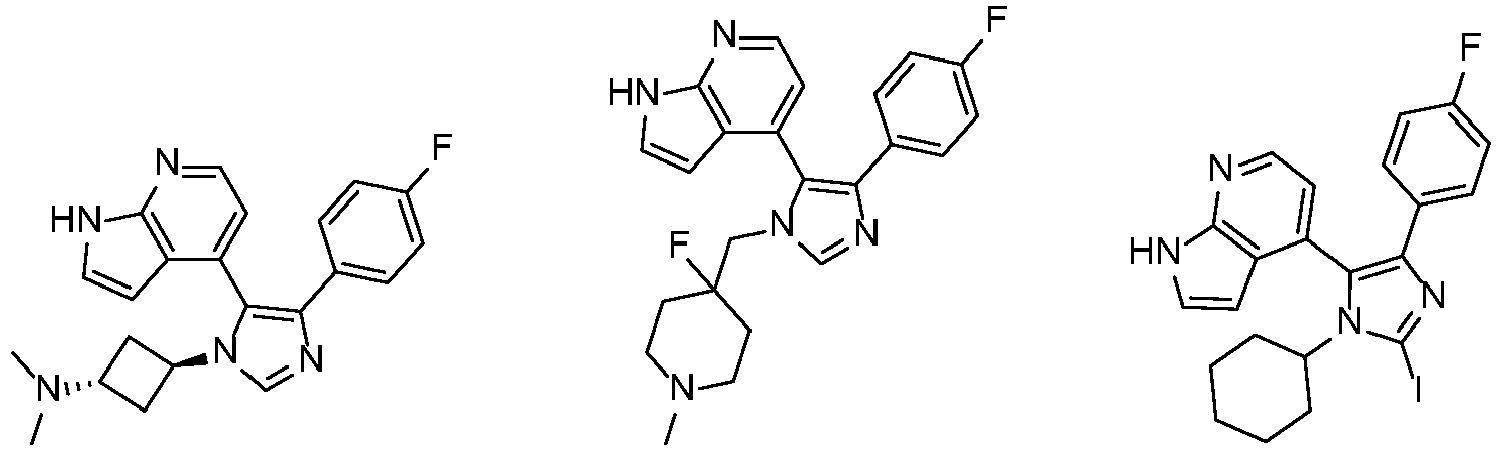


- Compound according to any one of the preceding claims for use as a medicament.
- Compound according to any one of the preceding claims for use in a method of treatment of leukaemia, lymphoma or solid tumors.
- Compound for use according to claim 13, wherein the leukaemias are selected from chronic lymphocytic leukaemia, acute lymphocytic leukaemia, chronic myeloid leukaemia, acute myeloid leukaemia; the lymphomas are selected from Burkitt lymphoma, mantle cell lymphoma, follicular lymphoma, diffuse large B-cell lymphoma; the solid tumors are selected from breast cancer, melanoma, prostate cancer, pancreatic cancer, ovarian cancer, hepatocellular carcinoma.
- A pharmaceutical preparation comprising at least one compound of formula I according to any one of claims 1 to 11, and at least one pharmaceutically acceptable auxiliary substance selected from pharmaceutically acceptable solvents, fillers, binders.
Priority Applications (2)
| Application Number | Priority Date | Filing Date | Title |
|---|---|---|---|
| SI201930240T SI3774795T1 (en) | 2018-03-29 | 2019-03-26 | 4-(1h- imidazol- 5- yl) -1h-pyrrolo (2, 3-b) pyridines for use in the treatment of leukaemias, lymphomas and solid tumors |
| PL19715027T PL3774795T3 (en) | 2018-03-29 | 2019-03-26 | 4-(1h- imidazol- 5- yl) -1h-pyrrolo [2, 3-b] pyridines for use in the treatment of leukaemias, lymphomas and solid tumors |
Applications Claiming Priority (2)
| Application Number | Priority Date | Filing Date | Title |
|---|---|---|---|
| EP18164938 | 2018-03-29 | ||
| PCT/EP2019/057595 WO2019185631A1 (en) | 2018-03-29 | 2019-03-26 | 4—(1h— imidazol— 5— yl) -1h-pyrrolo [2, 3-b] pyridines for use in the treatment of leukaemias, lymphomas and solid tumors |
Publications (2)
| Publication Number | Publication Date |
|---|---|
| EP3774795A1 EP3774795A1 (en) | 2021-02-17 |
| EP3774795B1 true EP3774795B1 (en) | 2022-03-16 |
Family
ID=61837684
Family Applications (1)
| Application Number | Title | Priority Date | Filing Date |
|---|---|---|---|
| EP19715027.9A Active EP3774795B1 (en) | 2018-03-29 | 2019-03-26 | 4-(1h- imidazol- 5- yl) -1h-pyrrolo [2, 3-b] pyridines for use in the treatment of leukaemias, lymphomas and solid tumors |
Country Status (13)
| Country | Link |
|---|---|
| US (1) | US11498920B2 (en) |
| EP (1) | EP3774795B1 (en) |
| JP (1) | JP7008967B2 (en) |
| KR (1) | KR102465111B1 (en) |
| CN (1) | CN111936496B (en) |
| AU (1) | AU2019246220B2 (en) |
| CA (1) | CA3085967C (en) |
| DK (1) | DK3774795T3 (en) |
| ES (1) | ES2918448T3 (en) |
| PL (1) | PL3774795T3 (en) |
| PT (1) | PT3774795T (en) |
| SI (1) | SI3774795T1 (en) |
| WO (1) | WO2019185631A1 (en) |
Families Citing this family (4)
| Publication number | Priority date | Publication date | Assignee | Title |
|---|---|---|---|---|
| US11795160B2 (en) | 2019-02-22 | 2023-10-24 | Insilico Medicine Ip Limited | Kinase inhibitors |
| CA3159250A1 (en) * | 2019-11-29 | 2021-06-03 | Facio Intellectual Property B.V. | New compounds for treatment of diseases related to dux4 expression |
| WO2022179528A1 (en) | 2021-02-24 | 2022-09-01 | Insilico Medicine Ip Limited | Analogs for the treatment of disease |
| CN114315729B (en) * | 2021-12-09 | 2024-01-26 | 大连理工大学 | 1-benzyl-2, 4-diaryl imidazole compound, synthetic method and application thereof in resisting tumor |
Family Cites Families (4)
| Publication number | Priority date | Publication date | Assignee | Title |
|---|---|---|---|---|
| CA2786424A1 (en) | 2010-01-08 | 2011-07-14 | Ruga Corporation | Raf kinase inhibitors |
| CZ2012538A3 (en) * | 2012-08-08 | 2014-02-19 | Masarykova Univerzita | Inhibitors for treating B-cell chronic lymphocytic leukemia |
| JP6267231B2 (en) * | 2012-12-21 | 2018-01-24 | ブリストル−マイヤーズ スクイブ カンパニーBristol−Myers Squibb Company | Novel substituted imidazoles as casein kinase 1δ / ε inhibitors |
| PE20171789A1 (en) | 2015-03-02 | 2017-12-28 | Bristol Myers Squibb Co | INHIBITORS OF THE TRANSFORMATION GROWTH FACTOR BETA (TGF-BETA) |
-
2019
- 2019-03-26 EP EP19715027.9A patent/EP3774795B1/en active Active
- 2019-03-26 CN CN201980023323.3A patent/CN111936496B/en active Active
- 2019-03-26 AU AU2019246220A patent/AU2019246220B2/en active Active
- 2019-03-26 PT PT197150279T patent/PT3774795T/en unknown
- 2019-03-26 CA CA3085967A patent/CA3085967C/en active Active
- 2019-03-26 DK DK19715027.9T patent/DK3774795T3/en active
- 2019-03-26 ES ES19715027T patent/ES2918448T3/en active Active
- 2019-03-26 WO PCT/EP2019/057595 patent/WO2019185631A1/en not_active Ceased
- 2019-03-26 SI SI201930240T patent/SI3774795T1/en unknown
- 2019-03-26 PL PL19715027T patent/PL3774795T3/en unknown
- 2019-03-26 KR KR1020207024799A patent/KR102465111B1/en active Active
- 2019-03-26 US US16/963,766 patent/US11498920B2/en active Active
- 2019-03-26 JP JP2020552878A patent/JP7008967B2/en active Active
Also Published As
| Publication number | Publication date |
|---|---|
| CA3085967C (en) | 2022-10-18 |
| WO2019185631A1 (en) | 2019-10-03 |
| US11498920B2 (en) | 2022-11-15 |
| KR102465111B1 (en) | 2022-11-09 |
| SI3774795T1 (en) | 2022-07-29 |
| CN111936496B (en) | 2023-12-29 |
| CN111936496A (en) | 2020-11-13 |
| US20210040086A1 (en) | 2021-02-11 |
| PT3774795T (en) | 2022-07-20 |
| JP7008967B2 (en) | 2022-01-25 |
| AU2019246220B2 (en) | 2020-10-08 |
| EP3774795A1 (en) | 2021-02-17 |
| PL3774795T3 (en) | 2022-07-04 |
| AU2019246220A1 (en) | 2020-07-09 |
| CA3085967A1 (en) | 2019-10-03 |
| JP2021517157A (en) | 2021-07-15 |
| DK3774795T3 (en) | 2022-06-27 |
| KR20200116137A (en) | 2020-10-08 |
| ES2918448T3 (en) | 2022-07-15 |
Similar Documents
| Publication | Publication Date | Title |
|---|---|---|
| CN112313219B (en) | 2-Amino-pyridine or 2-amino-pyrimidine derivatives as cyclin-dependent kinase inhibitors | |
| CA3147266C (en) | Imidazo[4,5-c]pyridine derivatives as toll-like receptor agonsits | |
| CA3124898A1 (en) | Heterocyclic compound, intermediate, preparation method therefor and application thereof | |
| JP6267231B2 (en) | Novel substituted imidazoles as casein kinase 1δ / ε inhibitors | |
| KR20070113252A (en) | 2,4-diamino-pyridopyrimidine derivatives and use thereof as mTOR inhibitors | |
| AU2019316858B2 (en) | Smad3 inhibitors | |
| JP7303948B2 (en) | Azalactam compounds as HPK1 inhibitors | |
| KR102465111B1 (en) | 4-(1H-imidazol-5-yl)-1H-pyrrolo[2,3-b]pyridine for use in the treatment of leukemia, lymphoma and solid tumors | |
| AU2019296085A1 (en) | Heterocyclic compound as TRK inhibitor | |
| JP2023513373A (en) | P2X3 modulators | |
| AU2018337138B2 (en) | 2-substituted pyrazole amino-4-substituted amino-5-pyrimidine formamide compound, composition, and application thereof | |
| KR102833011B1 (en) | Furo[3,4-b]pyrrole-containing BTK inhibitor | |
| EP4288438B1 (en) | Derivatives of imidazo[4,5-d]pyridazine, their preparation and their therapeutic application | |
| EP4587429B1 (en) | Substituted oxoisoindolinyl piperidine-2,6-dione compounds | |
| TW202510871A (en) | Substituted bicyclic compounds | |
| US20250243196A1 (en) | Citron kinase inhibitors | |
| RU2819642C1 (en) | Azalactam compounds as inhibitors of hpk1 | |
| RU2839367C1 (en) | Heterocyclic compound of pyrimidin-4(3h)-one, method for production thereof and pharmaceutical use thereof | |
| RU2801140C2 (en) | Azalactam compounds as hpk1 inhibitors | |
| JP2023054768A (en) | Azalactam compounds as HPK1 inhibitors | |
| HK40111515A (en) | Methods and compositions for targeting pd-l1 | |
| CN119912442A (en) | 2,4-disubstituted thiadiazole derivatives and their use as GLS1 inhibitors | |
| TW202545941A (en) | Small molecule inhibitors of nav1.8 sodium channels for pain relief | |
| EA042105B1 (en) | 2-AMINO-PYRIMIDINE DERIVATIVES AS CYCLIN-DEPENDENT KINASE INHIBITORS | |
| WO2019088016A1 (en) | Pharmaceutical composition administered in combination with substituted dihydropyrrolopyrazole compound and immunotherapeutic agent |
Legal Events
| Date | Code | Title | Description |
|---|---|---|---|
| STAA | Information on the status of an ep patent application or granted ep patent |
Free format text: STATUS: UNKNOWN |
|
| STAA | Information on the status of an ep patent application or granted ep patent |
Free format text: STATUS: THE INTERNATIONAL PUBLICATION HAS BEEN MADE |
|
| PUAI | Public reference made under article 153(3) epc to a published international application that has entered the european phase |
Free format text: ORIGINAL CODE: 0009012 |
|
| STAA | Information on the status of an ep patent application or granted ep patent |
Free format text: STATUS: REQUEST FOR EXAMINATION WAS MADE |
|
| 17P | Request for examination filed |
Effective date: 20200930 |
|
| AK | Designated contracting states |
Kind code of ref document: A1 Designated state(s): AL AT BE BG CH CY CZ DE DK EE ES FI FR GB GR HR HU IE IS IT LI LT LU LV MC MK MT NL NO PL PT RO RS SE SI SK SM TR |
|
| AX | Request for extension of the european patent |
Extension state: BA ME |
|
| DAV | Request for validation of the european patent (deleted) | ||
| DAX | Request for extension of the european patent (deleted) | ||
| GRAP | Despatch of communication of intention to grant a patent |
Free format text: ORIGINAL CODE: EPIDOSNIGR1 |
|
| STAA | Information on the status of an ep patent application or granted ep patent |
Free format text: STATUS: GRANT OF PATENT IS INTENDED |
|
| INTG | Intention to grant announced |
Effective date: 20211001 |
|
| GRAS | Grant fee paid |
Free format text: ORIGINAL CODE: EPIDOSNIGR3 |
|
| GRAA | (expected) grant |
Free format text: ORIGINAL CODE: 0009210 |
|
| STAA | Information on the status of an ep patent application or granted ep patent |
Free format text: STATUS: THE PATENT HAS BEEN GRANTED |
|
| AK | Designated contracting states |
Kind code of ref document: B1 Designated state(s): AL AT BE BG CH CY CZ DE DK EE ES FI FR GB GR HR HU IE IS IT LI LT LU LV MC MK MT NL NO PL PT RO RS SE SI SK SM TR |
|
| REG | Reference to a national code |
Ref country code: GB Ref legal event code: FG4D |
|
| REG | Reference to a national code |
Ref country code: CH Ref legal event code: EP Ref country code: DE Ref legal event code: R096 Ref document number: 602019012616 Country of ref document: DE |
|
| REG | Reference to a national code |
Ref country code: IE Ref legal event code: FG4D |
|
| REG | Reference to a national code |
Ref country code: AT Ref legal event code: REF Ref document number: 1475809 Country of ref document: AT Kind code of ref document: T Effective date: 20220415 |
|
| REG | Reference to a national code |
Ref country code: FI Ref legal event code: FGE |
|
| REG | Reference to a national code |
Ref country code: SE Ref legal event code: TRGR |
|
| REG | Reference to a national code |
Ref country code: NL Ref legal event code: FP |
|
| REG | Reference to a national code |
Ref country code: DK Ref legal event code: T3 Effective date: 20220622 |
|
| REG | Reference to a national code |
Ref country code: LT Ref legal event code: MG9D |
|
| REG | Reference to a national code |
Ref country code: ES Ref legal event code: FG2A Ref document number: 2918448 Country of ref document: ES Kind code of ref document: T3 Effective date: 20220715 |
|
| REG | Reference to a national code |
Ref country code: PT Ref legal event code: SC4A Ref document number: 3774795 Country of ref document: PT Date of ref document: 20220720 Kind code of ref document: T Free format text: AVAILABILITY OF NATIONAL TRANSLATION Effective date: 20220714 |
|
| PG25 | Lapsed in a contracting state [announced via postgrant information from national office to epo] |
Ref country code: RS Free format text: LAPSE BECAUSE OF FAILURE TO SUBMIT A TRANSLATION OF THE DESCRIPTION OR TO PAY THE FEE WITHIN THE PRESCRIBED TIME-LIMIT Effective date: 20220316 Ref country code: LT Free format text: LAPSE BECAUSE OF FAILURE TO SUBMIT A TRANSLATION OF THE DESCRIPTION OR TO PAY THE FEE WITHIN THE PRESCRIBED TIME-LIMIT Effective date: 20220316 Ref country code: HR Free format text: LAPSE BECAUSE OF FAILURE TO SUBMIT A TRANSLATION OF THE DESCRIPTION OR TO PAY THE FEE WITHIN THE PRESCRIBED TIME-LIMIT Effective date: 20220316 Ref country code: BG Free format text: LAPSE BECAUSE OF FAILURE TO SUBMIT A TRANSLATION OF THE DESCRIPTION OR TO PAY THE FEE WITHIN THE PRESCRIBED TIME-LIMIT Effective date: 20220616 |
|
| REG | Reference to a national code |
Ref country code: NO Ref legal event code: T2 Effective date: 20220316 |
|
| PG25 | Lapsed in a contracting state [announced via postgrant information from national office to epo] |
Ref country code: LV Free format text: LAPSE BECAUSE OF FAILURE TO SUBMIT A TRANSLATION OF THE DESCRIPTION OR TO PAY THE FEE WITHIN THE PRESCRIBED TIME-LIMIT Effective date: 20220316 Ref country code: GR Free format text: LAPSE BECAUSE OF FAILURE TO SUBMIT A TRANSLATION OF THE DESCRIPTION OR TO PAY THE FEE WITHIN THE PRESCRIBED TIME-LIMIT Effective date: 20220617 |
|
| PG25 | Lapsed in a contracting state [announced via postgrant information from national office to epo] |
Ref country code: SM Free format text: LAPSE BECAUSE OF FAILURE TO SUBMIT A TRANSLATION OF THE DESCRIPTION OR TO PAY THE FEE WITHIN THE PRESCRIBED TIME-LIMIT Effective date: 20220316 Ref country code: SK Free format text: LAPSE BECAUSE OF FAILURE TO SUBMIT A TRANSLATION OF THE DESCRIPTION OR TO PAY THE FEE WITHIN THE PRESCRIBED TIME-LIMIT Effective date: 20220316 Ref country code: RO Free format text: LAPSE BECAUSE OF FAILURE TO SUBMIT A TRANSLATION OF THE DESCRIPTION OR TO PAY THE FEE WITHIN THE PRESCRIBED TIME-LIMIT Effective date: 20220316 Ref country code: EE Free format text: LAPSE BECAUSE OF FAILURE TO SUBMIT A TRANSLATION OF THE DESCRIPTION OR TO PAY THE FEE WITHIN THE PRESCRIBED TIME-LIMIT Effective date: 20220316 |
|
| PG25 | Lapsed in a contracting state [announced via postgrant information from national office to epo] |
Ref country code: IS Free format text: LAPSE BECAUSE OF FAILURE TO SUBMIT A TRANSLATION OF THE DESCRIPTION OR TO PAY THE FEE WITHIN THE PRESCRIBED TIME-LIMIT Effective date: 20220716 Ref country code: AL Free format text: LAPSE BECAUSE OF FAILURE TO SUBMIT A TRANSLATION OF THE DESCRIPTION OR TO PAY THE FEE WITHIN THE PRESCRIBED TIME-LIMIT Effective date: 20220316 |
|
| REG | Reference to a national code |
Ref country code: DE Ref legal event code: R097 Ref document number: 602019012616 Country of ref document: DE |
|
| PLBE | No opposition filed within time limit |
Free format text: ORIGINAL CODE: 0009261 |
|
| STAA | Information on the status of an ep patent application or granted ep patent |
Free format text: STATUS: NO OPPOSITION FILED WITHIN TIME LIMIT |
|
| 26N | No opposition filed |
Effective date: 20221219 |
|
| REG | Reference to a national code |
Ref country code: AT Ref legal event code: UEP Ref document number: 1475809 Country of ref document: AT Kind code of ref document: T Effective date: 20220316 |
|
| PG25 | Lapsed in a contracting state [announced via postgrant information from national office to epo] |
Ref country code: MK Free format text: LAPSE BECAUSE OF FAILURE TO SUBMIT A TRANSLATION OF THE DESCRIPTION OR TO PAY THE FEE WITHIN THE PRESCRIBED TIME-LIMIT Effective date: 20220316 Ref country code: CY Free format text: LAPSE BECAUSE OF FAILURE TO SUBMIT A TRANSLATION OF THE DESCRIPTION OR TO PAY THE FEE WITHIN THE PRESCRIBED TIME-LIMIT Effective date: 20220316 |
|
| PG25 | Lapsed in a contracting state [announced via postgrant information from national office to epo] |
Ref country code: HU Free format text: LAPSE BECAUSE OF FAILURE TO SUBMIT A TRANSLATION OF THE DESCRIPTION OR TO PAY THE FEE WITHIN THE PRESCRIBED TIME-LIMIT; INVALID AB INITIO Effective date: 20190326 |
|
| PGFP | Annual fee paid to national office [announced via postgrant information from national office to epo] |
Ref country code: DE Payment date: 20250318 Year of fee payment: 7 |
|
| PGFP | Annual fee paid to national office [announced via postgrant information from national office to epo] |
Ref country code: IT Payment date: 20250318 Year of fee payment: 7 |
|
| PGFP | Annual fee paid to national office [announced via postgrant information from national office to epo] |
Ref country code: ES Payment date: 20250404 Year of fee payment: 7 |
|
| PGFP | Annual fee paid to national office [announced via postgrant information from national office to epo] |
Ref country code: CH Payment date: 20250401 Year of fee payment: 7 |
|
| PGFP | Annual fee paid to national office [announced via postgrant information from national office to epo] |
Ref country code: SE Payment date: 20260327 Year of fee payment: 8 |
|
| PGFP | Annual fee paid to national office [announced via postgrant information from national office to epo] |
Ref country code: GB Payment date: 20260330 Year of fee payment: 8 |
|
| PGFP | Annual fee paid to national office [announced via postgrant information from national office to epo] |
Ref country code: MC Payment date: 20260330 Year of fee payment: 8 |
|
| PGFP | Annual fee paid to national office [announced via postgrant information from national office to epo] |
Ref country code: NO Payment date: 20260327 Year of fee payment: 8 Ref country code: DK Payment date: 20260325 Year of fee payment: 8 Ref country code: IE Payment date: 20260327 Year of fee payment: 8 |
|
| PGFP | Annual fee paid to national office [announced via postgrant information from national office to epo] |
Ref country code: AT Payment date: 20260324 Year of fee payment: 8 |
|
| PGFP | Annual fee paid to national office [announced via postgrant information from national office to epo] |
Ref country code: LU Payment date: 20260330 Year of fee payment: 8 Ref country code: BE Payment date: 20260330 Year of fee payment: 8 Ref country code: FI Payment date: 20260324 Year of fee payment: 8 |
|
| PGFP | Annual fee paid to national office [announced via postgrant information from national office to epo] |
Ref country code: NL Payment date: 20260330 Year of fee payment: 8 |
|
| PGFP | Annual fee paid to national office [announced via postgrant information from national office to epo] |
Ref country code: FR Payment date: 20260330 Year of fee payment: 8 |
|
| PGFP | Annual fee paid to national office [announced via postgrant information from national office to epo] |
Ref country code: TR Payment date: 20260325 Year of fee payment: 8 |
|
| PGFP | Annual fee paid to national office [announced via postgrant information from national office to epo] |
Ref country code: PT Payment date: 20260318 Year of fee payment: 8 Ref country code: CZ Payment date: 20260227 Year of fee payment: 8 |
|
| PGFP | Annual fee paid to national office [announced via postgrant information from national office to epo] |
Ref country code: PL Payment date: 20260313 Year of fee payment: 8 Ref country code: MT Payment date: 20260325 Year of fee payment: 8 |
|
| PGFP | Annual fee paid to national office [announced via postgrant information from national office to epo] |
Ref country code: SI Payment date: 20260318 Year of fee payment: 8 |