EP3773589B1 - Ret inhibitor for use in treating cancer having a ret alteration - Google Patents
Ret inhibitor for use in treating cancer having a ret alteration Download PDFInfo
- Publication number
- EP3773589B1 EP3773589B1 EP19718531.7A EP19718531A EP3773589B1 EP 3773589 B1 EP3773589 B1 EP 3773589B1 EP 19718531 A EP19718531 A EP 19718531A EP 3773589 B1 EP3773589 B1 EP 3773589B1
- Authority
- EP
- European Patent Office
- Prior art keywords
- ret
- cancer
- compound
- thyroid cancer
- amino acid
- Prior art date
- Legal status (The legal status is an assumption and is not a legal conclusion. Google has not performed a legal analysis and makes no representation as to the accuracy of the status listed.)
- Revoked
Links
Images


Classifications
-
- A—HUMAN NECESSITIES
- A61—MEDICAL OR VETERINARY SCIENCE; HYGIENE
- A61K—PREPARATIONS FOR MEDICAL, DENTAL OR TOILETRY PURPOSES
- A61K31/00—Medicinal preparations containing organic active ingredients
- A61K31/33—Heterocyclic compounds
- A61K31/395—Heterocyclic compounds having nitrogen as a ring hetero atom, e.g. guanethidine or rifamycins
- A61K31/495—Heterocyclic compounds having nitrogen as a ring hetero atom, e.g. guanethidine or rifamycins having six-membered rings with two or more nitrogen atoms as the only ring heteroatoms, e.g. piperazine or tetrazines
- A61K31/505—Pyrimidines; Hydrogenated pyrimidines, e.g. trimethoprim
- A61K31/506—Pyrimidines; Hydrogenated pyrimidines, e.g. trimethoprim not condensed and containing further heterocyclic rings
-
- A—HUMAN NECESSITIES
- A61—MEDICAL OR VETERINARY SCIENCE; HYGIENE
- A61K—PREPARATIONS FOR MEDICAL, DENTAL OR TOILETRY PURPOSES
- A61K31/00—Medicinal preparations containing organic active ingredients
- A61K31/33—Heterocyclic compounds
- A61K31/395—Heterocyclic compounds having nitrogen as a ring hetero atom, e.g. guanethidine or rifamycins
- A61K31/435—Heterocyclic compounds having nitrogen as a ring hetero atom, e.g. guanethidine or rifamycins having six-membered rings with one nitrogen as the only ring hetero atom
- A61K31/47—Quinolines; Isoquinolines
-
- A—HUMAN NECESSITIES
- A61—MEDICAL OR VETERINARY SCIENCE; HYGIENE
- A61K—PREPARATIONS FOR MEDICAL, DENTAL OR TOILETRY PURPOSES
- A61K31/00—Medicinal preparations containing organic active ingredients
- A61K31/33—Heterocyclic compounds
- A61K31/395—Heterocyclic compounds having nitrogen as a ring hetero atom, e.g. guanethidine or rifamycins
- A61K31/495—Heterocyclic compounds having nitrogen as a ring hetero atom, e.g. guanethidine or rifamycins having six-membered rings with two or more nitrogen atoms as the only ring heteroatoms, e.g. piperazine or tetrazines
- A61K31/505—Pyrimidines; Hydrogenated pyrimidines, e.g. trimethoprim
- A61K31/517—Pyrimidines; Hydrogenated pyrimidines, e.g. trimethoprim ortho- or peri-condensed with carbocyclic ring systems, e.g. quinazoline, perimidine
-
- A—HUMAN NECESSITIES
- A61—MEDICAL OR VETERINARY SCIENCE; HYGIENE
- A61K—PREPARATIONS FOR MEDICAL, DENTAL OR TOILETRY PURPOSES
- A61K45/00—Medicinal preparations containing active ingredients not provided for in groups A61K31/00 - A61K41/00
- A61K45/06—Mixtures of active ingredients without chemical characterisation, e.g. antiphlogistics and cardiaca
-
- A—HUMAN NECESSITIES
- A61—MEDICAL OR VETERINARY SCIENCE; HYGIENE
- A61K—PREPARATIONS FOR MEDICAL, DENTAL OR TOILETRY PURPOSES
- A61K9/00—Medicinal preparations characterised by special physical form
- A61K9/0012—Galenical forms characterised by the site of application
- A61K9/0053—Mouth and digestive tract, i.e. intraoral and peroral administration
-
- A—HUMAN NECESSITIES
- A61—MEDICAL OR VETERINARY SCIENCE; HYGIENE
- A61P—SPECIFIC THERAPEUTIC ACTIVITY OF CHEMICAL COMPOUNDS OR MEDICINAL PREPARATIONS
- A61P35/00—Antineoplastic agents
-
- A—HUMAN NECESSITIES
- A61—MEDICAL OR VETERINARY SCIENCE; HYGIENE
- A61P—SPECIFIC THERAPEUTIC ACTIVITY OF CHEMICAL COMPOUNDS OR MEDICINAL PREPARATIONS
- A61P35/00—Antineoplastic agents
- A61P35/04—Antineoplastic agents specific for metastasis
Definitions
- This disclosure relates to a compound for use in the treatment of a subject afflicted with a cancer having an activating RET alteration by administering an effective amount of a selective RET inhibitor, i.e., a compound which is specifically designed to selectively target one or more RET or RET-altered kinases.
- a selective RET inhibitor i.e., a compound which is specifically designed to selectively target one or more RET or RET-altered kinases.
- the term "afflicted with a cancer” means having a cancer.
- a subject afflicted with a cancer has a cancer. More specifically, the uses described herein relate to treating a subject having a cancer characterized by an activating RET alteration.
- the selective RET inhibitor is Compound 1 or pharmaceutically acceptable salts thereof, as defined in the appended claims, and is administered once daily.
- the cancer is a RET-altered non-small cell lung cancer, or a RET-altered thyroid cancer.
- the cancer is a pancreatic cancer, lung cancer, colorectal cancer, head and neck cancer, hepatobiliary cancer or sarcoma. This disclosure also relates to treatment of RET-altered cancers by administering a physiological effective dose of the selective RET inhibitor that produces a sustained down-regulation of at least one effect marker.
- RTK receptor tyrosine kinase
- GDNF glial cell line-derived neurotrophic factors
- GFR ⁇ GDNF family receptors- ⁇
- Oncogenic RET activation occurs via gain of function mutation or RET gene rearrangement resulting in the production of a RET fusion protein with constitutively active RET signaling that promotes ligand-independent tumor growth.
- Oncogenic RET activation was initially described in hereditary and sporadic thyroid cancers and subsequently in non-small cell lung cancer (NSCLC).
- Oncogenic RET rearrangements have been identified in 1-2% of NSCLC ( Lipson, D. et al., Nat. Med. 18:382-384 (2012 ); Takeuchi, K. et al., Nat. Med. 18:378-381 (2012 ); Stransky, N. et al., Nat. Commun. 5:4846 (2014 )). This generates a constitutively active kinase that promotes tumorigenesis.
- RET-rearranged NSCLC typically has adenocarcinoma histology (though occasionally squamous) and occurs in young, non-smoking patients. Because diagnostic testing for RET is not standard of care, RET-rearranged patients with advanced NSCLC are treated per NCCN guidelines for epidermal growth factor receptor (EGFR-) and ALK-negative adenocarcinoma. This usually includes chemotherapy with a platinum doublet or more recently with a checkpoint inhibitor however, clinical response and overall survival specifically in RET-rearranged NSCLC with these agents is not well understood. Subsequent therapy beyond chemotherapy and checkpoint inhibitors for refractory patients per NCCN guidelines is best supportive care or clinical trial.
- Oncogenic RET activation is also associated with thyroid cancer.
- Thyroid cancer consists primarily of differentiated thyroid cancer (DTC; -90% of cases), medullary thyroid cancer (MTC; -5% of cases), and anaplastic thyroid cancer ( ⁇ 5% of cases).
- DTC arises sporadically from thyroid follicular cells and consists of papillary thyroid cancer (PTC) (-80% of all thyroid cancer cases) and follicular thyroid cancer.
- PTC papillary thyroid cancer
- MTC arises from parafollicular C cells and occurs in both hereditary and sporadic forms.
- Oncogenic RET activation has been implicated as a driver in both MTC and PTC.
- Recurrent gene rearrangements involving RET and a dimerization domainencoding gene have been identified in approximately 5%-20% of sporadic papillary tumors in adults.
- Kinase-activating RET mutations occur in nearly all cases of hereditary MTC (87%-97%) ( Machens A et al., N Engl JMed 349:1517-25 (2003 ); Mulligan LM et al., Nature 363(6428):458-60 (1993 Jun 3 ); Mulligan LM et al., J Int Med. 238(4):343-346 (1995 )) and approximately 43%-65% of sporadic MTC ( Elisei R. et al., J Clin Endocrinol Metab.
- RET mutations occur in the extracellular domain (primarily at the C634 position) which promote ligand-independent dimerization and activation of RET, and kinase domains mutations (primarily M918T, A883F or V804L/M) which promote RET auto-activation and consequent oncogenic signaling ( Romei C et al., Nat Rev Endocrinol. 12(4):192-202 (2016 Apr. )).
- Cabozantinib and vandetanib are approved MKIs for advanced MTC and are used regardless of RET mutational status.
- MKIs used to treat thyroid cancer have broad activity against many kinases (e.g., RAF, MET, EGFR, VEGFR1-3, PDGFR, RET and others), and are associated with significant dermatologic, cardiovascular, and gastrointestinal side effects. Therefore, National Clinical Practice Guidelines in Oncology from the National Comprehensive Cancer Network (available at https://www.nccn.org/professionals/physician_gls/f_guidelines.asp) recommends careful monitoring and dose interruption and/or dose modification for drug-related side effects with these agents. For patients with disease progression on MKI therapy or MKI intolerance, there are no effective therapies and NCCN guidelines recommend clinical trial participation.
- NCCN guidelines recommend clinical trial participation.
- Small molecule compounds that selectively inhibit RET are a desirable means for treating cancers having an activating RET alteration.
- One small molecule is (1S,4R)-N-((S)-1-(6-(4-fluoro-1H-pyrazol-1-yl)pyridin-3-yl)ethyl)-1-methoxy-4-(4-methyl-6-((5-methyl-1H-pyrazol-3-yl)amino)pyrimidin-2-yl)cyclohexanecarboxamide (Compound 1).
- Compound 1 has the chemical structure:
- WO 2017/079140 describes the synthesis of Compound 1 (Example Compound 130) and also discloses the therapeutic activity of this molecule to inhibit, regulate, and/or modulate RET kinase (Assays, Example 10 on pp. 72-74).
- Studies of BLU-667 activity in RET-driven cancers can be found in www.blueprintmedicines.com/wp-content/uploads/2018/12/BLU-667-EORTC-2017-BPM.pdf.
- Compound 1 is (1S,4R)-N-((S)-1-(6-(4-fluoro-1H-pyrazol-1-yl)pyridine-3-yl)ethyl)-1-methoxy-4-(4-methyl-6-((5-methyl-1H-pyrazol-3-yl)amino)pyrimidin-2-yl)cyclohexanecarboxamide:
- DOR duration of response
- PD progressive disease
- SD stable disease
- ORR means overall all response rate
- CBR clinical benefit rate
- PFS progression free survival
- a "fusion" is a protein that results from a chromosomal translocation in which two genes are joined with an in-frame coding sequence and results in a chimeric protein.
- a fusion is a chromosomal translocation where the kinase domain of one protein fuses to a dimerization domain of another gene.
- RET-altered cancer is a cancer having an activating rearranged during transfection (RET) alteration, which drives tumorigenesis.
- activating RET alterations include mutations, fusions, and copy number variations.
- RET fusion is a gene rearrangement. RET rearrangements create a fusion protein juxtaposing the RET kinase domain and a dimerization domain of another protein, creating a constitutively activated dimer, which drives tumorigenesis.
- RET fusion protein is the result of a gene rearrangement.
- RET activating mutation means a mutation in RET kinase which promotes ligand-independent, constitutive RET kinase activation, which drives tumorigenesis.
- RET mutations can occur in the extracellular cysteine residues (e.g., C620R or C634R/W), which trigger aberrant receptor dimerization, or RET mutations can occur in the intracellular kinase domain.
- RET inhibitor is a compound which inhibits the activity of RET kinase.
- RET kinase is wild-type RET kinase and/or one or more RET-altered kinases (e.g., RET fusion, RET mutation, or RET copy number variation).
- RET inhibitors include Compound 1 as defined in the appended claims, and other inhibitors which are not part of the invention such as LOXO-292 (selpercatinib), cabozantinib, vandetanib, alectinib, sorafenib, levatinib, ponatinib, dovitinib, sunitinib, foretinib, sitravatinib, DS-5010 (BOS172738), and RXDX-105.
- LOXO-292 silpercatinib
- cabozantinib vandetanib
- alectinib sorafenib
- levatinib levatinib
- ponatinib dovitinib
- sunitinib sunitinib
- foretinib sitravatinib
- DS-5010 BOS172738
- RXDX-105 RXDX-105
- a RET inhibitor may also inhibit other kinases.
- a "multi-kinase RET inhibitor” is a compound which inhibits wild type RET kinase and inhibits at least one other kinase equally or more potently than wild type RET kinase. Examples of multikinase RET inhibitors include: cabozantinib; vandetanib; alectinib; sorafenib; levatinib, ponatinib; dovitinib; sunitinib; foretinib; sitravatinib; DS-5010; and RXDX-105.
- selective RET inhibitor means a compound which selectively inhibits RET kinase.
- RET kinase can include RET wild type kinase and/or one or more RET-altered kinases (e.g., RET fusion, RET mutation, or RET copy number variation).
- a selective RET inhibitor's inhibitory activity against RET kinase is more potent in terms of IC 50 value (i.e., the IC 50 value is subnanomolar) when compared with its inhibitory activity against many other kinases (e.g., KDR, VEGFR-2, ABL, EGFR, FGFR2, HER2, IGFIR, JAKI, KIT, MET, AKTI, MEKl). Potency can be measured using known biochemical assays.
- Examples of selective RET inhibitors include Compound 1 and selpercatinib.
- subj ect or “patient” refers to organisms to be treated with the compounds of the present disclosure.
- organisms include, but are not limited to, mammals (e.g., murines, simians, equines, bovines, porcines, canines, felines, and the like), and in some embodiments, humans.
- cancers have been linked to aberrant RET expression ( Kato et al., Clin. CancerRes. 23(8): 1988-97 (2017 )).
- Types of "cancer” as used herein include lung cancer, head and neck cancer, pancreatic cancer, hepatobiliary cancer, colorectal cancer, and sarcoma.
- the lung cancer is chosen from small cell lung cancer (SCLC), lung adenocarcinoma, non-small cell lung cancer (NSCLC), bronchioles lung cell carcinoma, and mesothelioma.
- SCLC small cell lung cancer
- NSCLC non-small cell lung cancer
- bronchioles lung cell carcinoma and mesothelioma.
- the lung cancer is SCLC.
- the lung cancer is NSCLC.
- the lung cancer is metastatic NSCLC.
- the head and neck cancer is chosen from thyroid cancer and cancer of the salivary gland.
- the thyroid cancer is chosen from differentiated thyroid cancer (DTC), papillary thyroid carcinoma (PTC), metastatic papillary thyroid cancer, medullary thyroid cancer (MTC), anaplastic thyroid cancer, follicular thyroid cancer, diffuse sclerosing variant of papillary thyroid cancer and thyroid gland carcinoma.
- the cancer is familial medullary thyroid cancer.
- the cancer is sporadic meduallary thryoid cancer.
- the thyroid cancer is PTC.
- the thyroid cancer is MTC.
- the cancer is metastatic colon cancer.
- Lung cancer is known to spread to the brain in about 40 percent of cases in which a metastasis has occurred. With lung cancer, this is considered stage 4 of the disease, and the average survival time with brain metastases is usually less than a year. Lung cancers with metastases to the brain have a relatively poor prognosis, e.g., chemotherapy drugs. Brain metastases are difficult to treat for many reasons. Often, by the time the patient first exhibits symptoms, they already have multiple lesions. Brain metastases tend to be very aggressive. The brain has many defenses to reduce the penetration of harmful substances. Specifically, the blood-brain-barrier prevents many medications, e.g., compounds from entering the brain. Treatment options may damage surrounding normal tissue and have a significant impact on the quality of life. In particular, there is a need to provide compounds that can be administered at a safe dose, with good tolerability, and which penetrate the brain for treatment of brain metastases.
- the cancer is a "RET-altered cancer," which, as used herein, means the cancer has an activating RET alteration, as defined in the claims.
- the RET-altered cancer has a RET mutation or a RET gene rearrangement.
- the RET-altered cancer is a RET-altered solid tumor.
- the term "effective amount" refers to the amount of a selective RET inhibitor (e.g., Compound 1 or a pharmaceutically acceptable salt thereof) sufficient to effect beneficial or desired results.
- Beneficial or desired results may be a therapeutic benefit or result or a physiological benefit or result.
- An effective amount can be administered in one or more administrations, applications, or dosages and is not intended to be limited to a specific formulation or administration route According to the invention, 300 mg or 400 mg of Compound 1 or a pharmaceutically acceptable salt thereof is administered once daily, as defined in the claims.
- the term "therapeutically effective amount” refers to the amount of a selective inhibitor (e.g., Compound 1 or a pharmaceutically acceptable salt thereof) sufficient to effect beneficial or desired therapeutic results in a subject.
- a therapeutically effective amount can be administered to a subject in need thereof in one or more administrations, applications, or dosages and is not intended to be limited to a specific formulation or administration route.
- a therapeutically effective amount provides the desired safety, exposure, and tolerability.
- Selecting the therapeutically effective amount i.e., the right dose for administering a compound, is a required step in the development of a pharmaceutical drug for clinical use. Without adequate information on dosage, it is not possible for doctors to prescribe a particular drug to patients. Therefore, determining the correct drug dosage is a key question that can only be answered in clinical studies. If the dose and frequency of administration that allows safe and predictable administration cannot be identified, then the compound cannot be a medically useful or commercially viable pharmaceutical product.
- physiologically effective amount refers to the amount of a selective inhibitor (e.g., Compound 1 or a pharmaceutically acceptable salt thereof) sufficient to effect beneficial or desired physiological result in a subject.
- a physiological result may be a sustained down-regulation of at least one effect marker in the subject.
- treating includes any effect, e.g., lessening, reducing, modulating, ameliorating, or eliminating, that results in the improvement of the condition, disease, disorder, and the like, or ameliorating a symptom thereof.
- an "effect marker” means DUSP6 mRNA expression, SPRY4 mRNA expression, CEA, calcitonin, KIF5B ctDNA or TP53 ctDNA.
- the activating RET alteration comprises a RET mutation or a RET gene rearrangement (fusion). In some embodiments, the activating RET alteration is a RET mutation. In some embodiments, the RET mutation is a point mutation. In some embodiments, the RET mutation is a resistance mutation. In some embodiments, the RET alteration is a RET mutation chosen from Table 1. In some embodiments, the RET mutation is V804M, M918T, C634R, or C634W.
- the cancer is RET-altered medullary thyroid cancer (MTC). In some embodiments, the cancer is familial MTC or sporadic MTC. In some embodiments, the cancer is MTC having a M918T mutation, a C634R mutation or a V804M mutation.
- the activating RET alteration is a gene-rearrangement (fusion). In some embodiments, the activating RET alteration is a fusion with a RET fusion partner chosen from Table 2, in as far as the cancers fall in the scope of the claims.
- the fusion is KIF5B-RET, CCDC6-RET, KIAA1468-RET, or NCOA4-RET.
- the cancer is RET-altered NSCLC. In some embodiments, the cancer is NSCLC having a KIF5B-RET fusion. In some embodiments, the cancer is NSCLC having a CCDC6-RET fusion or a KIAA1468-RET fusion.
- the cancer is RET-altered PTC. In some embodiments, the cancer is PTC having a CCDC6-RET fusion or a NCOA4-RET fusion.
- the subject has not received prior chemotherapy. In some embodiments, the subject has received prior chemotherapy. In some embodiments, the prior chemotherapy is chosen from carboplatin and cisplatin. Table 1. RET Point Mutations Example RET Point Mutation Example RET Point Mutation Amino acid position 2 Amino acid position 665 ( e.g ., H665Q) Amino acid position 3 Amino acid position 666 ( e.g ., K666E, K666M, or K666N) Amino acid position 4 Amino acid position 686 ( e.g ., S686N) Amino acid position 5 Amino acid position 691 ( e.g ., G691S) Amino acid position 6 Amino acid position 694 ( e.g ., R694Q) Amino acid position 7 Amino acid position 700 ( e.g ., M700L) Amino acid position 8 Amino acid position 706 ( e.g ., V706
- Amino acid position 12 Amino acid position 736 (e.g ., G736R) Amino acid position 13 Amino acid position 748 ( e.g ., G748C) Amino acid position 20 Amino acid position 750 ( e.g.
- Amino acid position 32 e.g ., S32L
- Amino acid position 765 e.g ., S765P
- Amino acid position 34 e.g ., D34S
- Amino acid position 766 e.g ., P766S or P766M6
- Amino acid position 40 e.g ., L40P
- Amino acid position 768 e.g ., E768Q or E768D
- Amino acid position 64 e.g ., P64L
- Amino acid position 769 e.g ., L769L
- Amino acid position 67 e.g ., R67H
- Amino acid position 770 e.g ., R770Q
- Amino acid position 114 e.g ., R114H
- Amino acid position 771 e.g ., D771N
- Amino acid position 136 e.g .,
- Amino acid position 200 Amino acid position 790 ( e.g. , L790F) Amino acid position 292 ( e.g. , V292M) Amino acid position 791 ( e.g.
- Amino acid position 294 Amino acid position 802 Amino acid position 321 (e.g ., G321R) Amino acid position 804 (e.g ., V804L, V804M, V804M, or V804E) Amino acid position 330 ( e.g ., R330Q) Amino acid position 805 ( e.g ., E805K) Amino acid position 338 ( e.g ., T338I) Amino acid position 806 ( e.g ., E806C, Y806E, Y806F, Y806S, Y806G, Y806H, Y806N, or Y806C) Amino acid position 360 ( e.g.
- Amino acid position 818 e.g ., E818K
- Amino acid position 373 e.g ., alanine to frameshift
- Amino acid position 819 e.g ., S819I
- Amino acid position 388 e.g. , V388A
- Amino acid position 393 e.g ., F393L
- Amino acid position 823 e.g.
- Amino acid position 432 Amino acid position 826 ( e.g ., Y826M) ⁇ Amino acid residues 505-506 (6-Base Pair In-Frame Germline Deletion in Exon 7) Amino acid position 833 ( e.g.
- Amino acid position 510 (e.g ., A510V) Amino acid position 841 ( e.g ., P841L or P841P) Amino acid position 511 ( e.g ., E511K) Amino acid position 843 ( e.g ., E843D) Amino acid position 513 ( e.g ., A513D) Amino acid position 844 ( e.g ., R844W, R844Q, or R844L) Amino acid position 515 ( e.g ., C515S, C515W) Amino acid position 848 ( e.g ., M848T) Amino acid position 525 ( e.g ., R525W) Amino acid position 852 ( e.g ., 1852M) Amino acid position 531 ( e.g ., C531R, or 9 base pair duplication) Amin
- Amino acid position 533 e.g ., G533C or G533S
- Amino acid position 876 e.g ., A876V
- Amino acid position 550 e.g. , G550E
- Amino acid position 881 e.g.
- Amino acid position 591 e.g ., V591I
- Amino acid position 882 Amino acid position 593 ( e.g ., G593E)
- Amino acid position 883 e.g ., A883F, A883S, A883T, or A883T*)
- Amino acid position 600 e.g ., R600Q
- Amino acid position 884 e.g.
- Amino acid position 602 (e.g ., I602V) Amino acid position 886 (e.g ., R886W) Amino acid position 603 ( e.g ., K603Q or K603E2) Amino acid position 891 ( e.g ., S891A) Amino acid position 606 ( e.g ., Y606C) Amino acid position 897 ( e.g ., R897Q) Amino acid position 609 ( e.g ., C609Y, C609S, C609G, C609R, C609F, or C609W) Amino acid position 898 ( e.g ., D898V) Amino acid position 611 ( e.g ., C611R, C611S, C611G, C611Y, C611F, or C611W) Amino acid position 901 ( e.g ., I602
- R525W and A513D may act in combination with S891A to enhance oncogenic activity.
- Table 2. RET Fusions. RET fusion partner Exemplary cancers in which the fusion is found BCR Chronic Myelomonocytic Leukemia (CMML) CLIP 1 Adenocarcinoma KIFSB NSCLC, Ovarian Cancer, Spitzoid Neoplasm; Lung Adenocarcinoma, Adenosquamous Carcinomas CCDC6 NSCLC, Colon Cancer, Papillary Thyroid Cancer; Adenocarcinoma; Lung Adenocarcinoma; Metastatic Colorectal Cancer; Adenosquamous Carcinoma, Metastatic papillary thyroid cancer PTClex9 Metastatic papillary thyroid cancer NCOA4 Papillary Thyroid Cancer, NSCLC, Colon Cancer, Salivary Gland Cancer, Metastatic Colorectal Cancer; Lung Adenocarcinoma, Adenosquamous Carcinomas; Diffuse Scle
- a person of ordinary skill in the art may determine if a subject possesses a RET-altered cell, cancer, gene, or gene product, e.g., having a mutation, e.g., a fusion, deletion, insertion, translocation, frameshift, duplication, point mutation, and/or rearrangement, e.g., using a method selected from hybridization-based methods, amplification-based methods, microarray analysis, flow cytometry analysis, DNA sequencing, next-generation sequencing (NGS), primer extension, PCR, in situ hybridization, fluorescent in situ hybridization, dot blot, and Southern blot.
- primary tumor samples may be collected from a subject.
- the samples are processed, the nucleic acids are isolated using techniques known in the art, then the nucleic acids are sequenced using methods known in the art. Sequences are then mapped to individual exons, and measures of transcriptional expression (such as RPKM, or reads per kilobase per million reads mapped), are quantified.
- Raw sequences and exon array data are available from sources such as TCGA, ICGC, and the NCBI Gene Expression Omnibus (GEO). For a given sample, individual exon coordinates are annotated with gene identifier information, and exons belonging to kinase domains are flagged. The exon levels are then z-score normalized across all tumors samples.
- breakpoint is the boundary at which two different genes are fused. It is sometimes referred to as a "fusion point.” The location where the difference in exon expression is maximal between 5' and 3' is the inferred breakpoint of the fusion.
- Thousands of tumor samples can be rapidly profiled in this manner, generating a list of fusion candidates (ranked by t-statistic). High-ranking candidates can then be validated, and fusion partners identified by examining the raw RNA-seq data sets, and identifying chimeric pairs and/or split reads which support the fusion. Candidate fusions can then be experimentally confirmed as described below.
- Compound 1 can be administered as a pharmaceutical formulation, wherein Compound 1 is combined with one or more pharmaceutically acceptable excipients or carriers.
- Compound 1 may be formulated for administration in any convenient way for use in human or veterinary medicine.
- the compound included in the pharmaceutical preparation may be active itself, or may be a prodrug, e.g., capable of being converted to an active compound in a physiological setting.
- phrases "pharmaceutically acceptable” is employed herein to refer to those compounds, materials, compositions, and/or dosage forms which are, within the scope of sound medical judgment, suitable for use in contact with the tissues of human beings and animals without excessive toxicity, irritation, allergic response, or other problem or complication, commensurate with a reasonable benefit/risk ratio.
- Examples of pharmaceutically acceptable carriers include: (1) sugars, such as lactose, glucose, and sucrose; (2) starches, such as corn starch and potato starch; (3) cellulose and its derivatives, such as sodium carboxymethyl cellulose, ethyl cellulose, and cellulose acetate; (4) powdered tragacanth; (5) malt; (6) gelatin; (7) talc; (8) excipients, such as cocoa butter and suppository waxes; (9) oils, such as peanut oil, cottonseed oil, safflower oil, sesame oil, olive oil, corn oil, and soybean oil; (10) glycols, such as propylene glycol; (11) polyols, such as glycerin, sorbitol, mannitol, and polyethylene glycol; (12) esters, such as ethyl oleate and ethyl laurate; (13) agar; (14) buffering agents, such as magnesium hydroxide and aluminum hydroxide; (15)
- antioxidants examples include: (1) water soluble antioxidants, such as ascorbic acid, cysteine hydrochloride, sodium bisulfate, sodium metabisulfite, sodium sulfite, and the like; (2) oil-soluble antioxidants, such as ascorbyl palmitate, butylated hydroxyanisole (BHA), butylated hydroxytoluene (BHT), lecithin, propyl gallate, alpha-tocopherol, and the like; and (3) metal chelating agents, such as citric acid, ethylenediamine tetraacetic acid (EDTA), sorbitol, tartaric acid, phosphoric acid, and the like.
- water soluble antioxidants such as ascorbic acid, cysteine hydrochloride, sodium bisulfate, sodium metabisulfite, sodium sulfite, and the like
- oil-soluble antioxidants such as ascorbyl palmitate, butylated hydroxyanisole (BHA), butylated hydroxytoluene (BHT
- Solid dosage forms can include one or more pharmaceutically acceptable carriers, such as sodium citrate or dicalcium phosphate, and/or any of the following: (1) fillers or extenders, such as starches, lactose, sucrose, glucose, mannitol, and/or silicic acid; (2) binders, such as, for example, carboxymethylcellulose, alginates, gelatin, polyvinyl pyrrolidone, sucrose, and/or acacia; (3) humectants, such as glycerol; (4) disintegrating agents, such as agar-agar, calcium carbonate, potato or tapioca starch, alginic acid, certain silicates, and sodium carbonate; (5) solution retarding agents, such as paraffin; (6) absorption accelerators, such as quaternary ammonium compounds; (7) wetting agents, such as, for example, cetyl alcohol and g
- Liquid dosage forms can include pharmaceutically acceptable emulsions, microemulsions, solutions, suspensions, syrups, and elixirs.
- the liquid dosage forms may contain inert diluents commonly used in the art, such as, for example, water or other solvents, solubilizing agents and emulsifiers, such as ethyl alcohol, isopropyl alcohol, ethyl carbonate, ethyl acetate, benzyl alcohol, benzyl benzoate, propylene glycol, 1,3-butylene glycol, oils (in particular, cottonseed, groundnut, corn, germ, olive, castor and sesame oils), glycerol, tetrahydrofuryl alcohol, polyethylene glycols, and fatty acid esters of sorbitan, and mixtures thereof.
- inert diluents commonly used in the art, such as, for example, water or other solvents, solubilizing agents and emulsifiers
- Suspensions in addition to the active compounds, may contain suspending agents as, for example, ethoxylated isostearyl alcohols, polyoxyethylene sorbitol and sorbitan esters, microcrystalline cellulose, aluminum metahydroxide, bentonite, agar-agar and tragacanth, and mixtures thereof.
- suspending agents as, for example, ethoxylated isostearyl alcohols, polyoxyethylene sorbitol and sorbitan esters, microcrystalline cellulose, aluminum metahydroxide, bentonite, agar-agar and tragacanth, and mixtures thereof.
- Ointments, pastes, creams, and gels may contain, in addition to an active compound, excipients, such as animal and vegetable fats, oils, waxes, paraffins, starch, tragacanth, cellulose derivatives, polyethylene glycols, silicones, bentonites, silicic acid, talc, and zinc oxide, or mixtures thereof.
- excipients such as animal and vegetable fats, oils, waxes, paraffins, starch, tragacanth, cellulose derivatives, polyethylene glycols, silicones, bentonites, silicic acid, talc, and zinc oxide, or mixtures thereof.
- Powders and sprays can contain, in addition to an active compound, excipients such as lactose, talc, silicic acid, aluminum hydroxide, calcium silicates, and polyamide powder, or mixtures of these substances.
- Sprays can additionally contain customary propellants, such as chlorofluorohydrocarbons and volatile unsubstituted hydrocarbons, such as butane and propane.
- Dosage forms for the topical or transdermal administration of Compound 1 include powders, sprays, ointments, pastes, creams, lotions, gels, solutions, patches, and inhalants.
- the active compound may be mixed under sterile conditions with a pharmaceutically acceptable carrier, and with any preservatives, buffers, or propellants that may be required.
- Compound 1 When Compound 1 is administered as a pharmaceutical, to humans and animals, it can be given per se or as a pharmaceutical composition containing, for example, 0.1 to 99.5% (such as 0.5 to 90%) of active ingredient in combination with a pharmaceutically acceptable carrier.
- the formulations can be administered topically, orally, transdermally, rectally, vaginally, parentally, intranasally, intrapulmonary, intraocularly, intravenously, intramuscularly, intraarterially, intrathecally, intracapsularly, intradermally, intraperitoneally, subcutaneously, subcuticularly, or by inhalation.
- FIGs. 1A-1C show relative transcript expression of RET pathway targets DUSP6 and SPRY4 and AKT-pathway target GSK3B 7 hours after treatment of L2C/ad cells ( FIG.
- FIG. 2 shows relative transcript expression of DUSP6, SPRY4 and GSK3B from KIF5B-RET NSCLC PDX. Tumors collected at the indicated times (hours) after administration of last dose. Data are the mean + SD. *P ⁇ 0.05, **P ⁇ 0.01, ***P ⁇ 0.001, 2-sided Student's t-test. SD, standard deviation.
- the DNA encoding the amino acid sequence of human KIF5B-RET variant 1 was placed in a lentivirus vector under a doxycycline-inducible promoter to maximize expression with a carboxyl-terminal FLAG epitope to facilitate immunodetection of the fusion by anti-FLAG antibodies.
- Lentiviral-mediated gene transduction was used to express KIF5B-RET in Ba/F3 cells, KIF5B-RET dependent cells were selected by IL-3 withdrawal and confirmed to express the KIF5B-RET fusion protein by immunoblot analysis.
- WT KIF5B-RET Ba/F3 cells were mutagenized overnight with ENU and plated in 96-well plates for a period of 2 weeks in the presence of 6 concentrations of MKIs (ponatinib, regorafenib, cabozantinib, or vandetanib).
- concentrations chosen ranged from 2 ⁇ -64 ⁇ the proliferation IC 50 for each compound: 125 nM to 4 ⁇ mol/L cabozantinib, 20 to 640 nM ponatinib, and 250 nM to 8 ⁇ mol/L vandetanib.
- FIG. 3 shows antitumor activity of Compound 1 compared with cabozantinib in KIF5B-RET V804L Ba/F3 allografts.
- a phase I, first-in-human study (NCT03037385) to define the maximum tolerated dose, safety profile, pharmacokinetics, and preliminary anti-tumor activity of Compound 1 in advanced, RET-altered NSCLC, MTC and other solid tumors was initiated.
- Written informed consent was obtained from all patients for treatment with Compound 1 and collection of blood and tumor samples for exploratory biomarker analyses to characterize potential predictive biomarkers of safety and efficacy.
- Adult patients ( ⁇ 18 years of age) must have had advanced, unresectable solid tumors, with an Eastern Cooperative Oncology Group performance status of 0 to 2, and adequate bone marrow, hepatic, renal, and cardiac function.
- Compound 1 was administered orally, once daily, on a 4-week cycle using a Bayesian Optimal Interval Design. At dose levels ⁇ 120 mg, documented RET-alteration was additionally required for study entry. Adverse events were graded per Common Terminology Criteria for Adverse Events (CTCAE). Radiographic response by computed tomography was evaluated RECIST version 1.1 ( European Journal of Cancer 45: 228-247 (2009 )). Levels of ctDNA in plasma were assessed using the PlasmaSELECT TM -R64 NGS panel (Personal Genome Diagnostics, Baltimore, MD). Serum calcitonin levels in MTC patients were measured by ELISA (Medpace, Cincinnati, OH). Tumor DUSP6/SPRY4 levels were analyzed by qRT-PCR (Molecular MD, Portland, OR).
- Patient 1 was a 27-year-old patient with sporadic MTC harboring multiple RET mutations (L629P, D631_R635DELINSG, and V637R).
- the patient was tyrosine kinase inhibitor na ⁇ ve prior to the start of Compound 1 treatment with highly invasive disease that required emergent tracheostomy and extensive surgery, including total thyroidectomy, central neck dissection, bilateral levels 1 through 4 neck dissection, total thymectomy, and median sternotomy.
- the postoperative course was complicated by chylothorax.
- the patient was enrolled on the Compound 1 clinical trial and began treatment at the second dose level (60 mg, QD).
- the serum tumor marker calcitonin FIG. 4A
- target lesions were reduced by 19%.
- the patient achieved partial response with >30% tumor reduction per Response Evaluation Criteria in Solid Tumors (RECIST) version 1.1 ( FIG. 4B ).
- This patient subsequently escalated to 300 mg QD Compound 1 and achieved a confirmed partial response (47% maximal reduction) at 10 months.
- carcinoembryonic antigen (CEA) levels decreased by 57% over this period.
- Compound 1 Improved health status with Compound 1 treatment allowed for removal of the patient's tracheostomy tube and a return to baseline body weight after several kilograms of weight loss prior to treatment.
- Compound 1 has been well tolerated throughout 11 months of continuous treatment with the only drug-related adverse event being transient grade 1 decrease in white blood cells, which resolved without drug interruption or dose modification. As of April 13, 2018, the patient remains on therapy.
- Patient 2 was a 56-year-old with sporadic RET M918T-mutant MTC, who had responded and then progressed on vandetanib, initiated therapy with Compound 1, 300 mg QD.
- RET M918T circulating tumor DNA (ctDNA) decreased by 47% after 28 days and was not detectable after 56 days.
- Paired tumor biopsies collected pretreatment and 28 days post-treatment demonstrated a 93% reduction in DUSP6 and an 86% reduction in SPRY4 mRNA expression, confirming RET-pathway inhibition within the tumor ( FIG. 4E ).
- Patient 3 was a 37-year-old patient with metastatic RET-altered NSCLC, who had progressed on cisplatin, pemetrexed, and bevacizumab, had tumor tissue test positive for a RET fusion via FISH analysis.
- the patient initiated treatment with 200 mg QD Compound 1 (not part of the invention), and ctDNA analysis at baseline revealed a canonical KIF5B-RET fusion and co-occurring TP53 mutation. Tumor reduction (-25%) was noted at first radiographic assessment after 8 weeks of treatment and correlated with a concomitant decline in KIF5B-RET and TP53 ctDNA levels ( FIG. 5A ).
- the patient achieved a partial response on the second radiographic assessment after 16 weeks ( FIG.
- Patient 4 was a 69-year-old patient with NSCLC, who had prior lung resection nephrectomy, and pleural drainage.
- the patient initiated treatment with 400 mg QD Compound 1.
- Tumor reduction was noted against KIF5B-RET NSCLC brain metastases ( FIG. 9 ).
- evidence of intracranial anti-tumor activity was observed in the patient.
- the patient had an approximately 6 mm metastatic lesion in the brain, which appeared to resolve after 8 weeks on treatment.
- the patient was determined to have stable disease.
- Patient 5 was a 74-year-old former smoker with locally advanced KIF5B-RET NSCLC.
- the patient's CT scans are shown in FIGs. 11A-11D .
- the patient had received concurrent chemoradiation with cisplatin and pemetrexed, was then treated with carboplatin and nab-paclitaxel and eventually progressed.
- the patient achieved a partial response, but restaging scans performed after 11 cycles showed progressive disease, which was associated with clinical symptoms of increasing dyspnea and worsening performance status.
- Patient 6 was a 23-year old woman with PTC, sclerosing variant (CCDC6-RET fusion), who presented 6 years ago with symptomatic diffuse lung metastases requiring supplemental oxygen, since diagnosis. She had progressed on sorafenib and lenvatinib. She initiated treatment with Compound 1 at 400 mg once daily.
- FIG. 13 shows tumor reduction after 5 months of treatment with Compound 1. Within 5 months, she was weaned to room air.
- PlasmaSELECT TM 64 analyzes circulating tumor DNA for genetic alterations in cancer. Specifically, PlasmaSELECT TM 64 evaluates a targeted panel of 64 well-characterized cancer genes. Cell-free DNA is extracted from plasma and prepared using proprietary methods that accommodate low abundance sample DNA. Samples are then processed using a proprietary capture process and high coverage next-generation sequencing.
- Plasma samples were collected at pre-determined time points from patients dosed with 30 to 600 mg Compound 1 orally once daily. Plasma samples were analyzed for Compound 1 using a validated liquid chromatography-tandem mass spectrometry (LC-MS/MS) method.
- the plasma Compound 1 concentration-time data were graphed using Phoenix WinNonlin ⁇ (Version 6.4, Certara L.P.) or Graphpad Prism (Version 7.02).
- Figure 6A shows the plasma concentration-time profile of Compound 1 at steady state.
- the RET IC 90 and brain IC 90 are based on projections and extrapolations based on PK and PD data in animals.
- BID twice a day
- the BID dosing schedule started at a 300 mg total daily dose (200 mg in the morning, 100 mg in the evening).
- a total of 9 patients were enrolled into the BID dose escalation: 4 patients at 300 mg total daily dose (200 mg in the morning, 100 mg in the evening) and 5 patients at 200 mg total daily dose (100 mg BID).
- 4 patients enrolled at the 300 mg total daily dose 2 patients experienced dose limiting toxicities (DLTs) of Grade 3 hypertension and the dose was subsequently de-escalated to 100 mg BID.
- DLTs dose limiting toxicities
- Two of 5 patients at 100 mg BID experienced DLTs, including 1 patient with Grade 3 hypertension and 1 patient with Grade 3 tumor lysis syndrome. Based on overall safety, exposure, and tolerability, QD was the superior dosing schedule and chosen for the dose expansion.
Landscapes
- Health & Medical Sciences (AREA)
- Animal Behavior & Ethology (AREA)
- Chemical & Material Sciences (AREA)
- General Health & Medical Sciences (AREA)
- Medicinal Chemistry (AREA)
- Public Health (AREA)
- Veterinary Medicine (AREA)
- Pharmacology & Pharmacy (AREA)
- Life Sciences & Earth Sciences (AREA)
- Epidemiology (AREA)
- Organic Chemistry (AREA)
- Nuclear Medicine, Radiotherapy & Molecular Imaging (AREA)
- General Chemical & Material Sciences (AREA)
- Chemical Kinetics & Catalysis (AREA)
- Oncology (AREA)
- Nutrition Science (AREA)
- Physiology (AREA)
- Pharmaceuticals Containing Other Organic And Inorganic Compounds (AREA)
- Medicines That Contain Protein Lipid Enzymes And Other Medicines (AREA)
- Acyclic And Carbocyclic Compounds In Medicinal Compositions (AREA)
- Medicines Containing Antibodies Or Antigens For Use As Internal Diagnostic Agents (AREA)
- Measuring Or Testing Involving Enzymes Or Micro-Organisms (AREA)
Description
- This disclosure relates to a compound for use in the treatment of a subject afflicted with a cancer having an activating RET alteration by administering an effective amount of a selective RET inhibitor, i.e., a compound which is specifically designed to selectively target one or more RET or RET-altered kinases. As used herein, the term "afflicted with a cancer" means having a cancer. Said another way, a subject afflicted with a cancer has a cancer. More specifically, the uses described herein relate to treating a subject having a cancer characterized by an activating RET alteration. The selective RET inhibitor is Compound 1 or pharmaceutically acceptable salts thereof, as defined in the appended claims, and is administered once daily. The effective amount is 300 mg or 400 mg. In some embodiments, the cancer is a RET-altered non-small cell lung cancer, or a RET-altered thyroid cancer. In some embodiments, the cancer is a pancreatic cancer, lung cancer, colorectal cancer, head and neck cancer, hepatobiliary cancer or sarcoma. This disclosure also relates to treatment of RET-altered cancers by administering a physiological effective dose of the selective RET inhibitor that produces a sustained down-regulation of at least one effect marker.
- The receptor tyrosine kinase (RTK) RET, along with glial cell line-derived neurotrophic factors (GDNF) and GDNF family receptors-α (GFRα), is required for the development, maturation, and maintenance of several neural, neuroendocrine, and genitourinary tissue types. However, increasing evidence implicates aberrant activation of RET as a critical driver of tumor growth and proliferation across a broad number of solid tumors (Mulligan LM., Nat. Rev. Cancer. 14:173-186 (2014)). Oncogenic RET activation occurs via gain of function mutation or RET gene rearrangement resulting in the production of a RET fusion protein with constitutively active RET signaling that promotes ligand-independent tumor growth. Oncogenic RET activation was initially described in hereditary and sporadic thyroid cancers and subsequently in non-small cell lung cancer (NSCLC).
- Oncogenic RET rearrangements have been identified in 1-2% of NSCLC (Lipson, D. et al., Nat. Med. 18:382-384 (2012); Takeuchi, K. et al., Nat. Med. 18:378-381 (2012); Stransky, N. et al., Nat. Commun. 5:4846 (2014)). This generates a constitutively active kinase that promotes tumorigenesis. As with anaplastic lymphoma kinase (ALK) and c-ros oncogene (ROS) 1-rearranged NSCLC, RET-rearranged NSCLC typically has adenocarcinoma histology (though occasionally squamous) and occurs in young, non-smoking patients. Because diagnostic testing for RET is not standard of care, RET-rearranged patients with advanced NSCLC are treated per NCCN guidelines for epidermal growth factor receptor (EGFR-) and ALK-negative adenocarcinoma. This usually includes chemotherapy with a platinum doublet or more recently with a checkpoint inhibitor however, clinical response and overall survival specifically in RET-rearranged NSCLC with these agents is not well understood. Subsequent therapy beyond chemotherapy and checkpoint inhibitors for refractory patients per NCCN guidelines is best supportive care or clinical trial.
- Initial case reports and single-arm studies with the multikinase RET inhibitors (MKIs) cabozantinib, vandetanib, sorafenib, and alectinib in patients with known RET-rearranged NSCLC have demonstrated clinical activity, suggesting that RET may be a valid target in NSCLC. Although encouraging response rates (-12%-60%) (Horiike A et al., Lung Cancer 93:43-6 (Mar. 2016); Lin JJ et al., J Thorac Oncol. 11(11):2027-32 (Nov. 2016); Gautshi O et al., J Clin Oncol. 34 (suppl; abstr 9014) (2016)) have been observed in these early studies, duration of response is typically less than a year. MKI treatment was associated with significant toxicity, requiring dose interruption and/or dose modification, which likely limit exposures required to effectively inhibit RET.
- Oncogenic RET activation is also associated with thyroid cancer. Thyroid cancer consists primarily of differentiated thyroid cancer (DTC; -90% of cases), medullary thyroid cancer (MTC; -5% of cases), and anaplastic thyroid cancer (<5% of cases). DTC arises sporadically from thyroid follicular cells and consists of papillary thyroid cancer (PTC) (-80% of all thyroid cancer cases) and follicular thyroid cancer. In contrast, MTC arises from parafollicular C cells and occurs in both hereditary and sporadic forms. Oncogenic RET activation has been implicated as a driver in both MTC and PTC.
- Recurrent gene rearrangements involving RET and a dimerization domainencoding gene have been identified in approximately 5%-20% of sporadic papillary tumors in adults. Kinase-activating RET mutations occur in nearly all cases of hereditary MTC (87%-97%) (Machens A et al., N Engl JMed 349:1517-25 (2003); Mulligan LM et al., Nature 363(6428):458-60 (1993 Jun 3); Mulligan LM et al., J Int Med. 238(4):343-346 (1995)) and approximately 43%-65% of sporadic MTC (Elisei R. et al., J Clin Endocrinol Metab. 93:682-687 (2008); Moura MM et al., British Journal of Cancer 100:1777-1783 (2009)). These RET mutations occur in the extracellular domain (primarily at the C634 position) which promote ligand-independent dimerization and activation of RET, and kinase domains mutations (primarily M918T, A883F or V804L/M) which promote RET auto-activation and consequent oncogenic signaling (Romei C et al., Nat Rev Endocrinol. 12(4):192-202 (2016 Apr.)).
- Both PTC and MTC are treated with surgery when localized (Fagin JA & Wells SA Jr., N Engl J Med. 375(11):1054-67 (2016 Sep 15)). Ablative therapy with radioactive iodine (RAI) is effective in PTC patients with recurrence; however, patients eventually become refractory to RAI. As MTC arises from follicular C-cells, RAI is not effective. Once advanced, RAI-refractory PTC and MTC are poorly responsive to chemotherapy and systemic treatment with a small molecule MKI is the standard of care for both. Sorafenib and lenvatinib are approved MKIs for progressive and/or symptomatic RAI-refractory PTC. Cabozantinib and vandetanib are approved MKIs for advanced MTC and are used regardless of RET mutational status. MKIs used to treat thyroid cancer have broad activity against many kinases (e.g., RAF, MET, EGFR, VEGFR1-3, PDGFR, RET and others), and are associated with significant dermatologic, cardiovascular, and gastrointestinal side effects. Therefore, National Clinical Practice Guidelines in Oncology from the National Comprehensive Cancer Network (available at https://www.nccn.org/professionals/physician_gls/f_guidelines.asp) recommends careful monitoring and dose interruption and/or dose modification for drug-related side effects with these agents. For patients with disease progression on MKI therapy or MKI intolerance, there are no effective therapies and NCCN guidelines recommend clinical trial participation.
- Given the strong genetic and preclinical evidence that activated RET is an oncogenic disease driver, the lack of selective RET inhibitors available, and the poor prognosis of many patients with RET-altered tumors, a need remains for identifying dosing amounts and schedules with the appropriate safety, exposures, and tolerability for selective RET inhibitors for the treatment of RET-altered cancers.
- Small molecule compounds that selectively inhibit RET are a desirable means for treating cancers having an activating RET alteration. One small molecule is (1S,4R)-N-((S)-1-(6-(4-fluoro-1H-pyrazol-1-yl)pyridin-3-yl)ethyl)-1-methoxy-4-(4-methyl-6-((5-methyl-1H-pyrazol-3-yl)amino)pyrimidin-2-yl)cyclohexanecarboxamide (Compound 1).
Compound 1 has the chemical structure:
- In March 2017, Compound 1 (also known as BLU-667) entered Phase I clinical trials in the United States for the treatment of patients with thyroid cancer, non-small cell lung cancer, and other advanced solid tumors (NCT03037385: www.clinicaltrials.gov/ct2/history/NCT03037385?V_3=View#StudyPageTop).
-
WO 2017/079140 describes the synthesis of Compound 1 (Example Compound 130) and also discloses the therapeutic activity of this molecule to inhibit, regulate, and/or modulate RET kinase (Assays, Example 10 on pp. 72-74). Studies of BLU-667 activity in RET-driven cancers can be found in www.blueprintmedicines.com/wp-content/uploads/2018/12/BLU-667-EORTC-2017-BPM.pdf. -
-
FIGs. 1A, 1B, and 1C are a series of bar graphs which show the impact ofCompound 1 on expression of DUSP6 and SPRY4 in LC2/ad (FIG. 1A ), MZ-CRC-1 (FIG. 1B ), and TT (FIG. 1C ) cells. -
FIG. 2 is a bar graph which shows the sustained decrease in expression of the MAPK target genes DUSP6 and SPRY4 in a KIF5B-RET NSCLC PDX model. -
FIG. 3 is a graph which shows in vivo anti-tumor activity ofCompound 1 in a cabozantinib-resistant tumor model generated from an engineered KIF5B-RET V804L cell line. -
FIG. 4A is a graph which shows tumor size and levels of calcitonin and CEA (carcinoembryonic antigen) decrease over the course of treatment withCompound 1. The RET-mutant MTC patient (RET L629P, D631_R635DELINSG, V637R MTC) was treated with 60 mg once daily and then received successive dose escalation up to 300 mg once daily.FIG. 4B is a CT scan of the same RET-mutant MTC patient ofFIG. 4A at baseline (top) and after 8 weeks ofCompound 1 treatment (bottom) demonstrating rapid reduction in tumor growth.FIG. 4C is a graph which shows tumor size and the levels of calcitonin and CEA decrease in a patient with RET M918T-mutant MTC over the course of treatment withCompound 1 with 300 mg once daily.FIG. 4D is a CT scan of the RET M918T-mutant patient ofFIG. 4C 's tumor at baseline (top) and after 24 weeks ofCompound 1 treatment (bottom).FIG. 4E is a graph which shows ctDNA analysis of RET M918T levels in plasma from an MTC patient during treatment. Pre- and post-treatment tumor biopsy revealed a 93% decrease in DUSP6 and 86% decrease in SPRY4 mRNA expression after 28 days of treatment withCompound 1. -
FIG. 5A is a graph which shows lung tumor and KIF5B-RET and TP53 ctDNA reduction over the course of treatment with 200 mg once daily Compound 1 (not part of the invention);FIG. 5B is a CT scan which illustrates tumor at baseline (top) and after 32 weeks ofCompound 1 treatment (bottom). -
FIG. 6A is a graph which shows the mean plasma concentration (ng/mL) vs. time (h);FIG. 6B is a bar graph which shows the percent change from baseline in mean gene expression levels of DUSP6 and SPRY4. -
FIG. 7A is a bar graph which shows dose-dependent reduction in CEA in patients measured oncycle 2,day 1.FIG. 7B is a bar graph which shows dose-dependent reduction in calcitonin in patients measured oncycle 2day 1. -
FIG. 8 is a waterfall plot which shows maximum tumor reduction-sum of diameter change from baseline percent-from patients in the phase I clinical study. Data cut-off: April 6, 2018. -
FIG. 9A is a brain CT scan at baseline prior to treatment withCompound 1.FIG. 9B is a brain CT scan after 8 weeks of treatment withCompound 1 treatment. -
FIG. 10 is a chart which shows patient response rate in RET-altered NSCLC. Data cut-off: April 6, 2018. -
FIG. 11A is a CT scan at baseline prior to treatment withCompound 1.FIG. 11B is a CT scan after 8 weeks of treatment withCompound 1.FIG. 11C is a CT scan at baseline prior to treatment withCompound 1.FIG. 11D is a CT scan after 8 weeks of treatment withCompound 1. -
FIG. 12 is a graph which shows that the response rate in medullary thyroid cancer patients increases with dose and duration of therapy. Specifically, the graph shows the response rate fordosing Compound 1 at 60 to 200 mg once daily and 300/400 mg once daily over a period of 8 to 24+ weeks. -
FIG. 13 is a CT scan at baseline (BSL) and after 5 months of treatment withCompound 1 at 400 mg once daily. - The following abbreviations and terms have the indicated means throughout:
"Compound 1" is (1S,4R)-N-((S)-1-(6-(4-fluoro-1H-pyrazol-1-yl)pyridine-3-yl)ethyl)-1-methoxy-4-(4-methyl-6-((5-methyl-1H-pyrazol-3-yl)amino)pyrimidin-2-yl)cyclohexanecarboxamide:
- As used herein, "DOR" means duration of response.
- As used herein, "PD" means progressive disease.
- As used herein, "SD" means stable disease.
- As used herein, "CR" means complete response.
- As used herein, "ORR" means overall all response rate.
- As used herein, "CBR" means clinical benefit rate.
- As used herein, "PFS" means progression free survival.
- As used herein, a "fusion" is a protein that results from a chromosomal translocation in which two genes are joined with an in-frame coding sequence and results in a chimeric protein. In some embodiments, a fusion is a chromosomal translocation where the kinase domain of one protein fuses to a dimerization domain of another gene.
- As used herein, a "RET-altered cancer" is a cancer having an activating rearranged during transfection (RET) alteration, which drives tumorigenesis. Non-limiting examples of activating RET alterations include mutations, fusions, and copy number variations.
- As used herein, a "RET fusion" is a gene rearrangement. RET rearrangements create a fusion protein juxtaposing the RET kinase domain and a dimerization domain of another protein, creating a constitutively activated dimer, which drives tumorigenesis.
- As used herein, a "RET fusion protein" is the result of a gene rearrangement.
- As used herein, a "RET activating mutation" means a mutation in RET kinase which promotes ligand-independent, constitutive RET kinase activation, which drives tumorigenesis. For example, RET mutations can occur in the extracellular cysteine residues (e.g., C620R or C634R/W), which trigger aberrant receptor dimerization, or RET mutations can occur in the intracellular kinase domain.
- As used herein, a "RET inhibitor" is a compound which inhibits the activity of RET kinase. RET kinase is wild-type RET kinase and/or one or more RET-altered kinases (e.g., RET fusion, RET mutation, or RET copy number variation).
- Examples of RET inhibitors include
Compound 1 as defined in the appended claims, and other inhibitors which are not part of the invention such as LOXO-292 (selpercatinib), cabozantinib, vandetanib, alectinib, sorafenib, levatinib, ponatinib, dovitinib, sunitinib, foretinib, sitravatinib, DS-5010 (BOS172738), and RXDX-105. - In some embodiments, a RET inhibitor may also inhibit other kinases. As used herein, a "multi-kinase RET inhibitor" is a compound which inhibits wild type RET kinase and inhibits at least one other kinase equally or more potently than wild type RET kinase. Examples of multikinase RET inhibitors include: cabozantinib; vandetanib; alectinib; sorafenib; levatinib, ponatinib; dovitinib; sunitinib; foretinib; sitravatinib; DS-5010; and RXDX-105.
- As used herein, the term "selective RET inhibitor" means a compound which selectively inhibits RET kinase. RET kinase can include RET wild type kinase and/or one or more RET-altered kinases (e.g., RET fusion, RET mutation, or RET copy number variation). A selective RET inhibitor's inhibitory activity against RET kinase is more potent in terms of IC50 value (i.e., the IC50 value is subnanomolar) when compared with its inhibitory activity against many other kinases (e.g., KDR, VEGFR-2, ABL, EGFR, FGFR2, HER2, IGFIR, JAKI, KIT, MET, AKTI, MEKl). Potency can be measured using known biochemical assays. Examples of selective RET inhibitors include
Compound 1 and selpercatinib. - As used herein, the term "subj ect" or "patient" refers to organisms to be treated with the compounds of the present disclosure. Such organisms include, but are not limited to, mammals (e.g., murines, simians, equines, bovines, porcines, canines, felines, and the like), and in some embodiments, humans.
- Many cancers have been linked to aberrant RET expression (Kato et al., Clin. CancerRes. 23(8): 1988-97 (2017)). Types of "cancer" as used herein include lung cancer, head and neck cancer, pancreatic cancer, hepatobiliary cancer, colorectal cancer, and sarcoma.
- In some embodiments, the lung cancer is chosen from small cell lung cancer (SCLC), lung adenocarcinoma, non-small cell lung cancer (NSCLC), bronchioles lung cell carcinoma, and mesothelioma. In some embodiments, the lung cancer is SCLC. In some embodiments, the lung cancer is NSCLC. In some embodiments, the lung cancer is metastatic NSCLC.
- In some embodiments, the head and neck cancer is chosen from thyroid cancer and cancer of the salivary gland. In some embodiments, the thyroid cancer is chosen from differentiated thyroid cancer (DTC), papillary thyroid carcinoma (PTC), metastatic papillary thyroid cancer, medullary thyroid cancer (MTC), anaplastic thyroid cancer, follicular thyroid cancer, diffuse sclerosing variant of papillary thyroid cancer and thyroid gland carcinoma. In some embodiments, the cancer is familial medullary thyroid cancer. In some embodiments, the cancer is sporadic meduallary thryoid cancer. In some embodiments, the thyroid cancer is PTC. In some embodiments, the thyroid cancer is MTC.
- In some embodiments, the cancer is metastatic colon cancer.
- Lung cancer is known to spread to the brain in about 40 percent of cases in which a metastasis has occurred. With lung cancer, this is considered
stage 4 of the disease, and the average survival time with brain metastases is usually less than a year. Lung cancers with metastases to the brain have a relatively poor prognosis, e.g., chemotherapy drugs. Brain metastases are difficult to treat for many reasons. Often, by the time the patient first exhibits symptoms, they already have multiple lesions. Brain metastases tend to be very aggressive. The brain has many defenses to reduce the penetration of harmful substances. Specifically, the blood-brain-barrier prevents many medications, e.g., compounds from entering the brain. Treatment options may damage surrounding normal tissue and have a significant impact on the quality of life. In particular, there is a need to provide compounds that can be administered at a safe dose, with good tolerability, and which penetrate the brain for treatment of brain metastases. - In the invention, the cancer is a "RET-altered cancer," which, as used herein, means the cancer has an activating RET alteration, as defined in the claims. In some embodiments, the RET-altered cancer has a RET mutation or a RET gene rearrangement. In some embodiments, the RET-altered cancer is a RET-altered solid tumor.
- As used herein, the term "effective amount" refers to the amount of a selective RET inhibitor (e.g.,
Compound 1 or a pharmaceutically acceptable salt thereof) sufficient to effect beneficial or desired results. Beneficial or desired results may be a therapeutic benefit or result or a physiological benefit or result. An effective amount can be administered in one or more administrations, applications, or dosages and is not intended to be limited to a specific formulation or administration route According to the invention, 300 mg or 400 mg ofCompound 1 or a pharmaceutically acceptable salt thereof is administered once daily, as defined in the claims. - As used herein, the term "therapeutically effective amount" refers to the amount of a selective inhibitor (e.g.,
Compound 1 or a pharmaceutically acceptable salt thereof) sufficient to effect beneficial or desired therapeutic results in a subject. A therapeutically effective amount can be administered to a subject in need thereof in one or more administrations, applications, or dosages and is not intended to be limited to a specific formulation or administration route. In some embodiments, a therapeutically effective amount provides the desired safety, exposure, and tolerability. Selecting the therapeutically effective amount, i.e., the right dose for administering a compound, is a required step in the development of a pharmaceutical drug for clinical use. Without adequate information on dosage, it is not possible for doctors to prescribe a particular drug to patients. Therefore, determining the correct drug dosage is a key question that can only be answered in clinical studies. If the dose and frequency of administration that allows safe and predictable administration cannot be identified, then the compound cannot be a medically useful or commercially viable pharmaceutical product. - As used herein, the term "physiologically effective amount" refers to the amount of a selective inhibitor (e.g.,
Compound 1 or a pharmaceutically acceptable salt thereof) sufficient to effect beneficial or desired physiological result in a subject. A physiological result may be a sustained down-regulation of at least one effect marker in the subject. - As used herein, the term "treating" includes any effect, e.g., lessening, reducing, modulating, ameliorating, or eliminating, that results in the improvement of the condition, disease, disorder, and the like, or ameliorating a symptom thereof.
- As used herein, an "effect marker" means DUSP6 mRNA expression, SPRY4 mRNA expression, CEA, calcitonin, KIF5B ctDNA or TP53 ctDNA.
- In some embodiments, the activating RET alteration comprises a RET mutation or a RET gene rearrangement (fusion). In some embodiments, the activating RET alteration is a RET mutation. In some embodiments, the RET mutation is a point mutation. In some embodiments, the RET mutation is a resistance mutation. In some embodiments, the RET alteration is a RET mutation chosen from Table 1. In some embodiments, the RET mutation is V804M, M918T, C634R, or C634W.
- In some embodiments, the cancer is RET-altered medullary thyroid cancer (MTC). In some embodiments, the cancer is familial MTC or sporadic MTC. In some embodiments, the cancer is MTC having a M918T mutation, a C634R mutation or a V804M mutation.
- In some embodiments, the activating RET alteration is a gene-rearrangement (fusion). In some embodiments, the activating RET alteration is a fusion with a RET fusion partner chosen from Table 2, in as far as the cancers fall in the scope of the claims.
- In some embodiments, the fusion is KIF5B-RET, CCDC6-RET, KIAA1468-RET, or NCOA4-RET.
- In some embodiments, the cancer is RET-altered NSCLC. In some embodiments, the cancer is NSCLC having a KIF5B-RET fusion. In some embodiments, the cancer is NSCLC having a CCDC6-RET fusion or a KIAA1468-RET fusion.
- In some embodiments, the cancer is RET-altered PTC. In some embodiments, the cancer is PTC having a CCDC6-RET fusion or a NCOA4-RET fusion.
- In some embodiments, the subject has not received prior chemotherapy. In some embodiments, the subject has received prior chemotherapy. In some embodiments, the prior chemotherapy is chosen from carboplatin and cisplatin.
Table 1. RET Point Mutations Example RET Point Mutation Example RET Point Mutation Amino acid position 2 Amino acid position 665 (e.g., H665Q) Amino acid position 3 Amino acid position 666 (e.g., K666E, K666M, or K666N) Amino acid position 4 Amino acid position 686 (e.g., S686N) Amino acid position 5 Amino acid position 691 (e.g., G691S) Amino acid position 6 Amino acid position 694 (e.g., R694Q) Amino acid position 7 Amino acid position 700 (e.g., M700L) Amino acid position 8 Amino acid position 706 (e.g., V706M or V706A) Amino acid position 11 Amino acid position 713 splice variant (e.g., E713K) Amino acid position 12 Amino acid position 736 (e.g., G736R) Amino acid position 13 Amino acid position 748 (e.g., G748C) Amino acid position 20 Amino acid position 750 (e.g., A750P) Amino acid position 32 (e.g., S32L) Amino acid position 765 (e.g., S765P) Amino acid position 34 (e.g., D34S) Amino acid position 766 (e.g., P766S or P766M6) Amino acid position 40 (e.g., L40P) Amino acid position 768 (e.g., E768Q or E768D) Amino acid position 64 (e.g., P64L) Amino acid position 769 (e.g., L769L) Amino acid position 67 (e.g., R67H) Amino acid position 770 (e.g., R770Q) Amino acid position 114 (e.g., R114H) Amino acid position 771 (e.g., D771N) Amino acid position 136 (e.g., glutamic acid to stop codon) Amino acid position 777 (e.g., N777S) Amino acid position 145 (e.g., V145G) Amino acid position 778 (e.g., V778I) Amino acid position 180 (e.g., arginine to stop codon) Amino acid position 781 (e.g., Q781R) Amino acid position 200 Amino acid position 790 (e.g., L790F) Amino acid position 292 (e.g., V292M) Amino acid position 791 (e.g., Y791F or Y791N) Amino acid position 294 Amino acid position 802 Amino acid position 321 (e.g., G321R) Amino acid position 804 (e.g., V804L, V804M, V804M, or V804E) Amino acid position 330 (e.g., R330Q) Amino acid position 805 (e.g., E805K) Amino acid position 338 (e.g., T338I) Amino acid position 806 (e.g., E806C, Y806E, Y806F, Y806S, Y806G, Y806H, Y806N, or Y806C) Amino acid position 360 (e.g., R360W) Amino acid position 818 (e.g., E818K) Amino acid position 373 (e.g., alanine to frameshift) Amino acid position 819 (e.g., S819I) Amino acid position 388 (e.g., V388A) Amino acid position 393 (e.g., F393L) Amino acid position 823 (e.g., G823E) Amino acid position 432 Amino acid position 826 (e.g., Y826M) Δ Amino acid residues 505-506 (6-Base Pair In-Frame Germline Deletion in Exon 7) Amino acid position 833 (e.g., R833C) Amino acid position 510 (e.g., A510V) Amino acid position 841 (e.g., P841L or P841P) Amino acid position 511 (e.g., E511K) Amino acid position 843 (e.g., E843D) Amino acid position 513 (e.g., A513D) Amino acid position 844 (e.g., R844W, R844Q, or R844L) Amino acid position 515 (e.g., C515S, C515W) Amino acid position 848 (e.g., M848T) Amino acid position 525 (e.g., R525W) Amino acid position 852 (e.g., 1852M) Amino acid position 531 (e.g., C531R, or 9 base pair duplication) Amino acid position 866 (e.g., A866W) Amino acid position 532 (e.g., duplication) Amino acid position 873 (e.g., R873W) Amino acid position 533 (e.g., G533C or G533S) Amino acid position 876 (e.g., A876V) Amino acid position 550 (e.g., G550E) Amino acid position 881 (e.g., L881V) Amino acid position 591 (e.g., V591I) Amino acid position 882 Amino acid position 593 (e.g., G593E) Amino acid position 883 (e.g., A883F, A883S, A883T, or A883T*) Amino acid position 600 (e.g., R600Q) Amino acid position 884 (e.g., E884K) Amino acid position 602 (e.g., I602V) Amino acid position 886 (e.g., R886W) Amino acid position 603 (e.g., K603Q or K603E2) Amino acid position 891 (e.g., S891A) Amino acid position 606 (e.g., Y606C) Amino acid position 897 (e.g., R897Q) Amino acid position 609 (e.g., C609Y, C609S, C609G, C609R, C609F, or C609W) Amino acid position 898 (e.g., D898V) Amino acid position 611 (e.g., C611R, C611S, C611G, C611Y, C611F, or C611W) Amino acid position 901 (e.g., E901K) Amino acid position 618 (e.g., C618S, C618Y, C618R, C618Y, C618G, C618F, C618W) Amino acid position 904 (e.g., S904F or S904C2) Amino acid position 619 (e.g., F619F) Amino acid position 907 (e.g., K907E or K907M) Amino acid position 620 (e.g., C620S, C620W, C620R, C620G, C620L, C620Y, C620F) Amino acid position 908 (e.g., R908K) Amino acid position 623 (e.g., E623K) Amino acid position 911 (e.g., G911D) Amino acid position 624 (e.g., D624N) Amino acid position 912 (e.g., R912P, R912Q) Amino acid position 629 (e.g., L629P) Amino acid position 630 (e.g., C630A, C630R, C630S, C630Y, or C630F) Amino acid position 918 (e.g., M918T, M918V, or M918L6) Amino acid position 631 (e.g., D631N, D631Y, D631A, D631G, D631V, or D631E, D631 R635DELINSG) Amino acid position 919 (e.g., A919V) Amino acid position 632 (e.g., E632K or E632G5) Amino acid position 921 (e.g., E921K) Δ Amino acid residues 632-633 (6-Base Pair In-Frame Germline Deletion in Exon 11) Amino acid position 922 (e.g., S922P or S922Y) Amino acid position 633 (e.g., 9 base pair duplication) Amino acid position 930 (e.g., T930M) Amino acid position 634 (e.g., C634W, C634Y, C634S, C634R, C634F, C634G, C634L, C634A, or C634T, or an insertion ELCR2, or a 12 base pair duplication) Amino acid position 961 (e.g., F961L) Amino acid position 635 (e.g., R635G) Amino acid position 972 (e.g., R972G) Amino acid position 636 (e.g., T636P or T636M4) Amino acid position 982 (e.g., R982C) Amino acid position 637 (e.g., V637R) Amino acid position 640 (e.g., A640G) Amino acid position 1009 (e.g., M1009V) Amino acid position 641 (e.g., A641S or A641T8) Amino acid position 1017 (e.g., D1017N) Amino acid position 648 (e.g., V6481) Amino acid position 1041 (e.g., V1041G) Amino acid position 649 (e.g., S649L) Amino acid position 1064 (e.g., M1064T) Amino acid position 664 (e.g., A664D) RET+3 Amino acid position 629 (e.g., L629P) Amino acid position 637 (e.g., V637R) - Some of the RET point mutations in Table 1 are discussed in:
U.S. Patent Application Publication No. 2014/0272951 ; Krampitz et al., Cancer 120:1920-31 (2014); Latteyer et al., J Clin. Endocrinol. Metab. 101(3): 1016-22 (2016); Silva et al. Endocrine 49.2:366-72 (2015); Jovanovic et al., Prilozi 36(1):93-107 (2015); Qi et al., Oncotarget 6(32):33993-4003 (2015); Kim et al. ACTA ENDOCRINOLOGICA-BUCHAREST 11.2, 189-194, (2015); Cecchirini et al. Oncogene, 14:2609-12 (1997); Karrasch et al., Eur. Thyroid J 5(1):73-77 (2016); Scollo et al., Endocr. J63:87-91 (2016); and Wells et al., Thyroid25:567-610 (2015). - R525W and A513D may act in combination with S891A to enhance oncogenic activity.
Table 2. RET Fusions. RET fusion partner Exemplary cancers in which the fusion is found BCR Chronic Myelomonocytic Leukemia (CMML) CLIP 1Adenocarcinoma KIFSB NSCLC, Ovarian Cancer, Spitzoid Neoplasm; Lung Adenocarcinoma, Adenosquamous Carcinomas CCDC6 NSCLC, Colon Cancer, Papillary Thyroid Cancer; Adenocarcinoma; Lung Adenocarcinoma; Metastatic Colorectal Cancer; Adenosquamous Carcinoma, Metastatic papillary thyroid cancer PTClex9 Metastatic papillary thyroid cancer NCOA4 Papillary Thyroid Cancer, NSCLC, Colon Cancer, Salivary Gland Cancer, Metastatic Colorectal Cancer; Lung Adenocarcinoma, Adenosquamous Carcinomas; Diffuse Sclerosing Variant of Papillary Thyroid Cancer TRIM33 NSCLC, Papillary Thyroid Cancer ERC1 Papillary Thyroid Cancer, Breast Cancer FGFRIOP CMML, Primary Myelofibrosis with secondary Acute Myeloid Leukemia MBD1 Papillary Thyroid Cancer RAB61P2 Papillary Thyroid Cancer PRKAR1A Papillary Thyroid Cancer TRIM24 Papillary Thyroid Cancer KTN1 Papillary Thyroid Cancer GOLGA5 Papillary Thyroid Cancer, Spitzoid Neoplasms HOOK3 Papillary Thyroid Cancer KIAA1468 Papillary Thyroid Cancer, Lung Adenocarcinoma TRIM27 Papillary Thyroid Cancer AKAP 13 Papillary Thyroid Cancer FKBP15 Papillary Thyroid Cancer SPECC1L Papillary Thyroid Cancer, Thyroid Gland Carcinoma TBL1XR1 Papillary Thyroid Cancer, Thyroid Gland Carcinoma CEP55 Diffuse Gastric Cancer CUX1 Lung Adenocarcinoma ACBD5 Papillary Thyroid Carcinoma MYH13 Medullary Thyroid Carcinoma PIBF 1 Bronchiolus Lung Cell Carcinoma KIAA1217 Papillary Thyroid Cancer, Lung Adenocarcinoma, NSCLC MPRIP NSCLC - Some of the RET fusions in Table 2 are discussed in: Grubbs et al., J Clin Endocrinol Metab, 100:788-93 (2015); Halkova et al., Human Pathology 46:1962-69 (2015);
U.S. Patent No. 9,297,011 U.S. Patent No. 9,216,172 U.S. Patent Application Publication No. 2015/0177246 ;U.S. Patent Application Publication No. 2015/0057335 ;Japanese Patent Application Publication No. 2015/109806A Chinese Patent Application Publication No. 105255927A ; Fang, et al., Journal of Thoracic Oncology 11.2 (2016): S21-S22; European Patent Application Publication No.EP3037547A1 ; Lee et al., Oncotarget DOI: 10.18632/oncotarget.9137, e-published ahead of printing, 2016; Saito et al., Cancer Science 107:713-20 (2016); Pirker et al., Transl Lung Cancer Res, 4(6):797-800 (2015); and Joung et al., Histopathology 69(1):45-53 (2016). - A person of ordinary skill in the art may determine if a subject possesses a RET-altered cell, cancer, gene, or gene product, e.g., having a mutation, e.g., a fusion, deletion, insertion, translocation, frameshift, duplication, point mutation, and/or rearrangement, e.g., using a method selected from hybridization-based methods, amplification-based methods, microarray analysis, flow cytometry analysis, DNA sequencing, next-generation sequencing (NGS), primer extension, PCR, in situ hybridization, fluorescent in situ hybridization, dot blot, and Southern blot.
- To detect a fusion, primary tumor samples may be collected from a subject. The samples are processed, the nucleic acids are isolated using techniques known in the art, then the nucleic acids are sequenced using methods known in the art. Sequences are then mapped to individual exons, and measures of transcriptional expression (such as RPKM, or reads per kilobase per million reads mapped), are quantified. Raw sequences and exon array data are available from sources such as TCGA, ICGC, and the NCBI Gene Expression Omnibus (GEO). For a given sample, individual exon coordinates are annotated with gene identifier information, and exons belonging to kinase domains are flagged. The exon levels are then z-score normalized across all tumors samples.
- Next, genes in which 5' exons are expressed at significantly different levels than 3' exons are identified. A sliding frame is used to identify the breakpoint within an individual sample. Specifically, at each iteration, an incremental breakpoint divides the gene into 5' and 3' regions, and a t-statistic is used to measure the difference in expression (if any) between the two regions. The breakpoint with the maximal t-statistic is chosen as the likely fusion breakpoint. As used herein, "breakpoint" is the boundary at which two different genes are fused. It is sometimes referred to as a "fusion point." The location where the difference in exon expression is maximal between 5' and 3' is the inferred breakpoint of the fusion. Thousands of tumor samples can be rapidly profiled in this manner, generating a list of fusion candidates (ranked by t-statistic). High-ranking candidates can then be validated, and fusion partners identified by examining the raw RNA-seq data sets, and identifying chimeric pairs and/or split reads which support the fusion. Candidate fusions can then be experimentally confirmed as described below.
- Alternatively, the methods described in Wang L et al., Genes Chromosomes Cancer 51(2):127-39 (2012). doi: 10.1002/gcc.20937, Epub 2011 Oct 27; and Suehara Y et al., Clin Cancer Res. 18(24):6599-608 (2012). doi: 10.1158/1078-0432.CCR-12-0838, Epub 2012 can also be used.
- It has been proposed that the inclusion of a pharmacodynamic assessment of molecularly targeted therapies in clinical trials can streamline the drug development process (Tan DS et al., Cancer J 15(5):406-20 (2009); Sarker D & Workman P. Adv Cancer Res 96:213-68 (2007)). Pharmacodynamic biomarkers have been successfully utilized for the clinical development of kinase inhibitors, including imatinib and gefitinib (Sarker D & Workman P. Adv Cancer Res 96:213-68 (2007); Baselga J et al., J Clin Oncol 23(23): 5323-33 (2005); Druker BJ et al., N Engl J Med 344(14):1031-7 (2001)). As described herein,
Compound 1 dose-dependently inhibited RET and SHC activation, which mirrored the inhibition of DUSP6 and SPRY4 transcription across RET-driven preclinical models, indicating that these transcripts can serve as biomarkers for RET inhibitory activity. The translational capability of these markers was established in this study in which MTC tumor shrinkage induced byCompound 1 treatment was associated with efficient inhibition of DUSP6 and SPRY4 expression within the tumor tissue. To Applicant's knowledge, this represents the first confirmation of RET target engagement by a small molecule inhibitor, multi-targeted or selective, within the clinical setting. These effect markers may be used to more precisely define the optimal dose and schedule required for effective RET inhibition. - While it is possible for
Compound 1 to be administered alone, in some embodiments,Compound 1 can be administered as a pharmaceutical formulation, whereinCompound 1 is combined with one or more pharmaceutically acceptable excipients or carriers.Compound 1 may be formulated for administration in any convenient way for use in human or veterinary medicine. In certain embodiments, the compound included in the pharmaceutical preparation may be active itself, or may be a prodrug, e.g., capable of being converted to an active compound in a physiological setting. - The phrase "pharmaceutically acceptable" is employed herein to refer to those compounds, materials, compositions, and/or dosage forms which are, within the scope of sound medical judgment, suitable for use in contact with the tissues of human beings and animals without excessive toxicity, irritation, allergic response, or other problem or complication, commensurate with a reasonable benefit/risk ratio.
- Examples of pharmaceutically acceptable carriers include: (1) sugars, such as lactose, glucose, and sucrose; (2) starches, such as corn starch and potato starch; (3) cellulose and its derivatives, such as sodium carboxymethyl cellulose, ethyl cellulose, and cellulose acetate; (4) powdered tragacanth; (5) malt; (6) gelatin; (7) talc; (8) excipients, such as cocoa butter and suppository waxes; (9) oils, such as peanut oil, cottonseed oil, safflower oil, sesame oil, olive oil, corn oil, and soybean oil; (10) glycols, such as propylene glycol; (11) polyols, such as glycerin, sorbitol, mannitol, and polyethylene glycol; (12) esters, such as ethyl oleate and ethyl laurate; (13) agar; (14) buffering agents, such as magnesium hydroxide and aluminum hydroxide; (15) alginic acid; (16) pyrogen-free water; (17) isotonic saline; (18) Ringer's solution; (19) ethyl alcohol; (20) phosphate buffer solutions; (21) cyclodextrins such as Captisol®; and (22) other non-toxic compatible substances employed in pharmaceutical formulations.
- Examples of pharmaceutically acceptable antioxidants include: (1) water soluble antioxidants, such as ascorbic acid, cysteine hydrochloride, sodium bisulfate, sodium metabisulfite, sodium sulfite, and the like; (2) oil-soluble antioxidants, such as ascorbyl palmitate, butylated hydroxyanisole (BHA), butylated hydroxytoluene (BHT), lecithin, propyl gallate, alpha-tocopherol, and the like; and (3) metal chelating agents, such as citric acid, ethylenediamine tetraacetic acid (EDTA), sorbitol, tartaric acid, phosphoric acid, and the like.
- Solid dosage forms (e.g., capsules, tablets, pills, dragees, powders, granules, and the like) can include one or more pharmaceutically acceptable carriers, such as sodium citrate or dicalcium phosphate, and/or any of the following: (1) fillers or extenders, such as starches, lactose, sucrose, glucose, mannitol, and/or silicic acid; (2) binders, such as, for example, carboxymethylcellulose, alginates, gelatin, polyvinyl pyrrolidone, sucrose, and/or acacia; (3) humectants, such as glycerol; (4) disintegrating agents, such as agar-agar, calcium carbonate, potato or tapioca starch, alginic acid, certain silicates, and sodium carbonate; (5) solution retarding agents, such as paraffin; (6) absorption accelerators, such as quaternary ammonium compounds; (7) wetting agents, such as, for example, cetyl alcohol and glycerol monostearate; (8) absorbents, such as kaolin and bentonite clay; (9) lubricants, such a talc, calcium stearate, magnesium stearate, solid polyethylene glycols, sodium lauryl sulfate, and mixtures thereof; and (10) coloring agents.
- Liquid dosage forms can include pharmaceutically acceptable emulsions, microemulsions, solutions, suspensions, syrups, and elixirs. In addition to the active ingredient, the liquid dosage forms may contain inert diluents commonly used in the art, such as, for example, water or other solvents, solubilizing agents and emulsifiers, such as ethyl alcohol, isopropyl alcohol, ethyl carbonate, ethyl acetate, benzyl alcohol, benzyl benzoate, propylene glycol, 1,3-butylene glycol, oils (in particular, cottonseed, groundnut, corn, germ, olive, castor and sesame oils), glycerol, tetrahydrofuryl alcohol, polyethylene glycols, and fatty acid esters of sorbitan, and mixtures thereof.
- Suspensions, in addition to the active compounds, may contain suspending agents as, for example, ethoxylated isostearyl alcohols, polyoxyethylene sorbitol and sorbitan esters, microcrystalline cellulose, aluminum metahydroxide, bentonite, agar-agar and tragacanth, and mixtures thereof.
- Ointments, pastes, creams, and gels may contain, in addition to an active compound, excipients, such as animal and vegetable fats, oils, waxes, paraffins, starch, tragacanth, cellulose derivatives, polyethylene glycols, silicones, bentonites, silicic acid, talc, and zinc oxide, or mixtures thereof.
- Powders and sprays can contain, in addition to an active compound, excipients such as lactose, talc, silicic acid, aluminum hydroxide, calcium silicates, and polyamide powder, or mixtures of these substances. Sprays can additionally contain customary propellants, such as chlorofluorohydrocarbons and volatile unsubstituted hydrocarbons, such as butane and propane.
- Dosage forms for the topical or transdermal administration of
Compound 1 include powders, sprays, ointments, pastes, creams, lotions, gels, solutions, patches, and inhalants. The active compound may be mixed under sterile conditions with a pharmaceutically acceptable carrier, and with any preservatives, buffers, or propellants that may be required. - When
Compound 1 is administered as a pharmaceutical, to humans and animals, it can be given per se or as a pharmaceutical composition containing, for example, 0.1 to 99.5% (such as 0.5 to 90%) of active ingredient in combination with a pharmaceutically acceptable carrier. - The formulations can be administered topically, orally, transdermally, rectally, vaginally, parentally, intranasally, intrapulmonary, intraocularly, intravenously, intramuscularly, intraarterially, intrathecally, intracapsularly, intradermally, intraperitoneally, subcutaneously, subcuticularly, or by inhalation.
- The present disclosure is further illustrated by the following examples which should not be construed as further limiting.
- Cells were treated with the indicated compounds for 7 hours before lysis with Buffer RLT (QIAGEN, Hilden, Germany) containing 1% β-mercaptoethanol. Total RNA was isolated using the Rneasy Plus Mini kit (QIAGEN, Hilden, Germany) according to the manufacturer's instructions. First-strand cDNA was synthesized using the SuperScript VILO Master Mix (Thermo Fisher Scientific, Waltham, MA) according to the manufacturer's instructions. Real-time qPCR was run on
ViiA 7 Real Time PCR System (Thermo Fisher Scientific). For qRT-PCR, the expression of the reference gene glucuronidase beta (GUSB) was used to normalize expression of the target genes DUSP6, SPRY4, andglycogen synthase kinase 3 beta (GSK3B). Replicate qRT-PCR reactions were analyzed for each sample, and QuantStudio Real-Time PCR software (Life Technologies, Carlsbad, CA) normalized the average expression of DUSP6, SPRY4, or GSK3B to the average expression of the reference gene GUSB in each sample.FIGs. 1A-1C show relative transcript expression of RET pathway targets DUSP6 and SPRY4 and AKT-pathway target GSK3B 7 hours after treatment of L2C/ad cells (FIG. 1A ), MZ-CRC-1 cells (FIG. 1B ), or TT MTC cells (FIG. 1C ) withCompound 1 or cabozantinib.FIG. 2 shows relative transcript expression of DUSP6, SPRY4 and GSK3B from KIF5B-RET NSCLC PDX. Tumors collected at the indicated times (hours) after administration of last dose. Data are the mean + SD. *P<0.05, **P<0.01, ***P<0.001, 2-sided Student's t-test. SD, standard deviation. - The DNA encoding the amino acid sequence of human KIF5B-
RET variant 1 was placed in a lentivirus vector under a doxycycline-inducible promoter to maximize expression with a carboxyl-terminal FLAG epitope to facilitate immunodetection of the fusion by anti-FLAG antibodies. Lentiviral-mediated gene transduction was used to express KIF5B-RET in Ba/F3 cells, KIF5B-RET dependent cells were selected by IL-3 withdrawal and confirmed to express the KIF5B-RET fusion protein by immunoblot analysis. To generate Ba/F3 cells carrying V804 substitutions, WT KIF5B-RET Ba/F3 cells were mutagenized overnight with ENU and plated in 96-well plates for a period of 2 weeks in the presence of 6 concentrations of MKIs (ponatinib, regorafenib, cabozantinib, or vandetanib). The concentrations chosen ranged from 2×-64× the proliferation IC50 for each compound: 125 nM to 4 µmol/L cabozantinib, 20 to 640 nM ponatinib, and 250 nM to 8 µmol/L vandetanib. Genomic DNA was isolated from resistant clones, and Sanger sequencing was used to identify those that harbored substitutions.FIG. 3 shows antitumor activity ofCompound 1 compared with cabozantinib in KIF5B-RET V804L Ba/F3 allografts. - A phase I, first-in-human study (NCT03037385) to define the maximum tolerated dose, safety profile, pharmacokinetics, and preliminary anti-tumor activity of
Compound 1 in advanced, RET-altered NSCLC, MTC and other solid tumors was initiated. Prior to study entry, written informed consent was obtained from all patients for treatment withCompound 1 and collection of blood and tumor samples for exploratory biomarker analyses to characterize potential predictive biomarkers of safety and efficacy. Adult patients (≥18 years of age) must have had advanced, unresectable solid tumors, with an Eastern Cooperative Oncology Group performance status of 0 to 2, and adequate bone marrow, hepatic, renal, and cardiac function.Compound 1 was administered orally, once daily, on a 4-week cycle using a Bayesian Optimal Interval Design. At dose levels ≥120 mg, documented RET-alteration was additionally required for study entry. Adverse events were graded per Common Terminology Criteria for Adverse Events (CTCAE). Radiographic response by computed tomography was evaluated RECIST version 1.1 ( European Journal of Cancer 45: 228-247 (2009)). Levels of ctDNA in plasma were assessed using the PlasmaSELECT™-R64 NGS panel (Personal Genome Diagnostics, Baltimore, MD). Serum calcitonin levels in MTC patients were measured by ELISA (Medpace, Cincinnati, OH). Tumor DUSP6/SPRY4 levels were analyzed by qRT-PCR (Molecular MD, Portland, OR). -
Patient 1 was a 27-year-old patient with sporadic MTC harboring multiple RET mutations (L629P, D631_R635DELINSG, and V637R). The patient was tyrosine kinase inhibitor naïve prior to the start ofCompound 1 treatment with highly invasive disease that required emergent tracheostomy and extensive surgery, including total thyroidectomy, central neck dissection,bilateral levels 1 through 4 neck dissection, total thymectomy, and median sternotomy. The postoperative course was complicated by chylothorax. Multidisciplinary medical consensus was against radiotherapy to the neck, and restaging scans showed left paratracheal disease with tracheal and esophageal invasion as well as metastatic disease to the lungs and liver. The two FDA approved multi-kinase drugs for MTC (vandetanib and cabozantinib) were not considered appropriate for this patient given the associated risk of VEGFR-related toxicities that can include impaired wound healing, and increase the risk of fistula formation and hemorrhage (CAPRELSA (vandetanib) [package insert]. Cambridge, MA: Sanofi Genzyme; 2016; COMETRIQ (cabozantinib) [package insert]. South San Francisco, CA: Exelixix, Inc.; 2018). Therefore, the patient was enrolled on theCompound 1 clinical trial and began treatment at the second dose level (60 mg, QD). Remarkably, after 28 days ofCompound 1 therapy, there was a >90% reduction in the serum tumor marker calcitonin (FIG. 4A ). After 8 weeks, target lesions were reduced by 19%. After successive dose escalations ofCompound 1 to 200 mg QD, the patient achieved partial response with >30% tumor reduction per Response Evaluation Criteria in Solid Tumors (RECIST) version 1.1 (FIG. 4B ). This patient subsequently escalated to 300mg QD Compound 1 and achieved a confirmed partial response (47% maximal reduction) at 10 months. Overall, carcinoembryonic antigen (CEA) levels decreased by 57% over this period. Improved health status withCompound 1 treatment allowed for removal of the patient's tracheostomy tube and a return to baseline body weight after several kilograms of weight loss prior to treatment.Compound 1 has been well tolerated throughout 11 months of continuous treatment with the only drug-related adverse event beingtransient grade 1 decrease in white blood cells, which resolved without drug interruption or dose modification. As of April 13, 2018, the patient remains on therapy. -
Patient 2 was a 56-year-old with sporadic RET M918T-mutant MTC, who had responded and then progressed on vandetanib, initiated therapy withCompound Compound 1 treatment: serum calcitonin decreased >90% and CEA decreased by 75% after 28 days (FIG. 4C ). RET M918T circulating tumor DNA (ctDNA) decreased by 47% after 28 days and was not detectable after 56 days. Paired tumor biopsies collected pretreatment and 28 days post-treatment demonstrated a 93% reduction in DUSP6 and an 86% reduction in SPRY4 mRNA expression, confirming RET-pathway inhibition within the tumor (FIG. 4E ). Importantly, these indications of activity were confirmed by radiographic response (-35%) per RECIST 1.1 after 8 weeks (FIG. 4D ). The patient toleratedCompound 1 treatment well without dose interruption; drug-related adverse events weregrade 1 nausea and hyperphosphatemia. The patient continues on therapy at 8 months with a confirmed partial response (maximum 47% reduction) as of April 13, 2018. -
Patient 3 was a 37-year-old patient with metastatic RET-altered NSCLC, who had progressed on cisplatin, pemetrexed, and bevacizumab, had tumor tissue test positive for a RET fusion via FISH analysis. The patient initiated treatment with 200 mg QD Compound 1 (not part of the invention), and ctDNA analysis at baseline revealed a canonical KIF5B-RET fusion and co-occurring TP53 mutation. Tumor reduction (-25%) was noted at first radiographic assessment after 8 weeks of treatment and correlated with a concomitant decline in KIF5B-RET and TP53 ctDNA levels (FIG. 5A ). The patient achieved a partial response on the second radiographic assessment after 16 weeks (FIG. 5B ) and continues on treatment through 10 months with a confirmed partial response as of April 13, 2018. As observed with the MTC patients described above,Compound 1 has been well tolerated, with all drug-related adverseevents being grade 1 and including constipation (resolved), dry skin, rash, and leukopenia. -
Patient 4 was a 69-year-old patient with NSCLC, who had prior lung resection nephrectomy, and pleural drainage. The patient initiated treatment with 400mg QD Compound 1. Tumor reduction was noted against KIF5B-RET NSCLC brain metastases (FIG. 9 ). Specifically, evidence of intracranial anti-tumor activity was observed in the patient. At baseline, the patient had an approximately 6 mm metastatic lesion in the brain, which appeared to resolve after 8 weeks on treatment. At the time of the 8-week assessment, the patient was determined to have stable disease. -
Patient 5 was a 74-year-old former smoker with locally advanced KIF5B-RET NSCLC. The patient's CT scans are shown inFIGs. 11A-11D . The patient had received concurrent chemoradiation with cisplatin and pemetrexed, was then treated with carboplatin and nab-paclitaxel and eventually progressed. Next generation sequencing of the tumor tissue, along with FISH, revealed a KIF5B-RET fusion, and the patient was enrolled on a clinical trial testing a combination regimen of vandetanib and everolimus (NCT01582191). The patient achieved a partial response, but restaging scans performed after 11 cycles showed progressive disease, which was associated with clinical symptoms of increasing dyspnea and worsening performance status. The patient was then enrolled on thephase 1 trial ofCompound 1. After 16 weeks of treatment with Compound 1 (300 mg QD), the patient had a partial response with 34% reduction of tumor volume (FIGs. 11C and 11D ) and improvement of dyspnea and performance status.Compound 1 has been well tolerated throughout treatment, and the patient has not experienced drug-related adverse events as of April 13, 2018. -
Patient 6 was a 23-year old woman with PTC, sclerosing variant (CCDC6-RET fusion), who presented 6 years ago with symptomatic diffuse lung metastases requiring supplemental oxygen, since diagnosis. She had progressed on sorafenib and lenvatinib. She initiated treatment withCompound 1 at 400 mg once daily.FIG. 13 shows tumor reduction after 5 months of treatment withCompound 1. Within 5 months, she was weaned to room air. - Levels of one example effect marker, ctDNA in plasma (e.g., KIF5B or TP53 ctDNA), may be assessed using the PlasmaSELECT™-R64 NGS panel (Personal Genome Diagnostics, Baltimore, MD). PlasmaSELECT™ 64 analyzes circulating tumor DNA for genetic alterations in cancer. Specifically, PlasmaSELECT™ 64 evaluates a targeted panel of 64 well-characterized cancer genes. Cell-free DNA is extracted from plasma and prepared using proprietary methods that accommodate low abundance sample DNA. Samples are then processed using a proprietary capture process and high coverage next-generation sequencing.
- Blood samples were collected at pre-determined time points from patients dosed with 30 to 600
mg Compound 1 orally once daily. Plasma samples were analyzed forCompound 1 using a validated liquid chromatography-tandem mass spectrometry (LC-MS/MS) method. Theplasma Compound 1 concentration-time data were graphed using Phoenix WinNonlin© (Version 6.4, Certara L.P.) or Graphpad Prism (Version 7.02).Figure 6A shows the plasma concentration-time profile ofCompound 1 at steady state. The RET IC90 and brain IC90 (predicted) are based on projections and extrapolations based on PK and PD data in animals. - A twice a day (BID) dosing schedule was also explored as part of the phase I clinical trial (not part of the invention). The BID dosing schedule started at a 300 mg total daily dose (200 mg in the morning, 100 mg in the evening). A total of 9 patients were enrolled into the BID dose escalation: 4 patients at 300 mg total daily dose (200 mg in the morning, 100 mg in the evening) and 5 patients at 200 mg total daily dose (100 mg BID). Of the first 4 patients enrolled at the 300 mg total daily dose, 2 patients experienced dose limiting toxicities (DLTs) of
Grade 3 hypertension and the dose was subsequently de-escalated to 100 mg BID. Two of 5 patients at 100 mg BID experienced DLTs, including 1 patient withGrade 3 hypertension and 1 patient withGrade 3 tumor lysis syndrome. Based on overall safety, exposure, and tolerability, QD was the superior dosing schedule and chosen for the dose expansion.
Claims (14)
- A compound for use in the treatment of a rearranged during transfection (RET) altered cancer in a subject in need thereof, comprising administering to the subject 300 mg or 400 mg of Compound 1 or a pharmaceutically acceptable salt thereof once daily, wherein Compound 1 is:
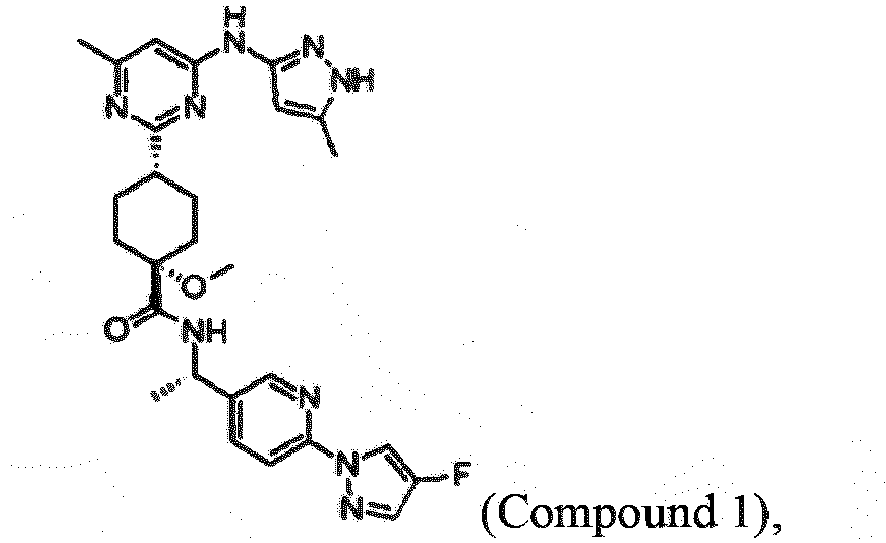
- A compound for use in the treatment of a rearranged during transfection (RET) altered cancer in a subject in need thereof, comprising administering to the subject 400 mg of Compound 1 or a pharmaceutically acceptable salt thereof once daily, wherein Compound 1 is:

- The compound for the use of claim 2, wherein:(i) the lung cancer is selected from small cell lung cancer (SCLC), lung adenocarcinoma, non-small cell lung cancer (NSCLC), bronchioles lung cell carcinoma, and mesothelioma; and(ii) the head and neck cancer is selected from salivary gland cancer and thyroid cancer, preferably wherein the thyroid cancer is selected from differentiated thyroid cancer (DTC), medullary thyroid cancer (MTC), and anaplastic thyroid cancer, preferably wherein the differentiated thyroid cancer is selected from papillary thyroid cancer (PTC) and follicular thyroid cancer.
- The compound for the use of any one of claims 1 to 3, wherein:(i) the RET altered cancer comprises a RET fusion;(ii) the RET-altered cancer is RET-fusion non-small cell lung cancer (NSCLC); or(iii) the RET-altered cancer is a RET-fusion thyroid cancer selected from papillary thyroid cancer (PTC), metastatic papillary thyroid cancer, thyroid gland carcinoma, medullary thyroid cancer (MTC), diffuse sclerosing variant of papillary thyroid cancer and sporadic medullary thyroid cancer.
- The compound for the use of claim 4, wherein the RET fusion is selected from the group consisting of CLIP1, PIBF1, BCR, FGFRIOP, CEP55, CUX1, MPRIP, CCDC6, KIF5B, PTClex9, NCOA4, TRIM33, ERC1, MBD1, RAB61P2, PRKAR1A, TRIM24, KTN1, GOLGA5, HOOK3, KIAA1468, TRIM27, AKAP13, FKBP15, SPECC1L, TBL1XR1, ACBD5, KIAA1217, and MYH13, preferably wherein the RET fusion is selected from CCDC6, KIF5B, TRIM33, TRIM24, and NCOA4; or MPRIP, KIF5B, CCDC6, NCOA4, TRIM33, and KIAA1217; or ERC1, GOLGA5, MYH13, PTClex9, MBD1, RAB61P2, PRKAR1A, TRIM24, KTN1, HOOK3, TRIM27, AKAP13, FKBP15, SPECC1L, TBL1XR1, ACBD5, CCDC6, NCOA4, TRIM33, KIAA1468, KIF5B, and KIAA1217.
- The compound for the use of any one of claims 1 to 3 wherein the RET-altered cancer comprises:(i) a RET mutation, optionally wherein the RET mutation is a point mutation or a resistance mutation; or(ii) a RET-mutant thyroid cancer selected from papillary thyroid carcinoma (PTC), medullary thyroid cancer (MTC), metastatic papillary thyroid cancer, diffuse sclerosing variant of papillary thyroid cancer, thyroid gland carcinoma and sporadic medullary thyroid cancer, preferably wherein the cancer is medullary thyroid cancer (MTC).
- The compound for the use of claim 6, wherein the RET-altered cancer is a RET mutant thyroid cancer, and wherein the RET mutant is sporadic or wherein the RET mutant is hereditary.
- The compound for the use of claim 6, wherein the RET mutation or RET mutant is V804L, V804M, V804E, M918T, C609Y, C609S, C609G, C609R, C609F, C609W, C611R, C611S, C611G, C611Y, C611F, C611W, C618S, C618Y, C618R, C618G, C618F, C618W, C620S, C620W, C620R, C620G, C620L, C620Y, C620F, C630A, C630R, C630S, C630Y, C630F, C634W, C634Y, C634S, C634F, C634G, C634L, C634A, C634T, L790F, R844W, R844Q, R844L, A883F, A883S, A883T, K666E, K666M, or K666N.
- The compound for the use of any one of claims 1 to 8 wherein the cancer is metastatic and is selected from metastatic papillary thyroid cancer (PTC) and metastatic non-small cell lung cancer (NSCLC).
- The compound for the use of any one of claims 2 to 8 wherein the cancer is metastatic and is metastatic colon cancer.
- The compound for the use of any one of claims 1 to 10, wherein the subject was previously treated with chemotherapy, optionally wherein the previous chemotherapy is selected from cisplatin and carboplatin.
- The compound for the use of any one of claims 1 and 4 to 11, wherein the subject is administered 300 mg of Compound 1 once daily.
- The compound for the use of any one of claims 1 and 4 to 11, wherein the subject is administered 400 mg of Compound 1 once daily.
- The compound for the use of claim 1, wherein:(i) the RET-altered cancer is a RET-mutant thyroid cancer selected from papillary thyroid carcinoma (PTC), medullary thyroid cancer (MTC), metastatic papillary thyroid cancer, diffuse sclerosing variant of papillary thyroid cancer, thyroid gland carcinoma and sporadic medullary thyroid cancer; and the subject is orally administered the 300 mg or 400 mg of Compound 1 once daily; or(ii) the RET-altered cancer is RET-fusion non-small cell lung cancer (NSCLC); and the subject is orally administered the 300 mg or 400 mg of Compound 1 once daily; or(iii) the RET-altered cancer is a RET-fusion thyroid cancer selected from papillary thyroid cancer (PTC), metastatic papillary thyroid cancer, thyroid gland carcinoma, medullary thyroid cancer (MTC), diffuse sclerosing variant of papillary thyroid cancer and sporadic medullary thyroid cancer; and the subject is orally administered the 300 mg or 400 mg of Compound 1 once daily.
Priority Applications (4)
| Application Number | Priority Date | Filing Date | Title |
|---|---|---|---|
| HRP20240124TT HRP20240124T1 (en) | 2018-04-03 | 2019-04-03 | RET INHIBITORS FOR USE IN TREATMENT OF CANCER HAVING RET ALTERATION |
| SI201930702T SI3773589T1 (en) | 2018-04-03 | 2019-04-03 | Ret inhibitor for use in treating cancer having a ret alteration |
| RS20240107A RS65127B1 (en) | 2018-04-03 | 2019-04-03 | Ret inhibitor for use in treating cancer having a ret alteration |
| EP23199171.2A EP4353317A3 (en) | 2018-04-03 | 2019-04-03 | Ret inhibitor for use in treating cancer having a ret alteration |
Applications Claiming Priority (5)
| Application Number | Priority Date | Filing Date | Title |
|---|---|---|---|
| US201862652284P | 2018-04-03 | 2018-04-03 | |
| US201862656297P | 2018-04-11 | 2018-04-11 | |
| US201862657605P | 2018-04-13 | 2018-04-13 | |
| US201862741683P | 2018-10-05 | 2018-10-05 | |
| PCT/US2019/025655 WO2019195471A1 (en) | 2018-04-03 | 2019-04-03 | Ret inhibitor for use in treating cancer having a ret alteration |
Related Child Applications (2)
| Application Number | Title | Priority Date | Filing Date |
|---|---|---|---|
| EP23199171.2A Division EP4353317A3 (en) | 2018-04-03 | 2019-04-03 | Ret inhibitor for use in treating cancer having a ret alteration |
| EP23199171.2A Division-Into EP4353317A3 (en) | 2018-04-03 | 2019-04-03 | Ret inhibitor for use in treating cancer having a ret alteration |
Publications (2)
| Publication Number | Publication Date |
|---|---|
| EP3773589A1 EP3773589A1 (en) | 2021-02-17 |
| EP3773589B1 true EP3773589B1 (en) | 2023-11-01 |
Family
ID=66223846
Family Applications (2)
| Application Number | Title | Priority Date | Filing Date |
|---|---|---|---|
| EP19718531.7A Revoked EP3773589B1 (en) | 2018-04-03 | 2019-04-03 | Ret inhibitor for use in treating cancer having a ret alteration |
| EP23199171.2A Withdrawn EP4353317A3 (en) | 2018-04-03 | 2019-04-03 | Ret inhibitor for use in treating cancer having a ret alteration |
Family Applications After (1)
| Application Number | Title | Priority Date | Filing Date |
|---|---|---|---|
| EP23199171.2A Withdrawn EP4353317A3 (en) | 2018-04-03 | 2019-04-03 | Ret inhibitor for use in treating cancer having a ret alteration |
Country Status (26)
| Country | Link |
|---|---|
| US (5) | US20210100795A1 (en) |
| EP (2) | EP3773589B1 (en) |
| JP (3) | JP7422084B2 (en) |
| KR (1) | KR20200139749A (en) |
| AU (1) | AU2019247766A1 (en) |
| BR (1) | BR112020020273A2 (en) |
| CA (1) | CA3096043A1 (en) |
| CL (1) | CL2020002544A1 (en) |
| CR (1) | CR20200522A (en) |
| DK (1) | DK3773589T3 (en) |
| ES (1) | ES2970041T3 (en) |
| FI (1) | FI3773589T3 (en) |
| HR (1) | HRP20240124T1 (en) |
| HU (1) | HUE065374T2 (en) |
| IL (1) | IL277629A (en) |
| LT (1) | LT3773589T (en) |
| MX (1) | MX2020010417A (en) |
| MY (1) | MY203645A (en) |
| PE (1) | PE20210096A1 (en) |
| PL (1) | PL3773589T3 (en) |
| PT (1) | PT3773589T (en) |
| RS (1) | RS65127B1 (en) |
| SG (1) | SG11202009681YA (en) |
| SI (1) | SI3773589T1 (en) |
| WO (1) | WO2019195471A1 (en) |
| ZA (1) | ZA202006072B (en) |
Families Citing this family (7)
| Publication number | Priority date | Publication date | Assignee | Title |
|---|---|---|---|---|
| WO2016127074A1 (en) | 2015-02-06 | 2016-08-11 | Blueprint Medicines Corporation | 2-(pyridin-3-yl)-pyrimidine derivatives as ret inhibitors |
| NZ742351A (en) | 2015-11-02 | 2023-03-31 | Blueprint Medicines Corp | Inhibitors of ret |
| EP3773589B1 (en) | 2018-04-03 | 2023-11-01 | Blueprint Medicines Corporation | Ret inhibitor for use in treating cancer having a ret alteration |
| US11666570B2 (en) * | 2019-07-11 | 2023-06-06 | The Board Of Trustees Of The Leland Stanford Junior University | Diagnosis and regulation of epidermal differentiation and cancer cell activity |
| CA3183728A1 (en) | 2020-05-29 | 2021-12-02 | Blueprint Medicines Corporation | Solid forms of pralsetinib |
| US11946935B2 (en) * | 2020-08-25 | 2024-04-02 | Regents Of The University Of Minnesota | Circulating tumor markers for meningiomas |
| JP1746261S (en) * | 2022-10-17 | 2023-06-14 | Quantum encryption key transmitter |
Citations (3)
| Publication number | Priority date | Publication date | Assignee | Title |
|---|---|---|---|---|
| WO2017079140A1 (en) | 2015-11-02 | 2017-05-11 | Blueprint Medicines Corporation | Inhibitors of ret |
| WO2018071447A1 (en) | 2016-10-10 | 2018-04-19 | Andrews Steven W | Substituted pyrazolo[1,5-a]pyridine compounds as ret kinase inhibitors |
| WO2018213329A1 (en) | 2017-05-15 | 2018-11-22 | Blueprint Medicines Corporation | Combinations of ret inhibitors and mtorc1 inhibitors and uses thereof for the treatment of cancer mediated by aberrant ret activity |
Family Cites Families (95)
| Publication number | Priority date | Publication date | Assignee | Title |
|---|---|---|---|---|
| HUP0301117A3 (en) | 2000-02-17 | 2004-01-28 | Amgen Inc Thousand Oaks | Imidazole derivatives kinase inhibitors, their use, process for their preparation and pharmaceutical compositions containing them |
| US20060116381A1 (en) | 2002-07-24 | 2006-06-01 | Fagin James A | 4-4(methylpiperazin-1-ylmethyl)-n-[4-methyl-3-(pyridin-3-yl)pyrimidin-2-ylamino)phenyl]-ben-zamide for treating mutated-ret kinase associated diseases |
| PL1696920T3 (en) | 2003-12-19 | 2015-03-31 | Plexxikon Inc | Compounds and methods for development of ret modulators |
| US8227455B2 (en) | 2005-04-18 | 2012-07-24 | Rigel Pharmaceuticals, Inc. | Methods of treating cell proliferative disorders |
| SG159561A1 (en) | 2005-05-09 | 2010-03-30 | Achillion Pharmaceuticals Inc | Thiazole compounds and methods of use |
| US20100047777A1 (en) | 2005-05-26 | 2010-02-25 | The Johns Hopkins University | Methods for identifying mutations in coding and non-coding dna |
| WO2007023382A2 (en) | 2005-08-25 | 2007-03-01 | Pfizer Inc. | Pyrimidine amino pyrazole compounds, potent kinase inhibitors |
| WO2007087245A2 (en) | 2006-01-24 | 2007-08-02 | Merck & Co., Inc. | Ret tyrosine kinase inhibition |
| WO2007136103A1 (en) | 2006-05-18 | 2007-11-29 | Eisai R & D Management Co., Ltd. | Antitumor agent for thyroid cancer |
| WO2008061201A1 (en) | 2006-11-15 | 2008-05-22 | Rigel Pharmaceuticals, Inc. | Methods for treating renal tumors using 2,4-pyrimidinediamine drug and prodrug compounds |
| WO2009003136A1 (en) | 2007-06-26 | 2008-12-31 | Rigel Pharmaceuticals, Inc. | Substituted pyrimidine-2, 4 -diamines for treating cell proliferative disorders |
| BRPI0814818A2 (en) | 2007-07-09 | 2019-09-10 | Astrazeneca Ab | compound, use of a compound, methods for producing an antiproliferative effect and a inhibitor effect of mtor kinase in a warm-blooded animal, method for treating disease, and, pharmaceutical composition |
| WO2009014637A2 (en) | 2007-07-19 | 2009-01-29 | Schering Corporation | Heterocyclic amide compounds as protein kinase inhibitors |
| AR067762A1 (en) | 2007-07-31 | 2009-10-21 | Vertex Pharma | PROCESS TO PREPARE 5-FLUORO-1H-PIRAZOLO (3,4-B) PIRIDIN-3-AMINA AND DERIVATIVES OF THE SAME |
| WO2009100536A1 (en) | 2008-02-15 | 2009-08-20 | Methylgene Inc. | Inhibitors of kinase activity with 1,2-di-cyclyl substituted alkyne structures |
| WO2010006432A1 (en) | 2008-07-14 | 2010-01-21 | Queen's University At Kingston | Pharmaceutical compositions comprising ret inhibitors and methods for the treatment of cancer |
| EP2411011A4 (en) | 2009-03-24 | 2012-08-15 | Msd Kk | NOVEL AMINOPYRIDINE DERIVATIVES HAVING SELECTIVE INHIBITORY ACTION OF AURORA A |
| AU2010259023A1 (en) | 2009-06-08 | 2012-01-12 | Nantbioscience, Inc. | Triazine derivatives and their therapeutical applications |
| CN102573484B (en) | 2009-06-09 | 2015-07-01 | 加利福尼亚资本权益有限责任公司 | Benzyl substituted triazine derivatives and their therapeutical applications |
| CA2777128A1 (en) | 2009-10-30 | 2011-05-05 | Ariad Pharmaceuticals, Inc. | Methods and compositions for treating cancer |
| US8629132B2 (en) | 2009-11-13 | 2014-01-14 | Genosco | Kinase inhibitors |
| KR20140047138A (en) | 2011-08-04 | 2014-04-21 | 도쿠리츠교세이호진 고쿠리츠간켄큐센터 | Fusion gene of kif5b gene and ret gene, and method for determining effectiveness of cancer treatment targeting fusion gene |
| ES2704126T3 (en) | 2011-08-23 | 2019-03-14 | Found Medicine Inc | KIF5B-RET fusion molecules and their uses |
| MX370814B (en) | 2011-09-02 | 2020-01-08 | Univ California | Substituted pyrazolo[3,4-d]pyrimidines and uses thereof. |
| US20130096136A1 (en) | 2011-09-30 | 2013-04-18 | Methylgene Inc. | Inhibitors of Protein Tyrosine Kinase Activity |
| US10023855B2 (en) | 2011-10-31 | 2018-07-17 | Macrogen, Inc. | Fusion protein comprising C-terminal domain of RET protein and use thereof as a diagnosing marker |
| WO2013071093A1 (en) | 2011-11-09 | 2013-05-16 | Vertex Pharmaceuticals Incorporated | Pyrazine compounds useful as inhibitors of atr kinase |
| CN104169260A (en) | 2012-03-09 | 2014-11-26 | 卡尔那生物科学株式会社 | Novel triazone derivative |
| JP2015109806A (en) | 2012-03-22 | 2015-06-18 | アステラス製薬株式会社 | Method for detecting new ret fused body |
| MX360323B (en) | 2012-04-25 | 2018-10-29 | Raqualia Pharma Inc | Pyrrolopyridinone derivatives as ttx-s blockers. |
| AU2013259267A1 (en) | 2012-05-10 | 2014-11-06 | Synta Pharmaceuticals Corp. | Treating cancer with Hsp90 inhibitory compounds |
| NZ703495A (en) | 2012-07-11 | 2018-02-23 | Blueprint Medicines Corp | Inhibitors of the fibroblast growth factor receptor |
| US20150177246A1 (en) | 2012-07-26 | 2015-06-25 | Lsip, Llc | Fusion gene of cep55 gene and ret gene |
| EP2892532B1 (en) | 2012-09-07 | 2019-02-13 | Exelixis, Inc. | Inhibitors of met, vegfr and ret for use in the treatment of lung adenocarcinoma |
| US10668075B2 (en) | 2012-09-25 | 2020-06-02 | Chugai Seiyaku Kabushiki Kaisha | RET inhibitor |
| ES2755772T3 (en) | 2012-11-07 | 2020-04-23 | Nerviano Medical Sciences Srl | Pyrimidinyl and substituted pyridinylpyrrolopyridinones, process for their preparation and use as kinase inhibitors |
| TWI629266B (en) | 2012-12-28 | 2018-07-11 | 藍印藥品公司 | Inhibitors of the fibroblast growth factor receptor |
| JP6186012B2 (en) | 2013-02-25 | 2017-08-23 | ブリストル−マイヤーズ スクイブ カンパニーBristol−Myers Squibb Company | C-3 alkyl and alkenyl modified betulinic acid derivatives |
| WO2014160521A1 (en) | 2013-03-15 | 2014-10-02 | Blueprint Medicines Corporation | Piperazine derivatives and their use as kit modulators |
| UY35465A (en) | 2013-03-15 | 2014-10-31 | Glaxosmithkline Ip Dev Ltd | NEW COMPOUNDS AS REORGANIZED INHIBITORS DURING TRANSFECTION (RET) |
| WO2014147640A2 (en) | 2013-03-19 | 2014-09-25 | Glenmark Pharmaceuticals Limited; Glenmark Generics Limited | Process for the preparation of anagliptin |
| WO2015006875A1 (en) | 2013-07-18 | 2015-01-22 | Methylgene Inc. | Process for the preparation of substituted pyrimidines |
| US20150057335A1 (en) | 2013-08-20 | 2015-02-26 | National Cancer Center | Novel fusion genes identified in lung cancer |
| US9334263B2 (en) | 2013-10-17 | 2016-05-10 | Blueprint Medicines Corporation | Compositions useful for treating disorders related to kit |
| LT3057969T (en) | 2013-10-17 | 2018-07-10 | Blueprint Medicines Corporation | Compositions useful for treating disorders related to kit |
| DK3395814T3 (en) | 2013-10-25 | 2022-07-04 | Blueprint Medicines Corp | Inhibitors of the fibroblast growth factor receptor |
| GB201321146D0 (en) | 2013-11-29 | 2014-01-15 | Cancer Rec Tech Ltd | Quinazoline compounds |
| WO2015108992A1 (en) | 2014-01-15 | 2015-07-23 | Blueprint Medicines Corporation | Heterobicyclic compounds and their use as fgfr4 receptor inhibitors |
| US9688680B2 (en) | 2014-08-04 | 2017-06-27 | Blueprint Medicines Corporation | Compositions useful for treating disorders related to kit |
| AU2015313841B2 (en) | 2014-09-10 | 2018-03-08 | Glaxosmithkline Intellectual Property Development Limited | Pyridone derivatives as rearranged during transfection (RET) kinase inhibitors |
| CR20170094A (en) | 2014-09-10 | 2017-05-08 | Glaxosmithkline Ip Dev Ltd | NEW COMPOUNDS AS REORGANIZED INHIBITORS DURING TRANSFECTION (RET) |
| KR102562866B1 (en) | 2014-11-14 | 2023-08-04 | 네르비아노 메디칼 사이언시스 에스.알.엘. | 6-amino-7-bicyclo-7-deaza-purine derivatives as protein kinase inhibitors |
| WO2016127074A1 (en) | 2015-02-06 | 2016-08-11 | Blueprint Medicines Corporation | 2-(pyridin-3-yl)-pyrimidine derivatives as ret inhibitors |
| CN104844567B (en) | 2015-04-23 | 2017-03-29 | 暨南大学 | Synthesis method of intermediate 1- (3-chloro-2-pyridyl) -3-bromo-1H-5-pyrazolecarboxylic acid |
| HUE053067T2 (en) | 2015-07-16 | 2021-06-28 | Array Biopharma Inc | Substituted pyrazolo [1,5-A] pyridine compounds as RET kinase inhibitors |
| AU2016297754A1 (en) | 2015-07-24 | 2018-02-15 | Blueprint Medicines Corporation | Compounds useful for treating disorders related to KIT and PDGFR |
| CA2995997A1 (en) | 2015-08-26 | 2017-03-02 | Blueprint Medicines Corporation | Compounds and compositions useful for treating disorders related to ntrk |
| CN105255927B (en) | 2015-09-30 | 2018-07-27 | 温州医科大学附属第一医院 | A kind of KIAA1217-RET fusions |
| JP6936221B2 (en) | 2015-11-02 | 2021-09-15 | ファイブ プライム セラピューティクス, インコーポレイテッド | CD80 extracellular domain polypeptides and their use in cancer treatment |
| US20170121420A1 (en) | 2015-11-02 | 2017-05-04 | Janssen Pharmaceutica Nv | Anti-il1rap antibodies, bispecific antigen binding molecules that bind il1rap and cd3, and uses thereof |
| MX2018006195A (en) | 2015-11-19 | 2018-09-05 | Blueprint Medicines Corp | Compounds and compositions useful for treating disorders related to ntrk. |
| CN108602890A (en) | 2015-12-11 | 2018-09-28 | 瑞泽恩制药公司 | Method for reducing or preventing the tumour growth resistant to EGFR and/or ERBB3 retarding agents |
| WO2017145050A1 (en) | 2016-02-23 | 2017-08-31 | Glaxosmithkline Intellectual Property Development Limited | Pyridylpyridone derivative useful as a ret kinase inhibitor in the treatment of ibs and cancer |
| UY37155A (en) | 2016-03-17 | 2017-10-31 | Blueprint Medicines Corp | RET INHIBITORS |
| BR112018070163A2 (en) | 2016-04-01 | 2019-01-29 | Signal Pharm Llc | substituted aminopurine compounds, compositions and methods of treatment |
| RS63609B1 (en) | 2016-04-15 | 2022-10-31 | Cancer Research Tech Ltd | HETEROCYCLIC COMPOUNDS AS RET KINASE INHIBITORS |
| EP3442980B1 (en) | 2016-04-15 | 2021-06-09 | Cancer Research Technology Limited | Heterocyclic compounds as ret kinase inhibitors |
| FI3442977T3 (en) | 2016-04-15 | 2023-09-26 | Blueprint Medicines Corp | Inhibitors of activin receptor-like kinase |
| WO2018017983A1 (en) | 2016-07-22 | 2018-01-25 | Blueprint Medicines Corporation | Compounds useful for treating disorders related to ret |
| US10035789B2 (en) | 2016-07-27 | 2018-07-31 | Blueprint Medicines Corporation | Compounds useful for treating disorders related to RET |
| WO2018049233A1 (en) | 2016-09-08 | 2018-03-15 | Nicolas Stransky | Inhibitors of the fibroblast growth factor receptor in combination with cyclin-dependent kinase inhibitors |
| JP2018052878A (en) | 2016-09-29 | 2018-04-05 | 第一三共株式会社 | Pyridine compounds |
| CN106749231B (en) | 2016-10-09 | 2019-03-01 | 南京纳丁菲医药科技有限公司 | Naphthyridine compounds and pharmaceutical composition and their application |
| TWI752098B (en) | 2016-10-10 | 2022-01-11 | 美商亞雷生物製藥股份有限公司 | Substituted pyrazolo[1,5-a]pyridine compounds as ret kinase inhibitors |
| JP7105774B2 (en) | 2016-12-01 | 2022-07-25 | イグナイタ インコーポレイテッド | Methods for treating cancer |
| US11168090B2 (en) | 2017-01-18 | 2021-11-09 | Array Biopharma Inc. | Substituted pyrazolo[1,5-a]pyrazines as RET kinase inhibitors |
| WO2018136663A1 (en) | 2017-01-18 | 2018-07-26 | Array Biopharma, Inc. | Ret inhibitors |
| US11040979B2 (en) | 2017-03-31 | 2021-06-22 | Blueprint Medicines Corporation | Substituted pyrrolo[1,2-b]pyridazines for treating disorders related to KIT and PDGFR |
| GB201705971D0 (en) | 2017-04-13 | 2017-05-31 | Cancer Res Tech Ltd | Inhibitor compounds |
| WO2018237134A1 (en) | 2017-06-23 | 2018-12-27 | San Diego State University Research Foundation | ATROPISOMERISM FOR ENHANCED SELECTIVITY OF KINASE INHIBITORS |
| CN109180677A (en) | 2017-06-30 | 2019-01-11 | 厦门大学 | Substituted aryl ethers compounds, preparation method, Pharmaceutical composition and its application |
| PL3649260T3 (en) | 2017-07-07 | 2022-10-17 | Nipd Genetics Public Company Limited | Target-enriched multiplexed parallel analysis for assessment of tumor biomarkers |
| CN107980784B (en) | 2017-12-13 | 2020-05-26 | 中国农业大学 | Application of 5-aminopyrazole compounds in regulating plant growth |
| HUE060711T2 (en) | 2017-12-19 | 2023-04-28 | Turning Point Therapeutics Inc | Macrocyclic compounds for the treatment of diseases |
| EP3740490A1 (en) | 2018-01-18 | 2020-11-25 | Array Biopharma, Inc. | Substituted pyrazolo[3,4-d]pyrimidine compounds as ret kinase inhibitors |
| EP3740491A1 (en) | 2018-01-18 | 2020-11-25 | Array Biopharma, Inc. | Substituted pyrrolo[2,3-d]pyrimidines compounds as ret kinase inhibitors |
| CA3087972C (en) | 2018-01-18 | 2023-01-10 | Array Biopharma Inc. | Substituted pyrazolyl[4,3-c]pyridinecompounds as ret kinase inhibitors |
| CN108341782A (en) | 2018-03-30 | 2018-07-31 | 南京哈柏医药科技有限公司 | The synthesis technology of 3- amino-5-methylpyrazoles |
| EP3773589B1 (en) | 2018-04-03 | 2023-11-01 | Blueprint Medicines Corporation | Ret inhibitor for use in treating cancer having a ret alteration |
| EP3833372A4 (en) | 2018-08-10 | 2022-06-08 | Blueprint Medicines Corporation | EGFR MUTANT CANCER TREATMENT |
| CN111440151A (en) | 2020-03-25 | 2020-07-24 | 魏威 | Method for preparing antitumor drug prasutinib |
| CN111362923A (en) | 2020-03-25 | 2020-07-03 | 魏威 | Method for preparing RET inhibitor pracetib, intermediate of pracetib and preparation method of pracetib |
| CR20220666A (en) | 2020-05-29 | 2023-05-05 | Blueprint Medicines Corp | Pralsetinib pharmaceutical compositions |
| CA3183728A1 (en) | 2020-05-29 | 2021-12-02 | Blueprint Medicines Corporation | Solid forms of pralsetinib |
| AU2021390534A1 (en) | 2020-12-04 | 2023-06-22 | Blueprint Medicines Corporation | Method of preparing pralsetinib |
-
2019
- 2019-04-03 EP EP19718531.7A patent/EP3773589B1/en not_active Revoked
- 2019-04-03 FI FIEP19718531.7T patent/FI3773589T3/en active
- 2019-04-03 PE PE2020001523A patent/PE20210096A1/en unknown
- 2019-04-03 HR HRP20240124TT patent/HRP20240124T1/en unknown
- 2019-04-03 DK DK19718531.7T patent/DK3773589T3/en active
- 2019-04-03 AU AU2019247766A patent/AU2019247766A1/en not_active Withdrawn
- 2019-04-03 CR CR20200522A patent/CR20200522A/en unknown
- 2019-04-03 PL PL19718531.7T patent/PL3773589T3/en unknown
- 2019-04-03 SG SG11202009681YA patent/SG11202009681YA/en unknown
- 2019-04-03 LT LTEPPCT/US2019/025655T patent/LT3773589T/en unknown
- 2019-04-03 WO PCT/US2019/025655 patent/WO2019195471A1/en not_active Ceased
- 2019-04-03 JP JP2020553633A patent/JP7422084B2/en active Active
- 2019-04-03 ES ES19718531T patent/ES2970041T3/en active Active
- 2019-04-03 RS RS20240107A patent/RS65127B1/en unknown
- 2019-04-03 MY MYPI2020005148A patent/MY203645A/en unknown
- 2019-04-03 EP EP23199171.2A patent/EP4353317A3/en not_active Withdrawn
- 2019-04-03 KR KR1020207031426A patent/KR20200139749A/en not_active Withdrawn
- 2019-04-03 CA CA3096043A patent/CA3096043A1/en active Pending
- 2019-04-03 MX MX2020010417A patent/MX2020010417A/en unknown
- 2019-04-03 SI SI201930702T patent/SI3773589T1/en unknown
- 2019-04-03 US US17/044,884 patent/US20210100795A1/en not_active Abandoned
- 2019-04-03 BR BR112020020273-8A patent/BR112020020273A2/en not_active Application Discontinuation
- 2019-04-03 HU HUE19718531A patent/HUE065374T2/en unknown
- 2019-04-03 PT PT197185317T patent/PT3773589T/en unknown
-
2020
- 2020-09-27 IL IL277629A patent/IL277629A/en unknown
- 2020-09-30 ZA ZA2020/06072A patent/ZA202006072B/en unknown
- 2020-10-01 CL CL2020002544A patent/CL2020002544A1/en unknown
- 2020-10-02 US US17/061,743 patent/US11963958B2/en active Active
- 2020-12-18 US US17/127,041 patent/US11273160B2/en active Active
-
2021
- 2021-07-16 US US17/377,885 patent/US11872192B2/en active Active
- 2021-12-09 JP JP2021199945A patent/JP2022022391A/en active Pending
-
2023
- 2023-09-28 JP JP2023167564A patent/JP2023165937A/en not_active Withdrawn
-
2024
- 2024-03-15 US US18/606,346 patent/US12539303B2/en active Active
Patent Citations (3)
| Publication number | Priority date | Publication date | Assignee | Title |
|---|---|---|---|---|
| WO2017079140A1 (en) | 2015-11-02 | 2017-05-11 | Blueprint Medicines Corporation | Inhibitors of ret |
| WO2018071447A1 (en) | 2016-10-10 | 2018-04-19 | Andrews Steven W | Substituted pyrazolo[1,5-a]pyridine compounds as ret kinase inhibitors |
| WO2018213329A1 (en) | 2017-05-15 | 2018-11-22 | Blueprint Medicines Corporation | Combinations of ret inhibitors and mtorc1 inhibitors and uses thereof for the treatment of cancer mediated by aberrant ret activity |
Non-Patent Citations (20)
| Title |
|---|
| ALEXANDER DRILON, ZISHUO I. HU, GILLIANNE G. Y. LAI, DANIEL S. W. TAN: "Targeting RET-driven cancers: lessons from evolving preclinical and clinical landscapes", NATURE REVIEWS CLINICAL ONCOLOGY, vol. 15, no. 3, 1 March 2018 (2018-03-01), NY, US , pages 151 - 167, XP055719825, ISSN: 1759-4774, DOI: 10.1038/nrclinonc.2017.175 |
| ANONYMOUS: "BLU-667 Targets RET-Altered Cancers.", CANCER DISCOVERY, vol. 8, no. 6, 1 June 2018 (2018-06-01), pages 5pp, XP002792436, ISSN: 2159-8290, Retrieved from the Internet <URL:http://cancerdiscovery.aacrjournals.org/content/8/6/OF8.long> DOI: 10.1158/2159-8290.CD-NB2018-050 |
| ANONYMOUS: "Estimating the Maximum Safe Starting Dose in Initial Clinical Trials for Therapeutics in Adult Healthy Volunteers", GUIDANCE FOR INDUSTRY, 1 July 2005 (2005-07-01), pages 1 - 30, XP093000005, Retrieved from the Internet <URL:https://www.fda.gov/media/72309/download> [retrieved on 20221121] * |
| ANONYMOUS: "Guidance for Industry Estimating the Maximum Safe Starting Dose in Initial Clinical Trials for Therapeutics in Adult Healthy Volunteers", U.S. DEPARTMENT OF HEALTH AND HUMAN SERVICES FOOD AND DRUG ADMINISTRATION CENTER FOR DRUG EVALUATION AND RESEARCH (CDER, 1 July 2005 (2005-07-01), pages 1 - 30, XP093195537, Retrieved from the Internet <URL:https://www.fda.gov/media/72309/download> [retrieved on 20240815] |
| ANONYMOUS: "Phase 1/2 Study of the Highly-selective RET Inhibitor, Pralsetinib (BLU-667), in Participants With Thyroid Cancer, Non-Small Cell Lung Cancer, and Other Advanced Solid Tumors", CLINICAL TRIALS, 21 April 2017 (2017-04-21), pages 1 - 14, XP093195466, Retrieved from the Internet <URL:https://www.clinicaltrials.gov/ct2/history/NCT03037385?V_3=View#StudyPageTop> [retrieved on 20240815] |
| BRUCE G. ROBINSON, LUIS PAZ-ARES, ANNETTA KREBS, JAMES VASSELLI, ROBERT HADDAD: "Vandetanib (100 mg) in Patients with Locally Advanced or Metastatic Hereditary Medullary Thyroid Cancer", JOURNAL OF CLINICAL ENDOCRINOLOGY AND METABOLISM, vol. 95, no. 6, 1 June 2010 (2010-06-01), US , pages 2664 - 2671, XP055599340, ISSN: 0021-972X, DOI: 10.1210/jc.2009-2461 |
| ELIZABETH A. EISENHAUER , CHRISTOPHER TWELVES , MARC BUYSE: "Phase I Cancer Clinical Trials: A Practical Guide (2 edn)", 1 March 2015, OXFORD UNIVERSITY PRESS, ISBN: 978-0-19-935901-1, article DONNA M, GRAHAM, AARON R. HANSEN, ELIZABETH A. EISENHAUER, LILLIAN L. SIU: "Basics of Phase I Design: First-in-Human Studies", pages: 58 - 91, XP093195538 |
| GAINOR JUSTIN F; CURIGLIANO GIUSEPPE; KIM DONG-WAN; LEE DAE HO; BESSE BENJAMIN; BAIK CHRISTINA S; DOEBELE ROBERT C; CASSIER PHILIP: "Pralsetinib for RET fusion-positive non-small-cell lung cancer (ARROW): a multi-cohort, open-label, phase 1/2 study", THE LANCET ONCOLOGY, vol. 22, no. 7, 9 June 2021 (2021-06-09), AMSTERDAM, NL , pages 959 - 969, XP086683177, DOI: 10.1016/S1470-2045(21)00247-3 |
| KAMIL NOOR: "Dose estimation, conversion and translation from animal to human and human to animal for clinical and animal studies", INT. J. BIOL. BIOTECH., 1 July 2017 (2017-07-01), pages 311 - 317, XP093000013, Retrieved from the Internet <URL:https://www.researchgate.net/publication/322329638_Dose_estimation_conversion_and_translation_from_animal_to_human_and_human_to_animal_for_clinical_and_animal_studies> [retrieved on 20221121] * |
| NOOR KAMIL , SABA KAMIL: "Dose estimation, conversion and translation from animal to human and human to animal for clinical and animal studies", INT. J. BIOL. BIOTECH., vol. 14, no. 3, 1 July 2017 (2017-07-01), pages 311 - 317, XP093000013 |
| POUND PANDORA J ET AL: "Is it possible to overcome issues of external validity in preclinical animal research? Why most animal models are bound to fail", J. TRANSL MED, 1 January 2018 (2018-01-01), pages 1 - 8, XP093000231, Retrieved from the Internet <URL:https://www.researchgate.net/publication/328793141_Is_it_possible_to_overcome_issues_of_external_validity_in_preclinical_animal_research_Why_most_animal_models_are_bound_to_fail> [retrieved on 20221121], DOI: 10.1186/s12967-018-1678-1 * |
| POUND PANDORA J, RITSKES‑HOITINGA MEREL: "Is it possible to overcome issues of external validity in preclinical animal research? Why most animal models are bound to fail", JOURNAL OF TRANSLATIONAL MEDICINE, vol. 16, 1 January 2018 (2018-01-01), pages 1 - 8, XP093000231, DOI: 10.1186/s12967‑018‑1678‑1 |
| RAMI RAHAL ET AL: "BLU-667 is a potent and highly selective RET inhibitor being developed for RET- driven cancers", MOLECULAR CANCER THERAPEUTICS, 1 January 2018 (2018-01-01), pages 1, XP055644433, Retrieved from the Internet <URL:https://www.blueprintmedicines.com/wp-content/uploads/2018/12/BLU-667-EORTC-2017-BPM.pdf> [retrieved on 20191120] * |
| SHANNON REAGAN-SHAW ET AL: "Dose translation from animal to human studies revisited", THE FASEB JOURNAL, vol. 22, no. 3, 1 March 2008 (2008-03-01), & EXPERIMENTAL BIOLOGY MEETING; SAN DIEGO, CA, USA; APRIL 21 -25, 2018, pages 659 - 661, XP055542714, ISSN: 0892-6638, DOI: 10.1096/fj.07-9574LSF * |
| SHANNON REAGAN-SHAW, MINAKSHI NIHAL, NIHAL AHMAD: "Dose translation from animal to human studies revisited", THE FASEB JOURNAL, vol. 22, no. 3, 1 March 2008 (2008-03-01), US, pages 659 - 661, XP055542714, ISSN: 0892-6638, DOI: 10.1096/fj.07-9574LSF |
| SUBBIAH V. ET AL: "Clinical activity and safety of the RET inhibitor pralsetinib in patients with RET fusion-positive solid tumours: update from the ARROW trial", ASCO, 4 June 2021 (2021-06-04), pages 1 - 1, XP093000210, Retrieved from the Internet <URL:https://ascopubs.org/doi/abs/10.1200/JCO.2021.39.15_suppl.3079> [retrieved on 20221121] * |
| SUBBIAH V: "Highly potent and selective RET inhibitor, BLU-667, achieves proof of concept in a phase I study of advanced, RET-altered solid tumors", CANCER RESEARCH, vol. 78, no. 13, Supplement 1, 1 July 2018 (2018-07-01), US , pages 1 - 4, XP002792435, ISSN: 1538-7445, DOI: 10.1158/1538-7445.AM2018-CT043 |
| SUBBIAH VIVEK, CASSIER PHILIPPE A., SIENA SALVATORE, ALONSO GUZMAN, PAZ-ARES LUIS G., GARRIDO PILAR, NADAL ERNEST, CURIGLIANO GIUS: "Clinical activity and safety of the RET inhibitor pralsetinib in patients with RET fusion-positive solid tumors: Update from the ARROW trial.", ASCO, 1 January 2021 (2021-01-01), pages 1 - 1, XP093195495 |
| SUBBIAH VIVEK; TAYLOR MATTHEW; LIN JESSICA; HU MIMI; OU SAI-HONG IGNATIUS; BROSE MARCIA S; GARRALDA ELENA; CLIFFORD CORINNE; PALME: "CT043: Highly potent and selective RET inhibitor, BLU-667, achieves proof of concept in a phase I study of advanced, RET-altered solid tumors", CANCER RESEARCH, AMERICAN ASSOCIATION FOR CANCER RESEARCH, US, vol. 78, no. 13, Supplement 1, 1 July 2018 (2018-07-01) - 18 April 2018 (2018-04-18), US , pages CT043, XP002792435, ISSN: 1538-7445, DOI: 10.1158/1538-7445.AM2018-CT043 |
| VIVEK SUBBIAH, JUSTIN F. GAINOR, RAMI RAHAL, JASON D. BRUBAKER, JOSEPH L. KIM, MICHELLE MAYNARD, WEI HU, QIONGFANG CAO, MICHAEL P.: "Precision Targeted Therapy with BLU-667 for RET -Driven Cancers", CANCER DISCOVERY, vol. 8, no. 7, 1 July 2018 (2018-07-01), US , pages 836 - 849, XP055599279, ISSN: 2159-8274, DOI: 10.1158/2159-8290.CD-18-0338 |
Also Published As
Similar Documents
| Publication | Publication Date | Title |
|---|---|---|
| US12539303B2 (en) | RET inhibitor for use in treating cancer having a RET alteration | |
| US20210290620A1 (en) | Combinations of RET Inhibitors and mTORC1 Inhibitors and Uses Thereof for the Treatment of Cancer Mediated by Aberrant RET Activity | |
| De Groot et al. | CDK4/6 inhibition in early and metastatic breast cancer: A review | |
| JP2022172039A (en) | Method for treating cancer | |
| JP7490635B2 (en) | Treatment of EGFR-mutated cancer | |
| CA3146346A1 (en) | 6-(2,4-dichlorophenyl)-5-[4-[(3s)-1-(3-fluoropropyl)pyrrolidin-3-yl]oxyphenyl]-8,9-dihydro-7h-benzo[7]annulene-2-carboxylic acid for use in metastatic or advanced breast cancer patients | |
| JP2024528705A (en) | Compositions and methods for inhibiting creatine transport as a treatment for cancer - Patents.com | |
| Kang et al. | A phase II study of tepotinib in patients with advanced solid cancers harboring MET exon 14 skipping mutations or amplification (KCSG AL19-17) | |
| CA3119582A1 (en) | Use of il-1.beta. binding antibodies | |
| RU2800951C2 (en) | Ret inhibitor for use in the treatment of cancer with ret alteration | |
| HK40046992B (en) | Ret inhibitor for use in treating cancer having a ret alteration | |
| HK40046992A (en) | Ret inhibitor for use in treating cancer having a ret alteration | |
| KR20230031839A (en) | Belvarafenib for use in cancer treatment | |
| Alvarez et al. | Medical Treatment Horizons for Metastatic Differentiated and Medullary Thyroid Cancer |
Legal Events
| Date | Code | Title | Description |
|---|---|---|---|
| REG | Reference to a national code |
Ref country code: HR Ref legal event code: TUEP Ref document number: P20240124T Country of ref document: HR |
|
| STAA | Information on the status of an ep patent application or granted ep patent |
Free format text: STATUS: UNKNOWN |
|
| STAA | Information on the status of an ep patent application or granted ep patent |
Free format text: STATUS: THE INTERNATIONAL PUBLICATION HAS BEEN MADE |
|
| PUAI | Public reference made under article 153(3) epc to a published international application that has entered the european phase |
Free format text: ORIGINAL CODE: 0009012 |
|
| STAA | Information on the status of an ep patent application or granted ep patent |
Free format text: STATUS: REQUEST FOR EXAMINATION WAS MADE |
|
| 17P | Request for examination filed |
Effective date: 20201028 |
|
| AK | Designated contracting states |
Kind code of ref document: A1 Designated state(s): AL AT BE BG CH CY CZ DE DK EE ES FI FR GB GR HR HU IE IS IT LI LT LU LV MC MK MT NL NO PL PT RO RS SE SI SK SM TR |
|
| AX | Request for extension of the european patent |
Extension state: BA ME |
|
| DAV | Request for validation of the european patent (deleted) | ||
| DAX | Request for extension of the european patent (deleted) | ||
| REG | Reference to a national code |
Ref country code: HK Ref legal event code: DE Ref document number: 40046992 Country of ref document: HK |
|
| STAA | Information on the status of an ep patent application or granted ep patent |
Free format text: STATUS: EXAMINATION IS IN PROGRESS |
|
| 17Q | First examination report despatched |
Effective date: 20211202 |
|
| GRAP | Despatch of communication of intention to grant a patent |
Free format text: ORIGINAL CODE: EPIDOSNIGR1 |
|
| STAA | Information on the status of an ep patent application or granted ep patent |
Free format text: STATUS: GRANT OF PATENT IS INTENDED |
|
| INTG | Intention to grant announced |
Effective date: 20230516 |
|
| P01 | Opt-out of the competence of the unified patent court (upc) registered |
Effective date: 20230522 |
|
| GRAS | Grant fee paid |
Free format text: ORIGINAL CODE: EPIDOSNIGR3 |
|
| GRAA | (expected) grant |
Free format text: ORIGINAL CODE: 0009210 |
|
| STAA | Information on the status of an ep patent application or granted ep patent |
Free format text: STATUS: THE PATENT HAS BEEN GRANTED |
|
| AK | Designated contracting states |
Kind code of ref document: B1 Designated state(s): AL AT BE BG CH CY CZ DE DK EE ES FI FR GB GR HR HU IE IS IT LI LT LU LV MC MK MT NL NO PL PT RO RS SE SI SK SM TR |
|
| REG | Reference to a national code |
Ref country code: GB Ref legal event code: FG4D |
|
| REG | Reference to a national code |
Ref country code: CH Ref legal event code: EP |
|
| REG | Reference to a national code |
Ref country code: IE Ref legal event code: FG4D |
|
| REG | Reference to a national code |
Ref country code: DE Ref legal event code: R096 Ref document number: 602019040530 Country of ref document: DE |
|
| REG | Reference to a national code |
Ref country code: DK Ref legal event code: T3 Effective date: 20240124 |
|
| REG | Reference to a national code |
Ref country code: FI Ref legal event code: FGE |
|
| REG | Reference to a national code |
Ref country code: PT Ref legal event code: SC4A Ref document number: 3773589 Country of ref document: PT Date of ref document: 20240206 Kind code of ref document: T Free format text: AVAILABILITY OF NATIONAL TRANSLATION Effective date: 20240131 |
|
| REG | Reference to a national code |
Ref country code: NL Ref legal event code: FP |
|
| REG | Reference to a national code |
Ref country code: SE Ref legal event code: TRGR |
|
| REG | Reference to a national code |
Ref country code: GR Ref legal event code: EP Ref document number: 20240400268 Country of ref document: GR Effective date: 20240312 |
|
| REG | Reference to a national code |
Ref country code: SK Ref legal event code: T3 Ref document number: E 43436 Country of ref document: SK |
|
| PG25 | Lapsed in a contracting state [announced via postgrant information from national office to epo] |
Ref country code: IS Free format text: LAPSE BECAUSE OF FAILURE TO SUBMIT A TRANSLATION OF THE DESCRIPTION OR TO PAY THE FEE WITHIN THE PRESCRIBED TIME-LIMIT Effective date: 20240301 |
|
| REG | Reference to a national code |
Ref country code: HR Ref legal event code: T1PR Ref document number: P20240124 Country of ref document: HR Ref country code: HR Ref legal event code: ODRP Ref document number: P20240124 Country of ref document: HR Payment date: 20240311 Year of fee payment: 6 |
|
| REG | Reference to a national code |
Ref country code: EE Ref legal event code: FG4A Ref document number: E023978 Country of ref document: EE Effective date: 20240131 |
|
| PG25 | Lapsed in a contracting state [announced via postgrant information from national office to epo] |
Ref country code: IS Free format text: LAPSE BECAUSE OF FAILURE TO SUBMIT A TRANSLATION OF THE DESCRIPTION OR TO PAY THE FEE WITHIN THE PRESCRIBED TIME-LIMIT Effective date: 20240301 |
|
| REG | Reference to a national code |
Ref country code: ES Ref legal event code: FG2A Ref document number: 2970041 Country of ref document: ES Kind code of ref document: T3 Effective date: 20240524 |
|
| REG | Reference to a national code |
Ref country code: HU Ref legal event code: AG4A Ref document number: E065374 Country of ref document: HU |
|
| REG | Reference to a national code |
Ref country code: DE Ref legal event code: R026 Ref document number: 602019040530 Country of ref document: DE |
|
| PLBI | Opposition filed |
Free format text: ORIGINAL CODE: 0009260 |
|
| PG25 | Lapsed in a contracting state [announced via postgrant information from national office to epo] |
Ref country code: SM Free format text: LAPSE BECAUSE OF FAILURE TO SUBMIT A TRANSLATION OF THE DESCRIPTION OR TO PAY THE FEE WITHIN THE PRESCRIBED TIME-LIMIT Effective date: 20231101 |
|
| PLAX | Notice of opposition and request to file observation + time limit sent |
Free format text: ORIGINAL CODE: EPIDOSNOBS2 |
|
| REG | Reference to a national code |
Ref country code: AT Ref legal event code: UEP Ref document number: 1626438 Country of ref document: AT Kind code of ref document: T Effective date: 20231101 |
|
| 26 | Opposition filed |
Opponent name: SANDOZ AG Effective date: 20240712 |
|
| PG25 | Lapsed in a contracting state [announced via postgrant information from national office to epo] |
Ref country code: MC Free format text: LAPSE BECAUSE OF FAILURE TO SUBMIT A TRANSLATION OF THE DESCRIPTION OR TO PAY THE FEE WITHIN THE PRESCRIBED TIME-LIMIT Effective date: 20231101 |
|
| PG25 | Lapsed in a contracting state [announced via postgrant information from national office to epo] |
Ref country code: MC Free format text: LAPSE BECAUSE OF FAILURE TO SUBMIT A TRANSLATION OF THE DESCRIPTION OR TO PAY THE FEE WITHIN THE PRESCRIBED TIME-LIMIT Effective date: 20231101 |
|
| PLBB | Reply of patent proprietor to notice(s) of opposition received |
Free format text: ORIGINAL CODE: EPIDOSNOBS3 |
|
| PLAB | Opposition data, opponent's data or that of the opponent's representative modified |
Free format text: ORIGINAL CODE: 0009299OPPO |
|
| R26 | Opposition filed (corrected) |
Opponent name: SANDOZ AG Effective date: 20240712 |
|
| PGFP | Annual fee paid to national office [announced via postgrant information from national office to epo] |
Ref country code: SE Payment date: 20250310 Year of fee payment: 7 |
|
| PGFP | Annual fee paid to national office [announced via postgrant information from national office to epo] |
Ref country code: HR Payment date: 20250311 Year of fee payment: 7 |
|
| REG | Reference to a national code |
Ref country code: HR Ref legal event code: ODRP Ref document number: P20240124 Country of ref document: HR Payment date: 20250311 Year of fee payment: 7 |
|
| PGFP | Annual fee paid to national office [announced via postgrant information from national office to epo] |
Ref country code: RO Payment date: 20250327 Year of fee payment: 7 Ref country code: LT Payment date: 20250305 Year of fee payment: 7 Ref country code: NL Payment date: 20250317 Year of fee payment: 7 |
|
| PGFP | Annual fee paid to national office [announced via postgrant information from national office to epo] |
Ref country code: BG Payment date: 20250317 Year of fee payment: 7 Ref country code: LU Payment date: 20250326 Year of fee payment: 7 |
|
| PGFP | Annual fee paid to national office [announced via postgrant information from national office to epo] |
Ref country code: IE Payment date: 20250310 Year of fee payment: 7 |
|
| PGFP | Annual fee paid to national office [announced via postgrant information from national office to epo] |
Ref country code: LV Payment date: 20250304 Year of fee payment: 7 Ref country code: EE Payment date: 20250304 Year of fee payment: 7 Ref country code: GR Payment date: 20250318 Year of fee payment: 7 Ref country code: SI Payment date: 20250314 Year of fee payment: 7 Ref country code: BE Payment date: 20250318 Year of fee payment: 7 |
|
| PGFP | Annual fee paid to national office [announced via postgrant information from national office to epo] |
Ref country code: FR Payment date: 20250310 Year of fee payment: 7 Ref country code: CZ Payment date: 20250319 Year of fee payment: 7 Ref country code: PL Payment date: 20250313 Year of fee payment: 7 |
|
| PGFP | Annual fee paid to national office [announced via postgrant information from national office to epo] |
Ref country code: SK Payment date: 20250312 Year of fee payment: 7 Ref country code: IT Payment date: 20250320 Year of fee payment: 7 Ref country code: GB Payment date: 20250306 Year of fee payment: 7 |
|
| PGFP | Annual fee paid to national office [announced via postgrant information from national office to epo] |
Ref country code: RS Payment date: 20250320 Year of fee payment: 7 |
|
| PGFP | Annual fee paid to national office [announced via postgrant information from national office to epo] |
Ref country code: TR Payment date: 20250320 Year of fee payment: 7 |
|
| PGFP | Annual fee paid to national office [announced via postgrant information from national office to epo] |
Ref country code: FI Payment date: 20250421 Year of fee payment: 7 |
|
| PGFP | Annual fee paid to national office [announced via postgrant information from national office to epo] |
Ref country code: DE Payment date: 20250305 Year of fee payment: 7 |
|
| PGFP | Annual fee paid to national office [announced via postgrant information from national office to epo] |
Ref country code: ES Payment date: 20250509 Year of fee payment: 7 Ref country code: DK Payment date: 20250411 Year of fee payment: 7 |
|
| PGFP | Annual fee paid to national office [announced via postgrant information from national office to epo] |
Ref country code: HU Payment date: 20250327 Year of fee payment: 7 Ref country code: NO Payment date: 20250409 Year of fee payment: 7 |
|
| PGFP | Annual fee paid to national office [announced via postgrant information from national office to epo] |
Ref country code: PT Payment date: 20250403 Year of fee payment: 7 |
|
| PGFP | Annual fee paid to national office [announced via postgrant information from national office to epo] |
Ref country code: CH Payment date: 20250501 Year of fee payment: 7 |
|
| PGFP | Annual fee paid to national office [announced via postgrant information from national office to epo] |
Ref country code: AT Payment date: 20250325 Year of fee payment: 7 |
|
| RDAF | Communication despatched that patent is revoked |
Free format text: ORIGINAL CODE: EPIDOSNREV1 |
|
| REG | Reference to a national code |
Ref country code: DE Ref legal event code: R064 Ref document number: 602019040530 Country of ref document: DE Ref country code: DE Ref legal event code: R103 Ref document number: 602019040530 Country of ref document: DE |
|
| PGFP | Annual fee paid to national office [announced via postgrant information from national office to epo] |
Ref country code: CY Payment date: 20250324 Year of fee payment: 7 |
|
| RDAG | Patent revoked |
Free format text: ORIGINAL CODE: 0009271 |
|
| STAA | Information on the status of an ep patent application or granted ep patent |
Free format text: STATUS: PATENT REVOKED |
|
| REG | Reference to a national code |
Ref country code: CH Ref legal event code: N12 Free format text: ST27 STATUS EVENT CODE: U-0-0-N10-N12 (AS PROVIDED BY THE NATIONAL OFFICE) Effective date: 20260416 |
|
| REG | Reference to a national code |
Ref country code: LT Ref legal event code: MM9A Effective date: 20390403 |
|
| 27W | Patent revoked |
Effective date: 20260105 |