EP3772697A1 - Ressources de tiers dynamiques sécurisées cryptographiquement - Google Patents
Ressources de tiers dynamiques sécurisées cryptographiquement Download PDFInfo
- Publication number
- EP3772697A1 EP3772697A1 EP20187257.9A EP20187257A EP3772697A1 EP 3772697 A1 EP3772697 A1 EP 3772697A1 EP 20187257 A EP20187257 A EP 20187257A EP 3772697 A1 EP3772697 A1 EP 3772697A1
- Authority
- EP
- European Patent Office
- Prior art keywords
- content
- resource
- requester
- server
- request
- Prior art date
- Legal status (The legal status is an assumption and is not a legal conclusion. Google has not performed a legal analysis and makes no representation as to the accuracy of the status listed.)
- Granted
Links
Images

Classifications
-
- G—PHYSICS
- G06—COMPUTING OR CALCULATING; COUNTING
- G06F—ELECTRIC DIGITAL DATA PROCESSING
- G06F21/00—Security arrangements for protecting computers, components thereof, programs or data against unauthorised activity
- G06F21/10—Protecting distributed programs or content, e.g. vending or licensing of copyrighted material ; Digital rights management [DRM]
-
- G—PHYSICS
- G06—COMPUTING OR CALCULATING; COUNTING
- G06F—ELECTRIC DIGITAL DATA PROCESSING
- G06F21/00—Security arrangements for protecting computers, components thereof, programs or data against unauthorised activity
- G06F21/60—Protecting data
- G06F21/62—Protecting access to data via a platform, e.g. using keys or access control rules
- G06F21/629—Protecting access to data via a platform, e.g. using keys or access control rules to features or functions of an application
-
- H—ELECTRICITY
- H04—ELECTRIC COMMUNICATION TECHNIQUE
- H04L—TRANSMISSION OF DIGITAL INFORMATION, e.g. TELEGRAPHIC COMMUNICATION
- H04L63/00—Network architectures or network communication protocols for network security
- H04L63/04—Network architectures or network communication protocols for network security for providing a confidential data exchange among entities communicating through data packet networks
- H04L63/0428—Network architectures or network communication protocols for network security for providing a confidential data exchange among entities communicating through data packet networks wherein the data content is protected, e.g. by encrypting or encapsulating the payload
-
- G—PHYSICS
- G06—COMPUTING OR CALCULATING; COUNTING
- G06F—ELECTRIC DIGITAL DATA PROCESSING
- G06F21/00—Security arrangements for protecting computers, components thereof, programs or data against unauthorised activity
- G06F21/50—Monitoring users, programs or devices to maintain the integrity of platforms, e.g. of processors, firmware or operating systems
- G06F21/52—Monitoring users, programs or devices to maintain the integrity of platforms, e.g. of processors, firmware or operating systems during program execution, e.g. stack integrity ; Preventing unwanted data erasure; Buffer overflow
- G06F21/54—Monitoring users, programs or devices to maintain the integrity of platforms, e.g. of processors, firmware or operating systems during program execution, e.g. stack integrity ; Preventing unwanted data erasure; Buffer overflow by adding security routines or objects to programs
-
- G—PHYSICS
- G06—COMPUTING OR CALCULATING; COUNTING
- G06F—ELECTRIC DIGITAL DATA PROCESSING
- G06F21/00—Security arrangements for protecting computers, components thereof, programs or data against unauthorised activity
- G06F21/60—Protecting data
- G06F21/602—Providing cryptographic facilities or services
-
- G—PHYSICS
- G06—COMPUTING OR CALCULATING; COUNTING
- G06F—ELECTRIC DIGITAL DATA PROCESSING
- G06F9/00—Arrangements for program control, e.g. control units
- G06F9/06—Arrangements for program control, e.g. control units using stored programs, i.e. using an internal store of processing equipment to receive or retain programs
- G06F9/46—Multiprogramming arrangements
- G06F9/50—Allocation of resources, e.g. of the central processing unit [CPU]
- G06F9/5061—Partitioning or combining of resources
- G06F9/5077—Logical partitioning of resources; Management or configuration of virtualized resources
-
- H—ELECTRICITY
- H04—ELECTRIC COMMUNICATION TECHNIQUE
- H04L—TRANSMISSION OF DIGITAL INFORMATION, e.g. TELEGRAPHIC COMMUNICATION
- H04L63/00—Network architectures or network communication protocols for network security
- H04L63/08—Network architectures or network communication protocols for network security for authentication of entities
- H04L63/083—Network architectures or network communication protocols for network security for authentication of entities using passwords
-
- H—ELECTRICITY
- H04—ELECTRIC COMMUNICATION TECHNIQUE
- H04L—TRANSMISSION OF DIGITAL INFORMATION, e.g. TELEGRAPHIC COMMUNICATION
- H04L67/00—Network arrangements or protocols for supporting network services or applications
- H04L67/14—Session management
- H04L67/141—Setup of application sessions
-
- H—ELECTRICITY
- H04—ELECTRIC COMMUNICATION TECHNIQUE
- H04L—TRANSMISSION OF DIGITAL INFORMATION, e.g. TELEGRAPHIC COMMUNICATION
- H04L67/00—Network arrangements or protocols for supporting network services or applications
- H04L67/14—Session management
- H04L67/146—Markers for unambiguous identification of a particular session, e.g. session cookie or URL-encoding
-
- H—ELECTRICITY
- H04—ELECTRIC COMMUNICATION TECHNIQUE
- H04L—TRANSMISSION OF DIGITAL INFORMATION, e.g. TELEGRAPHIC COMMUNICATION
- H04L9/00—Cryptographic mechanisms or cryptographic arrangements for secret or secure communications; Network security protocols
- H04L9/32—Cryptographic mechanisms or cryptographic arrangements for secret or secure communications; Network security protocols including means for verifying the identity or authority of a user of the system or for message authentication, e.g. authorization, entity authentication, data integrity or data verification, non-repudiation, key authentication or verification of credentials
- H04L9/321—Cryptographic mechanisms or cryptographic arrangements for secret or secure communications; Network security protocols including means for verifying the identity or authority of a user of the system or for message authentication, e.g. authorization, entity authentication, data integrity or data verification, non-repudiation, key authentication or verification of credentials involving a third party or a trusted authority
- H04L9/3213—Cryptographic mechanisms or cryptographic arrangements for secret or secure communications; Network security protocols including means for verifying the identity or authority of a user of the system or for message authentication, e.g. authorization, entity authentication, data integrity or data verification, non-repudiation, key authentication or verification of credentials involving a third party or a trusted authority using tickets or tokens, e.g. Kerberos
Definitions
- Embodiments discussed herein generally relate to providing content security to a third-party content authors.
- a content delivery network is a system of distributed servers that deliver pages and other web content to users, based on the geographic locations of the users, the origin of the webpage and the content delivery server. This service is effective in speeding the delivery of content of websites with high traffic and websites that have global reach. The closer the CDN server is to the users geographically, the faster the content will be delivered to the users. CDNs may also provide protection from large surges in traffic.
- CDNs also provide a delivery platform for contents, such as JAVASCRIPT library files.
- CDNs may host library files to be accessed by users.
- users may include a Uniform Resource Locator (URL) or a Uniform Resource Identifier (URI) to point to or reference the library files via a web browser.
- URL Uniform Resource Locator
- URI Uniform Resource Identifier
- web browsers include a Subresource Integrity (SRI) feature, which is a security feature that enables browsers to verify that resources that the web browsers fetch (for example, from a CDN) are delivered without unexpected manipulation. It works by allowing the content authors to provide a cryptographic hash that a fetched resource must match.
- SRI Subresource Integrity
- Embodiments create a technical solution to the above challenges by modifying or updating the existing URL flow.
- a new URL flow alters existing or prior use by enforcing an upfront, authenticated request from the integrator or requestor to provision a "session" to use the resource.
- the requester may issue a back-end authenticated call to provision a "session" for the use of the resource.
- a resource provider or a content author may create a "session," for the resource usage.
- the content author may respond with a payload that includes the URL (host and path) to retrieve the latest version of the resource, for example a latest version of a script, plus an SRI value associated with the resource and to be used by the requestor when embedding that resource in a content page or site of the requestor.
- a payload that includes the URL (host and path) to retrieve the latest version of the resource, for example a latest version of a script, plus an SRI value associated with the resource and to be used by the requestor when embedding that resource in a content page or site of the requestor.
- the requester may then accept this response to render a fully qualified script tag (corresponding to the resource identified by the URL of the payload) on their page along with expected SRI for maximum security.
- the requester may then proceed with their integration of the content resource as per usual.
- a computer-implemented method comprising: providing a content resource by a content author for access by a requester; receiving a session request, via a first channel, from the requester for accessing the content resource; in response to the request, generating a session to access the content resource for the requester; in response to the generated session, generating a payload identifying the content resource on a resource provider, wherein generating the payload further comprises embedding an embedded cryptographic content in the payload; transmitting the generated payload to the requester; receiving an authentication access request to access the content resource, via a second channel, in response to executing the embedded cryptographic content; and in response to authenticating the authentication access request, providing the requester with access to the content resource.
- the first channel via which the session request is received may be a communication channel.
- the second channel via which the authentication access request is received may be a communication channel.
- the embedded cryptographic content may be associated with the resource provider and in some, examples, authenticate the resource provider to the requestor.
- the cryptographic content may be a Subresource Integrity (SRI) value, such as a cryptographic hash, to be verified by the requestor based on the content resource.
- SRI Subresource Integrity
- the authentication access request may be based on the payload.
- the session request comprises a server-to-server request call.
- the payload may comprise a first data field identifying a location at the resource provider and a second data field for the cryptographic content.
- the first data field identifies the location of the content resource at the resource provider.
- the location comprises a uniform resource locator (URL) or a uniform resource identifier (URI).
- URL uniform resource locator
- URI uniform resource identifier
- the second channel may be configured as a HTTP communication channel.
- one end of the second channel is advantageously a web browser at the requestor.
- the other end of the second communication channel may be at the resource provider.
- the content resource comprises computer software library executable files.
- the session may comprise a timed application stack or a web token.
- the web token may be a signed JSON web token.
- a system configured to execute a method as set out above, and a computer readable medium comprising instructions, which when executed by a computer system, causes the computer system to perform the method set out above.
- the first channel via which the session request is received may be a communication channel.
- the second channel via which the authentication access request is received may be a communication channel.
- Embodiments may now be described more fully with reference to the accompanying drawings, which form a part hereof, and which show, by way of illustration, specific exemplary embodiments which may be practiced. These illustrations and exemplary embodiments may be presented with the understanding that the present disclosure is an exemplification of the principles of one or more embodiments and may not be intended to limit any one of the embodiments illustrated. Embodiments may be embodied in many different forms and should not be construed as limited to the embodiments set forth herein; rather, these embodiments are provided so that this disclosure may be thorough and complete, and may fully convey the scope of embodiments to those skilled in the art. Among other things, the present invention may be embodied as methods, systems, computer readable media, apparatuses, or devices. Accordingly, the present invention may take the form of an entirely hardware embodiment, an entirely software embodiment, or an embodiment combining software and hardware aspects. The following detailed description may, therefore, not to be taken in a limiting sense.
- Embodiments overcome the challenges of the prior art of having a content author provide various versions of the encrypted content. Aspects of embodiments alter the existing flow of the secured content provision.
- the content author may establish a session with the requester.
- the content server may respond with a payload with a location of the content resource and the authenticated information. The requester may then use the payload by incorporating it to the pages or content linking to the content resource.
- a system 100 may provide a secure approach to enable update to content resources.
- a content author 102 may provide a plurality of resources 106 to be used by a requester 104.
- the plurality of resources may include content resources 106, such as library files (e.g., .DLL files), JAVASCRIPT files (e.g., .js files), etc., for the requester 104.
- the requester 104 may link or refer to the content resources on a web page.
- the content resources 106 may be updated and that the requester 104 may wish to provide to devices such as mobile devices, etc. These devices (not shown) may access a content site 110 that is linked to the resource 106.
- the content site 110 may be a web link.
- the content site 110 may be a portal accessible from the devices via a software application (e.g., an app) for a mobile device.
- a software application e.g., an app
- the resource 106 in the following examples may be a JAVASCRIPT file "v1.2.5/lib.js" in a 1.2.5 version.
- the JAVASCRIPT file may include the needed functions that may be desirable by the requester or integrator 104.
- the content author 102 may be a cluster of servers that are configured to provide hosting services for contents such that a requester may request access.
- the content author 102 may be a host server that provides contents as part of a content delivery network (CDN) and provides a resource server 112 for provisioning the resource 106 on request or on demand.
- CDN content delivery network
- the requester 104 may access the resource 106 via a computer executable link (e.g., a uniform resource locator (URL) or a uniform resource identifier (URI)).
- URL uniform resource locator
- URI uniform resource identifier
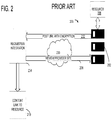
- a system 200 of a prior approach is shown.
- the requester 204 may first locate or identify the resource 206 by visiting or reviewing at 208 a site of the provider 202.
- the provider 202 would post a link at 212, such as the URL, and the link would include the authentication needed.
- the requester or the integrator 204 embeds the URL on a content site 210.
- the content author 202 may provide a JAVASCRIPT resource for the requester 204.
- the content author 202 may provide a specific version using the following URL tag:
- the content author 202 may provide an integrity hash for use with the "specific version" URL:
- the requester or integrator 204 could then include the URL that points to the content 206 of "lib.js" in building the site or application of the requester or integrator 204.
- the existing configuration or approach of the system 200 does not permit frequent or convenient way to update the content 206 when there is a different version to the one to which the URL is directed.
- the requester or integrator 104 may not be able to review or identify the URL as in the system 200 as discussed. Instead, the requestor or integrator 104 may first place or send a request 108 to the content author 102.
- the request 108 may not be made via a browser.
- such request 108 may not be the request placed in the same communication channel as in the system 200 under 208.
- the request 108 may be a server-to-server call or interaction.
- the request 108 may be considered as a set-up call or request so that the content author 102 may be noted about what is to be expected later.
- the server-to-server call or interaction may include an application programming interface (API) call between a service account of the requester or the integrator 104 and the server of the content author 102.
- API application programming interface
- request 108 may not involve a user account of the requester or integrator 104 and may also be known as a "two-legged OAuth," or "2LO".
- the request 108 may include authentication.
- the request 108 may include creating and cryptographically sign JSON Web Tokens (JWTs).
- authentication measures may be implemented without departing from the scope of aspects of embodiments.
- the following authentication measures may be used:
- the server at the content author 102 may be configured to respond by creating a session 112.
- the session 112 may be of a traditional type that the content author 102 maintains, as part of its application stack.
- the session 112 may involve issuing of a signed JSON Web Token that contains the payload information, as a security measure.
- Other implementations of the session 112 may be incorporated without departing from the scope of aspects of the embodiments.
- the following may further illustrate the session setup or creation according to aspects of embodiments:
- the HTTPS is the protocol used and the authentication used is HTTP Signature - both on request and response.
- Http signature on a response gives the requestor assurance that SRI hash values come from the payment processor network and may be trusted. When used properly with other security mechanism (e.g. CSP) this enables unmodified code to be run on cardholder devices.
- CSP other security mechanism
- the computer code of the response may be implemented as:
- a hash is used to provide requestors with SRI information, e.g. requested JS checksum.
- Digital signatures may also be used to allow requestors to validate that the provided SRI information comes from a known or trusted entity.
- aspects of embodiments may deliver to a requestor information that allows for rendering an HTML page that is guaranteed to load only content authored by the content author or fail (if malicious content is served).
- the content author 102 may generate a payload 114 with the requested link to the resource 106 with the needed authentication to be used under the SRI.
- the requester 104 may receive back a payload containing details to use for the integration of the content resource 106 into the content site 110.
- the payload may include:
- a first field of the payload may include a location of the content resource 106.
- the URL may be "/resource/X49vhxxRg.”
- the content author 102 may provide a separate sever 116 to provide the resource 106.
- the server 116 may be a database server or a database store accessible by the content server of the content author 102 to handle such request calls.
- a second field of the payload may include a security specification.
- the security specification may specify that an integrity hash may be a 384-bit value using a secure hash algorithm 2 (SHA-2) function.
- SHA-2 functions may produce other hash values, such as SHA-224, SHA-256, SHA-384, SHA-512, SHA-512/224, SHA-512/256.
- the requester or integrator 104 may now embed the latest resource, whilst also setting the correct integrity hash as received from the payload:
- aspects of embodiments provide the host/path information via a first communication channel (e.g. a server-to-server call) in a format that is consistent with the URL in the earlier example, that is, the URL is unchanged.
- a first communication channel e.g. a server-to-server call
- This further facilitates front-end compatibility (that is, the requestor 104 can use the same URL even though the content resource 106 may be updated) and background compatibility using the SRI via a web browser (that is, the requestor 104 can determine, based on the SRI, that the content resource 106 is provided by the content author 106 and not an unknown and potentially malicious third party).
- the payload may include a completely different URL to a previous URL relating to an earlier version of the resource content, where the different URL corresponds to the correct content (e.g. an updated version) for the duration of the session 112 created by the content author 102.
- integration of the resource content 106 by the content site 110 using the payload may take place in a second communication channel (e.g., via the web browser) and not via the same first communication channel (e.g., server-to-server call).
- the first communication channel differs from the second communication channel.
- the content author 102 may also have the ability to dynamically modify the resource content 106 in response to one or more session parameters defined in the request sent by the requestor to the content author, such as, a user agent engine, a timestamp associated with the request, and other specifications or technical features associated with the requestor.
- the content author 102 may optimize the resource 106 to target a specific user agent engine (minify, polyfils etc.) of the requestor, for example, a web browser of the requestor, where the user agent engine was specified as a session parameter of a session request provided by the requestor to the content author 102, as in the earlier example where the user agent engine "User-Agent: curl/7.29.0" is specified within the computer code of the request sent by the requester.
- a specific user agent engine minify, polyfils etc.
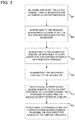
- a flow chart 300 illustrates a computer-implemented method for provide dynamically modifiable or updatable cryptographically secure third-party resources according to one embodiment.
- a content author e.g., content author 102 receives a request, via a first communication channel, from a requester for accessing a content resource.
- the content author in response to the request, the content author generates a session to access the content resource for the requester.
- the content author in response to the generated session, the content author generates a payload identifying the content resource available from a resource provider.
- the content author generates the payload by embedding a cryptographic content in the payload.
- the payload comprises a first data field identifying a location at the resource provider and a second data field for the cryptographic content.
- the content author transmits the generated payload to the requester.
- a resource provider receives an authentication access request to access the content resource, via a second communication channel, in response to executing the embedded cryptographic content.
- the resource provider in response to authenticating the authentication access request, provides the requester with access to the content resource.
- the resource provider 116 and the content author 102 while may be shown as separate reference identifiers in FIG. 1 , it is to be understood that they may be part of the same cluster of servers providing resources and services to the requester or integrator 104.
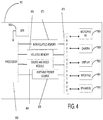
- FIG. 4 is a high-level illustration of a portable computing device 801 communicating with a remote computing device 841 but the application may be stored and accessed in a variety of ways.
- the application may be obtained in a variety of ways such as from an app store, from a web site, from a store Wi-Fi system, etc.
- a portable computing device 801 may be a mobile device 108 that operates using a portable power source 855 such as a battery.
- the portable computing device 801 may also have a display 802 which may or may not be a touch sensitive display. More specifically, the display 802 may have a capacitance sensor, for example, that may be used to provide input data to the portable computing device 801.
- an input pad 804 such as arrows, scroll wheels, keyboards, etc., may be used to provide inputs to the portable computing device 801.
- the portable computing device 801 may have a microphone 806 which may accept and store verbal data, a camera 808 to accept images and a speaker 810 to communicate sounds.
- the portable computing device 801 may be able to communicate with a computing device 841 or a plurality of computing devices 841 that make up a cloud of computing devices 811.
- the portable computing device 801 may be able to communicate in a variety of ways.
- the communication may be wired such as through an Ethernet cable, a USB cable or RJ6 cable.
- the communication may be wireless such as through Wi-Fi® (802.11 standard), BLUETOOTH, cellular communication or near field communication devices.
- the communication may be direct to the computing device 841 or may be through a communication network 102 such as cellular service, through the Internet, through a private network, through BLUETOOTH, etc.
- FIG. 4 is a simplified illustration of the physical elements that make up a portable computing device 801
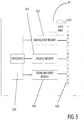
- FIG. 5 is a simplified illustration of the physical elements that make up a server type computing device 841.
- FIG. 4 is representative of a sample portable computing device 801 that is physically configured according to be part of the system.
- the portable computing device 801 may have a processor 850 that is physically configured according to computer executable instructions. It may have a portable power supply 855 such as a battery which may be rechargeable. It may also have a sound and video module 860 which assists in displaying video and sound and may turn off when not in use to conserve power and battery life.
- the portable computing device 801 may also have non-volatile memory 865 and volatile memory 870. It may have GPS capabilities 880 that may be a separate circuit or may be part of the processor 850.
- an input/output bus 875 that shuttles data to and from the various user input devices such as the microphone 806, the camera 808 and other inputs, such as the input pad 804, the display 802, and the speakers 810, etc., It also may control of communicating with the networks, either through wireless or wired devices.
- the various user input devices such as the microphone 806, the camera 808 and other inputs, such as the input pad 804, the display 802, and the speakers 810, etc.
- this is just one embodiment of the portable computing device 801 and the number and types of portable computing devices 801 is limited only by the imagination.
- the system is more than just speeding a process but uses a computing system to achieve a better outcome.
- the computing device 841 may include a digital storage such as a magnetic disk, an optical disk, flash storage, non-volatile storage, etc. Structured data may be stored in the digital storage such as in a database.
- the server 841 may have a processor 1000 that is physically configured according to computer executable instructions. It may also have a sound and video module 1005 which assists in displaying video and sound and may turn off when not in use to conserve power and battery life.
- the server 841 may also have volatile memory 1010 and non-volatile memory 1015.
- the database 1025 may be stored in the memory 1010 or 1015 or may be separate.
- the database 1025 may also be part of a cloud of computing device 841 and may be stored in a distributed manner across a plurality of computing devices 841.
- the input/output bus 1020 also may control of communicating with the networks, either through wireless or wired devices.
- the application may be on the local computing device 801 and in other embodiments, the application may be remote 841. Of course, this is just one embodiment of the server 841 and the number and types of portable computing devices 841 is limited only by the imagination.
- the user devices, computers and servers described herein may be computers that may have, among other elements, a microprocessor (such as from the Intel® Corporation, AMD®, ARM®, Qualcomm®, or MediaTek®); volatile and non- volatile memory; one or more mass storage devices (e.g., a hard drive); various user input devices, such as a mouse, a keyboard, or a microphone; and a video display system.
- the user devices, computers and servers described herein may be running on any one of many operating systems including, but not limited to WINDOWS®, UNIX®, LINUX®, MAC® OS®, iOS®, or Android®. It is contemplated, however, that any suitable operating system may be used for the present invention.
- the servers may be a cluster of web servers, which may each be LINUX® based and supported by a load balancer that decides which of the cluster of web servers should process a request based upon the current request-load of the available server(s).
- the user devices, computers and servers described herein may communicate via networks, including the Internet, wide area network (WAN), local area network (LAN), Wi-Fi®, other computer networks (now known or invented in the future), and/or any combination of the foregoing.
- networks may connect the various components over any combination of wired and wireless conduits, including copper, fiber optic, microwaves, and other forms of radio frequency, electrical and/or optical communication techniques.
- any network may be connected to any other network in a different manner.
- the interconnections between computers and servers in system are examples. Any device described herein may communicate with any other device via one or more networks.
- the example embodiments may include additional devices and networks beyond those shown. Further, the functionality described as being performed by one device may be distributed and performed by two or more devices. Multiple devices may also be combined into a single device, which may perform the functionality of the combined devices.
- Any of the software components or functions described in this application may be implemented as software code or computer readable instructions that may be executed by at least one processor using any suitable computer language such as, for example, Java, C++, or Perl using, for example, conventional or object-oriented techniques.
- the software code may be stored as a series of instructions or commands on a non-transitory computer readable medium, such as a random access memory (RAM), a read only memory (ROM), a magnetic medium such as a hard-drive or a floppy disk, or an optical medium such as a CD-ROM.
- a non-transitory computer readable medium such as a random access memory (RAM), a read only memory (ROM), a magnetic medium such as a hard-drive or a floppy disk, or an optical medium such as a CD-ROM.
- RAM random access memory
- ROM read only memory
- magnetic medium such as a hard-drive or a floppy disk
- an optical medium such as a CD-ROM.
- One or more of the elements of the present system may be claimed as means for accomplishing a particular function. Where such means-plus-function elements are used to describe certain elements of a claimed system it may be understood by those of ordinary skill in the art having the present specification, figures and claims before them, that the corresponding structure includes a computer, processor, or microprocessor (as the case may be) programmed to perform the particularly recited function using functionality found in a computer after special programming and/or by implementing one or more algorithms to achieve the recited functionality as recited in the claims or steps described above.
- the present disclosure provides a solution to the long-felt need described above.
- the systems and methods overcome challenges dealing with the inability to update the latest authentication or cryptographic content associated with a third-party hosted resource.
- aspects of embodiments maintain the URL syntax without disturbing established protocol. Instead, embodiments change the flow of accessing the resource so that the content authors may send to the requester the latest version of the resource with the updated authentication or cryptographic content.
Landscapes
- Engineering & Computer Science (AREA)
- Computer Security & Cryptography (AREA)
- Theoretical Computer Science (AREA)
- Software Systems (AREA)
- General Engineering & Computer Science (AREA)
- Computer Hardware Design (AREA)
- General Physics & Mathematics (AREA)
- Physics & Mathematics (AREA)
- Signal Processing (AREA)
- Computer Networks & Wireless Communication (AREA)
- Health & Medical Sciences (AREA)
- Bioethics (AREA)
- General Health & Medical Sciences (AREA)
- Multimedia (AREA)
- Technology Law (AREA)
- Computing Systems (AREA)
- Information Transfer Between Computers (AREA)
Applications Claiming Priority (1)
| Application Number | Priority Date | Filing Date | Title |
|---|---|---|---|
| US16/532,467 US11288399B2 (en) | 2019-08-05 | 2019-08-05 | Cryptographically secure dynamic third party resources |
Publications (2)
| Publication Number | Publication Date |
|---|---|
| EP3772697A1 true EP3772697A1 (fr) | 2021-02-10 |
| EP3772697B1 EP3772697B1 (fr) | 2023-08-30 |
Family
ID=71741729
Family Applications (1)
| Application Number | Title | Priority Date | Filing Date |
|---|---|---|---|
| EP20187257.9A Active EP3772697B1 (fr) | 2019-08-05 | 2020-07-22 | Ressources de tiers dynamiques sécurisées cryptographiquement |
Country Status (4)
| Country | Link |
|---|---|
| US (3) | US11288399B2 (fr) |
| EP (1) | EP3772697B1 (fr) |
| CN (1) | CN112333134B (fr) |
| SG (1) | SG10202006238PA (fr) |
Families Citing this family (2)
| Publication number | Priority date | Publication date | Assignee | Title |
|---|---|---|---|---|
| US11288399B2 (en) | 2019-08-05 | 2022-03-29 | Visa International Service Association | Cryptographically secure dynamic third party resources |
| WO2026052869A1 (fr) * | 2024-09-09 | 2026-03-12 | Codesealer A/S | Connexion sécurisée entre un serveur et un dispositif client |
Citations (1)
| Publication number | Priority date | Publication date | Assignee | Title |
|---|---|---|---|---|
| US20180069947A1 (en) * | 2016-09-07 | 2018-03-08 | Adobe Systems Incorporated | Automatic Integrity Checking of Content Delivery Network Files |
Family Cites Families (28)
| Publication number | Priority date | Publication date | Assignee | Title |
|---|---|---|---|---|
| US7395424B2 (en) * | 2003-07-17 | 2008-07-01 | International Business Machines Corporation | Method and system for stepping up to certificate-based authentication without breaking an existing SSL session |
| US20070174429A1 (en) * | 2006-01-24 | 2007-07-26 | Citrix Systems, Inc. | Methods and servers for establishing a connection between a client system and a virtual machine hosting a requested computing environment |
| US8799411B2 (en) * | 2010-05-28 | 2014-08-05 | Arvato Digital Services Canada, Inc. | Method and apparatus for providing enhanced streaming content delivery with multi-archive support using secure download manager and content-indifferent decoding |
| CA2811419A1 (fr) * | 2010-09-20 | 2012-03-29 | Vidyo, Inc. | Systeme et procede de commande et de gestion de conferences multipoints |
| CN102611709B (zh) * | 2012-03-31 | 2014-11-12 | 北京奇虎科技有限公司 | 一种对第三方资源的访问控制方法及系统 |
| WO2014083382A1 (fr) * | 2012-11-27 | 2014-06-05 | Robojar Pty Ltd | Système et procédé d'authentification de la légitimité d'une demande de ressource par un utilisateur |
| EP2890073A1 (fr) * | 2013-12-31 | 2015-07-01 | Gemalto SA | Système et procédé pour sécuriser des communications machine-machine |
| US9954678B2 (en) * | 2014-02-06 | 2018-04-24 | Cisco Technology, Inc. | Content-based transport security |
| US9792458B2 (en) * | 2014-05-05 | 2017-10-17 | Ims Health Incorporated | Platform to build secure mobile collaborative applications using dynamic presentation and data configurations |
| US9613218B2 (en) * | 2014-06-30 | 2017-04-04 | Nicira, Inc. | Encryption system in a virtualized environment |
| US9811610B2 (en) * | 2015-02-25 | 2017-11-07 | Hcl Technologies Limited | Systems and methods for bevel feature recognition and bevel profile generation |
| US10341311B2 (en) * | 2015-07-20 | 2019-07-02 | Schweitzer Engineering Laboratories, Inc. | Communication device for implementing selective encryption in a software defined network |
| US10637735B2 (en) * | 2015-08-26 | 2020-04-28 | International Business Machines Corporation | Pattern-based migration of workloads |
| AU2016403734B2 (en) | 2016-04-19 | 2022-11-17 | Visa International Service Association | Systems and methods for performing push transactions |
| US10162943B2 (en) * | 2016-04-27 | 2018-12-25 | Comcast Cable Communications, Llc | Streamlined digital rights management |
| US10559003B1 (en) * | 2016-08-22 | 2020-02-11 | A9.Com, Inc. | Server-side content management |
| US10225239B2 (en) * | 2016-09-29 | 2019-03-05 | Chelsio Communications, Inc. | Method for in-line TLS/SSL cleartext encryption and authentication |
| US10135810B2 (en) * | 2016-11-17 | 2018-11-20 | Adp, Llc | Selective authentication system |
| US10230720B2 (en) * | 2016-12-12 | 2019-03-12 | Sap Se | Authorization code flow for in-browser applications |
| US20180174231A1 (en) * | 2016-12-16 | 2018-06-21 | MonetaGo Inc. | Enhanced ledger system and method |
| CN107835155B (zh) * | 2017-10-11 | 2020-11-24 | 飞天诚信科技股份有限公司 | 一种双认证保护方法及装置 |
| US10785021B1 (en) * | 2018-02-28 | 2020-09-22 | Amazon Technologies, Inc. | User account authentication |
| US10721219B2 (en) * | 2018-06-28 | 2020-07-21 | Nxp B.V. | Method for establishing a secure communication session in a communications system |
| CN109819033A (zh) * | 2019-01-25 | 2019-05-28 | 杭州迪普科技股份有限公司 | 一种资源文件加载方法及系统 |
| US11038677B2 (en) * | 2019-01-31 | 2021-06-15 | Re Formsnet, Llc | Systems and methods for encryption and authentication |
| US11368477B2 (en) * | 2019-05-13 | 2022-06-21 | Securitymetrics, Inc. | Webpage integrity monitoring |
| US11288399B2 (en) * | 2019-08-05 | 2022-03-29 | Visa International Service Association | Cryptographically secure dynamic third party resources |
| US11258608B1 (en) * | 2021-05-21 | 2022-02-22 | Contentful GmbH | Systems for secure access to protected content in a content management system |
-
2019
- 2019-08-05 US US16/532,467 patent/US11288399B2/en active Active
-
2020
- 2020-06-29 SG SG10202006238PA patent/SG10202006238PA/en unknown
- 2020-07-15 CN CN202010679061.0A patent/CN112333134B/zh active Active
- 2020-07-22 EP EP20187257.9A patent/EP3772697B1/fr active Active
-
2022
- 2022-03-22 US US17/701,326 patent/US11741266B2/en active Active
-
2023
- 2023-07-27 US US18/360,244 patent/US12216801B2/en active Active
Patent Citations (1)
| Publication number | Priority date | Publication date | Assignee | Title |
|---|---|---|---|---|
| US20180069947A1 (en) * | 2016-09-07 | 2018-03-08 | Adobe Systems Incorporated | Automatic Integrity Checking of Content Delivery Network Files |
Also Published As
| Publication number | Publication date |
|---|---|
| EP3772697B1 (fr) | 2023-08-30 |
| US12216801B2 (en) | 2025-02-04 |
| US11741266B2 (en) | 2023-08-29 |
| US11288399B2 (en) | 2022-03-29 |
| SG10202006238PA (en) | 2021-03-30 |
| US20210042430A1 (en) | 2021-02-11 |
| US20230385454A1 (en) | 2023-11-30 |
| CN112333134B (zh) | 2024-08-23 |
| US20220215108A1 (en) | 2022-07-07 |
| CN112333134A (zh) | 2021-02-05 |
Similar Documents
| Publication | Publication Date | Title |
|---|---|---|
| US9378345B2 (en) | Authentication using device ID | |
| US20100043065A1 (en) | Single sign-on for web applications | |
| CN110521182B (zh) | 用于协议级身份映射的方法和系统 | |
| CN112491776B (zh) | 安全认证方法及相关设备 | |
| EP4120109A1 (fr) | Procédé et appareil d'accès à un groupe, dispositif électronique et support | |
| US12261843B1 (en) | Secure identity provider authentication for native application to access web service | |
| US9294479B1 (en) | Client-side authentication | |
| CN107111630A (zh) | 从浏览器打开本地应用 | |
| EP4268101A1 (fr) | Authentification à l'aide d'une identité de dispositif et d'utilisateur | |
| CN111262889A (zh) | 一种云服务的权限认证方法、装置、设备及介质 | |
| CN114338078B (zh) | 一种cs客户端登录方法及装置 | |
| US12216801B2 (en) | Cryptographically secure dynamic third party resources | |
| CN107888656A (zh) | 服务端接口的调用方法和调用装置 | |
| CN113225348B (zh) | 请求防重放校验方法和装置 | |
| JP6914436B2 (ja) | 認証のためのシステムおよび方法 | |
| US12323808B2 (en) | Systems and methods for verified communication between mobile applications | |
| US20220377064A1 (en) | Method and system for managing a web security protocol | |
| US10819695B2 (en) | Electronic device including local identity provider server for single sign on and related methods | |
| CN117278562A (zh) | 负载均衡方法、装置、系统、电子设备及存储介质 | |
| US12425489B2 (en) | Inserting and replacing placeholders in resource code | |
| CN114338033A (zh) | 一种请求处理方法、装置、设备及存储介质 | |
| CN115706729A (zh) | 一种服务提供方法及装置、设备、存储介质 | |
| US8881241B2 (en) | Method of and system for implementing privacy control | |
| CN105141586A (zh) | 一种对用户进行验证的方法和系统 | |
| CN114079573B (zh) | 一种路由器访问方法以及路由器 |
Legal Events
| Date | Code | Title | Description |
|---|---|---|---|
| PUAI | Public reference made under article 153(3) epc to a published international application that has entered the european phase |
Free format text: ORIGINAL CODE: 0009012 |
|
| STAA | Information on the status of an ep patent application or granted ep patent |
Free format text: STATUS: THE APPLICATION HAS BEEN PUBLISHED |
|
| AK | Designated contracting states |
Kind code of ref document: A1 Designated state(s): AL AT BE BG CH CY CZ DE DK EE ES FI FR GB GR HR HU IE IS IT LI LT LU LV MC MK MT NL NO PL PT RO RS SE SI SK SM TR |
|
| AX | Request for extension of the european patent |
Extension state: BA ME |
|
| STAA | Information on the status of an ep patent application or granted ep patent |
Free format text: STATUS: REQUEST FOR EXAMINATION WAS MADE |
|
| 17P | Request for examination filed |
Effective date: 20210810 |
|
| RBV | Designated contracting states (corrected) |
Designated state(s): AL AT BE BG CH CY CZ DE DK EE ES FI FR GB GR HR HU IE IS IT LI LT LU LV MC MK MT NL NO PL PT RO RS SE SI SK SM TR |
|
| GRAP | Despatch of communication of intention to grant a patent |
Free format text: ORIGINAL CODE: EPIDOSNIGR1 |
|
| STAA | Information on the status of an ep patent application or granted ep patent |
Free format text: STATUS: GRANT OF PATENT IS INTENDED |
|
| INTG | Intention to grant announced |
Effective date: 20230317 |
|
| P01 | Opt-out of the competence of the unified patent court (upc) registered |
Effective date: 20230511 |
|
| GRAS | Grant fee paid |
Free format text: ORIGINAL CODE: EPIDOSNIGR3 |
|
| GRAA | (expected) grant |
Free format text: ORIGINAL CODE: 0009210 |
|
| STAA | Information on the status of an ep patent application or granted ep patent |
Free format text: STATUS: THE PATENT HAS BEEN GRANTED |
|
| AK | Designated contracting states |
Kind code of ref document: B1 Designated state(s): AL AT BE BG CH CY CZ DE DK EE ES FI FR GB GR HR HU IE IS IT LI LT LU LV MC MK MT NL NO PL PT RO RS SE SI SK SM TR |
|
| REG | Reference to a national code |
Ref country code: GB Ref legal event code: FG4D |
|
| REG | Reference to a national code |
Ref country code: CH Ref legal event code: EP |
|
| REG | Reference to a national code |
Ref country code: DE Ref legal event code: R096 Ref document number: 602020016557 Country of ref document: DE |
|
| REG | Reference to a national code |
Ref country code: IE Ref legal event code: FG4D |
|
| REG | Reference to a national code |
Ref country code: LT Ref legal event code: MG9D |
|
| REG | Reference to a national code |
Ref country code: NL Ref legal event code: MP Effective date: 20230830 |
|
| REG | Reference to a national code |
Ref country code: AT Ref legal event code: MK05 Ref document number: 1606344 Country of ref document: AT Kind code of ref document: T Effective date: 20230830 |
|
| PG25 | Lapsed in a contracting state [announced via postgrant information from national office to epo] |
Ref country code: GR Free format text: LAPSE BECAUSE OF FAILURE TO SUBMIT A TRANSLATION OF THE DESCRIPTION OR TO PAY THE FEE WITHIN THE PRESCRIBED TIME-LIMIT Effective date: 20231201 |
|
| PG25 | Lapsed in a contracting state [announced via postgrant information from national office to epo] |
Ref country code: IS Free format text: LAPSE BECAUSE OF FAILURE TO SUBMIT A TRANSLATION OF THE DESCRIPTION OR TO PAY THE FEE WITHIN THE PRESCRIBED TIME-LIMIT Effective date: 20231230 |
|
| PG25 | Lapsed in a contracting state [announced via postgrant information from national office to epo] |
Ref country code: SE Free format text: LAPSE BECAUSE OF FAILURE TO SUBMIT A TRANSLATION OF THE DESCRIPTION OR TO PAY THE FEE WITHIN THE PRESCRIBED TIME-LIMIT Effective date: 20230830 Ref country code: RS Free format text: LAPSE BECAUSE OF FAILURE TO SUBMIT A TRANSLATION OF THE DESCRIPTION OR TO PAY THE FEE WITHIN THE PRESCRIBED TIME-LIMIT Effective date: 20230830 Ref country code: NO Free format text: LAPSE BECAUSE OF FAILURE TO SUBMIT A TRANSLATION OF THE DESCRIPTION OR TO PAY THE FEE WITHIN THE PRESCRIBED TIME-LIMIT Effective date: 20231130 Ref country code: LV Free format text: LAPSE BECAUSE OF FAILURE TO SUBMIT A TRANSLATION OF THE DESCRIPTION OR TO PAY THE FEE WITHIN THE PRESCRIBED TIME-LIMIT Effective date: 20230830 Ref country code: LT Free format text: LAPSE BECAUSE OF FAILURE TO SUBMIT A TRANSLATION OF THE DESCRIPTION OR TO PAY THE FEE WITHIN THE PRESCRIBED TIME-LIMIT Effective date: 20230830 Ref country code: IS Free format text: LAPSE BECAUSE OF FAILURE TO SUBMIT A TRANSLATION OF THE DESCRIPTION OR TO PAY THE FEE WITHIN THE PRESCRIBED TIME-LIMIT Effective date: 20231230 Ref country code: HR Free format text: LAPSE BECAUSE OF FAILURE TO SUBMIT A TRANSLATION OF THE DESCRIPTION OR TO PAY THE FEE WITHIN THE PRESCRIBED TIME-LIMIT Effective date: 20230830 Ref country code: GR Free format text: LAPSE BECAUSE OF FAILURE TO SUBMIT A TRANSLATION OF THE DESCRIPTION OR TO PAY THE FEE WITHIN THE PRESCRIBED TIME-LIMIT Effective date: 20231201 Ref country code: FI Free format text: LAPSE BECAUSE OF FAILURE TO SUBMIT A TRANSLATION OF THE DESCRIPTION OR TO PAY THE FEE WITHIN THE PRESCRIBED TIME-LIMIT Effective date: 20230830 Ref country code: AT Free format text: LAPSE BECAUSE OF FAILURE TO SUBMIT A TRANSLATION OF THE DESCRIPTION OR TO PAY THE FEE WITHIN THE PRESCRIBED TIME-LIMIT Effective date: 20230830 |
|
| PG25 | Lapsed in a contracting state [announced via postgrant information from national office to epo] |
Ref country code: PL Free format text: LAPSE BECAUSE OF FAILURE TO SUBMIT A TRANSLATION OF THE DESCRIPTION OR TO PAY THE FEE WITHIN THE PRESCRIBED TIME-LIMIT Effective date: 20230830 Ref country code: NL Free format text: LAPSE BECAUSE OF FAILURE TO SUBMIT A TRANSLATION OF THE DESCRIPTION OR TO PAY THE FEE WITHIN THE PRESCRIBED TIME-LIMIT Effective date: 20230830 |
|
| PG25 | Lapsed in a contracting state [announced via postgrant information from national office to epo] |
Ref country code: ES Free format text: LAPSE BECAUSE OF FAILURE TO SUBMIT A TRANSLATION OF THE DESCRIPTION OR TO PAY THE FEE WITHIN THE PRESCRIBED TIME-LIMIT Effective date: 20230830 |
|
| PG25 | Lapsed in a contracting state [announced via postgrant information from national office to epo] |
Ref country code: SM Free format text: LAPSE BECAUSE OF FAILURE TO SUBMIT A TRANSLATION OF THE DESCRIPTION OR TO PAY THE FEE WITHIN THE PRESCRIBED TIME-LIMIT Effective date: 20230830 Ref country code: RO Free format text: LAPSE BECAUSE OF FAILURE TO SUBMIT A TRANSLATION OF THE DESCRIPTION OR TO PAY THE FEE WITHIN THE PRESCRIBED TIME-LIMIT Effective date: 20230830 Ref country code: ES Free format text: LAPSE BECAUSE OF FAILURE TO SUBMIT A TRANSLATION OF THE DESCRIPTION OR TO PAY THE FEE WITHIN THE PRESCRIBED TIME-LIMIT Effective date: 20230830 Ref country code: EE Free format text: LAPSE BECAUSE OF FAILURE TO SUBMIT A TRANSLATION OF THE DESCRIPTION OR TO PAY THE FEE WITHIN THE PRESCRIBED TIME-LIMIT Effective date: 20230830 Ref country code: DK Free format text: LAPSE BECAUSE OF FAILURE TO SUBMIT A TRANSLATION OF THE DESCRIPTION OR TO PAY THE FEE WITHIN THE PRESCRIBED TIME-LIMIT Effective date: 20230830 Ref country code: CZ Free format text: LAPSE BECAUSE OF FAILURE TO SUBMIT A TRANSLATION OF THE DESCRIPTION OR TO PAY THE FEE WITHIN THE PRESCRIBED TIME-LIMIT Effective date: 20230830 Ref country code: SK Free format text: LAPSE BECAUSE OF FAILURE TO SUBMIT A TRANSLATION OF THE DESCRIPTION OR TO PAY THE FEE WITHIN THE PRESCRIBED TIME-LIMIT Effective date: 20230830 Ref country code: PT Free format text: LAPSE BECAUSE OF FAILURE TO SUBMIT A TRANSLATION OF THE DESCRIPTION OR TO PAY THE FEE WITHIN THE PRESCRIBED TIME-LIMIT Effective date: 20240102 |
|
| PG25 | Lapsed in a contracting state [announced via postgrant information from national office to epo] |
Ref country code: IT Free format text: LAPSE BECAUSE OF FAILURE TO SUBMIT A TRANSLATION OF THE DESCRIPTION OR TO PAY THE FEE WITHIN THE PRESCRIBED TIME-LIMIT Effective date: 20230830 |
|
| REG | Reference to a national code |
Ref country code: DE Ref legal event code: R097 Ref document number: 602020016557 Country of ref document: DE |
|
| PLBE | No opposition filed within time limit |
Free format text: ORIGINAL CODE: 0009261 |
|
| STAA | Information on the status of an ep patent application or granted ep patent |
Free format text: STATUS: NO OPPOSITION FILED WITHIN TIME LIMIT |
|
| PG25 | Lapsed in a contracting state [announced via postgrant information from national office to epo] |
Ref country code: SI Free format text: LAPSE BECAUSE OF FAILURE TO SUBMIT A TRANSLATION OF THE DESCRIPTION OR TO PAY THE FEE WITHIN THE PRESCRIBED TIME-LIMIT Effective date: 20230830 |
|
| 26N | No opposition filed |
Effective date: 20240603 |
|
| PG25 | Lapsed in a contracting state [announced via postgrant information from national office to epo] |
Ref country code: BG Free format text: LAPSE BECAUSE OF FAILURE TO SUBMIT A TRANSLATION OF THE DESCRIPTION OR TO PAY THE FEE WITHIN THE PRESCRIBED TIME-LIMIT Effective date: 20230830 |
|
| PG25 | Lapsed in a contracting state [announced via postgrant information from national office to epo] |
Ref country code: BG Free format text: LAPSE BECAUSE OF FAILURE TO SUBMIT A TRANSLATION OF THE DESCRIPTION OR TO PAY THE FEE WITHIN THE PRESCRIBED TIME-LIMIT Effective date: 20230830 |
|
| PG25 | Lapsed in a contracting state [announced via postgrant information from national office to epo] |
Ref country code: MC Free format text: LAPSE BECAUSE OF FAILURE TO SUBMIT A TRANSLATION OF THE DESCRIPTION OR TO PAY THE FEE WITHIN THE PRESCRIBED TIME-LIMIT Effective date: 20230830 |
|
| REG | Reference to a national code |
Ref country code: CH Ref legal event code: PL |
|
| PG25 | Lapsed in a contracting state [announced via postgrant information from national office to epo] |
Ref country code: LU Free format text: LAPSE BECAUSE OF NON-PAYMENT OF DUE FEES Effective date: 20240722 |
|
| PG25 | Lapsed in a contracting state [announced via postgrant information from national office to epo] |
Ref country code: LU Free format text: LAPSE BECAUSE OF NON-PAYMENT OF DUE FEES Effective date: 20240722 |
|
| PG25 | Lapsed in a contracting state [announced via postgrant information from national office to epo] |
Ref country code: CH Free format text: LAPSE BECAUSE OF NON-PAYMENT OF DUE FEES Effective date: 20240731 Ref country code: BE Free format text: LAPSE BECAUSE OF NON-PAYMENT OF DUE FEES Effective date: 20240731 |
|
| REG | Reference to a national code |
Ref country code: BE Ref legal event code: MM Effective date: 20240731 |
|
| PGFP | Annual fee paid to national office [announced via postgrant information from national office to epo] |
Ref country code: GB Payment date: 20250619 Year of fee payment: 6 |
|
| PGFP | Annual fee paid to national office [announced via postgrant information from national office to epo] |
Ref country code: FR Payment date: 20250620 Year of fee payment: 6 |
|
| PG25 | Lapsed in a contracting state [announced via postgrant information from national office to epo] |
Ref country code: IE Free format text: LAPSE BECAUSE OF NON-PAYMENT OF DUE FEES Effective date: 20240722 |
|
| PGFP | Annual fee paid to national office [announced via postgrant information from national office to epo] |
Ref country code: DE Payment date: 20250620 Year of fee payment: 6 |
|
| PG25 | Lapsed in a contracting state [announced via postgrant information from national office to epo] |
Ref country code: CY Free format text: LAPSE BECAUSE OF FAILURE TO SUBMIT A TRANSLATION OF THE DESCRIPTION OR TO PAY THE FEE WITHIN THE PRESCRIBED TIME-LIMIT; INVALID AB INITIO Effective date: 20200722 |
|
| PG25 | Lapsed in a contracting state [announced via postgrant information from national office to epo] |
Ref country code: HU Free format text: LAPSE BECAUSE OF FAILURE TO SUBMIT A TRANSLATION OF THE DESCRIPTION OR TO PAY THE FEE WITHIN THE PRESCRIBED TIME-LIMIT; INVALID AB INITIO Effective date: 20200722 |