EP3772569B1 - Actuator assembly with sealing arrangement - Google Patents
Actuator assembly with sealing arrangement Download PDFInfo
- Publication number
- EP3772569B1 EP3772569B1 EP19191074.4A EP19191074A EP3772569B1 EP 3772569 B1 EP3772569 B1 EP 3772569B1 EP 19191074 A EP19191074 A EP 19191074A EP 3772569 B1 EP3772569 B1 EP 3772569B1
- Authority
- EP
- European Patent Office
- Prior art keywords
- sleeve
- shaft
- seal ring
- bushing
- actuator assembly
- Prior art date
- Legal status (The legal status is an assumption and is not a legal conclusion. Google has not performed a legal analysis and makes no representation as to the accuracy of the status listed.)
- Active
Links
Images


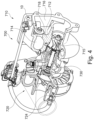
Classifications
-
- F—MECHANICAL ENGINEERING; LIGHTING; HEATING; WEAPONS; BLASTING
- F01—MACHINES OR ENGINES IN GENERAL; ENGINE PLANTS IN GENERAL; STEAM ENGINES
- F01D—NON-POSITIVE DISPLACEMENT MACHINES OR ENGINES, e.g. STEAM TURBINES
- F01D11/00—Preventing or minimising internal leakage of working-fluid, e.g. between stages
- F01D11/003—Preventing or minimising internal leakage of working-fluid, e.g. between stages by packing rings; Mechanical seals
-
- F—MECHANICAL ENGINEERING; LIGHTING; HEATING; WEAPONS; BLASTING
- F02—COMBUSTION ENGINES; HOT-GAS OR COMBUSTION-PRODUCT ENGINE PLANTS
- F02B—INTERNAL-COMBUSTION PISTON ENGINES; COMBUSTION ENGINES IN GENERAL
- F02B37/00—Engines characterised by provision of pumps driven at least for part of the time by exhaust
- F02B37/12—Control of the pumps
- F02B37/18—Control of the pumps by bypassing exhaust from the inlet to the outlet of turbine or to the atmosphere
- F02B37/183—Arrangements of bypass valves or actuators therefor
-
- F—MECHANICAL ENGINEERING; LIGHTING; HEATING; WEAPONS; BLASTING
- F02—COMBUSTION ENGINES; HOT-GAS OR COMBUSTION-PRODUCT ENGINE PLANTS
- F02B—INTERNAL-COMBUSTION PISTON ENGINES; COMBUSTION ENGINES IN GENERAL
- F02B37/00—Engines characterised by provision of pumps driven at least for part of the time by exhaust
- F02B37/12—Control of the pumps
- F02B37/18—Control of the pumps by bypassing exhaust from the inlet to the outlet of turbine or to the atmosphere
- F02B37/183—Arrangements of bypass valves or actuators therefor
- F02B37/186—Arrangements of actuators or linkage for bypass valves
-
- Y—GENERAL TAGGING OF NEW TECHNOLOGICAL DEVELOPMENTS; GENERAL TAGGING OF CROSS-SECTIONAL TECHNOLOGIES SPANNING OVER SEVERAL SECTIONS OF THE IPC; TECHNICAL SUBJECTS COVERED BY FORMER USPC CROSS-REFERENCE ART COLLECTIONS [XRACs] AND DIGESTS
- Y02—TECHNOLOGIES OR APPLICATIONS FOR MITIGATION OR ADAPTATION AGAINST CLIMATE CHANGE
- Y02T—CLIMATE CHANGE MITIGATION TECHNOLOGIES RELATED TO TRANSPORTATION
- Y02T10/00—Road transport of goods or passengers
- Y02T10/10—Internal combustion engine [ICE] based vehicles
- Y02T10/12—Improving ICE efficiencies
Definitions
- This disclosure relates to an actuator assembly for a charging apparatus. Furthermore, the invention relates to a turbine and a charging apparatus having such an actuator assembly. Additionally, the invention concerns a method for mounting such an actuator assembly into a turbine housing.
- ICE internal combustion engine
- ICE internal combustion engine
- a compressor may be driven by an e-motor (e-charger) and/or an exhaust gas powered turbine (turbocharger).
- e-charger e-motor
- turbine exhaust gas powered turbine
- an exhaust gas turbocharger has a turbine with a turbine wheel, which is driven by the exhaust gas flow of the combustion engine.
- a compressor with a compressor wheel arranged on a common shaft with the turbine wheel compresses the fresh air drawn in for the engine. This increases the amount of air or oxygen available to the engine for combustion. This in turn increases the performance of the combustion engine.
- a part of the exhaust gas can be bypassed around the turbine wheel in order to prevent the turbine wheel exceeding its maximum rotational speed.
- the amount of exhaust gas which is bypassed is commonly controlled by a bypass valve or wastegate valve which opens and closes a bypass opening connecting a bypass channel with a turbine inlet channel, in particular a volute.
- the wastegate valve is usually actuated by an actuator assembly which connects the wastegate valve inside the turbine housing with an actuating lever outside the turbine housing.
- the objective of the present invention is to provide an actuator assembly with reduced leakage.
- the present invention relates to an actuator assembly for a charging apparatus according to claim 1. Furthermore, the invention relates to a turbine and a charging apparatus having such an actuator assembly according to claims 11 and 13, respectively.
- the inventive actuator assembly for a charging apparatus comprises an actuator shaft, a bushing and a sealing arrangement.
- the actuator shaft is arranged inside the bushing and comprises a shaft step and a reduced diameter portion.
- the sealing arrangement comprises an insert sleeve and a seal ring.
- the the insert sleeve is arranged on the reduced diameter portion and has a sleeve step between a larger diameter sleeve portion and a smaller diameter sleeve portion.
- the seal ring is arranged in a cavity formed radially between the bushing and the smaller diameter sleeve portion and axially between the sleeve step and the shaft step.
- a radial sealing region and an axial sealing region are defined by the sealing arrangement.
- the radial sealing region is formed between the bushing and the seal ring, and the axial sealing region is formed between the seal ring and the insert sleeve.
- the seal ring is thereby configured and arranged to be driven into contact with the insert sleeve by exhaust gas pressure.
- the sealing arrangement may further comprise an exhaust gas pressure chamber.
- the exhaust gas pressure chamber may be configured to build up exhaust gas pressure to move the seal ring into axial sealing contact with the insert sleeve in order to establish the axial sealing region.
- the exhaust gas pressure chamber may be formed radially between the bushing and the insert sleeve and axially between the actuator shaft and the seal ring.
- the radial sealing region may be configured as slide fit. That means, the seal ring may slide closely inside the bushing. In particular, the seal ring can slide on an inner surface of the bushing. Thereby, less force is exerted on the seal ring but also on the bushing. This leads to a negligible wear or at least less wear in comparison to, for instance, a piston ring.
- the slide fit further ensures an axial movability of the seal ring to compensate for an axial displacement of the actuator shaft and/or the insert sleeve (and/or an outer lever which may be connected to the actuator shaft).
- the radial sealing region may be formed between an outer diameter of the seal ring and an inner diameter of the bushing.
- the radial sealing region may be formed between a bushing bore of the bushing (i.e. a radially inner surface of the bushing) and a radially outer surface of the seal ring.
- the axial sealing region may be formed between a first axial end face of the seal ring and a sleeve step face of the insert sleeve.
- the first axial end face may be formed as an annular face, in particular as an annular face without interruptions.
- the sleeve step face may be formed as an annular face, in particular as an annular face without interruptions.
- the first axial end face may be formed conical or curved to establish a line contact in the axial sealing region.
- the sleeve step face may be formed conical or curved to establish a line contact in the axial sealing region.
- the insert sleeve may comprise a first sleeve portion with a first outer diameter and a second sleeve portion with a second outer diameter. Additionally, the second outer diameter may be larger than the first outer diameter such that a sleeve step is formed.
- the sleeve step may have a sleeve step face. Additionally, the sleeve step may be formed between the first sleeve portion and the second sleeve portion. That means the first sleeve portion and the second sleeve portion may be axially adjacent.
- first sleeve portion may also be referred to as first axial sleeve portion and the second sleeve portion may also be referred to as second axial sleeve portion.
- the second sleeve portion may be arranged further to the outside of the actuator assembly, in particular further to the outside of a turbine housing when the actuator assembly is mounted in a turbine.
- an inner diameter of the seal ring may be smaller than the second outer diameter of the second sleeve portion. This latter feature ensures that the seal ring and the insert sleeve are overlapping in a radial direction. Thereby the axial sealing region can be established.
- the seal ring can be axially secured or restricted by the insert sleeve when exhaust gas pressure urges the seal ring in an axial direction towards the second sleeve portion.
- the seal ring may be arranged between, in particular radially between the first sleeve portion and the bushing and between, in particular axially between the second sleeve portion and the actuator shaft.
- the seal ring may be arranged in a cavity formed by the bushing, the insert sleeve and the actuator shaft. More specific the cavity may be formed axially between a shaft step face of the actuator shaft and the sleeve step face, and radially between and a radially outer surface of the first sleeve portion of the insert sleeve and a radially inner surface of the bushing.
- the exhaust gas pressure chamber may be formed between, in particular radially between the first sleeve portion and the bushing and between, in particular axially between the second sleeve portion and the actuator shaft. That means both the exhaust gas pressure chamber and the seal ring are located inside the cavity. In other words, the exhaust gas pressure chamber may equal the space of the cavity minus the space occupied by the seal ring.
- the actuator shaft may comprise a reduced diameter portion at an axial outer end region of the actuator shaft such that a shaft step with a shaft step face is formed.
- the sealing arrangement may be located radially outwardly of the reduced diameter portion. That means the sealing arrangement may be located radially between the bushing and the reduced diameter portion. In other words, the sealing arrangement is located at the axial outer end region.
- the seal ring and the insert sleeve may be accommodated between the bushing, the shaft step and the reduced diameter portion.
- the insert sleeve may be arranged on the reduced diameter portion such that a sleeve step face of the insert sleeve opposes the shaft step face.
- the seal ring may be arranged between, in particular radially between, the sleeve step face and the shaft step face.
- an inner diameter of the insert sleeve may be larger than an outer diameter of the reduced diameter portion such that a radial clearance fit is established between the actuator shaft and the insert sleeve.
- the actuator shaft may comprise an undercut which extends circumferentially between the reduced diameter portion and the shaft step. This latter feature ensures an axial abutment of the insert sleeve and the shaft step face.
- the actuator shaft may comprise a first shaft bearing land and a second shaft bearing land.
- the second shaft bearing land may be axially spaced apart from the first shaft bearing land such that an exhaust gas passage is formed therebetween.
- the first shaft bearing land may be arranged at a first axial end region of the bushing.
- the second shaft bearing land may be arranged adjacent a second axial end region of the bushing. Additionally, the second shaft bearing land may be arranged directly adjacent the shaft step. Additionally, the second shaft bearing land may form an outer diameter of the shaft step.
- an outer diameter of the first shaft bearing land may be smaller than an inner diameter of the bushing such that exhaust gas can flow axially through a gap formed radially between the first shaft bearing land and the bushing.
- an outer diameter of the second shaft bearing land may be smaller than an inner diameter of the bushing such that exhaust gas can flow axially through a gap formed radially between the second shaft bearing land and the bushing.
- an outer diameter of the first shaft bearing land may be smaller than outer diameter of the seal ring.
- an outer diameter of the second shaft bearing land may be smaller than outer diameter of the seal ring.
- an outer diameter of the seal ring may be larger than an outer diameter of the first shaft bearing land and smaller than an inner diameter of the bushing.
- an outer diameter of the seal ring may be larger than an outer diameter of the second shaft bearing land and smaller than an inner diameter of the bushing.
- the seal ring may be arranged axially between a shaft step of the actuator shaft and a sleeve step of the insert sleeve.
- the actuator assembly may further comprise an outer lever.
- the outer lever may be attached to an axial outer end region of the actuator shaft such that the insert sleeve is axially press-fit between a shaft step of the actuator shaft and the outer lever.
- the seal ring may be configured as a closed ring.
- the seal ring may be configured as a solid ring.
- the seal ring may be configured as a solid ring.
- the seal ring may be made from metallic material. In other words, the seal ring is shaped to have no interruption in circumferential direction.
- the present invention further relates to a turbine for a charging apparatus.
- the turbine comprises a turbine housing, a turbine wheel rotatably arranged in the turbine housing and a bypass valve.
- the turbine housing defines a volute and a bypass channel which is fluidically coupled to the volute via a bypass opening.
- the bypass valve is configured to open and close the bypass opening.
- the turbine further comprises an actuator assembly according to any one of the previous aspects. Thereby, the actuator assembly is coupled to the bypass valve.
- the actuator assembly may extend through a bore in the turbine housing from outside the turbine housing into the bypass channel.
- the sealing arrangement may be located at an outer end region of the bore which is opposite to the bypass channel.
- the actuator assembly may be arranged inside the bore of the turbine housing.
- the actuator shaft may extend into the bypass channel and may be configured such that exhaust gas residing in the bypass channel can stream from an axial inner end region of the actuator shaft along the actuator shaft to an exhaust gas pressure chamber of the sealing arrangement.
- the bushing may extend into the bypass channel and may be configured such that exhaust gas residing in the the bypass channel can stream from an axial inner end region of the actuator shaft along the actuator shaft to an exhaust gas pressure chamber of the sealing arrangement.
- the present invention further relates to a charging apparatus.
- the charging apparatus comprises a compressor with an impeller, a shaft and a turbine according to any one of the previous aspects.
- the impeller is rotatably coupled to the turbine wheel by the shaft.
- the present disclosure further relates to a method for mounting an actuator assembly into a turbine housing.
- the method comprises:
- the bore may be provided from outside the turbine housing into a bypass channel of the turbine housing.
- the bushing may be pressed into the bore from outside of the turbine housing.
- the actuator shaft may be inserted the with the reduced diameter portion in front from the bypass channel into the bushing.
- the seal ring may be inserted into the space from outside the turbine housing.
- the insert sleeve may be inserted into the space from outside the turbine housing.
- the insert sleeve may be press-fit axially between the shaft step and the outer lever.
- the expressions axially, axial or axial direction is a direction parallel of or along a rotation axis of the actuator shaft or the bushing or the seal ring or the insert sleeve.
- an axial dimension is described with reference sign 22
- a radial dimension extending "radially” away from the axial dimension 22 is described with reference sign 24
- a circumferential dimension around the axial dimension 22 is described with reference sign 26.
- the expression “outside” or “outer” should be referred to a location relative to a turbine housing into which the actuator assembly may be mounted.
- outside means outside the turbine housing
- outer means relative closer to the outside than another portion which is closer to the inside of the turbine housing.
- actuator assembly alone, “outer” can be interpreted as a driving side of the actuator assembly and “inner” as driven side of the actuator assembly.
- FIG. 1 illustrates an exemplary embodiment of the actuator assembly 10 for a charging apparatus 700 according to the present invention.
- the inventive actuator assembly 10 comprises an actuator shaft 200, a bushing 300 and a sealing arrangement 100.
- the sealing arrangement 100 comprises an insert sleeve 400 and a seal ring 500.
- a radial sealing region 110 and an axial sealing region 120 are defined by the sealing arrangement 100.
- the radial sealing region 110 is formed between the bushing 300 and the seal ring 500.
- the axial sealing region 120 is formed between the seal ring 500 and the insert sleeve 400.
- FIG. 2A shows the actuator assembly of FIG. 1 in greater detail.
- the seal ring 500 is thereby configured and arranged to be driven into contact with the insert sleeve 400 by exhaust gas pressure. More specifically, the seal ring 500 is configured and arranged to be axially driven into contact with the insert sleeve 400 by exhaust gas pressure.
- the actuator shaft 200 (and an outer lever 610 connected thereto which will be explained further below in more detail) are not restricted in axial and/or rotational movement by the seal ring 500.
- thermally or mechanically conditioned displacements or geometry changes of the actuator assembly 10 or parts of it, in particular the actuator shaft 200 may be possible or compensable without resulting in damages.
- the self-actuated sealing arrangement 10 there is no need for piston - or o-rings which are clamped at a fixed spot and have a gap in a circumferential direction 26 and, thus mostly result in a leakage at the gap and friction wear due to the clamping.
- radial sealing region 110 and axial sealing region 120 are to be understood as sealing regions which seal in a radial direction 24 (radial sealing region 110) and in an axial direction 22 (axial sealing region 120).
- the actuator shaft 200 comprises an axial inner end region 202 and an axial outer end region 204 which can also be referred to first axial end region 202 and second axial end region 204.
- the bushing 300 comprises a first axial end region 302 (axial inner end region 302) and a second axial end region 304 (axial outer end region 304).
- the actuator shaft 200 is thereby arranged inside the bushing 300.
- the actuator shaft 200 is arranged inside the bushing 300 such that the first axial end region 202 of the actuator shaft 200 is adjacent the first axial end region 302 of the bushing 300 and that the second axial end region 204 of the actuator shaft 200 is adjacent the second axial end region 304 of the bushing 300.
- the sealing arrangement 100 is thereby located radially between the second axial end regions 204, 304.
- the actuator shaft 200 comprises a reduced diameter portion 240 such that a shaft step 220 with a shaft step face 222 is formed (see, FIGS. 1 and 2A ).
- the shaft step face 222 is directed in a substantial axial direction 22.
- the reduced diameter portion 240 is arranged at the axial outer end region 204.
- the sealing arrangement 100 is located radially outwardly of the reduced diameter portion 240. That means the sealing arrangement 100 is located radially between the bushing 300 and the reduced diameter portion 240. In other words, the sealing arrangement 100 is located between the bushing 300, the shaft step face 222 and the reduced diameter portion 240. This means also that the seal ring 500 and the insert sleeve 400 are accommodated between the bushing 300, the shaft step 220, in particular the shaft step face 222 and the reduced diameter portion 240.
- the insert sleeve 400 comprises a first sleeve portion 410 with a first outer diameter 414 and a second sleeve portion 420 with a second outer diameter 424.
- the first sleeve portion 410 and the second sleeve portion 420 are arranged axially adjacent. Therefore, the first sleeve portion 410 may also be referred to first axial sleeve portion 410 and the second sleeve portion 420 may also be referred to second axial sleeve portion 420.
- FIGS. 2A and 2B depicts an even more detailed view of the sealing arrangement 100 of the actuator assembly 10 as shown in FIG. 2A .
- FIG. 2B depicts an even more detailed view of the sealing arrangement 100 of the actuator assembly 10 as shown in FIG. 2A .
- FIG. 2B depicts an even more detailed view of the sealing arrangement 100 of the actuator assembly 10 as shown in FIG. 2A .
- FIG. 2B depicts an even more detailed view of the sealing
- 2B schematically shows the geometrical relations, in particular the diameter relations of the different parts of the actuator assembly 10.
- the respective diameters and dimensions are schematically depicted in an exaggerated way to better distinguish between the different parts.
- a gap is clearly visible between the seal ring 500 and the bushing 300 .
- this gap might be smaller such that a slide fit between the seal ring 500 and the bushing 300 but also a good sealing function is ensured.
- the second outer diameter 424 of the insert sleeve 400 (also referred to as outer diameter 424 of the second sleeve portion 420) is larger than the first outer diameter 414 of the insert sleeve 400 (also referred to as outer diameter 414 of the first sleeve portion 410) such that a sleeve step 430 is formed between the first sleeve portion 410 and the second sleeve portion 420.
- the sleeve step 430 has a sleeve step face 432 which is directed in a substantial axial direction 22. Thereby, the sleeve step face 432 and the shaft step face 222 are directed in opposing axial directions 22.
- the insert sleeve 400 is arranged at the reduced diameter portion 240 such that the sleeve step face 432 opposes the shaft step face 222. That means that the sleeve step face 432 and the shaft step face 222 face each other.
- the first sleeve portion 410 is arranged axially between the shaft step 220 and the second sleeve portion 420 (see, in particular FIGS. 2A and 2B ).
- the seal ring 500 is thereby arranged radially between the first axial sleeve portion 410 and the bushing 300 and axially between the second axial sleeve portion 420 (more specifically the sleeve step 430) and the shaft step 220.
- the seal ring 500 is arranged in a cavity 140.
- the cavity 140 is formed radially between the bushing 300 and the first sleeve portion 410 and axially between the second axial sleeve portion 420 (more specifically the sleeve step 430) and shaft step 220. More specifically, the cavity 140 is formed axially between the shaft step face 222 and the sleeve step face 432 and radially between and a radially outer surface of the first sleeve portion 410 and a radially inner surface of the bushing 300.
- the sealing arrangement 100 further comprises an exhaust gas pressure chamber 130 (see, in particular FIGS. 1 and 2A ).
- the exhaust gas pressure chamber 130 is formed radially between the first axial sleeve portion 410 and the bushing 300 axially between the second axial sleeve portion 420 and the shaft step 220. That means both the exhaust gas pressure chamber 130 and the seal ring 500 are located inside the cavity 140.
- the exhaust gas pressure chamber 130 represents a portion of the cavity 140 minus the space occupied by the seal ring 500. That means the exhaust gas pressure chamber 130 is actually formed radially between the bushing 300 and the first sleeve portion 410 and axially between the shaft step 220 and the seal ring 500.
- the exhaust gas pressure chamber 130 comprises a small annular portion which is formed radially between the seal ring 500 and the first sleeve portion 410.
- this small annular portion does is functionally negligible for the function of the exhaust gas pressure chamber 130 as the pressure forces which enact on the seal ring 500 from the small annular portion are equalized by themselves due to the geometry of the small annular portion.
- the exhaust gas pressure chamber 130 is configured to build up exhaust gas pressure to move the seal ring 500 into axial sealing contact with the insert sleeve 400 in order to establish the axial sealing region 120.
- exhaust gas can accumulate inside the exhaust gas chamber 130 in order to provide pressure force which enacts on the seal ring 500 to urge it against the insert sleeve 400. More specifically, the seal ring 500 is urged in an axial direction 22 towards the sleeve step face 432.
- the exhaust gas pressure chamber 130 can further ensure that exhaust gas is distributed along the whole circumference of the first sleeve portion 410. Thereby the exhaust gas pressure can equally enact on the sleeve ring 500 in an axial direction 26. This can for instance prevent tilting and leads to a more homogenous and smooth movement of the seal ring 500.
- the shaft 200 comprises a first shaft bearing land 232 and a second shaft bearing land 234.
- the second shaft bearing land 234 is axially spaced apart from the first shaft bearing land 232 such that an exhaust gas passage 236 is formed therebetween.
- the first shaft bearing land 232 is arranged close to the first axial end region 202 of the actuator shaft 200 such that it is adjacent to the first axial end region 302 of the bushing 300.
- the second shaft bearing land 234 is arranged in the second axial end region 204 of the actuator shaft 200 such that it is adjacent to the second axial end region 304 of the bushing 300.
- the second shaft bearing land 234 is arranged directly adjacent the shaft step 220 or more precisely on the shaft step 220.
- the second shaft bearing land 234 may form an outer diameter 234a of the shaft step 220.
- an outer diameter 232a of the first shaft bearing land 232 and the outer diameter 234a of the second shaft bearing land 234 are smaller than an inner diameter 312 of the bushing 300 (see, in particular FIG. 2B ).
- the outer diameters 232a, 234a are adapted such that exhaust gas can flow axially through a gap 232b formed radially between the first shaft bearing land 232 and the bushing 300 and through a gap 234b formed radially the second shaft bearing land 234 and the bushing 300 (gap 232b only indicated in FIG. 1 whilst gap 234b is clearly visible in FIG. 2B ).
- the outer diameter 232a of the first shaft bearing land 232 and the outer diameter 234a of the second shaft bearing land 234 are smaller than an outer diameter 514 of the seal ring 500.
- the outer diameter 514 of the seal ring 500 is larger than the outer diameter 232a, 232b of the first and second shaft bearing land 232, 234 and smaller than the inner diameter 312 of the bushing 300.
- the seal ring 500 can slide with respect to the bushing 300 (see, FIGS. 2A and 2B ).
- the radial sealing region 110 is configured as slide fit. That means, the seal ring 500 can slide closely inside the bushing 300 but at the same time prevents or at least reduces leakage.
- the seal ring 500 can slide on a radially inner surface of the bushing 300. Thereby, less force is exerted on the seal ring 500 but also on the bushing 300. This leads to a negligible friction wear or at least less friction wear in comparison to, for instance, a piston ring.
- the slide fit further ensures an axial movability of the seal ring 500 to compensate for an axial displacement of the actuator shaft 200 and/or the insert sleeve 400 (and/or an outer lever 610 which may be connected to the actuator shaft 200). Furthermore, the axial movability ensures that the seal ring 500 can be pushed against and in close contact with the insert sleeve 400. Consequently, the radial sealing region 110 is formed between an outer diameter 514 of the seal ring 500 and an inner diameter 312 of the bushing 300. In other words, the radial sealing region 110 may be formed between the radially inner surface of the bushing 300 and a radially outer surface of the seal ring 500.
- an inner diameter 512 of the seal ring 500 is larger than the outer diameter 414 of the first sleeve portion 410 such that a clearance fit is provided radially between the seal ring 500 and the first sleeve portion 410. This ensures free movability of the seal ring 500 and prevents friction wear between the first sleeve portion 410 and the seal ring 500.
- FIG. 2B shows that the seal ring 500 comprises a first axial end face 522 and a second axial end face 524.
- the first and second axial end faces 522, 524 are oriented in opposing axial directions 22.
- the first axial end face 522 is directed towards the sleeve step face 432 and the second axial end face 524 is directed towards the shaft step face 222.
- the inner diameter 512 of the seal ring 500 is smaller than the outer diameter 424 of the second sleeve portion 420.
- the axial sealing region 120 is formed between the first axial end face 522 and the sleeve step face 432.
- the seal ring 500 can be axially secured or restricted by the insert sleeve 400 when exhaust gas pressure urges the seal ring 500 in an axial direction 22 towards the second sleeve portion 420.
- Both axial end faces 522, 524 are formed as an annular faces. They do not comprise interruptions and thus form a full 360° ring shape.
- the sleeve step face 432 is formed as an annular face, does comprise interruptions and thus form a full 360° ring shape.
- the first axial end face 522 and the sleeve step face 432 are depicted substantially flat, in alternative configurations on or both of them could be formed conical or curved to establish a line contact in the axial sealing region 120.
- This feature leads advantageously to the effect, that the sealing arrangement 100 can compensate for tilting of the actuator assembly 10, in particular tilting of the actuator shaft 200.
- friction wear between the seal ring 500 and the insert sleeve 400 could be reduced to the reduced contact area.
- the seal ring 500 is configured as a closed ring (axial end faces 522, 524 form a full 360° ring shape). In other words, the seal ring 500 is shaped to have no interruptions in a circumferential direction 26. Furthermore, the seal ring 500 is configured as a solid ring, in particular a substantially rigid ring. In particular, the seal ring 500 is made from metallic material. In alternative embodiments, the seal ring 500 can also be made from any other suitable material, for instance, a heat-resistant thermosetting material.
- the actuator assembly 10 further comprises an outer lever 610.
- the outer lever 610 is attached to the axial outer end region 204 of the shaft 200.
- the outer lever 610 is attached to the reduced diameter portion 240.
- the outer lever 610 is thereby axially adjacent to the insert sleeve 400 such that the insert sleeve 400 is axially press-fit between the shaft step 220 and the outer lever 610.
- An inner diameter 402 of the insert sleeve 400 is larger than an outer diameter 244 of the reduced diameter portion 240 such that a radial clearance fit is established between the shaft 200 and the insert sleeve 400.
- the shaft 200 comprises an undercut 250 which extends circumferentially between the reduced diameter portion 240 and the shaft step 220. This latter feature ensures an axial abutment of the insert sleeve 400 and the shaft step face 222.
- FIG. 3 shows a turbine 710 for a charging apparatus 700 which is depicted in FIG. 4 .
- the turbine 710 comprises a turbine housing 712, a turbine wheel 715 (only visible in FIG. 4 ) rotatably arranged in the turbine housing 712 and a bypass valve 718.
- the turbine housing 712 defines a volute 714 and a bypass channel 716 which is fluidically coupled to the volute 714 via a bypass opening 717.
- the bypass valve 718 is configured to open and close the bypass opening 717.
- the turbine 710 further comprises the actuator assembly 10. Thereby, the actuator assembly 10 is coupled to the bypass valve 718. More specifically, the bypass valve 718 is coupled to the first axial end region 202 of the actuator shaft 200.
- the actuator assembly 10 extends through a bore 713 of the turbine housing 712 from outside the turbine housing 712 into the bypass channel 716 (see, FIGS. 2 and 3 ).
- the actuator assembly 10 is arranged inside the bore 713 of the turbine housing 712.
- the sealing arrangement 100 is located at an outer end region 713b of the bore 713 which is opposite to the bypass channel 716.
- the actuator shaft 200 extends into the bypass channel 716 and is configured such that exhaust gas from the bypass channel 716 can stream at the axial inner end region 202 of the actuator shaft 200 along the shaft 200 to the exhaust gas pressure chamber 130 of the sealing arrangement 100. More specifically, exhaust gas can stream from the bypass channel 716 along the gaps 232b, 234b and the exhaust gas passage 236 into the exhaust gas pressure chamber 130.
- the bushing 300 extends into the bypass channel 716 and is configured such that exhaust gas from the bypass channel 716 can stream from the axial inner end region 202 of the actuator shaft 200 along the shaft 200 to the exhaust gas pressure chamber 130 of the sealing arrangement 100.
- FIG. 4 illustrates that the charging apparatus 700 comprises a compressor 720 with an impeller 724, a shaft 730 and the turbine 710.
- the impeller 724 is rotatably coupled to the turbine wheel 714 by the shaft 730.
- the charging apparatus 700 may further comprise an electric motor (not depicted). The electric motor can also be coupled to the impeller 724 via the shaft 730.
- the present disclosure further relates to a method for mounting the actuator assembly 10 into the turbine housing 712.
- the method comprises several steps which are performed in the following order.
- a turbine housing 712 is provided with a bypass channel 716 and a bore 713 which extends from outside of the turbine housing 712 into the bypass channel 716.
- a bushing 300 is pressed into the bore 713 from outside of the turbine housing 712.
- an actuator shaft 200 with a shaft step 220 and a reduced diameter portion 240 is provided.
- the actuator shaft 200 is inserted the with the reduced diameter portion 240 in front from the bypass channel 716 into the bushing 300.
- a seal ring 500 is inserted into a space formed between the bushing 300 and the reduced diameter portion 240 from outside the turbine housing 712.
- an insert sleeve 400 with a sleeve step 430 is also into the space from outside the turbine housing 712.
- the insert sleeve 400 is disposed onto the shaft step 220 and press-fit axially between the shaft step 220 and an outer lever 610 which is welded to the actuator shaft 200.
Landscapes
- Engineering & Computer Science (AREA)
- Mechanical Engineering (AREA)
- General Engineering & Computer Science (AREA)
- Chemical & Material Sciences (AREA)
- Combustion & Propulsion (AREA)
- Supercharger (AREA)
Description
- This disclosure relates to an actuator assembly for a charging apparatus. Furthermore, the invention relates to a turbine and a charging apparatus having such an actuator assembly. Additionally, the invention concerns a method for mounting such an actuator assembly into a turbine housing.
- The individual mobility sector is experiencing a disruptive change. Especially, the increasing number of electric vehicles entering the market demands higher efficiencies from traditional internal combustion engine (ICE) vehicles. Therefore, more and more vehicles are equipped with efficiency increasing measures, such as charging apparatuses and emission reduction devices. Well known are, for instance, charging apparatuses wherein a compressor may be driven by an e-motor (e-charger) and/or an exhaust gas powered turbine (turbocharger). Generally, an exhaust gas turbocharger has a turbine with a turbine wheel, which is driven by the exhaust gas flow of the combustion engine. A compressor with a compressor wheel arranged on a common shaft with the turbine wheel compresses the fresh air drawn in for the engine. This increases the amount of air or oxygen available to the engine for combustion. This in turn increases the performance of the combustion engine.
- Upon reaching a certain charging pressure a part of the exhaust gas can be bypassed around the turbine wheel in order to prevent the turbine wheel exceeding its maximum rotational speed. The amount of exhaust gas which is bypassed is commonly controlled by a bypass valve or wastegate valve which opens and closes a bypass opening connecting a bypass channel with a turbine inlet channel, in particular a volute. The wastegate valve is usually actuated by an actuator assembly which connects the wastegate valve inside the turbine housing with an actuating lever outside the turbine housing.
- In the state of the art, various actuator assemblies for bypass valves (wastegate valves) which comprise an actuator shaft being rotatably supported in a bushing are known. In this regard,
DE 10 2011 086089 A1 discloses a wastegate valve assembly with a shaft being supported in a first bushing and having a seal ring between the first bushing and a second bushing. One of the main challenges of these actuator assemblies is to reduce exhaust gas leakage from inside the turbine housing to the outside. - Accordingly, the objective of the present invention is to provide an actuator assembly with reduced leakage.
- The present invention relates to an actuator assembly for a charging apparatus according to claim 1. Furthermore, the invention relates to a turbine and a charging apparatus having such an actuator assembly according to claims 11 and 13, respectively.
- The inventive actuator assembly for a charging apparatus comprises an actuator shaft, a bushing and a sealing arrangement.The actuator shaft is arranged inside the bushing and comprises a shaft step and a reduced diameter portion. The sealing arrangement comprises an insert sleeve and a seal ring. The the insert sleeve is arranged on the reduced diameter portion and has a sleeve step between a larger diameter sleeve portion and a smaller diameter sleeve portion. The seal ring is arranged in a cavity formed radially between the bushing and the smaller diameter sleeve portion and axially between the sleeve step and the shaft step. A radial sealing region and an axial sealing region are defined by the sealing arrangement. The radial sealing region is formed between the bushing and the seal ring, and the axial sealing region is formed between the seal ring and the insert sleeve. The seal ring is thereby configured and arranged to be driven into contact with the insert sleeve by exhaust gas pressure. These features advantageously lead to a self-actuated sealing which is enabled by exhaust gas pushing the seal ring in an axial direction against the insert sleeve. On the other hand, there is no or at least a reduced friction wear radially outward (and also radially inward) of the seal ring as the seal ring is slidable or drivable on the bushing in order to come into contact with the insert sleeve. That means also that there is no preload acting on the actuator shaft or the bushing and consequently there is not only less wear on the seal ring but also on the actuator shaft and the bushing. As the seal ring can slide in an axial direction inside the bushing bore, i.e. radially inside the bushing, the actuator shaft (and an outer lever connected thereto) are not restricted in axial and/or rotational movement by seal ring. Thereby thermally or mechanically conditioned displacements or geometry changes of the actuator assembly or parts of it may be possible or compensable without resulting in damages. Furthermore, by having the self-actuated sealing arrangement, there is no need for piston - or o-rings which are clamped at a fixed spot and have a gap in a circumferential direction and, thus mostly result in a leakage at the gap and friction wear due to the clamping. The inventive seal ring, however, leads to close to zero leakage and reduced wear.
- In another aspect of the actuator assembly, the sealing arrangement may further comprise an exhaust gas pressure chamber. Additionally, the exhaust gas pressure chamber may be configured to build up exhaust gas pressure to move the seal ring into axial sealing contact with the insert sleeve in order to establish the axial sealing region. Alternatively or additionally, the exhaust gas pressure chamber may be formed radially between the bushing and the insert sleeve and axially between the actuator shaft and the seal ring. By providing an exhaust gas pressure chamber exhaust gas can accumulate inside the chamber in order to provide pressure force which enacts on the seal ring to urge it against the insert sleeve.
- In another aspect, which is combinable with any one of the previous aspects, the radial sealing region may be configured as slide fit. That means, the seal ring may slide closely inside the bushing. In particular, the seal ring can slide on an inner surface of the bushing. Thereby, less force is exerted on the seal ring but also on the bushing. This leads to a negligible wear or at least less wear in comparison to, for instance, a piston ring. The slide fit further ensures an axial movability of the seal ring to compensate for an axial displacement of the actuator shaft and/or the insert sleeve (and/or an outer lever which may be connected to the actuator shaft).
- In another aspect, which is combinable with any one of the previous aspects, the radial sealing region may be formed between an outer diameter of the seal ring and an inner diameter of the bushing. In other words, the radial sealing region may be formed between a bushing bore of the bushing (i.e. a radially inner surface of the bushing) and a radially outer surface of the seal ring.
- In another aspect, which is combinable with any one of the previous aspects, the axial sealing region may be formed between a first axial end face of the seal ring and a sleeve step face of the insert sleeve. The first axial end face may be formed as an annular face, in particular as an annular face without interruptions. Alternatively or additionally, the sleeve step face may be formed as an annular face, in particular as an annular face without interruptions. Alternatively or additionally, the first axial end face may be formed conical or curved to establish a line contact in the axial sealing region. Alternatively or additionally, the sleeve step face may be formed conical or curved to establish a line contact in the axial sealing region. This feature leads advantageously to the effect, that the sealing arrangement can compensate for tilting of the actuator assembly, in particular tilting of the actuator shaft.
- In another aspect, which is combinable with any one of the previous aspects, the insert sleeve may comprise a first sleeve portion with a first outer diameter and a second sleeve portion with a second outer diameter. Additionally, the second outer diameter may be larger than the first outer diameter such that a sleeve step is formed. In particular, the sleeve step may have a sleeve step face. Additionally, the sleeve step may be formed between the first sleeve portion and the second sleeve portion. That means the first sleeve portion and the second sleeve portion may be axially adjacent. Therefore, the first sleeve portion may also be referred to as first axial sleeve portion and the second sleeve portion may also be referred to as second axial sleeve portion. The second sleeve portion may be arranged further to the outside of the actuator assembly, in particular further to the outside of a turbine housing when the actuator assembly is mounted in a turbine. Additionally, an inner diameter of the seal ring may be smaller than the second outer diameter of the second sleeve portion. This latter feature ensures that the seal ring and the insert sleeve are overlapping in a radial direction. Thereby the axial sealing region can be established. Furthermore, the seal ring can be axially secured or restricted by the insert sleeve when exhaust gas pressure urges the seal ring in an axial direction towards the second sleeve portion.
- Additionally to the previous aspect, the seal ring may be arranged between, in particular radially between the first sleeve portion and the bushing and between, in particular axially between the second sleeve portion and the actuator shaft. In other words, the seal ring may be arranged in a cavity formed by the bushing, the insert sleeve and the actuator shaft. More specific the cavity may be formed axially between a shaft step face of the actuator shaft and the sleeve step face, and radially between and a radially outer surface of the first sleeve portion of the insert sleeve and a radially inner surface of the bushing.
- Alternatively or additionally to the previous aspect and when the sealing arrangement further comprises an exhaust gas pressure chamber, the exhaust gas pressure chamber may be formed between, in particular radially between the first sleeve portion and the bushing and between, in particular axially between the second sleeve portion and the actuator shaft. That means both the exhaust gas pressure chamber and the seal ring are located inside the cavity. In other words, the exhaust gas pressure chamber may equal the space of the cavity minus the space occupied by the seal ring.
- In another aspect, which is combinable with any one of the previous aspects, the actuator shaft may comprise a reduced diameter portion at an axial outer end region of the actuator shaft such that a shaft step with a shaft step face is formed. Additionally, the sealing arrangement may be located radially outwardly of the reduced diameter portion. That means the sealing arrangement may be located radially between the bushing and the reduced diameter portion. In other words, the sealing arrangement is located at the axial outer end region. Alternatively or additionally, the seal ring and the insert sleeve may be accommodated between the bushing, the shaft step and the reduced diameter portion. Alternatively or additionally, the insert sleeve may be arranged on the reduced diameter portion such that a sleeve step face of the insert sleeve opposes the shaft step face. Additionally, the seal ring may be arranged between, in particular radially between, the sleeve step face and the shaft step face. Alternatively or additionally, an inner diameter of the insert sleeve may be larger than an outer diameter of the reduced diameter portion such that a radial clearance fit is established between the actuator shaft and the insert sleeve. Alternatively or additionally, the actuator shaft may comprise an undercut which extends circumferentially between the reduced diameter portion and the shaft step. This latter feature ensures an axial abutment of the insert sleeve and the shaft step face.
- In another aspect, which is combinable with any one of the previous aspects, the actuator shaft may comprise a first shaft bearing land and a second shaft bearing land. The second shaft bearing land may be axially spaced apart from the first shaft bearing land such that an exhaust gas passage is formed therebetween. By providing the shaft bearing lands friction wear between the actuator shaft and the bushing can be reduced. Furthermore, the stability of the actuator shaft can be improved. By providing the exhaust gas passage exhaust gas flow towards the exhaust gas pressure chamber along the actuator shaft can be facilitated. The first shaft bearing land may be arranged at a first axial end region of the bushing. The second shaft bearing land may be arranged adjacent a second axial end region of the bushing. Additionally, the second shaft bearing land may be arranged directly adjacent the shaft step. Additionally, the second shaft bearing land may form an outer diameter of the shaft step.
- In another aspect, which is combinable with the previous aspect, an outer diameter of the first shaft bearing land may be smaller than an inner diameter of the bushing such that exhaust gas can flow axially through a gap formed radially between the first shaft bearing land and the bushing. Alternatively or additionally, an outer diameter of the second shaft bearing land may be smaller than an inner diameter of the bushing such that exhaust gas can flow axially through a gap formed radially between the second shaft bearing land and the bushing. Alternatively or additionally, an outer diameter of the first shaft bearing land may be smaller than outer diameter of the seal ring. Alternatively or additionally, an outer diameter of the second shaft bearing land may be smaller than outer diameter of the seal ring. In other words, an outer diameter of the seal ring may be larger than an outer diameter of the first shaft bearing land and smaller than an inner diameter of the bushing. Alternatively or additionally, an outer diameter of the seal ring may be larger than an outer diameter of the second shaft bearing land and smaller than an inner diameter of the bushing.
- In another aspect, which is combinable with any one of the previous aspects, the seal ring may be arranged axially between a shaft step of the actuator shaft and a sleeve step of the insert sleeve.
- In another aspect, which is combinable with any one of the previous aspects, the actuator assembly may further comprise an outer lever. The outer lever may be attached to an axial outer end region of the actuator shaft such that the insert sleeve is axially press-fit between a shaft step of the actuator shaft and the outer lever.
- In another aspect, which is combinable with any one of the previous aspects, the seal ring may be configured as a closed ring. Alternatively or additionally, the seal ring may be configured as a solid ring. In other words, the seal ring may be configured as a solid ring. Alternatively or additionally, the seal ring may be made from metallic material. In other words, the seal ring is shaped to have no interruption in circumferential direction.
- The present invention further relates to a turbine for a charging apparatus. The turbine comprises a turbine housing, a turbine wheel rotatably arranged in the turbine housing and a bypass valve. The turbine housing defines a volute and a bypass channel which is fluidically coupled to the volute via a bypass opening. The bypass valve is configured to open and close the bypass opening. The turbine further comprises an actuator assembly according to any one of the previous aspects. Thereby, the actuator assembly is coupled to the bypass valve.
- In another aspect of the turbine, the actuator assembly may extend through a bore in the turbine housing from outside the turbine housing into the bypass channel. The sealing arrangement may be located at an outer end region of the bore which is opposite to the bypass channel. In other words, the actuator assembly may be arranged inside the bore of the turbine housing.
- In another aspect of the turbine, which is combinable with any one of the previous aspects, the actuator shaft may extend into the bypass channel and may be configured such that exhaust gas residing in the bypass channel can stream from an axial inner end region of the actuator shaft along the actuator shaft to an exhaust gas pressure chamber of the sealing arrangement. Alternatively or additionally, the bushing may extend into the bypass channel and may be configured such that exhaust gas residing in the the bypass channel can stream from an axial inner end region of the actuator shaft along the actuator shaft to an exhaust gas pressure chamber of the sealing arrangement.
- The present invention further relates to a charging apparatus. The charging apparatus comprises a compressor with an impeller, a shaft and a turbine according to any one of the previous aspects. The impeller is rotatably coupled to the turbine wheel by the shaft.
- The present disclosure further relates to a method for mounting an actuator assembly into a turbine housing. The method comprises:
- providing a turbine housing with a bore extending from outside of the turbine housing into the turbine housing,
- pressing a bushing into the bore,
- providing an actuator shaft with a shaft step and a reduced diameter portion,
- inserting the actuator shaft into the bushing,
- inserting a seal ring into a space formed between the bushing and the reduced diameter portion,
- inserting an insert sleeve with a sleeve step into the space,
- disposing the insert sleeve onto the shaft step, and
- fixing, in particular welding, an outer lever to the actuator shaft.
- In another aspect of the method, the bore may be provided from outside the turbine housing into a bypass channel of the turbine housing. Alternatively or additionally, the bushing may be pressed into the bore from outside of the turbine housing. Alternatively or additionally, the actuator shaft may be inserted the with the reduced diameter portion in front from the bypass channel into the bushing. Alternatively or additionally, the seal ring may be inserted into the space from outside the turbine housing. Alternatively or additionally, the insert sleeve may be inserted into the space from outside the turbine housing. Alternatively or additionally, the insert sleeve may be press-fit axially between the shaft step and the outer lever.
- In another aspect of the method which is combinable with the previous aspect, the method steps are performed in the order in which they are listed.
-
- FIG. 1
- shows a sectional side view of the actuator assembly;
- FIG. 2A
- shows a detailed view of the sealing arrangement of the actuator assembly of
FIG. 1 ; - FIG. 2B
- shows a detailed view of the sealing arrangement of
FIG. 2A with diameter relations; - FIG. 3
- shows a turbine with the actuator assembly of
FIG. 1 including the sealing arrangement; - FIG. 4
- shows a charging apparatus with the turbine of
FIG. 3 including the actuator assembly. - In the context of this invention, the expressions axially, axial or axial direction is a direction parallel of or along a rotation axis of the actuator shaft or the bushing or the seal ring or the insert sleeve. Thus, with reference to the figures, see, especially
FIGS. 1 ,2A and 2B , an axial dimension is described withreference sign 22, a radial dimension extending "radially" away from theaxial dimension 22 is described withreference sign 24. Furthermore, a circumferential dimension around theaxial dimension 22 is described withreference sign 26. In the context of this invention the expression "outside" or "outer" should be referred to a location relative to a turbine housing into which the actuator assembly may be mounted. That means, "outside" means outside the turbine housing, and "outer" means relative closer to the outside than another portion which is closer to the inside of the turbine housing. With respect to the actuator assembly alone, "outer" can be interpreted as a driving side of the actuator assembly and "inner" as driven side of the actuator assembly. -
FIG. 1 illustrates an exemplary embodiment of theactuator assembly 10 for acharging apparatus 700 according to the present invention. Theinventive actuator assembly 10 comprises an actuator shaft 200, abushing 300 and asealing arrangement 100. For illustrative purposes theactuator assembly 10 is depicted inFIG. 1 being arranged in a housing, in particular aturbine housing 712 which, however, will be explained further below. The sealingarrangement 100 comprises aninsert sleeve 400 and aseal ring 500. Aradial sealing region 110 and anaxial sealing region 120 are defined by the sealingarrangement 100. Theradial sealing region 110 is formed between thebushing 300 and theseal ring 500. Theaxial sealing region 120 is formed between theseal ring 500 and theinsert sleeve 400. This can also be seen in greater detail inFIG. 2A which shows the actuator assembly ofFIG. 1 in greater detail. Theseal ring 500 is thereby configured and arranged to be driven into contact with theinsert sleeve 400 by exhaust gas pressure. More specifically, theseal ring 500 is configured and arranged to be axially driven into contact with theinsert sleeve 400 by exhaust gas pressure. These features advantageously lead to a self-actuated sealing which is enabled by exhaust gas pushing theseal ring 500 in anaxial direction 22 against theinsert sleeve 400. On the other hand, there is no or at least a reduced friction wear radially outward (and also radially inward) of theseal ring 500 as theseal ring 500 is slidable or drivable on thebushing 300 in order to come into contact with theinsert sleeve 400. That means also that there is no preload acting on the actuator shaft 200 or thebushing 300. Consequently, there is not only less friction wear on theseal ring 500 but also on the actuator shaft 200 and thebushing 300. As theseal ring 500 can slide in anaxial direction 22 inside a bore of the bushing 300 (the bore being radially inside the bushing 300), the actuator shaft 200 (and anouter lever 610 connected thereto which will be explained further below in more detail) are not restricted in axial and/or rotational movement by theseal ring 500. Thereby thermally or mechanically conditioned displacements or geometry changes of theactuator assembly 10 or parts of it, in particular the actuator shaft 200 may be possible or compensable without resulting in damages. Furthermore, by having the self-actuatedsealing arrangement 10, there is no need for piston - or o-rings which are clamped at a fixed spot and have a gap in acircumferential direction 26 and, thus mostly result in a leakage at the gap and friction wear due to the clamping. Theinventive seal ring 500, however, leads to close to zero leakage and reduced wear. The expressions radial sealingregion 110 andaxial sealing region 120 are to be understood as sealing regions which seal in a radial direction 24 (radial sealing region 110) and in an axial direction 22 (axial sealing region 120). - With further reference to
FIG. 1 the actuator shaft 200 comprises an axialinner end region 202 and an axialouter end region 204 which can also be referred to firstaxial end region 202 and secondaxial end region 204. Similarly, thebushing 300 comprises a first axial end region 302 (axial inner end region 302) and a second axial end region 304 (axial outer end region 304). The actuator shaft 200 is thereby arranged inside thebushing 300. The actuator shaft 200 is arranged inside thebushing 300 such that the firstaxial end region 202 of the actuator shaft 200 is adjacent the firstaxial end region 302 of thebushing 300 and that the secondaxial end region 204 of the actuator shaft 200 is adjacent the secondaxial end region 304 of thebushing 300. The sealingarrangement 100 is thereby located radially between the secondaxial end regions - The actuator shaft 200 comprises a reduced
diameter portion 240 such that ashaft step 220 with ashaft step face 222 is formed (see,FIGS. 1 and2A ). Theshaft step face 222 is directed in a substantialaxial direction 22. The reduceddiameter portion 240 is arranged at the axialouter end region 204. The sealingarrangement 100 is located radially outwardly of the reduceddiameter portion 240. That means the sealingarrangement 100 is located radially between thebushing 300 and the reduceddiameter portion 240. In other words, the sealingarrangement 100 is located between thebushing 300, theshaft step face 222 and the reduceddiameter portion 240. This means also that theseal ring 500 and theinsert sleeve 400 are accommodated between thebushing 300, theshaft step 220, in particular theshaft step face 222 and the reduceddiameter portion 240. - The
insert sleeve 400 comprises afirst sleeve portion 410 with a firstouter diameter 414 and asecond sleeve portion 420 with a secondouter diameter 424. Thefirst sleeve portion 410 and thesecond sleeve portion 420 are arranged axially adjacent. Therefore, thefirst sleeve portion 410 may also be referred to firstaxial sleeve portion 410 and thesecond sleeve portion 420 may also be referred to secondaxial sleeve portion 420. This can be seen, in particular, inFIGS. 2A and 2B , wherebyFIG. 2B depicts an even more detailed view of the sealingarrangement 100 of theactuator assembly 10 as shown inFIG. 2A . In detail,FIG. 2B schematically shows the geometrical relations, in particular the diameter relations of the different parts of theactuator assembly 10. For illustrative purposes the respective diameters and dimensions are schematically depicted in an exaggerated way to better distinguish between the different parts. For instance, between theseal ring 500 and the bushing 300 a gap is clearly visible. Although shown quite broad, this gap might be smaller such that a slide fit between theseal ring 500 and thebushing 300 but also a good sealing function is ensured. The secondouter diameter 424 of the insert sleeve 400 (also referred to asouter diameter 424 of the second sleeve portion 420) is larger than the firstouter diameter 414 of the insert sleeve 400 (also referred to asouter diameter 414 of the first sleeve portion 410) such that asleeve step 430 is formed between thefirst sleeve portion 410 and thesecond sleeve portion 420. Thesleeve step 430 has asleeve step face 432 which is directed in a substantialaxial direction 22. Thereby, thesleeve step face 432 and theshaft step face 222 are directed in opposingaxial directions 22. Theinsert sleeve 400 is arranged at the reduceddiameter portion 240 such that thesleeve step face 432 opposes theshaft step face 222. That means that thesleeve step face 432 and theshaft step face 222 face each other. - The
first sleeve portion 410 is arranged axially between theshaft step 220 and the second sleeve portion 420 (see, in particularFIGS. 2A and 2B ). Theseal ring 500 is thereby arranged radially between the firstaxial sleeve portion 410 and thebushing 300 and axially between the second axial sleeve portion 420 (more specifically the sleeve step 430) and theshaft step 220. In other words, theseal ring 500 is arranged in a cavity 140. The cavity 140 is formed radially between thebushing 300 and thefirst sleeve portion 410 and axially between the second axial sleeve portion 420 (more specifically the sleeve step 430) andshaft step 220. More specifically, the cavity 140 is formed axially between theshaft step face 222 and thesleeve step face 432 and radially between and a radially outer surface of thefirst sleeve portion 410 and a radially inner surface of thebushing 300. - The sealing
arrangement 100 further comprises an exhaust gas pressure chamber 130 (see, in particularFIGS. 1 and2A ). The exhaust gas pressure chamber 130 is formed radially between the firstaxial sleeve portion 410 and thebushing 300 axially between the secondaxial sleeve portion 420 and theshaft step 220. That means both the exhaust gas pressure chamber 130 and theseal ring 500 are located inside the cavity 140. In other words, the exhaust gas pressure chamber 130 represents a portion of the cavity 140 minus the space occupied by theseal ring 500. That means the exhaust gas pressure chamber 130 is actually formed radially between thebushing 300 and thefirst sleeve portion 410 and axially between theshaft step 220 and theseal ring 500. Furthermore, the exhaust gas pressure chamber 130 comprises a small annular portion which is formed radially between theseal ring 500 and thefirst sleeve portion 410. However, this small annular portion does is functionally negligible for the function of the exhaust gas pressure chamber 130 as the pressure forces which enact on theseal ring 500 from the small annular portion are equalized by themselves due to the geometry of the small annular portion. The exhaust gas pressure chamber 130 is configured to build up exhaust gas pressure to move theseal ring 500 into axial sealing contact with theinsert sleeve 400 in order to establish theaxial sealing region 120. By providing the exhaust gas pressure chamber 130, exhaust gas can accumulate inside the exhaust gas chamber 130 in order to provide pressure force which enacts on theseal ring 500 to urge it against theinsert sleeve 400. More specifically, theseal ring 500 is urged in anaxial direction 22 towards thesleeve step face 432. The exhaust gas pressure chamber 130 can further ensure that exhaust gas is distributed along the whole circumference of thefirst sleeve portion 410. Thereby the exhaust gas pressure can equally enact on thesleeve ring 500 in anaxial direction 26. This can for instance prevent tilting and leads to a more homogenous and smooth movement of theseal ring 500. - With further reference to
FIG. 1 , the shaft 200 comprises a firstshaft bearing land 232 and a secondshaft bearing land 234. The secondshaft bearing land 234 is axially spaced apart from the firstshaft bearing land 232 such that anexhaust gas passage 236 is formed therebetween. The firstshaft bearing land 232 is arranged close to the firstaxial end region 202 of the actuator shaft 200 such that it is adjacent to the firstaxial end region 302 of thebushing 300. The secondshaft bearing land 234 is arranged in the secondaxial end region 204 of the actuator shaft 200 such that it is adjacent to the secondaxial end region 304 of thebushing 300. The secondshaft bearing land 234 is arranged directly adjacent theshaft step 220 or more precisely on theshaft step 220. That means the secondshaft bearing land 234 may form anouter diameter 234a of theshaft step 220. By providing the shaft bearing lands 232, 234 friction wear between the actuator shaft 200 and thebushing 300 can be reduced. Furthermore, the stability of theactuator shaft 220 can be improved. By providing theexhaust gas passage 236 exhaust gas flow towards the exhaust gas pressure chamber 130 along the actuator shaft 200 can be facilitated. - To provide the exhaust gas flow towards the exhaust gas pressure chamber 130, an
outer diameter 232a of the firstshaft bearing land 232 and theouter diameter 234a of the secondshaft bearing land 234 are smaller than aninner diameter 312 of the bushing 300 (see, in particularFIG. 2B ). Theouter diameters gap 232b formed radially between the firstshaft bearing land 232 and thebushing 300 and through agap 234b formed radially the secondshaft bearing land 234 and the bushing 300 (gap 232b only indicated inFIG. 1 whilstgap 234b is clearly visible inFIG. 2B ). Theouter diameter 232a of the firstshaft bearing land 232 and theouter diameter 234a of the secondshaft bearing land 234 are smaller than anouter diameter 514 of theseal ring 500. In other words, theouter diameter 514 of theseal ring 500 is larger than theouter diameter shaft bearing land inner diameter 312 of thebushing 300. - As the
outer diameter 514 of theseal ring 500 is smaller than theinner diameter 312 of thebushing 300, theseal ring 500 can slide with respect to the bushing 300 (see,FIGS. 2A and 2B ). In other words, theradial sealing region 110 is configured as slide fit. That means, theseal ring 500 can slide closely inside thebushing 300 but at the same time prevents or at least reduces leakage. In particular, theseal ring 500 can slide on a radially inner surface of thebushing 300. Thereby, less force is exerted on theseal ring 500 but also on thebushing 300. This leads to a negligible friction wear or at least less friction wear in comparison to, for instance, a piston ring. The slide fit further ensures an axial movability of theseal ring 500 to compensate for an axial displacement of the actuator shaft 200 and/or the insert sleeve 400 (and/or anouter lever 610 which may be connected to the actuator shaft 200). Furthermore, the axial movability ensures that theseal ring 500 can be pushed against and in close contact with theinsert sleeve 400. Consequently, theradial sealing region 110 is formed between anouter diameter 514 of theseal ring 500 and aninner diameter 312 of thebushing 300. In other words, theradial sealing region 110 may be formed between the radially inner surface of thebushing 300 and a radially outer surface of theseal ring 500. On the radially opposite side of theseal ring 500 aninner diameter 512 of theseal ring 500 is larger than theouter diameter 414 of thefirst sleeve portion 410 such that a clearance fit is provided radially between theseal ring 500 and thefirst sleeve portion 410. This ensures free movability of theseal ring 500 and prevents friction wear between thefirst sleeve portion 410 and theseal ring 500. -
FIG. 2B shows that theseal ring 500 comprises a firstaxial end face 522 and a secondaxial end face 524. The first and second axial end faces 522, 524 are oriented in opposingaxial directions 22. The firstaxial end face 522 is directed towards thesleeve step face 432 and the secondaxial end face 524 is directed towards theshaft step face 222. Theinner diameter 512 of theseal ring 500 is smaller than theouter diameter 424 of thesecond sleeve portion 420. By this theseal ring 500 and theinsert sleeve 400 are overlapping in aradial direction 24. Thereby theaxial sealing region 120 can be established. That means, theaxial sealing region 120 is formed between the firstaxial end face 522 and thesleeve step face 432. Furthermore, theseal ring 500 can be axially secured or restricted by theinsert sleeve 400 when exhaust gas pressure urges theseal ring 500 in anaxial direction 22 towards thesecond sleeve portion 420. Both axial end faces 522, 524 are formed as an annular faces. They do not comprise interruptions and thus form a full 360° ring shape. Similarly, thesleeve step face 432 is formed as an annular face, does comprise interruptions and thus form a full 360° ring shape. These features ensure, that there is a full 360° sealing contact possible. Although inFIGS. 1 ,2A ,2B and3 the firstaxial end face 522 and thesleeve step face 432 are depicted substantially flat, in alternative configurations on or both of them could be formed conical or curved to establish a line contact in theaxial sealing region 120. This feature leads advantageously to the effect, that the sealingarrangement 100 can compensate for tilting of theactuator assembly 10, in particular tilting of the actuator shaft 200. Furthermore, friction wear between theseal ring 500 and theinsert sleeve 400 could be reduced to the reduced contact area. - As already mentioned, the
seal ring 500 is configured as a closed ring (axial end faces 522, 524 form a full 360° ring shape). In other words, theseal ring 500 is shaped to have no interruptions in acircumferential direction 26. Furthermore, theseal ring 500 is configured as a solid ring, in particular a substantially rigid ring. In particular, theseal ring 500 is made from metallic material. In alternative embodiments, theseal ring 500 can also be made from any other suitable material, for instance, a heat-resistant thermosetting material. - As illustrated in
FIGS. 1 ,2A and 2B , theactuator assembly 10 further comprises anouter lever 610. Theouter lever 610 is attached to the axialouter end region 204 of the shaft 200. - More specifically, the
outer lever 610 is attached to the reduceddiameter portion 240. Theouter lever 610 is thereby axially adjacent to theinsert sleeve 400 such that theinsert sleeve 400 is axially press-fit between theshaft step 220 and theouter lever 610. Aninner diameter 402 of theinsert sleeve 400 is larger than anouter diameter 244 of the reduceddiameter portion 240 such that a radial clearance fit is established between the shaft 200 and theinsert sleeve 400. The shaft 200 comprises an undercut 250 which extends circumferentially between the reduceddiameter portion 240 and theshaft step 220. This latter feature ensures an axial abutment of theinsert sleeve 400 and theshaft step face 222. -
FIG. 3 shows aturbine 710 for acharging apparatus 700 which is depicted inFIG. 4 . Theturbine 710 comprises aturbine housing 712, a turbine wheel 715 (only visible inFIG. 4 ) rotatably arranged in theturbine housing 712 and abypass valve 718. Theturbine housing 712 defines avolute 714 and abypass channel 716 which is fluidically coupled to thevolute 714 via a bypass opening 717. Thebypass valve 718 is configured to open and close the bypass opening 717. Theturbine 710 further comprises theactuator assembly 10. Thereby, theactuator assembly 10 is coupled to thebypass valve 718. More specifically, thebypass valve 718 is coupled to the firstaxial end region 202 of the actuator shaft 200. - The
actuator assembly 10 extends through abore 713 of theturbine housing 712 from outside theturbine housing 712 into the bypass channel 716 (see,FIGS. 2 and3 ). In other words, theactuator assembly 10 is arranged inside thebore 713 of theturbine housing 712. The sealingarrangement 100 is located at anouter end region 713b of thebore 713 which is opposite to thebypass channel 716. The actuator shaft 200 extends into thebypass channel 716 and is configured such that exhaust gas from thebypass channel 716 can stream at the axialinner end region 202 of the actuator shaft 200 along the shaft 200 to the exhaust gas pressure chamber 130 of the sealingarrangement 100. More specifically, exhaust gas can stream from thebypass channel 716 along thegaps exhaust gas passage 236 into the exhaust gas pressure chamber 130. Thebushing 300 extends into thebypass channel 716 and is configured such that exhaust gas from thebypass channel 716 can stream from the axialinner end region 202 of the actuator shaft 200 along the shaft 200 to the exhaust gas pressure chamber 130 of the sealingarrangement 100. -
FIG. 4 illustrates that the chargingapparatus 700 comprises acompressor 720 with animpeller 724, ashaft 730 and theturbine 710. Theimpeller 724 is rotatably coupled to theturbine wheel 714 by theshaft 730. In alternative embodiments the chargingapparatus 700 may further comprise an electric motor (not depicted). The electric motor can also be coupled to theimpeller 724 via theshaft 730. - The present disclosure further relates to a method for mounting the
actuator assembly 10 into theturbine housing 712. The method comprises several steps which are performed in the following order. First, aturbine housing 712 is provided with abypass channel 716 and abore 713 which extends from outside of theturbine housing 712 into thebypass channel 716. Next, abushing 300 is pressed into thebore 713 from outside of theturbine housing 712. Then an actuator shaft 200 with ashaft step 220 and a reduceddiameter portion 240 is provided. The actuator shaft 200 is inserted the with the reduceddiameter portion 240 in front from thebypass channel 716 into thebushing 300. Subsequently, aseal ring 500 is inserted into a space formed between thebushing 300 and the reduceddiameter portion 240 from outside theturbine housing 712. After inserting theseal ring 500, aninsert sleeve 400 with asleeve step 430 is also into the space from outside theturbine housing 712. Theinsert sleeve 400 is disposed onto theshaft step 220 and press-fit axially between theshaft step 220 and anouter lever 610 which is welded to the actuator shaft 200.
Claims (13)
- An actuator assembly (10) for a turbine (710) of a turbocharger comprising:a bushing (300),an actuator shaft (200) with a shaft step (220) and a reduced diameter portion (240), wherein the actuator shaft (200) is arranged inside the bushing (300), andcharacterized bya sealing arrangement (100) comprising an insert sleeve (400) and a seal ring (500),the insert sleeve (400) having a sleeve step (430) between a larger diameter sleeve portion (420) and a smaller diameter sleeve portion (410), the insert sleeve (400) being arranged on the reduced diameter portion (240),wherein the seal ring (500) is arranged in a cavity (140) formed radially between the bushing (300) and the smaller diameter sleeve portion (410) and axially between the sleeve step (430) and the shaft step (220),wherein the sealing arrangement (100) defines a radial sealing region (110) which is formed between the bushing (300) and the seal ring (500), and an axial sealing region (120) which is formed between the seal ring (500) and the insert sleeve (400), and wherein the seal ring (500) is configured and arranged to be driven into contact with the insert sleeve (400) by exhaust gas pressure.
- The actuator assembly (10) of claim 1, wherein the sealing arrangement (100) further comprises an exhaust gas pressure chamber (130), wherein the exhaust gas pressure chamber (130) is configured to build up exhaust gas pressure to move the seal ring (500) into axial sealing contact with the insert sleeve (400) in order to establish the axial sealing region (120).
- The actuator assembly (10) of any one of the previous claims, wherein the radial sealing region (110) is configured as slide fit.
- The actuator assembly (10) of any one of the previous claims, wherein the radial sealing region (110) is formed between an outer diameter (514) of the seal ring (500) and an inner diameter (312) of the bushing (300).
- The actuator assembly (10) of any one of the previous claims, wherein the axial sealing region (120) is formed between a first axial end face (522) of the seal ring (500) and a sleeve step face (432) of the insert sleeve (400).
- The actuator assembly (10) of any one of the previous claims, wherein the sleeve step (430) has a sleeve step face (432) is formed between the smaller diameter sleeve portion (410) and the larger diameter sleeve portion (420).
- The actuator assembly (10) of any one of the previous claims, wherein the reduced diameter portion (240) is arranged at an axial outer end region (204) of the actuator shaft (200), and wherein the shaft step (220) has a shaft step face (222), wherein the sealing arrangement (100) is located radially outwardly of the reduced diameter portion (240).
- The actuator assembly (10) of claim 7, when dependent of claim 6, wherein the insert sleeve (400) is arranged on the reduced diameter portion (240) such that the sleeve step face (432) opposes the shaft step face (222).
- The actuator assembly (10) of any one of the previous claims, further comprising an outer lever (610) which is attached to an axial outer end region (204) of the actuator shaft (200) such that the insert sleeve (400) is axially press-fit between a actuator shaft step (220) of the actuator shaft (200) and the outer lever (610).
- The actuator assembly (10) of any one of the previous claims, wherein the seal ring (500) is configured as a closed ring and/or as a solid ring, wherein the seal ring is made from metallic material.
- A turbine (710) for a turbocharger, the turbine (710) comprising:a turbine housing (712) defining a volute (714) and a bypass channel (716) being fluidically coupled to the volute (714) via a bypass opening (717),a turbine wheel (715) rotatably arranged in the turbine housing (712), anda bypass valve (718) configured to open and close the bypass opening (717),characterized byan actuator assembly (10) of any one of the previous claims being coupled to the bypass valve (718).
- The turbine (710) of claim 11, wherein the actuator assembly (10) extends through a bore (713) in the turbine housing (712) from outside the turbine housing (712) into the bypass channel (716) and, wherein the sealing arrangement (100) is located at an outer end region (713b) of the bore (713) which is opposite to the bypass channel (716).
- A charging apparatus (700) comprising:a compressor (720) with an impeller (724), anda shaft (730),characterized by a turbine (710) of any one of claims 11 or 12, wherein the impeller (724) is rotatably coupled to the turbine wheel (714) by the shaft (730).
Priority Applications (1)
| Application Number | Priority Date | Filing Date | Title |
|---|---|---|---|
| EP19191074.4A EP3772569B1 (en) | 2019-08-09 | 2019-08-09 | Actuator assembly with sealing arrangement |
Applications Claiming Priority (1)
| Application Number | Priority Date | Filing Date | Title |
|---|---|---|---|
| EP19191074.4A EP3772569B1 (en) | 2019-08-09 | 2019-08-09 | Actuator assembly with sealing arrangement |
Publications (2)
| Publication Number | Publication Date |
|---|---|
| EP3772569A1 EP3772569A1 (en) | 2021-02-10 |
| EP3772569B1 true EP3772569B1 (en) | 2024-09-18 |
Family
ID=67658637
Family Applications (1)
| Application Number | Title | Priority Date | Filing Date |
|---|---|---|---|
| EP19191074.4A Active EP3772569B1 (en) | 2019-08-09 | 2019-08-09 | Actuator assembly with sealing arrangement |
Country Status (1)
| Country | Link |
|---|---|
| EP (1) | EP3772569B1 (en) |
Families Citing this family (1)
| Publication number | Priority date | Publication date | Assignee | Title |
|---|---|---|---|---|
| GB2634558A (en) * | 2023-10-13 | 2025-04-16 | Cummins Ltd | Assembly for a turbine |
Family Cites Families (11)
| Publication number | Priority date | Publication date | Assignee | Title |
|---|---|---|---|---|
| JPS62110079A (en) * | 1985-11-08 | 1987-05-21 | Hitachi Ltd | Shaft sealing device for turbocharger |
| DE3916221C2 (en) * | 1989-05-18 | 1998-03-19 | Audi Ag | Exhaust gas turbocharger |
| US6210106B1 (en) * | 1999-04-30 | 2001-04-03 | General Electric Company | Seal apparatus for gas turbine engine variable vane |
| JP2008106823A (en) * | 2006-10-24 | 2008-05-08 | Toyota Motor Corp | Seal structure |
| EP2253816B1 (en) * | 2009-05-20 | 2016-02-10 | ElringKlinger AG | Rotary transmission leadthrough with low gas permeability |
| CN103403321A (en) * | 2011-03-17 | 2013-11-20 | 博格华纳公司 | Gas pressure biased sealing method for an actuating shaft |
| DE112012003266T5 (en) * | 2011-09-27 | 2014-05-22 | Borgwarner Inc. | Semi-permeable medium for sealing an actuating shaft |
| DE102011086089A1 (en) * | 2011-11-10 | 2013-05-16 | Bosch Mahle Turbo Systems Gmbh & Co. Kg | Charging device e.g. supercharger device for combustion engine, has bearing bush which is arranged in aperture of housing and boltable case which is provided in housing while enclosing bearing bush along circumferential direction |
| DE102013011106B4 (en) * | 2013-07-03 | 2021-05-20 | Volkswagen Aktiengesellschaft | Exhaust gas turbocharger |
| US10590789B2 (en) * | 2017-04-26 | 2020-03-17 | Borgwarner Inc. | Turbocharger radial seal |
| DE202017103441U1 (en) * | 2017-06-08 | 2018-09-11 | Borgwarner Inc. | Actuator assembly for a turbocharger |
-
2019
- 2019-08-09 EP EP19191074.4A patent/EP3772569B1/en active Active
Also Published As
| Publication number | Publication date |
|---|---|
| EP3772569A1 (en) | 2021-02-10 |
Similar Documents
| Publication | Publication Date | Title |
|---|---|---|
| EP2180160B1 (en) | Turbo charger | |
| KR101520996B1 (en) | Compressor-side shaft seal of an exhaust-gas turbocharger | |
| EP2094957B1 (en) | Turbine heat shield assembly | |
| CN100393984C (en) | Turbocharger | |
| EP3026225B1 (en) | Variable geometry exhaust turbocharger and method of manufacturing | |
| CN107075966B (en) | Variable-geometry turbine component | |
| EP1947373A1 (en) | Sealing arrangement | |
| CN101946069A (en) | Turbo charger | |
| US9695708B2 (en) | Turbocharger spring assembly | |
| JP2016017408A (en) | Variable nozzle unit and variable displacement turbocharger | |
| KR20110050673A (en) | Devices for sealing the bearing housing of the exhaust gas turbocharger | |
| WO2012125387A2 (en) | Gas pressure biased sealing method for an actuating shaft | |
| WO2015114971A1 (en) | Variable nozzle unit and variable displacement supercharger | |
| EP3234310A1 (en) | A turbocharger, and a method for manufacturing a turbocharger | |
| KR101244956B1 (en) | Carrier ring of a conducting device with sealing air channel | |
| CN111794981B (en) | Multi-step bore turbocharger | |
| CN109563772B (en) | Electric supercharger | |
| EP3772569A1 (en) | Actuator assembly with sealing arrangement | |
| US12037916B2 (en) | Turbine housing | |
| US8696307B2 (en) | Variable geometry turbine | |
| KR101532439B1 (en) | Thrust bearing seal for exhaust gas turbo charger | |
| CN107683374A (en) | Seal structure and supercharger | |
| CN105736067A (en) | Turbine exhaust seal | |
| US20220220893A1 (en) | Bush | |
| CN110735709A (en) | air-cooled turbocharger |
Legal Events
| Date | Code | Title | Description |
|---|---|---|---|
| PUAI | Public reference made under article 153(3) epc to a published international application that has entered the european phase |
Free format text: ORIGINAL CODE: 0009012 |
|
| STAA | Information on the status of an ep patent application or granted ep patent |
Free format text: STATUS: THE APPLICATION HAS BEEN PUBLISHED |
|
| AK | Designated contracting states |
Kind code of ref document: A1 Designated state(s): AL AT BE BG CH CY CZ DE DK EE ES FI FR GB GR HR HU IE IS IT LI LT LU LV MC MK MT NL NO PL PT RO RS SE SI SK SM TR |
|
| AX | Request for extension of the european patent |
Extension state: BA ME |
|
| STAA | Information on the status of an ep patent application or granted ep patent |
Free format text: STATUS: REQUEST FOR EXAMINATION WAS MADE |
|
| 17P | Request for examination filed |
Effective date: 20210809 |
|
| RBV | Designated contracting states (corrected) |
Designated state(s): AL AT BE BG CH CY CZ DE DK EE ES FI FR GB GR HR HU IE IS IT LI LT LU LV MC MK MT NL NO PL PT RO RS SE SI SK SM TR |
|
| GRAP | Despatch of communication of intention to grant a patent |
Free format text: ORIGINAL CODE: EPIDOSNIGR1 |
|
| STAA | Information on the status of an ep patent application or granted ep patent |
Free format text: STATUS: GRANT OF PATENT IS INTENDED |
|
| INTG | Intention to grant announced |
Effective date: 20211202 |
|
| GRAJ | Information related to disapproval of communication of intention to grant by the applicant or resumption of examination proceedings by the epo deleted |
Free format text: ORIGINAL CODE: EPIDOSDIGR1 |
|
| STAA | Information on the status of an ep patent application or granted ep patent |
Free format text: STATUS: REQUEST FOR EXAMINATION WAS MADE |
|
| STAA | Information on the status of an ep patent application or granted ep patent |
Free format text: STATUS: EXAMINATION IS IN PROGRESS |
|
| INTC | Intention to grant announced (deleted) | ||
| 17Q | First examination report despatched |
Effective date: 20220228 |
|
| P01 | Opt-out of the competence of the unified patent court (upc) registered |
Effective date: 20230327 |
|
| GRAP | Despatch of communication of intention to grant a patent |
Free format text: ORIGINAL CODE: EPIDOSNIGR1 |
|
| STAA | Information on the status of an ep patent application or granted ep patent |
Free format text: STATUS: GRANT OF PATENT IS INTENDED |
|
| INTG | Intention to grant announced |
Effective date: 20240327 |
|
| GRAS | Grant fee paid |
Free format text: ORIGINAL CODE: EPIDOSNIGR3 |
|
| GRAA | (expected) grant |
Free format text: ORIGINAL CODE: 0009210 |
|
| STAA | Information on the status of an ep patent application or granted ep patent |
Free format text: STATUS: THE PATENT HAS BEEN GRANTED |
|
| AK | Designated contracting states |
Kind code of ref document: B1 Designated state(s): AL AT BE BG CH CY CZ DE DK EE ES FI FR GB GR HR HU IE IS IT LI LT LU LV MC MK MT NL NO PL PT RO RS SE SI SK SM TR |
|
| REG | Reference to a national code |
Ref country code: GB Ref legal event code: FG4D |
|
| REG | Reference to a national code |
Ref country code: CH Ref legal event code: EP |
|
| REG | Reference to a national code |
Ref country code: DE Ref legal event code: R096 Ref document number: 602019059007 Country of ref document: DE |
|
| REG | Reference to a national code |
Ref country code: IE Ref legal event code: FG4D |
|
| REG | Reference to a national code |
Ref country code: LT Ref legal event code: MG9D |
|
| PG25 | Lapsed in a contracting state [announced via postgrant information from national office to epo] |
Ref country code: NO Free format text: LAPSE BECAUSE OF FAILURE TO SUBMIT A TRANSLATION OF THE DESCRIPTION OR TO PAY THE FEE WITHIN THE PRESCRIBED TIME-LIMIT Effective date: 20241218 |
|
| PG25 | Lapsed in a contracting state [announced via postgrant information from national office to epo] |
Ref country code: GR Free format text: LAPSE BECAUSE OF FAILURE TO SUBMIT A TRANSLATION OF THE DESCRIPTION OR TO PAY THE FEE WITHIN THE PRESCRIBED TIME-LIMIT Effective date: 20241219 Ref country code: FI Free format text: LAPSE BECAUSE OF FAILURE TO SUBMIT A TRANSLATION OF THE DESCRIPTION OR TO PAY THE FEE WITHIN THE PRESCRIBED TIME-LIMIT Effective date: 20240918 |
|
| PG25 | Lapsed in a contracting state [announced via postgrant information from national office to epo] |
Ref country code: BG Free format text: LAPSE BECAUSE OF FAILURE TO SUBMIT A TRANSLATION OF THE DESCRIPTION OR TO PAY THE FEE WITHIN THE PRESCRIBED TIME-LIMIT Effective date: 20240918 |
|
| PG25 | Lapsed in a contracting state [announced via postgrant information from national office to epo] |
Ref country code: LV Free format text: LAPSE BECAUSE OF FAILURE TO SUBMIT A TRANSLATION OF THE DESCRIPTION OR TO PAY THE FEE WITHIN THE PRESCRIBED TIME-LIMIT Effective date: 20240918 |
|
| PG25 | Lapsed in a contracting state [announced via postgrant information from national office to epo] |
Ref country code: HR Free format text: LAPSE BECAUSE OF FAILURE TO SUBMIT A TRANSLATION OF THE DESCRIPTION OR TO PAY THE FEE WITHIN THE PRESCRIBED TIME-LIMIT Effective date: 20240918 |
|
| REG | Reference to a national code |
Ref country code: NL Ref legal event code: MP Effective date: 20240918 |
|
| PG25 | Lapsed in a contracting state [announced via postgrant information from national office to epo] |
Ref country code: RS Free format text: LAPSE BECAUSE OF FAILURE TO SUBMIT A TRANSLATION OF THE DESCRIPTION OR TO PAY THE FEE WITHIN THE PRESCRIBED TIME-LIMIT Effective date: 20241218 |
|
| PG25 | Lapsed in a contracting state [announced via postgrant information from national office to epo] |
Ref country code: RS Free format text: LAPSE BECAUSE OF FAILURE TO SUBMIT A TRANSLATION OF THE DESCRIPTION OR TO PAY THE FEE WITHIN THE PRESCRIBED TIME-LIMIT Effective date: 20241218 Ref country code: NO Free format text: LAPSE BECAUSE OF FAILURE TO SUBMIT A TRANSLATION OF THE DESCRIPTION OR TO PAY THE FEE WITHIN THE PRESCRIBED TIME-LIMIT Effective date: 20241218 Ref country code: LV Free format text: LAPSE BECAUSE OF FAILURE TO SUBMIT A TRANSLATION OF THE DESCRIPTION OR TO PAY THE FEE WITHIN THE PRESCRIBED TIME-LIMIT Effective date: 20240918 Ref country code: HR Free format text: LAPSE BECAUSE OF FAILURE TO SUBMIT A TRANSLATION OF THE DESCRIPTION OR TO PAY THE FEE WITHIN THE PRESCRIBED TIME-LIMIT Effective date: 20240918 Ref country code: GR Free format text: LAPSE BECAUSE OF FAILURE TO SUBMIT A TRANSLATION OF THE DESCRIPTION OR TO PAY THE FEE WITHIN THE PRESCRIBED TIME-LIMIT Effective date: 20241219 Ref country code: FI Free format text: LAPSE BECAUSE OF FAILURE TO SUBMIT A TRANSLATION OF THE DESCRIPTION OR TO PAY THE FEE WITHIN THE PRESCRIBED TIME-LIMIT Effective date: 20240918 Ref country code: BG Free format text: LAPSE BECAUSE OF FAILURE TO SUBMIT A TRANSLATION OF THE DESCRIPTION OR TO PAY THE FEE WITHIN THE PRESCRIBED TIME-LIMIT Effective date: 20240918 |
|
| REG | Reference to a national code |
Ref country code: AT Ref legal event code: MK05 Ref document number: 1724848 Country of ref document: AT Kind code of ref document: T Effective date: 20240918 |
|
| PG25 | Lapsed in a contracting state [announced via postgrant information from national office to epo] |
Ref country code: NL Free format text: LAPSE BECAUSE OF FAILURE TO SUBMIT A TRANSLATION OF THE DESCRIPTION OR TO PAY THE FEE WITHIN THE PRESCRIBED TIME-LIMIT Effective date: 20240918 |
|
| PG25 | Lapsed in a contracting state [announced via postgrant information from national office to epo] |
Ref country code: IS Free format text: LAPSE BECAUSE OF FAILURE TO SUBMIT A TRANSLATION OF THE DESCRIPTION OR TO PAY THE FEE WITHIN THE PRESCRIBED TIME-LIMIT Effective date: 20250118 Ref country code: PT Free format text: LAPSE BECAUSE OF FAILURE TO SUBMIT A TRANSLATION OF THE DESCRIPTION OR TO PAY THE FEE WITHIN THE PRESCRIBED TIME-LIMIT Effective date: 20250120 |
|
| PG25 | Lapsed in a contracting state [announced via postgrant information from national office to epo] |
Ref country code: RO Free format text: LAPSE BECAUSE OF FAILURE TO SUBMIT A TRANSLATION OF THE DESCRIPTION OR TO PAY THE FEE WITHIN THE PRESCRIBED TIME-LIMIT Effective date: 20240918 Ref country code: SM Free format text: LAPSE BECAUSE OF FAILURE TO SUBMIT A TRANSLATION OF THE DESCRIPTION OR TO PAY THE FEE WITHIN THE PRESCRIBED TIME-LIMIT Effective date: 20240918 |
|
| PG25 | Lapsed in a contracting state [announced via postgrant information from national office to epo] |
Ref country code: ES Free format text: LAPSE BECAUSE OF FAILURE TO SUBMIT A TRANSLATION OF THE DESCRIPTION OR TO PAY THE FEE WITHIN THE PRESCRIBED TIME-LIMIT Effective date: 20240918 |
|
| PG25 | Lapsed in a contracting state [announced via postgrant information from national office to epo] |
Ref country code: EE Free format text: LAPSE BECAUSE OF FAILURE TO SUBMIT A TRANSLATION OF THE DESCRIPTION OR TO PAY THE FEE WITHIN THE PRESCRIBED TIME-LIMIT Effective date: 20240918 Ref country code: AT Free format text: LAPSE BECAUSE OF FAILURE TO SUBMIT A TRANSLATION OF THE DESCRIPTION OR TO PAY THE FEE WITHIN THE PRESCRIBED TIME-LIMIT Effective date: 20240918 |
|
| PG25 | Lapsed in a contracting state [announced via postgrant information from national office to epo] |
Ref country code: CZ Free format text: LAPSE BECAUSE OF FAILURE TO SUBMIT A TRANSLATION OF THE DESCRIPTION OR TO PAY THE FEE WITHIN THE PRESCRIBED TIME-LIMIT Effective date: 20240918 Ref country code: PL Free format text: LAPSE BECAUSE OF FAILURE TO SUBMIT A TRANSLATION OF THE DESCRIPTION OR TO PAY THE FEE WITHIN THE PRESCRIBED TIME-LIMIT Effective date: 20240918 |
|
| PG25 | Lapsed in a contracting state [announced via postgrant information from national office to epo] |
Ref country code: IT Free format text: LAPSE BECAUSE OF FAILURE TO SUBMIT A TRANSLATION OF THE DESCRIPTION OR TO PAY THE FEE WITHIN THE PRESCRIBED TIME-LIMIT Effective date: 20240918 Ref country code: SK Free format text: LAPSE BECAUSE OF FAILURE TO SUBMIT A TRANSLATION OF THE DESCRIPTION OR TO PAY THE FEE WITHIN THE PRESCRIBED TIME-LIMIT Effective date: 20240918 |
|
| REG | Reference to a national code |
Ref country code: DE Ref legal event code: R097 Ref document number: 602019059007 Country of ref document: DE |
|
| PG25 | Lapsed in a contracting state [announced via postgrant information from national office to epo] |
Ref country code: DK Free format text: LAPSE BECAUSE OF FAILURE TO SUBMIT A TRANSLATION OF THE DESCRIPTION OR TO PAY THE FEE WITHIN THE PRESCRIBED TIME-LIMIT Effective date: 20240918 |
|
| PLBE | No opposition filed within time limit |
Free format text: ORIGINAL CODE: 0009261 |
|
| STAA | Information on the status of an ep patent application or granted ep patent |
Free format text: STATUS: NO OPPOSITION FILED WITHIN TIME LIMIT |
|
| 26N | No opposition filed |
Effective date: 20250619 |
|
| PG25 | Lapsed in a contracting state [announced via postgrant information from national office to epo] |
Ref country code: SE Free format text: LAPSE BECAUSE OF FAILURE TO SUBMIT A TRANSLATION OF THE DESCRIPTION OR TO PAY THE FEE WITHIN THE PRESCRIBED TIME-LIMIT Effective date: 20240918 |
|
| PGFP | Annual fee paid to national office [announced via postgrant information from national office to epo] |
Ref country code: DE Payment date: 20250709 Year of fee payment: 7 |
|
| REG | Reference to a national code |
Ref country code: CH Ref legal event code: H13 Free format text: ST27 STATUS EVENT CODE: U-0-0-H10-H13 (AS PROVIDED BY THE NATIONAL OFFICE) Effective date: 20260324 |
|
| PG25 | Lapsed in a contracting state [announced via postgrant information from national office to epo] |
Ref country code: MC Free format text: LAPSE BECAUSE OF FAILURE TO SUBMIT A TRANSLATION OF THE DESCRIPTION OR TO PAY THE FEE WITHIN THE PRESCRIBED TIME-LIMIT Effective date: 20240918 |
|
| PG25 | Lapsed in a contracting state [announced via postgrant information from national office to epo] |
Ref country code: LU Free format text: LAPSE BECAUSE OF NON-PAYMENT OF DUE FEES Effective date: 20250809 |
|
| PG25 | Lapsed in a contracting state [announced via postgrant information from national office to epo] |
Ref country code: CH Free format text: LAPSE BECAUSE OF NON-PAYMENT OF DUE FEES Effective date: 20250831 |
|
| GBPC | Gb: european patent ceased through non-payment of renewal fee |
Effective date: 20250809 |