EP3771902A1 - Verfahren und system zur farbabstufung für diamanten - Google Patents
Verfahren und system zur farbabstufung für diamanten Download PDFInfo
- Publication number
- EP3771902A1 EP3771902A1 EP20188438.4A EP20188438A EP3771902A1 EP 3771902 A1 EP3771902 A1 EP 3771902A1 EP 20188438 A EP20188438 A EP 20188438A EP 3771902 A1 EP3771902 A1 EP 3771902A1
- Authority
- EP
- European Patent Office
- Prior art keywords
- diamond
- colour
- diamonds
- images
- acquired
- Prior art date
- Legal status (The legal status is an assumption and is not a legal conclusion. Google has not performed a legal analysis and makes no representation as to the accuracy of the status listed.)
- Pending
Links
Images




Classifications
-
- G—PHYSICS
- G06—COMPUTING OR CALCULATING; COUNTING
- G06T—IMAGE DATA PROCESSING OR GENERATION, IN GENERAL
- G06T7/00—Image analysis
- G06T7/10—Segmentation; Edge detection
- G06T7/11—Region-based segmentation
-
- G—PHYSICS
- G01—MEASURING; TESTING
- G01N—INVESTIGATING OR ANALYSING MATERIALS BY DETERMINING THEIR CHEMICAL OR PHYSICAL PROPERTIES
- G01N21/00—Investigating or analysing materials by the use of optical means, i.e. using sub-millimetre waves, infrared, visible or ultraviolet light
- G01N21/84—Systems specially adapted for particular applications
- G01N21/87—Investigating jewels
-
- G—PHYSICS
- G01—MEASURING; TESTING
- G01J—MEASUREMENT OF INTENSITY, VELOCITY, SPECTRAL CONTENT, POLARISATION, PHASE OR PULSE CHARACTERISTICS OF INFRARED, VISIBLE OR ULTRAVIOLET LIGHT; COLORIMETRY; RADIATION PYROMETRY
- G01J3/00—Spectrometry; Spectrophotometry; Monochromators; Measuring colours
- G01J3/46—Measurement of colour; Colour measuring devices, e.g. colorimeters
- G01J3/50—Measurement of colour; Colour measuring devices, e.g. colorimeters using electric radiation detectors
-
- G—PHYSICS
- G06—COMPUTING OR CALCULATING; COUNTING
- G06N—COMPUTING ARRANGEMENTS BASED ON SPECIFIC COMPUTATIONAL MODELS
- G06N3/00—Computing arrangements based on biological models
- G06N3/02—Neural networks
- G06N3/04—Architecture, e.g. interconnection topology
- G06N3/045—Combinations of networks
-
- G—PHYSICS
- G06—COMPUTING OR CALCULATING; COUNTING
- G06N—COMPUTING ARRANGEMENTS BASED ON SPECIFIC COMPUTATIONAL MODELS
- G06N3/00—Computing arrangements based on biological models
- G06N3/02—Neural networks
- G06N3/08—Learning methods
-
- G—PHYSICS
- G06—COMPUTING OR CALCULATING; COUNTING
- G06T—IMAGE DATA PROCESSING OR GENERATION, IN GENERAL
- G06T7/00—Image analysis
- G06T7/0002—Inspection of images, e.g. flaw detection
-
- G—PHYSICS
- G06—COMPUTING OR CALCULATING; COUNTING
- G06T—IMAGE DATA PROCESSING OR GENERATION, IN GENERAL
- G06T7/00—Image analysis
- G06T7/90—Determination of colour characteristics
-
- G—PHYSICS
- G06—COMPUTING OR CALCULATING; COUNTING
- G06V—IMAGE OR VIDEO RECOGNITION OR UNDERSTANDING
- G06V10/00—Arrangements for image or video recognition or understanding
- G06V10/40—Extraction of image or video features
- G06V10/44—Local feature extraction by analysis of parts of the pattern, e.g. by detecting edges, contours, loops, corners, strokes or intersections; Connectivity analysis, e.g. of connected components
- G06V10/443—Local feature extraction by analysis of parts of the pattern, e.g. by detecting edges, contours, loops, corners, strokes or intersections; Connectivity analysis, e.g. of connected components by matching or filtering
- G06V10/449—Biologically inspired filters, e.g. difference of Gaussians [DoG] or Gabor filters
-
- G—PHYSICS
- G06—COMPUTING OR CALCULATING; COUNTING
- G06V—IMAGE OR VIDEO RECOGNITION OR UNDERSTANDING
- G06V10/00—Arrangements for image or video recognition or understanding
- G06V10/40—Extraction of image or video features
- G06V10/56—Extraction of image or video features relating to colour
-
- G—PHYSICS
- G06—COMPUTING OR CALCULATING; COUNTING
- G06V—IMAGE OR VIDEO RECOGNITION OR UNDERSTANDING
- G06V10/00—Arrangements for image or video recognition or understanding
- G06V10/70—Arrangements for image or video recognition or understanding using pattern recognition or machine learning
- G06V10/764—Arrangements for image or video recognition or understanding using pattern recognition or machine learning using classification, e.g. of video objects
-
- G—PHYSICS
- G06—COMPUTING OR CALCULATING; COUNTING
- G06V—IMAGE OR VIDEO RECOGNITION OR UNDERSTANDING
- G06V10/00—Arrangements for image or video recognition or understanding
- G06V10/70—Arrangements for image or video recognition or understanding using pattern recognition or machine learning
- G06V10/82—Arrangements for image or video recognition or understanding using pattern recognition or machine learning using neural networks
-
- G—PHYSICS
- G01—MEASURING; TESTING
- G01N—INVESTIGATING OR ANALYSING MATERIALS BY DETERMINING THEIR CHEMICAL OR PHYSICAL PROPERTIES
- G01N21/00—Investigating or analysing materials by the use of optical means, i.e. using sub-millimetre waves, infrared, visible or ultraviolet light
- G01N21/84—Systems specially adapted for particular applications
- G01N21/88—Investigating the presence of flaws or contamination
- G01N21/8851—Scan or image signal processing specially adapted therefor, e.g. for scan signal adjustment, for detecting different kinds of defects, for compensating for structures, markings, edges
- G01N2021/8883—Scan or image signal processing specially adapted therefor, e.g. for scan signal adjustment, for detecting different kinds of defects, for compensating for structures, markings, edges involving the calculation of gauges, generating models
-
- G—PHYSICS
- G01—MEASURING; TESTING
- G01N—INVESTIGATING OR ANALYSING MATERIALS BY DETERMINING THEIR CHEMICAL OR PHYSICAL PROPERTIES
- G01N21/00—Investigating or analysing materials by the use of optical means, i.e. using sub-millimetre waves, infrared, visible or ultraviolet light
- G01N21/84—Systems specially adapted for particular applications
- G01N21/88—Investigating the presence of flaws or contamination
- G01N21/8851—Scan or image signal processing specially adapted therefor, e.g. for scan signal adjustment, for detecting different kinds of defects, for compensating for structures, markings, edges
- G01N2021/8887—Scan or image signal processing specially adapted therefor, e.g. for scan signal adjustment, for detecting different kinds of defects, for compensating for structures, markings, edges based on image processing techniques
-
- G—PHYSICS
- G01—MEASURING; TESTING
- G01N—INVESTIGATING OR ANALYSING MATERIALS BY DETERMINING THEIR CHEMICAL OR PHYSICAL PROPERTIES
- G01N2201/00—Features of devices classified in G01N21/00
- G01N2201/06—Illumination; Optics
- G01N2201/062—LED's
-
- G—PHYSICS
- G06—COMPUTING OR CALCULATING; COUNTING
- G06T—IMAGE DATA PROCESSING OR GENERATION, IN GENERAL
- G06T2207/00—Indexing scheme for image analysis or image enhancement
- G06T2207/10—Image acquisition modality
- G06T2207/10024—Color image
-
- G—PHYSICS
- G06—COMPUTING OR CALCULATING; COUNTING
- G06T—IMAGE DATA PROCESSING OR GENERATION, IN GENERAL
- G06T2207/00—Indexing scheme for image analysis or image enhancement
- G06T2207/20—Special algorithmic details
- G06T2207/20081—Training; Learning
-
- G—PHYSICS
- G06—COMPUTING OR CALCULATING; COUNTING
- G06T—IMAGE DATA PROCESSING OR GENERATION, IN GENERAL
- G06T2207/00—Indexing scheme for image analysis or image enhancement
- G06T2207/20—Special algorithmic details
- G06T2207/20084—Artificial neural networks [ANN]
Definitions
- the present invention relates to a system and a process for ascertaining the colour of a gemstone. More particularly, the present invention provides a system and a process for ascertaining the colour of a diamond.
- Diamonds are a key component utilized in luxury goods, in particular in articles of jewellery, and can have a very great value.
- the value of a diamond depends on several physical properties of the diamond.
- the Gemological Institute of America has a colour grade scale from D to Z, for which the D grade denotes a diamond which is completely colourless, and ranging to a Z grade which denotes a diamond having a significant amount of unwanted colour.
- GAA Gemological Institute of America
- Nitrogen is the most common impurity found in natural diamonds, which produces an unwanted yellow colour. The higher the nitrogen content in a diamond, the deeper the colour and hence the lower colour grade the stone is.
- vacancy defects within a diamond also contribute to colour of a diamond.
- vacancies such as isolated vacancy, multivacancy complex, and vacancy combining with impurities, for example.
- the carbon atoms may not form ideal tetrahedral structures, and the tetrahedral structures may be deformed. Such crystal deformation remains in natural diamond can also cause colour changes of a diamond.
- the most accepted industry standard and practice to determine a diamond's colour is by trained human eyes utilised standardized colour scales.
- colour grading personnel are trained for several months utilising standard master stones from a master stone set with assorted colour grades. Moreover, during the colour grading process, a diamond under assessment is compared with the master stones side by side in a controlled environment.
- the controlled environment is a standard light box with a white tile to place behind the master stones, and testing diamond as a backdrop.
- the colour of a diamond can be graded by referring it to the master stone with the nearest colour.
- a diamond is typically viewed from below at about 45 degrees to the pavilion, with a colour grader looking primarily at the pavilion of the diamond and in a direction towards the table of the diamond.
- the present invention provides a process operable using a computerized system for grading the colour of a diamond using a pre-trained neural network for determination of a colour grading, the computerized system including an optical image acquisition device, a pre-trained neural network and an output module operably interconnected together via a communication link, said process including the steps of:
- the one or more optical image of at least a portion of a diamond may be acquired in a direction of towards the table of the diamond in step (i), and wherein the pre-trained neural network has been pre-trained utilising optical images acquired from said plurality of diamonds each having a pre-assigned colour grade assigned thereto in a direction of towards the table of the diamond.
- the one or more optical image of at least a portion of a diamond may be acquired in a direction of towards the pavilion of the diamond in step (i), and wherein the pre-trained neural network has been pre-trained utilising optical images acquired from said plurality of diamonds each having a pre-assigned colour grade assigned thereto in a direction of towards the pavilion of the diamond.
- the one or more optical image of at least a portion of a diamond may be acquired in a direction of towards the table of the diamond and is acquired in a direction of towards the pavilion of the diamond in step (i), and wherein the pre-trained neural network has been pre-trained utilising optical images acquired from said plurality of diamonds each having a pre-assigned colour grade assigned thereto in a direction of towards the table of the diamond and in a direction of towards the pavilion of the diamond.
- the one or more images of the diamond of (i) and the one or more images of the plurality of the diamonds of (ii) is the entire view of the diamond within the field of view.
- the one or more images of the diamond of (i) and the one or more images of plurality of diamonds of (ii) may be acquired at an angle in the range of from zero degrees to 90 degrees with respect to said central axis.
- the plurality of the one or more images of the diamond of (i) and the one or more images of the plurality of diamonds of (ii) are preferably acquired about said central axis.
- the one or more images of the diamond of (i) and the one or more images of the plurality of diamonds of (ii) may be acquired at equally spaced angles about said central axis.
- the one or more images of the diamond of (i) and the one or more images of the plurality of diamonds of (ii) may be acquired of the pavilion facets of the diamonds.
- the one or more images of the diamond of (i) and the one or more images of the plurality of diamonds of (ii) may be acquired of the table facet of the diamonds.
- the one or more images of the diamond of (i) and the one or more images of the plurality of diamonds of (ii) may be acquired of the table facet of the diamonds.
- the one or more images of the diamond of (i) and the one or more images of the plurality of diamonds of (ii) may be acquired an angle in the range of from zero degrees to 90 degrees with respect to said central axis.
- the one or more images of the diamond of (i) and the one or more images of the plurality of diamonds of (ii) may be acquired at an angle of inclination in the range of from 40 degrees to 50 degrees with respect to the central axis.
- the one or more images of the diamond of (i) and the one or more images of the plurality of diamonds of (ii) may be acquired at an angle of inclination of about 45 degrees with respect to the central axis.
- the one or more images of the diamond of (i) and the one or more images of the plurality of diamonds of (ii) may be acquired within a system of a pair of integrating spheres.
- a light source providing said predetermined light level is selected from the group including an LED (Light Emitting Diode) light source, a Xeon lamp light source, and incandescent light source, and fluorescent lamp light source, a solar simulator or the like.
- LED Light Emitting Diode
- the pre-assigned colour grades of the plurality of diamonds are standard reference diamonds corresponding to a pre-existing colour grading system.
- the pre-existing colour grading system may be the Gemological Institute of America (GIA) colour grading system.
- the one or more images of the diamond of (i) are preferably are resized and cropped prior to being received by the neural network such that the images have a constant size and resolution to each other.
- the one or more images of the plurality of diamonds of (ii), are preferably resized and cropped prior to being received by the neural network such that the images have a constant size and resolution to each other.
- flat field correction is utilized in the acquisition of the one or more images of the diamond of (i) and the one or more images of the plurality of the diamonds of (ii)
- the present invention provides a computerized system for grading the colour of a diamond using a pre-trained neural network for determination of a colour grading, the computerized system including:
- the optical image acquisition device may be inclined at an angle in the range of from zero degrees to 90 degrees with respect to the central axis.
- the optical image acquisition device may be inclined at an angle of about 45 degrees with respect to the central axis.
- the optical image acquisition device is preferably located at a distance of in the range of 100mm and 300mm from the diamond, and may be located at a distance of about 200mm from the diamond.
- the system may comprise at least one light source for providing said predetermined constant light level is of colour temperature 6500K.
- the light source may be selected from the group including an LED (Light Emitting Diode) light source, a Xeon lamp light source, and incandescent light source, and fluorescent lamp light source, a solar simulator or the like.
- the system may further comprising system of a pair integrating spheres, wherein the integrating spheres comprised of two integrating spheres in optical communication with each other at aperture region in which the diamond is located when the one or more images of the diamond is acquired, and wherein the diamond is located at an aperture interconnecting each sphere of the integrating sphere system.
- the system may further comprise a rotational platform rotatable about said central axis and within the system of integrating spheres, wherein the rotational platform provides for rotation of the diamond about the central axis such that a plurality of optical images of the diamonds can be acquired by the optical image acquisition devices.
- the optical image acquisition device may be a digital camera.
- the optical image acquisition device may be disposed within a first sphere of the two integrating spheres and inclined towards said aperture.
- the optical image acquisition device may be disposed within a second sphere of the two integrating spheres and inclined towards said aperture.
- the present invention provides a report indicative of the grading the colour of a diamond, wherein the colour grading of the diamond has been provided by the process according to the first aspect.
- the present inventors have identified shortcomings in the manner in which colour grading of diamonds is performed, and upon identification of the problems with the prior art, have provided a system and process which overcomes the problems of the prior art, and provides a system and process for colour grading of gemstones, in particularly diamonds, which is more consistent and reliable.
- the master stones are required to be with very high accuracy and repeatability among different sets.
- the master stones can be real or alternatively synthetic diamonds, zirconia or other materials considered appropriate. Regardless of the material which the master stones are formed from, they must be of the same size and of the same cut within the same set, for effective comparative purposes.
- each master stone of a grading set must be homogenously saturated with the specific standard colour in order that a best comparison may be made between a stone to be graded and the reference stone of the grading set.
- the accuracy and usability of master stones are not only applicable to different sets of master stones, but also the same sets of master stones at different points in time when assessment is made. As such, the colour of the master stones must be permanent and without any changes over time, otherwise it is necessary to provide useable lifetimes to the master stones.
- Colour perception is a common psychological effect on human colour vision. Any differences or variations in the background colour and the lighting conditions, can contribute to errors being induced in colour grading of gemstones. As such, environmental parameters may also have a significant effect on colour grading.
- the very high refractive index of diamonds causes total internal reflection and dispersion of light, which can also affect accurate colour grading by a person.
- the cut varies between different diamonds so there are no corresponding master stones for every diamond cut for fair comparison.
- diamonds can also be cut in different fashions, such as Princess, Oval, Marquise, Pear shaped, Cushion, Emerald, Asscher, Radiant and Heart shaped cuts and the like.
- the present invention provides a superior new and innovative process for assessment and grading of colour of a diamond with respect to colour grading processes of the prior art.
- the present inventors have provided a system and process which overcomes these problems, and which can be used for providing a colour grading based on existing colour grading systems such as that of GIA.
- the present invention utilises the following:
- the pre-processing for colour grading may involves several steps.
- the pre-processing applies to photos of pavilion or table facet, typically with an angle to the table.
- the preprocessing steps involve as follows:
- Images of the diamonds are cropped from the background at the peripheries.
- Different diamonds may have different sizes. Images of which are therefore resized to achieve a constant size and resolution with each other.
- Flat-field correction is a technique to correct image artifacts caused by variation of pixel sensitivity.
- the variation of sensitivity usually caused by 2 factors.
- the first is the pixel performance in electronic level. Since it is impossible to perfectly engineer every pixel on the camera detector to be exactly the same, there exists pixel to pixel variation in sensitivity on ever camera detector.
- the second usual cause to the variation is the optical design.
- the combination of lens in a camera can cause brightness variation of the image.
- the most common case is dimmer perimeter of an image.
- the variation in pixel sensitivity can be corrected by taking a plurality of flat-field image F with an empty and clean background under the working lighting conditions.
- a dark field image D can also be taken with the camera covered to block all light.
- the dark field image can sometimes be omitted because it normally has low pixel values, especially for a high-quality camera.
- the flat-field correction can then be done with the raw image R to produce a corrected image C with a factor m, which is the image averaged value of (F - D) or a targeted value.
- C R ⁇ D * m / F ⁇ D
- the pre-processed images are preferably input into convolutional neural network (CNN) for colour training and prediction.
- CNN convolutional neural network
- colour can be considered as a continual spectrum.
- gemstones such as diamonds, for example, there are stones with colour E (for example in reference to the GIA colour grading scale) but quite close to the next colour grade F.
- an image is input into the CNN to capture the abstract characteristics from the colour images.
- the characteristics are analyzed by a regression method to take care or accommodate for the continual property of colour.
- the output of the regression is a continual value instead of discrete grade.
- diamonds with a known or pre-determined colour grading are used, for example from a color grading set, so as to train the CNN.
- the colour distribution of a gemstone may not be homogenous in the gemstone, it may appear to have a different colour at different rotation angles when viewed. Hence, the neural network colour evaluation of a gemstone can give different results at different rotation angle of the gemstone.
- the voting method is used in general for determination of the most suitable or possible result.
- Colour Domain is utilized in the present invention.
- the regression values from different angles of a diamond are combined by averaging to give a final regression value.
- the regression value means a gemstone's position between different colour grades.
- 1.0 represents colour E and 2.0 represent colour F.
- a gemstone with regression value 1.3 means that it has a colour E because it is closer to 1.0.
- This regression value also means that the gemstone has a colour near to colour F but not near colour D.
- a gemstone with regression values between 2 consecutive integers is considered to be the same colour domain.
- FIG. 1 there is shown a schematic represent of a first embodiment of a system 100 according to the present invention.
- the system 100 includes at least one optical image acquisition device 110 in communication 112 with a neural network 120.
- An output device 140 is provided, which is in communication 124 with the neural network 120.
- the optical image acquisition device 110 is preferably a digital camera device of CCD, which allows for acquisition of an optical image of the table of a diamond.
- the system 100 may be provided as a single unit and with the integers of the system 100 being provided as an integral device.
- the integers of the system 100 can be provided separately, and the neural network 120 being provided either in an adjacent location to, for example, a touch sensitive input device and visual display unit 140 or provided at a remote location and in communication with the touch sensitive input device and visual display unit 140 by way of a telecommunications network.
- FIG. 2 there is shown a flow chart 200 of the process according to the present invention.
- the process of the present invention is operable using a computerized system such as those as shown and described in reference to Figure 1 .
- the process and as implemented in a computerized system provides for grading the colour of a diamond.
- a computerized system in which the process is embodied includes an optical image acquisition device, a neutral network, and an output module.
- the process includes the steps of: First Step -
- the first step (210) includes acquiring one or more optical images of a diamond for which the colour grading thereof is to be determined.
- the optical image is acquired using an image acquisition device, such as a digital camera or CCD at a predetermined angle of inclination to the central axis extending normal to the table and through the apex of the pavilion of the diamond and in a direction of towards the table.
- an image acquisition device such as a digital camera or CCD at a predetermined angle of inclination to the central axis extending normal to the table and through the apex of the pavilion of the diamond and in a direction of towards the table.
- the optical image is acquired in an environment having a predetermined constant light level, such as within a system of two communicating integrating spheres.
- the optical image can be acquired from either side of the diamond, the pavilion facets of the diamond or the table of the diamond.
- Second Step - In the second step (220), in a pre-trained neural network, providing a regressive value associated with the colour grade of said diamond based on the one or more optical images of at least a portion of said diamond acquired during step (i);
- the pre-trained neural network has been pre-trained utilising optical images acquired from a plurality of diamonds each having a pre-assigned colour grade assigned thereto.
- the plurality of diamonds includes a plurality of diamonds of each pre-assigned colour grading, such as GIA grading, and using a set of colour grading diamonds.
- One or more optical images is acquired by an optical image acquisition device of at least a portion of each diamond of said plurality of diamonds at the same facets and at the same predetermined angle of with respect to the central axis extending normal to the table and through the apex of the pavilion of the diamond and in a direction of towards the table as that of (i) and in an environment having a predetermined constant light level the same as that as (i).
- Third Step - The third step (230), from an output module, providing a colour grade to the diamond of Step 1 by correlating the regression value from Step 2 to a colour grade.
- the present invention provides for the generation of a report which is indicative of the grading the colour of a diamond, whereby the colour grading of the diamond has been provided by the process according to the present invention.
- Such a report which correlates to a particular diamond can be used for determining the value of the diamond, and the grading as provided by the report may be utilised commercially in respect of supply, wholesaling and retail sales of the diamond.
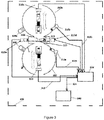
- the system 300 includes two first optical image acquisition devices 310 and 310a in communication 312, 312a with a neural network 320.
- An output device 340 is provided, which is in communication 324 with the neural network 320.
- the two first optical image acquisition devices 310 and 310a allow images of the table of diamond 315, which has its table facing downwards, at 90 degrees by image acquisition device 310 and at an inclination by image acquisition device 310a.
- images at two angles to the table facet of the diamond 315 may be acquired.
- the angle of inclination of the diamond 315 may be varied by a way of a holder for the diamond 315 so as to alter the viewing acquisition angle.
- the system 300 includes a system of integrating spheres comprised of two integrating spheres 350 and 350a in optical communication with each other at aperture region 316, in which the diamond 315 is located when the optical image is acquired.
- the first optical image acquisition devices 310 and 310a are preferably digital camera devices, which allow for acquisition of an optical image of a diamond 315 at 90 degrees by acquisition device 310, and at inclined at an angle for example 45 degrees acquisition device 310a with respect to the central vertical axis of the diamond 315.
- the optical image acquisition devices 310 and 310a are located at a distance of about 200mm from the diamond 315, or less, or more.
- the system 300 includes two light source 318 and 318a, providing said predetermined constant light level which is of colour temperature 6500K within each integrating sphere 350 and 350a.
- the light sources can be selected from the group including an LED (Light Emitting Diode) light source, a Xeon lamp light source, and incandescent light source, and fluorescent lamp light source, a solar simulator or the like, so as to provide a predetermined constant light level within the spheres 350 and 350a of colour temperature 6500K.
- the system 300 further includes a rotational platform 317 rotatable about said central axis of the diamond 315 and within the system of integrating spheres 350 and 350a, wherein the rotational platform 317 provides for rotation of the diamond 315 about the central axis such that a plurality of optical images of the diamonds can be acquired by the optical image acquisition devices 310 and 310a.
- a second optical image acquisition device 310b a second optical image acquisition device is also provided for acquiring at least a second optical image, wherein the second optical image is an optical image of the pavilion of the diamond 315.
- the images may be acquired by views of the pavilion of the diamond 315 for assessment of colour, and colour assessment conducted by way of views of the diamond.
- Additional optical image acquisition device 310c provides for acquisition of images of a diamond from above the pavilion, which is in communication with neural network 320.
- one or more further optical image acquisition devices 310d and 310e may be utilised for acquiring images of the diamonds as a side view, which are in communication with neural network 320.
- either the table or the pavilion or both the table and the pavilion of a diamond may be utilised in the present invention for colour assessment, and the neural network trained accordingly via images of either the table or the pavilion or both the table and the pavilion of known colour graded diamonds.
- the reference data of diamonds by which the neural network is trained is preferably standard reference diamonds of a master set, for example corresponding to a pre-existing colour grading system such as the Gemological Institute of America (GIA) colour grading system for example.
- GAA Gemological Institute of America
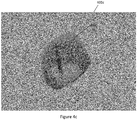
- Figures 4a shows an image 400a including a diamond 410 without flat-field correction.
- Figure 4b shows an image 400b which is a flat field image.
- Figure 4c shows a flat-field corrected image 400c with diamond 410, which demonstrates an image with uniform brightness and background.
- Colour is a continuum and an optical impression, and removal of artefact and increased evenness of light provides for more reliable and enhanced colour grading.
- Figure 5 shows a flow chart of an embodiment of a process according to the present invention. The process includes the steps of:
- the process of the present invention in a preferred embodiment, utilize a system of integrating spheres are used to analyze the colours of diamonds that are developed, and a pre-trained neutral network.
- Such a system and process can provide a good alternative with high repeatability in comparison with the systems and processes of the prior art, as can also reduce the cost and time to produce master stone sets and train a professional gemologist. It can also reduce the time to train a professional gemologist.
- the present invention ensures that the lighting conditions and the background for every diamond assessed for colour are the same, obviating negative environmental effects.
- controlled environment must be repeatable at different locations such that people at different location can still have the same assessment on diamond colour.
- a system of integrating spheres assists in playing this role as the light intensity, spectrum and uniformity can be well controlled and repeated, and meet this requirement.
Landscapes
- Engineering & Computer Science (AREA)
- Physics & Mathematics (AREA)
- Theoretical Computer Science (AREA)
- General Physics & Mathematics (AREA)
- Computer Vision & Pattern Recognition (AREA)
- Health & Medical Sciences (AREA)
- General Health & Medical Sciences (AREA)
- Evolutionary Computation (AREA)
- Multimedia (AREA)
- Life Sciences & Earth Sciences (AREA)
- Computing Systems (AREA)
- Artificial Intelligence (AREA)
- Software Systems (AREA)
- Databases & Information Systems (AREA)
- Biomedical Technology (AREA)
- Molecular Biology (AREA)
- Medical Informatics (AREA)
- Spectroscopy & Molecular Physics (AREA)
- Immunology (AREA)
- Chemical & Material Sciences (AREA)
- Analytical Chemistry (AREA)
- Biochemistry (AREA)
- Quality & Reliability (AREA)
- Pathology (AREA)
- Computational Linguistics (AREA)
- Biophysics (AREA)
- Data Mining & Analysis (AREA)
- General Engineering & Computer Science (AREA)
- Mathematical Physics (AREA)
- Biodiversity & Conservation Biology (AREA)
- Investigating Materials By The Use Of Optical Means Adapted For Particular Applications (AREA)
- Adornments (AREA)
Applications Claiming Priority (1)
| Application Number | Priority Date | Filing Date | Title |
|---|---|---|---|
| HK19127401.8A HK30017352A2 (en) | 2019-07-29 | A process and system for colour grading for diamonds |
Publications (1)
| Publication Number | Publication Date |
|---|---|
| EP3771902A1 true EP3771902A1 (de) | 2021-02-03 |
Family
ID=71894604
Family Applications (1)
| Application Number | Title | Priority Date | Filing Date |
|---|---|---|---|
| EP20188438.4A Pending EP3771902A1 (de) | 2019-07-29 | 2020-07-29 | Verfahren und system zur farbabstufung für diamanten |
Country Status (5)
| Country | Link |
|---|---|
| US (1) | US11326952B2 (de) |
| EP (1) | EP3771902A1 (de) |
| CN (1) | CN112381833A (de) |
| WO (1) | WO2021018174A1 (de) |
| ZA (1) | ZA202201380B (de) |
Cited By (1)
| Publication number | Priority date | Publication date | Assignee | Title |
|---|---|---|---|---|
| CN119756584A (zh) * | 2024-12-06 | 2025-04-04 | 北京理工大学 | 一种面向立体文物的测色装置及测色方法 |
Families Citing this family (5)
| Publication number | Priority date | Publication date | Assignee | Title |
|---|---|---|---|---|
| IL314376A (en) | 2022-01-18 | 2024-09-01 | Gemological Inst Of America Inc Gia | Analysis of the surface of gemstones |
| CN115112658A (zh) * | 2022-07-08 | 2022-09-27 | 漳州万舞信息科技有限公司 | 一种宝石等级鉴别方法及系统 |
| CN117036766A (zh) * | 2022-11-14 | 2023-11-10 | 合肥高斯智能科技有限公司 | 一种用于钻石定级的分类方法及系统 |
| WO2024261750A1 (en) * | 2023-06-20 | 2024-12-26 | Diamond Color Solutions Ltd. | Ai-based diamond grading |
| US12436092B1 (en) | 2024-10-10 | 2025-10-07 | Hong Kong Applied Science and Technology Research Institute Company Limited | Continuous line for automatic diamond color grading evaluation |
Citations (4)
| Publication number | Priority date | Publication date | Assignee | Title |
|---|---|---|---|---|
| US20080204705A1 (en) * | 2007-02-23 | 2008-08-28 | Yan Liu | Apparatus and method for color measurement and color grading of diamonds, gemstones and the like |
| US20090182520A1 (en) * | 2005-12-12 | 2009-07-16 | Yoav Luxembourg | Assessment of diamond color |
| EP3505917A1 (de) * | 2017-12-29 | 2019-07-03 | Goldway Technology Limited | Farbklassifizierungsverfahren und -system für diamanten |
| WO2019141200A1 (en) * | 2018-01-17 | 2019-07-25 | Master Dynamic Limited | Image analysis process and system |
Family Cites Families (33)
| Publication number | Priority date | Publication date | Assignee | Title |
|---|---|---|---|---|
| JPS5892920A (ja) * | 1981-11-30 | 1983-06-02 | Karuniyuu Kogaku Kogyo Kk | ダイヤモンドカラ−測定装置 |
| GB8700917D0 (en) * | 1987-01-16 | 1987-02-18 | British Petroleum Co Plc | Separation process |
| US6980283B1 (en) * | 1997-12-18 | 2005-12-27 | Imagestatistics, Inc. | Method and associated apparatus for the standardized grading of gemstones |
| US6304853B1 (en) * | 1998-09-21 | 2001-10-16 | Peter J. Malnekoff | Automated gemstone evaluation system |
| GB0130540D0 (en) | 2001-12-20 | 2002-02-06 | Boles Julian | Method for displaying information |
| US7420657B2 (en) * | 2003-12-22 | 2008-09-02 | American Gem Society | Methods, apparatus, and systems for evaluating gemstones |
| BE1016537A3 (nl) * | 2004-11-10 | 2007-01-09 | Wetenschappelijk En Tech Onder | Werkwijze voor het onderscheiden van kleurloze en bijna kleurloze diamanten en opstelling voor het uitvoeren van deze werkwijze. |
| US7388656B2 (en) * | 2005-12-30 | 2008-06-17 | Yan Liu | Method and system for color grading of gemstones |
| CN101539530B (zh) * | 2008-03-20 | 2011-08-31 | 香港城市大学 | 用于钻石的颜色分级的方法和装置 |
| AP2015008589A0 (en) * | 2009-03-11 | 2015-07-31 | Sarine Color Technologies Ltd | Methods and systems of imaging cut stones |
| CN103635793B (zh) * | 2012-06-29 | 2016-08-31 | 株式会社中央宝石研究所 | 钻石的心形及丘比特光学效应的良否判定方法及其装置 |
| US8878145B1 (en) * | 2012-07-27 | 2014-11-04 | Yan Liu | Apparatus and method for fluorescence spectral and color measurements of diamonds, gemstones and the like |
| CN103090973B (zh) | 2013-01-07 | 2015-01-14 | 广州标旗电子科技有限公司 | 基于光谱的Ia型钻石颜色快速分级方法 |
| EP3254089A4 (de) * | 2015-02-05 | 2019-07-17 | RGV Group LLC | Systeme und verfahren zur edelsteinidentifizierung |
| US10107757B2 (en) * | 2015-03-30 | 2018-10-23 | Gemological Institute Of America Inc. (Gia) | Apparatus and method for fluorescence grading of gemstones |
| US9678018B2 (en) | 2015-03-30 | 2017-06-13 | Gemological Institute Of America Inc. (Gia) | Apparatus and method for assessing optical quality of gemstones |
| CN107614127A (zh) * | 2015-03-31 | 2018-01-19 | 纳诺皮克集成软件解决方案私人有限公司 | 利用多反射和多角度视图的新型基于颜色的光学分级系统 |
| US10387723B2 (en) * | 2015-05-21 | 2019-08-20 | Sarine Color Technologies Ltd. | System and method of unique identifying a gemstone |
| GB201510652D0 (en) | 2015-06-17 | 2015-07-29 | Beers Uk De Ltd | Colour measurement of gemstones |
| JP6530552B2 (ja) * | 2015-07-29 | 2019-06-12 | デン、ウェンシュアイ | 色石の色品質の検出方法 |
| WO2017112609A1 (en) * | 2015-12-21 | 2017-06-29 | The Regents Of The University Of Califorina | Method to characterize cut gemstones using optical coherence tomography |
| CA3046787A1 (en) * | 2016-12-15 | 2018-06-21 | Gemological Institute Of America, Inc. (Gia) | Device and method for screening gemstones |
| US10548377B1 (en) * | 2017-01-30 | 2020-02-04 | The Diamond Pro, LTD | Methods, systems, and media for rating and analyzing diamonds |
| US10380734B2 (en) * | 2017-02-27 | 2019-08-13 | Aniket Bharat Parikh | System, method and computer program product for security analysis of jewelry items |
| CA3058554A1 (en) * | 2017-03-29 | 2018-10-04 | Engemma Oy | Gemological object recognition |
| EP3388822B1 (de) * | 2017-04-14 | 2023-09-27 | Inexto Sa | Verfahren zur berechnung eines einmaligen identifikators für einen edelstein mit facetten |
| BE1025152B1 (nl) * | 2017-04-19 | 2018-11-19 | Octonus Finland Oy | Verbeterde werkwijze voor het analyseren van een edelsteen |
| CN108009564A (zh) | 2017-10-31 | 2018-05-08 | 昆明理工大学 | 一种基于径向基函数神经网络模型的翡翠手镯品质分级方法 |
| CN107909103A (zh) | 2017-11-13 | 2018-04-13 | 武汉地质资源环境工业技术研究院有限公司 | 一种钻石4c标准自动分级方法、设备及存储设备 |
| EP3732469A4 (de) * | 2017-12-29 | 2021-03-10 | Goldway Technology Limited | Verfahren und system zur messung der diamantenklarheit |
| EP3769076A1 (de) * | 2018-03-23 | 2021-01-27 | Ariel Scientific Innovations Ltd. | Verfahren und vorrichtung zum klassieren von diamanten |
| WO2020016874A1 (en) * | 2018-07-15 | 2020-01-23 | Sarine Technologies Ltd | System and method for evaluating and determining color in gemstones |
| US20210148831A1 (en) * | 2019-07-02 | 2021-05-20 | Cortica Ltd. | Autonomous Grading of Gemstones |
-
2020
- 2020-07-29 US US16/942,687 patent/US11326952B2/en active Active
- 2020-07-29 WO PCT/CN2020/105430 patent/WO2021018174A1/en not_active Ceased
- 2020-07-29 CN CN202010747166.5A patent/CN112381833A/zh active Pending
- 2020-07-29 EP EP20188438.4A patent/EP3771902A1/de active Pending
-
2022
- 2022-01-28 ZA ZA2022/01380A patent/ZA202201380B/en unknown
Patent Citations (4)
| Publication number | Priority date | Publication date | Assignee | Title |
|---|---|---|---|---|
| US20090182520A1 (en) * | 2005-12-12 | 2009-07-16 | Yoav Luxembourg | Assessment of diamond color |
| US20080204705A1 (en) * | 2007-02-23 | 2008-08-28 | Yan Liu | Apparatus and method for color measurement and color grading of diamonds, gemstones and the like |
| EP3505917A1 (de) * | 2017-12-29 | 2019-07-03 | Goldway Technology Limited | Farbklassifizierungsverfahren und -system für diamanten |
| WO2019141200A1 (en) * | 2018-01-17 | 2019-07-25 | Master Dynamic Limited | Image analysis process and system |
Non-Patent Citations (2)
| Title |
|---|
| LÓPEZ-GONZÁLEZ G ET AL: "Quaternion Support Vector Classifier", 2 November 2014, BIG DATA ANALYTICS IN THE SOCIAL AND UBIQUITOUS CONTEXT : 5TH INTERNATIONAL WORKSHOP ON MODELING SOCIAL MEDIA, MSM 2014, 5TH INTERNATIONAL WORKSHOP ON MINING UBIQUITOUS AND SOCIAL ENVIRONMENTS, MUSE 2014 AND FIRST INTERNATIONAL WORKSHOP ON MACHINE LE, ISBN: 978-3-642-17318-9, XP047490377 * |
| ZHIGUO REN ET AL: "Diamond color grading based on machine vision", 2009 IEEE 12TH INTERNATIONAL CONFERENCE ON COMPUTER VISION WORKSHOPS, ICCV WORKSHOPS : KYOTO, JAPAN, 27 SEPTEMBER - 4 OCTOBER 2009, INSTITUTE OF ELECTRICAL AND ELECTRONICS ENGINEERS, PISCATAWAY, NJ, 27 September 2009 (2009-09-27), pages 1970 - 1976, XP031664553, ISBN: 978-1-4244-4442-7 * |
Cited By (1)
| Publication number | Priority date | Publication date | Assignee | Title |
|---|---|---|---|---|
| CN119756584A (zh) * | 2024-12-06 | 2025-04-04 | 北京理工大学 | 一种面向立体文物的测色装置及测色方法 |
Also Published As
| Publication number | Publication date |
|---|---|
| US11326952B2 (en) | 2022-05-10 |
| ZA202201380B (en) | 2022-10-26 |
| CN112381833A (zh) | 2021-02-19 |
| US20210033465A1 (en) | 2021-02-04 |
| WO2021018174A1 (en) | 2021-02-04 |
Similar Documents
| Publication | Publication Date | Title |
|---|---|---|
| US11326952B2 (en) | Process and system for colour grading for diamonds | |
| EP3505917B1 (de) | Farbklassifizierungsverfahren und -system für diamanten | |
| EP3771903B1 (de) | Verfahren und system zur messung der diamantklarheit | |
| CN102216760A (zh) | 用于宝石的评定、估价、分级的改进装置和方法 | |
| US11835466B2 (en) | Diamond clarity measurement process and system | |
| CN111837024B (zh) | 图像分析工艺和系统 | |
| CN111886492B (zh) | 用于翡翠的颜色分级工艺及系统 | |
| HK40048268A (en) | A process and system for colour grading for diamonds | |
| RU2786504C1 (ru) | Способ и система определения группы цвета алмазов | |
| HK40037870A (en) | A process and system for colour grading for diamonds | |
| HK40005146B (en) | Colour grading process and system for diamonds | |
| HK40005146A (en) | Colour grading process and system for diamonds | |
| HK40035894A (en) | A process and system for diamond clarity measurement | |
| HK40005214A (en) | Colour grading process and system for diamonds | |
| HK40032156A (en) | Image analysis process and system | |
| HK40032156B (en) | Image analysis process and system | |
| HK40032158A (en) | Diamond clarity measurement process and system | |
| HK40037871A (en) | A process and system for diamond clarity measurement | |
| HK40030455B (en) | Colour grading process and system for jade | |
| HK40030455A (en) | Colour grading process and system for jade | |
| HK40032158B (zh) | 钻石净度测量方法和系统 |
Legal Events
| Date | Code | Title | Description |
|---|---|---|---|
| PUAI | Public reference made under article 153(3) epc to a published international application that has entered the european phase |
Free format text: ORIGINAL CODE: 0009012 |
|
| STAA | Information on the status of an ep patent application or granted ep patent |
Free format text: STATUS: THE APPLICATION HAS BEEN PUBLISHED |
|
| AK | Designated contracting states |
Kind code of ref document: A1 Designated state(s): AL AT BE BG CH CY CZ DE DK EE ES FI FR GB GR HR HU IE IS IT LI LT LU LV MC MK MT NL NO PL PT RO RS SE SI SK SM TR |
|
| AX | Request for extension of the european patent |
Extension state: BA ME |
|
| RIN1 | Information on inventor provided before grant (corrected) |
Inventor name: HUI, KOON CHUNG Inventor name: CHEN, KA WING Inventor name: TANG, WING CHI |
|
| STAA | Information on the status of an ep patent application or granted ep patent |
Free format text: STATUS: REQUEST FOR EXAMINATION WAS MADE |
|
| RIN1 | Information on inventor provided before grant (corrected) |
Inventor name: HUI, KOON CHUNG Inventor name: CHENG, KA WING Inventor name: TANG, WING CHI |
|
| 17P | Request for examination filed |
Effective date: 20210802 |
|
| RBV | Designated contracting states (corrected) |
Designated state(s): AL AT BE BG CH CY CZ DE DK EE ES FI FR GB GR HR HU IE IS IT LI LT LU LV MC MK MT NL NO PL PT RO RS SE SI SK SM TR |
|
| REG | Reference to a national code |
Ref country code: HK Ref legal event code: DE Ref document number: 40048268 Country of ref document: HK |
|
| RAP3 | Party data changed (applicant data changed or rights of an application transferred) |
Owner name: GOLDWAY TECHNOLOGY LIMITED |
|
| STAA | Information on the status of an ep patent application or granted ep patent |
Free format text: STATUS: EXAMINATION IS IN PROGRESS |
|
| 17Q | First examination report despatched |
Effective date: 20230510 |
|
| P01 | Opt-out of the competence of the unified patent court (upc) registered |
Effective date: 20230529 |