EP3771639B1 - Aircraft cargo pallet lock assemblies - Google Patents
Aircraft cargo pallet lock assemblies Download PDFInfo
- Publication number
- EP3771639B1 EP3771639B1 EP20188096.0A EP20188096A EP3771639B1 EP 3771639 B1 EP3771639 B1 EP 3771639B1 EP 20188096 A EP20188096 A EP 20188096A EP 3771639 B1 EP3771639 B1 EP 3771639B1
- Authority
- EP
- European Patent Office
- Prior art keywords
- cargo
- aircraft
- actuator
- restraint
- pallet
- Prior art date
- Legal status (The legal status is an assumption and is not a legal conclusion. Google has not performed a legal analysis and makes no representation as to the accuracy of the status listed.)
- Active
Links
Images






Classifications
-
- B—PERFORMING OPERATIONS; TRANSPORTING
- B64—AIRCRAFT; AVIATION; COSMONAUTICS
- B64D—EQUIPMENT FOR FITTING IN OR TO AIRCRAFT; FLIGHT SUITS; PARACHUTES; ARRANGEMENT OR MOUNTING OF POWER PLANTS OR PROPULSION TRANSMISSIONS IN AIRCRAFT
- B64D9/00—Equipment for handling freight; Equipment for facilitating passenger embarkation or the like
- B64D9/003—Devices for retaining pallets or freight containers
-
- B—PERFORMING OPERATIONS; TRANSPORTING
- B60—VEHICLES IN GENERAL
- B60P—VEHICLES ADAPTED FOR LOAD TRANSPORTATION OR TO TRANSPORT, TO CARRY, OR TO COMPRISE SPECIAL LOADS OR OBJECTS
- B60P7/00—Securing or covering of load on vehicles
- B60P7/06—Securing of load
- B60P7/13—Securing freight containers or forwarding containers on vehicles
-
- B—PERFORMING OPERATIONS; TRANSPORTING
- B64—AIRCRAFT; AVIATION; COSMONAUTICS
- B64D—EQUIPMENT FOR FITTING IN OR TO AIRCRAFT; FLIGHT SUITS; PARACHUTES; ARRANGEMENT OR MOUNTING OF POWER PLANTS OR PROPULSION TRANSMISSIONS IN AIRCRAFT
- B64D9/00—Equipment for handling freight; Equipment for facilitating passenger embarkation or the like
Definitions
- the embodiments disclosed herein relate generally to lock assemblies for locking cargo load pallets to an aircraft cargo deck and to aircraft provided with such cargo pallet lock assemblies.
- cargo aircraft are configured to carry palletized cargo loads that are positionally locked to the cargo deck of the aircraft.
- the reliable positional locking of the cargo load pallets to the cargo deck during aerial transport is significantly important to safe aircraft operations as any shift in the cargo load within the aircraft's cargo compartment could adversely affect the aircraft's center of gravity that could in turn adversely (or even catastrophically) affect the aircraft's flight characteristics.
- pallet locks are therefore known and employed in the art as exemplified by US 3182608 A , US 4349168 A and US 4498823 A as well as US 2003/0334367 A1 .
- some pallet locks employ manually activated mechanisms such as shear pins which are used to lock the detent in its operational condition to avoid inadvertent detent movement. Such manually activated mechanisms thereby demand that the aircraft's loadmaster operate each lock individually.
- Other aircraft which employ remotely controlled lock units operated from the loadmaster's control panel.
- Some known lock mechanisms are not however capable of being fully retracted below the cargo deck thereby providing obstacles in the working volume of the cargo space when not in use.
- Further aircraft cargo assemblies having a locking device are described in US 6 729 818 B1 , EP 2 962 936 A1 , US 2013/334367 A1 , EP 2 360 094 A2 and US 3 810 534 A .
- cargo load pallets could be positionally locked relative to the aircraft cargo deck to restrain pallet movement in both vertical and horizontal directions and also be fully retractable so as to avoid being an obstacle in the cargo space. It is towards providing such a need that the embodiments disclosed herein are directed.
- the embodiments disclosed herein are directed toward aircraft cargo lock assemblies that are capable of positionally restraining movement of a cargo load pallet in both vertical and horizontal planes relative to the cargo deck of the aircraft.
- the lock assemblies described herein will include an actuator case and a restraint element which comprises at least one restraint plate and restraint detent, the restraint element being connected to the actuator case for pivotal movements between locked and released conditions relative to an edge of a cargo load pallet positioned on a cargo deck of an aircraft so as to positionally restrain the cargo load pallet against movement in both vertical and horizontal planes relative to the cargo deck.
- An actuator assembly is operably connected to the restraint element for moving the restraint element between the locked and released conditions thereof.
- the restraint plate is positioned over an edge of the cargo load pallet when the restraint element is in the locked condition thereof so as to positionally restrain the cargo load pallet against movement in the vertical plane relative to the cargo deck, while the restraint detent is positioned in an edge recess of the cargo load pallet when the restraint element is in the locked condition thereof so as to positionally restrain the cargo load pallet against movement in the horizontal plane relative to the cargo deck.
- the restrain element may comprise a spaced apart pair of the restraint plates with the restraint detent being positioned therebetween.
- the actuator case may be connected to the cargo deck for movements between a stowed mode, wherein the actuator case is substantially flush with the cargo deck, and a deployed mode, wherein the actuator case is raised above the cargo deck.
- the actuator case may include a hinge assembly at a rearward portion thereof that allows for pivotal connection to the cargo deck, and a linkage support plate at a forward portion thereof that allows for pivotal interconnection between the forward portion of the actuator case to the cargo deck to allow the actuator case to be pivotally moved between the stowed and deployed conditions thereof.
- the lock assembly may be deployed only when its use is desired but can remain stowed at other times so it does not provide an obstacle on the cargo deck surface.
- the actuator assembly includes a linear actuator having an actuator rod that is reciprocally moveable between extended and retracted conditions, and a linkage assembly which translates reciprocal movement of the actuator rod between the extended and retracted conditions into pivotal movement of the restraint element between the locked and released conditions, respectively.
- the linkage assembly may in turn include a splined command shaft, a bell crank positionally coupled to the command shaft, a rocker linkage assembly operably interconnecting the actuator rod of the linear actuator to the command shaft, and a coupler link operably interconnecting the restraint element to the bell crank.
- the rocker linkage assembly may be comprised of a linkage rod and a rocker link operably interconnecting a proximal end of the linkage rod to a distal end of the actuator rod, wherein a distal end of the linkage rod is operably connected to the bell crank.
- the coupler link and bell crank are in an over-the-center locking arrangement when the restraint element is in the locked condition thereof, in which case a tension spring may be operably connected to the restraint element for exerting a bias force on the restraint element in a direction to move the restraint element into the released condition thereof.
- a rotary transducer may be provided in order to sense positions of the restraint element when moved between the locked and released conditions thereof. Such sensed positions are preferably provided by the rotary transducer in the form of a position signal that is transmitted to and received by a lock controller (e.g., positioned at the loadmaster's control console within the aircraft) so as to provide an indication of the restrain element position.
- the lock controller may also allow the loadmaster to issue command signals to allow operation of the lock assemblies to thereby move them between the stowed and deployed modes and/or to move the restraint element between the locked and released conditions as may be required during cargo ground-based loading/unloading operations as well as inflight cargo jettisoning operations.
- FIGS. 1-3 show increasingly larger scale depictions of an exemplary interior cargo compartment 10-1 within the fuselage 10 of a conventional cargo aircraft CA.
- the cargo aircraft CA is provided with a rear-entry cargo door/ramp 10-2 and a cargo deck 10-3.
- the cargo deck 10-3 is shown supporting a number of conventional cargo load pallets CLP (not shown in FIG. 1 , but see FIG. 4A ) however the cargo door/ramp 10-2 could similarly be configured so as to support cargo load pallets CLP.
- the cargo load pallets are positionally locked relative to the cargo deck 10-3 by a number of pallet lock assemblies (a representative few of which are identified by reference numeral 20 in FIG. 1 ) to be described in greater detail below.
- the cargo deck 10-3 may include a series of laterally spaced apart roller equipped guides (a representative few of which are identified by reference numeral 10-4 in FIG. 1 ) aligned parallel to the longitudinal axis A L of the fuselage in the flight direction (arrow FD) of the aircraft CA for guiding the individual cargo load pallets CP into the selected position within the cargo compartment 10-1.
- access to the cargo compartment 10-1 may be achieved through the cargo door/ramp 10-2 when in a lowered position so as to allow the cargo load pallets CP to be loaded/unloaded from the cargo aircraft CA by suitable cargo handling equipment.
- each lock assembly 20 is capable of being pivotally moved between deployed and stowed modes, respectively.
- FIG. 4A shows the lock assembly 20 in a deployed mode whereby the lock assembly is angularly oriented upwardly toward the cargo pallet CP.
- FIG. 4B shows the lock assembly 20 in a stowed condition whereby the lock assembly 20 is fully retracted within the cargo deck 10-3 so as to provide a contiguous top surface 10-3a substantially flush with the top surface of the cargo deck 10-3.
- the lock assembly 20 is provided with an actuator case 22 (shown partly broken away in FIGS. 4A and 4B for clarity of certain internal mechanisms).
- An outboard lateral edge of the actuator case 22 is pivotally coupled to an adjacent portion of the fixed cargo deck support 10-4 by way of a hinge assembly 23 associated with the cargo deck 10-3.
- the hinge assembly 23 is comprised of hinge 23a and hinge rod 23b.
- the inboard edge of the actuator case 22 is pivotally coupled to the cargo deck 10-1 by way of a lower linkage support plates 24 and a drive link 26 pivotally coupled at an adjacent end to one another by connection rod 24b and to the inboard edge of the actuator case 22 and an adjacent portion of the fixed cargo deck support 10-4 by connection rods 24a, 26a, respectively.
- a lower linkage support plates 24 and a drive link 26 pivotally coupled at an adjacent end to one another by connection rod 24b and to the inboard edge of the actuator case 22 and an adjacent portion of the fixed cargo deck support 10-4 by connection rods 24a, 26a, respectively.
- the lock assembly 20 in order to positionally lock the cargo load pallet CLP relative to the cargo deck 10-3, the lock assembly 20 is provided with a pallet restraint element 30 which integrally includes a pair of restraint plates 30a, 30b spaced apart along the longitudinal axis A L of the aircraft CA and a restraint detent 30c disposed therebetween.
- a pallet restraint element 30 which integrally includes a pair of restraint plates 30a, 30b spaced apart along the longitudinal axis A L of the aircraft CA and a restraint detent 30c disposed therebetween.
- FIGS. 5A and 5B when the lock assembly 20 is in the deployed mode, the restraint plates 30a, 30b and restraint detent 30c of the restraint element 30 can be moved between locked and released conditions relative to the cargo load platform CLP, respectively.
- Each of the restraint plates 30a is therefore sized and configured so as to be capable of being extended over and engaged with an adjacent lateral edge LE of the cargo load pallet CLP while the restraint detent 30c is sized and configured so as to be positionable within an edge recess ER of the cargo load pallet CLP when in the locked condition as shown in FIG. 5A but may be retracted away from the cargo load pallet CLP when in the released condition as shown in FIG. 5B .
- the restraint plates 30a, 30b serve to positionally restrain the cargo load pallet CLP in direction vertically transverse to the longitudinal axis A L of the aircraft CA while the restraint detent 30c serves to positionally restrain the cargo load pallet CLP in a direction parallel to the longitudinal axis A L of the aircraft CA.
- the cargo load pallet CLP is positionally locked relative to the cargo deck 10-3.
- the restraint plates 30a, 30b and restraint detent 30c are separably disengaged from the cargo load pallet CLP so as to allow the cargo load pallet CLP to be positionally moved along the cargo deck 10-3.
- FIGS. 9-19 show the actuator mechanisms within the actuator case 22 that serve to move the lock assembly 20 between the deployed and stowed modes as well as to move the restraint element 30 between the locked and released conditions.
- the lock assembly 20 is operably connected to a lock controller LC via signal and power cables 40.
- the lock controller LC may be positioned anywhere convenient within the aircraft CA, for example, at the loadmaster's control console so as to allow the loadmaster to operate individual or designated groups of lock assemblies 20 during loading and unloading operations.
- Individual signal and power cables 40a and 40b from the lock controller LC are provided so as to electrically interconnect the lock controller LC with a linear actuator 50 and the rotary transducer 70 within the actuator case 22.
- the actuator case 22 may be electrically grounded to the aircraft frame structures by means of a grounding strap GS.
- the linear actuator 50 serves to move the restraint element 30 between the locked and released conditions thereof.
- the loadmaster may send appropriate lock/release signals via the lock controller to the linear actuator 50 associated with the lock assembly to cause the restraint element 30 to be moved between the locked/released conditions as may be required.
- the linear actuator 50 includes an actuator rod 52 that is operably connected to a rocker link 54.
- the rocker link 54 drives a linkage rod 56 which is pivotally connected at its distal end to a proximal end of a bell crank 58 which in turn is pivotally connected to the proximal ends of coupler links 60a, 60b operable attached to the restraint element 30.
- the distal end of the bell crank 58 is positionally coupled to a splined command shaft 62.
- an over-the-center locking arrangement is established by the bell crank 58 and the coupler link 60b so as to positionally secure the restraint element 30 in the locked condition thereof (see e.g., FIG. 13A ).
- Tension springs 64a, 64b connected between the restraint element 30 and the actuator case 22 will therefore be placed under tension when the restraint element is moved to its locked condition.
- a bias force will be exerted on the restraint element to assist it to move from the locked condition to the released condition upon retraction of the actuator rod 52 upon actuation of the linear actuator 50.
- the bias force will therefor assist to release the over-the-center locking arrangement between the bell crank 50 and the coupler link 60 so as to allow the restraint element to move back to a released condition thereof when commanded by the actuator 50.
- the splined shaft 62 carries a rotary stop element 67 that rotates with the shaft 62 when commanded by the linear actuator 50 in the manner described above.
- An adjustable stop pin 67a may be provided so as to establish a limit stop for the locked condition of the restraint element 30 whereas a portion of the actuator case 22 serves as a limit stop when the restraint element 30 is in the released condition.
- a rotary transducer 70 such as a Rotary Variable Differential Transformer (RVDT) is provided so as to sense the position of the restraint element 30 and provide position signals for the same to the lock controller LC.
- the rotary transducer 70 includes a crank arm 72 connected at a proximal end to the shaft 70a of the transducer 70 and at a distal end to a coupler link 74.
- the distal end of the coupler link 70 is in turn connected to a bell crank 75 positionally coupled to the splined shaft 62.
- rotation of the splined shaft 62 will rotate the bell crank 74 which in turn drives the crank arm 72 to thereby rotate the shaft 70a.
- a torsion spring 76 operably exerts a torsional spring force onto the crank arm 72 to assist in its movements.
- the shaft 70a of the rotary transducer 70 will be responsively rotated which in turn causes the transducer 70 to generate position signals that may be communicated to the lock controller LC via cabling 40b.
- the rotary transducer 70 is capable of sending position signals to the lock controller LC so as to confirm the proper positioning of the restraint element 30 relative to the cargo load pallet CLP or alert the loadmaster to any abnormal positioning of the restraint element 30 that may occur so that remedial action can be taken.
Landscapes
- Engineering & Computer Science (AREA)
- Aviation & Aerospace Engineering (AREA)
- Transportation (AREA)
- Mechanical Engineering (AREA)
- Pallets (AREA)
- Auxiliary Methods And Devices For Loading And Unloading (AREA)
Description
- The embodiments disclosed herein relate generally to lock assemblies for locking cargo load pallets to an aircraft cargo deck and to aircraft provided with such cargo pallet lock assemblies.
- As is well known, cargo aircraft are configured to carry palletized cargo loads that are positionally locked to the cargo deck of the aircraft. The reliable positional locking of the cargo load pallets to the cargo deck during aerial transport is significantly important to safe aircraft operations as any shift in the cargo load within the aircraft's cargo compartment could adversely affect the aircraft's center of gravity that could in turn adversely (or even catastrophically) affect the aircraft's flight characteristics.
- Various pallet locks are therefore known and employed in the art as exemplified by
US 3182608 A ,US 4349168 A andUS 4498823 A as well asUS 2003/0334367 A1 . In this regard, some pallet locks employ manually activated mechanisms such as shear pins which are used to lock the detent in its operational condition to avoid inadvertent detent movement. Such manually activated mechanisms thereby demand that the aircraft's loadmaster operate each lock individually. Other aircraft are known which employ remotely controlled lock units operated from the loadmaster's control panel. Some known lock mechanisms are not however capable of being fully retracted below the cargo deck thereby providing obstacles in the working volume of the cargo space when not in use. Further aircraft cargo assemblies having a locking device are described inUS 6 729 818 B1 ,EP 2 962 936 A1 ,US 2013/334367 A1 ,EP 2 360 094 A2 andUS 3 810 534 A . - It would therefore be desirable if cargo load pallets could be positionally locked relative to the aircraft cargo deck to restrain pallet movement in both vertical and horizontal directions and also be fully retractable so as to avoid being an obstacle in the cargo space. It is towards providing such a need that the embodiments disclosed herein are directed.
- Broadly, the embodiments disclosed herein are directed toward aircraft cargo lock assemblies that are capable of positionally restraining movement of a cargo load pallet in both vertical and horizontal planes relative to the cargo deck of the aircraft.
- According to the invention, the lock assemblies described herein will include an actuator case and a restraint element which comprises at least one restraint plate and restraint detent, the restraint element being connected to the actuator case for pivotal movements between locked and released conditions relative to an edge of a cargo load pallet positioned on a cargo deck of an aircraft so as to positionally restrain the cargo load pallet against movement in both vertical and horizontal planes relative to the cargo deck. An actuator assembly is operably connected to the restraint element for moving the restraint element between the locked and released conditions thereof. The restraint plate is positioned over an edge of the cargo load pallet when the restraint element is in the locked condition thereof so as to positionally restrain the cargo load pallet against movement in the vertical plane relative to the cargo deck, while the restraint detent is positioned in an edge recess of the cargo load pallet when the restraint element is in the locked condition thereof so as to positionally restrain the cargo load pallet against movement in the horizontal plane relative to the cargo deck. The restrain element according to some embodiments may comprise a spaced apart pair of the restraint plates with the restraint detent being positioned therebetween.
- The actuator case may be connected to the cargo deck for movements between a stowed mode, wherein the actuator case is substantially flush with the cargo deck, and a deployed mode, wherein the actuator case is raised above the cargo deck. To accomplish such movements, the actuator case may include a hinge assembly at a rearward portion thereof that allows for pivotal connection to the cargo deck, and a linkage support plate at a forward portion thereof that allows for pivotal interconnection between the forward portion of the actuator case to the cargo deck to allow the actuator case to be pivotally moved between the stowed and deployed conditions thereof. According to these embodiments, therefore, the lock assembly may be deployed only when its use is desired but can remain stowed at other times so it does not provide an obstacle on the cargo deck surface.
- The actuator assembly includes a linear actuator having an actuator rod that is reciprocally moveable between extended and retracted conditions, and a linkage assembly which translates reciprocal movement of the actuator rod between the extended and retracted conditions into pivotal movement of the restraint element between the locked and released conditions, respectively. The linkage assembly may in turn include a splined command shaft, a bell crank positionally coupled to the command shaft, a rocker linkage assembly operably interconnecting the actuator rod of the linear actuator to the command shaft, and a coupler link operably interconnecting the restraint element to the bell crank. The rocker linkage assembly may be comprised of a linkage rod and a rocker link operably interconnecting a proximal end of the linkage rod to a distal end of the actuator rod, wherein a distal end of the linkage rod is operably connected to the bell crank. In certain embodiments, the coupler link and bell crank are in an over-the-center locking arrangement when the restraint element is in the locked condition thereof, in which case a tension spring may be operably connected to the restraint element for exerting a bias force on the restraint element in a direction to move the restraint element into the released condition thereof.
- A rotary transducer may be provided in order to sense positions of the restraint element when moved between the locked and released conditions thereof. Such sensed positions are preferably provided by the rotary transducer in the form of a position signal that is transmitted to and received by a lock controller (e.g., positioned at the loadmaster's control console within the aircraft) so as to provide an indication of the restrain element position. The lock controller may also allow the loadmaster to issue command signals to allow operation of the lock assemblies to thereby move them between the stowed and deployed modes and/or to move the restraint element between the locked and released conditions as may be required during cargo ground-based loading/unloading operations as well as inflight cargo jettisoning operations.
- These and other aspects and advantages of the present invention will become more clear after careful consideration is given to the following detailed description of the preferred exemplary embodiments thereof.
- The disclosed embodiments of the present invention will be better and more completely understood by referring to the following detailed description of exemplary non-limiting illustrative embodiments in conjunction with the drawings of which:
-
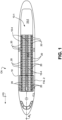
FIG. 1 is an x-ray plan view of a cargo aircraft fuselage which includes an opposed pairs of pallet lock assemblies according to an embodiment described hereinbelow longitudinally arranged along the cargo deck; -
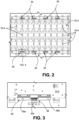
FIG. 2 is an enlarged plan view of an enlarged view of representative opposed pairs of pallet lock assembly as depicted inFIG. 1 ; -
FIG. 3 is an enlarged view of a representative pallet lock assembly as shown inFIG. 2 ; -
FIGS. 4A and 4B are cross-sectional elevational views showing the pallet lock assembly in deployed and stowed modes relative to the aircraft cargo deck; -
FIGS. 5A and5B are perspective views of a representative pallet lock assembly depicted in a deployed mode relative to the cargo deck and with the pallet restraint element being in the locked and released conditions, respectively; -
FIGS. 6 and7 are enlarged perspective views of the pallet lock assembly with the pallet restraint element depicted in locked and released conditions, respectively; -
FIG. 8 is a perspective view showing the pallet restraint element exploded from the actuator case assembly; -
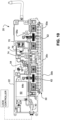
FIGS. 9 and10 are bottom plan views of the actuator case assembly with the cover removed and the mechanisms therein depicted in locked and released conditions, respectively; -
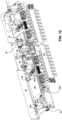
FIGS. 11 and12 are bottom perspective views as seen from the rear of the actuator case assembly with the cover removed and the mechanisms therein depicted in locked and released conditions, respectively; -
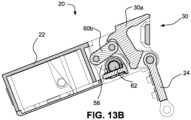
FIGS. 13A and13B depict the actuator mechanisms of the lock case in the locked and released conditions as taken alonglines 13A-13A and 13B-13B inFIGS. 6 and7 , respectively; -
FIGS. 14A and 14B depict the actuator mechanisms of the lock case in the locked and released conditions as taken alonglines 14A-14A and 14B-14B inFIGS. 6 and7 , respectively; -
FIGS. 15A and 15B depict the actuator mechanisms of the lock case in the locked and released conditions as taken alonglines 15A-15A and 15B-15B inFIGS. 6 and7 , respectively; -
FIGS. 16A and 16B depict the actuator mechanisms of the lock case in the locked and released conditions as taken alonglines 16A-16A and 16B-16B inFIGS. 6 and7 , respectively; -
FIGS. 17A and 17B depict the actuator mechanisms of the lock case in the locked and released conditions as taken alonglines 17A-17A and 17B-17B inFIGS. 6 and7 , respectively; -
FIGS. 18A and 18B depict the actuator mechanisms of the lock case in the locked and released conditions as taken alonglines 18A-18A and 18B-18B inFIGS. 6 and7 , respectively; and -
FIG. 19 is a detailed perspective view showing a rotary transducer when the actuator mechanisms of the lock case are in a locked condition. - Accompanying
FIGS. 1-3 show increasingly larger scale depictions of an exemplary interior cargo compartment 10-1 within thefuselage 10 of a conventional cargo aircraft CA. As shown inFIG. 1 , the cargo aircraft CA is provided with a rear-entry cargo door/ramp 10-2 and a cargo deck 10-3. As depicted, the cargo deck 10-3 is shown supporting a number of conventional cargo load pallets CLP (not shown inFIG. 1 , but seeFIG. 4A ) however the cargo door/ramp 10-2 could similarly be configured so as to support cargo load pallets CLP. The cargo load pallets are positionally locked relative to the cargo deck 10-3 by a number of pallet lock assemblies (a representative few of which are identified byreference numeral 20 inFIG. 1 ) to be described in greater detail below. As is conventional, the cargo deck 10-3 may include a series of laterally spaced apart roller equipped guides (a representative few of which are identified by reference numeral 10-4 inFIG. 1 ) aligned parallel to the longitudinal axis AL of the fuselage in the flight direction (arrow FD) of the aircraft CA for guiding the individual cargo load pallets CP into the selected position within the cargo compartment 10-1. As is known, access to the cargo compartment 10-1 may be achieved through the cargo door/ramp 10-2 when in a lowered position so as to allow the cargo load pallets CP to be loaded/unloaded from the cargo aircraft CA by suitable cargo handling equipment. - As is perhaps better shown in
FIGS. 4A and 4B , eachlock assembly 20 is capable of being pivotally moved between deployed and stowed modes, respectively. Specifically,FIG. 4A shows thelock assembly 20 in a deployed mode whereby the lock assembly is angularly oriented upwardly toward the cargo pallet CP.FIG. 4B on the other hand shows thelock assembly 20 in a stowed condition whereby thelock assembly 20 is fully retracted within the cargo deck 10-3 so as to provide a contiguous top surface 10-3a substantially flush with the top surface of the cargo deck 10-3. - In order to allow such deployment of the
lock assembly 20 between the deployed and stowed modes as shown respectively inFIGS. 4A and 4B , thelock assembly 20 is provided with an actuator case 22 (shown partly broken away inFIGS. 4A and 4B for clarity of certain internal mechanisms). An outboard lateral edge of theactuator case 22 is pivotally coupled to an adjacent portion of the fixed cargo deck support 10-4 by way of ahinge assembly 23 associated with the cargo deck 10-3. As shown, thehinge assembly 23 is comprised ofhinge 23a and hingerod 23b. The inboard edge of theactuator case 22 is pivotally coupled to the cargo deck 10-1 by way of a lowerlinkage support plates 24 and adrive link 26 pivotally coupled at an adjacent end to one another byconnection rod 24b and to the inboard edge of theactuator case 22 and an adjacent portion of the fixed cargo deck support 10-4 byconnection rods FIG. 4B , turning movement applied to therod 26a in a counterclockwise direction. Such turning movement may be applied manually by the load personnel but also conceivably could be configured to be connected to an electric or hydraulic drive member. Turning movement of therod 26a in a counterclockwise direction will in turn drive thelinkage support plate 24 in a clockwise direction thereby causing thelinkage support plate 26 to extend upwardly so as to raise the lockassembly actuator case 22 of thelock assembly 20 relative to the surface of the cargo deck 10-3 and into the deployed mode shown inFIG. 4A . Reverse movement to that as just described will thereby return the lockingassembly 20 from the deployed mode shown inFIG. 4A to the stowed mode shown inFIG. 4B . - As shown in
FIGS. 6-8 , in order to positionally lock the cargo load pallet CLP relative to the cargo deck 10-3, thelock assembly 20 is provided with apallet restraint element 30 which integrally includes a pair ofrestraint plates restraint detent 30c disposed therebetween. As shown inFIGS. 5A and5B , when thelock assembly 20 is in the deployed mode, therestraint plates restraint detent 30c of therestraint element 30 can be moved between locked and released conditions relative to the cargo load platform CLP, respectively. Each of therestraint plates 30a is therefore sized and configured so as to be capable of being extended over and engaged with an adjacent lateral edge LE of the cargo load pallet CLP while therestraint detent 30c is sized and configured so as to be positionable within an edge recess ER of the cargo load pallet CLP when in the locked condition as shown inFIG. 5A but may be retracted away from the cargo load pallet CLP when in the released condition as shown inFIG. 5B . Thus, when in the locked condition as shown inFIG. 5A , therestraint plates restraint detent 30c serves to positionally restrain the cargo load pallet CLP in a direction parallel to the longitudinal axis AL of the aircraft CA. In such a manner, therefore, the cargo load pallet CLP is positionally locked relative to the cargo deck 10-3. However, when in the released condition as shown inFIG. 5B , therestraint plates restraint detent 30c are separably disengaged from the cargo load pallet CLP so as to allow the cargo load pallet CLP to be positionally moved along the cargo deck 10-3. - Accompanying
FIGS. 9-19 show the actuator mechanisms within theactuator case 22 that serve to move thelock assembly 20 between the deployed and stowed modes as well as to move therestraint element 30 between the locked and released conditions. - As can be seen especially in
FIGS. 9 and10 , thelock assembly 20 is operably connected to a lock controller LC via signal andpower cables 40. The lock controller LC may be positioned anywhere convenient within the aircraft CA, for example, at the loadmaster's control console so as to allow the loadmaster to operate individual or designated groups oflock assemblies 20 during loading and unloading operations. Individual signal andpower cables linear actuator 50 and therotary transducer 70 within theactuator case 22. Theactuator case 22 may be electrically grounded to the aircraft frame structures by means of a grounding strap GS. Thelinear actuator 50 serves to move therestraint element 30 between the locked and released conditions thereof. Thus, during loading/unloading operations of palletized cargo onto the cargo deck 10-3 of the cargo aircraft CA, the loadmaster may send appropriate lock/release signals via the lock controller to thelinear actuator 50 associated with the lock assembly to cause therestraint element 30 to be moved between the locked/released conditions as may be required. - The
linear actuator 50 includes anactuator rod 52 that is operably connected to arocker link 54. Therocker link 54 drives alinkage rod 56 which is pivotally connected at its distal end to a proximal end of a bell crank 58 which in turn is pivotally connected to the proximal ends ofcoupler links restraint element 30. The distal end of the bell crank 58 is positionally coupled to asplined command shaft 62. Thus, in response to extension or retraction of theactuator rod 52 as commanded by thelinear actuator 50, therestraint element 30 will be caused to be pivotally moved between its locked and released conditions by thecoupler links FIGS. 18A and 18B that while in the locked condition, an over-the-center locking arrangement is established by the bell crank 58 and thecoupler link 60b so as to positionally secure therestraint element 30 in the locked condition thereof (see e.g.,FIG. 13A ). Tension springs 64a, 64b connected between therestraint element 30 and theactuator case 22 will therefore be placed under tension when the restraint element is moved to its locked condition. As such, a bias force will be exerted on the restraint element to assist it to move from the locked condition to the released condition upon retraction of theactuator rod 52 upon actuation of thelinear actuator 50. The bias force will therefor assist to release the over-the-center locking arrangement between the bell crank 50 and the coupler link 60 so as to allow the restraint element to move back to a released condition thereof when commanded by theactuator 50. - As is shown in
FIGS. 17A and 17B , thesplined shaft 62 carries arotary stop element 67 that rotates with theshaft 62 when commanded by thelinear actuator 50 in the manner described above. Anadjustable stop pin 67a may be provided so as to establish a limit stop for the locked condition of therestraint element 30 whereas a portion of theactuator case 22 serves as a limit stop when therestraint element 30 is in the released condition. - A
rotary transducer 70 such as a Rotary Variable Differential Transformer (RVDT) is provided so as to sense the position of therestraint element 30 and provide position signals for the same to the lock controller LC. As is shown in greater detail inFIG. 19 , therotary transducer 70 includes acrank arm 72 connected at a proximal end to theshaft 70a of thetransducer 70 and at a distal end to acoupler link 74. The distal end of thecoupler link 70 is in turn connected to a bell crank 75 positionally coupled to thesplined shaft 62. Thus rotation of thesplined shaft 62 will rotate the bell crank 74 which in turn drives thecrank arm 72 to thereby rotate theshaft 70a. Atorsion spring 76 operably exerts a torsional spring force onto thecrank arm 72 to assist in its movements. Thus, upon rotation of thesplined shaft 62, theshaft 70a of therotary transducer 70 will be responsively rotated which in turn causes thetransducer 70 to generate position signals that may be communicated to the lock controller LC viacabling 40b. Thus, during operation of therestraint element 30 as described hereinabove, therotary transducer 70 is capable of sending position signals to the lock controller LC so as to confirm the proper positioning of therestraint element 30 relative to the cargo load pallet CLP or alert the loadmaster to any abnormal positioning of therestraint element 30 that may occur so that remedial action can be taken.
Claims (14)
- An aircraft cargo pallet lock assembly (20) comprising:an actuator case (22);a restraint element (30) which comprises at least one restraint plate (30a, 30b) and restraint detent (30c), the restraint element (30) being connected to the actuator case (22) for pivotal movements between locked and released conditions relative to an edge of a cargo load pallet (CLP) positioned on a cargo deck (10-3) of an aircraft so as to positionally restrain the cargo load pallet (CLP) against movement in both vertical and horizontal planes relative to the cargo deck (10-3); andan actuator assembly (50) operably connected to the restraint element (30) for moving the restraint element between the locked and released conditions thereof, whereinthe restraint plate (30a, 30b) is positioned over an edge of the cargo load pallet (CLP) when the restraint element (30) is in the locked condition thereof so as to positionally restrain the cargo load pallet (CLP) against movement in the vertical plane relative to the cargo deck (10-3), and whereinthe restraint detent (30c) is positioned in an edge recess of the cargo load pallet (CLP) when the restraint element (30) is in the locked condition thereof so as to positionally restrain the cargo load pallet (CLP) against movement in the horizontal plane relative to the cargo deck (10-3);the aircraft cargo pallet lock assembly (20) being characterized by the fact that the actuator assembly comprises:a linear actuator (50) having an actuator rod (52) that is reciprocally moveable between extended and retracted conditions; anda linkage assembly which translates reciprocal movement of the actuator rod (52) between the extended and retracted conditions into pivotal movement of the restraint element (30) between the locked and released conditions, respectively.
- The aircraft cargo pallet lock assembly according to claim 1, wherein the restrain element (30) comprises a spaced apart pair of restraint plates (30a, 30b) with the restraint detent (30c) being positioned therebetween.
- The aircraft cargo pallet lock assembly according to claim 1, wherein the actuator case (22) is connectable to the cargo deck (10-3) for movements between a stowed mode, wherein the actuator case (22) is substantially flush with the cargo deck (10-3), and a deployed mode, wherein the actuator case (22) is raised above the cargo deck (10-3).
- The aircraft cargo pallet lock assembly according to claim 3, wherein the actuator case (22) includes a hinge assembly (23) at a rearward portion thereof that allows for pivotal connection to the cargo deck (10-3), and a linkage support plate (24) at a forward portion thereof that allows for pivotal interconnection between the forward portion of the actuator case to the cargo deck (10-3) to allow the actuator case (22) to be pivotally moved between the stowed and deployed conditions thereof.
- The aircraft cargo pallet lock assembly according to claim 1, wherein the linkage assembly comprises:a splined command shaft (62);a bell crank (58) positionally coupled to the command shaft (62);a rocker linkage assembly operably interconnecting the actuator rod (52) of the linear actuator (50) to the command shaft (62); anda coupler link (74) operably interconnecting the restraint element (30) to the bell crank (58).
- The aircraft cargo pallet lock assembly according to claim 5, wherein the rocker linkage assembly comprises a linkage rod (56) and a rocker link (54) operably interconnecting a proximal end of the linkage rod (56) to a distal end of the actuator rod (52), wherein a distal end of the linkage rod (56) is operably connected to the bell crank (58).
- The aircraft cargo pallet lock assembly according to claim 5, wherein the coupler link (74) and bell crank (58) are in an over-the-center locking arrangement when the restraint element (30) is in the locked condition thereof.
- The aircraft cargo pallet lock assembly according to claim 7, wherein the linkage assembly further comprises a tension spring operably connected to the restraint element (30) for exerting a bias force on the restraint element (30) in a direction to move the restraint element into the released condition thereof.
- The aircraft cargo pallet lock assembly according to claim 1, wherein the actuator assembly includes a rotary transducer (70) for sensing positions of the restraint element (30) when moved between the locked and released conditions thereof.
- A cargo aircraft which comprises the cargo pallet lock assembly according to one of the preceding claims.
- A cargo aircraft comprising:a fuselage (10) defining a cargo space;a cargo deck (10-3) within the fuselage (10) for supporting a plurality of cargo load pallets (CLP) thereon, anda plurality of cargo pallet lock assemblies laterally spaced apart relative to a longitudinal axis of the cargo aircraft for positionally restraining the cargo load pallets (CLP) against movement in both vertical and horizontal planes relative to the cargo deck, wherein the cargo pallet lock assemblies comprise the features of one of claims 1 to 10.
- The cargo aircraft according to claim 11, wherein the actuator assembly includes a rotary transducer (70) for positionally sensing the restraint element (30) in the locked and released conditions thereof and issuing a position signal indicative of the locked and released conditions.
- The cargo aircraft according to claim 12, further comprising a lock controller (LC), wherein:the lock controller (LC) is for receiving the position signal from the rotary transducer (70) and providing a position indication in response thereto; and/orthe lock controller (LC) is operably connected to the linear actuator (50), the lock controller (LC) issuing a command signal to the linear actuator (50) to thereby responsively activate the linear actuator (50) and cause the restrain element (30) to move between the locked and unlocked conditions thereof.
- The cargo aircraft according to claim 13, wherein the rotary transducer (70) is configured for issuing the position signal indicative of the locked and released conditions to the lock controller (LC).
Applications Claiming Priority (1)
| Application Number | Priority Date | Filing Date | Title |
|---|---|---|---|
| US16/524,745 US10994843B2 (en) | 2019-07-29 | 2019-07-29 | Aircraft cargo pallet lock assemblies |
Publications (2)
| Publication Number | Publication Date |
|---|---|
| EP3771639A1 EP3771639A1 (en) | 2021-02-03 |
| EP3771639B1 true EP3771639B1 (en) | 2023-09-13 |
Family
ID=71842568
Family Applications (1)
| Application Number | Title | Priority Date | Filing Date |
|---|---|---|---|
| EP20188096.0A Active EP3771639B1 (en) | 2019-07-29 | 2020-07-28 | Aircraft cargo pallet lock assemblies |
Country Status (3)
| Country | Link |
|---|---|
| US (1) | US10994843B2 (en) |
| EP (1) | EP3771639B1 (en) |
| CN (1) | CN112298570B (en) |
Families Citing this family (6)
| Publication number | Priority date | Publication date | Assignee | Title |
|---|---|---|---|---|
| CN110884517B (en) * | 2019-12-03 | 2021-03-02 | 中车齐齐哈尔车辆有限公司 | Container locking device and piggyback transport vehicle |
| DE102021112241B3 (en) * | 2021-05-11 | 2022-06-09 | Telair International Gmbh | Latch system, cargo deck and airplane |
| US12214900B2 (en) * | 2021-07-27 | 2025-02-04 | Goodrich Corporation | Latch state detection systems, methods and devices |
| CN114104257A (en) * | 2021-11-18 | 2022-03-01 | 庆安集团有限公司 | A device used for the bidirectional restraint of the container unit in the aircraft containerized cargo system |
| CN116353830B (en) * | 2023-01-31 | 2026-03-17 | 中航电测仪器(西安)有限公司 | A type of platform limit lock |
| CN117775263B (en) * | 2023-12-28 | 2026-02-03 | 北京北方长鹰无人机科技有限公司 | Track limiting lock and track guiding limiting system comprising same |
Family Cites Families (17)
| Publication number | Priority date | Publication date | Assignee | Title |
|---|---|---|---|---|
| US3182608A (en) | 1962-02-19 | 1965-05-11 | Brooks & Perkins | Pallet locking mechanism |
| US3810534A (en) * | 1970-04-22 | 1974-05-14 | Ancra Corp | Automatic pallet locking device |
| US4349168A (en) | 1980-02-19 | 1982-09-14 | The Boeing Company | Cargo delivery system for aircraft |
| US4379535A (en) * | 1981-07-06 | 1983-04-12 | Mcdonnell Douglas Corporation | Pallet restrain system |
| DE3222202C2 (en) * | 1982-06-12 | 1986-09-25 | Messerschmitt-Bölkow-Blohm GmbH, 8012 Ottobrunn | Locking element for locking cargo items in the cargo hold of aircraft |
| US4498823A (en) | 1982-09-29 | 1985-02-12 | The Boeing Company | Retractable vertical restraint mechanism for an aircraft cargo system |
| US6488457B2 (en) * | 2001-03-05 | 2002-12-03 | The Boeing Company | Latching system for a palletized system of an aircraft |
| US6485238B2 (en) * | 2001-03-16 | 2002-11-26 | Pemco Aviation Group | Restraint apparatus |
| US6612470B2 (en) | 2001-08-15 | 2003-09-02 | Systemation, Inc. | Packaging device for fasteners |
| US6729818B1 (en) * | 2003-01-14 | 2004-05-04 | The Boeing Company | Supplemental cargo restraint system for oversized cargo |
| US7118314B2 (en) * | 2004-08-20 | 2006-10-10 | Oshkosh Truck Corporation | Pallet system |
| US8221038B1 (en) * | 2010-02-26 | 2012-07-17 | Angra International, LLC. | Overridable side lock (stabber) pallet type load restraint |
| US9079665B2 (en) | 2012-06-18 | 2015-07-14 | Goodrich Corporation | Sequential latch for palletized cargo |
| US9738402B2 (en) * | 2014-06-30 | 2017-08-22 | The Boeing Company | Flight test equipment installation system and method |
| US20160194082A1 (en) * | 2015-01-05 | 2016-07-07 | Goodrich Corporation | Conformal manually operated aircraft cargo restraint mechanism with integrated tie off |
| BR102016000552B1 (en) * | 2016-01-11 | 2022-12-27 | Embraer S.A | LONGITUDINAL LOCKING DEVICE FOR LOADING IN AIRCRAFT |
| US10118700B2 (en) * | 2016-10-12 | 2018-11-06 | Goodrich Corporation | SMA actuated restraint assembly |
-
2019
- 2019-07-29 US US16/524,745 patent/US10994843B2/en active Active
-
2020
- 2020-07-28 CN CN202010736497.9A patent/CN112298570B/en active Active
- 2020-07-28 EP EP20188096.0A patent/EP3771639B1/en active Active
Also Published As
| Publication number | Publication date |
|---|---|
| CN112298570A (en) | 2021-02-02 |
| US20210031921A1 (en) | 2021-02-04 |
| EP3771639A1 (en) | 2021-02-03 |
| CN112298570B (en) | 2023-11-28 |
| US10994843B2 (en) | 2021-05-04 |
| BR102020015386A2 (en) | 2021-04-20 |
Similar Documents
| Publication | Publication Date | Title |
|---|---|---|
| EP3771639B1 (en) | Aircraft cargo pallet lock assemblies | |
| JP5596218B2 (en) | Semi-lever landing gear and related method | |
| US4522548A (en) | Aerial weapons handling trailer | |
| US4473201A (en) | Canopy-type aircraft cargo door and actuating mechanisms | |
| US5083892A (en) | Aerial weapons handling trailer | |
| CA2417559C (en) | Ejectable door for aircraft | |
| US4303213A (en) | Tow plate | |
| US11713139B2 (en) | Movable carriage system and method for implementing a movable carriage system | |
| US20040062630A1 (en) | Systems and methods for handling aircraft munitions | |
| EP4183683B1 (en) | Coupling device | |
| WO1984001761A1 (en) | Canopy-type aircraft cargo door and actuating mechanisms | |
| CN111032512B (en) | Flying cantilever mast for multipurpose aerial fuelling aircraft | |
| CN110615105B (en) | Retractable cargo deck entry guide assembly for palletized loads in cargo aircraft | |
| US5850991A (en) | Mechanical emergency dual-release mechanism for an external cargo hook system | |
| US5118241A (en) | Interface for cargo loaders | |
| EP3061690B1 (en) | Air delivery lock and system | |
| US20040108416A1 (en) | Airborne platform release securement apparatus | |
| US20250171148A1 (en) | Payload Mounting Apparatus with Low-Profile Floor Brace System | |
| CN107021227B (en) | Telescopic self-aligning aircraft stabilizer strut assembly and aircraft comprising same | |
| BR102020015386B1 (en) | AIRCRAFT CARGO PALLET LOCK ASSEMBLIES | |
| EP0771726A2 (en) | Electric pallet lock with load cell | |
| WO1995023733A1 (en) | Aircraft cargo elevator | |
| CN116022334A (en) | Aircraft packing box throwing device and aircraft | |
| US12428919B2 (en) | Injector tilt-mount lock | |
| EP4541714A1 (en) | Cargo restraint system for joint modular intermodal containers |
Legal Events
| Date | Code | Title | Description |
|---|---|---|---|
| PUAI | Public reference made under article 153(3) epc to a published international application that has entered the european phase |
Free format text: ORIGINAL CODE: 0009012 |
|
| STAA | Information on the status of an ep patent application or granted ep patent |
Free format text: STATUS: THE APPLICATION HAS BEEN PUBLISHED |
|
| AK | Designated contracting states |
Kind code of ref document: A1 Designated state(s): AL AT BE BG CH CY CZ DE DK EE ES FI FR GB GR HR HU IE IS IT LI LT LU LV MC MK MT NL NO PL PT RO RS SE SI SK SM TR |
|
| AX | Request for extension of the european patent |
Extension state: BA ME |
|
| STAA | Information on the status of an ep patent application or granted ep patent |
Free format text: STATUS: REQUEST FOR EXAMINATION WAS MADE |
|
| 17P | Request for examination filed |
Effective date: 20210803 |
|
| RBV | Designated contracting states (corrected) |
Designated state(s): AL AT BE BG CH CY CZ DE DK EE ES FI FR GB GR HR HU IE IS IT LI LT LU LV MC MK MT NL NO PL PT RO RS SE SI SK SM TR |
|
| STAA | Information on the status of an ep patent application or granted ep patent |
Free format text: STATUS: EXAMINATION IS IN PROGRESS |
|
| 17Q | First examination report despatched |
Effective date: 20220304 |
|
| GRAP | Despatch of communication of intention to grant a patent |
Free format text: ORIGINAL CODE: EPIDOSNIGR1 |
|
| STAA | Information on the status of an ep patent application or granted ep patent |
Free format text: STATUS: GRANT OF PATENT IS INTENDED |
|
| INTG | Intention to grant announced |
Effective date: 20230517 |
|
| GRAS | Grant fee paid |
Free format text: ORIGINAL CODE: EPIDOSNIGR3 |
|
| GRAA | (expected) grant |
Free format text: ORIGINAL CODE: 0009210 |
|
| STAA | Information on the status of an ep patent application or granted ep patent |
Free format text: STATUS: THE PATENT HAS BEEN GRANTED |
|
| AK | Designated contracting states |
Kind code of ref document: B1 Designated state(s): AL AT BE BG CH CY CZ DE DK EE ES FI FR GB GR HR HU IE IS IT LI LT LU LV MC MK MT NL NO PL PT RO RS SE SI SK SM TR |
|
| REG | Reference to a national code |
Ref country code: CH Ref legal event code: EP |
|
| REG | Reference to a national code |
Ref country code: DE Ref legal event code: R096 Ref document number: 602020017525 Country of ref document: DE |
|
| REG | Reference to a national code |
Ref country code: IE Ref legal event code: FG4D |
|
| REG | Reference to a national code |
Ref country code: LT Ref legal event code: MG9D |
|
| REG | Reference to a national code |
Ref country code: NL Ref legal event code: MP Effective date: 20230913 |
|
| PG25 | Lapsed in a contracting state [announced via postgrant information from national office to epo] |
Ref country code: GR Free format text: LAPSE BECAUSE OF FAILURE TO SUBMIT A TRANSLATION OF THE DESCRIPTION OR TO PAY THE FEE WITHIN THE PRESCRIBED TIME-LIMIT Effective date: 20231214 |
|
| PG25 | Lapsed in a contracting state [announced via postgrant information from national office to epo] |
Ref country code: SE Free format text: LAPSE BECAUSE OF FAILURE TO SUBMIT A TRANSLATION OF THE DESCRIPTION OR TO PAY THE FEE WITHIN THE PRESCRIBED TIME-LIMIT Effective date: 20230913 Ref country code: RS Free format text: LAPSE BECAUSE OF FAILURE TO SUBMIT A TRANSLATION OF THE DESCRIPTION OR TO PAY THE FEE WITHIN THE PRESCRIBED TIME-LIMIT Effective date: 20230913 Ref country code: NO Free format text: LAPSE BECAUSE OF FAILURE TO SUBMIT A TRANSLATION OF THE DESCRIPTION OR TO PAY THE FEE WITHIN THE PRESCRIBED TIME-LIMIT Effective date: 20231213 Ref country code: LV Free format text: LAPSE BECAUSE OF FAILURE TO SUBMIT A TRANSLATION OF THE DESCRIPTION OR TO PAY THE FEE WITHIN THE PRESCRIBED TIME-LIMIT Effective date: 20230913 Ref country code: LT Free format text: LAPSE BECAUSE OF FAILURE TO SUBMIT A TRANSLATION OF THE DESCRIPTION OR TO PAY THE FEE WITHIN THE PRESCRIBED TIME-LIMIT Effective date: 20230913 Ref country code: HR Free format text: LAPSE BECAUSE OF FAILURE TO SUBMIT A TRANSLATION OF THE DESCRIPTION OR TO PAY THE FEE WITHIN THE PRESCRIBED TIME-LIMIT Effective date: 20230913 Ref country code: GR Free format text: LAPSE BECAUSE OF FAILURE TO SUBMIT A TRANSLATION OF THE DESCRIPTION OR TO PAY THE FEE WITHIN THE PRESCRIBED TIME-LIMIT Effective date: 20231214 Ref country code: FI Free format text: LAPSE BECAUSE OF FAILURE TO SUBMIT A TRANSLATION OF THE DESCRIPTION OR TO PAY THE FEE WITHIN THE PRESCRIBED TIME-LIMIT Effective date: 20230913 |
|
| REG | Reference to a national code |
Ref country code: AT Ref legal event code: MK05 Ref document number: 1611040 Country of ref document: AT Kind code of ref document: T Effective date: 20230913 |
|
| PG25 | Lapsed in a contracting state [announced via postgrant information from national office to epo] |
Ref country code: NL Free format text: LAPSE BECAUSE OF FAILURE TO SUBMIT A TRANSLATION OF THE DESCRIPTION OR TO PAY THE FEE WITHIN THE PRESCRIBED TIME-LIMIT Effective date: 20230913 |
|
| PG25 | Lapsed in a contracting state [announced via postgrant information from national office to epo] |
Ref country code: IS Free format text: LAPSE BECAUSE OF FAILURE TO SUBMIT A TRANSLATION OF THE DESCRIPTION OR TO PAY THE FEE WITHIN THE PRESCRIBED TIME-LIMIT Effective date: 20240113 |
|
| PG25 | Lapsed in a contracting state [announced via postgrant information from national office to epo] |
Ref country code: AT Free format text: LAPSE BECAUSE OF FAILURE TO SUBMIT A TRANSLATION OF THE DESCRIPTION OR TO PAY THE FEE WITHIN THE PRESCRIBED TIME-LIMIT Effective date: 20230913 |
|
| PG25 | Lapsed in a contracting state [announced via postgrant information from national office to epo] |
Ref country code: ES Free format text: LAPSE BECAUSE OF FAILURE TO SUBMIT A TRANSLATION OF THE DESCRIPTION OR TO PAY THE FEE WITHIN THE PRESCRIBED TIME-LIMIT Effective date: 20230913 |
|
| PG25 | Lapsed in a contracting state [announced via postgrant information from national office to epo] |
Ref country code: SM Free format text: LAPSE BECAUSE OF FAILURE TO SUBMIT A TRANSLATION OF THE DESCRIPTION OR TO PAY THE FEE WITHIN THE PRESCRIBED TIME-LIMIT Effective date: 20230913 Ref country code: RO Free format text: LAPSE BECAUSE OF FAILURE TO SUBMIT A TRANSLATION OF THE DESCRIPTION OR TO PAY THE FEE WITHIN THE PRESCRIBED TIME-LIMIT Effective date: 20230913 Ref country code: IS Free format text: LAPSE BECAUSE OF FAILURE TO SUBMIT A TRANSLATION OF THE DESCRIPTION OR TO PAY THE FEE WITHIN THE PRESCRIBED TIME-LIMIT Effective date: 20240113 Ref country code: ES Free format text: LAPSE BECAUSE OF FAILURE TO SUBMIT A TRANSLATION OF THE DESCRIPTION OR TO PAY THE FEE WITHIN THE PRESCRIBED TIME-LIMIT Effective date: 20230913 Ref country code: EE Free format text: LAPSE BECAUSE OF FAILURE TO SUBMIT A TRANSLATION OF THE DESCRIPTION OR TO PAY THE FEE WITHIN THE PRESCRIBED TIME-LIMIT Effective date: 20230913 Ref country code: CZ Free format text: LAPSE BECAUSE OF FAILURE TO SUBMIT A TRANSLATION OF THE DESCRIPTION OR TO PAY THE FEE WITHIN THE PRESCRIBED TIME-LIMIT Effective date: 20230913 Ref country code: AT Free format text: LAPSE BECAUSE OF FAILURE TO SUBMIT A TRANSLATION OF THE DESCRIPTION OR TO PAY THE FEE WITHIN THE PRESCRIBED TIME-LIMIT Effective date: 20230913 Ref country code: SK Free format text: LAPSE BECAUSE OF FAILURE TO SUBMIT A TRANSLATION OF THE DESCRIPTION OR TO PAY THE FEE WITHIN THE PRESCRIBED TIME-LIMIT Effective date: 20230913 Ref country code: PT Free format text: LAPSE BECAUSE OF FAILURE TO SUBMIT A TRANSLATION OF THE DESCRIPTION OR TO PAY THE FEE WITHIN THE PRESCRIBED TIME-LIMIT Effective date: 20240115 |
|
| PG25 | Lapsed in a contracting state [announced via postgrant information from national office to epo] |
Ref country code: PL Free format text: LAPSE BECAUSE OF FAILURE TO SUBMIT A TRANSLATION OF THE DESCRIPTION OR TO PAY THE FEE WITHIN THE PRESCRIBED TIME-LIMIT Effective date: 20230913 Ref country code: IT Free format text: LAPSE BECAUSE OF FAILURE TO SUBMIT A TRANSLATION OF THE DESCRIPTION OR TO PAY THE FEE WITHIN THE PRESCRIBED TIME-LIMIT Effective date: 20230913 |
|
| REG | Reference to a national code |
Ref country code: DE Ref legal event code: R097 Ref document number: 602020017525 Country of ref document: DE |
|
| PG25 | Lapsed in a contracting state [announced via postgrant information from national office to epo] |
Ref country code: DK Free format text: LAPSE BECAUSE OF FAILURE TO SUBMIT A TRANSLATION OF THE DESCRIPTION OR TO PAY THE FEE WITHIN THE PRESCRIBED TIME-LIMIT Effective date: 20230913 |
|
| PLBE | No opposition filed within time limit |
Free format text: ORIGINAL CODE: 0009261 |
|
| STAA | Information on the status of an ep patent application or granted ep patent |
Free format text: STATUS: NO OPPOSITION FILED WITHIN TIME LIMIT |
|
| PG25 | Lapsed in a contracting state [announced via postgrant information from national office to epo] |
Ref country code: DK Free format text: LAPSE BECAUSE OF FAILURE TO SUBMIT A TRANSLATION OF THE DESCRIPTION OR TO PAY THE FEE WITHIN THE PRESCRIBED TIME-LIMIT Effective date: 20230913 |
|
| 26N | No opposition filed |
Effective date: 20240614 |
|
| PG25 | Lapsed in a contracting state [announced via postgrant information from national office to epo] |
Ref country code: SI Free format text: LAPSE BECAUSE OF FAILURE TO SUBMIT A TRANSLATION OF THE DESCRIPTION OR TO PAY THE FEE WITHIN THE PRESCRIBED TIME-LIMIT Effective date: 20230913 |
|
| PG25 | Lapsed in a contracting state [announced via postgrant information from national office to epo] |
Ref country code: SI Free format text: LAPSE BECAUSE OF FAILURE TO SUBMIT A TRANSLATION OF THE DESCRIPTION OR TO PAY THE FEE WITHIN THE PRESCRIBED TIME-LIMIT Effective date: 20230913 |
|
| PG25 | Lapsed in a contracting state [announced via postgrant information from national office to epo] |
Ref country code: BG Free format text: LAPSE BECAUSE OF FAILURE TO SUBMIT A TRANSLATION OF THE DESCRIPTION OR TO PAY THE FEE WITHIN THE PRESCRIBED TIME-LIMIT Effective date: 20230913 |
|
| PG25 | Lapsed in a contracting state [announced via postgrant information from national office to epo] |
Ref country code: BG Free format text: LAPSE BECAUSE OF FAILURE TO SUBMIT A TRANSLATION OF THE DESCRIPTION OR TO PAY THE FEE WITHIN THE PRESCRIBED TIME-LIMIT Effective date: 20230913 |
|
| PG25 | Lapsed in a contracting state [announced via postgrant information from national office to epo] |
Ref country code: MC Free format text: LAPSE BECAUSE OF FAILURE TO SUBMIT A TRANSLATION OF THE DESCRIPTION OR TO PAY THE FEE WITHIN THE PRESCRIBED TIME-LIMIT Effective date: 20230913 |
|
| REG | Reference to a national code |
Ref country code: CH Ref legal event code: PL |
|
| PG25 | Lapsed in a contracting state [announced via postgrant information from national office to epo] |
Ref country code: LU Free format text: LAPSE BECAUSE OF NON-PAYMENT OF DUE FEES Effective date: 20240728 |
|
| GBPC | Gb: european patent ceased through non-payment of renewal fee |
Effective date: 20240728 |
|
| PG25 | Lapsed in a contracting state [announced via postgrant information from national office to epo] |
Ref country code: LU Free format text: LAPSE BECAUSE OF NON-PAYMENT OF DUE FEES Effective date: 20240728 |
|
| PG25 | Lapsed in a contracting state [announced via postgrant information from national office to epo] |
Ref country code: CH Free format text: LAPSE BECAUSE OF NON-PAYMENT OF DUE FEES Effective date: 20240731 Ref country code: BE Free format text: LAPSE BECAUSE OF NON-PAYMENT OF DUE FEES Effective date: 20240731 |
|
| PG25 | Lapsed in a contracting state [announced via postgrant information from national office to epo] |
Ref country code: GB Free format text: LAPSE BECAUSE OF NON-PAYMENT OF DUE FEES Effective date: 20240728 |
|
| REG | Reference to a national code |
Ref country code: BE Ref legal event code: MM Effective date: 20240731 |
|
| PG25 | Lapsed in a contracting state [announced via postgrant information from national office to epo] |
Ref country code: IE Free format text: LAPSE BECAUSE OF NON-PAYMENT OF DUE FEES Effective date: 20240728 |
|
| PGFP | Annual fee paid to national office [announced via postgrant information from national office to epo] |
Ref country code: DE Payment date: 20250728 Year of fee payment: 6 |
|
| PGFP | Annual fee paid to national office [announced via postgrant information from national office to epo] |
Ref country code: FR Payment date: 20250725 Year of fee payment: 6 |
|
| PG25 | Lapsed in a contracting state [announced via postgrant information from national office to epo] |
Ref country code: CY Free format text: LAPSE BECAUSE OF FAILURE TO SUBMIT A TRANSLATION OF THE DESCRIPTION OR TO PAY THE FEE WITHIN THE PRESCRIBED TIME-LIMIT; INVALID AB INITIO Effective date: 20200728 |
|
| PG25 | Lapsed in a contracting state [announced via postgrant information from national office to epo] |
Ref country code: HU Free format text: LAPSE BECAUSE OF FAILURE TO SUBMIT A TRANSLATION OF THE DESCRIPTION OR TO PAY THE FEE WITHIN THE PRESCRIBED TIME-LIMIT; INVALID AB INITIO Effective date: 20200728 |